Category Archives: Home Movies

Law of the Land

By Ed Staskus

   When I moved from the near east side of downtown Cleveland to Carpenter, Ohio the post office there had been gone more than ten years. The Baptist church was still standing, but the minister didn’t live in the whistle-stop. He drove in on Sundays, performed his mission, and drove away after shaking a few hands. I went to the service one morning, but the minister looked like the talent scout for a graveyard, and it was the last time I went. The general store had closed even before the post office, which was good for Virginia Sustarsic and me, because that is what we moved into, staying the spring summer and into the early fall.

   The post office was opened in 1883 and stayed there until 1963. Nobody knew who the town was named for, although three men who had been natives of the place took credit. There was Amos Carpenter, an old geezer who talked too much, Jesse Carpenter, a farmer who hardly ever talked, and State Senator J. L. Carpenter, who only talked when it counted. He brought tracks and a railroad station to the town. Those were long gone, too.

   It wasn’t my idea to go live local yokel on the banks of Leading Creek, but Virginia argued living in the country was the way to go. She was a hippie and wore its ethos of going back to the roots on her sleeve. I countered that the hippies happened in coastal cities like San Francisco and New York, flowered in college towns like Austin and Ann Arbor, and were trucking along in cities like Omaha, Atlanta, and Cleveland. We were both from Cleveland, born of immigrant stock, she Slovenian and me Lithuanian.

   My reasoning fell on deaf ears.

   A friend of ours with a van drove us and our stuff to Carpenter, dropped us off, and waved goodbye. I had never been there before. Virginia had been there twice, having a friend who lived in that neck of the woods. It took less than ten seconds to look the town over. There wasn’t much to see. We stashed everything away in the sturdy but dilapidated 19th century-era store and walked up Carpenter Hill Rd. to Five Mile Run, detouring down what passed for a driveway to a small house where Virginia’s friend and his bloodhound lived.

   He was somewhere between not young and middle-aged, lean and scraggly, literate and friendly. He was the kind of man who was a hippie long before there were hippies. He read lots of books and smoked lots of weed. There was a Colt cap and ball pistol on his coffee table, laying there as relaxed as could be. It was a Walker .44. It was big, old as dirt, spic-n-span workable. 

   “That’s an imposing handgun,” I said.

   “They call it the Peacemaker,” he said. “Even though it can get you into a load of trouble the same as not. I call it the Devil’s Right Hand.”

   He shot rabbits with it for his stew pot. The large percussion revolver could have taken deer in season. He let me shoot it at a tree later that summer. It was heavy when I lifted it. I shot it stiff-armed expecting more recoil, which turned out to be modest. What I didn’t expect was the “BOOM!” at the end of my arm. I was glad I missed the tree. Even though it was a full-grown maple the ball hitting it might have put it on the woodpile.

   We spent a week sweeping dusting cleaning arranging the ground floor front room of the general store. There were two storerooms in the back and an upstairs we didn’t mess with. Two long broad oak tables served as platforms for working and preparing food. We ate in rocking chairs we set up at one of the windows. We found a braided round rug in a closet, beat the hell out of it, and rolled it out in the middle of the floor.

   After laying in a garden, we stuck a scarecrow of Grace Slick on a stick to guard the plot. The scarecrow, however, fell down on the job. Birds shat on her and rabbits ran riot. We ended up hunting and gathering.

   A kitten walked in out of the blue one morning, worn out and hungry as a horse. He was white with a black blob on his chest and a masked face. Virginia gave it a bowl of water, but we didn’t have cat food. “We should go into town, get some, and some food for us, too,” I said.

   Virginia was a genius at living off the land, but we still needed some store-bought stuff, salt pepper coffee pasta peanut butter and pancake mix, as well as toilet paper. The outhouse was bad enough without the comfort of Charmin.

   There were two municipalities within driving distance, Athens, which was 15 miles northeast of us, and Pomeroy, which was 17 miles southeast. Ohio University was in Athens, had several grocery stores, and plenty of citizens our own age. Pomeroy was on the Ohio River, was notorious for being repeatedly destroyed, and there was nobody our age there. We never went to Pomeroy except once to look around.

   The town was consumed by fire in 1851, 1856, 1884, and 1927. The floods of 1884, 1913, and 1937 were even more disastrous. 1884 was an especially bad year, what with fire and flood both. Why the residents kept rebuilding the place was beyond us, although we speculated they must have been plain stubborn.

   We stopped at the courthouse to lay eyes on the excitement. We had read in “Ripley’s Believe or Not!” that there is a ground floor entrance to each of its three stories, the only one of its kind in the world The sight of the phenomenon wasn’t all that exciting. A plaque explaining that the courthouse served as a jail for more than 200 of Morgan’s Raiders after their capture in the Battle of Buffington Island during the Civil War caught our attention. It was exciting to learn that Ohio boys had gotten the better of Johnny Reb when they ventured north.

   The county seat of Meigs County is mentioned in Ripley’s a second time for not having any cross streets. We took a stroll and didn’t see any. It didn’t seem deserving of mention in Ripley’s, but what did we know?

   Once he had a steady supply of food, out kitten got better and bigger. He spent his days outside and after sunset inside. He learned fast there were plenty of hungry owls, racoons, and coyotes in the dark. At first, when he was a tyke, he slept on top of my head at night. As he grew, I had to move him to the side. It was like wearing a Davey Crocket racoon hat to bed. 

   Meigs County, in which Carpenter lay, is 433 square miles with a population of around 20,000, or 54 people per square mile. Where we came from, Cuyahoga County, it was more like 3,000 people per square mile. At night in the middle of Meigs County it often seemed like 2 people per square mile, Virginia and me.

   There wasn’t much crime in the county, thank goodness, because the law enforcement amounted to one sheriff, one lieutenant, one sergeant, and six deputies. We had been in town a week-or-so when the sheriff stopped by to say hello. He was a pot-bellied man with fly belly blue eyes. He made sure we had the cop and fire department phone numbers even though we didn’t have a phone. He warned us not to mess around with the marijuana market. Virginia made roach clips for sale in head shops, but only smoked so much, and said so. 

   “No, I don’t mean that girlie,” he said. “I don’t care what you do on your own time. What I mean is, don’t mess with the growers. They’ve got it tucked in all around here. Some of them have been to Vietnam and back, and they learned a thing or two from Charlie. Even the DEA is careful when they chopper around these hills spraying their crop.”

   He pronounced Vietnam like scram.

   Meigs County is on the Allegheny Plateau. It is especially hilly where we were. The soil isn’t the greatest. The top crop by far is forage, followed by soybeans and corn. Layers and cattle are the top livestock. The marijuana growers hid their fruitage in corn fields, where it was hard to spot.

   Moonshine was made from the first day Meigs County was settled, for themselves and for whenever a farmer needed hard cash in a hurry, as long as they were near water and could haul a barrel of yeast and a hundred feet of copper line to the still. The yeast is stirred with sugar and cracked corn until it ripens. When the mash is ready it’s poured into an airtight still and heated. When it vaporizes it spirals through copper pipes, is shocked by cold water, returns to its original liquid form, and drips into a collection barrel.

   After that it is ready to go and all anyone needed was a fast Dodge to get it to market.

   The marijuana growers were mostly young, a loose-knit group known as the Meigs County Varmits, which was also the name of their championship softball team. They drove Chevy and Ford pick-ups. They stopped by and said hello, just like the sheriff. One of them told us to keep our heads down the middle of October.

   “What’s that all about?” I asked.

   “That’s when we harvest our green and that’s when the state cops and Feds get busy. You’ll see their cars and spotter planes. They ask you any questions, play dumb. You hear any noise, ignore it.”

   They had a hide-out in the woods where they had private stoner parties. Hardly anybody knew where it was, although everybody called it Desolation Row. It was some bench car seats thrown down on the ground and a rude shelter.

   Meigs County Gold was high quality highly sought weed. It was the strain of choice for the Grateful Dead and Willie Nelson when they toured Ohio and West Virginia. Meigs County folk learned to not lock their cars and to keep their windows partly rolled down when they went to the Ohio State Fairgrounds in Columbus or Kings Island near Cincinnati.

   When I asked why, a man said, “Because people see the Meigs County tag and it’s almost for sure you’ll have busted windows if you don’t. They will be looking for your pot.”

   Our pots and pans were always filled with grub Virginia gleaned in the forest lands where she found nuts greens fruits and tubers. She collected walnuts chestnuts papaws raspberries blueberries and strawberries. She dressed up salads with dandelions fiddleheads and cattails. In the late summer she hunted for ginseng, selling it to a health food store in Athens.

   She kept two goats in a shed. I fed them and cleaned up after them. They were more trouble than they were worth, especially after one of them head butted the minister who walked over late one Sunday morning inquiring about my spiritual frame of mind. The goat lowered his head and got him from behind, in the butt, knocking him down. He scuffed up his hands breaking his fall and got mad as the devil. He told the sheriff about it and the sheriff had to stop by and warn us to keep our goats civil.

   “Yes, sir,” I said.

   Carpenter was the kind of place where tomorrow wasn’t any different than a week ago. But it had its moments. A week-or-so after the sheriff paid us his official visit, we watched him drive slowly past our grocery store summer home on State Route 143 dragging an upright piano on rollers behind him, chained to his rear bumper. A deputy was walking beside the piano trying to keep it from falling over. It looked like a bad idea on the way to going wrong. We waved but didn’t ask any questions.

   Our nearest neighbor was Jack, his two brothers, and their mother, on the other side of Leading Creek, a quarter mile down the state route. Velma looked like she could have been their grandmother, but Jack Jerome and Jesse called her mam. It was a one-story house with a front porch. They had running water and a bathroom, but no cooking stove or furnace. Velma did the cooking in the fireplace and they heated the house with the fireplace and a cast-iron potbelly stove. It was more than we had, which was just the potbelly thing.

   “Food cooked in a fireplace tastes better than food cooked any other way, including charcoal grills,” Velma said. It was big talk, but she backed it up. She might not have been able to whip up a cake or a souffle, but she made just about everything else. We never turned down an invitation to dinner.

   There were always half-dozen-or-more barely alive cars and trucks in their backyard, which was more like a field. There was a chicken house and a pen for pigs. They slaughtered and smoked their own pork. There was a big deep pond near enough to the house and they let us go floating and swimming in it whenever we wanted. They had an arsenal of rifles and shotguns, even though they didn’t mess around with marijuana. Moonshine might have been a different matter. 

   “How come you’ve got all those guns?” I asked Jack.

   “That’s how our daddy raised us,” he said.

   They were born and bred right there. The folks in the ranch-style houses up Carpenter Hill Rd. avoided them. Sometimes when we went swimming the sheriff’s car was there. I had the impression he wasn’t there on lawman business, but rather visiting.

   By the end of summer, we realized we couldn’t stay. The Velma family already had enough cords of dried wood beside their house to keep themselves warm if winter went Siberian in Ohio. We didn’t even have a pile of twigs. We could have ordered coal, which was plentiful, but neither of us had ever started and stoked a coal furnace. We didn’t know anything about air vents. All we knew was dial-up thermostats for gas furnaces.

   Our friend returned with his van and helped us move back to the Plaza Apartment in Cleveland. Prospect Avenue was the Wild West, but winter was coming, and it would be quiet for a while. We wouldn’t need a Peacemaker. We said goodbye to Virginia’s hippie friend and his bloodhound, and to Jack up the hill. Jerome and Jesse had gone hunting waterfowl, the first day for it. Velma gave us an apple pie for the drive home.

   The cat, who was left-handed and so went by Lefty, decided to stay. He wasn’t a city boy. He wouldn’t have been able to make sense of the Cuyahoga River catching fire. Lefty had made friends with all the cats and dogs a half-mile in every direction, knew how to sneak into the grocery store closed doors or no doors, and had grown up enough to take care of himself. We slit open the 20-pound cat food bag and opened it like a book. We left it on the floor so he and his friends could have a party.

   When we drove away, he was sitting on his haunches on the gravel in front of the store’s double front doors. I watched him in the rearview mirror and Virginia waved goodbye through the open passenger window. The last I saw of him he was sauntering into the high Meigs County grass.

Ed Staskus posts stories on 147 Stanley Street http://www.147stanleystreet.com and Cleveland Daybook http://www.clevelandohiodaybook.com. To get the site’s monthly feature in your in-box click on “Follow.”

Summertime Blues

By Ed Staskus

“Well, I called my congressman, and he said I’d like to help you, son, but you’re too young to vote, there ain’t no cure for the summertime blues.”  Eddie Cochran

   “Mom said you’re not leaving and you’re coming to my birthday party this year,” Maggie said, putting down her ear of corn, her lips peppered with flecks of salt and smeary with   butter.

   “That’s right,” said Frank Glass.

   Vera Glass’s brother, sister-in-law, nephew and niece, Frank’s sister and her new boyfriend, a policeman who lived nearby, were visiting on the Fourth of July, in the backyard, a breezy sunny day in the shade, crowded around a folding table-clothed table doing double duty, food and drink and board games.

   Independence Day has been a federal holiday since 1941, but the tradition goes back to the American Revolution. Since then it’s been celebrated with festivities like fireworks parades concerts big and small and family barbecues. This year the fireworks parades concerts were scratched.

   Maggie was born seven almost eight years earlier. She was due to officially come to life the third week of September, four five days after Frank and Vera expected to be back from Atlantic Canada but was born on the first day of the month.

   She was a once in a blue moon baby. To do something once in a blue moon means to do it rarely. It is the appearance of a second full moon within a calendar month, which happens about once every three years.

   “Where do you go in the summer?” Maggie asked.

   “We go to Prince Edward Island, a small town called North Rustico, but we stay in a cottage in the National Park, a family owns the land, they’ve been there for almost two hundred years. We leave in mid-August and stay through the first couple of weeks of September, which is why we miss your birthday party.”

   “You always send me a present. I like that. But last year you sent me a sweatshirt with a red leaf on it that was ten times too big.”

   “You’ll grow into it,” said Frank.

   “Maybe I will, but maybe I won’t,” said Maggie. She was a genial child but could be a testy cuss. She thought she knew her own mind rounding out her seventh year, although it could go both ways.

   “Do you like it there?”

   “Yes, we like it a lot.”

   “Why aren’t you going? Is it the virus?”

   The 20th century was the American Century. The United States led the way socially economically brain-wise learning-wise and in every other wise way. In 2020 it led the way in virus infections, far outpacing the next two contenders, Brazil and India. The flat tires in charge nowadays can’t get anything right, from building their useless wall, all three miles of new wall, to securing a useful virus test.

   North Korea and Iran keep making atom bombs, there’s no China trade deal, the deficit has skyrocketed, and race relations have gotten worse. All that’s left is for the other shoe to drop. On top of that, Hilary Clinton still isn’t in jail.

   “Yes, the bug,” said Frank. “The Canadian border is closed, and even if we could get into Canada somehow, the bridge to the island is closed except for business.”

   In May President Trump said, “Coronavirus numbers are looking MUCH better, going down almost everywhere, cases are coming way down.” In June he said the pandemic is “fading away. It’s going to fade away.” On July 2nd he said, “99% of cases are totally harmless.” Four days later, on July 6th, he said, “We now have the lowest Fatality Rate in the World.”

   John Hopkins University subsequently reported that the United Sates has the world’s ninth-worst mortality rate, with 41.33 deaths per 100,000 people. It was a bald-faced report. They didn’t capitalize the numbers.

   “Are you sad that you can’t go?”

   “Yes.”

   “They built a new bridge to our house. I know all about it, we drove over it two weeks ago. Mom was so happy. It’s a big bridge, too, the other one was small and always breaking.”

   “You know the bridge you go across from downtown, when you go up the rise past the baseball stadium where the Indians play ball, on your way to Lakewood?”

   “That’s a long bridge.”

   “It’s called the Main Avenue Bridge and it’s two miles long. The bridge that goes from Canada to Prince Edward Island is almost 5 times longer than that. It’s as long as the distance from downtown to our house.”

   “That’s far!”

   “That can’t be,” Frank’s nephew Ethan blurted out. “That bridge is too long!”

   “How do you know, Bud, you can hardly count,” said Maggie. She called Ethan Bud. They were buddies, although they didn’t always see eye-to-eye.

   “I can so count, I know all the dinosaurs, there are a million of them,” said Ethan.

   “I’m going into third grade and we’re going to learn division. You’ve been learning to finger paint.”

   “What’s a million and a million?”

   “2 million.”

   “OK, what’s the biggest dinosaur ever?”

   “The Brontosaurus.”

   “No! It’s the Argentinosaurus, and he weighed a million pounds.”

   “That can’t be,” said Maggie.

   “My math is my math,” Ethan simply said.

   “If you can’t explain it simply you don’t understand it well enough,” said Albert Einstein.

   As of July, there were more than 300,000 cases of the virus reported in children since the start of the pandemic. The Executive Office of the Federal Government has repeatedly maintained it poses almost no threat to them. “The fact is they are virtually immune from this problem,” President Trump said.

   “How do you know about the virus?” Frank asked.

   “Everybody knows about it. The whole world knows.”

   “They even know in Antarctica,” said Ethan.

   “Do you know anybody who got it?”

   “A girl in school got it from her mom,” Maggie said. “I took piano lessons with her.”

   “That’s too bad,” Frank said.

   “Are there going to be fireworks tonight?” Maggie asked.

   “No, the city cancelled them.”

   “Where we live, too.”

   “Here there were fireworks last night, we sat on the front porch, until after midnight, but it was just people in the street or their yards. There were some big pops over there by Madison Avenue. I think they were shooting them off from the empty lot. We could see bottle rockets over the trees.”

   “Wow!”

   “You said you knew about the virus, but how do you know?” asked Frank.

   “The news about it is on every day on TV,” said Maggie.

   “That’s right,” said Ethan.

   “We have a TV, but we don’t have TV,” said Frank. “We only have a couple of streaming services for movies.”

   “We have real TV,” said Maggie, “and it’s on all the time. The news is on every single hour every single day and all the news is about the virus.”

   “Do you watch TV all the time?”

   “We don’t watch TV, but we watch it all day,” said Ethan.

   “We don’t really watch it, but it’s always there,” said Maggie.

   Parents are urged to pay attention to what their children see and hear on radio online television. They are cautioned to reduce screen time focused on the virus since too much information on one topic can lead to anxiety in kids. Talk to them about how stories on the web might be rumors and wildly inaccurate.

   “That’s OK, it’s all in your head, anyway,” said Maggie.

   “All in your head?”

   “That’s what dad says.”

   “Well,” Frank said, “your father knows best.” He wasn’t going to get into a no-win argument with his brother-in-law. His sister’s boyfriend was a policeman at Metro Hospitals. Frank didn’t want his ears pricking up. He wouldn’t understand it’s all in your head.

   “Are you worried about the virus?” Frank asked.

   “Would that help?” Maggie asked, biting into a burger. “This is yummy good.”

   “No, it would probably just make you crazy.”

   “Dad said your name wasn’t always Frank Glass.”

   “Yes and no,” said Frank. “My given name has always been Frank, which is short for Francis, like we call you Maggie even though your name is Margaret, but my family name, what they say is your surname, used to be Kazukauskas.”

   “What happened to it?” asked Maggie. “Why is it different now.”

   “When my father came here, to America after World War Two, the immigration people said he should change it to something other people could pronounce, that they could say without too much trouble, so he changed it to Glass.”

   “Where did he come from?”

   “Lithuania, a little country, north of Germany.”

   “That’s a nice name,” Maggie said. “I like Glass.”

   “At least he didn’t have to climb another brick in the wall once he got here.”

   “What does that mean?”

   “I’ll tell you when you’re older. Are you staying home more because of the virus?”

   “Yes!” both of them exclaimed.

   “Do you have to wear a mask when you go somewhere?”

   “We cover up,” Maggie said. “My face gets hot, my head gets hot, and my hair get hot. It makes my glasses fog up.”

   “I have a tube mask with rhino’s and bronto’s on it,” Ethan said. “But I can’t breathe, so I just rip it off until mom sees.”

   There was a box of Charades for Kids on the table. “Three or More Players Ages Four and Up.” Frank pointed at it.

   “Are you ready to play?”

   Maggie rolled around on the lawn, flapped her arms, rolled her eyes, and hugged herself. Nobody had any idea what she was doing.

   “Going to bed!” she yelped.

   Ethan did a somersault.

   “Somersault?”

   “Yes!”

   Maggie rolled on the ground holding her head and grimacing like a mad chipmunk. Everybody watched with blank faces, stumped.

   “Headache!” she blared.

   Ethan slashed the air with his hands.

   “Karate?”

   “Yes!”

   Maggie jumped, waved her right arm in circles, flapped it back and forth, and licked her lips. As the one-minute hourglass dropped the last grain of sand to the bottom, she fell down on the grass. Everybody was stumped again.

   “Frosting a cake! I can’t believe nobody got it.”

   Ethan got on all fours like an anteater, pretended to be eating something with great chomping motions, and clomped to the driveway and back.

   “Argentinosaurus?”

   “Yes!”

   Summer signals freedom for children. It’s a break from the structure of school days, a time for more days spent at the pool, a time for more play, for exploring the outdoors.

   One day his mom asked Ethan if he wanted to go out on his scooter.

   “So much,” he said. “I have got to get out of this house.”

   “Every single day I see the Amazon truck and the FedEx and the white trucks go past me,” said Maggie. “They turn around at the cul-de-sac thing, they just rush back, driving crazy. I run to the backyard.”

   “There’s a big field and woods past our backyard,” Ethan said.

   “We’re stuck at home but it’s summer, it’s nice outside, the sun is shining, and we all go for walks,” Maggie said.

   She hadn’t been to school since April, studying remotely. Ethan hadn’t been to pre-school for just as long.

   “Are you going back to school in the fall?” asked Frank.

   “I hope so,” said Maggie. “I miss it.”

   “I’m supposed to start first grade,” said Ethan.

   About two months away from hopes there will be a return to school, many parents were looking to new findings which suggest children are less likely to get and spread the virus. In late June the American Academy of Pediatrics, which advocates for “having students physically present in school,” published reopening guidelines. They stated that children “may be less likely to become infected” with the coronavirus and to spread the infection.

   Living and breathing in-person face-to-face time is what makes school a school. “Better than a thousand days of diligent study is one day with a great teacher,” is what a Japanese proverb says.

   “I want to play something else,” Maggie said. “Can you teach us how to play Pictionary?”

   “Sure,” Frank said.

   They put the never-ending news of the pandemic away, cleared one end of the table, and unfolded the game board, setting out the pencils note pads special cards. “Quick Sketches, Hilarious Guesses” is what it said on the yellow box, and that is what they did the rest of Independence Day, the clear sky going twilight, lightning bugs flashing on off on off, and neighborhood kids shooting off Uncle Sam Phantom fire flowers in the alley behind them.

   There wasn’t a dud in the caboodle, not that they saw. Uncle Sam got it right, rockets red glare.

Ed Staskus posts stories on 147 Stanley Street http://www.147stanleystreet.com and Cleveland Ohio Daybook http://www.clevelandohiodaybook.com. To get the site’s monthly feature in your in-box click on “Follow.”
Raise High the Roof Beam

By Ed Staskus

   When I moved into the Plaza Apartments on Prospect Ave. at the intersection of E. 32nd St., which wasn’t even a street since the other end of it dead-ended into a parking lot, it was by accident, including a car accident and bumping into Arunas Petkus a few days later.  The car accident happened when a flash of sunshine distracted me. Bumping into Arunas was simply by chance.

   I was living at Dixon Hall up the street near E. 40th St. A decade after I moved out it was designated a legacy building and historic location but when I lived there it was a rat’s nest, full of students, day laborers, and deadbeats. It was a solid four-story stone and brick building that had gone to seed. 

   Hookers and boozehounds roamed Prospect Ave. in the evening after the blue collars and shop owners went home. The junkies stayed in the shadows, hapless and harmless, mumbling and nodding off. I avoided roughnecks on the prowl, who were hoping to stumble on a sucker. Nobody from the suburbs ever came day-tripping, much less set foot on Upper Prospect at night.

   My roommate Gary was ten years older than me and was drinking himself to death, day by day, from the bottom of his heart. I first met him the day before moving in with him, when I answered a worse for wear note on a bulletin board at Cleveland State University, a ten-minute walk away. He was stocky, bearded, and sullen, but I needed a cheap room, and his second bedroom was available.

   It wasn’t any great shakes of an apartment, which was a living room, walk-in kitchen, and two small bedrooms. There were more cockroaches than crumbs in the kitchen. The sofa and upholstered chairs were a flop. Gary kept cases of beer stacked up by the back door and his whiskey under lock and key.

   I didn’t know much about spirits except that all the grown-ups I knew, who were most of them Lithuanian, drank lots of it, some more than others. I didn’t know why Gary was going breakneck down the river, but he was and wasn’t in in any kind of shape anymore to do much more than sit around and drink.

   The day he told me he was going out to pick up his car was a surprise, since he was living on some kind of inheritance and almost never went out. I didn’t even know he knew how to drive. I was even more surprised when he asked me if I wanted to go along.

   “Where is it?” I asked.

   “Down by 36th and Payne,” he said.

   We could walk there since it was a sunny day. E. 36th and Payne Ave. was only about twenty minutes away by foot.

   “All right,” I said, which was my first mistake.

   His car was a 1963 VW Beetle with a new engine block and repainted a glossy lime. He paid cash in hundred dollar bills and we drove off, down E. 55th St. to the lake, up E. 72nd St. to St. Clair Ave., and back to Dixon Hall. When he pulled up to the curb, he asked me if I knew how to drive a standard shift.

   “Sure,” I said.

   “Do you want to try it?”

   “Sure,” I said, which was my second mistake.

   I didn’t get far, about a quarter mile. As we were approaching the intersection of E. 30th St. and Prospect Ave. a flash of sunshine glancing off the glossy yellow-green hood of the car distracted me. I turned my head to the left. That was my third and last mistake.

   I didn’t see the four-door sedan going through the red light to my right and never touched the brake. He smashed into the front fender of the VW, sending us spinning, and a car behind us smashed into our rear engine compartment. The opposed 4 engine made a last gasp and went dead.

   When we came to a stop the VW Beetle was finished and I was finished as Gary’s roommate. I was just barely able to talk him into giving me a week to scare up another roof over my head. The fall quarter at Cleveland State University was rolling along and winter wasn’t far away.

   I was playing beggar-my-neighbor with friends in the Stillwell Hall ground floor cafeteria when Arunas Petkus joined us, snagging a card game in his free time. He was Lithuanian like me. We had gone to St. Joe’s together, a Catholic high school on the east side, and he was an art major at Cleveland State University. He had a deft hand drawing and painting. He piped up when he heard about my predicament.

   “Try the Plaza,” he said. “There’s a one bedroom on the second floor that’s come open. Somebody I know moved out in the middle of the night.”

   The Plaza was just down the street from Dixon Hall. I had never paid much attention to it, but when I gave it a closer look, I liked what I saw. It was built in 1901 in an eclectic style, on a stone foundation, with some blocks of the same stone in the exterior, and facing of yellow brick in front and around the courtyard. Some of the brick was sprouting ivy. The top of the five stories was crenellated. It had a cool vibe when I walked around it, eyeballing the stamping ground.

   Dave Bloomquist and Allen Ravenstine, who was the synthesizer player for the Cleveland-based art-rock band Pere Ubu, owned and operated the building.

   “I grew up at the Plaza. It’s where I became an adult,” Allen said. “I was a kid from the suburbs. When we bought this building in 1969, we did everything from paint to carpentry. When it was first built, it had 24 apartments. When we bought it in a land contract, there were 48 apartments. We tried to restore it unit by unit.”

   I knocked on Dave Bloomquist’s door. His apartment was at the crown, in the front, facing north, looking out across Chinatown, Burke Lakefront Airport, and out to Lake Erie. When he answered the door, I don’t know what I expected, but what I got was a tall young man, maybe six and a half feet of him, a thick mop of black hair, and an old-school beard.

   “I’m here about the apartment on the second floor,” I said.

   He led me through the kitchen, down a hallway, and into an office full of books, records, a big desk, and sat me down in a beat-up leather armchair.

   I didn’t blanch when he told me what the rent was because it wasn’t much, but I didn’t have much. I could make the first month, maybe the second. I hemmed and hawed until he finally asked me if I was short.

   “More or less,” I said.

   “Would you be willing to work some of it off?”

   “Yes, you bet.”

   “Good, we can work that out. Do you play chess, by any chance? You look like you might.”

   “I know how to play,” I said, but didn’t say anything about my reading chess how-to books.

   “Great, do you want to play a game?”

   “Sure.”

   He had a nice board and played a nice game, but I finished him off in less than twenty moves.

   “Beginner’s luck,” I said.

   “After you’ve moved in stop by, we’ll talk more about some work for you, and play again,” he said.

   I went down the front steps, out the door, and sat down on what passed for a stoop. A young woman stuck her head out of a basement window behind me. I looked at her. She was a looker.

   “I haven’t seen you around here before,” she said. “Are you moving in?”

   “Yes, in the next couple of days.”

   “Do you have a car?”

   “No.”

   “That’s good,” she said. “I’ve lost two cars living here.”

   “That’s too bad.”

   “I love living here, but it drives me crazy at night,” she said. Her name was Nancy and she was studying art. She wanted to be a teacher. “The junkies sit right here on this ledge and party all night long. They never see anything happening, like my cars being stolen.” The dopeheads didn’t have the smarts to steal cars. The making off happened when bad guys came down Cedar Rd. looking for easy pickings.

   I moved in over the course of one day, since I didn’t have much other than my clothes, bedsheets, kitchen dishes, utensils, pots and pans, schoolbooks, and a dining room table and chairs my parents bought for me. I lived on pancakes, pasta, and peanut butter. The apartment wasn’t furnished, but whoever had left in a hurry left a queen bed, a dresser, and a livable sofa. 

   A man by the name of Bob Flood, who lived on the same second floor like me, but in the front, not the back like me, helped me carry the table and chairs up. He was dressed in denim, wore a denim cap, making him look like a railroad engineer, had a little shaggy beard and bright eyes, and was on the rangy side. He walked in a purposeful way, like an older man, even though he wasn’t an old man. Everybody called him Mr. Flood.

   I found out later he was divorced and had two children who visited him, but I never found out if he worked for a railroad or what he did, at least not for a fact. He was either at home for days on end or he wasn’t. I had worked at Penn Central’s Collinwood Yards the winter before as a fill-in, sometimes unloading railcar wheels, sometimes walking the yard with a pencil and waybill clipboard. I didn’t remember ever seeing him there.

   “What kind of people live here?” I asked him.

   “All kinds,” he said. “There are a lot of musicians, artists, writers, some students and even a couple of professors.”

   “It’s an energy house,” said Scott Krause, who was the drummer for Pere Ubu.

   “Not everybody’s in the arts,” Mr. Flood said. “There are beauticians, bartenders, and bookstore clerks, too.” 

   “If you want to stick your head out the window and sing an aria, someone might listen, and someone might even applaud,” said Rich Clark from his open window. Nobody had window air conditioners.

   I found out almost everybody was more younger than older, except for an Italian couple and their parrot. The parrot never sang or spoke outside the family, no matter how much the Italians coaxed and cajoled him. The bird was as stubborn as a mule.

   Once winter was done and spring was busting out, I was reading a book for fun in the courtyard when Arunas Petkus stepped up to the bench I was sprawled out on. He wanted to know if I wanted to go to California with him once classes at Cleveland State University were done for the summer.

   “All that tie dye is finished there,” I said. “Even the hippies say so.”

   “I thought we could visit Chocolate George’s grave.”

   “Who’s Chocolate George?”

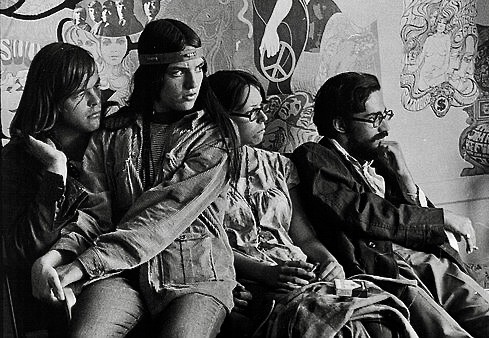
   George Hendricks was a Hells Angel in the San Francisco chapter who was hit by a car while swerving around a stray cat one August afternoon in 1967 as the Summer of Love was winding down. He was thrown from his motorcycle and died later that night from his injuries. He was known as Chocolate George because he was rarely seen without a quart of his favorite beverage, which was chocolate milk.

   “He drank chocolate milk because he had an ulcer,” explained Mary Handa, a friend of his. “He spiked it with whiskey from time to time.” He scored nips of the booze all day long.

   George Hendricks was a strapping 34-year-old when he died. He was a favorite among the hippies in Haight-Ashbury because he was funny and friendly. Sometimes he sported a Russian fur hat, making him look like a Cossack. His mustache and goatee were almost as long as his long hair, he wore a pot-shaped helmet when riding his Harley, and his denim vest was sprinkled with an assortment of round tinny pin badges. One of the badges said, “Go Easy on Kesey.”

   The writer Ken Kesey had been the de facto head of the Merry Pranksters. Much of the hippie aesthetic traced back to them and their Magic Bus.

   “I bought a used car,” Arunas said.

   It was parked in the back next to the nerve-wracking back stairs. The stairs were sketchy. Going up and down them always felt like it might be the last time as they twitched and shook and seemed on the verge of yanking themselves off the brick façade. I avoided them whenever I could.

   The car was a two-door 1958 VW Karmann Ghia. “You know how the Beetle has got a machine-welded body with bolt-on fenders,” Arunas said.

   I didn’t know, but I nodded agreement keeping my distance from the car. It looked like a soul mate to the stairs. It was pock-marked with rust and seemed like it might fall apart any second.

   “Well, the Karmann Ghia’s body panels are butt-welded, hand-shaped, and smoothed with English pewter.”

   I didn’t know what any of that meant, either, but nodded again.

   “Does it drive?”

   “It got me here.”

   “From where?”

   He bought the VW at a used car lot on E. 78th and Carnegie Ave.. It was two or three miles away, on the Misery Mile of used car lots.

   “Where is Chocolate George buried, exactly?” I asked.

   “He’s not buried, not exactly,” Arunas said.

   Five days after his death more than two hundred bikers followed a hearse up and down San Francisco’s narrow streets, pausing and revving their engines at the Straight Theater, near where the accident happened. Two quarts of chocolate milk were perched next to the cold body in the back of the hearse. The funeral ceremony was performed at the Cypress Lawn Cemetery, Chocolate George was cremated, and his ashes scattered over Twin Peaks, which are in the center of the city.

   The funeral procession became a motorcycle cavalcade, roaring to Golden Gate Park where, joined by hundreds of hippies from Haight-Ashbury, a daylong wake erupted. Big Brother & the Holding Company and the Grateful Dead were the live music send-offs. There was dancing and psychedelic merrymaking.   

   “Sometimes the lights all shining on me, other times I can barely see, lately it occurs to me, what a long, strange trip it’s been,” Jerry Garcia sang in his mid-western twang. There was free beer courtesy of the Hells Angels and free food supplied by the Diggers.

   The Haight Street Diggers were said to be a “hippie philanthropic organization.” They used the streets of San Francisco for theater, gatherings, and walkabouts. The organization fed the flock that made the scene in the Panhandle with surplus vegetables from the Farmer’s Market and meat they routinely stole from local stores.

   Two months after Chocolate George’s funeral the Diggers announced “The Death of the Hippie” by tearing down the store sign of the Psychedelic Shop and secretly burying it in the middle of the night.

   “So, do you want to go?” Arunas asked, his hand on the hood of the Karmann Ghia.

   “Sure,” I said, short on memory and long on summertime.

Ed Staskus posts stories on 147 Stanley Street http://www.147stanleystreet.com and Cleveland Ohio Daybook http://www.clevelandohiodaybook.com. To get the site’s monthly feature in your in-box click on “Follow.”

Fire in the Hole

By Ed Staskus

   My father was a firm believer in the harder you work the better your station. He meant better car, better house, more money in the bank, and basically better everything. He had become a refugee after WW2, getting out of Europe in 1949 with a duffel bag and twenty-five dollars in his pocket. By the time he got to Sudbury, Ontario he was down to five dollars, but found work in the nickel mines right away. That was what immigrants were for. Even though I wasn’t sure the long march to better was better, I was barely 15 years old the summer of 1966 and not about to argue with him.

   When I came home that summer from what turned out to be my last two-week Lithuanian boys and girls camp on Wasaga Beach, I was immediately put to work. My father got a job for me on the chain gang of a landscaper who was redoing the grounds at Mt. Sinai Hospital. We trimmed trees, ripped out dead shrubs, replacing them with new ones, and planted flowers.

   Mount Sinai Hospital began in 1892 as the Young Ladies’ Hebrew Association “caring for the needy and sick.” It opened as a hospital in 1903 on E. 32nd St., catering to east side Jews, then moved to a bigger building on E. 105th  St. in 1916. It was still there. In time it became the healthcare provider to Cleveland’s urban poor. It was still there. The poor hadn’t gone anywhere.

   My number one thankless task at the hospital was unloading heavy rolls of sod and laying them down to make new lawns. That meant removing the old grass and some of the worn-out soil beneath it, preparing the ground with a bow rake, breaking up large chunks, placing the sod, neatening the edges, and finally watering it. Handling the hose was easily the easiest part of the job. By the end of the first day I was dirty, soggy, and very tired. 

   I got a ride to work every morning from Val, a Lithuanian American like me, who was home from college. He drove a 1960 Plymouth Valiant with push-button transmission shifters. There was no button for park, but there was a lever for it. Flipping the lever to the top put the transmission into park and popped out whatever button was in gear. It was entertaining watching Val smack the buttons from first to second to drive and back as he fought the traffic.

   We jumped on I-90 at E. 185th St. and took the Liberty Blvd. exit, driving along the winding road through Rockefeller Park to the work site. The 200-acre park was given to the city by John D. Ruthless in 1897. Four stone bridges carried traffic and trains over the boulevard, there was a lagoon for rowing, fishing, and ice skating at the southern end of it, and a couple dozen Cultural Gardens down the three-mile length of it.

   The gardens are a series of landscaped green spots celebrating ethnic communities in Cleveland. The first green spot was the Shakespeare Garden in 1916, which later became the British Garden. The Cultural League carved out the next one, the Hebrew Garden, in 1926. After that it was off to the races. In the next ten years fourteen more gardens were created, including Italian, Hungarian, and Lithuanian. The idea was to dedicate a garden to each of the city’s immigrant groups, which at the time made up about a third of the population.

   In 1936 the city unified the gardens with bordered paths. Busts and statues were installed in many of them. The first One World Day took place in 1946. A parade of nationality floats and bands blaring hometown favorites started at Public Square and marched four miles along Euclid Ave. to the Cultural Gardens, where there were speeches and a ceremony. Afterwards there was food, souvenir stands, hobnobbing, and dancing to more music. By the middle of the day Liberty Blvd. sounded like the Tower of Babel.

   Val and I were listening to “Hanky Panky” by Tommy James and the Shondells on the car radio one Wednesday morning, curving down onto Liberty Blvd. on our way to work, when we were brought up short by a Jeep with a machine gun mounted on the back. It was blocking the road. We could see more Jeeps in the distance. “One of the Jeeps had a plastic lei hanging down from the .50 caliber gun,” said Wayne Baker, who lived in the adjacent St. Clair – Superior neighborhood. Cars were turning around and going the way they had come. Val pulled over to the side until a National Guardsman walked up to our car. 

   “You need to turn around,” he said. “This road is going to be closed today, maybe for the rest of the week.”

   “Why, what’s going on?” Val asked.

   “There’s a fire in the hole, boys. The coons are raising hell, busting into stores, burning them down.”

   “What about the parade?” I asked. One World Day was scheduled for the coming weekend. My parents, brother, sister, and I always went. All my friends went, too. It was a big thing.

   “I don’t know about no one world, but there ain’t going to be a parade until things cool down.”

   The street fighting had started Monday when a Negro man walked into the white-owned Seventy-Niners Café at Hough Ave. and E. 79th St. He asked for a glass of cold water to cool himself down. It had been a hot day in a long hot summer. The bartender said no, get the hell out of here. Somebody got a magic marker and a piece of cardboard. He made a sign and posted it outside next to the front door. It said “No water for coloreds.” 

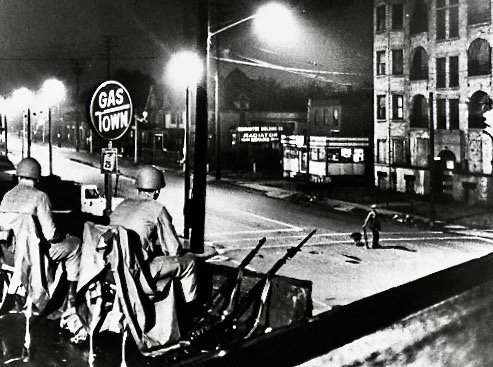
   One thing led to another and before long the Cleveland Police Department had a riot on its hands. The more policemen who showed up the bigger the mob got. By the next day there weren’t enough policemen in the city to handle the uproar. Mayor Ralph Locher asked Ohio Governor James Rhodes to send in the National Guard. They showed up through the night and deployed in the morning.

   It was too late for many business owners. The Provenzano family got a call early that morning that all the windows in their restaurant on E. 97th St. and Euclid Ave. were broken and they should bring plywood pronto. The eatery was the family’s bread and butter. By the end of the day there was a run on sheets of plywood at hardware stores, although it often became just more tinder when buildings were torched. 

    “Why are you home so early,” my mother asked after Val dropped me off. “Did you do something wrong?”

   “No, the colored people did, there’s a riot going on,” I said. “We couldn’t get to work.”

   In the mid-1960s 60% of northern whites agreed that Negro students should be able to go to the same schools as everybody else. 70% agreed with residential integration. 80% agreed that they should be able to get the same jobs as whites and 90% agreed that they should enjoy public transportation without having to sit in the crappy seats in the back. All the agreeing sounded good, except when Negroes tried to take them up on it. 

   100% of Lithuanian Americans didn’t care what bus Negroes rode to whatever job, but the same 100% was opposed to Negro children in their schools and Negro families moving into their neighborhoods. When the moving in started was when the white flight started. My parents weren’t any different than any other Lithuanian American I ever heard say anything about it. They hated Russians, distrusted Jews, and looked down on Negroes. Their culture was one of religion, property, and community. They thought Negroes were slow-moving and shiftless, belonged to the wrong religion, and didn’t respect private property.

   There were no Negroes where we lived, at all. I delivered the Cleveland Press, the city’s afternoon newspaper, door-to-door six days a week and collected money for it once a week. I knew the faces of who lived on our street of one hundred-some houses. There weren’t any black hands on my route handing me their weekly payment of fifty cents, and a tip if they wanted the rubber-banded newspaper to land securely on their front porch the following week.

   Our parochial high school, St Joseph’s, was the same as my paper route. I might see a black face once in a blue moon, but not in any of my classes. They were the janitors. There were many sizable Catholic families in our neighborhood of North Collinwood and they were a solid wall of European stock.

   With the Brown v. Board of Education of Topeka decision and the emerging Civil Rights movement, the times were slowly changing, but it was a bumpy change. Integration meant ill will and uproar. There had been some incidents at Collinwood High School, a few miles southwest of us, the year before. “With the passage of each year, the western fringes of the Collinwood area are being occupied by the Negro overflow from Glenville,” according to the Cleveland Plain Dealer, which was the morning paper.

   The Five Points Riot happened a few years later. Four hundred white students and their sullen parents, milling around Collinwood High School one morning, started throwing rocks, smashing more than fifty windows. The two hundred newly enfranchised Negro students attending the school fled to the third-floor cafeteria. When the mob stormed  the building the Negroes blocked the stairs to the third floor with tables and chairs, breaking off the legs to arm themselves. Cleveland police from three districts poured in, forming a cordon to keep the whites from attacking the blacks who were boarding buses. 

   “Be careful around them,” my mother warned, meaning Negroes. “They might have a knife.”

   My mother and father believed Negroes were liable to go off at the drop of a hat. I took my parents at their word. It was always touch-and-go messing with their point-of-view. They survived three invasions while growing up in Lithuania, were in Germany during the convulsive last months of the Third Reich, emigrated to North America with just about nothing except willpower, and worked their way up to be devout Republicans in the New World. They were short-tempered about anybody questioning their beliefs.

   Once, goofing around with my friends, I said, “And in this corner, still undefeated, my mom and dad and their long-held beliefs.” That was a big mistake, especially since my mother and father were within earshot.

   Hough was a powder keg the summer of 1966. Downtown to the west was white, University Circle to the east was white, and in the middle was Hough, which was black. The housing was substandard and overcrowded. The area stores were dumpy and overcharged for their wares. The police were selective about who they served and protected. When the race riot got rolling there was rock throwing, looting, arson, and some gunfire. Four people were killed, all four of them Negroes. Two were caught in crossfires, one was killed by a white passerby while waiting at a bus stop, and one was shot by a Little Italy man who said it was self-defense. More than thirty were injured, close to three hundred were arrested, and hundreds of fires were set. There was an estimated $2 million in property damage. Many homes burned to the ground, most of them in Hough. 

   A friend’s grandmother, born before the turn of the century in Poland, lived on White Ave. north of Hough Ave. The big houses all around her small house had all been converted into boarding houses. They were overcrowded, but what could anybody do who needed a bed but was hopelessly short of cash? The grandmother had gone to stay with her children in Parma during the disturbance. She was upset and wanted to go home to “my own place,” which was her home. 

   Real family income rose rapidly in the 1960s. From 1960 to 1970 median family income, adjusted for inflation, rose to $20,939 from $15,637. It did, at least, if you were white. It didn’t if you were not. It went the other way. “It is a stark reality that the black communities are becoming more and more economically depressed,” Bayard Rustin observed in 1966. “There has been almost no change or change for the worse in the daily lives of most blacks,” Carmichael and Hamilton observed in 1967. “Although it is true that the income of middle-class Negroes has risen somewhat, the income of the great mass of Negroes is declining,” Martin Duberman observed in 1968.

   You can only do so much with less. It’s smooth sailing when there’s money in the piggybank. It’s a hard slog when the piggybank is living lean. Living on bits and pieces is bitter and maddening. “The white man is reaping what he has sown. He is learning you can’t push people around. The trouble is here because the white man won’t treat the black man right,” the owner of a barber shop in Hough said. 

   A grand jury later concluded that the Communist Party, outside agitators, and black nationalists organized the uprising, but the finding was laughed off. No Communists had been seen in Cleveland for years and not even outside agitators nor black nationalists wanted to be caught dead in Hough, fearing for their health and safety.

   An angry crowd started an overflowing fire on Cedar Ave. during the weekend, burning down most of a block of stores, but that was the high and low point of the lawlessness. Life in the ghetto returned to normal on Sunday and the next day merchants started reopening. The National Guard was released from duty. Val and I went back to work mid-week.

   From where we stood on the grounds of Mt. Sinai Hospital it looked like nothing had happened. But there were two Cleveland Police patrol cars parked at the front, and one near the back, that whole week. There had always been police cars around the hospital, coming and going, but those three stayed around the clock.

   Nobody wanted to talk overmuch about the riot, except to say “that was nuts, burning down where you live.” My parents and their friends said “it’s a damned shame about the parade.” Val and I shouldered on for another two-some weeks. When the project was done we were sent to Bratenahl, mowing lawns for the millionaires who lived in the east side lakefront mansions.

   Our last day at Mt. Sinai, which was a Friday, driving home on Liberty Blvd., the Cultural Gardens looking great in the summer sun, Val said, “Have you noticed there isn’t an African American garden?” He didn’t call them Negroes for some reason. 

   “No,” I said.

   “They were some of the first immigrants, not that they wanted to come here, but still, you would think there would be a garden for them, especially since this is all in their neighborhood.”

   “I guess so,” I said.

    Val was five years older and wiser than me. He was going to an east coast college, majoring in history. He called what he was studying ‘The Decline of Western Civilization.’ He knew all about foreign movies and writers like Jack Kerouac and Allen Ginsburg. He wore his hair long. Some in the community called him a dirty hippie, even though he worked like a sharecropper.

   The idea of building a garden for Cleveland’s Negro community was brought up in 1961 by Cleveland councilman Leo Jackson. He proposed a “Negro Cultural Garden.” The mayor supported the proposal, but it was voted down by his finance committee. In 1968 the idea came back, including a statue of Martin Luther King, Jr., who had been assassinated that year. Nothing came of it until 1976, when Congressman Louis Stokes resurrected it. Ground for the garden was broken in 1977, but the project stalled until 2016, almost forty years later, when it was finally brought back to life and finished.

   When we turned off Liberty Blvd., racing up the entrance ramp to I-90, Val punched the spunky Valiant’s push buttons through its gears and we rode the current of rush hour traffic back to North Collinwood. The weekend was coming up. We had our paychecks in our pockets. We were both ready as could be.

   “I’m glad to be going home,” I said.

   “You and me both, pilgrim,” Val said. “Shelter from the storm.”

Ed Staskus posts stories on 147 Stanley Street http://www.147stanleystreet.com and Cleveland Ohio Daybook http://www.clevelandohiodaybook.com. To get the site’s monthly feature in your in-box click on “Follow.”

Hole in One

By Ed Staskus

   When Hal Schaser met him at the Kenwood Village Apartments, Wade Riddell had two bum knees, although they were the least of his problems. The burly man had been a Cleveland Police Department detective for fifteen years and a uniformed officer before that. He told Hal that in all that time he only drew his service handgun a handful of times and never once fired it. He lived with the same bullets on his belt all his life.

   He had bad knees from playing handball at the downtown YMCA.

   “I probably never should have played that game, but I loved it, although it and my job cost me my legs and my marriage,” he said.

   Hal met Wade after his own marriage fell apart and he lost his house, which was a lot like what happened to his new pal. They met on the grassy courtyard of the apartment complex on East 222nd St. in Euclid, where they both lived, when Hal saw him messing around with golf clubs on a warm spring day. The ex-cop was retired and living alone.

  Hal wasn’t retired, not exactly, but he lived alone, too.

  They played golf together for the next three years. He was the best friend Hal ever had, even more than the Jew, even though he ended up doing more for Hal later. Wade was affable and did things for him that he never even asked him to do. After Hal moved to Lakewood, Wade got him a car, convincing his lady friend to give him the old Ford she was planning on trading in when she got her new car. He later mailed a check to him for five hundred dollars, to live on, knowing Hal was strapped for cash, knowing his ex-wife had taken him to the cleaners.

   It wasn’t his fault the Ford’s transmission blew out, stranding him in the middle of nowhere. His son-in-law picked him up, driving him home, but wouldn’t lend him the money to get it repaired.

   “Fixing it will cost more than the car is worth,” he said. “You’re better off sending it to the scrap yard.”

   He knew he was right but knew at the same time his son-in-law didn’t want to lend him even one dollar. He could tell he didn’t trust him, even though he had always been an honest man. All his friends said so. He wasn’t sure what his daughter thought, whether she was just backing her husband up, or not.

   He junked the Ford and got a hundred bucks for it.

   After that he had to walk to the Lakewood Library and McDonald’s, the grocery and the bus stop all that winter, the winter Wade blew his head off, and the next spring until Charlie Taylor died and left him a hundred thousand dollars. The trust sold the dead man’s house and old furniture and threw everything else out. They converted his bonds and insurance to cash. Hal was able to buy a new car, a two-door Suzuki that never ran out of gas.

   When his wife Teresa walked out on him, and took all the money out of their joint accounts, swooping up the kids and talking him into taking a second mortgage out on their house so she and her new boyfriend from Rochester could open a restaurant, and Palmer Bearings went bankrupt, putting him out of the only work he had ever done since getting shipped home from the Korean War with a Purple Heart, it was then he played more golf than he ever played in his life, and waited to be thrown out of his house.

   When he finally got the boot and moved out of Indian Hills, down the hill to the flatlands, he was in his late 50s. “I was hanging on, waiting to get to 62, so I could get my Social Security early. I needed the money bad. When I worked for Palmer Bearings, they gave me a new car every year, with an expense account no one ever questioned, and I was in line to be made a vice-president, up to the day the Shylocks closed the doors without a word of warning to me.”

   Hal had a chip on his shoulder about it. He was aggrieved and bitter. Sometimes he went for a walk to cool down. He didn’t hate Charlie Taylor, but he could do without Jews.

   “There were years when I almost always had a thousand dollars, or more, in my pockets every day. Those days were gone. I made the day for them. I made them rich. In the end they took it all away from me, just like my wife did. They broke me and my wife broke me down.”

   When he moved to Euclid he moved into a no-rent apartment, an apartment that Angelo, the maintenance man at the apartment complex, who he met through Stan, a Pole he often had breakfast with at a railroad car diner on Green Road, not far from the giant Fisher Body and TRW plants, got for him when he was hired to be his helper.

   “Stan and I talked all the time over cups of coffee. We got to be good friends, even though he was a thick-headed Polack. He was a hell of a bowler. He was good enough to bowl in tournaments, and I went to a couple of them to watch him. It was hop, skip, and glide to the line. He was always pounding out strikes. It got old, though, and I stopped going, except when the drinks and pretzels were free.”

   Angelo was from Texas and was a Korean War veteran, like Hal. He talked to the man who was the boss, who owned the apartment complex, into hiring him. Hal didn’t like the man, didn’t like his thin shrewd face, but kept his mouth shut.

   “That’s who runs the country. They run the money, which means they run everything else, too. They own most of the gold in the world. They marry inside the family, keeping it all together for themselves.”

   He shoveled snow, did some of the gardening, and vacuumed the hallways. He cleaned apartments when they went vacant and got paid extra whenever he had to clean kitchens, scrubbing the stove and emptying out the fridge, throwing away spoiled food. He made a few bucks here and there, one way or another. He stayed sharp on the uptake whenever it was there. He kept his head above water.

   The apartment complex had been built during World War Two for government workers. It was built like a tank, sturdy as a fort. The brown brick buildings were three stories with garages in the back. Fox Ave. intersected the complex and ran all the way to Babbitt Ave., where there was the Briardale Greens Golf Course. Wayne and he shuttled to it on good days, getting in eighteen holes.

   “He wasn’t any good, and complained about the walking, but we got along. I always went looking for the balls he shanked. That way there wouldn’t be any problems about where they lay.”

   Wade worked part-time at night, in a booth selling betting slips at the Thistledown horse racing track in North Randall. He was on his own during the day, which was how he and Hal were able to go golfing together whenever Hal was free to go. They went to tournaments in Akron, to watch the professionals. Stan went with them once, but he wasn’t used to hiking around anywhere wider or longer than a bowling lane and got worn out.

   After Hal didn’t have a car anymore, Wade always drove the two of them. He had gotten a new dark blue Mercury four-door sedan. “He loved that car and talked his lady friend into getting one, too. That was how I got her old Ford.”

   When Hal moved to Lakewood, on the west side, to the no-frills Elbur Manor apartment building across the street from St. Ed’s High School, Wade visited him a few times, even though he didn’t like Hal’s small apartment.

   “It’s a dump,” he said. It wasn’t the apartment’s fault. Hal wasn’t a tidy man. He hoarded whatever came his way

    Hal took Wade to McDonald’s for breakfast. “I could tell he was suffering. It wasn’t just his knees. He had prostate cancer and was hurting. It was just a matter of time. I called him on Christmas Eve and wished him happy holidays. He didn’t sound good, but he didn’t sound bad, either. At least, that’s what I thought. I was dead wrong.”

   Wade’s son was a pre-law student at Miami University. He had tried out for the football team as a walk-on and made the cut. That fall he saw playing time as the team’s back-up quarterback when the starter was injured. “He was a hell of an athlete,” Hal said. He drove to Euclid from Oxford to see his dad the Christmas weekend. Wade told him all about his new Mercury.

   “Take my car and give it a little ride,” he said. “I haven’t driven it for a while. It needs to be out on the road.”

   His son got the car and drove it up and down Lakeshore Boulevard. It had snowed overnight, but not much, and what snow there was had been plowed to the side. When he got back, he found his father in bed. Wade had put a pillow over his head and a gun in his mouth. When he pulled the trigger, it was the first and last time he ever shot a gun at a living human being.

   After the funeral Hal hoofed it around Lakewood until summer, when Charlie Taylor, his golfing buddy for many years, who was in his 80s, got sick. He was taken to Fairview Hospital, and when there wasn’t anything else the doctors could do, they moved him to the Welsh Home in Rocky River.

   “Charlie was a great guy and great friend of mine, my other best friend for a long time. He was on our golf team in the Cleveland Metropolitan Golf Association. We had about ninety members and most of us were friends. We played golf until it was too cold to walk the courses. After that, any of us who could afford it went south to play. I went to sunny parts of the country to play golf many times, when I was married, and in the clover, and even afterwards, until I couldn’t afford to go anymore.”

   Charlie Taylor passed away in his sleep and a month after his funeral Hal got a registered letter from a lawyer saying he had been included in the will. “He left me his house. It surprised me but didn’t surprise me. I was the only person who ever listened to what he had to say, who stuck around when he lost track of his train of thought, who waited for him to reminisce about something else he was bound to remember sooner or later, even though it was a lot of nothing. After the house was sold, I got a check for a bundle.”

   He bought his new car, paying cash for it. He paid off his credit card debt, the plastic he had been living on, and bought a new laptop computer, so he didn’t have to always go to the library to work on his get-rich schemes. He stopped sending e-mails to his son-in-law when he exploded about them one day, saying he was sick of the Ponzi schemes. He told Hal he was never going to buy in to any of them, so don’t bother.

   “I was always a good friend with different people, including Wade and Charlie, who were my two best friends. It’s good to be best friends with the good guys. Otherwise, you end up with duck eggs. My ship is coming in one day. When it does, I’ll dump the Suzuki in the blink of an eye and get an Audi convertible.  I’ll go to Florida every winter. I’ll play golf in the sunshine again.”

   He bought new shirts and shoes and ate better. After squirreling the rest of Charlie’s money away he was in good shape. He stayed in his dog-eared apartment to keep costs down. He thought about buying birthday presents for his grandson and granddaughter, even though he hardly ever saw them, and when he did see them, hardly paid any attention to them. He didn’t work at much of anything and played golf all the next summer at new nicer courses. He carried the certificates for the two holes in one he had made over the years in his wallet. He went to both Wade and Charlie’s graves and paid his respects. He only went once, but it was enough.

   He made some new best friends, joining a coffee klatch at the new McDonald’s on Detroit Rd. across the street from the Lutheran church that was closing soon. They sat around shooting the bull and drinking free re-fills. “Don’t play too much golf,” he told them. “Two rounds a day are plenty.”

Ed Staskus posts stories on 147 Stanley Street http://www.147stanleystreet.com and Cleveland Ohio Daybook http://www.clevelandohiodaybook.com. To get the site’s monthly feature in your in-box click on “Follow.”

Messing With Bigfoot

By Ed Staskus

   The week we went to our last Boy Scout camp at Lake Pymatuning State Park wasn’t any seven days longer than any other summer camp we had gone to, but since it was going to be our last camp, my friends and I were determined to make the most of it, stay up most of the time, lengthening the days and nights, mess around in the woods and the lake, raid the girl’s side, and play mumble the peg.

   Most of us carried jackknives and some of us had fixed-blade sheath knives. We were always whittling on something. “No mumbledy peg,” our scoutmaster told us in no uncertain terms, in uncertain English, in his strong Lithuanian accent, speaking through his Chiclet teeth.

   One way we played mumble the peg was to first stick a twig into the ground. We threw our knives at the ground, flipping from the palm, back of the hand, twist of the fist, and every which way. Whatever the other scout did, if he threw it backward over his head, and it stuck, you had to do it, too. If you failed, then you had to mumble the peg. You had to get on your hands and knees and pull the twig out of the ground with your teeth.

   The other way we played was to stand opposite each other with our legs shoulder-width. Taking turns, we would flip and try to stick our knife into the ground as close to our own foot as possible. The first toss was always in the middle, but when the other guy got closer, you had to get closer, and the closer and closer it went. Whoever stuck his knife closest to his own foot, and the other guy chickened out, was the winner.

   If you stuck the knife into your own foot you won on the spot, although nobody ever wanted to win that way. It was why everyone who had not gotten their first aid merit badge and was going to get in on mumble the peg at camp took the class at the park ranger cabin a half mile away. It was taught by an older scout who wore leopard-print camouflage pants and shirt. One of us read from the only available Red Cross manual, while he was the hands-on guy.

   It was the only book-learning merit badge on the program. Sticking our noses in a book at summer camp was the last thing anybody except the bookworms wanted to do. They read what somebody else had dreamed up about fun. We dreamed up our own fun.

   We were going to look for Bigfoot and nab him if we could. He was the hide and seek world champion, but we knew he was somewhere around the lake. What we were going to do with him once we got him, none of us knew. We thought, if we did find him, and he was friendly, we would ask him where he lived and what he did all day. 

   “His name is Sasquatch,” the cammo-clad scout told us, looking like he thought we were retards.

   There were more of us than Bigfoot, or whatever his name was, for sure. There were seven of us, first-generation immigrant children like all the boys and girls at the camp, and we were all Eagle Scouts. None of us had earned any Palms, though, since none of us had gotten more than the twenty-one merit badges needed to get to Eagle, but all of us were going for twenty-two, since Somebody’s dad had brought two canoes. We were looking forward to it after we heard what getting a canoeing badge was all about.

   What it was about was jumping out of a canoe in deep water and getting back in without capsizing, then performing a controlled capsize, and swimming, towing, or pushing the swamped canoe fifty feet to shallow water. Once in the shallow water, empty the swamped canoe and reenter it. Back in deep water, rescue a swamped canoe and its paddlers by emptying it and helping the paddlers reenter their boat without capsizing. We were all about that, come hell or high water

   We had searched for Bigfoot at camp before, but sporadically, never having a plan. This time we had a plan. We brought flashlights, we had a map of the landscape north of our camp, and a compass, and we made sure all of us had sharpened our knives just in case the creature tried to mess with us. Finding Bigfoot would put Troop 311 on the map.

   Seven years earlier Bigfoot had terrorized a weekend Cub Scout camp at the park in the middle of the night. The scoutmaster was jolted out of a sound sleep by the screams of his boys. He stumbled out of his tent to find the 11-year-olds crying and running around in circles. Using a whistle and a flashlight he got them to stop and form a line. He then asked them what was going on.

   It turned out four of the boys had been woken up suddenly by a loud noise. Their tent started to shake. They thought it was a prank being played by their friends, until the tent was ripped from the ground and thrown into a tree. A very large shadow bellowed at them. It was Bigfoot. Two of the boys immediately shut their eyes. The other two were mesmerized by its glowing eyes. They couldn’t look away.

   The beast was satisfied with scaring them and left. The scoutmaster searched, but only found the tent high in the tree. He built a fire and gathered all the boys around him. In the morning he cut the camping weekend short and they all rushed home.

   Troop 311 was the Lithuanian American scout troop on the east side of town. Our headquarters was the community hall at Our Lady of Perpetual Help Church, just off E. 185th St., the principal road, and the spine of Lithuanian life and culture in Cleveland. Our group was all 15 and 16 years old. 

   The younger kids didn’t know anything. The older guys who were still scouts were Explorers, in it for life. We knew this was our last camp at Lake Pymatuning. Next year we were hoping to go out on a high note at the 12th World Scout Jamboree at Farragut State Park in the Rocky Mountains.

   “I will bust a gut if we make it there,” said Linas, our camel train’s wise guy.

    The first thing we did when we got to Lake Pymatuning on late Saturday morning was haul our stuff, clothes, sleeping bags, tents, food and supplies out of the fleet of Ford station wagons, Chevy station wagons, and Pontiac station wagons our parents had driven us in to the camp site. We set up our tents in a perpendicular line to the lake, hoisted the communal tent, dug a fire pit and a latrine trench, after which we built a 30-foot-high abstract frame sculpture out of dead tree branches. Everybody went for a swim when we were done.

   The lake is partly in Ohio and partly in Pennsylvania, on land that used to be a swamp. It is named for Pihmtomink, the chief of the tribe who lived in the swamp. When the Indians were pushed off their land, and told to go somewhere else, the first farmers had a hell of a time. The swamp was infested by mosquitoes carrying yellow fever. Farm animals were eaten by bears and mountain lions or sank in quicksand. There was a massive flood in 1913. Finally, the Pymatuning Land Company bought all the land, thousands of men worked from 1931 to 1934, and built a dam. The lake they made is 17 miles long and 2 miles wide.

   There’s a spot called “Where the Ducks Walk on the Fish,” where people throw bread to thousands of carp and Canadian geese. Birds of a feather rush around like madmen on top of the fish to snag their share of it.

   Our scoutmaster’s tent was nearest to the lake. Vytas Jokubaitis was a short barrel-chested man with blondish hair and a red face. He wore a wide-brimmed hat, the same kind that Robert Baden-Powell wore, to keep the sun off his face. But he usually had the front brim pushed up. That wasn’t why his face was red, anyway. He wasn’t a bad man, but he had a bad temper that boiled over at the drop of a hat. Nobody ever wanted to get on the wrong side of the scout oath, or scout motto, or the scout code with him. There was the devil to pay when that happened.

   He was our Scoutmaster, or Scouter, so we called him Scooter since we couldn’t call him Vito. He didn’t like that. He was a grown man, and we were kids. He didn’t like us calling him Scooter, either, but what could he do? Besides, we never called him that to his face. He was a “Yes, sir” and “No, sir” kind of man.

   He was from Alytus, the same town where my mother had been baby-sitting when the Russians stormed into Lithuania in 1944. She got out in the nick of time with her aunt and her aunt’s four kids on a horse drawn wagon with a cow tied to the back. By 1966 it had been 22 years since she had seen anyone from her family, who were all stuck behind the Iron Curtain.

   Vytas Jokubaitis organized Zaibas and the Lithuanian American Club in Cleveland, and had gotten medals, although he never wore them to camp. The CYO gave him the “Saint John Bosco Award.” We all went to Catholic schools, but none of knew who John Bosco was. He sounded like chocolate syrup.

   Vytas’s wife Ona was industrious and not about to be outdone by her husband. She ran the camp as much as he did, although she stayed on the girl’s side. She was the head of the Parents Committee of Zaibas, raised mounds of money for the Lithuanian Relief Fund, and was Outstanding Citizen of the Year in 1960. Cleveland mayor Ralph Locher gave her the award and a handshake to boot.

   They told us about Lithuania at the night-time campfire like it was the best place in the world, but none of had ever been there. Lithuania was like Bigfoot, something we heard about, but didn’t know if it was real or not.  When they talked about the Baltic and the dunes at Nida, all we could picture were the dunes at Mentor Headlands State Park on Lake Erie. That’s what we knew. We didn’t know Lithuania from the man in the moon.

   We got up early every morning, raised our flags on poles we had brought, did exercises in a field, made breakfast, and took a break after that. We washed our clothes in the lake and dried them on our tent lines. Scooter was focused on physical fitness, so before lunch we had to go on a forced march. We wore Lemon Squeezer campaign hats and uniform green knee socks and were burdened with backpacks full of responsibility. Our only consolation was being let loose afterwards to run and dive into the lake.

   The younger scouts worked on merit badges in the afternoon. We were free to drift off, which we did, fooling around, exploring the shoreline, and mumbling the peg in secluded top-secret spots.

   We did service projects, planting seedlings, and raking out the beach. We climbed trees and had our own “Big Time Wrestling” match with a Negro Scout Troop from Louisville. We went on more hikes before dinner. They were supposed to be short, two to three miles, but Scooter always took us out four and five miles. We hiked every day, rain or shine. We went on a night hike and got lost every which way.

   “It’s like training to be a mailman,” Linas grumbled.

   The last night of camp started after the campfire and lights out. A half hour later we snuck out of our sleeping bags, out of the campsite, and to the grove of crabapple trees on the other side of the girl’s side. There were plenty of last year’s old crabapples littering the ground that squirrels hadn’t gotten. We filled our pockets with them. When we got close to the girl’s tents we unleashed our barrage of missiles. They thunked the canvas and the girls woke up screaming. The next second, though, they were screaming mad. As soon as we were out of ammo, they rushed from their tents, led by the irate Milda, followed by the captivating Ruta, picked up the sour fruits, and started throwing them at us. We scattered and they ran after us, pelting us, but stopped when they ran out of fireworks. 

   Algis had a lump on his head where he got hit. We rubbed it to rub it away, but he said, “Cut it out, you’re making it hurt even more.” He was good to go in a minute. We went looking for Bigfoot, following the beams of our flashlights. We thought he had to be somewhere in the woods, away from the water, where there were always tents and trailers all summer long. Bigfoot was beyond any doubt a loner.

   We knew he was going to be hard to find in the dark even though he was probably nine feet tall. He was covered head-to-toe in swarthy hair. We were hoping to find footprints, which had to be enormous. We tramped around for hours looking for him, but all we found was a skunk, who raised his tail before we backed off, and two racoons on their hind legs, peering at us from behind their masks.

   “Maybe he avoids white people, since they chased off his ancestors,” Gediminas said.

   “You think he’s an Indian?” Andrius said . We called him Andy since calling him Andrius annoyed the crap out of him.

   “He’s got to be. Why would he live in the woods, all naked, no furniture or TV? Only Indians do that.” 

   “That makes sense to me,” Linas said.

   Looking for Bigfoot turned out to be a wild-goose chase. We whacked our heads on tree branches, tripped over roots, looked high and low, left no stone unturned, but he wasn’t anywhere to be found. We trudged back to camp, tired and disappointed.

   I don’t know what got into us. One minute we were sneaking back to our tents and the next minute we were sneaking up to Scooter’s car. It was a four-door Ford Country Sedan. After checking the driver’s door, finding it was unlocked, and quietly opening it, putting the manual gear into neutral, the next minute we were all at the back pushing the car down the slope toward the lake.

   Nobody said a word when it got stuck in the muck. The water slurped up to the front bumper. Nobody still said a word when we slouched back to our tents and threw ourselves down on our sleeping bags.

   The next morning we were woken up by ferocious bursts of anger and dismay. We were bum rushed out of our tents and lined up in a row. We could see the shipwrecked Ford down the bank. Scooter read us the riot act. None of us had any idea he knew so many swear words. He gave each of us the third-degree, face to face, glaring, but nobody was talking.

   “I will give you one last chance,” he finally said. “Whoever did this step forward, apologize, know that you broke the code of scouting, and we will forgive.”

   We all knew that wasn’t going to happen. Scooter wasn’t one to ever forgive and forget. His face was getting redder and redder. It looked like he might explode. Then Linas stepped up before he blew up.

   It was hard to believe he was going to spill the beans. He was the least tame scout among us. He was no chicken, either. He proved that every day. He had thrown down the mumble the peg gauntlet the first day and fended off all challengers. Playing the peg was forbidden but he played it more than anyone else and played it best, yet there he was ready to tell all about pushing our scoutmaster’s car into Lake Pymatuning.

   “Yes?” asked Scooter.

   “I think it was Bigfoot, sir,” Linas said.

A version of this story appeared in Lithuanian Heritage Magazine.

Ed Staskus posts stories on 147 Stanley Street http://www.147stanleystreet.com and Cleveland Ohio Daybook http://www.clevelandohiodaybook.com. To get the site’s monthly feature in your in-box click on “Follow.”

Laying Low on E. 4th St.

By Ed Staskus

   It never mattered what time I stepped into Otto Moser’s, morning, noon, or night. Somebody was always intoxicated at the bar. If they were quiet enough everybody ignored them. If they got unruly, they ended up being tossed out on the sidewalk. If it happened in the morning, they waited outside on the sidewalk for forgiveness.

   Otto Moser’s was a downtown bar restaurant on East 4th St. in Cleveland, Ohio. When I started cutting classes at Cleveland State University it had been there about eighty years. It toasted the century mark just before its time came due. It was a narrow deep-set place between a shoe store and a Woolworths. A civil defense shelter was between the variety store and Otto Moser’s, in case the Russians went crazy and started dropping atomic bombs. Everybody at Otto Moser’s agreed they would stay right where they were, where there was food and drink.

   Europeans drink more alcohol than anybody else in the world and Lithuanians knock back the most of any European drinkers. The ethnic community I belonged to was swimming in it, even though they put their faith in God and country first. Booze was a belief in and of itself. Even though I was part of the bloodline, I wasn’t much for strong drink. A couple of beers put me under the table, so I nursed whatever was in front of me. Most of the times I went to Otto Moser’s it was to hang out. The price of a chair for the afternoon, between the lunch and dinner crowds, was a cup of coffee and a grilled cheese sandwich.

   The restaurant’s grand opening was in 1893 when E. 4th St. was called Sheriff St. The Euclid Avenue Opera House was across the street and there were five theaters and two burlesque houses inside the blink of an eye. Many actors, businessmen, and stuffed shirts stopped in for a bite and hootch. Otto collected their autographed portraits, framed them, and hung them on the walls of his saloon. It got so there were more than a thousand of them. There were six mounted animal heads, including a moose named Bullwinkle.

   When Otto died in 1942 two of his employees, Max A. Joseph and Max B. Joseph, took over. Their mother had wanted a third Max she could name “C” but it never happened, much to her regret. The two Max’s didn’t change anything. Sometimes they closed their doors to the public, when the cast of a big show took the place over, or the Metropolitan Opera was in town. When it was, they closed nights for most of that week so the singers could kick back and relax at their leisure.

   Whenever I went there during mid-day the waitress was Norma Bunner, who had been there since 1955. She never looked at menus and never wrote my order down. The coffee was always fresh and the sandwiches hot, with extra pickles on the side. I liked to read when I was by myself, which was most of the time.

   I often stopped at Kay’s Books before going to Otto Moser’s to pick up used paperbacks that rarely had anything to do with my college studies. I was majoring in film and literature, so I made sure my fun reading was sans the classics. I read the John Carter of Mars series, Jim Thompson’s hard-boiled pulp, and Jorge Luis Borges’s short stories about knife fights in the stockyards of Buenos Aires.    

   Kay’s Books was on Prospect Ave, or what some folks called Prostitution Ave., at the corner of East 6th St. There were adult movie houses, hookers and pimps, and other questionable morals on both sides of the street. There were several wig stores and rotgut bars. If I was going to Kay’s in the morning, I got off my bus at Public Square, walked through the May Company, left by the back door, and slid past the Domino Lounge, its jukebox blasting, slipping into the bookstore.

   There was a raised platform on the right inside the front door of the bookstore. A large gay man who went by the name of Harry Condiles worked behind the counter, looming over everybody and everything, wearing white button-down shirts with the sleeves ripped off. He was friendly up to a point.

   “Get out of here, you creeps,” the boss lady blew up whenever his boyfriends stopped in to visit. He knew where everything was, was quiet and patient, although he could lose his temper if questioned one time too many. One day when a customer couldn’t find a book for the third or fourth time he snapped, “Oh, it’s up there, over there by those damned books, over by that damned thing there.” 

   He had a keen eye for shoplifters. He knew when a purse or bag didn’t look right. The boss lady was Rachel Kay. She appreciated his profit and loss smarts. She was always somewhere in the three-story building, her shoes click clacking on the mosaic tiled floors, keeping order as best she could.

   The place was stuffed full of books and magazines. I never saw the basement, which was rumored to be filled to the brim with them, but what I saw upstairs made me think they had a copy of every book ever printed. The aisles were narrow and the shelves floor to ceiling. There were rows of books behind every first row of books. It was sort of organized. New hardcovers were up front. Poetry was on the mezzanine. Mass market paperbacks were on the second floor. The upper level was for health magazines full of female nudists. Everything else had to fend for itself.

   The paperbacks I bought were fifteen cents, maybe a quarter. Some of them had been sticker priced so long ago I knew I was coming out way ahead when adjusted for inflation. Cockroaches that ate the glue were rampant, so I learned to check the bindings. The boss lady didn’t always stick to the sticker price. She wasn’t above saying a book stickered $2.95 was worth more, crossing out the price, and writing $4.95 in black crayon in its place. Whenever anybody argued with her about being a highhanded profiteer, first, they didn’t get the book, and second, were told to take their business somewhere else.

   I was reading a dog-eared copy of “Ernie’s War: The Best of Ernie Pyle’s World War II Dispatches” one afternoon when one of the barflies got up, limped over to my table, and plopped himself down in the chair across from me. He looked at the book. I looked at him. His eyes were watery.

   “Whatcha reading?” he asked.

   “Are we getting acquainted?” I asked.

   “You betcha,” he said.

   I thought before I spoke, wary of anymore cha cha cha’s. He seemed affable enough. He seemed sober enough, at least.

   “It’s about World War Two.”

   “I was in that war, fella,” he said. 

   “Is that right?”

   “You don’t believe me?”

   “I’ll take your word for it.”

   “All right, all right,” he said, reaching for his billfold. “I gotcha.”

   He pulled out a five-pointed gold star attached to a faded red, white, and blue ribbon.

   “What is it?” I asked.

   The Silver Star,” my newfound friend said. “It’s awarded for gallantry in action against an enemy of the United States.”

   “What did you do to get it?

   “I was on Tarawa.”

   “What’s that?”

   “It’s an island in the Pacific. We landed there in 1943. I got shot twice before it was all over, but I killed my share of slant-eyes. Those sons-of-bitches were tough.”

   The battle for Tarawa was fought in late November, part of Operation Galvanic, the invasion of the Gilbert Islands. More than 6,000 Japanese and American soldiers died during the three-day fighting, mostly on and around the 300-acre bird-shaped island of Betio, southwest of Tarawa Atoll. It was the first American offensive in the central Pacific. The nearly 5,000 Japanese defenders were well-prepared. They fought to the nearly last man. It was all over in three days.

   “The island was the most heavily defended atoll that would ever be invaded by Allied forces in the Pacific,” said Joseph Alexander, a Marine amphibious officer who later became an historian. One combat correspondent who landed with the fighting forces called it “the toughest battle in Marine Corps history.”

   “It was flat as a pancake” the barfly said. “There was nowhere to hide. We dug holes in the sand fast as we could, like crabs.”

   “Every spot on the island was covered by direct rifle and machine gun fire,” Marine Colonel Merritt Edison said.

   “We landed on amphibious tractors,” my lanky friend said. His hair was thin and unkempt. His teeth were bad and his fingernails were yellowish. He smoked Lucky Strikes one after the other. He wasn’t wearing a wedding ring, but his watch was a Rolex, and his shoes were soft fancy leather. He was down but not out. He waved towards the bar for his drink to be refreshed. “It was one goddamned mix-up after another,” he said.

   Shelling from the American warships was disjointed. The landing time was delayed twice. Headwinds pushed the landing craft between the devil and the deep blue sea. Scaling the seawall was more deadly than anybody thought it would be.

   “Those who were not hit wading ashore would always remember how the machine gun bullets hissed into the water, inches to the right, inches to the left,” wrote Robert Sherrod, a correspondent for Time Magazine.

    The Japanese used their grenades to good effect once the Marines started landing. Corporal John Spillane, a major league baseball prospect before the war, caught two of them barehanded and threw them back before a third exploded in his hand. His baseball career was over in that instant.

   “You got shot two times? Is that how you got the medal?” I asked.

   “Yes and no” he said. “It was when the Japs counterattacked the third night. They were screaming and yelling running right at us out in the open. Our artillery opened up on them until they were so close to us that they had to shut down. It was hand to hand after that.”

   “How did you get the medal?”

   “A squad of gooks got low with their Type 99 machine guns, the kind that had armored shields, and were spraying us. We had to take them out. Five of us went with grenades. Another one of us had a flame thrower. We took care of business, but I was the only one who made it. I dragged one of the guys back. I didn’t know he was dead. I got plugged in the shoulder and my leg, right here near the hip. The medics jacked me up with morphine and a bottle of sake and that was the end of the war for me.” 

   After the ferocious battle, which saw only 17 wounded Japanese soldiers surrendering, the island was awash in carnage. “Betio would be more habitable if the Marines could leave for a few days and send a million buzzards in,” Robert Sherrod wrote afterwards. Marine General Julian Smith declared the enemy “wiped out.” After that it was on to the next island.

   The disheveled man an arm’s length away had been a hero once. Watching him I thought of Marcel Proust, one of my least favorite writers, who I had been forced to read for one of my English classes. Why we had to read a French dandy was beyond me.

   “Remembrance of Time Past” is one and a half million words long. During a Q & A session I asked our professor how many times he thought a person would need to go to the bathroom getting through the endless magnum opus. He gave me a sour look. Proust scribbles words, words, and more words about his day-to-day life, society, manners, friends, enemies, boys, girls, courtesans, and love and love lost and the love of love and, above all, jealousy and recrimination. After a while it just makes you want to puke.

   I couldn’t finish it. It didn’t seem like there was a pay-off in store. Cliff’s Notes were created because of that book. When the class was over, I threw the book away.

   Just as I was about to ask what happened, how he went from hero to tosspot, my friend said, “I gotta go to the john.”

   There was one thing about Proust that I remembered. He wrote that we think we are living in the world when we are only really living in our minds. Everything is inside us, not just now, but all of the past. We are a house of mirrors. I realized my friend had no doubt told his World War Two story to countless listeners, some willing, some procured at random like me. My booze hound was staring in the same mirror day after day. Otto Moser’s was a way station and a confessional.

   When he came out of the bathroom, he walked past me like he either didn’t see me or I didn’t ring a bell. He went out the front door. It was for the best. I had a four o’clock class and needed to get going. I stuffed my stuff into my backpack, paid the bill of fare, and walked out into the bright afternoon.

   The VFW man was outside, three sheets to the wind, supporting himself by leaning on the fire hydrant at the curb with an outstretched arm. He must have done a shot for the road. He was standing in a patch of dull sunshine. He was a ship in a bottle.

   “Are you all right?” I asked.

   “Sure, man, I’m OK,” he said.

   “Where’s home?”

   “Old Brooklyn, up by the zoo.”

   “You might want to go home and dry out.”

   “I’d probably die if I tried drying out,” he said.

   “There’s always tomorrow morning. Otto’s opens early.” 

   “I know the order of business here, son, theirs and mine.”

   “I understand, but In the meantime,” I said, “maybe don’t lean on that Johnny pump.” I pointed at the hydrant. “Guys are always peeing on it.”

Ed Staskus posts on 147 Stanley Street http://www.147stanleystreet.com and Made in Cleveland http://www.clevelandohiodaybook.com. To get the site’s monthly feature in your in-box click on “Follow.”
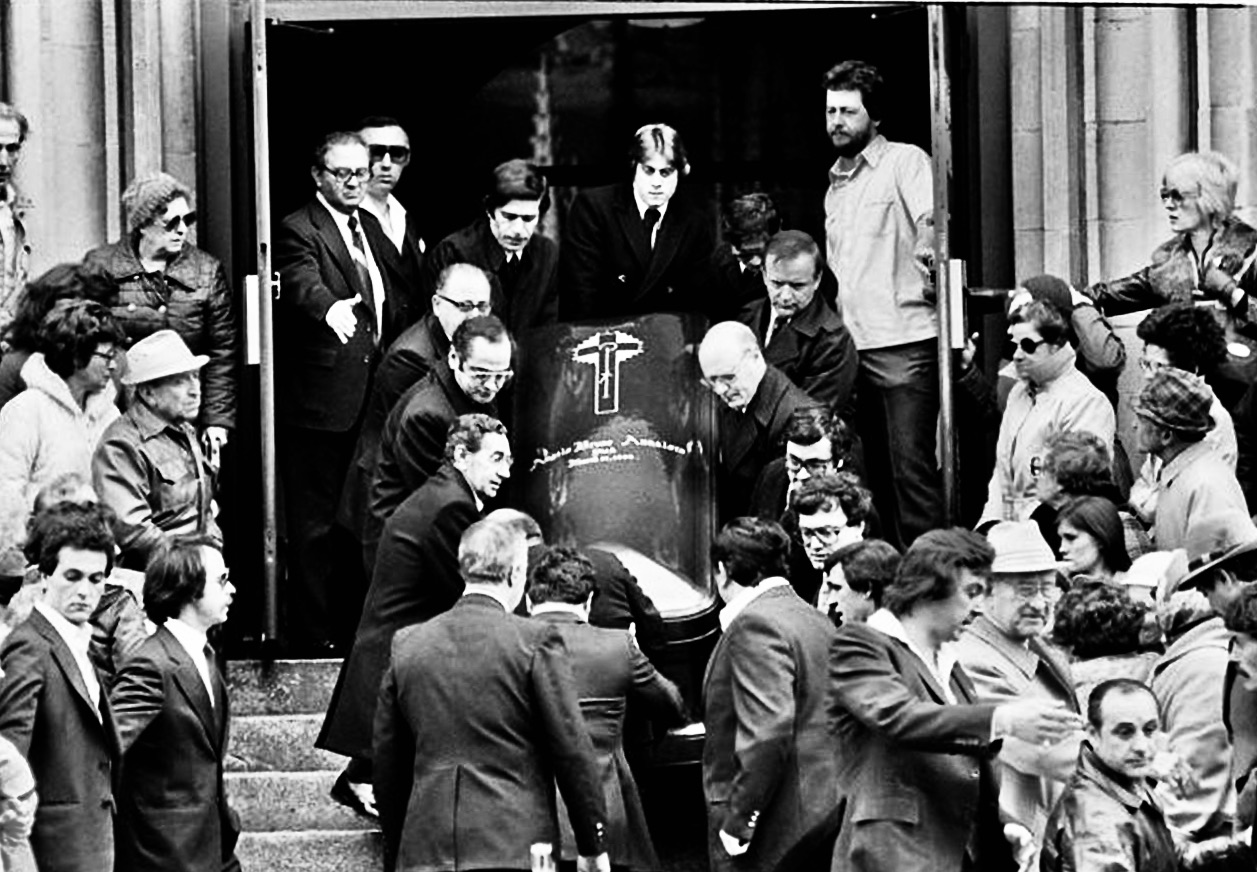
Vanishing Act

By Ed Staskus

   Hal Schaser was always excited by Catholic girls. His mother was Saxon Lutheran, and she raised his brother Willie and him as Lutherans, but Catholic girls were for him. That’s why he married one. But they had to be at least a nine or ten on the good-looking scales at the same time they were Catholic. If they weren’t, they didn’t count, not in his eyes. 

   All the guys rated gals, one way or another.

   He went to Florida every winter after he got back to Cleveland, before he got married. He came back from the Korean War with a Purple Heart, and after he got back on his feet, went right to work for Palmer Bearings. They put him in sales the minute they saw him. He was 22 years old, clean-cut, proportioned, and full of pep. He didn’t tell them about the bad hearing in one ear he came back with after a year as an artilleryman.

   His city pals, the young men he knew who had the dough to go south for a couple of weeks when it got dark and cold on the south coast of Lake Erie, razzed him about being picky.

   “All you do is keep looking for a number ten girl, and half the time you don’t got any girl on your arm,” one of them said one day while sucking on a bottle of Blatz. “Me, I get a number three or four, so I’ve always got a gal, and by the end of the week they all add up to more than zero.”

   Another of his pals, another wise guy on the camel train, said, “Hal, if you ever land a ten, she’ll be out of your league, anyway, so forget about it.”

   Teresa Stasas was Catholic, between a nine and a ten, and 15 years old when Hal met her. He was 25 years old. She lied about her age, not that she had to. But after he found out he made sure she was eighteen before they got married. “We missed out on the cash envelopes and presents, since her family was dead set on me staying single and Teresa marrying somebody else.” He didn’t care. He wanted Teresa. He wanted to get ahead to the high life with her fast at his side.

   They met at the Karamu Theater. Hal lived with his mother on the near east side, and Teresa took a bus from North Collinwood, where she lived with her three sisters and parents in a two-bedroom house. Hal liked auditioning for parts and acting in shows. It got him started with the girls. He looked like Paul Newman, which didn’t hurt his chances. He was always trying out for shows at the Chagrin Little Theater, too.

   “I met a boatload of lookers that way.”

   Teresa was in high school shows and danced ballet. She had taken dance classes ever since she was a little girl. She could straighten a leg, keep a foot flat on the ground, and raise the other one to the ceiling. 

   “I don’t know how the hell she did it. I always liked ballet dancers. I fell in love with one when I was in high school. Her name was Margo. She was a beautiful girl with a beautiful body, the same age as me, but an inch taller. She was one of the gym leaders and danced ballet on stage at our school. Another guy liked her, a Serb who played a lousy hillbilly guitar, and he was always angling to get into shows with her.”

   Hal started trying out, trying to get close to Margo, trying to elbow the Serbian boy aside.

   Teresa and he met auditioning for the same show at Karamu. He kept his eyes on her from the minute he set eyes on her. “She came on to me and did stuff like, ‘Can you give me a ride home?’ I had a car, she had stars in her eyes, and on starry nights it was a nice ride. She sat close to me on the bench seat.”

   She would sometimes leave something in his car, like her wallet or watch. “She would call me, and I would drive to her house, returning it, seeing her again. It was those little tricks women do.”

   Her parents were set in stone in opposition to her wedding bell plans. “It won’t work,” they both insisted. He was Lutheran, ten years older than her, born in the United States, but Romanian-bred. They were Catholic and Lithuanian, from the old country. She was still a teenager. He had a better job than either of her parents, making more money than the two of them put together, but it didn’t matter. 

   Teresa and Hal had to elope, driving across the Ohio line to Indiana, where they found a justice-of-the-peace on the side of the road, and got married. They went to Florida for their honeymoon. “We drove straight there in a new car I had just gotten. We stayed in the same motel my buddies and I used to go to. Our suite had a small kitchen and there was a big pool we went swimming in.” They sat out in the sun. Their skin got a shade darker. They discovered each other in the dark.

   When they got back to Cleveland, Teresa’s’s parents disowned her, and she didn’t see them for years. They moved in with Hal’s mother, in the meantime, in the old neighborhood, around East 65th St. and St. Clair Ave. Most of his countrymen worked in factories, ore docks, and knitting mills. His father had operated a corner store until he was murdered by two young thieves.

   “I worked hard, saving my salary and commissions, and the next year we bought a two-story house in Indian Hills, up from Euclid Avenue, near the city park.” The house fronted a sloping wooded lot. Their daughter Vanessa was born the next year and their son Mathias four years after that. Their problems started three years later. They never stopped getting worse.

   “We started out great, got the year of living with my mother out of our systems, moved into our big house, three bedrooms, newer than not new, got the kids grown up enough to walk, and my job got bigger and better the more I worked. I took clients out for golf and dinner three and four times a week. I kept my waistline under control by walking the courses. My handicap took a nosedive.”

   He was making money hand over fist. “I made a lot of money for Palmer Bearings. Those heebs loved me, so long as the pipeline stayed full and flowing.” His bosses said, “Keep up the good work.” His neighbors envied his one after the other new car. His wife complained about him never being home. “What do you do all those hours at work?”

   “I do a lot of business on golf courses,” he told her. “It’s work, don’t think it’s all just fun and games, it’s not.”

   Whenever he came home right after work, Teresa came running out the front door, grabbing him, giving him a hug and a kiss. He thought, this is embarrassing, the neighbors are watching, even though he barely knew any of their neighbors. “Cut it out,” he said. She gave him a queer look. He kissed the kids and read a book while Teresa set the table and served dinner.

   “I took her to dinner and shows, but it was never enough. I always let her do whatever she wanted. I let her teach cooking at the high school. I let her get a job at a restaurant. I let her go to Cleveland State University. It got to be a problem, because no matter what I did, it was never enough.”

   Teresa was a good-looking young woman, shapely and good on the move, friendly and running over with zip, and men eating at the restaurant were always hitting on her, but Hal’s problem was the young men she met at college. “One time I found a note in a drawer from some guy named Dave, thanking her for the great time they had. When I asked her about it, she said it was just a bunch of them from one of her theater classes going out for a drink.”

   “That’s all it was,” she said.

   “You’re not getting together with him?”    

   “No,” she said, “of course not.”

   He didn’t believe her, not for a minute. He knew what women were about. But he didn’t know everything. He didn’t know he was on his way to splitsville.

   Hal found out more, small things that looked like big things, about other men she was cheating on him with. He was sure of it. One night he answered a call from a man who sounded like he was from India, asking for her. He hung up. She was coming home later and later at night, 10 o’clock, 11 o’clock, midnight. It began to look like the babysitter would have to start living in.

   “Where the hell were you?” he asked one night when she got home close to two in the morning.

   “Oh, my keys got locked in somebody’s trunk.”

   “It was always some bullshit story like that. We got into an argument. We got into a lot of arguments.”

   “Not so loud,” she hissed. “You’ll wake up the kids.”

   “It was her idea to get separated. Later it was her idea to get divorced. I loved her. I loved my kids. I didn’t want a bust-up. We could have settled the split between ourselves, but she had to get a lawyer, which meant I had to get a lawyer. Her mouthpiece must have put something in her ear, bastard lawyers.”

   He stopped at the Cleveland Trust Bank downtown on East 9th Street one day, after lunch with clients on Short Vincent, to withdraw some money, but the teller said, “There’s no money in your account, sir.”

   “What do you mean?”

   “The account is at zero,” the teller said.

   “Teresa had taken it all. She raided our joint bank account and took all the money in it. All I had left was what I had been keeping in a personal account she didn’t know anything about, the scratch I kept separate, and our insurance policies. She charged all kinds of stuff on our credit cards before I wised up and cancelled them all.”

   He paid his lawyer five thousand dollars, in cash. He got it from a separate business he had going, apart from Palmer Bearings. The lawyer was a golfing buddy of his, but he still had to pay it all up front. “The son-of-a-bitch, right away he joined the Shaker Country Club with it, and never invited me to play golf there, not even once, not even when I got in his face about it.”

   When they went to court, Hal picked a fight there and then. Not with Teresa, but with their two lawyers, his and hers. “The Saul Goodman’s get together with their crap, take all your money, and leave you with nothing. They are like morticians, just waiting for you to come back to life.”

   Between Teresa and them, he complained loud and long to his friends, they left him with only table scraps.

   Hal knew how to handle himself. He boxed Golden Gloves before going to Korea. He got to the finals in his weight class, and even though the other fighter was dazed purple and bloody, the judges gave the first prize to him. He was a Marine and Hal was an Army draftee, so the Marine staggered away with the trophy. 

   “I could have levelled both the shysters in a minute flat. The bailiff, and a policeman, and the judge, had to restrain me. The judge gave me a hell of a talking to after everybody was back in their seats.” It was a loud knock-down drag-out commotion on the third floor of the Lakeside Courthouse, under a high ceiling of ornate plasterwork, quiet paneled walls, and leather-covered doors.

   “They’re all the same, talking through their hats.”

   Teresa moved into the new Park Centre on Superior Avenue, the same building where some of Richard Hongisto’s right-hand men lived. He was Cleveland’s new top lawman, although inside a couple of years Dennis Kucinich, the kid mayor of the city, fired him on live TV. It sparked a recall drive to remove the mayor from office, which was the least of his problems, since the city was going bankrupt fast. The bankers hated the mayor and withdrew their helping hand of ready cash. They knew how to get back at him.

   “I say a plague on all of them, except that whoever did the car caper with her got me the last laugh on Teresa, for what it was worth.”

   He bought her a new Mercedes sports car, hoping it would make her happy. It had a red leather interior. She loved the car, although it didn’t make her any happier about him any more than she wasn’t already. When they separated, she reported the car stolen. She called Hal about the insurance money. He told her he would let her know. He didn’t tell her the car was in his name. 

   “A month later I got a letter from a parking garage in New York City, saying we’ve got your car here, you owe so much for parking, come and get it. I was sure one of Teresa’s cop neighbors cooked it up with her, driving the car away, and leaving it in the garage. When I got the insurance check for the missing car, I cashed it and tore the letter up.”

   Teresa was a looker in her time, always worth a second look. Hal wasn’t sure how she looked when she got older, since after their last fight he never saw her again. He was certain her looks had gone south. “I’m sure she wasn’t the beauty she had been. I’m sure she looked like hell. That’s something I would bet money on.”

   She had beautiful handwriting but wrote Hal hate letters after their separation. 

   “Your kids don’t want to see you, you haven’t sent me enough money, all that kind of crap. I had to pay child support, even though I was used to a certain style of living for myself. I had to go on dates, looking for another woman, but it wasn’t easy. I couldn’t operate. I didn’t have much money. You’ve got to have money to do things. I was nearly broke. I had to take care of my kids. I didn’t want to be a deadbeat father.”

   Teresa met another man, a handsome Italian from Rochester, a Vietnam veteran. They moved in together, with her children. They didn’t pretend to be married, even though they lived like man and wife. They wanted to get married, but Hal wouldn’t give Teresa a divorce, no matter how many times she asked.

   “She and the guy from Rochester got it into their heads to go into the restaurant business. She asked me to take a second mortgage on the house. I said no, restaurants are the worst thing you can get into. In spite of myself I took a second mortgage on the house and gave her the money. It put me in a spot.”

   Teresa’s restaurant became two restaurants. The new family moved up to the seventeenth floor of Park Centre, to a three-bedroom end suite facing Lake Erie. They watched the Cleveland National Air Show from the balcony. They opened a bar on the new Eat Street in the apartment complex.

   “The dago was always telling me, take it easy, like he was trying to be my friend. I wanted to tell him how mad I was about not being able to get my wife back, about never seeing my kids. I never said one bad thing about her, but the divorce hurt me bad. After the mess in court, after we split up, I thought, if that’s the way it’s going to be, I don’t want anything to do with her anymore. I don’t want to talk to her, and I don’t want to see her. And I never did, except once more.”

   Teresa came to the family house in Indian Hills on a quiet autumn afternoon. She asked Hal to mortgage the house again, a third time, so she could expand her eateries some more, but he told her a second mortgage was all banks would go for. She said she needed more investment money and that he should sell the house, splitting whatever he might get for it with her.

   “If I do that, where am I going to live?”

   “That’s up to you.”

   “She was living downtown, in her fancy high-rise. What did she care where I lay my head? It could be some crummy cardboard bed under a bridge, as far as she was concerned. We got into an argument about it. My boy was with her. He stuck up for his mom. I didn’t blame him, though. I liked that about him.”

   Push came to shove, and Teresa slapped Hal hard in the face when he finally had enough, nose to nose, shouting that he wasn’t going to sell the house, that they were through once and for all, and that was that. 

   “She scratched me with her fingernails when she slapped me, cutting me, and drawing blood. I pushed her away.”

   They glared at each other.

   “Quit it. Go away,” he said.

   Teresa’s mouth went cold thin-lipped, she twisted around, reaching for her son, and stamped out. She didn’t look back. The front door slammed shut. He didn’t see her or the money he had lent her ever again.

   He was on the ropes. He knew the TKO was on its way, making its slow way to down and out. He had let his guard down and there was nothing he could do about it. He would have to take it like a man.

Ed Staskus posts stories on 147 Stanley Street http://www.147stanleystreet.com and Cleveland Ohio Daybook http://www.clevelandohiodaybook.com. To get the site’s monthly feature in your in-box click on “Follow.”

On Thin Ice

By Ed Staskus

   When I lived on the far west side of North Collinwood there wasn’t anything unusual about a dog barking. What was unusual was barking that never stopped. The dog was an American pit bull who was chained all day long to a stake in a front yard two houses down. He had good reason to bark. He was a full-grown pooch, tan with a white chest. At night he vanished and the street was quiet.

   Nobody liked the barking, but nobody ever worked up the courage to say anything. The dog was Lou’s dog. Lou was some kind of gangster on our side of town.

   I walked Sylvester, my Great Dane, every day and night and avoided the barker, going the other way. There was no point in messing with his school of thought. One day I was preoccupied and there we suddenly were right in front of him. He was so surprised he didn’t make a peep. We crossed the street. He started barking up a storm. Before I knew it, he jerked, lunged, and ripped the stake out of the ground. In an instant he was running across the street at us snarling, the metal stake on the other end of the chain kicking up sparks behind him on the concrete.

   The west end of North Collinwood butts up to Bratenahl, which is its own posh enclave six miles from downtown Cleveland. The two neighborhoods couldn’t be any more different. In the 1970s Bratenahl’s median household income was wondrous and North Collinwood’s median household income was lousy. 

   Bratenahl is a village on the south shore of Lake Erie. It is one of Cleveland’s oldest streetcar suburbs, strategically cut off from the city to the south by railroad tracks and the Memorial Shoreway, bordered by Gordon Park on one side and the Northeast Yacht Club on the other side. The village police station is on the road that dips under the highway and becomes East 105th St, the main north south artery in Glenville. Bratenahl is 98% white while Glenville is 98% black. The neighborhood is notorious for the late-60s Glenville Shootout, back when bussing was making headlines and racial tensions were boiling over.

   Bratenahl’s famous sons are too many to count, although they are trumped by Collinwood’s George Voinovich, 54th mayor of Cleveland, 65th governor of Ohio, and two-time United States Senator. Joe Shuster and Jerry Siegel lived in Glenville when they were creating Superman. My neck of the woods was sketchy. There were wicked men in the shadows.

   I could have used Superman when the pit bull charged us. I had a Great Dane, though, who was no shrinking violet of a Clark Kent. I let him loose, he whirled on the pit bull, got behind and on top of him, and clamped his jaws on the back of the other dog’s neck. By the time Lou came running out of his house it was all over.

   He apologized up and down. I knew he was sincere because he was in the crime business and never went out of his way to apologize to anybody about anything. My dog sat on his haunches looking out into the distance while we talked. He was feeling like Bratenahl. The pit bull smoldered, his eyes going slit-like and red. He was feeling misunderstood.

   A thousand-some people live in Bratenahl within one tree-lined square mile. Twenty thousand-some people live in North Collinwood within three close-knit square miles. A two-bedroom two-bath unit in the Bratenahl Towers sells for between three and four hundred thousand dollars nowadays. There is a $1,000 monthly maintenance fee. A three-bedroom three-bath house in North Collinwood sells for a hundred thousand and change. Maintenance is up to you. It wasn’t much different in the 1970s.

   Lou was in his late 20s, single, and plenty of young women came and went. He drove a black 1973 Pontiac Luxury LeMans. It was one of the biggest cars on the road, the size of a rhino, cruising down the road like a Barco lounger. He never went into details, but everybody knew he worked for the underworld. Lou didn’t call it the Mob or the Mafia. He called it the Group. He made it sound like a fraternal outfit, getting together with the guys to chew the fat.

   John Scalish was the top dog. He took control in 1944 and stayed on the throne of blood for thirty-two years, taking his last breath in 1976 after hardened arteries got the better of him. His gang was allies of the Chicago Outfit and the Genovese Crime Family. Nobody asked what Lou did during the day, but we all knew when it got dark he hung out at the not-so-secret members-only nightclub around the corner on Lakeshore Blvd.

   It was a squat one-story building with a flat roof and no sign. There was a no fooling around steel entrance door. A hand-written square of cardboard taped to the back door said, “Keep Away” in block letters. A burly man in a blue Dodge Coronet lay low in the back of the parking lot from dusk to dawn, keeping his eyes open for troublemakers. The joint jumped with babes and booze. Lou worked the inside, making sure everybody stayed happy and keeping a semblance of order in play.

   My lodgings were on Westropp Avenue, a few blocks away. It runs parallel to Lakeshore Blvd. from East 140th St. to East 152nd St. It doesn’t end at East 152nd, but becomes Waterloo Rd. My front porch was within spitting distance of Bratenahl. I stayed snug as a bug upstairs in the Polish double. Ray Sabaliauskas owned the house, living it up with the pint-sized Asian wife he had brought back from the Vietnam War.

   Although I had never had a dog and didn’t want one, I had a dog. He had been left behind when my brother’s fiancée was killed by a drunk driver out in the suburbs. My brother moved out the funeral. We had been roomies. I stayed because I could sort of afford to live on my own and liked being within walking distance of Lake Erie. The CTS 39B bus stopped right on Lakeshore Blvd., slowly but surely getting me downtown to Cleveland State University.

   The Great Dane’s name was Sylvester, although I called him called him Sly and the Family Stone. I walked him every morning and again in the evening. Our morning walk was so he could do his business and the evening walk was so he could do his business and stretch his legs. We crossed Lakeshore Blvd. to the open field between Bonniewood Dr. and Overlook Park Dr. Once there I removed his lead and he ran around like a nut. When he got it out of his system, we walked to the beach. In the winter, if the lake was frozen, we walked on the ice.

   Early on an overcast February evening, already as dark as midnight, we were about one hundred feet from the shore when Sly broke through the ice and fell into Lake Erie. He couldn’t get up and out, although he was able to keep his head above water. When I tried to walk to him the ice started cracking under my feet. I stopped. There wasn’t anybody anywhere except us. I had to get him out of the water. It was windy and his whiskers were going frozen icicles by the minute.

   I got on my belly and crawled to where he was. I had to be careful. If I fell in, we might both end up in Davey Jones’s locker. I grabbed his collar. He didn’t like it and pulled away. I got a better grip and yanked as hard and fast as I could, getting him halfway out. He got the idea and heaved himself out the rest of the way. When he tried to stand up his legs splayed apart and he flopped. I gripped his collar and we slowly on all fours made our way to land. I was wet and cold. Sly was wetter and colder. On the way home he stopped and shook himself all over trying to get dry. He got drier but got me wetter with the spray.

   It was warm inside the house. I rubbed Sly with bath towels, spread one on the floor in front of the living room space heater, and he lay down, licking the big wet spot he was. I filled the tub with hot water and took a long soak. The next day neither of us showed any aftereffects, except that Sly ate two big helpings of Bil-Jac in one sitting.

   In the winter Lou’s pit bull lived indoors. I hardly ever saw the dog. I saw Lou coming and going. He seemed to be on the go day and night. I thought he might be a runner for the Italian lottery in Hough and Glenville, picking up the bets and doling out the winnings. The Ohio Lotto was still more than a decade away.

   Even though Lou’s house and yard were bare bones, it was clear he had dough to burn. The lock on his front door was Fort Knox. He had a big car. The garage door lock was Fort Knox’s best friend. He dressed well and carried himself with confidence. He always had a roll of twenty-dollar bills held together by a rubber band inside his pants pocket.

   John Nardi controlled Teamsters Local 410. He wanted to control more. Leo “Lips” Moceri was known to be one of the most violent and ruthless criminals in the city. One day he walked into the council hall on East 22ndStreet. “Keep your hands off the Akron rackets and get rid of Danny Greene,” Lips shouted at John Nardi.

   “I’ll do what I damn well please!” John Nardi shouted back.

   “Do you know who I am?” Lips exploded. “I’m Leo Moceri and no one pushes me around!” 

   They went their separate ways after spitting in each other’s faces. Lips got the better of it since he had more to work with. That weekend he went to the Feast of Assumption in Little Italy where he snacked on cannoli’s and pawed the bottoms of passing teenage girls. He disappeared on Monday. Two weeks later his car was found abandoned in the parking lot of an Akron motel. There were a pair of new shoes in the back seat. The spare tire was missing and the trunk was drenched in blood. Not a trace was ever seen of Leo Moceri again, dead or alive.

   What the John Scalish Crime Family was up to in Cleveland was loansharking, bookmaking, narcotics, and labor racketeering. They were also blowing up the Irish gangsters led by Danny Greene. Cleveland was known as Bomb City USA. Danny Greene found and disarmed bomb after bomb targeting him until he finally didn’t find the last one. John Nardi was planning on taking over the whole shebang, no matter what he had to do, bombs or no bombs. He later went to pieces the same as Danny Greene.

   One morning I noticed Lou’s pit bull was panting in the heat of the sun and his water bowl was empty. It was still empty when I got home from Cleveland State University. I filled it up, keeping a wary eye on the beast. He slurped it down. The next day it was empty again. I filled it up again and brought him dried kibble. The dog and I made a separate peace.

   The next week a truck from Animal Control Services pulled up to the curb. Two men got out, one of them threw treats to the side of the dog, and when he turned that way, the other man got a slip lead around his neck. They loaded him into the back of their truck. It was the last I saw of him. It was also the last I saw of Lou, who I hadn’t seen for a while. When he was found what was left of him was deposited in a closed coffin. 

   The funeral was at Holy Rosary Church on Mayfield Rd. Even though many of Holy Rosary’s pioneer members were immigrant stone cutters, the church is built of brick. There are life-size statues of saints on top of the facade and the east corner is topped by a domed cupola. It was the first Italian parish in Cleveland.

   After the mass and the procession to the burying ground went its way, I was lingering at the base of the flight of stairs to the street. A tight-knit group of men in black suits were talking nearby. They were smoking cigars and cigarettes. There was a white gray cloud over their heads.

   “What’s the word on what happened?”

   “It was the niggers in Glenville. They stabbed him bad and then emptied a Saturday night special into his face. He was a mess.”

   “Anybody on it?”

   “Yeah, the coons are going to pay, first with what they stole from him, and then for what they did to him.”

   “Who’s on it?”

   “Shon is on it.”

   Shondor Birns was a gangster from the Little Caesar days. Even though he specialized in the numbers and loansharking, he was mostly an enforcer on the streets and back alleys. By the time he was 13 he already had a reputation for violence. The neighborhood toughs steered clear of him as somebody not to be fooled with. He lived by his wits and his fists. When he was arrested for the twentieth time as an adult and indicted as an enemy alien, he beat the rap, but the deportation order against him remained in play. No other country would admit him, however, so he stayed in Cleveland.

   Lou’s car and the loot he was carrying were lost and not found. I never found out if his confederates resolved the issue, whether Shondor Birns made anybody pay up, or not. By the mid-1970s homicides in Cleveland were setting records with more than 300 of them a year. Ten years earlier there had been about one murder a week, not one murder a day. There were too many of them going around to pay attention to what happened to Lou. I forgot about him and put his homeless dog out of my mind.

   The next winter was just as cold as the one before it and even snowier. I took Sly and the Family Stone for walks along Lake Erie, but we stayed on the shore. The Great Dane sniffed up the ice but thought better of it. He knew where he wasn’t wanted. He romped on the frozen beach and the dunes, instead, flailing up and down snow drifts. There was no sense in putting himself and me in harm’s way by setting foot on thin ice.

Ed Staskus posts stories on 147 Stanley Street http://www.147stanleystreet.com and Cleveland Ohio Daybook http://www.clevelandohiodaybook.com. To get the site’s monthly feature in your in-box click on “Follow.”

Time is Candy

Superman

By Ed Staskus

   Three hundred and sixty-four days of the year parents tell their children to never take candy from strangers. Then, on the last day of every October they dress those same children up in masks and weird costumes and tell them to go out on the streets at night and either threaten or beg strangers to give them candy.

   Halloween is traditionally a holiday observed on the eve of the Christian feast of All Hallows, or All Saints Day. In the Middle Ages it was believed that restless souls of the recently dead wandered during the year until All Saints Day, when their fate would be decided. All Hallows Eve was their last chance to get revenge on their enemies before entering the next world. Some people, fearing the consequences, would wear masks to disguise themselves.

   It wasn’t until the first decade of the 20th century that Halloween began to be celebrated in the United States and not until the 1930s that children began trick-or-treating. Since then costume parties, haunted house attractions, and watching horror films have also become popular.

   When I was a child Halloween was a special night after a long day filled with anticipation. My brother and sister and our friends and I couldn’t wait for nightfall to head out onto the dark streets and ring as many doorbells as we could.

   On the night of the last Halloween, postponed several days by thunderstorms, my wife and I and a neighbor sat out on our porch, on the top lip of the stairs, on a cold but dry night, with our cauldron of chocolate treats. We long ago learned that anything mostly chocolate was “the good stuff”.

   As we put fun-size Milky Ways and Kit Kats into plastic pumpkins, coffin containers, and grab-and-go pillowcases, we started asking some of the kids in cute spooky super hero disguises coming and going up and down our walk what they liked about Halloween.

   “The most fun is dressing up,” said one girl, dressed as the Material Girl. “I’m an 80s rock star. I love Madonna.”

   We wondered if she wasn’t chilly because of the weather.

   “I’m not cold,” she said. “I’m insulated.”

   One boy was a walking bundle of towels.

   “Some safety pins and a lot of old towels and you’re warm,” he said.

   We asked a puffed-up little boy in white what he was.

   “I’m a cloud!”

   “What is that on your pants?”

   “Lightning!”

   “What are those spots?”

   “Rain!”

   “Is that your mom?”

   “She’s a rainbow. We go together!”

   A girl dressed as a witch said she liked seeing other kids in costumes.

   “It’s a time for them to dress up like they’re not, to just be someone they never could be before.”

   Others take a minimalist approach. When we asked one boy why his friend wasn’t wearing a costume, he said, “See, he’s on his cell phone. He’s not wearing a costume because he’s a businessman.”

   Some children delight in the scary side of Halloween, the ghost stories, monsters, and gory special effects.

   “I like Halloween because it’s fun, “said a boy dressed in a Warrior Wasteland costume. “People scare you a lot. It’s so amazing. I just like the horror of it.”

   Other children take delight in seeing their heroes in the flesh.

   A stocky six-year-old in black pants, a red over-sized jacket, a red hat, and an enormous black mustache told us he was Super Mario.

   “Because I am,” he said. “My happy time, it was when I saw BATMAN! I love Halloween!”

   Another boy dressed as Spiderman said Halloween was fun because “Kids dress up!”

   “I like Spiderman because he’s red and white. If I was Spidey, I would sling my webbing and save all the people.”

   In an MSNBC poll, adults were asked what their favorite part of Halloween was. More than 50 percent said it was seeing little kids dressed in costumes, while just 10 percent said it was eating candy. Our own unscientific poll revealed the exact opposite. Nine out of ten kids told us it was all about the candy.

   “Candy is the best thing that ever happened to me on Halloween,” said someone in KISS regalia

   “It’s my favorite season. You get all the candy. I’m a vampire,” said a girl with bloody fangs.

   “They should have more Halloween weekends, and pass out a lot more candy,” said a boy dressed as a pirate, waving a rubber sword. “I would put it all in my treasure chest.”

   Many children walked the streets in groups, the smaller ones accompanied by their parents. But one teenager rode up alone on a bicycle, wearing a Beavis and Butt-Head latex mask. He jumped off his bike, which clattered to the ground, and ran up our walk. We tossed chocolate bars into his bag, asking him what he liked about Halloween. Sprinting back to his bike, he turned around and shouted,

   “Can’t talk, time is candy.”

   Our chocolate bars moved briskly all night, followed by the lollipops our neighbor had brought.

   “You just wolf down candy bars,” said a girl dressed as Fluff N Stuff, “but you can play with suckers, click them against your teeth.”

   I asked several children what were the least-liked least-desired treats they had gotten. Among the worst offenders were Mary Janes, Necco Wafers, and Christmas ribbon candy.

   “I don’t even know what Mary Janes are,” said a boy dressed as Luigi, in blue overalls, a hat two or three sizes too big, and white gloves.

   “They taste like molasses sawdust.”

   The worst offender, however, turned out to be money. Towards the end of the night, we ran out of candy, and since all we could see on the street were some stragglers, we gathered up our loose change to hand out rather than race to the corner store.

   A small girl dressed as Popstar Keira, with a tiara on her head, came bouncing up the stairs smiling. My wife put some dimes and nickels into her extended hand. The girl looked at the coins and then up at us. She threw the coins down stamped her feet and started crying.

   “I don’t want money! I want candy!”

   She refused to be consoled until we finally found a full-size Hershey bar in our kitchen and brought it out to her.

   After the streets were finally empty and Halloween was over, my wife and I popped a big bowl of popcorn and watched George Romero’s “Night of the Living Dead.” The moon was big and round and the sky clear. The last of the thunderstorms were past.

   When my wife, who had never seen the old black-and-white horror movie, finally realized what the zombies were after, she said, “Oh, man, it’s the undead trick-or-treating.”

Ed Staskus posts on 147 Stanley Street http://www.147stanleystreet.com and Made in Cleveland  http://www.clevelandohiodaybook.com. To get the site’s monthly feature in your in-box click on “Follow.”