
Our Daily Bread

By Ed Staskus

   My mother started working at Pick-N-Pay when my sister was 7 years old and had reached the age of reason. It was 1964. My brother and I were a few years older than our sister, but listening to my mother anybody would have thought we were still trying to catch up to her in smarts. We told our mother we knew our way around.

   She was mending a skirt. She put her needle down and said, “Boys, the young know everything, the middle-aged are suspicious of everything, and the old believe everything. I’m not young but I’m not old, either. Do you understand what I’m saying?”

   “Come on mom, we’re not stupid.”

   “Good,” she said.

   The next day we found out what she was saying when we asked an older student at school what she was saying.

   “What she’s trying to tell you is, she suspects everything, especially you two,” he said, walking away and shaking his head.

   “Oh, right, that’s what we thought,” my brother improvised. 

   We were living in a two-family house in the St. Clair-Superior neighborhood. The house had been built in 1903. There were tornado doors leading into the basement from the backyard and an out-of-date coal room. The anthracite chute had been bolted shut. There was a sweet gum tree in the backyard. It was where we played William Tell with rubber arrows. We attended St. George’s Catholic School, taking two city buses there in the morning and two city buses back home in the afternoon.

   “Every day Vytas drove to work and the kids went to school,” my mother said. “I was left all alone. Most of my friends worked, helping provide, but Vytas said under no circumstances did he want me to go to work outside of the house. We didn’t agree about that. One day after I learned how to drive I thought I would try to find a job in a bank. I looked in the newspaper. There was an ad for a new bank opening on Noble Rd. in Cleveland Hts. Vytas didn’t know I was going, but I went.”

   By that time we had moved to North Collinwood and were living east of E. 185th St. The bank’s main office was on Rockside Rd., 25 miles away. She had yet to drive five miles in any one direction. It took her an hour to get there. She didn’t get the job, but there were Pick-N-Pay offices in a building next door. She saw a sign saying they were hiring cashiers for a new store on the same Noble Rd. as the bank.

   Pick-N-Pay got started in the 1920s when Ed Silverberg opened a dairy store in Cleveland Hts. During the Great Depression he surprisingly expanded and called his new stores Farmview Creamery. He changed the name to Pick-N-Pay in 1940 and by 1951 they had grown to 10 locations. When my mother went to work for the supermarket chain there were more than 40 locations.

   “There were maybe 50 people filling out applications. They asked me if I played the piano. No, I said. They asked me if I knew how to type. No, I said.”

    The interviewer looked up from his desk. “He asked me if there was anything at all that recommended me. I told him I worked nights with a relative, an immigrant like us, who was an accountant. He moonlighted doing the books for more than a dozen women who staged Tupperware home parties.”

   The sales parties took place in living rooms. Tupperware was a plastic storage container invented by Earl Tupper. They were going like gangbusters. Our next-door neighbor Arlene Noga had a full set. She put leftovers in them instead of throwing the food away. Only after she forgot about the leftovers and they finally spoiled in the containers did she throw the food away. 

   “I am very good on adding machines is what I said to the man interviewing me.”

   Four women were hired that day. My mother was one of them. She started her new job on Noble Rd. two weeks later.

   “When I got home it was late. Vytas had made supper. As soon as I walked in the door he wanted to know where I had been. I hadn’t left a note. When I told him I had gotten a job he was unhappy.”

   “Who’s going to take care of the kids?” he asked.

   “They’re old enough to take care of themselves,” she said.

    It wasn’t exactly true but our father didn’t know that. He had a full time and a part-time job on top of that. We hardly saw him Monday through Friday. On weekends he told us what we must do and must not do. We didn’t have to deserve our mother’s love. We had to deserve our father’s.

   “My first day on the job, after my training, the head cashier showed me around the store. ‘Do your best,’ she told me. ‘You’ll never be as good as me but do your best.’  Everything had to be rung up one at a time. If there was a sale, like seven for a dollar, I had to do the division. Very soon, I didn’t have to look at the keys on the register, just push the groceries with one hand while my other hand rang them up while I talked to the customer. I got to be as good as the head cashier. Even she said so.”

   Starting in the 1970s, after cashiers rang up orders, they gave customers S & H Green Stamps based on their total purchase. It was a loyalty program. Shoppers pasted the stamps into booklets and redeemed them for ash trays, bicycles, and appliances. “We had boxes on the floor next to us where we kept the booklets and rolls of stamps. I didn’t like the boxes because there wasn’t much room to move around in the first place, what with all the circulars down there.”

   One day my father was complaining about the competitive spirit in the land. “It’s dead in America,” he said. 

   “If you believe it’s dead,” my mother said, “you’ve never been in my grocery store when a cashier opens another check-out line.”

   My mother had a falling out with the manager at the Noble Rd. store. “I told him I needed time off every summer. We took the kids to a Lithuanian summer camp on the Georgian Bay north of Toronto. My husband and I were volunteers and stayed the whole two weeks. He said OK but when summer came he wouldn’t let me go. I said, I’m going, no matter what you say. He said no, again, although I didn’t listen. He had no choice, because I went, but he punished me. I worked eight-hour days three days a week, but never on Saturdays. He made me work on Saturdays, at least until he was fired. He got the ax when they found out he was stealing steaks.”

   Her intention was to work 20-some years and retire with a good pension. “It wasn’t hard work. I enjoyed it. We had to bag the groceries but on weekends we had kids bagging. I didn’t lift anything heavy. I just pushed it.” I spent a summer while in high school bagging at a Pick-N-Pay store on E. 72nd St. and St. Clair Ave. I did more heavy lifting than I expected. A gallon of anything weighs eight pounds. Hundreds of gallons a day weigh thousands of pounds a day.

   “Sometimes customers would help. Old people were always coming into my check-out line. I tried to remember their names and we talked because they often didn’t have anybody else to talk to. One lady believed in ancient aliens while another one liked describing the butterflies in her backyard. They had long faces whenever they saw me working the express line.”

   After we moved out of North Collinwood and were living in Euclid on the Lake Erie side of Lakeshore Blvd. she asked the new manager to be transferred. Pick-N-Pay had opened a new store within walking distance and my mother wanted to work there. “The manager was a good man, but because I was good worker he didn’t want to let me go. One day the guy who hired me was at the store, bagging groceries for the cashiers. He was married to the daughter of the man who owned the stores. He often went to them unannounced and got his hands dirty. I asked him if I could go to the new store. I lied and said I didn’t have a car. He said, ‘Wait until tomorrow.’ The next day he stopped in and said, ‘Monday, go to the new store.’”

   She walked home for lunch every day. One day before lunch she went into the basement to throw some clothes in the washer and discovered the basement was flooded. “Vytas didn’t know how to do anything around the house but I called him anyway. He didn’t know where the main shut-off was. I ran back to the store and told the manager. He ran back to our house with me and turned the water right off. He knew everything.”

   When my parents moved to Sagamore Hills she again had to ask for a transfer. The manager said, “No problem.” He threw a staff party for my mother. “He brought his wife and their triplets. He was a hands-on man but having triplets was no walk in the park. He said, ‘It’s a whole lot of love, a whole lot of diapers, and a whole lot of who’s crying now. It’s three times the blessings but three times the chaos, too.’”

   She went to work at the Pick-N-Pay store on Emery Rd. “The head cashier, Katie, and I became best friends. Her husband and she liked music shows. We often went to the Carousel Dinner Theater together.”

   The Carousel was in Ravenna a half hour away. It had opened in 1973 with Arte Johnson, a cast member of “Rowan & Martin’s Laugh-In,” starring in Neil Simon’s “Last of the Red Hot Lovers.” Arte Johnson called the show “ver-r-r-ry in-te-res-ting.” Performances ran Tuesday through Sunday at the 500-seat complex. Tickets ranged from $6.95 on weekdays to $10.95 on Friday and Saturday nights. The tickets were for dinner and a play. Entrees included roast beef, chicken almondine, ham steak, and seafood casserole. Seconds and thirds were included. My parents ate light to save room the day of the show. My mother never made breakfast the next day.

   Dave Fulford, the founder and manager of the Carousel, favored light comedies. He didn’t care for the “snob hits” of New York City, saying they were “so intellectual they go beyond entertainment. I don’t think dinner theater audiences want to work. They don’t want an algebra test after dinner.”

   My parents and their friends went to the last show in Ravenna in 1988 before the Carousel moved to Akron. The show was “Big Bad Burlesque.” It was an off-Broadway revue, a musical salute to the golden days of burlesque. The show was made up of skits and girls, lots of girls. The skits were based on one joke, which was unsatiated and unrequited lust. My father had trouble keeping his eyes on his dinner plate.

   “By today’s standards, burlesque is the only family show left in town,” Katie’s husband grumbled.

   After the show my mother told her friend she was retiring from Pick-N-Pay. “She tried to talk me out of it, but I had worked long enough. My husband had moved up at TRW and I wanted to start volunteering, especially at our church.”

   My mother worked three days a week every week her 24 years at the supermarket chain. What she didn’t know was that the trouble with retirement is you never get a day off. Her church sold frozen Lithuanian dumplings every Sunday to raise money, just like they hosted bingo on Friday nights. She worked the bingo games and twice a week made dumplings with six or seven other women. After mass she worked in the community hall selling them. After they were all sold she helped clean up. She worked at all the church’s special events.

   One evening while visiting my parents I observed that she was working more in her retirement than she had when she was a working woman.

   “I retire when I go to bed,” she said.

Ed Staskus posts monthly on 147 Stanley Street http://www.147stanleystreet.com, Made in Cleveland http://www.clevelandohiodaybook.com, Down East http://www.redroadpei.com, and Lithuanian Journal http://www.lithuanianjournal.com. To get the site’s monthly feature in your in-box click on “Follow.” His books are available on Amazon and Apple Books.

“Hell’s Kitchen” 

New York City, 1956. Times Square, Coney Island, and the World Series. A high profile Mob contract in the works. Stan Riddman, a private eye working the edges, stirs up the shadows.

A Crying of Lot 49 Publication
On the Warpath

By Ed Staskus

   Bernard Shaw was on a roll in the Roaring Twenties. For over a decade he had been scoring  theatrical winners, spirited satires of the times, breezy comedies revolving around artificial circumstance, and melodramas based on marriage and family life. When he switched gears it was with “Heartbreak House” in 1920. It was produced in New York City and was well-received.  The theme of the play dealt with the ethics of humanism and scientific determinism at loggerheads with each other. It marked a return of a sense of high purpose in the playwright’s work. 

   It met with less success in London a year later.  “It was partly because of miscasting, but chiefly because the London audience was a failure,” Bernard Shaw said with a splash of venom. He was always ready to speak his mind. “The secret of success is to offend the greatest number of people,” he said.

   “Back to Methuselah” hit the stage in 1921. An elaborate speculative fantasy, it met with critical acclaim and public listlessness when performed in the United States, which had until then taken Bernard Shaw to its bosom and heaped honors on him in a form everybody understood, namely dollars and cents.

   For all of his success as a writer, there were a few cracks in Bernard Shaw’s happiness. He was closing in on his threescore and ten. “Threescore-and-ten’s the mark, and no man with a conscience, and a proper sense of what’s expected of him, has any business to live longer, flying in the face of the Bible,” Charles Dickens wrote. Even though he eventually exceeded the Biblical edict, he knew the remarkable energy of his so far long lifetime was waning. The death of his older sister served as a reminder that even he would one day pass away.

   Although “Back to Methuselah” was a good play, there were some critics, like Homer Woodbridge, who believed “as a playwright he has shot his bolt, and that as a preacher he is getting very tiresome.” Even though Bernard Shaw was capable of great disdain, he was still irked by the criticism. He wanted to write another play right away, but had trouble getting started. “Sometimes the urge to write comes over me and I cannot think what to write about,” he said. “This happened before I started ‘Saint Joan.’ I wanted to get to work on something but I hadn’t a subject. ‘Why not write a play on Joan of Arc?’ said my wife. So, I did.”

   “Saint Joan” was written in 1923 and produced in 1924. It was a success in both New York City and London. It stilled his most obstinate detractors. The play incorporated two themes Bernard Shaw was interested in, which were history and religion.  (Two earlier plays, “Androcles and the Lion” and “The Devil’s Disciple,” had focused on those same concerns.) Essentially a tragedy concerned with a universal issue, namely the conflicts that arise between individuals and the institutions they erect, “Saint Joan” has come to be considered Bernard Shaw’s “last great hurrah.”

   Many critics approach the play as one of Bernard Shaw’s best efforts, comparable in importance and popularity to “Man and Superman.” The Oxford History of English Literature has called it his outstanding work, “conceivably the finest and most moving English drama since ‘The Winter’s Tale’ or ‘The Tempest.’ It owns that sure mark of greatness, a stature that remains intact after every consideration has been given to its evident and undeniable imperfections.”

   In 1910, long before the appearance of “Saint Joan,” G. K. Chesterton published a biography of Bernard Shaw, even though he had said, “It is indefensibly foolish to attempt to explain a man whose whole object through life has been to explain himself.” After it was published the playwright said, “It is the best work of literary art I have yet provoked. It is a fascinating portrait study and is in the great tradition of literary portraiture.”

   G. K. Chesterton and Bernard Shaw had been good friends for many years. They enjoyed debating one another about the world’s problems. The biography begins with a preface that outlines the headaches of preparing a preface for a book about the ‘Master of Prefaces,’ which Bernard Shaw was. The book itself is divided into six parts. The first three parts, “The Irishman,” “The Puritan,” and “The Progressive” describe the soil out of which Bernard Shaw sprang. The last three parts, “The Critic,” “The Dramatist,” and “The Philosopher” delineate the playwright’s activities with and relationship to the stage up to about 1909.

   My purpose is to examine the parts of the biography and see to what extent G. K. Chesterton’s observations about Bernard Shaw anticipate the creation of “Saint Joan.” The question I hope to answer is whether or not Bernard Shaw was in a sense ordained to write the play, or something very like it. I don’t think the playwright would scoff at my proposal that there was something miraculous going on.  He once said it was funny being asked why he denied miracles “because I never do deny them, but, on the contrary, spend my life largely affirming them. The world is full of miracles.”

   Bernard Shaw was an Irishman. A connection between his ancestry and Joan of Arc can be made in this way: the maid was a virgin and in the 15th century was considered to be a saint, which she became in actuality 500 years later.  Bernard Shaw came from a land variously known as “The Land of Virgins” and “The Land of Saints.” G. K. Chesterton writes that in some other time, in another kind of civilization, Bernard Shaw might have been regarded as a saint, albeit an ascetic and negative one. He embellished the image by marking a strange note in Bernard Shaw, which is “that he is literally unworldly. Worldliness has no human magic for him; he is not bewitched by rank nor drawn on by conviviality at all.” 

   There is a clear relationship between Bernard Shaw and Joan of Arc. She is “unworldly” to the extent of communicating with spirits and with God himself. In the preface to “Saint Joan” the storyteller writes that this trick of the imagination visits many of those burdened with genius, which he considers Joan of Arc to be.

   Bernard Shaw was not unaware of his own genius. In 1924 he concluded that “if Paris perishes in ignorance of my works, the loss will be for Paris and not for me. I do not say that the loss would not be serious; for I am as indispensable as Bergson for a complete modern culture.” He may not have heard voices, but he could appreciate the reason Joan of Arc did. 

   Like Bernard Shaw, Joan of Arc is not attracted by the trappings of rank .She does not aspire to generalship in the usual sense. Throughout the play she remains aware of her origins and breeding. Conviviality does not strike a chord in her. If it had she would not have alienated almost all of her compatriots. But if she had not she could not have been heroic, since her heroism depends on willfulness and stubbornness, which are antithetical to conviviality. As it happens, her heroic virtues are given free rein.

   According to G. K. Chesterton, there are several modal elements that can be ascribed to the Irish. He believes Irishmen succeed in those labors that “require a certain crystalline realism; such professions are the lawyer and the soldier.” Joan of Arc becomes a soldier and argues her own case like a lawyer before the Inquisition. The Irishman is “aggressive, and he attacks, he goes on asking for a thing because he wants it, and he tries really to hurt his enemies because they are his enemies.” Joan of Arc’s arrival on the front signals the beginning of an implacable campaign to oust the English from France and, in the process, to crown the Dauphin king, which she alone seems to want.  

   The Irish mentality embraces a kind of peculiar and “wild chastity” in regards to sex. Joan of Arc is a peasant girl who is able to remain chaste amid a mob of soldiers, whose sexual desires were often held in abeyance for lengthy periods with great difficulty. She wears armor for more reasons than one.

   The last general truth G. K. Chesterton asserts is that “Ireland is a country in which the political conflicts are at least genuine; they are about something.” He goes on to say that they are real because they hinge on the “ three great realities” of patriotism, religion, and hard cash. “Saint Joan” has nothing to do with money, but everything to do with the other two realities. Without being actually cognizant of the issues, Joan of Arc nevertheless promotes nationalism at the cost of the nobles, and undermines the Catholic Church’s contention that one can apprehend God only with the assistance of an assigned intermediary. If political contests are contests for power, “Saint Joan” is unquestionably a story of such a struggle.

   Besides being an Irishman, which endowed him with a kind of “intellectual chastity and the fighting spirit,” Bernard Shaw was an Orangeman. He was a Protestant in a Roman Catholic land. There were many Nationalist Irishmen who condemned him as a “West Briton.” Bernard Shaw was “an exile from Ireland living in Ireland,” much as Joan of Arc was an outsider to the land and church she fought for.

   The kind of Protestant that Bernard Shaw was amounted to  Puritanism. G. K. Chesterton defines the basic tenet of Puritanism in this way: “It is a refusal to contemplate God or goodness with anything lighter or milder than the most fierce concentration of the intellect.” Bernard Shaw wrote in 1912 that if he could “conceive a God as deliberately creating something less than himself, I should class him as a cad. If he were simply satisfied with himself, I should class him as a coxcomb. My God must continually strive to surpass himself.” Just like God must reaffirm and surpass himself so must a Puritan in service to his God.

   This touches on Joan of Arc in two ways. First, she eschews, however unwittingly, dealing with her God except on the most immediate basis. She brings all of herself to it. Second, she reaffirms her stance, though in a roundabout way, during and at the conclusion of her trial. Her faith wavers momentarily, but her fierceness wins out in the end. She unequivocally returns to the essential and demanding Puritan idea that “God can only be praised by direct contemplation of him.”  

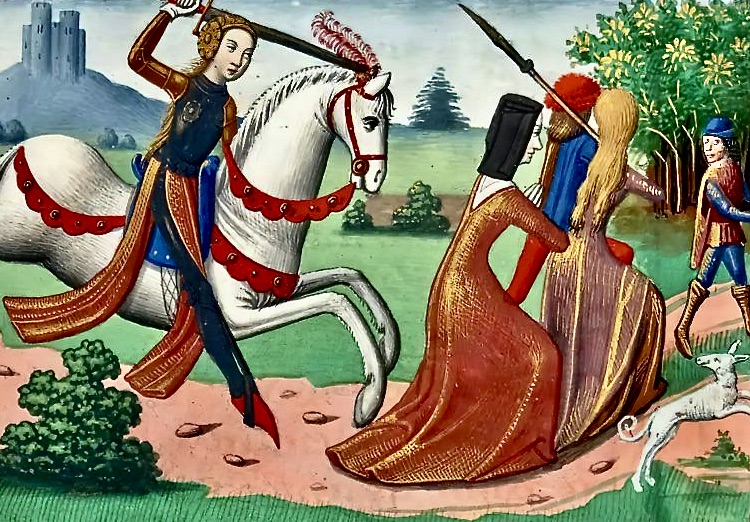
   G. K. Chesterton maintains that, because he is a Puritan, Bernard Shaw is never frivolous. The same can be said for Joan of Arc. She does not make war wearing a ball gown. While talking to the artist Walter Tittle in 1924 George Shaw said Joan of Arc’s idea “in wearing man’s clothes was a sensible one; she was a soldier, and could not be bothered with skirts, and as she was associated with soldiers constantly it was more modest to dress as one of them.” But this was one of the counts against her at the trial, and was interpreted by the Catholic Church as wanton immodesty. Joan of Arc never uses her wit for fun  – so much like Bernard Shaw’s, in that it is not a sense of humor, which implies that truth is tricky. She rather uses it as one of the means to attain her goals. She joshes the Dauphin to give him courage. When she pokes fun at religious leaders it is because she understands they are her enemies. She uses her wit like a weapon. It is, like a Calvinist’s and like Bernard Shaw’s, consistent as a sharp tongue eager to engage.

   An aspect of all Puritans is that they are austere. Bernard Shaw’s Puritan teachers “could not prevent him from taking up theatricals, but they made him take theatricals seriously .” Joan of Arc is similarly austere. During her trial she declares that she could comfortably live on bread and water. Her aversion to excess is signaled by her reaction to everlasting imprisonment as punishment for her heresy. Her recantation is recanted. She instinctively recoils from that judgment because it would deny her the lifeforce of nature, and also because she believes the verdict is wildly extravagant. Death   has preference because it pales in the face of profligacy.

   He austerity in the play is occasionally belied by some historical inaccuracies. The critic J. Van Kan has observed that Joan of Arc would sooner have endured diabolical cruelties at the hands of her torturers than to admit a naturalistic explanation for her “voices.” On the whole, though, considering her sincerity, background, and mission, and the means she employs to fulfill her destiny, she is an austere character. Bernard Shaw answered for his errors of strict fact when he wrote to a critic of his representation of Joan of Arc’s nature that he had “ no theory about Joan, and understand her no more than I understand myself.”

   If Bernard Shaw’s vocation was as a playwright, then his avocation was as a progressive. G. K Chesterton writes that he was born in an epoch that had taken the great political and moral successes of the 19th century and fashioned them into portals of nothing. “The moral world was pretty well all windows and no house by the time George Bernard Shaw arrived on the scene.” The reason it was mostly windows by the time he got to London was that morality had morphed into mud. Bernard Shaw waded into the mudflat and “thoroughly trashed all competitors in the difficult art of being at the same time modern and intelligent.” He kept revolutionists on their toes by such declarations as that physical science was a mystical fake. He didn’t go into details and left it at that.

   As a progressive Bernard Shaw concentrated on two crusades. The first was the humanitarian cause. “At its best and noblest it meant a sort of mystical identification of our life with the whole life of nature,” G. K. Chesterton says, though he does not mention what it is at its worst. Joan of Arc’s identification with a similar cause can be shown by two examples. First, although she went to war, it was specifically to save her homeland. On the battlefield she did not actually kill anyone. Second, she prefers the stake to exile from nature.

   Another cause Bernard Shaw committed himself to was Socialism. G. K. Chesterton says that this exemplifies the same trait as his humanitarianism. If it does, then Joan of Arc leaving the farming life of her parents to live among a gaggle of soldiers is a reflection of her sociological leanings and human compassion

   G. K Chesterton admires Bernard Shaw’s moral and social persuasions, but says thst his “great defect was and is the lack of democratic sentiment.” This particular lack is exactly what sends Joan of Arc on the warpath and to her death. She fails to see that her trial is political, not religious. In addition, she is unable or unwilling to delegate authority, and consequently comes to be considered arrogant and disagreeable. She and her spirit  oracles cannot make a mistake. He body will fail Joan of Arc. She may not be a democrat, but, like Bernard Shaw, she makes an excellent republican. Her death will be a success. The two of them “are more for the Public Thing than the Private Thing.”

   I have emphasized the first three parts of G. K. Chesterton’s biography because they have the most to reveal about Bernard Shaw’s nature and character, and by inference Joan of Arc herself. The last three parts say less about who Bernard Shaw was and more about what he did up to 1910, which was that he wrote a few lackadaisical novels and a good many good  plays. Each of these imaginings had a plot and a theme. Some of the attitudes expressed in the plays and other writings can be brought to bear on “Saint Joan.” 

   When Bernard Shaw was a critic for the Saturday Review he defended the Norwegian playwright Henrik Ibsen. He informed everyone that Ibsen “was not artistic, but moral; that his dramas were didactic and that all great art was didactic.” Bernard Shaw might as well have been talking about himself.. He went to great lengths to make his plays didactic. The original version of “Back to Methuselah” took three days to perform. If one was willing to stay and listen, one couldn’t help but get the point. Many of his plays sport prefaces and epilogues intended to make the meaning clear as a bell. With “Saint Joan” Bernard Shaw was doing what Socrates believed to be the highest duty of a teacher, which was exposing prejudices and misconceptions in order to arrive at the truth.

   In Plato’s “The Last Days of Socrates” the doomed philosopher invents a persona for “The Laws and Constitution of Athens” in order to find out whether or not he should flee the sentence of death that hangs over him. It is worthwhile pointing out that Bernard Shaw likewise creates spokesmen for the political and religious adventures of the time, and then posits Joan of Arc against them. The dialogues that ensue set forth the relative positions of all involved and then, in the epilogue, synthesize those positions. This is done subtly enough so that Bernard Shaw’s conception of the truth is set forth forthrightly, and yet space is left for the audience to come to their own conclusions. In this vein the critic F. F. Rattray said that “it is a tribute to Shaw that both Catholics and Protestants have been satisfied with how their respective cases have been dealt with in it.”

   G. K. Chesterton writes that in “Arms and the Man” there was, among other elements of style, “one thing not unimportant; there was savage sincerity.” In the future, out of the remote past, Joan of Arc lay in wait. A warrior of ferocious sincerity, she seems an apt character for Bernard Shaw’s pen. She fits right into his style.

   Idealism is not the same as sincerity. Bernard Shaw published “The Philanderer” in 1898 as part of “Plays Unpleasant.” It was in part an exposition of the ”dangers of ideals, the sacrifice of people to principles.” It strongly suggested that “ the idealist is more concerned about the sin than the sinner.” Bernard Shaw went on to recapitulate this idea in “Saint Joan.” He used the Catholic Church to demonstrate the inhumanity of doggedly adhering to a single creed. That might be their only crime. They harm not only others, but eventually themselves, as well. They disregard the fact that happiness is a practical, not an abstract concern.

   One of Bernard Shaw’s most important plays, and the last one I will talk about in relation to “Saint Joan,” is “Man and Superman.” The play mixes many themes but one stands out, which is his discovery of Frederick Nietzsche and the concept of the Superman. Frederick Nietzsche believed that just as man had evolved from primates, leaving them behind on the evolutionary ladder, man would ultimately give rise to a new breed of man, higher than Homo Sapiens as he is higher than the apes. In Frederick Nietzsche’s mind this eventually became interwoven with anachronistic ideas about valor and a hatred of pity. Bernard Shaw was not taken in by these latter beliefs, for, as G. K. Chesterton says, “It would require more than ten thousand mad Polish professors to make Bernard Shaw anything but a generous and compassionate man.” 

   Bernard Shaw came to believe that man’s only hope was in evolution. Consequently, he made the hero of “Man and Superman” a woman, whose justification in seeking a mate suitable for producing a better race is that she will be the mother of the coming Superman. One of the ideas buttressing the play is that nature desires ideal marriages.

   Insomuch as it must be a woman who produces the Superman, it may be that Bernard Shaw envisioned Joan of Arc as a precursor to the woman who would do it. One of Joan of Arc’s achievements is that she promotes a redefinition of the role of women in society. Her other achievement is that she is an example of how evolution is thought to work, which is along the lines of sudden changes or mutations. The tragedy of Joan of Arc is that she appeared to soon, too fast, and too insistent in the 15th century.   An unlikely  pioneer, she was crucified in the name of conventional morality. Her gifts and genius doomed her, as the old customs and obligations proved too strong. But she signals a new set of virtues and indicates that the time will come. It is inevitable, even though she raises the cry “How long, how long?” to her God.

   Posing the question of whether Bernard Shaw was fated to write “Saint Joan” reveals the answer to be “Who knows?” There is some evidence suggesting the seed of the play was in him, but the evidence must remain circumstantial. Nobody knows enough about the secret workings of fate to make assertions about its nature. Everybody knows enough about it to  connect some of the dots. We are not prisoners of fate, even though some people meet their destiny on the road they take to avoid it.  Rather, for good or ill, we are prisoners of our own minds.

Ed Staskus posts monthly on 147 Stanley Street http://www.147stanleystreet.com, Made in Cleveland http://www.clevelandohiodaybook.com, Down East http://www.redroadpei.com, and Lithuanian Journal http://www.lithuanianjournal.com. To get the site’s monthly feature in your in-box click on “Follow.” His books are available on Amazon and Apple Books.

“Hell’s Kitchen” 

New York City, 1956. Times Square, Coney Island, and the World Series. A high profile Mob contract in the works. Stan Riddman, a private eye working the edges, stirs up the shadows.

A Crying of Lot 49 Publication
Dancing With the Stars

By Ed Staskus

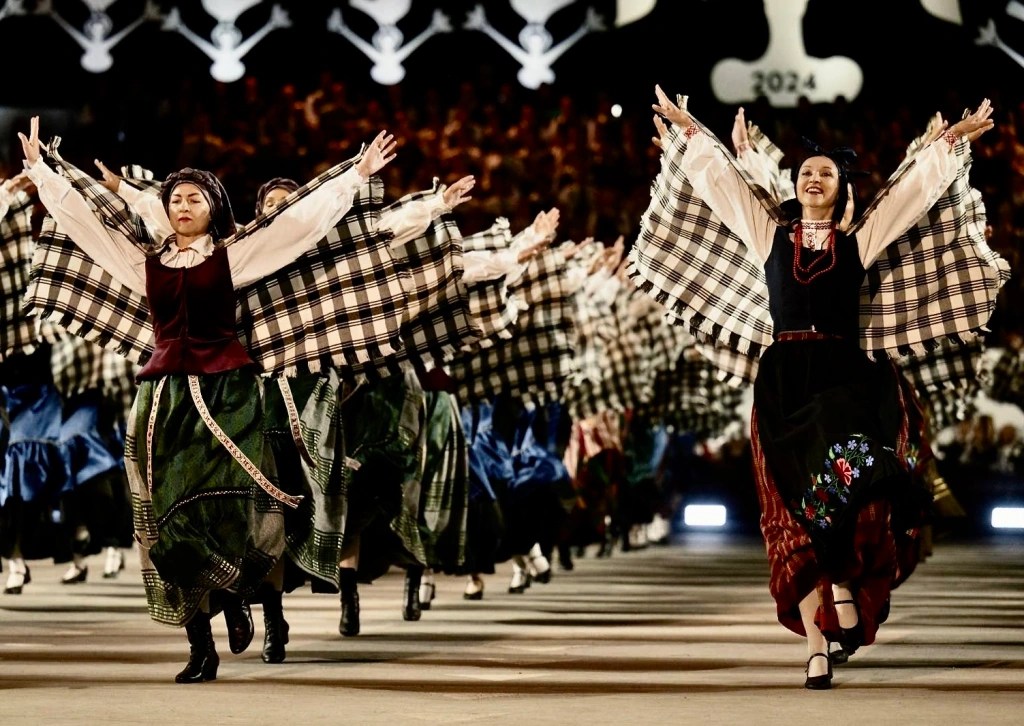
   Folk dancing costumes are by and large traditional, except when they aren’t. When Gabriele Baltrunaite traveled from Cleveland, Ohio to the 2024 Centenary Song and Dance Celebration in Vilnius, the capital of Lithuania, she had to borrow one, even though she had one. “I had to borrow a dancing costume because, although I had one, but it was too Lithuanian,” she said. “They wanted us to wear our own versions for the festival.”

   “It is important for us that every participating ensemble bring their own tradition, their own songs, those they inherited from their own place, their own dances and customs,” said Vida Šatkauskienė of the Folklore Day creative group. “And all that diversity, every region, every ensemble, every individual performer, are what makes up our day.”

   The day lasted a week through the first week of July. It featured Folklore Day, Dance Day, Ensembles Evening, and Song Day. More than 9,000 dancers performed on Dance Day. Gabriele went with the Cleveland folk dance group Svyturys.   

  The dance group was established in 2003, when 16 young dancers got together to prepare for the XII Lithuanian Folk Dance Festival in Chicago. They perform at shows, festivals, and special events. They have appeared throughout the United States and Europe, as well as South America. They have organized  “Concerts of Friendship”  to which dancers from the Lithuanian diaspora are invited to participate.

   “I started dancing at St. Casimir’s when I was in 2nd grade,” Gabriele said. “In the 8th grade I started dancing with Svyturys.” She has danced with the group since she was 13 years old, participating in many of its overseas excursions. “Sweden was my favorite trip,” she said. It’s hard to beat a breath of fresh Scandinavian air. In between breathing there is fika, the coffee break ritual of the Swedes.

   “Dancing is fun and I like the exercise, although sometimes it can suck practicing every Sunday.” The group practices Sundays from 10:30 to 1:30 at the Kirtland Community Center on the east side of Cleveland. “It’s partner dancing in a group. It’s highly choreographed, with lots of circles, polkas, and spinning. I like the social aspect of being in the group, making friends and making deeper connections. When it’s getting close to a concert, we have boot camp and practice even more. I love dancing at concerts, the forms and shapes we make on the dance floor, and the attention, the fact that people are looking at me.”

   Gabriele was born in Lithuania but grew up in the United States. In 1999 when she was three years old her parents Ausra and Gintaras tried their luck at the Green Card Lottery, a result of the Immigration Act of 1990. The new law allowed hundreds of thousands of immigrants to enter the United States. Lithuania was one of thirty one qualifying countries. Their luck was good. They were awarded visas. More immigrants were admitted into the United States from 1991 to 2000 than in any prior decade in American history, with11 million documented entries.

   “My parents were doing all right, but the economy was bad,” Gabriele said. “They wanted more success in life. They wanted a change of pace, something new, even though all they knew about the United States was what they had seen on TV.”

   Gabriele attended Eastlake North High School, Lakeland Community College, and graduated with a degree in Business Economics from Cleveland State University. She is a real estate agent with EXP Realty and operates her own commercial cleaning service with several employees. “I live by my phone,” she said.

   The 2024 Centenary Song and Dance Celebration was one hundred years in the making. The first Song Day was staged in Kaunas in 1924 and continued to be staged all through the Soviet Occupation after World War Two. It became a World Celebration after the fall of the Iron Curtain, and in 1994 more than 1,200 singers, dancers, and musicians from ten countries participated in the event

   This year’s event described itself as, “We, the singing and dancing people, make the living tradition that has survived through this century. We are the unique kin that meets every few years and speaks its own language. The language of this kin resembles the language of the earth – the language of the bird and the river, the culture and the memory, for our language is the one of life, spoken by all the members of the Cantor Lituanus kinship.”

   Flying from Cleveland to Helsinki to Vilnius takes about a full day and night with layovers. It takes a couple of days to get over the jet lag. The Svyturys group numbered more than forty on the plane, from dancers to teachers to volunteer support. They got to Lithuania a week before the big show. They stayed in the Old Town of Vilnius, brought back to life after the country recovered its independence in 1991. Nearly $30 million euros have been spent on restoration projects. Everybody got a complimentary bus pass with which to explore the city, of which there is much to explore. There are the Gates of Dawn, the Palace of the Grand Dukes, and the notorious Soviet-era Lukiskes Prison, which has morphed into a go-to for hundreds of artists and musicians who have set up their studios in renovated spaces there. Kankles are mightier than the sword.

   On Friday, the day after they arrived,  the group boarded a chartered bus and went to Palanga for the weekend to lay their jet lag out in the sun. Palanga is a resort town in western Lithuania on the shore of the Baltic Sea. In the height of summer, the sun comes up at 5 AM and doesn’t set until after 10 PM. “It doesn’t get totally dark until 11,” Gabriele said. It is the country’s largest seasonal resort, sporting beaches 11 miles long and 1,000 feet wide, with sand dunes to boot.

   Lithuania was the last European country to give up paganism and adopt Catholic Christianity. There used to be a pagan shrine at the base of a hill in Palanga watched over by a beautiful priestess by the name of Birute. She tended the ceremonial fire. One day Kestutis, the Grand Duke of Lithuania, laid eyes on her and decided he had to have her, even though she had promised the sky god Perkunas to remain a virgin as long as she lived. Kestutis wasn’t going to be denied, however, and took her back to Trakai, his fortress home. There was a lavish wedding, but the joy didn’t last long. Kestutis was murdered soon after and buried with his weapons and horses. Once free, Birute went back to Palanga, resumed her duties at the shrine, and when she died was buried at the top of the hill, as close to the stars as she could get.

   When the group got back to Vilnius from Palanga on Sunday they had a free night and the next day visited Seimas Palace, which is where the Parliament of the Republic of Lithuania meets. After that they had the rest of the day to themselves. Everybody tried to hit the hay early, although with little success, there being too much to do and see. 

   Each and every one of them knew that the next day the hard work was going to begin. The hard work coming up was going to be three straight days of practice. “Our practices were at a nearby park deep in the woods,” Gabriele said. “It was an athletic complex with fields, food trucks, and port-a-potties. Our practices were on one of two fields depending on the choreography. One part of one of the fields was super dusty. We had to run the field while dust kicked up, for two hours, running back and forth. When I got done my nose was full of dark boogers. It was tough.”

   What was tougher was the eagle-eyed man on the platform calling out instructions. “He was on a platform maybe 30 feet up, with a microphone and loudspeakers,” Gabriele said. “He had written the part of the concert we were going to perform. He had a  PhD in folk dancing.” There wasn’t going to be any easy way of explaining away missteps. “He knew every group’s assigned number.”

   As the first and second 12-hour days of practice unfolded Gabriele heard less of “Number 37, you’re doing it wrong.” Her group was Number 37. Nobody wanted to be the group whose number was being repeatedly called out. Svyturys kept their eyes open and their feet moving.

   “During one dance, which is actually technically easy, but it’s hard to remember, it’s always changing from a circle to a square to a diamond, he had to keep calling out and reminding us of the order,” Gabriele said. “But one group couldn’t get it right, no matter what.”  

   “Number 13, stop it, you keep doing it wrong!” the man on the platform finally barked. “Get out of here.”

   “They had to leave and practice on their own until they got it right,” Gabriele said.

   The last day of practice was Thursday. The practice and subsequent dress rehearsal ended close to midnight, a 16-hour day instead of a 12-hour day. “It went so long they ran out of food,” Gabriele said. “I was sick tired. My calves were cramping so bad. I was praying to God, let me get through this. At one point I had to stop. And then the man on the platform pointed at me and said, ‘You need to run!’”

   In the end it ended well. The man on the platform announced they wouldn’t have to brush anything up on Friday morning. “Thank you so much for everything you’ve done,” he said. “I really appreciate it. I know I’ve been yelling at you guys, but you have all been fantastic. I love you.”

   “It was so heartfelt and moving,” Gabriele said. “ He told us to go out and just dance.”

   The theme of the 2024 Centenary Song and Dance Celebration was “May the Green Forest Grow.” It brought together 37,000 artisans, singers, and dancers. The audience for the 14 large scale events during the week was in the hundreds of thousands. Song Day on July 6th featured 400 choirs on the outdoor stage. The performance was in the spirit of the Singing Revolution of 1987-91, when Latvia, Estonia, and Lithuania defied their Soviet occupiers by breaking out into native songs. When the Soviet Union collapsed in 1991 everybody sang “Hit the Road Jack.” They put some oomph into it by finishing with “and don’t you come back no more, no more.”

   “The event shows our resilience and that music unites people and inspires them to break free from repressive regimes and fight for their country’s sovereignty,” said Saulius Liausa, director of the Lithuanian Song Celebration. “We had to fight for freedom to preserve our cultural identity, traditions, and language.”

   Friday was Dance Day. Svytutys performed at 1 PM and again at 9 PM. “The dance concert was close to where we were staying,” Gabriele said. “We walked there in our costumes.” The were many other groups walking to the venue as well. The streets were soon overflowing with them. “There were thousands of us.” The groups gathered and waited on adjoining fields for their turn to dance in the stadium. At the event groups rotated in and out during the two-hour shows. Video cameras on the ground and in the sky recorded the carousal.

   “My mom went to the show,” Gabriele said. “She said it was OK, but when she saw the replay on LRT TV, she said it was amazing.”

   On Saturday morning a parade of the singing and dancing participants walked the several miles to the Song Day venue. “All of us had our full costumes on,” Gabriele said. “It was very cool.” The participants included children, teenagers, adults, and older folks. “My uncle lives in Lithuania, on a farm. He’s in his late 60s but came to Vilnius to dance.”

   When the last song faded away late Saturday night, the 2024 Centenary Song and Dance Celebration was officially over. The participants from 21 countries said their goodbyes and went their own way. The Australians had the longest flight home. They smeared their crackers with Vegemite, the down under by-product paste.

   “History is pretty clear today,” Saulius Liausa said  “Our festival was the only way to keep the tradition alive, to not forget.” It kept the cultural fires burning through the war years and the occupation years. The flames reached free Lithuanian communities everywhere. A fair highlighting those communities around the world was sponsored by the Vilnius Town Hall Square.

   The song and dance showcase on native soil happens every four years. The next one is in 2028. Lithuanian folk dancers worldwide are tapping their toes and waiting for their cue. Gabriele is sprucing up her old school costume and going back to practice.

Ed Staskus posts monthly on 147 Stanley Street http://www.147stanleystreet.com, Made in Cleveland http://www.clevelandohiodaybook.com, Down East http://www.redroadpei.com, and Lithuanian Journal http://www.lithuanianjournal.com. To get the site’s monthly feature in your in-box click on “Follow.” His books are available on Amazon and Apple Books.

“Hell’s Kitchen”

New York City, 1956. Times Square, Coney Island, and the World Series. A high profile Mob contract in the works. Stan Riddman, a private eye working the edges, stirs up the shadows.

A crying of Lot 49 Publication