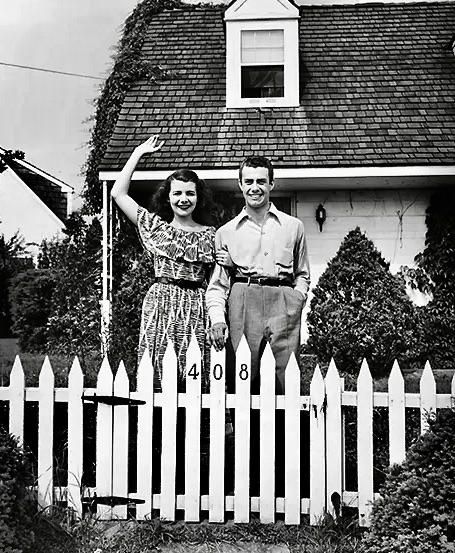
Burning Down the House

By Ed Staskus

   My father was born in the village of Vadzgiris in 1892. Lithuania had been under the thumb of the Russians since 1795. They had wiped the name of the country off the map. They instead called the land the “Western Provinces.” They declared a press ban in 1892 that prohibited printing Lithuanian books in the Latin alphabet. Cyrillic script became obligatory, no matter what the natives said. A large scale crop failure that year led to widespread famine. Migration to North America swelled to a tidal wave. That same year the first light bulb in the country was lit in the town of Rietavas. There was at least one small light at the end of the tunnel.

   A certificate of baptism makes the birth place and birth year of Antanas Staskevicius, my father, clear. That is probably where he grew up, although it is uncertain. He had a younger brother, Juozas, who not wanting to be drafted into the Imperial Russian Army, emigrated to the United States. My father served in the Czar’s army in Saransk. He always said it was in the middle of nowhere, although nobody knew for sure where the middle was. My mother was a native Russian he met there, a school teacher. They started a family in 1916, starting with my two sisters.

   When the Bolsheviks took over from the Czar they sent many military officers to jail. Since my father was a Lithuanian they let him return to his country. In those days Lithuanians who returned from the Russian Imperial Army were not looked upon favorably. Their Russian wives were even less popular. But as time went on people got used to them.

    At first, my father lived in Siauliai. Later on, he lived in Kaunas. Around 1930 he went to work in Panevezys for a short time. I spoke only Russian until I was four or five years old, no matter that my mother spoke Lithuanian very well, without an accent. Although she was Russian Orthodox, we went to a Catholic Church, acceding to my father’s wishes. I would occasionally go to the Russian Orthodox Church with my mother, but only when my father was away from home. 

   I was born in Siauliai, not far from the Hill of Crosses, in 1924, even though we did not live there at the time. After I was born my father moved to Kaunas. He became the Director of the Department of Citizen Protection there. Later on we moved back to Siauliai. My father was appointed the Chief of Police.  He used to wear a fancy uniform when he would attend events. It was always exciting to see him in it.  He was in charge of the entire region as well as the police department. 

   I remember Police Captain Kurpius. He had a big face and a small mouth. He would stop at our house after duty hours to eat and smoke. He and my father drank vodka and sang all night. My mother plucked a kankles while they sang. Both of  my sisters were friends with the daughters of the man who was the director of the Teacher’s College. They dreamt about becoming teachers like our mother.

   Sometime in 1938 or 1939 my father was transferred from Siauliai to Panevezys and then to Zarasai. Augustinas Voldemaras lived in Zarasai at that time. He had been banished there after briefly serving as the country’s first prime minister. He was a stubborn man with a quick temper. He often came to our house. I used to go with my father to the sauna where I rubbed  Augustinas Voldemaras’ lower back for him. When he felt better he used to run out of the sauna and jump into an ice hole.

   I did not finish grade school. I went for only two grades since I did not find it difficult. My father hired a tutor for me and two of my friends. The tutor helped us prepare for the high school exams. We passed the exams and started high school. We were the youngest in the class. Since I attended three different high schools, in Siauliai, Panevezys, and Zarasai, I could not remember the names of my classmates very well. 

   My father had a good friend in Kaunas who was a certain Mr. Dagys. My mother was good friends with his wife. When they would come to our house I used to have to hold the door open for them. I did not like to kiss the hands of married women, which at that time was customary, but I had to kiss her hand.  One time I cut my lip on a diamond ring she was wearing.

   We had an open air Chevrolet Eagle Cabriolet. When the famous pilot Feliksas Vaitkus, the second Lithuanian after Darius and Girenas to fly across the Atlantic Ocean, came to Panevezys. I went with our driver, who called the car “Stovebolt” after its engine, and my father to the train station to meet him. I was on the edge of my seat being in the car with the aviator. Later in the day he met with the public and gave a long speech I didn’t listen to.

   When we lived in Zarasai we had a driver who was a police officer.  He wore a peaked visor cap with a cockade fixed to the front. My father and I lived there by ourselves for a year. My mother was supposed to join us as soon as we were established, but she never came. The year passed quickly and then the Russians came. My father returned to Siauliai, since he, like all officials, was relieved of his duties. 

   He spent most of his time in the hinterland instead of the city. Our farm in Dainai was a model farm. In the summer excursions would come from all over to see our land and operation. We had all the newest tools and farming equipment, both cutting and sowing implements. We had many cows and an orchard of yellow Alyvinis apples.

   After the Russians came our car was taken away. In 1940 the mood was very bad. We had a fear of the future in the pit of our stomachs. My father was seized by the Russians a week before the mass deportations of 1941. They took him as he was, just the shirt on his back and wearing sandals. Three men came in a passenger car. They asked my father for some help. They claimed they were having car trouble, or maybe they needed water. My father walked over to them and they shoved him into the back seat of the car. I was not at home. I was taking my exam at the high school. My mother called the high school. I sped home right away on my bicycle, but there wasn’t anything I could do.

   Later, my mother and I went to the prison and took clothes and food for my father. We weren’t allowed see him. We drove to the NKVD office in the County Police Headquarters where we were told to go home. No one explained anything to us. I never saw him again. He was sent to a slave labor camp in Siberia and starved to death in 1942. 

   The mass deportations began in June. When they started my mother and I hid in the woods. When things got better we went home. One of my sisters was living in Vilnius. My mother said to me, “Go to Vilnius and warn her to watch out for herself.” Soon after I got there a neighbor called and told me to come back. He said my mother might be arrested. She was hiding in his root cellar. In the meantime, the  Germans went to war with the Russians, occupying the country, and it was toilsome trying to return. No one was allowed to travel without permission, but I got lucky. Someone who had been a policeman in Siauliai was working with the Germans in Vilnius. At one time he had worked for my father. He was taking care of travel documents. I don’t remember his name, but I went to him, he introduced me to a German officer, and I got permission to travel by train. I returned to Siauliai. 

   After my father was sent to Siberia I had to manage the farm. I knew almost nothing about farming, even though I thought I knew in the fall the fields had to be plowed. I told the farm hands who had not run away, “Go plow the fields.” A neighbor saw them and ran over and said, “What the hell are you doing? You are plowing next year’s clover under.” 

   I hurt my hand during the war. I had ridden out with a horse drawn mower to cut hay. I saw that rain was coming. I tried to speed things up. Instead of sitting down as you should I walked beside the horses so that I could get them to pull the mower faster. As I was encouraging them I tripped and fell on the blades. The horses stopped. My right hand was almost cut off. The farmhand who was helping me ran over and, seeing my mangled hand, fainted. Meanwhile, my hand was hanging there and I was losing blood. I ran a kilometer to the prisoner camp where Red Army troops were being held, which was also in Dainai, for medical help. An ambulance came and rushed me to the hospital.

   My mother was arrested and deported in 1944. She spent twelve years in Siberia. Later, after Stalin’s death, she was released, but was not allowed to return to Dainai or Siauliai. Nobody said why. She was moved into a cinder block apartment in Silute near the Curonian Lagoon.

   I fled Lithuania when the Russians came back. I escaped with a company of Werhmacht leaving the Red Army prison camp in their Opel Blitz trucks. Their aim was to get to East Prussia. They were in a big hurry and only gave me a few minutes to gather what I could. We were a mile away when I looked back. I could see black smoke from our house and barn that the Russians had set on fire.

   I went to Germany where I stayed for five years. At first I lived in a DP camp. I worked wherever I could doing whatever I could, I sold chocolate and cigarettes and shoes on the black market. I found legitimate work with the International Refugee Organization in 1948. I left for Sudbury, Ontario in 1949. I worked in a nickel mine, thousands of feet deep, working there for nearly seven years. There were many expatriates holding down jobs in Canada. Some cut down forests, which was hard work. Some went into the mines, which was dangerous work, but for men who barely spoke English and who did not have any specialty, the pay was good. I worked as a black powder man. I worked laying tracks for trains that carried the ore. Eventually I got an easier job driving underground tractors.

   It was In Sudbury that I made a family. My three children were born there. My wife, Angele Jurgelaityte, was from southwestern Lithuania, from a small farm near Gizai, five kilometers from Marijampole. We met in Nuremberg where she was a nurse. She helped operate on my hand, which needed two more operations to restore its use to me. 

   After five years of living in Sudbury we started planning where we would live next. Most of the Lithuanians in the city were looking for better prospects. Many left for Montreal and Toronto, others to Chicago and Pittsburgh. We all started to go our separate ways. When I was living in Germany I had applied for a visa to live in the United States, in case the prospect ever arose. When the opportunity came we sold our house in Sudbury. We moved to Cleveland, Ohio in late 1957 with our children. My older sister and her husband were living there.

   At the time I fled Lithuania my younger sister was forced to stay behind. We had all fled separately. She was unable to evade the Russians and get across the border. She stayed locked up behind the Iron Curtain for the rest of her life.

   When I went back to Lithuania for the first time in 1979 I looked for our farm. I hadn’t seen it for thirty five years. Our house and barn were gone. There was a collective on most of the land. I found an old woman who remembered my parents. She briefly told me some things. She told me that in 1957 my mother searched for me by printing an announcement through the Red Cross in the American Lithuanian newspaper Darbininkas. A priest from Siauliai, Father Justinas Lapis, helped us to make the connection with my mother. He had looked after her welfare when she returned to Lithuania from Siberia.

   After arriving in Lithuania I was determined to see her, no matter what the restrictions were. At first I tried to travel secretly to Silute, but was stopped in Ukmerge and ordered to go back to Vilnius. The next day I got permission to go for one day and was able to get a car. They charged me two hundred American dollars for it, which was highway robbery, especially since the car was of such poor quality. I visited with my mother and we spent three hours together. The car broke down on our way back to Vilnius.

   From our former farm the city of Siauliai is five kilometers away. It was a busy city, or so it seemed to me after we went there from Panevezys, which seemed to be a very quiet city. Everyone used to say that Siauliai was known for its hooligans, although I didn’t see any.  I did not like Siauliai when I lived there. The requirements of the high school there were not strict. I didn’t like that. The high school in Panevezys was very strict. The director would personally make sure everyone was in uniform, that their collars were buttoned and ties knotted, whereas the high school in Siauliai was not strict about the dress code, at all. 

   After a few years in the United States my wife and I shortened our surname from Staskevicius to something easier to pronounce. Since I worked in international business it was bothersome always explaining my family name to foreigners. I worked for TRW for seventeen years, selling auto parts worldwide. I was a Manager for International Service and traveled all over South America. Later they closed our division and gave the older workers pensions. In 1984 | collaborated to start the Taupa Credit Union in Cleveland. I worked there for six years before leaving. I became an international trade consultant and started traveling to Lithuania often. We tried to buy and sell a number of things, not all of them successfully. 

   One thing, furniture plugs, was successful. In the United States there are only a few companies that manufacture them because you need good birch trees. Lithuania has plenty of good birch trees. We negotiated there for two years. We looked for partners in Kazlu Ruda, a city near Marijampole, and Panevezys, to no avail. We finally found a group in Elektrenai, in southeastern Lithuania, to partner with and who we successfully began doing business with in the United States.

   Birch trees lose their leaves in early fall in the Baltics, but they keep their roots intact year after year. Winter storms in the land of forests make the trees dig deep to stay the course. They are a pioneer species. They are the first to regrow after wildfires and ecological disturbances. When I set foot in North America I had to make a new home far from home. I had to carry my roots with me. I planted them where I landed, which was all I could do.

Ed Staskus posts monthly on 147 Stanley Street http://www.147stanleystreet.com, Made in Cleveland http://www.clevelandohiodaybook.com, Down East http://www.redroadpei.com, and Lithuanian Journal http://www.lithuanianjournal.com. To get the site’s monthly feature in your in-box click on “Follow.” His books are available on Amazon and Apple Books.

“Cross Walk” 

Late summer, New York City, 1956. Big city streets full of menace. A high profile contract killing in the works. A private eye working out of Hell’s Kitchen scares up the shadows.

A Crying of Lot 49 Publication
Working Side of the Altar

By Ed Staskus

   “Mom, can you write me a note for school tomorrow saying I can’t be an altar boy,” I asked my mother after we had finished watching every minute of “The Wide World of Disney” and “The Ed Sullivan Show.” She pulled a face. I gave her my best first-born smile. I didn’t have a plan so much as a hope.

   Every Sunday night my parents snacked on smoked eels while my brother, sister, and I munched on handfuls of popcorn from yellow plastic bowls sitting in front of our Zenith console in the basement. It was a family ritual. We loved Walt Disney, but the ‘Great  Stone Face’ wasn’t a chip off the old block. He was the unfunniest man on TV. The circus acts and comedians were fun, but the opera singers and dramatic monologues were dull as turned off. None of us understood what the Little Italian Mouse was up to, either.

   I asked my mother for the note after I was out of the tub, in pj’s, and my book bag was ready for the coming up Monday morning. I wanted it to be short and sweet, as though it were no big deal, routine, really. I thought pleading something along the lines 

of all my spare time already being spent on my studies would be the way to go. I knew I was walking a thin line, though. My parents wanted me to be an altar boy. They went to mass every Sunday, which meant we all went. “Everybody went to church back then,” according to my mother. “There were two masses every Sunday. The church was full of people. We went early to get a pew.”

   My mother always went to church because she had always gone. “I grew up that way,” she said. My father, on the other hand, was a true believer. He was an accountant and counted on getting to Heaven. Even though he wasn’t a betting man, he put his money on Pascal’s Wager. The wager argues that a thinking person should live as though God exists and try to believe in him. If God doesn’t exist, there will only be a few finite losses, like no good times with too much money and too many girlfriends. When you are dead and gone you won’t miss them. But if God does exist, there are infinite gains, like spending eternity in Heaven, and no infinite losses, like spending eternity in Hell. 

   After he told me about the parlay there was no arguing with him about whether I was going to faithfully serve as an altar boy. “St. George is one of the Holy Helpers,” he said. The nuns at school thought George was a stud, the Trophy Bearer. I helped myself out by biting my tongue. As far as my father was concerned, I was going to be an altar boy, no dust up about it.

   The most embarrassed I ever was as a child was when my parents made me go to a Sunday mass one morning dressed up in a Buster Brown sailor suit. Something happened to the costume before the next Sunday. It was never found alive again. I had to go to confession after telling my mother I had no idea what happened to it. The fashion show took months to live down at school. I had to wrestle my way out of several mean-spirited jibes. There will be blood in grade school.

   St. George’s church, school, and parish hall were a three-in-one package, a rectangular two-and-a-half story brick building on Superior Ave. and E. 67th St. The church was on the top floor, the school on the middle floor, and the hall on the half-in-the-ground floor. The hall doubled as a civil defense shelter in case of a nuclear war, even though it was unclear what we going to do down there after the atomic bomb had blown the city to kingdom come.

   I was glad my mother didn’t downpress me about it, but wrote a note, sticking it in an envelope, sealing it, and finishing it off with my teacher’s name on the front. A small whitecap of uncertainty took shape in my mind at my mother’s readiness to do my bidding, but I put my doubts to rest and slept well that night. The next morning I gave the envelope to my third-grade teacher, Sister Matilda, a gnarly disciplinarian who had press-ganged me and a half-dozen other boys into the altar boy operation the second week of school. I found out later it was an annual recruitment drive.

   She read the note, smiled, and said, “Very good, you start next Monday.”

   How could that be? What happened between last night and now?  I realized my own mother had monkey wrenched me. When I asked her about it, she said, “As a mother I do the possible and leave the impossible to God.” I had already heard God helps those who help themselves, but that didn’t seem to be working out for me.

   St. George’s edifice was the biggest Lithuanian building in Cleveland. It was built in 1921. It was at the center of the ethnic neighborhood and some parishioners had Lithuanian-related businesses, like a newspaper and some kind of historical outfit, nearby. The east side along Lake Erie was full of Poles, Slovenians, Croatians, and Lithuanians.

   The parish priest, Father Ivan, short for his civvy name Balys Ivanauskas, lived in a seven-bedroom Italianate-style rectory a stone’s throw from the church. It had originally been built for a big family in the 1880s. Our teachers, the Sisters of St. Francis of the Providence of God, lived together in a smaller house on Superior Ave. two or three minutes away. There were eight of them, not including the Mother Superior. They could have used some of Father Ivan’s empty bedrooms. As it was they had to double up.

   The sisters were a hard-boiled bunch. They were strict as could be about us taking our studies seriously and behaving in class. Those were rules number one and two. There were no other rules. They weren’t above hitting us with rolled-up Catholic Universe Bulletins. Nobody’s parents ever complained about it, so none of us ever complained about it to them. What would have been the point? Our parents would only have asked, “What did you do?” There was never a good answer to that.

   The nuns never sweated getting the job done. In fact, they didn’t sweat at all. Wearing thick bulky habits they should have been the first to perspire whenever it got hot, but they never did. Nobody knew how they did it, if it was part of their training or some kind of black magic from the Middle Ages.

   Even though I hadn’t been baptized at St. George’s I was an altar boy at many baptisms there. One time at the font a baby streamed pea green apple sauce puke on my surplice and another time one burped and farted and messed up Father Ivan. I had to run back to the supply closet and get wet rags. I sprayed the boss with a new kind of aerosol called Lysol some busybody had donated.

   I received my First Communion at St. George’s and was confirmed there. The First Communion happens when as a Catholic you attain the Age of Reason. I don’t know how any of us were ever awarded the sacred host when we were, because I definitely didn’t attain the Age of Reason in grade school, nor had anyone else in my class, unless they were faking it.

   My reason was affected by reading boy’s books in my spare time, adventures about running for your life, spies, foreign lands, full moons, secrets, ray guns, tommy guns, femme fatales, hooded supervillains, back alleys, conspiracies, and the bad guys foiled at the last minute by the good guys. The paperbacks seeded my nightly dreams and I cooked up twisty exploits all night long, waking up glad I had survived. 

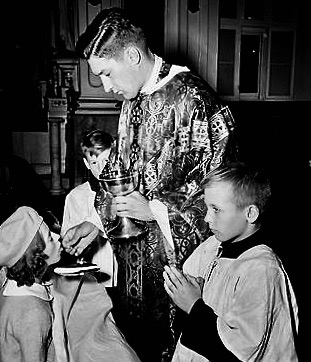
   Before we got thrown to the lions we got trained in the performance basics, how to dress, the call and response, and how to arrange the corporal, the purificator, the chalice, the pall, and the big Missal. We learned how to hold liturgical books for Father Ivan when he was proclaiming prayers with outstretched hands. We brought him thuribles, the lavabo water and towel, and vessels to hold the consecrated bread.

   We helped with communion, presenting cruets of wine and water for him to pour into the chalice. When he washed his hands standing at the side of the altar we poured the water over them. If incense was used, we presented the thurible and incense to Father Ivan, who smoked the offerings, the cross and the altar, after which we smoked the priest and people. It had one flavor, a rotting pomegranate smell. The thurible was a two-piece metal chalice with a chain that we swung side to side. God forbid anybody got slap happy and swung it too high, hitting something with it, and spilling the hot coals, threatening to burn the church down. That was when Father Ivan became Ivan the Terrible.

   We rang a handbell before the consecration, when the priest extended his hands above the holy gifts. We rang the bell again when, after the consecration of the bread and wine, the priest showed the host and then the chalice. “Ring dem’ bells” is what we liked doing best.

   I started low man on the totem pole, which meant the 7 o’clock weekday morning shift. Even though everybody went to church, nobody went to church first thing in the morning Monday through Friday. At least, almost nobody. The man in charge was always there for sure with one of his altar boys. I had to get up at 5:30 in the morning, pour myself a bowl of Cheerios and a glass of orange juice, catch a CTS bus on the corner of St. Clair Ave. and E. 127th St., toss exact change into the fare box, stay away from the crazy people on the bus, run through the church to the sacristy, get into my uniform, and make sure I had my cheat sheet. Among other things I had to be on time, or else.

   The mass was performed in Latin, most of the time the priest’s back to the congregation, and we followed his lead. There were prescribed times we had to respond by voice to something Father Ivan recited. It was only when we offered Holy Communion that I finally faced the nave and saw the only people in church were old and older, unemployed, worried about something, or simply in the wrong place. 

   One benefit to hardly anybody being in the pews first thing in the morning was whenever I made a mistake it usually stayed between me and my maker. That is, unless Ivan the Terrible, who had eyes in the back of his head and whose hearing was better than a moths, saw and heard what I had done wrong.

   Moths have the best hearing in the world, next to priests, who are accustomed to listening to whispers in the confessional. I was waiting for my turn one afternoon after school when I heard Father Ivan bellow, “What did you say?” and the next thing I knew a red-faced boy burst out of the booth running, followed by the dark-faced priest. I slipped quietly away. There was no need to put myself in harm’s way for somebody else’s mortal sins.

   When I started Father Bartis was in charge, but the next year Father Ivan became the parish priest. He was a burly man. None of us knew where he came from or how old he was, although we guessed he was between thirty and sixty. I could never tell the age of adults. All I knew was they weren’t new anymore. He ran the parish until 1980. He smoked a lot, which we could smell on his breath when he got close to us, and sometimes we caught a whiff of spirits. We all knew what strong drink smelled like because almost everybody’s parents drank. They were Lithuanian, after all.

   He liked to take walks and mind his own business, unless he was minding ours. We were always under the gun. He was irascible to begin with and screwing around with his life’s work brought out the worst in him. Our school janitor said he had never met anyone worth a damn who wasn’t irascible, just like Father Ivan. He was short-tempered but his bark was worse than his bite. The nuns put him to shame when it came to crime and punishment.

   All of us carried cheat sheets at mass. Latin was a foreign language, as well as a dead language. None of us were taking classes in it and none of us knew what we were saying. Our responses during mass were rote, except when something went wrong, when we improvised with mumbles. It wasn’t speaking in tongues, but Father Ivan warned us exorcism was imminent if we didn’t learn our lines.

   The Eucharist was the high point of mass. It got us off our knees and on our feet. We helped in the distribution by holding a communion plate under everybody’s chin when the priest gave them the wafer. There would have been hell to pay if there was an accident, like the wafer falling out of somebody’s mouth and landing on the floor. It would have meant saying a million Hail Mary’s and a thousand turns around the Stations of the Cross.

   After gaining seniority I was promoted off the morning shift and started serving at Sunday masses, funerals, and weddings. Sunday mass was more of the same, only longer and more elaborate, but at least I got to sleep in and go to church in the family car instead of a city bus full of nobody I knew.

   Funerals were usually scheduled on Mondays and Fridays. I began to think weekends coming and going were a dangerous time. At one Friday funeral Father Ivan spoke glowingly of all the good works the deceased had done and how he was sure the man was going to Heaven. “The way to the brightness is through good works,” he said. “The first thing we all have got to do is do good.”

   The other altar boy and I were standing on either side of the dead man in his pine box. The boy’s name was Zedonas. Everybody called him Zed. He leaned over the open casket and whispered, “What you got to do first is be dead.”

   The corpses always looked like wax figures. They didn’t bother us over much, but the occasional mewling coffin sounds freaked us out. None of us especially enjoyed funerals, not because we were near at hand to the dead, but because everybody was down in the dumps, and on top of everything else we were rarely gifted with cash. It dismayed us to see the family light candles at a votive stand and push folded ones and fives into the offering box.

   Weddings were a different story. Everybody was in a good mood. They were festive. It was always a sunny day. The brides looked great in their white dresses with trains. Heaven help the altar boy who stepped on a moving train and yanked it off. The number one perk of serving at a wedding was we were always rewarded. The best man was usually the man who slipped us an envelope and told us what a great job we had done, even though we never did anything great beyond kneeling and standing around, like we always did.

   Weddings in July and August were usually hot and humid happenings. One time the groom himself paid us in advance in silver dollars, ten of them for each of us. It was an unexpected windfall. I wrapped mine up in a handkerchief. Everybody was sweating during the ceremony. When it came time for communion I reached into my pocket for the handkerchief to dry my hands. It would have been bad if I let the cruet slip. 

   When I did, a silver dollar slipped out from my handkerchief, rolled down the two steps in the gap between the altar rail, past the bride and groom, and down the center aisle of the nave. A man stuck his foot out and corralled it with his shoe. I was relieved when I saw it was my uncle, who was an accountant like my father. He knew the value of a dollar.

   One time Jon Krokey, a fellow traveler at Holy Family Church, dropped the Roman Missal, which was very bad. It is a large heavy book that includes all the words and prayers the priest uses during mass, except for the readings. It is second in line only to the Holy Bible

   “I was the bottom man, so I got to get up in the middle of the night to serve at morning mass,” he said. “While transporting the giant book I dropped it and it bounced down the stairs all the way to the communion rail. Father Andrel chewed me out in front of the congregation, which was ten elderly women in the front pews, all wearing babushkas. When he was done spewing, I quit. After that all the nuns at school mean face mugged me like I was the Antichrist.”

   My tour of duty ended at the end of sixth grade when my parents moved out of the neighborhood and I transferred to another Catholic school. They already had a full complement of altar boys and my services weren’t needed. I was happy enough to go back to being a spectator.

   When St. George’s Catholic Church closed in 2009 it was the oldest Lithuanian parish in North America. At the last mass three priests presided and there were a host of altar boys and girls. Back in the day we would have welcomed girls to our ranks, even though they weren’t allowed. They were better at cleaning than us and we knew we could boss them around, although they were also slowly but surely getting to be nice to have around as friends.

   The altar was given away to another church. The playground and parking lot were sold, and the grounds converted to greenhouses. The rectory was boarded up. The convent was already long gone, since the school had closed years before. A chain link fence was set up all around the building and that was that. There were no more dragons real or imagined for the soldier saint to slay. The day of the Holy Helper was done. St. George took a knee.

Ed Staskus posts monthly on 147 Stanley Street http://www.147stanleystreet.com, Made in Cleveland http://www.clevelandohiodaybook.com, Down East http://www.redroadpei.com, and Lithuanian Journal http://www.lithuanianjournal.com. To get the site’s monthly feature in your in-box click on “Follow.” His books are available on Amazon and Apple Books.

“Bomb City” by Ed Staskus

It is Cleveland, Ohio in 1975. The John Scalish Crime Family and Danny Greene’s Irish Mob are at war. Car bombs are the weapon of choice. Two  police detectives are assigned to find the bomb makers. It gets personal. Revenge is always personal.

A Crying of Lot 49 Publication