One Way or Another

By Ed Staskus

   When I was taking yoga classes I learned much about the practice, from the thinking side of it to the action side of it. It learned yoga wasn’t any one thing but many things. It was a melting pot of ways and means. The core of it was simple enough, but the branches bore investigation, from meditation to headstand, no matter how exasperating the branches might be.

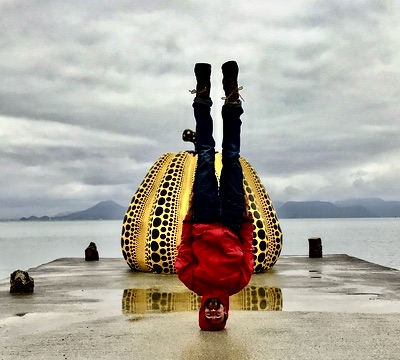
    I wasn’t able to do headstand for a long time, except against a wall, until one day I was doing it, no problem. After that I flipped wrong side up at the drop of a hat. I went from hating it to loving it. When a woman toppled out of the pose and crashed into me in a class, I thought, man, what an amateur! I changed my tune when I almost killed myself trying to get a grip on handstand. I never did get the hang of it.

   When it came to the doing of yoga the instructors were all different, all sincere, all good coaches with good intentions. They demonstrated the nuts and bolts of poses. They explained the idea behind them. They helped with adjustments. They encouraged us, which was a good thing, if encouragement was what you needed. Hope and encouragement are two of the best things you can give another person. For my part, lack of encouragement has never been a problem. I am irascible enough to not care too much about sticks and carrots. I mind my own business and keep in mind what Ezra Pound said, which was, “I have never known anyone worth a damn who wasn’t irascible.”

   One element of studio classes always bothered me, however, which was the catch phrases the instructors used. Some lingo like drishti, bandhi, and chaturanga was helpful to know. Everything seemed to revolve around down dog and tadasana, making it easy to jump to attention when hearing those words. Lift your leg, open your chest, and bring your feet together were sensible and understandable. Most of the new age cliches, however, got under my skin.

   “Love yourself” was one of the new age cliches. I understand living in your own skin but always thought loving yourself was either narcissism or some kind of mental disorder reserved for celebrities. I sometimes thought being a celebrity might be fun because, if I was boring somebody they would naturally think it was their own fault, they being nobody’s.

   “Inhale the future, exhale the past” was another one. Breathing is breathing. It’s not a trick or a metaphor. It’s a fact of life. Breathing consciously or unconsciously, awake or asleep, running a 10K or while doing Chair Yoga, is staying alive. Not breathing for a couple of minutes is losing life’s good luck charm. As for me, whenever I feel blue I go for a walk in the Cleveland Metroparks where the breathing is free and easy.

   What did exhaling the past mean? Exhaling the past would mean puffing away everything you have learned and know. The past informs the present. The past is gone, sure, but it isn’t going anywhere. As for inhaling the future, who can wait that long? When I was on the yoga mat scuffling to keep up, I had to gulp air right now, not in the future. Besides, instructors were always saying, “Be in the present.” Today was yesterday and is going to be tomorrow soon. Every asana, which is what the poses are called, was always right now. Breathing right now is what matters, never mind the past or the future.

   “Letting go is the hardest asana” was hard to take. Nobody who has ever taken a Bikram Yoga or Ashtanga Yoga class can possibly believe this. Bikram in a sweatbox is a torture chamber and Ashtanga is simply torture. After finishing those classes letting go isn’t hard. It is the easiest most wonderful thing in the world to breathe a sigh of relief. I have seen men and women letting go at Bikram Yoga studios and never coming back. What is so hard about letting go and kicking back on the sofa with a cold one after sweating out a gallon of life’s salt water?

   “Release the toxins” was a shopworn chesnut. Hearing it always reminded me of “Release the hounds.” What if I released my toxins and they started attacking others, for God’s sake? The instructors never explained the mechanics of it, except for saying nonsense like toxins come out in perspiration. There is no such thing as toxins that come out in sweat. Anyway, if I knew how to release them, assuming I was keeping toxins prisoner in my own body, I would do so without anybody having to cajole me. 

   The maxim that dazzled and perplexed the most was “It’s all yoga.” It was like saying, “It is what it is.” When I asked what it meant all I got was well-meaning mush that implied yoga was woven into the fabric of life. The life of the Mafia or the Taliban? The life of Nazis and Commies? The zany cesspool of the NRA and MAGA? There are many monsters running rampant who think they are gods and yoga is unquestionably not in their DNA. The nut cases who spill blood at schools and shopping centers with their AR-15’s don’t have a drop of yoga blood in them. They could use it but eschew it in favor of their dark fantasies.

   Even yoga isn’t exactly yoga nowadays. It might have been in the Old World, but much of it in the New World is a hodgepodge of calisthenics, jazzercize, and core work. Some studio owners don’t even bother paying lip service to the ethical and spiritual side of the practice anymore. They have bought in to the capitalist side of yoga by endlessly promoting teacher training, which costs thousands of dollars. Bikram Yoga teacher training, lasting nine weeks, cost ten thousand dollars before Bikram Choudhury fled the country, leaving behind charges of mischief behind closed doors. 

   There are practices like Naked Yoga and We’re Stoned Yoga that have as much to do with yoga as the Three Stooges have to do with Schrodinger’s cat. “Now you see it, now you don’t,” is what the cat says. Better to sleep it off than try to figure it out, although figuring it out isn’t difficult. “A child of five would understand this,” Groucho Marx once said. “Send someone to fetch a child of five.”

   Many yoga masters, like Greg Gumucio and John Friend, oozing sincerity have been the most insincere yogis ever, opting for sex and dollars. They are always banging on Heaven’s door with news of their next Ponzi scheme, except they don’t call them schemes. They call them something like conscious surrender. It is a showboat they sail on the open river, a fishing line leading back to what they are really all about. Don’t follow leaders, watch the parking meters, especially when the leaders tell you their sole aim in life is to help you. 

   When I looked around the west side of the North Shore it was the haves who were enjoying “It’s all yoga” the most. Those in Rocky River had the time and energy levels. Next door to Rocky River in Lakewood, where I lived, they enjoyed some of “It’s all yoga.” The problem was their income levels didn’t match up, so they didn’t have the same time or energy. The city of Cleveland, where yoga isn’t a halo except for scattered gentrified islands, it wasn’t all yoga, at all. The streets are meaner there and there isn’t the time or money to kid yourself that classes are necessary.

   It was when the head honcho at the yoga studio I went to in Rocky River started trying to convince me I should deepen my practice by taking teacher training that I stopped taking classes there. I was in my late 50s with a bad hip and skeptical about more than a few of the claims of yoga. I wasn’t teacher material, far from it. I was more anarchist than love your neighbor. They didn’t seem to be enlightened enough to see that. I wasn’t grist for the mill, either. I didn’t have the readies teacher training would require just lying around waiting for something to happen.

   I don’t take classes anymore. I practice at home by myself almost every day. There’s nothing complicated about yoga once a few basics have been mastered. It’s easier than grafting plants or installing a garbage disposal. It has lots of benefits to it, like staying in shape and finding some peace of mind. When I get on the mat at home, I get to be me, not what somebody else is telling me I should be, using buzz words that mix up being grounded with pie on the sky.

   That’s the best thing about the practice, the freedom of it, at least once I broke free of the conceits and capitalism of yoga studios.

Ed Staskus posts monthly on 147 Stanley Street  http://www.147stanleystreet.com, Made in Cleveland http://www.clevelandohiodaybook.com, Down East http://www.redroadpei.com, and Lithuanian Journal http://www.lithuanianjournal.com. To get the site’s monthly feature in your in-box click on “Follow.”

“Cross Walk” by Ed Staskus

Late summer, New York City, 1956. Big city streets full of menace. A high profile contract killing in the works. A private eye working out of Hell’s Kitchen scares up the shadows.

Available on Amazon: https://www.amazon.com/dp/B0CRPSFPKP

A Crying of Lot 49 Publication

Not Dead Enough

By Ed Staskus

   Vera Nyberg was in the middle of a zigzag dream when her cell phone rang. She kept it on the nightstand when sleeping. She let it ring, gathering her senses. Laying on her back she finally pawed for it and held it up over her head so she wouldn’t have to move her head. She saw it was 5:45 in the morning. It was the department. She took the call.

   “It’s my day off,” she said. “This better be good.”

   “Look out your front window,” the man on the other end of the line said. It was Dave Campbell. He was the boss of the Criminal Investigations Unit. He was her boss.

   Her back bedroom faced onto Crest Ln., which was more-or-less an alley. Her front bedroom, which was empty since she hadn’t done anything to it since moving in except paint it, faced onto Riverside Dr. The street overlooked the Rocky River Metropark valley.

   Vera got up and trudged to the front bedroom. One of her cats had been sleeping with her. The other one was sleeping in the front bedroom on one of the windowsills. She went to the open window and looked down. The cat yawned, stretched, and jumped away. What she saw was the street blocked in both directions by Ford Explorer Police Interceptors. Red and blue lights were flashing. There were an ambulance, a rescue truck, and a utility truck, as well. The utility truck had probably come from Station No. 1 on Madison Ave, but the other two vehicles, she thought, must have come from Station No. 2, which was around the corner on Detroit Rd. She had slept through whatever was going on.

   There are more than twelve thousand houses and buildings in Lakewood’s five-square mile footprint on the south shore of Lake Erie. The Fire Department has three stations. The lay of the land means their response times are very good. Vera hadn’t heard any sirens. She had gone out with a friend to the Alley Cat Oyster Bar in the Flats and been the worse for wear when she finally fell into bed. She swam downstream all the night.

   She couldn’t tell what the excitement was about. There were no civilian cars in the street. It couldn’t have been an accident. If it had been a simple  accident she wasn’t likely to be involved, anyway. There wasn’t anybody sprawled out and oozing blood on the asphalt. Two police officers were leaning  over the safety railing on top of the Jersey barrier that bordered the valley side of the street, from where Riverway Ave. dead ended to the corner of West Clifton Blvd. Maybe somebody had fallen into the valley. It was a long way down the cliffside, more than a hundred and fifty feet down.

   “Did somebody fall into the valley?”

   “Go take a look at what we’ve got and get back to me.”

   “All right,” she said, perplexed, She pulled on sweatpants and a light sweater. It was unseasonably cool for the first week of July. She slipped her identification card into her pocket, just in case. She stepped out her front door.

   When she walked into the street sunrise was in full swing. A police officer taking field notes looked her up and down.

   “Rough night Vera?” he asked.

   “It was a very good night,” she said. “It’s a rough morning.”

   “What there is to see is right over there,” the police officer said, leading her to the safety railing.

   She saw a rope tied to the safety railing. When she looked over the railing she saw a man hanging by the neck at the other end of the rope. He was wearing tan cargo shorts and a Cowboy Carter t-shirt. He wasn’t wearing shoes. There wasn’t much else to see. There wasn’t a sign of life to him.

   “The medical examiner should be here in about half an hour,” the police officer said.

   “Who called this in?”

   “Your neighbor one house over.”

   Tim Doyle lived in a large cottage-style house with his wife. They shared their house with two shaggy dogs. He was a professional photographer. He wore his graying hair long and tied back in a ponytail. His wife Colleen was a fine gardener and his business manager. Tim was an early riser.

   “I went across the street to get some shots of the fog on the river,” he said. “I like the half-light early in the morning. I didn’t notice the hanging man at first. I was standing there at the barrier when a turkey buzzard flew over me.” The birds nested in the cliffside. “They’re ugly birds but beautiful in flight. I got a good shot of him. He dove and was coming back up when I saw the man hanging there. I couldn’t see his face too well, but I think I recognize the t-shirt.”

   “We’re going to get him up and wait for the medical examiner,” Vera said. “Are you willing to take a look at him then?”

   “I’ll be on my front porch. I need a cup of coffee.”

   The hanged man was less than three feet down from the edge, although the rope looked longer. Vera saw it wasn’t taut and wondered why. Two firemen began pulling him up by his armpits but stopped. “He’s stuck on something,” one of them said. Vera saw the back of the man’s belt was caught on a small stump jutting out from the cliffside. One of the firemen carefully stretched down and freed the belt from the stump  They pulled him up and laid him down in the street. Vera borrowed a pair of nitrile gloves and began looking the man over. The heels of his bare feet were scuffed and bloody. He was fit but thick around the middle. There was still some color in his face. She thought whatever happened must have happened just before sunrise. There wasn’t anything in his pockets. 

   The Cuyahoga County Medical Examiner arrived in twenty minutes. He  was in his late 30s, like her, but lanky and tall. He was six and a half feet tall. Vera was five and a half feet tall. She was always looking up at the underside of his bony chin. His name was Isaac but whenever she saw him she thought of Ichabod Crane. She called him Ichabod, but only out of the man’s earshot.

   He began by crouching over the hanged man and examining his neck. After a minute he frowned. He looked up at Vera.

   “He didn’t die by hanging,” he said. “Ligature marks from hanging typically appear as a groove or furrow encircling the neck, obliquely positioned above the thyroid cartilage and discontinuous at the point of suspension. There are almost no ligature marks and there is no groove.”

   Vera got the gist, ignoring the jargon.

   “So what did he die of?”

   “I’ll show you what I think killed him.”

   He reached into his evidence bag and pulled out a pair of tweezers. He pushed the tweezers up one of the man’s nostrils and extracted a crumb of green fabric.

   “I think he was smothered, probably by a green shaggy pillow,” he said, probing the other nostril. He was still probing it when the man sneezed. Vera jumped back like she had stepped on a snake and the medical examiner almost fell over.

   “What’s going on?” the man groaned.

   “He’s not dead,” Vera said.

   “Apparently not,” the medical examiner said, recovering his poise and checking the man’s vital signs. He checked his pulse. He checked his respiratory rate. He checked his doll’s eye reflex, moving his head gently back and forth and observing his eye movements.

   “He’s definitely alive and seems to be all right, but let’s get him to Fairview as soon as possible,” he said. The Cleveland Clinic Hospital in Fairview Park was five minutes away.

   “Wait,” Vera said.

   She waved across the street at Tim Doyle, who put his coffee cup down and joined them. He looked down at the man.   

   “That’s Bill,” he said. “He lives in that house there.” He pointed to a large house next to another large house on the opposite corner. Both houses faced the valley. “He lives with a partner. His name is Walter, although I call him Wally. He doesn’t like it, but that’s what I call him. He and Bill haven’t been getting along lately.”

   “How do you know that?”

   “I’ve heard the fights in their backyard the past two months. All the neighbors have. Wally’s been in a foul mood lately.”

   “Keep him right here,” Vera said to the medical examiner, pointing at Bill. “When you see me coming back put something over his face.”

   “He needs to go to Fairview the sooner the better.”

   “I’ll be back in five minutes.”

   Vera crossed Franklin Ave., walked to the second house down, and went up the front steps. The house had an old-fashioned slate roof. It had recently been spruced up with shiplap siding. An oak tree kept the house shaded. There were two large, glazed pots of scarlet geraniums flanking the front door. One of them was knocked over. Loose flower petals on the ground looked like spots of dried blood. The blinds in every window were drawn. She rang the doorbell. A man dressed like Jimmy Buffett answered the door. There were two suitcases and a carry-on at his feet. What she could see of the indoors looked dim and gloomy. 

   “Let’s go,” he said. “I’ll be glad to get out of here.”

   “Where to?” Vera asked.

   “The airport.”

   “I’m not your Uber,” Vera said, showing him her identification card.  “Are you Wally?”

   “I’m Walter,” the man said.

   “Before you leave for the airport, I wonder if you would come with me for a minute.”  It wasn’t a request. A police officer had come with her. He was standing behind her.

   “I’m already running late for my flight.”

   “This will only take a minute.”

   They went down the steps when Vera suddenly said, “I forgot something, be right back.” She made a sign the police officer understood and beelined up the steps and into the living room. In the living room she saw two green shaggy pillows on a sofa. Back outside they walked to where Bill was. The medical examiner had covered him with an evidence sheet. He quickly peeked under the sheet and put a forefinger to his lips, signaling Bill to be quiet.

   When they got to the evidence sheet Vera said to Walter, “We discovered a man hanging from the safety rail this morning and we’ve been made aware he lived in the house you also occupy. Would you mind taking a look at the man and see if you can identify him.”

   “Is he dead?” Walter asked.

   Vera didn’t answer. The medical examiner uncovered the face of the man. Walter looked at him and said, “My God, it’s Bill, what happened to him?”

   Bill opened his eyes and said, “You’re what happened to me.”

   Walter was dumbstruck. His face went white. His eyes got big as a tree frog’s. “You can’t be alive. I killed you twice.”

   “I’m not dead enough for you?” Bill asked. “Why did you do it?”

   Walter’s face changed. It got dark. “I loved you for twenty years but you were dumping me for a younger man,” he said. “Where was I going to live? How was I going to live? I took all your money I could get my hands on and I was going somewhere warm and sunny where nobody would ever find me. I hate you. I wish I could kill you again.”

   Vera stepped in front of Walter, told him he was being arrested for attempted murder, and began reading him his rights. Halfway through her recital Walter bolted, dodged two police officers, and ran down Riverside Dr. towards West Clifton Blvd.

   “Oh, for God’s sake, he’s got the brains of a paper cup,” Vera said. “Go get him before he hurts himself.”

   While she waited for Walter to be caught and brought back, the ambulance took Bill to the Cleveland Clinic, the rescue and utility trucks drove off, and all but one of the Police Interceptors left. The medical examiner came over and stood next to Vera, looked down at the top of her head, and said, “Next time make sure they’re dead for real before calling me first thing in the morning.”

   “That’s on me,” Vera said.

   “And stop calling me Ichabod,” he said. “I’m not a schoolmaster, and when it comes to headless horsemen, I’m the one with bone saws, not the other way around.”

Image by Joan Miro.

Ed Staskus posts monthly on 147 Stanley Street at http://www.147stanleystreet.com, Made in Cleveland http://www.clevelandohiodaybook.com, Down East http://www.redroadpei.com, and Lithuanian Journal http://www.lithuanianjournal.com. To get the site’s monthly feature in your in-box click on “Follow.”

“Bomb City” by Ed Staskus

“A Rust Belt police procedural when Cleveland was a mean street.” Sam Winchell, Beyond Books

Available on Amazon: https://www.amazon.com/dp/B0F1LM1WF9/ref=sr_1_1?crid=2MYAQAOZIC2U9&dib=eyJ2IjoiMSJ9.hTm7BGbiQbSe5ZapFwYPPfcwOpTe-Vdg6VLE4aGyTyk.Z0R-VNBWWEcvKcNaO9LdCOUnNIOOXgvYkRS_FXiXuHk&dib_tag=se&keywords=bomb+city+ed+status&qid=1742136726&sprefix=bomb+city+ed+staskus%2Caps%2C84&sr=8-1

Cleveland, Ohio 1975. The John Scalish Crime Family and Danny Greene’s Irish Mob are at war. Car bombs are the weapon of choice. Two police detectives are assigned to find the bomb makers. Nothing goes according to plan.

A Crying of Lot 49 Publication