By Ed Staskus
Arunas Petkus wasn’t an especially talkative young man. He was more taciturn than not. So, when he came up for air after ten minutes of lamenting the Woodstock Music & Art Fair, which was what he missed because the weekend before it happened he stepped on a shard of glass in the beach sand at Mentor Headlands, it dawned on me he was dismayed. I glanced at his left foot. He had needed five stiches to staunch the bleeding. The stiches were being removed the following day.
He had planned on hitching a ride to the Catskills, where the music festival was staged, but with his bad foot ended up limping around home. We both lived in North Collinwood on Cleveland’s east side and had both attended near-at-hand St. Joseph High School. All the school’s sports teams were nicknamed the Vikings, and we had the trophies to prove it, but since our school was Catholic, run by the Marianist Fathers of the Society of Mary, we weren’t allowed to do anything like the Vikings used to do, such as maraud, plunder, or practice Old Norse paganism.
We were sitting around the backyard of the Petkus house where Arunas lived with his parents, north of Lakeshore Blvd. and ten minutes from our high school. Until that summer I had lived with my parents, south of Lakeshore Blvd. and the same ten minutes from the school. We graduated in the same class. I had since moved to the bohemian neighborhood of Upper Prospect on the fringes of downtown.
Steve Warszawski, one of our friends from Cleveland State University, where the three of us were undergraduates, had joined us and was fingering a joint he had rolled. He was high strung and could blaze it all day. Arunas warned him to not light up until his parents left. Steve was Polish, not Lithuanian like us, but it was close enough. The Polish – Lithuanian Commonwealth had been a European powerhouse during the Early Modern Period.
Arunas was majoring in Fine Arts at Cleveland State University, I was majoring in English, and Steve was majoring in Political Science.
“Do you know what the word politics means? “Arunas asked, grinning like a Cheshire cat.
Steve shot him a wary look.
“Poly is Greek for many and tics are blood sucking insects.”
“Very funny, but I’ll tell you this, I’m finding out a lot, especially about the two things most important when it comes to politics.”
“What are those?”
“The first one is money and I forget the second one. I’m going to have lots of money someday while you two are going to be poor with all your reading and drawing.”
“So when you’re the top dog you’re going to legalize weed and make millions?”
“That’s right.”
I hadn’t known anything about the music festival beforehand and so wasn’t being driven to lamentations about it, although after reading the news in the Cleveland Plain Dealer wished I had gone. Steve had gone in his rundown 1956 Ford Country Sedan with nine freeloaders. The car had been known as “America’s Favorite Station Wagon” back in the day, but by the time Steve got his hands on the bucket of bolts its day was long gone.
“Describing Woodstock as the Big Bang, I think that’s a great way to describe it,” David Crosby of Crosby, Stills & Nash said. Their set made a bang, even though the music festival was only the group’s second-ever live public performance.
“I didn’t see anybody play, except when I was standing backstage waiting to go on, because it was so muddy,” Grace Slick of Jefferson Airplane said. “The weather was horrible.
“The important thing that you’ve proven to the world is that a half a million kids can have three days of fun and music and have nothing but fun and music, and I bless you for it,” Max Yasgur, the dairy farmer who hosted the gathering on his land, said.
“Man, oh man, there was a lot of free weed,” Steve said. “When I got home I thought I was going to have to face the music, but the only thing my mother asked me was whether I had smoked any LSD. I was able to honestly tell her I hadn’t.” He didn’t tell her LSD wasn’t smokable.
“All I know is that I wasn’t there,” Arunas grumbled.
Joni Mitchell wasn’t there, either, but she ended up writing the best song about the event. She wrote it in a New York City hotel room while watching news coverage of the Woodstock Music & Art Fair on TV. “I’m going down to Yasgur’s farm, think I’ll join a rock and roll band, I’ll camp out on the land, I’ll try and set my soul free.”
A year later Arunas’s foot, which had mended in time for the previous year’s fall classes at Cleveland State University, was itching to go to another music festival, this time at Goose Lake in Michigan. Steve had brought up the idea, but Arunas had made it his own.
“Do you still have your Country Sedan?”
“No, the head gasket blew, but I’ve got something better.”
The something better was a 1961 Chevrolet Corvair, which by 1970 was considered the worst car manufactured in the 1960s. It had oil leak and fan belt issues. Its rear-engine swing-axle design caused severe oversteer and a loss of control at high speeds, which meant rollovers. The handling flaws and rollovers had led to a congressional investigation five years earlier. Ralph Nader weighed in, saying the car was a menace.
“That sounds great,” Arunas said.
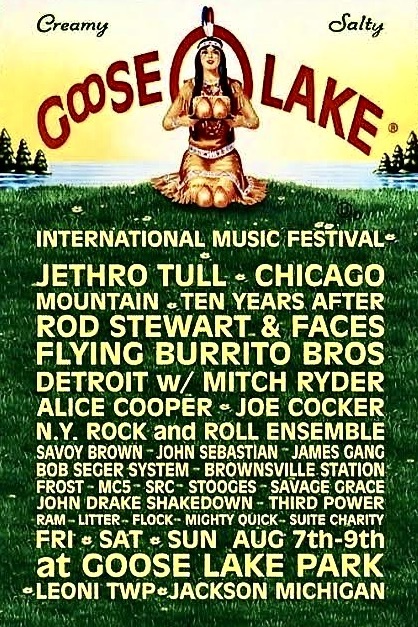
The Goose Lake International Music Festival was going to be held in Leoni Township, Michigan, not far from the city of Jackson. The city was the birthplace of the Republican Party. The festival was slated for the first weekend of August, almost exactly a year to the day that the Woodstock Music & Art Fair had taken place. We stuffed clothes, socks and underwear, rain slickers, and cans of pork and beans into our backpacks. Arunas brought a tarp and some rope and I brought an aluminum-barrier bag of powdered Tang. Steve brought his hash pipe. He was a dopehead. We each brought our own sleeping bags. Arunas and I prayed for good weather. We were Catholics. Steve didn’t pray. He was an atheist.
“You can’t be a successful politician if you believe in anything,” he explained.
We got on the Ohio Turnpike to Michigan in the early afternoon the day before the rockfest. Our plan was to be there in four-some hours, park someplace out of the way, sleep under the stars, and be in line first thing in the morning. Steve slept on top of the car that night. Arunas slept under the car and had to fend off a pesky groundhog. I ended up sleeping in the back seat.
It eventually took us eight hours to get to Goose Lake, adding oil to the engine every hundred miles. Steve had brought five or six extra quarts of Bardahl. We had to change a flat tire outside of Sandusky. When we did Arunas piped up that he had always wanted to ride the Blue Streak at nearby Cedar Point, so we detoured to the amusement park on Lake Erie and rode the roller coaster half a dozen times, until Steve got grayed out. The G-forces of that kind of ride push blood down towards the feet, which reduces blood and oxygen getting to the brain. Steve got lightheaded and almost fainted. Arunas and I had to do the two-rescuer walk to get him back to the car. He wouldn’t let either of us drive, however, saying only he knew how to handle the death trap that the Chevrolet Corvair was.
Back on the road we saw a billboard that said “Beautify America…Get a Haircut.” All three of us had locks. We ignored the billboard. Steve said he had heard there were going to be 60,000 people at the festival. That was the capacity of the site. When we got to the front gate at seven o’clock on Friday morning, groggy and disheveled, there were nearly 60,000 people already there. By mid-day there were 140,000. By nightfall there were more than 200,000.
Waiting in line to get into the festival I noticed the eight-foot high chain link fence encircling the 390 acre site featured barbed wire and was electrified. A kind of moat ran parallel to the fence. Security guards on horseback were patrolling the water-filled ditch. They looked as young as us. “A young, hip police force was hired to provide 24-hour protection,” Bobby Mann, one of the promoters, said. “The only thing that can blow our rock festival is kids who might try to crash it.” By Saturday more than half of the attendees had snuck in.
The Goose Lake International Music Festival was the brainchild of Richard Songer, a successful Detroit area businessman who had cashed out in his mid-30s and was looking for something new to do. He had a brainstorm. He would build a permanent venue for giant music festivals and ride the profits into old age. He bought the land, which included shoreline on Goose Lake, and started construction of a rotating stage and sound towers. No sooner did he do that than the Goose Lake Property Owners Association took him to court.
“You can call it a rock festival,” one of the property owners said. “It’s just another way to sell dope.”
“What the community had heard about Woodstock was out-of-control youth, rampant drug use, motorcycle gangs, sex, and all sorts of things you just couldn’t have,” said Larry Jacobson, a local historian. “A lot of people thought, ‘You’re not bringing that here. We’re not going to allow it.” They filed a lawsuit, claiming the event would “pollute the area and bring in an invasion of hippies,” but the property’s zoning allowed for it, and that was that. “There are no ordinances to prevent the event from happening,” the judge said.
The Woodstock Music & Arts Fair and Altamont Free Concert had set the stage for the complaints. The crowd at Woodstock had greatly exceeded expectations. Traffic on the rural roads completely locked up. There weren’t enough food vendors and not nearly enough toilets There was more than enough nudity and drug use, not to mention the anti-establishment music. At Altamont the Hells Angels had been hired as security, resulting in beatings of attendees and even some performers. The beatings were by fist and chain. One concertgoer was stabbed to death by the motorcycle gang.
The Jackson County police forces took a hand-off approach, controlling what was happening outside the rockfest, but not entering the site. Sheriff Charles Southworth told his deputies, “Leave them alone. I don’t care what the hell they do once they’re in that private park.”
If the police had entered the private park they wouldn’t have had enough paddy wagons. “One of the security guards was standing right next to a table where a guy was selling drugs,” said Dave Eckler, one of the attendees. “The guy said, ‘Hey, can I borrow your bullhorn for a second?’ And he goes, ‘Acid! Mescaline! Hashish!’ He was using the bullhorn to advertise to people who were walking through the crowd.”
The grounds at Goose Lake were top-notch. There was free parking, plenty of campground, where we unrolled our sleeping bags beneath the tarp Arunas had brought, lots of restrooms with toilet paper and some showers, trails for walking and dirt bikes, and open kitchens, although we lived on our pork and beans and Tang all weekend, managing our finances. There was the world’s longest slide that we raced down on burlap sacks.
The weather was dry, but hot. The sandy beach was a mile long. A boatload of skinny dipping went on to cool off. We spent Friday and Saturday listening to bands like Chicago, Mountain, Rod Stewart and the Faces, Ten Years After, and the Flying Burrito Brothers. The Burrito Brothers did a spirited version of their song “My Uncle.” They meant Uncle Sam.
“Now I don’t know how much I owe my uncle, but I suspect it’s more than I can pay, he’s askin’ me to sign a three-year contract, I guess I’ll catch the first bus out today, so I’m headin’ for the nearest foreign border, Vancouver may be just my kind of town.”
They got a standing ovation. Everybody knew we weren’t going to win the Vietnam War. Nobody wanted to die eight thousand miles away in a losing cause. Victor Charlie was engaged in a War of Independence and the United States wasn’t. I didn’t know about Arunas or Steve, but I no longer believed in “My country right or wrong,” especially not when Richard Nixon said it.
We saw Chicago from the very back of the amphitheater, but their three man horn section came through loud and clear, even though we were about a quarter mile away. Mountain did some terrific acid blues. John Sebastian was tie-dyed, folksy, and sincere.
The highlight on Saturday was the Stooges. Iggy Pop was on vocals and the rest of the band was the original line-up. It would be the last time the original line-up played together. The bassist Dave Alexander was so intoxicated during the set that he was thrown out of the band by Iggy Pop as soon as they left the stage.
I didn’t know anything about the Stooges. Somebody said the band was from Ann Arbor. Somebody else said they were from Detroit. When Iggy Pop appeared he was shirtless, wearing ratty blue jeans and a dog collar, and his face was white as chalk. He was big into stage diving. His voice was volatile. He sounded like a wolf at times. The band was abrasive, a raw wall of sound, heavy on grit and feedback. Iggy Pop ran his microphone through Marshall amps, distorting his voice. I couldn’t understand a word of the lyrics.
The line-up of bands on Sunday was whopping good, including the Bob Seeger System, the James Gang, who were from our hometown, and Mitch Ryder & the Detroit Wheels. Jethro Tull closed the show with their song “Dharma for One” and an extended drum solo.
We were rolling up our sleeping bags when we heard a warning over the public address loudspeakers to not take drugs with us, as the police outside the gates were ready. Just inside the exit we went out of there were half-a-dozen 50-gallon drums full of drugs. Everybody was emptying their pockets. “The drums were overflowing,” Johnie Kyke Rains said. “Any color of pill you could think of, blocks of hash, marijuana, everything.”
As we were leaving a lanky pony-tailed guy wearing a leather codpiece, and nothing else, slipped past us back through the gate. He was carrying a penny whistle. He looked dazed and confused, so Arunas pointed over his shoulder and told him the parking lot was the other way.
“That’s cool,” he said, “but I’m looking for my baby, man. I lost her somewhere.”
“Where did you last see her?”
“I think it was down by the lake.”
We walked him to Goose Lake and sure enough, a bare-breasted young woman was cavorting in waist deep water.
“Benjy, my man,” she called out happily.
A big smile lit up Benjy’s face. He played the opening bars of “A Groovy Kind of Love” by the Mindbenders on his penny whistle and ran into the water, launching himself at her. The last we saw of them they looked like a pair of eels having fun. It was getting dark so we hustled our way to the parking lot and got going. Everybody else was doing the same thing. It took us a while to get to the Ohio Turnpike. The Chevrolet Corvair held up, even though Steve drove like the Road Runner, popping pills to stay awake, and we were back in Cleveland just after midnight.
Richard Songer had planned on making the festival an annual thing, but it wasn’t to be. No sooner was the weekend over than the Jackson County Prosecutor called the event a “public nuisance.” He claimed the promoters had condoned the “open sale of drugs and irresponsible behavior.” Michigan’s Attorney General chimed in that the state had seen “its first and last rock concert.” Despite Richard Songer never being convicted of anything, an injunction forbade any more rockfests being staged at Goose Lake.
Over the years the site transformed itself. It became a drive through zoo for a time and eventually the Greenwood Acres Campground. They pay homage to the Goose Lake International Music Festival every August with a “Groovin’ at Greenwood” weekend of live music. The sound towers are still there, but the wall of sound isn’t. Iggy Pop has never been invited back. The Greenwood Acres Campground is “family friendly” with an Olympic-size swimming pool and an 18-hole putt-putt course. Even though marijuana is legal nowadays, it is not allowed on the grounds.
Ed Staskus posts monthly on 147 Stanley Street http://www.147stanleystreet.com, Made in Cleveland http://www.clevelandohiodaybook.com, Down East http://www.redroadpei.com, and Lithuanian Journal http://www.lithuanianjournal.com. To get the site’s monthly feature in your in-box click on “Follow.” His books are available on Amazon and Apple Books.
“Bomb City”
Cleveland, Ohio 1975. The John Scalish Crime Family and Danny Greene’s Irish Mob are at war. Car bombs are the weapon of choice. Two police detectives are assigned to find the bomb makers. It gets personal. Revenge is always personal.
A Crying of Lot 49 Publication