
By Ed Staskus
I was three years old before I got my first good look at Sudbury. I didn’t know the place had started life as a railroad outpost in the nineteenth century before rapidly expanding when vast mineral resources were discovered. I didn’t know what it had become seventy years later, which was “Nickel Capital of the World.” I knew it was springtime on our street. When I looked around I thought it was the best place in the world, a place where everything was new. I later learned, no matter how old anything looked, everything had once been new.
My brother had been born in the fall and had been crying at night lately, keeping us all awake. My father was a miner, working day shifts for two weeks and then night shifts for two weeks. He was one of the black powder men, setting explosive charges more than a mile down. He needed his nerves to be rock solid. He needed to sleep like a baby. He didn’t need crying rattling around in his brain.
At first, my mother thought it was a passing thing. When it didn’t pass, she took to sleeping in the living room, on the sofa, with my brother on the floor beside her in a small rocking cradle. Whenever he started crying she reached down and rocked him, settling him down. She didn’t get much sleep, although my father and I got all the shuteye we needed.
One day a year-and-a-half later, when my father was at work, and my mother had an appointment with the family doctor to check my brother’s tonsils, my godfather Joe Dzenkaitis showed up to babysit me for the afternoon. He was on the night shift in the nickel mines and had time to kill. He showed up on a 1948 Vincent Black Shadow motorcycle.
“My neighbor asked me to watch it,” he explained. “He’s up in Wawaitin Falls hunting bears for a week.”
Most of the Lithuanian immigrants who came hat in hand to Sudbury in the late 1940s and early 1950s worked in the mines. They got out of the black hole that Europe was after World War Two and ended up in another black hole. Most of them were saving every penny they could so they wouldn’t have to work in the mines a day more than they had to. Many of them had clawed enough cash together to buy their own homes, but didn’t own much in the way of wheels.
The Vincent had a black tank and a black frame. The pipes were nickel chrome steel. The nickel came from Sudbury. The city, south of North Bay and north of Lake Huron, sat on top of a big hole in the ground overflowing with ore. Some people called it the “Valley.” Others called it the “Basin.” Still others simply called it “Paydirt.” An asteroid smashed into the spot in Ontario hundreds of millions of years ago with a cargo of must-have metals. Nickel took the blue ribbon.
During the Korean War, which had ended two years before, nickel was regulated. Whenever there was fighting anywhere in the world Sudbury boomed. Nickel was vital for making modern warfare. When the fighting stopped Sudbury went back to scuffling. It wasn’t boom or bust, but it was a one horse town, so it was boom or bust.
After World War Two the open pits were almost exhausted and new underground mines were being dug. Nickel was increasingly being used for civilian purposes. Technologically advanced smelters started seeing the light of day. While Sudbury slowly progressed from being one of the most polluted cities in North America, cleaning itself up, I was just getting my legs under me. My friends and I played on the outcroppings behind our house all the time and never noticed the ever-present haze of ash and smoke.
We played Man on the Moon. Astronauts from the United States played the same game on the rocky wastelands surrounding Sudbury in 1971. They were part of the Apollo 16 mission. More American astronauts trained outside of town a year later, for Apollo 17, for the moon landing in December of 1972. They were practicing for the real thing.
I didn’t see much of my hometown after I was born. I was homesick for my old home, which had been warm and fluid. Sudbury was frozen solid, the winter one severe cold snap after another. After I was squeezed out into the new world I saw a lot of my crib and the kitchen. I only spoke Lithuanian until the spring of 1954, when I started meeting kids my own age on the street. They all spoke English and French although none of them spoke French among themselves. English was their language on the street. They said French was for talking to their parents and to girls.
The Vincent motorcycle my godfather was riding was plenty fast enough, but it wasn’t the Black Lightning, which was the racing version of the Black Shadow. Every steel part on the Lightning that could be remade in aluminum had been remade in aluminum. Everything not essential was removed, reducing the weight by almost a hundred pounds. It had a single racing seat and rear footrests. In 1948 Rollie Free broke the motorcycle land speed record riding a Black Lightning on the Bonneville Salt Flats. He did it wearing a bathing suit, laying like a swimmer flat on his stomach, his legs dangling off the back end, and hanging on to the handlebars for dear life. When he finally rolled to a stop he was coated tip-to-toe with sand and salt.
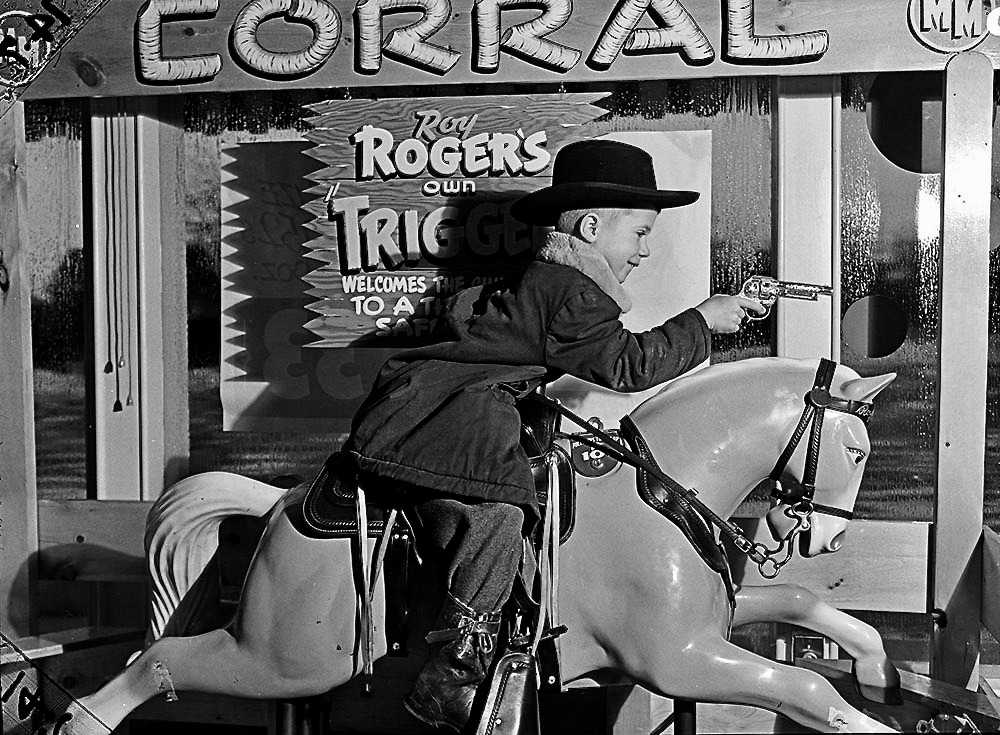
I sat on the motorcycle behind my godfather, who I called Uncle Joe. I couldn’t get my arms around him and had to hang on tight to his shirt. He burped the motorcycle down Stanley St. to Elm St. and took a left towards downtown. My friends and I had been to an arcade downtown and ridden Roy Roger’s horse Trigger, which was made of laminated wood. Roy Rogers was “King of the Cowboys.” Even though he was a buckaroo hero, he was from Ohio, where our family was going to end up in a few years. The only cowboys I ever saw riding horses in Cleveland were Shriners in parades, when they weren’t driving miniature cars.
We lived on a new stretch of Stanley St. Houses were being built as fast as could be because Sudbury was the most congested city in Canada and needed housing. The Dominion Bureau of Statistics reported there were “42,410 people jammed into 9,450 units.” More than a third of the housing was officially designated as “overcrowded.”
We glided past the Regent Theatre where my parents went to see movies on weekends. My father learned to speak English in Lithuania, but my mother had lived on a remote family farm of pigs and sugar beets near the East Prussian border. The mother tongue was all she knew. The movies were a way for her to learn English. A twin bill was showcasing “Creature from the Black Lagoon” and “Seven Brides for Seven Brothers.” I made a mental note to see the monster movie.
The movie house was operated by Herbert Sutherland. By the time I was old enough to go see movies it was home to a colony of rats. It got so it was hard to tell if somebody was screaming because of the scariness on the screen or because of a rat biting their ankles. Herb Sutherland found some homeless cats and invited them to make his movie house their home. The city sent him a letter saying, “We do not feel the use of cats is sufficient to eliminate the menace.” He threw the hired guns out and deployed poison traps, making the problem disappear.
We went past the new Sudbury Arena which had replaced the old Palace Rink the year I was born. Uncle Joe rode carefully, watching for mud, threading the needle. The Junction Creek overflowed its banks every year, flooding the northern and central parts of Sudbury. We rode around the General Hospital where I was born. Outside the Grotto of Our Lady of Lourdes we stopped for ice cream cones. I snuck a look over my shoulder for spirits, saintly or otherwise.
Frederic Romanet du Caillaud, known as the “Count of Sudbury,” had a six-foot tall 1500-pound bronze statue of the Virgin Mary erected at the mouth of the grotto in 1907. “Queen of the Gauls” was inscribed on the statue. At first, an Italian family by the name of Drago took care of it, wiping off grime and bird shit every spring and autumn. In the 1950s the Rosary Club was formed. Omer Naqult. a local barber and devout Catholic, watched over the pilgrimage site from then on.
One year earlier almost 10,000 people had gathered at the site, coming from all the various parishes of the Sault-Ste-Marie diocese. New lighting was installed to light up the shrine at night. At the start of the next summer a throng of residents of Sudbury took part in the Procession of Corpus Christi that ended up at the grotto. My parents were not able to go to the parade, no matter how devoted to Catholicism they were, so I didn’t know anything about it at the time.
The statue was an inch or two shorter than Uncle Joe, who wore his hair wavy and was strong as an ox. He could bend galvanized nails with his fingers. He and his wife Brone didn’t have any children, but I saw plenty of them, anyway. My parents had a good-sized living room and our house was where card playing, dancing, and carousing took place on many weekends. There was always a spread of Baltic foodstuffs, like black bread and smoked eel, at the kitchen parties, as well as plenty of booze.
We set off for Ramsey Lake. Before there ever was a Sudbury the natives called it Lake Bitimagamasing, which means “water that lies on the side of the hill.” Everybody agreed Ramsey was easier to pronounce and that is what everybody called it. Everybody also agreed the lake was dead as a doornail. Sewage from Minnow Lake drained into Ramsey Lake. Open roast emissions had been going on for so long and led to so much pollution that the lake, which had few flow outlets, had given up the ghost. Even though it was still the largest lake in the world located entirely within the boundaries of a single city, it was a shell of its former self.
There weren’t many fish in the lake. By the 1950s, despite three decades of persistent stocking, angling was still bad. Besides the pollution, fishermen had long since been dynamiting for fish, wiping out some species like bass. When Lands and Forest biologist R. E. Whitefield went survey netting, it took him four full days to catch five pike and one yellow perch. Lake trout were re-stocked in 1952, but when they disappeared that was the end of stocking for the next twenty-five years.
Before my father showed up to sweep her off her feet, my mother’s then Canadian boyfriend often took her out on the lake in his speedboat, until the day he started showing off, racing and zig zagging, and she fell off the back of it without him noticing. An evil-looking northern pike watched her bob up to the surface. By the time her boyfriend thought to look for her she was floating on her back waiting for him, hoping the weight of her wet clothes wouldn’t drag her under.
The lake is named after William Ramsey, who was the chief of a surveillance party in the late 1800s and who got into the weeds in heavy fog. After finding himself he named it Lost Lake. Others more civic minded decided it would be better to name it after him but misspelled his name, calling it Lake Ramsay. Forty years later somebody noticed the mistake and corrected the spelling.
When we got to the lake I begged Uncle Joe to let me go swimming, but there was a greasy purple substance on the surface of the water as far out as we could see. “It’s probably some poisonous waste, or something Inco is up to,” he said. I had no idea what Inco was, but I had heard “What are you up to?” from my mother often enough to know it couldn’t be anything good. We went for a walk instead. When I got tired my godfather carried me sitting on his shoulders, my hands gripping his thick head of hair.
It was an early fall day and trees were starting to change color. There weren’t many of them, but the yellows and reds got me going and I asked my godfather to take me to a forest. He said there weren’t any left, but finally relented when I wouldn’t leave it alone. We rolled slowly out of town on the Vincent. Uncle Joe flat-hatted across the hinterland.
It turned out he was right. There were hardly any trees anywhere, at all. The first thing to happen to them was the Great Chicago Fire in the 1870s. Lumber camps popped up all over Ontario providing wood for the American city’s reconstruction. Then the ore discoveries and smelting got going, the fires releasing sulfur, which combined with water forms sulfuric acid, leading to acid rain. Saplings struggling to reforest the landscape didn’t have a chance and died by the millions. The back country of Sudbury looked like a wasteland by the 1940s.
Our street on the west side of the city had trees and grass and gardens but the only vegetation I saw outside of the city were wild blueberry patches and paper birch trees. What other trees were still standing were giving it their best shot against long odds. They were like the crippled kid on Pine St. we sometimes played with, although never for long. He couldn’t hop, skip, or run. He couldn’t keep up with us. He sat under a tree watching us hop, skip, and run. None of us knew what he did when he was by himself.
When my godfather checked his watch, he suddenly said we had to go. We raced back to Sudbury, to Stanley St. and our house. My father wasn’t home from work, yet. Neither was my mother. Uncle Joe indicated that was a good thing.
“When she asks you what we did today, just tell her we went sightseeing, OK?” he said.
“OK,” I said.
After my mother came home I told her we had a great time, and while she and my godfather had coffee on the back porch, I watched my baby brother crawl around the yard. He was making progress, gurgling rather than crying. Our street dead-ended in a dark face of pitted rock. I was forbidden to climb it because it was steep, and Canadian Pacific trains hauling ore ran along the top, even though I had already gone up and down it many times with my friends. Sometimes rules are just a moot point, especially when the ground rumbles under your feet while standing near the tracks and the suction effect makes it seem like the train is trying to pull you towards it.
When my friends ran into our front yard after dinner and asked me where I had been all day, I told them all about it, all the places I had been to, and how Sudbury was bigger, better, and more exciting than I had ever imagined. After that Stanley St. was still our whole world, but we couldn’t wait to see more of the world. We ran up and down the street that evening pretending to be riding motorcycles. The sunset was a gleaming orange. We were spent and sat down on a boulder watching night happen. When my mother put me to bed, saying I looked tired, I slept like the rock of ages.
Ed Staskus posts monthly on 147 Stanley Street http://www.147stanleystreet.com, Made in Cleveland http://www.clevelandohiodaybook.com, Atlantic Canada http://www.redroadpei.com, and Lithuanian Journal http://www.lithuanianjournal.com.
“Cross Walk“
“A once upon a crime whodunit.” Barron Cannon, Adventure Books
“Captures the vibe of mid-century NYC.” Sam Winchell, Beyond Fiction
Available on Amazon: https://www.amazon.com/dp/B0CRPSFPKP
Late summer and early autumn. New York City. A Hell’s Kitchen private eye. The 1956 World Series. President Eisenhower at the opening game. A killer in the dugout.

