Category Archives: Home Movies

One Way Ticket

By Ed Staskus

   “I don’t like this jacket, dad,” I said. “It’s too white.”

   “The first communicant has to wear special clothing,” my father said. “It’s white to symbolize purity.” He could be pontifical whenever he wanted to be. There was nothing I could do about it. I had to live with his pronouncements. He had grown up in northern Lithuania in the shadow of the Hill of Crosses. Unlike my mother, he was a true believer in Roman Catholism.

   “That’s right,” my younger brother piped up. “At least you’ll look like a saint.” I could tell from his face that he wanted to add “or a fag” but couldn’t with our father in the same room. I gave him a look we both knew meant we would settle that wisecrack later, when our parents were out of range of his cries for help. His time would come. When it did, his time would be up.

   First Communion was a big deal. Girls wore dresses passed down to them from their sisters or mothers. They sported a veil or a wreath. Boys wore a suit and tie, their Sunday best, or the national dress, with embroidered armbands and white gloves. Thank God all I had to wear were a sports jacket and a pressed pair of clean pants. A folk costume and white gloves in front of my relatives would have been mortifying, especially if they started nodding approvingly at one other. In front of my friends, it would have been unbearable.

   My father was devout and my brother wasn’t far behind, even though his guile was legendary among everybody except grown-ups. I was sure he would find some goofy jacket to wear the day of my First Communion, just to show me up. That is exactly what happened. I couldn’t do anything about it. I had to keep my JFK-style hairdo in place. Even though my parents voted Republican like playing Whac-A-Mole, my mother thought John F. Kennedy the envy of the Western world, new, vibrant, and handsome. She wasn’t going to vote for him, but that was beside the point.

   We lived on Bartfield Ave. at East 128th St. and St. Clair Ave. in the Forest Hills vicinity of the Glenville neighborhood. There were no forests, hills, or glens. Lake Erie wasn’t far away, though it was so polluted nobody but the reckless ever swam in it. Our church was St. George’s on E. 65th St. and Superior Ave. It was also our school. During the week my brother, sister, and I took two city busses, transferring while halfway there, a half-hour ride to get to school, but on Sunday mornings our father drove the family the ten minutes there.

   After the First Communion ceremony a photographer took portraits of us, a prayer book and rosary in our hands, looking pious and glowing in soft focus. Gifts were parceled out. Some parents gave their children holy cards, religious statues, and daily devotional books. My father and uncle were thankfully both accountants and gave me envelopes alive with cash.

   The next day was Jesus Day. We took a prayer walk around the school grounds, which was a big asphalt parking lot, were led on a tour of the church, which I knew full well since I was training to be an altar boy, created a personal bookmark, and sat through a special liturgy. We were reminded that Holy Communion was very special, a matter of life and death. St. Ignatius of Antioch called the Eucharist the “medicine of immortality.”

   The first dead man I ever saw happened the Sunday after my First Communion. It was before we went to church, when one of my friends ran past our front porch shouting something about life and death. I took off after him to St. Clair Ave. where on the corner was a Gulf gas station and repair shop. Police cars and an ambulance were scattered along the street. Their lights were flashing. One policeman was writing in a notebook. Another one was standing around doing nothing. A man was lying in the gutter akimbo all sprawled arms and legs. 

   We walked up to him and looked down. He was missing a shoe. There was a crusty puddle of red goo on the front of his white t-shirt. He looked asleep, except his head was bent sideways in a way I had never seen before. An ugly purple gash on his temple was getting crusty.

   “Run along boys, there’s nothing for you to see here,” a policeman said, prodding us to move along.

   “Did somebody shoot him?”

   The policeman gave my friend a push. We ran home and went to church. We forgot all about the dead man until Monday when we told everybody at school about it. We were the talk of the hallway. I could have run for class president and won handily.

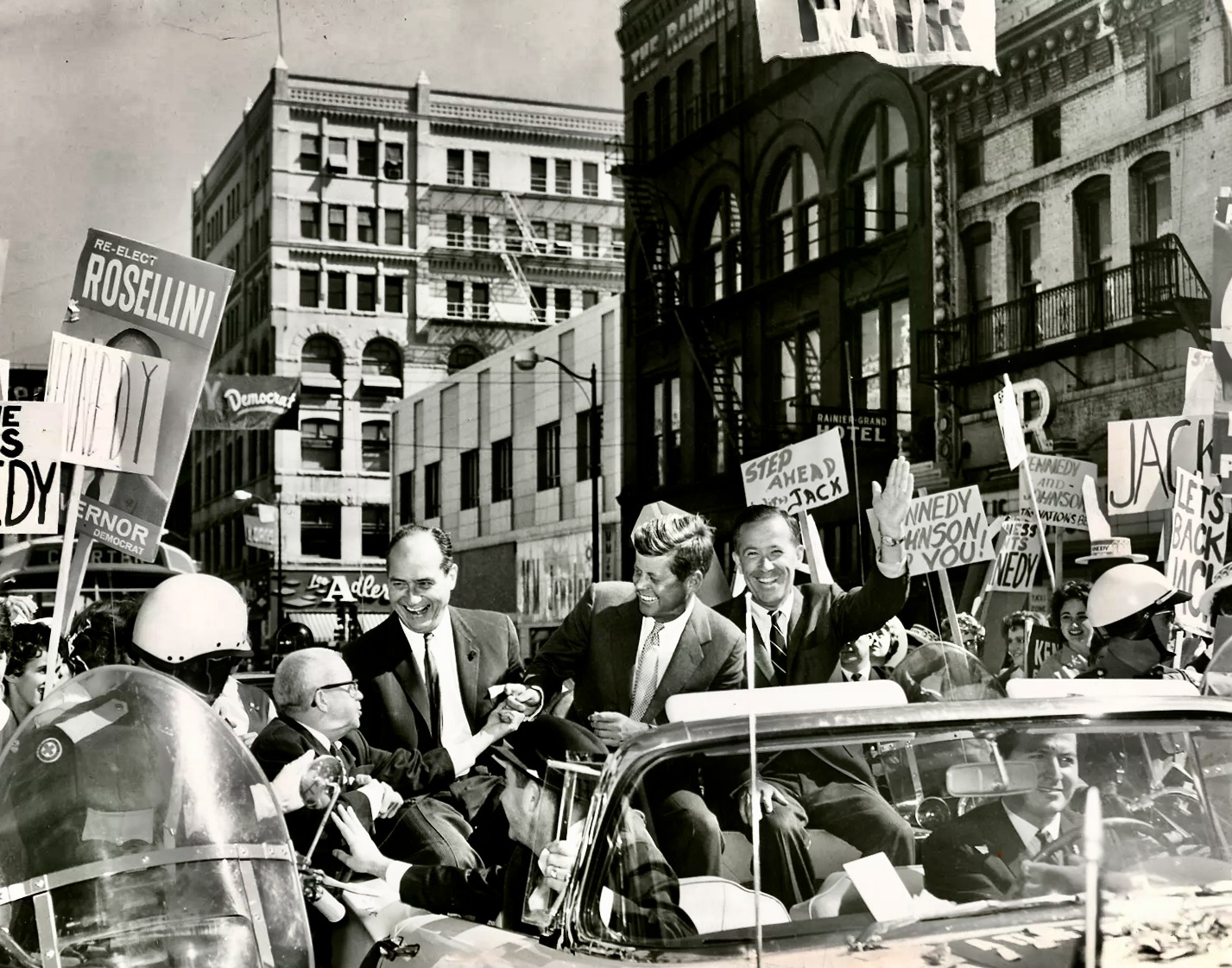
   Less than a year before I had seen John F. Kennedy when he campaigned for the presidency in Cleveland, smiling and waving from the back of a convertible crawling along Superior Ave. It was a sunny early fall day. A little more than two years later I saw reruns on TV over and over of him getting his head blown off in another convertible. Flags went half-mast. One of his children saluted his father during the memorial parade in Washington D. C.

   There were five houses on the north side of Bartfield Ave. where it met Coronado Ave. Our house was the second from the corner. A family of hillbillies who had migrated to Cleveland from West Virginia lived in the corner house. One of their boys my brother’s age and my brother were always wrestling and smacking each other. One day I saw him waving a rake at my brother.

   “Stop that!” I yelled. “Mom said dinner is ready.” It was nearly a mortal sin in our house to be late for dinner.

   A boy my age from South Carolina lived in a two-story brick apartment building on the corner opposite the Gulf gas station. He was one of the new Negro’s in our neighborhood. We were friends and played together but didn’t always get along. One day he called me a dirty DP. Both  of my parents had come to the United States after World War Two. One thing led to another. I called him a dirty nigger and he tried to hit me. I slapped him on the ear. He lunged at me and when I put my hands up, he clamped his teeth onto my right thumb. He wouldn’t let go no matter what. I had to say I was sorry. When he finally let go, he ran away up his back steps. My thumb hurt like the devil and I had to wipe tears out of my eyes.

   When John F. Kennedy debated Richard Nixon in late September 1960, it was the first televised presidential debate in the United States. The TV man Howard Smith moderated the debate. A pack of journalists faced off with the candidates. My mother and father watched it that Sunday evening, so we watched it. My brother, sister, and I were mad about missing our favorite weekend nighttime shows. We complained but our parents were long on civics and short with stir-crazy children. John F. Kennedy looked good. He had style and charisma. Richard Nixon was sweaty, shifty, and no match for his younger competitor.

   “He should have shaved,” my father, a lifelong Republican, lamented. “He looks bad.” He looked pasty and haggard is what he looked like. JFK looked fit and self-assured. He looked like a winner. After the debate he flew out of Chicago and flew to Cleveland. His plane landed at Lost Nation Airport at two in the morning. Students from Western Reserve University turned out to greet him and provide an “Honor Guard.” In the morning his motorcade rolled down Euclid Ave. and around University Circle to a cheering throng.

   On his way to a rally in Lorain Stadium, the motorcade wound its way west along city streets. I was 10 years old and waiting farther east on Superior Ave. with my South Carolina friend. We got one good look at JFK. We were behind everybody, trying to find a hole in the crowd to squeeze through to the front, when there he was, in a convertible, sitting on the back of the car with his feet on the seat. He was waving. We waved back and cheered. He wasn’t the only self-assured grown-up I had ever seen, but he was the youngest-looking best-looking grown-up. He looked like a movie star, baseball player, and war hero all rolled up in one.

   After the rally in Lorain, and lunch at the Moose Hall, John F. Kennedy went to the annual Democratic steer roast at Euclid Beach Park. More than 125,000 people heard him speak, more people than had ever assembled at the amusement park. Lakeshore Blvd. was a mess of cars and busses going nowhere. Drivers chewed the cud in the traffic jam, the smell of the steer roast in their noses.

   “The forgotten man of 1960 is the American consumer,” he said. “The forgotten woman is the American housewife. In 1952 they were promised lower prices. They heard endless Republican commercials about a stable dollar and a cheaper market basket. But under 8 years of Republican rule, the cost of living has gone up and they have done nothing about it. Families are concerned about the missile gap, but they are equally concerned about the gap between what they earn and what they have to spend.”

   It struck a chord with my mother and father, but they voted the GOP slate top to bottom., no matter what. Richard Nixon would have had to shoot Pope John XXIII stone cold dead in front of the Vatican’s Easter Sunday crowd to get my Catholic parents to vote for the Catholic on the ticket. John F. Kennedy wasn’t a Republican and that was that.

   Halloween was a month later. Time is candy was our motto. We knew our neighborhood forward and backward. We knew who handed out old fruit and who handed out new chocolate. We knew what houses to avoid because the householders were mean, stingy, or simply slow, and which houses were gold mines. My brother and I never wasted time with costumes, simply dressing like bums. The freeloader look was best because that is what we were.

   Once back home my sister hid her candy in the attic. The attic was as empty as the day we moved in. Our parents were immigrants and still scraping by, still buying only what we needed and were going to use, not things to forget about as soon as we bought them. My sister found a loose floorboard in a corner and hid her candy there. My brother had a sweet tooth and wasn’t to be trusted. No one knew or ever found out where he hid his candy. He believed loose lips sank ships and never told anybody. I hid mine in the basement, on a shelf behind a box of summer fun beach gear. 

   The next week John F. Kennedy won the White House, although he did it without winning Ohio. Tricky Dick defeated JFK, 53 percent to 47 percent, in the Buckeye State. He took all but 10 of Ohio’s 88 counties. The Democrat won the Cleveland area, though, to the displeasure of my Lithuanian kinfolk.

   That winter was cold although not a lot of snow fell. When it finally did, we built snow forts on Blind Man’s Hill. The hill was the side yard of a house on the other end of our short stretch of Bartfield Ave. A blind man lived alone in the house. We had an arrangement with him. In return for keeping an eye out for anybody messing with his house, he let us mess around on his side lawn. It was a knoll, inclining about four feet, but it was enough for us, especially when we were behind the walls of our fort hurling snowballs down on our enemies.

   The next summer on a rainy afternoon Romas Povilaitis and I almost killed my brother in the attic of our house. It wasn’t our fault, since we were only playing, but after my sister raised the roof there was no explaining it and we just had to take our lumps. We heaved a sigh of relief when my brother exonerated us, saying we were only playing, even though wrath then fell on his head, too.

   Our friend Romas lived in Chicago with his small-fry brother Viktoras, his mother Irma, and father Vytas. The man of the house was muscular and handsome. He was my sister’s godfather. He had wavy blonde hair shiny with Brylcreem. He was better looking even than his wife. Irma said she was glad he worked in a factory and wasn’t trying to better himself, because if he did, she was sure he would leave her. Even though he was blue collar, they lived in a big house in the Marquette Park neighborhood. Chicago has the largest Lithuanian community outside of the homeland. It is known as Little Lithuania among those in the know. 

   Whenever they visited us, we ran around like 10,000 maniacs. Romas was enamored of Spiderman, a new Marvel Comics superhero. He scuttled around our house pretending to squirt web fluid from his wrists. He tried to cling to walls but tumbled to the floor. We were in the attic arguing the merits of Superman, Batman,  and Spiderman when my brother insisted for the last time that Superman was the best of the three.

   “He could crush Batman and Spiderman with his little finger and besides, only he can fly,” he said.

   It finally drove us to distraction. We put a Superman cape on him and hung him by his heels out the third-floor window. He was all for it, except when the cape went flapping over his head and he complained he couldn’t see. It was then my sister walked through the door. Our brother almost nose-dived when she screamed and we were startled. We were pulling him back inside when our mother burst in.

   She dropped a dozen eggs and bum rushed the three of us downstairs. Thank God my father and Vytas Povilaitis were out. As it was, we had to listen to Irma and my mother lay down the law of the land. They seemed deadly serious, so we listened with grim attention.

   “Don’t ever do that again!” is what we heard over and over until we stopped paying attention.

   There were only two bedrooms in our Polish double on Bartfield Ave. Our sister shared a bedroom with my brother and me. Vytas and Irma slept on the living room sofa when visiting. Romas and Viktoras slept on the floor in sleeping bags between our beds. We read comic books by flashlight long into the night. We kept our sister up, but she had the good sense to keep her sleeplessness to herself. She knew she was no match for Superman, Batman, and Spiderman.

   The Friday John F. Kennedy was assassinated I was in my eighth-grade classroom at Holy Cross Catholic School in Euclid, where I had transferred after we moved from our old neighborhood that had gone civil rights to the white community of North Collinwood. My parents had said our house was becoming worthless and we had to leave. The school loudspeaker unexpectedly crackled to life. It was the principal on the broadcast system. She said the president had been shot.

   “Here is a flash from Dallas,” NBC Radio announced. “Two priests who were with President Kennedy say he is dead of bullet wounds suffered in the assassination attempt today. I repeat, a flash from Dallas, two priests say President Kennedy is dead of bullet wounds.”

   We were stunned. It wasn’t something any of us had ever thought about or expected to happen. Nobody knew what to do or say. Everybody was struck dumb. Our teacher asked us to stand and recite the rosary. We did until the principal came back on the PA and told us all to go home. Some kids were crying as they went through the door. 

   Everybody stayed glued to their TVs at home, watching the news. There wasn’t anything else to watch, anyway. The networks suspended their commercials and regular programming for the first time ever and ran coverage on a non-stop basis. The assassin was caught, but a few days later was shot in the stomach in the basement of Dallas Police headquarters. We saw it happen live on TV. It was unbelievable. Even more unbelievable was that the man who killed Lee Harvey Oswald was a strip club owner who went by the nickname of “Sparky.” I didn’t know what strip clubs were, but my father was incredulous.

   “What is this country coming to?” he asked. There was no love lost for John F. Kennedy in our house and community, but nobody wished him dead. They may not have believed in the man, but they believed in law and order. That was why they fled Europe, where law and order had fallen apart after World War Two.

   I started to wonder about God. Why did he want John F. Kennedy dead? Did he have a plan or was he just flipping a coin? When I asked our teacher why God had given him a one-way ticket to get halfway to where he was going, she started into chapter and verse, but then ran out of air. She sent me to the parish priest who told me God always has a plan and to not use words like one-way ticket.

   “Keep your mind clean and on track,” he said. “That way you will always have a one-way ticket to Heaven in your pocket.”

Ed Staskus posts monthly on 147 Stanley Street http://www.147stanleystreet.com, Made in Cleveland http://www.clevelandohiodaybook.com, Atlantic Canada http://www.redroadpei.com, and Lithuanian Journal http://www.lithuanianjournal.com. 

“Cross Walk” by Ed Staskus

“Captures the vibe of mid-century NYC, from stickball in the streets to the Mob in the shadows.”” Sam Winchell, Beyond Fiction

Available on Amazon:

Late summer and early autumn. New York City. A Hell’s Kitchen private eye. The 1956 World Series. President Eisenhower at the opening game. An assassin in the dugout.

A Crying of Lot 49 Publication.

Ready to Rumble

By Ed Staskus

   When I went to work for Gene Weiss in the 1980s all I knew about him was that he owned a racquetball club in Euclid, Ohio and that he was a famous wrestler. The club was Racquettime, which also went by the name of Gene Weiss’s Place for Fitness. It was a boxy two-story building on Lakeland Blvd. with a big sign clearly visible from I-90. The front doors were on the second floor, the front desk was just inside, and the locker rooms were downstairs. There were lots of racquetball courts and a weight room. Gene sold workout equipment on the side. His other enterprises were top secret.

   I got the job because I had worked for the Back Wall, a Beachwood-based chain of clubs that had transformed its customer base into a cash cow by selling what they touted as lifetime memberships at a ridiculously low price. There was an initiation fee and monthly payments for a while but after that it was the gravy train for the members. At least, that was the pitch. After everybody’s money was safe and sound in the corporate vault, they went out of business and closed all their clubs.

   My job was to reproduce the cash cow. I got an office just inside the front door and was expected to sign up as many members to Gene’s new plan as possible. What he didn’t know was that I was barely an operational salesman. My job at the Back Wall had sort of involved sales, but my aim wasn’t true. I was a hapless peddler.

   Gene went to Shaker Heights High School and won the state wrestling title. After he graduated, he won gold and silver medals for the USA at the Maccabiah Games. In 1961 he was named coach of the United States wrestling team. Four years later he was flag bearer for the USA at the opening ceremonies of the 7th World Maccabiah Games in Israel. He was named Ohio Amateur Athletic Union coach of the year and continued to coach with the United States wrestling teams. In the meantime, he became National Wrestling Chairman of the Maccabiah Games and a member of the United States Olympic Committee. 

   He was inducted into the Ohio Wrestling Hall of Fame in 1977 and in 1980 was inducted into both the Cleveland Sports Hall of Fame and the Shaker Heights High School Hall of Fame. In the 1970s he refereed pro rassling at the Cleveland Arena. He was running the Ohio School of Wrestling when I went to work for him. 

   He introduced himself and his accomplishments to me at some length. I listened dutifully, an attentive expression on my face. When he came up for air, I thought, I hope there isn’t a quiz on this tomorrow. I hadn’t taken notes and most of it went in one ear and out the other. I had gotten the gist of it, though. He was great guy. It was a great club. We were going to have a great time.

   Everybody loved Gene Weiss. “Gene is tough as nails on the outside, but a softie on the inside with a big heart of gold,” said Don Roskoph. “He’s a tough guy with a big heart,” said Bill Turk. “A friend like Gene comes along once in a lifetime. He’s always for the underdog and will give you the shirt off his back in a second,” said Angelo Amato.

   Gene loved unqualified praise. I found out later praise undeserved is satire in disguise. Acclaim for the bridge that got you over to the other side is deserved. Otherwise, it’s hot air.

   “Gene is a big bad dude. He could grab you and he could hurt you.” said Ryan Peters, the athletic director at Beachwood High School. At the same time, he’s a teddy bear, he hastily added. “You can’t help walking away from a meeting with Gene and not give him a big hug. He’s one of these guys that when you meet with him, he’d tell you a story that would change your life.”

   He never hugged me but was always punching my upper arms and slapping me on the back. Thank God he pulled his punches. I loved Gene for a few months until the day after day glad-handing got to be too much while his promises got smaller and smaller, finally fading away to nothing.


   Gene was the owner operator of Racquettime, although he wasn’t in the club overly much nor did it seem like he did over much. When he was there, he mostly mixed with the members and checked with the staff about how things were going. Several young women worked at the front desk and his right-hand man Katherine the Great was in some kind of supervisory position, although whether she was the manager or assistant manager or simply the all-seeing eye for Gene was never clear to me. What was clear was that everybody did what she told them to do, except me. 

   I knew Kathy Roach from racquetball tournaments. She was a good player, athletic fast strong. She didn’t like me, and I didn’t like her. I don’t know why, but there it was. As much as Gene led with smiles she led with scowls. I was forced to play racquetball with Gene every so often, which was literally a pain. He was a human hinder. He hated letting me hit open winners and would do his best to obstruct me. He was a man-sized slab of iron. I wasn’t. Running into him meant bouncing off him, while the ball went bouncing away and he won the point. 

   If I complained about it, he explained and explained, going on and on about why how where I was wrong. On top of that, he signed my paycheck, so I didn’t complain. Besides, his takedowns were accompanied by a full mouth smile full of sparkling Chiclet teeth. I wondered what candy store he got his choppers from.

   Sometimes in the locker room after games he talked about wrestlers, bringing up the names of stars like Mr. Fuji, Tarzan Tyler, Andre the Giant, Killer Kowakski, and the Iron Sheik. I didn’t know anything about wrestling and didn’t know any of them from the man in the moon. He seemed to be on a first name basis with torso twisters far and wide.

   Kathy was a better racquetball player than Gene. However, even though Gene necessarily won every game we played, she never won a single game. I disliked her so much my goal was to always shut her out, which I did. I slowed my serves and shots down against Gene but sped them up against Kathy. After goose-egging her several times she stopped asking me to play. I never asked her, so we stopped altogether, although she never stopped shooting me dark looks.

   She fawned over Gene as though he was the Great Sugar Daddy. After a while I looked the other way. Too much sugar. It wasn’t any of my business anyway. I had my eyes on Emily, a pretty dark-haired girl who worked at the front desk. Despite my best efforts, including charming her parents, I never got anywhere.

   I saw Gene every day because he was there more-or-less every day. I started work at 11 o’clock and worked until 7 o’clock. Gene was gone most afternoons and came back as the after-work surge got started. I made sure I was gone at seven, no matter what. By then I had long ago learned that going the extra mile for employers was giving up my time in a losing cause. When push came to shove it would mean nothing.

   Gene was paying me more than the Back Wall had, said he would spring for health insurance, and promised me a bonus when all was said and done. At first, selling the dream team memberships was easy. I sold them to the tried-and-true members, everybody who loved the club and loved Gene. After that the going got harder, especially with members who only came to the club occasionally sporadically. They wanted to pay for court time or workout time and leave it at that. They didn’t want to sign any contracts. They didn’t want to give me their bank account numbers for monthly withdrawals. It was even harder when it came to first timers. They always asked for a free one-time pass and usually never came back a second time. I was expected to get their phone numbers and follow up with them. I learned quickly enough what it felt like to have one person after another hang up on me.

   But the work wasn’t hard and I kept plugging away. I needed the paycheck since I was living paycheck to paycheck.

   One day at my desk I started experiencing discomfort in my right side. By the end of the day the discomfort had turned to pain. Gene noticed I was squirming during our daily meeting the next day and asked me what was wrong. When I told him he took me to the locker room and said a session in the whirlpool would take care of business. I said maybe I should go see a doctor. He said no, I didn’t need a doctor. He was big on saunas, steams, and whirlpools, and insisted I stay in the hot water tub until I couldn’t stand it anymore. After I got out, I felt better all over except for the pain in my side. It felt worse. That night I couldn’t sleep.

   The next morning, I went to Lakewood Hospital and found out I had kidney stones. The ER doctor gave me a small allowance of morphine-like pills and told me to drink as much water as my bladder could stand. “The pain of kidney stones is right up there with giving birth,” he said. I didn’t go to work that day and that night slept like a baby. In the morning I felt like a new man.

   When the bill for the hospital visit came a few weeks later I left it in Gene’s in-tray, which is when I found out I didn’t have health insurance after all. It was all hot air. He had never signed me up and never paid any premiums. I wasn’t sure what to do. If I confronted him about it, he might put me in a headlock. I heard through the grapevine that nobody, except for maybe Kathy Roach, had health insurance. 

   The last couple of months I worked at Racquettime I stayed busy discovering things weren’t going my way. I had been promising new members we were going to be putting an Olympic-size swimming pool in soon. When I pressed Gene about it, since members were pressing me about it, he hemmed and hawed. I realized there wasn’t any pool on the way.

   Gene wanted me to start giving racquetball lessons, but I didn’t want to. I had done lessons at the Back Wall. No matter how many times I told men, women, and teenagers to hit a thousand forehands backhands ceiling shots and to practice their serves, they never did. What they wanted to do was hit the ball around with me while I tried to correct their swings. Everybody thought there was one sure way to become a winner. When I tried to explain that everybody good went at it in their own way, and what they should do is practice and discover what worked for them, all the while grooving their swings, they weren’t interested. They wanted to know what the easy magic was.

   When I asked Gene about my bonus, the bonus he had promised me for selling his new memberships, he said I hadn’t sold enough of them to make paying me a bonus worth it. On top of that he was so disappointed in my performance that he was going to have to let me go, starting right now. It didn’t take me entirely by surprise, but it took me by surprise. I hadn’t planned on it and hadn’t gone looking for anything new. I didn’t bother arguing with him. I knew when I was down for the count.

   “Gene was on my paper route when I was a kid,” said Randy Harris. “He loved to show me a one-hundred-dollar bill when I’d ring his doorbell with my well-known motto, ‘Cleveland Plain Dealer .75 cents please’, thinking I’d wait until next week. I always told him I’d be right back while I rode my bike home and returned with $99.25.”

   On my way home I reminded myself, never trust the heavyweights. They didn’t get to be big cheeses by giving anybody anything unless they absolutely had to. They got rich by pinning suckers to the mat until they squealed. The only people they respect are others like them, and even that respect is provisional.

   The kingfish always say they got where they are through hard work. They get annoyed when asked whose hard work. They don’t care if they are rich, so long as they have a boat load of money, no matter where it came from. Top dogs make the rules. It’s the law of the land. My rule of thumb was to keep my distance, since when the mondo men make trouble it’s always the small fry who get beat on the anvil. 

   I had been thinking about going to work for myself. Hardly anybody gets much satisfaction other than bread and butter by being a wage slave. I wasn’t going to make it to Fort Knox with the modest plan I had in mind, but I moved the thought from the back of my mind to the front. I might still have to work part-time for somebody else to stay afloat, but I was going to make sure to be wary of whoever it was.

   Nobody quits when they’re wrestling the Iron Sheik and gets sick and tired of it. You quit when the Iron Sheik gets sick and tired of you. I was old enough to know the rules, but I was old enough to know the exception to the rules, as well.

Ed Staskus posts monthly on 147 Stanley Street http://www.147stanleystreet.com, Made in Cleveland http://www.clevelandohiodaybook.com, Atlantic Canada http://www.redroadpei.com, and Lithuanian Journal http://www.lithuanianjournal.com.

“Cross Walk” by Ed Staskus

“A once upon a crime whodunit.” Barron Cannon, Adventure Books

“Captures the vibe of 1950s NYC.” Sam Winchell, Beyond Fiction

Available at Amazon

Apple Books 
http://books.apple.com/us/book/id6502837788

Late summer and early autumn. New York City. A Hell’s Kitchen private eye. The 1956 World Series. President Eisenhower at the opening game. An assassin in the dugout.

A Crying of Lot 49 Publication

Walking the Line

By Ed Staskus

   When I got out of high school finding a job was easy as pie, as long as it was the most thankless job known to man, work like grit blasting, jackhammering, and tearing off roofs. None of it was a bowl of cherries, not that anybody ever said it was going to be. It was more like a crown of thorns with the only salvation at the end of the day being the end of the day.

   The good thing about grit blasting was that the work was indoors, in an all-metal room, out of the sun and rain. The bad thing about it was being in an all-metal room, in a haze of abrasive dust, hoping the blast hose wouldn’t bust a gut. The work room measured twenty feet wide by fifty feet long by fifteen feet tall. It was all business, no windows, no distractions, and no escape.

   The metal finishing shop was in Brook Park near Cleveland Hopkins Airport. Starting time was 7:30 AM, no ifs ands or buts. God forbid I miss my bus. They did shot-peening, deburring, and metal polishing. Other than the occasional odd job, I only did one thing. I blasted an assortment of metal dinguses, most of them incomprehensible to me, with steel grit or crushed glass. Sometimes, if the object was small, I worked at a sandblasting cabinet. It had a foot operated control valve.

   I wore a heavy canvas long-sleeved blast suit, gloves with gauntlets, and steel-toed safety boots. When I was ready, the last thing I put on was an air-fed metal helmet with a shawl protector. My boss was adamant that I go slow, never stopping at one spot with my blaster, keeping the same pace, which was a crawl. I had no problem with that since I could barely move in my protective suit.

   The shop was noisy, dusty, and dingy from front to back, although when we got finished with whatever thing we had been working on it looked brand new. After three months, though, I felt beat up. I was down for the count and quit in the middle of my shift. I took a bus to Edgewater Park, stripped off my shirt, and lay on the sand in the sun the rest of the day. My fish belly got some good color.

   I didn’t think my next job, jackhammering, could be worse than grit blasting. I was wrong. It was worse. It was like hanging on to a prehistoric woodpecker. The pneumatic t-shaped tool weighed a hundred pounds and was very loud. When it got revved up it sounded louder than a jet engine. I was given Willson earmuffs to save my hearing. I didn’t wear them my first five minutes on the job. After the first five minutes I never took them off.

   Charles King, a pioneering engineer in the Gilded Age, produced the first air-powered jackhammer for the mining industry. Miners had labored for ages breaking rocks with sledgehammers. The jackhammer was a groundbreaking invention for them. They are percussive tools. They pound rock and concrete with thousands of hits a minute. Once we had  broken a slab of concrete into small pieces it was time to move on to the next slab. For basic breaking I used a basic point bit. The old hands, who were built like fire hydrants,  used a flat bit for better control.

   We sprayed the concrete with water to keep the dust down. We wore face masks. Since shrapnel wasn’t an unusual hazard, I wore heavy-duty pants and a long-sleeved shirt. I still had my steel-toed boots from my grit blasting days. There was no steep learning curve. Even though I was young and fit, I took breaks all the time. The shock waves were too much to stand. Whole-body vibration is fun and games for only so long. At times I wished for an earthquake to do the work for me.

   The old hands knew the score but still complained about fatigue, headaches, and lower back pain. They sometimes took five to lay down flat on their backs on whatever ground was nearby. It was hard work controlling the heavy tool. We rotated on and off. Everybody said jackhammers were better than sledgehammers in the hot sun, but it struck me as making a fine distinction to no purpose. I didn’t last long. I was neither strong nor sizable enough for the work. After my last day I went home to my apartment and slept for a day-and-a half. My lumpy mattress felt like a bed of roses. 

   It was still summer, so I signed on with a roofing company. There was even less of a learning curve. I was dragooned to be one of the guys who tore roofs off. It sounded easy enough but it was hard to do. I didn’t know it was the most physically demanding specialty trade work of all time. I didn’t know it was the fourth most dangerous job in the country, either.

   “It’s hard work and it can be a risk,” the boss said. “You need to be proud of what you do. It’s good stuff.”

   The other guys ignored the boss. They said don’t climb ladders with your hands in your pockets. I showed them my open palms. “Don’t slide down ladders,” one of the men said showing me his hands. “It might have splinters.” They said don’t slip when topside. I said I would watch out for that. They said don’t touch wires and get electrocuted. I agreed to watch out for that, too. They claimed the company was a storm chaser, even though we never worked during storms. I found out what it meant soon enough. Our warranty was in effect so long as the homeowner could see our truck’s license plate as we were driving away. 

   If it was ninety degrees on the street, it was nine hundred degrees on the roof. If it was a dark-colored or metal roof, it was even hotter. I got a sunburned face my first day. I wore sunscreen and a baseball cap as a matter of course after that. I got heat rash and learned to never wear jeans or dark-colored clothing. I got heat cramps and learned to drink gallons of water. 

   There were two of us at the bottom of the totem pole. We were responsible for cleaning up. The rolling magnetic sweeper was my favorite tool. Sweeping for loose nails and screws was incredibly easy and meant the end of the job was at hand. The pay was good, but I didn’t like going up and down ladders. Once I got on the roof, I settled down, but ladders made me jumpy. I finally had enough of them and called in sick. I stayed sick until the office manager stopped calling me.

   Summer started to drift away after Labor Day. I applied for work at the nearby Collinwood Rail Yards and was hired as a temporary workhand for as long as they needed me. The railroad yard and diesel terminal had been there for about one hundred years, after a machine shop and roundhouse were originally built to repair locomotives. Miles of stock yard rail was laid for freight trains coming and going. By 1930 there one hundred and twenty miles of track handling two thousand cars daily. During World War Two the Collinwood Yards became one of the major switching and repair facilities for the New York Central, and after that for Penn Central.

   My job title was Extra Clerk. I thought it meant a cushy office job. What it actually meant was I had to work wherever they wanted me to, filling in when somebody was sick or on vacation. I found out soon enough that nobody in any office ever got sick or went on vacation.

   A warehouse had been built near the roundhouse. There was a smaller storehouse with two offices next to it. The front office was for whoever wanted to sit around in it. The back office was for my boss. I worked for him even when I was working for somebody else. He was Isaiah Wood, an older man who always wore an Irish scally cap indoors and outdoors, rain or shine. He wasn’t Irish. He was a rabble rouser for the Nation of Islam. He always had stacks of their newspaper “Muhammed Speaks” on the floor behind his desk. When it became “Bilalian News” he piled up stacks of those.

   He sold them to African Americans who worked in the yard. They trooped in, plunked down their dough, and walked out with the newspaper in a coat pocket. Nobody who was white ever trooped in and plunked down anything. Isaiah Wood was disliked by every white man in the Collinwood Yards, especially when I let out who I worked for. They all told me what a dismal dead-end I was stuck in.

   He had a poster on the wall of the Nation of Islam kingpin Elijah Muhammed wearing sunglasses and a funny hat with stars and crescent moons emblazoned on it. The poster quoted the kingpin. “If you think the white man isn’t the devil like I have taught you, then bring me your devil and I will show you that the white man has no equal.” Whenever I had to go into his office the poster was right behind him so it was right in my face.

   He liked to say things like, “Whenever you look at a black man you are looking at God.” Then he would tell Wally and me that there were two or three gondolas with rail wheels on them that needed unloading. He tried to make it sound like orders from the mouth of God, speaking low and slow. We trudged out to the gondolas low and slow.

   Wally was Ozor Benko. Nobody ever called him Ozor or even Ozzie. Everybody called him Wally. He was shorter and older than Isaiah. He had been married for almost fifty years. His wife put together his lunch pail of sandwiches, apples, and grapes. The sandwiches were always Hungarian since he and his wife were Hungarian. He especially liked black bread smeared with cream cheese and topped with plum jam.

   Wally and I worked together. Every morning at 7 AM we collected wood from broken pallets and built a bonfire. Some winter days the fire was as big as Isaiah’s hatred of the white man. We stood around it once it got roaring and warmed ourselves up. Anybody passing by was welcome to take a spot. Whenever we had to unload a gondola in bad weather, we made sure to have a 55-gallon steel drum nearby with a fire going in it. We thawed our hands and dried our gloves over the fire.

   When we were unloading rail wheels the two of us stood in the gondola with a crane on a flat car at hand. The crane operator swung his block to us, one of us wrote a number on the wheel with a thick yellow crayon, while the other one attached a sling to the wheel. The crane lifted it, setting it down in a row of them, and swung back to us. It wasn’t hard work, except when it was cold, snowy, and slippery. There wasn’t as much snow that winter as there would be a few years later during the Great Blizzard, but it was cold enough.

   Wally started taking days off when his wife got sick. I didn’t mind because another Extra Clerk like me, who was about my age, filled in. One week Wally didn’t come to work at all. At the end of the next week Isaiah told me Wally’s wife had died and he would be taking a few weeks off. When he came back, he looked terrible. He started going to one of the bars just outside the yard for lunch, eating pickled eggs, fried baloney sandwiches, and swigging bottles of P.O.C. 

   Even still, he lost weight, getting thinner. His clothes hung loose on him. His skin got gray and cadaverous. He died two months later. He missed his wife so much he didn’t want to go on living. He had a heart attack and died on his sofa watching “Sanford and Son” on a portable TV. We thought he died of a broken heart. Isaiah didn’t say much, although he went to Wally’s funeral. I went with him. We each had a P. O. C. afterwards.

   When spring came, I was assigned to be a tracker in the switching yard. I was given a clipboard and a pocketful of pencils. My job was walking the line. Boxcars, flat cars, and gondolas were busted up a cut and sorted by railway company, loaded or unloaded, destination, car type, and whether they needed repairs. The black snakes hauling coal, unloading across the street, weren’t on my beat. I walked miles a day every day, noting and writing it all down and delivering the paperwork to an office in the shadow of the terminal.

   I discovered small beat-up shacks tucked into shadows where workmen hung out, making hay, killing time, reading the daily papers, listening to the radio, playing cards, and drinking. A lot of drinking went on in the yard and at the bars on East 152nd St. just outside the main entry gate. Even more drinking happened on payday, when many men cashed their checks at the bars and drank part of it before their wives could get their hands on what was left.

   By the end of summer, I was out of a job. Conrail was taking over, cutting costs, and laying workers off. First hired first fired. When the 1970s came to an end Conrail closed the diesel locomotive repair facilities and sold off most of the rail yard. By that time, I didn’t care. I had squirreled away the hard cash I had made and gone back to college so I could make my way. My father was a fan of higher education.

   He had been a miner in Sudbury, Ontario in the 1950s until he finally saw the light. When he did we emigrated to the United States where he worked days and studied nights at Western Reserve University, graduating with a degree in accounting. He was determined to work with his head and not his hands.

   Everybody said I had my father’s looks, but we didn’t always look at things the same way. He had a bad habit of threatening me with the ways of the world, with all the terrible things that were out there. He was from the Old World and had survived World War Two, on the wrong end of the stick for most of it. Even though he and I didn’t routinely see eye to eye, after a year of punching the working stiff’s time clock, I began thinking he might be on to something about working with your head. I wasn’t big on accepted wisdom, but I thought maybe it was time to put my thinking cap on.

Ed Staskus posts monthly on 147 Stanley Street http://www.147stanleystreet.com, Made in Cleveland http://www.clevelandohiodaybook.com, Atlantic Canada http://www.redroadpei.com, and Lithuanian Journal http://www.lithuanianjournal.com. 

“Cross Walk” by Ed Staskus

“A once upon a crime whodunit.” Barron Cannon, Adventure Books

“Captures the vibe of 1950s NYC.” Sam Winchell, Beyond Fiction

Available at Amazon

Apple Books 
http://books.apple.com/us/book/id6502837788

Late summer and early autumn. New York City. A Hell’s Kitchen private eye. The 1956 World Series. President Eisenhower at the opening game. An assassin in the dugout.

A Crying of Lot 49 Publication

Champing at the Bit

By Ed Staskus

   By 1984 many bands had strutted their stuff at the Richfield Coliseum. It was built for basketball and anything else that could be booked between games. Everybody called the venue the Palace on the Prairie. It was in Richfield, Ohio. The bands included Led Zeppelin in 1975, Bruce Springsteen and the E-Street Band in 1978, the Rolling Stones in 1981, and Queen in 1982. The Bee Gees drove girls to screaming, crying, and pleading in 1979.

   Frank Sinatra opened the place with a show in October 1974. “The crisscross of lights, mirroring the animation of 21,000 stylish people packed from floor to roof, transformed the gray amphitheater in the hills of Richfield Township into a huge first-night bouquet of green and blue,” is how The Cleveland Plain Dealer splashed Old Blue Eye’s show across its front page. We called him Slacksey because, no matter what, his slacks were always neatly pressed. Roger Daltrey gone solo closed the doors and shut off the lights for good in 1994. His show drew fewer than 5,000 fans. Nobody wrote a word about it or how he was dressed. Over the years there were might have been a thousand musical events at the Richfield Coliseum. 

   Vann Halen opened for Black Sabbath in 1978 and came back as headliners in 1984. When they did, they had to sit on their hands waiting for ice to melt. Walt Disney’s Magic Kingdom on Ice had just skated out of the building. When Van Halen came to town it was the one and only time I saw the band and the one and only time I went to a show at the Richfield Coliseum. 

   It wasn’t that I didn’t go to rock ‘n roll shows. It was that the few I went to were closer to home, like at the Allen Theater, the Agora, and Engineer’s Hall, where it was standing room only. There were no seats. Downtown was nearby but Richfield was a long way for my long-suffering car. Besides, I was by necessity a Scrooge. Big shows charged big bucks. First things came first, like food and shelter. 

   I saw the Doors at the Allen Theater in 1970, the Clash at the Agora in 1979, and the Dead Kennedys at Engineer’s Hall in 1983. The Dead Kennedys blew into town during a heat wave. The air conditioning at the Engineer’s Hall was non-existent and there were no windows. Everybody sweated up a storm and everybody stayed through the encore. Six years later the Brotherhood of Locomotive Engineers sold their building. It was demolished and replaced by a posh hotel.

   The Doors opened their sold-out Friday night show in 1970 with ‘Roadhouse Blues’ followed by ‘Break on Through’ and ‘Backdoor Man’. They covered Bo Diddley’s ‘Who Do You Love?’ That was a surprise. “I walk 47 miles of barbed wire, I use a cobra snake for a necktie, I got a brand new house on the roadside, made from rattlesnake hide.” They sounded much better live than on carefully managed vinyl. They were more than worth the six dollars for my orchestra seat ticket. My girlfriend paid her own way. We had an even-steven relationship. Eli Radish, a local band, opened, and were funky and fun, but all through their set everybody was antsy waiting for Jim Morrison.

   “He worked the crowd with his staring sneers and sexy leather posing, witch doctor mumbling and slouching about,” said Jim Brite, who was in the crowd. “The lighting and sound were dramatic. The band was great, with extended solos and workmanlike professionalism, delivering the music behind the shaman. No one could take their eyes off Jim. It was one of the best concerts I ever saw and I’ll never forget it.”

   The Doors were banned in Miami for Jim Morrison’s obscene language and lewd behavior. He told the city fathers to call him the Lizard King. They had been banned from performing in Cincinnati and Dayton the year before. None of it mattered to the 3,000 of us filling every seat at the Allen Theater.

   “Jim Morrison swigged beer and smiled a lot between numbers,” Dick Wooten wrote in The Cleveland Press the nest day. “When he performs, he closes his eyes, cups his hand over his right ear, and clutches the mike. His voice is pleasant, but his style also involves shouts and screams that hammer your nervous system.”

   When it was over we whistled, roared, and clapped until the house lights came on. We were disappointed there was no encore. Everybody was getting to their feet when Jim Morrison suddenly came back on stage. “Somebody stole my leather jacket, he bellowed. “Thanks a lot Cleveland!” He flipped us the finger. Then he said, “Nobody leaves until I get it back!” Nobody knew what to do. A half-dozen rough-looking bikers jogged to the back of the hall and blocked the doors. When my girlfriend and I looked to the side for another way out, Jim Morrison had left the stage, but then a minute later came back.

   “Sorry, that was a mistake. I found my jacket.” 

   He said the band wanted to play some more songs to make up for the mistake, but that John Densmore’s hands were messed up. He was the group’s drummer. The beat couldn’t go on without a beat, except it could and did.

   “John their drummer was walking around backstage and holding up his hands which seemed bloody in the creases of his fingers,” said Skip Heil, the drummer for Eli Radish. “I felt all warmed up since we played before them, so I said I’ll do it. I wasn’t sure of the songs, but I thought they were simple shuffles.” 

   After two encores, and telling everybody how much he loved Cleveland, Jim Morrison accidentally locked himself in an old bathroom backstage. One of the band’s roadies said, “Stand back Jim.” He knocked the door down and set him free.

   The band toured non-stop after they left Cleveland. They had been touring non-stop for several years. Jim Morrison died in Paris of a heroin overdose the next year and the door shut forever on the band. It was a shame.

   The Richfield Coliseum was an arena in the middle of nowhere, halfway between Akron and Cleveland. It was built to be the home of the Cleveland Cavaliers, the local NBA team, although indoor soccer, indoor football, and hockey were played there, too. Larry Bird of the Boston Celtics said it was his favorite place to shoot hoops. He played his last pro game there. Muhammed Ali fought Chuck Wepner there in 1975. Dave Jones, Ali’s nutritionist, could never get the boxer to try soy burgers. He had to have his red meat. Chuck Wepner was his red meat that night. There were rodeos and monster trucks. There were high wire acts and hallelujah choruses. The WWF Survivor Series came and went and came back.

   I had a friend who had gotten free tickets to see Van Halen. Two other friends of ours went with us but had to fork over $10.75 apiece for the privilege. I didn’t know much about the band, except that they were no doubt about it loud as two or three jet engines, but free is free and since I had the free time I went. 

   The headbangers were from Pasadena California. They were Eddie Van Halen on guitar, Eddie’s brother Alex Van Halen on drums, Mike Anthony on bass, and David Lee Roth belting it out up front. Mike Anthony sang back-up while keeping the low pitch going.  

   “It wasn’t until the fourth or fifth Van Halen record that people would go, ‘Wow! You’re singing backgrounds on those records. We thought it was David Lee Roth doing that, too,’” the bass player said. “And I go, Hell, no! That’s not David Lee Roth.”

   The word among aficionado’s was that the band was “restoring hard rock to the forefront of the music scene,” whatever that meant. I was listening to lots of John Lee Hooker and the Balfa Brothers. The rock ‘n roll parade was largely passing me by. I didn’t have a clue who was at the front of the parade.

    Everybody I asked said Van Halen’s live shows were crazy energetic and Eddie Van Halen was a crazy virtuoso on the electric guitar. During the show he switched guitars right and left, but more-or-less stuck to a Stratocaster, except it wasn’t exactly a Stratocaster. Eddie Van Halen called it a Frankenstrat.

   “I wanted a Fender vibrato and a Stratocaster body style with a humbucker in it, and it did not exist,” he said. “People looked at me like I was crazy when I said that’s what I want. Where could I go to have someone make me one? Well, no one would, so I built one myself.” He wasn’t trying to find himself. He was creating himself.

   His homemade six-string was almost ten years old in 1984, made of odds and ends, a two-piece maple neck stuck onto a Stratocaster-style body. He used a chisel to gouge a hole in the body where he stuck a humbucking pickup taken out of a 1958 Gibson. He used black electrical tape to wrap up the loose ends and a can of red spray paint to get the look he wanted. When he met Kramer Guitar boss Dennis Berardi in 1982 Eddie showed him his Frankenstrat. It was his prize possession. 

   “We went up to his house and he got it out,” Dennis said. “It looked like something you’d throw in the garbage. That was his famous guitar.” 

   Van Halen released their first LP in 1978. By 1982 they had released four more LP’s. When they came to northeast Ohio they were one of the most successful rock acts of the day, if not the most successful. Their album “1984” sold 10 million copies and generated four hit singles. “Jump” jumped the charts to become a number one single.

   When the lights went down and the stage lights went up, the band took their spots. Eddie Van Halen wore tiger striped camo pants and a matching open jacket over no shirt. He wore a white bandana and his hair long. Mike Anthony wore a dark short-sleeved shirt and red pants. He wore his hair long, too. David Lee Roth wore a sleeveless vest, leather pants ripped and stitched every which way, and hula hoop bracelets on his wrists. He wore his hair even longer. Alex Van Halen wore a headband. The headband was all I could see of him behind his Wall of Drums. There were speakers galore stacked on top of each other on both sides of the drum set.

   When they launched into “Running with the Devil” Mike Anthony ran across the stage and slid on his knees playing the opening notes. David Lee Roth was a wild man, swinging a sword around like Zorro and doing acrobatics like the Olympian Kurt Thomas. He did Radio City Rockette kicks and jumped over the drum set while singing “Jump.” 

   Taylor Swift would have flipped out if she had been alive, but she wasn’t going to be alive for another five years. When she came into her own years later she got very good at strutting on stage, but she never jumped a drum set. The audience at the Palace on the Prairie was alive as they were ever going to be that night. David Lee Roth’s high flying got a standing ovation.

   In the middle of one song, David Lee Roth stopped singing. The band played on but slowly dropped out, one instrument at a time. “I say fuck the show, let’s all go across the street and get drunk,” he shouted into his handheld microphone. The crowd hooted, hollered, and cheered, forgetting for a moment they were in the middle of nowhere and the closest bar was miles away. 

   One of the best parts of the show was when Alex Van Halen and Mike Anthony did a long bass and drum duet. Eddie Van Halen did some good work on keyboards, doing the opener for “I’ll Wait.” He did his best work, however, on his guitars. He had a way of playing with two hands on the fretboard. He learned it from Jimmy Page of Led Zeppelin. 

   “I think I got the idea of tapping by watching him do his “Heartbreaker” solo back in 1971. He was doing a pull-off to an open string, and I thought wait a minute, open string and pull off? I can do that, but what if I use my finger as the nut and move it around? I just kind of took it and ran with it.” He filed for and got a patent for a device that attaches to the back of an electric guitar. It allows the musician to employ the tapping technique by playing the guitar like a piano with the face upward instead of forward.

   Most of us stayed in our seats during most of the show, only coming to our feet to applaud, but there was an undulating crowd squished like sardines at the front of the stage, where they stayed from beginning to end. They never left their feet. It was more than loud enough where we were up near the rafters. It had to be deafening if not mind-blowing being at the lip of the speakers.

   By the time the show ended Eddie Van Halen and David Lee Roth had long since stripped off their shirts. They came back for several encores and then the music was over. It took a half hour to shuffle out of the arena, a half hour to find our car, and another half hour to inch along the traffic jam the half mile to the highway. My sense hearing came back somewhere along I-271 on the way home.

   After the concert I went back to listening to the blues and zydeco. I didn’t rush out to buy any records by Van Halen. My cat and the neighbors, not to mention my peace and quiet roommate, would have complained about the noise. I tried explaining to my cat that one man’s noise was another man’s symphony, but he wasn’t having any of it. 

   Six years later, after the excitement of being pushed and pulled into existence had died down, when Taylor Swift was in her crib in the living room, she took a peek at a film clip on MTV of the 1984 Van Halen concert at the Richfield Coliseum. She went bananas over the sold-out crowd. She made a vow then and there that she would do the sure thing. She wasn’t going to invite 20,000 fans to hit the bottle. She was going to schmooze them into buying the bottle for her.

    The first thing she would do when she was ready to sing her way to stardom was head to Nashville. It would be a baby step, but she had her sights set. It was going to be the hillbilly highway first and then the superhighway. Her father was a stockbroker at Merrill Lynch and her mother was a marketing manager at an advertising agency. She already knew the way to the teller’s window at the bank. She was determined to be a rich girl when she was grown up. 

   She was sure as shooting not going to strum a Frankenstrat or bust out any freaky Mighty Mouse moves, with or without a sword, with or without a shirt, although her legs were fair game. They were shapely legs made for boots that were made for walking. She was going to belt out her break-up ballads and march her way to the front of the hit parade. She was going to blend Frank Sinatra’s pressed pants with some tried-and-true country, add a dash of spicy pop, mix in lots of love and heartache, and deliver it with catchy melodies. 

   Van Halen’s aim during their time at the top of the charts seemed to be to die of exhaustion rather than boredom. Their aim was true. Taylor Swift’s aim was different. She was going to the top of the charts but she wasn’t going to die of exhaustion getting there. She wasn’t going to take any chances, no matter how boring it might be.

Ed Staskus posts monthly on 147 Stanley Street http://www.147stanleystreet.com, Made in Cleveland http://www.clevelandohiodaybook.com, Atlantic Canada http://www.redroadpei.com, and Lithuanian Journal http://www.lithuanianjournal.com. 

“Cross Walk” by Ed Staskus

“Captures the vibe of mid-century NYC.” Sam Winchell, Beyond Fiction

Available on Amazon: https://www.amazon.com/dp/B0CRPSFPKP

Late summer and early autumn, New York City, 1956. Stickball in the streets and the Mob on the make. President Eisenhower on his way to Ebbets Field for the opening game of the World Series. A killer waits in the wings. A Hell’s Kitchen private eye scares up the shadows.

A Crying of Lot 49 Publication

Ring of Fire

By Ed Staskus

   Many bands came to Cleveland, Ohio in the 1980s, bands like Queen, Guns N’ Roses, and Journey. I didn’t see or hear any of them. Besides, they just played the same song over and over again. I couldn’t afford arena rock, even if I wanted to squeeze myself into their sold-our shows. What did they do with all their money? Freddie Mercury didn’t spend much of it on his five-and-dime white tank tops.

   I did see and hear Wall of Voodoo when they played the Agora Ballroom, shortly before the band broke up. They were the second-to-last group I saw at the downtown music hall before it burnt down. After the fire the Agora moved thirty blocks uptown into what had been the Metropolitan Theatre, built in 1919. It had been home to the Cleveland Opera until 1929. Twenty two years later, when the prima donnas were long gone and the building was housing the WHK radio station, disc jockey Allen Freed coined the phrase “rock-and-roll” on the air there.

   The Agora was on E. 24th St. across the street from Cleveland State University. It had been there since 1968. It was the brainchild of local entrepreneur Henry LoConti Sr. “Monday Night Out at the Agora” showcased new bands like ZZ Top, Meat Loaf, and Talking Heads. “Live From the Agora” was broadcast on the radio. There were many affiliated stations. Bruce Springsteen’s show at the Agora in 1978 was heard by more than three million listeners. On Sunday nights it was reserved for home-grown bands like the Raspberries and the James Gang. 

   Iggy and the Stooges hit the music hall one night during a thunderstorm. “Iggy came out in a jock strap,” Henry LoConti Sr. said. “He had a razor and cut himself on stage, all kinds of crazy things. A girl and her boyfriend were in the front row. Iggy jumped off the stage on her face. Her boyfriend and his friends started beating on him. Our guys finally got him out of it, dragged him back, and he finished the show like nothing had happened.” The Stooges, however, spent the rest of the night slipping and sliding on Iggy’s blood on the boards.

   Wall of Voodoo was a Los Angeles band fronted by Stan Ridgway, who had been running a film score business before getting into the emerging punk scene in the 1970s. He picked up a bass player and a keyboardist from the Skulls and a drummer from Black Randy and the Metrosquad. They started playing at the Masque, a club underneath the Pussycat Theatre in Hollywood. They mixed electronica with country and western with Ennio Morricone movie music. There were junkyard riffs and percussion effects galore. 

   It didn’t always go over well. “This electronic music quintet makes self-proclaimed nightmare music,” John Swenson wrote in The New Rolling Stone Record Guide. “I pass on this stuff,” he declared in black and white, not writing another word.

   When asked by Dick Clark on American Bandstand to describe their music, Stan Ridgway said, “I’m just as confused as anyone else as to what to call it.” The band released an EP in 1979 featuring a synthesizer driven cover of “Ring of Fire.” It wasn’t what the songwriter June Carter had ever intended. It had a spaghetti western twang to it. It was strange and surreal. Their album “Call of the West” was released in 1982. The catchy single “Mexican Radio” from the album became a big hit. It was about hot desert winds and border blaster radio stations.

   By the end of the 1970s Henry LoConti Sr. had built twelve more Agora music clubs around the country, turning himself into a corporation. He went buttoned down in a no button business. He was awarded Billboard’s Steve Wolfe Award in 1979, presented to the person who had contributed the most to music entertainment the previous year. Billboard’s “Best Club in the Country” award was awarded to him in 1980. 

   For all that, the original Agora in Cleveland was always a rough and tumble place, awards or no awards. The audience was young. The music was loud. The drinks flowed all night long. There were bouncers. They kept their eyes and ears off the stage and more on the disturbances on the floor that erupted time and again.

   The word “bouncer” comes from an 1875 book by Horatio Alger. A young man has a hearty breakfast, claims he has no money to pay for it, whereupon his waiter is ordered to “bounce” him. “A well-directed kick landed him across the sidewalk into the street.” But before there was the word, there were the Romans. In Rome a bouncer was known as an ostiarius. His job was to remove unwanted people from places they were trying to get into. In the Old Testament bouncers protected temples from “illegal entry into sacred places.” In the United States, starting in the mid-19th century, saloons and whorehouses hired them to remove drunk as a skunk, noisome, and violent patrons from the premises.

   The Agora didn’t necessarily call their security staff bouncers, but that is what they were. They checked entrants for underage drinking. They refused entry to those already the worse for wear. Their duty was to maintain some semblance of order. Their No. 1 task was to deal with hot-headed behavior.

   Wall of Voodoo opened their show with “Me and My Dad” followed by “Red Light” followed by “Call of the West.” Everybody’s ears perked up. “Got a green look about ya, and that’s a gringo for starts, sometimes the only thing a western savage understands are whiskey, rifles, and an unarmed man.” It was easy enough to follow the bouncing ball because Stan Ridgway had a clear as a bell voice. He sounded like a revved-up Hank Williams. The band was in fine fettle but didn’t drown him out.

   They finished their first set with “Lost Weekend.” The song was Lou Reed-inflected, about a couple driving home after a losing streak in Las Vegas. “She was in the backseat while he was at the wheel, all the money from the store they’d gambled away. He said the best laid plans often go astray. She lit a cigarette, she didn’t make a sound. I know if we’d had just one more chance, he said. I know, we’d finally hit the big one at last, she said.” It was Wall of Voodoo’s bad dream of the American Dream.

   The club was a haze of never ending cigarette smoke. The ceiling was barely visible. Music lovers elbowed their way to the front of the bar the minute intermission began. I was chronically short of cash and rarely drank at bars. I drifted outside for whatever fresh air there was. Cleveland was a smokestack city and the Agora was just two miles from the smokestacks. Beggars can’t be choosers.

   The front doors were behind a makeshift garage door of corrugated metal. When the sidewalks finally rolled themselves up after a show the corrugated metal door came down. Even though the club was next door to Cleveland State University, it wasn’t in the best neighborhood. When the sun went down it was more along the lines of a bad neighborhood. I stood to the side minding my own business until saying hello to the bouncer by the door, with the idea that it is never a bad idea to get on the good side of bouncers.

   He was younger and taller than me, about twenty pounds heavier, and appeared to be between a WWE wrestler and a bull fighter. He was wearing dark pants and a short-sleeved shirt. He looked like he did bicep curls for a living. He didn’t talk much until I asked him how he had gotten into the bouncer business.

   “My great grandfather was a bouncer before he got into the New York City ganglands,” he said. “His name was Monk Eastman. I’m named after him.”

   “Your great grandfather?” I was dubious. The young usually can’t remember that far back. Their memories go in one direction, which is forward, not backward.

   “Yeah, he was a bouncer from 1894 to 1899, after which he got into the rackets. Back then there were saloons from one end of New York City to the other. He was seventeen years old when he got his first job. The saloon he went to, the manager told him he was too young, and besides, he already had two good men. My great grandfather asked if he could meet them. When they met, he quickly took care of both of  them and got the job on the spot. He worked alone, although he always carried a truncheon.”

   “You mean like a club?”

   “Just like a club. It had notches carved into it for every man he made mincemeat of. Family legend has it, one slow night before he retired from bouncing, he threw his eyes on the bald spot of a man drinking at the bar. He couldn’t take his eyes off the bald spot. He walked up behind the man and clubbed him. ‘I had forty nine nicks in me stick and I wanted to make it an even fifty’ is how he explained it.”

   “You said he got into the rackets after that?”

   “Feet first, free-lancing in the beginning. He charged $15.00 for ‘ear chawed off’ and $19.00 for ‘leg broke.’ It was $100.00 for doing what he called ‘the big job.’ He put together his own gang soon enough. They got into it with another gang. One night he crossed a boundary line by mistake and got jumped. He carried a blackjack and was holding his own until he was shot twice in the stomach. He plugged the holes in his belly with his fingers and found a doctor. Two years later the other gang and my great grandfather’s gang went at it for real in Manhattan under the tracks of the 3rd Avenue Elevated line. It went on all night, fifty or sixty men firing at each other with Colts from behind cast iron arches. The police tried to stop the fighting but they had to retreat. Five men died and dozens were wounded.”

   “It sounds like Iggy Pop,” I said.

   “Iggy Pop has got a screw loose,” he said. “He would have shot himself in the foot.”

   “What happened when the shoot-out was over?”

   “A boxing match happened.”

   “They put their guns down and put up their fists?”

   “My great grandfather and the other man decided to settle matters with a boxing match. The other man was good with his hands but mine had arms long as an ape. In the end they fought for two and half hours to a draw. A month later they were shooting it out again. It was too much for the city fathers. Both of them were finally arrested, convicted of something, and both of them got eleven years in Sing Sing. When my great grandfather got out of prison his gang was gone, up in smoke. He volunteered for the army and was sent to Europe towards the end of World War One. My father told me he never took a prisoner if he could help it. He came home with a medal and told everybody there were plenty of saloons in New York City tougher than what everybody called the Great War.”

   “What did he do after he got home?”

   “Not too much, to be honest. He was found dead behind a dance hall in Brooklyn on New Year’s Eve in 1920. Somebody emptied a revolver into him. There were six bullet holes in him.”

   “That’s too bad,” I said.

   “Yeah, although he probably deserved it,” the bouncer said.

   When I heard the band start their second set I took leave of the bouncer and went back into the Agora. On the cover of the album  “Call of the West” there is a crooked door, slightly ajar, inviting everybody into Wall of Voodoo’s world. A standing room only crowd had squeezed into the Agora. It looked like all of them were still there.

   Wall of Voodoo were pioneers of a kind. Their sound was plenty original. For all that, they were never going to be inducted into the Rock & Roll Hall of Fame.

   When Huey Lewis and the News played the Agora in 1981 they played to a sold-out crowd. “We always heard that the heart of rock and roll was Cleveland, and we’d say ‘Wow, we’re from San Francisco. We had the Grateful Dead! We had Jefferson Airplane! What’s Cleveland got?’’’ The enthusiastic audience inspired Huey Lewis to write “The Heart of Rock & Roll.” He meant Cleveland was the heart of it. Fourteen years later the Rock & Roll Hall of Fame opened in Cleveland, not New York City or someplace in California, or anywhere else. 

   Wall of Voodoo finished their second set with “Mexican Radio” and came back to do an extended version of “Ring of Fire” for their encore. “I fell into a burning ring of fire, I went down, down, down, and the flames went higher, and it burns, burn, burns, the ring of fire.” When they were done the band looked wiped out. They got a big hand and most of the audience shuffled out. Some stayed to reminisce over a last drink.

   I went home to crack open Nathaniel West’s “The Day of the Locust.” I had read it in an English class at Cleveland State University and there was something about the music I heard that night that reminded me of the book. Wall of Voodoo’s songs seemed to be about those with little in the way of hope and getting by on illusions, just like the book. Their songs were not all about hard luck and dark times, but enough of them were for me to get a handle on what thread was being woven. The thread was about one small-time lost in time tragedy after another.

   For all that, I wasn’t about to cue up the arena rockers, or the likes of Madonna or Boy George, now or ever. Better the real deal than deals from the bottom of the deck. Better rough and tumble than a bag of old baloney.

Ed Staskus posts monthly on 147 Stanley Street http://www.147stanleystreet.com, Made in Cleveland http://www.clevelandohiodaybook.com, Atlantic Canada http://www.redroadpei.com, and Lithuanian Journal http://www.lithuanianjournal.com. 

“Cross Walk” by Ed Staskus

A Mid-Century Crime Thriller

“A once upon a crime whodunit.” Barron Cannon, Adventure Books

“Captures the vibe of 1950s NYC.” Sam Winchell, Beyond Fiction

Available on Amazon: https://www.amazon.com/dp/B0CRPSFPKP

Late summer and early autumn. New York City. A Hell’s Kitchen private eye. The 1956 World Series. President Eisenhower at the opening game. A killer in the Brooklyn Dodger dugout.

Rolling With the Punches

By Ed Staskus

   I was taken aback the day my mother told me that, other than the two-week sun and sand Lithuanian youth camp in Wasaga Beach, and our one-week Boy Scout camp at Pymatuning State Park, I would be working most of the summer at the newspaper Dirva. I shouldn’t have been surprised, since my parents believed in the work ethic and worked like a dogs, but I was. She gave me an annoyed look when I blurted out it would screw up my off-from-school plans.

   She and I weren’t on the same page, so I kept my dismay to myself. It wouldn’t have helped, anyway. I knew once she told me I would be working at Dirva from the day after Independence Day to Labor Day, I would be working there. My mother’s best friend was Regina Ciuberkiene and Regina’s husband, Jonas, was the editor of Dirva. They had arranged it. Thank God it was only part-time. I would be home before four and didn’t have to work on Fridays. I was going to be enjoying three-day weekends before I even knew what three-day weekends were.

   Before the newspaper Dirva, which means field, was Dirva, it was Santaika, which means peace. Kazys Karpius was the editor then and stayed on the job for thirty years, from the end of World War One through the Great Depression to the end of World War Two, getting the week’s news out without fail. The paper was anti-communist, pro-democracy, and true-blue to the homeland, which was Lithuania.

   Kazys Karpius wrote poems, plays, and histories about Lithuania, especially about warding off the Vikings and Teutonic Knights back in the day. The Teutonic Knights were always tramping into the Baltics for plunder and conversions, not their own conversion, but that of the natives they regarded as pagans. The Lithuanians didn’t see eye to eye with the Germans about it, insisting it was none of their business. The Teutonic Knights and Baltic tribes fought with longswords, battles axes, crossbows, maces, picks and war hammers, knives, clubs, slingshots, and hand-to-hand for the fate of their souls.

   The first day I slouched my way to work was a sun-drenched summer morning. I was down on Dirva but resigned to the handwriting on the wall. I rode two CTS buses, transferring once, from where we lived off St. Clair Ave. to E. 105th St. and over Liberty Blvd. down to Superior Ave. It was the same two buses and same route I took going to school, to St. George’s, on E. 67th St. and Superior Ave.

   Lithuanian immigrants came to Cleveland on the south shore of Lake Erie in two waves, the first one in the late 19th century. They were cheap labor for emerging industries. They wanted their own church and their own newspaper. At the turn of the century Father Joe Jankus threw up a small wooden church near downtown. The next pastor bought the land St. George’s was going to stand on and after it was built Father Vincent Vilkutaitis ran the parish for forty years. His last year was my first year of five years attending school there.

   The church was on the top floor of the two-and-a-half story brick building, the grade school on the middle floor, and the community hall on the ground floor, which was partly below ground.  Since it was the Atomic Age, and the Cold War was in full swing, the hall doubled as a Nuclear Fallout Shelter. Every few months we had a Civil Defense drill and had to file out of our classes and down to the community hall, where we shuffled around until the drill was over.

   If we had somehow survived the atomic blast, even though we all brought our own sandwiches in Jetson and Dudley Do-Right lunch boxes, we would have all slowly starved to death trying to live on crumbs and apple cores. Our movers and shakers in D. C. wouldn’t have been any help, snug in their bunker under the Pentagon. 

   Jonas Ciuberkis was our neighbor two houses down from where we lived off St. Clair Ave, on the corner of Bartfield and Coronado, in a Polish double my parents had bought with my father’s sister and her family. He was the editor of Dirva, working out of a small office next to the front door. A quiet man, going bald, careful in manner, he was married to a woman fifteen-some years his junior, a woman who had given him three children, and who was fleshy and gregarious. Nobody knew how they made it work.

   Regina Ciuberkiene had an opinion about everything and could talk your ear off. It didn’t matter that we were just kids. A little less talking and a little more action is what we believed in. We avoided her. My mother never called her Regina. She called her Ciuberkiene, even to her face. Many of Jonas’s friends called him Janis, which is Latvian for Jonas. He had studied law in Lithuania and worked in Latvia before the war. Their two daughters were either too old or too young for us, but their son, Arunas, was just right and we horsed around with him.

   Dirva was in a drab one-story building on Superior Ave., next to the haunted house that was next to St. George’s. The Lithuanian Hall Society was next door to Dirva. It was where civic and cultural business was done. It was also where there were parties, dances, and heavy drinking. Jonas Ciuberkis wasn’t sure what to do with me, so the first few days I didn’t do anything. After that he obliged me to start cleaning up the mess, starting with the bathroom. My job was to do this, do that, or whatever I was told to do.

   The printing press looked like it belonged in a museum. It worked, sort of, but it was my archenemy, always threatening my health and safety. It was a hand-fed flat-bed cylinder press that always sounded like it was in distress. There was metal type for headings and an intertype machine for news and features. When the paper was ready for print, I got the machine rolling, crossing my fingers and hoping for the best. As the copies came off the belt I changed hats, becoming the press-boy who checked for defects. If and when the press got everything done, I became the mail-boy, wrapping the papers in bundles. Then I became the push-boy, carting them to the back door for pick-up.

   By the time World War One was over there were almost ten thousand Lithuanians in Cleveland. They had long been sick of the Tsar. It didn’t take them long to get sick of the communists. St. George’s was their church. Dirva was their newspaper. It was put out by the Ohio Lithuanian Publishing Company, which was then run by Apdonas Bartusevicius. 

   After World War Two boatloads of Lithuanians fleeing Europe made it to Cleveland. Dirva published local, national, and international news, as well as keeping everybody informed about what was going on back in the homeland. We mailed the paper to Detroit and Pittsburgh and other places where there was a community.

   Jonas Ciuberkis went out most days for lunch and usually came back smelling like whiskey. One day when he was walking out the door and I was sitting on a crate doing nothing, he waved at me and said, “Ateik.” I must have been daydreaming because he had to say it again before I realized he wanted me to go with him.

   He usually wore a white shirt and brown pleated pants. His thin hair was brownish gray. He drove a brown car. The interior was tan Naugahyde, clean and anonymous. No one would ever have suspected he had a vivacious wife. He turned right on Norwood Rd., six blocks later turned right on St. Clair Ave., past the Slovenian National Home, to the Maple Lanes Bowling Alley and Tavern. It took five minutes. He parked on the street and we went in. Nothing was going on in the bowling alley, but he wasn’t going to the bowling alley, anyway. He walked into the bar, checking to see that I was following him, and took a stool.

   “Atsisesk,” he said, adding, “Don’t tell your mother.”

   I sat down next to him. The bartender stepped up and a heavy shadow fell over me. He was wearing a bow tie and looked like as big as a mattress wearing a bow tie. I couldn’t see around him even if I had wanted to.

   Jonas Ciuberkis ordered a shot and a water chaser and asked me what I wanted. I wanted a Coca-Cola. I wanted it to be ice cold. It was in the 90s and humid. There was a big glass jar of pickled eggs at his elbow. He took one for himself and nodded at the jar, looking at me. I said thanks, but no thanks. Pickled eggs are eggs hard boiled, the shell removed, and submerged in a solution of vinegar, salt, spices, and seasonings. The eggs are left in the brine anywhere from one day to several months. They get more and more rubbery the longer they are in the pickling solution.

   “They’re Pennsylvania Dutch,” my boss said. “Try a bite.”

   Pennsylvania Dutch style means whole beets, onions, vinegar, sugar and salt, as well as cloves and a cinnamon stick are used as the brine. The eggs looked pinkish purple. I took a bite, gingerly. It wasn’t bad. It was far better than the koseliena, which was chopped cow’s tongues and pig’s feet in cold aspic, my mother was always trying to get us to eat. Some food from the old country should have been left in the old country, dead and buried.

   When the bartender moved to the side, I saw a large painting right in front of me. It was on the wall above the top shelf of liquor bottles. It was of a half-naked woman reclining on her side on a chaise, looking down on the drinkers, her long blonde hair hanging loose. Her eyes were wide set and her lips pouty red. It was Lili St. Cyr, a burlesque dancer forty-some years ago. She was a stripper known for her cutting-edge performances. One of her most famous tricks was “The Flying G.” While she was doing her striptease, the lights slowly going down, just at the instant when everything went completely dark, a man in the wings with a fishing rod would snag her G-string with a hook and pull it off. Even if you didn’t blink it looked like it had disappeared just like that.

   A man who had seen her perform many times all around town painted the mural in 1954. Maple Lanes paid him off in beer and pickled eggs. Above the burlesque queen’s legs in the painting was an English proverb, “A woman is an angel at ten, a saint at fifteen, a devil at forty, and a witch at fourscore.”

   Jonas Ciuberkis flicked his eyes at the painting ten and twenty times, while I narrowed my altar boy eyes. I was an acolyte at St. George’s on the side. Some women are like the highway from Akron to Cleveland, no curves. She wasn’t one of those women The boss had another shot, this time with a beer chaser. My mother always told us an apple a day, not a bottle of soda pop, kept the doctor away, so, I turned down more Coca-Cola.

   He talked about the “Great Books,” one of his favorite subjects, so I didn’t tell him about my reading habits, which revolved around Fantomas, Doc Savage, and John Carter of Mars. He talked about Lithuania, his other favorite subject, its history, the commies, and how to restore its freedom. I didn’t tell him it was going in one ear and out the other. He talked in a passionate way, but I couldn’t pay attention, so I gave up, and set my sights back on Lili St. Cyr. When I did she started looking familiar. I finally realized, if she were wearing clothes, she looked just like Regina Ciuberkiene, wide set eyes and full mouth, buxom, calves of salami.  She wasn’t a spitting image but as close as spit got.

   I noticed the black and white portable TV high on the wall in a corner was broadcasting a re-run of a boxing match. The two men were taking small steps, staying on the balls of their feet, and never crossing their legs so they never lost their balance. When one threw a punch the other one rolled with it. They were doing a lot of chopping, throwing punches right and left, but not many chips were flying.

   Jonas Ciuberkis had to drag me away and never invited me to Maple Lanes again. Mondays through Thursdays the long summer crawled by, while Fridays through Sundays flew by. I fooled around with my friends during my three-day weekends, rode my bike, and played a boatload of pick-up baseball. By the time my employment was coming to an end, Labor Day fast approaching, I had come to an accommodation with my job. The printing press and I were on speaking terms. I was no longer down on Dirva. I almost enjoyed it. I asked about my paychecks. I hadn’t seen a single one of them.

   “I gave them to your father every two weeks,” my boss said.

   “Oh,” I said.

   I didn’t ask my father about the paychecks. He was a fanatical saver, being an accountant, putting every spare penny in the bank. I thought I knew what he was going to be doing with the money, which was clothes and tuition for school. I didn’t have much money, anyway, so less of it wasn’t going to be a burden.

   By the next year we had moved past Five Points to the new Lithuanian neighborhood in North Collinwood. Everybody was moving there because, with urban renewal in full swing, black people were steadily shifting east, moving into our old neighborhood. “We like them less than the hillbillies,” my father said “They’re lazy.” If you weren’t a workaholic my parents thought you were lazy.

   The first Lithuanians in Cleveland lived near downtown, but fifty years later were mostly living in the St. Clair – Superior neighborhood around St. George’s. After that they moved near the church of Our Lady of Perpetual Help, off of E. 185th St. Most Lithuanians are Roman Catholic, although some are Lutherans, and a few are Jewish. None are pagans anymore. A small group of Cleveland’s Lithuanians broke off to live among working-class Poles on the south side, even though there is no love lost between Poles and Lithuanians.

   I enrolled in St. Joseph’s High School when the time came. It was where E. 185th St. intersected with Lakeshore Blvd. It was an all-boy’s school. I took a peek at Dirva now and then, but when classes were on all I read were my schoolbooks. I read Doc Savage adventure books on weekends. There were twenty-four of them in all. I read them all. My favorite was “The Secret of Satan’s Spine.”

   Jonas Ciuberkis was fired from his job the year I started high school and Vytautas Gedgaudas took over. I didn’t know him and nobody I knew ever told me anything about him. He expanded the publication schedule to three times a week, but it went back to its original weekly frequency soon enough. Working that much must have driven the printing press crazy, and driven whoever was operating it crazy, too.

   Maple Lanes Bowling Alley and Tavern was sold that same summer of 1964. Ann Abranovich and Josephine Reeves, sisters and working mothers, bought it so they could make more money and spend more time with their growing families. Josephine lived a few blocks from the bowling alley and walked to work. Ann moved her family into the apartment upstairs. The noise downstairs was money in the bank.

   When I heard the St. Joseph’s High School bowling team was going there for a tournament, I told them I knew the ins and outs of the bowling alley and they let me tag along. Everybody asked me about the painting, which the new owners hadn’t messed with. I told them I knew everything about it. I didn’t really know the painting from playing polo, although I knew the seniors at school liked blondes the best. 

   The kids from upstairs were the pinsetters. You had to be careful not to roll while they were still setting up. They screamed and threw the kingpin at you if you did. The alleys weren’t even and smooth. They were old wood, not laminate, and there were warps, bumps, gouges, divots, and waves from one end to the other. It was hard if not impossible to tell what your ball was going to do. The St. Joe’s and Padua and St. Ignatius teams rolled the worst scores of their lives. The talk was that no one had ever rolled a three hundred perfect score at Maple Lanes, and that no one ever would, unless they made a deal with the devil.

   That was unlikely to happen, because everybody in our neck of the woods went to church on Sundays. Even Lili St. Cyr probably went back in the day, to atone for her strip teasing sins. There weren’t as many churches as bars, but it was close enough. There would have been gossip like wildfire if it happened, front page news that you had rolled a three hundred game, and there would have been hell to pay, everybody saying tell Old Scratch that Mr. Perfect is rolling himself there as fast as he can.

Ed Staskus posts monthly on 147 Stanley Street http://www.147stanleystreet.com, Made in Cleveland http://www.clevelandohiodaybook.com, Atlantic Canada http://www.redroadpei.com, and Lithuanian Journal http://www.lithuanianjournal.com. 

“Cross Walk” by Ed Staskus

A Mid-Century Crime Thriller

“A once upon a crime whodunit.” Barron Cannon, Adventure Books

“Captures the vibe of 1950s NYC.” Sam Winchell, Beyond Fiction

Available on Amazon: https://www.amazon.com/dp/B0CRPSFPKP

Late summer and early autumn. New York City. A Hell’s Kitchen private eye. The 1956 World Series. President Eisenhower at the opening game. A killer in the Brooklyn Dodger dugout.

Eye on the Prize

By Ed Staskus

   I was planting Japanese yews in our backyard when our next door neighbor KJ came out his side door with a fistful of Husky trash bags. It was late April and storms were predicted for the next couple of days. The weather forecast suited my purposes. Every new yew got a handful of slow release fertilizer and a promise of plentiful rain. KJ swung the bags up and into the trash bin. I hadn’t seen him since December. He told me he had been in Los Angeles all winter, pitching a movie idea.

   “What’s the idea?” I asked.

   “One-Eyed Charley is the idea,” KJ said.

   “Who is One-Eyed Charley?” 

   “Charley was a woman in the 19th century who pretended to be a man so she could drive stagecoaches.”

   My ears pricked up. My wife and I had just watched a restored version of John Ford’s 1939 movie “Stagecoach” on the Criterion Channel. John Wayne was the Ringo Kid. He talked low, talked slow, and didn’t say too much. A roly-poly man called Buck handled the reins and whip on the way from the Arizona Territory to Lordsburg, New Mexico. He sounded like a teenage girl whenever he spoke. Curly Wilcox rode shotgun. He sounded like a he-man. The only people who messed with him were the local savages, who swore by cheap whiskey and unarmed men. By the time they found out Curly was armed to the teeth it was too late for a last shot of rotgut.

   When I first met KJ it was the late 20-teens and he had just moved in. We talked for a few minutes, getting acquainted. He was easy to talk to. He was also girlish looking. When I mentioned him to my wife I told her a young woman who was a teacher with a Ph.D. was our new neighbor. The last person who rented the second floor of the two-family house next to us on the west end of Lakewood had not been a good neighbor. The only Ph.D. he had was in headbanging with an undergraduate degree in weed. KJ looked like a big improvement.

   “She specializes in gender studies at Oberlin College,” I told my wife.

   “She drives all that way every day?”

   “I thought it was far, too, but KJ says it only takes her about a half-hour.”

   KJ Cerankowski teaches Comparative American Studies and is a writer with interests in asexuality, queer theory, and transgender issues. He has authored numerous articles, including the 2021 Symonds Prize winning essay “The ‘End’ of Orgasm: The Erotics of Durational Pleasures.” His poetry and prose have been published in Pleiades and DIAGRAM. He is the co-editor of “Asexualities: Feminist and Queer Perspectives” and the author of the recently published book “Suture: Trauma and Trans Becoming.”

   “I read and tell in order to be upset, in order to live,” KJ says. “I gather the fragments that will never fit together to make a whole. I want the trauma to be poetry, but I cannot find the right timing, the right words, the right image. I ask how this constellation of events makes me desire or not desire, makes me desirable or undesirable, makes me like a man or a man.”    

    The year after I met our neighbor was when I began to realize she was a gal on her way to becoming a guy. She told me it was a long process, but she was committed to it. For people transitioning from female to male, the process includes hormonal therapy and surgery. Gender-affirming surgery includes chest surgery, such as a mastectomy, and bottom surgery, such as a hysterectomy. I knew there was loads of antagonism in the land about transgender anything, but it didn’t make any difference to me. She looked like she minded her p’s and q’s and didn’t run red lights, which was more than enough for me.

   When somebody runs a red light in front of me and I have to stomp hard on my brakes, I don’t think about what gender they are. I don’t wonder or generalize about their race or income or social status. The first thing that pops into my mind is, “What an asshole!” After that I take a deep breath and go my way.

   “You went to Hollywood to beat the drum for making a motion picture?” I asked KJ again, even though I knew there is no real place called Hollywood where movies are made. Hollywood is a state of mind, a global business, not a place.

   “Yes, a friend of mine and I have an idea for a movie about One-Eyed Charley,” KJ said. “We had a meeting with Sony. They liked our idea and were encouraging but said it wasn’t right for them. ‘Don’t give up,’ they said. They sent us to their TV division where they thought it might work better. We are teaching ourselves how to write a screenplay.”

   The Cambridge Dictionary last year revised their definition of “man” and “woman” to include people who do not identify with the sex they were at birth. “Man” now includes the definition “an adult who lives and identifies as a male though they may have been said to have a different sex at birth.” The updated definition of “woman” is “an adult who lives and identifies as female though they may have been said to have a different sex at birth.” It made sense to me since sex and gender identity don’t always adhere to one another.

   Talking heads far and wide went ballistic. Daily Caller writer Mary Rooke said, “Fucking traitors to the truth. Cambridge Dictionary is only the latest. If we don’t stop them from erasing women our civilization is ngmi.” I knew what ‘fucking traitors’ meant. I had no idea what ‘ngmi’ meant. Mary Rooke didn’t bother defining it since she was too busy cursing up a storm.

   “Remember, if you control the language, you control the population,” Steven Crowder, a popular conservative TV pundit, posted on Twitter. Since many former employees claim he runs an “abusive” company, where he often spits and screams at the hired hands, including his own father, makes underlings wash his dirty clothes, according to the laundromat, and exposes his genitals, according to the New York Post, I ignored his tweet.

   “Transgenderism is the most dangerous extremist movement in the United States,” Tucker Carlson said on FOX News. Since he has a laundry list of most dangerous extremist movements, I ignored what he said, too. I would never get any sleep if I paid attention to the never-ending warnings of his kind. The end of the world is always near on FOX News.

   Charlotte Parkhurst was born in New Hampshire in 1812. She was orphaned early in life and delivered to an orphanage. She soon enough dressed up like a boy and ran away. She ended up near Boston cleaning stables. A livery owner took her in, raising her as his own, and trained her to handle horses and drive coaches. When the Gold Rush started happening in 1848 she went west to find her fortune. Instead, no sooner did she get there but a horse spooked by a rattlesnake kicked her in the face. She lost her sight in one eye but didn’t lose sight of the prize. She realized she could do better as a skilled stage driver than panning for gold in some God-forsaken stream bed in northern California. She put on a black eyepatch and rode both whip and shotgun for the California Stage Company. She got so good with her whip that she could slice open the end of an envelope from twenty feet away.  She could cut a cigar out of a man’s mouth without drawing blood.

   She became One-Eyed Charley. Some called her Cockeyed Charley, but only behind her back. She became a ‘Jehus,’ one of the best and fastest coach drivers in California. Jehu was a Biblical king who in the second Book of Kings is described as a man who “driveth furiously.” She carried goods and passengers up and down the state for nearly twenty years, mainly on the passages between Monterey and San Francisco, and Sacramento to Grass Valley.

   She was short and stout and a hard-living son-of-a-gun, a loner who chewed tobacco and drank like a fish. She could curse like the devil. Charley had more than her fair share of manpower and could handle all takers in a fight. She slept by herself in station relay stables, curling up with her horses. She kept her whip close beside her. It was a five-foot hickory shaft with buckskin lashes 12 feet long. She kept the lashes well-oiled so they stayed as limber as a snake in the sun.

   One-Eyed Charley dealt with would-be thieves whenever she had to. She was hauling gold bullion for Wells Fargo when she shot and killed Sugarfoot, an infamous road agent, near Stockton after he tried to hold her up. Wells Fargo rewarded her with a solid gold watch and chain. “Indians and grizzly bears were a major menace,” the New York Times wrote in 1969. “The state lines of California in the post-Gold Rush period were certainly no place for a lady, and nobody ever accused One-Eyed Charley of being a lady.” Even though the introduction of thorough braces to the underside of coaches created a swinging motion, making traveling easier and more comfortable, stagecoach work was hard work. Anything might happen trying to control a six-horse team over mountain passes.

   “How in the world can you see your way through this dust?” a passenger asked her one bone-dry summer day.

   “I’ve traveled over these mountains so often I can tell where the road is by the sound of the wheels,” she explained. “When they rattle, I’m on hard ground. When they don’t rattle, I gen’r’lly look over the side to see where I’m agoing.”

   Talking to KJ over the backyard fence I noticed he was sounding more like a man than I had noticed before. He was looking more like a man, too. His hair was cut short. He wore a form-fitting t-shirt that only betrayed a flat stomach. He looked more handsome than womanly.

   “Only a rare breed of man could be depended upon to ignore the gold fever of the 1850s and hold down a steady job of grueling travel over narrow one-way dirt roads that swerved around mountain curves, plummeting into deep canyons and often forded swollen, icy streams,” wrote historian Ed Sams in his 2014 book “The Real Mountain Charley.” On one trip over Carson Pass her horses suddenly veered off the road and the rare breed of woman was jolted off the box. She landed between the wheelers, the two horses at the rear of the team. She hung onto the reins as she was dragged on her stomach in the dirt and gravel. She somehow managed to regain control and got the team back on the road, saving the stagecoach and its passengers. She spent the night soaking and disinfecting her wounds in a tub of carbolic acid.

   Brother Whips were the road warriors of their day. “I think I should be compelled to nominate the stage-drivers, as being on the whole the most lofty, arrogant, reserved and superior class of being on the coast, that class that has inspired me with the most terror and reverence.” Henry Bellows, president of the United States Sanitary Commission, said during a trip to California.

   One-Eyed Charley wore gauntlet gloves to hide her womanish hands and a wide-awake hat to keep the sun off her face. She wore a loose linen duster to conceal her figure and fend off rain. She carried a bugle to announce stage arrivals. She could be testy, for good reason. She blew a  horn but didn’t blow her own horn. Gay, lesbian, bisexual, and transgender were all of them illegal at the time. “It was a crime,” Mark Jarrett, a textbook publisher, spelled out in plain English. “People didn’t go around professing what their real identities were. They hid them.”

   After transcontinental tracks got to the west coast, railroads branched out and muscled out stagecoach businesses. One-Eyed Charley put her driving days behind her, opening a saloon, among other ventures. She retired to a ranch near Soquel in the early 1870s, raising chickens. She voted in 1868 even though women didn’t win the right to vote until 1920. When her one good eye perused the ballot and she decided on Ulysses S. Grant, she became the first woman to vote in a federal election in the United States. She would have used her whip on any man who tried to keep her from the polls. Stepping over his prone body she doubtless would have unleashed a stream of tobacco juice on the unfortunate creature.

   “Why this woman should live a life of disguise, always afraid her sex would be discovered, doing the work of a man, may never be known,” the Santa Cruz Sentinel wrote in their 1880 obituary. “The only people who have occasion to be disturbed by the career of Charley Parkhurst are the gentlemen who have so much to say about ‘woman’s sphere’ and ‘the weaker vessel,’” the Providence Journal wrote soon after her death. “It is beyond question that one of the soberest, pleasantest, most expert drivers in this state, and one of the most celebrated of the world-famed California drivers was a woman. And is it not true that a woman had done what woman can do?” The Journal didn’t want to speak ill of the dead but no matter how expert One-Eyed Charley was in the saddle, she was not a sober nor a pleasant person.

   “How does a nice Polish girl from Parma know how to pitch a movie in Hollywood?” I asked KJ. “That’s not to say you’re a girl anymore, but you’re still from Parma.” Alan Ruck, an actor who portrayed Ferris Bueller’s best friend almost forty years ago, is the best known movie personality from there. The Miz, a famous wrestler, is the most famous person from Parma nowadays.

   Parma is a southern suburb of Cleveland. It is the biggest suburb in the state of Ohio. It where scores of Ukrainians as well as Poles live. There is a district called Ukrainian Village and another district called Polish Village. Eastern Orthodox Christians like Ukrainians are conservative about sex. Roman Catholic Christians like Poles are even more conservative about sex. There is no Transgender Village. There are no plans to found one anytime soon.

   “I’ve been taking Polish language lessons,” KJ said. “I was taking weekly in-person classes until the pandemic shut everything down. After that I kept up on Zoom, but now that I’m working on our movie, I’ve had to put that to the side.”

   “Now that you’re back in town, what are your plans for the summer?” I asked.

   “I’m going to Chicago this June for a year on sabbatical,” he said. “In fact, I’ve got somebody from Oberlin coming to look at my place any minute now.”

   “I don’t figure you’re going to be pulling out a horsewhip for my asking, but you’re not going to be sub-leasing to any One-Eyed Charley legends, are you?” 

   “No, but he or she might be a Two-Eyed Charley,” KJ said.

Ed Staskus posts monthly on 147 Stanley Street http://www.147stanleystreet.com, Made in Cleveland http://www.clevelandohiodaybook.com, Atlantic Canada http://www.redroadpei.com, and Lithuanian Journal http://www.lithuanianjournal.com. 

“Cross Walk” by Ed Staskus

A Mid-Century Crime Thriller

“A once upon a crime whodunit.” Barron Cannon, Adventure Books

“Captures the vibe of 1950s NYC.” Sam Winchell, Beyond Fiction

Available on Amazon: https://www.amazon.com/dp/B0CRPSFPKP

Late summer and early autumn. New York City. A Hell’s Kitchen private eye. The 1956 World Series. President Eisenhower at the opening game. A killer in the Brooklyn Dodger dugout.

Winter Wonderland

By Ed Staskus

   It is 11 miles as the crow flies from E. 42nd St. in Newburgh Hts. to E. 125th St. and St. Clair Ave. in Cleveland, Ohio. A streetcar in the 1950s would have made the trip in about 40 minutes and a car in about 20 minutes. A brisk walk on a summer day would have taken about 3 hours. When Hal Scott left work at American Steel and Wire in Newburgh Hts. for home on Friday November 24, 1950, in the middle of the Great Thanksgiving Blizzard, no streetcars were running anymore, and he didn’t have a car. He started walking. He didn’t see a crow that day or the rest of the weekend.

   The storm started on the long holiday weekend when an arctic air mass barreled into town and temperatures fell to below zero. The next day low pressure from Virginia moved into Ohio. When that happened a blizzard with high winds and heavy snow got up to speed. By the end of the day two feet of snow had fallen and the airport had to close. Mayor Tom Burke declared a state of emergency and called out the National Guard. Snow plowing was hampered by more than 10,000 abandoned cars. The mayor declared a state of emergency. Unnecessary travel was banned. Everything nonessential was forbidden from trying to get downtown. The car ban lasted for a week until the last Cleveland Transit System line was back on the line. By then the temperatures had hit the 50s and all the snow melted. Creeks and rivers flooded far and wide.

   Hal was born in 1903. He had a sister, Eleanor, and a brother, LeGrant. His brother made it as a pro baseball player nicknamed Babe, after Babe Ruth, although he never made it out of the minor leagues. Hal married a local girl, Jennie O’Connell, and they had six children. Jennie died of pneumonia twenty years later leaving Hal with six kids under the age of eighteen. A year-and-a half later he married his next-door neighbor and they had two more kids, Mike and Teen, or Harold Jr. Teen was killed when he was four years old. He was sitting on a curb on a sunny day waiting for his brother to get home from school when a delivery truck backing up ran him over. Not long after the funeral Hal’s hair turned white.

   When he started walking home as the Great Thanksgiving Blizzard was raging, he walked up E. 49th St. and then zigzagging to Guy Ave. to Hamm Ave. to E. 55th St. to St. Clair Ave. From there, he only had seventy blocks to go. It was a slog. The snow was deep and getting deeper. Nobody was shoveling any sidewalks. He walked in the street more than on any sidewalk. He stopped every so often to catch his breath. It was dark as a squid’s world by 8 o’clock. The sky was a mass of heavy clouds. He was wearing a heavy wool coat, gloves, a hat, and buckled rubber galoshes. He pulled his collar up. Hal was dressed for bear, but it was hard going.

   “Everything came to a standstill,” said Burt Wilfong on the east side of town. He got to his feet off his sofa, bundled up, and went outside to shovel his walk and driveway. There was a hitch, though. “The garage doors were the kind that opened out. There was about 5 feet of snow that drifted around in front of the garage, and the snow shovel was inside.” He went back to his sofa, plopped himself down, and stayed there.

   By the time Hal got to Orey Ave. and E. 55th St. he was more than ready to sit down in the hole in the wall bar on the corner and warm himself up. He could use a bite and a drink, too, or two drinks. He sat down. A barfly a stool down next to him had a bowl of black olives and a bottle of Blatz in front of him.

   “Hell of a night to be out,” the barfly said.

   “That’s the God’s truth,” Hal said.

   He ordered chicken soup in a pot with homemade noodles and hard-boiled sliced eggs. He thought about a draft beer but had a shot of rye whiskey instead. Halfway through his eggs he ordered another shot. He got a cottage cheese and pickle relish sandwich to go and stuck it in his coat pocket. He left $3.00 on the bar, buttoned up his coat, and started north up E. 55th St. again. He felt much better, although the storm was getting worse.

   He took short steps shuffling now and then when the going got icy. He walked bent slightly forward as much as he could, with his center of gravity directly over his feet. The wind made it tricky. It was worse than the snow. He stayed ready for falling on his face as gusts came and went. The wind was unpredictable, buffeting him from all sides.

   “I was born during that storm,” Fred Rothhauser on the west side of town said. “My parents told me I was a miracle baby coming into the world the day hell froze over.” Every leafless branch of every tree was in motion. Twigs littered the snow. Hal stepped over branches that had cracked off. As the wind swept over roofs their tiles shook and flapped. When they were ripped away, they went sailing and disappearing. Overhead the electric and telephone wires whistled. The infrequent passing cars all looked like they were on the verge of sliding and veering crazily off somewhere.

   Flo Ellis was two years old when she, her four brothers and sisters, and parents drove from North Collinwood to Willoughby for Thanksgiving dinner. “We stayed overnight, then the blizzard hit, and it turned into almost a week. My grandma had to cut head holes and armholes in pillowcases to make nightgowns for us kids.”

   When he got to Fleet Ave. Hal saw two bars. One was on the opposite corner and the other one on his side of the street. He took the path of least resistance.  He might have gone to Krejci’s Tavern down the street but he didn’t. Krejci’s was “Where the Fishermen Meet” and where he often met his pals for drinks. It would have been full of fishermen, anyway, telling tales about the Great Lakes Storm of 1913 that sank 30 freighters and killed more than 200 mariners. He wasn’t up for snow storm stories from the past.

   There was a three-story cupola over the front door he went through and lots of windows on the Feet Ave. side. A yellow sign said “Parking in the Rear” in red letters. There were two cars in the lot. How they got into and were planning on getting out of the lot was their business. The windows on the second and third stories were brightly lit. Whatever children and boarders the bartender and his wife, who was the bar’s cook, had up there were staying snug as bugs.

   The watering hole was full of people. The tables were all taken. He sat down at the bar alongside a group of six. When he asked the bartender, the man said, “It’s the local folks, they’ve been walking in all night, except for this group. They’re from Lakewood. I guess everybody has had their fill of turkey.”

   Gus and Eva Stanik were sitting closest to Hal. “We were going to Pennsylvania to do some deer-hunting,” Eva said. “We got up in the morning, and there was a load of snow, and we decided that maybe we’d better not go.” Her younger brother, Gomer, disagreed and talked them into making the trip.

   “Oh, yeah, we can still do that,” he said in the afternoon. “It can’t keep snowing much longer.” Gus and Eva fired up their 1946 Buick Sedanet with her brother’s friend in the back seat. Gomer rode with his uncle Ivan and their friend Mack in a second car, which was Ivan’s 1941 Ford Super Deluxe. Their bags, blankets, gear, and guns were in the car trunks. They had strong coffee in thermoses.

   “We were young,” Eva said. “There were six of us all together in two different cars. So, we helped one another. But everywhere we went, my uncle got stuck.” They passed one deserted car stuck in a snow drift after another. “My husband was the only one who had chains on.” After the two cars went slip sliding out of the parking lot behind the bar, Ivan’s car got stuck in the street. Hal helped push it out. When they drove off, they followed snowplows east. Hal waved goodbye as he set off on E. 55th St. again. 

   “When we were going through Sharon in Pennsylvania, we came to a standstill,” Eva said. “Gomer got out of the car and went across the street to a place that sold peanuts in the shell. We ate peanuts the rest of the day.” They threw the shells out the windows. Their four-hour trip turned into a twelve-hour trip. They labored on to Coalport, found their motel, shoveled out parking spaces, and fell into bed.

   “Hell, yeah, I shot my deer the next day,” Gus said, finally triumphant..

   Hal walked the rest of the night. The bars had all closed. The whole city was closed. He stopped for shelter in doorways now and then, watching plows waste their time. No sooner were they gone than snow started piling up again. The sun came up at 7:30 in the morning, what there was of it. The light looked like old milk. When dawn happened, he turned the corner on to St. Clair Ave. When he did, he saw U. S. Army Pershing tanks hauling away broken-down busses and delivery trucks.

   “Hundreds of motorists abandoned stalled autos,” the Lakewood Sun Post wrote in its morning edition. “Stuck streetcars were strung along main arteries for miles. Bus routes were littered with coaches blocked by enormous drifts. Most plants closed, and some employees who did manage to report in were marooned on their jobs. Trucks laden with food couldn’t deliver. Babies were without milk and grocery stores able to open were rationing it as well as bread.”

   Lakewood is Cleveland’s closest western neighbor, just across the Cuyahoga River. The far side of Lakewood butts up to the Rocky River. No neighbors were visiting neighbors that weekend, even though they could have skated across the frozen river. By the end of the day snow was wall-to-wall and drifts were 25 feet high. Some buildings collapsed under the weight of snowpack. More and more wires and trees were blown down. Bulldozers cleared roads so ambulances could reach those in need. The National Guard delivered food in their Jeeps to the out-of-the way. 

   Hal stopped at the first open diner he saw for breakfast. He was hungry as a horse. The diner was the kind that never closed, no matter what. He sat on a stool at the counter across from the galley kitchen. He had eggs, sausage, hash browns, pancakes, and two cups of coffee. When he was done, he folded his arms and lay his head down. A waitress woke him up when he started snoring.

   He trudged on as far as E. 69th St, where he stopped again. His legs were heavy. He was more tired than a month of overtime. He walked into the Maple Lanes Tavern and Bowling Alley. Nobody was bowling, but a handful of men were at the bar. One of them was a snowplow driver. He looked exhausted. Hal sat at the bar and had a hot toddy. When he felt warm again, he went out into the cold for the last stretch to home.

   The bone-chilling cold created a run on woolen clothing, long underwear, and flannel pajamas. A department store hosiery clerk took a telephone call asking for fleece-lined women’s hose. “I don’t know that there is any such thing,” she told the caller. Funerals and burials were delayed because cemeteries were neck-deep in snow. Hearses were unable to navigate roads to churches for services. An undertaker watched a body being unloaded from a commandeered milk truck for its much-needed embalming.

   After Hal got home late Saturday afternoon, 24 hours after leaving work, his wife bombarded him with questions, but he was too cold and too tired to talk. He spoke to his son Mike for a few minutes, telling him everything was all right, took a long hot bath, and fell into bed. His wife threw an extra quilt over him. He slept the rest of the day, all day Sunday, and called off work on Monday. The National Guard went home on Wednesday November 29th. Schools stayed closed all that week. When Hal got out of bed, he checked all his fingers and toes. He didn’t have a speck of frostbite on him.

   While he was on his long trek, the Big Ten championship game in Columbus between Ohio State and Michigan went ahead as planned. A trip to the Rose Bowl was at stake. Fifty thousand fans, just about half of the tickets sold, were in their seats for the kick-off. There was heavy snow, 40 MPH winds, and the temperature at game time was 5 degrees. Michigan won the Snow Bowl, even though they didn’t get a single first down and only gained a total of 27 yards. There were 45 punts between the two teams in the 60 minutes of playing time.

  “I was a teenager when the blizzard hit,” Irene DeBauche on the south side of town said. “It was something you never forget. We thought it was exciting and fun although our parents thought differently.” The Great Thanksgiving Blizzard impacted 22 states, killed 383 people, and caused almost $70 million in damage, equivalent to about $800 million today. Insurance companies paid out more money to their policy holders for damage than for any previous storm of any kind up to that time. 

   When Hal’s second wife died in 1964, he looked around the neighborhood again. He married another next-door neighbor in 1969. After he went blind in his later years, he spent summer days on his porch. When his children and grandchildren visited, and the neighborhood kids ran over, everybody sat on the steps and porch. Hal always had a paper bag filled with taffy and candy bars. The younger kids snacked while the older kids counted the number of times he cursed while telling tales. When they ran out of fingers to count on, they counted on their toes.

   Hal cursed up a storm whenever he recounted the Great Thanksgiving Blizzard of 1950, right up to the day he died in 1976. If he had lived a couple more years, he would have experienced the White Blizzard of 1978. When that storm was over everybody in Cleveland agreed it was the Storm of the Century. If he had made it that far, Hal would have had a golden opportunity to expand his store of descriptive words about winter wonderlands. 

Ed Staskus posts monthly on 147 Stanley Street http://www.147stanleystreet.com, Made in Cleveland http://www.clevelandohiodaybook.com, Atlantic Canada http://www.redroadpei.com, and Lithuanian Journal http://www.lithuanianjournal.com. 

A New Thriller by Ed Staskus

“Cross Walk“

“A once upon a crime whodunit.” Barron Cannon, Adventure Books

“Captures the vibe of mid-century NYC.” Sam Winchell, Beyond Fiction

Available on Amazon: https://www.amazon.com/dp/B0CRPSFPKP

Late summer and early autumn. New York City. A Hell’s Kitchen private eye. The 1956 World Series. President Eisenhower at the opening game. A killer in the dugout.

Furnace Room

By Ed Staskus

   Abner Vance got his first peek of Odessa Ballard through a second-floor window at the Majestic Hotel. She was fiddling with her skirt while standing and waiting on the corner of Central Ave. and E. 55th St. for the CTS streetcar. It was a sunny summer day. Odessa did pantry work and was on her way home. She didn’t see him. He spotted her from behind his venetian blinds.

   “I had just gotten back from Woodland Cemetery, where I sometimes did patrols on foot, which was whenever my sergeant thought there was some small thing I did he didn’t care for.” It was how Abner came to be known as Gravedigger Vance. “She was a sight for sore eyes and my tired dogs. I put my Colt Positive away in the dresser drawer and stepped outside.”

   During the winter the Majestic let Abner, who was a policeman, have a small room on the E. 55th St. side of the hotel. When the weather was bad he ducked into it for ten minutes to warm up. He helped the house man when help was needed. His room was a half-dozen steps from a secret door to an adjoining drug store in case anything criminal happened there. After a few years he kept the room in the summer, too. Everybody said the Majestic was apartments, but it was a hotel. Abner started going to the jazz club there when he was in his early 20s. It was called the Furnace Room.

   “Meeting Odie was a lot like jazz, it was improvised,” he told his son Lavert. “That was it, go ahead and see what happens.” The club had dancers and crooners and bands that came through Cleveland on tour. The restaurant serving food to the club and rooms was Mammy Louise’s Barbeque Café. Their house specialty was braised beef short ribs in gravy. The ribs were like soul music in your mouth.

   Abner was from a small town in the Florida Panhandle and never thought twice about eating chicken fried steak, candied sweet potatoes, and cheesy grits. He grew up on it. He ran it off when he was a boy. He walked it off when he was a policeman.

   “We went to Mammy Louise’s for dinner and then next door to the club,” he said. “The International Sweethearts of Rhythm were there the night we stepped out. They were an all-girl all-color orchestra. ‘Slick Chicks and Hot Licks’ was what it said on the billboard outside the doors. They raised the roof and we kicked up our heels, dancing up a storm.”

   The Furnace Room became Elmer Waxman’s Ubangi Club, but when Abner first took Lavert there in the 1950s, when he was twelve years-old, it was the Rose Room Cocktail Lounge. Before the Hough riots and Glenville shoot-outs in the 1960s, even though it was already mostly a colored neighborhood, the audiences were every which way. Judges and politicians from downtown brought their wives to the Rose Room. It was the black and tan saloon scene. It was its own world in the nighttime. But by then no one danced to jazz anymore. That had already changed. It wasn’t that jazz changed, even though it had. There was a new kind of music and new dancing in town.

   When Abner applied to the Cleveland Police Department after high school the merit system broke down, like it always did, because he was a Negro. They told him he had poor eyesight, even though he didn’t start wearing glasses until he was in his 70s, almost fifty years after joining the force. He had to ask for help from his ward leader to have the rejection overruled.

   He hunted bootleggers in the 1930s, before they gave him his own beat. It was dangerous work. They carried more guns than the police. He had to prove himself. “You could always tell whether the moonshine was good if you set it on fire and blue flames were what you saw. That’s when you knew it wouldn’t make you go blind.” Everybody took some home.

   There weren’t many men of color on the police force, and most of those who made the department had to get certification from outside doctors to get past the official exam of the police doctor. Jim Crow was sneakier in the North than it was in the South. The department kept separate eligibility lists, so when one Negro died, resigned, or retired, his replacement might or might not be another Negro. When a white policeman died, his replacement was always another white man.

   Duke Jenkins and his group were the house band at the Majestic. They were the first jazz band Lavert ever heard. Every Tuesday night was Cha Cha Night and on Thursdays Mambo Night was the hot ticket. But the big attraction was the before dawn Blue Monday Party.

   “People lined up to get into those jam sessions. Sometimes you couldn’t even get a seat. All the players, the girl singers, the quartets, entertainers like Erroll Garner and Arthur Prysock and Nancy Wilson, they’d be there performing. People went crazy when Nancy Wilson was there because she was so good,” Abner said.

   Lavert stayed overnight with his father at the Majestic on Sundays and went to the Blue Monday parties with him when they got going, which was at five in the morning. Afterwards Abner drove his son to school. If they stayed too late at the jam session, soaking up the sounds, he would call and ask for a squad car to race Lavert to school, its lights flashing and siren whooping.

   “Eyes lit up like flashbulbs on a camera whenever that happened,” Lavert said.

   There were only a handful of Cleveland hotels listed in the Negro Green Book. The Majestic was one of them. All the rooms had two beds and a radio on every bedstand, although Abner only had one bed. He had the other one removed so Lavert and he could have a table to eat at on Sunday nights. Lavert slept on a folding rollaway his father kept in the closet.

   When he was a baby his mother kept his playpen next to the upright piano in the front room. It was so she would know where he was. So long as she heard him picking out notes she knew he wasn’t getting into trouble. When he was in third grade he found out they had music classes at his grade school. He was eight years old.

   “I’d like to do that,” he told his mother. He lived with her and his grandparents. It was a surprise to them. “That’s just what my place was,” he said. “They didn’t think music was my place.” But he found out even the status quo can change.

   He put his name down for piano lessons at the Miles Standish School. He learned to play a Chopin waltz sitting beneath a painting of Miles Standish, after who the school was named. The portrait was of a soldier accompanying the Pilgrims when they came to the New World. In the painting he wore armor and carried a matchlock rifle. He didn’t look like he knew a piano from a peace pipe. 

   Lavert played the organ and piano because his grandmother decided she wanted him to. She was the matriarch of the family and conservative about everything under the sun. She didn’t believe in bell house music. She was strict about church music, too, so she had a man, who was the organist at the New Liberty Hill Baptist Church, come to their house and give him lessons. Years later, when he was older, Lavert played there himself.

   Paul John was the man who came to their house. He worked in the steel mills in the Flats. He was a friend of Lavert’s grandfather, who sang in the male chorus in the mill that Paul John led on a Salvation Army five rank pipe organ. The choristers went to Detroit and Pittsburgh to perform on holidays.

“   Mr. John could play Rachmaninoff, and all, but he was ahead of his time, so he had to give lessons,” Abner told his son. “That was the incentive for him when he came to your mother’s house and got you started. You put food on his table.”

   Lavert played sacred music for most of his life and jazz music the rest of the time. The sacred music came from his mother and grandmother and the jazz music came from his father, who took him to uptown clubs like the Tijuana Café Society.

   “When the Four Sounds came to audition at the Tijuana, they were just re-opening, and they didn’t even have a piano on the stage. It was in the corner. I helped them lift it up on the stage to do the audition,” Abner said. He was a strong rawboned man. “They had been the Four Sounds until they asked me to talk to the saxophone player. He had a habit of carrying a gun in his horn case. He wouldn’t listen to a lick of sense. When he said he didn’t want to leave it behind, they finally left the saxophone out and became the Three Sounds.”

   Most days anybody walking around the neighborhood could hear horns through open windows around Doan Square, where all the action was. It was usually a jazz musician reading his lines in the afternoon. Hotels weren’t open to musicians of color, so they stayed in boarding houses.

   “You couldn’t even go to the Five and Dime store and have a quiet lunch,” Lavert said.

   His grandmother went to buy a hat one Saturday and when she tried it on, she had to buy it. She had put it on her head to see if it fit and when a salesclerk saw her, she had to pay for it. His grandfather was a mulatto from Cuba. Whenever a white man came to their house, selling something, or on some errand, his grandfather was polite, but as soon as the white man left and was out of sight he would spit sideways and call the man a cracker.

   They lived on Pierpont Ave. in Glenville, what everyone called the Gold Coast, before Glenville fell apart and the Gold Coast moved to Lakewood in the 1960s. His grandmother died in 1968 and his mother sold the house, moving to Lost Nation Rd. His grandfather moved into a rented room. By then Lavert had finished studies at the Boston Conservatory and was playing the big organ at the Christian Science Mother Church. In the summer he played piano at jazz clubs in Provincetown and on Martha’s Vineyard

   When he was a boy Glenville was crowded with immigrants, Negroes, and Jews. There were orthodox Jews all over the place. He thought they were Santa Claus’s in black suits. There were churches for men of faith, like the Cory United Methodist Church, which had been the Park Synagogue, and the Abyssinia Baptist Church, which had also been a synagogue. There were clubs, movie houses, and department stores.
   There were mom and pop restaurants operated by the Jews. There were no bad sandwich shops in Glenville, but Abner always ate at Pirkle’s Deli. He said if he ever stumbled on a good-looking Jewish woman from the vantage of his window at the Majestic, he was going to track her down so he could get up Sunday mornings and stroll out to a deli with her.

   “Those folks never invented anything so fine as deli food,” he said. “The corned beef at Pirkle’s is as tender as a young lady’s leg.”

   Lavert’s father and mother were never together as a family. “There were two different families, his and ours.” Abner and Odessa had their room at the Majestic some nights, but in later years she stayed away. She felt he betrayed her. “My father said he wanted to marry my mother, and she thought he was going to divorce his wife, but he never did that.” 

   As time went on she had a hard time seeing Abner as a soul mate. He didn’t see it that way. “Your mother shot a hole in my soul.”

   Lavert lived with his mother, and after she married another man she bore two more boys who became his brothers. He became Lavert Stuart. Abner came to their house many times, often in his police car after he was promoted. He parked in the driveway for everybody to see. It wasn’t as if he was cut off from them.

   He was one of the first colored farmers in Twinsburg, where he kept fowl and pigs. Every November the family got a turkey for Thanksgiving. He had a smokehouse, too, and when the time came to slaughter some of the fattening pigs, he would do it himself. He castrated the males a month beforehand. The family had bacon and ham all winter and into the spring.

   Abner picked Lavert up in his Ford pick-up on Friday and Saturday nights to help him forage for feed. The father and son drove up and down Euclid Ave., on the south side of Glenville, from E. 110th to E. 95th St., picking up refuse from barrels and dumpsters behind the clubs and restaurants on the strip. Abner stuck his gloved hands into the slop and nosed around for metal and glass before filling up his barrels.

   “Pigs will eat anything you give them. They can be stink and filth, even though their sausages smell great. I would rather cut myself than injure my animals.” The Hebrew meaning of Abner is “father of light.” He was a good father to his pigs.

   When their barrels were full they drove to the farm. The pigs would hear the truck coming and know it was time to eat. “They started doing what pigs do, getting feisty and greedy. He dumped the food in the trough, let them loose, and they would go at it,” Lavert said. That was why Abner picked through the fruit, vegetables, scraps of meat, greasy bits and pieces, because they would have cut themselves, biting into anything.

   Lavert stopped gleaning garbage when his mother told him he had to be careful about his hands. She didn’t want him hurting them, hurting his chances. Odessa wanted him to go places, better places than scrounging for leftovers behind eateries in the middle of the night.

   He learned more sacred music and less blue notes after his mother put him in Empire High. Eleanor Bishop, his music teacher, had been there since the school opened. She had an hourglass figure and the only thing that gave her away was that she wore old lady comforters. But she was spry and walked fast. She could catch misbehaving boys anytime she wanted to.

   She was an old maid because she had become a teacher long ago and wasn’t supposed to marry, and by the time the times changed it was too late for her. One afternoon Lavert found a dedicatory book for Empire High, which was built in 1915. He leafed through it. He took it to her office.

   “I see your name in this book and your picture,” he said.

   She looked at him but didn’t say anything.

   “Is this you?”

   “Yes.”

   “But you’re old, not like this.”

   “Everything was once new,” she said, her face pinched. Lavert was sure she wanted to pinch him, hard, like she did when he hit a wrong note. But she didn’t put any concern to what he said. She made sure he practiced faithfully and later helped him get a scholarship to Ohio University, where he studied the organ. After he graduated he never lived in Glenville again.

   He lived in Chicago, New York, and Boston. He learned to live alone, like Duke Ellington, who said music was a mistress. He lived in his own world, detached and determined, so he could practice. He had friends who kept him in tune to the here and now, but on weekend nights he didn’t go anywhere. He had to be ready for Sunday services. That kept him out of wrongdoing. He tried the high life a few times but decided it’s misguided when you’re not feeling well in church after a hard Saturday night. He decided he had to do it his way.

   He didn’t see much of his mother, who moved to California to live with one of his brothers. He saw his father only when he was passing through the Midwest. They visited and had lunch at one or another deli in Cleveland Heights, where all the Jews had moved. Pirkle’s Deli had burned down.

   Abner was an industrious man his whole life. When he retired and his lawful wife passed on, he bought the commercial building next to Whitmore’s Bar-B-Q on Kinsman Rd. where it starts to snake up into Shaker Heights. There was a barbershop and beauty salon side-by-side. He lived upstairs in a one-bedroom apartment. He could have lived in a house, since he owned three of them, but didn’t want to.

   “I don’t want to get too comfortable because I may not be here long,” he said. His apartment had one bedroom and one bathroom. It had one table with two chairs, one sofa, and one half-empty closet. It looked like no one lived there. He was becoming his own gravedigger.

   “He had been industrious when I was growing up but changed into a careless custodian of his properties. He got stingy and mean. He patchworked instead of getting things done the best way, so everything slowly deteriorated. He wasn’t willing to pay the price to get things done the right way. When a man has that mindset, he ends up losing more money than he’s spent.” 

   Abner lost his eyesight when he was visiting Texas. He stepped on a splinter and after a few days his left big toe got infected. He had surgery for it, but in the end, they had to amputate the toe. Afterwards he lost feeling in his leg. While he was still in the hospital convalescing he woke up one morning and had gone blind. He stayed in Texas for a month, and when he came back he moved in with one of his daughters, who took care of him.

   He never recovered his sight, which was hard on him because he had always lived by his senses. He was troubled by visions and nightmares, which were part of the side effects from the medication he was taking. He had them at night when he went to bed. He heard things and saw craziness and wasn’t able to sleep.

   Lavert never got his father and mother together again, even when Abner was dying and Lavert was staying with him, playing old jazz records. His father listened to music all day long towards the end. He stopped sleeping and eating, drinking cold lemonade, instead. The last time his mother visited Cleveland Abner was near death. Lavert took her to places in Glenville, some that were still there and others that weren’t anymore, trying to get her to reminisce and go to the facility on Rockside Rd. where his father was. 

   She fought him all the way, though, and in the end wouldn’t go. Odessa just didn’t want )anything to do with Abner. “That’s all over, a long time ago,” she said, shaking her head.

   Abner and Odessa did what they had to do from beginning to end. “I was just a cameo in the business they had between themselves.” After his father died in 2005 there was nothing left to do anymore about the rips in the family fabric. He said goodbye to his mother, who went back to California. Abner left behind six children by his wife Amanda, eleven grandchildren, and eighteen great grandchildren with three buns still in the oven.

   When he moved back to Cleveland, Lavert played sacred organ music three seasons of the year at churches all around town. In the summer, however, he played jazz and popular tunes in clubs on Cape Cod. On those Sunday mornings, when the weather was good, on the coastline of the ocean, he brewed a pot of strong coffee and warmed up a plate of guava pastries. Sitting on his balcony in the light of the rising sun he watched gray seals sculling past on the long surf line.

A version of this story appeared in Literary Heist Magazine.

Ed Staskus posts monthly on 147 Stanley Street http://www.147stanleystreet.com, Made in Cleveland http://www.clevelandohiodaybook.com, Atlantic Canada http://www.redroadpei.com, and Lithuanian Journal http://www.lithuanianjournal.com. 

A New Thriller by Ed Staskus

“Cross Walk“

“A once upon a crime whodunit.” Barron Cannon, Adventure Books

“Captures the vibe of mid-century NYC.” Sam Winchell, Beyond Fiction

Available on Amazon: https://www.amazon.com/dp/B0CRPSFPKP

Late summer and early autumn. New York City. A Hell’s Kitchen private eye. The 1956 World Series. President Eisenhower at the opening game. A killer in the dugout.

Raising Cain

By Ed Staskus

Many cities have a nickname. Detroit is “Motor City.” Las Vegas is “Sin City.” New York City is “The Big Apple.” Atlantic City is known as “Always Turned On” although it has been turning itself off for years. Even suckers lose their taste for losing sooner or later. Cleveland was once known as “Forest City” and “Sixth City.” In the 1960s it was the “Mistake on the Lake” and in the 1970s it became the “Rock and Roll Capital of the World.” Nowadays it is known as “The Land.”

Cleveland has never been known as a hotbed of anarchy, although at the beginning of the 20th century that is what it was. It was where the anarchist Emma Goldman struck a match. After the match sparked and flared to life the run-up to the end of the life of the 25th President of the United States started.

When Emma Goldman gave a blistering speech at Cleveland’s Franklin Club in December 1900 she knew she was throwing gasoline on fire. She didn’t know the White House was where the fire were going to spread. Leon Czolgosz was in the audience. He was born in Detroit but lived in Cleveland most of his life after his immigrant family moved there. As soon as the speech was over he started putting spare change aside to buy a handgun. He hadn’t held down a job for three years. Money was hard to come by but he made sure to come by it, by hook or by crook.

In the meantime, he tried joining Cleveland’s Liberty Club, a local anarchist group, but they said no. They said he was mad as a hatter and couldn’t join their club. All Leon could do was roll his eyes. “I no need to belong to no damn club, not me,” he grumbled. He probably would have refused to join any club that would have him. The lone wolf hoped his aim would be true when the time came.

Anarchism is a philosophy that believes the state is both unnecessary and undesirable. It advocates the end of hierarchical government. “Anarchism is founded on the observation that since few men are wise enough to rule themselves, even fewer are wise enough to rule others,” Edward Abbey said. What is desirable is a stateless society. Anarchists believe in organizing society on a voluntary basis without recourse to compulsion. They refuse to rely on authority. It is the farthest left of anything on the political spectrum. Anarchism is not for or against anything but it stands for liberty. “I say, liberate yourself as far as you can,” is what Max Stirner said. They have always believed in defunding and dismantling the police.

Capitalists and communists hate anarchists as much as they hate each other. Law and order everywhere in the world puts them in jail at the drop of a hat. Most people don’t understand them and don’t want to understand them. Many of them believe the worst thing in the world, next to government, is anarchy.

Not long before Emma Goldman, who was billed as the “High Priestess of Anarchy,” lit up Cleveland, New York’s Supreme Court ruled that the act of identifying oneself as an anarchist in public was a breach of the peace and liable to prosecution. The state later passed the Criminal Anarchy Law, which said nothing prevents the government from punishing political speech that advocates its violent overthrow. Theodore Roosevelt, after taking over from William McKinley, proclaimed that anarchists were criminals and malefactors. “Their perverted instincts lead them to prefer confusion and chaos to the most beneficent form of social order.” Before he was president, Teddy Roosevelt was the police chief of New York City. In 1903 Congress passed a law that said no immigrants who were anarchists with “foreign-sounding” names were welcome.

Go back to Germany. Go back to Russia. Go back to where you came from and don’t come back.

Emma Goldman wasn’t a windshield wiper kind of anarchist, mincing her words to suit her listeners. She said the same thing to bomb throwers and the judges who put bomb throwers away. What she said in Cleveland was, “Anarchism stands for liberation from the dominion of property and liberation from the shackles of government. The political arena leaves one no alternative. One must either be a dunce or a rogue. Politicians promise you heaven before election and give you hell after. There’s never been a good government. A man has as much liberty as he is willing to take for himself.”

She brought the house down at the Franklin Club. “My head nearly split with the pain,” Leon Czolgolsz said after the speech. “She set me on fire.” He made up his mind to take down the top dog at the top of bad government. He circled the Pan-American Exposition in Buffalo in September on his calendar.

In the beginning the Franklin Club was the Union Labor Club. It was organized to promote the “brotherhood of humanity.” By 1896 the club was meeting at Forester’s Hall near downtown Cleveland and had changed its name to the Franklin Club. They had two motto’s. The first one was “error is harmless if truth is free to combat it.” The second one was “labor produces all wealth.” When they met their lectures and discussions revolved around ethics, economics, religion, free love, and anarchy. After Leon Czolgolsz got done doing what he was planning on doing, the club’s records were seized by the Cleveland Police and the group disbanded.

   Anarchists had been busy in the years leading up to the new millennium. They believed that since the state was an instrument of violence it was appropriate to employ violence against the state. In Chicago in 1886 an anarchist threw a bomb at a group of policemen, killing seven of them. Four anarchists were hanged. In 1893 an anarchist tossed two bombs into a theater in Barcelona, Spain, killing 20 people. That same year an anarchist detonated a nail bomb in the French Parliament. He went to his death by guillotine shouting, “Death to bourgeois society! Long live anarchy!” Over the years they assassinated more and more European monarchs, including the Tsar of Russia, the Kings of Italy, Portugal, and Greece, and the Empress of Austria.

Not all anarchists advocated violence, but nobody paid much attention to those who didn’t. There will be blood is what front page news is all about. When Luigi Galleani, who was the leader of an anarchist group dedicated to terrorism, published a manual for bomb-making, which included a do-it-yourself guide to nitroglycerin, everybody paid attention. He wasn’t hiding his hopes and dreams. His rants about class warfare and tips about bomb-making were published in his magazine “Chronicle of Subversion.” After one of his followers blew up a Milwaukee police station, he was deported back to Italy, even though the Italians didn’t want him back. Who wants to be re-gifted a bomb-making bomb-thrower? In retaliation his followers mailed letter bombs to thirty six mayors, governors, congressmen, and the U. S. Attorney General. The Attorney General was A. Mitchell Palmer. Before he was done retaliating, ten thousand foreign-born radicals had been arrested and more than five hundred deported.

When Leon Czolgosz took a train from Cleveland to Buffalo in late August 1901 he had just enough money to rent a room for a few days, load his handgun, and wait for his chance. He got his chance on September 6th when President William McKinley was at the Temple of Music at the Pan-American Exposition. He hid his handgun by wrapping a handkerchief around his hand. The president was shaking hands with well-wishers. When the anarchist stepped up to shake the president’s hand, he fired two shots instead. The first bullet hit a button over the president’s sternum and bounced away. The second bullet hit him in the abdomen. He went down gutshot and died eight days later. His last words were, “It is God’s will. Goodbye to all.”

   The gunman was arrested on the spot. He told the Secret Service men dragging him away his name was “Fredrich Nieman.” It meant “Fred Nobody” in German. “You’re somebody now, you son-of-a-bitch,” one of the Secret Service men said. It didn’t take long for the State of New York to deal with the assassin. He was tried by the Supreme Court in Albany and found guilty in two days. He was electrocuted on October 29th. His last words were, “I killed President McKinley because I done my duty. He was the enemy of the good people, the good working people. I am not sorry for my crime.” His body was tossed into a lead casket and disintegrated when sulfuric acid was poured into the coffin. He was buried in an unmarked grave. All his personal possessions were burned. Everybody in Cleveland said, “Good riddance.”

Emma Goldman was arrested on suspicion of being involved, but later released. There was insufficient evidence she had helped plan or execute the murder. She couldn’t help herself, though, and published “The Tragedy at Buffalo.” She compared Leon Czolgosz to Marcus Brutus, the assassin of Julius Caesar. She said tyrants had to go, one way or the other. She called William McKinley the “president of the money kings and trust magnates.” She was later deported for shooting off her big mouth.

Anarchism didn’t go away after William McKinley’s death and all the crackdowns that followed. The Los Angeles Times Building was bombed in 1910 during a bitter labor dispute. A series of bombings in 1919 targeted anti-immigration politicians and businessmen. Judges who had sentenced anarchists to prison were singled out. An anarchist parked a horse-drawn cart in front of the J. P. Morgan building in the heart of Wall Street on a mid-September day in 1920. He walked away. A minute later at 12:01 PM 100 pounds of dynamite in the cart exploded, spraying 500 pounds of metal ball bearings in all directions. The horse pulling the cart was killed instantly. More than 30 people died and more than 300 were injured.

The anti-anarchist lockups and interdictions of the 1920s were the effective end of movement. It wasn’t the end of terrorism, though. In the 1930s terrorism became the preferred tool of Adolf Hitler and Josef Stalin. Both were fascists in their own way. They hated almost everything except themselves and their cronies. After World War Two terrorism was the preferred tool of nationalist anti-colonial forces. In the 1960s the Red Brigade and the Weather Underground employed old methods in new ways. They kidnaped and killed people who they blamed for economic exploitation and political repression. Towelheads took up the sword in the 1980s. After 9/11 they discovered they hadn’t thought through the consequences.

   Terrorism means getting more bang for your buck. Northern Ireland suffered more than its fair share of terrorist bombings for decades during “The Troubles.” Even Canadians got in on the action. Quebec separatists robbed armories and set off bombs throughout the 1960s. In 1970 they murdered a Quebec cabinet minister.

In Cleveland anarchism has largely faded away but hasn’t entirely gone away. Not long ago, five local anarchists were arrested by the FBI for trying to blow up a four-lane bridge. They knew they wanted to blow something up but at first weren’t sure what. They talked about blowing up a Ku Klux Klan picnic ground in the suburbs. They talked about blowing up the Federal Reserve Bank building downtown. “We wanted to send a message to big business and the government,” 20-year-old Brandon Baxter said. They finally settled on the bridge.

They planted C-4 explosive charges at the base of the high-level bridge crossing the Cuyahoga Valley National Park south of downtown. They planned to set the explosives off the next day when anti-government protests were planned to happen in Cleveland. They changed their minds and drove to a nearby Applebee’s, where they sat down to cheap draft beer and tried to set off the bombs by cellphone. The restaurant was on a bluff overlooking the valley and the bridge. Nothing happened. When they did FBI agents rushed them, handcuffed them, and frog marched them to the Justice Center. They had been infiltrated by an informant. The C-4 was fake. The plot was a bust.

   The FBI had been on to the anarchists for almost a year. The informant met the five suspects at a Wall Street Occupy Cleveland rally. He told lawmen about their plans. The lawmen paid him $5,000 to get the goods on them. Supporters of the “Cleveland Five” gathered outside the Justice Center after the arrests carrying signs calling for the arrest of the man who was the informant. The FBI ignored them. The informant laughed all the way to the bank.

Four of the anarchists pled guilty and were sentenced to long prison terms and lifetime probation. The fifth anarchist pled ignorance and declared his innocence. He testified he was only along for the ride and that he thought his friends wanted to tag the bridge with paint.

   “All I really wanted to do was help my friends,” 24-year-old Joshua Stafford said.

Lying turned out to be a mistake. He was found guilty as charged after a three-day trial. “The defendant’s callous disregard for our community, all in the name of making his ideological views known, reinforces the need to work diligently to stop terrorists from committing violent acts,” said Stephen Anthony, the FBI Special Agent in Charge. Joshua Stafford squirmed and bit his tongue. He wasn’t facing deportation. He was facing life in prison, never mind probation.

The root of the word anarchy is archos, which means no leaders. It’s not about chaos and confusion. It is about taking personal responsibility for yourself. When it comes to leaders, it’s buyer beware. The world’s poohbahs have beyond any doubt proven that and continue to prove it. Back in the day Bob Dylan didn’t celebrate anarchism, but warned, “Don’t follow leaders, watch the parking meters.”

Ed Staskus posts monthly on 147 Stanley Street http://www.147stanleystreet.com, Made in Cleveland http://www.clevelandohiodaybook.com, Atlantic Canada http://www.redroadpei.com, and Lithuanian Journal http://www.lithuanianjournal.com. 

A New Thriller by Ed Staskus

“Cross Walk“

“A once upon a crime whodunit.” Barron Cannon, Adventure Books

“Captures the vibe of mid-century NYC.” Sam Winchell, Beyond Fiction

Available on Amazon: https://www.amazon.com/dp/B0CRPSFPKP

Late summer and early autumn. New York City. A Hell’s Kitchen private eye. The 1956 World Series. President Eisenhower at the opening game. A killer in the dugout.