
By Ed Staskus
Maggie Campbell’s father Fred had been a stockbroker, an investment advisor, and a vice president at Prudential Bache. He worked downtown with the other moneymakers. He believed in hard cash and all things capitalism. Socialism was for the poor. He was shrewd, always keeping his self-interest at the front of his mind. Greed was like gravity, keeping life on a steady course.
Everybody called him the Margin King. His wife called him the King of Fools. When Fred and Alma got married he was a gambling man, but Alma didn’t want him doing that after the wedding. She said it was time he became a family man. “The gambling stops now,” she declared, stamping her little feet. That was when he decided to become a stockbroker.
When he did he found he could still gamble, except now it would be with other people’s money. He raked in a boatload of loot. He bought a house in Bay Village west of Cleveland. He wasn’t narrow minded about pursuing the almighty dollar, though. He told jokes all the time. He was a shaggy dog man. Getting a good laugh was like hitting the jackpot to him.
He was a prankster as well as a jokester. He appeared on the TV show “Hoolihan and Big Chuck” now and then, doing skits with them. Hoolihan was Bob Wells. He was the weatherman on the local CBS affiliate. After Ghoulardi left Cleveland for Hollywood he still did the weather, but became the other half of the “Hoolihan and Big Chuck Show” as well. That show was what replaced Ghoulardi’s “Shock Theater.” They screened low-budget science fiction and cheesy horror movies, the same as Ghoulardi, late at night and did comedy skits in between the commercials.
The show always started with the Ray Charles song “Here We Go Again” and ended with the Peggy Lee song “Is That All There Is.” Hoolihan played a trumpet with a toilet plunger mute and Big Chuck played a ukelele. That’s where Maggie’s father came in. Fred couldn’t carry a tune, so was never invited to raise his voice in song. He brought his gorilla suit instead.
The Soul Man, Lil’ John, and Mushmouth were on the show, too, more than Fred was. That’s how he met them. Once they met, they became fast friends. Fred and Alma went to Hoolihan and Big Chuck’s house parties. They used to have them over to their house for spaghetti dinners. Lil’ John was a small man who could eat many plates of spaghetti. He was a hungry Hank.
They did skits on the show like Ben Crazy, from the “Ben Casey” TV series, Parma Place, which was like “Peyton Place,” and the Kielbasa Kid, which was like a Polish cowboy misadventure. The skit Fred was most famous for was the “When You’re Hot You’re Hot” skit, which was based on a Jerry Reed song.
“Well now me and Homer Jones and Big John Taley, had a big crap game goin’ back in the alley, and I kept rollin’ them sevens, winnin’ them pots,” was how the song went. “My luck was so good, I could do no wrong, I just kept on rollin’ and controllin’ them bones, and finally they just threw up their hands and said, when you hot, you hot.”
They acted out the words to the song. Big Chuck rolled the dice. He had a Kirk Douglas face, if Kirk Douglas had been Polish. Fred was the sheriff. He had an honest face. The Hoolihan no-goods would be shooting craps on the street and Fred busts them. Later when they are in court the judge tells them he is going to throw the book at them, except when he throws the book he hits Fred in the head by mistake.
“That hurt!” he shouts.
“You’re out of order.” the judge declares, pounding his gavel like a madman. “Arrest that man immediately!” Fred had to arrest himself, since he was the sheriff.
Shake and Bake Nights were when there were double features featuring disaster movies like “Earthquake” and “Towering Inferno.” Alma got into the act. She was in a skit with Big Chuck. They are sitting on a park bench on a first date under a full moon and he turns into a werewolf. He reaches for her. She starts screaming and runs away, but falls face first into a cream pie. He shrugs and turns back into sheepish Chuck.
Fred did most of his skits wearing a gorilla suit. But not all the skits were on the “Hoolihan and Big Chuck Show.” Some of them were unscripted. It was his own unreality show. He would wiggle into his suit and he and Big Chuck drove around Cleveland in a Buick Regal Sedan looking for hitchhikers. Big Chuck handled the wheel while Fred hid in the back seat. They would pick somebody up and after a few minutes Fred would suddenly pop up out of nowhere with a roar, reaching for their passenger’s neck.
That usually scared the hell out of the hitchhiker in the front seat. One of them passed out. Another one jumped out of the car while it was still moving. Maggie remembered listening to their scarefest stories and thinking, “You guys are really weird.” It felt funny to say it about her own father.
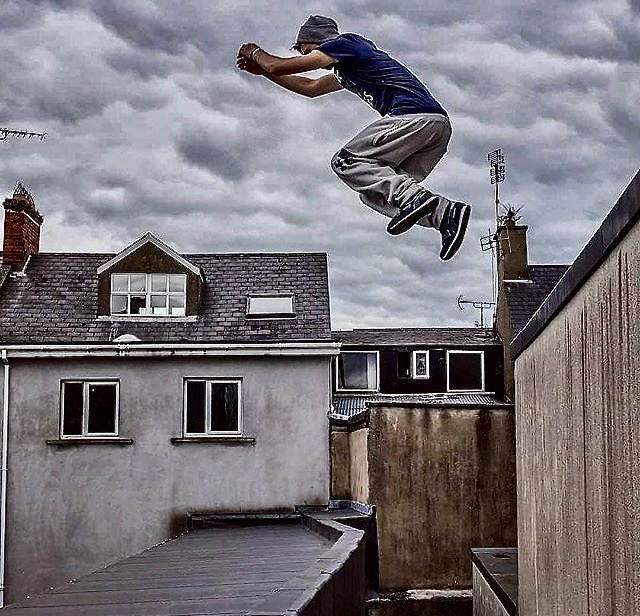
Sometimes they would go out at night and roof jump in Lakewood. They jumped the traces. The houses and apartments are close together in the streetcar suburb, often separated only by a driveway. They would run across the roofs, swinging from the chimneys, jumping from one roof to the other. They whooped it up as householders in for the night wondered what the thumping above them was all about.
As they got older, although not necessarily wiser, the gang got more socially correct. They had mystery parties, which were parties on a bus on which they would have dinner and drinks with their friends, not knowing where they were going, and at the end of the night everyone would have to guess where they were. The winner got to be on the show. It was the Me Decade. Everybody wanted to be seen and heard.
Maggie’s father was a prankster even at home in their quiet lakeside suburb. He played jokes on the neighbors on their street. He hired the Bay Village High School Marching Band to wake up one of their neighbors at five in the morning. They did it by marching up and down their driveway and playing a fight song. All the other neighbors for blocks around woke up, too. Some of them thought it was funny. Most of them didn’t. They called City Hall, even though City Hall wasn’t open for business that early in the morning.
One of their neighbors had dogs, like them, and Maggie dog sat them when they were out for dinner or at a show. “Can you take care of our babies?” Mrs. Butler would ask. One day Fred took advantage of Maggie having the Butler house keys. He snuck into their house and filled every glass, cup, vase, sink, whatever it was, with water and a single goldfish. When they got home there was a glut of goldfish waiting for them, even in the toilets.
From then on it was buttheads on the loose at the Butler residence every few months. Once when they were taking a walk on Huntington Beach after dinner, Fred and his friends got into their garage, picked up their car, and turned it sideways. The man of the house couldn’t go to work the next morning. There wasn’t anything he could do. Everybody on the street thought he might have to tear the garage down.
“I am going to sue that son-of-bitch,” he roared. He was a corporate lawyer. His funny bone was more along the lines of a crazy bone. He wore out his thumb thumbing through his law books. He couldn’t prove who had done it and had to resort to fuming.
Fred crept into another house late one summer night wearing his gorilla suit and scared their children so much they screamed their heads off and peed on the floor. He thought it was great laughs, giving them nightmares. That was fun to him. It didn’t matter what anybody thought or threatened. Whatever he thought of doing he did it. He was always pranking the poor Butlers. When they complained to the Bay Village Police Department, the forces of law and order just shrugged their shoulders.
Maggie and her sisters and little brother were never out of trickster range. Their father would crawl under their beds at night and wait silent as a snake until they got warm and cozy and dozed off. When he was good and ready, he reached up and around and suddenly grabbed their arms or legs and yanked.
“Oh, yeah, while we were sleeping!” Maggie said. ”I found out your worst fears can come true at any minute. I’m a grown woman and I still to this day can’t hang my feet out over the edge of my bed at night.”
Ed Staskus posts on 147 Stanley Street http://www.147stanleystreet.com and Made in Cleveland http://www.clevelandohiodaybook.com. To get the site’s monthly feature in your in-box click on “Follow.”

