Category Archives: Baltic Place

Farm Girl

By Ed Staskus

   When my mother Angele was born it snowed until it got too cold to snow anymore. By the end of the month the thermometer rose to ten degrees below zero. When it warmed up the next month and the snow melted, a half-foot of slush was left behind. The next week there was heavy rain and her father’s fields were left under water. If it froze again there would be acres of ice rink. It froze and everybody went skating.

   “I was born in an area we called the New Farm, in Suvalkija, near Gizai,” said Angele. It was mid-January 1928.

   Suvalkija is the smallest of the five regions of Lithuania. It is girdled by the Nemunas River to the north and Poland to the south. The region’s identity was molded in the 19th century when it was a part of Congress Poland. Suvalkija was an agricultural area, generating substantial sugar beet harvests. Sugar beet yield in Lithuania in the early 20th century was almost half what it was in the United States, even though the country is 151 times smaller than the United States.

   “My father’s name was Jonas Jurgelaitis. My mother’s name was Julija. I had four brothers and a sister. I was so happy when my sister was born. We lived on a small farm. It was three or four miles from Marijampole.”

   Marijampole is in the far south of Lithuania, bordering Poland and Kaliningrad. Lake Vistytis is nearby. The town was a center of book spreaders and freedom fighters in the long struggle leading to the country’s independence in 1918. Speaking Lithuanian was forbidden, but they did it anyway. Reading Lithuanian books was forbidden but they read them anyway. Many of them ended up in Russian prisons, where they spoke Lithuanian among themselves.

   Their farm was 10-some acres. The nearest neighbors were out of sight, even though they were nearby. Small woodlands of Scots Pine and Norway Spruce were scattered along the periphery of their land. Her father kept a pair of horses, three to four cows, lots of chickens, and a sounder of swine. Every week he loaded 10-gallon 90-pound milk cans into his wagon and took them to a local dairy. He rented croplands from a childless widow. The ground was devoted to sugar beets, a cash crop, harvested in early autumn.

   Suvalkija has less forest than any other part of Lithuania. It had long since been brought to bear for tillage. Kazlu Ruda, a large forest, nearly 230 square miles of it, is in Suvalkija, but it is on sandy soil that doesn’t work for farming. Rye, wheat, and barley have been cultivated in Lithuania for two thousand years. Potatoes got rolling three hundred years ago. The country has always been able to sustain itself with foodstuffs. After gaining home rule from the Russians, land reforms in 1922 turned over ground suitable for the plow to tens of thousands of new landowners. Two years later the Academy of Agriculture was established to oversee land exploitation and management.

   “My mother was tall and thin.,” Angele said. “She was pretty. She looked like a Romanian, even though she was born near where we lived. I didn’t look like her, at all. I looked like my father.” Her mother gave birth to eleven children in less than twenty years. Six of them survived infancy. Five of them survived World War Two, the forty-six-year subsequent Soviet occupation that happened next, and lived to see Lithuania regain its independence.

   Justinas was the oldest boy, born in 1919. “Justinas and my other older brother Bronius would invite their friends, and all the girls, to our house in the summer for dancing, before he joined the army.” Irena and the boys Sigitas and Jozukas were the youngest. Jozukas, the tenderfoot of the family, was two years old in 1938.

   Julija started suffering chest pains that year, losing her appetite and losing weight. She was diagnosed with tuberculosis, a major killer in the 19th and early 20th centuries. Almost ninety years later tuberculosis is still prevalent in Lithuania, one of the most highly TB-burdened countries in the world.

   “She went to the sanitorium in Kaunas the next year and got better.” When family responsibilities and the family’s finances called her back, she got worse. Angele helped with the housework and cooking. She kept up her schoolwork, kept up her chores, and with her two older brothers nursed their mother.

   “Irena and I went to a school in Gizai, which was less than a mile from our house. In the winter, when it was snowy, my father hitched one of the horses to a sled and took us there. I went for six years.” The family farm wasn’t far from Marijampole. It was forty miles southwest of Kaunas, the country’s second largest city. Vilnius, the largest city, home to nearly a half million, was eighty miles away. It might as well have been a million miles away.

   “Even though my father did everything, we all had to work, since we were poor.” There were no hired men or seasonal laborers. “I mixed feed for the pigs and fed them. We earned our money by growing sugar beets. Irena and I helped, but Sigitas and Jozukas were too small. We pulled them out of the ground in the fall and used a big knife to cut the leaves away. We threw them in a cart and when we had enough to fill our wagon, my father hitched a horse and took the beets to Marijampole.”

   The family home was a frame house, clapboard siding painted green, two stories, although the second story was an attic for storage and for smoking pork. “We had a barn, but we had another small house, too, a small barn where we kept wood for the fireplace.” They sawed and split their own cordwood. “On the second floor, up a ladder, there was rye and barley for bread. Justinas and Bronius slept in a room beneath the loft.” A brick-lined jumper duct fed heat from the house fireplace to the barn. Still and all, all winter long the young men gathered their blankets and warmed them up at the fireplace before going to bed. In deep winter in the Baltics the nights are 16 hours long. The stars twinkle but they are icy.

   Lithuania is a flat fertile country overlooking the Baltic Sea. The summers are mild, and the days are long, but the winters are longer. They are cold and dark. Temperatures often drop well below freezing. The ground is ice and snow-covered from mid-December to mid-March.

   “We had a dog, in a dog house next to the barn, whose name was Sargis.” Saugotis in Lithuanian means beware or watch out. “He was our guard dog, always tied up at night, who barked whenever a stranger came near. We had cats, too, who killed the mice and rats who ate our grain. We never let them into the house, though. They were only for the outside.” Barn cats lead a rough life, hunting vermin in outbuildings and fields. They sleep where they can, stay warm if they can. Living feral, they don’t live long. Whenever they could they snuck into the small, heated barn and slept under the blankets next to the two brothers.

   The family knew everybody in their neck of the woods. Everybody was wary of strangers. Although they had no immediate neighbors, her mother’s father, a tailor, lived nearby, and her father’s mother also lived within walking distance. “Whenever my mother made potato pancakes, she would give me a platter of them, and I took them to grandma’s house.” Her grandmother lived on the other side of the woods, with one of her father’s older sisters.

   After her mother got sick, from about the time she was ten years old, Angele did the cooking for the family. “My oldest brother Justinas helped me until he went into the army, and then Bronius helped.” She cooked pork logs, made soup, and served bread and butter every day. She washed the pots and pans and dishes and utensils twice a day.

   Justinas was apprenticed to a tailor, and learning the trade, but joined the army in the late 1930s. Every country cousin knew war was coming. “He became a cavalryman and was stationed near Marijampole. He rode home a few times, on his horse, in his uniform. He was so handsome.” He had just turned twenty-one. He didn’t know his horse was going to be useless in the coming war.

   When the Red Army invaded the Baltic states in June 1940, their troops numbering some fifty divisions, supported by armor and an air force, they swept the Estonian, Latvian, and Lithuanian forces aside in a matter of days. Justinas spent the rest of the war feeding his horse, and sewing and mending clothes, first under the thumb of the Russians, then the Germans, and then the Russians again.

   A woman whose husband had died and who lived nearby helped Angele learn to bake bread in their brick-lined oven. They made a half-dozen loaves at a time, kneading up to ten pounds of dough at a time, baking the free-standing loaves loosely arranged in front of a smoldering pile of coals that had been left burning for several hours. They kept the coals pushed to the back of the oven. They added wood as they needed it, shifting the fire from side to side. “We always had bread. We always had tea and sometimes coffee. When times were hard we collected herbs and had herbal tea.”

   The house did not have electricity or indoor plumbing. They had oil lamps and an outhouse and a well. There was a sink with a pump handle in the kitchen. “The outside well had a pulley and a bucket until we finally got a hand crank.” In January 1940 a bitter cold wave enveloped Lithuania, driving temperatures down to 40 degrees below zero Fahrenheit. The next month it crashed to 54 degrees below zero, the coldest in 160 years. The cats didn’t leave the small barn for weeks. The well froze. The Baltic Sea iced over. Some people froze to death and more than 10,000 throughout the Baltics were severely frostbitten, losing fingers and toes.

   When Julija had a relapse, she went back to the sanitorium in Kaunas, but returned home soon afterwards. “A taxi brought her back. My mother said she had to be with her children.” She was not fully recovered. When winter bore down again, she became run down and became bedridden. Jonas built an addition with a window, putting down rough planks over the packed dirt floor. He moved a free-standing cast iron furnace into the room. His wife died in her bed, the head of the bed facing the window, early the next spring. She was forty-three years old.

   Angele’s father re-married four months later. “He needed a woman to take care of Sigitas and Jozukas, my baby brothers.” Jonas had decided to ask the nearby widow with the farm, the woman who had helped Angele bake bread, but by then she was spoken for by another man. He found a single woman in Gizai and didn’t waste any time proposing.

   “Gizai was where we always went. My school was there, and there was a church, a police station with a policeman, and a hardware store that had everything. Whenever we had a coin we bought candy at the coffee shop there.”

   Jonas’s new wife was younger than Julija had been and healthy as a horse. She had a daughter a year older than Angele, even though she had never been married. The wedding was in early September. It wasn’t long after the move-in before Angele realized she couldn’t stay. “My new mother and my father started arguing. She loved the younger ones, and she loved her own daughter, but they started arguing about me. My father stood up for me, but he needed a wife. I don’t know what I was thinking, but one day I left.”

   It was late September. She packed a loaf of bread, some cold pork, what clothes she could carry, and a picture of her mother. She set off on foot in the morning for Alvitas, for her aunt’s house. Ona Kreivenas was her mother’s sister. Her aunt’s husband, a police captain, had been deported to Siberia by the Russians that summer, leaving her with three children and pregnant with a fourth. She could use a hand around the house.

   “I knew life wasn’t going to be any easier in Alytus, but I had to go,” Angele said

   Even though two German army groups smashed into the country in late June that summer, ousting the Russians, by then it was too late for Jonas Kreivenas, who didn’t come back from a slave labor camp in Siberia for nearly fifteen years, and when he did, found out his wife wasn’t in Lithuania anymore. She had fled post-war Europe. She was living in Philadelphia, in the United States.

   Alvitas is about fifteen miles from Gizai. It took Angele most of the day to walk there. She passed a prisoner of war camp crowded with Soviet soldiers captured by the Wehrmacht. One of them asked her for bread but she turned her head away. His war had amounted to little and ended in nothing. When she got to her aunt’s farm the sun was close to setting. 

   “I lived with my aunt for the next three years, until the Russians came again, and we had to run to Germany. I never went back home, except to visit, as a guest. I loved my father, and my brothers and sister, but I couldn’t go back.” When Angele woke up early the next morning, she had a new home and a new mother. “She was my parent now. They were my family.” She helped her aunt make breakfast. There was strong black tea at the table. The first frost wasn’t far away, but that morning was an Indian summer morning.

A version of this story appeared in Draugas News.

Ed Staskus posts on 147 Stanley Street http://www.147stanleystreet.com and Made in Cleveland http://www.clevelandohiodaybook.com. To get the site’s monthly feature in your in-box click on “Follow.”

One Man Army

By Ed Staskus

    There has never been an excess of men who fight for a guerrilla band and three armies, one of the armies twice, quitting it the first time around, during any single war. An armed force a day keeps most men busy enough. Leonas Lucauskas stayed busier than many other combatants during the struggle that was World War Two. He fought with partisans in the forests. He served in the Lithuanian, German, and American militaries. He may not have had as many lives as a cat, but it was close.

   “My father Leonas was born in 1916, in the Ukraine,” his son Leo Lucas said. “My grandfather Juozas and grandmother Stanislava were living in Poltava, insanely far from Lithuania, which was their home.” He meant the seven hundred miles was insanely far given the state of Russian roads and their rundown railroads. The Eastern Front, where millions of men were slaughtering each other at the time, was closer.

   “My grandfather was a professor, teaching there during the war.”

   The school was the Poltava National Technical University. It was founded in 1818 by the wife of the governor-general of the province, the granddaughter of the last Ukrainian strongman before the Russian Empire absorbed the country in the 18th century. For hundreds of years Lithuanian and Polish freebooters had controlled vast tracts of the Ukraine and were a law unto themselves. They were no match for the Cossacks, however, who were later no match for the Russians.

   After the war the family, including Leonas’s older brother and sister, who were twins, went back to Lithuania. They settled near Iglauka, not far from Lake Yglos, His father taught school in Marijampole, twelve miles to the west, and they lived on a farm. His mother’s family were prosperous owners of farmland and personal property.

   In 1924 the state-sponsored revolt in Klaipeda was signed, sealed, and delivered, the country competed in the Summer Olympics for the first time, and Leonas’s older brother unexpectedly died of a contagion. The next year his mother went to a wedding. In the middle of the reception she was shot dead.

   It had been Russian Imperial policy to leave Lithuania in a non-industrial state. The inheritance system after the land reform of 1863 forbade the partition of plots. There were many landowners at the reception. They stuck together socially, friends, neighbors, and families bound by the old-time way.

   The Communist party of Lithuania was formed in 1918, declared illegal, and remained illegal until 1940. The Reds didn’t care about legality. They were out for blood and land. There is only so much land to go around in small Baltic-like countries. It was a zero-sum disagreement. “A group of Communist agitators, people who wanted other people’s land, came to the wedding, started a ruckus, started shooting guns, and my grandmother was coincidentally shot and killed.”

   Years later, Leonas told his son the challenge of his life after his mother’s death was, should he take revenge when he grew up? They lived in small towns, everybody knew everybody else, and everybody knew who the Communists were. Should he kill them when he grew up? He decided he wouldn’t, although he never got over the ill will he felt.

   When he grew up, he got married, had a daughter, and was planning on going to school to study medicine, but then World War Two happened. His father was shot and killed by fifth column collaborators in his own living room. Leonas joined the Lithuanian Army and the Soviet Union invaded. 

   It was never a fair fight. In mid-June 1940 a half-million Red Army troops poured across the borders. Within a week the Baltics were overrun, one week before France fell to Nazi Germany.Josef Stalin blew his nose into his walrus mustache. Adolf Hitler did an awkward jig, grinning behind his toothbrush mustache.

   Leonas took to the forest, joining a group of partisans, staying in the fight for the next year. It wasn’t any more dangerous than anything else in dangerous times. He had been working in their fields when his father was killed. “They were killing landowners. My father’s luck was just the luck of being in the fields,” Leo said. “They would have shot him if they had been able to track him down.”

   A year later Lithuania was invaded by the German army. Most Russian aircraft was destroyed on the ground. The Wehrmacht advanced rapidly, assisted by Lithuanians, who saw them as liberators. They helped by bringing their weapons to bear, controlling railroads, bridges, and warehouses. The Lithuanian Activist Front and Lithuanian Territorial Corps formed the native backbone of the anti-Soviet fighting.

   Leonas was one of many who joined the German Army, being assigned to a Baltic Unit. Three years later he was having second thoughts. The Russian Baltic Offensive of 1944 was in full swing. The Red Army was on the march to “liberate the Soviet Baltic peoples.” An NCO by then, Leonas and his men were ordered to man the front line and hold it at all costs. It was costing them dearly every day. 

   “The rich Lithuanians were officers,” Leo said. “They weren’t in the tranches getting their heads shot off. The enlisted men were getting killed. They all wanted to get away.”

   There was a small airstrip nearby for reconnaissance and resupply. Junker 52s were flying in and out with ammunition, first aid, food, and hope in the grim hopelessness. Leonas and three other men from his unit were unloading one of the planes at a side door by means of a ramp, the front and wing-mounted engines roaring, when with hardly a word spoken between them they made up their minds on the spot to steal it and fly somewhere safe and sound.

   Two of the men rushed up the ramp and threw the German pilots out the door, while the other Lithuanian and Leonas kept watch, guns at the ready. He was the last one to scramble into the plane and was shot in the back of the foot just before slamming the door shut.

   “I was playing on the floor one day,” Leo said. It was the late 1960s. “My dad was relaxing, shoes and socks off, sitting on the sofa in the living room reading a newspaper. I saw a scar on his heel and asked him what it was. He said it was a bullet wound. He rolled up his pants and showed me three more on both legs.”

   One of the Lithuanians returned the shooting with a MG15 machine gun set in the dustbin turret, while the other two men dragged Leonas to the cockpit. None of them had ever flown an airplane. He was the only one of them who had ever even driven a car.

   How hard can it be? he thought. With bullets slamming into the corrugated aluminum fuselage, he found out it wasn’t hard at all. He pushed on the throttle, got the Junker going as fast as he thought it would go, raised the nose, and “Iron Annie” lifted itself up into the air.

   They quickly came up with a plan, planning to fly to Switzerland. They got as far as the Poland to Germany border when they ran out of gas. The plane wasn’t the fastest, 165 MPH being its top speed, and it could go about six hundred miles on a tankful. When they went down, they were headed in the right direction. All they needed was another full tank.

   It solved their landing problem, since Leonas had already told his confederates he had no idea how to land the plane. The Junker hit the ground hard and every part of it broke into pieces. When Leonas came back to life he was in a German field hospital. He never found out what happened to his countrymen.

   The doctors and military men asked him who he was and what happened. He answered them in German, in High Deutsch, not Low. “My father spoke Lithuanian, Polish, Russian, and German.” He was wearing the right uniform when found, was speaking like a householder, and they assumed he was one of them. Leonas bit his tongue about who he really was, thanking God for his good fortune.

   After he got out of the hospital he was deemed not fit enough for combat and assigned to the motor pool. Soon after that he drew a lucky number and was assigned to be the driver for a Wehrmacht general. It was lucky enough until several months later, when early one morning, in the middle of winter, he got a wake-up call from one of his motor pool sidekicks.

   “Don’t come to work today,” the man said.

   “What do you mean?”

   “Your general died late last night. One of the first people the Gestapo will want to talk to is you.”

   He knew it was true. He knew what had happened to anybody and everybody involved in the attempt to assassinate Adolf Hitler in mid-July. Nearly five thousand people were executed. He would never be able to stand up to scrutiny. They would stand him up in front of a firing squad in no time.

   His general was probably out carousing in their Tatra 87, slid on some ice, smashing into a tree, but it didn’t matter. It didn’t matter whether the general died in the arms of his mother or was assassinated. His goose was cooked if the SS got him. They were known to literally cook people to death.

   The Tatra 87 had been the Nazi Car of the Year five years running. Sleek, futuristic, BMW-engine fast and high-tech as could be, it was the vehicle of choice for German officers. Unfortunately for them, it handled like pudding, killing its passengers right and left. Leonas always kept it under 40 MPH. It was the vehicle of choice of the Allies, too, at least for their mortal enemy. They thought of it as a secret weapon, killing more high German officers than died fighting the Red Army.

   He jumped to his feet, got himself into his uniform, threw on a winter coat, and fled his room. Making his way to the motor pool, he found a truck with keys in the ignition and a full tank of gas. There were plenty to go around. Opel manufactured ninety five thousand of the 4 x 4 Blitz trucks during the war. He quickly signed it out, turned it over, and drove away. He drove straight for the front. His plan was to break through the line and surrender to the Americans. When you’re at the end of your rope, tie a knot and hang on.

   He didn’t run out of gas and didn’t get shot by either side. In the event, he surrendered. He was relieved and confident that the war was over for him. But by the time the war raised the white flag he was in his third army. At least he was finally on the winning side.

   “My grandfather Juozas was a gigantic guy,” Leo said. “I’m six foot four myself. But my father Leonas was five nine and maybe one hundred forty pounds.” In the end, what counts is what you do. Dwight Eisenhower was the Supreme Commander of what he called “the whole shebang” in Europe. He knew there was more to winning the war than armor. “What counts is not necessarily the size of the dog in the fight, it’s the size of the fight in the dog,” he said.

   At the beginning of 1945 the Allied Expeditionary Force on the Western Front had seventy three divisions ready to go. The Germans had twenty six divisions. The Battle of the Bulge ended in an Allied victory. Adolf Hitler held a meeting with his top men, instructing them to hold the Americans and British off at all costs. By that time, however, his top men were flat tires. The Fuhrer boarded a train and never went back to the Western Front. At the end of January, he gave the last speech he was ever to give. It was all hot air.

   After surrendering, Leonas spent time in a DP camp, until being recruited by the Americans. They were looking for men who spoke multiple languages and he fit the bill. He had been picking up bits and pieces of English in the meantime. Russian and Polish are among the Top 10 hardest languages to learn. English is no slouch, either. He persevered with his new grammar book and was made a Sergeant. In 1946 and 1947 he was in Nuremberg, where war crime trials were being conducted, translating the misdeeds. He watched the men who propagated the National Socialist German Party commit suicide, get executed, or get locked up forever.

   As the hard-fought decade of the 1940s wound itself down, Leonas made his way to North America, finding work as a lumberjack near Sudbury, Ontario. “It was an indentured servant kind of job,” said Leo. More than two-thirds of the Canadian province is forest, in land mass the equivalent of Fascist Germany and Fascist Italy combined. “He was never quite sure where he was when he was in the forest.” He preferred it, though, to being a mile down in the Sudbury Basin nickel mines. Up a tree he could, at least, see for miles.

   Making it in a company town is hard to do. Since there is no competition, housing costs and grocery bills can become exorbitant, and workers build up large debts they are required to pay off before leaving. It can be bondage by another name. Leonas determined to find another way, his own way.

   He and several other immigrants pooled their resources, found a broken-down car, scavenged parts from other wrecks, filled the tires with enough rags to get them to roll, and hit the road. He ended up in St. Catherine’s, near Niagara Falls, and later, sensing an opportunity to get into the United States, he took it. He settled down outside Buffalo, New York in 1950, where he stayed the rest of his life. He never saw his wife and child, trapped behind the Iron Curtain, again.

   He got married to an American woman. His new wife Louise taught school. They raised a family. He went to work as a butcher in the meat department of a grocery store for more than thirty years, rarely missing a day. He built a house on three acres of land. One acre of it was devoted to a garden. “I must have moved five thousand wheelbarrows of manure as a child,” Leo said. “Whenever our factory friends went on strike, I delivered food from our garden to them in the morning before school.” His sister Katherine still lives in the family home.

   Leonas often hung from his heels in the garage to prove he could still do it. “My father was a strong man.” Sometimes men are strong because it’s the only choice they have. Spinning your wheels doesn’t get it done. Leonas smoked and drank with his friends at the local Italian and Polish social clubs. They played cards. They rarely talked about the past. They stuck to the present. The past was a dead letter.

   He was a sociable man in post-war society. He was friendly and approachable. He rarely missed a dance at the social clubs. He believed that if you can dance, you always have a chance. He had more lives than a cat, although he stopped testing the limits. He never fought in another man’s army ever again.

Ed Staskus posts stories on 147 Stanley Street http://www.147stanleystreet.com and Cleveland Daybook http://www.clevelandohiodaybook.com. To get the site’s monthly feature in your in-box click on “Follow.”

Shake a Leg

teen-zumba

By Ed Staskus 

   “Rhythm is something you either have or don’t have, but when you have it, you have it all over.”  Elvis Presley.

   On a Saturday morning in mid-fall, Olga Capas, Rita Zvirblis, and Vanessa Staskus ordered late breakfast early lunch at the Diner on Clifton, finding a table on the outdoor patio and easing into their seats twenty minutes after their ever first Zumba class. Over cups of steaming coffee, three-cheese omelets, patty melts, and shared sweet potato fries, they caught up with their breath and with tuning in to the sunny-side up movement exercise scene.

   “We got to class early and found our space in the back,” said Vanessa, “but then every minute somebody went behind us, so in no time we went from being in the back row to being in the front row.”

   If you’re in the front row you’re leading the parade. It wasn’t what they planned, but once the class started, they had to look alive. If you stop, you’re going to melt back into the tuba section, where you might get laid low.

   “I thought they were going to kick me out,” said Rita, “I have no rhythm, but it’s so fast, you can’t think about anything else besides keeping your feet moving.”

   She was being modest. She danced with the Grandinele folk dancers as a teenager and young adult. She traveled with the troupe to Chicago and Toronto, Europe, and South America. Folk dancing reflects the life of people from a place or country. It can be the upbeat southern Italian Tarantella, the rhythmic Turkish Haly, the Polish carnival party dance Polonaise, Kentucky clogging, and Korean sword dancing. Zumba is along the lines of a street dance.

   Grandinele was formed in Cleveland in the early 1950s by Liudas Sagys, who began his career as a professional dancer with the National Folk Dance Ensemble in Lithuania. He taught the steps and choreographed Grandinele’s country hoedowns while his wife Alexandra made the costumes and kept the books. He was the longtime director of the Cleveland Folk Dance Festival which in 1976 was recognized as “the best ever.”

   “I loved the Zumba, the music and moving,” said Olga. She always had tennis shoes at the ready in her hallway when she was ready to move.

   The three women are all of Lithuanian descent, one of them from the homeland, two of them immigrant stock, living west of the Cuyahoga River, on the west side of Cleveland, Ohio, active and fit enough. Plump pale and healthy as an ox without batting an eyelash was the touchstone once upon a time, but the signs of the times have long since changed. Never fit and trim enough is where walking jogging running working out and Zumba come in.

   Zumba is a dance and fitness program created by exercise instructor and choreographer Alberto “Beto” Perez in Colombia during the 1990s when he improvised salsa music into an aerobics class. Since the turn of the century, it has expanded to 125 countries, taught by more than 20,000 certified instructors. Practiced weekly by approximately 14 million people worldwide it is today’s most popular dance fitness phenomenon.

   In 2012 Zumba was named the”‘Company of the Year” by Inc. Magazine and is today one of the largest fitness brands in the world, practiced everywhere from big-box gyms to church halls to community centers.

   At the Harrison Elementary School, sponsored by the Lakewood Recreation Department, classes are taught by Amy Annico, a hale hearty black-haired young woman sporting a quick smile, bright blue sneakers, and hauling a yellow Dewalt boom box about the size of an air compressor from her car to the class.

   “One minute she was monkeying with that big yellow thing,” said Rita, “and then at nine o’clock in the morning exactly it was blasting.”

   It was the blast off.

   “I’m not really for nightclubbing first thing in the morning,” Rita said, “but she makes it a lot of fun. It’s like partying yourself into shape.”

   Zumba is different than many other fitness programs because people don’t always take it for the fitness benefits, more often than not for the boogie and socializing, even though the results can be transforming.  It is a cardiovascular calorie-burning hour of twisting and turning in varying states of synchronization to loud bouncy infectious music.

   “They are taking it for the happiness and joy that they feel while they are doing it, and the fitness is just the result of this,” said Alberto Perlman, who with Alberto Perez was a co-founder of the Zumba enterprise.

   Zumba is essentially an aerobic fitness program, including basic core fitness, married to dance routines. Set to full of life Latin American beats, it burns up to 600 calories an hour, according to Harvard Health Publications. Sweating is not optional, since everybody starts sweating within a couple of minutes and doesn’t stop until the end of class.

   “Zumba is hard,” said Olga, “but it’s not hard like going to the gym. Sometimes I have to force myself to do that, but with Zumba the music is going, and you just want to move.”

   “It’s fast-paced and you’re watching Amy’s feet up on the stage,” said Rita between bites on a Reuben sandwich. “It’s those blue shoes she wears the whole time, trying to follow what she’s doing, and then you immediately start sweating.”

   “Immediately!” echoed Vanessa. “Sweat was dripping down the small of my back before the warm-up was even over.”

   Amy Annico, a music teacher as well as part-time actress, has taught Zumba since 2008 at area YMCA’s, Live Well Lakewood, health fairs, and retirement homes. She attends the annual Zumba Instructor Convention in Orlando, Florida, every year, upgrading her skills

   “I’m trained in Zumba, which is for everyone,” she said, “and Zumba Gold, which is for older, active adults, and Zumbatomic for kids.” There is even Aqua Zumba, a water-based workout integrating Zumba with aqua fitness themes. A great deal of jumping and splashing is involved. Strapless bathing suits are strongly discouraged, for good reason.

   “The Harrison school class is a great community class,” Amy said. “Everyone’s dancing, it’s like a party, people are hooting and hollering and shaking, and the hour flies by and you don’t even know it.”

   By all accounts shimmying, shaking and sliding, hooting and hollering, as well as chest pumping and bootie shaking, are encouraged subscribed to and applauded. You may not get a gold star, but you’ll be a shooting star.

   “I always say, don’t be shy, give it a try,” said Amy Annico. “It’s all about spreading the joy of music from around the world with fantastic fitness and dance moves.”

   The word zumba is Colombian slang and means “move fast and have fun.” It has been described as exercise in disguise. Set to four basic rhythms based on salsa, merengue, cumbia, and reggaeton, it is a non-stop workout that works all your endorphins out endorphins as well as working out your muscles.

   Some people lose inches off their waistlines, others see their cholesterol drop and their energy levels rise, while still others simply reduce their stress levels. Some men even learn to dance and not make fools of themselves at weddings anymore.

   Just as sweating is mandatory, so is staying hydrated.

   “I told Vanessa to bring water, even though she doesn’t like water, because I heard you get really thirsty at Zumba,” said Rita.

   “My whole bottle of water was gone before half the class was over, and I never drink water,” said Vanessa. “Everybody was going back and forth to the water fountain getting more of it all class long. You don’t get totally winded, even though it’s non-stop dancing, but you do get totally thirsty.”

   Their dishes cleared off the table at the diner, coffee cups re-filled, and lingering over their lunchtime, the three women agreed that Zumba was the best way they could think of to exercise without actually exercising.

   “The salsa moves are really good for you, your whole body is going, your hips are going,” said Rita. “Amy is so animated, she makes all these noises, those sounds of hers, like she is definitely having fun doing it, and she makes it the same for everybody.”

   “It’s loke dancing from beginning to end, but it’s exercise, too. You do it with joy, and afterwards you feel so good,” added Olga. “It’s guaranteed to put a smile on your face.”

   They all agreed Zumba was the best of both worlds. There are shortcuts to happiness and dancing is one of them. “Your whole body is moving, and you don’t have time to think about working out,” said Rita while walking back to their car. “It’s like having your cake and eating it, too.”

   Some words are triggers. Cake is one of them. If staying healthy and fit is a priority, since vegetables are a good way of getting there, there is always pumpkin pie and carrot cake.

   “Why don’t we drive down to Tremont, have some dessert, and go for a walk along the river?” Vanessa suggested. “It’s going to start getting cold soon.” The winter in Cleveland was only six weeks away, when the sky would go dark gray and storms started blowing in over Lake Erie.

   That’s what the three Baltic hoofers doing Columbian slimnastics for the day did, before the sun set, and the night’s new frost crept in unnoticed.

Ed Staskus posts stories on 147 Stanley Street http://www.147stanleystreet.com and Cleveland Ohio Daybook http://www.clevelandohiodaybook.com. To get the site’s monthly feature in your in-box click on “Follow.”

No Man’s Land

By Ed Staskus

   My grandmother was a Russian, a schoolteacher in Saransk, when my grandfather met her before the start of World War One. He was a Lithuanian. The town and the garrison were in the Penza, four hundred miles southeast of Moscow. It was somewhere but in the middle of nowhere. Antanas Staskevicius was an officer in the Russian Imperial Army, not that he wanted to be, but the Muscovite landlords of the Baltics demanded it.

   Saransk later became the capital city of the Republic of Soviet Monrovia, but long before that happened my grandfather had returned to Lithuania. Native soil is always better than the Saransk’s of the world. Home is where the heart is, but not necessarily where the heart is forcibly relocated.

   The town in the Volga Basin was founded as a fort, on the left bank of the Isar River, at the crossroads of Moscow and the Crimea. Before the First World War its commercial life revolved around leather, meat, and honey. After the war its factories were closed for more than ten years when there weren’t any available fuels or raw materials. In the meantime, the Kremlin stayed stocked with vodka and caviar.

   “My father was trained as an officer and sent to serve there in the Czar’s army with an infantry regiment,” my father, Vytas Staskevicius, said. “It was a hard post for him, because back then they said drinkers go to the navy and dimwits to the infantry.” The Imperial Russian Army had more than a million men, most of them conscripted, and most of them dirt-poor peasants. There were a quarter million Cossacks, too. Only the Cossacks knew what they were doing.

   “He met and courted my mother, Antonina, and they got married. They had my older sister, Eugenia, in 1917. We called her Genute. My sister Gaile was born the next year.” Vytas was born six years later, in 1924, in Siauliai. “My father named me after King Vytautas the Great.” His mother called him Vytas. His sisters called him many things, including the little prince and the rotten prince.

   Siauliai is home to the Hill of Crosses, a hill where there had once been a fortification less than ten miles from the town. It is covered with tens of thousands of crosses, crucifixes, and holy statues. It was after Czarist forces crushed Lithuania’s November Uprising of 1831 when the first of them appeared.

   By 1918 Lithuania had been missing from the map for more than one hundred years, having been disappeared after the Partition of Poland. Since that time, it had been under the thumb of the Czars. In late 1919, when the Bolshevik Revolution had become a Civil War, Antanas Staskevicius went home to a newly independent Lithuania.

   “Lithuania didn’t have many officers when they formed their own army,” said Vytas. “Most of them were men who had been conscripted into the Imperial Army before the war. My father fought in the post-war battles around Klaipeda and after that he served in the secret service in Kaunas, which had been made the capital.”

   Lithuania declared independence in February 1918 and for almost three years fought Russians, West Russians, and Poles for their land. Finally, they formed their own government, although they lost Vilnius, their historic capital, to the Poles, with whom they remained officially at war with no warfare after 1920. “After the post-war fighting with the Poles my father got some land for serving his country, near Siauliai. We lived on a farm.”

   During World War One most of Siauliai was destroyed and the city center was obliterated. Since its founding in the 13thcentury, it had burned down seven times, been struck by plague seven times, and World War Two was the seventh conflict that wrecked the town. It was rebuilt after every catastrophe.

   “We lived there for several years, but then my father became the governor of the Panevezys district and we moved to the city there.” Panevezys, a royal town founded in the early 16th century, is on the plain of the Nevezis River, about fifty miles east of Siauliai. During the years between the world wars Lithuania was divided into 24 districts and each district had its own governor. My grandfather was the governor of Panevezys until 1938.

   Vytas went to grade school and high school in Panevezys, but his father was later transferred to Zerasai, a place that was a summer resort. In 1834 Zerasai had burned down and been rebuilt. Two years later it was renamed Novoalexandrovsk, in honor of Czar Alexander’s son, but after the Great War the name was expunged. There was no love lost between the Baltics and the East Slavs.

   “When my father became the governor of Zerasai, my mother didn’t want to move there, since it was more than seventy-five miles from where we lived, so I stayed with her. But I didn’t get along with the students at the high school there. It was a strict school and everyone had to dress nice. On my first day of classes I was dressed up too nice, like I was going to a wedding, with a tie and everything, and everybody laughed at me. Where are you from, they all said. I didn’t make any friends there.”

   He told everyone, “I’m going to Zerasai.” He moved there in 1939 and lived with his father. “We always studied a second language in school, and since my mother was Russian, studying it was easy for me. But when I got to Zerasai I found out they only had English as a second language, no Russian. My father had to hire a tutor to help me.”

   All during the 1930s the world had been changing fast. In 1940 the Lithuanian world changed even faster. Father and son moved back to Siauliai. “The Soviets came that year. All the high officials were let go and the Russians selected new people who they wanted to run the country. They said they didn’t run the country themselves, we Lithuanians did, but it was the Lithuanian Communists who were in charge, so it was actually the Rus.”

   The family went to their farm, while renting a house in Siauliai, dividing their time between town and country. “It was only a few miles from our farmhouse to town. I used to walk or bicycle to Siauliai. But the mood was bad, very bad. Everybody thought something terrible was going to happen.”

   The Russian annexation of Lithuania was completed by the late summer of 1940. Businesses were nationalized and collectivization of land began. As the Russian presence expanded the family discussed leaving the Baltics.

   “Why don’t we go to Germany?” my grandmother asked.

   “We had a chance to leave the country then and go somewhere else.,” my father explained. “My mother wanted to go. We talked about it often, about going to Germany.”

   But my grandfather didn’t want to leave Lithuania. “I have never done anything wrong that they would put me in jail,” he told his family. “I have always been good to people. They aren’t going to put me in jail.” He stopped short of laughing it off.

   In the fall of 1940, a passing troop of Russian infantry commandeered their farm for several days. “They didn’t mistreat us or do anything bad,” my father recalled. “They stunk bad, though. They hadn’t washed in months. They rolled their Bulgarian tobacco in newspaper. They smoked all the time. It took a week to air out the house.” The tobacco came from the infertile fields of the Rhodope mountains, which were suited to little else other than tobacco.

   The family stayed on their farm through the winter. Then, as the mass arrests and deportations of almost 20,000 Lithuanian policemen and politicians, dissidents, and Catholics began in June 1941, my grandfather was picked up by NKVD plainclothesmen. It was a mild cloudless day.

   “He was gardening in our yard, weeding the cabbages, wearing a shirt, old pants, and slippers when they drove up, a carload of Russians, and stopped, saying there was something wrong with their engine. ‘I’ll help you out,’ my father said. He walked over to their car with them. They shoved him into the back seat and drove him to jail. He never came back.”

   Vytas was in school in Siauliai taking his final exams that morning. “My mother called the school and told me my father had been taken. I ran out of class and went home right away on my bike.” His mother packed clothes, socks and shoes, and soap for her husband. She went to see him the next day.

   “The man who was running the jail was a Jewish fellow. He had grown up with us and was a friend of our family, but when my mother asked him to help us he said the old days were over.” There was a new boss in town. There was a new order.

   “He was a Communist and had been in and out of jail because of his political activities. He was always in trouble. My father usually let him go after a few days, telling him to not get involved in politics anymore. ‘Just be a nice boy,’ he would tell him, but then the next thing we knew he was in jail again. He wouldn’t help my father when he was arrested. ‘Everything is different now,’ he said. Times had changed. Everybody was looking out for themselves, only themselves.”

   The man who had once commanded the local police stayed in stir. “They didn’t let my mother talk to my father. We went to the jail several times, but they never let us see him. We didn’t ever see him again.”

   Antanas Staskevicius was taken to Naujoji Vilnia and loaded onto a boxcar. The train left Lithuania on June 19, 1941. Four days later, between June 23 and 27, at the Battle of Raseiniai, the 4th Panzer Group, part of the first phase of Operation Barbarossa, the German invasion of Russia, effected the almost complete destruction of Russian armored forces in Lithuania. Within a week Nazi Germany seized all of Lithuania.

   My grandfather was transported to Russia’s far east to a labor camp near Krasnojarsk in Siberia. He was put to work logging in the thick forests and starved to death in the winter of 1942. Anton Chekhov, a noted Russian short story writer, once wrote that Krasnojarsk was the most beautiful city in Siberia. My grandfather was never able to catch the tour bus there.

   “The morning after my father was arrested, I drove our horse and wagon to school to finish my exams. I had to deliver milk to my teacher’s family, too. But when I stopped at his house, he ran out with his family and said, ‘Help take us to the railroad station.’ I said OK and they all got into my wagon, his wife and he and their two children. I took them to the station. After that I never saw them or ever found out what happened to them. The next day one of our neighbors told me the Russians had gone to the teacher’s house that same afternoon looking for him. Teachers, lawyers, anybody from an educated family, they were worried about all of them. They were afraid high-class people were against them.”

   When NKVD men began mass arrests of Lithuanians, officials seized their property, and there was widespread looting by Lithuanians among themselves. It was every man for himself, unless you were a Red. “If you were a Communist then you were all right. The father of one of my friends was a metal worker. He didn’t even know how to read, but the Russians made him the mayor of Siauliai because he was a Communist.”

   Antonina, Genute, and Vytas stayed on the farm after Antanas’s arrests arrest. Gaile was living in Vilnius. When the mass arrests intensified, they became alarmed. “We were determined about leaving the farm. It was dangerous everywhere. We went into the forest. But then my mother told me to go to Vilnius and tell Gaile our father had been arrested. She wanted her to know to be careful. I took a train to Vilnius, but as soon as I got there, I got a phone call saying my mother had been arrested. When I got back to Siauliai, I found out she was being deported. Somebody probably complained and informed on her. We had land, 160 acres, so we were considered capitalists. We weren’t rich, but we weren’t poor, either. There was no real reason that I ever found out about for why they took her. I went to the train station but didn’t see her anywhere. She was sent to a prison camp.”

   His mother was released from the Gulag in 1956, after Stalin’s death, but not allowed to return to her home in Siauliai. The Communists didn’t want her stirring up trouble, even though they were stirring the pot. “My God, you’ve gotten older,” was the first thing Antonina said when she saw her son again in 1979, come from the United States to behind the Iron Curtain. It was thirty-eight years after she had been transported.

   After his mother’s arrest and exile my father, not yet 17-years-old, left Siauliai and moved to Vilnius, staying with his sister Gaile and her husband. At the time almost everyone living in Vilnius was either Polish or Jewish. Lithuanians in the former capital city of Vilnius were relative strangers in their own land.

   “The day the Russians left and before the Germans came, everybody rushed to the food warehouses and broke into them. It wasn’t that we were robbing them, but everybody was doing it, since there was no food. Gaile and I went, too. We filled up our bags with bread and pork, all kinds of food, and took as much as we could home. When the Germans arrived, they put a stop to it.”

   He stayed in Vilnius for several months, but then decided to go home before the end of summer. The family farm had to be cared for, but, first, he had to get a travel permit. “I couldn’t get in to see a single German to apply for a permit, but finally I talked to someone who had known my father and got an appointment. The officer told me they weren’t issuing any for the time being and to come back, but after we talked about my father a little more, he said all right, and wrote one out for me.”

   He took a train back to Siauliai and walked to the farm, but when he got there, he discovered a company of Wehrmacht had taken over the  homestead. “They were there about two weeks, more than seventy of them. I couldn’t even get into our house since the officers had taken it over. Those Germans were good men. They didn’t do our farm any harm. They had their own quarters and their own mess. I made friends with some of them. We drank wine together at night.”

   His father’s business practice had been to have a foreman run the farm. The foreman hired three men and three women every spring. Although the farm had chickens and pigs, and draft horses to do the heavy work, it was mostly a dairy farm with more than twenty cows.

   “It was a model farm,” said Vytas. “Every summer students from the agricultural academy would tour our farm. When I came back, my sister Genute was there, but she wasn’t interested, so she didn’t do any work. I started taking care of things, even though I didn’t know much, which was almost nothing. I knew the cows had to be milked and the milk had to go to the dairy. But about growing crops, and the fields, I didn’t know anything. But I did everything as though I knew what I was doing.”

   That fall he sent his hired hands out to till the ground in a nearby field. When his nearest neighbor saw them working, he ran across the road towards them, waving his arms.

   “What in the hell are you doing?” he yelled.

   “I told him we were preparing the ground for next year. He said, ‘You’re ruining this year’s seed and you won’t have any grass next year.’ We stopped right away. I learned what to do.”

   A year later he was on a horse-drawn mower cutting hay when he saw storm clouds gathering. He thought he would be better served walking the horses, so they could pull the mower faster, and jumped down from his seat. “As I hopped down, I stumbled and fell on the blades of the mower. The horses stopped right away. My hand was almost cut off. The boy who was helping me ran over. When he saw what happened, he passed out.”

   While the war dragged on across Europe, he had problems keeping the farm going. He had only partial use of his injured hand and farmhands everywhere were deserting the land. “I went to the prisoner-of-war camp where I knew the Germans used to give Russians out. They gave me five of them. They were nice guys, worked hard, and sang at night. One morning after a month I woke up and there wasn’t one of them left. They were all gone. I had to go back and ask for five more. My God, how they yelled about it. One officer shouted that I hadn’t looked after them, shouted that I needed to lock them up at night, and shouted that they weren’t going to give me anymore. In the end I said, I need five more, so they gave me five more. I kept them locked up after that and they were still there when the Russians returned.”

   In 1944 the Red Army stormed back into Lithuania. My father escaped with a mechanized company of Germans, whisked up by them in their vehicles as they passed. They had been stationed near the prisoner-of-war camp. They told him he had five minutes to decide whether or not he was coming with them as they retreated.

   “They told me the Russians were on the other side of the Hill of Crosses. They were in a big hurry. I only had time to fill a bag with a few clothes, a little money, and photographs of my parents.”

   His sister Genute, not at the farm that day, fled separately. She got across the border into East Prussia, and later into Germany. His other sister, Gaile, wasn’t able to escape Lithuania in time. “She had a problem at the border and didn’t make it. The Russians had taken that area, so Gaile was forced to stop in a little town there. She had her daughter and her husband’s mother with her.” In the end the three of them were compelled to remain where they were.

   “She stayed there after the war and finished a trade school, became a nurse, and never told anyone where she was from. The Communists never found out anything about her. If they had, it would have been the end of her.”

   In July the Red Army captured Panevezys. Later that month they took Siauliai, inflicting heavy damage on the city. Black smoke filled the sky. Two months later the counterattacking German 3rd Panzer Army was destroyed and for the next nearly fifty years Lithuania became part of the Union of Soviet Socialist Republics.

   “I was glad to get out of Siauliai in 1944,” my father said. He fled to the German border and landed in Hamburg. “There was no future in Lithuania anymore. I was very glad to get out in time.”

Ed Staskus posts on 147 Stanley Street http://www.147stanleystreet.com and Made in Cleveland http://www.clevelandohiodaybook.com. To get the site’s monthly feature in your in-box click on “Follow.”

Eat Sleep Scout Repeat

By Ed Staskus

   “Scouting is a man’s job cut down to a boy’s size.”  Robert Baden-Powell

   My father was born on a family farm outside of Siauliai in 1924, six years after Lithuania’s Declaration of Independence and two years before the start of what is known as the Smetonic Era. The small city, the capital of northern Lithuania, is home to the Hill of Crosses, a protest site, folk-art collection, and spiritual statement of about one hundred thousand Christian crosses.

   Siauliai goes back to 1236 to the Battle of Saule against the Teutonic Knights. The bitter war between the Teutonic Order and Lithuania was one of the longest in the history of Europe. The first Christian church in the country was built in 1445. Until then Lithuanians were steadfast pagans. When they first encountered missionaries they came to the conclusion that Hell was a fine place to end up, if it came to that, since Lithuania was very cold and Hell was warm.

   My grandfather had been conscripted as an officer in the Czarist Army. My grandmother was Russian and a former schoolteacher. They met when he was stationed in the badlands southeast of Moscow. “In those days drunks went into the navy and dimwits into the infantry,” he said about his time as an officer in the Russian armed forces. After returning to Lithuania he served in its military and was awarded farmland outside of Siauliai.

   My father was a Boy Scout early on. Since my grandfather had been made the police chief of the province, and since Antanas Smetona, the President of the country, was the Chief Scout, and since there were privileges accorded to scout troops by the Ministry of Education, my grandfather involved my father in scouting as soon as he grew to be of school age.

   I became a Boy Scout in the early 1960s when my father became the Scoutmaster of  Troop 311. We wore official Boy Scouts of America neckerchiefs and carried unofficial knives in scabbards on our belts. We went camping summer and winter. We learned how to set up base camps and how to build temporary shelters. We hiked trails through forests, although most of us were hapless with a compass, instead relying on ingenuity, stamina, and dumb luck to find our way.

   Boy Scouts got their start in 1907 when a British Army officer gathered up twenty boys and took them camping, exploring, and pioneering on an island off England’s southern coast. The next year the army officer, Robert Baden-Powell, wrote “Scouting for Boys.” That same year more than ten thousand Boy Scouts attended a rally at the Crystal Palace in London.

   The first scout patrol of ten boys and two girls in Lithuania was organized in 1918. The next year there were two patrols, one for boys and another one for girls. During the inter-war years more than 60,000 boys and girls participated in scouting, making it one of the most popular activities among the young at that time. In 1939, just before the start of World War Two, there were 22,000 Lithuanian scouts.

   Four out of five Lithuanians were farmers or lived in the country and camping was everyone’s favorite part of scouting. It’s what probably accounts for my father’s fondness for the outdoors and all the scout camps he was later Scoutmaster of. They weren’t all sun-kissed and starlit camps, either.

   Winter Blasts were camps in thin-skinned cabins in the highlands of the Chagrin Valley at which we earned cold weather Merit Badges. We were informed that exploring outdoors in December was fun. We always built a fire first thing in the morning in the cabin’s Franklin stove, kept it well stoked, and hoped we wouldn’t freeze to death in the long night.

   In the summer a grab bag of Merit Badges was up for grabs. There were more than a hundred of them, from sports to sciences. I learned the six basic Boy Scout knots, from the sheet bend to the clove hitch. I earned my Pioneering Badge and eventually learned how to tie every knot known to man, although I never learned how to properly knot a tie, even later in life, when my wife always had to help me with it.

   My father was forever transporting, putting up and tearing down tents, finding lost stakes and poles, and persuading my mother to repair rips in canvas. He told us sleeping outdoors was manly, robust, and healthy, no matter how much rain leaked onto our sleeping bags. He had a maxim that a week of camp was worth six months of theory.

   The outdoors wasn’t just the Boy Scouts, either. For many years he was the boss at Ausra, a two-week sports-related, Lithuanian-inflected, and Franciscan-inspired summer camp at Wasaga Beach, which was on the Georgian Bay two hours north of Toronto. Although we did calisthenics every morning, went to Mass after breakfast, and spoke Lithuanian whenever we had to, what we actually did most of the time was run around in the woods like madmen, play tackle football in the shallow water of the bay, and sing off-key long into the night at the nightly bonfires. Singing around a bonfire is even better than singing in the car or the shower.

   When my father was nine years old he was one of the nearly two thousand cohorts at the 1933 Reception Camp in Palanga when Robert Baden-Powell, founder of the Boy Scouts, came to Lithuania. Palanga is a seaside resort on the Baltic Sea known for its beaches and sand dunes. Then a sleepy resort, today it is a summer party spot.

   He never forgot having been at the camp, seeing scouting’s leader and guiding light, if only on that one occasion. “He was a hero to us, someone who gave his life to something bigger than himself, even though we were all smaller than him,” he said. The scouting founder’s son, who was with him in 1933, didn’t forget, either. “I particularly remember the warm and friendly welcome we received as we came ashore on Lithuanian soil,” recalled Peter Baden-Powell in 1956.

   Five years later, in 1938, my father was at the Second National Jamboree in Panemune, the smallest city in the country, which commemorated both the 20th anniversaries of the foundation of the Lithuanian Boy Scout Association and the restoration of Lithuania’s independence.

   Things change fast, though. Two years later the Soviet Union invaded, the country’s independence was overturned, and scouting was outlawed. During the war and successive occupations, first by the Russians, then the Nazis, and then the Russians again, both of my father’s parents were arrested and transported to concentration camps. My grandfather died of starvation in a Siberian labor camp. My grandmother spent twelve years in the Gulag.

   In 1ate 1944 my father fled to Germany, making his way buying and selling black market cigarettes, and after the war worked for relief organizations dealing with the masses of displaced people. He met his wife-to-be in a hospital in Nuremberg, where she was a nurse’s aide, and he was being operated on several times for a wound that almost cost him his right hand.

   He found passage to Sunbury, Ontario in Canada in 1949, married my mother, who had emigrated there a year earlier, and by 1956 was the father of three children. While in Canada he wasn’t involved in scouting. “There weren’t any children, or they were all still babies,” my mother said. “All of us from Lithuania, and there was a large community of us in Sudbury in the early 1950s. We were all so young. We were just starting to rebuild our lives, getting married and having children, but it was taking time for them to grow up to scouting age.”

   Robert Baden-Powell said that Bot Scouts should always be prepared for the unexpected and not be taken by surprise. “A scout knows exactly what to do when anything unexpected happens,” he said. By that guiding light scouting stood my father in good stead through the 1940s.

   When his parents were arrested and deported, he took over the family farm. He was 17 years old. When he fled the farm in 1944 with the Red Army on the horizon it was with ten minutes notice. When he stepped off a re-purposed troop carrier in Halifax, Nova Scotia in 1949, everything he had was in a rucksack and there were twenty dollars in his wallet. In the event, he eventually knocked on my mother’s door in Sudbury, almost six hundred miles away.

   He left Sudbury in 1957, where he had worked in nickel mines for almost seven years, first as a black powder blaster and then as an ore hauler, and moved to Cleveland, Ohio. We followed six months later. He worked as an elevator operator for seventy-five cents an hour, less than half of what he had been making in the mines, swept floors, stocked warehouses, and did whatever he could for a paycheck. He started taking classes in accounting at Western Reserve University.

   In Cleveland, living in a Polish double he bought in collaboration with his sister’s family, who had also fled Lithuania, he found work full-time at the Weatherhead Corporation, continued going to school at night, and after earning a degree in accounting went to work for TRW. He made his way up the ladder, finally managing his division’s financial operations in South America.

   After taking early retirement in the late-1980s he helped found the Taupa Lithuanian Credit Union and as its director built its assets into the tens of millions. In the 1990s he formed NIDA Enterprises and managed it through 2008, when he was in his 80s. He believed the workingman was the happy man. “Nothing works unless we do,” he said. He believed there was value in work. He believed work without effort was valueless.

  Because of World War Two and its dislocations, and his subsequent emigration overseas, as well as the demands of rebuilding a life and building a family, he didn’t participate in scouting for many years. But once a scout always a scout. “What you learn stays with you long after you’ve outgrown the uniform,” he said.

   When he took over from Vytautas Jokubaitis as Scoutmaster of Troop 311 they were big shoes to fill. Vytas Jokubaitis was a tireless advocate for his countrymen who became director of Cleveland’s Lithuanian American Club. He was awarded the Ohio Governor’s “Humanitarian of the Year” award in 1994. He was a true believer I scouting.

   My father worked with Cleveland’s Lithuanian scouts for nearly twenty years. While Scoutmaster he helped affiliate Troop 311 with the American Boy Scouts, opening up camping and jamboree venues, as well as linking it to the traditions and activities of scouting worldwide. In the late 1960s he established an ancillary scouting camp at Ausra, the campsite on the Georgian Bay, where Cleveland’s scouts enjoyed two weeks of camping, and by many accounts, some of the biggest nighttime bonfires they ever experienced.

   “Your dad loved bonfires,” recalled Paul Kazlauskas, a friend of mine who was also a scout. “It was a rule with him, that there be one every night. Some of our fires were as big as small cars and were still smoldering in the morning when we got up for our morning exercises and raising the flags.” When asked what bonfires meant to him, my father said, “Sometimes it takes looking through campfire smoke to see the world clearly.”

   Although we never exactly warmed to it, he introduced us to winter camping and hiking, even encouraging us to try snowshoes. I don’t remember ever falling down as much as when I tried walking on top of snow drifts wearing snowshoes. He said it didn’t matter how many times we fell down, it only mattered that we get up and try again, although getting up while stuck in snowshoes is easier said than done.

   He stressed achievement by encouraging the pursuit of Merit Badges, especially those that involved self-reliance. One summer at a Canadian camp at Blue Mountain we were taken on an overnight canoe trip. We were supervised, but only given a compass, a canteen, and a bag of chocolate chip cookies. We had to make the round-trip up the bay and back to the camp ourselves without any help. We all somehow made the round-trip without the need of a search party.

   In the 1970s he inaugurated Scautiu Kucius, a kind of Boy Scout’s Christmas celebration. Every year, the weekend before Christmas, Cleveland’s Lithuanian scouts gather and feast on twelve foods representing the twelve apostles, sing carols, and kick their shoes off over their heads to see what girl they will land near, which is old-school marriage-making..

   Another annual event he was involved in was the Kazuke Muge, a scouting craft fair, fund-raiser, and parade held every March in the community hall of Our Lady of Perpetual Help, Cleveland’s Lithuanian church. He organized and promoted it for many years, making sure stalls were assembled for the craft sales, arranging indoor games and entertainment, and encouraging everyone to support the scouts.

   Although he did much for the movement, as a Scoutmaster he didn’t try to do everything for his charges. He thought it better to encourage boys to educate themselves instead of always being educated. “When you want a thing done ‘Don’t do it yourself’ is a good motto for a Scoutmaster,” said Robert Baden-Powell. Like him, my father believed that to be true.

   “There is no ideal way to do things,” he explained to Gintaras Taoras, one of his scouts. “There is no absolute wrong way to do things. Everyone has different ways to accomplish something. It will just take some faster to accomplish the task and others longer, but you both end up at the same end point. Learn through your mistakes.”

   Gintaras, who would become a Scoutmaster in his own right, when asked what person had made a difference in his scouting career, said it was my father. “Brother Vytas was never afraid to try anything new. He always gave us the chance to do things ourselves, like getting our camps organized and set up. If we got it wrong, he didn’t harp on us getting it wrong. He would ask us how we could have done things differently, what we learned, and we would then move on.”

   After World War Two the Lithuanian Boy Scouts Association began to re-organize. In 1948 a National Jamboree was held in the German Alps. More than a thousand displaced Boy Scouts and Girl Scouts were there. In 1950 there was the first Lithuanian presence at the Boy Scouts of America Jamboree in Valley Forge, Pennsylvania.

   In 2014 Gintaras Taoras was in the front ranks when the 65th anniversary of scouting for Lithuanian immigrants on four continents was recognized at the Lithuanian Embassy in Washington, D. C.  “Scouting is a powerful movement providing life-changing opportunities to today’s Lithuanian youth,” said Zygimantas Pavilionis, the Lithuanian ambassador. “I wish to personally congratulate the Lithuanian Scouts Association,” said Robert Gates, former Secretary of Defense under Presidents Bush and Obama and National President of the Boy Scouts of America.

   The Centennial of Lithuanian scouting was celebrated in 2018. My father was one of many Scoutmasters who helped keep scouting alive. Although he passed away seven years before the celebration, whatever scout camp in the sky he is at today, he is sure to be smiling through the smoke of a campfire in the sky at how Lithuanian scouting has resurrected itself one hundred years later.

Ed Staskus posts stories on 147 Stanley Street http://www.147stanleystreet.com and Cleveland Ohio Daybook http://www.clevelandohiodaybook.com. To get the site’s monthly feature in your in-box click on “Follow.”
Waking Up On Wasaga Beach

   There might be flies on some of you guys, but there ain’t no flies on us.” Traditional Summer Camp Song

   There might be flies on some of you guys, but there ain’t no flies on us.” Traditional Summer Camp Song

   My brother and I both went to Ausra, as Kretinga today was then known, starting in 1959, later joined by our younger sister, who continued going into the 1970s, after we had grown older than the age limit allowed. When that happened there was no love lost in our lukewarm goodbyes to her, watching our sister leave for camp while we were left with crumbs at home.

   Everybody who was going waited all year for the first day of stovykla, or camp, and two weeks later, when it was over, saying goodbye to fellow campers felt like summer was over, even though it was still only mid-July. While there we ran around in the woods like knockabouts, there were humongous bonfires, and it was gangbusters hanging out with our friends. We would have traded any day in the real world for five minutes at summer camp.

   Austra was a summer camp in Wasaga Beach, ninety-some miles from Toronto. It is north of a provincial park and the town’s honky-tonk boardwalk. Americans, Canadians, and anybody who had a drop of Lithuanian blood in them was good to go. After the first year we never wrote letters home. The year we weren’t allowed to be campers anymore we wrote letters asking for an exemption, to no avail.

   Founded in 1957, Ausra was a sports, culture, and religious camp wrapped up in a package on the south shore of Lake Huron’s Georgian Bay. The camp was and still is on twenty-four acres of sand. The sand is everywhere and gets into everything, your ears, shoes, pockets, sleeping bag, and toothbrush, on the first day and stays there until after you get home. The trees surrounding our camp are what we disappeared into for two weeks, far from home.

   The drive from where we lived in Cleveland, Ohio to the camp was longer when we were children. The highways weren’t all highways like they are now. Some of them were just roads. My father had bought a Chevrolet Brookwood as soon as there were three of us, a blue and white station wagon that was twice as big as any sedan. The third-row seat faced backwards. We called it the way back window, playing the license plate game and how many cows on my side game.

   The rear window seat was where my brother and I sat. Our sister had to sit alone on the middle bench seat. She wasn’t allowed in the back with us, although we sometimes let her play rock paper scissors with us, since she was so bad at it. My brother and I found out from a friend of a friend that she counted her lucky stars to have the middle seat to herself. When we asked her why, she just laughed like Woody Woodpecker.

   We were always so excited about going to camp we couldn’t sit still. It took forever to get there. I don’t know how my parents endured the 12-hour trip with the three of us in the back. I do know my father had a globe-like compass on top of the dashboard next to a plastic St. Christopher figurine staring blank-faced ahead. When our father started chain-smoking was when we knew things were getting wayward.

   The year the camp opened it slept eight boys to every Canadian Army surplus tent pitched over a plank floor. By the time my sister went to camp, wood A-frames were replacing canvas. Boys stayed on one side of the camp and girls on the other side, while the smaller kids slept on bunkbeds in roughhewn barracks. There were close to two hundred of us. There was a sports field, a parade ground, and an all-purpose open-air hall, adjoined by an amphitheater of tiered logs. 

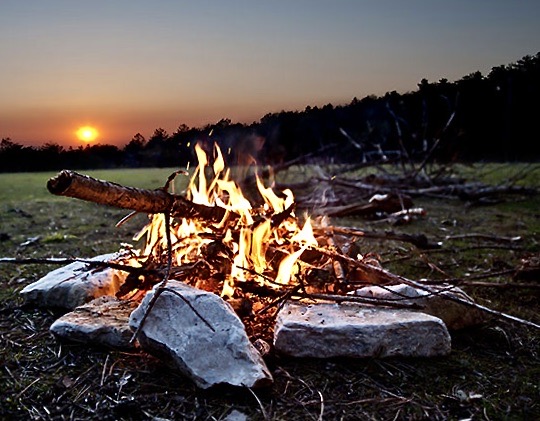
   The amphitheater was where we sang songs, acted out skits, and had a lauzas, or bonfire. Everybody ran down to the bonfire and sing-along as soon as it started getting dark. There was so much loose wood everywhere we had a fire every night, as big as a log cabin burning down. “It’s not like now, when you have to drive to the convenience store and buy it,” a latter day camper said. “They only have bonfires on weekends and they are more the size of flashlights than three-alarm blazes.”

   Our camp activities director had been in the Foreign Legion. Bruno wore a black beret, a checked kerchief around his neck, and carried a hand axe on his belt. He didn’t chop any trees down. He mostly just picked up branches from the forest floor. Our woodpile was always sky high ready for a rainy day. Even though we were often reminded to never play with matches in the woods, every night it seemed to take a full box of stick matches and a half gallon of gasoline to start the bonfire. Everybody cheered when the big whoosh happened.

   The days were mostly sunny, sometimes windy and wet, but at camp there was no such thing as bad weather, only different kinds of good weather. The nights were often massively starlit and frequently damp. The summer sky on the Georgian Bay is a wide dome. It’s clean and full of life, too, full of pine warblers and broad-winged hawks.  We didn’t shower when we were at camp. Everybody was expected to clean themselves at the communal sink in the latrine. It wasn’t just a pit. It was a cinder block building that teemed with daddy long-leg spiders.

   Some kids hardly ever washed anything besides their hands and face. It could get disgusting, although none of us cared too much about it. One time somebody’s parents wouldn’t let him get into the car when his two weeks were up and he hadn’t cleaned all over even once.

   “No, go back, go hose yourself off,” his mother said through her nose. “What is wrong with you?”

   One year we had bedbugs. We caught them with scotch tape and stored them in a glass jar. We tried to kill some of them with poison spray, because when they sucked your blood they left itchy clusters on your skin, but the bugs didn’t seem to care. When the camp commander found out about it, he hired a bedbug sniffing dog.

   The Beagle was so good at his work he sniffed out a bedbug hiding in the folded page of a paperback book. The next day everybody whose tents were plagued by the bugs piled their stuff into plastic garbage bags and threw the bags inside whatever cars were at the camp, parked in the hot sun with the windows closed. All the bedbugs died.

   Bruno told us that a Canadian had invented plastic garbage bags. He was proud of that because he had become a Canadian citizen. He always had something historic to tell us, usually something about World War Two. Sometimes we listened to what he had to say. Most of the time we didn’t.

   Every morning at seven o’clock we were rousted from our cots by martial music and rag-tagged to the sports field for calisthenics. We stretched and did jumping jacks and ran the track. Afterwards we ran back to our tents, changed into clean shirts, and after raising the Lithuanian, Canadian, and American flags, sometimes preceded by lowering underpants hoisted during the night, we raced to breakfast.

   We ate porridge and scrambled eggs and Post Top 3 cereal. We always had PB&J on Wonder Bread. Sometimes we had sandwiches all day if something went wrong and there wasn’t anything else. The sweet jelly was a hit with bees and wasps. Metallic colored dragonflies, agile and powerful fliers, had the run of the camp. If the spring had been soggy there were clouds of mosquitos.

   After breakfast we pushed the long tables to the side, lined our benches up in rows, and sat down for religious services. Father Paul, Ausra’s resident Franciscan, said mass every day on a makeshift altar. He didn’t have any children, being a priest, but he was good with children. He cemented his coolness in the early days when a camper swiped the wine meant for communion.

   “I was about 12 years old and drank it with a girlfriend,” Dalia Daugvainyte said. “The trees whirled around us along with the stars that night.”

   She had to go to confession the next morning. Father Paul let her off the hook with less than a million Hail Mary’s and a solemn vow to never do it again. “Knowing him, he probably hid a smile,” she said. Since the confessional was out in the open, he probably had to turn his head to the side.

   Late mornings we were free. We cleaned up our tents, messed around, and played volleyball, the Baltic national game, according to our sports counselor. One day we played volleybat, which was baseball but with a volleyball. We found out it could be hairier than it sounds when the pitcher, who was closer to home plate since he had to lob the volleyball, broke his wrist fending off a line drive.

   Every afternoon, barring mid-afternoon thunder and lightning, we assembled for the best part of the day, which was going to the longest freshwater beach in the world, a ten-minute hike from the camp. We lined up in our swimsuits and towels and tramped through a stand of pines and birches to the Concession Road gate and past the corner variety store to the New Wasaga Beach coastline. Whenever we could, we made a run for the variety store, breaking out of our two-by-two ranks for bottles of Bubble-Up and bags of Maltesers.

   Bruno was unlike most of the other counselors. He wasn’t a parent or a young adult. He was a wiry man in his forties with wavy hair who wore his khaki shorts hiked up to his belly button. He led our expeditions to the beach, a whistle stuck in his mouth. He had been a military man and every summer thought he knew how to assemble children for close order drill, only to see us scatter pell-mell as soon we got close to the shoreline.

   Fish-n-chip shacks on stilts and fat family cars, which were then still allowed to park on the beach, dotted the wide sand flats. The surf line was a hundred yards out and the water was often flat as a pancake. We didn’t swim so much as play in the water, running and belly flopping, tackling one another, flinging Wham-O Frisbees, and splashing every girl we saw.

   “You’re getting us wet,” the girls yelled, even though they were in the lake the same as us. One girl who I liked hated getting water in her eyes and up her nose. She wore enormous green goggles and said they were for swimming, even though she always just stood and floated around in one spot. I never splashed her.

   What none of us ever noticed was the loose cordon of watchful camp counselors on the outskirts of our horseplay, keeping their eyes peeled as we played. Walking back to camp behind Bruno we would sing “Hello, goodbye, Jell-o, no pie” because we knew we would be having Jell-o for dessert when we got back. Sometimes I walked next to the green goggle girl.

   Bruno liked to snack on koseliena, or headcheese, and thought we should, too, but our kitchen had the good sense never to serve it, fearing mass nausea. We ate four times a day, served by eight cooks, volunteer mothers and grandmothers, who made burgers and French fries, pork chops and mashed potatoes, and kugelis, or potato pudding. Potatoes were a staple, like Wonder Bread.

   Going swimming was the only time we were allowed to leave camp. It was a strict rule. Everybody feared the consequences, especially expulsion from the camp. One summer a fifteen-year-old was spotted cavorting on the Wasaga Beach boardwalk and given the choice of going home or spending the remainder of the camp in the small kid’s barracks. He chose a top bunk in the barracks, his new campmates a gaggle of eight and nine-year-old’s.

   Another summer two other boys who had messed up did penance by staging a memorial to Darius and Girenas, the 1930s adventurers who died flying from America to Lithuania. After a week building a model of their orange monoplane, they strung a clothesline over the bonfire pit, and painted rocks depicting the route, from New York to Newfoundland, Ireland, and finally Kaunas.

   That night, with the whole camp assembled at the amphitheater, they pulled the plane along the rope, telling the spellbinding story of the ill-fated flight, when near the marker depicting Kaunas they yanked too hard on the guide rope. The plane careened backwards, shook and shuddered, plunging down too soon and too fast and crashed into the bonfire, exploding into flames.

   Everybody hooted hollered groaned and wolf whistled. It was the buzz of the camp for days. The green goggle girl was quiet. Somebody said one of the pilots had been her great uncle. I bought her a bottle of Orange Crush from the variety store to cheer her up.

   Although Ausra no longer exists, except perhaps in memory, the summer camp on the shore of Georgian Bay is still there in the same place. More than half a century after tens of thousands of Lithuanians fled Europe for North America it thrives on the thin, sandy soil of Wasaga Beach.

   Toronto’s Church of the Resurrection bought the land for the camp from a parishioner for a nominal amount in the 1950s and operated it until 1983, when it was re-christened as Kretinga. Since then it has evolved into three camps. There are two weeks for English-speaking and two weeks for Lithuanian-speaking children of Lithuanian descent, and another week for families whose children are too young for the other camps.

   There is a weeklong basketball camp in August. In 2014 Mindaugas Kuziminskas, a former Kretinga camper, played for the Lithuanian National Team in the World Cup in Spain. Summer after summer many of the same children and families across generations return. “It’s my second home,” one recent camper said, while another said, “Greatest camp in the world!” Another camper wearing a double-sided Kretinga t-shirt summed it up. “I love this camp so much and I have been going since forever.”

   The son of a Lithuanian who lives west of Cleveland, like me, goes to Kretinga and eats in the same mess hall as my brother and I once did, shoots hoops on the same asphalt court, and every summer helps restore the same sand map of Lithuania behind the flagpoles. I asked him if he was going back next summer.

   “Oh, yeah,” he said. “My friends and I have been together for five years in the same cabin. Waking up and being at camp is the best time of the year. We get there the first day and there are high-fives knuckle-touches bro-hugs all around. We punch each other and laugh it up. When all the moms and dads are finally gone, we have sandwiches in the mess hall. Father says a prayer and the camp commander makes a speech. Then it’s off to the races.”

   He had already made plans for when his eligibility for the races went out of date.

   “After next summer, after my last year at camp, when I’m not allowed to be a camper anymore, I’m going back as a counselor,” he said. “That’s a sure thing. I can’t wait to go back.”

Ed Staskus posts stories on 147 Stanley Street http://www.147stanleystreet.com and Cleveland Ohio Daybook http://www.clevelandohiodaybook.com. To get the site’s monthly feature in your in-box click on “Follow.”

The End of Taupa

arrested-in-handcuffs-e1583003662982.jpg

By Ed Staskus

   When one-time CEO Alex Spirikaitis was arrested on the afternoon of Monday, October 21, 2013, he had been on the run for ninety-some days, accused of embezzling more than $10 million from the Taupa Lithuanian-American Credit Union in Cleveland, Ohio.

   It was almost half of the cash, assets, and member deposits of the small non-profit bank.

   He had changed his appearance by growing hair on his formerly shaved head and shaving his goatee. Despite speculation that he had fled to Europe or South America, he was apprehended in the Collinwood neighborhood on Cleveland’s east side.

   “He was actually walking down the street when we spotted him,” said FBI Special Agent Vicki Anderson. His disguise had only gotten him so far. Although he had left behind multiple semi-automatic weapons and 10,000 rounds of ammunition secreted away at the credit union, he was arrested without incident.

   “He did not put up a fight.”

   Stealing money with a smile and a fountain pen is one thing. Shooting it out with the Federal Bureau of Investigation is another thing. They aren’t the same thing, by a long shot.

   The FBI would not reveal how he been tracked to Collinwood, only that they had “developed information based upon advanced investigative techniques that led to his apprehension,” a brief statement said.

   He was less than three miles from closed down boarded up Taupa Credit Union.

   Modern credit unions date to mid-nineteenth century Germany, where they were conceived as people’s banks leveraging social capital to serve farmers and the working class. The first credit union in North America began operations in 1901 with a ten-cent deposit. Today more than 8000 of them in the United States serve over 90 million members with total assets of nearly $800 billion.

   Managed by their members, most credit unions are not-for profit cooperatives taking in deposits, promoting thrift, and making loans. Unlike banks, individuals combine to manage and control their own money. They are near and far in many shapes and sizes. Credit unions range from corporate entities to community institutions serving local schools and churches.

   When Augis Dicevicius emigrated from the homeland to Cleveland in the early 2000s, he soon opened an account at Taupa. It was in the neighborhood, the employees at the credit union were from the immigrant community, spoke Lithuanian, and over time became more like friends than bankers.

   “It was like loyalty,” he said, describing why he kept an account there.

   “There is a level of trust from both sides of the counter at Taupa because you know who you are dealing with,” said Algis Gudenas, former chairman of the credit union’s board of directors, three years before the National Credit Union Association liquidated it. “I think the slogan of Taupa more or less says it all, save with one of your own.”

   From the 1930s on when the federal government began to charter them, credit unions grew steadily, especially among immigrant groups. They were instrumental in helping establish Poles, Germans, Italians, and the more recent Asian and Hispanic immigrants in their new locales. When creating the Office of Ethnic Affairs in 1976 President Ford cited “the ethnic church, school, and credit union” as fostering “a sense of neighborhood.”

   Wherever Lithuanians have settled in the United States, from coast to coast, they have formed their own credit unions. Founded in 1969, the California Lithuanian Credit Union has assets of $72 million. The thriving Boston Lithuanian Federal Credit Union celebrated its 33rd anniversary in 2013. From its roots in the basement of a church hall in the early 1950s, Toronto’s Parama has grown to become the world’s largest Lithuanian credit unions.

   Already by 1906 in Cleveland the Lithuanian Building and Loan Association, sometimes simply known as the Lit bank, had been established, even though the community numbered less than a thousand at the time. After World War Two it evolved into the Superior Savings and Loan. In the 1980s, when Cleveland was by then home to more than sixteen thousand former Lithuanian natives and their children, Taupa was founded.

   It served the community for almost three decades.

   With approximately 1100 members and $24 million in assets, located a short walk from both their church and the Lithuanian Village cultural center, Taupa was a stable institution, healthy and growing, year after year, even in an economy often troubled by bank failures and recessions.

   At least it was until the evening of July 16, 2013, when police and federal agents surrounded Alex Spirikaitis’s $1.7 million home in Solon, a bedroom suburb 25 miles southeast of Cleveland. It was four days after the decision had been made by the state to liquidate the credit union, determining it was insolvent and had no viable prospect for restoring operations.

   Armed with a warrant for his arrest for fraud, when authorities approached the home they were met by his family, who told them he was inside, but was refusing to come out. He was going to tough it out.

   “Family members left the house with us and we thought, from the information we gathered, that he was not going to willingly come out,” said Special Agent Vicki Anderson.

   The police decided to regroup, the size and layout of the large house playing a big part in their decision to wait for daylight. After a night-long standoff, the neighborhood cordoned off for safety’s sake, and TV news crews at the ready, tactical teams entered the house in the morning.

   But the police came up empty. He was not there. He had run away, fled from the consequences, not that it did much good. “A horse may run quickly but it cannot escape its tail,” is how a Lithuanian proverb puts it.

   Before the first members made their first deposits in 1984, the credit union was just a hope and a dream.

   “We were in our kitchen having coffee one morning, talking about it like we had for months,” recalled Angele Staskus. “That was when my husband suddenly said yes, we were going to go ahead.”

   Believing Cleveland’s Lithuanian immigrants and descendants would be better off banding together for their savings and loan needs, Vic Staskus took his brainchild to an ad hoc committee made up of Vytautas Maurutis, Vacys Steponis, Gintaras Taoras, and Vincas Urbaitis. Taupa was coined as the bank’s name and they were shortly chartered by the state.

   At a meeting at Our Lady of Perpetual Help church attended by fewer than twenty people, they collected $4000.00 in deposits, convinced local Lithuanian attorney Algis Sirvaitis to donate space for an office, and hired Rimute Nasvitiene, who became Taupa’s first employee.

   “At first we did everything by hand,” said Vic Staskus. Later that year the Toronto credit union offered them their old computing machine. “It took four of us to bring it into our office, since it was as big as a table, and on top of that we lost most of our small office space to it.” Fortunately, through a friend at IBM, they were shortly able to secure a more modern system.

   After they purchased their own building from a retiring Lithuanian doctor in 1985, deposits began to pour in.  “That was a problem,” Vic Staskus recalled shortly before his death in January 2011. “We had no loans, so we were earning very little. We asked one of our board members to take out a loan. But he said he didn’t need anything. Every time we asked him, he said no. We were finally able to convince him and he took a loan out for $500, and gradually people began to realize we were lending.”

   By 1990, when Vic Staskus left Taupa, the credit union had nearly $8 million in assets and delivered most of the same services all banks did. “I knew we could offer better rates and interest, and I always believed we could offer as many advantages as banks to our members,” he said. Taupe was on solid footing and growing.

   Alex Spirikaitis joined Taupa in the early 1990s, at first working at the front counter as a clerk, later promoted to assistant manager, and eventually taking on the role of CEO, as the credit union quadrupled its assets in those years.

   “He lived on the same street as we did, in the neighborhood, just down the street from the credit union, when we were children,” said Rita Zvirblis, who served as secretary for Taupa’s board of directors in its early years. “He was a really nice kid, really quiet.”

   Former board director Ricardas Sirvinskas described the new CEO as well liked, especially by older members, because he spoke Lithuanian fluently. “The older generation of Lithuanians, they really liked Alex very much.”

   After he was arrested, U.S. Magistrate Judge Kenneth McHargh unsealed an affidavit revealing the extent of the embezzlement, which was more than $10 million, making it one of the largest cases of fraud against a credit union ever n the country. The largest, involving the St. Paul Croatian Credit Union, was coincidentally also in Cleveland, Ohio.

   The criminal complaint against Alex Spirikaitis was for allegedly making false statements to a credit union from 2011 through 2013.

   “He printed out numbers he wanted to report to auditors and the National Credit Union Association and taped them over the real numbers from the true Corporate One Federal Credit Union bank account statements,” the affidavit states. “Mr. Spirikaitis then photocopied the altered documents resulting in a document that mimicked the appearance of a statement coming directly from Corporate One.”

   The machinations were on the order of “Get Smart.”

   “Everybody accepted the financial statements Alex provided us, and everybody appeared to be happy with them,” said Vincas Urbaitis, a founding member of the credit union who sat on its board for more than 25 years until resigning in 2011.

   “I guess everybody just got duped.”

   During the summer, as Alex Spirikaitis remained on the loose, federal prosecutors seized his wife’s luxury SUVs and moved to take legal possession of his home. Court documents revealed that the down payment for the house, the construction of which took a year, was paid with two checks totaling $100,000 from the former CEO’s personal account at the credit union.

   “All remaining checks, totaling approximately $1,555,132, came from Mr. Spirikaitis in the form of Taupa Lithuanian Credit Union official checks,” court documents said. “While working at the Taupa Lithuanian Credit Union, Mr. Spirikaitis never made in excess of $50,000.”

   The luxury Adirondack-style house on a five-acre lot featured two full kitchens, an indoor swimming pool, entertainment room with big screen and movie projectors, five-and-a-half bathrooms, and an elevator.

   Alex and his wife had a luxury suite at FirstEnergy Stadium for Cleveland Browns football games. They drove one of their nine cars downtown for home games. They celebrated touchdowns with fancy drinks.

   “No Trespassing” signs surrounded the house on all sides.

   “I don’t think anybody from the board of directors knew or anyone within the Lithuanian community knew he was building a house,” said Vincas Urbaitis. “He was not very social. But he was not antisocial, either. He would talk to you about the business aspects of the credit union, but I don’t even know who his close friends were.”

   He was a kind of chameleon. Everybody noticed him, but nobody recognized him. He wasn’t a public man, after all. Ricardas Sirvinskas described Alex Spirikaitis as a quiet person, keeping to himself, and only rarely attending social events in the Lithuanian community.

   Although court documents were not completely clear regarding the final tally of money missing, Vincas Urbaitis was bewildered why examiners had not verified the statements prepared by Alex Spirikaitis.

   “They never went to the bank, Corporate One, and asked independently as to how much money was in the accounts,” he said.

   Vytautas Kliorys, board president of Taupa at the time it was closed and liquidated, also questioned the credit union’s third-party audit firm and examiners. “The board believed that it had all the procedures in place to prevent this sort of event,” he said. “We had received excellent and very good reports from the annual state exams, and we had even gone one step further than required and used an outside CPA firm to perform annual independent audits.”

   Paul Hixon, VP of marketing at Corporate One, had no comment other than to say the National Credit Union Association was investigating. Officials said it would take up to six months to complete a full forensic account process.

   The Lithuanian community reacted to the credit union’s closing with dismay. “For those in Cleveland that have been watching the news for the last few days know that the Lithuanian community in Cleveland has been in the spotlight,” said Regina Motiejunas-McCarthy, co-host of Siaurinis Krantas Lithuanian Radio.

   “Not because of something good but because of a tragedy.”

   The unexpected closure of the credit union affected all of its members, freezing their accounts for several months-and-more, even though they were insured, as well as severely impacting some businesses, including the Lithuanian Community Center.

   “Like many other businesses that have their accounts there, we are all scrambling to open new checking accounts with basically no liquid cash other than from sales over the weekend,” Ruta Degutis, president of the community center, said when news of the closure became official.

   “Alex assumed a public trust when he became CEO of Taupa, to help better the lives of others,” said one of the members. “It was not given to him as an opportunity to satisfy personal greed.” After thirty years Cleveland’s Lithuanian community lost one of the pillars of its community.

   Within days of his arrest U.S. Magistrate Kenneth McHargh found the former bank officer indigent and qualified for a court-appointed public defender. Since a “Go Bag” filled with blank identification cards, mobile phone cards, and stored value cards that could be used in lieu of cash had been found in his office, the magistrate also ruled he be held behind bars without bond. Assistant federal public defender Darin Thompson did not challenge the no-bond ruling.

   The defendant and his lawyer agreed to waive his right to a detention hearing. The case was bound over to a federal grand jury. Alex Spirikaitis left the U.S. District Court in downtown Cleveland as he had entered it, hands handcuffed behind him, a policeman beside him guiding him away.

   In the same courtroom the following year Alex Spirikaitis and Vytas Apanavicious pled guilty to bank fraud. Vytas Apanavicius of VPA Accounting, providing bookkeeping and accounting services, conspired with the group, depositing and transferring funds to hide overdrafts and withdrawals, according to Steven Dettlebach, United State Attorney. Michael Ruksenas of Naples, Florida, and John Struna of Concord Township, Ohio, were subsequently charged for their roles in the conspiracy.

   At the end of the day, Alex Spirikaitis was sentenced to eleven years in prison, not so much a punishment as a consequence, the wages not of sin but of breaking the faith.

A version of this story appeared in Draugas News.

Ed Staskus posts on 147 Stanley Street http://www.147stanleystreet.com and Made in Cleveland http://www.clevelandohiodaybook.com. To get the site’s monthly feature in your in-box click on “Follow.”