
By Ed Staskus
“Scouting is a man’s job cut down to a boy’s size.” Robert Baden-Powell
My father was born on a family farm outside of Siauliai in 1924, six years after Lithuania’s Declaration of Independence and two years before the start of what is known as the Smetonic Era. The small city, the capital of northern Lithuania, is home to the Hill of Crosses, a protest site, folk-art collection, and spiritual statement of about one hundred thousand Christian crosses.
Siauliai goes back to 1236 to the Battle of Saule against the Teutonic Knights. The bitter war between the Teutonic Order and Lithuania was one of the longest in the history of Europe. The first Christian church in the country was built in 1445. Until then Lithuanians were steadfast pagans. When they first encountered missionaries they came to the conclusion that Hell was a fine place to end up, if it came to that, since Lithuania was very cold and Hell was warm.
My grandfather had been conscripted as an officer in the Czarist Army. My grandmother was Russian and a former schoolteacher. They met when he was stationed in the badlands southeast of Moscow. “In those days drunks went into the navy and dimwits into the infantry,” he said about his time as an officer in the Russian armed forces. After returning to Lithuania he served in its military and was awarded farmland outside of Siauliai.
My father was a Boy Scout early on. Since my grandfather had been made the police chief of the province, and since Antanas Smetona, the President of the country, was the Chief Scout, and since there were privileges accorded to scout troops by the Ministry of Education, my grandfather involved my father in scouting as soon as he grew to be of school age.
I became a Boy Scout in the early 1960s when my father became the Scoutmaster of Troop 311. We wore official Boy Scouts of America neckerchiefs and carried unofficial knives in scabbards on our belts. We went camping summer and winter. We learned how to set up base camps and how to build temporary shelters. We hiked trails through forests, although most of us were hapless with a compass, instead relying on ingenuity, stamina, and dumb luck to find our way.
Boy Scouts got their start in 1907 when a British Army officer gathered up twenty boys and took them camping, exploring, and pioneering on an island off England’s southern coast. The next year the army officer, Robert Baden-Powell, wrote “Scouting for Boys.” That same year more than ten thousand Boy Scouts attended a rally at the Crystal Palace in London.
The first scout patrol of ten boys and two girls in Lithuania was organized in 1918. The next year there were two patrols, one for boys and another one for girls. During the inter-war years more than 60,000 boys and girls participated in scouting, making it one of the most popular activities among the young at that time. In 1939, just before the start of World War Two, there were 22,000 Lithuanian scouts.
Four out of five Lithuanians were farmers or lived in the country and camping was everyone’s favorite part of scouting. It’s what probably accounts for my father’s fondness for the outdoors and all the scout camps he was later Scoutmaster of. They weren’t all sun-kissed and starlit camps, either.
Winter Blasts were camps in thin-skinned cabins in the highlands of the Chagrin Valley at which we earned cold weather Merit Badges. We were informed that exploring outdoors in December was fun. We always built a fire first thing in the morning in the cabin’s Franklin stove, kept it well stoked, and hoped we wouldn’t freeze to death in the long night.
In the summer a grab bag of Merit Badges was up for grabs. There were more than a hundred of them, from sports to sciences. I learned the six basic Boy Scout knots, from the sheet bend to the clove hitch. I earned my Pioneering Badge and eventually learned how to tie every knot known to man, although I never learned how to properly knot a tie, even later in life, when my wife always had to help me with it.
My father was forever transporting, putting up and tearing down tents, finding lost stakes and poles, and persuading my mother to repair rips in canvas. He told us sleeping outdoors was manly, robust, and healthy, no matter how much rain leaked onto our sleeping bags. He had a maxim that a week of camp was worth six months of theory.
The outdoors wasn’t just the Boy Scouts, either. For many years he was the boss at Ausra, a two-week sports-related, Lithuanian-inflected, and Franciscan-inspired summer camp at Wasaga Beach, which was on the Georgian Bay two hours north of Toronto. Although we did calisthenics every morning, went to Mass after breakfast, and spoke Lithuanian whenever we had to, what we actually did most of the time was run around in the woods like madmen, play tackle football in the shallow water of the bay, and sing off-key long into the night at the nightly bonfires. Singing around a bonfire is even better than singing in the car or the shower.
When my father was nine years old he was one of the nearly two thousand cohorts at the 1933 Reception Camp in Palanga when Robert Baden-Powell, founder of the Boy Scouts, came to Lithuania. Palanga is a seaside resort on the Baltic Sea known for its beaches and sand dunes. Then a sleepy resort, today it is a summer party spot.
He never forgot having been at the camp, seeing scouting’s leader and guiding light, if only on that one occasion. “He was a hero to us, someone who gave his life to something bigger than himself, even though we were all smaller than him,” he said. The scouting founder’s son, who was with him in 1933, didn’t forget, either. “I particularly remember the warm and friendly welcome we received as we came ashore on Lithuanian soil,” recalled Peter Baden-Powell in 1956.
Five years later, in 1938, my father was at the Second National Jamboree in Panemune, the smallest city in the country, which commemorated both the 20th anniversaries of the foundation of the Lithuanian Boy Scout Association and the restoration of Lithuania’s independence.
Things change fast, though. Two years later the Soviet Union invaded, the country’s independence was overturned, and scouting was outlawed. During the war and successive occupations, first by the Russians, then the Nazis, and then the Russians again, both of my father’s parents were arrested and transported to concentration camps. My grandfather died of starvation in a Siberian labor camp. My grandmother spent twelve years in the Gulag.
In 1ate 1944 my father fled to Germany, making his way buying and selling black market cigarettes, and after the war worked for relief organizations dealing with the masses of displaced people. He met his wife-to-be in a hospital in Nuremberg, where she was a nurse’s aide, and he was being operated on several times for a wound that almost cost him his right hand.
He found passage to Sunbury, Ontario in Canada in 1949, married my mother, who had emigrated there a year earlier, and by 1956 was the father of three children. While in Canada he wasn’t involved in scouting. “There weren’t any children, or they were all still babies,” my mother said. “All of us from Lithuania, and there was a large community of us in Sudbury in the early 1950s. We were all so young. We were just starting to rebuild our lives, getting married and having children, but it was taking time for them to grow up to scouting age.”
Robert Baden-Powell said that Bot Scouts should always be prepared for the unexpected and not be taken by surprise. “A scout knows exactly what to do when anything unexpected happens,” he said. By that guiding light scouting stood my father in good stead through the 1940s.
When his parents were arrested and deported, he took over the family farm. He was 17 years old. When he fled the farm in 1944 with the Red Army on the horizon it was with ten minutes notice. When he stepped off a re-purposed troop carrier in Halifax, Nova Scotia in 1949, everything he had was in a rucksack and there were twenty dollars in his wallet. In the event, he eventually knocked on my mother’s door in Sudbury, almost six hundred miles away.
He left Sudbury in 1957, where he had worked in nickel mines for almost seven years, first as a black powder blaster and then as an ore hauler, and moved to Cleveland, Ohio. We followed six months later. He worked as an elevator operator for seventy-five cents an hour, less than half of what he had been making in the mines, swept floors, stocked warehouses, and did whatever he could for a paycheck. He started taking classes in accounting at Western Reserve University.
In Cleveland, living in a Polish double he bought in collaboration with his sister’s family, who had also fled Lithuania, he found work full-time at the Weatherhead Corporation, continued going to school at night, and after earning a degree in accounting went to work for TRW. He made his way up the ladder, finally managing his division’s financial operations in South America.
After taking early retirement in the late-1980s he helped found the Taupa Lithuanian Credit Union and as its director built its assets into the tens of millions. In the 1990s he formed NIDA Enterprises and managed it through 2008, when he was in his 80s. He believed the workingman was the happy man. “Nothing works unless we do,” he said. He believed there was value in work. He believed work without effort was valueless.
Because of World War Two and its dislocations, and his subsequent emigration overseas, as well as the demands of rebuilding a life and building a family, he didn’t participate in scouting for many years. But once a scout always a scout. “What you learn stays with you long after you’ve outgrown the uniform,” he said.
When he took over from Vytautas Jokubaitis as Scoutmaster of Troop 311 they were big shoes to fill. Vytas Jokubaitis was a tireless advocate for his countrymen who became director of Cleveland’s Lithuanian American Club. He was awarded the Ohio Governor’s “Humanitarian of the Year” award in 1994. He was a true believer I scouting.
My father worked with Cleveland’s Lithuanian scouts for nearly twenty years. While Scoutmaster he helped affiliate Troop 311 with the American Boy Scouts, opening up camping and jamboree venues, as well as linking it to the traditions and activities of scouting worldwide. In the late 1960s he established an ancillary scouting camp at Ausra, the campsite on the Georgian Bay, where Cleveland’s scouts enjoyed two weeks of camping, and by many accounts, some of the biggest nighttime bonfires they ever experienced.
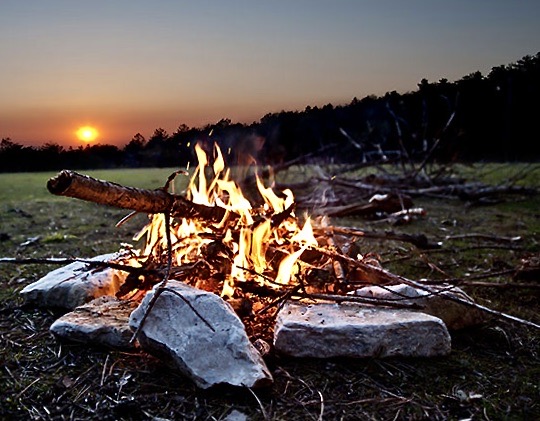
“Your dad loved bonfires,” recalled Paul Kazlauskas, a friend of mine who was also a scout. “It was a rule with him, that there be one every night. Some of our fires were as big as small cars and were still smoldering in the morning when we got up for our morning exercises and raising the flags.” When asked what bonfires meant to him, my father said, “Sometimes it takes looking through campfire smoke to see the world clearly.”
Although we never exactly warmed to it, he introduced us to winter camping and hiking, even encouraging us to try snowshoes. I don’t remember ever falling down as much as when I tried walking on top of snow drifts wearing snowshoes. He said it didn’t matter how many times we fell down, it only mattered that we get up and try again, although getting up while stuck in snowshoes is easier said than done.
He stressed achievement by encouraging the pursuit of Merit Badges, especially those that involved self-reliance. One summer at a Canadian camp at Blue Mountain we were taken on an overnight canoe trip. We were supervised, but only given a compass, a canteen, and a bag of chocolate chip cookies. We had to make the round-trip up the bay and back to the camp ourselves without any help. We all somehow made the round-trip without the need of a search party.
In the 1970s he inaugurated Scautiu Kucius, a kind of Boy Scout’s Christmas celebration. Every year, the weekend before Christmas, Cleveland’s Lithuanian scouts gather and feast on twelve foods representing the twelve apostles, sing carols, and kick their shoes off over their heads to see what girl they will land near, which is old-school marriage-making..
Another annual event he was involved in was the Kazuke Muge, a scouting craft fair, fund-raiser, and parade held every March in the community hall of Our Lady of Perpetual Help, Cleveland’s Lithuanian church. He organized and promoted it for many years, making sure stalls were assembled for the craft sales, arranging indoor games and entertainment, and encouraging everyone to support the scouts.
Although he did much for the movement, as a Scoutmaster he didn’t try to do everything for his charges. He thought it better to encourage boys to educate themselves instead of always being educated. “When you want a thing done ‘Don’t do it yourself’ is a good motto for a Scoutmaster,” said Robert Baden-Powell. Like him, my father believed that to be true.
“There is no ideal way to do things,” he explained to Gintaras Taoras, one of his scouts. “There is no absolute wrong way to do things. Everyone has different ways to accomplish something. It will just take some faster to accomplish the task and others longer, but you both end up at the same end point. Learn through your mistakes.”
Gintaras, who would become a Scoutmaster in his own right, when asked what person had made a difference in his scouting career, said it was my father. “Brother Vytas was never afraid to try anything new. He always gave us the chance to do things ourselves, like getting our camps organized and set up. If we got it wrong, he didn’t harp on us getting it wrong. He would ask us how we could have done things differently, what we learned, and we would then move on.”
After World War Two the Lithuanian Boy Scouts Association began to re-organize. In 1948 a National Jamboree was held in the German Alps. More than a thousand displaced Boy Scouts and Girl Scouts were there. In 1950 there was the first Lithuanian presence at the Boy Scouts of America Jamboree in Valley Forge, Pennsylvania.
In 2014 Gintaras Taoras was in the front ranks when the 65th anniversary of scouting for Lithuanian immigrants on four continents was recognized at the Lithuanian Embassy in Washington, D. C. “Scouting is a powerful movement providing life-changing opportunities to today’s Lithuanian youth,” said Zygimantas Pavilionis, the Lithuanian ambassador. “I wish to personally congratulate the Lithuanian Scouts Association,” said Robert Gates, former Secretary of Defense under Presidents Bush and Obama and National President of the Boy Scouts of America.
The Centennial of Lithuanian scouting was celebrated in 2018. My father was one of many Scoutmasters who helped keep scouting alive. Although he passed away seven years before the celebration, whatever scout camp in the sky he is at today, he is sure to be smiling through the smoke of a campfire in the sky at how Lithuanian scouting has resurrected itself one hundred years later.
Ed Staskus posts stories on 147 Stanley Street http://www.147stanleystreet.com and Cleveland Ohio Daybook http://www.clevelandohiodaybook.com. To get the site’s monthly feature in your in-box click on “Follow.”

 147 Stanley Street