Category Archives: Baltic Place

Independent People

By Ed Staskus

   “I started to help in the sugar beet fields when I was 9 years old,” my mother said. “My sister Irena started helping me two years later when she turned nine.” The year was 1939 when the sisters worked together for the first time. Six years later my mother was in a refugee camp outside of Nuremberg and my aunt was on her way to a slave labor camp in Siberia. My mother was lucky Americans ran the camp she ended up in. My aunt was unlucky Russians ran the camp she ended up in. She was lucky to survive her first year, much less the next decade.

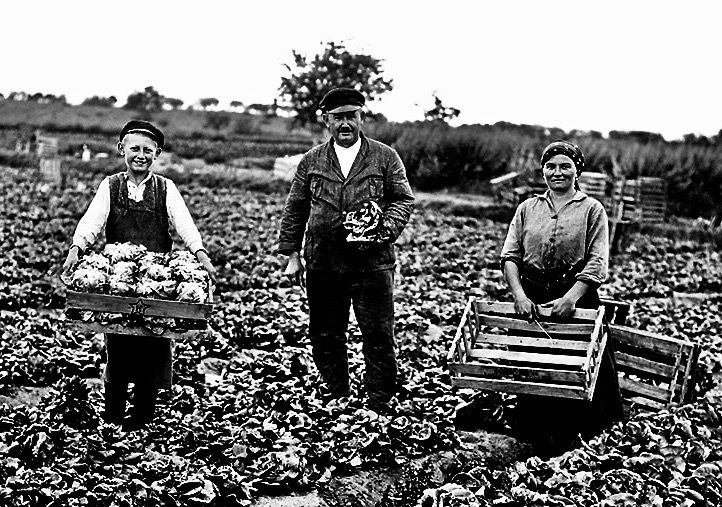
   “We worked with our father, who had a one-row horse-drawn puller.” My grandfather Jonas Jurgelaitis followed on foot behind the puller, picked up the beets, scalping the tops with a small machete, and dropped them behind him as he went. He recycled the heads for animal feed. His daughters brought up the rear, shaking dirt off the beets, and loading them into a side slat cart. When it was full he made his way to Mariampole, the nearest market town, where there was a storehouse and a train station to later take the root vegetables to a sugar beet factory. 

   Their other major crop was cabbage. They could harvest upwards of ten thousand heads an acre. When they cut the cabbage head out of the plant they left the outer leaves and root in the ground. That way they got two crops. Jonas took them to Mariampole, too.

   “My older brothers Bronius and Justinas helped handle the livestock, and they did field work and repairs. Something always needed to be fixed. My younger brothers were still growing up. My father did everything outside the house and my mother did everything inside the house. All of us worked around the clock at harvest time, even the boys.” Most of the food and drink the family of eight ate and drank came from their own fields and pastures, although their sugar beets were grown on land they rented from a neighboring childless widow.

   The farm was in the Naujeji Gizai region hallway between Lake Paezeriu and Mariampole, although it was far closer in spirit to the lake than it was to the city. Some farmers had tractors. Most farmers had draft horses. They preferred tractors, but the Great Depression had put a dent into what they preferred. Some big land owners had cars. Everybody else had a horse and carriage to get the family to church on time on Sundays.

   My grandfather kept cows, pigs, and chickens. “We made our own bread and butter, made cheese, gathered eggs, and collected berries.” There were patches of wild blueberries at the edge of their fields. Although they didn’t have a cellar, my grandmother Julija still canned pickles and beets and stored them in the well. “We raised our own pigs and my father killed them.” When the time came, Jonas selected a pig for slaughter, walked it to a clearing beside the barn, hit the animal hard between the eyes with a club hammer, and cut its throat. With the help of his two eldest sons, he cleaned and skinned the pig with a sharp knife, keeping a knife sharpener at hand.

   Once the skin was separated from the muscle and fat, he cleaned out the guts and sawed the pig’s head off. After quartering the animal, Jonas found the hip joints and slid his knife into them, cutting off the two hams. He did the same thing when cutting off the shoulders of the pig. At the center, where the ribs are, he took whatever meat he could find. They made sausages, bacon, and cured slabs of pork with salt and pepper. Jonas had built a closet around the chimney in the attic of the house, which could be gotten to by ladder. There were no stairs. He smoked the pork in the closet, laying the meat on grates, opening a damper to vent smoke into the closet. “I was scared to death of the upstairs, of the fire up there, although the pig meat was delicious,” my mother said. “When we ran out of food, my father killed another animal. He was a serious man.”

   The dining room was big enough for all of them at once. There were no chairs. There were two long benches. My mother always sat cross-legged when eating. “I was scared that a Jew would sneak under the table.” She was afraid he would bite her legs and suck her blood. “Everybody said the Jews had killed God and they drank the blood of Christians.”

   One of my mother’s chores was killing chickens for dinner. She didn’t like chopping their heads off, so she grabbed them by the neck instead and swung them in a circle around her until their necks snapped. There were barn cats and a watchdog. They chained the dog up at night. There were potatoes and fruit trees. They grew barley and summer wheat, putting in a barnful of hay every autumn. Sugar beets were my grandfather’s number one cash crop, followed by cabbage and hemp. He grew some stalks of marijuana and tobacco behind the barn. He didn’t puff on pot himself. He smoked his homegrown tobacco instead, packed in a pipe, taking a break at the end of a long hard day. 

   “I let the young men smoke their stinkweed and get silly,” he said. My grandfather got silly in a different way. He brewed his own beer and krupnickas. My grandmother didn’t smoke or drink. She kept a close eye on her husband. He kept a close eye on her, never smoking in the house. She had chronic tuberculosis, coughing and running a fever, and wasn’t long for this world.

   Making home brew is the simplest thing in the world. Sumerian farmers brewed beer from barley more than 5,000 years ago. The Codes of Hammurabi, that were the laws during the Babylonian Empire, decreed a daily beer ration to everybody from laborers to priests. Laborers got two liters a day. Priests got five liters a day. In the Middle Ages Christian monks were the artisanal beer makers of the time. Since my grandfather had water, malt and hops, and yeast within easy reach, he had beer within easy reach year-round.

   Krupnikas is a spiced honey liqueur. The Order of Saint Benedict whipped it up for the first time in the 16th century. It can be spiced with just about anything, including cardamon, cinnamon, and ginger. If they had them, farmers added lemons, oranges, and berries. Honey was essential, although not as essential as a gallon or two of 190 proof grain alcohol. There was grain as far as the eye could see, and everybody knew somebody who made moonshine, so making krupnikas full-bodied was never a problem. Lithuanians pour it down on holidays and weddings. Everybody likes a warm snort of it in the dead of winter, whether they have a cold or not.

   Next to the lowlands of central Lithuania, the carbonate soils of the west are the best. That is where my grandfather was. More than half of the country’s land area was farmland. Most of the rest of it was meadow and forest. What was left was where the towns and cities were. The agrarian reform of 1922 promoted farmsteads. Landless peasants got some acres of land, if not a mule. Most holdings, except those Polonized, were between 5 and 40 acres. The Poles were Lithuania’s rural aristocracy. My grandfather had been a landless peasant. He got 10-some acres of his own and rented more of it. During the interwar years more than 70% of the population depended on agriculture for its livelihood. In the 1930s Lithuanians fed themselves and were the source of 80% of the country’s export income. Lithuania is roughly two-thirds the size of the state of Maine. The small country was the sixth-largest butter exporter in the world.

   My grandfather didn’t know anything about the legality of cannabis. He didn’t know it was called “Sacred Grass” three thousand years ago in India. He didn’t know the Romans had used it as medicine. He didn’t know Queen Elizabeth in 1563 ordered all English land owners with 60 or more acres to grow it or face a 5 pound fine. One year later King Philip of Spain ordered cannabis be grown throughout his empire from Spain to Argentina. George Washington cultivated it at Mount Vernon and smoked it when his teeth hurt too much to bear.

   After World War One some nations began to outlaw marijuana. It became seriously illegal in the 1930s. The United States led the way. The plow breaking new ground was “Reefer Madness” and the man behind the plow was William Randolph Hearst. His chain of newspapers ran one article after another demonizing marijuana. There were articles about Mexicans gone crazy after smoking it, running around with a “lust for blood,” and articles about reefer-mad Negroes dancing to voodoo jazz music and raping white women.

   Harry Anslinger, head of the Federal Bureau of Narcotics, turned the nativist, as well as racist, battle against marijuana into a war. “Reefer makes darkies think they’re as good as white men,” he said. He believed it had a bad effect on the weak-minded “degenerate races.” He was especially worried that white women might smoke it at parties and consort with black men. 

   “Most marijuana smokers are Negroes, Hispanics, and Filipinos,” he said. “Their satanic music, jazz, and swing, result from its usage. This marijuana causes white women to seek sexual relations with Negroes, and entertainers, and many others. I consider it the worst of all narcotics, far worse than the use of morphine or cocaine.” The soft drink Coca-Cola contained cocaine from 1894 until 1929. It was why kids could walk five miles to school, both ways, uphill in the snow, jumping barbed wire fences. 

   The town of Gizai is situated at a crossroad. There was a small school, church, police station, hardware store, and a coffee shop in the 1930s. “We went to church every Sunday and my father went to the store whenever he needed a tool or something he couldn’t make himself,” my mother said. “When he took us along he treated us to candy at the coffee shop while he drank coffee and had a slice of lazy cake.”  

   Back on the farm everybody slept on the ground floor of the house. The bedrooms were three side rooms. One was for Jonas and Julija. One was for my mother and her sister. The third room was for the four boys. There was no electricity. The house was lit by kerosene lamps. The dining room was the biggest room. It was lit by a big kerosene lamp that was raised and lowered from the ceiling by a pulley attached to a counterweight. Everybody washed their meals down with tea. My grandfather bought tea from a German smuggler rather than pay the taxes levied on it. In the winter the fireplace was stuffed with wood and turf. The boys had the chore of making sure it never died out November through March.  Once a year a chimney cleaner came with ladders, brooms, and brushes. The sweep used a long rope attached to a weight for pushing out the soot.  

   In Washington, D. C. Harry Anslinger could blow smoke with the best of them. “Under the influence of marijuana men become beasts. It destroys life itself,” he declared. He called for a nationwide ban on the weed. Just in case anybody had missed the point, he added, “Smoking it leads to pacifism and communist brainwashing.” The top pot cop got the Marijuana Tax Act passed in 1937. It effectively made the weed illegal from coast to coast. Other countries worldwide got on the bandwagon. Even the Netherlands criminalized cannabis for a few years. The American law was declared unconstitutional in 1969, but Richard Nixon replaced it with the Controlled Substances Act the next year. Darkies couldn’t catch a break any which way.

   The Nixon administration quickly changed the name of the Controlled Substances Act to the War on Drugs. The next Republican president dragged out the big guns. “I now have absolute proof that smoking even one marijuana cigarette is equal in brain damage to being on Bikini Island during an H-bomb blast,” said President Ronald Reagan. The First Lady consulted advertising executives and her astrologer and they came up with a snappy slogan: “Just Say No!” When asked what she meant she said she wasn’t talking about H-bombs but about marijuana.

   My grandparents couldn’t afford a washerwoman, so my grandmother did all the laundry. She put a tripod inside the fireplace and heated water in a copper kettle. After the clothes were washed she rinsed them in another kettle. She hung some of the clothes on a line in the attic to dry. She used a mangler on other laundry to get the wrinkles out. It was a wooden box with rollers like a wringer that squeezed and smoothed water-soaked clothes. When she was done she didn’t need any marijuana to help her relax. She fell asleep the minute she was done.

   My grandmother Julija died of tuberculosis in 1941. She had been in and out of a sanatorium in Kaunas. When she decided to go home for the last time it was to go home to die. My grandfather built an addition for her, which was a bedroom with a window. He built a new bed and stuffed a new mattress with clean straw. He moved their wedding cask to a corner of the bedroom. When the end was near he stood a coffin up beside the door. She was buried in a cemetery outside Gizai a few months before the German Army suddenly invaded.

   My grandfather Jonas died in 1947 after the Russians took the country over and collectivized everybody’s farms. The authorities told him he could keep one cow and one pig. They didn’t care about his chickens. They told him to stop growing marijuana and tobacco. All his crops had to be delivered to the state and the state would pay him whatever they thought was appropriate. He had differences with them about it, but what could he do? What he did was die soon afterwards of some kind of brain disease. His head probably exploded. Who wants to be a slave of the state? His farm disappeared down the Soviet sinkhole.

   Lithuania criminalized cannabis in 2017, a hundred years behind the times. The country was going against the grain. Almost everybody else in the world outside of China and Russia was decriminalizing it as fast as they could. They were sick of the drug gangs and lost tax revenue and prisons bulging with one-time losers. By then everybody knew marijuana didn’t make anybody sex-crazy or lust after blood. The country pivoted four years later and decriminalized small amounts for personal use. Growing any amount of jazzy stinkweed remains illegal. God forbid a seed in your personal Mason jar sprouts and flowers.

   My grandfather was a simple man with only a handful of overriding concerns, doing what had to be done, leaving the rest to take care of itself. He might have mulled the matter over on his front porch, drawing on his pipe to get it going, but I doubt he would have paid too much attention to whatever monocratic laws the boss men promulgated regarding his farm and crops, unless it was at the point of a gun. 

Ed Staskus posts monthly on 147 Stanley Street http://www.147stanleystreet.com, Made in Cleveland http://www.clevelandohiodaybook.com, Atlantic Canada http://www.redroadpei.com, and Lithuanian Journal http://www.lithuanianjournal.com

A New Thriller by Ed Staskus

Cross Walk

“A once upon a crime whodunit.” Barron Cannon, Adventure Books

“Captures the vibe of mid-century NYC.” Sam Winchell, Beyond Fiction

Available on Amazon: https://www.amazon.com/dp/B0CRPSFPKP

Late summer and early autumn. New York City. A Hell’s Kitchen private eye. The 1956 World Series. President Eisenhower at the opening game. A killer in the dugout.
Spoiling for a Fight

By Ed Staskus

   Even though Ukraine wasn’t Ukraine in the 14th century lots of folks called it that so that is what it was. The word itself means borderland. The Lithuanians visited every summer. They did it for their health, if not for the health of the natives. When they did they had good times marauding and looting and drinking too much whenever the devil got the better of them. They didn’t control the land so much as take advantage of it. The less governance the better is the way they saw it. “We do not change old traditions and do not introduce new ones,” they said.

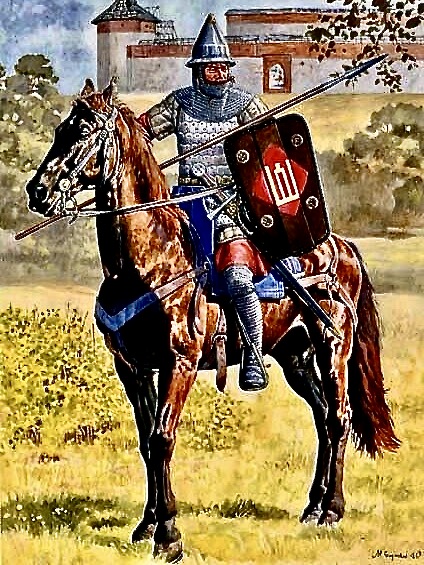
   They were freebooters who became empire builders. The boyars rode fast horses, big and fit, were outfitted in chain mail, wore conical metal helmets, were armed with lances, swords, and knives, and carried a black shield emblazoned with the red emblem of the Columns of Gediminas. They weren’t draftees or recruits. Those who were, walked and died where they stood. The boyars were tough men who could be dangerous in the blink of an eye. The Golden Horde warned would-be enemies of them, “Beware the Lithuanians.” That was all they ever said.

   They had to be rough and tough. When they went to war they didn’t launch cruise missiles and kill their enemies at great distance, checking the body count with drones. They hacked their enemies to pieces with long swords face to face and watched them bleed to death in the mud at their feet.

   By the end of the 14th century the Grand Duchy of Lithuania was the biggest country in Europe. Today it is one of the smallest countries in Europe. When they were growing fast and furious they didn’t do it by being soul brothers or good trading partners. They did it by getting on their horses and taking what they wanted. They didn’t bother explaining.

   The Grand Duchy got started in the early 13th century when Prince Mindaugas united his Baltic forest clans, swamp tribes, and fiefdoms into a feudal state. They were desperate times. The Teutonic Knights were on a rampage. They wanted to incorporate all of Lithuania into the Teutonic Order. They never stopped trying. Between 1305 and 1409 they launched 300-some military campaigns. They slaughtered more peasants than anything else. The Lithuanians beat them back time and again. Finally, in 1410, at the Battle of Grunwald the Lithuanians and Poles destroyed the Teutonic Knights. Most of the order’s leadership was killed or taken prisoner. The Grand Master ran away. They never recovered their former power. When the carnage was over, the Lithuanian-Polish alliance became the dominant political and military force in the region.

   When I was a kid almost everybody called the Ukrainians Russians. We didn’t call them that because we knew what was up with the Reds. They had done the same thing to Lithuania, enslaving the country, and reaping something anything everything for nothing. Both of my parents came from there after WW2, so we knew what was up. We didn’t have to read between the lines of whatever Washington and Moscow were forever saying.

   Even though Ukraine didn’t become a nation-state until 1991, after getting their feet wet for a few years after WW1, it was extant in the 14th century, and well before that. We all knew about the Ukrainians when I was growing up, The first Ukes came to Cleveland, Ohio in the 1880s. They settled in the Tremont neighborhood. Their idea was work hard in the factories of the industrial valley, get rich, go back home, buy some land, and live happily ever after. Between the world wars lots of former freedom fighters came. They were goners if they had stayed. Stalin was itching to get his hands on them. Most of them settled in Parma, a southwest suburb, where they built churches, schools, and started their own aid associations and credit unions.

   We didn’t live in Parma, but on the east side along the lake. Nevertheless, among the Poles, Hungarians, Croatians and Slovenians, and anybody else who could sneak into the country when the Statue of Liberty wasn’t looking, there were some Ukrainian families in our neck of the woods. One of them operated a gas station on St. Clair Ave. not far from where we lived. One of their handful of sons who was our age messed around with us summers, when we had three no-school months to mess around in. His name was Lyaksandra. It sounded like a girl’s name, so we called him Alex.

   We played pick-up baseball at Gordon Park, from where we could see Lake Erie. We once asked him, taking a break in the action, what he thought about the Russians. He growled, made an obscene gesture, spit sideways, and said, “There are lots of Russki’s in Ukraine. They are liars about everything. They aren’t all bad, but they all hate themselves. We hate them, too.”

   Ukraine is the second-largest country in Europe. It is bordered by Russia and Belarus, as well as Poland, Hungary, and Romania, among others. It has coastlines along the Black Sea and the Sea of Azov. It has its own language. Most people speak Russian, as well. The Muscovites are always trying to convince them to drop the Uke talk and speak only Russian.

   “We don’t talk that Russki talk anymore,” Alex said. “Not here, no way.”

   In the Middle Ages Ukraine, which is about the size of Texas, was the epicenter of East Slavic culture. It was, at least, until the Kievan Rus was destroyed by Mongol invasions in the 13th century. Somebody is always trying to beat up on Ukraine. From then to the 20th century Ukraine was variously ruled by the Lithuanian-Polish Commonwealth, the Ottoman Empire, the Austrian Empire, and the Tsars of Russia. Everybody wanted to be the boss of the Ukes. It’s a miracle they have prevailed and are still prevailing, facing the long odds of going against the vaunted Red Army.

   The Russians are finding out what it is like to go toe to toe with somebody who is not afraid of them and has the up-to-date American rockets and artillery to back up their bravado. The Ukrainians are fighting an existential battle. Their backs are against the wall. They have nowhere to fall. The Red Army is fighting to save its skin and make it home alive for Defenders of the Fatherland Day. The soldiers throw their uniforms into the nearest sewer when they desert.

   When I was a boy I played with toy soldiers. There wasn’t any such thing as a Lithuanian mounted  boyar toy soldier, so I pretended that anybody on a horse was a Lithuanian knight. They were always the good guys. They won every fight battle and war. They were my heroes. I didn’t know what sons of bitches they must have been. They weren’t any different than anybody else in power back then. They were all sons of bitches, including the Holy Roman Church, whose popes ruled by the sword whenever the pen wasn’t convincing enough. 

   In the early 16th century Pope Julius I, the Fearsome Pope, imported Swiss Guards to be his personal bodyguards. He strapped on armor and led the Papal State armies against the Venetians, the French, and the Spanish. His armor plating covered every inch of him just in case the grace of God didn’t get it done, including a helmet made to look like a miter. Everybody on his side was allowed to join the Holy League. Everybody else was badmouthed and excommunicated.

  After Pope Julius died a rumor had it that if he was denied entrance at the Pearly Gates, there would be hell to pay. He would storm them, St. Peter or no St. Peter, and never mind his set of silver and gold keys. It was every man for himself and God against all.

   Until the end of the 14th century Lithuanians didn’t give a damn what the Vatican did. They were pagans. They were the last pagans in Europe. The word “Lithuania” is first mentioned in 1009, in an account of the murder of Saint Bruno by “pagans on the border of Lithuania and Rus.” He was trying to convert them. That was a mistake. Their headman, whose name was Dievas, ruled the universe from his kingdom in the sky. He didn’t like anybody popping up with new ideas about Heaven and Hell. Perkunas, the god of thunder and lightning, was his right-hand man and enforcer. The holy fires were guarded by Vaidilutès, the Lithuanian equivalent of Vestal Virgins. They buried their dead with food and household goods. The last pagan grand duke was buried with his hounds, horses, and falcons.

   When they finally joined the God-fearing club it was a political move. They were doing a dynastic union with Poland, and one of the conditions the Poles laid down was that the Lithuanians had to convert to church-going and dump their veneration of the forces of nature. It didn’t change their business plan in Ukraine, other than to make them more organized. They transitioned from frat parties to fancy dress balls.

   The Grand Duchy of Lithuania had controlled Belarus for some time and when they went after Ukraine they got it, extending their control to the open steppe and eventually to the Black Sea. The Ukes learned to “Beware the Lithuanians.” When they started to get what they wanted they left their freebooting days behind and started building castles to keep their loot secure. It was  a ten-day ride from Vilnius to Kiev. Why not ditch the seasonal exploitation and make the most of the four seasons?

   It wasn’t their land, but it is finders keepers. They meant to keep what they had subjugated. The Ukrainians didn’t have a say in the matter. They told the Ukes, “We may not be perfect but we’re Lithuanians so it’s almost the same.” The Ukes said, “We promise not to laugh when your oven is on fire.” The Lithuanians weren’t offended. They just said, “Show us the goats.”

   They built the Lutsk Castle, which later became a museum. They built the Olyka Palace, which later became an insane asylum. They built the Kremenets Castle, which later fell into ruins after the Cossacks sacked the city at the bottom of the hill. In the meantime, the boyars lived the high life. They started with red borscht, green borscht, and cold borscht. They feasted on holubtsi, cabbage leaves stuffed with minced meat, rice, and stewed in tomato sauce. They ate slabs of kholodets, a cold jellied meat broth. They drank vodka between courses. Ukrainians to this day drink more vodka than beer. When they were done with dinner they went to bed, snoring and cabbage farting in their sleep.

   Even though the Lithuanians always said the Ukrainians welcomed them with open arms, they built their castle-fortresses on high hills with steep inclines, the rockier the better, fitted with one main gate and plenty of towers, arrow slits, battlements, and dungeons. They kept big rocks and hot oil handy to toss down on door-to-door salesmen. If you ended up in the dungeon you found out soon enough they weren’t playing Dungeons and Dragons.

   Imperialism is never cozy and consensual. It’s more like assault and battery. The movers and shakers of power politics don’t get thrown in jail until long after they are dead. My friend Alex had never heard of Lithuanians living it up in Ukraine. He was surprised to hear they had once been a super power. He was chagrined to find out there were more invaders of his homeland than he had realized.

   “How come the Lithuanians push us around back then?” he asked. Most of us playing ball at Gordon Park were second generation Lithuanian Americans. We weren’t even teenagers, yet. None of us had a good answer, much less a sensible answer of any kind.

   “Somebody always wants to be the top dog,” Kesty said.

   “No, that wasn’t it,” Arunas said. “They just wanted to have somebody else do all the work, like make dinner and clean the toilets.”

   “It was the Ukrainian girls,” Romas said. “Ukrainian girls are hot.”

   Romas was over-sexed, and everybody knew it. Nobody had any other ideas. We went back to playing ball in the summer sun. When we got overheated we walked to the shore and sat on the edge of a cliff in the breeze. Lake Erie was in front of us, the water rippling, the tips of the waves white.

   “Can we see Ukraine from here?” Alex asked.

   “No, it’s that way,” Arunas said pointing over his right shoulder. When we looked all we could see was Bratenahl, where rich people lived in mansions. They made the rules, for what they were worth. Our grade school class practiced duck and cover once a month, just in case the Russki’s dropped an atomic bomb on Cleveland. We brought our own lunches every day but wondered where our next lunch was going to come from if all the food stores got blown up. Many of the Bratenahl bluebloods had their own fallout shelters. They didn’t worry overmuch about starving.

   All good things must come to an end. The Lithuanians were strong in Ukraine for several centuries, but the deal they made with Poland reaped a better harvest for their next-door neighbors than my ancestors. The Poles say, “A good appetite needs no sauce.” By the mid-16th century Lithuanians were sauce. Their goose was cooked. The dynastic link was changed to a constitutional one by the Union of Lublin in 1569. Ukraine was set free of the Lithuanians but was annexed by Poland the next day.

   The more things change the more they stay the same, until they don’t. The new would-be colonialists calling the shots in the Kremlin are finding that out, to their discomfiture. They make a wasteland and call it New Russia. They have been looking grim lately. The once-mighty boyars are rolling over in their graves, their visions of conquest and glory gone sour, their iron fists gone rusty. Lithuania has gone egalitarian, joined NATO, and gotten out of the plunder and pillage business. 

Ed Staskus posts monthly on 147 Stanley Street http://www.147stanleystreet.com, Made in Cleveland http://www.clevelandohiodaybook.com, Atlantic Canada http://www.redroadpei.com, and Lithuanian Journal http://www.lithuanianjournal.com

“Cross Walk” by Ed Staskus

“Captures the vibe of mid-century NYC, from stickball in the streets to the Mob on the make.” Sam Winchell, Beyond Fiction

Available on Amazon: https://www.amazon.com/dp/B0CRPSFPKP

Late summer and early autumn. New York City, 1956. Jackson Pollack opens a can of worms. President Eisenhower on his way to the opening game of the World Series where a hit man waits in the wings. A Hell’s Kitchen private eye scares up the shadows.

A Crying of Lot 49 Publication

Crossing at Nuremberg

By Ed Staskus

   “The holy bishop from Kaunas fixed it up for us,” Angele Jurgelaitis said when she arrived in Berlin in the middle of the night. There was nothing holy about the ferocious last days of World War Two. It was a godless maelstrom. It helped to have a man of the cloth on your side when the devil was doing his best on the other side. There was more than enough hellfire on earth that winter.

   When Angele, 16 years old, Ona Kreivenas, who was her aunt, and Ona’s four children got off one of the last trains that the Prussian Eastern Railway ran from East Prussia to Germany they were met at the station by Bishop Vincentas Brizgys. The clergyman was Ona’s husband’s cousin. Her husband, a Chief of Police in southern Lithuania, had been arrested by the Russians in 1941 and deported to Siberia, where he was stuck in a slave labor camp. By the early fall of 1944 Bishop Brizgys and more than two hundred other priests had already fled the Baltics on the heels of retreating German forces.

   Many Lithuanians barreled out of the Baltics in the fall and winter of 1944 as the Red Army overwhelmed the Wehrmacht and overran the land. The fighting was tenacious and terrible. Wartime losses of Estonians, Latvians, and Lithuanians were among the highest in Europe. They didn’t go down without protest. They were out-gunned, though.

   Ona had somehow located the bishop by telephone from East Prussia and he arranged to meet them at the train station. He was wearing a dark suit and a homburg. He was carrying a basket of hot buns. He looked like the churchman he was. Berlin didn’t look like what it had once been. It looked like a wasteland.

   “He gave one of the buns to each one of us,” Angele said. “I was so happy.”

   What the churchman fixed up for them was passage to Bavaria. They ended up in the north of the southeastern state. Bavaria shares borders with Austria, Switzerland, and the Czech territories. The Danube and Main flow through it, the Bavarian Alps border Austria, and the highest peak in Germany is there. The Bohemian forests are nearby. The major cities of the region are Munich and Nuremberg. 

   “The bishop found a pig farm for us, people he knew,” Angele said. “We lived in a two-room apartment above the slaughterhouse. There was another Lithuanian with us, a woman in her 20s, a fancy woman.” One of the two rooms was a kitchen. They lived and slept in the larger room, two adults, a teenager, and four children. The fancy woman kept to herself. There was barely enough room to stand. There were three cots. 

“We took turns sleeping on them. We worked for our keep, helping with the cows, and cutting clover. There was no town, just country everywhere. The German family we stayed with fed us. They were good people.” There was no combat in their corner of the world. “We didn’t see any fighting all winter long,” said Angele. “The war ended when the Americans came. They wore nice uniforms, not like the Russians, who were filthy and stank. They were friendly, completely different. They threw candy to us as they went past.”

   Bavaria was one of Adolf Hitler’s favorite places during the twelve years of the planned one thousand year Third Reich. He had a lavish residence at the Obersalzberg. Bavaria had been the scene of protests against Nazi rule in the late 1930s, but it didn’t matter to the Fuhrer. He had his own dog-eat-dog security men. Their orders were to shoot first. They didn’t bother about questions. After the war Nuremberg was chosen for the military tribunals trying Nazi war criminals because it had been the ceremonial birthplace of the party. It was where their annual propaganda rallies were held.

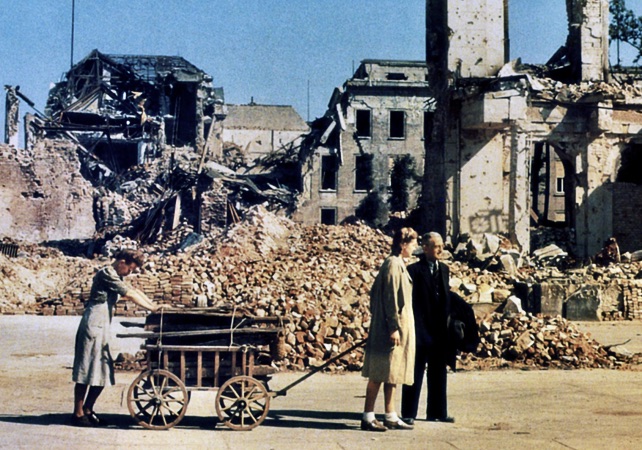
   Allied air forces bombed the hell out of the city in 1944 and 1945. One night in January 1945 more than 500 British bombers dropped six thousand high-explosive bombs and more than a million incendiary devices. The historic old town was destroyed. Half of the rest of the city was destroyed. What wasn’t blown to bits or burnt down was damaged. Surviving the bombing meant you had to then survive the aftermath. The city was left with practically no heat, no electricity, and  no water supply in the middle of winter. The Palace of Justice and the prison that was part of the sprawling complex were spared. It was a sign of what was in store. It was spared because justice and revenge were in store.

   “In the fall after the war ended, we had to leave the pig farm and went to an American refugee camp near Regensburg. We had two rooms, but there was a Lithuanian man in the other room, so we had one room. We lived there and didn’t do anything. We waited and waited.”

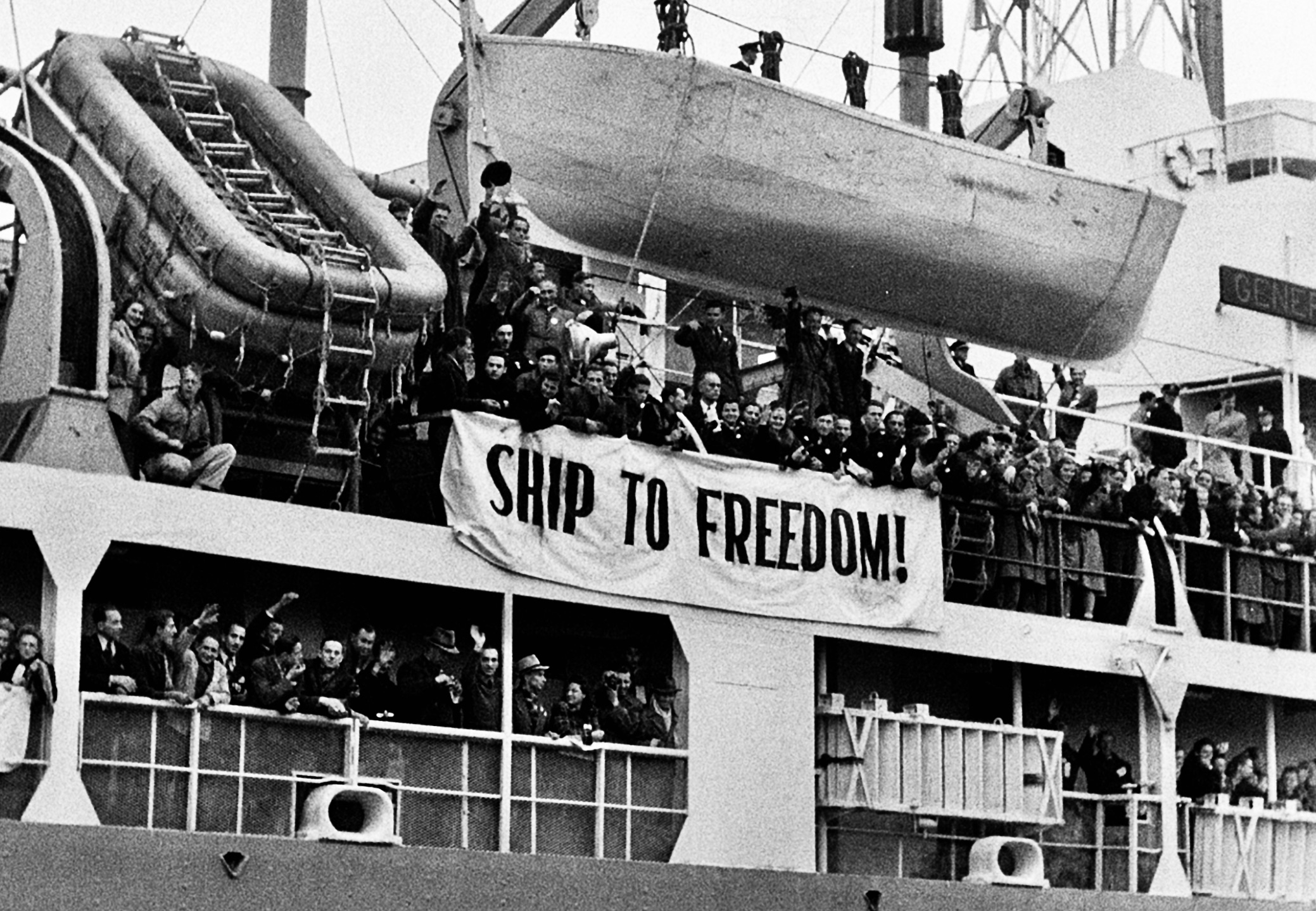
   Before the Russians closed the borders, padlocking the Baltics behind the Iron Curtain, about 70,000 Lithuanians were able to escape the country, almost all of them ending up in Germany. By the time the war ended nearly 11 million refugees had flooded the country, more than the total population of Austria. Many of them ended up in Displaced Persons camps in Bad Worishofen, Nordlingen, and Regensberg.

   In the spring of 1946, Angele, Ona, and the children moved to a new camp. “It was a castle that you went to down a long road through a forest in front of a lake. There was a big chapel and two big barracks. There were no owners anymore, and no workers, nobody. There were only the Americans and refugees. There were many of us, all of us homeless. We were almost all Lithuanians.”

   The Schwarzenberg castle on the outskirts of Scheinfeld in Bavaria is northwest of Nuremberg. From 1946 until 1949 thousands of Lithuanians were housed at the DP camp there while they waited for their chance to get to Australia, Canada, the United States, anywhere somewhere else. “There was no future for us in Germany,” Angele said. There was flat out no going back. The system of revolving displacement the Russians proposed would have meant the end for many of them and suspicion and persecution for the rest of them. The Russians had no plans of letting repatriated Lithuanians off easy. They had no plans of letting any Lithuanians of any kind, unless they had converted to Communism, off easy. Even then it was dicey. If they wanted you to live and die in Siberia, the far east is where you went.

   The camp outside Nuremberg was administered by an American Army officer of Lithuanian descent. The military’s concern was providing shelter, nutrition, and basic health care. Although the Americans looked after vital supplies, everybody in the camp had to lend a hand, The refugees prepared their own food. They sewed new clothes from old cloth. They printed their own daily newspaper. They printed their own money, too. The currency could be earned by working around the camp and spent at the canteen, where you could buy shaving cream, combs, and cigarettes.

   “We had our own doctors, our own church, and even a school. My best friend was Maryte. Her parents were teachers. They taught the high school classes in the camp. Her mother knew how to sew.. She would take hand-me-downs that had been donated to us by the Red Cross, take them apart, and make new dresses. Whenever she made a dress for Maryte she made one for me, too.”

   Angeles’s aunt talked to her about becoming a seamstress. “She wanted me to learn how to sew, like my older brother Justinas, so I would have some way to make a living, but I said no.” She had already turned down her aunt’s advice back home about becoming a farmer’s wife. She wasn’t sure what she wanted to do, but she knew for sure what she didn’t want to do, which was no sewing and no farming.

   After her friend Maryte moved to Nuremberg, taking classes in x-ray technology, and was on the way to becoming a nurse assistant at the Army Hospital there, she wrote Angele. “She told me about it, told me it was a 10-month course, and told me to come join her.” Angele packed a satchel with her clothes and slipped away as the weather warmed up in 1947. She waved goodbye to Ona and her four children. “By then my aunt was teaching kindergarten at the camp and she had her kids around her.” The boy Mindaugas had grown a few years older, was now a full-fledged teenager, and could take care of his three sisters.

   She hitchhiked the forty miles to Nuremberg. Even though there were travel restrictions, a German government barely existed to enforce its own laws, and the only thing she had to worry about was an over-zealous American officer in a Jeep who might take her back to where she came from. When she got to Nuremberg she asked where the hospital was and found her way there. It had been rebuilt after the bombings two years earlier. She was assigned a bed in a small room, which was twelve feet by twelve feet. She shared it with three other women.

   “There was Ele, who was 24 and tall, Koste, who was 28 and stocky, Monica, who was the oldest and had been a nurse in Kaunas, and me. One of our teachers was Lithuanian and she helped me. We lived in the barracks. I worked in the hospital, cleaned, changed beds, and did whatever they told me to do. I studied whenever I could. There wasn’t time to do much else.”

   They had to do something, though. Most of them were young and raring to go. They staged dances at the hospital. “Somebody would play the accordion and we would all dance. There were never enough men to go around, so many had died.” Whenever they could they went to town on Saturdays. “We took a train, went to the movies, and the music shows. We loved it. Everything was so clean. It was all smashed during the war but two years later you wouldn’t have believed there had ever been a war.”

   There had not only been repeated bombing and shelling of the city, especially the medieval part of it, there had been street-by-street, house-to-house, and room-by-room fighting in April 1945. The city was rebuilt after the war and was partly restored to its pre-war aspect. “The Americans did it,” said Angele. “You could see them doing it every day.”

   The German government was being resurrected, as well, and order was the order of the day. “One day we were waiting in line for the movies, eating grapes, and spitting the seeds on the sidewalk. When a policeman saw us, he came over, and told us it was our responsibility to keep the city clean. He made us pick up all the seeds.”

   The circus was even better than movies or musical theater. It is in the movies and on stage that people fall in love and there is always a happy ending. The boy and girl kiss in a glowing haze. It is the circus, however, that leaves an in-the-flesh fantasy a vivid memory. “Whenever it came to town, none of us could sleep,” Angele said.

   The Nazi era was good for circuses since they were not considered subversive. They were left alone by the tyrants. Between the two wars, through the 1930s, Germany was the epicenter of  European circus companies and their large tents. There were more than forty of them on the road with clowns, acrobats, and animals. They were mostly family-run enterprises. The last year of World War Two, however, was bad for business. Many circuses lost all their equipment and animals. The postwar monkeyshines boomed after 1946. Circus Europa toured Germany in 1947. 

   “I loved the circus,” Angele said. “I would have gone alone if I had to.”

   In mid-summer 1948 she got a week’s vacation from the Army Hospital. She and her friend Benas, his best friend Porcupine, and two of the Porcupine’s friends took a train the 170 miles to Zugspitze on the border of Germany and Austria. On two sides of the Zugspitze are glaciers, the largest in Germany. Mountain guides lead climbers up three different routes to the summit at nearly ten thousand feet.

   “Benas had thick dark hair and his father was a minister back home. He was a good friend to me. Everybody called his friend Porcupine because my roommate Koste called him that, although nobody knew why. He thought he was Koste’s boyfriend, even though that’s not what she thought.”

   They got to the mountains at night and stayed in a small hotel. “There were two rooms at the end of the corridor. We three girls went into one of them. There were two beds, so we pushed them together and slept together. The boys took the other room. In the morning I went to the window and threw open the heavy drapes. I had to take a step back. The mountain was right there. I was astonished and frightened. For a second I thought it was going to fall in on us.”

   They rode a rack railway up the northern flank of the mountain the next day. “It went around and around.” At a landing they sunned themselves. “Even though there was snow everywhere, and people were skiing, looking like ants below us, we lay in the sun before going farther up.” They took the Eibsee cable car to an observation deck. “The gondola was all glass. You could see the whole world.” From the deck at the top a path led to a Cross of God.

   A 14-foot gilded iron cross had been lifted to the peak of the Zugspitze in 1851 by twenty-eight bearers under the direction of Karl Kiendl, a forester, and Christoph Ott, a priest. Father Ott was the brainstorm behind the cross, motivated by a vision of the mountain, “the greatest prince of the Bavarian mountains raising its head into the blue air towards heaven, bare and unadorned, waiting for the moment when patriotic fervor and courageous determination would see that his head too was crowned with dignity.”

   The Porcupine and his two companions wouldn’t go to where the cross was, patriotism or no patriotism. They said the path was too icy and narrow. “Only Benas and I went. There was a ladder attached to a rock face you had to climb to get to where the cross stood on a flat space.” In 1888 the cross had to be taken down and repaired after being struck by lightning. It had holes gouged out by the lightning bolts. A year later it was taken back to the top, onto the East Summit, where it had stayed ever since.

   The side rails of the metal ladder going up were secured by bolts to the rock. “I was near the top when a bolt came loose and the ladder jerked free,” Angele said. “I stopped and couldn’t go up or down. I stayed as still as I could. I was scared to death.”

   She had survived a Russian invasion, her mother’s untimely death, a subsequent German invasion, followed by another Russian invasion, making tracks out of Lithuania, the invasion of the Reich, the collapse of the German government, landing in DP camps in Bacaria, and finding her way to work at the Army Hospital In Nuremberg, all in the past 8 years, all by the time she was 19 years old. She was determined a broken ladder was not going to be the end of her. Benas helped her get down, extending his belt from the top, and another pilgrim helped her from below, coming partway up and slowly carefully easing her down. Benas slid down the side rails without incident.

   Faith can be church-going or it can be personal. Life and death at ten thousand feet is personal, Cross of God or no Cross of God. Who thinks about God when they are about to meet their maker? They took their time on the icy path back to the observation deck. The rest of the week they hiked, took local trains to nearby alpine towns, ate, drank, smoked, talked, and had fun while it lasted.

   At the end of their vacation they went back to Nuremberg. In her room, Angele thought about the men in her life. There were two of them. One of them was Vladas, who was a Baltic soldier. The other one was Vytas, a civilian, who worked for the Red Cross and worked the black market. They were both refugees from Lithuania, like her. Vladas brought her food and Vytas played cards with her. Vladas watched while she made dinner for him while Vytas let her win at the card table.

   Getting married might not be a matter of life and death, except when it is. She thought she was probably going to marry one of them, and thought she knew which one it would be, but she knew for sure she wasn’t going to be staying in Europe. She was going to break free of nowhere. Making her way some place where there was a future was the most important thing on her mind. She wanted a bright future, not a dark past. The only way was up the ladder, rung by rung. 

   No matter what, she was going to have to make what lay ahead worth its while. Nobody else was going to do it for her. When she got a visa to go to Canada and work as a nanny for thirteen children in Sudbury, an Ontario mining town, she took the chance. It was the chance she had been waiting for.

Ed Staskus posts monthly on 147 Stanley Street http://www.147stanleystreet.com, Made in Cleveland http://www.clevelandohiodaybook.com, Atlantic Canada http://www.redroadpei.com, and Lithuanian Journal http://www.lithuanianjournal.com

“Cross Walk” by Ed Staskus

“Captures the vibe of mid-century NYC, from stickball in the streets to the Mob on the make.” Sam Winchell, Beyond Fiction

Available on Amazon: https://www.amazon.com/dp/B0CRPSFPKP

Late summer and early autumn. New York City, 1956. Jackson Pollack opens a can of worms. President Eisenhower on his way to the opening game of the World Series where a hit man waits in the wings. A Hell’s Kitchen private eye scares up the shadows.

A Crying of Lot 49 Publication

Surprise House

By Ed Staskus

   Everything happened when Eva and Nick got out of whack and the adventure rides burned down, although most of it happened before that. It started when Eva Giedraityte, who grew up one of four Lithuanian girls in the family in a two-bedroom house, married Nicolae Goga, a handsome Romanian man. She turned 18 the day of the wedding. He was 28. She made up her own mind about it. They had to elope, crossing the state line, finding a justice of the peace in a used-up roadside Indiana town.    

   Afterwards, the day after the fire, Eva and Sammy and Agnes walked to Euclid Avenue and flagged down a three-wheel bicycle peddling Louie Kaleal’s Checker Bar ice cream. When the skinny black man opened the box on the back of the bike white smoke from dry ice poured out. Agnes made sure she ate all of her ice cream while it was still cold in the sugar cone.

   Two years later on Christmas Eve, while Sammy and she stood on the lip of the front walk, below the light in the window of the upstairs front bedroom, she remembered the night when the Surprise House burned down, and how Sammy and Eva and she looked over the tops of the trees, watching the fire on the far lakeshore.

   They didn’t know what was going up in oily clouds of orange-gray smoke, finding out only the next morning when Eva showed them a front-page photograph about it in the Cleveland Plain Dealer.

   Agnes snuck a peek at her mother getting out of the car across the street where she had parked and let them out, walking flatfooted on the icy driveway, and knocking on Anna MacAulay’s side door. She glanced back over her shoulder, waving them towards the house with black shutters and red front door where she and Sammy had grown up. Eva wanted them to talk Nick into giving her a divorce, even after he had said no more than a thousand times. She wanted to marry somebody else, an ex-military policeman from Rochester who was their father now, more-or-less.

   Eva’s grandparents from the old country didn’t approve of Nicolae from the beginning, even though he got medals for shooting Commie’s in Korea. That’s why Eva and Nick had to elope. Grandma and grandpa were stern and unforgiving. When they made tracks out of Lithuania during the war, not dying of bombs bullets hunger exhaustion, they made it. They never talked much about it, about the hardships they faced. They stayed stone-faced about it.

   When they were growing up, Agnes and Sammy didn’t see their grandparents for a long time. They had disowned Eva. Even when they were finally allowed, they hardly ever saw them because they still didn’t want to see their faithless daughter. It didn’t look like their new man was in the running either, even though he was Catholic instead of Lutheran.

   “Come on, bub,” Agnes said, starting up the walk.

   “Don’t call me bub,” Sammy said, slouching behind her with a long face.

   “I told you I don’t like you doing that,” she said, tugging him up hard by the back of the collar.

   “You’re a stick,” he grunted, pulling away.

   “What does that mean?”

   Agnes was upset when she thought of the Surprise House burning down, the signal flags on top of the roof on fire, and sick to her stomach when she remembered not knowing Euclid Beach Park hadn’t closed for the season when she was ten years old but closed for good. She found out the next summer, the summer before the fire, when school let out and Eva told them, and later said they would go to Williamsburg for a family vacation, instead.

   But they didn’t go to Williamsburg, so they never saw the reenactments she heard about from Sandy next door, who had gone there three times, just like they never went back to Euclid Beach Park. They went to Fredericksburg, instead, where Nick played golf at the country club while Sammy and she dragged after Eva sightseeing sunburned Civil War battlefields and staring up at the fancy plaster ceilings of the Kenmore Plantation.

   When Sammy complained the long four-day weekend that his head was hot and his neck hurt, Eva pointed to the plank floor in a dusty corner of the plantation house beneath a high window.

   “Lay down for a few minutes,” she said.

   When Agnes and she got back from the foursquare garden behind the house, he was curled up on his side asleep.

   “Did you know this was George Washington’s older sister’s house?” Agnes said as they walked to the car.

   “She wasn’t older,” he said.

   He ran after mom, reaching for her hand.

   The winter before Sammy was born her mother told Agnes she was making a little friend for her to play with. By the time summer came she was ready to tell her mother he wasn’t what she really wanted.

   “I can’t play with him. Can you take him back?”

   But Eva never did, even though Agnes asked again.

   “I’m hungry. Can’t we go to Williamsburg? I don’t like it here, eating dried strawberries all the time,” Sammy said.

   “Your father told you it’s too far,” Eva said.  

   Agnes remembered thinking, why are we in Fredericksburg? Everybody goes to Williamsburg, not Fredericksburg. Why didn’t we go there?

   Eva was born in Noorkoping, south of Stockholm, after her parents made their getaway from Lithuania. The Germans were invading and since there was Jewish blood in the family, and since everybody knew what the Nazis were doing to Jews, they stepped on the gas. Their grandfather was an import export up-and-comer and had a car. Their grandmother was a high school teacher. They left everything behind, drove to Estonia in the middle of the retreating Red Army, and from there found a boat to Sweden.

   When the family got to America after the war, they first lived in Pittsburgh, but it was too dirty. They had to keep all the windows in the house closed all the time. They moved to Cleveland the next year. Grandpa got a job in the Collinwood Rail Yards and worked days there the rest of his life. Grandma got a job at Stouffers making frozen food and worked nights there the rest of her life.

   One of them was always at home to watch the kids.

   Nick worked for Palmer Bearings, downtown on Prospect Avenue, on the backside of the angle before E. 46th St. He was vice-president of sales, which meant he went to all the steel factories in the Flats and to lunch most days on Short Vincent. When he wasn’t working, he was on golf courses on all three sides of town. He played afternoons with clients and weekends with clubhouse men and his private friends, but not with their neighbors. 

   He said they were different, the neighbors. Eva didn’t know what he meant. He never invited them over for dinner, either.

   By then Eva’s first-born sister was getting to be a big wig around town, but she never invited them over for picnics or holidays. She had grandpa and grandma blood in her. They had four children, all around Agnes and Sammy’s age. They hardly ever saw them. One day Eva went to their house to pick something up and she took Sammy and Agnes with her in their Mercedes convertible. It was a fun ride, the ragtop down. Their aunt made them wait in the garage, shuffling in the half-light, while she found whatever she was looking for. It turned out to be a Lithuanian relic she wanted Eva to deliver to an old lady who lived near them.

   When Agnes saw her at the door, Eva handing her the box, she thought, “She’s like a relic herself, why does she need more old stuff?”

   Eva got married on the first day she could, the year after she was Miss Boat Show of 1959. She and Nick met on the main stage of the Karamu House, auditioning for an amateur production of a play called “The Glass Menagerie.” They didn’t get the parts but got each other.

   She got hitched because her three sisters slept in the second bedroom while she slept on a daybed in the kitchen, because her mother was always telling her what to do, and because she was a free spirit. She had to get away from it all. She meant away from her stiff-necked mom and dad and her no bedroom and the old neighborhood, the church, and the community hall where she wasn’t happy anymore.

   Sammy and Agnes hardly knew their grandparents, although they knew a little, about how grandma’s sense of humor was top-secret, and grandpa was missing in action because he worked nights for the New York Central.

   Eva loved Nick the minute they met, and only waited until the day she was one minute older than she had to be to get married. She wanted her own bed in her own room. She wanted her own family.

   Nick’s parents weren’t alive anymore. His father was shot dead by robbers and his mother died after Eva put her foot down and she had to move out of their house to an old folk’s home. They were buried in Woodland Cemetery where Nick left plastic flowers every spring.

   The summer Sammy and Agnes started going to Euclid Beach Park, their grandparents went on vacation, and when no one else could watch their dog, Eva volunteered. She fed watered walked the dog every day. One day her older sister stopped by and when she opened the side door, the dog, surprised, ran out. Eva chased him down the street to Lakeshore Boulevard, but it was too late. A car hit the dog and he died. Her parents didn’t speak to her even more than they hadn’t before that for even longer.

   When they went to Euclid Beach Park, racing down Lakeshore Boulevard since Eva had a lead foot, she dropped them off, and told them exactly when she was going to be back. They were to wait for her just outside the main entrance gate arch, which looked like a gigantic letter H, so she could pick them up without having to get lost in the parking lot.

   The arch was underneath an old dusty giant pin oak tree. They knew it was an oak because acorns littered the grass, and knew it was a pin oak because it had pointy leaves. Sammy said it was five hundred years old, but what did he know?

   Admission into the amusement park was free. They just walked in, like magic. Eva always gave them enough money for fizzy drinks, popcorn balls, and two-dozen rides. She gave them bananas, too.

   “A banana is the best snack,” she said, pushing them down into their pockets with quarters dimes nickels.

   The first thing they did was run through the park to the Rocket Ships. Moving fast through the arch, they could see the tops of the cranes above the shade trees and hear the band organ that was beneath the second-floor platform.

   “Just in case we lose all our money, or something bad happens, this way at least I’ll know I was on my favorite ride,” Sammy always said.

   The Rocket Ships were three shiny aluminum spaceships that flew fifty feet up in the air over Lake Erie as they whirled around a twice high tower. Sammy said it was a great view and cooled you off on hot days, but Agnes wouldn’t ride the silver ships because she heard one of them had broken its support chains once and been hurled into the lake.

   None of the riders was ever seen alive again.

   After Sammy was finished flying around and cooling himself off, they rode the coasters together, starting with the Thriller. At first, Agnes was afraid of them, of the sickening hills and valleys, until the VW bus neighborhood hippie boys took them to the amusement park one afternoon.

   “It’s not what you think, it’s not the giant slide,” they said. “On the slide you can see everything ahead, everything that might happen, and that’s scary. On a roller coaster you never know what’s going to happen next. You can’t see that far ahead. It’s like a Zen pop. It’s the best ride because it’s always right now.”

   The Thriller was an out-and-back coaster with part of it running along Lake Shore Boulevard. They could see the tiny roofs of the cars on the road from the top of the first rise, just before they tipped plunging and screaming. The last hill was so steep they couldn’t help not standing up as they careened down, pressing against the lap bar.

   It was hair-raising because it might crash anytime. Everybody knew so. Coming into the station once the train behind came in too soon and rear-ended the other, and the cargo of boys and girls got banged up. The next day the platform was fixed, and it looked like nothing had happened. Sammy and Agnes found out they stored different shades of secret paint so that when they repaired the coasters and tracks, they could paint them so they all looked worn the same way, and no one could tell that anything bad had ever happened. 

    The more Agnes rode the coasters the more she liked them. They were like the peanut butter maker at Holiday Sands, twisting in the sky but bigger. She loved the sound of the wood trestles groaning and heaving on the turns. Even though she thought the riding might take her somewhere, it only ever took her back to where she started.

   The Racing Coasters were next to the Thriller. They were a double out-and-back, running beside the first leg of the Thriller, and there were two separate continuous tracks, the blue cars racing against the red cars. The ride ended on the other side of the station, everybody screaming their last go-go-go’s as it slowed down.

   The Flying Turns were the highest of the rides. They were scary loose nerve-wracking. The trains were freewheeling. “It’s a coaster without tracks!” Sammy liked to tell anyone who would listen, even though he had to sneak on, since he was smaller than the yardstick beside the gate.

   The cars weren’t attached to the track. The train careened in a bobsled trough, threatening to overturn at any second. There were only three toboggan-like cars for every train and only two rode in any one car, one directly in front of the other, white-knuckling the snap-of-the-whip turns.

   On “Nickel Days” they rode the Tea Cups between turns on the coasters, which were a four-table cup ride, like a Crazy Daisy. They spun in circles and looked like they would slam into each other any minute, but always missed by a sliver. Getting into a teacup one day Sammy found a plastic baggie tucked into the bench seat. A man with a ponytail came back before the ride started and asked if they had found anything.

   “It’s my happy weed,” he said when Sammy handed it to him.

   Walking around the park they munched on Humphrey’s Candy Kiss salt-water taffy and bought pictures of their favorite stars at the movie star photo booth. They yukked it up riding the black-light Laff-in-the-Dark and got soaked to the bone on Over the Falls.

   They steered clear of the Surprise House until the end of the day, not because it was bloodcurdling, which it was, but because of Laffing Sal, right outside the entrance, cackling her face off inside a glass case. Her hips gyrated like a hula hoop and she never stopped her nutty squeaky helter-skelter laughing talking.

   She had blazing red hair and shiny dead eyes in a head that jerked side-to-side back-and-forth. They tried to not look at her bloated painted face. It was too much.

   The front of the Surprise House was painted lime green and purple. It glowed lurid-like in the sun. The sign above the arch framing the doors was yellow with black letters. They had to give seven tickets to the bow-tied operator at the booth. He put the tickets on a conveyor belt that carried them to a chopper that shredded them.

   Once they walked in, through a fog cloud, right away around the corner was a screen door puzzle. Only one of all the doors was really a door and while they searched for it, all the doors banged open and shut so loud all around them it was baffling.

   When they found the right one, they walked into a narrow room full of rock formations and wild animals running up-and-down the rocks. The floor suddenly became a moving floor, zooming up and down and sliding side to side. The wall beside the moving floor was glass and people outside the Surprise House watched and laughed as they struggled to not fall down, much less walk.

   At the far end of the floor was a giant Grandfather Clock. When they got to it a spotted snake sprang at them from cuckoo doors beneath the clock face. Jumping away sideways from the ugly thing they had to run through a rolling barrel to get away.

   Most of the Surprise House was a maze of moving floors and stairways leading to elevated platforms, creaking doors, and dead ends. One room was so weirdly slanted sideways that just standing was all-in-all defying gravity.

   Pitch-black hallways led from one room to the next. Excruciating screams filled the air and loud knocking on the floors and ceiling overhead drummed in the darkness. There were siren whoops and unexpected clangs near and far. Blasts of air from secret holes hit them in the face coming around corners, and they never knew when a wind gust would blow up their shorts from the floor.

   At the end of one passageway were three porky sailor boys with tin whistles in their mouths. When they stepped up to them, they blew their whistles in their faces. When they stopped at a window to see a fireman with a hose, he whirled around and sprayed, except the spray hit the window, not them, jumping back in alarm. At a wishing well when they looked down into the water, they could see themselves as though they were looking at themselves from behind. 

   At the far end was a distortion mirror maze they had to find their way through to get out of the Surprise House. The curved mirrors stretched and squeezed them like screwball bubble gum.

   After all the strange moving floors and dark and noise it was a shock to step through the exit on the quiet side of Laffing Sal and suddenly stand blinking in the sunlight with people strolling by not knowing anything about what they had just been through. Sammy and Agnes were sad and excited at the same time, not sure what to do next.

   When the park announced closing time and everyone was on their way out an army of skunks came waddling up from the beach palisades, hard on their heels, eating the litter and discarded goodies. They threw banana peels at them and watched the skunks drag the peels away. They meowed like cats with sore throats.

   They didn’t know the last time they stumbled out of the Surprise House and tossed their leftovers away as they walked to the arch and Eva’s convertible that it was the last closing time at Euclid Beach Park. They didn’t know Eva was going to leave soon and not come back, either

   She and Nick started arguing when she started going to college. When she got a job, it got worse. After that it never got better.

   “Why do you need to work?” he asked her. “We have enough money. You don’t need to work. Stay home and take care of the family, for Christ’s sake.”

   But Eva was sick of asking him for money all the time, not just for groceries, but for everything, for her clothes, nice things for the house, and just everything. She got sick of him, too, of him always telling her what and what not to do.

   They argued more and more that winter, even in the morning at breakfast and over dinner and late at night when the Sammy and Agnes were supposed to be asleep. One night they had an argument in the living room because Eva had stayed out the day before until four in the morning.

   “We were at Reuben’s house,” she explained. “Nothing happened. I just lost track of time.”

   She meant Reuben Silver, who was the showman at Karamu House, where Nick and Eva had first met. He was a friendly man with a black beard and slicked-back thinning black hair. His wife wore purple turtlenecks and always took Agnes’s hand when she saw her backstage.

   “Nothing went on,” Eva said. “We went to the Playhouse and saw “Effect of Gamma Rays on Man-in-the-Moon Marigolds,” that’s all, and then we were at their house afterwards, talking.”

   “Gamma Rays? What are you talking about?” Nick went to the movies sometimes, but he didn’t go to theaters anymore. That was all over.

   He thought Eva had done something behind his back. He didn’t say what, although Sammy and Agnes could tell from his face it must have been wrong. When Eva went into the kitchen Nick followed her.

   She stepped into the hall and went up the stairs. They could hear them in their bedroom, screaming at each other in different languages. Suddenly there was a loud crash. Eva came running down the stairs out the front door and to Anna MacAulay’s house. Nick came downstairs after she was gone and told them everything was all right. He sat by the back window the rest of the night and stared into the ravine. He looked unhappy, like he had lost his golf clubs and fancy spiked shoes.

   When they went upstairs, they looked into their parent’s bedroom and saw a hole in the wall. A potato masher was lying on the floor. They found out later Nick had thrown it at Eva but missed. It lay on the floor until the next day when Eva came home. She cleaned up the dinner table, did the dishes, and put the potato masher away. Agnes liked that about her mom, keeping the cleanest house anyone ever saw. She vacuumed twice a day and they could eat off the floor if they wanted to.

   Their father said he was going to call Sears about fixing the bedroom wall, but he never did. He just left the hole to fester. Maybe it was like their marriage by then, not worth fixing.

   Anna MacAulay came over the next day when Nick was at work. She always just walked into the house. Nick hated that. She and Eva talked for a long time. When they were done talking Eva packed her bags.

   Looking up across the sidewalk at their house on Christmas Eve, Agnes thought she had probably known all along that her mother was going to leave her father, but back then surprises still upset her. Eva was going to marry the new man from Rochester, one way or another. There was no surprise about that. Agnes was going to do her best to help out.

   “If I can get my divorce,” Eva said, “we’ll have enough money to send you to Germany when you’re done with junior high.” Agnes hated her junior high and was sure she would hate high school. One of her aunts had gone to Vasario 16-osios, the Lithuanian high school in Germany.

   “You can stay summers with your grandfather’s sister in Diepholz,” her aunt Banga, Eva’s youngest sister, said. “She enjoys bringing food to the table. She’ll fatten you up a little. You can go to Italy with your friends. You’ll love it. When you come back, I’ll take you to Dainava.”

   She could go to summer camp the talk of the town, not a nobody, not like the first time, when they told her to leave. Agnes knew she would keep her word. She was her favorite aunt. She was her mother’s favorite sister. Banga means “Little Wave,” washing over you but not knocking you down.

   Going to school in Europe would be the kind of surprise Agnes could handle.

   “Come on, bub,” she said, taking Sammy’s hand when he reached for hers, and they started up the chancy sidewalk.

Ed Staskus posts monthly on 147 Stanley Street http://www.147stanleystreet.com, Made in Cleveland http://www.clevelandohiodaybook.com, Atlantic Canada http://www.redroadpei.com, and Lithuanian Journal http://www.lithuanianjournal.com

“Cross Walk” by Ed Staskus

“Captures the vibe of mid-century NYC, from stickball in the streets to the Mob on the make.” Sam Winchell, Beyond Fiction

Available on Amazon: https://www.amazon.com/dp/B0CRPSFPKP

Late summer and early autumn. New York City, 1956. Jackson Pollack opens a can of worms. President Eisenhower on his way to the opening game of the World Series where a hit man waits in the wings. A Hell’s Kitchen private eye scares up the shadows.

A Crying of Lot 49 Publication

Spanky and Our Gang

By Ed Staskus

   When the Soviet Union was in charge, there wasn’t a Mafia in Lithuania. The Russians wouldn’t allow it, since they were the Black Hand themselves and didn’t brook any competition. When anybody tried to muscle in on the action the KGB shoved them into a boxcar with a free ticket to Siberia in their pockets.

   But as soon as the Commies were gone in December 1991, it was the same story less the boxcars. The next morning the Lithuanian Mob popped up like mushrooms after a spring rain. The homeboys were just as poisonous as the Russians.

   Nobody could call his own tune in a kiosk, no matter how pint-sized, built onto the side of their house selling gum, chocolate, and cigarettes without being on the lookout for them. The gangsters would appear in their grim track suits demanding protection money, or else. It was like Spanky and Our Gang, except “or else” meant they might burn your house down, whether you were in it, or not.

   Like Little Scotty, Spanky’s best friend, they always said, “That’ll learn ‘em.” Of course, Little Scotty was only eight years old, and hardly knew what he was talking about. He wasn’t an arsonist, either. It was only a slapdash kid’s movie.

   If you paid up, you could sleep soundly at night. If anybody went into business across the street, all you had to do was tell your Mob man about it, and the competition disappeared. If you were looking for cheaper gum, they pointed the way to fake Dubble Bubble. 

   It wasn’t just businesses, big and small, that paid protection money. That’s what the Mob called it, like they were doing you a favor, although everybody else called it extortion. It was the same as 1930s Chicago but set in the new frontier world of Eastern Europe. It was all up for grabs.

   “Whenever I stayed in Vilnius in those years, the 90s, I stayed at my friend Birute’s house,” my sister Rita said. She was a travel agent in Cleveland, Ohio. She often visited the native land leading tours of emigrants. “Her husband built a big house and the first time I saw it I thought, the Lithuanian Mob has got to have their eyes on this house. I hope she has police protection, even though they weren’t much better than the Mafia.”

   Corruption was so endemic after Lithuania won independence that the Internal Investigation Service was established in 1998 with its own special jurisdiction. It was on top of the Immunity Service, responsible for preventing and investigating corruption within the police force. There was rot top to bottom.

   Targeting malfeasance became more urgent leading up to the country joining the European Union in 2004. Europe had long prided itself on its trustworthy policemen. Only Croatia had more fast and loose law enforcement than Lithuania. The nation introduced a score of anti-corruption measures, to little apparent effect. More than 60% of the country’s citizens continued to believe crooked lawmen were widespread and oozing spreading fast.

   If you can’t trust the cops, who can you trust, although it’s best to never trust a policeman in a raincoat, especially if it’s not raining, unless he’s Columbo, who always wore a raincoat, rain or shine. He always wore the same one, too. “Every once-in-a-while I think about getting a new coat, but there’s no rush on that, since there’s still plenty of wear in this fella,” he explained.

   Lithuania’s policemen wore coats full of holes. The graft was like moths, eating away at the wool. They needed new coats in a bad way.

   “One of our cousins could have used a policeman the day she lost her kid,” Rita said. “But they’re not always there when you need them.”

   It was winter when our cousin picked up her six-year-old from school, sitting him down in a little red wagon, and pulling him along behind her. Somewhere down the line he fell out of the wagon. She didn’t notice, trudging through the snow, until she got home. When she did, she rushed back, but he wasn’t anywhere on the path they had taken. There wasn’t a badge in sight. When she called the local station, nobody answered. Sunset in Lithuania in early January is at around four o’clock. She finally found him making snow angels on a side street by himself in the darkness. None of the streetlights were working.

   Another of our cousins had a son, Gytis, who was grown up, and had gotten involved with the Mob. He owed them money but was unable to pay his debt. They were looking for their loot. When they got sick and tired of waiting, they rigged his car up to blow up. The next morning when he started it, it blew up, but the gangsters hadn’t used enough dynamite. They also stuck it under the trunk instead of the front seat. Gytis was hurt, breaking an arm in the blast, but survived.

   “I had to go from Vilnius to Marijampole one night and my relatives sent Gytis,” Rita said. “I couldn’t believe it. Why Gytis of all people? The Mob was after him! His arm was in a cast, and he had a friend with him. His friend was from Samogitia and I could barely understand a word he said. It didn’t help that he was smoking Bulgarian cigarettes and coughing up a storm.”

   They were driving a beat-up Trabant, an East German car, which had a reputation for getting old fast. It got old the minute it rolled off the assembly line. Car ownership was exploding in Lithuania, but it was the best they could do. Gytis put her in the back seat and told her to lay low. They didn’t take the highway or the secondary roads. They drove back roads, which were hardly roads, at all. They weren’t paved. The Trabant ran out of gas in the middle of nowhere.

   “Stay here,” Gytis said when he and his friend tramped away.

   “It was pitch black as could be,” said Rita. “I stayed in the car because there was nothing anywhere. I would have just been wandering around, having an out-of-body experience.”

   After more than an hour, Gytis and his friend came back with an open bucket of gasoline. She didn’t ask where they found it. When they finally pulled into the driveway of our Uncle Justinas’s house, she jumped out of the car, nearly ripping the Trabant’s back door off its hinges.

   By the time Gytis grew up, he was fatherless. His mother went through three husbands. She left her first husband after he tried to kill her twice. One day he wired the front door lock so she would be electrocuted when she put her key into the lock. It didn’t work. Another day he veered off the road and rammed the passenger side of their car into a tree. That didn’t work, either. She was unhurt, although he was a mess, and had to be hospitalized.

   Her second husband was working at Chernobyl in 1986 when the nuclear power plant melted down. Even though he returned home, he suffered from radiation poisoning, and shortly afterwards committed suicide. She took care of his grave faithfully, cleaning and decorating it. Her third husband was a good man, but a year after their marriage she came home from her job as a seamstress and found him dead on the floor from a heart attack. After that she got the message, giving up and remaining a widow.

   “My Uncle Juozukas had a son, Edvardas, who was a policeman, and he always told me to watch out for the police,” said Rita. “He said they were rotten through and through.”

   “Make sure you always have cash with you if you’re ever driving alone, because if you get stopped by them, you will have to pay them,” Edvardas said.

   “You mean I will have to pay the fine right on the spot?”

   “No, you will have to pay them off right on the spot. Otherwise, they will keep you on the side of the road all day and night until you do.”

   Our cousin Mikolas shook his head up and down and said, “That’s right. If their pockets are empty, and even if they aren’t, they will stop you no matter if you have done something, or not.”

   The year before, after the birthday party his parents threw for him, the police were waiting outside and followed Mikolas home. They were after his birthday money. “Maybe somebody told them about the party, maybe not, but I had to hand all of it over,” he said.

   The police car parked behind him when he pulled into his driveway. One of the policemen counted the money he finally handed over to them and said, “It’s not nearly enough, since I have to pay some of it out back at the station, but OK.” He threw the birthday cards and envelopes out the window, backing over them on his way out.

   “You are scum between my toes,” is what Spanky used to say and would have said. When Mikolas asked the cops what he had done, they said, “Nothing, and make sure it stays that way.” They were in the thievery business, not the law-and-order business.

   Edvardas was an honest policeman. He couldn’t condone or handle the rampant corruption. He quit the police force after a few years. Sometimes you’ve got to live with yourself, not the rotten apples. There’s no sense in letting canker have its way, just because it says so.

   When Rita asked our Uncle Juozukas how much he paid the Mob for protection when he was selling gum, chocolate, and cigarettes out of the kiosk he built onto the side of his house, he said, “Peanuts, but peanuts I couldn’t afford to pay.”

   There were loads of peanuts up and down and all around the country, as well as bags of peanuts, and truckloads of peanuts, and it all added up to keep the crime wave going full steam ahead. At least until the engine got overheated. When it did there was hell to pay.

   After journalists, businessmen, and prosecutors started getting murdered by the Mob, the country got good and shocked, and repercussions soon followed. The Vilnius “Godfather” Boris Dekanidze was put to death while the Kaunas “Godfather” Henrikas Daktaras was locked up. His jailers lost the key and he stayed locked up forever.

   In the 1990s the Mob employed persuasion, intimidation, and violence to get what they wanted, including pocketing public property for themselves. Everything was on hand on deck in play. In the new millennium the worm turned. The Mob put their brass knuckles away and put on business suits, employing persuasion, intimidation, and bribery to get what they wanted. It wasn’t lowlifes cashing in on the gum and cigarette market anymore. It wasn’t bringing a trunkful of booze back from Poland. It wasn’t stealing used cars. It was the new dodge of cashing in on state and private legal and illegal deals, drugs, sex trafficking, internet gambling, and money laundering. They stashed their brickbats in the basement and repositioned themselves as venture capitalists.

   Not all of them, though. Some stayed true to their roots. Several years later, more than three hundred armed policemen at the crack of dawn broke down the doors of nearly a hundred homes and apartments and arrested members of ONG, the country’s most dangerous crime group. Elite Lithuanian ARAS units dragged away dozens of groggy men wearing wrinkled tracksuits, hands handcuffed behind them. The haul included “a large number of automatic and semi-automatic firearms, ammunition and explosive substances,” according to a Europol press release, as well as a boatload of sports cars and luxury sedans.

   The hoodlums operated out of Kaunas for the most part, smuggling guns and drugs, keeping their shady lawyers and accountants busy and themselves living the high life. They used “various money-laundering schemes that involved legal entities and limited ownership of assets worth millions of euros and maintained strong links with other organized criminal groups in Lithuania and abroad,” a Kaunas Police Department news release said.

   The way most crime lords see it, you can get much farther with a gun and a kind word than you can with a kind word alone. Their guns gone, there wasn’t much they could say. Kindness wasn’t part of their vocabulary. They didn’t even know how to spell the word.

   In the end, locked up inside police stations and handcuffed in cages in courtrooms, few kind words were spoken. There was some rude spanking on the horizon on their way to prison. Alfalfa, Spanky’s right-hand man, his hair neatly parted down the middle, always had the last word when asked if he had any last words for evildoers.

   “Yeah, see ya!”Ed Staskus posts monthly on 147 Stanley Street http://www.147stanleystreet.com, Made in Cleveland http://www.clevelandohiodaybook.com, Atlantic Canada http://www.redroadpei.com, and Lithuanian Journal http://www.lithuanianjournal.com

“Cross Walk” by Ed Staskus

“Captures the vibe of mid-century NYC, from stickball in the streets to the Mob on the make.” Sam Winchell, Beyond Fiction

Available on Amazon: https://www.amazon.com/dp/B0CRPSFPKP

Late summer and early autumn. New York City, 1956. Jackson Pollack opens a can of worms. President Eisenhower on his way to the opening game of the World Series where a hit man waits in the wings. A Hell’s Kitchen private eye scares up the shadows.

A Crying of Lot 49 Publication

End of the Line

By Ed Staskus

   When my father died the funeral service was at Our Lady of Perpetual Help, the Lithuanian church on Cleveland’s east side, the memorial service was at the Lithuanian Club up the street, and he was buried on the grounds of All Souls in Chardon, forty miles farther east. It is where many local Lithuanian-American Catholics ending their days on the south shore of Lake Erie end up.

   All Souls Cemetery covers some 250 acres, features over 109 developed acres and 7 mausoleums, and could be a golf course if it wasn’t a boneyard. If someone’s got the blues, it’s where to go. It’s the place to bury your troubles once and for all.

   Two years later, paying my respects on a sunny summer day, visiting my father in the mausoleum where he is interned, and later wandering about the cemetery, I stumbled on the burial place of Antanas Smetona. The name rang a bell. When it came to me, I remembered he was the first and last president of Lithuania during the inter-war years.

   Walking back to my car I passed a headstone 50-some years old. Red and white artificial flowers lay on the ground. Engraved on the stone was a man’s name, the dates of his birth and death, and the inscription “He Done His Damnest.” It wasn’t the kind of epitaph I expected, which would have been more along the lines of “Always in Our Hearts” or “Gone but Not Forgotten.” Had the man gone to Heaven or Hell?

   Antanas Smetona did his damnest, too, during a damnably hard time. 

   He was born into a family of farmers, former serfs, the eighth of nine children. Their homestead was near a small lake, almost dead center in the middle of Lithuania. His father died when he was eleven, making a last wish that his youngest son be sent to school. He was the only one of his brothers and sisters to ever get an education. The instruction was in Russian, because the Russians were in charge and Lithuanian talk was closed down. Lithuanian literature was closed down. Lithuanian history was closed down.

   He was a top student and won a tuition waiver. He supported himself by superintending his dormitory and giving private lessons. After graduation he made his way to Latvia, got involved with the Lithuanian National Revival, got into trouble, made his way to St. Petersburg, got involved in the February 1899 student protests, got into more trouble, and got deported back to Lithuania.

   After he was allowed to return to St. Petersburg, he got involved with Lithuanian book smugglers, got arrested, got thrown into a castle that doubled as a prison, somehow got acquitted, cracked his books wide open, burned the midnight oil, graduated university, and finally made his way voluntarily out of Moscow’s orbit. He never went back. He went back to the homeland. Russia was like a cemetery with a big fence around it. Those inside couldn’t leave unless they were thrown out. Those outside didn’t want to scale the fence to get inside unless it was a matter of life and death.

   Antanas Smetona got married and went to work for the Vilnius Land Bank. When he wasn’t working, he was working with several Lithuanian nationalist groups and writing, editing, publishing, circulating news and editorials, all the while for advocating national unity and independence.

   When the First World War started, he chaired the Central Committee Relief Society and pressed demands on the Germans, who had pushed the Russians out of the country in 1915. His No. 1 demand was that that Lithuania be granted its independence. A year later he began editing and publishing the newspaper Lithuania’s Echo. His message, stated in the first issue, was the speedy establishment of an autonomous and sovereign Lithuanian state.

   Russia didn’t like that, since they had controlled the country for more than a hundred years, but they had their own problems, namely the Eastern Front, where they were busy suffering six million casualties and three-and-a-half million captured. On top of that more than a million civilians were dying of war-related causes. Adding to the anvil chorus, the Bolsheviks were breathing down their necks.

   When the Council of Lithuania was formed, Antanas Smetona was elected Chairman and in February 1918 he signed the Act of Independence of Lithuania. The next year he was elected the first President of the Republic of Lithuania. His tenure didn’t last long. The next year a new man was elected, and he was out. He taught classes at the University of Vilnius and got involved with the paramilitary group the Lithuanian Riflemen’s Union.

   Five years later he led a coup d’etat, deposing the president and seizing the office for himself. A year later he suppressed the parliament. Two years later he assumed dictatorial powers. For all his editorializing about autocratic czars, he became an autocratic czar. For the next nine years he ruled by decree, his own new constitution vesting in him both executive and legislative powers. Whenever there were new elections he ran as the only candidate.

   He added his name to the rise of totalitarianism and dictatorship in the 1930s, joining Benito Mussolini, Francesco Franco, Joseph Stalin, and Adolf Hitler. He went from idealism and high-mindedness to cynicism and the inside track. Realpolitik is not about democracy and human rights. It is the struggle for power. It’s like Adolf Hitler said, “It is not truth that matters but victory. If you win, you need not have to explain. If you lose, you should not be there to explain.”

   Although there aren’t many children nowadays who would accept guidance counseling from Adolf Hitler, there were plenty of men and women eighty and ninety years ago who were all ears. That’s why cemeteries in 1945 were overflowing with human beings, not including the dictators. They make their own bed of nails.

   Antanas Smetona may have been a patriot and a loyalist, doing his best to restore Lithuania to nation statehood, but he was nonetheless a dictator. He may have repressed the Iron Wolves, a radical rightist movement led by his former Prime Minister who he had earlier removed from office, but his own Lithuanian Nationalist Union took part in the 1934 Montreux Fascist Conference. He may have believed in political parties, but his was one-party rule and he was the ringleader of the party. He styled himself as the Tautos Vadas, or Leader of the People.

   Under his rule Lithuania “moved decisively towards a dictatorship of what might be termed the ‘fascism from above’ variety,” according to Martin Blinkhorn, British historian and author of “Fascism and the Right in Europe 1919 – 1945.” The Russians, the Muddy Mississippi of Fascism themselves, said he was trying to “adapt Italian Fascist concepts to Lithuanian conditions.” He was more centrist and moderate in his authoritarianism than many others, but he also believed he was the most qualified and experienced person to run the country. He rigged the elections to make sure it stayed that way.

   Not that it did him any good. By 1938 he was being squeezed by Nazi Germany and the Soviet Russians. He had never been able to get Vilnius back from the Poles. Now he had to surrender Memel to the Germans. When the Russians presented an ultimatum to his government in 1940, he urged armed resistance, but nobody agreed that Lithuania’s armed forces, numbering some twenty thousand, was up to the task of going toe to toe with the five-million-man Red Army.

   “I do not want to make Lithuania a Bolshevik country with my own hands,” he said from the steps of the Presidential Palace in Kaunas and left the country. A month later Lithuania was incorporated into the Soviet Union. He wasn’t on hand to try to stop it.

   When he got to the border Antanas Smetona and his bodyguard waded across a rivulet into Nazi Germany. When he did, he went from lightning rod to lightning bug. The next day his family convinced the Lithuanian crossing guards to let them go, too, since the big fish was already gone. The provisional government wanted him back, but what could they do?

   The Germans put him up in a hunting lodge in the Masurian Lake District. From there he was moved to Berlin, then traveled to Bern, Switzerland, and lastly to Rio de Janeiro. He finally landed on his feet in the United States where four hundred guests greeted him at New York City’s Pierre Hotel for a lavish dinner and evening function. He briefly lived in Pittsburgh and Chicago before finally settling down on the east side of Cleveland.

   When I grew up on the east side in the late 1950s and 60s, Eastern Europe was right across the street. There were Serbs, Slovenians, Croatians, plenty of Poles, and lots of Lithuanians. Everybody had their own church and their own watering holes. Everybody had their own talk in their own language about their old homes and their new place new lives new future in the United States.

   Antanas Smetona and his wife Sofija moved in with their son Julius on Ablewhite Avenue on the northeast side of the city, off Eddy Road, near Lake Erie. Julius worked as a grinder for Standard Tool and was married to Birute Nasvytyte, a former concert pianist, raising their two children. The self-styled President-in-Exile worked on his memoirs and visited Lithuanian communities across America speaking about the plight of the mother country and his hopes for its post-war independence.

   “What the Magna Carta was to the English, what the rights of man of the French Revolution were to personal liberty, the Atlantic Charter is to nations, especially small nations like ours,” he said.

   When my parents bought a two-and-a-half story duplex with a backyard big enough for a pack of kids, their first house in the United States, doubling up with my father’s sister and her family in 1958, both families recent immigrants, it was about a mile from the exile’s residence. When I attended the Iowa-Maple Elementary School my first school year in Cleveland, I sat in a classroom a stone’s throw from the house. I wasn’t aware of at the time that the ex-president of Lithuania died in that house less than twenty years earlier.

  The day he died, Sunday January 9, 1944, he and his wife were in their upstairs bedroom relaxing. It had snowed lightly on Saturday and the windows were frosty in the below freezing weather. They smelled something foul and saw smoke oozing into their room from under the door. 

   The furnace had been acting up lately. “The night before yesterday coal fumes made me dizzy. I could not think clearly. Now I have completely recovered,” he wrote in his journal two months earlier. This was worse. His clear thinking days were soon going to be over.

   The overheated furnace caught fire, leapt up the chimney, and swept through the house. The man and wife bolted out of the room and down the stairs, but he turned around, stepping back into the bedroom, grabbing a fur-lined overcoat to throw over his head. By the time he turned again to flee his wife was in the front yard. He never made it out of the house alive.

   Fire Battalion Chief Tom O’Brien said afterwards the fire had a “head start,” making it difficult to fight. The coal room was red-hot. By the time they extinguished the blaze and accounted for everyone, they went looking for Antanas Smetona. They had saved the house but found him face down in the second-floor kitchen dead of suffocation. Police outlined where his body was found in chalk, and other policemen carried him out on a stiff board.

   The pull out all the stops funeral was at the Cathedral of St. John the Evangelist in the heart of downtown and was presided over by Bishop Edward Hoban. The Cleveland Police Mounted Unit saluted as his coffin was carried out the front door. He was buried in Cleveland’s Knollwood Cemetery but in 1975 was moved to Chardon, next to his wife, who died in 1968.

   Although the inter-war years in Lithuania are often referred to as the Smetonian years, there is no monument to the man in Vilnius. “I really wouldn’t want to say whether I’d approve a monument to Smetona, or not,” Remigius Simasius the mayor of the city said. In the end he didn’t say. There is still some bad blood about the putsch and his authoritarianism. “Perhaps not so much for the coup itself than for disbanding political parties and essentially destroying the opposition,” said Vilnius University historian Alfredas Bumblauskas.

   When I went back the next summer to visit my father, I walked to where I knew Antanas Smetona was six feet up. The polished granite slabs are on a wall above Grace and Philip McGarry and below Michael and Anna Pula. Someone had fixed fresh flowers to both Antanas and his wife Sofija’s facings. The sepulchral stone was spic-and-span.

   I thought of Blind Lemon Jefferson’s song, “There’s just one kind favor I’ll ask of you, see that my grave is kept clean.” No matter what, whether Antanas Smetona had done the best he could, or not, whether he was a statesman or a tyrant, whether he was in Heaven or Hell, the earthly remains of the man were beyond reproach in his neat as a pin final resting place at All Souls. 

Ed Staskus posts monthly on 147 Stanley Street http://www.147stanleystreet.com, Made in Cleveland http://www.clevelandohiodaybook.com, Atlantic Canada http://www.redroadpei.com, and Lithuanian Journal http://www.lithuanianjournal.com

“Cross Walk” by Ed Staskus

“Captures the vibe of mid-century NYC, from stickball in the streets to the Mob on the make.” Sam Winchell, Beyond Fiction

Available on Amazon: https://www.amazon.com/dp/B0CRPSFPKP

Late summer and early autumn. New York City, 1956. Jackson Pollack opens a can of worms. President Eisenhower on his way to the opening game of the World Series where a hit man waits in the wings. A Hell’s Kitchen private eye scares up the shadows.

A Crying of Lot 49 Publication

Duck and Cover

By Ed Staskus

   Lithuania has lots of historical show-and-tell. There is the Ninth Fort, Trakai Island Castle, and the Hill of Crosses. The capital city Vilnius has the Gates of Dawn, the Palace of the Grand Duke of Lithuania, and the Bernardine Cemetery. The cemetery can be hard going, though. The dead get restless when it rains. After heavy rainfall old bones from ancient  graves tend to float to the top. They stick out of the ground and trip up passers-by.

   Gothic, Renaissance, and Baroque buildings are extant all around the city. There are 16th and 17th century churches. Narrow winding streets characterize the oldest stretches of Vilnius. The historic center was designated a UNESCO World Heritage Site in the early 1990s, soon after the country threw out its Russian overlords. They went back to Moscow, scouring the map for other countries to oppress.

   There are dozens of tour groups in the country, from Baltic Holidays to Discover Lithuania to Vilnius with Locals. There are hundreds of tour guides who can guide you to places both in plain sight and off the beaten path, brimming with anecdotes and history. They also have the know-how of when and where to stop for a cup of coffee or cold beet soup.

   Pavelas Puzyna, a native of the city, got his start in the heritage business while studying archaeology at Vilnius University. When he was a student he dug up something new. It was a small rusty metal box. “I was at the market and saw a box with the Sigma logo on it,” he said. “Inside the box was the flash for a camera. They made cameras and the first Lithuanian computers. Finding the box was like a drug to me. I immediately started to research Soviet-era factories and got interested in the history of industrial Vilnius. I’m a big fan of the city. I thought it would be a good idea to make a tour.”

  He had already been having second thoughts about archaeology. “There are some job problems with it,” he said. Never underestimate the cold feet of an empty piggybank. Pavelas put his mind to discovering ways to fund his new plans.

   The Age of Discovery led to the Age of Colonialism, when European countries went far and wide to Asia, Africa, and the Americas, trading, conquering, and controlling natural resources, while benefitting themselves strategically and economically. They created sugar plantations in the West Indies and rubber plantations in the East Indies. They commanded herds of elephants to explore and exploit India. When they found oil anywhere they pumped it out of the ground as fast as they could.

   The world was their oyster. It was tasty, but it was hazardous work, no matter that they were playing the natives for suckers. Caravan routes thousands of miles long were plagued by bandits and ships routinely sank in storms or were pirated, their treasures gone for good. It wasn’t a swords, sandals, and babes movie.

   That wasn’t for the Russians. “Why bother?” the czars said, chain-smoking and downing their strong coffee. “We’ll just go next door.” They sent their conscripts, whose military service was for life, or the end of the conscript’s life, to the Ukraine, the Khanates, and the United Kingdom of Poland Lithuania. The faceless minions of the Russian Empire followed, sucking the life out of whatever the Imperial Army had won.

   The Iron Curtain got drawn over the window of Eastern Europe in 1945. When the curtain encircling Lithuania got to be full of holes, and after the Russians were pushed out once and for all in 1991, they left most of their relics behind. Some of the things they left behind, besides a bad taste, were zavody, which are Eastern Bloc factories. Even though Pavelas went looking for zavody, the first thing he found was a 1975-built civil defense bunker underneath a communist sweat shop in Naujamiestis, a former industrial district next to Naujaninkai, the district where he lives.

   “The bunker was underneath a factory that used to make sliding electric garage doors,” he said. “It was all trashed out. I thought maybe I could talk to the person in charge and offer to look after it. Small enterprises were renting space in the former factory and one of them, a car repair shop, gave me the phone number of the owner of the place.”

   He called and was able to get through. “He’s a real millionaire, a Lithuanian guy, and I was able to talk to him. I told him your bunker is a mess, can I maybe look after it, clean it up, be like the overseer?” Although he didn’t expect an answer that very minute, the man on the other end of the line said yes. 

   “It was bizarre but after that I was like a little kid on Christmas.”

   The Russians started building bomb shelters in Lithuania in the early 1950s, underneath schools, apartment complexes, government buildings, railway stations, and smokestack enterprises. “There was an all-important rule then, that big factories had to have a bunker,” Pavelas said. They were equipped with steel doors, filtered ventilation, food, water, and medical supplies. Participation in civil defense training was compulsory for all able-bodied men and women. 

   “If World War Three had started, like the Russians were afraid of, people would have had to live there.” 

   Nobody said anything about what they were going to do in their bomb shelters after a rocket from the tombs had wiped Lithuania off the map. When I was in grade school in Cleveland, Ohio we had a safety drill once a week. It was called Duck and Cover. We crawled under our desks and stayed there for a few minutes until our teacher nun sounded the all-clear. It was never clear to us what exactly was going on, although we knew well enough it was scary.  

   Nuclear weapons in the Iron Curtain days blasted holes in the ground 200 feet deep and 1,000 feet in diameter, blowing everything within a half mile to smithereens. Only skeletal remains would have been left within three miles of impact. After a month-or-two of radiation decay it might be safe enough to go outside, except it wouldn’t be safe.

   There wouldn’t be any power for light, heat, or refrigeration, no running water, no sanitary systems, millions of unburied dead, and an ecological balance thrown out of whack. Stress, malnutrition, and damaged immune systems would be fecund ground for the contraction and transmission of disease among survivors.

   Pavelas took rags, brooms, and candles to the bunker. “The place didn’t have electricity. It was dark, but I cleaned it” He came back with a tool box and light bulbs. He restored the electricity. He came back with curtains for the no-window windows. A year later he was conducting his first tours of the bomb shelter.

   Tour guides escort people on sightseeing excursions, cruises, or through public buildings, art galleries, and native places of significance. They describe points of interest and respond to questions. Many of them research topics related to their site, such as history and culture.  

   “What’s special about our shelter is it’s almost all authentic, just like from the Soviet times,” Pavelas said. Some bunkers had been transformed into Cold War museums, but he played it close to the vest. “Ours is original, what you would have seen in those days. It’s the only one in Vilnius like it.”

   A year after his first tour he teamed up with Albertas Kazlauskas to form Gatves Gyvos, which means Streets Alive, and Albertas bought the bunker. “He was working for a bank and when the Litas was being converted to the Euro, he thought it would be an opportunity to make a tour company. He’s the owner, a great guy, and a great friend. I’m the main tour guide and main handyman.” They upgraded the bunker tour and made it a success, at least until the viral pandemic brought it to a standstill.

   “We did non-stop tours,” said Pavelas. “I was working nine in the morning until ten at night. The bunker was a money maker although it also eats money.” Despite his success, or perhaps because of it, he expanded his tours to include Soviet-era factories located in the Naujamiestu and Zirmunu districts. “They used to make everything, from vodka to electronics. After learning a lot about Soviet Lithuanian factories, I thought people would be interested in them, too.” His favorite is the former ELFA factory.   

   When the Russians occupied Lithuania during World War Two, the country was largely agricultural. To communize it, they industrialized it. From 1940 to 1959 industrial production in Lithuania increased nine times, while in Russia itself it increased only half as much. Much of the industry was in tools, metal processing, and automobiles, and most of it was exported to the Union of Soviet Socialist Republics. The home folks drove old East German automobiles.

   It was full speed ahead in 1963, with plans on the books to build more than seven hundred new factories, including a synthetic materials factory in Kaunas, a refrigerator plant in Ukmergė, and a glass factory in Panevėžys. A furniture factory in Vilnius was going to be one of the largest in the USSR. Some of it got built. Some of it was a Potemkin Village.

   “At the time the Soviet Union collapsed all the factories were owned by the government, by Moscow,” Pavelas said. “It became like a race after independence, about who could take over the factories first. ELFA was bought and sold and bought again until the last CEO standing, who wasn’t that great of a person, shut it down. There’s still a small office on the fifth floor, but it doesn’t exist anymore.”

   After the USSR went belly up Lithuania suffered a significant recession, as well as a corrective inflation. It was a mess. There were major trade disruptions because the Russians had been the country’s main trade partner. Radical privatization didn’t helpsince much of it was out and out thievery, resulting in a 40% drop in GDP in the first half of the 1990s.

   “The ELFA factory produced electric motors for fridges, washing machines, and drills. They made reel to reel tape recorders and record players, by the millions a year. They were crappy compared to Japanese and American production but in Soviet terms the quality was as good as it got.”  

   The Lithuanians who worked there worked at what was in effect a company town. Entire families were employed in the factories, fathers and mothers and their progeny. “It was son, father, and grandpa,” Pavelas said. Some of the factories had their own campgrounds, on their own lakes, and sponsored soccer teams and singing chorales. When a conductor’s baton wasn’t enough the Russians led sing-a-longs with their special batons. Chin music was the consequence of being out of tune.

   “The complex takes up about 5 hectares of space and had more than five thousand workers, many of them women. The most memorable item they made is the ELFA-001 reel to reel machine. It cost thousands and only fifty of them were ever made. Another is a small and very powerful windshield washer motor made for Soviet submarines. Subs have a tower and towers have windows. The windows needed wipers like in a car.”

   Another of his favorites is the Sparta plant. “Their name means speed and fast work,” he said. “Their main product was socks, which they made millions of year after year. Now the factory is being demolished. I’m glad I had the opportunity to save some items, like stained glass from the canteen.”

   Albertas makes traditional tours of the Old Town, his wife Victoria leads tours for children, mixing entertainment with snippets of history, and Pavelas makes what he calls non-traditional tours, both on the job and privately. “My main goal is to research industry in Vilnius, its economics mostly during the Soviet times, why and what it was doing here,” he said. “I’m also interested in the industrial history of Lithuania, from the end of the Industrial Revolution, through the inter-war years and into today.”

   The onset of the viral pandemic in 2020 threw businesses of every kind everywhere for a loop, although if anyone needed to isolate, an underground bunker built with two-foot-thick reinforced concrete walls might have been the ideal place. In the meantime, waiting for vaccination efforts to ramp up and results to happen, Pavelas sat it out.

   “My guess is that if not for the pandemic our bunker would be one of the famous places in Lithuania,” he said. “What we have is the only one in Vilnius and the very first. We have had many different people come and see it, from deaf people to many foreigners. The bad days came when the lockdown started.” 

   During the second lockdown in Lithuania the sightseeing business was declared out of business for the duration. “We didn’t get any money, and we just tried to survive, but now that it’s over, people are going to be pouring back in. Our site is unique, in a class by itself.”

   He felt they were on the tip of something big. It doesn’t always pay to call it a day. The smart money is usually on history repeating itself, which it usually does. The sticks and stones from a long time ago is an unbroken line to today’s masters of war and their bomb shelters. Pavelas was putting his money on walking that immemorial line.

Ed Staskus posts on 147 Stanley Street http://www.147stanleystreet.com and Made in Cleveland Daybook http://www.clevelandohiodaybook.com. To get the site’s monthly feature in your in-box click on “Follow.”

Tough as Nails

By Ed Staskus

   My grandmother hit the deck pretty as a prayer book the day she was born. She didn’t come into the world tough as nails. She wasn’t that way as a girl, a young woman, a schoolteacher, a newlywed, or a wife and mother. But that was the way she was when World War Two ended and she was waking up to her second year in a Siberian prison camp. She survived by being that way for more than ten years, in the middle of nowhere, slaving away. She stayed alive, somehow. It was no way of life stuck in the Soviet dark ages.

   She was born near the tail end of the Gilded Age, although it wasn’t anywhere near anything gilded. She missed out on the mischief of the robber barons. She was born in Russia during the fin de siècle. She missed the debates convulsing Europe at the time concerning the moral responsibility of art. Even if she had heard the arguments, it’s doubtful she would have cared. She missed the Boxer Rebellion, the Second Boer War, and the Philippine-American War. When the pea shooters of those conflicts were put away, she got to live through the blitzkrieg of World War Two.

   Growing up she had an inkling most Lithuanians hated Muscovites, for taking over their homeland, forbidding the native language, and exploiting everything they touched. By the time she was grown and gone to Lithuania she knew for sure Russia was feared and distrusted on all its borders.

   My grandmother Antonina met my grandfather Antanas when he was stationed in Saransk. It is in the Volga basin where the Saranka and Insar Rivers meet. The garrison was four hundred miles east of Moscow. Antanas Staskevicius was a Lithuanian officer in the Russian Imperial Army. He was more than a thousand miles from home. My grandmother came from a nearby small town. She earned her teacher’s certificate in Saransk. She was teaching kids their Cyrillic ABC’s.

   The whistle-stop was founded as a fort, on the left bank of the Isar River, at the crossroads of Moscow and the Crimea. Before World War One its commercial life revolved around honey, meat, and leather. After the war its factories stayed closed for more than ten years when there weren’t any available fuels or raw materials.

   “My father was trained as an officer and sent to serve there with an infantry regiment,” my father said. “It was a hard post for him, because back then they used to say drinkers go to the navy and dimwits go to the infantry.” The Imperial Army had more than a million men in uniform, most of them conscripted, most of them peasants. There were a quarter million Cossacks, too. Only the Cossacks knew what they were doing.

   Antanas courted Antonina and they got married sooner than later. They had a daughter, Eugenia, in 1917. They called her Genute. Another daughter, Gaile, was born the next year. My father was born six years later, in 1924, in Siauliai in the north of Lithuania. He was named after King Vytautas the Great. His mother called him Vytas. His sisters called him many things, including the little prince, the pickle prince, and the rotten prince.

   Siauliai is home to the Hill of Crosses, which is a hill less than ten miles from the town. It is covered with tens of thousands of wooden crosses, crucifixes, and statues. It was after Tsarist forces crushed the November Uprising of 1831 when the first of them appeared.

   By 1918 Lithuania had been missing from the map for more than a hundred years, having been disappeared after the Partition of Poland. Since that time, it had been under the thumb of the Russian Empire. Late that year, when the war finally ended, and Russia was being convulsed by its Bolshevik revolution, Antanas and his new family went home to a newly independent country.

   “Lithuania didn’t have many officers when they formed their own army,” my father said. “Most of them were men who had been conscripted into the Imperial Army before the war.” Most of them burned their Russian uniforms as soon as they could. “My father fought in the post-war battles around Klaipeda and after that he served in the secret service in Kaunas, which was the capital.”

  Lithuania had declared independence in February 1918 and for almost three years fought Soviet Russians, West Russians, and Poles for their homeland. Finally, in 1920 they formed their own government, although they later lost Vilnius to the Poles, with whom they remained officially at war with little blood spilled. In September 1939 Poles found out they were in the frying pan. Vilnius was suddenly off the menu.

   After the fighting my grandfather was awarded land for serving his country. The family had a house in town but lived on a farm most of the time. They spoke Russian at home. Except for what he picked up among his friends, so that he had a sprinkle of street cred, my father spoke little Lithuanian until he started school.

   During World War One most of Siauliai’s buildings were destroyed and the city center was obliterated. Since its founding in the 13thcentury, it had burned down seven times, been struck by pandemics seven times, and World War Two was the seventh war that wrecked it. It was a winsome town between the disasters.

   “When my father became the governor of the district, we moved to the city there,” Vytas said. It is a royal town founded in the early 16th century on the plain of the Nevezis River, about fifty miles east of Siauliai. During the interwar years Lithuania was divided into 24 districts and each district had its own governor. Antanas was the governor of Panevezys until 1938.

   Vytas went to grade school and high school there, but then his father was made governor of Zerasai, which was more-or-less a summer resort. In 1834 Zerasai had burned down and been rebuilt. Two years later it was renamed Novoalexandrovsk, in honor of Tsar Alexander’s son, but after the war to end all wars was over and done with the name was thrown out the window.

   “No sooner was my father made governor, my mother didn’t want to move there, since it was far from where we lived, so I stayed with her,” Vytas said. “But I didn’t get along with the other students in town. It was a strict school, and everybody had to dress nice. On my first day of high school, I was dressed too nice, like I was going to a wedding, with a tie and everything, and everybody laughed at me. ‘Where are you from, the sticks?’ they all said. I didn’t make any friends there.”

   He told them, “I’m going to Zerasai.” He moved there in 1939 and lived with his father. “We always studied a second language in school, and since my mother was Russian, studying that was easy for me. But when I got there, I found out they only had English as a second language. My father had to hire a tutor to help me.” He soon spoke Lithuanian, Russian, and English.

   All during the 1930s the world had been changing fast. It changed a lot faster the last year of the decade. Father and son moved back to Siauliai. “The Russians came in 1940. All the high officials were let go and they selected new people who they wanted in the driver’s seat. They said they didn’t run the country themselves, we Lithuanians did, but it was the Lithuanian Communists who were in charge, so it was the Russians.”

   The family spent more and more time on their farm, renting out their house in Siauliai. “It was only a few miles from our farm to town. I used to walk or bicycle there. But the mood was bad. Everybody was on edge. Everybody thought something terrible was going to happen.”

   The Russian invasion of Lithuania was completed by the late summer. Businesses were nationalized and collectivization of land began. As the Soviet presence expanded the family discussed leaving the Baltics. “Why don’t we go to Germany?” Antonina asked. She wasn’t a fan of her Muscovite kith and kin. She had an insider’s track making judgment calls about them.

   “We had a chance to leave the country and go somewhere else. My mother wanted to go. We talked about it often.” But my grandfather didn’t want to leave his native land. “I have never done anything wrong that they would put me in jail,” he told his family. “I have always been good to people. They aren’t going to put me in jail.”

   In the fall of 1940, a company of Red Army infantry commandeered their house and farm for several days. “They didn’t do anything crazy, or mistreat us, but they hadn’t washed in months. They stunk and they rolled their cheap tobacco in newspaper. They smoked all the time. It took us a week to air out the house.”

   The family stayed on the farm through the winter. Then, as the mass arrests and deportations of more than17,000 Lithuanians began in June 1941, my grandfather was picked up by NKVD plainclothesmen. “He was gardening in our yard, wearing a shirt, old pants, and slippers when they drove up, a carload of Russians, and stopped, saying there was something wrong with their engine,” Vytas said. “I’ll help you out, my father said. He walked over to the car with them. They pushed him into it and drove away.”

   Vytas was in school taking his final exams that morning. “My mother called the school and told me my father had been taken. I ran out of class and went home right away on my bike.” His mother packed up clothes, socks and shoes, and soap for her husband. They went to see him the next day.

   “The man who was running the jail was a Jewish fellow. He had grown up with us and was a friend of our family, but when my mother asked him to help us, he said times have changed.” The old order was out. There was a new order. Asking for help meant getting nowhere.

   “He was a Communist and had been in and out of jail because of it. He was always in trouble. My father always let him go after a few days, telling him to not get involved in politics anymore. Just be a nice boy, he would tell him, but then the next thing we knew he would be in jail again. He wouldn’t help my father when he was arrested. Everything’s different now, he said.”

   My grandfather, who had once commanded the local police, stayed stuck in his jail cell. “They didn’t let my mother talk to my father,” Vytas said. “We went there several times, but they didn’t let us see him. We never saw him again.”

   Antanas Snieckus, the top dog of the Lithuanian Commies, supervised the mass deportations. He decided who was an “Enemy of the People.” Teachers, priests, policemen, civil servants, politicians, anybody who was a member of the Nationalist Union or the Rifleman’s Union, and landowners were on the list. Tens of thousands of them were deported. When they checked their tickets, they discovered the deportations had no expiration date.

   My grandfather was taken to Naujoji Vilnia and shoved into a boxcar. The train left Lithuania on June 19, 1941. Four days later, at the Battle of Raseiniai, the 4th Panzer Group, part of the first phase of Operation Barbarossa, the German invasion of Russia, wrapped up the complete destruction of Red Army armor and air forces in Lithuania. Within a week the Nazis were the feet on the ground.

   The Russians transported my forefather to a forced labor camp near Krasnojarsk in Siberia. He was put to work sawing down trees all that winter. He starved to death the next winter of 1942. Anton Chekhov, a noted Russian short story writer, once wrote that Krasnojarsk was the “most beautiful city in Siberia.”

   “The morning after my father was arrested, I drove our horse and wagon to school to finish my exams,” Vytas said. “I had to deliver milk to my teacher’s family, too. But when I stopped at his house, he ran out with his family and said, please take us to the railroad station. I said OK and they all got into my wagon. It was him and his wife and their two children. I took them to the station. After that I never saw them again. The next day one of our neighbors told me the secret police had come to the teacher’s house that same afternoon looking for him. Anybody from an educated family, the Russians were worried about all of them. They were afraid all the high-class people were against them.”

   When the NKVD began mass arrests of Lithuanians, Soviet officials seized their property, and there was widespread looting, especially by the body politic. It was every man for himself and God against all, unless you were a dyed in the wool comrade. “If you were a Communist then you were all right. The father of one of my friends was a metal worker. He didn’t even know how to read and write, but the Russians made him the mayor of Siauliai because he was a Communist.”

   My father’s mother Antonina, sister Genute, and he stayed on the farm after the Nazi takeover. His sister Gaile was living in Vilnius. There was an uneasy peace. “The day the Russians left and before the Germans came, I was in Vilnius,” Vytas said. “Everybody rushed to the food warehouses and broke into them. It wasn’t that we were robbing them, but everybody was doing it, since there was no food. Gaile and I went, too. We filled up our bags with bread and pork, all kinds of food, and took everything home. When the Germans arrived, they put a stop to it.”

   He stayed in Vilnius for several months, but then decided to go home before the end of summer. The family farm had to be cared for, but first, he had to get a travel permit. “I couldn’t get to see a single German to apply for a permit, but finally I talked to somebody who had known my father and got an appointment. The officer told me they weren’t issuing any for the time being and to come back, but after we talked about my father a little, he said all right, and wrote one out for me.”

   He took a train north and walked home, but when he got there, he discovered a company of Wehrmacht had taken over the farm. “They were there three weeks, more than seventy of them. I couldn’t even get into our house since the officers had taken it over. But those Germans were good men. They didn’t do our farm any harm. They had their own tents and their own mess. I made friends with some of them. We drank beer together at night.”

   His father’s practice had been to have a foreman run the farm. The foreman hired three men and three women every spring. Although the farm had chickens and pigs, and draft horses to do the heavy work, it was mostly a dairy farm with more than twenty cows.

   “When I came back, my sister Genute was there, but she wasn’t interested, so she didn’t do any work. I started taking care of things, even though I didn’t know anything. I knew the cows had to be milked and the milk had to go to the dairy. But about growing crops, and the fields, I didn’t know anything. But I did everything as though I knew what I was doing.”

   That fall he sent farmhands out to till the ground in a nearby field. When his nearest neighbor saw them working, he ran across the road towards them.

   “What the hell are you doing?” he shouted waving his arms.

   “I told him we were preparing the ground for next year. He said, you’re ruining this year’s seed and you won’t have any grass next year. We stopped right away. I learned what to do.”

   A year later he was on a horse-drawn mower cutting hay when he saw storm clouds gathering. He thought he would be better served walking the horses, so they could pull the mower faster, and jumped down from his seat. “As I hopped down, I stumbled and fell on the blades of the mower. The horses stopped. My hand was almost cut off. The boy who was helping me ran over. When he saw what happened, and saw my injured hand, he passed out.”

   While the war dragged on across Europe, he had problems keeping the farm going. He had only partial use of his impaired hand and farmhands everywhere were deserting the land. “I went to the prisoner-of-war camp where I knew the Germans gave Russians out. They gave me five of them. They were nice guys, worked hard, and sang at night while they got drunk. One morning I woke up and there wasn’t one of them left. They were all gone. I had to go back to the Germans and ask for five more. My God, how they yelled about it. One officer exploded, shouting that I hadn’t looked after them, shouting that I needed to lock them up at night, and shouting that they weren’t going to give me anymore. In the end I said, I need five more, so they gave me five more. I kept them locked up after that and they were still there when the Russians came back.”

   In 1944 the Red Army stormed back into Lithuania. My father escaped with a mechanized company of Wehrmacht, whisked up by them as they passed. They had been stationed near the prisoner-of-war camp. They told him he had five minutes to decide whether he was coming with them as they retreated.

   “An officer said the Russians were on the other side of the Hill of Crosses.” The hill was on fire. “They were in a big hurry. I only had time to fill a bag with a few clothes, a little money, and photographs of my parents.” It was time to go, come hell or high water.

   His sister Genute, not on the farm that day, fled separately. She got across the border into East Prussia, and later into Germany. His sister Gaile didn’t make it out. “She had a problem at the border. The Russians had taken that area, so she was forced to stop in a town there. She had her daughter and her husband’s mother with her. After the war she finished trade school, became a nurse, and never told anybody where she was from. The Communists never found out anything about her.”

   In July the Red Army captured Panevezys. Later that month they took Siauliai, inflicting heavy damage on the city. Two months later the counterattacking German 3rd Panzer Army was destroyed and for the next nearly fifty years Lithuania became part of the Union of Soviet Socialist Republics.

   “I was glad to get out of Lithuania in 1944,” my father said.

   He found out his mother, my grandmother, had been deported. “Somebody complained and informed on her. We had land, 160 acres, so we were considered capitalists. We weren’t rich, but we weren’t poor, either. There was no real reason that I ever found out about for why they took her. She was sent to a prison camp.”

   Between the tail end of World War Two and 1950 more than 87,000 Lithuanians were deported, forced to work in logging and gold mines, forced to live in barracks with leaky roofs and drafty windows, if there were any windows. More than a third of them died. Some of them resigned themselves to their lot. A few escaped into the wild.

   My grandmother was released from the Gulag in the early 1960s, one of the last deportees to be let go. She was not allowed to return to her home in Siauliai. She was forced to relocate to Silute, to an aboveground bomb shelter-style apartment. She was still on somebody’s shit list. 

   Silute is to the west of Marijampole, in the south of the country. The Nemunas River floods there almost every year, soaking the lowland pastures. Migrating birds call it home away from home because of the delta and all the water. A large part is forested and home to more than three hundred villages.

   My mother’s family, none of whom escaped the country during the war, lived near there. When my mother and sister visited Lithuania in the early 1980s, they made plans to visit Antonina. They kept their plans close to the vest. The scheme was for there to be three of our uncles, three wives, my mother and sister, and some of our cousins in three cars. “My mother would be in one of the cars, I would be in another, and the third car would be a decoy, if it came to that,” my sister Rita said.

   The secrecy was necessary because they weren’t allowed to go anywhere except within the city limits of Vilnius, where they were staying. When they asked about Silute and Siauliai, they were told they were out of bounds. Every place outside of Vilnius was out of bounds. The Intourist official at the front desk of the Gintaras Hotel leaned forward and told my mother it was because of missile installations.

   “Are there missile installations in every town in the whole country?” she asked.

   “I know sarcasm from naïve American when I listen to it,” the official sneered.

   Their convoy didn’t get far the first day of the familial excursion. They were stopped by a roadblock on the outskirts of Vilnius. The police were waiting for them. “They knew,” Rita, my sister, said. “Somebody had overheard something. Somebody talked. They waved us off the road.”

   The police glanced at my Uncle Justinas’s papers and told him to go back. They went to the second car. Everybody had to show their papers. My mother was the best dressed of everybody in all three cars. She was decked out. They asked her where she lived.

   “The Gintaras Hotel.”

   “Turn around, fancy lady, go back to the hotel.”

   They went to the third car. My Uncle Sigitas and his wife Terese showed their papers. Rita was sitting in the back with our cousins. They showed their papers. When it was Rita’s turn, she said, “You’ve seen their papers. I live in the same place.”

   “What’s your name?”

   “Jurgelaitis, just like them,” she lied.

   He asked her something in Russian. She didn’t understand a word of it and glared at him. The stare-down between Soviet cop and American gal took a few minutes. It was a stalemate at the end of the staring contest.

   “The next time I see this one she is going to have to answer,” the policeman warned my uncle. it was bluster until he said, “Turn back.”

   They turned around and the convoy went back to Vilnius.

   Undaunted, a few days later, a day before leaving the USSR, Rita was picked up by Uncle Sigitas before dawn before breakfast at the back of the hotel for an end run to Silute. She skittered into the car, and they sped off. The streets were empty in the autumn gloom.

   “He was a crazy driver, always yelling, ‘Somebody’s following us!’ He stayed off the highway, and the main roads, instead going up and down different ways. I thought the drive was going to take two hours, but it took much longer.” It took five hours on empty stomachs. It was worse than the Aeroflot flight from Moscow, which had been bad enough. Rita had slipped their bad food tray under her seat in mid-flight.

   They were stopped several times, but every time Uncle Sigitas was allowed to stay the course. The roadblock police didn’t explain why. They just waved him onward. When they got to Silute they asked around and found the house where Antonina was living.

   “She lived in a two-room apartment, in a rectangular four-unit building, almost like a concrete log cabin, that looked like it was built hundreds of years, before there even was concrete,” said Rita. She had a low-tech security system, a rusty nail she used to lock the front door. There wasn’t a back door. There was no running water or indoor plumbing. The windows needed caulking. The roof was long overdue.

   She was in her late 80s. She had gone through tough times, but she still had a lot of life in her. She had seven grandchildren in the United States. Rita was the first one she ever saw. She gave my sister a big smile and a big hug, even though she was a small woman and had to reach up. She was barely five feet tall.

   She wasn’t the Man of Steel, like the ringleader who squashed her and the Baltics under his thumb, but he was dead and gone, a downspout memory, and she still had plenty of what it takes. How you start is how you finish. They had lunch, cold beet soup, potato dumplings, and mushroom cookies with strong tea. It was a roots buffet on a beat-up wood table. Rita didn’t slip anything under her chair.

   “How did you like it?” Uncle Sigitas asked on their way back to Vilnius.

   “It’s the best food I’ve had in Lithuania so far,” Rita answered.

   Antonina passed away in 1985. She didn’t die of anything special. She died in her sleep. She was in her early 90s. She had fought tooth and claw to survive in a no mercy Siberia and was worn out. Even the toughest nails one day become the last nail in the coffin. Her time was up on this earth.

   When she died my father bought a mass for her at our Lithuanian American church in Cleveland, Ohio. He had been raised a Catholic and was still a true believer. I wasn’t on the same page, but I wasn’t going to slam the good book shut in anybody’s face that day. When my turn came to say a prayer, I said a prayer for the dead, asking God to grant my grandmother peace and quiet. I was sure where she was going it was a sure thing, not like the third planet from the sun she was leaving behind.

Ed Staskus posts on 147 Stanley Street http://www.147stanleystreet.com and made in Cleveland  http://www.clevelandohiodaybook.com. To get the site’s monthly feature in your in-box click on “Follow.”

Hammer the Sickle Blues

By Ed Staskus

   “Man, I had a dreadful flight, I’m back in the USSR, you don’t know how lucky you are, boy, back in the USSR.”  The Beatles

   When Angele Staskus went to Lithuania in 1977 with her daughter, she had not been on native ground for thirty-three years. Her daughter, Rita, 17 years old, had never been there. They flew from Cleveland, Ohio, to New York City to Moscow to Vilnius. It took two days to travel the five thousand miles.

   It was in 1944 that Angele Jurgelaiyte, then a 16-year-old farmer’s daughter, fled Alvitas near Marijampole in the south of the country, the German Army retreating pell-mell and the Red Army storming the front. She shared a wagon drawn by two horses with her aunt and her aunt’s four children. A milk cow was tied to the back of the wagon. She fled to East Prussia to Germany to Canada. Nobody else in her immediate family got away before the clampdown. They got to stay in the USSR for the next five decades.

   Angele got married to Vic Staskevicius, another Lithuanian refugee, in Sudbury, Ontario. They had three children and the family emigrated to the USA in the late 1950s. After they got there they became Mr. and Mrs. Staskus. They started at the bottom. Everything looked like up to them.

   The first time Rita saw her first Russian  airport, she wasn’t impressed. “The Moscow airport was crappy, gray on gray, and there were birds and bats flying around inside the terminal. Everybody looked sick, like stomach flu was going around.”

   “The color of truth is gray,” said the French writer Andre Gide. He was wrong. The Commies were wrong, too, and their favorite color was wrong. Social material political truth at any cost is more trouble than it’s worth, sparing no one, not during the countless bloodthirsty 20th century grabs for glory and power, for sure. It’s not black and white either, no matter what the insincere masterminds say. The color of truth is more like Sgt. Pepper’s Crayola 64 Colors. 

   The Sheremetyevo airport served most of the international flights arriving and departing the capital city. The airport was originally built as a military airfield in the late 1950s with one runway. In the early 1970s a second runway was added. A single terminal still served both runways. Half the people waiting for their flights looked like they might commit suicide any second.

   “We had to go through customs. The higher-ups, police, and soldiers all looked grim. Everybody going to Lithuania was smuggling something. My mom kept telling me to flash a smile at the soldiers, most of whom were young, like me. We had gum and cigarettes in my suitcase, but they never went through it.”

   A woman behind them wearing an oversized fur coat wasn’t so lucky. “She had all kinds of stuff sewn into the lining of her coat. They ripped the lining apart and took all of it.” The police put her stuff in their pockets.

   There were several eateries in the terminal, but neither mother nor daughter ate while waiting for their connection. “The food looked horrible, and what was the point of bad food and bad service without a smile?” asked Rita.

   They flew Aeroflot to Vilnius. “They brought us food, butter and buns, but they were hard as rocks,” Rita said. “You couldn’t even bite into them.” She tossed them under her seat. “The stewardesses were all so surly, down at the mouth, that I started laughing about it.” The flight attendants did a slow burn.

   When they landed in Vilnius, the stale buns rolling to the front of the airplane, passenger loading stairs were rolled to the door. The terminal was built in 1954. “It was a gray rectangular building, like a warehouse, like in Moscow.” There were sculptures of soldiers and workers outside and wreaths, bay leaves and stars, and the Soviet hammer and sickle inside.

   “It was even crappier than the Moscow airport.”

   Inside the terminal was a tight-knit group of more than forty of their relatives. “They came running up to us. One of them asked, do you speak Lithuanian? When I said yes, everybody started talking at once.” Some of the people looked a little like her, while others looked a lot like her mother. They were her uncles, Justinas, Juozukas, Sigitas, and her aunt Irena. There were nieces and nephews. When the excitement died down, they drove to the Gintaras Hotel, near the railroad station.

   The Gintaras was where foreigners stayed, all foreigners from anywhere, who visited Lithuania. It was a hard and fast rule. Signs warned against making a commotion. “The kids were running up and down the hallway, while the adults were all in our room. It was crowded since it wasn’t a big room, at all.”

   They had brought pens, gum, and cigarettes. “My uncle Justinas lost the pen I gave him, and when I offered him another one, he said, no, he wanted the same pen I had given him. Nobody could find it, so I pretended to find it, and gave him a new one.”

   Everybody wanted the American cigarettes they had smuggled in. “Russian cigarettes were nasty. They smelled bad.” The Belomorkani cigarettes didn’t come with a filter, but with a hollow cardboard tube attached to a thin paper tube filled with tobacco. The tube was like a disposable cigarette holder. They were popular in the Baltics because of their cheap price. They were notorious for being the strongest cigarette in the world.

   “Everybody was smoking in minutes, the men, the women, and the older kids. It was non-stop.” 

   The Prima brand was imported from Bulgaria. It was a better quality of tobacco. But since the Belomorkani was the only available fag in most of the hinterland, that is what everybody smoked. A low-lying ashy cloud soon hung down from the ceiling. Even though cigarette advertising wasn’t allowed in the USSR, almost everybody smoked. 

   “After twenty minutes you couldn’t see across the room.” Rita noticed one of her cousins was chain-smoking. “I didn’t know you smoked.”

   “I don’t,” he said.

   “We brought Bubble Yum because that’s what they wrote us they wanted. All they had was crappy hard gum that would break your teeth when you started to chew it.” Introduced just two years earlier by Life Savers, Bubble Yum was the first soft bubble gum ever created. “They would chew the Bubble Yum for a half hour and then put it back in its wrapper, putting it away in their pockets or purses.”

   One afternoon Rita was sitting in a nearby park talking with her uncle Sigitas. He took his wallet out of his back pocket. He filled his hand with a wad of cash.

   “We have money, but there’s nothing to buy,” he said.

   “We went to a butcher shop. There were only two kinds of meat and both of them were loads of white fat. My aunts were always cutting fat off. It was gross. Even the herring was bad. I mostly hated the food. It turned my stomach.”

    There was a store near the hotel. It was called the Dovana Krautuve, or Gift Store. It was for Western tourists only. Lithuanians weren’t allowed to shop there, or even go inside it. They went there one day on a tour bus. “They had amber, wooden dolls, artsy stuff there. They just wanted our American dollars. When we were leaving, they gave each of us a bottle of Coca-Cola.”

   Back on the bus, Rita asked the driver if he liked Coke.

   “Yes, I had some in 1955,” he said. “It was good.”

   “That was twenty-two years ago,” she said. 

   “Yes, I understand,” said the bus driver.

   She gave him her bottle of the sweet soda.

   “The Young Communists were always following us around, telling us their world was just as good as ours, that they had everything we had, and more. When I had to take my contacts out on the bus, one of them said, we have those, too. That was wacky because none of my relatives had contacts and none of them knew where to get any unless it was the black market.” She finally told the Young Communists to cut it out. “Your BS isn’t doing anything for me,” she said.

   While inside the hotel, nobody talked about anything that might compromise them. “All the rooms were bugged. Everything was bugged.” Everybody was constantly watched, one way or another. Telephones were tapped. Mail was opened. Black government sedans followed people around.

   Angele and Rita stayed at the Ginraras Hotel for a week. Everybody knew somebody was always listening in. Nobody said anything. Their room wasn’t small, but it wasn’t large, and the bathroom was even smaller. The room was a bathroom and a shower all at once. There weren’t any sliding doors or shower curtains. “There was a drain in the middle of the floor, and whenever we showered the spray would get all over the tiled walls and sink and toilet. Everything got wet. The whole room became a shower.”

   After they towel dried the room and themselves off, they visited with their relatives. It was what they did more than anything else. There weren’t many sights to see in Vilnius, even if you could go there.

   “You never asked anybody, even your own flesh and blood, what they did. They would always say, ‘I have responsibilities.’ If you lived in Vilnius, you probably had a normal job, but not in Marijampole.” Most of her kinfolk lived in the country and farmlands southwest of the rural town. They finagled and horse traded, going to Poland, smuggling whatever they could, doing things that weren’t altogether legal, or so the Russians said, so it wasn’t prudent to ask them too much

   The goal was to be a ‘pasikaustes,’ somebody who has the smarts prowess right stuff to make it happen. It literally means putting a horseshoe on yourself. Everybody needed good luck in the clampdown. That’s why they were always wheeling and dealing.

   They were waiting for the Russians to get the hell out of their country. They had once waited more than a hundred years. They could wait another hundred if they had to, although who wanted to do that? They were already bitter and alienated. ‘Laikiu nesulaukiu’ means not being able to wait for something to happen. “I wait but I can’t wait.” It’s like being in jail for a crime you didn’t know you had committed.

   They made plans to go to Silute to see Rita’s paternal grandmother, who was in her 80s. Angele had never met her. Rita couldn’t imagine her.

   Silute is to the northwest of Marijampole, two-some hours away. The Nemunas River floods there almost every year, soaking the lowland pastures. Migrating birds call it home away from home because of the delta and all the water. A fifth of the area is forested. It is home to more than three hundred villages.

   Antonina was Angele’s husband’s mother. She was a Russian woman, had been a young schoolteacher in the middle of nowhere, and married Rita’s grandfather when he was an officer in the Imperial Army, stationed in the middle of nowhere. “She was taken a few years after my grandfather was deported in 1941 and dragged away to Siberia for more than ten years.”

   Rita’s mother’s family, who lived in the south of the country, made plans to take them to Silute. They kept their plans close to the vest. The scheme was for there to be three brothers, three wives, three cars, Angele and Rita, and some of their cousins. “My mother would be in one of the cars, I would be in another, and the third car would be a decoy, if it came to that.”

   The secrecy was necessary because they weren’t allowed to go anywhere except within the city limits. When they asked about Silute, Siauliai, and Zarasai, the other points of the compass to Vilnius, they were told they were all out of bounds. Everywhere outside of Vilnius was off limits. The Intourist official, the Soviet tourism monopoly, at the front desk of the hotel leaned forward and told Angele and Rita it was because of missile installations.

   “Are there missiles in every town in the whole country?” asked Angele.

   “I know sarcasm from naïve American when I listen to it,” the official scowled.

   Their convoy didn’t get far the day of the familial excursion. They were stopped by a roadblock on the outskirts of Vilnius. The police were waiting for them. “They knew,” Rita said. “Somebody had overheard something. Somebody talked. They waved us off the road.”

   The police glanced at Justinas’s papers and told him to go back.

   They went to the second car. Everybody had to show their papers. Angele was the best dressed of everyone in all three cars. She was all decked out. They asked her where she lived.

   “The Gintaras Hotel.”

   “Turn around, fancy lady, go back to the Gintaras.”

   They went to the third car.

   Sigitas and his wife Terese showed their papers. Rita was sitting in the back with three of her cousins. They all showed their papers. When it was Rita’s turn, she said, “You’ve seen their papers. I live in the same place.”

   “What’s your name?”

   “Jurgelaitis, just like them.”

   He asked her something in Russian. She didn’t understand a word and glared at him. The stare-down between cop and girl took a long minute.

   “The next time I see this one she is going to have to answer,” the policeman warned Rita’s uncle.

   “Turn back,” he said, shooting everybody a dirty look. They turned around and the convoy went back to Vilnius.

   Undaunted, a few days later, a day before leaving the USSR, Rita was picked up by Sigitas before dawn before breakfast at the back of the hotel for an end run to Silute. She skittered into the car, and they sped off. The streets were empty in the gloom.

   “He was a crazy driver, always yelling, ‘Somebody’s following us!’ He stayed off the highway, and the main roads, instead going up and down different streets. I thought the drive was going to take two hours, but it took much longer.” It took five hours on empty stomachs. It was worse than the Aeroflot flight.

   They were stopped several times, but every time her uncle was allowed to stay the course. The roadblock police didn’t explain why. They just waved him on. When they got to Silute they asked around and found the house where Antonina Staskevicius was living. 

   After Josef Stalin’s death many political prisoners in Siberia were set free. She was one of them. Her chain gang days were over. Her husband was long dead, dead of starvation in 1942, in a forest labor camp. She was sent back to Lithuania, but not back to Siauliai where the family farm didn’t exist anymore. She still wanted to go there but was told to go live in Silute. The Russians shrugged her off when she asked why.

   “She lived in a two-room apartment, in a rectangular four-unit building, almost like a log cabin, that looked like it was built a thousand years ago,” said Rita. There was no running water or indoor plumbing. The floors were dirt. The windows needed caulking. The roof was several generations overdue.

   “She was in her 80s. She had gone through tough times, but still had a lot of life in her.” She had seven grandchildren in the United States. Rita was the first one she ever saw. She gave her granddaughter a big smile and a big hug, even though she was a small woman and had to reach up.

   She wasn’t made of steel, like the Muscovite ringleader who squashed her and the Baltics under his thumb, but he was gone, a tinhorn memory, and she still had plenty of what it takes. How you start isn’t always how you finish.

   They had lunch, cold beet soup, potato dumplings, and mushroom cookies with strong hot tea. Rita didn’t throw anything under the table. It was an old-school buffet on an old round wood table.

   “How did you like it?” her uncle asked on their way back to Vilnius.

   “It was the best food I’ve had since I left home,” Rita said.

Ed Staskus posts stories on 147 Stanley Street http://www.147stanleystreet.com and Cleveland Daybook http://www.clevelandohiodaybook.com. To get the site’s monthly feature in your in-box click on “Follow.”

Kitchen Party

HOMESPUN.jpeg

By Ed Staskus

Some years later living in a Polish double in Cleveland, Ohio, the last winter we lived in the old neighborhood off St. Clair Ave., before moving to the new neighborhood in North Collinwood where a school and convent adjoining the Lithuanian church had just been built, I watched my 9-year-old sister Rita walk up the stairs in her new American winter coat and remembered the blimp-style snow suit my mother made for her in Canada.

   She looked like one of the astronauts in ‘Destination Moon.’ I had seen the Technicolor sci-fi movie on a 15” black and white “Atomic Age” Zenith. It had a sharp picture, at least until it warmed up, when it would sooner or later start arcing and hissing. It was always on the verge of blasting off.

   It was space, the new frontier, brought to life by space the old frontier, at least until the TV went black. Rockets were hot. Project Mercury was done and gone, launching the first American astronaut on a suborbital flight in 1961. John Glenn lifted off on an Atlas rocket in 1962 to become the first American to orbit the Earth.

   Rita wore her space suit winters in Sudbury, Ontario. It was where my mother Angele Jurgelaityte married Vytas Staskevicius in 1949 and gave birth to me in 1951, my brother in 1952, and my sister in 1954. It was the trifecta. When she did, she gave up her job as a nanny for the Lapalme’s, known as “The Largest Family in Sudbury.” The Lapalme’s had 13 kids. She went to work raising her own family in her own house. 

   “I spent all my time cooking, cleaning, doing laundry, and watching my kids,” she said.

   The day she got married she was good at boiling pork and making soup. That was about it. “I didn’t know how to make any other food.” The first time she bought ground meat for a meatloaf, she bought too many pounds by far of it. “We didn’t have a refrigerator and I had to ask one of our neighbors to keep it for me.” She learned to stick to the basics, fruit in season, fresh meat from a butcher shop, eggs, cheese, bread, milk, and coffee.

   “No matter how much I ate I couldn’t put on weight,” she said. “I was thin as a pencil.” She saw a doctor who told her not to overthink nor overeat her slender figure. “You’ll want it back some day,” he told her.

   My mom and dad rented an upstairs room to a German couple who were recently arrived in the country, Bruno and Ingrid Hauck, in order to bring in some income. They charged $11.00 a week and soon converted a second upstairs bedroom to accommodate more boarders. There was a half bath.

   “I don’t know where they went for a real bath,” my mom said. Our family lived on the ground floor. We had a full bath. Once a week in the tub was de rigueur at our house.

   “I loved having kids, but we still had to go out sometimes,” she said. My dad bought her a fur coat after Rita’s birth. Fur was more a north country necessity than a big city luxury, and didn’t cost an arm and a leg, especially since it wasn’t mink and came from the nearby outdoors.

   They couldn’t afford a babysitter but made friends with the Hauck’s, who helped out. “Ingrid loved the kids, especially Rick. She watched them so we could go out.” They walked to the movie theater on Elm Street on Saturday nights. After the movie they took a stroll.

   When she worked for the Laplame’s it was as a mother’s helper for a year. J. A. Lapalme, a local businessman, promised her he would help get boyfriend out of Germany and into Canada. He went to his office every day and every day she waited for word about the sponsorship.

   “One week he was in Montreal,” she said. “When he got home, he didn’t say anything about it. I was in the kitchen washing dishes. I asked him if he had done it, sponsored Vytas, but he said he forgot. I got so mad I threw the washcloth on the floor.”

   She ran upstairs, down the hallway to the back, into her room, slammed the door, and threw herself on the bed.

   He knocked on the door a minute later, came in, and said, “I’ll fix it tomorrow.”

   “He did it the next day,” she said.  

   Vytas went to work in the nickel mines. Sudbury was a mining town. Either you worked underground, or you worked in an ancillary business. He wasn’t low man on the totem pole, like pick-axe men, but he had to watch his step in the 3,000-foot-deep dim damp mineshafts. A wrong step could be a last step. His first job was packing black powder. He worked as a blaster, the man responsible for loading, priming, and detonating blastholes, breaking rock for excavation, creating rock cuts.

   Sudbury is the regional capital of northeastern Ontario, 230 miles north of Toronto and 140 miles east of Sault Ste. Marie. It lays in a 200-million-year-old crater, surrounded by the Canadian Shield, and has hundreds of lakes within its boundaries. Lake Wanapitei is the largest city-contained lake in the world.

   Sudbury’s economy went boom and bust through the years as demand for nickel fluctuated. It was high during World War One, fell sharply when the war ended, and rose again in the 1920s and 30s. It was one of the richest and fastest-growing cities in Canada through the 1930s. During World War Two one mine alone accounted for all the nickel used in Allied artillery. With the advent of the Cold War Sudbury supplied the United States with most of its military grade nickel.

   Angele and Vytas lived in an old two-story clapboard house on Pine Street after their wedding and a one-day honeymoon at a nearby lakeshore park and local hotel. They saved everything they could and couldn’t afford, and with the help of a loan from J. A. Lapalme, were able to buy a new house on a new dead-end stretch of Stanley Street.

    Stanley Street stretched four blocks from Elm Street, a commercial thoroughfare, past Pine Street to Poplar Street. When it was extended to the nearly sheer rock face on top of which the Canada Pacific ran hauling ore, it became five blocks. Several new homes were built. All of them had basements and coal furnaces.

   “There were three on our side of the street and three on the other side when we moved in,” said Angele. There were no sidewalks. “One of the houses on the other side was bigger. It was the builder’s home.”

   Storm windows had been neglected on their new house, regardless of the long winters.  “We hadn’t signed for the house, yet, and Vytas insisted he put in second windows. He put them right in.” They might have been immigrants, DPs from Eastern Europe, but they didn’t need a weatherman to know which way the icy wind blew.

   The builder had four children, two of them boys. I played with them in the summer, climbing the sloping rock hills behind our house, and planning on how to someday climb the steep cliff at the end of the street. Our parents forbade us the fantasy, while we bided our time, waiting for them to turn their backs for a second.

   My mother spoke Lithuanian fluently, Russian and German competently, English just barely, and French not at all. Everybody in Sudbury spoke English and French. It was hearing it on the grapevine and listening some more for her to be able to go shopping.

   “I listened to people. I learned English by talking to them.”

   The first Lithuanians came to Canada in the early 1900s to work in Nova Scotia’s mines. They established a parish and built a church in 1913. Another wave of immigration, tens of thousands, took place after World War Two. Most of them went to Ontario. They spread out to London, Hamilton, and Toronto. Some of them went to Sudbury. There was ready employment there.

   For all its work and prosperity, the mining town was known as one of the ugliest cities in Canada. Logging for the reason of roasting ore on open fires and the smoke that resulted despoiled the landscape, leaving behind scattered poplars and birches, the only trees able to endure the harm. The small city and its vast environs were often compared to the landscape of the moon. What birds there were carried their nut and seed lunch boxes from tree to tree because the trees were so far and few between. They never said goodbye, though. The nest is where the heart is.

   “The summers were short and steamy,” my mom said. “There were no trees anywhere. There was one here and there. The rocks got hot and made everything hotter. Winter started in October, and it was cold.”

   When spring came, there wasn’t much to it. Decades of indiscriminate logging, massive mining operations, and smelter emissions had wiped out almost all the vegetation. The pollution poisoned lakes and streams. The dearth of trees meant a dearth of mulch, leading to widespread soil erosion. As a result, frost was severe in the winter, and it was too summery in the summer.

   It was colder than cold in winter. The average temperature was below zero. “Our best friends, Henry and Maryte Zizys, had to go home on the bus one weekend after visiting us and it was 45 degrees below zero.” The average snowfall was above average for northern lands. The last frost in spring was in May. It came back early in autumn, if it had ever gone away in the first place.

   In the winter, once she got the hang of it, my mom sewed clothes. When she started, she had sewn little except a button back on a shirt or skirt. “But when you have to do something, I did it,” she said. She learned to sew the same way she learned to speak English. She rummaged cheap clothes from second-hand stores and took them apart to see how they had been put together. She cut up adult pants, reusing the zippers, and made children’s pants. “The zipper in pants was hard to figure out.” She learned by doing what she was doing.

   “I found out it was just common sense,” she said.

   She bought a used foot-powered Treadle Singer sewing machine in good condition. A rubber belt operated it. It stretched from the balance wheel to a flat metal bigfoot pedal at the bottom. The power came from the rhythm of the sewer’s feet. The stitch length couldn’t be adjusted. Only a single straight stitch is possible with treadle machines. But once she got into the swing of things, both delicate and durable stiches become more workable. Within a few years she was making curtains and tablecloths for herself and her neighbors.

   She sewed dresses for her friends. She made a dress for Irma Hauck. “I sewed a coat for Maryte Zizys and other Lithuanians.” She learned to make pants for the men, cuffs and all. She sewed winter suits for us. I got a German army winter field coat and matching wool pants. Rick got a Space Cadet zip up one-piece suit. Both of us wore snug form-fitting hats based on “Atomic Rulers of the World.”  Rita’s snow suit was puffed up like a dirigible, cinched at the waist, and paired with a white rabbit furry hat. She was “The Thing from Stanley Street.” We chased her with make-believe ray guns.

   When my father learned how to ice skate at a local rink, he bought us skates. He flooded the front yard with hose water, and when it froze solid taught us how to skate. Whenever Rita fell she never felt a thing, her puffy suit protecting her. But sometimes she couldn’t get back up, lacking leverage, the sharp gusty wind rolling her over and over.

   “When I lived in Nuremberg, at the Army Hospital, one of my roommates, Monica, read my palm, and said I would have three children, but one of them would die young,” my mom said. “When it was time to take the taxi to the hospital for Rita, my third child, I was so scared I fell down on the living room floor and couldn’t go.”

   Vytas got her to her feet and inside the car. In the event, my sister survived, fortune teller or no fortune teller, ray guns or no ray guns, rock solid rink ice or not.

   In the spring, between pregnancies and births, Angele performed in plays resurrected from the homeland. She danced with a folk-dance group. They practiced in the church hall and did turns on local stages, once going to Sault Ste. Marie for an outdoor dance jamboree.

   “Rimas Bagdonas was always my partner,” she said. “He was tall and a good dancer.”

   Vytas and Angele met Rimas and Regina Bagdonas in Sudbury. They met everyone they knew for the first time in Sudbury, since everybody else they had known in Lithuania was either stuck behind the Iron Curtain or had emigrated to one corner of the wide world-or-other. Many of them died in the war.

   Rimas worked for Murray Mines and hosted a Lithuanian radio program in his spare time on Sundays. He sang and danced and played the piano, violin, harmonica, and accordion. He was one of the church organists and one of the accordionists for folk dancing performances.

   He worked deep down in the rock for eight years. In 1957 he was told in order to get promoted he would have to change his last name. A manager suggested Rimas Bags or Rimas Bagas. He didn’t like the idea, at all. He worked in the dark but was beginning to see the light.

   “My dad told them he was born a Bagdonas and would die a Bagdonas,” his daughter Lele said. “So, a family decision was made that he would leave to find a job. We stayed in Sudbury. That November after he found work, we moved to Hamilton. My dad’s first job was at the Ford plant in nearby Oakville.”

   By 1957 most of the Lithuanians in Sudbury were thinking about talking about planning on leaving or had already left for greener pastures. They were moving to Toronto Montreal and the northern United States. My father made a foray south of the border, exploring where we might go to live and work.

   Mining has been and is one of the most dangerous occupations in the world. Some of the worst workplace disasters ever have been collapses and explosions. The most common accidents are the result of poisonous or volatile gases and the misuse of explosives for blasting operations. Especially dangerous below ground is mine-induced instability. It is a major threat for all miners. None of the DP diggers wanted to be dug out of rubble after surviving WW2.

   At the start of the 1950s Sudbury had a population of about 40,000 and of the 14,000 men in the labor force more than 8,000 of them worked in mining and smelting. Ten years later, due to the high demand for labor, the population of the city doubled. But at the outset of the 2000s Sudbury had the smallest proportion of immigrants of any city in Ontario, the Italians, Ukrainians, and Lithuanians almost all gone.

   In the meantime, Sudbury modernized its mining and reclaimed its landscape. They changed the climate. Nearly 9 million trees were planted over a 30-year period. It was one of the largest re-greening projects in the world. Better late than never.

   “I hated my husband having to work in the mines,” my mom said. “Whenever a miner died, you never heard it on the news or read about it in the newspaper. We only ever found out by word- of-mouth.”

   My sister’s godfather moved to Chicago. My brother’s godfather moved to San Diego. My godfather moved to Los Angeles. Henry and Maryte Zizys moved to Montreal. The Hauck’s moved to Detroit. Almost every DP who came to Sudbury for the chance to get out of Europe and for the available work went somewhere else.

   “My husband worked nine hours a day for two weeks and then nine hours a night for two weeks,” Angele said. His days of getting up, shoveling coal into the furnace on bitter mornings, having breakfast, walking or hitching a ride to the mine, working his shift, getting home, having dinner, seeing his kids for few minutes, took up most of his day. 

   “When he worked nights, we barely saw him. He would come home in the morning, have a bite to eat, and go to bed.”

   Refugees and displaced people believe in hard work as the way to get ahead. It’s often the only thing they have to believe in. Everything else has been left behind.

   “When the men were working day shifts, we had parties on weekends at our house,” my mom said. “We had a big living room and the Simkiai, Povilaiciai, and Dzenkaiciai would come over.” Rita, Rick, and I got shoved into a bedroom to fend for ourselves.

   The husbands played bridge in the kitchen long into the night, drinking beer and homemade krupnickas, which is a kind of Lithuanian moonshine, smoking Export “A” and Player’s Navy Cut cigarettes until the card table was under a pall of smoke. The wives put food out, mixed cocktails, and kibitzed the card players. They danced to records. They kicked back and talked.

   “We didn’t have TV’s so we talked.”

   They talked about their kids, their neighbors and friends, their baznycia and bendruomene, who was getting married and who was getting dumped, the movies, shopping cooking the butcher baker and candlestick maker. They talked about the local doings. The men talked about their jobs, who knew and didn’t know what they were doing. They put us back to bed when they spotted us listening. They talked long into the night in the living room.

   When it got dark outside, and started snowing, the black rock face of Sudbury got muffled in white. When the wind picked up drifts built up against the side of the house and the windows. After that there wasn’t much to see. They didn’t talk about what had been, but about what was going to be. Up ahead was what mattered to them.

   “One day a door will open and let the future in,” Angele said. In the meantime, she made sure the front door was securely latched. There was no sense in letting Old Man Winter crash the party.

Photograph by Vytas Staskevicius.

Ed Staskus posts feature stories on 147 Stanley Street http://www.147stanleystreet.com and Cleveland Ohio Daybook http://www.clevelandohiodaybook.com. To get the site’s monthly feature in your in-box click on “Follow.”