
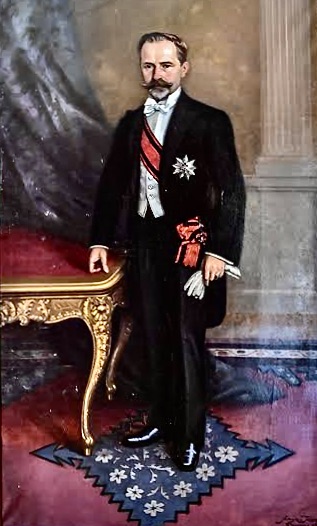
By Ed Staskus
The Friday after my father died the funeral service was at Our Lady of Perpetual Help, the Lithuanian church on Cleveland’s east side, the memorial service was at the Lithuanian Club up the street, and he was laid to rest at All Souls Cemetery in Chardon, forty miles farther east. It is where many Lithuanian American Catholics ending their days on the south shore of Lake Erie ended up.
The memorial park covers some 250 acres, features over 109 developed acres and seven mausoleums, and could be a golf course if it wasn’t a boneyard. If someone’s got the blues, it’s where to go. It’s the place to go when riding in a long black funeral coach to bury your troubles once and for all.
Two years later, paying my respects on a sunny summer day, visiting my father in the mausoleum where he is entombed, and afterwards wandering about the cemetery, I stumbled on the burial place of Antanas Smetona. The name rang a bell. When it came to me, I remembered he was the first and last president of Lithuania between the world wars.
Walking back to my car I passed a headstone 50-some years old. Red and white artificial flowers lay on the ground. Engraved on the stone was a man’s name, the dates of his birth and death, and the inscription “He Done His Damnest.” It wasn’t the kind of epitaph I expected, which would have been more along the lines of “Always in Our Hearts” or “Gone but Not Forgotten.” Had the man gone to Heaven or Hell?
Antanas Smetona did his damnest, too, during a damnably hard time. He was born into a family of farmers, who were former serfs, the eighth of nine children. Their homestead was near a small lake, almost in the dead center of Lithuania. His father died when he was eleven, making a last wish that his youngest son be sent to school. He was the only one of his brothers and sisters to ever get an education. The instruction was in Russian, because the Russians were in charge and Lithuanian talk was zepreshcheno. Lithuanian literature was zepreshcheno. Lithuanian history was zepreshcheno. It was all forbidden.
He was a top student and won a tuition waiver. He supported himself by superintending his dormitory and giving private lessons. After graduation he made his way to Latvia, got involved with the Lithuanian National Revival, got into trouble, made his way to St. Petersburg, got involved in the February 1899 student protests, got into more trouble, got arrested, and got deported back to Lithuania.
After he was allowed to return to St. Petersburg he got involved with Lithuanian book smugglers, got arrested again, got thrown into a castle that doubled as a prison, somehow got acquitted, cracked his books, burned the midnight oil, graduated university, and finally made his way out of Moscow’s orbit. He never went back. He went back to the homeland. Russia was like a cesspool with a big fence around it. Those inside couldn’t leave unless they were thrown out. Those outside didn’t want to jump the fence to get inside unless cesspools agreed with them.
Antanas Smetona got married and went to work for the Vilnius Land Bank. When he wasn’t working he was working with several Lithuanian nationalist groups, writing, editing, and circulating news, all the while endlessly advocating for national unity and independence. He was a firebrand.
When the First World War started he chaired the Central Committee Relief Society and pressed demands on the Germans, who had pushed the Russians out of the country in 1915. His No. 1 demand was that that Lithuania be granted its independence. A year later he began publishing the newspaper Lithuania’s Echo. His message, stated in the first issue, was the speedy establishment of an autonomous and sovereign Lithuanian state.
The Russians didn’t like that, since they had controlled the country for more than a hundred years, but they had their own problems, namely the Eastern Front, where they were busy suffering six million casualties in the trenches and three-and-a-half million captured. On top of that more than a million civilians were busy dying of war-related causes. Adding to the anvil chorus, the Bolsheviks were breathing down the neck of Tsar Nicholas I.
When the Council of Lithuania was formed, Antanas Smetona was elected Chairman and in February 1918 he signed the Act of Independence of Lithuania. The next year he was elected the first President of the Republic of Lithuania. His tenure didn’t last long. The next year a new man was elected and he was out. He taught classes at the University of Vilnius and got involved with the paramilitary group the Lithuanian Riflemen’s Union.
Five years later he led a coup d’etat, deposing the elected head of state and seizing the office for himself. A year later he suppressed the parliament. Two years later he assumed dictatorial powers. For all his editorializing about autocrats, he became an autocrat. For the next nine years he ruled by decree, his new constitution vesting in him both executive and legislative powers. Whenever there were new elections he ran as the only candidate. He won all the elections.
He added his name to the line-up of dictators in the 1930s, joining Benito Mussolini, Joseph Stalin, and Adolf Hitler. He went from idealism and high hopes to rancor and cynicism. Realpolitik is not about democracy and human rights. It is the struggle for power. It’s like Adolf Hitler said, “It is not truth that matters but victory. If you win, you need not have to explain. If you lose, you should not be there to explain.”
Although there aren’t many children nowadays who would accept guidance counseling from Adolf Hitler, there were plenty of men and women back then who were all ears. That’s why cemeteries in 1945 were overflowing, not including the dictators. They made their own bed of nails and bled to death there. Everybody who had been all ears said they hadn’t known anything about their evil ways.
Antanas Smetona may have been a patriot and a loyalist, doing his best to restore Lithuania to statehood, but he was nonetheless a dictator. He repressed the Iron Wolves, a radical rightist movement led by his former Prime Minister who he had earlier removed from office, but his own Lithuanian Nationalist Union took part in the 1934 Montreux Fascist Conference. He may have believed in political parties, but his was one-party rule and he was the bandmaster of the party. He styled himself as the Tautos Vadas, or Leader of the People.
Under his rule Lithuania “moved decisively towards a dictatorship of what might be termed the ‘fascism from above’ variety,” according to Martin Blinkhorn, British historian and author of “Fascism and the Right in Europe 1919 – 1945.” The Russians, masters of doublespeak, said he was trying to “adapt Italian Fascist concepts to Lithuanian conditions.” He was more centrist and moderate in his authoritarianism than many others, but he also believed he was the most qualified and experienced person to run the country. He rigged the way to make sure it stayed that way.
Not that it did him any good. By 1938 he was being squeezed by Nazi Germany and the Soviet Union. He had never been able to get Vilnius back from the Poles. Now he had to surrender Memel to the Germans. When the Russians presented an ultimatum to his government in 1940 he urged armed resistance, but nobody believed that Lithuania’s armed forces, numbering some twenty thousand men, were up to the task of going toe to toe with the five-million-man Red Army.
“I do not want to make Lithuania a Bolshevik country with my own hands,” he said from the steps of the Presidential Palace in Kaunas and immediately fled the country. A month later Lithuania was incorporated into the Soviet Union. He wasn’t on hand to try and stop it with high-minded rhetoric.
When he got to the border Antanas Smetona and his bodyguards waded across a rivulet into Nazi Germany. When he did, he went from lightning rod to lightning bug. The next day his family convinced the Lithuanian crossing guards to let them go, too, since the big fish was already gone. The provisional government wanted him back to explain himself, but what could they do?
The Germans put him up in a hunting lodge in the Masurian Lake District. From there he was moved to Berlin, then traveled to Bern, Switzerland, and wound up in Rio de Janeiro. He finally landed on his feet in the United States where four hundred guests greeted him at New York City’s Pierre Hotel for a lavish dinner. He briefly lived in Pittsburgh and Chicago before settling down on the east side of Cleveland.
When I grew up on the east side in the late 1950s and early 1960s Eastern Europe was right across the street. There were Serbs, Slovenians, Croatians, plenty of Poles, and lots of Lithuanians. Everybody had their own church, their own community hall, and their own watering holes. Everybody had their own talk in their own language about their old homes and their new homes, new lives, and new future in the United States.
Antanas Smetona and his wife Sofija moved in with their son Julius on Ablewhite Ave. on the northeast side of the city, off Eddy Road, near Lake Erie. Julius worked as a grinder for Standard Tool and was married to Birute Nasvytyte, a former concert pianist, raising their two children. The self-styled President-in-Exile worked on his memoirs and visited Lithuanian communities across the United States, speaking about the plight of the mother country and his hopes for its post-war independence.
“What the Magna Carta was to the English, what the rights of man of the French Revolution were to personal liberty, the Atlantic Charter is to nations, especially small nations like ours,” he said, veering from dictator to democrat.
When my parents bought a two-story duplex with a backyard big enough for a pack of kids, their first house in the United States, doubling up with my father’s sister and her family, both families recent immigrants, it was about a mile from the exile’s residence. When I attended the Iowa-Maple Elementary School my first school year in Cleveland, I sat in a classroom a stone’s throw from his house. I wasn’t aware at the time that the ex-president of Lithuania died there less than twenty years earlier.
The day he died, January 9, 1944, he and his wife were in their upstairs bedroom relaxing. It had snowed lightly on Saturday and the windows were frosty in the below freezing weather. They smelled something foul and saw smoke oozing into their room from under the door. The furnace had been acting up lately. “The night before yesterday coal fumes made me dizzy. I could not think clearly. Now I have completely recovered,” he wrote in his journal two months earlier. This was worse than coal fumes. His thinking clear days were fast coming to an end.
The overheated furnace caught fire, leapt up the chimney, and swept through the house. Antanas Smetona and his wife bolted out of their bedroom and down the stairs, but he turned back, grabbing a fur-lined overcoat to throw over his head. By the time he turned around to flee his wife was in the front yard. He never made it out of the house alive.
Fire Battalion Chief Tom O’Brien afterwards said the fire had a “head start” which made it difficult to fight. The coal room had gotten red-hot. After they extinguished the blaze, saving the house, they accounted for everyone, except for Antanas Smetona. They found him face down in the second-floor kitchen, dead of suffocation. A policeman with crime scene chalk outlined where his body was found and firemen carried him out on a backboard.
The formal public funeral was at the Cathedral of St. John the Evangelist in the heart of downtown and was presided over by Bishop Edward Hoban. The Cleveland Police Mounted Unit saluted as his coffin was carried out the front doors. He was buried in Cleveland’s Knollwood Cemetery, but in 1975 was moved to All Souls Cemetery, next to his wife, who had died in 1968.
Although the inter-war years in Lithuania are referred to as the Smetonian Era, there is no monument to the man in Vilnius, the capital of the country. “I really wouldn’t want to say whether I’d approve a monument to Smetona, or not,” Remigius Simasius, mayor of the city, declared. In the end he didn’t say anything else one way or the other. There is still some bad blood about the putsch and his authoritarianism. “Perhaps not so much for the coup itself than for disbanding political parties and essentially destroying the opposition,” Vilnius University historian Alfredas Bumblauskas said.
When I went back to All Souls Cemetery the next summer to visit my father again, I subsequently walked to where I knew Antanas Smetona was six feet up. The polished granite slabs of the man and his wife are on a wall above Grace and Philip McGarry and below Michael and Anna Pula. Someone had fixed fresh flowers to both Antanas and Sofija’s facings. The sepulchral stone was spic-and-span, free of spatter.
I thought of the Blind Lemon Jefferson song written the same year the Smetonian Era began. “There’s just one kind favor I’ll ask of you, see that my grave is kept clean.” No matter what, whether Antanas Smetona had done the best he could, or not, whether he was a statesman or a tyrant, whether he was in Heaven or Hell, the earthly remains of the man were beyond reproach in his neat as a pin final resting place.
Ed Staskus posts monthly on 147 Stanley Street http://www.147stanleystreet.com, Made in Cleveland http://www.clevelandohiodaybook.com, Atlantic Canada http://www.redroadpei.com, and Lithuanian Journal http://www.lithuanianjournal.com.
“Cross Walk” by Ed Staskus
“Captures the vibe of mid-century NYC, from stickball in the streets to the Mob on the make.” Sam Winchell, Beyond Fiction
Available on Amazon: https://www.amazon.com/dp/B0CRPSFPKP
Late summer and early autumn. New York City, 1956. Jackson Pollack opens a can of worms. President Eisenhower on his way to the opening game of the World Series where a hit man waits in the wings. A Hell’s Kitchen private eye scares up the shadows.
A Crying of Lot 49 Publication


Thanks for the history lesson..🙂
LikeLike
Very interesting!
LikeLike