All posts by Edward Staskus

Edward Staskus is a freelance writer from Sudbury, Ontario. He lives in Lakewood, Ohio. His crime thrillers "Cross Walk" and "Bomb City" can be found on Amazon.

Breathless (Wonder Wheel)

By Ed Staskus

Before today’s groundswell of yoga there was Charles Atlas in the 1920s and Joe Wieder in the 1930s, he-men manufacturing “97-pound weaklings into men.” Jack LaLanne, the godfather of physical fitness, opened his first health studio in California. Resistance training gained ground and Nautilus was invented in the 1940s. Isometrics or “motionless exercise” was the rage in the 1950s, and Universal introduced its first multi-station weight-training machines.

Dr Kenneth Cooper’s aerobic training popularized jogging in the 1960s and in the 1970s modern health clubs began to spring up. In the 1980s Jane Fonda brought aerobics to the masses. Aerobicise, the world’s highest-grossing exercise video of all time, was produced, and the weight-loss fitness personality Richard Simmons became a household name. In the 1990s step aerobics was wildly popular, Madonna inspired women to weight train, riding a bike became spinning, and Tae Bo, or fitness kickboxing, was the hottest trend of the 1990s.

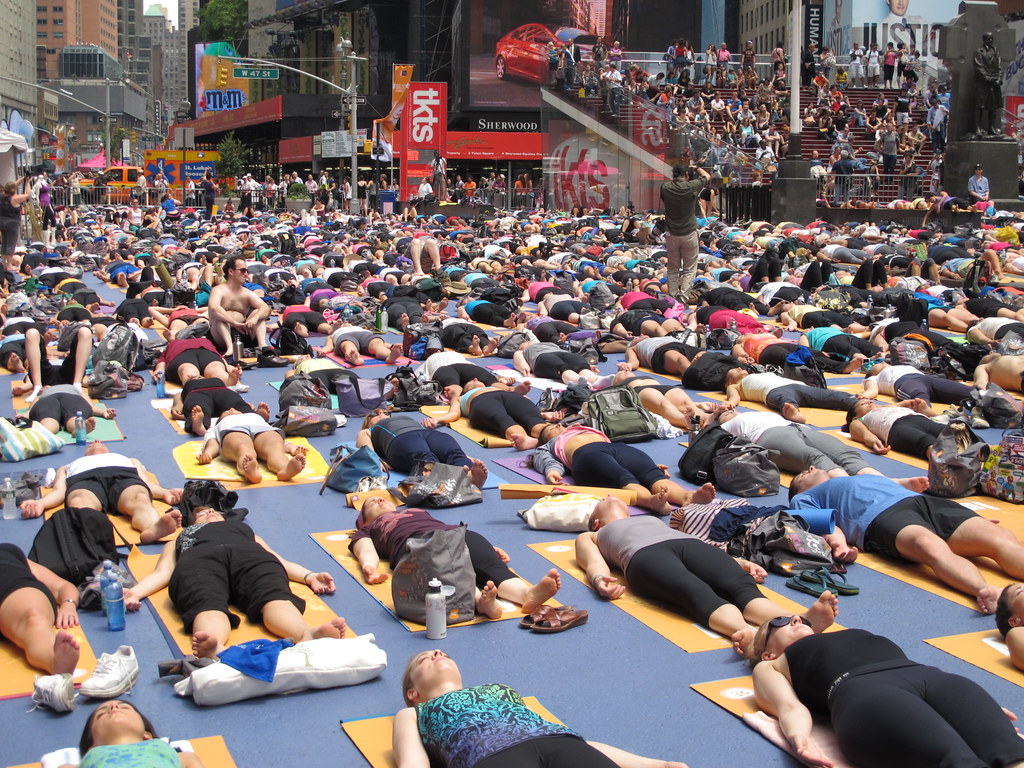
In the new century boot-camp style workouts, Latin dance, or Zumba, and Pilates were top fitness trends. But, in terms of growth, from the late 1990s through today, nothing has matched the marketplace expansion of yoga. In 2009 the National Sporting Goods Association reported that among activities in which more than 10 million people participated, yoga was the fastest growing of them all, its rise measured at a rate of 21% annually. This compared to 3% for aerobic exercise, 2% for weight lifting, and 1% for jogging.

Spending on yoga products has increased by 87% in the past 5 years, according to the Yoga Business Academy. Doctors sometimes recommend it to their patients and a few insurance companies already pay for the practice. The wellness industry is bringing it into its fold and the corporate world is busy mainstreaming it. Approximately one in sixteen Americans currently practice yoga.

“If the rate of growth continues,” said Mathew Schaser of Equity Engineering, “every American will be practicing yoga by the year 2032.”

The consequences for the American way of life would be both confounding and devastating.

Many people practice yoga on a physical level, going to yoga exercise studios or unrolling their mats at home. Yoga practice has specific health benefits, including greater range of motion, strength, muscle tone, pain prevention, and better breathing. Yoga breathing calms the central nervous system, which has both physical and mental benefits.

Scientific studies have proven that spinal flexibility and cardiovascular health markers improve with yoga exercise.

“There are all these wonderful cardio effects that come from the other end of the spectrum,” said William Broad, author of The Science of Yoga. “The relaxation of the heart, rather than the pumping-up phenomena that you get from aerobic sports.”

According to the Yoga Health Foundation the health issues yoga addresses include chronic backache, depression, diabetes, menopause, stress, asthma, obesity and heart disease, not to mention arthritis.

More than one in five Americans suffer from arthritis, according to the Centers for Disease Control and Prevention. The number of Americans with arthritis is expected to climb to 67 million by 2030, estimates the Arthritis Foundation.

“People with rheumatoid arthritis may benefit from low-impact exercises like yoga to help improve overall health and fitness without further damaging or hurting the joints,” said Dr. Cheryl Lambing, Assistant Clinical Professor at the University of California Los Angeles. “It may optimize both physical and mental health and play a vital role in disease management.”

Bikram Yoga benefits bad knees through poses that focus on stability and alignment, keeping the kneecap moving smoothly along its track. Iyengar Yoga provides relief from lower back problems. In a 6-month research study in 2009 at the University of West Virginia, subjects suffering from chronic back pain who engaged in Iyengar Yoga reported less ”functional disability and pain.”

For many people who practice yoga it is a game changer.

“I started yoga in 2002 and it has become a way of life for me,” said Dr. Rathore Ramkashore, a biologist and former editor of the Journal of Agricultural and Scientific Research who suffered from back problems. “It has given me physical and mental well-being.”

Given its applicability and success in dealing with many physical ailments, yoga practice poses a serious threat to the American healthcare industry.

Americans spend more than $8 thousand dollars per person, man, woman, and child, on healthcare every year. The American healthcare industry is the largest of its kind in the world. According to the World Health Organization spending in the USA on healthcare is close to 20% of GDP, the highest by far on the globe, even though American healthcare is ranked 37th in overall performance and only 72nd in overall health of its population.

American health insurance companies increased their profits by 56 percent in 2009. A recent report by Health Care for America Now noted that the country’s five biggest for-profit health insurance companies ended 2009 with a combined profit of $12.2 billion.

There are 784,626 healthcare companies employing almost 17 million people in the United States. According to the US Department of Labor the healthcare industry added on average 26,000 jobs to the economy every month in 2012.

The more people practice yoga the less likely they might be to need the services of the healthcare industry. That could spell trouble for an industry that employs approximately one of every eight Americans. For example, more than $86 billion dollars are spent annually in the USA treating back pain, according to The Journal of the American Medical Association. If most of that money were extracted from the economy because everyone was practicing yoga and there were far fewer back problems for doctors to treat, it would result in significant downsizing and unemployment among healthcare workers.

Arthritis is one of the top 5 health problems plaguing Americans today. The total annual tab for treating arthritis exceeds $100 billion dollars annually, from prescription drugs to surgery. Everyone recommends exercise, or simply movement of any kind, from family doctors to the Arthritis Foundation. The reason is that exercise makes synovial fluid move within joints. The element that supplies nourishment and lubrication to joints is specifically this fluid. The flexibility and pivoting of joints is only possible because of it.

One positive effect of yoga practice is to get synovial fluid flowing. “One thing that yoga does for sure is move the joints into extreme but safe positions, allowing the obscure corners and crevices of each joint to be awash with lubricating, life-sustaining fluid,” write Dr. Loren Fishman and Ellen Saltonstall in Yoga for Arthritis.

If everyone practiced yoga asanas, and if even half of them were able to stabilize or reverse their arthritis issues, the end result would be a loss in the range of $50 billion annually to the healthcare industry, forcing more contractions and subsequent lay-offs of personnel.

Heart disease is the leading cause of death in the United States, according to the American Heart Association. Approximately 600,000 people died because of it in 2011. Among those who practice yoga it has long been known to be good for the heart, in more ways than one. Now even the medical community is chiming in. “A small but promising body of research suggests that yoga’s combination of stretching, gentle activity, breathing, and mindfulness may have special benefits for people with cardiovascular disease,” writes Harvard Health Publications.

“Yoga is designed to bring about increased physical, mental, and emotional well-being,” said M. Mala Cunningham, Ph.D., counseling psychologist and founder of Cardiac Yoga. “Hand in hand with leading a heart-healthy lifestyle, it really is possible for a yoga-based model to help prevent or reverse heart disease. It may not completely reverse it, but you will definitely see benefits.”

Even if not a panacea, if yoga practice could make a dent in half of the heart disease in the USA, it would not only alleviate a great deal of suffering, it would significantly cut into the direct medical costs of the malady. One study estimated that over the course of a person’s lifetime, the cost of coming down with severe coronary artery disease is more than $1 million.

Even if you don’t develop heart disease, it is still costing you.

“You’re paying for cardiovascular disease whether you have it or not,” said Paul Heidereich, a cardiologist at the VA Palo Alto Health Care System in California, and Associate Professor of Medicine at Stanford University. “You’re paying for it in your taxes and your health insurance premiums.” He estimates that the average person in the USA is paying $878 per year for the societal costs of heart disease.

The consequences for the healthcare industry of everyone in America practicing yoga become clear when focusing on lower back pain, arthritis, and heart disease. The result would be severe dislocations and unemployment, as well as the loss of significant revenue for hospitals, clinics, and doctors, not to mention support personnel and vendors.

Obesity in America would also likely be trimmed to manageable levels, or reduced to nothing, if everyone practiced yoga.

More than one-third of all Americans are obese, according to the Centers for Disease Control and Prevention. Obesity is defined as having an excessive amount of body fat, or a body mass index over 30, says the Mayo Clinic. Since 1988 in the USA obesity has dramatically increased in adults at all income and education levels. Current estimates suggest that the yearly medical costs of adult obesity are between $147 billion and $210 billion. The weight loss and diet control market has been estimated to have reached $60 billion a year, led by commercial diet chains, multi-level marketing diet plans, and retail meal replacements and diet pills.

Although not primarily known as an aerobic activity, or an activity that raises ones metabolic rate, which is belied by such 90-minute practices as Ashtanga and Vinyasa, yoga has long been known to be a practice that changes people’s bodies and keeps them changed.

“Yoga practice can influence weight loss, but not in the traditional sense,” said Beth Lewis, Associate Professor at the University of Minnesota School of Kinesiology in Minneapolis. “Many yoga practices burn fewer calories than traditional exercise, but yoga can increase one’s mindfulness and the way one relates to their body. So, individuals will become more aware of what they are eating and make better food choices.”

Yoga professionals are more emphatic about yoga’s weight loss capabilities.

“Yoga facilitates weight loss in several ways and, when combined with evidence-based nutritional guidance, can be highly effective,” said Annie Kay, Lead Nutritionist at the Kripalu Center for Yoga & Health.

What people who have lost weight through yoga say about it is the proof in the pudding. In 2008 Claudia Azula Altucher lost 30 pounds “and the weight never came back.”

“When it comes to losing weight I find that it does not so much matter what kind of yoga one practices, but that one does,” said the author of 21 Things to Know Before Starting an Ashtanga Yoga Practice. “The simple act of getting on the mat every day sends the body the message that one cares.”

Doing an about-face on obesity could cost the American economy $270 billion a year.

Although universal yoga practice would be dire for the healthcare industry, the picture for normative life in America gets worse when a light is shone on the rest of yoga, not simply on the physical exercise aspect of it. If everyone practiced all eight limbs of yoga, society in America as we know it could very well be transformed, or collapse.

A version of this story appeared in Yoga Chicago Magazine.

Ed Staskus posts stories on 147 Stanley Street http://www.147stanleystreet.com and Cleveland Daybook http://www.clevelandohiodaybook.com. To get the site’s monthly feature in your in-box click on “Follow.”

Poor Little Retard Kid

By Ed Staskus

   After Maggie Campbell was born family vacations became a sore point. “I have to drag those two around?” her mother Alma complained, pointing to Maggie and her older sister Elaine. Fred her husband took a slurp of his Manhattan. The day Bonnie and Brad came on board vacations came to a dead stop, except for once. When Elaine had been the one and only, she went all the time, mostly to Florida to see their grandparents, where she would ride fan boats and go fishing, and all her other fun stuff.

   Maggie screwed up the scheme of things, but still had her summer fun. When Bonnie and Brad rounded out the family her mother blew her top. “Too many kids,” she complained after they were born. The family vacations were more-or-less over and done with after that.

   “I never wanted you kids. You are all your father’s idea,” Alma told them their entire lives. She meant the children were a bad idea since they were her husband’s handiwork. “Why are you even here? You’ve ruined my life!”

   Her mom never wanted any of them, so she was sullen whenever one of them was in the house. Anytime one of them would walk into a room she got irate that they were living and breathing and asking her for something. Whenever all of them walked in all at once she hit the roof, exasperated. 

   “It’s a good thing she doesn’t have a gas chamber in the basement,” Maggie told her brother and sisters. She didn’t know gas chambers were frowned on in Bay Village, Ohio. Even so, knowing wouldn’t have helped.

   Later, when they got older, Elaine was ostracized from the family, and Bonnie cut herself off. Elaine locked herself in her room and never came out. Bonnie was always fuming if she was within a mile of the house. 

   Whenever Brad made his parents mad, Maggie would jump in and take his punishment. She couldn’t stand to see him get it. None of them wanted to get hit. But the sisters were always throwing each other under the bus. “The bad part is your sisters then grow up hating you.” That’s how there was the mess between them and Maggie, a mess that wouldn’t go away. She wasn’t saying there weren’t good times, but it was tough sledding.

   The one and only all in the family vacation they went on her whole life was to Disneyland. Her mom was sullen about it, complaining that it was like corralling cats. One morning Maggie was with her. They were out searching for breakfast. No one knew where Elaine was. She had just walked off by herself. Bonnie took Brad with her, and their dad went to find tickets to see the Country Bears Jamboree.

  That’s the only reason he had agreed to go to Disneyland to begin with. He was a stockbroker and vice-president at Prudential Bache in downtown Cleveland where moneybags went every day but loved the Country Bears and couldn’t get enough of them. He laughed ear-splittingly at the mention of them.

   When her mom and she finally got trays of breakfast for everybody they couldn’t find anybody, so they sat down on a curb. A minute later, sitting on the curb, looking up, they saw Bonnie and Brad go slowly past, leaning back in a horse-drawn carriage, waving at them like movie stars

   Alma and Maggie looked at each other. Where were the rest of the lost and found? Their food was getting cold.

   They saw the Bear Jamboree later, and the next day Maggie spotted Donny Osmond riding the same monorail with them out of their hotel. Her sisters loved Donny Osmond but wouldn’t go up to him. They were scared skittish. Maggie was gun-shy, too, but her dad pushed her in Donny’s direction, anyway.

   “Go get his autograph,” Fred said.

   “No, no, no,” she said.

   Fred pushed her forward. She got a push in the small of the back running start, and the next thing she knew was standing in front of Donny Osmond. Maggie was just flabbergasted. She had seen him on TV and now she was standing less than a foot from him. She stammered and bumbled fumbled with her hands. She got his autograph, although she didn’t know how. Maybe he felt bad because he thought she was special needs.  

   “Poor little retard kid,” he probably thought and gave her his autograph. He could be cavalier, unless they were lookers, when he got even more cavalier. When the wheels of the monorail stopped, Maggie ran off the car as fast as she could. One of her shoes went flying. Donny Osmond ducked. It hit Micky Mouse who was behind him. Mickey gave Donny a dirty look.

   “Why would you do that to me?” she asked her dad. “Why me?”

   After the vacations stopped Maggie went to Bay Village High School. She was a lifeguard at the Bay Pool and a Bay Rockette on the kick line for two years. She had many friends growing up, but hardly ever had them over to her house. She went to their houses. She was always leery of having them over because she never knew if her dad would out of the blue lose his temper or her mom would out of the blue start something disastrous.

   If anybody liked something Alma was always going to find a way to not like it. After Maggie moved away, her sister Elaine, who had long since moved away, wanted a family heirloom their mom had, a bench that had been in their great grandparent’s house, but Alma wouldn’t let her take it.

   Her parents had the bench in their split-level family house in Bay Village, at the end of their bed, but when Fred passed away and Alma re-married in the blink of an eye, marrying her old high school sweetheart from Jersey Shore, and moving to a new house in North Ridgeville, she put it away in her garage.

   Elaine wanted the bench bad. Maggie told her mom over and over that she wanted it, but Alma said, “No, she can’t have it, and that’s final.” It was like talking to a blockhead of wood.

   “What are you doing with it?” Maggie asked. She knew the answer, which was nothing, but wanted to hear Alma say it. “No, no, no,” was all she said. It was because she knew Elaine wanted it that she wouldn’t give it to her. That’s the way Alma was. If someone loved something, then she hated it. She had always been like that. Their dad could be cool sometimes, at least. Maggie knew, even though he beat the tar out of them, that he cared about them. But, their mom, not so much, if at all.

   Maggie had a Rockette party at their house before her senior year, at the tail end of August. The party came out of left field. They were at practice and their coach said the first football game was coming up soon. It was on September such-and-such, but they didn’t have a place scheduled for their potluck, yet.

   “We can have it at our house,” Maggie blurted out. Just like that, thirty high school girls were going to be coming over to their house. She called her dad at work. He sounded happy to hear from her.

   “Hey, dad,” she said. “I just invited all my friends over for a potluck.”

   “Sweet,” Fred said. “We’ll make it work.” Maggie was amazed and hung up before he could say anything else. She didn’t say anything about the potluck party to her mom. It would have been like poking a hornet’s nest with a stick.

   Her dad came home early from work the day of the party, brought all the hot dogs hamburgers buns and pickles, and enjoyed having her friends in the backyard. He was all over the place with his camera and took a ton of pictures. It was a good time. Her mom stayed in the house and never came out. Fred loved it, but Alma was angry and sulking that her daughter had all her friends over.

   Maggie loved being a Rockette. She was one of the in crowd during her sophomore and junior years in high school until the night not long after the party when she tore her hamstring in three places. It was an act of God, but a misadventure that was going to take three or four months to mend. She had to give up being a Rockette her last year of high school because of her leg.

   It was terrible, like she had lost something special, something she could never get back.

Ed Staskus posts stories on 147 Stanley Street http://www.147stanleystreet.com and Cleveland Ohio Daybook http://www.clevelandohiodaybook.com. To get the site’s monthly feature in your in-box click on “Follow.”

Horrible House

By Ed Staskus

   Mike Butler was catching some zzz’s beneath a clear night sky and three-quarter moon. When he woke up, he woke up quickly. The car came to a stop below him, the engine went dead, and a car door opened. It closed quietly, a trunk opened, and closed quietly.  He peeked down through the slats of the second story deck. The trunk wasn’t a trunk. It was a hatch. The car wasn’t a car. It was a black Lexus SUV.

   A man carrying a rolled-up bundle, like a carpet, wrapped in plastic, over his shoulder, went into the house through the side door. He beeped his way in with his set of keys. Mike rolled quietly off his folding chair. He stood to the side of the sliding glass door. No lights had come on and he couldn’t hear the man in the house. Was he coming upstairs or staying downstairs?

   Should he go or should he stay? He knew he could ignore the stairs, swing over the railing, and drop soundlessly down on the sand at the back of the house. He didn’t know where the windows there were, not exactly, even though he had helped cater some parties in the house last year. He decided to stay.

   He didn’t have to wait long. When the man came out of the house he walked to the front of the Lexus, leaned back on it, facing the dark ocean, and lit a cigar. In the flare of the lighter his lips were pinkish, like pink goo. The ash from the cigar flaked off and floated like charred mercury onto his safari jacket.

   Mike stayed in the shadow of the eaves where he could see the man but the man couldn’t see him. He could hear Cape Cod Bay at high tide on the other side of the beach. The man with the cigar in his mouth got into the SUV and drove away.

   Mike went the way he had come, walking up Chequessett Neck Road to Great Island where he had parked. At home he rolled a smoke. He had been surprised as anyone would be surprised by anybody showing up at a seasonal mansion in early May, in the middle of the night, even though the weather was unusually fine.

   Vera Nyberg was and wasn’t in a hurry. If she left in the next five minutes she might be on time for work. If she took Archie for a walk she would be late for sure. Halfway into spring, halfway to summer, her job wasn’t so much work as it was holding down the fort. It’s never too late to go and get that fresh air feeling, she thought, thinking about going for a walk.  

   Besides, unless it was summer, when everyone on the Outer Cape worked like dogs, she tried as much as possible to get to the office late and make up for it by leaving early. If she left early today she could make the five o’clock Strong Flow class at Quiet Mind in Wellfleet.

   “Come on Archie,” she clapped, reaching for the Airedale’s leash. They left the house on Washington Avenue and walked up Commercial Street. When they got to Lopes Square they turned down MacMillan Pier to the end where the ferry came and went to Plymouth. 

   Archie was her constant companion, her watchdog, and one of her best friends. He liked running full speed ahead into streams ponds ocean. In the 1920s President Warren Harding had an Airedale. His name was Laddie Boy. President Harding always included the dog in his cabinet meetings at the White House. Laddie Boy had his own special hand-carved chair.

   They’re all mongrels now, Vera thought

   “Come on, boy, let’s go home,” she said.

   Archie liked Vera more than anyone. He felt like there were three faithful friends in this life, ready money, a good dog like himself, and a good master like Vera. He liked everything about her. She enjoyed reading books at night. He curled up at her feet, keeping her feet warm and his belly warm, too. “Outside of a dog a book is man’s best friend,” said Groucho Marx. “Inside of a dog it’s too dark to read.”

   Archie didn’t take it the wrong way. Besides, he didn’t know how to read. He wasn’t planning on learning, either, although Vera sometimes read stories out loud to him. Learning to read was the first step on the path to a career. He was not a working dog.

   Dick Armstrong was a well-built man with thick lips and a crooked smile. At least Vera Nyberg thought so. She smiled back at him as he sat down carelessly. He wore a cotton safari jacket and aviator sunglasses. He had scrupulously white teeth, but she didn’t like the way he smiled, or the way he sat down. His face was scabrous and she found herself looking away, only glancing at him.

   Vera shot an eye at his driver’s license. He did and didn’t look like himself, two-faced.  She thought she might not like him. What if she had planted a bomb in the seat cushion by mistake?

   “What can I help you with, Mr. Armstrong?” she asked.

   “You work for me,” he said. “You watch our house.”

   Vera smiled politely and imagined a small bomb in the seat cushion, again.

   Vera Nyberg was an Ashtanga Yoga teacher, but yoga didn’t pay the bills in the off-season, or the on-season, either. She worked part-time for Focus Home Security, in Orleans, in a small office condo off Cove Road behind the Orleans Post Office. The office was on the first floor and faced south, lit by bright natural light on sunny days and gray natural light on cloudy days.

   The drive was more than forty minutes from her rented room in Provincetown, but since she worked part-time, and since it was an off-season job most of the time, it wasn’t too long or too much. Route 6 was never overburdened in the off-season. Besides, most of her work was on-the-road work like property checks home watch resetting smart home features in Wellfleet, Truro, and P-Town itself, all of which were closer than the office.

   She baby sat summer vacation mansions and held the hands of absentee landlords. Vandalism, storm damage, and frozen pipes were usually as nerve wracking as it got. Property surveillance was Focus Security’s bread and butter.

   “I pay for your key-holding service, and since I was passing through, I want to stop at our house and walk through it, look everything over, before we come up next month,” said Dick Armstrong.

   Who passes through the back end of a peninsula? Vera asked herself.

   “Of course, we can arrange that,” she said. “When would you like to inspect the house?”

   “Now.”  

   Twenty minutes later they got off Route 6 and drove through Wellfleet to the bay side of the town. The Lexus blotted out the sun as Vera followed behind Dick Armstrong down the curvy Chequessett Neck Road. Archie lolled in the back seat of Vera’s Honda CRV.  

   She had never been inside the Armstrong house, but had seen it often enough. She took Archie for walks on the long beach past what was called The Gut. After parking at Great Island, unless she cut through the woods and took a track on a backside dune, she walked past the house at the end of the road. She had even parked in their driveway several times, when she knew the house wasn’t occupied, when she was short on time for a quick short hike. 

   The Focus Security magnetic vehicle sign came in handy then.

    The house was on the edge of the Cape Cod National Seashore and stuck out like a sore thumb. She knew it had a reputation. Eight years ago, when it was being built, it was sometimes called Horrible House. 

   An older, smaller house had been bought and torn down and the Armstrong’s had somehow convinced the town’s building inspector to give them a permit to build a house three times the size. It dominated the view across the Herring River. Wellfleet’s homeowner’s association and the National Park Service appealed the permit, but the house got built, anyway.

   “Kill the Rich!” had been spray-painted below the garage door windows before the house was even finished. Focus Security parked a man in the driveway until the commotion died down. Since then, the Armstrong’s spent three or four or five middle-of-the-summer weeks on the Outer Cape. Sometimes their children, extended family, and friends took the house over for a weekend. After Labor Day it was shut up for the winter.

   Everything about the house was Cape Cod-like, from the cedar shingle siding to the paired windows on both sides of the central front door to the fishy weathervane. Everything was right about it, perched on the sea, except for the King Kongness of it.

   They parked in the driveway. Vera looked up at the second story deck. She liked the deck, round high facing the ocean.

   “Unlock this door,” said Dick Armstrong, pointing to the side door. “I don’t want that in the house,” he said, pointing to Archie in the back seat.

   Archie didn’t like the way the man said it, but he didn’t bark about it.

   As soon as they were inside the house, he jumped out of the car window Vera had left open for him. He barked at the Lexus. He sniffed at one of the rear tires, lifted his hind leg, and peed on it. Archie could hear and smell the ocean. In a minute he saw it and in the next minute he was at the shore, in the water.

   Inside the house Vera sat at the kitchen table while Dick Armstrong strode through the rooms, strode upstairs, and strode back into the kitchen.

   “Everything looks good,” he said. “Come down to the panic room. I want to check the alarm system and security cameras.”

   “I thought they were called safe rooms.”

   He gave her a sharp look. “Panic room.”

   The basement floor was a mirror-like epoxy painted slab. There were a pool table, a billiards table, a snooker table, and a bar with eight or nine stools. The safe room was a concrete square in the corner. The door was a steel door. The hinges and strike plate were reinforced. A table with four chairs was to the right of the door. An open bathroom with a first aid kit on the wall was behind the table. On the left a two-door cabinet held dry goods, bottled water, and gas masks. In the left corner were an office chair and table, an iMac, shortwave radio, and closed-circuit monitors.

   A woman was splayed on the floor, dress disordered eyes closed face blank, dark red blood drying in her blonde hair.

   Vera looked up as Dick Armstrong took a step at her and grabbed her by the throat. His face looked like murder. She slashed at his mouth. His lips came off in her hand. He hit her with a short hard right to the temple and her legs went wobbly. She leaned into him. A black inky film filled her eyes. She lost consciousness as he let her go to the ground.

   Archie was almost dry by the time he ran back to the car. He had a hard dense wiry coat. Thick heavyset dark clouds were rolling in across the bay. When Dick Armstrong came through the side door Archie wondered, where’s Vera? The side door slammed, and the man strode towards his car.

   Archie didn’t like the smell of it. The man had a sour smell. He wanted to ask him where Vera was, but the man, opening his car door, kicked at him. Archie was an Oorang Airedale. His great-great-great-great grandfather had been a fierce competitor in water-rat matches. He jabbed headfirst at the man’s leg, slashing through the pant fabric, and biting into warm flesh. He could taste blood in his mouth.

   It tasted good.

   Dick Armstrong yawped and flung himself into the Lexus, lurching and grabbing at the door. Backing out of the driveway he swerved at the Airedale, but Archie was graceful fast lissome, and it was child’s play jumping to the side.

   The better I get to know people, thought Archie. He wasn’t trying to be narrow-minded, but what he liked about people most of the time was their dogs. Dogs never bite me, only people. He jumped into the CRV. The rain fell like dread.

   Vera Nyberg blinked her eyes open. She was lying prone on a medical exam table. The ceiling was white. She took ten twenty then a hundred slow steady breaths staring into the white. When she was done, she tried to prop herself up on her elbows. She slowly deliberately wary lay back down on her back. Her head hurt like somebody had hit it with a hammer. Hedging her bets, she closed her eyes and fell back into the inky blackness. 

   Officer Matheus Ribeiro was stocky and had short stocky black hair. Besides routine patrol work, he was the medical supply officer and detainee monitor. He sat across from Vera in an interview room in the Wellfleet Police Department checking and double-checking a sheaf of papers on a clipboard. Vera knew him, not so much as a policeman, but more as a friend of Rachel Amparo, her friend on the Provincetown Police Department.

   He was from Brazil, Porto Velho, one of the state capitals in the upper Amazon River basin. He was a graduate of the Plymouth Police Academy and had been on the Wellfleet force for six years. He spoke Portuguese, Rachel spoke Portuguese, he was a great cook, and Rachel loved great food.

   One night, over plates of bacalhau, Vera asked him what he liked about being a policeman.

   “I get to drive as fast as I want,” he said.

   Rachel, whose duties routinely involved foot patrols, scowled.

   “What the hell, Vera,” he said. “What happened?”

   “Where’s Archie?” she asked.

   “He was asleep in the back of your car. We called Bruce. He and a friend of his picked Archie up and your car and took them home. Now tell me what happened.”

   When she was done, she laced her fingers, reached up and behind the chair, and stretched. Officer Ribeiro leaned back in his chair, tipping on the back legs. He straightened up.

   “Mr. Armstrong was who called us about you,” he said.

   “What?”

   “He called the department and said he was worried, said he had called from Boston and asked that somebody from Focus walk through his house, that he was coming up for the weekend, since the weather was so good. He said you volunteered and would call him back within the hour. When you didn’t call by the end of the day he called your office, no answer, and then called us.”

   The policeman drank from a bottle of Poland Spring.

   “He asked us to drive by, see if everything was OK. When we pulled up your car and Mrs. Armstrong’s car were in the driveway.”

   “Mrs. Armstrong? There was no Mrs. Armstrong, only him, by himself. And the woman.”

   “The woman was Mrs. Armstrong. She was in the safe room in the basement, with you, except she was dead.”

   “That was the first and only time I ever saw her.”

   “I was going to ask you about that. We’ve told Mr. Armstrong about her death, and he’ll be here today.”

   “If that’s him in the picture you showed me, that’s not exactly him. That’s not the man who slugged me.”

   “There’s something at odds here.”

   “What time is it?”

   “Nine, nine in the morning.”

   “When did Mrs. Armstrong die?”

   “The medical examiner so far is saying ten, eleven o’clock, the same time you were there.”

   “How did she die?”

   “The same as you, blunt force, but you didn’t die.”

   “Am I a suspect?”

   “Yes and no.”

   “I like the no part better. Can I go have breakfast?”

   “How’s your head?”

   “It could be better.”

   “There’s no substitute for a hard head. Where are you going?”

   “The Lighthouse, then home, I’ve got to shower, and change. I’ll be back.”

   “How are you going to do that?”

   “I was hoping you could drive me to the Lighthouse. I’ll call Sandra on the way. She can take me home. Archie and I will be back by five.”

   “This isn’t exactly how murder investigations are supposed to go.”

   “You’re right about that, about this being murder. He was the man who slugged me, with his wrong face or no wrong face. I think it’s all just sand in our faces, just some sleight of hand.”

   “We’ve confirmed him to be in Boston with a friend yesterday.”

   “What kind of a friend?”

   The policeman hesitated. “A close friend.”

   “It has to be something about the house, something personal. Why not solve your problem in Boston, or get someone else to solve your problem, make it disappear? I’ve got a friend, one of Sandra’s catering guys, who was once a jailhouse lawyer, before he went more-or-less straight. He’s an IT jack-of-all-trades, good at following the money. He’ll know how to find out.”

   “I know Mike Butler, so let’s drop that within earshot of me,” said Officer Ribeiro.

   “Man, that’s crazy, I was there the night before last, hanging out on that second story deck of theirs,” said Mike Butler.

   Vera, Sandra, and Mike were having a late breakfast at the Lighthouse. They sat at the bar. Sandra lived in Eastham but worked part-time at Herridge Books in Wellfleet. It was a small bookstore with no magazines and no café, just books. There were books in stacks on chairs tables and the floor. It smelled like a bookstore even with the windows open.

   Sandra catered private parties on the side. Mike was one of the local men who worked with her. In the off-season, in the late afternoon or evening, he often roosted on decks and porches of unoccupied seasonal houses on seaside lots. “What they don’t know won’t hurt them,” he said. He never brought his iPhone. He never parked in the driveways. He always brought his own Eddie Bauer folding chair.

   “Yeah, there was a guy, some kind of black car, a big one, like a Caddy, or a Lexus, maybe” he said. “He carried something into the house, didn’t stay long. As soon as he was gone, I made myself gone, too.”

   “Can you find out about that house, about them, who held the purse strings, and who was on the outs with who?”

   “Sure, after breakfast, give me a few hours. Call me if I don’t call you. I might be taking a nap.”

   Men are most sincere when they’re in love, when they’ve been empowered, and when they’re committing murder. Dick Armstrong must have fallen out of love with his wife, thought Vera. Murder wasn’t the next step, but it might be if his love had turned to hate. Murders are always a problem when they’re spur of the moment crimes, when they’re mistakes. But Dick Armstrong had gotten too clever for his own good trying to send a message to the graveyard. When someone has thought and thought about something it isn’t hard working backwards and reading their thoughts.

   Vera showered, fed Archie, and meditated for an hour. Most days she meditated for half an hour, except when she was busy. Then she meditated longer. She had been busy the past day-and-a half. Breathing exercises and meditation were about everything and nothing at the same time. They were acts of slowing down, getting centered, and finding some understanding and compassion for the living and the dead.

   “It’s his money, real estate money, plenty of it and plenty of it shady, but all the personal property was in her name,” said Mike Butler as they sped down Route 6 to Wellfleet.” She was after a divorce, she’s saying abuse, but she wanted more than alimony, she wanted the summer house.”

   “The horrible house,” said Vera.

   “It’s not so horrible, kind of big, but a great view of the bay.”

   “Why did she want the house?”

   “She wanted it because he wanted it. He planned the house just the way he wanted it, he bought off everybody and his brother, he went to court, fought off the do-gooders, the Feds, got it built even though they made him jump through hoops, got it done. Hell, he probably loved that house a lot more than he loved her. She probably knew that, too.”

   Mike Butler had grown up in old Provincetown before it became new Provincetown, when property was cheap and rents low and gays and hippies were starting to show up. He didn’t downpress anyone one way or the other. His father had fished for cod on his own boat out of Provincetown Harbor. Mike still called Commercial Street Front Street and Bradford Street Back Street.

   He didn’t care about bankers and stockbrokers buying up land, either. He had his family’s old small house in Provincetown. The front door still faced the ocean, unlike most of the town’s waterfront houses, which had been turned round so the front doors faced the street. He kept to himself, except when he was working, or watching a BoSox game at the Lighthouse, a Pabst Blue Ribbon at hand.

   Mike lived with a box turtle he’d had since he was a kid. Inscribed on the underside of the shell of the turtle were the initials M. B. and the year 1979, where he had carved them with a pocketknife on his 18th birthday, six years after his father gave him the baby turtle for his birthday.

   Archie liked riding in the CRV with the windows open, just in case anything came up that he needed to bark at. But he had a bad habit of barking at anything that moved, a crossing guard, a passing bicyclist, a rafter of wild turkeys on the side of the road. Sometimes Vera told him to “Shut the hell up.” He didn’t know exactly what hell was, but he knew exactly what she meant when she said it. She wasn’t shy or dry nor someone who beat the sense out of words.

   When they pulled into the Wellfleet Police Department parking lot and Archie barked at Dick Armstrong getting out of his white Lincoln Navigator, Vera said, “Good dog.” Two men in suits went into the station with him. “At least one of them is a lawyer,” said Mike. He rubbed the top of Archie’s head.

   The police station was on Gross Hill Road off Route 6, tucked beneath Oakdale Cemetery where Cemetery Road began and ended. “I’ll stay here, maybe go for a walk in the graveyard,” said Mike. Vera and Archie went into the station. Vera sat on a plastic chair in the lobby and Archie flopped down on the floor. She had gotten a good look at Dick Armstrong and couldn’t swear he was Dick Armstrong.

   A half-hour later, when Officer Matheus Ribeiro came out to the lobby and asked her if she could identify Dick Armstrong as the man who had attacked her in the safe room, she said, “No.”

   “Too bad,” he said. “I don’t think we’re going to be able to charge him with anything.”

   Ten minutes later Dick Armstrong and the two men accompanying him pushed into the lobby on their way out of the police station. One of the men gave her a look-see. Dick Armstrong stopped and eyeballed Archie.  

   Archie jumped up and started barking his head off. It was the sour-smelling man he had bitten outside the big house. He barked and barked but could tell no one was making heads or tails of what he was trying to say. “Keep that damned dog away from me,” shouted Dick Armstrong.

   Archie lunged at him, got his teeth into the right pants leg, and tugging violently tore the fabric off the leg at the knee. One of the men started to beat Archie with his briefcase. The police dispatcher, another policeman, and finally Officer Ribiero burst into the lobby, manhandling Dick Armstrong away from Archie, pulling Archie away from him, and pushing the lawyer with the angry briefcase away from the fracas.

   “Look what that goddamned dog did to my pants,” yelled Dick Armstrong.

   Everyone looked

   “Look at his leg,” said Vera. “Look at the bite mark on his shin.”

    Everyone looked.

   The bite mark was black and blue in an ugly ring where the skin had been broken. Five inflamed red marks defined where canine teeth had drawn blood. Some kind of antiseptic cream was smeared over the wound. Two of the red marks were back-to- back.

   “That’s Archie’s bite,” said Vera. 

   “What?” asked Officer Ribiero.

   “One of his baby canines got retained, and since it wasn’t bothering him when his permanent teeth came in, I just let it go. He’s got two canine teeth on that one side, which is why his bite mark is the way it is. I’d know it anywhere, because that Dick Armstrong isn’t the first Dick Armstrong he’s bitten. If this man was in Boston yesterday, how did he get bitten by my dog on the same day?”

   “Get the Medical Examiner on the phone,” Officer Ribiero said to the police dispatcher. “In the meantime, I think it’s best if we all go back inside and go over this from the beginning. And you,” he said, pointing to Vera, “bring that dog with you.”

   Only the lawyer with the out of gas briefcase objected.

   “They took photos, took some measurements, and took some samples from Archie and Armstrong,” said Vera.

   Rachel Amparo and Vera were at Terra Luna in North Truro.  They sat at the bar and shared plates of artichoke heart pate and grilled sardines. Rachel sipped on a Flower Power cocktail while Vera pulled from a bottle of Tank 7 Farmhouse Ale.

   “If the DNA matches it’ll throw a new light on everything,” said Rachel. “That’s when the trouble will start. One lie will lead to another until it’s all a house of cards.”

   “I’m always telling Archie he’s not allowed to bite people,” said Vera, crunching on a sardine. “He agrees, I think, but he seems to think it’s OK to bite anyone who’s in the wrong place at the wrong time doing the wrong thing.”

   “He’s a good dog,” said Rachel.

   Archie was on his stomach lounging in the orangey sunset at the back of the small restaurant. Tony was working in the kitchen. He could see him through the screen door. Archie’s chin was flat on the warm grass, back legs tucked up under him. His front legs were extended before him. He could clearly smell pork chops being grilled.

   Maybe Tony will bring me something to eat soon.

   He was glad he had been able to help by biting the sour-smelling man. He didn’t often bite people. He preferred to bump them when he had to.

   One night Vera had read a story to him called The Dog Who Bit People, about Muggs, an Airedale like him, but unlike him a dog who bit everyone in sight, although he didn’t bite his family as often as he bit strangers. “When he starts for them, they scream and that excites him,” explained the mother of the house. The city police wanted him tied up, but he wouldn’t eat when he was tied up.

   Archie thought Muggs lacked good sense.

   When the screen door swung open Archie jumped up. Tony was bringing out a bowl of water and a plate of pieces of pork chop and the raw meat bone.

   “The bone is for after your meal,” said Tony.

   Later, chewing on the bone, he thought the sour-smelling man may have had the wrong mug shot, but he knew in his bones he had bitten the right leg on the right man at the right time.

Ed Staskus posts stories on 147 Stanley Street http://www.147stanleystreet.com and Cleveland Ohio Daybook http://www.clevelandohiodaybook.com. To get the site’s monthly feature in your in-box click on “Follow.”

Hole in One

By Ed Staskus

   When Hal Schaser met him at the Kenwood Village Apartments, Wade Riddell had two bum knees, although they were the least of his problems. The burly man had been a Cleveland Police Department detective for fifteen years and a uniformed officer before that. He told Hal that in all that time he only drew his service handgun a handful of times and never once fired it. He lived with the same bullets on his belt all his life.

   He had bad knees from playing handball at the downtown YMCA.

   “I probably never should have played that game, but I loved it, although it and my job cost me my legs and my marriage,” he said.

   Hal met Wade after his own marriage fell apart and he lost his house, which was a lot like what happened to his new pal. They met on the grassy courtyard of the apartment complex on East 222nd St. in Euclid, where they both lived, when Hal saw him messing around with golf clubs on a warm spring day. The ex-cop was retired and living alone.

  Hal wasn’t retired, not exactly, but he lived alone, too.

  They played golf together for the next three years. He was the best friend Hal ever had, even more than the Jew, even though he ended up doing more for Hal later. Wade was affable and did things for him that he never even asked him to do. After Hal moved to Lakewood, Wade got him a car, convincing his lady friend to give him the old Ford she was planning on trading in when she got her new car. He later mailed a check to him for five hundred dollars, to live on, knowing Hal was strapped for cash, knowing his ex-wife had taken him to the cleaners.

   It wasn’t his fault the Ford’s transmission blew out, stranding him in the middle of nowhere. His son-in-law picked him up, driving him home, but wouldn’t lend him the money to get it repaired.

   “Fixing it will cost more than the car is worth,” he said. “You’re better off sending it to the scrap yard.”

   He knew he was right but knew at the same time his son-in-law didn’t want to lend him even one dollar. He could tell he didn’t trust him, even though he had always been an honest man. All his friends said so. He wasn’t sure what his daughter thought, whether she was just backing her husband up, or not.

   He junked the Ford and got a hundred bucks for it.

   After that he had to walk to the Lakewood Library and McDonald’s, the grocery and the bus stop all that winter, the winter Wade blew his head off, and the next spring until Charlie Taylor died and left him a hundred thousand dollars. The trust sold the dead man’s house and old furniture and threw everything else out. They converted his bonds and insurance to cash. Hal was able to buy a new car, a two-door Suzuki that never ran out of gas.

   When his wife Teresa walked out on him, and took all the money out of their joint accounts, swooping up the kids and talking him into taking a second mortgage out on their house so she and her new boyfriend from Rochester could open a restaurant, and Palmer Bearings went bankrupt, putting him out of the only work he had ever done since getting shipped home from the Korean War with a Purple Heart, it was then he played more golf than he ever played in his life, and waited to be thrown out of his house.

   When he finally got the boot and moved out of Indian Hills, down the hill to the flatlands, he was in his late 50s. “I was hanging on, waiting to get to 62, so I could get my Social Security early. I needed the money bad. When I worked for Palmer Bearings, they gave me a new car every year, with an expense account no one ever questioned, and I was in line to be made a vice-president, up to the day the Shylocks closed the doors without a word of warning to me.”

   Hal had a chip on his shoulder about it. He was aggrieved and bitter. Sometimes he went for a walk to cool down. He didn’t hate Charlie Taylor, but he could do without Jews.

   “There were years when I almost always had a thousand dollars, or more, in my pockets every day. Those days were gone. I made the day for them. I made them rich. In the end they took it all away from me, just like my wife did. They broke me and my wife broke me down.”

   When he moved to Euclid he moved into a no-rent apartment, an apartment that Angelo, the maintenance man at the apartment complex, who he met through Stan, a Pole he often had breakfast with at a railroad car diner on Green Road, not far from the giant Fisher Body and TRW plants, got for him when he was hired to be his helper.

   “Stan and I talked all the time over cups of coffee. We got to be good friends, even though he was a thick-headed Polack. He was a hell of a bowler. He was good enough to bowl in tournaments, and I went to a couple of them to watch him. It was hop, skip, and glide to the line. He was always pounding out strikes. It got old, though, and I stopped going, except when the drinks and pretzels were free.”

   Angelo was from Texas and was a Korean War veteran, like Hal. He talked to the man who was the boss, who owned the apartment complex, into hiring him. Hal didn’t like the man, didn’t like his thin shrewd face, but kept his mouth shut.

   “That’s who runs the country. They run the money, which means they run everything else, too. They own most of the gold in the world. They marry inside the family, keeping it all together for themselves.”

   He shoveled snow, did some of the gardening, and vacuumed the hallways. He cleaned apartments when they went vacant and got paid extra whenever he had to clean kitchens, scrubbing the stove and emptying out the fridge, throwing away spoiled food. He made a few bucks here and there, one way or another. He stayed sharp on the uptake whenever it was there. He kept his head above water.

   The apartment complex had been built during World War Two for government workers. It was built like a tank, sturdy as a fort. The brown brick buildings were three stories with garages in the back. Fox Ave. intersected the complex and ran all the way to Babbitt Ave., where there was the Briardale Greens Golf Course. Wayne and he shuttled to it on good days, getting in eighteen holes.

   “He wasn’t any good, and complained about the walking, but we got along. I always went looking for the balls he shanked. That way there wouldn’t be any problems about where they lay.”

   Wade worked part-time at night, in a booth selling betting slips at the Thistledown horse racing track in North Randall. He was on his own during the day, which was how he and Hal were able to go golfing together whenever Hal was free to go. They went to tournaments in Akron, to watch the professionals. Stan went with them once, but he wasn’t used to hiking around anywhere wider or longer than a bowling lane and got worn out.

   After Hal didn’t have a car anymore, Wade always drove the two of them. He had gotten a new dark blue Mercury four-door sedan. “He loved that car and talked his lady friend into getting one, too. That was how I got her old Ford.”

   When Hal moved to Lakewood, on the west side, to the no-frills Elbur Manor apartment building across the street from St. Ed’s High School, Wade visited him a few times, even though he didn’t like Hal’s small apartment.

   “It’s a dump,” he said. It wasn’t the apartment’s fault. Hal wasn’t a tidy man. He hoarded whatever came his way

    Hal took Wade to McDonald’s for breakfast. “I could tell he was suffering. It wasn’t just his knees. He had prostate cancer and was hurting. It was just a matter of time. I called him on Christmas Eve and wished him happy holidays. He didn’t sound good, but he didn’t sound bad, either. At least, that’s what I thought. I was dead wrong.”

   Wade’s son was a pre-law student at Miami University. He had tried out for the football team as a walk-on and made the cut. That fall he saw playing time as the team’s back-up quarterback when the starter was injured. “He was a hell of an athlete,” Hal said. He drove to Euclid from Oxford to see his dad the Christmas weekend. Wade told him all about his new Mercury.

   “Take my car and give it a little ride,” he said. “I haven’t driven it for a while. It needs to be out on the road.”

   His son got the car and drove it up and down Lakeshore Boulevard. It had snowed overnight, but not much, and what snow there was had been plowed to the side. When he got back, he found his father in bed. Wade had put a pillow over his head and a gun in his mouth. When he pulled the trigger, it was the first and last time he ever shot a gun at a living human being.

   After the funeral Hal hoofed it around Lakewood until summer, when Charlie Taylor, his golfing buddy for many years, who was in his 80s, got sick. He was taken to Fairview Hospital, and when there wasn’t anything else the doctors could do, they moved him to the Welsh Home in Rocky River.

   “Charlie was a great guy and great friend of mine, my other best friend for a long time. He was on our golf team in the Cleveland Metropolitan Golf Association. We had about ninety members and most of us were friends. We played golf until it was too cold to walk the courses. After that, any of us who could afford it went south to play. I went to sunny parts of the country to play golf many times, when I was married, and in the clover, and even afterwards, until I couldn’t afford to go anymore.”

   Charlie Taylor passed away in his sleep and a month after his funeral Hal got a registered letter from a lawyer saying he had been included in the will. “He left me his house. It surprised me but didn’t surprise me. I was the only person who ever listened to what he had to say, who stuck around when he lost track of his train of thought, who waited for him to reminisce about something else he was bound to remember sooner or later, even though it was a lot of nothing. After the house was sold, I got a check for a bundle.”

   He bought his new car, paying cash for it. He paid off his credit card debt, the plastic he had been living on, and bought a new laptop computer, so he didn’t have to always go to the library to work on his get-rich schemes. He stopped sending e-mails to his son-in-law when he exploded about them one day, saying he was sick of the Ponzi schemes. He told Hal he was never going to buy in to any of them, so don’t bother.

   “I was always a good friend with different people, including Wade and Charlie, who were my two best friends. It’s good to be best friends with the good guys. Otherwise, you end up with duck eggs. My ship is coming in one day. When it does, I’ll dump the Suzuki in the blink of an eye and get an Audi convertible.  I’ll go to Florida every winter. I’ll play golf in the sunshine again.”

   He bought new shirts and shoes and ate better. After squirreling the rest of Charlie’s money away he was in good shape. He stayed in his dog-eared apartment to keep costs down. He thought about buying birthday presents for his grandson and granddaughter, even though he hardly ever saw them, and when he did see them, hardly paid any attention to them. He didn’t work at much of anything and played golf all the next summer at new nicer courses. He carried the certificates for the two holes in one he had made over the years in his wallet. He went to both Wade and Charlie’s graves and paid his respects. He only went once, but it was enough.

   He made some new best friends, joining a coffee klatch at the new McDonald’s on Detroit Rd. across the street from the Lutheran church that was closing soon. They sat around shooting the bull and drinking free re-fills. “Don’t play too much golf,” he told them. “Two rounds a day are plenty.”

Ed Staskus posts stories on 147 Stanley Street http://www.147stanleystreet.com and Cleveland Ohio Daybook http://www.clevelandohiodaybook.com. To get the site’s monthly feature in your in-box click on “Follow.”

Farm Girl

By Ed Staskus

   When my mother Angele was born it snowed until it got too cold to snow anymore. By the end of the month the thermometer rose to ten degrees below zero. When it warmed up the next month and the snow melted, a half-foot of slush was left behind. The next week there was heavy rain and her father’s fields were left under water. If it froze again there would be acres of ice rink. It froze and everybody went skating.

   “I was born in an area we called the New Farm, in Suvalkija, near Gizai,” said Angele. It was mid-January 1928.

   Suvalkija is the smallest of the five regions of Lithuania. It is girdled by the Nemunas River to the north and Poland to the south. The region’s identity was molded in the 19th century when it was a part of Congress Poland. Suvalkija was an agricultural area, generating substantial sugar beet harvests. Sugar beet yield in Lithuania in the early 20th century was almost half what it was in the United States, even though the country is 151 times smaller than the United States.

   “My father’s name was Jonas Jurgelaitis. My mother’s name was Julija. I had four brothers and a sister. I was so happy when my sister was born. We lived on a small farm. It was three or four miles from Marijampole.”

   Marijampole is in the far south of Lithuania, bordering Poland and Kaliningrad. Lake Vistytis is nearby. The town was a center of book spreaders and freedom fighters in the long struggle leading to the country’s independence in 1918. Speaking Lithuanian was forbidden, but they did it anyway. Reading Lithuanian books was forbidden but they read them anyway. Many of them ended up in Russian prisons, where they spoke Lithuanian among themselves.

   Their farm was 10-some acres. The nearest neighbors were out of sight, even though they were nearby. Small woodlands of Scots Pine and Norway Spruce were scattered along the periphery of their land. Her father kept a pair of horses, three to four cows, lots of chickens, and a sounder of swine. Every week he loaded 10-gallon 90-pound milk cans into his wagon and took them to a local dairy. He rented croplands from a childless widow. The ground was devoted to sugar beets, a cash crop, harvested in early autumn.

   Suvalkija has less forest than any other part of Lithuania. It had long since been brought to bear for tillage. Kazlu Ruda, a large forest, nearly 230 square miles of it, is in Suvalkija, but it is on sandy soil that doesn’t work for farming. Rye, wheat, and barley have been cultivated in Lithuania for two thousand years. Potatoes got rolling three hundred years ago. The country has always been able to sustain itself with foodstuffs. After gaining home rule from the Russians, land reforms in 1922 turned over ground suitable for the plow to tens of thousands of new landowners. Two years later the Academy of Agriculture was established to oversee land exploitation and management.

   “My mother was tall and thin.,” Angele said. “She was pretty. She looked like a Romanian, even though she was born near where we lived. I didn’t look like her, at all. I looked like my father.” Her mother gave birth to eleven children in less than twenty years. Six of them survived infancy. Five of them survived World War Two, the forty-six-year subsequent Soviet occupation that happened next, and lived to see Lithuania regain its independence.

   Justinas was the oldest boy, born in 1919. “Justinas and my other older brother Bronius would invite their friends, and all the girls, to our house in the summer for dancing, before he joined the army.” Irena and the boys Sigitas and Jozukas were the youngest. Jozukas, the tenderfoot of the family, was two years old in 1938.

   Julija started suffering chest pains that year, losing her appetite and losing weight. She was diagnosed with tuberculosis, a major killer in the 19th and early 20th centuries. Almost ninety years later tuberculosis is still prevalent in Lithuania, one of the most highly TB-burdened countries in the world.

   “She went to the sanitorium in Kaunas the next year and got better.” When family responsibilities and the family’s finances called her back, she got worse. Angele helped with the housework and cooking. She kept up her schoolwork, kept up her chores, and with her two older brothers nursed their mother.

   “Irena and I went to a school in Gizai, which was less than a mile from our house. In the winter, when it was snowy, my father hitched one of the horses to a sled and took us there. I went for six years.” The family farm wasn’t far from Marijampole. It was forty miles southwest of Kaunas, the country’s second largest city. Vilnius, the largest city, home to nearly a half million, was eighty miles away. It might as well have been a million miles away.

   “Even though my father did everything, we all had to work, since we were poor.” There were no hired men or seasonal laborers. “I mixed feed for the pigs and fed them. We earned our money by growing sugar beets. Irena and I helped, but Sigitas and Jozukas were too small. We pulled them out of the ground in the fall and used a big knife to cut the leaves away. We threw them in a cart and when we had enough to fill our wagon, my father hitched a horse and took the beets to Marijampole.”

   The family home was a frame house, clapboard siding painted green, two stories, although the second story was an attic for storage and for smoking pork. “We had a barn, but we had another small house, too, a small barn where we kept wood for the fireplace.” They sawed and split their own cordwood. “On the second floor, up a ladder, there was rye and barley for bread. Justinas and Bronius slept in a room beneath the loft.” A brick-lined jumper duct fed heat from the house fireplace to the barn. Still and all, all winter long the young men gathered their blankets and warmed them up at the fireplace before going to bed. In deep winter in the Baltics the nights are 16 hours long. The stars twinkle but they are icy.

   Lithuania is a flat fertile country overlooking the Baltic Sea. The summers are mild, and the days are long, but the winters are longer. They are cold and dark. Temperatures often drop well below freezing. The ground is ice and snow-covered from mid-December to mid-March.

   “We had a dog, in a dog house next to the barn, whose name was Sargis.” Saugotis in Lithuanian means beware or watch out. “He was our guard dog, always tied up at night, who barked whenever a stranger came near. We had cats, too, who killed the mice and rats who ate our grain. We never let them into the house, though. They were only for the outside.” Barn cats lead a rough life, hunting vermin in outbuildings and fields. They sleep where they can, stay warm if they can. Living feral, they don’t live long. Whenever they could they snuck into the small, heated barn and slept under the blankets next to the two brothers.

   The family knew everybody in their neck of the woods. Everybody was wary of strangers. Although they had no immediate neighbors, her mother’s father, a tailor, lived nearby, and her father’s mother also lived within walking distance. “Whenever my mother made potato pancakes, she would give me a platter of them, and I took them to grandma’s house.” Her grandmother lived on the other side of the woods, with one of her father’s older sisters.

   After her mother got sick, from about the time she was ten years old, Angele did the cooking for the family. “My oldest brother Justinas helped me until he went into the army, and then Bronius helped.” She cooked pork logs, made soup, and served bread and butter every day. She washed the pots and pans and dishes and utensils twice a day.

   Justinas was apprenticed to a tailor, and learning the trade, but joined the army in the late 1930s. Every country cousin knew war was coming. “He became a cavalryman and was stationed near Marijampole. He rode home a few times, on his horse, in his uniform. He was so handsome.” He had just turned twenty-one. He didn’t know his horse was going to be useless in the coming war.

   When the Red Army invaded the Baltic states in June 1940, their troops numbering some fifty divisions, supported by armor and an air force, they swept the Estonian, Latvian, and Lithuanian forces aside in a matter of days. Justinas spent the rest of the war feeding his horse, and sewing and mending clothes, first under the thumb of the Russians, then the Germans, and then the Russians again.

   A woman whose husband had died and who lived nearby helped Angele learn to bake bread in their brick-lined oven. They made a half-dozen loaves at a time, kneading up to ten pounds of dough at a time, baking the free-standing loaves loosely arranged in front of a smoldering pile of coals that had been left burning for several hours. They kept the coals pushed to the back of the oven. They added wood as they needed it, shifting the fire from side to side. “We always had bread. We always had tea and sometimes coffee. When times were hard we collected herbs and had herbal tea.”

   The house did not have electricity or indoor plumbing. They had oil lamps and an outhouse and a well. There was a sink with a pump handle in the kitchen. “The outside well had a pulley and a bucket until we finally got a hand crank.” In January 1940 a bitter cold wave enveloped Lithuania, driving temperatures down to 40 degrees below zero Fahrenheit. The next month it crashed to 54 degrees below zero, the coldest in 160 years. The cats didn’t leave the small barn for weeks. The well froze. The Baltic Sea iced over. Some people froze to death and more than 10,000 throughout the Baltics were severely frostbitten, losing fingers and toes.

   When Julija had a relapse, she went back to the sanitorium in Kaunas, but returned home soon afterwards. “A taxi brought her back. My mother said she had to be with her children.” She was not fully recovered. When winter bore down again, she became run down and became bedridden. Jonas built an addition with a window, putting down rough planks over the packed dirt floor. He moved a free-standing cast iron furnace into the room. His wife died in her bed, the head of the bed facing the window, early the next spring. She was forty-three years old.

   Angele’s father re-married four months later. “He needed a woman to take care of Sigitas and Jozukas, my baby brothers.” Jonas had decided to ask the nearby widow with the farm, the woman who had helped Angele bake bread, but by then she was spoken for by another man. He found a single woman in Gizai and didn’t waste any time proposing.

   “Gizai was where we always went. My school was there, and there was a church, a police station with a policeman, and a hardware store that had everything. Whenever we had a coin we bought candy at the coffee shop there.”

   Jonas’s new wife was younger than Julija had been and healthy as a horse. She had a daughter a year older than Angele, even though she had never been married. The wedding was in early September. It wasn’t long after the move-in before Angele realized she couldn’t stay. “My new mother and my father started arguing. She loved the younger ones, and she loved her own daughter, but they started arguing about me. My father stood up for me, but he needed a wife. I don’t know what I was thinking, but one day I left.”

   It was late September. She packed a loaf of bread, some cold pork, what clothes she could carry, and a picture of her mother. She set off on foot in the morning for Alvitas, for her aunt’s house. Ona Kreivenas was her mother’s sister. Her aunt’s husband, a police captain, had been deported to Siberia by the Russians that summer, leaving her with three children and pregnant with a fourth. She could use a hand around the house.

   “I knew life wasn’t going to be any easier in Alytus, but I had to go,” Angele said

   Even though two German army groups smashed into the country in late June that summer, ousting the Russians, by then it was too late for Jonas Kreivenas, who didn’t come back from a slave labor camp in Siberia for nearly fifteen years, and when he did, found out his wife wasn’t in Lithuania anymore. She had fled post-war Europe. She was living in Philadelphia, in the United States.

   Alvitas is about fifteen miles from Gizai. It took Angele most of the day to walk there. She passed a prisoner of war camp crowded with Soviet soldiers captured by the Wehrmacht. One of them asked her for bread but she turned her head away. His war had amounted to little and ended in nothing. When she got to her aunt’s farm the sun was close to setting. 

   “I lived with my aunt for the next three years, until the Russians came again, and we had to run to Germany. I never went back home, except to visit, as a guest. I loved my father, and my brothers and sister, but I couldn’t go back.” When Angele woke up early the next morning, she had a new home and a new mother. “She was my parent now. They were my family.” She helped her aunt make breakfast. There was strong black tea at the table. The first frost wasn’t far away, but that morning was an Indian summer morning.

A version of this story appeared in Draugas News.

Ed Staskus posts on 147 Stanley Street http://www.147stanleystreet.com and Made in Cleveland http://www.clevelandohiodaybook.com. To get the site’s monthly feature in your in-box click on “Follow.”

Revenge on Race Point

By Ed Staskus

Vera Nyberg tugged on her bonnet, scrunching it down to the tops of her ears. She had braided her hair into a high bun earlier in the day, and reaching into her back pocket found her silver-plated Alice Teapot hatpins, pushing them though the hat and bun.

The wind was blowing hard, gusting off the Atlantic Ocean, and the Race Point sand stung her bare calves below the black Capri’s she was wearing. Looking ahead she broke into a trot to catch up with her friends. The bonnet stayed in place.

She had ridden her bike to the beach after finishing her late afternoon holiday class at Yoga East, past the Province Lands Visitor Center, and walked the surf to the near side of the lighthouse and Hatches Harbor. Race Point is the only beach on the east coast where the sun sets over a landslide of ocean in the west behind you. Twilight was near to hand, but dusk was still more than an hour away.

It was more than enough time to fly kites. If she could get hers off the ground. “I haven’t flown a kite since I was a kid,“ said Vera as she came abreast of her friends.

“It’s just like riding a bike,” said Caleb. “Here, I’ll show you.”

Her three friends were year-round Provincetown residents who operated an inn and guesthouse on Washington Avenue between the main thoroughfare, Commercial Street, and Bradford Street.

Caleb had been flying kites the past two summers on Race Point Beach. Four kites were laying flat in the sand.

“Yours is the delta,” said Caleb, pointing to a purple blue bright green kite with streamers off the back points. “The sled is mine, and the two diamonds, that’s Elliott’s, and the one with the Tasmanian Devil on it is Bruce’s.”

A Looney Tunes cartoon of the Tasmanian Devil was emblazoned on a yellow field bordered in black. The gaping mouth of the devil was red and lined with gleaming, white fangs.

Vera turned to look at her kite and asked, “How do I make it go up?”

“There’s nothing to it,” said Caleb “Delta’s are easy to launch, they fly no matter what, and almost always sit at a good steep angle. But, they’re unpredictable in gusty winds, so watch out.”

Caleb tossed a handful of sand up to see which way the wind was blowing. He held the kite in one hand and unwound several feet of string onto the sand. He gave the kite to Vera.

“Hold it over your head as high as you can with the tow line facing you,” he said. “Let the kite go as soon as it fills with wind and starts to pull. Unwind the string as you go, but make sure to hold the spool and not the string itself.”

Vera released string from the spool and the kite darted higher and higher, its streamers snapping in the wind. In a few minutes all the kites were flying high and spread out above the sand dunes.

When Vera’s kite slid downwards and she struggled to turn it parallel to the wind, Caleb came close enough to her to be heard. “Kites fly highest against the wind, not with it.” Vera pivoted towards the gloaming ocean and let out string, watching the wind take the kite. As she did she wondered who was flying the kite, her or the wind.

“There’s a saying that those who fly a kite live a long life,” said Elliott as they walked back to the parking lot in the last of the day..

“Flying a kite lifts my spirits,” said Bruce.

“It’s a little bit yogic, too,” said Caleb. “As you look up following the kite near to far, your neck opens. It’s a counterbalance to looking down or at eye level all the time. You have to pay attention. It keeps you in the moment.”

“And it’s fun, like happiness on a string” said Vera.

They walked side-by-side along the surf. Gray seals played peek-a-boo just outside the line of breaking waves. Ahead of them gulls were dive-bombing something rolling in the surf.

“It looks like they’ve found dinner,” said Bruce.

“Herring gulls,” said Caleb.

“No, those are the black-backs,” said Elliott.

The surf was heavy and the water foaming. The gulls let the wind take them away as Vera and her friends drew nearer. They soared across the beach and hovered along the ridge of the sand dunes.

“What is that?” asked Caleb as they approached the bulk the gulls had been attacking. A gang of sanderlings skittered past them, their skinny legs a blur, racing after the receding waves.

“Oh, my God, it’s a person, a man,” exclaimed Bruce, who was in the lead, stopping short, taking a step back.

The others crowded around him, en masse ran into the crashing surf, grabbing what they could of the man, and dragging him out and onto the backwash-rippled sand. Quickly rolling him over on his back they recoiled from his lacerated face, pockmarked with slashes. His scalp was mottled. The gulls had pecked his eyes out.

Time stopped for a moment, inconceivable. The four friends stared at the man in cargo shorts, his stomach bloated by the ocean, and features ravaged by the birds.

Vera looked across the expanse of Race Point to the dunes and across the open, endless water. She thought as far as death is concerned we all live in a world without walls where the walls are always falling down.

Caleb broke the spell by asking if anyone had brought a cell phone, but no one had. Elliott volunteered that his was in the car and he sprinted to the parking lot. As he grabbed his Samsung out of the glove compartment of his Ford Fiesta the idling engine of a Cadillac Esplanade parked on the far side of the lot purred.

Vera and Bruce sat down on the sand a short distance away from the surf, waiting, while Caleb stood guard over the dead man. The black-back gulls circled overhead, angry cawing squealing.

In the distance Vera heard the wailing of a siren.

The Cadillac slid out of its parking spot and skirred towards the Provincetown Municipal Airport.

A long hard rain fell the next day, Tuesday. It was the day after Labor Day and the unofficial end of summer on Cape Cod. It turned roads into rivers and all afternoon cars on Route 6 were compelled to pull off to the side, unable to see through the watery white-out. In the middle of town at Bradford Street beneath High Point Hill Road, at the bottom of Pilgrim Monument, sewers clogged and the street flooded.

A minivan stalled halfway through the deep water. The driver clambered on top and sat beneath his umbrella, watching the volunteer firemen, their hoses snaking away to MacMillan Pier, while a highway crew worked on the snarled drains. The rain turned to drizzle, but the sky stayed dark and threatening as the storm rumbled northeast towards Maine.

Wednesday morning dawned clear and bright, the sky a cerulean blue. Vera tidied up her room, showered, meditated on her mat for a half-hour, and then, not finding her friends anywhere, either in the guesthouse or the inn, found her way to the backyard enclosed by cypress hedges. She watched tree swallows and hermit thrushes darting in and out of the bird feeder.

Stretching her legs out, she slipped her feet into a pair of flip-flops and walked up Commercial Street to the Portuguese Bakery. She ordered eggs on a papo seco and Darjeeling to go. She walked to a bench at the far end of MacMillan Pier and ate her sandwich while looking out over the flat water. A black-and-white Provincetown squad car made its way slowly up one side of the pier, turned, and began to make its way back. As it approached her bench it stopped and a policewoman poked her head out the window.

“Hi, Vera,” said Patrol Officer Rachel Amparo, and stepped out of the car, its flashers blinking. Vera and the policewoman had become acquainted over the course of the summer at the twice-weekly Ashtanga Yoga classes Vera taught and Rachel Amparo struggled at.

“Hi, Rachel, nice day,” said Vera. “Especially after that storm we had.”

“You bet. Hey, I heard you found the drowned man on Race Point the other day. That must have been a shock.”

“It was, but we couldn’t help him. We pulled him out of the water, but it was too late. Have you found out who he was?”

“We did. He had a record and we were able to match his prints, lucky for us, because his face was a mess.”

“He was a criminal?”

“No, far from it. In fact, he was one of the Stoddard’s, maybe you’ve heard of them, the Boston fishing and shipping people.”

Vera had never heard of the Stoddard’s, or their shipping company, and since she was a vegetarian didn’t give fish much thought.

“Some vegetarians eat fish, you know,” Bruce had told her when she moved to Provincetown. “There’s a lot of fish here.”

“I’ll keep that in mind,” she said.

“Stoddard was arrested two years ago at an Earth Day demonstration on the Commons. It wasn’t much, the way I saw the report. He pushed a policeman into the Frog Pond, but they processed him, so his prints were in the FBI database.”

“What happened? How did he drown?”

“We don’t know, but there was water in his lungs, so we know that’s what happened. We don’t know how it happened. We’re thinking he fell off a boat, the way the tides work there, but no one has reported anything, and the Coast Guard hasn’t spotted anything drifting.”

The radio on the policewoman’s vest squawked and she stepped to the side, speaking into it.

“Vera, I’ve got to go, fender bender,” she said, walking quickly back to her squad car. “See you in class tomorrow.”

“Bye, see you then,” said Vera, waving.

She finished her tea, tossed the sandwich wrapping and paper cup into a trash can outside a trap shed, and walked to Commercial Street. But, instead of turning right, back to the guesthouse, she turned left and walked to the Provincetown Bookstore.

The bookshop was in a weathered white building with black-framed windows. A small sign beside the door said “Since 1932”. Inside, stacks of books, most of them best sellers, romances, and self-help tomes, but with an offering of poetry and mysteries, as well, overflowed thick tables and disorderly floor-to-ceiling bookcases.

On the far side of the counter was an autographed photograph of John Waters, who had worked at the bookstore before leaving for Hollywood.

A trim middle-aged woman manned the small front counter. She glanced at the door with an expression of mild exasperation, pushing reading glasses up her nose with two fingers. A cardboard box of books squatted on the counter.

“Oh, Vera, I was just thinking of you,” she said, breaking into a smile.

“Hi, Hattie, something good, I hope.”

“The UPS man was just now here and gone. Maybe that Charles Bukowski you asked for is in this shipment.”

She pulled hardbound books out of the box one at a time, glancing at the covers. “Here we go, I was right.” She handed the book to Vera.

The cover was in black and lurid yellow. The title ‘Women’ was scrawled in jittery capital letters on the black background, while in the yellow field above the title a woman in a tight dress and stiletto heels imaged from the waist down bent over to scratch one of her ankles.

“I don’t know what you see in him,” said Hattie.

“He was an alcoholic, a postal worker, and probably a misogynist, too,” she added. “That book,” she said, pointing at it with her chin, “is about every sexual penchant of every woman who ever dared to sleep with him after he got famous. Most of them were mad as hornets after the book was published.”

“It’s probably not the best American novel ever written,” said Vera. “I know he could be simplistic and disgusting, and even narcissistic, but he was honest, maybe to a fault. He was always honest.”

“Vera, he was crazy honest, or honestly crazy,” said Hattie. “He never worried about what to say or how to say it, or how it could affect others, he just said it. That can’t be right. And you call yourself a yoga teacher.”

“He makes me laugh,” said Vera, abashed, but unwilling to abandon her recent enthusiasm for the writer. “It’s the truths he tells, it’s like you’re hearing them for the first time, and they can be funny, even when they’re serious.”

“Like Bukowski said, great writers are indecent people,” said Hattie.

“They live unfairly, saving the best part for paper. You should know that, being a bookseller,” said Vera. They both laughed.

“Oh, I heard you and the boys found that man on Race Point,” said Hattie, suddenly changing the subject. “What happened? Who was it?”

“I don’t know, he drowned. That’s how we found him, drowned, rolling in the surf. He was from Boston, one of the Stoddard family, but I don’t know who they are, although I heard he was an environmental activist.”

“Aidan Stoddard? I can’t believe it. He’s been on the Cape most of the summer. He was staying down in Wellfleet. He was here just a few days ago. He was always buying something, especially about the oceans and climate change, that kind of thing. He was friendly with Bruce, did you know? But, how could he drown? He was a champion college swimmer. I heard he was good enough to try out for the Olympics, even though he didn’t make the team.”

“Oh,” said Vera Nyberg, teasing the hair on the nape of her neck. World-class swimmers don’t sink to the bottom of the pool or wash up on Race Point in a pair of cargo shorts.

Walking back to her room, the book under her arm, Vera thought about Aidan Stoddard. How had he died? It didn’t seem to make sense.

“We are here to laugh at the odds and live our lives so well that death will tremble to take us,” was something she remembered Charles Bukowski had written. Had Aidan Stoddard laughed at the odds and lost, or had death been forced on him somehow? She would have to talk to Bruce.

“That couldn’t have happened,” said Bruce that night when Vera told him, the two of them sitting in the backyard.

“He could swim for miles. I mean, the man was like a seal. There is no way he would ever drown. He told me they used to practice underwater breath holding until it felt like you were drowning. He said the sensation makes you remember real fast everything you ever knew about swimming. He knew everything about it. He was strong and in the water he was weightless and even stronger.”

“But if he didn’t drown,” asked Vera, “and the police say he did drown, what happened?”

“What I mean is, he couldn’t have drowned unless something, or her, or somebody, drowned him,” said Bruce. “I wouldn’t be surprised if it was that Tyler boyfriend of hers. I wouldn’t put it past them. He looks like he would do anything for money.”

“Who are you talking about?”

“Aidan’s wife, Emily, and her boyfriend. I forgot, you didn’t know him, I mean, Aidan, or any of that.”

Bruce was quiet for a moment. Vera watched the late season lightning bugs in the twilight. She thought of how when she was a girl she and her friends would catch them. They held the fireflies between their fingers pretending they were diamond rings.

“Aidan was one of the Stoddard’s, the Boston fishing family that goes back more than one hundred and fifty years. You know how Cape Cod in the 17th century was named for the shoals of cod that were in the waters. Back then you could catch them as fast as you could bait and haul in line.”

A process of seagulls soared overhead flying toward the bay.

“A hundred years ago hooks gave way to draggers and the boats got bigger and bigger. Then the fishermen started using echo finders and satellite positioning and by the 1980s the fisheries around here collapsed. There were almost no more cod left. The government closed down 8000 square miles of ocean, but even though scallops and haddock have come back, the cod haven’t. The Stoddard’s were one of the fleets that emptied the ocean. They were the biggest and most modern, and not only that, they were so powerful and connected they worked hand-in-glove with the Fishery Council, which meant that every decision the council made favored the fishermen, at least in the short term.”

“Didn’t the Stoddard business collapse when all the fish were gone?” asked Vera.

“No, by that time they had diversified. Thjey were into shipping and banking. But, they were still in the fish business, processing the catch of floating factory trawlers out on the Atlantic. They had finished off the fish here and were hoovering it up out of the rest of the ocean.”

“What about Aidan?”

“He was groomed to take over the family business, went to Harvard Business School, and married a Hampton’s girl, but then things started to change with him. He was taking lessons at the Boston Old Path Sangha, like me, which is where we met.”

“How was he changing?”

“We had lunch one day last year. Oh, yeah, he had become a vegetarian, too, like you.”

“It’s better all around, you know.”

“It doesn’t say so in black and white in the yoga bible.”

“I know.”

“Anyway, he said civilization was all a conspiracy to keep us quiet and comfortable. One natural disaster, he talked about Hurricane Sandy, and you can see we’re at the mercy of nature, not the other way around.”

“Sometimes it’s a mistake to not be in awe,” said Vera. “Mother Nature’s teeth can be sharp.”

”When he showed up here this summer he told me his father had died, left him forty million dollars, he was divorcing his wife, and had signed up with Greenpeace. I wasn’t surprised about his wife. Emily is a harpy. She was having an affair behind his back, although he knew about it. What I wouldn’t be surprised about is if she had something to do with this.”

“Why?

“Because he was giving a lot of his money away to Greenpeace and to Coastal Studies here in P-town.”

“What are you going to do?” asked Vera.

“I think I’m going to talk to Ralph in the prosecutor’s office tomorrow and see what he can tell me.”

The next morning Vera was rolling up her yoga mat in the backyard where she had been practicing when Bruce barged through the gate with his car keys jangling.

“Vera, come to Sandwich with me.”

“Sure, but why?”

“They’re issuing a death certificate,” said Bruce.

The Chief Medical Examiner’s office in Sandwich was a one-story building with a high, sloping gray roof, gray clapboard, and a brick entrance. Parked to the side of the front door was a Cadillac Esplanade.

At the front counter Emily Stoddard and Tyler Bullock were talking to a tall bulky man with thick gooish lips. The man handed Emily Stoddard a manila envelope, shook her hand, and turning on his heel walked away down a hallway.

When Emily Stoddard saw Bruce she scowled, but then composed her face.

“Hello, Bruce, what a surprise to see you,” she said.

Bruce looked down at the manila envelope in her hand and back at her.

Emily Stoddard smiled pleasantly.

“They’ve ruled Aidan’s passing was an accidental death and issued a death certificate,” she said, showing him the envelope. “It’s all very sad, but now we can go on with our lives.”

She smoothed the front of her skirt, glanced at Vera, and back at Bruce.

“Goodbye,” she said.

“Wait for me in the car, I’ll just be a minute,” said Tyler Bullock.

As Emily Stoddard walked out he asked Vera, “Haven’t I seen you somewhere, riding a bicycle, maybe?”

“Maybe,” said Vera.

“Bicycles are for little girls,” he said, and followed where the Medical Examiner had gone.

“What was that all about?” asked Bruce.

“I don’t know,” said Vera.

As they walked along the front of the building to their car a sharp gust of wind blew Vera’s bonnet off her head. It somersaulted along the side of the building and came to rest in the thorns of a Rugosa bush at the far rear corner. Vera jogged to the bush and disentangled it.

She could smell the spicy clove fragrance of the white flowers.

As she straightened up she saw the Medical Examiner walking to his car and Tyler Bullock standing at the open rear door of the building.

What were they doing, she wondered?

As she made to go Tyler Bullock suddenly turned in her direction and glared, surprised and suspicious.

“What do you want?” he asked, loud, coming towards her.

“Just my hat,” she said, stepping back with it in her hand. Tyler Bullock was a large man.

“Go find your bike,” he said.

In the car Bruce asked, “Did you forget your hatpins?”

“Yes, I’ll have to make sure not to do that again.”

Later, driving through the Eastham-Orleans rotary, Vera asked, ”I wonder if the folks at Coastal Studies would tell us anything about the money Aidan was giving them?”

“They might,” said Bruce.

“I’ll go see them tomorrow.”

The Provincetown Center for Coastal Studies was on Bradford Street across from the Pilgrim Monument. As Vera came through the front door Kathy Neves da Graca, the executive assistant, turned from the filing cabinet she was stuffing with file folders.

“Hi, Vera, long time no see.”

“Teaching the tourists to twist and turn,” said Vera.

“Which reminds me…”

“I know, I’ll see you in October. But, that’s not why I stopped in.”

“I didn’t think so. What is it?”

“Have you heard about Aidan Stoddard?”

“Oh, my God! We couldn’t believe it. He was such a great kid.”

Kathy da Graca was in her mid-50s with two children in their mid-30s. Everyone 30-and-under was still a kid to her.

“He worked with us all summer, was a big help, and had signed on to Greenpeace. He was leaving for New Zealand next week. He was so excited. They had found a place for him on the new Rainbow Warrior. It’s such a loss. On top of that he was going to contribute a large amount of money to us. Now nobody knows where that stands.”

“That’s what I wanted to ask you about.”

“I don’t know much about the details. You should talk to Ran Olds. He’s our development officer. He’s out on the pier today, cleaning up our kiosk. He would know everything about it.”

As Vera walked onto MacMillan Pier Rachel Amparo waved from the front of Outermost Kites and joined her.

“You’re on foot patrol today?” asked Vera.

Rachel Amparo pointed to the Pier Parking Permit Required sign.

“The boss was cranky this morning and I rubbed him the wrong way. This is my reward,” she said.

“I’m going over to the Coastal Studies kiosk to talk to Ran Olds about Aidan Stoddard. Kathy told me he was handling the money Aidan had pledged to them. I just have a feeling there is something not right about what happened to him.”

“What do you mean?”

“He was a world-class swimmer, but he drowned. How did he get out there? No boat, does that mean he paddled out on the spur of the moment wearing cargo shorts? He was leaving his wife and giving some of his inheritance to Coastal Studies and some of it to Greenpeace, but he ends up dead. What happens now? Does his wife inherit everything? There’s just something fishy about it.”

“I’ll tell you something really fishy,” said Rachel Amparo. “The Plymouth County District Attorney got a copy of the death certificate from the Medical Examiner in Sandwich this morning.”

“What’s fishy about that?” asked Vera. “Did it say someone killed him?”

“No, it basically said accident, or death by misadventure.”

“What’s fishy about that?”

”The Medical Examiner’s office in this state is a mess. They’re underfunded and understaffed. I mean, that office in Sandwich, they built it in 2009, but it was unused until it opened three years later. They couldn’t afford the staffing. They have long, long delays in producing death certificates. We’re talking a year-or-more. Court cases get delayed. Time is not your friend when you’re investigating a case or prosecuting it. But, here we’ve got Aidan Stoddard, it’s not exactly cut and dried, and we get a death certificate inside of a week.”

Vera thought suspicion was often recouped by finding what we suspected. She was not herself a suspicious woman. But, what had Tyler Bullock and the Medical Examiner been doing behind the building in Sandwich?

The door of the Coastal Studies kiosk was open. A man stepped out with a banker’s box and set it on top of two others. He was trim with thick salt and pepper hair, wearing shorts and a t-shirt.

“Mr. Olds?”

“Yes.”

“Hi, I’m Vera Nyberg, and this is Rachel Amparo of the police department. I wonder if we could ask you a few questions about Aidan Stoddard?”

Rachel Amparo gave Vera a sharp look. She ignored it.

“Sure, how can I help you?”

“It’s about the money he had pledged to Coastal Studies. Can you tell us how much it was going to be, and are you still getting it, now that he’s died?”

“It was a substantial amount.”

“How much?” Vera persisted.

“There’s probably no harm in telling you, now that we’re not going to be getting it.”

“No?”

“No, we got a call from Mrs. Stoddard’s lawyer yesterday afternoon that the offer was being rescinded, and a letter would follow to that effect. It was very disappointing.”

“How much are you not getting?”

“Mr. Stoddard had pledged ten million to us and the same amount to Greenpeace. I doubt they will be getting theirs, either. We’ve been looking for funding to study the gray seals, but it looks like it’s going to have to wait.”

“The seals?”

“Yes, the hue and cry about culling them. Fishermen blame the seals for eating all the cod. Some call them wolves that go into the water.”

Ran Olds gave them a thin smile.

“They say they attract sharks, too. They probably do, but the cod aren’t coming back because they were overfished, not because the seals are federally protected. But, many people on the Cape believe they’re overabundant. There is even a group calling itself the Seal Abatement Coalition. Aidan didn’t agree and had earmarked some of his pledge to study the issue.”

“That’s too bad,” sad Vera.

“Yes, it’s too bad.”

In the backyard later that night Vera grilled balsamic vinaigrette tofu for herself and beef patties for Bruce’s hamburgers. As they ate she looked at Bruce’s flowerbeds. The fragrance of the asters filled her with nostalgia. Vera’s mother had tended flowers when she was a child. Her knees had always been green at the end of the day.

After eating they lingered over bottles of Harpoon IPA.

“Did you know burning aster leaves keeps snakes away?” Vera asked Bruce.

“No,” he said. “What brought that on?”

“Tyler Bullock,” she said.

“Oh, right.”

“There’s something about the Medical Examiner that rubs me the wrong way. He was talking to Tyler Bullock behind the building before we left. It just makes me think there’s something not right about the death certificate. If only there was something we could do.”

“I could talk to Ralph tomorrow and check if his office can ask for a second opinion on the autopsy.”

“Do you think he might do that?”

Bruce took a pull on his Harpoon.

“We’re friends, so it doesn’t hurt to ask.”

Vera slept well that night, her breath beery and her window open wide to the cool breeze off the bay. The next day she did laundry and borrowed Elliot’s Ford Fiesta to get groceries from the Stop & Shop before jumping on her bike to go teach her classes at Yoga East.

She was sitting on a bench outside the studio waiting for the evening class to assemble when her iPhone rang.

It was Bruce.

“Vera, Ralph called down to Sandwich, but it’s not good news. Aidan’s wife had him picked up that same day and he’s already been cremated.”

“Holy moly!” Vera exclaimed.

“It’s like a dead end,” said Bruce.

Vera put on a brave face for her catch-all hot flow class, practicing along with the students to stay engaged, mixing in more sun salutations than she ordinarily would have.

“Great class everybody, namaste,” she said after corpse pose, the class dispersing to their cars, scooters, and bikes.

When the parking lot had emptied a Cadillac pulled quietly up to the Garden Renovations Nursery on the far side of Yoga East. Tyler Bullock let the engine idle.

“Don’t be long,” Emily Stoddard had said when he dropped her off at Race Point Beach.

“Save some of that for me,” he said pointing to the bottle of Dom Perignon dangling from her hand.

“I’ll try, sweetheart. Just don’t be long.”

When Tyler Bullock saw Vera in his rearview mirror with her back to him, locking the front door of the yoga studio, he stepped out of the black SUV and briskly crossed the parking lot to the sidewalk Vera was walking down to her bike.

“You’re quite the busybody,” he said as he stepped in front of her, blocking her way.

“Your name keeps coming up. I don’t like that.”

“That’s too bad,” she said.

His arm shot out and his hand clamped on Vera’s throat. He squeezed when Vera tried to pull back and wagged the fingers of his free hand in her face.

“Don’t,” he said.

“I’ll tell you once and once only. Stay out of my business. Remember the champion swimmer who drowned. You don’t want to be the yoga lady who ended up twisted into a pretzel.”

He lifted her up slightly so that Vera had to stand on her tiptoes to keep breathing. He smiled at her, his teeth showing. Gasping for air, Vera suddenly remembered she was wearing her bonnet. She reached up with her right hand and in a fast underhanded swing drove an eleven-inch Alice Teapot hatpin as hard as she could into Tyler Bullock’s thigh.

He reacted instantly, jumping back, shouting in pain, spittle spraying Vera’s face, and fell to his knees. When he looked down and saw the silver plated hatpin he grabbed it and pulled it out of his leg.

“I’ll kill you,” he screamed, but when he tried to stand up he fell down.

But, it was no matter by then. Vera was at the street side of the yoga studio, on her bike, crossing Route 6 and not stopping until she swerved into the Cumberland Farms gas station on Shank Painter Road, punching 911 into her iPhone.

The next morning Rachel Amparo picked Vera up at the guesthouse on Washington Avenue.

“I could have walked,” Vera said.

“No, we’re not going to the station. Ralph said it was all right if you heard it for yourself. The fisherman is still out on the beach, although he said he would be leaving by two, three o’clock, didn’t think he wanted to do anymore casting.”

“Can we bring Bruce along? He and Aidan were friends.”

“I think so.”

A park ranger met them at the south access ramp of Race Point and they crossed onto the beach, following the vehicle tracks, surprising terns hiding in the ruts. On the backshore side of the beach were scattered a half dozen RV’s.

“They’re self-contained vehicles. We call them SCV’s,” the ranger explained. “They carry their own water and toilet holding tank. Folks camp on the off-road corridor and fish, some of them for two, three weeks. There are families that come here every summer.”

He made a straight line for a white RV with blue trim and a slide out awning. The tires looked almost flat. A jolly roger was flying from a plastic pole stuck in the sand. The skull on the flag sported a red bandana and black eye patch.

A stocky middle-aged man met them outside the shade of the awning in the mid-morning sunlight.

“Bob, this is Rachel Amparo, Provincetown police, and these are the interested parties, Vera and Bruce,” said the ranger.

“The wife is watching the news. Maybe we could talk down by the fire pit,” said Bob.

“You have TV out here?” asked Bruce.

“Sure, satellite,” said Bob.

The fire pit was round with a flat donut mound in the middle littered with charred firewood. Bleacher seating had been dug out of the sand in a circle around the donut.

“I was taking a walk,” said Bob, once they were all seated.

“The wife was making dinner and I had an hour. She said to make myself scarce since she was making something special. I thought I’d work up an appetite.”

He grinned, but without any mirth.

“I never did have that dinner.”

He got a flip-top pack of Marlboros out of his breast pocket and lit a cigarette. He threw the match on the dead fire.

“I didn’t see her at first. I was watching the seals as I walked, there were so many of them, close in to shore. You don’t see that many around here, not like down in Chatham. When I did see her I wasn’t sure of what I was seeing.”

“What was it?” asked Bruce.

“There were seven or eight seals, I think, on the beach. The lady was lying on the sand, her legs stretched out to the breakers. She had a bottle in her hand. They had her penned in. At first she wasn’t moving, none of them were. Not her or the seals. When she tried to get up is when all hell broke loose. One of them clamped his mouth on to her ankle and pulled her down. She was hitting him with her bottle, but then the others got her by both legs and started pulling her into the water.”

He took a drag on his Marlboro.

“It all happened so fast. I didn’t know they could move that fast. They use their flippers, and sort of wiggle. By the time I got close enough to maybe help her, they had her in the water and there wasn’t anything I could do.”

He stubbed his cigarette out in the sand and put the butt in his pants pocket.

“She was trying to keep her head above the water, but they had her by both legs and one of them was biting her face. She was screaming something godawful and the seals were making a crazy high crying, like a dog howling. Then, just like that, it was all over, and it got real quiet. They pulled her down into the water and I didn’t see her or them again. When I looked up all the other seals who had been watching were gone, too.”

The man stood up and brushed sand off his pants.

“That’s what happened. At first I couldn’t believe it, but when I saw blood on the sand and the broken bottle I called the rangers,” he said.

Vera looked out at the horizon.

“I’ve got to go. We’re packing and leaving, going home. Oh, yeah, one other thing I forgot to tell you folks,” he said, looking at Rachel Amparo.

“There was a man who came down the beach, yelling, and lurching, like one of his legs hurt. I think he saw what happened, too. He fell down after the seals took her and started to slap the sand. He kept screaming goddamn, goddamn, goddamn, sounded like the seals, but when I tried to get close to him he gave me an eye that made me stop. After that he got up and dragged himself back towards the parking lot. He wasn’t walking too good, but it didn’t seem like he wanted my help.”

“Thanks, Bob,” the park ranger said.

“Sure,” said Bob, nodding at the others before he turned and walked away.

“I’ve never heard anything like it,” said the park ranger.

At Fanizzi’s, a restaurant on the quiet side of Commercial Street, Vera, Bruce, and Rachel Amparo sat at the bar, staring through the windows that made up the back wall of the bar out onto Provincetown Harbor. The policewoman worked on a plate of fish and chips, Bruce nursed a bottle of Magic Hat No. 9, and Vera played with the straw in her glass of ice water.

She wasn’t hungry or thirsty, just flummoxed, lonely.

The bar would begin to fill up soon, but she didn’t want to be there when it did.

“I don’t hate people. I just feel better when they’re not around,” Charles Bukowski had once said. Maybe Hattie was right about him, Vera thought. Or maybe she was all wrong.

“Are you thinking the same thing I am?” asked Bruce.

“Probably,” answered Vera.

“So, tell me.”

“The seals knew it was her.”

“That’s a relief. I’m glad I’m not the only one.”

Rachel Amparo, twisting towards them in her seat, a forkful of haddock almost in her mouth, said, “That’s crazy talk. Seals are just, you know, seals.”

“It makes you wonder who the big fish is,” said Bruce.

“Oh, Vera,” said Rachel Amparo, sliding a thick clear plastic bag marked ‘Evidence’ in black capital letters across the polished bar to her.

“I found this last night in the parking lot. I thought you might want it back. You never know when you might need it again.”

Inside the plastic bag was an Alice Teapot hatpin.

Ed Staskus posts stories on 147 Stanley Street http://www.147stanleystreet.com and Cleveland Ohio Daybook http://www.clevelandohiodaybook.com. To get the site’s monthly feature in your in-box click on “Follow.”

Messing With Bigfoot

By Ed Staskus

   The week we went to our last Boy Scout camp at Lake Pymatuning State Park wasn’t any seven days longer than any other summer camp we had gone to, but since it was going to be our last camp, my friends and I were determined to make the most of it, stay up most of the time, lengthening the days and nights, mess around in the woods and the lake, raid the girl’s side, and play mumble the peg.

   Most of us carried jackknives and some of us had fixed-blade sheath knives. We were always whittling on something. “No mumbledy peg,” our scoutmaster told us in no uncertain terms, in uncertain English, in his strong Lithuanian accent, speaking through his Chiclet teeth.

   One way we played mumble the peg was to first stick a twig into the ground. We threw our knives at the ground, flipping from the palm, back of the hand, twist of the fist, and every which way. Whatever the other scout did, if he threw it backward over his head, and it stuck, you had to do it, too. If you failed, then you had to mumble the peg. You had to get on your hands and knees and pull the twig out of the ground with your teeth.

   The other way we played was to stand opposite each other with our legs shoulder-width. Taking turns, we would flip and try to stick our knife into the ground as close to our own foot as possible. The first toss was always in the middle, but when the other guy got closer, you had to get closer, and the closer and closer it went. Whoever stuck his knife closest to his own foot, and the other guy chickened out, was the winner.

   If you stuck the knife into your own foot you won on the spot, although nobody ever wanted to win that way. It was why everyone who had not gotten their first aid merit badge and was going to get in on mumble the peg at camp took the class at the park ranger cabin a half mile away. It was taught by an older scout who wore leopard-print camouflage pants and shirt. One of us read from the only available Red Cross manual, while he was the hands-on guy.

   It was the only book-learning merit badge on the program. Sticking our noses in a book at summer camp was the last thing anybody except the bookworms wanted to do. They read what somebody else had dreamed up about fun. We dreamed up our own fun.

   We were going to look for Bigfoot and nab him if we could. He was the hide and seek world champion, but we knew he was somewhere around the lake. What we were going to do with him once we got him, none of us knew. We thought, if we did find him, and he was friendly, we would ask him where he lived and what he did all day. 

   “His name is Sasquatch,” the cammo-clad scout told us, looking like he thought we were retards.

   There were more of us than Bigfoot, or whatever his name was, for sure. There were seven of us, first-generation immigrant children like all the boys and girls at the camp, and we were all Eagle Scouts. None of us had earned any Palms, though, since none of us had gotten more than the twenty-one merit badges needed to get to Eagle, but all of us were going for twenty-two, since Somebody’s dad had brought two canoes. We were looking forward to it after we heard what getting a canoeing badge was all about.

   What it was about was jumping out of a canoe in deep water and getting back in without capsizing, then performing a controlled capsize, and swimming, towing, or pushing the swamped canoe fifty feet to shallow water. Once in the shallow water, empty the swamped canoe and reenter it. Back in deep water, rescue a swamped canoe and its paddlers by emptying it and helping the paddlers reenter their boat without capsizing. We were all about that, come hell or high water

   We had searched for Bigfoot at camp before, but sporadically, never having a plan. This time we had a plan. We brought flashlights, we had a map of the landscape north of our camp, and a compass, and we made sure all of us had sharpened our knives just in case the creature tried to mess with us. Finding Bigfoot would put Troop 311 on the map.

   Seven years earlier Bigfoot had terrorized a weekend Cub Scout camp at the park in the middle of the night. The scoutmaster was jolted out of a sound sleep by the screams of his boys. He stumbled out of his tent to find the 11-year-olds crying and running around in circles. Using a whistle and a flashlight he got them to stop and form a line. He then asked them what was going on.

   It turned out four of the boys had been woken up suddenly by a loud noise. Their tent started to shake. They thought it was a prank being played by their friends, until the tent was ripped from the ground and thrown into a tree. A very large shadow bellowed at them. It was Bigfoot. Two of the boys immediately shut their eyes. The other two were mesmerized by its glowing eyes. They couldn’t look away.

   The beast was satisfied with scaring them and left. The scoutmaster searched, but only found the tent high in the tree. He built a fire and gathered all the boys around him. In the morning he cut the camping weekend short and they all rushed home.

   Troop 311 was the Lithuanian American scout troop on the east side of town. Our headquarters was the community hall at Our Lady of Perpetual Help Church, just off E. 185th St., the principal road, and the spine of Lithuanian life and culture in Cleveland. Our group was all 15 and 16 years old. 

   The younger kids didn’t know anything. The older guys who were still scouts were Explorers, in it for life. We knew this was our last camp at Lake Pymatuning. Next year we were hoping to go out on a high note at the 12th World Scout Jamboree at Farragut State Park in the Rocky Mountains.

   “I will bust a gut if we make it there,” said Linas, our camel train’s wise guy.

    The first thing we did when we got to Lake Pymatuning on late Saturday morning was haul our stuff, clothes, sleeping bags, tents, food and supplies out of the fleet of Ford station wagons, Chevy station wagons, and Pontiac station wagons our parents had driven us in to the camp site. We set up our tents in a perpendicular line to the lake, hoisted the communal tent, dug a fire pit and a latrine trench, after which we built a 30-foot-high abstract frame sculpture out of dead tree branches. Everybody went for a swim when we were done.

   The lake is partly in Ohio and partly in Pennsylvania, on land that used to be a swamp. It is named for Pihmtomink, the chief of the tribe who lived in the swamp. When the Indians were pushed off their land, and told to go somewhere else, the first farmers had a hell of a time. The swamp was infested by mosquitoes carrying yellow fever. Farm animals were eaten by bears and mountain lions or sank in quicksand. There was a massive flood in 1913. Finally, the Pymatuning Land Company bought all the land, thousands of men worked from 1931 to 1934, and built a dam. The lake they made is 17 miles long and 2 miles wide.

   There’s a spot called “Where the Ducks Walk on the Fish,” where people throw bread to thousands of carp and Canadian geese. Birds of a feather rush around like madmen on top of the fish to snag their share of it.

   Our scoutmaster’s tent was nearest to the lake. Vytas Jokubaitis was a short barrel-chested man with blondish hair and a red face. He wore a wide-brimmed hat, the same kind that Robert Baden-Powell wore, to keep the sun off his face. But he usually had the front brim pushed up. That wasn’t why his face was red, anyway. He wasn’t a bad man, but he had a bad temper that boiled over at the drop of a hat. Nobody ever wanted to get on the wrong side of the scout oath, or scout motto, or the scout code with him. There was the devil to pay when that happened.

   He was our Scoutmaster, or Scouter, so we called him Scooter since we couldn’t call him Vito. He didn’t like that. He was a grown man, and we were kids. He didn’t like us calling him Scooter, either, but what could he do? Besides, we never called him that to his face. He was a “Yes, sir” and “No, sir” kind of man.

   He was from Alytus, the same town where my mother had been baby-sitting when the Russians stormed into Lithuania in 1944. She got out in the nick of time with her aunt and her aunt’s four kids on a horse drawn wagon with a cow tied to the back. By 1966 it had been 22 years since she had seen anyone from her family, who were all stuck behind the Iron Curtain.

   Vytas Jokubaitis organized Zaibas and the Lithuanian American Club in Cleveland, and had gotten medals, although he never wore them to camp. The CYO gave him the “Saint John Bosco Award.” We all went to Catholic schools, but none of knew who John Bosco was. He sounded like chocolate syrup.

   Vytas’s wife Ona was industrious and not about to be outdone by her husband. She ran the camp as much as he did, although she stayed on the girl’s side. She was the head of the Parents Committee of Zaibas, raised mounds of money for the Lithuanian Relief Fund, and was Outstanding Citizen of the Year in 1960. Cleveland mayor Ralph Locher gave her the award and a handshake to boot.

   They told us about Lithuania at the night-time campfire like it was the best place in the world, but none of had ever been there. Lithuania was like Bigfoot, something we heard about, but didn’t know if it was real or not.  When they talked about the Baltic and the dunes at Nida, all we could picture were the dunes at Mentor Headlands State Park on Lake Erie. That’s what we knew. We didn’t know Lithuania from the man in the moon.

   We got up early every morning, raised our flags on poles we had brought, did exercises in a field, made breakfast, and took a break after that. We washed our clothes in the lake and dried them on our tent lines. Scooter was focused on physical fitness, so before lunch we had to go on a forced march. We wore Lemon Squeezer campaign hats and uniform green knee socks and were burdened with backpacks full of responsibility. Our only consolation was being let loose afterwards to run and dive into the lake.

   The younger scouts worked on merit badges in the afternoon. We were free to drift off, which we did, fooling around, exploring the shoreline, and mumbling the peg in secluded top-secret spots.

   We did service projects, planting seedlings, and raking out the beach. We climbed trees and had our own “Big Time Wrestling” match with a Negro Scout Troop from Louisville. We went on more hikes before dinner. They were supposed to be short, two to three miles, but Scooter always took us out four and five miles. We hiked every day, rain or shine. We went on a night hike and got lost every which way.

   “It’s like training to be a mailman,” Linas grumbled.

   The last night of camp started after the campfire and lights out. A half hour later we snuck out of our sleeping bags, out of the campsite, and to the grove of crabapple trees on the other side of the girl’s side. There were plenty of last year’s old crabapples littering the ground that squirrels hadn’t gotten. We filled our pockets with them. When we got close to the girl’s tents we unleashed our barrage of missiles. They thunked the canvas and the girls woke up screaming. The next second, though, they were screaming mad. As soon as we were out of ammo, they rushed from their tents, led by the irate Milda, followed by the captivating Ruta, picked up the sour fruits, and started throwing them at us. We scattered and they ran after us, pelting us, but stopped when they ran out of fireworks. 

   Algis had a lump on his head where he got hit. We rubbed it to rub it away, but he said, “Cut it out, you’re making it hurt even more.” He was good to go in a minute. We went looking for Bigfoot, following the beams of our flashlights. We thought he had to be somewhere in the woods, away from the water, where there were always tents and trailers all summer long. Bigfoot was beyond any doubt a loner.

   We knew he was going to be hard to find in the dark even though he was probably nine feet tall. He was covered head-to-toe in swarthy hair. We were hoping to find footprints, which had to be enormous. We tramped around for hours looking for him, but all we found was a skunk, who raised his tail before we backed off, and two racoons on their hind legs, peering at us from behind their masks.

   “Maybe he avoids white people, since they chased off his ancestors,” Gediminas said.

   “You think he’s an Indian?” Andrius said . We called him Andy since calling him Andrius annoyed the crap out of him.

   “He’s got to be. Why would he live in the woods, all naked, no furniture or TV? Only Indians do that.” 

   “That makes sense to me,” Linas said.

   Looking for Bigfoot turned out to be a wild-goose chase. We whacked our heads on tree branches, tripped over roots, looked high and low, left no stone unturned, but he wasn’t anywhere to be found. We trudged back to camp, tired and disappointed.

   I don’t know what got into us. One minute we were sneaking back to our tents and the next minute we were sneaking up to Scooter’s car. It was a four-door Ford Country Sedan. After checking the driver’s door, finding it was unlocked, and quietly opening it, putting the manual gear into neutral, the next minute we were all at the back pushing the car down the slope toward the lake.

   Nobody said a word when it got stuck in the muck. The water slurped up to the front bumper. Nobody still said a word when we slouched back to our tents and threw ourselves down on our sleeping bags.

   The next morning we were woken up by ferocious bursts of anger and dismay. We were bum rushed out of our tents and lined up in a row. We could see the shipwrecked Ford down the bank. Scooter read us the riot act. None of us had any idea he knew so many swear words. He gave each of us the third-degree, face to face, glaring, but nobody was talking.

   “I will give you one last chance,” he finally said. “Whoever did this step forward, apologize, know that you broke the code of scouting, and we will forgive.”

   We all knew that wasn’t going to happen. Scooter wasn’t one to ever forgive and forget. His face was getting redder and redder. It looked like he might explode. Then Linas stepped up before he blew up.

   It was hard to believe he was going to spill the beans. He was the least tame scout among us. He was no chicken, either. He proved that every day. He had thrown down the mumble the peg gauntlet the first day and fended off all challengers. Playing the peg was forbidden but he played it more than anyone else and played it best, yet there he was ready to tell all about pushing our scoutmaster’s car into Lake Pymatuning.

   “Yes?” asked Scooter.

   “I think it was Bigfoot, sir,” Linas said.

A version of this story appeared in Lithuanian Heritage Magazine.

Ed Staskus posts stories on 147 Stanley Street http://www.147stanleystreet.com and Cleveland Ohio Daybook http://www.clevelandohiodaybook.com. To get the site’s monthly feature in your in-box click on “Follow.”

Mr. Moto Thinks Fast

By Ed Staskus

   Even though Mr. Moto didn’t know how to think, he did his fair share of thinking. There was no sense of getting on the wrong side of the high priests. It was a breezy sunny morning. What he could see of New York City looked good. He squatted on the platform of the fire escape, checking out Hell’s Kitchen, and wondered, why is there something rather than nothing?

   There was a lot of everything in the big city, as far as he could see. It was true he slept more than not, sometimes sixteen hours a day, but between sightseeing on window ledges, visiting next-door stoops and roofs, and prowling the land, he saw enough. Where did it all come from? Where was it all going? What was it all about?

   “To be or not to be” was what he thought he knew. Where had he heard that? It might have been the junkie in the alley who was always mumbling to himself. Was that what it was all about? Was it all just something and not nothing and never mind everything in between? It was the simplest explanation, and the one he liked the most, but there was something about it that didn’t sit right with him. He never knew his father, but he remembered his mother. That was where he came from. He came from her. Everything had to come from somewhere. He flopped on his side, raised a hind leg, and started licking his butt. He kept himself clean as a whistle, even though he had never seen a clean whistle in his life.

   As far as he could tell, even though he couldn’t read, there were five concepts that philosophy revolved around, which were language, knowledge, truth, being, and good. He couldn’t talk, so it got whittled down to four in his world. The truth was always up for grabs, leaving three. There was no need wasting time arguing about what was right and wrong. He knew good and evil when he saw it. When it came to knowledge, he knew what he knew. “Real knowledge is to know the extent of one’s ignorance.” That left being, and being a cat, he was solid with that gospel truth. He was always being, no matter what he was doing. That’s what life was all about. Be true to yourself.

   It was about eating and drinking, too. He couldn’t think straight without food and drink. He was a stickler for fresh water in his bowl. He got cross if it was stale. Stan gave him canned fish in the morning, he ate all of it every morning, and the rest of the day nibbled on dry food. He had to throw his weight around every so often when Stan forgot about him. It paid to stay bulked up.

   Mr. Moto didn’t like “The unexamined life is not worth living.” If that were true, most lives weren’t worth living. Socrates was full of bull. Besides, who had the time to examine everything they did all the time? He never examined his own life. He didn’t know a single other cat, nor had he heard of any, who did. He didn’t believe the four-legged world ever did. He didn’t think many of the two-legged did, either, at least not in his neck of the world. Who was Socrates to say their lives weren’t worth living? No wonder 501 Athenians poisoned him when they got the chance. He must have been a pain in the ass.

   Mr. Moto lay on his stomach with his front paws stretched out. He looked like the Sphinx. He felt calm like Buddha. He purred deep in his throat like Felix the Cat. Some bluestocking said it is never right to lie. Should that idea be universally applied? If everybody lied, trust would disappear, so lying is wrong in all cases, is what the do-gooders said. What a lot of more bull! Mr. Moto distrusted almost everybody, and it stood him in good stead. He was able and willing to lie to anybody he didn’t trust, anybody who might be a menace to him. Whatever works was his motto. He only tipped the scales at fifteen pounds and had to watch his step. There were plenty of rats in the city bigger than him. His chief goal was survival. “We must all cultivate our own wisdom,” Voltaire said. That was more like it, more to his liking.

   He was taking the air on the fire escape, the wrought iron stairs bolted to the front of the building. It was where he did his best thinking. It was also where he stayed abreast of the street’s comings and goings. The World Series, whatever that was, was on everybody’s lips. Everybody was saying it was the Subway Series. It was starting tomorrow. He heard Dottie say she was going to be on the picture box, talking to one of the big men, although he was a small man, somebody by the name of Pee Wee Reese. Somebody sitting on the stoop next door was reading Sports Illustrated. Micky Mantle with a bat in his hands was on the cover.

   When he looked down at the sunlit pavement, watching Dottie come out the front door and start off to school, he didn’t like what he saw. A black Chevy panel truck was parked at the curb. Two men in dark suits, not overalls, wearing fedoras pulled down over their eyes, were getting out of the truck. They weren’t in the trades, that was for sure. He thought they looked like guinea gangsters.

   When they blocked Dottie’s way and reached for her, clamping a sweet-smelling damp handkerchief over her mouth, the black cat, his ears pinned back, sprang into action. He raced down the steps of the fire escape. He whirled on the sidewalk and ran straight at the struggle. Dottie was kicking furiously at the men. Leaping, he jumped over the back of the man holding her from behind, over the top of Dottie’s head, and on to the face of the man facing him. The man screamed as Mr. Moto raked his face with his razor-sharp claws.

   “Hey, what’s going on?” Sports Illustrated on the stoop shouted, standing up.

   The hoodlum grabbed at the cat, got hold of him, and flung him away. Blood gushed from his face and one eye. Mr. Moto pivoted and went at him again, coming up short but landing on his chest, where he grabbed with all his claws digging into the man’s shirt. The goon flung him off again, bellowing curses. The cat landed on all fours and glared up at him. The man’s face was gushing blood and his shirt was starting to ooze red, too.

   Dottie went limp from the chloroform on the handkerchief and the men dragged her to the back of the panel truck, tossing her inside, and slamming the doors shut. An empty bottle of Sneaky Pete rolled into the gutter. Mr. Moto went after them again but had to dodge bullets from the soon-to-be-Scarface, and skittered behind a trash can, more bullets ripping through the thin metal of the can and ricocheting off concrete.

   The man on the stoop threw himself flat, his magazine forgotten, cradling his head with his arms. When the truck started pulling away, heads appearing in windows, and shouts that it was gunfire, not backfire, Mr. Moto ran after it. When he jumped at one of the rear wheels, hoping to puncture it, all he got for his trouble was two ripped-out claws and bruised ribs when he was flung off the spinning steel belt to the curb.

   He looked up at the disappearing truck and in a flash memorized the license plate number. Back on the sidewalk he pulled a scrap of paper from the overturned trash can and wrote the letters and numbers on it in his own blood. Even though he didn’t know how to write, he could recreate symbols. He didn’t know what the symbols meant, but they had to mean something. Everything meant something. He would take the symbols to Stan. He would know what they meant.

   He heard a whistle. A policeman on the beat was running up the sidewalk. A woman yelled out her window, “It’s the Riddman girl!”

   “What happened?” the policeman yelled up to the woman.

   “I don’t know, two guys were dragging her. She looked like she was knocked out. They threw her into their truck, started shooting at some cat, and raced away.”

   “Did you see their faces?”

   “No.”

   “How about the plates?”

   “No.”

   “Which way did they go?”

   “It’s a one way only street. They went that way.”

   It wasn’t any better sledding with anybody else. Everybody had seen what happened, but nobody knew what the trail looked like. The patrolman wrote down what he heard and waited for the squad car he knew was coming. He could already hear a siren in the distance.

   Mr. Moto felt bad. If he wanted to be honest with himself, he didn’t feel up to snuff, at all. He had stanched the bleeding by licking his paw, but he was having a hard time breathing. His chest hurt like the devil. When he tried to walk, he felt like he had strained a tendon or a ligament in his right back leg. He was a mess. He limped up the walk. He kept a grip on the scrap of paper with his canine teeth. There wasn’t any way he was going to be able to scurry up the wood trim to the awning to the second-floor platform and back to the open window of the apartment. He waited at the front door until the woman in Apartment 1A came running out, slipped into the foyer, and through the quietly closing inner door.

   He dragged himself up to the fourth floor, to the hallway window, and gingerly hopped up on the sill. He went out to the fire escape and back into the apartment he shared with Stan and Dottie through the living room window. 

   The apartment was a living room, dining room, kitchen, bathroom, and two bedrooms. He went to his water bowl first, caught his breath, and lapped up enough to slake his dry mouth. He staggered to Dottie’s room, stopping inside the door to catch his breath again. His chest hurt something awful. He clawed his way up onto the bed, let the scrap of paper fall from his mouth, and lay there until his wheezing tapered off.

   A minute later he fell into a dreamless sleep, one more life gone.

Excerpted from the crime novel “Cross Walk.”

Ed Staskus posts on 147 Stanley Street http://www.147stanleystreet.com and Made in Cleveland  http://www.clevelandohiodaybook.com. To get the site’s monthly feature in your in-box click on “Follow.”

Chaturanga Chatter

By Ed Staskus

“Talk low, talk slow, and don’t say too much.”  John Wayne

There are some constants common to all yoga classes, from the bewilderment of beginner instruction to the push and pull of Ashtanga, from the relief of restorative classes to the drumbeat marching orders of Bikram. One of them is setting your intention.

What yoga teachers mean when they say set your intention is to practice with a purpose, such as quieting your mind, or developing greater awareness, or simply nailing the poses. It is the same as setting a goal, or defining what it is you want to do so you can do it. Your body, mind, and spirit then become open to change and transformation.

“Every time that I begin a yoga class, I make sure to allow my students time and space to set an intention for their practice,“ said Dana Marie, a CorePower yoga instructor.

Intentions are a way to ground the mind, so that when one’s mind wanders there is always the original thought to return to. Intention creates reality. It’s better to be on the mark with intention than flop around by default.

“When my mind goes somewhere else, I just remember my intention and I come back,” said Jenniferlyn Chiemingo, Director of Yoga at hauteyoga in Seattle.

A second constant is that the teacher will emphasize, no matter what the rest of the class is doing, that it is up to you to practice in such a way that it benefits you. There is a steady stream of reminders across approaches that it is fundamentally an individual pursuit that is meant to move at an individual pace.

“You create your own experience,” said Greg Gumucio, founder of Yoga to the People. “You are responsible for your body. You are your best teacher.”

What they mean is that regardless of the instruction, and no matter what the rest of the class is doing, what you do in class and what you accomplish is up to you. The outward shape of the yoga pose, or asana, is not what matters so much as what you put into and get out of it

“The most important thing to remember is that yoga is all about you, it’s your practice and nobody else’s,” said Linda Schaar of Vibrant Life Yoga.

Yoga posture classes are about tuning into your body. They are about taking yourself as deep as you are willing to go, but at the same time being able to stay within the perameters of what is going on, to be able to recognize and respond to consequences.

“I can always choose to rest in child’s pose, chill out with my legs up the wall, or completely opt out of today’s fancy pose,” said Rebekah Grodky, a university administrator and yoga teacher in Sacramento. “Yoga is about self-love and acceptance of where we are right now.”

A third constant is that teachers will talk about going inward, of wedding your breath with your movement. An awareness of one’s breath makes you more aware of yourself and grounds you in the here-and-now. It is thought the more you go inward the more fully you can be present.

What teachers are talking about when they recommend going inward is the fifth aspect of the classical eight-limb system of Patanjali. This fifth limb is known as pratyahara, or inversion. It is generally thought of as a way of learning to lessen reaction to the distractions of the world around you, although it actually counsels withdrawal from the senses.

“The journey of yoga is a couple of hundred miles up a mountain, but it is a millions miles inward,“ said Lilias Folan, best known for her PBS series ‘Lilias! Yoga and You’“There is a lot more to yoga than a ten-minute headstand.”

The last constant of most yoga classes, as soon as they actually start, after the homilies and theme-setting are over, is that teachers will do their best to thwart your intention, break your resolve to make the practice your own, and shatter whatever commitment you have made to go inward.

The first thing many yoga teachers do when class starts is plug in their iPods and twirl up their personal play lists, from MC Yogi to Bob Marley, from Krishna Das to Norah Jones. Even the Queen of Pop and King of Rock get in on the act. If it’s a Bikram class, the Leaders of the Pack climb onto their platforms and clear their throats.

When did yoga teachers become DJ’s? Or DI’s, drill instructors frog marching their cadets through the steam, as the case might be, in the world of Bikram Yoga? When did touching your toes become a Pavlovian response to ‘Head Over Feet’?

Music has become an elemental part and parcel vital ingredient of Vinyasa Flow classes, the most popular form of yoga. Sometimes musicians will even play live during classes. It’s entertaining, but it begs the question, what does it have to do with the practice? Does the Billboard Hot 100 enhance breath and awareness? Does it help focus attention on the inner man and woman? Does getting it together mean having to listen to the certified gold ‘Get It Together’?

Or is it just more noise, just another way of avoiding silence?

“The musical classes, if I wanted to dance, I’d go to Zumba,” pointed out William Auclair, who practices yoga in Monterey.

The next thing most yoga teachers do, once the soundtrack is spinning, is start talking and not stop talking until the class is over. Yoga was once made for doing, not for talking. “Just do,” said Pattabhi Jois when it was still old-school. If it’s a Bikram Yoga class, they talk twice as loud and twice as fast as other teachers.

Some teachers even talk during savasana, or corpse pose, in the guise of what they describe as guided meditation. Corpse pose used to be about sinking into stillness. Assembly instructions weren’t required. It was more a seat of your own pants thing. When it’s a Bikram class, corpse pose is the only time teachers don’t talk. They leave the hot room the minute class is over, leaving the sweat lodgers to chill out on their own.

When did the front of the room become a soapbox? When did yoga become a blank page for an editorial? When did yoga teachers start going center stage, like conductors of a symphony orchestra?

Conductors are meant to get their musicians to play all together for an audience. Yoga teachers are supposed to get posture students to do the work for themselves. Yoga isn’t a performance. Trombone players consciously and deliberately slide their telescoping mechanisms to make sounds concertgoers like. Yoga practice, on the other hand, is sliding into a consciousness of the unconscious.

How much talking should a teacher do during class?

There is a range of opinion mindset approaches.

Beginner classes are necessarily composed of a steady stream of instruction. Iyengar Yoga, since it focuses on body alignment and is largely about basic principles, involves precise verbal guidance. Bikram Yoga, hell-bent on obedience, is an unchanging and unending litany of commands.

The claim is that the patter keeps everyone on track, in lockstep. All yoga involves a certain amount of instruction from the instructors, or teachers, beyond just mechanically sequencing the class. That’s what they’re there for. A paramount concern of yoga exercise classes is that poses be practiced safely.

This is true from beginner classes, where instruction is vital, to intermediate classes, where it is complementary, to Ashtanga and other advanced classes, where it is rote.

Many yoga posture students appreciate the instruction they receive in class.

“If I didn’t want to hear my instructor teach and lead me I wouldn’t bother with a class,” said Amber Rose, who practices in Coeur d’ Alene, Idaho. “I want them to talk me through it, to help me reach a deeper level. When I want quiet time I’ll practice at home on my own.”

Some wouldn’t have it any other way.

“I love the talk,” said Alicia Allen, an Assistant Professor at University of Minnesota Family Medicine. “Words of encouragement and relevant stories are always helpful to me.”

Others, however, even those going to class for instruction and physical adjustments, believe there should be some space for them to experience the poses on their own.

“Chit chat and personal stories are very different than cues and directions,“ said Emily Callison Heilbraun of Charleston, South Carolina. “I don’t need to be asked twenty times what my intention was when I started the class.”

Even at big studios in the middle of big classes people are often looking for opportunities for stillness and self-observation. No matter how much movement there is the room they want to keep a kind of quiet engaged. Steadiness comes from stillness of person.

Yoga is what bubbles up from the nothingness of silence, not from the everything of pep talks, sermonizing, and multi-media.

“When people come to do yoga, they come to empty,” said Cyndi Lee, writer and founder of the former OM Yoga in NYC. “If the teacher is filling up too much space with talking, too much music, or too many stimuli, it makes it difficult to empty.”

Yoga teachers need to stop talking so much, according to YogaDork.

“It may be because they love telling stories, or making oodles of verbal adjustments, or hearing themselves speak yogic poetry, but some yoga teachers just don’t know when to shut up!”

The question has even been raised if teaching poses in class has become secondary to other considerations.

“The instructor offered little to no guidance about how to actually do the poses,” Leslie Munday, a former yoga teacher, wrote on ‘Recovering Yogi’ about a class she attended. “She was practically turning herself blue in the face telling us how to live our lives.”

As a strategy for yoga classes the dispensing of advice has its problems. Benjamin Franklin observed wise men don’t need advice and fools won’t take it. Everyone else in class, for the most part, only wants to hear it if it agrees with what they were going to do anyway. The best advice may be to not take anyone’s advice.

Listening to advice is not without its pitfalls, including the misstep of ending up making somebody else’s mistakes.

Although most don’t talk until they’re blue in the face, some teachers talk “way too much,” observed Kimberly Johnson, an international yoga teacher trainer. “A lot of teachers say that their goal is for students to feel ‘better’ or ‘happier’ after class. Where it gets tricky though is at what point in your teaching trajectory do you deem yourself ready to teach philosophy or wax poetic?”

But, ready-made knowledge isn’t the role of yoga, at least not beyond beginner classes. It is rather a practice whose dynamic fosters conditions for invention and re-invention. The number 1 teachers don’t pose as number 1’s. They aren’t the ones who try to tell you everything, but the ones who inspire you to teach yourself.

“You have to grow through the inside out,” said Vivekananda, a key figure in the introduction of yoga to the Western world. “There is no other teacher but your own soul.”

Silence and speech are like yin and yang. Each depends on the other. Speech explains the mystery and silence brings us closer to it. Yoga is between the nothing that isn’t there and the nothing that is.

Who listens to anyone who yammers on and on about the ‘deeper lessons’ of the practice? Who can focus on the intricacies of headstand when Elton John, the Liberace of my generation, is on the play list, hamming it up about his Rocket Man? Who can relax when somebody keeps telling you to just relax?

Yoga isn’t about texting, tweeting, and talking, talking, talking. It’s about stepping back, absorbing silence, and being in the moment. “It is to quiet the fluctuations of the mind,” said Patanjali about the purpose of yoga.

That can be hard to do when your teacher is yakking it up.

“When we’re constantly chattering, it’s a distraction and brings students into their heads,” said Karen Fabian of Bare Bones Yoga. “A great way to create presence is to allow for silence.”

Oftentimes the less you say is the more you are listened to.

Although soapboxes are tempting – who doesn’t enjoy the glow of attention – and there are plenty of yoga teachers who talk too much, many of them, based on my own walk in the door unscientific tally, talk just enough, sprinkling advice, observations, and encouragement in with instruction.

There are some who might even not talk enough.

A few years ago I was in a workshop in my hometown of Lakewood, Ohio, given by Naime Jezzeny, a teacher from New Jersey who specializes in biomechanics and its application to yoga. We were all in bridge pose when he walked over to our side of the large room. After looking over what a few other people were doing and briefly commenting on them, he stopped at my mat.

He looked my pose up and down, chewed on his index finger, and said, “Hmmm…” I looked up at him. He looked at my clasped hands beneath me.

Then he walked away to the next mat.

I’ve always wondered what he meant by what he said. Or meant by what he didn’t say.

Ed Staskus posts stories on 147 Stanley Street http://www.147stanleystreet.com and Cleveland Daybook http://www.clevelandohiodaybook.com. To get the site’s monthly feature in your in-box click on “Follow.”

Walking Tall

By Ed Staskus

“Waiting for an invitation to arrive, goin’ to a party where no one’s still alive.” Oingo Boingo   

Barron Cannon laughed and made loop de loops at the side of his head with his index finger.

“Agent Orange has a screw loose,” he said. “But, since he’s at the top, he can take his crazy visions and turn them into reality. He’s like a saint from the Dark Ages who ate a moldy loaf of rye and saw God. It makes you wonder, am I or they round the bend?” He made a fist, raised his thumb, extended two fingers parallel to each other, and blew on the fingers.

“Where there’s smoke there’s fire.”

Smoke signals and mirrors. Lipstick sour looks lapel flag pins and soapboxes in the halls of power. Men and women in ten thousand-dollar suits slowing down when they see a mirror.

We were sitting in the only place there are any chairs in Barron’s small neighborhood yoga studio, at the front by the windows facing the parking lot. The Quiet Mind is on Clifton Boulevard on the Lakewood side of the North Shore. Across the street is Cleveland, Ohio. He was drinking homemade Kombucha out of a travel mug and I was drinking Starbucks drive-thru coffee.

Barron had an Apple laptop in his lap. He was updating a Facebook post he had made offering yoga classes in return for turning in your guns. I chewed on my pencil. He was making like Wyatt Earp.

In 1881, when Wyatt Earp and Doc Holliday were running things in Tombstone, you could bring your gun into town, but you couldn’t keep it while in town. You had to check it into the sheriff’s office. There was stricter gun control in the Wild West than there is today. Nowadays in Tombstone, Arizona, anyone can carry a Ruger semi-automatic pistol in a fancy holster on his rattlesnake belt. There is no Wyatt Earp anymore with a Colt Peacemaker telling you to stash your gun in the sheriff’s office for the duration.

Barron Cannon’s amnesty program was in response to the massacre of 26 churchgoers in a small Texas town on November 5th, on a suddenly not quiet Sunday morning. President Donald Trump, kowtowing to the gun lobby, said after the shooting, “I think that mental health is your problem here.”

“I mean, when I say a loose screw, he signed a bill that Congress, the Republicans, the lunatics running the asylum, earlier in the year voted through that made it easier for crazy people to buy guns legally. I should probably say mentally ill, but if you’re buying six-shooters for protection, you’re crazier than the mentally ill. The horse is out of the barn. It’s blasting time, AR-15’s all around!”

Barron was working both sides of the street, as is his wont, but he had a point. One of Donald Trump’s first reactions in the White House was to roll back an Obama-era law that made it harder for people with mental illnesses to buy firearms. He made it easier, no trouble, a piece of cake.

“It is the height of hypocrisy for President Trump – who called the latest tragic mass shooting ‘a mental health problem at the highest level’ – to have rolled back a rule specifically designed to prevent some gun violence deaths,” said Senator Richard Blumental of Connecticut.

“Blaming mental health is a tactic straight out of the gun lobby’s playbook,” said Peter Ambler, executive director of Giffords, the gun control group started by former Congresswoman Gabrielle Giffords, who was shot in 2011, along with 18 other people, at a constituent meeting in Arizona.

“Maybe it’s more like crazy as a fox,” I said.

“The United States used to be a safe place, but not anymore. This year it ranked 114th on the Global Peace Index. It ranks lower every year. We’re edging towards Iraq and Syria. Maybe the Republicans are right. Maybe what we need are more not less guns.”

“Nope, wrong,” he said.

Barron Cannon can be abrupt high-hat holier-than-thou. He is not a sensitive, bias-free, politically correct man. Even though he has a Master’s Degree in Comparative Philosophy and is in his early 30s, he often behaves and speaks as though he grew up in the 1930s. He is as blunt barefaced austere as anybody from back in the Depression.

Barron Cannon is, however, hardly ever depressed. He says happiness doesn’t depend on the external, but rather on our mental attitude. The free flow yoga he teaches is as much about mental health as it is about physical health.

“The reason the United States is getting more dangerous is because there are more and more guns, not less,” he said. “Canada, Japan, and Australia are some of the safest places to live in the world, while here it’s every man for himself and God against all. Conservative Christians have more guns than anybody else.”

An American is 300 times more likely to be killed by a gun than a Japanese.

“There are hardly any guns in those countries,” he said. “All the guns are here.”

“They can’t all be here,” I said.

“Right you are, Jocko,” he said. My name isn’t Jocko, but Barron often fixes nicknames to people, like Shorty for a tall man and Train Track for someone wearing braces. His nickname for himself is Dazzy.

All of the White House men have had nicknames, from Father of the Country to Give ‘Em Hell Harry to No Drama Obama. Barron’s nickname for Donald Trump is Agent Orange.

“Not all the guns in the world are here, just most of them. There are fewer than 5% of the people on the planet here in the USA, but we have almost 50% of the guns in the world. Nobody messes with us. The Senate and the House, and now Trump World, they have their noses snagged in the NRA money clip. It stinks, but they can’t smell anything beyond the stench of fresh new one hundred dollar bills.”

A gun buyback program is a program to purchase privately owned guns, reducing how many guns there are in general among the general population. In 2003 and again in 2009 Brazil bought and destroyed more than a million guns. Firearm related mortality was reduced.

Gun amnesty programs involve handing in guns you shouldn’t have without being prosecuted for having them. In July 2017 Australia announced a national firearms amnesty. Anyone with an illegal firearm could turn it over to the police. Otherwise, they faced a quarter-million dollar fine. More than 50,000 guns were turned in.

In 1996 a gunman killed 35 tourists in Australia. It was the worst mass murder in the country’s history. By the end of the year, led by a conservative Prime Minister, sweeping gun control laws were put in place. A buyback resulted in more than 600,000 semi-automatic weapons being destroyed. There hasn’t been a mass shooting in Australia since.

In this country, more men, women, and children have been killed by gunfire in the past 50 years than have been killed on all the battlefields in all the wars America has ever fought. Gun control laws in the United States are, in general, laughable.

“I have a very strict gun control policy,” said Clint Eastwood, play acting being a bounty hunter dressed up as a rodeo clown in the caper movie “Pink Cadillac”.

“If there’s a gun around, I want to be in control of it.”

That is the state of gun control in the United States.

After the Las Vegas bloodbath on the night of October 1st in which 59 people were killed and more than 500 injured by a lone gunman with an army squad kettle of semi-automatic weapons fitted with bump stocks, Malcom Turnbull, the current Australian Prime Minister, said the politics of gun ownership in America was “almost beyond comprehension.”

He pointed out the intractable problem guns pose in the United States.

“There is a ferociously strong political lobby and the National Rifle Association, and millions of Americans who own guns and cherish their constitutional right to bear arms, But, of course, the right to bear arms was an 18th century concept, long before automatic weapons were even thought of, let alone invented.”

Americans are crazy about their guns. They often claim they need them for home security, which begs the question, how many enemies do they have? However, they rarely, if ever, go to home security trade shows and conventions. They go to gun trade shows and conventions, swap meets online purveyors private sellers, no background checks required. They love their guns.

What’s crazy is that after Sandy Hook, where 20 children and 6 teachers were killed in an elementary school, nothing changed, except that more guns have been sold in the past five years. It has become the new normal to massacre concertgoers, churchgoers, and kids going to school.

“Aren’t mass murderers crazy?” I asked.

“Nope, no matter what Agent Orange says,” said Barron Cannon. “It’s about one in five who are delusional or psychotic. Neither the Orlando nightclub shooter nor the Las Vegas killer had any apparent mental illnesses, unless you believe shooting people in and of itself is a mental illness. What they were was angry and disgruntled.”

“That’s not what the White House says,” I said.

“I know, but that’s what the Department of Justice says, which knows better than Agent Orange, who only knows blowhard bluster on Twitter. Most mass murderers are injustice collectors with gun collections. When you have a paranoid streak, that’s a personal problem. When you have a paranoid streak and a boatload of guns, then that becomes everybody’s problem. That’s what Agent Orange doesn’t want to talk about. ”

The NRA and gun enthusiasts are fond of saying guns don’t kill people, people kill people. They oppose regulations protecting American citizens from crazy malevolent gun violence. They never talk about Jayne Mansfield or Tylenol, since it would make everybody dizzy at NRA headquarters.

In 1967, when the Hollywood sexpot Jayne Mansfield rear-ended a tractor-trailer, ramming her car underneath it and dying as a result, the National Highway Traffic Safety Administration immediately made it mandatory for all semi- truck trailers to be fitted with under-ride bars. In 1982, when 7 people in Chicago died from poisoned Tylenol, federal anti-tampering laws were immediately put in place. Bottles of everything medical have been hellishly hard to open ever since.

Between 1968 and 2015 the total deaths caused by firearms in the United States were 1,516,863. Getting shot is an immediate experience, since bullets travel on average 1,7000 MPH. Since 1968 it has gotten easier, not harder, to buy all the bigger badder faster-blasting guns you want. The pace of writing common sense gun laws has stayed at ZERO MPH.

“When it comes to guns everyone’s got their reason, the 2nd Amendment, target shooting, recreation, whatever that means, hunting, and personal protection,” said Barron. “The NRA and Agent Orange gush about the 2nd Amendment as an argument against gun control, but almost no one cares about that.”

The Gallup Poll consistently shows that about 5% of people who own guns cite the amendment as their reason.

“Personal safety is the reason most people own a gun,” he said.

The Gallup Poll has always shown that protecting themselves has been, by a wide margin, the number one reason people buy guns.

Whenever there is a mass murder, like the recent mass murders in Las Vegas and Texas, support for stricter gun laws spikes. After a month-or-so, even though more than 80% of Americans consider gun violence a big problem, interest fades until the next mass murder. In the meantime, Congress and the White House do nothing, except mouth platitudes about their thoughts and prayers being with the dead the wounded and their families.

They never actually get off their NRA-bought-and-paid-for bottoms and buy into 21st century gun control. “It’s time for Congress to get off its ass and do something,” said Senator Chris Murphy of Connecticut. The chances of that happening are close to ZERO.

“Sometimes the notion that American society is inherently violent is floated as a reason there’s so much gun violence,” said Barron. ”Or it’s video games or racism or poverty. Conservative Christians say Satan is to blame. Agent Orange and Congress spearhead the notion that only crazy people are mass murderers. They propagate it being a nut case problem, not a gun problem.”

He looked down at his laptop and finished editing his Facebook post. When Barron Cannon has a great notion it’s best to wait him out.

“That’s all wrong,” he said. “It’s essentially about the astronomical number of guns in this country. That’s the problem. The other problem is that no wise man ever took a handgun to a gunfight. The times change and technology changes. You always take bigger and better ordinance.”

The more guns the more shooting.

“Yemen and Serbia have the next-highest rate of gun ownership in the world, next to the United States,” said Barron. “The United States has the highest rate of mass shootings in the world. It’s Boot Hill all over again, writ large.”

In the United States the homicide rate is 33 per million people, greater than any other developed country in the world. In Canada it is 0.7 per million. You are 50 times more likely to be shot and killed on the American side of Niagara Falls than you are on the Canadian side.

When the front door opened both Barron Cannon and I looked up. The tall young man stopped in the doorway, the late morning light silhouetting him. He had a Glock “Safe Action” Sig Sauer stuffed into the waistband of his black Levi’s.

Ohio is an open carry state.

“What can we do for you, partner?” asked Barron.

“Are you the outfit that’s doing the gun amnesty?”

“Sure are.”

“Well, this is what I’ve got for you,” said the lanky stranger. He pointed down at the bulge in his pants.

“I can’t shoot straight, anyways.” He tugged the gun out of his waistband and handed it butt first to Barron. “It’s not loaded.”

“That’s neighborly of you.”

“So I get 20 yoga classes for it?”

“That’s right,” said Barron. He flipped open his laptop. “Let’s get you signed up.”

Afterwards, after we had delivered the Glock to the Lakewood Police Department, during lunch at Melt Bar and Grill up the street, over a whiskey on ice in a lowball glass that I insisted Barron buy me to settle my nerves, I asked him if he thought his gun amnesty program would make any difference.

“There’s no energy in death,” he said. “There’s only life energy. If the White House and Congress won’t pull the trigger on gun control, then what we need is more breath control. That’s where yoga comes in. You can learn to be breathless without getting the breath knocked out of you by a bullet.”

Mao Zedong, the Communist Chinese dictator, was notorious for saying, “In order to get rid of the gun it is necessary to take up the gun.”

“He’s long gone,” said Barron. “Good riddance to bad rubbish. I say it’s necessary to take up yoga.”

“I’ll drink to that,” I said.

Ed Staskus posts on 147 Stanley Street http://www.147stanleystreet.com and Made in Cleveland http://www.clevelandohiodaybook.com. To get the site’s monthly feature in your in-box click on “Follow.”