
Tag Archives: Ed Staskus

Juke Joint

By Ed Staskus

   When Matt Lavikka and I slowly but surely stopped playing chess and started playing Go we didn’t know we were sitting down to the oldest board game played continuously to the present day. The game was invented in China 3,000-some years ago. It is a contest for two players in which the goal is to capture more stones and surround more territory than your opponent. The way of the game is inexorable. The way anybody plays is one’s own choice.

   The playing pieces are called stones. One player uses the white stones and the other one the black stones, taking turns placing them on the vacant intersections of the board. The stones can’t be moved once placed, but are removed from the board if it, or a group of stones, is surrounded on all adjacent points, in which case it is captured. At the end the winner is determined by counting each player’s surrounded territory along with captured stones. 

   Games can and do end when one player is very tired or has gone brain dead. Our games usually went for two to three hours. The longest game ever played was played in Japan in 1938 between two Go masters. It lasted 54 hours. Shusai Meijin, the older of the two masters, died immediately after the marathon due to the aftereffects of the ordeal. He played the game with life and death determination. 

   The chess board starts with everything on it. The last man standing wins. The Go board starts with nothing on it. Whoever is the more ruthless and determined ends up on top. It’s the way of the world. Even though the rules of Go are simple, the play is complex, especially the longer the action goes on. It has a larger board than chess with more scope for play and more alternatives to consider. The number of board positions in Go has been calculated to be greater than the number of atoms in the observable universe. The Japanese believe no two matches have ever been or ever will be the same. They deem the game to be a microcosm of everything everywhere all at once.

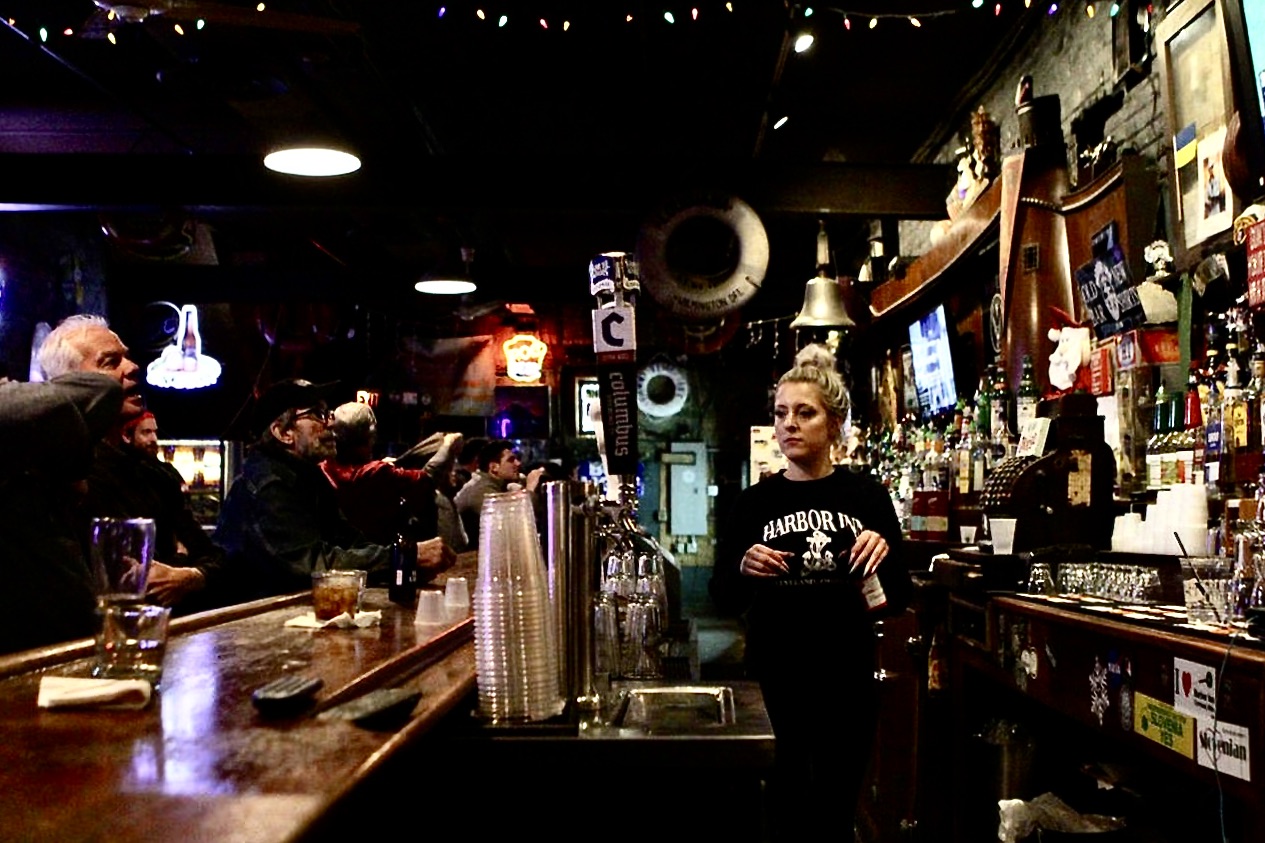
   If we had known that we probably would never have started playing. By the time we found out it was too late. We had been sucked into the black hole of Go. Getting out of the hole meant going down to the Harbor Inn for a pick-me-up. It was another hole, on the west bank of the Cuyahoga River in the Flats. It either was or wasn’t the oldest bar in town. Either way, the place wore its reputation on its sleeve.

   “The place was always shoulder to shoulder with bikers and their molls,” said Dan Coughlin, a sportswriter for the Cleveland Plain Dealer. “Wally had a virtual armory behind the bar. He had pistols and shotguns. One night in the middle of the summer we stacked up cases of beer bottles and fired at them from the hip, with shotguns blasting away. I put a hole in the stop sign in front of his bar.”

   Wally was Vlado Pisorn, an immigrant from Slovenia who had taken over the Harbor Inn sometime in the indeterminate past. We called him Vlad the Impaler. He had the kind of beer we liked, the kind from Germany and Czechoslovakia. The wine came from a hose and died on the tongue. After a couple of near deaths, we never drank it again.

   Matt had served a tour of duty in the armed forces, was on a prolonged stretch of R & R, and in the meantime was boning up for the entrance exams for mailman, fireman, and policeman. He was hedging his bets. He finally found employment with the Bay Village Fire Department, which was like working at a posh nursery school. There were hardly ever any fires anywhere near the lakefront suburb. There were, however, lots of old folks having heart attacks and strokes and the EMS trucks kept up an endless shuttle to St. John West Shore Hospital.

   One night Matt and his duty partner Chuck were called to a house where the man of the house was having chest pains. He was on his back in bed, his eyes closed. When they stepped up to him in the bedroom his wife whispered that she thought he was dead. “The poor dear man,” she said. Chuck was in the lead. As he walked up to the bed, he slipped on a throw rug and went head over heels on top of the man, body slamming him, the bedsprings recoiling.

   “If he’s not dead yet, he’s dead now,” Matt thought. 

   “Is he OK?” the woman asked, alarmed. 

   “Your husband will be OK,” Matt said. 

   “No, not him,” the woman said. “I meant the other fireman.” 

   “What the hell is going on!” the dead man suddenly spat out, jolting awake. “Get your fat ass off me.” He rolled Chuck off the bed, who fell to the floor. From then on, Chuck was known as Lazarus back at headquarters. It took years for the sobriquet to fade away.

   Virginia Sustarsic introduced me to Matt. How they knew each other was beyond me. She was Slovenian and a hippie through and through. He wasn’t, not by a long shot. He was a cool customer and Finnish on top of everything else. He played chess, like me, and we got to know one another playing now and then. I had moved out of the Plaza Apartments, where Virginia still lived, and was living on a forgotten street in North Collinwood, a couple of blocks south of Lake Erie. I lived upstairs in a two-bedroom Polish double. Ray Sabaliauskas, a fellow Lithuanian, owned the house and lived downstairs with his Southeast Asian wife and a prize German Shepherd. He had come home safe and sound from the bright shining lie that was the Vietnam War.

   I found my Go game at a garage sale in the neighborhood. It was practically brand new, the instruction sheet still in the box. I paid a dollar for it in pocket change. Reading the rules took less than five minutes. Explaining the rules to Matt took less than one minute. Our first game took five hours. We played on the front porch. The contest was suspended due to darkness when the sun set.

   “The best strategy is to spread the pieces far apart and stretch them out, to encircle and attack the opponent, and thus win by having the most points vacant,” Go master Huan Tan said nearly two thousand years ago. We were both bug-eyed after our first game. We didn’t know the game’s strategy from a seesaw. It was like wrestling a gorilla. You don’t quit when you’re tired, you quit when the gorilla is tired. Go is considered the most difficult board game in the world. Sleeping became my new go-to after a long match.

   I started jogging on Lakeshore Blvd. west out of North Collinwood, where everybody was a working man in one way or another, through the village of Bratenahl, where everybody was tall, trim, and filthy rich. They oozed pride in their state of being. When I was running in their neighborhood I hesitated to even spit on the tree lawns. I had put exercise on the back burner in my early 20s. I never thought I would be working out again to be able to sit quietly hour after hour staring at a square board of intersecting lines.

   When I was a teenager I ran track and field as part and parcel of Zaibas. It was a Cleveland Lithuanian sports club formed in 1950. In 1951, at the 1st North American Lithuanian Games, members participated in basketball, volleyball, and table tennis. The next year the club hosted the games in our hometown and fielded a full team in track and field. 

   In the 1960s I ran around in circles encouraged by Algirdas Bielskus. He was a small man with a round face and a championship head of hair. He was the director of a men’s vocal ensemble, co-founder of a choir, and concertmaster of the Ciurlonis Ensemble. He was also the Zaibas track and field coach for sixty years. He had the voice to make himself heard loud and clear from the far end of any quarter-mile track. Every weekend fair or foul all I heard was “Go! Go! Go!”

   He always carried a briefcase, briefcases he was always losing, stuffed with notes about how we were progressing. Rita Kliorys, one of his top-notch runners, made him a Christmas gift of a new one in 1966. “It was the accordion kind,” she said. “I remember it cost $100.00, and I collected one dollar from many people. He actually did not lose it, either.”

   He coached thousands of youngsters who ran hundreds of thousands of miles. “I thought of him afterwards whenever I saw a turquoise and orange Howard Johnsons and would remember how he took us there for ice cream sometimes,” Regina Thomas said. “Although I was a klutz at sports, he never made me feel like one. I never thought much about it as a kid, but what a commitment to youth and sports.” The small man with the big voice was seemingly tireless, championing fitness among Cleveland’s Baltic off-spring.

   “He worked for my dad’s company, Transmission Research, in the basement of our house,” Dalia Nasvytis said. “Sometimes we would hear strange noises downstairs late at night and realize he was still down there running off schedules for the next athletic meet he was organizing.” He was unrelenting about the fettle of immigrant kids.

   Once we started playing Go, Matt and I made a commitment to it. We played all that spring, summer, and through the winter, two and three games a week. It wasn’t an obsession, although it was. We played on the front porch until it got too cold to play outside. After that we played in the living room at a coffee table, sitting opposite one another, all four of our eyes glued to the board.   

   The game demands concentration, which is born out of silence. Some of our best moves and long-term maneuvers were made quiet stealthiness. I found out the more time I spent noiseless, the more illumination lit me up. We hardly talked, going for a half-hour without saying a word. Every so often Matt smoked a Marlboro. Before long he would tap another one out of the red and white flip-top box. Whenever I joined him, the living room filled with smoke, a gray-white cloud stewing over the entanglements of Go.

   When we first started playing our plan of attack was capturing stones. We both saw that surrounding other stones and taking them prisoner yielded points. It was like taking a piece in chess. After a while we discovered the object of Go is not to surround and capture the opponent’s stones. The object is to surround empty territory on the board. The way to do it is by building walls around empty intersections. If your territory includes some opposing stones, all the better. Then it’s grab and go. From then on it became a contest to capture territory rather than simply capture stones.

   In the Eastern world Sun Tzu’s “The Art of War” reads as an introduction and exposition to the game. Real life warlords back in the day of every stripe were always big on blockading their enemies and capturing territory. The times they were not a-changing, not anytime soon. The Vietnam War was over, but there was always another war on the horizon.

   There’s an old saying, “Chess is a battle. Go is a war.” The more we played the more we discovered it was a war of attrition. It was like breaking stones in the hot sun. Both of us knew how to make the other guy sweat. There was no fighting the commandments of Go.

   Oskar Korschelt, a German chemist, brought the game from Japan to Europe in the 1880s. Even though it was slow to catch on, by the 1950s championship-level tournaments were being organized. By the early-70s it was filtering into the United States. I never met another Lithuanian who played the game. My kinsmen are instinctively suspicious, somewhat superstitious, sometimes curious, usually sensible, always pragmatic, hard-working, conformist, and punctual. They are often reserved except when they get together. Once they establish their bona fides it’s time to pick up a drink and run off at the mouth, getting communal. They play volleyball and basketball like nobody’s business. They probably couldn’t stand the prolonged silence of Go.

   One night after a long back-and-forth on the board we drove to the Harbor Inn. We were looking for some downtime. The two-story building was a home-away-from-home for dockworkers and salt-miners. A lonely man who didn’t mind a lumpy mattress could even grab some shut-eye upstairs. It might have been a dive way back when, but it was no ifs ands or buts about it still a dive, slinging suds to third shifters in the morning and anybody else who had a buck the rest of the day and night. There was a coin operated bowling arcade game downstairs and battered dart boards upstairs. We ordered bottles of Pride of Cleveland instead of imported European brew, being short on ready cash, and picked up a handful of house darts.

  Nobody knew how long the Harbor Inn had been there, but we thought it had to be from the day after Moses Cleaveland settled the land centuries before. It reeked of smoke from long-gone cigars and cigarettes. The shadows smelled even worse, like ammonia had been set on fire. Looking around there was no doubt some of the men at the bar only bathed once a month.

   The beer was cold and refreshing and playing darts was fun. We played 501 Up. Both players start with a score of 501 and take turns throwing three darts. Bullseye scores 50, the outer ring scores 25, and a dart in the double or treble ring counts double or triple. The tally is calculated and deducted from the player’s total. The goal is to be the first player to reduce the score to exactly zero, the only hitch being that the last missile thrown must land in a double or the bullseye. 

   Darts are front weighted for flight and are several inches long with a sharp point. A big part of playing darts is the throwing part. The rest of it is mental toughness, staying on the button, stinging the cork like a bee. It was like Go except we could let ourselves go. We wrote our names in chalk on the brick wall, adding them to the hundreds of other names reaching to the ceiling. After a couple more Pride of Cleveland’s we got sloppy, but it was no matter in the juke joint that was the Harbor Inn.

   When I took a good look at the dart board, there weren’t a hundred-or-more darts crowding it, like all the stones on a Go board. Every throw was always at an empty target, every throw a new chance to get it right, unencumbered by the past. Go was all about the past, the past of all the carefully placed stones on the board. Playing darts was right now. It was a relief to see the target and hit the target, except when we completely missed and the dart bounced off the brick wall. When that happened we yukked it up, not like the game of Go, which was never a laughing matter.

Ed Staskus posts on 147 Stanley Street http://www.147stanleystreet.com and Made in Cleveland http://www.clevelandohiodaybook.com. To get the site’s monthly feature in your in-box click on “Follow.”

Leap of Faith

By Ed Staskus

Names are signifiers and we are the signified. We have proper names, like Daniel and Kate and Muhammed. Some given names, like Lola, sound good in song and dance. Some names, like Ratso, don’t sound good under any circumstances. We have surnames, like McCarthy and Doiron and Zapatero.

We have pen names, like Dr. Seuss, Mark Twain, and John le Carre. There are logo names, like Colonel Sanders, whose double is the current Secretary of Defense in the USA. Sometimes we have pet names, like Winnie and Booboo, whether we have pets, or not.

There’s nothing and everything in a name, since a cauliflower is a cauliflower is a cauliflower, except when it isn’t, as in Denys Morgan, who is Denys Morgan, living and working in Cleveland, Ohio, except when she’s Devta Kaur, living and breathing and practicing Kundalini Yoga.

It was during an immersion teacher’s training course at the Kundalini Research Institute in New Mexico seven years ago that Denys Morgan received her spiritual name, Devta Kaur, which more-or-less means “one who has the consciousness of the divine or angelic.” It was a leap of faith.

The owner of Total Body Solutions in C-land, she is a masseuse and yoga teacher. She is hands on the wheel on a mission. She’s the kind of grass roots working woman that if she couldn’t cut hair, she wouldn’t open a barbershop. The change of name didn’t lead to a change of heart. She’s always been about service.

“My services are for those searching for freedom from stress and pain,” she says. She takes a holistic approach towards vitality and longevity. “My goal is to share my passion for massage, yoga, meditation, sound, vibration, and energy therapy with all. My mission is healing the world one person at a time.”

Zachary Lewis was one person one day when Denys Morgan gave him a hands-on demonstration of Shiatsu, a massage modality that translates as “finger pressure.”

“Lying shirtless on a mat on the floor, I marveled at her power to zero in on my tightest, sorest spots and to relieve tension in areas where I hadn’t even sensed it, such as my neck, shoulders and spine,” he said.

“Some techniques were new to me. Where most therapists place your limbs gently back down, she let my legs and arms drop heavily to the floor, or even tossed them down. Other times, she’d hold and shake them vigorously. While she used her feet to walk on or knead my muscles, or push me into a stretch, she was also just as likely to use her elbows as a wedge to break up knots.”

Shiatsu is using all your fingers and toes and elbows.If you’re Denys and Devta rolled into one, it’s going at it with twenty fingers and multiple elbows. If you’re Zachary Lewis, it’s rolling with the punches.

He left a new man.

A pseudonym is a name someone uses instead of his or her real name. Pseudonyms include aliases, pen names, stage names, nicknames, superhero and villain names. Some are on the upside and some are on the downside. “Baby Face” Nelson sounds good, but he was a bad man. Beta Ray Bill defends those threatened by monsters. Vlad the Impaler says it all.

James Butler Hickock was known as “Wild Bill” by the wild men he ran to ground. GM’s CEO Charles Wilson was known as “Engine Charlie.” Kal-El’s alias is Clark Kent and Clark Kent’s stage name – star of comic book and screen – is Superman.

In some cases, pseudonyms are adopted because they are part of a cultural or organizational tradition, for example, devotional names used by members of a religious or spiritual fraternity.

In the tradition of Kundalini Yoga, a spiritual name is both vibration and vise grip helping to elevate energy through the power of sound and meaning. It is your soul’s identity. It challenges you to live up to your highest consciousness. Adopting a spiritual name is taking a step toward leaving old habits and old thinking behind and connecting more deeply with your real infinite self, according to 3HO.

3HO and Kundalini Yoga are what Yogi Bhajan brought to the western world from India in the late 1960s.

“You are all here and we will ask you to understand your spiritual incarnation and your spiritual name and try to find the strength to live it. I give you a healthy, happy, holy way of life,” he said.

“Thank you, Guru Ram Das, for building the beautiful Golden Temple for seekers to find their way home. I will never forget the palatable presence of the Naad as I stood in awe in the sacred, timeless place. Truly the highlight of all my trips to India! On the day of your birth, I bow to you again and again!” said Devta Kaur about her most recent visit to the sub-continent.

The Golden temple in Punjab, India, is called the Golden Temple because it is plated in gold. It is the most prominent pilgrimage site of Sikhism. The construction of the building was completed by Guru Ram Das, the fourth guru of the Sikh tradition, in the late 16th century. To this day a unique feature of it is twenty-four-hour free food. The Golden Temple gives out grub to thousands of people every day, on the house, for the asking.

Denys was certified as an aerobics instructor by the Aerobic Fitness Association of America in 1986, launching her career in the health and fitness way of life. She has since drilled in many different kinds of aerobic exercise and strength training.  In 1997 she was certified as a personal trainer with the National Alliance of Fitness Professionals.

Her academic work has been mostly in biology and psychology. She holds an Associates in Arts degree and studied pre-med at Cleveland State University. She spent a semester abroad studying biology at the University of Westminster in London.

She spent more than ten years as a Red Cross volunteer certifying people in CPR and first aid. Anyone who jogs on running trails, hits the weights at their gym, plays touch football, will need first aid sooner or later. In the meantime, a good massage is a good balm.

Denys got going on massage therapy in 1991 and received her license to practice from the State Medical Board of Ohio in 1994. In general, she offers therapeutic deep tissue massage combining a variety of different techniques. Her specialties are Japanese Shiatsu, Chinese Medicine, and Native American healing.  She has trained in other massage modalities, including Swedish Massage, Cranial-Sacral Therapy, Trager Method, Myofascial Release, Reflexology, and Reiki, among others.

She has been named “Best Massage Therapist” in northeast Ohio and has been a guest several times on local radio and television stations. Her clients include all walks of life, professional football and basketball players, dancers from the Cleveland Ballet, triathletes, cyclists, marathon runners, not to mention unheralded weekend warriors and office workers who spend all day in a chair, to their regret.

Denys has worked professionally with movement and fitness for more than thirty years, and in a few years, burning the midnight oil, will have been studying yoga for thirty years. She began at the Reese Institute in Orlando, Florida, and in 1992 completed her teacher’s training. In 1994 she started teaching yoga in the Forest City. She has developed an eclectic blend of several styles, including Hatha, Ashtanga, Raja, Bhakti and Kundalini, as well as Dynamic Meditation and Tibetan yogic techniques.

It’s diverse and eclectic, but it’s more old-school yoga than spin yoga or yoga tone and sculpt or yogalates. It’s more than exercise. It’s more than just fitness, although a component of fitness is one of the gears. It’s not about the Body of Steel. It’s more like the Christian Body of Glory or the Tibetan Rainbow Body. It’s a frame of mind.

Much of her knowledge comes from the horse’s mouth, having spent time in ashrams up and down India. In 2007 she worked on Kriya and Raja Yoga, Osho and Vipassana Meditation, as well as Yoga Trance Dancing for six months. While there she committed herself to Bhakti Yoga and took lessons in leading devotional singing and Sanskrit chanting.

Two years later she was back in India for six more months, furthering her studies of Dynamic Meditation with an Osho Master. She spent several months in the Himalayas completing her International Teachers Training Program, accredited through Yoga Alliance, giving her a total of over 800 hours of overall training in all aspects of the vocation. She took courses in sound therapy, learning the vibrations of Tibetan Singing Bowls, chimes, and symbols to create healing energy through sacred sound. She spent several months in the practice of Bhakti Yoga, singing bhajans daily.

She has led retreats to India, as well as in Central America. She has taught in Serbia, England, and Italy. She spent several years living in Costa Rica practicing yoga and massage and ran a retreat center. She co-hosted adventure yoga and surfing on the Caribbean coast.

Sometimes the highest goal of human existence is sprinting to the surf to catch a bitchin’ barrel.

In 2010 Denys co-hosted a 10-day yoga retreat to Goa, India, authorizing the participants to an 80-hours training certificate accredited through Yoga Alliance. She helped them sightsee some of India’s holiest places, such as Hampi, the birthplace of Hindu culture, Varanasi, the place where pilgrims come to worship the Ganges River, and Bodhgaya, the place where the Buddha attained enlightenment She was a kind of spiritual Rick Steves, sans cable TV show and eat drink make merry.

In 2015 she co-founded the Ananda Bhakti Hatha Yoga teacher Training program. In 2017 she started a program called “Stay Sane,” which incorporates Kundalini Yoga to help those struggling with mental health issues.

As a teacher she has an extensive knowledge of anatomy and physiology, yoga philosophy, and brings enthusiasm, creativity, and dedication to her work. As a healer, bodyworker, and spiritual mentor she relies on her intuition and inspirations.

Denys follows the tenets and spark of Shirdi Sai Baba, Sathya Sai Baba, Pramahansa Yogananda, Meher Baba, and Yogi Bhajan. “By their grace I am blessed to spread their message. The essence of my work is prompted by my guru, Sai Baba. ‘Love All, Serve All’ and ‘Help Ever, Hurt Never.’”

In the past year she has joined forces with Pop Life. Located in the Waterloo Arts District, on the east side of the North Coast, the collaborative is rooted in art, design, and wellness. They work with artists and designers and the space features a gallery, yoga and wellness studio, and a cafe. She is the yoga and wellness director.

Next year she will be conducting a RYT 200-hour certified course at Pop Life featuring Kundalini Yoga. “Level One Teacher Training in Kundalini Yoga is a transformative experience, whether you decide to teach, or simply use it as an opportunity for personal growth. You will change,” she says.

We all change as we grow, but the only time you need a change of heart is when your heart isn’t in the right place to begin with.

Her intention for the program is inspired by Yogi Bhajan. “I want to make my teachers ten times greater than myself” and “I have come here not to get students, but to make teachers,” he said. Although the program will be diversified, it will regardless offer authentic philosophical and devotional components.

“Those changes can be a challenge to your family and your community. Don’t take it personally and definitely don’t make any big decisions during training. Simply allow yourself to dive deeply into your own identity. It is a physical and mental challenge. Do your best to keep up and set up your life.”

Pop Life isn’t like Pop Art. It’s not on the outside looking in. It’s not stuck in any moment. It’s on the move. It doesn’t look like anything other than what it is.

Denys Morgan, even by another name, whatever the signifier, popping the collar of whatever hat she’s wearing, living her life heart desire, is the thing itself, everything that is significant.

Ed Staskus posts on 147 Stanley Street http://www.147stanleystreet.com and Made in Cleveland Ohio http://www.clevelandohiodaybook.com. To get the site’s monthly feature in your in-box click on “Follow.”
Six Oysters Ahoy

IMG_6834 2

By Ed Staskus

“He was a very valiant man who first adventured on the eating of oysters.”  King James VI and I

“I checked the weather report,” said Frank Glass.

“What did you find out?” asked Vera Glass.

“It’s going to be the same today as it was yesterday.”

“Is it going to rain all day?” asked Vera.

“You don’t need a weatherman for that,” said Frank, throwing a glance at the window.

A steady rain was falling outside the large front window of the cottage, down on the long sloping lawn of the Coastline Cottages, on the Gulf Shore Parkway, on the three houses on the other side of the road, and out to the horizon as far as they could see. The sky was dark over Doyle’s Cove. Broad surfboard-sized waves worked up the water. When Frank looked out the northwest-facing kitchen window, the sky, where the weather was coming from, was even darker.

“What should we do? It rained all day yesterday. I’m getting cabin fever.”

“We could play cards, read, and talk among ourselves. How about dinner and a show?”

“That sounds good, especially the part about dinner,” said Vera. “Where do you want to eat?”

“There’s a show opening tonight at the Victoria Theatre.”

“All right, but what about dinner?”

“We could eat at the Landmark, it’s right there.”

“I’ve always liked the Landmark,” said Vera. “Eugene is a great cook. They have the best meat pies.”

“Somebody told me he sold it and there are new owners,” said Frank.

“What? How can that be? Eugene and Olivier and Rachel are gone?”

The Sauve family tree had repurposed an old grocery store in Victoria into a café restaurant in the late 1980s, adding a deck, digging a basement for storage and coolers, and expanding their dining space several times. They were a perennial ‘Best Place to Eat on Prince Edward Island’ in the magazine Canadian Living.

“It’s now called the Landmark Oyster House.”

“I love oysters,” said Vera. “Let’s go.”

It was still raining when Frank and Vera drove up Church Hill Road and swung onto Route 6, through North Rustico to Route 13, through Hunter River and Kelly’s Cross. It was still raining when they pulled into the small seaside town of Victoria on the other side of Prince Edward Island, on the Northumberland Straight side, 45 minutes later. It rained on them as they rushed into the Landmark Oyster House.

There wasn’t a table to be had, but there were two seats at the bar.

“Look, we’re right in front of the oysters,” said Vera, as they sat down at the closed end of it. “I love this spot.”

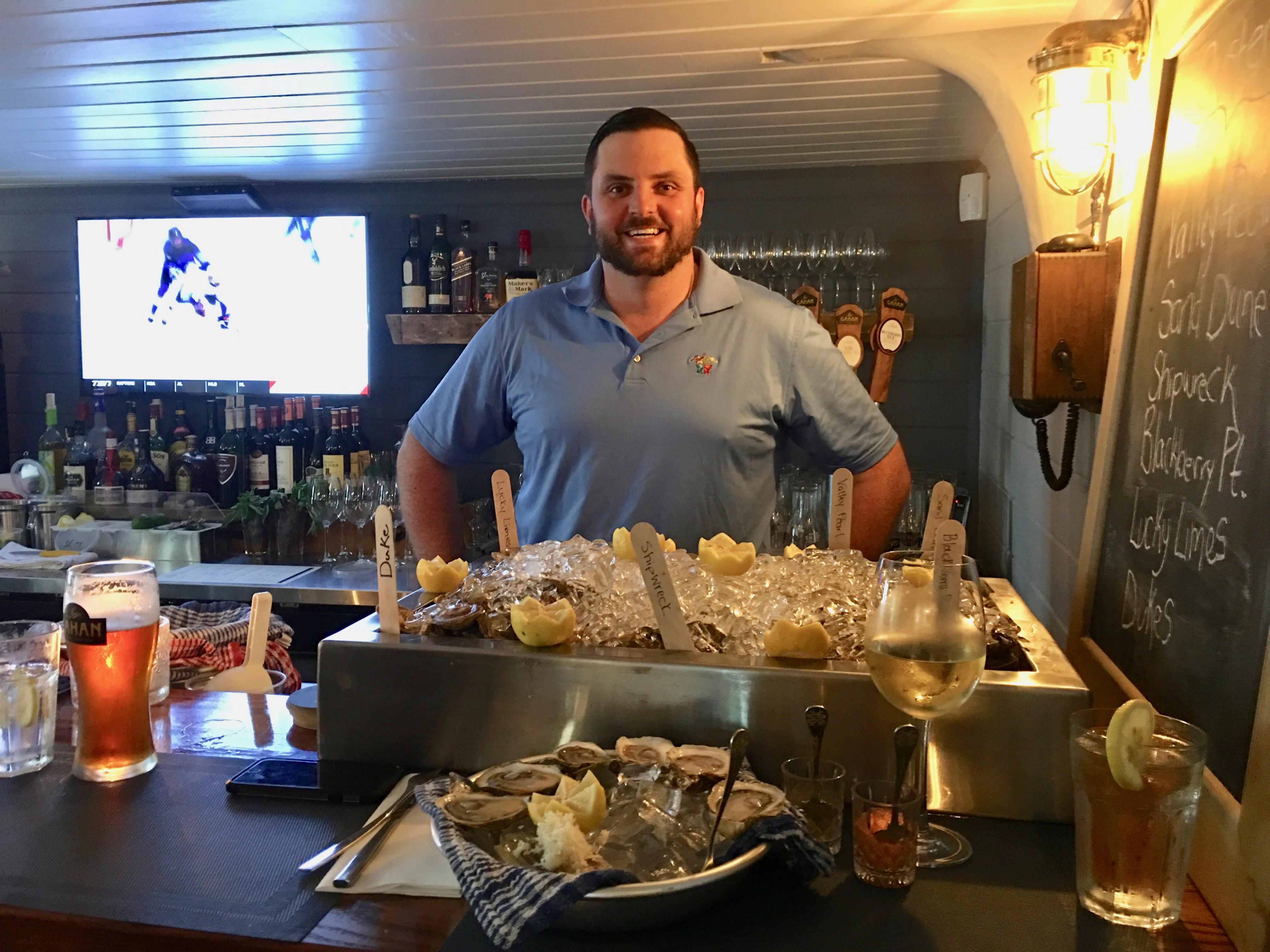
Kieran Goodwin, the bartender, agreed, standing on the other side of the bar, on the other side of a large shallow stainless steel bin full of raw oysters on ice.

“Best seats in the house,” he said. “They were going to put the bar in the front room, but the dimensions didn’t work out.”

“Who’s they?” asked Frank.

Vera looked the chalkboard on the wall up and down. The names of the oysters on ice were written on the board. There were six of them, Valley Pearl, Sand Dune, Shipwreck, Blackberry Point, Lucky Limes, and Dukes. She looked down into the bin. She couldn’t make heads or tails of which were which. She knew raw oysters were alive, more-or-less.

She wondered, how could you tell?

“Greg and Marly Anderson,” said Kieran. “They own a wedding venue up the road.”  It is the Grand Victoria Wedding Events Venue, in a restored former 19th century church. “When this opportunity came up, when Eugene was looking to tone it down a bit, they decided to purchase it.”

“I worked at the Oyster House in Charlottetown shucking oysters for almost five years,” said Marly. “We heard that the family wanted to retire because they had been working at this restaurant for 29 years. We already felt a connection to this place and we are friends and neighbors with the family.”

“They’ve put their roots down in the community, are making their stand here,” said Kieran.

“I like what they’ve done in here, casual but upscale,” said Vera.

“It looks like the kitchen is more enclosed than it was,” observed Frank.

“Yeah, they did up a wall,” said Kieran. “When you used to walk in, you could peek right in.”

“I remember Eugene telling us once he learned all his cooking from his mom. Who does the cooking now?”

“Kaela Barnett is our chef.”

“We couldn’t do this without her,” said Greg Anderson.

Somebody’s got to have a steady hand on the ladle that stirs the soup.

“I’m thinking of doing oysters and a board,” said Vera.

“That’s a good choice,” said Kieran. “I recommend the large board. You get a bit of everything. I personally like getting some cheese.”

“Me, too.”

“Are you oyster connoisseurs?” asked Kieran.

“Not me,” said Frank. “I can’t remember the last time I ate an oyster.”

“I wish I was, but I love them,” said Vera. “We were on the island last year and went to the Merchantman in Charlottetown with Doug and Rachel, Eugene’s daughter. We had oysters and she went through all the ones we ate, explaining them to me.”

“Would you like something from the bar?” asked Kieran.

“I’ll take the Gahan on tap, the 1772 Pale Ale.”

“What wine goes with oysters?” asked Vera.

“We have a beautiful California chardonnay,” said Kieran. “It’s great with shellfish. I recommend it.”

“This is good, fruity,” said Vera, tasting it.

“We have six oysters,” said Kieran. “You could do one of each.”

“That’s what I’ll do,” said Vera.

“I think I’ll have the seafood chowder and some of the board,” said Frank.

“Oh, Frank, try one,” said Vera.

“Lucky Limes are my favorite,” said Kieran. “It’s a good medium oyster.”

“OK, I’ll try it,” said Frank, shrugging.

Kieran handed him a Lucky Lime.

“How do I eat this thing?” Frank asked Vera.

“Sometimes I chew it, sometimes I don’t,” she said.

“Some people like putting stuff on it, like horseradish, which kills the taste,” said Kieran. “But straight up is best. That’s how islanders do it, just shuck it.”

Frank looked down at the liquid-filled half shell.

“From the wide end,” said Kieran.

He slurped the oyster into his mouth and swallowed it.

“Now you’re a pro,” said Vera.

“That wasn’t bad,” said Frank. “How could you tell it was a Lucky Lime? They all look the same to me.”

“If you look at the chalkboard, it’s one through six. That’s one way.”

“Can you tell by looking at them?” asked Vera.

“I can tell by the shell,” said Kieran. “The ones that are more green, that means there’s more saltwater content. So this is a Sand Dune, quite briny. That one is almost straight salt water.” He pointed to an even darker greener shell.

“The Shipwreck, the name made me nervous to have it, but it was mild,” said Vera.

“It would be farther up the estuary, closer to fresh water.”

“Blackberry Point was very salty.”

“The Blackberry’s are from Malpeque, which is near Cavendish,” said Kieran. “The Sand Dune is from Surrey, down east, and the Lucky Limes are from New London Bay. Valley Pearl is from Tyne Valley and the Dukes are from Ten Mile Creek.”

“I thought you were just making all this up,” said Frank.

“No, its like wine,” said Kieran.

“How did you get into the shellfish racket?” asked Frank.

“I graduated in business, traveled, lived in New Zealand and Australia, and then came back home, and worked in a bank as a financial advisor for six years, in Summerside and Charlottetown, but then I just got tired of working in a bank, and went back to school.”

“How did you find your way here, behind the bar?”

“I date Jamie, who is Marly’s sister.”

“Are those pickled carrots?” asked Vera, pointing at the charcuterie board in front of her.

“Yes, and you have raisin jam, too,” said Kieran.

“Chutney, stop the madness!” exclaimed Vera. “Oh, it’s strawberry jam. It just looks like chutney. It’s delicious.”

“We had raisin pie at a small diner in Hunter River the other day,” said Frank.

“The one by the side of the road, up from the Irving gas station?” asked Kieran.

“That’s the one,” said Frank. “The waitress told us she always thinks of raisin pie as funeral pie, because back in the day, if there was a funeral in the winter, women always made raisin pies for the reception after the memorial service, because raisins kept all year round.”

“Can I take my oyster shells with me?” asked Vera.

“Sure,” said Kieran. ”We can get a little bag for you.”

“You can really taste the sea eating oysters,” said Vera. “Blackberry Point was a little thin and too salty, but once you eat one, and you don’t like it, whoa, what are you going to do? Valley Pearl didn’t have a lot of flavor, but there was some good texture to it. Lucky Lime was very good. My favorite was Sand Dune. It had a strong ocean flavor, briny.”

“I’ve heard people say oysters are slimy, but the one I had, it didn’t seem that way,” said Frank. “I can see having oysters again.”

“Don’t people sometimes say the world is your oyster?” said Vera.

“Do you want dessert?” asked Kieran.

“Do you have carrot cake?”

“It’s made here.”

“We’ll split a slice of that, and two coffees, thanks.”

As Vera and Frank dug into their carrot cake, there was a commotion at the other end of the bar. Kieran, Jamie, and Marly were huddling over glowing screens.

“Did your electronics go haywire?” asked Frank when Kieran brought them coffee.

“The microwave in the basement tripped the breaker. We hardly ever use it, except to melt butter sometimes. It’s weird, it’s been working until now. We have a thing that magnifies our wi-fi signal. We just found out it’s on the same circuit.”

“My mother was a pastry chef,” said Vera. ”She didn’t use microwaves much, but whenever she did, she always said, ‘I’m going to nuke it now!’”

Frank and Vera used their forks on the last crumbs of their cake and finished their coffee. Frank checked the time on his iPhone. “Time to go, sweetheart,” he said. They paid the bill and stood to go.

“Enjoy the show, hope to see you again,” Kieran said as Frank and Vera walked out of the Oyster House.

“It’s raining and sunny at the same time,” said Frank as they dashed across the street to the Victoria Theatre, yellow slanting sunlight leading the way.

“That’s PEI for you,” said Vera. “By the way, what are we seeing?”

“Where You Are.”

“I know where we are,” said Vera.

“That’s the name of the show,” said Frank.

“Aha, I see,” said Vera.

“Hustle it up, we’re almost late.”

They went up the steps into the theater, got their programs, and sat down. Vera tucked the bag of shells under her seat. “Wherever you are, there you are, oyster boys and girls,” she thought, making sure they were safe and sound.

“How could you even tell?” she wondered, as the lights went down and the show started.

Photograph by Vanessa Staskus

Ed Staskus posts stories on 147 Stanley Street http://www.147stanleystreet.com and Cleveland Ohio Daybook http://www.clevelandohiodaybook.com. To get the site’s monthly feature in your in-box click on “Follow.”

Laying Low on E. 4th St.

By Ed Staskus

   It never mattered what time I stepped into Otto Moser’s, morning, noon, or night. Somebody was always intoxicated at the bar. If they were quiet enough everybody ignored them. If they got unruly, they ended up being tossed out on the sidewalk. If it happened in the morning, they waited outside on the sidewalk for forgiveness.

   Otto Moser’s was a downtown bar restaurant on East 4th St. in Cleveland, Ohio. When I started cutting classes at Cleveland State University it had been there about eighty years. It toasted the century mark just before its time came due. It was a narrow deep-set place between a shoe store and a Woolworths. A civil defense shelter was between the variety store and Otto Moser’s, in case the Russians went crazy and started dropping atomic bombs. Everybody at Otto Moser’s agreed they would stay right where they were, where there was food and drink.

   Europeans drink more alcohol than anybody else in the world and Lithuanians knock back the most of any European drinkers. The ethnic community I belonged to was swimming in it, even though they put their faith in God and country first. Booze was a belief in and of itself. Even though I was part of the bloodline, I wasn’t much for strong drink. A couple of beers put me under the table, so I nursed whatever was in front of me. Most of the times I went to Otto Moser’s it was to hang out. The price of a chair for the afternoon, between the lunch and dinner crowds, was a cup of coffee and a grilled cheese sandwich.

   The restaurant’s grand opening was in 1893 when E. 4th St. was called Sheriff St. The Euclid Avenue Opera House was across the street and there were five theaters and two burlesque houses inside the blink of an eye. Many actors, businessmen, and stuffed shirts stopped in for a bite and hootch. Otto collected their autographed portraits, framed them, and hung them on the walls of his saloon. It got so there were more than a thousand of them. There were six mounted animal heads, including a moose named Bullwinkle.

   When Otto died in 1942 two of his employees, Max A. Joseph and Max B. Joseph, took over. Their mother had wanted a third Max she could name “C” but it never happened, much to her regret. The two Max’s didn’t change anything. Sometimes they closed their doors to the public, when the cast of a big show took the place over, or the Metropolitan Opera was in town. When it was, they closed nights for most of that week so the singers could kick back and relax at their leisure.

   Whenever I went there during mid-day the waitress was Norma Bunner, who had been there since 1955. She never looked at menus and never wrote my order down. The coffee was always fresh and the sandwiches hot, with extra pickles on the side. I liked to read when I was by myself, which was most of the time.

   I often stopped at Kay’s Books before going to Otto Moser’s to pick up used paperbacks that rarely had anything to do with my college studies. I was majoring in film and literature, so I made sure my fun reading was sans the classics. I read the John Carter of Mars series, Jim Thompson’s hard-boiled pulp, and Jorge Luis Borges’s short stories about knife fights in the stockyards of Buenos Aires.    

   Kay’s Books was on Prospect Ave, or what some folks called Prostitution Ave., at the corner of East 6th St. There were adult movie houses, hookers and pimps, and other questionable morals on both sides of the street. There were several wig stores and rotgut bars. If I was going to Kay’s in the morning, I got off my bus at Public Square, walked through the May Company, left by the back door, and slid past the Domino Lounge, its jukebox blasting, slipping into the bookstore.

   There was a raised platform on the right inside the front door of the bookstore. A large gay man who went by the name of Harry Condiles worked behind the counter, looming over everybody and everything, wearing white button-down shirts with the sleeves ripped off. He was friendly up to a point.

   “Get out of here, you creeps,” the boss lady blew up whenever his boyfriends stopped in to visit. He knew where everything was, was quiet and patient, although he could lose his temper if questioned one time too many. One day when a customer couldn’t find a book for the third or fourth time he snapped, “Oh, it’s up there, over there by those damned books, over by that damned thing there.” 

   He had a keen eye for shoplifters. He knew when a purse or bag didn’t look right. The boss lady was Rachel Kay. She appreciated his profit and loss smarts. She was always somewhere in the three-story building, her shoes click clacking on the mosaic tiled floors, keeping order as best she could.

   The place was stuffed full of books and magazines. I never saw the basement, which was rumored to be filled to the brim with them, but what I saw upstairs made me think they had a copy of every book ever printed. The aisles were narrow and the shelves floor to ceiling. There were rows of books behind every first row of books. It was sort of organized. New hardcovers were up front. Poetry was on the mezzanine. Mass market paperbacks were on the second floor. The upper level was for health magazines full of female nudists. Everything else had to fend for itself.

   The paperbacks I bought were fifteen cents, maybe a quarter. Some of them had been sticker priced so long ago I knew I was coming out way ahead when adjusted for inflation. Cockroaches that ate the glue were rampant, so I learned to check the bindings. The boss lady didn’t always stick to the sticker price. She wasn’t above saying a book stickered $2.95 was worth more, crossing out the price, and writing $4.95 in black crayon in its place. Whenever anybody argued with her about being a highhanded profiteer, first, they didn’t get the book, and second, were told to take their business somewhere else.

   I was reading a dog-eared copy of “Ernie’s War: The Best of Ernie Pyle’s World War II Dispatches” one afternoon when one of the barflies got up, limped over to my table, and plopped himself down in the chair across from me. He looked at the book. I looked at him. His eyes were watery.

   “Whatcha reading?” he asked.

   “Are we getting acquainted?” I asked.

   “You betcha,” he said.

   I thought before I spoke, wary of anymore cha cha cha’s. He seemed affable enough. He seemed sober enough, at least.

   “It’s about World War Two.”

   “I was in that war, fella,” he said. 

   “Is that right?”

   “You don’t believe me?”

   “I’ll take your word for it.”

   “All right, all right,” he said, reaching for his billfold. “I gotcha.”

   He pulled out a five-pointed gold star attached to a faded red, white, and blue ribbon.

   “What is it?” I asked.

   The Silver Star,” my newfound friend said. “It’s awarded for gallantry in action against an enemy of the United States.”

   “What did you do to get it?

   “I was on Tarawa.”

   “What’s that?”

   “It’s an island in the Pacific. We landed there in 1943. I got shot twice before it was all over, but I killed my share of slant-eyes. Those sons-of-bitches were tough.”

   The battle for Tarawa was fought in late November, part of Operation Galvanic, the invasion of the Gilbert Islands. More than 6,000 Japanese and American soldiers died during the three-day fighting, mostly on and around the 300-acre bird-shaped island of Betio, southwest of Tarawa Atoll. It was the first American offensive in the central Pacific. The nearly 5,000 Japanese defenders were well-prepared. They fought to the nearly last man. It was all over in three days.

   “The island was the most heavily defended atoll that would ever be invaded by Allied forces in the Pacific,” said Joseph Alexander, a Marine amphibious officer who later became an historian. One combat correspondent who landed with the fighting forces called it “the toughest battle in Marine Corps history.”

   “It was flat as a pancake” the barfly said. “There was nowhere to hide. We dug holes in the sand fast as we could, like crabs.”

   “Every spot on the island was covered by direct rifle and machine gun fire,” Marine Colonel Merritt Edison said.

   “We landed on amphibious tractors,” my lanky friend said. His hair was thin and unkempt. His teeth were bad and his fingernails were yellowish. He smoked Lucky Strikes one after the other. He wasn’t wearing a wedding ring, but his watch was a Rolex, and his shoes were soft fancy leather. He was down but not out. He waved towards the bar for his drink to be refreshed. “It was one goddamned mix-up after another,” he said.

   Shelling from the American warships was disjointed. The landing time was delayed twice. Headwinds pushed the landing craft between the devil and the deep blue sea. Scaling the seawall was more deadly than anybody thought it would be.

   “Those who were not hit wading ashore would always remember how the machine gun bullets hissed into the water, inches to the right, inches to the left,” wrote Robert Sherrod, a correspondent for Time Magazine.

    The Japanese used their grenades to good effect once the Marines started landing. Corporal John Spillane, a major league baseball prospect before the war, caught two of them barehanded and threw them back before a third exploded in his hand. His baseball career was over in that instant.

   “You got shot two times? Is that how you got the medal?” I asked.

   “Yes and no” he said. “It was when the Japs counterattacked the third night. They were screaming and yelling running right at us out in the open. Our artillery opened up on them until they were so close to us that they had to shut down. It was hand to hand after that.”

   “How did you get the medal?”

   “A squad of gooks got low with their Type 99 machine guns, the kind that had armored shields, and were spraying us. We had to take them out. Five of us went with grenades. Another one of us had a flame thrower. We took care of business, but I was the only one who made it. I dragged one of the guys back. I didn’t know he was dead. I got plugged in the shoulder and my leg, right here near the hip. The medics jacked me up with morphine and a bottle of sake and that was the end of the war for me.” 

   After the ferocious battle, which saw only 17 wounded Japanese soldiers surrendering, the island was awash in carnage. “Betio would be more habitable if the Marines could leave for a few days and send a million buzzards in,” Robert Sherrod wrote afterwards. Marine General Julian Smith declared the enemy “wiped out.” After that it was on to the next island.

   The disheveled man an arm’s length away had been a hero once. Watching him I thought of Marcel Proust, one of my least favorite writers, who I had been forced to read for one of my English classes. Why we had to read a French dandy was beyond me.

   “Remembrance of Time Past” is one and a half million words long. During a Q & A session I asked our professor how many times he thought a person would need to go to the bathroom getting through the endless magnum opus. He gave me a sour look. Proust scribbles words, words, and more words about his day-to-day life, society, manners, friends, enemies, boys, girls, courtesans, and love and love lost and the love of love and, above all, jealousy and recrimination. After a while it just makes you want to puke.

   I couldn’t finish it. It didn’t seem like there was a pay-off in store. Cliff’s Notes were created because of that book. When the class was over, I threw the book away.

   Just as I was about to ask what happened, how he went from hero to tosspot, my friend said, “I gotta go to the john.”

   There was one thing about Proust that I remembered. He wrote that we think we are living in the world when we are only really living in our minds. Everything is inside us, not just now, but all of the past. We are a house of mirrors. I realized my friend had no doubt told his World War Two story to countless listeners, some willing, some procured at random like me. My booze hound was staring in the same mirror day after day. Otto Moser’s was a way station and a confessional.

   When he came out of the bathroom, he walked past me like he either didn’t see me or I didn’t ring a bell. He went out the front door. It was for the best. I had a four o’clock class and needed to get going. I stuffed my stuff into my backpack, paid the bill of fare, and walked out into the bright afternoon.

   The VFW man was outside, three sheets to the wind, supporting himself by leaning on the fire hydrant at the curb with an outstretched arm. He must have done a shot for the road. He was standing in a patch of dull sunshine. He was a ship in a bottle.

   “Are you all right?” I asked.

   “Sure, man, I’m OK,” he said.

   “Where’s home?”

   “Old Brooklyn, up by the zoo.”

   “You might want to go home and dry out.”

   “I’d probably die if I tried drying out,” he said.

   “There’s always tomorrow morning. Otto’s opens early.” 

   “I know the order of business here, son, theirs and mine.”

   “I understand, but In the meantime,” I said, “maybe don’t lean on that Johnny pump.” I pointed at the hydrant. “Guys are always peeing on it.”

Ed Staskus posts on 147 Stanley Street http://www.147stanleystreet.com and Made in Cleveland http://www.clevelandohiodaybook.com. To get the site’s monthly feature in your in-box click on “Follow.”
When Hell Freezes Over

By Ed Staskus

   “The Hells Angels are so much aware of their mad-dog reputation that they take a perverse kind of pleasure in being friendly.”  Hunter S. Thompson

   When Frank Glass pulled his Hyundai into the back lot of Barron Cannon’s pop-up yoga class, on the border of Lakewood and Cleveland, Ohio, getting out with his rolled-up mat under his arm, he was brought up short by a fleet of Harley Davidson motorcycles parked outside the door. Inside, he peeked into the practice space, where a mob of muscled-up bare-chested men was in awkward cross-legged poses on rental mats. The denim vests and jackets hanging on coat hooks bore the Hells Angels colors and moniker, red lettering displayed on a white background.

   The bikers are sometimes called “The Red and White.” They are also known as “The Filthy Few.” Inside the club house among themselves they are “The Club.”

   The Angels are the best known of what are known as outlaw motorcycle gangs. The name comes from the P-40 squadrons of Flying Tigers who flew in Burma and China during World War Two. The pilots were known as “Hells Angels” because the combat missions they flew were dangerous courageous literally death-defying.

   Skulls scowled from the middle of the back of the biker vests and jackets.

   Frank took a seat, instead of taking the class, seeing he was late for it, anyway, and the room was full. He might as well, he thought, read the book he was halfway through, and go to lunch with Barron, as they had planned, when the class was over. The book he was reading on his iPhone was David Halberstam’s “The Fifties.” Even though the Hells Angels were formed at the turn of the decade, and ran riot in the 1950s, there wasn’t anything about them in the book.

   Yoga in the United States got going in the same decade, although it didn’t run riot. It kept a low profile until the next decade, the 1960s, when hippies made the scene, and adopted yoga as one of their motifs. Even so, from then until now as yoga has grown exponentially, it has never run riot.

   The Hells Angels and yoga have diametrically opposing outlooks on duty focus liberty life in general. The bikers are noted for violence, brawling, and fighting with fists pipes guns. They are notorious for being ruthless. They will cut the legs out from under you at the slightest provocation. One of the legs yoga stands on is ahimsa, or non-violence. Yoga stands up for its own values but doesn’t go out of its way to chop anyone else down to size.

   When the class ended the Hells Angels filed out of the studio. It had only been them in Barron Cannon’s morning class. They slugged back bottled water, toweled off, and got back into their denims and Red Wings.

   “I’ll be damned if that was a beginner’s class,” one of them said.

   The biker standing next to him, his bald mottled head glistening, said, “That was a hell of a workout.”

   “Workout?” another one exclaimed. “That was some kind of a torture.”

   The Hells Angels are the biggest biker gang in the world. There are 444 chapters on six continents. They are banned in some countries, like the Netherlands, where they have been labeled as a “menace to public order.” The Angels don’t give a fig about the Dutch, so it’s a wash. 

   There are only a few requirements for becoming a Hells Angel. First, you have to have a driver’s license and a seriously badass motorcycle, preferably a chopped Harley Davison. Second, you have to ride it a minimum of 12,000 miles a year. Third, if you were ever a policeman, or even ever thought of being a policeman, you cannot join the club. Fourth, you have to undergo a semi-secret initiation, resulting in being “patched.” Being patched is like getting tenured at a university. Lastly, you have to be a man, and a renegade, to boot, no women allowed.

   It’s best to be a white man when applying for membership.

   In 2000, Sonny Barger, one of the sparkplugs of the gang, said, “if you’re a motorcycle rider and you’re white, you want to join the Hells Angels. If you’re black, you want to join the Dragons. That’s how it is whether anyone likes it or not. We don’t have no blacks and they don’t have no whites.” When asked if that might ever change, he answered, “Anything can change. I can’t predict the future.” He was being sarcastic.

   As many Hells Angels as there are, there are many more folks who practice yoga, about 300 million worldwide. It’s easy to do, too. You don’t need a $20 thousand-dollar two-wheeler, you don’t need to ride it all day and night, and there are no initiation rites, half-baked or otherwise. You can be whatever race creed color gender you want to be. You don’t have to be amoral bloodthirsty ungovernable, either, although yoga is good for resolving those problems.

   “What did you say?” asked one of the Hells Angels.

   “Who, me?” asked Frank

   “Yes, you,” the biker said, looming over him.

   “I didn’t say anything. I’m just sitting here reading, thinking.”

   “Keep your thinking to yourself,” the Hells Angel said, stalking out of the pop-up. Some of the other bikers glared at him but left without incident. One of them gave him a friendly wave and a wink. Frank breathed a sigh of relief.

   There was a roar of 1690 and 1870 cc engines starting up in the parking lot. In a minute the bikers were swaggering down Clifton Boulevard towards downtown Cleveland. Frank had overheard one of them mention the Rock ‘n’ Roll Hall of Fame. He wondered whether there was an exhibit commemorating the Rolling Stones concert at Altamont, where the Hells Angels had been hired to provide security, and 4 people were killed during the show.

   Barron Cannon stepped out of the studio space, wearing loose black shorts and a tight-fitting Pearl Izumi jersey. He looked cool as a cucumber. Frank jumped up.

   “What in the goddamn Sam Hill was that all about?” he asked blurting it out.

   “Missionary work,” said Barron, as unflappable and insufferable as a post-graduate in philosophy can be. Barron had a PhD, although he eschewed academics in favor of his own leanings, which were economic Marxism, idealistic anarchy, vegetarianism, and yoga. He had grown up on the other side of Lakewood, camped in a yurt in his parent’s backyard while he was in school, been briefly married, and lived in a small 80-year-old vaguely modernized apartment close by Edgewater Park, a short bike ride away.

   Barron owned a Chevy Volt, but often rode his bicycle, shopping for groceries, visiting nearby friends, and training aerobically on the multi-purpose path in the Rocky River Metropark.

   “Missionary work? What do you mean?”

   “Let’s go across the street to Starbucks, get some coffee, some wraps or egg and cheese protein boxes,” said Barron.

   Sitting down inside the Starbucks, which had transformed a vacant Burger King the year before, their food and coffee in front of them, Frank again asked Barron, “What are you up to?”

   “Off the mat into the world.”

   “The last time that came up you derided the idea, saying yoga had to stay close to the individual, close to its roots, and not try to reform the world.”

   “Times change, bud,” said Barron.

   “Trying to teach yoga to Hells Angels isn’t a hop skip and jump.”

   “No,” said Barron. “It’s a great leap forward, man.”

   Barron Cannon took secret pleasure in conflating things like the moon landing and Chairman Mao, as though the past was play dough.

   “How did it go?”

   “Not bad, they got engaged in what we were doing. I think they might follow up on the class.”

   “When hell freezes over,” thought Frank.

   Barron Cannon laughed.

   “That’s mostly true, but not entirely true,” he said. “No one is absolutely unsuited for yoga practice.”

   “Are you reading my mind?”

   “Sometimes.”

   “Are you sure they weren’t just grandstanding?”

   “If there’s anything uncertain about yoga, it’s certainty,” said Barron.

   Many law enforcement agencies worldwide consider the Hells Angels the numero uno of the “Big Four” motorcycle gangs, the others being the Pagans, Outlaws, and Bandidos. They investigate and arrest the bikers for engaging in organized crime, including extortion, drug dealing, trafficking in stolen goods, and violent battery of all kinds. They raid their clubhouses and haul the Filthy Few off to jail.

   The police never bust up yoga studios, which are generally spic and span.

   Members of the Hells Angels say they are a group of enthusiasts who have bonded to ride motorcycles together, organizing events such as road trips, rallies, and fundraisers. They say any crimes are the responsibility of the men who committed them and not the club as a whole, despite many convictions for racketeering, riots, mayhem, and shootings.

   One of their slogans is, “When in doubt, knock ‘em out.”

   “How did you get them into the studio in the first place?”

   “I was at the Shell station up on the corner, filling up, when a Hells Angel pulled in behind me. He moved like a wooden Indian. He had to lean on the gas tank getting off his motorcycle.”

   “And you suggested yoga?” 

   “You should try yoga,” Barron said to the biker. “It’s good for your back.”

   “What the fuck?” said the biker, his arms tattooed from wrist to shoulder. “Who the hell are you?”

   “I teach yoga just down the street. You should come in for a beginner’s class. You might be surprised what a big help it can be.”

   “Fuck off,” said the biker.

   “So, what happened?” asked Frank. 

   “The next thing I knew, there they were this morning. They took over the class, one of them standing outside turning everyone else away, saying the class was full, until I got started.”

   “How did it go?”

   “They wouldn’t chant, and they didn’t want to hear much beforehand. They told me to get down to business, so what happened was that it turned into a plain and simple asana class.”

   “How did they do?”

   “They’re strong men, but most of them can’t touch their toes to save their lives. They tried hard, so I will give them that. They were terrific doing the warrior poses, but things like triangle, anything cross-legged, and some of the twists were beyond them. Most of them were stiff as boards.”

   Yoga plays an important role in reducing aggression and violence. It helps you by becoming more thoughtful about your actions. It makes you more flexible in tight spots. The brain-addled in prisons have been specifically helped by the practice.

   “Attention and impulsivity are very important for this population, which has problems dealing with aggressive impulses,” says Oxford University psychologist Miguel Farias about inmates

   Simple things like pranayama breathing techniques release tension and anger. Doing headstand is a good way to get it into your head that you can’t stay mad when you’re on your head. Mindfulness and awareness flip the misconceptions of anger.

   “We can see anger in terms of a lack of awareness, as well as an active misconstruing of reality,” says the Dalai Lama.

   Even the yoga concept of non-attachment can be a big help. No matter what patches you wear, you aren’t that patch. You are an individual who is free to make individual choices. The Hells Angel skull’s head is a reminder of the transitory nature of life. Make the most of it. Don’t be always punching your way out of a paper bag.

   Frank and Barron finished their coffees and stepped outside. At the crosswalk they paused at the curb. The traffic was light on Clifton Boulevard, but a biker was approaching. He was a trim young man on a yellow Vespa. He pulled up and stopped at the painted line of the crosswalk. He was wearing a turquoise football-style helmet. Both his arms up to the sleeveless of his black t-shirt were heavily tattooed. He waved at them to go. They went over the edge of the curb into the street.

   Stepping up to the curb on the other side, Barron said, “There you are, Frank, not all angels are bats out of hell.”

Ed Staskus posts stories on 147 Stanley Street http://www.147stanleystreet.com and Cleveland Ohio Daybook http://www.clevelandohiodaybook.com. To get the site’s monthly feature in your in-box click on “Follow.”

Paint It Black

By Ed Staskus

   “Everybody needs a helping out, if that ain’t what it’s all about, tell me what.” Amy Grant

   Going 9000 miles anywhere is a taxing no picnic undertaking. All roads may lead to the same end, but if you are an Iowa farmgirl since transplanted to Cleveland, Ohio, going to India is not the same as going to Seattle or Boston or someplace in between. It’s going halfway around the world to another continent culture world view.

   Despite economic progress, India remains a poor country. Someone is always begging you for a hand-out. Pushing and shoving is a way of life. Personal space isn’t personal, it’s public. There are a billion Indians. Pick pocketing is common. Grab and go is even more common. Getting anything back after the fact is uncommon. Sanitation and hygiene are lacking. Among other things, Delhi Belly is a pain in the butt.

   If you are a Western woman, staring and unwanted attention are par for the course anyplace anytime day or night.

   When Deanna Black went to India last month, she made the trip look easy. She didn’t stand still for anything. She kept her eye on the prize.

   “I’m not surprised,” said Frank Glass.

   “The first class I ever took taught by Deanna was by accident, it was the hardest yoga class I ever took, and I had to sit out going to Inner Bliss the rest of the week.”

   This from a man who three times a week for three years went to Bikram Yoga classes until he had no more sweat to give.

   Deanna Black is a yoga teacher and holistic fitness trainer. Her point of view is far and wide. She studies engages practices aerobics, Prana Flow, Ashtanga, strength training, TRX, kettle ball, Insanity, Zumba, spinning, West African Dance, hoop dance, slacklining, stand up paddle board yoga, and “any other movement and activity that connects you with your body, your mind, your soul, and the nature around you.” She also assays positive psychology, which comes in handy when you are at the front of the room.

   “Deanna was subbing that class. No one expected what we got,” said Frank. “She wasn’t bossy or demanding. She was actually encouraging, but she kept at it. She’s nothing if not relentless. I remember wondering if I was going to make it.”

   She has studied with Shiva Rea and her Prana Vinyasa teacher training program since 2004. “The classes I create are designed to empower you to do more than you thought possible,” she says. “The benefits are more than meet the eye.”

   She is an old-fashioned modern kind of gal, “balancing and aiming for what I want while leaning on the history of what worked and did not work from the past.”

   The class was a mix of sheer effort vinyasa, endurance strength work, and baling hay, even though Deanna Black has done undergrad and grad coursework in advanced exercise physiology and psychology at Iowa State University. Making your way in the class, however, wasn’t about classwork and observation reading study reflection.

   “It was about peeing on the electric fence for yourself,” said Frank Glass.

   She can back off the pedal to the metal if she has to, as when she volunteers for teaching dance fitness to seniors at the Westside Community House.

   Born and bred in a small town in Iowa, living in the big city of Cleveland since 1995, Deanna describes herself as a “farm girl whose DNA is filled with farmers, teachers, trailblazers, and travelers, and an adventure yogini, thrive activist and bucket list catalyst.”

   It’s a lot to be. It’s a lot like mixed farming.

   Mixed farming is a blend of multiple crops and livestock, maximizing light, moisture, and nutrients, complementing land and labor demands across the year. Erosion is minimized, biodiversity is maintained, water is conserved, and habitats preserved. Monocultural farming may better increase production levels, but capitalism isn’t always the bottom line.

   She goes back to Iowa often, especially during harvest time. Although she isn’t Old McDonald Had a Farm, she helps out in her own way.

   “I can’t even call it a job, it’s so much fun,” she said. “I am taking care of the farm animals, which includes emceeing pig races and goat yoga. I am recess patrolling jumping pillows pedal karts apple slingshots and mazes. I am lifeguarding the corn pool, which includes acro yoga sessions. I am making delicious apple cider donuts and taste testing from our scratch bakery. And I have a team of farmtastic people to help.”

   When she went to the subcontinent she went on behalf of the 88Bikes Foundation.

   “They continue to be instrumental in my trips to India,” said Deanna. “For all the work they do with girls who are survivors or at risk for human trafficking. It is the timing of me doing this work with them on International Women’s Day, to empower, to educate, to let the world know that the female spirit is not to be suppressed. It is to be respected and honored.”

She arrived in Allahabad in early March. It was the day after the Kumbh Mela wrapped up. It had been going on since January 15th, although it’s been going on for centuries. The Kumbh Mela is a mass pilgrimage. In 2013, the last time it was staged in Allahabad, an estimated 120 million people came to it over a 2-month period.

   “Flags were still flying from each country represented,” she said. “Even with many tents and porta potties still up, the area felt abandoned. Still, a feeling of peace washed over me, particularly after I stepped into the Ganga with prayers and gratitude. Afterwards, I visited the birthplace of Indira Gandhi and learned not only how remarkable she was, but how the women of India stood strong all together and made a significant difference. It was an inspiration for leading into International Women’s Day.”

   Indira Gandhi was the first and only female Prime Minister of India. Even though a politician, she had once been a child revolutionary, leading the Monkey Brigade at the age of 12 as part of India’s struggle against the British Empire for self-determination. Despite often criticized as a “goongi goodiya” – dumb doll – she was twice prime minister and was named “Woman of the Millennium” by the BBC.

    She was assassinated by her bodyguards in 1984.

   The brainchild of Dan Austin, a writer, filmmaker, and one-time bicycle deliveryman, the non-profit 88Bikes was born in 2007. In return for a sponsorship of $88.00, a bike is delivered to someone somewhere in the developing world. The child gets a photo of the person who donated the bike, and the donor gets a photo of the child who received it.

   “We feel strongly that you can connect people across the world like this,” he has said. “I think that’s the root of what 88Bikes is about, this one-to-one connection.”

   It’s many thousands of bikes going to Peru, Cambodia, Mongolia, Ghana, India, two wheels at a time.

   Deanna is aware of how much awareness it takes to get a bicycle into the hands of a kid with little chance of scoring one for him or herself. That’s why she goes halfway around the world. “It’s joy-based philanthropy,” she said. “What brings us joy? Connection!”

   “The happiness they deserve is now within reach,” says Dan Austin.

   Before she could get 88Bikes on the road, however, she found herself speaking in front of a large group in Allahabad gathered for the Run4Niine.

   “The race is in recognition that thoughts and views on menstruation in India need to change,” said Deanna. “To say that this conversation is taboo is to say a conversation about women is taboo. To say menstruation is dirty is to say a girl or woman is dirty. It is beyond time to change this thinking.”

   Even though menstruation is a natural phenomenon, like blinking heartbeats hairiness and breasts filled with milk, it is problematic in many parts of India. “Close to 70% of Indian women risk getting severe infection, at times causing death, due to poverty, ignorance, and shame attached to their menstruation cycle,” said Swapna Majumdar, a New Delhi journalist who writes on gender and development.

   When they are menstruating, Indian women are not supposed to touch a holy book, handle kitchen utensils, or look at pickles. Demystifying what is supposedly taboo about periods and creating awareness about hygiene has been an uphill struggle in the country. More than 30% of girls in northern India drop out of school after they start menstruating.

   “It is connection with birth and the cycle of life,” said Deanna. “It’s not something to be left unsaid. It’s part of the sacred flow of womanhood.”

   The next day was the day to get into the flow of pedal power.

   “I’m super excited,” she said. “Tomorrow one hundred girls are getting their own bicycle.” She and her companions, Ruby and Ramon of the Blossomy Project, were outside Kolkotta. About 500 miles east of Allahabad, on the Bay of Bengal, it used to be Calcutta, once an East India trading post, now the capital of West Bengal state, India’s third-largest city with nearly 5 million inhabitants.  It is regarded as the artistic, cultural, and intellectual center of the country.

   It’s also the home of Mother House, headquarters of the Missionaries of Charity, founded by Mother Teresa, who is buried there.

   The Blossomy Project is a non-profit organization that works to empower survivors of human trafficking through art-based programs. Since riding a bike is as much an art as a skill, they were partnering with 88Bikes.

   Deanna had a big envelope full of donor cards.

   “Each card is one of who donated to 88Bikes. I am taking a road trip to meet these girls and give them their cards with their bikes.”

   It was bright day in the 90s. March is the sunniest month of the year on the northern east coast of India, although it is also one of the wettest. A heavy rain and hailstorm had passed by a few days earlier.

   “Watch out boys,” said Deanna, giving a donor card and bike to the first young girl. “This girl has got a bike with things to do and places to go.”

   The first girl hopped on her bike and raced away.

   “She took off immediately to school to take a Sanskrit exam. With her bike she can get to school much more easily. These girls also use their bikes to patrol the neighborhood and visit communities and bring awareness about how to stay safe.”

   Ruby and Ramon and Deanna exchanged high fives.

   “Each time I come to Kolkotta, these two have been instrumental in getting me and the bikes connected with girls,” said Deanna. “So happy to have the Blossomy Project. Shout out to Ruby acting as translator and all-out rock star making things happen.”

   “I can go anywhere,” said another girl, getting on her bike.

   Deanna showed her the back of the donor card that came with the bike.

   “You can go anywhere,” it said.

   “I love moments like this,” said Deanna.

   Sunday night was Funday night in Kolkotta. Everyone went out to a show by Tanmoy Bose, a percussionist and tabla player. A native of the city, he was one of the first Indian musicians to meld folk songs and tribal drumming into a large band setting. His own band, the Taal Tantra Experience, signifies worship through rhythm. The music is nothing if not spilling over with life.

   “I’m still amazed with that violin,” said Deanna. “If anyone in Cleveland knows of concerts like this, let me know, I wanna go.”

   After the bikes were distributed, it was time to go home. The return flight to the United States from India doesn’t take two three days, but it might as well, when you’re on the way back to your own digs. Once on native ground, she exclaimed, checking out the run-up to the NCAA tournament, “Yeeeaaasss!!! Nothing like coming back to the States during March Madness!”

A few days later she got a Facebook message from Amita Gour, one of the girls who had    gotten a bike.

   “Thanks for your visit to Allahabad, Deanna,” she wrote.

   “So happy to spend time with you and your family,” Deanna wrote back. “Thank you so very much for all the time you spent with me showing me around. And thrilled about your new bike.”

   The thrill is in lending a helping hand.

Ed Staskus posts on 147 Stanley Street http://www.147stanleystreet.com and Made in Cleveland http://www.clevelandohiodaybook.com. To get the site’s monthly feature in your in-box click on “Follow.”

Throwing Down the Hammer

By Ed Staskus

“I’m all lost in the supermarket, I can no longer shop happily, I came here for their special offer, a guaranteed personality.”  The Clash

In the United States Congress is made up of two chambers, the House of Representatives and the Senate. They are both in Washington D. C. The chambers are filled by direct elections in the fifty states by the American voting public. Statutory law is proposed and created by Congress, with the White House stage-managing business as usual.

Many of those laws have been progressive, from the activism at the turn of the 20th century to the New Deal in the depths of the Great Depression to the Civil Rights bills of the 1960s.

Most of them have been regressive, such as the marriage and property laws of the 19th century, the Smoot-Hawley Act of 1930, among other protectionist laws, and just about everything the GOP has done in living memory, bad laws in lieu of good ideas. Many lawmakers live on the wrong side of fear.

Some of them have been bone-headed, from the Fugitive Slave Act of 1850 to Prohibition to the Gulf of Tonkin Resolution, the last based on glib lies eagerly believed by the eager beavers ready to make a buck on waving the flag.

There are laws Congress makes that are homeland lifestyle laws. They are about America, about our allegiance and attachment to its ideals, interests, and traditions. They are about embracing a way of life. When they address the way we live now, they are about what makes life liberty and the pursuit of happiness a real way of life, not just foggy notions from long ago.

They are stale toast when they try to recreate the past.

The most up-to-date attempts to fossilize American values are from the font of the Make America Great Again Wall of Shame Rantings of POTUS. The Big Man in the Oval Office is a race-baiting tax-dodging whore-loving atheist mouthing Christian platitudes, of all things, although it doesn’t seem to matter to his zany supporters. They rally around the ranting and red hats. It’s spooky Americanism in the Haunted White House.

Homeland legislation has often been the purview of the good old boys in love with the good old days. Their guiding principle is “In God We Trust” and God forbid anything change anytime soon. Even though change has accelerated by leaps and bounds in the past one hundred years, and even though Orange Julius can’t keep his mouth shut, the conservative order in the United States is not very much different today than it was one hundred years ago during the reign of Silent Cal.

Thank God Congress is coming back into session next month, the week of Labor Day. They may only work 138 days a year, but they have their work cut out for them. If the United States stands for anything, it stands for free enterprise. It stands for capitalism. It ultimately stands for consumerism. In the mid-1950s the President of the National Sales Executives was already blithely declaring, “Capitalism is dead, consumerism is king.”

Even President Trump, with his crazy fast thumb on social media, and incredibly busy with issues such as body-shaming Senator Elizabeth Warren, trying to remember his wife’s name, and the mental health menace of xBox, is cognizant of what really makes America great.

“The WTO is BROKEN. NO more!!! Today I directed the U.S. Trade Representative to take action so that countries stop CHEATING the system at the expense of the USA!”

Make America Great Again!

“I built the greatest economy in the World, the best the U.S. has ever had. Best stock market, economy and unemployment numbers ever! Most people working within U.S. ever! Low interest rates, very low inflation! Country doing great!”

Make America Great Again!

“Did you hear the latest con job? President Obama is now trying to take credit for the Economic Boom taking place under the Trump Administration. He had the WEAKEST recovery since the Great Depression, despite Zero Fed Rate & MASSIVE quantitative easing. NOW, best jobs numbers.”

Make America Great Again!

President Trump has raced Air Force One to one trade junket after another over the past year, burning up the carbon, and sent proposals to Congress, and taken to Twitter, going hard after Europe South America China with tariffs tariffs tariffs to protect American jobs workers businesses, humping the notion that the business of America is business. He has gotten on top of the mountain of nationalism and shouted his message for all to hear, both prophet and salesman and head honcho of the lunatic fringe.

“I have the absolute right to PARDON myself!” he tweets again and again.

It is hard to believe incredible bewildering just about impeachable that he hasn’t focused his tweeting laser-like eye on yoga. It might not be long, though. When Dhvani, an athletic-wear company from Oregon that makes yoga clothes, put up a 30-foot billboard in Times Square criticizing the president, the response was swift and sure.

“You’re just full of shit,” said Donald Trump Jr.

There are many things that threaten the American economy, from unemployment to energy prices to fiscal crises to cyber-attacks to data fraud to extreme weather events to large-scale involuntary migration to illicit trade to asset bubbles. There’s always something. If there is one thing that is a clear and present danger to the well-being of Main Street and Wall Street, it is yoga.

Although yoga pumps tens of billions of dollars into the economy, it is only one of the arms of the practice, the arm that is the spigot, the physical aspect of it, from studios to mats ‘n’ stuff to groovy lulu outfits, as well as ancillary products and services like seminars supplements physical therapies alternative regimens and R & R.

The danger yoga poses to the American economy lies in the other seven arms of the practice, some of which are so antithetical to the American way of life as to be nearly treasonous. Even though the commodification of yoga is a done deal, even the body beautiful, the face on the myth of beauty health success, is on shaky ground, since one of the aspects of traditional yoga is acceptance of one’s body, to be at one with it, in all its imperfections.

The body can be improved upon, but it’s not a lump of clay in search of aesthetic perfection. At least, not if you exist outside the star-studded world of the stars and pro sports. They’ve got the dough to work on the clay they are. Its objectification only serves the merchandiser, not necessarily the consumer. It is buyer beware, just like it’s always been.

Tom Brady, the star quarterback of the New England Patriots, makes about $40 million a year. His football fans far and wide ultimately are the ones who fork over the dough. When it comes to being careful with the merchandise, Tom Brady pays all the attention in the world to his body. Practicing yoga is partly exercising the body, but the million-dollar part of the practice is exercising the brain.

Practicing yoga is having a fan base of one, you.

Old-school yoga is a stuck in the craw problem for the United States. If it ever gains a foothold it could be dangerous. If it got out of hand it could threaten the consumer society that makes America as great as it is. At the very least, Aparigraha – meaning non-covetousness – should be outlawed immediately. The consumer society is predicated on coveting a bigger house bigger car bigger clothes and the newest devices, never being satisfied. The new minimalism is the old maximalism. It’s a wild goose chase, but it’s what makes the world go around.

“There’s nothing I’d ever buy, but I love consumerism,” said Johnny Rotten of the punk band the Sex Pistols. “I like being there, in the shopping malls. It’s wacky.”

What is hare-brained, and what Orange Julius and Congress need to understand, is that buying into non-consumerism is the same as throwing the flag into the mud and trampling on it. The American government has often intervened interfered intruded into life in the United States in order to advance and preserve what it considers the aims and ambitions of its people. The country may be doing great now, business is booming, but if the growth of yoga is left unchecked, and its precepts go invasive on native soil, it could cast a spell, causing a downward spiral in the economy.

The virtuous cycle is all about disposable income demanding more stuff and manufacturers ramping it up to meet the demand. Business spending on technology, productivity, and capital goods is a significant factor in sustaining the economy and raising the standard of living, but the mainstay is consumer spending. It is 70% of gross domestic product. It is the most important driving force of the economy.

When consumer spending drops off growth slows, prices fall, and deflation creeps in. If it goes on too long, and the economy steadily contracts, the result is hard times, recession and depression. The White House, and all our houses, start looking ragged at the edges.

The ground rules of yoga are anathema to capitalism and consumerism. It’s not just Aparigraha, either. The eight-fold path is meant to lead to a purposeful and meaningful life, by way of truthfulness and continence, among other things. There is little in the way of truthfulness on Madison Avenue and almost no continence. Self-discipline and spiritual observances are a big part of yoga. They’re a big part of going shopping. Samtosa is defined as contentment. If that concept ever got adopted, there would be hell to pay at Amazon. They would have to resurrect Stonewall Jackson to fight that battle.

In the United States, society is structured in such a way that many people are regarded and regard themselves as profit-generators. Everyone else is either helping or hindering you on the yellow brick road to Fort Knox. It is a selfish way of life, but a way of life that has led to the good life.

No one wants to go back to the Great Recession, much less the Great Depression, or any bust of any kind. President Trump has got his quick thumb on that button. His arch-enemy Hillary Clinton practices yoga, which he has pointed to as unacceptable.

“She does a lot of yoga, right?” he said. He mocked her for justifying deleting e-mails as an ethical result of yoga practice. “I think that one of the great crimes committed is Hillary Clinton deleting 33,000 e-mails after Congress sent her a subpoena.”

Yoga has been integrated into the fabric of life in the United States, but only the get up stand up part of it. The other parts don’t fit well. They fit so badly, indeed, that alarm bells are clanging coast to coast. Parents and school boards in Georgia, Alabama, and California have gotten yoga expelled from programs in their states, for good reason. They understand the treat at ground level.

Orange Julius and Senator “Moscow” Mitch McConnell and the rest of the GOP need to take a hard look at the Russian city of Nizhnevartovsk, where yoga in all its forms was banned in 2015, under the rubric of it being foreign and subversive. The owners of the city’s yoga studios received letters telling them to close up shop and “stop spreading new religious cults and movements.”  Classes at a stadium and public meeting hall were suspended. Schools and local physical culture centers were advised in no uncertain terms to cut out the asana and meditation practices of “an occult character.”

That’s the spirit, comrade!

President Trump has torn more than one page out of the Russki playbook. Ronald Reagan said “Tear down the wall” in the 1980s, referring to the Berlin Wall. President Trump has repurposed the phrase, saying “Build the wall” in our own times. It is time he includes the practice of yoga, and its foreign influences, to the same blacklist where all the other foreigners his wall is designed to keep out of the homeland are listed in black and white.

Bad ideas are as bad as bad people. The president knows that. The Trump Wall is meant to keep bad people out of the United States. The president needs to build it higher. It needs to be built higher to keep out bad ideas. The ideas and beliefs that make up the practice of yoga are a menace to the zeitgeist of the Land of the Free and Home of the Brave in the 21st century.

The Trump Tower might fall like the Tower of Babel, for Christ’s sake!

The activist Alyssa Milano has called on removing the president from office with “the power of yoga.” She proposes chanting a reality-altering mantra every day for throwing him out. That’s going to backfire. President Trump knows a bugbear when he sees one.

Consumerism and affluence may be a corruption of the American Dream, but it’s all we’ve got. Yoga would have us believe it’s best to never buy anything you can’t carry in your tote, the tote your children are carrying. They think that’s the future, but there’s no future in that. Bigger is better and more is more, not the other way around. Loyalty and permanence are undermined by consumerism, but that’s the way it is. It’s every man for himself and God against all.

Get to work, Congress. Do the right thing by the homeland. Send a bill up the hill. Since the commander-in-chief is still the commander-in-chief, at his command yoga can go back to where it came from. With a tweet and a fountain pen President Trump can outlaw yoga and restore American values.

Build the blockade make the stonewall make the country great again make the mats go away throw down the hammer bust those yoga blocks to bits no more standing on your head and ban foreign ideas foreign ethos foreign beliefs, once and for all!

Ed Staskus posts on 147 Stanley Street http://www.147stanleystreet.com and Made in Cleveland  http://www.clevelandohiodaybook.com. To get the site’s monthly feature in your in-box click on “Follow.”

Ditching the Back Seat Driver

By Ed Staskus

   Most people don’t care if you’ve taken a million yoga classes, or not. If you do something bad to them, they aren’t going to say, “That fella needs more yoga classes.” They are going to say something less kind and understanding. If you do something good, they’re not going to say, “It’s because of all the yoga classes that fella has taken.” Saints get taken for granted. Nobody cares where the crown of light came from. 

   They aren’t going to say you are a saint because you’ve spent your savings at the local yoga studio. They will probably say something along the lines of, “That fella needs to put his halo away and start living in the real world.” It begs the question, but a $16 billion dollar business in the USA is about as real as it gets, unless it’s as unreal as a sideshow.

   When you apply for a job your prospective employer, unless it’s a yoga studio, isn’t going to ask if you’ve taken a bazillion yoga classes. If you can’t or won’t lift that bale and tote that barge you are not going to get your foot in the door, no matter what kind of a yogi you think you are. Capitalism doesn’t care about high-mindedness.

   If yoga studios had their druthers, they would be full to the gills seven days a week, except on the birthday of B. K. S. Iyengar, the man who got the ball rolling. That day is a holy day. Studios would like to be so full of folks 24/7 that even their most loyal customers would have to display VIP passes to get in the door. That’s why more than less classes are barn burners with a rocking soundtrack and the hands of a nubile assistant adjusting your pose. When the playlist is blasting with the hammer down, and the adjustments are flowing, speed traps are for suckers.

   Yoga is big business. Anybody who thinks otherwise need only spend a few minutes checking out Facebook pages. “Welcome to the universal family of yoga jobs and yoga retreats,” says Global Yoga Community. The Yoga Teacher Resource Community describes itself as “helping yoga instructors in their yoga business.” Members and administrators post about topics including how to select liability insurance and navigating advertisement options. Yoga Jobs All Over the World proclaims they are “kind of like a global yogi Craigslist.”

   God save us from the crap that is Craigslist, global or otherwise.

   In between, from the West to the East, from Hoboken to Madras, yesterday today tomorrow, somebody is peddling something every minute of the day on the back of the practice. Yoga teachers often say, “It’s all yoga.” They say it with a smile. If they are right, it explains everything about the one-time spiritual path. The path today isn’t so much metaphysical as it is “Turn Here for Your Friendly Walmart Superstore.”

   Everybody is your friend in the world of yoga, and all your friends are peddling videos and books. There is the “7 Day Yoga Crash Course.” They don’t say what is going to happen on the 8th day. Probably crash and burn, but that is beside the point. Other courses pay off faster, in 4 and 5 days.

   There are many people who take yoga classes month after month, year after year. It’s hard to say if they are slow learners or simply devotees. If they are slow learners, they deserve a pat on the back. If they are devotees, they need a slap in the face. Somebody needs to remind them life is not lived inside a classroom. If they are yoga teachers, they get a pass. Paychecks are what keep the wolf away from the door.

   Life is lived out in the wide world. It’s one thing to listen to the steel belts humming pleasantly on the asphalt from the cocoon of a studio. It’s another thing to stand on the side of the highway, 18-wheelers loaded up and rolling, rubber smoking and diesel fumes acrid, drivers tossing down little white pills in the glow of all-night diners, the radio tuned to crazy talk show stations.

   What’s the point of taking endless yoga classes? The practice is not rocket science. Learn a few asanas, a few flows linking them, how to breathe, how to meditate, the yamas and niyamas, and you’re all set to go back down the beanstalk. The overarching claims of wellness will only make you go in circles.

   It’s easy to fetishize yoga teachers. It’s easy to idealize and glamorize idols of all kinds. Who doesn’t want to shrug off responsibility and stay on the yellow brick road of life with the hand of a guru at your elbow? If you’re young and naive, or a seeker seeking a better way, it’s the way to go. But at some point, it time to ditch the teacher and stand on your own two feet.

   Yoga teachers are full of aphorisms like “Reach higher. It will steady you.” Why it would steady anybody is unclear, but if you are afraid of heights, don’t do it. The air is thinner up there. Down in easy pose they say, “Open up your palms if you want answers from the universe. Put your palms face down if you want answers from within yourself.” It got so I started making fists of my palms and shaking my fists at them.

   An eager beaver instructor with a taste for tall tales liked to tell us, “Take the Hanuman Leap.” I always let that one lay. I wasn’t about to monkey see monkey do. “If something in your life isn’t serving you, quietly thank it for the lesson, and let it go,” was something I heard a million times in the ten-or-so years I took yoga classes. On behalf of everybody who ever worked nine to five to pay the mortgage and feed the kids, I say let the cliches go down the drain. Nobody I ever knew ever quit because the job wasn’t serving them. In most cases the no serving part was a given. They either made the best of it or screwed up to the extent they needed firing. Anybody who quit did so because they could go somewhere else where they could make more money, where they could sooner rather than later let it go, once and for all.

   One day a yoga teacher said, “Let that shit go.” Everybody in the class laughed. She was talking about friendships relationships what somebody did or didn’t say and how we hope things will get better. I scowled and did a down dog, letting the shit go and the platitudes slide down my back.

   “The only moment that really matters is right now,” is an all-time favorite mantra of yoga teachers. It makes sense now and then. Most of the time it doesn’t. If it was true, yoga would be one of the unhealthiest healthy practices of all time. Standing on your head right now before you are ready can be more than a pain in the neck. There is no saving your neck if it goes wrong because you don’t know what you are doing. Full speed ahead isn’t what standing on your head is all about. Planning in advance is what really matters, making sure what has a lasting impact on you isn’t the wrong end of a baseball bat. Nothing would ever get done, including breakfast lunch and dinner, if right now was all there was.

   One command that made me gnash my teeth was “Be your authentic self.” Nobody is their authentic self in a yoga classroom. A warm and fuzzy refuge is all well and good but there comes a time in every man and woman’s life when it’s best to become your own man or woman. Otherwise, we become Pee-Wee Herman. Becoming your own true self isn’t possible if you are baloney in somebody else’s slice of life. We are not all in the same boat. We are all in different boats in the same ocean. 

   In classrooms you become what the teacher is, what the teacher is saying, what you hope will get you somewhere. You become like the yogis in class who you admire. You buy into the ethos and the ethic becomes you. You buy into the chalk talk and that’s that. After a while whoever you were is beside the point. It’s a brave new world, but it’s not a world you had a hand in making. Your thinking becomes whatever yoga is thinking, like how people become what they learned in school, what they do at work, and what they see on TV. You go into people-pleasing mode, otherwise people might not like who you are.

   Making an authentic self can be a slog through hell or a dance in the sun. Not everybody is good with it happening to their spouse, siblings, and friends. They wonder how it will impact them. But when you are being authentic you are being all parts of yourself, the good the bad the super-duper awesome and the ugly. It’s the only way to find true acceptance rather than a phantom hug from a make-believe friend. It’s better to be a first-rate version of yourself rather than a second-rate version of somebody else.

   Everybody gets a temporary driver’s license first. Then they get their permanent driver’s license. After they have gone through a used car-or-two, they get a new car. Getting behind the wheel by yourself, ditching the back seat driver, is the way to go to get somewhere good.

Ed Staskus posts on 147 Stanley Street http://www.147stanleystreet.com and Made in Cleveland http://www.clevelandohiodaybook.com. To get the site’s monthly feature in your in-box click on “Follow.”

Shock and Awe

By Ed Staskus

   “You’re early,” Barron Cannon said.

   “I know, but I wanted to come in before class and ask if you would help me navigate my new electric pants,” Zadie Wisniewski said. She was wearing cherry pop yoga pants.

   “I don’t think you need any help from me,” Barron said. “Your pants look high voltage enough to navigate themselves.”

   “What do you mean?”

   “The color, you can’t beat that red.”

   “Oh, right, they are bright. They’re a special pair. They’re usually black.  No, what I mean is, they’re actually electric.”

   Barron Cannon taught yoga classes, usually at the crossroads of Lakewood and the west side of Cleveland near where he lived. Zadie was there for a Hot Yoga class. Her pants were hot looking enough to fit right in to the theme of the class.

   She was wearing spanking new Nadi X yoga pants. The X pants are high-tech high-performance yoga wear, trumping Perfect Moment, Lululemon, and Runderwear. They are up to date. They are like wearing a self-driving car.

   There is a battery attached to a port on the pants. Wires are woven into the fabric. Sensors sewn throughout the pants are synced to an app that collects data as the wearer practices yoga. If a pose is going wrong, the app makes that part of you that is getting it wrong vibrate with a low-voltage electrical charge. When you make an adjustment, the app pipes up with praise. If you keep getting it wrong, the app keeps buzzing you and saying, “Please try again.”

   “Are you pulling my leg?” Barron asked.

   “No, of course not,” Zadie said. “These pants cost me two hundred and fifty dollars.”

   “They’re cool,” said Folasade Adeoso, an influencer with 86,000 followers, the day she first pulled the pants on and pranced on a pretend runway at her yoga studio.

   “That’s an arm and a leg,” Barron said about the bleeding-edge pants designed to make you bleed money.

   “So, I wonder if I can roll my mat out in front of you, and if you would handle my phone, keeping it next to you in case I need an adjustment?”

   “Sure,” Barron said. “I’ll do my best.”

   “Great!”

   “You said navigate. What does that mean?”

   “The app is supposed to do it all on its own, but I would feel better if you kept your eye on it.” She handed Barron her iPhone. It was an iPhone 16 Pro Max. It was the most phone Barron had ever seen.

   “It would be super if you would put it on your mat where both of us can see it.”

   “All right,” he said. “But I’ll be damned if I like this. You should be paying attention to what you’re doing, not relying on an app. Besides, when you come to my class, supervision is my responsibility.”

   “I know,” said Zadie, “but this will usually be for at home, for when I do yoga in my spare room.”

   Nadi X yoga pants are the brainchild of Billie Whitehouse, a fashion and tech designer. She has developed vibrating underwear that buzzes for its own reasons, never mind what’s going on with your private parts. She has developed a driving jacket that vibrates right side left side to alert you to turn right or left. The latest thing she and her tech team thought up were the new vibrating yoga pants.

   “The vibrations on the body cue you about where to focus and the app lets you know how you went at the end of each pose. Get the smartest yoga experience!” is how the experience is described. Nadi X guides your yoga practice through the latest state-of-the-art technology based on your body’s alignment. Listen to the audio instructor on your phone and feel the guidance on your skin.”

   “The vibrations will guide your focus,” says Billie Whitehouse.

   It is downstream to go modern, take sense and mindfulness out of the equation and go straight to machine learning, go straight to the Big Brother of asana practice, the brother who has your best interests in mind and won’t mine any of the data it collects about your body.

   “There’s a sucker born every minute,” the showman PT Barnum said long ago. He would have been happy to see the birthrate rise in our own age and get in on more of the action.

   “Wearable X is the future of wellness that brings together design and technology to create a better quality of life through experience and fashion,” says Wearable X, the Australian cyber company behind the yoga pants device.

   “Putting electronics into garments is still so new and so difficult,” says Ben Moir, co-founder with Billie Whitehouse and chief technology officer. “Yoga pants get stretched, get sweated in. The sensors had to be invisible and the pants had to not be a tech-looking product. That’s kind of an engineer’s nightmare.”

   “We’re very proud that it is at its peak.” Billie Whitehouse said about their new  cow nose ring attire device, proudly pointing the way to the unforeseeable future.

   “I’ve got to bounce on that,” Barron said to himself. “I smell a rat.”

   “They make my butt look good,” said Isabelle Chaput, half of a French performance-art duo, a few months earlier during a demonstration of the pants in New York City

   The high-waisted four-way stretch level one compression pants aren’t just for gals, either. “These leggings are extremely well made. The high waisted band is flattering, and these are honestly my go-to leggings for everyday wear,” said Justin Gong, reviewing the pants on Amazon. “Whether it’s a full 40-minute flow or a 5-minute session, my Nadi X allows me to flow whenever I want.”

   It’s great to get what you want, whenever you want it, whether you’re a gal or a guy, or whoever.

   They were named Nadi X for a reason. “In Sanskrit, the nadi are the highways of communication that exist around the body when all your chakras are aligned,” Billie Whitehouse spelled out, updating the past, eliding then and now. “As You Think You Vibrate” is one of the company’s mantras.

   Over the next twenty minutes the Hot Yoga class filled up, a quiet buzz and energy filling the room until there were thirty-some mats lined up in a loose order alongside and behind Zadie when the proceedings got started. Barron taught a one-hour flow class in a room heated to the mid-90s. His method was to start slow, pick up the pace, end slow, and encourage a five-minute corpse pose at the end.

   He didn’t like it when folks rolled their mats up after the last pose and bolted the room. “Hold your horses!” he hollered.

   The Nadi X pants are manufactured in Sri Lanka, an island country off the southern coast of India. The nation is prosperous economically, has a strong military, and is the third most religious country in the world, with 99% of all Sri Lankans saying religion is an important part of their daily life. They are by all accounts proud to produce the vibrating pants for the spiritual practice of yoga. 

   Wearable X has even designed several yoga sequences for travelers, making the pants and the app work with phones on airplane mode, assuming the flight attendants don’t mind a downward dog in the middle of an aisle at 38,000 feet.

   “Sitting is the new smoking,” Billie Whitehouse said. “It is a genuine epidemic. It’s not just because we’re at desks all day but because we’re constantly on airplanes.”

   Baron Cannon had never been on a big airliner, only a seaplane that flew 30-minute tours over Long Lake in the Adirondacks. He had been on it several times, whenever he went north to the High Peaks for a week of hiking, always flown by the same pilot, a short stocky old man by the name of Bob, who if you saw him in the street you might mistake for a bum. He flew his battered Cessna with one hand, pointing out landmarks. Sometimes he flew the little plane with no hands, talking with both hands. He always landed it, fair or foul weather, like the lake was a baby’s bottom.

   Nadi X is a godsend for all the yogis who burn up the carbon, flying here there and everywhere, globe-trotting for profit and diversion. The pants are machine washable and powered by a rechargeable battery that lasts up to an hour-and-a half, which is as long as most yoga classes ever are. The battery connects by Bluetooth to a smartphone, letting one and all choose the level of effort they’re going to be putting into the practice.

   “Once you have set your vibration strength, you can place the phone next to your yoga mat during your session. Your pulse is monogamist to your phone. You can have different Nadi X pants, but your phone will always want to connect to your pulse.”

   Everyone knows that their smartphone never screws up and is always up to snuff. Silicon Valley would have a heart attack if it was otherwise. That would be the day a robot car runs into a robot directing traffic, sending it to the garbage dump.

   “The audio instructions are paired with gentle vibrations to give you clues where to focus. The accelerometer values are processed in your smartphone and the audio instructions will let you know if you have made it into the pose at the end of each pose.”

   After a couple of instructional noises from the phone, Barron shut the sound off, muttering to himself.

   Within ten minutes it all fell into place for Zadie. She wasn’t an expert, but she wasn’t a novice either. In her late 20s she was fit and smart, smart enough to catch the cues and act on them. By the middle of the class there were hardly any cues anymore. The class was flowing. She was deep into it and getting it just right.

   That’s when the trouble started.

   Even though she was going strong and was intuitively aware of how good it was all going, Barron not even glancing at her, she was getting zapped more and more frequently. The vibrations were rolling up and down her legs almost continuously. There was something wrong with the device, she thought. 

   Was there a ghost in the machine learning?  There must be! Maybe it’s all this sweat, she thought, mopping her brow. She looked up from the floor pose she was doing to ask Barron to turn her iPhone off, but he was gone.

   He was patrolling the room making hands-on adjustments, alignment-based assists for backbends and forward folds. Barron didn’t push anybody deeper into their poses, but he tried to get them into the integrity of the pose, within the constraints of what their flesh, tendons, ligaments, joints, and bones would bear.

   A young woman had complained about it in one of his classes, saying that touching her was inappropriate and reminding him about the #MeToo movement, saying its concerns were a real issue to her.

   “You’re doing it wrong,” he said. “You’re compromising your safety.”

   “I don’t care, hands-off,” she said. “My husband’s a lawyer, just in case you’re a pervert.”

   “Oh, the hell with it, get out of here and don’t come back.”

   “What?” She glared at him. The class stopped and everyone watched the goings-on. Those who knew Barron better than others rolled their eyes heavenward. They knew banishment was coming. Barron didn’t believe in the customer is always right.

   “You heard me,” he said. “Out.” He fixed his hand firmly on her arm and led her to the door.

   When they were outside, he leaned into her and said, “Tell your husband the local Hells Angel chapter practices at my class Saturday mornings, so I don’t ever want to see your face again or hear a word from your legal beagle about anything litigious, understand?”

   “You’re an ass,” she said.

   “Let’s leave it at that, sweet lips,” Barron said. “Now drift.” He went back to his class.

   Love, peace, and understanding, he thought, were all well and good, except when it came to the empowered privileged well-bred wallets from the better neighborhoods, especially on the lakeshore, which was called the Gold Coast, where he was sure she sprang from.

   Barron was an anarchist at heart. He believed anarchism walked the walk best with the practice of yoga. Any other affiliation with anything else, capitalism, socialism, democracy, dictatorship, consumerism, minimalism, left-wing, right-wing, high and mighty, and the lunatic fringe, was inimical to the practice. Barron was an idealist, but practical enough to pay his taxes and not run red lights. He kept his anarchism to himself.

   Zadie was close to the breaking point. The longer the class went on and the sweatier she got, the more her pants shocked her. It was only 12 volts, she knew, but it was getting to be 12 volts every second. Maybe it was more voltage than she thought. Was it getting stronger? Yow, that stung!

   “The hell with it,” she finally cried out. She ripped her cherry pop yoga pants off and angrily tossed them into a corner. She was left wearing a pair of royal purple Under Armour pure stretch underwear.

   Everyone behind Zadie gave them a close look.

   “Eyes on me, everyone, front and center,” Barron said. “Let’s get back to business.”

   “Those pants can kiss my butt,” Zadie said, getting back into the flow of the class.

   “And, no,” she said, looking straight at Barron, “I won’t need any adjustments for the rest of the class today, thank you very much.”

Hitting the Bricks

By Ed Staskus

   There once was a union maid, she never was afraid, of goons and ginks and company finks, she went to the union hall when a meeting it was called, and when the Legion boys come ’round, she always stood her ground.”  Woody Guthrie

   Early in 2019, five weeks into a union-led strike against the country’s biggest car maker, General Motors was losing about $90 million a day and thousands of auto workers were watching their savings shrink. Yet there was no end in sight for the longest labor upheaval in many years. Nearly 50,000 workers were idled, picketing outside GM factories from coast to coast, squabbling about wages, retirement benefits, and the fate of the shuttered Chevrolet plant in Lordstown, Ohio.

   At about the same time, teachers at New York City’s YogaWorks studios, a nationwide chain that advertises itself as “America’s #1 Yoga Studio,” asked the wellness corporation to recognize a union. “It would appear to be the first union in the United States to include yoga instructors,” according to The New York Times.

   “Yoga teachers are poor,” said Abi Miller, feeling like the low man on the totem pole. He posted his feelings on a Facebook group page. “This is a vibration that I lived for the first years of teaching yoga,” he said. “I did lots of free community events. While there is absolutely nothing wrong with doing those things, it prevented me from jumping towards my dream. It held me back because I was afraid to ask for the money that I was worth. It delayed my process of stepping into the teacher that I am meant to be. This industry is in full boom and makes a ton of money every year. If you are a teacher, why wouldn’t you be deserving of having a little piece of that pie?”

   Although yoga is for everybody, everybody can’t always get to the front of the table for their piece of the pastry. Joe Hill, the songwriter, and union organizer, back in the day,  once pointed out why that was. “Work and pray, live on hay, you’ll get pie in the sky when you die.”

   “We believe yoga is for every body,” is the mantra of YogaWorks, fiddling with spelling and meaning. “No matter your age or fitness level, we offer yoga that will work for you. Our programs remain authentic to ancient yoga tradition while seamlessly integrating today’s popular styles. Join us on the mat, we’re here to honor and empower your journey toward personal growth and well-being.”

   Even though the request by their employees, who honor and empower the journeys of all those who come to the studio, was polite, if firm, the response by the company was equally firm, if not exactly polite. It was stern, if not rabid, in the tradition of labor-management relations, which are almost always adversarial.

   Unions and bosses have never exactly been a baby blue meeting of the minds. They have spent most of their time since the Industrial Revolution poking one another in the eye. When it’s gotten out of hand, which it often has, it’s ended up as an eye-for-an-eye. Sometimes it gets ramped up to two eyes for one. It never gets damped down to turning the other cheek. No one is that Christian Buddhist Muslim Jewish or God-fearing.

   In the 1890s the Carnegie Steel Company went toe-to-toe against the nation’s strongest trade union, which was the Iron and Steel Workers. An 1889 strike had won them a three-year contract, but three years later Andrew Carnegie was determined to break them. The company locked the workers out of the plant and all of them were fired.

   They workers stormed the factory and took over the company town. Three hundred Pinkerton guards, locked and loaded, were called in, but when they got there they were met by thousands of strikers, many of them locked and loaded, too. After a full-out gun battle, the Pinkertons gave up and ran for it. In all, nine strikers and seven Pinkertons were killed. More than a hundred were injured. Eight thousand Pennsylvania National Guardsmen were called in and the strike was quickly broken.

   The Battle of Blair Mountain, near Welch, West Virginia, in 1921, was a spontaneous uprising of ten thousand coal miners who fought the company’s hired guns and their allies, the state police, for three days before federal troops intervened. In 1987, while union members staged a fight as a distraction, others set fire to the Dupont Plaza Hotel in Puerto Rico. The union was in a dispute with management about pay and health care. Ninety-seven people were killed, many of them burned beyond recognition.

   In New York City, the battle between YogaWorks and their working people was more in the way of a war of words. It was about hitting the bricks, not throwing bricks. Non-violence stayed the course. A YogaWorks official sent an e-mail addressed to their NYC teachers and trainers, painting the union as an untrustworthy group simply looking to collect dues from them, and on the look-out only for their own welfare.

   The e-mail, from Heather Eary, a regional vice president, ended in blunt capital letters. “DON’T SIGN A CARD.” The capital letters referred to cards being circulated by teachers and by the union, the International Association of Machinists and Aerospace Workers, stating the signatory wanted the group to represent them.

   “YogaWorks does not believe that employees joining, and paying dues to, a union is in the best interest of YogaWorks, our employees or our students,” the message said. “We are surprised that the machinist union would ask us to help them possibly take away your right to decide whether you want to go running to join them.”

   There was something queer about the message, as though it needed to get into down dog on both feet and both hands, to get itself grounded in the gap between the company’s principles and appetite. “Our offer to work in collaboration with the company still stands,” said David DiMaria, an organizer with the union. “Hopefully they will see past their original reaction.”

   Carla Gatza, the head of human resources for YogaWorks, said, “We believe that our company, our employees, and our students are best served when YogaWorks and its employees work together without the interference of a third-party union.”

   “They often say the yoga teachers are the center of this business,” Tamar Samir, embroiled in the unionization bid, said of the company’s leaders. “But then somehow the way that teachers are supported in terms of pay and benefits and job security doesn’t match that.” That being said, YogaWorks promptly closed its SoHo center, throwing its employees out of work and its students out on the sidewalk.

   A union is an association of workers, often in a trade or profession, formed to protect and further their interests and rights. They began forming in the mid-19th century in response to the social and economic impact of the Industrial Revolution. National unions bubbled up in the post-Civil War era as the coasts and regions were brought together by commerce and railroads.

   Labor unions benefited greatly from the New Deal in the 1930s, especially after the Wagner Act was passed to legally protect their right to organize. The number of workers belonging to unions peaked in the mid-50s at about 35% of the workforce and the total number of members peaked in the 70s at about 21 million. Membership has declined ever since. In 2013 there were 14 million members compared with 18 million in 1983. In 2013, the percentage of workers belonging to a union was 11%, compared to 20% in 1983.

   There are more than 50 thousand yoga teachers in the United States, and according to the Yoga Alliance there are two people interested in becoming a teacher for every current teacher on the classroom floor. At that rate, should they succeed in signing up the proletariat of yogis, the Machinists and Aerospace Workers will soon be the biggest union in the country.

   “Do I think that yoga teachers deserve more job security and better pay? Yes,” says J. Brown of J. Brown Yoga. “Are there a lot of yoga center owners who are participating in a business model that exploits teachers? Yes. Does the Yoga Alliance 200-hour teacher training standard bear a lot of responsibility for creating this model and fueling more people to follow it? Yes.”

   He didn’t stop there. “Do I think that 100 teachers in NYC becoming part of the union, so they can attempt to negotiate the terms of their employment with YogaWorks, will do anything to change the model across the industry and give teachers more job security and better pay? The answer is no.”

   There are about six thousand yoga centers nationwide. Twenty years ago, all of them were mom and pop places, independents, riding the wellness gravy train. In the past ten years venture capital has gotten its tentacles into the practice, for good reason.

   There are 36 million pairs of active feet on mats nowadays, according to Yoga Journal. The number of people doing yoga grew by 50% in the past five years. Sun salutations are now as popular as swinging a golf club, without even having to go outside and get a sunburn. Popularity polls show that 15% of everybody has done yoga in the past year.

   J. Brown sees “bottom line economics infecting the entire landscape of yoga centers. That is why yoga teachers have come to be paid so little and treated so poorly by both the corporate and independent operators.”

   The median income in the United States is about $32,000. Median pay at GM is about $40,000. Roughly speaking, the average hourly pay for a member of the United Auto Workers ranges from $28 to $38 for those hired before September 2007, and between $16 and $20 for workers hired afterward. In 2015 yoga teaching was rated as one of the top one hundred jobs in the country, according to CNN, with a median annual paycheck clocking in at more than $60,000.

   The compensation at YogaWorks ranges from about $35 to $100-or-more to teach classes of an hour’s length, occasionally an hour-and-a-half. The average teacher, teaching an average of 25 classes a week, working about 30 hours a week, at an average rate of pay of $50.00 a class, will make their $60 thousand-or-more a year without breaking a sweat, unless it’s a hot flow class.

   One of the complaints made by yoga teachers about their jobs is the extra time they have to spend cleaning the yoga rooms after class, even though the rooms are simply empty spaces with wood floors that usually just require mopping up some sweat and sweeping up some dust balls.

   The pay for hotel maids ranges between $9.00 to $13.00 an hour across the country. The pay range hardly varies, suggesting there aren’t many opportunities for increased pay or advancement, even with several years of experience. The average cleaner, working 40 hours a week, vacuuming making beds disinfecting hotel rooms, makes approximately $21,000 a year, a third of what the average yoga teacher makes.

   But it’s not just cleaning up after class. There’s more to it than that in the teaching racket. Hotel maids may have to mess with some messy stuff in the rooms they clean, but they don’t have to fiddle with their iPods. Yoga teachers do. “We’re constantly having to change our playlist, constantly having to sequence, testing it out,” Melissa Brennan of CorePower Yoga said. “The expectation is go out and do all of this work and then come back and bring it back to the studio.”

   The work on their digital music players is not compensated and has led to resentment, notwithstanding that teachers make about twice what the average Joe and Jane do. On the other hand, resentment is not morally superior to making money, so you might as well make as much of it as you can when you can.

   Melissa and Effie Morgenstern are suing CorePower. They claim the company has failed “to pay its instructors for certain hours worked, causing their average weekly compensation to drop below the minimum wages they are entitled.”
   “They hide behind the fact that you have all this gratitude and love and appreciation for yoga and your peers,” said Effie. “In a lot of ways, they weaponize relationships,” Melissa said. “I know there is a part of me that feels really foolish for buying into that and thinking that these people did care about me.”

   The suit is the fourth action with similar complaints filed against CorePower. Almost two thousand other yoga instructors joined a separate class action lawsuit, claiming they are “overstretched and not being paid the minimum wages they are entitled to.” In a statement, CorePower Yoga said the lawsuit brought by Brennan and Morgenstern is without merit and maintains there was no wrongdoing. “CorePower is proud of its practices, believes they are fair, and will continue to stand by and defend them.”

   When yoga went commercial it went capitalist. Yoga is cool beans, but cool capitalism is still capitalism, no matter how many times headquarters quotes BKS Iyengar Seane Corn Leslie Kaminoff or anybody else. They might as well cut to the chase and get right to Sadie Nardini, the bright shining light of yoga commercialism.

   The debate about traditional vs. modern in the world of yoga is over. It’s been bushwhacked. The answer is free market capitalism. It’s about selling and winning and making money. It’s not for the faint of heart. After all, you can go broke in the yoga game, like anywhere else. “Capitalism without bankruptcy is like Christianity without hell,” says Frank Borman, businessman and ex-NASA astronaut.

   Yoga is progressive open-minded socially conscious, except when it isn’t, when it comes to collective bargaining. Then it’s status quo push back time. “The dynamic of unions doesn’t reflect who we are, how we interact, how we make decisions or where we need to go,” is what automaker corporations and venture capital yogis all say when push comes to shove. It’s my way or the highway.

   Yoga literally means union. Yoga yoke union. It can be understood on different levels, philosophically, religiously, and psychologically, as in no longer living at cross-purposes with yourself. It can simply mean going to yoga class, getting in step with like-minded folks. It might soon mean a first sighting thunderbolt, yoga teachers walking the picket line, fending off glib-talking union-busting ginks and finks.

   Meanwhile, Andrew Carnegie, the Bluto of plutocrats, is rolling over in his grave laughing hysterically, while new-age union bosses are getting with the new dynamic, and Krishnamacharya and his antecedents are springing up out of corpse pose with surprised looks, all shook up at the ruckus.

Ed Staskus posts on 147 Stanley Street http://www.147stanleystreet.com and Made in Cleveland http://www.clevelandohiodaybook.com. To get the site’s monthly feature in your in-box click on “Follow.”