Tag Archives: Ed Staskus

Thrills and Spills

By Ed Staskus

   Two days after we got married in the Lithuanian Roman Catholic church on Cleveland’s east side my wife and I drove over the Rainbow Bridge to the Canadian side of Niagara Falls. It used to be called the Honeymoon Bridge, but it collapsed in 1938. When the new one opened in 1941 a quote from the Book of Genesis about a “bow in the clouds” was engraved on the side of the bridge. A half century later the span was still standing, God willing.

   We must have looked happy as larks when we got to the other side of the crossing. After paying the toll, and showing the border patrol our driver’s licenses, we were told to join a line of cars off to the side. Ten minutes later German Shepherds and their handlers showed up, sniffing the cars up and down for drugs. One of the uniforms used a tactical mirror to inspect the underside of the cars. 

   When it was over and done with and they told us we were free to go, I said, “Love is the drug, man.” The lawman at my driver’s side window didn’t like it and scowled but Rin Tin Tin gave me a forty-two-tooth salute. He was glad to be going back to headquarters for grub. We were steps from the Honeymoon Capital of the World.

   After lunch we went to Goat Island, bought tickets, got outfitted in bright yellow ponchos, and were elevatored 18 stories down to the Niagara Gorge. The Cave of the Winds started life as a rock overhang that was like a cave. There used to be an overhanging ledge of Lockport Dolostone at the top of the gorge which stuck out more than 100 feet. The overhang wasn’t there anymore but the Hurricane Deck was. We followed a guide on a series of wood walkways to it, stopping standing staring at the thundering water 20 feet away. It sprayed us in the face. There was a rainbow right there. We could almost touch it.

   “Did you bring a camera?” my wife asked.

   “No,” I said.

   “That’s all right, better to remember it the way we want to,” she said.

   Since we were soggy already, we decided to go to the Journey Behind the Falls. An elevator went down 13 stories through bedrock to tunnels that led to the Cataract Portal and the Great Falls Portal. We walked to the Lower Observation Deck at the foot of the Falls and watched one-fifth of the world’s freshwater crash down at 40 MPH into the basin below. We left dripping freshwater behind us.

   There was still some daylight left in the day, and waterlogged as we were with nothing to lose, we boarded the Maid of the Mist. The first boat in 1846 was called Maid of the Mist and the name had never changed although the ships had. The first ones were steam powered. Ours was a diesel-powered vessel put into service in 1955. It was two years after Marilyn Monroe cuckolded and tried to murder her husband Joseph Cotton in the movie “Niagara.”

   The first Maid of the Mist was a barge-like steamer that was more ferry than anything else. It was a 72-foot-long side-wheeler powered by a wood-and coal-fired boiler. The ferrying only lasted two years, when a suspension bridge opened. Not knowing what to do with the boat, the owners finally decided to make it a sightseeing wheeler.

   We took the Incline Railway from street level down to the boat dock. The new Maid was looking good, having replaced the old Maid in 1983. The old boat was plying the Amazon River as a missionary ship under an assumed name. She had been a trooper in her day. In 1960 the Maid wheeled to the starboard and the crew rescued Roger Woodward, a seven-year-old who became the first person to survive going over the Horseshoe Falls wearing only a life jacket. Getting on the boat we were both handed blue ponchos and advised to wear them, or else.

   “Or else what?” I asked. 

   “You’re free to not wear it and soak in the experience,” the man said. We put our ponchos on and cinched the hoods.

   The boat chugged to the base of the American Falls. It started to rock and roll. We kept our balance hanging on to a rail. I never knew water droplets could pummel or that half a million gallons of water pouring out of the faucet at once could be so loud. The Maid went on to the basin of the Canadian Horseshoe Falls. We stood at the front of the boat on the upper level up close and personal. The captain took her closer and closer. We got as close as it gets. The waterfall was in our faces. We could barely keep our eyes open. It might as well have been raining, even though the sky was sunny and blue. When the boat turned to go back, she spun around in place, spray coming at us from every direction.

   There was a full moon that night. “When the moon hits your eye like a big pizza pie, that’s amore.” We had fun fooling around that night.

   The next day we went high and dry. We were done with getting wet and took a helicopter ride. The chopper was an Enstrom, operated by Pan-Air. They had a “Chapel in the Sky” service although since we were freshly minted, there was no need for more vows. The helicopter sat six, but my wife and I and two Japanese men were the only ones on the flight. We sat in the front with the pilot and the Japs sat in back, where they took a million pictures. The front of the chopper was plexiglass. When I looked down the sky was right under our feet. Rainbows shot up at us from the rapids and falls.

   The ride was only ten or fifteen minutes long, but we got an eyeful. The bird’s-eyeview was nothing if not breath-taking. We saw the American Falls, Bridal Veil Falls, Horseshoe Falls, Whirlpool Rapids, the Rainbow Bridge, and Queen Victoria Park.

   “Ooh-wee,” we both said when the helicopter landed. We got our land legs back and went back to the Howard Johnson’s for a nap and dinner. The Japs stayed behind taking pictures of the chopper.

   The next day we left Niagara Falls, messed around in Toronto, and drove to Ottawa in our VW Golf. The city is the capital of Canada, on the south bank of the Ottawa River, straddling the provinces of Ontario and Quebec. Brian Mulroney was the Prime Minister. He kept order by saying things like, “I am not denying anything I did not say.” The city had been there since 1826 and by 1989 was the fourth-largest one in the country. A big part of it burned down in 1900 and had to be re-built for the better. We stayed at a small motel near Pig Island. The drive to Byward Market and Lower Town was a short one up Colonel By Dr. along the Rideau Canal. We discovered a Portuguese bakery in Lower Town and pigged out.

   We visited the Notre-Dame Cathedral Basilica, Parliament Hill, which is the neo-Gothic home of the law of the land, checked out the Centennial Flame and the statue of Queen Victoria, took a stroll through Major’s Hill Park, and had dinner two nights back-to-back at two terrific restaurants near Confederation Park, walking the food and drink off afterwards, and tossing a Loonie in the fountain, the one-dollar coin introduced two years earlier.

   One afternoon we were standing on the Mackenzie King Bridge watching boats going to and from the locks when we noticed a houseboat coming our way. The canal was built starting in 1826. More than a thousand Irish, Scottish, and French laborers died of malaria digging it out. It opened in 1832. The idea behind the canal was a lifeline between Montreal and the naval base at Kingston in case Canada ever went to war with the United States. 

   The Pumper was the first steamboat to make the trip, carrying Colonel By and his family. John By was the man who made the canal happen. Canada and the United States never went to war and the canal became a thoroughfare for shipping grain, timber, and minerals from the hinterland to the east. Immigrants used it moving westward. After railroads appropriated the shipping trade, the canal was mostly used by pleasure craft.

   It was a pleasure watching the houseboat approach. A man was sitting in a folding chair at the bow. His legs were crossed, he was reading a newspaper, and smoking a cigar. A woman was standing at the stern with a long pole. She was slowly leaning into the pole and pushing the forty-foot flat bottomed houseboat forward. She kept her push pole lined up with the center line of the boat to keep it moving in a straight line. I could see they had an inboard motor but weren’t using it. Smoke from her husband’s cigar drifted back to her. She waved it away from her face.

   “Take notes,” I told my new bride. 

   “That’ll be the day,” she grumbled.

   After we got home from our honeymoon, we often went back to Canada, to Montreal and Quebec City, up the St Lawrence River, and to Nova Scotia and Prince Edward Island. We never went back to Ottawa, not for any especial reason. One morning while I was looking out our living room window at yet another winter storm blowing through town, my wife asked me if I had seen the news about the protests in Ottawa. I flipped an iPad open and read the news. Sure enough, protests were roiling the capital.

   A convoy of truckers had descended on the city three weeks earlier protesting a regulation requiring drivers moving goods across the USA Canada border to be vaccinated against the 19 virus. Other truckers were blocking bridges between Windsor and Detroit and another bridge linking Alberta to North Dakota. The federal police had already arrested more than a dozen drivers out west and seized all their guns and ammo. They had been planning on ambushing and shooting law enforcement officers.

   When the Ottawa camel train pulled into town to throw gasoline on the fire they rumbled straight to Wellington St. and Parliament Hill and surrounded it. Their $100,000 travel trailers, $150,000 recreational vehicles, and $200,000 heavy trucks brought traffic to a standstill. Businesses shut down for the duration. There wasn’t any money coming in, anyway. Flatbed trucks became stages. Organizers clapped themselves on the back and made misinformation speeches. DJ’s spun rap cranked up so everybody within miles could hear it. Bouncy castles were plopped down in the streets for kids playing hooky. Some drivers had brought their children with them. An inflatable hot tub was pumped up and set up for rest and recreation. They flew QAnon and Confederate flags, even though QAnon is a Whac-A-Mole, and Johnny Reb got his ass kicked a long time ago.

   Who flies slaveholder-or-die flags to prove how virtuous they are? Folks who want a slave of their own? Folks who live in caves? Folks who are far over the full moon? 

   Drivers put their air horns on autopilot 24/7. It didn’t take long for everybody living nearby to get sick of it. “You got vehicles laying on their horns for hours and hours at a time,” said Peter Simpson. “We don’t even live on Parliament Hill. It’s very difficult to work or relax or to do anything. All you can do is focus on calming yourself down.”

   The morning I read about the protests was the morning things were coming to a head. The police sat on their hands for weeks until the mayor got tired of it, fired the police chief, put a by the book man in charge, and a few days later the cops were showing up in force. “It’s horrific,” said Dagny Pawlak, a protestor spokeswoman. “It’s a dark moment in Canadian history. Never in my life would I have believed anyone if they told me that our own Prime Minister would refuse dialogue and choose violence against peaceful protesters instead.”

   “Look, I am a big, brassy guy who won and won big,” is what Brian Mulroney always said. “I do what I want.” But he wasn’t the Prime Minister anymore. Justin Trudeau was the man upstairs. He said the truckers were “an insult to memory and truth.” He did what he had to do.

   When I was student at Cleveland State University in the 1970s we went marching from our campus down Euclid Ave. to Public Square every spring to protest the Vietnam War. We never marched in wintertime because it was too cold and snowy. Nobody wanted to be plowed under by a snowplow. We wore buttons saying, “How Many More?” and “I’m a Viet Nam Dropout” and “Ship the GI’s Home Now!”  Many of the GI’s shooting it out with Charlie were true believers who volunteered. The rest were unlucky trailer trash. They were the ones who were always getting drafted first. We were college students with draft deferments and wanted to keep it that way.

   We carried banners and damp handkerchiefs in our pockets. Everybody wore sensible shoes. One springtime I noticed two coeds next to me wearing pumps with two-inch heels and straps that looked like they would snap at the slightest provocation.

   “You might want to change into flats,” I said. 

   “Why would we want to do that?” one of them asked.

   “In case you’ve got to run.” They giggled and skipped away. The last time I saw them they were skinning their knees trying to run and getting themselves easily arrested.

    When we got to the Sailors and Soldiers Monument, firebrands made fiery speeches, we chanted slogans, listened to more speeches about justice and freedom, half of us high on weed, and waited for the cops to show up. When they did and ordered us to disperse and we didn’t, they lobbed tear gas at us. We gave them the finger. They beat us with rubber batons. We threw cherry bombs at them. They sent in the mounted police. Nobody wanted to be trampled by a horse. We usually ran for the train station in the Terminal Tower trying to lose ourselves in the workaday crowd.

   I never went on a Civil Rights march. They had it worse. Vigilantes and police used whips, Billy clubs, guns, dogs, Cossack-style horses, fire hoses, and tear gas. When we were protesting the Vietnam War, we were white kids being corralled by white policemen. They didn’t like us but weren’t trying to kill us. 

    The Freedom Convoy in Ottawa had plenty of banners and slogans. Reading them was like trying to find meaning in a bowl of alphabet soup. Mandate Freedom 4 All. He Will Not Divide. Hold the Line. Take Back Our Freedom. We Will Not Acquiesce. Were they trying to dam up Niagara Falls with toothpicks? One of the signs said they were willing to take a bullet for their country. What about taking a shot for your neighbors?

   Matthew Wall, an electrician from Manitoba, joined the Freedom Convoy after popping psychedelics and having a vision. “I’m here for the rights of our kids, for parents’ rights, for everyone’s rights,” he said. “It is so kids can live in a future where they don’t have to have something covering their face. You don’t have the human connection, don’t see them smile anymore. It’s dehumanizing. They’re taking away the love!”

   Many of Ottawa’s residents had their own slogan: Make Ottawa Boring Again!

   “I wonder what would be going on if it was the 1340s and 1350s?” I wondered aloud to my wife, watching it snow in the meantime.

   “What do you mean?” she asked.

   “I mean, I wonder how long the lines would be to get vaccinated against the Bubonic Plague if it was the plague instead of the 19 virus,” I said.

   Five years into the pandemic at the beginning of the Middle Ages almost 50 million Europeans were dead, more than half of the population. They called it the Great Pestilence. They didn’t have vaccines. They resorted to mixing tree resin, roots of white lilies, and human excrement into a porridge and slathering it all over themselves. If you caught the Black Death, your chances of making it back alive were almost zero. Nobody died peacefully in an ICU. There were no ICU’s. They got crazy feverish, their joints on fire like a ten-alarm. They broke out in buboes, oozing pus and blood, vomiting non-stop, and got diarrhea to die for.. The suffering went on non-stop for a week-or-so. When it was over, they fell down dead in the streets, glad it was over.

   “I bet the spaghetti o’s with their portable spas in Ottawa would be the first ones pushing their way to the head of the vaccination line while crying there is a conspiracy to push them to the back. They would be going 100 MPH in their trucks and RV’s to get somewhere anywhere to snag a shot, not complaining about government overreach.”

   “Maybe you’re right,” she said. “Thank goodness we’re on the other side of the Middle Ages.”

   “Hats off to that, sugar, although now and then when there’s a full moon it’s back to the Dark Ages,” I said.

Ed Staskus posts monthly on 147 Stanley Street http://www.147stanleystreet.com, Made in Cleveland http://www.clevelandohiodaybook.com, Atlantic Canada http://www.redroadpei.com, and Lithuanian Journal http://www.lithuanianjournal.com

“Cross Walk” by Ed Staskus

“Captures the vibe of mid-century NYC, from stickball in the streets to the Mob on the make.” Sam Winchell, Beyond Fiction

Available on Amazon: https://www.amazon.com/dp/B0CRPSFPKP

Late summer and early autumn. New York City, 1956. Jackson Pollack opens a can of worms. President Eisenhower on his way to the opening game of the World Series where a hit man waits in the wings. A Hell’s Kitchen private eye scares up the shadows.

A Crying of Lot 49 Publication

Tower of Babel

By Ed Staskus

   My sister Rita thought Gadi Galilli was going to help her learn Hebrew, but he didn’t, not even for a minute. He was from Jerusalem, he had a boat load of friends who spoke Hebrew, and they yakked it up among themselves all the time. But he never helped her, even though they lived together, and she was the designated driver who drove him to synagogues. 

   She met Gadi when he was with the Cleveland International Group. They were both looking up at the same dinosaur one day at the Natural History Museum and afterwards she gave him a ride home. Everybody in the immigrant group loved him. He asked her for her phone number. He was a cute guy, and she liked him, but found out later he had almost no patience, even though it is a Biblical virtue.

   He was from a Kurd family, had been born in Haifa, and was an orthodox Jew. Rita always thought there was something out of joint with him. He never talked about why he left Israel when everybody else said it was the homeland. He didn’t always go to the same synagogue, either. He was supposed to walk to the service but she always drove him. She dropped him off a block from whatever synagogue he was going to that day and he walked the rest of the way. He didn’t want anyone to see him in a car.

   Rita was working at Born to Travel in Beachwood when she started thinking about learning to speak Hebrew. Beachwood is an ethnic neighborhood on the far east side of Cleveland and many of the people who came to the agency spoke Hebrew. She thought, “Maybe I should learn it. It would help me get ahead in my job.” Gadi and she would have something in common, other than going out and making out. 

   Sandy Eisen and Sima Zucker encouraged her. They were the co-owners of the travel agency. They wanted Rita to guide tours to Israel. What could be better, they said to one another, hacking and spitting into their trash cans, making their plans. They were sisters and both were fat. They were always at the head of the buffet line. Sandy was usually ahead of her sister. Sima worked hard, but Sandy didn’t, since she had Sima. Sandy fell asleep at her desk every day, her head lolling on triple chins. They both smoked cigarettes non-stop all day, stinking up the office, like it was the most important thing to stick in the mouths, next to chow. They were from Israel, from when they were children. They had never gone back. They weren’t even planning on visiting anytime soon.

   Although Rita wasn’t Jewish and only knew a handful of Hebrew words, she spoke Lithuanian fluently and some German. “I’m pretty good with languages,” she thought. She used to be a schoolteacher and was sure she could learn. At least she thought so until she tried. “I couldn’t have been more wrong,” she admitted. It was like baby talk being your native tongue and trying to learn Chinese and Hungarian both at once. 

    Sima told her about a language school on Shaker Boulevard, just 10 minutes from where Rita and Gadi lived. Classes were at night, twice a week, Tuesdays and Thursdays, from 8 o’clock until 10 o’clock. She made sure to get there early her first night, although when she got there every last person was already in the classroom.

   When the teacher walked in, Rita could barely see her, she was so short, barely bumping five feet. She had dark hair and was from Yemen. The first thing she said was, “Yemenite Jews are the most Jewish of all Jews. Be glad I am your teacher. Sit up straight and pay attention.” Her name was Ayala. She handed notebooks out with the Hebrew alphabet in them to the class. She started speaking in Hebrew, too, right away, and never went back to English unless she absolutely had to. She was all business.

   “Let’s go,” she said clapping at the start of every class.  Everybody had to stand up and sing the Israeli national anthem. Then it was down to the business of Hebrew.

   Rita’s biggest fear was Ayala calling on her. “I would have to speak in front of everyone,” she complained to herself. She tried to keep her nose buried in her notebook, scribbling notes. She tried to keep her head down in the foxhole. Everybody in the class was Jewish, except for her. Everybody had to tell everybody else their names the first day of class, There were Esther, Joshua, Miriam, Daniel, and 1Alexander. One man’s name was Gilead, which Alaya explained means mound of testimony, although she never explained what mound of testimony meant. Most of the class called him Gil, although one wise guy called him Mound of Gil, because he was heavyset.

   “Oh, my name’s Rita,” she said when it was her turn. Right away somebody asked her, “What’s your Hebrew name?” She wanted to say, “What the hey, I’m not even Jewish,” but instead said, “My family calls me Rita.” 

   Ayala asked questions in Hebrew, and when everyone around her answered in Hebrew, she realized they all knew at least some of the language, while she knew nothing. It was a beginner’s class, but she was as far back from the starting line as could be. When Ayala found out Rita didn’t know anything, she devoted a little more time to her. 

   Rita couldn’t make out the strange alphabet, and on top of that the writing was backwards. When the teacher spoke, it sounded like she was clearing her throat. She decided she wouldn’t be able to make those sounds. “I’m not coming back,” she decided. But two days later she was back. She told herself, “I am taking the class for work’s sake. I want to travel overseas. I don’t want to admit to Gadi I am quitting after one night.” She ended up taking the course from beginning to end, nine months of Hebrew. 

   Every symbol of the alphabet had to be memorized back to front and back. She tried, but it was hoodoo to her for a long time. Everything the teacher wrote on the black board she copied in her notebook. She wrote sentences first in English and then in Hebrew. She wrote her name repeatedly until she got it right. She wrote, “We have three children in our family, two boys and one girl,” and then she wrote it in Hebrew, over and over.

  The Pilgrims, when they landed in America, for a few minutes thought of making Hebrew their national language. It didn’t matter that it was the New World, not the Old World. But there’s no word in Hebrew for history, so the Hebrew proposal became lost history.

   The classroom across the hall was a conversion class. Everybody in the class was somebody converting to being Jewish. Rita’s classmates craned their necks, a sour look on their faces, watching them go in their door. They didn’t like it, at all.

   “Oh, they’ll never be real Jews, those non-Jews trying to be Jewish.” they said.  

   “Take a look at that shiksa,” a skinny man sneered looking down his nose.

   Rita thought everybody believed her mother was Jewish, although she didn’t know why. She had shoulder-length blonde hair. “I don’t look Jewish,” she thought, but if you say that in front of Jews, they’ll say, “What? There are plenty of blondes in Israel.” 

   Gino, who was the travel agent at the desk opposite her, and she were talking about the Jewish look one afternoon when a man walked in and she said, “Tell me he doesn’t look Jewish.” She said it too loud. It just came out. Everybody heard her say it.. Sandy and Sima put their cigarettes down. The secretary looked up from her typewriter. Most people who came to the agency were Jewish, so it wasn’t any surprise, but the man looked like Barbara Streisand.  

   Gino and she were outsiders because everybody else in the office and almost everybody else in the building and neighborhood was Jewish. Sandy and Sima would sometimes say, “I don’t know why the Christians don’t like Jews.” They made it sound like Christians were a crazy backwoods clan. They made it sound like being Jewish was God’s blue-ribbon plan.

   The Jewish holidays start in September. Yom Kippur is the heavyweight holiday. Everybody in Rita’s class was talking about it. One of them asked her, “What synagogue do you go to?” Most of the class lived on the east side, including her. She lived in Cleveland Heights up the hill from Little Italy. Rita thought, “Oh, Christ, there are a lot of small ones, but they’re all ultra-orthodox.” She didn’t want to look overly conservative. When she drove to work, she always passed the big Sinai Synagogue, so she said, “SInai.” It turned out it was ultra-orthodox.   

   Everybody was good with that, even though Rita didn’t wear a wig or have a real Hebrew name. She decided she had to go to the Sinai Synagogue to see it. At the service the men were all downstairs and the women upstairs, on a balcony, segregated. She took the stairs. It looked like most of the women were wearing wigs. She didn’t own a wig and never went back.

   Her classmates knew she lived with Gadi. He dropped her off at school and picked her up afterwards. He was OK with her saying she was orthodox. Since everybody mistakenly thought she was Jewish she knew she had to be crafty about it. She ran into them all the time where she lived and worked, especially around Corky and Lenny’s in the plaza next to Born to Travel, where she went to lunch every day.

  One evening an elderly lady with a scratchy voice, the mother of a woman she sat next to in class, called her out of the blue. It was a week before Christmas. It was the day before the last day of Hanukkah.

   “What did you do today?” she asked, like they were old friends.

   “I just finished all my shopping,” Rita said. She almost said Christmas shopping, but caught herself. Her family celebrated Kucius, the Lithuanian Christmas Eve. Her kith and kin were dyed in the wool Christians.

   “But it’s the last day of Hanukkah tomorrow,” she said.  

   “In my family that’s how we do it, we do everything the last minute,” Rita explained. “I’m not breaking tradition. Oh, I bought some donuts, too.” Somebody had told her to say donuts if she ever felt she was being called out.

   “Oh, I see, that’s good,” the old lady said.

   Rita was never certain whether she was getting a good grasp on Hebrew, or not. After every class she thought, “I’m never going back.” One night she finally didn’t go back. She couldn’t bring herself to do it. That night Alaya called her at 11 o’clock, just as she was going to bed. 

   “Why weren’t you in class?” she asked. 

   Rita wanted to tell her, “You should be asking me why I go, not why I didn’t go this one time.” But she told her because of the holiday coming up, she had to clean her cupboards, getting rid of all the yeast in the kitchen. If you’re ultra-orthodox you have to remove any yeast you have in the house, sweep away crumbs, look under cushions for moldy donuts, remove every trace of the stuff.  Most of the people in class were reformed Jews and didn’t take it too seriously, but because she had mistakenly made everybody believe she was more conservative than them, she was expected to be serious about ritual.

   “It never was my intention to say I was Jewish, but a good time to admit it never came up,” she explained to Gadi. What was worse, she was Roman Catholic. That side of her didn’t like Jews. The Lithuanian side of her didn’t like Jews, either. She kept her peace of mind by doing breathing exercises.

   After Alaya hung up, Rita had to meet her on Sunday morning, just the two of them, to make up the class. It was impossible to keep her head down with her teacher breathing down her neck. Alaya told her she was making progress. It made Rita glad.

   Gadi’s younger brother Oz from Israel visited them for two weeks in the spring. He was a big help, taking the time to talk to Rita in Hebrew, helping her get the feel of the language. It sounded like something between Arabic and French when he spoke it. He helped her more in a few days than Gadi ever did.

   Since his brother was visiting, the two men went to services together on Fridays, dressed up in business casual. Gadi turned off all the lights in the apartment when they went, walking to the synagogue. He had never done that before. He even unscrewed the light bulb in the refrigerator. When they left, they left Rita sitting alone in the half-dark.

   At the end of the class Rita got a B, even though she more-or-less staggered through it like wandering in the desert. Her reading and writing were sketchy, but by graduation time she spoke the language tolerably well. Even so, she was glad when it was all over.

  She started chaperoning Born to Travel tours to Israel soon afterwards. Sandy and Sima saw her off at Cleveland Hopkins Airport. They waved goodbye with their long Virginia Slims, their fingertips stained yellow, their flat feet achy. They bought giant hot pretzels to tide them over on the way home.

   Rita stayed with Gadi’s mother the first time she was in Jerusalem. Oz still lived at home. He  took her to a wedding. He told her how to dress for it. “Wear a black dress.” Rita wore a black dress. The men sat on one side and the women on the other side. After the ceremony she sat at a table with the women who passed around platters of food. 

   They were separated from the men by a low wall. The women sat and talked, most of the chatter too fast for her. All the men wore black hats and were having a great time, drinking, singing, and dancing, sweating up a storm, their hats bobbing up and down on the other side of the wall. The groom wouldn’t say a word to her when she tried to talk to him. He and his bride didn’t dance together, not even once. Rita danced with some of the other women. She had a wonderful time.

   The more often she went to Israel the better her Hebrew got. One day she was walking around Jerusalem by herself, sight-seeing the way she liked it. A young man with red hair wearing a yarmulke asked her something as he was passing by.

   “What’s that?” she asked.

   “Do you know where Jaffa Road is?” he repeated.

   Her tour group was staying in a hotel on Ben Yehud Street. It was exactly where it met Jaffa Road. She pointed over her shoulder.

   “It’s over there,” she said in throat-clearing squeaky-clean Hebrew.

Ed Staskus posts monthly on 147 Stanley Street http://www.147stanleystreet.com, Made in Cleveland http://www.clevelandohiodaybook.com, Atlantic Canada http://www.redroadpei.com, and Lithuanian Journal http://www.lithuanianjournal.com

“Cross Walk” by Ed Staskus

“Captures the vibe of mid-century NYC, from stickball in the streets to the Mob on the make.” Sam Winchell, Beyond Fiction

Available on Amazon: https://www.amazon.com/dp/B0CRPSFPKP

Late summer and early autumn. New York City, 1956. Jackson Pollack opens a can of worms. President Eisenhower on his way to the opening game of the World Series where a hit man waits in the wings. A Hell’s Kitchen private eye scares up the shadows.

A Crying of Lot 49 Publication

Ground Zero

By Ed Staskus

   The General Hospital of the Immaculate Heart of Mary opened in Sudbury on Paris Street in 1950. It was the first English speaking not just French hospital in northern Ontario. It had a brick façade with a steel beam grid system. The parking lot was close to hand right at the entrance, which was handy if you were dragging a broken leg behind you.

   Nobody needed to speak English or any other language to get around. “They used to do this cool thing,” Ginette Tobodo said. “On the walls they painted certain colors, one color for the lab, another color for the cardiac department, and you just followed the color to where you needed to go. It was easy to find your way around.”

  Susan Cameron was the lead blast off. “The hospital was not officially open, but my mother was in labor,” she said. It was unofficial but necessary vital time sensitive. When it’s your time to be born, it’s your time, no matter what anybody officially rules on the matter.

   When I was born the next year in March 1951 everybody was already calling the hospital the ‘General.’ I don’t remember a single second of being in my mother’s womb. The next thing I knew there were bright lights, voices, a pair of scissors, a slap on my butt, and I was being held up for inspection like a hunk of ham. I couldn’t make out what was happening. Everybody was wearing clothes and I was naked as a jaybird. It seemed like I had come into being not knowing anything.   

   The whole thing was such a shock I couldn’t bring myself to talk about it for almost two years, by which time nobody wanted to hear about it.

   A man wearing a mask counted my toes and fingers and pinched my arms and legs. He stopped when he seemed satisfied. I wanted to ask him what he was doing but didn’t know how to talk. That month’s issue of Sudbury’s Inco Triangle newsletter had a poem called “Man’s a Queer Animal” on one of its inside pages.

   “With a lid on each eye, and a bridge on his nose, with drums in his ears, and nails on his toes, with palms on his hands, and soles on his feet, and a large Adam’s apple, that helps him to eat, with a cap on each knee, on each shoulder a blade, he’s the queerest thing made.”

   I looked myself over. I didn’t seem queer, but what did I know? I checked the other newborns but couldn’t see any difference between them and me. Were we all off the wall? I was reassured when I heard a nurse say, “They are all such little miracles.”

   Inco was the corporation that ran most of the mining in Sudbury. Its head man died a month before I was born. Robert Crooks Stanley was a mining engineer who patented many new refining methods including the Stanley Process. He became president of Inco in 1922, when the company was at a low ebb. He had to close operations owing to a loss of war orders. Six years later, recovering his poise, he launched a $50 million dollar building and expansion project. 

   When I came down the chute the mines were booming. My mom was getting her bag ready for the hospital the day Len Turner and Nifty Jessup arrived at the Bank of Toronto in the Donovan neighborhood, one of Sudbury’s oldest neighborhoods, with Inco’s weekly payroll. Going up the steps of the bank, the pay clerks were suddenly brought up short by two men armed with revolvers.

   “Let me have that case,” one of them snarled.

   Len made a grab for the man’s gun. The gun went off, the bullet slamming into the bank building. The bank was unharmed. The gunman grabbed the payroll case and the thieves drove off in a stolen car towards North Bay. For all that, they made a wrong turn, got trapped on Fir Lane and the Sudbury police, more of them and better armed than the bandits, rounded them up.

   “A little of that excitement goes a long way,” Len said to Nifty after they got their company’s payroll back.

   Sudbury came into existence in the early 1880s as a construction site for Canadian Pacific Railway that was laying tracks for a transcontinental line. It was a company town and all the stores and boarding houses and everything else were operated by the company. W. J. Bell cut down every tree he could see to supply the railroad, at least until the day the railroad was done and left town. It looked like the end of Sudbury.

   It was saved from stillbirth by prospectors who found vast mineral deposits, what became known as the Sudbury Basin. It is the third largest impact crater on the planet, when something big from outer space crashed there about 2 billion years ago. “By 1886 we knew Sudbury was going to be a mining town,” Florence Howey wrote. In that year mining and smelting was started by Copper Cliff. Seven years later the town incorporated itself.

   Meanwhile, Sam Richie formed the Canadian Copper Company in Cleveland, Ohio, which was an unknown place to me in 1951, although by 1959 I was finding out all about it since my parents, with my brother, sister, and me in tow, migrated there. At the turn of the 20th century Canadian Copper was merged with International Nickel, controlled by J. P Morgan, and moved to New Jersey.

   Sudbury’s nickel plating on warships helped win the Spanish-American War for the United States. Afterwards, the British and their international military cousins sat up and took notice. The arms race was on, and Sudbury was rolling in dough.

   Even though my mother and I had been inseparable for nine months, the next thing I knew I was being separated from her. I was carried to a nursery and spent the next week in the company of a gaggle of strangers. Half the time half of us were crying. The rest of the time we were sleeping or looking around for food.

   The boy next to me seemed to be hungry 24 hours a day. Whenever anything edible was within reach, he reached for it. “He’s a nice boy but he’s got more nerve than a bum tooth,” I thought, even though he was far off from cutting his teeth. A girl on the other side of me wiggled her legs and giggled. She started wiggling her arms, too. 

   I couldn’t take my eyes off her, baby fat and all. “That girl is fidgety as a bubble dancer with a slow leak,” I tried to tell the hungry boy beside me, but the words wouldn’t come, and besides he was eating again.

   The nurses gave us a bath every morning and fed us every three hours. The nurse who scrubbed me from tip to toe was all business. She tested the temperature with her elbow, soaped me up, and I went gently down into the water. One day something scared me, and I jumped like an electric eel. I was crazy slippery from the soap and slipped out of her hands. I landed face down in the baby bath. The commotion I caused would have made anyone think she was trying to kill me.

   When we were done with breakfast lunch dinner and goodies, which was all the same mush, they bubbled us, changed us, and put us back to sleep. I wasn’t fussy or gassy and slept like a log. As soon as I woke up, I was hungry again.

   The boys took it easy in blue beds and the girls in pink beds, what the bosses in white uniforms called cots. My mother got to stay in a room with another woman, chatting it up, eating in bed, and reading Woman’s Day, Good Housekeeping, and Ladies’ Home Journal. I saw her twice a day for a few minutes for some real food. One day my dad showed up.

   “Who’s that?” I wanted to ask.

   My cot was near a window. When I looked out all I could see was ice and snow. More than a hundred inches of snow had fallen that winter and there were snowbanks as far as the eye could see. The month before the thermometer had gotten stuck between 30 and 40 below for a week. It was still bitter cold. I pulled my blanket tight around me when I heard one of the nurses say, “It’s too bad we can’t take them out for a little airing.”

   The minerals in the Sudbury Basin had a high sulphur content and needed to be roasted before smelting. The open pits burned for years. The roasting yards puffed yellow gray clouds all around the compass. There were slag and mine tailing piles, soil erosion and blackened hilltops. When I was born Sudbury was largely barren and treeless. Everybody said that was the way it was. Everybody cashed their paychecks and got on with it. Tourists on their way somewhere else called the Sudbury Basin the Canadian Death Valley.

   I was an infant and didn’t have a clue that engineers and corporate executives can be a burrito short of a combination plate. The executives were sly dogs, though. What their mines paid in taxes was the equivalent of about one-half the revenue that Sudbury would have gotten if it had been any other heavy-industrial city in that part of Ontario. The national press was always saying my hometown was a “slum” or “a smaller version of Katowice, Poland.”

   My dad belonged to Local 598 of the International Union of Mine, Mill and Smelter Workers. It was the biggest trade union in Canada. Local 598 and Inco hated each other’s guts. The local built union halls and a children’s camp where we went to hear music and see movies. I saw Walt Disney’s “Treasure Island” and “The Littlest Outlaw.”

   It wasn’t like I needed a day off like my father and godfather, who worked long hours miles down in the ground. One day my godfather walked up to me at the camp and said, “What are you doing here relaxing? You haven’t worked a day in your life.”

   “You’ve got to love livin’,” I said.

   He coughed up a mouthful of mine dust and cigarette smoke and laughed. “If you aren’t laughing, you aren’t living, my baby boy,” he said, reaching for his Export A’s when my dad walked up, so they could kick back together for ten minutes.

   My baby days were behind me, but I let it slide.

   My parents didn’t live in Lively or Onaping Falls, where class and race paid the bills. Little Warsaw was where the Poles lived. Little Italy was under a line of smokestacks and the Italians lived there. I ended up living in the middle of town where the East Europeans and Finns lived. The Finns liked to wrestle and ski, although not at the same time. My parents and their friends liked to play cards smoke drink and dance. They worked like Puritans, though, saving their money, so they could get ahead. They left the DP camps of Europe in the late 1940s on separate freighters with a duffel bag and enough cash to buy a snack.

  When it came time to pack up, I wasn’t ready. I had gotten used to the nursery and had made friends. I learned soon enough that all good things come to an end. It was a sunny day towards the end of the month when my dad gathered my mom and me up and took us home. There weren’t any crocuses showing, but most of the snowpack had melted away.

   The General did fine work by me. I was hale and hearty when I got to what I found out was home. I had been living on the bottle, but my mom switched the menu up, feeding me herself. My parents lived in a small, rented house on Pine Street. My father was working in the tombs of outer space, taking all the overtime he could get, and was planning on buying a house on Stanley Street, just down the street.

   Sometimes the hospital couldn’t get it done and people took matters into their own hands. Edmond Paquette, an Inco pensioner in his 80s, had suffered a paralytic stroke that left him unable to walk. He vowed an act of penance, building a built-to-scale church inside a five-gallon glass carboy. When he was done, he stood up and walked across the room to tell his son-in-law Dusty that he had accomplished his mission.

   “You’re walking unaided,” Dusty exclaimed. 

   “It’s a miracle,” Edmond said.

Ed Staskus posts monthly on 147 Stanley Street http://www.147stanleystreet.com, Made in Cleveland http://www.clevelandohiodaybook.com, Atlantic Canada http://www.redroadpei.com, and Lithuanian Journal http://www.lithuanianjournal.com

“Cross Walk” by Ed Staskus

“Captures the vibe of mid-century NYC, from stickball in the streets to the Mob on the make.” Sam Winchell, Beyond Fiction

Available on Amazon: https://www.amazon.com/dp/B0CRPSFPKP

Late summer and early autumn. New York City, 1956. Jackson Pollack opens a can of worms. President Eisenhower on his way to the opening game of the World Series where a hit man waits in the wings. A Hell’s Kitchen private eye scares up the shadows.

A Crying of Lot 49 Publication

Duck and Cover

By Ed Staskus

   Lithuania has lots of historical show-and-tell. There is the Ninth Fort, Trakai Island Castle, and the Hill of Crosses. The capital city Vilnius has the Gates of Dawn, the Palace of the Grand Duke of Lithuania, and the Bernardine Cemetery. The cemetery can be hard going, though. The dead get restless when it rains. After heavy rainfall old bones from ancient  graves tend to float to the top. They stick out of the ground and trip up passers-by.

   Gothic, Renaissance, and Baroque buildings are extant all around the city. There are 16th and 17th century churches. Narrow winding streets characterize the oldest stretches of Vilnius. The historic center was designated a UNESCO World Heritage Site in the early 1990s, soon after the country threw out its Russian overlords. They went back to Moscow, scouring the map for other countries to oppress.

   There are dozens of tour groups in the country, from Baltic Holidays to Discover Lithuania to Vilnius with Locals. There are hundreds of tour guides who can guide you to places both in plain sight and off the beaten path, brimming with anecdotes and history. They also have the know-how of when and where to stop for a cup of coffee or cold beet soup.

   Pavelas Puzyna, a native of the city, got his start in the heritage business while studying archaeology at Vilnius University. When he was a student he dug up something new. It was a small rusty metal box. “I was at the market and saw a box with the Sigma logo on it,” he said. “Inside the box was the flash for a camera. They made cameras and the first Lithuanian computers. Finding the box was like a drug to me. I immediately started to research Soviet-era factories and got interested in the history of industrial Vilnius. I’m a big fan of the city. I thought it would be a good idea to make a tour.”

  He had already been having second thoughts about archaeology. “There are some job problems with it,” he said. Never underestimate the cold feet of an empty piggybank. Pavelas put his mind to discovering ways to fund his new plans.

   The Age of Discovery led to the Age of Colonialism, when European countries went far and wide to Asia, Africa, and the Americas, trading, conquering, and controlling natural resources, while benefitting themselves strategically and economically. They created sugar plantations in the West Indies and rubber plantations in the East Indies. They commanded herds of elephants to explore and exploit India. When they found oil anywhere they pumped it out of the ground as fast as they could.

   The world was their oyster. It was tasty, but it was hazardous work, no matter that they were playing the natives for suckers. Caravan routes thousands of miles long were plagued by bandits and ships routinely sank in storms or were pirated, their treasures gone for good. It wasn’t a swords, sandals, and babes movie.

   That wasn’t for the Russians. “Why bother?” the czars said, chain-smoking and downing their strong coffee. “We’ll just go next door.” They sent their conscripts, whose military service was for life, or the end of the conscript’s life, to the Ukraine, the Khanates, and the United Kingdom of Poland Lithuania. The faceless minions of the Russian Empire followed, sucking the life out of whatever the Imperial Army had won.

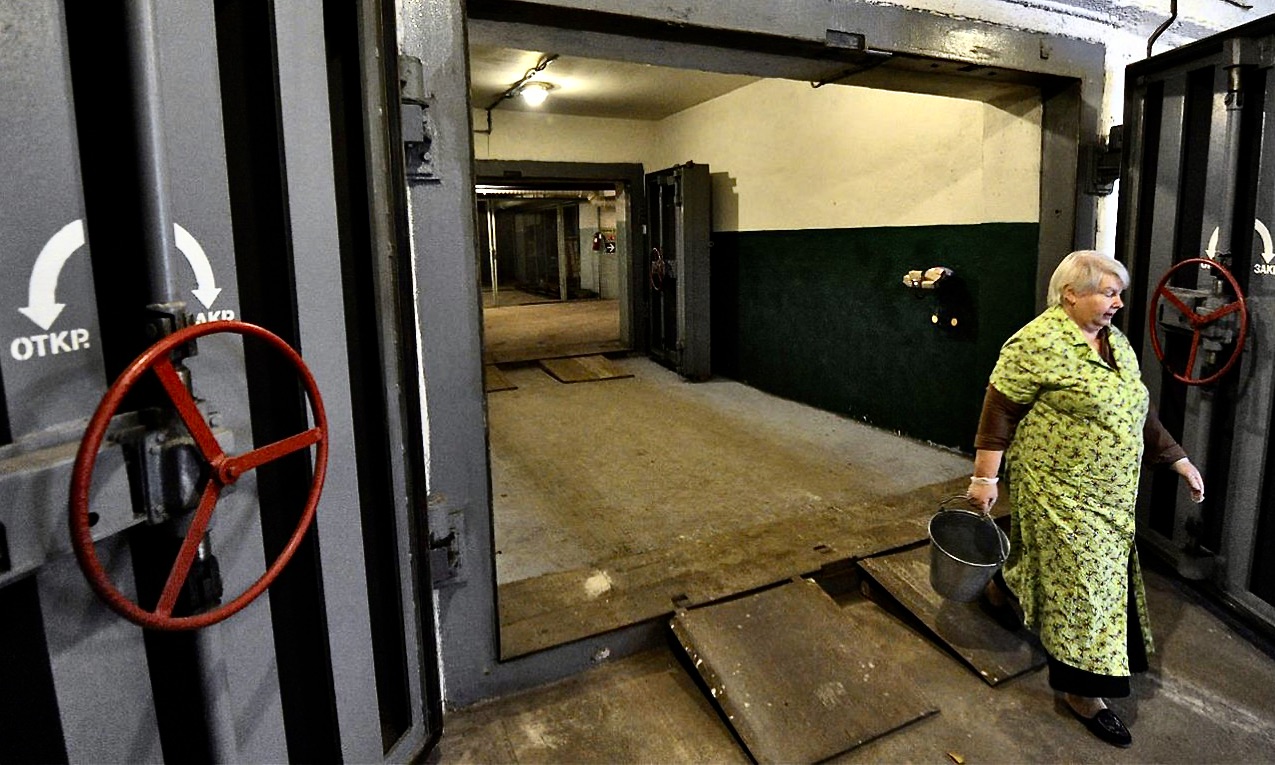
   The Iron Curtain got drawn over the window of Eastern Europe in 1945. When the curtain encircling Lithuania got to be full of holes, and after the Russians were pushed out once and for all in 1991, they left most of their relics behind. Some of the things they left behind, besides a bad taste, were zavody, which are Eastern Bloc factories. Even though Pavelas went looking for zavody, the first thing he found was a 1975-built civil defense bunker underneath a communist sweat shop in Naujamiestis, a former industrial district next to Naujaninkai, the district where he lives.

   “The bunker was underneath a factory that used to make sliding electric garage doors,” he said. “It was all trashed out. I thought maybe I could talk to the person in charge and offer to look after it. Small enterprises were renting space in the former factory and one of them, a car repair shop, gave me the phone number of the owner of the place.”

   He called and was able to get through. “He’s a real millionaire, a Lithuanian guy, and I was able to talk to him. I told him your bunker is a mess, can I maybe look after it, clean it up, be like the overseer?” Although he didn’t expect an answer that very minute, the man on the other end of the line said yes. 

   “It was bizarre but after that I was like a little kid on Christmas.”

   The Russians started building bomb shelters in Lithuania in the early 1950s, underneath schools, apartment complexes, government buildings, railway stations, and smokestack enterprises. “There was an all-important rule then, that big factories had to have a bunker,” Pavelas said. They were equipped with steel doors, filtered ventilation, food, water, and medical supplies. Participation in civil defense training was compulsory for all able-bodied men and women. 

   “If World War Three had started, like the Russians were afraid of, people would have had to live there.” 

   Nobody said anything about what they were going to do in their bomb shelters after a rocket from the tombs had wiped Lithuania off the map. When I was in grade school in Cleveland, Ohio we had a safety drill once a week. It was called Duck and Cover. We crawled under our desks and stayed there for a few minutes until our teacher nun sounded the all-clear. It was never clear to us what exactly was going on, although we knew well enough it was scary.  

   Nuclear weapons in the Iron Curtain days blasted holes in the ground 200 feet deep and 1,000 feet in diameter, blowing everything within a half mile to smithereens. Only skeletal remains would have been left within three miles of impact. After a month-or-two of radiation decay it might be safe enough to go outside, except it wouldn’t be safe.

   There wouldn’t be any power for light, heat, or refrigeration, no running water, no sanitary systems, millions of unburied dead, and an ecological balance thrown out of whack. Stress, malnutrition, and damaged immune systems would be fecund ground for the contraction and transmission of disease among survivors.

   Pavelas took rags, brooms, and candles to the bunker. “The place didn’t have electricity. It was dark, but I cleaned it” He came back with a tool box and light bulbs. He restored the electricity. He came back with curtains for the no-window windows. A year later he was conducting his first tours of the bomb shelter.

   Tour guides escort people on sightseeing excursions, cruises, or through public buildings, art galleries, and native places of significance. They describe points of interest and respond to questions. Many of them research topics related to their site, such as history and culture.  

   “What’s special about our shelter is it’s almost all authentic, just like from the Soviet times,” Pavelas said. Some bunkers had been transformed into Cold War museums, but he played it close to the vest. “Ours is original, what you would have seen in those days. It’s the only one in Vilnius like it.”

   A year after his first tour he teamed up with Albertas Kazlauskas to form Gatves Gyvos, which means Streets Alive, and Albertas bought the bunker. “He was working for a bank and when the Litas was being converted to the Euro, he thought it would be an opportunity to make a tour company. He’s the owner, a great guy, and a great friend. I’m the main tour guide and main handyman.” They upgraded the bunker tour and made it a success, at least until the viral pandemic brought it to a standstill.

   “We did non-stop tours,” said Pavelas. “I was working nine in the morning until ten at night. The bunker was a money maker although it also eats money.” Despite his success, or perhaps because of it, he expanded his tours to include Soviet-era factories located in the Naujamiestu and Zirmunu districts. “They used to make everything, from vodka to electronics. After learning a lot about Soviet Lithuanian factories, I thought people would be interested in them, too.” His favorite is the former ELFA factory.   

   When the Russians occupied Lithuania during World War Two, the country was largely agricultural. To communize it, they industrialized it. From 1940 to 1959 industrial production in Lithuania increased nine times, while in Russia itself it increased only half as much. Much of the industry was in tools, metal processing, and automobiles, and most of it was exported to the Union of Soviet Socialist Republics. The home folks drove old East German automobiles.

   It was full speed ahead in 1963, with plans on the books to build more than seven hundred new factories, including a synthetic materials factory in Kaunas, a refrigerator plant in Ukmergė, and a glass factory in Panevėžys. A furniture factory in Vilnius was going to be one of the largest in the USSR. Some of it got built. Some of it was a Potemkin Village.

   “At the time the Soviet Union collapsed all the factories were owned by the government, by Moscow,” Pavelas said. “It became like a race after independence, about who could take over the factories first. ELFA was bought and sold and bought again until the last CEO standing, who wasn’t that great of a person, shut it down. There’s still a small office on the fifth floor, but it doesn’t exist anymore.”

   After the USSR went belly up Lithuania suffered a significant recession, as well as a corrective inflation. It was a mess. There were major trade disruptions because the Russians had been the country’s main trade partner. Radical privatization didn’t helpsince much of it was out and out thievery, resulting in a 40% drop in GDP in the first half of the 1990s.

   “The ELFA factory produced electric motors for fridges, washing machines, and drills. They made reel to reel tape recorders and record players, by the millions a year. They were crappy compared to Japanese and American production but in Soviet terms the quality was as good as it got.”  

   The Lithuanians who worked there worked at what was in effect a company town. Entire families were employed in the factories, fathers and mothers and their progeny. “It was son, father, and grandpa,” Pavelas said. Some of the factories had their own campgrounds, on their own lakes, and sponsored soccer teams and singing chorales. When a conductor’s baton wasn’t enough the Russians led sing-a-longs with their special batons. Chin music was the consequence of being out of tune.

   “The complex takes up about 5 hectares of space and had more than five thousand workers, many of them women. The most memorable item they made is the ELFA-001 reel to reel machine. It cost thousands and only fifty of them were ever made. Another is a small and very powerful windshield washer motor made for Soviet submarines. Subs have a tower and towers have windows. The windows needed wipers like in a car.”

   Another of his favorites is the Sparta plant. “Their name means speed and fast work,” he said. “Their main product was socks, which they made millions of year after year. Now the factory is being demolished. I’m glad I had the opportunity to save some items, like stained glass from the canteen.”

   Albertas makes traditional tours of the Old Town, his wife Victoria leads tours for children, mixing entertainment with snippets of history, and Pavelas makes what he calls non-traditional tours, both on the job and privately. “My main goal is to research industry in Vilnius, its economics mostly during the Soviet times, why and what it was doing here,” he said. “I’m also interested in the industrial history of Lithuania, from the end of the Industrial Revolution, through the inter-war years and into today.”

   The onset of the viral pandemic in 2020 threw businesses of every kind everywhere for a loop, although if anyone needed to isolate, an underground bunker built with two-foot-thick reinforced concrete walls might have been the ideal place. In the meantime, waiting for vaccination efforts to ramp up and results to happen, Pavelas sat it out.

   “My guess is that if not for the pandemic our bunker would be one of the famous places in Lithuania,” he said. “What we have is the only one in Vilnius and the very first. We have had many different people come and see it, from deaf people to many foreigners. The bad days came when the lockdown started.” 

   During the second lockdown in Lithuania the sightseeing business was declared out of business for the duration. “We didn’t get any money, and we just tried to survive, but now that it’s over, people are going to be pouring back in. Our site is unique, in a class by itself.”

   He felt they were on the tip of something big. It doesn’t always pay to call it a day. The smart money is usually on history repeating itself, which it usually does. The sticks and stones from a long time ago is an unbroken line to today’s masters of war and their bomb shelters. Pavelas was putting his money on walking that immemorial line.

Ed Staskus posts on 147 Stanley Street http://www.147stanleystreet.com and Made in Cleveland Daybook http://www.clevelandohiodaybook.com. To get the site’s monthly feature in your in-box click on “Follow.”

Tracks of My Tears

Bt Ed Staskus

   I didn’t watch much TV growing up because we didn’t have a TV. It wasn’t until a couple of years after we moved from Sudbury, Ontario to Cleveland, Ohio that my parents bought a used 1955 Philco Custom 400. It was a 21-inch model in a cabinet of white oak with a finger-tip tuning system. It had a Double Gated Automatic Picture Control tuner that never worked during sketchy weather of any kind, whether it was drizzling or thunder storming.

   At first, I wasn’t impressed with what I saw. The shows were the likes of “McHale’s Navy,” “Car 54, Where Are You,” and “My Three Sons.” I had no use for “Hazel” and “I Love Lucy” drove me nuts. Lucy was a fruit loop and everybody hollered and played pratfalls like there was no tomorrow. I liked watching baseball and football games, although baseball games went on forever and football games were only broadcast on Sundays. The Cleveland Browns were a powerhouse. Everybody citywide stayed patriotically stuck to the tube when they were playing.

   Cartoons were fun and westerns were my favorite, especially “Maverick,” “Bart Masterson,” and “Have Gun – Will Travel.” My parents enjoyed “Bonanza” and watched it every Sunday night which meant my sister, brother, and I watched it every Sunday night. I didn’t care for it, the Cartwright’s being irredeemable do-gooders, but I couldn’t and didn’t say anything to my parents about my point of view. They were always telling me to be a good boy.

   My favorite was “Route 66.” It was about two young men driving around the country in a Chevy Corvette convertible. Besides the adventures, what I liked about the show was that every episode was shot on location in a new state. It was my kind of geography.  I would have given my tooth fairy money to be them. I didn’t mind being good, but I didn’t want to be too good.

   I had been to the neighborhood Shaw-Hayden Theater many times and seen plenty of space adventure and monster movies. My friends and I always sat in the front row. Movies were the real deal and TV was lame compared to the big screen. Movies were stupendous while TV was furniture. At about the same time we were watching Godzilla movies on the big screen the chairman of the Federal Communications Commission gave a speech to the National Association of Broadcasters. After praising the professionals in the room, he said that television should uphold the public interest. Then he said TV was a “vast wasteland.” He didn’t stop there. “When television is bad, nothing is worse.” He was a starry eyed idealist who didn’t pay attention to the commercials.

   One summer when I started watching “Queen for a Day” I watched it every day. It didn’t matter that my friends were riding bikes, playing ball, and messing around outside. I watched it laying on my stomach on the floor a few feet from the TV. I only watched it for three or four weeks, although it was more than enough to make me sweat bullets. When I stopped watching it, I went cold turkey and never watched it again. I hadn’t grown much older watching the sob show, but I seemed to be growing up way too fast on the tracks of melodrama and avarice.

   The show was originally a local affair on radio in Los Angeles but became popular enough that NBC picked it up and started broadcasting it nationally on television. The broadcast was live from the Moulin Rouge theater restaurant in Hollywood. Its ratings got so high that the network increased its running time from 30 to 45 minutes so they could sell more commercials. They were raking in $4,000 a minute, a premium price nobody else was getting. Sponsorships poured in. Every single prize came from sponsors. Models in faux medieval outfits plugged the products. They looked more slutty than maidenly. They had to put up with the sad sack-looking host saying things like, “Let’s give Mary Ann a big hand for finally doing something right.” Pre-recorded commercials ran between segments. Naming all the sponsors at the end of the show took more than five minutes.

   The show went to ABC from 1960 to 1964 until it finally folded. The television writer Mark Evanier has called it “one of the ghastliest programs ever produced, tasteless, demeaning to women, demeaning to anyone who watched it, cheap, insulting, and utterly degrading to the human spirit.” After that nobody bothered asking him what he really thought.

   The idea behind the show was simple as dog eat dog. “Queen for a Day” was about four women sharing their stories of unhappiness and tribulation in front of an all-female audience. There was always a box of Kleenex on the table behind which the women sat. jack Bailey was the host. He was a pencil mustached man who always looked like he needed another drink. The stories were about dead husbands and sons crippled with polio. One woman wanted to win so she could repair the bullet holes in her bedroom walls where her husband had committed suicide. He missed several times before getting it right. Determined widows with healthcare problems were a staple. If they had a small dying child, to boot, they were sure to win. 

   “I had two handicapped sons,” one woman said. “I lost them, and then I took care of an elderly lady in a wheelchair. She passed away, along with my mother and my father, and then my husband passed away. I feel that I would like to have a vacation.” She got her vacation. Another woman related the tale of her legally blind uncle and cousins. They were a poor farm family in Kansas. Everybody in the family had serious vision troubles. She came in second place and so none of her relations got new eyeballs.

   “On the show when Jack Bailey introduced my mother, he made a big deal about her being a long-lost cousin because her last name was Bailey,” one woman’s daughter recalled. “Since she was a farm girl, he asked her if she milked cows, and she demonstrated on his fingers. She became the queen that day. My uncle was given everything my mother asked for and more. He got a complete piano tuning tool set and a scholarship to a piano tuning school in Seattle. My mom got a full set of living room furniture and an Amana freezer that lasted for twenty-five years.”

   “My husband died,” one contestant explained. “Then my children and I were evicted and were out in the cold with nowhere to turn.” The show was the forerunner of all the reality TV shows that came after it. “Well, ha, ha, ha!” Jack Bailey laughed like he was at a circus. “Today is your lucky day, getting to tell your story here and having the chance at being chosen QUEEN FOR A DAY!” Sometimes, unable to help himself, he guffawed at the sad stories and threw out sarcastic comments, immediately explaining that he was just kidding.

   After the ladies finished, the audience applauded for the woman they wanted to see become “Queen for a Day.” The winner was determined by a decibel-reading Applause Meter, what I called the Thing-O-Meter. I didn’t always agree with the contraption, but what did I know. The winner was fitted with a jeweled crown and robed in a sable-trimmed robe. She got money, appliances, clothes, and vacations, among other things.

   “I always thought losing was the worst,” said Bill Costello, who like me found himself glued to the boob tube. “Then you find out your life sucks, but not enough.”

   Not just anyone was picked to be on the show. They had to somehow appeal to the  producers before they ever got to a live audience and the tens of millions watching at home. One woman explained she wanted to be on the show because “it would help me to regain my identity, which I seem to have lost somewhere between the maternity ward and the washing machine.” The best approach was delivering enough pathos and bawling to turn the trick. One woman said she would give her right arm to be on the show.

   My mother spotted me on the living room floor one day staring up at the TV, engrossed in the black and white pathos. She put her dish towel away and sat down in a sofa chair behind me. When the day’s episode was over, she shut the TV off. “Don’t watch that show anymore,” she said. She had never forbidden me to watch anything before. I knew there was something wrong with the show but couldn’t put my finger on it. It held me in its sordid grip. The women told fantastic stories, whoever got the most applause for her miserable tale won, got crowned, and walked away with prizes up the wazoo. What could be better?

   One winner said her husband was killed in a car crash, the family ended up poor as church mice, their savings exhausted, and needed help bad. “My mother was 28, pregnant, my sister was 8, and I was 5,” her daughter remembered years later. “My father promised my sister that if she got good grades, he would buy her a pony. She did but he died before he could fill his promise. My mother won two bedroom sets, a living room set, a dining room set complete with dishes for a service for eight, a set of silver ware, a cook-set, a built in mixer, a hot water heater, a 7-piece patio set, a complete set of Tupperware, twelve complete outfits that included dress, matching shoes and handbags, twelve pairs of stockings, a complete set of Sarah Coventry jewelry, a complete set of rhinestone jewelry, a diamond encrusted watch, a four piece matching mother-daughter outfit, a swimsuit, a check for $1,000, and a Shetland pony.” 

   When she came up for air she checked the time on the jewel-encrusted watch.

   Jack Bailey had a trademark signoff, which was, “Make every woman a queen, for every single day.” He never said what the losers got, although I always assumed they got nothing. Once my mother came to grips with the show, she disliked it instantly. My parents were World War Two refugees from Lithuania and didn’t believe a word about getting something for nothing.

   “I was babysitting my aunt’s four children in 1944 when the Russians came,” my mother said. “We ran away on a cart pulled by a horse with a cow tied to the back. On our way through East Prussia, we had to sell the cow for food. There was no milk for the baby. We slept under the cart every night and every night either the Germans or Russians bombed us. After the war I lived in Nuremberg in one room with three other women and worked at the Army Hospital. When I went to Canada where I had gotten a visa and a job, the job was as a nanny for a family of thirteen. When your father joined me the next year, he had no money and went to work in a cement factory the next day. When we got married, we still had no money, but we had the three of you and bought a small house. It’s shameful to go on a TV show, telling all the world your troubles for prizes.”

   She hadn’t seen her parents, uncles, aunts, brothers, sisters, and cousins for almost twenty years. The Iron Curtain was locked up tight. My parents never complained about it. They both went to work weekdays and on weekends worked around the house when they weren’t doing something at the church or with the Boy Scouts. They didn’t help us with our homework or drive us to the library. We did our own homework and walked to the library.

   She wasn’t telling me anything about “Queen for a Day” I didn’t already know, although I couldn’t if my life depended on it have put it into words. I knew I didn’t like the clapping like crazy for the most miserable story of the day. “Sure, the show was vulgar and sleazy and filled with bathos and bad taste,” the show’s producer Howard Blake said after the program’s nine-year run ended. “That was why it was so successful. It was exactly what the public wanted.”

   He didn’t stop there. He knew it was a trashy show that played on people’s misery, while those same people played out their tearjerkers to cash in on the American Dream. “Everybody was on the make, NBC and later ABC, the producers, the sponsors, and the suppliers of gifts. And how about all the down-on-their-luck women who we used to further our money-grubbing ends? Weren’t they all on the make? Weren’t they willing to wash their dirty linen on coast-to-coast TV for a chance at big money, for a chance to ride in our chauffeured Cadillac, for the free tour of Disneyland and the Hollywood nightclubs? What about one of the most common wishes they turned in? ‘I’d like to pay back my mother for all the wonderful things she’s done for me.’ The women who made that wish didn’t want to pay back their mothers at all. They wanted us to do that.”

   We never clapped and cheered when anybody in our grade school class at St. George’s Catholic School had a bad day. None of us clapped and cheered when a nun slapped one of us and made him or her stand in the hall. Nobody clapped and cheered when somebody was a step slow getting to the CTS streetcar taking us home. We yelled and slapped on the windows for the driver to stop and pick the kid up. None of us wanted to be finks for a day, or any other day.

Ed Staskus posts on 147 Stanley Street http://www.147stanleystreet.com and Made in Cleveland http://www.clevelandohiodaybook.com. To get the site’s monthly feature in your in-box click on “Follow.”

Bird On the Wing

By Ed Staskus

   Some men are good at farming. Other men are good at fishing. Merchants and tradesmen keep them in gear and goods. Most men are good for something, although some are good for nothing. Kieran Foyle wasn’t a man good at doing nothing. He didn’t know fishing or farming but was familiar with horses. He was going to make a horse farm and make his way on Prince Edward Island that way.

   He stayed on the cove where he landed, building a house. He cut, limbed, and sawed trees by hand and split blocks with an axe. The wood would be ready for a stove and fireplace next year. In the meantime, he bought a load of coal from a passing schooner. He found dampness nearby and looked for an underground spring. When he found it, he dug it out for drinking water, saving himself the work and expense of digging a well. Whenever he could he cleared land. It was one stump at a time, pulling them out with a team of draft horses. Sometimes it seemed like it was all he did.

   “The islander making a new farm cuts down the trees as fast as possible until a few square yards of the blue sky can be seen above. Roots and branches lying on the ground are set on fire and sometimes the forest catches fire acres of timber are burned,” is how Walter Johnson, who came to the island to start Sunday schools, described it.

   Kieran put enough salted cod away to feed a God-fearing family of Acadians. When the weather changed for the worse, he ate, smoked, read, and slept through the season, living in his union suit. The dead of winter arrived near the beginning of January and kept at it through February. The daytime high temperatures were below zero and the overnight low temperatures were less than below zero. After spring arrived and the Prince Consort proved true to his word, his land grant delivered, stamped with officialdom, he continued clearing land and building his house.

   He wasn’t a food growing man, but he had to eat. His first task was putting in a root garden of beets, turnips, and potatoes. They would store well during the winter. He made sure there were onions. They added flavor to food and were a remedy to fight off colds. Whenever he started coughing or sneezing, he stripped and rubbed himself all over with goose grease, stuffing a handful of sliced onions into his underwear. He always felt better afterwards. 

   Corn, peas, and beans could be dried and stored for soup. A bachelor might even live on the fare. Rhubarb was a perennial and a harbinger of warmer days. After a long winter it was the first fresh produce. He planted plenty of it. The island had a short but robust growing season. He woke up before sunrise and worked until dusk. He kept at it every day. The Sabbath meant nothing to him.

   The Prince of Wales visited Prince Edward Island that summer during his tour of British North America, arriving in a squadron consisting of the Nile, the Flying Fish, and three more men-of-war. The Nile accidentally grounded trying to enter Charlottetown’s harbor. Once the tide came in the unlucky boat sailed away towards Quebec. Spectators cheered Bertie’s progress to Government House on streets decorated with spruce arches. 

   “The town is a long straggling place, built almost entirely of wood, and presents few objects of interest,” the Prince of Wales wrote home to his mother Queen Victoria. She was too busy to reply with commiseration. England had been importing loads of Southern cotton for its textile industries, which were exporting loads of cloth back to the United States. Queen Victoria was on the side of Johnny Reb, but Prince Albert cautioned her to not take sides and meddle in foreign affairs. When the Union Navy seized a British ship with two Johnny Reb’s on board, there was an outcry in Parliament. A declaration of war was submitted for the queen’s signature. In the meantime her consort hid her quill pen.

   Prince Albert died within the year, but not his admonishments about politics. Queen Victoria stuck to his guns for the next forty years. “I love peace and quiet,” she said. “I hate politics and turmoil. We women are not made for governing, and if we are good women, we must dislike these masculine occupations.” A third war with the United States would have been problematic.

   It was a cloudy afternoon, but when it cleared, the Prince of Wales went horseback riding. That evening there was a dress dinner and ball at the Province Buildings. His lordship took a minute to step out onto a balcony. “Some Indians grouped themselves on the lawn, dressed in their gay attire, the headgear of the women recalling the tall caps of Normandy,” he told an aide. When the squadron ferrying the royal party embarked towards the mainland it was in a heavy rain. No one who didn’t need to be on deck wasn’t on deck. There were no spectators in the harbor waving hats and kerchiefs. Even the Mi’kmaq stayed away.

   “Our visit it is to be hoped has done much good in drawing forth decided evidence of the loyalty of the colonists to the Queen,” the Prince of Wales proclaimed. Colonial loyalty and Queen Victoria’s confidence in her colonists were soon to be tested. It was not yet viable, but Confederation was rearing its head. He played cards and lost money on his way to Quebec. He was loath to ante up. The wealthy are always more tight-fisted than the beggarly.

   Kieran hadn’t bothered making the long trip into town, having already gotten what he wanted from the royal family. The Prince of Wales was a playboy. Kieran knew he didn’t care whether any of his subjects lived or died. When the Irishman was able to at last move into his house, he started work on a horse barn. It would be large, more than large enough for stabling animals, milking cattle, and storing tools. The haymow would hold more than forty tons to feed his animals during the winter.

   At the same time, he started looking for a wife. He needed help inside the house so he could work outside the house. He needed somebody he could trust and talk to. Life without a woman on Prince Edward Island was a hard life. He found his wife-to-be at the same time he was finally finishing the barn.

   He met her in the cash provision store in Cavendish. Siobhan Regan was 19 years old, a few years older than half his age. She wasn’t pretty or well off but looked sturdy and round bottomed. He was sure she could bear children without killing herself or the infant. She could read, although she seldom did, except for the Good Book. She was ruddy cheeked with big teeth. She was a quiet woman, which suited him, who used the spoken word only for what it was worth.

   They were married and snug in their new house, home from the wedding in a buggy retrofitted with sleigh runners, the night before the last big snowfall in April. She got pregnant on Easter Sunday and stayed more-or-less pregnant for the next ten years, bearing six children, all of whom survived. Her husband refused the services of the village’s midwives, refused the services of the doctor, and delivered the children himself. He threw quacksalvers out the door with a curse and a kick. He trusted them as much as he trusted the Prince of Wales. They peddled tonics saturated with moonshine and opium. He had had some of both, enough to know they were no good for the sick or healthy, more likely to kill than not. He never drank port, punch, or whiskey, rather drinking his own homemade beer. He liked to wrap up the day with a pint and his pipe.

   He knew cholera and typhus had something to do with uncleanliness, although he didn’t know what. He had seen enough of it on ships, where straw mattresses were rarely destroyed after somebody died from dysentery while laying on them. He ran a tight ship, keeping his house and grounds in working order. He didn’t let his livestock near the spring, instead taking them downstream. He had seen the toll in towns where garbage was thrown into the street and left there to rot. He and his wife were inoculated against smallpox, and as the children got on their feet, so were they. He brooked no objections about it.

   Kieran wasn’t going to throw the dice with the lives of his children. Five of his ten brothers and sisters had died before they reached adulthood in the Land of Saints and Scholars. Their overlords had something to do with it, famine had something to do with it, and their rude lives the rest of it, putting them into early graves. One of them died on the kitchen table where a barber was bleeding him. He bled to death. They buried him in cold sod. The family shunned the barber for always afterwards.

   Siobhan took a breather from childbearing towards the end of the decade. Her husband and she went to Charlottetown twice that summer to see shows at St. Andrew’s Hall. They saw “Box and Cox” and “Fortune’s Frolic.” Both of them were directed by the eccentric Wentworth Stevenson, an actress and music teacher trained in London who had formed the Charlottetown Amateur Dramatic Club. 

   They stayed at Mrs. Rankin’s Hotel, having breakfast and dinner there, walking about the city, stopping for tea when the occasion arose, and spent their otherwise not engaged hours making a new baby. When they were done, they went home. The children weren’t surprised months later when told another one of them was on the way.   

   Every farm on Prince Edward had a stable of horses for work and transport. Most farmers used draft horses for hard labor, the nearly one-ton animals two-in-hand plowing fields, bringing in hay, and hauling manure. It was his good fortune to know horses inside and out, whether big or small. The carrying capacity of his land was more than a hundred horses. He wasn’t planning on that many, although a hundred would suit him well enough if it came to that. He was going to grow most of his own food and sell horses for the rest of life’s essentials and pleasures.   

   By 1867 when Prince Edward Island rejected the thought of joining the Confederation, even though it hosted the Charlottetown Conference in 1864 where it was first proposed, he was well on his way to making his horse farm a going concern. Confederation didn’t concern him, one way of the other. Many islanders wanted to stay part of Great Britain. Others wanted to be annexed by the United States. Some thought becoming a dominion on their own was best. He kept his eyes on the prize, which were his family and his farm.

   John Macdonald, the country’s first Prime Minister, who was always worried about American expansionism, tried to coax the island into the union with incentives, but it wasn’t until they were faced with a crisis that Prince Edward Island’s leaders reconsidered his various offers. It was when they put themselves into a hole that John Macdonald’s efforts paid off.

   A coastline-to-coastline railway-building plan gone bad put Prince Edward Island into debt. It spawned a banking crisis. Ottawa agreed to take over the debt and prop up the financing needed to resume railway construction. Parliament Hill had only been in business for ten years, but it learned its business fast. There was a demand for year-round steamer service between the island and the mainland. Ottawa agreed to the demand. The province wanted money to buy back land owned by absentee landlords. Ottawa agreed to that, too. In the event, the politics and wrangling went on. “Let us pray,” Kieran said, even though he wasn’t a church-going man. “Oh, Lord, give us strength to bear that which is about to be inflicted upon us. Be merciful with them, oh, Lord, for they know not what they are doing.” He neglected to say amen.

   He was better off than many people on the island. He had some amount of hard cash while most islanders had no cash to speak of and bartered almost everything. When the chance arose to make a killing during the horse disease of 1872, he took it. The pandemic started in a pasture near Toronto. Inside a year it spread across Canada. Mules, donkeys, and horses got too sick to work. They suffered from exhaustion. They coughed, ran a fever, and keeled over getting out of their barns and stables. Delivering lumber from sawmills or beer barrels to saloons killed them outright. They died like flies.

   “There are not a hundred horses in the city free from the disease,” a newspaper editor in Ottawa wrote. “We have very few horses unaffected,” another editor in Montreal wrote.“ The only place the pandemic didn’t touch was Prince Edward Island. “When the disease was raging in the other provinces, our navigation was closed, and our island entirely cut off, in the way of export or import from the mainland, which in fact must have been the reason it did not cross to our shores,” wrote the editor of the island’s Patriot newspaper.

   Kieran drove forty horses to Summerside where they were loaded on two ships for crossing the Northumberland Straight. Once on shore they were walked to the railhead in New Brunswick and shipped by railcar to Montreal, where money for horses was better than anywhere else. After he was paid he secreted the money inside his shirt. He kept his jacket buttoned up to the collar all the way home.

   The next year the island’s voters were given the option of accepting Confederation or going it alone and seeing their local taxes go sky high. “I hope they can finally make up their minds,” Kieran said. Most voters chose Confederation, voting their pocketbooks. Prince Edward Island officially joined Canada on July 1, 1873. The weather that day was foul and then a storm rolled in. Lightning lit up the low dark clouds, followed a second later by sonic booms. Foxes lay low in their foxholes. The night wasn’t fit for man or beast.

   It was two years later in August, lightning bolts slashing the sky, that the prize horse on Foyle land spooked and kicked Kieran in the head, knocking an eye out, breaking his jaw, and fracturing his skull. Everything he knew about horses, as well as the money from the sale of them in Montreal, which he had hidden in a hole behind the barn, flew out the window with his soul. The gates of both Heaven and Hell opened wide to admit him. He tossed the Devil’s invitation aside.

   Flags flew on the island that same August when George Coles died in Charlottetown. He had been the first premier of Prince Edward Island and one of the Fathers of Confederation. It hadn’t kept him from fighting a duel with Edward Palmer, another Father of Confederation. He had been a feisty man. He was convicted of assault over the duel. He spent a month in jail while still serving in the provincial government. His twelve children visited him every day and brought him beer every day. He had been a brewer earlier in life. He always said, “There is no beer in Heaven which is why we drink it here.”

   Siobhan folded her flag and buried it with her husband in the St. Peter’s boneyard up the hill. After the interment, her children gathered around her, she looked out on the Atlantic Ocean from the top of the rise. Her husband had crossed the western ocean at peril to himself to make his fortune, no matter what it might be. He was gone now but the land was still theirs. She would never give it up. It would always be theirs. Her children’s children would bear fruit there.

   Siobhan wasn’t going anywhere, no matter whether it was Canada or the United States or anywhere else on the island. She couldn’t raise the dead, but she could raise her children on the farm her husband had made. She was determined none of them would ever forget their father. Foyle’s Cove would stay what it was and where it was.

   She started the slow walk home with her sick at heart brood. They walked down the red road to the cove and their farm. The smallest of her issue, a girl with pigtails flapping, pulled at her mother’s dress.

   “Mammy, I have a secret to tell you.”

Excerpted from the book “Ebb Tide.”

Ed Staskus posts stories on 147 Stanley Street http://www.147stanleystreet.com and Cleveland Daybook http://www.clevelandohiodaybook.com. To get the site’s monthly feature in your in-box click on “Follow.”

“Ebb Tide” by Ed Staskus

“A thriller in the Maritimes, out of the past, a double cross, and a fight to the finish.” Sam Winchell, Beyond Books

Available at Amazon: https://www.amazon.com/dp/B0CV9MRG55

Summer, 1989. A small town on Prince Edward Island. Mob money on the move gone missing. Two hired guns from Montreal. A constable working the back roads stands in the way.

A Crying of Lot 49 Publication

Tough as Nails

By Ed Staskus

   My grandmother hit the deck pretty as a prayer book the day she was born. She didn’t come into the world tough as nails. She wasn’t that way as a girl, a young woman, a schoolteacher, a newlywed, or a wife and mother. But that was the way she was when World War Two ended and she was waking up to her second year in a Siberian prison camp. She survived by being that way for more than ten years, in the middle of nowhere, slaving away. She stayed alive, somehow. It was no way of life stuck in the Soviet dark ages.

   She was born near the tail end of the Gilded Age, although it wasn’t anywhere near anything gilded. She missed out on the mischief of the robber barons. She was born in Russia during the fin de siècle. She missed the debates convulsing Europe at the time concerning the moral responsibility of art. Even if she had heard the arguments, it’s doubtful she would have cared. She missed the Boxer Rebellion, the Second Boer War, and the Philippine-American War. When the pea shooters of those conflicts were put away, she got to live through the blitzkrieg of World War Two.

   Growing up she had an inkling most Lithuanians hated Muscovites, for taking over their homeland, forbidding the native language, and exploiting everything they touched. By the time she was grown and gone to Lithuania she knew for sure Russia was feared and distrusted on all its borders.

   My grandmother Antonina met my grandfather Antanas when he was stationed in Saransk. It is in the Volga basin where the Saranka and Insar Rivers meet. The garrison was four hundred miles east of Moscow. Antanas Staskevicius was a Lithuanian officer in the Russian Imperial Army. He was more than a thousand miles from home. My grandmother came from a nearby small town. She earned her teacher’s certificate in Saransk. She was teaching kids their Cyrillic ABC’s.

   The whistle-stop was founded as a fort, on the left bank of the Isar River, at the crossroads of Moscow and the Crimea. Before World War One its commercial life revolved around honey, meat, and leather. After the war its factories stayed closed for more than ten years when there weren’t any available fuels or raw materials.

   “My father was trained as an officer and sent to serve there with an infantry regiment,” my father said. “It was a hard post for him, because back then they used to say drinkers go to the navy and dimwits go to the infantry.” The Imperial Army had more than a million men in uniform, most of them conscripted, most of them peasants. There were a quarter million Cossacks, too. Only the Cossacks knew what they were doing.

   Antanas courted Antonina and they got married sooner than later. They had a daughter, Eugenia, in 1917. They called her Genute. Another daughter, Gaile, was born the next year. My father was born six years later, in 1924, in Siauliai in the north of Lithuania. He was named after King Vytautas the Great. His mother called him Vytas. His sisters called him many things, including the little prince, the pickle prince, and the rotten prince.

   Siauliai is home to the Hill of Crosses, which is a hill less than ten miles from the town. It is covered with tens of thousands of wooden crosses, crucifixes, and statues. It was after Tsarist forces crushed the November Uprising of 1831 when the first of them appeared.

   By 1918 Lithuania had been missing from the map for more than a hundred years, having been disappeared after the Partition of Poland. Since that time, it had been under the thumb of the Russian Empire. Late that year, when the war finally ended, and Russia was being convulsed by its Bolshevik revolution, Antanas and his new family went home to a newly independent country.

   “Lithuania didn’t have many officers when they formed their own army,” my father said. “Most of them were men who had been conscripted into the Imperial Army before the war.” Most of them burned their Russian uniforms as soon as they could. “My father fought in the post-war battles around Klaipeda and after that he served in the secret service in Kaunas, which was the capital.”

  Lithuania had declared independence in February 1918 and for almost three years fought Soviet Russians, West Russians, and Poles for their homeland. Finally, in 1920 they formed their own government, although they later lost Vilnius to the Poles, with whom they remained officially at war with little blood spilled. In September 1939 Poles found out they were in the frying pan. Vilnius was suddenly off the menu.

   After the fighting my grandfather was awarded land for serving his country. The family had a house in town but lived on a farm most of the time. They spoke Russian at home. Except for what he picked up among his friends, so that he had a sprinkle of street cred, my father spoke little Lithuanian until he started school.

   During World War One most of Siauliai’s buildings were destroyed and the city center was obliterated. Since its founding in the 13thcentury, it had burned down seven times, been struck by pandemics seven times, and World War Two was the seventh war that wrecked it. It was a winsome town between the disasters.

   “When my father became the governor of the district, we moved to the city there,” Vytas said. It is a royal town founded in the early 16th century on the plain of the Nevezis River, about fifty miles east of Siauliai. During the interwar years Lithuania was divided into 24 districts and each district had its own governor. Antanas was the governor of Panevezys until 1938.

   Vytas went to grade school and high school there, but then his father was made governor of Zerasai, which was more-or-less a summer resort. In 1834 Zerasai had burned down and been rebuilt. Two years later it was renamed Novoalexandrovsk, in honor of Tsar Alexander’s son, but after the war to end all wars was over and done with the name was thrown out the window.

   “No sooner was my father made governor, my mother didn’t want to move there, since it was far from where we lived, so I stayed with her,” Vytas said. “But I didn’t get along with the other students in town. It was a strict school, and everybody had to dress nice. On my first day of high school, I was dressed too nice, like I was going to a wedding, with a tie and everything, and everybody laughed at me. ‘Where are you from, the sticks?’ they all said. I didn’t make any friends there.”

   He told them, “I’m going to Zerasai.” He moved there in 1939 and lived with his father. “We always studied a second language in school, and since my mother was Russian, studying that was easy for me. But when I got there, I found out they only had English as a second language. My father had to hire a tutor to help me.” He soon spoke Lithuanian, Russian, and English.

   All during the 1930s the world had been changing fast. It changed a lot faster the last year of the decade. Father and son moved back to Siauliai. “The Russians came in 1940. All the high officials were let go and they selected new people who they wanted in the driver’s seat. They said they didn’t run the country themselves, we Lithuanians did, but it was the Lithuanian Communists who were in charge, so it was the Russians.”

   The family spent more and more time on their farm, renting out their house in Siauliai. “It was only a few miles from our farm to town. I used to walk or bicycle there. But the mood was bad. Everybody was on edge. Everybody thought something terrible was going to happen.”

   The Russian invasion of Lithuania was completed by the late summer. Businesses were nationalized and collectivization of land began. As the Soviet presence expanded the family discussed leaving the Baltics. “Why don’t we go to Germany?” Antonina asked. She wasn’t a fan of her Muscovite kith and kin. She had an insider’s track making judgment calls about them.

   “We had a chance to leave the country and go somewhere else. My mother wanted to go. We talked about it often.” But my grandfather didn’t want to leave his native land. “I have never done anything wrong that they would put me in jail,” he told his family. “I have always been good to people. They aren’t going to put me in jail.”

   In the fall of 1940, a company of Red Army infantry commandeered their house and farm for several days. “They didn’t do anything crazy, or mistreat us, but they hadn’t washed in months. They stunk and they rolled their cheap tobacco in newspaper. They smoked all the time. It took us a week to air out the house.”

   The family stayed on the farm through the winter. Then, as the mass arrests and deportations of more than17,000 Lithuanians began in June 1941, my grandfather was picked up by NKVD plainclothesmen. “He was gardening in our yard, wearing a shirt, old pants, and slippers when they drove up, a carload of Russians, and stopped, saying there was something wrong with their engine,” Vytas said. “I’ll help you out, my father said. He walked over to the car with them. They pushed him into it and drove away.”

   Vytas was in school taking his final exams that morning. “My mother called the school and told me my father had been taken. I ran out of class and went home right away on my bike.” His mother packed up clothes, socks and shoes, and soap for her husband. They went to see him the next day.

   “The man who was running the jail was a Jewish fellow. He had grown up with us and was a friend of our family, but when my mother asked him to help us, he said times have changed.” The old order was out. There was a new order. Asking for help meant getting nowhere.

   “He was a Communist and had been in and out of jail because of it. He was always in trouble. My father always let him go after a few days, telling him to not get involved in politics anymore. Just be a nice boy, he would tell him, but then the next thing we knew he would be in jail again. He wouldn’t help my father when he was arrested. Everything’s different now, he said.”

   My grandfather, who had once commanded the local police, stayed stuck in his jail cell. “They didn’t let my mother talk to my father,” Vytas said. “We went there several times, but they didn’t let us see him. We never saw him again.”

   Antanas Snieckus, the top dog of the Lithuanian Commies, supervised the mass deportations. He decided who was an “Enemy of the People.” Teachers, priests, policemen, civil servants, politicians, anybody who was a member of the Nationalist Union or the Rifleman’s Union, and landowners were on the list. Tens of thousands of them were deported. When they checked their tickets, they discovered the deportations had no expiration date.

   My grandfather was taken to Naujoji Vilnia and shoved into a boxcar. The train left Lithuania on June 19, 1941. Four days later, at the Battle of Raseiniai, the 4th Panzer Group, part of the first phase of Operation Barbarossa, the German invasion of Russia, wrapped up the complete destruction of Red Army armor and air forces in Lithuania. Within a week the Nazis were the feet on the ground.

   The Russians transported my forefather to a forced labor camp near Krasnojarsk in Siberia. He was put to work sawing down trees all that winter. He starved to death the next winter of 1942. Anton Chekhov, a noted Russian short story writer, once wrote that Krasnojarsk was the “most beautiful city in Siberia.”

   “The morning after my father was arrested, I drove our horse and wagon to school to finish my exams,” Vytas said. “I had to deliver milk to my teacher’s family, too. But when I stopped at his house, he ran out with his family and said, please take us to the railroad station. I said OK and they all got into my wagon. It was him and his wife and their two children. I took them to the station. After that I never saw them again. The next day one of our neighbors told me the secret police had come to the teacher’s house that same afternoon looking for him. Anybody from an educated family, the Russians were worried about all of them. They were afraid all the high-class people were against them.”

   When the NKVD began mass arrests of Lithuanians, Soviet officials seized their property, and there was widespread looting, especially by the body politic. It was every man for himself and God against all, unless you were a dyed in the wool comrade. “If you were a Communist then you were all right. The father of one of my friends was a metal worker. He didn’t even know how to read and write, but the Russians made him the mayor of Siauliai because he was a Communist.”

   My father’s mother Antonina, sister Genute, and he stayed on the farm after the Nazi takeover. His sister Gaile was living in Vilnius. There was an uneasy peace. “The day the Russians left and before the Germans came, I was in Vilnius,” Vytas said. “Everybody rushed to the food warehouses and broke into them. It wasn’t that we were robbing them, but everybody was doing it, since there was no food. Gaile and I went, too. We filled up our bags with bread and pork, all kinds of food, and took everything home. When the Germans arrived, they put a stop to it.”

   He stayed in Vilnius for several months, but then decided to go home before the end of summer. The family farm had to be cared for, but first, he had to get a travel permit. “I couldn’t get to see a single German to apply for a permit, but finally I talked to somebody who had known my father and got an appointment. The officer told me they weren’t issuing any for the time being and to come back, but after we talked about my father a little, he said all right, and wrote one out for me.”

   He took a train north and walked home, but when he got there, he discovered a company of Wehrmacht had taken over the farm. “They were there three weeks, more than seventy of them. I couldn’t even get into our house since the officers had taken it over. But those Germans were good men. They didn’t do our farm any harm. They had their own tents and their own mess. I made friends with some of them. We drank beer together at night.”

   His father’s practice had been to have a foreman run the farm. The foreman hired three men and three women every spring. Although the farm had chickens and pigs, and draft horses to do the heavy work, it was mostly a dairy farm with more than twenty cows.

   “When I came back, my sister Genute was there, but she wasn’t interested, so she didn’t do any work. I started taking care of things, even though I didn’t know anything. I knew the cows had to be milked and the milk had to go to the dairy. But about growing crops, and the fields, I didn’t know anything. But I did everything as though I knew what I was doing.”

   That fall he sent farmhands out to till the ground in a nearby field. When his nearest neighbor saw them working, he ran across the road towards them.

   “What the hell are you doing?” he shouted waving his arms.

   “I told him we were preparing the ground for next year. He said, you’re ruining this year’s seed and you won’t have any grass next year. We stopped right away. I learned what to do.”

   A year later he was on a horse-drawn mower cutting hay when he saw storm clouds gathering. He thought he would be better served walking the horses, so they could pull the mower faster, and jumped down from his seat. “As I hopped down, I stumbled and fell on the blades of the mower. The horses stopped. My hand was almost cut off. The boy who was helping me ran over. When he saw what happened, and saw my injured hand, he passed out.”

   While the war dragged on across Europe, he had problems keeping the farm going. He had only partial use of his impaired hand and farmhands everywhere were deserting the land. “I went to the prisoner-of-war camp where I knew the Germans gave Russians out. They gave me five of them. They were nice guys, worked hard, and sang at night while they got drunk. One morning I woke up and there wasn’t one of them left. They were all gone. I had to go back to the Germans and ask for five more. My God, how they yelled about it. One officer exploded, shouting that I hadn’t looked after them, shouting that I needed to lock them up at night, and shouting that they weren’t going to give me anymore. In the end I said, I need five more, so they gave me five more. I kept them locked up after that and they were still there when the Russians came back.”

   In 1944 the Red Army stormed back into Lithuania. My father escaped with a mechanized company of Wehrmacht, whisked up by them as they passed. They had been stationed near the prisoner-of-war camp. They told him he had five minutes to decide whether he was coming with them as they retreated.

   “An officer said the Russians were on the other side of the Hill of Crosses.” The hill was on fire. “They were in a big hurry. I only had time to fill a bag with a few clothes, a little money, and photographs of my parents.” It was time to go, come hell or high water.

   His sister Genute, not on the farm that day, fled separately. She got across the border into East Prussia, and later into Germany. His sister Gaile didn’t make it out. “She had a problem at the border. The Russians had taken that area, so she was forced to stop in a town there. She had her daughter and her husband’s mother with her. After the war she finished trade school, became a nurse, and never told anybody where she was from. The Communists never found out anything about her.”

   In July the Red Army captured Panevezys. Later that month they took Siauliai, inflicting heavy damage on the city. Two months later the counterattacking German 3rd Panzer Army was destroyed and for the next nearly fifty years Lithuania became part of the Union of Soviet Socialist Republics.

   “I was glad to get out of Lithuania in 1944,” my father said.

   He found out his mother, my grandmother, had been deported. “Somebody complained and informed on her. We had land, 160 acres, so we were considered capitalists. We weren’t rich, but we weren’t poor, either. There was no real reason that I ever found out about for why they took her. She was sent to a prison camp.”

   Between the tail end of World War Two and 1950 more than 87,000 Lithuanians were deported, forced to work in logging and gold mines, forced to live in barracks with leaky roofs and drafty windows, if there were any windows. More than a third of them died. Some of them resigned themselves to their lot. A few escaped into the wild.

   My grandmother was released from the Gulag in the early 1960s, one of the last deportees to be let go. She was not allowed to return to her home in Siauliai. She was forced to relocate to Silute, to an aboveground bomb shelter-style apartment. She was still on somebody’s shit list. 

   Silute is to the west of Marijampole, in the south of the country. The Nemunas River floods there almost every year, soaking the lowland pastures. Migrating birds call it home away from home because of the delta and all the water. A large part is forested and home to more than three hundred villages.

   My mother’s family, none of whom escaped the country during the war, lived near there. When my mother and sister visited Lithuania in the early 1980s, they made plans to visit Antonina. They kept their plans close to the vest. The scheme was for there to be three of our uncles, three wives, my mother and sister, and some of our cousins in three cars. “My mother would be in one of the cars, I would be in another, and the third car would be a decoy, if it came to that,” my sister Rita said.

   The secrecy was necessary because they weren’t allowed to go anywhere except within the city limits of Vilnius, where they were staying. When they asked about Silute and Siauliai, they were told they were out of bounds. Every place outside of Vilnius was out of bounds. The Intourist official at the front desk of the Gintaras Hotel leaned forward and told my mother it was because of missile installations.

   “Are there missile installations in every town in the whole country?” she asked.

   “I know sarcasm from naïve American when I listen to it,” the official sneered.

   Their convoy didn’t get far the first day of the familial excursion. They were stopped by a roadblock on the outskirts of Vilnius. The police were waiting for them. “They knew,” Rita, my sister, said. “Somebody had overheard something. Somebody talked. They waved us off the road.”

   The police glanced at my Uncle Justinas’s papers and told him to go back. They went to the second car. Everybody had to show their papers. My mother was the best dressed of everybody in all three cars. She was decked out. They asked her where she lived.

   “The Gintaras Hotel.”

   “Turn around, fancy lady, go back to the hotel.”

   They went to the third car. My Uncle Sigitas and his wife Terese showed their papers. Rita was sitting in the back with our cousins. They showed their papers. When it was Rita’s turn, she said, “You’ve seen their papers. I live in the same place.”

   “What’s your name?”

   “Jurgelaitis, just like them,” she lied.

   He asked her something in Russian. She didn’t understand a word of it and glared at him. The stare-down between Soviet cop and American gal took a few minutes. It was a stalemate at the end of the staring contest.

   “The next time I see this one she is going to have to answer,” the policeman warned my uncle. it was bluster until he said, “Turn back.”

   They turned around and the convoy went back to Vilnius.

   Undaunted, a few days later, a day before leaving the USSR, Rita was picked up by Uncle Sigitas before dawn before breakfast at the back of the hotel for an end run to Silute. She skittered into the car, and they sped off. The streets were empty in the autumn gloom.

   “He was a crazy driver, always yelling, ‘Somebody’s following us!’ He stayed off the highway, and the main roads, instead going up and down different ways. I thought the drive was going to take two hours, but it took much longer.” It took five hours on empty stomachs. It was worse than the Aeroflot flight from Moscow, which had been bad enough. Rita had slipped their bad food tray under her seat in mid-flight.

   They were stopped several times, but every time Uncle Sigitas was allowed to stay the course. The roadblock police didn’t explain why. They just waved him onward. When they got to Silute they asked around and found the house where Antonina was living.

   “She lived in a two-room apartment, in a rectangular four-unit building, almost like a concrete log cabin, that looked like it was built hundreds of years, before there even was concrete,” said Rita. She had a low-tech security system, a rusty nail she used to lock the front door. There wasn’t a back door. There was no running water or indoor plumbing. The windows needed caulking. The roof was long overdue.

   She was in her late 80s. She had gone through tough times, but she still had a lot of life in her. She had seven grandchildren in the United States. Rita was the first one she ever saw. She gave my sister a big smile and a big hug, even though she was a small woman and had to reach up. She was barely five feet tall.

   She wasn’t the Man of Steel, like the ringleader who squashed her and the Baltics under his thumb, but he was dead and gone, a downspout memory, and she still had plenty of what it takes. How you start is how you finish. They had lunch, cold beet soup, potato dumplings, and mushroom cookies with strong tea. It was a roots buffet on a beat-up wood table. Rita didn’t slip anything under her chair.

   “How did you like it?” Uncle Sigitas asked on their way back to Vilnius.

   “It’s the best food I’ve had in Lithuania so far,” Rita answered.

   Antonina passed away in 1985. She didn’t die of anything special. She died in her sleep. She was in her early 90s. She had fought tooth and claw to survive in a no mercy Siberia and was worn out. Even the toughest nails one day become the last nail in the coffin. Her time was up on this earth.

   When she died my father bought a mass for her at our Lithuanian American church in Cleveland, Ohio. He had been raised a Catholic and was still a true believer. I wasn’t on the same page, but I wasn’t going to slam the good book shut in anybody’s face that day. When my turn came to say a prayer, I said a prayer for the dead, asking God to grant my grandmother peace and quiet. I was sure where she was going it was a sure thing, not like the third planet from the sun she was leaving behind.

Ed Staskus posts on 147 Stanley Street http://www.147stanleystreet.com and made in Cleveland  http://www.clevelandohiodaybook.com. To get the site’s monthly feature in your in-box click on “Follow.”

Swimming With the Fish

By Ed Staskus

   There are thousands of restaurants in Cleveland Ohio. Captain Frank’s isn’t one of them anymore. It used to be and when it was it was one of the best places to eat if you liked seafood and Lake Erie waves and wind shaking the building on the E. 9th St. pier. Every so often somebody full of cheer and careless after a hearty meal, or simply drunk as a skunk, drove off the pier into the lake. 

   “It was always my last stop after a night of drinking in the Flats,” said Nancy Wasen. “Every night I was surprised no one fell off the pier and drowned.” It wasn’t for want of trying.

   In 1964 Mary Jane Jereb was 16 years old. She was in a car with her cousin and a neighbor and a driver’s education instructor. “He took us downtown, to prepare for city driving. I wasn’t driving, my neighbor was. He directed her to this particular parking lot.” It was Captain Frank’s parking lot. They drove straight to the edge of the slimy pier. Spray from the Great Lake spotted their windshield.

   “The instructor told my neighbor to turn around and head back to Parma. My short young life flashed before me as she pulled into a parking space and backed out and headed home.” They slowly carefully left the dark deep behind.

   Captain Frank’s was a “Lobster House” or a “Sea Food House” depending on the signage of the year. It changed now and then. There was a panhandler who called himself Captain Frank who hung around outside the restaurant day and night, his hand stuck out. Demoted cops who had kept quiet about hidden rooms in gambling joints and pocketed cash in job-buying schemes were assigned to seagull patrol on the pier, always in the dead of winter. They ignored the panhandler and did their best to walk the chill off. Sometimes they helped the innocent just to stay on the move.

   Francesco Visconti was the Captain Frank who ran the restaurant. He was a Sicilian from Palermo whose parents beat it out of Europe the year World War One started. At first, as soon as he could handle a horse, he sold fish from a wagon. After that he operated the Fulton Fish Market on E. 22nd St. He was 40 years old in 1940 and lived with his wife, Rose, a son, as well as three daughters.

   He bought a beat-up passenger ferry building on the E. 9th pier in 1953 and opened Captain Frank’s. I was a child living the easy life in Sudbury, Ontario at the time and missed the grand opening. Kim Rifici Augustine’s grandfather was the original chef at Captain Frank’s. “The wax matches he used for flambé caused a fire back in the 1958,” she said. The fish shack burned down. Frank Visconti built it back bigger and better the next year.

   By the late 1950s my family had emigrated from Canada to Cleveland Ohio. We lived nearby, but never went to the restaurant. My parents were Lithuanians and ate bowls of beetroot soup and plates of potato pancakes and meat-filled zeppelins at their own table. They didn’t know a Mediterranean Diet from Micky Mouse.

   In the Old Country they had feasted on pigs and crows. My mother’s father was a family farmer who kept porkers, slaughtering them himself, and smoking them in a box he built in the attic of the house, the box built around their fireplace chimney. “It was the best bacon and sausage I ever had in my life,” my mother said eighty years later.

   They hunted wild crows. “Those birds were tasty,” my mother said. The younger the birds the better. Those still in the nest and unable to get away were considered delicacies. Their crow cookouts involved breaking necks and boiling the birds in cooking oil over a bonfire. They served them with whatever vegetables they had at hand.

   Since I was part of the family, I ate with my parents, my brother, and sister. My mother prepared every meal. I ate whatever she made, even the fried liver and God-awful Baltic headcheese, although we never, thank God, had carrion-loving crows. Even if I had wanted to go to the Lobster House, I didn’t have a dime to my name

   Captain Frank’s boomed in the 1960s and 1970s. There were views of the lake out every window. There was an indoor waterfall. If you had water on the brain, it was the place to be. The food was terrific. Judy Garland, Nelson Eddy, and Flip Wilson ate there whenever they were in town doing a show. The Shah of Iran and Mott the Hoople partied there, although not at the same time. They weren’t any which way on the same wavelength, other than under the spell of Captain Frank. He never asked them to leave, no matter how late it was.

   There was a luncheonette behind the restaurant that doubled as a custard stand in the summer. When the Shah or Mott the Hoople stayed later than ever, they could sit in the back in the morning in the breezy sunshine with a cup of custard while lake freighters went back-and-forth. “I never went inside Captain Frank’s, but I remember the ice cream shop in the back well,” recalled Bob Peake, a homegrown boy who was a frozen sweets connoisseur.

   Frank Visconti was a made member of the Cleveland Mob. His criminal record dated back to 1931, including arrests for narcotics, bootlegging, and counterfeiting. The restaurant was frequented by high-echelon hoods and low-minded politicians alike. Many criminal family meetings were held there. 

   “It was the hangout for Cleveland Mafia Enterprises,” said Tom James on Cleveland Crime Watch.

   Longshoremen went to Kindler’s and Dugan’s to drink before and after work, but between their double shifts went to Captain Frank’s for power shots. When they were done it was only a short walk back to the docks. When the weather was bad, they were warmed up and sobered up by the time they clocked back in.

   The restaurant was a football field’s length from Lakefront Stadium, where Chief Wahoo and the Browns played. The ballpark sat nearly 80,000 fans. The Indians were always limping along, their glory days long gone, but the Browns were exciting, and on game day crazy loud cheering rocked the windows of the restaurant. Cold biting winds blew into the stadium in spring, fall, and winter. In the summer under the lights, swarms of midges and mayflies sometimes brought baseball games to a standstill.

   In 1966 the Beatles played the stadium and after that the Beach Boys, Pink Floyd, and the Rolling Stones showed up to rock the home of rock-n-roll. It was a walloping paycheck for a night’s work. In the 1980s U2 brought its big show to town, raking in millions singing about lovesickness and hope. Every so often they threw in something about social injustice.

   Even though I was grown-up by the 1970s, I still didn’t dine at Captain Frank’s. I was living in a rented house in a forgotten part of town, and it was all I could do to feed myself at home. I didn’t have pocket money to eat out. When I finally joined the way of the world and could afford to go whenever I had some spare change and wasn’t too tired from working with my hands all day, I ate out. Most of my friends were already racing to the top. I was starting at the bottom.

   There was a kind of magic eating at Captain Frank’s at night. I watched the lights of ships making their way slowly into Cleveland’s harbors while munching on scampi and warm rolls swimming in garlic butter. They served steaks the cooks seared, but the seafood was usually just threatened with heat and served. That’s why it was good. Students from St. John College on E. 9th and Superior Ave. walked there to have midnight breakfast because it was nearby and substantial

   The Friday night in September 1984 my friend Matti Lavikka and I treated my brother to dinner on his 31st birthday at Captain Frank’s was almost the last birthday he celebrated on this earth. We didn’t know Frank Visconti had died earlier that year, but in the car on the pier after dinner we thought my brother was dying. He was gasping for air. The dinner had been very good, but he looked very bad. We were afraid he might end up swimming with the fish.

   He was getting over a marriage to a Columbus girl that had lasted 56 days. We picked him up in Mentor, where he was living alone, and went downtown. It was a starry late summer evening. We ordered a bottle of Chianti, some pasta, and lots of shellfish. We didn’t know, and he didn’t know, that he was allergic to shellfish. 

   “I don’t know why, but I hardly ever eat fish,” he said. “It doesn’t usually agree with me.” Our dinner at Frank’s that night included scallops, oysters, shrimp, and lobster. He might not have been allergic to all of them, but he was allergic to one of them, for sure.

   Halfway through coffee and dessert, which was sfogliatelle, layers of crispy puff pastry that bundle together in a lobster-like way, he was itching, wheezing, and his head was swelling. His lips, tongue, and throat were like silly putty. He was breaking out into hives. He was getting dizzy and dizzier. It was like he had eaten a poisoned apple.

   Shellfish allergy is an abnormal response by the body’s immune system to proteins in all manner of marine animals. Among those are crustaceans and mollusks. Some people with the allergy react to all shellfish. Others react to only some of them. It ranges from mild symptoms, like a stuffy nose, to life-threatening.

   Matt was a fireman and paramedic in Bay Village. Looking at my brother he didn’t like what he was seeing. We frog-marched him to the car and made a beeline for the nearest hospital. Matti put the pedal to the metal. The Cleveland Clinic wasn’t far, and we had him at the front door of the emergency room in ten minutes. Five minutes later a doctor was injecting him with epinephrine and a half-hour later he was his old self.

   “Thanks, guys,” he said when we dropped him off at his bachelor pad in Mentor. He staggered away to bed.

   After Frank Visconti died the restaurant limped along. The service and food got worse and worse. The tables and chairs and walls looked like they needed to be scrubbed down. Fewer and fewer people went downtown for any reason other than work. I was working downtown near the Cleveland State University campus, where Matt and I had started a small two-man business. One evening when I got off work, I called my girlfriend and invited her to dinner at Captain Frank’s. I had seen her eat buffets of seafood. She had a hollow leg. I knew she wasn’t allergic to any of it. When we got there, however, the pier was dark in all directions. There were no parked cars in the lot and no lights in any of the windows.

   Rudolph Hubka, Jr., the owner the past five years, had given up the ghost and declared bankruptcy in 1989. Nobody said a word. Hardly anybody noticed. The building was demolished in 1994. The only thing left was dust and litter blowing around in the wind.

   We drove to Little Italy and snagged a table at Guarino’s, a woman out front pointing the way. Sam Guarino had died two years earlier, but his wife Marilyn was carrying on with the aid of Sam’s sister Marie, who lived upstairs and helped with the cooking in the basement kitchen. “Marilyn sat in front, and she was like the captain on a ship, making sure everything was just right,” said Suzy Pacifico, who was a waitress at the eatery for fifty-two years.

   We had a farm-to-table dinner before there was farm-to-table, red wine, and coffee with tiramisu. Mama Guarino asked us how we liked the cake. We told her we liked it very much. We didn’t see any fishy characters. When I drove my girlfriend home that night we were both happy as clams.

Ed Staskus posts stories on 147 Stanley Street http://www.147stanleystreet.com and Cleveland Ohio Daybook http://www.clevelandohiodaybook.com. To get the site’s monthly feature in your in-box click on “Follow.”

Dead Man’s Curve

By Ed Staskus

   Maggie Campbell was almost 22 years-old the morning she drove face first into a cement truck. She was driving a yellow 1973 coupe a girlfriend of hers at the Bay Deli, where they both worked, had sold her for one hundred and eighty-five dollars in cash. It was a rust bucket, but it was a Jap car so the two hundred thousand miles on it hadn’t made a dent in it running, at least not yet.

   She had gotten up late that frosty spring morning and shoveled down a Fudgsicle, a hot dog, and a cup of joe for breakfast. “I better go,” she said to herself, throwing the Fudgsicle stick in the trash with the other Fudgsicle sticks.

   Her roommate and she were sharing a small house on Schwartz Road behind St. John’s West Shore Hospital in Westlake. She was late for class at the Fairview Beauty Academy. She bolted out to the car. When she got into it, she couldn’t wait for the front window to defrost more than the small square absolutely needed to look through. She was squinting through one square inch of windshield taking the curve at Excalibur Ave. and bopping to Jan and Dean on the radio.

   “It’s no place to play, you’d best keep away, I can hear ’em say, won’t come back from Dead Man’s Curve.”

   “I never touched the brakes,” she said after hitting the cement truck headlong.

   The truck was parked on her side of the street. The front end was facing her. That was the first surprise. She knew she was on the right side of the street as she came around the curve since she could see full well out her driver’s side window. At first, Maggie didn’t know what happened. The second surprise was that when she tried to get out of her car she couldn’t move. When she looked down to see why she couldn’t move she saw the steering wheel jammed into her legs. She was sandwiched between the wheel and the seat. Some days you are the dog and other days you are the fire hydrant.

   She finally got out of the car by swinging one and then the other leg over the steering wheel. Standing next to her coupe, looking at the man suddenly standing in front of her, she realized why no one had come to help her. He was white as a ghost. The rest of the cement men behind him looked like they were looking at a ghost, too. They thought she had died in the car, which had turned into scrap metal in an instant.

   “I tried to wave you off,” one of them said.

   “Hey, here’s a clue, bub, I didn’t see you and I didn’t see the truck,” she said. “Thanks for the heads up, but I didn’t see anything.” The next thing she knew a woman walked up to her and shoved Kleenex up her nose.

   “You better sit down,” she said.

   “That’s OK,” Maggie said. “I’m good. Besides, I’ve got to get to school.”

   “No, you better sit down. I’ve called an ambulance. They should be here in just a minute.”

   “Seriously, thanks, but no. I just bumped my nose.”

   She sat Maggie down. When she did Maggie’s white beauty school skirt rode up and she saw her mangled knees. The skirt was bleeding.

   The convertor radio underneath the dash had slammed into them. Even though she couldn’t feel anything bad, she could see shinbones and a thighbone. That looks bad, she thought. It had only been a minute since she had gotten out of the car. The front end of it was jack-knifed. She left patches of raw skin behind her on the front seat. 

   It was when the excitement was over that she went for real. She lost her eyesight. It was her next-to-last surprise. She blinked. It didn’t help. She blinked again. It still didn’t help.

   “Everything’s gone fuzzy, like an old TV on the fritz.”

   “Just close your eyes. The paramedics are here.”

   “OK, open your eyes,” one of the paramedics said.

   “Are they open?” she asked.

   “Yeah,” he said.

   “Are you sure? I can’t see anything.”

   “Is it like in a closet, or more like the basement, with the lights all out?”

   “A closet or a basement? What kind of as question is that? Oh, my God, you are such a smart ass. Who sits in a dark closet except crazy people?”

   They laid her down and out in the ambulance and, suddenly, her sight came back.

   “It was just the shock,” she told them.

   “Stop self-diagnosing,” the medic said.

   “I was a lifeguard at the Bay Pool. I know my stuff!”

   St John’s West Shore Hospital must have thought she was younger than she was. Underage is what they thought, so they called her parents. Her mom was on the way, they said. It was Maggie’s last surprise.

   “You did what? You called who? I’m 21-years-old. You didn’t need to call my parents.”

   “It’s done.”

   “You rat bastards!” Maggie was beyond mad. She hadn’t talked to either of her parents for more than a year. “Fuck off and die” had been the last thing she had said to them.

   She planned on moving out as soon she turned 21, but her dad didn’t want her to grow up or move out. Maggie wanted both, to be 21 and gone. Her parents wanted her out, too, but they didn’t want her to go, either. When she told them she would be leaving the day of her birthday, first, they slapped the crap out of her, and then they threw her out of the house. She had no money, no clothes, and nowhere to go.

   She called her dad from a phone booth about picking up her clothes.

   “If you come grovel for them, you can get them out of the trash,” he said.

   “You keep them, dad, because I’m not going to grovel.”

   At the very least they raised a true-blue Scottish kid, Maggie thought. She never knew if her dad really threw her clothes in the trash because she never called or went back, at least not for the clothes.

   Her mom burst through the emergency room door at St. John’s at the same time as her dad got her on the phone. Before that she had been joking with the doctors, saying she cut her legs shaving.

   “Oh, my God, look at her legs!” her mom started shouting.

   “Who let that woman in here?” Maggie blew up.

   “Who’s the president?” her dad asked over and over on the phone until the line went dead. The next thing she knew her whole family, sisters, brother, her dad rushing in from work, were all in the room, and then the adrenaline started to wear off fast. She had been laying there, not too panicked, and suddenly her constitutional joy juice was all gone. She hurt like hell. She went banshee.

   AAARRRGHHHHHH!!

   Her younger sister started crying and everybody got so upset about her crying that they put her in her dad’s lap. Her mom stroked her hair. Maggie was left on her back on the table in pain and agony, ignored and all alone until a nurse finally wheeled her away to surgery. No one noticed she was gone.

   At the end of the day, what happened wasn’t off the charts. She broke her nose and had two black eyes along with a concussion. One of her teeth was loose. She hurt both of her knees. One of them had to be operated on. She was released three days later. A policemen told her afterwards if she had hit the back of the cement truck instead of the front she would have been decapitated.

   If that had happened and she had been driving a rag top instead of her hard shell, then “HEADLESS GIRL IN TOPLESS CAR” would have been the headline on the front page of the next day’s West Life News. As it happened, she ended up in the middle of the back page.

Ed Staskus posts on 147 Stanley Street http://www.147stanleystreet.com and Cleveland Daybook http://www.clevelandohiodaybook.com. To get the site’s monthly feature in your in-box click on “Follow.”

Nowhere to Hide

By Ed Staskus

   JT Markunas was assigned to the Queens County RCMP detachment.  He routinely patrolled the north coast of Prince Edward Island. He didn’t mind pulling duty in a police pursuit vehicle. He didn’t mind the car he had drawn today, either. He could have done without the blue velour interior but he liked everything else about it. It was plenty fast enough. It was a Ford Mustang Police Interceptor.

   He had rented a two-bedroom farmhouse in Milton. It was small but the appliances had been updated and it sported a new roof. He planted a root garden. His parents were pleased when they saw the photograph of beets, turnips, and carrots that he mailed them. JT was from Sudbury, Ontario and Prince Edward Island was his second assignment since joining the force. His first tour of duty had been at Fort Resolution in the Northwest Territories. He missed his hometown but didn’t miss Fort Resolution.

   When he was growing up, the Canadian Pacific hauled ore on tracks behind the family house on Stanley St. in Sudbury. When he was a boy, astronauts from the United States trained for their moon landings in the hinterland, where the landscape resembled the moon. After he grew up, he trained for the RCMP at a boot camp in Regina. He was surprised to see women at the camp, the first ones ever allowed on the force. They kissed the Bible and signed their names, like all the recruits, and wore the traditional red serge when on parade, although they wore skirts and high heels and carried a hand clutch, too. 

   He was sitting in his Police Interceptor under a sky that had opened up that morning. Even though Ford had built more than 10,000 of them since 1982, the RCMP had only gotten 32 of the cars. He had one of the two on the island. The car’s motto was “This Ford chases Porsches for a living.” There were lights on the roof, front grille, and rear parcel shelf. He was in Cavendish, on the other side of Rainbow Valley. He was watching for speeders, of whom he hadn’t seen any that morning. He was thinking of stopping somebody for whatever reason, if only to justify the pursuit car. He was also thinking more seriously about having a second cup of coffee, but was waiting until he started yawning. He thought it was going to happen soon. When it did, he would 10-99 the radio room and take a break from doing nothing.

   Cavendish was Anne’s Land. It was where Lucy Maud Montgomery’s book “Anne of Green Gables” was set. He had never read the book, but doubted it had much to do with what he could see in all directions, although the amusement park across the street was named after her book “Rainbow Valley.” It featured waterslides, swan boats, a sea monster, monorail, roller coasters, animatronics, castles and suspension bridges, and a flying saucer gift shop. The paratrooper ride might have been everyone’s favorite, at least if they were children who didn’t know what fear meant.

   Earl Davison, the man behind Rainbow Valley, had been looking for a roller coaster when he found the paratrooper ride. He was in Pennsylvania searching for a bargain at a park that had gone bust. Their coaster seemed to fit the bill at first sight. “It’s a terrific ride, but you’ll need to have a good maintenance team to keep ’er running,” the Pennsylvania man said with unexpected candor.

   When Earl hemmed and hawed, the man suggested his paratrooper ride instead. “It’s the best piece of equipment I have. I will sell you that for $25,000 and we’ll load it for you.” By the end of the next day Earl had written a check and the ride was ready to go for the long drive back to Prince Edward Island. He flipped a coin about it fitting on the ferry. The coin came up heads.

   Earl dreamed up Rainbow Valley in the 1960s, buying and clearing an abandoned apple orchard and filling in a swamp, turning it into a pond. “We borrowed $7,500.00,” he said. “It seemed like an awful lot of money at the time.” When they opened in 1969 admission was 50 cents. Children under five got in free. Ten years later, he bought his partners out and expanded the park. Most of the attractions were designed and fabricated by him and his crew.

   “We add something new every year,” Earl said. “That’s a rule.” The other rule was launching smiles on the faces of children. “Some of the memories you hear twenty years later are from people whose parents aren’t with them anymore. But they remember their visits to Rainbow Valley and that lasts a lifetime.”

   When his two-way radio came to life, instructing him to go to Foyle’s Cove to check on the report of a suspicious death, JT hesitated, thinking he should get a coffee first, but quickly decided against it. Suspicious deaths were far and few between in the province. Homicides happened on Prince Edward Island once in a blue moon. If it was a homicide, it might be his only chance to work on one. When he drove off it was fast with flashing lights but no siren. He reported that the address was less than ten minutes away. 

   Conor Foyle saw the Police Interceptor pull off the road onto the shoulder and tramped down the slope to it. Some people called the RCMP the Scarlet Guardians. Conor called them gavvers. JT put his cap on and joining Conor walked up to where Bernie Doiron was waiting beside the tractor. When he saw the arm handcuffed to the briefcase, he told Conor and Bernie to not touch anything and walked back to his pursuit car. He wasn’t sure what code to call in, so he requested an ambulance and asked for the commander on duty. He described what he had seen and was told to sit tight.

   “Yes sir,” he said.

   It wouldn’t be long before an ambulance and more cars showed up. They couldn’t miss his Mustang, but he turned the lights on top of it back on just in case and backtracked to the tractor.

   “Who found this?” he asked, pointing at the arm. 

   “I did,” Bernie said

   “Is it the same as you found it?” JT asked. “Did you move or disturb anything?”

   “No, we left it alone,” Bernie said. 

   “And you are?” JT asked Conor.

   “I’m across the street in the green house,” Conor said. “These are my fields. Bernie was plowing. He came down and got me when he found this. A fox has been at the arm.”

   “I see that,” JT said, even though he didn’t know what had happened to the arm. He rarely jumped to conclusions. The arm was flayed and gruesome, whatever had happened. He wasn’t repulsed by it. He was patient and objective. The quality that made him a good policeman was that he was patient. He waited alongside Conor and Bernie for backup resources to show up. None of the three men said much of anything..

   JT looked at the ground around him. It was ready for the growing season. There was no growing season where he grew up. Farming had been blighted by smelting. His father had worked the nickel mines in Sudbury his whole working life, never missing a day. He had been an explosives man and made it through his last year, last week, and last day unscathed. He had always known there was no one to tap him on the shoulder if he ever made a mistake.

   His mother raised four children. She dealt with powder burns every day. The family was among the few post-war Lithuanians still left in Sudbury. The rest of them had worked like dogs, scrimping and saving, leaving for greener pastures the first chance they got. His parents put their scrimping and saving into a house on the shore of Lake Ramsey and stayed to see Sudbury transition from open pit roasting to ways and means less ruinous to the land they lived on.

   An ambulance from a funeral home in Kensington was the first to arrive, followed within minutes by two more RCMP cars. A rescue truck from the North Rustico Fire Department rolled to a stop, but there wasn’t anything for the volunteer firemen to do. They thought about helping direct traffic, but there was hardly any traffic to speak of. The summer season was still at least a month away. They waited, suspecting they were going to be the ones asked to unearth the remains. They brought shovels up from their truck and leaned on them.

   A doctor showed up, as well, and bided his time, waiting for a commissioned officer to arrive. When he did there were two of them, one an inspector and the other one a superintendent. They talked to JT briefly and then to the fire department. The firemen measured out a ten-foot by ten-foot square with the arm in the center, pounded stakes into the ground, demarcated the space with police tape, and slowly began to dig, opening a pit. They had not gotten far when the arm fell over. It had been chopped off above the elbow. One of the firemen carried the arm and the briefcase to a gray tarp and covered them with a sheet of thick translucent plastic.

   “Has anybody got a dog?” the inspector asked.

   Many of the firemen farmed one way or another. Most of them had dogs. One of them who lived less than two miles away on Route 6 had a Bassett Hound. When he came back with the dog, he led him to the pit. The hound sniffed around the perimeter and then jumped into it, digging with his short legs, barking and looking up at his master. The fireman clapped his hands and the dog jumped out of the pit.

   “There’s something more there,” he said. “Probably the rest of him.”

   They started digging again slowly and steadily. When they found the rest of him twenty minutes later and three feet under, he was a woman. She was wearing acid wash jeans and an oversized tangerine sweatshirt. She was covered in dirt and blood. One of her shoes was missing. What they could see of her face had been ruined by burrowing insects and worms. She was decomposing inside her rotting clothes. The doctor stepped up to the edge of the pit with the two men who had come in the ambulance. “Be careful, she’s going to want to fall apart as soon as you start shifting her weight,” he said. 

   The two men were joined by two of the firemen. When all four were astride the dead woman they carefully moved her into a mortuary bag, zipped it up, and using the handles on the bag lifted it up to two constables and two more of the firemen. They carried the bag slowly down the hill, the dog following them, placing it on a gurney and inside the ambulance.

   The two constables went back up the hill to join the rest of the men, who were getting ready to sift through the pit looking for evidence. They would scour the ground in all directions, to the tree line and the road. JT had gotten his Minolta out of the trunk and took photographs before and during the excavation. When he was done, he joined the others. They spread out and with heads bowed started looking for anything and everything.

   The ambulance was ready to go when Conor came down to the shoulder of the road. He stopped beside it and tapped on the driver’s side window. When the driver rolled it down, Conor pointed up the slope.

   “Don’t forget the arm,” he said.

Excerpted from the book “Ebb Tide.”

Ed Staskus posts stories on 147 Stanley Street http://www.147stanleystreet.com and Cleveland Ohio Daybook http://www.clevelandohiodaybook.com. To get the site’s monthly feature in your in-box click on “Follow.”

“Ebb Tide” by Ed Staskus

“A thriller in the Maritimes, out of the past, a double cross, and a fight to the finish.” Sam Winchell, Beyond Books

Available at Amazon: https://www.amazon.com/dp/B0CV9MRG55

Summer, 1989. A small town on Prince Edward Island. Mob money on the move gone missing. Two hired guns from Montreal. A constable working the back roads stands in the way.

A Crying of Lot 49 Publication