Tag Archives: 147 Stanley Street

Cooking Up the Landmark

345156-eugene-sauve-proprietaire-landmark-cafe

By Ed Staskus

There are thousands of moving parts to restaurants, from sourcing good food for the larder to wage and safety regulations to clearing the tables. Keeping the doors open is an exercise in controlling chaos. That’s why Calvin Trillin, the New York City food writer, has said he never eats in a restaurant more than one hundred feet off the ground.

It can be a way of life, a labor of love, and Dante’s Inferno all rolled up in one, especially if you are the owner and chef at the same time.

Restaurants are fine dining with a reserved atmosphere and noisy gastropubs and clam chowder shacks on the beach. All restaurants, from fast food to fine dining, need stoves and ovens and grills to prepare food. And no matter what kind of a restaurant it is, unless it’s a street takeaway or a food truck, it needs chairs, tables, and booths.

“There was a neighbor of mine up the road in Crapaud, a farmer, who had built tables for a little church fair,” said Eugene Sauve, the owner and chef of the Landmark Café in Victoria, a seacoast town on the Northumberland Strait side of Prince Edward Island. “I asked him if he would consider building tables and a whole bunch of chairs for me. A week later he said, I’ll do it for two thousand.”

A dozen some tables and forty chairs were made. It was 1988. “I didn’t have a formal plan, but it was all visually in my mind,” said Eugene. “I knew I wanted a big round one. The tables and chairs in the front and back dining rooms are still the originals. The big round table is still in the front.”

The Landmark Café, in the centuries old building that had once been Craig’s Grocery Store, opened on the day long-time Victoria resident Hope Laird drove her three-wheeled bicycle through the grand opening ceremonial ribbon. Almost everyone in town was there.

“When we were kids, we used to call Craig’s Store the Landmark,” she said. “Say meet you at the Landmark and all the kids would meet you there.”

“So, that’s what we called it,” said Eugene Sauve.

Restaurateurs open eateries because they are conversant with the business, are self-motivated, and are usually people with people skills. They are foodies who want to match a menu with what they love to do. Sometimes they are people who just like getting their hands wet and dirty, like to be on their feet all day, and like to work long, long hours.

Opening your own sit-down means pulling up your pants, pilgrim. It takes gumption and hard work the spread-out hours you are on your feet. It takes nerve, too. 50% of all restaurants go south inside of three years. After a decade more than 70% have closed their doors.

Why do friends let friends open restaurants?

“I remember having nightmares opening this place,” said Eugene. “All my friends were saying, you’re crazy, you’re wasting your money.”

What Eugene Sauve’s friends didn’t know was that he had worked in restaurants since he was 16-years-old, and had an outsize appetite, to boot. A business centering on an all-you-can-eat business plan made all the sense in the world. “Growing up I played a lot of hockey and I was always hungry,” he said.

“My father was very formal. He was a banker. He would come home from work, go upstairs, get out of his suit, come downstairs, sit down, and only then was supper served. So, I volunteered to help in the kitchen. I had three sisters, but they weren’t interested. My mom was an amazing great cook. One night, dinner would be Japanese, another Italian, another French.”

He helped her and helped himself.  “Every time my mom turned her back in the kitchen I was eating.”

In the early 1970s Euene Sauve’s father, Eugene, Sr., was transferred from Quebec to British Columbia. He was the first French-Canadian to become vice-president of a major bank in western Canada. Eugene’s sisters, as they grew up, went into banking, too, following the lead of their father.

“I was the only one who got away,” said Eugene.

Before his father was a banker, he was a football player in high school and later joined the Canadian Navy.

“After his military service he became a loan officer in a bank. Sometimes loans would only be ten or twenty dollars and he would literally hound guys for fifty cents. It was right after the war and every penny counted. Since he had also once been a boxer, he was an ideal debt collector.”

After leaving home in the mid 70s Eugene was on the road and staying in a small coastal town in Portugal. It was where he found out for himself what good food was, the kind of food he describes to this day as something that “snaps and cracks.” It was the kind of food three decades after opening the Landmark Café he continues to procure and make and serve.

“When I was in Portugal the fishermen would come in, take a little nap, get dressed up, and walk around the plaza, drinking coffee and booze. Their women would go to work, sardines on the barbeque, dipped in olive oil, sprinkled with salt and pepper, with a big crusty roll. Those are my images of good food, good simple food.”

There’s a difference between good table manners and good food. No one needs a silver spoon to eat the best food.

By the 1980s, although his wanderlust had not, and has not to this day abated, he found himself living, working, and newly married in Charlottetown, Prince Edward Island. “Julia was from New York, performing in a modern dance company. That’s how we met.” He was soon working in the performing arts and the father of the first of two children.

But his children didn’t grow up in PEI’s capital city. Charlottetown is the province’s largest city. They grew up in Victoria. It is one of the province’s smallest communities. “Erskine Smith, the director of the theater in Victoria, phoned me in April one day, out of the blue,” said Eugene. “He said, I’d like to have you at the Victoria Playhouse, would you come out to talk?”

The seaside town that is Victoria, once known simply as Lot 29, was founded in 1819. Besides landing fish, its livelihood was shipping potatoes and eggs to Europe and the West Indies. Today there are some year-round residents, but not many more than a hundred. Summer is what animates the former seaport of family-run fine and folk-art galleries, artisan chocolate and coffee shops, and the Victoria Playhouse. The Landmark Café is kitty-corner to the theater.

The town in April is quiet wet cold.  “I had a half-hour, I walked around, and I instantly felt something here, something about this place. I got the job, and a month in someone at the theater says to me, there’s a house on the corner. I think the guy wants to sell it.” By the end of the summer Eugene Sauve and his nascent family were living in Victoria.

Two years later he approached Annie Craig about renting her grocery store to him for a new seasonal café to serve the theater’s playgoers.

“She had the post office, a bit of pension, although she wasn’t making a living at the store. But she said no,” said Eugene.

Two months later he approached her again. “This time I asked her if I could buy it. She said no, again.”

Annie Craig spent winters knitting sitting in a rocking chair in the back corner of the store. “Under our carpet you can see where she wore the floor out, rubbing her feet as she rocked,” said Rachel, Eugene’s daughter. “She wore through the tile and into the wood.”

The Craig’s Grocery Store building was almost two hundred years old. It had been gambled away in a card game and had once been sold with the bill of sale hand written on the back of a pack of cigarettes. Before it was a grocery it had a history of cobbling, butchering, and bootlegging.

Annie Craig called back the next spring. “You know what, I will sell to you,” she said.

“How much?” asked Eugene Sauve.

“Twenty thousand. I’m going to be firm on that,” she said.

“You got a deal,” he said.

“20 grand,” he thought after hanging up the phone. “Where am I going to get $20 grand?”

Entrepreneurs need capital to get going, but banks don’t like lending to start-up businesses. “They have no historical income,” said Tom Swenson, chief executive of an American bank. “If you are proposing a start-up business, you are de facto proposing something that doesn’t meet typical bank underwriting standards.”

If it’s a food-related business, they like it even less, because restaurants have high rates of default, no matter how much people like eating the food or how well known the chef might be. A healthy dose of skepticism is the default setting of most banks, or at least it should be. Many start-ups look to their families for cash. Eugene Sauve looked to his father, who was family, and a banker, too.

“My father lent me the $20 grand, since I was determined to open it for exactly that amount of money,” he said. “But I had to bring him in as a partner. It cost me 50 for 20 the six years he was my partner, which was pretty darn good for him, which explains why he was a banker.”

He stuck to his budget by buying end-of-the-roll carpeting on the cheap, cadging no cost paint that had been returned because it was the wrong color, and doing a lot of the heavy lifting himself. “A buddy of mine was an electrician. I worked with him. It was hard work, but It all fell together.”

His first stove was an old 4-burner Enterprise. The galvanized range hood came from a bakery going bankrupt. He was the dishwasher, sous chef, and chef. The kitchen had no air conditioning. “It used to be so hot in here it was unbelievable.”

The Landmark Café in Victoria opened in the summer of 1989.  In the movies they say things like, “If you build it, they will come.” In real life not everything is scripted. “The first day was really scary,” said Eugene. “I wasn’t sure if anybody was going to walk in.”

But if you build something good somebody is going to pay good money for it.

“The best Caesar salad I have ever experienced. The flavors were amazing. And the seafood pasta was melt in your mouth delicious,” said a man finishing his seafood pasta.

“I had been searching for a great seafood chowder,” said a woman in a print skirt. “After four other places this was the very best I’ve had on the island so far, just delicious.”

“I usually go with the flavorful Acadian meat pie, but yesterday I tried the special, a fish burger,” said a frequent diner. “It was delicious.”

When you’re serving people delicious food they don’t complain.

Not much beats delicious. Sunshine and fresh air are delicious. Kissing is delicious, tastier than sex. You don’t have to think about rotisserie chicken to know that it’s delicious. Authentic fresh yummy ingredients like island beef, island fish, and island produce are what make the Landmark Café a landmark when Eugene Sauve prepares and brings them to the table.

A decade-and-a-half after opening, in the mid-aughts, the family, son Oliver and daughter Rachel having joined the labor force, expanded the Landmark Café. “We lifted the whole building, since we had a problem with storage and there was no basement, which we needed to grow as a business,“ said Eugene.

“We added 40 seats and that changed everything, since we were turning people away. The air conditioning in the kitchen got done, too. I’m the chef here, anyway, and I need to stay cool. That way we serve more food and everybody’s happy.”

For all the changes and renovations, the original chairs and tables built by Crapaud farmer George Nicholson thirty years ago are still what many diners sit on and eat at in the Landmark Café. In the course of time, however, things happen, chairs and tables sometimes taking the brunt of it.

Opening the restaurant one morning after a stormy night Eugene Sauve found a note addressed to him.

Dear Eugene,

Please accept my sincere apology for the disorderly behavior I displayed last evening. Enclosed is a cheque that I hope is sufficient for the purchase of a new table. It’s been awhile since I’ve let myself loose like that and I’m only sorry it was at your expense.

Signed, Pam

The next day he wrote back.

Pam, the table is going to be fixed with a little glue. There’s no problem. You are always welcome here.

Love, Eugene

Who doesn’t want to stop and eat and drink and kick back somewhere where the chairs are time tested and sturdy and the table is always set for you?

Ed Staskus posts stories on 147 Stanley Street http://www.147stanleystreet.com and Cleveland Ohio Daybook http://www.clevelandohiodaybook.com. To get the site’s monthly feature in your in-box click on “Follow.”

Two’s a Crowd

By Ed Staskus

“It’s like having, you know, your phone has a charger, right? It’s like having a charger for your body and mind. That’s what meditation is.”  Jerry Seinfeld

Meditation is not a huge undertaking. Anybody can do it anywhere they are, anytime they want, sitting somewhere familiar or even on the fly. It’s often thought that meditation is thinking about nothing. It’s not, since thinking is one thing and nothing is another thing.

If you’re trying to think about nothing, you are still thinking, giving your best shot to making something out of nothing. But, trying to think of nada is like trying to nail Jell-O to a wall. Only nothing comes from nothing. The black hole of meditation isn’t the dark side of the void.

The practice is about being somebody somewhere in a state of being less and less distracted, especially by thoughts. That’s why there are walking and sitting meditations, in the park or on a park bench. It’s not about the moving body. It’s about the non-moving mind. It’s about slowing down the brain on the train.

“If you’re impatient while waiting for the bus, tell yourself you’re doing bus waiting meditation,”” said Gretchen Rubin, author of ‘The Happiness Project.’

It’s about knowing everything without thinking about anything, at the same time that it’s about paying close attention to one thing, the one thing you’re doing on the bulls-eye spot you’re doing it.

It’s about being alone.

But, who wants to be alone? Many people hate being alone. It makes them feel insecure anxious depressed. They get into relationships and marriages and stay related and married because they’re afraid of being alone. We seek family, work, and obligations to stave off loneliness. Social isolation poses health risks and is associated with an increased risk of death.

Most people avoid being alone as much as possible because who wants to hear the voices in their own head all day long, their own internal monologue. You can’t get away from yourself. It would drive anyone crazy.

Even the Bible says it’s not good for man to be alone, although Jean-Paul Sartre, the existentialist writer, once said hell was other people. Whenever you’re left alone you have fewer problems. It’s harder to find someone else to blame, though.

Meditation is an old practice, prehistoric, mentioned in some Hindu texts more than three thousand years ago, and practiced by pagans, Christians, and Muslims. The Romans said, “Do what you are doing.” Japan’s Zen is meditative, Sufis practiced meditative breathing controls, and a meditative tradition is implicit in the Jewish Tanakh.

The bones of it all come from the Buddhists. “Many techniques commonly practiced today originate from ancient Buddhist meditation texts,” explained Susan Chow, a science writer and editor. For most of its long history it was a religious approach. Even when it wasn’t it played a top spot in many religious and spiritual practices.

Believers went to churches temples mosques for many years centuries millennium to affirm and reaffirm their beliefs. They prayed and meditated because it was the person-to-person way to talk to God. It was the direct line to heaven. If you wanted to go to heaven you went to church first.

But, who goes to church anymore? Religion was once called the opiate of the masses. However, denominations and church attendance have slowly and steadily declined the past thirty years, so that today, according to The Journal for the Scientific Study of Religion, only about 52 million worshipers go to a weekly service.

Yoga is the new opiate of the masses. It has grown by leaps and bounds the past thirty years, so that today, according to Yoga Journal, about 37 million Americans practice it. Getting on their rubber mats about twice a week, at a studio or at home, means that more people practice yoga than go to church every week.

Spiritual practice has gone rubber soul secular.

Nobody wants to climb the Holy Staircase of the Scala Santa in Rome on sore knees anymore. Everybody wants to get down on healthy knees for cat cow pose. Nobody wants to chant a mantra to a complicated-sounding deity. Everybody wants to go ecstatic kirtan dancing at Wanderlust. Nobody wants to meditate like old-school Buddhists, for whom meditation was a cog in the machinery of enlightenment, along with virtue and wisdom.

Virtue and wisdom don’t get it done anymore, dude, not in the machine age.

What does get it done is mindfulness meditation.

“Meditation is not religion, not spirituality, it’s a technology of upgrading the mind that can enrich one’s life,” wrote Jay Michaelson in ‘Evolving Dharma: Meditation, Buddhism, and the Next Generation of Enlightenment’.

Mr. Michaelson cut to the chase, limning his perspective on meditation and its offspring, modern mindfulness meditation. “There are a lot of same-old, same-old Buddhist books out there. I wanted to write the book I wanted to write, for my circle of serious practitioner friends, all of whom are either Gen-X or Millennial, and none of whom have any patience for those clichés.”

“All men’s miseries derive from not being able to sit in a quiet room alone,” wrote Blaise Pascal, the French mathematician and philosopher, coining a cliché.

But, three hundred years after Blaise Pascal, nobody needs to sit in a musty quiet same-old room meditating all by themselves. Besides, it’s not a quiet world anymore, not when the nagging question of the age for the Gen-X and Millennial body politic is, “Where’s my iPhone?” We have turned our backs on silence, even though it’s only silence that can express the inexpressible.

The idea used to be to get in touch with the silence within you. Now the idea is to get in touch with your social media account to see what it’s saying about you. The sounds of silence were once golden. Although the world is never quiet, it used to be much quieter. Chattering is the new knowledge.

Silence is scary.

Fortunately, there is little need to meditate alone anymore. Wherever you are we can all go to mindfulness meditation seminars, classes, and studios. MNDFL in New York City offers 30-minute sit-down sessions for $15 and 45-minute classes for $25. For those aware that MNDFL fills up fast, endless meditation is available at $200 a month.

The Awakening Series at Cleveland’s Mindful Moments is $200, while the Deepening Series is $280.00. Austin’s Meditation Bar offers an unlimited monthly pass, with a 3-month commitment, for $99 a month. At the Kadampa Meditation Center in San Francisco, “perfectly suited for busy modern people,” drop-in classes are $15 and there is a bargain coupon offer of 4 for $50.

“Having a dedicated space where you can go to meditate really brings the practice to life for people,” said Rinzler Lodro, one of MNDFL’s founders. Otherwise, at home, he added, “They’re always going to be distracted by the stain on the carpet.” Carpet stains can be a bane to the tidy and distraction is the archenemy of meditation.

Before meditation was mindfulness meditation it was meditation. It was a way of shaping the mind so that it could be cognizant of content without identifying with content. It was an exercise in generating energy, sometimes called life force, and developing patience, generosity, and compassion. It could also simply be about sustaining a single-pointed concentration as an end in itself.

“The simplest definition of meditation is learning to do one thing at a time,” wrote Tony Schwartz in The New York Times.

The complexity of mindfulness meditation, on the other hand, is that it wants to do everything at once: it lowers stress, enlarges your brain, elevates your school grades, makes music sound better, lowers your health care bill, reduces depression risk, supports weight-loss goals, comes in handy during cold season, and finally, among much, much more, basically makes you a totally terrific person, according to Amanda Chan, editor of ‘Healthy Living’.

What doesn’t it do?

Brain, Behavoir and Immunity Journal Proves Meditation Reduces Risk of Alzheimer’s and Premature Death!

Wake Forest Baptist Medical Centre Reveals Meditation Better than Morphine for Pain!

University of Wisconsin-Madison Demonstrates Meditation Effective in Relieving Inflammatory Bowel Disease!

Whew, it’s time to take a breath!

However, not everyone is all-in with the one-size-fits-all outsize role of mindfulness meditation. “Mindfulness practice has its benefits,” noted Catherine Ingram, author of ‘Passionate Presence’“But, there came a point when mentally noting my breath, thoughts, and sensations became wearisome, a sense of always having homework and of constantly chopping reality into little bits.”

Even Jack Kornfield, the American author and Buddhist teacher, believed there were limits to what meditation could accomplish. “While I benefitted enormously from training in the Thai and Burmese monasteries where I practiced,” he wrote, “there were major areas of difficulty in my life that even deep meditation didn’t touch.”

One major area in which meditation has undergone a sizable transformation is in the world of business. Not only is meditation, like yoga, like spirituality, like all things ingenuous, being transformed into a commodity, businesses are co-opting meditation for their own purposes.

Fortune 500’s as diverse as Nike, Prentice Hall Publishing, and Proctor & Gamble have gotten behind the meditation-at-work wave. “You cannot out-work a problem, you have to out-meditation it,” said P & G’s CEO A. G. Lafley, who has his own mindfulness practice.

Apple and Google offer meditation space and courses on a regular basis. Google’s ‘Search Inside Yourself’ program is designed to teach employees how to breathe mindfully and listen closely to their coworkers. Steve Jobs often meditated, was married in a Zen ceremony, and the technology titan he created affords employees 30 minutes a day to meditate.

It is no fad in Silicon Valley, since many techies believe it is the kind of thing that rewires your brain, all to the good of the bottom line. “The woo-woo mystical stuff, that’s really retrograde,” said Kenneth Folk, a meditation teacher in San Francisco. “It’s about training the brain.”

In the Digital Age in the New World it’s the kind of thing that can make or break your career. Many companies are concerned with employee motivation, or what they call emotional intelligence. “Every company knows that if their people have emotional intelligence, they’re going to make a shitload of money,” said Google’s Mindfulness Coach and ‘Jolly Good Fellow’ Chade-Meng Tan, sounding like a squid on a skateboard.

At Google there are bi-monthly ‘Mindful Lunches’ where everyone eats in total silence, the only sound the sounds of munching crunching digesting, and the tolling of prayer bells. They have built a labyrinth, too, for walking meditations, although it’s not clear what getting lost has to do with being found. Nevertheless, it isn’t “hippie bullshit,” said Bill Duane, who designs meditation classes for the industry giant.

Meditation used to be one man or woman in one place somewhere on Main Street doing one thing, doing their own thing. There was no bullshit to it. Now it’s walking in circles to get the Wall Street share price of your employer’s stock going in the right direction. There are many kinds of bullshit to it.

Meditation for a long time was an individual enterprise, the seventh element of the Buddhist Noble Eightfold Path. It was about being attentive to everything as-it-is. It wasn’t about being attentive to your co-workers making sure they were on the same path to profits as everyone else.

It wasn’t goal-oriented mindfulness meditation and data-driven wisdom conferences at resorts with executives from Cisco and Ford among the headliners.

“Are we there yet?” asked the man at the Journey to Enlightenment class.

Individualism is the idea that an individual’s life belongs to him or her. The Declaration of Independence is largely about individualism. Collectivism is the idea that an individual’s life belongs to the pack company society of which he or she is a part. The Constitution is largely about collectivism.

According to collectivism the group is real and the individual is an abstraction, clear as dishwater. When meditation is reduced to its lowest common denominator, a dollar sign for a breath of life, individuals are reduced to consumers and notional values on an Excel spreadsheet. According to individualism men and women are an end in themselves. They are not a means to an end for Apple, Google, and Proctor & Gamble, although, God knows, everybody needs soap.

Nobody needs to meditate about that, not even the P & G soap makers.

Mindfulness meditation, as conceived by spiritual entrepreneurs, sharp-eyed businessmen, and post modernists, is a collectivist endeavour, full of hearty healthy happiness on the menu. Meditation as conceived by the old-school sit-down tradition is a breath and point-of-focus practice to get you to a new state of consciousness, out of time, back to the future.

Maybe you got there and maybe you didn’t. In any event, back-in-the-day the results weren’t going to show up on your pay stub. They were going to show up in something that money can’t buy. They were going to show up in a brain and body sitting quietly by itself, the showing up as much the big bang of consciousness as consciousness itself.

When men and women fall in love they rarely want a third wheel along for the ride. Nobody takes collectivism that far, neither back-in-the-day nor today. The dynamic of love is two minds two bodies two individuals melding into what makes the ride worthwhile.

Three’s a crowd.

Meditation can be practiced anywhere, by yourself or in a crowd. All you have to do is be quiet and go inward. No one can do it to you or for you. You have to do it yourself, all by yourself. In the end, when the effort is intentional and the end is unintentional, everyone meditates alone, just like everyone is born alone and everyone dies alone.

Meditation is as solitary as your own reflected light in a mirror. It’s minding your own business.

“Travel light, live light, be the light,” said Yogi Bhajan. When it comes to meditation, and its modern soul mate, mindfulness meditation, two’s a distraction from the solitary practice. It’s me and my shadow.

Other than that, two’s a crowd.

Ed Staskus posts stories on 147 Stanley Street http://www.147stanleystreet.com and Cleveland Ohio Daybook http://www.clevelandohiodaybook.com. To get the site’s monthly feature in your in-box click on “Follow.”

Ball and Chain

By Ed Staskus

   It was wetter than not the front end of summer and too muddy to ride the single tracks in the Rocky River Reservation. It had rained or thunder stormed nine days the first fourteen days of July. One day two inches of rain fell. Instead, I rode my Specialized on the all-purpose trail and left my Schwinn hanging in the garage. The Schwinn was outfitted for dirt, with front shocks and a low stem. The Specialized was outfitted with road tires, knobby on the outside and smooth rolling on the flat side and had a higher stem. It made for better riding on asphalt.

   It made for even faster riding down Hogs Back Lane, which is the entryway off Riverside Dr. into the valley. Hogs Back is laid out on a steep shale hill. It’s about a half-mile to the bottom. When the shale slumps and slides, the two-lane surface crumbles, and it becomes essential to keep your eyes fixed on the road.

   Hunched over the handlebars I could hit 40 MPH going downhill, no problem, unless I feathered the brakes, which I did, lessening the chances of flying over the handlebars at 40 MPH. That would have been a problem, if not the end of me.

   I rode alone most of the time and especially that summer because my brother Rick was getting married. He said he didn’t have time to get on his bike anymore. “I’ve got a lot going on,” he explained. He had been married once before, but it only lasted 57 days. He was determined to make his next marriage work out for the better.

   “I don’t want him racing that crazy hill and crashing,” said his fiancée, Amy Brotherton. She was down on Hogs Back. She didn’t want a train wreck walking down the aisle at her side. She and Rick had met a few months earlier on a blind date. One thing led to another on the one-way street they were on.

   “You be careful, too,” my wife said watching me saddle up in the backyard. “I don’t want you wrecking, either.”

   The summer of 1995 was hot, in the high 80s when it wasn’t in the high 90s, and the air was humid and sluggish. I could have ridden the single tracks, since they had dried up, but I stayed on the all-purpose trails. Towards the end of one week, after getting home from work, I rode twelve miles out, almost all the way to Berea. It was on the way back that I passed a skinny man in a red helmet on a hybrid.

   Inside a few minutes the red helmet was behind me, drafting, but when I slowed down for a car at the crossroads to the entrance of Little Met, he slipped ahead when the car paused to let us go by. The trail goes up a long hill there and I finally caught up at the top.

   He tucked in behind me and we rode fast to where the trail zigzags through some curves, and to where he got sloppy. He tried to pass two young women on roller blades, except on an inside-out curve, and when a biker rode up on the other side, he had to slalom wide on the grass. At the end of the curve a ditch stretches away from the trail to the Valley Parkway, and he backtracked. I waited for him to catch up.

   “That was a good pace,” he said before I peeled away to go back home, while he kept going his own way. Pedaling up Hogs Back is a long hard slog, which is what I did, slog up the long hill. By the time I got close to the crest, I was on the verge of a standstill.

   The next day Rick and I rode downtown. He said he had an appointment for a haircut at Planet 10, on West 9th St., and wanted to ride there. On the way from Lakewood, we spun through Ohio City to Church Street. He pointed out an old church whose rectory had been converted into a recording studio. 

   “That’s where we’re having our reception,” he said. Amy was a sometime actress and singer. She had the looks and the voice. She made a living doing nails, since nailing roles in Cleveland wasn’t a paying proposition.

   They were getting married at St. Peter’s Episcopal Church instead of Our Lady of Perpetual Help, where my wife and I had gotten married. Rick was Lithuanian stock, just like me, but even though Amy was an atheist, her mother wasn’t and wanted her to be married in a church. Amy didn’t like the Lithuanian church in North Collinwood, so it was going to be St. Pete’s in Lakewood.

   We went south on West 25th St., crossed the bridge to Jacobs Field, and rode to the Warehouse District. The bride-to-be was still OK with Rick riding on city streets, but not any farther through the near east side, like I often did, to Cleveland Heights along Cedar Rd. She quashed that, stamping her foot.  

   “I don’t want him getting killed in Fairfax by any porch monkey,” she said.

   Rick pushed his bike into Planet 10’s lobby and I rode away, going my flaneur-like way. After zigzagging around downtown, on my way home, stopping at a narrow strip of grass beside the Hope Memorial Bridge, squeezing a drink from my water bottle, I watched a black woman with shopping bags easing herself down to the ground in front of an RTA sign. She looked up at me and smiled. She had crooked yellow teeth. She was probably going back to Fairfax, maybe thinking of killing Rick if he rode his bike past her house.

   I was standing outside my garage when Rick and Amy pulled up in her baby blue Ford Tempo. His bike was sticking out of the trunk, the trunk bungee corded. “Jerry screwed up Rick’s appointment,” she complained. “He’s so unprofessional.” She was mad. “That’s not how we do business at Artistiques.” It was her friend’s hair and nail salon.

   Planet Ten was owned and operated by a gay man named Jerry who was a junkie. He lived near Gordon Square where he could score smack in the blink of an eye. He was up-and-down on any given day. He was good with clippers and shears, though.

   It was mid-week before I rode back into the park and got on the dirt trails that branch off from the horse stables at Puritas Rd. They were dry where they were level, but they weren’t level over much. I had to ford a stream where a tree had fallen. I jumped some baby stumps, went sideways once, and when I got home got the outdoor hose and sprayed cold water on myself. It was a hot day.

   My wife and I drove to Amy’s bridal shower that weekend, which was at her best friend’s house in Avon Lake. She was a big-faced woman married to an Englishman who was a barge pilot. It was steamy as hell even though it was just barely August. I was sprawled across a leather sofa in the air-conditioned family room when I noticed a small dog on the coffee table. I couldn’t tell if it was a dog dead asleep or a dead dog who had been stuffed. When I reached for whatever the thing was, it snapped at my fingers.

   “You better watch out,” the bridesmaid said. “He’s blind, so he bites at everything.”

   I went for a ride after we got home. Twilight was turning to dusk by the time I got back. Snapper, our Maine Coon cat, came running out of the neighbor’s backyard. Just when I was ready to close the garage door, Rick pulled into the driveway.

   “Can I borrow your lawn mower?” he asked.

   “All right, but don’t break it.”

   My brother was notorious for either busting or never returning borrowed tools. He had Katie, Amy’s three-year-old, with him. I picked her up, held her upside down, and spun her by her heels in tight circles. When we were done, we talked about a nickname for her, finally settling on Skate.

   “It rhymes with Kate,” I said.

   She waved goodbye through the window of the car as Rick pulled out with the lawn mower. If the child hadn’t been with him, I wouldn’t have lent him the mower. That was probably why he brought her along.

   By mid-August cumulus clouds were dotting the sky and the weather was surprisingly cooler than it had been. I rode my Schwinn down Hogs Back and got off the all-purpose trail at Mastik Woods, veering onto the dirt track there. I rode the track for three miles and then double-backed on the horse trail. As I did, I noticed somebody was coming up.

   When he went by, I saw he was wearing a baseball cap instead of a helmet and was on a well-worn Trek. He was riding fast, and even though I followed him as best I could, I couldn’t catch him until he suddenly slowed down. I saw why when he pulled up. Horses were coming around a bend. We waited while the horses cantered past.

   The Trek turned to the right and rode into the trees toward the river and the single tracks on the bank. I followed him, bumping over ruts and logs and through thick underbrush, but soon lost sight of him. He pushed up the hill running along Big Met, then down, and as he came into the clear jumped onto the trail ahead of me. He had gone around and was riding faster than before. We sped through a thicket, then across a baseball field where he widened the gap by jumping a wood guardrail, something I couldn’t do, even if I tried as hard as I could. It would have ended badly. I went around. It went well enough.

   I thought I might catch the Trek on the Detroit Rd. climb out of the valley, except he climbed so fast I lost more ground. I finally caught up to him where he was waiting at a red light on Riverside Dr. We talked while I gulped air.

   “I wasn’t planning on doing much today, but it ended up being a fun ride,” he said. “I saw the Vytis decal on your fender,” he said. There was a red decal of the White Knight on my rear X-Blade fender. 

   “Not many people know what that is,” I said.

   “I know my Lithuanian heroes,” he said, waving goodbye.

   A week before the wedding my brother called and said JoJo was out as their maid of honor. She was Amy’s ex-friend-to-be who arranged the blind date with Rick when Amy had been on the prowl after her latest divorce. She was promised she could be maid of honor if the date led to anything. JoJo was a travel agent. Amy gave her a cash down payment for a Cancun honeymoon. But then the travel agency called and said they were getting anxious about the down payment, since they hadn’t received it, yet.

   When Rick telephoned JoJo, she said she hadn’t gotten any cash, but when Amy heard that she rushed to the phone. There was a long loud argument and JoJo somehow found the money. The honeymoon was back on, but Tammy had to at the last minute find another maid of honor. 

   The next day my brother called.

   “Are you going riding?” he asked.

   “I’m just going out the door,” I said.

   “I’ll be there in ten minutes. I need some fresh air.”

    I was working out the kinks in my lower back when Rick rode up the driveway.

   “Amy’s sick,” he said.

   “What’s wrong with her?”

   “Cramps. I think it’s nerves,” he said.

   “Let’s go,” I said.

   The sky was overcast and gusts from the southwest pushed us around as we rode Riverside Dr. on the rim of the valley. We glided down and rode single tracks. The dirt was late summer dried out and the ruts were bad, but we rode fast enough. My back wheel went in sketchy directions a few times. Rick held back. He didn’t want to face plant.

   “A little out of control there,” he said when we crossed over to a horse path and relaxed.

   “Maybe a little,” I said.

   “I want to make it to the altar in one piece,” he said.

   “Getting married can be risky business,” I said. “Take a look at you and Amy. You were married once, and it lasted for two months. Tammy’s been married twice. She’s got a kid by one of the husbands and a kid by somebody else. You might want to throw yourself down every downhill between now and the wedding day.”

   “I don’t think so,” he said, giving me an aggrieved look. 

   “Then the next best thing is to keep your eyes wide open before the wedding and half-shut afterwards.”

   Coming out of the park on a smooth stretch Rick suddenly slowed down ahead of me when I wasn’t looking. I got tangled up in his rear tire and went over the handlebars. I skinned my knee and put a dent in my helmet, but we were going too slow for much else to happen.

   “Crash test dummies!” a crow watching us from a tree branch squawked.

   I took me longer to put my derailleur chain, which had fallen off, back on than it did to get over my injuries. The chain was trapped against the frame. I had to loosen the rear wheel. I cleaned my greasy hands on some of last year’s fallen leaves.

   The morning of the big day, while my wife went shopping for a gift, I rode down into the valley. I felt good, but a strong crosswind was blowing, and I got tired. The bike felt sloppy, too. Going home I pushed hard because I didn’t want to be late for the show. When I finally got home, I found out I had been riding on a nearly flat back tire.

   Rick’s wedding went off without a hitch, but during the reception, when my wife was congratulating him, he made the shape of a handgun with his hand, with his index finger pressed to his temple.

   The next day I drove to Rick’s house with the gift we had forgotten to bring to the reception. Amy was lounging in the living room in a thick, white bathrobe, poring over Cancun brochures, and Skater Katie was in her pajama’s. While Rick and I talked in the kitchen doorway, Amy’s old dog limped up to me and licked the scrape on my knee.

   By the beginning of October, the park was yellow and maple red. I rode the all-purpose trail every other day. One Sunday morning my wife and I had breakfast at the Borderline Café down the street and went for a walk on the horse trails behind South Mastik. That night, while we were watching a movie on TV, Rick called.

   “I won’t be able to ride anymore,” he said.

   “Amy?” I asked.

   “No,” he said. “It’s my shoulder.”

   I had seen how he couldn’t lift his right arm above his head without trying hard.

   “After any ride,” he said, “any ride at all, bumps or no bumps, my shoulder is in a lot of pain. I’ve been taking Celebrex, but my doctor told me it’s rubbing bone on bone. There’s almost no cartilage left. He said sometime in the next couple of years, depending on how fast the rest of it goes, I’ll need a replacement shoulder.”

   “Oh, man!” I exclaimed.

   The last Saturday of the month was the last day of the year I rode in the valley. It was getting too wet and cold. I was adjusting the strap on my helmet when a gang of neighborhood boys and girls came walking up with rakes, brooms, and a wagon. They asked if they could rake our yard for $5.00. I said sure. They started pushing wet leaves into piles. The biggest of the girls walked up to me.

   “Mister, can I ask you something?” she said.

   “Sure,” I said.

   “That small boy,” she said pointing to a small boy. “He’s having a potty emergency.”

   I rang the doorbell for my wife, and she came outside, saying she would take care of the boy and supervise the raking. “Go before it gets dark,” she said. It was getting dark earlier and earlier.

   Where Hogs Back intersects with the Valley Parkway, I cut across a field and rode onto a single track. The path was littered with twigs and slapdash. A flock of honking Canadian geese went by overhead. I came around a quick bend and the branches of a fallen tree on the side of the track jabbed at my face. I swerved to the left and pulled on the brakes, jumping off the bike when the tree I was going to run into became the tree I ran into. I landed on my feet and the bike was all right when I picked it up.

   On the way home I rode on the road, instead of the all-purpose trail, hugging the shoulder’s white line. A man in a shiny new silver pick-up leaned on his horn behind me, and when he went past, tried to shrug me off the road, giving me his middle finger for good measure. Some people are sons of bitches. There’s no getting around it or doing anything about it. 

   At home I hosed off the Schwinn and hung it up in the garage. I checked the tires. They looked good, although I knew hanging upside down in the garage all winter long all the air would slowly seep out of them.

   I was going to miss riding with Rick, but when you ride with somebody else you have to wait until they’re as ready as you. When you ride by yourself you can go whenever your bike is spit polish lubricated and the tires look good. The White Knight had been a metalhead for crown and country, and even though his decal brought up my rear, going it alone is the real deal. Nobody wants to be alone, but sometimes you just need to be left alone.

   I did yoga at home that winter to give my lower back a break. I went to classes sometimes even though I couldn’t stand the pie in the sky talk. I had an indoor bike and pedaled on it. I would have to pump up my road bike tires again the coming April, before going back into the valley. When I did, I would keep my eyes on the road ahead, not looking back, daffodils blooming and turkey buzzards circling in the warming air, the springtime fine after a long cold winter on Lake Erie.

Ed Staskus posts stories on 147 Stanley Street http://www.147stanleystreet.com and Cleveland Daybook http://www.clevelandohiodaybook.com. To get the site’s monthly feature in your in-box click on “Follow.”

Beating the Bushes

cape-cod.jpg

By Ed Staskus

   “Nobody would talk to me at the Lighthouse the first winter I lived in Wellfleet,” said Susan Rarick. “All the other tables were yukking it up, laughing away, having a good time. I sat there alone slouched over a beer, night after night, and nobody would talk to me.”

   The Lighthouse was a bar and restaurant in Wellfleet, Massachusetts, on Cape Cod. It had been there forty-some years at the far end of the peninsula called the Outer Cape. A scale replica of the Nauset Beach lighthouse jutted up from the roof and the menu didn’t lack for crab cakes, littlenecks, and PBR’s. The only towns farther out on the Cape are Truro and Provincetown, on the far fist end of the Cape, which is 14 miles north of Wellfleet.

   The Pilgrims, when they landed in North America in 1620, landed in Provincetown. It is where they first shook hands with the locals and signed the Mayflower Compact. When Thanksgiving was over and done, they shook a holy fist at the locals and went south for better living quarters.

   “It wasn’t until Barbara Jordan, who was then the social director of the town, started talking to me that everybody else did, too,” said Suzie.  “I had only moved to Wellfleet from Provincetown, but it’s very local here, big time. Any small town is like that. But, once you’re in, you’re in for life.”

   Fewer than three thousand people live in Wellfleet, once known as Oyster Port, although in summer the population swells to nearly twenty thousand. Almost half of the town is part of the Cape Cod National Seashore. The rest of the place is a one-horse middle of town, winding residential neighborhoods, and a large harbor.

   The town clock on the top of the Congregational Church is the only bell clock in the world that still rings on ship’s time. The Wellfleet Drive-In is one of the few still standing in the USA. It’s the only outdoor screen on the same coastline where the movie was shot that shows the movie “Jaws” under the stars. The Beachcomber at Cahoon’s Hollow is the only beach bar high on top a Cape Cod dune overlooking the Atlantic Ocean.

   The Incredible Casuals, featuring a transvestite drummer, were the Sunday afternoon house band for many years. But, like the band, not all of Cape Cod where the Beachcomber stands is still there. “When I was a kid, we had to walk forever from the car, lugging all our stuff, to the beach,” said Suzie. “Not anymore. It’s being washed away. The winter before last we had a storm that caused twenty years’ worth of erosion.” The Beachcomber lost its last row of parking. It collapsed into the Atlantic Ocean.

   “It’s extremely fragile here. That’s one reason it’s so special, besides the people. Where else can you live where many people don’t necessarily lock their doors? It’s like going back in time,” she said. Recent FBI crime statistics show that Cape Cod is below the national average in everything, while the murder risk, at a third, and the robbery risk, at a fourth, are both far below the national average.

   “I feel safe wherever I go, even in the woods, at least right up to hunting season, when you have to start being a little careful,” Suzie said.

   You can go everywhere in a small town like Wellfleet, although small towns aren’t for everybody. Since many of them don’t have places to go that you shouldn’t necessarily go to, they are sometimes thought of as small-minded. But no matter where you go, even the world’s big cities, it is only small minds that cling to small things.

   Small town life is like working at home, where everybody knows you and you know everybody. “I know everybody here in the winter,” Suzie said. “New Englanders are private, not show-offy, which sometimes comes off as cold, but I know all the local stories now.”

   Zsuzsanna Rarick vacationed on Cape Cod in the 1950s as a child, after her parents immigrated to the United States in the aftermath of the Hungarian Uprising of 1956. “My parents didn’t even speak English. They said the Massachusetts climate was similar to Hungary’s, so that was where they settled. They went to Framingham with nothing but the clothes on their back. It was a different time to come to the United States. People were welcoming, very welcoming.”

   She has spent every summer or lived year-round on Cape Cod since she was four years old. “My friends had families with summer homes, but our family camped. I always loved it. There’s a picture of me at the top of the Provincetown Monument, my front teeth missing. I used to cry going home over the bridge, I don’t want to go, I don’t want to go, I cried. I would lick the sea salt off my skin to get the last little taste of the Cape.”

   It is in places like Cape Cod that something is everything to somebody.

   After whaling slowly died off in the 18th century tourism began to be promoted in the 19th century. The Cape became a summer place for well-off city folk coming from Boston by packet boat and stagecoach.  When Route 6 was finished as far as Provincetown in the 1950s, and President Kennedy signed legislation creating the Cape Cod National Seashore, the sandy peninsula became a go-to vacation spot for many families up and down the Northeast.

   “I always tell people when they say how much they like Wellfleet, only tell your very best friends about us. It still has character and it’s still a real community.” Some of the townsfolk wear t-shirts saying, “So Many Tourists, So Few Sharks.”  Nevertheless, the driving force behind much of Wellfleet’s economy is off-Cape dollars. Seasonal residents, second-home owners, and tourism account for the better part of the town’s annual income.

   “There’s not a lot of year-round work here, so in the summer everybody is working crazy hours. We’re all complaining about it, too. The roads are a parking lot. All your errands you do on your off hours, somehow or other, or not at all. You go for groceries at the Stop-n-Shop in Provincetown at midnight.”

   It’s where to gossip with your neighbors who you never see in season.

   “But we have to make money, although after September it’s our reward time. We get to be with each other. Cape Cod is your private playground then. You can throw a snowball down the street in January, and you won’t hit a thing.”

   Everybody has to come in from the playground sometime, though, and that’s one of the problems of living in Wellfleet, as well as Truro and Provincetown.

   “There are people who live here who can’t find a place to live,” Suzie said. “If you have a house already, you’re OK.  But, if you’re trying to find a house here, like me, you’re bitter, like me.” Spring, summer, and fall Susan Rarick lives in a three-season cottage, a dwelling without sufficient land around it to qualify as an all-season’s condo. In the winter she is compelled to move to a rental in Eastham, farther south on the Outer Cape. There is a dearth of housing because housing prices have soared, while wages have stagnated.

   “Over the past ten years the median cost of a house rose $200,000 while income rose only $10,000,” said Paul Cullity, the pastor of Wellfleet’s Congregational Church and member of the local housing partnership trust. “Not only are people barely earning more than they did ten years ago, but they can actually buy less and less housing each year.”

   By standards common to the state of Massachusetts the town of Wellfleet should have 140 affordable homes. “But, we have less than 20,” said Pastor Cullity. The problem is so acute that there is an annual “Housing with Love Walk” to raise money and awareness for Cape Cod housing agencies.

   “It’s so friggin’ expensive here, and then, 80%, maybe 90% of the houses are empty,” said Suzie. “The baby boomers are buying everything up. It’s just summer homes for them, someplace where they’ll have a good spot for the 4th of July parade. They don’t live here all year. They live someplace else.” In the race between living and living it up, living it up is winning. “You have to be a certain type of person to live here year-round. We’re not the fast track and our track is disappearing because of real estate. In the 80s a half-acre might have cost $40,000. Today it’s closer to $240,000, or more, if you can find one.”

   Real estate land listings in the spring of 2016 in Wellfleet included 1.4 acres on Route 6, Cape Cod’s spinal highway, for $399,000 and 1.2 waterfront acres on Pine Pond Road for $895,000, while 2.3 acres on Perch Pond Way was a steal at $389,000. Almost half of the homes listed for sale in 2015 in Wellfleet were asking over a million dollars. One of the least expensive was a Sears kit house, the kind folks used to buy from the catalog, priced at $329,000.

   “Wellfleet was a cottage community, but then people started buying the cottages and making them over into million-dollar structures that they use three weeks out of the year,” Suzie said. “It’s good for our taxes and it’s actually not bad either that they’re not here most of the time.”

Far away makes the heart grow fonder.

   “The only saving grace we have is the National Seashore, thank God. Otherwise, there would be condos up and down that shoreline. At least we’re not Provincetown. It’s so sad. There’s nothing there anymore. Twenty years ago, it was a year-round community. It was so much fun. Everybody got along and you could get cheap rentals for the summer. Now, forget it. All the Portuguese sold their family homes for big bucks, walked away, and went somewhere else. You can’t find anything to rent. Everything’s been bought up.”

   Always a popular summer resort town, Provincetown has become increasingly popular since the 90s, so much so that no one lives there anymore. “Locals have been relocating,” said Bob O’Malley of Beachfront Realty. “The prices are driving them out of the market.”

   Although most of the new homeowners don’t live in town in the off-season, they are the newcomers who have more money, much more money, than the locals. “A lot of people had to leave town because they couldn’t find housing, any housing,” said Michelle Jarusiewicz, the Community Housing Specialist for Provincetown.

   “There’s no old-timers, there’s hardly any locals left, at all. There are practically no births anymore and the high school closed,” Suzie said. The last senior class at the Provincetown High School, after more than 150 years of senior classes, graduated in 2013. That was the end of that future.

   In the spring of 2015 Kristin Hatch, a volunteer member of the Provincetown Housing Authority, found the shoe on the other foot when she found out she was going to have to vacate her two-bedroom condo. “The landlord sent me an e-mail that he’s going to sell,” she said. “Hopefully something comes up.” In the meantime, she was moving her possessions into storage and staying with a friend.

   “Living here is not for everybody,” Suzie said. “What is kind of funny is that in the summertime the tourists are all sitting up here and thinking it’s like this all the time, but it’s not. I was doing a catering event in Truro, at a big, modern house that they got out of a magazine, and one of the guys I was working with said, ‘Come winter I’ll be sitting right here on this deck looking out at the sunset because there ain’t gonna be anybody else here.’”

   In winter the shore towns of the Outer Cape go from bustling to evacuated. In summer you can’t park anywhere. In winter you can park anywhere you want. The suddenly empty beaches of the Cape Cod National Seashore are anyone’s for the taking, so long as you take along a heavy coat, boots, and a friendly dog to keep you company.

   In winter in Wellfleet there might not be anything better than spending an hour or two in a neighborhood bar. “It’s a small community,” Suzie said. “One winter when it was bad there were three guys who always sat at a big table at the Lighthouse telling jokes. We would sit around, and they would start telling jokes. They each had a repertoire of fifty of them, maybe more, and they told them for hours. We thought it was great. It’s pretty isolated here in the winter.”

   “Did I ever tell you how Harvey and I tried to set up an anarchist community here in the 1960s, but we couldn’t make it work because nobody would obey the rules,” one of the good old boys drawled between pulls on a Pabst Blue Ribbon.

   “But, if you’re in trouble, somebody’s boat sinks in the harbor, the community is there,” Suzie said. “I was going to drive to Florida one time and there was something wrong with my car. The dealer said it was going to be five, maybe six hundred dollars. I took it to my friend, one of the men who used to tell jokes at the Lighthouse, and he looked at it, said it was no big deal, fixed it, and didn’t charge me. That’s what they are, salt of the earth people.”

   But, before joining the salt of the earth, one needs a little bit of the earth for oneself.

   “I love it here, although you give up a lot to live here. You have got to like yourself because there aren’t many distractions. But I need a house, that’s the biggest thing. I have just got to get a house. I’m crazy about it. I’m obsessed with it. I’ve been looking for years.”

   Of all home remedies, a good home is the best. While it may be true that everybody is stuck with themselves at home, it is where everybody usually feels better than anywhere else. Home is where one starts from early in the morning and ends up at the tail end of the day, where there’s always a candle burning in the window.

   “I’ll get it,” Susan Rarick said. “I’m getting closer, getting closer, and I’ll get there soon.”

Ed Staskus posts stories on 147 Stanley Street http://www.147stanleystreet.com and Cleveland Daybook http://www.clevelandohiodaybook.com. To get the site’s monthly feature in your in-box click on “Follow.”
Walk of Life

By Ed Staskus

“War is hell.”  William Tecumseh Sherman

Wars are armed conflicts. We have been marching off to them for the past 14,000 years. Since the rise of the nation-state as we know it tens of thousands of wars have been fought, costing more than 3.5 billion human lives. Other deaths, like those of horses, mules, and camels are incalculable.

The Confederate cavalryman J. O. Shelby had 24 horses shot out from under him in two-and-a-half years during the Civil War. He survived every warhorse he ever rode. General Shelby died of old age in 1897.

Nearly all people all societies all states have gone to war with one another. 95% of all known societies have either fought wars or fought wars constantly. In the past 14,000 years there have been only approximately 300 years of non-raising Cain.

“The condition of man is a condition of everyone against everyone,” said Thomas Hobbes some 400 years ago. When it comes time to taking care of business it’s about banging heads with iron and blood, no matter what century it is. “Force and fraud are in war cardinal virtues.” In other words, no one gives a hoot for the other man, woman, or child. It’s every Man for himself and God against all.

It’s every horse mule camel for himself, too.

All faiths beliefs persuasions have crossed swords, from Jews to Buddhists to Christians. The European Wars of Religion in the 16thand 17th centuries cost more than 15 million souls. Islam has been at it since just about Day 1. In Sri Lanka the Tamil Tigers and hard-line Buddhists have been fighting tooth and nail for several years.

They were and are fighting for their beliefs, their beliefs being a ball and chain. Non-violence can be a disaster when it doesn’t work. The only bigger disaster is violence when it works.

More than 230 million people died in the wars of the 20th century. “It was a beastly century,” said Margaret Drabble. It’s impossible to say how many were injured displaced disappeared. At the end of the day, at the end of the century, who’s to say who was right and who was wrong? Whoever is left is who says.

The verdict is still out on the 21st century.

In the 5,000-year history of yoga, however, there are no recorded battlefield deaths of any man or woman true-blue to the eight limbs of the practice. There are no war stories of getting off the mat and duking it out with someone across the street who doesn’t see it your way. Even though there is a standing pose called Warrior, there are no thrust and parry, no AK-47’s, no nuclear arsenal. There are no bronze memorials of stern men on horseback sword in hand in any yoga studio anywhere.

Wars are fought for many reasons, but those reasons can be boiled down to nationalism, revenge, and material gain, both economic and territorial. The wages of war are swinish dark bottomless. Yoga is practiced for one reason, uniting body spirit mind. The wages of yoga are breath light energy.

Going to war may be the easiest thing to explain and the hardest thing to do. “Battle is an orgy of disorder. There is only attack and attack and attack some more,” said George ‘Old Blood and Guts’ Patton, who commanded the U. S. Third Army during WW2. Yoga may be the hardest thing to explain and the easiest thing to do. “Just do,” said K. Pattabhi Jois, the man who originated Ashtanga Vinyasa Yoga.

General Patton often said battle was the “most magnificent” undertaking known to man. It can be one hell of an undertaking. A chest full of medals sparkles when you’re successful. Six feet of loose dirt covers up your failures.

“The real trouble with modern war is that it gives no one a chance to kill the right people,” said Ezra Pound.

Old Blood and Guts died in an automobile accident. The Army private chauffeuring his Cadillac limousine was uninjured. K. Pattabhi Jois died of natural causes. “He was fearless about combining the path of yoga with the path of the participant “ said David Life, the co-founder of Jivamukti Yoga.

Since yoga doesn’t self-identify with any nation-state, doesn’t live by the eye for an eye of the tiger, and isn’t interested in looting all your stuff, it doesn’t issue declarations and ultimatums. It doesn’t blow its stack, launching smart bombs, armed drones, and coming to your world soon, fully autonomous weapons systems.

Practicing yoga is practicing getting your hands on freedom, no matter how elusive it may be. It’s not about getting your hands on the other guy’s cargo, no matter how bright and shiny and phenomenal it is. More cargo more loot more territory means keeping your nose to the grindstone in order to keep it all in your corner of the world. Yoga means sloughing off the wet dream of more glory more prizes more pride in victory.

Freedom isn’t about riding the merry-go-round and grabbing grasping snatching at the brass ring. Hell, what would you do with it anyway?

The Totenkopf military hat features a human skull, mandible, and two crossed long bones. The black-clad Hussar cavalry of Frederick the Great were the first to wear them. The death-head hats scared the hell out of the other guys, making it clear what was at stake.

Even though the Dalai Lama has said, “Awareness of death is the very bedrock of the path,” death-head hats are never worn by anyone at any time anywhere in any yoga class.

If Germany’s Kaiser Wilhelm II had taken off his skull and crossbones hat in 1902, put his hair up into a bun, and gotten on a yoga mat instead of scowling all the time, he might not have walked off the plank right into WW1. But, he didn’t, and 12 years later it was Time for Trench Warfare. Since WW2 was a direct consequence of the War to End All Wars, maybe that wouldn’t have happened, either.

In 1938, just before the start of WW2, French biologist Jean Rostond said, “Kill one man, and you are a murderer. Kill millions of men, and you are a conqueror. Kill them all, and you are a god.”

What a difference a hat can make, not just in fashion, but in what determines the fate of birds on the wing, too. The last German Emperor abdicated in 1918, grew a beard, and spent the rest of his life chopping wood and hunting birds. He bagged tens of thousands of them in the next twenty years. The neighborhood flocks thought he was an avenging angel.

Only one man has ever returned Uncle Sam’s Medal of Honor.

Charlie Liteky, a combat chaplain, without a weapon, flak jacket, or helmet, dragged 23 wounded soldiers out of a Viet Cong ambush in 1967, evacuating them to safety. He later opposed the war, and other wars, such as the invasions of Iraq. “I think it’s more of a patriotic duty of citizens of this country to stand up and say that this is wrong, that this is immoral,” he said.

But, one man’s immorality is another man’s morality, especially if those men are Raytheon, Lockheed Martin, and Northrop Grumman. The three largest defense companies in the world are USA companies. “You fasten all the triggers, for the others to fire,” sang Bob Dylan in ‘Masters of War’.

The United States controls more than 50% of the global weaponry market. Yoga controls 100% of the global yoga mat market. Only you control whether the world that’s always trying to make you something else gets its way.

Violence is the bread and butter of war. Warfare is a dangerous world filled with rough men, and lately, rough women, too. It is a world where the end justifies the means. Ahimsa, or non-violence, is the bread and butter of yoga The practice does not abjure self-defense, but it doesn’t propagate violence as a means, no matter what the end might be.

Non-violence is the first article of the first limb of yoga. Ahimsa in action is not doing harm. It’s simple enough, but easier said than done. The first step is to do unto others as you would have them do unto you. Unless you’re a psychopath, the doing will be non-violent. The next step might be to not march in ideological lockstep with anybody’s army. It doesn’t matter if it’s President Trump or President Putin or President Xi Jinping. Their interests are not necessarily in your best interest.

It’s pointless to complain about the weather. War is a longtime turmoil as old as the weather, as old as our gods. “May God have mercy on my enemies, because I won’t,” said George Patton. Sometimes it seems like there is no resisting the winds of war. It would be like trying to win a hurricane. When the Junior Bush and Elder Cheney administration wanted to invade Iraq over nothing Iraq had done, there was no stopping it.

If it all sounds like a shell game, that’s because it is. The shells of rockets’ red glare, the litter of shells the damage done, and political military industrial hacks shelling out pipe dreams of heroism. When you’re dead as a doornail it doesn’t matter who won the war.

The side of the moon facing away from the earth is the far side, the flip side. It is the side facing out to the cosmos. The bright side is what makes some moonstruck, making them go crazy when there’s a full moon.

John Bell Hood was a General in the Civil War on the Confederate side. He was notoriously brave and aggressive, and a madman. His troops routinely suffered staggering losses staging frontal assaults they were routinely ordered into. During the Seven Days Battle in 1862 every single officer in his brigade was either killed or wounded. In 1863 at Gettysburg Hood’s left arm was severely injured and he lost use of it for the rest of his life. In 1864 at Chickamauga his right leg had to be amputated just below the hip.

For the rest of the Civil War he rode into battle with his left arm tied to his body and his body tied to the body of his horse. “He has body enough left,” one witness remarked, watching Johnny Reb lock horns with the Yankees again.

The macabre spectacle of the one-armed one-legged Hood, trailed by an orderly carrying his replacement cork leg, was not his alone. Hundreds of thousands of soldiers on both sides of the Civil War lost arms and legs. That’s the damage all wars do, civil or not so civil, lopping off limbs, scrambling brains, filling up cemeteries.

Yoga, on the other hand, is not only a practice intent on keeping your arms and legs attached to your body, it is a practice that conjures additional limbs to those willing to take up the mantle of the mat. The discipline in the classic sense is an eight-limb practice. The limbs are restraint, observance, posture, breath control, sense withdrawal, concentration, meditation, and samadhi, which means standing inside of.

The walk of life can be hard enough with two arms and two legs. It’s much harder when missing an arm or a leg, or both. It’s much easier with eight extra limbs.

“When we talk about war we’re talking about peace,” said President George W. Bush. In the world of doublespeak slavery is freedom and war is known as peace. In the world of yoga freedom is freedom and non-war is known as peace. No fooling. Only fools try to fool themselves.

The masters of war would have you believe that taking up the gun will solve all the problems of taking up the gun. “The crueler it is, the sooner it will be over,” said William Tecumseh Sherman. General Sherman is known for the Savannah Campaign of 1864, slashing through Georgia and South Carolina, innovating what is now known as scorched earth warfare. “Yoga is not easy!” said K. Pattabhi Jois. “But, it leads to freedom.” He is known for inspiring and influencing the way yoga is taught and practiced all over the world.

Warrior pose on the yoga mat is about fighting the good fight, not fighting the other guy. It’s about challenge strength fortitude.

Standing on one leg in a yoga class may be cruel and unusual punishment, but at least you’re standing. Not only that, the standing is getting you somewhere. Getting anywhere in the Fog of War is up for grabs, at best, and on a collision course with Hell, at worse.

When it comes to getting on the good side of the Pearly Gates, war doesn’t have a leg to stand on.

A version of this story appeared in International Yoga Journal.

Ed Staskus posts stories on 147 Stanley Street http://www.147stanleystreet.com and Cleveland Ohio Daybook http://www.clevelandohiodaybook.com. To get the site’s monthly feature in your in-box click on “Follow.”

Show on the Road

erin-mcqueen-e1547221002320

By Ed Staskus

Erin McQueen isn’t a blonde, doesn’t often wear pearls carry a silk hand fan or suit up in gilded dresses with bows at the breast and puffed sleeves, and rarely looks perplexed. She does, however, speak with an English accent, which comes in handy when you’re a blonde sporting a string of pearls in a posh dress in the Restoration-era play “The Man of Mode.”

Staged by the Fountain School of Performing Arts at Dalhousie University in Halifax, Nova Scotia, the comedy by George Etherege is about a notorious man-about-town trying to slip-slide out of his love affairs and win over the young spunky seemingly virtuous heiress Harriet.

The play hit the bright lights way back when at just the right time. William Shakespeare had died 60 years earlier. The screws tightened by the Puritans had been recently loosened and women were finally being allowed to play female roles on stage.

There’s nothing like a gal in a gal’s role, rather than some scruffy cross-dresser.

“The make up and costumes are totally different from any other show we’ve done,” said Erin, then in her final year at the school. “Having the period costumes is really exciting. It’s a total transformation. The play truly is an authentic glimpse inside the intricate dating scene of 1676.”

Although she paced her prowling at a good trot, cast arched looks in the stagecraft of 17thcentury love stories, and had at it with barbed one-liners, like everyone else in a play that is all innuendo and intrigue, unlike everyone else in the play her English accent was neither feigned nor all wrong.

Even though she graduated from high school in Canada, spent four years at Dalhousie University, earning a Bachelor of Arts with Honors in Theatre, lives in Victoria on the south shore of Prince Edward Island, and her father is Canadian, she isn’t, not entirely Canadian, not exactly.

Erin McQueen is British, born and bred in Bristol.

“It’s right on the border with Wales,” said Erin.

Iron Age hill forts and remnants of Roman villas dot the southwestern British landscape. In the 11thcentury the town was known as Brycgstow, easier to pronounce then than it is now. The port was the starting point for many of the voyages of discovery to the New World in the 15thcentury. Today the modern economy of the city is built on aerospace, electronics, and creative media.

Unlike most cities, it has its own money, the Bristol pound, which is pegged to the Pound sterling. “Our town, our money,” is what they say in Bristol. Since money is a matter of belief, it’s best to believe in what you’ve got.

“There are a lot of art festivals,” said Erin.

“They do a scavenger hunt every summer with ceramic animals. They started with gorillas, giving giant ceramic gorillas to artists, who painted them, and businesses sponsored them in their shops and on sidewalks, where you had to find them. They have a theatre festival, too, but that only started when we left.”

She was 16-years-old.

“The first time we came to Canada we went to see Halifax, where my father was born. It also happened to be the 150thanniversary of ‘Anne of Green Gables.’ My sister Caitlin was a massive fan. My parents finally said, ‘OK, we are in Halifax anyway, we’ll just pop over to Prince Edward Island.’”

She was 11-years-old.

“We did the tour, all the Anne of Green Gables things,” said Caitlin McQueen. They stayed in Victoria, a small village of maybe one hundred residents near the Westmoreland River. It is much, much smaller than Bristol, which is the 8thlargest urban area in England, home to nearly a million.

”I remember saying to Erin, I know I’ve never been here before, but I feel like I am coming home. I feel like I am supposed to be here. It is a dream come true.”

“I don’t really know what happened after that,” said Erin, “but the next year and for a couple of years after, we came back, and we always ended up in Victoria.”

While on a return trip, Andy and Tania McQueen, Erin and Caitlin’s parents, bought a lot overlooking the village harbor. In 2012 the family immigrated to Canada. They commissioned a house to be built, to be completed for occupancy the following spring. That winter was the winter they almost went back to the UK, back to England, back to Bristol.

“We spent a year living in Hampton, just up the road, in a rented house that had no central heating,” said Erin. ”I’m honestly surprised we didn’t move home that winter, because it was horrible.”

The winter months on PEI can be cold, temperatures averaging below zero in January and February. There are many storms, veering from freezing cold rain to freezing cold blizzards. The February 2013 North American blizzard started in the Northern Plains of the United States. By the third day of its arrival in the Maritimes there was heavy snowfall, wind gusts were hitting 100 MPH, more than a thousand flights had been cancelled across eastern Canada, and all Marine Atlantic ferries were suspended.

There was nowhere to go, anyway.  There are few things as democratic as a snowstorm. It’s the same everyone everywhere.

“I feel like many people on this island have done that, lived without central heating, but British people aren’t cut out for Canadian winters in unheated houses. I had a comforter on my bed and many, many blankets. I often wore two pairs of pajamas.”

The McQueen family stuck it out.

“The main reason we didn’t move back to England was probably pride,” said Erin. “Obviously, you can’t move back after five months because your whole family back home would be saying, ‘Oh, so that didn’t go well?’”

The McQueen family cats stuck it out, too.

“They are rescue cats, Callie and Zebedee, and we got their vaccination papers together, and applied for pet passports. My uncle said, ‘Why don’t you just get new cats?’”

“You did not just say that!” said Tania McQueen. “They’re part of the family.”

“Let me tell you, though, cats do not like emigrating,” said Erin. “It traumatized them a little. The only other animals on the plane the eight-hour flight were two dogs, a little thing that barked all the time, and a big, quiet German shepherd. We’re still making up for it six years later.”

The cats slept in front of the fireplace in the living room in the rented house from morning to every next morning from the beginning to the end of winter. Unlike the upstairs rooms, there were no doors downstairs shutting the living room off from the kitchen and two back rooms. They made doors out of blankets to conserve the heat in the living room. The cat litter box was in one of the small rooms, behind a blanket door.

“They would wait quite a long time, and then dart behind the blanket, and as soon as they were done, run back in to the fireplace.”

The school buses stayed the course. Erin enrolled at Bluefield High School to complete her last two years. The family had waited leaving England until she finished her first set of high school exams there.

“It’s a big thing,” she said. “Everyone in the country takes the same exams. You study for them for two years. It’s what you’re working up to that whole time.”

Bluefield High School is in the small town of Hampshire. A $2 million dollar addition in 2000 enlarged and modernized the school, which as well as secondary education trains in carpentry, welding, and applied technology. All of its classrooms feature SmartBoards and there are two computer labs. The sports teams from badminton to hockey are all called the Bluefield Bobcats.

The school is thirteen miles and 90 minutes from Victoria.

“The bus went everywhere, so by the time I got there I didn’t really know where I was, because we had gone all over the island. My first day we did orienteering, even though the school is just surrounded by forest and potato fields. It wasn’t like you ever came across any houses. It was very different from Bristol.”

Her plan had been to study fashion design and costume, but her plans changed. “They didn’t have any sewing or couture classes. They did have drama, so I thought, I guess drama is where my theatrical tendencies are going to have to go.”

After graduation she enrolled at Dalhousie University, majoring in anthropology, keeping acting in the back of her mind. “I took acting as an elective and later auditioned for the program. If I get in, I’ll think about it, I thought. I didn’t think I actually would. And then I did.”

In order to find the unexpected it’s best to expect it. You can’t plan for it, but it’s what often changes your life. ”All creative people want to do the unexpected,” said Hedy Lamarr, the glamorous Hollywood starlet and designer of a patented frequency-hopping radio guidance system for torpedoes. Even though she once said, “Any girl can be glamorous, all you have to do is stand still and look stupid,” her smart invention was the precursor to GPS, secure WiFi, and Bluetooth technology.

“My sister is the anthropologist, no acting, although she’s fascinated by actors,” said Erin. “She thinks she might do a research project about them one day. Actors never know what the future holds. They’re rarely employed for a long time, always on the way to their next role. It’s living on the edge. It’s the idea that you could love doing something so much that you choose that over stability or financial security.

“That’s what I want to do.”

It’s taking the show on the road. “I’m just going to start auditioning in Halifax. There are so many small weird theatre spaces. I’m thinking of potentially writing a fringe play.” She has no plans of pursuing the discipline of anthropology.

Her four years studying the arts and sciences of theater at Dalhousie University were matched by four summers working in theater in her newly adopted hometown.

“My parents saw there was a job at the Victoria Playhouse. I needed to work in the village. It was the perfect job, since although I do now drive, I couldn’t drive at the time. I could meet people in the industry, too.”

The Victoria Playhouse, in the middle of town, in what used to be the Victoria Hall, seats about 150, and has been producing and presenting live theater and performance events for thirty-seven seasons. In 2007 it was designated a ‘Historic Place’ on the Canadian Register of Historic Places. History gets made every summer seven days a week on its stage.

She worked the refreshment stand her first two summers.

“I don’t do that so much anymore,” she said last summer. “You could say I’ve moved up.”

She worked part-time in the box office, then went full-time, and worked front of the house. Odd jobs became must-do jobs. “I helped one of the actors run their lines, and then I did that a couple more times.” When the stage manager was conscripted to do lighting cues, she went backstage. “I gave the actors their places, which was exciting. I’ll do whatever it takes to make sure the show goes on.”

Sometimes the lighting cues are on the sturm und drang side of the curtain, occasioning careful calculation. Higher than normal water temperatures in the Gulf of St. Lawrence can and do morph into massive thunderstorms, roiling the island. It is batten down the hatches and check the flashlights.

“In villages like this, in bad thunderstorms, power goes out,” said Erin. “The doors are going to open in twenty minutes, the power keeps flickering off and on, and the management has to make a call about whether you think you can make it through the show.”

She became one of the emcees at the front of the stage, pointing out the exits, encouraging donations to the theater, and introducing the play. After the show was over was her favorite time. “It might sound corny, but at the end of the show, when we get to open the curtain and the applause, and afterwards the actors are happy, a kind of high, even with small crowds, that they brought a story to life and created some magic for the audience.”

After her employment contract at the Victoria Playhouse expired at the end of October, she moved back to Halifax, where she went to university, and where there is a red-blooded theatre scene. It is zesty and diverse, ranging from Zuppa Theatre, whose performances defy categorization, to the Neptune Theatre, whose performances outpace categorization.

“Some of the actors who worked at the Playhouse live in Halifax, so that’s quite cool,” she said. “They came to my shows at Dalhousie and I went to their shows.

“Acting, that’s my plan.”

If in the event a professional acting career doesn’t pan out, she is determined to keep her foot on the boards, front back or in the wings. ”If I wasn’t an actor, I’d be a secret agent,” said Thornton Wilder. Erin’s secret is all parts of the theater business interest her, from acting to directing to writing to the nuts and bolts.

“If I’m not acting, I will definitely be doing something in theatre. It’s plow ahead.”

It’s keeping your hand on the gospel plow.

“A part of me is intrigued by stage management,” she said. “Stage managers are another level of human being. They’re like super people with super powers. They’re the people you go to if you have any issues, personal, professional, or logistical. One of my stage managers at Dalhousie had a locker full of extra clothes and every kind of medicine you could imagine. They are prepared for anything.”

A career in the arts often means being a jack-of-all-trades.

“I am very into doing whatever I can,” said Erin.

If you want to accomplish anything something everything, you have to be willing to do whatever it takes, maybe not blood, but certainly sweat, and probably a locker loaded for bear, to make it work, to make it happen.

Ed Staskus posts stories on 147 Stanley Street http://www.147stanleystreet.com and Cleveland Ohio Daybook http://www.clevelandohiodaybook.com. To get the site’s monthly feature in your in-box click on “Follow.”
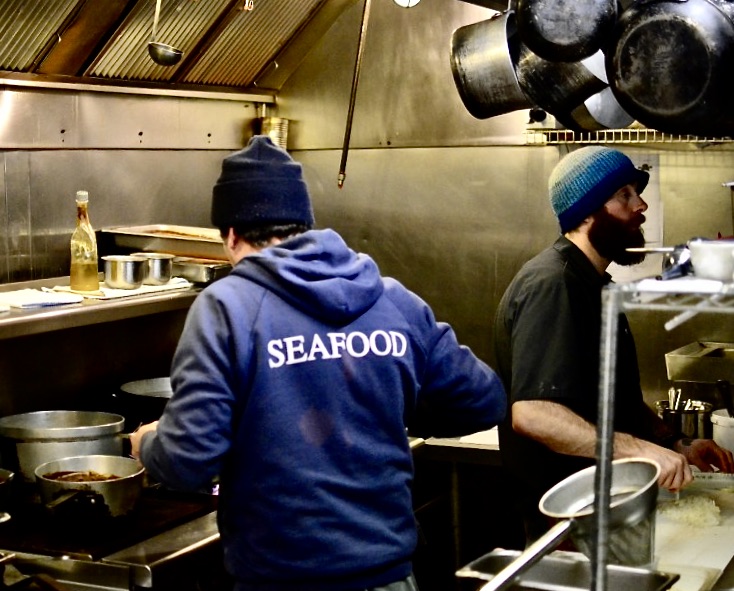
Stitch in Time

By Ed Staskus

   Maggie Campbell met Steve De Luca, her husband-to-be who was more-or-less living in Little Italy, when he wasn’t in jailbird trouble, a week after he got thrown out of a Columbus court and came home for his father’s funeral. Meanwhile, she was being thrown out of the family house in Bay Village after her own father died and she threatened to kill her sister.

   They met at Mad Anthony’s, and later Steve followed her to the Tick Tock Tavern on Clifton Boulevard, on a night when she was out with her friends. The stars were sparkling in a west side Cleveland sky. “I needed to get loose that night. Elaine and I had gotten into a fight at mom and dad’s house and when she tried to choke me, I told her I was going to punch her in the face and kill her if she ever put her hands around my neck again.”

   “What did you say?” Elaine shrieked.

   “I know how to break your nose and shove it up into your brain,” Maggie screamed when she pushed her older sister off. “I will do that if you try choking me one more time. I will lay you out flat.” Elaine never touched Maggie after that, but the threat of death didn’t go down well.

   Steve had been a bartender at the Tick Tock Tavern once, slinging shots and shooting the bull. He worked there forever, although since it opened in 1939 it hadn’t been forever. Whenever anybody mentioned anybody’s name to Steve at the bar he always said, “Oh, I know him.” It didn’t matter who it was, famous, infamous, or unknown.

   “Food, spirits, and characters” is what they say at the Tick Tock.

   After the fight with Elaine, Maggie went to her church, Bay Presbyterian, to talk to the pastor. She was contrite but seething. “I was born a Christian and raised a Christian. I have always gone to Bay Presbyterian, and I still go there. But goddamn my family to hell.”

   She had been going to counseling for years, but still not accepted the fact that her sisters and brother and she had been roughed up as children. She was upset that her roughing-it-up father had died, and was upset, too, about her ex-boyfriend-to-be, Craig, who was the mayor of Lorain, which was along the lake near her Bay Village hometown. 

   They had been seeing each other for twelve years, but there was no re-election on the horizon. Even if there had been, Maggie’s chances of higher office were slim to none. Craig had his eye on future choices and chances.

   “What are you doing with Craig?” her minister asked.

   “Why would you ask me such a thing?”

   “Why do you stay with him?” he asked.

   “You really want to know? I’ll let you know! I made a promise a long time ago, when I was a Young Lifer, that I would never have pre-marital sex. When I met Craig, a couple of years into our relationship, I started having sex with him. I said to myself, well, I’ve made my bed and I’m going to lie in it.”

   “No, no, no,” he said. “That’s not the life the Lord wants for you.”

   They started praying for the kind of man she wanted to meet, from eye color to personality. What she didn’t know was that Steve was hoping and praying to meet someone at the same time. He wasn’t being as specific as Maggie, though.

   After Steve got loose after driving too fast too drunk and arguing with the police, and shortly after his dad died, Fat Freddie, his brother, begged him to stay with him in Little Italy, so he did. Steve was a full-blown addict by then. When she met him, he was drinking nearly a fifth of Yukon with beer chasers and snorting coke day in and day out so he could keep drinking.

   He had started thinking his life totally sucked. He hadn’t had a girl to talk to for more than two years, because he was an obnoxious drunk, and he was down, if not down and out. One day while he was walking the dogs, dogs that his brother and he rescued at their used car lot, he started praying, which was something he had never done before.

   “God, if you can, bring me a woman. Please make that happen. I’m lonely, I’m miserable, and I hate my life. Please show me someone who can show me how to love you as much as I can love her.” He was willing to hold hands with the Lord so long as he could hold hands with a woman.

   Shortly after that Maggie’s friends and she were out having fun at Mad Anthony’s. Steve walked in and as he went by, locked eyes with her. After he walked past, she was talking to her friends when she got a creepy feeling that someone was staring at her. After another drink she kept feeling that long steep stare. She went over to where Steve was sitting alone.

   “I’m pretty sure we went to high school together,” she said.

   “Yeah, Bay High,” he said. “I was two classes ahead of you. You worked at the pool.” Oh, Lord, you done good, he wanted to say. Maggie was a fine-looking gal with ruby red lips and jet-black hair.

   Steve asked her out on a date and one more, too.

   “Really, dude, two dates before we’ve even had one date?”

   He wanted Maggie to go with him to the wedding of a sportswriter friend of his, but he thought they should go out first, to test the waters.

   “Alright, alright,” she said, finally. “We’ll see what happens.” She gave him her phone number. She could always hang up if she had to.

   “We’re going to the next bar,” her friends said.

   “It was nice meeting you,” she said to Steve. “Call me.”

   He followed them out. By the time they got to the Tick Tock Tavern he was a different man than the man she had been talking to at Mad Anthony’s, getting obnoxious and louder by the minute. By then his brain was drowning in Yukon. His life preserver was coke. But he was out of the powder. It was all downhill from there.

   “I’m leaving, so piss off,” she finally told him.

   “Jenny, why don’t you come home with me?”

   “Whoa, dude, you’re a jackass.”

   “Jenny, Jenny, why are you going?”

   “Because my name’s Maggie and that’s why I’m not going home with you.”

   As she went through the door, she shot him a look. “Great, he’s got my phone number,” she thought. But she gave him a second look. “He could be really handsome if we got rid of that huge monobrow.”

   The next morning, he called her.

   “What do you want?” she asked, ready willing able to hang up.

   “Don’t hang up, don’t hang up,” he said.

   “I have drugs and alcohol in my family,” she said. “The last thing I want to do is put up with it in a boyfriend. It’s not going to happen, pal.”

   “No, no, no, I’m good,” he said.

   They talked some more. When Steve wasn’t drinking like a drunkard, he was charming. He charmed her into a date and then another one, and even another one. They always went out with a group because she wouldn’t go out with him by herself. She was leery skittish cautious. Every time she went out with him, she left him at the bar at the end of the night after their argument.

   “You’re an idiot.” 

   When she was done running him down, she would leave, stamping her feet. He usually walked the railroad tracks home. He had lost his car to a court order and was footloose. But he started to get better, slowly surely, and as he did, they got better together, and the clock in Maggie’s head kept time to the times that might be on the way.

Ed Staskus posts stories on 147 Stanley Street http://www.147stanleystreet.com and Cleveland Daybook http://www.clevelandohiodaybook.com. To get the site’s monthly feature in your in-box click on “Follow.”

Road Map

By Ed Staskus

   There are more than six thousand kilometers of two-lane roads from one end of Prince Edward Island to the other end. There are some fast roads but most of them are laid-back. Tractors cows dogs slow the going down. About two thousand of the kilometers are unpaved and even slower, even if it was a motorcycle or a sports car trying to get up to speed. The ruts and chuckholes would make short work of them. All the unpaved roads are red clay dirt. Most of the paved roads are reddish to the naked eye.

   “At one time there was island stone and beach sand that was used in concrete,” explained Jamie Reid, the PEI operations manager for USCO Concrete.

   The landscape of Prince Edward Island is layered over sandstone bedrock. The sandstone is leavened with iron oxide, or rust, giving the countryside a distinctive red color beneath blue skies overlooking green fields. The natives who lived on the island before European colonization called their land Epekwitk. They thought Glooscap, who was their god, after he finished making the rest of the world, mixed all his colors with a final flourish and made their island.

   Sandstone can be dug up by backhoes and is still sometimes used for local and seasonal roads. Wet weather transforms unpaved byways and tractor paths into what some islanders call baby poop. 

   “When I was a kid most of the roads around here were dirt,” said Kelly Doyle. “Sometimes after a bad winter storm you couldn’t go anywhere for a day-or-two.”

     The first roads on PEI were built in the late 1760s. At the turn of the 20th century cars were banned on most roads most of the time, especially on market days. It didn’t have anything to do with drunk driving. There was a total ban on alcohol on the island. A Red Flag law was legislated, ordering there be a man at the front of every car with a red flag, ready to wave it just in case things got out of hand. Twenty years later the law was thrown out , the red flags were put away and cars went anywhere they wanted so long as there was a throughway that they could handle without breaking an axle.

   Kelly Doyle has lived in North Rustico, a small town on a natural harbor on the north-central side of Prince Edward Island along the Gulf of St. Lawrence, most of his life. He owns the Coastline Cottages on Doyle’s Cove on the National Seashore, operates PEI Select Tours, and was a lobster fisherman for many fishing seasons.

   “I grew up on a mixed farm. It wasn’t anything elaborate, basically turnips, which is a rutabaga, and we grew grain, barley, and wheat. My father was the farmer.” Mixed farms are for families who need a farmer three times a day, for breakfast, lunch, and dinner.

   Tom and Doris “Dottie” Doyle farmed 100 acres, although at one time the family had almost 400 acres. “Most of our land is rented,” said Kelly Doyle. “We used to have seven fields on our one hundred acres, but now it’s three fields.”

   By the early 1900s PEI’s dense forests had been largely cleared and ninety percent of the island’s land was being farmed. There were more than 12,000 farms, almost all of them between fifty to one hundred acres. The land was sub-divided by dikes, which are walls built of rocks dug up from the fields.

   “Those dikes were full of berries,” said Kelly. “Our mom used to send us back in the fields with buckets. We’d come back with them full of wild raspberries and blueberries.” 

   After World War Two technology and tractors led to modernization and bigger farms. One-crop planting became common. By 2006 there were only 1,700 working farms on Prince Edward Island and more than half of them were growing potatoes.  PEI is sometimes called the Million Acre Farm. Other times it’s just called Spud Island.

   “Fields were smaller fifty years ago,” said Kelly. “Maybe it should have stayed that way. Now they’ve ripped out all the dikes and sprays kill all the wild berries. It’s a shame to see it.”

   Tom Doyle, however, was the only Doyle who ever farmed.

   “They were boat people from Ireland in 1847,” said Kelly. “It was on his third sailing here that my great-great-grandfather landed and stayed. He did something so that the Queen, or somebody, granted him land, and two shore lots.” 

   By 1850 a quarter of the people on Prince Edward Island were Irish. The last wave of immigrants was from County Monaghan. They usually paid their own way to North America and usually made their own way once on the island, rather than submitting to tenant farming.

   Most freeholders farmed and controlled livestock. By the mid-1800s PEI was already exporting surplus foodstuff all over eastern Canada and to Great Britain. The Doyle’s, however, raised horses and propagated thoroughbreds. The family later took advantage of fashion and bred black silver foxes for their pelts.

   The riddle of breeding foxes was solved in the late 19th century on Prince Edward Island. Twenty years later single pelts sold for as much as $2000.00, at a time when farm laborers made about a dollar a day. In 1913 the provincial government estimated foxes were worth twice as much as “all of the cattle, horses, sheep, swine, and poultry” on the island.

   Whenever fish and crop prices went south, men turned to fox breeding. No one overly minded the stink, the skunk-like smell of the fox farms. The fur bubble burst on the eve of WW2. “When they went out of style my dad let all his animals out and he became a farmer.” By the early 1950s the fox industry was finished.

   Kelly grew up on the family farm and went to the nearby Stella Maris School, across the street from the Church of Stella Maris Roman Catholic Church. The school was built in 1940 and burned to the ground in 1954. “We stood looking utterly helpless in our misery,” a nun at the nearby Stella Maris Convent wrote in her diary. A year later, a year before Kelly’s birth, the town re-built their school. “It is the most modern fourteen room school in the province,” the Guardian newspaper touted in its feature article.

   “I went grades one through nine. Almost everybody my age quit in grade nine. It was the 60s and 70s. There was no need of education around here. Fathers would tell their kids, you’re not going to do anything in school, get to work in the boat. All of us said we’ve got better things to do and banged out of there.” 

   As a young man he wasn’t ready for boat work, or steady work of any kind, instead roaming Lower Canada, living in Montreal and sowing a bushel full of wild oats, until returning to North Rustico. He built a cottage on family land on a hillside overlooking Doyle’s Cove, but couldn’t find work.

   High unemployment in Atlantic Canada has been a constant since the 1950s. The eastern provinces are more invested in  seasonal jobs, like agriculture, fishing, and tourism, than Canada’s other regions, leading to seasonal lay-offs and involuntary part-time work.

   “Back in the 70s and 80s, she was pretty lean here. There was no money around for years.” 

   In the 1980s the gross domestic product of Prince Edward Island was the lowest in Canada, only 56% of the national average. Next to Newfoundland, the province had the lowest per capita income in the country. There was the fruit of the sea, though. When Kelly was offered work on a fishing boat putting out of the town harbor, he took it.

   “When I first started fishing everyone had a gasoline engine in an old wooden boat. Everything was done manually, except for hydraulics to haul gear off the bottom. The steering was even done by chains. Then everything went fiberglass, everything went diesel, and everything went hydraulics.” 

   As late as the 1980s fish men went door-to-door, making a living selling cod, until a ban on the taking of ground fish was put in place. Fish stocks had been over-exploited for decades up and down Atlantic Canada. They were severely depleted.

   “When I started fishing, people were baiting hooks and hauling trawls for halibut, haddock, and cod. Then the moratorium came in. All we were allowed was lobster.” 

   Kelly harvested hundreds of thousands of lobsters for almost three decades.

   “Lobster traps were invented a while ago and they’re as simple as mousetraps,” he said. Except, unlike mousetraps, lobster traps are remarkably half-baked, even though they almost always get the job done. Invented just more than one hundred years ago, they have changed little in the interim. Even though entrances to the traps are one-way, any lobster that tries to escape can get away, if it has a mind to.

   “My theory is there are two ways lobsters get caught,” said Kelly. “One way is what I call simple mindedness.” Since lobster brains are less than the size of the tip of a fountain pen, he might be right.

   “Lobsters won’t usually back out the same way they’ve come in. They crawl up the net, there’s a flap on it, then once they’re in that they can’t go back. The other way they get caught is they just stay too long in the trap eating bait, and when we jerk it out of the water, they get tossed into the back by the sheer momentum of us pulling it up with the hauler.” 

   Since lobsters spend almost all day and night racking their brains about where their next meal is coming from, crawling on their walking legs to get to it, and finally eating all the crabs, mollusks, fish, and even other lobsters they can get, it lends credence to Kelly’s second theory about overeating.

   Kelly Doyle’s brothers, John, Mike, and Kenny, all fished. “We weren’t farmers, exactly, but we weren’t fishermen, exactly, either, although I think it was naturally in our blood, since every one of us was at ease on the water.”

   John Doyle fished for several years before marrying and moving to Ontario to raise a family. Mike Doyle was one of the first satellite television providers on PEI. “Mike had rubber boots and oil gear and he went out, too, but then he got into TV’s.”  He later transitioned from catching lobsters to serving them at his Blue Mussel Café, a seafood restaurant, at the far end of the harbor.

   Kenny Doyle spent fifteen years fishing on local boats, and the next ten years fishing commercially with his brother, Kelly. “He’s captained deep-sea fishing boats out of Rustico for fifteen years, too. Kenny’s an able man behind the wheel.”

   Cathy and Elaine, the Doyle sisters, stayed on dry land. They did so for good reason. In North America fishing boats sink to the bottom of the sea at the rate of one every three days. Unpredictable storms roil the ocean. “You get black and bruised,” said Kelly. “During those seas, you do everything slower. You have to be a lot more careful with your gear, your traps, and the rope under your feet. You always have to watch your P’s and Q’s.”

   Kelly fished with his partner, Paul Doiron, a man he’s known since they were youngsters, although nine years separates them. “Paul, that’s my buddy, that’s my partner in crime.” Their boat was the Flying Spray, a modern, high-bowed 40-foot fiberglass craft built in nearby Kensington. “Paul’s roundish, built a bit like a buoy. He lives right here in the crick.”

   North Rustico has been known as ‘The Crick’ for many years. “There was a creek that ran right through the village,” said Kelly. “The people from Charlottetown either didn’t know what a creek was, or misunderstood, and ended up calling it the crick, so we ended up being nicknamed that.”

   There are only three houses on the shore lots on the northwestern side of Doyle’s Cove. One of them is a newer house built by Kenny Doyle, the other is the old Doyle family house, and the house nearest the cove was Andy’s Surfside Inn. Andy Doyle was Kelly Doyle’s uncle. “Andy turned 90 a couple of years ago and was still over there.” When he passed away, a cousin took over the house, renovating it.

   Kelly’s all-year cottage, large sliding glass doors fronting red cliffs and the curving shoreline, is on the field side of the Gulf Shore Parkway, the National Park roadway between Cavendish and North Rustico. Since the late-1980s he has one by one built five seasonal cottages adjacent to his, which are the Coastline Cottages, on the crest of the hill overlooking Doyle’s Cove. In the new century he added a kidney-shaped saltwater swimming pool. 

   “People thought, I’m turning it into a tourist trap,” he laughed.

   “Most of my friends ended up getting married. I ended up having cottages and getting in debt.” He is not on the rocks, but “there was no money around here for years. We’re all making a living now, but there still isn’t any great amount of it.”

   He owned and operated Amanda’s, a fresh seafood diner, in town across from the market, for many years. It wasn’t in his blood, but it was. During the 1960s his parents had a small restaurant in nearby Cavendish. 

   “It was 7 cents for pop, 30 cents for a hamburger, and 17 cents for fries back then,” he said. “That was the kind of money you made in 1964. There were six kids in our family. Some of those French Acadian families around here had a dozen births. It was no different for anyone.”

   Besides his cottages and fishing for lobster the months of May and June, like many men and women on Prince Edward Island he has always had other jobs to keep his head above water. He operates PEI Select, a tour guide service catering to Japanese tourists visiting Anne’s Land, the home of “Anne of Green Gables”. The series of books by Lucy Maud Montgomery, about a plucky red-haired girl, are big in Japan. In 2014 a Japanese-language version of the “Anne of Green Gables” musical wrapped up a sold-out nationwide tour by playing in Tokyo.

   In the spring he rents his farmland to neighboring farmers for hay, grain, and soybeans. He doesn’t let potatoes be planted on his land. “I let them grow food that uses the least amount of herbicides and pesticides,” he explained.

   Coastline Cottages, the Doyle houses, and the cove are in the National Park, but are not the National Park. The park was established in 1937 and encompasses more than five thousand acres of coastal headlands, sand dunes, and beaches. The Doyle’s didn’t sell their land when the park was being created on the central north shore of Prince Edward Island. 

   “But they have the patience to wait everybody out,” said Kelly. “That’s the beauty of the National Park. You don’t want to sell right now? That’s fine. Your son will want to sell, and if he doesn’t want to, his son will. If it takes two hundred years, we will get you out of this park.”

   Only change is unchanging, even though when times change it sometimes seems like not much is different. “There’ve been a lot of changes around the island, but it’s nice to go home and say it hasn’t changed much right here. That’s another beauty of the National Park. Since it’s a national park, it stays the same.”

   About 285 million years ago Prince Edward Island was a mountain range. Over time it evolved into a low-lying basin as glaciers advanced and retreated. Most of the ice was gone by 10,000 years ago and the island slowly took shape. Living in a traditional farming and fishing community, looking past the sandstone cliffs of Doyle’s Cove and out over the Atlantic Ocean, from the vantage point of Kelly Doyle’s deck it can seem like only a little has changed in a long time.

   “Only the rabbits and trees get bigger,” he said.

    Before the rebuilt Gulf Shore Parkway, which features a new all-purpose trail as it winds down a long highland past the cove, there was the old Gulf Shore Parkway, and before that there were tracks, and before that there weren’t any roads, at all. 

   “When the road came in sometime in the 1950s it cut our farm in half,” said Kelly. Before it was a road it was a hillside. When it rained in early spring or late fall, and especially when it rained all day, the slope that is now a road turned into a slippery slope of PEI sandstone, red clay goop slippery as an eel.

   The Doyle’s still always got to where they had to go. Getting somewhere is staying on your feet, knowing the drive, trimming your sails. Sometimes any road, or even no road at all, will get you where you want to go.

Ed Staskus posts stories on 147 Stanley Street http://www.147stanleystreet.com and Cleveland Ohio Daybook http://www.clevelandohiodaybook.com. To get the site’s monthly feature in your in-box click on “Follow.”

800 Pound Gorilla

By Ed Staskus

Theatre patron: “Say, what is it, anyhow?” 2nd Theatre patron: “I hear it’s a kind of gorilla.” Theatre patron: “Gee, ain’t we got enough of them in New York?”  King Kong

I never thought I would see an 800-pound gorilla in headstand, but then again, I never thought I would see a fleet of gold SUV’s filling up the parking lot of the yoga studio in Rocky River, Ohio, that I sometimes practice at, either.

The car repair lot next door, where no one is supposed to park, was filled, too. I parked across the street. It was early March, but winter had been mild, either because of climate change or El Nino, and there were no snowdrifts to climb over or icy sidewalks to flat foot across.

The SUV’s were parked in a line along the front of the building. As I squeezed past the lead one I glanced inside and saw a red baseball cap on the passenger seat.

Donald Trump? I thought.

I knew the Ohio GOP primary was coming up soon, I knew it was Donald Trump’s chance to derail John Kasich, our governor still in the race, and I also knew what Marco Rubio had said about Donald Trump during the FOX News debate in Detroit a few days earlier.

“He’s very flexible,” said Marco Rubio, pointing out that Donald Trump was primed for yoga because of his cherry picking politics. I wasn’t sure I agreed with Senator Rubio. Donald Trump’s policy positions seemed more like blobs of mercury, impossible to pin down and toxic, too.

At the top of the stairs, the yoga studio being on the second floor, two burly security men in dark glasses and darker suits looked me up and down. They asked me to unroll my mat for their inspection.

“Democrat or Republican?” they asked as I was rolling up my mat again.

“Canadian,” I said, lying.

They smiled, grimly.

I stepped into the studio wondering if Canada might ever build a wall from their side of the border to keep out their scary neighbors. When did the United States become the scary neighbor?

The yoga room was packed to the gills.

I had several times attended workshops staged by celebrity teachers, one with Janet Stone and another led by Max Strom, and thought then that the room was packed to the gills. I was wrong. If it all comes down to turnout, as is often said about elections, it was “Mission Accomplished”.

Both of my favorite spots in the yoga room were overflowing. The only available spot I saw was one in front, my least favorite place to be, but beggars can’t be choosers. I set up camp next to a vacant, extra-thick, extra-long, tangerine-flecked purple mat that faced the teacher’s mat.

Where do 800-pound gorillas practice yoga?

Anywhere they want to.

Donald Trump was in the center of the room. He wore a gold Speedo and nothing else, not even a headband. He was surrounded by a crowd and speaking, waving his arms as he spoke.

“I was always a good athlete,” he said. “I was always the captain of my teams. Staying in shape is very important. If you’re physically happy and healthy, it’s a lot easier to keep a relationship going. Taking care of your body is a great thing for love.

“Don’t even think about Marco Rubio saying my hands are small, and if they’re small something else must be small. My fingers are long and beautiful, as, it has been well documented, are various other parts of my body.” He pointed to the front of his Speedo. “I guarantee you there’s no problem.”

Some of the women in the crowd being regaled by Donald Trump lifted their eyes from his gold Speedo, gathered up their mats, and left the yoga room. One of them stopped and asked the teacher, “What is that?”

“That’s Donald Trump, the Republican running for president.”

“I know,” she said. “Did you lose a bet?”

“Of course not. This is part of our yoga on and off the mat program.”

“This is the same man who said women were dogs, slobs, fat pigs, and disgusting animals, right?”

“It’s all yoga,” said the teacher, looking increasingly uncomfortable.

“Blah,” said the woman, slipping out the door.

Since the yoga room was less crowded at the start of class than it had been beforehand, everyone rearranged their mats. The teacher cued her iPod and class began.

“Before we start,” said the teacher, “I’d like to welcome Donald Trump to our studio and say that I really believe in the essential goodness of Republicans.”

“Wait a minute, not all goodness,” exclaimed Donald Trump, jumping up out of Easy Pose. “There’s Lying Ted, he’s an unstable person. His whole deal is he will lie. He will lie and after the lie takes place he will apologize. Little Marco, he’s always hiding his palm sweat. Once a choker always a choker. Kasich, he’s a nice guy, but he’s a baby. He can’t be president.”

My mat was next to Donald Trump’s, giving me an up-from-your-bootstraps view of the man as he stood straddling his mat. He was tall, over six foot, and big, well over 200 pounds. He had large feet, size 12 or 13. It was clear he had recently gotten a pedicure.

As he sat back down I heard muttering behind me. I glanced over my shoulder and saw another dozen-or-so people leaving the yoga room. “Mitt Romney was right when he talked about your bullying and absurd third grade theatrics,” said a middle-aged man, pausing as he passed by.

“Get him out of here,” said Donald Trump, tilting his chin up to one of his security men. “They’re always sticking a certain finger up in the air. I love the old days. You know what they used to do to protestors like that when they got out of line. They’d be carried away on a stretcher, folks.”

There was a low moan from the back and a few more people walked out. The yoga room had gone half empty and class hadn’t even actually started. Our teacher, looking out at what had been a multitude just minutes earlier, hurriedly got us on our feet for sun salutations, a traditional warm-up.

We were midway through our second sequence of sun salutations when Donald Trump jumped out of down dog to the front of his mat, but instead of staying in the sequence he stood upright and began flapping his arms.

“What language is that?” he demanded to know.

The teacher had been speaking partly in Sanskrit, the classical Indian language used in yoga to define poses.

“Is that Mexican? That’s bad. When Mexico sends people, they’re bringing drugs. They’re bringing crime. They’re rapists. I will build a great wall. Nobody builds walls better than me. I’ll make Mexico pay for that wall. Mark my words.”

“Oh, man, that’s all I can take.” It was a voice I recognized, although I hadn’t seen her in the room. When Lola stormed to the front I was sure there was going to be a confrontation. She grew up in a Polish-American neighborhood on Cleveland’s south side and taught high school in Lorain, a nearby rust belt town. Many of her students were either first or second-generation immigrants, mostly from Mexico and Central America.

“It’s scary to actually think about what you in office would mean for equality,” she said, standing high on her toes to get up into his suntanned face. Although, when I looked closely, it looked like he was using a self-tanner. The color was orangey.

“The truth is that all men having power ought to be mistrusted,” said James Madison.

“Nobody’s done so much for equality as I have,” said Donald Trump. “When it comes to my $100,000.00 membership club, Mar-a-Lago in Florida, it’s totally open to everybody. I set a new standard in Palm Beach.”

“Yikes,” she said and stormed out, followed by what was now a throng.

“How did she get that close to me?” asked Donald Trump, glaring at his security men. “You could see there was blood coming out of her eyes, blood coming out of her wherever.”

He turned to face what was left of the class. “We need strong borders. We need a wall. I’m the king of building buildings, the king of building walls. Nobody can build them like Donald Trump.” He was starting to slip into the third person, as though there were two of him. “I’m opposed to new people coming in. We need Predator drones.”

By this time there weren’t many darker-skinned people of any kind left in the room, only a handful of women, and no one who practiced yoga for more than the exercise. Most of the remainder, scattered in the corners and shadows, were either younger men or older men. They began chanting, but not OM, the chant most commonly heard in yoga classes.

“USA! USA! USA!”

“We’re going make our country rich again,” Donald Trump shouted over the din. “We’re going make our country great again and we need the rich in order to make the great.”

“USA! USA! USA!”

“It’s better to live one day as a lion than one hundred years as a sheep,” he shouted, even louder. “I know who said it, Mussolini, OK. But what difference does it make?”

“USA! USA! USA!”

The teacher tried to regain control of the class, but it was too late, in more ways than one. If yoga is about focus, the focus of everyone left in the room was elsewhere. All eyes were on Donald Trump. He whirled on the teacher.

“You’re fired, done,” said the King of Skull Island. “What a moron, lightweight.”

He gathered up his mat and unfurled it where the teacher’s had been, perpendicular to the class.

“I promise you I’m much smarter than her. I focus exclusively on the present. I’m speaking with myself,” said Donald Trump.

“I’m the super genius of all time. I was a great student. I was good at everything. We need a president with tremendous intelligence, smarts, and cunning. My whole life is about winning. I don’t like losers. Everybody loves me. The haters and losers refuse to acknowledge it, but I do not wear a wig. My hair may not be perfect, but it’s mine.

“It’s all about living your words, walking your talk, and talking your walk.”

Our yoga class was almost over. Since he had flipped the GOP head over heels this campaign season, Donald Trump said we were going to finish by doing an inversion. He spun his hair into a bun and to my astonishment lifted up into a pinpoint headstand, his new updo making a comfy cushion.

Most people who practice headstand hold the pose for about a minute. If they stick with it and get seasoned, some hold headstand for up to five minutes. Donald Trump’s eyes were open and his gaze straight ahead. His legs were parallel and butt tucked in.

Five minutes later everyone had rolled up their mats and left the room. Donald Trump was still in headstand. His security men stared out the windows. Ten minutes later the yoga receptionist cracked open the door and peeked in.

“Mr. Trump, I don’t mean to interrupt,” she said. “Our next class is scheduled, we’re running late, and everyone’s waiting out here in the lobby.”

“That’s so inappropriate,” he said. “You’re a flunkie, treating me very badly.”

She closed the door softly behind her.

I lay on my mat in corpse pose. I could hear Donald Trump’s breathing next to me, slow and steady. When I was finished I rolled my mat up, nodded to the bored-looking security men, and left the yoga room. Everyone’s eyes fell on me as I stepped into the lobby.

“Is he still in there?” someone asked.

“Yes,” I said.

“When is he going to be done?”

If there’s an 800-pound gorilla in the room, the yoga class is over when the beast says so.

Ed Staskus posts stories on 147 Stanley Street http://www.147stanleystreet.com and Cleveland Ohio Daybook http://www.clevelandohiodaybook.com. To get the site’s monthly feature in your in-box click on “Follow.”

In the Rough

mv5bmtyzndk4ota5m15bml5banbnxkftztcwndq2odaymw-_v1_-e1541716884822.jpg

By Ed Staskus

   “It’s a good day for it,” Dwight Eisenhower said, smiling his disarming trademark smile.

   It was going to be his first full round of golf since June. He had suffered a heart attack last year. Then when this summer rounded into shape, he needed surgery for ileitis. The past week had been filled to the brim with the Republican National Convention at the Cow Palace in San Francisco, Even though he had been unopposed, no need for a stampede, there had been some hard campaigning trying to get Richard Nixon off the ticket, to no avail.

   Dwight Eisenhower wasn’t overly enthusiastic about being president. He did it because he thought of the work as a duty. “This desk of mine is one at which a man may die, but from which he cannot resign,” he said. Richard Nixon wanted to be president. He didn’t think of it as a duty. He wanted it for himself, himself in the executive’s chair, at the top, giving orders and being obeyed. The conniving public official didn’t think it had anything to do with civil service.

   “Any man who wants to be president is either an egomaniac or crazy,” Dwight Eisenhower told Turk Archdeacon, his caddy standing next to him with a bag of clubs. Turk thought he was simply shifty, but didn’t say so. It wasn’t his place.

   Nat King Cole the Negro singer had spoken at the Cow Palace yesterday, the last day of the convention, to some cheers and more jeers. The president made the speech happen, no matter the carping about it. He knew he had to give in on his second-in-command, who was a hardline anti-Communist, who the rank-and-file supported with cheers and campaign donations. “I don’t want those Commie bastards to be successful,” Richard Nixon always said. But the president knew he didn’t have to give in to Jim Crow, at least not always. He could take the high road and leave the jeering to the dirty tricks gang.

   They drove up to Pebble Beach before the convention ended, before his VP could invite him to dinner. Besides, Richard Nixon’s father was seriously ill. The president urged him to go see him before it was too late. The VP mumbled something and in the end was almost too late. The night he visited his father, Frank Nixon said, “Good night, Dick. I don’t think I’ll be here in the morning.” He died in the morning. Dick wasn’t there. The funeral was three days later at the East Whittier Friends Meeting House. Richard Nixon had to ask for directions. The Quakers had become a lost heritage to him.

  There were three cars full of Secret Service men fore and aft. Charlie Taylor, who’d been at it for many years, was in one of the cars. One night when the president was having trouble opening his safe, and asked for help, his agents told him safecracking wasn’t part of their training. He was beside himself, giving them his ten-pound hammer look. Charlie got the cranky combination to give in without a struggle. He had been an anti-submarine officer during the war. Safes weren’t safe when he got his hands on them.

    “I won’t know whether to trust you, or not, after this,” Dwight Eisenhower told him, glancing at the trim crew-cut man.

   Dwight Eisenhower was driven to his golf outing in a black Lincoln Cosmopolitan. It was one of ten presidential touring cars. They all had extra headroom to accommodate the tall silk hat the president wore on formal occasions. The cars were almost 20 feet long, with Hydra-Matic transmissions, and heavily armored, weighing in at close to ten thousand pounds. One of them, a convertible, a 1950 model built for Harry Truman, had been fitted with a Plexiglas top. The president called it the Bubble Top. Charlie Taylor called it a pain-in-the-ass. Mamie Eisenhower didn’t like sitting under a plastic dome, but she put up with it, like she did with everything else.

   It was a clear day, sunny, the high sky dotted with seashore clouds. A steady breeze blew up from the water. It was refreshing. Dwight Eisenhower nodded at the man standing behind him.

   “It’s a pleasure, Mr. President,” Turk said.

   “Why, that’s fine,” President Eisenhower said.

   Turk had been caddying at Cypress Point since he was nine years-old, from almost 40 years ago. They walked to the practice tee. The president started whacking balls into the distance. He played Bobby Jones woods with his official five-star insignia engraved on their heads. At the putting green he lined up three balls 20-some feet away from the cup. He sank all three.

   “I should quit right here,” he grinned.

   “Yes, sir,” Turk said.

   Dwight Eisenhower had been practicing on a green on the White House grounds, hitting wedges, irons, and 3-woods, sometimes sending balls sky-high over the south fence. Whenever he did, he sent his valet to retrieve them. The squirrels that prowled the lawn dug up his putting green, burying acorns, nuts, and hardtack. When they buried their loot they left small craters behind. One morning the president finally had enough. “The next time you see one of those goddamned squirrels go near my putting green, take a gun and shoot it!” The Secret Service asked the groundskeepers to trap the squirrels, instead, and release them in a park somewhere far away.

   In a week August would be come and gone.  He would be 66 years-old soon. “I’m saving my rocker for the day when I feel as old as I really am,” he said, pointing to the rocker in the Oval Office. More days than not, he felt like that day was creeping closer, step by step, and there was no stopping it.

   His birthday was in October. CBS was planning a “Person to Person” TV show the night beforehand. Eddie Fisher was going to sing ‘Counting Your Blessings Instead of Sheep.’  Kathryn Grayson and Howard Keel were going to sing ‘Down Among the Sheltering Palms.’ Nat King Cole, with the Nelson Riddle Orchestra, was going to sing ‘It’s Just a Little Street Where Old Friends Meet.’ He was looking forward to it.

   In six weeks, he would be throwing out the first pitch for the first game of the World Series. There were five or six teams in the hunt, although the New York Yankees looked like a lock, at least to get there. If he were a betting man, which he was, he would be putting his money on the Bronx Bombers to take the kaboodle. He wouldn’t be at the game in the Bubble Top, either, but in the Cream Puff, which didn’t have a dome. He would be  getting some sunshine and fresh air, at least what there was of it in New York City.

   He liked Cypress Point because it was set in coastal dunes, wandered into the Del Monte forest along the front nine, and then reemerged on the rocky Pacific coastline. The last holes played right along the ocean. He’d played golf on many courses around the world. This was one of the best of them.

   Dwight Eisenhower looked out over the par-5 10th hole. He had taken off his tan sweater, but still had a white cap on his head. Seven months ago, Ben Hogan and Byron Nelson, professional living legends, had taken on the talented amateurs Ken Venturi and Harvie Ward in a white-knuckle not-so- friendly foursome at the same Cypress Point. The same 10th hole turned out to be the key to unlocking the contest.

   “I bet they can beat anybody,” said San Francisco car dealer Eddie Lowery about the two amateurs, who were his employees. He was talking to fellow millionaire George Coleman. The bet and the match were on in that minute. The bet was in the four figures.

   Harvie Ward was a two-time U.S. Amateur champion. Three months later Ken Venturi came within one stroke of winning the Masters. The cypress-strewn rolling dunes of the course on the wind-swept coast, the deep ravines, knee-deep grass, sand on all sides of the fairways, weren’t redoubtable, not to them.

   Ben Hogan turned the corner on the 10th when he rolled in a wedge shot for a 3. The eagle and 27 overall birdies testified to the competiveness of the match. The drinks at the bar afterwards rubber-stamped the camaraderie. There were backslaps about made shots and groans about missed shots.

   Dwight Eisenhower was playing with Harry Hunt, the president of Cypress Point, Sam Morse, a one-time football star who had developed Pebble Beach, and John McCone, a businessman who had been the undersecretary of the Air Force. He was partnered with Harry Hunt. They were playing a dollar-dollar-dollar Nassau bet. It was even-steven at the halfway mark, even though the president had stunk up the 8th hole.

   “Where is it?” he asked getting there, searching for the green on the 8th somewhere across the dogleg.

   He sliced his tee shot into sand. When he got to it, he hit it less than ten feet further on. Then he hit it fat, the ball limping head-high less than twenty feet, and falling into somebody’s heel print.

   “I’ve had it, pick it up,” he said.

    “Having a little trouble?” Sam Morse asked.

   “Not a little,” he said. “A lot.”

   On the tee of the 17th hole Dwight Eisenhower lined up his shot. Sea lions on the rocks below him barked. “It’s hard to hit a shot and listen to those seals at the same time,” he complained, but not so either of the Secret Service agents with them could hear him. He didn’t want them taking unnecessary potshots at the seals.

   Dwight Eisenhower was accustomed to having bodyguards around him, during the campaign in North Africa, and later as commander of the Allied Army in Europe. The Nazis had tried to kill him several times. Secret Service agents near his person nearly every minute of the day felt like a second skin. He knew what it took to save his skin. When he moved into the White House he didn’t mingle mindlessly, shake hands in crowds, or do anything foolish.

   “Protecting Ike works like clockwork,” said agent Gerald Blaine.

   Mamie Eisenhower gave her Secret Service men nicknames. One of them, who was a good dancer, was called ‘Twinkletoes.’ He asked Mamie to keep it between themselves. Some of the bodyhuards called her mom. Other bodyguards had never had mothers and called her Mrs. President.

   “You don’t have to worry about me, but don’t let anything happen to my grandchildren,” the president told Secret Service chief U. E. Baughman. The Diaper Detail guarded the four kids. Dwight Eisenhower changed the name of the presidential retreat in Maryland from Shangri-La to Camp David in 1953. “Shangri-La is just a little fancy for a Kansas farm boy,” he said. He renamed it in honor of his 5-year-old grandson, David. When Nikita Khrushchev, the Soviet Union boss man, visited the retreat he said the name sounded like a place where “stray dogs are sent to die.” 

   Dwight Eisenhower looked for the fairway on the 18th hole. “Where do we aim here?” he asked.

   “Keep it away from the left,” Harry Hunt said. There was a stand of pine trees on the left. “That’s the Iron Curtain. You’ll never get through that stuff.” The president laughed and hit a long drive. His next shot was a 4-iron and he nailed it onto the green, 20 feet short of the pin. He was going out with a bang.

   In 1954 eighty people were convicted of threatening the president and sent to prison or locked away as madmen. In 1955 nearly two thousand threats were made against Dwight Eisenhower’s life. The year before, the Russian KGB officer Peter Deryabin, after defecting, told the CIA about a Soviet plot to kill the president in 1952. “We were preparing an operation to assassinate Eisenhower during his visit to Korea in order to create panic among the Americans and win the war there.”

   Whenever he played golf, bad-tempered men with good eyesight and high-powered rifles took up vantage points on hills, surveying the course with telescopic sights. Other men, dressed in golf clothes, carried guns and ammo in their golf bags as they tagged along. The Queen Mary, a specially outfitted armored car, was their rolling command center.  

   Shortly after Mother’s Day the Secret Service had investigated a threat to plant two boxes of explosives at a baseball park where the president was planning on taking in a game. “Demoralize the enemy from within by surprise, terror, sabotage, and assassination,” Adolf Hitler had said not very many years before. “This is the war of the future.” Dwight Eisenhower and the Allied Army derailed the Nazi night train. No one was going to take him by surprise. He was planning on sitting in his rocking chair one day, rocking back and forth, watching his grandchildren trundle on the carpeting.

   He served in the armed forces from one end of his adult life to the other. After he retired, he was dean at Columbia University, and then president of the country. He was still the president and, he was sure, he was going to beat Adlai Stevenson like he had four years ago. Adlai didn’t know how to get close to folks. He was full of sanctimonious bull.

   Even though he’d commanded millions of men in the last war, Dwight Eisenhower thought war was rarely worth going to war for. He hated it. “I hate war as only a soldier who has lived it can, only as one who has seen its brutality, its futility, its stupidity.”

   “Didn’t you once say that we are going to have peace even if we have to fight for it?” Harry Hunt slyly asked.

   “When we have to, but always remember, the most terrible job in the world is to be a second lieutenant leading a platoon when you’re on the battlefield. There is no glory in battle worth the blood it costs. When people speak to you about a preventive war, you tell them to go and fight it themselves.” 

   The Cold War wasn’t nearly as hot as it had been ever since Nikita Khrushchev denounced Joseph Stalin’s cult of personality earlier in the year, as well as admitting the Man of Steel’s crimes, and the outrages committed against Mother Russia. The iron door had been cracked open. The president had long thought war settles nothing, even when it’s all over. He was worried about the arms race, which was a race towards nuclear catastrophe.

   “You just can’t have that kind of war,” he told his inner circle. “There aren’t enough bulldozers in the world that could ever scrape all the bodies off the streets.”

   “Disarmament, with mutual honor and confidence, is a continuing imperative” is what he had written in his daybook and wanted to say at the Cow Palace, but didn’t, not with Richard Nixon and the Red Scare and the military hand-in-hand with industry. He wanted to call it what it was, a military-industrial complex that was always crying “fire” in a crowded theater. But he couldn’t, at least not until after he was re-elected. In the meantime, he planned on speaking softly and carrying a big stick, even if it was only a long shaft wood driver, the biggest stick he had in his golf club bag.

Excerpted from the crime novel “Cross Walk.”

Ed Staskus posts on 147 Stanley Street http://www.147stanleystreet.com and Made in Cleveland http://www.clevelandohiodaybook.com. To get the site’s monthly feature in your in-box click on “Follow.”