
By Ed Staskus
The weekend my mother-in-law Terese and her husband Dick moved out of Reserve Square in downtown Cleveland, they moved out of twin Brutalist inspired apartment towers into a turn of the century house. They had lived in their apartment for more than twenty years, on the 17th floor facing Lake Erie. During the National Air Shows flying out of Burke Lakefront Airport they sat on their balcony and watched the Blue Angels streak past like roadrunners on the loose.
There’s nothing like the sound of F/A-18 Hornets roaring a few hundred feet overhead and veering away at the last second from skyscrapers dead ahead. They are jets able to perform high angle of attack tail sitting maneuvers and can fly formation loops dirty, their landing gear down. The sound of silence once they’re gone is deafening.
Terese and Dick bought an abundance of a house with four bedrooms and three bathrooms on the corner of East 73rd St. and Chester Ave., in the blighted Hough neighborhood, ten minutes from downtown. It was built in 1910 in the colonial style. When they got done restoring it, they had added an attached garage, put on a new roof, installed new vinyl windows and siding, a new interior staircase, and a new kitchen. It went from ghetto to gentrified as fast as the contractors could make it happen.
Almost 100% of the people living in Hough in 1999 were black. Only 2% of them were white. Terese was Lithuanian and Dick was Italian. They were part of the 2%. She was from Cleveland. He was from Rochester. Everybody and their uncle tried to talk them out of buying the house. The racial make-up of the neighborhood was the stumbling block of all their opinions. The color barrier, however, was not a stumbling block to Terese.
Terese was a self-taught chef who owned four restaurants in her time and made herself into one of the city’s top-notch confectioners. The opera star Luciano Pavarotti searched her out and pigged out on her cookies and cakes whenever he was in Cleveland. “That man can eat,” she said. When he was done eating he was good and ready for an aria.
Her signature creation was a 17-layer cake based on a recipe that Napoleon brought to Lithuania during his ill-fated Russian campaign. Terese, Dick, my wife, brother-in-law, and I helped make them Novembers and Decembers, working out of her kitchen, freezing them, and selling them during the holidays through the Neiman Marcus catalog. I went home most nights needing to shower clouds of flour off me.
Terese and Dick bought the house in Hough because she had grown up nearby, when the neighborhood was more white than not, and wanted to go home again. It wasn’t the same, but she saw what she wanted to see. She remembered the neighborhood from her childhood and made the reality fit her memory. She had a streak of magic realism running through her.
My wife and I lived in Lakewood. I had a red Schwinn mountain bike that I frequently rode in the Rocky River Metropark, on the paved trail, the horse trails, and the single tracks. I rode downtown sometimes, winding my way through Ohio City and across the Hope Memorial Bridge, especially on weekends when all the bankers, lawyers, and city workers were at home. I usually rode the Hope Bridge over the Flats so I could see the Guardians.
The 6,000-foot-long art deco truss bridge crosses the Cuyahoga River. Four pairs of immense stone statues officially named the “Guardians of Traffic” are sculpted onto opposite-facing pylons at each end. Each of the Guardians holds a different vehicle in its hands, a hay wagon, a covered wagon, a stagecoach, a 1930s-era automobile, and four different kinds of trucks. I always crossed an index and middle finger while going by in hopes of keeping traffic away from me.
I got it into my head that I wanted to ride around on the east side of town, through Cleveland Heights and Shaker Heights. I thought about East Cleveland but thought better of it. The city had gone to hell in a handbasket. I asked Terese if I could park my car in their driveway while I rode. She said yes but cautioned me to bring my rear-mounted rack into the garage. Law and order was sketchy in her neighborhood. When I had stored the rack away she invited me into the kitchen to snack on croissants fresh out of the oven.
She was in the middle of two projects. One was chocolate-covered plastic spoons that turned into a steaming drink when hot water was added. There were rows of the spoons on baking trays. The other project she was working on was perfecting a handy self-serve pan to make the dry, hard-textured Italian cookies called biscotti. I preferred croissants fresh out of the oven.
Whenever I had ridden downtown with friends and wanted to push ahead into Cedar and Fairfax, what my friends called the black hole, they always turned back. “I don’t want my husband getting killed by some spade,” one of their wives told me. I didn’t bother trying to explain that hot under the collar rednecks driving pick-ups were far more dangerous. It wouldn’t have done any good.
I rode up the hill to Little Italy and Lake View Cemetery. The riding was twisty throughout the graveyard. I couldn’t see the lake, no matter what. I stopped at the Garfield Monument. President Garfield was shot four months into his term of office and died two months later from infections caused by his medical staff. He was determined to live but stood no chance against his White House doctors. The shooter was hung the next summer. On the gallows he recited a poem he had written called “I Am Going to the Lordy.” He signaled he was ready for his fate by dropping the paper it was written on. The hangman kicked the paper aside and didn’t screw around securing the noose.
There are thousands of trees and 100,000 graves in the 280-acre cemetery, from nobodies to moguls. One of the most striking grave markers is the life-sized bronze statue called The Angel of Death Victorious but known as Haserot’s Angel. The statue is seated on the gravestone of Francis Haserot, holding an extinguished torch upside-down. The man made his fortune canning foodstuffs and importing tea and coffee.
The angel’s wings are outstretched and looks like it is crying black tears. “They formed over time,” Terese told me. “It’s an effect of the aging bronze.” She had taken drawing and painting classes at the Cleveland Institute of Art. I took her word for it.
I rode Fairmount Blvd. to Shaker Hts. and bicycled around the Nature Center at Shaker Lakes. The green space was created in 1966 to stop the Clark Freeway from going in. Those behind the effort called themselves ‘Freeway Fighters.’ Cuyahoga County Engineer Albert Porter called the Shaker Lakes a “two-bit duck pond” and vowed that the highway would get built come hell or high water. The highway never got built, regardless.
The twenty acres of the Nature Center has eight mapped natural habitats, four gardens for native plants and insects, and two trails. I rode the trails and tried not to squash any insects. I wheeled out on the 7-mile long Shaker Blvd. to Beachwood and back. Shaker Hts. was built by Oris and Mantis Van Swerington, early 20thcentury developers. They modeled the suburb and the boulevard after examples of English Garden City planning. They laid rapid transit rail service down the middle of the boulevard. Broad tree-shaded lawns front the mansions on either side of the road. One of my cousins and her husband lived in one of the mansions, but I was crusty from sweat and didn’t stop to visit.
The best thing about riding up Mayfield Rd. to the cemetery was riding down Mayfield Rd. from the cemetery. It was a long enough stretch that I could go as fast as I wanted, although I feathered the brakes all the way down. I didn’t want to end up laid out next to President Garfield.
Terese always let me wash up when I got back to her house, made me a cup of coffee, and put something tasty she had baked on a plate. She had never gone to cooking school, instead learning her craft by getting the cooking done. Everything she made was as good as the cookbooks said it was supposed to be. In her time she had been the pastry chef at Max’s Deli in Rocky River and Gallucci’s Italian Foods in Cleveland.
One weekend I rode my tricked-out Schwinn, which was equipped with front shock absorbers and disc brakes, and went looking for Sledgehammer Hill in Forest Hills Park. The city park is lodged between East Cleveland and Coventry Village. The sloping land rises to a plateau. It was where John D. Rockefeller’s private summer estate was in the 19th century. He could afford it because his estimated net worth was equivalent to 1.5% of America’s GDP at the time. He was and still is the richest man in American business and economic history.
There were lakes and bridle trails. There was a racetrack and a golf course. Before John D. Rockefeller died the property went to his son, John, Jr., who transferred one third of it to Cleveland Hts. and two thirds to East Cleveland. His only stipulation was the land be used for recreation and nothing else. The new park opened in 1942. It was about half forest and half meadow. It has been improved over the years, with tennis courts, a swimming pool, picnic areas, as well as basketball courts, football fields, and baseball diamonds.
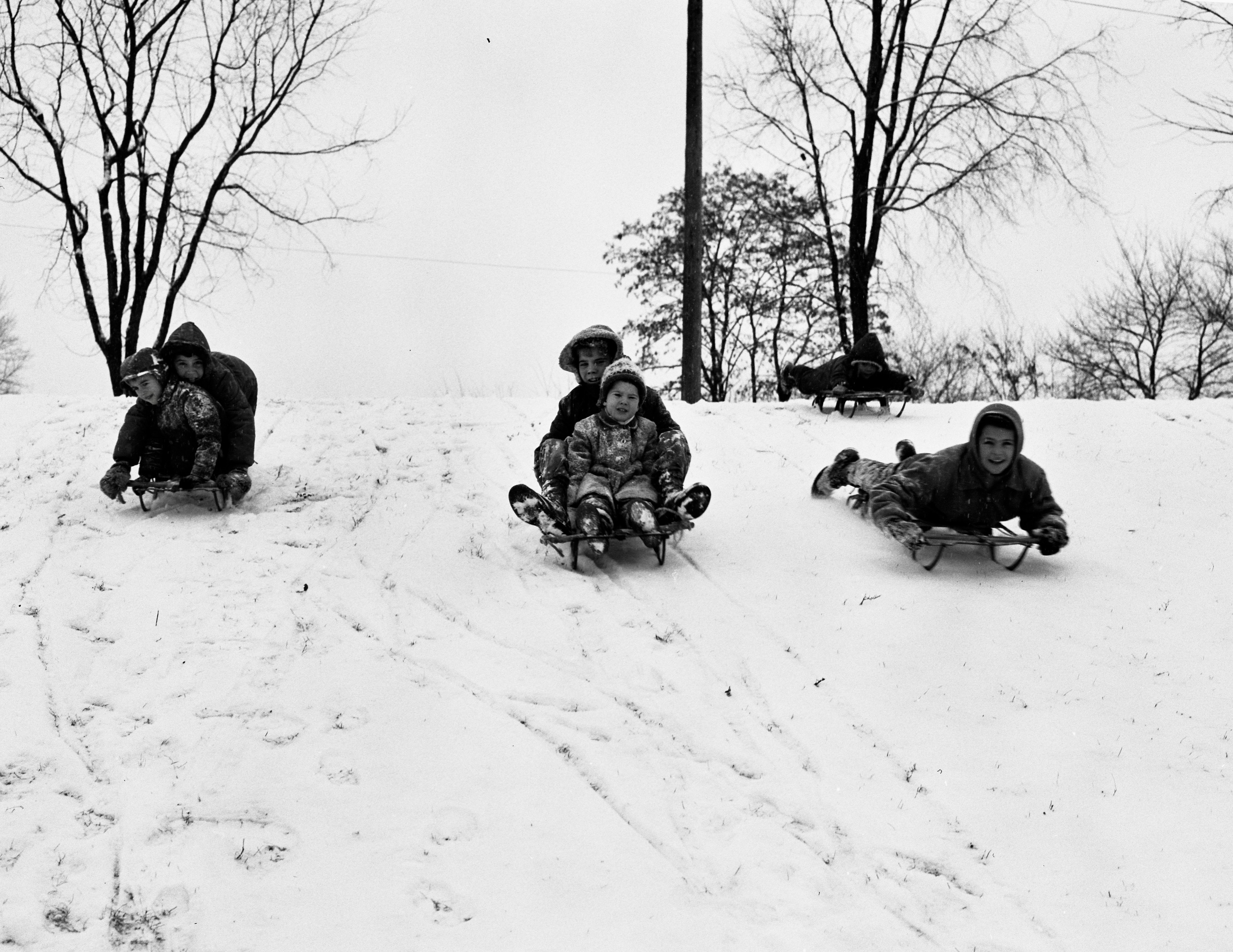
When I was growing up we hardly ever went there summers, but went there many times in the winter. We lived at East 128th St. and St. Clair Ave. and getting there was no trouble. We went ice skating on the man-made lagoon and sledding down Sledgehammer Hill. That wasn’t its official name, if it even had one. It was what all of us called it because of the killer bump near the bottom.
Skating was loads of fun. There was a boat house on the man-made lagoon. It was where we changed into skates. My father had taught us to skate growing up in Sudbury, Ontario. The mining town is north of the Georgian Bay and south of Wanapitei Lake. He would spray our front yard with a hose in the winter and the water froze hard as concrete in no time. When we moved to Cleveland in the late 1950s we took our skates with us. Neither my brother, sister, nor I were big leaguers on the ice, but we skated like dervishes, living it up as we tried to toe loop and pirouette.
Sledgehammer Hill was a hill that started at the top of the plateau and ran down a wide treeless slope. When I went looking for it my memory of it was that it was long, fast, and deadly. I didn’t give my memory much credence, though, believing it must have really been short, slow, and safe. You never know when you’re making up the past.
When I found it, thinking that I would ride down on my Schwinn, I was startled by what I saw. I backed away from the lip of the hill and got off my bike. I walked back to the edge and looked down. It looked even longer and more dangerous than I remembered. I saw the bump near the faraway bottom and remembered hitting it, going airborne, and landing like Godzilla had body-slammed me. Many kids veered away from the bump. None of us ever blamed them. We had all done the same thing one time or another. Only the innocent went over the bump full-bore the first time and lived.
I don’t know how fast our sleds went, maybe 20 or 25 MPH, but they went fast as hell. We didn’t wear helmets. We wore knit caps. You were considered a sissy if you wore earmuffs. I started wearing earmuffs after one icy winter weekend my ears froze and almost fell off. Insults were easier to bear than frostbite.
Our parents always went skating with us or watched from a bench, in case the ice started to crack, but when we went sledding, they dropped us off and went on their way. My sister rarely sledded, my brother sometimes did, but I couldn’t get enough of it. We rode Speedaways, Yankee Clippers, and Flexible Flyers. Only the foolhardy among us rode Sno Wing Blazons. They were too fast for Sledgehammer Hill. Most of us wanted to go as fast as possible but not necessarily break our necks. We sledded until it started to get dark and our parents came back to pick us up.
I didn’t take a chance going down the hill on my Schwinn. I rode away from Sledgehammer Hill, roaming around the park plateau instead, taking in the highlights of the past. I rode to the north end of the hill where John D. Rockefeller’s mansion had stood. It burned to the ground under unexplained circumstances in 1917.
It was early in the evening by the time I pedaled back to Terese’s house. After I told her about the hill she stepped into the middle of her kitchen, pretending to be standing on a snowboard, balancing with her arms stretched out, and racing to the bottom.
She had performed professionally as a ballet dancer when she was younger and taught the fine points of footwork to Cleveland’s Lithuanian folk dancing groups. I applauded her performance when she was done, but if she had tried that stunt on Sledgehammer Hill, professional dancer or not, she would have gone flying headfirst when she hit the killer bump, and there wouldn’t have been enough croissants in her kitchen to break her fall.
Ed Staskus posts stories on 147 Stanley Street http://www.147stanleystreet.com and Cleveland Ohio Daybook http://www.clevelandohiodaybook.com. To get the site’s monthly feature in your in-box click on “Follow.”
 147 Stanley Street