Tag Archives: Matti Lavikka

Monkey Business

By Ed Staskus

   Kevin Rourke was an engaging young man with handsome eyes, handsome hair, and a handsome man’s love for all women, from Plain Jane’s to Jane Russell’s. He was charming but unscrupulous, especially when it came to sexpots. He was slowly going to paunch but still young enough that nobody noticed it except us, his roommates, who saw him flip flopping to and from bedroom and bathroom every morning with a towel wrapped around his spreading mid-section.  

   He was in his late-20s, but his belly was going on late-40s. He liked food as much as he liked women. He was always eating sirloins and plucking daisies. The only time he wasn’t was when he went to Florida, which he did for one week twice a year. When he did he only took toothpaste and a toothbrush, two pairs of clean socks and underwear, and a fistful of cash with him. He had a small safe in his closet full of paper money.

   He always wore a baseball cap, safari shorts, and a yellow shirt on the flight. He wore the baseball cap because his hair was thinning.

   “Why yellow?” we asked. 

   “It’s a cheerful color,” he said.

   “What do you do there?”

   “I don’t do anything. I hardly ever leave my room. I sit on the balcony sometimes at night.”

   “How about getting some sun?”

   “No,” he said. “I keep the outside where it belongs, which is outside.”

   “What do you mean? There’s a beach right there.” He always stayed in the same hotel, the Pier 66 Hotel, within sight of the Atlantic Ocean. “What do you do in your room?”

   “I sleep, and other things,” he said.

   “What about food?”

   “It’s my week to diet.”

   “You can’t lay around doing nothing all day every day for a week.”

   “I’ll take that bet,” he said.

   His Lebanese fiancée Leyla took the bet and won. When she did she wouldn’t take his calls for three weeks, but he wormed his way back into her good graces after he got back to Cleveland and their wedding back on track, except when it wasn’t. They had been engaged for more than a year. Day after day went by and they were unable to set a firm date. In the meantime, Kevin kept hedging his bets, sowing his wild oats.

   He took more showers than anybody we knew. He showered every morning and again in the evening after work. He even showered those nights he wasn’t going out but staying in. He wrapped his dampness up in a bathrobe those nights and watched TV. Neither Matt Lavikka, our other roommate, nor I minded. We didn’t watch much on the boob tube, anyway, except in the fall when the Cleveland Browns were launching pigskins.

   When he was spic and span, Kevin worked for ABF Freight Systems, which was a national LTL motor carrier based in Arkansas. We called it All Broken Freight. After calling it that to his face a few times and seeing frown lines break out around his mouth, we eased off and stopped with the buzz talk. His paycheck meant everything to him.

   He was an orphan, or at least said he was an orphan, and had thrown in with ABF like it was a second family. He had a desk in a bare bone’s office in Brook Park, although he hardly ever went there. His paycheck depended, since he was largely commissioned, on being on the road. He never missed a day of work. Most of the time he worked overtime, pressing the flesh day and night. Some nights he slept in his car in his suit when the drive back to Cleveland from Akron or Canton was going to take too long. When he showed up in the morning he took a shower, changed his clothes, and went back to work.

   Even though he was making a boatload of money, he didn’t seem to own anything except half a dozen expensive suits, a rack of long-sleeved starched white shirts, a trove of status symbol ties, comfortable Italian leather shoes, and a 1980 Mercury Marquis. The car was nearly new and was reddish purple with a leather-and-velour interior. It featured split-bench seats and the driver’s seat reclined. We called it the land yacht. He kept it even cleaner than he kept himself. If there was anything he loved beyond any doubt, it was that car.

   I was taken aback the first time I saw Leyla, Kevin’s girlfriend and treasure chest in the making. She was dark-skinned like she had just crossed the Jordan River, with black hair and a hook nose. Her nose was problematic, but he wasn’t marrying her for that. She was swank the night I met her, with some kind of fur wrapped around the top of her. Her dress was cream-colored and designer. She wasn’t half as good-looking as Kevin. I pegged her at about ten years older.

   Kevin lived by the mantra that when he found a woman with millions of dollars, who would sign over most of it to him, and promised to be dead within a couple of years at the most, that was the woman he was going to marry. “It’s just as easy marrying a rich woman as it is marrying a poor one,” he explained. Leyla didn’t look like she was going to drop dead any time soon, although she looked like she had a million dollars, for sure. We found out her father was a big-time import-export businessman.

   The groom-to-be knew that married couples become in the eyes of the law one person, and that one person was going to be him. Even though it is true enough that one shouldn’t marry for money, since it is cheaper to simply borrow it, he had a one-track mind. He had a bad case of the gimmes. He ran the rat race day and night.

   I was dating a queen bee by the name of Dana Price the year I roomed with Matt and Kevin. Her family lived in a new house in a new development in Solon, a bedroom suburb about twenty minutes southeast of Cleveland. She was a saleswoman for IBM, selling hardware systems to banks, and lived in an apartment twice as large as she needed at the top of Cedar Rd. in Cleveland Heights. Her father was the head honcho of Mrs. Weiss’ Noodles.

   The business had been another family’s business for more than forty years. They were Hungarian, churning out Ha-Lush-Ka noodles for casseroles and dumpling-style Kluski egg noodles at their Woodland Ave. plant. When it burned down in 1961 they built a new plant in Solon. By 1968, after they merged with American Mushroom, they were a multi-million-dollar company and still growing. After the Hungarians retired, and ten years after the merger, Dana’s father Jim Price became president.

   I called him Big Jim because he was a big man with a big mouth. He knew everything about everything. There was no mistaking where you stood with him. He told me so himself when he told me to stay away from his daughter. He didn’t want her marrying an immigrant son with nothing in the bank and anarchist leanings. But she was as stubborn and determined as her father and ignored him.

   We talked about her father’s concerns. She wasn’t planning on marrying me or anybody else to reform them. “That’s what reform schools are for,” she said. Dana was like the highway between Akron and Cleveland, no curves, being up-to-date fit and trim, but I liked her for sticking up for me.

   Kevin hated Dana. She had swagger to spare, and he knew it. She wasn’t curvier than his Lebanese steady but was better-looking by far. He resented her faux Boston accent. He resented her family, her family’s wealth, and their lifestyle. The family house in Solon had four bedrooms and a hot tub on the back deck. Big Jim drove a Caddy. It seemed like it was a new model every year. Kevin hated all of Big Jim’s Caddy’s.

   Dana had gone to college in Boston and flew there every two months-or-so to get her hair done by her favorite stylist. That winter, when I was thinking of breaking up with her, she asked me if I wanted to go to Aspen for some skiing. Before I could say anything, she stuck an airline ticket in my hand and said she would meet me there. She was going a few days in advance. She was more like her father than she knew.

   “I’ve only down hilled a few times,” I told her. “I mostly cross-country ski on the golf courses around town, which are mostly flat.”

   “You’ll get the hang of it,” she said. She was a can-do gal. She could be unconsciously smug.

   I felt like I was being hung out to dry with a broken leg in the making. Aspen Mountain is almost 12,000 feet up and has a vertical drop of more than 3,000 feet. The ticket was like an albatross around my neck. I went for a walk around the block to work it out. I couldn’t work up an angle to get out of the suicide mission.

   “Why don’t you give the plane ticket to Matt?” Kevin suggested. “He’s always skiing. He would love to go to Aspen.” Matt’s parents were from Finland, where skiing is second nature. They always said, “One cannot ski so softly that the tracks cannot be seen.” It was some kind of Finnish proverb. I had no idea what it meant.

   That’s what I did. I gave the ticket to my roommate. I didn’t say a word to Dana about it. She could be a hothead. After he got back from Aspen, Matt told me Dana was dumbfounded when he arrived in my place, his gear in tow. After she got her feet back under her, she swore up a storm and swore it was over between us. She was true to her word.

   “How was the skiing?” I asked.

   “It was great,” Matt said. “You should try it.”

   The on-again off-again wedding of Kevin and Leyla was back on when spring began to bust out all over. They planned to get hitched in June. I had majored in English at Cleveland State University and when my school days were over was minoring in unemployment, and so had time to spare for errands and lending a helping hand. I addressed all the invitations, sealed, and stamped them. I mailed them out. The replies started coming back the beginning of May. It was shaping up to be a sizable wedding followed by a chock-full reception. Kevin was opting out of hot wet love and into cold hard cash.

   I thought all his talk about marrying for money was just talk since a lot of what he said was all talk. I found out otherwise. He was going to marry for money. He was inviting anybody and everybody, no matter how distantly related by blood or friendship, adding up what their envelopes stuffed with fifties and hundreds might amount to.

   Kevin was like the Three Musketeers of repartee. There was nothing any woman could say to him that he didn’t have a better retort for. That was his number one problem. What woman was going to put up with a smart-ass day in and day out, much less for the rest of her life? The second problem was he never dated anybody who was better looking than him. When that became clear to whoever was princess for the day, she chopped his head off with words and moved on. Leyla was willing to put up with both problems. She wanted Kevin so she could make him into what she wanted him to be. The wedding was supposed to be at St. Marion’s, which was a downtown Maronite church. The congregation had been around since before World War One.  It was the center of Lebanese culture in Cleveland, both religious and ethnic.

   Kevin was still wrestling with doubt and indecision a week before the wedding. When he went down for the count, he called it off. He was giving up the task of loving his lady love. He had enough money in his safe so that he could stay a playboy for a few more years. Leyla was going to find out soon enough she had been made a monkey of.

   Matt and I were watching the Kardiac Kids on an old black and white TV when we found out what was happening. The Kardiac Kids were the exciting new version of the Cleveland Browns. They snatched victory out of the jaws of defeat most Sundays. Kevin walked in on the broadcast and tried to break his news flash to us. Brian Sipe was lofting a Hail Mary Pass. We motioned for Kevin to wait. When the Dawg Pound erupted, their prayers answered, we turned to him.

   “What’s that you were saying?” we asked, high fiving each other.

   “The wedding is off,” he said.

   “It’s off?” we asked, flummoxed.

   “Finito,” he said in an Italian accent phony as a bag of baloney, making a slashing motion across his throat. “You’re going to have to let everybody know.”

   “Hey, that’s all right,” I said turning back to the football game, making sure Don Cockcroft had kicked the extra point. “No man should get married until he’s studied some anatomy and carefully dissected the corpses of one or two women, so he knows exactly what he’s going up against.”

   Matt and I were at his parent’s house the next Sunday. They were from the old country. They had gotten a new Philips color television and we were watching the adventures of the Kardiac Kids again. The game hung by a thread. In the middle of the drama a slew of commercials interrupted the action. We told the old folks all about Kevin’s misadventure.

   “Life is not a waiting game for better times,” Matt’s dad said when the commercials were wrapping up, the game coming back on, and we were done with our account of the no-wedding.

   What does that mean? I wondered. I thought it had to be another Finnish proverb. What about all good things come to those who wait? “Even in Helsinki they don’t keep a maid on the dresser too long,” Matt’s mom said as though she had read my mind. I didn’t have to parse that. Matt and I went back to watching Brian Sipe side-stepping a defensive bull rush and pitching a tight spiral. It was flying colors right, left, and center.

Ed Staskus posts monthly on 147 Stanley Street http://www.147stanleystreet.com, Made in Cleveland http://www.clevelandohiodaybook.com, Atlantic Canada http://www.redroadpei.com, and Lithuanian Journal http://www.lithuanianjournal.com

“Cross Walk” by Ed Staskus

“Captures the vibe of mid-century NYC.” Sam Winchell, Beyond Fiction

Available on Amazon: https://www.amazon.com/dp/B0CRPSFPKP

Late summer and early autumn, New York City, 1956. Stickball in the streets and the Mob on the make. President Eisenhower on his way to Ebbets Field for the opening game of the World Series. A killer waits in the wings. A Hell’s Kitchen private eye scares up Cold War shadows.

A Crying of Lot 49 Publication

From Here to Someday

By Ed Staskus

   Sly and the Family Stone drifted into the kitchen where I was making pancakes, stood up on his hind legs, and slapped his tongue against the side of my face. I didn’t mind too much. His mouth was cleaner than that of most of my friends. His kiss was less risky than kissing another person, like my girlfriend. Whatever germs were in his mouth were mostly incompatible to human beings. I never caught the flu from him since his nose never ran. Sometimes it seemed like he had more of a soft spot for me than any living being I knew.

   My brother left his Great Dane behind when he moved out. The dog cost me an arm and a leg to feed. I had to walk him twice a day. I had to shove him out of my bed whenever he tried to sleep next to me. His germs might have been harmless, but his bad breath was sewer gas. He was good-natured, though, and we got along. I called him Sly for short. He called me the man, by which he meant the grocery deliveryman. He didn’t know how to talk, but I always knew what he meant when he barked.

   Sly was in his formative years and fascinated by cars. He was reckless chasing them. I put a stop to it by sitting him down on the tree lawn and driving slowly past with a squirt gun in my lap. The gun was loaded with vinegar. Whenever he lunged at the car, I squirted him in the face through the open window. It only took five minutes to teach him cars were dangerous and guns were even more dangerous. After that I rarely had to put him on a lead when we walked to the pocket park on Lake Erie for runaround time. He walked beside me and the only time I reached for his collar was when I spied another dog coming our way.

   I was living upstairs in a Polish double on the west end of North Collinwood, on a forgotten street, a couple of blocks from the lake. Ray Sabaliauskas lived downstairs with his prize German Shepherd and the woman he brought back from the Vietnam War. He was Lithuanian like my brother and me. I was going to Cleveland State University and paying for it by taking a quarter off every now and then to work for an electro-static painting outfit. We did most of our work on-site out of town. Ray fed and walked my dog whenever I was on the road.

   The day Sly became my dog was the week after my brother’s fiancée Brenda Watson, a girl from Vermont who my brother met while in the U. S. Army at Fort Riley, was killed on Rt. 20 coming home from her part-time job at a restaurant in Mentor. She had been enrolled full-time at Cuyahoga Community College the rest of the time. She didn’t spend much time fooling around.

   The night Brenda didn’t come home was the night I woke up at two in the morning from a bad dream with a bad feeling. I got up and sat looking out window. It had rained earlier and the worms were out. The backyard grass glistened. The lettuce in the garden was glistening. A stray cat sat under the eaves of the garage, keeping an eye out for late-night snacks.

   When I noticed Brenda’s Subaru station wagon wasn’t in the driveway, I somehow felt certain something bad had happened to her. I couldn’t shake the feeling. I stayed up, sitting by the window, until I finally went back to bed, thinking it was the dream that had upset me. Even so, I couldn’t fall back asleep, and when I did, I slept fitfully.

   The next morning a Cleveland Police squad car pulled up outside the house and broke the news to my brother. At first, I thought he hadn’t heard what the policeman said. He stood stock still. But then he asked where Brenda was and reached for his car keys. I didn’t see him the rest of the day or the next day. Brenda’s parents arrived later in the week and took her back to Vermont for burial in the family’s hometown cemetery. When my brother got back from the funeral he moved out.

   Brenda fell asleep at the wheel coming home the night she died, but that wasn’t what killed her. She wasn’t even hurt when the car drifted off the highway and halfway down the embankment. She was able to hit the brakes and stop the car from overturning. She even coaxed it back up to the shoulder, where she discovered she had a flat tire. She turned on the flashers and was getting the jack and spare tire out of the back of the car when a drunk driver going her way drifted out of his lane and rear-ended her. She was propelled into and over the Subaru. She died on the spot, blind-sided, never knowing what hit her.

   When I finished my pancakes, I took Sly for a short walk. Brenda and my brother were gone and the dog was my only roommate now. He didn’t say much, which suited me, but he needed tending. I was running late for school. Back home I left him on the front porch to sleep the day away and made my way to Lakeshore Blvd, where I caught the 39B bus downtown for a class. It was cheaper than driving my bucket of bolts and paying for parking. It was Friday and I was babysitting a friend’s motorcycle for the weekend.

   Saturday morning I scarfed down a cream cheese bagel and a glass of Joe Wieder’s. The motorcycle was in the driveway behind the house where nobody could see it. Our streets were sketchy. Brothers from the hood and home-grown hoodlums prowled for loot at night. The bike was a 1950s Vincent Black Shadow, only a couple of years younger than me. My friend had dropped it that spring when the front wheel locked up. One of the handlebars was bent and made tight right turns tricky. Even though it was beat up, it handled well, and had great acceleration.

   Thirty years earlier Rollie Free, wearing a helmet, swimming trunks, and tennis shoes, broke the motorcycle land speed record riding a Black Shadow at the Bonneville Salt Flats. He did it lying outstretched flat on his stomach and hanging on to the handlebars for dear life. Two years later he did it again, breaking his own record.

   I tied my backpack down across the handlebars, turned the key, and kicked it into life. The air-cooled V-twin engine made a happy sound. I dropped it into gear. At the sidewalk I nodded at a blonde walking by. She turned her nose up at me but looked the bike up and down. I rode west on Lakeshore Blvd, halfway through Bratenahl, and turned south on East 105th St. I meant to connect with Euclid Ave. I wanted to sneak a peek at the urban decay in Glenville I had been hearing about. It was still there. I took in the ruins. The mess was a place, I thought, but not the best place to live.

   I met my former roommate Carl Poston at Mary Jane McGinty’s rented clapboard house on East 33rd St. off Payne Ave. Carl was with Mary Jane, taking it easy in her deep-set backyard. It was a tangle of overgrown hedges, monstrous bean plants, sunflowers, roses run riot, and dwarf trees, all trying to make sense of it all.

   Twin blue-eyed albino cats ran past us, across the lawn, and over a low fence. One of them was cross-eyed. They were from next door. The hippie artist next door let them do their own thing. They were rolling stones who only ate and slept at home. Carl’s motorcycle was in the driveway. It was a 1965 Harley Davidson. We decided to ride west along the lake, nowhere special, just drifting in the direction the sun was going.

   We gassed up on the other side of the Cuyahoga River and stopped at an Ohio City diner for coffee. Carl was a bean counter but had taken some philosophy classes at Cleveland State University that year and was in a frame of mind all summer, trying to realize something that might or might not matter as a way of exercising his mind. 

   We rode on Lake Rd. through Lakewood, Rocky River, and Bay Village. We were riding into a strong headwind, but it was no match for our motorcycles. The sun reached its zenith and kept going. We kept going, too, until we reached Vermilion. There were crowds milling in the streets. We slowed down to almost nothing. Children gamboled here and there. We inched our way to the harbor. A stout lady with a perky freckle face told us it was the annual Fish Festival. 

   We caught a break coming into town that day. There were vintage cars on parade, men wearing fezzes and sashes, marching high school bands in starched uniforms, a covey of Boy Scouts, floats carrying gals looking like movie stars, garish looking clowns, and oafish looking town officials. Brenda had been an outdoorsman. She would have jumped at the chance to cruise the Fish Festival. She had just turned legal that year. Now she was gone with no future. I couldn’t get her out of my mind. She was like the opening pages of a good book whose remaining pages had been torn out and thrown away.

   We had heaping plates of buttered perch with potatoes and sage. Carl wanted to talk about the future, but I didn’t. I was in a state. I thought of the past as nothing but debris and the present as grist for the mill. I left the future in God’s hands. Carl was becoming a thinking man, so he told me I was being irresponsible. 

   “Mind your own business,” I said. He sounded like my father who sometimes knew everything about everything.

   “That kind of attitude is even more irresponsible,” he said.

   “You’ll be an old man soon enough. Wait until then to talk that way.”

   “I’ll have to look you up when that happens,” he said.

   A shapely young woman wearing a bikini with ruffles came our way. She was topped off with a peaked hat two feet high, four feet wide, made of wire mesh, and adorned with red, white, and blue rosettes. We admired her glide. When we left Vermilion, we followed a road along the lakeshore winding past small frame houses and cottage resorts. There were big trees everywhere and the air smelled sweet.

   After we reached Marblehead we took the ferry to Kelly’s Island. We saw sailboats bobbing up and down, leaning to one side of the wind. The ferry rode rough on the choppy water. Carl’s Harley didn’t have a center stand and he had to lean on it to keep it from falling over. A tow-headed boy getting soaked at the bow laughed like Soupy Sales every time a wave crashed onto the deck. When he saw Perry’s Monument he jumped and pointed that way. 

   Don’t Give Up the Ship” was on Commander Oliver Perry’s battle flag during the Battle of Lake Erie in 1813. It recapitulated the dying words of a fellow commander who fell in an earlier naval engagement against the British. Oliver Perry didn’t give up and the British squadron was sent packing.

   We rode around the island aimlessly with our helmets off and the wind in our hair. The blacktop dipped and curved. There were boats stashed in harbors tied to docks all over the place. We took a break at a public beach, ogling skin sizzling in baby oil from behind our sunglasses. Back on our bikes we rode across a field to an abandoned baseball field. The chain link of the backstop was rusted and the painted stands were weathered, cracking, and peeling. The pitcher’s mound was overgrown with weeds.

   We shared some reefer sitting on the outfield grass. Carl started expounding on the problem of good and evil. I suspected I was in for it and took a short drag on the reefer. “The Nazi’s thought what they did to the Jews was righteous, but at the same time many other people didn’t,” he said.

   “Especially the Jews,” I said.

   “Who was right?”  

   I said we both knew Adolf Hitler and his henchmen were insane monsters.

   “Sure, but that’s not the point,” he said. 

   “What is the point?”

   “Just trying to touch on something metaphysical here.”

   “All right, but metaphysics is more fantasy than not. Arguments about good and evil are useless. Just about everything except food, water, and breathing is relative. Most of it is all made up.”

   “What about your brother’s girlfriend who got killed? Was that relative? Did the drunk driver have the right to decide her life and death?”

   “I hope they hang that guy like they hung the Nazi’s.”

   We took a quarry road back to the ferry dock. We were early for our return ride and walked to a nearby tavern. It had a Louisiana ceiling and wide plank floor. Fishing paraphernalia filled the walls. Teenagers were playing pinball and yakking it up. They looked too young to drink but had bottles of Blatz at hand. Over the cash register somebody had scrawled in magic marker that an Irishman was not drunk so long as he could hold on to a blade of grass and not fall off the edge of the planet.

   Carl and I each had a Blatz while we waited for the ferry. Back on the mainland, we took secondary roads as far as Avon, where Carl waved goodbye and roared off for home. I laced up my skates and got on the highway. I crossed the Flats going 75 MPH. Passing the Municipal Stadium I fell in with three other motorcyclists who were making good time. I hit 105 MPH keeping up, then taking the lead, leaning low over my handlebars. Every part of me was focused on the road flowing backwards in front of me. I had never gone that fast on a car or motorcycle or anything else other than a jet plane. Nothing mattered except keeping my tail on the seat and not wiping out. 

   Hunter Thompson once said, “If you ride the Vincent Black Shadow at top speed for any length of time, you will almost certainly die. That is why there are not many life members of the Black Shadow Society.” It took less than three minutes to pass the Cleveland Aquarium and veer away from the pack down the ramp of my exit onto Waterloo Rd. I caught my breath at the stop sign before an impatient horn behind me made me jump and I tapped the gear shift.

   Back home I chained and tucked the Vincent out of sight in the backyard. I watered and fed Sly before throwing myself down on the sofa. My legs felt like worn out rubber bands. My left palm was sore from handling the clutch all day. I wasn’t used to it. I wasn’t used to anybody my age dying, either, but Brenda had died and there wasn’t anything anybody could do about it. 

   A good idea is to die as young as late in life as possible. It hadn’t worked out for Brenda. Her life was still in the memory of the living. Nobody had forgotten her, at least not yet. When that happens, it happens slowly, counting down to zero, until nobody remembers. It was a shame, I thought, before I stopped thinking about time and fate and fell into a simple as ABC sleep while Sly and the Family Stone snored on the floor at the foot of the bed.

Ed Staskus posts monthly on 147 Stanley Street http://www.147stanleystreet.com, Made in Cleveland http://www.clevelandohiodaybook.com, Atlantic Canada http://www.redroadpei.com, and Lithuanian Journal http://www.lithuanianjournal.com

“Cross Walk” by Ed Staskus

“Captures the vibe of mid-century NYC, from stickball in the streets to the Mob on the make.” Sam Winchell, Beyond Fiction

Available on Amazon: https://www.amazon.com/dp/B0CRPSFPKP

Late summer and early autumn. New York City, 1956. Jackson Pollack opens a can of worms. President Eisenhower on his way to the opening game of the World Series where a hit man waits in the wings. A Hell’s Kitchen private eye scares up the shadows.

A Crying of Lot 49 Publication

Swimming With the Fish

By Ed Staskus

   There are thousands of restaurants in Cleveland Ohio. Captain Frank’s isn’t one of them anymore. It used to be and when it was it was one of the best places to eat if you liked seafood and Lake Erie waves and wind shaking the building on the E. 9th St. pier. Every so often somebody full of cheer and careless after a hearty meal, or simply drunk as a skunk, drove off the pier into the lake. 

   “It was always my last stop after a night of drinking in the Flats,” said Nancy Wasen. “Every night I was surprised no one fell off the pier and drowned.” It wasn’t for want of trying.

   In 1964 Mary Jane Jereb was 16 years old. She was in a car with her cousin and a neighbor and a driver’s education instructor. “He took us downtown, to prepare for city driving. I wasn’t driving, my neighbor was. He directed her to this particular parking lot.” It was Captain Frank’s parking lot. They drove straight to the edge of the slimy pier. Spray from the Great Lake spotted their windshield.

   “The instructor told my neighbor to turn around and head back to Parma. My short young life flashed before me as she pulled into a parking space and backed out and headed home.” They slowly carefully left the dark deep behind.

   Captain Frank’s was a “Lobster House” or a “Sea Food House” depending on the signage of the year. It changed now and then. There was a panhandler who called himself Captain Frank who hung around outside the restaurant day and night, his hand stuck out. Demoted cops who had kept quiet about hidden rooms in gambling joints and pocketed cash in job-buying schemes were assigned to seagull patrol on the pier, always in the dead of winter. They ignored the panhandler and did their best to walk the chill off. Sometimes they helped the innocent just to stay on the move.

   Francesco Visconti was the Captain Frank who ran the restaurant. He was a Sicilian from Palermo whose parents beat it out of Europe the year World War One started. At first, as soon as he could handle a horse, he sold fish from a wagon. After that he operated the Fulton Fish Market on E. 22nd St. He was 40 years old in 1940 and lived with his wife, Rose, a son, as well as three daughters.

   He bought a beat-up passenger ferry building on the E. 9th pier in 1953 and opened Captain Frank’s. I was a child living the easy life in Sudbury, Ontario at the time and missed the grand opening. Kim Rifici Augustine’s grandfather was the original chef at Captain Frank’s. “The wax matches he used for flambé caused a fire back in the 1958,” she said. The fish shack burned down. Frank Visconti built it back bigger and better the next year.

   By the late 1950s my family had emigrated from Canada to Cleveland Ohio. We lived nearby, but never went to the restaurant. My parents were Lithuanians and ate bowls of beetroot soup and plates of potato pancakes and meat-filled zeppelins at their own table. They didn’t know a Mediterranean Diet from Micky Mouse.

   In the Old Country they had feasted on pigs and crows. My mother’s father was a family farmer who kept porkers, slaughtering them himself, and smoking them in a box he built in the attic of the house, the box built around their fireplace chimney. “It was the best bacon and sausage I ever had in my life,” my mother said eighty years later.

   They hunted wild crows. “Those birds were tasty,” my mother said. The younger the birds the better. Those still in the nest and unable to get away were considered delicacies. Their crow cookouts involved breaking necks and boiling the birds in cooking oil over a bonfire. They served them with whatever vegetables they had at hand.

   Since I was part of the family, I ate with my parents, my brother, and sister. My mother prepared every meal. I ate whatever she made, even the fried liver and God-awful Baltic headcheese, although we never, thank God, had carrion-loving crows. Even if I had wanted to go to the Lobster House, I didn’t have a dime to my name

   Captain Frank’s boomed in the 1960s and 1970s. There were views of the lake out every window. There was an indoor waterfall. If you had water on the brain, it was the place to be. The food was terrific. Judy Garland, Nelson Eddy, and Flip Wilson ate there whenever they were in town doing a show. The Shah of Iran and Mott the Hoople partied there, although not at the same time. They weren’t any which way on the same wavelength, other than under the spell of Captain Frank. He never asked them to leave, no matter how late it was.

   There was a luncheonette behind the restaurant that doubled as a custard stand in the summer. When the Shah or Mott the Hoople stayed later than ever, they could sit in the back in the morning in the breezy sunshine with a cup of custard while lake freighters went back-and-forth. “I never went inside Captain Frank’s, but I remember the ice cream shop in the back well,” recalled Bob Peake, a homegrown boy who was a frozen sweets connoisseur.

   Frank Visconti was a made member of the Cleveland Mob. His criminal record dated back to 1931, including arrests for narcotics, bootlegging, and counterfeiting. The restaurant was frequented by high-echelon hoods and low-minded politicians alike. Many criminal family meetings were held there. 

   “It was the hangout for Cleveland Mafia Enterprises,” said Tom James on Cleveland Crime Watch.

   Longshoremen went to Kindler’s and Dugan’s to drink before and after work, but between their double shifts went to Captain Frank’s for power shots. When they were done it was only a short walk back to the docks. When the weather was bad, they were warmed up and sobered up by the time they clocked back in.

   The restaurant was a football field’s length from Lakefront Stadium, where Chief Wahoo and the Browns played. The ballpark sat nearly 80,000 fans. The Indians were always limping along, their glory days long gone, but the Browns were exciting, and on game day crazy loud cheering rocked the windows of the restaurant. Cold biting winds blew into the stadium in spring, fall, and winter. In the summer under the lights, swarms of midges and mayflies sometimes brought baseball games to a standstill.

   In 1966 the Beatles played the stadium and after that the Beach Boys, Pink Floyd, and the Rolling Stones showed up to rock the home of rock-n-roll. It was a walloping paycheck for a night’s work. In the 1980s U2 brought its big show to town, raking in millions singing about lovesickness and hope. Every so often they threw in something about social injustice.

   Even though I was grown-up by the 1970s, I still didn’t dine at Captain Frank’s. I was living in a rented house in a forgotten part of town, and it was all I could do to feed myself at home. I didn’t have pocket money to eat out. When I finally joined the way of the world and could afford to go whenever I had some spare change and wasn’t too tired from working with my hands all day, I ate out. Most of my friends were already racing to the top. I was starting at the bottom.

   There was a kind of magic eating at Captain Frank’s at night. I watched the lights of ships making their way slowly into Cleveland’s harbors while munching on scampi and warm rolls swimming in garlic butter. They served steaks the cooks seared, but the seafood was usually just threatened with heat and served. That’s why it was good. Students from St. John College on E. 9th and Superior Ave. walked there to have midnight breakfast because it was nearby and substantial

   The Friday night in September 1984 my friend Matti Lavikka and I treated my brother to dinner on his 31st birthday at Captain Frank’s was almost the last birthday he celebrated on this earth. We didn’t know Frank Visconti had died earlier that year, but in the car on the pier after dinner we thought my brother was dying. He was gasping for air. The dinner had been very good, but he looked very bad. We were afraid he might end up swimming with the fish.

   He was getting over a marriage to a Columbus girl that had lasted 56 days. We picked him up in Mentor, where he was living alone, and went downtown. It was a starry late summer evening. We ordered a bottle of Chianti, some pasta, and lots of shellfish. We didn’t know, and he didn’t know, that he was allergic to shellfish. 

   “I don’t know why, but I hardly ever eat fish,” he said. “It doesn’t usually agree with me.” Our dinner at Frank’s that night included scallops, oysters, shrimp, and lobster. He might not have been allergic to all of them, but he was allergic to one of them, for sure.

   Halfway through coffee and dessert, which was sfogliatelle, layers of crispy puff pastry that bundle together in a lobster-like way, he was itching, wheezing, and his head was swelling. His lips, tongue, and throat were like silly putty. He was breaking out into hives. He was getting dizzy and dizzier. It was like he had eaten a poisoned apple.

   Shellfish allergy is an abnormal response by the body’s immune system to proteins in all manner of marine animals. Among those are crustaceans and mollusks. Some people with the allergy react to all shellfish. Others react to only some of them. It ranges from mild symptoms, like a stuffy nose, to life-threatening.

   Matt was a fireman and paramedic in Bay Village. Looking at my brother he didn’t like what he was seeing. We frog-marched him to the car and made a beeline for the nearest hospital. Matti put the pedal to the metal. The Cleveland Clinic wasn’t far, and we had him at the front door of the emergency room in ten minutes. Five minutes later a doctor was injecting him with epinephrine and a half-hour later he was his old self.

   “Thanks, guys,” he said when we dropped him off at his bachelor pad in Mentor. He staggered away to bed.

   After Frank Visconti died the restaurant limped along. The service and food got worse and worse. The tables and chairs and walls looked like they needed to be scrubbed down. Fewer and fewer people went downtown for any reason other than work. I was working downtown near the Cleveland State University campus, where Matt and I had started a small two-man business. One evening when I got off work, I called my girlfriend and invited her to dinner at Captain Frank’s. I had seen her eat buffets of seafood. She had a hollow leg. I knew she wasn’t allergic to any of it. When we got there, however, the pier was dark in all directions. There were no parked cars in the lot and no lights in any of the windows.

   Rudolph Hubka, Jr., the owner the past five years, had given up the ghost and declared bankruptcy in 1989. Nobody said a word. Hardly anybody noticed. The building was demolished in 1994. The only thing left was dust and litter blowing around in the wind.

   We drove to Little Italy and snagged a table at Guarino’s, a woman out front pointing the way. Sam Guarino had died two years earlier, but his wife Marilyn was carrying on with the aid of Sam’s sister Marie, who lived upstairs and helped with the cooking in the basement kitchen. “Marilyn sat in front, and she was like the captain on a ship, making sure everything was just right,” said Suzy Pacifico, who was a waitress at the eatery for fifty-two years.

   We had a farm-to-table dinner before there was farm-to-table, red wine, and coffee with tiramisu. Mama Guarino asked us how we liked the cake. We told her we liked it very much. We didn’t see any fishy characters. When I drove my girlfriend home that night we were both happy as clams.

Ed Staskus posts stories on 147 Stanley Street http://www.147stanleystreet.com and Cleveland Ohio Daybook http://www.clevelandohiodaybook.com. To get the site’s monthly feature in your in-box click on “Follow.”

Juke Joint

By Ed Staskus

   When Matt Lavikka and I slowly but surely stopped playing chess and started playing Go we didn’t know we were sitting down to the oldest board game played continuously to the present day. The game was invented in China 3,000-some years ago. It is a contest for two players in which the goal is to capture more stones and surround more territory than your opponent. The way of the game is inexorable. The way anybody plays is one’s own choice.

   The playing pieces are called stones. One player uses the white stones and the other one the black stones, taking turns placing them on the vacant intersections of the board. The stones can’t be moved once placed, but are removed from the board if it, or a group of stones, is surrounded on all adjacent points, in which case it is captured. At the end the winner is determined by counting each player’s surrounded territory along with captured stones. 

   Games can and do end when one player is very tired or has gone brain dead. Our games usually went for two to three hours. The longest game ever played was played in Japan in 1938 between two Go masters. It lasted 54 hours. Shusai Meijin, the older of the two masters, died immediately after the marathon due to the aftereffects of the ordeal. He played the game with life and death determination. 

   The chess board starts with everything on it. The last man standing wins. The Go board starts with nothing on it. Whoever is the more ruthless and determined ends up on top. It’s the way of the world. Even though the rules of Go are simple, the play is complex, especially the longer the action goes on. It has a larger board than chess with more scope for play and more alternatives to consider. The number of board positions in Go has been calculated to be greater than the number of atoms in the observable universe. The Japanese believe no two matches have ever been or ever will be the same. They deem the game to be a microcosm of everything everywhere all at once.

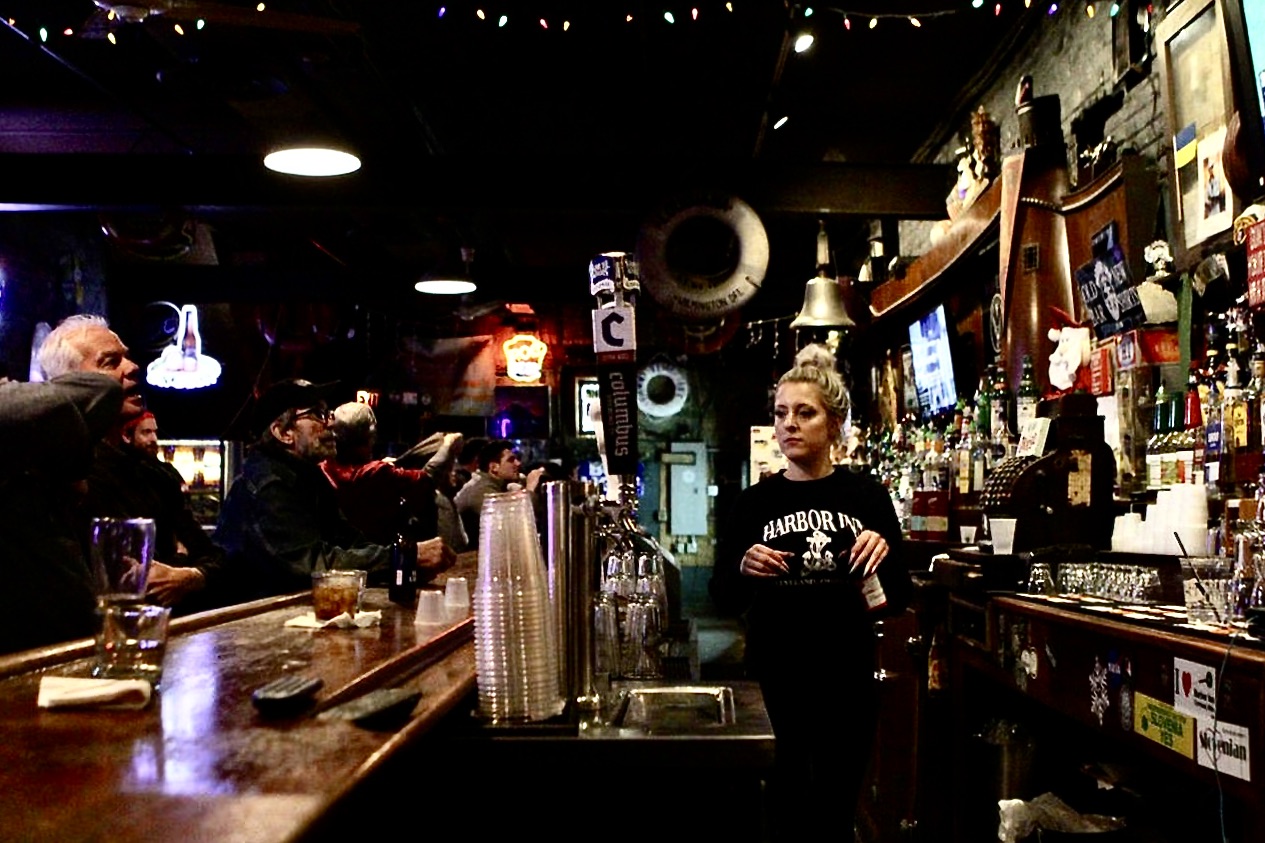
   If we had known that we probably would never have started playing. By the time we found out it was too late. We had been sucked into the black hole of Go. Getting out of the hole meant going down to the Harbor Inn for a pick-me-up. It was another hole, on the west bank of the Cuyahoga River in the Flats. It either was or wasn’t the oldest bar in town. Either way, the place wore its reputation on its sleeve.

   “The place was always shoulder to shoulder with bikers and their molls,” said Dan Coughlin, a sportswriter for the Cleveland Plain Dealer. “Wally had a virtual armory behind the bar. He had pistols and shotguns. One night in the middle of the summer we stacked up cases of beer bottles and fired at them from the hip, with shotguns blasting away. I put a hole in the stop sign in front of his bar.”

   Wally was Vlado Pisorn, an immigrant from Slovenia who had taken over the Harbor Inn sometime in the indeterminate past. We called him Vlad the Impaler. He had the kind of beer we liked, the kind from Germany and Czechoslovakia. The wine came from a hose and died on the tongue. After a couple of near deaths, we never drank it again.

   Matt had served a tour of duty in the armed forces, was on a prolonged stretch of R & R, and in the meantime was boning up for the entrance exams for mailman, fireman, and policeman. He was hedging his bets. He finally found employment with the Bay Village Fire Department, which was like working at a posh nursery school. There were hardly ever any fires anywhere near the lakefront suburb. There were, however, lots of old folks having heart attacks and strokes and the EMS trucks kept up an endless shuttle to St. John West Shore Hospital.

   One night Matt and his duty partner Chuck were called to a house where the man of the house was having chest pains. He was on his back in bed, his eyes closed. When they stepped up to him in the bedroom his wife whispered that she thought he was dead. “The poor dear man,” she said. Chuck was in the lead. As he walked up to the bed, he slipped on a throw rug and went head over heels on top of the man, body slamming him, the bedsprings recoiling.

   “If he’s not dead yet, he’s dead now,” Matt thought. 

   “Is he OK?” the woman asked, alarmed. 

   “Your husband will be OK,” Matt said. 

   “No, not him,” the woman said. “I meant the other fireman.” 

   “What the hell is going on!” the dead man suddenly spat out, jolting awake. “Get your fat ass off me.” He rolled Chuck off the bed, who fell to the floor. From then on, Chuck was known as Lazarus back at headquarters. It took years for the sobriquet to fade away.

   Virginia Sustarsic introduced me to Matt. How they knew each other was beyond me. She was Slovenian and a hippie through and through. He wasn’t, not by a long shot. He was a cool customer and Finnish on top of everything else. He played chess, like me, and we got to know one another playing now and then. I had moved out of the Plaza Apartments, where Virginia still lived, and was living on a forgotten street in North Collinwood, a couple of blocks south of Lake Erie. I lived upstairs in a two-bedroom Polish double. Ray Sabaliauskas, a fellow Lithuanian, owned the house and lived downstairs with his Southeast Asian wife and a prize German Shepherd. He had come home safe and sound from the bright shining lie that was the Vietnam War.

   I found my Go game at a garage sale in the neighborhood. It was practically brand new, the instruction sheet still in the box. I paid a dollar for it in pocket change. Reading the rules took less than five minutes. Explaining the rules to Matt took less than one minute. Our first game took five hours. We played on the front porch. The contest was suspended due to darkness when the sun set.

   “The best strategy is to spread the pieces far apart and stretch them out, to encircle and attack the opponent, and thus win by having the most points vacant,” Go master Huan Tan said nearly two thousand years ago. We were both bug-eyed after our first game. We didn’t know the game’s strategy from a seesaw. It was like wrestling a gorilla. You don’t quit when you’re tired, you quit when the gorilla is tired. Go is considered the most difficult board game in the world. Sleeping became my new go-to after a long match.

   I started jogging on Lakeshore Blvd. west out of North Collinwood, where everybody was a working man in one way or another, through the village of Bratenahl, where everybody was tall, trim, and filthy rich. They oozed pride in their state of being. When I was running in their neighborhood I hesitated to even spit on the tree lawns. I had put exercise on the back burner in my early 20s. I never thought I would be working out again to be able to sit quietly hour after hour staring at a square board of intersecting lines.

   When I was a teenager I ran track and field as part and parcel of Zaibas. It was a Cleveland Lithuanian sports club formed in 1950. In 1951, at the 1st North American Lithuanian Games, members participated in basketball, volleyball, and table tennis. The next year the club hosted the games in our hometown and fielded a full team in track and field. 

   In the 1960s I ran around in circles encouraged by Algirdas Bielskus. He was a small man with a round face and a championship head of hair. He was the director of a men’s vocal ensemble, co-founder of a choir, and concertmaster of the Ciurlonis Ensemble. He was also the Zaibas track and field coach for sixty years. He had the voice to make himself heard loud and clear from the far end of any quarter-mile track. Every weekend fair or foul all I heard was “Go! Go! Go!”

   He always carried a briefcase, briefcases he was always losing, stuffed with notes about how we were progressing. Rita Kliorys, one of his top-notch runners, made him a Christmas gift of a new one in 1966. “It was the accordion kind,” she said. “I remember it cost $100.00, and I collected one dollar from many people. He actually did not lose it, either.”

   He coached thousands of youngsters who ran hundreds of thousands of miles. “I thought of him afterwards whenever I saw a turquoise and orange Howard Johnsons and would remember how he took us there for ice cream sometimes,” Regina Thomas said. “Although I was a klutz at sports, he never made me feel like one. I never thought much about it as a kid, but what a commitment to youth and sports.” The small man with the big voice was seemingly tireless, championing fitness among Cleveland’s Baltic off-spring.

   “He worked for my dad’s company, Transmission Research, in the basement of our house,” Dalia Nasvytis said. “Sometimes we would hear strange noises downstairs late at night and realize he was still down there running off schedules for the next athletic meet he was organizing.” He was unrelenting about the fettle of immigrant kids.

   Once we started playing Go, Matt and I made a commitment to it. We played all that spring, summer, and through the winter, two and three games a week. It wasn’t an obsession, although it was. We played on the front porch until it got too cold to play outside. After that we played in the living room at a coffee table, sitting opposite one another, all four of our eyes glued to the board.   

   The game demands concentration, which is born out of silence. Some of our best moves and long-term maneuvers were made quiet stealthiness. I found out the more time I spent noiseless, the more illumination lit me up. We hardly talked, going for a half-hour without saying a word. Every so often Matt smoked a Marlboro. Before long he would tap another one out of the red and white flip-top box. Whenever I joined him, the living room filled with smoke, a gray-white cloud stewing over the entanglements of Go.

   When we first started playing our plan of attack was capturing stones. We both saw that surrounding other stones and taking them prisoner yielded points. It was like taking a piece in chess. After a while we discovered the object of Go is not to surround and capture the opponent’s stones. The object is to surround empty territory on the board. The way to do it is by building walls around empty intersections. If your territory includes some opposing stones, all the better. Then it’s grab and go. From then on it became a contest to capture territory rather than simply capture stones.

   In the Eastern world Sun Tzu’s “The Art of War” reads as an introduction and exposition to the game. Real life warlords back in the day of every stripe were always big on blockading their enemies and capturing territory. The times they were not a-changing, not anytime soon. The Vietnam War was over, but there was always another war on the horizon.

   There’s an old saying, “Chess is a battle. Go is a war.” The more we played the more we discovered it was a war of attrition. It was like breaking stones in the hot sun. Both of us knew how to make the other guy sweat. There was no fighting the commandments of Go.

   Oskar Korschelt, a German chemist, brought the game from Japan to Europe in the 1880s. Even though it was slow to catch on, by the 1950s championship-level tournaments were being organized. By the early-70s it was filtering into the United States. I never met another Lithuanian who played the game. My kinsmen are instinctively suspicious, somewhat superstitious, sometimes curious, usually sensible, always pragmatic, hard-working, conformist, and punctual. They are often reserved except when they get together. Once they establish their bona fides it’s time to pick up a drink and run off at the mouth, getting communal. They play volleyball and basketball like nobody’s business. They probably couldn’t stand the prolonged silence of Go.

   One night after a long back-and-forth on the board we drove to the Harbor Inn. We were looking for some downtime. The two-story building was a home-away-from-home for dockworkers and salt-miners. A lonely man who didn’t mind a lumpy mattress could even grab some shut-eye upstairs. It might have been a dive way back when, but it was no ifs ands or buts about it still a dive, slinging suds to third shifters in the morning and anybody else who had a buck the rest of the day and night. There was a coin operated bowling arcade game downstairs and battered dart boards upstairs. We ordered bottles of Pride of Cleveland instead of imported European brew, being short on ready cash, and picked up a handful of house darts.

  Nobody knew how long the Harbor Inn had been there, but we thought it had to be from the day after Moses Cleaveland settled the land centuries before. It reeked of smoke from long-gone cigars and cigarettes. The shadows smelled even worse, like ammonia had been set on fire. Looking around there was no doubt some of the men at the bar only bathed once a month.

   The beer was cold and refreshing and playing darts was fun. We played 501 Up. Both players start with a score of 501 and take turns throwing three darts. Bullseye scores 50, the outer ring scores 25, and a dart in the double or treble ring counts double or triple. The tally is calculated and deducted from the player’s total. The goal is to be the first player to reduce the score to exactly zero, the only hitch being that the last missile thrown must land in a double or the bullseye. 

   Darts are front weighted for flight and are several inches long with a sharp point. A big part of playing darts is the throwing part. The rest of it is mental toughness, staying on the button, stinging the cork like a bee. It was like Go except we could let ourselves go. We wrote our names in chalk on the brick wall, adding them to the hundreds of other names reaching to the ceiling. After a couple more Pride of Cleveland’s we got sloppy, but it was no matter in the juke joint that was the Harbor Inn.

   When I took a good look at the dart board, there weren’t a hundred-or-more darts crowding it, like all the stones on a Go board. Every throw was always at an empty target, every throw a new chance to get it right, unencumbered by the past. Go was all about the past, the past of all the carefully placed stones on the board. Playing darts was right now. It was a relief to see the target and hit the target, except when we completely missed and the dart bounced off the brick wall. When that happened we yukked it up, not like the game of Go, which was never a laughing matter.

Ed Staskus posts on 147 Stanley Street http://www.147stanleystreet.com and Made in Cleveland http://www.clevelandohiodaybook.com. To get the site’s monthly feature in your in-box click on “Follow.”