
By Ed Staskus
The Germans called the town Memel. We called it Klaipeda but only among ourselves. The Germans were in charge. They had been in charge for hundreds of years so we didn’t argue with them. They lived in the town. We lived on the flatlands outside of town, although some called it the bogs. They had built a railway station of yellow brick not long ago. The town was spreading out. None of us ever rode on the trains. We worked on the docks. The port was on the mouth of the Neman River and was the gateway to the Baltic Sea.
The Curonian Spit shielded the harbor from storms. Dunes soaked up wind and waves. The Neringa Fortress had been built fifteen years earlier to protect the harbor from marauders. A hospital was built to treat sailors with infectious diseases. It was the last resort for ailing seadogs. Most of them died there. There were buried in a back corner of the Municipal Cemetery, as long as they weren’t Jewish.
We spent our days loading grain and lumber for export. After work we stopped in at the taverns and bawdy houses up and down Heydekrug Strasse. It was mostly us single men. It was a bad neighborhood to be living in if you had good intentions. We stayed in shabby boarding houses, two men to a closet of a room, during the week and only went home on weekends. We walked home on Sunday mornings and walked back to town Monday mornings.
It was on a Friday night in the middle of summer that I first laid eyes on Ignas Radzvilas. He was known as the Pig Sticker. Everybody knew all about him. He was rumored to have killed two or three men in knife fights. It was the same night that Dominykas Norkus left town and never came back. It was the last time any of us ever saw the back of his head, his hair limp and shiny with fear.
I was smoking outside of Grazina Kleiza’s place, leaning against a brick kiln, when I saw Ignas Radzvilas come marching up the street. His face was set in stone and he was dressed in black like an undertaker. His belt buckle was silver. I couldn’t see where he kept his knife. I knew it had to be somewhere handy, but couldn’t spot it. I thought, maybe it’s hidden up his sleeve, but I knew that couldn’t be right. Ignas Radzvilas didn’t hide his reputation. He wore it on his sleeve for all to see.
Grazina Kleiza was part Lithuanian and part Tatar. She traced her ancestry to Grand Duke Vytautas the Great, who brought more than ten thousand Tatars back from a campaign in the Ukraine in the early 15th century to serve him as mounted fighters. They were small dark men who knew how to raise hell. Grazina Kleiza’s eyes were the color of river rocks in a cold stream. She wore lace-up boots and kept her hair loose. Nobody knew what kept her dress in place. A red light burned at the front of her business building, which looked more like a warehouse than a pleasure house. It was as much about loaded dice on the gluckshaus board and cheap moonshine as it was about anything else. Her pleasure house was in the shadow of the ruined Klaipeda Castle. The castle was where the dead went to cast shadows.
Ignas Radzvilas walked past me without seeming to notice I was there. I could tell he had something on his mind. I tossed my cigarette aside and followed him through the door. What he had in mind was Grazina Kleiza. She had once been his girl. What he didn’t know was that she was another man’s girl now, not that it mattered even if he had known. Dominykas Norkus could have been a Polish prince and it wouldn’t have mattered.
When I went through the door behind him, the door bumped him on the backside. He reached behind him without looking and swung the door back into my face. I reached for the knife I kept in the lining of my vest. “Don’t,” he said, slapping the knife out of my hand and brushing me aside like I wasn’t any more than a sand beetle.
Grazina Kleiza was dancing a polka with Dominykas Norkus. An old bag wearing a magpie feather hat was on a piano and a skeleton of a man was on an accordion. We all made the sign of the cross when walking past the piano. The woman believed wearing magpie feathers was a sign of fearlessness. We knew it was a sign of witchcraft. Dominykas Norkus was known as the Brakeman. He worked for the Germans. Nobody ever insulted him to his face since he was the best man with a knife in our neighborhood. When the Pig Sticker walked up to the Brakeman and took Grazina Kleiza’s arm, pulling her away, the dancing and music stopped. The piano player turned on her stool and scowled.
“I’m all done hating you,” he said to Grazina Kleiza. “Saying goodbye is like dying a little. When I said goodbye to you I died a lot. Pasiklydau ta diena. It was a mistake.” The couples on the dance floor near them moved away, shuffling their feet and staying quiet. The talk at the bar drifted off. One man made a quick grab for more krupnickas and poured it down his throat.
“I’m looking for the man I hear is the best with a knife in these parts,” Ignas Radzvilas said, looking straight at Dominykas Norkus. “I am probably not as skilled as him, but I’d like to find out what I’ve got.” He didn’t say anything about love and hate, but everybody knew what he was talking about. In the next instant everybody saw the knife in his hand, although nobody knew where it came from. We couldn’t take our eyes off it.
The Brakeman had a smoldering butt held between his thumb and forefinger. He took a drag on it. It burned down and he let it fall to the plank floor. We thought he was going to fill his hand with his knife any minute, but one minute after another passed and his hand stayed empty.
“Do you know I’m talking to you?” Ignas Radzvilas said, stepping closer to Dominykas Norkus. If it was a question, the Brakeman didn’t have an answer. The Pig Sticker’s breath was sour in his face. The deaf geezer in the corner, the corner that was reserved for him, was listening closely like everybody else.
Grazina Kleiza stepped up to her man. She reached for where he kept his knife and put it into his empty hand. “This is what you’ve been looking for,” she said and stepped aside. He looked at the knife in his hand like he had never seen it before. Was he playing the fool to buy time? The knife slipped from his fingers, hitting the floor with a thud, playing dead. The air went out of the room.
“I thought you were a man, not a yellow dog,” Ignas Radzvilas said.
Grazina Kleiza wrapped herself around the Pig Sticker’s arm. “Forget him,” she said. “He’s got a white liver.” They walked arm and arm to the back and through a private door. We watched them stroll to the room of the rising sun. When we turned back to Dominykas Norkus, he was gone. The window behind where he had been standing was wide open.
We all hated him from that moment on. He hadn’t just let us down. He had betrayed us. The skeleton pumped up his accordion and the magpie hat began banging on her piano keys. The drinkers went back to their drinks, pounding the bar for doubles. On the dance floor the polka dancing was frenzied, like everybody was trying to burn something off.
I got overheated dancing with one girl after another until I finally had enough. I shrugged the last girl off me and went outside. I stopped at the well for a cool drink. The water tasted hot. I spit it out. The dirt street and the clean sky were the same as they had always been, but everything was different. I heard a horse snort softly. It was asleep on its feet at the front of the gate into Klaipeda Castle.
Somebody almost knocked me over. “Stay out of my way, half-wit,” Dominykas Norkus said walking towards his horse. I stayed out of his way. He wasn’t worth the trouble. I watched him riding away until I saw Ignas Radzvilas and Grazina Kleiza come out a side door. I followed them past the brick kiln down the street toward Wilhelm Strasse. The moon lit my way. They were talking in low voices. She laughed and he gave her a pat on the behind.
Later, when I got back to the bawdy house, everybody’s spirits were low. What dancing was still going on was at a crawl. The piano player was slumped over her keyboard. A group of men were playing cards, trying to make out who had the more crooked cards. When Grazina Kleiza came back in through the door she was crying. She looked over her shoulder like she was being followed by a ghost. The ghost was Ignas Radzvilas. His face was the washed out color of dried mud. He stumbled onto the dance floor and fell down on his side. We rolled him over and when we did our hands came away wet with blood.
“You’re looking at a man doomed to hell,” he said and groaned.
“What happened?” everybody asked Grazina Kleiza.
She said Ignas Radzvilas and she were walking past the Church of St. Jacob when they saw somebody coming towards them from the far side of the bell tower. “I couldn’t tell who it was,” she said. The Pig Sticker waited for the stranger to approach him.
“Oh, it’s you, the nobody,’ he said, his thumbs hooked on his belt buckle.
“He was young, I could tell that, but his face was hidden by the darkness,” Grazina Kleiza said. “He said to Ignas, ‘I hear you’re looking for a fight.’ He walked right up to my man and before I knew it he stuck him with a knife, just below the heart there. A Jew ragman was passing in a wagon. We got him into it and brought him here. I didn’t want him to die in the street.”
Everybody could tell Ignas Radzvilas was going fast. His breath rattled in his throat. The knife must have cut into his lungs. There was a froth bubbling on his lips. He asked Grazina Kleiza to cover his face. When he took his last breath her handkerchief went limp. It was stained a bright red. A handful of flies began buzzing around him. Somebody said we should send for the police. “Don’t be a damned fool,” somebody else said. Somebody with one eye said Grazina Kleiza must have done it. That man was even more of a damned fool. I couldn’t take what they were saying since I knew they were wrong.
“Look at her,” I said, stepping up beside her. She was trembling. “Does she look steady enough to kill a man. Her heart was his to take. She didn’t want to stop his heart from beating. Whoever killed the Pig Sticker must have been a real knife fighter since he didn’t want to get into a real knife fight. Those kinds of bona fide men only want to cut you. They will do anything to take you by surprise and finish you off before you even know what is going on.”
A stranded Argentine sailor killing time in town lifted his glass and saluted my little speech. He went by the name of Jorge Borges, although we called him Luis. As soon as was I finished we heard the sound of horses. When we looked we saw the police coming, even though none of us had hailed them. Maybe the Jew ragman told them what had happened. It didn’t take long for everybody to be gone in all directions through the back doors and windows. The only one who stayed behind was the deaf man in his corner. He had fallen asleep, stuck in a dream that was lost in a labyrinth.
I walked back to my boarding house, slow and easy. I was in no hurry. The dark town was quiet as a windowless room. The moon had slipped behind a cloud. When I got to the front stairs I stopped before going up to my room. I pulled out my knife. It wasn’t a big knife but it had a stabbing tip and a sharp edge. I gave it a close look-over by the light of a stick match, rinsing it in a cistern at the corner of the house. I dried it on my sleeve, making sure there wasn’t the least drop of blood on it.
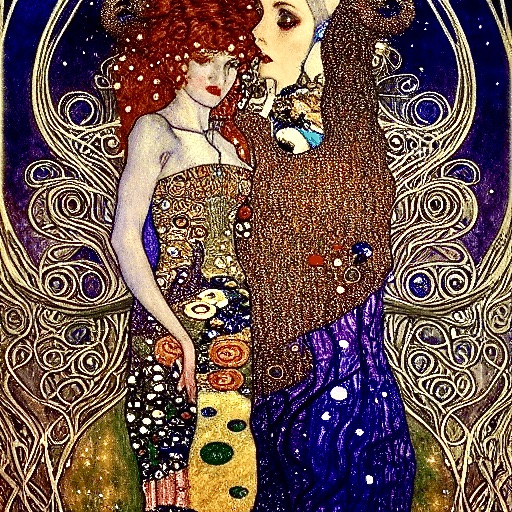
Image by Gustav Klimt.
A version of this story appeared in Cowbell Literary Magazine.
Ed Staskus posts monthly on 147 Stanley Street http://www.147stanleystreet.com, Made in Cleveland http://www.clevelandohiodaybook.com, Atlantic Canada http://www.redroadpei.com, and Lithuanian Journal http://www.lithuanianjournal.com.
“Cross Walk” by Ed Staskus
“Captures the vibe of mid-century NYC.” Sam Winchell, Beyond Fiction
Available on Amazon: https://www.amazon.com/dp/B0CRPSFPKP
Late summer and early autumn, New York City, 1956. Stickball in the streets and the Mob on the make. President Eisenhower on his way to Ebbets Field for the opening game of the World Series. A killer waits in the wings. A Hell’s Kitchen private eye scares up Cold War shadows.
A Crying of Lot 49 Publication
 147 Stanley Street