
By Ed Staskus
There was no love lost for Jews among my father’s generation. He was born and raised in northwestern Lithuania. His father was a police chief and his mother was a schoolteacher. They weren’t empty-headed, but they were full of the zeitgeist of the times. The general consensus in Lithuania before and during World War Two was that Jews were no good. It was partly economic. Most Lithuanians were farmers then. They saw Jews as middlemen exploiting them. It was partly nationalist. Many saw them as against the country for siding with Russian and Polish interests. It was partly because Lithuanians in general aligned with Germanic beliefs, including their hatred of Jews, which the Germans had kept alive from the Middle Ages on.
Most of the time it was simply traditional Christian antisemitism. Lithuanians were the last Europeans to give up paganism and take up Christianity. It wasn’t always a blessing for Jews. Grand Duke Jagiellon expelled all of them from the Grand Duchy in 1495. They eventually returned, but in the mid 17th century the Khmelnytsky Uprising and Deluge Wars led to the deaths of many of them.
In the 19th century pogroms came and went. Jews had to endure smashed up and burned down houses, public beatings, and some murders. Half-baked blood libel stories ran rampant, especially in Panevizys and Siauliai. My father was from Siauliai.
When in the summer of 1996 he told me he was going to Kaunas to deliver yarmulkes, tallitots, which are prayer shawls, and three thousand dollars to an impoverished synagogue in Kaunas, Lithuania’s second largest city, I was dumbfounded. He had never been loud-mouthed about his animus for Jews, but I had heard enough over the years to know exactly how he felt.
“Does this have something to do with the $!8.00 Rita took to a synagogue two years ago?”
“Yes, it’s the same synagogue.”
My sister, Rita, had gotten the ball rolling in 1994. She was working at a travel agency called Born to Travel. It was in Beachwood, on Cleveland’s east side, and was owned by two sisters. They were Jewish. It got started when Sally Steiger, another travel agent, asked Rita to deliver what is called a chai of $18.00 to the first synagogue she saw in Lithuania, where she was going to visit relatives. The $18.00 is symbolic. The toast “L ‘Chaim” means “To Life!”
During the interwar years there were more than two hundred thousand Jews living in Lithuania. When World War Two ended there were fewer than two thousand left alive. There were eight hundred in Vilnius, seven hundred in Kaunas, and handfuls scattered here and there. The rest had been killed by Nazi death squads and Lithuanian auxiliaries. They called it extermination, as though Jews were bugs or mice. The victim rate was the highest of any country where the Holocaust happened.
“I was walking around with a friend of mine in Kaunas checking out the sights while at the same time in the back of my mind I was searching for a random synagogue,” Rita said. No one she had asked knew whether there was one in the city, or not. “We turned a corner and suddenly right before us was an old synagogue.”
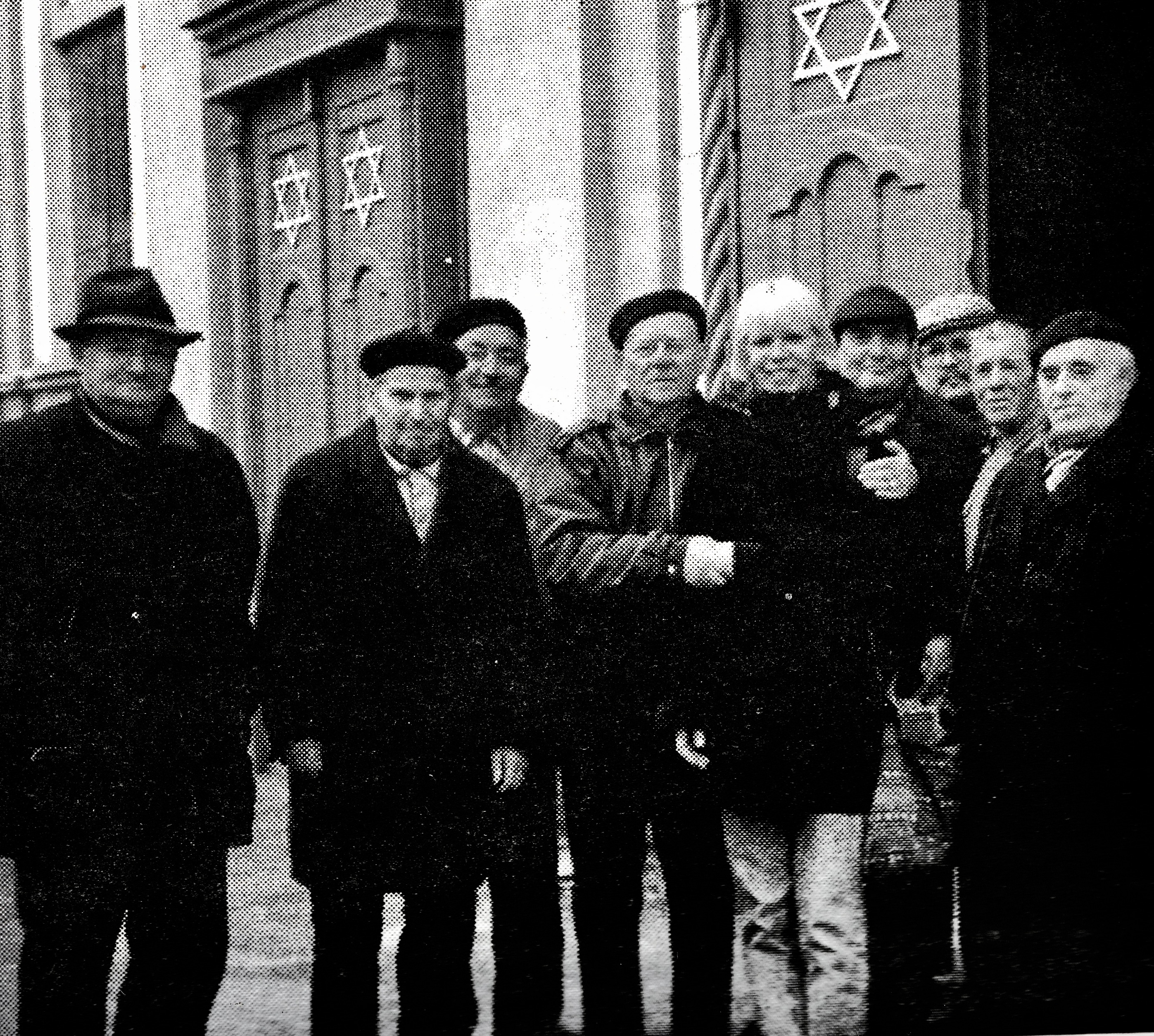
It was the Ohei Jacob Synagogue. It was built in the mid-19th century and featured a two-story classical façade. By 1910 more than thirty thousand Jews lived in Kaunas, almost 40% of the population. The city became a center of European Judaism. They had their own seminary, prison, and kosher slaughterhouse. There were twenty five active synagogues in the city before the war.
The Nazis used the synagogue as a warehouse during their occupation of Kaunas, which ironically led to its survival. The other synagogues were destroyed or fell into disrepair. The Ohei Jacob Synagogue was the only one left. There had once been a school and an orphanage, but by the 1990s both were long gone.
In 1941 Lithuania’s Jews began to find themselves locked up in ghettos. The Nazis, led by their number one killers the Einsatzgruppen, transformed them into death camps. It was during this time that the vast majority of the country’s Jews were murdered. Those that weren’t had somehow made themselves scarce.
“I went inside and found a few elderly men in prayer,” Rita said. “The synagogue looked poor and the prayer books the men were holding were ancient and tattered. I gave them the chai.”
Two years earlier, faced with a financial crisis, Rabbi Yecheska Zach had gone to a nearby Catholic church and asked for help. The synagogue was at the point of closing. The Catholic priest gave him enough money to keep the shul’s doors open.
Before she left she met Rabbi Zach. When it came time to leave she extended her hand to shake hands with him. “That was a mistake.” Orthodox rabbis don’t shake hands with women outside their immediate family. “It was kind of awkward.”
When she returned home and went back to work, telling her co-workers about the synagogue, they decided to adopt it. They set up a collection box wrapped in glossy blue paper at the front of the office. ”Some people mailed in checks, Others brought in cash. One man slapped a hundred dollar bill down on my desk. I opened an account in the bank next door.”
A local synagogue invited her to speak about her experiences in Lithuania. A group of Hebrew genealogists asked her to speak to their group. The Park Synagogue, an historic modernist landmark in Cleveland Heights, invited her to address their congregation. ”More than three hundred people were there, all looking at me. it was an out of body experience. Some people had questions when I was done. One lady stood up and said, ‘You know, you Lithuanians killed all the Jews.’ I didn’t know what to say. An older man stood up and said, ‘Leave her alone. If it wasn’t for her we wouldn’t even know about any synagogues in Lithuania.’ At the end a collection was taken. There was nearly a thousand dollars in the bag when they gave it to me.”
My father had already planned a trip to Lithuania, partly to visit relatives, some of whom, after the Iron Curtain had been drawn shut, he hadn’t seen in more than forty years, and partly on business. He agreed to take material and money with him. “It got to the point that, before he left for Lithuania, he would call my office and ask, ‘Where’s the chai money to give to the shul?’ I didn’t know he even knew what shul meant.”
When he set off from Vilnius to the synagogue in Kaunas he took a suitcase full of yarmulkes and prayer shawls with him. He wore a money belt stuffed with thousands of American dollars. The yarmulkes were white, left over from a wedding. The Park Synagogue donated two dozen used prayer shawls. D. O. Summers dry cleaned them at no charge. When he delivered them the congregation would at last be properly dressed.
“I told him to not go on a Sunday because nobody would be there,” Rita said. “I told him to go on a Saturday. I didn’t know it was going to be Rosh Hosana, but it was.”
Rosh Hashanah is the Jewish New Year. It is a two-day holiday that begins on the first day of the Hebrew month of Tishrei. It ushers in the Days of Awe, ten days culminating in Yom Kippur. It is a time for prayer, repentance, and self-reflection. The holiday celebrates the creation of the world and is observed with special ceremonies like sounding a shofar. The shofar is a hollowed out horn made from a ram’s horn. The person who blows it is usually called the Master of the Blast.
There is food and drink. Everybody has some symbolic foods like challah and apples dipped in honey and then gets down to business. Dishes include matzo ball soup, chicken, and brisket washed down with grape juice or wine. When my father showed up they put out the feedbag.
“Those guys were very friendly,” he said. “They clapped me on the back, brought me more food than I could eat, and kept refilling my wine glass. I thought they were going to take down the picture of the rabbi that was on the wall and replace it with my picture.” He went back to Vilnius filled with good cheer, in more ways than one.
After my father got back to Cleveland he toned down his long-time antisemitism. It got so he only had neighborly things to say about Jews. It was a change of heart, an old dog learning a new trick.
Rita went back to Lithuania the following year, visiting uncles, aunts, and cousins. She delivered more garments and money to the Ohei Jacob Synagogue in Kaunas. “What impressed me most about Rabbi Zach was that he never asked me for anything. He just said how appreciative he was.” He took a picture of her standing with a clutch of congregants. She was the only one in the photograph legally blonde.
Before she left Lithuania she visited the Paneriai Memorial outside of Vilnius. It is where a village and railway station had long stood. In 1940 the Red Army began work on a fuel storage base there. They didn’t finish it, interrupted by the German invasion in the summer of 1941. The pits that had been dug for fuel were repurposed. In December 1941 thirty three thousand Jews from Vilnuis were killed there and thrown into the pits. More than five thousand Red Army prisoners of war were also killed and thrown into the pits.
In 1944, before the Nazis retreated from the Baltics, they began digging the pits out, burning the corpses, and mixing the ashes with sand. They were trying to hide the evidence of what they had done. The corpse burners were all Jews brought to the pits from forced labor camps. It was a choiceless choice for them. Machine guns compelled them to do the work. The Nazis called the corpse burners Sonderkommandos.
“When I got there I took a tour, but it was too much. I sat down on a bench by the railroad tracks that came from the nearby main line. They used to bring the Jews to the pits packed in boxcars. It was eerie sitting there and even more eerie when I heard a train whistle and saw a train going past in the distance. That was all I could take.”
A letter from Kaunas arrived at Born to Travel after Christmas. “A Happy New Year,” Rabbi Zach wrote. “The Jewish Association of Kovno has received tallitots, yarmulkes, and money.” Kovno is what Jews called Kaunas. “We now have all the Jews in our synagogue wearing the tallitot you brought us and everyone is happy about it. We thank you again. We hope you won’t forget us.”
Ed Staskus posts monthly on 147 Stanley Street http://www.147stanleystreet.com, Made in Cleveland http://www.clevelandohiodaybook.com, Down East http://www.redroadpei.com, and Lithuanian Journal http://www.lithuanianjournal.com. To get the site’s monthly feature in your in-box click on “Follow.”
“Cross Walk” by Ed Staskus
“A Cold War thriller that captures the vibe of mid-century NYC.” Sam Winchell, Beyond Books
Late summer, New York City, 1956. The Mob on the make and the streets full of menace. President Eisenhower on his way to Brooklyn for the opening game of the World Series. A killer waits in the wings. Stan Riddman, a private eye working out of Hell’s Kitchen, scares up the shadows.
Available on Amazon: https://www.amazon.com/dp/B0CRPSFPKP
A Crying of Lot 49 Publication
 147 Stanley Street