Tag Archives: Ed Staskus

My Aim is True

By Ed Staskus

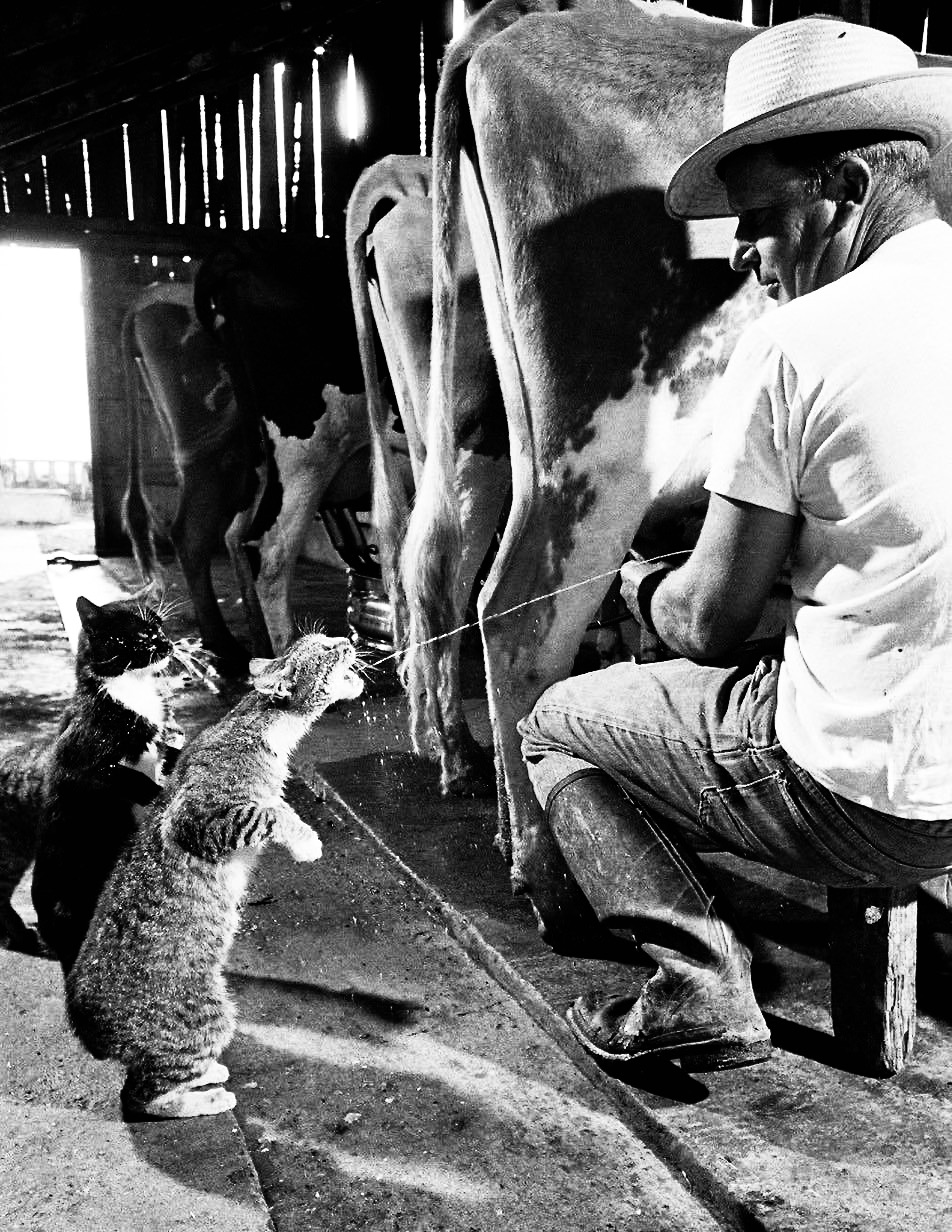
   “I think all the farmers on the island did it,” Linda Hewitt said. What all the farmers on Prince Edward Island used to do was squirt a stream of milk in the direction of whatever barn cat was hightailing it into the barn during milking time. “We used to enjoy watching them line up for their treat.”

   Even though milk is not ideal for grown-up cats, because it can cause gassiness once they are of age, squirt milk in the direction of a clowder of cats and they will come running. They drank milk non-stop when they were kittens. When they grow up they remember the familiar smell and taste of it. Their sense of smell is closely linked to memory, more so than the other senses, the same as in people. Straight from the source is their No. 1 comfort food. 

   “Granny Matheson my cousin’s grandmother squirted milk to the cats,” PEI native Anne Fuller said. “They loved it.” Seen from the sky Prince Edward Island lives up to its moniker “Million Acre Farm.” It is known by several different names, including Spud Island, but is most commonly called PEI. The natives including grandmothers on down the line call themselves islanders with a capital “I”.

   Almost all cows nowadays are milked by automatic suction machines. The devices increase the yield of milk and reduce the labor involved. Milking by machine draws about 5 liters of milk. Milking one cow takes between 5 and 7 minutes. Milking by hand draws about 3-and-a-half liters and one cow takes 15 to 20 minutes. The machines go back to the late 1800s. It took decades for them to gain the upper hand. Many cows in North America were still being milked by hand well into the 1940s. Some cows on Prince Edward Island were still being milked by hand even later than that.

   “I did that every time we milked the cows,” PEI native Cecil Wigmore said about the squirting.

   Milking cows on Prince Edward Island in the 21st century is a highly mechanized operation. The total number of cattle on the island is more than 60,000 head. 13,900 of those are dairy cows and 6,300 are dairy heifers. 170-some farms ship their milk to cooperatives and the volume amounts to 120-some million liters. The milk is known for its good taste and high quality.

   Cows Ice Cream makes some of the world’s best ice cream. They have been making it on the island since 1983 with island milk. They won the award for Canada’s Best Ice Cream in 2015. Their frozen confections were recently named the World’s Best Ice Cream by Tauck World Discovery. 

   “Yes, I sure do remember doing that for cats on visits to my grandfather’s farm,” PEI native Norma MacLean said. “I have many special memories.”

   One of dairy farmer Bloyce Thompson’s cows won the award for Top Holstein in the World in 2011. He is a third-generation farmer in Frenchfort, in the middle of the island, with a sizable herd of purebred cows. He serves as Deputy Premier of Prince Edward Island and has long opposed NAFTA-mandated dairy imports. Why mess with a good thing when you’ve already got the best?

   The dairy business on Prince Edward island is made up of dairy producers, who operate farms and produce raw milk, and dairy processors, who process raw milk into butter, cheese. yogurt, ice cream, and condensed milk. ADL is the major processor, by far. Island cheese is known and celebrated worldwide. Avonlea Clothbound Cheddar, made by Cows Creamery on the island, won the Super Gold of the World Cheese Awards at the 28th annual BBC Good Food Show in 2015. 

   Milking by hand isn’t rocket science. It is easy enough to do. “I used to do that,” PEI native Tom McSwigan said. While milking a cow he would wait for his cat to rise up on its hind legs and then give it a squirt right from the cow’s udder. “If I missed and hit the cow’s leg she kicked viciously. Not only that, if I got caught doing it I got the heavy hand of justice from my grandaunt, for because me doing it free of charge.”

   Neolithic farmers in northern Europe were among the first to milk cattle for human consumption. They put hand to teat about 6,000 years ago. It was around that time that the ability of human beings to digest milk was slowly but surely accomplished. It was accomplished by the spread of a genetic mutation called lactase persistence. It was what allowed post-weaned human beings to continue to drink and digest milk.

   Heath McLennan milked cows from the 1930s until his death in 2021.The family farm is in Port Hill on the west end of the island. Heath lived across the street. “He couldn’t wait to get over and that was the highlight of the day,” his son Hilton said. “It was in his blood.” The farm has thirty Holsteins who are milked by machine. “We used to milk them out in the field,” Heath said. “It wasn’t a very excellent job when it was raining. The water was running off the cows.”

   When asked if he ever milked cows by hand anymore, Heath said he wasn’t sure if it would be a good idea to try milking their cows that way anymore. “I wouldn’t want to touch them when they’re not used to it now. They might kick the head off you.”

   Hand milking is done one way or the other, by stripping or by full hand. When stripping the teat is held between thumb and forefinger and the hand glides in one smooth motion down the teat while applying pressure to draw the milk out. When employing the full hand method, the teat is held with all the fingers and the teat is pressed against the palm. The full hand method is thought to be the better of the two methods because it applies a more consistent pressure on the teat and simulates the sucking action of a calf.

   “I can still see my father doing it by hand,” PEI native Adele Shea said. “The cats loved it.”

   Before the machine age children played a big part doing what had to be done on the family farm. They gathered eggs, cleaned, fed, and watered the stock, made butter, made lard and soap, weeded the garden, and went berry picking. They helped with planting and harvesting. One thing they did all year round was milk the cows. When they did, sitting on a stool or balancing on their haunches, they made an immediate connection to one of their most important food sources. Kids being kids, they shared the food source with whatever was wandering in for a taste of white..

   “Me when I was younger did it to the cats,” PEI native Ken Macleod said. “I also did it to the dogs.” 

   Even though cows are by nature easygoing creatures, they can sometimes be buttholes. They can be irascible and stubborn. They can even be dangerous. A cow kick can be deadly. It takes the form of a sharp blow. Most cow kicks are brush-offs, but some lead to a trip to the Emergency Room, and a few are fatal. Always move slowly around cows. Always announce yourself when approaching a cow. Never approach a cow from behind. Always be patient. Never flap your arms. Stay a kick away is the way to be. Stay safe getting your glass of milk.

   “Daddy would squirt the barn cats when we were kids,” PEI native Joanne Creamer said. Cats are much faster than cows and even faster when a cow kicks at them. They are rarely overmuch bothered so long as they get their milk. “Me, when I was squirting milk, sometimes I hit the wrong end of the cat,” PEI native Dwight Llewellyn said.

   “I exactly do remember doing that,” PEI native Brian Trainor said. “The cats would sit there waiting while we milked.”

   Fathers milking cows by hand and directing squirts at cats was an island-wide practice back in the day. “Oh, yes, my dad did it all the time!” PEI native Helen Verhulp said. “My dad always done that and sometimes to us, too,” PEI native Caroline MacLean said. “My father did it,” PEI native Joan Coulthard said. “He did it to us kids as well. It was warm sweet milk.”

   Not all parents were as generous. “I always did it until my father caught me,” PEI native Erroll Jon Campbell said. Waste not want not was his father’s motto. The Scottish are notoriously thrifty. They preach the smart thing to do is be more frugal than not, cats or no cats.

   Milking machines are made of a vacuum pump, a vacuum controller, a pulsation system, a milk transport system, and a milker cluster. The machines apply constant vacuum pressure to the tips of a cow’s udder, mimicking the way milk is naturally drawn. The vacuum tubes are attached to a container where milk is collected. The machines also squeeze the udder periodically so that blood circulation is maintained.

   Milking by hand instead of techno milking is more time-consuming but it is simpler. What’s needed is a milking pail, a wash bowl ,white towel rags, a filter, a funnel, and storage jars. Mason jars are preferred. Glass jars are preferred. Plastic jars are discouraged. They are harder to disinfect. White wash rags are used to clean the udder. Wash bowls are used for cleaning the wash rags. Funnels are used to direct milk from the pail into the storage jar.

   Not all milk ends up where it should. “I remember being sprayed by Shawn and Brian Shea when Granny Trish still had cows,” PEI native Krista Dillon said. “Oh, my God, that was so long ago. I loved that house and farm.”

   Hand milking isn’t coming back anytime soon. Time marches on. Hand milking lives on in the memories of those who made it happen every morning and every afternoon, but there is no squirting anymore. Machine milking is more efficient. Dairy farmers don’t miss the good old days. Who misses the good old days are the island’s cats. The Industrial Age means nothing to them. A stream of warm cow’s milk straight from teat to mouth twice a day is what meant everything to them.

   “Oh my, yes,” PEI native Clara Ross said. “All the barn kitty’s loved it.”

Photograph by Nat Farbman.

Ed Staskus posts monthly on 147 Stanley Street http://www.147stanleystreet.com, Made in Cleveland http://www.clevelandohiodaybook.com, Atlantic Canada http://www.redroadpei.com, and Lithuanian Journal http://www.lithuanianjournal.com

A New Thriller by Ed Staskus

Cross Walk

“A once upon a crime whodunit.” Barron Cannon, Adventure Books

“Captures the vibe of mid-century NYC.” Sam Winchell, Beyond Fiction

Available on Amazon: https://www.amazon.com/dp/B0CRPSFPKP

Late summer and early autumn. New York City. A Hell’s Kitchen private eye. The 1956 World Series. President Eisenhower at the opening game. A killer in the dugout.
Hot Pants

By Ed Staskus

   There’s nothing new about scandals, be they personal, political, academic, corporate, celebrity, religious, or financial. They are a dime a dozen. The reason they are so cheap is because there are so many of them. Crack a newspaper, turn on a TV, open a browser, and there they are, today and every day. They take all shapes and sizes, not just nowadays, but way back when, too.

   Back when the Olympics were the Greek Olympics, an Athenian pentathlete bribed his opponents to secure victory. He was found out and both he and his hometown were fined. He paid his fine, but the hometown of Athens refused. It took the Delphic Oracle threatening in no uncertain terms that there would be no more oracles for them to pay up.

   Five hundred years ago the Borgia’s, two of whom ruled the Holy City as Popes, were conniving entrepreneurs who bought their way to the top, and poisoned friend, foe, and family alike. They didn’t suffer competition. At the Banquet of Chesnuts in the Vatican in 1501 they encouraged their guests to enjoy the “fifty honest prostitutes” they had procured for dessert.

   More recently, during the Gilded Age, there were more corporate shenanigans than you could shake a stick at. Somebody should have read James “Jubilee Jim” Fisk the Ten Commandments, but instead he became entangled in blackmail and was shot to death by his business partner in broad daylight in the lobby of New York City’s Grand Central Hotel.

   Everyone’s always got their reasons for falling into the tar pit. Even the ever bad have their good reasons. More often than not it’s not anybody’s fault, either, especially in our own exculpatory day and age.

   “It’s because as a child Cinderella got home after midnight, Pinocchio told lies, Aladdin was a thief, Snow White lived in a house with seven men, I saw Tarzan practically naked, Batman drove 200 MPH without a license, and Shaggy was a mystery solving hippie who always had the munchies,” we explain in song and dance about how we became good-time Charlies.

   Sex scandals are nothing if not ever new. They are the bedrock of dirty linen. Many a man has fallen into the hamper. Grover Cleveland fathered a child out of wedlock and during the 1884 presidential campaign was dogged by Republican chants of, “Ma, Ma, where’s my Pa?” After he won, Democrats answered, “Gone to the White House, ha, ha, ha.”

   Bill Clinton had sex out of wedlock on top of the father of our country’s desk in the Oval Office, was almost impeached for it, but shrugged it off as though the disapproval was a misunderstanding. When Donald Trump lays down with whores, it’s not a skeleton in the wedlock closet, for several reasons. First, he’s done it many times before, so there isn’t anything scandalous about him doing it again. Second, he’s a consummate philanderer, so there’s nothing unusual about it. Lastly, no one cares, not his evangelical brain-addled base, nor the country’s liberals, for whom it’s the least of his foibles, nor the rest of the world, for whom it’s just a punchline. No one holds him to any kind of standard, anyway, high or low.

   When yoga gurus, masters, and teachers, on the other hand, go sex crazy, it is a scandal, for many reasons, not the least of which is they are held to a higher standard. They are expected to hold firm to the ethical high ground, not rut around in the trough. Stand above reproach. Steer clear of the web of corruption. Practice what you preach, for goodness sake.

   It isn’t necessarily what everybody calls you, but what you answer to. Rules guide the everyday. Right conduct guides the better man. Nevertheless, stick to what it says in the job description. “We are what we pretend to be, so we must be careful about what we pretend to be,” Kurt Vonnegut observed. If you can’t trust an honest-to-God yoga teacher, who can you trust?

   It is a long list of bad boys who have practiced a common vice, amounting to antics in the back room, inducement and seduction, and sometimes something darker. It can be a crime punishable by law or at other times simply an offense that outrages the public conscience. It ain’t the Hall of Fame. It’s more along the lines of the Wall of Shame.

   It includes Kriyananda and Rodney Yee. Akhandananda Sarswati was charged with 35 counts of sexual abuse in 1987, convicted, and sent to prison. It also includes Osel Tendzin, Dechen Thurman, known as the “yoga gigolo,” and Maharishi Mahesh Yogi – whose relationship with the Beatles came to a sudden end over allegations he tried to rape the actress Mia Farrow. The “Giggling Guru” got away with it, expanded his TM empire, and ended up living in his own 200-room mansion, where he could transcendentalize whatever he wanted in whatever bedroom he wanted to.

   It includes Satchidananda, Muktananda, and Rama, founder of the Himalayan Institute of Yoga Science and Philosophy, whose estate had to pay almost $2 million in 1996 to a woman who claimed she was forced to have sex with him. Easy come, easy go, seems to have been the institute’s corporate philosophy.

   It includes Sathya Sai Baba, K. Pattabhi Jois, and Amrit Desai, who founded the Kripalu Center in Massachusetts, and was compelled to resign after confessing to several affairs in 1994. Kripalu took a low profile on the whole sordid business, stating blandly for the record, “Yogi Desai resigned as spiritual director of Kripalu.” It’s like saying he had other things besides the spirit on his mind, or loins, as the case may be.

   The royal family of yoga got caught up in the fun. In 2012 allegations of emotional and sexual abuse were made against Kausthub Desikachar, the grandson of the godfather of modern yoga, Krishnamacharya. Evasions rang forth. The next year Desikachar finally  confessed.

   “I realize that some of the decisions that I have made in the past have not been consistent with the high standards that I usually set for myself. I also fully understand and acknowledge that these have had far reaching effects, way beyond myself. There is no way of changing the past. I wholeheartedly repent for what has happened.” There’s nothing like slapping yourself on the wrist.

   The list includes Osho, John Friend, and Bikram Choudhury.

   During his lifetime, Osho, a self-proclaimed spiritual guru, was otherwise known as the sex guru. He made no secret of it. Osho was always on the pull, day and night. He did make a secret of everything else, however, including allegations of drug-running and a prostitution racket. He was deported from the United States in 1985 as the result of complicity in a murder plot, among other things. He was arrested on board a Learjet in North Carolina with $1 million in cash and valuables on board, trying to escape to Bermuda. Although 21 other countries denied him entry, India finally took him back.

   He was welcomed by his disciples with a clap on the back. “We must put the monster America in its place,” he declared. He complained of being the victim of “evil magic.” He died five years later of a heart attack, the victim of clogged arteries. Amazingly enough, he is more popular today than he ever was back then.

   John Friend, who studied long and hard with B. K. S. Iyengar, and who labored long and hard to create and establish Anusara Yoga, a new kind of heart-centered practice, stepped down from his leadership role in 2012. Two years earlier The New York Times had proclaimed him the “Yoga Mogul.” Thousands of teachers and hundreds of thousands of people around the world practiced his style of yoga.

   A year later it was all gone, gone up in smoke. The yoga gear supplier Manduka got stuck with a warehouse full of John Friend-branded mats.

   Besides smoking a boatload of pot, which was illegal at the time, and slyly dipping into pension funds that weren’t his, which is still illegal, he slept his way through his closest female acolytes, married and otherwise. He dreamed up a Wiccan coven, calling it Blazing Star Flames, to keep things on the up and up, at least in his own mind. It was a kind of tantric dodge to explain himself.

   Tantric sexual expression is said to be a God-like weaving and expansion of energy creating a mind-body connection leading to powerful orgasms. If only we could be gods is the idea behind the idea.

   “On a chilly New Year’s Eve in 2009, John Friend—the popular and charismatic founder of Anusara Yoga—lay naked on a bearskin rug in front of a blazing fire at his home in Texas while three underwear-clad women hovered over him, massaging his body with sweetly scented oil,” Lizzie Crocker wrote in the Daily Beast. “One rubbed his head, neck, and shoulders, another worked on his hands, while a third rubbed his inner thighs and pelvic region, her whole body writhing sinuously to the new-age sitar melodies playing in the background.”

   The man himself didn’t see that what he did with his friend mates was anybody’s business. “The Anusara scandal to me was focused on my sex life,” John Friend said. “My sexual relationships with women were private and consensual in my eyes, but the community considered my private life as something that they should judge. So, it was like a 21st century social media witch trial, which judged me as being unfit to teach yoga.”

   Not everybody agreed. They wanted to say, save your breath to cool your soup. “Attending a yoga class where a teacher is generating bed-buddies while expounding on spiritual matters is like attending church only to find out the priest is bonking the altar boys,” said Kelly Morris, founder of Conquering Lion Yoga.

   Sometimes you have to change yoga teachers when they just rub you the wrong way. In the event, Anusara Yoga went by the boards. John Friend has since rebranded himself with another kind of alignment-based yoga called Sridaiva.

   Bikram Hot Yoga was the brainchild of Bikram Choudhury, born and bred in Kolkotta, and transplanted to Beverly Hills, where he founded the Yoga College of India. In time it became a big success. He claimed his one-size-fits-all system cured everything from arthritis to cancer, although the talk was largely snake oil. By 2006 there were 1,650 Bikram Yoga studios worldwide. He was training hundreds of teachers annually at $10,000 a pop for the privilege. There was no snake oil in his sign on the dotted line business model. He attempted to copyright the poses that constituted his modus operandi, but his claim was thrown out of court when the judge determined touching your toes wasn’t copyrightable.

   Bikram owned more than forty Bentley and Rolls Royce automobiles. He jet-setted with the beau monde. He toured Las Vegas, dressing like a gangster, and claiming to have testicles as big as “atomic bombs.” In 2013 it all started to unravel, when several women accused him of false imprisonment, sexual battery, and rape.

   In 2016 Bikram lost a civil lawsuit in California for sexual harassment and was fined $7.4 million. In response, he closed up shop, sold off everything he could, and went back to the sub-continent. The judge issued a warrant for the lothario, but to this day he’s going, going, gone. In an interview with ABC News Nightline’s David Wright, Bikram said, “I never hurt another spirit. I’m the most spiritual man you ever met in your life.”

   “You find out who your real friends are when you’re involved in a scandal,” said Elizabeth Taylor, who was involved in her fair share of them. During his reign of steam and sweat, many studio owners said they loved the 26-pose take-it-or-leave-it regimen, even though they were equivocal about the man on the platform, turning a blind eye and keeping the other eye on the bottom line.

   It was the king’s new clothes, outfitted in white silk suits and fedora. “If you look at his values and his lifestyle, there’s nothing spiritual about it. The cars and the watches and allowing people to fawn all over him, it’s disgusting,” said Stephanie Schestag, “He treated people like shit. But the truth was, he was like the Wizard of Oz. It was all a smokescreen.”

   When push came to shove, Bikram Choudhury found out he had few real friends. Most of the world’s Bikram Hot Yoga studios have either closed or changed their names to something else not-so-hot. His wife divorced him. It has even been rumored his gold Rolex found another wrist to call home. Sometimes it seems like only our dogs will never betray us.

   It can take a scandal, or two, or even a dozen, to bring about reform. Maybe yoga will be practicing what it preaches from here on out. It’s not rocket science. The culture isn’t corrupt, even though some of the culture’s icons were and are. Trying to get it right isn’t like trying to dam up Niagara Falls with toothpicks. It’s about living for a principle, not always trying to make yourself the principal of the gimmies and swinishness.

   Love of men, women, and humanity in general may be part and parcel of yoga practice, but not necessarily “gimme your lovin’ you sweet lookin’ thang.”

   One thing all the sex-crazed yoga masters of our times have had in common is they all claimed they were someway somehow the best divines and what they were doing was divining the sacred word, intent, and  purpose for the way we live today, for your greater good, especially if you are a babe in the woods. The hand of the man will show you the way out of the woods and down the garden path. The path can get thorny, though. Hero worship isn’t always everything it’s cracked up to be.

   “I’m breaking eggs to make an omelet because I see the big picture, and you don’t,” they all say, sly and sincere, straight-faced if not straight-laced, Tricky Dick’s to a man. It’s the classic refrain of self-styled masters of the universe, lady-killers one and all, but what can one say in the breach?

   All one can say is, don’t be a four-flusher. Don’t be a Donald. Stay in your lane bro’.

Ed Staskus posts monthly on 147 Stanley Street http://www.147stanleystreet.com, Made in Cleveland http://www.clevelandohiodaybook.com, Atlantic Canada http://www.redroadpei.com, and Lithuanian Journal http://www.lithuanianjournal.com

A New Thriller by Ed Staskus

Cross Walk

“A once upon a crime whodunit.” Barron Cannon, Adventure Books

“Captures the vibe of mid-century NYC.” Sam Winchell, Beyond Fiction

Available on Amazon: https://www.amazon.com/dp/B0CRPSFPKP

Late summer and early autumn. New York City. A Hell’s Kitchen private eye. The 1956 World Series. President Eisenhower at the opening game. A killer in the dugout.

Down to Sea Level

   By Ed Staskus

   There was a window seat midway back in the Boeing 737. JT Markunas parked himself there. The plane looked old but smelled clean. It had been built in 1969 with an expected lifespan of 20 years. It was 20 years old in 1989 on the day JT buckled his seat belt. He was on the one daily Canadian Airlines flight from Ottawa, the capital of Canada, to Charlottetown, the capital of Prince Edward Island. Crossing over the eastern end of New Brunswick, he looked up from his Car and Driver magazine. He took a look through the porthole window at the crescent-shaped island in the distance. The land wasn’t small, but it wasn’t big, either. It was blanketed by snow. He had been told his new posting was mostly farm country. He wondered what it looked like from outer space.

   Seen from outer space Prince Edward Island can barely be seen. The solar system is a speck in the galaxy. The earth is a speck in the solar system. Prince Edward Island is a speck on the earth. When the sky is clear and the sun is shining it is a green and red speck under a dome of blue. When it is cloudy and stormy everything gets wet and gray until the sun comes back. It is the Gulf of St. Lawrence. Where he came from, which was Sudbury, Ontario, the sky was always either getting cloudy or it was already cloudy.

   The lay of the land formed hundreds of millions of years ago. Creeks and rivers deposited gravel, sand, and silt into what is the Gulf of Saint Lawrence. Before the last ice age, Prince Edward Island was part of the mainland. After the glaciers melted it wasn’t a part of it anymore. The Northumberland Strait became what separates it from the rest of Canada.

   The province is one of Canada’s Maritime provinces, the others being New Brunswick and Nova Scotia. Newfoundland and Labrador are nearby but more on their own than not, which is the way they want it. There are 225 kilometers from one end of the island to the other. It is 3 kilometers at its most narrow and 65 kilometers at its most wide. It is twice as far as the Kulloo flies from the island to Walt Disney World in Florida as it is to the Arctic Circle. Walt Disney World is far away and for pretend. The Arctic Circle is nearby and for real.

  There are farms from stem to stern of Prince Edward Island. There are so many of them the province is called the “Million-Acre Farm.” Jacques Cartier discovered it in 1534 and Samuel Champlain claimed it for France in 1603. The French explorers called it Île Saint-Jean. When they landed the native Mi’kmaq’s tried to explain they had been there for thousands of years, but all they got for their trouble was wasting their breath. They switched gears and tried singing some of their Top 10 songs. They sang “The Eagle Song” and “The Honor Song” and “The Gathering Song.” They accompanied themselves on rattles and hand drums.

   “Try singing a different tune,” Samuel Champlain finally said. “I’ll teach you the words.” He meant for them to sing “The Giveaway Song.” The Mi’kmaq glared and reached for their bows and arrows. The French strapped on armor and reached for their swords. They were more savage than the savages and knew how to prove it. The natives grumbled to themselves and drifted away. They thought they could make it right later. They were wrong about later.

   Kulloo could have set them straight, but he didn’t. He spoke in riddles, anyway. Hardly anybody ever understood his riddles. Over the centuries it had gotten so he held his tongue more often than not. He didn’t believe in explaining himself, anyway. He believed, being terse, say it once, why say it again? No matter what the  Mi’kmaq’s thought he was, or meant to them, he was a lone wolf. He was big enough to hook a grown man with his talons and carry him away. If push came to shove, and the man couldn’t explain himself, Kulloo was strong and predatory enough to eat him. Men were his least favorite meal, being bitter and hidebound, bur he was never going to shortchange himself dinner.

   He was at least a millennium old. Nobody knew how old he really was, not even Kulloo himself. The day he saw Jacques Cartier’s two ships come from France in 1534 he didn’t know what century it was. He lived by the seasons and the rotation of the stars. The ships and their crewmen piqued his interest. The Mi’kmaq had small boats that hugged the coastline. The big sailing boats had come from the other world, from the other side of the ocean. Kulloo had gotten word about that world long ago, but had never seen it. He suspected the Old World was intent on making the New World their world. He thought it  best to take a closer look to see where he stood.

   When the British took control of Canada East they changed the name of the island from what the French had called it to St. John’s, then changed it to New Ireland, and again on the eve of the 19th century to Prince Edward Island. It was named after Prince Edward, who later became the father of Queen Victoria. He was beguiled by the island, even though he proposed transferring sovereignty of it to Nova Scotia. He visited his namesake five times. The journey took almost a month to sail one way. 

   It became a separate colony in 1769 and the seventh province of Canada in 1873. Charlottetown was named after the wife of King George III. Queen Charlotte barely spoke a word of English and never visited the capital city. She stayed home in Buckingham House and played her harpsichord. She liked chartbusters like Bach’s “Concerto in the Italian Style in F Major” and Handel’s “Keyboard Suite No. 5.”

   “She ain’t no beauty, but she is amiable,” King George said about his wife. Queen Charlotte smiled slyly. She played “By the Light of the Moon” on her harpsichord for the man of the house.  It was a lullaby. King George took a nap in his queen’s lap.

   The province is the smallest and most densely populated Canadian province, although outside of Charlottetown and Summerside, where half of everybody lives, the habitants and their communities are spread far and wide. Most of everything is in the way of out of the way. Forests once covered the island. Trees still covered half of it. The red oak is the provincial tree. There are pine, beech, and spruce. There are no deer, moose, or black bears. There are rabbits and skunks, muskrats, and plenty of foxes. The red fox is the provincial poster boy. In early summer pink and purple lupins, weeds that are an invasive species, line fields and ditches. The Lady Slipper, an out-of-the-way orchid that grows in shady woodlands, is the provincial flower.

   JT was looking out the porthole window when he saw Kulloo. The bird was bigger than an albatross and more stern-looking than an eagle. If it was sowing the wind it was going to reap a whirlwind. The plane was cruising like it had been for the last hour-and-a-half. The big bird was keeping pace with the plane off the tip of the wing. JT rubbed his eyes and looked again. It was still there, soaring. He scanned the aircraft cabin. Some passengers were reading while others napped. Nobody was looking out at the wide blue yonder. When JT blinked the bird was gone. When he blinked again it was back.

   Farming is the number one way of life on the island, followed by the enterprises of fishing and fish mongering. There are a wealth of fields full of potatoes, grains, and fruits. There are cows everywhere, their snouts in the turf, waiting to be milked or slaughtered. There are boatloads of mussels, oysters, and lobsters to be had. Cod had been overfished to near extinction. There was talk of importing it from Iceland.

   Tourism was growing and Liam Foyle and his Japanese girlfriend Mariko were building cottages on family land in North Rustico to get in on the summer trade. In the meantime, they stayed at Sandy’s Surfside Inn most of the time. It was on the Gulf Shore Parkway. It was on the park road but not in the National Park. They had never sold their land. His brother Conor was his only neighbor. Liam and Conor were Kieran Foyle’s descendants, more than a hundred years after the Irish triggerman from the Old World landed in the New World, his Beaumont-Adams revolver tucked into a sailor’s bag. 

   In 1989 the pickings were good for the Liberals. They swept the elections. Andrew, the new Duke of York, and Fergie, his wife and Duchess, visited, flying in on a Canadian Armed Forces jetliner. George Proud, one of the new Liberal members of the province’s parliament, stood on a bench for a better view of the royals as they were driven up University Ave. “We’re the commoners, and they’re royalty, and I think people in a strange way must secretly like that,” he said. 

   “It’s a great day,” declared John Ready, the mayor of Charlottetown. Not everybody agreed. A woman in the crowd groused, “I was talking to a friend this morning who said, ‘I don’t know why we should have to curtsy to a person who a few years ago was living with a race-car driver.’” During the parade the Duchess climbed over a rope barrier to talk to a group of senior citizens. “What are these ropes for?” she asked. “I can’t believe you’re penned in.” The senior citizens were polite but baffled.

   Scouts Canada held their annual jamboree on the island that summer, honing their outdoor skills and running riot in the woods. The TV series “Road to Avonlea” went into production. The last train on Prince Edward Island made its last run, coming to a dead stop in living time. The tip-to-tip railway had been operating for one hundred years. The minute the clock struck the century mark it was done for good.

   Poison’s “Every Rose Has Its Thorn” was the top song on the radio. Malcolm “Monk” Kennedy was a thorn on the island that year, but nobody knew it until the Boy Scouts had all gone home. They were always prepared, it being the scouting motto, but nobody was prepared for Monk. Nobody was prepared for Jules Gagnon and Louise Barboza, either. They were hired guns from Montreal who came to the island looking for Monk and two million missing dollars.

   Jules and Louise were good as gold at what they did, but didn’t know they were going to end up paddling upstream to get their work done. Monk didn’t know two million dollars was going to be so hard to spend. They didn’t like the stumbling blocks in their way, but by then they had picked their poison. The Hunter River was going to flow through North Rustico and out to the ocean, no matter what. They were going to have to find that out for themselves. They weren’t prisoners of fate. They were prisoners of their own minds. Monk couldn’t change his mind, no matter what. Jules and Louise wouldn’t change their minds, no matter what.

   Kulloo peeled away from the Boeing 737 and swooped landward. He saw Louie the Large near the coastline. Hunkered down on a rock shelf not far from shore, the big shellfish was sizing up Monk, Jules, and Louise. Monk was scrawny. He was off the dinner table unless there was a famine. Jules looked better. He had some meat on his bones. Louise looked the best. He wouldn’t mind getting his claws into her, not at all. They shared a name. He liked that. He would like it even better if they shared some flesh and blood.

   Louie the Large loved the ocean, deep and blue, the tides rising and falling. It was where all life came from. He understood the primal fear men and women had of it, which he encouraged with every click clack of his crusher claws. He knew Kulloo was laying low overhead. He kept one eye open for him. He knew all about the bird. He was dangerous as a switchblade. He knew the creature never slept and woke up every morning dangerous as ever. Everything on land and sea was fair game to him.

   JT looked out the porthole window again, as the plane started its approach to the Charlottetown Airport, and saw that the bird was gone. He didn’t think he had imagined it. He wasn’t a fanciful man. He prided himself on thinking straight. He wasn’t especially impulsive or emotional, although he had been in love once and knew he could be as irrational and emotional as anybody. He didn’t believe any bird could be that big and that fast. It must have been a mirage of some kind, like in the movies. 

   He checked his seat belt to make sure it was snug. He looked down at the sea level he was going down to. Five minutes later he was landing on the Atlantic Canada land that was going to be his new RCMP posting.

Excerpted from “Ebb Tide.”

Ed Staskus posts monthly on 147 Stanley Street http://www.147stanleystreet.com, Made in Cleveland http://www.clevelandohiodaybook.com, Atlantic Canada http://www.redroadpei.com, and Lithuanian Journal http://www.lithuanianjournal.com

“Ebb Tide” by Ed Staskus

“A thriller in the Maritimes, out of the past, a double cross, and a fight to the finish.” Sam Winchell, Beyond Books

Available at Amazon: https://www.amazon.com/dp/B0CV9MRG55

Summer, 1989. A small town on Prince Edward Island. Mob money on the move gone missing. Two hired guns from Montreal. A constable working the back roads stands in the way.

A Crying of Lot 49 Publication

Cheap Seats

By Ed Staskus

   It was hot and humid all up and down the east coast. It was hotter and more humid in Hell’s Kitchen. It was in the 90s and sluggish as an old bayou. The heat was trapping humidity in the air. It didn’t matter to Dottie Riddman. She was playing stickball in the street. That was all that mattered.

   The street wasn’t West 56th, which was her street. Her father had told her to never play stickball on their own street. The fronts of buildings were ruled home runs in the game of stickball. Stan Riddman didn’t want any broken windows near where they lived. Dottie and her friends always played on West 55th or West 57th.  She wasn’t about to break into a sweat about it.

   A boy bigger than her teased her about it the beginning of summer, knocking her over and pushing her to the ground. “You always do everything your old man tells you to do, boobie?” he said, straddling her with his legs. From where she lay he looked like Godzilla. “You going to wear that trainer of yours the rest of your life?” he asked, looking at her boobies.

   Dottie had her broom stick in her hands. She had moxie in her eyes. Looking up from the gutter she whacked him as hard as she could between his legs. When the boy’s father showed up at their apartment that night to complain that his son might never grow up to be a father, her father threw the man out, dragging him down the stairs by the collar, threatening him and his son with bodily harm if they ever laid hands on his daughter again.

   “You think I’m fooling, look up my police record,” he yelled, red in the face, inches from the  ashy face of the sputtering father when they were on the sidewalk. “Go back to where you came from.” He calmed down in an instant the instant he was back in the house. He jogged upstairs and sat his daughter down.

   “You did the right thing Dottie,” Stan said. “If somebody says something rotten to you, be a lady about it. Be the bigger man. But if somebody pushes you, or grabs you, or hits you, you hit them back as hard as you can. You always do that. That’s so they won’t push you again.”

   “OK, dad,” she said.

   It was a good day for stickball. Ten kids showed up, some her age, some younger. They picked their teams. Willy, her friend from Sacred Heart of Jesus Catholic School, brought a new pinky ball. It wasn’t a Pensy, either. It was the cream of the crop. It was a Spalding Hi-Bounce.

   “Spaldeen!”

   They drew a rectangle in chalk on the brick wall at the back of an empty lot on West 55th to represent the strike zone. The buildings on both sides were the foul lines. They chalked first base and third base onto the building walls and second base was a manhole on the sidewalk. If a batted ball hit any of the buildings across the street, it was a home run. If it hit a roof it was a home run-and-a-half. If it hit a window they ran like jackrabbits.

   “There ain’t no runs-and-a-half,” a kid from Chelsea, who was visiting his cousins, sneered, shooting his mouth off.

   “If you’re going to play stickball on West 55th, you better learn Hell’s Kitchen rules,” gibed Willy.

   Dottie was batter up. She smacked a hot grounder, but it was caught on the first bounce, and she was out. Willy got as far as third base, but three strikes and you’re out finished their inning. By the time they came back up in the second inning they were behind by five runs. It wasn’t looking good for the home team.

   “All right, all right, let’s pick it up, let’s get some roofies,” Willy yelled clapping his hands, urging his team on. “But chips on the ball. I mean it.” He meant that if his new Spaldeen was roofed, and couldn’t be found, everybody would chip in to pay for a new ball.

   Hal came up to the plate, wagging his broom handle menacingly, and planted his high-top rubber soled Keds firmly in the hot squishy asphalt. They were new and felt like Saturday shoes. His batted ball hit the side wall at third base where the wall met the ground and bounced back to home plate in a high slow arc.

   “It’s a Hindoo,” he shouted.

   “No, that ain’t a do-over, it’s a foul ball, so it’s a strike,” shouted back Dave Carter, who everyone called Rusty because his hair was red.

   “What do you know?”

   “I know what I gotta know.”

   “Go see where you gotta go,” Hal retorted.

   “No, you stop wasting my time,” Rusty said. “It was a foul ball.”

   “Ah, go play your stoopball,” Hal said, peeved.

   Stoopball was throwing a pinky against the steps of a stoop, and then catching it, either on the fly or on a bounce. Catching the ball was worth 10 points. Catching a pointer on the fly was worth 100 points. A pointer was when the ball hit the edge of a step and flew back like a line drive, threatening to take your eye out. When you played stoopball, you played against yourself.

   “You got a lotta skeeve wichoo,” Rusty yelled back at Hal.

   “All right, already, strike one,” said Willy, exasperated.

   He knew Rusty would never give in. He was a weisenheimer. He was somebody you had to keep your eyes on, too, or your Spaldeen might grow legs. It wasn’t that Rusty was a thief. He just kept his nickels in his pocket, and everything else, too. Willy had heard he was such a tightwad he still had his communion money from two years ago. Rusty had been born in Philadelphia. That was his problem. Willy sympathized, not too much, but slightly.

   Hal hit a cheap on the next pitch, a slow roller, but when Rusty let his guard down, reaching down leisurely for the Spaldeen, it went between his legs, and the next instant Hal was standing at first base, smirking.

   “Comeback stickball,” he shouted at Rusty. “Our game.” Eleven batters later Dottie’s team was on the plus side of the scoreboard. Rusty was beside himself. He  wasn’t going to complain, but he could have spit.

   The woman sitting on the stoop across the street, watching her windows, watched Dottie and her friends walk down the sidewalk when the game was over, one of them bouncing his pinky, all of them talking happily.

   “We killed them, just killed them,” Willy said.

   “We sure did,” Hal said.

   “What a game!” Dottie said.

   “Yeah, we were down, then you put some Chinese on that ball between Rusty’s legs, they got rattled, and then we score a boatload just like that, and it’s all over.”

   “Did you see him, the putz, pulling that long face?” Hal asked.

   “Oh, he’ll be back, no biggie, he loves playing on the street,” Dottie said.

   Dottie was beyond glad her team had fought hard and won. They scrapped for every run. It was worth it. She didn’t mind losing once in a while, but she liked winning better. She stripped off her sweaty clothes, rubbed down with a cool sponge, and put on a fresh pair of shorts and a t-shirt.  

   She put her broom stick away in a corner beside her bedroom window. In the summer she loved her friends, no matter what team they were on, and loved playing stickball with them more than anything in the world. When it was wet and cold, and the wind was windy, the pinky and chalk and sticks all stashed away, and they were clambaking the grapevine, the talk always made its way back to playing ball. It was the way of their world.

Excerpted from the crime novel “Cross Walk.”

Ed Staskus posts monthly on 147 Stanley Street http://www.147stanleystreet.com, Made in Cleveland http://www.clevelandohiodaybook.com, Atlantic Canada http://www.redroadpei.com, and Lithuanian Journal http://www.lithuanianjournal.com

A New Thriller by Ed Staskus

Cross Walk

“A once upon a crime whodunit.” Barron Cannon, Adventure Books

“Captures the vibe of mid-century NYC.” Sam Winchell, Beyond Fiction

Available on Amazon: https://www.amazon.com/dp/B0CRPSFPKP

Late summer and early autumn. New York City. A Hell’s Kitchen private eye. The 1956 World Series. President Eisenhower at the opening game. A killer in the dugout.

Raising Cain

By Ed Staskus

Many cities have a nickname. Detroit is “Motor City.” Las Vegas is “Sin City.” New York City is “The Big Apple.” Atlantic City is known as “Always Turned On” although it has been turning itself off for years. Even suckers lose their taste for losing sooner or later. Cleveland was once known as “Forest City” and “Sixth City.” In the 1960s it was the “Mistake on the Lake” and in the 1970s it became the “Rock and Roll Capital of the World.” Nowadays it is known as “The Land.”

Cleveland has never been known as a hotbed of anarchy, although at the beginning of the 20th century that is what it was. It was where the anarchist Emma Goldman struck a match. After the match sparked and flared to life the run-up to the end of the life of the 25th President of the United States started.

When Emma Goldman gave a blistering speech at Cleveland’s Franklin Club in December 1900 she knew she was throwing gasoline on fire. She didn’t know the White House was where the fire were going to spread. Leon Czolgosz was in the audience. He was born in Detroit but lived in Cleveland most of his life after his immigrant family moved there. As soon as the speech was over he started putting spare change aside to buy a handgun. He hadn’t held down a job for three years. Money was hard to come by but he made sure to come by it, by hook or by crook.

In the meantime, he tried joining Cleveland’s Liberty Club, a local anarchist group, but they said no. They said he was mad as a hatter and couldn’t join their club. All Leon could do was roll his eyes. “I no need to belong to no damn club, not me,” he grumbled. He probably would have refused to join any club that would have him. The lone wolf hoped his aim would be true when the time came.

Anarchism is a philosophy that believes the state is both unnecessary and undesirable. It advocates the end of hierarchical government. “Anarchism is founded on the observation that since few men are wise enough to rule themselves, even fewer are wise enough to rule others,” Edward Abbey said. What is desirable is a stateless society. Anarchists believe in organizing society on a voluntary basis without recourse to compulsion. They refuse to rely on authority. It is the farthest left of anything on the political spectrum. Anarchism is not for or against anything but it stands for liberty. “I say, liberate yourself as far as you can,” is what Max Stirner said. They have always believed in defunding and dismantling the police.

Capitalists and communists hate anarchists as much as they hate each other. Law and order everywhere in the world puts them in jail at the drop of a hat. Most people don’t understand them and don’t want to understand them. Many of them believe the worst thing in the world, next to government, is anarchy.

Not long before Emma Goldman, who was billed as the “High Priestess of Anarchy,” lit up Cleveland, New York’s Supreme Court ruled that the act of identifying oneself as an anarchist in public was a breach of the peace and liable to prosecution. The state later passed the Criminal Anarchy Law, which said nothing prevents the government from punishing political speech that advocates its violent overthrow. Theodore Roosevelt, after taking over from William McKinley, proclaimed that anarchists were criminals and malefactors. “Their perverted instincts lead them to prefer confusion and chaos to the most beneficent form of social order.” Before he was president, Teddy Roosevelt was the police chief of New York City. In 1903 Congress passed a law that said no immigrants who were anarchists with “foreign-sounding” names were welcome.

Go back to Germany. Go back to Russia. Go back to where you came from and don’t come back.

Emma Goldman wasn’t a windshield wiper kind of anarchist, mincing her words to suit her listeners. She said the same thing to bomb throwers and the judges who put bomb throwers away. What she said in Cleveland was, “Anarchism stands for liberation from the dominion of property and liberation from the shackles of government. The political arena leaves one no alternative. One must either be a dunce or a rogue. Politicians promise you heaven before election and give you hell after. There’s never been a good government. A man has as much liberty as he is willing to take for himself.”

She brought the house down at the Franklin Club. “My head nearly split with the pain,” Leon Czolgolsz said after the speech. “She set me on fire.” He made up his mind to take down the top dog at the top of bad government. He circled the Pan-American Exposition in Buffalo in September on his calendar.

In the beginning the Franklin Club was the Union Labor Club. It was organized to promote the “brotherhood of humanity.” By 1896 the club was meeting at Forester’s Hall near downtown Cleveland and had changed its name to the Franklin Club. They had two motto’s. The first one was “error is harmless if truth is free to combat it.” The second one was “labor produces all wealth.” When they met their lectures and discussions revolved around ethics, economics, religion, free love, and anarchy. After Leon Czolgolsz got done doing what he was planning on doing, the club’s records were seized by the Cleveland Police and the group disbanded.

   Anarchists had been busy in the years leading up to the new millennium. They believed that since the state was an instrument of violence it was appropriate to employ violence against the state. In Chicago in 1886 an anarchist threw a bomb at a group of policemen, killing seven of them. Four anarchists were hanged. In 1893 an anarchist tossed two bombs into a theater in Barcelona, Spain, killing 20 people. That same year an anarchist detonated a nail bomb in the French Parliament. He went to his death by guillotine shouting, “Death to bourgeois society! Long live anarchy!” Over the years they assassinated more and more European monarchs, including the Tsar of Russia, the Kings of Italy, Portugal, and Greece, and the Empress of Austria.

Not all anarchists advocated violence, but nobody paid much attention to those who didn’t. There will be blood is what front page news is all about. When Luigi Galleani, who was the leader of an anarchist group dedicated to terrorism, published a manual for bomb-making, which included a do-it-yourself guide to nitroglycerin, everybody paid attention. He wasn’t hiding his hopes and dreams. His rants about class warfare and tips about bomb-making were published in his magazine “Chronicle of Subversion.” After one of his followers blew up a Milwaukee police station, he was deported back to Italy, even though the Italians didn’t want him back. Who wants to be re-gifted a bomb-making bomb-thrower? In retaliation his followers mailed letter bombs to thirty six mayors, governors, congressmen, and the U. S. Attorney General. The Attorney General was A. Mitchell Palmer. Before he was done retaliating, ten thousand foreign-born radicals had been arrested and more than five hundred deported.

When Leon Czolgosz took a train from Cleveland to Buffalo in late August 1901 he had just enough money to rent a room for a few days, load his handgun, and wait for his chance. He got his chance on September 6th when President William McKinley was at the Temple of Music at the Pan-American Exposition. He hid his handgun by wrapping a handkerchief around his hand. The president was shaking hands with well-wishers. When the anarchist stepped up to shake the president’s hand, he fired two shots instead. The first bullet hit a button over the president’s sternum and bounced away. The second bullet hit him in the abdomen. He went down gutshot and died eight days later. His last words were, “It is God’s will. Goodbye to all.”

   The gunman was arrested on the spot. He told the Secret Service men dragging him away his name was “Fredrich Nieman.” It meant “Fred Nobody” in German. “You’re somebody now, you son-of-a-bitch,” one of the Secret Service men said. It didn’t take long for the State of New York to deal with the assassin. He was tried by the Supreme Court in Albany and found guilty in two days. He was electrocuted on October 29th. His last words were, “I killed President McKinley because I done my duty. He was the enemy of the good people, the good working people. I am not sorry for my crime.” His body was tossed into a lead casket and disintegrated when sulfuric acid was poured into the coffin. He was buried in an unmarked grave. All his personal possessions were burned. Everybody in Cleveland said, “Good riddance.”

Emma Goldman was arrested on suspicion of being involved, but later released. There was insufficient evidence she had helped plan or execute the murder. She couldn’t help herself, though, and published “The Tragedy at Buffalo.” She compared Leon Czolgosz to Marcus Brutus, the assassin of Julius Caesar. She said tyrants had to go, one way or the other. She called William McKinley the “president of the money kings and trust magnates.” She was later deported for shooting off her big mouth.

Anarchism didn’t go away after William McKinley’s death and all the crackdowns that followed. The Los Angeles Times Building was bombed in 1910 during a bitter labor dispute. A series of bombings in 1919 targeted anti-immigration politicians and businessmen. Judges who had sentenced anarchists to prison were singled out. An anarchist parked a horse-drawn cart in front of the J. P. Morgan building in the heart of Wall Street on a mid-September day in 1920. He walked away. A minute later at 12:01 PM 100 pounds of dynamite in the cart exploded, spraying 500 pounds of metal ball bearings in all directions. The horse pulling the cart was killed instantly. More than 30 people died and more than 300 were injured.

The anti-anarchist lockups and interdictions of the 1920s were the effective end of movement. It wasn’t the end of terrorism, though. In the 1930s terrorism became the preferred tool of Adolf Hitler and Josef Stalin. Both were fascists in their own way. They hated almost everything except themselves and their cronies. After World War Two terrorism was the preferred tool of nationalist anti-colonial forces. In the 1960s the Red Brigade and the Weather Underground employed old methods in new ways. They kidnaped and killed people who they blamed for economic exploitation and political repression. Towelheads took up the sword in the 1980s. After 9/11 they discovered they hadn’t thought through the consequences.

   Terrorism means getting more bang for your buck. Northern Ireland suffered more than its fair share of terrorist bombings for decades during “The Troubles.” Even Canadians got in on the action. Quebec separatists robbed armories and set off bombs throughout the 1960s. In 1970 they murdered a Quebec cabinet minister.

In Cleveland anarchism has largely faded away but hasn’t entirely gone away. Not long ago, five local anarchists were arrested by the FBI for trying to blow up a four-lane bridge. They knew they wanted to blow something up but at first weren’t sure what. They talked about blowing up a Ku Klux Klan picnic ground in the suburbs. They talked about blowing up the Federal Reserve Bank building downtown. “We wanted to send a message to big business and the government,” 20-year-old Brandon Baxter said. They finally settled on the bridge.

They planted C-4 explosive charges at the base of the high-level bridge crossing the Cuyahoga Valley National Park south of downtown. They planned to set the explosives off the next day when anti-government protests were planned to happen in Cleveland. They changed their minds and drove to a nearby Applebee’s, where they sat down to cheap draft beer and tried to set off the bombs by cellphone. The restaurant was on a bluff overlooking the valley and the bridge. Nothing happened. When they did FBI agents rushed them, handcuffed them, and frog marched them to the Justice Center. They had been infiltrated by an informant. The C-4 was fake. The plot was a bust.

   The FBI had been on to the anarchists for almost a year. The informant met the five suspects at a Wall Street Occupy Cleveland rally. He told lawmen about their plans. The lawmen paid him $5,000 to get the goods on them. Supporters of the “Cleveland Five” gathered outside the Justice Center after the arrests carrying signs calling for the arrest of the man who was the informant. The FBI ignored them. The informant laughed all the way to the bank.

Four of the anarchists pled guilty and were sentenced to long prison terms and lifetime probation. The fifth anarchist pled ignorance and declared his innocence. He testified he was only along for the ride and that he thought his friends wanted to tag the bridge with paint.

   “All I really wanted to do was help my friends,” 24-year-old Joshua Stafford said.

Lying turned out to be a mistake. He was found guilty as charged after a three-day trial. “The defendant’s callous disregard for our community, all in the name of making his ideological views known, reinforces the need to work diligently to stop terrorists from committing violent acts,” said Stephen Anthony, the FBI Special Agent in Charge. Joshua Stafford squirmed and bit his tongue. He wasn’t facing deportation. He was facing life in prison, never mind probation.

The root of the word anarchy is archos, which means no leaders. It’s not about chaos and confusion. It is about taking personal responsibility for yourself. When it comes to leaders, it’s buyer beware. The world’s poohbahs have beyond any doubt proven that and continue to prove it. Back in the day Bob Dylan didn’t celebrate anarchism, but warned, “Don’t follow leaders, watch the parking meters.”

Ed Staskus posts monthly on 147 Stanley Street http://www.147stanleystreet.com, Made in Cleveland http://www.clevelandohiodaybook.com, Atlantic Canada http://www.redroadpei.com, and Lithuanian Journal http://www.lithuanianjournal.com

A New Thriller by Ed Staskus

Cross Walk

“A once upon a crime whodunit.” Barron Cannon, Adventure Books

“Captures the vibe of mid-century NYC.” Sam Winchell, Beyond Fiction

Available on Amazon: https://www.amazon.com/dp/B0CRPSFPKP

Late summer and early autumn. New York City. A Hell’s Kitchen private eye. The 1956 World Series. President Eisenhower at the opening game. A killer in the dugout.

Message in a Bottle

By Ed Staskus

   When Frank Gwozdz and Tyrone Walker sat down in front of Lieutenant Ed Kovacic’s desk, Tyrone had a thick sheaf of files with him. Their ranking officer behind the desk looked at them. Tyrone looked at his ranking officer. Frank looked at the windows. It was windy and raining hard. The Central Station wasn’t what it used to be. Frank watched rain leaking in through the windows. He believed in keeping the out of doors where it belonged, which was out of doors. It wasn’t his problem, though. The city’s solution to  problems was often as bad as the problem. He turned his attention back to the matter at hand.

   “These are files of all the bombings the past five years in northeast Ohio, including the Youngstown bombings, which are almost as everyday as ours,” Tyrone said. Youngstown had long since been dubbed “Crime Town USA” by the Saturday Evening Post. Their gang wars had been going on as long as those in Cleveland. 

   “You can keep those on your lap for now, son,” Lieutenant Kovacic said. “Never mind about northeast Ohio. Forget about Youngstown. Concentrate on Cleveland.” A close second to Tyrone not liking being called nigger was not liking being called son. He did a slow burn but didn’t say anything. Saying something would have been a mistake. He bit his tongue.

   Ed Kovacic wasn’t born a police officer. He was born a Slovenian and baptized at St. Vitus Catholic Church, but everybody knew he was going to die a police officer. When he did the funeral mass was going to be at St. Vitus. Whenever anybody called him a cop, he reminded them with a stern look that he was a police officer. He hardly ever had to say it twice. When he did have to say it twice, his fellow police officers took a step away from whoever had called him a cop one too many times.

   “We don’t mind the Irish and Italian mobs blowing each other up, it keeps our cells spick and span, but they’ve started killing bystanders,” he said. “We can’t stand for that, which is why we are adding men to this investigation.”

   When Ed Kovacic graduated the police academy the first assignment he had was to walk a beat in the 6th District. He worked his way up to the Decoy Squad, the Detective Bureau, and finally the Bomb Squad. He married his high school sweetheart in 1951 before shipping off to the Korean War. When he got back he and his wife got busy in bed making six children. After that his wife stayed busy raising them. They lived in North Collinwood. 

   “We want to get them before they get more civilians. That’s your number one job from now on. When you’ve got the goods on one of them report to me. Make sure the charges are tight as a drum so we don’t wind up wasting our time. If you apprehend somebody red-handed, do what you have to do. Try to get him back here in one piece so we can question him.” He gave his police detectives a sharp look. 

   “Are we clear about that?”

   “Yes, sir,” Tyrone said. He knew his rulebook inside and out. Frank nodded. He had his own rule book spelling out what one piece meant. It meant still breathing.

   “The first thing I want you to do is go over to Lakewood. I talked to the chief there and he’s expecting you. After you see him, I want you to find Richie Drake and find out what he knows, or at least what he’s willing to tell you. He’s one of our on-again off-again informers. He’s a west side man. I understand he spends most of his life at the Tam O’Shanter there in Lakewood.”

   “I know the man and I know the place,” Frank said. He knew every stoolie in town, just like he knew every bar on every side of town that served food and drink to wrongdoers.

   “Which reminds me, the Plain Dealer boy who saw it happen, his father called, said the boy has something to tell us. Here’s the address.” He handed Frank a slip of paper.  “Stop there while you’re on that side of town and find out what he has to say.”

   Lakewood City Hall, its courtroom, and the police department, were on Detroit Ave., closer to Cleveland than the rest of the near west side suburb. Frank parked in the back. He and Tyrone went inside and waited. When they met with the police chief there wasn’t much he could tell them, other than to say his department would do all it could do to help. 

    “We believe in law and order here,” he said. “You point them out, we’ll lock them up.”

   Lakewood’s first jail was in the Halfway House, which was a bar on Detroit Ave., in one of the back rooms that had a locking door. It was soon relocated to a barn where lawbreakers were kept in two steel cages. After that they were kept in the basement of a sprawling house at the corner of Detroit Ave. and Warren Rd.

   After World War One Lakewood’s main streets, like Detroit Ave. and Clifton Blvd., began to be paved. When they were, speeding problems surfaced. The police force grew, adding two motorcycle men, to patrol Clifton Blvd. and Lake Ave., the streets where the better half lived. A Friday Night Burglar plied his trade on those streets, forcing the police to work overtime while those they were protecting were out on the town. The burglar was never caught. The better half bought more valuables to replace those that went missing.

   When Frank and Tyrone walked into the Tam O’Shanter the late afternoon crowd was starting to fill it up. They made their way to the bar. The bartender asked them what they would have.

   “Don’t I know you?” Frank asked.

   Jimmy Stamper was the bartender. “Maybe, but I don’t know you,” he said, wiping his hands with a damp rag.

   “Are you in a band?”

   “I’m a drummer, been in plenty of bands,” Jimmy said.

    “Are you in a band called Standing Room Only.”

   “You have a good memory,” Jimmy said. “That would have been around 1969, maybe 1970. It sounds like you liked our sound.”

   Frank didn’t tell Jimmy he had been tailing a suspect who was at a bar the band was playing at. The man stayed there until closing time which meant Frank stayed there until closing time. Surveillance was the easiest but most time-consuming part of his job. He had never liked rock and roll and after that night he disliked it even more. Standing Room Only played rock and roll covers. The only one Frank liked was their cover of the Venture’s tune “Hawaii Five-O.”

   “We’re looking for Richie,” Frank said, flashing his badge just long enough for Jimmy to get a peek of it. The bartender hitched his thumb over his left shoulder. “Last booth over there by the men’s toilets. He’s got a blonde with him. He should still be sober. At least he’s still doing all the sweet talking.”

   Frank sat down on the other side of Richie Drake after giving the blonde the thumb. “Drift” is what he said to her. She sat at the bar sulking. Tyrone stood to the side, neither near nor far, but close enough so that Richie knew he was between him and the door. Pinball machines and their pinball wizards were making a racket opposite the booth.

   “What can I do for you?” Richie Drake asked.  He didn’t bother asking who they were.

   Somebody slid a dime into the Rock-Ola jukebox. “It’s just your jive talkin’, you’re telling me lies, yeah, jive talkin’” the Bee Gees sang in their trademark falsetto style. Frank thought they sounded like pansies.

   “That business last Sunday down the street,” Frank said.

   “What business?”

   “You can either tell me here or out back while my partner has a Ginger Ale.”

   “Hold your horses,” Richie said. “Everybody knows it was the Italians.”

  Why?”

   “I don’t know, exactly, but it had something to do with the Irishman. The guy who got it was a bog hopper. They can’t get to the main man, but they got to him.”

   “One more time, why?”

   “So far as I know, it was a message more than anything else.”

   “A message from who exactly?”

   “The way I hear it, it was Jack White.”

   Frank let it go at that. It seemed to him that Richie Drake didn’t know a hell of a whole lot. The police detective stood up and walked away. He stopped at the Rock-Ola jukebox and glanced at the playlist. He walked back to the booth. “I need a dime,” he said. Richie gave him a dime. He selected a song by B. J. Thomas. The juke box was playing the tune when he and Tyrone left.

   “Hey, wontcha play another somebody done somebody wrong song, so sad that it makes somebody cry, and make me feel at home.”

   Frank and Tyrone drove to Ethel Ave. They stopped and looked at Lorcan Sullivan’s corner house but didn’t bother getting out of the car. They drove to Tommy Monk’s house, parking across the street. Frank pressed the doorbell. When nobody answered they walked up the driveway to the backyard. The family was grilling out and having burgers and corn at a picnic table. A sweet gum tree kept them shaded. Chain link fencing and Japanese yews kept the yard private. Tommy’s father Einar invited them to sit down, bringing two lawn chairs out from the garage. Einar had changed the Old World family name but kept his given name. For all that, everybody and his wife called him Eddie.

   “How did you know the man in the corner house?” Frank asked Tommy. 

   “I delivered his paper every day,” Tommy said. “I knew him better than most because he tipped me better than most.”

   “Did you see anything before it happened?”

   “No, it was like any other Sunday morning, except it wasn’t raining or snowing.”

   “Did you see anything special after it happened?”

   “No.”

   “What is it you have to tell us?”

   “Mr. Sullivan asked me to keep an eye out for anybody prowling our street who didn’t look right. He always gave me a big bonus at Christmas. He told me what to look for. I never saw anybody until yesterday. The man I saw was just like what Mr. Sullivan said he might be. I memorized his license plate.”

   “What is it?”

   “Wait a minute,” Tommy said. “I need a copy of the newspaper.”

   He ran to the back door. A minute later he burst back through the door and ran to the picnic table. He had the front page of yesterday’s Cleveland Plain Dealer with him. He crossed out the headline and in its place wrote down the license plate number. He handed it to Frank.

   “Are you sure this is the number?”

   “I never make a mistake whenever I memorize anything this way.”

   “Good work, son,” Frank said. “If you see that man again, be careful. Don’t draw any attention to yourself. Tell your father right away.”

   He gave Eddie Monk his number. “Call me if your son spots anything else. I don’t think there’s any danger to him, but you never can tell. Make sure he knows not to talk to strangers.”

   “All my children already know that,” Eddie Monk said.

   “Good,” Frank said.

   The police detectives walked back to their car. Tyrone called in the license plate number. Frank smoked a cigarette while they waited. Tyrone had already formed  the impression Frank wasn’t big on small talk. He seemed to keep most talk to himself. When they got the license plate’s street address, Tyrone wrote it down and handed it to his partner.

   “That’s in South Collinwood,” Frank said. “Let’s go there and pay Earnest Coote a visit.”

Excerpted from the crime novel “Bomb City.”

Ed Staskus posts monthly on 147 Stanley Street http://www.147stanleystreet.com, Made in Cleveland http://www.clevelandohiodaybook.com, Atlantic Canada http://www.redroadpei.com, and Lithuanian Journal http://www.lithuanianjournal.com

“Bomb City” by Ed Staskus

“A police procedural when the Rust Belt was a mean street.” Sam Winchell, Beyond Books

Available on Amazon: https://www.amazon.com/dp/B0F1LM1WF9/ref=sr_1_1?crid=2MYAQAOZIC2U9&dib=eyJ2IjoiMSJ9.hTm7BGbiQbSe5ZapFwYPPfcwOpTe-Vdg6VLE4aGyTyk.Z0R-VNBWWEcvKcNaO9LdCOUnNIOOXgvYkRS_FXiXuHk&dib_tag=se&keywords=bomb+city+ed+status&qid=1742136726&sprefix=bomb+city+ed+staskus%2Caps%2C84&sr=8-1

Cleveland, Ohio 1975. The John Scalish Crime Family and Danny Greene’s Irish Mob are at war. Car bombs are the weapon of choice. Two police detectives are assigned to find the bomb makers. It gets personal.

A Crying of Lot 49 Publication

Dracula at the Door

By Ed Staskus

   Some folks turn on the porch lights Halloween night and wait for the doorbell to ring. Others sit on their front steps or stoop, while still others plop themselves down on lawn chairs at the base of the driveway. Those who don’t want to bother make sure all their lights are off. They sit sulking in silence or watching whatever is on their phones and tablets. They think Halloween is just for kids and that grown-ups have better things to do.

   When I was a kid and went trick or treating with my sister, brother, and our friends it was, next to Christmas, the biggest show of the year. It was one for the money and two for the show. ”Don’t be a chiseler! Give me some Twizzlers!” It didn’t matter what horse opera was on TV or what homework was due the next day. What mattered was making sure we stuck to our battle plan. We planned our route days beforehand, which was left out of our house on Bartfield Ave., left on E. 128th St., left on Locke Ave., left on E. 127th St., down Coronado Ave. to Lancelot Ave. and back home. We knew we had about two hours and if we banged on one door every minute we would have gotten to more than a hundred houses and hit the jackpot. When we did we ran home to survey what we had gotten.

   My sister and I always hid our loot from our brother. We had to. He had a non-stop sweet tooth. “Give me a break! You know it’s the Kit Kats I want to take!” He believed in sharing, like us, but Sharing Street to him was a one-way street.

   All of us hated dark houses. Was the dark inviting us to the spookiness or telling us to stay away? Time is candy, we reckoned, and wasting time evaluating a dark house was time lost. We imagined grumpy old men and women lived there, better left unseen, although we also thought they could have shown their faces at least once a year.

   We weren’t scared about anything anybody threw into our pillow cases, except when it was pennies and apples. If it was candy corn we put a curse on their house. The day of crazy people putting razor blades and poison into candy hadn’t arrived yet. We didn’t want pennies and we got more than enough apples at home. Our mother fed one to us every day to keep the doctor away. When we got sick she gave us Ginger Ale and slices of liver and onions. The soda was bubbly. The liver and onions were sickening.

    The term “Trick or Treat” was first used in a Red Hook, Alberta newspaper in 1924. “Hallowe’en night was observed in the usual manner by the young bloods in town. Fun is fun and tricks are tricks, but when such public buildings as school and Memorial Hall are molested with no option for Trick or Treat, we cannot see where either fun or trick is enjoyed.”

   A high school boy next door told us there hadn’t always been any such thing as Halloween. We were aghast. How could it be? We ignored him. We found out later he was right, although by that time we weren’t trick or treating anymore, so it didn’t matter.

   I didn’t know a thing about Halloween until after we got to the United States. It’s not a traditional holiday in Lithuania, where both my parents came from after World War Two. It was only introduced there after the country kicked the Russians out in 1990. It wasn’t much of anything in Sudbury, Canada, where I was born and bred, either. There was often snow on the ground by the end of October in northern Ontario and nobody went out dressed as a skeleton in zero weather sponging for sweets. 

   In Romania the holiday is Dracula Day. In China it is the Hungry Ghost Festival. In Mexico it is the Day of the Dead. In the Middle Ages in England ‘soulers’ went around begging for round cakes or ‘souls’ during All Hallows Eve as a way to remember the dead. It was the soul kitchen. Turn me out and I’ll wander forever.

   Before there was Halloween there was nothing, just the end of the month and the beginning of the next month. Then the Irish Potato Famine happened, and millions of Irishmen came to the Land of Plenty. They didn’t have much to go around, but they had culture. They brought Samhein with them. The Irish New Year started on November 1st and Samhein was the day before that. It was when the spirits of the dead returned to the world of the living for one night. Paddy lads and lassies dressed up in costumes and went door to door begging for food and money. Their parents carved ghoulish faces on turnips to ward off evil. They put candles inside the turnips to let kids know they could bang on their door for treats.

   Many youngsters without a drop of Irish blood in them got into the spirit of it but the powers that be didn’t like it. They blanched at the complaints of vandalism, houses splattered with eggs, and strips of newspaper littering shrubs and trees. Enough is enough, they said, and put a stop to it wherever whenever they could. They didn’t care that some parents spent hours wrapping their kids up in rolls of toilet paper to look like mummies. After the post-WW2 baby boom many families made demands to make the holiday official, and city fathers were forced to bow to the popular will. Halloween broke out all over.

   It busted loose just in time for the candy companies. Old timers used to parcel out nuts, fruits, and trinkets. They thought we would have fun bobbing for apples. They were wrong, just like everybody who gave us candy corn was wrong. Candy corn was originally sold in the 1880s. It was like chicken feed with rooster images on the boxes. Nobody ever ate it unless they wanted a jelly belly. It didn’t matter that the last pyramid-shaped penny candy had been slurried during the Roaring Twenties. Every year it was repackaged and redistributed. By the mid-50s real candy became the treat of choice. We were all in on the new tradition. We didn’t know it would grow into the second-largest commercial holiday in the country, raking in more than $6 billion dollars.

   It doesn’t do it in on the shoulders of kids going door to door anymore. These days only a third of everybody hands out candy. Another third leave candy out in a bowl, while the rest keep their lights off. One year my wife and I were going out to dinner with friends. We left a big plastic bowl full of goodies on the front porch with a sign saying, “TAKE ONE.” We were pleased to see it empty when we got home, until we ran into one of our neighbors the next day.

   “Two boys just ten minutes after you left wiped you out. They turned the bowl over and poured everything into their bags. When I went up to them to say something they ran away.”

   When we trick or treated back in the day we loved getting Clark Bars, which were peanut butter and spun taffy, Zag Nuts, which were peanut butter and toasted coconut, and Mary Janes, which were peanut butter and taffy molasses. We had a soft spot for peanut butter. Treacle was a close second. We hated Necco Wafers. They were tasteless except when they tasted bad. We liked candy cigarettes, which we could pretend to smoke and eat at the same time.

   Many more than less of Halloweeners stay home nowadays and watch a scary movie instead of trick or treating. “Hocus Pocus” is the number one movie followed by “Friday the 13th” and “It’s a Great Pumpkin Charlie Brown.” In the late 1950s and early 1960s nobody stayed home watching any movies unless they were deathly ill. Everybody beat feet the second it got dark enough for the starting gun to go off. When it did we raced outside and took a left.

   A decade later, when my trick or treating days were behind me, I was living in Asia Town. The old school Cleveland neighborhood had plenty of Chinamen, Eastern Europeans, and Puerto Ricans. There were the working class, trailer trash, beatniks and hippies, and college students. I fit in somewhere between beatnik and college student. I joined the working class whenever I ran out of money. It was an affordable place to live with all of life’s necessities within walking distance, which worked for me because most of the time I didn’t have a car. The rest of the time I had a car that didn’t work most of the time.

   Joe Dwyer was one of my friends who lived one block over. We had gone to high school together and were both some-time students at Cleveland State University. We were dodging the draft as much as we were reading textbooks. At least I was reading. I was majoring in English with a minor in Unemployment. Joe was an art student and didn’t read anything unless it was necessary. He painted houses whenever he had to keep the wolf away from the door.

   His digs were on East 33rd St. between Payne Ave. and Superior Ave. The 100-year-old house was narrow as a one-lane street and as cluttered as a Victorian parlor. He smoked marijuana like nobody’s business. He made sure it was nobody’s business. In those days cops were always throwing young adults into jail for smoking weed. Dying in Vietnam was OK. Smoking weed was not OK. He had two white cats with mismatched blue and green eyes. There was a disheveled garden in his postage-stamp size yard. He collected gourds, decorating them in fantastical colors.

   One day in mid-October, passing by his house, I heard hammering. When I took a look-see I saw two sawhorses and a pile of plywood. He was sawing and hammering a coffin together in his backyard.

   “Who died?” I asked. I didn’t put anything ad hoc past him. He was crafty in more ways than one.

   “Nobody died, not yet, at least,” he said. “This is for Halloween.” He was a red-blooded Irishman and had first dibs on Samhein.

   He was making the coffin so it could stand on its hind legs. He painted the outside a glossy black and the inside a glossy fire engine red. He was going to park it in his open front door on the big day. When kids came up his stairs they would have to approach the vertical lid of the coffin in the doorway. When they did, spotting them through a peephole, he slowly opened the lid, dressed as Dracula, and handed out treats.

   Nobody in our neighborhood took a pass on Halloween, especially not that year. The holiday was on a Friday and that made it Halloweekend. It didn’t matter if the child was from China or West Virginia. Every child who could walk hit the mean streets of the near east side running. Every teenager did the same thing. Even some old Slovenian women dressed up as themselves went out, their babushkas tied tight under their chins. I sat on a front porch next door to Joe’s house with some college friends. We had a family-size bag of Lay’s potato chips and a 12-pack of Stroh’s beer for ourselves and tossed Home Run gumballs into everybody’s bags, but not before getting our two cents in about every costume we saw. The gumballs were right up our alley, costing us close to nothing..

   Joe had rigged up a mirrored stardust ballroom light. It strobed, throwing shards of colored light on the ceiling, walls, and the deck of the front porch. Once the trick or treaters were on the porch there was no missing the coffin, especially since a purple floodlight was making it look creepier than coffins usually do.

   At first, everybody was cautious about approaching the coffin. Some kids didn’t even try. They took one look at it and left for greener pastures. Some kids recoiled when Joe slowly swung the lid open, the hinges creaking, extending Nips in assorted flavors. Nips were pint-sized Coke bottles made of food-grade paraffin filled with colored syrup. Some kids fell backwards in alarm when Joe’s hand floated forward reaching for them, landing on their behinds. A few screamed to high heaven and ran for their lives. Joe’s vampire get-up featured pancake make-up, fangs, and fake fingers a foot long. His lips and eye sockets were blackened. He was dressed in a stitched together tuxedo, a starched white shirt, and a black bow tie. There were few parents accompanying their children so there were few irate parents to give Joe a piece of their minds.

   Not that it mattered. When word got out, Joe’s house became the place to go to for fun and fear in Asia Town. At first the line was down the front walk. Then it was down the sidewalk. Then it was around the block. Everybody had to see the coffin for themselves. When Joe ran out of Nips I ran to Stan’s Deli on the corner and got more of anything he had.

   Stan was a Polack who ran a meat counter and beverage store on Payne Ave. He was short and heavy-set and always wore a white apron. It always had flecks of ground beef on it, which wasn’t surprising since he so seldom washed it. He sold a grab bag of wares besides protein and beer. He had a box of old flavored wax lips he said I could have at a big discount. I bought those. He had bags of old cotton candy. He slashed the price. I bought those, too. He had wads of old Orbit chewing gum. I bought those and rushed back to Joe’s house.

   He was still there, standing outside his coffin, telling ghost stories in lieu of handing out treats. We dished out what I had brought back until it was all gone and then called it a day. “Hey mister, you got any candy corn to go with that gum?” a pint-sized Long John Silver asked. We told him to walk the plank. The next morning Joe told me he was so tired at the end of the night that he threw himself down on his sofa still clad in his Bela Lugosi outfit and fell right asleep. “I slept like the dead last night,” he said.

   At the end of the first “Halloween” movie, after Dr. Sam Loomis pumps six bullets into Michael Myers, he catches his breath on the balcony and looks down at the sidewalk. He doesn’t see the boogeyman lying there. He’s gone! When that happened, everybody knew there was going to be a sequel, just like everybody knows after the big night that the next big night is exactly one year away.

Ed Staskus posts monthly on 147 Stanley Street http://www.147stanleystreet.com, Made in Cleveland http://www.clevelandohiodaybook.com, Down East http://www.redroadpei.com, and Lithuanian Journal http://www.lithuanianjournal.com

“Cross Walk” by Ed Staskus

“Captures the vibe of mid-century NYC, from stickball in the streets to the Mob on the make.” Sam Winchell, Beyond Fiction

Available on Amazon: https://www.amazon.com/dp/B0CRPSFPKP

Late summer and early autumn. New York City, 1956. President Eisenhower on his way to the opening game of the World Series. A hit man waits in the wings. A Hell’s Kitchen private eye scares up the shadows.

A Crying of Lot 49 Publication

Rocket From the Tombs

By Ed Staskus

  It was sometime during the Me Decade that I discovered I was poor as a church mouse. I owned lots of dog-eared books, some clothes, and a car I didn’t dare drive. I didn’t own an alarm clock. I didn’t have any money in the bank because I didn’t have a bank account. I was living at the Plaza Apartments on Prospect Ave., where the rent was more than reasonable. I got by doing odd jobs and taking advantage of opportunities, although I was far from being a capitalist.

   The Plaza was in a neighborhood called Upper Prospect. There were about thirty architecturally and historically significant buildings there, built between 1838 and 1929.  The Plaza was one of the buildings. Upper Prospect had long benefitted from Ohio’s first streetcar line that connected it to the downtown business district. Those days were long gone.

   In the 1870s Prospect Ave. advanced past Erie St., which is now E. 9th St., and kept going until it reached E. 55th St. That’s where it stopped. “Lower Prospect, closer into downtown, went commercial long ago, but Upper Prospect stayed residential longer,” says Bill Barrow, historian at the Michael Schwartz Library at Cleveland State University. Lower Prospect is where lots of downtown entertainment is now, including Rocket Arena, where the Cleveland Cavs follow the bouncing ball, and the House of Blues, where music fans have a ball.

   The Winton Hotel was built in 1916 on the far side of E. 9th St. It was nothing if not grand. It was renamed the Carter Hotel in 1931, suffered a major fire in the 1960s, but was renovated and renamed Carter Manor. I never set foot in it. The Ohio Bell Building went up in the 1920s before the Terminal Tower on Public Square was built.  When it was finished it became the tallest structure in the city. I never set foot in it, either. It was the building that Cleveland’s teenaged creators of Superman had the Man of Steel leap over in a single bound. The cartoon strip first appeared in their Glenville High School student newspaper, which was the Daily Planet.

   Before Superman ever got his nickname, the first Man of Steel was Doc Savage. There were dozens of the adventure books written by Lester Dent. When I was a child I read every one I could get my hands on. Doc Savage always saved the day. Nothing ever slowed him down, not kryptonite, not anything. 

   In the 1970s Prospect Ave. wasn’t a place where anybody wanted to raise children. Nobody even wanted to visit the place with their children in tow. The street was littered with trash, dive bars, hookers, and bookstores like the Blue Bijou. There was heroin in the shadows and plasma centers that opened first thing in the morning. The junkies knew all about needles and got paid in cash for their plasma donations.

   The Plaza was around 70 years old when I moved in. There was ivy on the brick walls and shade trees in the courtyard. There were day laborers, retirees, college students, latter day beatniks, scruffy hippies, artists, musicians, and some no-goods living there. “The people who lived in the building during my days there helped shaped my artistic and moral being,” Joanie Deveney said. “We drank and partied, but our endeavors were true, sincere, and full of learning.” Everybody called her Joan of Art.

   Not everybody was an artist or musician. “But anybody could try to be,” Rich Clark said. “We were bartenders and beauticians and bookstore clerks with something to say. There was an abiding respect for self-expression. We encouraged each other to try new things and people dabbled in different forms. Poets painted, painters made music, and musicians wrote fiction.”

   The avant-garage band Pere Ubu called it home. Their synch player Allen Ravenstine owned the building with his partner Dave Bloomquist. “I was a kid from the suburbs,” Allen said. “When we bought the building in the red-light district in 1969, we did everything from paint to carpentry. We tried to restore it unit by unit.”

   The restoration work went on during the day. The parties went on during the night. They went on long into the night. “I remember coming home at four in the morning,” Larry Collins said. “There would be people in the courtyard drinking beer and playing music. We watched the hookers and the customers play hide-and-seek with undercover vice cops. In the morning, I would wake up to see a huge line of locals waiting in line in front of the plasma center.”

   When I lived there, I attended Cleveland State University on and off, stayed fit by walking since my car was unfit, and hung around with my friends. Most of us didn’t have TV’s. We entertained ourselves. I worked for Minuteman whenever I absolutely had to. The jobs I got through them were the lowest-paying worse jobs on the face of the planet, but beggars can’t be choosers.

   I spent a couple of weeks on pest control, crawling into and out of tight spaces searching for rats, roaches, and termites. My job was to kill them with poison. The bugs ran and hid when they saw me coming. I tried to not breathe in the white mist. I spent a couple of days roofing, hoping to not fall off sloping elevated surfaces that were far hotter than the reported temperature of the day. The work was mostly unskilled, which suited me, but I got to hate high places. My land legs were what kept me upright. I didn’t want to fall off a roof and break either one of them

   I passed the day one summer day jack hammering, quitting near the end of my shift. I thought the jack hammer was trying to kill me. “If you don’t go back, don’t bother coming back here,” the Minuteman boss told me. “Take a hike, pal,” I said, walking out. I wasn’t worried about alienating the temporary labor agency. Somebody was always hiring somebody to do the dirty work.

   The Plaza was four stories tall and a basement below, a high and low world. Some of the residents were lazy as bags of baloney while others were hard-working. Some didn’t think farther ahead than their next breath while others thought life was a Lego world for the making. There was plenty in sight to catch one’s eye.

   “I had a basement apartment in the front,” Nancy Prudic said. “The junkies sat on the ledge and partied all night long. But the Plaza was a confluence of creative minds from many fields. It was our own little world. Besides artists, there were architects and urban planners.”

   Pete Laughner was a hard-working musician. He was from Bay Village, an upper middle class suburb west of Cleveland. He wrote songs, sang, and played guitar. He was “the single biggest catalyst in the birth of Cleveland’s alternative rock scene in the mid-1970s,” Richard Unterberger said. He led the bands Friction and Cinderella Backstreet. He co-founded Rocket from the Tombs. “They were a mutant papa to punk rock as well as spawning a number of famous and infamous talents, all packed into one band,” Dave Thomas said. After the Rockets crashed and burned, Pete teamed with Dave to form Pere Ubu.

   Dave Thomas was nicknamed the Crocus Behemoth because he was ornery and overweight. He went against the grain by occasionally performing in a suit. He was a tenor who sometimes sang and others times muttered, whistled, and barked.  “If nobody likes what you do, and nobody is ever going to like what you do, and you’ll never be seen by anyone, you do what you want to do,” he said. He commandeered the street in front of the Plaza for middle of the day open air concerts. “He never let the lack of any musical training get in his way,” said Tony Maimone, Pere Ubu’s bass player.

   Pere Ubu’s debut pay-to-get-in show was at the Viking Saloon in late 1975. Their flyer said, “New Year’s Eve at the Viking. Another Go-damn Night. Another year for me and you, another year with nothing to do.” Pete had a different take on it. “We’re pointing toward the music of the 80s.”

   When he wasn’t making his stand on a riser, Pete was writing about rock and roll for Creem, a new monthly music magazine which was as sincere and irreverent as his guitar playing. The magazine coined the term “punk rock” in 1971. “Creem nailed it in a way that nobody else did,” said Thurston Moore of Sonic Youth.

   Pete played with the Mr. Stress Blues Band in 1972 when he was 20 years old. They played every Friday and Saturday at the Brick Cottage. Mr. Stress called the squat building at Euclid Ave. and Ford Rd. the “Sick Brick.” When he did everybody called for another round. Monique, the one and only bartender, ran around like a madwoman. “The more you drink, the better we sound,” Mr. Stress said and picked up his mouth organ.

   The harmonica man was a TV repairman by day. The lanky Pete was in disrepair both day and night. He wasn’t a part-time anything. He wasn’t like other sidemen. His guitar playing was raw and jagged. While the band was doing one thing, he seemed to be doing another thing. 

   “He only ever had three guitar lessons,” his mother said. Pete was in bands by his mid-teens. “He was my boyfriend when we were 15,” Kathy Hudson said. “He still had his braces. He was with the Fifth Edition. They were playing at the Bay Way one time and he wanted them to bust up their equipment like The Who. The others weren’t down with it.”

   “He was so energetic and driven, but his energy couldn’t be regulated,” said Schmidt Horning, who played in the Akron band Chi Pig. “It could make it hard to play with him. He was so anxious and wouldn’t take a methodical approach.”

   Charlotte Pressler was the woman Pete married. “From 1968 to 1975 a small group of people were evolving styles of music that would, much later, come to be called ‘New Wave’. But the whole system of New Wave interconnections which made it possible for every second person on Manhattan’s Lower East Side to become a star did not exist in Cleveland,” she said. “There were no stars in Cleveland. Nobody cared what they were doing. If they did anything at all, they did it for themselves. They adapted to those conditions in different ways. Some are famous. Some are still struggling. One is dead, my Pete.”

   Not long before everything fell apart Pete stepped into a photo booth in the Cleveland Arcade, one of the earliest indoor shopping arcades in the United States. He was wearing a black leather jacket and looked exhausted. His eyes had the life of broken glass in them. He sent the pictures and a note to a friend. “Having a wonderful time. Hope you never find yourself here.”

   He played his kind of music at Pirate’s Cove in the Flats, along with Devo and the Dead Boys. “We’re trying to go beyond those bands like the James Gang and the Raspberries, drawing on the industrial energy here,” Pete said. He played at the Viking Saloon, not far from the Greyhound station, until it burned down in 1976. Dave Thomas was a bouncer there, keeping law and order more than just an idle threat. He wasn’t the Crocus Behemoth for nothing.

   “I’m drinking myself to death,” Pete wrote to a friend of his in 1976. “No band, no job, running out of friends. It’s easy, you start upon waking with Bloody Mary’s and beer, then progress through the afternoon to martinis, and finally cognac or Pernod. When I decided I wanted to quit I simply bought a lot of speed and took it and then drank only about a case of beer a day, until one day I woke up and knew something was wrong, very wrong. I couldn’t drink. I couldn’t eat. And then the pain started, slowly like a rat eating at my guts until I couldn’t stand it anymore and was admitted to the hospital.”

   The rat was pancreatitis. If you lose a shoe at midnight you’re drunk. Pete lost shoes like other people lost socks in the dryer. He didn’t need any shoes however, where he was going. It was the beginning of the end of him. It didn’t take long. He wouldn’t or couldn’t listen to his doctor’s orders. He went back to his old pal, which was booze.

   “Pete could do whatever he wanted to do,” said Tony Mamione. “He was instrumental in crafting the Pere Ubu sound, but, even at such an early age, had a deep understanding of all kinds of music.” Tony and Pete met when they lived across the hall from each other on the third floor of the Plaza Apartments. “I had just moved in and would play my bass and Pete heard it through the walls and knocked on my door. We started talking and he went back and grabbed his guitar and some beer, and we started jamming right away.”

  Pete was as good if not better on the piano than the guitar, even though the guitar was his tried and true. One day he found a serviceable piano at a bargain price and bought it. He and Tony picked it up to take back to the Plaza. “Here I was driving his green Chevy van down Cedar Ave. and there he was in the back of the van rocking out on the piano,” Tony said. “He was so special, a pure musician.” After they dragged, muscled, and coaxed the piano up to the third floor, they had some beers and the next jam session started.

   “I want to do for Cleveland what Brian Wilson did for California and Lou Reed did for New York,” Pete said in 1974. “I’m the guy between the Fender and the Gibson. I want a crowd that knows a little bit of the difference between the sky and the street. It’s all those kids out there standing at the bar, talking trash, waiting for an anthem.”

   They would have to wait for somebody else. Pete Laughner died in 1977 a month before his 25th birthday. He was one year younger than me when he met his maker. He didn’t die at the Plaza Apartments. Neither of us was there anymore. He died in his sleep at his parent’s home in Bay Village. There’s nowhere to fall when your back is against the wall, except maybe where you got up on your feet in the first place.

Ed Staskus posts monthly on 147 Stanley Street http://www.147stanleystreet.com, Made in Cleveland http://www.clevelandohiodaybook.com, Atlantic Canada http://www.redroadpei.com, and Lithuanian Journal http://www.lithuanianjournal.com

A New Thriller by Ed Staskus

Cross Walk

“A once upon a crime whodunit.” Barron Cannon, Adventure Books

“Captures the vibe of mid-century NYC.” Sam Winchell, Beyond Fiction

Available on Amazon: https://www.amazon.com/dp/B0CRPSFPKP

Late summer and early autumn. New York City. A Hell’s Kitchen private eye. The 1956 World Series. President Eisenhower at the opening game. A killer in the dugout.
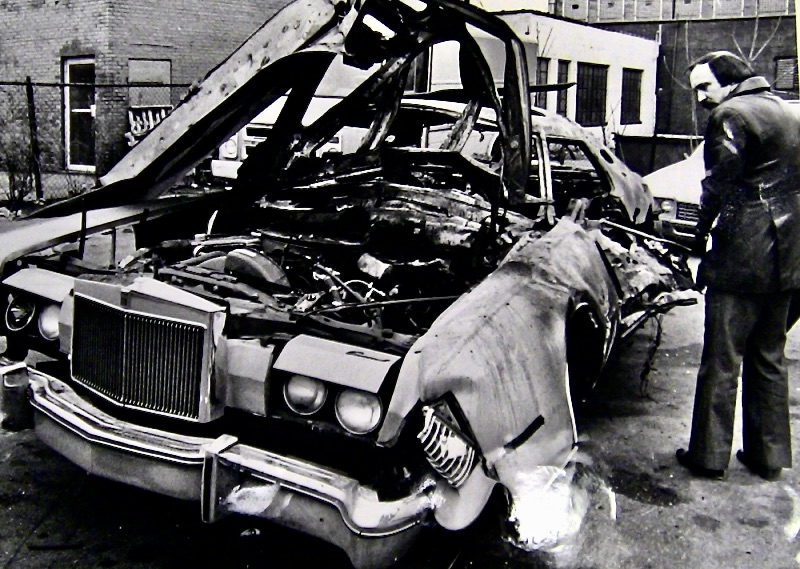
King of the Cowboys

By Ed Staskus

   I was three years and some months old before I got my first good look at Sudbury. I didn’t know it had started life as a railroad outpost in the later nineteenth century before rapidly expanding when vast mineral resources were discovered. I didn’t know what it had grown up to be seventy years later. I knew it was springtime on our street. When I looked around, I thought it was the best place in the world, a place where everything was new. 

   My brother had been born in the fall, and had been crying at night lately, keeping us all awake. My father was a miner, working day shifts for two weeks and then night shifts for two weeks. He was one of the explosives men, setting black powder charges a mile down. He needed his nerves to be rock solid. He needed to sleep like a baby. He didn’t need crying rattling around in his brain.

   At first, my mother thought it was a passing thing. When it didn’t pass, she took to sleeping in the living room, on the sofa, with my brother on the floor beside her in a small rocking cradle. Whenever he started crying, she reached down and rocked him, settling him down. She didn’t get much sleep, although my father and I got all the shuteye we needed.

   One day, when my father was at work, and my mother had an appointment with the family doctor to check my brother’s tonsils, my godfather Joe Dzenkaitis showed up to babysit me for the afternoon. He was on the night shift in the nickel mines and had time to kill. He showed up on a 1948 Vincent Black Shadow motorcycle.

   “I borrowed it from my neighbor,” he explained.

   Most of the Lithuanian immigrants who came hat in hand to Sudbury in the late 1940s and early 1950s worked in the mines. They got out of the black hole that Europe was for them after World War Two and ended up in another black hole. Most of them were saving every penny they could so they wouldn’t have to work in the mines a minute more than they had to. Many of them had clawed enough cash together to buy their own homes, but didn’t own a car, a motorcycle, or even a bicycle.

   The Vincent had a black tank and a black frame. The chrome pipes were nickel chrome steel. The nickel came from Sudbury. The city south of North Bay in Ontario sat on top of a big hole in the ground overflowing with ore. Some people called it the ‘Valley.’ Others called it the ‘Basin.’ Still others simply called it ‘Paydirt.’ An asteroid smashed into the spot in Canada hundreds of millions of years ago with a cargo of vital metals. Nickel took the blue ribbon.

   During the Korean War, which had ended the year before, nickel was regulated. Whenever there was combat anywhere in the world Sudbury boomed. Nickel was vital for making modern man-killing warfare. When the fighting stopped Sudbury went back to scuffling. It wasn’t boom or bust, but it was a one-basket economy, so it was boom or bust.

   After World War Two the open pits were almost exhausted and new underground mines were being dug. Nickel was being used for more and more civilian purposes. Technologically advanced smelters started seeing the light of day. While Sudbury slowly progressed from being one of the most polluted cities in North America, cleaning itself up, I was just getting my legs under me. My friends and I played on the outcroppings behind our house all the time and never noticed the ever-present haze of ash and smoke. We played Man on the Moon. 

   Astronauts from the United States played Man on the Moon on the rocky wastelands surrounding Sudbury in 1971. They were part of the Apollo 16 mission. More American astronauts trained outside of town a year later, for Apollo 17, for the moon landing in December of 1972. They were practicing for the real thing.

   When I was born in 1951, I didn’t see much of my hometown at first. I was homesick for my old home, which had been warm and fluid. After I was squeezed out into the real world I saw a lot of my crib and the kitchen. It was lively when my parents and their friends had kitchen parties at our house. I only spoke Lithuanian until the spring of 1954, when I started meeting kids my own age on the street. They all spoke English and French although none of them spoke French among themselves. English was their language on the street. They said French was for talking to girls and their parents.

   The Vincent my godfather was riding was plenty fast enough, but it wasn’t the Black Lightning, which was the racing version of the Black Shadow. Every steel part on the Lightning that could be remade in aluminum had been remade in aluminum. Everything not essential was removed, reducing the weight by almost a hundred pounds. It had a single racing seat and rear footrests. In 1948 Rollie Free broke the motorcycle land speed record riding a Black Lightning on the Bonneville Salt Flats. He did it wearing a bathing suit, laying like a swimmer flat on his stomach, his legs dangling off the back end, and hanging on to the handlebars for dear life. When he came to a stop, he was coated tip-to-toe with sand and salt.

   I sat on the motorcycle behind my godfather, who I called Uncle Joe. I couldn’t get my arms around him and had to hang tight to his shirt. He burped the bike down Stanley Street to Elm Street and took a left towards downtown.  My friends and I had been to an arcade and ridden Roy Roger’s horse Trigger, but none of us had ever been on a real motorcycle. Roy was “King of the Cowboys.” He was from Ohio, where my family was going to end up in a few years. The only cowboys I ever saw in Cleveland, Ohio rode ponies in parades.

   We lived on a new stretch of Stanley Street. Houses were being built as fast as could be because Sudbury was the most congested city in Canada. The Dominion Bureau of Statistics reported there were “42,410 people jammed into 9,450 units.” More than a third of the housing was officially designated as “overcrowded.”

   We glided past the Regent Theatre where my parents went to see movies on weekends. My father learned to speak English in Lithuania, but my mother had lived on an out-of-the-way family farm of pigs and sugar beets near the East Prussian border. The native lingo was all she knew. The movies were a way for her to learn English. A twin bill was showing “Creature from the Black Lagoon” and “Seven Brides for Seven Brothers.”

   The movie house was operated by Herbert Sutherland. By the time I was old enough to go see movies it was home to a colony of rats. It got so it was hard to tell if somebody was screaming because of the monsters on the screen or because of a rat biting their ankles. Herb Sutherland found several homeless cats and invited them to make his theater their home. The city sent him a letter saying, “We do not feel the use of cats is sufficient to eliminate the menace.” He threw the hired guns out and set out poison, making the problem disappear. 

   We went past the new Sudbury Arena which had replaced the old Palace Rink the year I was born. Uncle Joe rode carefully, watching for mud, threading the needle. The Junction Creek overflowed its banks every year, flooding the northern and central parts of Sudbury. We rode around the General Hospital where I was born. Outside the Grotto of Our Lady of Lourdes we stopped for ice cream cones. I peeked over my shoulder for spirits, saintly or otherwise.

  Frederic Romanet du Caillaud, known as the Count of Sudbury, had a six-foot tall 1500-pound bronze statue of the Virgin Mary erected at the mouth of the grotto in 1907. “Queen of the Gauls” was inscribed on the statue. At first, an Italian family by the name of Drago took care of it, wiping off grime and bird shit every spring and autumn. In the 1950s the Rosary Club was formed. Omer Naqult. a local barber and devout Catholic, watched over the pilgrimage site.

   One year earlier almost 10,000 people had gathered at the site, coming from all the various parishes of the Sault-Ste-Marie diocese. New lighting was installed to light up the shrine at night. At the start of the next summer more than 10,000 residents of Sudbury took part in the procession of Corpus Christi that ended up at the grotto. My parents were not able to go to the parade, no matter how devoted to Catholicism they were, so I didn’t know anything about it at the time.

   The statue was an inch or two shorter than Uncle Joe, who wore his hair wavy and was strong as an ox. He could bend nails with his fingers. He and his wife Brone didn’t have any kids, but I saw plenty of them, anyway. My parents had a good-sized living room, and our house was where card playing, dancing, and drinking booze took place on many weekends. There was always a spread of Baltic foodstuffs.

   We set off for Ramsey Lake. Before there ever was a Sudbury the natives called the lake Bitimagamasing, which means “water that lies on the side of the hill.” Everybody agreed Ramsey was easier to pronounce and that is what everybody called it. Everybody also agreed the lake was dead as a doornail. Sewage from Minnow Lake drained into Ramsey Lake. Open roast emissions had been going on for so long and led to so much pollution that the lake, which had few water flow outlets, had given up the ghost. Even though it was still the largest lake in the world located entirely within the boundaries of a single city, it was a shell of its former self.

   There weren’t many fish in the lake. By the 1950s, despite three decades of persistent stocking, angling was still bad. Besides the pollution, fishermen had long since been dynamiting for fish, wiping out some species like bass. When Lands and Forest biologist R. E. Whitefield went survey netting, it took him four full days to catch five pike and one yellow perch. Lake trout were re-stocked in 1952, but when they disappeared, that was the end of stocking for the next twenty-five years.

   Before my father showed up to sweep her off her feet, my mother’s Canadian boyfriend often took her out on the lake in his speedboat, until the day he started showing off, racing and zig zagging, and she fell off the back of it without him noticing. An evil-looking northern pike watched her bob up to the surface. By the time her boyfriend thought to look for her she was floating on her back waiting for him, hoping the weight of her wet clothes wouldn’t drag her under.    

   The lake is named after William Ramsey, who was the chief of a surveillance party in the late 1800s and got into the weeds in heavy fog. After finding himself he named it Lost Lake. Others more civic minded decided it would be better to name it after him but misspelled his name, calling it Lake Ramsay. Forty years later somebody noticed the mistake and corrected the spelling.

   When we got to the lake, I begged Uncle Joe to let me go swimming, but there was a greasy purple substance on the surface of the water as far out as we could see. “It’s probably some poisonous waste, or something Inco is up to,” he said. I had no idea what Inco was, but I had heard “What are you up to?” from my mother often enough to know it couldn’t be anything good. We went for a walk instead. When I got tired my godfather carried me sitting on his shoulders, my hands gripping his thick head of hair.

   It was an early fall day and trees were starting to change color. There weren’t many of them, but the yellows and reds got me going and I begged my uncle to take me to a forest. He said there weren’t any, but finally relented when I wouldn’t leave it alone. We rolled slowly out of town on the Vincent. Uncle Joe flat-hatted across the hinterland.

   It turned out my godfather was right. There were hardly any trees anywhere, at all. The first thing to happen to them was the Great Chicago Fire in the 1870s. Lumber camps popped up all over Ontario providing wood for the American city’s reconstruction. Then the ore discoveries and smelting got going, the fires releasing sulfur, which combined with water forms sulfuric acid, leading to acid rain. Saplings struggling to reforest the landscape didn’t have a chance and died by the millions. The hinterland of Sudbury looked like a wasteland by the 1940s.

   Our street in the city had trees and grass and gardens but the only vegetation I saw outside the city was wild blueberry patches and paper birch. What other trees there were, were giving it their best shot against long odds. They were like the crippled kid on Pine Street we sometimes played with, although never for long. He couldn’t hop, skip, or run. He couldn’t keep up with us. He sat under a tree watching.

   When my godfather checked his watch, he suddenly said we had to go. We raced back to Sudbury, to Stanley Street, to our house. My father wasn’t home from work, yet. Neither was my mother.

   “When she asks you what we did today, just tell her we went sightseeing, OK?” Uncle Joe said.

   “OK,” I said.

   After my mother came home, I told her we had a great time, and while she and my godfather had coffee on the front porch, I watched my baby brother crawl around in the back yard. He was making progress, gurgling rather than crying. Our street dead-ended in a dark face of pitted rock. I was forbidden to climb it because it was steep, even though I had already gone up and down it many times with my friends. Sometimes rules are just a moot point.

   When my friends ran into our front yard after dinner and asked me where I had been all day, I told them all about it, all the places I had been to, and how Sudbury was bigger, better, and more exciting than I had ever imagined. After that, Stanley Street was our world, but we couldn’t wait to see more of the world. We ran up and down the street that evening pretending to be riding motorcycles. The sunset was a gleaming red and orange. We were spent and sat down on a big rock watching night happen. When my mother put me to bed, saying I looked tired, I slept like the rock of ages.

Ed Staskus posts monthly on 147 Stanley Street http://www.147stanleystreet.com, Made in Cleveland http://www.clevelandohiodaybook.com, Atlantic Canada http://www.redroadpei.com, and Lithuanian Journal http://www.lithuanianjournal.com

A New Thriller by Ed Staskus

Cross Walk

“A once upon a crime whodunit.” Barron Cannon, Adventure Books

“Captures the vibe of mid-century NYC.” Sam Winchell, Beyond Fiction

Available on Amazon: https://www.amazon.com/dp/B0CRPSFPKP

Late summer and early autumn. New York City. A Hell’s Kitchen private eye. The 1956 World Series. President Eisenhower at the opening game. A killer in the dugout.
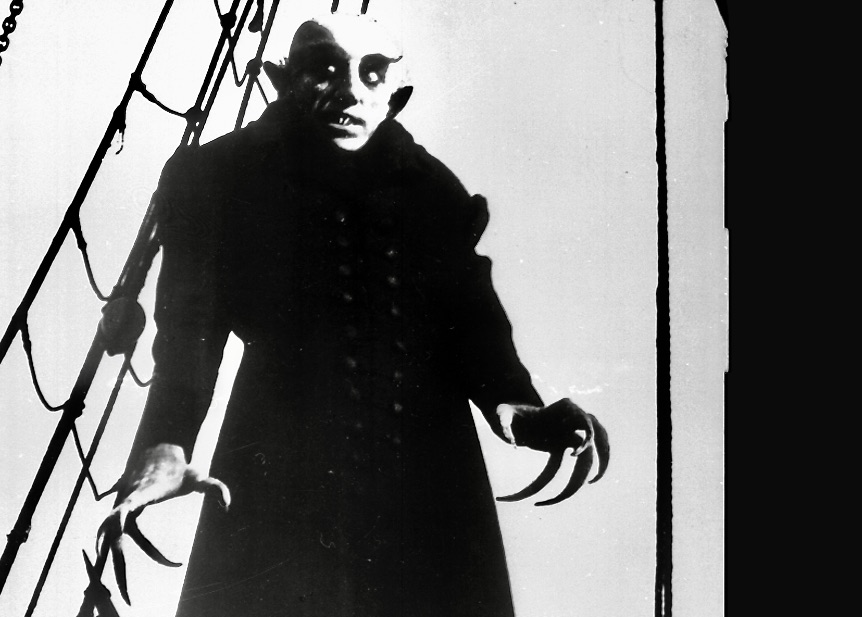
Pie in the Sky

By Ed Staskus

   Bettina Goertzen, Victoria Adams, and Dorothy Riddman were on their way to Coney Island. They were calling themselves Betty, Vicki, and Dottie for the day. They plunked down their ten cents apiece at a NYCTA booth and skipped down the stairs. Dottie stopped to look at a yellow sign trimmed in red on the wall at the entrance to the tunnel. “Please cooperate. When in doubt, ask any employee. Help keep the subways clean. Use receptacles for paper. Do not rush. Let ‘em off first. Move away from doors. Keep to the right on stairways. Always be courteous.”

   Why was them spelled ‘em, Dottie wondered? She didn’t think Sister Mary  Agnes would approve. “Run!” she suddenly called out, running up the platform. “It’s one of those air-conditioned cars!” Two months earlier the transit system had rolled out their first experimental air-conditioned cars on the East Side IRT line. They were fitted with deodorizers and filters and featured piped-in soft music. The temperature was maintained in the mid-70s. Signs on every third window said, “Air-Conditioned Car. Please Keep Windows Closed.”

   They were taking the IND line across the river to Brooklyn, across Gravesend, to the end of the line. When they got off the train they walked, crossed Mermaid Avenue, and hoofed it to Coney Island Beach and the Boardwalk. Dottie felt light as lemonade.

   They stopped at the Sodamat on West 15th Street as they strolled on the Boardwalk. ‘Good Drinks Served Right. Skee Ball 5 cents.’ There were prize games, hammer games, rifle ranges, freak shows, and fortune-tellers up and down Coney Island. “Look, they have waffles,” Dottie said, pointing to a sign on the front of a counter behind which a man in a white jacket and soda jerk cap was making waffles.

   “I thought you wanted a Nathan’s,” Vicki said.

   “I do, but later,” Dottie said.

   “Did you know hot dogs were invented right here on Coney Island, almost one hundred years ago?” Betty asked.

   “Not so fast, how could Nathan have done that?” Dottie asked.. 

   “It wasn’t Nathan then, it was Charley Feltman, who used to boil sausages on a small charcoal stove inside his wagon and then slip them into a roll. He called them red hots at first, but later changed it to hot dogs.”

   “How about some ball hop before we eat?” Vicki asked, pointing into the arcade behind the food counter. “The word from the bird is that you’re good at it.”

   “My game is stickball,” Dottie said. “Skee ball is for jellyfish. They don’t even play stickball here. They play coop-ball. That’s for jellyfish, too.”

   “Do you only play stickball?” Vicki asked. 

   “Oh, no, we play ringolevio and skelly, too, although some kids call it scummy top. Skelly is fun, but all you’ve got are your chalk and the squares and your caps. Ringolevio is way more fun, we run all over, and there’s a jail, and jailbreaks, and everything.  Chain, chain, double chain, no break away!” 

   “Let’s break the chain and go eat,” Betty said. They ordered waffles.

   “That was the best waffle I ever had,” Dottie proclaimed when they were leaving.

    “You had two of them,” Vicki said.

   “She’s a growing girl,” Betty said.

   “Those were the best two waffles I ever had,” Dottie said.

   “Where to now?” Betty asked.

   “I want to jump off the Eiffel Tower!” Dottie exclaimed.

   The Parachute Jump at Steeplechase Park had been built for the 1939 World’s Fair and later moved to Coney Island. It stood 250 feet high, was open-frame, and everybody called it the Eiffel Tower of Brooklyn. Twelve cantilevered steel arms sprouted from the top of the tower, eleven of them supporting two-man canvas seats and parachutes. The riders were belted down, hoisted to the top, then released into a freefall, caught by the parachute, and floated to the ground. Shock absorbers were built into the seats, just in case.

   “I’m not going up on that thing,” Betty said.

   “Do you remember the parachute wedding?” Vicki asked her.

   “No, I never heard of it.”

   “A couple got married up there. The minister was in the seat next to them and the whole wedding party was on the rest of the seats. When the ceremony was over the married couple parachuted down first, and everyone else followed them, except for the minister. The cables on his seat got tangled and he was up in the sky for more than five hours before firemen could get him down. The tower is right on the ocean, and it was windy, and he got sick as a dog, puking on the wedding party who were watching from below.”

   “That cinches it,” Betty said.

   “You and me both, sister,” Vicki said. “Time to plow back through the crowd.”

   “Why do they call it Coney Island?” Dottie asked, taking a last look up at the parachute ride she wasn’t going to ride.

   “It’s because of the Dutch,” Betty said “When they were here, maybe three hundred years ago, there were lots of rabbits in the dunes, so they called it Konijnen Eiland, which means Rabbit Island. It became Coney Island when the English took over.”

   “How did they take over?”

   “Somebody always takes over.”

   “Why does somebody always take over?”

   “It’s the way of the world, child.”

   “I want to go on the Wonder Wheel.”

   “I think we’re up for that,” Vicki and Betty agreed.

   The Wonder Wheel at Luna Park was a Ferris wheel and a Chute-the Chutes and a slow-moving roller coaster all rolled up in one. It was once called Dip-the-Dip. Some of the cars were stationary, but more than less of them moved back and forth along tracks between a big outer wheel and a smaller inner wheel as the contraption rotated.   

   They walked past an eight-foot high neon sign spelling out “Wonder Wheel.” Shooting through the middle of the sign was an arrow blinking and pointing to the ride. “Thrills!” it said. Dottie sat between Vicki and Betty in one of the sliding cars. 

   “You can see Manhattan,” Vicki said when it was their turn at the top of the 150-foot-tall wheel and it stopped for a few seconds.

  “Look, you can see the Rockaway,” Betty said.

   “It takes you low and it takes you high,” Vicki said.

   “When you reach the top it’s like you can touch the sky,” Dottie said. “You can see the whole world from here.”

   “One minute you’re on top, the next minute down you go,” Betty said. “I say, stay in your seat, it’s going to get bumpy, and enjoy the ride.”

   “Top of the world, ma, top of the world,” Vicki cried out like a crazy woman, bulging her eyeballs, and throwing her arms up. Betty laughed. Dottie squinted at them, wondering what they were talking about.

   “One day he’s a mama’s boy mad dog killer and the next day, older and wiser, he’s Yankee Doodle Dandy.”

   Dottie wondered again, what are they talking about? The Wonder Wheel shuddered and started down.

   “Can we go fast now instead of slow?” Dottie asked when they were on the ground.

   The Cyclone was in Astroland at the corner of Surf Avenue and West 10th Street. It was almost 3000 feet long, with six fan turns and twelve drops. The lift hill was 85 feet high. Six years earlier a man who hadn’t spoken in fourteen years, riding the roller coaster for the first time, screamed while going down the first drop. “I feel sick,” he groaned when the train returned to the station. He dropped to the ground in a dead faint after realizing he had spoken.

   Dottie peeked over the front edge of the front car at the track of the Cyclone as the train creaked to the top of the lift hill, where it was going to curve over the rails and hurtle down. Vicki and Betty were in the car behind her, after she had pleaded with them to go on the coaster, and she was with her new friend, Ronald, a boy her age whose parents had stayed behind on the platform. 

   “I have a friend who counts the seconds until the ride is over,” Ronnie said. 

   “Why does he do that?”

   “He can’t stand it.”

   “What’s the point of riding it in the first place?” 

   “I dunno,” Ronnie said. “Every time I ask if he wants to go with me, he says, sure, as soon as I’ve lost my mind, but he always goes anyway.”

   “The Cyclone is for when you want to be scared and excited all at the same time. Maybe he should stick to the merry-go-round.”

   “Yeah,” Ronnie said. “You don’t want to ride the roller coaster when you’ve got diarrhea.”

   “No way,” Dottie said, making sure their buzz bar was locked in place.

   “Did you hear about that girl who got hit in the face by a pigeon and broke her nose going down this hill?” Ronnie asked.

   “No!” Dottie said.

   “She was alright,” he said. “She had some Kleenex and stuffed it up her nose holes to keep the blood out of her eyes. She went right back for another ride.”

   “Yikes!” Dottie said, as the Cyclone shook, shimmied, and roared down the other side of the lift hill. “If that happens, I don’t have any Kleenex!” They laughed up and down the trick hill, leaned into the banked turns that twisted and tipped the train, ducked beneath the head-choppers, and inside of two minutes pulled back into the station where everybody clambered off. 

   “My legs feel like fried bacon,” Ronnie said.

   “Yeah, that was the mostest fun,” Dottie agreed.

   “Bye.”

   “Bye to you, too.”

   “That was sketchy,” Vicki said, catching her breath.

   “Shoot low, they’re sending Shetlands,” Betty said. “Did you feel that tower sway when we got to the top?”

   “You bet I did, right in the pit of my stomach.”

   “I’m hungry,” Dottie said.

   “You’re always hungry,” Betty said. “Doesn’t the boss feed you? Do you have a hollow leg, or what?”

   “I’m on the same page, hollow and hungry,” Vicki said.

   “How about a red hot at Nathan’s?” Betty suggested. 

   “Whoopee!” Dottie belted out sounding like Yosemite Sam after a long day on the trail of Bugs Bunny.

Excerpted from “Cross Walk.”

Ed Staskus posts monthly on 147 Stanley Street http://www.147stanleystreet.com, Made in Cleveland http://www.clevelandohiodaybook.com, Atlantic Canada http://www.redroadpei.com, and Lithuanian Journal http://www.lithuanianjournal.com

A New Thriller by Ed Staskus

Cross Walk

“A once upon a crime whodunit.” Barron Cannon, Adventure Books

“Captures the vibe of mid-century NYC.” Sam Winchell, Beyond Fiction

Available on Amazon: https://www.amazon.com/dp/B0CRPSFPKP

Late summer and early autumn. New York City. A Hell’s Kitchen private eye. The 1956 World Series. President Eisenhower at the opening game. A killer in the dugout.