Tag Archives: Ed Staskus

Behind Bulletproof Glass

By Ed Staskus

   I should have known better when I told the young woman on the other side of the Walgreen’s bulletproof drive-thru window that I needed the kind of coronavirus test that would get my wife and me into Canada and she breezily said, “For sure, this is it.” She was a trained pharmacy technician, but made up her harebrained reply, assuring me all was well even though she didn’t know what she was talking about. We found out three days later trying to cross the border at Houlton, Maine into Woodstock, New Brunswick.

   Getting a straight answer from the young can sometimes be like trying to give fish a bath. They often have a quippy answer for everything. Their answers are in earnest no matter what they’re asked and no matter their wealth or lack of knowledge. Whenever they are fazed by anything they say, “Oh, whatever.” 

   They say whatever they want when they are behind bulletproof glass.

   My wife and I were going to Prince Edward Island, where we didn’t go the summer before because of the 19 virus. Canada closed itself up tight as a clam in March of that year and didn’t reopen for Americans until early August of this year. Once we heard the opening was going ahead, we got in touch with the folks who operate Coastline Cottages in the town of North Rustico on PEI and let them know we were coming on August 21st and staying for three weeks.

   The cottages are on a hillside, on land that has been in the Doyle family going on two hundred years. A park road cut through their farm when it was built in the 1970s, but unlike other landowners they didn’t sell their remaining acreage to the state, so it sits snug inside the National Park. There are several homes on the bluff side of the eponymous Doyle’s Cove, some old and some brand new. In one way or another every one of them houses a homegrown north shore family, except for Kelly Doyle, who has lived on the cove the longest and lives alone.

   It takes two and half days to drive from Lakewood, Ohio to Prince Edward Island. At least it did every other year we had driven to the island. This year it took us six and half days.

   When we got to the Canadian border the black uniform in the booth asked for our passports. We forked them over to the tall trim guard, forearms tattooed, a Beretta 9mm on his hip. He was young and just old enough to be on this side of Gen Z. He looked our documents over and asked where we were from and where we were going.

   “Cleveland, Ohio,” I said. Although we live in Lakewood, an inner ring suburb, we always tell red tape we live in Cleveland. No one has heard of Lakewood. Everybody has heard of Cleveland, for good or bad. At least nobody calls it “The Mistake on the Lake” anymore. 

   I almost preferred the insult. “It keeps the riff raff rich away,” I explained to my wife. “There is no need for Cleveland to become the next new thing. They will just use up all the air and water and our real estate taxes will go ballistic. On top of that, we would end up knee deep in smarmy techies with their cheery solutions to all the world’s problems.”

   We handed our ArriveCAN documents over. We handed our virus inoculation cards over. We had both gotten Moderna shots. We handed our virus tests over, proving we had both tested negative.

   “You are cutting it close,” the border guard sniffed, shuffling everything in his hands like a deck of cards. I was hoping he wouldn’t turn a Joker up.

   The negative test had to be presented at the border within 72 hours of taking it. We were there with an hour to spare, although it would have been two hours if we hadn’t had to wait in line in our car for an hour. We had driven a thousand miles. It was tiresome but waiting in an idling car wasn’t any more skin off our noses.

   It started to smell bad when a second border guard stepped into the booth and the two guards put their heads together.

   “The antigen tests you took aren’t accepted in Canada,” the Joker said. “It has to be a molecular test. You can go ahead, since you’re from Canada, but your wife has to go back.”

   I was born in Sudbury, Ontario, and have dual citizenship, although I only carry an American passport. I couldn’t tell if he was being serious, so I asked him to repeat what he said. He repeated what he said and gave us a turn-around document to return to the USA when I told him I wasn’t ready to abandon my wife.

   We went back the way we had come, just like two of the six cars ahead of us, although we had to wait in line at the American crossing for an hour. Once we returned to Maine, we found out we could get the molecular test, but it would be a week-or more before we got the results. Nobody we talked to, not even the Gods of Google, was any help. A friendly truck driver mentioned New Hampshire was faster, only taking a day or two.

   The truck driver was stout, bowlegged, wearing a Red Sox baseball cap, a two-or-three-day growth of beard on his face, with a small shaggy dog to keep him company on the road. He wasn’t a Gen Z man. It was hard to tell what generation he belonged to, other than the changeless working-class generation.

   We drove six hours the wrong way to Campton, New Hampshire and checked into the Colonel Spencer Inn. It was Saturday night. We got on-line and made test appointments for noon at a CVS in Manchester, an hour away. We streamed “Castle of Sand” on our laptop. It was a 1970s Japanese crime thriller movie and kept us up past our bedtime.

   Over breakfast the next morning our innkeeper told us to go early since the traffic leaving New Hampshire for home on Sunday mornings was heavy. We gave ourselves an hour and a half to drive the 55 miles and barely made it. Luckily, we hadn’t made appointments for an hour later. We never would have made it. The traffic on I-93 going south was a snarl of stop and go by the time we started north back to Campton.

   We got our test tubes and swabs and stuck the swabs up our noses. I spilled some of the liquid in my tube and asked the Gen Z pharmacy technician behind the bulletproof glass if I should start over with a new kit.

   “You’re fine, it doesn’t matter,” she said, lazy as a bag of baloney. She couldn’t have been more wrong, which we discovered soon enough.

   Gen Z is self-centered and self-sacrificing both at the same time. “My goals are to travel the world and become the founder of an organization to help people.” They want to stand out. “Our generation is on the rise. We aren’t just Millennials.” They say they are the new dawn of a new age. “We are an unprecedented group of innovation and entrepreneurship.”

   Welcome to the future, just don’t take the future’s word for it.

   We spent the night at the Colonel Spencer. It was built in 1764, a year after the end of the French and Indian War. During the war the British, allied with American colonists, weaponized smallpox, trading infected blankets to Indians. The virus inflicts disfiguring scars, blindness, and death.

   “Could it not be contrived to send the smallpox among those disaffected tribes of Indians? We must on this occasion, use every stratagem in our power to reduce them,” the British commander Sir Jeffrey Amherst wrote to his subordinates.

   The results were what the continent’s newest immigrants from the Old World expected.

   “They burned with the heat of the pox, and they died to feed the monster. And so, the village was deserted, and never again would the Indians live on that spot,” is how one of the natives described the deadly epidemic.

   We had dinner at Panorama Six82, not far from our inn. The hostess seated us outside on the patio which looked out over a valley and a series of cascading White Mountain hilltops. The sun went down behind one of them and we finished our dessert in the dark.

   Our server was a middle-aged man from Colombia wearing jeans, a Panorama Six82 signature shirt, and a Sonoma-style straw hat. He went back to the homeland every year to visit relatives.

    “They always want money, so I don’t bring too much of it,” Fernando said. “It’s not as dangerous as most Americans think it is. I avoid some neighborhoods, sure, and I avoid riding in cabs. The rebels are in the hills, not the cities, and besides, they don’t do much anymore. The Venezuelans are a problem, all of them leaving their god-forsaken country. But they do a lot of the dirty work for us these days.”

   We drove back to Houlton on I-95. The speed limit north of Bangor is 75 MPH. I set the cruise to 85 MPH and kept my eyes peeled for moose. The fleabags lumber onto the roadway, sometimes standing astride one lane or another. Hitting a moose is a bad idea. A full-grown bull moose stands six to seven feet tall and tips the scales at 1500 pounds. It isn’t certain that the collision will kill the beast, but it will kill your car, and maybe you. They do most of their roaming around after nightfall. We made sure we got to our motel before dusk.

   In the morning my wife was winding down a business meeting on Zoom when there was a knock on our door. It was the housekeeper. She wore a black uniform and black hair pulled back in a bun. She was young. She was part of the Z crowd.

   “We’ll be out in about a half-hour,” I said.

   “Can I replace the towels and empty the trash?”

   “Sure.”

   “Weren’t you here a few days ago?”

   “Yes,” I said, and told her about trying and failing to get across the border and our search for a fast 19 test.

   It turned out the explanation for the motel being sold-out was because of the same problem. Every other person lodging there had been turned around for one reason or another.

   “You should go to the Katahdin Valley Medical Center,” she said. “A friend of mine went there, they did the test, she got it back the next day, and went to Nova Scotia.”

   “Thanks,” I said. We packed and followed Apple Maps to the medical center. The receptionist didn’t know anything about a fast molecular test. She sent us to Jesse, the man upstairs, who was the man in charge.

   “We test on Mondays, Wednesdays, and Fridays,” he said. “It takes about a week to get the results back from the lab.” It was Tuesday. We were already three days late. I started looking over my shoulder for Chevy Chase.

   “Not the next day?”

   “No.”

   We left Houlton and drove to Presque Isle, had lunch, messed around, my wife went running on the town’s all-purpose trail, and we drove to the Caribou Inn in the next town north. While the receptionist checked her computer for our reservation, we heard a wolf whistle through the open door of the office behind the front desk. A minute later we heard it again.

   “That’s just Ducky,” the receptionist said. “She belongs to the manager.”

   “Does she do that often, whistle, I mean?” I asked.

   “Whenever she sees a pretty girl.”

   Another wolf whistle came my wife’s way.

   I must have looked cross, because the receptionist said, “Ducky is a parrot.”

   Ducky was a parrot in a tall white cage just inside the door of the office. Her plumage was green with some red and yellow mixed in. She was a saucy character.

   “She’s twenty years old,” the receptionist said.

   “How long has she been here?”

   “Twenty years.”

   Ducky was spending all her Gen Z years locked up at the Caribou Inn, where flocks came and went. The only lasting relationship she had was with Betty, the hotel’s manager, and the bird’s keeper.

   “I didn’t know parrots lived that long.”

   “They can live to be seventy, eighty years old,” Betty said.

   “Ducky wolf whistles women?”

    “And men. We thought she was a he until she started laying eggs not long ago.”

   The parrot was going to outlive most of us, the 19 or no 19. They sometimes play dead in response to threats. They can also look dead when they are asleep. But if a parrot is lying still and not breathing, looking lifeless, you can assume it is dead.

   We had a non-smoking room, although every hallway that led to our room was lined with smoking rooms. The hallways smelled sad and stale. We were settling in with a bottle of wine and a movie when we got a phone call. It was the lab in New Hampshire that was doing our 19 molecular tests. They had good news and bad news. My wife tested negative, but my test was discarded. 

   “There wasn’t enough liquid in the test vial to maintain the sample,” the lab technician said. “Did you happen to spill some of it?”

   I didn’t bother trying to explain. I got on-line and filled out another ArriveCAN form. When we got to the border my wife had no problem. The only problem I had wasn’t make or break, since they couldn’t deny me entry, test or no test. A health officer gave me a self-test kit and told me to make sure I performed it within four days. She was in her early 30s. I had no reason to be skeptical. She was just out of Gen Z range. I should have been leery since she was wrong. She wasn’t as far out of the field of friendly fire as I thought.

   Four days later, when I went on-line and followed the directions for the self-test, the Indian-looking Indian-sounding woman on the other side of screen was nonplussed when I apologized for waiting to the last minute.

   “I don’t understand.” she said. “You are four days early. You are supposed to test after eight days of self-quarantine.”

   When I started to spell out what had happened, she wasn’t in the mood, and said she would schedule Purolator to pick my test up the next day. Purolator sent me an e-mail saying they would pick up between nine and noon. The truck pulled up just before five. I was grilling dogs and corn on the front deck. The next day I got an e-mail informing me my test came back negative. I had been tested four times in ten days and was finally officially virus-free.

   No matter the generation, Prince Edward Island was the only place and people who got it right. When we arrived late Wednesday afternoon and crossed the nine-mile-long bridge to the province, we waited in one of the many lines edging towards checkpoints. It didn’t take long. A young woman took our vitals while an older man in a spacesuit swabbed our noses.

   “If we don’t call you within two hours you tested negative,” he said.

   We drove to the Coastline Cottages. “Welcome to Canada,” our hosts said. “You made it.” 

   No one from Health PEI called us. We unpacked, watching the day get dark over the Atlantic Ocean, and fell into bed. I drifted off thanking God somebody on our part of the planet knew what the 19 score was, not some mumbo jumbo they dreamed up because they neglected to check the scoreboard.

Ed Staskus posts stories on 147 Stanley Street http://www.147stanleystreet.com and Cleveland Ohio Daybook http://www.clevelandohiodaybook.com. To get the site’s monthly feature in your in-box click on “Follow.”
Queen and Country

By Ed Staskus

   Kieran Foyle was a black-haired man who knew how to get things done. He was Black Irish. He was a careful man, too. He only took chances when there was a good chance of making good. It was why Prince Albert sent him to the Canadian outlands on the clipper ship “Antelope of Boston’” to deliver vengeance on the man who had tried to kill his wife. It didn’t matter that it was an American ship. It didn’t matter that he was an Irishman sent to kill an Englishman. When it came to killing each other the Irish and English were good at it.

   “Either bring the evil-minded rogue back to be hung or, better yet, put him in the ground where you find him and spare us the trouble,” Queen Victoria’s consort said. He had had enough of assassination attempts. There had been one too many. He loved his wife and wanted her to die in bed.

   The Irishman nearly lost his chance when he stepped out of the long boat landing him on the north coast of Prince Edward Island too soon for comfort and almost drowned. The water was deeper near the shore of the cove than he  knew. He sank to the bottom not knowing how to swim and only made it to land on the back of one of the sailors who knew how to dog paddle.

   The man he was after was Thomas Spate, a disgruntled veteran of the Crimean War. He had known how to kill Russians. When he was awarded the Crimea Medal, he threw it in his rucksack and forgot about it. When he was one of the first soldiers to receive the Victoria Cross for bravery at the Battle of Balaclava, he thought about throwing it in his rucksack, too, but didn’t. Instead, he wore it every day pinned to his coat over his heart. He kept it cleaner than anything else he possessed.

   During the war Queen Victoria knitted woolens for the troops and inspected military hospitals, wearing a custom-made red army jacket. When the war ended, she hosted several victory balls in her new ballroom. Tom Spate watched from the outside, driving himself crazy. He was alone and down on his luck. He blamed everybody except himself for the bad things happening to him. He walked incessantly, from one end of London to the other. He goose-stepped up and down Hyde Park. Small groups gathered to watch the performance. The queen saw him often enough to become familiar with him, although she never approached him.

   It was on one of his walks around London he spied Queen Victoria and Prince Albert outside Cambridge House. As their carriage left, it came to a stop outside the gate. Tom Spate had taken to carrying two flintlock coat pocket pistols. They were always loaded. He walked up to the carriage and pulled them out. He didn’t ask himself what he was doing. He straightened one arm and pulled the trigger. Nothing happened. It was a dud. He brought the other pistol to bear and pulled the trigger. It misfired. He had just enough time to jump at Queen Victoria and strike her on the head with the butt of one of his guns before Prince Albert grabbed him, shoving him off the carriage. Men on the walk swarmed the would-be assassin and beat him.

   Queen Victoria stood up in her carriage and proclaimed in a firm voice, “I am not hurt,” even though she was gushing blood from a gash on her forehead. The blood was crimson on her yellow crocheted shawl. Prince Albert staunched the bleeding with his handkerchief.

   Tom Spate was arrested, jailed, tried, convicted, and sentenced to transportation and twenty years of hard labor in the penal colony on Tasmania. There was no appeal. There was no changing anybody’s mind. By most calculations he got what he deserved. Prince Albert’s calculations were more severe. “I would have had the rascal drawn and quartered,” he said.

   When Tom Spate escaped his jailers and disappeared, Prince Albert summoned Kieran Foyle, a mercenary adventurer who it was said always got his man. It took almost a year, but in the spring of 1859 he was making his way soaking wet up the hill from the cove to the village of North Rustico. He knew where Tom Spate was and knew he could take his time about the matter. He needed to get out of his clothes. He needed a hot cider and dinner. He needed a good night’s sleep in a feather bed on dry land that didn’t heave-ho all night long. He found the only boarding house in North Rustico and took a room.

   Kieran Foyle’s chuff was living on the far side of the Stanley River, nine miles northwest up the coast. The Irishman had grown up calling miles chains. His man was 720 chains away. It would take him about three hours to walk there on the coastal footpath. He had no intention of taking anybody back to England. The voyage itself took a month. “Jesus and Mary chain,” he grumbled. He had every intention of collecting his reward.

   Tom Spate lived in a rough-and-ready hut he had thrown together, living in it with his new wife and new baby. He had no land to farm and no craft to make his way. He made his way by operating a ferry service from one side of the Stanley River to the other. In the winter he closed it down when the water froze and everybody walked across. In January the ice got thick enough so that horses and wagons could cross. 

   He bought ice skates, carved sticks with a curve at the bottom by hand, and made rough and ready pucks. His wife rented them to youngsters who had eggs, salt cod, and potatoes to trade for playing shinny on the ice. It was a game of fast skating and trying to hit the puck between two sticks of wood marking the goal.

   Most of North Rustico was Acadian. They were Catholic like Kieran Foyle. St. Augustine’s had been built in nearby South Rustico twenty years earlier. It boasted an 80-foot-high tower. A man could see everything from the top of it. The harbor at North Rustico was filled with boats and the fishing was good. There were cattle and horses grazing and fields of turnip and cabbage. Piles of mud dotted the fronts of fields. On his way to send Tom Spate to his maker, stopping to rest, he asked a passing man what the piles of mud were about.

   “It is mussel mud,” the man, a farmer, said. “The land needs lime to breathe new life into it. We use the mud from bays and riverbeds. It is beneficial, filled with oyster shells.”

   “Do you dig it up?” Kieran asked. He didn’t ask why they called it mussel mud instead of oyster mud.

   “We go out in canoes at high tide and dam up a small space so we can dig it from the bottom. When we are full, we go back and unload it at low tide.”

   “It sounds like a great deal of work.”

   “It is, but without the mud we would starve on the farms, both man and beast. I couldn’t keep one horse but for it. Your cow needs at least a ton of hay to survive the winter. We have been doubling our harvests with the mud. We will have even more of it soon.”

   “How’s that?” 

   “We have got a man engineering a mechanical digger to harvest the mud in the winter through holes in the ice and carry it across the island by sleigh. There’s talk that we will be able to increase our crops of hay five and ten times. And then there’s the ice besides. We cover it in sawdust and put it into an icehouse so that we can preserve foods that go bad in the summer’s heat.”

   Kieran Foyle parted with the farmer, shaking his hand. He liked what he heard about mussel mud. It was a sunny day and the uplands looked fine to him. When he got to the Stanley River, he rang a bell hanging from a post. Tom Spate’s face appeared at a window on the other side. He waved and the next minute was guiding his flatboat across the water, using a rope anchored to oak trees. He pushed with a pole along the riverbed. Kieran paid him his two pennies and put his back to a pillar as Tom Spate pushed off.

   Near the middle of the river the Irishman felt for the sidearm in his pocket. He was carrying a new Beaumont-Adams percussion revolver. The cylinder held five rounds, although he knew he wasn’t going to miss his man with his first shot. He intended to be standing face to face with him when he dispatched the villain. He walked up to Tom Spate.

   “Thomas Spate, I have a message for you from your queen,” he said.

   Tom Spate’s face went white as a ghost when the barrel of the gun pressed into his chest, pressing against the Victoria Cross he was wearing.

   “For God’s sake, I have a wife and child.”

   “For crown and country,” Kieran Foyle said and pulled the trigger. The bullet rocketed out of the barrel slamming into and driving the Victoria Cross into Tom Spate’s heart, putting an end to the one-time war hero’s life.

   Kieran stood over him and decided in an instant that he was going to stay on Prince Edward Island. There was nothing in Ireland or the rest of the United Kingdom for him other than more killing and waiting for the day he would be the one killed. He had neither wife nor family. He would find a woman here, he thought. He would have sons by the colleen. He would raise horses fed with abundant hay grown in the goodness of mussel mud. He didn’t love his fellow man, but he loved horses.

   He bent a knee and using both hands pried open the hole in Tom Spate’s chest. He stuck his fingers into the man, feeling for the bullet and the medal. He couldn’t find the bullet at first but found the Victoria Cross easily enough. He yanked the medal out. It had been cast from the cascabels of two cannons captured from the Russians at the siege of Sevastopol. He probed for the bullet until he found it. He washed the blood on his hands off in the water. He pushed the body off the ferry with his boot. It bobbed in the river and slowly floated out to the ocean on the ebb tide.

   He walked back to North Rustico the way he had come. In his room he packaged the bullet, the medal, and a letter in an envelope. The letter didn’t have a word in it about what he had done, only asking for land on the shoreline where he had landed and the right to name the cove “Foyle’s Cove.”

   He posted the letter in Charlottetown, paying an extra penny to make it a “Registered Letter.” It would sail on the Gazette to Liverpool the next week. He hoped to have a reply by the fall. In the meantime, he would start building a house on the west side of the cove. The land might already be owned by somebody, not that it mattered. It was nearly all forest. Whoever the landlord was, there was no tenant. When and if the landlord showed up from England, the Irishman was sure he could set him straight.

   He sat in his room and fired up his Meerschaum pipe. When he was young and poor, he smoked spone, which was coltsfoot mixed with wild rose petals. Now he carried good tobacco in his purse. The smoke curled up from the Irish clay. He had found a kitten on the ferry and brought it back with him from the the Stanley River. The kitten watched the smoke, jabbing at it with its paws.

   “All the old haunts and the dear friends, all the things I used to do, the hopes and dreams of boyhood days, they all pass me in review.” It was a song they still sang in military barracks. He had been dragooned into the army while still a boy after being plied with drink by a sergeant in a pub. He took the “Queen’s Shilling” and there was no going back, especially after he deserted and went to work for himself, plying a new trade. 

   The window of his room faced west. The setting sun slanted in, the orange glow warming his face. When he was done with his pipe he would go downstairs for haddock, potatoes, and beer. He would bring some bits of fish and milk back for the kitten. Until then, he would sit where he was, smoking and letting his plans slowly unwind themselves from the back of his mind.

Excerpted from the book “Ebb Tide.”

Ed Staskus posts on 147 Stanley Street http://www.147stanleystreet.com and made in Cleveland http://www.clevelandohiodaybook.com. To get the site’s monthly feature in your in-box click on “Follow.”

“Ebb Tide” by Ed Staskus

“A thriller in the Maritimes, out of the past, a double cross, and a fight to the finish.” Sam Winchell, Beyond Books

Available at Amazon: https://www.amazon.com/dp/B0CV9MRG55

Summer, 1989. A small town on Prince Edward Island. Mob money on the move gone missing. Two hired guns from Montreal. A constable working the back roads stands in the way.

A Crying of Lot 49 Publication

Feed Your Head

By Ed Staskus

   I was in my early 20s in 1973 the first time I visited Lake View Cemetery. I was in the back seat of a 1964 Oldsmobile Jetstar 88 convertible. Bill Neubert was driving and his wife Bonnie was beside him. Everybody called Bonnie Buck, although I called her Bonnie. It was a mid-summer day, warm, bright, and breezy. The top of the car was down. Bill stopped in front of an old headstone. We got out of the car and walked over to it. The name on the grave was Louis Germain DeForest. The dates were 1838 – 1870. There was moss on the base of the stone.

   “He was the first guy buried here,” Bill said.

   Captain Louis Deforest was from Cleveland, Ohio, one of ten children, served in the Union Army during the Civil War, and went home after Johnny Reb gave up the fruitless struggle. He married Theresa Luidham before the war, got her pregnant during the war, and again after the war. Once back in Cleveland he went into the jewelry business. The sparkle didn’t last long. He died unexpectedly at the age of 31.

   Two sites in the graveyard were on the National Register of Historic Places, the second one added that year. I didn’t know much about places with a past. I had enough trouble making sense of the present. Bill filled me in, even though he wasn’t interested in historic places. He was more interested in the flow of history.

   Bill and Bonnie were mimes clowns comedians, putting on shows around town, working out of town when they got offers. They were a few years older than me, friends of my roommate Carl Poston. That Saturday morning Carl begged off messing around town, leaving me the odd man out. Bill and Bonnie made me feel at home. Bill didn’t act or look anything like Humphrey Bogart, but he talked just like him. We drove to Little Italy and had pastries and coffee. Back in the car they both dropped acid and asked me if I wanted to try it.

   “All right,” I said.

   They didn’t call it LSD. They called it Uncle Sid. It was the first time I took LSD. A half hour later I was finding it and everything else incredibly interesting. Everything seemed fresh and bright. Uncle Sid wasn’t the disheveled uncle with yesterday’s stogie trying to take your picture with his dime store camera. He was my best friend that day.

   The Jefferson Airplane released “White Rabbit” in 1967. “One pill makes you large and one pill makes you small, feed your head,” Grace Slick sang with her eyes full of stars.. My head was full to the brim the rest of the day. Everything was freaky but close and personal.. No matter what it was, it all felt, looked, smelled, and sounded new. My eyes stayed wide open like a baby’s all day long.

  “What’s it like to be a child?” asked Robin Carhart-Harris of Imperial College in London. “That sense of wonder, that sense of awe is what you certainly see with psychedelics. Sometimes it’s framed in a sort of mystical or spiritual way. But it’s interesting if you look at some literature, someone like William Wordsworth, who talks about the infant state as being a kind of heavenly state where we’re closer to what you would call God.”

   LSD was first synthesized in 1938 in Switzerland. It was introduced as a psychiatric drug in 1947 and marketed as a psychotropic panacea, in other words “a cure for everything from schizophrenia to criminal behavior, sexual perversions, and alcoholism.” The abbreviation LSD is from the mouthful of the German word lysergsäurediethylamid. The drug was brought to the United States by the CIA. The spy agency bought the world’s entire supply for a quarter million dollars and promoted its use in clinics, research centers, and prisons. They administered it to their own employees, soldiers, doctors, prostitutes, the fruity, the mentally ill, the down and out, and plain folks to study their reactions, usually without those given the drug knowing what they were taking. The idea was that LSD is like psychoanalytical Drano.

   Lake View Cemetery is a graveyard straddling Cleveland, East Cleveland, and Cleveland Heights. It was founded in 1869. It was where the city’s wealthy buried themselves during the Gilded Age. There are many lavish funerary monuments and mausoleums. Little Italy up and down Mayfield Rd. was settled by stone masons from Italy who came to the United States to make monuments for God’s 280 acres. Many of the monuments they made were symbols. It’s better to be a symbol than a monument. Pigeons do bad things to monuments.

   In the 1960s Aldous Huxley, Alan Watts, and Timothy Leary got their hands on LSD and started advocating its use to the counterculture. It was supposed to be the drug of choice for consciousness expansion. Owsley Stanley got the blotter rolling in San Francisco. Ken Kesey and the Merry Pranksters popularized it during their road trips, giving it away to anybody who wanted it. Nick Sands created Orange Sunshine, the most pure, highest-quality LSD made at the time, better than the CIA’s. In 1966 the Psychedelic Shop opened, selling acid over the counter. It was legal as cookies and milk. If you were a gal, wearing a pants suit was problematical, but not downing the hallucinogenic.

   Bill drove his Olds 88 to Section 9 on Lot 14, to the marble gravestone of Francis Haserot and his family. The bigger than life tomb marker was “The Angel of Death Victorious.” The angel’s wings were outstretched, and she held an extinguished torch upside-down. I stepped up to her and saw what looked like black tears dripping from her eyes and down her neck. I wasn’t unnerved, but rather impressed with the sculptor’s skill, until I realized the tears were a result of rain and aging bronze.

   W. H. Auden wasn’t impressed with LSD. “Highly articulate people under it talk absolute drivel,” he said. After he tried it, he reported, “Nothing much happened but I did get the distinct impression that some birds were trying to communicate with me.” The Beatles jumped on the bandwagon with “Day Tripper” in 1966 and “Lucy in the Sky with Diamonds” in 1967. “The first time I took LSD, it just blew everything away,” said George Harrison. “I had such an incredible feeling of well-being.”

   Not everybody was all in. “We don’t take trips on LSD in Muskogee, we are living right and free,” Merle Haggard sang on “Okie from Muskogee.” Living free in the home of the brave is one thing. Living right is in the eye of the beholder. The city is on the Arkansas River in Oklahoma. It is home to a museum of Native American history and the USS Batfish, a WWII submarine with an onboard museum. Between 1858 and 1872 the Texas Rangers and U. S. Cavalry battled Creeks, Kiowa, and Comanche Native Americans in more than a dozen major engagements, eventually wearing them down, rounding them up, and telling them to stay the hell on the reservation. In the 1970s the USS Batfish was becalmed bewildered on the river, many miles from its native ocean hunting grounds.

   After we left the angel we drove to the Garfield Memorial. It’s the final resting place of assassinated President James Garfield, who was from nearby Mentor. The memorial is built of Ohio sandstone in a combination of Gothic, Byzantine, and Romanesque styles. It took five years to build and was dedicated on Memorial Day, 1890. James Garfield, and his wife, Lucretia, are entombed in the crypt.

   The circular tower is 180 feet high. We stood on the broad front steps and looked up. Before we went in, we gave the once-over to the bas-reliefs depicting President Garfield’s life and death, which included more than one hundred life-size figures. Inside was a gold dome and a statue of the main man. Below the Memorial Hall were two bronze caskets and two urns, the urns holding the ashes of the presidential couple’s daughter and her husband. I followed Bill and Bonnie up a stairway to a balcony with a view of Lake Erie. We stayed for twenty minutes, taking a long look at the downtown skyline before we left. It was like IMAX a year before IMAX happened, but without the motion sickness.

   “My feelings about LSD are mixed,” said Jerry Garcia of the Grateful Dead. “It’s something that I both fear and love at the same time. I never take any psychedelic, have a psychedelic experience, without having that feeling of, I don’t know what’s going to happen. In that sense, it’s fundamentally an enigma and a mystery to me.” 

   “The function of the brain is to reduce available information and lock us into a limited experience of the world” said the Czechoslovakian psychiatrist Stanislav Grof. “LSD frees us from this restriction and opens us to a much larger experience.”

   When he was dying of cancer Aldous Huxley asked his wife to inject him with LSD. The drug has analgesic properties for the terminally ill. When the acid trip was over so was his trip on earth. He died that night. The doors of perception closed on the man who wrote “The Doors of Perception.” Two years later Jim Morrison and Ray Manzarek named their new band The Doors.

   In the United States LSD was scaring the bejesus out of Washington D. C. They thought it was undermining American values and undermining the war effort in Vietnam. The Air Force might have dropped puff powder bombs of it on Charlie instead of napalm to keep the dominoes in place, but they didn’t. It was made illegal in the late 1960s. It was classified as a substance with no legitimate medical use and a lack of accepted safety. The DEA said it had a high potential for abuse. Although the drug had never caused any documented deaths, that was that. If you wanted to be in the sky with diamonds, once you landed back on earth your next stop might be prison.

   After we left Garfield’s Memorial we left the Olds 88 where it was and set off on foot. The memorial is on a hill which is the boneyard’s high point. We rambled downhill in the sunshine, making our way on twisty paths, stopping at the graves of Charles Brush, Elroy Kulas, John D. Rockefeller, and Garrett Morgan.

   Charles Brush was an inventor with fifty patents to his name. His arc lights were the first to illuminate Cleveland’s Public Square. When he later sold his company, it merged with the Edison Electric Co. to form General Electric. Elroy Kulas was the president of Midland Steel from the day it was organized in 1923 until his death in 1952. He was one of the driving forces behind the city’s steelmaking. During World War Two he built hulls for tens of thousands of M4 Sherman Tanks. The Nazis had a low opinion of them, but in the end the Sherman’s played chin music with the Panzer’s, blasting them to kingdom come. The Kulas Auditorium at the Institute of Music is named after him.

   We found John D. Rockefeller’s grave without any problem. It was at the base of an almighty obelisk. We didn’t stay long, only long enough to pay our respects to the Age of Oil. John D. Rockefeller was a son-of-a-gun, bleeding anybody and everybody who crossed him bone dry. It was how he made it to the top of the world, making himself the richest man in the world. He gave it away at the end so people would stop spitting in the gutter when they heard his name. 

   Garrett Morgan founded the Cleveland Call newspaper for the Negro community. He patented a breathing device that was used in 1916 during a mining disaster in gas-filled tunnels under Lake Erie to rescue workers and bring back those who died. Twenty-one men died. He and his brother rescued two of them and recovered four dead. He developed the modern traffic light and was the first black man in town to own a car.

   We went flaneur hoofing it around the graveyard, spending all day there. By early evening we were dog tired and coming down from the LSD. We needed bread and water. We hopped into the Olds 88 and drove back own to Little Italy. Instead of bread and water we had espresso, ham sandwiches, and biscotti.

   When Bill and Bonnie dropped me off back home it was nighttime. I ignored the mail, fed Ollie my Siamese cat, who was meowing up a storm, brushed my teeth, and got into bed. Ollie jumped up and got comfortable beside me.

   I had spent the day with the dead but felt incredibly alive. More than one hundred thousand men women and children are buried in Lake View Cemetery, their eyes closed forever. My eyes had never been more open. I didn’t drop much LSD after that, and when I did stuck to small doses. I didn’t think it was especially dangerous, but it is unpredictable stuff that can go wrong, like children one minute are laughing their heads off and the next minute bawling their eyes out. 

   I thought maybe I would take it again when I was dying, like Aldous Huxley, and go out on a high note.

Ed Staskus posts stories on 147 Stanley Street http://www.147stanleystreet.com and Cleveland Ohio Daybook http://www.clevelandohiodaybook.com. To get the site’s monthly feature in your in-box click on “Follow.”

Inside the Box

By Ed Staskus

   I started playing racquetball in my mid-20s, at Cleveland State University, while taking my mandatory physical education class. I got good enough to play on an intramural team and some small tournaments around town. By the time I had played enough and worked my way through the B and A divisions to the Open division, I was in my 30s and getting too old to play in the Open division. It took a year-or-so of beating my head against the wall, but when the discontent went away I started playing in the 30-plus division.

   Racquetball is played with a small rubber ball on an indoor 20-foot-wide by 40-foot-long court. It is basically a box made of concrete or laminate with a hardwood floor. A door is set flush in the back wall, the wall sometimes made of tempered glass. The floor, walls, and ceiling are legal playing surfaces, with the exception that the ball off the racquet must not hit the floor first. Hinders are interference. It happens when somebody gets in the way. Unlike tennis, there is no net to hit the ball over, and, unlike squash, there is no out of bounds tin at the bottom of the front wall requiring the ball be hit above it.

   The game’s roots are in handball and Squash 57, a British game sometimes called racketball.Joe Sobek invented what would become racquetball in 1950, adding a stringed racquet to the game of paddleball in order to increase velocity and control. At the start he called his new sport Paddle Rackets. He was the first person to be inducted into the Racquetball Hall of Fame.

   When I started playing, the school supplied racquets, which were warped antiques that generated little velocity. Controlling the ball with them was along the lines of magic realism. Playing a game took forever because nobody could score points, unless it was by accident. Fortunately, Ektelon was on the way.

   Founded by Frank “Bud” Held, it was one of the first manufacturers to go big in a still small sport. Working from his garage in San Diego, he got his start designing and patenting a new kind of stringing machine. Ektelon introduced their first racquetball racquet in 1970. The next year they made the first ever racquet of high-strength aluminum. Six years later they pioneered hand-laid composite racquets and six years after that the first oversized models. They became foremost in the hearts of racquetball players.

   Ektelon racquets made a fast game even faster. The leading amateurs and top pros regularly hitdrive serves in the 130-and-up MPH range. Even club players hit serves and set-up shots at 90 MPH and better. There is no outrunning the ball. Fortunately, given the parameters of the court, there isn’t far for the ball to run.

   Not only is it a flat out fast game, it works every muscle group known to man. The arms and upper body are involved in hitting the ball, legs are involved in getting to remote spots where the opponent has sent the ball, and the core is involved in keeping legs and arms on the same page. The more I played the better my balance became as my hip and leg strength improved. I became more flexible, too, stretching before and after matches so I could contort and lunge for difficult shots. My hand-eye coordination got better. I developed some playmaking skills.

   They weren’t classic life skills like reading, writing, and arithmetic, but they were classic skills for staying relevant on the racquetball court. The game is good for staying trim, too, since it is aerobic involving constant motion, burning up to 800 calories an hour. On the other hand, burning a boatload of calories isn’t so great at tournaments, which require not only playmaking to get to Sunday’s semi-finals and finals, but stamina to endure the Friday and Saturday matches and so make it to Sunday.

   I asked Danny Clifford, a heavy hitting high seeded Open player from Cincinnati, how he did it, usually  making his way to Sundays. He was about the same age as me. He never looked the worse for wear at tournaments. Whenever I made it to a Sunday, I looked bedraggled for days afterward.

   “You don’t want to see me Monday mornings,” he said. “I usually have to roll out of bed and crawl on all fours to the bathroom, where I run a hot bath and soak for as long as I can before I need to go to work. If I didn’t have a cushy enough job, I wouldn’t be playing in tournaments.” 

   Playing in an age division was the best thing I could have done. It wasn’t that anyone’s shot making was any the worse, but they were slowly and surely becoming slower like me and got sore and achy just as fast as me. They recovered slower, too. They didn’t party hardy Saturday nights anymore, opting for a good night’s sleep, instead. Dave Scott, my doubles partner when I played doubles, was an exception. His motor was along the lines of his Oldsmobile’s V8.

   Dave was the student at Cleveland State University with whom I started playing racquetball. I was an English and film major and he was in the accounting program, not that anybody could tell by looking at him. He wore his clothes loose and his hair long and smoked marijuana. When we started playing doubles together racquetball was the fastest-growing sport in America. Entrepreneurs around the country were busy building courts. Back Wall clubs popped up like mushrooms around northeast Ohio. The sport expanded internationally thanks to its fast pace and high intensity. The first world championship was held in 1981.

   “It’s the hottest recreational sport in America, spearheading the whole fitness craze,” said Marty Hogan, the world’s top-ranked player at the time.

   We didn’t know it was happening, but something happened to the hottest recreational sport over the course of the 1980s. Even though there were more than 12 million participants in 1982, the boom was over.  Aerobics and body building “had a definite impact” on racquetball, said Chuck Leve, editor of National Racquetball Magazine. “You have to understand that a lot of people do things that are ‘in.’ There was a time when racquetball was the thing to do. The people who played racquetball because it was a fad are long gone.”

   The morning Dave and I were scheduled to play a semi-finals doubles match at the Hall of Fame in Canton was a sunny mid-spring Sunday morning. it was a men’s Open match at one of Ohio’s biggest racquetball clubs. I got up early, drove to his house, parked on the street, and knocked on his back door. With one thing and another, by the time we got into his Rocket 88 it was 10 minutes after 9. Dave drove big cars with plenty of legroom and beefy engines. The match was scheduled for 10 o’clock. The club in Canton was an hour away.

   “Don’t worry, we’ll be there with time to spare,” Dave said. When we pulled onto the highway I found out why he was so confident. He flattened the accelerator pedal and sped to Akron at 90 MPH. He slowed down going through Akron, but once we were just south of it, he picked it up a notch, hitting 100 MPH an hour. Even though there were few cars on the road that early in the morning I gnashed my teeth and hung on to the ‘Oh God!’ handle above the passenger door. My takeaway coffee got cold. We walked into the club with 5 minutes to spare.

   The Hall of Fame was a large club with 25 racquetball courts, among other things like tennis courts, basketball courts, and a swimming pool. We were at one of the glass back walled courts ringing the lobby, putting on our sweatbands and sticky gloves, when Kelvin Vantrease strolled in. He had two blondes with him, one on each arm. Heads swiveled as he strolled towards the locker room. Only Kevin Deighan, an Open player from Mentor who hit line drives and nothing but line drives, kept himself to himself. He was a staunch Republican and didn’t suffer rascals, unless they were good for his wallet.

    Kelvin Vantrease looked like he had been up all night. He was scheduled to play on one of the two center courts in an Open semi-final singles match at the same time as us. He looked like he needed a nap, a shower and shave, and a fisherman’s breakfast. He didn’t look like he was going to unleash his vaunted forehand anytime soon. I couldn’t have been more wrong. There was thunder in his shot-making that morning and it was all over before his opponent knew what hit him.

   I played Kelvin in an Open quarter-final match once. He crushed me in the first game. I eked out the second game, mostly because he was horsing around and I wasn’t. I scored the first point of the tie breaker. Feeling my oats, I served again, tempting him with a lob serve. He didn’t take the bait, we rallied, with Kelvin hitting the ball harder and harder and me trying to match him. I don’t know what got into me, but I started diving for the ball whenever I couldn’t get to it on my feet. I finally left a  floater that hung around the front of the court. He attacked it, taking it out of the air hip-high, hitting a splat shot, and barking, “Return that!” I didn’t return it and didn’t score another point.

   A couple of years later the four-time Ohio junior racquetball state champion and 1984 United States doubles champion needed surgery. “When I had back surgery for a ruptured disc, the doctor told me I would never play sports again,” Kelvin said. ”I had never planned to go pro or even play much on the amateur level, but when someone tells you that you can’t do something, it makes you want to do it more.”

   He bought a motor home and supported himself giving lessons, churning out up to 40 of them a week. ”I’m like a rat,” he said. ”I can adapt. If I can live in a motor home for three years, I can live anywhere.” Half-Dutch, half-Cherokee Indian, he trimmed his Samson locks and cut down on the cornpone, like playing with a frying pan instead of a racquet and wearing swimming flippers instead of sneakers. He started playing tournaments again and by 1986 stood second in the men’s Open national rankings.

   Our doubles match turned out to be the match of the day. The men’s and women’s single’s finals were scheduled for the early afternoon. Other matches were going on, but ours went on and on and drew a crowd, in part because of the commotion.

   Our opponents were a lefty righty team, making it tough on us. Right from the start Dave did not like the lefty, who was a walking rule book. Hinders are inevitable when playing doubles and the rule book and his partner were no exception to the rule. They were worse. They were both hefty men and phlegmatic. They had no problem with never giving way. There were hinders galore. Dave took it in stride in the beginning. Then he started to seethe and smolder. Then he went off. He argued with them and started harping on the referee about blown calls. The referee put up with it for a while but finally ripped up the score sheet and tossed the crumbs down on the court, walking away. Another referee was rustled up.

   Refereeing was voluntary although the losers of the previous match on the same court were expected to referee the next match. The second referee did the best he could but wasn’t able to control or put up with the repeated flare ups, by now involving all four of us on the court. The crowd grew when a third referee had to be recruited. It was standing room only. There was cheering and catcalls, clapping and jeering, hoorays and laughter.

   We went to a tiebreaker game before finally losing by one point. It was an exciting match. The walking rule book was smug about their victory. Dave was gracious except on the ride home when he vented spleen for ten minutes before lighting up a blunt and calming down. I drank a bottle of Gatorade to keep from cramping up and took a toke to be companiable.

   I continued to practice and play and got a job at the Back Wall in Solon as an Activities Director so I could practice and play for free. I met others around town who were willing to play practice matches with me. Kevin Deighan and Gaylon Finch played in Mentor. Bobby Sanders and Jerry Davis played in Cleveland Heights. Steve Schade and Dominic Palmieri played in Middleburg Heights. At my home club I gave lessons, although there was no need to give lessons to local boy Doug Ganim, who was half my age and twice the playmaker. His t-shirts were emblazoned with “Eye of the Tiger” on the back. His backhand was already a rally killer. 

    Over the years he reached the finals of the National Doubles Championships eight times with four different partners, winning the national title four times. He is considered one of the best right-handed left-side players to have ever played the game, all the while promoting the sport as an executive for Head/Penn Racquetball for 28 years and as the President of the Ohio Racquetball Association for almost as long.

   I played racquetball through most of the 1980s, although not as much and not nearly as many tournaments as I had earlier in the decade. I started riding a mountain bike and was thinking of trying yoga. I began playing squash and one day put my racquetball gear away for good. Dave continued to play the game and play well with his old-school all-steel Dayton racquet. After a time it became the only one of its kind left in existence.

   My wife and I bought a house in Lakewood and I put my nose to the grindstone. I played squash whenever I could at the 13th Street Racquet Club in downtown Cleveland and found more than enough competition because many of the better players in the city played there. It was only a 10-minute drive from home instead of driving all over town looking for a skirmish inside the box. They had a Nautilus circuit and a running track. They had a sauna. They had food and drink at the bar for afterwards. It was a one-stop shop.

   The only thing squash didn’t have was a kill shot or a rollout. A kill shot in racquetball is hit low and bounces twice in the blink of an eye coming off the front wall. It is nearly impossible for an opponent to return. A rollout is hit so low that it rolls back flat after hitting the front wall, never bouncing at all. It is like a fingertip touchdown catch in the back corner of the end zone, irremediable and final.

   Although squash is a gentleman’s game, gentlemen with squash racquets can be hardhearted at the drop of a top hat. Some of them are patient wolves, the most dangerous in the animal world. The game has its own pleasures, like long rallies vying for position, but nothing like the pleasure of ending a rally with a perfect kill shot, rolling it out, and going Foghorn Leghorn.

   “Try and return that, son!”

Ed Staskus posts stories on 147 Stanley Street http://www.147stanleystreet.com and Cleveland Ohio Daybook http://www.clevelandohiodaybook.com. To get the site’s monthly feature in your in-box click on “Follow.”

Hammer the Sickle Blues

By Ed Staskus

   “Man, I had a dreadful flight, I’m back in the USSR, you don’t know how lucky you are, boy, back in the USSR.”  The Beatles

   When Angele Staskus went to Lithuania in 1977 with her daughter, she had not been on native ground for thirty-three years. Her daughter, Rita, 17 years old, had never been there. They flew from Cleveland, Ohio, to New York City to Moscow to Vilnius. It took two days to travel the five thousand miles.

   It was in 1944 that Angele Jurgelaiyte, then a 16-year-old farmer’s daughter, fled Alvitas near Marijampole in the south of the country, the German Army retreating pell-mell and the Red Army storming the front. She shared a wagon drawn by two horses with her aunt and her aunt’s four children. A milk cow was tied to the back of the wagon. She fled to East Prussia to Germany to Canada. Nobody else in her immediate family got away before the clampdown. They got to stay in the USSR for the next five decades.

   Angele got married to Vic Staskevicius, another Lithuanian refugee, in Sudbury, Ontario. They had three children and the family emigrated to the USA in the late 1950s. After they got there they became Mr. and Mrs. Staskus. They started at the bottom. Everything looked like up to them.

   The first time Rita saw her first Russian  airport, she wasn’t impressed. “The Moscow airport was crappy, gray on gray, and there were birds and bats flying around inside the terminal. Everybody looked sick, like stomach flu was going around.”

   “The color of truth is gray,” said the French writer Andre Gide. He was wrong. The Commies were wrong, too, and their favorite color was wrong. Social material political truth at any cost is more trouble than it’s worth, sparing no one, not during the countless bloodthirsty 20th century grabs for glory and power, for sure. It’s not black and white either, no matter what the insincere masterminds say. The color of truth is more like Sgt. Pepper’s Crayola 64 Colors. 

   The Sheremetyevo airport served most of the international flights arriving and departing the capital city. The airport was originally built as a military airfield in the late 1950s with one runway. In the early 1970s a second runway was added. A single terminal still served both runways. Half the people waiting for their flights looked like they might commit suicide any second.

   “We had to go through customs. The higher-ups, police, and soldiers all looked grim. Everybody going to Lithuania was smuggling something. My mom kept telling me to flash a smile at the soldiers, most of whom were young, like me. We had gum and cigarettes in my suitcase, but they never went through it.”

   A woman behind them wearing an oversized fur coat wasn’t so lucky. “She had all kinds of stuff sewn into the lining of her coat. They ripped the lining apart and took all of it.” The police put her stuff in their pockets.

   There were several eateries in the terminal, but neither mother nor daughter ate while waiting for their connection. “The food looked horrible, and what was the point of bad food and bad service without a smile?” asked Rita.

   They flew Aeroflot to Vilnius. “They brought us food, butter and buns, but they were hard as rocks,” Rita said. “You couldn’t even bite into them.” She tossed them under her seat. “The stewardesses were all so surly, down at the mouth, that I started laughing about it.” The flight attendants did a slow burn.

   When they landed in Vilnius, the stale buns rolling to the front of the airplane, passenger loading stairs were rolled to the door. The terminal was built in 1954. “It was a gray rectangular building, like a warehouse, like in Moscow.” There were sculptures of soldiers and workers outside and wreaths, bay leaves and stars, and the Soviet hammer and sickle inside.

   “It was even crappier than the Moscow airport.”

   Inside the terminal was a tight-knit group of more than forty of their relatives. “They came running up to us. One of them asked, do you speak Lithuanian? When I said yes, everybody started talking at once.” Some of the people looked a little like her, while others looked a lot like her mother. They were her uncles, Justinas, Juozukas, Sigitas, and her aunt Irena. There were nieces and nephews. When the excitement died down, they drove to the Gintaras Hotel, near the railroad station.

   The Gintaras was where foreigners stayed, all foreigners from anywhere, who visited Lithuania. It was a hard and fast rule. Signs warned against making a commotion. “The kids were running up and down the hallway, while the adults were all in our room. It was crowded since it wasn’t a big room, at all.”

   They had brought pens, gum, and cigarettes. “My uncle Justinas lost the pen I gave him, and when I offered him another one, he said, no, he wanted the same pen I had given him. Nobody could find it, so I pretended to find it, and gave him a new one.”

   Everybody wanted the American cigarettes they had smuggled in. “Russian cigarettes were nasty. They smelled bad.” The Belomorkani cigarettes didn’t come with a filter, but with a hollow cardboard tube attached to a thin paper tube filled with tobacco. The tube was like a disposable cigarette holder. They were popular in the Baltics because of their cheap price. They were notorious for being the strongest cigarette in the world.

   “Everybody was smoking in minutes, the men, the women, and the older kids. It was non-stop.” 

   The Prima brand was imported from Bulgaria. It was a better quality of tobacco. But since the Belomorkani was the only available fag in most of the hinterland, that is what everybody smoked. A low-lying ashy cloud soon hung down from the ceiling. Even though cigarette advertising wasn’t allowed in the USSR, almost everybody smoked. 

   “After twenty minutes you couldn’t see across the room.” Rita noticed one of her cousins was chain-smoking. “I didn’t know you smoked.”

   “I don’t,” he said.

   “We brought Bubble Yum because that’s what they wrote us they wanted. All they had was crappy hard gum that would break your teeth when you started to chew it.” Introduced just two years earlier by Life Savers, Bubble Yum was the first soft bubble gum ever created. “They would chew the Bubble Yum for a half hour and then put it back in its wrapper, putting it away in their pockets or purses.”

   One afternoon Rita was sitting in a nearby park talking with her uncle Sigitas. He took his wallet out of his back pocket. He filled his hand with a wad of cash.

   “We have money, but there’s nothing to buy,” he said.

   “We went to a butcher shop. There were only two kinds of meat and both of them were loads of white fat. My aunts were always cutting fat off. It was gross. Even the herring was bad. I mostly hated the food. It turned my stomach.”

    There was a store near the hotel. It was called the Dovana Krautuve, or Gift Store. It was for Western tourists only. Lithuanians weren’t allowed to shop there, or even go inside it. They went there one day on a tour bus. “They had amber, wooden dolls, artsy stuff there. They just wanted our American dollars. When we were leaving, they gave each of us a bottle of Coca-Cola.”

   Back on the bus, Rita asked the driver if he liked Coke.

   “Yes, I had some in 1955,” he said. “It was good.”

   “That was twenty-two years ago,” she said. 

   “Yes, I understand,” said the bus driver.

   She gave him her bottle of the sweet soda.

   “The Young Communists were always following us around, telling us their world was just as good as ours, that they had everything we had, and more. When I had to take my contacts out on the bus, one of them said, we have those, too. That was wacky because none of my relatives had contacts and none of them knew where to get any unless it was the black market.” She finally told the Young Communists to cut it out. “Your BS isn’t doing anything for me,” she said.

   While inside the hotel, nobody talked about anything that might compromise them. “All the rooms were bugged. Everything was bugged.” Everybody was constantly watched, one way or another. Telephones were tapped. Mail was opened. Black government sedans followed people around.

   Angele and Rita stayed at the Ginraras Hotel for a week. Everybody knew somebody was always listening in. Nobody said anything. Their room wasn’t small, but it wasn’t large, and the bathroom was even smaller. The room was a bathroom and a shower all at once. There weren’t any sliding doors or shower curtains. “There was a drain in the middle of the floor, and whenever we showered the spray would get all over the tiled walls and sink and toilet. Everything got wet. The whole room became a shower.”

   After they towel dried the room and themselves off, they visited with their relatives. It was what they did more than anything else. There weren’t many sights to see in Vilnius, even if you could go there.

   “You never asked anybody, even your own flesh and blood, what they did. They would always say, ‘I have responsibilities.’ If you lived in Vilnius, you probably had a normal job, but not in Marijampole.” Most of her kinfolk lived in the country and farmlands southwest of the rural town. They finagled and horse traded, going to Poland, smuggling whatever they could, doing things that weren’t altogether legal, or so the Russians said, so it wasn’t prudent to ask them too much

   The goal was to be a ‘pasikaustes,’ somebody who has the smarts prowess right stuff to make it happen. It literally means putting a horseshoe on yourself. Everybody needed good luck in the clampdown. That’s why they were always wheeling and dealing.

   They were waiting for the Russians to get the hell out of their country. They had once waited more than a hundred years. They could wait another hundred if they had to, although who wanted to do that? They were already bitter and alienated. ‘Laikiu nesulaukiu’ means not being able to wait for something to happen. “I wait but I can’t wait.” It’s like being in jail for a crime you didn’t know you had committed.

   They made plans to go to Silute to see Rita’s paternal grandmother, who was in her 80s. Angele had never met her. Rita couldn’t imagine her.

   Silute is to the northwest of Marijampole, two-some hours away. The Nemunas River floods there almost every year, soaking the lowland pastures. Migrating birds call it home away from home because of the delta and all the water. A fifth of the area is forested. It is home to more than three hundred villages.

   Antonina was Angele’s husband’s mother. She was a Russian woman, had been a young schoolteacher in the middle of nowhere, and married Rita’s grandfather when he was an officer in the Imperial Army, stationed in the middle of nowhere. “She was taken a few years after my grandfather was deported in 1941 and dragged away to Siberia for more than ten years.”

   Rita’s mother’s family, who lived in the south of the country, made plans to take them to Silute. They kept their plans close to the vest. The scheme was for there to be three brothers, three wives, three cars, Angele and Rita, and some of their cousins. “My mother would be in one of the cars, I would be in another, and the third car would be a decoy, if it came to that.”

   The secrecy was necessary because they weren’t allowed to go anywhere except within the city limits. When they asked about Silute, Siauliai, and Zarasai, the other points of the compass to Vilnius, they were told they were all out of bounds. Everywhere outside of Vilnius was off limits. The Intourist official, the Soviet tourism monopoly, at the front desk of the hotel leaned forward and told Angele and Rita it was because of missile installations.

   “Are there missiles in every town in the whole country?” asked Angele.

   “I know sarcasm from naïve American when I listen to it,” the official scowled.

   Their convoy didn’t get far the day of the familial excursion. They were stopped by a roadblock on the outskirts of Vilnius. The police were waiting for them. “They knew,” Rita said. “Somebody had overheard something. Somebody talked. They waved us off the road.”

   The police glanced at Justinas’s papers and told him to go back.

   They went to the second car. Everybody had to show their papers. Angele was the best dressed of everyone in all three cars. She was all decked out. They asked her where she lived.

   “The Gintaras Hotel.”

   “Turn around, fancy lady, go back to the Gintaras.”

   They went to the third car.

   Sigitas and his wife Terese showed their papers. Rita was sitting in the back with three of her cousins. They all showed their papers. When it was Rita’s turn, she said, “You’ve seen their papers. I live in the same place.”

   “What’s your name?”

   “Jurgelaitis, just like them.”

   He asked her something in Russian. She didn’t understand a word and glared at him. The stare-down between cop and girl took a long minute.

   “The next time I see this one she is going to have to answer,” the policeman warned Rita’s uncle.

   “Turn back,” he said, shooting everybody a dirty look. They turned around and the convoy went back to Vilnius.

   Undaunted, a few days later, a day before leaving the USSR, Rita was picked up by Sigitas before dawn before breakfast at the back of the hotel for an end run to Silute. She skittered into the car, and they sped off. The streets were empty in the gloom.

   “He was a crazy driver, always yelling, ‘Somebody’s following us!’ He stayed off the highway, and the main roads, instead going up and down different streets. I thought the drive was going to take two hours, but it took much longer.” It took five hours on empty stomachs. It was worse than the Aeroflot flight.

   They were stopped several times, but every time her uncle was allowed to stay the course. The roadblock police didn’t explain why. They just waved him on. When they got to Silute they asked around and found the house where Antonina Staskevicius was living. 

   After Josef Stalin’s death many political prisoners in Siberia were set free. She was one of them. Her chain gang days were over. Her husband was long dead, dead of starvation in 1942, in a forest labor camp. She was sent back to Lithuania, but not back to Siauliai where the family farm didn’t exist anymore. She still wanted to go there but was told to go live in Silute. The Russians shrugged her off when she asked why.

   “She lived in a two-room apartment, in a rectangular four-unit building, almost like a log cabin, that looked like it was built a thousand years ago,” said Rita. There was no running water or indoor plumbing. The floors were dirt. The windows needed caulking. The roof was several generations overdue.

   “She was in her 80s. She had gone through tough times, but still had a lot of life in her.” She had seven grandchildren in the United States. Rita was the first one she ever saw. She gave her granddaughter a big smile and a big hug, even though she was a small woman and had to reach up.

   She wasn’t made of steel, like the Muscovite ringleader who squashed her and the Baltics under his thumb, but he was gone, a tinhorn memory, and she still had plenty of what it takes. How you start isn’t always how you finish.

   They had lunch, cold beet soup, potato dumplings, and mushroom cookies with strong hot tea. Rita didn’t throw anything under the table. It was an old-school buffet on an old round wood table.

   “How did you like it?” her uncle asked on their way back to Vilnius.

   “It was the best food I’ve had since I left home,” Rita said.

Ed Staskus posts stories on 147 Stanley Street http://www.147stanleystreet.com and Cleveland Daybook http://www.clevelandohiodaybook.com. To get the site’s monthly feature in your in-box click on “Follow.”

Searching for the Surfside

By Ed Staskus

“Whenever we leave home, to Ontario or New Brunswick, I always say we are crossing into another world, into a strange world, into Canada,” said Marie Bachand. “I always ask Louie did you bring our passports?” She always asks in French because her partner Louie Painchaund doesn’t speak English.

It was a cumulus cloud high sky day when they went to Prince Edward Island. They didn’t have their passports. Who wants to look like their passport picture on a sunny summer day, anyway?

They live in Saint-Gregorie in Quebec, a community of the city of Becancour, on the south side of the St. Lawrence River. Their house dates to the 1780s, built by refugee Acadians after the French and Indian War. “They came down the St Lawrence River, four hundred families. It was a rough time. They stopped, said OK, looks good, and settled here.”

It is about six hundred miles to Prince Edward Island, up the St. Lawrence, down New Brunswick, and across the Confederation Bridge to PEI. The first time they went they were touring the Maritimes. The island was a spur of the moment runaround. They drove across the Northumberland Straights on the nine-mile-long bridge to the other side.

“We thought we could run over and visit PEI in one or two days,” Marie said. “It’s so small.”

Even though it is pint-sized, the smallest of the ten Canadian provinces at just a little more than two thousand square miles, compared to Quebec’s almost six hundred thousand square miles, it goes over big.

Ten years later, even after Andy’s Surfside Inn is no more, they still go to Prince Edward Island two weeks in the summer, staying at the Coastline Cottages up the hill across the street, riding their bikes all over the place, still finding substantial fresh things to rack up on the to-do list.

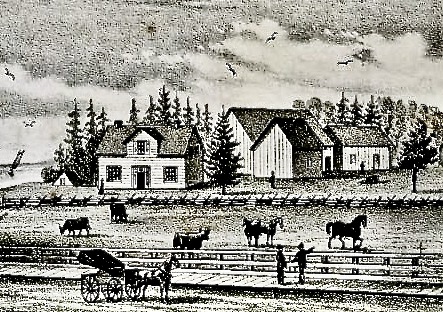
The inn was on the ocean side of North Rustico, near the entrance to the harbor, a white clapboard two-story house with a dozen windows, two dormers and three porches on the side facing the water. A broad lawn slopes down to the cliffs. It wasn’t always the Surfside Inn and isn’t the Surfside Inn anymore, having since taken up where it left off, back to being a home.

“The first house was bigger,” said Kelly Doyle.

Kelly’s grandparents, Mike and Loretta Doyle, were visiting and playing cards at a neighbor’s house one winter night in 1929. Their friends lived about a mile away. At the end of the evening, going home in their horse-drawn sled, they crested a frozen hill. A red glow lit up the sky and flared across the flat cove below them.

The house was being swallowed up by fire. The pitch-dark night was blazing. They had left seven children behind in the care of the eldest.

“It was a flue fire,” said Kelly. “It burnt down because of the stove.”

By the time the Doyle’s raced their sled down to the house, and finding all the children safe and sound outside, there wasn’t much they could do. There were no neighbors nearby to help and there was no fire department. Mike Doyle was able to drag some furniture from the first floor out the front door and saved as many fox furs as he could.

The house was rebuilt the next year and finished the following year.

“The foxes my grandfather saved built the new house.” Kelly’s grandfather was a fox farmer. What he sold the pelts for paid for the work of the itinerant immigrant tradesmen who built the house.

Furry garments are made of furry animal hides. Even though it has lately fallen on hard times, fur is one of the oldest forms of clothing. Once we started globe-trotting out of Africa, to where everywhere else was colder, we started wearing furs. Ever since, people have worn beaver racoon sable rabbit coyote wolf chinchilla opossum mink and foxes.

Mountain men wore the bears they shot and killed.

In the 1880s foxes were bred for the first time, accomplished on Prince Edward Island by locals Charlie Dalton and Robert Oulton. Theirs was the original fur farm in 1884. Within several years the rush was on. But the rush didn’t really and truly mushroom until after a pelt sale a few years later when their harvest of 25 skins brought them nearly $35 thousand dollars. It was a boat load of a barn door of money, bearing in mind that the average island farm worker those days made less than $30 dollars a month.

In 1926 nearly nine hundred live silver foxes were shipped from Summerside to the United States. It was the most valuable shipment in the history of Prince Edward Island up to that time and is still called the ‘Million Dollar Train’. Andy Doyle was born the same year, spunky and healthy, although nobody ever called him the ‘Million Dollar Baby’.

By the 1930s the fox farm industry was strong as a bull, raking in multi-millions of dollars. There were hundreds of thousands of foxes being farmed and skinned coast to coast throughout Canada and the United States.

“The furs my grandfather was able to rescue from the fire were worth five thousand. In the end the new house cost five thousand,” said Kelly.

“We stayed at a country inn, at the information center at the bridge they said it was nice, but it was a little room, yuk,” said Marie. She picked up the official PEI tourist book. Where to stay next? She thumbed through the book. She put her finger on Andy’s Surfside Inn. “I say to Louie, what’s that, the north shore? We had already decided to stay three or four more days. We went looking for it.”

Gavan Andrew “Andy” Doyle was 81 years old in 2007 when Marie and Louie went driving up and down the north shore looking for his eponymous inn. Andy had been born in the white house that was the inn. Years later, grown-up a young man, pushing off after World War Two, he landed in Montreal, married, brought up three stepchildren, and years later, when his wife Vivienne died, went back to Prince Edward Island.

His mother died shortly after and he inherited the house on Doyle’s Cove. “My aunt, his sister in Montreal, always had a soft spot for Gavan. She helped him get the place up and running. She bought a bunch of nice furniture for him,” said Kelly Doyle. It was the late 80s. Andy Doyle resurrected the Surfside Inn that had been his mother’s brainchild in the late 40’s.

“When my grandfather died in 1948, my grandmother wanted to make some money with the house and started taking in tourists,” said Kelly. “There was a white picket fence, she had ducks and geese and sheep in a big barnyard, and she kept a garden.” It was a large working garden. “She fed the bed and breakfasts herself.”

As her six girls and two boys grew up and left home, she converted their rooms to guest rooms.

“She filled those rooms all through the 50s and 60s,” said Kelly. “PEI wasn’t like the rest of the world back then. Tourists found the way of life interesting, honest and down-to-earth. There wasn’t much entertainment, but there was always lots to do. They just liked the place.”

When Marie telephoned the Surfside Inn, a Japanese woman answered the call.

“Andy always had Japanese girls, three girls, housekeepers for the season who were exchange students who wanted to learn English. They shared a small bedroom over the kitchen. She told us, yes, we have a room.”

Louie and Marie drove up and down Route 6 between Cavendish and North Rustico searching for the Surfside Inn. When they couldn’t find it, they finally stopped at a National Parks kiosk and got directions. It was in the park, although on private land, Doyle’s Land on Doyle’s Cove. They drove down the Gulf Shore Parkway, past Cape Turner and Orby Head, and down to the coastal inlet.

When they got there, there wasn’t a room. There were four rooms that shared a bath. They were all taken. What Marie and Louie didn’t know was that there was a fifth room on the ground floor, which was Andy’s bedroom with a private bath.

“When we are full, he gives you that room,” explained the young woman.

“We’ll take that,” said Marie. “Where does Andy go to sleep?”

“He sleeps in the boat.”

The Japanese girls did the heavy lifting in return for being able to learn English. “I don’t know where they learned it, but it wasn’t from Andy,” said Marie. “He never talked to them.”

Outside the house was a castaway wooden lobster boat. The hull and forward cabin were worthy enough, although it needed some planks and rib work. it looked like it still had some spirit to it, like it could still make a living at sea.

“It smelled bad, all old stuff papers tools junk a small bed,” said Marie. “It should have been burned long ago.”

The Surfside Inn had a kitchen with several refrigerators. “We thought it was just for breakfast, but we saw other people storing food and making supper.” They started shopping at Doiron’s Fish Market on the harbor road. One suppertime Andy saw them coming into the kitchen with lobsters.

“Let me fix those for you,” he said.

“Oh, my God,” said Marie, “he was good. Tack, tack, tack, all done.”

They started bringing their own wine from home, though.

“I don’t like PEI Liquor wines. We brought Italian and French whites and rose for the fish.”

Coming back from Doiron’s one day, putting away fresh cod wrapped in Kraft paper, Marie noticed small buckets of frozen milk in the freezer.

“There was a Muslim couple staying at Andy’s, the guy was always in the living room, but she was wrapped up, always going to the bedroom. She didn’t talk. At breakfast, no words. She looked at her iPad, that’s all.”

The mother was expressing her breast milk and storing it. She kept it in the back of the freezer, the coldest part of fridges. One day all the milk was gone.

“We never saw the baby, though, maybe it was somewhere else, with a grandma.”

“Tourists in the 50s and 60s weren’t from Monkton or Toronto,” said Kelly. “Some were from the States, but a lot of them were from Europe. We lived next door and ran around the yard, having fun, meeting people. In 1970 my grandmother got a little bit ill and couldn’t keep it going. She lived alone for seven years until my dad moved her into the senior citizen’s home in North Rustico.”

The white house was empty for about ten years, for most of the 80s. It came back to life as the rooms filled up. In summertime it was never vacant.

“You could see the sea right in front of you,” said Marie. “We sat on the porch every day. It was a special place. After a week we would say, let’s stay another day, then another day. Other people, too, were crazy about this place.”

One day Andy asked Louie to help him take an old heavy bicycle out of the lobster boat. “You’re a big guy, you can do it,” said Andy.

When the bike was on the ground Andy straddled it and pedaled to the downhill on the all-purpose path. “He was going down the hill, but Louie told me there were no brakes. Stop! Stop! I yelled but he yelled back, I’ve been riding this bike for thirty years!”

Whenever Andy pulled his four-door sedan out to run errands or go to the grocery, Marie and Louie kept their distance. “I don’t think there were any brakes on his car, either,” she said.

He seemed to own only three short-sleeve shirts. “I have three nice ones,” he said. “I got them for a dollar each at the Salvation Army.” One was yellow, one green and one blue. The blue shirt was his favorite. He dried all his laundry on an outside clothesline, in the sun and ocean breeze.

“All the guests, they were from Canada, the United States, Italy, England, all over. A Chinese couple had a four-year-old who had been born in Quebec, so they named him Denis. Whenever we saw a Chinese child after that we always called the child Denis Wong. There was a couple from Boston, they lived in the harbor on a boat there. He was 80 and she was in her 70s.”

“I didn’t come with my boat. I came with my girlfriend,” he said.

“There is no age,” said Marie. Until you find out your grade school class is running the town city province country.

Aging and its consequences usually happen step-by-step, sometimes without warning. One minute you’re only as old as you feel and the next minute you don’t feel good. It’s like going on a cruise. It can be smooth sailing or a shipwreck. Once you’re on board, though, there’s not much you can do about it.

“There were always many guests, but suddenly a few years ago Andy started getting mixed up. He forgot reservations, there were two Japanese girls instead of three, it wasn’t the same.” What it takes to make an inn work wasn’t getting done. By 2016 it was far more vacant than occupied and Marie and Louie were staying at Kelly Doyle’s Coastline Cottages up the hill across the street.

“Andy introduced us to him,” Marie said.

Like Dorothy said at the end of ‘The Marvelous Land of Oz’, “Everything has to come to an end, sometime.”

In 2018 Andy Doyle moved to the Garden Home in Charlottetown and his nephew Erik Brown took the house over, renovating it and transforming it into his home. In November Andy died. He was 92. It was the end of the Surfside Inn.

“On the ocean was wonderful,” said Marie. “Once we found it, Louie and I loved the Surfside.”

Ed Staskus posts stories on 147 Stanley Street http://www.147stanleystreet.com and Cleveland Ohio Daybook http://www.clevelandohiodaybook.com. To get the site’s monthly feature in your in-box click on “Follow.”

Rolling Up the Oilcloth

By Ed Staskus

   When Mary Smith picks up a fiddle, she’s got about twenty years of life with it behind her. When she picks up a guitar, she’s got about seventy years behind her. When she plays the mandolin, organ, or piano, it’s anybody’s guess.

   “We always had music at home,” she said. “My dad played mouth organ and step danced. When I was growing up there was no TV, so the thing to do was have house parties.”

   Home was the North Rustico lighthouse on the north-central shore of Prince Edward Island, and later a house her father, George Pineau, built up the road on Harbourview Drive. George and his wife Ruby rolled up the oilcloth on weekends. The kids were sent to bed.

   “They would have three or four couples come over, cook up a big feed of salt fish and potatoes, and play music,” said Mary. Her father would dance jigs and play ‘George’s Tune’ on his harmonica.

   “On winter nights it was the custom in villages for friends to collect in a kitchen and hold a ceilidh,” explained Joe Riley, who designs and installs kitchens in the surrounding area. “They sang old or new songs set to old music or new music composed in the manner of the old, and maybe a few lies would be shared among friends.”

    “We used to sneak down the stairs. I always wanted to be a part of it,” Mary said. “I thought, if I can get a guitar, and learn to play it, I could stay up and play for them. My dad wanted me to play a fiddle, but I wouldn’t bother with it. I kept asking for a guitar and eventually he ordered one.”

  It came from Sears, Roebuck & Co. It was a Gene Autry Round-up guitar. Gene Autry was a rodeo performer and crooner. He was “The Singing Cowboy” in the movies. His name was inscribed on the guitar. A cowboy riding herd and swinging a lariat above his head was stencil-painted on the front. She still has it, although it’s not part of her gear on the road.

   “I learned how to play a few chords.”

   Square dancing was popular in her neck of the woods, and even though there were several good fiddlers, there were no guitar players. As she became more accomplished on her Round-up, she began accompanying fiddlers at local dances.

   The North Rustico lighthouse was her home when she was a child. Although not many children are born at home, it was where she was born. She didn’t go far that first day, tired out by the move, and slept the rest of the day.

   Only about 1% of babies today are delivered outside of a hospital. Until the 20th century most women gave birth at home. When someone was ready to go, her friends and relatives and a midwife would help. As late as 1900 about half of all babies were still brought into the world by midwives. By the 1930s, however, after the advent of anesthesia, only one of ten were delivered by them.

   Not many were delivered by a neighbor, like Mary. “There was nobody else around. If you stayed home to have a baby, somebody had to help out.” 

   The lighthouse was built in 1876 on the North Rustico beach, a pyramidal white wooden tower and attached living space. Eight years later it was moved to the entrance of the harbor. George Pineau was the keeper of the lighthouse from 1925 until 1960, when the beam was automated.

   “My grandfather was lighthouse keeper for many years, and my father was the keeper for thirty four years. I lived in the lighthouse until I was eight years old.”

   Mary grew up on the harbor road, where she has moved back to and lives to this day, as a child running the mile-or-so up and down the road from one end to the other with her brother and sister. Fish factories canned lobster and salt fish, shipping it to the United States and West Indies. Fish peddlers loaded horse-drawn wagons and small trucks, selling cod, herring, and mackerel door-to-door.

   A three-story hotel stood on the rise across the street from the present-day Blue Mussel Café.

“My Aunt Angie bought it, tore it down, and built a house with the lumber. My dad was laid back, but his twin sister was a fiery person.” Her father was a fisherman, working hard, but enough of a go-with-the-flow man to be able to live to one hundred and three before he was laid to rest.

   In the summer Mary fished for smelt and sold them for a penny a dozen to tourists. When she had a pocketful of pennies she ran to the grocery store on Route 6. “You could buy a lot of candy for three or four cents.”

   There were two schools serving the community, one Protestant and one Catholic. “In them days the Protestant and Catholic relationship wasn’t great.” When the Stella Maris school in North Rustico burned down in the early 1950s, classes were organized in the church until the school was rebuilt.

   “I was in grade ten when I quit. You can’t quit now, but we went to work early back then.”

   Many secondary students dropped out of school. There were plenty of entry-level jobs in agriculture and the fisheries. As late as 1990 the dropout rate on Prince Edward Island was 20%. Today, it is 6%.

   She moved to Ontario, worked, came back to Prince Edward Island, met her husband-to-be, Al Smith, a Nova Scotian who was seasonal fishing out of the town harbor, and they got married when she was eighteen years old.

   When they had a son and made a home, at the far end of the harbor mouth, it was in North Rustico. “We had a deep-sea fishing business.” Fishing, along with farming and tourism, drive the economy on the island. Shellfish like mussels and lobsters are the mainstay. Mary kept house, raised their son, and lent a hand with the gear. She mended nets, repaired pots, and rafted trap muzzles. She mixed their own cement runners for weights to sink the pots.

   “The twine in the traps, what we called the hedge, we used to knit all those by hand. Nowadays they buy all the stuff.”

   She stayed on shore more often than not. She was prone to seasickness, a disturbance of the inner ear. It especially wreaks havoc with balance. Christopher Columbus and Lord Nelson both suffered from it.

   One day, just as that year’s fishing season was about to start, Al Smith’s hired man told him he was moving west in search of better prospects. He would have to look for another helpmate right away. “Well, Mary would never go because she gets seasick,” said one of their neighbors. That evening she told her husband, “I guess I’m going fishing in the spring.” 

   “Oh, God, it’ll be too hard for you,” Al said.

   “There’s no women fishing in Rustico, and they say I can’t do it, so I’m going to go,” said Mary said. She shortly became the fishing fleet’s first girl Friday.

   There are several ways of battling motion sickness. Cast off well-rested, well-nourished, and sober. Insert an ear plug in one ear. Keep your eyes on the horizon. Riding it out is sometimes the only remedy.

   “I couldn’t physically lift the traps, they were too heavy, but I could slide them. My husband would haul them up and push the trap to me. I would take the lobster out and rebait the trap, slide it down the washboard to the back with the movement of the boat, and kick it off. There was rope all over, so you had to watch where your feet were, because there’s fathoms of rope and it’s going over fast.

   “On a nice morning, going out to work, the sun coming up, we would look back and see the green and red of Prince Edward Island. It was beautiful. It was good work.”

   Al and Mary Smith fished together for four years. They fished for lobster, mackerel, cod, and tuna. “It took me four years to get over being seasick,” she said. A sure cure is sitting down under your own roof on dry land four years later.

   When her work on the water was done, she cast about for another kind of work.  

   “I always loved to draw,” she said. “So, when I wasn’t fishing anymore, and our son was grown up, I talked to my husband about it.”

   “Why don’t you take a course?” Al said.

   “Someday I’ll do that,” Mary daid

   Someday came sooner than later and she enrolled in a two-year commercial design course at Holland College in Charlottetown, the provincial capital. The community college is named after British Army surveyor Captain Samuel Holland, offers more than one hundred and fifty degree pathways, and more than 90% of its graduates find employment.

   Two years later, art degree in hand, she decided she wanted to teach art. She thought, I’ll go to the University of Prince Edward Island and get a teacher’s license. She went to see the Dean of Education at UPEI.

   “What education do you have?” asked Roy Campbell, who was the dean. 
   

   “I only have grade ten.”

   “Well,” he said.

   She had brought a long list of courses she was interested in taking. He looked at the list. “Well,” he said, “you should be realistic. I suggest you not take more than three courses at any one time.”

   “That was kind of insulting. He thinks I probably can’t even do three. I’ll show him. I’ll take six. Oh, my God, that was a mistake. It was a hectic time.”

    It got more hectic her second year, when she entered the world of higher level courses.

   “I took a course on Dante, which was really crazy. I’m never going to make it through this. I thought about it for a while and thought the only way I’m going to be able to pass this course is if I draw it. So that’s what I did.”

   She put her all into drawing the Circles of Hell. Her professor had never gotten a paper like that. “He was thrilled with it.” She got an A in the course.

   “I got my teacher’s license. I proved that I could do it.”

   She taught at a private art school in Summerside and lent a hand part-time at Rainbow Valley in nearby Cavendish during the summer season until, in 1990, her husband of thirty years tied an anchor around his neck and threw himself into the North Rustico Harbor waters.

   “He was a great guy. I decided to do a three-dimensional sculpture of Al as he was, as a fisherman.”

   At first, her plan was to make the commemorative sculpture in cement. “But then I thought, we had just gotten a new fiberglass boat, so I could do it in fiberglass.” It was an idea that would reinvent her from then until now.

   The boat was a Provincial, built by Provincial Boat and Marine Limited in Kensington, less than twenty miles west on the north coast. “Earl Davison had a fiberglass plant in Kensington and was producing great fiberglass boats.” They are known for their speed and durability. They are sometimes called “lifetime boats.” Mary went to Kensington to see Earl, who also owned and operated Rainbow Valley.

   “I went to see him, and I said, I’ve got something that I’d like to do in fiberglass, so he said, I’ll come down to look at it. He came down to the house this one day and looked at my plan. I got a call a few days later. He offered me a full-time job instead.” 

   “I need an artist,” Earl said.

   “Yeah, I’ll do that,” she said.   

   The sculpture of Al Smith got made and Mary went to work full-time at Rainbow Valley in Cavendish, a hop, skip, and a jump away from her home.

   She never left. She worked seven days a week, May through September, until the water safari adventure amusement park was purchased by Parks Canada in 2005. It has since been remade into Cavendish Grove and become conserved land with a network of walking trails.

   Rainbow Valley, named after Lucy Maud Montgomery’s 1919 book “Rainbow Valley,” was thirty six years’ worth of waterslides, animatronics, swan boats, a sea monster, a monorail, roller coaster, castles, suspension bridges, and a flying saucer gift shop. “We tried to add something new every year,” Earl said. “That was a rule.” The other rule-of-thumb was families with smiles plastered all over their faces.

   “The most important thing you could do for somebody was to have them all together as a family and help make memories,” said John Davison, Earl’s son who grew up running around the park and as a grown man worked there. “Some of the memories you hear are from people whose parents aren’t with them anymore. But they remember their visits to Rainbow Valley with their parents and those experiences last a lifetime.”

   Earl Davison had envisioned the park in 1965, buying and clearing an abandoned apple orchard and filling in a swamp, turning it into ponds. “We borrowed $7,500.00,” he said. “It seemed like an awful lot of money at the time.” When they opened in 1969 admission was  fifty cents. Children under five got in free. In 1979 he bought his partners out and eventually expanded the park to sixteen hectares. Most of the attractions were designed and fabricated by him and his crew. 

   “Rainbow Valley was a unique place to work, because Earl was so creative,” Mary said.

   “Mary had a talent,” Earl said. “She could see things, create things, draw, and she seemed to always be able to draw what I told her about.”

   He told her about rum running on the island, where there had been a total ban on alcohol from 1901 until 1948. Smugglers laid low off Cavendish in the Gulf of St. Lawrence, avoiding Coast Guard cutters, hiding kegs of hard liquor in the sand dunes and woods at night. When the kegs were empty fishermen often used them to salt mackerel in, the smells of rum and salt fish mixing it up.

   She sketched out what became an animated simulated dark ride about booze and bootleggers.

   “Mary designed it,” said Earl. “She did all the faces for the characters and helped dress them, too.”

   At the end, an animatronic man coming home with a keg of rum in a handcart tells his protesting wife it’s molasses. “Don’t you lie to me,” she says. He takes a step between his wife and his handcart. “I would never lie to you, my smuckins, and if this here’s rum, may lightning strike me right here where I stand.” Every day, morning, noon, and night, a thunderous crack of lightning struck him where he stood.

   In the early 1990s Mary approached Earl about mounting a music show. It became Fiddlers and Followers, which became the North Rustico Country Music Festival, which is still going strong. The music festival, staged over the course of a weekend every August at the town’s North Star Arena, concerts as well as workshops and jam sessions, brings together some of Atlantic Canada’s best-known down-home, old-time, country, bluegrass, island-fiddling, folk-inspired music makers.

   “We’ve never missed a year. We’re getting older, but I still get really pumped up about it.”

   Earl and the Rainbow Valley construction crew built a barn and a stage for Fiddlers and Followers, local talent was secured, and they fabricated a 24-foot fiddle to be a beacon at the front of the building.

   “Earl provided the opportunity for it to start. I designed the big fiddle.”

   “It was a giant fiddle,” Earl said. In the event, it might have been even more gigantic, given the chance. “We coulda gone higher. It was Mary’s fault. She drew it to be twenty four feet, so that’s what we did.” In 2017 the giant fiddle was moved to the New Brunswick front lawn of fiddle champions Ivan and Vivian Hicks.

   “Burns MacDonald and I did shows every day,” Mary said. 

   When she began playing with Burns MacDonald it was the first time in more than thirty years she played anywhere outside of home or at a house party.

   He was the piano player. “I would be in the shop painting, doing artwork, and somebody would say, you’ve got to go for the show.” She would drop everything, grab a guitar, and run to the stage. “I never got tired.” Pete Doiron was their fiddler at the evening shows. “He was one of the best on PEI.” They played together three times a day for twenty-minute stretches.

   The first time she heard Burns playing the piano she was working with her boss one floor down.

   “I have to go see who that is,” she told Earl.

   “I run upstairs, and it was this Burns MacDonald. I went over, stood by him, and we started talking. He never stopped playing while he was talking.”

   When she went back downstairs, she said to Earl, “You’ve got to hear this guy. He’s unreal.”

   Burns MacDonald got hired on the spot and started playing during intermissions of the Roaring 20s show then on stage. The next year he came from his home in Nova Scotia for the whole season, living in a trailer in the park. “He was there fourteen years steady,” said Mary. “Everybody was just blown away by him.”

   Shortly before his death Al Smith had gotten his wife a fiddle.

   “We were at a show in Charlottetown and the entertainer was a fiddler. I thought, gee, someday I’m going to learn how to play a fiddle.” Her husband thought it was a good idea and bought her one. But when her husband passed away, Mary put the fiddle back in its case and put it away.

   She took it out of its case after a bus tour she had organized to Cape Breton. Burns was the entertainer on the tour. “I said something about fiddles, and he said, you’ll never learn how to play the fiddle.” He might as well have thrown down the gauntlet as made a passing remark.

   “That wasn’t the thing to say to me,” Mary said. 

   Since dusting off the fiddle, and learning how to play it, she’s done well enough to receive the Tera Lynne Touesnard Memorial Award at the 2017 Maritime Fiddle Contest. “It was a humbling experience and one I really don’t deserve,” she said. “It’s a great honor, however, and one I’ll always cherish.” She has also been made a lifetime member of the PEI Fiddle Association.

   Mary came to the piano by misadventure.

   She had agreed to be a co-host during an on-air fundraiser for Make-A-Wish. After finishing her stint at the station, she went home, but kept track of the auction. She noticed a keyboard valued at more than a thousand dollars wasn’t attracting many bids. She decided to prime the pump.

   “I started bidding, figuring when it’s high enough, I’ll stop.” However, she got carried away. “I kept bidding. I thought, I can’t let them outbid me. Just as I put my last bid in, time ran out, and I ended up with the keyboard.” It cost her $800.00.

   “I couldn’t afford it, but it was a for a good cause,” she said. “When I got it home, I took my guitar, and since I knew the chords on it, I just figured them out on the piano. I have my own style.” Being self-made means doing things your own way, no matter how much teamwork is involved.

   When Mary Smith takes the stage at the North Star Arena, whether as one of the key organizers of the North Rustico Music Festival, or with guitar, fiddle, keyboards in hand, she is within sight of the lighthouse she was born in. There are sixty three lighthouses on Prince Edward Island. More than thirty of them are still active. The North Rustico harbor light is one of the operational ones, sending out five seconds of light every ten seconds.

   Lighthouses, like music makers, aren’t narrow-minded about who sees their light. “When you play, never mind who listens to you,” said the pianist Robert Schumann. They shine for all to see. Without a guidepost, steaming into a dark harbor would be a mistake. Without music to brighten the day, getting up in the morning might be a mistake.

   Music is in Mary’s bones. She plays with several groups, including Mary Smith and Friends, Touch of Country, and the Country Gentlemen. The North Rustico Choral Group, which performs for seniors, was her brainchild ten years ago. 

   “I see Mary’s performances at Sunday Night Shenanigans,” said Simona Neufeld, a local music buff and fun fan.

   “Music has been a big part of my life,” Mary said. “I’ve met so many great people, some really great friendships.” She plays in living rooms, at outdoor venues, and on motor coach day tours. She often plays at community centers.

   “Life would be pretty dull if you just sat at home and watched TV. I guess being born in a lighthouse, I have to be brighter. You have to keep going.”

Ed Staskus posts on 147 Stanley Street http://www.147stanleystreet.com and Made in Cleveland http://www.clevelandohiodaybook.com. To get the site’s monthly feature in your in-box click on “Follow.”

Katya in Asia Town

By Ed Staskus

   The Chinese started settling in the United States in the 18th century. Wherever whenever there were enough of them, they lived close to hand, building their own neighborhoods, appropriately called Chinatowns. There are more than 50 of them across the United States, including at least 16 in California alone.

   There are several of the towns within cities in New York City, the most famous one being in Manhattan. It’s the largest Chinatown in the country, spread out over 40 blocks and home to more than 150,000 Chinese-speaking residents.

   Cleveland, Ohio used to have a Chinatown, a colony at Rockwell Ave. near downtown. Immigrants settled in the area starting in the 1920s. After the Communist takeover of the mainland and into the 1960s more than 2,000 lived in the neighborhood. There was a row of Chinese restaurants, among them the Three Sisters, Golden Coin, and Shanghai, as well as two grocery stores between East 21st and East 24th. Storehouses in the district supplied native eateries one end of the city to the other. There was a temple and a meeting hall.

   Chinatown went into sharp decline in the early 1970s and a few years later, when I moved into what was becoming Asia Town, there wasn’t much left. Most of the residents moved to the suburbs and by the 1980s there were only two half-empty restaurants holding on, catering mostly to business folk and occasional tourists looking for the city’s historic Chinese quarter.

   Asia Town is roughly from East 18th St. to East 40th St. and from St. Clair Ave. to Perkins Ave. It has the highest percentage of Chinese, Koreans, and Vietnamese in Ohio. When I lived on East 34th St. between Payne Avenue and Superior Ave. in the mid to late 70s, there weren’t as many yellow faces yet but they were everywhere. There were dirt poor whites, dirt poor blacks, and a recent influx of college students. It wasn’t as present-day as it would become after the 1990s when Asia Plaza was built at East 30th St. and Payne Ave., when it became a business as well as a residential community.

   My roommate Carl Poston was tall, walked with a lanky slouch, and wore a mop of twisty black hair. Everybody called him Erby. He never said why, and I never asked. He liked to read, tearing through the Plain Dealer newspaper every morning, and liked to play chess, like me, but was better than me. He had a bad-ass motorcycle and several bad-ass friends with motorcycles. He worked downtown for the city helping crunch numbers and delivering bad news as Cleveland went under.

   In 1978 the city became the first one in the United States to go bust since the Great Depression. After the bankruptcy it became known as the Mistake on the Lake, a nickname nobody in the hometown liked. When Mayor George Voinovich showed up at a Cleveland Indians game against the New York Yankees in the 1980s wearing a t-shirt under his sports coat, the t-shirt said, “New York’s the Big Apple, but Cleveland’s a Plum.” Only the Asians liked the plum thing, since plums represent purity and perseverance to them. Nicknames come and go but when Cleveland later became ‘The Land,’ nobody shook their heads in despair. It was far better than the mistake and the plum.

   Our house on East 34th St. was behind another house. There was no backyard or garage. Almost all the houses on the west side of the street were that way. The houses across the street had backyards and most of the houses in the neighborhood had backyards. But there were some houses so tucked away one had to be looking right at them to see them. Our rent was more than reasonable, and my half was even better. The landlord lived in Strongsville. His grandmother lived in Asia Town, like me. In return for checking up on her at the beginning of the week and taking her to Dave’s Grocery at the end of the week, I lived almost rent-free.

   Her name was Katya, and she was hundreds of years old. She was five foot four something short and hunchbacked on top of that. She was always in her kitchen when I knocked on the side door, she always croaked “Come in, honey,” and when I went in, she always asked me what I wanted.

   She had three cats who I never saw. She kept a pan of water next to the door for them but no food bowls or litter. They were freeloaders, running down grub in the wild. She had a stack of old newspapers in a corner and the linoleum kitchen floor was usually covered with them. It was sketchy walking inside. The unfolded papers piled haphazardly on top of each other slid every which way. I had to walk like a duck to stay upright.

   “I keep my kitchen floor clean that way.” she said, peeling back the corner of a newspaper and showing me.

   She bought her clothes from third hand stores but bought her shoes new. She was crazy frugal, but she wasn’t crazy. She was built to last, and her feet had to lead the way.

   Katya was from Slovenia, from sometime back in the 19th century. Her parents were peasants from a village nobody ever heard of southeast of Ljublijana. They came to Cleveland to work in the steel mills in the 1890s. At first, they lived in Newburgh, but when a community started forming along East 30th St., from Lake Erie south to Superior Ave., they moved, finally landing on East 38th St. She still lived in the small house her parents bequeathed her.

   By 1910 there were so many Slovenes in Cleveland that it would have been the third-largest Slovenian city in the world if it was in Slovenia. The immigrants opened enough taverns to drown their New World blues and enough churches to repent their drinking. St Vitus was established in 1893, St. Lawrence in 1901, and St. Mary in 1906. Each had its own school. They published their own newspapers in their mother tongue and formed debating drama and singing clubs.

   The singing clubs were stamping grounds, as well. The Lira Singing Society, located in the St. Clair neighborhood, and adamantly Catholic, was opposed by the Zaria Singing Society, sponsored by atheists and socialists. Everybody knew what the arguments were about.

   Katya was married long enough to have two sons before her husband was shot by mistake by a policeman outside a Collinwood bank during a botched robbery. He bled to death before an ambulance could reach him. She buried him in Woodlawn Cemetery, never married again, raising her sons by herself. She took in sewing days and worked nights during World War Two. Her oldest son moved to Seattle and she never saw him again. Her younger son moved to the west side and had a family, but they didn’t want to visit her.

   “We aren’t going to your crazy grandmother’s house in that terrible neighborhood, and that’s final,” his wife said. What the woman didn’t know was that Katya kept a loaded Colt Pocket Hammerless in her kitchen table drawer. It was a single action blowback .32 caliber handgun.

   “Nobody going to shoot me by accident,” she said.

   Her eldest grandson loved her and made sure she had what she needed to stay afloat. She had a small pension and some social security, too. She told me she had silver dollars buried in the backyard, but quickly shot me a wily look.

   “Forget I say that.”

   When Katya’s husband Janez was buried in Woodlawn, it was the oldest cemetery in Cleveland, the first man being inhumed there in 1853. It was the worst cemetery in Cleveland, too. The Depression wrecked its finances. There were sunken graves, toppled headstones, grass never mowed, piles of rotting leaves, and broken tree branches all over the place. That was before the city found out Louise Dewald, who worked in the finance office, had stolen almost half a million in today’s dollars from the coffers as the Depression picked up steam.

   After that it got worse.

   The cemetery chapel roof and the rest of it collapsed in 1951 and was hauled away. The next year City Council thought about digging up and moving all the bodies somewhere else, but the public outcry was too great. Katya never stopped visiting Janez, no matter what, no matter what it took to get there. 

   One Friday walking her home from Dave’s Grocery she asked me if I could take her to the Slovenian National Home the next afternoon for a luncheon. 

   “I don’t have a car anymore, Katya, sorry.” My 1962 Rambler Custom Six, that I had gotten for free, was no more. When I got it, the car was already on its last legs. It was now rusting peacefully away in a junk lot somewhere up on Carnegie Ave.

   “Oh,” she said. “Maybe you walk with me there?”

   “It’s pretty far,” I said. I didn’t mention taking a bus. She distrusted the metropolitan buses getting to where they were going, ever since the city’s rail tracks had been torn up and the electric cars replaced with diesel transport. She believed half the drivers were addled from the fumes.

   The Home was almost thirty blocks away on East 64th St. and St. Clair Ave. At the rate she walked we would have to start as we spoke. After the luncheon we would have to walk the whole night to get back.

   “Oh, that too bad. Janez and I dance there all the time before he die.”

   “Let me see what I can do.”

   I asked my roommate Carl, in return for my washing the dishes, cleaning the house, and mowing our grave-sized plot of grass, if he would take her there and back.

   “It’s a deal,” he said.

   The next day he schlepped her to the Slovenian Home on his Harley, waiting outside smoking cigarettes and shooting the bull with passersby. She was a big hit with her cronies when they spilled outside after the gabbing and feedbag and saw her climb on the back of the hog, wrap her stumpy arms around Carl’s waist, and glide away.

   The Slovenian Home was where my Baltic kinsmen booked their big wedding receptions and celebrations. The Lithuanian Hall on Superior Ave. was too small in the 1960s and the new Community Center in North Collinwood wasn’t built yet. The Home opened in 1924, with two auditoriums, a stage, bar restaurant kitchen, meeting rooms, a gym, and a Slovenian National Library.

   The main auditorium was plenty big enough for any get together and the stage was plenty big enough for any band. The bar was big enough for even Lithuanians. Europeans drink more alcohol than anybody else in the world and Lithuanians are number one in Europe. Whenever I accompanied my parents to the Slovenian Home for a reception or gala, it was always a long night. There was a big dinner at big round tables, speeches, chatting it up, dancing, drinking, and as the drinking went on, singing. My father and his friends would booze it up well into one and two in the morning, singing “In the Sea of Palanga” and “The Old Roofs of Vilnius” and “Oh, Don’t Cry, Beloved Mother.”

   By then I was snoozing sprawled out in the balcony.

   Unlike our no backyard house Katya had a backyard where she grew Brussels sprouts cauliflower broccoli onions potatoes and anything else she could squeeze in. She liked prosciutto and bread for lunch. Sundays she made loads of yota with turnips beans cabbage and potatoes and a slab of meat loaf with hardboiled eggs in the middle. She kept it in the fridge all week, dinner at her beck and call.

   That fall I had to tell Katya that once the school quarter at Cleveland State University was over, I was going to have to take the next quarter off. I had found a job with an electrostatic painting outfit that was going to send me on the road, expenses like food and motels paid, for a couple of months. We were going to start in Chicago, swing out to the west coast, end up in Texas, and be back in time for the spring quarter at CSU. It was chance for me to earn good money and save almost all of it.

   “I going to miss you,” she said.

   We traveled in three-man crews and worked nights, from about 5:30 to about 1 in the morning. We worked in offices, painting office furniture like metal filing cabinets, desks, bookcases, and storage cabinets. The paint was loaded with a low voltage positive charge and the metal items magnetized negative. The finish was like new, no runs, no brush or roller marks, and there was almost no overspray.

   When I got back from my two-and-a-half months on the road, I picked up my cat Mr. Moto from my parents, did my laundry, and registered for classes for the spring quarter at CSU. I went to visit Katya that evening, but she wasn’t there anymore. The house was vacant. A “For Sale” sign was posted. I asked one of the neighbors, but he said he didn’t know much, just that a moving truck pulled up one morning and by the end of the day she was gone.

   I peeked through the windows. The ground floor rooms were all empty. The only thing left was a stack of old newspapers in a corner of the kitchen.

Ed Staskus posts stories on 147 Stanley Street http://www.147stanleystreet.com and Cleveland Ohio Daybook http://www.clevelandohiodaybook.com. To get the site’s monthly feature in your in-box click on “Follow.”

Front Row Seat

By Ed Staskus

   The documentary “Night and Fog” is 32 minutes long, unless it’s watched thirty times in a row, which makes it 16 hours long. I was studying literature and film at Cleveland State University in the late 1970s when I saw it for the first time and the thirtieth time. It had been made twenty years earlier by the French filmmakers Jean Cayrol and Alain Resnais. It is about the Nazi concentration camps of the 1940s, specifically Majdanek and Auschwitz. It is a monster movie without the pretend.

   The reason I watched “Night and Fog” thirty times successively by myself in a small dim room wasn’t because I was especially interested in World War Two or the Holocaust. In fact, the documentary spooked the hell out of me. Dennis Giles, the one and only professor of film in the Communications Department at Cleveland State University, had suggested I write a paper about it. He made me a teacher’s assistant so I could have a closet-sized office on the 16th floor of Rhodes Tower down the hall from his office. In return, I screened motion pictures for his film classes, which was hardly a chore. The rest of the time, which was most of the time, was my own. 

   Nazi Germany and its Axis allies built thousands of concentration camps and other incarceration and extermination sites between 1933 and 1945. They stayed busy as killer bees. Majdanek was outside Lublin, Poland and run by the SS. The SS were the black-uniformed and self-described “political soldiers” of the Nazi Party. There were many gallows and seven gas chambers. Auschwitz was also in Poland, a complex of forty camps. It was run by the SS, too. It had more gallows and more gas chambers. The camps were what the Nazis called the “Final Solution to the Jewish Question.” They asked themselves the question and dreamed up the answer among themselves. The camps were also the solution about what to do with gypsies, homosexuals, Russian prisoners, and anybody else who got in the way of the Third Reich.

   Between 1942 and 1944 freight trains delivered millions of people to the camps. They were manhandled, beaten, and tortured. Some of them died of exhaustion, starvation, and disease. Others were subjected to deadly medical experiments. A quarter million people were exterminated at Majdanek. Auschwitz operated on a more industrial scale. More than a million people were exterminated there.

   My teacher’s assistant office was no-frills cinderblock, like the grind houses of the 1960s and 70s, which were old movie houses in bad neighborhoods showing low-budget horror movies. I was given access to a 16mm projector and a spotless copy of the documentary. It was the only thing clean about it. If the Nazis thought they were cleaning up the world, they had a dirty way of doing it. There was a method to their madness, but it was madness, nevertheless.

   Dennis Giles graduated from the University of Texas with a master’s degree. His thesis was “The End of Cinema.” He got a Ph.D. from Northwestern University and then showed up in Cleveland. He was tall, thin, lanky, dressed like a beatnik, and smoked like a chimney. He lived in Ohio City near the West Side Market. The neighborhood was a mess, but in the past ten years the Ohio City Redevelopment Association had gotten more than a hundred structures restored or redeveloped. Houses were being refurbished by the young upper middle-class, proto Yuppies, leading to complaints of gentrification. 

   If Dennis Giles was part of the gentrification, he didn’t look the part. He looked scruffy as a beatnik. He looked like he had spent too much time watching movies by himself. He was a member of the National Film Society. He liked to say film was art and television was furniture. He didn’t mean the furniture was any good, either.

   It took me a few days to figure out how to tackle the project. I finally decided to do a shot-by-shot analysis, zeroing in on how the shots were the brick and mortar of the scenes and sequences. I reasoned that if I tried writing about the gruesome nature of the subject, I would never get out of the weeds.

   The film goes back and forth between past and present, between black-and-white and color, with some of it shot by the filmmakers and some of it stock footage. The first shot is of a deadpan sky. The camera tracks downwards to a dreary landscape. It then tracks to the right and stops on strands of barbed wire. The second shot is of a field with a line of trees on the horizon. “An ordinary field with crows flying over it,” the narrator says. But it’s not an ordinary field. The camera again tracks to the right revealing posts with more barbed wire strung from post to post. The wire is electrified. The third shot tracks from an open road once more to the right to another tangle of more wire.

   After a while the tracking shots to the right and the wire everywhere start to look like a normal landscape. “An ordinary village, a church steeple, and a fairground. This is the way to a concentration camp,” the narrator says. When he says “steeple” the shot on screen is of an observation tower, machine guns at the ready.   

   The city of Siaulai is in the north of Lithuania, which is north of Poland. It is home to the Hill of Crosses. It is place of pilgrimage, established in the 19th century as a symbol of resistance to Russian rule. There are more than 100,000 big and small crosses on the hill. During World War Two almost every single Jew who lived in Siaulai bore his own cross. Most of the natives didn’t worry about them. They had more than enough of their own problems to worry about, squeezed between the Nazis and the Communists.

   My father was born in the mid-1920s and grew up in Siailiai. His father was the police chief who was swept up by the Russians in 1941 and deported to a Siberian labor camp for ideological reasons. He never stood a chance. He died of starvation the next year. My father was in his mid-teens. He had to take over the family farm. When the Germans invaded, capturing and imprisoning vast numbers of Red Army troops, he applied for and was granted labor rights to a dozen of them. There were severe manpower shortages. The Russians worked 12-hour days and slept in the barn. When they groused about the work, he passed out Bulgarian cigarettes and bottles of vodka. When they escaped, the Germans gave him more men and told him to lock the barn doors.

   The first part of “Night and Fog” is about the rise of fascist ideology in Germany. The second part contrasts the good life of loyal Germans to the travails of the concentration camp prisoners.  The third part details the sadism of the captors. The fourth part, all in black-and-white, is about gas chambers and piles of bodies. It is nothing if not dreadful. Even the living are bags of bones in their dingy barracks. The Nazis shaved everybody’s heads before they gassed them. They said it was for lice prevention and that the gas chambers were showers. They collected and saved the hair. It was used to make textiles at factories in occupied Poland. The last part is about the liberation of the camps and the bearing of responsibility.

   Everybody, even the next-door neighbors, said they didn’t know anything about the camps, or if they did, were just following orders. “We SS men were not supposed to think about these things,” said Rudolf Hoss, the commandant at Auschwitz. “We were all trained to obey orders without even thinking, so that the thought of disobeying an order would simply never have occurred to anybody, and somebody else would have done it just as well if I hadn’t. I never gave much thought to whether it was wrong. It just seemed a necessity.”

   The next shots of the film are of the rail lines to the camps and their gates. “All those caught, wrongly arrested, or simply unlucky make their way towards the camps,” the narrator says. “They are gates which no one will enter more than once.” The train tickets were all one-way. There was a 16-foot wide sign above the entrance gate to Auschwitz that said, “Work Makes One Free.” It didn’t say what kind of work.

   After World War Two started and the Nazis incorporated the Baltics into the Reich Ostland, there were about 240,000 Jews in Lithuania, about 10% of the population. The first thing the Einsatzgruppen did was start gunning them down in the countryside, aided by Lithuanian auxiliaries. By August 1941 most of them were dead or gone to ground. Then the SS killers started in the cities. There wasn’t a lot of search-and-destroy involved, so the grim business didn’t take long. 

   “Gangs of Lithuanians roamed the streets of Vilnius looking for Jews with beards to arrest,” said Efraim Zuroff, who didn’t wear a beard but whose wife and two sons were taken to Likiskis Prison and shot. Karl Jaeger, the commander of an Einsatzgruppen unit that did its work in Vilnius, kept an account book of their work. On September 1, 1941, he recorded those recently killed as “1,404 Jewish children, 1,763 Jews, 1,812 Jewesses, 109 mentally sick people, and one German woman who was married to a Jew.” When the war finally ended there were only 10,000-some Jews left in Lithuania, slightly more than 0% of the population. It was the largest-ever loss of life of any group in that short a period in the history of the country.

   The middle shots and scenes of the film are without narration. They show crowds of disheveled people being strong-armed into boxcars. The last shot is of a father leading his three children along a railroad platform. The father looks resigned and the children look bewildered. They are shoved into a boxcar. “Anonymous trains, their doors well-locked, a hundred deportees to every wagon,” the narrator says. “Neither night nor day, only hunger, thirst, and madness.”

   The Nazis occupied Siauliai in 1941. All the Jews were made to wear a yellow Star of David on their chests. Their children were forbidden to go to school. Their businesses were taken away from them. At the end of summer, the Einsatzgruppen and Lithuanian auxiliaries rounded up more than a thousand Jews, took them to a forest, ordered them to strip, and shot them down like dogs. They shoved their naked bodies into open pits. When the shooters left, they took all the watches, jewelry, wallets, and purses with them. “Today the sun shines,” the narrator says in the 70th shot of the film, tracking through the sunlit trees. “Go slowly along, looking for what? Traces of the bodies that fell to the ground?”

   The rest of the town’s Jews were made to move into a ghetto. Two years later two thousand adults and a thousand children were transported to Auschwitz and gassed. The next year the few of them left were sent to the Stutthof concentration camp. That finished off the Jews in Siauliai, once and for all.

   Nearing the end of the film the narrator asks, “How discover what remains of the reality of those camps, shrill with cries, alive with fleas, nights of chattering teeth, when they were despised by those who made them and eluded those who suffered there?” One of the last shots is of a macerated man lying on his side on the ground and drinking something from a bowl. “The deportee returns to the obsession of his life and dreams, food.” The next shot is of a dead man, legs akimbo in the mud, ignored by those around him. “Many are too weak to defend their ration against thieves and blows. They wait for the mud or snow. To lie down somewhere, anywhere, and die one’s own death.”

   My father fled Siauliai for East Prussia when the Red Army swarmed the country in 1944. His two sisters and mother were already on the run. One of his sisters made it to Germany, the other sister didn’t, going into hiding, while his mother was arrested and sent to Siberia, where she remained for the next ten years. Even though he fled with almost nothing except a handful of cash, a few family photographs, and a change of clothes, he had nothing to lose. The Russians would have shot him on the spot if they had captured him.

   Like most Lithuanians my father had no use for Jews. He never had a good word to say about them. He never let on to me, and never talked about went on in Siauliai, except as it related to his family, but I caught enough snatches of talk at parties, community events, and get-togethers to know what the score was. My father wasn’t a bad man, just like most Lithuanians weren’t bad men and women. He wasn’t any different than most people. He worked hard to support his family, community, and country. He was a Boy Scout leader and helped get the local church and parochial school built.

   The film ends with aerial shots of Auschwitz. It is 1945. The war is almost over. “There is no coal for the incinerators The camp streets are strewn with corpses.” One of the last sequences shows captured Nazi soldiers lined up by Allied forces outside a concentration camp. All of them look sullen and demoralized. Many of the soldiers are women. They carry rail thin corpses slung over their shoulders, throwing them into a pit, and going back for more. You never realize how thick the murk is until it lifts. Prisoners barely alive but suddenly free stand next to useless strands of rusting barbed wire. 

   In a Nuremberg courtroom one after another Nazi official says he was not responsible. “Who is responsible then?” the narrator asks. The Master Race all look like somebody’s bland Uncle Ernie. Nobody responsible says anything, although many at least were convicted of war crimes and hung. They should have been broken on the wheel and quartered for their evil deeds.

   Short of cannibalism, what the Nazis did to those they herded into their concentration camps was the worst thing they could have done. After I finished my thirtieth viewing of every shot, scene, and sequence in the film, I wrote my paper and turned it in. I got an A- for misspelling some words. I got to keep my cubbyhole. I knew I wouldn’t watch the documentary ever again. 

   One groundhog day after another had gotten me down in the dumps. Enough was enough. I returned my print of “Night and Fog” to the university library. I caught my breath and went for a walk in the brimming light of day.

A version of this story appeared in Literary Heist Magazine.

Ed Staskus posts on 147 Stanley Street http://www.147stanleystreet.com and Made in Cleveland http://www.clevelandohiodaybook.com. To get the site’s monthly feature in your in-box click on “Follow.”

Sledgehammer Hill

By Ed Staskus

   The weekend my mother-in-law Terese and her husband Dick moved out of Reserve Square in downtown Cleveland, they moved out of twin Brutalist inspired apartment towers into a turn of the century house. They had lived in their apartment for more than twenty years, on the 17th floor facing Lake Erie. During the National Air Shows flying out of Burke Lakefront Airport they sat on their balcony and watched the Blue Angels streak past like roadrunners on the loose.

   There’s nothing like the sound of F/A-18 Hornets roaring a few hundred feet overhead and veering away at the last second from skyscrapers dead ahead. They are jets able to perform high angle of attack tail sitting maneuvers and can fly formation loops dirty, their landing gear down. The sound of silence once they’re gone is deafening.

   Terese and Dick bought an abundance of a house with four bedrooms and three bathrooms on the corner of East 73rd St. and Chester Ave., in the blighted Hough neighborhood, ten minutes from downtown. It was built in 1910 in the colonial style. When they got done restoring it, they had added an attached garage, put on a new roof, installed new vinyl windows and siding, a new interior staircase, and a new kitchen. It went from ghetto to gentrified as fast as the contractors could make it happen.

   Almost 100% of the people living in Hough in 1999 were black. Only 2% of them were white. Terese was Lithuanian and Dick was Italian. They were part of the 2%. She was from Cleveland. He was from Rochester. Everybody and their uncle tried to talk them out of buying the house. The racial make-up of the neighborhood was the stumbling block of all their opinions. The color barrier, however, was not a stumbling block to Terese.

   Terese was a self-taught chef who owned four restaurants in her time and made herself into one of the city’s top-notch confectioners. The opera star Luciano Pavarotti searched her out and pigged out on her cookies and cakes whenever he was in Cleveland. “That man can eat,” she said. When he was done eating he was good and ready for an aria.

   Her signature creation was a 17-layer cake based on a recipe that Napoleon brought to Lithuania during his ill-fated Russian campaign. Terese, Dick, my wife, brother-in-law, and I helped make them Novembers and Decembers, working out of her kitchen, freezing them, and selling them during the holidays through the Neiman Marcus catalog. I went home most nights needing to shower clouds of flour off me. 

   Terese and Dick bought the house in Hough because she had grown up nearby, when the neighborhood was more white than not, and wanted to go home again. It wasn’t the same, but she saw what she wanted to see. She remembered the neighborhood from her childhood and made the reality fit her memory. She had a streak of magic realism running through her.

   My wife and I lived in Lakewood. I had a red Schwinn mountain bike that I frequently rode in the Rocky River Metropark, on the paved trail, the horse trails, and the single tracks. I rode downtown sometimes, winding my way through Ohio City and across the Hope Memorial Bridge, especially on weekends when all the bankers, lawyers, and city workers were at home. I usually rode the Hope Bridge over the Flats so I could see the Guardians.

   The 6,000-foot-long art deco truss bridge crosses the Cuyahoga River. Four pairs of immense stone statues officially named the “Guardians of Traffic” are sculpted onto opposite-facing pylons at each end. Each of the Guardians holds a different vehicle in its hands, a hay wagon, a covered wagon, a stagecoach, a 1930s-era automobile, and four different kinds of trucks. I always crossed an index and middle finger while going by in hopes of keeping traffic away from me.

   I got it into my head that I wanted to ride around on the east side of town, through Cleveland Heights and Shaker Heights. I thought about East Cleveland but thought better of it. The city had gone to hell in a handbasket. I asked Terese if I could park my car in their driveway while I rode. She said yes but cautioned me to bring my rear-mounted rack into the garage. Law and order was sketchy in her neighborhood. When I had stored the rack away she invited me into the kitchen to snack on  croissants fresh out of the oven.

   She was in the middle of two projects. One was chocolate-covered plastic spoons that turned into a steaming drink when hot water was added. There were rows of the spoons on baking trays. The other project she was working on was perfecting a handy self-serve pan to make the dry, hard-textured Italian cookies called biscotti. I preferred croissants fresh out of the oven.

   Whenever I had ridden downtown with friends and wanted to push ahead into Cedar and Fairfax, what my friends called the black hole, they always turned back. “I don’t want my husband getting killed by some spade,” one of their wives told me. I didn’t bother trying to explain that hot under the collar rednecks driving pick-ups were far more dangerous. It wouldn’t have done any good.

   I rode up the hill to Little Italy and Lake View Cemetery. The riding was twisty throughout the graveyard. I couldn’t see the lake, no matter what. I stopped at the Garfield Monument. President Garfield was shot four months into his term of office and died two months later from infections caused by his medical staff. He was determined to live but stood no chance against his White House doctors. The shooter was hung the next summer. On the gallows he recited a poem he had written called “I Am Going to the Lordy.” He signaled he was ready for his fate by dropping the paper it was written on. The hangman kicked the paper aside and didn’t screw around securing the noose.

   There are thousands of trees and 100,000 graves in the 280-acre cemetery, from nobodies to moguls. One of the most striking grave markers is the life-sized bronze statue called The Angel of Death Victorious but known as Haserot’s Angel. The statue is seated on the gravestone of Francis Haserot, holding an extinguished torch upside-down. The man made his fortune canning foodstuffs and importing tea and coffee. 

   The angel’s wings are outstretched and looks like it is crying black tears. “They formed over time,” Terese told me. “It’s an effect of the aging bronze.” She had taken drawing and painting classes at the Cleveland Institute of Art. I took her word for it.

   I rode Fairmount Blvd. to Shaker Hts. and bicycled around the Nature Center at Shaker Lakes. The green space was created in 1966 to stop the Clark Freeway from going in. Those behind the effort called themselves ‘Freeway Fighters.’ Cuyahoga County Engineer Albert Porter called the Shaker Lakes a “two-bit duck pond” and vowed that the highway would get built come hell or high water. The highway never got built, regardless.

   The twenty acres of the Nature Center has eight mapped natural habitats, four gardens for native plants and insects, and two trails. I rode the trails and tried not to squash any insects. I wheeled out on the 7-mile long Shaker Blvd. to Beachwood and back. Shaker Hts. was built by Oris and Mantis Van Swerington, early 20thcentury developers. They modeled the suburb and the boulevard after examples of English Garden City planning. They laid rapid transit rail service down the middle of the boulevard. Broad tree-shaded lawns front the mansions on either side of the road. One of my cousins and her husband lived in one of the mansions, but I was crusty from sweat and didn’t stop to visit.

   The best thing about riding up Mayfield Rd. to the cemetery was riding down Mayfield Rd. from the cemetery. It was a long enough stretch that I could go as fast as I wanted, although I feathered the brakes all the way down. I didn’t want to end up laid out next to President Garfield.

   Terese always let me wash up when I got back to her house, made me a cup of coffee, and put something tasty she had baked on a plate. She had never gone to cooking school, instead learning her craft by getting the cooking done. Everything she made was as good as the cookbooks said it was supposed to be. In her time she had been the pastry chef at Max’s Deli in Rocky River and Gallucci’s Italian Foods in Cleveland.

   One weekend I rode my tricked-out Schwinn, which was equipped with front shock absorbers and disc brakes, and went looking for Sledgehammer Hill in Forest Hills Park. The city park is lodged between East Cleveland and Coventry Village. The sloping land rises to a plateau. It was where John D. Rockefeller’s private summer estate was in the 19th century. He could afford it because his estimated net worth was equivalent to 1.5% of America’s GDP at the time. He was and still is the richest man in American business and economic history.

   There were lakes and bridle trails. There was a racetrack and a golf course. Before John D. Rockefeller died the property went to his son, John, Jr., who transferred one third of it to Cleveland Hts. and two thirds to East Cleveland. His only stipulation was the land be used for recreation and nothing else. The new park opened in 1942. It was about half forest and half meadow. It has been improved over the years, with tennis courts, a swimming pool, picnic areas, as well as basketball courts, football fields, and baseball diamonds.

   When I was growing up we hardly ever went there summers, but went there many times in the winter. We lived at East 128th St. and St. Clair Ave. and getting there was no trouble. We went ice skating on the man-made lagoon and sledding down Sledgehammer Hill. That wasn’t its official name, if it even had one. It was what all of us called it because of the killer bump near the bottom.

   Skating was loads of fun. There was a boat house on the man-made lagoon. It was where we changed into skates. My father had taught us to skate growing up in Sudbury, Ontario. The mining town is north of the Georgian Bay and south of Wanapitei Lake. He would spray our front yard with a hose in the winter and the water froze hard as concrete in no time. When we moved to Cleveland in the late 1950s we took our skates with us. Neither my brother, sister, nor I were big leaguers on the ice, but we skated like dervishes, living it up as we tried to toe loop and pirouette.

   Sledgehammer Hill was a hill that started at the top of the plateau and ran down a wide treeless slope. When I went looking for it my memory of it was that it was long, fast, and deadly. I didn’t give my memory much credence, though, believing it must have really been short, slow, and safe. You never know when you’re making up the past.

   When I found it, thinking that I would ride down on my Schwinn, I was startled by what I saw. I backed away from the lip of the hill and got off my bike. I walked back to the edge and looked down. It looked even longer and more dangerous than I remembered. I saw the bump near the faraway bottom and remembered hitting it, going airborne, and landing like Godzilla had body-slammed me. Many kids veered away from the bump. None of us ever blamed them. We had all done the same thing one time or another. Only the innocent went over the bump full-bore the first time and lived.

   I don’t know how fast our sleds went, maybe 20 or 25 MPH, but they went fast as hell. We didn’t wear helmets. We wore knit caps. You were considered a sissy if you wore earmuffs. I started wearing earmuffs after one icy winter weekend my ears froze and almost fell off. Insults were easier to bear than frostbite.

   Our parents always went skating with us or watched from a bench, in case the ice started to  crack, but when we went sledding, they dropped us off and went on their way. My sister rarely sledded, my brother sometimes did, but I couldn’t get enough of it. We rode Speedaways, Yankee Clippers, and Flexible Flyers. Only the foolhardy among us rode Sno Wing Blazons. They were too fast for Sledgehammer Hill. Most of us wanted to go as fast as possible but not necessarily break our necks. We sledded until it started to get dark and our parents came back to pick us up. 

   I didn’t take a chance going down the hill on my Schwinn. I rode away from Sledgehammer Hill, roaming around the park plateau instead, taking in the highlights of the past. I rode to the north end of the hill where John D. Rockefeller’s mansion had stood. It burned to the ground under unexplained circumstances in 1917.

   It was early in the evening by the time I pedaled back to Terese’s house. After I told her about the hill she stepped into the middle of her kitchen, pretending to be standing on a snowboard, balancing with her arms stretched out, and racing to the bottom. 

   She had performed professionally as a ballet dancer when she was younger and taught the fine points of footwork to Cleveland’s Lithuanian folk dancing groups. I applauded her performance when she was done, but if she had tried that stunt on Sledgehammer Hill, professional dancer or not, she would have gone flying headfirst when she hit the killer bump, and there wouldn’t have been enough croissants in her kitchen to break her fall.

Ed Staskus posts stories on 147 Stanley Street http://www.147stanleystreet.com and Cleveland Ohio Daybook http://www.clevelandohiodaybook.com. To get the site’s monthly feature in your in-box click on “Follow.”