Tag Archives: Angele Jurgelytyte

Never Look Back

NEVER LOOK BACK.jpeg

By Ed Staskus

   The new-style lightning war that started in 1939 won the Third Reich most of Europe and substantial parts of Russia. Five years later the Red Army was poised to take revenge on its enemy. When the Wehrmacht on the Eastern Front tried to weather the storm and fight out of encirclements, the Russians did what the Germans would have done, fed armor into the attack, maintaining mobility, forcing the issue deep into rear areas, faster than the enemy could respond. Their M4A2 Sherman tanks, built by the United States, could be replaced when destroyed faster than German factories could take a breath and say, “Gute trauer!”

   “The Russians came very quickly,” said Angele Jurgelaityte. “We listened to the radio every day. We could hear booming in the distance, which was their bombs and cannons. The Germans were all over the roads. The Russians were to the north and the east of us. Everybody knew they were coming.”

   The angel-face of her aunt’s family, the family Angele was staying with near Alvitas, Lithuania, didn’t know, but everybody else in the Baltics knew the Red Army was coming back and there was going to be hell to pay. “Everybody was worried and unhappy.” Most Lithuanians sided with the Germans. There were centuries of bitterness smoldering between Vilnius and the Muscovites.

   It was in the summer of 1944 that Soviet forces went on the offensive. The Germans were pushed back on a shifting front. Armored tank columns from both sides advanced on Vilkaviskis, four miles away from where Angele was. If it wasn’t for land mines she could have walked there in an hour. The Russian 33rd Army entered the town a few days later and then secured the rail depot at Marijampole. The Third Panzer Army mounted a counterattack, but after several grim tank battles was finally forced to retreat to Kybartai, rolling back to a last-ditch defensive line defending the Baltics. Neither the Germans nor the Russians listened to a single Lithuanian who said the land wasn’t their land to begin with.

   “It was one day in the afternoon that a lady, a teacher, who was one of my aunt’s friends, with two kids, a small boy and a small girl, came to our farm from Vilnius,” Angele said. The woman and Angele’s aunt, Ona Kreivenas, had studied and graduated together from a teacher’s college. She was in a horse drawn wagon with her children and what chattels and valuables she could pack and carry. She had come from the big city in a rush. She told them there was Russian armor hiding on the nearby farm tracks.

   The next morning Ona, Angele, and the children, Mindaugas, Carmen, Ramute, and the toddler Gema, loaded their wagon with clothes, blankets, and food. They hitched two horses to the wagon and tied a cow to the back. “We took milk with us when we left, for baby Gema, and hoped we would find more when we were gone.” They took whatever they could shoulder. They left their buggy and let the riding horse, the rest of the cows, and all the pigs and chickens loose. Ona’s friend followed behind them.

   “We let all the animals go. What could we do? The Russians would have just stolen all of them.”

   Ona took all her money and what jewelry she possessed with her in a handbag that she could keep close to the vest. She filled a trunk with her sewing machine, china, vases, artifacts, and family heirlooms. They lugged it behind the barn, where the remains of months of potatoes thrown down to feed the pigs were piled up.

   They cleared a space, dug a four-foot deep hole, and buried the trunk. They threw potato scraps back over the overturned ground. When they were done, they left in two wagons, two women, seven children, and a cow on the move, suddenly homeless in their own home.

   “We moved back about fifteen miles.”

   They went southwest towards East Prussia. “We stopped at a big farm. When we got there, there were already hundreds of people in the fields, with their wagons, and their families. The farmer there slaughtered and cut pigs up for us. All the women made food. Everybody was talking about the war, about what to do.”

   There was heavy fighting between German and Soviet troops in the Baltics. As the fighting raged, more than 130,000 Latvians escaped to Sweden and Germany. In total, the country lost almost 20% of its population during the war, either dead or gone. The Great Escape in Estonia started in the summer and continued through the fall. It is estimated 80,000 Estonians fled from the Red Army to anywhere else. Almost a 100,000 Lithuanians joined them, clogging the roads to Poland, Prussia, and Germany.

   Ona crept back to her farm during the week the Panzer divisions were holding their own. The countryside was nearly deserted. She discovered the trunk they had buried underneath the pile of potato scraps behind the barn had been dug up and was gone. “There was just a big hole. The Russians took it. They used metal sticks to poke into the ground. Her sewing machine was gone, all gone, everything gone.”

   They slept rough, out of doors, like everybody else. “We slept on blankets on the ground. When it rained, we slept under the wagon and stretched a tarp out to keep the water away.” Every day it got darker. Over the course of September, the length of the day in Lithuania rapidly decreases. By the end of the month the daylight is two hours less than it was at the start of the month.

   Their encampment stretched out for six weeks. They dug latrines and filled barrels with water. They picked apples off trees and blueberries from bushes. They took especial care of their horses. They greased the axles of their wagons, making sure the grease bucket was always full of animal fat and tar, and making sure they had a spare axle. Without one a broken axle would be a disaster, bringing them to a standstill.

   The children played games whenever they had idle time. “We played the ring game,” Angele said. “We all sat in a circle and passed around a pretend ring, like a twig or a pebble. Sometimes we passed it, but other times we didn’t. We just pretended to give it to who was next to us. One of us was it, like in tag, who had to guess who had the ring. If they were right, they got a prize, like a pencil. If they were wrong, they had to sing a song or do a dance in the middle of the circle.”

   When they finally left, they left in the early evening. They had heard over the radio that morning that the Russians had come closer. They spent the day packing and preparing. It was now or never. “Most of us left, although some stayed. Some of the farmers wanted their land back. They didn’t want to leave.” It was all they had. It was all they had ever known. They were loath to give it up. “My aunt had to go, no matter what. The farm didn’t matter. Her husband had already been taken by the Communists. She knew they would take her, too, if they caught her, send her away to Siberia, and her children would be left behind, orphans.”

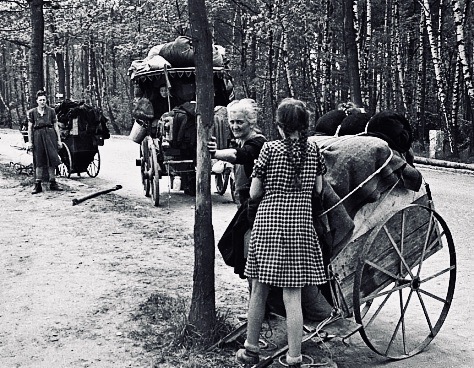
   It rained that day and the rest of the night. “The road was crowded on both sides. There were thousands of wagons, wagon after wagon, all going one way. There wasn’t a single car or truck, just horses. We knew the Germans were somewhere ahead of us and the Russians somewhere behind us, but we didn’t see any soldiers anywhere, at all.”

   Ona was at the reins of the two-horse team, her seven-year-old daughter Ramute beside her holding the three-year-old Gema, and Carmen, Mindaugas, and Angele walking. Most of the refugees were walking, their wagons jam-packed with possessions and provisions. Their friend from Vilnius with her two small children stayed in line behind them.

   Before the war, Lithuania’s population was almost 3 million. After the war it was closer to 2 million. Some Lithuanians ended up dead. Many were deported. Others ran for their lives. The displaced were forced to make new lives in different countries all around the world, whatever country they could get to, whatever country would take them, whatever country they could sneak into.

   When the second Soviet invasion of the 1940s happened, some Lithuanians tried to flee across the Baltic Sea to the Nordic countries, but only a few were successful. Patrol boats apprehended them, and they ended up hauled off to labor camps. Most fled west, while others went south to Hungary, Romania, and the Balkans.

   “On the way we met my uncle on the road, Uncle Jankauskas and his family.” Her uncle’s wagon fell into line with them. The progression of wagons stretched as far as the eye could see, ahead and behind. They soon crossed into East Prussia. There were no guards. They had all fled. The borderland was a mess.

   “I was so sad leaving Lithuania,” Angele said.

   Russian warplanes strafed and bombed the column of evacuees several times. The Red Air Force was bombing and strafing at will, both German Army and refugee columns alike. Forest and brush on both sides of the road were set on fire. There was smoke in the sky day and night. Wagons and carts slowly wended their way around rain-filled craters.

   “It was all just wagons. They knew we were refugees They dropped bombs and shot their machine guns. I don’t know why they did that. Whenever we heard airplanes, we all ran and jumped into ditches beside the road. I was afraid, but somehow I knew I wouldn’t be hurt by them.”

   What was called the Baltic Gap had grown so menacing to the Reich that Adolf Hitler moved his headquarters from Berchtesgaden to Rastenburg in East Prussia. The German situation on the Eastern Front was desperate. The fighting was hard and bitter. It was a fight to the finish. The hinterland was torn up, abandoned and forlorn.

   “Most of the people on farms had run away. We would go into their houses and find dried fruit, pickles, mushrooms, pork, and wine.” They ransacked barns, pantries, and root cellars. “We took all the food we could find, all of it. It rained most of the time, it was cold, and we walked and walked. Everybody was hungry.”

   The rain and asphalt track were hurtful to their cow. The animal was careful as could be on the poor traction of the wet road, stepping timidly with its rear feet spread wide. It was compensating by walking with an arched back. They finally had to do something. They knew the long miles and pavement weren’t good for it. They thought she might be going lame. Angele’s uncle looked at the cow’s hooves and saw lesions. An ulcer was forming on one hoof.

   “Mindaugas and I found a family that hadn’t run away. We went to their farmhouse and sold the cow to them.” They gave the money to Ona and she hid it on her person with the rest of her money. She had plans for it.

   One cold night when they stopped to rest her uncle said, “Kids, jump up and down to warm yourselves up.” When Angele stopped jumping, he grasped her under the armpits. “He grabbed me. We were jumping up and down and he dropped me by accident.” She broke her wrist. “It hurt bad, but there were no doctors to help me.” When they got to a town with a railroad station, there weren’t any doctors there, either. The smart and the skilled had already left. Everybody else was hoping against hope. Angele’s wrist had to take care of itself.

   After the New Year the German population of East Prussia, most of whom had not yet cut and run, began to evacuate as the Red Army rapidly advanced. Within weeks it turned into helter-skelter flight as more than two million of the two-and-half million men women children of the enclave bolted into the Polish Corridor heading for Germany. The winter weather was bad, the roads were caving in, and the civil authorities were overwhelmed. There was panic and quagmire and many thousands died, some caught in combat, others swept away in the chaos.

   But before that happened, Ona Kreivenas had already sold their wagon and horses and everything they couldn’t carry and managed against the odds to get passage on a train going to Berlin. The Prussian Eastern Railway connected Danzig and Konigsberg to Berlin. A month later, the last week of January 1945, the last train to Berlin ran the rails. There was no traffic on the line after that.

   “The train was completely full. The corridors were full, too.” They stood in a tight group in the corridor. The passenger cars were red and had ten large windows on both sides. They were pressed against one of the windows. Some of the windows were smashed and the passageway was as cold as the outside. “We had a pillow for Gema, who slept on the floor, but we stood that night and the next day.”

   The twin locomotives pulling the long line of passenger cars and baggage cars and a caboose were in camouflage livery. On their front was painted the Hoheitsadler, an eagle, Germany’s traditional symbol of national sovereignty, holding a swastika in its talons. By the time they crossed Poland and entered Germany, the talons and swastika were obscured by coal soot.

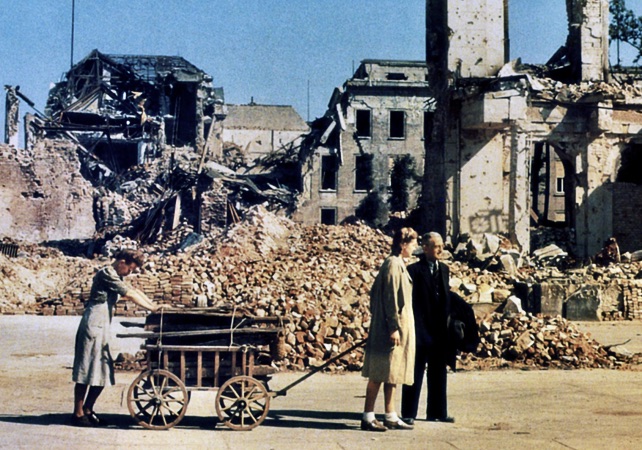
   Lehrter Bahnhof was the Berlin terminus, adjacent to Hamburger Bahnhof, built in the late 19th century just outside of what was then Berlin’s boundary on the Spree River.  It was built in the French neo-Renaissance style, the façade covered in glazed tiles. The station had long been known as a “palace among stations.” But it had been severely damaged by Allied strategic bombing and was near to being a shambles.

   When they finally got off the train in Berlin, tired and stiff from standing, they were met on the platform by Bishop Brizgys. The clergyman was Ona’s husband’s cousin. Vincentas Brizgys had been the assistant to Juozapas Skvireckas, the archbishop of Kaunas. During the summer of 1944 he and the archbishop and more than two hundred other Lithuanian priests fled the country with several retreating German army divisions. Ona had somehow located him by telephone, and he arranged to meet them at the train station. He was wearing a dark suit and a homburg and carrying a basket of hot buns.

   “He gave one to each of us. I was so happy,” Angele said.

   She was 16-years old, somewhere between childhood and adulthood. Seven years later, and a  continent away, she gave birth to me, followed quickly by my brother and sister. In the meantime, hope for the future was the only thing keeping her on her feet.

   The Third Reich’s war economy was on the verge of collapse. The whole country was a sinking ship. There was a shortage of bread sausage cabbage beer, and everything else. When they looked around, the buns the bishop had brought were the only cheer they could see. There wasn’t going to be any traditional roast goose this holiday season.

   Angele looked at the four children and her aunt. She glanced up and down the platform. Their friend from Vilnius and her uncle were long gone, lost in the fog of war. Bishop Brizgys led them out of the station into the city. The Red Army numbering over four million men was massing on the Vistula River and along the East Prussian border. Their superiority was ten to one in infantry and twenty to one in artillery and planes. Berlin and its three million residents were already a wreck, the day and night Allied bombing taking a monstrous toll.

   The early afternoon was a gray haze. There was smoke in the sky. It was darkness at noon. She looked at the rubble in the street. When she looked ahead, she knew in her teenaged bones it was going to be a grown-up bare-bones winter on German soil.

Ed Staskus posts monthly on 147 Stanley Street at http://www.147stanleystreet.com, Made in Cleveland http://www.clevelandohiodaybook.com, Down East http://www.redroadpei.com, and Lithuanian Journal http://www.lithuanianjournal.com. To get the site’s monthly feature in your in-box click on “Follow.”

“Cross Walk” by Ed Staskus

“A Cold War thriller that captures the vibe of mid-century NYC.” Sam Winchell, Beyond Books

Available on Amazon: https://www.amazon.com/dp/B0CRPSFPKP

The end of summer, New York City, 1956. Stickball in the streets and the Mob on the make. President Eisenhower on his way to Ebbets Field for the opening game of the World Series. A killer waits in the wings. A Hell’s Kitchen private eye scares up the shadows.

A Crying of Lot 49 Publication

Breaking the Waves

By Ed Staskus

   Even if it is a 500-foot long 12-thousand-ton carrier like the Marine Flasher, sailing the North Sea in late fall is sailing those waters at the wrong time of the year. Daytime temperatures average cold-and-worse and it is gloomy and foggy. There are about seven hours of daylight. If it’s not raining, it will start raining soon. Sometimes it is so foggy that ships have to slow down to less than 5 knots with horns blaring non-stop. Windy skies and strong swells make plowing through the cold water like trying to plow through month-old mashed potatoes.

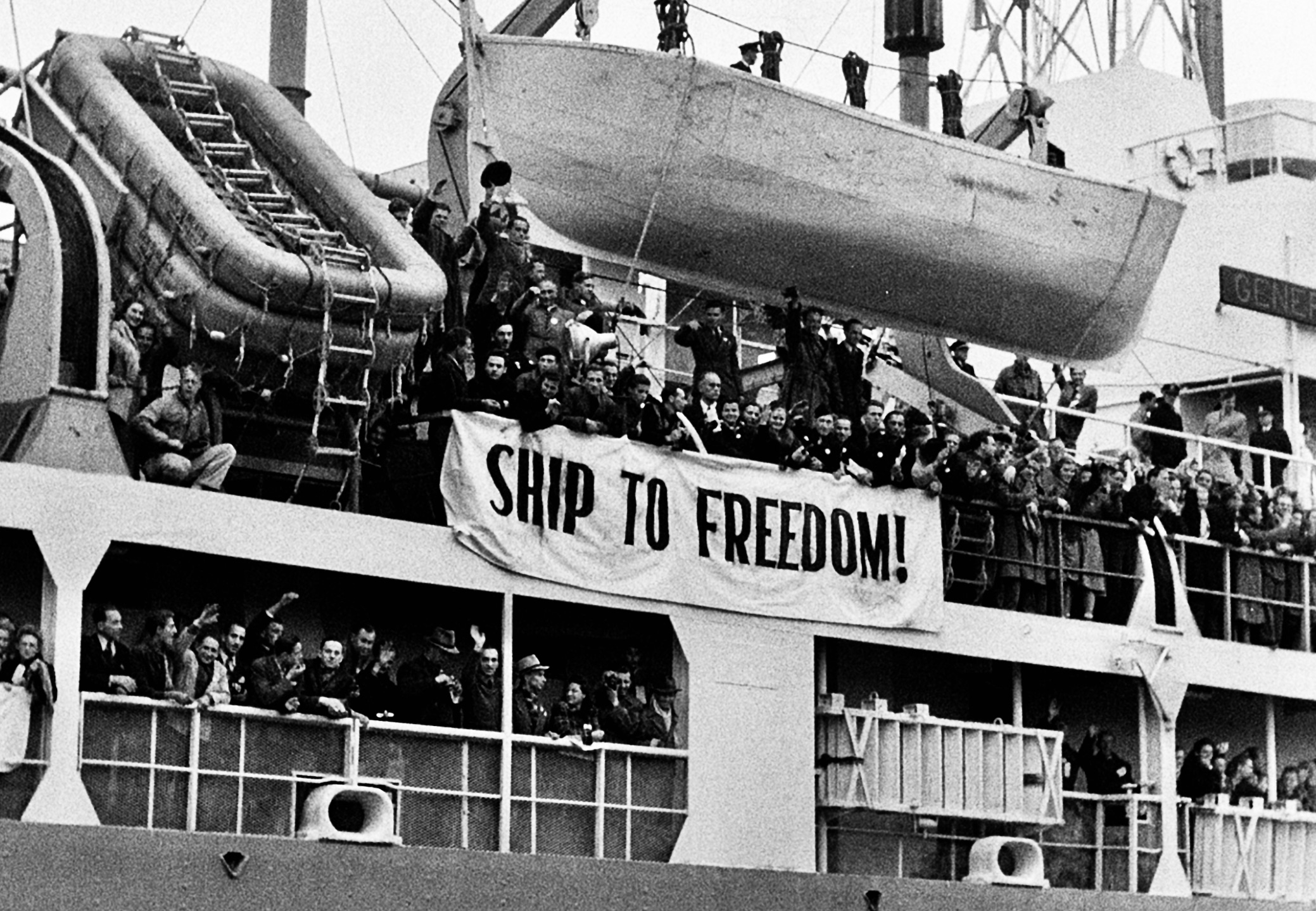
   “I was on the boat for nine days and I was sick for nine days,” said Angele Jurgelaitis about her crossing from Hamburg, Germany, to Halifax, Nova Scotia, on the Marine Flasher, converted from a troop ship to hauling DP’s. Not only were big waves breaking over the sides of the ship, in the aftermath of the war, hundreds of thousands of tons of chemical weapons had been disposed of by being dumped in the North Sea.

   “The ocean didn’t leave a good impression on me. Whenever we threw up, we called it ‘Going to Riga.’” What they meant was that the water flows north, so when they threw up over the side, the vomit went north up the Baltic Sea past Poland and Lithuania to the mouth of the Daugava River, where Riga the capital of Latvia is.

   The Marine Flasher was built at the Kaiser Shipyard in Vancouver, Washington. She was launched for the United States Maritime Commission in May 1945. The ship sailed to San Francisco, Okinawa, Korea and returned to Seattle. The next year it sailed to New York City and from there to Bremen. For the next three years she ferried refugees from Europe to North America, by way of Canada and New York City, and then went back to Germany.

   Angele shoved off from the Old World for good on November 17, 1948. The next day ration scales for IRO refugees became uniform in the British, French, and American zones. It didn’t matter to her anymore. She ate better on the boat, no matter the seasickness, than she had in a long time.

   “There was a canteen on board, and we all got two dollars a day,” she said. “The food was very good. I didn’t think about IRO. We ate well.”

   There were widespread food shortages in Germany following the end of the war. The supply of food was impacted by the prolonged warfare, including the destruction of farmland, silos and barns, livestock, and machinery. Many Germans were forced to live on less than 1,500 calories a day. The average adult calorie intake in the United States at the time was more than 3,000 and in the overseas U.S. Army it was more than 4,000. 

   The civilian population suffered hard times during the severe winter of 1946, exacerbated by shortages of fuel for heating. Displaced persons got somewhat more generous rations, supplied by the Army, the UN, and relief agencies, but even they averaged less than 2,000 calories a day.

   There were 535 refugees bound for Canada on board the Marine Flasher. There were almost 3,000 more bound for the United States, men, women, children, and baby carriages. They steamed into Halifax the afternoon of November 26 and spent the night on the boat. It tied up at Pier 21. Angele hadn’t been able to get into the United States, but she had been able to get to the next best place, Canada.

   She wasn’t stuck behind the Iron Curtain, she wasn’t stuck in Nuremberg, and two days later she boarded a train for Montreal. It took all day and all night and part of the next day to get there, but she wasn’t stuck going nowhere.

   “It was almost 30 hours, but the train was comfortable, with beds,” she said. When they arrived, everybody designated as a nanny or a domestic was segregated. “Those who already had sponsors left. The rest of us, about a hundred of us, boarded busses and they took us to a camp.” They were housed two to a room and interviewed. “They wanted to know what we had been doing in Germany.” They had to fill out one triplicate form after another. 

   One of her roommates at the Army Hospital in Nuremberg had emigrated to Canada a few months earlier. She was working and living in London, Ontario. It is in southwestern Ontario, just north of Lake Erie. The city is a hub for education and healthcare. There are parks and greenways where it lays along the Thames River. It was a military center during the first and second wars, but the wars were finally over.

   “My roommate Ele wrote me that I should ask to go to London, or second best, Toronto,” Angele said. “I started thinking I would join her in London. When I filled out the forms that they gave me I wrote down where she was and that I wanted to go there.”

   Three days later she was presented with a Canadian visitor visa and found out where she was going. She knew she was on the list for the Lapalme family. She hoped she wasn’t going there. An official gave her their address in Sudbury, Ontario. They were Florence and J. A. Lapalme, a prominent family in the mining town. They were known as “’The Largest Family in Sudbury.’ Their children numbered fourteen, although Angele would only be responsible for five of them. Since she had worked in the Children’s Ward at the Army Hospital in Nuremberg, she was seen as the kind of nanny capable of caring for multiple boys and girls.

   “They were so young,” she said. “The youngest was 9 months and the oldest was only 7 years old.” Francois was the youngest, Aline the oldest, Gilles Muriel and Marcel in the middle.

   The domestic woman who cleaned and helped in the kitchen was Lucille Pharand. She worked in several big houses. Lucille was well known as a hard worker. She was built like a fireplug. In the spring of 1949, she and her husband Leo built a house in in the new town of Minnow Lake, three miles from Sudbury. The first few years there was no indoor water and there were no sewer lines to the house. Leo drove to the nearby lake every day with a neighbor, carrying a tub and pails, where they collected water for dishes, laundry, and bathing. They got their drinking water from a well a couple of houses away. In time they gave the Lapalme’s a run for their money, making a large family for themselves. They were known as ‘The Second Largest Family in Sudbury.’

   “I asked again to go to London , but again they said no,” Angele said. “They said nobody was going there.” She wasn’t sure if it was true or if they were just telling her that. In the end not a single refugee went to London or Toronto.

   She didn’t complain. There wasn’t anybody to explain and complain to, anyway, nobody who was going to change the destination that had been determined for her. If you were a European refugee, you were going somewhere where there was work. Men punched a clock mining ore, cutting down trees, and laying roads. Women knuckled down cleaning, cooking, and caring.

   Angele had struck up a friendship on the Marine Flasher with two other Lithuanian women, Inga and Laime, who were young like her. Laime in Lithuanian means happy. They had their hearts set on going to Alberta. They told her there were many rich men there. 

   When the train reached Sudbury, Angele and six other women, all Russians, and a man, another Russian, got off the train. Everybody else, including Inga and Laime, went on to Alberta and British Columbia. Angele was the only Lithuanian on the train platform, more than four thousand miles and several languages from her home.

   “There was no one to understand how unhappy I was,” she said.

   The end of World War Two saw the movement of people all over the world from one place to another. Between January 1946 and December 1953 over 750,000 refugees went to Canada. In June 1947 the federal government authorized the entry of 5,000 non-sponsored DP’s. Two years later the number rose to 45,000. Ottawa established five mobile immigration teams composed of security, medical, and labor officials. They were sent to Austria and Germany to select refugees deemed acceptable for emigration to Canada. 

   Displaced people from the Baltic countries were ranked high on the list. They had been in UN-run camps after their countries, Latvia, Estonia, and Lithuania were caught in the middle of the Russian and German battle zones. Their small countries had become independent after World War One, then occupied by the Russians in 1940, then invaded by Germany in 1941, and in 1944 taken over again by the Russians. In the space of 25 years, they had gone from enslaved by tyrants to enslaved by tyrants

   “When we got off the train there were two men waiting for us,” Angele said. They helped the eight refugees sort themselves out and get to where they were going. One of them told her she was lucky to be going where she was going.

   The Lapalme’s introduced themselves and their children, arranged her living quarters, and quieted her fears about there being no other Lithuanians in Sudbury. They explained there were, and the next day Dr. Valaitis, a Lithuanian doctor and friend of the family, drove to the Laplame home and sat down with her, telling her there were many other Lithuanians in town.

   “Some of them have been here more than two years,” he said. “They make a good living working in the mines.” He gave her the names and phone numbers of several, told her about the Polish church they shared for services, and the local hall where they staged dances and folk performances.

   “The kids I had to care for were so small,” Angele said. She was just 20 years old. Just outside of two years later she gave birth to me, followed quickly by my brother and sister. By 1958 we were living in Cleveland, Ohio, starting from scratch again.

   “They spoke French among themselves and English to me.” She spoke to them more in gestures and pantomime than not. Angele spoke Lithuanian, German, some Russian, but less English. “When Vytas and I were together in Nuremberg he encouraged me to learn English, but I didn’t want to. Whenever I saw him coming with his grammar book I ran away.”

   Vytas Staskevicius was a young Lithuanian man from Siauliai she had left behind in Nuremberg, but who she was waiting for, waiting for him to come to Canada and join her. He had fled the Baltics in 1944, like her, and been displaced in Germany, like her, for more than four years.

   She started taking English classes in Sudbury right away. She wrote her man often, at night, pages and pages in cursive, in their native language. “The Lapalme’s have been good to me They are Catholics and go to church every day, seven days a week. They have a food warehouse, which is their business. We eat very well, so it’s not bad in that respect.”

   Florence was J. A. Laplame’s second wife. He placed ads in newspapers and hired her, a young out-of-town woman, to watch and care for his children after his first wife died. He had seven children, some of them teenagers, some not. It wasn’t long before one thing led to another and he proposed to her. He was nearly thirty years her elder, but she accepted, and over the next decade gave birth to seven children, bringing the family up to record-breaking speed in their part of the world.

   “Florence does the cooking,” Angele wrote. “She has a part-time woman named Lucille who helps with the cleaning and cooking, but Florence does the main cooking. There are usually eleven or twelve of us at the dinner table. She is in the basement every night doing laundry, too. I don’t clean or cook. My job is to watch the children.”

   Whenever Florence was ready to deliver another baby, since her husband had several business interests and was often out of town, Florence usually drove herself to St. Joseph’s Hospital. “If it was a close call, she called a taxi,” Angele said.

   Roger Lapalme, grown-up and the only one of the family who had gone farther than high school, sat next to Angele at the dinner table whenever he was at home. “Roger liked me.” He was barking up the wrong tree. He took her motor-boating on Lake Ramsey until the day he got too enthusiastic at the helm and she fell off the boat. She told him it was enough of that. “Roger was handsome and a lawyer, but I finally told him I already had a boyfriend,” Angele said. 

   One of the LaPalme girls had suffered a nervous breakdown. When her boyfriend, who she expected to marry, killed someone in a car crash, she broke down. She told her father her life was over and went to work in the nickel mines. She was rarely at the house. When she was she slept all day.

   Vytas had a sponsor, an uncle who lived in Boston, but delayed sailing to the United States. He procrastinated about going to Australia with a friend of his who thought they could make passage there. He was determined to go to Canada. J. A Lapalme promised Angele he would give him a helping hand.

   “The year is ending soon,” she wrote her Baltic boyfriend biding his time in Germany. “I have been here more than three weeks. When can you come?” She knew the sailing season wasn’t going to be for several more months. Her man had to break the waves. She knew it wasn’t going to be soon enough. “Be a good boy and write me often,” she wrote him at the start of the new year.

Ed Staskus posts monthly on 147 Stanley Street http://www.147stanleystreet.com, Made in Cleveland http://www.clevelandohiodaybook.com, Atlantic Canada http://www.redroadpei.com, and Lithuanian Journal http://www.lithuanianjournal.com

A New Thriller by Ed Staskus

Cross Walk

“A once upon a crime whodunit.” Barron Cannon, Adventure Books

“Captures the vibe of mid-century NYC.” Sam Winchell, Beyond Fiction

Available on Amazon: https://www.amazon.com/dp/B0CRPSFPKP

Late summer and early autumn. New York City. A Hell’s Kitchen private eye. The 1956 World Series. President Eisenhower at the opening game. A killer in the dugout.

Crossing at Nuremberg

By Ed Staskus

   “The holy bishop from Kaunas fixed it up for us,” Angele Jurgelaitis said when she arrived in Berlin in the middle of the night. There was nothing holy about the ferocious last days of World War Two. It was a godless maelstrom. It helped to have a man of the cloth on your side when the devil was doing his best on the other side. There was more than enough hellfire on earth that winter.

   When Angele, 16 years old, Ona Kreivenas, who was her aunt, and Ona’s four children got off one of the last trains that the Prussian Eastern Railway ran from East Prussia to Germany they were met at the station by Bishop Vincentas Brizgys. The clergyman was Ona’s husband’s cousin. Her husband, a Chief of Police in southern Lithuania, had been arrested by the Russians in 1941 and deported to Siberia, where he was stuck in a slave labor camp. By the early fall of 1944 Bishop Brizgys and more than two hundred other priests had already fled the Baltics on the heels of retreating German forces.

   Many Lithuanians barreled out of the Baltics in the fall and winter of 1944 as the Red Army overwhelmed the Wehrmacht and overran the land. The fighting was tenacious and terrible. Wartime losses of Estonians, Latvians, and Lithuanians were among the highest in Europe. They didn’t go down without protest. They were out-gunned, though.

   Ona had somehow located the bishop by telephone from East Prussia and he arranged to meet them at the train station. He was wearing a dark suit and a homburg. He was carrying a basket of hot buns. He looked like the churchman he was. Berlin didn’t look like what it had once been. It looked like a wasteland.

   “He gave one of the buns to each one of us,” Angele said. “I was so happy.”

   What the churchman fixed up for them was passage to Bavaria. They ended up in the north of the southeastern state. Bavaria shares borders with Austria, Switzerland, and the Czech territories. The Danube and Main flow through it, the Bavarian Alps border Austria, and the highest peak in Germany is there. The Bohemian forests are nearby. The major cities of the region are Munich and Nuremberg. 

   “The bishop found a pig farm for us, people he knew,” Angele said. “We lived in a two-room apartment above the slaughterhouse. There was another Lithuanian with us, a woman in her 20s, a fancy woman.” One of the two rooms was a kitchen. They lived and slept in the larger room, two adults, a teenager, and four children. The fancy woman kept to herself. There was barely enough room to stand. There were three cots. 

“We took turns sleeping on them. We worked for our keep, helping with the cows, and cutting clover. There was no town, just country everywhere. The German family we stayed with fed us. They were good people.” There was no combat in their corner of the world. “We didn’t see any fighting all winter long,” said Angele. “The war ended when the Americans came. They wore nice uniforms, not like the Russians, who were filthy and stank. They were friendly, completely different. They threw candy to us as they went past.”

   Bavaria was one of Adolf Hitler’s favorite places during the twelve years of the planned one thousand year Third Reich. He had a lavish residence at the Obersalzberg. Bavaria had been the scene of protests against Nazi rule in the late 1930s, but it didn’t matter to the Fuhrer. He had his own dog-eat-dog security men. Their orders were to shoot first. They didn’t bother about questions. After the war Nuremberg was chosen for the military tribunals trying Nazi war criminals because it had been the ceremonial birthplace of the party. It was where their annual propaganda rallies were held.

   Allied air forces bombed the hell out of the city in 1944 and 1945. One night in January 1945 more than 500 British bombers dropped six thousand high-explosive bombs and more than a million incendiary devices. The historic old town was destroyed. Half of the rest of the city was destroyed. What wasn’t blown to bits or burnt down was damaged. Surviving the bombing meant you had to then survive the aftermath. The city was left with practically no heat, no electricity, and  no water supply in the middle of winter. The Palace of Justice and the prison that was part of the sprawling complex were spared. It was a sign of what was in store. It was spared because justice and revenge were in store.

   “In the fall after the war ended, we had to leave the pig farm and went to an American refugee camp near Regensburg. We had two rooms, but there was a Lithuanian man in the other room, so we had one room. We lived there and didn’t do anything. We waited and waited.”

   Before the Russians closed the borders, padlocking the Baltics behind the Iron Curtain, about 70,000 Lithuanians were able to escape the country, almost all of them ending up in Germany. By the time the war ended nearly 11 million refugees had flooded the country, more than the total population of Austria. Many of them ended up in Displaced Persons camps in Bad Worishofen, Nordlingen, and Regensberg.

   In the spring of 1946, Angele, Ona, and the children moved to a new camp. “It was a castle that you went to down a long road through a forest in front of a lake. There was a big chapel and two big barracks. There were no owners anymore, and no workers, nobody. There were only the Americans and refugees. There were many of us, all of us homeless. We were almost all Lithuanians.”

   The Schwarzenberg castle on the outskirts of Scheinfeld in Bavaria is northwest of Nuremberg. From 1946 until 1949 thousands of Lithuanians were housed at the DP camp there while they waited for their chance to get to Australia, Canada, the United States, anywhere somewhere else. “There was no future for us in Germany,” Angele said. There was flat out no going back. The system of revolving displacement the Russians proposed would have meant the end for many of them and suspicion and persecution for the rest of them. The Russians had no plans of letting repatriated Lithuanians off easy. They had no plans of letting any Lithuanians of any kind, unless they had converted to Communism, off easy. Even then it was dicey. If they wanted you to live and die in Siberia, the far east is where you went.

   The camp outside Nuremberg was administered by an American Army officer of Lithuanian descent. The military’s concern was providing shelter, nutrition, and basic health care. Although the Americans looked after vital supplies, everybody in the camp had to lend a hand, The refugees prepared their own food. They sewed new clothes from old cloth. They printed their own daily newspaper. They printed their own money, too. The currency could be earned by working around the camp and spent at the canteen, where you could buy shaving cream, combs, and cigarettes.

   “We had our own doctors, our own church, and even a school. My best friend was Maryte. Her parents were teachers. They taught the high school classes in the camp. Her mother knew how to sew.. She would take hand-me-downs that had been donated to us by the Red Cross, take them apart, and make new dresses. Whenever she made a dress for Maryte she made one for me, too.”

   Angeles’s aunt talked to her about becoming a seamstress. “She wanted me to learn how to sew, like my older brother Justinas, so I would have some way to make a living, but I said no.” She had already turned down her aunt’s advice back home about becoming a farmer’s wife. She wasn’t sure what she wanted to do, but she knew for sure what she didn’t want to do, which was no sewing and no farming.

   After her friend Maryte moved to Nuremberg, taking classes in x-ray technology, and was on the way to becoming a nurse assistant at the Army Hospital there, she wrote Angele. “She told me about it, told me it was a 10-month course, and told me to come join her.” Angele packed a satchel with her clothes and slipped away as the weather warmed up in 1947. She waved goodbye to Ona and her four children. “By then my aunt was teaching kindergarten at the camp and she had her kids around her.” The boy Mindaugas had grown a few years older, was now a full-fledged teenager, and could take care of his three sisters.

   She hitchhiked the forty miles to Nuremberg. Even though there were travel restrictions, a German government barely existed to enforce its own laws, and the only thing she had to worry about was an over-zealous American officer in a Jeep who might take her back to where she came from. When she got to Nuremberg she asked where the hospital was and found her way there. It had been rebuilt after the bombings two years earlier. She was assigned a bed in a small room, which was twelve feet by twelve feet. She shared it with three other women.

   “There was Ele, who was 24 and tall, Koste, who was 28 and stocky, Monica, who was the oldest and had been a nurse in Kaunas, and me. One of our teachers was Lithuanian and she helped me. We lived in the barracks. I worked in the hospital, cleaned, changed beds, and did whatever they told me to do. I studied whenever I could. There wasn’t time to do much else.”

   They had to do something, though. Most of them were young and raring to go. They staged dances at the hospital. “Somebody would play the accordion and we would all dance. There were never enough men to go around, so many had died.” Whenever they could they went to town on Saturdays. “We took a train, went to the movies, and the music shows. We loved it. Everything was so clean. It was all smashed during the war but two years later you wouldn’t have believed there had ever been a war.”

   There had not only been repeated bombing and shelling of the city, especially the medieval part of it, there had been street-by-street, house-to-house, and room-by-room fighting in April 1945. The city was rebuilt after the war and was partly restored to its pre-war aspect. “The Americans did it,” said Angele. “You could see them doing it every day.”

   The German government was being resurrected, as well, and order was the order of the day. “One day we were waiting in line for the movies, eating grapes, and spitting the seeds on the sidewalk. When a policeman saw us, he came over, and told us it was our responsibility to keep the city clean. He made us pick up all the seeds.”

   The circus was even better than movies or musical theater. It is in the movies and on stage that people fall in love and there is always a happy ending. The boy and girl kiss in a glowing haze. It is the circus, however, that leaves an in-the-flesh fantasy a vivid memory. “Whenever it came to town, none of us could sleep,” Angele said.

   The Nazi era was good for circuses since they were not considered subversive. They were left alone by the tyrants. Between the two wars, through the 1930s, Germany was the epicenter of  European circus companies and their large tents. There were more than forty of them on the road with clowns, acrobats, and animals. They were mostly family-run enterprises. The last year of World War Two, however, was bad for business. Many circuses lost all their equipment and animals. The postwar monkeyshines boomed after 1946. Circus Europa toured Germany in 1947. 

   “I loved the circus,” Angele said. “I would have gone alone if I had to.”

   In mid-summer 1948 she got a week’s vacation from the Army Hospital. She and her friend Benas, his best friend Porcupine, and two of the Porcupine’s friends took a train the 170 miles to Zugspitze on the border of Germany and Austria. On two sides of the Zugspitze are glaciers, the largest in Germany. Mountain guides lead climbers up three different routes to the summit at nearly ten thousand feet.

   “Benas had thick dark hair and his father was a minister back home. He was a good friend to me. Everybody called his friend Porcupine because my roommate Koste called him that, although nobody knew why. He thought he was Koste’s boyfriend, even though that’s not what she thought.”

   They got to the mountains at night and stayed in a small hotel. “There were two rooms at the end of the corridor. We three girls went into one of them. There were two beds, so we pushed them together and slept together. The boys took the other room. In the morning I went to the window and threw open the heavy drapes. I had to take a step back. The mountain was right there. I was astonished and frightened. For a second I thought it was going to fall in on us.”

   They rode a rack railway up the northern flank of the mountain the next day. “It went around and around.” At a landing they sunned themselves. “Even though there was snow everywhere, and people were skiing, looking like ants below us, we lay in the sun before going farther up.” They took the Eibsee cable car to an observation deck. “The gondola was all glass. You could see the whole world.” From the deck at the top a path led to a Cross of God.

   A 14-foot gilded iron cross had been lifted to the peak of the Zugspitze in 1851 by twenty-eight bearers under the direction of Karl Kiendl, a forester, and Christoph Ott, a priest. Father Ott was the brainstorm behind the cross, motivated by a vision of the mountain, “the greatest prince of the Bavarian mountains raising its head into the blue air towards heaven, bare and unadorned, waiting for the moment when patriotic fervor and courageous determination would see that his head too was crowned with dignity.”

   The Porcupine and his two companions wouldn’t go to where the cross was, patriotism or no patriotism. They said the path was too icy and narrow. “Only Benas and I went. There was a ladder attached to a rock face you had to climb to get to where the cross stood on a flat space.” In 1888 the cross had to be taken down and repaired after being struck by lightning. It had holes gouged out by the lightning bolts. A year later it was taken back to the top, onto the East Summit, where it had stayed ever since.

   The side rails of the metal ladder going up were secured by bolts to the rock. “I was near the top when a bolt came loose and the ladder jerked free,” Angele said. “I stopped and couldn’t go up or down. I stayed as still as I could. I was scared to death.”

   She had survived a Russian invasion, her mother’s untimely death, a subsequent German invasion, followed by another Russian invasion, making tracks out of Lithuania, the invasion of the Reich, the collapse of the German government, landing in DP camps in Bacaria, and finding her way to work at the Army Hospital In Nuremberg, all in the past 8 years, all by the time she was 19 years old. She was determined a broken ladder was not going to be the end of her. Benas helped her get down, extending his belt from the top, and another pilgrim helped her from below, coming partway up and slowly carefully easing her down. Benas slid down the side rails without incident.

   Faith can be church-going or it can be personal. Life and death at ten thousand feet is personal, Cross of God or no Cross of God. Who thinks about God when they are about to meet their maker? They took their time on the icy path back to the observation deck. The rest of the week they hiked, took local trains to nearby alpine towns, ate, drank, smoked, talked, and had fun while it lasted.

   At the end of their vacation they went back to Nuremberg. In her room, Angele thought about the men in her life. There were two of them. One of them was Vladas, who was a Baltic soldier. The other one was Vytas, a civilian, who worked for the Red Cross and worked the black market. They were both refugees from Lithuania, like her. Vladas brought her food and Vytas played cards with her. Vladas watched while she made dinner for him while Vytas let her win at the card table.

   Getting married might not be a matter of life and death, except when it is. She thought she was probably going to marry one of them, and thought she knew which one it would be, but she knew for sure she wasn’t going to be staying in Europe. She was going to break free of nowhere. Making her way some place where there was a future was the most important thing on her mind. She wanted a bright future, not a dark past. The only way was up the ladder, rung by rung. 

   No matter what, she was going to have to make what lay ahead worth its while. Nobody else was going to do it for her. When she got a visa to go to Canada and work as a nanny for thirteen children in Sudbury, an Ontario mining town, she took the chance. It was the chance she had been waiting for.

Ed Staskus posts monthly on 147 Stanley Street http://www.147stanleystreet.com, Made in Cleveland http://www.clevelandohiodaybook.com, Atlantic Canada http://www.redroadpei.com, and Lithuanian Journal http://www.lithuanianjournal.com

“Cross Walk” by Ed Staskus

“Captures the vibe of mid-century NYC, from stickball in the streets to the Mob on the make.” Sam Winchell, Beyond Fiction

Available on Amazon: https://www.amazon.com/dp/B0CRPSFPKP

Late summer and early autumn. New York City, 1956. Jackson Pollack opens a can of worms. President Eisenhower on his way to the opening game of the World Series where a hit man waits in the wings. A Hell’s Kitchen private eye scares up the shadows.

A Crying of Lot 49 Publication

Kitchen Party

HOMESPUN.jpeg

By Ed Staskus

Some years later living in a Polish double in Cleveland, Ohio, the last winter we lived in the old neighborhood off St. Clair Ave., before moving to the new neighborhood in North Collinwood where a school and convent adjoining the Lithuanian church had just been built, I watched my 9-year-old sister Rita walk up the stairs in her new American winter coat and remembered the blimp-style snow suit my mother made for her in Canada.

   She looked like one of the astronauts in ‘Destination Moon.’ I had seen the Technicolor sci-fi movie on a 15” black and white “Atomic Age” Zenith. It had a sharp picture, at least until it warmed up, when it would sooner or later start arcing and hissing. It was always on the verge of blasting off.

   It was space, the new frontier, brought to life by space the old frontier, at least until the TV went black. Rockets were hot. Project Mercury was done and gone, launching the first American astronaut on a suborbital flight in 1961. John Glenn lifted off on an Atlas rocket in 1962 to become the first American to orbit the Earth.

   Rita wore her space suit winters in Sudbury, Ontario. It was where my mother Angele Jurgelaityte married Vytas Staskevicius in 1949 and gave birth to me in 1951, my brother in 1952, and my sister in 1954. It was the trifecta. When she did, she gave up her job as a nanny for the Lapalme’s, known as “The Largest Family in Sudbury.” The Lapalme’s had 13 kids. She went to work raising her own family in her own house. 

   “I spent all my time cooking, cleaning, doing laundry, and watching my kids,” she said.

   The day she got married she was good at boiling pork and making soup. That was about it. “I didn’t know how to make any other food.” The first time she bought ground meat for a meatloaf, she bought too many pounds by far of it. “We didn’t have a refrigerator and I had to ask one of our neighbors to keep it for me.” She learned to stick to the basics, fruit in season, fresh meat from a butcher shop, eggs, cheese, bread, milk, and coffee.

   “No matter how much I ate I couldn’t put on weight,” she said. “I was thin as a pencil.” She saw a doctor who told her not to overthink nor overeat her slender figure. “You’ll want it back some day,” he told her.

   My mom and dad rented an upstairs room to a German couple who were recently arrived in the country, Bruno and Ingrid Hauck, in order to bring in some income. They charged $11.00 a week and soon converted a second upstairs bedroom to accommodate more boarders. There was a half bath.

   “I don’t know where they went for a real bath,” my mom said. Our family lived on the ground floor. We had a full bath. Once a week in the tub was de rigueur at our house.

   “I loved having kids, but we still had to go out sometimes,” she said. My dad bought her a fur coat after Rita’s birth. Fur was more a north country necessity than a big city luxury, and didn’t cost an arm and a leg, especially since it wasn’t mink and came from the nearby outdoors.

   They couldn’t afford a babysitter but made friends with the Hauck’s, who helped out. “Ingrid loved the kids, especially Rick. She watched them so we could go out.” They walked to the movie theater on Elm Street on Saturday nights. After the movie they took a stroll.

   When she worked for the Laplame’s it was as a mother’s helper for a year. J. A. Lapalme, a local businessman, promised her he would help get boyfriend out of Germany and into Canada. He went to his office every day and every day she waited for word about the sponsorship.

   “One week he was in Montreal,” she said. “When he got home, he didn’t say anything about it. I was in the kitchen washing dishes. I asked him if he had done it, sponsored Vytas, but he said he forgot. I got so mad I threw the washcloth on the floor.”

   She ran upstairs, down the hallway to the back, into her room, slammed the door, and threw herself on the bed.

   He knocked on the door a minute later, came in, and said, “I’ll fix it tomorrow.”

   “He did it the next day,” she said.  

   Vytas went to work in the nickel mines. Sudbury was a mining town. Either you worked underground, or you worked in an ancillary business. He wasn’t low man on the totem pole, like pick-axe men, but he had to watch his step in the 3,000-foot-deep dim damp mineshafts. A wrong step could be a last step. His first job was packing black powder. He worked as a blaster, the man responsible for loading, priming, and detonating blastholes, breaking rock for excavation, creating rock cuts.

   Sudbury is the regional capital of northeastern Ontario, 230 miles north of Toronto and 140 miles east of Sault Ste. Marie. It lays in a 200-million-year-old crater, surrounded by the Canadian Shield, and has hundreds of lakes within its boundaries. Lake Wanapitei is the largest city-contained lake in the world.

   Sudbury’s economy went boom and bust through the years as demand for nickel fluctuated. It was high during World War One, fell sharply when the war ended, and rose again in the 1920s and 30s. It was one of the richest and fastest-growing cities in Canada through the 1930s. During World War Two one mine alone accounted for all the nickel used in Allied artillery. With the advent of the Cold War Sudbury supplied the United States with most of its military grade nickel.

   Angele and Vytas lived in an old two-story clapboard house on Pine Street after their wedding and a one-day honeymoon at a nearby lakeshore park and local hotel. They saved everything they could and couldn’t afford, and with the help of a loan from J. A. Lapalme, were able to buy a new house on a new dead-end stretch of Stanley Street.

    Stanley Street stretched four blocks from Elm Street, a commercial thoroughfare, past Pine Street to Poplar Street. When it was extended to the nearly sheer rock face on top of which the Canada Pacific ran hauling ore, it became five blocks. Several new homes were built. All of them had basements and coal furnaces.

   “There were three on our side of the street and three on the other side when we moved in,” said Angele. There were no sidewalks. “One of the houses on the other side was bigger. It was the builder’s home.”

   Storm windows had been neglected on their new house, regardless of the long winters.  “We hadn’t signed for the house, yet, and Vytas insisted he put in second windows. He put them right in.” They might have been immigrants, DPs from Eastern Europe, but they didn’t need a weatherman to know which way the icy wind blew.

   The builder had four children, two of them boys. I played with them in the summer, climbing the sloping rock hills behind our house, and planning on how to someday climb the steep cliff at the end of the street. Our parents forbade us the fantasy, while we bided our time, waiting for them to turn their backs for a second.

   My mother spoke Lithuanian fluently, Russian and German competently, English just barely, and French not at all. Everybody in Sudbury spoke English and French. It was hearing it on the grapevine and listening some more for her to be able to go shopping.

   “I listened to people. I learned English by talking to them.”

   The first Lithuanians came to Canada in the early 1900s to work in Nova Scotia’s mines. They established a parish and built a church in 1913. Another wave of immigration, tens of thousands, took place after World War Two. Most of them went to Ontario. They spread out to London, Hamilton, and Toronto. Some of them went to Sudbury. There was ready employment there.

   For all its work and prosperity, the mining town was known as one of the ugliest cities in Canada. Logging for the reason of roasting ore on open fires and the smoke that resulted despoiled the landscape, leaving behind scattered poplars and birches, the only trees able to endure the harm. The small city and its vast environs were often compared to the landscape of the moon. What birds there were carried their nut and seed lunch boxes from tree to tree because the trees were so far and few between. They never said goodbye, though. The nest is where the heart is.

   “The summers were short and steamy,” my mom said. “There were no trees anywhere. There was one here and there. The rocks got hot and made everything hotter. Winter started in October, and it was cold.”

   When spring came, there wasn’t much to it. Decades of indiscriminate logging, massive mining operations, and smelter emissions had wiped out almost all the vegetation. The pollution poisoned lakes and streams. The dearth of trees meant a dearth of mulch, leading to widespread soil erosion. As a result, frost was severe in the winter, and it was too summery in the summer.

   It was colder than cold in winter. The average temperature was below zero. “Our best friends, Henry and Maryte Zizys, had to go home on the bus one weekend after visiting us and it was 45 degrees below zero.” The average snowfall was above average for northern lands. The last frost in spring was in May. It came back early in autumn, if it had ever gone away in the first place.

   In the winter, once she got the hang of it, my mom sewed clothes. When she started, she had sewn little except a button back on a shirt or skirt. “But when you have to do something, I did it,” she said. She learned to sew the same way she learned to speak English. She rummaged cheap clothes from second-hand stores and took them apart to see how they had been put together. She cut up adult pants, reusing the zippers, and made children’s pants. “The zipper in pants was hard to figure out.” She learned by doing what she was doing.

   “I found out it was just common sense,” she said.

   She bought a used foot-powered Treadle Singer sewing machine in good condition. A rubber belt operated it. It stretched from the balance wheel to a flat metal bigfoot pedal at the bottom. The power came from the rhythm of the sewer’s feet. The stitch length couldn’t be adjusted. Only a single straight stitch is possible with treadle machines. But once she got into the swing of things, both delicate and durable stiches become more workable. Within a few years she was making curtains and tablecloths for herself and her neighbors.

   She sewed dresses for her friends. She made a dress for Irma Hauck. “I sewed a coat for Maryte Zizys and other Lithuanians.” She learned to make pants for the men, cuffs and all. She sewed winter suits for us. I got a German army winter field coat and matching wool pants. Rick got a Space Cadet zip up one-piece suit. Both of us wore snug form-fitting hats based on “Atomic Rulers of the World.”  Rita’s snow suit was puffed up like a dirigible, cinched at the waist, and paired with a white rabbit furry hat. She was “The Thing from Stanley Street.” We chased her with make-believe ray guns.

   When my father learned how to ice skate at a local rink, he bought us skates. He flooded the front yard with hose water, and when it froze solid taught us how to skate. Whenever Rita fell she never felt a thing, her puffy suit protecting her. But sometimes she couldn’t get back up, lacking leverage, the sharp gusty wind rolling her over and over.

   “When I lived in Nuremberg, at the Army Hospital, one of my roommates, Monica, read my palm, and said I would have three children, but one of them would die young,” my mom said. “When it was time to take the taxi to the hospital for Rita, my third child, I was so scared I fell down on the living room floor and couldn’t go.”

   Vytas got her to her feet and inside the car. In the event, my sister survived, fortune teller or no fortune teller, ray guns or no ray guns, rock solid rink ice or not.

   In the spring, between pregnancies and births, Angele performed in plays resurrected from the homeland. She danced with a folk-dance group. They practiced in the church hall and did turns on local stages, once going to Sault Ste. Marie for an outdoor dance jamboree.

   “Rimas Bagdonas was always my partner,” she said. “He was tall and a good dancer.”

   Vytas and Angele met Rimas and Regina Bagdonas in Sudbury. They met everyone they knew for the first time in Sudbury, since everybody else they had known in Lithuania was either stuck behind the Iron Curtain or had emigrated to one corner of the wide world-or-other. Many of them died in the war.

   Rimas worked for Murray Mines and hosted a Lithuanian radio program in his spare time on Sundays. He sang and danced and played the piano, violin, harmonica, and accordion. He was one of the church organists and one of the accordionists for folk dancing performances.

   He worked deep down in the rock for eight years. In 1957 he was told in order to get promoted he would have to change his last name. A manager suggested Rimas Bags or Rimas Bagas. He didn’t like the idea, at all. He worked in the dark but was beginning to see the light.

   “My dad told them he was born a Bagdonas and would die a Bagdonas,” his daughter Lele said. “So, a family decision was made that he would leave to find a job. We stayed in Sudbury. That November after he found work, we moved to Hamilton. My dad’s first job was at the Ford plant in nearby Oakville.”

   By 1957 most of the Lithuanians in Sudbury were thinking about talking about planning on leaving or had already left for greener pastures. They were moving to Toronto Montreal and the northern United States. My father made a foray south of the border, exploring where we might go to live and work.

   Mining has been and is one of the most dangerous occupations in the world. Some of the worst workplace disasters ever have been collapses and explosions. The most common accidents are the result of poisonous or volatile gases and the misuse of explosives for blasting operations. Especially dangerous below ground is mine-induced instability. It is a major threat for all miners. None of the DP diggers wanted to be dug out of rubble after surviving WW2.

   At the start of the 1950s Sudbury had a population of about 40,000 and of the 14,000 men in the labor force more than 8,000 of them worked in mining and smelting. Ten years later, due to the high demand for labor, the population of the city doubled. But at the outset of the 2000s Sudbury had the smallest proportion of immigrants of any city in Ontario, the Italians, Ukrainians, and Lithuanians almost all gone.

   In the meantime, Sudbury modernized its mining and reclaimed its landscape. They changed the climate. Nearly 9 million trees were planted over a 30-year period. It was one of the largest re-greening projects in the world. Better late than never.

   “I hated my husband having to work in the mines,” my mom said. “Whenever a miner died, you never heard it on the news or read about it in the newspaper. We only ever found out by word- of-mouth.”

   My sister’s godfather moved to Chicago. My brother’s godfather moved to San Diego. My godfather moved to Los Angeles. Henry and Maryte Zizys moved to Montreal. The Hauck’s moved to Detroit. Almost every DP who came to Sudbury for the chance to get out of Europe and for the available work went somewhere else.

   “My husband worked nine hours a day for two weeks and then nine hours a night for two weeks,” Angele said. His days of getting up, shoveling coal into the furnace on bitter mornings, having breakfast, walking or hitching a ride to the mine, working his shift, getting home, having dinner, seeing his kids for few minutes, took up most of his day. 

   “When he worked nights, we barely saw him. He would come home in the morning, have a bite to eat, and go to bed.”

   Refugees and displaced people believe in hard work as the way to get ahead. It’s often the only thing they have to believe in. Everything else has been left behind.

   “When the men were working day shifts, we had parties on weekends at our house,” my mom said. “We had a big living room and the Simkiai, Povilaiciai, and Dzenkaiciai would come over.” Rita, Rick, and I got shoved into a bedroom to fend for ourselves.

   The husbands played bridge in the kitchen long into the night, drinking beer and homemade krupnickas, which is a kind of Lithuanian moonshine, smoking Export “A” and Player’s Navy Cut cigarettes until the card table was under a pall of smoke. The wives put food out, mixed cocktails, and kibitzed the card players. They danced to records. They kicked back and talked.

   “We didn’t have TV’s so we talked.”

   They talked about their kids, their neighbors and friends, their baznycia and bendruomene, who was getting married and who was getting dumped, the movies, shopping cooking the butcher baker and candlestick maker. They talked about the local doings. The men talked about their jobs, who knew and didn’t know what they were doing. They put us back to bed when they spotted us listening. They talked long into the night in the living room.

   When it got dark outside, and started snowing, the black rock face of Sudbury got muffled in white. When the wind picked up drifts built up against the side of the house and the windows. After that there wasn’t much to see. They didn’t talk about what had been, but about what was going to be. Up ahead was what mattered to them.

   “One day a door will open and let the future in,” Angele said. In the meantime, she made sure the front door was securely latched. There was no sense in letting Old Man Winter crash the party.

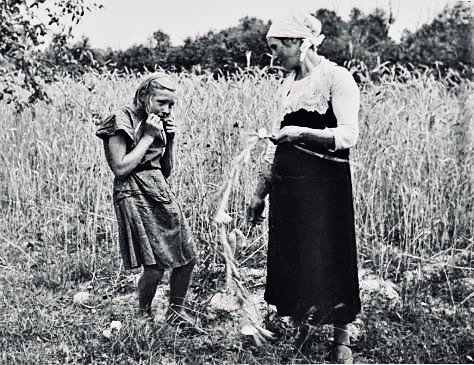
Photograph by Vytas Staskevicius.

Ed Staskus posts feature stories on 147 Stanley Street http://www.147stanleystreet.com and Cleveland Ohio Daybook http://www.clevelandohiodaybook.com. To get the site’s monthly feature in your in-box click on “Follow.”

Close to the Bone

SCAN.jpeg

By Ed Staskus

   Afterwards, my mother could never remember exactly where she met her first grown-up boyfriend, Vladas the soldier. “It was in Nuremberg, but I don’t know if I met him at one of the dances at the hospital or at a coffeehouse or out walking,” she said.

   It might have been at the city zoo, where she went most days weather permitting, leading twenty thirty children from the ward where she worked, children who were recovering from the war, for a walk in the fresh air and sunshine. Her youngest niece, Gema, was one of the kids.They threw groundnuts to the elephants, even though elephants don’t like nuts and hardly ever eat them.

   Angele and her friend Maryte, her friend from the same DP camp in Bavaria, who was the friend who told her about starting over in Nuremberg, when they had the chance the two of them jumped on the tram for the two-mile ride to town, where they slipped into a restaurant or coffeehouse, ordered coffee and got an earful of music for an hour-or-so.

   “Someone was always playing a piano. We would sit and listen and order another coffee if we had to so we could stay and listen some more.”

   Angele Jurgelaityte was living at the Army Hospital in Nuremberg, studying to be a nurse assistant. She fled Lithuania in late 1944, when she was 16 years old, on her aunt’s horse-drawn wagon, in a line of carts and wagons miles long. Three other Lithuanian women and she shared a small room, all of them training and working, on the grounds of the hospital.

   Vladas was a Lithuanian Army officer who served as a guard at the war crime trials a couple of years earlier and was still stationed in the city. He wanted back to the homeland, but it wasn’t looking likely.

   Many Baltic military officers, Estonian, Latvian, Lithuanian, were assigned security functions in the Allied zones after the war. They guarded bridges and buildings. Some of them kept an eye on Germany’s war criminals during the series of thirteen Nuremberg trials. After the suicides and executions of those Nazis judged to have committed genocide and crimes against humanity, some of the officers and their units stayed in the city, protecting weapon arsenals, food supplies, and the airport.

   “He was my first boyfriend. He was my friend, but he was a father to me, too,” Angele said. It was summer, three years after the end of the war. She was 20 and he was 33. He had access to food most Germans and no refugees had access to. He brought her some of it. He brought her oranges and apples. One day he brought bananas.

   “I had never had one before.”

   Vladas was married with a home and a six-year-old daughter in Lithuania. He told Angele his wife was dead. He explained how he had been deployed when the Russians swarmed the Baltics, got caught up in the retreat, and couldn’t rescue retrieve his wife and child. They were left behind to fend for themselves. When his wife died soon afterwards, his daughter was taken in by his mother.

   “When he told me his wife was dead, I didn’t believe him. I told him that, about not believing him, but he didn’t say anything.” Instead of trying to explain, he wrote a letter to his mother. She sent him a letter in return. He took it to Angele.

   “He brought it to me unopened. We sat down together on a sofa and he gave it to me. I opened it.” The only thing inside the envelope was a black and white snapshot of the headstone on the grave of his wife.

   “I was dumbstruck, but no matter, I wasn’t ready to get married. At the same time, I was friends with Vytas.” She was getting only so close to Vladas. She hadn’t told and he didn’t know about Vytas, her other boyfriend in the making, a young man her own age, who was in the fast lane.

   “I told Vladas, sorry, we have to end it. Besides, he had only talked to me about marriage once, while Vytas told me a hundred times we were going to get married.”

   Vytas Staskevicius was from Siauliai. It is both a district and a city in northern Lithuania. The road getting there is the gateway to the Hill of Crosses, a pilgrimage site created in the 19th century as a symbol of resistance to Russian rule. There are more than 100,000 crosses on and around the hill.

   His father, who had been governor of the province, was arrested in 1940 and died of starvation in a forest labor camp in Siberia. His mother, a native of Russia, was picked up and deported to Siberia in 1944, where she still was and would remain for another eight years.

   He severely hurt his hand in an accident on the family farm during the war, and after fleeing Lithuania in early fall 1944, black marketed whatever he could get his hands on, worked on and off for the American Army, and was now working for a relief agency. He had gone to the Army Hospital in Nuremberg several times, starting in 1947, where Dr. Rudaitis, a Lithuanian specialist, was performing reconstructive surgery on his injury.

   Angele met Vytas the second day he first came to the hospital. He was unconscious on an operating table. They met again and started talking and seeing each other after he was back on his feet. “We went for walks and to the movies,” she said. They didn’t go to any theaters, as much as Angele enjoyed musical theater. The show would have got in the way. They didn’t hold hands, being careful not to get off on the wrong foot, since his hand was healing.

   “I liked him. He was a steady man, not a fancy man.” When he came back to the hospital in spring 1948, they got reacquainted, getting more intimate, growing closer. Intimacy is healing when the lifeline to your home has been broken and your bones broken, too. They heal better when they have a reason.

   When he went back to Hanau, she put her nose to the grindstone. It was all she could do. She had gotten her certification and was saving everything she could for passage to North America, where she was determined to go to build a new life.

   “I couldn’t go home, I couldn’t stay in Germany, and there wasn’t any future for us in Europe,” she said. “All of us were trying to go somewhere.”

   She was being paid in the new Deutsche Marks for working at the hospital, unlike many others who were paid partly with money and partly with cigarettes, or only with cigarettes, which were a kind of currency in post-war Germany. Vytas was paid room and board and 32 packs of Turkish cigarettes a month working for an international relief outfit in Hanau.

   “Everybody smoked,” said Angele.

   She was smoking in a hallway one day when Vytas’s bone doctor approached her. “I put my hand behind my back,” she said. There was no hiding the smoke, however.

   “Dr. Rudaitis gave me a long lecture about not smoking. Finally, he left.”

   By the time he did the cigarette had smoldered down to a butt and she had to stub it out. It was like burning money. Deutsche Marks cost too much to burn, she thought, and thought about quitting, but didn’t, not just then.

   Apart from study and work and more work, writing letters, breakfast dinner sleep, the four Lithuanian roommates, Ele, Koste, Monica, and Angele, talked, played cards, and talked some more in their single room.

   “We played rummy and talked all the time, about our friends, politics, the future, and the movies.” They all enjoyed the circus, too, but only Angele went to the city’s theaters.

   “I loved going to the musical shows. Maryte and I would go together.” One day on their way they stopped and got a strip of pictures taken of themselves, their heads close together, in a coin-operated photo booth kiosk.

   “We were in our seats, during the show looking at our pictures, and laughing when someone behind us complained. An usher came and told us we had to move to the back row and be quiet or we would have to leave.”

   They sat in the back row quiet as mice the rest of the show.

   Their room at the Army Hospital was fitted with four twin beds, a sofa, and a table. The table barely sat the four of them. They played cards among themselves and sometimes with friends, although men rarely played with them, except Vytas.

   “He would come to our room when he was having another operation on his hand and always play cards with us, squeezing himself in. He was the only man who did.”  By then she was almost certain he was the one she was going to marry.

   “None of my friends wanted me to be friends with him. Koste and Monica thought he was the wrong man. Ele wanted me to be friends with her brother, but he and I both knew we didn’t like the other one, at all.”

   She was hoping Vytas would be able to get a job at the Army Hospital. One of the maintenance men, a fellow Lithuanian refugee, told them he was moving on and had recommended Vytas. When the time came, though, he changed his mind at the last minute, deciding to stay.

   “After that we weren’t friends,” Angele said. She was vexed her man was not going to be able to be nearby all the time. The more she thought about it the more ticked off she became.

   One evening she saw the maintenance man walking down the long corridor towards their room. She dashed inside, poured a thick glass tumbler full of water, opened the door slightly, and positioned the glass on top of the door. She left it ajar. When she heard him passing, she called his name out. He pushed the door open, the glass tumbled over, and his head shoulders shirt were drenched with water.

   “He got so mad!” said Angele.

   “Who did this?” he yelled.

   “The girls were all in the room. They saw what I had done but all of them said they didn’t know who did it.”

   “This is so childish!”

   It probably was a childish prank. At least it wasn’t deadly serious. He changed his shirt and toweled off his drenched head. Many heavy bombs had fallen on the heads of everyone in and around Nuremberg for more than a year. Better a tumbler of water than being rumbled by explosions. Better to be a rumble fish with a chance to swim away.

   “You did it,” he said, pointing at Angele.

   “I did not do it,” she lied.

   During the war Nuremberg was a production center for armaments. It was densely populated, as well, well-suited for the purposes of the deadly area bombing strategy the British had devised. They used a mix of explosive and incendiary bombs, seeking to create firestorms on the ground.

   From February 1944 until the end of the war nearly twenty major raids involving more than eight thousand USA Army Air Force and RAF Pathfinder planes bombed the city. B-17’s, B-24’s, and Lancaster’s attacked plants making motorcycles, engines for submarines, and parts for tanks. They destroyed more than a hundred other factories. They destroyed the marshaling yard, the main railway lines, and the Reichsbahn. They destroyed industrial and infrastructure targets everywhere, since by that time the Allies exercised air supremacy.

   It was mess at the end of the war, blown up, torn apart, families lost and separated. Koste, Monica, and Angele were alone in Germany. Only Ele had family with her, two brothers. By 1947 all were looking for a way out.

   At the end of summer 1948 Angele was ready to go. She had not been able to get permission to go to the United States. She was going to Canada, instead. She didn’t have a sponsor, but since she worked in the children’s ward at the Army Hospital, she had the skills to be a nanny once she was there.

   All she had to do was get there. It was now or never. It was time to stop marking the time.

   After VE Day there were about twelve million DP’s in Europe. Some half of them were repatriated to their homelands within a few months. Almost four hundred refugee camps were set up in the Allied zones in Germany for the rest.

   Two years after the end of the war American policy was revised so that every refugee who wanted to emigrate had to have a sponsor. When not enough were found, Congress passed the Displaced Persons Act, providing for more than 200,000 DP’s to enter the United States. Nearly half of those designated were Ukrainian, who under no circumstances wanted to go home, home meaning almost certain death.

   Many Russian refugees flatly refused to board transports bound for Mother Russia. Some Baltics killed themselves rather than be repatriated. General Dwight Eisenhower banned the use of forced repatriation in the American zone.

   By the 1950s about a million DP’s had been absorbed by Western European countries. Approximately half a million were accepted by the United States and a further half million by other nations, more than forty of them. Some refugees remained in camps through the decade. It was only near the end of 1960 that the last refugee camp was finally closed.

   As she was packing to go to Hamburg, Angele got a note from Vladas. “Merry Christmas on the first day of the holidays. My squad visited my quarters to wish me a happy holiday, but I wasn’t happy with them or myself.”

   On November 16, 1948, she caught a morning train for the Port of Hamburg, boarded a repurposed troop carrier, sailed up the Elbe River, the next day crossed the North Sea, and the rest of the week rode out the rough Atlantic Ocean. It was the second half of the month of Lapkritis.

   Lapas means leaf in Lithuanian and kristi means fall.

   “It took nine days to cross the ocean and I was sick for nine days,” Angele said. She landed in Halifax, Nova Scotia, boarded a train with the Canada-bound refugees who had been on the S.S. Marine Flasher, disembarking 27 hours later in Montreal, where she was shuffled around like a second cousin for several weeks before getting her walking papers, and caught a second train to Sudbury, Ontario, riding the rails for another 24 hours.

   Sudbury is the largest city in northern Ontario and by land area the largest in the province and the fifth largest in the country. Its economy was dominated by the mining industry for most of the 20th century. The big mining companies were the major employers in the city and the world’s leading producers of nickel. Outside the city proper the landscape looked like the landscape of the moon.

   The use of open coke beds into the mid-20th century and logging for material to burn resulted in the nearly complete loss of trees far and wide. By the 1940s all the pink-gray granite for fifty miles had long been turned black by air pollution from the roasting yards.

   She was going to be the nanny for the Lapalme’s, one of the leading families in the city, reportedly “the largest family in Sudbury.” Five of the children were under ten. They were going to be her responsibility. She celebrated Christmas alone that winter, at a desk writing a letter to Vytas.

   “Two of the grown-up Lapalme’s, in their early 20s, are in the next room with their friends, young French couples, dancing, as I write to you. They invited me to join them since one of them had been in a prisoner-of-war camp in Germany and speaks German, but I said thank you, no.”

   She stayed by herself in her room. The song “Chattanooga Choo Choo” on the record player bubbled through the gap under the door. The Lapalme’s were dancing to the Glenn Miller Orchestra. The big-band man’s airplane had disappeared in bad weather over the English Channel four years earlier when he was traveling to France to entertain Allied troops. Only his music was still alive.

   “You don’t understand how lonely it is to be here. I am waiting,” Angele wrote.

   “She’s gonna cry, until I tell her that I’ll never roam, so Chattanooga choo choo, won’t you choo-choo me home?” She skipped over the rest of the song as the needle grooving the record started to skip, marking the time now and then and shaping the time to come in her own mind’s eye.

Ed Staskus posts stories on 147 Stanley Street http://www.147stanleystreet.com and Cleveland Ohio Daybook http://www.clevelandohiodaybook.com. To get the site’s monthly feature in your in-box click on “Follow.”

Farm Girl

By Ed Staskus

   When my mother Angele was born it snowed until it got too cold to snow anymore. By the end of the month the thermometer rose to ten degrees below zero. When it warmed up the next month and the snow melted, a half-foot of slush was left behind. The next week there was heavy rain and her father’s fields were left under water. If it froze again there would be acres of ice rink. It froze and everybody went skating.

   “I was born in an area we called the New Farm, in Suvalkija, near Gizai,” said Angele. It was mid-January 1928.

   Suvalkija is the smallest of the five regions of Lithuania. It is girdled by the Nemunas River to the north and Poland to the south. The region’s identity was molded in the 19th century when it was a part of Congress Poland. Suvalkija was an agricultural area, generating substantial sugar beet harvests. Sugar beet yield in Lithuania in the early 20th century was almost half what it was in the United States, even though the country is 151 times smaller than the United States.

   “My father’s name was Jonas Jurgelaitis. My mother’s name was Julija. I had four brothers and a sister. I was so happy when my sister was born. We lived on a small farm. It was three or four miles from Marijampole.”

   Marijampole is in the far south of Lithuania, bordering Poland and Kaliningrad. Lake Vistytis is nearby. The town was a center of book spreaders and freedom fighters in the long struggle leading to the country’s independence in 1918. Speaking Lithuanian was forbidden, but they did it anyway. Reading Lithuanian books was forbidden but they read them anyway. Many of them ended up in Russian prisons, where they spoke Lithuanian among themselves.

   Their farm was 10-some acres. The nearest neighbors were out of sight, even though they were nearby. Small woodlands of Scots Pine and Norway Spruce were scattered along the periphery of their land. Her father kept a pair of horses, three to four cows, lots of chickens, and a sounder of swine. Every week he loaded 10-gallon 90-pound milk cans into his wagon and took them to a local dairy. He rented croplands from a childless widow. The ground was devoted to sugar beets, a cash crop, harvested in early autumn.

   Suvalkija has less forest than any other part of Lithuania. It had long since been brought to bear for tillage. Kazlu Ruda, a large forest, nearly 230 square miles of it, is in Suvalkija, but it is on sandy soil that doesn’t work for farming. Rye, wheat, and barley have been cultivated in Lithuania for two thousand years. Potatoes got rolling three hundred years ago. The country has always been able to sustain itself with foodstuffs. After gaining home rule from the Russians, land reforms in 1922 turned over ground suitable for the plow to tens of thousands of new landowners. Two years later the Academy of Agriculture was established to oversee land exploitation and management.

   “My mother was tall and thin.,” Angele said. “She was pretty. She looked like a Romanian, even though she was born near where we lived. I didn’t look like her, at all. I looked like my father.” Her mother gave birth to eleven children in less than twenty years. Six of them survived infancy. Five of them survived World War Two, the forty-six-year subsequent Soviet occupation that happened next, and lived to see Lithuania regain its independence.

   Justinas was the oldest boy, born in 1919. “Justinas and my other older brother Bronius would invite their friends, and all the girls, to our house in the summer for dancing, before he joined the army.” Irena and the boys Sigitas and Jozukas were the youngest. Jozukas, the tenderfoot of the family, was two years old in 1938.

   Julija started suffering chest pains that year, losing her appetite and losing weight. She was diagnosed with tuberculosis, a major killer in the 19th and early 20th centuries. Almost ninety years later tuberculosis is still prevalent in Lithuania, one of the most highly TB-burdened countries in the world.

   “She went to the sanitorium in Kaunas the next year and got better.” When family responsibilities and the family’s finances called her back, she got worse. Angele helped with the housework and cooking. She kept up her schoolwork, kept up her chores, and with her two older brothers nursed their mother.

   “Irena and I went to a school in Gizai, which was less than a mile from our house. In the winter, when it was snowy, my father hitched one of the horses to a sled and took us there. I went for six years.” The family farm wasn’t far from Marijampole. It was forty miles southwest of Kaunas, the country’s second largest city. Vilnius, the largest city, home to nearly a half million, was eighty miles away. It might as well have been a million miles away.

   “Even though my father did everything, we all had to work, since we were poor.” There were no hired men or seasonal laborers. “I mixed feed for the pigs and fed them. We earned our money by growing sugar beets. Irena and I helped, but Sigitas and Jozukas were too small. We pulled them out of the ground in the fall and used a big knife to cut the leaves away. We threw them in a cart and when we had enough to fill our wagon, my father hitched a horse and took the beets to Marijampole.”

   The family home was a frame house, clapboard siding painted green, two stories, although the second story was an attic for storage and for smoking pork. “We had a barn, but we had another small house, too, a small barn where we kept wood for the fireplace.” They sawed and split their own cordwood. “On the second floor, up a ladder, there was rye and barley for bread. Justinas and Bronius slept in a room beneath the loft.” A brick-lined jumper duct fed heat from the house fireplace to the barn. Still and all, all winter long the young men gathered their blankets and warmed them up at the fireplace before going to bed. In deep winter in the Baltics the nights are 16 hours long. The stars twinkle but they are icy.

   Lithuania is a flat fertile country overlooking the Baltic Sea. The summers are mild, and the days are long, but the winters are longer. They are cold and dark. Temperatures often drop well below freezing. The ground is ice and snow-covered from mid-December to mid-March.

   “We had a dog, in a dog house next to the barn, whose name was Sargis.” Saugotis in Lithuanian means beware or watch out. “He was our guard dog, always tied up at night, who barked whenever a stranger came near. We had cats, too, who killed the mice and rats who ate our grain. We never let them into the house, though. They were only for the outside.” Barn cats lead a rough life, hunting vermin in outbuildings and fields. They sleep where they can, stay warm if they can. Living feral, they don’t live long. Whenever they could they snuck into the small, heated barn and slept under the blankets next to the two brothers.

   The family knew everybody in their neck of the woods. Everybody was wary of strangers. Although they had no immediate neighbors, her mother’s father, a tailor, lived nearby, and her father’s mother also lived within walking distance. “Whenever my mother made potato pancakes, she would give me a platter of them, and I took them to grandma’s house.” Her grandmother lived on the other side of the woods, with one of her father’s older sisters.

   After her mother got sick, from about the time she was ten years old, Angele did the cooking for the family. “My oldest brother Justinas helped me until he went into the army, and then Bronius helped.” She cooked pork logs, made soup, and served bread and butter every day. She washed the pots and pans and dishes and utensils twice a day.

   Justinas was apprenticed to a tailor, and learning the trade, but joined the army in the late 1930s. Every country cousin knew war was coming. “He became a cavalryman and was stationed near Marijampole. He rode home a few times, on his horse, in his uniform. He was so handsome.” He had just turned twenty-one. He didn’t know his horse was going to be useless in the coming war.

   When the Red Army invaded the Baltic states in June 1940, their troops numbering some fifty divisions, supported by armor and an air force, they swept the Estonian, Latvian, and Lithuanian forces aside in a matter of days. Justinas spent the rest of the war feeding his horse, and sewing and mending clothes, first under the thumb of the Russians, then the Germans, and then the Russians again.

   A woman whose husband had died and who lived nearby helped Angele learn to bake bread in their brick-lined oven. They made a half-dozen loaves at a time, kneading up to ten pounds of dough at a time, baking the free-standing loaves loosely arranged in front of a smoldering pile of coals that had been left burning for several hours. They kept the coals pushed to the back of the oven. They added wood as they needed it, shifting the fire from side to side. “We always had bread. We always had tea and sometimes coffee. When times were hard we collected herbs and had herbal tea.”

   The house did not have electricity or indoor plumbing. They had oil lamps and an outhouse and a well. There was a sink with a pump handle in the kitchen. “The outside well had a pulley and a bucket until we finally got a hand crank.” In January 1940 a bitter cold wave enveloped Lithuania, driving temperatures down to 40 degrees below zero Fahrenheit. The next month it crashed to 54 degrees below zero, the coldest in 160 years. The cats didn’t leave the small barn for weeks. The well froze. The Baltic Sea iced over. Some people froze to death and more than 10,000 throughout the Baltics were severely frostbitten, losing fingers and toes.

   When Julija had a relapse, she went back to the sanitorium in Kaunas, but returned home soon afterwards. “A taxi brought her back. My mother said she had to be with her children.” She was not fully recovered. When winter bore down again, she became run down and became bedridden. Jonas built an addition with a window, putting down rough planks over the packed dirt floor. He moved a free-standing cast iron furnace into the room. His wife died in her bed, the head of the bed facing the window, early the next spring. She was forty-three years old.

   Angele’s father re-married four months later. “He needed a woman to take care of Sigitas and Jozukas, my baby brothers.” Jonas had decided to ask the nearby widow with the farm, the woman who had helped Angele bake bread, but by then she was spoken for by another man. He found a single woman in Gizai and didn’t waste any time proposing.

   “Gizai was where we always went. My school was there, and there was a church, a police station with a policeman, and a hardware store that had everything. Whenever we had a coin we bought candy at the coffee shop there.”

   Jonas’s new wife was younger than Julija had been and healthy as a horse. She had a daughter a year older than Angele, even though she had never been married. The wedding was in early September. It wasn’t long after the move-in before Angele realized she couldn’t stay. “My new mother and my father started arguing. She loved the younger ones, and she loved her own daughter, but they started arguing about me. My father stood up for me, but he needed a wife. I don’t know what I was thinking, but one day I left.”

   It was late September. She packed a loaf of bread, some cold pork, what clothes she could carry, and a picture of her mother. She set off on foot in the morning for Alvitas, for her aunt’s house. Ona Kreivenas was her mother’s sister. Her aunt’s husband, a police captain, had been deported to Siberia by the Russians that summer, leaving her with three children and pregnant with a fourth. She could use a hand around the house.

   “I knew life wasn’t going to be any easier in Alytus, but I had to go,” Angele said

   Even though two German army groups smashed into the country in late June that summer, ousting the Russians, by then it was too late for Jonas Kreivenas, who didn’t come back from a slave labor camp in Siberia for nearly fifteen years, and when he did, found out his wife wasn’t in Lithuania anymore. She had fled post-war Europe. She was living in Philadelphia, in the United States.

   Alvitas is about fifteen miles from Gizai. It took Angele most of the day to walk there. She passed a prisoner of war camp crowded with Soviet soldiers captured by the Wehrmacht. One of them asked her for bread but she turned her head away. His war had amounted to little and ended in nothing. When she got to her aunt’s farm the sun was close to setting. 

   “I lived with my aunt for the next three years, until the Russians came again, and we had to run to Germany. I never went back home, except to visit, as a guest. I loved my father, and my brothers and sister, but I couldn’t go back.” When Angele woke up early the next morning, she had a new home and a new mother. “She was my parent now. They were my family.” She helped her aunt make breakfast. There was strong black tea at the table. The first frost wasn’t far away, but that morning was an Indian summer morning.

A version of this story appeared in Draugas News.

Ed Staskus posts on 147 Stanley Street http://www.147stanleystreet.com and Made in Cleveland http://www.clevelandohiodaybook.com. To get the site’s monthly feature in your in-box click on “Follow.”