Tag Archives: 147 Stanley Street

Rocket From the Tombs

By Ed Staskus

  It was sometime during the Me Decade that I discovered I was poor as a church mouse. I owned lots of dog-eared books, some clothes, and a car I didn’t dare drive. I didn’t own an alarm clock. I didn’t have any money in the bank because I didn’t have a bank account. I was living at the Plaza Apartments on Prospect Ave., where the rent was more than reasonable. I got by doing odd jobs and taking advantage of opportunities, although I was far from being a capitalist.

   The Plaza was in a neighborhood called Upper Prospect. There were about thirty architecturally and historically significant buildings there, built between 1838 and 1929.  The Plaza was one of the buildings. Upper Prospect had long benefitted from Ohio’s first streetcar line that connected it to the downtown business district. Those days were long gone.

   In the 1870s Prospect Ave. advanced past Erie St., which is now E. 9th St., and kept going until it reached E. 55th St. That’s where it stopped. “Lower Prospect, closer into downtown, went commercial long ago, but Upper Prospect stayed residential longer,” says Bill Barrow, historian at the Michael Schwartz Library at Cleveland State University. Lower Prospect is where lots of downtown entertainment is now, including Rocket Arena, where the Cleveland Cavs follow the bouncing ball, and the House of Blues, where music fans have a ball.

   The Winton Hotel was built in 1916 on the far side of E. 9th St. It was nothing if not grand. It was renamed the Carter Hotel in 1931, suffered a major fire in the 1960s, but was renovated and renamed Carter Manor. I never set foot in it. The Ohio Bell Building went up in the 1920s before the Terminal Tower on Public Square was built.  When it was finished it became the tallest structure in the city. I never set foot in it, either. It was the building that Cleveland’s teenaged creators of Superman had the Man of Steel leap over in a single bound. The cartoon strip first appeared in their Glenville High School student newspaper, which was the Daily Planet.

   Before Superman ever got his nickname, the first Man of Steel was Doc Savage. There were dozens of the adventure books written by Lester Dent. When I was a child I read every one I could get my hands on. Doc Savage always saved the day. Nothing ever slowed him down, not kryptonite, not anything. 

   In the 1970s Prospect Ave. wasn’t a place where anybody wanted to raise children. Nobody even wanted to visit the place with their children in tow. The street was littered with trash, dive bars, hookers, and bookstores like the Blue Bijou. There was heroin in the shadows and plasma centers that opened first thing in the morning. The junkies knew all about needles and got paid in cash for their plasma donations.

   The Plaza was around 70 years old when I moved in. There was ivy on the brick walls and shade trees in the courtyard. There were day laborers, retirees, college students, latter day beatniks, scruffy hippies, artists, musicians, and some no-goods living there. “The people who lived in the building during my days there helped shaped my artistic and moral being,” Joanie Deveney said. “We drank and partied, but our endeavors were true, sincere, and full of learning.” Everybody called her Joan of Art.

   Not everybody was an artist or musician. “But anybody could try to be,” Rich Clark said. “We were bartenders and beauticians and bookstore clerks with something to say. There was an abiding respect for self-expression. We encouraged each other to try new things and people dabbled in different forms. Poets painted, painters made music, and musicians wrote fiction.”

   The avant-garage band Pere Ubu called it home. Their synch player Allen Ravenstine owned the building with his partner Dave Bloomquist. “I was a kid from the suburbs,” Allen said. “When we bought the building in the red-light district in 1969, we did everything from paint to carpentry. We tried to restore it unit by unit.”

   The restoration work went on during the day. The parties went on during the night. They went on long into the night. “I remember coming home at four in the morning,” Larry Collins said. “There would be people in the courtyard drinking beer and playing music. We watched the hookers and the customers play hide-and-seek with undercover vice cops. In the morning, I would wake up to see a huge line of locals waiting in line in front of the plasma center.”

   When I lived there, I attended Cleveland State University on and off, stayed fit by walking since my car was unfit, and hung around with my friends. Most of us didn’t have TV’s. We entertained ourselves. I worked for Minuteman whenever I absolutely had to. The jobs I got through them were the lowest-paying worse jobs on the face of the planet, but beggars can’t be choosers.

   I spent a couple of weeks on pest control, crawling into and out of tight spaces searching for rats, roaches, and termites. My job was to kill them with poison. The bugs ran and hid when they saw me coming. I tried to not breathe in the white mist. I spent a couple of days roofing, hoping to not fall off sloping elevated surfaces that were far hotter than the reported temperature of the day. The work was mostly unskilled, which suited me, but I got to hate high places. My land legs were what kept me upright. I didn’t want to fall off a roof and break either one of them

   I passed the day one summer day jack hammering, quitting near the end of my shift. I thought the jack hammer was trying to kill me. “If you don’t go back, don’t bother coming back here,” the Minuteman boss told me. “Take a hike, pal,” I said, walking out. I wasn’t worried about alienating the temporary labor agency. Somebody was always hiring somebody to do the dirty work.

   The Plaza was four stories tall and a basement below, a high and low world. Some of the residents were lazy as bags of baloney while others were hard-working. Some didn’t think farther ahead than their next breath while others thought life was a Lego world for the making. There was plenty in sight to catch one’s eye.

   “I had a basement apartment in the front,” Nancy Prudic said. “The junkies sat on the ledge and partied all night long. But the Plaza was a confluence of creative minds from many fields. It was our own little world. Besides artists, there were architects and urban planners.”

   Pete Laughner was a hard-working musician. He was from Bay Village, an upper middle class suburb west of Cleveland. He wrote songs, sang, and played guitar. He was “the single biggest catalyst in the birth of Cleveland’s alternative rock scene in the mid-1970s,” Richard Unterberger said. He led the bands Friction and Cinderella Backstreet. He co-founded Rocket from the Tombs. “They were a mutant papa to punk rock as well as spawning a number of famous and infamous talents, all packed into one band,” Dave Thomas said. After the Rockets crashed and burned, Pete teamed with Dave to form Pere Ubu.

   Dave Thomas was nicknamed the Crocus Behemoth because he was ornery and overweight. He went against the grain by occasionally performing in a suit. He was a tenor who sometimes sang and others times muttered, whistled, and barked.  “If nobody likes what you do, and nobody is ever going to like what you do, and you’ll never be seen by anyone, you do what you want to do,” he said. He commandeered the street in front of the Plaza for middle of the day open air concerts. “He never let the lack of any musical training get in his way,” said Tony Maimone, Pere Ubu’s bass player.

   Pere Ubu’s debut pay-to-get-in show was at the Viking Saloon in late 1975. Their flyer said, “New Year’s Eve at the Viking. Another Go-damn Night. Another year for me and you, another year with nothing to do.” Pete had a different take on it. “We’re pointing toward the music of the 80s.”

   When he wasn’t making his stand on a riser, Pete was writing about rock and roll for Creem, a new monthly music magazine which was as sincere and irreverent as his guitar playing. The magazine coined the term “punk rock” in 1971. “Creem nailed it in a way that nobody else did,” said Thurston Moore of Sonic Youth.

   Pete played with the Mr. Stress Blues Band in 1972 when he was 20 years old. They played every Friday and Saturday at the Brick Cottage. Mr. Stress called the squat building at Euclid Ave. and Ford Rd. the “Sick Brick.” When he did everybody called for another round. Monique, the one and only bartender, ran around like a madwoman. “The more you drink, the better we sound,” Mr. Stress said and picked up his mouth organ.

   The harmonica man was a TV repairman by day. The lanky Pete was in disrepair both day and night. He wasn’t a part-time anything. He wasn’t like other sidemen. His guitar playing was raw and jagged. While the band was doing one thing, he seemed to be doing another thing. 

   “He only ever had three guitar lessons,” his mother said. Pete was in bands by his mid-teens. “He was my boyfriend when we were 15,” Kathy Hudson said. “He still had his braces. He was with the Fifth Edition. They were playing at the Bay Way one time and he wanted them to bust up their equipment like The Who. The others weren’t down with it.”

   “He was so energetic and driven, but his energy couldn’t be regulated,” said Schmidt Horning, who played in the Akron band Chi Pig. “It could make it hard to play with him. He was so anxious and wouldn’t take a methodical approach.”

   Charlotte Pressler was the woman Pete married. “From 1968 to 1975 a small group of people were evolving styles of music that would, much later, come to be called ‘New Wave’. But the whole system of New Wave interconnections which made it possible for every second person on Manhattan’s Lower East Side to become a star did not exist in Cleveland,” she said. “There were no stars in Cleveland. Nobody cared what they were doing. If they did anything at all, they did it for themselves. They adapted to those conditions in different ways. Some are famous. Some are still struggling. One is dead, my Pete.”

   Not long before everything fell apart Pete stepped into a photo booth in the Cleveland Arcade, one of the earliest indoor shopping arcades in the United States. He was wearing a black leather jacket and looked exhausted. His eyes had the life of broken glass in them. He sent the pictures and a note to a friend. “Having a wonderful time. Hope you never find yourself here.”

   He played his kind of music at Pirate’s Cove in the Flats, along with Devo and the Dead Boys. “We’re trying to go beyond those bands like the James Gang and the Raspberries, drawing on the industrial energy here,” Pete said. He played at the Viking Saloon, not far from the Greyhound station, until it burned down in 1976. Dave Thomas was a bouncer there, keeping law and order more than just an idle threat. He wasn’t the Crocus Behemoth for nothing.

   “I’m drinking myself to death,” Pete wrote to a friend of his in 1976. “No band, no job, running out of friends. It’s easy, you start upon waking with Bloody Mary’s and beer, then progress through the afternoon to martinis, and finally cognac or Pernod. When I decided I wanted to quit I simply bought a lot of speed and took it and then drank only about a case of beer a day, until one day I woke up and knew something was wrong, very wrong. I couldn’t drink. I couldn’t eat. And then the pain started, slowly like a rat eating at my guts until I couldn’t stand it anymore and was admitted to the hospital.”

   The rat was pancreatitis. If you lose a shoe at midnight you’re drunk. Pete lost shoes like other people lost socks in the dryer. He didn’t need any shoes however, where he was going. It was the beginning of the end of him. It didn’t take long. He wouldn’t or couldn’t listen to his doctor’s orders. He went back to his old pal, which was booze.

   “Pete could do whatever he wanted to do,” said Tony Mamione. “He was instrumental in crafting the Pere Ubu sound, but, even at such an early age, had a deep understanding of all kinds of music.” Tony and Pete met when they lived across the hall from each other on the third floor of the Plaza Apartments. “I had just moved in and would play my bass and Pete heard it through the walls and knocked on my door. We started talking and he went back and grabbed his guitar and some beer, and we started jamming right away.”

  Pete was as good if not better on the piano than the guitar, even though the guitar was his tried and true. One day he found a serviceable piano at a bargain price and bought it. He and Tony picked it up to take back to the Plaza. “Here I was driving his green Chevy van down Cedar Ave. and there he was in the back of the van rocking out on the piano,” Tony said. “He was so special, a pure musician.” After they dragged, muscled, and coaxed the piano up to the third floor, they had some beers and the next jam session started.

   “I want to do for Cleveland what Brian Wilson did for California and Lou Reed did for New York,” Pete said in 1974. “I’m the guy between the Fender and the Gibson. I want a crowd that knows a little bit of the difference between the sky and the street. It’s all those kids out there standing at the bar, talking trash, waiting for an anthem.”

   They would have to wait for somebody else. Pete Laughner died in 1977 a month before his 25th birthday. He was one year younger than me when he met his maker. He didn’t die at the Plaza Apartments. Neither of us was there anymore. He died in his sleep at his parent’s home in Bay Village. There’s nowhere to fall when your back is against the wall, except maybe where you got up on your feet in the first place.

Ed Staskus posts monthly on 147 Stanley Street http://www.147stanleystreet.com, Made in Cleveland http://www.clevelandohiodaybook.com, Atlantic Canada http://www.redroadpei.com, and Lithuanian Journal http://www.lithuanianjournal.com

A New Thriller by Ed Staskus

Cross Walk

“A once upon a crime whodunit.” Barron Cannon, Adventure Books

“Captures the vibe of mid-century NYC.” Sam Winchell, Beyond Fiction

Available on Amazon: https://www.amazon.com/dp/B0CRPSFPKP

Late summer and early autumn. New York City. A Hell’s Kitchen private eye. The 1956 World Series. President Eisenhower at the opening game. A killer in the dugout.
King of the Cowboys

By Ed Staskus

   I was three years and some months old before I got my first good look at Sudbury. I didn’t know it had started life as a railroad outpost in the later nineteenth century before rapidly expanding when vast mineral resources were discovered. I didn’t know what it had grown up to be seventy years later. I knew it was springtime on our street. When I looked around, I thought it was the best place in the world, a place where everything was new. 

   My brother had been born in the fall, and had been crying at night lately, keeping us all awake. My father was a miner, working day shifts for two weeks and then night shifts for two weeks. He was one of the explosives men, setting black powder charges a mile down. He needed his nerves to be rock solid. He needed to sleep like a baby. He didn’t need crying rattling around in his brain.

   At first, my mother thought it was a passing thing. When it didn’t pass, she took to sleeping in the living room, on the sofa, with my brother on the floor beside her in a small rocking cradle. Whenever he started crying, she reached down and rocked him, settling him down. She didn’t get much sleep, although my father and I got all the shuteye we needed.

   One day, when my father was at work, and my mother had an appointment with the family doctor to check my brother’s tonsils, my godfather Joe Dzenkaitis showed up to babysit me for the afternoon. He was on the night shift in the nickel mines and had time to kill. He showed up on a 1948 Vincent Black Shadow motorcycle.

   “I borrowed it from my neighbor,” he explained.

   Most of the Lithuanian immigrants who came hat in hand to Sudbury in the late 1940s and early 1950s worked in the mines. They got out of the black hole that Europe was for them after World War Two and ended up in another black hole. Most of them were saving every penny they could so they wouldn’t have to work in the mines a minute more than they had to. Many of them had clawed enough cash together to buy their own homes, but didn’t own a car, a motorcycle, or even a bicycle.

   The Vincent had a black tank and a black frame. The chrome pipes were nickel chrome steel. The nickel came from Sudbury. The city south of North Bay in Ontario sat on top of a big hole in the ground overflowing with ore. Some people called it the ‘Valley.’ Others called it the ‘Basin.’ Still others simply called it ‘Paydirt.’ An asteroid smashed into the spot in Canada hundreds of millions of years ago with a cargo of vital metals. Nickel took the blue ribbon.

   During the Korean War, which had ended the year before, nickel was regulated. Whenever there was combat anywhere in the world Sudbury boomed. Nickel was vital for making modern man-killing warfare. When the fighting stopped Sudbury went back to scuffling. It wasn’t boom or bust, but it was a one-basket economy, so it was boom or bust.

   After World War Two the open pits were almost exhausted and new underground mines were being dug. Nickel was being used for more and more civilian purposes. Technologically advanced smelters started seeing the light of day. While Sudbury slowly progressed from being one of the most polluted cities in North America, cleaning itself up, I was just getting my legs under me. My friends and I played on the outcroppings behind our house all the time and never noticed the ever-present haze of ash and smoke. We played Man on the Moon. 

   Astronauts from the United States played Man on the Moon on the rocky wastelands surrounding Sudbury in 1971. They were part of the Apollo 16 mission. More American astronauts trained outside of town a year later, for Apollo 17, for the moon landing in December of 1972. They were practicing for the real thing.

   When I was born in 1951, I didn’t see much of my hometown at first. I was homesick for my old home, which had been warm and fluid. After I was squeezed out into the real world I saw a lot of my crib and the kitchen. It was lively when my parents and their friends had kitchen parties at our house. I only spoke Lithuanian until the spring of 1954, when I started meeting kids my own age on the street. They all spoke English and French although none of them spoke French among themselves. English was their language on the street. They said French was for talking to girls and their parents.

   The Vincent my godfather was riding was plenty fast enough, but it wasn’t the Black Lightning, which was the racing version of the Black Shadow. Every steel part on the Lightning that could be remade in aluminum had been remade in aluminum. Everything not essential was removed, reducing the weight by almost a hundred pounds. It had a single racing seat and rear footrests. In 1948 Rollie Free broke the motorcycle land speed record riding a Black Lightning on the Bonneville Salt Flats. He did it wearing a bathing suit, laying like a swimmer flat on his stomach, his legs dangling off the back end, and hanging on to the handlebars for dear life. When he came to a stop, he was coated tip-to-toe with sand and salt.

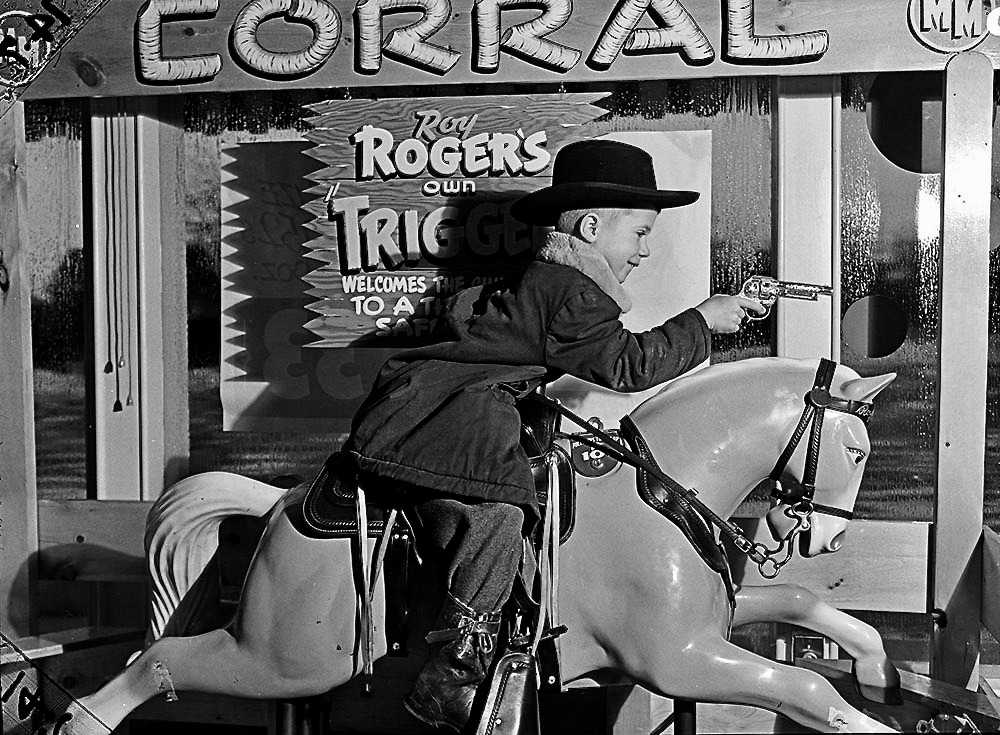
   I sat on the motorcycle behind my godfather, who I called Uncle Joe. I couldn’t get my arms around him and had to hang tight to his shirt. He burped the bike down Stanley Street to Elm Street and took a left towards downtown.  My friends and I had been to an arcade and ridden Roy Roger’s horse Trigger, but none of us had ever been on a real motorcycle. Roy was “King of the Cowboys.” He was from Ohio, where my family was going to end up in a few years. The only cowboys I ever saw in Cleveland, Ohio rode ponies in parades.

   We lived on a new stretch of Stanley Street. Houses were being built as fast as could be because Sudbury was the most congested city in Canada. The Dominion Bureau of Statistics reported there were “42,410 people jammed into 9,450 units.” More than a third of the housing was officially designated as “overcrowded.”

   We glided past the Regent Theatre where my parents went to see movies on weekends. My father learned to speak English in Lithuania, but my mother had lived on an out-of-the-way family farm of pigs and sugar beets near the East Prussian border. The native lingo was all she knew. The movies were a way for her to learn English. A twin bill was showing “Creature from the Black Lagoon” and “Seven Brides for Seven Brothers.”

   The movie house was operated by Herbert Sutherland. By the time I was old enough to go see movies it was home to a colony of rats. It got so it was hard to tell if somebody was screaming because of the monsters on the screen or because of a rat biting their ankles. Herb Sutherland found several homeless cats and invited them to make his theater their home. The city sent him a letter saying, “We do not feel the use of cats is sufficient to eliminate the menace.” He threw the hired guns out and set out poison, making the problem disappear. 

   We went past the new Sudbury Arena which had replaced the old Palace Rink the year I was born. Uncle Joe rode carefully, watching for mud, threading the needle. The Junction Creek overflowed its banks every year, flooding the northern and central parts of Sudbury. We rode around the General Hospital where I was born. Outside the Grotto of Our Lady of Lourdes we stopped for ice cream cones. I peeked over my shoulder for spirits, saintly or otherwise.

  Frederic Romanet du Caillaud, known as the Count of Sudbury, had a six-foot tall 1500-pound bronze statue of the Virgin Mary erected at the mouth of the grotto in 1907. “Queen of the Gauls” was inscribed on the statue. At first, an Italian family by the name of Drago took care of it, wiping off grime and bird shit every spring and autumn. In the 1950s the Rosary Club was formed. Omer Naqult. a local barber and devout Catholic, watched over the pilgrimage site.

   One year earlier almost 10,000 people had gathered at the site, coming from all the various parishes of the Sault-Ste-Marie diocese. New lighting was installed to light up the shrine at night. At the start of the next summer more than 10,000 residents of Sudbury took part in the procession of Corpus Christi that ended up at the grotto. My parents were not able to go to the parade, no matter how devoted to Catholicism they were, so I didn’t know anything about it at the time.

   The statue was an inch or two shorter than Uncle Joe, who wore his hair wavy and was strong as an ox. He could bend nails with his fingers. He and his wife Brone didn’t have any kids, but I saw plenty of them, anyway. My parents had a good-sized living room, and our house was where card playing, dancing, and drinking booze took place on many weekends. There was always a spread of Baltic foodstuffs.

   We set off for Ramsey Lake. Before there ever was a Sudbury the natives called the lake Bitimagamasing, which means “water that lies on the side of the hill.” Everybody agreed Ramsey was easier to pronounce and that is what everybody called it. Everybody also agreed the lake was dead as a doornail. Sewage from Minnow Lake drained into Ramsey Lake. Open roast emissions had been going on for so long and led to so much pollution that the lake, which had few water flow outlets, had given up the ghost. Even though it was still the largest lake in the world located entirely within the boundaries of a single city, it was a shell of its former self.

   There weren’t many fish in the lake. By the 1950s, despite three decades of persistent stocking, angling was still bad. Besides the pollution, fishermen had long since been dynamiting for fish, wiping out some species like bass. When Lands and Forest biologist R. E. Whitefield went survey netting, it took him four full days to catch five pike and one yellow perch. Lake trout were re-stocked in 1952, but when they disappeared, that was the end of stocking for the next twenty-five years.

   Before my father showed up to sweep her off her feet, my mother’s Canadian boyfriend often took her out on the lake in his speedboat, until the day he started showing off, racing and zig zagging, and she fell off the back of it without him noticing. An evil-looking northern pike watched her bob up to the surface. By the time her boyfriend thought to look for her she was floating on her back waiting for him, hoping the weight of her wet clothes wouldn’t drag her under.    

   The lake is named after William Ramsey, who was the chief of a surveillance party in the late 1800s and got into the weeds in heavy fog. After finding himself he named it Lost Lake. Others more civic minded decided it would be better to name it after him but misspelled his name, calling it Lake Ramsay. Forty years later somebody noticed the mistake and corrected the spelling.

   When we got to the lake, I begged Uncle Joe to let me go swimming, but there was a greasy purple substance on the surface of the water as far out as we could see. “It’s probably some poisonous waste, or something Inco is up to,” he said. I had no idea what Inco was, but I had heard “What are you up to?” from my mother often enough to know it couldn’t be anything good. We went for a walk instead. When I got tired my godfather carried me sitting on his shoulders, my hands gripping his thick head of hair.

   It was an early fall day and trees were starting to change color. There weren’t many of them, but the yellows and reds got me going and I begged my uncle to take me to a forest. He said there weren’t any, but finally relented when I wouldn’t leave it alone. We rolled slowly out of town on the Vincent. Uncle Joe flat-hatted across the hinterland.

   It turned out my godfather was right. There were hardly any trees anywhere, at all. The first thing to happen to them was the Great Chicago Fire in the 1870s. Lumber camps popped up all over Ontario providing wood for the American city’s reconstruction. Then the ore discoveries and smelting got going, the fires releasing sulfur, which combined with water forms sulfuric acid, leading to acid rain. Saplings struggling to reforest the landscape didn’t have a chance and died by the millions. The hinterland of Sudbury looked like a wasteland by the 1940s.

   Our street in the city had trees and grass and gardens but the only vegetation I saw outside the city was wild blueberry patches and paper birch. What other trees there were, were giving it their best shot against long odds. They were like the crippled kid on Pine Street we sometimes played with, although never for long. He couldn’t hop, skip, or run. He couldn’t keep up with us. He sat under a tree watching.

   When my godfather checked his watch, he suddenly said we had to go. We raced back to Sudbury, to Stanley Street, to our house. My father wasn’t home from work, yet. Neither was my mother.

   “When she asks you what we did today, just tell her we went sightseeing, OK?” Uncle Joe said.

   “OK,” I said.

   After my mother came home, I told her we had a great time, and while she and my godfather had coffee on the front porch, I watched my baby brother crawl around in the back yard. He was making progress, gurgling rather than crying. Our street dead-ended in a dark face of pitted rock. I was forbidden to climb it because it was steep, even though I had already gone up and down it many times with my friends. Sometimes rules are just a moot point.

   When my friends ran into our front yard after dinner and asked me where I had been all day, I told them all about it, all the places I had been to, and how Sudbury was bigger, better, and more exciting than I had ever imagined. After that, Stanley Street was our world, but we couldn’t wait to see more of the world. We ran up and down the street that evening pretending to be riding motorcycles. The sunset was a gleaming red and orange. We were spent and sat down on a big rock watching night happen. When my mother put me to bed, saying I looked tired, I slept like the rock of ages.

Ed Staskus posts monthly on 147 Stanley Street http://www.147stanleystreet.com, Made in Cleveland http://www.clevelandohiodaybook.com, Atlantic Canada http://www.redroadpei.com, and Lithuanian Journal http://www.lithuanianjournal.com

A New Thriller by Ed Staskus

Cross Walk

“A once upon a crime whodunit.” Barron Cannon, Adventure Books

“Captures the vibe of mid-century NYC.” Sam Winchell, Beyond Fiction

Available on Amazon: https://www.amazon.com/dp/B0CRPSFPKP

Late summer and early autumn. New York City. A Hell’s Kitchen private eye. The 1956 World Series. President Eisenhower at the opening game. A killer in the dugout.
Pie in the Sky

By Ed Staskus

   Bettina Goertzen, Victoria Adams, and Dorothy Riddman were on their way to Coney Island. They were calling themselves Betty, Vicki, and Dottie for the day. They plunked down their ten cents apiece at a NYCTA booth and skipped down the stairs. Dottie stopped to look at a yellow sign trimmed in red on the wall at the entrance to the tunnel. “Please cooperate. When in doubt, ask any employee. Help keep the subways clean. Use receptacles for paper. Do not rush. Let ‘em off first. Move away from doors. Keep to the right on stairways. Always be courteous.”

   Why was them spelled ‘em, Dottie wondered? She didn’t think Sister Mary  Agnes would approve. “Run!” she suddenly called out, running up the platform. “It’s one of those air-conditioned cars!” Two months earlier the transit system had rolled out their first experimental air-conditioned cars on the East Side IRT line. They were fitted with deodorizers and filters and featured piped-in soft music. The temperature was maintained in the mid-70s. Signs on every third window said, “Air-Conditioned Car. Please Keep Windows Closed.”

   They were taking the IND line across the river to Brooklyn, across Gravesend, to the end of the line. When they got off the train they walked, crossed Mermaid Avenue, and hoofed it to Coney Island Beach and the Boardwalk. Dottie felt light as lemonade.

   They stopped at the Sodamat on West 15th Street as they strolled on the Boardwalk. ‘Good Drinks Served Right. Skee Ball 5 cents.’ There were prize games, hammer games, rifle ranges, freak shows, and fortune-tellers up and down Coney Island. “Look, they have waffles,” Dottie said, pointing to a sign on the front of a counter behind which a man in a white jacket and soda jerk cap was making waffles.

   “I thought you wanted a Nathan’s,” Vicki said.

   “I do, but later,” Dottie said.

   “Did you know hot dogs were invented right here on Coney Island, almost one hundred years ago?” Betty asked.

   “Not so fast, how could Nathan have done that?” Dottie asked.. 

   “It wasn’t Nathan then, it was Charley Feltman, who used to boil sausages on a small charcoal stove inside his wagon and then slip them into a roll. He called them red hots at first, but later changed it to hot dogs.”

   “How about some ball hop before we eat?” Vicki asked, pointing into the arcade behind the food counter. “The word from the bird is that you’re good at it.”

   “My game is stickball,” Dottie said. “Skee ball is for jellyfish. They don’t even play stickball here. They play coop-ball. That’s for jellyfish, too.”

   “Do you only play stickball?” Vicki asked. 

   “Oh, no, we play ringolevio and skelly, too, although some kids call it scummy top. Skelly is fun, but all you’ve got are your chalk and the squares and your caps. Ringolevio is way more fun, we run all over, and there’s a jail, and jailbreaks, and everything.  Chain, chain, double chain, no break away!” 

   “Let’s break the chain and go eat,” Betty said. They ordered waffles.

   “That was the best waffle I ever had,” Dottie proclaimed when they were leaving.

    “You had two of them,” Vicki said.

   “She’s a growing girl,” Betty said.

   “Those were the best two waffles I ever had,” Dottie said.

   “Where to now?” Betty asked.

   “I want to jump off the Eiffel Tower!” Dottie exclaimed.

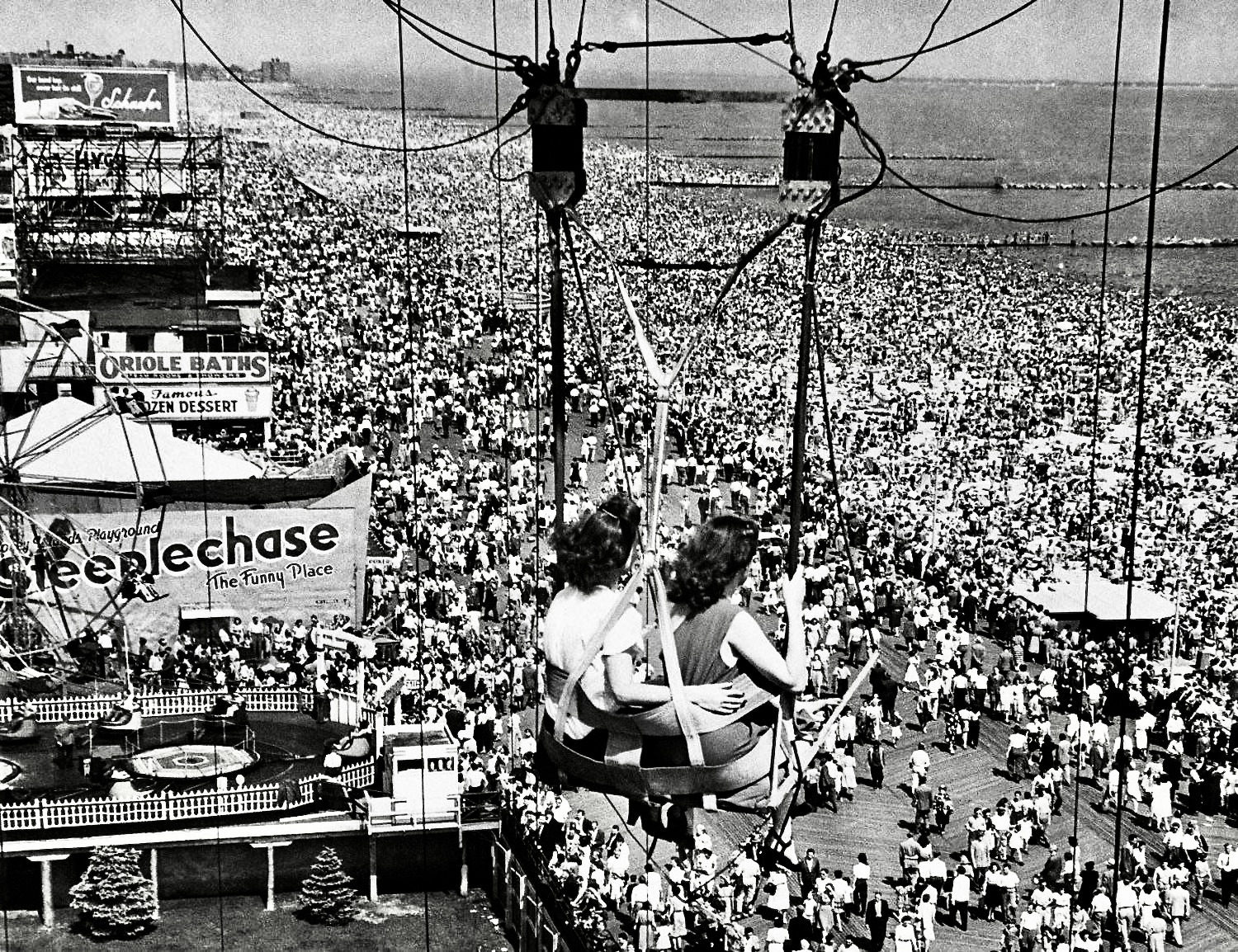
   The Parachute Jump at Steeplechase Park had been built for the 1939 World’s Fair and later moved to Coney Island. It stood 250 feet high, was open-frame, and everybody called it the Eiffel Tower of Brooklyn. Twelve cantilevered steel arms sprouted from the top of the tower, eleven of them supporting two-man canvas seats and parachutes. The riders were belted down, hoisted to the top, then released into a freefall, caught by the parachute, and floated to the ground. Shock absorbers were built into the seats, just in case.

   “I’m not going up on that thing,” Betty said.

   “Do you remember the parachute wedding?” Vicki asked her.

   “No, I never heard of it.”

   “A couple got married up there. The minister was in the seat next to them and the whole wedding party was on the rest of the seats. When the ceremony was over the married couple parachuted down first, and everyone else followed them, except for the minister. The cables on his seat got tangled and he was up in the sky for more than five hours before firemen could get him down. The tower is right on the ocean, and it was windy, and he got sick as a dog, puking on the wedding party who were watching from below.”

   “That cinches it,” Betty said.

   “You and me both, sister,” Vicki said. “Time to plow back through the crowd.”

   “Why do they call it Coney Island?” Dottie asked, taking a last look up at the parachute ride she wasn’t going to ride.

   “It’s because of the Dutch,” Betty said “When they were here, maybe three hundred years ago, there were lots of rabbits in the dunes, so they called it Konijnen Eiland, which means Rabbit Island. It became Coney Island when the English took over.”

   “How did they take over?”

   “Somebody always takes over.”

   “Why does somebody always take over?”

   “It’s the way of the world, child.”

   “I want to go on the Wonder Wheel.”

   “I think we’re up for that,” Vicki and Betty agreed.

   The Wonder Wheel at Luna Park was a Ferris wheel and a Chute-the Chutes and a slow-moving roller coaster all rolled up in one. It was once called Dip-the-Dip. Some of the cars were stationary, but more than less of them moved back and forth along tracks between a big outer wheel and a smaller inner wheel as the contraption rotated.   

   They walked past an eight-foot high neon sign spelling out “Wonder Wheel.” Shooting through the middle of the sign was an arrow blinking and pointing to the ride. “Thrills!” it said. Dottie sat between Vicki and Betty in one of the sliding cars. 

   “You can see Manhattan,” Vicki said when it was their turn at the top of the 150-foot-tall wheel and it stopped for a few seconds.

  “Look, you can see the Rockaway,” Betty said.

   “It takes you low and it takes you high,” Vicki said.

   “When you reach the top it’s like you can touch the sky,” Dottie said. “You can see the whole world from here.”

   “One minute you’re on top, the next minute down you go,” Betty said. “I say, stay in your seat, it’s going to get bumpy, and enjoy the ride.”

   “Top of the world, ma, top of the world,” Vicki cried out like a crazy woman, bulging her eyeballs, and throwing her arms up. Betty laughed. Dottie squinted at them, wondering what they were talking about.

   “One day he’s a mama’s boy mad dog killer and the next day, older and wiser, he’s Yankee Doodle Dandy.”

   Dottie wondered again, what are they talking about? The Wonder Wheel shuddered and started down.

   “Can we go fast now instead of slow?” Dottie asked when they were on the ground.

   The Cyclone was in Astroland at the corner of Surf Avenue and West 10th Street. It was almost 3000 feet long, with six fan turns and twelve drops. The lift hill was 85 feet high. Six years earlier a man who hadn’t spoken in fourteen years, riding the roller coaster for the first time, screamed while going down the first drop. “I feel sick,” he groaned when the train returned to the station. He dropped to the ground in a dead faint after realizing he had spoken.

   Dottie peeked over the front edge of the front car at the track of the Cyclone as the train creaked to the top of the lift hill, where it was going to curve over the rails and hurtle down. Vicki and Betty were in the car behind her, after she had pleaded with them to go on the coaster, and she was with her new friend, Ronald, a boy her age whose parents had stayed behind on the platform. 

   “I have a friend who counts the seconds until the ride is over,” Ronnie said. 

   “Why does he do that?”

   “He can’t stand it.”

   “What’s the point of riding it in the first place?” 

   “I dunno,” Ronnie said. “Every time I ask if he wants to go with me, he says, sure, as soon as I’ve lost my mind, but he always goes anyway.”

   “The Cyclone is for when you want to be scared and excited all at the same time. Maybe he should stick to the merry-go-round.”

   “Yeah,” Ronnie said. “You don’t want to ride the roller coaster when you’ve got diarrhea.”

   “No way,” Dottie said, making sure their buzz bar was locked in place.

   “Did you hear about that girl who got hit in the face by a pigeon and broke her nose going down this hill?” Ronnie asked.

   “No!” Dottie said.

   “She was alright,” he said. “She had some Kleenex and stuffed it up her nose holes to keep the blood out of her eyes. She went right back for another ride.”

   “Yikes!” Dottie said, as the Cyclone shook, shimmied, and roared down the other side of the lift hill. “If that happens, I don’t have any Kleenex!” They laughed up and down the trick hill, leaned into the banked turns that twisted and tipped the train, ducked beneath the head-choppers, and inside of two minutes pulled back into the station where everybody clambered off. 

   “My legs feel like fried bacon,” Ronnie said.

   “Yeah, that was the mostest fun,” Dottie agreed.

   “Bye.”

   “Bye to you, too.”

   “That was sketchy,” Vicki said, catching her breath.

   “Shoot low, they’re sending Shetlands,” Betty said. “Did you feel that tower sway when we got to the top?”

   “You bet I did, right in the pit of my stomach.”

   “I’m hungry,” Dottie said.

   “You’re always hungry,” Betty said. “Doesn’t the boss feed you? Do you have a hollow leg, or what?”

   “I’m on the same page, hollow and hungry,” Vicki said.

   “How about a red hot at Nathan’s?” Betty suggested. 

   “Whoopee!” Dottie belted out sounding like Yosemite Sam after a long day on the trail of Bugs Bunny.

Excerpted from “Cross Walk.”

Ed Staskus posts monthly on 147 Stanley Street http://www.147stanleystreet.com, Made in Cleveland http://www.clevelandohiodaybook.com, Atlantic Canada http://www.redroadpei.com, and Lithuanian Journal http://www.lithuanianjournal.com

A New Thriller by Ed Staskus

Cross Walk

“A once upon a crime whodunit.” Barron Cannon, Adventure Books

“Captures the vibe of mid-century NYC.” Sam Winchell, Beyond Fiction

Available on Amazon: https://www.amazon.com/dp/B0CRPSFPKP

Late summer and early autumn. New York City. A Hell’s Kitchen private eye. The 1956 World Series. President Eisenhower at the opening game. A killer in the dugout.
Breaking the Waves

By Ed Staskus

   Even if it is a 500-foot long 12-thousand-ton carrier like the Marine Flasher, sailing the North Sea in late fall is sailing those waters at the wrong time of the year. Daytime temperatures average cold-and-worse and it is gloomy and foggy. There are about seven hours of daylight. If it’s not raining, it will start raining soon. Sometimes it is so foggy that ships have to slow down to less than 5 knots with horns blaring non-stop. Windy skies and strong swells make plowing through the cold water like trying to plow through month-old mashed potatoes.

   “I was on the boat for nine days and I was sick for nine days,” said Angele Jurgelaitis about her crossing from Hamburg, Germany, to Halifax, Nova Scotia, on the Marine Flasher, converted from a troop ship to hauling DP’s. Not only were big waves breaking over the sides of the ship, in the aftermath of the war, hundreds of thousands of tons of chemical weapons had been disposed of by being dumped in the North Sea.

   “The ocean didn’t leave a good impression on me. Whenever we threw up, we called it ‘Going to Riga.’” What they meant was that the water flows north, so when they threw up over the side, the vomit went north up the Baltic Sea past Poland and Lithuania to the mouth of the Daugava River, where Riga the capital of Latvia is.

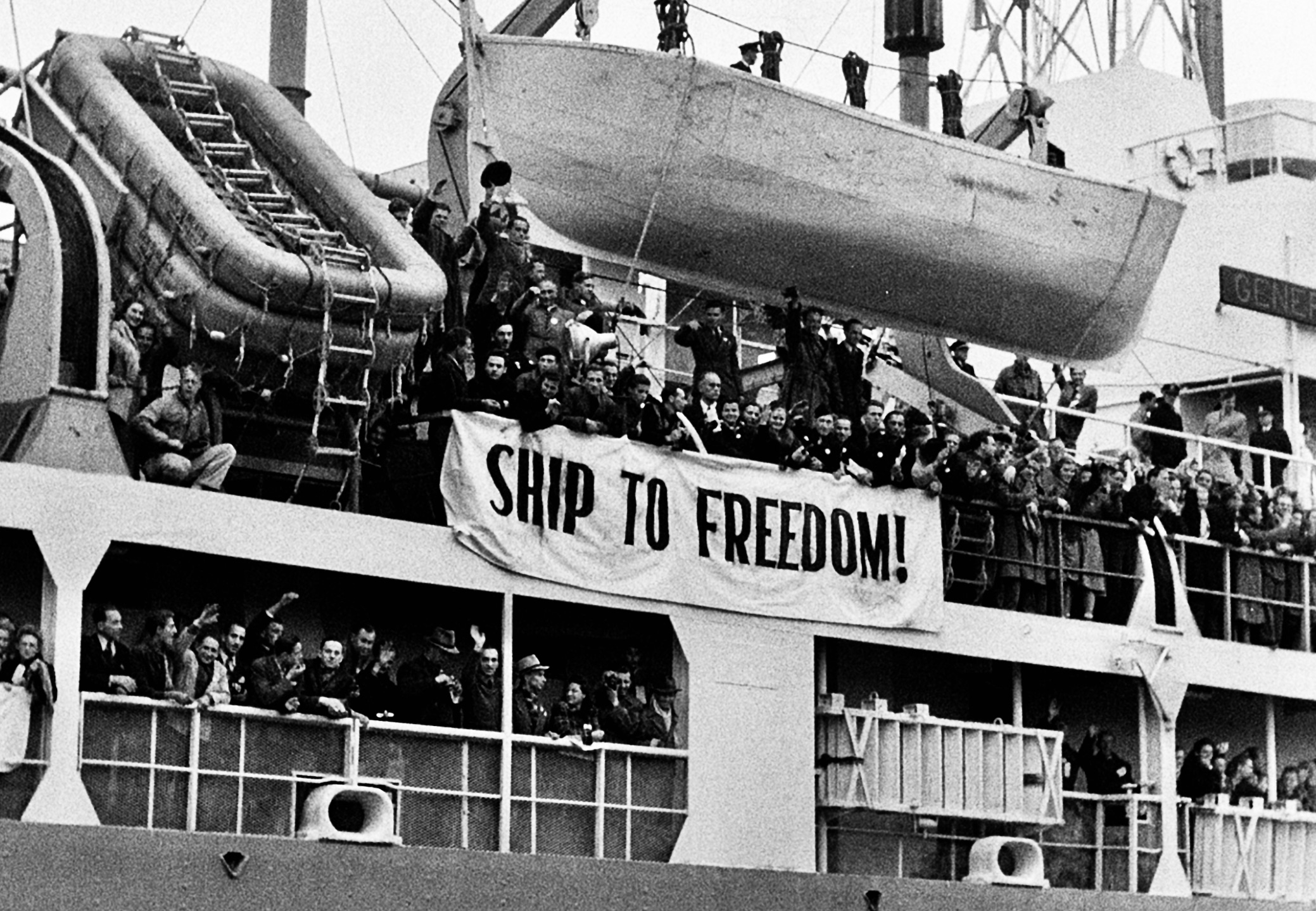
   The Marine Flasher was built at the Kaiser Shipyard in Vancouver, Washington. She was launched for the United States Maritime Commission in May 1945. The ship sailed to San Francisco, Okinawa, Korea and returned to Seattle. The next year it sailed to New York City and from there to Bremen. For the next three years she ferried refugees from Europe to North America, by way of Canada and New York City, and then went back to Germany.

   Angele shoved off from the Old World for good on November 17, 1948. The next day ration scales for IRO refugees became uniform in the British, French, and American zones. It didn’t matter to her anymore. She ate better on the boat, no matter the seasickness, than she had in a long time.

   “There was a canteen on board, and we all got two dollars a day,” she said. “The food was very good. I didn’t think about IRO. We ate well.”

   There were widespread food shortages in Germany following the end of the war. The supply of food was impacted by the prolonged warfare, including the destruction of farmland, silos and barns, livestock, and machinery. Many Germans were forced to live on less than 1,500 calories a day. The average adult calorie intake in the United States at the time was more than 3,000 and in the overseas U.S. Army it was more than 4,000. 

   The civilian population suffered hard times during the severe winter of 1946, exacerbated by shortages of fuel for heating. Displaced persons got somewhat more generous rations, supplied by the Army, the UN, and relief agencies, but even they averaged less than 2,000 calories a day.

   There were 535 refugees bound for Canada on board the Marine Flasher. There were almost 3,000 more bound for the United States, men, women, children, and baby carriages. They steamed into Halifax the afternoon of November 26 and spent the night on the boat. It tied up at Pier 21. Angele hadn’t been able to get into the United States, but she had been able to get to the next best place, Canada.

   She wasn’t stuck behind the Iron Curtain, she wasn’t stuck in Nuremberg, and two days later she boarded a train for Montreal. It took all day and all night and part of the next day to get there, but she wasn’t stuck going nowhere.

   “It was almost 30 hours, but the train was comfortable, with beds,” she said. When they arrived, everybody designated as a nanny or a domestic was segregated. “Those who already had sponsors left. The rest of us, about a hundred of us, boarded busses and they took us to a camp.” They were housed two to a room and interviewed. “They wanted to know what we had been doing in Germany.” They had to fill out one triplicate form after another. 

   One of her roommates at the Army Hospital in Nuremberg had emigrated to Canada a few months earlier. She was working and living in London, Ontario. It is in southwestern Ontario, just north of Lake Erie. The city is a hub for education and healthcare. There are parks and greenways where it lays along the Thames River. It was a military center during the first and second wars, but the wars were finally over.

   “My roommate Ele wrote me that I should ask to go to London, or second best, Toronto,” Angele said. “I started thinking I would join her in London. When I filled out the forms that they gave me I wrote down where she was and that I wanted to go there.”

   Three days later she was presented with a Canadian visitor visa and found out where she was going. She knew she was on the list for the Lapalme family. She hoped she wasn’t going there. An official gave her their address in Sudbury, Ontario. They were Florence and J. A. Lapalme, a prominent family in the mining town. They were known as “’The Largest Family in Sudbury.’ Their children numbered fourteen, although Angele would only be responsible for five of them. Since she had worked in the Children’s Ward at the Army Hospital in Nuremberg, she was seen as the kind of nanny capable of caring for multiple boys and girls.

   “They were so young,” she said. “The youngest was 9 months and the oldest was only 7 years old.” Francois was the youngest, Aline the oldest, Gilles Muriel and Marcel in the middle.

   The domestic woman who cleaned and helped in the kitchen was Lucille Pharand. She worked in several big houses. Lucille was well known as a hard worker. She was built like a fireplug. In the spring of 1949, she and her husband Leo built a house in in the new town of Minnow Lake, three miles from Sudbury. The first few years there was no indoor water and there were no sewer lines to the house. Leo drove to the nearby lake every day with a neighbor, carrying a tub and pails, where they collected water for dishes, laundry, and bathing. They got their drinking water from a well a couple of houses away. In time they gave the Lapalme’s a run for their money, making a large family for themselves. They were known as ‘The Second Largest Family in Sudbury.’

   “I asked again to go to London , but again they said no,” Angele said. “They said nobody was going there.” She wasn’t sure if it was true or if they were just telling her that. In the end not a single refugee went to London or Toronto.

   She didn’t complain. There wasn’t anybody to explain and complain to, anyway, nobody who was going to change the destination that had been determined for her. If you were a European refugee, you were going somewhere where there was work. Men punched a clock mining ore, cutting down trees, and laying roads. Women knuckled down cleaning, cooking, and caring.

   Angele had struck up a friendship on the Marine Flasher with two other Lithuanian women, Inga and Laime, who were young like her. Laime in Lithuanian means happy. They had their hearts set on going to Alberta. They told her there were many rich men there. 

   When the train reached Sudbury, Angele and six other women, all Russians, and a man, another Russian, got off the train. Everybody else, including Inga and Laime, went on to Alberta and British Columbia. Angele was the only Lithuanian on the train platform, more than four thousand miles and several languages from her home.

   “There was no one to understand how unhappy I was,” she said.

   The end of World War Two saw the movement of people all over the world from one place to another. Between January 1946 and December 1953 over 750,000 refugees went to Canada. In June 1947 the federal government authorized the entry of 5,000 non-sponsored DP’s. Two years later the number rose to 45,000. Ottawa established five mobile immigration teams composed of security, medical, and labor officials. They were sent to Austria and Germany to select refugees deemed acceptable for emigration to Canada. 

   Displaced people from the Baltic countries were ranked high on the list. They had been in UN-run camps after their countries, Latvia, Estonia, and Lithuania were caught in the middle of the Russian and German battle zones. Their small countries had become independent after World War One, then occupied by the Russians in 1940, then invaded by Germany in 1941, and in 1944 taken over again by the Russians. In the space of 25 years, they had gone from enslaved by tyrants to enslaved by tyrants

   “When we got off the train there were two men waiting for us,” Angele said. They helped the eight refugees sort themselves out and get to where they were going. One of them told her she was lucky to be going where she was going.

   The Lapalme’s introduced themselves and their children, arranged her living quarters, and quieted her fears about there being no other Lithuanians in Sudbury. They explained there were, and the next day Dr. Valaitis, a Lithuanian doctor and friend of the family, drove to the Laplame home and sat down with her, telling her there were many other Lithuanians in town.

   “Some of them have been here more than two years,” he said. “They make a good living working in the mines.” He gave her the names and phone numbers of several, told her about the Polish church they shared for services, and the local hall where they staged dances and folk performances.

   “The kids I had to care for were so small,” Angele said. She was just 20 years old. Just outside of two years later she gave birth to me, followed quickly by my brother and sister. By 1958 we were living in Cleveland, Ohio, starting from scratch again.

   “They spoke French among themselves and English to me.” She spoke to them more in gestures and pantomime than not. Angele spoke Lithuanian, German, some Russian, but less English. “When Vytas and I were together in Nuremberg he encouraged me to learn English, but I didn’t want to. Whenever I saw him coming with his grammar book I ran away.”

   Vytas Staskevicius was a young Lithuanian man from Siauliai she had left behind in Nuremberg, but who she was waiting for, waiting for him to come to Canada and join her. He had fled the Baltics in 1944, like her, and been displaced in Germany, like her, for more than four years.

   She started taking English classes in Sudbury right away. She wrote her man often, at night, pages and pages in cursive, in their native language. “The Lapalme’s have been good to me They are Catholics and go to church every day, seven days a week. They have a food warehouse, which is their business. We eat very well, so it’s not bad in that respect.”

   Florence was J. A. Laplame’s second wife. He placed ads in newspapers and hired her, a young out-of-town woman, to watch and care for his children after his first wife died. He had seven children, some of them teenagers, some not. It wasn’t long before one thing led to another and he proposed to her. He was nearly thirty years her elder, but she accepted, and over the next decade gave birth to seven children, bringing the family up to record-breaking speed in their part of the world.

   “Florence does the cooking,” Angele wrote. “She has a part-time woman named Lucille who helps with the cleaning and cooking, but Florence does the main cooking. There are usually eleven or twelve of us at the dinner table. She is in the basement every night doing laundry, too. I don’t clean or cook. My job is to watch the children.”

   Whenever Florence was ready to deliver another baby, since her husband had several business interests and was often out of town, Florence usually drove herself to St. Joseph’s Hospital. “If it was a close call, she called a taxi,” Angele said.

   Roger Lapalme, grown-up and the only one of the family who had gone farther than high school, sat next to Angele at the dinner table whenever he was at home. “Roger liked me.” He was barking up the wrong tree. He took her motor-boating on Lake Ramsey until the day he got too enthusiastic at the helm and she fell off the boat. She told him it was enough of that. “Roger was handsome and a lawyer, but I finally told him I already had a boyfriend,” Angele said. 

   One of the LaPalme girls had suffered a nervous breakdown. When her boyfriend, who she expected to marry, killed someone in a car crash, she broke down. She told her father her life was over and went to work in the nickel mines. She was rarely at the house. When she was she slept all day.

   Vytas had a sponsor, an uncle who lived in Boston, but delayed sailing to the United States. He procrastinated about going to Australia with a friend of his who thought they could make passage there. He was determined to go to Canada. J. A Lapalme promised Angele he would give him a helping hand.

   “The year is ending soon,” she wrote her Baltic boyfriend biding his time in Germany. “I have been here more than three weeks. When can you come?” She knew the sailing season wasn’t going to be for several more months. Her man had to break the waves. She knew it wasn’t going to be soon enough. “Be a good boy and write me often,” she wrote him at the start of the new year.

Ed Staskus posts monthly on 147 Stanley Street http://www.147stanleystreet.com, Made in Cleveland http://www.clevelandohiodaybook.com, Atlantic Canada http://www.redroadpei.com, and Lithuanian Journal http://www.lithuanianjournal.com

A New Thriller by Ed Staskus

Cross Walk

“A once upon a crime whodunit.” Barron Cannon, Adventure Books

“Captures the vibe of mid-century NYC.” Sam Winchell, Beyond Fiction

Available on Amazon: https://www.amazon.com/dp/B0CRPSFPKP

Late summer and early autumn. New York City. A Hell’s Kitchen private eye. The 1956 World Series. President Eisenhower at the opening game. A killer in the dugout.
Shadow Man

By Ed Staskus

   Uncle Ernie worked for Danny Greene and nobody else. He didn’t have to work at all, if he didn’t want to, but he liked staying busy. He was busy sniffing around looking for who had blown up Lorcan Sullivan. He put on the wig and fake glasses he always wore when sniffing around. He tried to catch the drift in both Lakewood and Cleveland. It didn’t do him any good. Nobody he knew, who would talk to him, knew anything, while nobody in the know would talk to him. They told him to get lost. None of the working stiffs from the Cleveland Press and Cleveland Plain Dealer who he drank with occasionally could fill him in on anything solid.

   He always told anybody who asked that he was a pipefitter. He wasn’t a full-time fitter but did belong to the Pipefitters Union. He occasionally worked for Blanton Pipe Valves and Fittings. It was more for show than not. It was so he could show income to the IRS. His real earnings were always in cash. He was a private contractor. He was a bomb maker. 

   He was sure the Italians had done it, but the boss wanted to know exactly which one of them had done it. When he found out, the Irishman would expect him to take care of business. Uncle Ernie was an expert at what he did. When he took care of business it stayed taken care of. He never made a mistake, especially never the mistake of blowing himself up, like Art Sneperger had done four years ago. 

   Art Sneperger had been standing outside the back door of Swan’s Auto Service on the corner of Mayfield Rd. and Coventry Rd. four years ago. He was holding a bomb he had assembled when it suddenly went off in his hands. There was the flash of a falling star and a sonic boom. Swan’s Auto Service collapsed in a heap. All the cars in the lot waiting to be repaired were laid to waste. Every window in every house adjacent to the building was  broken by the blast. The Bomb Unit found what little was left of Art under a pile of bricks the next day. His ex-wife withdrew what there was of his savings account and moved out of town.

   Mike Frato, with whom Danny Greene was having a dispute, was part-owner of Swan’s Auto Service. He and the Irishman were going to have it out sooner or later. Everybody on the wrong side of the tracks knew one of the two was going to go belly up.  When Danny Greene was questioned about the bombing at Swan’s he said he didn’t know anything about any dispute or any explosion. Both of the police detectives interviewing him knew they were being lied to, but there wasn’t anything they could do about it.

   “You weren’t sending a message?” they asked.

   “What message would that be?” he asked, grinning like a leprechaun.

   What the police detectives and Uncle Ernie didn’t know was that Danny Greene had been around the corner and detonated the bomb by remote control. Art and Danny had grown up together and worked together as longshoremen, but Art had ratted Danny out. He was in the hole to loan sharks and bookmakers. He couldn’t pick a nag to save his life. He was rewarded by officialdom when he turned canary. He knew he was fixing to die, but what could he do? The squeeze was on.

    “I’m coming out of work one day,” said Skip Ponikvar, a longshoreman’s union vice president. “A car pulls right up. It’s Danny Greene. He jumps out of the car. The other guy, a Hells Angel, jumps out of the car. Danny says, ‘He’s going in there to pay his water bill. How you doing?’ I say, ‘I’m good.’ He says, ‘I heard that Snep is making statements about me!’ I say, ‘Oh, Danny, I don’t know nothing about that.’ Then he starts talking about something else for five or ten minutes. All of a sudden he says, ‘You know that Snep said I killed so and so’  I say, ‘Aw, he never said that.’ He says, ‘I got ya! You told me you didn’t know about that statement!’”

   Uncle Ernie drove up to Lorcan Sullivan’s house on Ethel Ave. and parked across the street. Everything was a mess and other than the mess there wasn’t much to see. All the broken windows on the back side of the house had been boarded up with sheets of plywood. What was left of the garage was being torn down. A small tree in the back yard lay on its side and shrubs that had stood in a line at the rear of the driveway didn’t exist anymore. 

   Tommy Monk rode slowly past on his bicycle as Uncle Ernie flicked his cigarette butt out of his open car window. Tommy looked as the butt, what his dad called coffin nails, fly out the open window. Sparks scattered when it hit the asphalt. He looked at the man behind the wheel. What he saw was a big beak and a funny looking hat. The man’s face looked like it was made of putty. He took a good look at the license plate and turned it into a Plain Dealer banner headline. It was what he did whenever he absolutely had to remember something. He rode home. He would tell his father about the man in the car after dinner. 

   Whoever it was he must have made a dent in the armory to cinch the job, Uncle Ernie thought, and knew in a flash who it was who set the bomb. Only Joey Bag of Donuts doubled down on his targets. He started the car, turned around, got on Clifton Blvd., took Rt. 2 through downtown, and merged onto I-90 to Collinwood. Neither Danny Greene nor his girl Denise were at the Celtic Club.  He had been wanting to have some fun with Denise, but she didn’t seem to want to give him the skin off a plum. He parked and waited. When school let out and students filled the street, he noticed all of them walked on the side of the street across the street from the trailer home.

   After the sidewalks had cleared of school kids and a half hour passed, Uncle Ernie got out of his car and went for a walk, stretching his legs. He walked around the block and another block. When he got back there still wasn’t any sign of life at the Celtic Club. He didn’t want to sit in the car. It was a hot humid afternoon. He took a few steps backwards into a dim space between two storefronts, leaning on a shadow and smoking a cigarette. He was quiet and unnoticeable, except for the glow of the tip of his Pall Mall every time he sucked on it.

   Uncle Ernie was bald and wore a black bucket hat all the time. Most people never saw his pate. He didn’t sleep well, tossing and turning, and had bags under his eyes. He wheezed going up and down stairs. He knew the Pall Malls were killing him but couldn’t stop. His fingertips were yellow from nicotine. Whenever he tried to stop smoking he lit up another one to mull over whether to stop. 

   When the Irishman pulled up, parked, and went inside the trailer home, Uncle Ernie waited for five minutes. When nothing happened he crossed the street, walked up to the only door, and knocked. He always tried to never surprise Danny Greene, who didn’t like surprises. The Irishman let him in. Denise was nowhere in sight. They sat down in what passed for a living room. Even though Danny Greene dressed well, and was always neat as a pin, the trailer home was disordered.

   “What have you got for me?” he asked.

   “I think I know who did the job,” Uncle Ernie said.

   “Do you think or do you know?”

   “I’d be surprised if I was wrong.”

   “All right, spill it.”

   “It may not be the God’s truth, but I don’t think it could have been anybody else other than Joey Bag of Donuts.”

   “All right, now that you know, take care of that fucking Dago.”

   “You want it done right away?”

   “What the hell do you think?”

   “Got it,” Uncle Ernie said.

   It didn’t take him long to get home. He lived in Collinwood just like Danny Greene did. He lived on Midland Ave. south of I-90 and the Collinwood Railroad Yard. There were one hundred and twenty miles of track in the yard and two locomotive repair roundhouses. The sound of trains was always in the background. His house was a two-story single home with a garage and a deep backyard. His bomb-making workshop was in the basement.

   Uncle Ernie had been married three times and three times his wives left him. Even though he was responsible enough, always paying his taxes and never running a red light, he had several bad habits that no woman could put up with for long. His non-stop smoking was one of them. His hardly ever talking was another one of them. When it came to women he only talked to the buttons on their blouses. His watching cops and robbers reruns on TV every night was another one. All three marriages were over within two years. One of them ended less than a year in. After the last one left he gave up. That had been twenty years ago. He knew no woman would have him anymore and had stopped trying to find one.

   His house had been shipshape twenty years ago when the last of his Zsa Zsa’s left. He was convinced all three of them had read the real Zsa Zsa Gabor’s book “How to Get Rid of a Man.” Twenty years later his house was a pigsty. He never opened the fridge for fear of what he might find. He had started cleaning his bathroom a couple of years ago but then gave up. He hadn’t made his bed for more than a decade, although he changed the sheets every couple of months. Every ashtray in every room was overflowing with butts. Old newspapers were stacked in corners. He meant to tie them up and put them on the tree lawn someday.

   He put his bucket hat away and made coffee. He lit a cigarette. He took his coffee black and took the mug down to the basement with him. He had a workroom there. It was as unlike the rest of the house as it could be. The cement floor was smooth as a baby’s bottom. He had painted it an industrial gray which had sealed it. The paint kept the dust down, too. The floor supported two heavy workbenches and a fixed saw. One pegboard was on the wall at the back of his main workbench while another bigger peg board covered most of another wall. He had two sets of freestanding shelves. Everything was close to hand, including ash trays and fire extinguishers.

   Dampness was a problem he had solved partly with a dehumidifier. He solved the rest of the problem by installing an exhaust fan high up on a wall. It was next to the egress window he had put in, if ever he had to get out fast. He had more than enough tools to build anything, even a dining room set, although all he ever built were bombs. He had spares in a cabinet of all the tools he used the most. He was like an old maid when it came to his job of work.

   He put his mug where he could reach it easily and stubbed his cigarette out. The bomb he was going to make was a simple one of a few sticks of dynamite and a detonator. That would take care of Joey Bag of Donuts. He bought his explosives in New Hampshire. Everything else he bought in Valley View on the south side of town. He would have to set the bomb off by remote control rather than a timer or tilt fuse. 

   Nobody knew where Joey Bag of Donuts lived, although everybody knew he didn’t own a car. He went to where his targets were by city bus. He carried schedules in his pocket. He never worked outside the city. Uncle Ernie had heard he frequented the cemetery next to Little Italy. He had heard the greasy turnip liked to take naps at the base of Haserot’s Angel. He would hide the bomb in the weeds there and wait nearby. When the greasy turnip showed up and was napping he would set the bomb off and send the little man to the big sleep he deserved.

   Uncle Ernie was a professional. He hated amateurs like the Weather Underground and their wacky friends. They had gone from throwing Molotov cocktails now and then in the late 1960s to a steady campaign of protest bombings that stretched from New York City to San Francisco. The FBI had gotten to calling San Francisco the “Belfast of North America.” From 1971 through 1972 there were more than two thousand terrorist bombings on American soil. Most of them happened at night, targeting buildings, and most of them didn’t cause any serious injuries. What Uncle Ernie hated about the radicals was their sincerity. They had a boatload of fervor, too, which he hated almost as much. He had no use for true believers throwing bombs for the sake of a better world. He believed in the kind of bomb throwing that put cold cash into his wallet. 

   Making bombs was his cash cow. “I’m not a goddamned anarchist,” he said to himself. No one heard him say it. He didn’t have any friends. Both of his next door neighbors and the immediate neighbors across the street avoided him. “I’m a businessman, no bullshit,” he reminded himself.

   When he was done he put the bomb in a lunch pail. The pail was a Black Dome. It had been his father’s when his father had been a coal miner in West Virginia. “The devil put the coal in the ground,” his father always said. He kept a lump of it on the mantle in their living room. “That is gonna be a diamond someday, son, even though I ain’t gonna see that day.” He carried his lunch underground with him every day until the day black lung stopped him in his tracks. He coughed himself to death the rest of the year. When he died he didn’t have a diamond to buy his way into paradise, where they don’t take lumps of coal.

   Uncle Ernie put the lunch pail on the floor under his workbench. He did it carefully. He went upstairs and put his hat back on. Blowing up Joey Bag of Donuts was going to take some time, most of it waiting for the weasel to show up. In the meantime, he would do some dining and drinking at the Flat Iron Café. The place was an Irish watering hole. They had meat loaf and mashed potatoes, corned beef and cabbage, and Pride of Cleveland on tap. It. They had Lake Erie Yellow Perch every Friday. It was Friday, so he was going to have fish with his beer. He would go fishing for donuts on the weekend.

Excerpted from the crime novel “Bomb City.”

Ed Staskus posts monthly on 147 Stanley Street http://www.147stanleystreet.com, Made in Cleveland http://www.clevelandohiodaybook.com, Atlantic Canada http://www.redroadpei.com, and Lithuanian Journal http://www.lithuanianjournal.com

“Bomb City” by Ed Staskus

“A police procedural when the Rust Belt was a mean street.” Sam Winchell, Beyond Books

Available on Amazon: https://www.amazon.com/dp/B0F1LM1WF9/ref=sr_1_1?crid=2MYAQAOZIC2U9&dib=eyJ2IjoiMSJ9.hTm7BGbiQbSe5ZapFwYPPfcwOpTe-Vdg6VLE4aGyTyk.Z0R-VNBWWEcvKcNaO9LdCOUnNIOOXgvYkRS_FXiXuHk&dib_tag=se&keywords=bomb+city+ed+status&qid=1742136726&sprefix=bomb+city+ed+staskus%2Caps%2C84&sr=8-1

Cleveland, Ohio 1975. The John Scalish Crime Family and Danny Greene’s Irish Mob are at war. Car bombs are the weapon of choice. Two police detectives are assigned to find the bomb makers. It gets personal.

A Crying of Lot 49 Publication

Outside the Law

By Ed Staskus

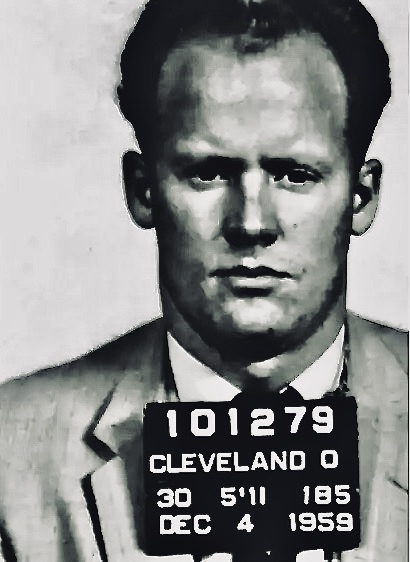
   Everybody called Danny Greene the Irishman. He was almost forty two years old the summer of 1975 and somehow still alive. He had never looked his age, but that had changed, although he still didn’t look his age. He looked older. Water under the bridge hadn’t done him any favors. He grew a mustache to take attention away from his thinning hair. On top of that, at the moment, he felt bad. He didn’t feel bad about Lorcan Sullivan being blown up in Lakewood two days earlier. He was in a rage about that. That was different. His mouth hurt bad. A bum tooth was a different kind of misery. He called his dentist, who knew well enough to get him in no later than right away.

   He lay down with his face on a pillow on the floor of the trailer home in Collinwood that had become the Celtic Club. His live-in girlfriend Denise Schmidt knelt over him and massaged his back. It had been tightening up every night the past two months. He was stiff as a board most mornings. He felt like an old man sometimes. Denise was a senior at Collinwood High School. She was on the young side of more than half his age. She made him feel younger. The bomb blast hadn’t slowed her down. 

   Two months earlier at four in the morning while they were sleeping on the second floor of their two-story storefront home on Waterloo Rd. somebody had thrown two bombs through the ground floor windows. The storefront was where Danny Greene had a phony consulting firm on the ground floor that went by the name of ‘Emerald Enterprises.’ The enterprise was mainly in the business of extortion. The Irishman’s other enterprises were gambling, embezzlement, loansharking, and leg breaking. Murder was taken for granted in his line of work.

   When the sound of glass breaking woke him up, he slipped out of bed and into the kitchen. He had a gun in his hand. When the first bomb that came through the window exploded, he was crouching between the sink and the refrigerator. A cabinet was above him. He was safe in his improvised nook when timbers and bricks started to fall, but when the floor caved in he went down with it. Denise was still in bed. She and the bed went down, too. The bed ended up halfway down from the second floor, tilted and dangling from a beam. She hung on until she couldn’t hang on anymore.

   “I felt the floor give out,” the Irishman said. “The next thing I knew I was in a heap of rubble. A busted icebox was beside me. Denise fell on top of me. I dug the two of us out. I heard dogs barking. I couldn’t hear my cats.”

   “Danny Greene made out like Houdini,” Ed Kovacic, the Central Station police lieutenant investigating organized crime, told Frank Gwozdz and Tyrone Walker. “He was luckier than his cats.” Danny Greene had two street cats who nightly slept inside the building on the first floor. They were both killed. His new 1975 Lincoln Continental was destroyed. A second bomb was connected to a two-gallon can of gasoline. That bomb didn’t go off and the gasoline didn’t ignite. The Irishman had more lives than a clowder of cats.

   The Bomb Unit got to work before dawn after the blast. Across the street a disheveled hippie sat on the curb waving a bottle of Boone’s Farm at anybody who gave him a glance. “You should a heard just what I seen,” he said to anybody who came within earshot. Nobody paid any attention to him. Even he had a hard time paying attention to himself.

   When the rubble was cleared away Danny Greene set up shop in the same place, parking a trailer home there. A TV news crew interviewed him outside his new headquarters. He announced his new address and invited any other would-be bombers to try again. “I’m in between both worlds, the square world and the street world,” he said. “I think I have trust on both sides, but I have no ax to grind. If somebody wants to come after me, we’re over here at the Celtic Club. I’m not hard to find.” He was shirtless, bare-chested, and spilling over with contempt. He pointed to the medal of St. Jude he was wearing around his neck. “This is why nobody is going to get me.” 

   Parents in the neighborhood warned their children not to go near the trailer with the Irish flag flying in front of it. They told them it was best to stay away from that whole block, St. Jude medal or no St. Jude medal.

   Danny Greene’s mother died when he was three days old. His father got drunk and stayed drunk after she was buried. He lost his job with Fuller Brush. When he did he dropped the baby boy off at the Parmadale Orphanage. Six years later, back on his feet, newly married, he took the boy back, but the first grader argued long and loud with his stepmother and ran away again and again. One night he ran away to his grandfather’s house in neighboring Collinwood and never went back.

   His grandfather put him into St. Jerome’s Catholic School where he became an altar boy and all-star basketball player. He joined the Boy Scouts. After graduating from grade school he went to St. Ignatius High School. After that things started to go south. He was thrown out of the Boy Scouts for fighting with other scouts. He was expelled from St. Ignatius for fighting with the Italian pupils and everybody else. He transferred to Collinwood High School but was expelled for “excessive tardiness.” He explained he had to fight his way into the school, fighting the bullies blocking his way, but the principal didn’t believe a word of it and told him, “Leave and don’t ever come back.”

   “He grew up hustling,” said his one-time friend Aggie who ran with Danny Greene when they were kids. “It’s hard to take the hustle and larceny out of somebody who grew up with nothing. Being an orphan and growing up with the nuns, you tend to grow up edgy, tough, and slightly mean.” Hardly anybody stayed friends with the Irishman for too long. The nuns put him in their prayers, to no great effect.

   He enlisted in the Marine Corps. They liked his fighting spirit. He became an expert marksman. Before long he was training other marksmen on Sniper Garand rifles. When he was discharged he was honorably discharged. He went home to Cleveland to be his own man. He was done with running away. He had a brand-new plan. He started working on the waterfront. He was elected president of Cleveland’s Local 1317 International Longshoreman’s Association, the dock workers union, in 1962. The trouble started right away when he began embezzling union funds. He was living large and needed the money. Trouble picked up the pace when he started leaning on his longshoremen for more money.

   “Danny was spending money hand over fist,” said Skip Ponikvar, vice president of the union. “His trips to the Theatrical Grill downtown, trips to Chicago, trips to New York. And he was picking the tabs up. There was only so much a few hundred men could support with dues. He got the idea to have some guys work the grain boats on the side and sign the checks over to the union. The guys started bitching and moaning about it. Well, if you worked on the grain boats, when it came to the hiring hall later on, those guys were given the better job, which is illegal.”

   Longshoremen started shaking down employers for payoffs. One of them threatened to kill the children of a businessman who wouldn’t cooperate. His house had to be put under police protection and his children escorted to school by an armed guard. After one too many complaints, the Cleveland Police Department sent Ed Kovacic and his partner to set Danny Greene straight. It wasn’t a far drive to the union hall. They stopped for coffee and a smoke. Refreshed, they walked into the union hall quietly, looking for the back office. They didn’t mean it to be a pow wow. They hadn’t brought a peace pipe.

   “When we walked in, I felt like I’d fallen in the Atlantic Ocean, because it was all green,” Ed Kovacic said. “Even the walls were green.” The only thing not green was the Irishman, at least from the neck up. “Everything was green except his hair and face. He handed us a pen, which had green ink in it. Everything was pleasant until he asked why we were there.” They told him why they were there. “He got up and started walking around the room. As he did, he got louder and louder. He started talking about how the Italians thought they ran Collinwood, and this was just a bunch of tough Irish and Slovenian kids who were going out there and telling them they didn’t run Collinwood anymore. I handed him our crime report and said, ‘How about this man? Your goons blinded a Chinese American man.’ Boy, that really set him off like a rocket! Finally, he said, ‘Get out. That’s enough. We’re done.’” 

   The policemen were done, too. “When we got in the car, I said, ‘That was like a scene from that waterfront movie. He was acting like Marlon Brando.’ My partner said, ‘Yeah, I was waiting for him to start hollering, ‘Stella! Stella!’” Ed Kovacic didn’t bother telling his partner he was getting his movies mixed up.

   Danny Greene didn’t want or need anybody like Stella. Blanche was more his speed, at least if she had been half her age. He knew how to get what he wanted. He liked blondes who were blonde as sunlight. The nuns at St. Jerome’s had tried to teach him the difference between angels and demons, but he never learned his lesson.

   “He was dynamic,” Skip said. “Dressed to the nines. You never saw him in jeans or street clothes. Suit and tie all the time. He negotiated a hiring hall for the union. It allowed us control. Total control. If you were my friend, I’d send you on a boat that’s going to work ten hours. And if you weren’t my friend, or just an average guy, I’d send you on a boat that’s going to work four hours. He had ‘Don’t fuck with me’ written all over him. You didn’t want to even challenge him. He was always in shape. He didn’t smoke. But when he drank, that was his weakness. He drank to excess, and when he drank to excess, bad things would happen, arguments, fights, all kinds of bad things.”

   Danny Greene was in shape but couldn’t fight everybody in the union. He was outnumbered. Everybody finally wanted him gone. “The men wanted him out,” said John Baker, one of the dock workers. “They didn’t want to work the boats for nothing. When he got into his jam, he asked me for a vote of confidence, and I said, ‘Danny, I can’t do it.’ That was it. We never talked after that.”

   The national union suspended him. He was done running Cleveland’s docks. Somebody drove past his house and pumped five bullets into the clapboard, just to make sure he got the message. When a TV reporter showed up the next morning the Irishman read from a scrap of paper, “Effective immediately, I have resigned as a member and officer of Local 1317. After nearly four years of devoting all my energies to get the dock workers in Cleveland a fair shake, I found that my only compensation is headlines in the newspaper and bullets through my window.” When push came to shove he pled guilty to falsifying union records and was fined $10,000. He never spent a day in jail and never paid a penny of the fine. By that time, he was a part-time FBI informant and the FBI didn’t care whether he paid his fine, or not. They had bigger fish to fry.

   Danny Greene stayed on the floor for ten minutes after Denise was done with his rubdown, rolling over on his back, grasping his knees, and pulling them into his chest. He rocked forward and back. When he stood up he felt like his old self. He went outside and sat down a lawn chair in the dirt front yard in front of his trailer home. Two empty cans of Stroh’s lay at the feet of a plaster leprechaun beside the chair. He used to do next week’s drinking every day of the week but had put a stop to most of it. He had started jogging, gulping vitamins, and steaming vegetables for dinner.

   His dentist’s appointment wasn’t for two more hours. The tooth yanker was in Lyndhurst, twenty some minutes away, so there was plenty of time to think things over between now and then. He had gotten a new Lincoln Continental and enjoyed driving it. What he didn’t enjoy was checking it from front to back and underneath it for anything that might blow its top. Denise wouldn’t go near the car until he was done.

   He was going to make somebody pay for blowing up his building and killing his cats, never mind the car. He was going to make somebody pay for Lorca Sullivan’s death, too. He knew more about revenge than any man alive. He was going to make somebody pay for something, if it was the last thing he did. He was nothing if not a man of his word, no matter how many twists and turns his words might take.

Excerpted from there crime novel “Bomb City.”

Ed Staskus posts monthly on 147 Stanley Street http://www.147stanleystreet.com, Made in Cleveland http://www.clevelandohiodaybook.com, Atlantic Canada http://www.redroadpei.com, and Lithuanian Journal http://www.lithuanianjournal.com

“Bomb City” by Ed Staskus

“A police procedural when the Rust Belt was a mean street.” Sam Winchell, Beyond Books

Available on Amazon: https://www.amazon.com/dp/B0F1LM1WF9/ref=sr_1_1?crid=2MYAQAOZIC2U9&dib=eyJ2IjoiMSJ9.hTm7BGbiQbSe5ZapFwYPPfcwOpTe-Vdg6VLE4aGyTyk.Z0R-VNBWWEcvKcNaO9LdCOUnNIOOXgvYkRS_FXiXuHk&dib_tag=se&keywords=bomb+city+ed+status&qid=1742136726&sprefix=bomb+city+ed+staskus%2Caps%2C84&sr=8-1

Cleveland, Ohio 1975. The John Scalish Crime Family and Danny Greene’s Irish Mob are at war. Car bombs are the weapon of choice. Two police detectives are assigned to find the bomb makers. It gets personal.

A Crying of Lot 49 Publication

Day of the Snapper

By Ed Staskus

   After we got married my wife and I bought a home in Lakewood a few houses east of the Rocky River valley and set up housekeeping. It was the early 1990s. We tore all the lime green shag carpeting out, tore all the false ceilings out, and tore all the wallpaper off the walls, painting them white. We purged the original bathroom. The house was built in 1922 and the bathroom had to go. It was only the beginning, but at least it was a start.

   After a few years we thought we would get a cat. My wife wanted a darkish long haired. I wanted an orange short haired. We got a fluffy orange Maine Coon. He was a half-breed, but well bred. The few times he misbehaved it was mostly because we hadn’t made it clear to him that some behavior, like scratching the furniture, was out of bounds. After we let him become an inside outside cat, all the scratching he did after that was outside. We never asked the local trees shrubs or fences whether they minded, or not.

   He stayed indoors during wintertime, except when it was above freezing, as well as those times he was simply close to the side door and I tossed him outside, which I did whenever there was a snow mound beside the door. If the snow was fluffy enough, he sank into it up to his eyeballs, looked helpless for a second, scrambling to get out of the snow, and giving me a dirty look rushing back inside. Maine Coons have a reputation for enjoying snow. Our cat didn’t live up to the reputation. He was good with rain, tolerated snow showers, but not blizzards or northern Ohio winter wind storms.

   We named him Snapper after a movie we had recently seen, “The Snapper,” which is about a big family in a small house in Dublin whose oldest daughter has gotten pregnant, but won’t tell anybody who the father is, because it happened after a wild night at a pub with a man who is her father’s friend and is her father’s age. She tells everybody it was a friendly Spanish sailor passing through town. The family calls the baby in the belly the Snapper.

   I called our cat Bud. My wife called him Snaps, Snapper Doodle, Kinney, Lambkins, and Goose. He didn’t answer to much unless he was hungry, wanted to go outside, or wanted to come back inside. He didn’t like to be bothered when he was catnapping, which was more often than not. He never answered to Bud, or anything else, when he was wholeheartedly asleep.

   Snapper didn’t tell us who his parents were. He didn’t say a word about his brothers and sisters, or uncles and aunts. He didn’t tell us where he was from or how he had gotten to where I found him, which was the Cleveland Arcade. He was vocal enough when it came to food and creature comforts but didn’t like talking about himself.

   It was Thanksgiving and Christmas time. I was downtown to pick something up from a store in the Cleveland Arcade. The whole placed was dolled up for the holiday. It used to be called the Crystal Palace. I parked near the Main Library and went in through the Superior Ave. doors. When I did, I noticed the Animal Protective League had taken a vacant storefront for the time being and was peddling dogs and cats. When I looked around, I spied our new kitten in a cage at eye level in the middle of the store. I extended my index finger into his jail cell, he took it into his mouth, and bit me. He was a youngster somewhere between 10 and 12 weeks old. He might have been able to puncture paper, but not me.

   “You’re for me, bud,” I told him.

   I told the man behind the sales counter I was going to my car to get money to pay for him. When I got back a young lady had him in her hands and was walking to the counter. I stepped up to her, tapped her on the shoulder, took our cat away from her, and said, “He’s spoken for.” She gave me a sour look and went looking for another one before another one of me came along.

   The Maine Coon is one of the oldest breeds in the United States. Nobody knows exactly where they came from, but many believe they are related to both Siberian and Norwegian Forest cats. They are the official state cat of Maine. Down Easters say the breed originated in their state. Others say they are the only original American cat.

   The legend I like best is that when Marie Antoinette, the ill-fated Queen of France, was trying to beat feet out of the country, she enlisted the help of Captain Samuel Clough. She loaded his ship with all her favorite stuff, including six of her favorite cats, Siberians and Turkish Angoras. Her luck was bad, though. The Gendarmerie dragged her back to Paris before the ship could sail. When the ship sailed the six cats sailed with it. After they reached the town of Wiscasset, Maine they went into town on shore leave, living it up with the local breeds. They didn’t make it back in time when the ship shoved off, developing into the modern kind of Maine Coon. 

   My mother-in-law was owning and operating a deli takeout on the ground floor of the National City Bank building on East 9th St. My trip downtown had also meant picking up dinner for myself and my wife. I needed to get food for the new guy, too. I parked on Short Vincent. I didn’t want to leave the cat in the car, so I smooshed him into the pocket of my winter coat.

   “What’s that wiggling in your coat?” my mother-in-law asked handing me a bag full of good food. The cat stuck his head out of the top of my pocket sniffing at the bag.

   After oohing and awing at the furball she gave me a wicker basket for him to sleep in. He slept in the basket that night and for years afterwards. He never suffered from insomnia. Even when we bought a bigger and better basket for him, he continued sleeping in the original until he couldn’t fit into it anymore. When he grew up, he had a white ruff on his chest and a two-layered coat, a silky undercoat under longer guard hairs. He wasn’t as big as a purebred Maine Coon, but more than hunter savvy enough. He was more than sociable with us since we were his feedbag.

   At first, we thought we would keep him indoors, but he was as much dog as cat and had to go outside, no matter what. When spring arrived, we started letting him out and teaching him to stay away from the street. I let him wander around, following with a squirt gun, and whenever he drifted down the driveway to the apron squirted him in the face. He didn’t like it and learned his lesson, at least until he got older, when all bets were off. Our backyard was fenced on three sides and raised above the alley behind our house. Three or four houses both sides of us was as far as he ranged sideways. 

   I was watching him walk up the sidewalk one day when a full-grown cat came sauntering his way. Snapper was still a tyke. They sniffed at each other. Our guy made a sudden movement and the other guy swatted him. When he went running the other cat followed him. He jumped and I gathered him up in my arms. The neighborhood bully sat at my feet watching while Snapper made faces at him, throwing caution to the wind, snarling, and showing his claws. He could be sassy. Cats fight all the time. Even when they are playing, they get scratched. That doesn’t keep kittens from happening. They are both wild and domestic at the same time.

   Over time he learned and remembered what our cars sounded like and hearing my wife or me pulling into the driveway ran out of the backyard to see us. I didn’t like him doing it and blared my horn to make him stop doing it, but he never did. He went his own way.

   We lost him one day in the night when he got trapped inside a neighbor’s garage after the man unwittingly closed the door on him, but he was such a loudmouth that his cries alerted everybody to where he was. He could have been a civil defense siren. He knew to come inside at sunset, but sometimes forgot, sitting under our bedroom window in the middle of night meowing until we let him in the house. He slept with us on our bed, taking up a third of it. He liked his space.

   Snapper was a mouser, bringing half dead mice to the door for our approval. He messed with anything that moved. Since we lived on the edge of the valley park, there were plenty of squirrels, rabbits, possums, and racoons. He never caught a rabbit, but one day a racoon caught him. We were searching for him the next day when I found him curled up in the back of a closet. There were gobs of dried blood on his face and puncture wounds on one side of his mouth.

   “It looks like a coon hooked him,” the vet said, sewing him up and shoving an antibiotic down his throat. “Give him one of these every day for a week.” Giving him the pills was easier said than done.

   He was a birder, too, although birds were usually too fast for him. One day a pair of blue jays were in our backyard bird feeder when he went after them. That was a mistake. One of the birds flew away but the other one circled back and started dive bombing him. Snapper had no answer for the loud jeers and attacks of the big bird and ducked under a hedge sulking. The rest of the summer he scanned the sky and made sure there were no blue jays in his neck of the woods before he went exploring.

   By the time his second summer rolled around he could jump to the top of any fence, climb any tree, and even make his way to the top of flat-roofed garages. He came down from trees backwards, but I usually had to get a step ladder to get him down from roofs. He often bit off more than he could chew. I kept him in shape by holding him upside down and tossing him up in the air. He twisted at the top of the arc, aligning himself head up feet down, landing on my open hands. He rarely misjudged it, nailing the landing. It stood him in good stead his long lifetime.

   Indoor cats live about 12 to 17 years. One way or another outdoor cats live about 2 to 5 years. Maine Coons live about 10 to 13 years. Snapper was half Maine Coon and half who knows what. He spent half his life indoors and half his life outdoors. The more time he spent in the great outdoors the more wary he became of the animal kingdom, especially people and their ways. He always had the same expression on his face, whether it was a June bug or an ax-murderer coming his way. He was able to snap to attention out of a deep sleep in a split second. Snapper never let anybody get near him unless we were nearby. He was smarter than he knew. He lived to be nearly 18 years old. 

   We fed him wet food in the morning and kibble the rest of the time. We started him off with top shelf wet food until he made it known that anything with gravy was his favorite. After that Iams and Science Diet were out. Cheap-ass Friskies were in. He might have lived on gravy alone if we let him. We didn’t let him, but we tried to keep him happy. “When my cats aren’t happy, I’m not happy. Not because I care about their mood but because I know they’re just sitting there thinking up ways to get even,” the writer Percy Shelly once said.

   As much time as he spent outside, he was a homeboy at heart. When we went on vacation, whether it was for a week or a month, the minute we got back he started complaining about our absence and stayed close to us for days afterwards. After that it was back to his gravy and his basket.

   He got slower towards the end of his life. When winter came, he slept near the furnace registers. His kidneys started going bad. We added a second litter box so he could pee the second he had to. 

   One summer day coming home from work I turned into our street behind another car. Snapper was across the street from our house, on our neighbor’s front porch. Hearing my car, he jumped up and started running across the street. He was still fast enough for his age, but not fast enough that day. The front tires of the car in front of me missed him but when one of the back tires struck him, he went up into the air, landed with a thud, and rolled over. I watched the car not stop. I stopped in the middle of the street. He was still alive when I ran to him, but just barely.

   He was spasming and crying. He was broken. He was choking on blood. I forced his mouth open so he could breathe. He sucked on my finger and died. He wasn’t the kind of cat who had nine lives. Snapper had one life and his life was over in the blink of an eye. I wrapped him up in that week’s issue of the Lakewood Observer and took him down Hog’s Back Lane to the park, burying him on the banks of the Rocky River. He had never been to the park but lived on the edge of it. He saw it every day of his life from our second-floor porch.

   Two years later we got another mixed Maine Coon. He was a black classic style tabby. My wife named him Gladwyn but called him Baby Wodin, after the pagan god of the Anglo-Saxons. She called him Gladdy often enough so that I started calling him Gaylord, after the crafty old Cleveland Indians pitcher Gaylord Perry. When winter came and went, he liked sitting on Snapper’s cat perch on the porch and looking out at the valley going buds and blossoms.

   Every spring I go to where I buried our cat and sit by the river in the sun watching ducks take their young out for a swim on the greenish-brown water. Snapper was like me in some ways. Whenever I chased him he went running. Whenever I ignored him he came purring.

Ed Staskus posts monthly on 147 Stanley Street http://www.147stanleystreet.com, Made in Cleveland http://www.clevelandohiodaybook.com, Atlantic Canada http://www.redroadpei.com, and Lithuanian Journal http://www.lithuanianjournal.com

A New Thriller by Ed Staskus

Cross Walk

“A once upon a crime whodunit.” Barron Cannon, Adventure Books

“Captures the vibe of mid-century NYC.” Sam Winchell, Beyond Fiction

Available on Amazon: https://www.amazon.com/dp/B0CRPSFPKP

Late summer and early autumn. New York City. A Hell’s Kitchen private eye. The 1956 World Series. President Eisenhower at the opening game. A killer in the dugout.

Throne of Blood

By Ed Staskus

   Little Italy was a fifteen minute drive from the Central Station. Frank Gwozdz drove slightly under the speed limit and didn’t try to time the lights. It took them twenty minutes. He parked at the intersection of Euclid Ave. and Ford Dr. on the border of the Negro ghetto and Case Western Reserve University. The run-down near east side was its own world. The school was its own world. Little Italy was up Mayfield Rd. It was its own world, too.

   “We’ll leave the car here,” Frank said. “We can walk the rest of the way.”

   “No respect for the law where we’re going?” Tyrone Walker asked.

   “Let’s just say it’s better to leave the car where the school kids believe in cross walks,” Frank said.

   They walked to Corbo’s Dolceria on Mayfield Rd. where it stood on the corner of Murray Hill Rd. After sitting down at one of a handful of small tables at the front window, Frank ordered a caffe normale and Tyrone ordered a coffee with cream and sugar.

   “Do you want to try a cappuccino instead?” Frank asked.

   “Whatever that is, no,” Tyrone said.

   Frank ordered a cassata for himself and another one for Tyrone.

   “Do you want it the Sicilian way or the American way?”

   “What’s the difference?”

   “The Sicilian way is with cannoli filling and maraschino cherries. The American way is with fresh strawberries and custard.”

   “I’ll take mine the American way.”

   “Suit yourself,” Frank said, ordering the Sicilian way for himself. Antoinette Corbo, who owned the bakery with her husband Joe, brought them their coffees and cassata cakes. She gave Tyrone a sidelong glance. 

   “Did you know the macaroni machine was invented in this neighborhood 70-some years ago?” Frank asked Tyrone.

   “No, I didn’t know that. In fact, I don’t know anything about this neighborhood.” 

   “It’s kind of like an Italian hill town, like in the Middle Ages” Frank said. “Cleveland is down there and Cleveland Hts. is up there at the top of Mayfield Rd. Little Italy has been here in the middle of the hill nearly a hundred years. Most of the first immigrants, who were from around Naples, worked at nearby marble works. They were stone masons. Their women went into the garment trades, mostly lacework and embroidery.”

   “Why are we here?” Tyrone asked.

   “We’re here for you to see the neighborhood,” Frank said.

   “Is this the hot bed of dynamite?”

   “This is one side of the bed. The other side of the bed is the Celtic Club down in Collinwood.”

   “I’ve been boning up on the files,” Tyrone said. “It seems like a bitter thing they’re up to, like a blood feud.”

   “Not here, not now,” Frank said. “After we finish our drinks we can take in the sights and then walk up to the cemetery. We can talk there. The walls have ears, especially around here. Where the dead are, they don’t care.”

   “What cemetery?”

   “Lakeview Cemetery. You can’t see it from here, but we’re sitting right next to it. That why all the Italian stone masons came here in the first place.”

   After finishing their cups of coffee Frank and Tyrone walked two blocks down the hill to the Holy Rosary Roman Catholic Church. It was a Baroque-style building. The house of worship stood four-square on the incline of the street.

   “The Guido’s weren’t here but a few years before they started building this church,” Frank said.

   “Don’t call them Guido’s,” Tyrone said.

   “I agreed to not call you a Negro,” Frank said. “That’s all the agreeing I’m going to do for one day.”

   “Whatever you say,” Tyrone said under his breath.

   “Where was I?”

   “Christian charity,” Tyrone said.

   “I didn’t agree to listen to sarcasm, either.” 

   “All right,” Tyrone said under his breath again. Frank was his partner but partner or not, narrow-minded or not, he was still his superior officer. There was no point in making an enemy of him his first day on the job. That could wait for later. 

   He followed Frank up one of the flights of concrete stairs to the double front doors of the church. There were two outsize arched windows above the doors. There were statues of saints at the top of the façade. A domed bell and clock tower anchored the eastern corner of the church. There was a parochial school in the back that was administered by nuns of Maestre Pie Filippini. Boys and girls were forbidden giving them any lip. The nuns were not above giving them a hard crack. Their parents did worse than that whenever they heard complaining and explaining from their children about their misbehavior in school.

   “Since all the Italians back in the day here were stone masons, like you said, how come this church is built of brick?” Tyrone asked.

   “The foundation is stone,” Frank said.

   “I guess that’s good enough,” Tyrone said.

   “Are you a church goer?” Frank asked as they stepped inside.

   “Yes, I am, Baptist, not Roman. How about you?”

   “Not anymore of any kind.”

   They went inside. The church was empty. It was quiet as a moonbeam. The sanctuary was brightly colored, but the nave was musty. It felt like a tomb. The police detectives looked around. When Frank spoke, he spoke low and slow.

   “This is where the Italians get baptized, get married, and get buried,” he said. “We are always here for the funerals, to make sure whoever is in the casket is the man we won’t miss in this life, making sure he’s really dead, and check out what other hoodlums are in the crowd.”   

   “Do you take pictures of them?”

   “No, we show some respect when we’re here. Besides, we know who’s who.”

   “It sounds like routine enough work.”

   “It’s not the kind of work you’re going to be doing anytime soon, not with your face.”

   “My badge is the same color as everybody else’s,” Tyrone said.

   “The men we’re talking about don’t have any respect for badges, no matter what color they are. They have even less respect for black men carrying badges.”   

   Returning to Mayfield Rd. they went back across the street again. Frank slipped back into Corbo’s and came out with a cold bottle of San Pellegrino. He looked down at the church. “They have a weekend here called the Feast of the Assumption every summer. It’s a kind of fundraiser. They hoist the Virgin Mary up on a platform, march her around, and everybody pins dollar bills on her. There are so many people in the crowd nobody can move.”

   They went up the hill. They stopped when they got to the New Mayfield Repertory Cinema. “Opening Soon – Classic and Foreign Films” an a-frame sign on the sidewalk announced. “It’s some bookworm who lost his job teaching English out in the suburbs,” Frank said pointing at the sign. “He got a year’s pay in the downsize and is re-opening this place. He thinks between the arty college crowd down on Euclid Ave. and the grab bag hippies up on Coventry Rd. he can turn a hobby into a business.” 

   It was dawning on Tyrone that Frank was less a bigot and more pig-headed than not. He wasn’t a babe in the woods by any means, but for a big city policeman he was somehow more small town than big city. He was like white men in Alabama who couldn’t help themselves, although Frank didn’t seem to have intolerant opinions so much as he resorted to blinkered shorthand. White men in Alabama had many intolerant opinions, most of them gotten without having to get the facts.

   A glass encased poster for the opening movie said “La Strada.” It was an Italian movie with Anthony Quin and Richard Basehart in it. Anthony Quinn looked musclebound. Richard Basehart was wearing angel wings and walking a tightrope. The love interest was somebody by the name of Giulietta Masina. She wore a bowler hat and had a clown’s dot on the tip of her nose. She didn’t look like any leading lady Tyrone had ever seen. The director was somebody by the name of Federico Fellini. Tyrone had never heard of him. He had never seen any movies like “La Strada” down south.

   “The funny thing about it is, he had to first talk to Blackie about getting the theater,” Frank said.

   “Who’s that?” Tyrone asked. 

   “That’s Jim Licavoli, one of the Mob bosses here, probably going to be the next top guy. They had lunch together and he finally gave the bookworm his blessing to lease the Mayfield, even though Blackie doesn’t have any ownership in it. His word is more law here than ours. It used to be a vaudeville theater that closed six or seven years ago. The way Blackie sees it, strippers are OK but foreign movies might be immoral.”

   “Why do you call him Blackie? His name came up in a file, but it said he’s called Jack White.”

   “He’s almost as dark as you, which is why we call him Blackie. He calls himself Jack White, God knows why. We never call him by that name.”

   “How do you know they had lunch together?”

   “We were nearby and heard the whole thing, although it was more a waste of time than anything else. The Jew had curly hair and was sincere as Shirley Temple. He wouldn’t stop talking about how much he loved movies. We thought he was a faggot. I think Blackie gave him his blessing just to get rid of him.”

   “You go to the movies?” Tyrone asked.

   “Not since I was in the academy,” Frank said. “’The Music Man’ might have been the last movie I saw.”

   “What do you do to relax?”

   “Fight with my wife,” Frank said.

   “She can’t be all that bad.”

   “She comes the closest.”

   “That’s too bad.” 

   “Yeah, it’s too bad.”

   They continued walking up Mayfield Rd. When they got to E. 126 St. they turned left. At a dead-end past half a dozen houses they walked through a line of trees into the cemetery. Frank led the way, zig zagging his way to the James Garfield Monument.

   “It’s a tragedy what happened to him,” Frank said.

   “It’s a tragedy any time somebody gets shot, president or no president,” Tyrone said.

   “No, I mean it’s too bad about how he died. He had the best doctors in the country, but they didn’t believe in disinfecting their hands and instruments back then. They said only Europeans did that. So, he didn’t die of the gunshot wound. He died of infection. It took him almost three months to die. He had only been president four months.”

   They stopped to look at John D. Rockefeller’s grave, but Tyrone didn’t want to stay. “He was the richest man in the world, selling his black gold, but he wouldn’t give the black man a chance. His kids did better later on, but not John D. He was a mean son-of-a-bitch.”

   They crossed the cemetery’s Hillside Rd. before coming to the Haserot Angel.

   “What is that?” Tyrone asked looking at it. It was a life-sized bronze angel sitting on a marble gravestone. She held an extinguished torch upside down. Her wings were outstretched. She seemed to be crying black tears.

   “They call it ‘The Angel of Death Victorious’ because of the torch that is out,” Frank said. “Some people call it the weeping angel because it looks like she’s crying. It was put up about fifty years ago by a local man who made his fortune in canned goods.” The name ‘Haserot’ was chiseled into the base of the gravestone. “The man who sculpted it is buried in this same boneyard. Lots of people say this place is haunted, especially this spot right here.”

   They heard a cough behind the statue of the angel. There was a bad smell in the air. Frank put a finger to his lips and signaled Tyrone to step back. Tyrone slipped his service weapon into his hand with the barrel pointing to the ground. Frank stepped to the side of the monument. The angel stayed where it was, looking deadpan.

   “All right, come out of there, with your hands where we can see them.”

   What staggered out from behind the marble angel was a small swarthy man who reeked of booze. There was a pint bottle of it peeking out from his back pocket. It was emptier than fuller. He slapped dirt off his hands and shrugged loose grass off his shoulders. One of his shoes was untied. His shirt was checked and his eyes were fly belly blue. His zipper sagged at the crotch of his pants. All of him smelled worse the closer he got to them. He smelled like the Middle Ages.

   “That’s close enough,” Frank said. “What are you doing here?”

   “Visiting old friends,” the man said.

   “Let me introduce you to Joey Bag of Donuts, one of the bomb makers for the Italians,” Frank said to Tyrone, pointing to the man. “Does Danny Greene know you’re here? He might show up with a pick and shovel.”

    “It takes an earlier bird than that dumb-ass paddy to get the better of a worm like me,” Joey said, pursing his lips and purring.

Excerpted from the crime novel “Bomb City.”

Ed Staskus posts monthly on 147 Stanley Street http://www.147stanleystreet.com, Made in Cleveland http://www.clevelandohiodaybook.com, Atlantic Canada http://www.redroadpei.com, and Lithuanian Journal http://www.lithuanianjournal.com

“Bomb City” by Ed Staskus

“A police procedural when the Rust Belt was a mean street.” Sam Winchell, Beyond Books

Available on Amazon: https://www.amazon.com/dp/B0F1LM1WF9/ref=sr_1_1?crid=2MYAQAOZIC2U9&dib=eyJ2IjoiMSJ9.hTm7BGbiQbSe5ZapFwYPPfcwOpTe-Vdg6VLE4aGyTyk.Z0R-VNBWWEcvKcNaO9LdCOUnNIOOXgvYkRS_FXiXuHk&dib_tag=se&keywords=bomb+city+ed+status&qid=1742136726&sprefix=bomb+city+ed+staskus%2Caps%2C84&sr=8-1

Cleveland, Ohio 1975. The John Scalish Crime Family and Danny Greene’s Irish Mob are at war. Car bombs are the weapon of choice. Two police detectives are assigned to find the bomb makers. It gets personal.

A Crying of Lot 49 Publication

Maybe Later Baby

By Ed Staskus

   “The end is always near,” Greg Smith said, sinking back into the firm as Jell-O bench seat. Flying bugs recently alive littered our windshield. One of them left a big yellow blob behind him the instant he hit the glass. It was a fine summer day. Jimi Hendrix’s song “Stone Free” was playing on the car radio.

   Greg’s driving hand was easy on the steering wheel. His other hand was wiggling in the outside air. He was driving well enough to keep us on the road, but his eyes were like pinwheels. The magic mushroom he had popped into his mouth a half hour earlier was working its magic. I couldn’t tell him to slow down because he was going slower than a horse-drawn buggy. I reached for the seatbelt, anyway. When I did I found out the top drop Chevrolet Impala SS didn’t have seatbelts. 

   I had taken a Greyhound bus from Cleveland down the hillbilly highway and hooked up with my friend Greg in Athens. It wasn’t Greece. It was southern Ohio in the northern Appalachians. I called him Jonesy for fun, even though he didn’t think it was funny. “I don’t like glibness,” he complained like an offended grade school teacher.

   SS stood for Super Sport. There was nothing super about the car anymore, which came off the assembly line in 1961, except for the engine. It was still super when it had to be. The rocker panels were rusting out, the front of the hood was gashed, and the tires were bald as baloney skins. The car was Roman Red on the outside while the interior was scuffed black leather. I reached for the grab bar attached to the padded dashboard.

   “Do you know this car was built by union labor right here in the United States?” Greg asked, apropos of the Japanese and German cars we had been seeing here and there.

   “No, I didn’t know that,” I said.

   “It’s got a V-8 engine. One of my uncles might have built it.”

   “Is that right? By the way, what do you mean the end is always near?”

   “Like they say,” he said, “the future’s uncertain and the end is always near.”

   At the moment the Chevy Impala SS was running on one of the V-8’s and none of Greg’s car-making relatives were in sight. What was in sight was the future. There was a flashing red light behind us. It was the kind of light that always looks makes you feel blue. The Meigs County policeman didn’t have any trouble getting on our tail. He had some trouble pulling us over, however, even though the road was straight and narrow as a preacher. The manual steering took several turns of the steering wheel to go from lock to lock. In the state he was in it took Greg a few minutes and a mile-or-so to master the mechanics of pulling off onto the shoulder.

   The policeman didn’t bother asking for his driver’s license. “Step out of the car, son, and let me smell your breath,” he said.

    Greg didn’t like being called son. He scowled patting himself down for his wallet. He huffed and puffed in the policeman’s direction.

   “You smell all right,” the policeman said. “It don’t seem like you been drinking or smoking stinkweed.” The Chevy had a vacuum powered ash tray that sucked ashes to a container in the trunk. “Why are you going so slow when you got that power horse under the hood?”

   “I know this road doesn’t go anywhere but I’m looking for the end of it,” Greg said. “I don’t want to miss it.” The policeman wasn’t fazed by the nonsense. “It don’t go nowhere but it always brings you back again,” he said. Greg was flummoxed for a minute. The policeman looked the Chevy Impala SS up and down. “This is the car the Beach Boys wrote a song about, son.”

   The song was a big hit in its day. “Nobody can catch her, nothing can touch my 409, giddy up, giddy up, my four speed dual quad 409,” Brian Wilson sang in his big falsetto while the rest of the boys layered the harmonies. The fired-up 409 was fitted with a 4-barrel carburetor and a solid lifter camshaft. The pistons were made from forged aluminum. The heads and engine block were made from cast-iron.

   “Those were the days, boys. Make no mistake, that Impala is a real fine car. Try to put some giddy up into your driving. And keep it on the yellow line.” He got back into his black and white Dodge Coronet patrol car and u-turned, going the way he had come. He drove away in good order.

   I was along for the ride on Greg’s ride that day. I had spent the spring, summer, and fall of the previous year in a nearby town called Carpenter living with Virginia Sustarsic in an abandoned general store. She wasn’t my girlfriend, but we got along, even though she was a dyed in the wool hippie and I wasn’t. She rolled her homegrown delicately and deliberately. We kept two goats, gleaned plenty of food, and brewed our own beer. I drank most of the beer. A stray kitten made us his crash pad. The town wasn’t a town so much as a whistle stop. The railroad had long since abandoned the place, though. There were maybe a dozen residents, including us. There were dust balls in all the corners of the crossroad. At night every star in the universe twinkled in the nighttime sky.

   Carpenter was in Meigs County. It was named after Return Meigs, Jr., who was the fourth governor of Ohio. The county is on the Appalachian Plateau in the southeast corner of the state. The Shade River and Leading Creek drain into the Ohio River. Leading Creek ran right through Carpenter. In the 1970s the county’s population was less than 20,000. As far as I could tell there were no Asians, Native Americans, or African Americans anywhere. There were trailer trash on every other hillside.

   Greg was a friend of John McGraw’s, who was Virginia’s on-again off-again boyfriend back home. They both lived on the bohemian near east side of downtown, near Cleveland State University. John was a part-time writer and drank whiskey straight from the bottle. Greg came from a more polite class and drank from a glass. He and John had planned on sight-seeing Meigs County, but at the last minute John bowed out. Greg went anyway, cruising all the way from one end of the state to the other in his big Chevy SS.

   Virginia dressed like it was still the Summer of Love while John more like the Age of Beatniks had never ended. Greg wasn’t any better off than them, living half on and half off the American Dream, but he dressed like a preppy. He read the classics. He was studying Latin so he could read Ovid and Seneca in the original. Nobody ever suspected he kept magic mushrooms in his wallet.

   Something came over him the minute the policeman was out of sight. He fired up the Chevy SS. He spun gravel getting back on the asphalt. The next minute we were doing eighty in a forty. The Doobie Brothers came on the radio belting out “Rockin’ Down the Highway.” I took a peek in the rearview. There was nobody behind us. I looked through the windshield at what was in front of us. All the danger was in front of us.

   “We should maybe slow down,” I calmly suggested as loud as I could. 

   The Chevy SS was a four on the floor. She wasn’t good on gas and burned some oil. Greg picked up speed. We were doing a hundred in no time. There were no more gears to shift up into. His eyes weren’t pinwheels anymore. They glinted like icepicks. He leaned over the steering wheel. The car wasn’t sloppy, nor was Greg’s handling of it sloppy, but we were headed for trouble. We were blasting down a back road. It was cracked and rough and more gravel than not. Meigs County didn’t have the tax base to keep its roads in any kind of Daytona 500 shape.

    “I’m not asking for a miracle, Lord, just a little bit of luck will do,” I whispered.

   “Every minute counts,” Greg shouted above the wind noise.

   “Keep your eyes on the road,” I shouted back. “You never can tell what’s around the corner.”

   He waved at the outdoors with his left arm. Southeastern Ohio on a sunny day in the summer is beautiful. When we roared around a blind curve there wasn’t anything there, to my relief, until there suddenly was. It was a roadhouse with some cars and pick-ups in the front, which was a small parking lot full of potholes. The sign said Frank’s Roadhouse. There were worn-out antlers nailed to the outside wall above the front windows. We pulled in, skidding in three or four different directions. A long-tailed weasel ran the other way. There were half a dozen bungalows in the back.

   Inside there was a bar, a kitchen, some tables, a dance floor, a riser protected by chicken wire, and a pool table. A man and a woman were having mashed potatoes with pulled pork at one of the tables. A bottle of BBQ sauce stood at the ready between their plates. There was some action going on at the pool table but none on the dance floor. Before I knew it Greg had found unexpected action at the bar, where a cute brunette was sitting, a lowball glass half full of red wine at her elbow and a paperback book in front of her.

   There was an oblong mirror on the wall behind the bar. It was too smudged to see into. There was a hand-written warning on a greasy piece of cardboard below it. It said, “Don’t eat the big white mint!” I didn’t ask what it meant. I didn’t want to know. What’s a simple man to do? I looked around for something to do. I put a dollar on the lip of the pool table marking my turn in line. There were two men playing nine ball. It was the middle of the day on a Thursday. Neither of them was on union soil. Neither of them was being especially efficient. There were seven or eight bottles of Burger Beer on a small round table behind them.

   One of the men looked me up and down. “I’m a pretty big man around these parts,” he said, flashing a Mighty Mouse grin. He had sharp yellow teeth. He was shorter than me, but I knew what he meant. “I thought you’d be bigger,” I said. He didn’t laugh. He had the sense of humor of a circus strongman. The other man laughed his head off. My man broke the rack. He was no Minnesota Fats. When my turn came I ran the rack and took my dollar back. I collected a dollar from the local yokel. He tried his luck two more times and paid me two more dollars. He didn’t know, and I didn’t tell him, that I spent more time than I wanted to admit, even to myself, shooting snooker at Joe Tuma’s Pool Hall back in Cleveland.

   I bought them both beers, they clapped me on the back, the circus strongman harder than he needed to, and I went back to the bar, joining my friend and his new friend. He wasn’t paying any attention to her book. He gave me a wink, suggesting the main drag from the eye to the heart doesn’t go through the intellect, or words to that effect.

   Her name was Annie. She was a third-year student at Ohio University in Athens, 20-some miles to the northwest of where we were. She was majoring in English. She wasn’t enrolled in classes that summer but had stayed in Athens instead of going home to Cincinnati. She spent her spare time exploring. She had found Frank’s Roadhouse by accident, liked the looks of it, and stopped in for the afternoon.

   “What do you like about this dump?” I asked.

   “It looks real,” she said.

   I was willing to grant her that. When the bartender approached I ordered a Vernors Ginger Soda. Between the earlier psychedelics and shots of roadhouse whiskey stirring up my tour guide, I knew one of us had to stay on the wagon. 

   “Who is Frank,” I asked the bartender. 

   “There ain’t no Frank, at least not no more,” he said. 

   “What happened to him?” 

   “Nobody knows,” he said.

    The middle of nowhere is as good a place to disappear as any.

   I reminded Greg we had promised our farmhouse friends where we were staying we would stop at the grocery store in Pomeroy and pick up milk, cheese, and toilet paper. Toilet paper was like gold where they lived. Greg’s eyes had gone soft and fuzzy in the meantime. He needed reminding. I had to remind him twice. He finally slid off the bar stool glowing like a full moon in a clear sky.

   Annie followed us out to the Chevy SS. “I like your car,” she said. Greg asked her if she wanted a ride back to college town. She pointed to a VW Beetle. “Fontasse postem infantem,” she said, jotting her name and phone number down on a  scrap of paper. She pressed it into his open hand. She rose up on her tiptoes and gave him a kiss on the cheek. I never saw a man go head over heels as fast as he did that day.

   Once we were in the car, humming along Route 143 on our way to Pomeroy, I asked him what Annie had said.

   “Maybe later baby,” he said. “That’s what she said.”

   The Milky Way was in his eyes. “Keep your eyes on the road and your hands on the wheel,” I reminded him for the last time. I didn’t have to remind him to keep his hands off the magic mushrooms in his wallet. He was riding high on a different kind of magic. Love may not make the world go round, although it can make the ride around the world worthwhile.

Photograph by Elaine Mayes.

Ed Staskus posts monthly on 147 Stanley Street http://www.147stanleystreet.com, Made in Cleveland http://www.clevelandohiodaybook.com, Atlantic Canada http://www.redroadpei.com, and Lithuanian Journal http://www.lithuanianjournal.com

A New Thriller by Ed Staskus

Cross Walk

“A once upon a crime whodunit.” Barron Cannon, Adventure Books

“Captures the vibe of mid-century NYC.” Sam Winchell, Beyond Fiction

Available on Amazon: https://www.amazon.com/dp/B0CRPSFPKP

Late summer and early autumn. New York City. A Hell’s Kitchen private eye. The 1956 World Series. President Eisenhower at the opening game. A killer in the dugout.
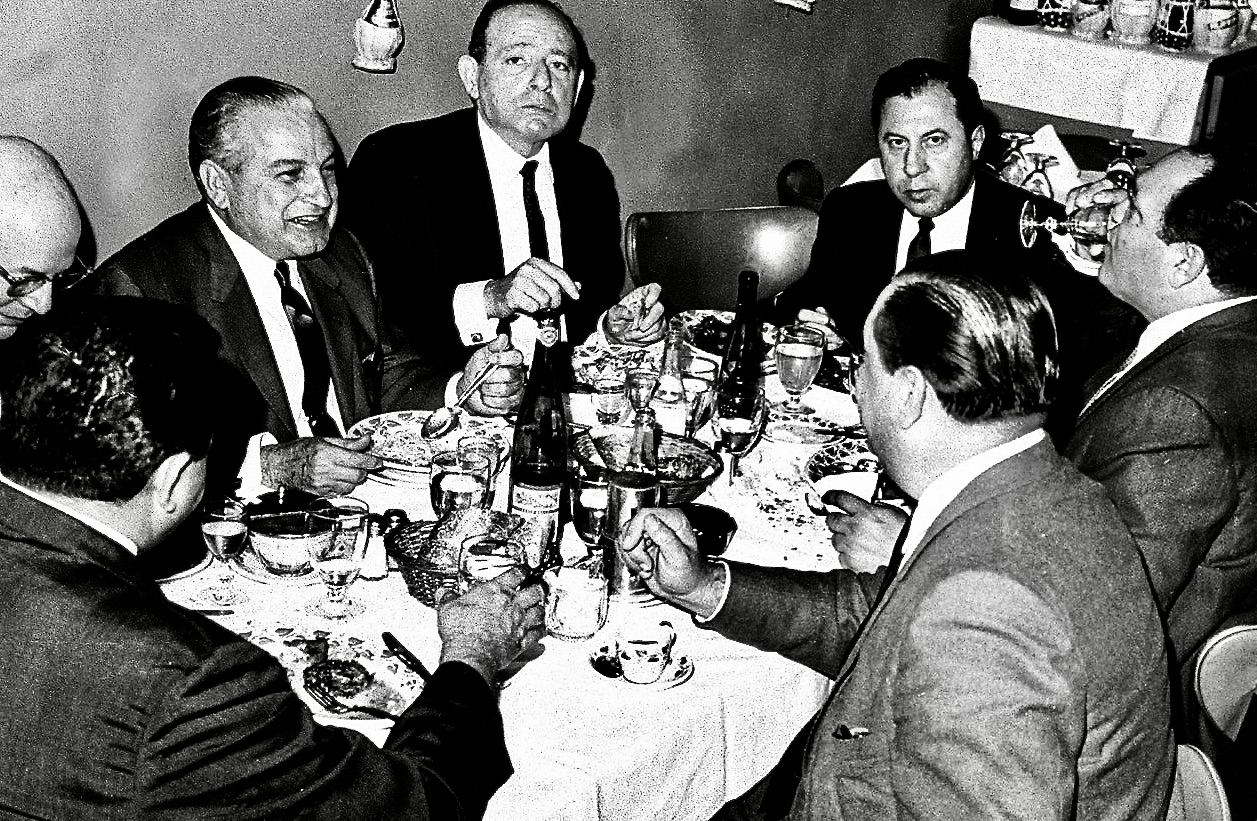
Dangerous Passage

By Ed Staskus

   The Police Department’s Central Station was the end of the line for many criminals. It was also the end of the line for some policemen. The police force had been created in 1866 by the Metropolitan Police Act. Before that there were a few constables and night watchmen. Cleveland wasn’t a safe place even with them doing the best they could. The Cleveland Grays, a private military-style company, took over in 1837 but they couldn’t keep suspicions and arrests in the right order. In the 110 years since the police became official one hundred and eight of them had died in the line of duty. Seventy-five of them were gunned down by handguns, rifles, and shotguns. The rest died of assault and battery. All the policemen who were killed were men.

   When Frank Gwozdz’s partner was shot and killed his badge was retired, like the badges of all the other policemen who had been killed. Patrolmen wear numbered silver-colored badges. Detectives carry numbered gold-colored badges on their person. The rest of the force, Sergeant and higher, wear unnumbered gold-colored badges. The Badge Case was on the wall of a landing between the first and second floors. Frank never took the elevator to the third floor where the desks of the General Duty Detective Squad were. He always took the stairs. He saw his partner’s badge every day.

   Frank had been on the landing with other detectives when his partner’s badge was put in the case. The Police Chief, his partner’s wife, and partner’s son had been there. too. The boy wore a little boy’s man suit, bow tie, and a fresh haircut. He frowned through the ceremony and frowned when Frank told him his father was a brave man who died protecting Cleveland’s citizens. He was the first detective on the force to be shot and killed since 1960, fifteen years earlier.

   “Did you catch the bad man?”

   “Not yet, son, but we will.”

   The boy frowned more than ever. He looked like he wanted to kill the man who had murdered his father. Frank wanted to nail the man who had murdered his partner. There will be blood. Frank knew that and the man who killed his partner knew that.

   His partner’s bloated body had been found floating in Lake Erie with a bullet in his face near the White Beach City Park. Two days earlier Danny Greene had shot and killed Mike Frato, with whom he had been disagreeing about garbage collecting, at the same place. Danny Greene, who ran the Celtic Club, had set up a sham union. He meant to strong-arm garbagemen for their dues and anything else he could get. Mike Frato didn’t want to join any mob union. He had ten children and meant to keep the family money in the family. Danny Greene sent his personal bomber, Art Sneperger, to plant a bomb underneath  Mike Frato’s car. Something went wrong and the bomber blew himself to kingdom come. Two months later Mike Frato drove into the park and shot at Danny Greene, who was walking his dog, shooting through the open passenger window of his car. He emptied his gun, shooting wildly. The Irishman dropped to the ground. He shot back. His aim was true. He killed Mike Frato with a single shot. He was later acquitted of all charges after pleading self-defense.

   Not a day went by that Frank didn’t think about it. He was still standing on the landing looking at the Badge Case when another plainclothes man walking past said, “The captain is looking for you,” he said. “He’s in the dep’s office.”

   “OK, thanks” Frank said, turning to go down the stairs to the Deputy Commander’s office. It was on the first floor. He stopped at the snack stand run by the Society for the Blind and bought a pack of Beech-Nut chewing gum. There were five sticks in the pack. He unwrapped two sticks and pulled them into his mouth with his tongue. Chewing gum kept his blood pressure under control and raised the blood pressure of his superior officer. It helped keep their meetings short and sweet.

   The Central Station was built of white limestone with pinkish pillars fronting the main entrance. It was five floors of command and control. On the first floor were the information bureau, traffic division, chief’s office, inspector’s office, record room, property room, and newspaper reporters’ room. One floor up were the municipal courts and rooms for prosecutors and probation officers. Several holding cells serviced the four courtrooms. Bondsmen, lawyers, and private dicks did their dirty work in the bathrooms at the back end of the second floor. The third floor housed the detectives, with offices for the inspector, superintendent of criminal identification, and lieutenants. There were rooms for photographic equipment and record keeping. There were seven small airless rooms for detectives to interview their prisoners. The fourth floor was the jail. The fifth floor housed the radio department and battery rooms. 

   There was a line up room on the fourth floor. It was divided by a screened wall and bright lights. Suspects couldn’t see into the other side. Detectives were supposed to attend lineups before roll call three days a week. Newly arrested men and women were marched behind the screen. Detectives and witnesses sat in the dark less than three feet away. Many run-of-the-mill street crimes were solved this way. 

   When Frank walked into the Deputy Commander’s office his captain was there, as well as a black man dressed like a detective. It wasn’t a uniform but any detective could sniff the suit out.

   “Have a seat,” the Deputy Commander said.

   “Thanks, I’ll stand,” Frank said.

   “I said have a seat.”

   Frank sat down and waited. His captain had on a poker face. The black man had on a poker face. He put one on, too.

   “You’ve been doing a good job running down the numbers, but we are going to reassign you,” the Deputy Commander said. “There are too many bombings in this city. It’s gotten so the papers are calling us ‘Bomb City USA.’ I want you to get up to speed on it and then find out where the bombings are coming from. When you find names that can be prosecuted report to me first before filing your report. Is that clear?”

   “It’s clear enough, but everybody knows it’s the micks and dagos killing each other.”

   “Don’t tell me what I know and don’t know,” the Deputy Commander said. “And while we’re at it, this new assignment is not shoot first and ask questions later. Put the bounty hunter attitude away. We want answers, not DOA’s piling up.”

   “Yes, sir.”

   “You’ve been working alone, but there’s an element of more danger involved in your new assignment, so we are assigning you a partner.” He nodded at the black man.

    Frank looked the man up and down, looked at his hands, and shook his head from side to side.

   “That’s not going to work,” he said.

   “What’s not going to work?”

   “The Negro is not going to work,” Frank said pointing at the baby-faced man sitting next to him. “First, I don’t need a partner. I work better alone. Second, he’s too young. I’m not a babysitter. The last thing is, he’s the wrong color. He’ll stick out like a sore thumb.”

   “We determine whether you need a partner, or not,” the Deputy Commander said. “It’s not up to you. Second, he’s old enough to be a police detective, which is what he is. And the last thing, I don’t like his color any better than you do, but orders are to get him out in the field. There’s no other Negro we can pair him with. You drew the short straw because nobody else is champing at the bit to work with you.”

   “Yes, sir,” Frank said.

   “You and you partner will be running a parallel investigation with the Bomb Unit. When you’ve got something to report, report it to Ed Kovacic, and me personally. Is that understood?”

   “Loud and clear, sir.”

  “Whatever extra you need for this assignment, go to your captain. He’ll make sure you get it.”

   The short and sweet conference was over. Frank stood in the hallway with his new partner. He tossed the wad of now tasteless Beech-Nut gum in the trash. It disappeared without a trace, sticking to a court summons somebody had thrown away.

   “Don’t call me Negro again,” Tyrone said.

   “What should I call you?” Frank asked.

   “Call me partner or call me by my name, which is Tyrone Walker. Drop the Negro thing. You’re behind the times. We’re called black now.”

   “Like in black and white?”

   “That’s right, like in black and white.”

   They took the stairs to the third floor. When they walked into the bullpen, Frank saw that an old unused desk had been pushed in place, its back butting up to the back of Frank’s desk.

   “It looks like we’re joined at the hip, brother,” Frank said.

   “I don’t think so,” Tyrone said. “This desk looks like a shack. And don’t call me brother.”

   “Don’t call you Negro and don’t call you brother?”

   “That’s right.”

   “Anything else?”

   “I’ll let you know.”

   “Let’s stop right there,” Frank said. “We need to get off the wrong foot and on the right foot. I’ll call you whatever you want to be called. I’ve got no problem with that. What I said downstairs stays downstairs. We are going to be working together. When we are on the street we have to trust one another. Most of the time it won’t matter, but sometimes it will. If we can’t or won’t watch one another’s backs, whether it matters or not, it will come back to bite us.”

   Tyrone sat at his new beat-up desk, leaning forward.

   “All right,” he said. “I can live with that. We don’t have to be friends. I get that. I’ll watch your back if you’ll watch mine.”

   “All right,” Frank said.

   “One thing you should know,” Tyrone said.

   “What’s that?”

    “I don’t like being called nigger. I hate it. It riles me up. I see red.”

   “Somebody calls you that, I will remind them you are servant of the law and deserve respect. If they disagree, we can try convincing them in other ways.”

   “What ways?”

   “Talking some sense into them might be one way. Getting in their face might be another way. Threatening them with thirty days in the hole on a trumped up charge might be the best way.”

   “It looks like I’m going to get the hang of big city police work my new partner’s way,” Tyrone laughed.

   “Where are you from?”

   “Montgomery, Alabama.”

   “That’s a big enough city.”

   “It’s small like a fishbowl when you’re one of the few black men on the city police force,” Tyrone said. “The first sheriff in Alabama was only elected nine years ago. Until D. C. imposed hiring quotas there weren’t any black uniformed state policemen. Now it’s all the way up to 5% of the force in a state where we are almost 30% of the population. In our state the governor says, ‘Segregation now, segregation tomorrow, and segregation forever.’ He says D. C. can go to hell.”

   What Tyrone didn’t know was that Governor George Wallace had also said, “I look like a white man but my heart is as black as anyone’s.” He meant what he said, everything he said.

   “All right, let’s take a drive up to Little Italy,” Frank said.

   “That’s the launching pad, right?”

   “That’s right, but more like a shooting gallery,” Frank said. “Make sure you bring your peacemaker with you.”

Excerpted from the crime novel “Bomb City.”

Ed Staskus posts monthly on 147 Stanley Street http://www.147stanleystreet.com, Made in Cleveland http://www.clevelandohiodaybook.com, Atlantic Canada http://www.redroadpei.com, and Lithuanian Journal http://www.lithuanianjournal.com

“Bomb City” by Ed Staskus

“A police procedural when the Rust Belt was a mean street.” Sam Winchell, Beyond Books

Available on Amazon: https://www.amazon.com/dp/B0F1LM1WF9/ref=sr_1_1?crid=2MYAQAOZIC2U9&dib=eyJ2IjoiMSJ9.hTm7BGbiQbSe5ZapFwYPPfcwOpTe-Vdg6VLE4aGyTyk.Z0R-VNBWWEcvKcNaO9LdCOUnNIOOXgvYkRS_FXiXuHk&dib_tag=se&keywords=bomb+city+ed+status&qid=1742136726&sprefix=bomb+city+ed+staskus%2Caps%2C84&sr=8-1

Cleveland, Ohio 1975. The John Scalish Crime Family and Danny Greene’s Irish Mob are at war. Car bombs are the weapon of choice. Two police detectives are assigned to find the bomb makers. It gets personal.

A Crying of Lot 49 Publication