Blue Highway Bug Out

Road-Trip-4

By Ed Staskus

We went on a road trip at the end of summer, first to West Virginia, then North Carolina, north to Philadelphia, and finally Vermont, afterwards circling back home by way of the low-scale Town House Inn in high-scale Lake Placid.

Before leaving home, I called an exterminator about a swarm of yellow jackets nesting in our eaves. Every morning it sounded like the Bee Gees, as they came and went, always buzzing, as though they had forgotten the words. They had the high-pitch key right, at least.

“Don’t worry,” the bug man said. “I’ll put a spell on them. They’ll be bee-witched by the time I’m done with them.”

Unlike earlier in the summer, when we ran into bad weather the week we spent in the woods, rain was as scarce as hen’s teeth on our late season trip. We spent considerable time outdoors, hiking in parks, sprawling on beaches, and getting lost on small town sidewalks. We had different kinds of weather, mostly dry and warm enough, from the Cheat River to the Au Sable Chasm, which was white on rice.

The wettest we got was when Vera slipped on a patch of slime and fell on her butt crossing a rocky stream in Vermont. There’s no wading a river with dry breeches. I went swimming in the Atlantic Ocean off Nag’s Head and got wet that way.

We left on a Friday afternoon for a bluegrass and gospel music festival in Elkins, West Virginia, 300-some miles from home. Our weekend booking was the Cheat River Lodge. We had a hard time finding it, relying on a Rand McNally road atlas, in the solitary countryside, in the middle of nowhere, on the edge of the Monongahela National Forest. It was out of town on a dark road, up a big hill, then down a steep, even darker road, until Vera suddenly spotted it as easily as sliding off a greasy log backwards.

It wasn’t a lodge, not nearly, but it was on the Cheat River.

On Saturday morning we drove down the mountain into Elkins to the crafts, arts, and music fair at the Elkins City Park, on 9 acres dotted with 300-year-old oaks. As I searched for parking Vera’s stomach began to grumble, and she quickly spied a run-down-looking good-food-looking diner called Scotty’s.

“Frank, there’s a parking spot,” she said, pointing and pointing.

Scotty’s was full of people eating breakfast. We got the last Formica-topped table in a back corner. Across from us a Metallica tee-shirted teenager wearing a scruffy backpack was explaining to his girlfriend’s mother how nice their new apartment was.

I overheard the mother say, “What do you mean ‘we’? You got a mouse in your pocket?”

Three big sweaty women were doing the cooking in an open kitchen and one small woman was doing the waiting. She was quicker than grease off a b-b-q biscuit. I looked up and there she was.

“Ya’ll ain’t from around here, are ya?” she asked, tossing menus down on the table and pouring coffee without breaking stride.

Vera ordered a plate of grits, a plate of gravy biscuits, and a plate of chicken-fried steak, which came with a plate of mashed potatoes. I was barely able to get my plate of eggs and home fries safely on the table. By the time she was done she was fuller than a tick on a 10-year-old dog.

Afterwards at the craft fair, while talking to a fiddle-maker at one of the booths, we mentioned eating at Scotty’s and how good it was. “If that ain’t true,” he said, “grits ain’t groceries, eggs ain’t poultry, and Mona Lisa was a man.”

We saw two bands at a show later that night at the Harmanson Center on the hillside campus of the Davis and Elkins College. The opening act was the Sweetback Sisters and the main show was Blue Highway. Both were good bands, but what we liked the most was the young lady who came on stage ten minutes before Blue Highway and whistled five songs. She didn’t sing or play a musical instrument. She just whistled. Introducing her last tune, she invited everyone to whistle along with her.

I didn’t even try. I hadn’t puckered up and whistled in years. It would have been like trying to nail jelly to wall.

On Sunday morning we stopped at a small chapel in town that was hosting a workshop of Appalachian gospel songs. There were 60 or 70 people in attendance, guided by a conductor of sorts, a man who introduced the songs and led us by hand. We had been provided with a printout of the songs and when prompted sang 18th and 19thcentury gospel truths for an hour-and-a half.

When we left West Virginia it was on a twisting, mountainous state road that crossed the Appalachian Plateau and wound up and over the Blue Ridge Mountains. Later in the day we drove onto the coastal plain and made our way through the Outer Banks, passing Kitty Hawk, Kill Devil Hills, and finally arriving at Nag’s Head.

There are only two up-and-down roads on the Outer Banks, the beach road and Route 12, which is also the ‘Hurricane Evacuation Route.’ We drove in on Route 12. It was new to us, it was dark, our Rand McNally was looking dog-eared, and I was sure we were going to have a hard time finding our reservation. But, again, Vera saw it in a flash. I don’t know how in the Sam Hill she did it.

“It’s a gift, Frank, a gift,” she said.

We stayed four days at the First Colony Inn, a 28-room, 2-story roadhouse built in 1930, and re-built several times after hurricane disasters. It was a 2-minute walk from the ocean. We started every morning in the John White Breakfast Room and then retired to hammock chairs on the upper floor breezeway to read. Vanessa read books about Mesopotamia and I read books.

The weather at Nag’s Head was in the high 90s every day beneath a clear blue sky. It was hotter than a goat’s butt in a pepper patch and as humid as a prostitute in church. The constant ocean breeze tempered the heat and humidity a little, as did the shade of the veranda at mid-day. We went to the beach across the street and down a narrow sand trail every afternoon, laying on our blankets in the sun and walking along the surf line.

We found a small yoga studio in Kitty Hawk and took classes, and at night went out to eat seafood. One night we stopped at a fish camp down the beach road. It was called Owens, a family place that’s been there more than 60 years and is still owned by the same founding father family.

There was a crowd and we had to wait, but once seated and served I exclaimed, “Well, I swaney!” We had a basket of hush puppies, Carolina Jambalaya, Yellowfin Tuna, grits, and pecan pie. The portions were so large and so good it’d make you slap your mama. While walking back to our inn we agreed it was a great day in the morning, even though it was night.

Another night we drove to Roanoke Island, had catfish and wild rice on the outdoors patio of the Blue Moon, and were as happy as clams at high tide. Afterwards we saw ‘The Lost Colony’ at the Waterside Theater in the Fort Raleigh National Historical Park. It was a musical, of all things, about the first English settlement in the Americas.

The show has been at the Waterside every summer since 1937. The theater is under the stars. It has been rebuilt twice, once after it burned down in 1947, and again after a hurricane demolished it in the 1960s. The only things saved in the 1947 fire were the costumes, which the actors threw into the water of the sound behind the main stage. A man and wife well into middle age sitting behind us talked about how the show hadn’t changed much since they had seen it as teenagers.

The story of ‘The Lost Colony’ is about Walter Raleigh and Queen Elizabeth, the motley colonists, and the still mysterious fate that befell them. To this day no one knows what happened. They all just disappeared. The show itself was a bag of nails. The uncertainty and danger of the American wilderness in the 1580s was delivered in Disneyesque song-and-dance. On top of that, even though the expedition was English, a land that broke with Rome, the narrative was by a Franciscan friar, of all people.

I didn’t know whether to scratch my watch or wind my butt.

On the Friday afternoon we left Nag’s Head thunderstorms loomed in an uncertain sky. One of the ladies on the cleaning staff of the First Colony Inn, standing on the veranda with her hands on her hips, said, “That sure ’nuff looks like a frog strangler comin’ in.”

Instead of taking I-95 to Philadelphia we decided to go around our elbows to get to our thumbs by taking Route 13, a state road that traces its way north to Norfolk, Virginia, up through the tidal flats of Delaware, and finally into Pennsylvania. It was the long way round, but worth the drive. There’s scenery everywhere, but it’s hard to see from the interstate.

“Bless your pea picking heart,” I said to Vera for suggesting the local roads.

We traversed the Chesapeake Bay Bridge and Tunnel, which are three bridges and two tunnels, linked together by four man-made islands and spanning more than 17 miles. We lost sight of land for a few miles driving over the middle of the Chesapeake. It was like a drive over the open ocean.

The bridges and tunnels have to be inspected, according to federal law, every five years. It takes inspectors five years to do the job. When they’re done, they start over. The job never ends. Ain’t that the berries!

We cruised up the eastern shore of Virginia and along the tidal flats of Delaware and Maryland. The small towns looked like the 1940s rather than nowadays. Farms and marshes were spread out in all directions. Everyone, black and white alike, looked more raw rustic ethnic than back home.

Gassing up at a filling station, I overheard two black men talking at the next pump. There was pepper in the gumbo of their talk. One of them said, “If a bullfrog had wings he wouldn’t bump his ass when he jumped.” When I asked what he meant, he said they were arguing about the mayor.

We got to Philadelphia, although we later learned from a cabbie it’s really pronounced Fulladulfya, just past ten at night, and from the minute we got there it was yo, supp. When I got off the highway a couple of exits north of the senner siddy and turned left, faster than a knife fight in a phone booth I was stuck on railroad tracks facing the wrong end of a one-way sign.

“What the hey!” Vera squealed.

I thrust the Honda CRV into reverse and backed up, hoping praying cursing I wouldn’t hit anyone. Sometimes I can throw myself on the ground and miss, but this time I got the car going forward on the right road. After several more wrong turns on Philadelphia’s many one-way streets we finally found our bed-and-breakfast. We stayed at the Shippen Way Inn in the Society Hill neighborhood, the oldest residential area in the city. The inn was built in 1750, expanded in 1810, and again in 1900. We had one of the upstairs 1750s rooms, tiny as a jail cell, under a low raftered ceiling, and slept on a lumpy twin bed. The inn itself was be yoo dee full, with a big communal breakfast room and a tree-shaded brick patio.

“Jeet yet?” our hostess asked us the next morning, pouring coffee, the smell of breakfast on her apron.

One day we had breakfast with a couple from the state of Washington and their four children. Another day we ate with a young man and his girlfriend, both from Ireland, who were law students and had spent the summer interning in Chicago. Everybody was in town to see the historic sights, just like us.

We walked around the sites on Saturday, Independence Hall, Carpenter’s Hall, and Congress Hall. We strolled brick-lined arcades that used to be slave markets, historic churches from back when churches were a vital business, and then spent the rest of the day with Kate Burnow, one of Vera’s idiosyncratic Cleveland State University teachers, who was working at the University of Pennsylvania that summer.

She is short and stout, 51-years-old, with a head of crazy thick long black hair, paints her nails purple, and walks really slow on really small feet. She doesn’t own or drive a car. She has a boyfriend, a police detective in Philadelphia, with whom she talks by phone every day, although she hasn’t actually seen him in more than nine months.

She leads an imaginary existence on a web site called Second Life. Her avatar, which is what she called her alter ego, is a lissome cocktail waitress in a nightclub in Thailand. In real life Kate Burnow is a middle-aged authority on West African art. She had recently returned from London, where she delivered a lecture about folk art. When in Philadelphia she lives with her aged parents in the suburbs. She is lonely, or at least said so half-a-dozen times over lunch and a walk afterwards. I figure there’s no warming up next to a wood figurine late at night.

On Saturday night Vera and I decided to have dinner at Morimoto’s, a swank Japanese fusion restaurant owned by one of the Iron Chefs on the Food Network. Even though it was a mild night, it was slightly too far to walk from our inn, so we took a cab. Besides, we didn’t know how to get there.

“Niceta meechas,“ our driver said.

The streets, some of them cobblestone, were crowded with people and cars. We made our way past blocks of 18th and 19th century homes. While stuck in traffic and idling for a moment at the curb of a narrow one-way street two young women approached our cab.

“Hal ya doin’ ladies,” the cabbie said, leaning over his elbow out the open window. “What youse lookin’ for?”

They didn’t blink an eye. They were looking for directions to paint the town, they said, in a similar dialect.

“Deflee,” the cabbie said, and rattled off the names and streets of taverns and clubs.

Morimoto’s was a narrow and deep space with a curving undulating wood ceiling that sloped down to an open kitchen. There were phallic-shaped lamps on the forty-or-so booths and tables. The seats were chic and illuminated and tube lights were embedded in the tables. The lights glowed and slowly continually changed colors. We each had a mixed drink and shared a fish appetizer. After a delicious chicken broth soup, Vanessa had Kobe beef and I had seafood, each of us sampling the other’s plate, and we split a bottle of wine.

After dessert and coffee, we rolled out of the restaurant dizzier than bessy bugs and thought we would try walking back to the inn, a meandering mistake, finally finding it a few hours later and falling into bed.

The next morning following a light breakfast we headed for Stowe, driving as fast as possible through the horrible state of New Jersey, where God made the food but the devil made the cook. We stopped in Albany at an Einstein’s for coffee and bagels, and then crossed into Vermont, which we knew it was when we started seeing guyascutas, or cows whose legs are shorter on one side than they are on the other so they can walk comfortably on the steep hillsides.

Stowe is a small one-main-road snow town. We hung a Ralph at the mountain road that dead ends at the base of Mt. Mansfield, where the skiing is. Every few miles a swamp donkey sign warned us to watch out for the beasts. We stayed at the Grey Fox Inn, in a sizable room with a balcony. It was up-scale because of the Range Rover set, but affordable because it wasn’t winter, yet, although the Dairy Queen were closing in a few weeks.

The weather was refreshing, mild and sunny during the day, crisp at dusk. The forecast for the nights was for dark damp darkness. We camped out at the pool every day after breakfast. We went on hikes on successive afternoons partway up Mt. Mansfield, one on the Long Trail, and the other on an unnamed branch trail. The trails were both steep and rocky. After a few hours on them we were both like toads in a tar bucket, wondering why we ever thought hiking in the mountain woods would be fun.

In the evening my prayer handles were wicked achy.

One night we saw ‘The Bourne Ultimatum’ at the local movie house, which was action-packed derivative dim-witted, and another night we saw ‘Urinetown’ at the Stowe Community Center, which was funny and loaded with engaging tunes. A 2001 Broadway musical, half the cast was high school students and the other half were adults who had once acted in high school, which goes to show it don’t make knee-odds the talent.

On our last night in Stowe we made a pizza and packie run and watched ‘The Adventures of Robin Hood’ on the TV. We drank a toast to Friar Tuck.

The next day we drove to Burlington and took the car ferry across Lake Champlain to Port Kent, and from the landing through the Keene Valley to Lake Placid. We stayed at the Town House Motor Lodge, which is on Lake Placid, while the town of Lake Placid is actually on Mirror Lake. We read and sun-tanned at the 1960’s-style pool surrounded by cypress hedges and 100-foot-high white pines. Even the four farting Quebecois men didn’t bother Vera overly much the one afternoon they were taking a break at the pool from their daily golf outings.

We went on two long hikes in the ADK wilderness area, more rolling than up-and-down paths, had dinner one night at the Caribbean Cowboy and another night at Nicola’s on Main, where we split a liter jug of Chianti, wobbling back to our room, and on Friday night went to the Lake Placid Center for the Arts and saw an affecting but disturbing movie called ‘Volver’ directed by the Spanish man Pedro Almodovar.

They say the weather in New England is nine months of winter and three months of poor sledding. It was already into September, so when Saturday rolled around, even though we weren’t ready to go home, we went home. We took the old road, through Tupper Lake, Blue Mountain Lake, and Racquette Lake, stopped in Old Forge at the Pied Piper ice cream stand, by-passed Utica, and made the rest of the long drive back to Ohio on the turnpike.

It was late when we got home and after rubbing up our lonesome cat Snapper, we threw ourselves into bed. We were plum tuckered out. The next morning, we both unpacked the car, I mowed the lawn, and Vera went through the mail. She found the bug man’s bill tucked into our front door. She said it said, “I have made the yellow jackets bee-gone.”

When I checked they were, indeed, done gone.

Ed Staskus posts stories on 147 Stanley Street http://www.147stanleystreet.com and Cleveland Ohio Daybook http://www.clevelandohiodaybook.com. To get the site’s monthly feature in your in-box click on “Follow.”

Pennies From Heaven


By Ed Staskus

I would trade any day in the real world for a minute at summer camp.

Those two weeks are what I wait for all year. It’s hard to believe, but my best friends and I and everyone who knows us best have been going to camp for half our lives, just after I turned seven. Since then I have gone every summer. The first day of camp is better than the rest of time.

I used to go to Camp Katahdin with my dad when he first started taking Katie and Sylvia. I went along to keep him company on the drive, because my mom wouldn’t go, and the girls were just girls. After dropping their duffels and backpacks off and getting them signed in, we would walk around the campground, to where it is fenced in along the lakeside, although most of the fence is now rusting and falling down.

My dad and his sister went to the camp in the 1960s, before there were real highways and it took forever. They rode in granddad’s Chevy Impala, a green woody wagon that was twice as big and long as the Hyundai dad drives to work. The third row seat faced backwards. That is where he and his sister sat, what they called the way-back seat, playing the license plate game and category abc’s.

They slept in Canadian Army tents at the camp in those days, not the A-frame cabins we sleep in now. They had bonfires and sing-a-longs every night and ate peanut butter and grape jelly on Wonder Bread. “Some days we had sandwiches three times a day if there wasn’t anything else,” my dad says.

“There was so much wood we had bonfires every night, as big as a house burning down. Not like now, when you have to drive to the convenience store and buy it,” he said, pushing the wrapped-up firewood packages with his foot. We only have bonfires on weekends and they are more the size of flashlights than three-alarm fires.

“One of our camp commanders back then had been in the French Foreign Legion. He wore a black beret and a small hand axe on his belt. He just picked wood up in the forest. We always had more than we wanted, the woodpile was so high.”

When it was late afternoon and the girls were finished at the orientation we would leave for the ride home, driving all night, listening to talk shows and baseball games on AM radio, twisting the knob on the dashboard back and forth as the game or the talk show faded in and out. My dad likes talk shows so he only listens to AM radio.

I knew I wanted to go to summer camp the first time I saw it. Since the girls were already going I knew I probably would, too. I just had to wait to be at least seven-years-old. Every summer they told me how much fun it was to be at camp and not at home. That was the big thing, they always said, to be away, to be somewhere else for two weeks.

Summer camp is a different life than being at home. There are fewer adults than anywhere else and no parents. The counselors are almost like you. Some of them let you run amok and hope no one dies. All of your friends are together and there are even more of them than you have at home. Nobody yells at you for two weeks. The counselors scream if you do something really dumb, but you don’t get yelled at for just doing something wrong by mistake. Even when you do it’s all over in a few minutes, not like at home, where it never ends.

You can’t always go wherever you want, roam around the camp, or just run around in the forest, but you can be who you want to be almost all the time. When you’re at camp it’s like waking up on the roof. The nights are dark and everything smells damp, like a bottle of milk in the refrigerator. Although everyone is supposed to be in after lights out, and there’s a night guard, he isn’t able to watch all the cabins all of the time. In the forest in the middle of the night when it’s quiet it’s scary quiet, and the quieter you are, just breathing, everything’s a strange echo.  Sometimes it’s so dark walking is like feeling your way with your hands, but you never lose your way.

The sky at summer camp is clean and windy, not stuffy and dead like at home. Some kids don’t shower when they’re there and that’s disgusting, but nobody cares too much about it. Once somebody’s parents wouldn’t let him in the car when they came to pick him up. ”No, go hose yourself off, and brush your teeth!” his mother yelled. The cabins are gnarly old, partly plywood and partly brown clapboard, and moldy in some spots. They never smell all good, even on sunny days. There is a beat-up screen and wood door in the front and a tilt window in the back, although most of the time the window won’t crank open.

But, it doesn’t matter. The camp is big and so are the lake, the dunes, and the woods. We hardly live in our cabins, anyway, only sleeping in them, unless it rains.

Camp Ketahdin is a long drive from Cleveland, to the northeast shore of Lake Michigan, on Little Traverse Bay. It’s past a town called Petoskey, which means ‘Where the light shines through the clouds’, hidden down a winding gravel lane from the main road. The boy’s cabins are on one side of the camp, the mess hall is in the middle, and on the backside of the drive-in and packed-dirt lot is the chapel. The girl’s cabins and nurse’s station are on the other side and the flagpoles and bonfire are down a sloped sandy hill from the hall. The lake is a one-mile walk from the sport’s field.

A year goes by and it’s like I never left. As soon as we get to camp we unload everything we’ve brought, our clothes, sleeping bags, and snacks. Everything we own has our initials on it written with a Sharpie. We find our cabins and claim our beds, and then your parents are gone before you know it. Sometimes I don’t even realize they’ve left. You see your friends again, your cabin mates and everyone you have ever camped with, and there are high-fives, knuckle-touches, and bro-hugs all around.

Everyone punches each other and laughs, “What’s up, dude.” We hang out, reunite with the girls, and get some overdue hugs from them. When everyone has gotten to the camp and all the parents are finally gone we have sandwiches in the dining hall. Father Elliott says a prayer for the kids and new campers, and afterwards the camp commander gives us a chalk talk about everything. He writes the rules in block letters on the blackboard.

Before nightfall we hike to the beach for our first look at it. We go to the lake every afternoon, unless the weather’s absolutely horrible. But, when the day’s cold and gusty it’s really the best time, because there are huge waves, the wind is blowing hard, and the surf is smashing you. When we come out for a break the counselors have a snack set up for us, and later we go back in the water a second time, or just lay around on our towels.

We have activities every night, like bonfires, mystery night, and sleep-outs under the stars. There are three dances, the big one on the last night of camp, which is the formal dance. Some nights we do things later than the kids, like the manhunt game, because they have to go to bed before us. They sleep in the long barracks, not the cabins like us, where they have their own sleep-in counselor.

The last couple of summers the kid’s barrack counselor has been an immigrant, who is tall and pretty, but has bad teeth, is very serious, and barely speaks English. She has twin girls who stay in her room. She sweeps the hallway with a broom for a long time after all the kids have gone to bed. Nobody ever thinks about sneaking out. Everybody knows what would happen, because she tells them all in her own way on the first day of camp.

As soon as we’re done with the night activities, but before going back to our cabins and staying up, or whatever we do, we gather in a circle and cross our arms with each other. A counselor says a prayer and everybody shouts good night. Then it’s a mad dash back to our cabins. We always flip our mattresses over to get the sand and wolf spiders out. The spiders aren’t poisonous, but they can be big as your hand, and they bite hard as if they had teeth.

One year we had bedbugs. We caught them with scotch tape and kept them in a glass jar. We tried to kill them with poison spray, because when they sucked your blood they left itchy clusters of bites on your skin, but the bugs didn’t seem to care. When the camp commander found out he hired a bedbug-sniffing dog. The next day everyone whose cabins had bugs put everything they had in plastic garbage bags and put them inside the cars at camp, in the hot sun, with the windows closed. All the bedbugs died.

In our cabins we talk, jump into the middle of things, and beat each other up. We plan different ways to kill people, have wrestling matches, and see who can burp and fart the loudest.  Whenever anyone falls asleep they are fair game. My fourth-best friend Tomas is an open-mouth sleeper. One night we squirted minty toothpaste around his lips and watched bubbles form as he breathed. Another time we covered his face with lipstick and mascara. He didn’t like that, but later he thought it was funny. We don’t fight or talk the whole time, at least, not necessarily. We eat a boatload of candy, too.

The camp doesn’t let us bring our phones or tablets, or even video games, but everyone brings four or five pounds of candy. Some bring less, but some bring even more, which is ridiculous. One boy brought four cases of soda and a carton of family-size Lays Classic potato chips with him, and that was on top of the pickings at the camp store, where you get two treats every day. He is 14-years-old, like me, but built like a twig. He ate and drank everything he brought and didn’t share it with anybody.

We have a food-eating contest every summer after the Counselor Staff Show. The kids have to go to bed, but we stay up late to play the game. Whoever volunteers is blindfolded and has to eat whatever the counselors make. Everyone has to keep their hands behind their backs and lap it up with their mouth like a dog. Sometimes the other kids vomit, but I never throw up. Last year the counselors made bowls of Rice Krispies with ketchup, mustard, jelly, lots of salt, and it was mashed together like potatoes. It was horrible. Everyone cheers you on and you have to eat it all as fast as you can if you want to win.

Some nights if we have stayed up until dawn the night before we try to go to sleep a little earlier than usual, no later than two or three in the morning. We don’t keep track, but we have to get some sleep because the counselors wake us up at seven-thirty for calisthenics. They march us to the sports field and make us do jumping jacks, push-ups and crunches, and run the track. If they see you are tired and slacking they will make you do more.

We get up every morning to dance music, like Katy Perry or Duck Sauce, or whatever the counselors want, played loud on loudspeakers hidden in trees. Sometimes I don’t hear it because I’m sound asleep. The counselors carry water shooters. If they say you have twenty seconds to wake up, and you don’t jump right out of bed, they start squirting you. They shake your bed and jump on you, and scream “Wakey wakey campers!”

After exercise hour on the sport’s field we go back to our cabins, clean up, and then raise all the flags before breakfast. Sometimes we don’t clean up and instead fall back asleep in our cabins and then are late for the flag raising, which means humiliation. Whoever is late has to step out into the middle of everybody on the parade ground and do the chicken dance, or whatever dance they tell you to do.

All the boys on their side of the parade ground do the chop when that happens, swiveling their arms like tomahawks and chanting. Nobody knows what it means, but they all do it, and the girls stand there watching, and then they do their dumb dance, like cheerleaders, but they aren’t cheering for you. We have some pretty messed-up people at camp, but everybody gets their share.

Every cabin has to keep a diary for two weeks and we get graded on it every day. Whoever is the best writer wins Liberty Dollars. But, if you write something dumb, like “ugi, ugi, ugi” or anything that doesn’t make sense, you get a bad grade. The counselors tell us to be sincere. Matthew always makes up our diary because everyone else in our cabin is retarded. At the flag lowering one time, after Titus had written something stupid, we had to do the Rambo, running down the hill to the flagpoles with no shirts on and singing “cha, cha, cha” while everyone did the chop.

My friends and I are in cabin three, which is the smallest cabin of the nine boy’s cabins. There are eight of us and the only space we have to move around in is to walk back and forth to our beds. Matthew is my best friend and totally number one. He’s a little shorter than me, has dirty blond hair, and is stick slender. We like to relax, not get uptight, and soft chill at the end of the day. We have been rooming together for seven years and know each other best.

Logan is my second best friend. He is a tad taller, funny, and chunky.  He chews green frog gummies and spits them out on the cabin floor. He likes to play paintball. I don’t paintball, but I think I’d be better, considering I’ve never done it. He’s strong, too, but not loud and belligerent. Once he punched someone who stomped on his bad toe. He has in-grown toenails. Logan was, like, “Dude!” and he pushed him, and then got punched in the stomach. Logan punched him back in the face, but without being mean. It was the Night of the Super Starz in the dining hall, we were just sitting there watching the show, and the rude boy started crying. He had a reddish bruise and a black eye at the end of the day.

There was a midnight mass afterwards, but Logan had to go back early and alone to our cabin, although all that happened the next day was they made him sweep the hall. That’s somebody’s job, anyway, so he just helped, but not too much.

After the morning activities we eat breakfast, and then clean up our areas. You don’t have to do it, but there is a cabin judging at the end of camp. We didn’t win last summer, but we didn’t come in last, either, which is a good thing, because then you would have to do something bad. We go to classes, sometimes, or you can say you aren’t feeling good, and then we have lunch, and later go to the beach. After dinner we lower the flags, there’s an evening program, and then we go back to our cabins and get naked, at least some of us. I don’t know why we do that, exactly.

We talk about movies, television shows, and our favorites on YouTube. We talk about girls, some of them more than others, and we talk about video games, even though we don’t have any at camp. It’s never been allowed. The one of us in our cabin who doesn’t talk much is Titus. He just sits in his corner all secluded, but he does play some games, so I talk to him about that, sometimes.

I used to play WoW, but I got addicted to it and didn’t like that. Call of Duty is my game now, except I don’t play it on my Xbox anymore, only on my computer. I love it when they say, “In war there is no prize for the runner-up.” I’m not sure what games Titus plays.

Nobody knows what is wrong with Titus. We love Titus, but he’s quiet. He doesn’t do anything, which is the problem. At night when we’re sitting in our cabin talking, he’ll start crying. He’ll just cry on his bed, and when we ask him what’s wrong, he says, “I don’t know.” We don’t ignore him and we never do anything to him. We punch him every once in awhile, but not hard. Mostly when he’s looking, but sometimes when he isn’t looking. He gets pinkeye every year. We don’t make fun of him, though. But then he got double pinkeye

We were all, like, “God damn it, Titus.”

Everybody made fun of him as a joke, and then he cried, but not because of that, just because he’s Titus. Every year he sleeps in the corner by the door. That’s the problem, he doesn’t know. He is one sad, sad child.

We stage our wrestling matches in cabin two, which is the oldest boy’s cabin. It’s the coolest cabin, too, and the biggest. What we do is take our shirts off and duct tape a sleeping bag onto the wood floor. There is no punching allowed, no hammer blows, or anything like that, but you can kick and throw each other on the ground. We aren’t supposed to fight, because the camp commanders don’t like it, but everybody wrestles and gets bruised, and crap.

One night we had wrestle mania. The winner is the last man standing. Mason and Chase, two boys from cabin five where they’re younger, were locked together when Chase grabbed Mason’s head and flipped him over. Mason slammed hard into a bed and got knocked out. We let him lay there, but when he didn’t wake up for twenty seconds we threw dirt on him. He was fine after that. The next day we were walking to the beach and Mason jumped on Chase’s back for no reason and almost cracked it. But, they didn’t punch each other, or anything like that. They’re both hardcore kids, everybody knows that, but not haters. Besides, the counselors were watching, and that would have been trouble.

Liam sleeps in the other corner opposite Titus by the door. He’s a serious douche bag. He thinks he can play guitar, but all he does is play the same part of Stairway to Heaven over and over. Who needs that? We are always yelling “Shut up!” and then we broke his guitar, but it was a piece of junk, anyway.

We broke the brand new fan his parents got him, too. Logan was angry, his toes hurt that day, and he started hitting it with a comb. We took the fan behind our cabin and beat it with a bat. It was hanging on rags when we were done. The spiny part was smashed, giant chunks were missing, and we just kept beating it. We beat it with a hockey stick and threw bottles of water at it. I mean, we did everything to it.

He wasn’t too happy about it, but he deserved it.

When his parents came mid-week they asked him what happened. He told them we did it, but not surprising to us, they didn’t believe him. After that he tipped a Diet Coke over on my bed in spite, so I poured the rest of it on his bed, and he pushed me, and I punched him back, and then he punched me, and I finally punched him in the jaw, but not crazy hard, and he stopped.

He thinks he is swagged, but since he is Liam, there is no reason.

Boys are never allowed to be in the girl’s cabins, ever. But, once a day we go over, one or two of my friends and me. We usually sneak peek there from the boy’s side, through the woods, to right behind the girl’s cabins. We know which one we want and go in through the rear window. Sometimes we run to the front door, but it is better all around to go the back way. That’s why all the screens in the back windows are ripped out. The counselors staple them back on every year.

We hang out, talk about life, and chill. We dream up rages, but never in our cabins, always in their cabins. It’s awesome and the music pumps. We just go up and down the walls. Sometimes fifteen people crowd into the cabin, having fun and out of control. We rage every day, mostly during the day, but sometimes at night, too, at least whenever we can. It’s better in the dark when we can turn on the Christmas lights and crazy dance to Skrillex. The counselors hear the music, but they don’t care. There’s music playing all the time. The wrong counselor coming in for a random reason might catch you, so you have to watch out for that.

When people knock on the doors we jump in-between any crack or under the beds. The girls say, hold on, we’re changing, and we just wait, hiding under the beds, or in the cracks where they can’t see you. All the time you’re hiding and you’re quiet so they won’t find you. Most of the counselors just laugh and call you pathetic if they see you. But, they always let you stay.

After the rages we talk and chill again, eat all of the girl’s candy, and then sneak back to our cabins. We’re only there for two weeks, so we have as much fun as we can, playing music and dancing to the beats. It pumps hard every day. It’s not melodic, trust me on that, although one time Logan slowed it down and sang I Did It My Way, and everybody loved it. For the rest of camp whenever we chanted his name he had to jump on a picnic table and lead a sing-along of My Way.

I am the boss of dance moves at the camp dances. There isn’t anyone or anything that doesn’t make me the boss; a picture of the boss busting moves is worth ten thousand words. The girls dance with me because I’m not a douche. The ones who are exactly that think they’re cool, but then nobody really likes them, or only a select few who are just like them. You can’t be the boss and a douche, too.

At the dances everybody makes a circle and I squirt into the middle. I break moves, and I’m dead serious about it. I’m out there every dance rocking it. I do the party boy, popping, liquiding, and electric shuffling. One of the counselors is teaching me. He goes to things called raves, like rages, except they’re gigantic, where people get wasted. He says they’re awesome.

My favorite dances are slow dances, of course, because you get to dance in a curve, your arms wrapped around your girl, soft and flowing. Everything is good about that. I love shuffling and going crazy on the dance floor, but it’s a close second. I slow dance with just about everybody, except cabin seven, the youngest girls, who once asked me to dance with them. I said no to that.

It was two or three years ago when I started noticing the chiquita’s at summer camp. At first it was just curiosity. Then it was like standing on the rim of the Rocky River Valley and feeling how great it would be to jump. They were there and they were nice. Being around them felt like something good was going to happen.

Happy girls are the prettiest girls, but some of them, especially the ones who think they’re stars, are mean. When you try to talk to them, they act, like, “Oh, my God, I’m so cool, and you’re so dumb, leave me alone.” They will say, “Just because you know my name doesn’t mean you know me,” and walk the other way. It’s then you know they’re down and snobby. They never smile when no one else is around because they would have to really mean it.

Natalya is one of the mean girls. She isn’t hot, although maybe she is, partly. She’s shorter, not fat, but not like a twig, either. She has some knockers, nice and big, but she wears a butt-load of make-up, which is weird. She prances around, like she is acting it out, and dyes her hair all the time in different colors, black, and then blonde, and then something else. She brought her own little folding table to summer camp so she could put make-up on in private. She wears a ton of it.

If you wear make-up it doesn’t mean you are snotty, but that’s just a thing with her. Most people can only whine for so long, but she whines over stupid things all day. We’re in the same morning classes, after cabin clean up and the inspections, so I know. She’s in my group, and whenever we have to do anything, she whines about it, saying, “Oh, my God, I’m not doing that.” She just wants to sit around and be annoying.

She has a lot of friends, but she has a lot of enemies, too. Logan said she deserves her enemies, but I think she deserves her friends, too. Some of my friends, girls who are nice, hate her a lot. They won’t be in the same cabin with her, even though they are the same age. I know she hates being ignored. I try not to care about her, but I can’t, not always.

The other mean girls, Alexis, Samantha, and Hannah, are all in my morning group, too, which sucks. Alexis doesn’t constantly whine, only most of the time, and she wears shiny bracelets and rings, too. She just wants to sit around and be looked at. Samantha is all drama, way into herself, and I don’t like her at all. Everything she says she starts by saying “Frankly…” She looks awkward when she’s not talking. I don’t even know about Hannah, she’s just kind of weird, glammed up like a puppet.

The nice girls are fun to be around. That’s the big difference about them. They’re not immature about things like having to play sports all day on sport days. They even play the dizzy bat with us between games on the soccer field, at the end the sidelines strewn with us lying on the ground, grabbing for the grass to keep from falling off the edge of the earth. The mean girls sit in their cabin and flame about it, and stupid stuff, like how small their cabin is, even though there are only four of them. Ours has eight of us in it, it’s the smallest boy’s cabin, and we never complain about it, ever.

The mean girls always want to be with the boys who are ripped. All they want to do is talk to them and then talk about them the rest of the time. The nice girls don’t like the boys who are mean and their girls. They don’t get along. There really is a divide and it’s serious. Last year one of the mean girls, Kayla, started cursing out another girl and charged her, and got kicked out of camp. Her parents had to come and get her. That was bad.

The nice girls don’t try so hard to be something they aren’t, slapping on a smile or a smirk. They’re not expert liars. The mean girls always look like they’re waiting to be discovered behind their cover up. But the nice girls, even if they have bandy legs and a lopsided face, when they laugh it’s one of the best sounds in the world.

One of the nicest girls at camp is Lauren, who is tall, has wavy brown hair, kind of long, and is a little chunky, but not like fat. At least, not too fat. She lives on the other side of the lake where it’s the Upper Peninsula. Lauren doesn’t try to be anything. She’s pretty, but not beautiful, not like she’s impersonating somebody, trying to fool you. Instead, she’s really kindhearted and friendly. She stays up at night, like me, listening to music.

Jessica is my age, the very nicest girl of all. She is fourteen, just a month younger and a bit shorter than me, blonde hair, but not dirty blonde. We have known each other for five years. She appreciates everything about me, the whole nine yards. We see each other every day. We go to the secret swings and talk, but I don’t remember about what. You never know what girls are going to say. I just stare at her. I don’t know what she talks about, girl stuff, I think, and her clothes. Anything they wear is fine, really. I heard her say once she likes the Detroit Tigers, and another time she said something about her room. She says all kinds of stuff and I just listen. Sitting in the woods with her at night feels like hanging loose. I never want it to end.

Last summer Raymond, the night guard, who is the weirdest man, was in the bushes when I was walking to the crapper from the swings after a night with Jessica. He was standing in the dark watching me, and my friend Logan saw him and started screaming at him, “Get out of here, man, what do you want?” He also used some select words. It was the funniest thing, because most of the time no one can talk to Raymond like that.

Raymond is the night guard, not a counselor, or even one of the camp commanders. His hair is long and greasy, he always wears a baseball cap, and he smells terrible. He’s one of the older adults, for sure in his 50s, and he told us he’s an ex-Spetsnaz.  Titus was stung in the ear by a hornet once, and was crying, and Raymond told him to “tough it out.”

He sleeps during the day and patrols the camp at night, and will stand behind your cabin, just looking in at you for a long time, like a freak. He’s very patient. Nobody wants him chasing you when you have snuck out. You can’t break away from him, ever; he’s just a beast. He has a birch branch that he whips your feet out from under you when you’re running, and will seriously manhandle you when he catches you, which is every time.

The best night of camp is the night of the manhunt game we play with the counselors on the 4th of July. It’s called Nazis and Jews. The older campers are the Jews and the counselors are the Nazis. We call it that because the Jews run from the Nazis. The kids have to go to bed. They aren’t allowed to play. We start running as soon as it gets completely dark, so we have a chance, and then the counselors come after us. If they catch you they railroad you back to a jail where you have to sit and wait.

You can try to get away, but it’s hard because the counselors who catch you are the strong, fast ones, and the ones who don’t catch you are the slow ones, the ones who are mostly unfit. The strong ones don’t like it when anyone makes them look bad by busting out. You can try to break free when no one’s looking, but if they grab you then you have to stay longer. The longer you sit there the less chance you have to win Liberty Dollars for the auction after the game, which isn’t a good thing. It is intense. I am dead serious.

One summer during the manhunt Simon, who is from Maine, jumped out of a tree on me. Whenever he talks it’s with a slurry, toothless accent. He was ten feet up in a quiet, dark shadow where I couldn’t see him, and he jumped down and tackled me. I got up and ran, but he started chasing me. He was like a monster, coming to get me, and I ran into a branch. Everything just went SHING! I almost got knocked out because it hit me right in the face and tore my neck, which really hurt. There is still a scar on my Adam’s apple to this day.

On another game night Matilda, who plays for a college basketball team and is seriously fast, blind-sided me, decking me. At first I wasn’t sure what happened. I didn’t mean to, but when I got up I tripped her, and started running away. You try to run away whenever anyone catches you. When she caught me I fell on the ground like I was out cold. She was forced to drag me by my arms and legs. While she was dragging me, huffing and puffing, I noticed a large lump on her chest. When I asked her what it was she gave me a sly look and said, “It’s a tumor, I have cancer.” I couldn’t believe it. She seemed so healthy. I jumped to my feet so she wouldn’t have to drag me. While we were walking the tumor started to jerk back and forth. I didn’t know what to do, since it wasn’t anything we’d learned about in first-aid training. I thought she might collapse. Then, just as we walked up to the jail, her baby pet gerbil poked its head out of her bra.

Last summer the jail was inside the art house, where all the supplies and costumes are stored. It’s at the farthest end from the sand dunes. Makayla was the guard that night, and although she isn’t very big, she’s strong. There are two rooms, so she had to patrol both of them. We had to sit in chairs and be quiet. If you talked too much you had to sit there longer. If you got up from your chair for any reason you had to stay in there longer, too. You could try to escape, but it wasn’t easy. Makayla would hit you, not really hard, but hard enough, with a twine broom, usually with the soft end. She would push the broom down on you and yell the whole time.

You don’t want to try escaping too many times, either, because if you try a couple of times and they catch you each time, they might kick you out of the game for the night. It isn’t fair, but that’s what they do if they get annoyed about it. If you sat there quietly, or told Makayla you’d be good, sometimes she let you out before the others.

The game starts once it gets dark and everybody is assembled at the bonfire pit in the sand arena. The counselors change the game a little every year. One summer whoever was a Jew child had to go out to find passports for their family. That was the main prize. When they got caught, and they all got caught because there were traps everywhere, the rest of us, their family, had to break them out of jail somehow. It was like capture the flag, but trickier.

This summer the counselors took us to the dining hall, closed the doors, darkened the windows, turned off all the lights, and made us sit on the concrete floor. There were two people giving news broadcasts, but then a counselor warned us they were going to censor the station. It got quiet. You couldn’t hear anything.

When the counselors came back they were dressed in black, charcoal from the bonfire smeared on their faces, and screaming, acting like they were mad. They split us up into groups and gave us directions. We had to find books and save them from being burned. They gave us clues and we had to find them. They weren’t real books, just pieces of paper. The more we brought back the more Liberty Dollars we got for the auction. The more of us in our group, our family, that got caught the more of our Liberty Dollars were taken away.

The papers were scattered around the camp in the pockets of a couple of special counselors, who were hidden in the forest, and kept moving around. You had to find them and when you did they would give you the paper. But, sometimes you had to beg them. If the Nazis captured you they would take the paper away from you, rip it up right in front of you, and you would have to start all over. A lot of people hid them in their shoes, or their underwear, or different places no one would look.

It can be a dirty game. One time I was by myself, not far from the art house, but on the edge of the woods, and one of the counselors came walking past, and I dropped flat. I was lying in a bunch of crap, leaves, twigs, bugs, mud, and stuff, and he just walked right up to me, but didn’t see me. I was, like, “Oh, man.”

Everybody gets the same number of campers for their group, and they are your family. The mom and dad of the family are the two oldest from the girl and boy side, and the children are the trickles from the other cabins. You have to find the books, but you have to protect each other, too. If anyone in your family gets sent to jail you have to rescue them. But, it’s best to be careful, so that you don’t get caught yourself.

They called us out family-by-family and yelled at us if we didn’t listen. They were hitting the floor with brooms, yelling at us, dressed all in black. Most of us were dressed in black, too, or camouflage, because it gets intense. They gave the moms and dads a lit candle, lined us up, and marched us to the sports field. They were telling us the rules, when Gregory, who has an anger problem, and wasn’t even in my family, snuck up behind me and snapped at me because I was laughing, “Shut up!” and then slammed me. I slammed him back on the ground. I was, like, “What the hell?” The counselors were shouting, “Gregory, get over here!” and they started chewing him out, because I hadn’t done anything.

Gregory has crazy anger problems. He might not make it. His brother used to come to the camp, but he was kicked out one year for the same thing. They called his parents to pick him up and he has never been back. That’s the worst thing that can happen at camp.

The counselors were being all serious, spitting out commands, when out of nowhere, out of all directions, they just started screaming and sprinting at us, without even telling us that it was starting. We booked it in every direction. That’s how the game started. It was crazy.

I had already planned to go with my friends, because you don’t really want to stay with your group. It’s stupid then, since you’re just trying to have fun, anyway. We hustled to one of the boy’s cabins and hid there, and then started running around, dodging the counselors. Some of them are fast, and there are two girl counselors, too, who can catch you if you don’t see them coming and they are already sprinting towards you.

You can push the counselors away, out of your way, but not punch them, although you can punch them, just not all of them, only the ones who don’t care. Your friends can come help you, and if the counselors try to catch both of you, you have a good chance of getting away, because they can’t get both of you at the same time, no matter how big they are.

The counselors tackle you hard when they want to. They can be stealthy rockets and they don’t mess around. Sometimes they’ll use you as a distraction so they can catch someone else. If they’re your counselor they’ll cut you some slack. You act like you’re getting caught when one of your friends is walking by, and yell, “Help me!” and your counselor will throw you to the side and run to get them, and you can then dash free.

I had to help when Noah explained he needed me to go along with one of his plans. When I was little I would slip into his cabin and his friends would let me sit on their beds and give me candy. Besides, he had me pinned down. He pretended to capture me, but he really wanted to capture one of my friends. He had his own reasons. They are usually not going to let you go just to capture somebody else, because then you can run off. But, I did what he wanted, and I begged one of my friends, “Dude, come help me,” and Noah let me go and took him.

This summer the jail was on the sports field, which was a pressboard box used to store basketball backboards. It was small, the size of a dining room table, but tall and deep to the back. Last summer the jail cell was the boy’s bathroom. It was dark and clammy, the light bulb missing, with only one door, so it was hard to escape from. We had to sit in there with the daddy long-legs and rotten smells.

The pressboard box was even worse. It was out in the open with a pole lamp over it. The counselors squeezed eight people in there, around the edges, and then made more people stand in the middle like cattle. They nailed two-by-fours to the sides so we wouldn’t spill out. Everybody was packed tight inside it. You could try to crawl out, but they would have already gotten you by then.

We escaped when some counselors grabbed new runners and were bringing them in, but there wasn’t any room left because it was so crowded. Someone pushed us out. We had a couple of seconds of leeway. They can’t just grab you again that minute, so we ran into the forest to the Hill of Crosses.

The Hill of Crosses is on a small dirt hill in the woods. There are trees all around it, and nothing but crosses on the hill, hundreds of them, some bigger than life. Everybody’s parents know all about it. It has something to do with their past. It’s been there a long time, but no new crosses have been added so long as I can remember. There’s a white fence around the hill and a gate, but it’s never locked. We go there for fun sometimes, to talk, and chill, because almost no one ever goes there anymore, and it’s secluded.

We were cutting through the Hill of Crosses, talking out what we were going to do, when Lovett, who is very fast and really fit, jumped out of a sand dune right at us, waving a flashlight. We just flipped out, everybody started running, none of us going the same way.  Somebody smashed into Lovett, who singled out Mark for it, running after him.

A lanky kid named Norville, from another cabin but who was with us, sprinted to the border of the camp where there is a crappy old fence. He didn’t know it was there and when he jumped on it he got all tangled. He ended up stuck on it, his hands were gashed, his clothes ripped, and he couldn’t get off. He was bloody after that, not like gushing, but it was bad.

Later, when we all found each other, we saw Lovett with his big flashlight, looking for Mark. We lay down in the sand; we were so afraid, but he ran right past us. We stayed there behind the little hill where we hang our clothes after coming back from the lake, and then snuck back into our cabin. We were sitting on our beds, laughing, but Mark was freaking out. He was so afraid he got on his knees, put his hands together on his bunk bed, and started praying out loud. He was praying there, crying, saying, “I don’t feel good,” when Lovett walked in.

“What’s wrong with Mark?” he asked.

“I don’t feel good,” Mark said, and walked outside the cabin and threw up. He tried to throw up in the trashcans, at least it looked that way, but he didn’t get any in the trashcans, at all. The next morning we dogged Mark, because he’s an idiot, but all he said was he really didn’t feel good, anyway.

After Mark threw up we heard one of the counselors squawk on the loudspeakers that the game was over. That’s how it really ends. They broadcast all during the game, about how much time is left, and what we have to do, and then it just ends. I don’t know what time that is. I don’t wear a watch at camp. Everybody just has to report to the dining hall.

After the game is over we get a five-minute break to mess around, and then we all go to the hall, laugh with our friends, and tell them how crazy it was. We’re still getting our breath back when Father Elliott starts his talk. He always speaks after the game. This summer he told us about Siberia, how he went on a memorial train ride there, to commemorate our grandparents who were taken away by the Communists in the 1940s.

He talked about the train cars, how there were so many people in the freight cars that nobody had any space to move around in, and how they had to go to the bathroom in the train itself. He was very serious. It was kind of sad, actually, how serious it was, but I was glad he told us about it. He had pictures on his laptop, lots of them of the little broken-down villages where people had to live in the freezing cold. I remember one picture, there were wooden railroad tracks, old rusted bolts, and the snow was blazing white. The tracks were all nasty and messed up. I don’t know why I remember that one. He said we should be thankful we didn’t have to go through that, that we were lucky.

Father Elliott is our priest at the camp. He runs the religion classes, says mass, and organizes the Faith Nights. We build bonfires all around the camp for Faith Night, in the dunes, by the art house, and everyone goes to one of the bonfires with their morning group. Our two counselors have a list, they ask us questions, and we talk. I used to think it was stupid, but I like some things about religion now. Some people take it as a joke. They are smart-asses.

In my class at St. Mel’s I hate my religion teacher, but at summer camp I try to express myself. Some of the questions are dumb, but a lot of them are intriguing. How do you see God? What does God mean to you? How do you communicate with God? When I was a kid they taught us to go to church and pray, and everybody would be happy. But, is that truly enough, to pray once in awhile, and that will please God? I’m not sure.

Father Elliott goes to each group on Faith Night carrying chairs for confession. I don’t really like that. You’re sitting by your fire, talking about God and all, and he comes by with his two folding chairs. He doesn’t make you confess, but you basically have to. You have to sit face-to-face with him in the open. He stares straight into your soul while you’re giving confession. I don’t want the priest to know it’s me because you see him every day. You know he thinks of you differently afterwards, at least for a few days.

This summer we almost didn’t play Nazis and Jews. We heard rumors the camp commander wanted to stop it, or change it, but the counselors said you couldn’t just stop it. It’s a legend at camp. It’s the most fun night of the two weeks. It was probably somebody’s parents, the counselors said, complaining about calling the manhunt game Nazis and Jews, or something like that. Everybody was worried. At least we got the game back, and it was the same, although we might call it something else next summer.

They were playing it when I first started going to camp. I used to want to play it so bad then. When we were kids in the long barracks we would get together, go somewhere, and play our own manhunt game for hours. We stood in a circle and chanted “bit, burp, poop, you, are, not, it” until only one kid was left, and he was it and had to go and catch people. If you saw one of your friends you could try to tag him and he would be it.

One summer my third-best friend Adrian was it and he was mad because he had been it twice that day. “I‘m not playing anymore,” he said. We said, “Stop being a baby and just be it.” He started chasing Luke, who was still really small. He ran and Adrian tore after him, and then slammed him onto his back. Luke broke his arm and had to go to the hospital. He wore a cast for the rest of camp, which was bad. Adrian told everybody he was sorry. He was crying about it and explaining he hadn’t meant to do it.

Summer camp goes by fast. You wake up one morning and it’s over. Where did it go? We’re always wasting our time, but we never waste a minute. You’re hanging with your friends, everything is carefree, and then suddenly you have to go back to your normal life. It’s gone, it’s done, and you have to wait another year. You go see your girls and they’re all teary. You hang out with your bro’s and everybody is kind of sad.

After breakfast we raise the flags one last time. I know we won’t be the ones lowering them later that night and nobody feels good about that. We go back to our cabins, get all our stuff ready, and then everybody’s parents start arriving. We go to the bonfire pit and sing songs one more time, like The Cat Came Back the Very Next Day and Tin Tan Tin. I don’t know what the girls sing. It is something like “Tick a lick a lick, per diena zirgele, I am alone.“ But, the truth is, my friends and I don’t really sing anymore. When you’re a kid it’s fun, but now it sucks.

We always sing one last song. Everybody gets in a big circle at the end, the whole camp, after the awards are given out, and our arms all crossed together we sing I’m Leaving on a Jet Plane, and then say a prayer. It’s really sad, and then it’s over, and you say goodbye to everybody.

The next year when it’s time for summer camp again you are jonesing, it’s like getting the jitters. All the same people are there, all your girls and your cabin, and everything we do. It’s just a great experience. When I’m older, after my last year, when I’m not allowed to be a camper anymore, I’m going back as a counselor. That’s for sure, at least until I finish college and have to get a real job.

I was the top dog at Nazis and Jews this summer. The next day I ran my stack of Liberty Dollars to the auction. The camp commander stands at a podium with a wood mallet. There is a chalkboard behind him with a list of all the things you can get and everyone starts bidding. There are t-shirts and baseball hats, breakfast in bed, and counselors cleaning your cabin. Sometimes it’s a mystery box, which can be good, like roasting marshmallows for two hours, or it can be not so good, like cleaning the urinals.

There’s stargazing with another cabin of your choice, which is always obviously a girl’s cabin, and that is a good thing. But, I put everything I had, all of my Liberty Dollars, on the first shower. Saturday was the night of the formal dance and I wanted to look my best for it. I made absolutely sure nobody outbid me because it was do-or-die for the hot water.

You get to shower first, all by yourself, for as long as you want to.  You’re in the shower and nobody can get you out. They post a counselor to stand guard at the door and they don’t let anyone in except you, and you can use as much hot water as you want. There is only so much of it at the camp, but you can take it all, and everybody else is left with the cold remains.

Oh, yeah, that is what you always do, because everybody else would do it to you.

Ed Staskus posts stories on 147 Stanley Street http://www.147stanleystreet.com and Cleveland Ohio Daybook http://www.clevelandohiodaybook.com. To get the site’s monthly feature in your in-box click on “Follow.”

Cirque Du Asana

By Ed Staskus

Exercise used to be one of the eight limbs of Ashtanga Yoga, along with restraint, observance, breath control, sense withdrawal, concentration, meditation, and samadhi, the last literally meaning putting it all together.

Not anymore. Not nowadays. It’s not eyes wide open anymore. It’s eyes straight ahead on the posture. The practice of asana is today on the fast track to becoming the trunk of yoga, while the other limbs are paid lip service, wither away, or are simply ignored.

For many years yoga exercise, as defined in Patanjali’s Yoga Sutras, was a small means to a big end. The basics of asana were defined in the sutras as a “steady or motionless posture accompanied with a sense of ease or comfort.” The mastery of it was meant to “loosen effort while meditating on the infinite.”

Sometime in the latter half of the last century asana began to forge its own separate identity, that of strengthening and revitalizing the body, the idea being that it was through the third limb of Ashtanga Yoga, which are the physical postures, that all the other limbs could be realized.

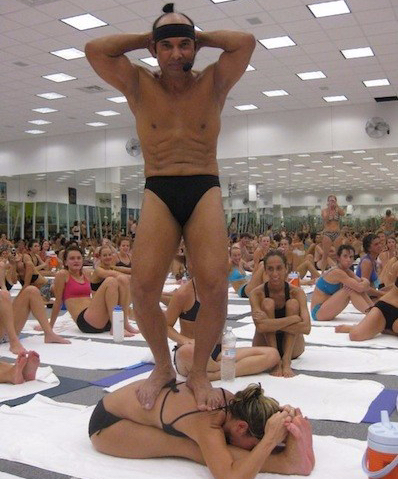
As yoga pressed ahead and onward asana masters like Bikram Choudhury and Baron Baptiste designed new forms of yoga exercise, such as sequences practiced in hot rooms with no motive other than to lock the knee and “push, push, push” and other sequences that referenced only physical prowess, like Baptiste’s “Unlocking Athletic Power.”

In the new epoch yoga exercise has made many more great leaps forward, leaving its past farther behind, moving decisively into the worlds of athletic competition and extreme sports.

Today tournaments crown asana winners in Arizona, California, and New York, while overseas the European Yoga Alliance organizes an annual championship. USA Yoga, sponsor and governing body of the annual National Yoga Asana Championships, in what it says is the “spirit of healthy competition” is committed to bringing yoga asana to the Olympic games.

”Once yoga is in the Olympics,” says Esak Garcia, 2005 winner of the International Yoga Championship, “it will legitimize yoga for many people all over the world.”

Beyond the bright lights of the arena and its judgments on the perfection of a pose, its poise and composure, is the new world of extreme yoga. The Chicago Tribune recently ran a photo spread called “Extreme Yoga Positions” featuring a body artist named Yoga Yoga, whose real name is Michael Elias Mondosha.

He transforms Steady Eddy into 3-ring big top high wire on the mat.

Meanwhile, acroyogi partners perform poses like ‘Bird’, a horizontal “flier” supported on the feet and legs of a “base” staying rock steady, nailing the posture on top of stone parapets in the mountains of Nepal on the edge of sheer drops, all without the aid of spotters.

The back page of a recent issue of Yoga Journal featured a full‐page photograph of a woman in tree pose with hands in prayer behind her, standing on a ledge of the Roberto Clemente Bridge in Pittsburgh. She was not wearing a tether, nor was there a net to catch her just in case she wobbled and fell.

It was here to eternity.

Even Native American Indians, famous for their work on bridges and skyscrapers, are careful about heights. “We have more respect for heights than most people,” said Dan Angus, a Kahnawake Mohawk ironworker, in ‘The Mohawks Who Built Manhattan.’

“You’ve got to watch it up there,” he said.

“I kept bringing my focus back to the pose,” the brave yoga lady on the bridge said.

She was watching it, but unlike the Mohawks, from the inside out, not the next step ahead. She wasn’t looking ahead down or up. Focusing on the pose and keeping it steady was undoubtedly a good idea. It is 78 feet from the deck of the bridge to the Allegheny River.

“I don’t see any benefit to it, especially since yoga begins with yama and the first yama is ahimsa, or non‐injury,” said Kenneth Toy of the Institute for Personal Development in Hampton, New Hampshire.

Which begs the question, why do it? If yoga is a spiritual practice with a physical component, why tempt fate? If yoga is just a gym rat’s bag of physical poses, again, why tempt fate? Even Olympic gymnasts don’t perform on the beams of bridges, much less without a padded mat below them to break the fall for when they inevitably fall.

“Talk about finding your edge!” said Carolyn Gilligan, an editor at elephant journal. “If you lose your balance on a bridge the risk is pretty tremendous. I think the key here would be having a calm, verycalm mind.”

‘One slip and it’s all over’ feats are often performed by circus troupes and extreme artists like Eskil Ronningsbaken, famous for stunts like balancing in handstand on a projecting steel rail of a lookout platform more than a thousand feet above a cold Norwegian lake.

“Yoga and different breathing techniques helps me to stay focused and hit the right wave of energy,“ he says, riding the wave

Yoga has a long history of bendy, stretching, balancing poses that seem incredible. Some are more amazing than others.

In the 1970s, on a television show called “That’s Incredible,” a performer named Mr. Yogi folded himself up, limb by limb, into a wooden box no bigger than a carry-all. When a lid was put on the small box the audience shouted on cue, “That’s incredible!” A big strong man carried the carry-all off stage to applause.

“Some yogis like to provide drama or accentuation or adrenaline to their poses,” explains Susan Pennington of Susquehanna Yoga & Meditation Center in Timonium, Maryland. “That is funny considering yoga is a practice of finding the middle. That is what balance is. Not the edge, but the middle.”

However, the middle way may not be the American way in the twenty-first century.

The Sanskrit word asana, from the root ‘asi’ which means to be, literally means a state of being. Today the meaning has been stood on its head, changed to mean a state of doing.

“Extreme balancing can be both fun and beautiful, calling for particular focus and skill,” said Alison West, the director of Yoga Union in New York City. “It’s a form of marketing through beauty and danger. Does it make one a better yogi? Probably not. But it looks that way.”

In Austin, Texas, artists perform yoga poses hanging from the skeletal beams of partially constructed buildings. Staging their suspension theater at night, the lines and cables they use are practically invisible.

“Tightrope walkers are now doing yoga poses in their routines,” says Cosmo Wayne of Yogagroove in Austin. “My question is, were they performers or yogis first, and does it matter? As for balance, either you have it or you don’t. People who can balance but are afraid of heights will be affected and probably not balance on the edge of a cliff. It’s all just fun and scenic.”

Whether extreme balancing has anything to do with yoga is a moot point, although Patanjali might be rolling over in his grave. His reasoning for the practice of yoga exercise was ultimately to be able to withstand physical and mental distractions in order to meditate.

“Yoga is a sacred practice of going inward and knowing who you are authentically,” said Michele Risa, a Kundalini Yoga teacher and New York City TV producer of yoga programming. “All this showmanship seems like a distraction at the least and the wrong message at worst.”

In many respects, however, in our post-modern times yoga has become a purely physical practice, and the message has morphed so now the headline is that the body beautiful can be gotten by anyone with a credit card, factoring in more dollars if you live on either coast and need to be really beautiful.

If perfecting the pose is the be‐all and end‐all of yoga, then cirque du asana might be the new third eye for raising awareness. If living the true yogic life is part and parcel of handstand, then performing handstand on the edge of the Grand Canyon probably validates the true yogic life and it would behoove all and sundry to get on the bus for the Rim‐to‐Rim tour.

Not everyone agrees that famous fitness instructors in yoga clothes or extreme sports performers with film crews in tow are the best guides on the path of the practice.

“I don’t believe risk taking is necessary to achieve the balance that a sound yoga asana and lifestyle practice can give us,” argues Nydia Tijerina Darby of Nydia’s Yoga Therapy in San Antonio, Texas. “It is beautiful and awe inspiring, but it seems to continue to sensationalize the asana and detract from the real beauty of a quiet and content mind, body, and spirit that does not need to push the limit in order to feel alive.”

Selflessness, balance, and humility are some of the core values of yoga. They are not the core values of our modern sports and entertainment culture. Exercising for fame and fortune is exercising for fame and fortune. It is not innercizing, which is the platform on which yoga was built.

What does gaining mastery in asana really mean, anyway? It doesn’t really mean doing handstands for an audience’s wonder and applause. It means doing handstand to gain awareness, to master a state of mind, to become, in a sense, bodiless.

“The pictures of extreme yoga are beautiful and certainly showcase a certain level of expertise,” says Tracey Ulshafer of One Yoga & Wellness Center in East Winsor, New Jersey. “But I do feel they are missing the essence of yoga. It is not for showing off. It is for exploring within.”

If yoga is a physical practice, then hitting a home run is worth the price of admission. But, if yoga is a spiritual practice with a physical dimension meant to keep the body strong and healthy for a lifetime of much more than asana, then home runs are only good for as long as they last, which isn’t long.

Who remembers last year’s World Series winner and loser?

“I believe asana is to help the work of unfolding inner Shakti, and so I see daredevil poses as something other than the true meaning of the practice,” says Ann Farbman of the World Yoga Center in New York City.

The devil is in the details of yoga practice. The practice is partly about the power of asana, but ultimately it is about the power of consciousness. In the Yoga Sutras Patanjali doesn’t say a word about physical accomplishment, because that is not the point of yoga practice. He mentions asana only four times. The Yoga Sutras are about states of being, maybe achieved through asana, but not beholden to them.

There are no contortionists on boardwalks or carnivals on the edge of believe‐it‐ or‐not in any of Patanjali’s 196 aphorisms.

“It is better to take risks in extreme savasana,“ says Francois Raoult of Open Sky Yoga Center in Rochester, New York. Get down on the mat and look up at everything.

Modern yoga may not see it that way, having opened its own Pandora’s Box, but there is no doubt Patanjali would agree.

A version of this story appeared in Elephant Journal.

Ed Staskus posts stories on 147 Stanley Street http://www.147stanleystreet.com and Cleveland Ohio Daybook http://www.clevelandohiodaybook.com. To get the site’s monthly feature in your in-box click on “Follow.”

The End of Taupa

arrested-in-handcuffs-e1583003662982.jpg

By Ed Staskus

   When one-time CEO Alex Spirikaitis was arrested on the afternoon of Monday, October 21, 2013, he had been on the run for ninety-some days, accused of embezzling more than $10 million from the Taupa Lithuanian-American Credit Union in Cleveland, Ohio.

   It was almost half of the cash, assets, and member deposits of the small non-profit bank.

   He had changed his appearance by growing hair on his formerly shaved head and shaving his goatee. Despite speculation that he had fled to Europe or South America, he was apprehended in the Collinwood neighborhood on Cleveland’s east side.

   “He was actually walking down the street when we spotted him,” said FBI Special Agent Vicki Anderson. His disguise had only gotten him so far. Although he had left behind multiple semi-automatic weapons and 10,000 rounds of ammunition secreted away at the credit union, he was arrested without incident.

   “He did not put up a fight.”

   Stealing money with a smile and a fountain pen is one thing. Shooting it out with the Federal Bureau of Investigation is another thing. They aren’t the same thing, by a long shot.

   The FBI would not reveal how he been tracked to Collinwood, only that they had “developed information based upon advanced investigative techniques that led to his apprehension,” a brief statement said.

   He was less than three miles from closed down boarded up Taupa Credit Union.

   Modern credit unions date to mid-nineteenth century Germany, where they were conceived as people’s banks leveraging social capital to serve farmers and the working class. The first credit union in North America began operations in 1901 with a ten-cent deposit. Today more than 8000 of them in the United States serve over 90 million members with total assets of nearly $800 billion.

   Managed by their members, most credit unions are not-for profit cooperatives taking in deposits, promoting thrift, and making loans. Unlike banks, individuals combine to manage and control their own money. They are near and far in many shapes and sizes. Credit unions range from corporate entities to community institutions serving local schools and churches.

   When Augis Dicevicius emigrated from the homeland to Cleveland in the early 2000s, he soon opened an account at Taupa. It was in the neighborhood, the employees at the credit union were from the immigrant community, spoke Lithuanian, and over time became more like friends than bankers.

   “It was like loyalty,” he said, describing why he kept an account there.

   “There is a level of trust from both sides of the counter at Taupa because you know who you are dealing with,” said Algis Gudenas, former chairman of the credit union’s board of directors, three years before the National Credit Union Association liquidated it. “I think the slogan of Taupa more or less says it all, save with one of your own.”

   From the 1930s on when the federal government began to charter them, credit unions grew steadily, especially among immigrant groups. They were instrumental in helping establish Poles, Germans, Italians, and the more recent Asian and Hispanic immigrants in their new locales. When creating the Office of Ethnic Affairs in 1976 President Ford cited “the ethnic church, school, and credit union” as fostering “a sense of neighborhood.”

   Wherever Lithuanians have settled in the United States, from coast to coast, they have formed their own credit unions. Founded in 1969, the California Lithuanian Credit Union has assets of $72 million. The thriving Boston Lithuanian Federal Credit Union celebrated its 33rd anniversary in 2013. From its roots in the basement of a church hall in the early 1950s, Toronto’s Parama has grown to become the world’s largest Lithuanian credit unions.

   Already by 1906 in Cleveland the Lithuanian Building and Loan Association, sometimes simply known as the Lit bank, had been established, even though the community numbered less than a thousand at the time. After World War Two it evolved into the Superior Savings and Loan. In the 1980s, when Cleveland was by then home to more than sixteen thousand former Lithuanian natives and their children, Taupa was founded.

   It served the community for almost three decades.

   With approximately 1100 members and $24 million in assets, located a short walk from both their church and the Lithuanian Village cultural center, Taupa was a stable institution, healthy and growing, year after year, even in an economy often troubled by bank failures and recessions.

   At least it was until the evening of July 16, 2013, when police and federal agents surrounded Alex Spirikaitis’s $1.7 million home in Solon, a bedroom suburb 25 miles southeast of Cleveland. It was four days after the decision had been made by the state to liquidate the credit union, determining it was insolvent and had no viable prospect for restoring operations.

   Armed with a warrant for his arrest for fraud, when authorities approached the home they were met by his family, who told them he was inside, but was refusing to come out. He was going to tough it out.

   “Family members left the house with us and we thought, from the information we gathered, that he was not going to willingly come out,” said Special Agent Vicki Anderson.

   The police decided to regroup, the size and layout of the large house playing a big part in their decision to wait for daylight. After a night-long standoff, the neighborhood cordoned off for safety’s sake, and TV news crews at the ready, tactical teams entered the house in the morning.

   But the police came up empty. He was not there. He had run away, fled from the consequences, not that it did much good. “A horse may run quickly but it cannot escape its tail,” is how a Lithuanian proverb puts it.

   Before the first members made their first deposits in 1984, the credit union was just a hope and a dream.

   “We were in our kitchen having coffee one morning, talking about it like we had for months,” recalled Angele Staskus. “That was when my husband suddenly said yes, we were going to go ahead.”

   Believing Cleveland’s Lithuanian immigrants and descendants would be better off banding together for their savings and loan needs, Vic Staskus took his brainchild to an ad hoc committee made up of Vytautas Maurutis, Vacys Steponis, Gintaras Taoras, and Vincas Urbaitis. Taupa was coined as the bank’s name and they were shortly chartered by the state.

   At a meeting at Our Lady of Perpetual Help church attended by fewer than twenty people, they collected $4000.00 in deposits, convinced local Lithuanian attorney Algis Sirvaitis to donate space for an office, and hired Rimute Nasvitiene, who became Taupa’s first employee.

   “At first we did everything by hand,” said Vic Staskus. Later that year the Toronto credit union offered them their old computing machine. “It took four of us to bring it into our office, since it was as big as a table, and on top of that we lost most of our small office space to it.” Fortunately, through a friend at IBM, they were shortly able to secure a more modern system.

   After they purchased their own building from a retiring Lithuanian doctor in 1985, deposits began to pour in.  “That was a problem,” Vic Staskus recalled shortly before his death in January 2011. “We had no loans, so we were earning very little. We asked one of our board members to take out a loan. But he said he didn’t need anything. Every time we asked him, he said no. We were finally able to convince him and he took a loan out for $500, and gradually people began to realize we were lending.”

   By 1990, when Vic Staskus left Taupa, the credit union had nearly $8 million in assets and delivered most of the same services all banks did. “I knew we could offer better rates and interest, and I always believed we could offer as many advantages as banks to our members,” he said. Taupe was on solid footing and growing.

   Alex Spirikaitis joined Taupa in the early 1990s, at first working at the front counter as a clerk, later promoted to assistant manager, and eventually taking on the role of CEO, as the credit union quadrupled its assets in those years.

   “He lived on the same street as we did, in the neighborhood, just down the street from the credit union, when we were children,” said Rita Zvirblis, who served as secretary for Taupa’s board of directors in its early years. “He was a really nice kid, really quiet.”

   Former board director Ricardas Sirvinskas described the new CEO as well liked, especially by older members, because he spoke Lithuanian fluently. “The older generation of Lithuanians, they really liked Alex very much.”

   After he was arrested, U.S. Magistrate Judge Kenneth McHargh unsealed an affidavit revealing the extent of the embezzlement, which was more than $10 million, making it one of the largest cases of fraud against a credit union ever n the country. The largest, involving the St. Paul Croatian Credit Union, was coincidentally also in Cleveland, Ohio.

   The criminal complaint against Alex Spirikaitis was for allegedly making false statements to a credit union from 2011 through 2013.

   “He printed out numbers he wanted to report to auditors and the National Credit Union Association and taped them over the real numbers from the true Corporate One Federal Credit Union bank account statements,” the affidavit states. “Mr. Spirikaitis then photocopied the altered documents resulting in a document that mimicked the appearance of a statement coming directly from Corporate One.”

   The machinations were on the order of “Get Smart.”

   “Everybody accepted the financial statements Alex provided us, and everybody appeared to be happy with them,” said Vincas Urbaitis, a founding member of the credit union who sat on its board for more than 25 years until resigning in 2011.

   “I guess everybody just got duped.”

   During the summer, as Alex Spirikaitis remained on the loose, federal prosecutors seized his wife’s luxury SUVs and moved to take legal possession of his home. Court documents revealed that the down payment for the house, the construction of which took a year, was paid with two checks totaling $100,000 from the former CEO’s personal account at the credit union.

   “All remaining checks, totaling approximately $1,555,132, came from Mr. Spirikaitis in the form of Taupa Lithuanian Credit Union official checks,” court documents said. “While working at the Taupa Lithuanian Credit Union, Mr. Spirikaitis never made in excess of $50,000.”

   The luxury Adirondack-style house on a five-acre lot featured two full kitchens, an indoor swimming pool, entertainment room with big screen and movie projectors, five-and-a-half bathrooms, and an elevator.

   Alex and his wife had a luxury suite at FirstEnergy Stadium for Cleveland Browns football games. They drove one of their nine cars downtown for home games. They celebrated touchdowns with fancy drinks.

   “No Trespassing” signs surrounded the house on all sides.

   “I don’t think anybody from the board of directors knew or anyone within the Lithuanian community knew he was building a house,” said Vincas Urbaitis. “He was not very social. But he was not antisocial, either. He would talk to you about the business aspects of the credit union, but I don’t even know who his close friends were.”

   He was a kind of chameleon. Everybody noticed him, but nobody recognized him. He wasn’t a public man, after all. Ricardas Sirvinskas described Alex Spirikaitis as a quiet person, keeping to himself, and only rarely attending social events in the Lithuanian community.

   Although court documents were not completely clear regarding the final tally of money missing, Vincas Urbaitis was bewildered why examiners had not verified the statements prepared by Alex Spirikaitis.

   “They never went to the bank, Corporate One, and asked independently as to how much money was in the accounts,” he said.

   Vytautas Kliorys, board president of Taupa at the time it was closed and liquidated, also questioned the credit union’s third-party audit firm and examiners. “The board believed that it had all the procedures in place to prevent this sort of event,” he said. “We had received excellent and very good reports from the annual state exams, and we had even gone one step further than required and used an outside CPA firm to perform annual independent audits.”

   Paul Hixon, VP of marketing at Corporate One, had no comment other than to say the National Credit Union Association was investigating. Officials said it would take up to six months to complete a full forensic account process.

   The Lithuanian community reacted to the credit union’s closing with dismay. “For those in Cleveland that have been watching the news for the last few days know that the Lithuanian community in Cleveland has been in the spotlight,” said Regina Motiejunas-McCarthy, co-host of Siaurinis Krantas Lithuanian Radio.

   “Not because of something good but because of a tragedy.”

   The unexpected closure of the credit union affected all of its members, freezing their accounts for several months-and-more, even though they were insured, as well as severely impacting some businesses, including the Lithuanian Community Center.

   “Like many other businesses that have their accounts there, we are all scrambling to open new checking accounts with basically no liquid cash other than from sales over the weekend,” Ruta Degutis, president of the community center, said when news of the closure became official.

   “Alex assumed a public trust when he became CEO of Taupa, to help better the lives of others,” said one of the members. “It was not given to him as an opportunity to satisfy personal greed.” After thirty years Cleveland’s Lithuanian community lost one of the pillars of its community.

   Within days of his arrest U.S. Magistrate Kenneth McHargh found the former bank officer indigent and qualified for a court-appointed public defender. Since a “Go Bag” filled with blank identification cards, mobile phone cards, and stored value cards that could be used in lieu of cash had been found in his office, the magistrate also ruled he be held behind bars without bond. Assistant federal public defender Darin Thompson did not challenge the no-bond ruling.

   The defendant and his lawyer agreed to waive his right to a detention hearing. The case was bound over to a federal grand jury. Alex Spirikaitis left the U.S. District Court in downtown Cleveland as he had entered it, hands handcuffed behind him, a policeman beside him guiding him away.

   In the same courtroom the following year Alex Spirikaitis and Vytas Apanavicious pled guilty to bank fraud. Vytas Apanavicius of VPA Accounting, providing bookkeeping and accounting services, conspired with the group, depositing and transferring funds to hide overdrafts and withdrawals, according to Steven Dettlebach, United State Attorney. Michael Ruksenas of Naples, Florida, and John Struna of Concord Township, Ohio, were subsequently charged for their roles in the conspiracy.

   At the end of the day, Alex Spirikaitis was sentenced to eleven years in prison, not so much a punishment as a consequence, the wages not of sin but of breaking the faith.

A version of this story appeared in Draugas News.

Ed Staskus posts on 147 Stanley Street http://www.147stanleystreet.com and Made in Cleveland http://www.clevelandohiodaybook.com. To get the site’s monthly feature in your in-box click on “Follow.”

Welcome to Sudbury

By Ed Staskus

   When my mother first saw my father at the Nuremberg Army Hospital in Germany, he was 23 years old and out cold on a surgical table underneath a white sheet. She was 19 and wearing a white cotton nurse’s uniform with a button-on apron. They were both refugees from the Baltics. It was 1947. Everybody was regrouping and rebuilding.

   The military hospital had been built in 1937 and personally dedicated by Adolf Hitler. Just like 90 percent of Nuremberg, the city that was Hitler’s favorite town and the ideological capital of the National Socialists, it had been hit hard by strategic bombing. One night more than 500 British four-engine heavy bombers blitzed the city, and the six-story central section of the hospital was severely damaged.

   By the time Angele Jurgelaityte and Vytas Staskevicius met it had been taken over and rebuilt by the United States Army. He was living in a refugee camp near Hanau, 200 kilometers north of Nuremberg, and Angele was a nurse trainee at the Army Hospital. She shared a single room, with a bath down the hall in an adjoining building, with three other young women. They were officially known as displaced persons, displaced from Lithuania, which had first been annexed by the Russians in 1940, then invaded by the Germans in 1941, and finally re-occupied by the Russians during their Offensive of 1944.

   They both fled Lithuania like jumping out of a window. He was jump started by a truck-full of Wehrmacht soldiers, stationed at a Russian prisoner-of-war camp nearby, who stopped at his family farm and told him he had five minutes to decide whether to come with them as they retreated from the rapidly advancing Red Army.

   “I was born in Siauliai. My father was the Director of the Department of Citizen Protection there. He was the police chief,” he said. “We had a farm, too, in Dainai. It was a model farm. We had all the newest tools, cutting and sowing implements. Excursions would come to our farm from all over the country.”

   Angele woke up the same morning while babysitting her aunt’s kids to find the family hitching their horse to a cart, tossing in rucksacks, clothes, a small trunk of valuables, tying the family cow to the back of it, and jumping in. They trudged away, one grown-up and five children.

   “I was from Suvalkija, in the southwest, from the farm of Gizai, five kilometers from Marijampole. My family was all still there, but I couldn’t go back, so I went with my aunt. There wasn’t anything else I could do. On the way we had to sell the cow and jump into ditches when planes bombed us.” She never saw her parents again and only re-united with any of her family more than forty years later.

   Vytas lost his parents to political persecution as the Nazis and Communists traded ideological body blows, and Angele lost her parents to the vagaries of a world war, and both were then cut off from what remained of their families and homes by what was fast becoming the Iron Curtain.

   “The Communists took my father in 1940 because he was a government official,” Vytas said. “They took him in the summer just as he was, with only the shirt on his back and wearing sandals. He was sent to Krasnojarsk and starved to death in a labor camp there in 1942. Later the mass deportations started, and my mother was arrested. She spent fifteen years in Siberia and when she was released after Stalin’s death she wasn’t allowed to return to Siauliai.” 

   Anton Chekhov, one of the greatest writers of short stories in history, once wrote that Krasnojarsk was the most beautiful city in Siberia.

   Three years after fleeing Lithuania they were both in central Bavaria, biding time, looking for a new life, like almost 10 million other Eastern Europeans who had decamped to Germany in 1944 and 1945. Vytas had severely injured his right hand in a hay mower accident in 1942, when he was 18 years-old and had taken over the operation of the family farm. He was at the Nuremberg hospital for a series of what would be mostly successful operations to restore the use of the hand to him.

   “In 1940 in Siauliai the mood was very bad,” he said. “We felt that something terrible was going to happen. When my parents were sent to Siberia, I had to maintain the family farm. I was on a horse drawn mower cutting hay when I saw that rain was coming, so I jumped down and walked with the horses so they would pull the mower faster. As we went, I tripped and fell down right on the blades.” The horses stopped. It started raining. Blood gushed from his wrist.

   “My hand was almost cut off. The farmhand who was helping me ran over, and seeing my injured hand, passed out.”

   One of Angele’s nursing roommates told her there was a new arrival, teasing her that he was a young and good-looking man from Lithuania, but it wasn’t until she was transferred to the bone section of the hospital that she met him. When she finally saw him, he was in an operating theater, having a small bone taken from his leg and put into his hand.

   She saw him every day for the next three months on her rounds as he recovered, fully conscious, and more than ever conscious of her. “She took care of me,” he said, while she remembers that, “It felt so right to be with that guy.” As winter gave way to spring, they began to take walks on the hospital grounds, and in the nearby wooded parks, and then into Nuremberg to the zoo and downtown to watch American movies.

   He was eventually discharged and went back to Hanau, where he gave up black-marketing cigarettes and chocolate in the American Zone and found work as a bookkeeper for the International Refugee Organization. They stayed in touch, writing letters. In the middle of the year, he returned to Nuremberg for more surgery, staying two months while he recovered, as well as romancing Angele with long walks and talks. When he went back to Hanau, they continued to write one another, dating by mail.

   By 1948 Europe’s refugee camps were rapidly emptying as people left for Canada, Australia, the United States, or anywhere they could get a visa and a fresh start. “No one knew where they would end up,” Angele said. “You couldn’t go home and there was no future in Germany. We had nothing and there were no opportunities.” She chose to go to Canada, sponsored by a French-Canadian family in Sudbury, Ontario, to be an au pair for their brood of a dozen. She sailed in December 1948, and after landing wrote Vytas about where she was.

   He already had official papers allowing him to enter the United States, papers that had been hard to get. He had an uncle and friends there and was tempted by the prospect. His best friend wanted to emigrate to Australia and suggested they go together. He debated with himself about what to do. Angele won the debate. He wrote her a letter in early 1949 and proposed he come to Canada, they get married, start a family, and try the hands at a chicken farm, since they had both grown up on farms. She knew how to get dinner started by breaking their bird necks, since that had been one of her chores as a child.

   Two months later he got her answer by return letter and started searching for a way to get to Canada, rather than the United States. Almost 4000 miles away in Sudbury, but on almost the same latitude as Vytas in Hanau, Angele was sure she had made the right decision. “He wasn’t a lady killer and I liked that,” she said. “He was a steady man. And he was interesting. I didn’t want a boring man. He was the right guy for me.”

   Once Vytas secured permission to go to Canada, he took a train to Bremen in northwestern Germany, but couldn’t get on a boat, passing the time in a boarding house in the Altstadt. After several more dead ends he found himself traveling back through Bavaria, across the Alps, and going south of Rome to Naples. He waited for three weeks, living on espressos and cheap Neapolitan pizzas, and finally managed to secure a berth on a tramp freighter going to Nova Scotia.

   “There were millions of us trying to get out of Europe,” he said.

   He arrived in Sudbury after a seventeen-day boat ride across the Atlantic Ocean and two-day train ride from Halifax early on the morning of September 7, 1949, with the clothes on his back, five dollars in American money in his wallet, and a small suitcase more empty than full. When no one met him at the train station he asked a policeman for directions to Angele’s address where she was living and working. He walked the three miles from the Canada Pacific terminal to her doorstep.

   He found the house, stepped up to the back door, and knocked. “What are you doing here,” she asked opening the door, wiping her wet hands on a kitchen towel, surprised to see him. She hadn’t been expecting him until the next day, September 8th. Standing on the steps, looking up at her, nonplussed, he said, “I came to marry you.”

   The next day he moved into a nearby one-room apartment, sharing it with another man for the next two weeks. There was only one bed, but he worked during the day and slept at night, while the other man worked at night and slept during the day.

   His first job in Sudbury was making cement cinder blocks for the LaPalme Cement Works, which was owned and operated by the large family for whom Angele was the domestic. The day after his initiation into cement-making he appeared at her door again and told her he ached from tip-to-toe and was going back to Germany. “Save your breath to cool your soup,” she said. She gave him a back rub and sent him back to the cement factory.

   They were married two weeks later, on a Saturday, on a sunny day in what was usually an overcast month, in a ceremony presided over by two Catholic priests, one French-speaking and the other Lithuanian-speaking. The following afternoon they went on a picnic and took a room at the downtown Coulson Hotel for their honeymoon. The hotel was John D’Arcy Coulson’s, a Sudbury native who played in the NHL for the Philadelphia Quakers one year, scoring no goals while ranking third in the league in penalty minutes.

   Neither Vytas nor Angele spent a minute in the penalty box that night. They celebrated with a dinner of venison and a bottle of champagne. The rest of the time at the hotel they spent in private.

   Monday morning both of them went back to work. Within a year they bought a house on Stanley Street and started a family, but set aside their plans for a chicken farm, since Sudbury’s landscape was more suited to rock collecting than farming. Vytas went to work in the city’s vast network of mines, judging the work easier than cement making. It wasn’t, at first, but he eventually rose in the ranks, from blaster to driving underground loaders and ore trains.

   “I worked in the nickel mines for seven years, 3500 feet underground,” he said. “There were many Lithuanians working in Canada. Some cut down forests, which was very hard, and some worked in the mines, which wasn’t as hard but more dangerous. I started as a dynamite man, then laying track for the trains that carried the rocks, and later I got an easier job driving the tractors.”

   Angele became her own au pair within a few years, at the end of the day taking care of three children of her own. In 1957 the family left Sudbury behind and went to the United States, settling in Cleveland, Ohio, where they lived together for the next fifty years before Vytas passed away.

   “Most of the Lithuanians we knew in Sudbury started looking for better work,” he said. There was only so far up they could go in the company town. “Many of us left for Montreal, Toronto, and south of the border. We all started to go our separate ways. As soon as our turn came up to go to the United States, Angele and I started getting ready.”

   In Cleveland he went from being an elevator operator to earning a degree in accounting from Case Western Reserve University. They bought their first home. He got a good job with TRW and later in the early 1980s helped found the Taupa Lithuanian Credit Union.

   In 1979, after almost four decades, he saw his mother again. “It was the first time I went back to Lithuania. She was living in Silute, and we tried to travel there secretly, but were caught in Ukmerge and told to return to Vilnius. The next day I got permission to go for one day and I was able to get a car. I visited my mother, who barely recognized me, and we spent three hours together.”

   Angele and Vytas went back to Sudbury several times to visit their sponsors the LaPalme family. They went to Lithuania to join in the celebration surrounding the country’s declaration of independence in 1990, but never again to the Army Hospital in Nuremberg, which had survived the war but was closed and torn down in 1994, there being no further need for it. The grounds were used to build apartments and homes for the burgeoning city. A new generation had come of age.

   “We never forgot where we met, all we had to do was close our eyes and go there,” Vytas said. “But, where we were going, our family, home, and community, was always more important to us. Everything else was in the past. We had our own place now.”

   Home is where you hang your hat miner’s helmet accountant’s visor and foul weather gear.

   A version of this story appeared in Bridges Magazine.

Ed Staskus posts on 147 Stanley Street http://www.147stanleystreet.com and Made in Cleveland http://www.clevelandohiodaybook.com. To get the site’s monthly feature in your in-box click on “Follow.”

Ceiling Beams

golrghakola-e1449877325970.jpg

By Ed Staskus

Every Sunday morning Mel Hakola, at the front of the auditorium, leads the congregation at the Christian Science Church in Rocky River, Ohio, across from the town’s high school, in three hymns during the service, as well as singing a solo, accompanied by his organist Berdie d’Aliberti.

“The church has a wonderful atmosphere,” said Mel. “It’s a fabulous place to sing.”

Berdie d’Aliberti plays a Schantz organ, manufactured in Orrville, Ohio, from a recessed nook to the side of the reader’s platform.

“It’s a small instrument, but it’s an excellent pipe organ,” she said. “And the pipes are real.”

“We’re the music,” said Mel. “We help the people have a good religious experience. My role as a singer is to create a spiritual atmosphere for the worship of the congregation.”

Mel Hakola began singing at the church in 1974, when its members were looking for a new soloist, and Berdie d’Aliberti joined him twenty years later.

“We were at college together, and when the organist left I talked her into coming here,” he said.

Mel Hakola began singing in churches in Painesville when he was nine-years-old. “I sang in a boy’s choir in an Episcopal church, although I’m not Episcopalian. I am Finnish, so I was raised in a Lutheran family.”

As a boy he spent his summers at Camp Waliro, a choir camp on South Bass Island, named after Warren Lincoln Rogers, an Episcopalian bishop. “I worked there in the summers, as a dishwasher, because my family didn’t have the money for lessons, from when I was nine until I was seventeen-years-old. The camp ran for eight weeks, and every week boy choirs from different churches would come to the camp, but since I worked there I stayed all summer. I learned so much about music, in general, and sacred music especially. It helped me become the musician I became.”

A professor emeritus at Baldwin Wallace University, Mel taught voice for 38 years before retiring. The Conservatory of Music at BW created the Mel Hakola Prize for Academic and Vocal Excellence to reward voice students who demonstrate vocal and musical abilities and ‘who have the potential to make a significant contribution to music performance.’

Berdie d’Aliberti was born in Brilliant, Ohio. “My father was a Methodist minister and I am his brilliant daughter. I played prayer meetings from when I was seven-years-old.” She is a distinguished alumna of the Baldwin Wallace Conservatory of Music. She has served on faculties at BW and the University of Akron, and is a piano accompanist at concerts throughout the Midwest, and most recently, at Carnegie Hall.

Neither Mel nor Berdie are Christian Scientists, which matters neither to them or the church. Music praises God, and in some respects music is a church’s greatest adornment. “In church, sacred music would make believers of us all,“ wrote the American journalist Mignon McLaughlin.

“I do a prelude before the service, ten minutes of organ music,” said Berdie. ”I play an offertory, a postlude at the end of the service, Mel leads the congregation in three hymns, and he sings a solo. The readers of the church pick the hymns, he picks his own solo, and I pick my own organ music.”

“We both have libraries of sacred songs, so many of them you wouldn’t believe it,” said Mel. “All the classical composers from Bach onward have written sacred songs, Handel, Mendelssohn, John Rudder. We have sung many songs by Ralph Vaughn Williams in this church.”

“You get good stuff here on Sundays,” said Berdie.

Mel Hakola sang in a G. I. chorus during his service in the army. “That’s when I decided I would go into what I always wanted to do, which was music.” After he was discharged he earned a degree at Baldwin Wallace and a Master’s from Case Western Reserve University. He began singing at the Old Stone Church in downtown Cleveland, and from there he migrated to the Jewish Temple on E. 107th Street. ”That was a huge place, and the organ in the temple was tremendous. I sang there from 1951 until I came here. I loved singing there. Even after I left I kept singing the high holy days.”

In the early 1950s he won a scholarship with the Singer’s Club, whose conductor was Robert Stulfert.

“He had a program at the Church of the Covenant, and one time he was talking about a piece of music, and said his job was to choose music that would create a spiritual atmosphere. That’s when I realized why I should be playing sacred music, so I could be an important part of the service.”

His career includes being a concert artist in more than 250 performances, a frequent guest artist with the Cleveland, Akron, and Columbus symphony orchestras, as well as a long-time church and synagogue soloist.

Berdie d’Aliberti has directed choirs and served as an organist in several area churches. She was the choir director at the Westlake Methodist Church for twelve years, and later played the Holtkamp organ, with its eleven racks of pipe, at the West Shore Unitarian Church. The Rocky River Christian Science Church might be her favorite. “I don’t know if it’s acoustically regulated, but it sounds just fine. It is a very comfortable place to play, and the people are just great.”

Music has always been an important element in Christian Science church services. In 1897 Mary Baker Eddy, the founder of the religious movement that emerged in New England in the late 19th century, wrote, “congregational singing is the best song service for the Church of Christ, Scientist. Why? Because singing is, if harmony, an emotion more spiritual than material and must, to touch my heart, or ear, come from devout natures.”

Mary Baker Eddy wrote the lyrics to hymns that are still sung today, including ‘Christ My Refuge’ and ‘Communion Hymn’.

“Berdie and I choose the music for the services, planning it three months in advance,” said Mel Hakola, “so it meets the qualifications of the weekly lessons.”

“People come up and thank us for the music,” said Berdie, “for what we’ve chosen. That’s another nice thing about this church. You just don’t walk in and nobody gives you the time of day. I think it is because it is a Christian Science church, and nothing negative goes on in the church. Sometimes people have a hard time with chords in more contemporary sacred music, it doesn’t suit their harmonic specifications. But that’s all right, that’s how you grow.”

“It makes it interesting to do the singing, too, so you don’t fall into a rut, “said Mel. “We don’t have time to fall into ruts.”

Since retiring both Mel Hakola and Berdie d’Aliberti have remained active. “I have sung the Messiah more than 75 times, all over creation,” said Mel, “and Bach with the Columbus Symphony and at the BW Bach Festival.” Berdie d’Aliberti is a frequent collaborative pianist in vocal performances. Longtime friends, they are planning several recitals together.

“I sing when I am happy and I sing when I am unhappy to make myself happy, “ said Mel Hakola.

“I’m just glad to be singing at age 86.”

Ed Staskus posts stories on 147 Stanley Street http://www.147stanleystreet.com and Cleveland Ohio Daybook http://www.clevelandohiodaybook.com. To get the site’s monthly feature in your in-box click on “Follow.”

Doing a Body Good

By Ed Staskus

Chavutti-Thai might sound like Pacific Rim culinary fare, but as served up by Jennifer Beam at Holistic Massotherapy and Apothecary, it is a blend of two separate bodywork modalities that may provide one of the deepest and yet most relaxing massages to be found anywhere.

“I would say most of the work I do is Chavutti-Thai,” said Jennifer, a Massage Therapist licensed by the State Medical Board of Ohio, which was the first state to license the practice of massage. The first applicant was licensed in 1916.

Hippocrates, the father of medicine, once said, “The physician must be experienced in many things, but most assuredly in rubbing.” Although an ancient practice, massage was banned in Europe by the Church from the 500s to the 1700s. Dr. Cornelius De Puy introduced it to the United States in the early nineteenth century.

Chavutti massage, pronounced ‘shah-voo-tee’, is a technique that has been practiced in southern India for centuries, in which therapists, while standing above their clients lying on a mat, use a rope for balance while they massage with their feet. Chavutti literally translates as ‘massage by foot pressure’.

“It is an anatomical treatment as well as energy work,” said Jennifer. “It focuses on the deep tissue and energy lines of the body. The broad surface of the foot delivers pressure more evenly.”

Practitioners use their feet in order to cover the entire body with a continuous gliding stroke and press deeper into muscles. The long strokes increase blood circulation and iron out tensions in the muscles and connective tissue.

“Chavutti is the ultimate deep tissue massage, the best I have ever had,” says Anna Magee, author of “The De-Stress Diet.”

Thai massage, sometimes called ‘Lazy Man’s Yoga’, is a form of bodywork based on yoga and Ayurveda. It is one of the world’s oldest healing modalities, originating in India more than 2500 years ago.

The massage recipient wears loose clothes and lies on a mat on the floor. The receiver is then put into a series of yoga-like positions during the course of the massage, involving rhythmic motion, palming, and thumbing along energy lines in the body. The result of the practice is greater flexibility, an increase in range of motion, and decreased strain on the joints.

At Holistic Massotherapy Jennifer Beam has synthesized Chavutti and Thai massage to make a new form of bodywork greater than the sum of it parts.

“Chavutti helps to stretch out, to warm up, and loosen up the muscles and fascia,“ said Jennifer. “Then the Thai massage brings it together by further stretching, folding in the compression aspects, and the energy work that is part of the process.”

A graduate of the Ohio College of Massotherapy in Akron, she honed her craft at Lakewood Massotherapy, specializing in therapeutic deep tissue work. In 2002 she traveled to Thailand where she studied Thai massage.

Thailand is the home of Thai massage, which has been strongly influenced by the traditional medicine systems of India and China, as well as yoga.

“I felt like I had hit a ceiling,” she said. “I knew there had to be more to massage than just the traditional western style that most of us knew.”

After returning to Thailand in 2004 for advanced training she studied with Pichest Boonthumme, an acknowledged master of the practice. Jennifer Beam opened Holistic Massotherapy in Fairview Park shortly afterwards.

Finding the way is the first step to better health.

“I started out with one room and put dividers up. It was my humble beginning.”

Patiently building her practice, she offered traditional table work while at the same time emphasizing the benefits of Thai massage.

In 2007 Jennferand her husband, planning a family, moved from Lakewood to Bay Village, a bedroom community on Cleveland’s western North Shore. They bought a ranch-style home and proceeded to renovate it.

“The yard was a veritable forest. We basically tore everything out and started from scratch,” she said. “We gutted and renovated everything short of replacing the furnace, and ripped wallpaper out of every room in the house. I don’t think I will ever buy a house with wallpaper again.”

The following year she relocated Holistic Massotherapy to Bay Village in the Dover Commons Plaza, expanding its space and offerings, as well as bringing it closer to home, where the first of her two sons was now crawling around.

Jennifer Beam’s impetus for her career sprang from an interest in physical therapy and the desire to make a difference in people’s lives on a one-to-one basis

“That is why I started massage school in the first place,” she said.

A kind heart is often the beginning of knowledge.

Massage therapy has been found to be better than medication or exercise for easing lower back pain, according to a 2011 study published in the Annals of Internal Medicine.

“Many people look to massage for pain relief, sports injuries, chronic pain due to poor posture, or just bad habits. Musculoskeletal problems are really where skilled massage therapists can help,” said Jennifer.

Massage is sometimes more than that for some.

“When I start thinking about death, I order a massage and it goes away,” Hedy Lamarr, the Hollywood actress many critics regard as the most beautiful to ever appear in the movies, famously said about mortality and immortality.

For the treatment of pain, Americans rate massage as highly as medications, according to recent surveys by the American Massage Therapy Association. 9 of 10 Americans agree that massage is a practical remedy for pain relief.

“We have found massage to be effective for chronic pain syndromes,” confirmed Tiffany Field, director of the Touch Research Institute at the University of Miami School of Medicine.

“Chavutti-Thai helps to break up the adhesions in the muscles and connective tissues,” Jennifer said. “Many people say they have gotten longer-lasting results from the treatment, more profound results, and more range of motion in their hips and shoulder girdles.”

As much as addressing muscle and skeletal pain is a primary focus of massage therapy, Jennifer Beam also brings the awareness to her practice that stress may just as likely be the reason for physical distress.

“Chronic pain might not only be caused by physical injury, but also by stress and emotional issues,” writes Susanne Babbel, Ph.D., in Psychology Today.

“Many people hold tension in their bodies, not knowing what the cause of it is,” said Jennifer. “They don’t know how to let go of that.”

It isn’t stress itself that hurts us, but our reaction to it.

“It has been clinically proven that the thoughts we have don’t just stay in the brain,” she added, “but travel in the form of neuropeptides throughout the body. That’s why stress-reducing therapies like massage are so important.”

Whether the goal is to reduce muscular tension, or pain management, or simply to lower stress levels, the new practice of Chavutti-Thai may just be the gateway to them all.

“I strive to be the best at what I do for those people who desire to live a healthy, holistic lifestyle,” she said

Treating the whole person, both spirit and body, is Jennifer Beam’s mantra as well as the business of compassion at Holistic Massotherapy.

Ed Staskus posts stories on 147 Stanley Street http://www.147stanleystreet.com and Cleveland Ohio Daybook http://www.clevelandohiodaybook.com. To get the site’s monthly feature in your in-box click on “Follow.”

Move It on Over

By Ed Staskus

   Every time Maggie Campbell found an animal, cat dog bird squirrel, anything, it didn’t matter, she would take care of it. If they were hurt her dad, Fred, and she would help them get better They did it together. If it was an emergency, they took them to the Lake Erie Nature Center down Wolf Rd. way.

   It drove her mother Alma batty. She barely tolerated animals, at all. Besides, she had asthma. Their dander, saliva, and skin flakes aggravated it. It was a headache for everybody. “Somebody’s going to have to take me to the people doctor,” she complained bitterly whenever Maggie brought another lost or hurt critter home.

  “If you’re born to love animals, then you love animals,” Maggie said. She didn’t think it was anything you could just make happen. Her dad had it. She had it. Her mom wasn’t good with strays. She didn’t have it. Whenever Maggie wanted a pet, she always asked her dad. She never asked her mom. They had cats, dogs, guinea pigs, and a poodle, thanks to Fred.

   Their poodle Coco hated Maggie’s brother Brad. She never knew why, exactly, except she thought he might have been too rough with her when he was a crawler. “Coco, get him,” was all she had to say if they were sitting on the sofa together. Coco would jump him, growling and snapping and ripping off his diaper. She had fun making the poodle attack her little brother since she knew the dog wanted to, and because she could.

  Before Elaine her older sister moved out Maggie and Brad slept in the same room. They both had double beds with posts and a bar across the back. They each had cherry wood dressers, a closet, and shelves for their toys. Maggie slept by the window and Brad slept closer to the attic. Her brother passed wind, more like gusts of noxious gas, when he was a tyke. They kept their bedroom window cracked open even in winter. Sometimes Brad farted so loud he woke her up.

   “Are your butt cheeks still flapping from that one?” 

  She did love him, though. He was a good kid most of the time. When she was in junior high, she took him with her wherever she went. They had their moments, though. They were like Tom and Jerry.

   Maggie played TRIP! with him all the time when he was small. Wherever he was in the house, which was a split level, six steps up from the basement, or the five steps up to the kitchen, or the twelve steps up to the bedrooms, it didn’t matter, he never knew when Maggie was going to suddenly pull a cord tight and make him trip.

   Her sisters made her play LET ME HAVE IT! with them. They would be in Elaine or Bonnie’s bedroom, and she would have to say, “LET ME HAVE IT!” They would pummel her with pillows. Just beat her, letting her have it.

  A car hit Coco when Maggie was a sophomore in high school. Coco had gotten older and slower, but none of them saw it coming. She ran up and down the street and into and out of the woods at the end of their cul-de-sac all her days.  The man who hit her stopped, picked her up, and went looking for the owners. When he found Bonnie, she came to the Bay Village swimming pool where Maggie was lifeguarding and got her. They had to put Coco down. Even Alma thought it was awful.

   When they got their Rottweiler, Alma claimed she loved the dog, but they had to get rid of him because she said the dog inflamed her asthma. Her sister Elaine adopted him, since she had moved away from home, so Maggie was still able to see the dog whenever she wanted.

   Growing up in the Fred and Alma Campbell house in Bay Village was not like growing up in your average house. You were either going to move out while you were still young, or you were going to be thrown out. Looking back, after she left, she realized they all left early.

   Everybody in their family got married when they were 19, except Maggie. Her mom and dad got married at 19, her brother got married when he was 19, and both of her sisters got married when they were 19. She didn’t get married until I was 34, soon after her dad died. She left the family hearth the year she was legal.

   Long before she got married, after her dad threw her out just before her 21st birthday, she watched Elaine’s dog whenever her sister went on vacation. He was a sweet dog, but a stupid dog, too.  Elaine named him Candyman. Everybody called him Candy. He wasn’t the kind of vicious Rottweiler everybody thinks they are. He had a blanket he carried around. They called his blanket Betty. They would tell him to go get Betty and when he came back, he would be dragging his blankie behind him.

   He loved people, just loved them. Elaine lived in West Park, near St. Patrick’s, which was a Catholic church and school, and when school let out, the Candyman would sit at the front door whimpering to be let out.

   “You can’t go out,” Elaine would say. “You’re going to scare the kids.”

   He was muddle-headed and cried no matter what she said. He learned how to lean on the door and swivel the knob with his snoot and get out. Maggie started thinking he wasn’t so simpleminded, after all. “No, you’re not going out there,” she told him all the time she was at Elaine’s house, but if she was upstairs, he would finesse the door and the next thing she knew he was at the end of the driveway. As the school kids walked by there was a big slurp for each of them.

   They walked away wiping their faces and rubbing their hands dry on their pants.

   He got out one day when two guys were playing with a frisbee in the street. The Rottie had seen them through the screen. He couldn’t contain himself. “You’re not going out there,” Maggie told him firmly, wagging her finger. “I don’t know those guys.” 

   He banged up against the door and when it flew open, he took off. The guys were 16, maybe 17, and when they saw him running full speed at them, they froze. Maggie ran out waving her arms. “Throw the frisbee!” she yelled. They stayed stuck in place stiff as sticks. “The dog will love you if you throw the damn frisbee!” One of them threw their bright red plastic disk. The eager beaver Rottweiler hauled ass after it.

   “Sweet,” one of the boys said.

   They hit the jackpot, running the mutt until the end of the afternoon. His feet were raw when he got home. He was an idiot, after all, Maggie decided. She poured him a big bowl of clean cold water and rubbed aloe vera gel on his paw pads.

   Even though she loved animals, and her mom didn’t, which was something between them that wasn’t getting resolved anytime soon, Maggie was the only one of her mom’s four kids who was determined to spark some love in her mother. The others had long ago given up trying. They had their reasons.

   She would come home from parties or from dances when she was in junior high and plop down on her bed, sprawling out and telling Alma about the whole fantastic night, everything that happened. Her mom would stay on the bed with her, stroking her hand, listening. She cooed until Maggie fell asleep.

   A dog will love you if you throw a frisbee. In their family they had to plan scheme compel their mom to love them. It was just the way Alma was. Her father had grown up well-off, but not her mother. Maggie used to wonder what it was like for her growing up in a worn-out washed-up town, her family poor broken ignored. Her mother needed some love. Maggie could tell. Maybe animals couldn’t give it to her, but she could try.

Ed Staskus posts stories on 147 Stanley Street http://www.147stanleystreet.com and Cleveland Ohio Daybook http://www.clevelandohiodaybook.com. To get the site’s monthly feature in your in-box click on “Follow.”

Charles Dickens, Stieg Larsson, and a Side Order of Barbie

ridethrough

By Ed Staskus

The ‘Billions and Billions’ served up at many drive-thru’s may not be on the menu at the Lakewood Library, our hometown Ohio library, but the millions and millions of pages that go through the its own sliding window arguably have a much higher nutritional value.

Built in 1916 and expanded as well as modernized in 2007, the Lakewood Library is considered one of the best in the country, routinely ranked as exceptional for its size in the United States. Hennen’s American Public Library Ratings scored the Lakewood Library in its top ten nine of the past ten years.

The library houses more than a half-million volumes and circulates close to two million items to fifty-five thousand residents every year.  Materials are processed at the five-station main circulation desk, flanked by a two-story sky-lighted lobby and the Grand Staircase, and the four-station audio-visual department adjacent to the Grand Reading Room.

On the backside of the library is the more modest single-station Materials Return & Pick-up Window, better known as the drive-thru, facing onto the asphalted parking lot.

“All the service people work at the drive-thru,” said Beverly Coffey, one of the more than twenty-two customer-service clerks at the library. “It’s exactly the same as the front desk, except one person at a time.”

Drive-thru’s were first pioneered by banks starting in 1930, followed by burger joints in the 1940s. Since then fast food chains have made drive-thru’s ubiquitous, and their use has spread to pharmacies, coffee shops, post offices, wedding chapels, and even funeral parlors.

National Drive-Thru Day is July 24th.

The first library to install a drive-thru was the Milwaukee Central Library in 1956.

“Really, when you think about it, it’s a nice convenience,” said Mrs. Coffey. “You can order or place books on hold, check out CDs and DVDs, and sign up for a library card without ever leaving the comfort of your car.”

Not every patron agrees that convenience is the best of all possible worlds.

“No Lakewoodite ever need make the long walk from the parking lot to the front counter to pick up a copy of ‘The South Beach Diet’,” one wag waiting at the circulation desk said.

The mother of four adult children, the engaging Mrs. Coffey has lived in Lakewood since marrying soon after high school, and has worked at the library for three years.

“I saw an ad in the Lakewood Observer, and I thought, I’m always here anyway, so I applied for it,” she said. “Everybody comes to the library, it’s like a little slice of life. I enjoy working at the drive-thru; you have the window and can see outside. Except when it’s cold, you shut that window really fast.”

The drive-thru frees up parking spaces, and when it rains or snows, or a man has his dog with him, or a mother her brood about her, it is the venue of choice.

”It allows me to get good developmental books for the kids and pick them up without destroying the library in the process,” said a mother of toddler twins. “If it wasn’t for the drive-thru I might avoid the library altogether because of the hassle of getting both kids out of the car and into the library, not to mention the chaos they could cause.”

Children in the back seat are a staple at the drive-thru.

“There are lots of babies, lots of kids, which I totally understand,” said Mrs. Coffey.

Sometimes pile-ups ensue when children can’t bear to return something.

“They’ll say, no, mommy, not that one, I like that movie, when the DVD’s are coming back through the window, so we renew them,” said Mrs. Coffey. “There are certain movies they want to see over and over. The Barbie movies are very popular right now.”

Begging the question, if Barbie is so popular, why do all of her friends have to be bought and paid for?

The drive-thru is often the preferred portal for returns that have been damaged and whose returning patron doesn’t want to face a librarian at the circulation desk.

“Usually they’ll hand them to us, they’ll say, it got dropped in water, or my dog chewed on this, I’m really sorry,” said Mrs. Coffey. “It’s the nature of the material, its paper, it’s not indestructible, but that’s just library stuff.”

Patrons with fines also frequently prefer the drive-thru.

“I’ve noticed that people who drop off material and don’t wait for us to check it in often have fines,” said Mrs. Coffey. “Not that it matters, because we don’t say, you owe a dollar, wait, wait, let me get out of this little window!”

Even in an age of Kindles and i-Pads, circulation and visits continue to rise at the Lakewood Library, according to Library Journal.

“Yes, we are a really busy library,” said Mrs. Coffey.

From the classics to cops-and-robbers, books remain popular.

“I just saw a Charles Dickens go out, and I don’t think it was for a child,” said Mrs. Coffey. “It was a big heavy copy.”

“The new titles,” she added, “like Payne Harrison, Stephanie Myers’s Twilight Series, and the Stieg Larsson books, especially since the new movie has come out, are some of the hot titles now.”

Patrons occasionally linger at the drive-thru.

The Girl with the Dragon Tattoo trilogy, people sometimes say they didn’t quite understand the second one,” said Mrs. Coffey. “I’ll ask them if they read the first one, because there are layers to the full story, and if they didn’t and somebody’s behind them I ask them to circle around the parking lot while I call the front desk and try to get it for them.”

There are no traffic jams at the Return & Pick-up Window when the Beverly Coffey’s of the service staff go the extra plot device and character development mile.  Unlike the fat and sugar served at most drive-thru’s, the fare served at Lakewood Library’s sliding window is always rich in nutrition and food for thought.

Ed Staskus posts stories on 147 Stanley Street http://www.147stanleystreet.com and Cleveland Ohio Daybook http://www.clevelandohiodaybook.com. To get the site’s monthly feature in your in-box click on “Follow.”

Blairpen House Turns Twenty

Riggs Picture #2

By Ed Staskus

It isn’t hard finding many first-rate inns, hotels, and bed-and-breakfasts in Niagara-on-the-Lake. But, finding one in the heart of Old Town less than a five minute walk from all the Shaw Festival’s theaters, as well as the shopping and restaurant district, is a little harder.

Finding one whose roots are as deep in the town as the Blairpen House on Davy Street, whose innkeeper bakes the bread and makes the yogurt, mixing in seasonal blueberries, for the European-style breakfasts is even harder.

“My father, who was going to become one of the town’s two doctors, bought this building in 1946,” said Tim Rigg of Blairpen House, a cozy and charming six-room inn a block-and-a-half from the Festival Theater.

“He and his brother renovated it and it became their office. The dining room today was their waiting room then. They practiced medicine together.”

Blairpen House, which turns twenty this year, was originally built as Niagara-on-the-Lake’s high school gymnasium in 1909. The high school, built in 1875, stood at the corner of Castlereagh and Davy Streets.

“They closed the high school during World War Two,” said Tim Rigg. “All the men were away and after the war there were very few children in town.”

Tim Rigg’s grandfather was the town doctor until 1939, and his father, Bruce Rigg, practiced medicine in Niagara-on-the-Lake until 1990, when he retired.

Bruce Rigg was a painter as well as doctor. In 2009 the Niagara Historical Society Museum hosted a retrospective of local art in the period 1929 – 1973 titled ‘The Forgotten Years’. Along with works by John Shawe and Mary Jones were exhibited several paintings by Dr. Bruce Rigg.

Two of his paintings depicting the town in the late 1940s hang on the back wall of Blairpen House’s dining room, including one of fishermen hanging their nets to dry. They are windows into a place that doesn’t exist anymore.

After his father’s death Tim Rigg, who had grown up in Niagara-on-the Lake, but was working in real estate in nearby St. Catherine’s, returned and took over the building.

“It was close to the theaters so it made sense to try to convert the building into an inn,“ he said.

The conversion from small town medical center to country inn included adding a second floor, a gable roof, and a suite to the back of the building.

“We updated the mechanical, electrical, hydro, and put in fire-rated drywall,” he said. “The footprint is the same, it’s just that everything is new, brought up to modern building standards.”

The ensuite queen rooms on the ground floor look out onto a brick patio, while the three rooms on the second floor have balconies. There is a guest lounge, a library, wi-fi and computers, as well as private parking. Sofas and chairs front a gas fireplace in the guest lounge, looking through sliding glass doors out onto the deep, backyard garden.

“It’s immaculately clean and yet welcoming,” said Julia Richardson of Toronto. “It’s quiet and literally a short walk to downtown.”

The patio and garden, with its masses of pots, plants, and thick bamboo, look like they might have come from southern France, not the Niagara Escarpment.

Along with the Shaw Festival the region’s more than eighty wineries dotting the landscape attract taste testers as well as cognoscente.

A couple from Scotland commented on their comfortable room, and especially appreciated how their used, by which they meant recently emptied, wine glasses were replaced daily. The guest lounge includes a wine cooler for convenience and an ample supply of stemmed glasses.

Growing up in Niagara-on-the-Lake Tim Rigg attended both grade and high schools in town, and lived two blocks from the Royal George Theater, originally built as a vaudeville house to entertain troops during World War One.

“It was much different then, much quieter,” he said. “There’s always been tourism, but before the Shaw Festival people often came for a few weeks and sometimes an entire month.”

Trains brought summer people up King Street and returned to Toronto and Buffalo loaded with fruit. Large trees lined Queen Street. Their canopies overlapped across the middle of the road.

But, the sleepy summer town began to change in the 1960s with the launch of what was then called ‘Salute to Shaw’. Since the 1970s the town’s many landmarks have been restored and in 2003 the Old Town was designated a National Historic District.

The Shaw Festival is what draws many theatergoers to Niagara-on-the-Lake and the Blairpen House.

“We have people who come here for seven or eight days,” said Tim Rigg. “They like it here because they don’t have to drive anywhere. They try to see everything and then they go to Stratford for Shakespeare.”

In the winter book clubs come for a weekend of getting together, talking, and drinking wine.

“It’s an easy walk to the shops and restaurants,” said a book lover from Toronto.

Occasionally some reading gets done, too.

Although the inn’s great location in the Old Town is a plus, it is old-fashioned service that keeps Blairpen House humming summer and winter.

“The real value of staying with Tim and Sharon [Tim’s partner] is the service,” said Mike Scullen of Alpine, New York. “Like a Continental hotel they provide nothing short of true concierge service.”

From dining establishments to wineries to local outings the innkeepers are a wealth of information. Between them there is little they don’t know about Niagara-on-the-Lake. They even make sure there is hot milk at breakfast for anyone who might need it.

”The inn is fun. I’m up at five in the morning every day,” said Tim Rigg. “We get people from all over the world, Australia, Great Britain, all over. You meet a lot of interesting people.”

Those people include composers of movie music, former premiers of Ontario, and a scientist from the Livermore National Lab in California.

“He would sit on the patio writing poetry. His wife and he would drive up from Cornell and I always wondered how on earth they got here in a car, since they were both such very small people. I resolved to stay off the roads until they left town.”

The inn is closed for several weeks at the tail end of winter while Tim and Sharon recharge in Spain. But, even then, with their laptops and Skype at hand, they are never really closed.

“It works remarkably well.”

When asked what lay in store the next twenty years at Blairpen House, Tim Rigg had an easy answer.

“I don’t think I’ll ever stop doing this. Our guests are on holiday. Everybody’s happy and it doesn’t seem like hard work.”

“They’ll probably have to carry me out,” he concluded, laughing wryly.

Ed Staskus posts stories on 147 Stanley Street http://www.147stanleystreet.com and Cleveland Ohio Daybook http://www.clevelandohiodaybook.com. To get the site’s monthly feature in your in-box click on “Follow.”

Design a site like this with WordPress.com
Get started