Category Archives: Paperback Yoga

Topsy Turvy

By Ed Staskus

The biggest yoga event of 2013 in Cleveland, Ohio, went off at the tail end of the summer without a hitch. It was as though the gods were smiling down on it. The Friday evening was dry, without a thunderstorm in sight, the hot day tempering as the sun sank into Lake Erie so that when the festivities began the temperature had settled into the mid-70s. The humidity was kept at bay by the breeze off the lake.

“The yoga, the assists, the people, the music, the weather, the views. Cleveland rocks!” said Deanna Broaddus of Beachwood.

Several thousand people unrolled their mats on the Collection Auto Group Plaza of the Rock and Roll Hall of Fame and Museum on the city’s re-developed North Coast Harbor. The mass class took place in front of the I. M. Pei-deigned dual-triangular-shaped glass tent that is the main entry facade to the museum and which extends onto the 65,000-square-foot plaza.

It is modeled after Pei’s Louvre Pyramid in Paris.

‘Believe in Cleveland’ was sponsored by Inner Bliss, Cleveland’s largest yoga studio with locations in Rocky River and Westlake, the athletic apparel company Lululemon, and the Rock Hall.

“We are so thrilled to have you here,” said Greg Harris of Brecksville, CEO of the Rock Hall. “This is the first time, but it won’t be the last,” he added, to a roar from the crowd.

The keynote address was by Ohio Congressman Tim Ryan, who spoke on mindfulness, the subject of his recent book, ‘A Mindful Nation’.

Tammy Lyons of Bay Village, owner of Inner Bliss, led the yoga exercise class. “Lift up your neighbor, breath in, a little higher, go up,” she urged the throng.

After the 90-minute practice, set to music by Prince, Led Zeppelin, U2, Billy Idol, and the Rolling Stones, among others, there was dancing and food, including the novelty of a vegan food truck.

But, on a night filled with inspiring speeches, asana, music, laughter, dancing, and fun, food was not uppermost in most people’s minds.

“The yoga, the location, the weather, it was perfect in Cleveland,” said Heather Moore of Cleveland Heights.

It was easily not only the largest outdoor yoga event in Cleveland; it was the largest yoga event in Cleveland of any kind, attesting to the practice’s growing popularity in a changing city.

“We came. We saw. We believed,” said Jeffrey Jones of Willoughby. “This event gave me hope for the city I love.”

But, it was an event edgy with surprising alliances, some more surprising than others. It was a night when politicians, of all things, shone brighter and truer than professed yoga boosters like Lululemon and professed counter culture icons like rock-and-roll bands.

Congressional job approval stands at less than 20% according to most polls, including Fox News and the Gallup Poll. The 80% disapproval rating is the worst Gallup has measured in more than 30 years of tracking congressional approval. And this is more than a century after Mark Twain said, “Suppose you were an idiot, and suppose you were a member of Congress. But, I repeat myself.”

It has long been observed that politics have little or no relation to morals. It is rarely a good idea to give a politician the keys to the city. Better to change the locks.

Henry Kissinger, the National Security Advisor and Secretary of State in the administrations of Presidents Richard Nixon and Gerald Ford, once noted that 90 percent of politicians give the other 10 percent a bad name.

Congressman Ryan is one of the 10 percent. He might be the only percent of politicians who believe meditation can result in well being on a nationwide basis, and who practice it themselves.

A five-term incumbent from a rust belt northeastern Ohio district, the congressman is a 6-foot-4-inch former football star, an unlikely candidate for the meditative world. He is a career politician whose re-elections are fueled by the jobs he brings to his district, from the Lordstown Chevy plant to the expansion of the Air Force Reserve Base, and the tens of millions of federal dollars in earmarks he routinely delivers. The Additive Manufacturing Center in downtown Youngstown, which he was instrumental in making happen, is poised to become the linchpin in a Pittsburgh-Youngstown-Cleveland technology belt.

But, as much as he caters to the meat-and-potato concerns of his district’s residents, as well as dealing with national issues like immigration, gun control, and balancing the budget, Congressman Ryan is breaking ground in Washington by proposing that America can be transformed by practicing simple forms of meditation to develop what he calls “mindfulness”.

In his book ‘A Mindful Nation: How a Simple Practice Can Help Us Reduce Stress, Improve Performance, and Recapture the American Spirit’, Congressman Ryan asserts that meditation, or mindfulness, is a simple tonic for the national angst.

“Mindfulness will be a response to the wars, struggling to make ends meet, the general anxiety out there. This can be transformational. It should be mainstream. We need this.”

‘A Mindful Nation’ was the result of a retreat he attended after the 2008 elections, conducted by Jon Kabat-Zinn, founder of the Stress Reduction Clinic at the University of Massachusetts Medical School, and a leading mindfulness advocate.

“When you taste this stuff, it has profound effects,” said Mr. Kabat-Zinn. “That’s why it has lasted 2,600-plus years. It’s not just some silly quaint thing they used to do in Asia because they had nothing better to do. It’s a way to stay healthy.”

While writing his book Congressman Ryan met with Richard Davidson, a neuroscientist who studies the effects of meditation on the brain.

“Tim was interested in the potential of this, the impact this research might have to shape policy, bringing these kinds of methods into education, health care, leadership,” said Mr. Davidson, the director of the University of Wisconsin’s Lab for Affective Neuroscience.

“There’s a huge amount of suffering that can be prevented with healthy habits of the mind, decreased substance abuse, suicide, bullying, drunk driving, anxiety, and depression. The benefits are considerable and wide-ranging.”

Starting with scientists conducting Transcendental Meditation research since the late 1960s, numerous studies have shown that meditation helps reduce chronic pain and depression, protects against heart disease by reducing the marker C-reactive protein, and lowers acute stress response by actually changing the structure of the brain.

“It did to my mind what going to the gym did to my body – it made it both stronger and more flexible,” says Dr. Hedy Kober, a neuroscientist who studies the effects of mindfulness meditation at her lab at Yale University.

Since the publication of his book Congressman Ryan has started a once-a-week quiet time caucus for members of Congress as well as spoken on the subject at seminars and public events coast-to coast. He said he has been surprised by how many members of Congress have asked him about the practice and how to better deal with stress.

“A lot of people don’t understand mindfulness,” he said.

“But, when you talk about slowing down and being in the present moment they get enthusiastic, across partisan lines. It’s about participating in your own health care, in education, in politics, and becoming more resilient, and there’s no reason why people should rule this out because it doesn’t fit into their political philosophy.”

Even before the publication of his book Congressman Ryan secured almost a million dollars in federal funding for programs to teach mindfulness at elementary schools in his district.

“We are basically teaching them how to calm down the part of the brain that is preventing them from learning how to pay attention. It’s a beautiful thing to walk in to classrooms and hear stories about how it’s transforming them.”

Congressman Ryan may have been the warm-up band at ‘Believe in Cleveland’, but he deserved to be the headliner.

It is rare when the unexpected sincerity of a politician trumps the supposed sincerity of yoga boosters like Lululemon. Politicians are bred to seem sincere, even when they usually don’t mean it. Congressman Ryan was a breath of fresh air. Lululemon, on the other hand, is as fresh as its next advertising campaign, or in whatever direction the hot air balloon is blowing.

Lululemon is a high-end yoga-inspired multi-billion dollar apparel retailer. It pronounces itself as a company “where dreams come to fruition.” One of the slogans most prominent in its manifesto is: “Friends are more important than money.”

However, most of Lululemon’s apparel is manufactured in third-world countries at the behest of the company’s founder, Chip Wilson, who believes, according to a speech he made at a conference of the Business Alliance of Local Living Economies in Vancouver, British Columbia, that third-world children should be encouraged to work in factories because it provides their families with much-needed wages.

Lululemon’s former CEO, Christine Day, recently ousted after overseeing the introduction of its ill-fated see-through yoga pants, explained the company’s philosophy of purposefully keeping inventories low in order to drive demand for its one hundred dollar separates by saying: “Our guests know that there’s a limited supply, and it creates these fanatical shoppers.”

When Lululemon opened a new store in Kingston, Ontario, in the middle of winter in 2011, it advertised free clothes at its grand opening. Full-page ads blared: “Grin and Bare It! Let us dress you from head to toe. The first 30 people wearing only their undies will receive a free Lululemon top and bottom.” Since another of the company’s slogans is, “Do one thing a day that scares you,” and since stripping in public is scary for most people, on the big day the sidewalks of Kingston were overflowing with Girls Gone Wild, although some couldn’t stop shivering while patiently waiting for their free Bhakti capris.

Corporate public relations representative Sara Gardiner described the come-as-you-are campaign as a “great way of grassroots marketing and creating conversations.”

“Our product is unique because it’s infused with passion,” said the manager of Lululemon when it opened in the up-scale Eton Square Mall in a suburb of Cleveland. “Each step of the process is committed to greatness, fun, integrity, and quality. The culture of Lululemon is one that inspires me. When I put on a pair of groove pants I feel like I’m a part of that inspiration.”

A New York Times investigation revealed that Lululemon’s Vitasea line of seaweed fabric – whose seaweed it claimed released “marine amino acids, minerals, and vitamins into the skin” – contained no seaweed at all.

The Wall Street Journal has reported that the company’s employees are trained to routinely eavesdrop on customers.

In the past five years Lululemon has tripled its annual revenue, expanding from 70 stores to more than 200, giving substance to the notion that if you can fake sincerity, you have surely got it made.

Two years ago Lululemon introduced new shopping bags sporting the shadowy question: “Who is John Galt?”

John Galt, a pivotal character in Ayn Rand’s novel ‘Atlas Shrugged’, believes in and defends the right of the individual to employ his mind and life solely for his own benefit.

Few people become engaged with yoga as a result of reading Ayn Rand’s potboilers, and for good reason. An unabashed advocate of individualism and unbridled capitalism, she rejects faith in favor of rational selfishness.

In notes for her novel she describes John Galt as without “inner conflict because he is perfect.” In other words, he is the Superman of our modern times. In the book he is compared to Prometheus, who in Greek mythology created man from clay.

The philosophy of Ayn Rand holds that there is no greater moral good than achieving happiness. It is an idealistic message burdened by the simplistic flaw that it confuses what are necessary conditions for happiness with sufficient conditions.

Ayn Rand blithely pronounces, in the words of John Galt, that if we all pursue whatever is in our own self-interest then the world will be a better place. Most of today’s libertarians justify their political views by citing Ayn Randism, or Objectivism, as it is better known.

Ayn Rand is considered the matriarch of the Tea Party, even though she herself enjoyed the benefits of Medicaid and Social Security.

Chip Wilson, Lululemon’s founder and guiding light, was influenced by ‘Atlas Shrugged’ when he read it at age eighteen. “Only later, looking back, did he realize the impact the book’s ideology had on his quest to elevate the world from mediocrity to greatness,” according to the company.

“Our bags are visual reminders for ourselves to live a life we love and conquer the epidemic of mediocrity.”

It begs the question of whether the children working in Lululemon’s overseas factories are on the fast track to conquering mediocrity, or if they need to get on the fast track to reading more of Ayn Rand to understand how they have been misled. Maybe they should reconsider sewing see-through pants twelve hours a day and instead, as Lululemon urges, break free of “the constraints and limitations on ourselves, which impede us from living our best lives.”

But, it may not be as easy to do in Bangladesh as it is in North America, given that practically all of the profit margins on clothes made for pennies on the dollar flow into the coffers of Lululemon and its shareholders, and not into the savings accounts of its workers.

In the spring of 2013 workers at the Sabrina Garment Manufacturing factory in Cambodia, where Lululemon clothes are made, went on strike, complaining about “slave wages”.

Lululemon replied by saying: “We share your concern about the situation, and are in close contact with our factory partners.”

They might as well have said nothing.

Carol Horton, a yoga teacher and author of ‘Race and the Making of American Liberalism’, writes: “I strongly suspect that the overwhelming majority of Lululemon customers and ambassadors haven’t thought into the politics of the company they’re supporting.”

But, social and economic concerns aside, the issue of pursuing our own self-interest no matter what not only leads to innumerable dead ends, it is contrary to the teachings of yoga, a core component of which is building community. “The feeling we get from being part of a community, or kula, is an important part of why many of us embrace yoga,” says Kelle Walsh, the editor of Yoga Journal.

“The notion of self-interest, in fact, runs completely against that,” argues Simon Houpt, senior media writer for the Canadian newspaper the Globe and Mail, writing about Lululemon’s love affair with Ayn Rand.

The path of yoga is admittedly a path towards one’s own fulfillment, but it is not the path of narcissism. It is a commonplace that we have to be selfish to get ahead in this world. But, the idea that selfishness is an overarching virtue to be pursued at all cost, as Ayn Rand and Lululemon espouse, is both shortsighted and solipsistic.

Every man for himself and God against all is not one of the eight limbs of yoga.

“Self-cherishing is the cause of all misery and dissatisfaction,” according to the Tibetan Buddhist Panchen Lama, “while holding other sentient beings dearer than oneself is the foundation of all realization and knowledge.”

It may seem churlish to not see the good in sexy, form fitting yoga pants, but yoga is ultimately a practice whose focus is meant to be internal, rather than focused on how shapely one’s butt can be in a pair of Wunder Under tights. Nor is it a practice meant to further the fortunes of companies doing anything and everything they can to claw their way up the NASDAQ ladder. Although yoga is America’s favorite eastern philosophy, because it is so accepting of SUV’s, one of its central tenets is non-grasping, or non-greed.

None of its tenets bears any resemblance to Lululemonism. To suppose otherwise is to pretend to understand what Led Zeppelin meant by the lyrics of ‘Stairway to Heaven’.

As antithetical as the presumptions of Lululemon are to yoga, the mantra of sex, drugs, and rock-and-roll is equally peripheral to the yoga project. Rock-and-roll’s carousal of multi-millionaire stars has long since turned the music on its head. Given the luxurious lifestyles of many of the Rock Hall’s inductees, from the Gloved One to Elton John, my generation’s Liberace, it cannot be any wonder that Miley Cyrus, famous for faux-masturbating with a foam finger, is banging the gong at No. 1 on the Billboard Hot 100 chart with her smash hit ‘Bangerz’.

With five chart-toppers by the tender age of twenty, Miley is on a roll and the Rock Hall is probably already planning the induction of and shiny mausoleum for Cyrus the Great in the 2030s when she becomes eligible.

Although rock-and-roll is not, admittedly, my favorite genre of music, I do enjoy listening to the likes of Sonic Youth, Social Distortion, and even Bikini Kill, who recorded on the label ‘Kill Rock Stars’, as much as the next man. It is to their credit, however, that they aren’t and hopefully never will be in the Rock and Roll Hall of Shame, so-called by Johnny Rotten of the Sex Pistols.

“It’s a place where old rockers go to die.”

In 1994 Jerry Garcia of the Grateful Dead did not attend his induction because he was opposed to the idea of a Rock and Roll Hall of Fame and Museum. The rest of the band disagreed, dragging a cardboard cutout of Garcia onstage. Grace Slick of the Jefferson Airplane skipped the ceremony in 1996, saying: “All rock-and-rollers over the age of 50 look stupid and should retire.”

When the Sex Pistols were named as inductees in 2006, alongside Blondie and Lynyrd Skynyrd, they refused to attend, sending a note instead: “Rock and roll and the hall of fame are a piss stain. We’re not coming. We’re not your monkey, and so what? Fame at $25,000 if we paid for a table, selling us a load of old famous. We’re not coming. You’re not paying attention.”

What they meant was that rock and roll has long since become as corporate as it can possibly become. The genre is immensely popular worldwide and has morphed into a multi-billion dollar business with little connection to what used to be known as the counter-culture, or to anything that means anything except the sound and fury of a tune with a backbeat. Since punk rock stripped back the curtain in the late 1970s, big-time rock-and-roll bands have routinely sold out to sell everything from Royal Caribbean Cruises (Iggy Pop) to Jaguar S-class sedans (Sting).

The Rock Hall’s signature exhibition in 2013 was the ‘Rolling Stones: 50 Years of Satisfaction’. The aptly named Stones have spent fifty years snorting kilos of cocaine and making tons of money. In the years 2000 through 2010 the bad boys of rock grossed almost $900 million dollars at their live shows alone. In the form of twenty-dollar bills it amounts to 36,000 pounds, or literally eighteen tons of twenty-dollar bills.

From its explosive springboard in the 1950s rock-and-roll became a cultural revolution. Bookended by Woodstock and Live Aid it responded to the issues of its day like war, race, sexuality, power, and world hunger. But, 25 years after Live Aid it has become predictable and irrelevant. Rock-and-roll may once have been on its way to changing the world, but then came Matchbox 20 and Vertical Horizon.

There is a reason Fall Out Boy’s ‘Save Rock and Roll’ was the most successful rock album of 2013, and it’s not even really rock-and-roll.

The nadir may have been 2008 when the pop icon Madonna was inducted into the Rock Hall, which Gene Simmons of KISS said was an insult to her because she should have been in the Dance Hall of Fame, instead. The Material Girl is to rock-and-roll as Ben Affleck is to the Baseball Hall of Fame because he goes to so many Red Sox games at Fenway Park.

For a performer whose career has been built on a platform of bawdiness, it is surprising that since 1996 Madonna has practiced and stayed in shape with Ashtanga Yoga workouts. “Yoga is a metaphor for life,” she says. “It is a workout for your mind, your body, and your soul.”

It is surprising, but maybe she simply has never heard of Pattabhi Jois’s emphasis on bramacharya, or the wise use of sexual energy, in the practice of Ashtanga Yoga. But, then again, that is not the kind of idea that sells records and concert tickets costing hundreds of dollars for ringside seats.

As yoga has become more mainstream stars have taken to writing and singing yoga tunes. Madonna had a hit with ‘Shanti/Ashtangi’ in which she crooned, “Beyond comparison, working like the jungle physician/To pacify loss of consciousness from the poison of existence.” The album ‘Ray of Light’ on which the song appeared sold 16 million copies. Abandoning her white top hat, black panties and bra, and black knee-high go-go boots in favor of a shapeless ankle-length sackcloth, the Queen of Pop performed with a troupe of traditionally-clad Indian women.

Although the Boston Globe described the album as “deeply spiritual dance music,” not everyone agreed that ‘Shanti/Ashtangi’ was Madonna’s best work, no matter the weird intensity of its lyrics. Nor does everyone agree that any and all performers are the best vehicles for sacred songs.

“Some people think they can find some melodies and put some mantras to them, and now they’re chanting,” Krishna Das said in an interview with Shannon Sexton, a former editor of Yoga International. “But they may not understand that this is spiritual practice. This is not entertainment. These chants have power. They have the ability to change us.”

The venue for ‘Believe in Cleveland’ was centrally located in downtown Cleveland, accessible to all the city’s many suburbs and exburbs along its myriad of highways. Like pilgrims flowing downstream the area’s yogis descended to the mouth of the Cuyahoga River as though it were the Ganges. The show was a hit.

However, it could have been staged in many different places in Cleveland, including the 22,000 green acres of the Metroparks circling the city. Edgewater State Park on Cleveland’s west shoreline of Lake Erie has hosted large gatherings of yogis practicing 108 sun salutations on summer solstice, as well.

Wade Oval, one of northeast Ohio’s premier public spaces, only minutes from the Rock Hall, might have made a natural choice. Its amenities include a seven-acre park, the hundred-foot wide Kulas Community Stage, and on-site access to water and electricity. Wade Oval is directly opposite the entrance to the Cleveland Museum of Art, as well, which has a large collection of art related to yoga.

One of its best pieces, ‘Yoga Narasimha: Lord Vishnu in his Man-Lion Avatar’, is headlining ‘Yoga: The Art of Transformation’, a major show billed as the world’s first exhibition on yogic art. It will explore yoga over time, as spiritual training as well as physical exercise, and its connections to both well-being and enlightenment. The exhibition, a result of the museum’s traditional strength in Asian art, premiers in June, 2014. It will travel to Washington, D. C. later in the fall for a three-month engagement at the Feer Sackler Gallery at the Smithsonian’s Museum of Asian Art.

At first glance it might seem like a park adjoining a museum co-organizing an historic exhibit of yogic art would have been a better fit for a groundbreaking yoga night out than a pay-per-view depository venerating the likes of Guns N’ Roses, the Stooges, and Black Sabbath.

At second glance, too.

“In retrospect,” the Village Voice recently noted, “it’s hard not to see the Osbournes [of Black Sabbath fame] as the first sign that the modern world was entering its Post-Dignity era.”

It might be said, as it often is, that “It’s all yoga.” There is a fondness for promoting the practice no matter what, in the belief that it is both immediately and ultimately beneficial, even if higgledy-piggledy alliances have to be made with Lululemon and the Rock Hall to bring the practice to the people.

But, that’s like Yogi Berra saying, “I didn’t really say everything I said.”

One of the yamas of yoga is satya, or honesty and truthfulness. Lululemon is consistently disingenuous and rock-and-roll chronically two-faced. Both wear the rubric of peace, love, and understanding over their shoulders, proving Mark Twain right when he said, “Honesty is the best policy, when there is money in it.”

Since many politicians don’t believe what they say, sitting on the fence with both ears to the ground, they are often surprised when they are believed. Hall of Fame rock bands and Lululemon are corporations in pursuit of unfettered wealth.

“Groups are corporations now,” says John Lee Hooker, father of the boogie. “They have pension plans. Musicians have saw the daylight.”

Bono of U2 is on track to, literally, become the world’s first billionaire rock star.

Corporations always seek to be believed, no matter what it is they are selling, that being the platform on which success and failure ultimately rests. No one likes to be lied to.

Who listens to Milli Vanelli anymore?

It was refreshing to hear Congressman Ryan speak candidly about an issue that does not benefit him directly in terms of votes and campaign contributions, but rather touches on larger issues affecting citizens and the republic itself. “It’s not very common for elected officials to talk about the psychological and mental factors that are involved in things going well or badly in public policy,” says Rick Hanson, a neuropsychologist and author of ‘Just One Thing: Developing a Buddha Brain One Simple Practice at a Time’.

“Tim is shining a spotlight on this, and that’s brave.”

It was dismaying to listen to the la-la-la’s of Lululemon and Led Zeppelin, especially when they barely believe and dimly understand what they are talking about. ‘Stairway to Heaven’, one of the most beloved and most played rock songs of all time, was written by Robert Plant, who has admitted the lyrics have no actual meaning. Whatever sounds good to keep turning the turnstiles.

The company we keep, fairly or unfairly, judges us.

When yoga aligns itself with the likes of Tim Ryan, who envisions for the nation mindfulness as a way to “prevent a lot of suffering, prevent a lot of war, and suffering in the healthcare system,” it associates with men of good company.

When yoga locks elbows with the likes of Chip Wilson and Mick Jagger, who can never get no satisfaction no matter how many dollar bills they accumulate by whatever means best suited to serve their self-interest, it associates with men of bad company.

“Associate with men of good quality if you esteem your own reputation; for it is better to be alone than in bad company,” said the man whose face is on the greenback.

Better the greenback than the shell game.

Postscript: In February 2014, ‘Believe in Cleveland’ sponsored its second mass event, this time in the renovated Atrium of the Cleveland Museum of Art. Several hundred people unrolled their mats in the glistening, new space, practicing to folk, roots, and world music, with a little bit of acoustic U2 thrown in.

Ozzy Osbourne was not allowed in the building.

“This is the first yoga practice within these walls, ever,” said Tammy Lyons.

The museum was founded in 1913 and opened its doors in 1916. The yoga class ended with a group OM echoing magically in the high-ceilinged space.

It was a sweet-sounding step up from the Rock Hall.

Ed Staskus posts stories on 147 Stanley Street http://www.147stanleystreet.com and Cleveland Ohio Daybook http://www.clevelandohiodaybook.com. To get the site’s monthly feature in your in-box click on “Follow.”

Marching Orders

By Ed Staskus

Ask any army navy marine air force officer recruiter chief of staff what is important about basic training and he will tell you it prepares recruits for all aspects of martial service, physical, mental, and emotional. Most important and far-reaching, however, is it forces individuals to put personal freedom aside and act as a group.

Ask any corporate recruiter what they look for in new hires and they will tell you the ability to make decisions and solve problems. Nevertheless, the skill they most look for is the ability to work effectively in a group.

Ask any yoga teacher whether it’s better to practice alone or in a studio setting and most of them will say yoga is an individual practice. It isn’t supposed to be groupthink. “Do what serves you” is often said and heard. In other words, think for yourself.

Singing from the same sheet of music doesn’t necessarily serve you.

But, they will point out, there are many valuable lessons to be learned exercising in a studio beyond just discovering the nuts and bolts of the practice, such as gaining insights and corrections from experts, sharing energy and purpose, raising consciousness, taking you out of your comfort zone when practicing mat to mat with different kinds of folks, and breathing in union with like-minded people in a dedicated space.

It unifies everyone in the studio in the team spirit of yoga. You can still be yourself, no matter the size of the flock, or so the thinking goes. Singing from the same sheet of music can make great choral societies.

Practicing solo at home, of course, has its go-to reasons.

“If you are self-conscious around other people, being in the safety of your own home can be comforting,” explains Mia Togo, a Yoga Works certified teacher and Life Coach.

However, going at it at home brings with it inevitable distractions, your family, your friends, your pets, your smart phone, and your own physical needs, like hunger, the bathroom, and hitting the sack. On the other hand, you don’t have to wear hundreds of dollars of fashionable apparel to earn your wings.

A t-shirt and a pair of sweatpants usually gets it done.

When did Lululemon’s Reveal Tight Precision Pants become the first serious step in suiting up for a studio yoga class? Do the Reveal Pants have something to do with revealing the inner self? Whatever happened to the fun of wearing sweatpants?

Although it’s true they’re old-fashioned and nobody looks good in them, it’s equally true they are made for one reason, which is exercise, and they fulfill their reason for existing without breaking a sweat or blabbing on and on about airflow and wicking.

The famous fashion designer Karl Lagerfeld looked down his nose on them, saying, “Sweatpants are a sign of defeat. You lost control of your life so you bought some sweatpants.” Nevertheless, they trap heat close to your body and help warm your muscles up quickly. You sweat more, you burn more calories, and you get a great workout.

After all, that’s what most commercial yoga is all about.

When did yoga become a studio practice? The easy answer is when it became a $16 billion dollar business in the United States and a $30 billion dollar-plus business worldwide. The real answer is it happened when it became a multi-billion dollar business everywhere.

When it comes to dollars and cents, even meditation and mindfulness are raking it in, more than a billion a year in the last calendar year in the United States. Group meditation classes, oxymoronic as that may be, have sprung up nationwide, costing real money for going inward. The “Muse” headband, if you want to know exactly what’s going on in the back of your mind, measures brain activity during meditation for only $299.95.

It doesn’t take any brains to know that is $299.95 too much.

Just like it doesn’t take any brains to tease out what the wizard behind the curtain is up to.

There is great good feeling to be found in yoga classes. That’s why millions of consumers go to them. That’s why many of them go to classes twice a week-or-more. That’s why they are willing to pay $12.00 to $16.00 a class. In some cosmopolitan areas it is almost double that. The wizardry of yoga studios is their awareness of the mesmerizing effect unrolling a yoga mat has on many patrons.

Just about everybody feels better walking out than walking in to a yoga class. It’s not because they’re happy it’s over. It’s because their muscles have been lengthened and strengthened and because they’ve spent an hour breathing calmly evenly steadily. The flow of prana, or life force, has been unlocked balanced juiced by the practice

GABA is a neurotransmitter. Low levels of it are associated with anxiety, mood disorders, and chronic pain. Higher levels are associated with the opposite. One way to replicate the activity of GABA is to drink beer, wine, or cocktails. Alcohol binds to some GABA receptors in the brain.

Another way is go to a yoga class.

According to the Boston University Medical School, people who practice yoga regularly have higher levels of GABA. In addition they have lower levels of cortisol, which is associated with a higher propensity towards depression. More GABA and less cortisol let the sun shine through.

Who wouldn’t rather be on the Virgin Islands than, say, Siberia at night in January?

In any case, a sunny disposition always trumps a cloudy day.

Loosening and lubricating joints muscles myofascial tissue and the mind all feel good. Rubbing the Aladdin’s lamp of endorphins, releasing the genie, leads to feelings of euphoria, appetite modulation, release of sex hormones, and enhancement of the immune response. Endorphins interact with the opiate receptors in your brain to reduce your perception of pain and stress.

That’s why 91% of regular yoga practitioners are satisfied with their yoga studio, among other reasons. That’s why yoga can be addictive, like happiness can be addictive. That’s why you go with the flow.

There is great well-being to be found in yoga classes. It’s always been like going to the store and buying a light bulb. The top two reasons people do yoga is its impact on health and stress. That’s what is behind what yoga studios market, often without actually marketing it. That’s why there are almost 14 million yoga practitioners over the age of 50 in the United States. Many older adults have three-or-more chronic health conditions. As we age, not only does existence become more painful, we become more sensitive to pain, as well.

Who isn’t up for an elixir?

It’s more than a tonic for what ails you. If the key aspects of life are physical, spiritual, intellectual, and emotional, then yoga is the three-point shot goal kick touchdown pass, all rolled up into a home run.

“Yoga, with its philosophical roots, flowing movements, and capacity to aid in regulation of our thoughts and feelings, hits all of these elements to provide an overall sense of well-being,” explains Sarah Sung in ‘What Makes Yoga Feel So Good’.

Yoga is about getting you feeling good in your own skin.

But why don’t more people, after they’ve mastered the basics of the practice, down dog their skins at home? Why march through rain snow sleet to the studio when you can throw on your sweatpants and roll out your mat in the rec room? Why go with the flow when even dead done fish go with the flow?

Why not get it done for yourself?

Even though 65% of yoga practitioners say they have practiced at home at least once, fewer than one out of four yoga practitioners in the United States have practiced yoga on their own in the past 12 months.

Yoga teachers stress it is important to be attentive to every individual in class so every individual can get the most out of their practice. That is easier said than done when there are a dozen-or-two people in class, much less fifty or a hundred. The larger the class the more cookie cutter it necessarily becomes.

Yoga studios advertise trust as an essential of their business. That’s the problem. Studios are businesses. Mutual trust devoid of mutual interest is sentimental nonsense. When yoga becomes a mutual transaction, it becomes a problem.

Just like guppies and most mammals, we are admittedly herd animals. When you’re in a herd you base your decisions on the actions of others. If you’re a guppy or a cow, that strategy works just fine. If you’re trying to walk the eight-limb path, that strategy is self-defeating.

Even though everyone in a herd is a self-serving individual, crowds are the phenomenon of people all acting in the same way at the same time. In a yoga class, the teacher on the platform is the opinion leader influencing persuading and leveraging. If you’re good at headstand, that’s good for you. If you’re not, make sure you let your neighbor know.

Herd behavior is all about being harnessed.

Who wants to live all their life with the bit between their teeth?

The key to creating lasting change is to do things on your own. Developing a personal yoga practice is part of that package. Doing what everybody else is doing in yoga class week month year after year, which doesn’t take too much willpower to do since it’s follow the leader, makes you just like everybody else. When you’re a member of the team, you rely on the team.

That’s why everybody knows there’s no ‘I’ in ‘TEAM’.

Self-practice, which takes no small measure of self-discipline, makes you into you.

“I think self-discipline is something, it’s like a muscle. The more you exercise it, the stronger it gets,” points out the cognitive psychologist Daniel Goldstein.

If yoga is a personal journey, as is touted far and wide, no one can truly be oneself in a flow yoga class. It is impossible to be yourself in the middle of a herd. It’s like sporting events, religious gatherings, and riots. Everyone goes with the flow. Getting down with the group mind is antithetical to standing up for oneself.

The private self in the public world is always at risk of being subsumed by the mass of marching orders of congregation corporation government.

Standing up for oneself is not up to a public vote. What you make of your yoga practice doesn’t have anything to do with studio classes or influencers. It’s OK to listen to others. It’s not OK to become a follower. It’s not a team game. It’s an individual game.

The biggest mistake anyone can make is to believe somebody else is pivotal central or crucial to one’s development. The best thing anyone can do is own their own practice. Watch the parking meters. There’s a reason there’s a slot for your money. Follow the leader long enough and you end up being an old abandoned car being towed away to the junk yard.

It isn’t about what you ought to be. It’s about what you can be.

Can you get the same results doing yoga at home as you can get at a studio class?

You’ll never know until you try it. Making oneself specific original and a conscious human being means marching the other way, away from the marching orders from on high, whether it’s parents teachers leaders ringleaders or bosses.

Shepherds are for flocks of sheep.

Bust out the dog-earred loose-fitting sweatpants. Just don’t look in the mirror. You might not like what you see. Are they chill? Yes. Are they all the rage? No. At least, all alone on your mat, there won’t be anyone around to judge you in your sweats and own original skin.

Ed Staskus posts stories on 147 Stanley Street http://www.147stanleystreet.com and Cleveland Ohio Daybook http://www.clevelandohiodaybook.com. To get the site’s monthly feature in your in-box click on “Follow.”

Mammon Goes Mantra

By Ed Staskus

Tim Feldmann and Kino MacGregor met in India, studied Ashtanga Yoga with Sri. Pattahi Jois, married and moved to Miami, and co-founded the Miami Life Center in 2008. Tim Feldman is an accomplished teacher much in demand for workshops in Asia and Europe, while Kino MacGregor is the author of books and producer of videos about the practice,

When they were asked by one of their yoga studio employees, who doubled as front desk man and janitor, if they would be interested in his take on their financial performance, it is to their credit “Mind your own business” wasn’t the first thing they said.

“I was the guy who took out the garbage,” says Matt Tashjian. “But, it was perfectly fine with me. I never thought about it.”

What he did think about was the yoga center’s bottom line.

“There’s some down time during classes when you sit behind the front desk. I started poking around the computer, looking at their numbers, and one day I sent Tim an e-mail suggesting there were a couple of things they could do to improve their numbers.”

Over tea at a local coffee shop he shared his thoughts with them. “We never thought about that, that could be of great value to us,” they said, and for the next year they met monthly, talking business. As they did Tim and Kino began to suspect Matt was someone who knew exactly what he was talking about.

For good reason.

After graduating with a degree in economics from Arizona State University Matt Tashjian worked at and then led a wealth management group at Citi in Hartford, CT, and since 2009 has been the chief advisor, and founder, of the Tashjian Group of Merrill Lynch.

But, before leaving Hartford and moving to Miami in 2008 two things happened: he ran out of steam and had a falling out with a close family member.

“My moving was a result of what can happen in the banking world, which is you get burned out,” he said.

“I was in my late 30s and very focused on professional success and money and got pulled into a cycle of achievement and striving.” As the liquidity crisis of 2007 became the global financial crisis of 2008 he withdrew from the economics world almost entirely. “I went from working 90% of the time to working 10% of the time.”

He found relief by doing more yoga, which he had been introduced to some years earlier, and sought advice at a Buddha Sangha.

“I was looking for a way out of the suffering. It opened my eyes,” he said.

“I reconciled with my sister and realized my life was more important than just work, and I needed to meet those needs. It so happened Miami could fill some of them and that was the impetus for me to start a different life.”

While shopping at lululemon for yoga shorts a sales clerk recommended Miami Life Center to him.

“I started taking classes and eventually asked if I could work there, behind the desk and mopping the floors. I went from being one of the top 500 financial advisors in the country to making sure the bathrooms had toilet paper.”

His personal practice started one day in the mid-1990s when he took a yoga class at a local gym instead of lifting weights.

“I didn’t have any predisposition to yoga or spirituality,” he said. “What piqued my interest was our instructor talking about the breath, patience, and being in the body. I got into it a little bit, started studying yoga, and then Buddhism.”

Sometimes one will go to a yoga class and get the exercise they need to get through the day. Other times they will start thinking about connecting to a higher energy.

“I would say my gym’s yoga class led to a transmutation of how I think about the world. Before yoga I experienced the world through the external, but now I experience it through the internal self. The primary takeaway to my practice is that ultimately all yoga leads to being more compassionate and empathetic to everything around us, and more sensitive to how we’re all connected.”

Compassion and empathy are not common benchmarks of stockbrokers and financial planners. Ambition and desire are the normative ideals, rather, as well as a dollop of greed.

In the modern world making money justifies any behavior. The incentives against financial crime are nominally zero. Almost no one, literally, has been arrested for the banking and market meltdown of the past seven years.

“Is it any wonder that we as a nation seem to be in search of spirit?” asked Kino MacGregor. “What else is left for America to invent than an authentic self in the midst of such rampant materialism?”

If yoga is mixed into the cauldron of capitalism the brew can begin to smell sweeter.

“When you’re deeply ingrained in the yogic path you relate to people differently. What I attempt to do with my clients is infuse the virtues of a balanced life,” said Matt Tashjian. “What’s the sense of having all the money in the world if you’re miserable?”

Sometimes a transformation of motivation can lead to healing and redemption.

“I now try to take a more holistic view with respect to how I interact and counsel clients.”

When Tim Feldmann and Kino MacGregor restructured their yoga center in 2013 they invited Matt Tashjian to join them as a partner.

“There are distinct pros and cons to running a yoga studio,” he said. “The pros are you are surrounded by thoughtful people who care not only about themselves, but other people, too.

“But, like any small business, there are many moving parts every day. Who’s going to change the air conditioning filter or update the holiday schedule on the web site? It’s death by a thousand paper cuts,” he laughed.

The Miami Life Center business model is to employ integrated tools, assimilating reiki, arurveda, as well as life coaching, reflecting Kino MacGregor’s approach to supporting people’s paths holistically. “There is a magic there that can’t be expressed in words,” said Claudia Borges about practicing at the studio.

At the heart of the practice is Ashtanga Yoga.

“Ashtanga is definitely very physical in nature,” said Matt Tashjian, “but it really speaks to more of a spiritual practice. Ashtanga studios like ours, by their nature, put their emphasis not only on asana, but on the other limbs of yoga, too.”

But, at most yoga studios it is exercise, not introversion or meditation, that is the de facto breadwinner.

“We’ve Americanized yoga, made it into an exercise,” said Matt Tashjian. “Asana is certainly a component of it, but asana is really to keep the body healthy so we can comfortably sit in a meditative state.”

Sitting and meditating don’t pay the bills, however.

“Studios that are more spiritually oriented face economic dilemmas that exercise-centric studios do not.”

To further their aims he has incorporated economic compromises into Miami Life Center’s mission statement.

“We’re committed to the Ashtanga lineage and we’re committed to the idea of bringing forth something that is more than just vinyasa,” said Matt Tashjian.

“It may not be for everyone, and it’s conceivable that we will make less money, but we want to be the kind of business in the business world that not only does good economically, but more importantly does good, all rolled into one.”

It is the financial advisor in Matt Tashjian that makes him understand it is spiritual snobbery to believe we can be happy without money. It is the yogi in him that reminds him to make sure there is money in his wallet, not in his heart.

Ed Staskus posts stories on 147 Stanley Street http://www.147stanleystreet.com and Cleveland Ohio Daybook http://www.clevelandohiodaybook.com. To get the site’s monthly feature in your in-box click on “Follow.”

Good Vibrations

By Ed Staskus

Before she spent eight years chanting with Frank Barnett, before she took the stage with Brenda McMorrow at Bhakti Fest, and long before she sang back-up harmonies for Jai Uttal, Beth Gatchall sang ‘Dance of the Sleepyheads’ with her grandmother waking up early summer mornings in Chillicothe, Ohio.

“I was always singing with my grandma, singing songs, and learning songs.”

Even kirtan singers start small.

“My grandma was a schoolteacher, she always had a piano in her classroom, and sang songs with the kids,” said Beth. “All the cousins in the family know the sleepyhead song. Whenever we sing the tagline to each other we just crack up.”

Growing up in Chillicothe, a small town on the Scioto River in southern Ohio, home of Bob’s Banjo Barn, Beth Gatchall began taking piano lessons from both her grandmother and a family friend at the age of six.

“I really took to it. I could read music and I practiced as much as I could.”

At ten she decided to branch out and learn how to play drums.

“But, I didn’t think my parents would go for the drums, so I went for the trumpet, instead, although I think it might have been equally boisterous.”

Her parents were between a rock and a hard place.

The sound level of drum kits is usually around 100 decibels, although rim shots can peak at 135. Trumpets typically generate levels in excess of 110 decibels. Chain saws are rated at 100 decibels, meaning that loggers are required to wear hearing protectors.

While in middle school, and throughout high school, she played in bands, sometimes two and three at the same time. When she left Chillicothe to attend Baldwin Wallace College, where she earned a BS in Biology, she took her trumpet with her.

“I was in love with it. I used to play every day.” She didn’t care about getting a ring around her lips.

In her senior year she grew interested in the guitar. “I was just enchanted by the sound of Peter, Paul, and Mary, their guitars and their harmonies.” She took a class, and after graduation studied with a local teacher, Bruce Walker, for seven years.

When she later teamed with Kasimira Vogel in 2009 to form Pale Daisies, an acoustic guitar and rhythm instruments duo, she credited Mr. Walker as one of her influences, along with the Carter Family and Blue Sky Boys.

“But, where I really learned to play was when I went to work at the Cleveland Museum of Natural History.”

The museum’s loosely-knit basement band was well into its more than 20-year tradition of playing roots folk music during their lunch hour when Beth Gatchall started watching and listening to them.

“They would tip their guitars away so I could watch their hands, and if I didn’t get the chords they would show them to me, always encouraging me,” she said.

“They were so kind.”

At the same time that Beth Gatchall was learning to fingerpick the guitar she was beginning to dip her toe into yoga. It was while she was teaching aerobics at the YMCA in Lakewood, the first-ring western suburb of Cleveland she had re-located to, that she took a yoga class, which led her to Bhumi’s Yoga and Wellness.

Harriet Bhumi Russell, a former Director of Yoga Teacher Training at the Kripalu Center who has studied with Amrit Desai and BKS Iyengar, opened the first public yoga center in metropolitan Cleveland in 1992.

After several years of taking classes, as well as practicing with Tom Carney, a Lakewood-based Ashtanga Yoga teacher, in 2003 Ms. Gatchall put on her game face.

“I decided I would do teacher training, so I did that,” she said.

Teacher training typically focuses on yoga exercise, the names of postures, principles of anatomy, an introduction to the subtle body, as well as some history and philosophy. Beth Gatchall’s training was more wide-ranging, even involving kirtan.

Kirtan is a sing-along is which the performer, or leader, sings a mantra, and the audience sings it back. Kirtan is chanting, although chanting is not necessarily kirtan. Call-and-response chants can last 30 and 40 minutes. It’s a way to immerse oneself in sound, or in a meditation of vibration.

“It definitely didn’t resonate with me at first. My reaction was, this is bizarre. But, that’s how I met Frank.”

Frank Barnett, a Cleveland native and fellow yoga teacher trainee, was already immersing himself in Bhakti Yoga and kirtan.

“Frank was doing some kirtans with Bhumi at a Presbyterian church. I went there, but I didn’t have the greatest experience. Frank and I started talking about it and he really listened to me. When that kirtan at the church dried up he took it to his house and we started to do a lot of chanting together.”

They hosted a monthly kitchen party kirtan and for several years a Sunday night sit-in-a-circle-on-the-floor kirtan at Inner Bliss, one of Cleveland’s most popular yoga studios, with Frank on harmonium and Beth on guitar.

“Singing together with Frank is what put the practice in my heart,” said Beth. “It was a powerful experience. He shared so much unconditional love with me through that practice. We got to be great friends.”

Frank Barnett committed suicide in 2011.

“There were growing indications that something wasn’t right, but I didn’t see the bigger picture,” said David Barnett, Frank’s brother and a reporter for National Public Radio. “He became increasingly irritable as his search for a job dragged on, after having been laid off three years before.”

Someone dies by his or her own hand in the United States about every 15 minutes. Most Americans believe adults have a moral right to suicide, according to the Pew Research Center. The Bhagavad Gita, a central yoga text, says that the self is eternal and cannot die. You can kill the body, but you can’t kill the self.

“We had been working on the Hanuman Chalisa,” said Beth. “I said the verses through a million tears every night when Frank passed. After a year of playing it continuously in my car I learned it.”

The Hanuman Chalisa is a 40-verse 16th century devotional hymn. Hanuman is a monkey-like being, sometimes described as an incarnation of Shiva, the God known as the Destroyer, and the hymn invokes his strength and wisdom.

“Then I learned Mere Gurudev. It’s a beautiful melody, and haunting. I sang that when we distributed Frank’s ashes.”

Frank Barnett’s ashes were scattered in the Rocky Mountains by a handful of his friends. “This mind of mine, this body of mine, my every atom is dedicated to you,” Beth Gatchall sang heart and soul. For the next three years she kept up Frank Barnett’s work with the Cleveland Kirtan Community.

“I just continued the practice.”

In 2012 she expanded her horizons by going to Bhakti Fest with her friend Craig Wise, known as Narada Wise, a percussionist and singer-songwriter.

Bhakti Fest Midwest, in Madison, Wisconsin, is a four-day festival of lectures, workshops, and practice. The kirtan ranges from the popular, like the Wild Lotus Band, to the local, like Amy and the Tribal Bliss Band.

Bhakti Fest West, a larger gathering, is a six-day festival in the desert of Joshua Tree, California. Both fests are centered on the devotional paths of yoga, meditation, personal growth, and especially kirtan. The soundtrack never stops.

“They’re huge festivals, beautiful, and just jubilant,” said Beth.

“Kirtan is a practice of singing from your heart. When you chant from your heart it’s the same as my heart, like we’re all in this together. It’s a community experience. I got that from Frank, from my friendship with him. It’s all about giving and receiving the chant, back and forth.”

The first year at Bhakti Fest she worked as a volunteer backstage. The next year she was on stage with Brenda McMorrow.

Brenda McMorrow is a well-known Canadian musician with roots in both folk and jazz. She has described her first encounter with kirtan as not knowing what it was about, only knowing that “every cell in my body started vibrating.”

She needed an extra harmony vocalist for her next day’s set at Bhakti Fest.

“Oh, Beth can sing harmony,” said Narada Wise. Sometimes you just have to step up to the plate and volunteer somebody else to do something.

“So, within an hour I was at Brenda’s campsite and she was teaching me the music,” said Beth. “The next day I was on stage singing with her. It was so fun, so fun.”

Kirtans are usually sung in their native language, which is Sanskrit. “It’s a vibrational language. There’s something powerful about the vibrations of the mantras. When you intend them sincerely from your heart space, they’re potent.”

Kirtan is the participatory chanting of simple melodies. The imaginary fourth wall between performer and audience is not just blurred, but it and the other three walls of the stage are imagined away, so that performer and audience are all on the same stage.

“It’s not about having a great voice or knowing anything about Hanuman,” said Beth.

Krishna Das, the best-known kirtan singer of his time, has said knowing the meaning of the lyrics isn’t the first or even the last step. “It’s about doing it and experiencing. Nothing to join, you just sit down and sing.”

Beth Gatchall recently appeared at the Cleveland State University Student Ballroom with Jai Uttal. She is the singer and guitarist in her own Vandanam Kirtan Band, accompanied by Eric Vogt on drums and George Shumway on upright bass. She performs at kirtan chant events throughout northern Ohio from the Zen Temple to Yoga Rocks the Park.

“The feeling of kirtan is a warmth in my heart that spreads through my body,” she said. “It’s a sense of vibration, of joy, in me.

“Something ignites in your body. It’s the yoga of the heart.”

Ed Staskus posts stories on 147 Stanley Street http://www.147stanleystreet.com and Cleveland Ohio Daybook http://www.clevelandohiodaybook.com. To get the site’s monthly feature in your in-box click on “Follow.”
Flim Flam Man

By Ed Staskus

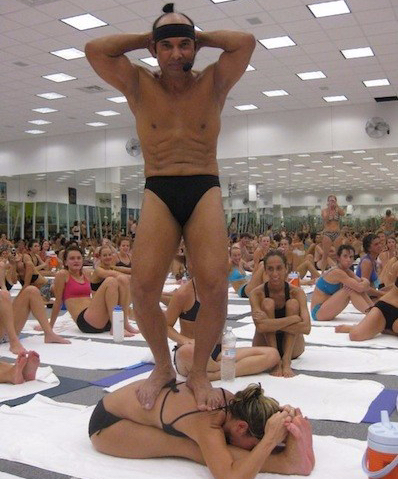
There are 26 poses in the yoga practice as developed by the Lord of the Flies. There are 26 problems with the practice, notwithstanding Bikram Choudhury still looking super in a Speedo in his 60s.

1) Bikram Teacher Training Guide: “Do not wear green.”

According to Bikram Choudhury green is an unlucky color and is banned from all his studios. “Please try to avoid the color green. Don’t ask, just try.”

Problem: Green signifies rebirth and growth. The “Green Man” of pre-Christianity was a symbol of fertility. Among Muslims it is a holy color. In Ireland it is a lucky color. However, circus and traveling showmen in Australia do consider green to be bad luck.

2) “How many Rolls-Royce do I own? I don’t know. 35?” said Bikram Choudhury.

Bikram Choudhury owns many Rolls-Royces, Bentleys, and Howard Hughes’s Royal Daimler, as well, with a toilet in the back.

Problem: Non-indulgence and non-acquisitiveness, or Aparigraha.

3) Bikram Yoga classes are taught in Hot Rooms heated to 105 degrees and 40% humidity, reaching a heat index greater than 120.

Problem: The risk factor of moderate activity in a heat index in excess of 115 is considered by the Occupational Safety and Health Administration to be “very high to extreme.”

A common reaction to one’s first Bikram Yoga class is, “Man, this might be a mistake, I don’t think I’m going to make it.”

4) “I am a product of Beverly Hills,” said Bikram Choudhury.

Problem: Bikram Choudhury is a product of Beverly Hills.

5) Bikram Choudhury often refers to his studios as “torture chambers.”

Problem: Torture is inflicting severe pain on someone as punishment or to force someone to do or say something. That has nothing to do with yoga. Neither does chewing glass, lying on nails, nor being buried alive, performances often given by 19th century yogi fakirs.

However, this does not obviate the torture many have felt in a Bikram Yoga class.

6) “They are all a bunch of clowns,” Bikram Choudhury told Yoga Journal, referring to other forms of yoga exercise, such as Kundalini and Ashtanga. “Nobody knows what the hell they are doing.” He claims to teach the only true and pure hatha yoga.

Everything else is “shit,” he explained on another occasion.

Problem: Honesty and truthfulness, or Satya, as well as non-harming in deed and word, or Ahimsa.

7) In a sworn legal deposition Bikram Choudhury claimed that Harvard University was constructing a “Bikram building in their campus.”

Problem: “We checked with our capital-projects group and can confirm no new building in the usual sense of the term is under construction funded by Mr. Choudhury or by a donation in his name,” said Kevin Galvin, spokesperson for Harvard University.

8) Bikram Choudhury professes that Eagle Pose is rejuvenating. “It is good for sex. Cootchi, cootchi. You can make love for hours and have seven orgasms when you are ninety.”

Problem: According to the Journal of Sexual Medicine yoga can improve some aspects of sexual function. Wide-angle seated forward bend and other hip-openers are cited; the Eagle Pose is not mentioned.

9) “I’m not dressed like a guru, am I? I dress like a gangster!” said Bikram Choudhury.

When he is wearing clothes Mr. Choudhury flashes in shiny white suits, diamond-studded wristwatches, crocodile shoes, gangster fedoras, and designer accessories.

Problem: Restraint, or Brachmacharya.

10) Bikram Choudhury has claimed that he and his yoga regimen are able to cure cancer and multiple sclerosis, among other serious medical conditions.

Problem: There are treatments for cancer and multiple sclerosis. There are no cures, yogic or otherwise.

11) For more than 10 years of contentious lawsuits Bikram Choudhury claimed copyright protection for his 26 yoga poses.

Problem: Bikram Yoga’s claims were overruled in 2012. The U. S Copyright Office said that sequences of yoga exercise are not the equivalent of a choreographed work.

Bikram Yoga is protected by trademark, not copyright.

Yogis worldwide were relieved to learn they could again touch their toes without fear of subpoena.

12) “I’m in show biz,” said Bikram Choudhury. “I entertain people.”

Problem: When did yoga become a Lady Gaga song and dance?

13) “A warm body is a flexible body,” says Bikram Yoga, explaining that heat softens muscle tissue. “Then you can reshape the body any way you want.”

Problem: About 5 minutes of cardiovascular work is sufficient to warm up muscles, according to Ben Ballinger of Athletic Performance. “The claim that Bikram Yoga allows for deeper stretching due to the heat is untrue.” Overstretching can even compromise joints and ligaments, causing instability and hypermobility.

14) “Did you pay to come here and listen to me?” said Bikram Choudhury “Wow! I am lucky. I go shopping tomorrow!”

Problem: Paying good money to listen to Bikram Choudhury so he can buy more Rolls-Royces.

15) Bikram Yoga offers up many testimonials of metabolisms made new and excess pounds shed. Warm muscles are said to burn fat more easily as the heat flushes and detoxifies the body. Fat will turn into muscle is the mantra.

Problem: According to the Health Status Calorie Counter power yoga burns 594 calories an hour. Bikram Yoga burns 477 calories an hour. Ballroom dancing burns about 250 calories an hour, while running a 10K in under an hour burns about 1000 calories.

“The benefits are largely perceptual,” said Dr. Cedric Bryant, chief science officer of the American Council on Exercise. “People think the degree of sweat is the quality of the workout, but that’s not reality. It doesn’t correlate to burning more calories.”

16) Bikram Choudhury’s home in Beverly Hills is an 8,000-square-foot mansion seemingly built entirely of marble, gold, and mirrors.

Problem: Non-indulgence and non-acquisitiveness, or Aparigraha

17) Bikram Yoga argues that exercising in a heated and humidified room strengthens the body, resulting in greater endurance, internal organ conditioning, and a stronger heart.

Problem: “The human body is designed to tolerate temperatures between 97 and 100 degrees,” said Fabio Comana, exercise physiologist with the American Council on Exercise. “It is not designed to go outside those numbers. Core temperatures can go up very quickly. Over 105 degrees you will start to damage protein.”

18) “An Iyengar class looks like a Santa Monica sex shop with all those props,” said Bikram Choudhury.

Problem: What was Bikram Choudhury doing in a Santa Monica sex shop sizing up the props?

19) Bikram Yoga proclaims itself the detox practice extraordinaire because it induces profuse sweating. “When you sweat, impurities are flushed out of the body through the skin.” Detoxification may be the most touted benefit of the practice, said to “cleanse and purify the system.”

Problem: “That’s silliness,” said Craig Crandall, director of the Thermoregulation Laboratory at the University of Texas Medical Center at Dallas. “I don’t know of any toxins that are released through sweat.”

The liver and kidneys filter toxins from the blood. Sweating too much and becoming dehydrated could stress the kidneys and actually keep them from doing their job.

20) “I should be the most honored man in your country,” said Bikram Choudhury.

Problem: Ahead of Thomas Jefferson, Abraham Lincoln, Helen Keller, Thomas Edison, Eleanor Roosevelt, Martin Luther King, Jr., William Sloane Coffin, and Edward Snowden, among many others, both men and women?

21) The heat and humidity of Bikram Yoga are often explained as replicating the heat and humidity of India, where Bikram Choudhury learned yoga.

Problem: In India yoga was and is traditionally practiced in the early morning to avoid the heat of the day.

22) Bikram Yoga says its practitioners derive aerobic benefits from the practice. “You can derive these benefits [i.e. aerobic] from practicing Bikram Yoga.”

Problem: In a study published in 2013 in the Journal of Strength and Conditioning Research one group of young adults practiced Bikram Yoga three times a week for eight weeks while another group did nothing. By the end of the study researchers found no differences in either group in terms of maximal aerobic fitness or cardiovascular measures.

23) Bikram Yoga studios are required to outfit their Hot Rooms with carpet flooring.

“Don’t throw up on the carpet,” said Bikram Choudhury. “It’s new.”

Problem: Carpets are nearly impossible to clean thoroughly, much less sanitize. Allergens are particularly adept at hiding among carpet fibers. Sweat-soaked carpets are breeding grounds for bacteria, fungus, and pathogens.

Vomit may be the least of anybody’s concerns in a Bikram Hot Room.

24) “Oxygen deprivation is a major cause of sciatica,” says Bikram Yoga, encouraging the use of breath to “break through the fear of pain.”

Problem: The causes of sciatica are varied, including degenerative disc disease, isthmic spondylolisthesis, lumbar spinal stenosis, piriformis syndrome, and sacroiliac joint dysfunction.

Oxygen deprivation is not one of the causes of sciatica, although it can be a cause of death.

25) “Because I have balls like atom bombs, two of them, 100 megatons each. Nobody fucks with me,” said Bikram Choudhury.

Problem: All eight limbs, or aspects, of yoga from the Yamas & Niyamas to Samadhi.

The yoga master confessed he only has two bomb balls, which is fortunate for everyone, not just the girls. The world’s nuclear arsenal is big enough.

26) “The whole Bikram class is one big brainwashing session,” said Bikram Choudhury.

Problem: No problem, as long as you believe applying systematic and forcible indoctrination is the best way to advance yoga.

Ed Staskus posts stories on 147 Stanley Street http://www.147stanleystreet.com and Cleveland Ohio Daybook http://www.clevelandohiodaybook.com. To get the site’s monthly feature in your in-box click on “Follow.”
Cirque Du Asana

By Ed Staskus

Exercise used to be one of the eight limbs of Ashtanga Yoga, along with restraint, observance, breath control, sense withdrawal, concentration, meditation, and samadhi, the last literally meaning putting it all together.

Not anymore. Not nowadays. It’s not eyes wide open anymore. It’s eyes straight ahead on the posture. The practice of asana is today on the fast track to becoming the trunk of yoga, while the other limbs are paid lip service, wither away, or are simply ignored.

For many years yoga exercise, as defined in Patanjali’s Yoga Sutras, was a small means to a big end. The basics of asana were defined in the sutras as a “steady or motionless posture accompanied with a sense of ease or comfort.” The mastery of it was meant to “loosen effort while meditating on the infinite.”

Sometime in the latter half of the last century asana began to forge its own separate identity, that of strengthening and revitalizing the body, the idea being that it was through the third limb of Ashtanga Yoga, which are the physical postures, that all the other limbs could be realized.

As yoga pressed ahead and onward asana masters like Bikram Choudhury and Baron Baptiste designed new forms of yoga exercise, such as sequences practiced in hot rooms with no motive other than to lock the knee and “push, push, push” and other sequences that referenced only physical prowess, like Baptiste’s “Unlocking Athletic Power.”

In the new epoch yoga exercise has made many more great leaps forward, leaving its past farther behind, moving decisively into the worlds of athletic competition and extreme sports.

Today tournaments crown asana winners in Arizona, California, and New York, while overseas the European Yoga Alliance organizes an annual championship. USA Yoga, sponsor and governing body of the annual National Yoga Asana Championships, in what it says is the “spirit of healthy competition” is committed to bringing yoga asana to the Olympic games.

”Once yoga is in the Olympics,” says Esak Garcia, 2005 winner of the International Yoga Championship, “it will legitimize yoga for many people all over the world.”

Beyond the bright lights of the arena and its judgments on the perfection of a pose, its poise and composure, is the new world of extreme yoga. The Chicago Tribune recently ran a photo spread called “Extreme Yoga Positions” featuring a body artist named Yoga Yoga, whose real name is Michael Elias Mondosha.

He transforms Steady Eddy into 3-ring big top high wire on the mat.

Meanwhile, acroyogi partners perform poses like ‘Bird’, a horizontal “flier” supported on the feet and legs of a “base” staying rock steady, nailing the posture on top of stone parapets in the mountains of Nepal on the edge of sheer drops, all without the aid of spotters.

The back page of a recent issue of Yoga Journal featured a full‐page photograph of a woman in tree pose with hands in prayer behind her, standing on a ledge of the Roberto Clemente Bridge in Pittsburgh. She was not wearing a tether, nor was there a net to catch her just in case she wobbled and fell.

It was here to eternity.

Even Native American Indians, famous for their work on bridges and skyscrapers, are careful about heights. “We have more respect for heights than most people,” said Dan Angus, a Kahnawake Mohawk ironworker, in ‘The Mohawks Who Built Manhattan.’

“You’ve got to watch it up there,” he said.

“I kept bringing my focus back to the pose,” the brave yoga lady on the bridge said.

She was watching it, but unlike the Mohawks, from the inside out, not the next step ahead. She wasn’t looking ahead down or up. Focusing on the pose and keeping it steady was undoubtedly a good idea. It is 78 feet from the deck of the bridge to the Allegheny River.

“I don’t see any benefit to it, especially since yoga begins with yama and the first yama is ahimsa, or non‐injury,” said Kenneth Toy of the Institute for Personal Development in Hampton, New Hampshire.

Which begs the question, why do it? If yoga is a spiritual practice with a physical component, why tempt fate? If yoga is just a gym rat’s bag of physical poses, again, why tempt fate? Even Olympic gymnasts don’t perform on the beams of bridges, much less without a padded mat below them to break the fall for when they inevitably fall.

“Talk about finding your edge!” said Carolyn Gilligan, an editor at elephant journal. “If you lose your balance on a bridge the risk is pretty tremendous. I think the key here would be having a calm, verycalm mind.”

‘One slip and it’s all over’ feats are often performed by circus troupes and extreme artists like Eskil Ronningsbaken, famous for stunts like balancing in handstand on a projecting steel rail of a lookout platform more than a thousand feet above a cold Norwegian lake.

“Yoga and different breathing techniques helps me to stay focused and hit the right wave of energy,“ he says, riding the wave

Yoga has a long history of bendy, stretching, balancing poses that seem incredible. Some are more amazing than others.

In the 1970s, on a television show called “That’s Incredible,” a performer named Mr. Yogi folded himself up, limb by limb, into a wooden box no bigger than a carry-all. When a lid was put on the small box the audience shouted on cue, “That’s incredible!” A big strong man carried the carry-all off stage to applause.

“Some yogis like to provide drama or accentuation or adrenaline to their poses,” explains Susan Pennington of Susquehanna Yoga & Meditation Center in Timonium, Maryland. “That is funny considering yoga is a practice of finding the middle. That is what balance is. Not the edge, but the middle.”

However, the middle way may not be the American way in the twenty-first century.

The Sanskrit word asana, from the root ‘asi’ which means to be, literally means a state of being. Today the meaning has been stood on its head, changed to mean a state of doing.

“Extreme balancing can be both fun and beautiful, calling for particular focus and skill,” said Alison West, the director of Yoga Union in New York City. “It’s a form of marketing through beauty and danger. Does it make one a better yogi? Probably not. But it looks that way.”

In Austin, Texas, artists perform yoga poses hanging from the skeletal beams of partially constructed buildings. Staging their suspension theater at night, the lines and cables they use are practically invisible.

“Tightrope walkers are now doing yoga poses in their routines,” says Cosmo Wayne of Yogagroove in Austin. “My question is, were they performers or yogis first, and does it matter? As for balance, either you have it or you don’t. People who can balance but are afraid of heights will be affected and probably not balance on the edge of a cliff. It’s all just fun and scenic.”

Whether extreme balancing has anything to do with yoga is a moot point, although Patanjali might be rolling over in his grave. His reasoning for the practice of yoga exercise was ultimately to be able to withstand physical and mental distractions in order to meditate.

“Yoga is a sacred practice of going inward and knowing who you are authentically,” said Michele Risa, a Kundalini Yoga teacher and New York City TV producer of yoga programming. “All this showmanship seems like a distraction at the least and the wrong message at worst.”

In many respects, however, in our post-modern times yoga has become a purely physical practice, and the message has morphed so now the headline is that the body beautiful can be gotten by anyone with a credit card, factoring in more dollars if you live on either coast and need to be really beautiful.

If perfecting the pose is the be‐all and end‐all of yoga, then cirque du asana might be the new third eye for raising awareness. If living the true yogic life is part and parcel of handstand, then performing handstand on the edge of the Grand Canyon probably validates the true yogic life and it would behoove all and sundry to get on the bus for the Rim‐to‐Rim tour.

Not everyone agrees that famous fitness instructors in yoga clothes or extreme sports performers with film crews in tow are the best guides on the path of the practice.

“I don’t believe risk taking is necessary to achieve the balance that a sound yoga asana and lifestyle practice can give us,” argues Nydia Tijerina Darby of Nydia’s Yoga Therapy in San Antonio, Texas. “It is beautiful and awe inspiring, but it seems to continue to sensationalize the asana and detract from the real beauty of a quiet and content mind, body, and spirit that does not need to push the limit in order to feel alive.”

Selflessness, balance, and humility are some of the core values of yoga. They are not the core values of our modern sports and entertainment culture. Exercising for fame and fortune is exercising for fame and fortune. It is not innercizing, which is the platform on which yoga was built.

What does gaining mastery in asana really mean, anyway? It doesn’t really mean doing handstands for an audience’s wonder and applause. It means doing handstand to gain awareness, to master a state of mind, to become, in a sense, bodiless.

“The pictures of extreme yoga are beautiful and certainly showcase a certain level of expertise,” says Tracey Ulshafer of One Yoga & Wellness Center in East Winsor, New Jersey. “But I do feel they are missing the essence of yoga. It is not for showing off. It is for exploring within.”

If yoga is a physical practice, then hitting a home run is worth the price of admission. But, if yoga is a spiritual practice with a physical dimension meant to keep the body strong and healthy for a lifetime of much more than asana, then home runs are only good for as long as they last, which isn’t long.

Who remembers last year’s World Series winner and loser?

“I believe asana is to help the work of unfolding inner Shakti, and so I see daredevil poses as something other than the true meaning of the practice,” says Ann Farbman of the World Yoga Center in New York City.

The devil is in the details of yoga practice. The practice is partly about the power of asana, but ultimately it is about the power of consciousness. In the Yoga Sutras Patanjali doesn’t say a word about physical accomplishment, because that is not the point of yoga practice. He mentions asana only four times. The Yoga Sutras are about states of being, maybe achieved through asana, but not beholden to them.

There are no contortionists on boardwalks or carnivals on the edge of believe‐it‐ or‐not in any of Patanjali’s 196 aphorisms.

“It is better to take risks in extreme savasana,“ says Francois Raoult of Open Sky Yoga Center in Rochester, New York. Get down on the mat and look up at everything.

Modern yoga may not see it that way, having opened its own Pandora’s Box, but there is no doubt Patanjali would agree.

A version of this story appeared in Elephant Journal.

Ed Staskus posts stories on 147 Stanley Street http://www.147stanleystreet.com and Cleveland Ohio Daybook http://www.clevelandohiodaybook.com. To get the site’s monthly feature in your in-box click on “Follow.”
From Yogaville to Cheeseville

By Ed Staskus

When Hannah Inglish interned at the North Country Creamery in Keeseville in far northern New York near the Canadian border for six months she didn’t know it was the penultimate step in her transition from Cleveland, Ohio, yoga girl to cow herder maven and cheesemaker.

She also didn’t know that a year later, eight years after she began studying pre-Christian non-theism, rolling out a yoga mat, and changing her eating habits, she would be making arrangements to move away from where there were 5000 people per square city mile to 15 people per square country mile, with only her boyfriend in tow, and take up farming.

“I didn’t know it was going to happen so quickly,” she said.

“But when I was at Yogaville” – a teacher training facility and retreat center in Buckingham, Virginia, at the base of the Blue Ridge Mountains – “I read Shivananda’s writings, especially the parts about adapting, adjusting, and accommodating, so the change has been kind of easy.”

Born in Oklahoma, she and her sister grew up in Lakewood, an inner-ring old school suburb of Cleveland, and graduated from Lakewood High School. In her senior year she started reading Alan Watts, the British-born philosopher and populariser of Zen Buddhism in the 1960s and 1970s.

“He was an awesome philosopher, trying to explain the deeper meaning of things, the underlying energy you always feel,” she said. “It makes the unexplainable easier to explain.”

After high school she experimented with raw foods and vegetarianism and began commuting across town to Cleveland Heights to the Atma Center, a holistic studio dedicated to Satyananda Yoga. “They taught traditional yoga, with pranayama and chanting, not your typical soccer mom hot yoga. I wanted that.”

Satyananda Yoga professes an integrated approach to the practice and is known as the yoga of the head, heart, and hands.

The next year she signed on and went to Yogaville for three months to train as a yoga teacher.

“It was a great experience. I cut my long dreads and went by myself. All of a sudden I looked and felt different and I was around completely different people, waking up at 6 AM and meditating.”

Once back home in Lakewood, certified to teach the hatha style of Integral Yoga, she freelanced, teaching around town, but was disillusioned by the high cost of classes at studios and the prevailing focus on yoga as a workout.

“For me it’s more of a lifestyle, and the benefit of yoga is being present in the body and learning to relax. That isn’t really taught in a lot of classes.”

The next summer, with her boyfriend Max, she returned to Yogaville for another three months, but this time as an intern cooking for the ashram’s community.

“We worked in their big kitchen, cooking for hundreds of people, buffet-style, vegetarian and organic. It was another great experience.”

Returning home that fall, inspired by her kitchen work at Yogaville, she found employment at the Root Cafe, a local vegetarian restaurant, organic bakery, and espresso bar doubling as a community clubhouse featuring local music and art.

“It was my first serious cooking job,” she said. “I was the youngest person there. It was tough, although I got the hang of it. It was a lot of fun.”

But, the next summer she broke her wrist while crowd surfing in the mosh pit at a heavy metal concert and was unable to do kitchen work for several months.

“It was bad, really dumb, but I feel like it was almost like life telling me to slow down.”

After her slam danced wrist got better she returned to work, but her job at the Root Café having been filled, she instead found a new job at Earth Fare, an organic and natural food market in neighboring Fairview Park.

“I was doing my own thing at first, with the fruits and vegetables, but I kept getting transferred all over the store, and the managers were really rude, and it was just unfulfilling.”

Destiny has been described as the opportunities that arise to turn left or right when coming to a crossroad. Sometimes it takes karma to work out the windings on the road from Yogaville to Cheeseville.

“I was looking for another job, and not having any luck, but I had been thinking and looking at farm internships when I found an organic farm website I liked.”

It was the website of the National Young Farmer’s Coalition. Hannah Inglish filled out an application for an internship, posted her resume, and sat back to wait. She didn’t wait long.

“Steve Googin from the North Country Creamery in Keeseville called me the next day, even though I hadn’t applied there. There are only a few little organic farms in Ohio, but when you look at New York state it blows up.”

According to the National Young Farmer’s Coalition, most of today’s young American farmers are first generation farmers, primarily interested in growing organic foodstuffs and grass-fed dairy and beef.

“He told me I was accepted. I made plans right away. My mom drove me up there, and it was so much more than I expected, all the young farmers and the movement that is going on there.”

Steve Googin and his partner Ashlee Kleinhammer, co-owners of Clover Mead Farm and the creamery, bought and rehabbed a small trailer for Hannah to live in. They tore out its thin carpet, replaced it with hardwood flooring, and parked it under the stars. A stray cat showed up. She went to work milking the twenty cows, feeding the calves, and doing the many odd jobs that farms have an endless supply of.

“All the cows have names, like Nellie, Petunia, Trillium. Trillium was my favorite. I would pet her and she followed me around, sticking her neck out, looking to be petted. They were all such gentle giants, except for Ida, who was cranky, not so gentle. If you got too close to her she would head butt you. Once, I didn’t realize she was right behind me and she got me, which was a big pain in my butt.”

No sooner than she had gotten the hang of herding and milking the shorthorns and Jerseys in her care than the plans Mr. Googin and Ms. Kleinhammer had been making to open a farm café to sell their milk, yogurt, and cheese bore fruit. They hired a cook with experience at New York City’s Blue Hill at Stone Farms to manage the café and put Hannah in charge of the cheese.

“I think Steven really wanted to make cheese himself, and he did a few times, but they’re so busy doing everything else so they asked me to take over the cheesemaking.”

Cheese is sometimes seen as milk’s leap towards immortality, although age matters when you’re a cheese. Making cheese turned out to be the fulcrum that would take her back to Keeseville.

“Making cheese is 90% washing dishes and cleaning everything so it’s sterile, but I loved it, and besides, I really like cows. When you’re milking them they get so relaxed. I’ve seen them fall asleep right on the spot. It’s funny hearing a cow snore while you’re milking it.”

By the end of October her internship was over and she went home again to Lakewood, saying, “I was ready to come back and see my boyfriend.” No sooner was she home, though, than she started making plans again.

“I want to be a farmer,” she said. “But I can’t go out and do that anywhere. I have to go where I can learn from people, and Keeseville is where I decided to go. Even though I asked them so many questions when I was there, they weren’t saying there’s this dumb city girl, and all that. The community there is so attractive to me, the people actually doing it. Whatever it takes.”

With her mother’s help she bought a house in Keeseville and when spring comes is moving there with her boyfriend. She will go back to work at the creamery, milking cows and making cheese, and raise chickens and keep bees on the side  on her own. “There’s a beekeeper across Lake Champlain in Vermont who breeds Northern Survivor Hybrids that do really well in the north country. I’ll see what I can accomplish.”

“Farming looks mighty easy when your plow is a pencil and you’re a thousand miles from the corn field,” Dwight Eisenhower, whose forebears were farmers, once said.

Farming is hard work and farmers are compelled to start over again every morning, very early in the morning, valuing their work, love of land and water, and their communities. It’s early in the sack, early to rise, no black limos for getting to work.

“The farmers around Keeseville, at Clover Mead and Mace Chasm Farms and Fledging Crow, they’re all young and it’s inspiring to see them doing that,” said Hannah.

“It’s hard, hard work, but super rewarding. Eventually I want to own land and build my own cob house. That’s the plan.”

From farm to table is the cheese way. From city girl to cheesemaker to farmer is the way Hannah Inglish has made for herself. When a cow crosses her path it means the animal is going somewhere. Here comes the cheese.

Once your plan has been signed sealed but not yet delivered what remains is bringing home the cows and getting them all on the tune of om on the milk machine so they can slumber away on their feet happily snoring.

A version of this story appeared in Rebelle Society.

Ed Staskus posts stories on 147 Stanley Street http://www.147stanleystreet.com and Cleveland Ohio Daybook http://www.clevelandohiodaybook.com. To get the site’s monthly feature in your in-box click on “Follow.”

Sat Nam (One Hundred and Eight)

By Ed Staskus

“One sits and beats an old tin can, lard pail. One beats and beats for that which one believes.” Wallace Stevens

Everyone has heard the words to thine own self be true, even if they’ve never read a word of Shakespeare. Not everyone has heard the words sat nam, which mean true self, even if they’ve done plenty of yoga. Shakespeare is remembered because he got human nature right. Yoga is practiced because it helps make human nature right.

Real life often means caving in to peer pressure instructions tropes status groupthink. Even though trying to fit in can make you temporarily insane, herd behavior is a longtime humankind habit. It can be a bad habit. The yoga life is about being stouthearted enough to be your true self.

You are what you eat. You are what you do possess believe say so. You are everything that has ever happened to you. The hidebound say you are what you were before the clock started ticking. Things are more like they are today than they’ve ever been. The pioneering say the best way to predict the future is to make the future, which is another way of saying that creating opportunities is creating you.

You are your life’s energy, one breath at a time, which is why yoga puts a premium on breathing. It is why breath control is one of the eight limbs of the practice. When you stop breathing you get stuck in time.

Sat Nam Sat Nam Sat Nam Sat Nam Sat Nam Sat Nam Sat Nam Sat Nam Sat Nam Sat Nam Sat Nam Sat Nam Sat Nam Sat Nam Sat Nam Sat Nam Sat Nam Sat Nam…

What is the self?

Philosophers psychologists psychiatrists say self-awareness is what leads to awareness, to consciousness, the difference between you and me. Is it your brain engaged in self-reference? “I think, therefore I am,” said Rene Descartes. Is it your private self, public self, better self? Are you your ego self or your observing self?

Society tells you to find yourself be yourself then tells you what to do. Is that what happens when you lose yourself?

What do self-respect, self-control, and self-confidence have to do with it? Were you yourself at two, as a teenager, and your good old self as you are now? Is your self your self-image? Are you only yourself when no one’s watching?

“You are your life, and nothing else,” said the existentialist Jean-Paul Sartre.

That is a Western view, the ‘I’ as an autonomous ego. In the East the self is often defined in its relation to others. You can’t be a self by yourself. In the West the self has been atomized. In the East who you are depends on where you are.

The philosopher Thomas Metzinger claims the self is an illusion. It’s all in your head. It’s just your brain and its neural activities, and nothing else. You are your genes. There is nothing about you that transcends the physical. There is no higher-order beyond the body and brain.

The question remains up in the air. Who are you? Make up your mind.

Sat Nam Sat Nam Sat Nam Sat Nam Sat Nam Sat Nam Sat Nam Sat Nam Sat Nam Sat Nam Sat Nam Sat Nam Sat Nam Sat Nam Sat Nam Sat Nam Sat Nam Sat Nam…

What is a mantra?

It’s simple enough, a sound or a word repeated to aid in meditation. The mantra of Main Street is bigger is better, the mantra of Wall Street is nobody goes to jail, and the mantra of D. C. Street is build a strong brand. Those aren’t mantras. They’re statements repeated ad nauseam to make you think they make sense.

There is meditation and then there is mantra meditation.

Mantra meditation is the act of repeating a sound, a few words, or a short phrase over and over. Sometimes again and again stops at 108 times, which is how many prayer beads there are on a string of them. It gets you into a frame of mind.

A mantra means ‘man’ which means mind and ‘tra’ which means vehicle. A mantra is a vehicle for the mind. One translation is “to be free from the mind.” It is the Magic Bus whose engine properties and sonic vibrations put you on the road to meditation.

In the same way that asanas on the mat are exercises for the body, mantras are exercises for the mind. Mantra meditation clears the decks of the mind of stress. It helps align the left and right sides of the brain. It connects the critical thought part of us with the creative side of us.

Breath and sound, energy and rhythm, help boost immunity, reduce anxiety, and release neuroses. Who wants to be nailed to the cross of their disturbed mind? It’s free and easy, too. All you have to do is show up and it works. No one needs to be an expert at busting out a solo. The world of mantra isn’t a stage. All you have to do is bust the breath from your belly and your heart.

Mantra is old stuff, from back in the day of campfires, the mother of meditation.

Sat Nam Sat Nam Sat Nam Sat Nam Sat Nam Sat Nam Sat Nam Sat Nam Sat Nam Sat Nam Sat Nam Sat Nam Sat Nam Sat Nam Sat Nam Sat Nam Sat Nam Sat Nam…

Why chant sat nam?

When you’re grooving on sat nam you’re getting back into the groove. Finding your groove is finding your balance. Chanting a mantra like sat nam is getting down with the original yoga rhythm section.

Sat nam is pronounced like but mom.

There are Sat Nam Fests at Joshua Tree and in the Berkshires, lots of yoga, lots of music, lots of chanting. “We thrive in tribes,” said Azita Nahal, a Kundalini teacher and author who spearheads workshops at the festivals. “Our bodies are the way in, our awareness is the way through.”

Sat nam is the seed mantra of Kundalini Yoga, a practice popularized by Yogi Bhajan in the 1960s. It is a synthesis of several traditions designed to bring to life the life force at the base of the spine. Kundalini Yoga is sometimes known as the yoga of awareness. Its method is in its physical postures, breath work, mantras, and meditation.

Sat means ‘true’ and nam means ‘identity’, more-or-less. Whatever it means, chanting sat nam means making an experience of your own consciousness. Consciousness is energy at its basal basic basement level. It also means having an experience of consciousness in general, of getting past the separateness.

“Truth can be stated in a thousand different ways, yet each one can be true,” said Vivekananda. What’s truer than true is that only you can be you. When in doubt be yourself, don’t be the other 999 guys, which is the best way to be a stand-up guy or gal, to tell the truth.

You can’t be free if you’re not truthful, at least to yourself, even if not to the truth of the matter. Who wants to meet themselves behind the wall of illusion, in the hall of mirrors? If you can’t find the truth within yourself, where do you think it might be? Is it in what somebody on their soapbox is saying? Is it in the flag-waving crowd? Is it in the great big spider web of the rest of the world?

Trying to find it there would be a mistake.

God knows we all make mistakes. Only God has never made the same mistake once. Although it’s true that mistakes can teach us something, the only mistake in the offing you don’t want to interrupt is the one an immediate mortal enemy is making.

Trying to find yourself outside of yourself would be a mistake because it isn’t about finding yourself somewhere out there, it’s about creating yourself from the inside out. After all, everybody has their one and only genetic identity. What’s better than being able to say I have my own selfhood and my own style?

It’s better to be a dead ringer of yourself than a knock-off of somebody else.

Sat Nam Sat Nam Sat Nam Sat Nam Sat Nam Sat Nam Sat Nam Sat Nam Sat Nam Sat Nam Sat Nam Sat Nam Sat Nam Sat Nam Sat Nam Sat Nam Sat Nam Sat Nam…

Why chant sat nam 108 times?

“By practicing chanting, breath work, or asana in rounds of this sacred number, the ancient yogis believed we could align ourselves with the rhythm of the creation,” Helen Avery wrote in “108: Yoga’s Sacred Number”.

When it comes to yoga, malas are made of 108 beads, breath work is often done in cycles of 108, and doing a traditional 9 rounds of the 12 sun salutations makes 108.

“Exactly how the yogis arrived at 108 we don’t quite know, but it seems to be a number that connects us to our place in the cosmic order.”

There are 54 letters in the Sanskrit alphabet. Since each of them has a feminine and masculine aspect, there are 108 letters. Chakras are energy lines in the body. It’s believed there are 108 energy lines that converge to form the heart chakra. There are said to be 108 stages on the journey of the Atman, or soul.

Many Buddhist temples have 108 steps leading up into them, meaning there are 108 steps on the path to enlightenment. The Mayans built their temple at Lamanai to be 108 feet high. The Sarsen Circle at Stonehenge is 108 feet in diameter.

The big picture is that the distance from the earth to the moon is 238, 800 miles, just about 108 times the moon’s diameter. The diameter of the sun is just about 108 times the diameter of the earth. The distance from the earth to the sun is just about 108 times the diameter of the sun.

“It serves as a reminder of the wonder and interconnectedness of the universe,” wrote Helen Avery.

Why not chant sat nam 108 times when there’s wonder in it?

Sat Nam Sat Nam Sat Nam Sat Nam Sat Nam Sat Nam Sat Nam Sat Nam Sat Nam Sat Nam Sat Nam Sat Nam Sat Nam Sat Nam Sat Nam Sat Nam Sat Nam Sat Nam…

Why a mantra? Why use it as a tool in the first place? Sometimes it can seem like a broken record. Why not just meditate? The reason is because it’s a kind of white noise, muffling the commotion hubbub chatter.

“A mantra has the power to drown out both the surface noise and eventually even the quieter undercurrent of thoughts until all that is left is the repetition of a neutral mantra and the serene state of natural awareness which starts to emerge naturally,” wrote Chad Foreman in “Why Repeating a Mantra Is So Powerful and How to Do It”.

Some of the oldies but goodies are om, om namah shivaya, and om mani padme hum. Many of them have the word om in common, the sound of life and death. It’s been called the sound of the universe.

Aaaa-Uooo-Mmm.

It’s close enough, although sound waves can’t and don’t travel through the vacuum of space. Electromagnetic waves can, though, and they can be recorded by spectrographs. Quasars sound remarkably like the spitting image of om.

Sat has sometimes been translated as ‘existence’ and nam as ‘to bow’. In other words, bow to existence. We are part of the universe. The universe is in us. “He who lives in harmony with himself lives in harmony with the universe,” said Marcus Aurelius more than two thousand years ago.

Sat Nam Sat Nam Sat Nam Sat Nam Sat Nam Sat Nam Sat Nam Sat Nam Sat Nam Sat Nam Sat Nam Sat Nam Sat Nam Sat Nam Sat Nam Sat Nam Sat Nam Sat Nam…

The arc of the horizon bends at sat nam, the seed mantra. In a universe that created itself out of nothing, a universe made out of energy, a universe that works from within outwards, making a vibration making a sound making sat nam with your breath is a simple way of making your way in the universe.

Ed Staskus posts stories on 147 Stanley Street http://www.147stanleystreet.com and Cleveland Ohio Daybook http://www.clevelandohiodaybook.com. To get the site’s monthly feature in your in-box click on “Follow.”

Painting the Town Red

By Ed Staskus

“Looking up at paradise, all souls bound just contrariwise, yo ho ho and a bottle of rum.” Dead Man’s Chest, a traditional sea shanty

When yoga got on its feet in the 1960s and started rolling in the 1970s, many Americans thought it was a fad. It was part and parcel of the culture of California, after all. It was for hippies and health nuts and religious fanatics, said working stiffs and wise guys, wondering where the success in it was.

In the 60s and 70s, however, it was anything but a fad. It was the real deal. It had its feet grounded in a 5000-year-old tradition. If it was a fad it was a fad that had never gone away, the kind that had staying power. When Satchidananda led the opening chant at Woodstock, it wasn’t that week’s Top 10 smash hit. It had a legacy going back centuries. It had been a smash hit in year zero.

The practice stayed solid for thirty years, but by the 2000s it was flipping over onto its head. Celebrity jet-setting yoga teachers crisscrossed the country, burning up the carbon, peddling their brand of sermon. John Friend got high and got sexy. Yoga franchises with their instant oatmeal wisdom and Groupon specials popped up from Miami to Joplin, Missouri.

Yoga used to be the hub of the wheel. Then it became the spokes of the wheel. Anusara, Baptiste, Forrest, Integral, Iyengar, Jivamukti, Kripalu, Kundalini, Moksha, Sivananda, Viniyoga, Vinyasa, and Yin.

It’s a baker’s dozen.

Soon afterwards the spokes started to splinter. Nowadays there is Karaoke Yoga and Laughing Yoga, Tots and Tykes Yoga, Aerial Yoga, and AcroYoga, Glow-in-the-Dark Yoga, Naked Yoga, Trampoline Yoga, Trampoline Yoga While Naked, Primal Screaming Yoga, and Paddleboard Yoga.

No staying grounded there, just don’t drift off by mistake and get captured by pirates. What did the shipwrecked blindfolded friendly SUP yogi with the outstretched arms ask his newfound friends swigging mugs of suds while he walked the plank?

“Am I getting warmer?”

Picking yourself up off the ground is the premise of Rage Yoga. “I was going through a lot of pain,” said Canadian teacher and founder Lindsay Istace. She had recently gone through a break-up. She was a bittergirl. “It started to come out during my practice. Suddenly there was a lot more yelling, swearing, and emotional release on my mat.”

Down on the farm there is Goat Yoga, which is exactly what it sounds like. It’s doing yoga with small cute goats, at least until their grumpy elders head butt you. Old Billy and his horns ain’t anything you want to partner yoga with.

“It might sound silly, but the way these classes are working, it’s becoming deeper and bigger than I thought, “ said Lainey Morse, who started the craze. The business has expanded to the point that she has quit her day job and is trademarking “Goat Yoga”.

Maa! Maa! Maa!

All of this is to not mention Bikram Choudhury, of eponymous Bikram Yoga-fame, whose crazy-like-a-fox marketing is legendary. “There’s a sucker born every day,” said P. T. Barnum, Bikram’s spiritual guru.

In more recent times yoga has gone from Jennifer Aniston’s six-pack abs, otherwise known as Jennifer’s Yoga Moves for Flat Abs, straight to six-packs.

Brewskis and poses was a practice born at the Burning Man fun festival. Who doesn’t need liquid refreshment in the middle of the summer in the middle of Nevada’s Black Rock Desert? Bend an elbow, help a brother out, bottoms up. A year later Germany’s BierYoga foamed to life, the marriage of beer and yogimeister Jhula’s brainstorm.

Jhula and her business partner Emily go by the names of Jhula and Emily. No surnames, please.

”It’s fun, but it’s no joke,” said Jhula. “We take the philosophy of yoga and pair it with the pleasure of beer-drinking to reach your highest level of consciousness.”

Or your highest level of semi-consciousness, as the case may be.

Yoga is meant to make you feel the way you want to feel without yoga. On the other hand, drink beer think beer.

The history of beer is the history of humanity. 6000 years ago the Sumerians, the oldest known civilization, were the first brewmeisters. They believed beer was the true blue drink of the gods. By the 14th century Germany was a country of world famous beer cities. Strong beer in imperial 20 fluid ounce pint portions isn’t a joke in Germany.

Miller Lite is strictly forbidden.

BierYoga Classes are conducted in a techno club in the heart of Berlin’s trendy Neukolln neighborhood. They are booked up solid weeks in advance. Disco balls hang from the ceiling. Everybody’s shuffling, everybody’s jump styling, everybody’s posing. The vibe is intoxicating.

“Has anyone not finished their first bottle? If not, bottoms up!” said Jhula during a full-house class.

Chug a lug in tree pose. You don’t want to nurse the beer, though. Your nipples will get soggy.

Beer Yoga is a new rave in London and usually practiced in pubs. The admission charge includes a mat and a beer. After a rough day at work, some hair-of-the-dog, stretching and belching.

“It complements the joy of drinking beer and the mindfulness of yoga,” said Beer Yoga’s Guzel Mursalimova. ”It adds a little more relaxation because a lot of people tend to be very tense when they come in. If this means you have to incorporate beer, I think that’s perfectly fine.”

It begs the question, however, if you had to incorporate horse to relax, would that be perfectly fine, too, or does heroin not complement the mindfulness of yoga in the same way beer does?

There is Beerasana in Washington, DC, and hops and hatha at the Quest Brewing Company in Greensville, SC. Awareness and self-observation are in the eye of the beer holder.

But, getting a buzz on during class may not be the best of ideas. “Not being able to tell your right arm from your left leg is not a healthy practice,” said Jake Panasevich, a wellness and yoga teacher. “Anything that alters your natural state of mind is no longer yoga in my book.”

Others say, lighten up.

“What a fabulous experience!” said James Villaruel about In the Spirit Studio and Wine Lounge in Scarborough, a borough of Toronto, Ontario. “Invigorating, yet relaxing yoga classes followed by first-class wine selections. I’ll definitely be back!”

Rah, rah, rah, that’s the spirit! Alcoholic drinks are sometimes called spirits because alcohol reduces anxiety and induces euphoria. Why are liquor stores not called spirit stores?

“Love this place!” said Sonya Dwyer about Zin Yoga and Wine in North Carolina. “Zin offers a wide variety of yoga classes and the clothing and wine selection is really great.” Getting loose in several different ways at once in brand new stretch pants.

Zinfandel is a black-skinned grape with a bold taste. “Either give me more wine or leave me alone,” said Rumi, whose best-selling poems are a part of yoga lore. He taught a kind of body movement in the 13th century, known as the Dance of the Whirling Dervishes, or spinning.

The thought of whirling after a couple of glasses of wine is enough to make your head go whee.

“Yoga can be very serious, but why not have it be really fun,” said Angela Gargano, the owner of Bliss Flow Yoga in Madison, Wisconsin, the state capital and a college town. She stage-manages weekend-long yoga and wine retreats. “Yoga is something spiritual to me. I feel we’ve lost the spiritual connection to the land food and wine grows on. That’s what was nice about the retreat, getting people to really connect to wine.”

That’s what yoga is all about, connecting. They don’t exactly tear it up, however, while connecting with Dionysus, the Greek god of wine and fertility. Vineyard tours and genteel five-course meals are fare of the weekend, along with a class on the mat on the side.

Although yoga can be serious, it is in the doing of it much more fun than fun, even without clinking glasses with the god of the grape. Nevertheless, Dionysus is a fun god, especially since the main focus of his cult back in the day was unrestrained consumption. “Prepare yourselves for the roaring voice of the God of Joy,” wrote Euripides in ‘The Bacchae’ way back when, when Athens was Broadway.

In and around New York City these days, Dina Ivas, a 15-year veteran of conducting yoga classes at top-rated fitness establishments, and Liz Howng, a certified wine expert, host Yoga Wine parties, which are private classes and wine tasting in the comfort of wherever you are.

“I finished the class feeling relaxed and a lot more confident about yoga,” said Miriam Gilbert. “Next, the wine tasting. We tasted a great range of wines. I’d certainly attend another party.”

There’s something oxymoronic about getting down for a  yoga wine party, but then again, we all fight for our right to party. There are shortcuts to happiness and drinking is one of them, although you don’t want to spend all day at Happy Hour. It can morph into Unhappy Hour. There’s an old saw that says good friends get drunk with you while best friends hold your hair back when you’ve had too much to drink.

Vino and vinyasa is found from coast to coast. Wine Body and Soul in New York. Downward Dog Then Drink Wine in Boston. Yin Yoga and Wine Night in Austin. Yoga Art and Wine in Redwood City. Vineyards from the Niagara Escarpment to Sonoma Valley are jumping on the bandwagon. No falling off the wagon on the way to class!

There’s nothing wrong with a beer-or-two at a ballgame or a barbeque, wine at dinner, or a scotch neat late on a lonely rainy night. Drinking water is essential to a healthy lifestyle, but does anyone want to drink water all the time? It’s what rusts pipes. After all, like Benjamin Franklin said, “Beer is proof that God loves us and wants us to be happy.”

One thing leads to another. Next up, absinthe and ashtanga, mantra and martinis, “cocktails and yoga, the perfect mix,” said Katherine Smith, yoga teacher, life-coach, and self-described “wild warrior yogi.”

“There is no good or bad, everything we feel, experience, think and sense is simply a manifestation of the divine,” she said. “Choose good quality alcohol.”

What about moonshine, bathtub gin, and rotgut? Since it’s all yoga, no good or bad, right or wrong, no heaven or hell in the divine scheme of things, what about rotgut? Live on the wild side!

Some of the new yoga doesn’t suffer in comparison with the old. It suffers all on its own.

Why conflate drink with yoga in the first place? Sure, everything was once new, just like today’s many new styles of yoga. There was once the first unclothed hard-core yogi back in the day when clothes were optional, although his practice probably didn’t include doing raging naked double flips arm in arm with goats. And if it did, he almost certainly wasn’t boozing it up at the same time.

Tomatoes are a fruit and fruit salads are full of fruit, but the wise saladmeister doesn’t mix tomatoes into their fruit salads.

There is nothing inherently demonic about drink, notwithstanding the screed of teetotalers. “Imagine getting up in the morning and knowing that’s as good as you’re going to feel all day,” said Dean Martin. Indeed, there are even benefits to demon rum.

Drinking responsibly lowers the risk of cardiovascular disease, helps prevent against the common cold, lowers the chance of diabetes, decreases the possibility of developing dementia, improves your libido, and can lengthen your life. It also reduces the risk of gallstones by a third, although the study of bile ducts at Great Britain’s University of East Anglia cautioned that “our findings show the benefits of moderate alcohol intake, but stress that excessive alcohol intake can cause health problems.”

The research is galling for anyone who still believes in the late not so great Eighteenth Amendment to the Constitution. There is no doubt Benjamin Franklin rolled over in his grave on the morning of January 16, 1920, believing God had abandoned the USA.

“Here’s to alcohol, the cause of, and solution to, all life’s problems,” said Homer Simpson. In other words, it’s better to drink when you’re happy, not when you’re unhappy, although it took the Great Depression to get Prohibition repealed.

Yoga is a broad practice, from meditation to exercise to ethics. There is no one correct form of it. “It’s such a big multifarious tradition you can find precedence for almost anything,” said James Mallinson, a senior lecturer in Sanskrit and Classical Indian Civilization at SOAS University in London.

“It’s not really about the body, but about the mind,” he added.

Since alcohol goes right to your head, maybe yoga and drinking do have something in common.

However, since under the over-influence of drink the brain goes haywire, a loss of fine motor skills, slowing reaction time, slurred speech, blurred vision, impaired hearing, and a daftness of muscle coordination and balance, it might be fairer to say that yoga and drinking have little in common.

Doing too much yoga, for example, isn’t going to land anyone in a detox center.

The yamas and niyamas are a set of ethical yoga rules, moral imperatives, and goals. They are the backbone of yoga, a kind of code of conduct. None of the social restraints or self-disciplines, as they are called, specifically address sidling up to the neighborhood bar.

“There is no mention of alcohol in the yamas or niyamas,” said James Bennitt, who studied with Rod Stryker and teaches flow-style yoga in Chicago. “A glass of wine or beer once in awhile isn’t the worst thing in the world, but when it becomes a habit, it is depleting to the system, not to mention clouds your judgment. Yoga is very much about building energy as well as clarity, not depleting yourself of them.”

Wine and beer and spirits ultimately have a sedative effect. At the end of the party end of the night, after you’re all done pulling the cork out of dinner and dessert, after you have stopped flooding the control center behind your forehead with liquid fun, your neurotransmitters slow way down low down. The part of your brain called the medulla gets sleepy.

Consciousness and clarity are located in the cerebral cortex. Do enough Beer Yoga and your senses, which process information for your cortex, get clumsy staggering punchy and inhibit thought processes, making it hard to get from point a to point b in a straight line. It devolves from I think therefore I am to I drink therefore I am.

“The ease with which I can now find an event that combines practicing yoga with drinking alcohol is at least unsettling, and at most completely mind-boggling in its depth at missing the point,” wrote Kelly McCormick in “Not-So-Happy Hour: Why Yoga & Alcohol Just Don’t Mix.”

If yoga is about energy and clarity, drinking is about relaxing and socializing. There’s nothing wrong with that, but yoga is something that makes your brain sparkle, while drinking makes your brain go fireworks and then fade away like the grand finale. Promoting the practice of yoga by wedding it to a fermented drug as the new hip thing to do is huckster work.

Nobody needs to mindlessly abstain. Everyone can mindfully enjoy a pint of craft beer or a glass of red wine at their local saloon. Nobody needs to do yoga, but when they do it gets them in a great state of mind. Everybody knows Miller time and yoga time are two different things, hucksters or no hucksters.

Getting a buzz on is living in your senses. Getting on the mat is transcending your senses. It’s all a state of mind.

Ed Staskus posts stories on 147 Stanley Street http://www.147stanleystreet.com and Cleveland Ohio Daybook http://www.clevelandohiodaybook.com. To get the site’s monthly feature in your in-box click on “Follow.”

From Stumbling Blocks to Stepping Stones

By Ed Staskus

   When Krishna Venkatesh, a musician who wrote the score for the yoga documentary movie ‘Enlighten Up’, suffered a serious back injury in 2008, he began a yoga practice, searching for relief. He explored Iyengar and Ashtanga practices, and eventually found the Stone Center for Yoga and Health in Teaneck, New Jersey, outside New York City. He immersed himself in the study of Stone Yoga, an adaptive, therapeutic approach accredited by the Yoga Alliance, in time resolving his back pain.  

   He returned to the music world, recently producing a groove re-mix chant CD with David “Durga Das” Newman, but in the meantime began teacher training at Stone Yoga. After completing his studies, the newly registered yoga teacher began working, with a focus on precise, but case-sensitive alignment.

   That the eponymous Charlotte Stone of Stone Center teaches yoga, much less trains teachers, would have been difficult, if not impossible, to predict in 1973, when she began her yoga journey as a student at the University of Zurich

   “I was born in Philadelphia, but my father was Swiss. We moved to Switzerland when I was ten-years-old.

   “I was studying medieval literature, working part-time for an advertising agency, and doing competitive sports. I was stressed out. One of my friends said, ‘You’ve got to do yoga, because you’re driving all of us crazy.’ He gave me a book called ‘Yoga 28 Day Exercise Plan’. After 28 days I could just about touch my knees.”

   A weight lifter and swimmer, she was undeterred.

   “I’ll be damned if I fail at yoga,” she recalls thinking.

   Going into action was her method for dealing with failure. She found a Sivananda Yoga studio in Zurich and began attending classes. 

   Sivananda Yoga is a traditional system concentrating not only on exercise, but breathing, relaxation, meditation, and diet, as well. “They kept saying, close your eyes, focus on your breath, and I kept saying, when are we going to get to the good stuff, moving, sun salutations. I always skipped savasana because I thought it was a total waste of my 10 minutes.

   “I didn’t understand the benefits of it. But, I stuck with it.”

   Nothing takes the place of persistence. After a year she was able to touch her toes. She continued her efforts and eventually entered into an informal apprenticeship. 

   “They slowly but surely allowed me to ease my way into learning more.”

   But, they warned her against ever teaching yoga to others.

   “You must never teach yoga,” one of her teachers told her. “You are too competitive. You’re going to kill all your students. Never teach yoga, no, no, no.”

   But, within a year, with their blessing, she was teaching an occasional Sunday morning class.

   “I really fell in love with it,” she says. 

   She began to study with physical therapists, medical students, and delved into Iyengar Yoga. “If I was going to tell people how to stand, how to move, I wanted to know more about physical alignment.”

   After returning to the United States in 1977, enrolling at the City University of New York to pursue her master’s degree, and meeting her future husband, she taught power-style vinyasa yoga part-time at gyms.

   She also taught at a small ballet school near Lincoln Center.

   “The school was run by a Russian lady and one day she looked in on what the girls and I were doing. It did not go well,” Charlotte Stone remembers.

   “What are you doing, teaching girls to relax? They are ballet dancers, must never relax! What is belly breathing? No belly breathing in ballet! They must suck belly in!”

   “I regarded that as my exit cue,” she says.

   In the next ten years she married, had two children, and worked in advertising, concentrating on focus groups, and later becoming an analyst. “We worked on issues like what color should the next Maxwell House coffee can be, which was apparently a vitally important question at the time. But, I do have to say, I loved my work. I learned how to really listen and pay attention.”

   She continued to regularly practice yoga, her own Ashtanga-based practice deepening, and continued to teach part-time.

   Then, in the late 1980s she was involved in a near-fatal car accident, which curtailed her professional career. “A truck and I had a close encounter on the George Washington Bridge and the truck won. “

   After recovering from her immediate injuries she was in physical therapy for the next eight months. “It sidelined my ability to travel. I also developed repetitive stress syndrome in my hands from writing so much. I was only able to consult now-and-then.”

   She fell back on her yoga practice, which brought out a side of healing that even her physical therapy couldn’t. She took gentle yoga classes at Kripalu. “It helped open my eyes to people like me, who had injuries.”

   She began to share her newly adaptive style of yoga with others.

   “I found, if I can’t write full-time, yoga is the only other thing I know how to do, so I did that. Whenever I brought it up, it always fascinated everyone. They would ask, what do you like about it, what can it do for me?

   “The yoga began to take off, and I finally decided to put my money where my mouth was and get formally trained.” She enrolled with Phoenix Rising, a Vermont-based training facility that combines old-school yogic wisdom with contemporary dialogue techniques with the aim of guiding practitioners to their edge of deep physical sensation.

   “It was an eye-opener,” she says.

   In 1991 she opened a small studio in Teaneck. “All my friends said they were tired of moving furniture around in my family room for classes. I thought I’m going to give it a shot.” Within five years she had trained as a Structural Yoga teacher, then as a Structural Yoga therapist, and moved the studio to larger quarters. She increasingly worked with people suffering chronic pain.

   “It’s based on anatomy and physiology, and goes far beyond saying do yoga three times a week and call me in the morning,” says Charlotte Stone. “It’s being present for the person and inviting a change to occur.

   “I feel what changed for me happened when I was seriously injured. I realized this body is very precious, that no breath should be taken for granted. It was a huge, huge change in my thinking about yoga.” Her anatomy instructor told her, “Now you’re going to become a good teacher.”

   The art of teaching is the art of awakening the mind, both student and teacher.

   “I used to think yoga was a great sport. In the Yoga Sutras it says yoga should be ‘steady and comfortable’. If you look at some of our yoga today, it doesn’t look steady, and it certainly doesn’t look comfortable. It almost makes me want to send letters of apology to my early students,” she says.

   A member of the International Association of Yoga Therapists, Charlotte Stone blends her experience of Structural Yoga with the adaptive approach of Viniyoga, the ideas of Ayurvedic bodily balance, and the organic movements of Feldenkrais, which is a method of communicating with the unconscious through movement.

   “I’ve come to feel that everyone should have yoga his or her way,” she said, explaining her multi-discipline approach. “It’s not about what you can’t do. It’s about what you can do. I try to make the practice meet you where you are.”

   Stone Yoga’s emphasis is on alleviating pain, reducing stress, and enhancing well-being at every level.

   “Every day I’ve been granted after my accident, I thought, there’s a reason I’m here. It began with me, peeling away all the illusions of who I was. It ended by working with others, who, like me, had to re-build themselves.”

   Out of her past beginnings in yoga had come a new beginning.

Postscript: 

In 2014 Charlotte Stone began expanding Stone Yoga, recently voted #1 in her community for the second year in a row, adding another practice room. “It’s exciting, but, man, it’s expensive exciting!” When asked what priorities she was assigning the new space, she said, “The space will teach us what it’s there for.” 

Ed Staskus posts stories on 147 Stanley Street http://www.147stanleystreet.com and Cleveland Ohio Daybook http://www.clevelandohiodaybook.com. To get the site’s monthly feature in your in-box click on “Follow.”