Category Archives: Made in Cleveland

From the Ground Up

By Ed Staskus

   By the time Dave Bloomquist set foot on Prospect Ave. the street had been there for more than a century. It is one block south of Euclid Ave. Between 1870 and 1930 Cleveland’s Euclid Ave. was known as Millionaire’s Row. Nearly 250 houses ran along its four miles. Some of the mansions were as big as 50,000 square feet on lots of six acres. One of them owned by Sam Andrews employed one hundred servants to make sure the mansion made it through the day.

   On Sundays everybody paraded to church dressed in their best. At the time Euclid Ave. was called “The Most Beautiful Street in America.” High-spirited sleigh races in winter attracted thousands, lining the thirty blocks between East 9th and East 40th Streets to watch. In the spring children busted out to the many small parks within running distance.

   Prospect Ave. was a second cousin to Euclid Ave., but the cousin was well-to-do in its own right. It housed the upper middle class, lawyers, doctors, and businessmen. Rowhouses were built between 1874 and 1879 near East 36th Street in Gothic Revival, Italianate, and Second Empire styles. A grand house was built in 1883 for Sarah Benedict, the widow of Cleveland Herald publisher George Benedict. The five-story Plaza Apartments, acquired by Dave Bloomquist in 1973, was built in 1901.

   Dave grew up in Sandusky, in northern Ohio on the south shore of Lake Erie, midway between Toledo and Cleveland. Back in the day the native Wyandots called his hometown Soundustee. It means cold water. Today Sandusky is known for the Cedar Point amusement park and its many roller coasters.

   “I was recruited my senior year in high school by Findlay University on a basketball scholarship, but was disciplined and dismissed after the winter semester of 1968,” he said. He quickly pulled up his dorm room stakes and went to Colorado. “I was avoiding arrest on a possession and sales charge but was eventually picked up and extradited back to Ohio. When I got out on bond I petitioned for probationary enrollment to Cleveland’s Tri-C community college.”

   It was one of the only higher education schools of any kind in Ohio that offered that kind of re-entry opportunity. Keeping his nose clean and finishing with a 3.5 GPA he was able to transfer to Cleveland State University. In the meantime, in between classes, he needed a job. When the Auditorium Hotel posted a stock boy position on the community college’s job board, he went downtown.

   “The manager’s assistant assumed I was there for another posting, for night auditor, since I showed up in a jacket and tie. I fabricated math and accounting skills on the spot.” He was hired on the spot.

   The 10-story hotel built in 1927 was on the corner of East 6th Street and St. Clair Ave. There were 420 rooms. It was close to everything because everything was close-by. “Most of the rooms stayed mostly empty, except when the Metropolitan Opera came to town,” Dave said. “That’s when my limited skills with the NCR auditing machine and the Lilly Tomlin-style switchboard became obvious. The three manual elevators were operated by retired prostitutes. The second shift bell captain was a city supervisor during the day, but at night became the procurer for all the shady desires of the guests. The hotel had off-duty policemen moonlighting as security. They were good at raiding the restaurant refrigerators for steaks and regaling me with crook stories.”

   He was the last night auditor at the Auditorium. Six months after he started the hotel closed. Soon after that it was demolished. Married and with an infant son, Dave dropped out of school for a quarter to work full-time. When he went back to Tri-C, he worked as a student assistant in the Art Department and the night shift at a local psychiatric hospital. When he moved on to Cleveland State University, he found work in their Art Department and became director of the university’s daycare, as well.

   The psychiatric hospital hadn’t driven him crazy. Infant crying and irritability at the daycare didn’t tip the scales, either. When he became the janitor at the Plaza, it tested him. The work can be messy and the mess is always back the next day. It can drive a good man crazy. Janitors work odd hours and are prone to a high risk of trips, slips, falls, repetitive motion misery, and musculoskeletal injuries caused by overexertion. More than 46,000 janitors suffer work-related mishaps every year requiring time off, according to the National Safety Council.  

   “Ruby and David, the janitors at the Plaza, had moved out and Betty Basil, the manager, offered me the job. I had to sweep the halls, shovel the snow, cut the grass, and empty the three big trash barrels. I was also paid $50 for every room that I painted. Overall, most things were dutifully taken care of. It just took patience.” When you have the patience to do simple things well you get the hang of doing the dirty work.

   Keeping the grounds and premises clean gave him a window into the workings of the Plaza. When he met Allen Ravenstine, he knew as much about the building as anybody. Allen was mulling over what to with the inheritance he had secured after both his parents died in an accident. He had since abandoned college life and was re-inventing himself as a musician.

   “It started the day Bob Bensick moved into the suite below me in a house in Lakewood,” Allen said. “Bob used to take these fuzztones and rewire them so they were oscillators. He had these little black boxes and he played them for me. They made neat noises. I had tried to be a guitar player but I hated all that crap of putting up with bloody fingertips until they got calluses. But I liked the idea of playing music. So, I fooled around with Bob’s black boxes. After a while there were three or four of them. One day Bob said, ‘Hey, you know when you get a whole bunch of these little black boxes in one big box, they call it a synthesizer.’”

   Music wasn’t the only thing Allen was engaged with. “He was keen on being more personally engaged with his recent windfall,” Dave said. “He was concerned that his investments were helping IBM and other blue-chip corporations that were supporting a government and a war.”

   The Vietnam War had gone fire and brimstone. The ten-day Christmas Bombing of 1972, targeting Hanoi and Haiphong, was accomplished by B-52 Stratofortress’s. They were the biggest strikes launched by the United States Air Force since the end of World War Two. During the Asian war more tonnage was dropped on Vietnam than all the tonnage dropped on everybody everywhere during World War Two. Other than blowing up lots of earthlings and infrastructure it didn’t get anything done to end the hostilities. 

   After all the blood spilled, and the countryside a wreck, 1973 dawned with a new peace agreement. It was repeatedly violated by both sides as the struggle for power and control continued. Nobody figured that by the end of the year there would hardly be any American combat forces left in the country. When that happened, it was just a matter of time before Charlie won the war.

   Dave and Allen brainstormed all that winter. “With the help of some wine and some smoke, Allen and I discussed a wide variety of investments. We talked about publishing and selling stories and poetry like City Lights, opening an art gallery, or getting an experimental music venue in the works. But as these interests were unlikely to go beyond a hobby that drained Allen’s resources, which were meant to sustain him into full adulthood, and some kind of career, one by one they were tabled.”

   After more talk and more ideas tabled as no good, Dave floated the notion of buying the Plaza and using the revenue from it to support their art enterprises.  At the time it was owned by the family who also owned Blonder Paints at East 39th St. and Prospect Ave. Blonder Paints went back to 1918 when a cigarmaker and a paperhanger teamed up and got it off the ground. They sold paint, varnish, and paperhanging supplies, both wholesale and retail. By the 1950s it was the country’s 6th largest wholesaler of wallpaper. 

   “We learned the family might be open to a purchase offer, so we got started,” Dave said. “It was the days of red lining and white flight. We had difficulty finding an appraiser who would even look at the building. Of course, no banks would talk to us.” A white shirt and tie didn’t obscure his Grateful Dead full beard and shoulder-length hair.

   Working with an inner city realtor and appraiser with an office on Cedar Ave., they got a number on which to base an offer. “Everett Pruitt helped us draft a land contract that was reviewed by Allen’s attorney and his older brother, who both thought we were nuts. We then manned up, dressed up, and made an offer. After a little back and forth we struck a deal. We got the Plaza, the Victorian house next door, and the parking lot for $62,500.  I put in every penny my wife Ann and I had, which was $1,000, and Allen contributed the remaining amount, which was $9,000. The balance was amortized over 15 years. We formed Corona Unlimited, a partnership agreement based on a handshake and a toast.”

   They paid themselves $75.00 a week and lived rent-free. When a six-room front apartment on the top floor came open, Dave, Ann, and their son moved into it from their small second floor rooms. It didn’t pay to have a bad memory at the Plaza and have to go up and down the stairs all the time for something you forgot, although that was how the family got their exercise.

   “Mike Roccini had been living in that suite,” Dave said. “He was a writer, some magazine articles and a novel. He graduated from the University of the Americas in Mexico City with a degree in pharmacology and a taste for tequila and cigars. After coming down with a heart ailment he retired from dispensing drugs and spent most of his time at the Plaza in what he called his Moose Hall writing, with breaks to check the mail and report to his off-the record office at the bar of the Sterling Hotel.”

   His wife Speedy was a schoolteacher.She kept him flush in pencils and paper. It was when the fourth-floor walk-up became too much for Mike that he and Speedy moved to a chicken farm east of Cleveland. None of the chickens complained about his cigar smoke, fearing for their heads. Dave opened all the windows and aired out his new digs.

   To make ends meet Dave tended bar weekends at the Viking Saloon, helped out at the Mistake Saloon, and filled in at the Library Saloon when they were short-staffed. The best thing for a case of nerves is a case of beer. The Library was popular with Cleveland State University students and local bohemians. It was at East 37th and Prospect, in what had been the Benedict House. It was long past its glory days. The students who went there tried to pick up girls, drank too much, and got into arguments, even though it never mattered who won or lost the wrangling. The girls usually steered clear of polemics. The bohemians stayed chill.

   He found work at the Round Table, an old downtown German restaurant. “It had become a tired-out attorney’s bar with most of the grand old rooms empty. A young hustler from Lakewood convinced the owner to convert all three floors to a music venue. It was wildly successful. But bar tending was tailor made for my increasingly flagrant infidelities. After we purchased the Plaza, my wife Ann grew tired of it and found sympathy and comfort with Allen.”

   Even so, infidelities notwithstanding, the partnership continued for a dozen-and-more years. They used the rental income from the 48 apartments for operating expenses and renovations. With a 30% vacancy rate, a mortgage at 17%, insurance for a troubled building, taxes and utilities, it ate up most of their income. Renovations meant DIY for almost everything. 

   “There was an old hardware store on Euclid just east of 55th Street, owned by a Mr. Weiss. Before buying the Plaza, I got to know him and his helpmate Jimmy in my role as janitor of the building. Their stock of plumbing and building supplies dated back at least 50 years, which is a great resource when keeping an 80-year-old building alive.” It was the kind of old-school hardware store where you could buy dynamite fuse by the foot. “Since I was limited in my knowledge of trade skills it meant I would frequently go to there for information on how to sweat pipe or wire a switch. They were  generous with their knowledge, if sometimes humored by my ignorance. They knew we were committed to the neighborhood.”

   The downside of living it up on the late-night bar life roller coaster finally proved to be too much. He left his old haunts to tend bar at the Elegant Hog on Playhouse Square. “It had an older crowd that tipped much better and they closed much earlier.” He put his nose to the grindstone and the Plaza got one step ahead month after month. The vacancy rate went down and the waiting-to-rent list went up.

   Taking risks doesn’t mean shirking responsibilities. It rather means embracing possibilities. Dave Bloomquist wasn’t Lord of the Manor, not by a long shot. Upper Prospect wasn’t anybody’s magic kingdom. Those days were done and gone. He was more like the Prince of Prospect, a hammer, wrench, and screwdriver on his coat of arms. When the roof leaked or the boiler faltered, he put on his dab hand gloves and got down to work.

Ed Staskus posts stories on 147 Stanley Street http://www.147stanleystreet.com and Cleveland Ohio Daybook http://www.clevelandohiodaybook.com. To get the site’s monthly feature in your in-box click on “Follow.”

Juke Joint

By Ed Staskus

   When Matt Lavikka and I slowly but surely stopped playing chess and started playing Go we didn’t know we were sitting down to the oldest board game played continuously to the present day. The game was invented in China 3,000-some years ago. It is a contest for two players in which the goal is to capture more stones and surround more territory than your opponent. The way of the game is inexorable. The way anybody plays is one’s own choice.

   The playing pieces are called stones. One player uses the white stones and the other one the black stones, taking turns placing them on the vacant intersections of the board. The stones can’t be moved once placed, but are removed from the board if it, or a group of stones, is surrounded on all adjacent points, in which case it is captured. At the end the winner is determined by counting each player’s surrounded territory along with captured stones. 

   Games can and do end when one player is very tired or has gone brain dead. Our games usually went for two to three hours. The longest game ever played was played in Japan in 1938 between two Go masters. It lasted 54 hours. Shusai Meijin, the older of the two masters, died immediately after the marathon due to the aftereffects of the ordeal. He played the game with life and death determination. 

   The chess board starts with everything on it. The last man standing wins. The Go board starts with nothing on it. Whoever is the more ruthless and determined ends up on top. It’s the way of the world. Even though the rules of Go are simple, the play is complex, especially the longer the action goes on. It has a larger board than chess with more scope for play and more alternatives to consider. The number of board positions in Go has been calculated to be greater than the number of atoms in the observable universe. The Japanese believe no two matches have ever been or ever will be the same. They deem the game to be a microcosm of everything everywhere all at once.

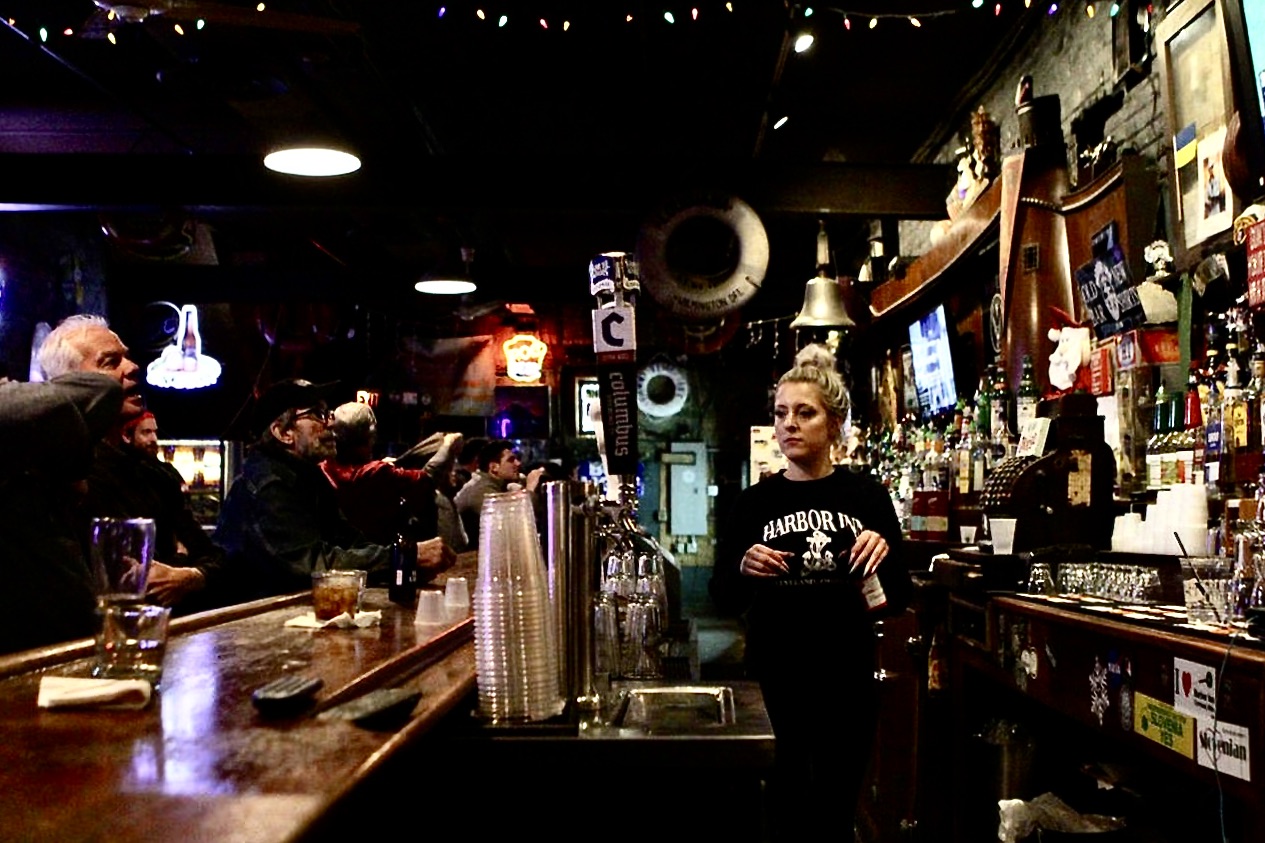
   If we had known that we probably would never have started playing. By the time we found out it was too late. We had been sucked into the black hole of Go. Getting out of the hole meant going down to the Harbor Inn for a pick-me-up. It was another hole, on the west bank of the Cuyahoga River in the Flats. It either was or wasn’t the oldest bar in town. Either way, the place wore its reputation on its sleeve.

   “The place was always shoulder to shoulder with bikers and their molls,” said Dan Coughlin, a sportswriter for the Cleveland Plain Dealer. “Wally had a virtual armory behind the bar. He had pistols and shotguns. One night in the middle of the summer we stacked up cases of beer bottles and fired at them from the hip, with shotguns blasting away. I put a hole in the stop sign in front of his bar.”

   Wally was Vlado Pisorn, an immigrant from Slovenia who had taken over the Harbor Inn sometime in the indeterminate past. We called him Vlad the Impaler. He had the kind of beer we liked, the kind from Germany and Czechoslovakia. The wine came from a hose and died on the tongue. After a couple of near deaths, we never drank it again.

   Matt had served a tour of duty in the armed forces, was on a prolonged stretch of R & R, and in the meantime was boning up for the entrance exams for mailman, fireman, and policeman. He was hedging his bets. He finally found employment with the Bay Village Fire Department, which was like working at a posh nursery school. There were hardly ever any fires anywhere near the lakefront suburb. There were, however, lots of old folks having heart attacks and strokes and the EMS trucks kept up an endless shuttle to St. John West Shore Hospital.

   One night Matt and his duty partner Chuck were called to a house where the man of the house was having chest pains. He was on his back in bed, his eyes closed. When they stepped up to him in the bedroom his wife whispered that she thought he was dead. “The poor dear man,” she said. Chuck was in the lead. As he walked up to the bed, he slipped on a throw rug and went head over heels on top of the man, body slamming him, the bedsprings recoiling.

   “If he’s not dead yet, he’s dead now,” Matt thought. 

   “Is he OK?” the woman asked, alarmed. 

   “Your husband will be OK,” Matt said. 

   “No, not him,” the woman said. “I meant the other fireman.” 

   “What the hell is going on!” the dead man suddenly spat out, jolting awake. “Get your fat ass off me.” He rolled Chuck off the bed, who fell to the floor. From then on, Chuck was known as Lazarus back at headquarters. It took years for the sobriquet to fade away.

   Virginia Sustarsic introduced me to Matt. How they knew each other was beyond me. She was Slovenian and a hippie through and through. He wasn’t, not by a long shot. He was a cool customer and Finnish on top of everything else. He played chess, like me, and we got to know one another playing now and then. I had moved out of the Plaza Apartments, where Virginia still lived, and was living on a forgotten street in North Collinwood, a couple of blocks south of Lake Erie. I lived upstairs in a two-bedroom Polish double. Ray Sabaliauskas, a fellow Lithuanian, owned the house and lived downstairs with his Southeast Asian wife and a prize German Shepherd. He had come home safe and sound from the bright shining lie that was the Vietnam War.

   I found my Go game at a garage sale in the neighborhood. It was practically brand new, the instruction sheet still in the box. I paid a dollar for it in pocket change. Reading the rules took less than five minutes. Explaining the rules to Matt took less than one minute. Our first game took five hours. We played on the front porch. The contest was suspended due to darkness when the sun set.

   “The best strategy is to spread the pieces far apart and stretch them out, to encircle and attack the opponent, and thus win by having the most points vacant,” Go master Huan Tan said nearly two thousand years ago. We were both bug-eyed after our first game. We didn’t know the game’s strategy from a seesaw. It was like wrestling a gorilla. You don’t quit when you’re tired, you quit when the gorilla is tired. Go is considered the most difficult board game in the world. Sleeping became my new go-to after a long match.

   I started jogging on Lakeshore Blvd. west out of North Collinwood, where everybody was a working man in one way or another, through the village of Bratenahl, where everybody was tall, trim, and filthy rich. They oozed pride in their state of being. When I was running in their neighborhood I hesitated to even spit on the tree lawns. I had put exercise on the back burner in my early 20s. I never thought I would be working out again to be able to sit quietly hour after hour staring at a square board of intersecting lines.

   When I was a teenager I ran track and field as part and parcel of Zaibas. It was a Cleveland Lithuanian sports club formed in 1950. In 1951, at the 1st North American Lithuanian Games, members participated in basketball, volleyball, and table tennis. The next year the club hosted the games in our hometown and fielded a full team in track and field. 

   In the 1960s I ran around in circles encouraged by Algirdas Bielskus. He was a small man with a round face and a championship head of hair. He was the director of a men’s vocal ensemble, co-founder of a choir, and concertmaster of the Ciurlonis Ensemble. He was also the Zaibas track and field coach for sixty years. He had the voice to make himself heard loud and clear from the far end of any quarter-mile track. Every weekend fair or foul all I heard was “Go! Go! Go!”

   He always carried a briefcase, briefcases he was always losing, stuffed with notes about how we were progressing. Rita Kliorys, one of his top-notch runners, made him a Christmas gift of a new one in 1966. “It was the accordion kind,” she said. “I remember it cost $100.00, and I collected one dollar from many people. He actually did not lose it, either.”

   He coached thousands of youngsters who ran hundreds of thousands of miles. “I thought of him afterwards whenever I saw a turquoise and orange Howard Johnsons and would remember how he took us there for ice cream sometimes,” Regina Thomas said. “Although I was a klutz at sports, he never made me feel like one. I never thought much about it as a kid, but what a commitment to youth and sports.” The small man with the big voice was seemingly tireless, championing fitness among Cleveland’s Baltic off-spring.

   “He worked for my dad’s company, Transmission Research, in the basement of our house,” Dalia Nasvytis said. “Sometimes we would hear strange noises downstairs late at night and realize he was still down there running off schedules for the next athletic meet he was organizing.” He was unrelenting about the fettle of immigrant kids.

   Once we started playing Go, Matt and I made a commitment to it. We played all that spring, summer, and through the winter, two and three games a week. It wasn’t an obsession, although it was. We played on the front porch until it got too cold to play outside. After that we played in the living room at a coffee table, sitting opposite one another, all four of our eyes glued to the board.   

   The game demands concentration, which is born out of silence. Some of our best moves and long-term maneuvers were made quiet stealthiness. I found out the more time I spent noiseless, the more illumination lit me up. We hardly talked, going for a half-hour without saying a word. Every so often Matt smoked a Marlboro. Before long he would tap another one out of the red and white flip-top box. Whenever I joined him, the living room filled with smoke, a gray-white cloud stewing over the entanglements of Go.

   When we first started playing our plan of attack was capturing stones. We both saw that surrounding other stones and taking them prisoner yielded points. It was like taking a piece in chess. After a while we discovered the object of Go is not to surround and capture the opponent’s stones. The object is to surround empty territory on the board. The way to do it is by building walls around empty intersections. If your territory includes some opposing stones, all the better. Then it’s grab and go. From then on it became a contest to capture territory rather than simply capture stones.

   In the Eastern world Sun Tzu’s “The Art of War” reads as an introduction and exposition to the game. Real life warlords back in the day of every stripe were always big on blockading their enemies and capturing territory. The times they were not a-changing, not anytime soon. The Vietnam War was over, but there was always another war on the horizon.

   There’s an old saying, “Chess is a battle. Go is a war.” The more we played the more we discovered it was a war of attrition. It was like breaking stones in the hot sun. Both of us knew how to make the other guy sweat. There was no fighting the commandments of Go.

   Oskar Korschelt, a German chemist, brought the game from Japan to Europe in the 1880s. Even though it was slow to catch on, by the 1950s championship-level tournaments were being organized. By the early-70s it was filtering into the United States. I never met another Lithuanian who played the game. My kinsmen are instinctively suspicious, somewhat superstitious, sometimes curious, usually sensible, always pragmatic, hard-working, conformist, and punctual. They are often reserved except when they get together. Once they establish their bona fides it’s time to pick up a drink and run off at the mouth, getting communal. They play volleyball and basketball like nobody’s business. They probably couldn’t stand the prolonged silence of Go.

   One night after a long back-and-forth on the board we drove to the Harbor Inn. We were looking for some downtime. The two-story building was a home-away-from-home for dockworkers and salt-miners. A lonely man who didn’t mind a lumpy mattress could even grab some shut-eye upstairs. It might have been a dive way back when, but it was no ifs ands or buts about it still a dive, slinging suds to third shifters in the morning and anybody else who had a buck the rest of the day and night. There was a coin operated bowling arcade game downstairs and battered dart boards upstairs. We ordered bottles of Pride of Cleveland instead of imported European brew, being short on ready cash, and picked up a handful of house darts.

  Nobody knew how long the Harbor Inn had been there, but we thought it had to be from the day after Moses Cleaveland settled the land centuries before. It reeked of smoke from long-gone cigars and cigarettes. The shadows smelled even worse, like ammonia had been set on fire. Looking around there was no doubt some of the men at the bar only bathed once a month.

   The beer was cold and refreshing and playing darts was fun. We played 501 Up. Both players start with a score of 501 and take turns throwing three darts. Bullseye scores 50, the outer ring scores 25, and a dart in the double or treble ring counts double or triple. The tally is calculated and deducted from the player’s total. The goal is to be the first player to reduce the score to exactly zero, the only hitch being that the last missile thrown must land in a double or the bullseye. 

   Darts are front weighted for flight and are several inches long with a sharp point. A big part of playing darts is the throwing part. The rest of it is mental toughness, staying on the button, stinging the cork like a bee. It was like Go except we could let ourselves go. We wrote our names in chalk on the brick wall, adding them to the hundreds of other names reaching to the ceiling. After a couple more Pride of Cleveland’s we got sloppy, but it was no matter in the juke joint that was the Harbor Inn.

   When I took a good look at the dart board, there weren’t a hundred-or-more darts crowding it, like all the stones on a Go board. Every throw was always at an empty target, every throw a new chance to get it right, unencumbered by the past. Go was all about the past, the past of all the carefully placed stones on the board. Playing darts was right now. It was a relief to see the target and hit the target, except when we completely missed and the dart bounced off the brick wall. When that happened we yukked it up, not like the game of Go, which was never a laughing matter.

Ed Staskus posts on 147 Stanley Street http://www.147stanleystreet.com and Made in Cleveland http://www.clevelandohiodaybook.com. To get the site’s monthly feature in your in-box click on “Follow.”
Bomb City USA

By Ed Staskus

   When I went to work as the night clerk at the Versailles Motor Inn on East 29th St. and Euclid Ave. in the mid-70s, Cleveland, Ohio was the bomb capital of the country. There were 21 bombings in the city in 1976, and 16 more in the county, carnage every ten days, making it tops in the United States, according to the Bureau of Alcohol, Tobacco, and Firearms. The federal lawmen christened the community “Bomb City USA.”

   “A bombing sends a real message. It commands a lot of attention,” said Rick Porello, a northeast Ohio career police officer. “Danny Greene was said to have paid Art Sneperger, his main explosives guy, extra if the bombing generated news coverage. Art got paid a bonus if the thing got on television or in the newspapers.” If it bleeds it leads was the motto of newsmen everywhere.

   Art Sneperger made his own headlines in 1971 when, working for gangster Danny Greene, he suddenly found himself consumed by hellfire while planting explosives under the car of the Irishman’s old friend and new enemy Mike Frato. Fumble fingers don’t pay, although the word on the street was that Danny Greene had set the bomb off from across the street. He had come to believe Art had ratted him out to the FBI.

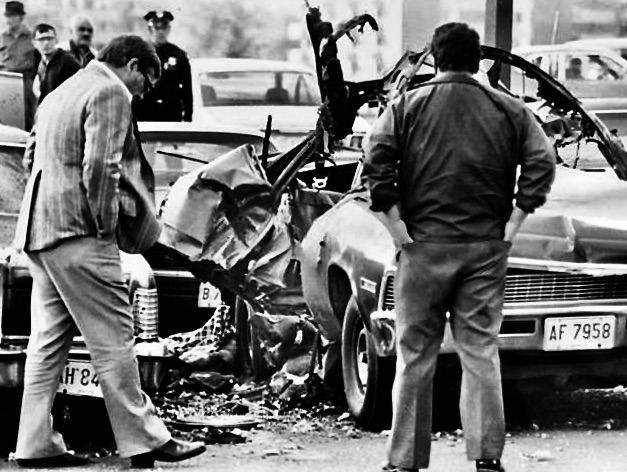
   The plus-sized bomb was in a small Chevy Nova parked next to his Lincoln Continental. It was a Trojan Horse. When it went off, set off by remote control, the Nova, Continental, and the Irishman were reduced to corn flakes. The gangster usually wore all green clothes, wrote in green ink, and drove a green car. He wasn’t going incognito. It was easy to see it was him getting into the Lincoln. The bomb blew one of his arms one hundred feet across the parking lot. The lucky Celtic Cross he wore around his neck was driven into the asphalt. The coroner didn’t bother trying to put him back together.

   The used car came from Fairchild Chevrolet in Lakewood. “We heard the owner of the car lot might have been involved,” said Bob Gheen, a teenager at the time. The Chevy Nova had once been his father’s car. “They never transferred the title out of my dad’s name. Rick Porello from the Lyndhurst Police Department showed up at our door on Saturday morning and drove us to identify what was left of the car. We had to answer several questions and that’s pretty much the last we heard of it.”

   I was taking classes at Cleveland State University but because I didn’t have a scholarship or any grants, and nobody would give me a loan, I had to pay tuition fees and book costs myself. I was living in Asia Town, in a Polish double on East 34th St, upstairs in a two-bedroom with a roommate, but even though I knew how to live on next to nothing, I needed something to pay the bills and some more to pay for school. I was sick of Manpower and their deplorable paychecks. I went looking for a steady job.

   The Versailles Motor Inn was built in the mid-60s, meant to piggyback on the Sahara Motor Inn a few blocks away at East 32nd St., which was built a few years earlier. The Sahara wasn’t hiring, but the Versailles was, and I thought if it is anything like the Sahara, I am the young man for the job. I later found out I was the only young man to apply for the job.

   All the rooms at the four-story Sahara featured a television, air conditioning, piped-in music, and a dial phone, the first ones in rooms in northeast Ohio. There were three presidential suites and three bridal suites. There was a heated swimming pool, a dance floor, and a patio on the second floor. There was a continental dining room with velvet armchairs and a starlight ceiling. There were four cocktail lounges. The waitresses wore Egyptian outfits, and the waiters wore fezzes. There were eight-foot paintings of Cleopatra, King Tut, and Queen Nefertiti in the lobby.

   Other than that the Versailles had 150 rooms, exactly the same as the Sahara, that is where the resemblance ended. The Versailles had a bar restaurant, a coffee shop, and a lobby. It featured sunken pit seating in the lobby where nobody ever went. The lighting was bad. The front doors facing Euclid Ave. were kept locked under penalty of death. Unlike the Sahara where the plants in the lobby were real geraniums, rhododendrons, and palm trees, everything at the Versailles was fake. The front desk was cheap veneer and the carpet was cheap, too, going threadbare. There was a drive-up entrance on the side of the building at one end of the front desk and the door to the bar restaurant at the other end of the desk. There were two elevators that made a racket going up and down.

   The Sahara attracted weddings, conventions, and business meetings. TV crews filming episodes for “Route 66” stayed there sometimes. The Versailles attracted business like peddlers, couples on a tight budget, short-term construction workers, dodgers who left small tips and said hold all their calls, and the John and Jane trade.

   I was glad to get the job since I could walk there from where I lived in Asia Town, it paid reasonably well, and I would have about half of my hours from 11 PM to 7 AM to do homework. I reconciled the day’s receipts before and after my shift. We had a floor safe bolted down in the back office. My responsibilities were mainly checking in guests and taking reservations. I gave directions to late-night callers, answered inquiries about our hotel services, which was easy enough since there were hardly any, and made recommendations to guests about nighttime dining and entertainment options, which was also easy.

   “In the 1970s, downtown was dead,” said John Gorman, disc jockey and program director at radio station WMMS. “The Warehouse District and Playhouse Square weren’t happening yet. There was no reason to come.” The nickname of the progressive rock station was ‘The Buzzard.’ Downtown Cleveland’s nickname was ‘The Wasteland.’

   One night, while nothing much was happening on my side of downtown, and I was in the back office boning up for an exam the next week, Shondor Birns, Public Enemy No. 1 in Cleveland for a long time, strolled out of Christy’s Lounge, a strip club on Detroit Ave. on the near west side. It was across the street from St. Malachi Catholic Church. It was Holy Saturday, easing into Easter Sunday. As it happened, there wasn’t going to be any resurrection for the gangster after what was going to come off happened.

   During Prohibition the Birns family turned to bootlegging, working a still in their basement for Cleveland Mafia boss Joe Lonardo. Mother Birns went up in smoke when the still exploded. After Shondor dropped out of high school, he was subsequently arrested 18 times in 12 years. After his 6th or 7th arrest a Cleveland prosecutor declared, “It is time the court put away this man whose reputation is one of rampant criminality.”

   He hooked up with the Maxie Diamond gang and got into the protection rackets. He muscled into the numbers and policy games. He opened restaurants like the Ten-Eleven and Alhambra. His big mistake was hiring Danny Greene as an enforcer. The relationship soured and Birns put a contract out on Greene. When the Irishman discovered a bomb in his car, he disarmed it himself and showed it to Cleveland Police Lieutenant Ed Kovacic, who offered him police protection. “No, for whatever it’s worth,” Danny Greene said, leaving the Central Station and taking the bomb with him. “I’m going to send this back to the old bastard that sent it to me.”

   When the old bastard left the girlie show, got comfortable behind the wheel of his car, and turned the key in the ignition, a package of C-4 exploded underneath him. His head was blown through the roof of his Lincoln Mark IV. The cigarette he had been meaning to light was still between his lips. His torso landed somewhere outside the passenger door. His legs landed somewhere farther away. 

   Mary Nags owned a print shop on Detroit Rd. It shared a common parking lot with the strip club. She got a call from the police telling her not to come to work on Monday. “They said a man had been blown up and parts of him were scattered around in our back lot.” The forensics men spent a day finding all the bits and pieces of the once infamous and intact Shondor Birns.

   Police detectives focused on the numbers men in the ghetto with whom the gangster had been feuding. That turned out to be a dead end. “It’s dumb to talk about blacks doing Shondor,”one of the numbers men said.  “He wasn’t no bad fella. He was white but it didn’t make no difference. Shon had a black soul. He was black through and through.”

   Everybody knew Danny Greene had ordered it done, but charges were never brought after the actual bomber died. The Irish mobster had contracted Hells Angel Enis “Eagle” Crnic to do the job. The biker was later blown to bits while placing explosives to the underside of a car belonging to “Johnny Del” Delzoppo. If the district attorney wanted to pursue the case, he would have to deliver his subpoena to the bottomless pit, where the Eagle was living next door to Art Sneperger.

   The first time I was robbed at the Versailles Motor Inn I wasn’t robbed, because I was surprised and reacted without thinking. A young black man filled out a registration card, handed me a twenty, and when I turned around to get him his key, started rifling the cash drawer. “Hey!” I shouted, lunging forward and smashing the drawer shut on his hand. He ran out yelping and cursing.

   The second time I was robbed I was robbed. The young black man didn’t bother registering. The bandit was wearing a jacket and suggested he had a gun in his jacket pocket by pointing the pocket at me. “Know what I mean?” he said. I had seen plenty of cops and robbers movies. I knew what he meant.

   “It’s not my money,” I said opening the drawer, stepping back, and raising my hands to the ceiling. What’s a simple man to do staring at the wrong end of a gun barrel? He said I could put my hands down. “This ain’t no western movie matinee, but don’t mess around.” He took all of the night’s take except the loose change. I called the police, a patrol car pulled up, I made out a report, and they left. The men in blue seemed more indifferent than not.

   “Don’t let it happen again,” my boss said in the morning. He wasn’t indifferent about the missing money.

   “What do you suggest?”

   “Do you want to keep your job?”

   “I guess so,” I said hedging my bets.

   “All right then,” he said, and that was the end of his word to the wise.

   My last night at the Versailles Motor Inn was the same as most nights, until it wasn’t. I was busy until 2:30, then it was slow as a shuttered orphanage. I sat in the back office reading until I got drowsy. I took a walk through the gloomy lobby to wake myself up and was standing behind the front desk doing nothing when in the next split second there was a bright flash and a roaring bang. The doors of the bar restaurant flew off their hinges and every single bit of glass the length of the hallway was blown to smithereens.

   Other than the echo from the blast I couldn’t hear anything, slowly backing away from the desk and backing out the side door, sidling along the outside wall until I came to the front of the building. I stood outside until I was breathing again, and my hearing started to come back. I decided I wasn’t hurt since nothing hurt. Back inside the dust was settling and it didn’t look like too much was on fire. The phone was still working. I called the police and they arrived in the matter of a minute, the fire department hard on their heels.

  The firemen hauled hoses inside and sprayed water on everything from one end of the bar restaurant to the other. The hardwood bar was split in half. All the tables and chairs were helter-skelter. Many of them were splintered. All of the bottles and glasses and mirrors were shattered. It was a soggy mess when the firemen got done with it.

   There were forty or fifty guests tucked into their beds when the bomb went off. Some of them on the lower floors  were woken up by the ka-boom. A policeman stood by the elevator and whenever somebody came down asking what the noise had been told them to go back to bed.

   I went over what happened with a detective, twice. He asked me a hundred questions but finally told me to go home. It was five in the morning. I walked up East 30th St. to Payne Ave, past Dave’s Grocery and Stan’s Deli, to my rented second floor on East 34th St. I didn’t see another soul, although a couple of cars went by. My roommate was dead asleep. Mr. Moto my Siamese cat followed me into my bedroom and jumped on top of me when I fell into it. He curled up while I lay awake.

   I quit by phone the next day. The only time I went back was to collect my last paycheck. The big cheese looked at me sideways like I had something to do with the bombing. When I asked, he said the police had found a door forced at the back of the coffee shop, and believed that’s how the intruder got in, taping three sticks of dynamite to the underside of the bar. He said I was lucky the wood was oak.

   “One stick can blow a 12-inch-thick tree right out of the ground, do you know?” he said.

   “I don’t know and I don’t care,” I said. There were sheets of plywood hammered up everywhere. A month later I heard talk that the bar restaurant proprietor, who leased it from the Versailles Motor Inn, had fallen behind paying his protection money and the bombing was a way of settling accounts.

   The Mob was big in Cleveland in the 1970s. When John Scalish died after 30-odd years as the power broker, Jack “King of the Hill” Licavoli took over. He lived in an unassuming house in Little Italy, up the hill towards Cleveland Heights. “Jack was the last of the old-school Cleveland mobsters,” said James Willis, his downtown lawyer. “Cleveland had the best burglars, thieves, and safe crackers in the country. I know, I represented a lot of them.”

   Jack White, another of his names, a play on his dark Sicilian complexion, got his start bootlegging in St. Louis. He came to Cleveland in 1938 and worked his way up. “A lot of the guys coming up were just out for themselves, but not Jack. He looked out for the operation and he was so good at his job that I thought it would never end,” his enterprising lawyer said. “He was very secretive and not at all flamboyant. We would only ever talk in person.”

   “No one thought it would be Licavoli taking over,” Rick Porello said. “He was an old miser. One time he was caught by store security for switching the price tag on a pair of trousers. When they found out who he was they dropped the charges.”

   I soon found work in the Communications Department at Cleveland State University, on the 16th floor of Rhodes Tower, working for their new film studies professor. I was an English major, but movies were close enough. They were becoming the new literature, anyway. My job was picking up whatever art house film my boss was showcasing from the mail room, roll the 16 mm projector out of storage, screen the movie to his class, and send it on to the next place that wanted it. In return I got free tuition and a closet that passed for an office.

   I watched many French New Wave movies, Japanese samurai movies, and 1940s Warner Brothers crime movies during my work-study year, films that the Cleveland State University library had tucked away in secret places. I projected them on my office wall at the end of the day. I didn’t have a TV at home, but the movies I watched were better than anything on TV, anyway.

   Two years after I left the Versailles Motor Inn, John Nardi, who was secretary-treasurer of Vending Machine Service Employees Local 410 and high up in the Mob’s chain of command, sauntered out of his office a couple of blocks away from where I had worked, stepped up to his Oldsmobile 98, and turned the key in the door lock. The small car parked next to him exploded. It was a Trojan Horse attack. The bomb was packed with nuts and bolts. John Nardi was blown to kingdom come. Bomb City USA was alive and well.

Ed Staskus posts monthly on 147 Stanley Street http://www.147stanleystreet.com, Made in Cleveland http://www.clevelandohiodaybook.com, Down East http://www.redroadpei.com, and Lithuanian Journal http://www.lithuanianjournal.com

“Cross Walk” by Ed Staskus

“Captures the vibe of mid-century NYC, from stickball in the streets to the Mob on the make.” Sam Winchell, Beyond Fiction

Available on Amazon: https://www.amazon.com/dp/B0CRPSFPKP

Late summer and early autumn. New York City, 1956. President Eisenhower on his way to the opening game of the World Series. A hit man waits in the wings. A Hell’s Kitchen private eye scares up the shadows.

A Crying of Lot 49 Publication