Category Archives: Made in Cleveland

Elbow Grease

By Ed Staskus

   When Mike White was elected the 55th mayor of Cleveland in the fall of 1989 he became the city’s second youngest mayor. Everybody thanked their lucky stars he wasn’t Dennis Kucinich, who had been the youngest, and who had bankrupted the city in 1978. He also became the city’s second African American mayor. Blacks weren’t exactly Blacks then, although they were getting there. They were African Americans. When Frank Jackson finally retired in 2022, after serving four terms as the 57th mayor of Cleveland, Mike White became the second-longest-serving mayor. He had served three terms.

   The day he was sworn in he inherited a boatload of crime, poverty, and unemployment. The tax-paying population of the city was shrinking fast. Downtown was more a hotbed of boll weevils than hotties. There was no Rock and Roll Hall of Fame and no Gund Arena, which is now Rocket Mortgage Field House. The Indians and Browns were both still playing their ballgames in the decrepit Municipal Stadium on the south shore of Lake Erie, although the Browns were thinking of packing up and moving to Baltimore.

   My wife and I were living in Lakewood, which wasn’t Cleveland, although it was close enough. It was the big city’s next door neighbor, what in the day was called a streetcar suburb. Nearly half of Cleveland’s residents were African American. Less than 1% of Lakewood’s residents were African American. We lived on the west end of town where there were zero African Americans. There wasn’t a Berlin Wall keeping them out of town but there was a Berlin Wall.

   We lived off Riverside Ave. on the east side of the Rocky River valley, which had been transformed into the Rocky River Metropark. The river and the valley were just steps from our front porch. Cleveland’s racial divisions seemed like a distant problem. In the event, one day a man was apprehended throwing more than a dozen black bowling balls into the Rocky River at Eddys Boat Dock. He explained to the police officers, “I thought they were nigger eggs.”

   Being the mayor of a village is hard enough. Being the mayor of a city can be thankless. It can be worse than thankless when the top dog shows up. “I would not vote for the mayor of that town,” Fidel Castro once said while touring his island nation. “It’s not just because he didn’t invite me to dinner, but because on my way into town from the airport there were such enormous potholes.”

   There was only one reason Mike White wanted the job. He was a born and bred Cleveland man. He was a true believer and a do-gooder. He was bound and determined to make the city a better place to live. “I remember looking out at the crowd of Cleveland residents, black and white, and reflecting on how many children were there,” he said about his inauguration day in 1990. “I remember how they looked at me as a symbol of what could be. It speaks to the powerful responsibility of being the kind of leader people want to follow.” 

   Getting the job done was going to be a problem, if not Mike White’s man-sized burden. He presented himself on the stump as pro-business, pro-police, and an effective manager. He argued that “jobs are the cure for the addiction to the mailbox,” by which he meant once-a-month welfare checks. He didn’t win over any live and die by the mailbox voters. In the end he won 80% of the vote in the white wards, 30% of the vote in the African American wards, and 100% of the brass ring.

   “Caesar is dead! Caesar is dead!” the crowd in Cleveland Centre cheered when the result was announced. It was near midnight. “Long live the king! Long live Mike!” When the mayor-elect appeared, people stood on chairs and cheered some more. “I extend my hand to all of Cleveland whether they were with me or not” he said. It had been a bitter uphill campaign. “The healing begins in the morning!” There were more cheers. “We … shall … be… ONE … CITY!” He spent twelve years trying to make it happen.

   “Winning an election is a good-news, bad-news kind of thing,” Clint Eastwood, the movie star who was once the mayor of Carmel-by-the-Sea, has said. “Okay, the good news is, now you’re the mayor. The bad news is, now you’re the mayor.” He ran on a promise to roll back Carmel’s back-handed ban on ice cream cones. The law stated that take-out ice cream cones had to be in secure and foolproof packaging with a cover. “Eating on the street is strongly discouraged,” the suck all the fun out of it city fathers said. The actor beat the incumbent in a tight race. One of his first official acts was getting au naturel ice cream cones back on the streets. After his two-year term was over he never stood for elected office again. Politics was too dirty for even Dirty Harry.

   By the time Mike White took office I couldn’t have cared less about Cleveland. For one thing, I no longer lived there anymore. For another thing, I wasn’t working in Cleveland anymore. I was working for the Light Bulb Supply Company. They were in the Lake Erie Screw Building in Lakewood. I wasn’t attending Cleveland State University anymore, either. As much as I used to go to the asphalt jungle was as much as I didn’t go there anymore.

   The city in 1990 was a mess, literally. Nobody thought anything about throwing litter and trash into the street. The police had never been busier. The fire department had never been busier. The schools had deteriorated so much that everything educational looked like up to the teachers. The graduation rate was less than 40%. “It couldn’t have gotten much worse,” recalled James Lumsden, a school board member. Mike White likened the schools to the Vietnam War, where well-meaning people went to help, but ended up stuck in a nightmare.

   Manufacturing jobs were disappearing, the workforce hemorrhaging paychecks, labor costs being outsourced like nobody’s business. Only street cleaners felt secure in their employment. The No. 1 bank in the city, Cleveland Trust, which had become AmeriTrust, was being dragged down by bad loans and a collapsing real estate market. The iconic May Company was drawing up plans to close its downtown store, which had been on Public Square for nearly 90 years. 

   In 1950 the city was the 6th largest in the country. Forty years later it was the 23rd largest in the country. Everybody who could move away was moving to the suburbs. When the inner ring suburbs filled up, new outer ring suburbs popped up. When they filled up, exurbia became the next place to go. Nobody from nowhere was moving to Cleveland. It was hard to believe anybody wanted to be mayor.

   Mike White grew up in Glenville on Cleveland’s east side. It was a rough and tumble neighborhood, notorious for a 1968 shootout. Gunfire was exchanged one night for nearly four hours between the Cleveland Police Department and the Black Nationalists of New Libya. They were a Black Power group. Three policemen, three Black Power men, and a bystander were killed. Fifteen others were wounded. Lots of others were shoved into paddy wagons and locked up.

   The new mayor’s father was a machinist at Chase Brass and Copper. He was a union man and ran a union shop at home, too. “If not for the discipline at home, we would have been lost,” Mike’s sister Marsha said. The first summer Mike White came home from college in 1970 his father took one look at him and told him to cut his hair. He had grown it long and was fluffing it into an afro. While he was a student at Ohio State University in Columbus he protested against racial discrimination practiced by the capital city’s public bus system. He was arrested. He got involved with Afro-Am and led a civil rights protest march. He was arrested again. The charges were disorderly conduct and resisting arrest. He didn’t deny the charges. “I hated the sheets back then,” he said.

   He was sick and tired of being arrested. He put his thinking cap on and ran for Student Union President. When he won he became Ohio State University’s first African American student body leader.  He earned a Bachelor of Arts degree in 1973 and a Master of Public Administration degree in 1974. He began his professional political career as an administrative assistant for Cleveland’s city council in 1976 and was elected councilman from the Glenville neighborhood in 1978. From 1984 until he ran for mayor he represented Ohio’s 21st District in the State Senate, serving as assistant minority whip for the Democrats. 

   Mike White’s opponent in the race for mayor was the long-time politician George Forbes, who was also African American. The color of his skin turned out not to matter. Mike White had gone color blind. He described George Forbes as a “foul-mouthed, uncouth, unregenerated politician of the most despicable sort.” The Forbes campaign countered by accusing their opponent of abusing his wife and abusing the tenants of his inner-city properties by ignoring housing codes. The difference between a hero and a villain can be as slight as a good press agent.

   I didn’t pay too much attention to the character assassinations. My wife and I were working on our new house. It had been built in 1922, and although the previous owners had done what they could, it was our turn to do what we could. What we were doing first was ripping out all the shag carpeting and taking all the wallpaper down. When we were done with those two projects we painted all the walls and restored the hardwood floors. Our game plan was by necessity long-term. We started on the basement next, started saving for a new roof, and started making plans for everything else.

   Mike White didn’t give a damn about ice cream cones, but he gave a damn about the kids who ate ice cream cones. “We can spend our money on bridges and sewer systems as we must,” he said, “but we can never afford to forget that children remain the true infrastructure of our city’s future. We need to create a work program and show every able-bodied person that we have the time and patience to train them. And we should start people young. We want to guarantee every kid graduating from high school a job or a chance to go to college.”

   He put the city’s power brokers on notice. “We do not accept that ours must be a two-tier community with a sparkling downtown surrounded by vacant stores and whitewashed windows.  You can’t have a great town with only a great downtown. I’ve said to corporate Cleveland that I’m going to work on the agenda of downtown, but I also expect them to work on the agenda of neighborhood rebuilding.” He wasn’t above making deals, although he wasn’t selling any alibis. Safety became a mantra for him. “Safety is the right of every American,” he said. “A 13-year-old drug pusher on the corner where I live is a far greater danger to me and this city than Saddam Hussein will ever be.”

   He would prove to be true to his commitments. In the meantime, he put his nose to the grindstone. He worked Herculean hours. His staff worked Herculean hours. Anybody who complained they weren’t Hercules was advised to find work elsewhere. When he found out the Gulf War was costing the United States $500 million a day, he was outraged. “I’m the mayor of one of the largest cities in the country while we have an administration in Washington that is oblivious to the problems of human beings in this country,” he said. “I sit here like everyone else, watching CNN, watching a half-billion dollar a day investment in Iraq and Kuwait, and I can’t get a half-million dollar increase in investment in Cleveland.”

   Mike White was never going to be president of the United States. He probably didn’t want to be president. He had his hands full as it was, making it happen in his hometown. He wanted a Cleveland with dirtier fingernails and cleaner streets. The city was in a hole. His goal was to get it to stop digging. It wasn’t going to be easy. He didn’t always speak softly, but words being what they are, he made sure that as mayor he carried a big stick, the biggest stick in sight.

   He was going to need it, if only because President Lyndon Baines Johnson had said so. “When the burdens of the presidency seem unusually big, I always remind myself it could be worse,” LBJ said during his troubled administration. When asked how that could be, he said, “I could be a mayor.”

Ed Staskus posts monthly on 147 Stanley Street at http://www.147stanleystreet.com, Made in Cleveland http://www.clevelandohiodaybook.com, Down East http://www.redroadpei.com, and Lithuanian Journal http://www.lithuanianjournal.com. To get the site’s monthly feature in your in-box click on “Follow.”

“Cross Walk” by Ed Staskus

“A Cold War thriller that captures the vibe of mid-century NYC.” Sam Winchell, Beyond Books

Available on Amazon: https://www.amazon.com/dp/B0CRPSFPKP

The end of summer, New York City, 1956. Stickball in the streets and the Mob on the make. President Eisenhower on his way to Ebbets Field for the opening game of the World Series. A torpedo waits in the wings. A Hell’s Kitchen private eye scares up the shadows.

A Crying of Lot 49 Publication
Riding the Red Line

By Ed Staskus

   The last summer we lived in the immigrant neighborhood around Eddy Rd. was the last summer my friends and I took Cleveland’s Rapid Transit on Saturdays to mess around downtown and go to the movies. It had been twenty-some years since the city-owned train system had gotten a move on. It wasn’t much older than us. The newspapers were all about civil rights and Vietnam, two issues we hardly knew anything about and cared about even less. What we cared about was whatever was right in front of our eyes.

   It was 1963. Beatlemania was on the way, although we didn’t know what it was, yet. Stevie Wonder released his first live album, “The 12 Year Old Genius,” that year. We were all twelve and thirteen years old. None of us were geniuses, not by a long shot, although some of us went on to be able to think more or less clearly.

   A vaccine for measles had been approved that year. It didn’t do me any good since I had gotten the measles years before. Push-button telephones were new, first class postage cost five cents, and President John F. Kennedy visited West Berlin, delivering his famous “Ich bin ein Berliner” speech. We went around calling each other Berliners and saluting Nazi-style. All of us had voted for JFK in a mock election at St. George’s Catholic School. Our nuns told us to stop saluting and pay attention to his good deeds, but they need not have. He was young, energetic, and handsome, while Richard Nixon was old, slow, and shifty with a five o’clock shadow. 

   The CTS Rapid Transit was a light rail system, what we called the wagon train. Tens of millions of riders rode it every year, especially on Saturdays, when it seemed like all of them were riding the Red Line at once to go shopping downtown. We had to stand most of the time. Even when we got a seat, we had to soon give it up to pregnant women and old folks. Standing and swaying and holding on to a pole was carefree. We were excited about roaming around downtown and seeing a big-time movie.

   All we had known in our youth was the neighborhood Shaw-Hayden Theater, which we could walk to. They showed monster movies, cowboy movies, and rocket ship movies on weekend afternoons. Cartoons and a double bill cost fifty cents. We ignored the newsreels. Popcorn cost fifteen cents, but since we were chronically short on hard cash, we brought our own in brown paper bags hidden under our jackets. Sometimes we stopped at Mary’s Sweet Shoppe and bought some penny candy.

   There was a playground around the corner behind the local fire station with Saturday Sandbox contests, but we never went, being too old for sandboxes. There were dances at the Shaw Pool every Saturday night, but we never went to those either, being too young to care much about girls and their goings-on.

   Before the movie matinee there was sometimes a drawing for prizes. One of my friends won two thousand sheets of paper one winter afternoon. He was beside himself hauling the reams home in the snow. He complained about frostbite, but he was a griper at heart, so we ignored him. The Shaw-Hayden was big, more than a thousand seats. We usually went early so we could sit in the front row, stretching our legs out, kicking each other, horsing around, and whooping it up during the movie.

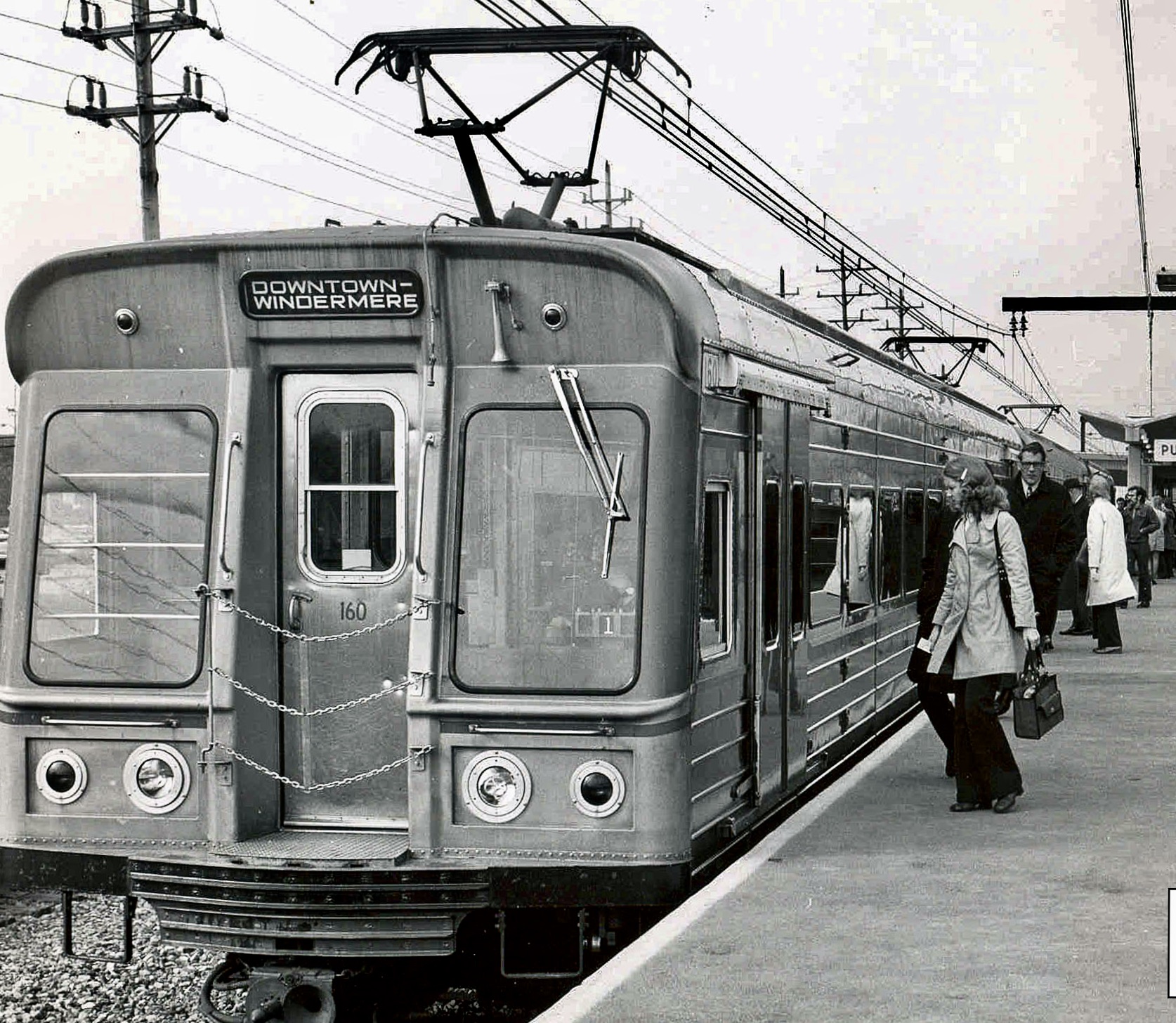
   Going downtown meant hoofing it from where we lived off St. Clair Ave. down E. 128th St. to Shaw Ave. to Hayden Ave. and following a no-name foot path to the Windermere station. We scrambled up the embankment, crossed the tracks at the rear of the station, and waited on the platform for the downtown bound train. Windermere was the end of the line for the Red Line.

   The Red Line ran at ground level, alongside railroad rights-of-way. There were no grade crossings with streets or highways. All of the stations along the way had high platforms. Unlike most transit lines, it was powered by an overhead electric catenary instead of a third rail. We knew things were going well when we heard the corona discharges of the high voltage.

   When the wheels finally rolled into the underground station downtown we dusted ourselves off and ran upstairs, running through the Terminal Tower lobby and overflowing outside, rain or shine. We made tracks around Public Square until there was nothing left to see. We liked walking to the movies on one of the three main avenues, which were Prospect, Euclid, and Superior. Our parents warned us to stay away from Prospect Ave. where there were prostitutes and burlesque houses. It was because of their words of wisdom that we took Prospect Ave. most of the time, although we never talked to the prostitutes and never went into the bars and strip clubs. We weren’t interested in smut, and besides, we wouldn’t have been able to pay for the cheap thrills. All the money we had we hoarded for the train, snacks, and the movie.

   There was a cluster of theaters between E. 14th and E. 17th. Four of them faced Euclid Ave. while one faced E. 14th St. The three blocks were known as Playhouse Square, although none of us were aware of that. We didn’t pay attention to signs unless they had something to do with the movies. All of us had our own money, cobbled together from allowances, paper routes, altar boy service at weddings, and some thievery from our siblings if push came to shove and our Saturday was threatened.

   The Ohio and State theaters were built by New York City plutocrat Marcus Loew in the early 1920s, followed by Charles Platt’s Hanna Theater. The Hanna was named for Mark Hanna, Cleveland’s wheeler-dealer senator in Washington. The Pompeiian-style Allen Theater opened at the same moment in time. 

   The Palace Theater got up and running at the end of the next year, in the Keith Building, the tallest skyscraper in the city at the time. The biggest electric sign in the world was fabricated and turned on the night of the Palace Theater’s grand opening. It was billed as the “Showplace of the World.” The opening night entertainment was headlined by a famous mimic and featured dancing monkeys. Everybody said it was “the swankiest theater in the country.” 

   It wasn’t swank anymore when we started going to Saturday matinees there, but we didn’t notice the wasting away. It had wide seats and a gigantic screen and that was all that mattered. The movies cost seventy five cents and we were glad to pay it. It was where we saw “Son of Flubber” and afterwards pretended to defy gravity like Fred MacMurray. We saw “It’s a Mad, Mad, Mad, Mad World” and laughed until we cried. We loved stories about lost treasure. The movie was perpetual motion and shouting. Ethel Merman was the most likable loudmouth we ever heard. We saw it twice and it was just as good the second time around.

   We saw “Cleopatra” and agreed afterwards that we had all gotten sick of Elizabeth Taylor. “Why is she even in the movie?” we wondered. Rex Harrison and Richard Burton were more like it. Thousands of Romans with swords, spears, and shields fighting each other were even more like it.

   We wanted to see “Psycho” but weren’t allowed. We were warned it was too intense and inappropriate for boys our age. We were offended, but when we heard what it was about, we asked each other what all the fuss was. It sounded like a sicko stabbing people, which was right up our alley. We had all seen plenty of horror movies, like “Carousel of Souls” and “Village of the Damned.”

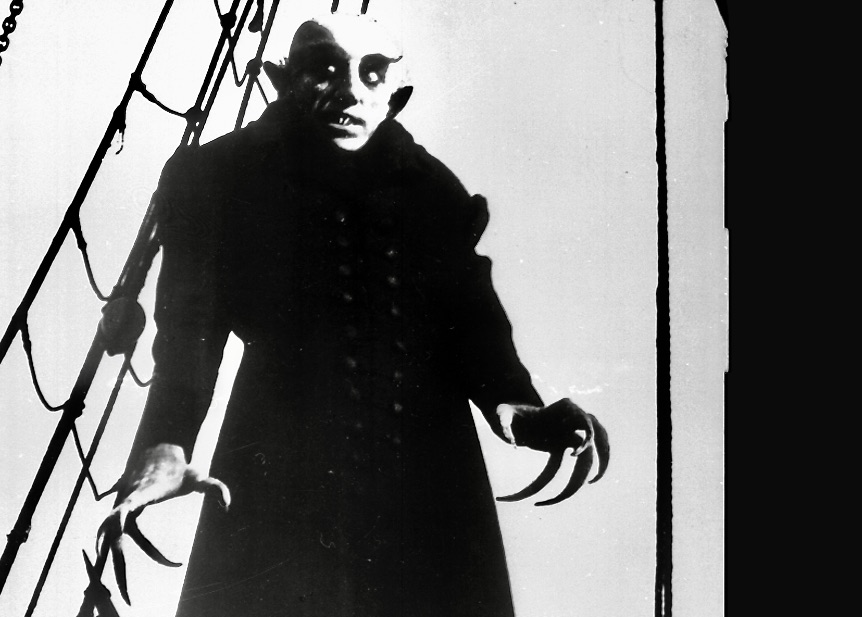
   When “The Raven” was playing we saw it right away, even though none of us knew Edgar Allen Poe from the Man in the Moon. There’s a black bird. There’s a tapping at the door. The night is dark and the wind is howling. When the door is opened there’s nobody there. “Watch your back!” we shouted at the screen.

   The stars in that movie were Vincent Price, Boris Karloff, and Peter Lorre, even though Peter Lorre was a half-pint. He had a sinister voice, hooded eyes, and a dodgy way about him, which made up for his lack of height. Vincent Price was disappointing, despite being the tallest. He spoke and acted like a sissy, even though he was supposed to be a big bad magician. In the end the whole business was disappointing. It was more laughable than scary, and once we realized how it was going, we enjoyed it for the laughs. We took a chance and asked for our money back, claiming intense disappointment, but a grouch in a red jacket ushered us out and told us where to go.

   We heard about “Seven Wonders of the World” on WERE-AM radio before we ever saw it on the marquee of the Palace Theater. We didn’t go see it, even though we saw it on the marquee week after week and even though it was in Cinerama. We saw everything in a kind of Cinerama, anyway, since we always sat in the front row. A gigantic screen always made a bad movie twice as good.

   The movies were spellbinding to us. They were like a dreamland in waking life. It didn’t matter if the story was real or unreal. We were dazzled by the moving images and the music. It was disorienting stepping out of a dark auditorium after the movie magic into bright sunlight, like after a midday nap when daydreams had come fast and furious.

   Our real life hometown was where we went to see the real wonders of the world. We wandered around in the industrial valley, what everybody called the Flats, light-headed and amazed, gazing up at the steel plants, looking down on the greasy Cuyahoga River, watching the up and down bridges go up and down as freighters hauling ore made their way. Six years later the river caught on fire, flames and plumes of black smoke turning day to night. We walked along the shoreline of Lake Erie where fishermen pulled walleye and crappie out of the polluted water that nobody was supposed to swim in. 

   We snuck into Municipal Stadium, called the Mistake on the Lake, whenever we knew the fire-balling Sam McDowell was pitching. He was twenty years old and tall as a tree. Hardly anybody went to see the back of the pack team and we often had most of the eighty thousand seat stadium to ourselves, cheering on the Tribe. We sat wherever we wanted. When ushers asked to see our ticket stubs, we hemmed and hawed and changed sections. Whenever we ended up in the bleachers there were never any ushers to roust us. If it was hot, we pulled our shirts off. We lobbed popcorn to the pigeons and threw pebbles at them when they were finished with their free goodies.

   The weekend before our summer vacation was going to be over and we had to go back to school we saw our last movie at the Ohio Theater. It was “Lord of the Flies.” It was about boys our age who were marooned on a desert island. We knew what made a boy’s life. We didn’t know anybody who ever did the crazy things they did. We didn’t like grown-ups making up art about us. We appreciated great trash but not great art. All of us wrote it off as hokum with a message. We were instinctively wary of messages.

   Going home on the Red Line after the movie we saw a fight break out. Two men had been talking, then shouting, then shoving each other in the aisle, until one of them pulled a knife and stabbed the other one in the arm. Real blood gushed and stained his clothes. A woman screamed. Two men grabbed the knifer and held him down, while another man took his own tie off and tied a tourniquet on the upper arm of the stabbed man. When we got to the Windermere station there were police cars and an ambulance there. We watched, fascinated, until a policeman told us “there’s nothing to see here, break it up and go home.” We went home more breathless than any movie had ever made us.

   John F. Kennedy was shot and killed that fall, which put a pall over everything. A fire broke out in the Ohio Theater the next year and the other theaters were hit by vandalism. All of them closed between the summers of 1968 and 1969 except for the Hanna. We were juniors and seniors at St. Joseph’s High School by then and the only movies we went to were at the LaSalle Theater in our North Collinwood neighborhood. 

   By then, when we went to the movies, we were more interested in girls than whatever was playing, although we soon found out horror movies were the way to go. There was never any doubt about what to do with your hands when you were with your main squeeze and the scary parts burst onto the screen.

Ed Staskus posts monthly on 147 Stanley Street at http://www.147stanleystreet.com, Made in Cleveland http://www.clevelandohiodaybook.com, Down East http://www.redroadpei.com, and Lithuanian Journal http://www.lithuanianjournal.com. To get the site’s monthly feature in your in-box click on “Follow.”

“Bomb City” by Ed Staskus

“A Rust Belt police procedural when Cleveland was a mean street.” Sam Winchell, Beyond Fiction

Available on Amazon: https://www.amazon.com/dp/B0F1LM1WF9/ref=sr_1_1?crid=2MYAQAOZIC2U9&dib=eyJ2IjoiMSJ9.hTm7BGbiQbSe5ZapFwYPPfcwOpTe-Vdg6VLE4aGyTyk.Z0R-VNBWWEcvKcNaO9LdCOUnNIOOXgvYkRS_FXiXuHk&dib_tag=se&keywords=bomb+city+ed+status&qid=1742136726&sprefix=bomb+city+ed+staskus%2Caps%2C84&sr=8-1

Cleveland, Ohio 1975. The John Scalish Crime Family and Danny Greene’s Irish Mob are at war. Car bombs are the weapon of choice. Two police detectives are assigned to find the bomb makers. Nothing goes according to plan.

A Crying of Lot 49 Publication
Bumping Into Big Al

By Ed Staskus

   I hadn’t seen Al Ezerskis for fifteen-some years, so when we met I hardly knew what to say. We bumped into each other on the corner of Ontario St. and Lakeside Ave. opposite the Lakeside Court House. I had come out of the court house where I had gone to drop off a  document. As I was leaving I noticed an inscription carved in a wall. It said, “Justice is the end of government. It is the end of Civil Society. It ever has been and ever will be pursued until it be obtained or until liberty be lost in the pursuit.” It seemed both quaint and appropriate in the Age of Make America Great Again.

   The Republicans had controlled Washington, D.C. more often than not in my lifetime. How had they managed to screw things up so much that America’s greatness evaporated? Gasbags are always complaining. It was time for them to stop complaining and start explaining.

   Downtown Cleveland was back up and running after the thunderstorm and high winds that had torn through the metropolis a week before. Five tornadoes and widespread straight-line winds wreaked havoc across Northeast Ohio. Thousands of trees and utility poles were knocked down. Hundreds of thousands were left without power. The shoreline of Lake Erie, near where I lived, was hit especially hard, with more than half of everybody experiencing power outages. Many of them still didn’t have power five days later. It was the worst storm to hit the city in thirty years. 

   Al had come out of the Justice Center across the street. “How are you doing?” I asked when I unwittingly happened upon him.

   “I’m between everything annoys the crap out of me and I don’t give a rat’s ass,” he said.

   He had gotten cranky after coming into his maturity. He hadn’t changed, although he had gotten older. He was the same age as me. We both grew up in North Collinwood’s Lithuanian community. We were both in Boy Scout Troop 311. We both went to St. Joseph’s High School in the 1960s, although he was an Honor Student and I wasn’t. He was walking with a slight limp. I had walked with a limp, at first slight and then full-blown, for five or six years before I finally had joint surgery two years earlier. I was never overly concerned about the limping, but the pain of the arthritis in my left hip finally drove me to distraction. After the surgery I walked more than ever, breaking in my after-market replacement.

   The Cleveland Clinic’s Lutheran Hospital had been as high-tech as it could be. The operating theater looked like the flight deck of the USS Enterprise. The road to recovery, however, was strikingly old fashioned. “Walk as much as you can every day” was what all the physical therapists said. It was a no-tech solution.

   “What are you doing downtown?” I asked.

   “Jury duty,” Al said. “Although all I’ve been doing for the past two days has been sitting in a room with a couple hundred other people waiting to hear if I’ve been chosen to be on a jury. If I get picked, whoever did whatever they did is going to be sorry to see me.”

   The jury pool had been released for lunch. It was a breezy mid-August day. The storm had broken the oppressive humidity of the past few weeks. Al was on his way to the Warehouse District. “I have an hour and a half before I have to be back to decide somebody’s fate,” he said.  

   I was of the opinion that there never was anybody worth a damn who wasn’t irascible, except for maybe Mother Teresa and Willie Mays. Perhaps Al was worth a damn. He was irascible enough. On the spur of the moment I asked if I could join him for lunch.

   “We can catch up on old times,” I said. 

   He gave me a peevish look, but said all right. I fell into step with him. He took long strides, one stride with a hitch to it, and I recalled that we had called him Big Al back in the day. He was six feet and a few more inches tall. He had been lanky as a teenager but wasn’t lanky anymore, He was still big, though, and bigger still. He had packed on 40-or-more pounds. We walked down Lakeside Ave. and then up W. 9th St. The Warehouse District’s eateries were buzzing. Curbside tables were filling up. Waitresses were taking orders. Lawyers were tossing back booze.

   “There’s a place here called Taza,” I said. “My wife and I eat there sometimes. It’s a Lebanese grill.”

   “I don’t eat food made by Arabs,” he said.

   We went to Cleveland Chop on St. Clair Ave., a sports bar where they served steaks and handcrafted burgers. Al ordered bacon wrapped shrimp and a Tom Hawk pork chop. The pork chop looked to be at least a pound of pig. I ordered a plate of Ahi Poke tacos, even though I had no idea what Ahi Poke was.

   “What do you think about that Harris wanting to be president?” he asked out of the blue, stirring the Manhattan in front of him with a swizzle stick. I wanted to say “Shaken not stirred” like James Bond, but I didn’t. Big Al had never been known for his sense of humor. He had been class president in high school and twice ran for mayor of Brecksville, a south side suburb where he had long lived. He had twice lost but never lost his preoccupation with politics.

   I was of the Mark Twain school of politics. “Suppose you were an idiot, and suppose you were a member of Congress, but I repeat myself,” the writer once said. I didn’t repeat that bit of doggerel at the lunch table. I suspected Al would be sensitive about that kind of wisecrack.

   “I haven’t thought much about the election” I said. “I’ll think about it in a month-or-two.”

   “You still have that beatnik attitude,” he said, spearing a shrimp.

   I let it pass. I had long ago lost whatever concern I ever had about what people thought of me. Everybody is entitled to their own opinions, if not necessarily their own facts, although that was changing.

   Joe Biden, the incumbent in the Oval Office, had decided to not run for a second term and his vice president, who was Kamala Harris, had thrown her bonnet into the ring. “I will say this,” I said, “she’s got about three months to campaign while Donald Trump has been campaigning for almost four years. I don’t see that she has much of a chance. Donald Trump can’t beat another man at the polls, but he’s gangbusters when it comes to beating women.”

   “I’m glad to hear you say that,” Al said. 

   “Why is that?” I asked.

   “The last thing this country needs is a half breed broad in the White House,” he said. “Or any broad, for that matter.”

   “How’s everything?” our waitress asked, gliding up to our table. She was a looker. Al looked her up and down. He didn’t keep it a secret. He wanted to be her long lost pal. I watched him while he watched her.

   “This country is going to hell,” Al said, cutting his pork chop into bite-sized pieces. It reminded me of what mothers do for their small children at the dinner table. He was a fastidious man. There probably wasn’t much that satisfied him.

   “Take that waitress,” he said. “What is she doing in this country? You know she’s from down there somewhere.” He pointed at the floor with his fork. The waitress was brown skinned with black hair. I couldn’t tell if she was Mexican or Middle Eastern. “They’re lazy and shiftless. All they want to do is live on welfare, which we have to pay for. They’re stealing our jobs.”

   I wondered why she was working if she was lazy and shiftless. Why was she taking jobs from Americans? Why wasn’t she on welfare, instead? Was she all mixed up?

   “I tell you, they’re polluting the blood of our country.”

   “Your parents were immigrants, just like mine,” I said.”They made this country better, not worse.”

   “That was different,” Al said. “They weren’t Latinos, they were Lithuanians.” 

   I was aware that many people conflated the word ‘immigrant’ with the word ‘Latino.’ Immigrants from Europe were acceptable. Immigrants from anywhere else were either suspicious-looking or unacceptable.

   “There’s millions of them here, tens of millions, undocumented, smuggling in drugs, committing crimes, raping our women. They’ve got to be kept out, one way or another. Kamala Harris will let them in. Donald Trump will make sure we keep them out.”

   The Chinese Exclusion Act of 1882 was one of the earliest pieces of legislation aimed at excluding foreigners based on their nationality. Congress said the Chinese were “lowering the cultural and moral standards of American society.” The law stayed in effect for more than 60 years. Even though it was eventually repealed, anti-immigrant sentiment remained alive and well. Fans of the sentiment routinely cite national security, the economy, and cultural preservation.

   When the play “The Melting-Pot” premiered in 1908 it portrayed America as a land “where all races and nations come to labor and look forward.” Ellis Island that year admitted nineteen hundred foreigners into the country every day, day after day. The New York Times called the play  “sentimental trash masquerading as a human document.” A few years later the newspaper complained that “the melting pot, besides having its own color, begins to give out its own smell. Its reek fills New York City and floats out rather widely in all directions.”

  In our own day the Know Nothing Party of the 19th century had become the Make America Great Party of the 21st century. Their aim seemed to be to keep the home of the brave and land of the free on edge day and night by menacing it with non-stop threats about scary immigrants.

   “Damned right, we should all be scared,” Al said, ordering another Manhattan. The Manhattan demands respect. It is a heavy pour of bourbon, sweet vermouth, and bitters. It is strong stuff. Big Al seemed to be hanging in there. I was impressed with his capacity for the bottle.

   “Donald Trump is doing God’s work. God knows somebody’s got to do it.”

   He wasn’t the only one doing the heavy lifting. From 2020 to 2024 there were hundreds of anti-immigrant proposals across 45 states. During the 2021-2022 legislative session there were 145 proposals, which ballooned to 365 proposals in the 2023-2024 session. For every anti-immigrant proposal in 2020 there was an average of 4.6 proposals in 2024.

   “What about the economy” I asked. “It seems to me that immigrants are one of the driving forces when it comes to that. They only have one thing on their minds and that’s improving their lot on life. Isn’t their new blood and new energy exactly what’s good for this country?”

   “Grow up!” Al blurted, spitting some of his Manhattan on his shirt. “They’re lazy and rotten, I’m telling you.”

   The National Academies of Science, Engineering, and Medicine released a report in 2017 called “The Economic and Fiscal Consequences of Immigration.” The report found that new immigrants tended to earn less than the native-born and so were more costly to government, but their children exhibited higher levels of upward mobility than the native-born and “are among the strongest economic and fiscal contributors in the population.” 

   I could have grown up there and then and told him about the report, but I didn’t. I thought he would probably dismiss it as “fake news.” I didn’t think Big Al was big on hearing anything he disagreed with. I could have cheered him up by telling him that Benjamin Franklin had proposed restrictions way back when on Germans coming to America, saying, “We’re going to be overrun by them.” I could have, but I didn’t. Al’s forebears had lived in Prussian Lithuania Minor on the Baltic Sea coast for generations.

   He ordered a triple chocolate cheesecake. I ordered coffee. When he was done with dessert he stretched his legs out, almost tripping the waitress as she walked past. “Watch your step,” he said. She gave him a wary look.

   “They game the system,” Al said. “Believe me, I know.” I wondered if he knew it first-hand. Was he gaming the system himself? “They get paid in cash, don’t pay taxes, but still want government benefits. Their kids go to our schools which have to cut programs to free up room in the budget for their special classes. Our kids suffer while their kids get ahead. It’s not fair. They fill up our hospitals and our prisons. Who pays for that? We do. You can’t deny the financial toll. It’s got to stop.”

   “Immigrants have always come here to work,” I said. “America was built by immigrants.”

   “You’re a  fool,” Al said.

   I don’t like being insulted anymore then the next guy, although it did mean I didn’t have to be friendly anymore. I stood up and looked down at Big Al. He looked like a rosy cheeked troll with the Manhattans in his blood stream. Maybe he would go easy on whatever poor sap he was going to be sitting in judgment of at the Justice Center, but I doubted it.

   “It’s been fine having lunch with you,” I lied, walking out of Cleveland Chop without paying my share of the bill. I don’t know if I meant to stick Al with the bill, but that’s what happened. I knew that wasn’t going to put me on his good side, but I didn’t expect to bump into him again anytime soon. Besides, by then I would know better and it wouldn’t be any more than a close call.

Ed Staskus posts monthly on 147 Stanley Street http://www.147stanleystreet.com, Made in Cleveland http://www.clevelandohiodaybook.com, Atlantic Canada http://www.redroadpei.com, and Lithuanian Journal http://www.lithuanianjournal.com

“Bomb City” by Ed Staskus

“A Rust Belt police procedural when Cleveland was a mean street.” Sam Winchell, Beyond Fiction

Available on Amazon: https://www.amazon.com/dp/B0F1LM1WF9/ref=sr_1_1?crid=2MYAQAOZIC2U9&dib=eyJ2IjoiMSJ9.hTm7BGbiQbSe5ZapFwYPPfcwOpTe-Vdg6VLE4aGyTyk.Z0R-VNBWWEcvKcNaO9LdCOUnNIOOXgvYkRS_FXiXuHk&dib_tag=se&keywords=bomb+city+ed+status&qid=1742136726&sprefix=bomb+city+ed+staskus%2Caps%2C84&sr=8-1

Cleveland, Ohio 1975. The John Scalish Crime Family and Danny Greene’s Irish Mob are at war. Car bombs are the weapon of choice. Two police detectives are assigned to find the bomb makers. Nothing goes according to plan.

A Crying of Lot 49 Publication

Monkey Business

By Ed Staskus

   Kevin Rourke was an engaging young man with handsome eyes, handsome hair, and a handsome man’s love for all women, from Plain Jane’s to Jane Russell’s. He was charming but unscrupulous, especially when it came to sexpots. He was slowly going to paunch but still young enough that nobody noticed it except us, his roommates, who saw him flip flopping to and from bedroom and bathroom every morning with a towel wrapped around his spreading mid-section.  

   He was in his late-20s, but his belly was going on late-40s. He liked food as much as he liked women. He was always eating sirloins and plucking daisies. The only time he wasn’t was when he went to Florida, which he did for one week twice a year. When he did he only took toothpaste and a toothbrush, two pairs of clean socks and underwear, and a fistful of cash with him. He had a small safe in his closet full of paper money.

   He always wore a baseball cap, safari shorts, and a yellow shirt on the flight. He wore the baseball cap because his hair was thinning.

   “Why yellow?” we asked. 

   “It’s a cheerful color,” he said.

   “What do you do there?”

   “I don’t do anything. I hardly ever leave my room. I sit on the balcony sometimes at night.”

   “How about getting some sun?”

   “No,” he said. “I keep the outside where it belongs, which is outside.”

   “What do you mean? There’s a beach right there.” He always stayed in the same hotel, the Pier 66 Hotel, within sight of the Atlantic Ocean. “What do you do in your room?”

   “I sleep, and other things,” he said.

   “What about food?”

   “It’s my week to diet.”

   “You can’t lay around doing nothing all day every day for a week.”

   “I’ll take that bet,” he said.

   His Lebanese fiancée Leyla took the bet and won. When she did she wouldn’t take his calls for three weeks, but he wormed his way back into her good graces after he got back to Cleveland and their wedding back on track, except when it wasn’t. They had been engaged for more than a year. Day after day went by and they were unable to set a firm date. In the meantime, Kevin kept hedging his bets, sowing his wild oats.

   He took more showers than anybody we knew. He showered every morning and again in the evening after work. He even showered those nights he wasn’t going out but staying in. He wrapped his dampness up in a bathrobe those nights and watched TV. Neither Matt Lavikka, our other roommate, nor I minded. We didn’t watch much on the boob tube, anyway, except in the fall when the Cleveland Browns were launching pigskins.

   When he was spic and span, Kevin worked for ABF Freight Systems, which was a national LTL motor carrier based in Arkansas. We called it All Broken Freight. After calling it that to his face a few times and seeing frown lines break out around his mouth, we eased off and stopped with the buzz talk. His paycheck meant everything to him.

   He was an orphan, or at least said he was an orphan, and had thrown in with ABF like it was a second family. He had a desk in a bare bone’s office in Brook Park, although he hardly ever went there. His paycheck depended, since he was largely commissioned, on being on the road. He never missed a day of work. Most of the time he worked overtime, pressing the flesh day and night. Some nights he slept in his car in his suit when the drive back to Cleveland from Akron or Canton was going to take too long. When he showed up in the morning he took a shower, changed his clothes, and went back to work.

   Even though he was making a boatload of money, he didn’t seem to own anything except half a dozen expensive suits, a rack of long-sleeved starched white shirts, a trove of status symbol ties, comfortable Italian leather shoes, and a 1980 Mercury Marquis. The car was nearly new and was reddish purple with a leather-and-velour interior. It featured split-bench seats and the driver’s seat reclined. We called it the land yacht. He kept it even cleaner than he kept himself. If there was anything he loved beyond any doubt, it was that car.

   I was taken aback the first time I saw Leyla, Kevin’s girlfriend and treasure chest in the making. She was dark-skinned like she had just crossed the Jordan River, with black hair and a hook nose. Her nose was problematic, but he wasn’t marrying her for that. She was swank the night I met her, with some kind of fur wrapped around the top of her. Her dress was cream-colored and designer. She wasn’t half as good-looking as Kevin. I pegged her at about ten years older.

   Kevin lived by the mantra that when he found a woman with millions of dollars, who would sign over most of it to him, and promised to be dead within a couple of years at the most, that was the woman he was going to marry. “It’s just as easy marrying a rich woman as it is marrying a poor one,” he explained. Leyla didn’t look like she was going to drop dead any time soon, although she looked like she had a million dollars, for sure. We found out her father was a big-time import-export businessman.

   The groom-to-be knew that married couples become in the eyes of the law one person, and that one person was going to be him. Even though it is true enough that one shouldn’t marry for money, since it is cheaper to simply borrow it, he had a one-track mind. He had a bad case of the gimmes. He ran the rat race day and night.

   I was dating a queen bee by the name of Dana Price the year I roomed with Matt and Kevin. Her family lived in a new house in a new development in Solon, a bedroom suburb about twenty minutes southeast of Cleveland. She was a saleswoman for IBM, selling hardware systems to banks, and lived in an apartment twice as large as she needed at the top of Cedar Rd. in Cleveland Heights. Her father was the head honcho of Mrs. Weiss’ Noodles.

   The business had been another family’s business for more than forty years. They were Hungarian, churning out Ha-Lush-Ka noodles for casseroles and dumpling-style Kluski egg noodles at their Woodland Ave. plant. When it burned down in 1961 they built a new plant in Solon. By 1968, after they merged with American Mushroom, they were a multi-million-dollar company and still growing. After the Hungarians retired, and ten years after the merger, Dana’s father Jim Price became president.

   I called him Big Jim because he was a big man with a big mouth. He knew everything about everything. There was no mistaking where you stood with him. He told me so himself when he told me to stay away from his daughter. He didn’t want her marrying an immigrant son with nothing in the bank and anarchist leanings. But she was as stubborn and determined as her father and ignored him.

   We talked about her father’s concerns. She wasn’t planning on marrying me or anybody else to reform them. “That’s what reform schools are for,” she said. Dana was like the highway between Akron and Cleveland, no curves, being up-to-date fit and trim, but I liked her for sticking up for me.

   Kevin hated Dana. She had swagger to spare, and he knew it. She wasn’t curvier than his Lebanese steady but was better-looking by far. He resented her faux Boston accent. He resented her family, her family’s wealth, and their lifestyle. The family house in Solon had four bedrooms and a hot tub on the back deck. Big Jim drove a Caddy. It seemed like it was a new model every year. Kevin hated all of Big Jim’s Caddy’s.

   Dana had gone to college in Boston and flew there every two months-or-so to get her hair done by her favorite stylist. That winter, when I was thinking of breaking up with her, she asked me if I wanted to go to Aspen for some skiing. Before I could say anything, she stuck an airline ticket in my hand and said she would meet me there. She was going a few days in advance. She was more like her father than she knew.

   “I’ve only down hilled a few times,” I told her. “I mostly cross-country ski on the golf courses around town, which are mostly flat.”

   “You’ll get the hang of it,” she said. She was a can-do gal. She could be unconsciously smug.

   I felt like I was being hung out to dry with a broken leg in the making. Aspen Mountain is almost 12,000 feet up and has a vertical drop of more than 3,000 feet. The ticket was like an albatross around my neck. I went for a walk around the block to work it out. I couldn’t work up an angle to get out of the suicide mission.

   “Why don’t you give the plane ticket to Matt?” Kevin suggested. “He’s always skiing. He would love to go to Aspen.” Matt’s parents were from Finland, where skiing is second nature. They always said, “One cannot ski so softly that the tracks cannot be seen.” It was some kind of Finnish proverb. I had no idea what it meant.

   That’s what I did. I gave the ticket to my roommate. I didn’t say a word to Dana about it. She could be a hothead. After he got back from Aspen, Matt told me Dana was dumbfounded when he arrived in my place, his gear in tow. After she got her feet back under her, she swore up a storm and swore it was over between us. She was true to her word.

   “How was the skiing?” I asked.

   “It was great,” Matt said. “You should try it.”

   The on-again off-again wedding of Kevin and Leyla was back on when spring began to bust out all over. They planned to get hitched in June. I had majored in English at Cleveland State University and when my school days were over was minoring in unemployment, and so had time to spare for errands and lending a helping hand. I addressed all the invitations, sealed, and stamped them. I mailed them out. The replies started coming back the beginning of May. It was shaping up to be a sizable wedding followed by a chock-full reception. Kevin was opting out of hot wet love and into cold hard cash.

   I thought all his talk about marrying for money was just talk since a lot of what he said was all talk. I found out otherwise. He was going to marry for money. He was inviting anybody and everybody, no matter how distantly related by blood or friendship, adding up what their envelopes stuffed with fifties and hundreds might amount to.

   Kevin was like the Three Musketeers of repartee. There was nothing any woman could say to him that he didn’t have a better retort for. That was his number one problem. What woman was going to put up with a smart-ass day in and day out, much less for the rest of her life? The second problem was he never dated anybody who was better looking than him. When that became clear to whoever was princess for the day, she chopped his head off with words and moved on. Leyla was willing to put up with both problems. She wanted Kevin so she could make him into what she wanted him to be. The wedding was supposed to be at St. Marion’s, which was a downtown Maronite church. The congregation had been around since before World War One.  It was the center of Lebanese culture in Cleveland, both religious and ethnic.

   Kevin was still wrestling with doubt and indecision a week before the wedding. When he went down for the count, he called it off. He was giving up the task of loving his lady love. He had enough money in his safe so that he could stay a playboy for a few more years. Leyla was going to find out soon enough she had been made a monkey of.

   Matt and I were watching the Kardiac Kids on an old black and white TV when we found out what was happening. The Kardiac Kids were the exciting new version of the Cleveland Browns. They snatched victory out of the jaws of defeat most Sundays. Kevin walked in on the broadcast and tried to break his news flash to us. Brian Sipe was lofting a Hail Mary Pass. We motioned for Kevin to wait. When the Dawg Pound erupted, their prayers answered, we turned to him.

   “What’s that you were saying?” we asked, high fiving each other.

   “The wedding is off,” he said.

   “It’s off?” we asked, flummoxed.

   “Finito,” he said in an Italian accent phony as a bag of baloney, making a slashing motion across his throat. “You’re going to have to let everybody know.”

   “Hey, that’s all right,” I said turning back to the football game, making sure Don Cockcroft had kicked the extra point. “No man should get married until he’s studied some anatomy and carefully dissected the corpses of one or two women, so he knows exactly what he’s going up against.”

   Matt and I were at his parent’s house the next Sunday. They were from the old country. They had gotten a new Philips color television and we were watching the adventures of the Kardiac Kids again. The game hung by a thread. In the middle of the drama a slew of commercials interrupted the action. We told the old folks all about Kevin’s misadventure.

   “Life is not a waiting game for better times,” Matt’s dad said when the commercials were wrapping up, the game coming back on, and we were done with our account of the no-wedding.

   What does that mean? I wondered. I thought it had to be another Finnish proverb. What about all good things come to those who wait? “Even in Helsinki they don’t keep a maid on the dresser too long,” Matt’s mom said as though she had read my mind. I didn’t have to parse that. Matt and I went back to watching Brian Sipe side-stepping a defensive bull rush and pitching a tight spiral. It was flying colors right, left, and center.

Ed Staskus posts monthly on 147 Stanley Street http://www.147stanleystreet.com, Made in Cleveland http://www.clevelandohiodaybook.com, Atlantic Canada http://www.redroadpei.com, and Lithuanian Journal http://www.lithuanianjournal.com

“Cross Walk” by Ed Staskus

“Captures the vibe of mid-century NYC.” Sam Winchell, Beyond Fiction

Available on Amazon: https://www.amazon.com/dp/B0CRPSFPKP

Late summer and early autumn, New York City, 1956. Stickball in the streets and the Mob on the make. President Eisenhower on his way to Ebbets Field for the opening game of the World Series. A killer waits in the wings. A Hell’s Kitchen private eye scares up Cold War shadows.

A Crying of Lot 49 Publication

Pinball Wizard

By Ed Staskus

   In 1984 the Cleveland Browns finished the season 5 in the win column and 11 in the loss column. They were nearly dead last in the NFL in points scored. The Municipal Stadium on Lake Erie was a lonely ballpark that winter with no  happy memories to keep it warm. Two years later, in Bernie Kosar’s first full season as the starting quarterback, the team went 12 and 4, their best record in nearly twenty years, and scored points right, left, and center. 

   Webster Slaughter and Brian Brennan pulled in TD passes while Earnest Byner and Kevin Mack punched it in when they were knocking on the door. They only kicked field goals when it was absolutely necessary, like when it was 4th and forever to go. Even then, all bets were off.

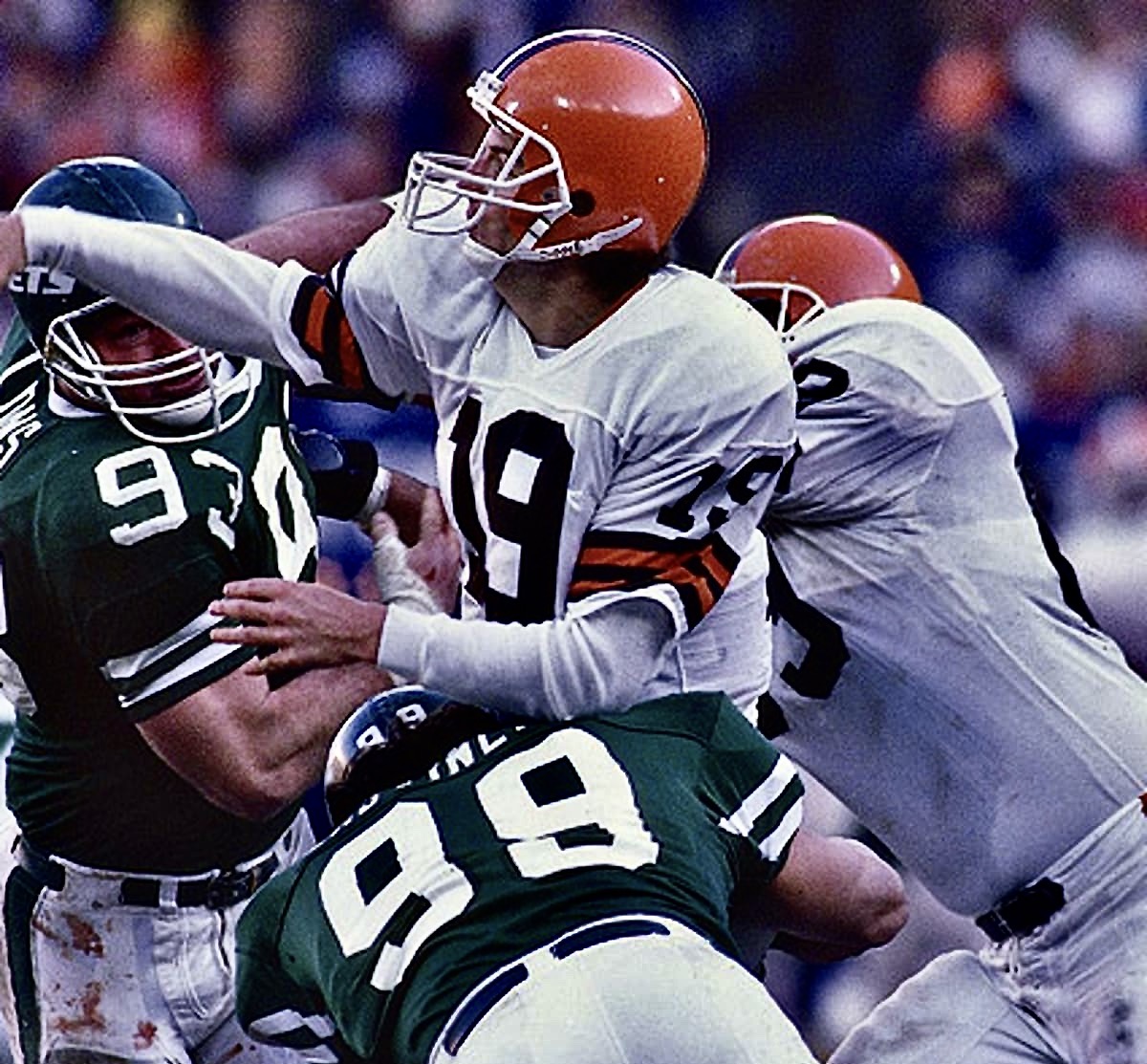
   Facing the New York Jets in 1986 in the playoffs, Bernie Kosar led the Browns to a double-overtime win, leading two come-back scoring drives in the final four minutes of regulation. He set a playoff record for passing yards. The team got knocked out of the playoffs the next round when they lost the AFC Championship Game by a field goal, again in overtime. It was close, but no cigar.

   Bernie Kosar was from Youngstown. His parents were Hungarian. He grew up in Boardman Township and went to Boardman High School. He didn’t play pinball then but was a hell of an athlete, slinging baseballs and footballs where they needed to go. The baseballs were strikes and the footballs were completed passes. In 1981 Parade Magazine named him Ohio’s Division I “Player of the Year.”

   My friends and I got hooked on the Cleveland Browns when they were the Kardiac Kids and Bernie Kosar was still in high school. We looked forward to the Sunday afternoon games and never missed them no matter what. If it was a Monday night game, it turned into a party. After their glory days in the 1960s the team hit a dry spell in the 1970s. The party was over. Then 1979 happened. They were losing their first game of the season, and time was running out, when quarterback Brian Sipe threw up a 45-yard prayer and Dave Logan answered the prayer by hauling in the pigskin. In no time flat the game was tied, and the Browns pulled it out in overtime. Municipal Stadium went nuts.

   The following week a doctor from the Cleveland Clinic stopped in at the team’s training center. “He showed us a paper readout of a cardiac machine,” Brian Sipe said. “It showed that somebody had died right at the moment we won the game. I think the story was that he was watching the game, sat up and cheered, and died.” The team was the Kardiac Kids from then on.

   The 1980 season was more of the same, a few crushing defeats and a slew of miraculous wins, until it all came to an end with Right Red 88. The Browns were knocking on the door towards the end of a tight game against the Oakland Raiders. The play call from Head Coach Sam Rutigliano was “Red slot right, halfback stay, 88.” As Brian Sipe started back out onto the field his coach told him, “Throw it into Lake Erie if no one is open.” Instead of throwing it to Dave Logan or Lake Erie, he threw it to Oakland safety Mike Davis and that was the end of the Kardiac Kids.

   It took six years, but when Bernie Kosar got to Cleveland and started working his magic, the glow inside the lakeside stadium came back. For two years he was the second-best quarterback in the world, behind only Dan Marino. He had half as many interceptions and half as many fumbles as Boomer Esiason. He threw for more yards, more touchdowns, and had fewer interceptions than John Elway.

   He almost didn’t make it to Cleveland. On the first play of the first game of his college career at the University of Miami a defensive lineman tracked him down. They were playing the Florida Gators in Gainesville. “It was a guy named Wilbur Marshall,” Bernie said. “We were backed up on the one-yard line and he cracked me into the brick wall that goes around Gator-land. The first thing I thought as I was laying there was, ‘I better do good in school because this football thing is not going to work out.’”

   He stuck it out, though, graduating with a degree in economics and leading Miami to a National Championship. When he got to the NFL, he found out there were more than brick walls to worry about. All the men on the defensive line were brick walls. “The league was encouraging crown of the helmet, top of the helmet blows,” he said. “The beginning of Monday Night Football was two helmets smashing together. The pregame show had a segment called ‘Jacked Up,’ about how hard did you hit a guy ,and you were glorified for using your helmet as a weapon.”

   Bernie Kosar played tough football in tough times. He also played a mean pinball. He was a team member on the football field, but he played pinball for himself. It wasn’t about burning off steam. It wasn’t about a need to conquer the machine age. It wasn’t a metaphor for sexual fulfillment. Pinball was like black magic in his hands.

   The Tam O’Shanter was a bar and grill in Lakewood, which was a bus line suburb on the west side of Cleveland. I had recently moved there and was living a couple of blocks from the Rocky River and a half-mile from Lake Erie. The bar and grill wasn’t far from where I lived. It was where I saw Bernie playing pinball one Thursday night.

   “He comes in for dinner and a draft and to play pinball every Thursday after the team film sessions are over,” Tom Gannon, who owned and operated the place, said. “He gets a buzz out of it.”

   Bernie was a big man, six foot five, but just a hearty dinner over two hundred pounds. He looked as fit as fit could be, even though he was gangly. He lived in a swank pink apartment building down Detroit Rd. across the Rocky River on the west side of the bridge. It overlooked the river. When he was done with whatever pinball game he had been dominating it was a five-minute drive home.

   He played new-style digital electronic machines. Even though he was tall, he didn’t hunch over them. No matter how fast things got he stayed slow on the flippers, never getting overly excited. He played the Fathom, the Firepower, and the Eight Ball Deluxe. He excelled on the Flash Gordon. It was the toughest of the pinball machines at the Tam O’Shanter. Everybody said it was the toughest single game of them all. The aim of it was trying to hit targets within a few allotted seconds to get double or triple points. Bernie made it look easy.

   “The first inches of a pinball game are always the same,” Eric Meunier, a game designer at Jersey Jack Pinball, said. “But after that, the ball can go anywhere.” A spring-loaded plunger propels the ball up the shooter alley and the next second it is rolling inside an amusement park maze of obstacles. There are ramps, spinners, and blinking lights. The goal is to keep the ball in play and away from the drain, a hole at the bottom of the playfield where the ball ends up when you lose control of it.

   Training camp for the Cleveland Browns was at Lakeland Community College in nearby Kirtland. “All of a sudden, I graduated college quick, and you’re in camp,” Bernie said. “It’s seven weeks of training camp with Marty Schottenheimer. You’re right in the thick of it.” It was thick or thin on and off the field. “In between two-a-day practices, players and reporters mingled in the dormitories,” Tony Grossi, a beat reporter for the Cleveland Plain Dealer, said. “Lakeland College had a couple of vintage pinball machines in the players’ lounge. Players competed against reporters in daily pinball contests.” 

   Nobody ever reported beating the curly-haired rookie at pinball. He played it clean, like he could feel the bumpers. He always got the replays. The reporters didn’t know what to say.

   He never replayed the first snap he took in the NFL for the Cleveland Browns against the New England Patriots. He fumbled the snap from center, and their rivals took advantage by kicking a field goal, going up 3 – 0. “I just dropped it,” he admitted. When his chance came on the following series, he handled the ball like an old pro, completing seven straight passes, and the Browns downed the Patriots 24- 20. He led the team to five playoff appearances and three trips to the AFC Championship Game in five years. By 1990, despite his risky sidearm throws, he held the all-time league record for fewest interceptions when calculated against attempts.

   The Tam O’Shanter was near St. James Catholic Church. Fridays and Saturdays were for the O’Shanter. Sundays were for St. James and the Browns. Men tacked on morning prayers for the home team and wives racked up time serving snacks and drinks during the game. Bernie was raised a religious boy and didn’t change his stripes when he landed in Cleveland as a grown man. He attended church in his parish and appeared at pep rallies whenever asked. One morning more than four hundred kids gave him a big cheer when he stepped into their school gym, the nuns with their rulers keeping order. Two of the kids sang “Bernie Bernie” from the stage. It had been a big hit on the radio the year before.

   When question time came, after all the football questions, and all the questions about what he did and didn’t like, one kid asked, “How much beer can you drink?”

   “Never mind about that, and stay away from that stuff,” he answered, and started autographing notebooks. After the rally, walking out with a reporter, a nun approached them. “If you ever find out anything bad about Bernie, we don’t want to know about it,” she said to the reporter. She tapped a ruler on the palm of her free hand. Bernie gave her a thumb’s up.

   I had played a few games of pinball in my time, but I was no wizard at it. Far from it. After watching Bernie play several times, I thought I might be able to get the hang of it. He made it look easy. I was older and wiser. There was only one objective, which was to keep the ball in play and score as many points as possible. The longer the ball was in play, more free balls could be won and more free replays could be earned. How hard could it be?

   The Tam O’Shanter was nearly empty the Tuesday afternoon I stopped in to find out. I went to the Flash Gordon and studied it. The rocketman in ripped biceps and a red muscle T, a babe wearing a metallic bra with pointy tips that could poke a man’s eye out, and a bald mean-looking dude with a goatee were on the back box display. The playfield looked challenging. There were lights and colors galore. I thought, it stands on four legs, pulling its pants up one leg at a time like we all do. If it can do it, I can do it, too. I dropped a quarter into the coin slot and went exploring.

   Pinball was going to celebrate its 60th anniversary soon. It got rolling during the Great Depression. At first the machines didn’t have flippers. Players leaned and banged on them to try to get the ball to fall into a hole. Flippers were invented in 1947. It had been a rocky road since then. The amusement was outlawed almost everywhere in the 1940s. Gambling on the game had become rampant. All the pinball machines in New York City were confiscated in 1942. Mayor Fiorello LaGuardia and his moral crusaders smashed them to bits and pieces with sledgehammers and dumped them into the East River. In the 1970s they were still outlawed in Chicago and Los Angeles. Video games nearly wiped the pastime out. But it was back. Pinball machines raked in more than 10 billion quarters in 1988.

   I put another quarter into Flash Gordon. My first quarter had gone down the drain in a flash. I took a deep breath and squared my shoulders. Ball control and shot accuracy are the one-two punch of pinball. Trapping the ball with a flipper and tip passing it between flippers are important skills. It’s handy knowing how to bounce pass and post pass. Nudging is body language, although getting a feel for the machine’s tilt sensitivity is vital. The death save comes into play when it’s all gone suddenly wrong.

   By the end of the afternoon, I was out of quarters and nowhere near being better at pinball than I had been when I walked in. I walked home. I saved my quarters for the rest of the week and went back to the Tam O’Shanter the next Tuesday. One day I brought twenty-five quarters, another day fifty quarters. I kept it up through the fall and into winter. I gave it up after the New Year. I wasn’t ready to give pinball years of practice. I didn’t have enough loose change, anyway.

   I could not for the life of me get the hang of it. I played racquetball in state-wide amateur tournaments and squash on a club team. I was good enough to hold my own most of the time. Both racquet sports were like pinball, the ball bouncing all over the place. But there was something helter-skelter about pinball that I couldn’t master. I wasn’t a mind reader, especially not my own mind, and I couldn’t put my finger on it. I knew there was some luck and chance involved in playing pinball, but there was luck and chance involved in everything.

   It wasn’t a physical struggle. Making the flippers slap was no great strain. It was a mental struggle. I wasn’t nervous and never distracted by the lights and noise of the machine. I kept my eyes on the prize, especially when the ball was coming down the middle of the table and there wasn’t anything I could do about it.

   When he was in the pocket Bernie Kosar usually stayed there. He was the kind of quarterback who always ended up dead last in foot races, anyway. He was wily and patient, though, waiting to throw the pigskin at the last second while defensive linemen and blitzing linebackers bore down on him. He kept looking downfield no matter the topsy turvy of linemen all around him.

  I followed the pinball wherever it went. I knew that was a mistake but kept doing it. There was no reason to focus on the ball when it was in the top half of the machine. The time to focus was when it was in the bottom half. Then it was flipper time. I made myself dizzy watching the bouncing ball too much. I was thinking all the time, wearing myself out, sucking all the fun out of the game.

   I was smacking the flippers and getting an occasional big score, but not controlling the hubbub. I couldn’t reconcile the hit-or-miss ricochets of the silver ball. There were hardly ever any random bounces on racquetball and squash courts. There were good shots and bad shots, but not many random shots. They were far and few between. I couldn’t tap into the uncertainty principle of pinball to save my life.

   By 1990 Bernie Kosar had a nearly dead elbow, a torn ligament in the front finger of his throwing hand, and was limping like Ahab on a bad day. Handheld signs were asking “Bernie Who?” and popping up all over Municipal Stadium. He was only 25 years old, but on his way out. When the home team lost to the Denver Broncos in the playoffs again, the Browns became the first AFC team to ever lose their first three conference championship games. The team let Bernie Kosar go.

   He wasn’t deaf, dumb, or blind, though, and once his hand healed, he won a Super Bowl ring playing for the Dallas Cowboys, where he had been traded. In his free time in the Big D, he touched base with Flash Gordon. The Rocket Man flashed a ray gun bristling with energy coils, but when the Ohio boy threw down his quarter and put his fingers on the flipper controls, both of them knew all bets were off.

A version of this story appeared in the Lakewood Observer.

Ed Staskus posts monthly on 147 Stanley Street http://www.147stanleystreet.com, Made in Cleveland http://www.clevelandohiodaybook.com, Down East http://www.redroadpei.com, and Lithuanian Journal http://www.lithuanianjournal.com.

“Cross Walk” by Ed Staskus

“Captures the vibe of mid-century NYC, from stickball in the streets to the Mob on the make.” Sam Winchell, Beyond Fiction

Available on Amazon: https://www.amazon.com/dp/B0CRPSFPKP

Late summer and early autumn. New York City, 1956. President Eisenhower on his way to the opening game of the World Series. A hit man waits in the wings. A Hell’s Kitchen private eye scares up the shadows.

A Crying of Lot 49 Publication

Calling the Corner Pocket

By Ed Staskus

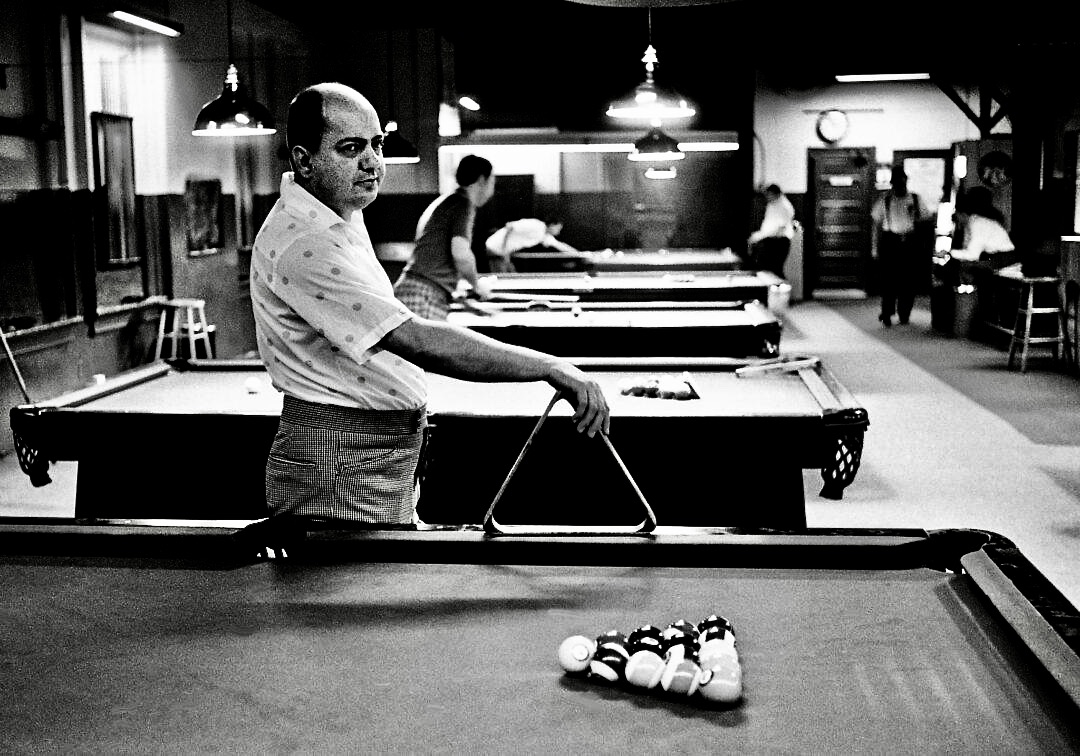
   Joe Tuma’s Billiard Club wasn’t a big place, although it was big enough. There were two snooker tables, two billiards tables, six straight pool tables, a scrappy ping pong table, and half a dozen mismatched beat-up stools at a beat-up front counter. There was an eight ball table in a corner for tourists. Nobody else ever went near it. All the tables were clean as a whistle except for the eight ball table. The floor was swept nightly but never mopped. The front windows were filthy. The bathroom was filthy. There was no bathroom for women. Nobody had ever seen a woman inside Joe Tuma’s anyway, so it didn’t matter.

   The pool hall was on the south side of Euclid Ave. at E. 19th St. on the second floor of a two-story building. Pool halls were usually in basements or on second floors to save on rent. The Morse Graphic Art Supply Co. was on the ground floor. Fine art students came and went. Cleveland State University was two blocks up the street. As many times as I went to Joe Tuma’s was as many times I didn’t go to the art supply store. I wasn’t interested in art.

   Cleveland State University was where I was a freshman, at least until I dropped out instead of getting flunked out. I spent more time at the pool hall than I did attending lectures in the humanities and sciences. My teachers were always asking me who I was and if I was in the right class.

   I wasn’t the only one in the thrall of pool. Ron Mabey graduated from the Cleveland Institute of Art, lost his student deferment, but was still waiting to be drafted. He and a cousin with the same 1-A ticket to Vietnam rented cheap office space in the nearby Corlett Building. They did odd jobs. “We started going to Joe Tuma’s and spent less and less time at the office,” Ron said. “We were killing time waiting for our letters from Uncle Sam. The billiard club was more enjoyable than the 3rd Platoon, D Company, 14th Battalion, 4th Brigade, where I eventually ended up, although by the time I ended up in the army  the war against the pajama’s was over.” The United States military had been killing the NVA and Viet Cong by the score, winning battles up and down Vietnam for more than a decade, until the day it suddenly lost the war.

   Joe Tuma’s called itself a “Billiard Club” and advertised “Bowling and Billiard Supplies” on its front window. I never saw anybody wearing a monogrammed club sweater and never saw supplies of anything except balls, chalk, and cue sticks. There were no bowling supplies of any kind. I never saw Joe Tuma,, either. After a few months I stopped looking for him.  Eventually I came to doubt his existence.

   Warmed over hot dogs and lukewarm beer were both twenty five cents at Joe Tuma’s. The wieners were cooked on a Carnival King rotisserie. The beer was P. O. C. out of a keg packed in not enough ice under the front counter. P. O. C. was Pride of Cleveland brewed by the Pilsener Brewing Company. It had been Cleveland-made ever since Wenzel Medlin from Bohemia founded the brewery in 1892, although it spent several aimless years in Pittsburgh in the 1960s before coming back. When it did it celebrated by giving away limited edition giant P. O. C. bottles. One of the giant beer bottles was behind the counter. It was where the quarters for the next keg went.

   The pool hall didn’t have slot machines, darts, or foosball, staying true to pool, billiards, and  snooker. When my father found out I was playing pool he said it would only lead to gambling, laziness, and philandering. He said it was a “social ill.” I told him I didn’t have any ready money to gamble with, learning to play was elbow grease not laziness, and I didn’t know what philandering meant, even though I did. My mother had just seen the movie “The Music Man” and referred me to the song “Trouble.”

   “You got trouble, folks, right here in River City, trouble with a capital ‘T’ and that rhymes with ‘P’ and that stands for pool.”

   The Cuyahoga River was right around the bend from the pool hall and it was always in trouble. It was always catching fire. My father was an accountant and said it was the price of progress. My mom didn’t say much about it. She was a cashier at a Pick-N-Pay supermarket, racing home to make dinner for my father, brother, and sister after work. By then I had already moved to the beatnik neighborhood on Upper Prospect and heated up my own pork and beans.

   The front door of Joe Tuma’s was at the side of the building and the front stairs were lit by a 40-watt light bulb on its last legs. Inside, most of what lights there were, were situated over the tables. There were no radios and no TV’s. It was always quiet, like a church, except for the clacking sound of balls hitting each other.

   Pool balls used to be made of stone, back in the 14th century when high society played a game that was a cross of croquet and billiards. When the game moved up to a table, balls were made of wood and clay. When the makers of balls discovered ivory, they started making them out of ivory. It was a slow go, though. One elephant tusk yielded only five or six of them. They were prone to discoloring and cracking if struck with too much force. A family of Waloons in Belgium hit the jackpot after World War Two when they developed a resin and plastic combination called phenolic resin. They became the biggest manufacturers of billiard balls in the world. Every ball racked and stacked at Joe Tuma’s was an Aramith branded ball that had been made and inspected at the Sulac family factory four thousand miles away.

   Nobody ever argued about anything at Joe Tuma’s. They didn’t give a damn about politics or society’s troubles. “Less talk and more chalk,” is what they said. Somebody might tap his cue stick on the wood frame of a table to show appreciation for a shot, but that was about as demonstrative as anybody ever got.

   One of the most soft-spoken men who came and went to Joe Tuma’s was Baby Face. “I was given that tag when I was 15 years old,” he said. “I had just played Buddy Wallace right here. Buddy played straight pool in championships where he ran large numbers to beat some world class players. I played him for money to 50 points and won decisively.” Life is a game of chance and money is to keep score. It’s draw for show and follow for the dough.

   “As I was going out the door with my winnings after I beat Buddy the man who covered the pool tables for Joe, who was named Butch, asked, ‘Who’s the baby face?’ When I got into my 30s, I was on the road busting everyone I ran up on. I busted Reid Pierce at the Office Lounge in Mississippi. I busted Tommy Sanders and Gabby in Texas. I busted Rich Geiler in Washington.”

   “Who is he talking about?” I wondered, even though I knew full well he was talking about Minnesota Fats kinds of guys.

   “I was pretty much undefeated except when I ran into Mike Siegal. He showed me what a world champion could do. I played him on the big table. It was painless. He only gave me a couple of opportunities. I started stalling with him the first rack out and he hit me with a 4 pack. I never came out of it. It was painless in the end.” 

   “The easiest way to win is to not let the other guy shoot,” is what road players say.

   I didn’t know much about pool when I started playing between classes. I had played eight ball on coin-operated bar tables with my friends, but it meant nothing except some fun. When I first saw the tables at Joe Tuma’s I knew for sure I knew nothing. There were always old timers hanging around, playing an occasional game on their social security money. One of them, Brooklyn Bob, who lived in Old Brooklyn near the Cleveland Zoo and took the bus downtown, helped me. He taught me how to play straight pool. I learned how to play billiards and snooker, too. I didn’t take to billiards, although I liked the caroms on the pocketless table.

   The first thing Brooklyn Bob told me was to “stroke it, don’t poke it. The ball will go where you look, but you don’t have to aim straight if you stroke straight. Let your cue stick do the work. Take what the table offers. Don’t try to get perfect shape when good shape will do.”

   The rules were simple enough and keeping score was even simpler. Every table had sliding scoring beads on a wire perpendicular to the table, using the light centered over the pool table as the middle string mount. The beads were made of wood. Fifty of them were dark and the other set of fifty were light colored. First color to fifty carried the day.

   At first my shooting was loose and clumsy, like I was shooting with a rope. I lost more games fifty to zero than I could count. I was on the hit and hope bandwagon. After I got a little better my nickname at the pool hall became One in a Row. It got so nobody wanted to play me, so I practiced by myself.

   “It’s not the cue, it’s you,” Brooklyn Bob said. “Hold the stick like you’re shaking a lady’s hand. Don’t crush it, but don’t be limp, either. Squat the rock. If you already have position, don’t play for it. Be steady.  Don’t cry in your beer about it, though.” Bob always had bottles of Blatz he brought with him in a Pan Am stewardess’s flight bag and always had a cigarette burning down in a tin ashtray on the table beside his stool. 

   The big open room on the second floor stank from years of incessant smoking. Everybody drank beer and smoked. I didn’t drink much but started tucking a cigarette behind my ear to stay in the swim of things. The sharks smoked Camels and Lucky Strikes. The tobacco was strong stuff. I tried to not breathe too much. After a while I had a pool hall tan like everybody else.

   The fewer school classes I went to and the more I practiced at Joe Tuma’s the worse I got at erudition and the better I got at pool. I started picking up games. I never played for money because the only loose change I ever had went to pay for table time. “Never gamble with a man named after a state or a city,” Brooklyn Bob told me. When he tried to get me to play him for money, I followed his advice.

   Some of the town players and lots of the road players had nicknames, all of them more flattering than mine. There were Frisco Jack, Rocket, Handsome Danny, Cadillac Ed, and Cue Ball Kelly. Before the movie “The Hustler” came out Minnesota Fats was simply Fats, even though his real name was Rudolf Wanderone.

   “Perhaps the most striking aspect of the pool hustler’s argot is the use of nicknames. The percentage of them who have nicknames is not only higher than among either professionals or hustlers in other sports but is higher than in any other adult group in America,” Ned Polsky wrote in “Hustlers, Beats and Others.” 

   Oklahoma Flash sounded good, and he was a good shooter, but his handle had nothing to do with pool. “I had a friend who started calling me that when we played softball together in Oklahoma,” he said. “Every time I ran to first base, he said a dust cloud could beat me there.”

    I learned how to handle the cue stick and how to stand in the right stance, keeping my head down on the ball with the cue below my chin. I got in the groove of gradually approaching the cue ball keeping my follow through straight and relaxed. I stayed down after the shot. I hit thousands of practice shots, then tens of thousands, until I realized getting to the level of guys like Baby Face was going to mean hitting practice shots until the end of time. “HAMB is the only fool-proof aiming system,” Brooklyn Bob said. HAMB meant ‘Hit a Million Balls.’ I didn’t think I had it in me.

   One afternoon after attending an occasional school class I stopped at Joe Tuma’s. A crowd was gathered around the ping pong table where a man was playing all comers with a small rusty garbage can lid. His off hand was tied behind his back. Nobody was having any luck scoring any points, even when he played two opponents with two balls in play at the same time. It was Danny Vegh, who was from Hungary, where he had been the country’s boy champion, junior champion, and adult champion. 

   He came to the United States after the Hungarian Uprising. “The border opened up and I ran like hell!” he said, landing at Camp Kilner Air Force Base in New Jersey. “I knew no one in this country.” Somebody on the base told him many Hungarians were going to Cleveland. He and his wife packed up and went to Cleveland. Four years later he was the USA Singles and Doubles Table Tennis Champion. It didn’t pay the bills, though, so he opened a ping pong center.

   “The business was a complete failure,” he said.

   Since he was a good pool player, too, he moved to the Hippodrome Building just west of E. 9th St. and opened Gaylord’s Pool Hall. It was a big success. He added four ping pong tables “just because I loved it.” He started staging pool tournaments with hundreds of players competing. The entry fees went to the Cleveland Plain Dealer Charities “so we had a lot of publicity.” Kids played in age divisions. “I was in the 9 to 10-year-old group and my cousin John was in the 8 and under,” Tim Goggin said. “He could barely see over the top of the table, but still made it to the quarterfinals.”

   Now and then, somebody would blow into town, do a demonstration at Gaylord’s, give some lessons, play whoever was up to it, and blow out of town better off than the day before. They didn’t usually come to Joe Tuma’s, but one morning when I walked in a road player was showing off trick shots. He was Jew Paul. He was from the Rack & Cue in Detroit. There were dark circles under his eyes. He looked like he had been up all night. 

   “He was here all night and he’s still here,” Butch said. “He ordered breakfast for everybody, should be here soon. Make sure you stay.”

   Paul Bruseloff was Jew Paul’s real name. He was in Cleveland with a friend of his by the name of Cornbread, whose real name was Billy Joe Burge. Jew Paul was from East New York City. The first time he played pool was in 1939 when he was 12 years old. The first time he played was also the first time he gambled on the game. It was for one cent. He needed three cents to pay for an 8-ball rack and twenty cents for an hour of straight pool. He won enough to play all he wanted.

   Jew Paul made a white-collar living selling kitchenware and a no-collar small fortune betting on his cue stick. He preferred one-pocket on a snooker table but played anything and everything. What he liked most was “come out a few games behind but win all the money.” One day he was doing just that, betting $300 a game in the center and $500 a game on the side. “But the hapless guy I was playing was running out of dough, so I accidentally dropped a couple of hundred on the floor so he could keep playing and I could find out just how hapless he was.”

   After breakfast somebody tried to take Jew Paul’s picture with an Instamatic. He pushed the man away. “Pictures are for movie stars,” he said.

   “That man don’t let nobody take his picture,” Butch said.

   He wasn’t the only one. I had started taking artsy black-and-white pictures, guided by Virginia Sustarsic, a friend of mine who was a hippie photographer and some-time writer. She had access to a dark room where we developed film and pictures ourselves. I borrowed her 35mm Nikon camera and brought it to the pool hall to take some character shots, but was firmly and not-so-politely told, “No pictures.”

   When I finally went back to school full-time, after dropping out came to seem like a bad idea, I dropped playing pool. I couldn’t do both. I was majoring in English literature and film studies and going to all my classes, reading and writing at night, and working part-time to keep the wolf away from the door. It took up all my time. Playing pool would have snookered me. 

   “All gents know how to play pool,” Brooklyn Bob told me one day when I was messing around with a friend during spring break, showing him how to put English on the cue ball. The old timer took a pull on a bottle of warm Blatz. “But any gent who plays too good, he ain’t no gentleman.”

Photograph by Helaine Garren.

Ed Staskus posts monthly on 147 Stanley Street http://www.147stanleystreet.com, Made in Cleveland http://www.clevelandohiodaybook.com, Atlantic Canada http://www.redroadpei.com, and Lithuanian Journal http://www.lithuanianjournal.com

“Cross Walk” by Ed Staskus

“Captures the vibe of mid-century NYC, from stickball in the streets to the Mob on the make.” Sam Winchell, Beyond Fiction

Available on Amazon: https://www.amazon.com/dp/B0CRPSFPKP

Late summer and early autumn. New York City, 1956. President Eisenhower on his way to the opening game of the World Series. A hit man waits in the wings. A Hell’s Kitchen private eye scares up the shadows.

A Crying of Lot 49 Publication

Staying Alive

By Ed Staskus

   One of the concerns of Cleveland’s early settlers was that Canada might invade at any time. They were just on the other side of Lake Erie and they had plenty of boats. They might land their Canuck army somewhere in the middle of the night and lay siege to the city. Nobody knew what they would do if they captured Cleveland, they being foreigners who lived on bacon and poutine and littered their mother tongue with ”eh?” Everybody was convinced it was going to happen soon. What could they do?

   When the city fathers finally acted they formed the Cleveland Grays, a volunteer military company, to protect themselves from Canucks on the loose. They weren’t called the Grays at first. At first they were called the Cleveland City Guards but since their uniforms were gray from tip to toe they changed the name the next year. They wore Queen’s Guard bearskin hats that made them look a foot taller than they really were. They adopted “Semper Paratus” as their motto. Nobody knew what it meant because it was in Latin until the man upstairs finally explained it meant “Always Prepared.” Everybody liked that. There were 65 of them. They stayed prepared after that.

   The Cleveland Grays stayed busy even though the Canadians eventually decided to stay on their side of the border. In 1852 they put down a two-day riot at Cleveland’s Medical College. A mob bearing clubs and cleavers attacked the school, protesting the work of Resurrection Men. They were men who robbed graves of the recently deceased for dissection lectures. The rioters broke into the college. The doctors, teachers, and students fled while the bully boys destroyed all the furnishings and equipment. They ransacked the lower level looking for the body of a local woman who they believed had been body snatched. The Grays restored order, but the next day the roughnecks were on their way to burn down the house of one of the anatomy teachers when the Grays had to save the day again. The rioters saw their bearskin hats a mile away and snuck away.

   In 1861 they were the first militia in the country to form a company and respond to the call for Union soldiers. They fought at the First Battle of Manassas. They hauled the first ever captured Johnny Reb cannon of the war from the Cheat River battlefield back to Camp Cleveland in Tremont. The troops called it ‘Cannon Sesech’ after the secessionists. They fired it after every Union victory. They whooped it up loud and clear every hour for 24 hours on the day the war ended. Nobody complained about the noise. Over the years, after a Gray had been a member for twenty-five or more years, he was entitled to be called a “Pioneer” and to wear a leather apron with his uniform. He was also entitled to carry an axe when on parade. Nobody messed with them when they were on parade. They fought in the Spanish-American War and World War One. 

   After that the Militia Act proscribed them and their like from fighting in wars anymore on their own initiative. Uncle Sam still wanted them but only if they wore his regulation uniform. The Cleveland Grays lasted as a “Businessmen’s Camp” into the 1990s.

   They first set up shop on the fourth floor of a building called the Mechanics Block. Thirty years later they needed more space. They moved into a former fire station. Ten years later they moved into the newly built City Armory, sharing it with the Ohio National Guard. Soon after that a fire destroyed the building. They decided to build their own place that would stand the test of time. 

   A three-ton block of sandstone was set in place in 1893 where Bolivar Rd. meets Prospect Ave. for the foundation of the Grays Armory. It grew to be three stories high with a five-story tower on the northeast corner. It was built as an urban fortress. There is a black iron drop-gate and iron barriers in front of the solid oak front doors. Iron rods were bolted to the brick walls as window protectors. 

   The armory was built to store weapons and ammo. The drill room, which doubled as a ballroom, was where the Grays marched up and down in tight formations. But it wasn’t long before it became a kind of Blossom Music Center. The Cleveland Orchestra’s first concert in 1918 was staged there. The first time the Metropolitan Opera came to town they sang songs of doomed love and hellfire there. When John Philip Souza first marched into town his band played there. 

   Even though in the early 1970s I was living on Prospect Ave. near Cleveland State University, and later in nearby Asia Town, I didn’t know the first thing about Grays Armory. The few times I saw it I dismissed it as an old ramshackle castle with a cool-looking tower. I did, at least, until Joe Dwyer invited me to his new digs there.

   Joe and I went to St. Joseph’s High School the same four years in the 1960s and for a few years in the 1970s lived a street apart in Asia Town. Many of the suburban kids who went beatnik and hippie in those days moved downtown like us. Many of us lived in reduced circumstances, trying to keep our heads above water, living catch as catch can in our counterculture world. Joe was living rent-free in the caretaker’s quarters on the top floor of the tower. He was keeping a part-time caretaking eye on the armory.

   He showed me around the building. He told me it had just been added to the National Register of Historic Places. It looked like a forest had been chopped down for the floors, doors, stairs, and wainscoting. It was a sunny day and sunlight poured in through the windows. Everything was old but gleaming like new. We played a game of pool in the Billiard Room. We peeked into the basement where there was a 140-foot-long shooting range. We played some haphazard notes on the Wurlitzer pipe organ that had been installed a couple of years earlier. It came from a silent movie theater in Erie, Pennsylvania. It sounded creepy in the empty ballroom. Three or four concerts a year were being sponsored by the Western Reserve Theater Organ Society.

   Twenty years later my wife and I were living in Lakewood when we received a friend’s wedding invitation in the mail. The reception was being held in the main ballroom of Grays Armory. We checked the box saying we would be attending the festivities. My wife bought a new dress and I polished my dress shoes,

   We parked on Erie Ct. alongside the Erie Street Cemetery on the day of the big day. It was where Lorenzo Carter, the first permanent settler of Cleveland, was buried. It was where Chief Joc-O-Sot, who fought the first settlers, was buried. It was where almost a hundred Civil War veterans were buried, including General James Barnett, who was a commander of the Cleveland Grays. After the war he served on the commission that got the Soldiers’ and Sailors’ Monument built on Public Square. We walked to the end of the block to the armory. The lobby was carpeted in red. There was some kind of ancient ticket booth off to the side. There was a grand staircase. The posts and railings were carved from a single slab of wood. The posts were engraved with ‘CG’ for Cleveland Grays.

   After toasts, dinner, a slice of wedding cake, and some dancing, we were standing around when somebody in our group said the armory was haunted. “Lots of people have seen ghosts here,” the man in the know said.

   “Like who?” I asked. 

   “Plenty of people,” he replied.

   “I saw a handsome young man with light brown hair, parted on one side, with a crown imperial goatee,” said Chris Woodyard, who has written a series of books about haunted places. “The spirit was wearing a Cleveland Grays woolen jacket, decorated with a glockenspiel pattern down the front, formed by braids and buttons.” Staff members said a woman wearing white often appeared at the armory’s piano. She didn’t play it but no matter where it was moved to, she was always there. She wanted to dance but didn’t have a partner. Day and night doors locked and unlocked themselves and disembodied sinister voices whispered in the shadows. Ghostly footsteps were forever setting off security alarms.

   One day the spirit of a soldier walked through a wall to get into the ballroom. A cleaning man was mopping up after a party. He watched the spirit watching him. A woman spirit wearing a party dress appeared and walked up to the man spirit. When the cleaning man coughed the spirits melted away. Another day a maintenance man was working at the back of the ballroom when a glowing green hand closed the door. He ran to the door, and opened it, but there was nobody there. The door knob oozed wormwood.

   After another drink my wife and I went looking for spooks. “Don’t bother looking for Lou,” we heard a voice behind us say. “He’ll find you.” My wife didn’t like the sound of that, but she was game and went with me. “Who is Lou?” she asked.

   Lou was a caretaker who once lived at the top of the tower in the same quarters Joe had lived in. He died of a heart attack making his rounds. He still made his rounds. Most ghosts are about unfinished business. He often walked behind people in the ballroom. When they heard his footsteps they turned to see who it was, but there was never anybody there, although they could smell the aroma from his cherry-vanilla pipe. Whenever there was a meeting in the first-floor tower room, where there was an oversized potted plant, he liked to shake it violently until it fell over.

   “Do you believe in ghosts?” I asked my wife.

   “Not during the day,” she said.  

   “How about at night?”

   “I’m a little more open-minded at night.”

   It had gotten to be night when we went on our self-guided tour of Grays Armory. We went upstairs. We stepped into the Club Room where the Grays used to sit around and puff on stogies. There were comfy leather sofas. The mahogany was dark and the atmosphere cozy. We stepped into the Billiard Room where Joe and I had shot pool years earlier. There were antlers of long dead deer on the walls. We peeked into the rooms on the upper floors. One of them was a smaller ballroom for meetings. Back in the day folks wanted to be high up so they wouldn’t have to smell the horse shit in the street. There were unlit fireplaces everywhere. We found cupboards in the Mess Room where members used to hide their booze during Prohibition. There wasn’t a drop of spirits left.

   With every step we took we had the feeling somebody or something was behind us, but every time we looked around we were alone. After a while being alone got scary. It’s better to be alone than to be in bad company, I reassured myself.

   “Maybe we should go back,” my wife suggested.

   “We’re not after fish but let’s do a little more fishing,” I said.

   We went up and down the tower. We stepped into the ground floor room. The lights went on by themselves. We heard footsteps and bumps in the night. A big dusty potted plant that looked like it was a hundred years old started to shake. It fell over.

   “That’s enough fishing for the day,” my wife said, backing up.

   In the end we didn’t see any ghosts, except for maybe Lou, which wasn’t to say we were ready to say there weren’t any. The Ghost Hunters, a paranormal team on the TV show SyFy, rooted around Grays Armory one day and found evidence of hauntings. Every time they left a room something closed the door behind them. When they investigated the basement they heard an unseen somebody say “Hello.” When they left the voice said “Goodbye.” They concluded there were spirits, but they seemed to want to have a good time more than cause a ruckus. Ghosts just want to have fun sometimes.

   “Have you ever noticed that ghosts are always wearing clothes?” my wife asked.

   “I’ve noticed without really noticing it,” I said.

   “How do their clothes get into the other dimension with them?” she asked.

   “That’s a good question,” I said. “If you ever get the chance, ask one of them.”

   “There’s a fat chance of that ever happening,” she said.

   We hadn’t seen anything substantial but we had seen enough. We had felt the presence of spirits in the shadows. We went back to the wedding reception in the ballroom. The bride and groom were the life of the party on the dance floor. True love can be like a ghost. Everybody talks about it but not many have ever seen it. They were doing the hustle to a Bee Gee’s tune being spun by the DJ. Disco is a surefire remedy for ghost sightings. The Lady in White, the lonely dancing spirit who had long haunted the armory, was nowhere in sight. She was dancing to her own tune.

   “Feel the city breakin’ and everybody shakin’, and we’re stayin’ alive, stayin’ alive,”  the Bee Gees sang in their eerie falsetto voices.

Ed Staskus posts monthly on 147 Stanley Street http://www.147stanleystreet.com, Made in Cleveland http://www.clevelandohiodaybook.com, Atlantic Canada http://www.redroadpei.com, and Lithuanian Journal http://www.lithuanianjournal.com

“Cross Walk” by Ed Staskus

“Captures the vibe of mid-century NYC, from stickball in the streets to the Mob on the make.” Sam Winchell, Beyond Fiction

Available on Amazon: https://www.amazon.com/dp/B0CRPSFPKP

Late summer and early autumn. New York City, 1956. Jackson Pollack opens a can of worms. President Eisenhower on his way to the opening game of the World Series where a hit man waits in the wings. A Hell’s Kitchen private eye scares up the shadows.

A Crying of Lot 49 Publication

Dracula at the Door

By Ed Staskus

   Some folks turn on the porch lights Halloween night and wait for the doorbell to ring. Others sit on their front steps or stoop, while still others plop themselves down on lawn chairs at the base of the driveway. Those who don’t want to bother make sure all their lights are off. They sit sulking in silence or watching whatever is on their phones and tablets. They think Halloween is just for kids and that grown-ups have better things to do.

   When I was a kid and went trick or treating with my sister, brother, and our friends it was, next to Christmas, the biggest show of the year. It was one for the money and two for the show. ”Don’t be a chiseler! Give me some Twizzlers!” It didn’t matter what horse opera was on TV or what homework was due the next day. What mattered was making sure we stuck to our battle plan. We planned our route days beforehand, which was left out of our house on Bartfield Ave., left on E. 128th St., left on Locke Ave., left on E. 127th St., down Coronado Ave. to Lancelot Ave. and back home. We knew we had about two hours and if we banged on one door every minute we would have gotten to more than a hundred houses and hit the jackpot. When we did we ran home to survey what we had gotten.

   My sister and I always hid our loot from our brother. We had to. He had a non-stop sweet tooth. “Give me a break! You know it’s the Kit Kats I want to take!” He believed in sharing, like us, but Sharing Street to him was a one-way street.

   All of us hated dark houses. Was the dark inviting us to the spookiness or telling us to stay away? Time is candy, we reckoned, and wasting time evaluating a dark house was time lost. We imagined grumpy old men and women lived there, better left unseen, although we also thought they could have shown their faces at least once a year.

   We weren’t scared about anything anybody threw into our pillow cases, except when it was pennies and apples. If it was candy corn we put a curse on their house. The day of crazy people putting razor blades and poison into candy hadn’t arrived yet. We didn’t want pennies and we got more than enough apples at home. Our mother fed one to us every day to keep the doctor away. When we got sick she gave us Ginger Ale and slices of liver and onions. The soda was bubbly. The liver and onions were sickening.

    The term “Trick or Treat” was first used in a Red Hook, Alberta newspaper in 1924. “Hallowe’en night was observed in the usual manner by the young bloods in town. Fun is fun and tricks are tricks, but when such public buildings as school and Memorial Hall are molested with no option for Trick or Treat, we cannot see where either fun or trick is enjoyed.”

   A high school boy next door told us there hadn’t always been any such thing as Halloween. We were aghast. How could it be? We ignored him. We found out later he was right, although by that time we weren’t trick or treating anymore, so it didn’t matter.

   I didn’t know a thing about Halloween until after we got to the United States. It’s not a traditional holiday in Lithuania, where both my parents came from after World War Two. It was only introduced there after the country kicked the Russians out in 1990. It wasn’t much of anything in Sudbury, Canada, where I was born and bred, either. There was often snow on the ground by the end of October in northern Ontario and nobody went out dressed as a skeleton in zero weather sponging for sweets. 

   In Romania the holiday is Dracula Day. In China it is the Hungry Ghost Festival. In Mexico it is the Day of the Dead. In the Middle Ages in England ‘soulers’ went around begging for round cakes or ‘souls’ during All Hallows Eve as a way to remember the dead. It was the soul kitchen. Turn me out and I’ll wander forever.

   Before there was Halloween there was nothing, just the end of the month and the beginning of the next month. Then the Irish Potato Famine happened, and millions of Irishmen came to the Land of Plenty. They didn’t have much to go around, but they had culture. They brought Samhein with them. The Irish New Year started on November 1st and Samhein was the day before that. It was when the spirits of the dead returned to the world of the living for one night. Paddy lads and lassies dressed up in costumes and went door to door begging for food and money. Their parents carved ghoulish faces on turnips to ward off evil. They put candles inside the turnips to let kids know they could bang on their door for treats.

   Many youngsters without a drop of Irish blood in them got into the spirit of it but the powers that be didn’t like it. They blanched at the complaints of vandalism, houses splattered with eggs, and strips of newspaper littering shrubs and trees. Enough is enough, they said, and put a stop to it wherever whenever they could. They didn’t care that some parents spent hours wrapping their kids up in rolls of toilet paper to look like mummies. After the post-WW2 baby boom many families made demands to make the holiday official, and city fathers were forced to bow to the popular will. Halloween broke out all over.

   It busted loose just in time for the candy companies. Old timers used to parcel out nuts, fruits, and trinkets. They thought we would have fun bobbing for apples. They were wrong, just like everybody who gave us candy corn was wrong. Candy corn was originally sold in the 1880s. It was like chicken feed with rooster images on the boxes. Nobody ever ate it unless they wanted a jelly belly. It didn’t matter that the last pyramid-shaped penny candy had been slurried during the Roaring Twenties. Every year it was repackaged and redistributed. By the mid-50s real candy became the treat of choice. We were all in on the new tradition. We didn’t know it would grow into the second-largest commercial holiday in the country, raking in more than $6 billion dollars.

   It doesn’t do it in on the shoulders of kids going door to door anymore. These days only a third of everybody hands out candy. Another third leave candy out in a bowl, while the rest keep their lights off. One year my wife and I were going out to dinner with friends. We left a big plastic bowl full of goodies on the front porch with a sign saying, “TAKE ONE.” We were pleased to see it empty when we got home, until we ran into one of our neighbors the next day.

   “Two boys just ten minutes after you left wiped you out. They turned the bowl over and poured everything into their bags. When I went up to them to say something they ran away.”

   When we trick or treated back in the day we loved getting Clark Bars, which were peanut butter and spun taffy, Zag Nuts, which were peanut butter and toasted coconut, and Mary Janes, which were peanut butter and taffy molasses. We had a soft spot for peanut butter. Treacle was a close second. We hated Necco Wafers. They were tasteless except when they tasted bad. We liked candy cigarettes, which we could pretend to smoke and eat at the same time.

   Many more than less of Halloweeners stay home nowadays and watch a scary movie instead of trick or treating. “Hocus Pocus” is the number one movie followed by “Friday the 13th” and “It’s a Great Pumpkin Charlie Brown.” In the late 1950s and early 1960s nobody stayed home watching any movies unless they were deathly ill. Everybody beat feet the second it got dark enough for the starting gun to go off. When it did we raced outside and took a left.

   A decade later, when my trick or treating days were behind me, I was living in Asia Town. The old school Cleveland neighborhood had plenty of Chinamen, Eastern Europeans, and Puerto Ricans. There were the working class, trailer trash, beatniks and hippies, and college students. I fit in somewhere between beatnik and college student. I joined the working class whenever I ran out of money. It was an affordable place to live with all of life’s necessities within walking distance, which worked for me because most of the time I didn’t have a car. The rest of the time I had a car that didn’t work most of the time.

   Joe Dwyer was one of my friends who lived one block over. We had gone to high school together and were both some-time students at Cleveland State University. We were dodging the draft as much as we were reading textbooks. At least I was reading. I was majoring in English with a minor in Unemployment. Joe was an art student and didn’t read anything unless it was necessary. He painted houses whenever he had to keep the wolf away from the door.

   His digs were on East 33rd St. between Payne Ave. and Superior Ave. The 100-year-old house was narrow as a one-lane street and as cluttered as a Victorian parlor. He smoked marijuana like nobody’s business. He made sure it was nobody’s business. In those days cops were always throwing young adults into jail for smoking weed. Dying in Vietnam was OK. Smoking weed was not OK. He had two white cats with mismatched blue and green eyes. There was a disheveled garden in his postage-stamp size yard. He collected gourds, decorating them in fantastical colors.

   One day in mid-October, passing by his house, I heard hammering. When I took a look-see I saw two sawhorses and a pile of plywood. He was sawing and hammering a coffin together in his backyard.

   “Who died?” I asked. I didn’t put anything ad hoc past him. He was crafty in more ways than one.

   “Nobody died, not yet, at least,” he said. “This is for Halloween.” He was a red-blooded Irishman and had first dibs on Samhein.

   He was making the coffin so it could stand on its hind legs. He painted the outside a glossy black and the inside a glossy fire engine red. He was going to park it in his open front door on the big day. When kids came up his stairs they would have to approach the vertical lid of the coffin in the doorway. When they did, spotting them through a peephole, he slowly opened the lid, dressed as Dracula, and handed out treats.

   Nobody in our neighborhood took a pass on Halloween, especially not that year. The holiday was on a Friday and that made it Halloweekend. It didn’t matter if the child was from China or West Virginia. Every child who could walk hit the mean streets of the near east side running. Every teenager did the same thing. Even some old Slovenian women dressed up as themselves went out, their babushkas tied tight under their chins. I sat on a front porch next door to Joe’s house with some college friends. We had a family-size bag of Lay’s potato chips and a 12-pack of Stroh’s beer for ourselves and tossed Home Run gumballs into everybody’s bags, but not before getting our two cents in about every costume we saw. The gumballs were right up our alley, costing us close to nothing..

   Joe had rigged up a mirrored stardust ballroom light. It strobed, throwing shards of colored light on the ceiling, walls, and the deck of the front porch. Once the trick or treaters were on the porch there was no missing the coffin, especially since a purple floodlight was making it look creepier than coffins usually do.

   At first, everybody was cautious about approaching the coffin. Some kids didn’t even try. They took one look at it and left for greener pastures. Some kids recoiled when Joe slowly swung the lid open, the hinges creaking, extending Nips in assorted flavors. Nips were pint-sized Coke bottles made of food-grade paraffin filled with colored syrup. Some kids fell backwards in alarm when Joe’s hand floated forward reaching for them, landing on their behinds. A few screamed to high heaven and ran for their lives. Joe’s vampire get-up featured pancake make-up, fangs, and fake fingers a foot long. His lips and eye sockets were blackened. He was dressed in a stitched together tuxedo, a starched white shirt, and a black bow tie. There were few parents accompanying their children so there were few irate parents to give Joe a piece of their minds.

   Not that it mattered. When word got out, Joe’s house became the place to go to for fun and fear in Asia Town. At first the line was down the front walk. Then it was down the sidewalk. Then it was around the block. Everybody had to see the coffin for themselves. When Joe ran out of Nips I ran to Stan’s Deli on the corner and got more of anything he had.

   Stan was a Polack who ran a meat counter and beverage store on Payne Ave. He was short and heavy-set and always wore a white apron. It always had flecks of ground beef on it, which wasn’t surprising since he so seldom washed it. He sold a grab bag of wares besides protein and beer. He had a box of old flavored wax lips he said I could have at a big discount. I bought those. He had bags of old cotton candy. He slashed the price. I bought those, too. He had wads of old Orbit chewing gum. I bought those and rushed back to Joe’s house.

   He was still there, standing outside his coffin, telling ghost stories in lieu of handing out treats. We dished out what I had brought back until it was all gone and then called it a day. “Hey mister, you got any candy corn to go with that gum?” a pint-sized Long John Silver asked. We told him to walk the plank. The next morning Joe told me he was so tired at the end of the night that he threw himself down on his sofa still clad in his Bela Lugosi outfit and fell right asleep. “I slept like the dead last night,” he said.

   At the end of the first “Halloween” movie, after Dr. Sam Loomis pumps six bullets into Michael Myers, he catches his breath on the balcony and looks down at the sidewalk. He doesn’t see the boogeyman lying there. He’s gone! When that happened, everybody knew there was going to be a sequel, just like everybody knows after the big night that the next big night is exactly one year away.

Ed Staskus posts monthly on 147 Stanley Street http://www.147stanleystreet.com, Made in Cleveland http://www.clevelandohiodaybook.com, Down East http://www.redroadpei.com, and Lithuanian Journal http://www.lithuanianjournal.com

“Cross Walk” by Ed Staskus

“Captures the vibe of mid-century NYC, from stickball in the streets to the Mob on the make.” Sam Winchell, Beyond Fiction

Available on Amazon: https://www.amazon.com/dp/B0CRPSFPKP

Late summer and early autumn. New York City, 1956. President Eisenhower on his way to the opening game of the World Series. A hit man waits in the wings. A Hell’s Kitchen private eye scares up the shadows.

A Crying of Lot 49 Publication

Sleigh Ride

By Ed Staskus

   When I was growing up in Sudbury, Ontario, it started snowing the last day of summer, snowed through Halloween, Thanksgiving, and Christmas, and got down to business on New Year’s Eve. The next day barreling into the new year it snowed some more. It kept up its business until mid-April with a fire sale now and then in the month of May. All told between 100 and 140 inches of snow fell every winter during my childhood. 

   My father built an igloo in the back yard so that when we were throwing snowballs we would have someplace to shelter if a blizzard roared down from the Northwest Territories. My brother, sister, and I sat inside on crates looking out of windowless windows as heavy clouds lowered the boom on us. When Canadian Pacific trains hauling copper and nickel rumbling past on top of the cliff face behind our house on Stanley St. wailed, we wailed right back. 

   Snow cover in Sudbury gets deep in December and stays deep through most of January to mid-March. By the end of April, the snow is usually gone. The city is free of snow every year in July and August. Extreme cold and winter storms kill more Canadians than floods, lightning, tornadoes, thunderstorms, and hurricanes all put together.

   A year before I was born the Great Appalachian Storm struck. It was Thanksgiving weekend. It dumped snow on Sudbury every day that holiday. A blustery wind made sure everybody got their fair share. Ramsey Lake froze solid. My father-to-be went snowshoeing. He wasn’t able to get to the INCO mine where he worked as a blaster, but he was able to get to the lake and go ice skating. He was from northern Lithuania and had seen worse. When the snowfall was finally cleared away, it was December.

   After we moved to Cleveland, Ohio, I sent a postcard to my friends back on Stanley St. saying Americans were snowflakes when it came to snow. “They complain about a couple of inches. Most days there isn’t nearly enough of it to make a decent snow angel.” It wasn’t exactly true, but it was true enough. In general, snowfall in Ohio is 50 inches a year. 

   Twenty years later I had to eat my words. The Blizzard of 1978 started in Indiana near the end of January. The Hoosiers could have kept it to themselves, but they didn’t. The day after the storm buried their state it buried Ohio. A foot-and-a-half of snow fell in one day, on top of a foot of old snow that was already on the ground. The wind huffed and puffed. Snow shovels were lost in snowdrifts. The wind chill made it feel like 60 below zero. East Ohio Gas pumped record amounts of natural gas to needy furnaces.

   “My dad made me shovel a path out the back door for our dachshund so he wouldn’t do his business in the house,” Joe Bennett said about the storm. “I got about two feet out and called it a day.” The storm was characterized by an unusual merger of two weather systems. Warm moist air slammed into bitter ice-cold air. “The result was a strong area of low pressure that reached its lowest pressure over Cleveland,” the National Weather Service reported. That day’s barometric pressure reading of 28.28 inches is the lowest pressure ever recorded in Ohio and one of the lowest readings in American history. By the end of the month, a few days later, Cleveland recorded 43 inches of snowfall for the month, which is still a record. 

   It was called “The Storm of the Century.” The wind averaged nearly 70 MPH the day it started. Gusts hit 120 MPH-and-more on Lake Erie. Ore boats coming from Lake Superior hunkered down and crewmen stayed close to oil heaters. “I was a deckhand on a lake freighter,” said August Zeizing. “We were stuck in ice about 9 miles off Pelee Point when the storm hit. We had steady 111 MPH winds gusting up to 127 MPH for about six hours. Our orders were to stay below decks and keep our movements to a minimum.” 

   More than fifty people died, trapped in wayward cars and unheated houses. A woman froze to death walking her dog. There was more than $100 million in property damage, what many said was a conservative estimate. The governor called up more than 5,000 National Guardsmen, who struggled to reach the cities they were assigned to. The Guardsmen used bulldozers and tanks outfitted with plows to clear streets, highways, and rescue the stranded.

   “My dad and I drove down I-71, which was closed, to get to our farm in Loudonville,” said Paula Boehm.  “We had chains on all four tires of our Buick station wagon. We made it, thank goodness.” The only other traffic was National Guard M113 personnel carriers. Car owners stuck homemade signs saying “Car Here” on top of mounds of snow. It alerted snowplow drivers to what was under there. Motorists abandoned their vehicles helter-skelter. It was a three-dog Siberian day, night, and the next day. In some places it went on and on, often in the dark, as power wires were blown loose or broke off poles from the weight of ice.

   I was in Akron the morning the storm struck. I had no idea a blizzard was on the way. The forecast the night before didn’t sound awful. “Rain tonight, possibly mixed with snow at times. Windy and cold Thursday with snow flurries.” I was visiting a friend, had stayed overnight, and was driving my sister’s 1970 Ford Maverick. I needed to get the car back to her that day. I set off on the 90-minute drive.

   National Weather Service Meteorologist Bob Alto got to work at the Akron-Canton Airport at six in the morning on Thursday. He was finally able to go home late Sunday night. “Nobody could get in and nobody could get out,” he said. “The roads were all closed. There were three of us and we had to ride it out there at the airport.” Cessna and Beechcraft two-seaters were flipped over like paper airplanes. Meteorologists didn’t call the storm a “Superbomb” like some people. They called it a “Bombogenesis.” It was their term for an area of low pressure that “bombs out.” 

   I got up early and got going. When I did the temperature started falling fast. By the time I got coffee and an egg sandwich and got on I-77 to go home the temperature had fallen from the mid-30s to the mid-teens. It was a sudden cold snap. The rain turned to ice and snow, snowing like there was no tomorrow. I couldn’t see any lane markers and could barely see the road. The Maverick was a rear wheel-drive with no traction to speak of. I kept it at a steady 25 MPH unless I slowed down, which I did plenty of. Jack-knifed tractor trailers littered the shoulders. One truck and its trailer were upside down. There were spun-out cars everywhere. When I passed the Ohio Turnpike, I saw it was closed, the first time that had ever happened in the history of the road. I found out later that I-77 was the only highway that didn’t close. 

   Marge Barner’s husband-to-be drove a yellow bus full of children to school as the blizzard started. He dropped them off. Not long afterwards he got a call saying the school was closing. He went back, got the children, and that afternoon started plowing parking lots. “He was out for 13 hours in an open tractor and ran out of gas several times. He didn’t have a radio to call for help,” Marge said. He had to help himself, walking with a can to gas stations. “He lost feeling in his arms when he got home, which only came back as he warmed up. His ears were frostbitten.”

   I kept on slow poking north. I had plenty of gas, having filled up the tank the night before after noticing I was driving on fumes. The car radio was no help, broadcasting the same bad news over and over. The car heater wheezed and groaned but stayed alive. Driving in the swirling snow hour after hour straining to see and stay on the road was nerve-wracking. I kept my gloves on and my eyes glued to the road.

   “I was 7 years-old and we lived in a drafty, old farmhouse in Fremont,” Susan Beech said. “The power went out, so the furnace went out, but our oven ran on propane, so it still worked. My dad set up cots and sleeping bags in our kitchen and stapled blankets over the doorways. We ran the stove around the clock, leaving the oven open so the heat filled the room. It was like winter camping in the kitchen.” 

   After I passed yet another overturned truck I thought, if that happens dead center on the road somewhere in front of me, we are goners. I am going to end up in a miles long traffic jam. Snowplows won’t be able to get around the mess. Wreckers won’t be able to get to the wreck to move it out of the way. We will all be at a standstill and run out of gas and either freeze or starve to death. I saved half my egg sandwich for later. I checked my gas gauge and was relieved to see I still had more than half a tank.

   “I was a teenager living four miles from the nearest town during the 1978 Blizzard,” John Knueve said. “We lost power the first night and had to rely on a small generator, which could power just one appliance at a time.” They fed the generator drops of gasoline at a time. “A two-lane state highway ran in front of our house, but even when they finally managed to clear it, an 18-wheeler would pass by and we could hear it but we couldn’t see it for the thirteen-foot drifts which encircled the entire house. We were trapped for most of a week before my brother-in-law made it down with his tractor to break through.” In some parts of the state snowdrifts as high as 25 feet buried dog houses, sheds, garages, and two-story homes.

   I got close to Cleveland before nightfall. I-90 looked closed, so I took St. Clair Ave. to Lakeshore Blvd. to North Collinwood. I lived two blocks from Lake Erie. When I tried to pull into my driveway the Maverick got stuck on the apron. I didn’t try digging it out. My sister would have to wait for her car. Spring was only a few months away, anyway.

   It was even windier and colder in our neighborhood on the lakeshore than the rest of the world. The furnace was trying hard, but the house stayed cold no matter how hard it tried. I wrapped myself up in a comforter. The windows rattled and the house shook whenever a hurricane-like blast of wind hit it. 

   “Oh, that was awful,” Mary Jo Anderson said about the howl of the wind. “Nobody slept much that night. We had never heard that kind of noise. You know, how your house shakes and squeals.” 

   Her husband, Rich, set off in his Ford Pinto for work that morning. He was wearing a heavy sweater and a heavy coat. The Pinto wasn’t the ugliest and most unsafe car ever made, but it was a close call. The seats made for sore cheeks after an hour-or-so and God forbid getting rear-ended. The gas tank had a design flaw that made it prone to exploding on impact. Two years earlier news had broken that Ford Motor Corporation’s company policy was that it was cheaper to pay the lawsuits of the car’s explosion victims rather than re-design the problem. After that news flash there was hell to pay.

   Rich Anderson was about a mile up the road in his Pinto when he was brought to a standstill. He couldn’t drive any farther because the wind was too ferocious. The car was a lightweight, barely breaking two thousand pounds. “The ice was on the window of his car, and he was trying to reach his arm out and scrape the ice off,” Mary said. “He opened the car door and the wind almost ripped it off. The car spun around in a circle. The door wouldn’t close. It was broken. He had to hold it shut while he drove home with the other hand. He was very happy to make it back.”

   That night I watched the WEWS Channel 5 news show. There wasn’t a lot of footage of the storm even though a film crew had gone searching for news on downtown streets. “It was impossible to see. Wind howling. Bitter, bitter cold,” Don Webster the weatherman said. “They couldn’t shoot anything because of the cold and wind. I couldn’t even talk because I got so cold. I couldn’t say anything.” When I changed the station to WJW Channel 8, their weatherman Dick Goddard called it a “white hurricane.”

   Susan Downing-Nevling drove her Chevy Chevette to work. It was a basic reliable car. Her boss was mad because she hadn’t made it in to work on Thursday, even though she told him people couldn’t get to their cars because the wind was knocking them down as they tried to walk to their vehicles. “So, on Friday I got up, dug my Chevette out, and drove to work on W. 44th St. and Lorain from Middleburg Hts. I didn’t stop once but it still took me four hours to go those few miles. When I got to work, I found out work was closed. My boss was stuck at home. A couple of others who made it like me and I went to the Ohio City Tavern for the afternoon.” They cheered the bartender who walked over from where he lived up the street. If you want to see the sunshine you have to weather the storm.

   When the weather moved on that weekend it moved toward the Atlantic Ocean, hooked up with a nor’easter, and walloped New England, as well as New York, New Jersey, and Pennsylvania. Instead of “Superbomb” it was called “Storm Larry.” Philadelphia got 16 inches of snow, Atlantic City got 20 inches, and Boston was buried by 27 inches. The ice, snow, and bitter wind killed almost 100 people and injured more than 4,000. It caused approximately $500 million dollars in damage.

   The next day my father called. My parents were living in Sagamore Hills in what is called the Lake Erie snow belt. My father called me about the snow on the roof of their ranch-style house. He was afraid the weight of the snow might make the roof collapse. I thought he was exaggerating until my brother and I climbed a ladder to see for ourselves. The roofline was long and low-pitched. We found ourselves thigh-deep in heavy wind slab snow. We spent the rest of the day shoveling and pushing it over the side of the eaves.

   Once it was all over local stores started selling t-shirts that read, “I Survived the ’78 Blizzard!” I didn’t buy one. What would have been the point? A t-shirt wasn’t going to keep me warm and dry if the blizzard came back. I bought a puff coat. I was hedging my bets. The Blizzard of 1978 might have been “The Storm of the Century,” but there were 22 more years left in the century. I wasn’t expecting to see it’s like anytime soon, but you never can tell. 

Ed Staskus posts monthly on 147 Stanley Street http://www.147stanleystreet.com, Made in Cleveland http://www.clevelandohiodaybook.com, Atlantic Canada http://www.redroadpei.com, and Lithuanian Journal http://www.lithuanianjournal.com

“Cross Walk” by Ed Staskus

“Captures the vibe of mid-century NYC, from stickball in the streets to the Mob on the make.” Sam Winchell, Beyond Fiction

Available on Amazon: https://www.amazon.com/dp/B0CRPSFPKP

Late summer and early autumn. New York City, 1956. President Eisenhower on his way to the opening game of the World Series. A hit man waits in the wings. A Hell’s Kitchen private eye scares up the Cold War shadows.

A Crying of Lot 49 Publication

Front Row Seat

By Ed Staskus

   The documentary “Night and Fog” is 32 minutes long, unless it’s watched thirty times in a row, which makes it 16 hours long. I was studying literature and film at Cleveland State University in the late 1970s when I saw it for the first time and the thirtieth time. It had been made twenty years earlier by the French filmmakers Jean Cayrol and Alain Resnais. It is about the Nazi concentration camps of the 1940s, specifically Majdanek and Auschwitz. It is a monster movie without the pretend.

   The reason I watched “Night and Fog” thirty times successively by myself in a small dim room wasn’t because I was especially interested in World War Two or the Holocaust. In fact, the documentary spooked the hell out of me. Dennis Giles, the one and only professor of film in the Communications Department at Cleveland State University, had suggested I write a paper about it. He made me a teacher’s assistant so I could have a closet-sized office on the 16th floor of Rhodes Tower down the hall from his office. In return, I screened motion pictures for his film classes, which was hardly a chore. The rest of the time, which was most of the time, was my own. 

   Nazi Germany and its Axis allies built thousands of concentration camps and other incarceration and extermination sites between 1933 and 1945. They stayed busy as killer bees. Majdanek was outside Lublin, Poland and run by the SS. The SS were the black-uniformed and self-described “political soldiers” of the Nazi Party. There were many gallows and seven gas chambers. Auschwitz was also in Poland, a complex of forty camps. It was run by the SS, too. It had more gallows and more gas chambers. The camps were what the Nazis called the “Final Solution to the Jewish Question.” They asked themselves the question and dreamed up the answer among themselves. The camps were also the solution about what to do with gypsies, homosexuals, Russian prisoners, and anybody else who got in the way of the Third Reich.

   Between 1942 and 1944 freight trains delivered millions of people to the camps. They were manhandled, beaten, and tortured. Some of them died of exhaustion, starvation, and disease. Others were subjected to deadly medical experiments. A quarter million people were exterminated at Majdanek. Auschwitz operated on a more industrial scale. More than a million people were exterminated there.

   My teacher’s assistant office was no-frills cinderblock, like the grind houses of the 1960s and 70s, which were old movie houses in bad neighborhoods showing low-budget horror movies. I was given access to a 16mm projector and a spotless copy of the documentary. It was the only thing clean about it. If the Nazis thought they were cleaning up the world, they had a dirty way of doing it. There was a method to their madness, but it was madness, nevertheless.

   Dennis Giles graduated from the University of Texas with a master’s degree. His thesis was “The End of Cinema.” He got a Ph.D. from Northwestern University and then showed up in Cleveland. He was tall, thin, lanky, dressed like a beatnik, and smoked like a chimney. He lived in Ohio City near the West Side Market. The neighborhood was a mess, but in the past ten years the Ohio City Redevelopment Association had gotten more than a hundred structures restored or redeveloped. Houses were being refurbished by the young upper middle-class, proto Yuppies, leading to complaints of gentrification. 

   If Dennis Giles was part of the gentrification, he didn’t look the part. He looked scruffy as a beatnik. He looked like he had spent too much time watching movies by himself. He was a member of the National Film Society. He liked to say film was art and television was furniture. He didn’t mean the furniture was any good, either.

   It took me a few days to figure out how to tackle the project. I finally decided to do a shot-by-shot analysis, zeroing in on how the shots were the brick and mortar of the scenes and sequences. I reasoned that if I tried writing about the gruesome nature of the subject, I would never get out of the weeds.

   The film goes back and forth between past and present, between black-and-white and color, with some of it shot by the filmmakers and some of it stock footage. The first shot is of a deadpan sky. The camera tracks downwards to a dreary landscape. It then tracks to the right and stops on strands of barbed wire. The second shot is of a field with a line of trees on the horizon. “An ordinary field with crows flying over it,” the narrator says. But it’s not an ordinary field. The camera again tracks to the right revealing posts with more barbed wire strung from post to post. The wire is electrified. The third shot tracks from an open road once more to the right to another tangle of more wire.

   After a while the tracking shots to the right and the wire everywhere start to look like a normal landscape. “An ordinary village, a church steeple, and a fairground. This is the way to a concentration camp,” the narrator says. When he says “steeple” the shot on screen is of an observation tower, machine guns at the ready.   

   The city of Siaulai is in the north of Lithuania, which is north of Poland. It is home to the Hill of Crosses. It is place of pilgrimage, established in the 19th century as a symbol of resistance to Russian rule. There are more than 100,000 big and small crosses on the hill. During World War Two almost every single Jew who lived in Siaulai bore his own cross. Most of the natives didn’t worry about them. They had more than enough of their own problems to worry about, squeezed between the Nazis and the Communists.

   My father was born in the mid-1920s and grew up in Siailiai. His father was the police chief who was swept up by the Russians in 1941 and deported to a Siberian labor camp for ideological reasons. He never stood a chance. He died of starvation the next year. My father was in his mid-teens. He had to take over the family farm. When the Germans invaded, capturing and imprisoning vast numbers of Red Army troops, he applied for and was granted labor rights to a dozen of them. There were severe manpower shortages. The Russians worked 12-hour days and slept in the barn. When they groused about the work, he passed out Bulgarian cigarettes and bottles of vodka. When they escaped, the Germans gave him more men and told him to lock the barn doors.

   The first part of “Night and Fog” is about the rise of fascist ideology in Germany. The second part contrasts the good life of loyal Germans to the travails of the concentration camp prisoners.  The third part details the sadism of the captors. The fourth part, all in black-and-white, is about gas chambers and piles of bodies. It is nothing if not dreadful. Even the living are bags of bones in their dingy barracks. The Nazis shaved everybody’s heads before they gassed them. They said it was for lice prevention and that the gas chambers were showers. They collected and saved the hair. It was used to make textiles at factories in occupied Poland. The last part is about the liberation of the camps and the bearing of responsibility.

   Everybody, even the next-door neighbors, said they didn’t know anything about the camps, or if they did, were just following orders. “We SS men were not supposed to think about these things,” said Rudolf Hoss, the commandant at Auschwitz. “We were all trained to obey orders without even thinking, so that the thought of disobeying an order would simply never have occurred to anybody, and somebody else would have done it just as well if I hadn’t. I never gave much thought to whether it was wrong. It just seemed a necessity.”

   The next shots of the film are of the rail lines to the camps and their gates. “All those caught, wrongly arrested, or simply unlucky make their way towards the camps,” the narrator says. “They are gates which no one will enter more than once.” The train tickets were all one-way. There was a 16-foot wide sign above the entrance gate to Auschwitz that said, “Work Makes One Free.” It didn’t say what kind of work.

   After World War Two started and the Nazis incorporated the Baltics into the Reich Ostland, there were about 240,000 Jews in Lithuania, about 10% of the population. The first thing the Einsatzgruppen did was start gunning them down in the countryside, aided by Lithuanian auxiliaries. By August 1941 most of them were dead or gone to ground. Then the SS killers started in the cities. There wasn’t a lot of search-and-destroy involved, so the grim business didn’t take long. 

   “Gangs of Lithuanians roamed the streets of Vilnius looking for Jews with beards to arrest,” said Efraim Zuroff, who didn’t wear a beard but whose wife and two sons were taken to Likiskis Prison and shot. Karl Jaeger, the commander of an Einsatzgruppen unit that did its work in Vilnius, kept an account book of their work. On September 1, 1941, he recorded those recently killed as “1,404 Jewish children, 1,763 Jews, 1,812 Jewesses, 109 mentally sick people, and one German woman who was married to a Jew.” When the war finally ended there were only 10,000-some Jews left in Lithuania, slightly more than 0% of the population. It was the largest-ever loss of life of any group in that short a period in the history of the country.

   The middle shots and scenes of the film are without narration. They show crowds of disheveled people being strong-armed into boxcars. The last shot is of a father leading his three children along a railroad platform. The father looks resigned and the children look bewildered. They are shoved into a boxcar. “Anonymous trains, their doors well-locked, a hundred deportees to every wagon,” the narrator says. “Neither night nor day, only hunger, thirst, and madness.”

   The Nazis occupied Siauliai in 1941. All the Jews were made to wear a yellow Star of David on their chests. Their children were forbidden to go to school. Their businesses were taken away from them. At the end of summer, the Einsatzgruppen and Lithuanian auxiliaries rounded up more than a thousand Jews, took them to a forest, ordered them to strip, and shot them down like dogs. They shoved their naked bodies into open pits. When the shooters left, they took all the watches, jewelry, wallets, and purses with them. “Today the sun shines,” the narrator says in the 70th shot of the film, tracking through the sunlit trees. “Go slowly along, looking for what? Traces of the bodies that fell to the ground?”

   The rest of the town’s Jews were made to move into a ghetto. Two years later two thousand adults and a thousand children were transported to Auschwitz and gassed. The next year the few of them left were sent to the Stutthof concentration camp. That finished off the Jews in Siauliai, once and for all.

   Nearing the end of the film the narrator asks, “How discover what remains of the reality of those camps, shrill with cries, alive with fleas, nights of chattering teeth, when they were despised by those who made them and eluded those who suffered there?” One of the last shots is of a macerated man lying on his side on the ground and drinking something from a bowl. “The deportee returns to the obsession of his life and dreams, food.” The next shot is of a dead man, legs akimbo in the mud, ignored by those around him. “Many are too weak to defend their ration against thieves and blows. They wait for the mud or snow. To lie down somewhere, anywhere, and die one’s own death.”

   My father fled Siauliai for East Prussia when the Red Army swarmed the country in 1944. His two sisters and mother were already on the run. One of his sisters made it to Germany, the other sister didn’t, going into hiding, while his mother was arrested and sent to Siberia, where she remained for the next ten years. Even though he fled with almost nothing except a handful of cash, a few family photographs, and a change of clothes, he had nothing to lose. The Russians would have shot him on the spot if they had captured him.

   Like most Lithuanians my father had no use for Jews. He never had a good word to say about them. He never let on to me, and never talked about went on in Siauliai, except as it related to his family, but I caught enough snatches of talk at parties, community events, and get-togethers to know what the score was. My father wasn’t a bad man, just like most Lithuanians weren’t bad men and women. He wasn’t any different than most people. He worked hard to support his family, community, and country. He was a Boy Scout leader and helped get the local church and parochial school built.

   The film ends with aerial shots of Auschwitz. It is 1945. The war is almost over. “There is no coal for the incinerators The camp streets are strewn with corpses.” One of the last sequences shows captured Nazi soldiers lined up by Allied forces outside a concentration camp. All of them look sullen and demoralized. Many of the soldiers are women. They carry rail thin corpses slung over their shoulders, throwing them into a pit, and going back for more. You never realize how thick the murk is until it lifts. Prisoners barely alive but suddenly free stand next to useless strands of rusting barbed wire. 

   In a Nuremberg courtroom one after another Nazi official says he was not responsible. “Who is responsible then?” the narrator asks. The Master Race all look like somebody’s bland Uncle Ernie. Nobody responsible says anything, although many at least were convicted of war crimes and hung. They should have been broken on the wheel and quartered for their evil deeds.

   Short of cannibalism, what the Nazis did to those they herded into their concentration camps was the worst thing they could have done. After I finished my thirtieth viewing of every shot, scene, and sequence in the film, I wrote my paper and turned it in. I got an A- for misspelling some words. I got to keep my cubbyhole. I knew I wouldn’t watch the documentary ever again. 

   One groundhog day after another had gotten me down in the dumps. Enough was enough. I returned my print of “Night and Fog” to the university library. I caught my breath and went for a walk in the brimming light of day.

A version of this story appeared in Literary Heist Magazine.

Ed Staskus posts on 147 Stanley Street http://www.147stanleystreet.com and Made in Cleveland http://www.clevelandohiodaybook.com. To get the site’s monthly feature in your in-box click on “Follow.”