
By Ed Staskus
The day Angele Jurgelaitis knocked on her aunt’s door in the spring of 1944 the sky was clear and sunny. Ona Kreivenas lived on a farm near Alvitas, where she taught grade school and had a family on her hands. There were four children, Mindaugas, Carman, Ramute, and the youngest, Gema. None of them were older than Angele. Even Mindaugas, the eldest, was three years younger than their sixteen year-old cousin from Gizai.
Gizai is twelve miles from Alvitas, which is a village on a lake of the same name. It is on a main road. Angele had walked there. There was a parish church built of stone, an elementary school, more than thirty houses, a general store, neighboring farmsteads, and almost four hundred inhabitants. None of them knew what was coming, although they all knew.
When Ona came to the front door she was by herself. She had been deprived of her husband. He had been transported to Siberia by the Russians. “He was a police chief,” Angele said about her uncle, Jonas Kreivenas. “The Russians took him. He didn’t do anything bad. It didn’t matter, they just took him away.”
Ona had since then become austere. “She was pretty, like a doll, but I was afraid of her. She could be very mean. I broke a dish one day and was scared to death of what she would say when she found out.” Her aunt welcomed the teenaged girl, who she had been half-expecting, if not warmly, at least with a measure of relief.
Angele had spent the day walking to her aunt’s house from her family’s farm, where she had decided she could no longer live with the stepmother her father had married two months before, six months after her mother’s death from pneumonia. She left three older brothers and a sister behind. Ona put her to work caring for her young children, among other things.
The Russians initiated arrests and deportations in 1940, after the Red Army occupied Lithuania and the adjacent Baltic countries. The Russians targeted government officials, nationalists, the well-to-do, Catholics, policemen, and everyone else they dubbed an “anti-Soviet element.” If you were a party member, you were going to prosper. If you weren’t, a Siberian slave labor camp might be in the cards.
“I had a friend not far from our farm whose father was a blacksmith, who couldn’t even read or write. When the Russians came they threw out the mayor in the town where they lived and made the blacksmith the mayor because he was a communist. Everyone high up, they threw out.”
Mass arrests began a year later on the night of June 13, 1941. when NKVD men fanned out across the country, scooping up men and women and entire families, carrying them to Vilnius. Jonas Kreivenas was among the first arrested. Nearly twenty thousand Lithuanians were forced into the boxcars of trains on June 19th and railroaded to the far end of Russia. Three days later the Wehrmacht invaded Lithuania, the Luftwaffe catching the Soviet air force unaware on the ground and destroying it. By mid-week the Germans had swept all resistance aside. The Russians were out. The Germans were in.
“The Germans weren’t good, but life was better for us. At least they didn’t deport us. Most of us hated the Russians.”
A puppet Lithuanian government was put in place. It soon became clear that the German occupiers held all the power. Lithuanian Jews began to bear the brunt of the occupation. They were forced to wear yellow stars and their money and property was taken away. Worse was in store.
Before Jonas Kreivenas was deported by the Russians he had gotten everything he needed to build an indoor bathroom, lumber, tiles, fixtures, a sink, toilet, and a bathtub. It was going to be his summer project. When World War Two ended the second floor was still torn up and the bathroom was still not a bathroom, but by that time nobody was living in the house.
The house was brick instead of clapboard or notched logs, fitted with large front windows, four rooms on the ground floor, a kitchen and dining room and two bedrooms. “My aunt lived on a farm that was bigger and much nicer than my father’s. It wasn’t primitive.” Her father had been a landless peasant until the Land Reform of 1922 when large Polish owned estates were confiscated and redistributed to farmhands and soldiers.
“Everyone where we lived had either a big farm or a small farm, although almost everyone had small farms. My aunt had a large farm. She sometimes had men come and do work, but I still ended up having to work much harder than I ever did at my family’s farm.”
There was a cellar where dried, pickled, and canned food and barrels of apples were kept in the winter. There were chickens, cows, two work horses, another horse for a buggy, and many pigs. “She had a herd of them. She had one of them slaughtered whenever we needed food.” Angele had to feed the pigs while they lived and fattened. “We kept a pot in the kitchen where I boiled potatoes for the pigs every day. I had to bring all the water in from the well, not just for the pigs, but for everything.”
In the summer of 1941, within days of the Red Army’s collapse, the Einsatzgruppen followed the Wehrmacht into Lithuania, their mission being to exterminate Jews. Synagogues were set on fire and thousands of Jews killed in the streets. The German authorities claimed rioting was a menace to public order and rounded up the country’s Jews, isolating them in ghettos to “protect them.”
By the middle of summer Angele was still working hard but tired of being a hired hand. “I was young, and I had a lot of energy. I didn’t get tired. I watched the kids. I loved Gema the most. Carman was my best friend. Ramute cried too much. She bent her own fingers backwards until they hurt and then started crying, saying that her hand hurt. I had to work all the time.”
She worked from before sunup to sundown. “I was the cook and made soup every day. I made the beds and I had to work all around the farm.” She washed dishes and put them away. She washed clothes by hand and hung them on a line outside to dry. She washed the children, too, keeping them spic and span.
“I was her sister’s daughter, but I was her house maid.”
She made the fire that had to get going every day. Mindaugas was a strong boy and helped as much as he could. Carman helped, too. Ramute was unwilling to do much and Gema was too small to do anything. Ona went to town to teach school every day, although in the summer she worked in the fields.
Angele put feed and water out for the chickens. She gathered eggs early and often. She collected them twice a day, so they stayed clean. Twice a day also kept the chickens from eating them. She herded cows to their milking stalls. She wore knee-high boots when walking knee-deep in pig mire. She put pebbles in the manger with the oats so the horses wouldn’t eat too fast. She mended fences the best she could when the pigs and cows bumped into them.
One day she was on the second floor and overheard through an open window her aunt talking to a man in the front yard about next spring’s seeding.
“I have a servant, but she’s still young, and only so good to me,” Ona said.
Angele realized her aunt was talking about her, about her being more of a servant and less of a niece. “I promised myself from that moment that when I grew up I would never be anyone’s servant, that no one would ever say that about me again.”
One day she and her father were sitting together in the yard of the family farm in Gizai. The dusk was gathering. “My father always called me Aneluke.” He told her his plans for the future. “Aneluke, when I die, I am going to leave the farm to you.”
Her aunt had talked to her about vocational classes at a nearby farm school, where she could learn animal husbandry, vegetable production, and seasonal planning. But after working on her father’s farm, and then working on her aunt’s farm, she had made up her mind farming wasn’t in her blood. “I didn’t like animals, and I hated the ground, the earth. I was never going to grow up to be a farmer.” She was sixteen years old. She didn’t say anything to her father about the vocational classes, but she told her aunt no.
When Angele’s grandfather died, Ona and her children went to Gizai for the funeral, but Angele had to stay behind and watch both Gemas and the house. “I was so unhappy,” she said. She thought about her future, even though in the here and now a war going on all around them. She thought about meeting boys. She thought about changing her name.
“I never liked my name. My father understood. That’s why he called me Aneluke.”
Her youngest brother didn’t like his name, either. Even though he been christened Mindaugas, after the legendary king, he changed it. When he told everybody far and wide, young and old, that his new name was Jozukas, everybody went along with him and he became Jozukas from then on.
She made friends with a boy she met at a dinner at a neighboring farm. They sat next to each other and talked. “I liked him, but one day Mindaugas and I were going to town in the buggy when I saw him on the road. He was on a bike and a girl was walking beside him, walking towards us. They were holding hands. After that, I didn’t like him at all.”
Her aunt decided to bring electricity to the farm. Although electricity was available in the cities, voltage drops over distance often made rural electrification too costly or simply impossible. When farmers had the chance to tap into a network they often jumped at the chance. She arranged for the work to be done, making plans through her relations. They found an electrician to do the work for her. “My aunt sent me to Vilkaviskis to pick him up, the electrician from Kaunas, who was coming on the train.”
Until 1941 Vilkaviskis had a large Jewish community. That summer SS death squads, assisted by Lithuanian auxiliaries, killed more than three thousand Jews. It was virtually every single one of them in the town. In 1943 many Jewish ghettos in Lithuania were demolished and the still living were transferred to concentration camps. When the war ended almost none of them were alive anymore. The genocide rate in the country, where anti-Semitism had been endemic for generations, was more than 90%, the highest in Europe.
Vilkaviskis, on the banks of the Seimina River, is eight miles west of Alvitas. After Angele hitched up the horse to their buggy, it took her and her cousin Mindaugas several hours to get there. They skirted the ruins of the Jewish quarter. That night they slept in the wagon and the next morning set off for home, taking the electrician with them.
“He was hard to understand,” she said. Lithuanians from different regions of the country have accents and dialects and often have their own way of saying things. “There was a man from Zemaitija once, we could hardly understand anything he was saying. They drop the endings of their words.”
There was a severe shortage of sugar throughout Europe, disrupted by worldwide conflict and blockade. The German military needed it to support its armed forces and its war effort at home. Sugar beet planting in Poland and the Baltics was ramped up. In 1942 more than 20% of Lithuanian farmers, the most ever, cultivated sugar beets. Production was expected to increase by 25% in 1943. Potatoes were in high demand. Grain was in high demand. The Third Reich paid in Reichsmarks, better money in Europe than anybody else’s.
Ona Kreivenas invested her bounty from sugar beets into electrification. “The electrician put in wires and lights. The black box was in the kitchen.” The children were warned to never touch it. “We didn’t have to use oil lamps anymore. We were so happy.”
Carman, Ramute, and Angele slept in the dining room, an improvised bedroom in the four-room house. To the left of the foyer was the kitchen and to the right was the dining room. Ona had the large bedroom and Mindaugas the small one. Gema slept with Ona. At the back of the house stairs led to the root cellar.
“We read books at night until Ona told us lights out. She was a strict mother. We had to turn the light off right away. She knew when we did because she had a blinking light in her room which told her when the lights had been turned off. We pretended being quiet until we knew she was asleep and then turned the light back on so we could read some more. After we got tired of reading we turned the light off and talked until we finally fell asleep.”
In March 1943 the Germans closed the Academy of Education and all Lithuanian schools of higher education. Ona taught grade school and wasn’t affected. She continued going to work. Everybody was uneasy. The war on the Eastern Front wasn’t going well for the Wehrmacht. They were losing the ability to mount offensive operations.
“I couldn’t go to school because I had to work so much. I finished six grades and I wanted to learn, so my aunt found a tutor for me. I went to her house, studying high school.” She wanted to be somebody other than a maid or a farmhand.
Two months later in May the Gestapo shut down Lithuania’s local electorates. In September the last Jews in the ghetto of Vilnius were dragged out of their homes. Those who could work were sent to labor camps. The rest were shot and buried in pits they were forced to dig themselves beforehand,
When the new year of 1944 came, news was broadcast that Antanas Smetona, the first and last president of independent Lithuania, who had fled his home and country in 1940, had died in a house fire in Cleveland, Ohio. His death closed the chapter on the interwar years, when Lithuania had been free and independent.
“We had a radio and listened to the news every day. We knew it was bad for the Germans all that spring and summer. We knew the Russians were coming back.” Everybody was worried and scared about the return of the Red Army. “We all knew something bad was going to happen.”
In early August 1944, the Wehrmacht was driven out of most of Lithuania by Soviet forces and Russian hegemony was re-established. They were the same days that marked the Battle of Normandy in the west, which soon led to French liberation and the invasion of what was left of the Third Reich.
“When the Russians came it all happened in one day. In the morning we got our wagon, the horses, the four children, and a cow. We needed the cow to give milk for Gema. We left as fast as we could.” They and hundreds of other families camped at a large farm a few miles from the East Prussian border, biding their time. When the Red Army again pushed west in September, and the remnants of the Wehrmacht forces fled before them, the refugees crossed the frontier.
“We got across the border into East Prussia at night. It was a wet cold night. There wasn’t a single border guard. Nobody else in my family, none of my brothers or my sister, nobody, made it out before the border was closed by the Russians.”
She was free in Germany for the moment, and would stay for four years, in and out of DP camps until finally securing a Canadian work visa, but her kinsmen and friends and the rest of the country stayed under the thumb of Moscow for the next nearly fifty years. She never saw her parents again and by the time she saw her brothers and sister again, after the rise of Mikhail Gorbachev in the mid-1980s, they had all grown old and their own children had all grown up.
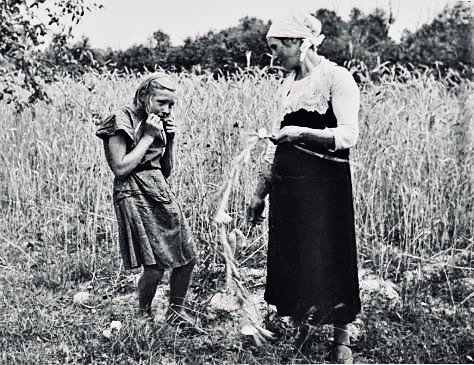
Photograph by Antanas Sutkus.
Ed Staskus posts monthly on 147 Stanley Street http://www.147stanleystreet.com, Made in Cleveland http://www.clevelandohiodaybook.com, Down East http://www.redroadpei.com, and Lithuanian Journal http://www.lithuanianjournal.com. To get the site’s monthly feature in your in-box click on “Follow.”
“Cross Walk” by Ed Staskus
“A Cold War thriller that captures the vibe of mid-century NYC.” Sam Winchell, Beyond Books
Late summer, New York City, 1956. The Mob on the make. The streets full of menace. President Eisenhower on his way to Brooklyn for the opening game of the World Series. A killer waits in the wings. A private eye working out of Hell’s Kitchen scares up the shadows.
Available on Amazon: https://www.amazon.com/dp/B0CRPSFPKP
A Crying of Lot 49 Publication
 147 Stanley Street