All in the Family

   By Ed Staskus

   Matt Poska twisted around in his seat, glaring at and swatting his brother’s hand off his shoulder. “Keep your hands off me” he said. “Who the hell do you think you are? You touch me again, there’s going to be trouble.” He couldn’t have been more to the point, although he didn’t necessarily want there to be a fight. He wanted his brother, however, to know exactly how he felt. Matt hadn’t trusted him for a long time and now disliked him on top of it. He knew having finally sold their mother’s house that push was coming to shove. The sooner the better, he thought.

   Ignoring Matt, his brother extended a warm salesman’s smile and a firm hand to the attorney on the other side of the big desk. “Call me Ray,” Raimondas said. He shook hands with the attorney. Ray’s new teeth glistened like Chiclets. His thinning hair was combed straight back.

   “You’ve got a nice tan for this time of year,” the attorney said. His hair was streaked with gray, his skin was grayish, and he was wearing a dark suit that might have been gray. A blizzard was blowing in from Lake Erie. The attorney’s back was to the window. Matt glanced through the window at snow whirling in the cold.

   “The wife and I just got back from two weeks in Jamaica,” Ray said. “We had a great time, great place.”

   “How’s the new car?” Ruta asked, shooting a venomous glance at her brother.

   “Couldn’t be better, drives like a charm, no problems.”

   “Just so I am clear about this, you three are related, brothers and sisters?” the attorney asked.

   “We used to be related,” Matt said.

   Their mother Irena’s problems began the day after their father’s funeral. She lost her appetite and couldn’t sleep. She had been married for sixty four years. She met her husband-to-be in Germany in a refugee camp after World War Two. They met again after both of them emigrated to the same small mining town in Canada. There had been no future for them in Europe. There were good-paying jobs in the Sudbury Basin. They got married in 1949 and were able to get into the United States in the late 1950s. It was where they raised their three children. They had been hard-working and by and large happy.

   Irena fell down in the kitchen in the middle of the night two years after her husband died. She had been thirsty and looking for something cold in the fridge. She fractured her right leg and lay on the ceramic tile floor until Ruta found her in the morning. She spent ten days at the Cleveland Clinic in Avon, two weeks recuperating at the Welsh Home in Rocky River, and a month of physical therapy at home.

   A year later she was back on her feet. She and Ruta visited relations in Toronto. She drove some of the way there and back on the New York Thruway. But the next year she had a mini-stroke and never drove again. Ray’s son Tyler convinced her to give up her Ford Taurus, telling her it was unsafe for her to be on the road. “You shouldn’t be driving,” Ray piped in. She signed it over to Tyler, but was sorry to see it gone. The car had represented independence, whether she drove it or not.  After it was gone she rarely left the house.

   Tyler immediately sold the Ford Taurus, even though it was more new than not. He bought a Toyota 4Runner. “This is more like it, not like that granny mobile,” he told his girlfriend. She didn’t like it when he told her to keep her dog out of the SUV, especially when he called her dog a mutt.

   When Irena caught Covid-19 she spent three weeks at the Cleveland Clinic in Avon. She was never the same after she got home. She had been in good health all her life, having grown up on a farm in Lithuania, but she was in her 90s. She craved salt, even though she had high blood pressure. Ray indulged her craving for it.

   “Stop bringing her those salted nuts,” Matt told his brother every time he saw a bowl of them in the house. “Are you trying to kill her?” He was exasperated. He threw the nuts away, but they always came back, along with bags of Malley’s chocolates and bottles of Gatorade.

   When she died the cause of death was listed as natural causes. Her last week was spent talking with ghosts during her wakeful hours and lost in dreams the rest of the time. Broken mirrors littered her memories. The real world no longer meant anything to her. Her greatest desire was to join her husband. Her last day was spent shutting down. She was tired and died of old age.

   Matt, Ray, and Ruta were in Saul Ammon’s legal office in the Marlowe Building on Detroit Ave. in downtown Lakewood, Ohio. Matt and Ruta both lived in Lakewood. Their mother had lived further west in well-heeled Rocky River. Their brother Ray lived in a new development in Sheffield Lake, even further west. They had sold their mother’s house, but Ray hadn’t lived up to their mother’s will. He had given Matt and Ruta half of what the will spelled out. He told them he was the trustee and had power of attorney and was doing what he thought best.

   “You mean best for you, like stealing all of mom’s savings and CD’s,” Ruta said. She was seething.

   Ray shrugged it off like it was something everybody did. He was never going to give his siblings access to their mother’s financial records. He wasn’t going to give them any of the nearly two hundred thousand dollars he had realized on the sly in the past two years. He wanted it to be understood he had his reasons, but he wasn’t going to talk about them. They didn’t need to know anything, although he wanted everybody to know he was honest as the day was long. 

   “Mom said she wanted to pay me for everything I was doing for her.”

   “You’re saying she paid you so much in two years that on the day she passed away she had less than nine thousand dollars left in the bank,” Ruta said. “She wasn’t a fool and I’m not a fool, either. Where are all her savings? If she hadn’t died she would have found out she was a pauper. How was she going to pay her bills?”

   “I have to take care of Tyler.”

   Ray’s son Tyler was a part-time drug dealer and a full-time party boy. He wasn’t able to stay out of jail or hold down a steady job. He had been fired from one job after another for thievery and lack of effort. Ray had been paying Tyler’s rent and bills for almost a year.

   “I took care of mom 24/7,” Ray said.

   “You are a liar,” Ruta said. “I was at her house every day. When she broke her leg I lived with her for a month. When she got a stroke I lived with her for another month. When she got the Covid I lived with her again. All I ever saw you do was run in, make her the same ham and cheese sandwich day after day, make sure she had taken her medications, and run out. You never stayed more than ten or fifteen minutes.”

   “How about all the times I took her to see doctors?”

   “I took her most of the time.”

   “I did everything for mom but nobody appreciates it. Matt didn’t do anything.”

   “Let’s stop arguing and get down to business,” Matt said. “I’m not going to go after you for what you did with mom’s Third Federal accounts. Our lawyer has told us it would be costly and time consuming. I don’t want it preying on my mind for however many years it might take.”

   Ruta didn’t say anything. Matt had asked her to sit tight until they wrapped up getting their share of the proceeds from the sale of their mother’s house. She had agreed, although she hadn’t told him she had talked to the Lakewood Law Department about elder abuse. She was going to someday make Ray pay for what he had done.

   Ray had been a problem for a long time. In the 1980s he fell deep in debt to a bookie who worked out of a back room at the Mentor Diner. Day after day none of his horses paid off. His bookie kept a strict ledger and got impatient. When Ray got married to a rich girl from Columbus their wedding reception was a gala. At the end of the day they had collected nearly forty two thousand dollars. Ray paid his bookie the thirty nine thousand dollars he owed him but neglected to tell his wife about it. When she started shopping for a house, planning the down payment, he had to spill the beans. They had been married fifty eight days on that day. She left him on the fifty ninth day and went home to Columbus. He never saw her again. The divorce was certified by mail.

   He dated several women after that, each one of them breaking it off with him after a year-or-so. He finally married Anita, a Jayne Mansfield with a family, who were two children by two passing boyfriends. They had a third child, who was Tyler. Anita was a beautician and a part-time actress. She was also an alcoholic. Three years after they divorced she drank herself to death. Ray married a woman named Karen soon afterwards. They both believed greed was good and lived the good life together.

   Ray put his greed to work when it dawned on him his mother had dementia and was dying. Her trustee was a second cousin who had long worked for Jones Day, one of the biggest law firms in the United States. Ray’s wife had a nephew who was an ambulance chaser in Pittsburgh. He drew up new trustee paperwork. Irena signed the documents without knowing what she was signing. The ambulance chaser also drew up new power of attorney paperwork. Irena signed those documents, too. Ray became the trustee and got power of attorney into his hands.

   He took the new power of attorney paperwork to a hair salon. Ray knew the manager from his marriage to Anita. He asked her to witness the document. She did, and so did a customer they asked, in return for a bottle of shampoo. Ray was pleased with his work that day, although he didn’t know his sister Ruta got her hair done at that same salon. One day, in passing, the manager told her about Ray and the documents. Ruta wrangled affidavits from her and the customer.

   “We have got two separate affidavits that swear you got their signatures on the power of attorney documents fraudulently,” Matt said. “They say mom was never present for them to witness her signature.”

   The lawyer pushed the two affidavits across his desk. Ray didn’t look at them. He looked at Matt.

   “What do you want?” he asked. 

   “You used your power of attorney to empty mom’s accounts at Third Federal but I don’t want to drive myself crazy over that,” Matt said. “What I want is, I want you to pay us the full amount that Ruta and I are due from the sale of the house, like it says in mom’s will.”

   “And if I don’t?”

   “If you don’t I will leave this office, go to City Hall, and file a criminal complaint with the Clerk of Court.” 

   “Can we make a deal?” Ray asked.

   “I’m not selling any alibis,” Matt said.

   “Remember me? I’m your brother.”    

   “I’ve got better things to do than remember you. Save your breath to cool your soup.”

   “Give me a break.”

   “No,” Matt said. “The banks are open right now. We’ll wait one hour. Bring certified checks. If you’re not back in an hour, I’ll go straight to City Hall.”

   “You know I didn’t do anything wrong,” Ray said, beside himself. “This is just a rip-off. I need that money. Tyler needs it, too. Karen might divorce me if she finds out about this, do you know that? Is that what you want? You want to see me homeless? The two of you, you’re both evil.”

   “Is that so?” Matt said. He knew Ray’s talk was horseradish.

   Ray shot Matt a dirty look. He was the kind of mother’s son who got mad when anybody didn’t believe whatever he was saying. Ray believed everything he conjured up, no matter what. He couldn’t distinguish between truth and lies anymore and so he couldn’t distinguish between right and wrong anymore. To be on the safe side, whenever he caught himself telling the truth, he reflexively told an untruth to keep his hand in. 

   It was a few minutes short of an hour when Ray returned and tossed two certified checks down on the lawyer’s desk. Matt slid one over to his sister.

   “You know we’re never going to see each other again after this,” Ray said, vexed and angry. Everybody’s got plans until you get hit in the face, he thought to himself bitterly.

   “That doesn’t make any difference anymore,” Matt said. “Go away and stay away.”

   “I can’t believe he would do that to mom,” Ruta said when Ray was gone. “Everything about this is too bad, really bad, but I don’t think he’s ever going to change. He’ll just find somebody else to fleece and blame whoever is handy.”

   “You’re probably right,” Matt said. “At least the joker has left the building,”

Ed Staskus posts monthly on 147 Stanley Street  http://www.147stanleystreet.com, Made in Cleveland http://www.clevelandohiodaybook.com, Down East http://www.redroadpei.com, and Lithuanian Journal http://www.lithuanianjournal.com. To get the site’s monthly feature in your in-box click on “Follow.”

“Cross Walk” by Ed Staskus

“A Cold War thriller that captures the vibe of mid-century NYC.” Sam Winchell, Beyond Books

Late summer, New York City, 1956. The Mob on the make and the streets full of menace. President Eisenhower on his way to Brooklyn for the opening game of the World Series. A killer waits in the wings. Stan Riddman, a private eye working out of Hell’s Kitchen, scares up the shadows.

Available on Amazon: https://www.amazon.com/dp/B0CRPSFPKP

A Crying of Lot 49 Publication

Flesh and Blood

By Ed Staskus

   The day Angele Jurgelaitis knocked on her aunt’s door in the spring of 1941 the sky was clear and sunny. Ona Kreivenas lived on a farm near Alvitas, where she taught grade school, and had a growing family on her hands. There were three children and an infant, Mindaugas, Carman, Ramute, and Gema. The new baby had come into being a year earlier. None of the children were older than Angele. Even Mindaugas, the eldest, was three years younger than their thirteen-year-old cousin from Gizai.

   Alvitas is a village on a lake of the same name. It is on the main road. There was a parish church built of stone, an elementary school, more than thirty houses, and almost four hundred inhabitants. None of them knew what was coming, although they all suspected.

   When Ona came to the front door she was by herself. She had lost her husband a year earlier. He had been transported to Siberia by the Russians. “He was a police chief,” Angele said about her uncle, Jonas Kreivenas. “The Russians took him. He didn’t do anything bad. It didn’t matter, they just took him away.”

   Ona had since become a stern woman. “She was pretty, like a doll, but I was afraid of her. I broke a dish one day and was scared to death of what she would say when she found out.” Her aunt welcomed the teenaged girl, who she had been half-expecting, if not warmly, at least with a measure of relief.

   Angele had spent the day walking to her aunt’s farmhouse from her family’s farm, where she decided she could no longer live with the stepmother her father had married the month before, six months after her mother’s death from pneumonia. She left three brothers and a sister behind.

   The Russians initiated arrests and deportations early in 1940, after the Red Army occupied Lithuania and the adjacent Baltic nations. Jonas Kreivenas was one of the first arrested that year. The Russians targeted government officials, nationalists, the well-to-do, Catholics, policemen, and everyone else they dubbed an “anti-Soviet element.” If you were a party member, you were going to prosper. If you weren’t, a Siberian slave labor camp was on the horizon.

   “I had a friend not far from our farm whose father was a blacksmith, who couldn’t even read or write. When the Russians came they threw out the mayor in the town where they lived and made the blacksmith mayor because he was a communist. Everyone high up, they threw out.”

   Mass arrests began a year later on the night of June 13, 1941. when NKVD men fanned out across the country, scooping up men and women and entire families, carrying them to Vilnius. Nearly twenty thousand Lithuanians were forced into the boxcars of seventeen trains on June 19th  and railroaded to the far end of Russia. Three days later the Wehrmacht invaded Lithuania, the Luftwaffe catching the Russian air force unaware on the ground and destroying it. By mid-week the Germans had swept all Russian resistance aside. The Russians were out. The Germans were in. “The Germans weren’t good, but life was better for us. At least they didn’t deport us. Most of us hated the Russians.”

   An independent Lithuanian government was put in place, but it soon became clear that the German occupiers held all the power. Lithuanian Jews began to bear the brunt of the occupation. They were forced to wear yellow stars and their money and property was taken away. Worse was on the horizon.

   Before Jonas Kreivenas was deported by the Russians he had gotten everything he needed to build an upstairs indoor bathroom, lumber, tiles, fixtures, a sink, and a bathtub. It was going to be his summer project. When World War Two ended the second floor was still torn up and the bathroom was still not a bathroom, but by that time nobody was living in the house.

   The house was brick instead of clapboard or notched logs, fitted with large front windows, four rooms on the ground floor, a kitchen and dining room, and two bedrooms. “My aunt lived on a farm that was bigger and much nicer than my father’s. It wasn’t primitive.” Her father had been a landless peasant until the Land Reform of 1922 when large Polish owned estates were confiscated and redistributed to peasants and soldiers.

   “Everyone where we lived had either a big farm or a small farm, although almost everyone had small farms. My aunt had a larger farm. She sometimes had men come and do work, but I still ended up having to work much harder than I ever did at my family’s farm.”

   There was a cellar where they kept canned food and apples in the winter. There were chickens, cows, two work horses, another horse for a buggy, and lots of pigs. “She had a herd of them. She had one of them slaughtered whenever we needed food.” Angele had to feed the pigs while they lived and fattened. “We kept a pot in the kitchen where I boiled potatoes for the pigs every day. I had to bring all the water in from the well, not just for the pigs, but for everything.”

   In the summer of 1941, within days of the Red Army’s collapse, the Einsatzgruppen followed the Wehrmacht into Lithuania, their mission being to exterminate Jews. Synagogues were set on fire and thousands of Jews killed in the streets. The German authorities claimed rioting was a menace to public order and rounded up the country’s Jews, isolating them in ghettos to “protect them.”  In 1943 the ghettos began to be demolished and the Jews, along with Roma and Russian prisoners, were transferred to concentration camps The genocide rate in Lithuania, where anti-Semitism had been endemic for years, was more than 90%, the highest in Europe.

   By the end of summer 1942 Angele was still working hard but tired of being a hired hand. “I was young, and I had a lot of energy. I didn’t get tired. I watched the kids. I loved Gema the most. Carman was my best friend. Ramute cried too much. She bent her own fingers backwards until they hurt and then started crying, saying that her hand hurt. I had to work all the time.”

   She worked from before sunup to sundown. “I was the cook and made soup every day. I made the beds and I had to work all around the farm.” She washed dishes and put them away. She washed clothes by hand and hung them on a line outside to dry. She washed the children, too, keeping them spic and span.

   “I was her sister’s daughter, but I was her house maid.”

   She made the fire that had to get going every day. Mindaugas was a strong boy and helped as much as he could. Carman helped, too. Ramute was unwilling to do much and Gema was too small to do anything. Ona went to town to teach school every day, although in the summer she worked in the fields. 

   Angele put feed and water out for the chickens. She gathered eggs early and often. She collected them twice a day, so they stayed clean. Twice a day kept the chickens from eating them, as well. She herded cows to their milking stalls. She wore knee-high boots when walking knee-deep in pig mire. She put pebbles in the manger with the oats so the horses wouldn’t eat too fast. She mended fences the best she could when the pigs and cows bumped into them.

   One day when she was on the second floor she overheard through an open window her aunt talking to a man in the front yard about that spring’s seeding.

   “I have a servant, but she’s still young, and only so good to me,” Ona said.

   Angele realized her aunt was talking about her, about her being more of a servant and less of a niece. “I promised myself from that moment that when I grew up I would never be anyone’s servant, that no one would ever say that about me again.”

   One day she and her father were sitting together in the yard of the family farm in Gizai. The dusk was gathering. “My father always called me Aneluke.” He told her his plans for the future. “Aneluke, when I die, I am going to leave the farm to you.”

   Her aunt had talked to her about vocational classes at a nearby farm school, where she could learn animal husbandry, vegetable production, and seasonal planning. But after working on her father’s farm, and then working on her aunt’s farm, she had made up her mind farming wasn’t in her blood. “I didn’t like animals, and I hated the ground, the earth. I was never going to grow up to be a farmer.” She was fourteen years old. She didn’t say anything to her father about the vocational classes, but she told her aunt no.

   When Angele’s grandfather died, Ona and her children went to Gizai for the funeral, but Angele had to stay behind and watch both the baby and the farm. “I was so unhappy,” she said. She thought about her future, even though in the here and now a war going on all around them. She thought about meeting boys. She thought about changing her name.

   “I never liked my name. My father understood. That’s why he called me Aneluke.”

   Her youngest brother didn’t like his name, either. Even though he been christened Mindaugas, after the legendary king, he changed it. When he told everybody far and wide, young and old, that his new name was Jozukas, everybody went along with him and he became Jozukas from then on.

   She made friends with a boy she met at a dinner at a neighboring farm. They sat next to each other and talked. “I liked him, but one day Mindaugas and I were going to Vilkaviskis in the buggy when I saw him on the road. He was on a bike and a girl was walking beside him, walking towards us. They were holding hands. After that, I didn’t like him at all.”

   Her aunt decided to bring electricity to the farm. Although electricity was available in the cities, voltage drops over distance often made rural electrification too costly or simply impossible. When farmers had the chance to tap into a network they often jumped at the chance.

   Ona’s fertile croplands paved the way out of the dark for the family. She arranged for the work to be done, making plans through her relations. They found an electrician to do the work for her. “My aunt sent me to Vilkaviskis to pick him up, the electrician from Kaunas, who was coming on the train.”

   Until 1941 Vilkaviskis had a large Jewish community. That summer SS death squads, assisted by Lithuanian auxiliaries, killed more than three thousand Jews. It was virtually every single one of them in the town. In 1943 many Jewish ghettos in Lithuania were demolished and the still living were transferred to concentration camps. When the war ended almost none of them were alive anymore. The genocide rate in the country, where anti-Semitism had been endemic for generations, was more than 90%, the highest in Europe.

   Vilkaviskis, on the banks of the Seimina River, is almost fifty miles northwest of Alytus. After Angele hitched up the horse to their buggy, it took her and her cousin Mindaugas all day to get there. They skirted the ruins of the Jewish quarter. That night they slept in the wagon and the next morning set off for home, taking the electrician with them.

   “He was hard to understand,” she said. Lithuanians from different regions of the country have accents and dialects and often have their own way of saying things. “There was a man from Zemaitija once, we could hardly understand anything he was saying. They drop the endings of their words.”

   There was a severe shortage of sugar throughout Europe, disrupted by worldwide conflict and blockade. The German military needed it to support its armed forces and its war effort at home. Sugar beet planting in Poland and the Baltics was ramped up. In 1942 more than 20% of Lithuanian farmers, the most ever, cultivated sugar beets. Production was expected to increase by 25% in 1943. Potatoes were in high demand. Grain was in high demand. The Axis paid in Reichsmarks, better money in Europe than anybody else’s.

   Ona Kreivenas invested her bounty from sugar beets into electrification. “The electrician put in wires and lights. The black box was in the kitchen.” The children were warned to never touch it. “We didn’t have to use oil lamps anymore. We were so happy.”

   Carman, Ramute, and Angele slept in the dining room, an improvised bedroom in the four-room house. To the left of the foyer was the kitchen and to the right was the dining room. Ona had the large bedroom and Mindaugas the small one. At the back of the house stairs led to a root cellar.

   “We read books at night until Ona told us lights out. She was a strict mother. We would always turn the light off right away. She knew when we did because she had a blinking light in her room which told her when the lights had been turned off. We pretended being quiet until we knew she was asleep and then turned the light back on so we could read some more. After we got tired of reading, we turned the light off and talked until we finally fell asleep.”

   In March 1943 the Germans closed the Academy of Education and all Lithuanian schools of higher education. Ona taught grade school and wasn’t affected. She continued going to work. Everybody was uneasy. The war on the Eastern Front wasn’t going well for the Wehrmacht. They were losing the ability to mount offensive operations.

   “I couldn’t go to school because I had to work so much. I finished six grades and I wanted to learn, so my aunt found a tutor for me. I went to her house for two years, studying high school.” She wanted to be somebody other than a maid or a farmhand.

   Two months later in May the Gestapo shut down Lithuania’s local electorates. In September the last Jews in the ghetto of Vilnius were dragged out of their homes. Those who could work were sent to labor camps. The rest were shot. 

   When the new year of 1944 came, news was broadcast that Antanas Smetona, the first and last president of independent Lithuania, who fled his home and country in 1940, had died in a house fire in Cleveland, Ohio. His death closed the chapter on the interwar years, when Lithuania had been free and independent.

   “We had a radio and listened to the news every day. We knew it was bad for the Germans all that spring. We knew the Russians were coming back.” Everybody was worried and scared about the return of the Red Army. “We all knew something bad was going to happen.”

   In early August 1944, the Wehrmacht was driven out of most of Lithuania by Soviet forces and Russian hegemony was re-established. They were the same days that marked the Battle of Normandy in the west, which soon led to French liberation and independence.

   “When the Russians came it all happened in one day. In the morning we got our wagon, the horses, the four children, and a cow. We needed the cow to give milk for Gema. We left as fast as we could.” They and hundreds of other families camped at a large farm a few miles from the East Prussian border, biding their time. When the Red Army again pushed west in September, and what was left of the Wehrmacht fled before them, the refugees crossed the frontier.

   “We got across the border into East Prussia at night. It was a cold night, and wet. There wasn’t a single border guard. Nobody else in my family, none of my brothers or my sister, nobody, made it out before the border was closed by the Russians.”

   She was free in Germany for the moment, and would stay for four years, in and out of DP camps until finally securing a Canadian work visa, but her kinsmen and friends and the rest of the country stayed under the  thumb of Moscow for the next nearly fifty years. She never saw her parents again and by the time she saw her brothers and sister again, after the rise of Mikhail Gorbachev in the mid-1980s, they had grown old and their children had all grown up.

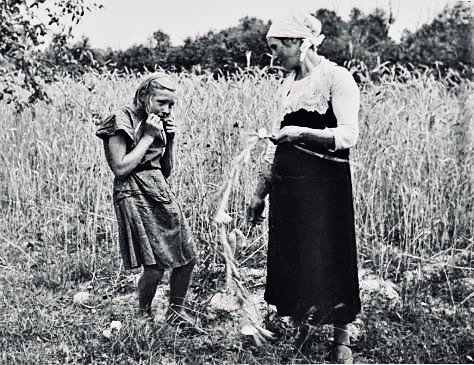
Photograph by Antanas Sutkus.

Ed Staskus posts monthly on 147 Stanley Street  http://www.147stanleystreet.com, Made in Cleveland http://www.clevelandohiodaybook.com, Down East http://www.redroadpei.com, and Lithuanian Journal http://www.lithuanianjournal.com. To get the site’s monthly feature in your in-box click on “Follow.”

“Cross Walk” by Ed Staskus

“A Cold War thriller that captures the vibe of mid-century NYC.” Sam Winchell, Beyond Books

Late summer, New York City, 1956. The Mob on the make and the streets full of menace. President Eisenhower on his way to Brooklyn for the opening game of the World Series. A killer waits in the wings. Stan Riddman, a private eye working out of Hell’s Kitchen, scares up the shadows.

Available on Amazon: https://www.amazon.com/dp/B0CRPSFPKP

A Crying of Lot 49 Publication