Brother From Another Planet

By Ed Staskus

   I wasn’t a sportswriter or a sports photographer at the time, but I had a media pass so I saw more Cleveland Cavalier games in the flesh during the 1980-81 season than I have ever seen in my life. I saw them from a better seat, too, even though I didn’t have a seat. I sat, stood, or knelt court side, sometimes under the baskets at the base of the stantions or beside the benches, and pretended to be doing something like taking notes. Nobody questioned my Kodak Instamatic Point & Shoot camera or schoolboy spiral notepad, even though the camera was rarely loaded with film and I often forgot to bring a pen.

   I got the media pass from my brother, who was a student at Lakeland Community College in Kirtland. He worked part-time for the school newspaper. He was their communications and media man. I had it laminated and wore it clipped on my belt. Whenever anybody bumped me jostling in or out of the arena I checked to make sure the pass was still on my belt. It was worth its weight in gold, getting me in to see the wine and gold whenever I wanted.

   The Cavaliers weren’t very good in 1980. Mike Mitchell was their best player. It was a steep drop-off from there. Bill Musselman, who was the coach, didn’t have much to work with and it showed on his game face game after game. The team finished the year twenty four games out of first place.

   My drive to the Richfield Coliseum in Richfield Township, twenty-five miles south of where I lived near downtown Cleveland, was long and longer, especially whenever they were playing a league-leading team like the Boston Celtics or Philadelphia 76ers. I soon enough learned to go early or get stuck in traffic. The Richfield Coliseum was Larry Bird’s favorite basketball arena, but he didn’t have to drive there. An interstate and a turnpike dumped cars onto a two-lane road in the middle of nowhere. It was a snail’s pace at the best of times. The traffic issues got worse the worse the weather got. In addition, the single level concourse made for massive congestion among the fans and nobody liked that, either. I had to pay for parking, which I didn’t like, although I brushed it off. Once I flashed my pass and strolled in without a hitch I was happy again.

   A lot went on at the Richfield, Coliseum, including concerts, truck pulls, rodeos, circuses, ice shows, wrestling, hockey, and indoor soccer. The arena hosted a championship boxing match between Muhammad Ali and Chuck Wepner in the mid-70s. The fight went to the bitter end, the human punching bag holding on for dear life but going down nineteen seconds before the final bell, losing in a TKO and inspiring Sylvester Stallone’s movie “Rocky.”

   The Cavaliers weren’t the first pro basketball team in Cleveland. The first three teams, starting in 1924, were the Rosenblums, the Rebels, and the Pipers. When the “Miracle of Richfield” happened during the 1975 season, the Cavaliers advancing to the Eastern Conference Finals, everybody forgot about the team’s basketball pioneers, if they had ever thought about them in the first place.

   The Richfield Coliseum opened in October 1974 with Frank Sinatra doing the honors. When he sang “My Way” the sold-out crowd roared its approval. “My friend, I’ll make it clear, I’ll state my case, of which I am certain.” Nobody roared louder than Nick Mileti. He had been a prosecutor in the inner-ring suburb of Lakewood, but then got the bug. “I want to have fun, make some dough, and leave a few footprints,” he told sportswriter Bob Oates of the Los Angeles Times.

   “Nick could sell you the Brooklyn Bridge, whether you wanted it or not,” said Bill Fitch, the Cavaliers coach from 1970 to 1979. The new arena in the middle of nowhere was the immigrant Sicilian son’s Brooklyn Bridge to glory. “My daddy was a machinist who came over as a teenager and had a dream that I was to wear a white shirt,” he said.

    He started by buying the Cleveland Arena and the city’s hockey team. He owned the Cleveland Indians baseball team for a while and then picked up the basketball team. He wasn’t using his own money, but he doctored it to look like it was his. After a while he took a good look at the 30-plus-year-old Cleveland Arena with its bad plumbing and a seating capacity of only 11,000. What he saw was money flying out the window. The players called it “The Black Hole of Calcutta.” They later called the new arena “The Palace on the Prairie.”

   “We met with the guy running the old arena,” Nick Mileti said. “On the wall, there was a calendar, and I said, ‘Why is it all white?’ They said, ‘Because we don’t have any events.’ It was an incredible situation. I bought the Barons and the arena, and after that, the first call I made was to Walter Kennedy, the commissioner of the NBA, and said I wanted a franchise. And two years later, I got one.”

   When in the early 1970s he decided on moving the basketball team halfway to Akron to do better business, every Cleveland politician and businessman was against the idea. They wanted to revitalize downtown, not vitalize someplace in the boondocks. They wanted the cash flow of twenty thousand fans driving in forty or fifty times a season. They wanted the countless concerts, circuses, and events the venue would host. They wanted the tax revenue. They didn’t get what they wanted. But that was what Nick Mileti wanted, and that was that.

   I didn’t get to know any broadcasters doing the games, but I got to know some of the writers and cameramen well enough to say hello. They were guys like Bill Nichols, Chuck Heaton, and Burt Graeff. One or the other of them was always giving me the fisheye. When I saw it happening, I pretended to be taking a picture with my Instamatic. The only newshound I was on more than hello and goodbye terms was Pete Gaughan. He was a sportswriter for the SunMedia suburban papers, writing about golf, high school, college, and pro sports, and anything else that involved hitting, kicking, throwing, or catching a ball. I met him while refereeing flag football Sunday mornings at Lakeland Community College.

   My brother had started a flag football league there with four teams. By 1980 he had two fields and fourteen teams. The teams were mainly made up of former high school players. He and I were the only two refs at first, but as more teams joined, he needed a second and third two-man crew. He paid $20.00 to each ref each game, but still had trouble recruiting and keeping crews for the Sunday morning games. When Pete Gaughan volunteered and my brother took him on, it was scraping the bottom of the barrel. Pete may have known all about local sports, but he didn’t know how to be on time and was indifferent about the rules.

   The first Sunday I met him he misjudged a parking space and brought his rust bucket to a stop on the wrong side of the curb. When the driver’s door swung open, the car still running, a half dozen empty Budweiser cans rolled out, a leg flopped here and there, and he finally staggered out of the car in a cloud of cigarette smoke. He looked like hell, like he hadn’t slept in a week. I turned his car off while my brother got him into ref’s clothes, gave him a whistle and a penalty flag, and decided he would work with me.

   “Thanks, bro,” I said while he trotted off to another field.

   Pete worked behind the offensive line while I worked downfield. He didn’t blow his whistle or throw his yellow rag once, not even when there was blood. One of the teams was made up of former Mentor High School players, and unlike most of the teams, they ran the ball more than they threw it. They were the number one team in the flag football league because they had played together in school and knew how to execute. One guy on the opposing team got tired of being battered by the relentless running attack, and when the halfback came through the line one more time the ball tucked under his arm, the other arm swatting hands away, he didn’t bother trying to reach for either of the flags on the runner’s waist. He raised his forearm head high and let the halfback’s nose run into it. He went down like a shot and blood gushed out of his nose. Pete spotted the ball at the spot and stepped to the side, lighting up a cigarette. 

   We called 911 and after an EMS truck showed up, they drove off with him, telling us his cheekbone was fractured along with his messed-up nose. We called the game. The Mentor boys were up by eight touchdowns anyway. Pete popped a Budweiser.

   By the 1980 season the “Miracle of Richfield” was five years in the dustbin and Nick Mileti had given up his title as president of the Cavaliers, sold his interest, and control of the team went to Ted Stepien, the King of Errors. There weren’t going to be any miracles under his reign. The NBA stayed busy writing rules addressing some of the crazy things he was prone to doing. He traded away five consecutive first-round picks. The wrote the Stepien Rule, which states no team can trade away consecutive first-round draft picks.

   In the meantime, I tried to see all the games involving the better teams in the league. The Cavaliers were a half-good team who could keep up with other half-bad teams. They had trouble with the cream of the crop. That year they went 1 and 4 against the Celtics, 1 and 5 against the Bulls, 0 and 5 against the Knicks, 0 and 6 against the Bucks, and 0 and 6 against the 76ers.

   The Philadelphia team was my favorite team. They were always in the hunt for the title. Maurice Cheeks and Doug Collins were the guards. Bobby “The Secretary of Defense” Jones cleaned up around the basket. Julius “Dr. J” Erving and Daryl “Dr. Dunkenstein” Dawkins led the scoring parade. When the doctors were in the house, they were good for almost fifty points. Julius Erving was menacing enough, but Daryl Dawkins was a menace unto himself.

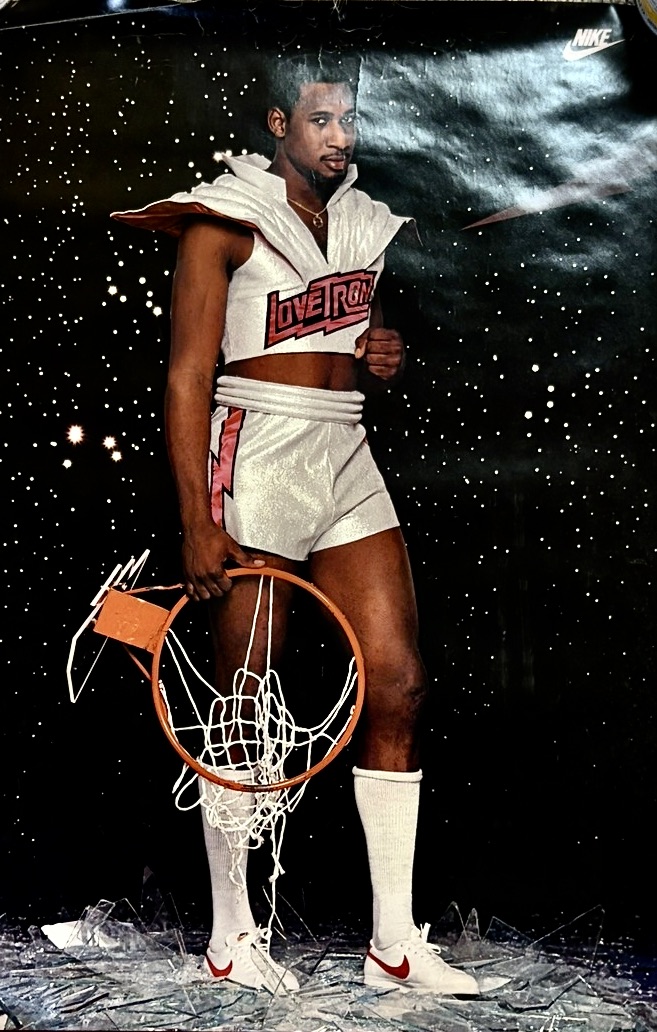
   A year earlier in a game against the Kansas City Kings in KC, dunking the ball with enthusiasm, Daryl broke the backboard, sending both teams ducking. Three weeks later, he did it again at home against the San Antonio Spurs. The next week the NBA wrote a new rule that smashing a backboard to smithereens was wrong, so wrong that it would result in a fine and suspension.

   Daryl named his backboard-breaking dunks “The Chocolate-Thunder-Flying, Teeth-Shaking, Glass-Breaking, Rump-Roasting, Wham-Bam, Glass-Breaker-I-Am-Jams.” His other dunks earned their own names, like the Rim Wrecker, the In-Your-Face Disgrace, the Spine-Chiller Supreme, and the Greyhound Special, for when he went coast to coast. “When I dunk, I want to go straight up, and put it down on somebody.” 

   His nicknames were Sir Slam, Chocolate Thunder, and Dr. Dunkenstein. He wore a LoveTron t-shirt while warming up. He told the Cleveland sportswriters he was an alien from the planet LoveTron, where he spent the off-season practicing “interplanetary funkmanship” with his girlfriend Juicy Lucy. The reporters scribbled it down like it was sirloin.

   His coach asked him to tone it down. “All the talk and bravado, enough,” Billy Cunningham said. The next day at practice Daryl told his teammates, “I’m not talking today. Coach made me Thunder Down Under.” It didn’t last long. He went back to talking the next day.

   Daryl Dawkins was in his mid-20s, six foot eleven, and 260 pounds of beef, brawn, and swagger. The Cavalier centers were Kim Hughes and Bill Lambeer, both six eleven, but both slower and skinnier than Daryl, who wore gold chains during games. One of them featured a cross while another one proclaimed Sir Slam in gold script. Sometimes, he would shave his head and oil it, along with wearing a gold pirate’s earring. 

   The year before he had averaged almost 15 points and 9 rebounds, helping the 76ers to the NBA Finals, which they lost in six games to the Los Angeles Lakers. I watched him go coast to coast against a back-pedaling Bill Lambeer one night. If it had been the other Cavalier center, Kim Hughes, about 40 pounds lighter than Daryl, he wouldn’t have even bothered back-pedaling. Bill Lambeer was far more stubborn. All the way to the inevitable slam dunk Daryl’s gold chains swung one way and the other way slapping at Bill’s face until he finally ducked and covered. The next year the NBA forbade the wearing of any jewelry while playing ball.

   The last three games I saw at the Richfield Coliseum were the last three games of the season. The Cavaliers lost by 26 to the Bucks, by 21 to the 76ers, and by 35 to the Bullets. It had been a long year. The opening game of the next season boded another long year when the wine and gold lost to the 76ers by 24. But before that game was even played, I didn’t have a media pass anymore and wasn’t planning on going back to the Richfield Coliseum anytime soon. I didn’t have a dependable car and God forbid I break down in the cow pastures of Summit County in the middle of the night.

   I missed going out there, missed the lights and noise, groaning and cheering, being on the floor, the action and excitement, the coaches fuming and cursing, and the players putting up with venomous fans sitting behind them. Daryl Dawkins wasn’t big on putting up with anything. When he flaked on a dunk one night, hearing the catcalls, he kicked somebody’s extra-large Coke off the floor, sticky sugar water spraying on everybody in the big-ticket seats. He didn’t look back and didn’t apologize. I kept a firm grip on my jumbo soft pretzel.

   After the Cleveland Cavaliers returned to Cleveland to a new arena the Palace on the Prairie closed and the parking lot went to weeds and shadows. I walked to games downtown a couple of times, but the atmosphere was more corporate than cutthroat and I didn’t go back. Besides, they were charging corporate prices for the tickets, and I wasn’t about to bust my piggybank to cheer grown men in shorts bouncing a ball from one end of a hardwood floor to the other end. Besides, the last time I checked on Daryl Dawkins, he was playing for the Harlem Globetrotters. That was where the fun and games were.

Ed Staskus posts monthly on 147 Stanley Street at http://www.147stanleystreet.com, Made in Cleveland http://www.clevelandohiodaybook.com, Down East http://www.redroadpei.com, and Lithuanian Journal http://www.lithuanianjournal.com. To get the site’s monthly feature in your in-box click on “Follow.”

“Cross Walk” by Ed Staskus

“A Cold War thriller that captures the vibe of mid-century NYC.” Sam Winchell, Beyond Books

Available on Amazon: https://www.amazon.com/dp/B0CRPSFPKP

The end of summer, New York City, 1956. Stickball in the streets and the Mob on the make. President Eisenhower on his way to Ebbets Field for the opening game of the World Series. A torpedo waits in the wings. A Hell’s Kitchen private eye scares up the shadows.

A Crying of Lot 49 Publication
Never Look Back

NEVER LOOK BACK.jpeg

By Ed Staskus

   The blitzkrieg that started World War Two in 1939 won the Third Reich most of Europe and substantial parts of Russia. Five years later the Red Army was poised to take revenge on its enemy. When the Wehrmacht on the Eastern Front tried to weather the storm and fight out of encirclements, the Russians did what the Germans would have done, fed armor into the attack, maintaining mobility, and forcing the issue deep into rear areas, faster than the enemy could respond. Their M4A2 Sherman tanks, built by the United States, could be replaced when destroyed faster than German factories could take a breath. “Gute trauer” was all they could say.

   “The Russians came fast,” Angele Jurgelaitis said. “We listened to the radio every day. We could hear booming in the distance, the bombs and cannons. The Germans were all over the roads. The Russians were to the north and the east of us. Everybody knew they were coming.”

   The baby of her aunt’s family, the family Angele was child minding near Alvitas, in southeastern Lithuania, didn’t know, but everybody else in the Baltics knew the Red Army was coming back and there was going to be hell to pay. “Everybody was worried and unhappy.” Most Lithuanians had sided with the Germans. There were centuries of enmity between Vilnius and Moscow. The Russians were imperialists.

   It was in the summer of 1944 that Muscovite forces went on the offensive. The Germans were pushed back on a shifting front. Armored tank columns from both sides advanced on Vilkaviskis, four miles away from where Angele was. If it wasn’t for land mines she could have walked there in an hour. The Russian 33rd Army entered the town a few days later and then secured the rail depot at Marijampole. The Third Panzer Army mounted a counterattack, but after several grim tank battles was finally forced to retreat to Kybartai, rolling back to a last-ditch defensive line. Neither the Germans nor the Russians listened to a single Lithuanian who said the land wasn’t their land to fight over.

   “It was one day in the afternoon that a lady, a teacher, who was one of my aunt’s friends, with two kids, a small boy and a small girl, came to our farm from Vilnius,” Angele said. The woman and Angele’s aunt, Ona Kreivenas, had studied and graduated together from a teacher’s college. She was in a horse drawn wagon with her children and what chattels and valuables she could  carry. She had come from Vilnius in a rush. She told them there was Russian armor hiding in the woods on farm tracks.

   The next morning Ona, Angele, and the children, Mindaugas, Carmen, and Ramute, loaded their wagon with clothes, blankets, food, and the baby Gema. They hitched two horses to the wagon and tied a cow to the back. “We took milk with us when we left, for Gema, and hoped we would find more when we were gone.” They took whatever they could carry. They left their Sunday buggy behind and let the riding horse, the rest of the cows, and all the pigs and chickens loose. The friend followed them.

   “My aunt let all the animals go. What could we do? The Russians would have just stolen all of them.”

   Ona Kreivenas took all her money and what jewelry she possessed with her in a handbag that she could keep close to the vest. She and the children filled a trunk with her sewing machine, china, vases, and family heirlooms. They lugged it behind the barn, where the remains of months of potatoes thrown down to feed the pigs were piled up.

   They cleared a space, dug a four-foot deep hole, and buried the trunk. They threw potato scraps over the overturned ground. When they were done, they left in two wagons with their friend. They were two women, seven children, and a cow on the move, suddenly homeless in their own homeland.

   “We moved back about fifteen miles.” They went southwest towards East Prussia. “We stopped at a big farm. When we got there, there were already hundreds of people in the fields, with their wagons, and their families. The farmer slaughtered and cut pigs up for us. All the women made food. Everybody was talking about the war, about what to do.”

   There was heavy fighting between German and Soviet troops in the Baltics. As the fighting raged, more than a hundred thirty thousand Latvians escaped to Sweden and Germany. In total, the country lost almost 20% of its population during the war, either dead or gone. The ‘Great Escape’ in Estonia started in the summer and continued through the fall. It is estimated eighty thousand Estonians fled from the Red Army to anywhere else. Almost one hundred thousand Lithuanians joined them, clogging the roads to Poland, Prussia, and Germany.

   Ona Kreivenas crept back to her farm during the week the Panzer divisions were holding their own. The countryside was a ghost town. She discovered the trunk they had buried behind the barn had been dug up and was gone. “There was just a big hole. The Russians took it. They used metal sticks to poke into the ground. Her sewing machine was gone, all gone, everything gone.”

   They slept rough, out of doors, like everybody else. “We slept on blankets on the ground. When it rained, we slept under the wagon and stretched a tarp out to keep the water away.” Every day it got darker. Over the course of September, the length of day in Lithuania rapidly decreases. By the end of the month the daylight is two hours less than it was at the start of the month.

   Their encampment stretched out for six weeks. They dug latrines and filled barrels with water. They picked apples off trees and blueberries from bushes. They took especial care of their horses. They greased the axles of their wagons, making sure the grease bucket was always full of animal fat and tar, and making sure they had a spare axle. Without one a broken axle would be a disaster, bringing them to a standstill.

   The children played games whenever they had idle time. “We played the ring game,” Angele said. “We all sat in a circle and passed around a pretend ring, like a twig or a pebble. Sometimes we passed it, but other times we didn’t. We just pretended to give it to who was next to us. One of us was it, like in tag, who had to guess who had the ring. If they were right, they got a prize, like a pencil. If they were wrong, they had to sing a silly song or do a dance in the middle of the circle.”

   When they finally left, they left in the early evening. They had heard over the radio that morning that the Russians had come closer. They spent the day packing and preparing. It was now or never. “Most of us left, although some stayed. Some of the farmers wanted their land back. They didn’t want to leave.” It was all they had. It was all they had ever known. They were loath to give it up. “My aunt had to go, no matter what. The farm didn’t matter. Her husband had already been taken by the Communists. She knew they would take her, too, if they caught her, send her away to Siberia, and her children would be left behind, orphans or worse.”

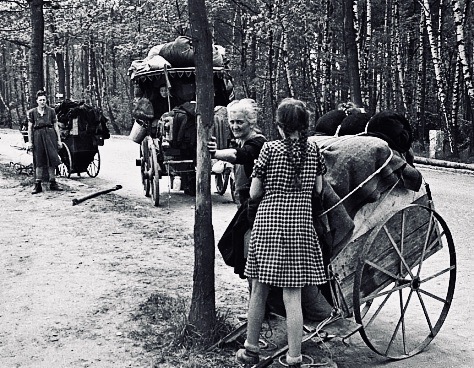
   It rained that day and the rest of the night. “The road was crowded on both sides. There were thousands of wagons, wagon after wagon, all going one way. There wasn’t a single car or truck, just horses. We knew the Germans were somewhere ahead of us and the Russians somewhere behind us, but we didn’t see any soldiers anywhere”

   Ona Kreivenas was at the reins of the two-horse team, her seven-year-old daughter Ramute holding the baby, and the rest of the children walking. Most of the refugees were walking, their wagons jam-packed with possessions and provisions. Their friend from Vilnius with her two small children stayed in line behind them.

   Before the war, Lithuania’s population was almost three million. After the war it was closer to two million. Some Lithuanians ended up dead. Many were deported. Others ran for their lives. The displaced were forced to make new lives in different countries all around the world, whatever country they could get to, whatever country would take them, whatever country they could sneak into.

   When the second Soviet invasion of the 1940s happened, some Lithuanians tried to flee across the Baltic Sea to the Nordic countries, but only a few were successful. Patrol boats apprehended them, and they ended up hauled off to labor camps. Most fled west, while others went south to Hungary, Romania, and the Balkans.

   “On the way we met my uncle on the road, Uncle Jankauskas and his family.” Her uncle’s wagon fell into line with them. The progression of wagons stretched as far as the eye could see, ahead and behind. They soon crossed into East Prussia. There were no guards. They had all fled. The borderland was a mess.

   “I was so sad leaving Lithuania,” Angele said.

   Russian warplanes strafed and bombed the column of evacuees several times. The Red Air Force was bombing and strafing at will, both German Army and refugee columns alike. Forest and brush on both sides of the road were set on fire. There was smoke in the sky day and night. Wagons and carts slowly wended their way around rain-filled craters.

   “It was all just wagons. They knew we were refugees They dropped bombs and shot their machine guns. I don’t know why they did that. Whenever we heard airplanes, we all ran and jumped into ditches beside the road. I was afraid, but somehow I knew I wouldn’t be hurt by them.”

   What was called the Baltic Gap had grown so menacing to the Reich that Adolf Hitler moved his headquarters from Berchtesgaden to Rastenburg in East Prussia. The German situation on the Eastern Front was desperate. The fighting was hard. It was a fight to the finish. The hinterland was torn up, abandoned and forlorn.

   “Most of the people on farms had run away. We would go into their houses and find dried fruit, pickles, mushrooms, pork, and wine.” They ransacked barns, pantries, and root cellars. “We took all the food we could find, all of it. It rained most of the time, it was cold, and we walked and walked. Everybody was hungry.”

   The rain and asphalt road were hurtful to their cow. The animal was careful as could be on the poor traction of the wet road, stepping timidly with its rear feet spread wide. It was compensating by walking with an arched back. They finally had to do something. They knew the long miles and pavement weren’t good for it. They thought she might be going lame. Angele’s uncle looked at the cow’s hooves and saw lesions. An ulcer was forming on one hoof.

   “Mindaugas and I found a family that hadn’t run away. We went to their farmhouse and sold the cow to them.” They gave the money to Ona Kreivenas and she hid it on her person with the rest of her money. She had plans for it. Her plans were all about survival.

   One cold night when they stopped to rest her uncle said, “Kids, jump up and down to warm yourselves up.” When Angele stopped jumping, he grasped her under the armpits. “He grabbed me. We were jumping up and down and he dropped me by accident.” She broke her wrist. “It hurt bad, but there were no doctors to help me.” When they got to a town with a railroad station, there weren’t any doctors there, either. The smart and the skilled had already left. Everybody else was hoping against hope. Angele’s wrist had to take care of itself.

   After the New Year the German population of East Prussia, most of whom had not yet cut and run, began to evacuate as the Red Army rapidly advanced. Within weeks it turned into helter-skelter flight as more than two million of the two-and-half million men, women, and children of the enclave bolted into the Polish Corridor heading for Germany. The winter weather was bad, the roads were caving in, and the civil authorities were overwhelmed. There was panic and quagmire and many thousands died, some caught in combat, others swept away in the chaos.

   But before that happened, Ona Kreivenas had already sold their wagon and horses and everything they couldn’t carry and managed against the odds to get passage on a train going to Berlin. The Prussian Eastern Railway connected Danzig and Konigsberg to Berlin. A month later, the last week of January 1945, the last train to Berlin ran the rails. There was no traffic on the line after that.

   “The train was completely full. The corridors were full, too.” They stood clumped together in the corridor. The passenger cars were red and had ten large windows on both sides. They were pressed against one of the windows. Some of the windows were smashed and the passageway was as cold as the outside. “We had a pillow for Gema, who slept on the floor, but we stood that night and the next day.”

   The twin locomotives pulling the long line of passenger cars and baggage cars were in camouflage livery. On their front was painted the Hoheitsadler, an eagle, Germany’s traditional symbol of national sovereignty, holding a swastika in its talons. By the time they crossed Poland and entered Germany, the talons and swastika were obscured by coal soot.

   Lehrter Bahnhof was the Berlin terminus, adjacent to Hamburger Bahnhof, built in the late 19th century just outside of what was then Berlin’s boundary on the Spree River.  It was built in the French neo-Renaissance style, the façade covered in glazed tiles. The station had long been known as a “palace among stations.” But it had been severely damaged by Allied strategic bombing and was near to being a shambles.

   When they finally got off the train in Berlin they were met on the platform by Bishop Brizgys. The clergyman was Ona’s husband’s cousin. Vincentas Brizgys had been the assistant to Juozapas Skvireckas, the archbishop of Kaunas. During the summer of 1944 he and the archbishop and more than two hundred other Lithuanian priests fled the country with several retreating German army divisions. Ona Kreivenas had somehow located him by telephone, and he arranged to meet them at the train station. He was wearing a dark suit and a homburg and carrying a basket of hot buns.

   “He gave one to each of us. I was so happy,” Angele said.

   She was 16-years old, somewhere between childhood and adulthood. She was very tired. In the meantime, hope in tomorrow was the only thing keeping her on her feet.

   The Third Reich’s war economy was on the verge of collapse. The whole country was a sinking ship. There was a shortage of bread, sausage, cabbage, and everything else. When they looked around, the buns the bishop had brought were the only cheer they could see. There wasn’t going to be any traditional roast goose this holiday season.

   Angele looked at the four children and her aunt. She looked up and down the platform. Their friend from Vilnius and her uncle were long gone, lost in the fog of war. Bishop Brizgys led them out of the station into the city. The Red Army numbering over four million men was massing on the Vistula River and along the East Prussian border. Their superiority was ten to one in infantry and twenty to one in artillery and planes. Berlin and its three million residents were already a wreck, the day and night Allied bombing taking a monstrous toll.

   The early afternoon was a gray haze. There was smoke in the sky. It was a kind of darkness at noon. She saw heaps of rubble in the street. When she looked all around she knew in her bones it was going to be a bare-bones winter on German soil. There was no looking back. She walked towards what was left of Berlin.

Ed Staskus posts monthly on 147 Stanley Street at http://www.147stanleystreet.com, Made in Cleveland http://www.clevelandohiodaybook.com, Down East http://www.redroadpei.com, and Lithuanian Journal http://www.lithuanianjournal.com. To get the site’s monthly feature in your in-box click on “Follow.”

“Cross Walk” by Ed Staskus

“A Cold War thriller that captures the vibe of mid-century NYC.” Sam Winchell, Beyond Books

Available on Amazon: https://www.amazon.com/dp/B0CRPSFPKP

The end of summer, New York City, 1956. Stickball in the streets and the Mob on the make. President Eisenhower on his way to Ebbets Field for the opening game of the World Series. A killer waits in the wings. A Hell’s Kitchen private eye scares up the shadows.

A Crying of Lot 49 Publication