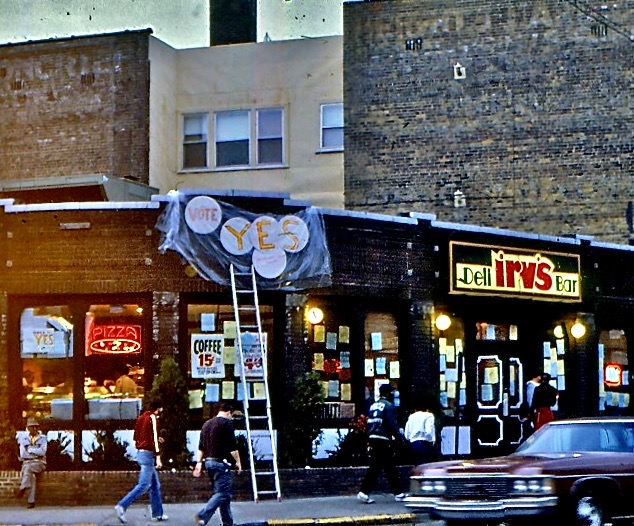
Chilling at Irv’s

By Ed Staskus

   Every Friday and Saturday in the 1970s deli’s like Solomon’s in South Euclid, Budin’s in Shaker Hts., and Irv’s in Cleveland Hts. were packed to the gills. The minute the front doors opened the smells of pastrami and corned beef wafted out like minstrels. We followed our noses. The minute anybody sat down was the minute a cup of coffee and a menu appeared. After that it was about waiting for a waitress to bring the sandwiches, French fries, and pickles.

   Even though we hardly ever went to Solomon’s, and only stopped in at Budin’s when we were going to the nearby Shaker Movie Theatre, I was at Budin’s one day having a bagel and coffee when Sandy Herskovitz’s friend won a bet. “I was sitting with a friend,” Sandy said. “A few tables down there were some women. One of them had on a straw hat. A countermen walked by with a jug of coleslaw and my friend says to me, ‘How much do you want to bet that guy is going to dump the coleslaw on the straw hat?’ OK, I’ll take that bet. Sure enough, he tripped and dumped his coleslaw all over the straw hat.”

   We went to Irv’s Deli in Coventry Village like going to grandma’s house. It was closest to where we lived and it was where the fun beatniks and hippies, cops and lawyers, college students, cutie pies, no-good bookies and gangster wannabees, and Hebrew folks went for breakfast, lunch, and dinner. There was the occasional misfit everybody ignored. We went there for the cheap breakfasts. We went there late at night, after everything else closed. Irv’s never closed. There were Outlaws and Hells Angels who lurked here and there, at least when the weather was warm and dry, but we avoided them. They spent most of their time drinking heavy down the street at the C-Saw Café, anyway.

   How Irv made any money with us spending the night ordering free refills of coffee is beyond me. Matzo ball soup was a buck a bowl and corned beef sandwiches were a buck-and-a-half. Somebody said Irv printed money in a room behind the kitchen. “You know how those Jews are,” a Case Western Reserve University student said. “They’ve always got secrets.” He was wearing bell bottoms and a turtleneck sweater and sported a Prince Valiant. One time when a waitress was complaining about the bikers and hippies who hung around without ever leaving a tip, Irv, who was always there, said, “You know how those losers are.” He knew how to give as good as he got.

   Although we went there all the time we didn’t usually eat there because we were chronically short on cash. We always had 15 cents for a cup of coffee, but not much more for food, unless it was a free deli roll and butter. Besides, the kitchen was sketchy. None of us ever got sick eating at Irv’s, but all of us closely inspected our food as soon as it was delivered. Nothing that appeared on a plate in front of us ever bore any resemblance to the way it was described on the menu. Beggars can’t be choosers. One night a hippie girl at our table said the sinks and stoves in the kitchen were filthy. We all rolled our eyes and laughed. 

   “No, I mean it,” the girl said. We laughed because the kitchen couldn’t have been any dirtier than her. She needed a bath right away and an appointment at a hair salon right after that. When my friend Jimmy the Jet said he was willing to send an SOS to Mr. Clean, she got into a huff. “Hey, babe, it’s all right, your beauty shines through,” he said. He was a smooth-talking devil.

   Jimmy was called the Jet not because he was fast on his feet but because he talked a mile a minute. Everything he said was a springboard for the next thing he was going to say. He always had an ace up his sleeve, and then another one, and another one. We knew he kept little white pills on his person at all times. He was the only one of us still bright-eyed as the night wore on, rapping with his dope fiend friends. He was always the last to leave, talking to himself as he walked back to his apartment on Mayfield Rd.

   Irv’s was a Jewish deli that served Chinese food, among everything else food-wise, and a bar that specialized in strong shots and weak beer. It was on the corner of Hampshire Rd. and Coventry Rd. in what was called Coventry Village in Cleveland Hts. Irving Gulko opened the delicatessen in 1959. His father and grandfather had both once operated eateries in Cleveland. It was in his blood, even though his food was generally bloodless. There were rumors that he wasn’t really in the deli business, but was in the drugs, prostitution, and bookmaking businesses. We never saw any drug-addled hookers lounging around and laying down bets, but that was neither here nor there.

   The prostitution supposedly went on in the basement, spilling over into the apartment building next door. Jimmy told us there was a secret door leading from Irv’s basement to the apartment building’s basement. “Everybody knows that,” he said. None of us knew it, but we didn’t have the means to rent a hooker, anyway, even if we wanted to. Besides, at the time, we believed in free love.

   At the turn of the century Coventry Village was a retail and restaurant venue for Cleveland’s Jewish community. The Mayfield and Euclid Heights streetcar lines met at the Coventry Rd. and Mayfield Rd. intersection. The streetcars made coming and going more convenient. By the 1920s a profusion of walk-up apartments had been built. There were bakeries and tailor shops. There was a kosher poultry slaughterhouse. By the time we showed up, however, many Jews were packing up and moving to Beachwood and the neighborhood was filling up with head shops and record stores.

   We hung around Coventry Books and flipped through books we weren’t going to buy. Reading was what libraries were for. “Bookstores are a place for youth to come and see people that you wouldn’t see at home,” the owner Ellie Strong said. We followed her advice and did more people watching than reading.

   We didn’t buy books unless we bought them from Kay’s Used Books downtown, where “War and Peace” could be had for 50 cents, but we did buy new records. We bought them at Record Revolution, which had opened a few years earlier. It was up the street from Irv’s. They sold tie-dyed t-shirts and pot paraphernalia, as well, calling the stuff “smoking accessories.” The walls were covered with autographs by Lou Reed, Led Zeppelin, and The Who, among others. Rock critics called it the “coolest place to buy records in Ohio.” It was a dingy place but it had the best LP’s. The rock station WWMS-FM routinely inquired about what was selling and added the albums to its playlist. 

   Many of us didn’t have cars, but some of us had bikes. We kibitzed at Pee Wee’s Bike Shop where they knew everything. If it wasn’t too involved of a repair, Marvin Rosenberg, who was Pee Wee during working hours, fixed things for free. When he was done he always said, “And don’t come back unless you have cash next time.”

   We idled through the High Tide Rock Bottom gift shop. Marcia Polevoi, the owner, never had any advice for us, although she kept an eagle eye on our doings. Shoplifting was endemic. The only customers who always paid were the Outlaws and the Hells Angels. They were criminals but didn’t do any petty thieving.

   The Coventry Street Fair happened for the first time in 1974, drawing close to 50,000 people in a neighborhood where 5,000 was too many. It was dreamt up to draw a new crowd to the scene. There were magicians and fire eaters. We checked out the scene but ran out of breathing room. The crowd was mostly suburbanites curious about the counter culture. “It got so big that the neighbors said they liked it, but whenever it was on, they left town,” said Bruce Hennes, president of the Coventry Neighbors Association. We didn’t leave town although we did what amounted to the same thing. We stayed away. We wouldn’t have been able to elbow our way into Irv’s, anyway.

   We went to the Dobama Theatre. It was a small playhouse in a renovated bowling alley that mostly featured serious style shows. I never saw a musical there. I saw Gore Vidal’s 1972 play “An Evening with Richard Nixon.” The playbill said, “ It is the playwright’s contention that American citizens don’t really remember anything. And a politician is thus able to re-invent himself on a day-to-day basis. Unless it is otherwise noted in the dialogue, what the Nixon character says and does this evening is what Mr. Nixon has really said and done.” I put my toy G.O.P. elephant away in a quiet corner so it could repent its sins. 

   The Saloon was where we went to hear bands. It was more-or-less a rowdy local bar, which worked well when the music was bad, but not so well when the music was good. Stairway and Rocket from the Tombs played there. Our favorite was the Electric Eels. The lead singer liked to dress up in tin foil and rat traps. “Wake up you miracle dumbbells!” he sang. “It’s time to fall out the window!” Their songs were more anti-social noise attack than music. They liked to bring a lawnmower on stage with them. Whenever fans got out of hand the Eels threw glasses of water on them. When that happened, we left, not saying goodbye.

   When we wanted a milkshake we stopped at Tommy Fello’s new dinette, which he called Tommy’s. It was small place with a small menu. He had bought the seven-seat Fine Arts Confectionary two years earlier. He knew how to make three dishes, which were all three of them Lebanese. We stuck to the milkshakes. They were fit for a king and only cost 35 cents each.

   We went to the Heights Art Theatre all the time. It was a 1,2000-seat movie house that opened in 1919. They showed movies nobody else was showing in northeastern Ohio. I saw “The Discrete Charm of the Bourgeoisie” there. The surrealist Spanish movie bowled me over. I was at the midnight showing of it and didn’t make it to Irv’s that night.

   “The Lovers” was screened at the Heights Art Theatre in 1959. It had won a Special Jury Prize at the Venice Film Festival the year before. The local cops weren’t handing out any awards. They cleared the theater and confiscated the film. The Cleveland Plain Dealer called the movie “shockingly nasty.” The manager got arrested and convicted of “public depiction of obscene material.” He cried foul and appealed the verdict. The case worked its way up the chain of command. Five years later the Supreme Court overturned the ruling. They said the criminal conviction was improper and the film was not obscene. “I know it when I see it,” is what Justice Potter Stewart said about obscenity. When I saw the movie years later I thought, “What was all the fuss about?” It was a French movie. Everybody talked a lot and smoked a lot cigarettes more than they did anything else.

   Irv’s Deli was where we hung out and where we went when we were down to spare change. It was also where we ran seeking sanctuary whenever things went wrong out on the street. Even though we went to the C-Saw Café sometimes, we generally avoided it. The baseball fans who rioted at Municipal Stadium during Ten Cent Beer Night the summer of 1974 in the middle of a game between the Texas Rangers and Cleveland Indians, and who ended up at the C-Saw Cafe later that night, didn’t know what they were getting into when they started arguing with the bikers at the bar. It is one thing to drunkenly storm a playing field and attack baseball players. It is another thing to drunkenly attack Hells Angels. The bikers drink more than anybody but never get drunk. When they fight they are all business. They don’t hit singles. When they hit you it is a home run.

   Jimmy the Jet and I were walking past the bar when a man came stumbling all arms and legs out the door and landed on his back. All the breath went out of him. He started gasping. He was followed out the door by a Hells Angel who began kicking him. Before long there was blood coming out of the man’s mouth. His friends poured out onto the sidewalk, but stood back like innocent bystanders. The Hells Angel continued to kick the man. Before I knew it Jimmy was stepping in. “Hey, stop that!” he yelled and pushed the biker. That was a big mistake.

   “What the hell?” the biker bellowed and swung his arm at Jimmy. He was unsteady on his feet, however, and the momentum toppled him over. When he did other Hells Angels came out of the bar. When they did they saw Jimmy and me standing over their fallen motorbike brother. When they glared at us and growled, showing their teeth, we knew the jig was up.

   Jimmy and I ran into Irv’s, the Hells Angels on our heels. We barreled past Irv who was sitting where he always sat. I followed Jimmy when he ran to the back of the deli and through a door. It was the door to the basement. He fastened the dead bolt on the other side as soon as we were through the door. As soon as he did hobnail boots started kicking the other side of it. The boots sounded angry. We ran down the stairs and into the basement of the apartment building next door. I looked around for the helping hand of a hooker, but there weren’t any, not even one. We ran up the apartment building’s stairs to the first floor and back out onto Coventry Rd. There was a crowd of bikers milling around Irv’s front door.

   “What’s going on?” I asked, still breathless.

   “Some punk jumped one of our guys,” a biker said. “When we find him we’re going to feed him to the rats. Then it will be down the sewer for whatever is left of him.”

   We wished him and his friends the best of luck and hurried away. We walked to Jimmy’s apartment. When we got there he set the deadbolt and secured the chain lock behind us. We sat in the gloom. Jimmy kept the lights off like it was a scary movie. He hadn’t said a word since we left Irv’s, setting a new world’s record. He lit a Lucky Strike and started to chill out. He put an LP on the turntable and lowered the needle. It was Jim Croce singing “Bad, Bad Leroy Brown.”

   “It’s too bad more men aren’t angels,” he said, leaning back and idly blowing smoke rings. “If they were we wouldn’t need to be sitting here like this.” There was a full moon that night. A police car siren went past wailing. I left in the middle of the night, but didn’t go home. I went back to Irv’s and splurged on a pastrami sandwich.

Ed Staskus posts monthly on 147 Stanley Street at http://www.147stanleystreet.com, Made in Cleveland http://www.clevelandohiodaybook.com, Down East http://www.redroadpei.com, and Lithuanian Journal http://www.lithuanianjournal.com. To get the site’s monthly feature in your in-box click on “Follow.”

“Made in Cleveland” by Ed Staskus

Coming of age in the Rust Belt in the 1960s and 1970s.

“A collection of street level stories blended with the historical, set in Cleveland, Ohio. The storytelling is plugged in.” Sam Winchell, Beyond Books

Available on Amazon:

A Crying of Lot 49 Production

Tailor Made

SCAN 2.jpeg

By Ed Staskus

   My uncle Justinas was a short man with a long face and a bald dome fringed with tufts of gray hair. He lived in Marijampole, which is in southern Lithuania. Whenever anybody in our family visited the motherland they stayed at his house, even though his house didn’t have an indoor bathroom or running water. He was always in hot water, though. Everybody loved Justinas. That was the problem. At least, that was the way his wife saw it.

   “He’s always coming home with bobby pins in his hair,” his wife Janina complained.

   Plenty of women liked him. He was silver-tongued. They wore their best dresses whenever visiting. Even Rasa Jurgelaityte, his niece, looked swank when she dropped by, clad in a bluish-purple shag sweater, sitting at the table drinking strong tea in the afternoon. There wasn’t anything untoward about it. Justinas had an Andy Kaufman meets Roger Moore vibe about him.

   When he moved from Gizai to Marijampole fewer than 20,000 people lived there. It was a small town. More than forty years later about 40,000 people lived there. It was still a small town. He always wore a sports coat or an old suit jacket. When the weather was bad he wore a herringbone newsboy cap. He was good working with his hands, deft and quick. His face was wrinkled, he could look gnomish slightly hunched over, but he was usually on the uptake.

   Nobody ever told him how young he looked, so he never heard how old he was. He was born a year after World War One ended, on a family farm near the border with East Prussia, one of eleven children, six of whom survived infancy. He was a cavalryman in the Lithuanian Army when World War Two broke out. “He was so handsome in his uniform,” my mother said. In the end, however, his war lasted only a few days after the Red Army in 1940 sent a half million troops and three thousand tanks into the Baltic states. It was Goliath vs. David, except David didn’t have a nearly big enough slingshot.

   He trained as a tailor when he was a teenager. He went back to that line of work after his horse was shot dead. “What did I ever do to you?” the horse wanted to ask the Russian who shot him. After the war, and all during the annexation, he took in or let out seats and waists, replaced zippers, buttons, and liners, and made custom pants and jackets. He got married and raised four children. The Russians controlled the money supply, however, and he was hard-pressed getting ahead, at least in any straightforward way.

   Justinas played the accordion like any minute was a good time for a good time. He couldn’t read music, not that it mattered. He knew what it was supposed to sound like. Squeezebox skills back then were passed on generation to generation, one-on-one. He belted out songs, too, even though his voice was thin and scratchy.  He could be the life of the party. He wasn’t planning on going to the grave with any music left inside of him.

   He was in good spirits most of the time, which was surprising. Until 1990, when the Soviet Union finally got the boot, Lithuania was a gray country, surly Russians and unhappy Lithuanians in the grip of the Russians. Even the post-war reconstruction looked miserable. There were busts and statues of Lenin everywhere. The tyrant didn’t look remotely happy in a single one of them. Justinas was happy enough to be alive, somehow staying on the sunny side of the street behind Lenin’s sour Iron Curtain.

    No matter how affable he could be, if you messed with his private Idaho museum or his pigeons, you would get yours, for sure. He dropped the hammer on the occasional black rat and red fox in the wrong place at the wrong time. When a neighbor’s cat mauled one of his favorite birds, Justinas got his shotgun and hunted the cat down. He shot it pointblank in the street where he found it. The neighbor never said anything about it, either to him or the police. The rest of the neighborhood warned their cats about the madman in their midst.

   My uncle’s home was a small two-story house. It was painted green. It backed up to railroad tracks. They had an electric stove, but no basement or furnace. They heated the house with a fireplace and a Franklin-style stove. They burned coal and dried turf. Justinas said the stove could burn anything with hardly any smell. His driveway and the road in front of the house were hard-packed dirt. The road was slightly higher than the surrounding terrain but there were no side ditches for rainwater to flow to. Whenever it stormed the pathway turned into a quagmire. When it was dry, except for an occasional man-eating pothole, it was like driving on rock bed.

   Justinas owned a four-door early-1970s Lada, manufactured by Fiat in collaboration with the Soviet Union. It was black. Everybody’s Lada’s were black. It had heavy-duty steel body panels and cheap components. It rode like a tank on the bumpy roads. It was a manual four-speed with slightly elevated ground clearance. It was made to be worked on by its owners, which is what my uncle did. The Lada was not a hot car but it ran hot. He changed the oil once a month. He replaced the muffler and the drum brakes when he had to. He installed a rack on the top and kept the outside of the car reasonably clean, although the inside was a dump. It wasn’t filthy dirty, just trashy, like a teenager owned it. 

   Justinas pumped his gasoline from child-sized pumps set on cinder blocks with fifteen-foot long snaky hoses. The concrete islands at their neighborhood gas station were unusually wide. The station looked like it had been built before the beginning of time. Motorists pulled in willy-nilly. They tried to ignore the long lines for fuel.

   Lithuanians are keen on wolves, bears, and moose. According to legend, Grand Duke Gediminas dreamt an iron wolf told him to create Vilnius and make the city his capital. The bear is a symbol of Samogitia, one of the country’s regions, and is part of the coat of arms of Siauliai, another region. The Lazdijai region features a moose as its hero, although when it shows up uninvited townsfolk stay behind closed doors. Birds don’t take a back seat. Everybody likes the cuckoo because its call is said to sweep away the last bits and pieces of winter. The pigeon, which is called balandis, gets its own month, which is April, or balanzio menuo.

    There was a barn-like garage behind Justinas’s house. He kept his old sewing machines and tailoring goods on the ground floor. Upstairs, up a ladder, he kept a coop of rock pigeons. Even though they can always find their way home, even when released blindfolded from no matter where, navigating by the earth’s magnetic fields, and even though they had carried messages across battlefields for armies during both world wars, Justinas never let his pigeons go anywhere without him. They weren’t prisoners, exactly, but they were there to stay.

   He loved his birds and they loved him. He fed them as well as he fed himself. He and his friends bred and traded them. Thieves sometimes tried to steal the pigeons, so there was a padlock fixed to the garage door. He kept a dog on a long leash chained to a stake in front of the garage, just in case. The dog was ready to bite whenever strangers approached.

   Behind the garage was a chicken wire enclosure brimming with white rabbits. My uncle raised them for the family’s dinner table. When the time came he would catch and pin one of the rabbits to the ground, put a stick across its neck, step on one side of the stick, quickly step on the other side of it, and pull the rabbit upward by its hind legs, breaking its neck. After cutting off its head he hung it upside down to clean it. Janina seasoned and cooked the bunnies, frying and braising them and mixing them into stews.

   His private Idaho museum was on the second floor of their house. Nobody had ever stolen anything from it, but God pity the fool who tried. Justinas might have committed murder in the event. The door was never locked, but you had to be invited to get in. He never gave anything in his museum away, either, not even to his own children, although he traded with his friends, just like he traded his birds with them.

   There was a glass case filled with gold and silver coins, military medals, and men’s pocket watches. There were framed pictures of Catholic saints, Lithuanian kings and politicians, and British luxury liners on the walls. He had carved figures, including an eagle, talons and wings outstretched and its head thrust forward. He had a restored Victrola with a new needle, new springs, new crank and motor, and a burnt orange sound horn. There were a dozen clocks, which were his prized possessions. They were grandfather wood wall clocks with pendulums and chimes. Every one of them was set to a random time of day. They all worked whenever he wanted them to work.

   Two smaller rooms adjoined the museum on the second floor. They were bedrooms where his four children had grown up. Both of the rooms had pint-sized windows. The rooms were stuffy, filled with dust motes and memories.

   Justinas and Janina were always accusing each other of having extra-marital affairs. She made great-tasting potato pancakes morning, noon, and night. One day while they were having a pancake lunch with two neighborhood widows in the living room, since there wasn’t a dining room, she told her husband to go outside for a minute. 

   “Oh, my God, he’s such a womanizer, always chasing women,” she said out of the blue. The two widows didn’t know what to say. She was in her late 60s and he was in his early 70s. He never talked about his wife, but she talked about him constantly. Somebody said she was the one having all the affairs. Nobody knew what to believe.

   When he walked back into the living room he was smiling. “What were you talking about?” he asked innocently enough. He wasn’t planning on living a century-or-more and giving up all the things that make you want to live that long. He believed it was best to die in the prime of life at a ripe old age.

   Justinas had a water well operated by a wheel pulley in the backyard. There was a red plastic bucket to get water and bring it into the house. Whenever anybody wanted to brush their teeth or wash their face, they took from the bucket. The outhouse was beside the garage. Everybody called it the little house. They kept cut-up scraps of Russian newspapers on a ledge inside the side door of the little house. Whenever relatives were visiting Janina gave them a vessel to keep beside their bed in case they needed to go in the middle of the night and didn’t want to go outside. Everybody made sure to not drink too much too late into the evening.

   They didn’t have a tub, either. They went to a nearby public bath to take showers once a week. Once when my sister was visiting she declared the outhouse was more than enough. She wasn’t going to any public bathhouse. Justinas told her he had a lady friend who had a bathtub. When they got there, it was full of turnips. The lady took them all out, but the water never warmed up above tepid. She took a bath anyway, since it was better than nothing.

   Even when Justinas retired from tailoring he was always out doing something, up to something. ”I have responsibilities,” he would say. It was never clear what those responsibilities were, although he stayed busy fulfilling them.

   My uncle Sigitas and his wife Terese had a pig farm near Gizai, near where my mother’s side of the family had originally come from. Terese worked for the Russians in a building supplies warehouse. She smiled politely and stole them blind. Nobody knew what my younger uncle Juozukas did. He had a truck and could fix anything, including stoves and electric circuits. He never got up in the morning at the same time and never went to work to the same place.

   He had patched together a kiosk and attached it to the side of his house. The hand-painted sign said, “Odds and Ends.” He and his wife sold soft drinks, chocolate bars, gum, and cigarettes. On the first of every month he had to pay off the local Lithuanian mobsters. They demanded a cut of everything, including gum. It was like Spanky and Our Gang.

   Everybody in Lithuania complained about everything and they especially complained about money. It was easier and more prudent to never ask anybody what they did. “This and that,” is what many of them said. They were always going to Poland and across the Baltic Sea to Sweden and bringing back clothes, food, prescription drugs, as well as cigarettes and more cigarettes. They smuggled contraband goods across borders without declaring anything, traversing forests and crossing rivers on the sly. Whenever they bootlegged cars or trucks they drove the long way around at night with the headlights off.

   After the fall of the Berlin Wall, the collapse of the Soviet Union, and the resumption of Lithuania, we collected financing from family members and sent enough to Justinas and Janina so they could get an indoor bathroom built and running water installed. The lady of the house absolutely wanted a toilet and faucets. She was more than happy when she got the funds. She even stopped complaining about her supposedly over-sexed husband for a while.

   When Justinas found out about the proposed toilet he said thanks, but no thanks. He said he had grown up and lived his whole life without the modern convenience. “What was good for my father is good for me,” he said. He wasn’t hidebound but wasn’t going to change anything more than he had to after all the years of his life. “I was coming down the ladder from the coop just now carrying a drink in one hand and a pigeon in the other hand,” he told anybody who asked about his reasons. “Don’t try that when you get to be my age.” His explanations were often elliptical.

   He was swimming upstream with Janina about the plumbing. She eventually got what she wanted. Over time, given Lithuania’s long and cold winters, he learned to like the indoor bathroom more than his wife or anybody else. He was an old dog who had sussed out a new trick. He never gave up visiting his lady friends, though. He didn’t forget how to make hot water.

Photograph by Rita Staskus. Juozukas Jurgelaitis, Justinas Jurgelaitis, and Rasa Jurgelaityte, 1994.

Ed Staskus posts monthly on 147 Stanley Street http://www.147stanleystreet.com, Made in Cleveland http://www.clevelandohiodaybook.com, Down East http://www.redroadpei.com, and Lithuanian Journal http://www.lithuanianjournal.com. To get the site’s monthly feature in your in-box click on “Follow.”

“Made in Cleveland” by Ed Staskus

Coming of age in the Rust Belt in the 1960s and 1970s.

“A collection of first-person street level stories blended with the historical, set in Cleveland, Ohio. The storytelling is plugged in.” Sam Winchell, Beyond Books

Available on Amazon:

A Crying of Lot 49 Production