Pie in the Sky

By Ed Staskus

   Bettina Goertzen, Victoria Adams, and Dorothy Riddman were on their way to Coney Island. They were calling themselves Betty, Vicki, and Dottie for the day. They plunked down their ten cents apiece at a NYCTA booth and skipped down the stairs. Dottie stopped to look at a yellow sign trimmed in red on the wall at the entrance to the tunnel. “Please cooperate. When in doubt, ask any employee. Help keep the subways clean. Use receptacles for paper. Do not rush. Let ‘em off first. Move away from doors. Keep to the right on stairways. Always be courteous.”

   Why was them spelled ‘em, Dottie wondered? She didn’t think Sister Mary  Agnes would approve. “Run!” she suddenly called out, running up the platform. “It’s one of those air-conditioned cars!” Two months earlier the transit system had rolled out their first experimental air-conditioned cars on the East Side IRT line. They were fitted with deodorizers and filters and featured piped-in soft music. The temperature was maintained in the mid-70s. Signs on every third window said, “Air-Conditioned Car. Please Keep Windows Closed.”

   They were taking the IND line across the river to Brooklyn, across Gravesend, to the end of the line. When they got off the train they walked, crossed Mermaid Avenue, and hoofed it to Coney Island Beach and the Boardwalk. Dottie felt light as lemonade.

   They stopped at the Sodamat on West 15th Street as they strolled on the Boardwalk. ‘Good Drinks Served Right. Skee Ball 5 cents.’ There were prize games, hammer games, rifle ranges, freak shows, and fortune-tellers up and down Coney Island. “Look, they have waffles,” Dottie said, pointing to a sign on the front of a counter behind which a man in a white jacket and soda jerk cap was making waffles.

   “I thought you wanted a Nathan’s,” Vicki said.

   “I do, but later,” Dottie said.

   “Did you know hot dogs were invented right here on Coney Island, almost one hundred years ago?” Betty asked.

   “Not so fast, how could Nathan have done that?” Dottie asked.. 

   “It wasn’t Nathan then, it was Charley Feltman, who used to boil sausages on a small charcoal stove inside his wagon and then slip them into a roll. He called them red hots at first, but later changed it to hot dogs.”

   “How about some ball hop before we eat?” Vicki asked, pointing into the arcade behind the food counter. “The word from the bird is that you’re good at it.”

   “My game is stickball,” Dottie said. “Skee ball is for jellyfish. They don’t even play stickball here. They play coop-ball. That’s for jellyfish, too.”

   “Do you only play stickball?” Vicki asked. 

   “Oh, no, we play ringolevio and skelly, too, although some kids call it scummy top. Skelly is fun, but all you’ve got are your chalk and the squares and your caps. Ringolevio is way more fun, we run all over, and there’s a jail, and jailbreaks, and everything.  Chain, chain, double chain, no break away!” 

   “Let’s break the chain and go eat,” Betty said. They ordered waffles.

   “That was the best waffle I ever had,” Dottie proclaimed when they were leaving.

    “You had two of them,” Vicki said.

   “She’s a growing girl,” Betty said.

   “Those were the best two waffles I ever had,” Dottie said.

   “Where to now?” Betty asked.

   “I want to jump off the Eiffel Tower!” Dottie exclaimed.

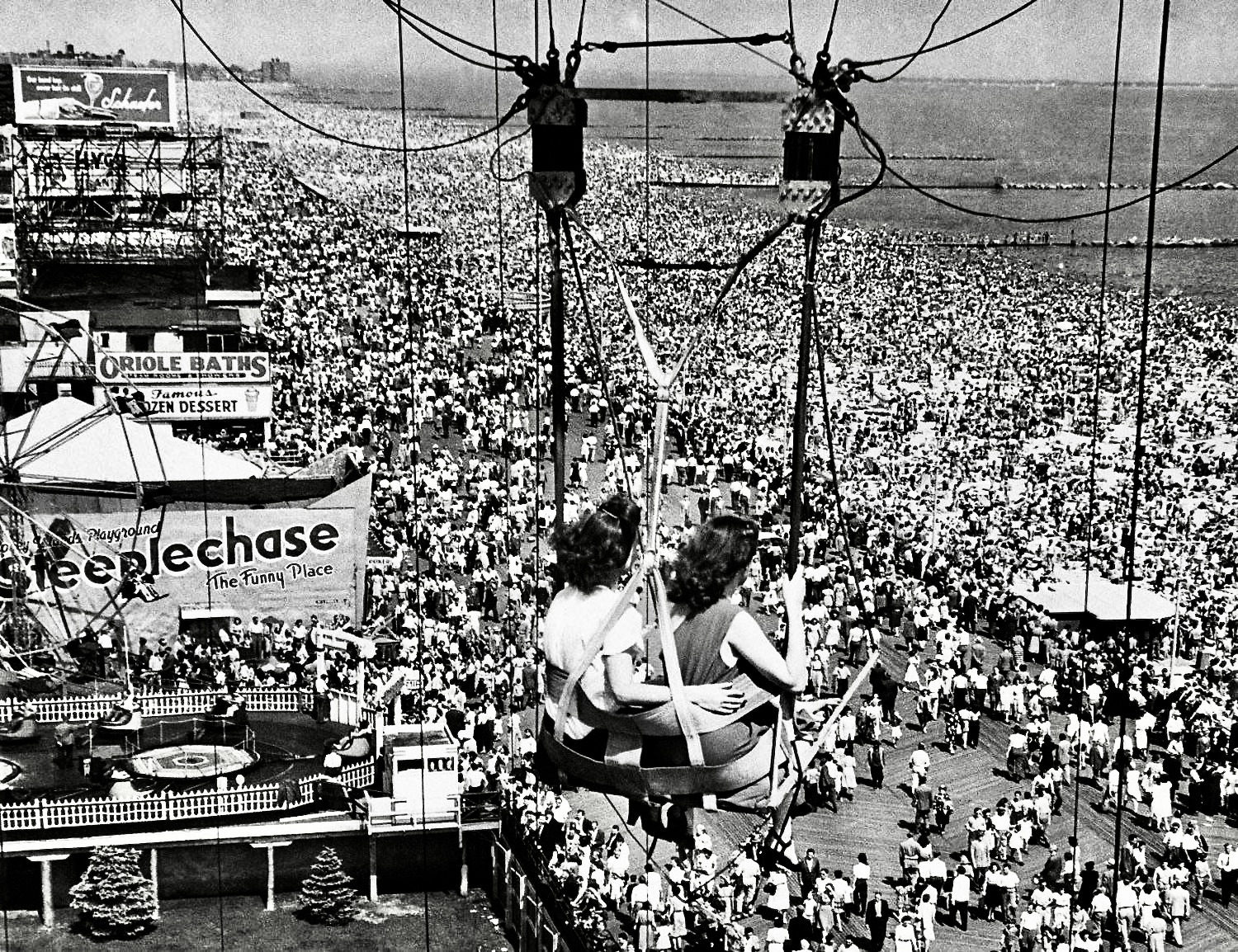
   The Parachute Jump at Steeplechase Park had been built for the 1939 World’s Fair and later moved to Coney Island. It stood 250 feet high, was open-frame, and everybody called it the Eiffel Tower of Brooklyn. Twelve cantilevered steel arms sprouted from the top of the tower, eleven of them supporting two-man canvas seats and parachutes. The riders were belted down, hoisted to the top, then released into a freefall, caught by the parachute, and floated to the ground. Shock absorbers were built into the seats, just in case.

   “I’m not going up on that thing,” Betty said.

   “Do you remember the parachute wedding?” Vicki asked her.

   “No, I never heard of it.”

   “A couple got married up there. The minister was in the seat next to them and the whole wedding party was on the rest of the seats. When the ceremony was over the married couple parachuted down first, and everyone else followed them, except for the minister. The cables on his seat got tangled and he was up in the sky for more than five hours before firemen could get him down. The tower is right on the ocean, and it was windy, and he got sick as a dog, puking on the wedding party who were watching from below.”

   “That cinches it,” Betty said.

   “You and me both, sister,” Vicki said. “Time to plow back through the crowd.”

   “Why do they call it Coney Island?” Dottie asked, taking a last look up at the parachute ride she wasn’t going to ride.

   “It’s because of the Dutch,” Betty said “When they were here, maybe three hundred years ago, there were lots of rabbits in the dunes, so they called it Konijnen Eiland, which means Rabbit Island. It became Coney Island when the English took over.”

   “How did they take over?”

   “Somebody always takes over.”

   “Why does somebody always take over?”

   “It’s the way of the world, child.”

   “I want to go on the Wonder Wheel.”

   “I think we’re up for that,” Vicki and Betty agreed.

   The Wonder Wheel at Luna Park was a Ferris wheel and a Chute-the Chutes and a slow-moving roller coaster all rolled up in one. It was once called Dip-the-Dip. Some of the cars were stationary, but more than less of them moved back and forth along tracks between a big outer wheel and a smaller inner wheel as the contraption rotated.   

   They walked past an eight-foot high neon sign spelling out “Wonder Wheel.” Shooting through the middle of the sign was an arrow blinking and pointing to the ride. “Thrills!” it said. Dottie sat between Vicki and Betty in one of the sliding cars. 

   “You can see Manhattan,” Vicki said when it was their turn at the top of the 150-foot-tall wheel and it stopped for a few seconds.

  “Look, you can see the Rockaway,” Betty said.

   “It takes you low and it takes you high,” Vicki said.

   “When you reach the top it’s like you can touch the sky,” Dottie said. “You can see the whole world from here.”

   “One minute you’re on top, the next minute down you go,” Betty said. “I say, stay in your seat, it’s going to get bumpy, and enjoy the ride.”

   “Top of the world, ma, top of the world,” Vicki cried out like a crazy woman, bulging her eyeballs, and throwing her arms up. Betty laughed. Dottie squinted at them, wondering what they were talking about.

   “One day he’s a mama’s boy mad dog killer and the next day, older and wiser, he’s Yankee Doodle Dandy.”

   Dottie wondered again, what are they talking about? The Wonder Wheel shuddered and started down.

   “Can we go fast now instead of slow?” Dottie asked when they were on the ground.

   The Cyclone was in Astroland at the corner of Surf Avenue and West 10th Street. It was almost 3000 feet long, with six fan turns and twelve drops. The lift hill was 85 feet high. Six years earlier a man who hadn’t spoken in fourteen years, riding the roller coaster for the first time, screamed while going down the first drop. “I feel sick,” he groaned when the train returned to the station. He dropped to the ground in a dead faint after realizing he had spoken.

   Dottie peeked over the front edge of the front car at the track of the Cyclone as the train creaked to the top of the lift hill, where it was going to curve over the rails and hurtle down. Vicki and Betty were in the car behind her, after she had pleaded with them to go on the coaster, and she was with her new friend, Ronald, a boy her age whose parents had stayed behind on the platform. 

   “I have a friend who counts the seconds until the ride is over,” Ronnie said. 

   “Why does he do that?”

   “He can’t stand it.”

   “What’s the point of riding it in the first place?” 

   “I dunno,” Ronnie said. “Every time I ask if he wants to go with me, he says, sure, as soon as I’ve lost my mind, but he always goes anyway.”

   “The Cyclone is for when you want to be scared and excited all at the same time. Maybe he should stick to the merry-go-round.”

   “Yeah,” Ronnie said. “You don’t want to ride the roller coaster when you’ve got diarrhea.”

   “No way,” Dottie said, making sure their buzz bar was locked in place.

   “Did you hear about that girl who got hit in the face by a pigeon and broke her nose going down this hill?” Ronnie asked.

   “No!” Dottie said.

   “She was alright,” he said. “She had some Kleenex and stuffed it up her nose holes to keep the blood out of her eyes. She went right back for another ride.”

   “Yikes!” Dottie said, as the Cyclone shook, shimmied, and roared down the other side of the lift hill. “If that happens, I don’t have any Kleenex!” They laughed up and down the trick hill, leaned into the banked turns that twisted and tipped the train, ducked beneath the head-choppers, and inside of two minutes pulled back into the station where everybody clambered off. 

   “My legs feel like fried bacon,” Ronnie said.

   “Yeah, that was the mostest fun,” Dottie agreed.

   “Bye.”

   “Bye to you, too.”

   “That was sketchy,” Vicki said, catching her breath.

   “Shoot low, they’re sending Shetlands,” Betty said. “Did you feel that tower sway when we got to the top?”

   “You bet I did, right in the pit of my stomach.”

   “I’m hungry,” Dottie said.

   “You’re always hungry,” Betty said. “Doesn’t the boss feed you? Do you have a hollow leg, or what?”

   “I’m on the same page, hollow and hungry,” Vicki said.

   “How about a red hot at Nathan’s?” Betty suggested. 

   “Whoopee!” Dottie belted out sounding like Yosemite Sam after a long day on the trail of Bugs Bunny.

Excerpted from “Cross Walk.”

Ed Staskus posts monthly on 147 Stanley Street http://www.147stanleystreet.com, Made in Cleveland http://www.clevelandohiodaybook.com, Atlantic Canada http://www.redroadpei.com, and Lithuanian Journal http://www.lithuanianjournal.com

A New Thriller by Ed Staskus

Cross Walk

“A once upon a crime whodunit.” Barron Cannon, Adventure Books

“Captures the vibe of mid-century NYC.” Sam Winchell, Beyond Fiction

Available on Amazon: https://www.amazon.com/dp/B0CRPSFPKP

Late summer and early autumn. New York City. A Hell’s Kitchen private eye. The 1956 World Series. President Eisenhower at the opening game. A killer in the dugout.
Breaking the Waves

By Ed Staskus

   Even if it is a 500-foot long 12-thousand-ton carrier like the Marine Flasher, sailing the North Sea in late fall is sailing those waters at the wrong time of the year. Daytime temperatures average cold-and-worse and it is gloomy and foggy. There are about seven hours of daylight. If it’s not raining, it will start raining soon. Sometimes it is so foggy that ships have to slow down to less than 5 knots with horns blaring non-stop. Windy skies and strong swells make plowing through the cold water like trying to plow through month-old mashed potatoes.

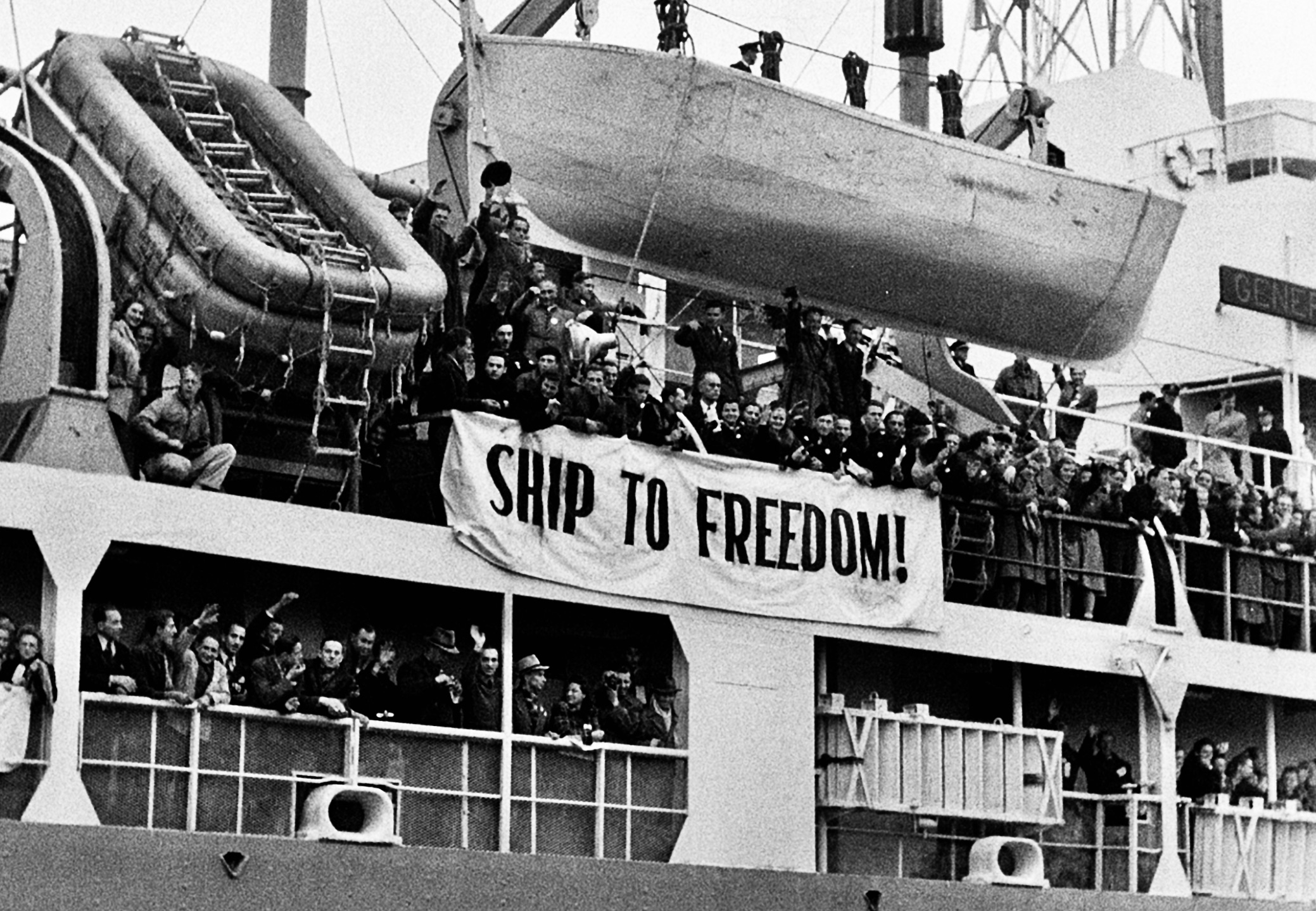
   “I was on the boat for nine days and I was sick for nine days,” said Angele Jurgelaitis about her crossing from Hamburg, Germany, to Halifax, Nova Scotia, on the Marine Flasher, converted from a troop ship to hauling DP’s. Not only were big waves breaking over the sides of the ship, in the aftermath of the war, hundreds of thousands of tons of chemical weapons had been disposed of by being dumped in the North Sea.

   “The ocean didn’t leave a good impression on me. Whenever we threw up, we called it ‘Going to Riga.’” What they meant was that the water flows north, so when they threw up over the side, the vomit went north up the Baltic Sea past Poland and Lithuania to the mouth of the Daugava River, where Riga the capital of Latvia is.

   The Marine Flasher was built at the Kaiser Shipyard in Vancouver, Washington. She was launched for the United States Maritime Commission in May 1945. The ship sailed to San Francisco, Okinawa, Korea and returned to Seattle. The next year it sailed to New York City and from there to Bremen. For the next three years she ferried refugees from Europe to North America, by way of Canada and New York City, and then went back to Germany.

   Angele shoved off from the Old World for good on November 17, 1948. The next day ration scales for IRO refugees became uniform in the British, French, and American zones. It didn’t matter to her anymore. She ate better on the boat, no matter the seasickness, than she had in a long time.

   “There was a canteen on board, and we all got two dollars a day,” she said. “The food was very good. I didn’t think about IRO. We ate well.”

   There were widespread food shortages in Germany following the end of the war. The supply of food was impacted by the prolonged warfare, including the destruction of farmland, silos and barns, livestock, and machinery. Many Germans were forced to live on less than 1,500 calories a day. The average adult calorie intake in the United States at the time was more than 3,000 and in the overseas U.S. Army it was more than 4,000. 

   The civilian population suffered hard times during the severe winter of 1946, exacerbated by shortages of fuel for heating. Displaced persons got somewhat more generous rations, supplied by the Army, the UN, and relief agencies, but even they averaged less than 2,000 calories a day.

   There were 535 refugees bound for Canada on board the Marine Flasher. There were almost 3,000 more bound for the United States, men, women, children, and baby carriages. They steamed into Halifax the afternoon of November 26 and spent the night on the boat. It tied up at Pier 21. Angele hadn’t been able to get into the United States, but she had been able to get to the next best place, Canada.

   She wasn’t stuck behind the Iron Curtain, she wasn’t stuck in Nuremberg, and two days later she boarded a train for Montreal. It took all day and all night and part of the next day to get there, but she wasn’t stuck going nowhere.

   “It was almost 30 hours, but the train was comfortable, with beds,” she said. When they arrived, everybody designated as a nanny or a domestic was segregated. “Those who already had sponsors left. The rest of us, about a hundred of us, boarded busses and they took us to a camp.” They were housed two to a room and interviewed. “They wanted to know what we had been doing in Germany.” They had to fill out one triplicate form after another. 

   One of her roommates at the Army Hospital in Nuremberg had emigrated to Canada a few months earlier. She was working and living in London, Ontario. It is in southwestern Ontario, just north of Lake Erie. The city is a hub for education and healthcare. There are parks and greenways where it lays along the Thames River. It was a military center during the first and second wars, but the wars were finally over.

   “My roommate Ele wrote me that I should ask to go to London, or second best, Toronto,” Angele said. “I started thinking I would join her in London. When I filled out the forms that they gave me I wrote down where she was and that I wanted to go there.”

   Three days later she was presented with a Canadian visitor visa and found out where she was going. She knew she was on the list for the Lapalme family. She hoped she wasn’t going there. An official gave her their address in Sudbury, Ontario. They were Florence and J. A. Lapalme, a prominent family in the mining town. They were known as “’The Largest Family in Sudbury.’ Their children numbered fourteen, although Angele would only be responsible for five of them. Since she had worked in the Children’s Ward at the Army Hospital in Nuremberg, she was seen as the kind of nanny capable of caring for multiple boys and girls.

   “They were so young,” she said. “The youngest was 9 months and the oldest was only 7 years old.” Francois was the youngest, Aline the oldest, Gilles Muriel and Marcel in the middle.

   The domestic woman who cleaned and helped in the kitchen was Lucille Pharand. She worked in several big houses. Lucille was well known as a hard worker. She was built like a fireplug. In the spring of 1949, she and her husband Leo built a house in in the new town of Minnow Lake, three miles from Sudbury. The first few years there was no indoor water and there were no sewer lines to the house. Leo drove to the nearby lake every day with a neighbor, carrying a tub and pails, where they collected water for dishes, laundry, and bathing. They got their drinking water from a well a couple of houses away. In time they gave the Lapalme’s a run for their money, making a large family for themselves. They were known as ‘The Second Largest Family in Sudbury.’

   “I asked again to go to London , but again they said no,” Angele said. “They said nobody was going there.” She wasn’t sure if it was true or if they were just telling her that. In the end not a single refugee went to London or Toronto.

   She didn’t complain. There wasn’t anybody to explain and complain to, anyway, nobody who was going to change the destination that had been determined for her. If you were a European refugee, you were going somewhere where there was work. Men punched a clock mining ore, cutting down trees, and laying roads. Women knuckled down cleaning, cooking, and caring.

   Angele had struck up a friendship on the Marine Flasher with two other Lithuanian women, Inga and Laime, who were young like her. Laime in Lithuanian means happy. They had their hearts set on going to Alberta. They told her there were many rich men there. 

   When the train reached Sudbury, Angele and six other women, all Russians, and a man, another Russian, got off the train. Everybody else, including Inga and Laime, went on to Alberta and British Columbia. Angele was the only Lithuanian on the train platform, more than four thousand miles and several languages from her home.

   “There was no one to understand how unhappy I was,” she said.

   The end of World War Two saw the movement of people all over the world from one place to another. Between January 1946 and December 1953 over 750,000 refugees went to Canada. In June 1947 the federal government authorized the entry of 5,000 non-sponsored DP’s. Two years later the number rose to 45,000. Ottawa established five mobile immigration teams composed of security, medical, and labor officials. They were sent to Austria and Germany to select refugees deemed acceptable for emigration to Canada. 

   Displaced people from the Baltic countries were ranked high on the list. They had been in UN-run camps after their countries, Latvia, Estonia, and Lithuania were caught in the middle of the Russian and German battle zones. Their small countries had become independent after World War One, then occupied by the Russians in 1940, then invaded by Germany in 1941, and in 1944 taken over again by the Russians. In the space of 25 years, they had gone from enslaved by tyrants to enslaved by tyrants

   “When we got off the train there were two men waiting for us,” Angele said. They helped the eight refugees sort themselves out and get to where they were going. One of them told her she was lucky to be going where she was going.

   The Lapalme’s introduced themselves and their children, arranged her living quarters, and quieted her fears about there being no other Lithuanians in Sudbury. They explained there were, and the next day Dr. Valaitis, a Lithuanian doctor and friend of the family, drove to the Laplame home and sat down with her, telling her there were many other Lithuanians in town.

   “Some of them have been here more than two years,” he said. “They make a good living working in the mines.” He gave her the names and phone numbers of several, told her about the Polish church they shared for services, and the local hall where they staged dances and folk performances.

   “The kids I had to care for were so small,” Angele said. She was just 20 years old. Just outside of two years later she gave birth to me, followed quickly by my brother and sister. By 1958 we were living in Cleveland, Ohio, starting from scratch again.

   “They spoke French among themselves and English to me.” She spoke to them more in gestures and pantomime than not. Angele spoke Lithuanian, German, some Russian, but less English. “When Vytas and I were together in Nuremberg he encouraged me to learn English, but I didn’t want to. Whenever I saw him coming with his grammar book I ran away.”

   Vytas Staskevicius was a young Lithuanian man from Siauliai she had left behind in Nuremberg, but who she was waiting for, waiting for him to come to Canada and join her. He had fled the Baltics in 1944, like her, and been displaced in Germany, like her, for more than four years.

   She started taking English classes in Sudbury right away. She wrote her man often, at night, pages and pages in cursive, in their native language. “The Lapalme’s have been good to me They are Catholics and go to church every day, seven days a week. They have a food warehouse, which is their business. We eat very well, so it’s not bad in that respect.”

   Florence was J. A. Laplame’s second wife. He placed ads in newspapers and hired her, a young out-of-town woman, to watch and care for his children after his first wife died. He had seven children, some of them teenagers, some not. It wasn’t long before one thing led to another and he proposed to her. He was nearly thirty years her elder, but she accepted, and over the next decade gave birth to seven children, bringing the family up to record-breaking speed in their part of the world.

   “Florence does the cooking,” Angele wrote. “She has a part-time woman named Lucille who helps with the cleaning and cooking, but Florence does the main cooking. There are usually eleven or twelve of us at the dinner table. She is in the basement every night doing laundry, too. I don’t clean or cook. My job is to watch the children.”

   Whenever Florence was ready to deliver another baby, since her husband had several business interests and was often out of town, Florence usually drove herself to St. Joseph’s Hospital. “If it was a close call, she called a taxi,” Angele said.

   Roger Lapalme, grown-up and the only one of the family who had gone farther than high school, sat next to Angele at the dinner table whenever he was at home. “Roger liked me.” He was barking up the wrong tree. He took her motor-boating on Lake Ramsey until the day he got too enthusiastic at the helm and she fell off the boat. She told him it was enough of that. “Roger was handsome and a lawyer, but I finally told him I already had a boyfriend,” Angele said. 

   One of the LaPalme girls had suffered a nervous breakdown. When her boyfriend, who she expected to marry, killed someone in a car crash, she broke down. She told her father her life was over and went to work in the nickel mines. She was rarely at the house. When she was she slept all day.

   Vytas had a sponsor, an uncle who lived in Boston, but delayed sailing to the United States. He procrastinated about going to Australia with a friend of his who thought they could make passage there. He was determined to go to Canada. J. A Lapalme promised Angele he would give him a helping hand.

   “The year is ending soon,” she wrote her Baltic boyfriend biding his time in Germany. “I have been here more than three weeks. When can you come?” She knew the sailing season wasn’t going to be for several more months. Her man had to break the waves. She knew it wasn’t going to be soon enough. “Be a good boy and write me often,” she wrote him at the start of the new year.

Ed Staskus posts monthly on 147 Stanley Street http://www.147stanleystreet.com, Made in Cleveland http://www.clevelandohiodaybook.com, Atlantic Canada http://www.redroadpei.com, and Lithuanian Journal http://www.lithuanianjournal.com

A New Thriller by Ed Staskus

Cross Walk

“A once upon a crime whodunit.” Barron Cannon, Adventure Books

“Captures the vibe of mid-century NYC.” Sam Winchell, Beyond Fiction

Available on Amazon: https://www.amazon.com/dp/B0CRPSFPKP

Late summer and early autumn. New York City. A Hell’s Kitchen private eye. The 1956 World Series. President Eisenhower at the opening game. A killer in the dugout.