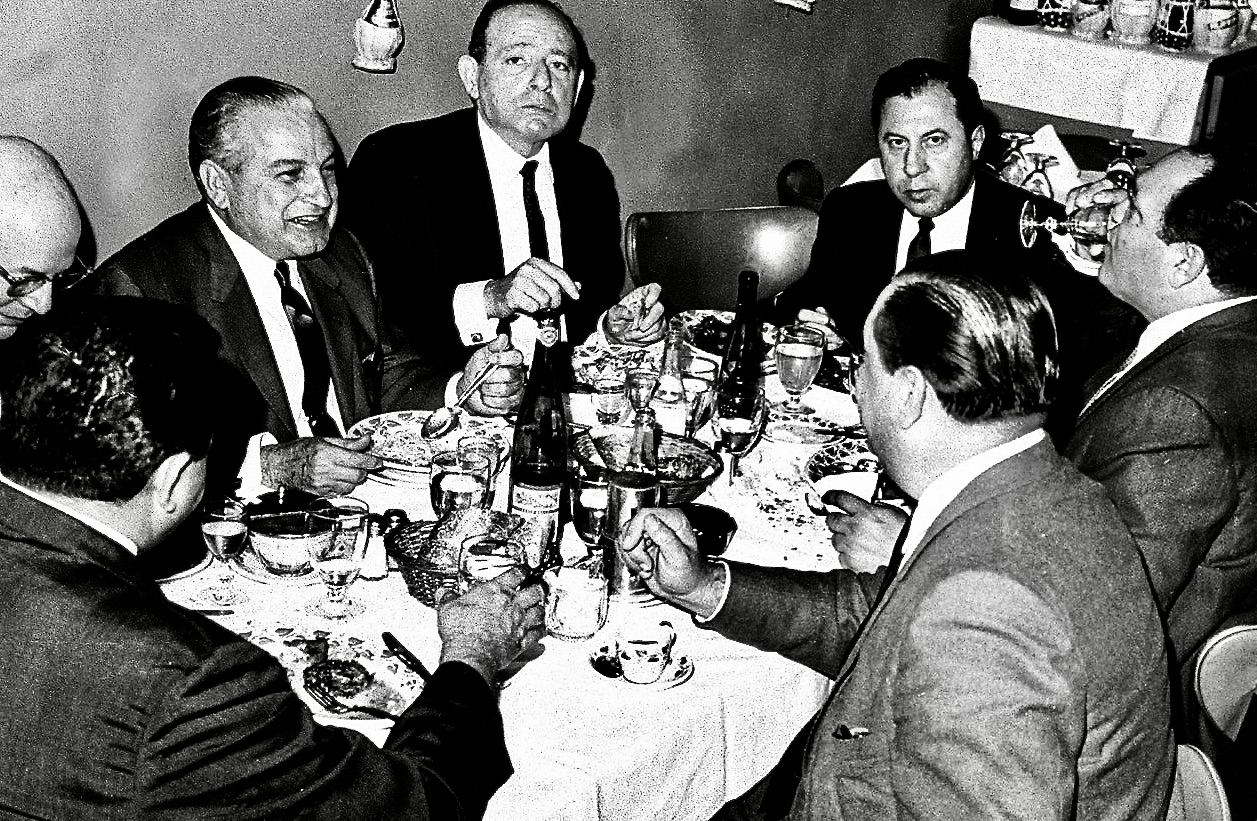
Throne of Blood

By Ed Staskus

   Little Italy was a fifteen minute drive from the Central Station. Frank Gwozdz drove slightly under the speed limit and didn’t try to time the lights. It took them twenty minutes. He parked at the intersection of Euclid Ave. and Ford Dr. on the border of the Negro ghetto and Case Western Reserve University. The run-down near east side was its own world. The school was its own world. Little Italy was up Mayfield Rd. It was its own world, too.

   “We’ll leave the car here,” Frank said. “We can walk the rest of the way.”

   “No respect for the law where we’re going?” Tyrone Walker asked.

   “Let’s just say it’s better to leave the car where the school kids believe in cross walks,” Frank said.

   They walked to Corbo’s Dolceria on Mayfield Rd. where it stood on the corner of Murray Hill Rd. After sitting down at one of a handful of small tables at the front window, Frank ordered a caffe normale and Tyrone ordered a coffee with cream and sugar.

   “Do you want to try a cappuccino instead?” Frank asked.

   “Whatever that is, no,” Tyrone said.

   Frank ordered a cassata for himself and another one for Tyrone.

   “Do you want it the Sicilian way or the American way?”

   “What’s the difference?”

   “The Sicilian way is with cannoli filling and maraschino cherries. The American way is with fresh strawberries and custard.”

   “I’ll take mine the American way.”

   “Suit yourself,” Frank said, ordering the Sicilian way for himself. Antoinette Corbo, who owned the bakery with her husband Joe, brought them their coffees and cassata cakes. She gave Tyrone a sidelong glance. 

   “Did you know the macaroni machine was invented in this neighborhood 70-some years ago?” Frank asked Tyrone.

   “No, I didn’t know that. In fact, I don’t know anything about this neighborhood.” 

   “It’s kind of like an Italian hill town, like in the Middle Ages” Frank said. “Cleveland is down there and Cleveland Hts. is up there at the top of Mayfield Rd. Little Italy has been here in the middle of the hill nearly a hundred years. Most of the first immigrants, who were from around Naples, worked at nearby marble works. They were stone masons. Their women went into the garment trades, mostly lacework and embroidery.”

   “Why are we here?” Tyrone asked.

   “We’re here for you to see the neighborhood,” Frank said.

   “Is this the hot bed of dynamite?”

   “This is one side of the bed. The other side of the bed is the Celtic Club down in Collinwood.”

   “I’ve been boning up on the files,” Tyrone said. “It seems like a bitter thing they’re up to, like a blood feud.”

   “Not here, not now,” Frank said. “After we finish our drinks we can take in the sights and then walk up to the cemetery. We can talk there. The walls have ears, especially around here. Where the dead are, they don’t care.”

   “What cemetery?”

   “Lakeview Cemetery. You can’t see it from here, but we’re sitting right next to it. That why all the Italian stone masons came here in the first place.”

   After finishing their cups of coffee Frank and Tyrone walked two blocks down the hill to the Holy Rosary Roman Catholic Church. It was a Baroque-style building. The house of worship stood four-square on the incline of the street.

   “The Guido’s weren’t here but a few years before they started building this church,” Frank said.

   “Don’t call them Guido’s,” Tyrone said.

   “I agreed to not call you a Negro,” Frank said. “That’s all the agreeing I’m going to do for one day.”

   “Whatever you say,” Tyrone said under his breath.

   “Where was I?”

   “Christian charity,” Tyrone said.

   “I didn’t agree to listen to sarcasm, either.” 

   “All right,” Tyrone said under his breath again. Frank was his partner but partner or not, narrow-minded or not, he was still his superior officer. There was no point in making an enemy of him his first day on the job. That could wait for later. 

   He followed Frank up one of the flights of concrete stairs to the double front doors of the church. There were two outsize arched windows above the doors. There were statues of saints at the top of the façade. A domed bell and clock tower anchored the eastern corner of the church. There was a parochial school in the back that was administered by nuns of Maestre Pie Filippini. Boys and girls were forbidden giving them any lip. The nuns were not above giving them a hard crack. Their parents did worse than that whenever they heard complaining and explaining from their children about their misbehavior in school.

   “Since all the Italians back in the day here were stone masons, like you said, how come this church is built of brick?” Tyrone asked.

   “The foundation is stone,” Frank said.

   “I guess that’s good enough,” Tyrone said.

   “Are you a church goer?” Frank asked as they stepped inside.

   “Yes, I am, Baptist, not Roman. How about you?”

   “Not anymore of any kind.”

   They went inside. The church was empty. It was quiet as a moonbeam. The sanctuary was brightly colored, but the nave was musty. It felt like a tomb. The police detectives looked around. When Frank spoke, he spoke low and slow.

   “This is where the Italians get baptized, get married, and get buried,” he said. “We are always here for the funerals, to make sure whoever is in the casket is the man we won’t miss in this life, making sure he’s really dead, and check out what other hoodlums are in the crowd.”   

   “Do you take pictures of them?”

   “No, we show some respect when we’re here. Besides, we know who’s who.”

   “It sounds like routine enough work.”

   “It’s not the kind of work you’re going to be doing anytime soon, not with your face.”

   “My badge is the same color as everybody else’s,” Tyrone said.

   “The men we’re talking about don’t have any respect for badges, no matter what color they are. They have even less respect for black men carrying badges.”   

   Returning to Mayfield Rd. they went back across the street again. Frank slipped back into Corbo’s and came out with a cold bottle of San Pellegrino. He looked down at the church. “They have a weekend here called the Feast of the Assumption every summer. It’s a kind of fundraiser. They hoist the Virgin Mary up on a platform, march her around, and everybody pins dollar bills on her. There are so many people in the crowd nobody can move.”

   They went up the hill. They stopped when they got to the New Mayfield Repertory Cinema. “Opening Soon – Classic and Foreign Films” an a-frame sign on the sidewalk announced. “It’s some bookworm who lost his job teaching English out in the suburbs,” Frank said pointing at the sign. “He got a year’s pay in the downsize and is re-opening this place. He thinks between the arty college crowd down on Euclid Ave. and the grab bag hippies up on Coventry Rd. he can turn a hobby into a business.” 

   It was dawning on Tyrone that Frank was less a bigot and more pig-headed than not. He wasn’t a babe in the woods by any means, but for a big city policeman he was somehow more small town than big city. He was like white men in Alabama who couldn’t help themselves, although Frank didn’t seem to have intolerant opinions so much as he resorted to blinkered shorthand. White men in Alabama had many intolerant opinions, most of them gotten without having to get the facts.

   A glass encased poster for the opening movie said “La Strada.” It was an Italian movie with Anthony Quin and Richard Basehart in it. Anthony Quinn looked musclebound. Richard Basehart was wearing angel wings and walking a tightrope. The love interest was somebody by the name of Giulietta Masina. She wore a bowler hat and had a clown’s dot on the tip of her nose. She didn’t look like any leading lady Tyrone had ever seen. The director was somebody by the name of Federico Fellini. Tyrone had never heard of him. He had never seen any movies like “La Strada” down south.

   “The funny thing about it is, he had to first talk to Blackie about getting the theater,” Frank said.

   “Who’s that?” Tyrone asked. 

   “That’s Jim Licavoli, one of the Mob bosses here, probably going to be the next top guy. They had lunch together and he finally gave the bookworm his blessing to lease the Mayfield, even though Blackie doesn’t have any ownership in it. His word is more law here than ours. It used to be a vaudeville theater that closed six or seven years ago. The way Blackie sees it, strippers are OK but foreign movies might be immoral.”

   “Why do you call him Blackie? His name came up in a file, but it said he’s called Jack White.”

   “He’s almost as dark as you, which is why we call him Blackie. He calls himself Jack White, God knows why. We never call him by that name.”

   “How do you know they had lunch together?”

   “We were nearby and heard the whole thing, although it was more a waste of time than anything else. The Jew had curly hair and was sincere as Shirley Temple. He wouldn’t stop talking about how much he loved movies. We thought he was a faggot. I think Blackie gave him his blessing just to get rid of him.”

   “You go to the movies?” Tyrone asked.

   “Not since I was in the academy,” Frank said. “’The Music Man’ might have been the last movie I saw.”

   “What do you do to relax?”

   “Fight with my wife,” Frank said.

   “She can’t be all that bad.”

   “She comes the closest.”

   “That’s too bad.” 

   “Yeah, it’s too bad.”

   They continued walking up Mayfield Rd. When they got to E. 126 St. they turned left. At a dead-end past half a dozen houses they walked through a line of trees into the cemetery. Frank led the way, zig zagging his way to the James Garfield Monument.

   “It’s a tragedy what happened to him,” Frank said.

   “It’s a tragedy any time somebody gets shot, president or no president,” Tyrone said.

   “No, I mean it’s too bad about how he died. He had the best doctors in the country, but they didn’t believe in disinfecting their hands and instruments back then. They said only Europeans did that. So, he didn’t die of the gunshot wound. He died of infection. It took him almost three months to die. He had only been president four months.”

   They stopped to look at John D. Rockefeller’s grave, but Tyrone didn’t want to stay. “He was the richest man in the world, selling his black gold, but he wouldn’t give the black man a chance. His kids did better later on, but not John D. He was a mean son-of-a-bitch.”

   They crossed the cemetery’s Hillside Rd. before coming to the Haserot Angel.

   “What is that?” Tyrone asked looking at it. It was a life-sized bronze angel sitting on a marble gravestone. She held an extinguished torch upside down. Her wings were outstretched. She seemed to be crying black tears.

   “They call it ‘The Angel of Death Victorious’ because of the torch that is out,” Frank said. “Some people call it the weeping angel because it looks like she’s crying. It was put up about fifty years ago by a local man who made his fortune in canned goods.” The name ‘Haserot’ was chiseled into the base of the gravestone. “The man who sculpted it is buried in this same boneyard. Lots of people say this place is haunted, especially this spot right here.”

   They heard a cough behind the statue of the angel. There was a bad smell in the air. Frank put a finger to his lips and signaled Tyrone to step back. Tyrone slipped his service weapon into his hand with the barrel pointing to the ground. Frank stepped to the side of the monument. The angel stayed where it was, looking deadpan.

   “All right, come out of there, with your hands where we can see them.”

   What staggered out from behind the marble angel was a small swarthy man who reeked of booze. There was a pint bottle of it peeking out from his back pocket. It was emptier than fuller. He slapped dirt off his hands and shrugged loose grass off his shoulders. One of his shoes was untied. His shirt was checked and his eyes were fly belly blue. His zipper sagged at the crotch of his pants. All of him smelled worse the closer he got to them. He smelled like the Middle Ages.

   “That’s close enough,” Frank said. “What are you doing here?”

   “Visiting old friends,” the man said.

   “Let me introduce you to Joey Bag of Donuts, one of the bomb makers for the Italians,” Frank said to Tyrone, pointing to the man. “Does Danny Greene know you’re here? He might show up with a pick and shovel.”

    “It takes an earlier bird than that dumb-ass paddy to get the better of a worm like me,” Joey said, pursing his lips and purring.

Excerpted from the crime novel “Bomb City.”

Ed Staskus posts monthly on 147 Stanley Street http://www.147stanleystreet.com, Made in Cleveland http://www.clevelandohiodaybook.com, Atlantic Canada http://www.redroadpei.com, and Lithuanian Journal http://www.lithuanianjournal.com

“Bomb City” by Ed Staskus

“A police procedural when the Rust Belt was a mean street.” Sam Winchell, Beyond Books

Available on Amazon: https://www.amazon.com/dp/B0F1LM1WF9/ref=sr_1_1?crid=2MYAQAOZIC2U9&dib=eyJ2IjoiMSJ9.hTm7BGbiQbSe5ZapFwYPPfcwOpTe-Vdg6VLE4aGyTyk.Z0R-VNBWWEcvKcNaO9LdCOUnNIOOXgvYkRS_FXiXuHk&dib_tag=se&keywords=bomb+city+ed+status&qid=1742136726&sprefix=bomb+city+ed+staskus%2Caps%2C84&sr=8-1

Cleveland, Ohio 1975. The John Scalish Crime Family and Danny Greene’s Irish Mob are at war. Car bombs are the weapon of choice. Two police detectives are assigned to find the bomb makers. It gets personal.

A Crying of Lot 49 Publication

Maybe Later Baby

By Ed Staskus

   “The end is always near,” Greg Smith said, sinking back into the firm as Jell-O bench seat. Flying bugs recently alive littered our windshield. One of them left a big yellow blob behind him the instant he hit the glass. It was a fine summer day. Jimi Hendrix’s song “Stone Free” was playing on the car radio.

   Greg’s driving hand was easy on the steering wheel. His other hand was wiggling in the outside air. He was driving well enough to keep us on the road, but his eyes were like pinwheels. The magic mushroom he had popped into his mouth a half hour earlier was working its magic. I couldn’t tell him to slow down because he was going slower than a horse-drawn buggy. I reached for the seatbelt, anyway. When I did I found out the top drop Chevrolet Impala SS didn’t have seatbelts. 

   I had taken a Greyhound bus from Cleveland down the hillbilly highway and hooked up with my friend Greg in Athens. It wasn’t Greece. It was southern Ohio in the northern Appalachians. I called him Jonesy for fun, even though he didn’t think it was funny. “I don’t like glibness,” he complained like an offended grade school teacher.

   SS stood for Super Sport. There was nothing super about the car anymore, which came off the assembly line in 1961, except for the engine. It was still super when it had to be. The rocker panels were rusting out, the front of the hood was gashed, and the tires were bald as baloney skins. The car was Roman Red on the outside while the interior was scuffed black leather. I reached for the grab bar attached to the padded dashboard.

   “Do you know this car was built by union labor right here in the United States?” Greg asked, apropos of the Japanese and German cars we had been seeing here and there.

   “No, I didn’t know that,” I said.

   “It’s got a V-8 engine. One of my uncles might have built it.”

   “Is that right? By the way, what do you mean the end is always near?”

   “Like they say,” he said, “the future’s uncertain and the end is always near.”

   At the moment the Chevy Impala SS was running on one of the V-8’s and none of Greg’s car-making relatives were in sight. What was in sight was the future. There was a flashing red light behind us. It was the kind of light that always looks makes you feel blue. The Meigs County policeman didn’t have any trouble getting on our tail. He had some trouble pulling us over, however, even though the road was straight and narrow as a preacher. The manual steering took several turns of the steering wheel to go from lock to lock. In the state he was in it took Greg a few minutes and a mile-or-so to master the mechanics of pulling off onto the shoulder.

   The policeman didn’t bother asking for his driver’s license. “Step out of the car, son, and let me smell your breath,” he said.

    Greg didn’t like being called son. He scowled patting himself down for his wallet. He huffed and puffed in the policeman’s direction.

   “You smell all right,” the policeman said. “It don’t seem like you been drinking or smoking stinkweed.” The Chevy had a vacuum powered ash tray that sucked ashes to a container in the trunk. “Why are you going so slow when you got that power horse under the hood?”

   “I know this road doesn’t go anywhere but I’m looking for the end of it,” Greg said. “I don’t want to miss it.” The policeman wasn’t fazed by the nonsense. “It don’t go nowhere but it always brings you back again,” he said. Greg was flummoxed for a minute. The policeman looked the Chevy Impala SS up and down. “This is the car the Beach Boys wrote a song about, son.”

   The song was a big hit in its day. “Nobody can catch her, nothing can touch my 409, giddy up, giddy up, my four speed dual quad 409,” Brian Wilson sang in his big falsetto while the rest of the boys layered the harmonies. The fired-up 409 was fitted with a 4-barrel carburetor and a solid lifter camshaft. The pistons were made from forged aluminum. The heads and engine block were made from cast-iron.

   “Those were the days, boys. Make no mistake, that Impala is a real fine car. Try to put some giddy up into your driving. And keep it on the yellow line.” He got back into his black and white Dodge Coronet patrol car and u-turned, going the way he had come. He drove away in good order.

   I was along for the ride on Greg’s ride that day. I had spent the spring, summer, and fall of the previous year in a nearby town called Carpenter living with Virginia Sustarsic in an abandoned general store. She wasn’t my girlfriend, but we got along, even though she was a dyed in the wool hippie and I wasn’t. She rolled her homegrown delicately and deliberately. We kept two goats, gleaned plenty of food, and brewed our own beer. I drank most of the beer. A stray kitten made us his crash pad. The town wasn’t a town so much as a whistle stop. The railroad had long since abandoned the place, though. There were maybe a dozen residents, including us. There were dust balls in all the corners of the crossroad. At night every star in the universe twinkled in the nighttime sky.

   Carpenter was in Meigs County. It was named after Return Meigs, Jr., who was the fourth governor of Ohio. The county is on the Appalachian Plateau in the southeast corner of the state. The Shade River and Leading Creek drain into the Ohio River. Leading Creek ran right through Carpenter. In the 1970s the county’s population was less than 20,000. As far as I could tell there were no Asians, Native Americans, or African Americans anywhere. There were trailer trash on every other hillside.

   Greg was a friend of John McGraw’s, who was Virginia’s on-again off-again boyfriend back home. They both lived on the bohemian near east side of downtown, near Cleveland State University. John was a part-time writer and drank whiskey straight from the bottle. Greg came from a more polite class and drank from a glass. He and John had planned on sight-seeing Meigs County, but at the last minute John bowed out. Greg went anyway, cruising all the way from one end of the state to the other in his big Chevy SS.

   Virginia dressed like it was still the Summer of Love while John more like the Age of Beatniks had never ended. Greg wasn’t any better off than them, living half on and half off the American Dream, but he dressed like a preppy. He read the classics. He was studying Latin so he could read Ovid and Seneca in the original. Nobody ever suspected he kept magic mushrooms in his wallet.

   Something came over him the minute the policeman was out of sight. He fired up the Chevy SS. He spun gravel getting back on the asphalt. The next minute we were doing eighty in a forty. The Doobie Brothers came on the radio belting out “Rockin’ Down the Highway.” I took a peek in the rearview. There was nobody behind us. I looked through the windshield at what was in front of us. All the danger was in front of us.

   “We should maybe slow down,” I calmly suggested as loud as I could. 

   The Chevy SS was a four on the floor. She wasn’t good on gas and burned some oil. Greg picked up speed. We were doing a hundred in no time. There were no more gears to shift up into. His eyes weren’t pinwheels anymore. They glinted like icepicks. He leaned over the steering wheel. The car wasn’t sloppy, nor was Greg’s handling of it sloppy, but we were headed for trouble. We were blasting down a back road. It was cracked and rough and more gravel than not. Meigs County didn’t have the tax base to keep its roads in any kind of Daytona 500 shape.

    “I’m not asking for a miracle, Lord, just a little bit of luck will do,” I whispered.

   “Every minute counts,” Greg shouted above the wind noise.

   “Keep your eyes on the road,” I shouted back. “You never can tell what’s around the corner.”

   He waved at the outdoors with his left arm. Southeastern Ohio on a sunny day in the summer is beautiful. When we roared around a blind curve there wasn’t anything there, to my relief, until there suddenly was. It was a roadhouse with some cars and pick-ups in the front, which was a small parking lot full of potholes. The sign said Frank’s Roadhouse. There were worn-out antlers nailed to the outside wall above the front windows. We pulled in, skidding in three or four different directions. A long-tailed weasel ran the other way. There were half a dozen bungalows in the back.

   Inside there was a bar, a kitchen, some tables, a dance floor, a riser protected by chicken wire, and a pool table. A man and a woman were having mashed potatoes with pulled pork at one of the tables. A bottle of BBQ sauce stood at the ready between their plates. There was some action going on at the pool table but none on the dance floor. Before I knew it Greg had found unexpected action at the bar, where a cute brunette was sitting, a lowball glass half full of red wine at her elbow and a paperback book in front of her.

   There was an oblong mirror on the wall behind the bar. It was too smudged to see into. There was a hand-written warning on a greasy piece of cardboard below it. It said, “Don’t eat the big white mint!” I didn’t ask what it meant. I didn’t want to know. What’s a simple man to do? I looked around for something to do. I put a dollar on the lip of the pool table marking my turn in line. There were two men playing nine ball. It was the middle of the day on a Thursday. Neither of them was on union soil. Neither of them was being especially efficient. There were seven or eight bottles of Burger Beer on a small round table behind them.

   One of the men looked me up and down. “I’m a pretty big man around these parts,” he said, flashing a Mighty Mouse grin. He had sharp yellow teeth. He was shorter than me, but I knew what he meant. “I thought you’d be bigger,” I said. He didn’t laugh. He had the sense of humor of a circus strongman. The other man laughed his head off. My man broke the rack. He was no Minnesota Fats. When my turn came I ran the rack and took my dollar back. I collected a dollar from the local yokel. He tried his luck two more times and paid me two more dollars. He didn’t know, and I didn’t tell him, that I spent more time than I wanted to admit, even to myself, shooting snooker at Joe Tuma’s Pool Hall back in Cleveland.

   I bought them both beers, they clapped me on the back, the circus strongman harder than he needed to, and I went back to the bar, joining my friend and his new friend. He wasn’t paying any attention to her book. He gave me a wink, suggesting the main drag from the eye to the heart doesn’t go through the intellect, or words to that effect.

   Her name was Annie. She was a third-year student at Ohio University in Athens, 20-some miles to the northwest of where we were. She was majoring in English. She wasn’t enrolled in classes that summer but had stayed in Athens instead of going home to Cincinnati. She spent her spare time exploring. She had found Frank’s Roadhouse by accident, liked the looks of it, and stopped in for the afternoon.

   “What do you like about this dump?” I asked.

   “It looks real,” she said.

   I was willing to grant her that. When the bartender approached I ordered a Vernors Ginger Soda. Between the earlier psychedelics and shots of roadhouse whiskey stirring up my tour guide, I knew one of us had to stay on the wagon. 

   “Who is Frank,” I asked the bartender. 

   “There ain’t no Frank, at least not no more,” he said. 

   “What happened to him?” 

   “Nobody knows,” he said.

    The middle of nowhere is as good a place to disappear as any.

   I reminded Greg we had promised our farmhouse friends where we were staying we would stop at the grocery store in Pomeroy and pick up milk, cheese, and toilet paper. Toilet paper was like gold where they lived. Greg’s eyes had gone soft and fuzzy in the meantime. He needed reminding. I had to remind him twice. He finally slid off the bar stool glowing like a full moon in a clear sky.

   Annie followed us out to the Chevy SS. “I like your car,” she said. Greg asked her if she wanted a ride back to college town. She pointed to a VW Beetle. “Fontasse postem infantem,” she said, jotting her name and phone number down on a  scrap of paper. She pressed it into his open hand. She rose up on her tiptoes and gave him a kiss on the cheek. I never saw a man go head over heels as fast as he did that day.

   Once we were in the car, humming along Route 143 on our way to Pomeroy, I asked him what Annie had said.

   “Maybe later baby,” he said. “That’s what she said.”

   The Milky Way was in his eyes. “Keep your eyes on the road and your hands on the wheel,” I reminded him for the last time. I didn’t have to remind him to keep his hands off the magic mushrooms in his wallet. He was riding high on a different kind of magic. Love may not make the world go round, although it can make the ride around the world worthwhile.

Photograph by Elaine Mayes.

Ed Staskus posts monthly on 147 Stanley Street http://www.147stanleystreet.com, Made in Cleveland http://www.clevelandohiodaybook.com, Atlantic Canada http://www.redroadpei.com, and Lithuanian Journal http://www.lithuanianjournal.com

A New Thriller by Ed Staskus

Cross Walk

“A once upon a crime whodunit.” Barron Cannon, Adventure Books

“Captures the vibe of mid-century NYC.” Sam Winchell, Beyond Fiction

Available on Amazon: https://www.amazon.com/dp/B0CRPSFPKP

Late summer and early autumn. New York City. A Hell’s Kitchen private eye. The 1956 World Series. President Eisenhower at the opening game. A killer in the dugout.