
By Ed Staskus
“The holy bishop from Kaunas fixed it up for us,” Angele Jurgelaitis said when she got to Berlin in the middle of the night. There was nothing holy about the last days of World War Two. It was a godless maelstrom. It helped to have a man of the cloth on your side when the devil was doing his best on the other side. There was more than enough hellfire on earth that winter.
When Angele, sixteen years old, Ona Kreivenas, who was her aunt, and Ona’s four children got off one of the last trains that the Eastern Railway ran from East Prussia to Germany they were met at the station by Bishop Vincentas Brizgys. The clergyman was Ona’s husband’s cousin. Her husband, a Chief of Police, had been arrested by the Russians in 1941 and deported to Siberia, where he was stuck in a slave labor camp. By the early fall of 1944 Bishop Brizgys and more than two hundred other priests had already fled the Baltics on the heels of retreating German forces.
Many Lithuanians barreled out of the Baltics in the fall and winter of 1944 as the Red Army overwhelmed the Wehrmacht and overran the land. The fighting was tenacious and terrible. Wartime losses of Estonians, Latvians, and Lithuanians were among the highest in Europe. They didn’t go down without protest. They were out-gunned, though.
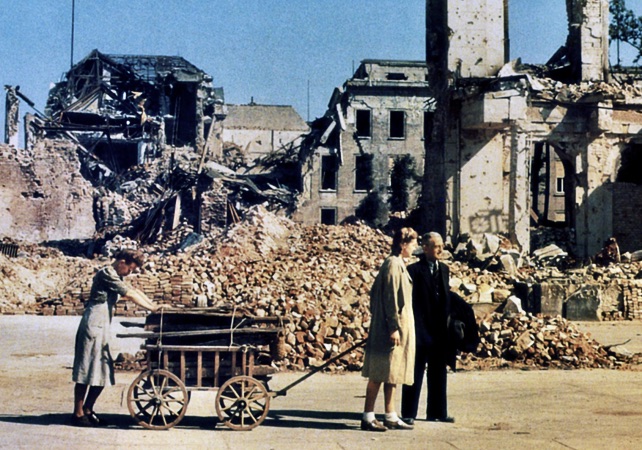
Ona had somehow located the bishop by telephone from East Prussia and he arranged to meet them at the train station. He was wearing a dark suit and a homburg. He was carrying a basket of hot buns. He looked like the churchman he was. Berlin didn’t look like the city it had once been. It looked like a wasteland.
“He gave one of the buns to each one of us. I was so happy.”
What the churchman fixed up for them was passage to Bavaria. They ended up in the north of the southeastern state. Bavaria shares borders with Austria, Switzerland, and the Czech territories. The Danube and Main rivers flow through it, the Bavarian Alps border Austria, and the highest peak in Germany is there. The Bohemian forests are nearby. The major cities of the region are Munich and Nuremberg.
“The bishop found a pig farm for us, people he knew,” Angele said. “We lived in a two-room apartment above the slaughterhouse. There was another Lithuanian with us, a woman in her 20s. She was a fancy woman.” One of the two rooms was a kitchen. They lived and slept in the larger room, two adults, a teenager, and four children. The fancy woman kept to herself.
There were three cots. “We took turns sleeping on them. We worked for our keep, helping with the cows, and cutting clover. There was no town, just country everywhere. The German family we stayed with fed us. They were good people.” There was no combat in their corner of the world. “We didn’t see any fighting all winter long. The war ended when the Americans came. They wore nice uniforms, not like the Russians, who were filthy and stank. They were friendly, completely different. They threw candy to us as they went past.”
Bavaria was one of Adolf Hitler’s favorite places during the twelve years of his planned one thousand year Third Reich. He had a lavish residence at the Obersalzberg. Bavaria had been the scene of protests against Nazi rule in the late 1930s, but it didn’t matter to the Fuhrer. He had his own ask no questions security men. Their orders were to shoot first. After the war Nuremberg was chosen for the military tribunals trying Nazi war criminals because it had been the ceremonial birthplace of the party. It was where their annual propaganda rallies were held.
Allied air forces bombed the hell out of the city in 1944 and 1945. One night in January 1945 more than five hundred British bombers dropped six thousand high-explosive bombs and more than a million incendiary devices. The historic old town was destroyed. Half of the rest of the city was destroyed. What wasn’t blown to bits or burnt down was damaged. Surviving the bombing meant you had to then survive the aftermath. The city was left with practically no heat, no electricity, and no water supply in the middle of winter. The Palace of Justice and the prison that was part of the sprawling complex were spared. It was a sign of what was in store. It was spared because justice and revenge were in store.
“In the fall after the war ended, we had to leave the pig farm and went to an American refugee camp near Regensburg. We had two rooms, but there was a Lithuanian man in the other room, so we had one room. We lived there and didn’t do anything. We waited and waited.”
Before the Russians closed the borders, padlocking the Baltics behind the Iron Curtain, about seventy thousand Lithuanians were able to escape the country, almost all of them ending up in Germany. By the time the war ended nearly eleven million refugees had flooded the country, more than the total population of Austria. Many of them ended up in Displaced Persons camps in Bad Worishofen, Nordlingen, and Regensberg.
In the spring of 1946, Angele, Ona, and the children moved to a new camp. “It was a castle that you got to down a long road through a forest in front of a lake. There was a big chapel and two big barracks. There were no owners anymore, and no workers, nobody. There were only the Americans and refugees. There were many of us, all of us homeless. We were almost all Lithuanians.”
The Schwarzenberg castle on the outskirts of Scheinfeld in Bavaria is northwest of Nuremberg. From 1946 until 1949 thousands of Lithuanians were housed at the DP camp there while they waited for their chance to get to Australia, Canada, the United States, or anywhere else. “There was no future for us in Germany,” Angele said. There was flat out no going back. The system of revolving displacement the Russians proposed would have meant the end for many of them and suspicion and persecution for the rest of them. The Russians had no plans of letting repatriated Lithuanians off easy. They had no plans of letting any Lithuanians of any kind, unless they had converted to Communism, off easy. Even then it was dicey. If they wanted you to live and die in Siberia, and got their hands on you, the far east is where you went.
The camp outside Nuremberg was administered by an American Army officer of Lithuanian descent. The military’s concern was providing shelter, nutrition, and basic health care. Although the Americans looked after vital supplies, everybody in the camp had to lend a hand. The refugees prepared their own food. They sewed new clothes from old cloth. They printed their own daily newspaper. They printed their own money, too. The currency could be earned by working around the camp and spent at the canteen, where you could buy shaving cream, combs, and cigarettes.
“We had our own doctors, our own church, and even a school. My best friend was Maryte. Her parents were teachers. They taught the high school classes in the camp. Her mother knew how to sew.. She would take hand-me-downs that had been donated to us by the Red Cross, take them apart, and make new dresses. Whenever she made a dress for Maryte she made one for me, too.”
Angeles’s aunt talked to her about becoming a seamstress. “She wanted me to learn how to sew, like my older brother Justinas, so I would have some way to make a living, but I said no.” She had already turned down her aunt’s advice about becoming a farmer’s wife. She wasn’t sure what she wanted to do, but she knew for sure what she didn’t want to do, which was no sewing and no farming.
After her friend Maryte moved to Nuremberg, taking classes in x-ray technology, and was on the way to becoming a nurse assistant at the Army Hospital there, she wrote Angele. “She told me about it, told me it was a ten month course, and told me to come join her.” Angele packed a satchel with her clothes and slipped away as the weather warmed up in 1947. She waved goodbye to Ona and her four children. “By then my aunt was teaching kindergarten at the camp and she had her kids around her.” The boy Mindaugas had grown a few years older, was now a teenager, and could take care of his three sisters.
She hitchhiked the forty miles to Nuremberg. Even though there were travel restrictions, a German government barely existed to enforce its own laws, and the only thing she had to worry about was an over-zealous American officer in a Jeep who might take her back to where she came from. When she got to Nuremberg she asked where the hospital was and found her way there. It had been rebuilt after the bombings two years earlier. She was assigned a bed in a small room, which was twelve feet by twelve feet. She shared it with three other women.
“There was Ele, who was twenty four and tall, Koste, who was twenty eight and stocky, Monica, who was the oldest and had been a nurse in Kaunas, and me. One of our teachers was Lithuanian and she helped me. We lived in the barracks. I worked in the hospital, cleaned, changed beds, and did whatever they told me to do. I studied whenever I could. There wasn’t time to do much else.”
They had to do something, though. Most of them were young and raring to go. They staged dances at the hospital. “Somebody would play the accordion and we would all dance. There were never enough men to go around, so many had died.” Whenever they could they went to town on Saturdays. “We took a train, went to the movies, and the music shows. We loved it. Everything was so clean. It was all smashed during the war but two years later you wouldn’t have believed there had ever been a war.”
There had not only been repeated bombing and shelling of the city, especially the medieval part of it, there had been street-by-street, house-to-house, and room-by-room fighting in April 1945. The city was rebuilt after the war and was partly restored to its pre-war aspect. “The Americans did it,” said Angele. “You could see them doing it every day.”
The German government was being resurrected, as well, and order was the order of the day. “One day we were waiting in line for the movies, eating grapes, and spitting the seeds on the sidewalk. When a policeman saw us, he came over, and told us it was our responsibility to keep the city clean. He made us pick up all the seeds.”
The circus was even better than movies or musical theater. It is in the movies and on stage that people fall in love and there is always a happy ending. The boy and girl kiss in a glowing haze. It is the circus, however, that is a live action fantasy. “Whenever it came to town, none of us could sleep,” Angele said.
The Nazi era was good for circuses since they were not considered subversive. They were left alone by the tyrants. Between the two wars, through the 1930s, Germany was the epicenter of European circus companies. There were more than forty of them on the road with clowns, acrobats, and animals. They were mostly family-run enterprises with large tents. The last year of World War Two, however, was bad for business. Many circuses lost all their equipment and animals. The postwar roadshows boomed after 1946. Circus Europa toured Germany in 1947.
“I loved the circus. I would have gone alone if I had to.”
In mid-summer 1948 she got a week’s vacation from the Army Hospital. She and her friend Benas, his best friend Porcupine, and two of the Porcupine’s friends took a train the one hundred and seventy miles to Zugspitze on the border of Germany and Austria. On two sides of the Zugspitze are glaciers, the largest in Germany. Mountain guides lead climbers up three different routes to the summit at nearly ten thousand feet.
“Benas was handsome with dark hair and his father was a minister back home. He was a good friend to me. Everybody called his friend Porcupine because my roommate Koste called him that. Nobody knew why. He thought he was Koste’s boyfriend, although that’s not what she thought.”
They got to the mountains at night and stayed in a small hotel. “There were two rooms at the end of the corridor. We three girls went into one of them. There were two beds, so we pushed them together and slept together. The boys took the other room. In the morning I went to the window and threw open the heavy drapes. I had to take a step back. The mountain was right there. I was astonished and frightened. For a second I thought it was going to fall in on us.”
They rode a rack railway up the northern flank of the mountain. “It went around and around.” At a landing they sunned themselves. “Even though there was snow everywhere, and people were skiing, looking like ants below us, we lay in the sun before going farther up.” They took the Eibsee cable car to an observation deck. “The gondola was all glass. You could see the whole world.” From the top a path led to the Cross of God.
A fourteen-foot gilded iron cross had been lifted to the peak of the Zugspitze in 1851 by twenty-eight bearers under the direction of Karl Kiendl, a forester, and Christoph Ott, a priest. Father Ott was the brainstorm behind the cross, motivated by a vision of the mountain, “the greatest prince raising its head into the blue air towards heaven, bare and unadorned, waiting for the moment when patriotic fervor and courageous determination would see that his head too was crowned with dignity.”
The Porcupine and his two companions wouldn’t go to where the cross was. They said the path was too icy and narrow. “Only Benas and I went. There was a ladder attached to a rock face you had to climb to get to where the cross stood on a flat space.” In 1888 the cross had been taken down and repaired after being struck by lightning. It had holes gouged out by the lightning bolts. A year later it was taken back to the top, onto the East Summit, where it had stayed ever since.
The side rails of the metal ladder going up were secured by bolts to the rock. “I was near the top when a bolt came loose and the ladder jerked free,” Angele said. “I stopped and couldn’t go up or down. I stayed as still as I could. I was scared to death.”
She had survived a Russian invasion, her mother’s untimely death, a subsequent German invasion, followed by another Russian invasion, making tracks out of Lithuania, the invasion of the Reich, the collapse of the German government, landing in DP camps in Bavaria, and finding her way to work at the Army Hospital in Nuremberg, all in the past eight years, all by the time she was nineteen years old. A broken ladder was not going to be the end of her. Benas helped her get down, extending his belt from the top, and another pilgrim helped her from below, coming partway up and carefully easing her down. Benas slid down the side rails without incident.
Faith can be church-going or it can be personal. Life and death at ten thousand feet is personal, Cross of God or no Cross of God. Who thinks about God when they are about to meet their maker? They took their time on the icy path back to the observation deck. The rest of the week they hiked, took local trains to nearby alpine towns, ate, drank, smoked, talked, and had fun while it lasted.
At the end of their vacation they went back to Nuremberg. In her room, Angele thought about the men in her life. There were two of them. One of them was Vladas, who was a Baltic soldier. The other one was Vytas, a Baltic civilian, who worked part-time for the Red Cross and part-time in the black market. They were both refugees from Lithuania, like her. Vladas brought her food and Vytas played cards with her. Vladas watched while she made dinner for him while Vytas let her win at the card table.
Getting married might not be a matter of life and death, except when it is. She thought she was probably going to marry one of them, and thought she knew which one it would be, but knew for sure she wasn’t going to be staying in Europe. She was going to break free of nowhere. Making her way some place where there was a future was the most important thing on her mind. She wanted a bright future, not a dark past. The only way was up the ladder.
No matter what, she was going to have to make what lay ahead worth its while. Nobody else was going to do it for her. When she got a visa to go to Canada and work as a nanny for a family of thirteen children in Sudbury, an Ontario mining town, she took the chance. It was the chance she had been waiting for. She didn’t look back.
Ed Staskus posts monthly on 147 Stanley Street http://www.147stanleystreet.com, Made in Cleveland http://www.clevelandohiodaybook.com, Atlantic Canada http://www.redroadpei.com, and Lithuanian Journal http://www.lithuanianjournal.com.
“Cross Walk” by Ed Staskus
“Captures the vibe of mid-century NYC, from stickball in the streets to the Mob on the make.” Sam Winchell, Beyond Fiction
Available on Amazon: https://www.amazon.com/dp/B0CRPSFPKP
Late summer and early autumn. New York City, 1956. Jackson Pollack opens a can of worms. President Eisenhower on his way to the opening game of the World Series where a hit man waits in the wings. A Hell’s Kitchen private eye scares up the shadows.
A Crying of Lot 49 Publication
 147 Stanley Street