By Ed Staskus
Zenius Petrauskas would have traded any day in the real world, whether it was reheated meatballs with his folks the slow drumbeat of his sophomore year at St. Ed’s or hanging out with the boys doing nothing special nowhere special, for five minutes of summer camp. After the next two summers were come and gone, after his last year in Cabin 6, when he couldn’t be a camper anymore, he was determined to go back as a counselor.
“That’s a sure thing,” Zen said. “I’ll be on my way to being a senior by then and I’ll know a thing-or-two. I’ll be older and wiser. I’ll know how to handle the boys who are on track and off track, no wool over my eyes.”
Camp is different than being at home. There are fewer grown-ups, which is a good thing, and nobody’s parents are there, even better. The teenage counselors are almost like the vassals. They let them run amok and hope no one dies. Everybody’s friends are together again and there are more of them than anywhere else. Nobody yells at you for two weeks. The counselors don’t like it if somebody does something stupid, but nobody gets yelled at for doing something wrong just by mistake.
“Even when it happens, it’s all over in a minute, not like back home, where it never ends,” Zen said, looking glum. “No sir, it never ends, it just goes on and on. You’re on the bottom, mom is on top, and you’ve got to keep your trap shut.”
The summer sky at camp is big and fresh and windy. It’s a bird in the hand. There are swallows, thrushes, woodcocks, and buffleheads. It’s in Canada, on the Georgian Bay, at Wasaga Beach, the world’s longest freshwater beach. It takes all day to drive there from Lakewood, Ohio, across the border at Buffalo, through Toronto, and to Barrie, where you take a sharp left at Lake Simcoe.
It was never spic and span, not like the Dainava summer camp in Michigan where the Lithuanian righteous gather on their bantam pond, but clean enough. Some boys didn’t shower when they were at Kretinga and that could be disgusting, although nobody cared too much about it.
Somebody’s parents wouldn’t let their boy in the car when his two weeks were over, and he hadn’t showered even once. “No, go back, go hose yourself off, and brush your teeth!” his mother coughed through her nose. “What is wrong with you?” The Kretinga summer camp used to be the Ausra summer camp. In the pioneer days there were latrines but no showers. After two weeks everybody had to use a hose.
Kretinga is named after a city of the same name, where Franciscan monks first hunkered down in Lithuania. At the time the natives were pagans. The camp is owned by the religious order. It includes a small chapel and a pet cemetery. The Franciscans have a habit of keeping a pet in their monastery in Toronto and the camp is where their dogs and cats are buried after dying.
One year Zen’s cabin had bedbugs. The boys caught them with scotch tape and pushed them into a glass jar. Zen tried to kill some of them with poison spray, because when they sucked blood, they left itchy clusters behind, but the bugs didn’t seem to care. They shrugged the poison off. When the camp commander found out about it, he hired a sniffing dog.
It was a Beagle, just a little bigger than Rufus, Zen’s Beagle at home. The scent hound was lean, with floppy ears and a loopy smile. He knew what was up, though, stepping into the cabin Chuck Norris in his eyes.
He was a scent dog, not like Rufus, who was a hearing dog. Rufus heard all, searching out BS wherever it was, like up in Jack’s room. Jack was Zen’s older half-brother who thought he knew everything and talked down to him. The family lived on a better-off street in Lakewood, wide tree lawns and a concrete roadway, but Rufus still stayed on his haunches on the front lawn looking both ways, ready to bark. He knew the future might not be what it used to be.
The search-and-destroy flea bag was so good he sniffed out a bedbug hiding behind the plastic cover of an electric outlet. The next day everybody stuck their stuff into big black garbage bags and threw them inside the cars at camp, in the hot sun, with the windows closed.
All the bugs died. They didn’t get buried in the pet cemetery. Zen set fire to some of them and scattered their ashes.
He and his friends were in the smallest of the nine boy’s cabins. The only free floor space they had was just enough to shuffle back and forth to their beds. Matias was number one with Zen. He had shiny blue eyes like buttons and was stick slender. They liked to run around, not get too uptight, and soft chill at the end of the day. They had roomed together in the same cabin for seven years.
Lukas was Zen’s second-best friend. He was a little taller, all funny smiles and chunky. He chewed green frog gummies and spit them out on the cabin floor where they got squashed flat like pancakes. By the end of camp, the floorboards were dried goo. He was strong as a bull, but not loud or belligerent. He suffered from in-grown toenails.
“Don’t step on them, or else!” Zen explained to newcomers. “It can be big trouble. One night he punched somebody who accidentally stepped on his bad toe.”
They were at the ‘Night of the Super Starz’ in the mess hall. They were sitting there watching the show when the misstep happened. Lukas stood up and pushed the boy. “Watch out, dude!” He got punched in the stomach for it. He punched him back in the face. The goat started bleating when Lukas did him. He had a bruise on his cheek and a black eye.
There was a special midnight mass after the show, but Lukas wasn’t allowed to stay. He had to go back to his bunk, although all that happened the next day was the counselors made him sweep the mess hall. The camp commander noticed Lukas waving a broom and thought he had volunteered. He came back to the cabin with serious points pinned to his chest.
Lukas liked being hip hop rundown. He was from Toronto and lived uptown, although Zen didn’t know where that was. He said he lived in a neighborhood of chinksters. He smoked weed sometimes, even though he wasn’t good at it. He and his dope friends went to a creek on the far end of camp one night and smoked some. He got funky and dreamed up disasters.
“I thought I was going to die,” he said.
Story time with Lukas at the head of the cabin was always gut-busting. When he spit out a gummy, ready to go, it was a high old time. He knew a lot of dirty jokes, too. At night they talked about movies, TV shows, and their favorites on YouTube. They talked about girls, some of them more than others. They talked about video games a lot, even though they didn’t have any at camp. They weren’t allowed. The one boy in their cabin who didn’t talk much was Titus, who they called Tits.
“He just sits in his corner all secluded,” Zen said. “He does play some kind of video game, so I talk to him about that, sometimes, but not much.”
Nobody knew what was wrong with Titus. “We love Tits, but he’s quiet. He doesn’t do anything, which is the problem. At night when we’re all laying around in our cabin he’ll start crying. His eyes get soggy, and his hair tuft goes limp. He will just sit teary-eyed on his bed, looking at the floor. When we ask him what’s wrong, he says, ‘I don’t know. My head hurts.’”
They didn’t ignore him all the time, and they never did much of anything to him. “We punch him sometimes, but not hard, just on the arms. Mostly when he’s looking, but sometimes when he’s not looking.” He got pinkeye every summer. They didn’t make fun of him about it, though. But then he got double pink eye. That was too much for everybody. They were all, “Damn it, Tits!” Everybody made fun of him, and he cried and got mad.
The girl cabins were on the other side of the flagpoles, up a sandy hill. Amelia, who was part of Natalie’s tootsie tribe, had a reddish birthmark on her face, in the shape of a dog. Zen thought she was self-conscious about it because she always turned to her left whenever anybody took her picture, away from the birthmark.
They never said anything about it to her. They dabbled the birthmark in their own cabin, but nothing bad, although sometimes somebody said, “What’s that thing crawling on her face?” One night, Titus was laid out on his bunk in the corner while everybody was telling home stories when out of nowhere, he said, “Did somebody have their period and rub it on Amelia’s face?”
Everybody stopped dead quiet for a minute. Who says that? Matias looked embarrassed. Then he got mad. “Shut up!” he yelled. Zen knew his best friend had the hots for Amelia. It was a brutal thing to say, especially coming from Tits. Everybody called him that because he had them. He had always been flabby and lately was getting flabbier.
“He doesn’t play sports or chase girls, that’s his problem. He’s going to grow up a fatso.”
Kajus slept in the corner opposite Titus. He thought he could play guitar, but all he did was play the same part of ‘Stairway to Heaven’ over and over. Everybody except Titus was always yelling at him to stop. Zen and Lukas finally took matters into their own hands and broke his guitar. The rest of the cabin blew off the commotion. They all knew it was a piece of junk, anyway.
They broke the new fan his parents got him, too. Lukas was frustrated, and angry, his toes hurt, and he started taking it out on the fan. They took it out behind the cabin and beat it with a hockey stick. It was hanging on a paper clip when they were done. The spiny part was smashed, chunks were missing, but they just kept beating it. They threw bottles of water at it. Kajus wasn’t happy when he found out. He complained and gave them a sour look. He pushed the busted fan under his bed.
When his parents came mid-week from Toronto, they asked him what happened to it. He told them Zen and Lukas did it, but they didn’t believe him. When they left, he tipped a Mountain Dew over on Zen’s bunk. Zen grabbed it and poured the rest on Kajus’s bed, pushing and shoving started, Kajus elbowed Zen, he elbowed him back harder but not crazy hard, and they both stopped when they got tired of it.
There was a food-eating contest every summer after the ‘Counselor Staff Show.’ The small fry had to go to bed, but the boys and girls stayed up late to play the game. Whoever volunteered was blindfolded and had to eat whatever was on their plate. Everybody had to keep their hands behind their backs and lap it up like a dog. Sometimes the others puked, but Zen never did.
There were bowls of moldy Rice Krispies with ketchup mustard strawberry jelly lots of salt and all mashed together like potatoes. It was horrible. It was like eating last place on one of his stepmom’s cooking shows on TV. Everybody cheered the belly brave and they had to eat as fast as they could if they wanted to win.
The counselors woke the camp up every morning at seven-thirty for calisthenics. They marched everybody to the sports field and made them do a butt load of jumping jacks, push-ups, and crunches, and the boys and girls had to run the track, even though the sun was barely breaking the tops of the trees. The small fry got to do their own thing, whatever that was.
If the counselors saw somebody was slacking, they made them do more. Everybody jumped on the used tire jungle gym and messed around whenever they could, having fun. The counselors made whoever overstayed their welcome do pull-ups on it, but it was a small price to pay.
“We get up every morning to music,” Zen said. “It’s always Katy Perry or Duck Sauce, or whatever the big cheeses want, played from loudspeakers hidden in the trees. Sometimes I don’t hear anything because I’m dead asleep. The counselors carry water blasters. If they say you have twenty seconds to wake up, and you don’t jump right out of bed, they start spraying you. They shake your bed and jump on you, but they’re always on the way to the next bed, so it doesn’t last long.”
After they were done exercising, they went back to their cabins, cleaned up, and raised the flags before breakfast. There are three flags, American, Canadian, and Lithuanian. “But sometimes we’re too tired to clean up and instead fall back asleep in our cabins and are late for the flag-raising. When that happens it’s time to swallow the pill. Whoever is late has to step into the middle of everybody on the parade ground and do the chicken dance. All the boys on their side of the parade ground do the chop, swiveling their arms like tomahawks and chanting. Nobody knows what it means. They all do it, and the girls stand there watching. Then they do their own dance, like cheerleaders, except they aren’t cheering for you.”
All the cabins had to keep a diary for the two weeks of camp. Everybody got graded on it every day. If anybody wrote something stupid, like “Ugi Ugi Ugi” or anything that didn’t make sense, they got a bad grade. The counselors told them to “Be yourselves, be sincere.”
“What does that mean?” Lukas asked, but they just laughed.
Matias always wrote their diary because everybody agreed they were all retards. Titus wrote something dumb once, even though he said it was sincere, and at the flag lowering that night they had to do the Rambo, running down the slope to the flagpoles with no shirts on and singing “Cha Cha Cha” while everybody did the chop. That night, in the middle of the night, they rolled Tits down the same slope wrapped up in a scratchy old blanket.
They wrestled in the oldest boy’s cabin. It was the biggest cabin, too, so it had space for fighting. They moved the beds and duct taped a sleeping bag to the wood floor. There was no punching allowed, no hammer blows, but kicking and throwing each other on the ground was fair game. They weren’t supposed to fight, because the camp commander didn’t like it, but everybody wrestled and got poked bruised blooded.
One night at their Wrestlemania, Donatas and Arunas were locked up when Donny grabbed Arnie’s head and flipped him over. Arnie slammed hard into a bedpost and got knocked out. They let him lay there, but when he didn’t wake up, even though they screamed in his face, they threw wet dirt on him. He jumped up and was fine after that.
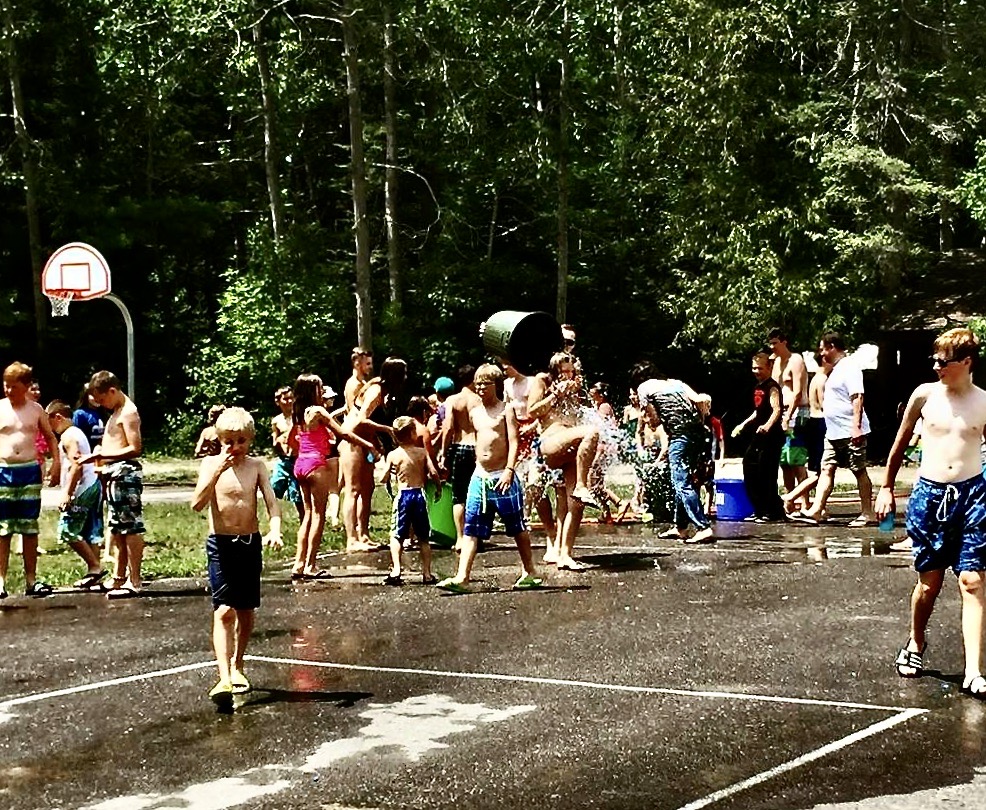
The next day they were walking to New Wasaga Beach, which is where the whole camp went every afternoon for a swim, and Arnie jumped on Donny’s back and almost cracked it. But they didn’t punch each other. It was just a couple of seconds of retaliation. They weren’t haters. Besides, the counselors were watching, and that would have been trouble. They always said, “Only we can get physical.” The grown-ups stood near and far in the water and made sure nobody drowned. The boys and girls and small fry never noticed. They were busy splashing swimming splurging in the sunshine.
Every year another year went by and when Zen was back at camp it was like he had never left. As soon as he got there, he unloaded everything he’d brought, his clothes flip flops sleeping bag. All his stuff had his initials written on it with a Sharpie. Everybody found their cabins and claimed their beds, and then all the parents were gone before anybody knew it.
They saw their friends again, everybody in their cabin, and everybody they had ever camped with. “What’s up dude!” There were high-fives knuckle-touches bro-hugs all around. They fake punched each other and laughed it up.
They reunited with the girls and got overdue squeezes from them. When all the moms and dads that nobody in his right mind thought about from that moment on were gone, they had sandwiches in the mess hall. The priest said a prayer and the camp commander made a speech. He wrote the camp rules in big block letters on a chalkboard.
He was big on shaming boys but not girls when his rules were broken. There was a bonfire most nights. They acted out skits, sang songs, whooped it up, but if you were on his list, he called you out in front of everybody and you had to try to explain why you did what you did when you did it. Most of the time the explanations were lame as diarrhea. Zen believed in never explain, never complain, although it was hard facing a determined grown-up.
The best night of summer camp was every night, but the best night was the night they played their manhunt game. Sometimes it was called ‘Fugitive’ or ‘Stealing Sticks’ or ‘Capture the Flag.’ It was always the same, although it was always different. Lukas told everybody he saw a movie about Jews battling Nazis in Warsaw, chases in the dark ghetto and shoot-outs, but nobody could understand what he was talking about. Nobody else had seen the movie.
Lukas said, “Let’s play it that way.”
Everybody said, “OK, that’s what it is.” They were the good guys, and the counselors were the bad guys. Some of the counselors thought it was sketchy but didn’t disagree. It was as much fun as ever. It was like ‘Bunnytrack’ with no holds barred.
Tits never played, and he didn’t play ‘Nazis and Jews,’ either. He said it was wrong and started explaining about Lithuania, where their parents and grandparents were from, and how terrible things had happened there. He said it was a holocaust, not a fun run around, but they told him to shut up, and he got sulky. Nobody knew what’s wrong with Titus. Zen knew what was wrong with him.
“Titus knows he’s low man on the totem pole and nobody cares what he says.”
The game started when the counselors led them to the mess hall. They turned the lights off and made everybody sit on the damp concrete floor. After they left it got super quiet. It was eerie. When the counselors came back, they were dressed in black, charcoal from the cold bonfire rubbed on their faces. They split everybody into groups and spit out the rules. They had to find books and save them from being burned. They weren’t real books, just pieces of paper. The more papers they dug up the more Liberty Dollars they got for the next day’s auction. The more of them in their group who got caught the more their Liberty Dollars were taken away.
The papers were scattered around the camp in the hands of three counselors, who were hidden in the woods, and who kept moving around. They had to find them and when they did, they were supposed to hand over the prize. But sometimes they had to beg them for it. Other times they had to fight tooth and nail for the paper.
If the counselors who were the Nazis caught anyone, they took their papers away, ripped them up, and it was back to square one. Many of the boys and girls hid them in their shoes, or their underwear.
“It gets dirty, in more ways than one,” Zen said. “The dirtiest I got was when I was by myself, not far from the sports field, but on the edge of the woods. One of the counselors came walking past and I dropped flat fast. I lay in a bunch of leaves, twigs, mud, bugs, worms, and moldy stuff and he just walked right past me.”
Anybody could try to get away when the counselors caught somebody, but it’s hard to do because the ones who catch you are the strong ones, while the other ones can’t catch a breath. The strong ones don’t like it when anybody makes them look bad by breaking away. It doesn’t matter what the other ones think. The bold could try to break free when no one was looking, but if they were captured, they had to stay even longer in the lock-up. The more sitting the less chance there was to win Liberty Dollars.
Matilda, who played for a college basketball team, decked Zen, blind-siding him out of the blue, just when he thought he was home free. At first, he wasn’t sure what happened. When he got up, he tripped her, and started running away. When she caught him, he fell on the ground like he was wiped out. She was forced to drag him by his arms and legs. While she was dragging him, he noticed a large lump on her chest. When he asked her what it was, she gave him a sly look.
“It’s a tumor,” she said. “I have cancer.”
“I couldn’t believe it. She seemed so healthy. I jumped to my feet so she wouldn’t have to drag me. While we were walking the tumor started to jerk back and forth. I didn’t know what to do. Was she going to die? Then, just as we walked into the lock-up, her baby gerbil poked its head out of her bra.”
One summer the lock-up was inside the art house, where supplies and costumes are stored. It’s at the farthest end from the sand dunes. Makayla was the guard, and although she wasn’t musclebound, she was strong and determined. There were two rooms. She had to patrol them by herself. She carried a broom, pacing back and forth, her head swiveling in all directions. Everybody had to sit in straight chairs and be quiet. If you talked too much you had to stay longer. If you got up from your chair you had to stay longer. If you messed with her in any way at all you had to stay longer.
Campers could try to escape, but it wasn’t easy. Makayla would hit you, not hard, but hard enough. She hit everybody with her broom, although usually with the soft twine end. But when anybody got nervy, she jabbed the broom handle down on them and yelled, “Shut the hell up!”
It was not a good idea to try escaping too many times, because if anybody tried a couple of times and they caught you both times, they would kick you out of the game. It wasn’t fair, but that’s what they did if they got annoyed about it. If you sat there quietly and sweet-talked Makayla, “I’ll be good,” she would smile and let you out before the others.
That’s what Zen did. “I was good. I play it smart. It’s the only way.”
He broke off from his group right away. He had planned to run with his Cabin 6 friends, anyway. They made it to one of the storage sheds and hid there, catching their breath, and then started running around. They searched for the counselors with the scraps of paper and dodged all the others.
“The counselors are fast,” Zen said. “Make no mistake about it. They aren’t sludges and even the sludges have some fast up their sleeves. The girl counselors can catch you if you don’t see them right away and they are sprinting straight at you. You can push them away, but not punch them, although you can punch them, just not all of them, only the ones who don’t care. Your friends can help you, and if the counselor is alone, you have a good chance of getting away. He can’t catch both of you at the same time, no matter how big and fast he is.”
The counselors tackle hard when they want to. They can be bottle rockets and they don’t mess around. If somebody is your cabin’s counselor, they’ll cut you some slack. They’ll use you as a distraction. The trick is to act like you’re getting caught when somebody else is walking by, yelling, “Help me!” Then your counselor will throw you to the side and get them, instead.
Another summer the lock-up was the boy’s bathroom. They took out the light bulbs. It was dark dank soggy clammy. There was only one door, so it was hard to escape. They had to sit in there with the bad smells and daddy long-legs crawling all over them. Titus stayed snug in the cabin with a package of Oreos.
The summer they played ‘Nazis and Jews’ the lock-up was on the edge of the sports field under a pole lamp. It was a pressboard box used to store basketball backboards. The box wasn’t big, the size of a dining room table, but high and deep going backwards. The counselors squeezed them in, and then made more of them stand in the middle. They nailed two-by-fours to the sides so they wouldn’t spill out. Everybody was packed in like rats. Somebody could try to crawl out, but they would have already gotten you by then, dragging you back.
All of Cabin 6 escaped when counselors nabbed a pack of new runners and were bringing them in, but there wasn’t any space because it was so crowded. They got pushed sideways to make room. They had a couple of seconds of daylight. There weren’t enough counselors to grab everybody, so they ran into the woods to the Hill of Crosses.
It was on a sandy knoll modeled after the Hill of Crosses in Lithuania. One of the crosses was the Ateitininkai symbol and one had fallen over. Nobody knew what the other ones were about. Everybody’s parents knew all about the crosses. It had something to do with their past, the old country, where there are tens of thousands of them on a big hill in Siauliai.
They went there sometimes at night for horseplay. It was secluded and private. Everything has its good points, Zen thought. When some of their dry as tinder crosses caught fire the Wasaga Beach Fire Department had to drag their spray hoses to the knoll and take care of business.
They were cutting through, talking about what they were going to do next, when Lovett the Loose Goose, who was fit and fast, jumped out of a sand dune. He was waving a flashlight like a crazy man. Somebody smashed into him. He singled out Nojus for it, running after him. Everybody flipped, scattering, none of them going the same way.
Dovydas sprinted to the border of the camp where there was an old crappy barbed wire fence. It was his first year at camp and he didn’t know it was there. When he tried to jump it, he got tangled. He ended up stuck, his t-shirt ripped, and his hands scratched. He couldn’t get off the sharp wire.
After they found each other, they saw Lovett again with his flashlight. He was still looking for Nojus. Everybody lay down in the sand, quiet as moles, and he ran right past them. They stayed behind a little hill where they usually hung their clothes after coming back from the beach, and later snuck back into Cabin 6. All of them were sitting on their beds, laughing it up in the dark, when Nojus started freaking out.
“See what happens,” Titus said.
Nojus was so worked up and down at the mouth he got on his knees, put his hands together in front of his bunk bed, and started praying. He was praying out loud, crying, and saying “I don’t feel good” when the Loose Goose walked in with the flashlight stuck in his back pocket.
“What’s wrong with him?” he asked.
“I don’t feel good,” Nojus said, walking outside the cabin and throwing up. He tried to throw up in a bin, but his aim was way off. The next morning, everybody heckled him about it, but all he wanted to say was he just didn’t feel good during the manhunt and didn’t want to talk about it anymore.
Zen almost broke his neck playing that night. It happened when Big Al started chasing him. He was ripped out of his mind and jacked up. He climbed trees and survived out on the tundra. Zen had been jogging lazily away from Ned, who was a lard and slow, when Big Al jumped him. Zen screamed and went into adrenaline mode. When he saw Big Al’s even bigger girlfriend waiting at the fork in the path, he sprinted the other way into the woods.
He got away clean, but it was when he lost them that a madman came out of nowhere and found him. Ginty was wearing a bandana and waving a basketball in his hands. Zen knew he was going to throw it straight at his shins, because that’s what he was doing to everybody. It was a basketball he had inflated crazy hard. He could sling it like a lightning bolt. It smashed boys on the legs. Runners were face planting and giving up.
Zen was running all out and jumped when Ginty threw the ball. He jumped right into the low-lying branch of a pine tree. It bruised him, a branch raking across his neck. It felt like his main man artery was going to pop.
“That really hurt!” Zen cried out. “I kept running, but I was suddenly scared, so I stopped. My neck was gashed and bleeding, but not gushing blood, thank God. When Ginty found me, he took his bandana off and wrapped it around my neck.”
“You’ll be fine,” Ginty said.
“Then he grabbed me and tried to drag me to the lock-up. You can always trust a counselor to be a sly dog. But I got away. I kept the bandana wrapped around my neck so he couldn’t track me down by any drops of blood. I made sure the Liberty Dollars I had collected were still in my pocket. I slept with them curled up in my fist and my fist tucked under my pillow.”
The next morning, he ran to the front row of the manhunt auction. The camp commander stood at a podium with a wooden mallet. There was a pegboard behind him full of a boat load of the things everybody might get, and everybody started bidding. There were t-shirts and baseball hats, breakfast in bed, and true-blue God-fearing counselors having to clean your cabin.
There was stargazing with a girl cabin of your choice. But Zen put everything he had on the first shower of the night. It was the day of the big night at the end of camp dance in the mess hall and he wanted to look his best for it. He made sure nobody outbid him because it was do-or-die for the hot water.
You got to shower first, all by yourself, for as long as you wanted. The camp commander posted a counselor to stand guard at the door and they didn’t let anyone in except you. It was only you and a bar of soap, and you could gush as much of the hot water as there was. There was only so much of it at camp, the tanks not being the best or biggest, and you could take it all. Everybody else was left with cold leftovers.
“Oh, yeah, that’s what you always do, because everybody else would do it to you.”
Ed Staskus posts stories on 147 Stanley Street http://www.147stanleystreet.com and Cleveland Daybook http://www.clevelandohiodaybook.com. To get the site’s monthly feature in your in-box click on “Follow.”




 147 Stanley Street