Bang a Gong

By Ed Staskus

The first day of spring will officially arrive in the West Park neighborhood of Cleveland, Ohio, in about six weeks, on Friday March 20th, shortly after noontime. The sun may or may not make an appearance. Whether Dawn Schroeder will be in her backyard practicing yoga depends more on its unofficial than official arrival. It can and will be cold cloudy wet in March April and into May.

High temperatures slowly go up to 51°F by the end of the month. How often the sky is mostly cloudy or completely overcast actually goes down from 62% to 56%. The chance of a rainy day over the course of March, however, goes up, starting the month at 23% and ending it at 30%.

It’s not that Dawn is a fair-weather yogi practitioner sadhak. She cleaves to it all year round, especially since she teaches the practice, too. But living in C-land is living four seasons, and some of those seasons are lived indoors, for the most part, for good reason.

Snowstorms in March and April are not uncommon in northern Ohio. The snowfall in April 2005 set a record at 19 inches. Two years later more than 13 inches fell in April. All the green and budding growing things had to take a break and wait it out, waiting for life.

“Yoga and meditation have served me well as I navigate and embrace my life,” says Dawn.

She describes herself as “an experienced vinyasa and Kundalini Yoga teacher, with over two decades of active teaching, a wife, mother, sister, friend, gardener, nature lover, curious seeker, and a gong and sound enthusiast.”

The gong is a metal disk with a turned rim, a large percussion instrument played by hitting it with a mallet. It makes a complex resonant echoing sound.

“The gong is the first and last instrument for the human mind,” said Yogi Bhajan, the man who brought Kundalini Yoga to America in the 1960s. “Vibrate the cosmos and the cosmos shall clear the path.”

Banging a gong is a kind of sound practice that involves using specific tones and vibrations to facilitate healing. It is sometimes called a gong bath, like being bathed in meditative sound waves. The goals of gong meditation are therapeutic, healing the mind and body, and expanding one’s awareness of the present.

“Becoming a certified and registered yoga teacher saved me when I was a stressed-out bond futures broker at the Chicago Board of Trading in the mid-’80s,” said Dawn. “It healed my body, soothed my soul and ignited my spiritual path. It is my faithful companion.”

Bond trading isn’t for everyone. It’s demanding and stressful, personally emotionally intellectually. There are times when you are on top of the world and other times when you’re the worst trader in the history of capital markets. It’s tough being a Bond Girl, especially when the action goes against you. It can be a lucrative job, but it can also be a job that drives you unglued out of your mind.

“There is only one thing that can supersede and command the human mind, the sound of the gong,” said Yogi Bhajan. “It is the first sound in the universe, the sound that created this universe. It is the basic creative sound. The sound of the gong is like a mother and father. The mind has no power to resist a gong that is well played.”

Dawn received her first yoga certification in 1986. “I have been learning ever since,” she says. Learning every day is living like what you did yesterday isn’t going to be enough for tomorrow.

“I completed my first Yoga Teacher Training in 1985 and being a life-long student, I continue to train today. I have been a Level One Kundalini Yoga and Meditation teacher since 2011, and I train with prominent teachers, attend immersions, retreats, and have begun my Level Two Training.”

Ten years later, she left Chicago, moved to Cleveland, able to spend more time with her family. and stepped into teaching yoga professionally.

“I actively study many styles of yoga by attending teacher trainings and workshops,” she said. “I am a Registered Yoga Teacher with the Yoga Alliance at the E-RYT 500 level, a KRI Certified Kundalini Yoga teacher, and I am trained in YogaEd. As Adjunct Faculty, I teach Yoga for Educators courses and Yoga courses at Baldwin-Wallace University.”

She is also an avid gongster.

I am a Gong Meditation Enthusiast.”

She and her husband Mark host Triple Gong and Mantra Meditations on weekends at the Unity Spiritual Center in Westlake, not far from their home. Get it on, bang a gong, or more.

A Roman gong from the 2nd century was excavated in Wiltshire in England and they were known in China since the 6th century. The word gong is Javanese, where they were used from the 9th century onwards. Flat gongs are found throughout Asia and knobbed gongs dominate in Southeast Asia.

On Thursday nights the Schroeder’s host yoga, pranayama, kriya, meditation, and gong savasana at the Schroasis. The Schroasis is at their house. In the winter the oasis is indoors, while in summer the oasis is outdoors.

“We absolutely love how the Kundalini Yoga and Meditation Immersions have grown and connected us,” she says. “It’s a way to practice consistently with a fun, welcoming group of yogis. The immersions and offerings are always open to students of all levels, true beginners to seasoned yogis,” she said.

“Filling ourselves up from the inside grows our gratitude. Choose to fill yourself up intentionally with meaningful experiences that create sustaining fullness, curiosity, growth, and contentment, while relying on both established experiences like on-going yoga classes and new experiences to fuel your inner glow.”

The gong is used in Kundalini Yoga as an instrument of healing, rejuvenation, and transformation. The sound waves ostensibly stimulate our cells. The idea is to increase prana, the vital life force, release tension and blocks in the body, encourage the glandular and nervous system, and improve circulation. It is also thought to work on the mental, emotional, and spiritual bodies, quieting the mind in the long run.The idea is to take the listener to their non-judgmental neural mind, to a state of quiet, of stillness.

“I see my dharma as sharing what I know, and supporting growth, expansion, connection, truth, and unity in this world,” said Dawn. “This clarity in my purpose led to the creation of our PranaVerdana, hosting, co-creating, and facilitating events that are joyful, uplifting and inspiring, creating vibrant life force energy, prana. Moving our prana toward a green, lush heart-centered world is what I generously offer.”

In Sanskrit, prana means primary energy. It is sometimes translated as breath or vital force. Although prana is the basic life-force, it can be considered the original creative power. It is the master form of all energy at every level. It has also been translated as bio-energetic motility, alive and moving, associated with maintaining the functioning of the mind and body. Kundalini, in its form as prana-kundalini, is identical to prana.

“The gong is very simple,” said Yogi Bhajan. “It is an inter-vibratory system. It is the sound of creativity itself. The gong is nothing more, nothing less. One who plays the gong plays the universe. The gong is not an ordinary thing to play. Out of it came all music, all sounds, and all words. The sound of the gong is the nucleus of the Word. “

In the beginning was the word, a sound, a vibration.

“The way I play it is my pleasure,” he added. “The gong is not a musical instrument, nor a drum. The gong is God, so it is said and so it is. The gong is a beautiful reinforced vibration. It is like a multitude of strings, as if you played with a million strings. The gong is the only tool with which you can produce this combination of space vibrations.”

Dawn teaches yoga at the Inner Bliss studios in both Rocky River and Westlake and freelances around town. She has completed Advanced Chakra Yoga Teacher Training and Lotus Palm Thai Yoga Massage trainings. “I am a polarity practitioner, and bring my exploration of Ayurveda, Reflexology, energy work, and essential oils to my client wellness services.”

She facilitates a variety of workshops, events, retreats, and trainings. “I have a playful, mature, empowering, eclectic style of teaching influenced by my trainings, personal experiences, and practice,” said Dawn. She inspires energizes networks collaborates. She fires it up.

“Necessity is the mother of invention,” says Cher Lukacs, founder and director of Sat Nam Studio. “Dawn Schroeder, my teacher, had been working tirelessly to bring the first Kundalini Yoga teacher training to Cleveland. After her Saturday morning classes, she would regularly report her steady progress toward making this dream a reality.

“A year earlier I had rented the space next to my law practice, planning to sublet to like-minded professionals. Despite some interest, it was not jelling. It was as if the space was quietly waiting.  One day when Dawn announced that a new space was needed for the training, I suddenly heard myself telling her, I have a space.”

“The studio was born as a school of Kundalini Yoga.”

“Gong is the only instrument that can create the vibration of affirming,” said Yogi Bhajan. “Life becomes yes to you and the word no is eliminated from your dictionary.”

Gongs are an integral traditional aspect of Kundalini Yoga. Every Kundalini ashram and yoga center and ashram is supposed to have a gong and use it faithfully., since it is felt to be more than a musical instrument, more in the realm of a healing tool. There are several mantras practitioners often chant out loud as a class before the playing of the gong. One of them is the Bhakti mantra and the other one is the Mangalacharan mantra. The one shows an appreciation for the moment and the gong while the other signals peace and centeredness.

“A gong bath truly is a transformative experience,” says Bridget Toomey, who teaches Kundalini Yoga at Heartland Yoga in Iowa City.

“To get a taste, start by imagining yourself lying in a dark room, on top of a yoga mat, covered in a blanket. The teacher directs you to relax each part of your body one muscle at a time, from your toes to your tongue. The sound begins quietly at first and then slowly becomes louder and more rhythmic and trance-inducing. The vibrations wash over your body. Time seems to slip away and what feels like five minutes can really be 30. That is the power of a gong bath.”

At about the same time Dawn Schroeder was transitioning out of bond trading in Chicago, the Philadelphia rock ‘n’ roll star Todd Rundgren was headlining the charts with his hit single ‘Bang the Drum All Day.’

“I don’t want to work, I want to bang on the drum all day, I don’t want to play, I just want to bang on the drum all day, I can do this all day.”

“You have no resistance against this sound, the gong,” said Yogi Bhajan “It is the master sound. Everything you think becomes zero. The gong prevails.”

“I am so grateful I found yoga and I love sharing it and watching students grow,” says Dawn. “I came to the mat seeking ease in my body and had no idea it would change my life. Yoga is the perfect complement to our hectic, stressful lifestyles.”

Dawn Schroeder isn’t a headbanger, but when she bangs her gong, she’s got her head in the right place.

Ed Staskus posts stories on 147 Stanley Street http://www.147stanleystreet.com and Cleveland Daybook http://www.clevelandohiodaybook.com. To get the site’s monthly feature in your in-box click on “Follow.”
Juke Joint

By Ed Staskus

   When Matt Lavikka and I slowly but surely stopped playing chess and started playing Go we didn’t know we were sitting down to the oldest board game played continuously to the present day. The game was invented in China 3,000-some years ago. It is a contest for two players in which the goal is to capture more stones and surround more territory than your opponent. The way of the game is inexorable. The way anybody plays is one’s own choice.

   The playing pieces are called stones. One player uses the white stones and the other one the black stones, taking turns placing them on the vacant intersections of the board. The stones can’t be moved once placed, but are removed from the board if it, or a group of stones, is surrounded on all adjacent points, in which case it is captured. At the end the winner is determined by counting each player’s surrounded territory along with captured stones. 

   Games can and do end when one player is very tired or has gone brain dead. Our games usually went for two to three hours. The longest game ever played was played in Japan in 1938 between two Go masters. It lasted 54 hours. Shusai Meijin, the older of the two masters, died immediately after the marathon due to the aftereffects of the ordeal. He played the game with life and death determination. 

   The chess board starts with everything on it. The last man standing wins. The Go board starts with nothing on it. Whoever is the more ruthless and determined ends up on top. It’s the way of the world. Even though the rules of Go are simple, the play is complex, especially the longer the action goes on. It has a larger board than chess with more scope for play and more alternatives to consider. The number of board positions in Go has been calculated to be greater than the number of atoms in the observable universe. The Japanese believe no two matches have ever been or ever will be the same. They deem the game to be a microcosm of everything everywhere all at once.

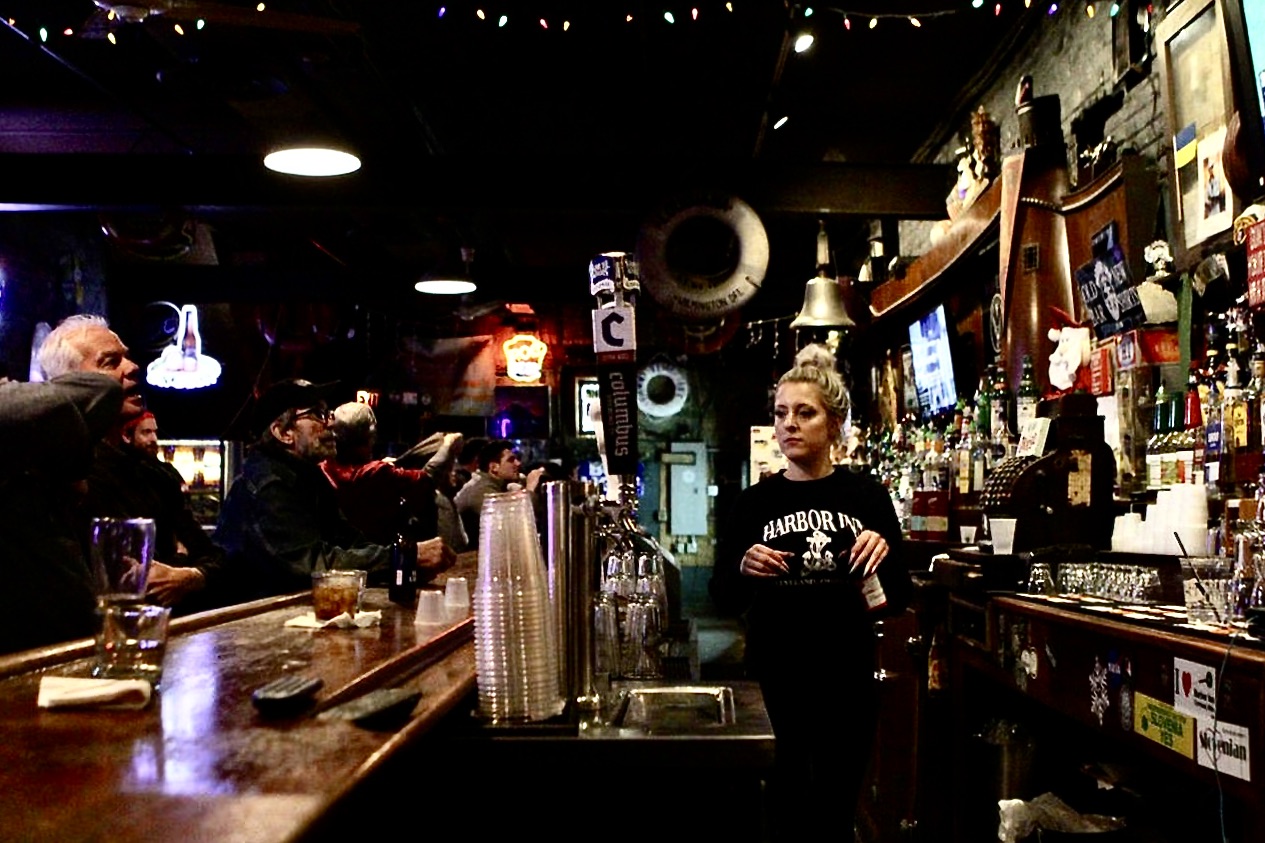
   If we had known that we probably would never have started playing. By the time we found out it was too late. We had been sucked into the black hole of Go. Getting out of the hole meant going down to the Harbor Inn for a pick-me-up. It was another hole, on the west bank of the Cuyahoga River in the Flats. It either was or wasn’t the oldest bar in town. Either way, the place wore its reputation on its sleeve.

   “The place was always shoulder to shoulder with bikers and their molls,” said Dan Coughlin, a sportswriter for the Cleveland Plain Dealer. “Wally had a virtual armory behind the bar. He had pistols and shotguns. One night in the middle of the summer we stacked up cases of beer bottles and fired at them from the hip, with shotguns blasting away. I put a hole in the stop sign in front of his bar.”

   Wally was Vlado Pisorn, an immigrant from Slovenia who had taken over the Harbor Inn sometime in the indeterminate past. We called him Vlad the Impaler. He had the kind of beer we liked, the kind from Germany and Czechoslovakia. The wine came from a hose and died on the tongue. After a couple of near deaths, we never drank it again.

   Matt had served a tour of duty in the armed forces, was on a prolonged stretch of R & R, and in the meantime was boning up for the entrance exams for mailman, fireman, and policeman. He was hedging his bets. He finally found employment with the Bay Village Fire Department, which was like working at a posh nursery school. There were hardly ever any fires anywhere near the lakefront suburb. There were, however, lots of old folks having heart attacks and strokes and the EMS trucks kept up an endless shuttle to St. John West Shore Hospital.

   One night Matt and his duty partner Chuck were called to a house where the man of the house was having chest pains. He was on his back in bed, his eyes closed. When they stepped up to him in the bedroom his wife whispered that she thought he was dead. “The poor dear man,” she said. Chuck was in the lead. As he walked up to the bed, he slipped on a throw rug and went head over heels on top of the man, body slamming him, the bedsprings recoiling.

   “If he’s not dead yet, he’s dead now,” Matt thought. 

   “Is he OK?” the woman asked, alarmed. 

   “Your husband will be OK,” Matt said. 

   “No, not him,” the woman said. “I meant the other fireman.” 

   “What the hell is going on!” the dead man suddenly spat out, jolting awake. “Get your fat ass off me.” He rolled Chuck off the bed, who fell to the floor. From then on, Chuck was known as Lazarus back at headquarters. It took years for the sobriquet to fade away.

   Virginia Sustarsic introduced me to Matt. How they knew each other was beyond me. She was Slovenian and a hippie through and through. He wasn’t, not by a long shot. He was a cool customer and Finnish on top of everything else. He played chess, like me, and we got to know one another playing now and then. I had moved out of the Plaza Apartments, where Virginia still lived, and was living on a forgotten street in North Collinwood, a couple of blocks south of Lake Erie. I lived upstairs in a two-bedroom Polish double. Ray Sabaliauskas, a fellow Lithuanian, owned the house and lived downstairs with his Southeast Asian wife and a prize German Shepherd. He had come home safe and sound from the bright shining lie that was the Vietnam War.

   I found my Go game at a garage sale in the neighborhood. It was practically brand new, the instruction sheet still in the box. I paid a dollar for it in pocket change. Reading the rules took less than five minutes. Explaining the rules to Matt took less than one minute. Our first game took five hours. We played on the front porch. The contest was suspended due to darkness when the sun set.

   “The best strategy is to spread the pieces far apart and stretch them out, to encircle and attack the opponent, and thus win by having the most points vacant,” Go master Huan Tan said nearly two thousand years ago. We were both bug-eyed after our first game. We didn’t know the game’s strategy from a seesaw. It was like wrestling a gorilla. You don’t quit when you’re tired, you quit when the gorilla is tired. Go is considered the most difficult board game in the world. Sleeping became my new go-to after a long match.

   I started jogging on Lakeshore Blvd. west out of North Collinwood, where everybody was a working man in one way or another, through the village of Bratenahl, where everybody was tall, trim, and filthy rich. They oozed pride in their state of being. When I was running in their neighborhood I hesitated to even spit on the tree lawns. I had put exercise on the back burner in my early 20s. I never thought I would be working out again to be able to sit quietly hour after hour staring at a square board of intersecting lines.

   When I was a teenager I ran track and field as part and parcel of Zaibas. It was a Cleveland Lithuanian sports club formed in 1950. In 1951, at the 1st North American Lithuanian Games, members participated in basketball, volleyball, and table tennis. The next year the club hosted the games in our hometown and fielded a full team in track and field. 

   In the 1960s I ran around in circles encouraged by Algirdas Bielskus. He was a small man with a round face and a championship head of hair. He was the director of a men’s vocal ensemble, co-founder of a choir, and concertmaster of the Ciurlonis Ensemble. He was also the Zaibas track and field coach for sixty years. He had the voice to make himself heard loud and clear from the far end of any quarter-mile track. Every weekend fair or foul all I heard was “Go! Go! Go!”

   He always carried a briefcase, briefcases he was always losing, stuffed with notes about how we were progressing. Rita Kliorys, one of his top-notch runners, made him a Christmas gift of a new one in 1966. “It was the accordion kind,” she said. “I remember it cost $100.00, and I collected one dollar from many people. He actually did not lose it, either.”

   He coached thousands of youngsters who ran hundreds of thousands of miles. “I thought of him afterwards whenever I saw a turquoise and orange Howard Johnsons and would remember how he took us there for ice cream sometimes,” Regina Thomas said. “Although I was a klutz at sports, he never made me feel like one. I never thought much about it as a kid, but what a commitment to youth and sports.” The small man with the big voice was seemingly tireless, championing fitness among Cleveland’s Baltic off-spring.

   “He worked for my dad’s company, Transmission Research, in the basement of our house,” Dalia Nasvytis said. “Sometimes we would hear strange noises downstairs late at night and realize he was still down there running off schedules for the next athletic meet he was organizing.” He was unrelenting about the fettle of immigrant kids.

   Once we started playing Go, Matt and I made a commitment to it. We played all that spring, summer, and through the winter, two and three games a week. It wasn’t an obsession, although it was. We played on the front porch until it got too cold to play outside. After that we played in the living room at a coffee table, sitting opposite one another, all four of our eyes glued to the board.   

   The game demands concentration, which is born out of silence. Some of our best moves and long-term maneuvers were made quiet stealthiness. I found out the more time I spent noiseless, the more illumination lit me up. We hardly talked, going for a half-hour without saying a word. Every so often Matt smoked a Marlboro. Before long he would tap another one out of the red and white flip-top box. Whenever I joined him, the living room filled with smoke, a gray-white cloud stewing over the entanglements of Go.

   When we first started playing our plan of attack was capturing stones. We both saw that surrounding other stones and taking them prisoner yielded points. It was like taking a piece in chess. After a while we discovered the object of Go is not to surround and capture the opponent’s stones. The object is to surround empty territory on the board. The way to do it is by building walls around empty intersections. If your territory includes some opposing stones, all the better. Then it’s grab and go. From then on it became a contest to capture territory rather than simply capture stones.

   In the Eastern world Sun Tzu’s “The Art of War” reads as an introduction and exposition to the game. Real life warlords back in the day of every stripe were always big on blockading their enemies and capturing territory. The times they were not a-changing, not anytime soon. The Vietnam War was over, but there was always another war on the horizon.

   There’s an old saying, “Chess is a battle. Go is a war.” The more we played the more we discovered it was a war of attrition. It was like breaking stones in the hot sun. Both of us knew how to make the other guy sweat. There was no fighting the commandments of Go.

   Oskar Korschelt, a German chemist, brought the game from Japan to Europe in the 1880s. Even though it was slow to catch on, by the 1950s championship-level tournaments were being organized. By the early-70s it was filtering into the United States. I never met another Lithuanian who played the game. My kinsmen are instinctively suspicious, somewhat superstitious, sometimes curious, usually sensible, always pragmatic, hard-working, conformist, and punctual. They are often reserved except when they get together. Once they establish their bona fides it’s time to pick up a drink and run off at the mouth, getting communal. They play volleyball and basketball like nobody’s business. They probably couldn’t stand the prolonged silence of Go.

   One night after a long back-and-forth on the board we drove to the Harbor Inn. We were looking for some downtime. The two-story building was a home-away-from-home for dockworkers and salt-miners. A lonely man who didn’t mind a lumpy mattress could even grab some shut-eye upstairs. It might have been a dive way back when, but it was no ifs ands or buts about it still a dive, slinging suds to third shifters in the morning and anybody else who had a buck the rest of the day and night. There was a coin operated bowling arcade game downstairs and battered dart boards upstairs. We ordered bottles of Pride of Cleveland instead of imported European brew, being short on ready cash, and picked up a handful of house darts.

  Nobody knew how long the Harbor Inn had been there, but we thought it had to be from the day after Moses Cleaveland settled the land centuries before. It reeked of smoke from long-gone cigars and cigarettes. The shadows smelled even worse, like ammonia had been set on fire. Looking around there was no doubt some of the men at the bar only bathed once a month.

   The beer was cold and refreshing and playing darts was fun. We played 501 Up. Both players start with a score of 501 and take turns throwing three darts. Bullseye scores 50, the outer ring scores 25, and a dart in the double or treble ring counts double or triple. The tally is calculated and deducted from the player’s total. The goal is to be the first player to reduce the score to exactly zero, the only hitch being that the last missile thrown must land in a double or the bullseye. 

   Darts are front weighted for flight and are several inches long with a sharp point. A big part of playing darts is the throwing part. The rest of it is mental toughness, staying on the button, stinging the cork like a bee. It was like Go except we could let ourselves go. We wrote our names in chalk on the brick wall, adding them to the hundreds of other names reaching to the ceiling. After a couple more Pride of Cleveland’s we got sloppy, but it was no matter in the juke joint that was the Harbor Inn.

   When I took a good look at the dart board, there weren’t a hundred-or-more darts crowding it, like all the stones on a Go board. Every throw was always at an empty target, every throw a new chance to get it right, unencumbered by the past. Go was all about the past, the past of all the carefully placed stones on the board. Playing darts was right now. It was a relief to see the target and hit the target, except when we completely missed and the dart bounced off the brick wall. When that happened we yukked it up, not like the game of Go, which was never a laughing matter.

Ed Staskus posts on 147 Stanley Street http://www.147stanleystreet.com and Made in Cleveland http://www.clevelandohiodaybook.com. To get the site’s monthly feature in your in-box click on “Follow.”