Jesus and Mary Chain

By Ed Staskus

   Steve De Luca and Maggie Campbell’s neighbors who have passed away lived in the house on the driveway side of them. The woman who was horrible to all the neighbors lived on the other side of them. The Romanian man and wife who loved them and their dogs lived behind them.

   Mary and Josephine, who were sisters, lived together in the two-story brick bungalow on the east side of West Park for 62 years. Neither of them ever married. Josephine cooked hot dogs, brought them to the fence, and fed them to Steve and Maggie’s dogs every day. They hardly ever saw Mary. She hardly ever came out of the house.

   After they died Steve fixed up a timer and security light in their living room and mowed their lawn every Saturday. He parked Maggie’s Honda Element in their driveway to make it look like it wasn’t vacant, at least until the house was cleaned and sold. It wasn’t the kind of neighborhood where vacant houses were safe. If they stayed vacant too long their world went tumbling down. The angel sky was only so good for so long.

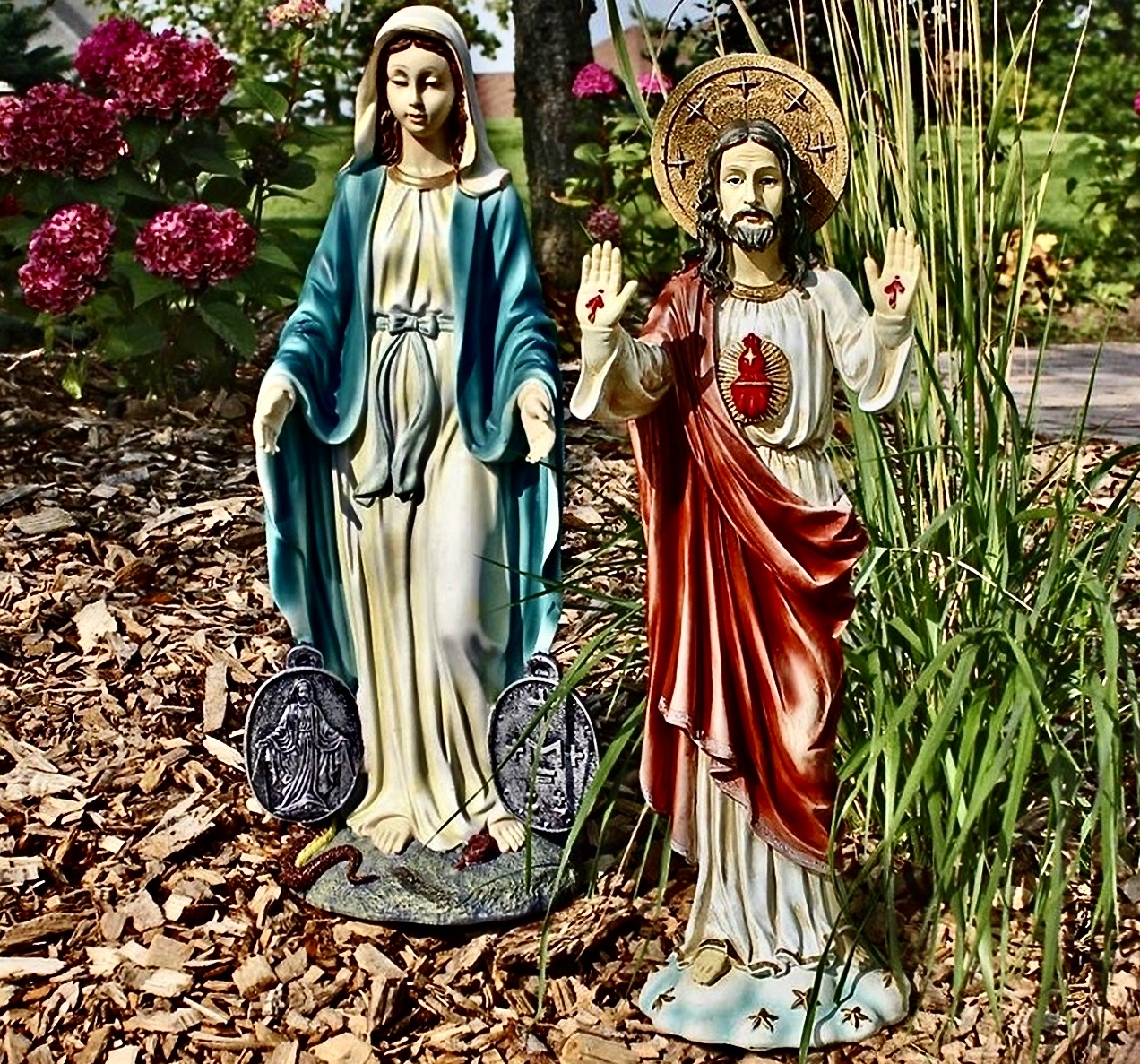
   There were statues of Jesus and Mary in front of a red hydrangea. They stood in Mary and Josephine’s front yard for an eternity. There were chains attached to the bases of both statues. The chains were buried beneath woody mulch and led to a bolt fixed to the side of the house. Mary and Josephine were determined to keep the holy family where they were. They didn’t want them spirited away to a sinful place.

   Dawn lived with her husband Chuck on the left side of next door. She was no Mr. Rogers. She was all about nine million rainy days. Chuck bought his house long before Steve and Maggie bought theirs. He had been a confirmed bachelor until he made a mistake and got married. He was a calm polite man. Before Dawn moved in Chuck was their nice neighbor. She was not so nice, disagreeable, and noisome.

   “She’s from New Jersey,” Maggie said. “She started in on us right at the start. Whenever we waved to her, she would never wave back. If she caught Chuck talking to either of us, he had to pay the price. He would sneak over to say hello and chat. The things she says to him about us I don’t even want to imagine.”

   “All my time in Hell is spent with her,” Chuck said.

   Dawn called the dog warden on them every other week, even when the dogs were on vacation. It was always about their dogs barking. It didn’t matter that they hardly ever barked. What she didn’t know was that the dogs were licensed, all of them, all the time.

   “Here’s the thing,” the Cleveland dog warden finally told Dawn. “Their dogs are licensed, and everyone’s dogs bark sometimes, so stop barking us up.” She finally got tired of her fun and games.

   “Most of the rest of our neighborhood loves it when our dogs are out,” Maggie said. “It is Dawn who gives us the most trouble. I don’t care if you’re from the bottomless pit, or not. It doesn’t give you the right to be a son of a bitch. But that’s all changed now that she needs me. When she couldn’t afford to have her hair done at the Charles Scott Salon anymore, I became good enough for her.”

   “Chuck doesn’t pay for anything for the kids,” Dawn complained bitterly. She had two children from an earlier marriage. Her ex-husband had killed himself. “Everything falls on me. I have to pay for their school.” They went to the West Park Lutheran School, even though Dawn was an atheist. She didn’t have much money of her own anymore. She had blown through her dead husband’s life insurance in Atlantic City. She depended on the good graces of Chuck.

   Then, when Maggie started doing her hair, knowing that she didn’t have kids herself, it was kids in her chatterbox all the time. “Do you think you could come over and watch them for a few minutes?”

   “No,” Maggie said. “That’s why I don’t have kids of my own. I don’t want to sit yours.” She might have done it to be a good neighbor, but she knew Dawn would have started taking advantage of her, so she put a stop to it.

   The old Romanian couple behind them bought their house the year Maggie was born. That was almost fifty years ago. They were straight out of Transylvania, which was part of Romania. Steve and Maggie could hardly understand a word they said, her more than him. His name was Anthony, but they had never been able to understand what her name was. They always called her Mrs. Anthony.

   Everything in their big back yard was a farm. They grew everything they ate, except for animals, in the back yard during the summer. When Steve and Maggie first moved into the neighborhood, they had grandkids who fed their dogs doggie cookies.

   They would hear the pack of them while sitting on their back porch. “Can we go see the dogs?” they asked. “Go, go,” their grandpa said.

   The children had become teenagers, but they still came to visit their grandparents. The dogs always ran to the back fence and lined up, waiting. “You can’t stop the feedbag now. You have to keep giving them cookies,” Maggie told the teens.

    Steve showed the dogs the lay of the land every day. He stopped and talked to their neighbors. They asked him about the dogs, so a lot of them found out they rescued dogs, finding them better homes. “That is so cool,” one of them said. That’s how they came to be called the Dog People. That’s what they’re known as. One day a distraught lady was walking up and down the street looking for her lost Dachshund.

   “Did you try the dog people,” everybody asked.

   “Have you seen my dog?” she asked Maggie.

   “No, but I’ll keep an eye out for the wiener,” she said.

   Sometimes neighbors donated dog food to them. They found 40-pound bags of it left on their front porch. It was nice to have a little community support.

   They started taking their tail-waggers to the dog park in the Rocky River Metropark instead of walking them because their Husky was a screamer. The second they put a leash on him the wailing started. It sounded like somebody was ripping out his toenails. He screamed the whole way on the way. Neighbors came out to make sure they weren’t torturing their dogs. Explaining got to be so embarrassing, Steve put their excursions to a stop. He drove them to the Metropark, instead.

   But the Husky hated the dog park, too. He didn’t like other people or other dogs coming up to him, or even up to his folks. One day they thought they would hide from him so he would learn to run around with other dogs. They hid behind a tree. But what happened was unsettling. He ran around like a madman looking for them.

   “Steve, we can’t hide from him,” Maggie said. “He’s never going to relax.”

   When they came out from hiding and he saw them he ran over right away. “He’s back to guarding us again,” Maggie told Steve. “He’s giving us his warm glow.”

   One of their neighbors fell in love with Grayson, their silver Lab, after he sniffed out who had bolt cut the Jesus and Mary statues and stolen them. Steve set them in cement so it wouldn’t happen again. Grayson had a great nose and was a cutie patootie, too. The neighbor lady did everything she could to get them to give Grayson to her.

   “He’s not for sale,” Maggie said. “He’s my dog.”

   “But I love him,” she said.

   “We love him, too,” Maggie said.

   One morning they took Grayson to Project Runway on Whiskey Island to a fundraiser for dog shelters. From there, later in the afternoon, they did Doggies on the Patio, another fundraiser. It was a long day. Afterwards they took him out for gelato. He loved it, the whole day, and the gelato. Maggie could never sell him. She couldn’t see that happening. It didn’t matter that he kept trying to sneak upstairs to sleep on their bed.

   Besides, Grayson had issues with Dawn, and was their early warning system, barking up a storm whenever she was in range. When she was, the Lab got going to the firing range. He never said a prayer, knowing he could get it done without any divine help.

Ed Staskus posts monthly on 147 Stanley Street http://www.147stanleystreet.com, Made in Cleveland http://www.clevelandohiodaybook.com, Atlantic Canada http://www.redroadpei.com, and Lithuanian Journal http://www.lithuanianjournal.com

“Cross Walk” by Ed Staskus

“Captures the vibe of mid-century NYC, from stickball in the streets to the Mob on the make.” Sam Winchell, Beyond Fiction

Available on Amazon: https://www.amazon.com/dp/B0CRPSFPKP

Late summer and early autumn. New York City, 1956. Jackson Pollack opens a can of worms. President Eisenhower on his way to the opening game of the World Series where a hit man waits in the wings. A Hell’s Kitchen private eye scares up the shadows.

A Crying of Lot 49 Publication
Over Hill and Dale

By Ed Staskus

   When the Ford F-150 in front of him swerved suddenly to the left, JT Markunas pushed down on the brake pedal of his Police Interceptor. The pick-up stopped on the shoulder on the left side of Route 6 just as JT saw what it was that had made the driver swerve. It was a woman in a Mother Hubbard dress crossing the road, looking fixedly ahead but not watching for approaching traffic. She looked unsteady. He pulled off and turned on his flashers. The pick-up driver was already leading the woman by the elbow away from the road.

   “She almost walked right into my truck,” he said.

   “Do you know who she is?” 

   “No, I don’t know,” he said. “I’m making a delivery to French River, coming up from Stratford. I thought I would go along the coast. Christ, I almost hit a dog down by Oyster Bed Bridge and now this.”

   JT put the woman in the front seat of his car and radioed that he was going to try to find out where she lived and get her back to her home.

   “How are you feeling?” he asked the woman.

   “Good, but I’m cold,” Ida Thomson said.

   He turned the car’s heating on, directing the vents at her.

   “Where do you live? Here in South Rustico?” 

   She pointed up Route 243 in the direction of St. Augustine’s Catholic Church. He swung his police car around, turning in a tight circle, and drove slowly up the road. Overhead the Kulloo hovered over them. He had known the woman for a long time. He lingered until he was sure she was safe and sound. He didn’t know the man, although he had a feeling he had seen him before somewhere. Neither the woman nor the policeman noticed anything.

   “Along here?” he asked.   

   “No,” she said. “Up that way.”

   When they got to the church he stopped and asked again.

   “I don’t know,” she said. “Somewhere that way.” She pointed to the left.

   “What color is your house?”

   The woman looked at the church, ignoring his question. “Everybody went to church back when I was a girl. Especially here in a small community like this. My goodness, we all went. I just walked up the road from home to the church and the school. It was the same way we walked to the beach and went swimming. My teachers were Mother Saint Alphonse, Mother Saint Theodore, and Mother Saint Cyril, who was sort of icky. Kids came to our school from all over, from Hope River and Oyster Bed Bridge.”

   “You have a good memory,” JT said.

   “Oh, yes,” she said. “My school was run by the Sisters of Notre Dame. Most of them came from the islands.” The Magdalen Islands are an archipelago not far away in the middle of the Gulf of St. Lawrence. “There were four classrooms and eleven grades. The nuns were one hundred percent French. My French is fluid to this day.”

   “Do you mean fluent?”

   “Yes, fluid.”

   South Rustico is where Route 6 and Church Rd. cross. There is a beach on Luke’s Creek, which is a bay on the far shoreline, near the National Park. The Rustico lands were some of the oldest communities established in La Nouvelle Acadie after the Treaty of Paris in 1763. 

   “I once went to mass at St. Augustine’s twice in twelve hours,” Archie Thomson said. He spoke from the hereafter. He was the woman’s dead husband. “We were dating, I was on the island and her mother insisted we go to church Saturday night before stepping out. So, OK, that’s it, we go. Sunday morning, they wake me up and say it’s time to go to church again. I say, what, did I die? When I did go, I thought, I got to be desperate for a girlfriend.”

   “You must have really liked me,” Ida said to Archie.

   Built in 1838, the oldest Catholic Church on the island, St. Augustine’s was an old church when Ida and Archie got married there in 1941. “Her foster mother hosted our dinner at the Charlottetown Hotel and the party afterwards was at their house,” Archie said. “The barn was behind the house and they brewed homemade beer. Ida and I didn’t have ten cents to rub together, but we were young and ready to go.”

   Ida Arsenault was born at home in 1917. She grew up in what became the Barachois Inn on the Church Rd. A barachois is a kind of bayou, a coastal lagoon separated from the ocean by a sandbar. But the home she grew up in wasn’t where she was born, nor were her parents the parents she was born to.

   “When my twin sister and I were born, our mother died the next day,” she said. “It was too much for her.”

   Her father, Jovite Arsenault, a farmer with nine children, owned a house behind the church and all the croplands between Anglo Rustico and the sand shore. “Where the new school was built,” Ida said, “that was once part of his fields.” Suddenly a widower, he was unable to care for the newborns.

   Ida and her sister, Elsy, were placed with foster families. Her sister went to Mt. Carmel, on the southwest end of the island. Ida became a ward of the Boucher’s, a husband and wife in their 50s, who lived down the street, on the front side of the church. “It was just a few minutes away,” she said. “I saw my brothers and sisters, and my father, all the time, and my new parents made sure I saw my twin sister now and then.”

   The Boucher’s were islanders who had long worked in Boston as domestics, saved their money, and returned to Prince Edward Island, buying a house and farm. They kept cows and some horses. They were childless. “I was spoiled rotten since I was their only child,” Ida said. “They were older and well-to-do. We had a car, a black Ford. I didn’t do too much, although I might have milked a cow once-in-a-while.”

   Before mid-century most of the roads on Prince Edward Island were dirt or clay, muddy when it rained, dusty when it was dry. The first paved road, two miles of it, was University Avenue in Charlottetown in 1930. “They eventually paved the road up to the church,” said Ida. “We used to say, ‘Meet me at the pave,’ which was where the pavement ended.”

   One of her aunts lived a few miles away in Cymbria on Route 242. She washed clothes by hand in a washtub and dried them on the line. There were thirteen children in her family. They didn’t have running water or electricity. They had an outhouse. “When I went out to the well and pulled the bucket up, there was meat and butter in the bucket. That was their refrigeration.”

   “When did they get power and plumbing?” JT asked.

   “In the 1950s when they moved across the street into an old schoolhouse,” Ida said.

   “Where were you going when I found you on the road?”

   “I don’t know,” Ida said. “Maybe I was going to visit my auntie, but I’m not sure.”

   Archie was born in Thorold, Ontario a year after Ida. “My father worked on the freighters all the time, Montreal to Thorold, where the locks are, and that’s where we moved,” he said. From Montreal the passage is down the St. Lawrence River and across the length of Lake Ontario to the Niagara Escarpment. The Welland Canal is “Where the Ships Climb the Mountain.” Standing on viewing platforms, anybody can watch ocean-going cargo ships pass slowly by at eye-level barely an arm’s length away.

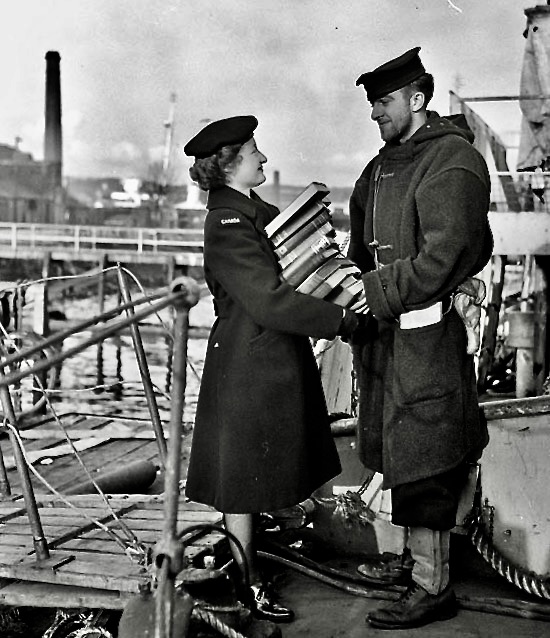
   He enlisted with the Royal Canadian Navy on his twenty-first birthday. It was 1939. During World War Two Canada commanded the fifth largest navy in the world. Archie met Ida when she was in nursing school in Halifax, where he was stationed with the fleet. “I was working a little job at the Charlottetown Hospital,” said Ida. “A friend of mine told me about the nursing course in Halifax. Right away I got the bug.” She and her friend enrolled and her friend’s father drove them to Nova Scotia.

   After graduating, as part of her scholarship agreement, she worked at the Christie Street Veterans Hospital in Toronto. It was a Gothic building originally built as the National Cash Register Company factory in 1913. “They gave us $45.00 a month to live on.” She and Archie dated long-distance by mail and phone. They got together when they could. When they did, they jumped into each other’s arms.

   “Whenever I got leave, I would pick her up in Toronto and take her to visit my parents in Thorold. That’s how I introduced her to my family.” At the same time, Ida was introducing Archie to Prince Edward Island. “You don’t get a second chance to make a good first impression,” Archie said.  It was a long drive alone to the east coast. While driving he practiced making a good first impression.

   “I took the S. S. Charlottetown across the strait when we were dating,” Archie said.. “You had to sleep in your car if you missed the last one. We would be lined up single file down the road. There would be a hundred cars full of frozen men inching along in the morning trying to get on the first ferry.”

   In the gray of winter, crossing the Northumberland Strait from Cape Tormentine, New Brunswick, to Port Borden, Archie stood bundled up against the cold wind, hands stuck in mittens, leaning over the bow watching as the heavy boat broke through thick ice. “It would crunch ice into big blocks and turn them over like ice cubes as it went across,” he said.

   One afternoon, making his way from Halifax to South Rustico, coming off the ferry in December and driving up Route 13 from Crapaud, he was brought up short by a snowdrift in the road. “The road went down a valley and there was five feet of snow piled up,” Archie said. He reversed his 1935 Chrysler Airflow back to where the rear tires could get a grip on a stretch of clear road. “I hit the gas as hard as I could, went as fast as I could, hit the snow, everything disappeared, and I came out the other side. By the time I did the car was barely moving. I shut it off and caught my breath.”

   Archie gave Ida a ring. She gave him a stack of books for his next sea voyage. They hardly saw each other after that as her man sailed back and forth across the Atlantic Ocean in a warship. In June the ferry S. S. Charlottetown sank on her way to a dry dock in Saint John for an overhaul. The boat was four miles off the coast of Nova Scotia. The crew rowed to safety in their lifeboats. Two tugs tried to get to the vessel but had to turn around in the heavy fog. When she was finally refloated the flow of water getting into her couldn’t be stemmed. It was the end of her.

   “We were in Lisbon when I got a message from Ida that she and my mother had decided on December 8th for our marriage,” Archie said. The executive order from home base said to be ready. “I went to the radio communications on board and sent a telegraph confirming my agreement.” They were married the day after Pearl Harbor was bombed by the Japanese.

   “Stay in the car, Ida,” JT said. “I’m going to the church for a minute.” He was hoping to find somebody who would know where she lived. But there was nobody to ask. All the doors were locked and he didn’t see any vehicles anywhere. He went back to his police car.

   “That’s where I live,” Ida said pointing through the windshield at the Barachois Inn across the street from the church.

   “That’s a bed and breakfast,” JT said.

   “That’s where I live,” Ida repeated.

   When JT knocked on the door with Ida standing behind him, a woman wearing an apron answered. She was drying her hands on a dish towel.

   “Can I help you?” she asked until she spied Ida. “Where did you find her?”

   “Trying to cross Route 6,” he said.

   “Oh, dear.”

   “She said she lives here.”

   “She did when she was a child.”

   “Do you know where she lives now.”

   “Yes,” the woman said. She gave him directions, describing the house. “She has a neighbor by the name of Bernie Doiron. He tries to keep an eye on her, but he’s a farmhand and works most days.”

   “Thanks for your help. If you don’t mind my asking, how old is this house? It looks old but it looks like it has been restored.”

   “It was more than a hundred years old when we bought it,” the woman said. “It was built by a merchant back then, a man by the name of Joseph Gallant, so we call it the Gallant House. My husband and I at first only planned on living here, fixing it up, which we are still doing. It is an unending job. We converted it into a bed and breakfast to help with the bills.”

   Back in the car Ida said she was hungry. “We ate fish, mussels, potatoes, carrots, and turnips when I was a girl. That was about it. Whenever we went to Charlottetown we ate at a Chinese restaurant, but that was as much as I ever knew. Before I got married, I never had Italian food. After I got married, my cousin and a friend of hers said, we’re coming over to make dinner. We’re going to make spaghetti. I thought, yippee, what’s that?”

   JT found her house easily enough, helped get Ida inside, and boiled water in a kettle for tea. He waited until she was resting easy in her easy chair before leaving. He shot her a two-finger salute off the brim of his cap.

   “Thank you, Mr. Policeman,” she said. “Can you come back soon and take me for another ride?”

Excerpted from the book “Ebb Tide.”

Ed Staskus posts stories on 147 Stanley Street http://www.147stanleystreet.com and Cleveland Daybook http://www.clevelandohiodaybook.com. To get the site’s monthly feature in your in-box click on “Follow.”

“Ebb Tide” by Ed Staskus

“A thriller in the Maritimes, out of the past, a double cross, and a fight to the finish.” Sam Winchell, Beyond Books

Available at Amazon: https://www.amazon.com/dp/B0CV9MRG55

Summer, 1989. A small town on Prince Edward Island. Mob money on the move gone missing. Two hired guns from Montreal. A constable working the back roads stands in the way.

A Crying of Lot 49 Publication