Minister of Music

Lavert-Stuart-organist

By Ed Staskus

On any Wednesday evening for the past two decades-and-more whenever anyone looked toward the musician’s pit to the right of the reader’s platform at the Christian Science Church in Rocky River they would have seen, as they still see today, the back of the pony-tailed head of Lavert Stuart.

What they wouldn’t have seen is that serendipity always rewards the prepared. Mr. Stuart has had his fingers on a keyboard from the time he could stand up in a crib. He was ready for the Schantz organ at the Rocky River church

“The substitute for Berdie d’Aliberti, the regular organist at the church, couldn’t make it one night, so I filled in,” said Lavert Stuart. “Then when Berdie’s teaching duties at Baldwin Wallace University got so she could only play on Sundays I became the Wednesday organist, and now we’re looking at more than 25 years.”

What Mr. Stuart didn’t say was that he has been a church musician for almost 50 years, since he started at Cleveland’s Mount Zion Congregational Church in 1965. In the years since he has performed as a pianist and organist at many Protestant churches, from the Historic First Parish in Lexington, Massachusetts, to the Cathedral de St. Trinity in Port au Prince, Haiti.

Although not a member of the Rocky River church he says he is a Christian Scientist “by osmosis”.

The son of a Cleveland policeman, who was cousin to Carl and Louis Stokes, noted Ohio politicians, and a librarian who went on to become the first black insurance saleswoman in Ohio, Mr. Stuart started small.

“When I was a baby my mother kept my playpen next to the upright piano in the front room. It was so she would know where I was. As long as she heard me picking out notes she knew I wasn’t getting into anything else.”

Mr. Stuart grew up in the Glenville neighborhood at a time when it was known as the Gold Coast, crowded with immigrants, delis, clubs, department stores, and churches. He attended Empire Junior High and John Adams High School.

The first in his family to pursue a higher education, he won a scholarship to Ohio University, where he majored in organ. After graduation he moved to Chicago, working for the Board of Education, and playing at several churches, including Salem Lutheran, founded in 1868 by Swedish immigrants. While there he studied with Edward Mondello, the University Organist at the University of Chicago.

“He was a wonderful teacher. I got a lot of the romantic 19th century style from him, playing in the Rockefeller Chapel.”

After being recommended for the New England Conservatory of Music in Boston, he studied there for two years. He was the musical director at the First Congregational Church in Weston and later played his graduation recital at the historic Old West Church, where the phrase “no taxation without representation” was first coined.

While living in Boston he helped coordinate the creation of the 1.6 mile Black Heritage Trail, which winds through the Beacon Hill neighborhood and ends at the African Meeting House, the oldest surviving black church in America.

“The first person to die in the American Revolution was a black man,” Mr. Stuart points out. “It was a terrible time.”

Even in 1976, during the Bicentennial celebrations in Boston, when a man at an anti-busing rally tried to kill an African-American bystander with the pointed pole end of an American flag, captured in a Pulitzer Prize-winning photograph.

“I was only a few steps away from that incident when it happened.”

Thirty-five years later Boston City Council cited Lavert Stuart with a proclamation honoring his “spiritual leadership through music ministry and commitment to developing interest and knowledge in Black heritage and culture.”

Having finished his studies he returned to live in Cleveland.

“It was my experience with institutions, and the sense of history in Boston, which made me interested in the organizations and history that brought me to where I was, and who I was.”

He returned to Mt. Zion Church, serving as their organist and choirmaster for the next ten years, as well as serving as supply organist for several other churches and chapels. He began a 25-year relationship with the Stuphen School of Music, serving as their musical director. The school experienced a renaissance under his leadership.

In 1996 he began his long association with Antioch Baptist Church as their organist for the Sanctuary and Gospel Choirs.

“His ministry of music has been a blessing to me,” said the Reverend Marvin McMickle of the Antioch Church. ”Lavert Stuart has been our local version of the Music Man.”

Mr. Stuart is a long-time supporter of the Antioch Development Corporation, whose mission it is to develop personal and collective self-sufficiency within individuals, families, and organizations throughout impoverished neighborhoods of Greater Cleveland.

“Sometimes you don’t realize the things people have to go through.”

As well as a career in classical, sacred music, Mr. Stuart has had a secular career in jazz and popular music. He got his start at the New England Conservatory under the aegis of Gunther Schuller, a composer, conductor, and performer who was then the president of the music school.

“He really put jazz on the map there,” said Lavert Stuart.

In 1973 Gunther Schuller won a Grammy Award with his Ragtime Ensemble.

In the late 1980s Mr. Stuart was the pianist at the Sweet Water Café in downtown Cleveland, and for more than ten years played three nights a week at Mantell’s in the Radisson in Willoughby.

“They had a grand piano on a platform in the shape of a grand piano.”

As well as playing jazz standards at clubs and restaurants, he has worked as a conductor-pianist for theater productions at both Karamu and the Ensemble Theater. He toured with Karamu when its production of ‘Langston’ performed at Lincoln Center in New York City.

He was the featured pianist in Philip Hayes Dean’s biographical play ‘Paul Robeson’.

“I always wanted to do something on a cruise ship, too,” he said, laughing. “Maybe in a next life I’ll be able to do that.”

As if his plate weren’t full enough, Mr. Stuart volunteers at the McGregor Home, a senior living facility near University Circle, playing the piano in their dining hall.

“One of my last adopted mothers is there,” he said. “She was my car mom when I was a boy, driving me home from church. I sit at the piano, start picking up the vibe, and play for her and her friends. It adds some quality to their lives, which is important, because it’s the little things that count.”

The Reverend Marvin McMickle remembers Mr. Stuart doing the same for his mother. “He would take a keyboard into my mother’s room and play the hymns of the church as she lay in her bed in a nursing home. I believe she is looking on from glory today and sharing in his musical celebration.”

Every Wednesday Lavert Stuart plays a prelude, accompanies three hymns, and finishes with a postlude at the Testimony Meeting at the Christian Science Church in Rocky River. Those who stay for the postlude are sometimes treated to his signature piece, the Carillon de Westminster, written for the organ by the French composer Louis Vierne as an embellishment on the chimes played from the clock tower of the Palace of Westminster.

After nearly two-and-a-half score years the minister of music continues to play organs with consummate skill and enthusiasm.

“It all started when I was a teenager and heard it at Mt. Zion. I would go to the library and get records. I loved to hear that sound,” he said.

For many centuries the organ has been known as ‘the king of instruments’.

“There’s something about the sound of the organ. It’s a light unto itself.” 

Ed Staskus posts stories on 147 Stanley Street http://www.147stanleystreet.com and Cleveland Ohio Daybook http://www.clevelandohiodaybook.com. To get the site’s monthly feature in your in-box click on “Follow.”
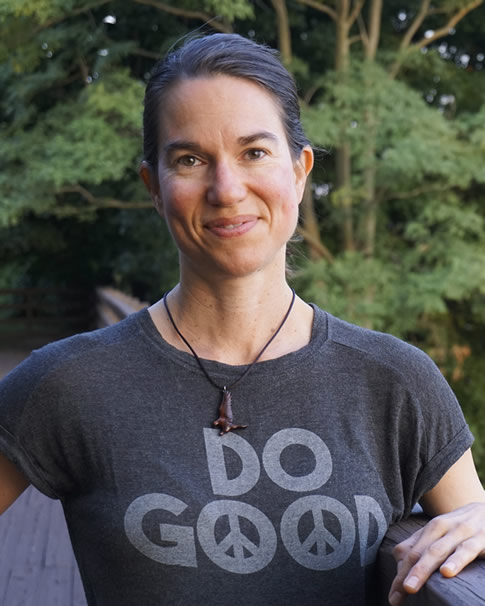
Good Vibrations

By Ed Staskus

Before she spent eight years chanting with Frank Barnett, before she took the stage with Brenda McMorrow at Bhakti Fest, and long before she sang back-up harmonies for Jai Uttal, Beth Gatchall sang ‘Dance of the Sleepyheads’ with her grandmother waking up early summer mornings in Chillicothe, Ohio.

“I was always singing with my grandma, singing songs, and learning songs.”

Even kirtan singers start small.

“My grandma was a schoolteacher, she always had a piano in her classroom, and sang songs with the kids,” said Beth. “All the cousins in the family know the sleepyhead song. Whenever we sing the tagline to each other we just crack up.”

Growing up in Chillicothe, a small town on the Scioto River in southern Ohio, home of Bob’s Banjo Barn, Beth Gatchall began taking piano lessons from both her grandmother and a family friend at the age of six.

“I really took to it. I could read music and I practiced as much as I could.”

At ten she decided to branch out and learn how to play drums.

“But, I didn’t think my parents would go for the drums, so I went for the trumpet, instead, although I think it might have been equally boisterous.”

Her parents were between a rock and a hard place.

The sound level of drum kits is usually around 100 decibels, although rim shots can peak at 135. Trumpets typically generate levels in excess of 110 decibels. Chain saws are rated at 100 decibels, meaning that loggers are required to wear hearing protectors.

While in middle school, and throughout high school, she played in bands, sometimes two and three at the same time. When she left Chillicothe to attend Baldwin Wallace College, where she earned a BS in Biology, she took her trumpet with her.

“I was in love with it. I used to play every day.” She didn’t care about getting a ring around her lips.

In her senior year she grew interested in the guitar. “I was just enchanted by the sound of Peter, Paul, and Mary, their guitars and their harmonies.” She took a class, and after graduation studied with a local teacher, Bruce Walker, for seven years.

When she later teamed with Kasimira Vogel in 2009 to form Pale Daisies, an acoustic guitar and rhythm instruments duo, she credited Mr. Walker as one of her influences, along with the Carter Family and Blue Sky Boys.

“But, where I really learned to play was when I went to work at the Cleveland Museum of Natural History.”

The museum’s loosely-knit basement band was well into its more than 20-year tradition of playing roots folk music during their lunch hour when Beth Gatchall started watching and listening to them.

“They would tip their guitars away so I could watch their hands, and if I didn’t get the chords they would show them to me, always encouraging me,” she said.

“They were so kind.”

At the same time that Beth Gatchall was learning to fingerpick the guitar she was beginning to dip her toe into yoga. It was while she was teaching aerobics at the YMCA in Lakewood, the first-ring western suburb of Cleveland she had re-located to, that she took a yoga class, which led her to Bhumi’s Yoga and Wellness.

Harriet Bhumi Russell, a former Director of Yoga Teacher Training at the Kripalu Center who has studied with Amrit Desai and BKS Iyengar, opened the first public yoga center in metropolitan Cleveland in 1992.

After several years of taking classes, as well as practicing with Tom Carney, a Lakewood-based Ashtanga Yoga teacher, in 2003 Ms. Gatchall put on her game face.

“I decided I would do teacher training, so I did that,” she said.

Teacher training typically focuses on yoga exercise, the names of postures, principles of anatomy, an introduction to the subtle body, as well as some history and philosophy. Beth Gatchall’s training was more wide-ranging, even involving kirtan.

Kirtan is a sing-along is which the performer, or leader, sings a mantra, and the audience sings it back. Kirtan is chanting, although chanting is not necessarily kirtan. Call-and-response chants can last 30 and 40 minutes. It’s a way to immerse oneself in sound, or in a meditation of vibration.

“It definitely didn’t resonate with me at first. My reaction was, this is bizarre. But, that’s how I met Frank.”

Frank Barnett, a Cleveland native and fellow yoga teacher trainee, was already immersing himself in Bhakti Yoga and kirtan.

“Frank was doing some kirtans with Bhumi at a Presbyterian church. I went there, but I didn’t have the greatest experience. Frank and I started talking about it and he really listened to me. When that kirtan at the church dried up he took it to his house and we started to do a lot of chanting together.”

They hosted a monthly kitchen party kirtan and for several years a Sunday night sit-in-a-circle-on-the-floor kirtan at Inner Bliss, one of Cleveland’s most popular yoga studios, with Frank on harmonium and Beth on guitar.

“Singing together with Frank is what put the practice in my heart,” said Beth. “It was a powerful experience. He shared so much unconditional love with me through that practice. We got to be great friends.”

Frank Barnett committed suicide in 2011.

“There were growing indications that something wasn’t right, but I didn’t see the bigger picture,” said David Barnett, Frank’s brother and a reporter for National Public Radio. “He became increasingly irritable as his search for a job dragged on, after having been laid off three years before.”

Someone dies by his or her own hand in the United States about every 15 minutes. Most Americans believe adults have a moral right to suicide, according to the Pew Research Center. The Bhagavad Gita, a central yoga text, says that the self is eternal and cannot die. You can kill the body, but you can’t kill the self.

“We had been working on the Hanuman Chalisa,” said Beth. “I said the verses through a million tears every night when Frank passed. After a year of playing it continuously in my car I learned it.”

The Hanuman Chalisa is a 40-verse 16th century devotional hymn. Hanuman is a monkey-like being, sometimes described as an incarnation of Shiva, the God known as the Destroyer, and the hymn invokes his strength and wisdom.

“Then I learned Mere Gurudev. It’s a beautiful melody, and haunting. I sang that when we distributed Frank’s ashes.”

Frank Barnett’s ashes were scattered in the Rocky Mountains by a handful of his friends. “This mind of mine, this body of mine, my every atom is dedicated to you,” Beth Gatchall sang heart and soul. For the next three years she kept up Frank Barnett’s work with the Cleveland Kirtan Community.

“I just continued the practice.”

In 2012 she expanded her horizons by going to Bhakti Fest with her friend Craig Wise, known as Narada Wise, a percussionist and singer-songwriter.

Bhakti Fest Midwest, in Madison, Wisconsin, is a four-day festival of lectures, workshops, and practice. The kirtan ranges from the popular, like the Wild Lotus Band, to the local, like Amy and the Tribal Bliss Band.

Bhakti Fest West, a larger gathering, is a six-day festival in the desert of Joshua Tree, California. Both fests are centered on the devotional paths of yoga, meditation, personal growth, and especially kirtan. The soundtrack never stops.

“They’re huge festivals, beautiful, and just jubilant,” said Beth.

“Kirtan is a practice of singing from your heart. When you chant from your heart it’s the same as my heart, like we’re all in this together. It’s a community experience. I got that from Frank, from my friendship with him. It’s all about giving and receiving the chant, back and forth.”

The first year at Bhakti Fest she worked as a volunteer backstage. The next year she was on stage with Brenda McMorrow.

Brenda McMorrow is a well-known Canadian musician with roots in both folk and jazz. She has described her first encounter with kirtan as not knowing what it was about, only knowing that “every cell in my body started vibrating.”

She needed an extra harmony vocalist for her next day’s set at Bhakti Fest.

“Oh, Beth can sing harmony,” said Narada Wise. Sometimes you just have to step up to the plate and volunteer somebody else to do something.

“So, within an hour I was at Brenda’s campsite and she was teaching me the music,” said Beth. “The next day I was on stage singing with her. It was so fun, so fun.”

Kirtans are usually sung in their native language, which is Sanskrit. “It’s a vibrational language. There’s something powerful about the vibrations of the mantras. When you intend them sincerely from your heart space, they’re potent.”

Kirtan is the participatory chanting of simple melodies. The imaginary fourth wall between performer and audience is not just blurred, but it and the other three walls of the stage are imagined away, so that performer and audience are all on the same stage.

“It’s not about having a great voice or knowing anything about Hanuman,” said Beth.

Krishna Das, the best-known kirtan singer of his time, has said knowing the meaning of the lyrics isn’t the first or even the last step. “It’s about doing it and experiencing. Nothing to join, you just sit down and sing.”

Beth Gatchall recently appeared at the Cleveland State University Student Ballroom with Jai Uttal. She is the singer and guitarist in her own Vandanam Kirtan Band, accompanied by Eric Vogt on drums and George Shumway on upright bass. She performs at kirtan chant events throughout northern Ohio from the Zen Temple to Yoga Rocks the Park.

“The feeling of kirtan is a warmth in my heart that spreads through my body,” she said. “It’s a sense of vibration, of joy, in me.

“Something ignites in your body. It’s the yoga of the heart.”

Ed Staskus posts stories on 147 Stanley Street http://www.147stanleystreet.com and Cleveland Ohio Daybook http://www.clevelandohiodaybook.com. To get the site’s monthly feature in your in-box click on “Follow.”