Tag Archives: North Rustico PEI

Guardian Angel

By Ed Staskus

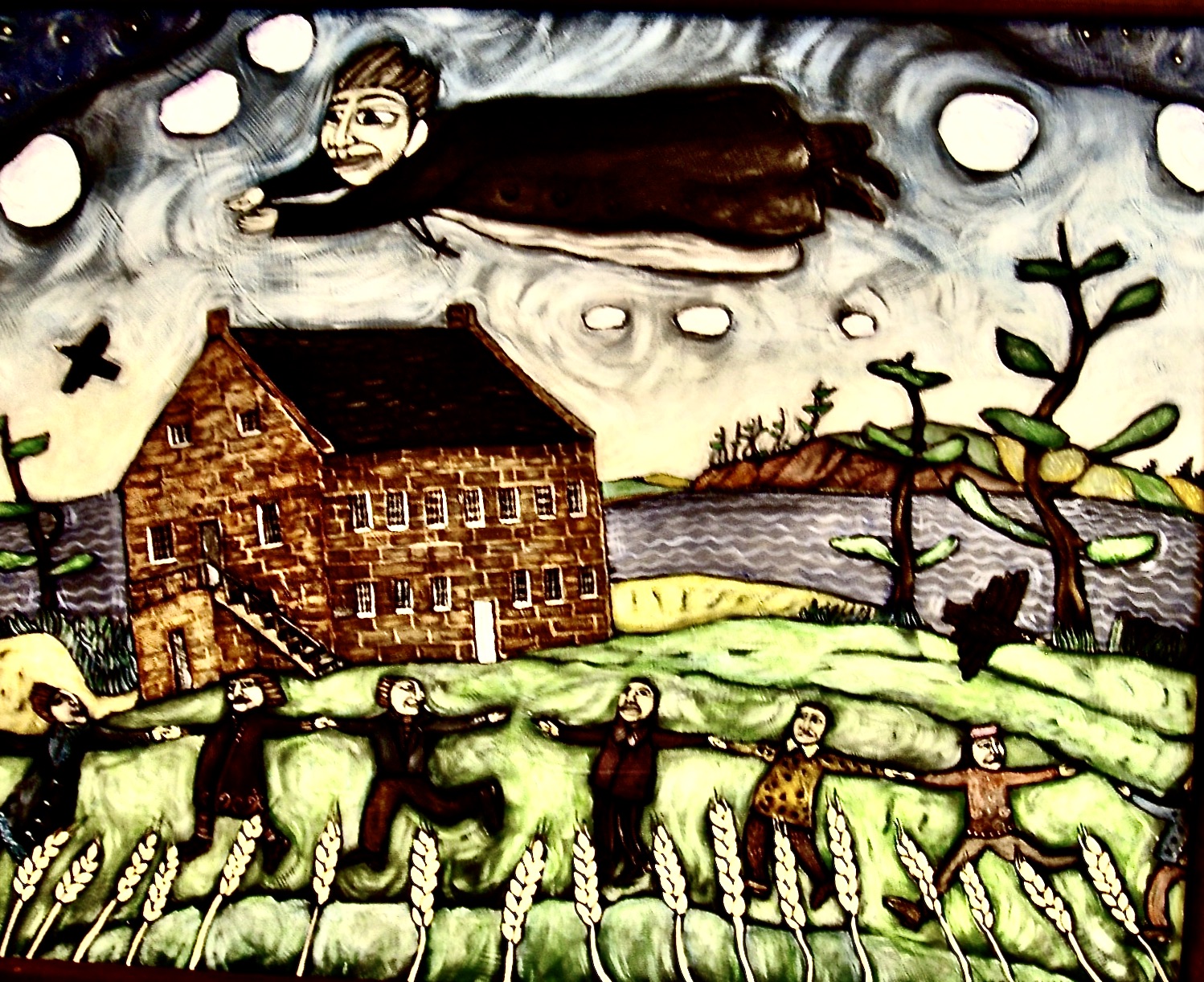
   The day Siobhan Foyle died in 1901 was the same day Queen Victoria died more than five thousand kilometers away. Siobhan’s head got bashed in when Father Georges Belcourt’s one-seater car fell on her. The horseless carriage killed her just as fast as the horse who kicked her husband in the head many years before killed him. 

   Her last thought was of the first day she met her husband-to-be in Cavendish, of her first look at him. She knew in a flash what he was all about when he looked her up and down and knew what her answer would be. After her last thought in this life before meeting her maker she went down into the darkness. She saw a bright light ahead of her. She saw her long-dead man at the end of the tunnel.

   Siobhan lay crushed under the old steam-powered car in her barn all day before anybody noticed. She didn’t feel sorry for herself. She knew she wouldn’t be forgotten. Flies buzzed around her. Her cat wandered in and lay down beside her. There was nothing he could do except keep her company. The sun went from one end of the sky to the other. Queen Victoria died in Osborne House of a stroke in her sleep, in a palatial bed surrounded by her family. The moon rose when she died. Siohban died alone. The sun went down when she died.

   Father Belcourt bought the car that killed Siobhan from a man in New Jersey in 1866. It was unloaded at Charlottetown and pulled to the Farmer’s Bank in Rustico by a team of horses. Nobody except the priest knew how to work the self-propelled wagon. He had a letter explaining its operation. He was keeping it close to the vest.

   “Be careful,” one of his parishioners said pulling him aside. “The devil could be in that tank.” The parishioner pointed to the steam engine.

   If he was, he was hunched over and hot as hell. The steam chamber was four feet high, and the motor was connected to the wheels by a chain. The car had no suspension, no windshield, and no roof. Father Belcourt kept it in a shed beside the bank. The Farmer’s Bank was organized by him soon after he arrived there in 1859. One of the first things that jumped out at him was the economic hardship of his flock. What he did to help was establish a Catholic Institute to bring parishioners together. Everybody had to agree to be teetotalers. The second thing he did was create the credit union to provide loans to farmers at Christian rates of interest. The third thing he did was buy the car to be able to get out to see the sick and homebound.

   The priest was from Quebec and had been in the business of saving souls for more than thirty years before arriving in Rustico. He led missions in Manitoba and North Dakota and fought it out with the Hudson’s Bay Company over their compensation to the natives who delivered furs to the trading company. But when he demanded the savages swear off liquor as a condition of conversion, they were unwilling to give up their company-supplied booze.

   He didn’t give up working for them, working up a petition for redress of wrongs. He persuaded a thousand of the savages to sign the petition about the company’s selfishness and discrimination, a petition he meant to send to Queen Victoria. He tried, but Earl Gray, the Colonial Secretary, tore it up and threw it away and arrested Father Belcourt for inciting discontent. The Archbishop of Quebec had to step into the fray. He got the charges retracted but sent the priest far away to the east to Prince Edward Island. 

   Father Belcourt retired as the pastor of Rustico in 1869 and moved to Shediac, New Brunswick, but couldn’t get islands off his mind. He pled to be allowed to pastor a parish on the Magdelen Islands. It wasn’t long before he was on a boat out on the Gulf of St. Lawrence with the Archbishop of Quebec’s blessing. Before he sailed, he asked Siobhan Foyle if he could store his steam-powered car on her farm. 

   “Of course,” she said.

   Unfortunately, the horseless carriage had forgotten how to get up and go and had to be towed there by a team of horses. It went into the barn. It was pushed into a corner. Everybody forgot about it.

   Siobhan had gotten into the habit of burying her money in a hole at the backside of the barn. When the bank got going, she dug up her savings and put it in the bank. She didn’t know it, but she was one of the biggest holders at the credit union. In 1893, a year before the bank closed, after her son Kieran Jr told her the bank would be closing soon, she withdrew all her money and buried it in the ground again. 

   She raised six children on her farm outside North Rustico. She raised them by herself. Siobhan knew the value of a dollar better than most. She wasn’t a miser, but she was frugal. When the shipbuilding business in Atlantic Canada collapsed in the 1880s and her son Sean was thrown out of work, she paid for his passage to the United States, where he joined Michael, her youngest. 

   Half of the island’s economy disappeared when shipbuilding disappeared. Thousands of islanders migrated to the Boston States looking for work in factories and domestic service. By the time Siobhan died more than a third of everybody on the island was gone. She never saw Sean and Michael again. Her three daughters all married, one of them going to Summerside, one to Acadian land, while Biddy stayed nearby in Stanley Bridge. She married a fisherman who was good at bringing up eels. They had seven children by the turn of the century.

   In the mid-1880s, unhappy that their winter mail and passenger service was still relying on iceboats, islanders started demanding a fixed link to the mainland by way of a railway tunnel. Siobhan rarely got mail and never left the island. She didn’t care if there were iceboats or tunnels. The tunnel never got built, no matter how many folks demanded it.

   In 1895 Robert Oulton and Charles Dalton become the first men on Prince Edward Island to successfully breed silver foxes in captivity. They brought a litter of foxes with a vein of silver in their fur to maturity near Tignish, on the west end of the island. They did it by mating red and black foxes. After that the gold rush was on. They shared the secret of their success and their breeding stock with a small circle and before long the small circle was getting rich. When word started to get out, the fox boom was on. When Kieran Foyle, Jr. heard about it, his ears pricked up. It was early fall 1900. When he told his mother about it, she dug up the family money buried behind the barn and laid it out on the kitchen table.

   Siobhan knew there was a livelihood and even a fortune to be made from fur. The explorer Samuel de Champlain had been in the fur trade three hundred years ago. Alexander Mackenzie, the first European to go cross-country and reach the Pacific Ocean, had been in the fur trade. John McLaughlin, who built forts in Vancouver and established the Oregon territory, had been in the fur trade.

   The Hudson’s Bay Company and North-West Company were in the business of hunting and killing bears, beaver, fox, deer, buffalo, mink, otter, and seal for their skins. Every woman in the Americas and Victorian Europe coveted a fur coat, but as the century raced to a close there weren’t enough wild animals left to answer the demand. Fur farms became the answer.

   “Charlie Dalton and another man have got a fur farm out on Cherry Island,” Kieran Jr. said. “They’ve been raising foxes in pens and have somehow got it so that the females stay quiet. They sold two breeding pairs to Silas Rayner up in Kildare and he’s making it work, too. Bob Tuplin bought a breeding pair for $340.00 and has gone into a partnership with Jimmy Gordon at Black Banks.”

   “That is a bushel of money,” Siohhan said.

   Farm hands on Prince Edward Island made about $25.00 a month. After a year they might have been able to buy one breeding fox, but it takes two to tango. Kieran Jr. leaned across the table. “Charlie sold one of his pelts in London for almost two thousand dollars.”

   Siobhan was amazed and said so.

   “Charlie and the Raynor’s and some others are setting up what they call the Big Six Combine. They plan on keeping their secret a secret, not produce too many pelts, and keep the price sky high.”

   “What’s their secret?” Siobhan asked.

   “One of their secrets is the wire they use, which they import from England. The foxes don’t seem to mind it. Charlie builds his pens with it. The wire stays free of rust and stays shiny. It seems to make a difference. They keep one breeding pair in one wire pen with a wooden kennel.”

   “How do they keep the foxes from climbing or digging their way out?”

  “They build sidewalls slanting in and add overhangs. To keep them from burrowing, they dig trenches and bury wire in the ground. They put catch boxes in corners and along the guard fences to trap any of them trying to escape.”

   “I would build a watchtower, valuable as the animals seem to be.”

   “Charlie’s got watchtowers.”

   “It must be hard on him if a fox does escape.” 

   “He pays schoolboys to hunt them down on weekends. There might be a boy or two who ends up going to Saint Dunstan’s with that money.”

   “What does he feed the foxes?”

   “He mixes fowl livers, junk fish, raw horsemeat, tripe, and offal with water. They eat about the same as a cat does, about a half pound a day. If a vixen can’t make milk for her pups, he brings in a nursing cat. He keeps the pups in good health, making sure they don’t have mites or worms.”

   “How do they go about taking the pelts without damaging them?”

   “Charlie pokes poison into their chest cavities when the time comes. I hear he might be getting a stunner from Norway, which kills the foxes on the spot. He’s got a fleshing machine that cuts the flesh from the pelt and sucks the fat into a tank. He cleans the pelt by putting it into a spinning drum filled with corn grit. Then he dries it on a wood board cut through with ventilation holes.”

   “Do you think you can make it work like Charlie’s done?”

   “Yes.”

   “How do you know all this about farming fox furs?” Siobhan asked.

   “It’s a secret,” Kieran Jr. said to his mother, from whom he had never been able to keep a secret. He spilled the beans soon enough.

Excerpted from “EbbTide.”

Ed Staskus posts monthly on 147 Stanley Street at http://www.147stanleystreet.com, Made in Cleveland http://www.clevelandohiodaybook.com, Down East http://www.redroadpei.com, and Lithuanian Journal http://www.lithuanianjournal.com. To get the site’s monthly feature in your in-box click on “Follow.”

“Ebb Tide” by Ed Staskus

“A thriller in the Maritimes, out of the past, a double cross, and a fight to the finish.” Sam Winchell, Beyond Books

Available at Amazon: https://www.amazon.com/dp/B0CV9MRG55

Summer, 1989. A small town on Prince Edward Island. Mob money on the move gone missing. Two hired guns from Montreal. A constable working the back roads stands in the way.

A Crying of Lot 49 Publication

Rat in the Hat

By Ed Staskus

   Aksel was a Norwegian rat, although it would have been a matter of rough-and-tumble if anybody had tried to tell him that. He believed he was a Norman rat since his forebears had come to the New World aboard a French ship that sailed from Bayeaux long ago. The Normans were hardy explorers. Norwegians sat around their fjords moon eyed. It had been more than a hundred generations of his family saga since his ancestors landed on the island. He had never met a Norwegian. He had no idea about any Norwegians. He didn’t even know where Norway was.

   He didn’t know what day week or month it was. He didn’t know it was 1989. He didn’t know he was living in North Rustico on Prince Edward Island, either. He had no clue he was on the North American continent, for that matter, although if he had known it wouldn’t have mattered. He knew where Rollings Pond was. The pond was where he spent most of his nights. During the day he slept in the basement of the Stella Maris Catholic Church. He never went to mass or confession, though. It wasn’t that he was an atheist, not exactly. He simply couldn’t wrap his head around the idea of a Supreme Being who had his best interests in mind. Something was always out to get him. He always had to do everything for himself. He didn’t own anything, not even a fork, knife, or plate, but his bedroom was cozy. He stored some dried food there and had a bed of straw and a small pillow. He kept a handful of loose change he had found at Orby Head under his pillow for a rainy day.

   Aksel was known by the nickname of Left-Hand. How he came to be called Aksel the Left-Hand was beyond him, since he was right-handed. In the event, he didn’t gripe about it. It was better than some of the other rat nicknames he had heard in his neck of the woods, like Seaweed Neck and Foul Fart. He liked to think of himself as a man about town and sometimes wore a bowler hat.

   He wasn’t a farmer. He foraged for food instead of sowing seeds. He gleaned grub far and wide. He ate anything and everything. He thought he had probably eaten hundreds of different foods in his lifetime. He ate any discarded morsels he came across as well as all crops from all fields. He ate all the time, snacking on whatever came his way. Some people said he was a glutton. He didn’t bother disagreeing with them. He preyed on chicks, lizards, and other rodents. He caught fish on Fridays, just in case there was a God.

   His mother let it slip one day that their kind only lived two or three years. He was aghast. There was apparently no time to waste. His eyesight had always been bad. He needed glasses. He was colorblind, too. His other senses, smell, taste, touch, and hearing, were outstanding. He wasn’t especially Olympic Games agile, but he could run, jump, climb, and swim enough to keep danger at bay. He used his face whiskers to feel the world around him. He could wiggle each one of them individually, unlike cats like Snaps, who was from Murphy’s Cove and was always messing with him. He and Snaps were going to have it out one day. The cat was a menace. He was always lying in ambush for him. He had to find a way to cancel out the mouser’s claws, which were razor sharp and deadly. He had the scars to prove it. 

   Except for Snaps, cats rarely bothered Aksel. He was too big for most of them, feral or otherwise. Snaps was a different order of things. He was as big as cats come. The beast was a dangerous son-of-a-gun. The cat and the rat were a stop-and-go dance in the dark. When Aksel stopped, Snaps stopped. When he started up again, the cat was on his heels again, low-down and deadly quiet.

   Islanders didn’t always give Aksel his due. Some called him a street rat, even though he was a field rat. Others with college educations called him a Hanover rat. He tried to explain he was a Norman rat, but couldn’t speak the language of the learned. He didn’t like it whenever he was called a dirty rat. He was fastidiously clean. He washed and groomed himself ten times a day. He was a brown rat with a white underside. He was a big boy, his body length almost a foot long with a tail slightly shorter than a foot. All he had to do was flash his teeth and wiggle his tail at passersby to make them jump and lose their sandwiches.

   He  liked hanging out in the back room of Lorne’s Snack Shop, where out of work fishermen hung around looking for something to talk about. Aksel wore morning dress, a bowler hat, and pantomimed Charlie Chaplin on table tops for handouts.

   One night he met one of his own kind in the dumpster behind the co-op store next to Angie’s Eatery. After giving each other the secret handshake, after which both rats were sure the other one was legit, they chewed the fat and gossiped about local doings. His new-found friend, it turned out, had come off a cruise ship in Charlottetown three weeks ago, gone on a self-guided tour, been late getting back, and was now stranded until another boat rolled in. He had strayed up to North Rustico and was thinking of staying

   “I’m a free agent,” he said. “I can hi-jack myself back onto any boat anytime I want to. You know those round things they attach to mooring lines, what they call rat guards, and how they coat them with grease? First, I puff up my cheeks. Second, I suck up the grease. Third, I spit it out over my shoulder when I go over the rat guard.”

   Cruise ships had been docking in Charlottetown since just after the turn of the century, pulling into port to hearty welcomes. They let loose hundreds sometimes thousands of tourists all at once to stretch their legs, eat, drink, see the sights, and buy “Anne of Green Gables” dolls and effigies. They bought on-the-spur memories to put away in their closets.

   It was after midnight when Aksel and Yeoman Purser, which was what his  friend called himself, went their separate ways. “I know I’m just a rat and a mug, to boot, but I have got to say this seaside place here is something else, just beautiful, and everywhere I look there is food.” The hometown boy twitched one whisker in agreement.

   Aksel was more nocturnal than not, so when Bernie Doiron found something sticking out of the ground when he was plowing on the other side of the hill from Rollings Pond and every nearby cop car, ambulance, and fire truck descended on his stomping grounds, the noise that morning woke him up. He had just rolled over in his straw bed. He coughed and cleared his throat, blinking. He was curious and made his way to the top of the field where it was all happening to see what was happening.

   He had a love hate relationship with members of the human race. On the one hand, he preferred living near them since they were a rat’s number one fast food outlet. On the other hand, they were always trying to kill him. They checked his droppings unceasingly and tracked him by them. They were always putting out traps and bait stations. Whenever they found his nest they gassed it. He had gotten to be as cautious as an accountant. He knew full well what glue boards and snap traps were about. It didn’t matter if they were baited with his favorite fish and cereals. He gave them a wide berth.

   “My mama didn’t raise no fool,” he grumbled to himself.

   He saw what Bernie had seen and what the cops were seeing sticking out of the ground. It was an arm that had been chopped off. He guessed the rest of the body was still in the ground. It looked like they were digging it up, although why was beyond him. He knew they weren’t going to eat the remains, so what was the point? What the human race did day in and day out puzzled him more often than not.

   Aksel quickly lost interest in the unearthing. There wasn’t going to be a free meal in it for him anytime soon unless somebody dropped some crumbs. That was something else that baffled him about men and women. They seemed to never want to pick up food they had dropped, especially the women. In his world no rat did that. They ate everything, no matter what, no matter where it was., and no matter how small it was.

   He ran across the open ground behind him. He could run faster than any man alive. He could run six times his body length in a single second, but he couldn’t keep it up for long. When he got to the tree line and was out of sight, he slowed down and caught his breath. When he got to Church Hill Rd., he looked both ways before crossing to the Stella Maris Catholic Church. There was no sense in being run over on his own doorstep by a four wheel bucket of bolts rolling past.

Excerpted from “Ebb Tide.”

Ed Staskus posts monthly on 147 Stanley Street http://www.147stanleystreet.com, Made in Cleveland http://www.clevelandohiodaybook.com, Atlantic Canada http://www.redroadpei.com, and Lithuanian Journal http://www.lithuanianjournal.com

“Ebb Tide” by Ed Staskus

“A thriller in the Maritimes, out of the past, a double cross, and a fight to the finish.” Sam Winchell, Beyond Books

Available at Amazon: https://www.amazon.com/dp/B0CV9MRG55

Summer, 1989. A small town on Prince Edward Island. Mob money on the move gone missing. Two hired guns from Montreal. A constable working the back roads stands in the way.

A Crying of Lot 49 Publication

Fish Tank Blues

By Ed Staskus

   It wasn’t breaking news that Prince Edward Island was an island. It was ancient news that it had not always been one. It was news to some folks who lived on the island, however. They weren’t overly concerned about the past. They cared about right now. They cared about heating oil being delivered on time and what time the school bus was scheduled. They cared about the flat tire that stopped them dead in their tracks on the way to the grocery store, and how they were going to put food on the table that day. They knew for sure that nothing from the prehistoric past had made their tire go flat. 

   What the land and the sea were all about wasn’t news to the lobsters who lived offshore. They had been around much longer than the fishermen, farmers, and townsfolk who plied their trade in the Maritimes. The crustaceans had seen it all, although they hadn’t seen amnesic shellfish poisoning before. The new toxin was killing Canadians who ate shellfish that year. No lobster ever went to any of their funerals. “That’s a dose of your own medicine,” Louie the Large said, chortling to himself that the toxin wasn’t bothering his kith and kin.

   Lobsters didn’t have a trade or much else to do, other than eat anything and everything they could all day and night. Everything was grist for the mill. They hated crabs and crabs hated them and it was the Hatfield’s and McCoy’s whenever the shellfish ran into each other. The lobsters were bigger, badder, and more determined. Three of their five pairs of legs were outfitted with claws. They usually carried the day. Might makes right was their motto.

   The number one rock ‘n’ roll band among the island’s lobsters was the B-52’s. They were the house band in their part of the world. Every lobster knew the lyrics to their “Rock Lobster” song. The band had released it ten years earlier and when they did it shot up the shellfish charts, even though every single crab scorned it as the devil’s music.

   “We were at the beach, everybody had matching towels, somebody went under a dock, and there they saw a rock, it wasn’t a rock, it was a rock lobster!” 

   Whenever any crab heard the song, it spit sideways and cursed. They were happy to see the island’s fishing boats go after their country cousins every spring. They showed up at the island’s harbors for the blessing of the fleet on Setting Day and shouted “Godspeed!” when the boats broke the waves. There was no love lost between crabs and lobsters. “We don’t need no skunks at our lawn party,” crabs far and wide said.

   Even though lobsters could be as bad as a Hells Angel on the wrong side of the bed, all they really wanted to do was eat and have fun afterwards. They were always on the move, moving in parties of fifty and a hundred, looking for a party. They ate non-stop so as to have plenty of get up and go at whatever party they found.

   “Havin’ fun, bakin’ potatoes,” they sang. Prince Edward Island was known as Spud Island. It was no small potatoes when it came to the tuber. It was the smallest province but the top potato producing province in the country. Everybody’s favorite way to eat lobster was boiled in the same pot with fresh corn and new potatoes.

   “Boys in bikinis, girls in surfboards, everybody’s rockin’, everybody’s fruggin’.”

   The blue and brown backed crustaceans couldn’t move fast enough to frug, but it didn’t matter. They got into the spirit of the song. They lived in harmony among themselves ten months out of the year, except when one of them happened to eat another one of them. The other two months of the year all bets were off. That’s when the island’s lobster boats went after them. That’s when the angels sang and it was every man for himself. They didn’t like it, but they had to take their lumps like everybody else.

   There were about 1200 boats sailing out of 45 harbors on the island. More than three dozen boats came out of the North Rustico harbor alone. Every one of them was out to get them. Once they got them their fate was sealed. Every lobster knew it in its bones, even though all they had was an exoskeleton. Their inner selves had no bones. They were going to be boiled alive and there was nothing they could do about it.

   Traps have escape vents to let shorts leave while still on the bottom. The under-sized lobsters who overstayed their welcome were thrown back into the ocean. Egg-bearing females were also thrown back. The female carried her eggs inside of her for about a year and then for about another year attached to the swimmerets under her tail. When the eggs hatch, the larvae float near the surface for a month. The few that survive eventually sink to the bottom and develop as full-fledged and grown-up. For every 50,000 eggs generated two lobsters survive to grow up and go rocking.

   Some diners wearing bibs argue that lobsters don’t have a brain and so they can’t and don’t feel pain. They have probably never seen tails twitching like a mosh pit in a hurricane when they got thrown into a pot of boiling water. They aren’t twitching to the beat of the B-52’s. Their brains might not amount to much, but they have a nervous system. They react to pain physically. The cortisol hormone they release when dying is the same one that human beings release when hurt. 

   “How about coming down here with the rest of us,” they wanted to scream from the red hot mosh pit. They would have screamed if they could. As it was, all they could was click and clack.

   The Prince Edward Island seafood industry considered lobster to be their crown jewel. It was a gourmet delicacy known for its juicy meat. But that was like getting the Medal of Honor when you weren’t around anymore. Who needs to bask in that kind of glory? The only consolation lobsters had was that the island’s fishermen took care to manage their resource. They didn’t pull up over many of them in their traps. They kept the surrounding waters clean as could be so there would be fruit of the sea year after year.

   It was a small consolation though. It only meant fishermen were in it for the long haul and weren’t going to change their minds about snatching them up anytime soon. The only consolation a lobster ever got was when somebody reached for it and the lobster was able to get the outstretched hand in its crusher claw.

   “We were at a party, his earlobe fell in the deep, someone reached in and grabbed it, it was a rock lobster!”

   When that happened, there was no quarter given. The lobster was going to sell its life dear. The human hand was going to pay dearly for sticking its nose where it didn’t belong. It should have stayed where it was before it ever came to the island. Why didn’t they stay in the Old World? What lobsters didn’t know was that fishermen came from the same place they themselves came from way back when. They came from way down in the ocean like them. They weren’t ever going back. The sooner lobsters got that through their thick heads the better.

   “Lots of bubble, lots of trouble, rock lobster.”

Excerpted from “Ebb Tide.”

Ed Staskus posts monthly on 147 Stanley Street http://www.147stanleystreet.com, Made in Cleveland http://www.clevelandohiodaybook.com, Atlantic Canada http://www.redroadpei.com, and Lithuanian Journal http://www.lithuanianjournal.com

“Ebb Tide” by Ed Staskus

“A thriller in the Maritimes, out of the past, a double cross, and a fight to the finish.” Sam Winchell, Beyond Books

Available at Amazon: https://www.amazon.com/dp/B0CV9MRG55

Summer, 1989. A small town on Prince Edward Island. Mob money on the move gone missing. Two hired guns from Montreal. A constable working the back roads stands in the way.

A Crying of Lot 49 Publication
Shock Wave

By Ed Staskus

   “When Britain is at war, Canada is at war,” Prime Minister Wilfrid Laurier said in 1910. “There is no distinction.” Four years later when Britain entered World War One, Canada signed on, too.  In August 1914 the Governor-General of Canada vowed that “if unhappily war should ensue, the Canadian people will be united in a common resolve to put forth every effort and to make every sacrifice necessary to ensure the integrity and maintain the honor of our Empire”

   Empires are made by plundering and slaughtering. They are always sure of the rightness of their cause. They never go down without a fight. It doesn’t matter if there’s any honor in the fighting, or not. They plow straight ahead.

   The country had no air force, a navy fit for a bathtub, and an army of 3,000-some men.  By the end of the war more than 600,000 Canadians had enlisted in the Canadian Expeditionary Force to fight for King and Country and more than 400,000 of them served in Europe, out of a population of fewer than 8 million nationwide.

   “The Empire Needs MEN” is what the posters said. “All answer the CALL! Helped by the YOUNG LIONS the OLD LION defies his foes. ENLIST NOW!”

   Everybody wanted in on the fight because everybody thought it would be over by Christmas. Canadians lined up to support the British Empire and collect steady pay of $1.10 a day. The harvest that year was bad, and unemployment was soaring. But machine guns fired ten times as many bullets a minute as they were paid pennies a day. Hundreds of thousands on all sides were slaughtered week by month by year by the rapid-firing weapons on the Western Front.

   At the beginning of the war, it was better to be killed than wounded. The wounded were taken off battlefields in horse-drawn wagons or on mules with baskets on their sides, the baskets soaked and dripping with men bleeding to death. There wasn’t any such thing as a dressing. If they made it to a train station, they were transported to hospitals. “One of those trains dumped about 500 badly wounded men and left them lying between the tracks in the rain, with no cover whatsoever,” said Harvey Cushing, the head of the Harvard Unit of volunteer doctors at the American Ambulance Hospital of Paris.

   Nearly 60,000 Canadians were killed, most of them the result of enemy action, and more than 170,000 of them were wounded. Almost 3.500 men and one woman had at least one arm or leg amputated. Private Curley Christian lost all four limbs but survived.

   During the Battle of Vimy Ridge he was unloading cargo from trucks when an artillery shell hit next to where he was, trapping him under debris for several days. When stretcher bearers tried to reach him, they were killed by more artillery. When he was finally rescued, he was transported to a military hospital and from there to London. His arms and legs had gone gangrenous and all four were sawed off.

   When he got back to Canada he was fitted with prosthetic limbs and married Cleopatra McPherson. He deigned his own prosthesis for writing. Cleo and he had a son who twenty years later served in World War Two.

   More than 7,000 Prince Edward Islander’s enlisted. Five hundred of them were killed and more than a 1,000 wounded. Tommy Murphy went overseas with a siege battery in 1915. Before he went, he got married to Freya O’Sullivan and got her pregnant. He got word of his son Danny’s birth by telegram while taking a break in an ankle-deep puddle of water sheltering in a trench during the Third Battle of Artois. 

   He had spent eight days at the front and was due for four days in a reserve trench and then four more days at a rest camp. When the bloodletting went on and on and the ranks thinned out, he never made it to the reserve trench much less the rest camp. It was that kind of a war. The Allied and Central Powers fought the same battles over and over.

   The British French and Canadians assembled seventeen infantry and two cavalry divisions for the offensive at Artois, backed by 630 field guns and 420 heavy artillery guns. During the fighting the field artillery fired 1.5 million rounds and the heavy artillery 250,000 rounds at the Germans defenses. Tommy Murphy barely slept for days. Whenever he took a break, he felt like his arms were going to fall off after loading shells until there weren’t any more to load. He knew he had sent his share of Germans to Hell even though he never saw one of them die.

   When the Allies tried to advance, they suffered 40% casualties. The battle went on from late September to mid-October when it ground to a halt in the middle of a never-ending autumn rainstorm and mutual exhaustion. By that time both sides were conserving ammunition because they were running out of it. They spent the rest of the month burying their dead, tending to their wounded, and withdrawing.

   Tommy was a cannon man because he was taller than five feet seven inches and burly enough to do the heavy work of feeding artillery. He didn’t have flat feet or bad eyesight, He didn’t have the greatest teeth, but explained he was enlisting to fight Germans, not bite them. He could have begged off the war because he was married, but he was patriotic and wanted to do his fair share. Money from the Canadian Patriotic Fund helped his wife keep the home fire burning.

   His battery had a lance corporal scout sniper attached to it. Francis “Peggy” Pegahmagabow was an Aboriginal who could split a bullseye nobody else could even see. He had more than 300 kills to his name. He roamed No Man’s Land at night for them, seeking out enemy snipers and forward spotters. He always came back in the morning. The other side never made it back to their side.

   He wore moccasins instead of army boots, chewed dead twigs whenever he sensed danger, and always carried a medicine bag. “When I was at training camp on Lake Superior in 1914, some of us landed from our vessel to gather blueberries near an Ojibwa settlement,” he said. “An old Indian recognized me and gave me a tiny medicine bag to protect me, saying I would shortly go into great danger. The bag was of skin tightly bound with a leather throng. Sometimes it seemed to be hard as a rock, at other times it appeared to contain nothing. What was inside of the bag I do not know.”

   Tommy had signed up for short service and when 1915 was over and done and it was April 1916, he was done with his one year on the Canadian Expeditionary Force. His commanding officer tried to convince him to re-enlist, but he had a wife, a child, and a farm that needed him. He didn’t need to kill anymore Germans. He was sick of the butchery. Three men from North Rustico were already dead. He didn’t want to be next. He knew if he re-enlisted it was only a matter of time before he went home in a box to be buried on Church Hill Rd.

   He got out when the going was good. The next year enlistments dried up as men near and far began to realize the toll the new style combat on the Western Front was taking. Machine gun fire and shell fire was murderous. On top of that there was poison gas. The dead were left where they fell. They were left for the rats. In May 1917 the government announced conscription through the Military Service Act. The rats stood up and cheered.

   It was easier getting into the army than it was getting out. He finally found a ride on a troop transport from Calais to Dover, took a train to London, and spent the night at a whore house with a razzle dazzle girl. He took a steam bath the next morning and had lunch at a corner fish and chip shop eating cod with a splash of vinegar and a full pint at his elbow. He followed the first pint with a second pint and was happy for it. He had a ticket for passage to Halifax in his wallet, but it was a week away. His grandfather had come from Ireland, or so the family story went, and done something big for the Crown, who rewarded him with 400 acres of PEI shoreline. He unfolded a map and located Dublin. It was directly across the Irish Sea from Liverpool.

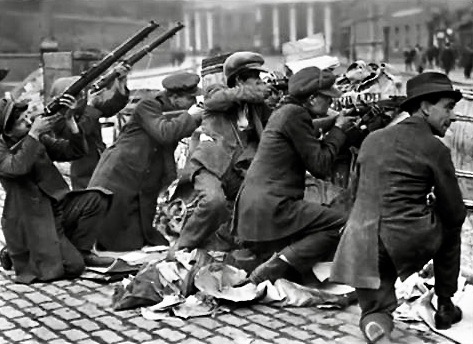
   He bought a train ticket to Liverpool and the next morning landed in Dublin. It was Easter Monday. The Easter Rising had happened yesterday. The Easter Rising was happening today. 

   After landing at the Dublin Port, he followed the River Liffey, making for Dublin Castle and St. Patrick’s Cathedral. His plan was to find a room for a few days and have dinner. He would explore the rest of the city after a good night’s sleep. He was wearing his Canadian Army uniform over a pair of Spring Needle underwear and carrying a rucksack. He had his toiletries, four pairs of clean socks, his rolled up military wool overcoat, and a paper bag full of Huntley & Palmer biscuits in it. The biscuits were so hard they would crack a man’s teeth at the first bite if not soaked in tea beforehand.

   His papers and money were in a travel wallet attached to his belt. He had his Colt New Service revolver on his belt, too, for what it was worth now that his war was over. An hour later he was glad he had it, after he got it back, although he wasn’t sure if he was going to need it to protect himself from the Irish or the British.

   Dublin Castle was in the middle of the old part of the city. The city got its name from the Black Pool, the ‘Dubh Linn,’ where the rivers Liffey and Poddle met. It was where the castle was. It had been a Gaelic ring fort in the beginning, a long time ago. Later, after the Vikings showed up, it was a Viking fort. For the past 700 years it had been a British fort, the seat of their rule in Ireland. 

   Tommy didn’t have anything against the British, but after a year of serving in their army, he thought the Irish might be better served ruling themselves. They couldn’t do worse. During the year he served on the Western Front three quarters of a million Jacks and John Bulls were killed. It made him sick to think of the men he had seen obeying orders to attack barbed wire and machines guns across open fields. Another few million men went wounded and missing. The broken might survive, but he didn’t think the missing were coming back anytime soon.

   He was glad to be out of it. It hadn’t ended by Christmas of 1914. It still wasn’t over by Christmas of 1915. The next Christmas was in eight months and the talk was it would take a half-dozen more holidays to either win or lose the war. He meant to say a prayer in St. Patrick’s Cathedral before dinner. 

   He didn’t get a chance to say a prayer, find a room, or have dinner. He lost his chance when he came across the bridge leading to Trinity College, turned the corner towards Dublin Castle, and found himself face to face with a Mauser semi-automatic pistol. He knew exactly what it was. He stood stock still exactly where he was. The hand on the firearm was a woman’s hand. She was wearing an old military hat and a yellow armband.

   “Hand’s up and on the wall, boyo,” she said, a second woman coming up behind him. The second woman was wearing a bandolier laden with a half dozen hand grenades. She had a revolver. It looked like it came from the Middle Ages. He did what she said. She patted him down and took his Colt.

   “Who are you and what are you doing here?” she asked.

   “Tommy Murphy, Canadian Army, from Prince Edward Island by way of a year in France,” he said. “I’m here to take in the sights before going home. Now that we’re talking, I thought Ireland was sitting the war out.”

   “We ask the questions,” the woman wearing the bandolier spit out.

   “Come on,” the woman with the Mauser said, poking him in the small of the back with the barrel of the gun.

   The streets leading to the city center were barricaded. When they got to the General Post Office, he saw there were two green flags flying in place of the Union Jack. They said “Irish Republic” in gold letters. He knew there was no such thing as an Irish Republic. 

   “What’s going on?”  

   “We’re rocking the casbah,” the grenade girl said.

   There was a man outside the post office reading from a broadsheet. It was the “Proclamation of the Irish Republic.” There were copies of it pasted on walls. Newsboys were handing them out to anybody who wanted one. Not everybody wanted one. Most of them didn’t understand what was happening. The grenade girl handed him a copy. “Read this,” she said. There were men with rifles and shotguns on the roofs of buildings overlooking bridges.

   “Who’s this?” said a man wearing a scrap of paper pinned to his breast. It said “Citizen Army.”

   “We found him down the street, Sean.”

   Sean was Sean Mac Duiarmada, one of Commander-in-Chief Patrick Pearce’s right-hand men.

   “He’s Canadian,” Sean said pointing to Tommy’s regimental badge and the “CANADA” title at the end of his shoulder straps.

   “We thought he was a Brit.”

   “They’ll be here soon enough,” Sean said.

   There were 1,200 rebels waiting for 20,000 British troops to arrive.

   A shot rang out in the distance and Margaret Keogh fell down dead. She was a 19-year-old nurse tending to a wounded Citizen Army man. She was the first person to die during the Rising of Easter Week.

   A team of Volunteers trotted past on their way to the Magazine Fort in Phoenix Park. They took all the weapons and ammunition they could carry and blew up the rest. When the son of the fort’s commander tried to raise the alarm, he was shot dead. He was the second person to die.

   “You’re free to go,” Sean said to Tommy. “Best you leave Dublin all together.”

   “What about my sidearm?”

   Sean nodded to the grenade girl, and she handed Tommy’s Colt back to him.

   When a contingent of the Citizen’s Army approached Dublin Castle, the police sentry James O’Brien ordered them to halt. He was shot dead even though he was unarmed. He was the third person to die. When British troops showed up the rebels retreated to City Hall, stormed up to the roof, and fired down on the troops in the street. The man commanding the rebel contingent, Sean Connolly, was shot dead by a sniper, the first rebel and fourth person killed.

   Tommy carefully made his way back to the docklands and the port. He boarded the same boat he had come on. An hour later the boat was steaming into Dublin Bay on its way back to Liverpool. Eight hours later he was asleep in a room of a boarding house on the waterfront, not far from the Three Graces.

   The next morning was cold and damp. Women were out in the streets with their long-handled push brooms. They were called Sweepers. Others were in homes cleaning and scrubbing. They were called Dailies. Many more were at work in munitions factories. They were called Munitionettes. Liverpool’s men were on the Royal Navy’s battleships and in the King’s Liverpool Regiment. They were called Cannon Fodder.

   Tommy found a greasy spoon near the port and ordered breakfast, eggs back bacon sausage baked beans a fried tomato fried mushrooms fried bread and black pudding. The Liverpool Daily Post headline screamed “REBELLION!” There was no need for him to read about it. He thought he might have this same breakfast at midday and tonight. Somebody once said, “To eat well in England you should have breakfast three times a day.”

   He put the newspaper aside. Pushing himself away from the table, he checked his ticket for Canada. He tucked it securely away with his service revolver. Tommy Murphy was going to keep himself safe and sound until his boat sailed for home. Once he was out of the frying pan that was burning and smoking on another man’s stove, he was going to stay out of it.

Excerpted from “Ebb Tide.”

Ed Staskus posts monthly on 147 Stanley Street http://www.147stanleystreet.com, Made in Cleveland http://www.clevelandohiodaybook.com, Atlantic Canada http://www.redroadpei.com, and Lithuanian Journal http://www.lithuanianjournal.com

“Ebb Tide” by Ed Staskus

“A thriller in the Maritimes, out of the past, a double cross, and a fight to the finish.” Sam Winchell, Beyond Books

Available at Amazon: https://www.amazon.com/dp/B0CV9MRG55

Summer, 1989. A small town on Prince Edward Island. Mob money on the move gone missing. Two hired guns from Montreal. A constable working the back roads stands in the way.

A Crying of Lot 49 Publication
Searching for the Surfside

By Ed Staskus

“Whenever we leave home, to Ontario or New Brunswick, I always say we are crossing into another world, into a strange world, into Canada,” said Marie Bachand. “I always ask Louie did you bring our passports?” She always asks in French because her partner Louie Painchaund doesn’t speak English.

It was a cumulus cloud high sky day when they went to Prince Edward Island. They didn’t have their passports. Who wants to look like their passport picture on a sunny summer day, anyway?

They live in Saint-Gregorie in Quebec, a community of the city of Becancour, on the south side of the St. Lawrence River. Their house dates to the 1780s, built by refugee Acadians after the French and Indian War. “They came down the St Lawrence River, four hundred families. It was a rough time. They stopped, said OK, looks good, and settled here.”

It is about six hundred miles to Prince Edward Island, up the St. Lawrence, down New Brunswick, and across the Confederation Bridge to PEI. The first time they went they were touring the Maritimes. The island was a spur of the moment runaround. They drove across the Northumberland Straights on the nine-mile-long bridge to the other side.

“We thought we could run over and visit PEI in one or two days,” Marie said. “It’s so small.”

Even though it is pint-sized, the smallest of the ten Canadian provinces at just a little more than two thousand square miles, compared to Quebec’s almost six hundred thousand square miles, it goes over big.

Ten years later, even after Andy’s Surfside Inn is no more, they still go to Prince Edward Island two weeks in the summer, staying at the Coastline Cottages up the hill across the street, riding their bikes all over the place, still finding substantial fresh things to rack up on the to-do list.

The inn was on the ocean side of North Rustico, near the entrance to the harbor, a white clapboard two-story house with a dozen windows, two dormers and three porches on the side facing the water. A broad lawn slopes down to the cliffs. It wasn’t always the Surfside Inn and isn’t the Surfside Inn anymore, having since taken up where it left off, back to being a home.

“The first house was bigger,” said Kelly Doyle.

Kelly’s grandparents, Mike and Loretta Doyle, were visiting and playing cards at a neighbor’s house one winter night in 1929. Their friends lived about a mile away. At the end of the evening, going home in their horse-drawn sled, they crested a frozen hill. A red glow lit up the sky and flared across the flat cove below them.

The house was being swallowed up by fire. The pitch-dark night was blazing. They had left seven children behind in the care of the eldest.

“It was a flue fire,” said Kelly. “It burnt down because of the stove.”

By the time the Doyle’s raced their sled down to the house, and finding all the children safe and sound outside, there wasn’t much they could do. There were no neighbors nearby to help and there was no fire department. Mike Doyle was able to drag some furniture from the first floor out the front door and saved as many fox furs as he could.

The house was rebuilt the next year and finished the following year.

“The foxes my grandfather saved built the new house.” Kelly’s grandfather was a fox farmer. What he sold the pelts for paid for the work of the itinerant immigrant tradesmen who built the house.

Furry garments are made of furry animal hides. Even though it has lately fallen on hard times, fur is one of the oldest forms of clothing. Once we started globe-trotting out of Africa, to where everywhere else was colder, we started wearing furs. Ever since, people have worn beaver racoon sable rabbit coyote wolf chinchilla opossum mink and foxes.

Mountain men wore the bears they shot and killed.

In the 1880s foxes were bred for the first time, accomplished on Prince Edward Island by locals Charlie Dalton and Robert Oulton. Theirs was the original fur farm in 1884. Within several years the rush was on. But the rush didn’t really and truly mushroom until after a pelt sale a few years later when their harvest of 25 skins brought them nearly $35 thousand dollars. It was a boat load of a barn door of money, bearing in mind that the average island farm worker those days made less than $30 dollars a month.

In 1926 nearly nine hundred live silver foxes were shipped from Summerside to the United States. It was the most valuable shipment in the history of Prince Edward Island up to that time and is still called the ‘Million Dollar Train’. Andy Doyle was born the same year, spunky and healthy, although nobody ever called him the ‘Million Dollar Baby’.

By the 1930s the fox farm industry was strong as a bull, raking in multi-millions of dollars. There were hundreds of thousands of foxes being farmed and skinned coast to coast throughout Canada and the United States.

“The furs my grandfather was able to rescue from the fire were worth five thousand. In the end the new house cost five thousand,” said Kelly.

“We stayed at a country inn, at the information center at the bridge they said it was nice, but it was a little room, yuk,” said Marie. She picked up the official PEI tourist book. Where to stay next? She thumbed through the book. She put her finger on Andy’s Surfside Inn. “I say to Louie, what’s that, the north shore? We had already decided to stay three or four more days. We went looking for it.”

Gavan Andrew “Andy” Doyle was 81 years old in 2007 when Marie and Louie went driving up and down the north shore looking for his eponymous inn. Andy had been born in the white house that was the inn. Years later, grown-up a young man, pushing off after World War Two, he landed in Montreal, married, brought up three stepchildren, and years later, when his wife Vivienne died, went back to Prince Edward Island.

His mother died shortly after and he inherited the house on Doyle’s Cove. “My aunt, his sister in Montreal, always had a soft spot for Gavan. She helped him get the place up and running. She bought a bunch of nice furniture for him,” said Kelly Doyle. It was the late 80s. Andy Doyle resurrected the Surfside Inn that had been his mother’s brainchild in the late 40’s.

“When my grandfather died in 1948, my grandmother wanted to make some money with the house and started taking in tourists,” said Kelly. “There was a white picket fence, she had ducks and geese and sheep in a big barnyard, and she kept a garden.” It was a large working garden. “She fed the bed and breakfasts herself.”

As her six girls and two boys grew up and left home, she converted their rooms to guest rooms.

“She filled those rooms all through the 50s and 60s,” said Kelly. “PEI wasn’t like the rest of the world back then. Tourists found the way of life interesting, honest and down-to-earth. There wasn’t much entertainment, but there was always lots to do. They just liked the place.”

When Marie telephoned the Surfside Inn, a Japanese woman answered the call.

“Andy always had Japanese girls, three girls, housekeepers for the season who were exchange students who wanted to learn English. They shared a small bedroom over the kitchen. She told us, yes, we have a room.”

Louie and Marie drove up and down Route 6 between Cavendish and North Rustico searching for the Surfside Inn. When they couldn’t find it, they finally stopped at a National Parks kiosk and got directions. It was in the park, although on private land, Doyle’s Land on Doyle’s Cove. They drove down the Gulf Shore Parkway, past Cape Turner and Orby Head, and down to the coastal inlet.

When they got there, there wasn’t a room. There were four rooms that shared a bath. They were all taken. What Marie and Louie didn’t know was that there was a fifth room on the ground floor, which was Andy’s bedroom with a private bath.

“When we are full, he gives you that room,” explained the young woman.

“We’ll take that,” said Marie. “Where does Andy go to sleep?”

“He sleeps in the boat.”

The Japanese girls did the heavy lifting in return for being able to learn English. “I don’t know where they learned it, but it wasn’t from Andy,” said Marie. “He never talked to them.”

Outside the house was a castaway wooden lobster boat. The hull and forward cabin were worthy enough, although it needed some planks and rib work. it looked like it still had some spirit to it, like it could still make a living at sea.

“It smelled bad, all old stuff papers tools junk a small bed,” said Marie. “It should have been burned long ago.”

The Surfside Inn had a kitchen with several refrigerators. “We thought it was just for breakfast, but we saw other people storing food and making supper.” They started shopping at Doiron’s Fish Market on the harbor road. One suppertime Andy saw them coming into the kitchen with lobsters.

“Let me fix those for you,” he said.

“Oh, my God,” said Marie, “he was good. Tack, tack, tack, all done.”

They started bringing their own wine from home, though.

“I don’t like PEI Liquor wines. We brought Italian and French whites and rose for the fish.”

Coming back from Doiron’s one day, putting away fresh cod wrapped in Kraft paper, Marie noticed small buckets of frozen milk in the freezer.

“There was a Muslim couple staying at Andy’s, the guy was always in the living room, but she was wrapped up, always going to the bedroom. She didn’t talk. At breakfast, no words. She looked at her iPad, that’s all.”

The mother was expressing her breast milk and storing it. She kept it in the back of the freezer, the coldest part of fridges. One day all the milk was gone.

“We never saw the baby, though, maybe it was somewhere else, with a grandma.”

“Tourists in the 50s and 60s weren’t from Monkton or Toronto,” said Kelly. “Some were from the States, but a lot of them were from Europe. We lived next door and ran around the yard, having fun, meeting people. In 1970 my grandmother got a little bit ill and couldn’t keep it going. She lived alone for seven years until my dad moved her into the senior citizen’s home in North Rustico.”

The white house was empty for about ten years, for most of the 80s. It came back to life as the rooms filled up. In summertime it was never vacant.

“You could see the sea right in front of you,” said Marie. “We sat on the porch every day. It was a special place. After a week we would say, let’s stay another day, then another day. Other people, too, were crazy about this place.”

One day Andy asked Louie to help him take an old heavy bicycle out of the lobster boat. “You’re a big guy, you can do it,” said Andy.

When the bike was on the ground Andy straddled it and pedaled to the downhill on the all-purpose path. “He was going down the hill, but Louie told me there were no brakes. Stop! Stop! I yelled but he yelled back, I’ve been riding this bike for thirty years!”

Whenever Andy pulled his four-door sedan out to run errands or go to the grocery, Marie and Louie kept their distance. “I don’t think there were any brakes on his car, either,” she said.

He seemed to own only three short-sleeve shirts. “I have three nice ones,” he said. “I got them for a dollar each at the Salvation Army.” One was yellow, one green and one blue. The blue shirt was his favorite. He dried all his laundry on an outside clothesline, in the sun and ocean breeze.

“All the guests, they were from Canada, the United States, Italy, England, all over. A Chinese couple had a four-year-old who had been born in Quebec, so they named him Denis. Whenever we saw a Chinese child after that we always called the child Denis Wong. There was a couple from Boston, they lived in the harbor on a boat there. He was 80 and she was in her 70s.”

“I didn’t come with my boat. I came with my girlfriend,” he said.

“There is no age,” said Marie. Until you find out your grade school class is running the town city province country.

Aging and its consequences usually happen step-by-step, sometimes without warning. One minute you’re only as old as you feel and the next minute you don’t feel good. It’s like going on a cruise. It can be smooth sailing or a shipwreck. Once you’re on board, though, there’s not much you can do about it.

“There were always many guests, but suddenly a few years ago Andy started getting mixed up. He forgot reservations, there were two Japanese girls instead of three, it wasn’t the same.” What it takes to make an inn work wasn’t getting done. By 2016 it was far more vacant than occupied and Marie and Louie were staying at Kelly Doyle’s Coastline Cottages up the hill across the street.

“Andy introduced us to him,” Marie said.

Like Dorothy said at the end of ‘The Marvelous Land of Oz’, “Everything has to come to an end, sometime.”

In 2018 Andy Doyle moved to the Garden Home in Charlottetown and his nephew Erik Brown took the house over, renovating it and transforming it into his home. In November Andy died. He was 92. It was the end of the Surfside Inn.

“On the ocean was wonderful,” said Marie. “Once we found it, Louie and I loved the Surfside.”

Ed Staskus posts stories on 147 Stanley Street http://www.147stanleystreet.com and Cleveland Ohio Daybook http://www.clevelandohiodaybook.com. To get the site’s monthly feature in your in-box click on “Follow.”

Finding the Coastline

By Ed Staskus

   “Remember what the dormouse said, feed your head, feed your head.”  Grace Slick, Jefferson Airplane

   There are no dormice on Prince Edward Island but there are plenty of mice. There are house mice, field mice, and meadow jumping mice. There are rats, too. There is the Norway rat, otherwise known as the brown rat. There are so many of them the wide world over, next to human beings, they are the most successful mammal on the planet.

   Mice are little bundles of energy and love to chow down. They eat fruits, seeds, and grains. They are omnivorous, which means they eat plants and meat. They eat just about anything they can find, always on the prowl. The trouble with the rat race is, win or lose, you are still in the rat race.

   Every day is a field day for them on Prince Edward Island. The state of the island is that its land mass is 1.4 million acres and almost half of it is cleared for agricultural use. Back in the day swarms of vermin would show up out of nowhere and eat everything in the fields. In the 19th century, the years 1813 to 1815 were known as “The Years of the Mouse.”

   We had a mouse in our cottage a couple of years ago. We heard something at night scratching around in the kitchen. The next morning, my wife Vanessa found droppings.” She tucked all the food away and told Kelly Doyle, the proprietor of Coastline Cottages, which are five cottages up a sloping lawn from the eponymous Doyle’s Cove in North Rustico. He found a tiny hole at the back of the cottage the mouse had chewed to get in, plugged it up, and set a trap under the sink.

   “That’s the end of that mouse,” I said.

   “You know what they say,” Vanessa said.

   “No, what?”

   “It’s the second mouse that gets the cheese.” The second mouse never showed up, though, staying away in the barley field behind the cottages.

   The first farmers at Souris, near the northeastern tip of the island, suffered many infestations. Vermin can and will lay waste to croplands. The first of a dozen plagues of mice in the 18th century happened in 1724. When the time came to give the town a name, the townsfolk called it Souris, which is French for mouse. Even though they are not welcome, the town’s mascot is a mouse.

   Integrated pest management systems have gone a long way controlling infestations in the 21st century. It doesn’t mean complete eradication of them, but rather bringing their numbers down to where losses are below economic injury levels. It’s about not throwing the baby out with the bath water, but rather ensuring crop protection while reducing human health risks and environmental damage.

   Mice have since gone That’s Entertainment! on Prince Edward Island. In 2010 small bronze statues of them were hidden around Charlottetown. They were based on Eckhart the Mouse, who is a character from PEI author David Weale’s book “The True Meaning of Crumbfest.” The around town game was about downloading clues and trying to find the hidden in plain sight little urchins.

   Mice in the wild live a year or two. The bronze rodents are still in Charlottetown. They’ve been living on their charm and good looks.

   Wherever there are mice there are foxes, and since there are a lot of foxes in the National Park between Cavendish and North Rustico, there are consequently a lot of mice. Foxes are omnivores and eat seeds, berries, worms, eggs, birds, frogs, and fungi. They are a lot like the mice they chase and snatch up. They eat everything. In the winter they eat lots of rabbits.

   We saw red foxes the first time we drove up to the north side of the island. They sat on the side of the road eyeing us. We were on a car trip across Nova Scotia, our second in as many years, when somebody mentioned Prince Edward Island. “What’s that?” Vanessa asked. I was born in Sudbury, Ontario, and was still a Canadian citizen, but couldn’t answer her question. I had never heard of the place.

  We took the Northumberland Ferry at Caribou to the island the next morning. The best dressed person on board in the brisk wind was a Chow Chow. We stayed at the Sunny King Motel in Cornwall. The next day we had lunch sitting at the bar inside Churchill Arms in Charlottetown. Vanessa had a Havarti and vegetable sandwich, and I had a clubhouse.

   “How long are you here?” asked the bartender.

   “Just a day or two. We need to be back to work on Monday.”

   “Where are you from?”

   “Northern Ohio, west of Cleveland, on Lake Erie.”

   “Eerie as in scary and strange?”

   “No, it was named after the Erie tribe of Indians.”

   “You mean Native Americans?”

   “Right, the Indians. The Iroquois called them Erie, which means long tail, because they wore bobcat fur hats with the tail on the back.”

   “Don’t bobcats have short stubby tails?” asked the bartender.

   “That’s the part that stumps everybody.”

   “We had never even heard of Prince Edward Island before,” Vanessa said.

   “I’ve seen some Canadian maps where we aren’t even there,” said the bartender, refilling our coffee cups. “There’s New Brunswick and Nova Scotia and the next thing is Newfoundland, which is not even really Canadian.”

   “I’m originally from Sudbury and I had an idea there was something here, but I couldn’t have told you what it was.”

   The bartender gave us a Visitor’s Guide.

   “You might try the north coastal side of the island, Rustico, Cavendish, Brackley Beach, up around there.”

   We took Route 7 to North Milton and Oyster Bed Bridge, took a left to North Rustico, and kept going to Cavendish. We saw a Visitor Center, turned right, and drove to the National Park. It was mid-September, and the toll booths were closed. There were no boom barriers. We drove onto the Gulf Shore Parkway. The road followed the curve of the ocean, the Gulf of St. Lawrence, the landscape rolling.

   We stopped at MacNeill’s Brook and took a walk on the beach. The freshwater outflow comes from the brook, part of David and Margaret MacNeill’s farm and house a hundred years ago, when they were cousins and neighbors of Lucy Maud Montgomery, who wrote “Anne of Green Gables.”

   We stopped at MacKenzie’s Brook and walked up to a grassy bluff. The brook passes underneath the parkway through two culverts. There was a long beach to the west and red sandstone cliffs to the east. One enormous rock in the cliff face had an enormous hole in it. We lay on our backs on the grass and looked up into the sky. The sun was warm on our faces and the breeze was cool.

   We stopped at Orby Head, parked in the gravel lot, and walked to the edge of the cliff. Cormorants was nesting in the cliffs. Some of them were fishing off the shore, others were drifting, their heavy bodies low in the water, while others were chilling in the sunshine on a ledge. They are large water birds with small heads on long necks. Their thin hooked bills are about the length of their heads. The birds are dark, brownish black with a small patch of yellow-orange skin on their face. They look pre-historic up close.

   “Oh, man, this is where we should come next year,” I said, getting back into our car.

   “I am with you,” my wife said.

   Before we could pull out, a red fox ran diagonally across the parking lot and jumped into the brush, hellbent after something running for its life.

   We passed Cape Turner and a minute later the road dipped down to Doyle’s Cove. On our left were two older frame houses, one green and the other one white. The white house had a sign on it that said, “Andy’s Surfside Inn.” On our right, up a grassy slope, were some cottages. The sign at the front of the drive read “Coastline Cottages.” We drove up to the office and parked in front of a neon OPEN sign in the window.

   A Japanese woman carrying a blue plastic bucket came out of one of the cottages. She told us her name was Katsue and that the owner was away, but she could show us one of the cottages, the one she had just finished cleaning. By the time we left, our names were on the paper schedule board for a cottage the next September, right after Labor Day.

   A year later, driving up and down Route 6 between North Rustico and Cavendish in the dark, after twelve hours in the car, having lost all sense of where exactly the park road and the cottages were, we finally found the Visitor Center on Cawnpore Lane. It was closed, but we heard voices across the street at Shining Waters. One of the cottages was still lit up and four men were talking laughing drinking beer on the deck.

   None of them knew the Coastline Cottages, but all of them knew where the shore road was.

   “That’s a step in the right direction,” Vanessa said, shooting me a vexed relieved look. “Maybe we won’t have to sleep in the car after all.”

   In the event, we almost fell asleep on the deck of our cottage after we found it, wrapped in blankets, looking up at the wide expanse of stars in the inky sky, stars we never saw at home, where the lights of the city obscured the heavens.

   “Keep your feet on the ground and your eyes on the stars,” I said.

   “I know you just said that, but who said that?” asked Vanessa.

   “Teddy Roosevelt, in the biography about him I’m reading.”

   “We are all stars, and we all deserve to twinkle.”

   “Who said that?”

   “Marilyn Monroe.”

   I read more books than watched movies and my wife watched more movies than read books. I was a by-the-book man, and she had her head in the stars.

   The next morning, the day clear brisk breezy, we unpacked and went for breakfast at Lorne’s Snack Shop in town. We both ordered the special, sausage eggs hash fries and toast at the kitchen hole at the back of the front room. There was a mixed bag of potato chip bags on wire racks attached to a wall where we stood.

   “We got a couple gut founded,” we heard the woman at the counter say to the other woman at the stove. “Fire up a scoff.”

   We sat down on worn chairs at a worn table. Everything was in apple-pie order but worn. There were scattered card tables in a back room and shelves on two walls full of VCR tapes for rent. Three rough and ready men talking low threw us a glance.

   When the front counter woman brought me my plate, I asked, “Is that for both of us?

   “No, that’s your, we’re just doin’ the other toast.”

   “It’s a good thing we haven’t eaten since yesterday afternoon.”

   “Where yah longs to?”

   “What’s that?” I asked.

   “Where yah from?”

   “The States,” said Frank. “What country are you from?”

   “Here in Canada, man, from Newfoundland.”

   “Oh.”

   Twenty years Lorne’s Snack Shop is gone, their poutine a strike-it-rich memory. The Co Op is gone, and although the food market across the street isn’t any bigger, it’s better. Amanda’s and their wood-fired pizza pies is gone, taken over by Pedro’s Island Eatery, big plates of fish on a new deck. The hard scrabble park road has been replaced, flanked by an all-purpose walking running biking path. The toll booths at the entrances to the National Park have been torn down and rebuilt.

   “This is swank,” I said. “What do you call these things, anyway?” I asked a teenager in a green shirt in the toll booth.

   “The guardhouse,” the teenager said, leaning out the window of the air-conditioned guardhouse.

   The town is bigger than it used to be. A trove of big ass houses has been raised in the triangle formed by Harbourview Drive, Church Hill Avenue, and the North Rustico beach. When winter comes most of the occupation army leaves and the houses sit empty. A brick-faced line of condos has been built on Route 6 between Co Op Lane and Autumn Lane.

   One summer evening we threw our beach chairs in the back of our Hyundai, popped open a bottle of wine, and drove to Orby Head to see the sun set. We unfolded our chairs at the edge of the cliff, poured ourselves wine in plastic water cups, and settled down, the orange red orb of the sun sinking over Cavendish. A sweet-tempered breeze drifted through the stunted trees.

   A minute later we were running back to our SUV, our wine splashing, the cork God knows where, swatting at the lynch mob of mosquitos coming after us. “What the hell,” I said as we stepped into the cottage. “You try to enjoy some out of doors and see what it gets you, a swarm of biters.”

   “The out of doors gets you a lot, but not just strong legs and a suntan,” Vanessa said. “Sometimes it’s best keeping the outdoors outdoors.”

   “Some people say the mosquito is the official bird of PEI,” Kelly Doyle said. “The sunset is when you’re most likely to feel them. If you were to stop at a certain place, like Orby Head, and get surprised by the little buggers, just move on. So long as it’s not sunset, they won’t follow.”

   It’s the price you pay to feed your head.

   A Stanford University study found that students who walked in a green park for an hour-and-a-half exhibited quieter brains than those who walked next to a rip-roaring highway. They manifested less activity in the prefrontal cortex, a part of the brain associated with depression. Walking in a natural setting was shown to improve frame of mind. It also avoids clouds of carbon monoxide soaking into the lining of your lungs.

   A study at the University of Exeter in En­gland found that people who moved from concrete spaces to green spaces experienced a clear-cut improvement in their mental health. The boost was long-lasting, mental distress over all lessened even three years post-move. An analysis in 2018 of more than a hundred studies on green spaces found that the benefits included upgraded heart rate and blood pressure, lowering of cholesterol levels, and better sleep duration. There were discernable reductions in type II diabetes, cardiovascular mortality, as well as overall mortality.

   Nobody needs to wash down the ‘Drink Me’ potion Alice did to get perspective, or slip away on Grace Slick’s Orange Sunshine, to have the zero cool red cliffs make your head spin. Just go there and see for yourself. Don’t stand too near the edge, though. Don’t go at sunset, either.

   “Maybe about fifty feet of our land has fallen away since I was a boy,” said Kelly. “It might be climate change, but the storms have gotten more intense, for sure. This island is made of sandstone. We’re like a BIC lighter, not meant to last. There’s no stopping that. It’s just our geology.”

   There is no granite or hard rock to keep the breaking waves away. “Everybody knows it,” said Adam Fenech, director of UPEI’s Climate Lab, echoing Kelly Doyle. He meant everybody on the island, like the Doyle’s, who have been there going on two hundred years. But nothing lasts forever, not mice, not red sandstone, not even hard rock. In the meantime, put on your walking running biking shoes, get out into outer space, never minding the bugs or what’s in the cards.

   Feed your head while you can is where it’s at.

Ed Staskus posts stories on 147 Stanley Street http://www.147stanleystreet.com and Cleveland Daybook http://www.clevelandohiodaybook.com. To get the site’s monthly feature in your in-box click on “Follow.”

Gone Gros Morne

Leah Pritchard

By Ed Staskus

“The secret to acting is don’t act. Be you, with add-ons.” Michael Sheen

“I’m going to take off now,” said Leah Pritchard. “I’m going to go. I’m going to do what I want. I’m going to leave. That’s what’s going to happen.”

It was the tail end of her last year at Gros Morne Academy in Rocky Harbour, Newfoundland. Closing in on the end of theater studies with Sarah McDonald, the teacher pulled Leah aside. “Of all the students here, the one we think would be feasible as a professional actor is the one who’s always saying they don’t want to do it. You would be the one strong enough and talented enough to actually make it.”

Leah Pritchard had other plans. She was geared up about joining the Mounties.

When the class mounted their year-end play, everybody’s parents coming to see the show, Sarah McDonald gathered up Ross and Marion Fraser-Pritchard.

“We’re going to put her in theater school at university, so that’s the plan,” she told Leah’s parents.

“My dad did not want me leave Newfoundland and did not want me to be in the RCMP,” said Leah.

“Fine, great, we’ll keep her here,” said her father, despite himself and his wife both being Royal Canadian Mounted Police.

“I was still very angry about being in Newfoundland, about being moved around, leaving Nova Scotia.” She was 17-years-old. “I was a surly teenager, a willful child. I didn’t want to be here anymore.”

She turned 18 her first day three months later at Memorial University of Newfoundland. “She can’t get into the theater program right away, but we’re going to make sure she gets into it,” Sarah McDonald told Leah’s father. “She was my mentor,” said Leah.

In the meantime, she snuck into theater classes.

“I was hanging with my friends one day when I got locked in the class by accident when the professor came in. After I didn’t get called out for it, after a few weeks I started answering questions,” she said.

“Who are you?” Todd Hennessey, the teacher and Head of the Division of Fine Arts, finally asked her. “Do you take this class?”

“Um, no,” she answered.

“Don’t worry,” her friends said. “You’ll meet her officially next year.”

In her last year at Memorial University she headlined Hard Ticket Theatre’s production of “Venus in Fur.” Todd Hennessey directed the two-person spooky sex comedy. “It takes one heck of an actress to convincingly play a character who is regarded as being a fantastic actress, and Leah Prichard nails it,” wrote Rachael Joffred in her review.

The campus she attended was the Sir Wilfred Grenfell College at Corner Brook, where the bulk of the theater program was, and which was only two hours from her family in Rocky Harbour. Wilfred Grenfell was an English doctor who opened hospitals, orphanages, and cooperatives one hundred years ago to serve the coastal inhabitants of Labrador and Newfoundland. He was an able-bodied doughty man. Once marooned on a slab of floating ice slob, he killed some of his dogs to make himself a fur coat in order to survive.

“They wanted to keep track of me, since I was just 18.” Two years later her mother was reassigned to RCMP Headquarters in Halifax. Her father took a post in the capital city, as well. Leah Pritchard lived and studied and worked in Newfoundland for the next nearly seven years.

Rocky Harbour is on the far western edge of Newfoundland. The town is home to Gros Morne National Park. There is a fjord lined with cliffs and waterfalls, formed by long-gone glaciers. There are caribou and moose, rainy moody fog-bound mountains, and the tablelands, where you can walk on the earth’s mantle. The landscape is ancient.

“If you ever see tourism commercials for Newfoundland,” said Leah, “there’s always this big fjord where somebody is standing with arms outstretched saying, “Look at the world!’ That’s where I lived. You can spend a long time by yourself there. I ended up loving it.”

A native of Nova Scotia, Leah Pritchard grew up in Lower Sackville, a fast-growing suburb of Halifax. In the 1950s it was known for its drive-in theater, harness racing track, and WW2 bomber plane ice cream stand. It is today a family-oriented commuter community.

Her parents, now both retired, were RCMP policeman and policewoman. The Force, as it is known, is both a federal and national police force. It enforces the law on a contract basis in the territories and most of the provinces. In many rural areas it is the only police force. Its French acronym, GRC, is sometimes repurposed as Gravel Road Cops.

Despite its name, the Mounties is not an actual mounted police force anymore, although it still was in the 1930s when they brought the Mad Trapper of Rat River to justice.

Her grandfather was a RCMP officer. “It’s just a family thing,” she said. “It also makes you very popular in high school, let me tell you,” she added with a booming laugh guffaw.

She is the youngest of five children. Her sister and two older brothers were adopted by her father when he was 21-years-old. “Their dad was a motorcycle cop and died on duty. My dad fell super in love with his widow and made a bold choice. The kids were 3, 2, and 1-years-old. The RCMP has always been a part of our lives. There’s a sense of honor and tradition.”

Growing up, the family moved whenever and wherever her parents were assigned. It was how they moved to Newfoundland, when her mother was made a detachment commander there. Leah spent most of her teen years in Yarmouth, on the Bay of Fundy in southwestern Nova Scotia. The seaside town is proximate to the world’s largest lobster fishing grounds.

“You get real accustomed to small town life real fast. There’s a lot of space in and around Yarmouth to get weird.”

No matter what efforts you summon to make sense of it, the world can still be a strange place. Small towns impart a sense of place, but often feelings of self-consciousness, too. It can mean the opportunity to create your own options out of the weird mix of things.

It is where Leah caught the acting bug.

“I was at a production of “Arsenic and Old Lace” at our high school when two of the actors started laughing hysterically on stage about something and couldn’t control themselves. I thought that looks like fun.”

She took fine arts and acting classes in both French and English. In lieu of lunch the drama students staged short one-act plays at a nearby small theater, declaiming their dialogue and handing out sandwiches to show goers who needed a bite. “We were just harmless theater geeks, so the teachers let us go and do that. I started spending all my time in theaters.”

Once in the acting stream at Memorial University she discovered the program was the only one of its kind in Atlantic Canada. It combined practical and academic training with small class sizes and one-on-one attention to detail by actors directors production professionals doubling up as faculty and staff.

“It’s a fabulous program, especially learning to handle Shakespeare,” said Leah. “The Newfoundland accent is the least bastardized accent in North America, the closest to what it would be in Shakespeare’s time. It’s got that time’s rhythm and music to it.”

Many Newfoundlanders work in classic theater, especially at Canada’s Stratford Festival, the internationally known repertory theater festival that showcases William Shakespeare. “The music is in our DNA,” said St. John’s native Robin Hutton, who has performed at Stratford for close to a decade. ”We can’t have a party without a sing song.”

Natives of ‘The Rock,’ as the province is sometimes known, at Stratford include Brad Hotter, Jillian Keiley, and Deidre Gillard-Rowlings. “We’re storytellers in Newfoundland,” said Brad Hotter. “Theater is a craft handed down, where you learn from people who pass it down from generation to generation.”

Leah Pritchard’s last semester at Memorial University was spent in England, taking master classes with working professionals and seeing shows in the West End and Stratford-upon-Avon. “You see as many plays as you can, you write reviews, and you rehearse a play. When you come back you put it up. It’s the culmination of all the work you’ve done the past four years.”

One of the plays she saw in London was “The 39 Steps,” accompanied by her brother, Ian, a six-foot-six young man with curly ginger hair who at the time was also in the theater program. The show is a comic treatment of the Alfred Hitchcock movie. It is played for laughs, so Leah and Ian laughed their heads off

“Most people would unanimously agree that I’m a very loud person,” said Leah. “If I’m being quiet, there’s something wrong. Ian has an even bigger laugh, a booming laugh, not subtle, at all. We were there laughing our heads off, Eastern Canadians watching a comedy. Everyone around us was quiet. Somebody said, ‘That’s not why we’re here.’ English audiences are reserved. Come on! I said. That’s exactly why we’re here. Join in the jokes, please.”

Sometimes being the loud enough voice for quiet thoughts is what works. Leah sang with the Xara Choral Theatre Ensemble on their debut CD “Here On These Branches” about northern cultures, communities, and landscapes. It was nominated for best classical recording of 2015 at the East Coast Music Awards.

It’s what she does getting ready to go on stage every night, too. She sings to herself, pop jazz show tunes by Julie London, Ella Fitzgerald, and Julie Andrews.

Back in Newfoundland with a newly minted BFA in acting on her resume, she found work as a bartender, a nanny, and an usher. “I’d get up at 6 in the morning, nanny the three kids, drop them off at their family’s restaurant, jump into a shower, get into my uniform, and go usher at the Gros Morne Theatre Festival.”

She worked in a candy store to make ends meet.

“You eat a lot of candy,” she said.

She got a job at a dinner theater in Halifax.

“You gotta do it,” she said. “It’s like cutting your teeth.”

Madrigals in the Middle Ages were a kind of dinner theater. They made a comeback in the 1970s, featuring mysteries and musicals. Actors like Lana Turner and Van Johnson performed between appetizers and dessert. Burt Reynolds owned his own dinner theater.

“You’re a performer, but you’re a waiter, too,” said Leah. “You sing and dance and run off stage to pick up six plates on a tray, deliver them, and run back on stage. You get into wicked shape doing it.”

The bane of dinner theaters is the hubbub. “You’re a waiter as well as a performer and you have to deal with eaters. But there isn’t a fourth wall. If someone starts talking on their phone, because they don’t really give a fuck about you, you can stop and say, do you mind?”

It’s best said with an upturned nose, mock haughtiness, and a snooty English accent. “It’s not like you’re in the middle of a soliloquy.”

Breaking into the arts world is often a matter of catching a break. ”My first Equity gig was in the fall after I graduated, which is very lucky.” In late 2013, another teacher from the university, Jerry Etienne, saw her in a remount of “Venus in Fur.” He has directed more that thirty productions as Artistic Director of Theatre Newfoundland Labrador and founded the Gros Morne Theatre Festival.

When he signed on to direct “The Rainmaker” at the Watermark Theatre on Prince Edward Island the next summer he asked her if she would consider signing on at the same time.

“Yes, please,” she said.

She played the plain spinster in the drought-ridden story set in Depression-era America whose family worries center on her slim marriage prospects and their dying cattle. “Leah Pritchard tunes into the right emotional channel,” wrote The Buzz, Prince Edward Island’s arts and entertainment monthly tabloid.

Summer stock at the Watermark Theatre in North Rustico on the north central coast of the island means finding a place to live and a place to eat. “The stage manager and I roomed together for four years.” She ate at Amanda’s that became Fresh Catch that became Pedro’s Island Eatery when it was taken over by a Portuguese couple. “This village has been crying out for Pedro’s,” she said. “They give you so much food, delicious, and a beer. I get passionate about their haddock.”

Meanwhile, she worked up and down the east coast. “I’m very much an eastern girl,” she said. “I’d go insane without the ocean.”

In the spring of 2016 Leah appeared in “The Drowning Girls” at the Neptune Theatre in Halifax, a play about the real-life early 20th-century British wife killer George Joseph Smith, who married three women in succession and drowned all three in succession. “There was a lot of sitting in water for long periods of time. There was even a splash zone by the first row.“

Later that fall she played Balthazar in “The Spanish Tragedy” at The Villain’s Theatre in Halifax. All the actors were actresses in the new adaptation and the revenge story unfolded with a plentiful dose of black humor.

By the end of the summer season of 2017, after four seasons at the Watermark Theatre, she had appeared in productions of “Blithe Spirit” “The Rainmaker” “The Lion in Winter” “Romeo and Juliet” “An Ideal Husband” “The Glass Menagerie” and most recently “Mrs. Warren’s Profession” and the perky newlywed in “Barefoot in the Park”.

“The Watermark has been very kind to me,” she said. “I’ve gotten the opportunity to do Oscar Wilde and Bernard Shaw and Tennessee Williams.”

“Leah Pritchard and Jordan Campbell have genuine chemistry together, an innocent quality which is very watchable and perfectly suited to the play,” wrote Colm Magner in his review of “Barefoot in the Park” for The Guardian.

Some roles are more challenging than others.

“The Glass Menagerie was hard,” she said. “It was physically challenging, limping around, and I couldn’t figure Laura out, at first. She’s someone who lives inside herself, although as an actor on stage you can’t be too inside yourself. She’s a character who withdraws from the world, is quiet and reserved, and doesn’t want to be in confrontation. But on stage you need to be present, need to be seen, and need to be physically heard.

“It was weird.”

In the fall of 2017 Leah went on tour with Xara Choral Theatre’s adaptation of “Fatty Legs,” a children’s book true story about a plucky eight-year-old Inuit girl gone off to a residential school. “They called me Fatty Legs because a wicked nun forced me to wear a pair of red stockings that made my legs look enormous,” says the heroine. The larger theme is the cultural genocide of Canada’s defunct Indian boarding school system, which separated children from their traditional skills, language, land, and family.

Working with youngsters isn’t new for her. She has been a teaching assistant for Neptune Theatre’s youth theater workshops and led PEI Watermark Theatre’s youth theater acting conservatory the past three summers.

Still a self-professed east coast girl, Leah Pritchard has recently moved to Toronto. The city boasts one of the liveliest theater scenes in the world, from major musicals at the Mirvish Theatres to Soulpepper, North America’s only year-round repertory company, to Buddies in Bad Times, the world’s largest and longest running queer theater.

“I want to be on the coast, but I understand the opportunities are in Ontario. I know what stages I want to be on and I’m going to keep working as hard as I can to get on those stages, by hook or by crook.”

Getting in the front door is easy to do if you’ve got a ticket. Getting in the stage door is hard to do if you’re an aspiring actor. Trying to make it in Toronto is a long uphill row to hoe.

“In Toronto no one needs to see you, no one needs to let you into the audition room, because there are thousands of you out there,” said Leah. “The way I approach my career is, there are thousands of good actors, but there aren’t thousands of me. There’s only one of me and they should be so lucky.”

Sometimes she tosses her head back when she laughs, like an actress from another generation, a Myrna Loy or Angela Lansbury, who she bears a resemblance to. If she hasn’t laughed ten twenty times a day it hasn’t been a good day. “I get that I’m a young Angela Lansbury, a lot. I should be as lucky as that. I tell them I’m like a young old lady, not like how people are trying to be beautiful today.”

Moving forward owning her career in the big city, she has several pokers in the fire, for the coming summer, as well, including Prince Edward Island. “It depends if there are roles for me in the plays they choose,” she said. “Five years in that theatre would be amazing. Even if they don’t, if I can manage a visit, the ocean, Pedro’s, it would be fabulous.”

She will be touring again in the fall with Xara Choral Theatre’s production of “Fatty Legs”.

“I’m always working to better myself as an actor,” she said. “I’m an independent artist, so I’m not in Toronto desperate to be liked. I’m older, a little wiser, although maybe not very wise. I’m still only 27. How wise can a 27-year-old be?”

It’s the sharp-eyed 27-year-old on the way to doing what she wants who understands the first word line page in the manuscript of horse sense keenness awareness is about being unfailing about being you, adding-on but no second-handing and no pretending about what you’re doing to make yourself happen.

Photograph by Matthew Downey.

Ed Staskus posts stories on 147 Stanley Street http://www.147stanleystreet.com and Cleveland Ohio Daybook http://www.clevelandohiodaybook.com. To get the site’s monthly feature in your in-box click on “Follow.”

Face in the Bunker Gear

bunker-gear-e1530712094879.jpg

By Ed Staskus

Bunker gear is what a firefighter wears, boots pants jacket, and more modern apparatus, like masks and breathing cylinders, to stay safe and be effective when responding to an emergency. It is also called turnout gear, which is what firefighters do, turning out when there’s an alarm. The protective clothing is triple-layered and fire resistant. It is sometimes stowed beside or under a firefighter’s bunk at the station.

It all weighs more than 50 pounds, and that’s before picking up an ax or an extinguisher. Two hundred-some years ago headgear was a felt cap meant to keep water out of your eyes. Today’s helmet, high-peaked with a long rear brim, was first introduced in the 1830s. The New York City luggage maker who designed it was also a volunteer fireman.

Fighting fires means a lot of stepping up and down bending crawling, as well as working with your arms both in front of and over your head. When a firefighter bends at the knee or waist they need added length in their pants and jacket to accommodate their movements. Although bunker gear isn’t necessarily oversized, it’s oversized for mobility’s sake.

When a firefighter is in full bunker gear it’s hard to tell if the reflective-striped all-suited-up hulk pulling hose off a truck is a man or a woman. If it’s the fire chief of North Rustico in the Canadian province of Prince Edward Island doing the work, it’s a woman.

It is Alison Larkin. A member of the town’s fire department since she was 18-years-old, she is in charge of the 30-man-and-woman volunteer company.

Before being appointed fire chief in the spring of 2016, the 28-year-old Ms. Larkin was and remains a full-time paramedic with Island EMS, where she has worked for seven years. But, before becoming a professional lifesaver, after graduating from high school, she had to first apply to the paramedic program at PEI’s Holland College.

She didn’t get in.

“My high school marks were terrible,” she said. “I loved school, all my friends, but I did just enough to pass.”

Regrouping, she took Adult Education classes, upgrading her math, science, and English scores. “I had no problem working on my own,” she said. “Healthcare was something I wanted to do and my best friends weren’t around to influence me about going or not going to class.” In the meantime, she filled out an application and was accepted as a member of the North Rustico Fire Department.

There are more than 125,000 volunteer firefighters across Canada, most of them serving in countryside that can’t afford to staff a full-time career department. Volunteer firefighters date to the year 6 in the city of Rome.

North Rustico is a small town of fewer than 600 year-round residents on the central north shore of the province, on a natural harbor along the Gulf of St. Lawrence. The National Park shoreline is a short walk from the harbor.

Although her family lives in the town of Rusticoville, her hometown is within a few miles driving on rising and falling rural roads of Rustico, Anglo Rustico, and South Rustico, as well as North Rustico. “I pretty much knew everyone in the department from being around here.” She spent her first year learning the ropes.

Alison’s plan was to bring her new marks and newfound experience in the fire department to bear in petitioning for admission to Holland College. “They save some seats in each course for people who have upgraded their marks,” she said. The next year she applied to the paramedic program again.

She didn’t get in.

She went to work at Lorne’s Snack Bar in North Rustico. “I waited tables, cooked, cleaned, everything. They had the best poutine and gravy in town.” Lorne’s was a stone’s throw from the Irving service station owned by her parents. “My dad does all the mechanics at the back and mom manages the front. You see a pretty lady walking around, that’s my mom.”

One day the following year her mother walked over to Lorne’s from the service station and dropped off a letter addressed to her. She slid the poutine she was making to the side. She opened the letter.

“I remember freaking out behind the counter,” she said. Alison Larkin had finally gotten into Holland College.

It’s when first and second chances haven’t played out that the third time’s a charm.

”I’m happy it took that long,” said Alison. “It can be a crazy job, seeing all the stuff you see. I wasn’t mentally prepared for it. How do you help people when you have no life experience?”

When first responders get to where they’re going there’s no waiting. They’re always stepping into something that’s gone wrong. When stepping into the middle of some emergencies they hear see smell things that most people never do, and don’t want to. Their job is to help people, sometimes people whose lives are hanging in the balance.

“It’s stressful, very stressful” said Alison. “I don’t carry a lot of the calls with me. If you hold on to it, get personal with it, you’re never going to last. My brain just lets me do the call and let it go.”

It was after Alison Larkin prevailed and became a paramedic and found work that she was able to stay in the Land of Rustico, stay on the North Rustico Fire Department, and stay on Prince Edward Island. “It’s a beautiful place, a great place to be, but it’s hard to make a living.”

Recent data released by Statistics Canada suggests that PEI natives have been moving to other provinces in search of work at a rate not seen in 30 years. “Five thousand people in Prince Edward Island declare Prince Edward Island as their home, but work in Alberta,” said Workforce and Advanced Learning Minister Richard Brown.

“There‘s not a lot of work here, you can’t make any money,” said Alison “It’s hard to buy farms and lobster gear, it’s so expensive, so finding a good well-paying job was the biggest thing, definitely.”

In the meantime she became more involved with her town’s fire department. “I fell in love with the firefighting side of things, almost changed my career to it.” She trained at the PEI Firefighters School “I loved it, got right into it. I loved hanging around with the guys.” She trained in fire and search simulators, climbed real ladders, and hauled high-pressure hoses. She aced the question and answer test at the end.

The men and women sitting in a fire truck speeding to the scene of a calamity do one of the most physically demanding of all jobs. No emergency call they go on is ever the same, from chain sawing holes in a steep roof ventilating it to dragging someone out of something smoky hot dark on fire to safety.

The first fire Alison Larkin fought was her helping handle a hose cooling off a propane tank that was next to a burning building. “It was a total adrenaline rush. It’s not boring. Every day is different.” It takes steady nerves. Half-hour bottles of air can empty fast if you lose your composure.

“Not every woman can do it, but not every man can do it, either,” said Alison. “There are definitely people who are built for it, man or woman. It’s hard, but I can do it. I’ve only ever been pushed further by the guys.”

The first female firefighter, a young slave from New York City, was Molly Williams, described in 1815 “as good a fire laddie as many of the boys.” When Emma Vernell’s husband died in the line of duty in the 1920s, she took his place on Westside Hose Company #1, becoming the first firewoman officially recognized by New Jersey.

The first female career firefighter was hired by the Arlington County Fire Department in Virginia in 1973. By the middle of the 1980s about 1% of all firefighters were women. Today more than 3% of them are women. On Prince Edward Island 65 of the approximately 1,000 firefighters are female, twice the national average. In 2016 Toronto Fire Services, the largest Canadian municipal fire department, made history when its top three graduates were women.

Alison Larkin made history when she was appointed fire chief.

“The job came up, so I put my name in,” she said. The chief who was stepping down recommended the stepping-stone of standing for deputy chief. “Why don’t you go for chief,” some of the members suggested. “If you’re going to help me, if I have your support, I will do it,” she said. The members voted her in and at a Committee of Council Meeting the town confirmed her appointment.

“The opportunity came up and I just took it.”

She is the first woman on Prince Edward Island to hold the post and one of only three women in the Maritimes who are fire chiefs. Making history is being who you are, not being your past history, not letting anything in your past keep you from doing something in the present.

“A woman fire chief fifty years ago? No, definitely not, but there are now,” said Alison. “I don’t know what changed. Maybe women decided, yeah, we can do it, and men decided, yeah, women can do it. Back then it would have been crazy. I think the culture has changed.”

Jane Ledwell of PEI’s Advisory Council on the Status of Women agrees, adding that Alsion Larkin is a “terrific role model. We are so thrilled to see she has been named PEI’s first female fire chief.”

After finishing her paramedic courses and finding work with Island EMS, Alison went back to PEI Firefighters School for more training. She is the first woman in the province to gain Level II accreditation and the next year was sought out to become a part-time instructor. “They really built up my confidence. I never thought I’d be teaching there.”

The North Rustico Fire Department is an all-volunteer force. Nobody gets paid, “I know a lot of people can’t understand that, but what we do we do for this community,” said Alison. Not everything that counts is just counting what’s in your wallet.

“We get calls to people’s homes on their worst day. That’s what we’re there for, to turn a bad situation into something manageable, try to make them feel a little bit better. The most rewarding part of the job is when someone thanks us, says we turned their crisis into not a crisis.”

The new fire chief has put a new emphasis on training. ”It’s a big thing. We’re always working on that.” The department meets every Tuesday night. One Tuesday is maintenance night on the rescue vehicle, the tanker truck, and the two fire trucks. Two of the Tuesday nights are devoted to training.

“It was more known as a boy’s club long ago, you come and hang out, when really now it’s more geared toward training, and doing a lot of work and making sure everyone knows what’s going on and what they’re doing.”

Safety is the cornerstone of firefighting. Although firefighters die at a rate barely greater than the rate for cashiers, when trouble comes it’s not a dollar bill paper cut, it’s a chain saw gone haywire. At the end of the day training is what keeps you from putting your life on the line. “You never want to put people into situations you feel they’re not trained for,” said Alison.

Just like cauliflower is just cabbage with a higher education, firefighters are just men and women who put their bunker pants on one leg at a time, except that before they’re even in their gear they know what to do next. Practice may not make perfect, but it makes getting it wrong less likely.

At the North Rustico fire station the department’s emphasis on training has gone the extra mile, extending to family pets. Atlantic Vet College recently schooled the members on animal first aid and rescue, reviewing facets from cardiac arrest to breathing distress.

One of the firefighters volunteered his unsuspecting dog as a guinea pig. “We found out how much oxygen we needed to turn the masks on to, what flow rate for what animal,” said Alison “They gave us pointers in how to go up to a scared dog or cat and get them to come to us.”

Besides getting everyone’s training up to speed, getting to where they have to go in a timely fashion is another goal she has set. “Our old trucks are just old. It’s time for new ones. After 25 years you need to upgrade your equipment.” Like roads and bridges, trucks don’t upgrade themselves. It takes someone to make it happen.

Although firefighters are faceless in their bunker suits and breathing masks, when Allison Larkin is off the truck and back at the North Rustico station after an emergency call, stripping off her gear, helmet pants jacket boots, there‘s no mistaking who she is.

She’s the firefighter with her toenails painted purple.

Ed Staskus posts stories on 147 Stanley Street http://www.147stanleystreet.com and Cleveland Ohio Daybook http://www.clevelandohiodaybook.com. To get the site’s monthly feature in your in-box click on “Follow.”

Island Hopping

PNP

By Ed Staskus

It is roughly 700 miles from Montreal, Quebec, an island at the confluence of the Ottawa and Saint Lawrence rivers, to Prince Edward Island, on the Gulf of Saint Lawrence. The way most people get off Montreal is by bridge or tunnel. There are twenty-five bridges and three tunnels. The longest passage is slightly more than a mile.

Most transit gets to Prince Edward Island by way of the Confederation Bridge, the only bridge that connects the island to the rest of Canada. Until the span was built coming and going was largely by boat or ferry. When the Northumberland Strait froze solid you might strap chains onto your tires and drive across it. After four years of construction the bridge opened in 1997.

It is the longest overpass in the world traversing ice-covered water. The concrete arc is 8 miles long. It is illegal to stop on the bridge and there is a curve to it whose only purpose is to keep drivers alert.

“It’s weird, it’s long, you’re on it for 5 minutes, at least.” said Tanner Patterson.

“It’s more of a 12-minute trip,” Amanda Patterson pointed out, fine-tuning.

“I did a project on it at school, actually, although I didn’t have any choice,” she said. “My teacher told me, you’re doing the Confederation Bridge. There was a referendum about building it. It was really close because lots of people wanted the island to stay secluded.”

There were even some who preferred the concept of a moat.

“Local workers built it and it’s sturdy. It’s probably never going to fall down,” said Amanda, putting the moat idea to rest.

More than a million-and-a-quarter people travel to PEI for a week-or-two in the summer, almost nine times as many people as live on the red island. Some of them cross by ferry, some of them fly into Charlottetown, but most of them drive over on the bridge.

“It’s very impressive,” said Cathy Patterson.

“Crossing it is anti-climactic, though, because of the concrete parapet. You can’t see anything,” said Mark Patterson, Tanner’s uncle, Amanda’s father, and Cathy’s husband. “But there’s a church you can pull into after you cross, up the approach towards Victoria, and from the parking lot you can see the bridge going all the way back into New Brunswick. It’s an incredible view.”

The Patterson’s live in the West Island, on the west side of Montreal, a laidback community-oriented green space small town feel in the big city kind of neighborhood. One of Montreal’s last large remaining spots of wilderness is in West Island. The region was a summer retreat into the 20th century.

Cathy Patterson first visited Prince Edward Island with a group of fellow potters in 2014. “We did the circuit of the pottery studios,” she said. Throwing, firing, and glazing mud and clay is a cottage industry on the island. “Several teachers showed us their methods.”

The small troop of ceramic artists stayed in the town of North Rustico, at the Coastline Cottages, on the seashore. “Kelly Doyle opened a cabin for us. It was very nice, but it was cold.” By the end of March 2014 more snow had fallen that winter than had in more than 40 years. Blizzards swept the island. “The landscape was stunning, but really, really cold. We all had three layers on.”

“I was here when I was a kid, thirty-five years ago,” said Mark. “We went to Nova Scotia, did the Cabot Trail, and came here. I saw “Anne of Green Gables” at the Confederation Centre. My mom told me we stayed near North Rustico.”

One afternoon when his nephew, daughter, and wife had gone deep-sea fishing, he went for a drive, exploring the north central coast. At the intersection of Route 6 and South Rustico he spotted an old-school style roadhouse. He pulled the car over.

“It was the original motel with green paint,” he said. “That’s where we stayed.”

The Patterson’s piled into their car on a Saturday at 6 o’clock in the morning in late June and left West Island for the eastern seaboard. The drive is circuitous, north to Quebec City, south to Fredericton, east to Monkton, and finally across the bridge. It takes close to 15 hours.

“We played the letter game in the car,” said Cathy.

The alphabet game is played on long car rides. The players try to find the letters of the alphabet on license plates, road signs, and nearby buildings, in order, starting with “A”. If any player spots a graveyard on the side of the road and declares it, the other players have to go back to the beginning. There is a shout out for the winner after they have reached “Z” if they can remember all the different things for each letter of the alphabet.

When he wasn’t playing the letter game, Tanner was downloading podcasts on his phone. “They saved my life,” he said. “’Our Fake History’ and ‘Night Vale’ are good ones.” ‘Night Vale’ is about a small desert town, mysterious lights in the night sky, and dark hooded figures with dark unknowable powers.

“I like to sleep,” said Amanda. “When I get bored I start rambling, talking nonsense.”

“It’s annoying,” Tanner groused about Amanda bunking in the back seat, who didn’t lose any sleep over it. “I can’t sleep in cars. She’s out for at least half the trip.”

“I drive,” said Mark. “I’m no good being a passenger.”

“I can drive all day or I can sleep,” said Cathy. “Put me in the passenger seat and I’m out like a light.”

Three years after Cathy had gone to Prince Edward Island, bundled up against the cold, they were on the way there in the summertime. They were in shorts and t-shirts because Sue Cameron, a fellow potter, had booked two weeks at Coastline Cottages earlier in the year. Cathy got wind of the vacation while at lunch with her friend one day.

“Is there another cabin?” asked Cathy.

“I don’t know, we can find out,” said Sue.

“I called Kelly, he had an open cottage, I said fine, and booked it on the spot,” said Cathy.

“Our first week we went to beaches five days in a row,” said Mark.

There are almost 700 miles of PEI coastline, cliffs, sand dunes, and long sandy beaches. There are about 90 of them. Most of them are located in provincial or national parks. The beaches on the north coast are white sand while those on the south coast are red sand. The sand at Basin Head is called singing sand because it squeaks when you walk on it.

“I was so excited for the beaches,” said Tanner. “We went all over, to Cavendish, Brackley, Thunder Cove.”

“He just sits there listening to music,” said Amanda.

“Or I listen to podcasts,” said Tanner. “Then I go in the water.”

“Thunder Cove is a secret beach,” said Amanda.

“The kids took a walk to the Teacup,” said Cathy.

“The way the rock there has eroded you can walk underneath it,” explained Mark.

“It’s a cliff, so you can be on the beach and behind you the water flows into the cliff, and you can go inside it,” said Tanner.

“It was cool,” said Amanda. “But, there were little crabs that bit your feet, especially this one part where they kept snapping at you.”

The day Mark Patterson went solo exploring was the same day the rest of the family boarded Papa’s Gem, one of two 45-foot Aiden’s Deep Sea Fishing boats sailing out of the North Rustico harbor. The fishing charter supplies rods, tackle, and bait, cleans the cod and mackerel you’ve caught, and you get to take it all with you.

Aiden Doiron started fishing when he was 15-years-old, started his own deep-sea fishing excursions in 1957, and started up Doiron’s Fish Market on the near side of the harbor. His family still operates the charter and the fishery.

“I caught one cod and two mackerel,” said Tanner.

“I caught two cod and mom got sick,” said Amanda.

“This guy on board was smoking a cigarette,” said Cathy.

“You’re not supposed to smoke,” said Amanda. “The captain got mad when he found out.”

“It was the way the wind came up and the smoke hit me full throttle. I had to sit down, but when the engines started up and we started moving, going back, it was too much. The next minute I was feeding the fish. It was quite embarrassing.”

Mark fired up the grill at Coastline Cottages the next day.

“I had never had mackerel,” he said. “We didn’t have any spices, no nothing, maybe a little parsley, but Tanner and I pan-fried the fish, and it might have been our best meal on the island.”

“No, dad, it was ice cream at Cows,” said Amanda.

By all accounts dinner at the New Glasgow Lobster Suppers was a big hit.

“It was a high point for me,” said Tanner.

The restaurant, on the Hunter River, not far from North Rustico, got its start in 1957 when the New Glasgow and District Junior Farmers Organization, looking for a permanent meeting place, bought and moved a canteen to the eatery’s current location. The first lobster supper, priced at $1.50, was served on improvised plank tables as a fundraiser in 1958. The dinner was followed by a dance.

Today the all-you-can-eat feast starts with fresh rolls seafood chowder coleslaw salad and Island Blue mussels.. The main course is lobster. Dessert is buffet-style. The restaurant is still owned by the Nicholson’s and MacRae’s, two of the original founding couples. It was showcased on TV’s Food Network in 2012, on a program called “You Gotta Eat Here”.

“You sit at a long picnic-style table. It’s like clockwork, so well run,” said Cathy.

“Tanner and I ate a whole bucket of mussels,” said Mark.

“You can have one, two, three buckets, all you want,” said Cathy.

“I ate them all,” said Tanner proudly.

“I never had fresh mussels like that,” said Mark.

PEI mussels, sweet and tender, are widely available at seafood counters in many countries, and are often considered the best in the world. Some gourmands say the best mussels are harvested on lonely rocky outcrops along cold-water tidal inlets, but since few people haul themselves, their rubber boots and gloves, and 5-gallon plastic pails to isolated shorelines, the island’s rope-grown mussels are the next best. They are super tasty nutritious sustainable and even help purify water by clearing nitrogen.

Nothing beats sitting down to PEI mussels on PEI.

“Amanda tried a mussel, but she wasn’t crazy about it,” said Tanner.

“Hey, I ate a lot of them!” she protested.

After a week of lolling on beaches the Patterson’s got into their car and went touring. The Tip-to-Tip Tour is about driving the length of the province on the rolling coastal roads. It’s a way to see the meeting of the tides at one end of the island at East Point and North America’s longest natural rock reef at the other end at North Cape.

“You go to one side, they give you a ribbon, and when you get to the other side, and show them the ribbon, they give you a certificate,” said Mark. “It’s a long drive. We were all tired by the time we got to North Cape.”

When they pulled into Tignish, a small town on the far northwestern tip of the island, they were ready for their daily bread. When they asked, someone recommended the Very Best Restaurant, which turned out to be part of the Tignish Co-op. A small sit-down, it has a big name for its Acadian meat pies.

“At first I thought they were bragging,” said Mark. “But, it’s got to be good if they say that. When we got there, there were all kinds of different tables and chairs.”

“It looked pretty sketchy,” said Amanda.

“After we sat down we could tell it was going to be good because all the local farmers and fishermen were there, in work clothes and Chevy caps,” said Mark. “We fed the whole family for thirty-five dollars.”

“It’s like a PEI secret place,” said Tanner.

“The name comes from living in the north,” said Amanda. “If you ask anybody how their day has been, they always say, the very best day.”

Closer to home, one day Cathy told the 12-year-old Tanner and the 13-year-old Amanda that the next day would be their day. They could pick whatever activity they wanted to do.

“We got one day, no, one morning, out of two weeks,” said Tanner.

“No, we went to all those beaches,” said Cathy.

“Oh, yeah,” said Tanner.

The next morning they went to Cavendish.

The resort town is the next town over from North Rustico, known for its numerous cottages and campgrounds, Green Gables attractions, golf courses, boardwalk, and amusement parks. The first place they went to was the Route 6 Motel, a haunted house nestled in a spruce grove, crawling, walking, and running through the winding corridors where disturbing obstacles lurk.

“It was great, but I couldn’t. I was fine, but I don’t like getting squished,” said Amanda. “When they yelled to get ready for the airbags, I hate that. I told them I needed to check out and they opened a side door for me.”

Tanner had already checked out.

“I’m good at scary movies,” he said. “I can predict everything. I just use my brain, but haunted houses, I don’t like it when it’s super dark and super loud.”

Cathy was waiting outside, catching some fresh air, reading a paperback. A young mother walked out of the haunted house with a 7-year-old in hand. The boy was crying.

“Is he OK?” asked Cathy.

“The haunted house did him in,” said the woman.

“I’m waiting for my kids,” said Cathy.

“Is one of them wearing a pink sweatshirt?”

“Yes.”

“They’re out already.”

Cathy found Big Pink and PJ at the side of the Route 6 Motel.

“Sure enough, neither of them finished the haunted house,” she said.

Within the first few days of arriving on Prince Edward Island, Tanner was known as Big Pink, since he was a large boy and wore his favorite pink sweatshirt whenever he could, and Amanda was known as PJ for wearing her pajamas over her bathing suit going to and from the Coastline Cottage’s kidney-shaped saltwater pool overlooking the ocean.

Their next stop was the Hangar, a black-lit, fog-filled, state-of-the-art laser tag arena. Strapped into special vests, Tanner and Amanda were released into the 3000-square-foot space, firing infrared beams with Uzi-style ray guns.

“When we went one-on-one, I totally destroyed her,” said Tanner.

“Sure, but when we played that other family, I dominated,” said Amanda.

“She was super good at sneaking around, getting behind you, and shooting, shooting, shooting,” said Tanner. “She would just surprise run up and shoot you in the back the whole time.”

After two weeks on the island, going home to Montreal wasn’t easy, except for leaving the pillows behind. “The beds are comfortable in the cottage, but the pillows aren’t,” said Amanda.

“Bring your own pillow next time,” said Cathy.

“We all went to see “Anne of Green Gables” in Charlottetown. When Matthew dies at the end, I was, oh, crap, I had forgotten that part. That got me,” said Mark.

“The island is beautiful,” he added. “I liked that I wasn’t working for two weeks.” Island hopping is being able to do nothing much and having all day to do it before you have to go back to whatever made you go on vacation in the first place.

“I liked getting up in the morning, taking my cup of tea down to the ocean, sitting on my log down there,” said Cathy.

“The beaches,” said Big Pink. His favorite place was anyplace by the ocean. “Eating mussels and Canada Day were awesome, too.”

When he heard there was pole climbing rubber boot throwing lobster eating contests and a cow bingo, guessing where the cow will do its business at the end of the afternoon, every year at the Agricultural Exhibition and Acadian Festival, he said, “We’re coming back!”

“I’m not chasing pigs!” said Amanda.

When the Patterson’s piled into their car for the return trip to Montreal, they drove from North Rustico to New Glasgow to Hunter River to Kelly’s Cross to Crapaud onto Highway 1 to Borden-Carleton and onto the Confederation Bridge.

By a twist of the turnstile, there’s no cost to cross the bridge for a summer vacation on the red island, no ticket takers. But, when you pull  up to the tollbooth to go home, it costs $47.00 to leave. It’s like the candles costing more than the cake. That’s when you might as well make plans to go back, since the 12-minute way off the mainland over the wide coastal water to Prince Edward Island is always for the asking.

Ed Staskus posts stories on 147 Stanley Street http://www.147stanleystreet.com and Cleveland Ohio Daybook http://www.clevelandohiodaybook.com. To get the site’s monthly feature in your in-box click on “Follow.”

Road Map

By Ed Staskus

   There are more than six thousand kilometers of two-lane roads from one end of Prince Edward Island to the other end. There are some fast roads but most of them are laid-back. Tractors cows dogs slow the going down. About two thousand of the kilometers are unpaved and even slower, even if it was a motorcycle or a sports car trying to get up to speed. The ruts and chuckholes would make short work of them. All the unpaved roads are red clay dirt. Most of the paved roads are reddish to the naked eye.

   “At one time there was island stone and beach sand that was used in concrete,” explained Jamie Reid, the PEI operations manager for USCO Concrete.

   The landscape of Prince Edward Island is layered over sandstone bedrock. The sandstone is leavened with iron oxide, or rust, giving the countryside a distinctive red color beneath blue skies overlooking green fields. The natives who lived on the island before European colonization called their land Epekwitk. They thought Glooscap, who was their god, after he finished making the rest of the world, mixed all his colors with a final flourish and made their island.

   Sandstone can be dug up by backhoes and is still sometimes used for local and seasonal roads. Wet weather transforms unpaved byways and tractor paths into what some islanders call baby poop. 

   “When I was a kid most of the roads around here were dirt,” said Kelly Doyle. “Sometimes after a bad winter storm you couldn’t go anywhere for a day-or-two.”

     The first roads on PEI were built in the late 1760s. At the turn of the 20th century cars were banned on most roads most of the time, especially on market days. It didn’t have anything to do with drunk driving. There was a total ban on alcohol on the island. A Red Flag law was legislated, ordering there be a man at the front of every car with a red flag, ready to wave it just in case things got out of hand. Twenty years later the law was thrown out , the red flags were put away and cars went anywhere they wanted so long as there was a throughway that they could handle without breaking an axle.

   Kelly Doyle has lived in North Rustico, a small town on a natural harbor on the north-central side of Prince Edward Island along the Gulf of St. Lawrence, most of his life. He owns the Coastline Cottages on Doyle’s Cove on the National Seashore, operates PEI Select Tours, and was a lobster fisherman for many fishing seasons.

   “I grew up on a mixed farm. It wasn’t anything elaborate, basically turnips, which is a rutabaga, and we grew grain, barley, and wheat. My father was the farmer.” Mixed farms are for families who need a farmer three times a day, for breakfast, lunch, and dinner.

   Tom and Doris “Dottie” Doyle farmed 100 acres, although at one time the family had almost 400 acres. “Most of our land is rented,” said Kelly Doyle. “We used to have seven fields on our one hundred acres, but now it’s three fields.”

   By the early 1900s PEI’s dense forests had been largely cleared and ninety percent of the island’s land was being farmed. There were more than 12,000 farms, almost all of them between fifty to one hundred acres. The land was sub-divided by dikes, which are walls built of rocks dug up from the fields.

   “Those dikes were full of berries,” said Kelly. “Our mom used to send us back in the fields with buckets. We’d come back with them full of wild raspberries and blueberries.” 

   After World War Two technology and tractors led to modernization and bigger farms. One-crop planting became common. By 2006 there were only 1,700 working farms on Prince Edward Island and more than half of them were growing potatoes.  PEI is sometimes called the Million Acre Farm. Other times it’s just called Spud Island.

   “Fields were smaller fifty years ago,” said Kelly. “Maybe it should have stayed that way. Now they’ve ripped out all the dikes and sprays kill all the wild berries. It’s a shame to see it.”

   Tom Doyle, however, was the only Doyle who ever farmed.

   “They were boat people from Ireland in 1847,” said Kelly. “It was on his third sailing here that my great-great-grandfather landed and stayed. He did something so that the Queen, or somebody, granted him land, and two shore lots.” 

   By 1850 a quarter of the people on Prince Edward Island were Irish. The last wave of immigrants was from County Monaghan. They usually paid their own way to North America and usually made their own way once on the island, rather than submitting to tenant farming.

   Most freeholders farmed and controlled livestock. By the mid-1800s PEI was already exporting surplus foodstuff all over eastern Canada and to Great Britain. The Doyle’s, however, raised horses and propagated thoroughbreds. The family later took advantage of fashion and bred black silver foxes for their pelts.

   The riddle of breeding foxes was solved in the late 19th century on Prince Edward Island. Twenty years later single pelts sold for as much as $2000.00, at a time when farm laborers made about a dollar a day. In 1913 the provincial government estimated foxes were worth twice as much as “all of the cattle, horses, sheep, swine, and poultry” on the island.

   Whenever fish and crop prices went south, men turned to fox breeding. No one overly minded the stink, the skunk-like smell of the fox farms. The fur bubble burst on the eve of WW2. “When they went out of style my dad let all his animals out and he became a farmer.” By the early 1950s the fox industry was finished.

   Kelly grew up on the family farm and went to the nearby Stella Maris School, across the street from the Church of Stella Maris Roman Catholic Church. The school was built in 1940 and burned to the ground in 1954. “We stood looking utterly helpless in our misery,” a nun at the nearby Stella Maris Convent wrote in her diary. A year later, a year before Kelly’s birth, the town re-built their school. “It is the most modern fourteen room school in the province,” the Guardian newspaper touted in its feature article.

   “I went grades one through nine. Almost everybody my age quit in grade nine. It was the 60s and 70s. There was no need of education around here. Fathers would tell their kids, you’re not going to do anything in school, get to work in the boat. All of us said we’ve got better things to do and banged out of there.” 

   As a young man he wasn’t ready for boat work, or steady work of any kind, instead roaming Lower Canada, living in Montreal and sowing a bushel full of wild oats, until returning to North Rustico. He built a cottage on family land on a hillside overlooking Doyle’s Cove, but couldn’t find work.

   High unemployment in Atlantic Canada has been a constant since the 1950s. The eastern provinces are more invested in  seasonal jobs, like agriculture, fishing, and tourism, than Canada’s other regions, leading to seasonal lay-offs and involuntary part-time work.

   “Back in the 70s and 80s, she was pretty lean here. There was no money around for years.” 

   In the 1980s the gross domestic product of Prince Edward Island was the lowest in Canada, only 56% of the national average. Next to Newfoundland, the province had the lowest per capita income in the country. There was the fruit of the sea, though. When Kelly was offered work on a fishing boat putting out of the town harbor, he took it.

   “When I first started fishing everyone had a gasoline engine in an old wooden boat. Everything was done manually, except for hydraulics to haul gear off the bottom. The steering was even done by chains. Then everything went fiberglass, everything went diesel, and everything went hydraulics.” 

   As late as the 1980s fish men went door-to-door, making a living selling cod, until a ban on the taking of ground fish was put in place. Fish stocks had been over-exploited for decades up and down Atlantic Canada. They were severely depleted.

   “When I started fishing, people were baiting hooks and hauling trawls for halibut, haddock, and cod. Then the moratorium came in. All we were allowed was lobster.” 

   Kelly harvested hundreds of thousands of lobsters for almost three decades.

   “Lobster traps were invented a while ago and they’re as simple as mousetraps,” he said. Except, unlike mousetraps, lobster traps are remarkably half-baked, even though they almost always get the job done. Invented just more than one hundred years ago, they have changed little in the interim. Even though entrances to the traps are one-way, any lobster that tries to escape can get away, if it has a mind to.

   “My theory is there are two ways lobsters get caught,” said Kelly. “One way is what I call simple mindedness.” Since lobster brains are less than the size of the tip of a fountain pen, he might be right.

   “Lobsters won’t usually back out the same way they’ve come in. They crawl up the net, there’s a flap on it, then once they’re in that they can’t go back. The other way they get caught is they just stay too long in the trap eating bait, and when we jerk it out of the water, they get tossed into the back by the sheer momentum of us pulling it up with the hauler.” 

   Since lobsters spend almost all day and night racking their brains about where their next meal is coming from, crawling on their walking legs to get to it, and finally eating all the crabs, mollusks, fish, and even other lobsters they can get, it lends credence to Kelly’s second theory about overeating.

   Kelly Doyle’s brothers, John, Mike, and Kenny, all fished. “We weren’t farmers, exactly, but we weren’t fishermen, exactly, either, although I think it was naturally in our blood, since every one of us was at ease on the water.”

   John Doyle fished for several years before marrying and moving to Ontario to raise a family. Mike Doyle was one of the first satellite television providers on PEI. “Mike had rubber boots and oil gear and he went out, too, but then he got into TV’s.”  He later transitioned from catching lobsters to serving them at his Blue Mussel Café, a seafood restaurant, at the far end of the harbor.

   Kenny Doyle spent fifteen years fishing on local boats, and the next ten years fishing commercially with his brother, Kelly. “He’s captained deep-sea fishing boats out of Rustico for fifteen years, too. Kenny’s an able man behind the wheel.”

   Cathy and Elaine, the Doyle sisters, stayed on dry land. They did so for good reason. In North America fishing boats sink to the bottom of the sea at the rate of one every three days. Unpredictable storms roil the ocean. “You get black and bruised,” said Kelly. “During those seas, you do everything slower. You have to be a lot more careful with your gear, your traps, and the rope under your feet. You always have to watch your P’s and Q’s.”

   Kelly fished with his partner, Paul Doiron, a man he’s known since they were youngsters, although nine years separates them. “Paul, that’s my buddy, that’s my partner in crime.” Their boat was the Flying Spray, a modern, high-bowed 40-foot fiberglass craft built in nearby Kensington. “Paul’s roundish, built a bit like a buoy. He lives right here in the crick.”

   North Rustico has been known as ‘The Crick’ for many years. “There was a creek that ran right through the village,” said Kelly. “The people from Charlottetown either didn’t know what a creek was, or misunderstood, and ended up calling it the crick, so we ended up being nicknamed that.”

   There are only three houses on the shore lots on the northwestern side of Doyle’s Cove. One of them is a newer house built by Kenny Doyle, the other is the old Doyle family house, and the house nearest the cove was Andy’s Surfside Inn. Andy Doyle was Kelly Doyle’s uncle. “Andy turned 90 a couple of years ago and was still over there.” When he passed away, a cousin took over the house, renovating it.

   Kelly’s all-year cottage, large sliding glass doors fronting red cliffs and the curving shoreline, is on the field side of the Gulf Shore Parkway, the National Park roadway between Cavendish and North Rustico. Since the late-1980s he has one by one built five seasonal cottages adjacent to his, which are the Coastline Cottages, on the crest of the hill overlooking Doyle’s Cove. In the new century he added a kidney-shaped saltwater swimming pool. 

   “People thought, I’m turning it into a tourist trap,” he laughed.

   “Most of my friends ended up getting married. I ended up having cottages and getting in debt.” He is not on the rocks, but “there was no money around here for years. We’re all making a living now, but there still isn’t any great amount of it.”

   He owned and operated Amanda’s, a fresh seafood diner, in town across from the market, for many years. It wasn’t in his blood, but it was. During the 1960s his parents had a small restaurant in nearby Cavendish. 

   “It was 7 cents for pop, 30 cents for a hamburger, and 17 cents for fries back then,” he said. “That was the kind of money you made in 1964. There were six kids in our family. Some of those French Acadian families around here had a dozen births. It was no different for anyone.”

   Besides his cottages and fishing for lobster the months of May and June, like many men and women on Prince Edward Island he has always had other jobs to keep his head above water. He operates PEI Select, a tour guide service catering to Japanese tourists visiting Anne’s Land, the home of “Anne of Green Gables”. The series of books by Lucy Maud Montgomery, about a plucky red-haired girl, are big in Japan. In 2014 a Japanese-language version of the “Anne of Green Gables” musical wrapped up a sold-out nationwide tour by playing in Tokyo.

   In the spring he rents his farmland to neighboring farmers for hay, grain, and soybeans. He doesn’t let potatoes be planted on his land. “I let them grow food that uses the least amount of herbicides and pesticides,” he explained.

   Coastline Cottages, the Doyle houses, and the cove are in the National Park, but are not the National Park. The park was established in 1937 and encompasses more than five thousand acres of coastal headlands, sand dunes, and beaches. The Doyle’s didn’t sell their land when the park was being created on the central north shore of Prince Edward Island. 

   “But they have the patience to wait everybody out,” said Kelly. “That’s the beauty of the National Park. You don’t want to sell right now? That’s fine. Your son will want to sell, and if he doesn’t want to, his son will. If it takes two hundred years, we will get you out of this park.”

   Only change is unchanging, even though when times change it sometimes seems like not much is different. “There’ve been a lot of changes around the island, but it’s nice to go home and say it hasn’t changed much right here. That’s another beauty of the National Park. Since it’s a national park, it stays the same.”

   About 285 million years ago Prince Edward Island was a mountain range. Over time it evolved into a low-lying basin as glaciers advanced and retreated. Most of the ice was gone by 10,000 years ago and the island slowly took shape. Living in a traditional farming and fishing community, looking past the sandstone cliffs of Doyle’s Cove and out over the Atlantic Ocean, from the vantage point of Kelly Doyle’s deck it can seem like only a little has changed in a long time.

   “Only the rabbits and trees get bigger,” he said.

    Before the rebuilt Gulf Shore Parkway, which features a new all-purpose trail as it winds down a long highland past the cove, there was the old Gulf Shore Parkway, and before that there were tracks, and before that there weren’t any roads, at all. 

   “When the road came in sometime in the 1950s it cut our farm in half,” said Kelly. Before it was a road it was a hillside. When it rained in early spring or late fall, and especially when it rained all day, the slope that is now a road turned into a slippery slope of PEI sandstone, red clay goop slippery as an eel.

   The Doyle’s still always got to where they had to go. Getting somewhere is staying on your feet, knowing the drive, trimming your sails. Sometimes any road, or even no road at all, will get you where you want to go.

Ed Staskus posts stories on 147 Stanley Street http://www.147stanleystreet.com and Cleveland Ohio Daybook http://www.clevelandohiodaybook.com. To get the site’s monthly feature in your in-box click on “Follow.”