Tag Archives: Ed Staskus

Feet to the Fire

13557805_10154300185528894_3079540249849818272_N.jpeg

By Ed Staskus

The first summer Doug McKinney joined the staff at the Landmark Café in Victoria, on the south shore of Canada’s Prince Edward Island, he joined at the bottom. He was a busboy. One of the first times he cleaned a table in the newer back dining room of the restaurant, he miscalculated the ceiling.

“I was clearing a mussel dish off a table, stood straight up, and hit my head,” he said. “It was like somebody hitting you right on the top of your head. I blacked out for a second.”

Doug is slightly taller than six feet eight inches. The ceiling is slightly shorter than six feet six inches. Something had to give.

He didn’t make the same mistake twice, although there were several more close calls. Almost knocking yourself out one time is often the charm, never mind any more times.

“I’ve always been the kind of person, if I don’t know how to do something, I’m going to ask, or I’m just going to go ahead and do it. Maybe I do it right. Maybe I do it wrong. If I do it wrong, I’ll probably only do it wrong once.”

An only child, Doug grew up on the eastern end of the island, near Montague. The small town is known as “Montague the Beautiful” for its river, tree-lined streets, and heritage homes. His father was a Royal Canadian Mounted Police officer. In 1993 his dad was struck by a fatal heart attack. The boy was 7-years-old.

The 33-year-old man has a tattoo on his chest honoring his father.

The following year his mother and he moved to Charlottetown, the capitol city of the province.

“The RCMP relocated them, bought them a house,” said Rachel Sauve, Doug’s fiancée.

“They are good for that,” said Doug. “I went from living in a rural community to a brand new suburb. My mom spoiled me a lot, for sure. There were lots of kids my own age. I was playing sports, basketball, and we had more than two TV channels.”

By the time he was 15 he was growing more and playing more basketball. He spent early mornings and late evenings at hoops. You can’t do it by loafing around. Practice makes it happen, not just wanting it to happen, and his growth spurt, which can’t be taught, took him up a notch.

As much as basketball was becoming his life, life and death came knocking.

“I was playing in the Canada Games in 2001 when my mother was diagnosed with cancer,” he said. “I came back home, and even though she had only been given until Christmas, she made it until April.”

An inking honoring his mother joined his father’s tattoo on his chest.

“When I lost her, I put more emphasis on basketball.” Not yet grown up, he had to grow up on his own. It was get up stand up for yourself on your own two feet. He treated every day on the hardwood like every day was his last day draining a jump shot.

“Basketball was developed to meet a need,” said James Naismith, the inventor of the game.

Doug played basketball at university and professionally until he was thirty. A graduate of Charlottetown Rural High School, he played five seasons with the UPEI Panthers. Later he played internationally in Lebanon, and after returning to Prince Edward Island, played four seasons with the Island Storm of Canada’s National Basketball League.

He had his ups and downs fast breaking crashing the boards shooting floaters, like every player, since even the superstars barely shoot 50% for the season, but he knew how to recognize his mistakes, learn from them, and then forget them. He never let an opponent try harder than he did.

”It’s basically grown men who do this for a job,” he said when trying out for the Island Storm in 2011. “Everybody is strong, everybody is athletic. I just try to play hard, sweat as much as I can every day, show that I’m willing to work.” Going nose to nose with grown men means proving yourself every day.

He was named to the NBL All-Star Second Team the 2012 – 2113 season.

When his team needed him to score, he scored. During game seven of the NBL Canada Finals in 2014 he went 7 of 8 from the field, 4 of 4 from the 3-point line, threw in an assist, a steal, and three rebounds, and set a playoff record that still stands for most points scored in the fewest minutes.

Basketball is a team game, to the extent that even the best basketball players, like Michael Jordan and LeBron James, could never have won multiple championships without solid teams around them. Doug McKinney’s pro career as a power forward was solid on getting it done.

Ask not what your teammates can do for you. Ask what you can do for your teammates. Make the extra pass.

After retiring from the pro game he has continued to work with the sport. Last year he was the Minor Basketball Advisor for Basketball Prince Edward Island, helping players and coaches of grassroots programs in PEI communities.

In the meantime, he re-connected with Rachel Sauve.

“We first met in 2002-or-so,” she said. “I was dating one of Doug’s teammates at UPEI.”

Years later they ran into each other at Baba’s Lounge in Charlottetown.

“One of my Storm teammates texted me that he was there, and even though I usually never went there, I went,” said Doug. “I saw her, she gave me a big hug, we hung out for a little bit, and after I left I couldn’t stop thinking about her.”

“I don’t think either of us were looking for a relationship, but we didn’t want to pass it up,” said Rachel. ”We both are islanders and want to be here.”

“I think we both knew there was something other than the fact that I’m really tall and she’s definitely shorter, something special about our energy together,” said Doug.

Rachel was working at the Landmark Café, her family’s homemade soup signature quiche traditional meat pies hot-off-the-press seafood all made fresh daily sit-down in the heart of their small town. The produce is local organic and they make their own salad dressings. Her father, Eugene, and mother, Julia, had staked out the restaurant, several times expanded since, excavating a new basement for storage and coolers, building new dining rooms, and adding an outdoor deck, twenty nine years earlier in what had once been Annie Craig’s Grocery Store and Post Office, kitty corner from the Victoria Playhouse.

“As kids my brother and I were always helping, doing stuff at the restaurant, washing dishes, running to the freezers for ice cream,” said Rachel.

Her father’s entrepreneurship rubbed off on her.

“I sat out front at a picnic table and sold stuff,” she said. “ I was 11, 12-years-old.”

She sold wood figurines, creating faces and outfits for them. She sold bootleg Anne of Green Gables straw hats with red braids. She sold wax jewelry that she and a friend designed and molded out of leftover wax from the café.

“We had a problem with it, though, because the wax would melt in the sun. We put it in boxes so it wouldn’t start melting until the tourists had left the village.”

The family has worked together at the Landmark from the word go.

Shortly after Doug and Rachel had gone from an encounter to a thing together, the restaurant posted a “Help Wanted” for the summer season sign.

Once Doug got the parameters of the back dining room’s ceiling right, he went from busboy to server to integral part of the roster, picking up vittles in the morning, working long into the night cleaning up and closing down.

“It goes back to growing up and playing on teams,” he said. “I’ve played on good ones. I’ve played on bad ones. I’ve always prided myself on being a team player. The Landmark is the kind of place, you’re either going to swim or you’re going to sink.”

“You either do the dance or you don’t do the dance,” said Rachel.

Working for a family business is a dynamic unlike other work. Your mom and dad or grandparents started it from scratch and you’re never going to be one of the founding fathers. Sometimes it’s one big happy family at the dinner table, but sometimes it’s like the Mafia. Whatever the big cheese says is what goes, and you have to come to grips with it.

Doug spent four years at the Landmark Café.

“I was actually the tallest server east of Montreal,” said Doug. “I didn’t want to just serve anywhere, except the Landmark.”

Their lives took a turn toward the end of last winter when they came to a fork in the road and took it. They had just come back to Prince Edward Island from several weeks in Cuba. “That was our last hurrah before the summer,” said Rachel. But once at home, instead of going back to work at the Landmark Café, Doug and Rachel took jobs with Fairholm Inn and Properties.

The collection of archetypal inns in downtown Charlottetown, including the eponymous Fairholm Inn, the Hillhurst Inn, and the Cranford House, share the same grounds, gardens, and outdoor fire-pit. The Fairholm Inn is a National Historic Site, originally a large family home built in 1838 for Thomas Haviland, a many times mayor of the capitol city.

Doug and Rachel are the Jack and Jill of all trades at Fairholm.

“I do the front desk, maintenance work, a little bit of everything,” said Doug.

“They wanted me to learn how to edit websites,” sad Rachel. “Now I know how to edit websites.”

“After Rachel got hired, they needed more help on their team, and thought I could help them out,” said Doug.

“He’s been building cabinets there,” said Rachel.

“It’s awesome working together,” said Doug “We’ve found that even when we’re not working, we go golfing together, go places on the island, have adventures.”

Fairholm Properties schedules most of their days off at the same time.

“It’s evolved into us realizing we work well together. After five years we’re at a spot where we’re trying to figure out our next life,” said Rachel.

“Our next play,” said Doug. “I’m adding stuff to my tool belt, but at the same time, we want to work for ourselves.”

“It might be a tabletop, food truck, catering, something,” said Rachel. “We’re lucky on this island. We have the best local seafood and meat. I can’t see myself being out of that line of work. My dad taught me. All my cooking skills are from him. I’ve got his cooking style in my blood.”

Her father and his Landmark Café have long made the list in the independent guide ‘Where to Eat in Canada’. He is known for his fusion of Asian, Cajun, and native PEI foods, and was once known as a pioneer for his never fried and healthy fare. He is still known for his tasty healthy never fried fare.

Doug’s mother had been a manager at Myron’s in Charlottetown, which was one of eastern Canada’s biggest and most popular sports bar restaurant nightclub concert venues of its time.

“I grew up in the industry without even realizing it,” said Doug.

There isn’t much needed to make your life. It’s all within you, in your way of thinking, in knowing what you want. Being an entrepreneur is a mindset. What it takes is taking the plunge, putting everything you’ve got into being your own boss, exploiting your opportunities when you get them.

It’s jumping off the Confederation Bridge to catch a flying fish. You might go splat in the Northumberland Straight. It will test your risk aversion, but it is, at least, one way to start swimming. You might, on the other hand, land in the fish market, show you’re worth your salt, because you saw something and built your wings on the way down.

No risk no reward.

“We have ideas for our own food venue,” said Rachel, “We’re not chefs, but we’re both great cooks.”

“We eat like kings at home,” said Doug.

“I want the lifestyle, the lifestyle I’ve been living all my life,” said Rachel.

“I’ve gotten to love it, too,” said Doug. “Grind all summer and then find summer somewhere else.”

“I’m not going to sit at a desk,” said Rachel. “That’s not going to happen.”

Whatever does happen, the two of them are undeniably hand to the plow. When they were with the Landmark Café they often worked seven days a week, twelve and fourteen hours a day, most of those hours on their feet. Restaurant work is hard enough, but seasonal restaurant work is getting down to business, not a moment to lose.

“We know many people in the food industry on the island, and some of them want us to work for them, but we want to have our own thing,” said Rachel.

Although raising capital is always a problem for new ventures, especially those related to food enterprises, Rachel Sauve and Doug McKinney are willing to work steadfast persevering to achieve their ends.

“I’m not too good to wash dishes, to do whatever it takes,“ said Doug. “There are a lot of opportunities to capitalize on the food scene on Prince Edward Island in the summertime.”

“When I do a post-up of something we’re cooking at home at night, and I see the reaction, I know it’s something I should be doing,” said Rachel. “We’re trying to mold our future.”

Rachel and Doug may be on a small team at the moment, since it is only the two of them on the roster, far from first place in the standings, but they are on one another’s side, both of them no ifs buts or maybes, their minds made up to make it happen.

“That’s the difference maker,” said Doug. “When you know what you want, you can make a difference.”

Everything’s on the front burner, pots and pans, the kitchen sink, plans goals around the corner, their feet to the bright side of the fire.

Ed Staskus posts stories on 147 Stanley Street http://www.147stanleystreet.com and Cleveland Ohio Daybook http://www.clevelandohiodaybook.com. To get the site’s monthly feature in your in-box click on “Follow.”
One Now at a Time

By Ed Staskus

Now matters more than anything. It is alive immediate distinct. If it wasn’t for now everything might happen at once.

Living in the now has been around for a long time, back when now was in the past, from about the time mirrors and cast iron were invented, up to the techno time of today. Everybody knew about it back then. “The secret of health for both mind and body is not to mourn for the past, worry about the future, or anticipate troubles, but to live in the present moment wisely and earnestly,” said Gautama Buddha more than 2500 years ago.

Nowadays the concept gets a lot of play. It has become a power phrase, meaning be aware of the moment, get out of your stream of thoughts, and make your life happen in the present. All you have to do is remember to do it amid the distractions of the modern age.

It used to be easier living in the now than it is now. Back when it was archaeological, much of life was spent in the slow lane, unlike now, when everyone is in the passing lane. Thousands of years ago everyone wasn’t always thinking about something that had happened, or might happen, or what they needed to do right now.

There wasn’t a whole lot happening, in any event.

They didn’t multi-task in the Stone Age. There was no need to disconnect because no one was connected. It was more of a single-task time. They didn’t drive fast here and there and everywhere. Ox carts and horse-drawn wagons were generally one-speed. They didn’t have to appreciate nature because there was so much of it. It was in your line of sight day and night. There was no need to take time out from the office for a nature walk.

Nonetheless, way back when, even Roman emperors, who had a lot to do, beating back barbarians and planning the next conquest, recognized the savvy of living in the now. “Man lives only in the present, in this fleeting instant,” said Marcus Aurelius. “All the rest of his life is either past and gone or not yet revealed.”

Even in our own age the wisdom of living in the now has been appreciated extolled recommended. “You must live in the present, find your eternity in each moment,” said Henry David Thoreau. “Fools look toward another land. There is no other land, there is no other life but this.”

In TV time Oprah Winfrey has passed sentence on the past and the future. “Living in the moment means letting go of the past and not waiting for the future,” she said. “It means living your life consciously, aware that each moment you breathe is a gift.”

When you’re killing time, time is quietly killing you. It’s time to get up stand up. It’s now or never.

The Now Generation is the Me Generation gone fast forward and spread far and wide. Before the 1960s gratification was often postponed in favor of the future. But in the blink of an eye self-sacrifice became self-fulfillment. In the 70s and 80s the immediacy of lived experience and self-gratification became the lifestyle choices of a generation.

When Nike unveiled its ‘Do It Now’ slogan in 1987 it hit a home run. Before the end of the century its business grew by more than 1000 percent. A stitch in time saves nine isn’t a rip in the space-time continuum. It’s getting 100 percent of it done now.

In the 21st century we spend about half our time thinking about something other than what we are doing, according to a study conducted by Harvard University. The only exception is sex, when almost everyone has his and her mind on the job at hand. Very few men or women whip out their iPhones when they’re in the moment, since they’re having a ringing good time, anyway.

The benefits of living in the now are many, notwithstanding better sex. Those benefits include less worry-warting and over-thinking, fewer distractions and improved concentration, putting your focus where it counts, getting things done, and having a richer experience from a direct-felt comprehension of reality. Staying foursquare in the present helps you be more creative, more decisive, and more happy, too, since you’re not lamenting the over and done nor fretting about the future.

Yoga has been associated with living in the now for most of its history.

“There is so much power in the experience of the present moment that whole spiritual disciplines have been created solely to bring us into the now,” according to Kino MacGregor, an Ashtanga Yoga teacher and writer about the discipline. Some of yoga’s eight limbs, or precepts, can only be practiced in the moment. You have to root your consciousness in them to get anywhere.

Much of yoga practice is predicated on practicing with no judgment and no expectation. In other words, just do it. In so doing, the past and the future have nothing to do with it. Getting on a yoga mat means getting off the merry-go-round of attachment and goals.

The first thing Patanjali, the godfather of yoga, says in the Yoga Sutras is, “Now begins instruction on the practice.” He doesn’t say, never mind, we did that yesterday, or, we’ll get to that tomorrow. He says there’s no time like the right time, which is now.

“When life seems crazy and fast and full of distractions, I just remember that yoga is now,” explained Hayleigh Zachary, a Los Angeles-based teacher trainer.

It is often said yoga takes you right into the present, the only place where life exists. Don’t become attached to anything, just flow with it. The past can be depressing and the future an anxious place. Being in the now is being both in time and stepping out of time.

Sometimes we are self-absorbed and other times we are absorbed in what we are doing. When we are in mid-stream landing a big trout, steering a car through a hairpin turn, or extracting a wisdom tooth, we are absorbed in the now. There’s no thinking about checking the latest tweet about something-or-other.

Yoga used to be about spiritual realization. It has become becoming one with your body. In any case, in line with a new emphasis on living in the now it has become the pursuit of self-realization.

Athletes often describe themselves as being at their best when they are in the zone, playing in the now. “I treat every day like it’s my last day with a basketball,” said LeBron James, arguably the best basketball player of his age. “See the ball, hit the ball,” said Pete Rose, arguably the best baseball player of his age. “I never looked down the road,” said Jerry Rice, arguably the best football player of his age. “It was always about playing each and every game 100 percent.”

Being in the flow of the here-and-now means bringing a focused concentration to your game, dissociating yourself from distractions, ignoring the irrelevant. Being in the zone is like tunnel vision. Everything extraneous falls away, everything happens in slow motion, and everything you accomplish in the zone is effortless and purposeful.

You forget yourself and you become yourself, no matter that the phrase, which dates from the 1970s, came from the TV show “The Twilight Zone” and means, more-or-less, “out of this world.”

Although living in the now, savoring the experience, has its benefits, ignoring the past can have its costs. Remembering the past is a way of learning from it. It’s long been said, those who forget the past are doomed to repeat it. When you’re engulfed by the now, it’s hard to remember anything except right now. A life without past or future is like a tree without roots, a tree without buds in the spring. It’s like jumping off a skyscraper and on the way down to the sidewalk looking around with a happy smile, so far, so good.

But the past is disappearing fast and there ain’t no future in the trip down to the bottom of the manhole.  You need eyes in the back of your head as well as the front. You’ve got to keep your eye on the prize.

In 1876 the Republican Rutherford B. Hayes ran for President of the United States against the Democrat “Centennial Sam” Tilden. Samuel Tilden won the popular vote, but when the votes were re-counted in Florida, the election was cast into the hands of an electoral commission, and one Republican Supreme Court justice decided the contest. “Centennial Sam” went home. “Rutherfraud” B. Hayes went to the White House.

One hundred and twenty-four years later another Democrat won the popular vote, the election was thrown into doubt by hanging chads in Florida, and the ultimate decision of who would sleep in the East Wing came down to one Republican Supreme Court justice.

If the consciousness-raising Al Gore hadn’t been so absorbed in the now of the campaign, and had heeded his history lessons, he wouldn’t today be known as the man who for a few short weeks was the next President of the United States.

Politicians of all stripes believe in the tyranny of now. Rah, rah, rah, vote for me, take it or leave it, never mind what I said ten minutes ago. The bad old days are in the past. The future isn’t promised to anyone unless we make it happen today. That’s how they get elected. However, Donald Trump’s cynical 2016 campaign demonstrated the power of applying lessons from the dark past, even though those lessons were miserable and mercenary.

The only consolation is that he will almost surely twitter his mind away and his time will pass.

The problem with living in the now is that in nothing flat it’s gone. It’s always in motion. It barely exists. One now always leads to another. If yoga is a practice of consciousness, the issue with now is that you can never be fully conscious of it. You can’t concentrate on it, be conscious of it, because it is so fleeting. The stream of consciousness on a yoga mat is one thing but following the bouncing ball of now to nowhere is another thing.

In the 19th century American cities suffered high rates of typhoid, cholera, and yellow fever. The epidemics were especially deadly to children. Many infectious diseases were the result of unmanaged waste and dirty water. In time people got tired of living in the now. They brought the future into the present so something could be done about the past.

Nowadays Americans rarely suffer from typhoid or cholera, and never think about what now was like a hundred years ago. We don’t have to worry about anyone on the mat next to us who might have yellow fever, because someone a hundred years ago was committed to making things better for us. They weren’t satisfied with now.

Another problem with living in the now is that when we make choices in the moment without considering how they will be remembered in the future we are playing with fire.

There is a reason Jerry Rice was inducted into the Pro Football Hall of Fame in 2010, why LeBron James will be inducted into the Naismith Basketball Hall of Fame, and why Pete Rose will never be inducted into the National Baseball Hall of Fame. All team sports are bound by rules and regulations. They are the accretion of years and decades. The rules are not just the officiating on the playing field. Some of them make reference to the other side of the sidelines. When Pete Rose gambled on baseball during his playing days, he gambled on the pleasures of now over the set-in-stone proscriptions against gambling.

He came up snake eyes.

Jerry Rice and LeBron James have both described themselves as students of the game. They learned their lessons from the past so that they wouldn’t have any regrets. Pete Rose, on the other hand, flaunting the past, made sure he got nothing for something, forever tarnishing his legacy.

A confounding problem with living in the now is that now goes hand in hand with the past and the future. They are not three separate entities. The nature of time doesn’t work that way. When Alice asked the White Rabbit how long forever was, he said, “Sometimes, just one second.” When someone practices yoga in the now, they are practicing a five- thousand-year-old discipline. It’s not a pop-up. It’s not going to disappear when you roll up your mat, even if you disappear. It is likely yoga will be fashioning split seconds into forever five thousand years from now.

Anybody getting into a self-driving car twenty years from now, kicking back on the way to their yoga studio, on the bridge over the river of time, will be kicking back because somebody planted the seed of the self-driving car twenty years ago.

Time has long been thought of as a river, time passing by, never recovered. It might be better, however, to think of it as spacetime, in which the past, present, and future are materially identical. They all exist on a par with each other. We are spread out in the fabric of time. The past and the future are inaccessible because now, where you are now, is in a different part of spacetime.

“What we are today comes from our thoughts of yesterday, and our present thoughts build our life of tomorrow,” said Buddha a long time ago. That’s one way of putting it. “The distinction between the past, present, and future is only a stubbornly persistent illusion,” said Albert Einstein not so long ago. That’s another way of putting the same thing.

Forever is made up of everybody living in the now, even though now isn’t what it used to be. There’s a lot more of it. Don’t miss out on forever. Tomorrow’s yesterday is always today. Don’t run out of time. Be here now the Big Bang the whole ball of wax in the blink of an eye.

Ed Staskus posts stories on 147 Stanley Street http://www.147stanleystreet.com and Cleveland Ohio Daybook http://www.clevelandohiodaybook.com. To get the site’s monthly feature in your in-box click on “Follow.”
Shouting Out the Om

By Ed Staskus

Om can be whatever you want it to be, since it represents the past, present, and future. It is both a symbol and a sound. It is omega, omniscient, and omnipresent, all words that start with Om. It’s the same as omelet, all your eggs and veggies on one plate.

Nobody knows exactly how old Om is, although everyone agrees it is along in years. It’s the sound that was never new and never gets old. It is sustainable energy that thrives and survives.

It’s the sign next to the door that says “Inquire Within”.

“In the beginning was the Word.”

Except in the beginning was the vibration.

“If you want to find the secrets of the universe, think in terms of energy, frequency, and vibration,” said Nikola Tesla, best known for spearheading the design of today’s electrical supply systems.

String Theory, a kind of theory of everything, says matter is made of small wriggling bits of energy that look like strings. It’s the vibration of life. It’s what ties it all together.

“All matter originates and exists only by virtue of a force which brings the particle of an atom to vibration and holds this most minute solar system of the atom together,” said Max Planck, who discovered energy quanta and won the Nobel Prize for it in 1918.

We are all electromagnetic fields, our own little solar systems. Just like the Big Bang. The big paradox about the Big Bang has always been the chicken or the egg question. It’s the same with Om. Do we make vibrations when we chant, or do the vibrations of our chanting make us, or does it matter?

Someone once asked their yoga teacher how long it would take to gain enlightenment if they practiced Om faithfully.

“Ten years,” said the teacher.

“How about if I really work at it and double my efforts?”

“Twenty years.”

It might take ten minutes to chant Om 108 times. At that rate you’ve got the rest of your life. Or, at least, you’ve got right now.

Why chant Om 108 times? Because 1 represents one thing, zero represents nothing, and 8 represents infinity. It’s the whole ball of wax wrapped up in one package, bound up by a red string.

Om is like getting a big bright box with a bow on it for your birthday. You open the box and find out it is empty inside.

“Aha!” you say. “Just what I wanted.”

It’s got that old time religion, the hand on the plow. It’s got the flow, the vibe. There’s no lip-synching it. It doesn’t even have to do anything, just be in the room. When you’re chanting there’s suddenly more air in the air, like you’re at the seashore, back before the Machine Age, back before the air got sucked out of everything.

“We know that all things in the world are electric forces at their root,” said Swami Krishnananda.  “Every object is an electromagnetic field. Om is a vibration. The whole world is made of subtle vibrations. Everything in the world is made of energy. When we chant Om we are generating energy.”

Om is energy breath life. The basic building blocks of everything are strings particles atoms molecules. Prana is life sustaining life-force lifetrons. Om gets your lifetrons moving up and down your spine. When the energy gets to the top of your head, you get perception discernment awareness.

It puts you in the groove. It’s the sound that puts you in tune with the old, but that keeps you young. It’s the virgin spring and the end of time. When you chant Om 108 times you’re on the road back to the Big Bang and looking ahead to the Big Kablooey.

The distance between the earth and the sun is about 108 times the sun’s diameter. The diameter of the sun is about 108 times the earth’s diameter The distance between the earth and the moon is 108 times the moon’s diameter.

There are no coincidences, unless you believe every single moment is a coincidence. It is no coincidence Om is the Tibetan Hum, the Muslim Amin, and the Jewish Protestant Catholic Amen. Om is the seed mantra, long before there were forks in the road.

Om is a one-syllable word made up of three syllables. It’s the three-in-one lunchbox. It’s like the Holy Trinity, except you don’t have to worship it, just do it.

A-U-M. Aweooommm.

Awe, when it vibrates in your belly. Ooo, when it vibrates in your chest. Mmm when it vibrates in your mind. Say it loud and say it proud. There’s a fourth syllable, the sound of silence at the end, but that’s just merging into nothingness. It’s the sound of the universe.

The Om frequency has been likened to the sound of the sun as recorded by NASA several years ago. It took NASA 40 days and 40 nights to do it. 432 Hz is the sound of nature, of the earth, of everything. Let the sunshine in. It’s better than being lost in the dark, lost in space.

The rhythmic pronunciation of Om slows down the nervous system and focuses the mind on one thing, slowing down, getting meditative, concentrating energy in one place. Chanting Om means being fully present. Be here now is one of the eight limbs of yoga.

Meditation is not concentration, but concentration is meditation.

Om may have only one lyric, but it’s the chart-busting song of all time, the ‘Rock of Ages’ without the blood and judgment.

“If you give it good concentration, good energy, good heart and good performance, the song will play you,” said the Band’s Levon Helm.

Om gets best when the sound goes down, from out loud to an undertone to stillness to the void, as silent as a sunbeam.

You are what you think. That is the basic principle of existentialism. When you chant Om you find out who you are. Om is home sweet home. It’s getting back to where you came from. It’s the sign in the front yard that says you’re on the right track.

“If you lived here you’d be Om now,” is what the sign says.

Ed Staskus posts stories on 147 Stanley Street http://www.147stanleystreet.com and Cleveland Ohio Daybook http://www.clevelandohiodaybook.com. To get the site’s monthly feature in your in-box click on “Follow.”

Hand on the Plow

By Ed Staskus

“Keep your hand on the plow, hold on, hold on.” Mahalia Jackson

Yoga is one of those things in this world that’s between the nothing that isn’t there and the nothing that is, except that somebody is always trying to make it into something. Although it’s true God made everything out of nothing, it’s also true the Big Bang will one day become the Big Crunch, when everything will collapse into a final singularity of nothing.

Hold on, it’s going to be a wild ride.

There’s a lot to like about the practice. There always has been. There will probably be a lot to like about it for a long time to come. It’s a practice with a get it done now point-of-view and a going going gone view of things, too. It is practical and spiritual, hands on about what is right in front of you, and tuned in to the bigger picture at the same time. It is getting physical and metaphysical, all on one plate, without blinking an eye.

There’s a boatload of tradition to it, but it isn’t necessary to know everything about it to practice it. Teachings and teachers are a big help, but past the point of breathing and meditation and concentration and staying on the good side of the Golden Rule, it is a practice accessible to everyone because it is within everyone.

Everybody knows it’s better to be considerate rather than merciless, generous rather than greedy, rock steady rather than raging. It’s only the wise guys, our politicos machine gunners bankers power brokers movers and shakers and parade makers, who don’t have the wisdom to see past their noses.

One of the reasons they are horse blinkered is because their noses have grown so long they can’t see around them anymore. It ain’t the yellow brick road anymore when it leads to Orange Julius in the Oval Office.

The practice of yoga doesn’t demand you sign on the dotted line. It doesn’t squeeze you into any forgone conclusions. It doesn’t ask for your loyalty. What you get out of it is what you put into it, not the other way around. There’s no Church of Yoga or Chamber of Commerce of Yoga or Supreme Court of Yoga. It’s a way of life anyone can practice in their backyard, at work, and out in the wide blue yonder.

It is lucid able-bodied eye-opening. It is living and breathing with your heart in the right place. What’s not to like?

The fly in the ointment is asana practice. If the other seven limbs of the eight limbs of yoga make all the sense in the world, why does what passes as yoga on the mat pass itself off as the by the book way to work out in order to sustain health and fitness so that our minds spirit energies stay strong and on track?

There’s always something sketchy about orthodoxy.

When did you start needing a fitness membership at a yoga studio in order to practice yoga?  Why are there so many yoga classes at Planet Fitness Gold’s Gym Anytime Fitness? Does anybody just make it up at home for themselves anymore, or not?

Where did the idea come from that performing an ordained sequence of physical postures will get you closer to equilibrium? It’s as though your doctor wrote you a prescription for the up dog side angle touch your toes pill as a catch-all remedy for what ails you.

Why does Yoga Journal spit out articles like ’38 Health Benefits of Yoga’ month after month?

If not a cure-all, yoga is often touted as the Swiss Army knife of fitness.

The idea behind today’s yoga exercise sequences seems to be that what makes “a true yogic practice unique is that its focus is on sustained feeling of freedom and wholeness,” according to Alanna Kaivalya, author of “Myths of the Asanas: The Stories at the Heart of the Yoga Tradition”.

In step with that definition, however, anybody with a million dollars in the bank is having a true yogic experience, because that much money in the bank is a no-brainer for feeling free and whole, no matter how you got the greenbacks or what you plan on doing with them.

The only problem with having a million dollars is that there are always a million guys trying to take it away from you. That’s where aparigraha comes in handy. It is one of the ten yamas and niyamas, the guidelines of the practice. It basically translates to non-greed, non-possessiveness, and invokes the frugal gene.

Since the rich are always complaining that being rich is harder than it looks, yoga might be a big help for them.

Yoga is like an old-time religion, even though it isn’t a religious practice. It is old-school. It’s got it’s hand on the gospel plow. But most of what is known as yoga today is largely about being led through a workout on a mat, with an emphasis on paying attention to your breath, and maybe a dollop of meditation to round things out. There’s no magic to it, but there is a healthy dose of hocus pocus involved.

For a long time, as yoga was booming in the modern world, the third limb of the practice was extolled for its timelessness. It was said the postures were thousands of years old. They had been burnished honed systematized to perfection. When Mark Singleton wrote “Yoga Body: The Origins of Modern Posture Practice” several years ago the genie was out of the bottle. It turns out almost everything being done on yoga mats had been invented in the past one hundred years-or-so.

A hundred years ago what is today taught and practiced on yoga mats far and wide was something else. It was Danish calisthenics British Army exercises YMCA strength work and Indian wrestling. It was a little bit of everything.

The “Hatha Yoga Pradipika” – written about six hundred years ago – enumerates fifteen physical postures. That’s all of them. Fifteen. The legendary text “Yoga Korunta” that Krishnamacharya and K. Pattabhi Jois based the Ashtanga Series on remains to this day legendary. In other words, undiscovered, unhistorical, and unverifiable, largely because ants supposedly ate the text. It was written on banana leaves.

Practicing the series, which is hard in the doing and fulfilling in the accomplishment, may land you on cloud nine, but the origin of the series is pie in the sky.

One of the only yoga sutras mentioning anything about asana practice simply says one of the most important aspects of it is that it should entail “appropriate effort.” There isn’t anything in any traditional yogic text that says headstand or handstand or standing in tree pose for five minutes is what you need to do to get fit.

All you need to do is show some gumption.

“Yoga practice is supposed to make us structurally stable, enable us to move with grace and ease, free us from physical suffering and enable us to withstand changing circumstances,” wrote Olga Kabel in ‘Traditional Goals of Asana Practice’.

Yoga exercise is part of the package, not the whole package, as it has been    misconstrued while being repackaged as a fitness regimen, another get fit quick commodity in the long line from Nautilus to jazzercise to spinning. It isn’t even clear that yoga is best for stability, best for enabling us to move with grace and ease, and best for alleviating suffering.

It is beyond doubt best for helping us adapt and deal with change, but that isn’t because of the exercise, but because of the rest of it. Yoga is 90% mental and the other half is physical.

“Traditionally, the practice of asana was always considered as an integral part of a holistic practice, never as an isolated fitness system,” said Gary Kraftstow, founder of the American Viniyoga Institute.

When it becomes a fitness system is when it starts selling monthly memberships.

“Many gyms that offer yoga emphasize the physical exercise without teaching the essential self-awareness that differentiates yoga from any exercise,” said David Surrenda, founding dean of the Graduate School of Holistic Studies at John F. Kennedy University.

“The result of an emphasis on exercise misinterprets what the real intention of yoga practice is. Yes, one can increase muscle mass and decrease waist size, but that’s not the real goal. Much of the yoga practiced today has actually become the antithesis of yoga as it is meant to be.”

Yoga might be whatever you want it to be in its post-modern guise. Whatever it was meant to be way back when is neither here nor now. Maybe that’s the beauty of the practice, shape-shifting to suit our intentions. You’ve got to stay on your toes to stay in the present, be in the moment, which is an integral part of the practice.

Nevertheless, even though lunges and twists and jump backs on the mat are good for you, so are riding a bike and lifting weights. In fact, yoga doesn’t even crack Harvard Medical School’s Top 5, which are walking, swimming, strength training, Tai chi, and kegel. The best fitness exercises are still basic hip and hamstring stretches, push-ups, sit-ups, squats, dumbbell rows and presses, and burpees.

As part of an overall fitness regimen, yoga exercise is by all accounts a Top 10. Everyone does push-ups and sit-ups on the mat without even realizing it. The burpee is a foundation of all vinyasa sequences. When it comes to flexibility, yoga is certainly Number 1 on the Hit Parade. Sometimes people say they aren’t flexible enough to do yoga, but that’s like saying you’re too dirty to take a bath.

Getting all the poses on the mat right is keeping your eye on the wrong prize.

Anyone who subscribes to the eight aspects of the practice is doing yoga, but no one who just does stuff on the mat is doing yoga. They are doing something, but it’s like soda pop to a scotch straight up. They are fooling themselves when they believe the bright shining proposition that they are achieving some greater good by doing what they’re told to do on the mat. Anyone will get fit if they spend enough time at a yoga studio, but they will get fit if they spend enough time walking around in circles, too.

Yoga is about mastering the modifications of your mind, not just the modifications of your body. When exercise is the be-all and end-all, it is a good thing in and of itself, but it’s not yoga. When exercise is linked to the breath, the breath to the mind, the mind to the spirit, in a kind of virtuous circle, it’s yoga whether you’re in a studio or walking the dog in the park.

Like K. Pattabhi Jois said, “Just do.”

Hatha yoga is what leads to physical health mental clarity and a cool as a cucumber spirit. When practiced alongside the yamas amd niyamas, the ten principles of daily life, it’s the second to none way of transforming yourself from the outside in and the inside out. There’s no monkey business to it.

The fitness aspect of yoga doesn’t have to be the dogma of what has come to be standardized in how-to books youtube videos and studios. It can be cobra and down dog and corpse pose. It can be power lifting. It can be archery. As long as your mind and spirit are one-pointed and your aim is true, whatever we do with gumption and purpose will gird us for where we want to go.

All anyone needs to do is keep their hand on the gospel plow.

Ed Staskus posts stories on 147 Stanley Street http://www.147stanleystreet.com and Cleveland Ohio Daybook http://www.clevelandohiodaybook.com. To get the site’s monthly feature in your in-box click on “Follow.”

Vanishing Act

By Ed Staskus

   Hal Schaser was always excited by Catholic girls. His mother was Saxon Lutheran, and she raised his brother Willie and him as Lutherans, but Catholic girls were for him. That’s why he married one. But they had to be at least a nine or ten on the good-looking scales at the same time they were Catholic. If they weren’t, they didn’t count, not in his eyes. 

   All the guys rated gals, one way or another.

   He went to Florida every winter after he got back to Cleveland, before he got married. He came back from the Korean War with a Purple Heart, and after he got back on his feet, went right to work for Palmer Bearings. They put him in sales the minute they saw him. He was 22 years old, clean-cut, proportioned, and full of pep. He didn’t tell them about the bad hearing in one ear he came back with after a year as an artilleryman.

   His city pals, the young men he knew who had the dough to go south for a couple of weeks when it got dark and cold on the south coast of Lake Erie, razzed him about being picky.

   “All you do is keep looking for a number ten girl, and half the time you don’t got any girl on your arm,” one of them said one day while sucking on a bottle of Blatz. “Me, I get a number three or four, so I’ve always got a gal, and by the end of the week they all add up to more than zero.”

   Another of his pals, another wise guy on the camel train, said, “Hal, if you ever land a ten, she’ll be out of your league, anyway, so forget about it.”

   Teresa Stasas was Catholic, between a nine and a ten, and 15 years old when Hal met her. He was 25 years old. She lied about her age, not that she had to. But after he found out he made sure she was eighteen before they got married. “We missed out on the cash envelopes and presents, since her family was dead set on me staying single and Teresa marrying somebody else.” He didn’t care. He wanted Teresa. He wanted to get ahead to the high life with her fast at his side.

   They met at the Karamu Theater. Hal lived with his mother on the near east side, and Teresa took a bus from North Collinwood, where she lived with her three sisters and parents in a two-bedroom house. Hal liked auditioning for parts and acting in shows. It got him started with the girls. He looked like Paul Newman, which didn’t hurt his chances. He was always trying out for shows at the Chagrin Little Theater, too.

   “I met a boatload of lookers that way.”

   Teresa was in high school shows and danced ballet. She had taken dance classes ever since she was a little girl. She could straighten a leg, keep a foot flat on the ground, and raise the other one to the ceiling. 

   “I don’t know how the hell she did it. I always liked ballet dancers. I fell in love with one when I was in high school. Her name was Margo. She was a beautiful girl with a beautiful body, the same age as me, but an inch taller. She was one of the gym leaders and danced ballet on stage at our school. Another guy liked her, a Serb who played a lousy hillbilly guitar, and he was always angling to get into shows with her.”

   Hal started trying out, trying to get close to Margo, trying to elbow the Serbian boy aside.

   Teresa and he met auditioning for the same show at Karamu. He kept his eyes on her from the minute he set eyes on her. “She came on to me and did stuff like, ‘Can you give me a ride home?’ I had a car, she had stars in her eyes, and on starry nights it was a nice ride. She sat close to me on the bench seat.”

   She would sometimes leave something in his car, like her wallet or watch. “She would call me, and I would drive to her house, returning it, seeing her again. It was those little tricks women do.”

   Her parents were set in stone in opposition to her wedding bell plans. “It won’t work,” they both insisted. He was Lutheran, ten years older than her, born in the United States, but Romanian-bred. They were Catholic and Lithuanian, from the old country. She was still a teenager. He had a better job than either of her parents, making more money than the two of them put together, but it didn’t matter. 

   Teresa and Hal had to elope, driving across the Ohio line to Indiana, where they found a justice-of-the-peace on the side of the road, and got married. They went to Florida for their honeymoon. “We drove straight there in a new car I had just gotten. We stayed in the same motel my buddies and I used to go to. Our suite had a small kitchen and there was a big pool we went swimming in.” They sat out in the sun. Their skin got a shade darker. They discovered each other in the dark.

   When they got back to Cleveland, Teresa’s’s parents disowned her, and she didn’t see them for years. They moved in with Hal’s mother, in the meantime, in the old neighborhood, around East 65th St. and St. Clair Ave. Most of his countrymen worked in factories, ore docks, and knitting mills. His father had operated a corner store until he was murdered by two young thieves.

   “I worked hard, saving my salary and commissions, and the next year we bought a two-story house in Indian Hills, up from Euclid Avenue, near the city park.” The house fronted a sloping wooded lot. Their daughter Vanessa was born the next year and their son Mathias four years after that. Their problems started three years later. They never stopped getting worse.

   “We started out great, got the year of living with my mother out of our systems, moved into our big house, three bedrooms, newer than not new, got the kids grown up enough to walk, and my job got bigger and better the more I worked. I took clients out for golf and dinner three and four times a week. I kept my waistline under control by walking the courses. My handicap took a nosedive.”

   He was making money hand over fist. “I made a lot of money for Palmer Bearings. Those heebs loved me, so long as the pipeline stayed full and flowing.” His bosses said, “Keep up the good work.” His neighbors envied his one after the other new car. His wife complained about him never being home. “What do you do all those hours at work?”

   “I do a lot of business on golf courses,” he told her. “It’s work, don’t think it’s all just fun and games, it’s not.”

   Whenever he came home right after work, Teresa came running out the front door, grabbing him, giving him a hug and a kiss. He thought, this is embarrassing, the neighbors are watching, even though he barely knew any of their neighbors. “Cut it out,” he said. She gave him a queer look. He kissed the kids and read a book while Teresa set the table and served dinner.

   “I took her to dinner and shows, but it was never enough. I always let her do whatever she wanted. I let her teach cooking at the high school. I let her get a job at a restaurant. I let her go to Cleveland State University. It got to be a problem, because no matter what I did, it was never enough.”

   Teresa was a good-looking young woman, shapely and good on the move, friendly and running over with zip, and men eating at the restaurant were always hitting on her, but Hal’s problem was the young men she met at college. “One time I found a note in a drawer from some guy named Dave, thanking her for the great time they had. When I asked her about it, she said it was just a bunch of them from one of her theater classes going out for a drink.”

   “That’s all it was,” she said.

   “You’re not getting together with him?”    

   “No,” she said, “of course not.”

   He didn’t believe her, not for a minute. He knew what women were about. But he didn’t know everything. He didn’t know he was on his way to splitsville.

   Hal found out more, small things that looked like big things, about other men she was cheating on him with. He was sure of it. One night he answered a call from a man who sounded like he was from India, asking for her. He hung up. She was coming home later and later at night, 10 o’clock, 11 o’clock, midnight. It began to look like the babysitter would have to start living in.

   “Where the hell were you?” he asked one night when she got home close to two in the morning.

   “Oh, my keys got locked in somebody’s trunk.”

   “It was always some bullshit story like that. We got into an argument. We got into a lot of arguments.”

   “Not so loud,” she hissed. “You’ll wake up the kids.”

   “It was her idea to get separated. Later it was her idea to get divorced. I loved her. I loved my kids. I didn’t want a bust-up. We could have settled the split between ourselves, but she had to get a lawyer, which meant I had to get a lawyer. Her mouthpiece must have put something in her ear, bastard lawyers.”

   He stopped at the Cleveland Trust Bank downtown on East 9th Street one day, after lunch with clients on Short Vincent, to withdraw some money, but the teller said, “There’s no money in your account, sir.”

   “What do you mean?”

   “The account is at zero,” the teller said.

   “Teresa had taken it all. She raided our joint bank account and took all the money in it. All I had left was what I had been keeping in a personal account she didn’t know anything about, the scratch I kept separate, and our insurance policies. She charged all kinds of stuff on our credit cards before I wised up and cancelled them all.”

   He paid his lawyer five thousand dollars, in cash. He got it from a separate business he had going, apart from Palmer Bearings. The lawyer was a golfing buddy of his, but he still had to pay it all up front. “The son-of-a-bitch, right away he joined the Shaker Country Club with it, and never invited me to play golf there, not even once, not even when I got in his face about it.”

   When they went to court, Hal picked a fight there and then. Not with Teresa, but with their two lawyers, his and hers. “The Saul Goodman’s get together with their crap, take all your money, and leave you with nothing. They are like morticians, just waiting for you to come back to life.”

   Between Teresa and them, he complained loud and long to his friends, they left him with only table scraps.

   Hal knew how to handle himself. He boxed Golden Gloves before going to Korea. He got to the finals in his weight class, and even though the other fighter was dazed purple and bloody, the judges gave the first prize to him. He was a Marine and Hal was an Army draftee, so the Marine staggered away with the trophy. 

   “I could have levelled both the shysters in a minute flat. The bailiff, and a policeman, and the judge, had to restrain me. The judge gave me a hell of a talking to after everybody was back in their seats.” It was a loud knock-down drag-out commotion on the third floor of the Lakeside Courthouse, under a high ceiling of ornate plasterwork, quiet paneled walls, and leather-covered doors.

   “They’re all the same, talking through their hats.”

   Teresa moved into the new Park Centre on Superior Avenue, the same building where some of Richard Hongisto’s right-hand men lived. He was Cleveland’s new top lawman, although inside a couple of years Dennis Kucinich, the kid mayor of the city, fired him on live TV. It sparked a recall drive to remove the mayor from office, which was the least of his problems, since the city was going bankrupt fast. The bankers hated the mayor and withdrew their helping hand of ready cash. They knew how to get back at him.

   “I say a plague on all of them, except that whoever did the car caper with her got me the last laugh on Teresa, for what it was worth.”

   He bought her a new Mercedes sports car, hoping it would make her happy. It had a red leather interior. She loved the car, although it didn’t make her any happier about him any more than she wasn’t already. When they separated, she reported the car stolen. She called Hal about the insurance money. He told her he would let her know. He didn’t tell her the car was in his name. 

   “A month later I got a letter from a parking garage in New York City, saying we’ve got your car here, you owe so much for parking, come and get it. I was sure one of Teresa’s cop neighbors cooked it up with her, driving the car away, and leaving it in the garage. When I got the insurance check for the missing car, I cashed it and tore the letter up.”

   Teresa was a looker in her time, always worth a second look. Hal wasn’t sure how she looked when she got older, since after their last fight he never saw her again. He was certain her looks had gone south. “I’m sure she wasn’t the beauty she had been. I’m sure she looked like hell. That’s something I would bet money on.”

   She had beautiful handwriting but wrote Hal hate letters after their separation. 

   “Your kids don’t want to see you, you haven’t sent me enough money, all that kind of crap. I had to pay child support, even though I was used to a certain style of living for myself. I had to go on dates, looking for another woman, but it wasn’t easy. I couldn’t operate. I didn’t have much money. You’ve got to have money to do things. I was nearly broke. I had to take care of my kids. I didn’t want to be a deadbeat father.”

   Teresa met another man, a handsome Italian from Rochester, a Vietnam veteran. They moved in together, with her children. They didn’t pretend to be married, even though they lived like man and wife. They wanted to get married, but Hal wouldn’t give Teresa a divorce, no matter how many times she asked.

   “She and the guy from Rochester got it into their heads to go into the restaurant business. She asked me to take a second mortgage on the house. I said no, restaurants are the worst thing you can get into. In spite of myself I took a second mortgage on the house and gave her the money. It put me in a spot.”

   Teresa’s restaurant became two restaurants. The new family moved up to the seventeenth floor of Park Centre, to a three-bedroom end suite facing Lake Erie. They watched the Cleveland National Air Show from the balcony. They opened a bar on the new Eat Street in the apartment complex.

   “The dago was always telling me, take it easy, like he was trying to be my friend. I wanted to tell him how mad I was about not being able to get my wife back, about never seeing my kids. I never said one bad thing about her, but the divorce hurt me bad. After the mess in court, after we split up, I thought, if that’s the way it’s going to be, I don’t want anything to do with her anymore. I don’t want to talk to her, and I don’t want to see her. And I never did, except once more.”

   Teresa came to the family house in Indian Hills on a quiet autumn afternoon. She asked Hal to mortgage the house again, a third time, so she could expand her eateries some more, but he told her a second mortgage was all banks would go for. She said she needed more investment money and that he should sell the house, splitting whatever he might get for it with her.

   “If I do that, where am I going to live?”

   “That’s up to you.”

   “She was living downtown, in her fancy high-rise. What did she care where I lay my head? It could be some crummy cardboard bed under a bridge, as far as she was concerned. We got into an argument about it. My boy was with her. He stuck up for his mom. I didn’t blame him, though. I liked that about him.”

   Push came to shove, and Teresa slapped Hal hard in the face when he finally had enough, nose to nose, shouting that he wasn’t going to sell the house, that they were through once and for all, and that was that. 

   “She scratched me with her fingernails when she slapped me, cutting me, and drawing blood. I pushed her away.”

   They glared at each other.

   “Quit it. Go away,” he said.

   Teresa’s mouth went cold thin-lipped, she twisted around, reaching for her son, and stamped out. She didn’t look back. The front door slammed shut. He didn’t see her or the money he had lent her ever again.

   He was on the ropes. He knew the TKO was on its way, making its slow way to down and out. He had let his guard down and there was nothing he could do about it. He would have to take it like a man.

Ed Staskus posts stories on 147 Stanley Street http://www.147stanleystreet.com and Cleveland Ohio Daybook http://www.clevelandohiodaybook.com. To get the site’s monthly feature in your in-box click on “Follow.”

Devil’s Right Hand

By Ed Staskus

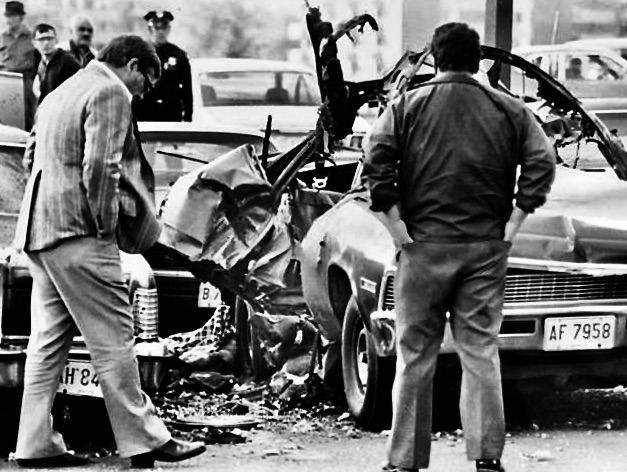
   For half a century, from 1916 to 1966, until Charles Whitman, an ex-Marine, shot and killed 16 people, wounding 31 others, shooting from the top of an observation deck at the University of Texas at Austin, there were just 25 public mass shootings in the United States in which four-or-more people were killed. The young ex-soldier redefined homegrown massacres. He brought to bear a Remington 700, a .35-caliber Remington, a M1 carbine, a Sears semi-automatic shotgun, a .357 Magnum, a Luger, and a .25-caliber pistol.

   During the rampage a police sharpshooter in a small plane circling the 27-story building was repeatedly driven back by return fire. The first person killed was the eight-month-old not-yet-born baby of an 18-year-old pregnant student when she was shot in the abdomen leaving the Student Union.

   Finally, two policemen stormed the observation deck, one firing his revolver, but missing, and the other killing Charles Whitman instantly with two blasts from his shotgun. The policeman with the revolver emptied his gun into the body at point-blank range, making dead sure. He ran to the parapet yelling, “I got him, I got him.” He was almost shot himself by police on the ground, who didn’t at first realize he wasn’t the shooter.

   It remains to this day one of the deadliest mass shootings in the United States.

My parents grew up in Lithuania. When they were still teenagers, they saw plenty of guns. Between 1940 and 1944 first the Russians invaded, then the Germans, then the Russians again. When they fled to Germany in 1944, they saw even more weapons during the furious last months of the collapse of the Third Reich. By the time they emigrated to Canada they had seen enough guns to last them a lifetime, more than most people ever see in a lifetime.

   During the Second World War the United States fabricated 2,679,840 machine guns and 11,750,000 infantry rifles. Twenty-nine other countries were a part of the deadliest war in history. Only God knows how many guns, and mortars and cannons and tanks, they manufactured, among other things, resulting in 70 to 85 million military and civilians done in for good.

   In the 1980s, the FBI defined mass shootings as four-or-more people, not including the mass murderer, being killed in a single incident, typically in a single location. Since 1966 there have been thousands of them. Before 1966 there was a mass shooting about once every 100 weeks, Today, there is a mass shooting about once every day.

   Between 1999 and 2013 there were 31 mass murders per year on average. In 2015 there were 220 days of mass shootings and only 145 with none. In the first ten months of 2018 there were 307 mass shootings, almost as many as there were days.

   It doesn’t bode well for the 2020s with the Grand Old Party still chock full of crazy people, the National Rifle Association still rampant with crazy people, and millions of crazy people still armed to the teeth. The NRA, with reasoning crooked as a corkscrew, has re-interpreted the 2nd Amendment, disappearing some of its language and all of the intent, to suit their agenda. They and their supporters equate success with goodness. It doesn’t matter that rightness ends where ammo begins. They are all in with Mao, who said, “Power grows out of the barrel of a gun.” Wayne LaPierre, the Grand Dragon of the NRA, says “We need national carry.”

   It would be like giving AK-47’s to monkeys.

   There are more guns than people in the United States. There are almost 400 million guns in the country. There are 12 million guns in Canada. There are 3 million guns in England. There are fewer than half-a-million guns in Japan. US citizens own 40% of all the guns in the world, more than the next 25 countries combined.

   When I grew up in Sudbury, Ontario, the only people who had guns were the police, hunters, and folks who lived on the outskirts. They kept shotguns near their back doors to fend off marauding bears. My parents didn’t have any guns. After the war my father never owned a gun.

“Guns kill people,” he said. He was a miner and saw things in black and white terms. If it looks like a volcano, blows its top like a volcano, it’s a volcano. He knew since he was a dynamite man a mile down, before he saw the light and started using his head instead of his hands.

   Yoga studios seem immune to gun violence. Whoever saw a security guard at the front door of a yoga studio? At least, not until two years ago, when a man walked into Hot Yoga in Tallahassee, Florida, and shot to death Nancy Van Versen, a faculty member at Florida State University, and Maura Binkley, a student at the same university.

   The young woman’s father said his daughter had planned on becoming a teacher. “She truly lived a life really devoted to peace, love, and caring for others,” said Jeff Binkley. She didn’t live long. She was 21 years old.

   It doesn’t take long to go packing in Florida. There is no waiting period to buy an assault rifle or anything else. In Iowa no one needs a license to sell guns online. If you plan on selling lemonade in Iowa, however, even if you’re a 7-year-old and your storefront is your front yard, you need a business permit. In Texas, if you want to sell guns, go right on ahead, partner. It is the most heavily armed state in the country.

   But, if you want to cut hair in Texas, you must, no if buts or maybes, log 1,500 hours at hairdressing school. Scissors don’t kill people, people do. It’s best to beware Texans bearing gifts.

   Buying a gun almost anywhere in the United States is easier than getting a license to drive, filling out your tax return, or talking to tech support. It’s harder to pay off student debt, which typically takes about 21 years, than it is to buy a gun, which typically takes about 10 minutes. Anyone can walk into a gun store, pass a background check in record time, and walk out with a persuader. In some states no one has to even do that. They can buy a gun from a private seller, no background check needed.

   In Lithuania there isn’t an arsenal in every basement. In order to own a gun an exam and license are required. They keep a lid on the bubbling stew, at least. The murder rate is 9 times higher in the United States than in Lithuania. You are 128 more times more likely to be involved in a gun related crime in the United States than Lithuania. The USA has gone gun crazy since the 1960s. It’s not just mass shootings, either. It’s one bullet at a time. In 2016, there were hardly any people murdered with a handgun in Japan, England, Canada. and Lithuania. All their coffins put together were a fraction of the 11,004 murdered in the USA.

   Mass shootings have happened at casinos, nightclubs, hotels, music festivals, libraries, factories, airports, shopping malls, courthouses, sorority houses, apartment buildings, Waffle Houses, backyard parties, Planned Parenthood clinics, movie theaters, churches, synagogues, the Empire State Building, nursing homes, baseball fields, grade schools, high schools, community colleges, and universities. In Dangerfield, Texas, a man walked into a church and killed 5 people and wounded 10 others after members of the congregation earlier declined to be character witnesses for him at a trial.

   Besides the mortally wounded at Hot Yoga, four others were shot and one of them, a young man who, among others, resisted the murderer, was pistol-whipped.

   “Several people inside fought back and tried to not only save themselves but other people,” said Police Chief Michael DeLeo. “It’s a testament to the courage of people who don’t just turn and run.” One of them who didn’t turn and run, even though unarmed, was shot nine times.

The killing spree broke out on a Friday night as the class was starting. Scott Beierle pretended to be a student, then pulled a semi-automatic handgun from his duffle bag and started blasting anybody female in sight without warning.

   When the gunfire momentarily stopped, Joshua Quick took action.

   “I don’t know if it jammed, or what,” he said. “So, I used that opportunity to hit him. I picked up the only thing nearby to hit him with, which was a vacuum cleaner, and I hit him on the head.” The shooter was staggered, but recovered his footing, pummeling Joshua on the forehead with his gun. The yoga student fell to the floor, bleeding bad, but got back up.

   “I jumped up as quickly as I could, ran back, and the next thing I know I’m grabbing a broom, you know, anything I can, and I hit him again.”

   “Thanks to him,” said Daniela Albalat, “I was able to rush out the door, slipping and bleeding.” She was shot in the upper legs. “I want to thank that guy from the bottom of my heart because he saved my life.”

   Joshua Quick did what the Dalai Lama would have done, except the Dali Lama would have gone heavy. He wouldn’t have used a broom. Arguably one of the most peaceable men on the planet, when asked by a child at the Educating Heart Summit in Oregon what he would do if someone came to his school with a gun, he replied without hesitation, “If someone has a gun and is trying to kill you, it would be reasonable to shoot back with your own gun.”

   Three minutes after the first 911 call, sirens were wailing, and police were showing up. The killer cleared the gun’s chamber, turned it on himself, and shot himself straight to hell.

   He lived in Deltona, Florida, about 250 miles from Tallahassee, and had no connection with the yoga studio or anyone he gunned down. He had been a substitute teacher at the Volusia County Schools, even though he had a master’s degree in public administration from Florida State University. He was arrested several times for groping women on the FSU campus. He was fired for unprofessional conduct, feeling up teenage students not being in his job description.

   The gunslinger was an amateur musician who posted his songs online. On “American Massacre” he sang, “If I cannot find a decent female to live with, I will find many indecent females to die with. I find that if I cannot make a living, then I will turn, I will make a killing.”

   Mass murderers are all different, except most of them are men. It’s a man’s world. They have their reasons for doing what they do, although none of them are good reasons, and many, if not all, mass murderers suffer from psychological problems. Mental health is not compatible with murdering people.

   Although they and their reasons are variable, the one constant among them is the fast fire weapons they deploy. None of them carries a cap and ball Colt. It would knock them off their feet, anyway. They bring the blessing and imprimatur of the NRA, the gun champions who have successfully lobbied one Congress after another for decades to limit research by the Centers for Disease Control into gun-related violence.

   A few days after a mass shooting at a high school in Parkland, Florida, in March 2018, House Speaker Paul Ryan said his ruling Grand Old Party planned on keeping restrictions on gun research in place. “We don’t just knee-jerk before we have all the facts and the data,” said the longtime opponent of gun control laws.

   So long as his kneecaps weren’t getting popped he wasn’t going to knee-jerk it.

   “We are saddened and angered by the senseless shooting at Hot Yoga Tallahassee,” said Tasha Eichenseher, speaking for Yoga Journal. “Studios are sacred places where we go for self-care and to feel safe.”

   After Sandy Hook and Tree of Life Synagogue and First Baptist Church, it is doubtful there are any safe places left. It is undoubtedly true there are no sacred places left. If even Fort Hood, the biggest active-duty and most secure army base in the United States, couldn’t prevent Nidal Hasan, an Army major, from going postal and fatally shooting 13 soldiers, while wounding more than 30 others, there might not be safe and sacred and secure anywhere.

   “You have a whole generation with this being more and more normal,” said Jeff Binkley. “That cannot happen.”

   When I was a kid in Sudbury our mom never bought us toy guns. “No,” she said whenever we asked. We stayed busy dodging the trains hauling ore and wailing on all sides of town. It wasn’t until we moved to the United States that I found out all kids had toy guns. After that there was no going back.

   In any event, so long as the politicians we elect to rule our state and national legislatures, and the politicians we elect to our state and national capital houses, are the same vote-stuffing wallet-stuffing puff ’n’ stuffers allied hand-in-hand with gun manufacturers and Second Amendment agitprops, no-nonsense gun-reform legislation and public-health funding are not going to happen.

   The gunrunners don’t give it a first thought. They don’t give it a second thought, either. The devil’s right hand is all right with them.

   The silk stockings perform to the grass roots who believe they need guns to make it in this world. Their faith is in the ruling class’s Punch and Judy show even though the second estate’s grass roots are fertilized at a thousand country clubs where a thousand lobbyists dine and drink. Their security guards carry sidearms, since they no more believe in responsible gun owners than they believe in the Constitution and aren’t taking any chances. No 2nd Amendment-toting mob is getting through their country club doors.

   Two-and-a-half centuries later we don’t live in 1780s buildings anymore, we don’t travel in 1780s horse and buggies anymore, and we don’t turn on the lights with 1780s whale oil anymore. We don’t read one-page pamphlets and the penny press anymore. We don’t use 1780s medicine, like arsenic and leeches, anymore. There is no reason why a 1780s amendment to the Constitution, written to enable a militia in a time of crisis, should enable everybody to buy whatever guns whenever and wherever they want for whatever reason.

   But that’s the world we have made and the world we live in. Carrie Lightfoot and Yosemite Sam guns a-blazing aren’t going anywhere anytime soon. Americans love their guns, guys gals and the movies. They don’t believe liberty gets handed to them unleaded. They believe it will get stripped away the wrong way around if they aren’t vigilant. It’s been said fences make for good neighbors. Locked and loaded makes for tried-and-true neighbors.

   It’s like the Lithuanian proverb says, “When you are in the devil’s wheel, you must learn how to spin.”

Ed Staskus posts on 147 Stanley Street http://www.147stanleystreet.com and Made in Cleveland http://www.clevelandohiodaybook.com. To get the site’s monthly feature in your in-box click on “Follow.”

Do-Dah Man

 By Ed Staskus

“Keep truckin’, like the do-dah man, together, more or less in line, just keep truckin’ on.”  Grateful Dead

Before there was the Sacred Mounds, before there was Christoph Eize, before there was the server at Moby Dick’s on Route 6 in Wellfleet who knows all the lyrics to all the Sacred Mounds songs, there was Christopher Manulla.

“I don’t even know all the lyrics myself,” said Christopher Manulla, aka Christoph Eize, the singer songwriter lead man on the guitar of the band.

The Sacred Mounds are an eclectic go-your-own-way group as well known on Cape Cod as they are little known elsewhere, even though they have toured the East Coast, Rocky Mountain High, and Ireland.

“They are out of sight,” said Tony Pasquale on his ‘Helltown City Limits’ show on Provincetown’s radio station WOMR. When they are in sight, they are an original undertaking, an agile funky soul-spirited sometime psychedelic sound, sonic on the move, cosmic funny, hardly a cover to be heard, at heart all their own songs from start to finish.

They aren’t live copycats of the Billboard Top 100 Golden Oldies, not when Christoph Eize has more than three hundred songs of his own in his scrapbook.

“You are one hell of a prolific songwriter,” said Tony Pasquale, interviewing Christopher, and Luke Massouh, the drummer, anchor of the band. “You have a ton of stuff.”

“I have to tell myself, no more new songs,” said Christopher. “I’ve got thirty or forty in my head I’m still trying to get a grasp on.”

If time moves in one direction, and memory in another, a question begs an answer. Where is the Moby Dick man on Route 6 going with his storehouse of verse and chorus? Maybe there’s nothing to be all-over about. Like Aeschylus said so far back nobody remembers, “Memory is the mother of all wisdom.”

“When we first saw the Sacred Mounds we were astonished to see such a good band at a small club,” wrote Brian Tarcy in Cape Cod Wave Magazine. “It is as if Neil Young joined the Grateful Dead and incorporated a little bit of jazz. It is quite an original.”

”Am I a man that you recognize – when you see me, I’m a dreamer, and I’ll be what I want to be.”

“The original music being made on Cape Cod, if you take the time to look, will astonish you,” added Brian Tarcy.

Many musicians and bands on Cape Cod, from Crooked Coast to The Ticks to the Incredible Casuals, are originals because, like Yogi Berra said, when you come to a fork in the road, take it. Even when they play covers, it’s often songs few have ever heard of. The Ticks say they only know their own songs. There’s no original sin on the sleeveless arm-shaped peninsula. Since they are writing and singing from the inside out, they can’t help being for real first hand prototypal.

Just like every natural pearl from every wild oyster is an original.

Before and after he morphs into Christoph Eize of Sacred Mounds, his alter ego on stage, Christopher Manulla was and still is Wellfleet’s Deputy Shellfish Constable. The Shellfish Department manages the town’s oysters, quahogs, clams, and bay scallops within a three-mile limit, issues permits, promotes crustacea and mollusk propagation, and monitors water quality.

The old whaling town on the seashore on the Outer Cape is a federal no-discharge area, clean as a whistle.

“It’s a complex job, mixing some law enforcement with public education, keeping tabs on our three-acre farm, talking to fishermen every day,” said Christopher. “There’s a little bit of psychology and therapy involved with that. It’s a 90% wake up happy going to work kind of job.”

Except for when he first came to the fair land on the seaboard.

After getting a degree in Park Management and Recreation, he was working at a nature center. On his way to a wedding, at his girlfriend’s friend’s grandmother’s daughter’s house, he was introduced to someone who at the end of the day offered him a job in Cape Cod with the Wellfleet Shellfish Department. However, the work was only part-time.

“I told him, I’m not going to move to Cape Cod for 19 hours a week. That’s crazy. He told me he’d get me full-time sooner than later. I got the job, but then found out the guy didn’t even work for the town. It was like Great Expectations.”

It took him four years to get steady real time full time.

“I just had to hold out. The Grateful Dead taught me how to survive on absolutely nothing, on peanut butter and jelly and pasta.”

In an earlier life Christopher Manulla grew up in Thomaston, Connecticut.

“That’s where I spent my growing pain years, until my parents bought my grandfather’s old place in New Hartford.” The new family home was a half hour north of his birthplace.

“It was a beautiful area.”

“Like a dream I drive on past, the spots where my childhood roamed, like a field seed blowing.”

His father, Randy, worked for the Hartford Courant, the local newspaper, and his mother, Virginia, taught grade school.

“She taught for forty years,” said Christopher.

In his spare time his father sang with Liederkranz, a German choral group, and his mother was in the Thomaston Ladies Choral Group. “Their singing was an influence on me, even though their semi-annual concerts weren’t exactly what a young kid wants to go see. Even still, I could always pick out their voices.”

Singing in a choir or choral group is a kind of therapy bought for a song. There’s a lot of harmony. It’s a sound raising high the roof beams that can heal the heart. It’s healthier than bending an elbow all evening or slouching in front of the boob tube that’s now the dazzling flat screen.

“In the end, for me, singing has become a way of releasing energy, a method of healing.”

By the time he got to 6thgrade he was playing the trombone and being fast-forwarded into the high school band. He quit in the 8thgrade. “At that point I could read and understand music, but the music I was being introduced to was boring. No jazz, or anything. That would have been great.”

“If you quit now, you’re going to lose everything,” his teacher told him.

“If I’m meant to play music, I’ll find it again,” he told his teacher.

He lay low in high school, at least until his senior year. “They were cloudy times,” he said. “I was very shy, until my senior year, when I started to get a little nuts and spread my wings.”

He bought a guitar. He graduated from high school. He attended Northwestern Connecticut Community College, on and off, finally earning his sheepskin eight years later. “I laugh at that, but it was fun. I spent most of my time at school playing chess and having conversations with psychology professors about how the brain works.”

In the meantime, he became a Deadhead, joining the fans of the Grateful Dead, followers who from the mid-70s traveled to see as many of the band’s shows and venues as they could. It was following a siren call. It was 1994 and he was twenty years old.

Jerry Garcia had a year-and-a-half left to live.

‘Dead Freaks Unite! Who are you? Where are you? How are you?’ was the catchphrase of the blues folk country rock jazz psychadelia hippie subculture counterculture movement.

“I’m feelin’ so confused, well, it’s hard, so hard to let it go.”

“I didn’t like my life at that moment. It was a leap of faith. I went with a sleeping bag, a change of clothes, and fifty bucks in my hand,” said Christopher. “I didn’t even know much about the Grateful Dead, but I felt like it was a calling. It was an adventure and I survived most happily for a whole tour.”

He and the friend who had made bold with him worked side jobs. He joined the Falafel Mafia, feeding the faithful from a food truck, the crew sometimes passing a deep-fried doughnut of ground chickpeas along when somebody asked to ‘kick down a kind falafel’, which meant a free falafel.

“It was inspirational for the music, for sure,” he said. ”The music was healing, dancing, and clearing the cobwebs of your mind away.”

Fronting the Sacred Mounds he mainly plays guitar.

“I don’t know theory anymore, I don’t know scales, like my school teacher said would happen. I call it playing blind. I’ve been doing mostly acoustic since 2006.”

His guitars are Martin’s from C. F. Martin & Company, established in 1833, known for their steel-string acoustic models, and led to this day by the great-great-great-grandson of the founding father. If melody imposes continuity, Martin’s are a kind of continuity you can always come back to. They don’t need any history lessons.

“I once got two guitar lessons,” said Christopher.

“You’ll learn faster by yourself,” the instructor said after the second lesson. “I will just keep you behind.”

“He kicked me out.”

When Christopher left Connecticut behind and moved to Wellfleet nearly twenty years ago, at the tail end of the summer season, he moved into a small spare room. He later moved on up, to an apartment of his own.

“It was the size of three pick-up trucks put together,” he said. “It was horrible. It was rough.”

“Remember what I say, why erase the truth, when it already happened?”

He still lives in Wellfleet, his adopted hometown, in a house with a studio attachment, living quarters more than sufferable.

“It is great.”

The Sacred Mounds – the duo of Christoph Eize and Luke Massouh – were almost a sacred mound themselves before they got off the ground. Christopher was in Hobo Village, a local band, playing at a restaurant where Luke was the bar manager. The band’s mandolin player and Luke got into it.

“I only heard his side of the story, so I thought Luke was an asshole,” said Christopher. “After that, every time we played that restaurant, we had it so that he wouldn’t be working that night. We were being assholes, too, I guess.”

One weekend, invited to shuck oysters and croon for a party in New Hampshire, he was surprised to see Luke there. Unbeknown, he had been invited, likewise. It’s a small world when it’s a turn of the cards. They got to talking over cold ones and crustaceans.

“Broken hearts are for assholes,” said Luke about the brouhaha.

“He used a Frank Zappa reference,” said Christopher. It put him in good stead. Christopher not only cites the Grateful Dead, but Chopin, Neil Young, and Frank Zappa as influences on his music making. ”I found out he didn’t mean any harm, was funny and intelligent, a good guy.”

He also found out Luke Massouh played drums.

“I threw songs at him and he played them as perfect as you can, hearing them for the first time.”

They have been the Sacred Mounds ever since.

Finding a bandmate on the 70-mile headland is no mean feat. Even though there is an abundance of talent on Cape Cod, there is a scarcity of people, especially in the off-season. “It’s like Jamaica four months of the year and like Russia the rest of the year,” said John Beninghof of Falmouth’s Old Silver Band.

It’s the sound of silence on the streets in the winter, muffled, chilled to the bone, nearly empty shore towns. Seawater freezes in the goose-bumpy sand dunes.

“This place turns into a ghost town,” said Christopher. “When I first came to Cape Cod I was pretty much a recluse. I didn’t mind being alone. Mostly everything is closed, but we find ways to socialize. Nobody can hide anything, anyway, because people here find out quick what you do. It’s when they don’t that rumors fly.”

Staying the course is no mean feat, either. The duo has been making music together – abetted by Matt Brundett, Jonathan Huge, Floyd Kellogg, and Kevin O’Rourke – for eight years running. “We’re basically two people, playing together, traveling, doing all sorts of fun adventures in the music world.“

They spend their summers on Cape Cod. “We’re the crew that doesn’t leave port,” said Christopher. “Everyone comes here, so instead of touring, we just drive five minutes and get paid, probably five times what we would on tour.” The lawnmower stays broken most of the summer. ”We used to beg to play, but now more often than not we get asked.”

If Christopher Manulla is the long arm of shellfish laws and regulations, on stage Christoph Eize learned his lessons by trial and error. “In the beginning it was scary.” Some performers suffer stage fright, sweating up a storm, blubbering midway through performances, stopping dead, their minds gone blank.

“You’ve got to learn through the falters,” he said.

He learned to get up on stage just the damp side of stone cold sober.

“You learn about what not to do, one of them being don’t be too crazy loud and don’t drink too much. I once early on watched eighty people leave the room. As my ego and heart were being destroyed, I realized it was a huge lesson about not being sloppy.”

“I was singin’ all day, thinkin’ about it all night, when things went wrong, when things went right.”

Sloppy is like a cafeteria tray of fast and loose food nobody cares about. Who wants to listen to an amateur missing the target? Better the professional who is ready to ready-aim-fire.

“I’m confident in our music and I’m confident with the band,” said Christopher. “Being on stage wasn’t always my safety place, but now it’s the most comfortable place for me to be. The minute it starts, I’m erupted with as much energy as possible. It’s a high, even sober.”

Some of his favorite stages are at the Lighthouse, the Harvest Gallery Wine Bar, and the small intimate stage under an old disco ball at the Beachcomber bar club restaurant on top of a dune as fat as a duck on Cahoon Hollow Beach. “It’s for people who figured out it was really cool to make it up into God’s country in Wellfleet,’ said Todd LeBart, one of the owners.

Last summer, as summer was breaking out of its shell on the Memorial Day weekend, and the Incredible Casuals, in some respects the house band, were finishing their first gig at the Beachcomber, Chandler Travis of the band was having a good time.

“That’s my job,” said Chandler. “God, what a great job.”

“Always our favorite summer night party,” said Christopher.

“I think it is fair to say that your life will not be complete until you have witnessed the sheer brilliance demonstrated by the Sacred Mounds,” said Chris Blood, the man who engineers the music at the nearby Payomet Performing Arts Center in Truro.

Although nothing beats seeing them live, the alternative is the new recording ‘Mirror’ by the Sacred Mounds, featuring Christoph Eize and Luke Massouh and Floyd Kellogg on bass guitar, the latter recording and mixing the work, as well.

“In the beginning I wrote poetry and put music to it,” said Christopher. “Then I wrote music and added the words. Now I hit record, play what comes out, I kind of black out, and the next thing you know, there’s a song, pure from the source.”

It’s a short step from the sacred to the profane. One day at Wellfleet’s town dump, the Transfer Station and Recycling Center, dropping off trash, Christopher was beckoned to the nearby Swap Shop.

“Check this out,” said the man who had waved him over. “A CD changer.”

“What am I supposed to do with that?” he asked. “Horrible sound. Everyone’s doing MP3’s, anyway. Besides, I’m thinking of going back to vinyl.”

He checked himself.

“Do I sound like a grandpa now?”

‘Mirror’ is available as a CD, or download, and streams on Bandcamp. It is not available on vinyl. It is available straight from the horse’s mouth all summer long on Cape Cod.

Whether Christopher Manulla is old-fashioned or new-fashioned, plugged in or a grandpa, quiet or gabby, is an open question. “When I first meet people I’m kind of shy stand-offish. When I get to know you, you can’t shut me up.” Whether he is able to shift seamlessly from shellfish constable to musical mastermind is not open for question.

“If neo-pagan, psychedelic, shamanistic fuzz is your thing, look no further than the new Sacred Mounds album,” said Tony Pasquale, aka Tony Scungilli, on WOMR-FM. “Chock full of rock ‘em sock ‘em hooks and sonic soma. It will realign your karma.”

It’s like balancing your tires for the long strange trip ahead.

The getting it done side of the coin of karma is dharma. If karma is the good or bad payoff resulting from good or bad actions, dharma is the choices we make. Making wrong choices, or adharma, leads to bad karma. Making right choices, right action known as dharma, leads to good karma.

What downbeat side or highlight of karma does realignment lead you to if you cue up the rock ‘em sock ‘em of the Sacred Mounds? It’s hard to say. The only way to find out is to get to the starting time of the do-dah man’s show and truck on down to the finish line.

Photograph: Deputy Constable Chris Manulla (left) and Assistant Constable John Mankevetch receive Massachusetts. Shellfish Officers Assn.’s “Deputy Constables of the Year” award from MSOA President Paul Bagnall.

Ed Staskus posts stories on 147 Stanley Street http://www.147stanleystreet.com and Cleveland Ohio Daybook http://www.clevelandohiodaybook.com. To get the site’s monthly feature in your in-box click on “Follow.”

Stressed Out Zeroed In

By Ed Staskus

   It is hardly surprising that most lists of the toughest jobs in the United States routinely list flying planes, fighting fires, and nabbing bad guys as the most stressful occupations. They are life-and death careers, just like being a paramedic or an atomic energy repairman, jobs with tension built in. Sometimes the work means there are no do-overs when getting it wrong.

   What is surprising is that many lists routinely flag some day-in day-out professions, such as teacher, social worker, and corporate executive. The corner office has gotten so nerve-racking, apparently, executives need to take a year off to sail their yachts to Greece. Teachers and social workers get to take a sick day-or-two.

   Even event coordinators have gotten into the act. They cracked the Forbes Top 10 list in 2017. The magazine’s stress score for airline pilots was 60.5 and for police officers it was 51.6. The stress score for event coordinators was 50.1.

   Who knew planning weddings and conferences and coordinating with on-site staff could be such a hassle? It points out that stress can be more real than the real jaws of death, like when bullets are whizzing by your head, and can simply be in the eye of the beholder. Sometimes hell is a foxhole. Other times hell is other people. Once in a while hell is just hell.

   Even though stress is primarily a physical response, more often than not what we are responding to in the modern world is what we have made of it. For millions of years, it was see the predator in the wild, there’s the potential danger, fight or flight, right now! Adrenaline, cortisol, and norepinephrine flooded the body to focus one’s attention on the danger. It was beat the bully or beat feet to get away. 

   The Napoleonic Wars and the two World Wars were extremely stressful, especially if you were involved in them, which hundreds of millions of people were. More than fifty million alone died during the Second World War. Today armed conflicts are more in the line of conflicts. Unlike the world wars when everyone was all in, relatively few people in terms of sheer numbers are on the firing lines of the War on Terror. It doesn’t make it any less stressful for those involved, but most of us aren’t involved.

   Nowadays it’s the kids won’t stop screaming, the boss won’t stop screaming, and the bill collectors won’t stop screaming. Not to mention losing your job, getting divorced, moving, and, worst of all, making a speech. Many people say they fear standing at a lectern in front of an audience more than they fear death. 

   There are many ways of coping with stress. Eat healthy, exercise regularly, and get plenty of sleep. Avoid drugs and drink, take a break, and share your problems, although taking a break and listening to somebody else’s problems without some booze at hand is problematic, at best. Have a drink, after all. Like W. C. Fields said, “I never worry about being driven to drink. I just worry about being driven home.”

   Some of the most popular 21st century techniques for reducing stress are meditation, mental imagery, and controlled breathing. When those techniques are rolled into one package, and girdled with specific physical movements, presto change-o, you get today’s yoga.

   There are many benefits to the strongman side of yoga. It keeps you active. It keeps you limber. It keeps you healthy. Besides the physical fitness benefits, it keeps you mentally fit. Yoga makes you more alert, less fatigued, and revs up cognitive function. It produces endorphins. You feel better in spite of yourself. It is tailor made for dealing with stress. 

   Lunges, bends, twists, inversions, down dogs, and whatever else is on the agenda are all good for you. They’re good for you every day, even if it’s only happy baby pose when you’re tired and winding down.  Seven out of ten adults in the United States say they are stressed out daily. That’s why ten out of ten of them should get on a yoga mat. Nobody stressed out left behind.

   When your brain’s feel-good neurotransmitters start to flow it puts pep in your step. Yoga exercise practiced regularly increases self-confidence and reduces the symptoms of anxiety and depression. It helps you sleep better, too. Tossing and turning aren’t what you want to be doing in bed, at least not that kind of tossing and turning.

   Guided imagery is a stress management technique that has been shown to reduce blood pressure and symptoms of PTSD. It relieves physical tension. It’s a simple technique, simply using your imagination to take you to a calm place. It involves getting comfortable, closing your eyes, and imagining yourself in a peaceful setting – like a tropical beach, bright blue water, surf, sand, and sun – which helps you relax and relieves stress. Yoga teachers do it all the time, especially when they are at yoga conferences at South Sea resorts.

   All yoga classes end with savasana, what is called corpse pose. It’s a relaxation thing, done flat on your back. What’s more relaxing than being flat on your back? Teachers croon the experience. “Soften your face, your shoulders, arms. Breathe. Soften your abdomen as it rises and falls. Breathe. Soften your thighs down to the tips of your toes.” Or they script the experience, leading the class in a systematic relaxation, conjuring images like a leaf floating down a stream or weaving a narrative about walking through a dappled forest.

   No one can avoid stress completely, not cavemen in tooth and claw days, nor up-to-the-minutemen. It’s not even certain doing so would be a good idea. But, how we react to stress is up there with all good ideas. Stress is a common trigger for headaches, from the tension kind to the migraine kind. Fighting it all day leads to high blood pressure, a risk factor for heart disease. It suppresses the immune response. It can make you literally sick as a dog. 

   Take a breath. Controlled breathing, also called diaphragmatic breathing or paced respiration, is a tried and true stress reduction technique. It is the cornerstone of the relaxation response, first developed in the 1970s at the Harvard Medical School. It encourages full oxygen exchange, slowing down the beat of the heart and stabilizing blood pressure.

   Take a deep breath. Deep abdominal breathing stimulates the parasympathetic nervous system, promoting calm. It’s easy to do whenever you want, at a scheduled time every day, any time you have a time out, or waiting during your appointment with your tax accountant. “It’s the fastest way to calm down,” said Time Magazine. It’s a stress eraser. It doesn’t cost a cent and can’t be taxed.

   Breath control is one of the eight limbs of yoga. It has been since the beginning of the practice, long before worry, anxiety, and stress became the bugaboos of modern life. According to the National Institute of Mental Health, about 10 percent of Americans suffer from anxiety disorders. If they went to a yoga class they would hear from the word go to breathe consciously, control the breath, and connect to your breath. 

   We all breathe 10 to 15 times a minute, which is about how many times yoga teachers use the word breathe in their speechmaking. Unconscious shallow breathing is part and parcel of the primitive part of the brain. Conscious breathing comes from the cerebral cortex. Conscious breathing is about controlling the mind. Connecting with the breath, since we breathe all the time, is connecting with the now. It’s a way of being in the present, not in the past where something has already happened, nor in the future where something might or might not happen. 

   Whatever bad thing might or might not happen today, time spent worrying about  it is a waste of time, since it’s already tomorrow on the other side of the world. Besides, what most people worry about never happens, anyway. Don’t worry about the horse going blind. Just get the kids loaded on the wagon for the hayride. 

   A big part of the practice of yoga is controlling prana – which can be imagined as energy, life force, or breath – through pranayama, or various methods of controlling the breath. The goal is to raise one’s energy, or prana. It’s an essential part of meditation, another of the eight limbs of yoga. 

   When it comes to breathwork, yoga is soup to nuts: bellows breath, breath of fire, and lion’s breath. Going all out, if you are especially stressed, skull cleanser is where to go. It’s a cleansing breath to raise your energy level. It also involves a fun hand sign, which is making your hands look like a dog’s head by resting your ring and middle fingers on your thumb while sticking your pointer fingers and pinkies up like ears.

   The power tool in the toolbox of stress busters is meditation. “Anyone can practice meditation,” says the Mayo Clinic, “It’s simple and inexpensive. It can wipe away the day’s stresses, bringing with it inner peace.” The relaxed breathing and focused attention of meditation clear away the overload of contemporary life, from eight-lane highways to information superhighways. Meditation helps you be self-aware, not simply aware of your surroundings.

   The port of call on the eight-fold path of yoga is meditation. It isn’t just about solving problems, be it stress, or anything else. It’s about getting into a state of consciousness different than either the waking or sleeping states. It’s about pivoting and positioning the mind inward. The mind often has a mind of its own. Meditation is designed for it to find stillness. If you can find it, there’s no stress there.

   Meditation is a practical way of calming yourself down, slowing down the endless sturm und drang, leaving distractions behind and focusing all your attention on one thing, be it your breath or an object. It’s not about thinking about nothing. It’s about paying attention. Or you can just hum along.

   It is practiced in the space between the nothing that isn’t there and the nothing that is. When you’re stressed out, get on a yoga mat. It will zero you in.

Ed Staskus posts on 147 Stanley Street http://www.147stanleystreet.com and Made in Cleveland http://www.clevelandohiodaybook.com. To get the site’s monthly feature in your in-box click on “Follow.”

Moving Day

julia-sauve-e1527892740400.jpg

By Ed Staskus

“To live is to keep moving.”  Jerry Seinfeld

“My grandfather had a 16mm camera,” said Julia Sauve. “He walked around taking home movies of everyone, all the family, our real relatives and our adopted relatives, all the kids. Everybody would come, it was like a party house, their house in Brooklyn.”

While visiting New York City recently and at a family reunion, she had a look-see at film footage, transferred to a DVD, of her childhood. “I watched myself as a baby, a toddler, and a little kid.  I was an active child, always running around, very physical. I thought, oh, yeah, that’s why I am the way I am.”

Coming around the corner from her house in the small town of Victoria on the south shore of Canada’s Prince Edward Island the block-or-so down Howard Street to the family-owned Landmark Cafe, where in the summer season she works with her son, daughter, and ex-husband, she is the easiest person on her feet on the walk.

She is footloose over the cracks in the pavement.

“I started ballet when I was 7-years-old,” she said. “I took my first modern dance class when I was 16.”

She ‘s been an artist dancer performer choreographer and teacher ever since. Dancing might be the only walk of life whose aim isn’t to get anywhere, but is rather a process of the steps along the way. It’s not a discipline whose ambition is to be better than anyone else, either, but one whose purpose is simply to dance better. It’s a kind of solitary self-mastery nevertheless done in public.

“Dance is the only art of which we ourselves are the stuff of which it is made,” said Ted Shawn, one of the pioneers of modern dance. There may be abstract art, but there is no such thing as abstract dance.

Growing up in Spring Valley, just west of the Hudson River and just northwest of New York City, Julia Lachow grew up in a family invested in the arts.

“My parents were both artsy,” she said. Her father Stan was involved with community theaters and was in the original cast of “On Golden Pond” at the Apollo Theatre on Broadway in 1979. Her mother Barbara transitioned from stay-at-home mom to dance teacher to psychologist, still practicing in NYC.

“They were always supportive of my brothers and me in the arts.” One of her brothers is a musician and the other one is a filmmaker. “They never pushed us about how much money we were going to make.” Never mind that Andy Warhol once slyly said, “Making money is art and the best art is good business.” When it comes to Andy Warhol, however, sometimes it’s better to simply believe in his art, not necessarily his bank account.

She was on the swim team at Suffern High School when she saw the Alvin Ailey American Dance Theater. The company, a troupe of 32 dancers founded in 1958, first performed at the New York Young Men’s Hebrew Association, otherwise known as the 92nd Street Y. They are credited with popularizing modern dance in the United States. Their signature choreographic work “Revelations” is the best-known and most often seen in contemporary dance.

“The lights went on,” she said. “That was it. That’s what I want to do.”

She started taking modern dance classes at a local studio. She kept it up at a nearby community college. When she transferred to the State College of New York she majored in dance. After graduation she moved to New York City.

“That was where you were going to get the best training.”

For the next nearly four years she got the best training.

She studied with Joyce Trisler, who was keen on the technique of Lester Horton, the West Coast dancer whose demanding style featured fast small steps and spirited ups and downs, combining elements of jazz and ballet and contemporary hoofing. Alvin Alley once described Joyce Trisler as “just a crazy floppy girl from down the street.”

She studied with Milton Myers, who since the early 90s has been the director of the modern program at Jacob’s Pillow Dance Festival. He routinely stole shows in the 70s and 80s coming out of corkscrew actions with quick vertical jumps, always active, always strong. He subscribed to the Horton technique of training, describing it “like physical therapy in its approach to creating a balanced body, training and freeing the body through constant movement.”

She studied with Matthew Diamond, who at the time was with Jennifer Muller and the Works, and went on to become the director of the TV show “So You Think You Can Dance”, which has since won seven Primetime Emmy Awards for Outstanding Choreography.

“It was great when he got that gig,” she said. “Dance is hard to film since it’s so fast, and he was a dancer.”

In late 1977, while working with the New Dance Group in Manhattan, she took a few minutes to talk to a fellow dancer

“I just got back from Prince Edward Island,” said Cathy Cahoon. “I danced with a fellow from there.”

“Wow, if you ever go back, I’d love to go with you,” said Julia, even though she barely knew Prince Edward Island from the man in the moon.

The next year the two of them joined Don Burnett and formed the Montage Dance Theatre. They wrangled free space at Trinity United Church in Charlottetown, the provincial capital. They stayed for five weeks. “We danced 25 hours a day, no kidding,” she said. They put on a show at the end of their residency.

“I fell in love with the place when I first came here,” she said. “There was so much space here.”

The next summer she went back for the whole summer. “We danced, gave demonstrations, and did a series of lectures. Don was cast in the Charlottetown Festival and we performed in the Maud Whitmore show.”

In the fall she went back to New York City.

“I was sad.”

The following January she got a call from Don.

“Meet us in Charlottetown,” he said.

“Yay!” she said, happy.

She packed a suitcase and moved to Prince Edward Island in February 1980. When she left New York City she moved from where there were 27,000 people per square mile to where there were fewer than 70 people per square mile.

Artists may starve for their art, but there’s no starving for space on PEI.

She moved to Charlottetown, working with the Montage Dance Theatre, teaching and performing in their studio theater, and soon met her husband-to-be.

Eugene Sauve, recently arrived from Montreal, was helping the troupe as their technical director. Julia and he hit it off. She even got him on stage, dancing, once or twice. “He was so nervous,” she said. “He’s got good rhythm, but I was leading, so all he had to do was rock back and forth.

Two-stepping led to high-stepping. They got married, Julia light on her feet, Gene trying not to rock back and forth. They soon had a son, Olivier. They started looking for something bigger than their cramped apartment in Charlottetown. Gene was working at a new theater in Victoria, on the Northumberland Strait 20 miles away. Julia drove out to the small town.

“I’ve lived here before,” she thought. “There’s something here, a past life regression. It was fun and creepy. I felt like I needed to live here again.” They bought a house across the street from the fire hall and moved in on June 1st. Two weeks later her daughter Rachel was born.

“Everybody tells you never move when you’re about to have a child,” she said.

Some people say, now that you’re eight-and-a-half months pregnant, you’re going to give up the house-moving thing, right? Some women say, I’m not crippled, I’m only having a baby.

“We did it box by box.”

She has lived in Victoria ever since, except for two years teaching at a boarding school in New Hampshire. “The kids grew up in that house.”

When the family moved from the capital city to greener pastures in the mid-80s they moved from where there were 15 thousand-some residents to where there were about 150 residents. Even though in the biggest cities everybody still lives in a neighborhood, Victoria is so small the whole town is the neighborhood.

Julia Sauve had moved from the jam-packed Big Apple to a minor-key metropolis to a seaside village.

The next year Montage Dance Theatre’s building burned down. “That changed everything,” she said. In the meantime, she, a modern dancer, met Peggy Reddin, whose background was ballet. They started getting together, “in a secretive way, in coffee shops,” talking about starting a dance school. “It was all just talk.” Several months later the secret was out. They decided to become business partners.

“We just did it.”

Their business venture, dance umbrella, opened its doors in 1989 in a second story rented space above Froggie’s, a used clothing store somewhere in Charlottetown. Since then they have become one of the best and brightest dance schools in the Maritimes.

“We are not a ‘line ‘em up and shuffle ’em through’ school,” said Peggy, while Julia added, “We’re proud of our students. They are getting to be very good dancers.”

In 2006 dance umbrella merged with the Confederation Centre of the Arts, expanding their programming, and last year rounded out their 28thseason with their annual end-of-the-year showcase in the Homburg Theatre. “We had everything from a Tragically Hip tribute to ‘Dance of the Snowflakes,’” said Peggy Reddin.

Juia Sauve has long been involved with Act Community Theatre, helping stage their showcase shows, worked with the Colonel Gray High School for two decades choreographing their school musicals, and has taught at Holland College School of Performing Arts. She founded the Luminosity Black Light Theatre, the only black light performing company in Atlantic Canada.

Many of Luminosity’s themes were environmental. “Water is a life force that is in us and all around us,” she explained. “Water has no sense of itself. It just is. It doesn’t sit still.” You dive into the water, but most of the time you can’t tell how deep it is.

“I used to pretty much take every gig I could get,” she said.

“There’s no escaping it. I was the person in my grandfather’s home movies who had to be a performer and a teacher. That’s not so off from who I am now.” She even attempted the improbable back in the day, trying to teach ballet steps to her two young brothers. It was a daring if doomed effort.

Although she hasn’t settled back into a rocking chair on the back deck of her house, she has recently retrenched.

“When did I stop teaching like a crazy person?” she asked herself. “It was maybe five years ago.” She continues to teach a class at dance umbrella. “But I let the younger dancers do the heavy work.”

Rocking chairs may give you something to do, but they don’t get you anywhere. Where she has gone the past three years is where many stroke survivors have trouble going, which is getting out of their chairs. What she has done is rolled up her sleeves on a project of helping restore some liveliness to lives that have been impacted by a cerebrovascular accident.

“How do you take someone that is so compromised, where maybe one side of the body is just not working, and help people feel better in their bodies,” she asked. “How can I get these people moving?”

A stroke is a brain attack. It happens when blood flow to a part of the brain is cut off. When cells lose oxygen they start to die and whatever the affected parts of the brain control, like memory or muscles, are then bewildered, or lost. It can happen to anyone at any time. It can be catastrophic. Most survivors suffer from some kind of disability.

Some survivors turn the disability to their advantage.

“When you have a stroke you must talk slowly to be understood,” said Kirk Douglas, the actor who appeared in more than 90 movies and won Academy Awards, Golden Globes, and Emmys, and who suffered a severe stroke in 1996. “I’ve discovered that when I talk slowly, people listen. They think I’m going to say something important.”

He wrote a book about his experiences, calling it “My Stroke of Luck”.

It was a book called “Move Into Life” that got Julia Sauve going. She was volunteering at the Omega Institute for Holistic Studies, an educational retreat center in New York north of Poughkeepsie, when she met the author. Anat Baniel, a former dancer and clinical psychologist, developed her method of treating chronic pain and physical limitations by emphasizing activity and becoming aware of the entire body, how it feels and moves, so that the brain can map the body anew and evolve a person’s ability to feel and move again.

Back home in Victoria her life partner Reg Ballagh suggested she talk to his brother-in-law, the head of the stroke unit at the Queen Elizabeth Hospital in Charlottetown. He in turn introduced her to Trish Helm-Neima, the Provincial Stroke Coordinator for Health PEI. They started working together at community centers.

“We did our first session near the end of 2015,” said Julia. “It was just a once-a-week thing.” Once a week clears away the rust of the rest of the week.

“We do 75 minutes, a combination of seated and standing exercises. Everyone spends time in a circle after that integrating what we’ve done. I pass around handouts. It’s when people work at home that you really see results.”

Her goal is to help stroke survivors help themselves rewire their bodies and brains. “It’s about creating plasticity, developing the neural activity in your brain,” she said. “These people had big lives. Stroke just knocked them over the head. Our goal is for them to have success. From a teacher’s standpoint it can be very rewarding.”

Except when it isn’t.

“Some people will give up,” she explained. “One of our participants, she was doing well, and then I heard through the grapevine she succumbed. She succumbed to where she was, succumbed to the idea that she was just going to sit around.”

One of the reasons efforts like Julia Sauve’s efforts are important is because it’s not just about exercise or therapy. Stroke support groups challenge survivors to get past society-imposed doctor-imposed self-imposed limitations. It’s about feeling connected, about being in the same boat with others, about having a can-do attitude, sailing the waves, no matter how storm-tossed.

In time Julia Sauve created a program called “Moving Life Forward with Movement and Music” with funding from a PEI Wellness Strategy grant. One week, while the Festival of Small Halls, a series of music venues, was ongoing on Prince Edward Island, she played jigs and reels during class.

“Wow,” I told them. “You’re doing really good. That is awesome.”

“That’s because the music is so good,” said one man.

“It’s because the music is so familiar,” she thought. “You’ve been going to ceilidhs your whole life. You’ve been listening to fiddle music all your life.”

“In rehab we talk about the repetition of movement and the pattern of movement is what’s going to make you learn that movement,” said Trish Helm-Neima. “So if you can find a fun way to do that you are more likely to continue doing that repetition and gain that function back.”

Getting up in the morning is only the half of it. Having fun is the other half. It’s always fun to do what might seem the impossible.

The next week Julia cued the fiddle music again. “They did it so good,” she said. “I ask our participants all the time, what’s the first part of your body that dances?”

“Legs, arms, feet,” they say.

“No, it’s your ears,” she tells them. “You hear the music you get the beat. I haven’t had a stroke survivor yet who wasn’t able to key the beat to the music.

“Sometimes we have them do a kick line holding onto chairs. They astound me.”

Even though Julia Sauve has slowed down she has no plans of slowing down.

“There’s something you’re put on earth to do,” she said. “That might sound woo-woo, but we’re put here for a purpose. Where I’m coming from now is, I want to learn more and help people more.”

When you’re always coming or going somewhere, at the family’s eatery dishing out some of the best meat pies on the island, on the no-stopping dance studio floor, or unfolding a folding chair helping a stroke survivor get a groove on, every day is moving day.

Ed Staskus posts stories on 147 Stanley Street http://www.147stanleystreet.com and Cleveland Ohio Daybook http://www.clevelandohiodaybook.com. To get the site’s monthly feature in your in-box click on “Follow.”

Between Sixes and Sevens

By Ed Staskus

In grade school there is always one kid in class who, when he has to stand up and give a book report, bumbles and stumbles around until it becomes obvious he hasn’t read the book, but the CliffsNotes, or maybe only skimmed the CliffsNotes. If he’s the class clown, it is a lot of fun. If he’s just a schlemiel in the back, it’s sad.

In college or university, you either know your stuff, the stuff your major is all about, or you don’t. There’s no use reading the CliffsNotes, because the teachers have seen it all before, and they just give you an F and move on. They don’t care if you’re an idiot, or not.

If you are at a trade school, forget it, there are no CliffsNotes. The diploma they give you is fitting and necessary. Then when you have your plumber’s toolbox in hand you have to fix the toilet. If you don’t get it right, there is a flood and instead of an F you get fired.

If you are a yoga teacher and you get it wrong, you could hurt somebody, put them in the hospital, or even, if you get it hopelessly wrong, kill somebody. The human body is supple and strong, but it can go haywire. That’s why yoga teachers have a grave responsibility. A plumber can replace a toilet, but yoga teachers can’t replace a life gone down the drain.

Pierre Bibby, chief executive of the British Wheel of Yoga, the national governing body in the UK, says, “Yoga is not bad for you, but bad teaching is.” Bad teaching is fiddling while you work.

CliffsNotes, which used to be called Cliffs Notes, are study guides. They used to only come as pamphlets, but nowadays they are online, too. It got started in 1958 when a Nebraska man and his wife set up shop in their basement. Six years later they were selling a million of their shorthand guides a year. Not reading the real thing turned out to be real big business.

Thirty years later a media and events company paid $15 million for CliffsNotes, pumped up the volume, got on the internet, and produced 60-scond videos about the major literary works of the world. “CliffsNotes lives on today,” they say, “as part of the global learning community, and its mission of changing lives by fostering passionate, curious learners.”

Sixty second bursts of passion, living on crumbs.

If you have a passion for plumbing, welding, or pipefitting, it takes considerably longer than an infomercial to fulfill your passion. It takes a long time. The reason is does take years is that there is no fooling around with those trades.

Like Abraham Lincoln said, “You can fool all the people some of the time, and some of the people all the time, but you cannot fool all the people all the time.”

Becoming a plumber starts with about two years of training at a trade school. After finishing an apprenticeship, which usually takes three to five years, and passing an exam, you can become a journeyman. A journeyman is someone who has served an apprenticeship at a trade and is certified to work at it under another person.

Another three or four years as a journeyman gets you enough flush master experience to let you take the test to become a master plumber.

Welders attend a technical school or community college to learn their trade. Nobody wants a welder without certification because they work with extremely hot high-energy electric arcs. On-the-job experience is important. They customarily work several years as an apprentice. Certificate programs typically last up to two years. Some go right to work after that while others   continue their education, pursuing degree programs in welding.

A pipefitter is somebody trained in organizing, assembling, and maintaining mechanical piping systems that are meant to withstand high pressure. The systems are usually industrial, including heating and cooling, and involve work with steam, ventilation, hydraulics, chemicals, and fuel.

They have to get it right so that nothing blows up.

Trade schools offer courses on pipe system design, safety, and tool use. Apprenticeships are four-year programs involving work full-time and learning the trade on the job. Apprentice pipefitters work about 2,000 hours a year under the supervision of experienced fitters.

Yoga has a different spin on things.  Teacher training consists of some coursework in yoga history and philosophy, basic anatomy and physiology, and instructional techniques. Hands-on experience is gotten by observing teachers and helping teach classes. Students usually become certified in CPR since fitness centers often require the skill of their instructors.

Most teachers graduate with a 200-hour certificate. They may not be Maxwell “Agent 86” Smart, but they’ve missed it by that much, if not more. You’ve got to be quick on the uptake to miss becoming Maxwell.

Then it’s off to work we go. After the graduation ceremony, out in the workaday world, trying to make a living, networking with other teachers, getting a gig, distinguishing yourself, making yourself into a teacher your students like and respect and look to for guidance.

It is all well and good, but in many yoga studios there is always the new 200-hour Yoga Alliance-certified teacher who barely knows what they are doing. They are not simpletons, exactly, because they have invariably been into yoga for a while, taking classes, reading about the practice, and going to seminars. But when it comes to their body of skill and knowledge, it is bare bones, a skeleton not fleshed out with either learning or experience.

That’s a problem.

Some yoga moves, taught to beginners by beginners, are problematic if done wrong.  William Broad, the science writer for the New York Times who wrote a book called “The Science of Yoga,” gathered evidence that some asanas can be risky business.

“This is not anecdotal, and they are not freak accidents,” he said. “Postures like the shoulder stand, in which you lie on your back and raise your legs into the air, and the plough, in which you lie on your back and put your feet over your head on the floor behind you, that are widely performed, can crank the neck around in a risky way.’”

Postures that reduce blood flow to the basilar artery can cause strokes in some people and can be dangerous. “If the clots that form go to the brain, you can have a stroke,” said William Broad. “And one in twenty people who have these vertebral artery problems can die.”

In 1972 Oxford University neurologist Professor Ritchie Russell wrote in the British Medical Journal that some yoga postures could cause strokes in young healthy people. The New England Journal of Medicine published an article in 2001 citing yoga as something that had the potential to provoke arterial damage.

What are the chances that a yoga teacher who has graduated with only five full-time weeks of training, with a 200-hour certificate, is going to be fully aware of the hazards of shoulder stand and upward bow and all the other upside poses? There is an outside chance, but who wants to bet the bank on an outside chance? Yoga teachers should be able to get to the bottom of everything they do, not be taken by surprise.

The Orthopaedic Journal of Sports Medicine published a study in 2016 that revealed there were close to 30,000 yoga-related injuries that required emergency room visits from 2001 to 2014 in the United States. The rate of “I need to go to a hospital!” injuries per 100,000 people who practice yoga grew from 9% to 17%. There is no telling how many people got hurt and simply nursed themselves back to health at home.

“I see quite a bit of yoga-related injuries,” said Robert Chhabra, an orthopedic surgeon at the University of Virginia Health System. “Mostly it’s overuse injuries like tendinitis and sprains.” He noted it was unusual for anyone to suffer a traumatic injury.

“You have to be smart about it, though” he said. “If a pose bothers you, don’t do it.”

There is a condition doctors call “yoga foot drop.” It results from staying in kneeling postures too long, which keeps oxygen from reaching a branch of the sciatic nerve that runs from the lower spine through the butt and legs. The nerve becomes temporarily deadened, causing considerable discomfort.

Yoga foot drop is rarely, if ever, mentioned in 200-hour trainings.

Experienced yoga teachers will tell you it is more important how a pose feels than how it looks. Inexperienced teachers often cookie cutter the class, trying to get everybody to look the same. Bikram Yoga classes were notorious for that approach. How you look in downward dog is far less important than how you feel. It is good if you are getting a stretch in your hamstrings. It is bad if you are getting a pain in your shoulders. It is good if your teacher can correct you at a glance. It is bad if the teacher has to think and think about it, trying to think what the CliffsNotes said.

It is terrific when teachers have the eyes of a hawk, spotting problems wherever and whenever they happen. 200-hour teachers are babes in the woods, however. That is bad if they are your teacher. Babes in the woods tend to bubble. If there was a hawk in the class, the hawk would hunt them down. That would be bad, but good at the same time.

Yoga isn’t meant to be competitive. It shouldn’t be, but it is an ambitious aggressive world we live in, since we are all competitive. Nobody wants to just be mediocre. “People push themselves too far,” said Mollie McClelland, a yoga teacher at the Alchemy Centre in London, England. “There are such huge egos in yoga that everyone wants to prove a point.”

Experienced teachers will slow it down. Inexperienced teachers are slow on the uptake and will encourage it under the assumption that trying hard is a good thing. It isn’t always, but it’s always hard to tell anybody that. The practice shouldn’t have a killer instinct, especially if you want to stay injury-free.

“It’s a myth that it’s safe to do an asana without awareness and consciousness,” says Glenn Black, a yoga teacher with forty years under his belt. He has gone so far as to say that the “vast majority of people” should give up yoga since they are getting it all wrong.

The problem with many of the 200-hour, and even 500-hour, Yoga Alliance-certified yoga teachers out in the world on their first jobs is that they are like the kid in school who didn’t read the book but has to give a book report.

They want to hit a home run, but they are second-string. When it comes to playing hardball, they’re more likely to strike out, and when they do, everybody strikes out with them. Tenderfoot classes are loads of fun and enthusiasm, playlists booming, but they come up short.

Why do pipefitters train like it is life and death but yoga teachers train like it’s a game of schoolyard ball? Why don’t yoga teachers take the same pride of professionalism in what they do as do plumbers, welders, and pipefitters? They train for years. Yoga teachers train for weeks.

Pipefitters lay weld and cement pipes, joining them together. They install automatic controls for whatever is flowing through those pipes. Yoga teachers join body mind and spirit together. They would be better served if they were better equipped to do so, so the blood of the body flowed better, enlivening the mind and spirit.

Many teachers are well equipped to do their work, but it’s only because they have gained experience in the school of hard knocks, not at a trade school or formal apprenticeship. It’s hard to say what the attitude is in Ecuador, Russia, or India, but in the United States yoga teachers get a pass because making a buck at yoga is so ridiculously easy. Five weeks in and you’re good to go. In the land of the fast buck why bother going to the trouble of cracking the books when you can rake it in with a scratch pad of jargon?

Even fitness instructors, who many yoga teachers resemble, usually have a college degree in the field before they hang out their shingles.

The men and women running industries that need pipefitters aren’t amateurs at what they do and won’t stand for amateurs working for them. An unprepared fitter isn’t going to get anywhere, so they have to be well-prepared. An amateur teacher with a bouncy personality a good voice fit good-looking perky balanced and believable can get bosom buddy with their ambition without getting too deep-sea with yoga, at all.

Most people who go to studio classes are amateurs and don’t know the difference between a chakra and a chocolate bar. They deserve a pro, but too often get a greenhorn at the front of the class. Until the standards are upgraded, and yoga teachers are required to get more training, that is what they will keep getting.

Yoga classes aren’t nursery schools. When nursery rhyme-style teachers run the classes, it does a disservice to the practice. Short cuts are taking without thinking. Yoga is a thinking man’s game. It’s the get smart game. The well-spent hard-beaten path is always the easiest in the long run.

Yoga is a long path, not a buttercup. There is no racing to the finish line. It’s more like a big bolt torque, getting it snug, slow and steady, not the latest hip hop playlist gambol. It’s like mountain men tracking dinner, not snacks. There isn’t any nutrition in Ho Hos. The good better best yoga teachers are master craftsmen who have made themselves what they are. Theirs is the shingle on the door to look for, not the certificate from the College of CliffsNotes.

Photograph: Kaylin Oligino, a junior in the plumbing program at Smith Vocational and Agricultural High School, practices on an oil burner.

Ed Staskus posts stories on 147 Stanley Street http://www.147stanleystreet.com and Cleveland Ohio Daybook http://www.clevelandohiodaybook.com. To get the site’s monthly feature in your in-box click on “Follow.”