Tag Archives: Ebb Tide

Guardian Angel

By Ed Staskus

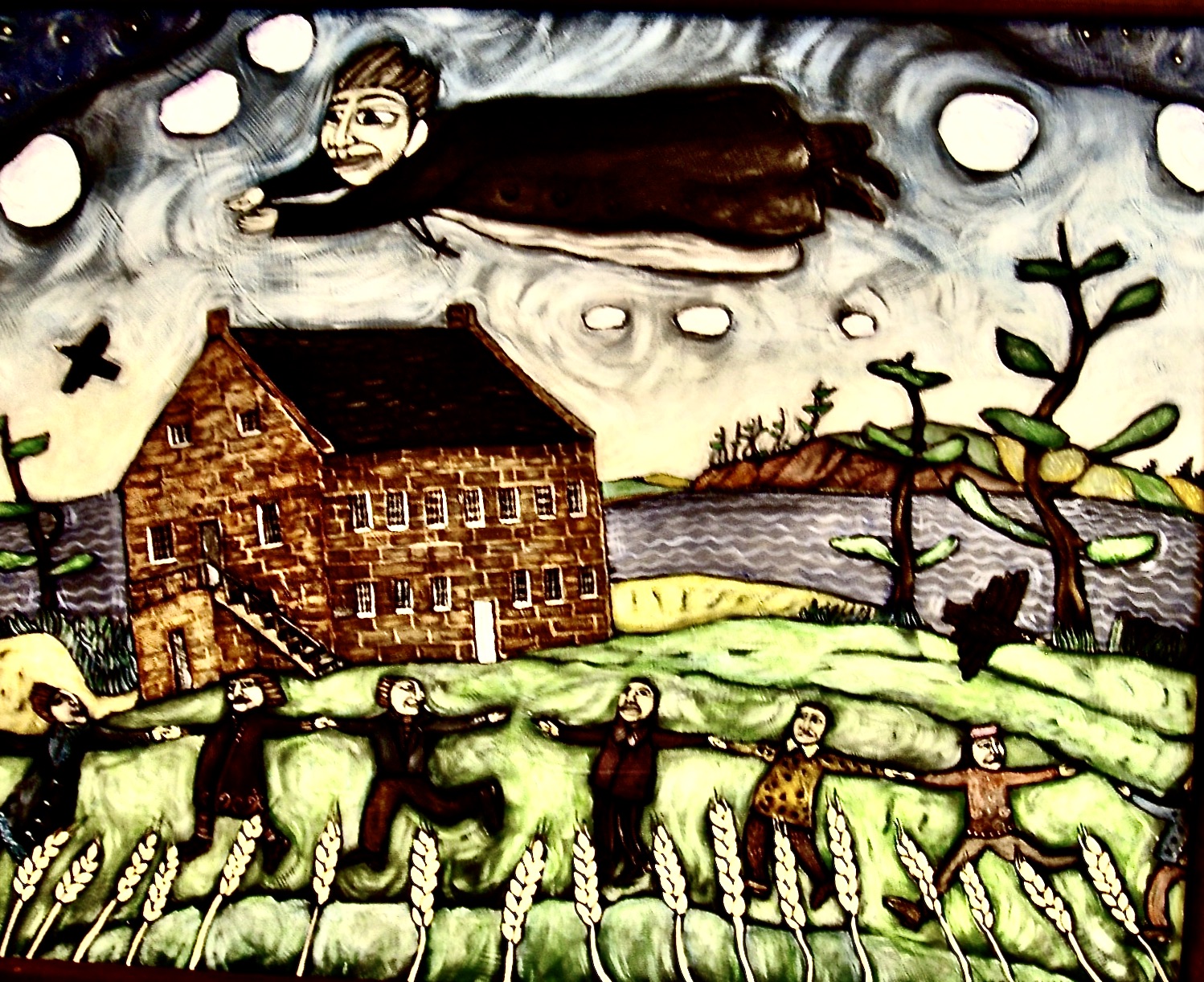
   The day Siobhan Foyle died in 1901 was the same day Queen Victoria died more than five thousand kilometers away. Siobhan’s head got bashed in when Father Georges Belcourt’s one-seater car fell on her. The horseless carriage killed her just as fast as the horse who kicked her husband in the head many years before killed him. 

   Her last thought was of the first day she met her husband-to-be in Cavendish, of her first look at him. She knew in a flash what he was all about when he looked her up and down and knew what her answer would be. After her last thought in this life before meeting her maker she went down into the darkness. She saw a bright light ahead of her. She saw her long-dead man at the end of the tunnel.

   Siobhan lay crushed under the old steam-powered car in her barn all day before anybody noticed. She didn’t feel sorry for herself. She knew she wouldn’t be forgotten. Flies buzzed around her. Her cat wandered in and lay down beside her. There was nothing he could do except keep her company. The sun went from one end of the sky to the other. Queen Victoria died in Osborne House of a stroke in her sleep, in a palatial bed surrounded by her family. The moon rose when she died. Siohban died alone. The sun went down when she died.

   Father Belcourt bought the car that killed Siobhan from a man in New Jersey in 1866. It was unloaded at Charlottetown and pulled to the Farmer’s Bank in Rustico by a team of horses. Nobody except the priest knew how to work the self-propelled wagon. He had a letter explaining its operation. He was keeping it close to the vest.

   “Be careful,” one of his parishioners said pulling him aside. “The devil could be in that tank.” The parishioner pointed to the steam engine.

   If he was, he was hunched over and hot as hell. The steam chamber was four feet high, and the motor was connected to the wheels by a chain. The car had no suspension, no windshield, and no roof. Father Belcourt kept it in a shed beside the bank. The Farmer’s Bank was organized by him soon after he arrived there in 1859. One of the first things that jumped out at him was the economic hardship of his flock. What he did to help was establish a Catholic Institute to bring parishioners together. Everybody had to agree to be teetotalers. The second thing he did was create the credit union to provide loans to farmers at Christian rates of interest. The third thing he did was buy the car to be able to get out to see the sick and homebound.

   The priest was from Quebec and had been in the business of saving souls for more than thirty years before arriving in Rustico. He led missions in Manitoba and North Dakota and fought it out with the Hudson’s Bay Company over their compensation to the natives who delivered furs to the trading company. But when he demanded the savages swear off liquor as a condition of conversion, they were unwilling to give up their company-supplied booze.

   He didn’t give up working for them, working up a petition for redress of wrongs. He persuaded a thousand of the savages to sign the petition about the company’s selfishness and discrimination, a petition he meant to send to Queen Victoria. He tried, but Earl Gray, the Colonial Secretary, tore it up and threw it away and arrested Father Belcourt for inciting discontent. The Archbishop of Quebec had to step into the fray. He got the charges retracted but sent the priest far away to the east to Prince Edward Island. 

   Father Belcourt retired as the pastor of Rustico in 1869 and moved to Shediac, New Brunswick, but couldn’t get islands off his mind. He pled to be allowed to pastor a parish on the Magdelen Islands. It wasn’t long before he was on a boat out on the Gulf of St. Lawrence with the Archbishop of Quebec’s blessing. Before he sailed, he asked Siobhan Foyle if he could store his steam-powered car on her farm. 

   “Of course,” she said.

   Unfortunately, the horseless carriage had forgotten how to get up and go and had to be towed there by a team of horses. It went into the barn. It was pushed into a corner. Everybody forgot about it.

   Siobhan had gotten into the habit of burying her money in a hole at the backside of the barn. When the bank got going, she dug up her savings and put it in the bank. She didn’t know it, but she was one of the biggest holders at the credit union. In 1893, a year before the bank closed, after her son Kieran Jr told her the bank would be closing soon, she withdrew all her money and buried it in the ground again. 

   She raised six children on her farm outside North Rustico. She raised them by herself. Siobhan knew the value of a dollar better than most. She wasn’t a miser, but she was frugal. When the shipbuilding business in Atlantic Canada collapsed in the 1880s and her son Sean was thrown out of work, she paid for his passage to the United States, where he joined Michael, her youngest. 

   Half of the island’s economy disappeared when shipbuilding disappeared. Thousands of islanders migrated to the Boston States looking for work in factories and domestic service. By the time Siobhan died more than a third of everybody on the island was gone. She never saw Sean and Michael again. Her three daughters all married, one of them going to Summerside, one to Acadian land, while Biddy stayed nearby in Stanley Bridge. She married a fisherman who was good at bringing up eels. They had seven children by the turn of the century.

   In the mid-1880s, unhappy that their winter mail and passenger service was still relying on iceboats, islanders started demanding a fixed link to the mainland by way of a railway tunnel. Siobhan rarely got mail and never left the island. She didn’t care if there were iceboats or tunnels. The tunnel never got built, no matter how many folks demanded it.

   In 1895 Robert Oulton and Charles Dalton become the first men on Prince Edward Island to successfully breed silver foxes in captivity. They brought a litter of foxes with a vein of silver in their fur to maturity near Tignish, on the west end of the island. They did it by mating red and black foxes. After that the gold rush was on. They shared the secret of their success and their breeding stock with a small circle and before long the small circle was getting rich. When word started to get out, the fox boom was on. When Kieran Foyle, Jr. heard about it, his ears pricked up. It was early fall 1900. When he told his mother about it, she dug up the family money buried behind the barn and laid it out on the kitchen table.

   Siobhan knew there was a livelihood and even a fortune to be made from fur. The explorer Samuel de Champlain had been in the fur trade three hundred years ago. Alexander Mackenzie, the first European to go cross-country and reach the Pacific Ocean, had been in the fur trade. John McLaughlin, who built forts in Vancouver and established the Oregon territory, had been in the fur trade.

   The Hudson’s Bay Company and North-West Company were in the business of hunting and killing bears, beaver, fox, deer, buffalo, mink, otter, and seal for their skins. Every woman in the Americas and Victorian Europe coveted a fur coat, but as the century raced to a close there weren’t enough wild animals left to answer the demand. Fur farms became the answer.

   “Charlie Dalton and another man have got a fur farm out on Cherry Island,” Kieran Jr. said. “They’ve been raising foxes in pens and have somehow got it so that the females stay quiet. They sold two breeding pairs to Silas Rayner up in Kildare and he’s making it work, too. Bob Tuplin bought a breeding pair for $340.00 and has gone into a partnership with Jimmy Gordon at Black Banks.”

   “That is a bushel of money,” Siohhan said.

   Farm hands on Prince Edward Island made about $25.00 a month. After a year they might have been able to buy one breeding fox, but it takes two to tango. Kieran Jr. leaned across the table. “Charlie sold one of his pelts in London for almost two thousand dollars.”

   Siobhan was amazed and said so.

   “Charlie and the Raynor’s and some others are setting up what they call the Big Six Combine. They plan on keeping their secret a secret, not produce too many pelts, and keep the price sky high.”

   “What’s their secret?” Siobhan asked.

   “One of their secrets is the wire they use, which they import from England. The foxes don’t seem to mind it. Charlie builds his pens with it. The wire stays free of rust and stays shiny. It seems to make a difference. They keep one breeding pair in one wire pen with a wooden kennel.”

   “How do they keep the foxes from climbing or digging their way out?”

  “They build sidewalls slanting in and add overhangs. To keep them from burrowing, they dig trenches and bury wire in the ground. They put catch boxes in corners and along the guard fences to trap any of them trying to escape.”

   “I would build a watchtower, valuable as the animals seem to be.”

   “Charlie’s got watchtowers.”

   “It must be hard on him if a fox does escape.” 

   “He pays schoolboys to hunt them down on weekends. There might be a boy or two who ends up going to Saint Dunstan’s with that money.”

   “What does he feed the foxes?”

   “He mixes fowl livers, junk fish, raw horsemeat, tripe, and offal with water. They eat about the same as a cat does, about a half pound a day. If a vixen can’t make milk for her pups, he brings in a nursing cat. He keeps the pups in good health, making sure they don’t have mites or worms.”

   “How do they go about taking the pelts without damaging them?”

   “Charlie pokes poison into their chest cavities when the time comes. I hear he might be getting a stunner from Norway, which kills the foxes on the spot. He’s got a fleshing machine that cuts the flesh from the pelt and sucks the fat into a tank. He cleans the pelt by putting it into a spinning drum filled with corn grit. Then he dries it on a wood board cut through with ventilation holes.”

   “Do you think you can make it work like Charlie’s done?”

   “Yes.”

   “How do you know all this about farming fox furs?” Siobhan asked.

   “It’s a secret,” Kieran Jr. said to his mother, from whom he had never been able to keep a secret. He spilled the beans soon enough.

Excerpted from “EbbTide.”

Ed Staskus posts monthly on 147 Stanley Street at http://www.147stanleystreet.com, Made in Cleveland http://www.clevelandohiodaybook.com, Down East http://www.redroadpei.com, and Lithuanian Journal http://www.lithuanianjournal.com. To get the site’s monthly feature in your in-box click on “Follow.”

“Ebb Tide” by Ed Staskus

“A thriller in the Maritimes, out of the past, a double cross, and a fight to the finish.” Sam Winchell, Beyond Books

Available at Amazon: https://www.amazon.com/dp/B0CV9MRG55

Summer, 1989. A small town on Prince Edward Island. Mob money on the move gone missing. Two hired guns from Montreal. A constable working the back roads stands in the way.

A Crying of Lot 49 Publication
Down to Sea Level

   By Ed Staskus

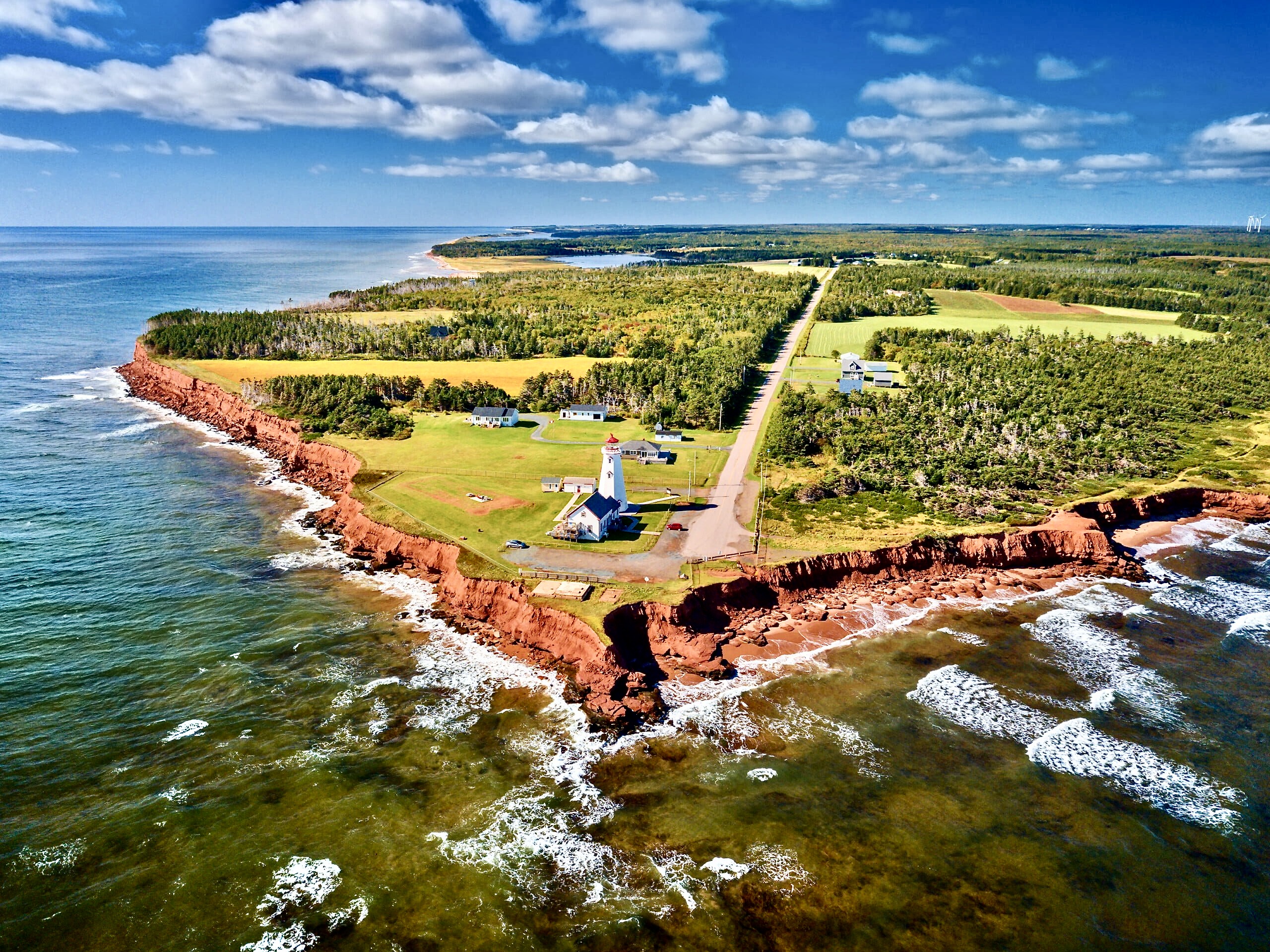
   There was a window seat midway back in the Boeing 737. JT Markunas parked himself there. The plane looked old but smelled clean. It had been built in 1969 with an expected lifespan of 20 years. It was 20 years old in 1989 on the day JT buckled his seat belt. He was on the one daily Canadian Airlines flight from Ottawa, the capital of Canada, to Charlottetown, the capital of Prince Edward Island. Crossing over the eastern end of New Brunswick, he looked up from his Car and Driver magazine. He took a look through the porthole window at the crescent-shaped island in the distance. The land wasn’t small, but it wasn’t big, either. It was blanketed by snow. He had been told his new posting was mostly farm country. He wondered what it looked like from outer space.

   Seen from outer space Prince Edward Island can barely be seen. The solar system is a speck in the galaxy. The earth is a speck in the solar system. Prince Edward Island is a speck on the earth. When the sky is clear and the sun is shining it is a green and red speck under a dome of blue. When it is cloudy and stormy everything gets wet and gray until the sun comes back. It is the Gulf of St. Lawrence. Where he came from, which was Sudbury, Ontario, the sky was always either getting cloudy or it was already cloudy.

   The lay of the land formed hundreds of millions of years ago. Creeks and rivers deposited gravel, sand, and silt into what is the Gulf of Saint Lawrence. Before the last ice age, Prince Edward Island was part of the mainland. After the glaciers melted it wasn’t a part of it anymore. The Northumberland Strait became what separates it from the rest of Canada.

   The province is one of Canada’s Maritime provinces, the others being New Brunswick and Nova Scotia. Newfoundland and Labrador are nearby but more on their own than not, which is the way they want it. There are 225 kilometers from one end of the island to the other. It is 3 kilometers at its most narrow and 65 kilometers at its most wide. It is twice as far as the Kulloo flies from the island to Walt Disney World in Florida as it is to the Arctic Circle. Walt Disney World is far away and for pretend. The Arctic Circle is nearby and for real.

  There are farms from stem to stern of Prince Edward Island. There are so many of them the province is called the “Million-Acre Farm.” Jacques Cartier discovered it in 1534 and Samuel Champlain claimed it for France in 1603. The French explorers called it Île Saint-Jean. When they landed the native Mi’kmaq’s tried to explain they had been there for thousands of years, but all they got for their trouble was wasting their breath. They switched gears and tried singing some of their Top 10 songs. They sang “The Eagle Song” and “The Honor Song” and “The Gathering Song.” They accompanied themselves on rattles and hand drums.

   “Try singing a different tune,” Samuel Champlain finally said. “I’ll teach you the words.” He meant for them to sing “The Giveaway Song.” The Mi’kmaq glared and reached for their bows and arrows. The French strapped on armor and reached for their swords. They were more savage than the savages and knew how to prove it. The natives grumbled to themselves and drifted away. They thought they could make it right later. They were wrong about later.

   Kulloo could have set them straight, but he didn’t. He spoke in riddles, anyway. Hardly anybody ever understood his riddles. Over the centuries it had gotten so he held his tongue more often than not. He didn’t believe in explaining himself, anyway. He believed, being terse, say it once, why say it again? No matter what the  Mi’kmaq’s thought he was, or meant to them, he was a lone wolf. He was big enough to hook a grown man with his talons and carry him away. If push came to shove, and the man couldn’t explain himself, Kulloo was strong and predatory enough to eat him. Men were his least favorite meal, being bitter and hidebound, bur he was never going to shortchange himself dinner.

   He was at least a millennium old. Nobody knew how old he really was, not even Kulloo himself. The day he saw Jacques Cartier’s two ships come from France in 1534 he didn’t know what century it was. He lived by the seasons and the rotation of the stars. The ships and their crewmen piqued his interest. The Mi’kmaq had small boats that hugged the coastline. The big sailing boats had come from the other world, from the other side of the ocean. Kulloo had gotten word about that world long ago, but had never seen it. He suspected the Old World was intent on making the New World their world. He thought it  best to take a closer look to see where he stood.

   When the British took control of Canada East they changed the name of the island from what the French had called it to St. John’s, then changed it to New Ireland, and again on the eve of the 19th century to Prince Edward Island. It was named after Prince Edward, who later became the father of Queen Victoria. He was beguiled by the island, even though he proposed transferring sovereignty of it to Nova Scotia. He visited his namesake five times. The journey took almost a month to sail one way. 

   It became a separate colony in 1769 and the seventh province of Canada in 1873. Charlottetown was named after the wife of King George III. Queen Charlotte barely spoke a word of English and never visited the capital city. She stayed home in Buckingham House and played her harpsichord. She liked chartbusters like Bach’s “Concerto in the Italian Style in F Major” and Handel’s “Keyboard Suite No. 5.”

   “She ain’t no beauty, but she is amiable,” King George said about his wife. Queen Charlotte smiled slyly. She played “By the Light of the Moon” on her harpsichord for the man of the house.  It was a lullaby. King George took a nap in his queen’s lap.

   The province is the smallest and most densely populated Canadian province, although outside of Charlottetown and Summerside, where half of everybody lives, the habitants and their communities are spread far and wide. Most of everything is in the way of out of the way. Forests once covered the island. Trees still covered half of it. The red oak is the provincial tree. There are pine, beech, and spruce. There are no deer, moose, or black bears. There are rabbits and skunks, muskrats, and plenty of foxes. The red fox is the provincial poster boy. In early summer pink and purple lupins, weeds that are an invasive species, line fields and ditches. The Lady Slipper, an out-of-the-way orchid that grows in shady woodlands, is the provincial flower.

   JT was looking out the porthole window when he saw Kulloo. The bird was bigger than an albatross and more stern-looking than an eagle. If it was sowing the wind it was going to reap a whirlwind. The plane was cruising like it had been for the last hour-and-a-half. The big bird was keeping pace with the plane off the tip of the wing. JT rubbed his eyes and looked again. It was still there, soaring. He scanned the aircraft cabin. Some passengers were reading while others napped. Nobody was looking out at the wide blue yonder. When JT blinked the bird was gone. When he blinked again it was back.

   Farming is the number one way of life on the island, followed by the enterprises of fishing and fish mongering. There are a wealth of fields full of potatoes, grains, and fruits. There are cows everywhere, their snouts in the turf, waiting to be milked or slaughtered. There are boatloads of mussels, oysters, and lobsters to be had. Cod had been overfished to near extinction. There was talk of importing it from Iceland.

   Tourism was growing and Liam Foyle and his Japanese girlfriend Mariko were building cottages on family land in North Rustico to get in on the summer trade. In the meantime, they stayed at Sandy’s Surfside Inn most of the time. It was on the Gulf Shore Parkway. It was on the park road but not in the National Park. They had never sold their land. His brother Conor was his only neighbor. Liam and Conor were Kieran Foyle’s descendants, more than a hundred years after the Irish triggerman from the Old World landed in the New World, his Beaumont-Adams revolver tucked into a sailor’s bag. 

   In 1989 the pickings were good for the Liberals. They swept the elections. Andrew, the new Duke of York, and Fergie, his wife and Duchess, visited, flying in on a Canadian Armed Forces jetliner. George Proud, one of the new Liberal members of the province’s parliament, stood on a bench for a better view of the royals as they were driven up University Ave. “We’re the commoners, and they’re royalty, and I think people in a strange way must secretly like that,” he said. 

   “It’s a great day,” declared John Ready, the mayor of Charlottetown. Not everybody agreed. A woman in the crowd groused, “I was talking to a friend this morning who said, ‘I don’t know why we should have to curtsy to a person who a few years ago was living with a race-car driver.’” During the parade the Duchess climbed over a rope barrier to talk to a group of senior citizens. “What are these ropes for?” she asked. “I can’t believe you’re penned in.” The senior citizens were polite but baffled.

   Scouts Canada held their annual jamboree on the island that summer, honing their outdoor skills and running riot in the woods. The TV series “Road to Avonlea” went into production. The last train on Prince Edward Island made its last run, coming to a dead stop in living time. The tip-to-tip railway had been operating for one hundred years. The minute the clock struck the century mark it was done for good.

   Poison’s “Every Rose Has Its Thorn” was the top song on the radio. Malcolm “Monk” Kennedy was a thorn on the island that year, but nobody knew it until the Boy Scouts had all gone home. They were always prepared, it being the scouting motto, but nobody was prepared for Monk. Nobody was prepared for Jules Gagnon and Louise Barboza, either. They were hired guns from Montreal who came to the island looking for Monk and two million missing dollars.

   Jules and Louise were good as gold at what they did, but didn’t know they were going to end up paddling upstream to get their work done. Monk didn’t know two million dollars was going to be so hard to spend. They didn’t like the stumbling blocks in their way, but by then they had picked their poison. The Hunter River was going to flow through North Rustico and out to the ocean, no matter what. They were going to have to find that out for themselves. They weren’t prisoners of fate. They were prisoners of their own minds. Monk couldn’t change his mind, no matter what. Jules and Louise wouldn’t change their minds, no matter what.

   Kulloo peeled away from the Boeing 737 and swooped landward. He saw Louie the Large near the coastline. Hunkered down on a rock shelf not far from shore, the big shellfish was sizing up Monk, Jules, and Louise. Monk was scrawny. He was off the dinner table unless there was a famine. Jules looked better. He had some meat on his bones. Louise looked the best. He wouldn’t mind getting his claws into her, not at all. They shared a name. He liked that. He would like it even better if they shared some flesh and blood.

   Louie the Large loved the ocean, deep and blue, the tides rising and falling. It was where all life came from. He understood the primal fear men and women had of it, which he encouraged with every click clack of his crusher claws. He knew Kulloo was laying low overhead. He kept one eye open for him. He knew all about the bird. He was dangerous as a switchblade. He knew the creature never slept and woke up every morning dangerous as ever. Everything on land and sea was fair game to him.

   JT looked out the porthole window again, as the plane started its approach to the Charlottetown Airport, and saw that the bird was gone. He didn’t think he had imagined it. He wasn’t a fanciful man. He prided himself on thinking straight. He wasn’t especially impulsive or emotional, although he had been in love once and knew he could be as irrational and emotional as anybody. He didn’t believe any bird could be that big and that fast. It must have been a mirage of some kind, like in the movies. 

   He checked his seat belt to make sure it was snug. He looked down at the sea level he was going down to. Five minutes later he was landing on the Atlantic Canada land that was going to be his new RCMP posting.

Excerpted from “Ebb Tide.”

Ed Staskus posts monthly on 147 Stanley Street http://www.147stanleystreet.com, Made in Cleveland http://www.clevelandohiodaybook.com, Atlantic Canada http://www.redroadpei.com, and Lithuanian Journal http://www.lithuanianjournal.com

“Ebb Tide” by Ed Staskus

“A thriller in the Maritimes, out of the past, a double cross, and a fight to the finish.” Sam Winchell, Beyond Books

Available at Amazon: https://www.amazon.com/dp/B0CV9MRG55

Summer, 1989. A small town on Prince Edward Island. Mob money on the move gone missing. Two hired guns from Montreal. A constable working the back roads stands in the way.

A Crying of Lot 49 Publication

Rat in the Hat

By Ed Staskus

   Aksel was a Norwegian rat, although it would have been a matter of rough-and-tumble if anybody had tried to tell him that. He believed he was a Norman rat since his forebears had come to the New World aboard a French ship that sailed from Bayeaux long ago. The Normans were hardy explorers. Norwegians sat around their fjords moon eyed. It had been more than a hundred generations of his family saga since his ancestors landed on the island. He had never met a Norwegian. He had no idea about any Norwegians. He didn’t even know where Norway was.

   He didn’t know what day week or month it was. He didn’t know it was 1989. He didn’t know he was living in North Rustico on Prince Edward Island, either. He had no clue he was on the North American continent, for that matter, although if he had known it wouldn’t have mattered. He knew where Rollings Pond was. The pond was where he spent most of his nights. During the day he slept in the basement of the Stella Maris Catholic Church. He never went to mass or confession, though. It wasn’t that he was an atheist, not exactly. He simply couldn’t wrap his head around the idea of a Supreme Being who had his best interests in mind. Something was always out to get him. He always had to do everything for himself. He didn’t own anything, not even a fork, knife, or plate, but his bedroom was cozy. He stored some dried food there and had a bed of straw and a small pillow. He kept a handful of loose change he had found at Orby Head under his pillow for a rainy day.

   Aksel was known by the nickname of Left-Hand. How he came to be called Aksel the Left-Hand was beyond him, since he was right-handed. In the event, he didn’t gripe about it. It was better than some of the other rat nicknames he had heard in his neck of the woods, like Seaweed Neck and Foul Fart. He liked to think of himself as a man about town and sometimes wore a bowler hat.

   He wasn’t a farmer. He foraged for food instead of sowing seeds. He gleaned grub far and wide. He ate anything and everything. He thought he had probably eaten hundreds of different foods in his lifetime. He ate any discarded morsels he came across as well as all crops from all fields. He ate all the time, snacking on whatever came his way. Some people said he was a glutton. He didn’t bother disagreeing with them. He preyed on chicks, lizards, and other rodents. He caught fish on Fridays, just in case there was a God.

   His mother let it slip one day that their kind only lived two or three years. He was aghast. There was apparently no time to waste. His eyesight had always been bad. He needed glasses. He was colorblind, too. His other senses, smell, taste, touch, and hearing, were outstanding. He wasn’t especially Olympic Games agile, but he could run, jump, climb, and swim enough to keep danger at bay. He used his face whiskers to feel the world around him. He could wiggle each one of them individually, unlike cats like Snaps, who was from Murphy’s Cove and was always messing with him. He and Snaps were going to have it out one day. The cat was a menace. He was always lying in ambush for him. He had to find a way to cancel out the mouser’s claws, which were razor sharp and deadly. He had the scars to prove it. 

   Except for Snaps, cats rarely bothered Aksel. He was too big for most of them, feral or otherwise. Snaps was a different order of things. He was as big as cats come. The beast was a dangerous son-of-a-gun. The cat and the rat were a stop-and-go dance in the dark. When Aksel stopped, Snaps stopped. When he started up again, the cat was on his heels again, low-down and deadly quiet.

   Islanders didn’t always give Aksel his due. Some called him a street rat, even though he was a field rat. Others with college educations called him a Hanover rat. He tried to explain he was a Norman rat, but couldn’t speak the language of the learned. He didn’t like it whenever he was called a dirty rat. He was fastidiously clean. He washed and groomed himself ten times a day. He was a brown rat with a white underside. He was a big boy, his body length almost a foot long with a tail slightly shorter than a foot. All he had to do was flash his teeth and wiggle his tail at passersby to make them jump and lose their sandwiches.

   He  liked hanging out in the back room of Lorne’s Snack Shop, where out of work fishermen hung around looking for something to talk about. Aksel wore morning dress, a bowler hat, and pantomimed Charlie Chaplin on table tops for handouts.

   One night he met one of his own kind in the dumpster behind the co-op store next to Angie’s Eatery. After giving each other the secret handshake, after which both rats were sure the other one was legit, they chewed the fat and gossiped about local doings. His new-found friend, it turned out, had come off a cruise ship in Charlottetown three weeks ago, gone on a self-guided tour, been late getting back, and was now stranded until another boat rolled in. He had strayed up to North Rustico and was thinking of staying

   “I’m a free agent,” he said. “I can hi-jack myself back onto any boat anytime I want to. You know those round things they attach to mooring lines, what they call rat guards, and how they coat them with grease? First, I puff up my cheeks. Second, I suck up the grease. Third, I spit it out over my shoulder when I go over the rat guard.”

   Cruise ships had been docking in Charlottetown since just after the turn of the century, pulling into port to hearty welcomes. They let loose hundreds sometimes thousands of tourists all at once to stretch their legs, eat, drink, see the sights, and buy “Anne of Green Gables” dolls and effigies. They bought on-the-spur memories to put away in their closets.

   It was after midnight when Aksel and Yeoman Purser, which was what his  friend called himself, went their separate ways. “I know I’m just a rat and a mug, to boot, but I have got to say this seaside place here is something else, just beautiful, and everywhere I look there is food.” The hometown boy twitched one whisker in agreement.

   Aksel was more nocturnal than not, so when Bernie Doiron found something sticking out of the ground when he was plowing on the other side of the hill from Rollings Pond and every nearby cop car, ambulance, and fire truck descended on his stomping grounds, the noise that morning woke him up. He had just rolled over in his straw bed. He coughed and cleared his throat, blinking. He was curious and made his way to the top of the field where it was all happening to see what was happening.

   He had a love hate relationship with members of the human race. On the one hand, he preferred living near them since they were a rat’s number one fast food outlet. On the other hand, they were always trying to kill him. They checked his droppings unceasingly and tracked him by them. They were always putting out traps and bait stations. Whenever they found his nest they gassed it. He had gotten to be as cautious as an accountant. He knew full well what glue boards and snap traps were about. It didn’t matter if they were baited with his favorite fish and cereals. He gave them a wide berth.

   “My mama didn’t raise no fool,” he grumbled to himself.

   He saw what Bernie had seen and what the cops were seeing sticking out of the ground. It was an arm that had been chopped off. He guessed the rest of the body was still in the ground. It looked like they were digging it up, although why was beyond him. He knew they weren’t going to eat the remains, so what was the point? What the human race did day in and day out puzzled him more often than not.

   Aksel quickly lost interest in the unearthing. There wasn’t going to be a free meal in it for him anytime soon unless somebody dropped some crumbs. That was something else that baffled him about men and women. They seemed to never want to pick up food they had dropped, especially the women. In his world no rat did that. They ate everything, no matter what, no matter where it was., and no matter how small it was.

   He ran across the open ground behind him. He could run faster than any man alive. He could run six times his body length in a single second, but he couldn’t keep it up for long. When he got to the tree line and was out of sight, he slowed down and caught his breath. When he got to Church Hill Rd., he looked both ways before crossing to the Stella Maris Catholic Church. There was no sense in being run over on his own doorstep by a four wheel bucket of bolts rolling past.

Excerpted from “Ebb Tide.”

Ed Staskus posts monthly on 147 Stanley Street http://www.147stanleystreet.com, Made in Cleveland http://www.clevelandohiodaybook.com, Atlantic Canada http://www.redroadpei.com, and Lithuanian Journal http://www.lithuanianjournal.com

“Ebb Tide” by Ed Staskus

“A thriller in the Maritimes, out of the past, a double cross, and a fight to the finish.” Sam Winchell, Beyond Books

Available at Amazon: https://www.amazon.com/dp/B0CV9MRG55

Summer, 1989. A small town on Prince Edward Island. Mob money on the move gone missing. Two hired guns from Montreal. A constable working the back roads stands in the way.

A Crying of Lot 49 Publication

Fish Tank Blues

By Ed Staskus

   It wasn’t breaking news that Prince Edward Island was an island. It was ancient news that it had not always been one. It was news to some folks who lived on the island, however. They weren’t overly concerned about the past. They cared about right now. They cared about heating oil being delivered on time and what time the school bus was scheduled. They cared about the flat tire that stopped them dead in their tracks on the way to the grocery store, and how they were going to put food on the table that day. They knew for sure that nothing from the prehistoric past had made their tire go flat. 

   What the land and the sea were all about wasn’t news to the lobsters who lived offshore. They had been around much longer than the fishermen, farmers, and townsfolk who plied their trade in the Maritimes. The crustaceans had seen it all, although they hadn’t seen amnesic shellfish poisoning before. The new toxin was killing Canadians who ate shellfish that year. No lobster ever went to any of their funerals. “That’s a dose of your own medicine,” Louie the Large said, chortling to himself that the toxin wasn’t bothering his kith and kin.

   Lobsters didn’t have a trade or much else to do, other than eat anything and everything they could all day and night. Everything was grist for the mill. They hated crabs and crabs hated them and it was the Hatfield’s and McCoy’s whenever the shellfish ran into each other. The lobsters were bigger, badder, and more determined. Three of their five pairs of legs were outfitted with claws. They usually carried the day. Might makes right was their motto.

   The number one rock ‘n’ roll band among the island’s lobsters was the B-52’s. They were the house band in their part of the world. Every lobster knew the lyrics to their “Rock Lobster” song. The band had released it ten years earlier and when they did it shot up the shellfish charts, even though every single crab scorned it as the devil’s music.

   “We were at the beach, everybody had matching towels, somebody went under a dock, and there they saw a rock, it wasn’t a rock, it was a rock lobster!” 

   Whenever any crab heard the song, it spit sideways and cursed. They were happy to see the island’s fishing boats go after their country cousins every spring. They showed up at the island’s harbors for the blessing of the fleet on Setting Day and shouted “Godspeed!” when the boats broke the waves. There was no love lost between crabs and lobsters. “We don’t need no skunks at our lawn party,” crabs far and wide said.

   Even though lobsters could be as bad as a Hells Angel on the wrong side of the bed, all they really wanted to do was eat and have fun afterwards. They were always on the move, moving in parties of fifty and a hundred, looking for a party. They ate non-stop so as to have plenty of get up and go at whatever party they found.

   “Havin’ fun, bakin’ potatoes,” they sang. Prince Edward Island was known as Spud Island. It was no small potatoes when it came to the tuber. It was the smallest province but the top potato producing province in the country. Everybody’s favorite way to eat lobster was boiled in the same pot with fresh corn and new potatoes.

   “Boys in bikinis, girls in surfboards, everybody’s rockin’, everybody’s fruggin’.”

   The blue and brown backed crustaceans couldn’t move fast enough to frug, but it didn’t matter. They got into the spirit of the song. They lived in harmony among themselves ten months out of the year, except when one of them happened to eat another one of them. The other two months of the year all bets were off. That’s when the island’s lobster boats went after them. That’s when the angels sang and it was every man for himself. They didn’t like it, but they had to take their lumps like everybody else.

   There were about 1200 boats sailing out of 45 harbors on the island. More than three dozen boats came out of the North Rustico harbor alone. Every one of them was out to get them. Once they got them their fate was sealed. Every lobster knew it in its bones, even though all they had was an exoskeleton. Their inner selves had no bones. They were going to be boiled alive and there was nothing they could do about it.

   Traps have escape vents to let shorts leave while still on the bottom. The under-sized lobsters who overstayed their welcome were thrown back into the ocean. Egg-bearing females were also thrown back. The female carried her eggs inside of her for about a year and then for about another year attached to the swimmerets under her tail. When the eggs hatch, the larvae float near the surface for a month. The few that survive eventually sink to the bottom and develop as full-fledged and grown-up. For every 50,000 eggs generated two lobsters survive to grow up and go rocking.

   Some diners wearing bibs argue that lobsters don’t have a brain and so they can’t and don’t feel pain. They have probably never seen tails twitching like a mosh pit in a hurricane when they got thrown into a pot of boiling water. They aren’t twitching to the beat of the B-52’s. Their brains might not amount to much, but they have a nervous system. They react to pain physically. The cortisol hormone they release when dying is the same one that human beings release when hurt. 

   “How about coming down here with the rest of us,” they wanted to scream from the red hot mosh pit. They would have screamed if they could. As it was, all they could was click and clack.

   The Prince Edward Island seafood industry considered lobster to be their crown jewel. It was a gourmet delicacy known for its juicy meat. But that was like getting the Medal of Honor when you weren’t around anymore. Who needs to bask in that kind of glory? The only consolation lobsters had was that the island’s fishermen took care to manage their resource. They didn’t pull up over many of them in their traps. They kept the surrounding waters clean as could be so there would be fruit of the sea year after year.

   It was a small consolation though. It only meant fishermen were in it for the long haul and weren’t going to change their minds about snatching them up anytime soon. The only consolation a lobster ever got was when somebody reached for it and the lobster was able to get the outstretched hand in its crusher claw.

   “We were at a party, his earlobe fell in the deep, someone reached in and grabbed it, it was a rock lobster!”

   When that happened, there was no quarter given. The lobster was going to sell its life dear. The human hand was going to pay dearly for sticking its nose where it didn’t belong. It should have stayed where it was before it ever came to the island. Why didn’t they stay in the Old World? What lobsters didn’t know was that fishermen came from the same place they themselves came from way back when. They came from way down in the ocean like them. They weren’t ever going back. The sooner lobsters got that through their thick heads the better.

   “Lots of bubble, lots of trouble, rock lobster.”

Excerpted from “Ebb Tide.”

Ed Staskus posts monthly on 147 Stanley Street http://www.147stanleystreet.com, Made in Cleveland http://www.clevelandohiodaybook.com, Atlantic Canada http://www.redroadpei.com, and Lithuanian Journal http://www.lithuanianjournal.com

“Ebb Tide” by Ed Staskus

“A thriller in the Maritimes, out of the past, a double cross, and a fight to the finish.” Sam Winchell, Beyond Books

Available at Amazon: https://www.amazon.com/dp/B0CV9MRG55

Summer, 1989. A small town on Prince Edward Island. Mob money on the move gone missing. Two hired guns from Montreal. A constable working the back roads stands in the way.

A Crying of Lot 49 Publication
Shock Wave

By Ed Staskus

   “When Britain is at war, Canada is at war,” Prime Minister Wilfrid Laurier said in 1910. “There is no distinction.” Four years later when Britain entered World War One, Canada signed on, too.  In August 1914 the Governor-General of Canada vowed that “if unhappily war should ensue, the Canadian people will be united in a common resolve to put forth every effort and to make every sacrifice necessary to ensure the integrity and maintain the honor of our Empire”

   Empires are made by plundering and slaughtering. They are always sure of the rightness of their cause. They never go down without a fight. It doesn’t matter if there’s any honor in the fighting, or not. They plow straight ahead.

   The country had no air force, a navy fit for a bathtub, and an army of 3,000-some men.  By the end of the war more than 600,000 Canadians had enlisted in the Canadian Expeditionary Force to fight for King and Country and more than 400,000 of them served in Europe, out of a population of fewer than 8 million nationwide.

   “The Empire Needs MEN” is what the posters said. “All answer the CALL! Helped by the YOUNG LIONS the OLD LION defies his foes. ENLIST NOW!”

   Everybody wanted in on the fight because everybody thought it would be over by Christmas. Canadians lined up to support the British Empire and collect steady pay of $1.10 a day. The harvest that year was bad, and unemployment was soaring. But machine guns fired ten times as many bullets a minute as they were paid pennies a day. Hundreds of thousands on all sides were slaughtered week by month by year by the rapid-firing weapons on the Western Front.

   At the beginning of the war, it was better to be killed than wounded. The wounded were taken off battlefields in horse-drawn wagons or on mules with baskets on their sides, the baskets soaked and dripping with men bleeding to death. There wasn’t any such thing as a dressing. If they made it to a train station, they were transported to hospitals. “One of those trains dumped about 500 badly wounded men and left them lying between the tracks in the rain, with no cover whatsoever,” said Harvey Cushing, the head of the Harvard Unit of volunteer doctors at the American Ambulance Hospital of Paris.

   Nearly 60,000 Canadians were killed, most of them the result of enemy action, and more than 170,000 of them were wounded. Almost 3.500 men and one woman had at least one arm or leg amputated. Private Curley Christian lost all four limbs but survived.

   During the Battle of Vimy Ridge he was unloading cargo from trucks when an artillery shell hit next to where he was, trapping him under debris for several days. When stretcher bearers tried to reach him, they were killed by more artillery. When he was finally rescued, he was transported to a military hospital and from there to London. His arms and legs had gone gangrenous and all four were sawed off.

   When he got back to Canada he was fitted with prosthetic limbs and married Cleopatra McPherson. He deigned his own prosthesis for writing. Cleo and he had a son who twenty years later served in World War Two.

   More than 7,000 Prince Edward Islander’s enlisted. Five hundred of them were killed and more than a 1,000 wounded. Tommy Murphy went overseas with a siege battery in 1915. Before he went, he got married to Freya O’Sullivan and got her pregnant. He got word of his son Danny’s birth by telegram while taking a break in an ankle-deep puddle of water sheltering in a trench during the Third Battle of Artois. 

   He had spent eight days at the front and was due for four days in a reserve trench and then four more days at a rest camp. When the bloodletting went on and on and the ranks thinned out, he never made it to the reserve trench much less the rest camp. It was that kind of a war. The Allied and Central Powers fought the same battles over and over.

   The British French and Canadians assembled seventeen infantry and two cavalry divisions for the offensive at Artois, backed by 630 field guns and 420 heavy artillery guns. During the fighting the field artillery fired 1.5 million rounds and the heavy artillery 250,000 rounds at the Germans defenses. Tommy Murphy barely slept for days. Whenever he took a break, he felt like his arms were going to fall off after loading shells until there weren’t any more to load. He knew he had sent his share of Germans to Hell even though he never saw one of them die.

   When the Allies tried to advance, they suffered 40% casualties. The battle went on from late September to mid-October when it ground to a halt in the middle of a never-ending autumn rainstorm and mutual exhaustion. By that time both sides were conserving ammunition because they were running out of it. They spent the rest of the month burying their dead, tending to their wounded, and withdrawing.

   Tommy was a cannon man because he was taller than five feet seven inches and burly enough to do the heavy work of feeding artillery. He didn’t have flat feet or bad eyesight, He didn’t have the greatest teeth, but explained he was enlisting to fight Germans, not bite them. He could have begged off the war because he was married, but he was patriotic and wanted to do his fair share. Money from the Canadian Patriotic Fund helped his wife keep the home fire burning.

   His battery had a lance corporal scout sniper attached to it. Francis “Peggy” Pegahmagabow was an Aboriginal who could split a bullseye nobody else could even see. He had more than 300 kills to his name. He roamed No Man’s Land at night for them, seeking out enemy snipers and forward spotters. He always came back in the morning. The other side never made it back to their side.

   He wore moccasins instead of army boots, chewed dead twigs whenever he sensed danger, and always carried a medicine bag. “When I was at training camp on Lake Superior in 1914, some of us landed from our vessel to gather blueberries near an Ojibwa settlement,” he said. “An old Indian recognized me and gave me a tiny medicine bag to protect me, saying I would shortly go into great danger. The bag was of skin tightly bound with a leather throng. Sometimes it seemed to be hard as a rock, at other times it appeared to contain nothing. What was inside of the bag I do not know.”

   Tommy had signed up for short service and when 1915 was over and done and it was April 1916, he was done with his one year on the Canadian Expeditionary Force. His commanding officer tried to convince him to re-enlist, but he had a wife, a child, and a farm that needed him. He didn’t need to kill anymore Germans. He was sick of the butchery. Three men from North Rustico were already dead. He didn’t want to be next. He knew if he re-enlisted it was only a matter of time before he went home in a box to be buried on Church Hill Rd.

   He got out when the going was good. The next year enlistments dried up as men near and far began to realize the toll the new style combat on the Western Front was taking. Machine gun fire and shell fire was murderous. On top of that there was poison gas. The dead were left where they fell. They were left for the rats. In May 1917 the government announced conscription through the Military Service Act. The rats stood up and cheered.

   It was easier getting into the army than it was getting out. He finally found a ride on a troop transport from Calais to Dover, took a train to London, and spent the night at a whore house with a razzle dazzle girl. He took a steam bath the next morning and had lunch at a corner fish and chip shop eating cod with a splash of vinegar and a full pint at his elbow. He followed the first pint with a second pint and was happy for it. He had a ticket for passage to Halifax in his wallet, but it was a week away. His grandfather had come from Ireland, or so the family story went, and done something big for the Crown, who rewarded him with 400 acres of PEI shoreline. He unfolded a map and located Dublin. It was directly across the Irish Sea from Liverpool.

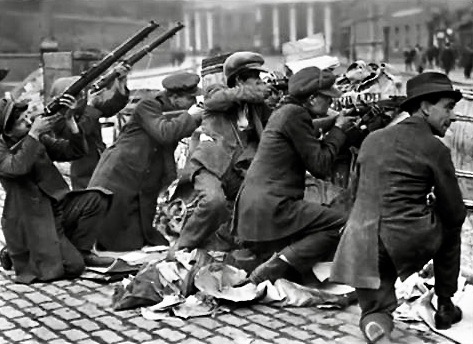
   He bought a train ticket to Liverpool and the next morning landed in Dublin. It was Easter Monday. The Easter Rising had happened yesterday. The Easter Rising was happening today. 

   After landing at the Dublin Port, he followed the River Liffey, making for Dublin Castle and St. Patrick’s Cathedral. His plan was to find a room for a few days and have dinner. He would explore the rest of the city after a good night’s sleep. He was wearing his Canadian Army uniform over a pair of Spring Needle underwear and carrying a rucksack. He had his toiletries, four pairs of clean socks, his rolled up military wool overcoat, and a paper bag full of Huntley & Palmer biscuits in it. The biscuits were so hard they would crack a man’s teeth at the first bite if not soaked in tea beforehand.

   His papers and money were in a travel wallet attached to his belt. He had his Colt New Service revolver on his belt, too, for what it was worth now that his war was over. An hour later he was glad he had it, after he got it back, although he wasn’t sure if he was going to need it to protect himself from the Irish or the British.

   Dublin Castle was in the middle of the old part of the city. The city got its name from the Black Pool, the ‘Dubh Linn,’ where the rivers Liffey and Poddle met. It was where the castle was. It had been a Gaelic ring fort in the beginning, a long time ago. Later, after the Vikings showed up, it was a Viking fort. For the past 700 years it had been a British fort, the seat of their rule in Ireland. 

   Tommy didn’t have anything against the British, but after a year of serving in their army, he thought the Irish might be better served ruling themselves. They couldn’t do worse. During the year he served on the Western Front three quarters of a million Jacks and John Bulls were killed. It made him sick to think of the men he had seen obeying orders to attack barbed wire and machines guns across open fields. Another few million men went wounded and missing. The broken might survive, but he didn’t think the missing were coming back anytime soon.

   He was glad to be out of it. It hadn’t ended by Christmas of 1914. It still wasn’t over by Christmas of 1915. The next Christmas was in eight months and the talk was it would take a half-dozen more holidays to either win or lose the war. He meant to say a prayer in St. Patrick’s Cathedral before dinner. 

   He didn’t get a chance to say a prayer, find a room, or have dinner. He lost his chance when he came across the bridge leading to Trinity College, turned the corner towards Dublin Castle, and found himself face to face with a Mauser semi-automatic pistol. He knew exactly what it was. He stood stock still exactly where he was. The hand on the firearm was a woman’s hand. She was wearing an old military hat and a yellow armband.

   “Hand’s up and on the wall, boyo,” she said, a second woman coming up behind him. The second woman was wearing a bandolier laden with a half dozen hand grenades. She had a revolver. It looked like it came from the Middle Ages. He did what she said. She patted him down and took his Colt.

   “Who are you and what are you doing here?” she asked.

   “Tommy Murphy, Canadian Army, from Prince Edward Island by way of a year in France,” he said. “I’m here to take in the sights before going home. Now that we’re talking, I thought Ireland was sitting the war out.”

   “We ask the questions,” the woman wearing the bandolier spit out.

   “Come on,” the woman with the Mauser said, poking him in the small of the back with the barrel of the gun.

   The streets leading to the city center were barricaded. When they got to the General Post Office, he saw there were two green flags flying in place of the Union Jack. They said “Irish Republic” in gold letters. He knew there was no such thing as an Irish Republic. 

   “What’s going on?”  

   “We’re rocking the casbah,” the grenade girl said.

   There was a man outside the post office reading from a broadsheet. It was the “Proclamation of the Irish Republic.” There were copies of it pasted on walls. Newsboys were handing them out to anybody who wanted one. Not everybody wanted one. Most of them didn’t understand what was happening. The grenade girl handed him a copy. “Read this,” she said. There were men with rifles and shotguns on the roofs of buildings overlooking bridges.

   “Who’s this?” said a man wearing a scrap of paper pinned to his breast. It said “Citizen Army.”

   “We found him down the street, Sean.”

   Sean was Sean Mac Duiarmada, one of Commander-in-Chief Patrick Pearce’s right-hand men.

   “He’s Canadian,” Sean said pointing to Tommy’s regimental badge and the “CANADA” title at the end of his shoulder straps.

   “We thought he was a Brit.”

   “They’ll be here soon enough,” Sean said.

   There were 1,200 rebels waiting for 20,000 British troops to arrive.

   A shot rang out in the distance and Margaret Keogh fell down dead. She was a 19-year-old nurse tending to a wounded Citizen Army man. She was the first person to die during the Rising of Easter Week.

   A team of Volunteers trotted past on their way to the Magazine Fort in Phoenix Park. They took all the weapons and ammunition they could carry and blew up the rest. When the son of the fort’s commander tried to raise the alarm, he was shot dead. He was the second person to die.

   “You’re free to go,” Sean said to Tommy. “Best you leave Dublin all together.”

   “What about my sidearm?”

   Sean nodded to the grenade girl, and she handed Tommy’s Colt back to him.

   When a contingent of the Citizen’s Army approached Dublin Castle, the police sentry James O’Brien ordered them to halt. He was shot dead even though he was unarmed. He was the third person to die. When British troops showed up the rebels retreated to City Hall, stormed up to the roof, and fired down on the troops in the street. The man commanding the rebel contingent, Sean Connolly, was shot dead by a sniper, the first rebel and fourth person killed.

   Tommy carefully made his way back to the docklands and the port. He boarded the same boat he had come on. An hour later the boat was steaming into Dublin Bay on its way back to Liverpool. Eight hours later he was asleep in a room of a boarding house on the waterfront, not far from the Three Graces.

   The next morning was cold and damp. Women were out in the streets with their long-handled push brooms. They were called Sweepers. Others were in homes cleaning and scrubbing. They were called Dailies. Many more were at work in munitions factories. They were called Munitionettes. Liverpool’s men were on the Royal Navy’s battleships and in the King’s Liverpool Regiment. They were called Cannon Fodder.

   Tommy found a greasy spoon near the port and ordered breakfast, eggs back bacon sausage baked beans a fried tomato fried mushrooms fried bread and black pudding. The Liverpool Daily Post headline screamed “REBELLION!” There was no need for him to read about it. He thought he might have this same breakfast at midday and tonight. Somebody once said, “To eat well in England you should have breakfast three times a day.”

   He put the newspaper aside. Pushing himself away from the table, he checked his ticket for Canada. He tucked it securely away with his service revolver. Tommy Murphy was going to keep himself safe and sound until his boat sailed for home. Once he was out of the frying pan that was burning and smoking on another man’s stove, he was going to stay out of it.

Excerpted from “Ebb Tide.”

Ed Staskus posts monthly on 147 Stanley Street http://www.147stanleystreet.com, Made in Cleveland http://www.clevelandohiodaybook.com, Atlantic Canada http://www.redroadpei.com, and Lithuanian Journal http://www.lithuanianjournal.com

“Ebb Tide” by Ed Staskus

“A thriller in the Maritimes, out of the past, a double cross, and a fight to the finish.” Sam Winchell, Beyond Books

Available at Amazon: https://www.amazon.com/dp/B0CV9MRG55

Summer, 1989. A small town on Prince Edward Island. Mob money on the move gone missing. Two hired guns from Montreal. A constable working the back roads stands in the way.

A Crying of Lot 49 Publication
Back in Action

By Ed Staskus

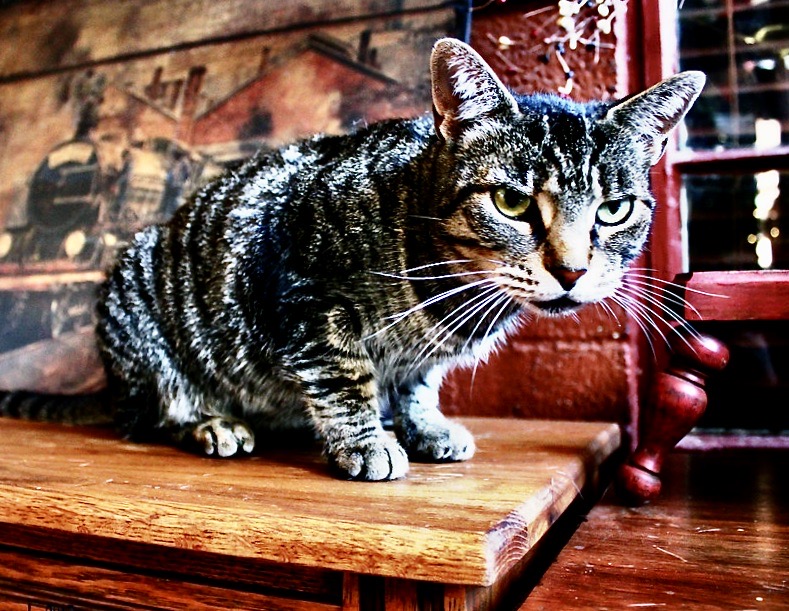
  “Oy, where is it you are coming from?” William Murphy asked the pussycat going on tomcat at his feet. The half-pint was looking up at him. He had been in Thomas Spate’s coat pocket when Prince Albert’s hired gunman shot him dead. As the ferryman was spitting out his last breath, the cat jumped out of his pocket and scurried to the side. He watched Bill Murphy roll push kick Tom Spate into the Stanley River. He floated face down into the New London Bay.

   That was the end of Queen Victoria’s would-be killer, at least until he sank. When he did bottom feeders like eels would chew on whatever was left of his decaying decomposing body. The cat had seen plenty of eels in his short time on Prince Edward Island. He knew what they were up to. It was why he never snacked on them.

   The kitten was striped and gray, still small but on the stocky side. “The only true animal is a cat, and the only true cat is a gray cat,” Lucy Maud Montgomery said years later while writing about the Green Gables girl. She had two of them. “When people ask me why I want to keep two cats I tell them I keep them to do my resting for me.”

   Snapper was a Scottish half-breed from Rear Settlement, on the west side of Settlement Rd. beside a tributary of the Montague River. Everything had gone wrong a month before when Ann Beaton, the woman who had given him his name and kept him fed dry and warm in bad weather, was murdered when somebody smashed in the back of her head with a grubbing hoe.

   Ann was 41 years old and a spinster. She was lonely but had a one-year-old daughter. Nobody knew who had gotten Ann pregnant. She had a lot of explaining to do but kept it a secret. She called the bun in the oven her snapper. When she found the kitten, having wandered away from his litter, she called him Snapper. She lived with her brother Murdoch and his family. The night she was killed was the day she went visiting her neighbor who was weaving some cloth for her. They had tea and raisin pie after dinner and Ann started for home when it was near to sunset.

   “What do you say, it’s getting awful dark, maybe you should stay overnight,” her neighbor asked.

   Ann said she knew the way back like the back of her hand and besides, she enjoyed walking in the dark. Her brother was away and one of his children was watching her girl. She wanted to get back so she could watch the young one herself. Ann was found dead the next day laying in a ditch at the back of her brother’s farm, day-old blood dry and caked.

   She was laid out in the barn. She was a mess. She had been stamped on and violated. Her body and dress were marked with the prints of a shod foot. Everybody from the community filing past the viewing laid a hand on her. There was a Scottish belief that if a murderer touched the body of his victim, blood would gush forth. At the end of the viewing everybody was in the clear. The killer was still on the loose.

   Snapper stayed alert as Bill Murphy walked back to North Rustico. He bounced up and down in the man’s coat pocket. The island’s pioneer days weren’t over, except where they were. Most folks still farmed and fished, but not all of them. Some made and sold farming implements while some worked in shipyards. Everybody needed lumber and many men worked at lumbering. There were sawmills and shingle mills. There were schools, churches, and post offices. There were some inns and hotels. There were plenty of distilleries.

   Ann Beaton’s funeral was presided over by the Reverend Donald McDonald, a minister of the Church of Scotland. He had a large following of “kickers” and “jumpers.” They were known that way for the religious frenzy they fell into while being “under the works.”

   The clergyman had emigrated from Scotland to Cape Breton and finally to Prince Edward Island. Everybody knew he drank too much when he was a Scotsman. When he became a Canadian, he tried to stay on the wagon. “Prince Edward Island is a dubious haven for a man fleeing demon rum,” one of his kinsmen said. There was plenty of strong drink on the island. A year before her death Ann attended several prayer meetings and while under the works knocked a Bible and a candle from Donald McDonald’s hands. She invertedly kicked the Bible. She purposely blew out the candle.

   “They are both under her feet now and mark the end of that girl,” the clergyman said by way of a sour eulogy.

   Snapper watched country folk going to Cavendish by horse and buggy to buy tea, salt, and sugar. If they had something extra in their pockets, they bought molasses and tobacco. They only bought clothes they couldn’t make themselves. They didn’t buy food as a rule. They grew and processed it themselves, picking and preserving berries, milking cows and churning cream for butter, and curing beef and pork after slaughtering the animals.

​   The grubbing hoe that killed Ann Beaton belonged to Archibald Matheson. He lived nearby on the Settlement Rd. with his wife and son. The three of them were arrested on suspicion of the crime. Some local women reported being molested by the farmer, but he and his family were soon released. Bad feelings among neighbors weren’t facts. He may have had a bad reputation, but so did Ann. There were rumors she had been killed by a jealous wife. A smutty ballad was written describing her as “light in her way.” 

   After the funeral she was buried in the Pioneer Graveyard. Her brother moved away nobody knew where. Nobody knew what happened to her baby, either. Nobody wanted to know. By the time Snapper was on his way to North Rustico everybody had done their best to forget all about it.

   The kitten was sleeping in the back of a wagon one day almost a month after Ann’s death. He was sick and tired of nobody feeding him. Before he knew it the wagon was on its way. When he looked back, he didn’t see much worth going back to. He made himself comfortable and went with the flow. The flow was towards the northwest. The wagon stopped overnight at Saint Andrews and the next night at Covehead before getting to the Stanley River, where it rang for the ferry. Once they were across, and the wagoner was stretching his legs, Snapper stretched his legs, too. When he was done the wagon was long gone. Unlike wagoner’s hauling freight, the kitten wasn’t on a schedule. He was go-as-you-please footloose.

   Tom Spate’s young wife took him in, poured him milk, and fed him scraps of white fish. He bulked up and stayed agile staying out of Tom Spate’s way. The ferryman had a bad temper and wasn’t above hitting his wife or trying to kick the cat. Snapper was fast and none of the ferryman’s kicks ever landed. Tom Spate’s wife wasn’t fast and had the bruises to prove it.

   He wasn’t overly distressed to see the dead as a doornail Tom Spate floating away. Bill Murphy was his kind of man, gruff but not mean-hearted. “I have never known anyone worth a damn who wasn’t irascible,” he thought. Snapper stayed where he was, not jumping ship. Besides, he had already spotted foxes along the coastline. He would deal with them once he was grown up and ready for bear, but for the moment he kept his eyes open and his nose on high alert.

   Snapper saw a lighthouse in the distance. It was weather-beaten. He was nearsighted and needed spectacles but saw well enough a few feet past his nose. He made good use of his nose and ears for everything closer. They walked past a house where it was wash day. Behind the house was a field of sunlit rapeseed. A woman was raising water from a well with a bucket and washing clothes on a washboard with home-made laundry soap. She pressed what clothes needed to pressed using an iron she heated on her kitchen stove. Snapper didn’t own or wear clothes and thought it was a lot of bother.

   A traveling tailor was walking up the path to another house. He was going to stay for several days, maybe even a week, making wool coats for everybody. The lady of the house had already spun dyed and woven the cloth. What Snapper didn’t know was winters on the island were long and cold. He was going to find out soon enough. When he did, he was every single day going to sniff out wool so he could curl up into it.

   When they got to North Rustico there was still plenty of daylight left in the day. Snapper ran behind the boarding house where Bill Murphy was staying and started pawing at a beetle. He batted it one way and another way. The beetle looked for a tree to scurry up. The only beetles Snapper never messed with were lady bugs. He liked the way they went about their business and took lessons as they hunted for aphids. They were deadly killers of the pests.

   Snapper slept at the foot of Bill Murphy’s bed that night. He made himself small and pressed himself against the man’s feet. The Irishman wasn’t a tosser and turner, which suited the cat. He didn’t have to catnap with one eye open, ready to jump at any minute. He slept better that night than he had in many days and nights.

Excerpted from “Ebb Tide.”

Ed Staskus posts monthly on 147 Stanley Street http://www.147stanleystreet.com, Made in Cleveland http://www.clevelandohiodaybook.com, Atlantic Canada http://www.redroadpei.com, and Lithuanian Journal http://www.lithuanianjournal.com

“Ebb Tide” by Ed Staskus

“A thriller in the Maritimes, out of the past, a double cross, and a fight to the finish.” Sam Winchell, Beyond Books

Available at Amazon: https://www.amazon.com/dp/B0CV9MRG55

Summer, 1989. A small town on Prince Edward Island. Mob money on the move gone missing. Two hired guns from Montreal. A constable working the back roads stands in the way.

A Crying of Lot 49 Publication
Bird On the Wing

By Ed Staskus

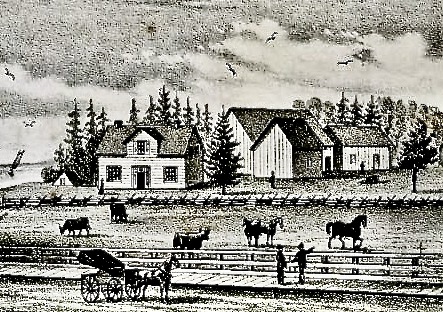
   Some men are good at farming. Other men are good at fishing. Tradesmen keep them in gear and goods. Most men are good for something, although some are good for nothing. William Murphy wasn’t a man good at doing nothing. He didn’t know fishing or farming but was experienced at raising horses. He was going to make a horse farm and make his way that way.

   He stayed on the cove where he had landed, building a house. He cut limbed sawed trees by hand and split blocks with an axe. The wood would be ready for a stove and fireplace next year. In the meantime, he bought a load of coal from a passing schooner. He found dampness nearby and looked for an underground spring. When he found it, he dug it out for drinking water, saving himself the work and expense of digging a well. Whenever he could he cleared land. It was one stump at a time, pulling them out with a team of draft horses. Sometimes it seemed like it was all he did.

   “The islander making a new farm cut down the trees as fast as possible until a few square yards of the blue sky could be seen above. Roots and branches lying on the ground were set on fire and sometimes the forest caught fire and hundreds of acres of timber were burned,” is how Walter Johnson, who came to Prince Edward Island to start Sunday schools, described it.

   Bill Murphy put enough salted cod away to feed a God-fearing family of Acadians. When the weather changed for the worse, he smoked read ate slept through the season, living in his union suit. The dead of winter arrived near the end of January and kept at it through February. The daytime high temperatures were below zero, and the overnight low temperatures were even lower. After spring arrived and the Prince Consort proved true to his word, his land grant signed sealed and delivered, he continued clearing land and building his house.

   He wasn’t a food growing man, but he had to eat. His first task was putting in a root garden of beets turnips carrots and potatoes. They would store well the next winter. He made sure there were onions. They added flavor to food and were a remedy to fight off colds. Whenever he started coughing or sneezing, he stripped and rubbed himself all over with goose grease, stuffing a handful of onions into his underwear. He always felt better afterwards. Corn peas beans could be dried and stored for soup. A bachelor might even live on the fare.

   Rhubarb was a perennial and one of the earliest to come up in the spring. After a long winter it was the first fresh produce. He planted plenty of it. The island had a short although rapid growing season. He woke up before sunrise and worked until dusk. He kept at it every day. The Sabbath meant nothing to him.

   The Prince of Wales visited Prince Edward Island that summer during his tour of British North America, arriving in a squadron consisting of the Nile, Flying Fish, and three more men-of-war. The Nile accidentally grounded trying to enter Charlottetown’s harbor. Once the tide lifted it, the unlucky boat sailed away towards Quebec. Spectators cheered Bertie’s progress to Government House on streets decorated with spruce arches. 

   “The town is a long straggling place, built almost entirely of wood, and presents few objects of interest,” he wrote home to his mother Queen Victoria.

   It was a cloudy afternoon, but when it cleared, he went horseback riding. That evening there was a dress dinner and ball at the Province Buildings. The Prince of Wales took a moment to step out onto a balcony. “Some Micmac Indians grouped themselves on the lawn, dressed in their gay attire, the headgear of the women recalling the tall caps of Normandy.”

   When the squadron ferrying the noble party embarked towards the mainland it was in a heavy rain. No one who didn’t need to be on deck wasn’t on deck. There were no spectators in the harbor waving hats and kerchiefs. Even the Indians stayed away.

   “Our visit it is to be hoped has done much good in drawing forth decided evidence of the loyalty of the colonists to the Queen.” Colonial loyalty and the Queen’s confidence in her colonists were soon to be tested. It was for another day, but Confederation was rearing its head. The Prince of Wales played cards and lost money on his way to Quebec.

   Bill Murphy didn’t bother making the long trip into town, having already gotten what he wanted from the royal family. The Prince of Wales was a playboy. There wasn’t anything he could do for him. He didn’t care whether Bill Murphy lived or died. When he was able to at last move into his house, he started on a horse barn. It would be large, large enough for stabling animals, milking cattle, and storing tools. The haymow would hold more than forty tons to feed his animals during the winter.

   At the same time, he started looking for a wife. He needed help indoors so he could work the outdoors. He needed help planting crops to feed himself and a family. He needed help clothing himself. Life without a woman on Prince Edward Island was a hard life. He found her the same time his work bee was finishing the barn.

   He met her in the cash provision store in Cavendish. Siobhan Regan was 19 years-old, a few years older than half his age. She wasn’t pretty or well off but looked sturdy and round bottomed. He was sure she could bear children without killing herself or the infant. She could read, although she seldom did, except for the Good Book. She was ruddy cheeked with big teeth and was a quiet woman, suiting him, who used the spoken word only for what it was worth.

   They were married and in their new house, home from the wedding in a buggy retrofitted with sleigh runners, the night before the last big snowfall in April. She got pregnant on Easter Sunday and stayed more-or-less pregnant for the next ten years, bearing six children, all of whom survived. Her husband refused the services of the village’s midwives, refused the services of the doctor, and delivered the children himself. He threw quacksalvers out the door with a curse and a kick. He trusted them as much as he trusted the Prince of Wales. They peddled tonics saturated with moonshine and opium. He had had some of both, enough to know they were no good for the sick or healthy, more likely to kill than not. He never drank port, punch, or whiskey, rather drinking his own homemade beer. He liked to wrap up the day with a pint.

   He knew cholera and typhus had something to do with uncleanliness, although he didn’t know what. He had seen enough of it on ships, where straw mattresses weren’t destroyed after somebody died from dysentery while laying on them. He ran a tight ship, keeping his house and grounds in working order. He didn’t let his livestock near the spring at the house, instead taking them downstream. He had seen the toll in towns where garbage was thrown into the street and left there for years. He and his wife were inoculated against smallpox, and as the children got on their feet, so were they. He brooked no objections.

   The Irishman wasn’t going to throw the dice with the lives of his children. Six of his ten brothers and sisters died before they reached adulthood in the Land of Saints and Scholars. Their overlords had something to do with it, famine had something to do with it, and their rude lives the rest of it, putting them in early graves. One of them died on the kitchen table where a barber was bleeding him. He bled to death. They buried him in cold sod.

   Siobhan Murphy took a breather from childbearing towards the end of the decade. Her husband and she went to Charlottetown twice that summer to see shows at St. Andrew’s Hall. They saw “Box and Cox” and “Fortune’s Frolic,” both directed by the eccentric Mrs. Wentworth Stevenson, an actress and music teacher trained in London who had formed the Charlottetown Amateur Dramatic Club. 

   They stayed at Mrs. Rankin’s Hotel, having breakfast and dinner there, walking about the city, stopping for tea when the occasion arose, and spent their otherwise not engaged hours making a new baby. When they were done, they went home. The children weren’t surprised months later that another one of them was on the way.   

   Every farm on Prince Edward had a stable of horses for work and transport. Most farmers used draft horses for hard labor, the nearly one-ton animals two in hand plowing fields, bringing in hay, and hauling manure. It was his good fortune to know horses inside and out, whether big and small. The carrying capacity of his land was well more than a hundred horses. He wasn’t planning on that many, but a hundred would suit him well enough if it came to that. He was going to grow most of his own food and sell horses for the rest of life’s essentials and pleasures.   

   By 1867 when Prince Edward Island rejected joining the Confederation, even though it hosted the Charlottetown Conference in 1864 where it was first proposed, he was well on his way to making his horse farm a going concern. Confederation didn’t concern him, one way of the other. Many islanders wanted to stay part of Great Britain. Others wanted to be annexed by the United States. Some thought becoming a dominion on their own was best. He kept his eyes on the prize, his family and farm.

   John D. Macdonald, the country’s first Prime Minister, who was always worried about American expansionism, tried to coax the island into the union with incentives, but it wasn’t until they were faced with a financial crisis that its leaders reconsidered John D’s various offers. It was when they put themselves into a hole that his efforts paid off.

   A coastline-to-coastline railway-building plan gone bad put Prince Edward Island into debt. It spawned a banking crisis. Parliament Hill agreed to take over the debt and prop up the financing needed to resume railway construction. There was demand for year-round steamer service between the island and mainland. Parliament Hill agreed to the demand. The province wanted money to buy back land owned by absentee landlords. Parliament Hill agreed to that, too. In the event, the wrangling went on.

   Bill Murphy was better off than many people on the island. He had a small amount of hard cash while most islanders had no cash to speak of and bartered almost everything. When the chance arose to make a killing during the horse disease of 1872, he took it. The pandemic started in a pasture near Toronto. Inside a year it spread across Canada. Mules, donkeys, and horses got too sick to work. They coughed, ran a fever, and keeled over exhausted getting out of their barns and stables. Delivering lumber from sawmills or beer to saloons killed them outright. They died like flies.

   “There are not a hundred horses in the city free from the disease,” a newspaper editor in Ottawa wrote. Another editor in Montreal wrote, “We have very few horses unaffected.” The only place the pandemic didn’t touch was Prince Edward Island.

   “When the disease was raging in the other provinces, our navigation was closed, and our island entirely cut off, in the way of export or import from the mainland, which in fact must have been the reason it did not cross to our shores,” wrote the editor of The Patriot newspaper.

   Bill Murphy drove forty horses to Summerside where they were loaded on two ships for crossing the Northumberland Straight. Once on shore they were walked to the railhead in New Brunswick and shipped by railcar to Montreal, whose money for the horses was better than all others. After he was paid, he hid the money inside his shirt with his jacket buttoned up to the collar all the way home.

   In 1873 the island’s voters were given the option of accepting Confederation or going it alone and having their taxes raised substantially. Most voters finally chose Confederation, voting their pocketbooks. Prince Edward Island officially joined Canada on July 1, 1873. The weather that day was foul and then a storm rolled in. Thunderbolts lit up the low clouds, followed a split second later by sonic booms. It was like fireworks. The fox in the fields lay low in their foxholes. It wasn’t fit for man or beast.

   It was two years later, as lightning again slashed the sky, that the prize horse on Murphy land spooked and kicked him in the head, knocking an eye out, breaking his jaw, and fracturing his skull. Everything he knew about horses, as well as the money from the sale of them the year before, which he had secreted away behind the barn, flew out the window with his soul. The gates of the Underworld and Heaven both opened wide to admit him. He tossed the Devil’s invitation away.

   Flags flew everywhere on the island that August when George Coles died in Charlottetown. He had been the first premier of Prince Edward Island and one of the Fathers of Confederation, which didn’t keep him from dueling with Edward Palmer, another Father of Confederation. He was a feisty man. He was convicted of assault over the incident. He spent a month in custody while still in the provincial government. His twelve children visited him and brought him beer every day. He had been a distiller and brewer earlier in life.

   Siobhan Murphy folded her flag and buried it with her husband in the Catholic burying ground. After the interment, her children gathered around her, she looked out on the Atlantic Ocean from the top of Church Hill Road. Her husband had crossed the briny deep at peril to himself to make his fortune, no matter what it might be. He was gone now but the land was still theirs. She would never give it up. It would always be theirs. Her children’s children would bear fruit there.

   Siobhan wasn’t going anywhere, no matter whether it was Canada or the United States or anywhere else on the island. She couldn’t raise the dead, but she could raise her children on the farm her husband made. She was determined none of them would ever forget their father. Murphy’s Cove would stay what it was and where it was.

   She started the slow walk home with her sick at heart brood back up then down the red road to the cove and their farm. The smallest of them, a girl her pigtails flapping, pulled at her mother’s dress.

   “Mommy, I have a secret to tell you.”

Excerpted from “Ebb Tide.”

Ed Staskus posts stories on 147 Stanley Street http://www.147stanleystreet.com and Cleveland Daybook http://www.clevelandohiodaybook.com. To get the site’s monthly feature in your in-box click on “Follow.”

“Ebb Tide” by Ed Staskus

“A thriller in the Maritimes, out of the past, a double cross, and a fight to the finish.” Sam Winchell, Beyond Books

Available at Amazon: https://www.amazon.com/dp/B0CV9MRG55

Summer, 1989. A small town on Prince Edward Island. Mob money on the move gone missing. Two hired guns from Montreal. A constable working the back roads stands in the way.

A Crying of Lot 49 Publication

Nowhere to Hide

By Ed Staskus

  JT Markunas was stationed in Charlottetown with the Queens RCMP detachment. He was a grade above constable, but still pulled service in a police pursuit vehicle. He didn’t mind the car he had drawn today, not at all. He could have done without the blue velour interior. It was plenty fast enough, though.

   He rented a two-bedroom farmhouse in Milton. It was small. The appliances had been updated and it sported a new roof. He planted a root garden. His parents were pleased when they saw the photograph of beets, turnips, and carrots that he mailed them. JT was from Sudbury, Ontario and Prince Edward Island was his third assignment since joining the force. His first assignment had been at Fort Resolution in the Northwest Territories. He missed Sudbury but didn’t miss Fort Resolution.

   When he was a child, the Canadian Pacific hauled ore on tracks behind their house. When the trains wailed, he wailed right back. When he was a boy, astronauts from the USA trained for their moon landings in the hinterland, where the landscape resembled the moon. After he grew up, he trained for the RCMP at a boot camp in Regina. He was surprised to see women at the camp, the first ones ever allowed on the force. They kissed the Bible and signed their names, like all the recruits, and wore the traditional red serge when on parade, but they wore skirts and high heels and carried a hand clutch, too. 

   He was sitting in his blue and white Mustang Interceptor. Even though Ford had built more than 10,000 of them since 1982, the RCMP had only gotten 32 of the cars. He had one of the two on the island. There were lights on the roof, front grille, and rear parcel shelf. He was in Cavendish, across the street from Rainbow Valley. He was watching for speeders, of whom he hadn’t seen any that morning. He was thinking of stopping somebody for whatever reason to justify the pursuit car. He was also thinking about his second cup of coffee but waiting until he started yawning. He thought it was going to happen soon. When it did, he would 10-99 the radio room and take a break from doing nothing.

   Cavendish was Anne’s Land. It was where “Anne of Green Gables” was set. He hadn’t read the book, but doubted it had anything to do with what he could see in all directions. The amusement park was named after Lucy Maud Montgomery’s 1919 book “Rainbow Valley.” It was waterslides, swan boats, a sea monster, monorail, roller coasters, animatronics, castles and suspension bridges, and a flying saucer gift shop. The paratrooper ride might have been everyone’s favorite, at least if they were children who didn’t know what fear meant.

   Earl Davison, the man behind Rainbow Valley, was looking for a roller coaster when he found it.  He was in Pennsylvania searching for a bargain at a park that had gone bust. The coaster seemed to fit the bill at first sight.

   “It’s a terrific ride, but you’ll need to have a good maintenance team to keep ’er running,” the Pennsylvania man said.

   When Earl hemmed and hawed, the man suggested his paratrooper ride instead. “It’s the best piece of equipment I have. I will sell you that paratrooper for $25,000 and we’ll load it for you.” By the end of the next day Earl had written a check and the ride was ready to go for the long drive back to Prince Edward Island. He crossed his fingers about it fitting on the ferry.

   Earl dreamed up Rainbow Valley in 1965, buying and clearing an abandoned apple orchard and filling in a swamp, turning it into ponds. “We borrowed $7,500.00,” he said. “It seemed like an awful lot of money at the time.” When they opened in 1969 admission was 50 cents. Children under 5 got in free. Ten years later, he bought his partners out and expanded the park. Most of the attractions were designed and fabricated by him and his crew.

   “We add something new every year,” Earl said. “That’s a rule.” The other rule-of-thumb was smiles plastered all over the faces of children. “Some of the memories you hear twenty years later are from people whose parents aren’t with them anymore. But they remember their visits to Rainbow Valley and that lasts a lifetime.”

   When his two-way radio came to life, instructing him to go to Murphy’s Cove to check on the report of a suspicious death, JT hesitated, thinking he should get a coffee first, but quickly decided against it. Suspicious deaths were far and few between in the province. Homicides happened on Prince Edward Island once in a blue moon. This might be his only chance to work on one. When he drove off it was fast with flashing lights but no siren. He reported that the cove was less than ten minutes away. 

   Conor Murphy saw the patrol car pull off the road onto the shoulder and tramped down the slope to it. Some people called the RCMP Scarlet Guardians. Most people in Conor’s neck of the woods called them Gravel Road Cops, after the GRC on their car doors, the French acronym for Royal Canadian Mounted Police. Conor didn’t call them anything. He had been on the force once and didn’t mess with what they might or might not be. 

  JT put his cap on and joining Conor walked up to where Bernie Doiron was waiting beside the tractor. When he saw the arm handcuffed to the briefcase, he told Conor and Bernie to not touch anything and walked back to his pursuit car. He wasn’t sure what code to call in, so he requested an ambulance, and asked for the commander on duty. He described what he had found and was ordered to sit tight.

   “Yes sir,” he said.

   It wouldn’t be long before an ambulance and many more cars showed up. They couldn’t miss his Mustang, but he turned the lights on top of it back on just in case and backtracked to the tractor.

   “Who found this?” he asked, pointing at the arm. 

   “I did,” said Bernie.

   “Is it the same as you found it?” JT asked. “Did you move or disturb anything?”

   “No, we left it alone,” Bernie said. 

   “And you are?” JT asked Conor.

   “I’m across the street in the green house,” Conor said. “These are my fields. Bernie came down and got me when he found this. A fox has been at the arm.”

   “I see that,” JT said, even though he didn’t know what had happened to the arm. He didn’t jump to conclusions. It was flayed and gruesome, whatever had happened. He wasn’t repulsed by it. He was being patient and objective. The quality that made him a good policeman was that he was patient. He waited with Conor and Bernie for reinforcements to show up. None of the three men said a word.

   JT looked at the ground around him ready for the growing season. There was no growing season where he grew up. His father worked the nickel mines in Sudbury his whole working life, never missing a day. He had been an explosives man and made it through his last year last week last day unscathed. The miner had always known there was no one to tap him on the shoulder if he made a mistake.

   His mother raised four children. She dealt with powder burns among her brood every day. They were among the few post-war Lithuanians still left in Sudbury. The rest of them had worked like dogs and scrimped and saved, leaving for greener pastures the first chance they got. His parents put their scrimping and saving into a house on the shores of Lake Ramsey and stayed to see Sudbury transition from open pits and wood fire roasting to methods less ruinous to the land they lived on.

   An ambulance from a funeral home in Kensington was the first to arrive, followed within minutes by two more RCMP cars. A pumper from the North Rustico Fire Department rolled to a stop, but there wasn’t anything for the volunteer firemen to do. They thought about helping direct traffic, but there was hardly any traffic to speak of. The summer season was still a month-and-a-half away. They waited, suspecting they were going to be the ones asked to unearth the remains. They brought shovels up from their truck and leaned on them.

   A doctor showed up, and bided his time, waiting for a commissioned officer to show up. When he did there were two of them, one an inspector and the other one a superintendent. They talked to JT briefly, and then to the fire department. The firemen measured out a ten-foot by ten-foot square with the arm in the center, pounded stakes into the ground, demarcated the space with police tape, and slowly began to dig, opening a pit 

   They had not gotten far when the arm fell over. It had been chopped off above the elbow. One of the firemen carried the arm and briefcase to a gray tarp and covered it with a sheet of thick translucent plastic.

   “Has anybody got a dog nearby?” the inspector asked.

   Most of the firemen farmed in one way or another. Most of them had dogs. One of them who lived less than two miles away on Route 6 had a Bassett Hound. When he came back with the dog, he led him to the pit. The hound sniffed around the perimeter and then jumped into it, digging with his short legs, barking, and looking up at his master. The fireman clapped his hands and the dog jumped out of the pit.

   “There’s something more there,” he said. “Probably the rest of him.”

   They started digging again carefully and methodically. When they found the rest of the man twenty minutes later and three feet under, he was a woman. She was wearing acid wash jeans and an oversized tangerine sweatshirt. She was covered in dirt and blood. One of her shoes had come off. What they could see of her face was ruined by burrowing insects. She was decomposing inside her rotting clothes.

   The doctor stepped up to the edge of the pit with the two men who had come in the ambulance.

   “Be careful, she’s going to want to fall apart as soon as you start shifting her weight,” he said. 

   The two men were joined by two of the firemen. When all four were astride the dead woman they slowly moved her into a mortuary bag, zipped it up, and using the handles on the bag lifted it up to two RCMP constables and two more of the firemen. They carried the bag slowly down the hill, the dog following them, placing it on a gurney and inside the ambulance.

   The constables went back up the hill to join the rest of the RCMP team, who were getting ready to sift through the pit looking for evidence. They would scour the ground in all directions, to the tree line and the road. JT had gotten his Minolta out of the trunk and took photographs. When he was done, he joined them. They spread out and with heads bowed started looking for anything and everything.

   The ambulance was ready to go when Conor came down to the shoulder of the park road. He stopped beside it and tapped on the driver’s side window. When it rolled down, he pointed up the slope.

   “Don’t forget the arm,” he said.

Excerpted from “Ebb Tide.”

Ed Staskus posts stories on 147 Stanley Street http://www.147stanleystreet.com and Cleveland Ohio Daybook http://www.clevelandohiodaybook.com. To get the site’s monthly feature in your in-box click on “Follow.”

“Ebb Tide” by Ed Staskus

“A thriller in the Maritimes, out of the past, a double cross, and a fight to the finish.” Sam Winchell, Beyond Books

Available at Amazon: https://www.amazon.com/dp/B0CV9MRG55

Summer, 1989. A small town on Prince Edward Island. Mob money on the move gone missing. Two hired guns from Montreal. A constable working the back roads stands in the way.

A Crying of Lot 49 Publication

The End of the Marco Polo

By Ed Staskus

   William Murphy, Jr. was 21 years old the day the Marco Polo was run aground at Cavendish. She was a three-masted three-deck clipper ship built at Marsh Creek in Saint John, New Brunswick 32 years earlier. During its construction the frame was disheveled and blown all over the shipyard by a storm and the skeleton had to be reassembled. When the shipbuilding was done the launch didn’t go well. The boat grazed the bank of the creek while sliding down the slipway, got stuck in a mudflat, and went over on her side. A week later a high tide lifted her up, but she got stuck in the mud again. Two weeks later she finally floated free and was fitted with rigging.

   The big boat carried emigrant men and women from England to Australia for many years. She set the world’s record for the fastest voyage from Liverpool to Melbourne, doing it in 76 days. More than fifty children died of measles on her maiden voyage and were buried at sea. Coming back, she carried a king’s ransom in gold dust and a 340-ounce gold nugget. It was a gift to Queen Victoria from the colonial government. Pulling into its home port, the ship unfurled a banner claiming it was the “Fastest Ship in the World.”

   The gold was delivered to the queen by a fast coach guarded by the King’s Men.

   During the gold rush the ship carried loads of standing room only men to Australia. Nobody died of measles, although some of them died of bad moonshine and fights. Fire is the test of gold. Many of the men died of typhus, what they called ship fever, burning up in their hammocks in the South Atlantic Ocean, Indian Ocean, and Tasman Sea. Many of the original settlers laying claim to aboriginal land, the oldest, flattest, and driest inhabited continent with the least fertile soil anywhere, got there on the Marco Polo. 

   When she was retired from the passenger trade, she was refitted for the coal, timber, and bat shit trade. The hull was rotting and wasting away. Chains were wrapped around it and drawn tight trying to keep it together. A windmill-driven pump was installed to send leaks back where they came from.

   It was a late July morning, clear sunny warm after the storm that had driven the ship to Cavendish. Bill Murphy was in the dunes watching the crew wade ashore. They had been on the way from Montreal to England loaded with pine planks when they got caught in a gale. They plowed ahead but started to take on water. Two days later wind and waves were still pommeling them, and they were still taking on water. The ship was flooding from stem to stern and the hands couldn’t plug the leaks well enough or fast enough. The windmill blew away and the pumps gave a last gasp. Captain Bull decided to try saving the crew and cargo. He put the clipper into full sail and wheeled it straight at Cavendish’s sandy beaches.

   The closer they got the better their chances looked until, three hundred feet from shore, he ordered the rigging cut. The masts groaned wanting to snap and the bottom of the boat scraped the bottom. Everybody stayed where they were, staying awake all night, until dawn when the storm finally wore itself out and they rowed ashore. There were 25 of them, Norwegians Swedes Germans. They were tough men. There was a Tahitian, too. It was the beginning of only his second sea voyage. He was barely half-tough but looked tougher than he was. He was speckled with tattoos and wore his hair in long braids tied up at their ends with small shiny fishhooks.

   Lucy Maud Montgomery was a pale slim 8-year-old girl, her long crimson hair in braids with choppy bangs, when she and everybody else in Cavendish watched the crew abandon the boat. She wore a white flower hairpiece on one side of her head and took notes on scraps of paper. Nine years later her short story “The Wreck of the Marco Polo” was published. Sixteen years after that her book “Anne of Green Gables” was published.

   Bill Murphy was hired by the salvage company stripping the boat. It was welcome work before harvest time. As soon as they started on the grounded vessel, another storm rolled in. Bill was on the boat and had to stay where he was. Trying for the shore was too dangerous. They battened whatever hatches were still left and spent the night being battered. Captain Macleod from French River showed up the next morning. The wind beat him back the first time he tried to reach the Marco Polo, but he made it the second time, saving all the men except one. He and his shipmates got gold watches for their courage. Bill went home wet as a wet dog.

   He didn’t go home empty-handed, though. There were twin figureheads of Marco Polo, depicting the boat’s namesake, spearheading the boat. A man from Long River hauled one of them away and hung it in his barn. Bill hauled the other one away and hung it in his barn. It was the end of the road for the far-ranging ship.

   Bill was back on the boat two days later as the salvage work went apace. He was taking a break on the poop deck leaning against a gunwale above the captain’s cabin when a young dark-skinned man joined him.

   “I am Teva the Tahitian,” he said.

   “I am Bill the Murphy,” Bill said.

   Teva was the only one of the crew who signed on to help salvage the ship. The rest stayed in Cavendish drinking and chasing farmgirls. The Tahitian and the Irishman worked together for the rest of the week and into August. Teva told Bill he was putting his purse together to get to Maine and sign on as a whaler.

   “My grandfather Queequeg was a harpooner,” he said. “He was the best in the world. You could spit on the water, and he could split your floating spit from the deck with one throw. He shaved with his harpoon and smoked from a tomahawk. He was a cannibal, but his favorite food was clam chowder.”

   “He was a cannibal?” Bill asked, taken aback. 

   “Him, not me,” Teva said. “I never met him, but my father told me about him before he went whaling. He never came back, either.”

   “They both went to sea and never came back?”

   “Both, never. A friend of my grandfather’s stopped on our island when I was a boy and told us about what happened to him. He was a white man. He and grandfather sailed and slept together.”

   “In the morning his arm was thrown over me in the most loving and affectionate manner,” Ishmael said. “You had almost thought I had been his wife. Better sleep with a sober cannibal than a drunken Christian, I always say.”

   Teva asked the white man what his grandfather had been like, what he was about.

   “There was no hair on his head, nothing but a small scalp-knot twisted up on his forehead, large, deep eyes, fiery black and bold. He looked like a man who had never cringed and never had a creditor. His bald purplish head looked for all the world like a mildewed skull. His body was checkered with tattoo squares. He seemed to have been in a war, and just escaped from it with a sticking-plaster shirt. Still more, his legs were marked, as if dark green frogs were running up the trunks of young palms.”

   Teva lapped up water from a barrel with his hands and spat on the deck.

   “Grandfather saved Ishmael’s life when their ship was head-butted by a white whale they were hunting. The coffin they had built for him when he was dying during the hunt was thrown overboard and Ishmael hung on to it like a buoy. He was the only sailor who survived when Captain Ahab the crew my grandfather and the Pequod all sank to the bottom.”

   “Since your father and grandfather both went whaling and never came back, why are you going southways to take up whaling?” Bill asked

   “It’s in my blood,” Teva said. “There will be blood.”

   Every day when the day was fair and the sun shining families picnicked on the beach at Cavendish, watching launches with two-masted ketch rigs go back and forth, taking what they could to Alexander MacNeill’s for auction.

   It was a Sunday when Sinbad the Sailor walked up to Bill Murphy, looked him up and down, and meowed. “They say our boat had no rats the whole last year,” Teva said. “This cat drove them off and those who thought they could stand up to him, they disappeared.” Teva tossed a piece of salt pork at Sinbad, who snagged it midair and gulped it down.

   Sinbad was a two-tone Norwegian Forest cat.

   “One of the Vikings brought him aboard,” Teva said.

   Sinbad was a twenty-pound bruiser with long legs and a bushy tail. His coat was a thick, glossy, water-repellent top layer with a woolly undercoat. It was thickest at the legs, chest, and head. His ears were large, tufted, wide at the base, and high set.

   “He’s a good climber, very strong,” Teva said. “He can climb rocks and cliffs.” 

   When he leaned on Bill and reached up stretching flexing his front legs, his claws extended themselves slightly. They were sharp as razors. Bill rubbed Sinbad’s head. 

   “He’s big enough to be a man-eater,” Bill said. “What’s going to happen to him when our work is finished?”

   “I don’t know,” Teva said. “The Viking left him behind.”

   That evening, when Bill was walking back to the rude shelter he had thrown up for himself behind the dunes, Sinbad the Sailor followed him. Bill put a bowl of fresh water out for the cat but left breakfast lunch dinner up to him. He was sure Sinbad was not going to starve. He was a vole shrew deer mouse snowshoe hare red-bellied snake widow maker. Even racoons, coyotes, and foxes gave him a wide berth.

   Sinbad went back and forth to the boat with Bill the rest of the month and into August while the vessel decayed and fell apart piece by piece until a wild thunderstorm barreled up from the United States. It broke up along the coast, going down to the bottom of the sea, to Davy Jones’ Locker. It was the end of the Marco Polo. 

   When Bill packed up his bedroll and shelter and walked home, Sinbad walked beside him the five miles back to Murphy’s Cove and North Rustico. Biddy and Kate were shucking oysters on the porch, a pot at their feet. The oysters were from Malpeque Bay. Hundreds of boats were in the fishery there and at St. Peter’s Bay. Until the 1830s oysters were plentiful and few people ate them. They were spread over land as fertilizer. The shells were burned, too, for the lime they produced.

   After the Intercolonial Railway got rolling in 1876 new markets for Prince Edward Island oysters opened in Quebec and Ontario. But oyster stocks started to fall and kept falling as more boats joined the harvesting. Oysters fled for their lives. They didn’t like being eaten alive. Biddy and Kate didn’t know anything about overfishing or the deep-seated fears of shellfish, and didn’t much care, either, so long as they got their fair share.

   “Oh my gosh, what a beauty!” Kate exclaimed when Bill walked up to the porch with Sinbad the Sailor beside him. 

   “He landed here on the Marco Polo,” Bill explained. “The ship broke up yesterday in the storm and he needed a new home, so here he is.”

   Sinbad walked straight past the girls to the pot and started pulling oysters out, gulping them down without a single word of hello.

   “Hey, stop that,” Biddy scolded, covering the pot. “You’ll ruin your appetite, silly goose.”

   Sinbad’s ears pricked up. He had taken goose for dinner last Christmas, and it was delicious. He shot a look in all directions. He didn’t see any birds, but had no doubt there had to be one or two somewhere nearby. He was by nature a nomad, but as there was a pot full of oysters and silly slow geese to eat, he thought, I’ll stay for the time being.

   He was a back door man, but when the front door was wide open, that was the door he went through. God probably didn’t believe in the easy way, but he was a cat. When there was an easy way of doing things, that was always the garden path he took.

Excerpted from “Ebb Tide.”

Ed Staskus posts monthly on 147 Stanley Street at http://www.147stanleystreet.com, Made in Cleveland http://www.clevelandohiodaybook.com, Down East http://www.redroadpei.com, and Lithuanian Journal http://www.lithuanianjournal.com. To get the site’s monthly feature in your in-box click on “Follow.”

Help support these stories. $25.00 a year (7 cents a day). Contact edwardstaskus@gmail.com for details

“Ebb Tide” by Ed Staskus

A Prince Edward Island Thriller

“A stem-winder in the Maritimes.” Sam Winchell, Beyond Fiction

Available at Amazon: https://www.amazon.com/dp/B0CVDP8B58

Summer, 1989. A small town on Prince Edward Island. Mob money on the move gone missing. Two hired guns from Montreal. One RCMP constable stands in the way.

A Crying of Lot 49 Publication

No Stone Unturned

By Ed Staskus

   The first day of summer wasn’t any different than the day before the first day of summer. When JT Markunas checked the weather report, it looked like it wasn’t going to be any different the next day, either. He sat outside his rented house in Milton and thought it was like the murder he was investigating. It wasn’t any different today than it had been yesterday and looked like it wasn’t going to be different anytime soon.

   The difference was nobody could do anything about the weather. The RCMP could do something about the murder in North Rustico. They knew where and how the woman with the empty briefcase was killed but didn’t know why. They still didn’t know who she was, nor did they have a solid clue about who might have done it. The more days and weeks went by the more it got pushed back in everybody’s minds. It was starting to become a cold case. Nobody had seen or heard anything in the fall and by the time anybody knew something had happened, winter was over, and it was springtime.

   It was a hell of a shame, he thought. Nobody should get away with murder. Murders are often a spur of the minute mistake, but what happened in Conor Murphy’s field wasn’t a mistake. It was deliberate. It rankled him to think whoever did it thought they could get away with it. It was usually poor slobs who didn’t get away with murder. They got locked up. The rich hired somebody to talk their way out of it. They walked away free. JT thought what happened had to involve money, and lots of it.

   An execution is justice, but assassination is murder. There was no justice in taking the law into your own hands. There was money in farming and fishing, which Prince Edward Island did a lot of. Farmers and fishermen rarely shot each other, or anybody else. At one time lenders got rough when it came to collecting debts, but that time was gone. Criminal gangs shot first and didn’t ask questions whenever they were crossed, but there were no criminal gangs like that on the island. There were some folks with criminal minds. That’s why the force existed. He thought it was likely that whoever did the shooting was a lone wolf. That meant whoever it was, was likely to keep to themselves. Whoever it was, he was going to be hard to find. JT wasn’t holding his breath. He was a patient man, though. He took the long view. He would get his man.

   It was going to be a tough nut to crack but it was a nut that would have to keep. It was his day off. He tossed his bicycle into the back of his pick-up. The bike was a Specialized Rockhopper, nothing special, but virtually indestructible. It went up and down farm roads and tracks just fine and rode smooth enough on pavement. He lived about 10 kilometers from Charlottetown and the RCMP station. Brackley Beach was about 20 kilometers away. He drove to Brackley Beach.

   JT parked at the west end of the beach. It was 15 kilometers to Dalvay. He was going to keep going another 5 kilometers farther on to Grand Tracadie, stop and stretch and his legs, and ride back. Forty kilometers in the saddle would be enough for him. When he started the wind was at his back and the living was easy, until he realized it would be in his face on the way back. He thought he would find somewhere in Grand Tracadie to have a scone and a cup of coffee, maybe two cups.

   He rode past the Harbor Lighthouse, some cottages, Ross Beach, some more cottages, Stanhope Beach, Long Pond, and stopped at Dalvay. He rode to the front steps, parked his bike, and walked down the sloping lawn to a set of red Adirondack chairs. He was sitting there looking out at the ocean when somebody walked up and asked if he would like tea and biscuits.

   “Black tea and plenty of butter,” he said.

   He need not have asked for butter. If there was anything plentiful on the island, it was homegrown butter. There were enough cows in all directions that everybody on the island could go on an all-butter diet if they wanted to and there still wouldn’t be a shortage.

   Dalvay By the Sea was a big house and seasonal rooms. Before becoming lodgings, it was only a big house. The Gilded Age American industrialist Alexander Macdonald built it just before the end of the 19th century on grounds of 120 acres. The lower half of the house and all the fireplaces were island sandstone. Windmills supplied power and water. He kept horses and carriages and a cohort of grooms to look after them. He and his wife entertained all summer when they weren’t riding and at the end of every summer hosted a lavish dance for the locals. They were like patroons from another age.

   By 1909 Alexander Macdonald was dying. At the beginning of fall, he stood on Long Pond for the last time staring at his house. He died the next year. After his children squandered the family fortune, Dalvay was sold to the man who had been tending it. William Hughes contacted the family to ask what should be done with the 26-room place. They said, “You can have it for the back taxes.” He bought it and all the furnishings for less than $500.00. Fifteen years earlier it had cost more than $50,000.00 to build. The furnishings were gotten during family travels to Italy, France, England, and Egypt. They were transported to Prince Edward Island by ocean steamer. Nobody knew what all of it had cost.

   William Hughes turned around and sold the house for a tidy profit. The last owner went broke and sold it to the government in 1938, which turned it over to Parks Canada, which under a concession had been operating it for the past fifty years as a summer hotel.

   JT finished his biscuits and tea, saddled back up, and buckled his helmet. Before he got started, he saw two young women on bicycles going his way. They were noodling it. He rode past them givng them a wave. They waved back. He thought they were both good-looking, one more than the other. He had a job, a house, and a bed, but he didn’t have a girlfriend. His job was the problem. It was a Catch-22. Most of the women he met who liked policemen, he didn’t like them. Most of the women he liked didn’t like policemen.

   There were no coffee shops in Grand Tracadie. There wasn’t much other than houses and fields. He rode as far as MacDougalls Cove and turned around. At first, riding back to Brackley, the breeze was at him from the side. Once he got back on the parkway, though, it was in his face. It wasn’t a hurricane, but it wasn’t a powder puff, either. He dropped his bike into a lower gear and plodded on. He rode the bike for fun and fitness. The ride back to his pick-up was going to be about fitness.

   He had just passed Cape Stanhope when he saw the two young women on their bicycles ahead of him. It almost looked like they were riding in place, although he could see they were peddling. He was fifty-some yards behind them when a red motorcycle went past him fast. JT hadn’t heard the motorcycle and was taken aback when it hummed zipped by him. It was going 140 KPH for sure, maybe faster on a road where the speed limit was a third of that. When the Tasmanian Devil passed the women ahead, the rider wiggle waggled his motorcycle at them and was gone. 

   The women were riding on the shoulder. The one closest to the road got shaky unnerved see-sawed lost control and fell over. She bounced on the shoulder and bounced off sideways onto the sand. Her friend stopped and ran back to her fallen friend.

   “Son of a bitch,” JT cursed under his breath. If he had been working, he could have caught the motorcycle, maybe. It had to be a Jap bike. They made the quietest motorcycles. He hadn’t gotten the plate, but he knew high-tech when he saw it. It looked new and might have been faster than his Ford Mustang pursuit car. He stopped where the fallen woman was rolling over and sitting up. Her hands and forearms were scraped and bleeding. There was sand in the blood. She had broken her fall with them. Both of her knees were scraped and bleeding, one of them worse than the other.

   He put his hand on her shoulder and pressed her back down when she tried to stand up.

   “No, don’t do that,” he said. “I’m with the RCMP. Stay where you are.” 

   He turned to the friend.

   “Don’t let her get up until I come back. It should just be a few minutes.”

   Some gulls came up from the beach to see what was happening. They made a choking ha-ha-ha sound. After they saw there was no food to be had, they flew away.

   He rode back across the bridge the way he had come, raced down Wharf Rd., and stopped at the first deep-sea fishing shack on Covehead Bay that he saw somebody at. He telephoned for an ambulance and rode back to the two women. They were where he had left them, except a man and wife had stopped to help. Their Ford Taurus with Massachusetts plates was half on the road and half on the shoulder behind the women, its flashers blinking. 

   “I run a tow truck operation back in Boston,” the man said.

   When the ambulance had come and gone, the man said, “She’s got road rash all over. What happened?”

   “Some jackass on a motorcycle went past like a scorcher and made a veer at them before cutting away, and she lost it, went down.”

   “That’s too bad,” the man said.

   JT stopped at the Queen Elizabeth Hospital the next morning. It was almost new, the biggest hospital in the province, having replaced both the Charlottetown and Prince Edward Island hospitals in 1982. He was told the woman had been treated and released.

   “Is she an islander?” he asked.

   The woman at the desk checked. “I don’t know, but she lives here in town,” she said.

   An islander was anybody who had been born on Prince Edward Island. The designation was closely watched. When a woman who was brought to the province as a baby died 90 years later her obituary in the newspaper read, “Woman from away died peacefully in her home.”

   Some said you had to be conceived on the island to make the grade. A boy living in Souris was flummoxed when he found out he might not be an islander, even though both his parents were, and he was born on the island. It turned out he was sparked into existence on an impulse in a dark corner of the ferry crossing the Northumberland Strait. “He was not conceived on the island so he’s not an islander,” his uncles and aunts pointed out, their noses out of joint. His parents took the argument to his father’s father. 

   “It all depends on whether the ferry was going away or coming back,” his grandfather said.

   The woman’s name was Kayleigh Jurgelaitis. JT got her address and went to work. After he was done wasting his time arresting a teenaged dishwasher smoking pot behind a dumpster, he clocked out at the end of the day, changed his clothes, and went looking for the address. He didn’t have far to go. She lived near Holland College. It was a two-year trade school, home to the Culinary Institute of Canada and the Atlantic Police Academy.

   He recognized the friend when she opened the door and she recognized him. When Kayleigh limped out of a hallway into the living room, she was limping up a storm.

   “How’s the leg?”

   “Better than yesterday, believe it or not. I couldn’t even walk. You’re the cop, right?”

   “Peace officer.”

   “Right.”

   “So, what happened to your leg?”

   “They said I have a slight meniscus tear in the knee,” she said sitting down and elevating her bad leg. “I’m supposed to keep it up and put ice on it every couple of hours. They think I should be back on my feet in a week or two.”

   “I’m glad to hear it. So long as I have it on my mind, did either of you get the license plate of that biker?”

   They both said no.

   “Neither did I,” JT said. “He was too far ahead, and it happened too fast. We might be able to find him, but probably not, except by accident.”

   “If I never see him again it will be soon enough,” Kayleigh said.

   “I couldn’t help noticing your name,” JT said. “Are you Lithuanian?”

   “Yes and no,” she said. “My mother was Irish, from here, and my father was Lithuanian, from there. I’m half of the one and half of the other. Why do you ask?”

   “Because my name is Justinas Markunas,” JT said.

   “I was wondering if I was the only Lithuanian on this island among all the Irish, Scots, and Frogs,” Kayleigh laughed. “Now I know there are two of us.”

   Before leaving, pausing at the door, JT asked, “Since it’s just the two of us, we should have lunch or dinner sometime and toast our native selves.”

   “I think we should, and I think I will take you up on that,” she said.

Excerpted from “Ebb Tide.”

Ed Staskus posts stories on 147 Stanley Street http://www.147stanleystreet.com and Cleveland Daybook http://www.clevelandohiodaybook.com. To get the site’s monthly feature in your in-box click on “Follow.”

“Ebb Tide” by Ed Staskus

“A thriller in the Maritimes, out of the past, a double cross, and a fight to the finish.” Sam Winchell, Beyond Books

Available at Amazon: https://www.amazon.com/dp/B0CV9MRG55

Summer, 1989. A small town on Prince Edward Island. Mob money on the move gone missing. Two hired guns from Montreal. A constable working the back roads stands in the way.

A Crying of Lot 49 Publication