
Category Archives: Ebb Tide

No Stone Unturned

By Ed Staskus

   The first day of summer wasn’t any different than the day before the first day of summer. When JT Markunas checked the weather report, it looked like it wasn’t going to be any different the next day, either. He sat outside his rented house in Milton and thought it was like the murder he was investigating. It wasn’t any different today than it had been yesterday and looked like it wasn’t going to be different anytime soon.

   The difference was nobody could do anything about the weather. The RCMP could do something about the murder in North Rustico. They knew where and how the woman with the empty briefcase was killed but didn’t know why. They still didn’t know who she was, nor did they have a solid clue about who might have done it. The more days and weeks went by the more it got pushed back in everybody’s minds. It was starting to become a cold case. Nobody had seen or heard anything in the fall and by the time anybody knew something had happened, winter was over, and it was springtime.

   It was a hell of a shame, he thought. Nobody should get away with murder. Murders are often a spur of the minute mistake, but what happened in Conor Murphy’s field wasn’t a mistake. It was deliberate. It rankled him to think whoever did it thought they could get away with it. It was usually poor slobs who didn’t get away with murder. They got locked up. The rich hired somebody to talk their way out of it. They walked away free. JT thought what happened had to involve money, and lots of it.

   An execution is justice, but assassination is murder. There was no justice in taking the law into your own hands. There was money in farming and fishing, which Prince Edward Island did a lot of. Farmers and fishermen rarely shot each other, or anybody else. At one time lenders got rough when it came to collecting debts, but that time was gone. Criminal gangs shot first and didn’t ask questions whenever they were crossed, but there were no criminal gangs like that on the island. There were some folks with criminal minds. That’s why the force existed. He thought it was likely that whoever did the shooting was a lone wolf. That meant whoever it was, was likely to keep to themselves. Whoever it was, he was going to be hard to find. JT wasn’t holding his breath. He was a patient man, though. He took the long view. He would get his man.

   It was going to be a tough nut to crack but it was a nut that would have to keep. It was his day off. He tossed his bicycle into the back of his pick-up. The bike was a Specialized Rockhopper, nothing special, but virtually indestructible. It went up and down farm roads and tracks just fine and rode smooth enough on pavement. He lived about 10 kilometers from Charlottetown and the RCMP station. Brackley Beach was about 20 kilometers away. He drove to Brackley Beach.

   JT parked at the west end of the beach. It was 15 kilometers to Dalvay. He was going to keep going another 5 kilometers farther on to Grand Tracadie, stop and stretch and his legs, and ride back. Forty kilometers in the saddle would be enough for him. When he started the wind was at his back and the living was easy, until he realized it would be in his face on the way back. He thought he would find somewhere in Grand Tracadie to have a scone and a cup of coffee, maybe two cups.

   He rode past the Harbor Lighthouse, some cottages, Ross Beach, some more cottages, Stanhope Beach, Long Pond, and stopped at Dalvay. He rode to the front steps, parked his bike, and walked down the sloping lawn to a set of red Adirondack chairs. He was sitting there looking out at the ocean when somebody walked up and asked if he would like tea and biscuits.

   “Black tea and plenty of butter,” he said.

   He need not have asked for butter. If there was anything plentiful on the island, it was homegrown butter. There were enough cows in all directions that everybody on the island could go on an all-butter diet if they wanted to and there still wouldn’t be a shortage.

   Dalvay By the Sea was a big house and seasonal rooms. Before becoming lodgings, it was only a big house. The Gilded Age American industrialist Alexander Macdonald built it just before the end of the 19th century on grounds of 120 acres. The lower half of the house and all the fireplaces were island sandstone. Windmills supplied power and water. He kept horses and carriages and a cohort of grooms to look after them. He and his wife entertained all summer when they weren’t riding and at the end of every summer hosted a lavish dance for the locals. They were like patroons from another age.

   By 1909 Alexander Macdonald was dying. At the beginning of fall, he stood on Long Pond for the last time staring at his house. He died the next year. After his children squandered the family fortune, Dalvay was sold to the man who had been tending it. William Hughes contacted the family to ask what should be done with the 26-room place. They said, “You can have it for the back taxes.” He bought it and all the furnishings for less than $500.00. Fifteen years earlier it had cost more than $50,000.00 to build. The furnishings were gotten during family travels to Italy, France, England, and Egypt. They were transported to Prince Edward Island by ocean steamer. Nobody knew what all of it had cost.

   William Hughes turned around and sold the house for a tidy profit. The last owner went broke and sold it to the government in 1938, which turned it over to Parks Canada, which under a concession had been operating it for the past fifty years as a summer hotel.

   JT finished his biscuits and tea, saddled back up, and buckled his helmet. Before he got started, he saw two young women on bicycles going his way. They were noodling it. He rode past them givng them a wave. They waved back. He thought they were both good-looking, one more than the other. He had a job, a house, and a bed, but he didn’t have a girlfriend. His job was the problem. It was a Catch-22. Most of the women he met who liked policemen, he didn’t like them. Most of the women he liked didn’t like policemen.

   There were no coffee shops in Grand Tracadie. There wasn’t much other than houses and fields. He rode as far as MacDougalls Cove and turned around. At first, riding back to Brackley, the breeze was at him from the side. Once he got back on the parkway, though, it was in his face. It wasn’t a hurricane, but it wasn’t a powder puff, either. He dropped his bike into a lower gear and plodded on. He rode the bike for fun and fitness. The ride back to his pick-up was going to be about fitness.

   He had just passed Cape Stanhope when he saw the two young women on their bicycles ahead of him. It almost looked like they were riding in place, although he could see they were peddling. He was fifty-some yards behind them when a red motorcycle went past him fast. JT hadn’t heard the motorcycle and was taken aback when it hummed zipped by him. It was going 140 KPH for sure, maybe faster on a road where the speed limit was a third of that. When the Tasmanian Devil passed the women ahead, the rider wiggle waggled his motorcycle at them and was gone. 

   The women were riding on the shoulder. The one closest to the road got shaky unnerved see-sawed lost control and fell over. She bounced on the shoulder and bounced off sideways onto the sand. Her friend stopped and ran back to her fallen friend.

   “Son of a bitch,” JT cursed under his breath. If he had been working, he could have caught the motorcycle, maybe. It had to be a Jap bike. They made the quietest motorcycles. He hadn’t gotten the plate, but he knew high-tech when he saw it. It looked new and might have been faster than his Ford Mustang pursuit car. He stopped where the fallen woman was rolling over and sitting up. Her hands and forearms were scraped and bleeding. There was sand in the blood. She had broken her fall with them. Both of her knees were scraped and bleeding, one of them worse than the other.

   He put his hand on her shoulder and pressed her back down when she tried to stand up.

   “No, don’t do that,” he said. “I’m with the RCMP. Stay where you are.” 

   He turned to the friend.

   “Don’t let her get up until I come back. It should just be a few minutes.”

   Some gulls came up from the beach to see what was happening. They made a choking ha-ha-ha sound. After they saw there was no food to be had, they flew away.

   He rode back across the bridge the way he had come, raced down Wharf Rd., and stopped at the first deep-sea fishing shack on Covehead Bay that he saw somebody at. He telephoned for an ambulance and rode back to the two women. They were where he had left them, except a man and wife had stopped to help. Their Ford Taurus with Massachusetts plates was half on the road and half on the shoulder behind the women, its flashers blinking. 

   “I run a tow truck operation back in Boston,” the man said.

   When the ambulance had come and gone, the man said, “She’s got road rash all over. What happened?”

   “Some jackass on a motorcycle went past like a scorcher and made a veer at them before cutting away, and she lost it, went down.”

   “That’s too bad,” the man said.

   JT stopped at the Queen Elizabeth Hospital the next morning. It was almost new, the biggest hospital in the province, having replaced both the Charlottetown and Prince Edward Island hospitals in 1982. He was told the woman had been treated and released.

   “Is she an islander?” he asked.

   The woman at the desk checked. “I don’t know, but she lives here in town,” she said.

   An islander was anybody who had been born on Prince Edward Island. The designation was closely watched. When a woman who was brought to the province as a baby died 90 years later her obituary in the newspaper read, “Woman from away died peacefully in her home.”

   Some said you had to be conceived on the island to make the grade. A boy living in Souris was flummoxed when he found out he might not be an islander, even though both his parents were, and he was born on the island. It turned out he was sparked into existence on an impulse in a dark corner of the ferry crossing the Northumberland Strait. “He was not conceived on the island so he’s not an islander,” his uncles and aunts pointed out, their noses out of joint. His parents took the argument to his father’s father. 

   “It all depends on whether the ferry was going away or coming back,” his grandfather said.

   The woman’s name was Kayleigh Jurgelaitis. JT got her address and went to work. After he was done wasting his time arresting a teenaged dishwasher smoking pot behind a dumpster, he clocked out at the end of the day, changed his clothes, and went looking for the address. He didn’t have far to go. She lived near Holland College. It was a two-year trade school, home to the Culinary Institute of Canada and the Atlantic Police Academy.

   He recognized the friend when she opened the door and she recognized him. When Kayleigh limped out of a hallway into the living room, she was limping up a storm.

   “How’s the leg?”

   “Better than yesterday, believe it or not. I couldn’t even walk. You’re the cop, right?”

   “Peace officer.”

   “Right.”

   “So, what happened to your leg?”

   “They said I have a slight meniscus tear in the knee,” she said sitting down and elevating her bad leg. “I’m supposed to keep it up and put ice on it every couple of hours. They think I should be back on my feet in a week or two.”

   “I’m glad to hear it. So long as I have it on my mind, did either of you get the license plate of that biker?”

   They both said no.

   “Neither did I,” JT said. “He was too far ahead, and it happened too fast. We might be able to find him, but probably not, except by accident.”

   “If I never see him again it will be soon enough,” Kayleigh said.

   “I couldn’t help noticing your name,” JT said. “Are you Lithuanian?”

   “Yes and no,” she said. “My mother was Irish, from here, and my father was Lithuanian, from there. I’m half of the one and half of the other. Why do you ask?”

   “Because my name is Justinas Markunas,” JT said.

   “I was wondering if I was the only Lithuanian on this island among all the Irish, Scots, and Frogs,” Kayleigh laughed. “Now I know there are two of us.”

   Before leaving, pausing at the door, JT asked, “Since it’s just the two of us, we should have lunch or dinner sometime and toast our native selves.”

   “I think we should, and I think I will take you up on that,” she said.

Excerpted from “Ebb Tide.”

Ed Staskus posts stories on 147 Stanley Street http://www.147stanleystreet.com and Cleveland Daybook http://www.clevelandohiodaybook.com. To get the site’s monthly feature in your in-box click on “Follow.”

“Ebb Tide” by Ed Staskus

“A thriller in the Maritimes, out of the past, a double cross, and a fight to the finish.” Sam Winchell, Beyond Books

Available at Amazon: https://www.amazon.com/dp/B0CV9MRG55

Summer, 1989. A small town on Prince Edward Island. Mob money on the move gone missing. Two hired guns from Montreal. A constable working the back roads stands in the way.

A Crying of Lot 49 Publication

Over Hill and Dale

By Ed Staskus

   When the Chevy Silverado pick-up in front of him swerved suddenly to the left, JT Markunas pushed on the brake pedal of his police car, slowing down. The pick-up stopped on the shoulder on the left side of Route 6 just as JT saw what it was that had made the driver swerve. It was a woman in a house dress crossing the road, looking steadily ahead but not for approaching traffic. She looked unsteady. He pulled off and turned on his flashers.

   The pick-up driver was leading the woman by the elbow away from the road.

   “She almost walked right into my truck,” he said.

   “Do you know who she is?” 

   “No, I don’t know,” he said. “I’m making a delivery to French River, coming up from Stratford. I thought I would go along the coast. Christ, I almost hit a dog down by Oyster Bed Bridge and now this. Next time I’m taking the highway.”

   JT put the woman in the front seat of his car and called in that he was going to try to find out where she lived and get her back to her home.

   “How are you feeling?” he asked.

   “Good, but I’m cold,” the woman said.

   He turned the car’s heating on, directing the vents at her.

   “Where do you live? Here in South Rustico?” 

   She pointed up Route 243 in the direction of St. Augustine’s. He swung his police car around turning in a tight circle and drove slowly up the road. 

   “Along here?” he asked.   

   “No,” she said. “Up that way.”

   When they got to the church he stopped and asked again.

   “I don’t know,” she said. “Somewhere that way,” pointing to their left.

   “What color is your house?”

   The woman looked at the church, ignoring his question. “Everybody went to church back when I was a girl. Especially here in a small community like this. My goodness, we all went. I just walked up the road from home to the church and the school. It was the same way we walked to the beach and went swimming. My teachers were Mother Saint Alphonse, Mother Saint Theodore, and Mother Saint Cyril, who was sort of icky. Kids came to our school from all over, from Hope River and Oyster Bed Bridge.”

   “You have a good memory,” JT said.

   “Oh, yes,” she said. “My school was run by the Sisters of Notre Dame. Most of them came from the islands.” The Magdalen Islands are an archipelago not far away in the Gulf of St. Lawrence. “There were four classrooms and eleven grades. The nuns were one hundred percent French. My French is fluid to this day.”

   South Rustico is where Route 6 and Church Road cross. There is a beach on Luke’s Creek, which is a bay on the far shoreline, near the National Park. The Rustico lands were some of the oldest communities established in La Nouvelle Acadie after the Treaty of Paris in 1763. 

   “I once went to mass at St. Augustine’s twice in twelve hours,” said the woman’s husband from the grave. Archie was the woman’s dead husband. “We were dating, I was on the island, and her mother insisted we go to church Saturday night before stepping out. So, OK, that’s it, we go. Sunday morning, they wake me up and say it’s time to go to church again. I say, what, did I die? When I did, I thought, I got to be desperate for a girlfriend.”

   “You must have really liked me,” his sweetheart said.

   Built in 1838, the oldest Catholic Church on PEI, St. Augustine’s was an old church when Ida Arsenault and Archie Thomson got married there in 1941. “Her foster mother hosted our dinner at the Charlottetown Hotel and the party afterwards was at their house,” said Archie. “The barn was behind the house, and they brewed homemade beer. Ida and I didn’t have five cents to rub together, but we were young and ready to go.”

   Ida Arsenault was born at home in 1917. She grew up in what became the Barachois Inn on the Church Road. A barachois is like a bayou, a coastal lagoon separated from the ocean by a sandbar. But the home she grew up in wasn’t where she was born, nor were her parents the parents she was born to.

   “When my twin sister and I were born, our mother died the next day,” she said. “It was too much for her.”

   Her father, Jovite Arsenault, a farmer with nine children, owned a house behind the church and the croplands between Anglo Rustico and the red sand shore. “Where the new school was built,” said Ida, “that was once part of his fields.” Suddenly a widower, he was unable to care for the newborns.

   Ida and her sister, Elsy, were placed with foster families. Her sister went to Mt. Carmel, on the southwest end of the island. Ida became a ward of the Boucher’s, a husband and wife in their 50s, who lived down the street, on the front side of the church. “It was just a few minutes away,” she said. “I saw my brothers and sisters, and my father, all the time, and my new parents made sure I saw my twin sister now and then.”

   The Boucher’s were islanders who had long worked in Boston as domestics, saved their money, and returned to Prince Edward Island, buying a house and farm. They kept cows and some horses. They were childless. “I was spoiled rotten since I was their only child,” Ida said. “They were older and well-to-do. We had a car, a black Ford. I didn’t do too much, although I might have milked a cow once-in-a-while.”

   Before mid-century most of the roads on Prince Edward Island were dirt or clay, muddy when it rained, dusty when it was dry. The first paved road, two miles of it, was University Avenue in Charlottetown in 1930. “They eventually paved the road up to the church,” said Ida. “We used to say, ‘Meet me at the pave,’ which was where the pavement ended.”

   One of her aunts lived a few miles away in Cymbria on Route 242. She washed clothes by hand in a washtub and dried them on the line. There were thirteen children in the family. They didn’t have running water or electricity. “When I went out to the well and pulled the bucket up, there was meat and butter in the bucket. That was their refrigeration.”

   “When did they get power and plumbing?” JT asked.

   “In the 1950s when they moved across the street into an old schoolhouse,” Ida said.

   “Where were you going when I found you on the road?”

   “I don’t know,” Ida said. “Maybe I was going to visit my auntie, but I’m not sure.”

   Archie was born in Thorold, Ontario a year after Ida. “My father worked on the boats all the time, Montreal to Thorold, where the locks are, and that’s where we moved,” he said. From Montreal the passage is down the St. Lawrence River and across the length of Lake Ontario to Niagara. The Welland Canal at Thorold, sitting on top of the Niagara Escarpment, is ‘Where the Ships Climb the Mountain.’ Standing on viewing platforms, anybody can watch cargo ships pass slowly by at eye-level barely an arm’s length away.

   He enlisted with the Royal Canadian Navy on his twenty-first birthday. It was 1939. During World War Two Canada commanded the fifth largest navy in the world. Archie met Ida when she was in nursing school in Halifax, where he was stationed with the fleet. “I was working a little job at the Charlottetown Hospital,” said Ida. “A friend of mine told me about the nursing course in Halifax. Right away I got the bug.” She and her friend enrolled, and her friend’s father drove them to Nova Scotia.

   After graduating, as part of her scholarship agreement, she worked at the Christie Street Veterans Hospital in Toronto. It was a Collegiate Gothic building originally built as the National Cash Register Company factory in 1913. “They gave us $45.00 a month to live on.” She and Archie dated long-distance by mail and phone. They got together when they could. When they did, they jumped into each other’s arms.

   “Whenever I got leave, I would pick her up in Toronto and take her to visit my parents in Thorold. That’s how I introduced her to my family.” At the same time, Ida was introducing Archie to Prince Edward Island. It was a long drive alone.

   “I took the S. S. Charlottetown across the strait when we were dating,” said Archie. “You had to sleep in your car if you missed the last one. We would be lined up single file down the road. There would be a hundred cars full of frozen men inching along in the morning trying to get on the first ferry.”

   In the gray of winter, crossing the Northumberland Strait from Cape Tormentine, New Brunswick, to Port Borden, Archie stood bundled up against the cold wind hands stuck in mittens leaning over the bow watching as the heavy boat broke through thick ice.

   “It would crunch blocks of ice and turn them over like ice cubes as it went across,” he said.

   One afternoon, making his way from Halifax to South Rustico, coming off the ferry in December and driving up Route 13 from Crapaud, he was stopped by a snowdrift in the road. “The road went down a valley and there was five feet of snow piled up,” Archie said. He reversed his 1935 Chrysler Airflow back to where the rear tires could get a grip on a stretch of clear road. “I hit the gas as hard as I could, went as fast as I could, hit the snow, everything disappeared, and I came out the other side. By the time I did the car was barely moving. I shut it off and caught my breath.”

   Archie gave Ida a ring. She gave him a stack of books for his next sea voyage. They hardly saw each other after that as her man sailed back and forth across the Atlantic Ocean. In June the S. S. Charlottetown sank on her way to a dry dock in Saint John for an overhaul. The boat was four miles off the coast of Nova Scotia. The crew rowed to safety in their lifeboats. Two tugs tried to get to the vessel but turned around in the heavy fog. When she was finally refloated the flow of water into her couldn’t be stemmed.

   “We were in Lisbon when I got a message from Ida that she and my mother had decided on December 8th for our marriage,” Archie said. The executive order said to be ready. “I went to the radio communications on board and sent a telegraph confirming my agreement.” They were married the day after Pearl Harbor was bombed by the Japanese.

   “Stay in the car, Ida,” JT said. “I’m going to the church for a minute.” He was hoping to find somebody who would know where she lived. But there was nobody to ask. All the doors were locked, and he didn’t see any parked cars anywhere. He went back to his police car.

   “That’s where I live,” Ida said pointing through the windshield at the Barachois Inn up the street from the church.

   “That’s a hotel,” JT said.

   “That’s where I live,” Ida repeated.

   When JT knocked on the door with Ida standing behind him, a woman wearing an apron answered.

   “Can I help you? she asked until she spotted Ida. “Where did you find her?”

   “Trying to cross Route 6,” he said.

   “Oh, dear.”

   “She said she lives here.”

   “She did when she was a child.”

   “Do you know where lives now.”

   “Yes,” the woman said, and gave him directions, describing the house. “She has a neighbor by the name of Bernie Doiron. He tries to keep an eye on her, but he’s a farmhand and works most days.”

   “Thanks for your help. If you don’t mind my asking, how old is this house?”

   “It was more than a hundred years old when we bought it,” the woman said. “It was built by a merchant back then, a man by the name of Joseph Gallant, so we call it the Gallant House. My husband and I had planned on living here, restoring it, which we still do, but we converted it into a bed and breakfast two years later.”

   Back in the car Ida said she was hungry.

   “We ate fish, mussels, potatoes, carrots, and turnips when I was a girl. That was about it. Whenever we went to Charlottetown we ate at a Chinese restaurant, but that was as much as I ever knew. Before I got married, I never had Italian food. After I got married, my cousin and a friend of hers said, we’re coming over to make dinner. We’re going to make spaghetti. I thought, yippee, what’s that?”

   JT found her house easily enough, helped get Ida inside, and boiled water for tea. He waited until she was resting easy in her easy chair before leaving. He shot her a two-finger salute off the brim of his cap.

   “Thank you, Mr. Policeman,” she said. “Can you come back soon and take me for another walk?”

Excerpted from “Ebb Tide.”

Ed Staskus posts stories on 147 Stanley Street http://www.147stanleystreet.com and Cleveland Daybook http://www.clevelandohiodaybook.com. To get the site’s monthly feature in your in-box click on “Follow.”

“Ebb Tide” by Ed Staskus

“A thriller in the Maritimes, out of the past, a double cross, and a fight to the finish.” Sam Winchell, Beyond Books

Available at Amazon: https://www.amazon.com/dp/B0CV9MRG55

Summer, 1989. A small town on Prince Edward Island. Mob money on the move gone missing. Two hired guns from Montreal. A constable working the back roads stands in the way.

A Crying of Lot 49 Publication
Swept Away

By Ed Staskus

   Jimmy LaPlante’s neighbors either didn’t know a thing about him or thought he was a miserly recluse with a nice dog. The dog was a Labrador Retriever, young and friendly, willing to chase any stick thrown by anybody into the bay. He didn’t especially like dogs, but he had gotten the animal last fall to keep him company and be an early warning alarm. He wasn’t worried about his neighbors, although he was worried about Montreal. Jimmy was from Montreal but had lived on St Peter’s Bay the past eleven years. He kept himself to himself and his only friend on Prince Edward Island was the Lab.

   Nobody except his dog and his neighbors and his niece knew where he lived. Now it was only the Lab and the neighbors. He had made sure Montreal didn’t know where he was. He was sure they still didn’t know. He was careful talking to them on the pay phone outside the fish and chip shop, never talking long. He knew they knew how to trace calls.

   His niece hadn’t been his friend, but he didn’t like it when he read in the newspaper that she was dead. Now at least he knew something. She had been found buried in a potato field up around Rustico. What the hell was she doing there? The cops weren’t saying much so the newshounds weren’t saying much.

   What the hell had happened? She had delivered the hundred grand of good cash from Montreal and long since was supposed to have delivered the two million dollars of bad cash to them, although he had known all winter she hadn’t. He wasn’t returning his hundred grand, though. He told Montreal that and told them to find the girl. When they found her, they would find their money, he said. They didn’t like it and told him so. He told them to drop dead and hung up. He knew it was the wrong thing to say, but what could he say? 

   He knew somebody would be showing up soon nosing around. The newspaper said she had been found with a briefcase but no identification. It didn’t say anything about what was in the briefcase. He knew without thinking about it that it had been empty just like he knew from now on he was going to have to be careful. That’s the way the Quebecois boys were. He didn’t think they would find him but started sleeping with his dog at the foot of the bed and a Colt .38 Super under his pillow.

   Jimmy was 16 years old when he made his first counterfeit bill. By his late teens he was making fake $100.00 Canadian notes that his friends spent everywhere without a single one of them bouncing. By his mid-20s he was flooding the market with so many of the fake c-notes that many businesses stopped accepting them. The Bank of Canada was forced to change their design to improve security.

   He got skilled at reproducing security holograms on banknotes and earned the nickname of “Hologram Tom.” His middle name was Tom. When he took a break from forgery, he took up impersonation. He masqueraded as a pilot for Air Canada so he could fly on courtesy passes. Over the next five years he pretended to be a doctor and a lawyer, among other things. One man died and another man was disbarred, but he left his mistakes behind him when he moved on to bank checks. In the end he went back to hard cash. It was what he knew best.

   What had happened to his niece? It had to be that goddamned biker, who he distrusted and disliked the minute he saw him and whose name he never got. He thought he had to be an islander, although he wasn’t sure. He didn’t know where he lived, but he guessed it had to be Summerside or Charlottetown. He didn’t even know what kind of motorcycle he rode, although he knew it was red.

   If push came to shove, he would tell the men from Montreal what he knew but would make sure he told them from the back end of his handgun. He wouldn’t let them get their hands on him. If they did, he stood no chance. He knew that as well as he knew anything. He wasn’t planning on moving. There was no point to it. It would just make them testy and not believe anything he might tell them. He would sit tight until if how when they showed up. He had moved to Prince Edward Island to get away from the life of crime, although crime was how he made his living. He knew the everyday risks, which was why he left Quebec for Atlantic Canada. The past eleven years had been quiet, the occasional phony bag of money keeping him in plenty of spending money.

   It had blown up in his face, but he put a brave face on and took his dog for a walk. He wore a pair of knee-high rubber boots. His house was just past Bay Shore Rd. where it turned toward Greenwich Rd. The dog and he walked on the narrow strip of beach on the bay past some cottages until there weren’t any more cottages.

   St. Peter’s went back to 1720 when the village of Saint Pierre was established. It was one of the most important settlements on the island because it had a good harbor and good fishing grounds full of clams oysters quahogs lobsters trout and salmon. Many of the French considered it to be the commercial capital of Isle St. Jean. When the Fort of Louisbourg on Cape Breton surrendered to the British it was the end of Isle St. Jean. The French were deported in 1758 and the English poured in. The land became Prince Edward Island. St. Pierre became St. Peter’s.

   The British weren’t interested in fish. They were interested in boats. They turned St. Peter’s into a booming shipbuilding community, building 27 big boats between 1841 and 1850. There were three shipyards, all controlled by Martin MacInnis and William Coffin. Whatever others there were, were at the mouth of the Midgell River. They couldn’t build their ships fast enough because the north shore was a graveyard for big ships.

   Passenger steamers between the mainland and Prince Edward Island sank all the time. In 1859 the Fairie Queene from Nova Scotia didn’t make it. Everybody said the bells of Saint James Church in Charlottetown tolled eight times on their own the morning of the disaster, foretelling the deaths of the eight passengers on board the steamer.

   “Keen blows the bitter spirit of the north,” is what everybody said.

   Jimmy lit a Players and blew smoke out through his nose.

   The Turret Bell was driven ashore by a big storm in 1906 at Cable Head. It stayed beached for more than three years and became a tourist attraction. Picnickers sat in the dunes staring at the rotting hulk, eating apples drinking cold tea and chatting. Their dogs ran up and down the beach barking up a storm.

   The first sawmill was Leslie’s Mill near Schooner Pond. There were lobster factories on the northside. A starch factory opened in 1880 and stayed open until 1945. A racetrack opened in 1929. It was still there. Jimmy wasn’t a betting man and never went there. He liked horses but disliked trotters. If God had meant horses to pull two-wheel carts for sport, he would have created two-wheel carts. If Jimmy had gone to the track, he wouldn’t have bet real money, anyway. 

   Jimmy and the Lab went as far as Sunrise Ave. and took a break. Sitting on the sand leaning back against a mound he watched his dog run into the water after a stick. Whenever a stick went flying into the ocean the dog became a creature of habit. He watched a man and a woman both in summer shorts coming his way. The man had a camera slung around his neck. It bounced on his chest with every step he took. He looked fair and sunburned. The woman was slightly taller than the man. She didn’t look fair. She carried a kind of messenger bag over her shoulder. 

   Tourists, Jimmy thought.

   They stopped a few yards away and watched the wet dog lunge out of the water and run up to Jimmy. He shook himself dry, the water spraying all three of them. The woman reached into her bag. She pulled a Colt .38 Super out of the bag and shot the dog twice. He cried yelped groaned staggered backwards and fell over, shaking uncontrollably until he stopped.

   The dog’s last thought before giving up the ghost was, “What did I ever do to you?”

   Jimmy jumped trying to get up.

   “Stay where you are. Don’t be the dog.”

   “Jesus Christ, why did you do that?”

   “Dogs are a man’s best friend,” the woman said. “I’m not a man. He wasn’t my best friend.”

   She threw the gun down at his feet. “That’s yours.”

   In that instant Jimmy instantly understood they were from Montreal. He understood they had found him. He understood his life was in mortal danger. He didn’t reach for the Colt. 38. There was no point in trying. If he tried, he would be as dead as the dog in no time flat.

   “What you need to do, Jimmy, is print another batch of bills for us,” the man said, taking a picture of the counterfeiter. “If you don’t, what happened to your dog will happen to you. The sooner you print them, the better. We are going to find whoever stole our first batch and take care of that business. When we do, we will be back to get what is ours before we leave this shitty island. Do you understand?”

   “I understand,” Jimmy said.

   “If anybody asks about the dog, just say he dropped dead,” the woman said. “And put that gun away somewhere safe, so nobody gets hurt.” They walked away, going up the bay the way they had been going. When they were specks in the distance Jimmy stood up and looked down at the dead dog.

   “Goddamn it,” he muttered, and turned around to go back the way he had come. When he was gone gulls and crows started nosing around the still warm lifeless Lab. A fox crept out of his burrow to investigate. Maggots and flies put the word out and were soon gathering. Jimmy came back and waved them away. He kicked pushed the dead dog into the bay. By that night the carcass floated past Morell, Greenwich, and the lighthouse. When the moon came out, he was far out to sea.

   The next day Jimmy drove to a farm outside Saint Catherine’s and got a new dog. It was a Pit Bull almost full grown and trained to bite on command. It took a week, but he taught the dog to hate guns. When he was done, the Pit Bull knew full well to bite off any hand not Jimmy’s that had a handgun in it.

Excerpted from “Ebb Tide.”

Ed Staskus posts stories on 147 Stanley Street http://www.147stanleystreet.com and Cleveland Ohio Daybook http://www.clevelandohiodaybook.com. To get the site’s monthly feature in your in-box click on “Follow.”

“Ebb Tide” by Ed Staskus

“A thriller in the Maritimes, out of the past, a double cross, and a fight to the finish.” Sam Winchell, Beyond Books

Available at Amazon: https://www.amazon.com/dp/B0CV9MRG55

Summer, 1989. A small town on Prince Edward Island. Mob money on the move gone missing. Two hired guns from Montreal. A constable working the back roads stands in the way.

A Crying of Lot 49 Publication

Chubby’s Corral

By Ed Staskus

   Clyde Ferguson stumbled into the Queen Elizabeth Hospital mortuary room like he was seeing it for the first time, even though he had been the provincial pathologist for 11 years. He waited for the sharp stab in his left hip to go away. He felt unsteady. He steadied himself with one hand on the doorjamb. He was all right after a moment, as far as it went. His left heel wouldn’t flatten down to the floor. That leg had gotten shorter the past five years. He put his arms at his sides and breathed evenly.

   The hospital was practically new. It was still in its infancy. He was getting older by the minute, which bothered him. “Getting old is no problem,” is what Groucho Marx said. “You just have to live long enough.” But sometimes he didn’t feel like he was just getting old. He felt like he was getting old and getting crippled to boot.

   His hip hurt like hell and worse. He knew exactly what the matter was. It had finally gotten to be bone on bone. The day had always been coming. Walking and yoga and strong drink had forestalled the inevitable. But he had walked too much the past several days. When the weather had gotten better, he drove to Brackley Beach, and walked two miles back and forth three days in a row. That was a mistake. It wasn’t the same as his treadmill, which had arm rails he could support himself on. He had three months left before his retirement became official. When it was signed and sealed, he was getting an after-market hip the next day, going back to Tracadie, and staying there. He would break it in and in the evening cut up fillets rather than dead folks.

   He blinked in the fluorescent light, wondering why there were two tables set up for him. When he remembered the arm, he remembered he was going to have to do two post-mortems, one on the arm and one on the young woman who the arm belonged to.

   Her death was being treated as the result of criminal activity. If it was some place bigger than Charlottetown the post-mortem would have been performed by a forensic pathologist. They investigate deaths where there are legal implications, like a suspected murder. But it wasn’t some other place. It was Charlottetown, the smallest capital city of the smallest province in Canada. It would have to do, and he would have to do it.

   When he was suited up, Clyde stood over the dead woman and blinked his fly-belly blue eyes. She was on her back on a stainless-steel cadaver table. It was essentially a a body-sized slanted tray with raised edges to keep fluids from flowing onto the floor. There was running water to wash away the blood that is released during the procedure. The blood went down a drain.

   She hadn’t been shot or stabbed. Her face was a mess, though. It took him a minute to see what it was that had killed her. Her skull was fractured. Parts of the broken skull had pressed into the brain. It swelled and cut off access to blood by squeezing shut the arteries and blood vessels that supply it. As the brain swelled it grew larger than the skull that held it and begin to press outside of it into the nasal cavity, out of the ears, and through the fracture. After a minute it began to die. After five minutes, if she hadn’t called it a day, she would have suffered irreversible brain damage. One way or the other it was the end of her.

   He got down to the rest of his work, making a long incision down the front of the body to remove the internal organs and examine them. A single incision across the back of the head allowed the top of her skull to be removed so the brain could be examined. He saw what he expected to see. He examined everything carefully with the naked eye. If dissection had been necessary to look for any abnormalities, such as blood clots or tumors, he would have done it, but what was the point?

   After the examination he returned the organs and brain to the body. He sewed her back up. When he turned his attention to the arm, he saw clearly enough it had been chopped off with one clean blow. The axe, or whatever it was, must have been new or even newer. In any case, it was as sharp as could be. Her hand was clenched in a fist. He had to break her fingers to loosen it. When he did, he found a loonie in her palm. It was Canada’s one-dollar coin introduced two years earlier to replace paper dollar bills, which had become too expensive to print. Everybody called them loonies after the loon on the reverse side.

   Clyde looked at the spanking new coin smeared with old blood and older dirt. He put it in a plastic bag and labelled it. He recorded everything on a body diagram and verbally on a cassette tape. He put the loonie, diagram, and tape in a pouch and labelled it. When he was done, he washed up and decided to go eat. After that he would call it a day. The work had warmed him up and he wasn’t limping as much as he had earlier. He tested his hip, lifting his leg at the knee and rotating it. It felt reasonably ready to go. He would go to Chubby’s Roadhouse for lunch. They had the best burgers on the island.

   The phone rang. It was Pete Lambert, the Commanding Officer of the RCMP Queens detachment.

   “What have you found out, Clyde.”

   “I’m on my way out for a bite to eat. Meet me at Chubby’s. So long as the force pays, I’ll tell you everything I know.”

   “I’ll meet you there in twenty minutes.” Chubby’s was 15 minutes from the Queen Elizabeth Hospital and 20 minutes from the RCMP station. While he was driving Clyde thanked God it was 1989 and metallic hip replacements were as good as they had ever been. The first hip replacements dated back a hundred years to when ivory implants were used to replace the femoral head. Elephant tusks were cheap at the time and were thought to possess good biomechanical properties. That proved to not be the case. Men and women died right and left from infections and dislocations.

   Fifty years later an American surgeon performed the first metallic hip replacement. He designed a prosthesis with a large head made of something he called Vitallium. The implant was 12 inches in length and attached with bolts to the end of the femoral shaft. It worked like a charm. That same prosthesis is what he would be getting, except it was better and the implant would be inserted within the canal of the femur, where bone growth would lead to more permanent attachment. So long as he could wake up and walk upright first thing in the morning, instead of staggering and grabbing for support, he would be a happy man.

   Chubby’s Roadhouse and Bud’s Diner were next to each other in a pink and blue building on St. Peters Road in Dunstaffnage. They did brisk business. It was a popular pit stop for bikers on poker runs. It was why Pete Lambert had lunch or dinner there once a week, getting to know the riders. He kept his enemies close.

   “We serve burgers and fries and shakes, and fish and chips and clams and all that stuff,” Clarence Foster said. “But I think as far as the burger goes, the best, the one that everybody seems to like is called the Bud Burger.” Clarence was both the Chubby and the Bud.

   Dances were held in the back of the building with local bands. Haywire was a summer favorite. Teenagers with ice cream cones gathered around the pinball machines at the front. Drinkers stayed at the bar, drinking. The bikers ate their Bud Burgers outside during the day and drank inside during the night.

   “We have wedding receptions and things like that,” Clarence said. He told the bikers about them in advance, so that nobody ended up stepping on anybody else’s toes.

   The Spoke Wheel Car Museum was next door. Clarence and his father, Ray, shared an appreciation for old cars. They both liked to smoke but loved cars more. They gave up cigarettes to save money. Instead of going up in smoke their savings went toward buying heaps nobody else wanted and restoring them. They offered to buy Bernie Doiron’s VW Beetle, but he said, “It ain’t no antique.” By 1969, they had 13 cars, including a 1930 Ford Model A Coach that Clarence drove. It was how the roadhouse and diner came into being. 

   “People were coming to the museum and looking for a place to eat,” he said. “Since my dad was a cook in the army, we decided to build a little canteen and it just kept on growing.” 

   Clyde and Pete ate inside at a back table. It wasn’t the warmest day, although it was sunny. They had Bud Burgers and cold pints. There were only a handful pf people having a late lunch.

   “How’s the hip?” Pete asked.

   “Hellzapoppin’,” Clyde said.

   “Is that the official word?”

   “It’s how I feel. I’ve got two months and 29 days from now circled on my calendar.”

   They ate and small talked. “Find anything out?” Pete asked, finishing his burger and hand-cut fries. The food was good because the beef and potatoes came from the island. It would be a trifecta once islanders started up their own breweries.

   “It will be in my report tomorrow, but since you’re interested, I’ll summarize it. She died of a fractured skull. There was tissue not hers on her face and in her hair. I want to say she was hit by a fist that got scuffed up doing it. She had alfalfa on and in her clothes. More than a brush of silage, enough to make me think she was on a dairy farm long enough to roll around in it. She wasn’t killed on that field, although her arm was probably cut off there. The last cut there was in late August, so she was put in the ground sometime between then and no later than the end of October.”

   Thousands of acres of potatoes on the island the last fall were left in the ground. Heavy rain and cold temperatures put a damper on the harvest. There was too much rain and cold, freezing and thawing day after day, and it led to a deep frost.

   “Her arm was probably cut off by an axe, sharp as hell, clean as a whistle. Whoever did it, like the fist, is a strong man or woman. Why it was cut off, since she was already dead when it happened, is for you to find out. She had a loonie clenched in her missing hand. It was a 1988 issue. No prints other than hers on it.”

   “Are her prints in the report?”

   “Yes, what we could get, which wasn’t much of anything, but they will do.”

   It was shop talk. Pete knew everything and a batch of photographs would be part of the report.     

   “She wasn’t molested or abused. I don’t think she had eaten for several days. There wasn’t anything remarkable about her teeth, none missing, one filling. She was in her early twenties, five foot five, 118 pounds, green eyes, light brown hair, no moles, birthmarks, or tattoos. She was healthy as a horse.”

   “Anything else?”

   “One more thing. I think she might have poked somebody in the eye. There was retinal fluid and blood under the fingernails of the first two fingers on the cut-off arm. Her nails were 7 mm long and almond shaped, perfect for poking. It wasn’t her blood, either.”

   Blunt trauma to the eye can cause the retina to tear. It can lead to retinal detachment. It can require urgent surgery. The alternative is blindness.

   “If that happened, where would the eye have been treated?” Pete asked.

   “At a hospital or a large eye clinic.”

   “What happens if it’s not treated?”

   “Kiss goodbye to that eye.”

   “I see,” the police officer said, paying the bill when the waitress stopped at their table. What thin crowd there had been had cleared out. It was the middle of the afternoon. When the two men went out to their cars, they were the only two cars in the front lot. Pete was driving an unmarked police car, although it was clearly an official car. Clyde was driving a Buick Electra station wagon. He could lay a corpse out in the back if he had to. They shook hands and went their separate ways.

   Five hours later a biker riding a red motorcycle approached the roadhouse, swerving to avoid a fox. There was always more roadkill in the spring and fall. Skunks and raccoons were the most common, although foxes weren’t always as quick and slippery as their reputation. He pulled up, parked, and went inside. He left the key in the ignition. His Kawasaki Ninja had an inline four cylinder, 16 valve, liquid cooled engine with a top speed above 240 KPH. He had already made that speed and more. He knew nobody was going to mess with his bike because everybody at Chubby’s knew whose motorcycle it was. At the bar he ordered a Bud Burger and a cold pint.

   “How’s the eye?” the bartender asked. “It looks good. At least, no more pirate’s patch.”

   “Yeah, but I waited too long to get it fixed,” the biker said. “The doc says I’ll probably be more blind than not in that eye from here on. It doesn’t matter, I can still see enough out of the other one to take care of my business.”

   He ate fast and downed his beer. When he left, he paid cash with a new one-hundred-dollar bill.

   “Where do you keep finding these?” the bartender asked.

   “Pennies from heaven, my man, pennies from the main man” the biker said, leaving him a tip of a half dozen shiny loonies.

   Getting on his glam motorcycle in the dusk he thought, I’ve got to be more careful about that.

Excerpted from “Ebb Tide.”

Ed Staskus posts stories on 147 Stanley Street http://www.147stanleystreet.com and Cleveland Ohio Daybook http://www.clevelandohiodaybook.com. To get the site’s monthly feature in your in-box click on “Follow.”

“Ebb Tide” by Ed Staskus

“A thriller in the Maritimes, out of the past, a double cross, and a fight to the finish.” Sam Winchell, Beyond Books

Available at Amazon: https://www.amazon.com/dp/B0CV9MRG55

Summer, 1989. A small town on Prince Edward Island. Mob money on the move gone missing. Two hired guns from Montreal. A constable working the back roads stands in the way.

A Crying of Lot 49 Publication

Treasure Island

By Ed Staskus

   “Mommy you know how those men dug a hole and buried daddy in it because he wasn’t alive anymore?”

   “Yes, Maggie.”

    “I saw daddy dig a hole behind the barn and bury something in it.”

   “When did you see that?”

   “I saw it when he came back.”

   “Came back from where?”

   “When he left with all the horses that time and then came back.”

   Siobhan dried her hands on her apron. “Show me where that is,” she said. The widow and her daughter walked out of the kitchen, across the yard, and behind the barn. It was early in the morning, the bottom half of the sun still in the ocean.

   “Look mommy, there’s a fox digging near where daddy buried his treasure.”

   A black-coated red fox was digging, stopping, listening, and digging again. He had long, thin legs, a lean lithe frame, pointed nose and bushy tail. They eat everything, rats, mice, voles, lizards, rabbits and hares, birds, fruits, and bugs. The foxes on their shoreline ate fish and crabs.

   “What is he doing?”

   “When he stops to listen, he’s listening for a rat or a mouse digging underground,” Siobhan said.

   The fox cocked his head. “I know you’re down there,” he said to himself. “You can’t get away.” He dug deeper, not trying to be quiet. He knew he could dig faster than whatever rodent was soon going to be breakfast.

   He was the size of a medium-sized dog. It was a tod, a man fox. The vixen was probably in the nesting chamber with their pups. They lived in the dunes, in burrows they dug for the family. There were three four five ways of getting into and out of the den in case predators snuck in trying to eat the pups. The fox husband and wife stored groceries there, pushing it under piles of leaves, spending most of the day in the safe and sound, searching for food at night.

   The fox looked up at Maggie and Siobhan. She knew they could see as well as cats, their vertically slit pupils glinting. If he yipped and turned to go, he would be gone in a flash. They were by far the fastest animals on the island. Many people thought they were cunning. Some people thought they had magical powers. Whatever spells they could cast never helped when a coyote was tracking them.

   When the fox got his Norway rat, he trotted off with it. Siobhan went into the barn and brought back a shovel. Maggie pointed at the spot to dig. Ten minutes later her mother had a dirty leather tobacco pouch in her hands. She knocked the loose dirt off it and walked to the house, Maggie trailing behind. They sat on the porch facing Murphy’s Cove. When she opened the pouch and reached inside, her hand brought out money in bundles held together by elastic bands. She had never seen elastic bands before and never seen that much money, either. When she finished counting it there was $10,500.00 in her lap.

   It was all in fifty-dollar Dominion of Canada bills. Mercury was on the front holding a map of British North America, along with a harbor, ships, and a train in the background. “50 Dollars Payable at Montreal” was printed on the back. Montreal was where her husband had sold his horses.

   “Look mommy,” Maggie said. “Somebody is coming.”

   A two-man horse and buggy were coming down the road, except there were three people in the buggy, a man and a woman and a one-year-old girl.

   “It’s Clara and Hugh come down from Clifton with their new-born,” Siobhan said as the buggy got closer. Her children were on the porch watching. She stuffed the cash money back into the leather pouch and handed it to Billy, her oldest son. “Go to my bedroom and wait for me there. Keep this on your lap until I come for it.”

   “Good day,” Siobhan said as the buggy came to a stop. Clara handed the child to her. Hugh walked around and helped his wife down to the ground. Lucy Maud Montgomery looked up at Siobhan and smiled. Siobhan smiled back. The baby girl cut cheese, and Siobhan gave her back to her mother.

   “Lucy is a lovely name, but she looks like an Annie to me,” Siobhan said.

   “That’s odd, because you’re the second person who has said the same thing,” Clara said.

   “We wanted to stop and pay our condolences,” Hugh said.

   “Thank you,” Siobhan said.

   “William was a good man.”

   “Yes, he was.”

   Hugh fed and watered the horse. The grown-ups sat and talked on the porch. The children played with the child. When the sun started to set Hugh and Clara started to set off for North Rustico where they planned to spend the night with relatives.

   “Come and have dinner with us,” Clara said.

   “I would love that,” Siobhan said and that is what she did, but not before walking upstairs with Sean, her second-oldest son. “I won’t be back tonight,” she said to him and Billy. “Put the children to bed once it gets dark. Don’t light anything and keep this bag in bed with you tight between the two of you until we decide what to do with it tomorrow.” She kissed her sons, and the others downstairs, and once outside walked alongside the buggy towards town. She carried the baby, cooing at the girl as they walked past the graveyard.

   The next morning, she made breakfast for her children and when they were done, she and the girls cleaned up while the boys tended to their chores. Michael was too small to do much, but Billy and Sean were strong boys who knew their way around animals and farmland. Next summer she might add on to the house, adding two bedrooms so when the boys and girls grew up, they could have separate bedrooms. She would improve the fields and fences. She would hire a farmhand, but not increase the size of her herd overmuch. Her husband had wanted to keep a hundred horses, but she didn’t think the land would keep that many healthy. She would devote three hundred acres to the horses and thought fifty-or-so of them would be best. 

   She didn’t believe in continuous grazing. Horses had a bad habit of grazing their favorite grass close to the ground, then returning to eat the regrowth as soon as it came back. As the year went on there wasn’t enough of it left to capture sunlight and regrow. It had to use stored energy to regrow, and if horses kept eating in the same place, the energy stores ran out and the grass died.

   Horses liked orchard grass, smooth brome, and timothy the best. They could eat it all day long down to the bare ground, which was when weeds started to grow in their place. Siobhan had heard of rotational grazing and that was what she was going to do. She would move the horses to one pasture and let the other pastures rest to recover. Each of the pastures would be left empty for at least several weeks at a time. That was how long it took for forage regrowth to begin after grazing.

   She had four paddocks connected to a sacrifice lot. The lot had a shelter, a feeder, and a water source so that the paddocks didn’t need to have their own. The horses could get to the sacrifice lot anytime they wanted. They liked it that way. Siobhan was determined to keep draft horses. Prince Edward Island was a farming island and farmers needed draft horses more than anything else

   When Friday came and before it went, she told the children they would be going to Charlottetown the next day, and staying overnight, so they could buy clothes shoes boots tools small barrels utensils dishes a new table and chairs and as many household necessities as they could carry back before the long winter set in.

   Her team could trot at 15 KPH and get them to Charlottetown in two hours or die trying. The road wasn’t especially rough or hilly, but it wasn’t smooth and flat, either. If the team walked, they could get to the city and live to tell the tale, although it might take them five hours-or-more. She would take the four youngest children with her and leave the two oldest behind. She made Billy and Sean stand on brown paper and traced their bare feet. She rolled the paper up and tied it with a string. She measured their arms and legs and height.

   The five of them going all together would weigh less than 400 pounds. They would be heavier coming back, but the horses could pull ten times and more that weight with no trouble and do it all day if the distance was slow and steady. She hitched the horses to their farm wagon and started before dawn. Maggie and Michael, the two youngest, sat up front with her. Biddy and Kate knelt in the back on the floor of the wagon leaning on the tailgate, looking back from the way they were coming. 

   When coming into Charlottetown she asked the children if they wanted to see Fanningbank. “Yes, please!” They were unanimous that they did. “Our teacher told us it is the Government House,” Biddy said when she saw it. “Why do they call it Fanningbank?”

   “It’s because a hundred years ago Edmund Fanning, who was going to become the governor, set this land on the riverbank aside for the building of a residence for the governor,” Siobhan said. “The land was his and known as Fanning Bank then, and that is what it has stayed.”

   Fanningbank was a large Georgian style house. It was the kind of architecture popular in England in the 18th and early 19th centuries. The Georgian style valued classical balance. John Harvey was the second governor to live there. After the start of the new year of 1837, in the dead of winter, he held the first big dress-up party in the elegant house. 

   “An entertainment, upon a grand and splendid scale, was given by His Excellency Sir John and Lady Harvey at Government House on Thursday evening last. As this was the first occasion upon which the rooms at Government House were thrown open to a large evening party, no pains were spared to give full effect to the enlivening scene. His Excellency and Lady Harvey received their guests in the centre drawing room, and at ten o’clock dancing commenced, which was continued with great spirit and animation until after one o’clock. The rooms were brilliantly lighted, and this, added to the crown of beauty and fashion with which they were thronged, exhibited their handsome proportions and striking appearance to peculiar advantage,” the Royal Gazette reported.

   The dancing mingling gossiping back-slapping took place in the Grand Ballroom, a high-ceilinged large room surrounded by eight columns. When the party was over His Excellency and Lady went upstairs and rooted around under the covers in the Sovereign’s Bedroom.

   In 1864 the delegates to the Charlottetown Conference came to the house in the evening for an official dinner and dance given by Governor George Dundas. They had a grand time excited by their grand ideas, although none of them had any illusions about what it would take to make their ideas come true.

   “Mommy, why do they call them excellencies?” Maggie asked.

   “I will tell you when you are a little bit older,” Siobhan said.

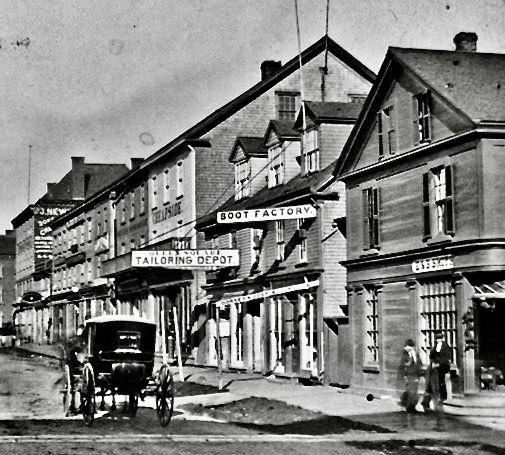
   They continued to the south side of Queen Square, one of Charlottetown’s main commercial streets. It was where Siobhan knew there was tailoring, the selling of dry goods, and the manufacture and sale of rubber boots and furniture. What she didn’t know was that a fire had swept through the section destroying all but one building on the corner of Richmond and Queen. Where wood had stood brick was being laid, but nothing there was ready yet to provide her what she wanted and needed.

   Charlottetown was a small city but with big enough business, and she had no great difficulty finding the clothes and goods she was looking for. One merchant’s loss was another merchant’s gain. The first merchant she visited was the shoemaker Thomas Strangman and Sons. A shoe stitching machine had been invented by an American in 1856. It was known as the McKay Stitching Machine and Thomas Strangman was the first on PEI to have one. Sole cuts specifically tailored to fit the right or left foot were still on the way.

   When she was ready to pay for the shoes and boots for her children and herself, she showed one of the fifty-dollar bills to Thomas Strangman.

   “Is my money good here?”

   He looked at the front and back of the bill.

   “Yes, ma’am, your money is good here.”

   He would take it next door to the dry goods store which was also an exchange bank.

   She bought rice, sugar, and coffee. She bought cotton socks wool socks undershirts under garments shirts denim pants and blankets. She bought rolls of calico, brown shirting, domestic gingham, and bleached cotton. She bought a heavy plaid shawl for $3.00.  She bought a dining room table and eight chairs for $45.00.

   On the way back to Murphy’s Cove on Sunday morning the children sat in the chairs at the table in the back of the farm wagon all the way home, waving to everybody they saw, pointing out a cross-eyed cow, and singing songs. They took turns sitting at the head of the table. They sang parlor songs and minstrel songs. They sang “The Maple Leaf Forever” and “The Red River Valley.”

   “From this valley they say you are going, I shall miss your bright eyes and sweet smile, for alas you take with the sunshine, that has brightened my pathway awhile.”

   Siobhan kept her eyes fixed on the long road ahead of her.

Photograph: Charlottetown, PEI, 1870s.

Excerpted from “Ebb Tide.”

Ed Staskus posts stories on 147 Stanley Street http://www.147stanleystreet.com and Cleveland Ohio Daybook http://www.clevelandohiodaybook.com. To get the site’s monthly feature in your in-box click on “Follow.”

“Ebb Tide” by Ed Staskus

“A thriller in the Maritimes, out of the past, a double cross, and a fight to the finish.” Sam Winchell, Beyond Books

Available at Amazon: https://www.amazon.com/dp/B0CV9MRG55

Summer, 1989. A small town on Prince Edward Island. Mob money on the move gone missing. Two hired guns from Montreal. A constable working the back roads stands in the way.

A Crying of Lot 49 Publication