Category Archives: Ebb Tide

Guardian Angel

By Ed Staskus

  Clyde Ferguson walked into the Queen Elizabeth Hospital mortuary room like he was seeing it for the first time, even though he had been the provincial pathologist for 11 years. “Damn, that hurts,” he said under his breath. His eyes were tearing up. He waited for the sharp stab in his left hip to go away. He felt unsteady. He steadied himself with one hand on the doorjamb. He was all right after a moment, as far as it went. His left heel wouldn’t flatten down to the floor. That leg had gotten slightly shorter the past five years. He put his arms at his sides and breathed evenly.

   The hospital was still in its infancy. It was practically new. He was getting older by the minute, which bothered him. “Getting old is no problem,” is what Groucho Marx said. “You just have to live long enough.” But sometimes he didn’t feel like he was only getting old. He felt like he was getting old and getting crippled to boot. His daughter was already telling her friends, “Don’t ever get old if you know what’s good for you.”

   His hip hurt like hell and worse. He knew exactly what the matter was. It had finally gotten to be bone on bone. The day had always been coming. Walking and yoga and strong drink had forestalled the inevitable. But he had walked too much the past several days. When the weather had gotten better, he drove to Brackley Beach, and walked two miles back and forth three days in a row. That was a mistake. It wasn’t the same as his treadmill, which had arm rails he could support himself on. He had three months left before his retirement became official. When it was signed, sealed, and delivered, he was getting an after-market hip the next day, going back to Tracadie, and staying there. He would break it in over the next year and in the evenings cut up fillets rather than the dead.

   He blinked in the fluorescent light, wondering why there were two tables set up for him. When he remembered the arm, he remembered he was going to have to do two post-mortems, one on the arm and one on the young woman who the arm had once belonged to. That arm looks like it’s been chewed on, he thought, looking at it. 

   Her death was being treated as the result of criminal activity. If it had been some place bigger than Charlottetown the post-mortem would have been performed by a forensic pathologist. They investigate deaths where there are legal implications, like a suspected murder. But it wasn’t some other place. It was Charlottetown, the smallest capital city of the smallest province in Canada. It would have to do and he would have to do it.

   After he was suited up, Clyde stood over the dead woman and blinked his fly-belly blue eyes. She was on her back on a stainless-steel cadaver table. It was a body-sized slanted tray with raised edges to keep fluids from flowing onto the floor. There was running water to wash away the blood released during the procedure. The blood went down a drain.

   She hadn’t been shot or stabbed. Her face was a mess, though. It took him a minute to see what it was that had killed her. Her skull was fractured. Parts of the broken head had pressed into the brain. It swelled and cut off access to blood by squeezing shut the arteries and blood vessels that supply it. As the brain swelled it grew larger than the skull that held it and begin to press outside of it into the nasal cavity, out of the ears, and through the fracture. After a minute it began to die. After five minutes, if she hadn’t called it a day, she would have suffered irreversible brain damage. One way or the other it was the end of her.

   He got down to his work, making a long incision down the front of the body to remove the internal organs and examine them. A single incision across the back of the head allowed the top of her skull to be removed so the brain could be examined. He saw what he expected to see. He examined everything carefully with the naked eye. If dissection had been necessary to look for any abnormalities, such as blood clots or tumors, he would have done it, but what was the point?

   After the examination he returned the organs and brain to the body. He sewed her back up. When he turned his attention to the arm, he saw clearly enough it had been chopped off clean as a whistle. The axe, or whatever it was, must have been newer than not. In any case, it was as sharp as could be. Her hand was clenched in a fist. He had to break her fingers to loosen it. When he did, he found a Loonie in her palm. It was Canada’s one-dollar coin introduced two years earlier to replace paper dollar bills, which had become too expensive to print. Everybody called them loonies after the bird on the reverse side.

   Clyde looked at the new coin smeared with old blood and older dirt. He put it in a plastic bag and labelled it. He recorded everything on a body diagram and verbally on a cassette tape. He put the Loonie, diagram, and tape in a pouch and labelled it. When he was done, he washed up and decided to go eat. After that he would call it a day. The work had warmed him up and he wasn’t limping as much as he had earlier. He tested his hip, lifting his leg at the knee and rotating it. His hip felt reasonably ready to go. He would go to Chubby’s Roadhouse for lunch. They had the best burgers on the island.

   The phone rang. It was Pete Lambert, the Commanding Officer of the RCMP Queens detachment.

   “What have you found out, Clyde.”

   “I’m on my way out for a bite to eat. Meet me at Chubby’s. So long as the force pays, I’ll tell you everything I know.”

   Chubby’s was 15 minutes from the Queen Elizabeth Hospital and 20 minutes from the RCMP station. While he was driving Clyde thanked God it was 1989 and metallic hip replacements were as good as they had ever been. The first hips dated back a hundred years to when ivory implants were used to replace the femoral head. Elephant tusks were cheap at the time and were thought to possess good biomechanical properties. That proved to not be the case. Men and women died right and left from dislocations and infections.

   Fifty years later an American surgeon performed the first metallic hip replacement. He designed a prosthesis with a head made of something he called Vitallium. The implant was 12 inches in length and attached with bolts to the end of the femoral shaft. It worked like a charm. That same prosthesis is what he would be getting, except it was better and the implant would be inserted within the canal of the femur, where bone growth would lead to more permanent attachment. So long as he could wake up and walk upright in the morning, instead of staggering and grabbing for support, he would be a happy man.

   Chubby’s Roadhouse and Bud’s Diner were side by side in a pink and blue building on St. Peters Road in Dunstaffnage. They did a brisk business. It was a popular pit stop for bikers on poker runs. It was why Pete Lambert had lunch or dinner there once a week, getting to know the riders. He kept his enemies close.

   “We serve burgers and fries and shakes and fish and chips and clams and all that stuff,” Clarence Foster said. “But I think as far as the burger goes, the best, the one that everybody seems to like is called the Bud Burger.” Clarence was both Chubby and  Bud.  “We have wedding receptions and things like that,” he said. He told the bikers about them in advance, so that nobody ended up stepping on anybody else’s toes.

   The Spoke Wheel Car Museum was next door. Clarence and his father Ray shared an appreciation for old cars. They both liked to smoke cigarettes but loved cars more. They gave up fags to save money. Instead of going up in smoke their savings went toward buying broken down heaps nobody else wanted and restoring them. They offered to buy Bernie Doiron’s VW Beetle, but he said, “It ain’t no antique.” By 1969, they had 13 cars, including a 1930 Ford Model A Coach that Clarence drove for show. It was how the roadhouse and diner came into being. 

   “People were coming to the museum and looking for a place to eat,” Clarence said. “Since my dad was a cook in the army, we decided to build a little canteen and it just kept on growing.” 

   Clyde and Pete met at the bar and ate at a back table. It wasn’t the warmest spring day, although it was sunny. They had cold pints and Bud Burgers.. There were a handful pf people having late lunches.

   “How’s the hip?” Pete asked.

   “Hellzapoppin,” Clyde said.

   “Is that the official diagnosis?”

   “It’s how I feel. I’ve got two months and 29 days from today circled on my calendar.”

   They ate and talked small. “Find anything out?” Pete finally asked, finishing his burger and hand-cut fries. The food was good because the beef and potatoes came from the island, not from away. It would be a trifecta once islanders opened up their own breweries.

   “It will be in my report tomorrow, but since you’re interested, I’ll summarize it. She died of a fractured skull. There was tissue not hers on her face and in her hair. I want to say she was hit by a fist that got scuffed up doing it. She had alfalfa on and in her clothes. More than a brush of silage, enough to make me think she was on a dairy farm long enough to roll around in it. She wasn’t killed on that field, although her arm was probably cut off there. The last field cutting there was in late August, so she was put in the ground sometime between then and no later than the end of October.”

   Thousands of acres of potatoes on the island the last fall had been left in the ground. Heavy rain and cold temperatures put a damper on the harvest. There had been too much rain and cold, freezing and thawing, day after day, and it led to a deep frost.

   “Her arm was probably cut off by an axe, sharp as can be. Whoever did it is a strong enough man, or a man driven to extremes. I don’t believe a woman did it, although I can’t tell you why. Why it was cut off, since she was already dead when it happened, is for you to find out. She had a Loonie clenched in her missing hand. It was a 1988 issue. No prints other than hers on it.”

   “Are her prints in the report?”

   “Yes, what we could get, which wasn’t much of anything, but they will do.” It was shop talk. Pete knew everything he needed and a batch of photographs would be part of the report.     

   “She wasn’t molested or abused. I don’t think she had eaten for several days. There wasn’t anything remarkable about her teeth, none missing, one filling. She was in her early twenties, five foot five, 118 pounds, green eyes, light brown hair, no moles, birthmarks, or tattoos. She was healthy as a horse.”

   “Anything else?”

   “One more thing. I think she might have poked somebody in the eye. There was retinal fluid under the fingernails of the first two fingers on the cut-off arm. Her nails were 7 mm long and almond shaped, perfect for poking. It wasn’t her fluid, either.”

   Blunt trauma to the eye can cause the retina to tear. It can lead to retinal detachment. It can require urgent surgery. The alternative is blindness. That alternative means living in the dark forever.

   “If that happened, where would the eye have been treated?” Pete asked.

   “At a hospital or a large eye clinic.”

   “What happens if it’s not treated?”

   “Kiss goodbye to that eye.”

   “I see,” Pete said, paying the bill when the waitress stopped at their table. What crowd there had been had cleared out. It was the middle of the afternoon. When the two men went out to their cars, they were the only two cars in the front lot. Pete was driving an unmarked police car, although it was clearly an official car. Clyde was driving a Buick Electra station wagon. He could lay a corpse out in the back if he had to. They shook hands and went their separate ways.

   Later that evening a biker riding a red motorcycle approached the roadhouse, swerving to avoid a fox. There was always more roadkill in the spring and fall. Skunks and raccoons were the most common, although foxes weren’t always as quick and slippery as their reputation. He pulled up, parked, and went inside. He left the key in the ignition. His Kawasaki Ninja had an inline four cylinder, 16 valve, liquid cooled engine with a top speed above 240 KPH. He had already made that speed and more. He knew nobody was going to mess with his bike because nobody stole wheels at Chubby’s Roadhouse. It would have been a heresy. At the bar he ordered a Bud Burger and a cold pint.

   “How’s the eye?” the bartender asked. “It looks good. At least, no more pirate’s patch.”

   “Yeah, but I waited too long to get it fixed,” the biker said. “The doc says I’ll probably be more blind than not in that eye from here on. It don’t matter, I can still see enough out of the other one to take care of my business.”

   He ate fast and downed his beer. When he left, he paid cash with a new one-hundred-dollar bill.

   “Where do you keep finding these?” the bartender asked.

   “Pennies from heaven, my man,” the biker said, leaving him a tip of two new Loonies. Getting on his glam motorcycle in the gloom of dusk he thought, I got to be more careful about that.

Excerpted from the book “EbbTide.”

Ed Staskus posts monthly on 147 Stanley Street at http://www.147stanleystreet.com, Made in Cleveland http://www.clevelandohiodaybook.com, Down East http://www.redroadpei.com, and Lithuanian Journal http://www.lithuanianjournal.com. To get the site’s monthly feature in your in-box click on “Follow.”

“Ebb Tide” by Ed Staskus

“A thriller in the Maritimes, out of the past, a double cross, and a fight to the finish.” Sam Winchell, Beyond Books

Available at Amazon: https://www.amazon.com/dp/B0CV9MRG55

Summer, 1989. A small town on Prince Edward Island. Mob money on the move gone missing. Two hired guns from Montreal. A constable working the back roads stands in the way.

A Crying of Lot 49 Publication
Down to Sea Level

   By Ed Staskus

   There was a window seat midway back in the Boeing 737. JT Markunas parked himself there. The plane looked old but smelled clean. It had been built in 1969 with an expected lifespan of 20 years. It was 20 years old in 1989 on the day JT buckled his seat belt. He was on the one daily Canadian Airlines flight from Ottawa, the capital of Canada, to Charlottetown, the capital of Prince Edward Island. Crossing over the eastern end of New Brunswick, he looked up from his Car and Driver magazine. He took a look through the porthole window at the crescent-shaped island in the distance. The land wasn’t small, but it wasn’t big, either. It was blanketed by snow. He had been told his new posting was mostly farm country. He wondered what it looked like from outer space.

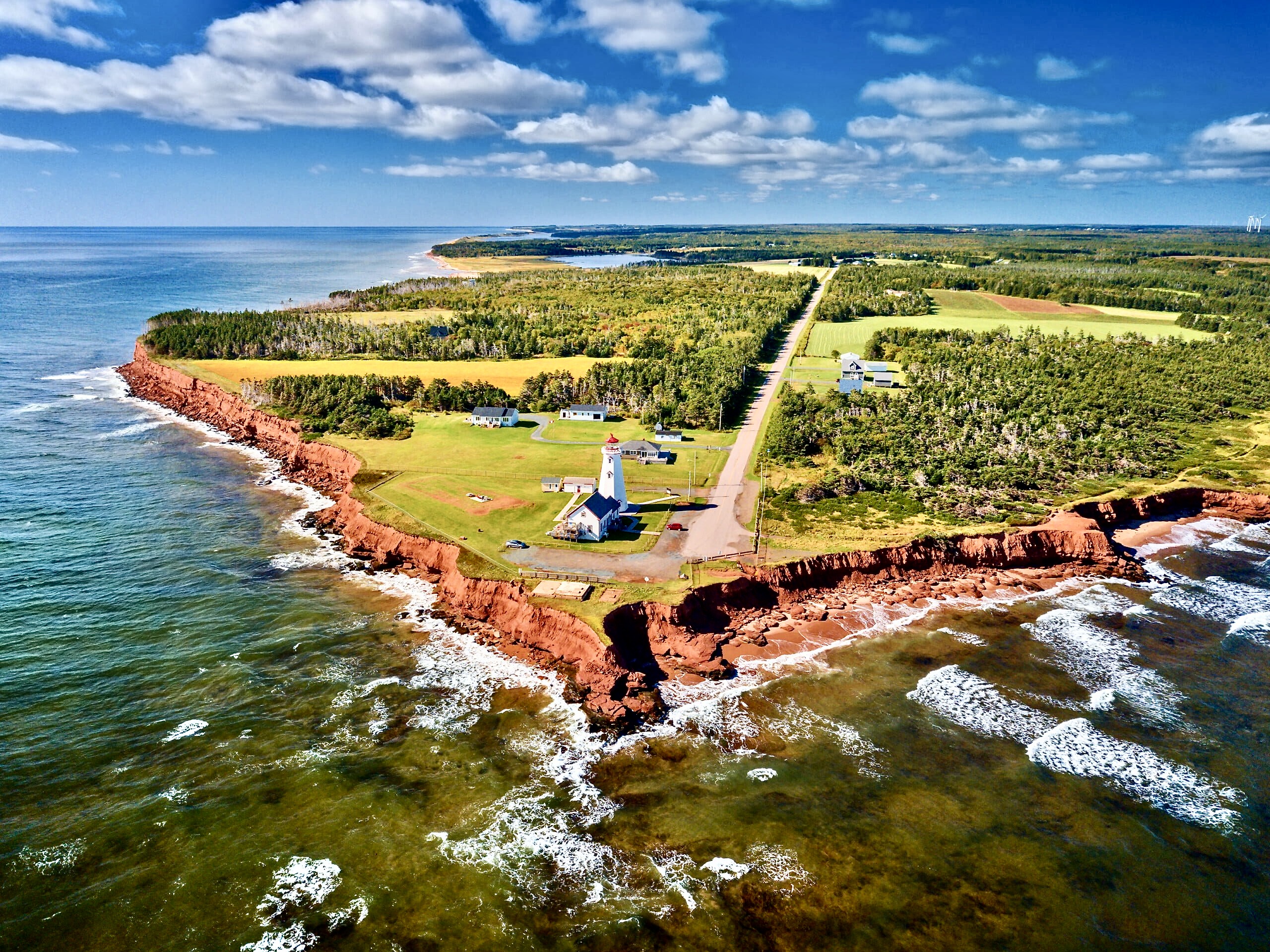
   Seen from outer space Prince Edward Island can barely be seen. The solar system is a speck in the galaxy. The earth is a speck in the solar system. Prince Edward Island is a speck on the earth. When the sky is clear and the sun is shining it is a green and red speck under a dome of blue. When it is cloudy and stormy everything gets wet and gray until the sun comes back. It is the Gulf of St. Lawrence. Where he came from, which was Sudbury, Ontario, the sky was always either getting cloudy or it was already cloudy.

   The lay of the land formed hundreds of millions of years ago. Creeks and rivers deposited gravel, sand, and silt into what is the Gulf of Saint Lawrence. Before the last ice age, Prince Edward Island was part of the mainland. After the glaciers melted it wasn’t a part of it anymore. The Northumberland Strait became what separates it from the rest of Canada.

   The province is one of Canada’s Maritime provinces, the others being New Brunswick and Nova Scotia. Newfoundland and Labrador are nearby but more on their own than not, which is the way they want it. There are 225 kilometers from one end of the island to the other. It is 3 kilometers at its most narrow and 65 kilometers at its most wide. It is twice as far as the Kulloo flies from the island to Walt Disney World in Florida as it is to the Arctic Circle. Walt Disney World is far away and for pretend. The Arctic Circle is nearby and for real.

  There are farms from stem to stern of Prince Edward Island. There are so many of them the province is called the “Million-Acre Farm.” Jacques Cartier discovered it in 1534 and Samuel Champlain claimed it for France in 1603. The French explorers called it Île Saint-Jean. When they landed the native Mi’kmaq’s tried to explain they had been there for thousands of years, but all they got for their trouble was wasting their breath. They switched gears and tried singing some of their Top 10 songs. They sang “The Eagle Song” and “The Honor Song” and “The Gathering Song.” They accompanied themselves on rattles and hand drums.

   “Try singing a different tune,” Samuel Champlain finally said. “I’ll teach you the words.” He meant for them to sing “The Giveaway Song.” The Mi’kmaq glared and reached for their bows and arrows. The French strapped on armor and reached for their swords. They were more savage than the savages and knew how to prove it. The natives grumbled to themselves and drifted away. They thought they could make it right later. They were wrong about later.

   Kulloo could have set them straight, but he didn’t. He spoke in riddles, anyway. Hardly anybody ever understood his riddles. Over the centuries it had gotten so he held his tongue more often than not. He didn’t believe in explaining himself, anyway. He believed, being terse, say it once, why say it again? No matter what the  Mi’kmaq’s thought he was, or meant to them, he was a lone wolf. He was big enough to hook a grown man with his talons and carry him away. If push came to shove, and the man couldn’t explain himself, Kulloo was strong and predatory enough to eat him. Men were his least favorite meal, being bitter and hidebound, bur he was never going to shortchange himself dinner.

   He was at least a millennium old. Nobody knew how old he really was, not even Kulloo himself. The day he saw Jacques Cartier’s two ships come from France in 1534 he didn’t know what century it was. He lived by the seasons and the rotation of the stars. The ships and their crewmen piqued his interest. The Mi’kmaq had small boats that hugged the coastline. The big sailing boats had come from the other world, from the other side of the ocean. Kulloo had gotten word about that world long ago, but had never seen it. He suspected the Old World was intent on making the New World their world. He thought it  best to take a closer look to see where he stood.

   When the British took control of Canada East they changed the name of the island from what the French had called it to St. John’s, then changed it to New Ireland, and again on the eve of the 19th century to Prince Edward Island. It was named after Prince Edward, who later became the father of Queen Victoria. He was beguiled by the island, even though he proposed transferring sovereignty of it to Nova Scotia. He visited his namesake five times. The journey took almost a month to sail one way. 

   It became a separate colony in 1769 and the seventh province of Canada in 1873. Charlottetown was named after the wife of King George III. Queen Charlotte barely spoke a word of English and never visited the capital city. She stayed home in Buckingham House and played her harpsichord. She liked chartbusters like Bach’s “Concerto in the Italian Style in F Major” and Handel’s “Keyboard Suite No. 5.”

   “She ain’t no beauty, but she is amiable,” King George said about his wife. Queen Charlotte smiled slyly. She played “By the Light of the Moon” on her harpsichord for the man of the house.  It was a lullaby. King George took a nap in his queen’s lap.

   The province is the smallest and most densely populated Canadian province, although outside of Charlottetown and Summerside, where half of everybody lives, the habitants and their communities are spread far and wide. Most of everything is in the way of out of the way. Forests once covered the island. Trees still covered half of it. The red oak is the provincial tree. There are pine, beech, and spruce. There are no deer, moose, or black bears. There are rabbits and skunks, muskrats, and plenty of foxes. The red fox is the provincial poster boy. In early summer pink and purple lupins, weeds that are an invasive species, line fields and ditches. The Lady Slipper, an out-of-the-way orchid that grows in shady woodlands, is the provincial flower.

   JT was looking out the porthole window when he saw Kulloo. The bird was bigger than an albatross and more stern-looking than an eagle. If it was sowing the wind it was going to reap a whirlwind. The plane was cruising like it had been for the last hour-and-a-half. The big bird was keeping pace with the plane off the tip of the wing. JT rubbed his eyes and looked again. It was still there, soaring. He scanned the aircraft cabin. Some passengers were reading while others napped. Nobody was looking out at the wide blue yonder. When JT blinked the bird was gone. When he blinked again it was back.

   Farming is the number one way of life on the island, followed by the enterprises of fishing and fish mongering. There are a wealth of fields full of potatoes, grains, and fruits. There are cows everywhere, their snouts in the turf, waiting to be milked or slaughtered. There are boatloads of mussels, oysters, and lobsters to be had. Cod had been overfished to near extinction. There was talk of importing it from Iceland.

   Tourism was growing and Liam Foyle and his Japanese girlfriend Mariko were building cottages on family land in North Rustico to get in on the summer trade. In the meantime, they stayed at Sandy’s Surfside Inn most of the time. It was on the Gulf Shore Parkway. It was on the park road but not in the National Park. They had never sold their land. His brother Conor was his only neighbor. Liam and Conor were Kieran Foyle’s descendants, more than a hundred years after the Irish triggerman from the Old World landed in the New World, his Beaumont-Adams revolver tucked into a sailor’s bag. 

   In 1989 the pickings were good for the Liberals. They swept the elections. Andrew, the new Duke of York, and Fergie, his wife and Duchess, visited, flying in on a Canadian Armed Forces jetliner. George Proud, one of the new Liberal members of the province’s parliament, stood on a bench for a better view of the royals as they were driven up University Ave. “We’re the commoners, and they’re royalty, and I think people in a strange way must secretly like that,” he said. 

   “It’s a great day,” declared John Ready, the mayor of Charlottetown. Not everybody agreed. A woman in the crowd groused, “I was talking to a friend this morning who said, ‘I don’t know why we should have to curtsy to a person who a few years ago was living with a race-car driver.’” During the parade the Duchess climbed over a rope barrier to talk to a group of senior citizens. “What are these ropes for?” she asked. “I can’t believe you’re penned in.” The senior citizens were polite but baffled.

   Scouts Canada held their annual jamboree on the island that summer, honing their outdoor skills and running riot in the woods. The TV series “Road to Avonlea” went into production. The last train on Prince Edward Island made its last run, coming to a dead stop in living time. The tip-to-tip railway had been operating for one hundred years. The minute the clock struck the century mark it was done for good.

   Poison’s “Every Rose Has Its Thorn” was the top song on the radio. Malcolm “Monk” Kennedy was a thorn on the island that year, but nobody knew it until the Boy Scouts had all gone home. They were always prepared, it being the scouting motto, but nobody was prepared for Monk. Nobody was prepared for Jules Gagnon and Louise Barboza, either. They were hired guns from Montreal who came to the island looking for Monk and two million missing dollars.

   Jules and Louise were good as gold at what they did, but didn’t know they were going to end up paddling upstream to get their work done. Monk didn’t know two million dollars was going to be so hard to spend. They didn’t like the stumbling blocks in their way, but by then they had picked their poison. The Hunter River was going to flow through North Rustico and out to the ocean, no matter what. They were going to have to find that out for themselves. They weren’t prisoners of fate. They were prisoners of their own minds. Monk couldn’t change his mind, no matter what. Jules and Louise wouldn’t change their minds, no matter what.

   Kulloo peeled away from the Boeing 737 and swooped landward. He saw Louie the Large near the coastline. Hunkered down on a rock shelf not far from shore, the big shellfish was sizing up Monk, Jules, and Louise. Monk was scrawny. He was off the dinner table unless there was a famine. Jules looked better. He had some meat on his bones. Louise looked the best. He wouldn’t mind getting his claws into her, not at all. They shared a name. He liked that. He would like it even better if they shared some flesh and blood.

   Louie the Large loved the ocean, deep and blue, the tides rising and falling. It was where all life came from. He understood the primal fear men and women had of it, which he encouraged with every click clack of his crusher claws. He knew Kulloo was laying low overhead. He kept one eye open for him. He knew all about the bird. He was dangerous as a switchblade. He knew the creature never slept and woke up every morning dangerous as ever. Everything on land and sea was fair game to him.

   JT looked out the porthole window again, as the plane started its approach to the Charlottetown Airport, and saw that the bird was gone. He didn’t think he had imagined it. He wasn’t a fanciful man. He prided himself on thinking straight. He wasn’t especially impulsive or emotional, although he had been in love once and knew he could be as irrational and emotional as anybody. He didn’t believe any bird could be that big and that fast. It must have been a mirage of some kind, like in the movies. 

   He checked his seat belt to make sure it was snug. He looked down at the sea level he was going down to. Five minutes later he was landing on the Atlantic Canada land that was going to be his new RCMP posting.

Excerpted from “Ebb Tide.”

Ed Staskus posts monthly on 147 Stanley Street http://www.147stanleystreet.com, Made in Cleveland http://www.clevelandohiodaybook.com, Atlantic Canada http://www.redroadpei.com, and Lithuanian Journal http://www.lithuanianjournal.com

“Ebb Tide” by Ed Staskus

“A thriller in the Maritimes, out of the past, a double cross, and a fight to the finish.” Sam Winchell, Beyond Books

Available at Amazon: https://www.amazon.com/dp/B0CV9MRG55

Summer, 1989. A small town on Prince Edward Island. Mob money on the move gone missing. Two hired guns from Montreal. A constable working the back roads stands in the way.

A Crying of Lot 49 Publication

Fish Tank Blues

By Ed Staskus

   It wasn’t breaking news that Prince Edward Island was an island. It was old news that it had not always been one. It was news that didn’t matter to some who lived on the island, however. They weren’t overly concerned about the past. They were concerned about right now. They cared about heating oil being delivered on time and what time the school bus was coming. They cared about the flu that stopped them dead in their tracks. They cared about how they were going to put food on the table. They knew for sure that nothing from the prehistoric past had anything to do with it. 

   What the land and the sea were all about wasn’t news to the lobsters who lived offshore. They had been around much longer than the fishermen, farmers, and townsfolk who plied their trades in the Maritimes. The crustaceans had seen it all, although they hadn’t seen amnesic shellfish poisoning before. The new toxin was killing Canadians who ate shellfish that year. No lobster ever went to any of their funerals. “That’s a dose of your own medicine,” Louie the Large said, chuckling to himself that the toxin wasn’t bothering his kith and kin.

   Lobsters didn’t have a trade or much else to do, other than eat anything and everything they could all day and night. Everything was grist for their mill. They hated crabs and crabs hated them and it was the Hatfield’s and McCoy’s whenever the shellfish ran into each other. The lobsters were bigger, badder, and more determined than the crabs. Three of their five pairs of legs were outfitted with claws. They usually carried the day. Might makes right was their rule of thumb.

   The number one rock ‘n’ rollers among the island’s lobsters were the B-52’s. They were the house band in their part of the world. Every lobster knew the lyrics to their “Rock Lobster” song. The band had released it ten years earlier and when they did it shot up the shellfish charts, even though every single crab in the Gulf of St. Lawrence scorned it as the devil’s music.

   “We were at the beach, everybody had matching towels, somebody went under a dock, and there they saw a rock, it wasn’t a rock, it was a rock lobster!” 

   Whenever any crab heard the song, it spit sideways and cursed. They were happy to see the island’s fishing boats go after their country cousins every spring. They showed up at the island’s harbors for the blessing of the fleet on Setting Day and shouted “Godspeed!” when the boats broke the waves. There was no love lost between crabs and lobsters. “We don’t need no skunks at our lawn party,” crabs far and wide said.

   Even though lobsters could be as bad as a Hells Angel waking up on the wrong side of the bed, all they really wanted to do was eat and have fun. They were always on the move, moving in parties of twenty, fifty and even a hundred, looking for a party. They ate non-stop so as to have plenty of get up and go at whatever good time they found.

   “Havin’ fun, bakin’ potatoes,” they sang. Prince Edward Island was known as Spud Island. It was no small potatoes when it came to the tuber. It was the smallest province but the top potato producing province in the country. Everybody’s favorite way to eat lobster was boiled in the same pot with fresh corn and new potatoes.

   “Boys in bikinis, girls on surfboards, everybody’s rockin’, everybody’s fruggin’.”

   The blue and brown backed crustaceans couldn’t move fast enough to frug, but it didn’t matter. They got into the spirit of the song. They lived in harmony among themselves ten months out of the year, except when one of them happened to eat another one of them. The other two months of the year all bets were off. That’s when the island’s lobster boats went after them. That’s when the angels sang and it was every man for himself. They didn’t like it, but they had to take their lumps like everybody else.

   There were about 1200 boats on the island sailing out of 45 harbors. More than three dozen boats came out of the North Rustico harbor. Every one of the boats was out to get lobsters. Once they got them their fate was sealed. Every lobster knew it in its bones, even though all they had was an exoskeleton. Their inner selves had no bones. They were going to be boiled alive and there was nothing they could do about it.

   Traps have escape vents to let shorts leave while still on the bottom. The under-sized lobsters who overstayed their welcome were thrown back into the ocean. Egg-bearing females were also thrown back. The female carried her eggs inside of her for about a year and then for about another year attached to the swimmerets under her tail. When the eggs hatch, the larvae float near the surface for a month. The few that survive eventually sink to the bottom and develop as full-fledged and grown-up. For every 50,000 eggs spawned two lobsters survive. The rest of them feed the fish.

   Some diners sporting bibs argue that lobsters don’t have a brain and so they don’t feel pain. They have probably never seen tails shuddering like palm fronds in a hurricane when the shellfish get thrown into a pot of boiling water. They aren’t twitching to the beat of the B-52’s. Their brains might not amount to much, but they have a nervous system. They react to pain like everybody else. The hormone they release when hurt is the same one that human beings release when hurt. 

   “How about coming down here with the rest of us,” they wanted to scream from the boiling pot mosh pit. They would have screamed if they could. As it was, all they could do was click and clack.

   The Prince Edward Island fisheries considered lobster to be their crown jewel. It was a gourmet known for its juicy meat. But that was like getting the Medal of Honor when you weren’t around anymore. Who needs to bask in that kind of glory? The only consolation lobsters had was that the island’s fishermen took care to manage their resource. They didn’t pull up over many of them in their traps. They kept the surrounding waters clean as could be so there would be plenty of them year after year.

   It was small consolation though. It only meant fishermen were in it for the long haul and weren’t going to change their minds about snatching them up anytime soon. The only consolation a lobster ever got was when somebody reached for it and the lobster was able to get the outstretched hand in its crusher claw.

   “We were at a party, his earlobe fell in the deep, someone reached in and grabbed it, it was a rock lobster!”

   When that happened, there was no quarter given. The lobster was going to sell its life dear. The human hand was going to pay dearly for sticking its nose where it didn’t belong. The nose should have stayed where it was before it ever came to the island. Why didn’t they stay in the Old World? What lobsters didn’t know was that fishermen came from the same place they did. Way back when they had come from way down in the ocean. But they weren’t ever going back. The sooner lobsters got that through their thick heads the better.

   “Lots of bubble, lots of trouble, rock lobster.”

Excerpted from the book “Ebb Tide.”

Ed Staskus posts monthly on 147 Stanley Street http://www.147stanleystreet.com, Made in Cleveland http://www.clevelandohiodaybook.com, Atlantic Canada http://www.redroadpei.com, and Lithuanian Journal http://www.lithuanianjournal.com

“Ebb Tide” by Ed Staskus

“A thriller in the Maritimes, out of the past, a double cross, and a fight to the finish.” Sam Winchell, Beyond Books

Available at Amazon: https://www.amazon.com/dp/B0CV9MRG55

Summer, 1989. A small town on Prince Edward Island. Mob money on the move gone missing. Two hired guns from Montreal. A constable working the back roads stands in the way.

A Crying of Lot 49 Publication
Back in Action

By Ed Staskus

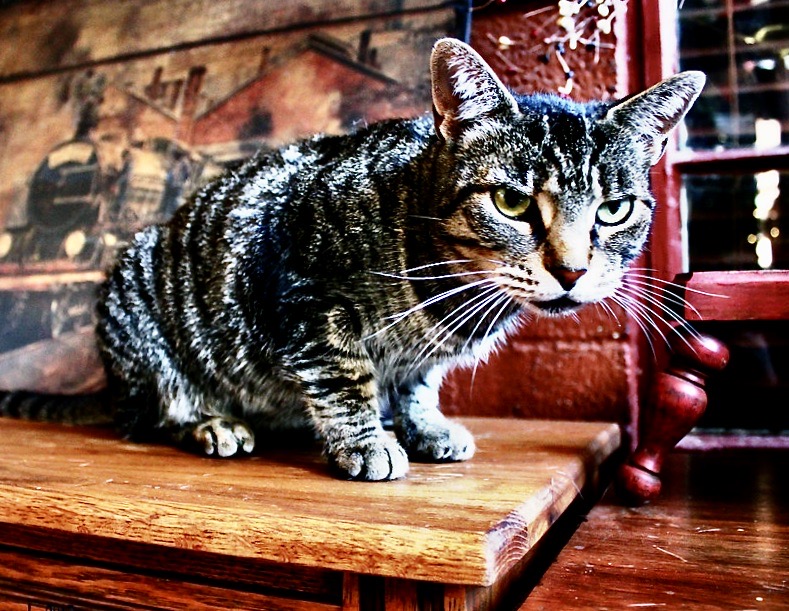
  “Oy, where is that you are coming from?” Kieran Foyle asked the kitten going on tomcat at his feet. The half-pint was looking up at him. He had been on board the ferry when Prince Albert’s gunman shot Tom Spate dead. As the ferryman was spitting out his last breath, the kitten jumped off his perch and scurried to the side. He watched Kieran roll, push, and kick the dead Englishman into the Stanley River. He floated face down into the New London Bay. The Kulloo flying overhead didn’t bother glancing down at the end of Tom Spate.

   That was the end of Queen Victoria’s would-be killer, at least until he sank. When he did bottom feeders like eels would eat whatever was left of his decomposing body. The kitten had seen plenty of eels in his short time on Prince Edward Island. He knew what they were up to. It was why he never snacked on them.

   The kitten was striped and gray, still small but on the stocky side. “The only true animal is a cat, and the only true cat is a gray cat,” Lucy Maud Montgomery said. The Green Gables author had two of them. “When people ask me why I want to keep two cats I tell them I keep them to do my resting for me.”

   Snapper was a Scottish half-breed from Rear Settlement, on the west side of Settlement Rd. beside a tributary of the Montague River. Everything had gone wrong a month before when Ann Beaton, the woman who had given him his name and kept him fed, dry, and warm, was murdered when somebody smashed the back of her head with a grubbing hoe.

   Ann was 41 years old and a spinster. She was lonely but had a one-year-old daughter to keep her company. Nobody knew who had gotten Ann pregnant. She had a lot of explaining to do but kept it a secret. She had called the bun in the oven her snapper. When she found the kitten, who had wandered away from his litter, she called him Snapper. She lived with her brother Murdoch and his family. The night she was killed was the day she went visiting her neighbor who was weaving some cloth for her. They had tea and raisin pie after dinner and Ann started for home when it was near to sunset.

   “What do you say, it’s getting awful dark, maybe you should stay overnight,” her neighbor suggested.

   Ann said she knew the way back like the back of her hand and besides, she enjoyed walking in the dark. Her brother was away and one of his children was watching her girl. She wanted to get back to her young one. Ann was found dead the next day in a ditch at the back of her brother’s farm. She was lying in blood day-old dry and caked.

   She was laid out in the barn. She had been stamped on and violated. Her body and dress were marked with the prints of a shod foot. Everybody from the community filing past the viewing laid a hand on her. There was a Scottish belief that if a murderer touched the body of his victim, blood would gush forth. At the end of the viewing everybody was in the clear. There had not been any gushers. The killer was never found.

   Snapper stayed alert as Kieran walked back to North Rustico. He bounced up and down in the man’s coat pocket. The island’s pioneer days weren’t over, except where they were. Most still farmed and fished, but not all of them. Some made and sold farming implements while some worked in shipyards. Everybody needed lumber and many men worked at lumbering. There were sawmills and shingle mills. There were schools, churches, and post offices. There were some inns and hotels. There were plenty of distilleries.

   Ann Beaton’s funeral was presided over by the Reverend Donald McDonald, a minister of the Church of Scotland. He had a large following of “kickers” and “jumpers.” They were known that way for the religious frenzy they fell into while being “under the works.” The clergyman had emigrated from Scotland to Cape Breton and finally to Prince Edward Island. Everybody knew he drank too much when he was still a Scotsman. When he became a Canadian, he tried to stay on the wagon. “Prince Edward Island is a dubious haven for a man fleeing demon rum,” one of his kinsmen said. There was plenty of strong drink on the island. 

   A year before her death Ann attended several prayer meetings and while under the works had knocked a Bible and a candle from Reverend McDonald’s hands. She invertedly kicked the Bible, too. She purposely blew out the candle. “They are both under her feet now and mark the end of that girl,” the clergyman said by way of a sour eulogy.

   Snapper watched country folk going to Cavendish by horse and buggy to buy tea, salt, and sugar. If they had something extra in their pockets, they bought molasses and tobacco. They only bought clothes they couldn’t make themselves. They didn’t buy food as a rule. They grew and processed it themselves, picking and preserving berries, milking cows and churning cream for butter, and curing beef and pork after slaughtering the animals.

​   The grubbing hoe that killed Ann Beaton belonged to Archibald Matheson. He lived nearby on the Settlement Rd. with his wife and son. The three of them were arrested on suspicion of the crime. Some local women reported being molested by the farmer. But bad feelings among neighbors weren’t facts. He and his family were soon released. He may have had a bad reputation, but so did Ann. There were rumors she had been killed by a jealous wife. A smutty ballad was composed describing her as “light in her way.” 

   After the funeral she was buried in the Pioneer Graveyard. Her brother moved away nobody knew where. Nobody knew what happened to her baby, either. Nobody wanted to know. By the time Snapper was on his way to North Rustico everybody had done their best to forget all about it.

   The kitten had been sleeping in the back of a wagon one day almost a month after Ann’s death. He was sick and tired of nobody feeding him. Before he knew it the wagon was on its way. When he looked back, he didn’t see anything worth going back to. He made himself comfortable and went with the flow. The flow went towards the northwest. The wagon stopped overnight at Saint Andrews and the next night at Covehead before getting to the Stanley River, where it rang for the ferry. Once they were across, and the wagoner was stretching his legs, Snapper stretched his legs, too. When he was done the wagon was long gone. Unlike wagoner’s hauling freight, the kitten wasn’t on a schedule. He was go-as-you-please footloose.

   Tom Spate’s young wife took him in, poured him a bowl of milk, and fed him scraps of white fish. He bulked up and stayed agile by staying out of Tom Spate’s way. The ferryman had a bad temper and wasn’t above hitting his wife or trying to kick the kitten. Snapper was fast and none of the ferryman’s kicks ever landed. Tom Spate’s wife wasn’t fast enough and had the bruises to prove it.

   Snapper wasn’t overly distressed to see the dead as a doornail Tom Spate floating away. Kieran was his kind of man, irascible but not mean-hearted. I have never known anyone worth a damn who wasn’t irascible, the kitten thought. Snapper stayed where he was, not jumping ship. Besides, he had already spotted foxes along the coastline. He would deal with them once he was grown up and ready for bear, but for the moment he kept his eyes open and his nose on high alert.

   He saw a lighthouse in the distance. It was weather-beaten. He was farsighted but saw well enough so long as it was a few feet past his nose. He made good use of his nose and ears for everything closer. They walked past a house where it was wash day. Behind the house was a field of sunlit rapeseed. A woman was raising water from a well with a bucket and washing clothes on a washboard with home-made laundry soap. She pressed what clothes needed to be pressed using an iron she heated on her kitchen stove. Snapper didn’t own or wear clothes and thought it was a lot of bother.

   A traveling tailor was walking up the path to a nearby house. He was going to stay for several days, maybe even a week, making wool coats for everybody. The lady of the house had already spun, dyed, and woven the cloth. What Snapper didn’t know was winters on the island were long and cold. He was going to find out soon enough. When he did, he was every day going to sniff out wool so he could curl up into it.

   When they got to North Rustico there was still plenty of daylight left in the day. Snapper ran behind the boarding house where Kieran was staying and started pawing at a beetle. He batted it one way and another way. The beetle looked for a tree to scurry up. The only beetles Snapper never messed with were lady bugs. He liked the way they went about their business as they hunted for aphids. They were deadly killers of the pests. Snapper never killed lady bugs. It would have brought bad luck. Everybody knew that.

   Snapper slept on Kieran’s bed that night. He made himself small and pressed himself into the man’s ribs. The Irishman didn’t toss and turn, which suited the kitten. He didn’t have to catnap with one eye open, ready to jump at any minute. He slept better that night than he had in many nights. By the morning he had forgotten all about Tom Spate.

Excerpted from the book “Ebb Tide.”

Ed Staskus posts monthly on 147 Stanley Street http://www.147stanleystreet.com, Made in Cleveland http://www.clevelandohiodaybook.com, Atlantic Canada http://www.redroadpei.com, and Lithuanian Journal http://www.lithuanianjournal.com

“Ebb Tide” by Ed Staskus

“A thriller in the Maritimes, out of the past, a double cross, and a fight to the finish.” Sam Winchell, Beyond Books

Available at Amazon: https://www.amazon.com/dp/B0CV9MRG55

Summer, 1989. A small town on Prince Edward Island. Mob money on the move gone missing. Two hired guns from Montreal. A constable working the back roads stands in the way.

A Crying of Lot 49 Publication
Bird On the Wing

By Ed Staskus

   Some men are good at farming. Other men are good at fishing. Merchants and tradesmen keep them in gear and goods. Most men are good for something, although some are good for nothing. Kieran Foyle wasn’t a man good at doing nothing. He didn’t know fishing or farming but was familiar with horses. He was going to make a horse farm and make his way on Prince Edward Island that way.

   He stayed on the cove where he landed, building a house. He cut, limbed, and sawed trees by hand and split blocks with an axe. The wood would be ready for a stove and fireplace next year. In the meantime, he bought a load of coal from a passing schooner. He found dampness nearby and looked for an underground spring. When he found it, he dug it out for drinking water, saving himself the work and expense of digging a well. Whenever he could he cleared land. It was one stump at a time, pulling them out with a team of draft horses. Sometimes it seemed like it was all he did.

   “The islander making a new farm cuts down the trees as fast as possible until a few square yards of the blue sky can be seen above. Roots and branches lying on the ground are set on fire and sometimes the forest catches fire acres of timber are burned,” is how Walter Johnson, who came to the island to start Sunday schools, described it.

   Kieran put enough salted cod away to feed a God-fearing family of Acadians. When the weather changed for the worse, he ate, smoked, read, and slept through the season, living in his union suit. The dead of winter arrived near the beginning of January and kept at it through February. The daytime high temperatures were below zero and the overnight low temperatures were less than below zero. After spring arrived and the Prince Consort proved true to his word, his land grant delivered, stamped with officialdom, he continued clearing land and building his house.

   He wasn’t a food growing man, but he had to eat. His first task was putting in a root garden of beets, turnips, and potatoes. They would store well during the winter. He made sure there were onions. They added flavor to food and were a remedy to fight off colds. Whenever he started coughing or sneezing, he stripped and rubbed himself all over with goose grease, stuffing a handful of sliced onions into his underwear. He always felt better afterwards. 

   Corn, peas, and beans could be dried and stored for soup. A bachelor might even live on the fare. Rhubarb was a perennial and a harbinger of warmer days. After a long winter it was the first fresh produce. He planted plenty of it. The island had a short but robust growing season. He woke up before sunrise and worked until dusk. He kept at it every day. The Sabbath meant nothing to him.

   The Prince of Wales visited Prince Edward Island that summer during his tour of British North America, arriving in a squadron consisting of the Nile, the Flying Fish, and three more men-of-war. The Nile accidentally grounded trying to enter Charlottetown’s harbor. Once the tide came in the unlucky boat sailed away towards Quebec. Spectators cheered Bertie’s progress to Government House on streets decorated with spruce arches. 

   “The town is a long straggling place, built almost entirely of wood, and presents few objects of interest,” the Prince of Wales wrote home to his mother Queen Victoria. She was too busy to reply with commiseration. England had been importing loads of Southern cotton for its textile industries, which were exporting loads of cloth back to the United States. Queen Victoria was on the side of Johnny Reb, but Prince Albert cautioned her to not take sides and meddle in foreign affairs. When the Union Navy seized a British ship with two Johnny Reb’s on board, there was an outcry in Parliament. A declaration of war was submitted for the queen’s signature. In the meantime her consort hid her quill pen.

   Prince Albert died within the year, but not his admonishments about politics. Queen Victoria stuck to his guns for the next forty years. “I love peace and quiet,” she said. “I hate politics and turmoil. We women are not made for governing, and if we are good women, we must dislike these masculine occupations.” A third war with the United States would have been problematic.

   It was a cloudy afternoon, but when it cleared, the Prince of Wales went horseback riding. That evening there was a dress dinner and ball at the Province Buildings. His lordship took a minute to step out onto a balcony. “Some Indians grouped themselves on the lawn, dressed in their gay attire, the headgear of the women recalling the tall caps of Normandy,” he told an aide. When the squadron ferrying the royal party embarked towards the mainland it was in a heavy rain. No one who didn’t need to be on deck wasn’t on deck. There were no spectators in the harbor waving hats and kerchiefs. Even the Mi’kmaq stayed away.

   “Our visit it is to be hoped has done much good in drawing forth decided evidence of the loyalty of the colonists to the Queen,” the Prince of Wales proclaimed. Colonial loyalty and Queen Victoria’s confidence in her colonists were soon to be tested. It was not yet viable, but Confederation was rearing its head. He played cards and lost money on his way to Quebec. He was loath to ante up. The wealthy are always more tight-fisted than the beggarly.

   Kieran hadn’t bothered making the long trip into town, having already gotten what he wanted from the royal family. The Prince of Wales was a playboy. Kieran knew he didn’t care whether any of his subjects lived or died. When the Irishman was able to at last move into his house, he started work on a horse barn. It would be large, more than large enough for stabling animals, milking cattle, and storing tools. The haymow would hold more than forty tons to feed his animals during the winter.

   At the same time, he started looking for a wife. He needed help inside the house so he could work outside the house. He needed somebody he could trust and talk to. Life without a woman on Prince Edward Island was a hard life. He found his wife-to-be at the same time he was finally finishing the barn.

   He met her in the cash provision store in Cavendish. Siobhan Regan was 19 years old, a few years older than half his age. She wasn’t pretty or well off but looked sturdy and round bottomed. He was sure she could bear children without killing herself or the infant. She could read, although she seldom did, except for the Good Book. She was ruddy cheeked with big teeth. She was a quiet woman, which suited him, who used the spoken word only for what it was worth.

   They were married and snug in their new house, home from the wedding in a buggy retrofitted with sleigh runners, the night before the last big snowfall in April. She got pregnant on Easter Sunday and stayed more-or-less pregnant for the next ten years, bearing six children, all of whom survived. Her husband refused the services of the village’s midwives, refused the services of the doctor, and delivered the children himself. He threw quacksalvers out the door with a curse and a kick. He trusted them as much as he trusted the Prince of Wales. They peddled tonics saturated with moonshine and opium. He had had some of both, enough to know they were no good for the sick or healthy, more likely to kill than not. He never drank port, punch, or whiskey, rather drinking his own homemade beer. He liked to wrap up the day with a pint and his pipe.

   He knew cholera and typhus had something to do with uncleanliness, although he didn’t know what. He had seen enough of it on ships, where straw mattresses were rarely destroyed after somebody died from dysentery while laying on them. He ran a tight ship, keeping his house and grounds in working order. He didn’t let his livestock near the spring, instead taking them downstream. He had seen the toll in towns where garbage was thrown into the street and left there to rot. He and his wife were inoculated against smallpox, and as the children got on their feet, so were they. He brooked no objections about it.

   Kieran wasn’t going to throw the dice with the lives of his children. Five of his ten brothers and sisters had died before they reached adulthood in the Land of Saints and Scholars. Their overlords had something to do with it, famine had something to do with it, and their rude lives the rest of it, putting them into early graves. One of them died on the kitchen table where a barber was bleeding him. He bled to death. They buried him in cold sod. The family shunned the barber for always afterwards.

   Siobhan took a breather from childbearing towards the end of the decade. Her husband and she went to Charlottetown twice that summer to see shows at St. Andrew’s Hall. They saw “Box and Cox” and “Fortune’s Frolic.” Both of them were directed by the eccentric Wentworth Stevenson, an actress and music teacher trained in London who had formed the Charlottetown Amateur Dramatic Club. 

   They stayed at Mrs. Rankin’s Hotel, having breakfast and dinner there, walking about the city, stopping for tea when the occasion arose, and spent their otherwise not engaged hours making a new baby. When they were done, they went home. The children weren’t surprised months later when told another one of them was on the way.   

   Every farm on Prince Edward had a stable of horses for work and transport. Most farmers used draft horses for hard labor, the nearly one-ton animals two-in-hand plowing fields, bringing in hay, and hauling manure. It was his good fortune to know horses inside and out, whether big or small. The carrying capacity of his land was more than a hundred horses. He wasn’t planning on that many, although a hundred would suit him well enough if it came to that. He was going to grow most of his own food and sell horses for the rest of life’s essentials and pleasures.   

   By 1867 when Prince Edward Island rejected the thought of joining the Confederation, even though it hosted the Charlottetown Conference in 1864 where it was first proposed, he was well on his way to making his horse farm a going concern. Confederation didn’t concern him, one way of the other. Many islanders wanted to stay part of Great Britain. Others wanted to be annexed by the United States. Some thought becoming a dominion on their own was best. He kept his eyes on the prize, which were his family and his farm.

   John Macdonald, the country’s first Prime Minister, who was always worried about American expansionism, tried to coax the island into the union with incentives, but it wasn’t until they were faced with a crisis that Prince Edward Island’s leaders reconsidered his various offers. It was when they put themselves into a hole that John Macdonald’s efforts paid off.

   A coastline-to-coastline railway-building plan gone bad put Prince Edward Island into debt. It spawned a banking crisis. Ottawa agreed to take over the debt and prop up the financing needed to resume railway construction. Parliament Hill had only been in business for ten years, but it learned its business fast. There was a demand for year-round steamer service between the island and the mainland. Ottawa agreed to the demand. The province wanted money to buy back land owned by absentee landlords. Ottawa agreed to that, too. In the event, the politics and wrangling went on. “Let us pray,” Kieran said, even though he wasn’t a church-going man. “Oh, Lord, give us strength to bear that which is about to be inflicted upon us. Be merciful with them, oh, Lord, for they know not what they are doing.” He neglected to say amen.

   He was better off than many people on the island. He had some amount of hard cash while most islanders had no cash to speak of and bartered almost everything. When the chance arose to make a killing during the horse disease of 1872, he took it. The pandemic started in a pasture near Toronto. Inside a year it spread across Canada. Mules, donkeys, and horses got too sick to work. They suffered from exhaustion. They coughed, ran a fever, and keeled over getting out of their barns and stables. Delivering lumber from sawmills or beer barrels to saloons killed them outright. They died like flies.

   “There are not a hundred horses in the city free from the disease,” a newspaper editor in Ottawa wrote. “We have very few horses unaffected,” another editor in Montreal wrote.“ The only place the pandemic didn’t touch was Prince Edward Island. “When the disease was raging in the other provinces, our navigation was closed, and our island entirely cut off, in the way of export or import from the mainland, which in fact must have been the reason it did not cross to our shores,” wrote the editor of the island’s Patriot newspaper.

   Kieran drove forty horses to Summerside where they were loaded on two ships for crossing the Northumberland Straight. Once on shore they were walked to the railhead in New Brunswick and shipped by railcar to Montreal, where money for horses was better than anywhere else. After he was paid he secreted the money inside his shirt. He kept his jacket buttoned up to the collar all the way home.

   The next year the island’s voters were given the option of accepting Confederation or going it alone and seeing their local taxes go sky high. “I hope they can finally make up their minds,” Kieran said. Most voters chose Confederation, voting their pocketbooks. Prince Edward Island officially joined Canada on July 1, 1873. The weather that day was foul and then a storm rolled in. Lightning lit up the low dark clouds, followed a second later by sonic booms. Foxes lay low in their foxholes. The night wasn’t fit for man or beast.

   It was two years later in August, lightning bolts slashing the sky, that the prize horse on Foyle land spooked and kicked Kieran in the head, knocking an eye out, breaking his jaw, and fracturing his skull. Everything he knew about horses, as well as the money from the sale of them in Montreal, which he had hidden in a hole behind the barn, flew out the window with his soul. The gates of both Heaven and Hell opened wide to admit him. He tossed the Devil’s invitation aside.

   Flags flew on the island that same August when George Coles died in Charlottetown. He had been the first premier of Prince Edward Island and one of the Fathers of Confederation. It hadn’t kept him from fighting a duel with Edward Palmer, another Father of Confederation. He had been a feisty man. He was convicted of assault over the duel. He spent a month in jail while still serving in the provincial government. His twelve children visited him every day and brought him beer every day. He had been a brewer earlier in life. He always said, “There is no beer in Heaven which is why we drink it here.”

   Siobhan folded her flag and buried it with her husband in the St. Peter’s boneyard up the hill. After the interment, her children gathered around her, she looked out on the Atlantic Ocean from the top of the rise. Her husband had crossed the western ocean at peril to himself to make his fortune, no matter what it might be. He was gone now but the land was still theirs. She would never give it up. It would always be theirs. Her children’s children would bear fruit there.

   Siobhan wasn’t going anywhere, no matter whether it was Canada or the United States or anywhere else on the island. She couldn’t raise the dead, but she could raise her children on the farm her husband had made. She was determined none of them would ever forget their father. Foyle’s Cove would stay what it was and where it was.

   She started the slow walk home with her sick at heart brood. They walked down the red road to the cove and their farm. The smallest of her issue, a girl with pigtails flapping, pulled at her mother’s dress.

   “Mammy, I have a secret to tell you.”

Excerpted from the book “Ebb Tide.”

Ed Staskus posts stories on 147 Stanley Street http://www.147stanleystreet.com and Cleveland Daybook http://www.clevelandohiodaybook.com. To get the site’s monthly feature in your in-box click on “Follow.”

“Ebb Tide” by Ed Staskus

“A thriller in the Maritimes, out of the past, a double cross, and a fight to the finish.” Sam Winchell, Beyond Books

Available at Amazon: https://www.amazon.com/dp/B0CV9MRG55

Summer, 1989. A small town on Prince Edward Island. Mob money on the move gone missing. Two hired guns from Montreal. A constable working the back roads stands in the way.

A Crying of Lot 49 Publication

Nowhere to Hide

By Ed Staskus

   JT Markunas was assigned to the Queens County RCMP detachment.  He routinely patrolled the north coast of Prince Edward Island. He didn’t mind pulling duty in a police pursuit vehicle. He didn’t mind the car he had drawn today, either. He could have done without the blue velour interior but he liked everything else about it. It was plenty fast enough. It was a Ford Mustang Police Interceptor.

   He had rented a two-bedroom farmhouse in Milton. It was small but the appliances had been updated and it sported a new roof. He planted a root garden. His parents were pleased when they saw the photograph of beets, turnips, and carrots that he mailed them. JT was from Sudbury, Ontario and Prince Edward Island was his second assignment since joining the force. His first tour of duty had been at Fort Resolution in the Northwest Territories. He missed his hometown but didn’t miss Fort Resolution.

   When he was growing up, the Canadian Pacific hauled ore on tracks behind the family house on Stanley St. in Sudbury. When he was a boy, astronauts from the United States trained for their moon landings in the hinterland, where the landscape resembled the moon. After he grew up, he trained for the RCMP at a boot camp in Regina. He was surprised to see women at the camp, the first ones ever allowed on the force. They kissed the Bible and signed their names, like all the recruits, and wore the traditional red serge when on parade, although they wore skirts and high heels and carried a hand clutch, too. 

   He was sitting in his Police Interceptor under a sky that had opened up that morning. Even though Ford had built more than 10,000 of them since 1982, the RCMP had only gotten 32 of the cars. He had one of the two on the island. The car’s motto was “This Ford chases Porsches for a living.” There were lights on the roof, front grille, and rear parcel shelf. He was in Cavendish, on the other side of Rainbow Valley. He was watching for speeders, of whom he hadn’t seen any that morning. He was thinking of stopping somebody for whatever reason, if only to justify the pursuit car. He was also thinking more seriously about having a second cup of coffee, but was waiting until he started yawning. He thought it was going to happen soon. When it did, he would 10-99 the radio room and take a break from doing nothing.

   Cavendish was Anne’s Land. It was where Lucy Maud Montgomery’s book “Anne of Green Gables” was set. He had never read the book, but doubted it had much to do with what he could see in all directions, although the amusement park across the street was named after her book “Rainbow Valley.” It featured waterslides, swan boats, a sea monster, monorail, roller coasters, animatronics, castles and suspension bridges, and a flying saucer gift shop. The paratrooper ride might have been everyone’s favorite, at least if they were children who didn’t know what fear meant.

   Earl Davison, the man behind Rainbow Valley, had been looking for a roller coaster when he found the paratrooper ride. He was in Pennsylvania searching for a bargain at a park that had gone bust. Their coaster seemed to fit the bill at first sight. “It’s a terrific ride, but you’ll need to have a good maintenance team to keep ’er running,” the Pennsylvania man said with unexpected candor.

   When Earl hemmed and hawed, the man suggested his paratrooper ride instead. “It’s the best piece of equipment I have. I will sell you that for $25,000 and we’ll load it for you.” By the end of the next day Earl had written a check and the ride was ready to go for the long drive back to Prince Edward Island. He flipped a coin about it fitting on the ferry. The coin came up heads.

   Earl dreamed up Rainbow Valley in the 1960s, buying and clearing an abandoned apple orchard and filling in a swamp, turning it into a pond. “We borrowed $7,500.00,” he said. “It seemed like an awful lot of money at the time.” When they opened in 1969 admission was 50 cents. Children under five got in free. Ten years later, he bought his partners out and expanded the park. Most of the attractions were designed and fabricated by him and his crew.

   “We add something new every year,” Earl said. “That’s a rule.” The other rule was launching smiles on the faces of children. “Some of the memories you hear twenty years later are from people whose parents aren’t with them anymore. But they remember their visits to Rainbow Valley and that lasts a lifetime.”

   When his two-way radio came to life, instructing him to go to Foyle’s Cove to check on the report of a suspicious death, JT hesitated, thinking he should get a coffee first, but quickly decided against it. Suspicious deaths were far and few between in the province. Homicides happened on Prince Edward Island once in a blue moon. If it was a homicide, it might be his only chance to work on one. When he drove off it was fast with flashing lights but no siren. He reported that the address was less than ten minutes away. 

   Conor Foyle saw the Police Interceptor pull off the road onto the shoulder and tramped down the slope to it. Some people called the RCMP the Scarlet Guardians. Conor called them gavvers. JT put his cap on and joining Conor walked up to where Bernie Doiron was waiting beside the tractor. When he saw the arm handcuffed to the briefcase, he told Conor and Bernie to not touch anything and walked back to his pursuit car. He wasn’t sure what code to call in, so he requested an ambulance and asked for the commander on duty. He described what he had seen and was told to sit tight.

   “Yes sir,” he said.

   It wouldn’t be long before an ambulance and more cars showed up. They couldn’t miss his Mustang, but he turned the lights on top of it back on just in case and backtracked to the tractor.

   “Who found this?” he asked, pointing at the arm. 

   “I did,” Bernie said

   “Is it the same as you found it?” JT asked. “Did you move or disturb anything?”

   “No, we left it alone,” Bernie said. 

   “And you are?” JT asked Conor.

   “I’m across the street in the green house,” Conor said. “These are my fields. Bernie was plowing. He came down and got me when he found this. A fox has been at the arm.”

   “I see that,” JT said, even though he didn’t know what had happened to the arm. He rarely jumped to conclusions. The arm was flayed and gruesome, whatever had happened. He wasn’t repulsed by it. He was patient and objective. The quality that made him a good policeman was that he was patient. He waited alongside Conor and Bernie for backup resources to show up. None of the three men said much of anything..

   JT looked at the ground around him. It was ready for the growing season. There was no growing season where he grew up. Farming had been blighted by smelting. His father had worked the nickel mines in Sudbury his whole working life, never missing a day. He had been an explosives man and made it through his last year, last week, and last day unscathed. He had always known there was no one to tap him on the shoulder if he ever made a mistake.

   His mother raised four children. She dealt with powder burns every day. The family was among the few post-war Lithuanians still left in Sudbury. The rest of them had worked like dogs, scrimping and saving, leaving for greener pastures the first chance they got. His parents put their scrimping and saving into a house on the shore of Lake Ramsey and stayed to see Sudbury transition from open pit roasting to ways and means less ruinous to the land they lived on.

   An ambulance from a funeral home in Kensington was the first to arrive, followed within minutes by two more RCMP cars. A rescue truck from the North Rustico Fire Department rolled to a stop, but there wasn’t anything for the volunteer firemen to do. They thought about helping direct traffic, but there was hardly any traffic to speak of. The summer season was still at least a month away. They waited, suspecting they were going to be the ones asked to unearth the remains. They brought shovels up from their truck and leaned on them.

   A doctor showed up, as well, and bided his time, waiting for a commissioned officer to arrive. When he did there were two of them, one an inspector and the other one a superintendent. They talked to JT briefly and then to the fire department. The firemen measured out a ten-foot by ten-foot square with the arm in the center, pounded stakes into the ground, demarcated the space with police tape, and slowly began to dig, opening a pit. They had not gotten far when the arm fell over. It had been chopped off above the elbow. One of the firemen carried the arm and the briefcase to a gray tarp and covered them with a sheet of thick translucent plastic.

   “Has anybody got a dog?” the inspector asked.

   Many of the firemen farmed one way or another. Most of them had dogs. One of them who lived less than two miles away on Route 6 had a Bassett Hound. When he came back with the dog, he led him to the pit. The hound sniffed around the perimeter and then jumped into it, digging with his short legs, barking and looking up at his master. The fireman clapped his hands and the dog jumped out of the pit.

   “There’s something more there,” he said. “Probably the rest of him.”

   They started digging again slowly and steadily. When they found the rest of him twenty minutes later and three feet under, he was a woman. She was wearing acid wash jeans and an oversized tangerine sweatshirt. She was covered in dirt and blood. One of her shoes was missing. What they could see of her face had been ruined by burrowing insects and worms. She was decomposing inside her rotting clothes. The doctor stepped up to the edge of the pit with the two men who had come in the ambulance. “Be careful, she’s going to want to fall apart as soon as you start shifting her weight,” he said. 

   The two men were joined by two of the firemen. When all four were astride the dead woman they carefully moved her into a mortuary bag, zipped it up, and using the handles on the bag lifted it up to two constables and two more of the firemen. They carried the bag slowly down the hill, the dog following them, placing it on a gurney and inside the ambulance.

   The two constables went back up the hill to join the rest of the men, who were getting ready to sift through the pit looking for evidence. They would scour the ground in all directions, to the tree line and the road. JT had gotten his Minolta out of the trunk and took photographs before and during the excavation. When he was done, he joined the others. They spread out and with heads bowed started looking for anything and everything.

   The ambulance was ready to go when Conor came down to the shoulder of the road. He stopped beside it and tapped on the driver’s side window. When the driver rolled it down, Conor pointed up the slope.

   “Don’t forget the arm,” he said.

Excerpted from the book “Ebb Tide.”

Ed Staskus posts stories on 147 Stanley Street http://www.147stanleystreet.com and Cleveland Ohio Daybook http://www.clevelandohiodaybook.com. To get the site’s monthly feature in your in-box click on “Follow.”

“Ebb Tide” by Ed Staskus

“A thriller in the Maritimes, out of the past, a double cross, and a fight to the finish.” Sam Winchell, Beyond Books

Available at Amazon: https://www.amazon.com/dp/B0CV9MRG55

Summer, 1989. A small town on Prince Edward Island. Mob money on the move gone missing. Two hired guns from Montreal. A constable working the back roads stands in the way.

A Crying of Lot 49 Publication

Queen and Country

By Ed Staskus

   Kieran Foyle was a black-haired man who knew how to get things done. He was Black Irish. He was a careful man, too. He only took chances when there was a good chance of making good. It was why Prince Albert sent him to the Canadian outlands on the clipper ship “Antelope of Boston’” to deliver vengeance on the man who had tried to kill his wife. It didn’t matter that it was an American ship. It didn’t matter that he was an Irishman sent to kill an Englishman. When it came to killing each other the Irish and English were good at it.

   “Either bring the evil-minded rogue back to be hung or, better yet, put him in the ground where you find him and spare us the trouble,” Queen Victoria’s consort said. He had had enough of assassination attempts. There had been one too many. He loved his wife and wanted her to die in bed.

   The Irishman nearly lost his chance when he stepped out of the long boat landing him on the north coast of Prince Edward Island too soon for comfort and almost drowned. The water was deeper near the shore of the cove than he  knew. He sank to the bottom not knowing how to swim and only made it to land on the back of one of the sailors who knew how to dog paddle.

   The man he was after was Thomas Spate, a disgruntled veteran of the Crimean War. He had known how to kill Russians. When he was awarded the Crimea Medal, he threw it in his rucksack and forgot about it. When he was one of the first soldiers to receive the Victoria Cross for bravery at the Battle of Balaclava, he thought about throwing it in his rucksack, too, but didn’t. Instead, he wore it every day pinned to his coat over his heart. He kept it cleaner than anything else he possessed.

   During the war Queen Victoria knitted woolens for the troops and inspected military hospitals, wearing a custom-made red army jacket. When the war ended, she hosted several victory balls in her new ballroom. Tom Spate watched from the outside, driving himself crazy. He was alone and down on his luck. He blamed everybody except himself for the bad things happening to him. He walked incessantly, from one end of London to the other. He goose-stepped up and down Hyde Park. Small groups gathered to watch the performance. The queen saw him often enough to become familiar with him, although she never approached him.

   It was on one of his walks around London he spied Queen Victoria and Prince Albert outside Cambridge House. As their carriage left, it came to a stop outside the gate. Tom Spate had taken to carrying two flintlock coat pocket pistols. They were always loaded. He walked up to the carriage and pulled them out. He didn’t ask himself what he was doing. He straightened one arm and pulled the trigger. Nothing happened. It was a dud. He brought the other pistol to bear and pulled the trigger. It misfired. He had just enough time to jump at Queen Victoria and strike her on the head with the butt of one of his guns before Prince Albert grabbed him, shoving him off the carriage. Men on the walk swarmed the would-be assassin and beat him.

   Queen Victoria stood up in her carriage and proclaimed in a firm voice, “I am not hurt,” even though she was gushing blood from a gash on her forehead. The blood was crimson on her yellow crocheted shawl. Prince Albert staunched the bleeding with his handkerchief.

   Tom Spate was arrested, jailed, tried, convicted, and sentenced to transportation and twenty years of hard labor in the penal colony on Tasmania. There was no appeal. There was no changing anybody’s mind. By most calculations he got what he deserved. Prince Albert’s calculations were more severe. “I would have had the rascal drawn and quartered,” he said.

   When Tom Spate escaped his jailers and disappeared, Prince Albert summoned Kieran Foyle, a mercenary adventurer who it was said always got his man. It took almost a year, but in the spring of 1859 he was making his way soaking wet up the hill from the cove to the village of North Rustico. He knew where Tom Spate was and knew he could take his time about the matter. He needed to get out of his clothes. He needed a hot cider and dinner. He needed a good night’s sleep in a feather bed on dry land that didn’t heave-ho all night long. He found the only boarding house in North Rustico and took a room.

   Kieran Foyle’s chuff was living on the far side of the Stanley River, nine miles northwest up the coast. The Irishman had grown up calling miles chains. His man was 720 chains away. It would take him about three hours to walk there on the coastal footpath. He had no intention of taking anybody back to England. The voyage itself took a month. “Jesus and Mary chain,” he grumbled. He had every intention of collecting his reward.

   Tom Spate lived in a rough-and-ready hut he had thrown together, living in it with his new wife and new baby. He had no land to farm and no craft to make his way. He made his way by operating a ferry service from one side of the Stanley River to the other. In the winter he closed it down when the water froze and everybody walked across. In January the ice got thick enough so that horses and wagons could cross. 

   He bought ice skates, carved sticks with a curve at the bottom by hand, and made rough and ready pucks. His wife rented them to youngsters who had eggs, salt cod, and potatoes to trade for playing shinny on the ice. It was a game of fast skating and trying to hit the puck between two sticks of wood marking the goal.

   Most of North Rustico was Acadian. They were Catholic like Kieran Foyle. St. Augustine’s had been built in nearby South Rustico twenty years earlier. It boasted an 80-foot-high tower. A man could see everything from the top of it. The harbor at North Rustico was filled with boats and the fishing was good. There were cattle and horses grazing and fields of turnip and cabbage. Piles of mud dotted the fronts of fields. On his way to send Tom Spate to his maker, stopping to rest, he asked a passing man what the piles of mud were about.

   “It is mussel mud,” the man, a farmer, said. “The land needs lime to breathe new life into it. We use the mud from bays and riverbeds. It is beneficial, filled with oyster shells.”

   “Do you dig it up?” Kieran asked. He didn’t ask why they called it mussel mud instead of oyster mud.

   “We go out in canoes at high tide and dam up a small space so we can dig it from the bottom. When we are full, we go back and unload it at low tide.”

   “It sounds like a great deal of work.”

   “It is, but without the mud we would starve on the farms, both man and beast. I couldn’t keep one horse but for it. Your cow needs at least a ton of hay to survive the winter. We have been doubling our harvests with the mud. We will have even more of it soon.”

   “How’s that?” 

   “We have got a man engineering a mechanical digger to harvest the mud in the winter through holes in the ice and carry it across the island by sleigh. There’s talk that we will be able to increase our crops of hay five and ten times. And then there’s the ice besides. We cover it in sawdust and put it into an icehouse so that we can preserve foods that go bad in the summer’s heat.”

   Kieran Foyle parted with the farmer, shaking his hand. He liked what he heard about mussel mud. It was a sunny day and the uplands looked fine to him. When he got to the Stanley River, he rang a bell hanging from a post. Tom Spate’s face appeared at a window on the other side. He waved and the next minute was guiding his flatboat across the water, using a rope anchored to oak trees. He pushed with a pole along the riverbed. Kieran paid him his two pennies and put his back to a pillar as Tom Spate pushed off.

   Near the middle of the river the Irishman felt for the sidearm in his pocket. He was carrying a new Beaumont-Adams percussion revolver. The cylinder held five rounds, although he knew he wasn’t going to miss his man with his first shot. He intended to be standing face to face with him when he dispatched the villain. He walked up to Tom Spate.

   “Thomas Spate, I have a message for you from your queen,” he said.

   Tom Spate’s face went white as a ghost when the barrel of the gun pressed into his chest, pressing against the Victoria Cross he was wearing.

   “For God’s sake, I have a wife and child.”

   “For crown and country,” Kieran Foyle said and pulled the trigger. The bullet rocketed out of the barrel slamming into and driving the Victoria Cross into Tom Spate’s heart, putting an end to the one-time war hero’s life.

   Kieran stood over him and decided in an instant that he was going to stay on Prince Edward Island. There was nothing in Ireland or the rest of the United Kingdom for him other than more killing and waiting for the day he would be the one killed. He had neither wife nor family. He would find a woman here, he thought. He would have sons by the colleen. He would raise horses fed with abundant hay grown in the goodness of mussel mud. He didn’t love his fellow man, but he loved horses.

   He bent a knee and using both hands pried open the hole in Tom Spate’s chest. He stuck his fingers into the man, feeling for the bullet and the medal. He couldn’t find the bullet at first but found the Victoria Cross easily enough. He yanked the medal out. It had been cast from the cascabels of two cannons captured from the Russians at the siege of Sevastopol. He probed for the bullet until he found it. He washed the blood on his hands off in the water. He pushed the body off the ferry with his boot. It bobbed in the river and slowly floated out to the ocean on the ebb tide.

   He walked back to North Rustico the way he had come. In his room he packaged the bullet, the medal, and a letter in an envelope. The letter didn’t have a word in it about what he had done, only asking for land on the shoreline where he had landed and the right to name the cove “Foyle’s Cove.”

   He posted the letter in Charlottetown, paying an extra penny to make it a “Registered Letter.” It would sail on the Gazette to Liverpool the next week. He hoped to have a reply by the fall. In the meantime, he would start building a house on the west side of the cove. The land might already be owned by somebody, not that it mattered. It was nearly all forest. Whoever the landlord was, there was no tenant. When and if the landlord showed up from England, the Irishman was sure he could set him straight.

   He sat in his room and fired up his Meerschaum pipe. When he was young and poor, he smoked spone, which was coltsfoot mixed with wild rose petals. Now he carried good tobacco in his purse. The smoke curled up from the Irish clay. He had found a kitten on the ferry and brought it back with him from the the Stanley River. The kitten watched the smoke, jabbing at it with its paws.

   “All the old haunts and the dear friends, all the things I used to do, the hopes and dreams of boyhood days, they all pass me in review.” It was a song they still sang in military barracks. He had been dragooned into the army while still a boy after being plied with drink by a sergeant in a pub. He took the “Queen’s Shilling” and there was no going back, especially after he deserted and went to work for himself, plying a new trade. 

   The window of his room faced west. The setting sun slanted in, the orange glow warming his face. When he was done with his pipe he would go downstairs for haddock, potatoes, and beer. He would bring some bits of fish and milk back for the kitten. Until then, he would sit where he was, smoking and letting his plans slowly unwind themselves from the back of his mind.

Excerpted from the book “Ebb Tide.”

Ed Staskus posts on 147 Stanley Street http://www.147stanleystreet.com and made in Cleveland http://www.clevelandohiodaybook.com. To get the site’s monthly feature in your in-box click on “Follow.”

“Ebb Tide” by Ed Staskus

“A thriller in the Maritimes, out of the past, a double cross, and a fight to the finish.” Sam Winchell, Beyond Books

Available at Amazon: https://www.amazon.com/dp/B0CV9MRG55

Summer, 1989. A small town on Prince Edward Island. Mob money on the move gone missing. Two hired guns from Montreal. A constable working the back roads stands in the way.

A Crying of Lot 49 Publication

End of the Marco Polo

By Ed Staskus

   Kieran Foyle, Jr. was 21 years old the day the Marco Polo was run aground by its captain at Cavendish. She was a three-deck three-mast clipper ship built at Marsh Creek in Saint John, New Brunswick 32 years earlier. During its construction the frame got loose in a storm and was blown all over the shipyard. The skeleton had to be reassembled. After the shipbuilding was done the launch didn’t go well. The ship grazed the bank of the creek while sliding down the slipway, got stuck in a mudflat, and went over on her side. A week later a high tide lifted her up, but she got stuck in the mud again. Two weeks later she finally floated free and was fitted with rigging.

   The ship carried emigrant men and women from England to Australia for many years. She set the world’s record for the fastest voyage from Liverpool to Melbourne, doing it in 76 days. More than fifty children died of measles on her maiden voyage and were buried at sea. Coming back, she carried a king’s ransom in gold dust and a 340-ounce gold nugget. The nugget was a gift to Queen Victoria from the colonial government, although she wasn’t able to pull rank and keep it under her mattress. Gliding into its home port, the ship unfurled a banner claiming it was the “Fastest Ship in the World.” Cannons boomed black powder discharges on her arrival.

   The gold dust and the big nugget were delivered to London by a fast coach guarded by a company of the King’s Men. There wasn’t going to be any Great Coach Robbery. They unloaded it at the Bank of England. One man after another carried the loot inside and stashed it in the vault. When they were done they locked it up tight and posted a sign saying, “Keep Out.”

   During the many gold rushes Down Under the ship carried boatloads of standing room only men to Australia. Nobody died of measles, although some of them died of moonshine. Fire is the test of gold. Many of the men died of typhus, what they called ship fever, burning up in their hammocks in the South Atlantic Ocean, Indian Ocean, and Tasman Sea. Many of the original settlers laying claim to aboriginal land, the oldest, flattest, and driest inhabited continent with the least fertile soil anywhere, got there on the Marco Polo. 

   When she was retired from the passenger trade, she was refitted for the coal, timber, and bat shit trade. It was rough going. The hull was rotting and wasting away. Chains were wrapped around it and drawn tight trying to keep it together. A windmill-driven pump was installed to send leaks back where they were coming from.

   It was a late July morning, clear and sunny after the storm that had driven the ship to Cavendish. Kieran Jr. was in the dunes watching the crew wade ashore. They had been on the way from Montreal to England loaded with pine planks when they got caught in a gale. They plowed ahead but started to take on water. Two days later wind and waves were still pummeling them and they were still taking on water. The ship was flooding and the hands couldn’t plug the leaks fast enough. The windmill fell over and the pumps gave a last gasp. Captain P. A. Bull decided to save the crew and cargo. He put the clipper into full sail and wheeled it straight at Cavendish’s sandy beaches.

   The closer they got the better their chances looked until, three hundred feet from shore, he ordered the rigging cut. The masts groaned ,wanting to snap, and the bottom of the ship scraped the bottom. Everybody stayed where they were, staying awake all night, until dawn when the storm finally wore itself out and they rowed ashore. 

      Lucy Maud Montgomery was a pale 8-year-old girl, her long crimson hair in braids with choppy bangs, when she and everybody else in Cavendish watched the crew abandon the ship. She wore a white flower hairpiece on one side of her head and took notes on scraps of paper. Nine years later her short story “The Wreck of the Marco Polo” was published. 

   She wrote, “The crew, consisting of 25 men, found boarding places among the settlement and contrived to keep the neighborhood in perpetual uproar They were lively times for Cavendish The crew consisted of Norwegians, Swedes, Spaniards, Germans, and one Tahitian.” They were tough men. It was the beginning of the Tahitian’s second sea voyage. He was barely half-tough but looked more red-blooded than he was. He was speckled with tattoos and wore his hair in long braids tied up at their ends with small fishhooks.

   Kieran Jr. was hired by the salvage company stripping the ship. It was welcome work coming before harvest time. As soon as they started on the grounded vessel, another storm rolled in. Kieran Jr. was on the ship and had to stay where he was. Trying for the shore was too dangerous. They battened whatever hatches were still left and spent the night being battered. Captain Macleod and a rescue party from French River showed up the next morning. The wind beat him back the first time he tried to reach the Marco Polo, but he made it the second time, saving all the men except one. He and his crew got gold watches for their efforts. Kieran Jr. went home wet as a wet dog.

   He didn’t go home empty-handed, though. There were twin figureheads of Marco Polo adorning the ship. A man from Long River hauled one of them away and hung it in his barn. Kieran Jr. hauled the other one away and hung it in his barn. It was the end of the road for the many parts of the far-ranging ship.

   He was back on the ship two days later as the salvage work went apace. He was taking a break on the poop deck, leaning against a gunwale above the captain’s cabin, when a young dark-skinned man joined him.

   “I am Teva the Tahitian,” he said. “We are dead in the water.”

   “I am Kieran the Foyle,” Kieran Jr. said. “We are alive on the shore of the water.”

   Teva was the only one of the crew who signed on to help salvage the ship. The rest of them stayed in Cavendish drinking and chasing farmgirls. The Tahitian and the Irishman worked together for the rest of the week and into August. Teva told Kieran Jr. he was putting his purse together to get to Maine and sign on as a whaler.

   “My grandfather Queequeg was a harpooner,” he said. “He was the best in the world. You could spit on the water, and he could split your floating spit from the deck with one throw. He shaved with his harpoon and smoked from a tomahawk. He was a cannibal, but his favorite food was clam chowder.”

   “He was a cannibal?” Kieran Jr. asked, taken aback. 

   “Him, not me,” Teva said. “I don’t eat my own kind. I never met him, but my father told me about him before he went whaling. He never came back, either.”

   “They both went to sea and never came back?”

   “Both, never. A friend of my grandfather’s stopped on our island when I was a boy and told us about what happened to him. The man who stopped was a white man. His name was Ishmael. He and grandfather sailed and slept together.”

   “Slept together?”

   “In the morning his arm was thrown over me in the most loving and affectionate manner,” is what Ishmael said. “You had almost thought I had been his wife. Better sleep with a sober cannibal than a drunken Christian, I always say.”

   Teva asked Ishmael what his grandfather had been like.

   “There was no hair on his head, nothing but a small scalp-knot twisted up on his forehead, large, deep eyes, fiery black and bold. He looked like a man who had never cringed and never had a creditor. His bald purplish head looked for all the world like a mildewed skull. His body was checkered with tattoo squares. He seemed to have been in a war and just escaped from it with a sticking-plaster shirt. Still more, his legs were marked, as if dark green frogs were running up the trunks of young palms.”

   Teva lapped up water with his hands from a barrel, gulped, and spat on the deck.

   “Grandfather saved Ishmael’s life when their ship was head-butted by a white whale they were hunting. The coffin they had built for him when he was dying during the hunt was thrown overboard and Ishmael hung on to it like a buoy. He was the only sailor who survived when Captain Ahab, the crew, my grandfather, and the Pequod all sank to the bottom.”

   “I must ask, since your father and grandfather both went whaling and never came back, why are you going the south way to take up whaling?” Kieran Jr. asked.

   “It’s in my blood,” Teva said. 

   Every day when the day was fair and the sun shining, families picnicked on the beach at Cavendish, watching launches with two-masted ketch rigs go back and forth, taking what they could to Alexander MacNeill’s for auction. It was a Sunday when Sinbad the Sailor walked up to Kieran Jr., looked him up and down, and meowed. “They say our boat had no rats the whole last year,” Teva said. “This cat drove them off and those who thought they could stand up to him, they disappeared.” Teva tossed a piece of salt pork at Sinbad, who snagged it midair and gulped it down.

   Sinbad was a two-tone Norwegian Forest cat. “One of the Vikings brought him aboard,” Teva said. He was a twenty-pound bruiser with long legs and a bushy tail. His coat was a thick and glossy with a water-repellent top layer and a woolly undercoat. It was thickest at the legs, chest, and head. His ears were large, tufted, wide at the base, and high set.

   “He’s a good climber, very strong,” Teva said. “He can climb rocks and cliffs.” When he leaned on Kieran Jr. and reached up while stretching, flexing his front legs, his claws extended themselves slightly. They were sharp as razors. Kieran Jr. rubbed Sinbad’s head. 

   “He’s big enough to be a man-eater,” he said. “What’s going to happen to him when our work is finished?”

   “I don’t know,” Teva said. “The Viking left him behind.”

   That evening, when Kieran Jr. was walking back to the rude shelter he had thrown up for himself behind the dunes, Sinbad followed him. He put a bowl of fresh water out for the cat but left breakfast, lunch, and dinner up to him. He was sure Sinbad was not going to starve. The cat was a vole, shrew, deer mouse, snowshoe hare, and red-bellied snake widow maker. Even racoons, foxes ,and coyotes gave him a wide berth.

   Sinbad went back and forth to the ship with Kieran Jr. the rest of the month and the next month while the vessel fell apart piece by piece until a thunderstorm barreled up from the United States and finally finished it. The ship broke up along the coast, going down to the bottom of the sea. It was the end of the Marco Polo. 

   When Kieran Jr. packed up his bedroll and shelter and walked home, Sinbad walked beside him the five miles back to Foyle’s Cove. Kuloo watched them from on high. He sized the cat up. The cat was like him in many ways. Biddy and Kate were shucking oysters on the porch overlooking the cove, a pot at their feet. The oysters were from Malpeque Bay. Hundreds of boats big and small were in the fishery there and at St. Peter’s Bay. Until the 1830s oysters were plentiful but few people ate them. They were often spread over land as fertilizer. The shells were burned, too, for the lime they produced.

   After the Intercolonial Railway got rolling in 1876 new markets for Prince Edward Island oysters opened in Quebec and Ontario. But oyster stocks started to fall and kept falling as more boats joined the harvesting. Oysters fled for their lives. They didn’t like being eaten alive. Biddy and Kate didn’t give much thought to overfishing or the deep-seated fears of shellfish, so long as they got their fair share.

   “Oh my gosh, what a beauty!” Kate exclaimed when Kieran Jr. walked up to the porch with Sinbad beside him. 

   “He came here on the Marco Polo,” he explained. “The ship broke up yesterday in the storm and he needed a new home, so here he is.” Sinbad walked straight past the girls to the pot and started pulling oysters out, gulping them down without a single word of thanks.

   “Hey, stop that,” Biddy scolded, covering the pot. “You’ll ruin your appetite, silly goose.”

   Sinbad’s ears pricked up. He had taken a goose for dinner last Christmas. It had been delicious. He shot a look in all directions. He didn’t see any birds, but had no doubt there had to be one or two nearby somewhere. He was by nature a nomad, but as there was a pot full of oysters and slow geese to eat, he thought, I’ll stay for the time being.

   He was a back door man, but when the front door was wide open, that was the door he always went through. God might or might not believe in destiny, but he was only a cat and didn’t know anything about divine inspiration. He didn’t believe in the garden path, but when the living was easy in the summertime, that was the way he went.

Excerpted from the book “Ebb Tide.”

Ed Staskus posts monthly on 147 Stanley Street at http://www.147stanleystreet.com, Made in Cleveland http://www.clevelandohiodaybook.com, Down East http://www.redroadpei.com, and Lithuanian Journal http://www.lithuanianjournal.com. To get the site’s monthly feature in your in-box click on “Follow.”

“Ebb Tide” by Ed Staskus

A Prince Edward Island Thriller

“A stem-winder in the Maritimes.” Sam Winchell, Beyond Fiction

Available at Amazon: https://www.amazon.com/dp/B0CVDP8B58

Summer, 1989. A small town on Prince Edward Island. Mob money on the move gone missing. Two hired guns from Montreal. One RCMP constable stands in the way.

A Crying of Lot 49 Publication

No Stone Unturned

By Ed Staskus

   When JT Markunas checked the weather report it looked like the outdoors was going to be in the 20s and sunny. It had been in the 20s and sunny yesterday, too. It was mid-summer. Sitting on a lawn chair outside his rented house in Milton he thought the forecast was like the murder he had been investigating on-and-off the past few months. It wasn’t any different today than it had been yesterday and looked like it wasn’t going to be different anytime soon.

   The difference was nobody could do anything about the weather. The RCMP could do something about the murder. They knew how the woman with the empty briefcase had been killed but didn’t know where or why. They still didn’t know who she was, nor did they have a clue about who might have done it. The more days went by the more it got pushed back in everybody’s minds. It was starting to go unresolved and cold.. Nobody had seen or heard anything the past fall and by the time anybody knew something had happened, winter was over and it was spring. Now it was summer.

   It was a hell of a shame, he thought. Nobody should get away with murder. Murders are often a spur of the minute violent outburst, but what happened in Conor Foyle’s field wasn’t a mistake. It was deliberate. It rankled him to think whoever did it thought they could get away with it. It was usually some poor slob who couldn’t get away with jaywalking. They got locked up. The rich hired somebody to talk their way out of it. They walked away free. JT thought what happened had to involve money, and lots of it. The rich didn’t brandish axes to get what they want. They had fountain pens for that.

   An execution is justice, but murder is injustice. There was no justice in taking the law into your own hands. There was money in farming and fishing, which Prince Edward Island did a lot of. Farmers and fishermen rarely shot each other, or anybody else. At one time lenders got rough when it came to collecting from debtors, but that time was gone. Criminal gangs shot first and didn’t ask questions whenever they were crossed, but there were no criminal gangs like that on the island. There were some with criminal minds. That’s why the force existed. He thought it likely that whoever did the killing was a lone wolf. That meant whoever it was, was likely to keep to themselves. Whoever it was, he was going to be hard to find. JT wasn’t holding his breath. He was a patient man, though. He believed he would get his man eventually.

   It was going to be a tough nut to crack but it was a nut that would have to keep. It was his day off. He tossed his bicycle into the back of his pick-up. The bike was a Specialized Rockhopper, nothing special, but virtually indestructible. It went up and down potato roads and single tracks just fine and rode smooth enough on pavement. Brackley Beach was about 20 kilometers away. He drove there.

   JT parked at the west end of the beach. It was 15 kilometers to Dalvay By the Sea. He was going to keep going another 5 kilometers farther on to Grand Tracadie, stop and stretch his legs, and ride back. Forty kilometers in the saddle would be enough for him. When he started the wind was at his back and the living was easy, until he realized it would be in his face on the way back. He thought he would find somewhere in Grand Tracadie to have a bite and a drink before turning around.

   He rode past the Harbour Lighthouse, some cottages, Ross Beach, some more cottages, Stanhope Beach, Long Pond, and stopped at Dalvay By the Sea. He rode to the front steps, parked his bike, and walked down the sloping lawn to a set of red Adirondack chairs in front of the big house. He was sitting there looking out at the ocean when somebody walked up and asked if he would like tea and biscuits.

   “Make it black tea and butter for the biscuits,” he said. He need not have asked for butter. If there was anything homegrown plentiful on the island, it was homegrown butter. There were enough cows in all directions that everybody on the island could go on an all-butter diet if they wanted to and there still wouldn’t be a shortage. There would still be plenty to export.

   Dalvay By the Sea was a big house and seasonal rooms. Before becoming lodgings, it was only a house. The Gilded Age industrialist Alexander Macdonald, who was an American, built it just before the end of the 19th century on grounds of 120 acres. The lower half of the house and all the fireplaces were island sandstone. Windmills supplied power and water. He kept horses and carriages and a cohort of grooms to look after them. He and his wife entertained all summer when they weren’t riding their horses and at the end of every summer hosted a lavish dance for the locals. They were like patroons from an even earlier  age.

   By 1909 Alexander Macdonald was dying. At the beginning of that fall he stood on Long Pond for the last time staring at his house. He missed it already. He knew his heirs were spendthrifts and nothing good would come of them or his house. He died the next year. After his children squandered the family fortune the house was sold to the man who had been tending it. William Hughes had asked the family what should be done with the 26-room mansion. They said, “You can have it for the back taxes.” He bought it and all the furnishings for less than $500.00. Fifteen years earlier it had cost more than $50,000.00 to build. The furnishings were gotten during family travels to France and England. They were transported to Prince Edward Island by ocean steamer. Nobody knew what it had all cost. William Hughes turned around and sold the house for a handsome profit. The last owner went broke and sold it to the government in 1938, which turned it over to Parks Canada, which under a concession had been operating it for the past fifty years as a summer hotel.

   JT finished his tea and biscuits, saddled back up, and buckled his helmet. Before he got started, he saw two young women on bicycles going his way. They were noodling it. He rode past them giving them a friendly wave. They waved back. He thought they were both good-looking, one more than the other. He had a job, a house, and a bed, but he didn’t have a girlfriend. His job was the problem. The job was a Catch-22. Most of the women he met who liked policemen, he didn’t like them. Most of the women he liked, they didn’t like policemen.

   There wasn’t much other than houses and fields in Grand Tracadie. He rode as far as MacDougalls Cove and turned around. At first, riding back to Brackley, the breeze was at him from the side. Once he got back on the parkway, though, it was in his face. It wasn’t a windstorm, but it wasn’t a gentle breeze, either. He dropped his bike into a lower gear and plodded on. He rode the bike for fun and fitness. The ride back to his pick-up was going to be about fitness.

   He had just passed Cape Stanhope when ahead of him he saw the two young women he had seen earlier on their bicycles. It almost looked like they were riding in place, although he could see they were peddling. He was thirty-some yards behind them when a red motorcycle went past him fast. He had barely heard the motorcycle and was taken aback when it zipped by him. It was going 140 KPH for sure, maybe faster on a road where the speed limit was a third of that. When it passed the women the rider wiggle waggled his motorcycle at them and flashed away. The women were riding on the shoulder. The one closest to the road got shaky and see-sawed, lost control, and fell over. She bounced, her arms outstretched, and bounced again sideways into the sand. The other woman stopped and ran back to the fallen woman.

   If he had been working traffic enforcement in the Mustang Police Interceptor he could have caught the motorcycle, maybe. It had to be a Japanese bike. They made the quietest motorcycles. He hadn’t gotten the plate, but he knew high-tech when he saw it. It looked new and was probably faster than his Ford Mustang Interceptor. He stopped where the fallen woman was rolling over and sitting up. Her hands and forearms were scraped and bleeding. She had broken her fall with them. Both of her knees were scraped and bleeding, one of them worse than the other. He put his hand on her shoulder and pressed her back down when she tried to stand up. “No, don’t do that,” he said. “I’m with the RCMP. Stay where you are.” He turned to the other woman.

   “Don’t let her get up until I come back. It should just be a few minutes.” Some gulls flew up from the beach to see what was happening. They made a choking ha-ha-ha sound. After they saw there was no food to be had, they flew away.

   He rode back across the bridge the way he had come, turned down Wharf Rd., and stopped at the first deep-sea fishing shack at  Covehead Harbour where he saw somebody working. He telephoned for an ambulance and rode back to the two women. They were where he had left them, except a man and woman had stopped to help. Their Ford Taurus was half on the road and half on the shoulder behind the women, its flashers blinking. The man was Barry MacNeil and his wife Gloria.

   “We saw it happen,” Barry said. “That jackass must have the brain of a paper cup. If he had done something like that on the track, there would have been hell to pay, believe you me.”

   An emergency truck from the North Rustico Fire Department arrived and carried the injured woman away. The other woman went with them. Barry put their bicycles in the trunk of his car, securing the trunk with a bungee cord.

   “I got the address where to take the bikes,” he said  “She’s got road rash all over and there’s something wrong with her leg. At least they won’t have to shoot her.”

   JT stopped at the Queen Elizabeth Hospital the next morning. It was almost new, the biggest hospital in the province, having replaced two smaller and older hospitals seven years earlier. He was told the woman had been treated and released.

   “Is she an islander?” he asked.

   The woman at the desk said, “I don’t know, but she lives here in town.”  An islander was anybody who had been born on Prince Edward Island. The designation was closely watched. When a woman who had been brought to the province from elsewhere as a baby died 90 years later her obituary in the newspaper read, “Woman From Away Dies Peacefully in Her Home.”

   Some said you had to be conceived on the island to make the grade. A boy living in Souris was flummoxed when he found out he might not be an islander, even though both his parents were, and he was born on the island. It turned out he was brought into existence on an impulse in a dark corner of the ferry crossing the Northumberland Strait. “He was not conceived on the island so he’s not an islander,” his uncles and aunts said, their noses out of joint. His parents took the matter to his father’s father. 

   “It all depends on whether the ferry was going away or coming back,” the boy’s grandfather said.

   The fallen bicyclist’s name  was Kayleigh Jurgelaitis. JT got her address and went to work. After he was done wasting his time arresting a teenaged dishwasher smoking pot behind an all-you-can-eat seafood restaurant, he clocked out at the end of the day, changed his clothes, and went looking for the address. He didn’t have far to go. She lived near Holland College. It was a two-year trade school, home to the Culinary Institute of Canada and the Atlantic Police Academy.

   He recognized the friend when she opened the door and she recognized him. When Kayleigh limped out of a hallway into the living room, she was limping up a storm.

   “How’s the leg?”

   “Better than yesterday, believe it or not. I couldn’t even walk. You’re the cop, right?”

   ”Constable.”

   “Right.”

   “So, what happened to your leg?”

   “They said I have a slight meniscus tear in the knee,” she said, sitting down and elevating her bad leg. “I’m supposed to keep it elevated and put ice on it every couple of hours. They think I should be back on my feet in a week or two.”

   “I’m glad to hear it. So long as I have it on my mind, did either of you get the license plate of that motorcycle?”

   They both said no.

   “Neither did I,” JT said. “He was too far ahead and it happened too fast. We might be able to find him, but probably not, except maybe by accident.”

   “If I never see him again it will be soon enough,” Kayleigh said. “I wouldn’t mind seeing him lose his license.”

   “I couldn’t help taking notice of your name,” JT said. “Are you Lithuanian?”

   “Yes and no,” she said. “My mother was Irish, from here, and my father was Lithuanian, from there. I’m half of the one and half of the other. Why do you ask?”

   “Because my name is Justinas Markunas,” he said, explaining he went by JT.

   “I was wondering if I was the only Lithuanian on this island among all the Irish, Scots, and the Acadians,” Kayleigh laughed. “Now I know there are two of us.”

   “Spud Island is immigrants through and through,” JT said. “Everybody here came from somewhere else. I’ve run into a few Jews, some Swedes and Hungarians, not to mention the Mi’kmaqs. There aren’t many of them even though they were here first. I’ve even heard some Asians are thinking of setting up a Buddhist community in Kings County, which will probably make everybody’s heads spin when they do their chanting.”

   Before leaving, pausing at the door, he asked, “Since it seems it’s just the two of us on the island, we should have lunch or dinner sometime and toast our native selves.”

   “I think I might take you up on that,” Kayleigh said. “In the meantime, I’ll keep my eye out for the Tasmanian Devil on two wheels.”

Excerpted from the book “Ebb Tide.”

Ed Staskus posts stories on 147 Stanley Street http://www.147stanleystreet.com and Cleveland Daybook http://www.clevelandohiodaybook.com. To get the site’s monthly feature in your in-box click on “Follow.”

“Ebb Tide” by Ed Staskus

“A thriller in the Maritimes, out of the past, a double cross, and a fight to the finish.” Sam Winchell, Beyond Books

Available at Amazon: https://www.amazon.com/dp/B0CV9MRG55

Summer, 1989. A small town on Prince Edward Island. Mob money on the move gone missing. Two hired guns from Montreal. A constable working the back roads stands in the way.

A Crying of Lot 49 Publication

Over Hill and Dale

By Ed Staskus

   When the Ford F-150 in front of him swerved suddenly to the left, JT Markunas pushed down on the brake pedal of his Police Interceptor. The pick-up stopped on the shoulder on the left side of Route 6 just as JT saw what it was that had made the driver swerve. It was a woman in a Mother Hubbard dress crossing the road, looking fixedly ahead but not watching for approaching traffic. She looked unsteady. He pulled off and turned on his flashers. The pick-up driver was already leading the woman by the elbow away from the road.

   “She almost walked right into my truck,” he said.

   “Do you know who she is?” 

   “No, I don’t know,” he said. “I’m making a delivery to French River, coming up from Stratford. I thought I would go along the coast. Christ, I almost hit a dog down by Oyster Bed Bridge and now this.”

   JT put the woman in the front seat of his car and radioed that he was going to try to find out where she lived and get her back to her home.

   “How are you feeling?” he asked the woman.

   “Good, but I’m cold,” Ida Thomson said.

   He turned the car’s heating on, directing the vents at her.

   “Where do you live? Here in South Rustico?” 

   She pointed up Route 243 in the direction of St. Augustine’s Catholic Church. He swung his police car around, turning in a tight circle, and drove slowly up the road. Overhead the Kulloo hovered over them. He had known the woman for a long time. He lingered until he was sure she was safe and sound. He didn’t know the man, although he had a feeling he had seen him before somewhere. Neither the woman nor the policeman noticed anything.

   “Along here?” he asked.   

   “No,” she said. “Up that way.”

   When they got to the church he stopped and asked again.

   “I don’t know,” she said. “Somewhere that way.” She pointed to the left.

   “What color is your house?”

   The woman looked at the church, ignoring his question. “Everybody went to church back when I was a girl. Especially here in a small community like this. My goodness, we all went. I just walked up the road from home to the church and the school. It was the same way we walked to the beach and went swimming. My teachers were Mother Saint Alphonse, Mother Saint Theodore, and Mother Saint Cyril, who was sort of icky. Kids came to our school from all over, from Hope River and Oyster Bed Bridge.”

   “You have a good memory,” JT said.

   “Oh, yes,” she said. “My school was run by the Sisters of Notre Dame. Most of them came from the islands.” The Magdalen Islands are an archipelago not far away in the middle of the Gulf of St. Lawrence. “There were four classrooms and eleven grades. The nuns were one hundred percent French. My French is fluid to this day.”

   “Do you mean fluent?”

   “Yes, fluid.”

   South Rustico is where Route 6 and Church Rd. cross. There is a beach on Luke’s Creek, which is a bay on the far shoreline, near the National Park. The Rustico lands were some of the oldest communities established in La Nouvelle Acadie after the Treaty of Paris in 1763. 

   “I once went to mass at St. Augustine’s twice in twelve hours,” Archie Thomson said. He spoke from the hereafter. He was the woman’s dead husband. “We were dating, I was on the island and her mother insisted we go to church Saturday night before stepping out. So, OK, that’s it, we go. Sunday morning, they wake me up and say it’s time to go to church again. I say, what, did I die? When I did go, I thought, I got to be desperate for a girlfriend.”

   “You must have really liked me,” Ida said to Archie.

   Built in 1838, the oldest Catholic Church on the island, St. Augustine’s was an old church when Ida and Archie got married there in 1941. “Her foster mother hosted our dinner at the Charlottetown Hotel and the party afterwards was at their house,” Archie said. “The barn was behind the house and they brewed homemade beer. Ida and I didn’t have ten cents to rub together, but we were young and ready to go.”

   Ida Arsenault was born at home in 1917. She grew up in what became the Barachois Inn on the Church Rd. A barachois is a kind of bayou, a coastal lagoon separated from the ocean by a sandbar. But the home she grew up in wasn’t where she was born, nor were her parents the parents she was born to.

   “When my twin sister and I were born, our mother died the next day,” she said. “It was too much for her.”

   Her father, Jovite Arsenault, a farmer with nine children, owned a house behind the church and all the croplands between Anglo Rustico and the sand shore. “Where the new school was built,” Ida said, “that was once part of his fields.” Suddenly a widower, he was unable to care for the newborns.

   Ida and her sister, Elsy, were placed with foster families. Her sister went to Mt. Carmel, on the southwest end of the island. Ida became a ward of the Boucher’s, a husband and wife in their 50s, who lived down the street, on the front side of the church. “It was just a few minutes away,” she said. “I saw my brothers and sisters, and my father, all the time, and my new parents made sure I saw my twin sister now and then.”

   The Boucher’s were islanders who had long worked in Boston as domestics, saved their money, and returned to Prince Edward Island, buying a house and farm. They kept cows and some horses. They were childless. “I was spoiled rotten since I was their only child,” Ida said. “They were older and well-to-do. We had a car, a black Ford. I didn’t do too much, although I might have milked a cow once-in-a-while.”

   Before mid-century most of the roads on Prince Edward Island were dirt or clay, muddy when it rained, dusty when it was dry. The first paved road, two miles of it, was University Avenue in Charlottetown in 1930. “They eventually paved the road up to the church,” said Ida. “We used to say, ‘Meet me at the pave,’ which was where the pavement ended.”

   One of her aunts lived a few miles away in Cymbria on Route 242. She washed clothes by hand in a washtub and dried them on the line. There were thirteen children in her family. They didn’t have running water or electricity. They had an outhouse. “When I went out to the well and pulled the bucket up, there was meat and butter in the bucket. That was their refrigeration.”

   “When did they get power and plumbing?” JT asked.

   “In the 1950s when they moved across the street into an old schoolhouse,” Ida said.

   “Where were you going when I found you on the road?”

   “I don’t know,” Ida said. “Maybe I was going to visit my auntie, but I’m not sure.”

   Archie was born in Thorold, Ontario a year after Ida. “My father worked on the freighters all the time, Montreal to Thorold, where the locks are, and that’s where we moved,” he said. From Montreal the passage is down the St. Lawrence River and across the length of Lake Ontario to the Niagara Escarpment. The Welland Canal is “Where the Ships Climb the Mountain.” Standing on viewing platforms, anybody can watch ocean-going cargo ships pass slowly by at eye-level barely an arm’s length away.

   He enlisted with the Royal Canadian Navy on his twenty-first birthday. It was 1939. During World War Two Canada commanded the fifth largest navy in the world. Archie met Ida when she was in nursing school in Halifax, where he was stationed with the fleet. “I was working a little job at the Charlottetown Hospital,” said Ida. “A friend of mine told me about the nursing course in Halifax. Right away I got the bug.” She and her friend enrolled and her friend’s father drove them to Nova Scotia.

   After graduating, as part of her scholarship agreement, she worked at the Christie Street Veterans Hospital in Toronto. It was a Gothic building originally built as the National Cash Register Company factory in 1913. “They gave us $45.00 a month to live on.” She and Archie dated long-distance by mail and phone. They got together when they could. When they did, they jumped into each other’s arms.

   “Whenever I got leave, I would pick her up in Toronto and take her to visit my parents in Thorold. That’s how I introduced her to my family.” At the same time, Ida was introducing Archie to Prince Edward Island. “You don’t get a second chance to make a good first impression,” Archie said.  It was a long drive alone to the east coast. While driving he practiced making a good first impression.

   “I took the S. S. Charlottetown across the strait when we were dating,” Archie said.. “You had to sleep in your car if you missed the last one. We would be lined up single file down the road. There would be a hundred cars full of frozen men inching along in the morning trying to get on the first ferry.”

   In the gray of winter, crossing the Northumberland Strait from Cape Tormentine, New Brunswick, to Port Borden, Archie stood bundled up against the cold wind, hands stuck in mittens, leaning over the bow watching as the heavy boat broke through thick ice. “It would crunch ice into big blocks and turn them over like ice cubes as it went across,” he said.

   One afternoon, making his way from Halifax to South Rustico, coming off the ferry in December and driving up Route 13 from Crapaud, he was brought up short by a snowdrift in the road. “The road went down a valley and there was five feet of snow piled up,” Archie said. He reversed his 1935 Chrysler Airflow back to where the rear tires could get a grip on a stretch of clear road. “I hit the gas as hard as I could, went as fast as I could, hit the snow, everything disappeared, and I came out the other side. By the time I did the car was barely moving. I shut it off and caught my breath.”

   Archie gave Ida a ring. She gave him a stack of books for his next sea voyage. They hardly saw each other after that as her man sailed back and forth across the Atlantic Ocean in a warship. In June the ferry S. S. Charlottetown sank on her way to a dry dock in Saint John for an overhaul. The boat was four miles off the coast of Nova Scotia. The crew rowed to safety in their lifeboats. Two tugs tried to get to the vessel but had to turn around in the heavy fog. When she was finally refloated the flow of water getting into her couldn’t be stemmed. It was the end of her.

   “We were in Lisbon when I got a message from Ida that she and my mother had decided on December 8th for our marriage,” Archie said. The executive order from home base said to be ready. “I went to the radio communications on board and sent a telegraph confirming my agreement.” They were married the day after Pearl Harbor was bombed by the Japanese.

   “Stay in the car, Ida,” JT said. “I’m going to the church for a minute.” He was hoping to find somebody who would know where she lived. But there was nobody to ask. All the doors were locked and he didn’t see any vehicles anywhere. He went back to his police car.

   “That’s where I live,” Ida said pointing through the windshield at the Barachois Inn across the street from the church.

   “That’s a bed and breakfast,” JT said.

   “That’s where I live,” Ida repeated.

   When JT knocked on the door with Ida standing behind him, a woman wearing an apron answered. She was drying her hands on a dish towel.

   “Can I help you?” she asked until she spied Ida. “Where did you find her?”

   “Trying to cross Route 6,” he said.

   “Oh, dear.”

   “She said she lives here.”

   “She did when she was a child.”

   “Do you know where she lives now.”

   “Yes,” the woman said. She gave him directions, describing the house. “She has a neighbor by the name of Bernie Doiron. He tries to keep an eye on her, but he’s a farmhand and works most days.”

   “Thanks for your help. If you don’t mind my asking, how old is this house? It looks old but it looks like it has been restored.”

   “It was more than a hundred years old when we bought it,” the woman said. “It was built by a merchant back then, a man by the name of Joseph Gallant, so we call it the Gallant House. My husband and I at first only planned on living here, fixing it up, which we are still doing. It is an unending job. We converted it into a bed and breakfast to help with the bills.”

   Back in the car Ida said she was hungry. “We ate fish, mussels, potatoes, carrots, and turnips when I was a girl. That was about it. Whenever we went to Charlottetown we ate at a Chinese restaurant, but that was as much as I ever knew. Before I got married, I never had Italian food. After I got married, my cousin and a friend of hers said, we’re coming over to make dinner. We’re going to make spaghetti. I thought, yippee, what’s that?”

   JT found her house easily enough, helped get Ida inside, and boiled water in a kettle for tea. He waited until she was resting easy in her easy chair before leaving. He shot her a two-finger salute off the brim of his cap.

   “Thank you, Mr. Policeman,” she said. “Can you come back soon and take me for another ride?”

Excerpted from the book “Ebb Tide.”

Ed Staskus posts stories on 147 Stanley Street http://www.147stanleystreet.com and Cleveland Daybook http://www.clevelandohiodaybook.com. To get the site’s monthly feature in your in-box click on “Follow.”

“Ebb Tide” by Ed Staskus

“A thriller in the Maritimes, out of the past, a double cross, and a fight to the finish.” Sam Winchell, Beyond Books

Available at Amazon: https://www.amazon.com/dp/B0CV9MRG55

Summer, 1989. A small town on Prince Edward Island. Mob money on the move gone missing. Two hired guns from Montreal. A constable working the back roads stands in the way.

A Crying of Lot 49 Publication