Category Archives: Constructed Reality

On Thin Ice

By Ed Staskus

   When I lived on the far west side of North Collinwood there wasn’t anything unusual about a dog barking. What was unusual was barking that never stopped. The dog was an American pit bull who was chained all day long to a stake in a front yard two houses down. He had good reason to bark. He was a full-grown pooch, tan with a white chest. At night he vanished and the street was quiet.

   Nobody liked the barking, but nobody ever worked up the courage to say anything. The dog was Lou’s dog. Lou was some kind of gangster on our side of town.

   I walked Sylvester, my Great Dane, every day and night and avoided the barker, going the other way. There was no point in messing with his school of thought. One day I was preoccupied and there we suddenly were right in front of him. He was so surprised he didn’t make a peep. We crossed the street. He started barking up a storm. Before I knew it, he jerked, lunged, and ripped the stake out of the ground. In an instant he was running across the street at us snarling, the metal stake on the other end of the chain kicking up sparks behind him on the concrete.

   The west end of North Collinwood butts up to Bratenahl, which is its own posh enclave six miles from downtown Cleveland. The two neighborhoods couldn’t be any more different. In the 1970s Bratenahl’s median household income was wondrous and North Collinwood’s median household income was lousy. 

   Bratenahl is a village on the south shore of Lake Erie. It is one of Cleveland’s oldest streetcar suburbs, strategically cut off from the city to the south by railroad tracks and the Memorial Shoreway, bordered by Gordon Park on one side and the Northeast Yacht Club on the other side. The village police station is on the road that dips under the highway and becomes East 105th St, the main north south artery in Glenville. Bratenahl is 98% white while Glenville is 98% black. The neighborhood is notorious for the late-60s Glenville Shootout, back when bussing was making headlines and racial tensions were boiling over.

   Bratenahl’s famous sons are too many to count, although they are trumped by Collinwood’s George Voinovich, 54th mayor of Cleveland, 65th governor of Ohio, and two-time United States Senator. Joe Shuster and Jerry Siegel lived in Glenville when they were creating Superman. My neck of the woods was sketchy. There were wicked men in the shadows.

   I could have used Superman when the pit bull charged us. I had a Great Dane, though, who was no shrinking violet of a Clark Kent. I let him loose, he whirled on the pit bull, got behind and on top of him, and clamped his jaws on the back of the other dog’s neck. By the time Lou came running out of his house it was all over.

   He apologized up and down. I knew he was sincere because he was in the crime business and never went out of his way to apologize to anybody about anything. My dog sat on his haunches looking out into the distance while we talked. He was feeling like Bratenahl. The pit bull smoldered, his eyes going slit-like and red. He was feeling misunderstood.

   A thousand-some people live in Bratenahl within one tree-lined square mile. Twenty thousand-some people live in North Collinwood within three close-knit square miles. A two-bedroom two-bath unit in the Bratenahl Towers sells for between three and four hundred thousand dollars nowadays. There is a $1,000 monthly maintenance fee. A three-bedroom three-bath house in North Collinwood sells for a hundred thousand and change. Maintenance is up to you. It wasn’t much different in the 1970s.

   Lou was in his late 20s, single, and plenty of young women came and went. He drove a black 1973 Pontiac Luxury LeMans. It was one of the biggest cars on the road, the size of a rhino, cruising down the road like a Barco lounger. He never went into details, but everybody knew he worked for the underworld. Lou didn’t call it the Mob or the Mafia. He called it the Group. He made it sound like a fraternal outfit, getting together with the guys to chew the fat.

   John Scalish was the top dog. He took control in 1944 and stayed on the throne of blood for thirty-two years, taking his last breath in 1976 after hardened arteries got the better of him. His gang was allies of the Chicago Outfit and the Genovese Crime Family. Nobody asked what Lou did during the day, but we all knew when it got dark he hung out at the not-so-secret members-only nightclub around the corner on Lakeshore Blvd.

   It was a squat one-story building with a flat roof and no sign. There was a no fooling around steel entrance door. A hand-written square of cardboard taped to the back door said, “Keep Away” in block letters. A burly man in a blue Dodge Coronet lay low in the back of the parking lot from dusk to dawn, keeping his eyes open for troublemakers. The joint jumped with babes and booze. Lou worked the inside, making sure everybody stayed happy and keeping a semblance of order in play.

   My lodgings were on Westropp Avenue, a few blocks away. It runs parallel to Lakeshore Blvd. from East 140th St. to East 152nd St. It doesn’t end at East 152nd, but becomes Waterloo Rd. My front porch was within spitting distance of Bratenahl. I stayed snug as a bug upstairs in the Polish double. Ray Sabaliauskas owned the house, living it up with the pint-sized Asian wife he had brought back from the Vietnam War.

   Although I had never had a dog and didn’t want one, I had a dog. He had been left behind when my brother’s fiancée was killed by a drunk driver out in the suburbs. My brother moved out the funeral. We had been roomies. I stayed because I could sort of afford to live on my own and liked being within walking distance of Lake Erie. The CTS 39B bus stopped right on Lakeshore Blvd., slowly but surely getting me downtown to Cleveland State University.

   The Great Dane’s name was Sylvester, although I called him called him Sly and the Family Stone. I walked him every morning and again in the evening. Our morning walk was so he could do his business and the evening walk was so he could do his business and stretch his legs. We crossed Lakeshore Blvd. to the open field between Bonniewood Dr. and Overlook Park Dr. Once there I removed his lead and he ran around like a nut. When he got it out of his system, we walked to the beach. In the winter, if the lake was frozen, we walked on the ice.

   Early on an overcast February evening, already as dark as midnight, we were about one hundred feet from the shore when Sly broke through the ice and fell into Lake Erie. He couldn’t get up and out, although he was able to keep his head above water. When I tried to walk to him the ice started cracking under my feet. I stopped. There wasn’t anybody anywhere except us. I had to get him out of the water. It was windy and his whiskers were going frozen icicles by the minute.

   I got on my belly and crawled to where he was. I had to be careful. If I fell in, we might both end up in Davey Jones’s locker. I grabbed his collar. He didn’t like it and pulled away. I got a better grip and yanked as hard and fast as I could, getting him halfway out. He got the idea and heaved himself out the rest of the way. When he tried to stand up his legs splayed apart and he flopped. I gripped his collar and we slowly on all fours made our way to land. I was wet and cold. Sly was wetter and colder. On the way home he stopped and shook himself all over trying to get dry. He got drier but got me wetter with the spray.

   It was warm inside the house. I rubbed Sly with bath towels, spread one on the floor in front of the living room space heater, and he lay down, licking the big wet spot he was. I filled the tub with hot water and took a long soak. The next day neither of us showed any aftereffects, except that Sly ate two big helpings of Bil-Jac in one sitting.

   In the winter Lou’s pit bull lived indoors. I hardly ever saw the dog. I saw Lou coming and going. He seemed to be on the go day and night. I thought he might be a runner for the Italian lottery in Hough and Glenville, picking up the bets and doling out the winnings. The Ohio Lotto was still more than a decade away.

   Even though Lou’s house and yard were bare bones, it was clear he had dough to burn. The lock on his front door was Fort Knox. He had a big car. The garage door lock was Fort Knox’s best friend. He dressed well and carried himself with confidence. He always had a roll of twenty-dollar bills held together by a rubber band inside his pants pocket.

   John Nardi controlled Teamsters Local 410. He wanted to control more. Leo “Lips” Moceri was known to be one of the most violent and ruthless criminals in the city. One day he walked into the council hall on East 22ndStreet. “Keep your hands off the Akron rackets and get rid of Danny Greene,” Lips shouted at John Nardi.

   “I’ll do what I damn well please!” John Nardi shouted back.

   “Do you know who I am?” Lips exploded. “I’m Leo Moceri and no one pushes me around!” 

   They went their separate ways after spitting in each other’s faces. Lips got the better of it since he had more to work with. That weekend he went to the Feast of Assumption in Little Italy where he snacked on cannoli’s and pawed the bottoms of passing teenage girls. He disappeared on Monday. Two weeks later his car was found abandoned in the parking lot of an Akron motel. There were a pair of new shoes in the back seat. The spare tire was missing and the trunk was drenched in blood. Not a trace was ever seen of Leo Moceri again, dead or alive.

   What the John Scalish Crime Family was up to in Cleveland was loansharking, bookmaking, narcotics, and labor racketeering. They were also blowing up the Irish gangsters led by Danny Greene. Cleveland was known as Bomb City USA. Danny Greene found and disarmed bomb after bomb targeting him until he finally didn’t find the last one. John Nardi was planning on taking over the whole shebang, no matter what he had to do, bombs or no bombs. He later went to pieces the same as Danny Greene.

   One morning I noticed Lou’s pit bull was panting in the heat of the sun and his water bowl was empty. It was still empty when I got home from Cleveland State University. I filled it up, keeping a wary eye on the beast. He slurped it down. The next day it was empty again. I filled it up again and brought him dried kibble. The dog and I made a separate peace.

   The next week a truck from Animal Control Services pulled up to the curb. Two men got out, one of them threw treats to the side of the dog, and when he turned that way, the other man got a slip lead around his neck. They loaded him into the back of their truck. It was the last I saw of him. It was also the last I saw of Lou, who I hadn’t seen for a while. When he was found what was left of him was deposited in a closed coffin. 

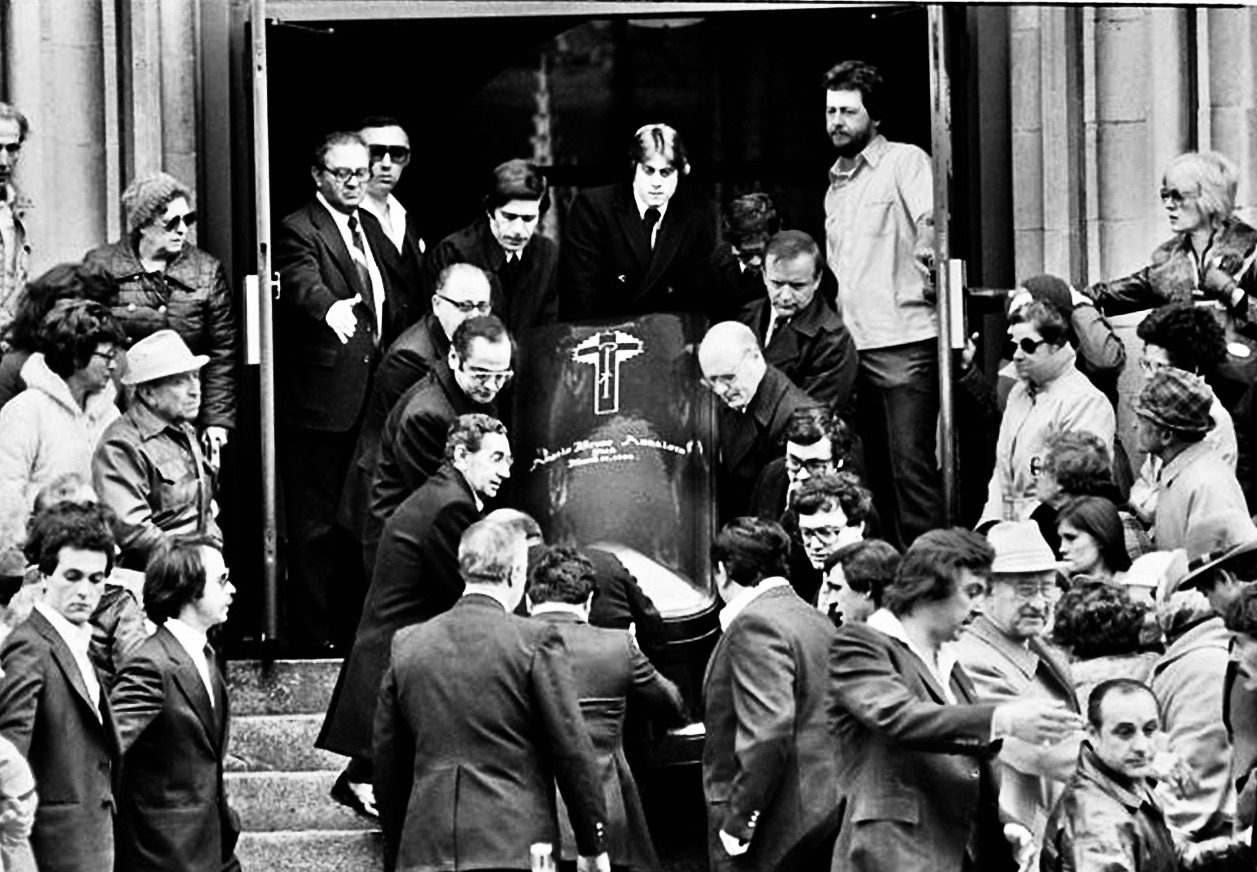
   The funeral was at Holy Rosary Church on Mayfield Rd. Even though many of Holy Rosary’s pioneer members were immigrant stone cutters, the church is built of brick. There are life-size statues of saints on top of the facade and the east corner is topped by a domed cupola. It was the first Italian parish in Cleveland.

   After the mass and the procession to the burying ground went its way, I was lingering at the base of the flight of stairs to the street. A tight-knit group of men in black suits were talking nearby. They were smoking cigars and cigarettes. There was a white gray cloud over their heads.

   “What’s the word on what happened?”

   “It was the niggers in Glenville. They stabbed him bad and then emptied a Saturday night special into his face. He was a mess.”

   “Anybody on it?”

   “Yeah, the coons are going to pay, first with what they stole from him, and then for what they did to him.”

   “Who’s on it?”

   “Shon is on it.”

   Shondor Birns was a gangster from the Little Caesar days. Even though he specialized in the numbers and loansharking, he was mostly an enforcer on the streets and back alleys. By the time he was 13 he already had a reputation for violence. The neighborhood toughs steered clear of him as somebody not to be fooled with. He lived by his wits and his fists. When he was arrested for the twentieth time as an adult and indicted as an enemy alien, he beat the rap, but the deportation order against him remained in play. No other country would admit him, however, so he stayed in Cleveland.

   Lou’s car and the loot he was carrying were lost and not found. I never found out if his confederates resolved the issue, whether Shondor Birns made anybody pay up, or not. By the mid-1970s homicides in Cleveland were setting records with more than 300 of them a year. Ten years earlier there had been about one murder a week, not one murder a day. There were too many of them going around to pay attention to what happened to Lou. I forgot about him and put his homeless dog out of my mind.

   The next winter was just as cold as the one before it and even snowier. I took Sly and the Family Stone for walks along Lake Erie, but we stayed on the shore. The Great Dane sniffed up the ice but thought better of it. He knew where he wasn’t wanted. He romped on the frozen beach and the dunes, instead, flailing up and down snow drifts. There was no sense in putting himself and me in harm’s way by setting foot on thin ice.

Ed Staskus posts stories on 147 Stanley Street http://www.147stanleystreet.com and Cleveland Ohio Daybook http://www.clevelandohiodaybook.com. To get the site’s monthly feature in your in-box click on “Follow.”

Time is Candy

Superman

By Ed Staskus

   Three hundred and sixty-four days of the year parents tell their children to never take candy from strangers. Then, on the last day of every October they dress those same children up in masks and weird costumes and tell them to go out on the streets at night and either threaten or beg strangers to give them candy.

   Halloween is traditionally a holiday observed on the eve of the Christian feast of All Hallows, or All Saints Day. In the Middle Ages it was believed that restless souls of the recently dead wandered during the year until All Saints Day, when their fate would be decided. All Hallows Eve was their last chance to get revenge on their enemies before entering the next world. Some people, fearing the consequences, would wear masks to disguise themselves.

   It wasn’t until the first decade of the 20th century that Halloween began to be celebrated in the United States and not until the 1930s that children began trick-or-treating. Since then costume parties, haunted house attractions, and watching horror films have also become popular.

   When I was a child Halloween was a special night after a long day filled with anticipation. My brother and sister and our friends and I couldn’t wait for nightfall to head out onto the dark streets and ring as many doorbells as we could.

   On the night of the last Halloween, postponed several days by thunderstorms, my wife and I and a neighbor sat out on our porch, on the top lip of the stairs, on a cold but dry night, with our cauldron of chocolate treats. We long ago learned that anything mostly chocolate was “the good stuff”.

   As we put fun-size Milky Ways and Kit Kats into plastic pumpkins, coffin containers, and grab-and-go pillowcases, we started asking some of the kids in cute spooky super hero disguises coming and going up and down our walk what they liked about Halloween.

   “The most fun is dressing up,” said one girl, dressed as the Material Girl. “I’m an 80s rock star. I love Madonna.”

   We wondered if she wasn’t chilly because of the weather.

   “I’m not cold,” she said. “I’m insulated.”

   One boy was a walking bundle of towels.

   “Some safety pins and a lot of old towels and you’re warm,” he said.

   We asked a puffed-up little boy in white what he was.

   “I’m a cloud!”

   “What is that on your pants?”

   “Lightning!”

   “What are those spots?”

   “Rain!”

   “Is that your mom?”

   “She’s a rainbow. We go together!”

   A girl dressed as a witch said she liked seeing other kids in costumes.

   “It’s a time for them to dress up like they’re not, to just be someone they never could be before.”

   Others take a minimalist approach. When we asked one boy why his friend wasn’t wearing a costume, he said, “See, he’s on his cell phone. He’s not wearing a costume because he’s a businessman.”

   Some children delight in the scary side of Halloween, the ghost stories, monsters, and gory special effects.

   “I like Halloween because it’s fun, “said a boy dressed in a Warrior Wasteland costume. “People scare you a lot. It’s so amazing. I just like the horror of it.”

   Other children take delight in seeing their heroes in the flesh.

   A stocky six-year-old in black pants, a red over-sized jacket, a red hat, and an enormous black mustache told us he was Super Mario.

   “Because I am,” he said. “My happy time, it was when I saw BATMAN! I love Halloween!”

   Another boy dressed as Spiderman said Halloween was fun because “Kids dress up!”

   “I like Spiderman because he’s red and white. If I was Spidey, I would sling my webbing and save all the people.”

   In an MSNBC poll, adults were asked what their favorite part of Halloween was. More than 50 percent said it was seeing little kids dressed in costumes, while just 10 percent said it was eating candy. Our own unscientific poll revealed the exact opposite. Nine out of ten kids told us it was all about the candy.

   “Candy is the best thing that ever happened to me on Halloween,” said someone in KISS regalia

   “It’s my favorite season. You get all the candy. I’m a vampire,” said a girl with bloody fangs.

   “They should have more Halloween weekends, and pass out a lot more candy,” said a boy dressed as a pirate, waving a rubber sword. “I would put it all in my treasure chest.”

   Many children walked the streets in groups, the smaller ones accompanied by their parents. But one teenager rode up alone on a bicycle, wearing a Beavis and Butt-Head latex mask. He jumped off his bike, which clattered to the ground, and ran up our walk. We tossed chocolate bars into his bag, asking him what he liked about Halloween. Sprinting back to his bike, he turned around and shouted,

   “Can’t talk, time is candy.”

   Our chocolate bars moved briskly all night, followed by the lollipops our neighbor had brought.

   “You just wolf down candy bars,” said a girl dressed as Fluff N Stuff, “but you can play with suckers, click them against your teeth.”

   I asked several children what were the least-liked least-desired treats they had gotten. Among the worst offenders were Mary Janes, Necco Wafers, and Christmas ribbon candy.

   “I don’t even know what Mary Janes are,” said a boy dressed as Luigi, in blue overalls, a hat two or three sizes too big, and white gloves.

   “They taste like molasses sawdust.”

   The worst offender, however, turned out to be money. Towards the end of the night, we ran out of candy, and since all we could see on the street were some stragglers, we gathered up our loose change to hand out rather than race to the corner store.

   A small girl dressed as Popstar Keira, with a tiara on her head, came bouncing up the stairs smiling. My wife put some dimes and nickels into her extended hand. The girl looked at the coins and then up at us. She threw the coins down stamped her feet and started crying.

   “I don’t want money! I want candy!”

   She refused to be consoled until we finally found a full-size Hershey bar in our kitchen and brought it out to her.

   After the streets were finally empty and Halloween was over, my wife and I popped a big bowl of popcorn and watched George Romero’s “Night of the Living Dead.” The moon was big and round and the sky clear. The last of the thunderstorms were past.

   When my wife, who had never seen the old black-and-white horror movie, finally realized what the zombies were after, she said, “Oh, man, it’s the undead trick-or-treating.”

Ed Staskus posts on 147 Stanley Street http://www.147stanleystreet.com and Made in Cleveland  http://www.clevelandohiodaybook.com. To get the site’s monthly feature in your in-box click on “Follow.”
Ball and Chain

By Ed Staskus

   It was wetter than not the front end of summer and too muddy to ride the single tracks in the Rocky River Reservation. It had rained or thunder stormed nine days the first fourteen days of July. One day two inches of rain fell. Instead, I rode my Specialized on the all-purpose trail and left my Schwinn hanging in the garage. The Schwinn was outfitted for dirt, with front shocks and a low stem. The Specialized was outfitted with road tires, knobby on the outside and smooth rolling on the flat side and had a higher stem. It made for better riding on asphalt.

   It made for even faster riding down Hogs Back Lane, which is the entryway off Riverside Dr. into the valley. Hogs Back is laid out on a steep shale hill. It’s about a half-mile to the bottom. When the shale slumps and slides, the two-lane surface crumbles, and it becomes essential to keep your eyes fixed on the road.

   Hunched over the handlebars I could hit 40 MPH going downhill, no problem, unless I feathered the brakes, which I did, lessening the chances of flying over the handlebars at 40 MPH. That would have been a problem, if not the end of me.

   I rode alone most of the time and especially that summer because my brother Rick was getting married. He said he didn’t have time to get on his bike anymore. “I’ve got a lot going on,” he explained. He had been married once before, but it only lasted 57 days. He was determined to make his next marriage work out for the better.

   “I don’t want him racing that crazy hill and crashing,” said his fiancée, Amy Brotherton. She was down on Hogs Back. She didn’t want a train wreck walking down the aisle at her side. She and Rick had met a few months earlier on a blind date. One thing led to another on the one-way street they were on.

   “You be careful, too,” my wife said watching me saddle up in the backyard. “I don’t want you wrecking, either.”

   The summer of 1995 was hot, in the high 80s when it wasn’t in the high 90s, and the air was humid and sluggish. I could have ridden the single tracks, since they had dried up, but I stayed on the all-purpose trails. Towards the end of one week, after getting home from work, I rode twelve miles out, almost all the way to Berea. It was on the way back that I passed a skinny man in a red helmet on a hybrid.

   Inside a few minutes the red helmet was behind me, drafting, but when I slowed down for a car at the crossroads to the entrance of Little Met, he slipped ahead when the car paused to let us go by. The trail goes up a long hill there and I finally caught up at the top.

   He tucked in behind me and we rode fast to where the trail zigzags through some curves, and to where he got sloppy. He tried to pass two young women on roller blades, except on an inside-out curve, and when a biker rode up on the other side, he had to slalom wide on the grass. At the end of the curve a ditch stretches away from the trail to the Valley Parkway, and he backtracked. I waited for him to catch up.

   “That was a good pace,” he said before I peeled away to go back home, while he kept going his own way. Pedaling up Hogs Back is a long hard slog, which is what I did, slog up the long hill. By the time I got close to the crest, I was on the verge of a standstill.

   The next day Rick and I rode downtown. He said he had an appointment for a haircut at Planet 10, on West 9th St., and wanted to ride there. On the way from Lakewood, we spun through Ohio City to Church Street. He pointed out an old church whose rectory had been converted into a recording studio. 

   “That’s where we’re having our reception,” he said. Amy was a sometime actress and singer. She had the looks and the voice. She made a living doing nails, since nailing roles in Cleveland wasn’t a paying proposition.

   They were getting married at St. Peter’s Episcopal Church instead of Our Lady of Perpetual Help, where my wife and I had gotten married. Rick was Lithuanian stock, just like me, but even though Amy was an atheist, her mother wasn’t and wanted her to be married in a church. Amy didn’t like the Lithuanian church in North Collinwood, so it was going to be St. Pete’s in Lakewood.

   We went south on West 25th St., crossed the bridge to Jacobs Field, and rode to the Warehouse District. The bride-to-be was still OK with Rick riding on city streets, but not any farther through the near east side, like I often did, to Cleveland Heights along Cedar Rd. She quashed that, stamping her foot.  

   “I don’t want him getting killed in Fairfax by any porch monkey,” she said.

   Rick pushed his bike into Planet 10’s lobby and I rode away, going my flaneur-like way. After zigzagging around downtown, on my way home, stopping at a narrow strip of grass beside the Hope Memorial Bridge, squeezing a drink from my water bottle, I watched a black woman with shopping bags easing herself down to the ground in front of an RTA sign. She looked up at me and smiled. She had crooked yellow teeth. She was probably going back to Fairfax, maybe thinking of killing Rick if he rode his bike past her house.

   I was standing outside my garage when Rick and Amy pulled up in her baby blue Ford Tempo. His bike was sticking out of the trunk, the trunk bungee corded. “Jerry screwed up Rick’s appointment,” she complained. “He’s so unprofessional.” She was mad. “That’s not how we do business at Artistiques.” It was her friend’s hair and nail salon.

   Planet Ten was owned and operated by a gay man named Jerry who was a junkie. He lived near Gordon Square where he could score smack in the blink of an eye. He was up-and-down on any given day. He was good with clippers and shears, though.

   It was mid-week before I rode back into the park and got on the dirt trails that branch off from the horse stables at Puritas Rd. They were dry where they were level, but they weren’t level over much. I had to ford a stream where a tree had fallen. I jumped some baby stumps, went sideways once, and when I got home got the outdoor hose and sprayed cold water on myself. It was a hot day.

   My wife and I drove to Amy’s bridal shower that weekend, which was at her best friend’s house in Avon Lake. She was a big-faced woman married to an Englishman who was a barge pilot. It was steamy as hell even though it was just barely August. I was sprawled across a leather sofa in the air-conditioned family room when I noticed a small dog on the coffee table. I couldn’t tell if it was a dog dead asleep or a dead dog who had been stuffed. When I reached for whatever the thing was, it snapped at my fingers.

   “You better watch out,” the bridesmaid said. “He’s blind, so he bites at everything.”

   I went for a ride after we got home. Twilight was turning to dusk by the time I got back. Snapper, our Maine Coon cat, came running out of the neighbor’s backyard. Just when I was ready to close the garage door, Rick pulled into the driveway.

   “Can I borrow your lawn mower?” he asked.

   “All right, but don’t break it.”

   My brother was notorious for either busting or never returning borrowed tools. He had Katie, Amy’s three-year-old, with him. I picked her up, held her upside down, and spun her by her heels in tight circles. When we were done, we talked about a nickname for her, finally settling on Skate.

   “It rhymes with Kate,” I said.

   She waved goodbye through the window of the car as Rick pulled out with the lawn mower. If the child hadn’t been with him, I wouldn’t have lent him the mower. That was probably why he brought her along.

   By mid-August cumulus clouds were dotting the sky and the weather was surprisingly cooler than it had been. I rode my Schwinn down Hogs Back and got off the all-purpose trail at Mastik Woods, veering onto the dirt track there. I rode the track for three miles and then double-backed on the horse trail. As I did, I noticed somebody was coming up.

   When he went by, I saw he was wearing a baseball cap instead of a helmet and was on a well-worn Trek. He was riding fast, and even though I followed him as best I could, I couldn’t catch him until he suddenly slowed down. I saw why when he pulled up. Horses were coming around a bend. We waited while the horses cantered past.

   The Trek turned to the right and rode into the trees toward the river and the single tracks on the bank. I followed him, bumping over ruts and logs and through thick underbrush, but soon lost sight of him. He pushed up the hill running along Big Met, then down, and as he came into the clear jumped onto the trail ahead of me. He had gone around and was riding faster than before. We sped through a thicket, then across a baseball field where he widened the gap by jumping a wood guardrail, something I couldn’t do, even if I tried as hard as I could. It would have ended badly. I went around. It went well enough.

   I thought I might catch the Trek on the Detroit Rd. climb out of the valley, except he climbed so fast I lost more ground. I finally caught up to him where he was waiting at a red light on Riverside Dr. We talked while I gulped air.

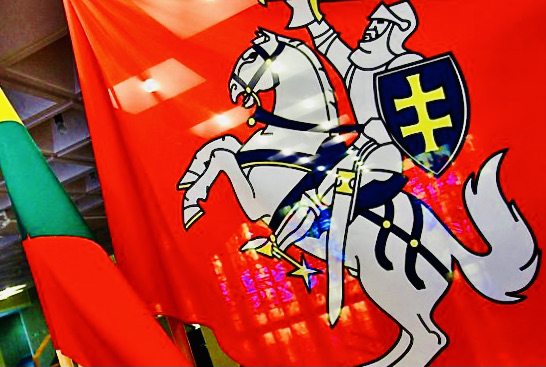
   “I wasn’t planning on doing much today, but it ended up being a fun ride,” he said. “I saw the Vytis decal on your fender,” he said. There was a red decal of the White Knight on my rear X-Blade fender. 

   “Not many people know what that is,” I said.

   “I know my Lithuanian heroes,” he said, waving goodbye.

   A week before the wedding my brother called and said JoJo was out as their maid of honor. She was Amy’s ex-friend-to-be who arranged the blind date with Rick when Amy had been on the prowl after her latest divorce. She was promised she could be maid of honor if the date led to anything. JoJo was a travel agent. Amy gave her a cash down payment for a Cancun honeymoon. But then the travel agency called and said they were getting anxious about the down payment, since they hadn’t received it, yet.

   When Rick telephoned JoJo, she said she hadn’t gotten any cash, but when Amy heard that she rushed to the phone. There was a long loud argument and JoJo somehow found the money. The honeymoon was back on, but Tammy had to at the last minute find another maid of honor. 

   The next day my brother called.

   “Are you going riding?” he asked.

   “I’m just going out the door,” I said.

   “I’ll be there in ten minutes. I need some fresh air.”

    I was working out the kinks in my lower back when Rick rode up the driveway.

   “Amy’s sick,” he said.

   “What’s wrong with her?”

   “Cramps. I think it’s nerves,” he said.

   “Let’s go,” I said.

   The sky was overcast and gusts from the southwest pushed us around as we rode Riverside Dr. on the rim of the valley. We glided down and rode single tracks. The dirt was late summer dried out and the ruts were bad, but we rode fast enough. My back wheel went in sketchy directions a few times. Rick held back. He didn’t want to face plant.

   “A little out of control there,” he said when we crossed over to a horse path and relaxed.

   “Maybe a little,” I said.

   “I want to make it to the altar in one piece,” he said.

   “Getting married can be risky business,” I said. “Take a look at you and Amy. You were married once, and it lasted for two months. Tammy’s been married twice. She’s got a kid by one of the husbands and a kid by somebody else. You might want to throw yourself down every downhill between now and the wedding day.”

   “I don’t think so,” he said, giving me an aggrieved look. 

   “Then the next best thing is to keep your eyes wide open before the wedding and half-shut afterwards.”

   Coming out of the park on a smooth stretch Rick suddenly slowed down ahead of me when I wasn’t looking. I got tangled up in his rear tire and went over the handlebars. I skinned my knee and put a dent in my helmet, but we were going too slow for much else to happen.

   “Crash test dummies!” a crow watching us from a tree branch squawked.

   I took me longer to put my derailleur chain, which had fallen off, back on than it did to get over my injuries. The chain was trapped against the frame. I had to loosen the rear wheel. I cleaned my greasy hands on some of last year’s fallen leaves.

   The morning of the big day, while my wife went shopping for a gift, I rode down into the valley. I felt good, but a strong crosswind was blowing, and I got tired. The bike felt sloppy, too. Going home I pushed hard because I didn’t want to be late for the show. When I finally got home, I found out I had been riding on a nearly flat back tire.

   Rick’s wedding went off without a hitch, but during the reception, when my wife was congratulating him, he made the shape of a handgun with his hand, with his index finger pressed to his temple.

   The next day I drove to Rick’s house with the gift we had forgotten to bring to the reception. Amy was lounging in the living room in a thick, white bathrobe, poring over Cancun brochures, and Skater Katie was in her pajama’s. While Rick and I talked in the kitchen doorway, Amy’s old dog limped up to me and licked the scrape on my knee.

   By the beginning of October, the park was yellow and maple red. I rode the all-purpose trail every other day. One Sunday morning my wife and I had breakfast at the Borderline Café down the street and went for a walk on the horse trails behind South Mastik. That night, while we were watching a movie on TV, Rick called.

   “I won’t be able to ride anymore,” he said.

   “Amy?” I asked.

   “No,” he said. “It’s my shoulder.”

   I had seen how he couldn’t lift his right arm above his head without trying hard.

   “After any ride,” he said, “any ride at all, bumps or no bumps, my shoulder is in a lot of pain. I’ve been taking Celebrex, but my doctor told me it’s rubbing bone on bone. There’s almost no cartilage left. He said sometime in the next couple of years, depending on how fast the rest of it goes, I’ll need a replacement shoulder.”

   “Oh, man!” I exclaimed.

   The last Saturday of the month was the last day of the year I rode in the valley. It was getting too wet and cold. I was adjusting the strap on my helmet when a gang of neighborhood boys and girls came walking up with rakes, brooms, and a wagon. They asked if they could rake our yard for $5.00. I said sure. They started pushing wet leaves into piles. The biggest of the girls walked up to me.

   “Mister, can I ask you something?” she said.

   “Sure,” I said.

   “That small boy,” she said pointing to a small boy. “He’s having a potty emergency.”

   I rang the doorbell for my wife, and she came outside, saying she would take care of the boy and supervise the raking. “Go before it gets dark,” she said. It was getting dark earlier and earlier.

   Where Hogs Back intersects with the Valley Parkway, I cut across a field and rode onto a single track. The path was littered with twigs and slapdash. A flock of honking Canadian geese went by overhead. I came around a quick bend and the branches of a fallen tree on the side of the track jabbed at my face. I swerved to the left and pulled on the brakes, jumping off the bike when the tree I was going to run into became the tree I ran into. I landed on my feet and the bike was all right when I picked it up.

   On the way home I rode on the road, instead of the all-purpose trail, hugging the shoulder’s white line. A man in a shiny new silver pick-up leaned on his horn behind me, and when he went past, tried to shrug me off the road, giving me his middle finger for good measure. Some people are sons of bitches. There’s no getting around it or doing anything about it. 

   At home I hosed off the Schwinn and hung it up in the garage. I checked the tires. They looked good, although I knew hanging upside down in the garage all winter long all the air would slowly seep out of them.

   I was going to miss riding with Rick, but when you ride with somebody else you have to wait until they’re as ready as you. When you ride by yourself you can go whenever your bike is spit polish lubricated and the tires look good. The White Knight had been a metalhead for crown and country, and even though his decal brought up my rear, going it alone is the real deal. Nobody wants to be alone, but sometimes you just need to be left alone.

   I did yoga at home that winter to give my lower back a break. I went to classes sometimes even though I couldn’t stand the pie in the sky talk. I had an indoor bike and pedaled on it. I would have to pump up my road bike tires again the coming April, before going back into the valley. When I did, I would keep my eyes on the road ahead, not looking back, daffodils blooming and turkey buzzards circling in the warming air, the springtime fine after a long cold winter on Lake Erie.

Ed Staskus posts stories on 147 Stanley Street http://www.147stanleystreet.com and Cleveland Daybook http://www.clevelandohiodaybook.com. To get the site’s monthly feature in your in-box click on “Follow.”

Kid Blast

By Ed Staskus

   I knew some bits and pieces about Dennis Kucinich, even though I had never met him. I knew what I knew because I was living in Cleveland, Ohio, and he was the mayor. He was the youngest mayor in the history of the city. He was the youngest mayor of any major American city. He was 31 years old but still looked milk-fed.

    I hadn’t voted for him. I never voted for anybody. I thought of myself as an anarchist. I wasn’t the bomb throwing kind though. I liked the idea of anarchism more than the risk-taking of anarchism. I wasn’t ready and willing to end up behind bars.

   The new mayor was born and bred in Cleveland, the oldest of seven children in a Catholic family. He was 23 years old when he won a seat on Cleveland’s city council. After he got a master’s degree from Case Western Reserve University, he ran for mayor in 1977. He surprised himself and everybody else when he won. When he did his troubles started and went on and on.

   Cleveland was a mess in 1977. A year earlier The Cleveland Plain Dealer splashed “Bombing Business Booming Here” across its front page. The old-school Italian families and the new-school Celtic Club were fighting it out for control of the rackets. Car bombs were the preferred ways and means of debate. All the evidence was usually blown to bits, which suited everybody involved, since they were all in. It didn’t suit the police, who were left out in the cold.

   The Bureau of Alcohol, Tobacco, and Firearms set up a new headquarters in town. When asked why they said since Cleveland was “Bomb City USA” they were obliged to do something about it. Within a year they doubled their staff.

   It wasn’t just bombs, either. Trash collection and street repairs were slipping fast. The parks were more litter and dopeheads than fun and games. Corporations and manufacturers were pulling up stakes. Racial polarization was staying put. Whites hated the busing that was coming and made sure everybody knew it. “We Say, No Way, No Bus for Us” is what their banners said. As the 1970s kicked off murders in the city set a record with 333 of them. Ten years earlier there had been 59. Environmentalists declared the Cuyahoga River dead and Lake Erie not far behind. The city lost a quarter of its population during the Me Decade. 

   The city didn’t lose me. I moved back to Cleveland after growing up in North Collinwood and Euclid. My parents didn’t like it. They believed in the American Dream and thought I was back tracking. They told me so from their suburban home. They thought the metropolis was a nightmare.

   I lived a block from Lakeshore Blvd. and two blocks from Lake Erie. Bratenahl was three blocks west. I rode the 39B bus through the posh village Monday through Friday on my way downtown to Cleveland State University. I always sat in the last row so that nobody could sit behind me. I didn’t have to worry about the swells, since they never rode the bus, but the same wasn’t true of some of my east side neighbors.

   Dennis Kucinich got started with a bang when he was elected in November. He championed the public good and made sure everybody understood he wasn’t going to auction off the city’s assets. He was sick and tired of corporate collusion and tax abatements. Everybody was sick and tired of the old mayor Ralph Perk. Dennis Kucinich was a breath of fresh air.

   It was snowing when he was inaugurated in January. It kept snowing and the new leader of the pack was forced to declare the metropolitan area a “disaster zone.” Before the month ended the city was hit with the worst blizzard in its history. Things went from bad to worse when he fired his police chief two months later.

   Dennis Kucinich had appointed Richard Hongisto, a former San Francisco sheriff, to be chief of police as soon as he became the mayor elect. It seemed like a smart choice, especially after the head honcho in blue saved a man from a snowbank during the Great Blizzard of 1978. He was acclaimed by the press and public as a man’s man.

   The mayor didn’t see it that way. When the police chief wouldn’t go along with his plans, which included rewarding his supporters with jobs, he charged him with insubordination. The chief responded by saying he wasn’t going to commit any “unethical acts.” On Easter weekend in front of live TV cameras the mayor fired his top cop. One thing led to another, and even though he was in a hole, he couldn’t stop digging. When business and civic leaders lost confidence in him, momentum grew for a recall election. When they started calling him Dennis the Menace the momentum became the real deal.

   I didn’t meet Terese Schaser until the late 1980s. It happened soon after I met her daughter, who was going to become my wife-to-be, although none of us knew it at the time. In 1978 Terese was living in Park Centre. She had left her husband and was making her way as a restaurateur. The twin 23-story downtown towers were less than ten years old, built with raw cement features in a Brutalist style, where the best people lived. Richard Hongisto lived in the same building as my mother-in-law in the making.

   She was in her mid-30s and getting on a roll. When she heard about the recall effort, she got behind it and helped roll the ball forward. She wasn’t much older than the boy mayor but believed he was an upstart, his inexperience getting in the way of his governing ability. Her friend the ex-police chief agreed with her. Neither of them gave a hoot about his populist philosophy.

   Cleveland was on the verge of default. Dennis Kucinich did the best he could to fend off his naysayers, but he was a Democrat, not a member of any intelligible political party. He shouldn’t have been allowed to deal with the devil in the first place. He was taking his lumps from all sides. Even his own city council was at his throat.

   He called them “a group of lunatics” and “a bunch of buffoons.” He said, “it’s hard to believe that so many people can be so stupid.” He added insult to injury by saying, “if they’re not stupid then they are crooked.” That summer he ordered more police patrols in the projects to counter rising crime. The police department refused to obey the order. Thirteen police were disciplined and suspended which led to a police strike. Among other things it was another first for the city.

   The Kucinich administration was making history right and left.

   When the weather warmed up Terese was in summer dresses and flat shoes helping with the recall petition. She had great legs from her dancing days. Towards the end of May the effort was short of the required signatures. She threw herself into the work explaining cajoling and demanding. She never got tired and wore people out. She had a big personality. Ten years later she wore me out. Her children ate cold cereal in the morning and cold leftovers at night. By the deadline of June 1st more than enough signatures had been gotten. 

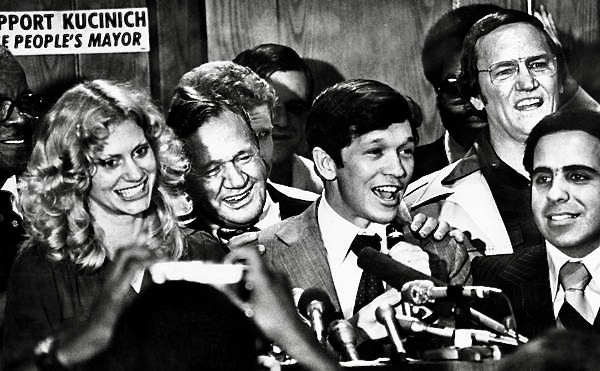
   The mayor refused to resign, saying “Bring on the recall.” He handed out bumper stickers saying, “Support Kucinich, the Peoples’ Mayor.” The people would have their say soon enough. Terese’s kids breathed a sigh of relief, but the hot meals didn’t last long. The recall election was scheduled for mid-August. The canvasser redoubled her efforts.

   She had pizzazz to spare and didn’t spare any of it during the recall campaign. She didn’t just rub two sticks together. She made sure one of them was a match. The lady lit a fire under everybody she talked to. Working on a political campaign means about half the electorate is going to hate you day in day out. She didn’t let it get her down. She had an agenda and a bogeyman. At night she made her plans for the next day while singing along to lurid Italian operas. 

   “My mother was an enthusiastic but terrible singer,” her daughter said.

   When Dennis Kucinich stalled on demands to sell Municipal Power, the city’s publicly owned electric utility, not only did lawyers get involved the Cleveland Mob got involved, too. They brought in a hit man from Maryland to shoot him during a parade. Nothing came of it when the mayor was hospitalized for a few days and missed the event. He never really liked parades, anyway. 

   As the recall campaign got into full swing, Council President George Forbes and Dennis Kucinich argued about the merits of building a new ore dock for Republic Steel, except their arguments had nothing to do with the ore dock.

   “Stick to the issue,” George Forbes said.

   “Mr. Chairman, I determine the issue,” Dennis Kucinich said.

   “Not in this chamber,” George Forbes retorted.

   “You will permit me to continue my remarks,” Dennis Kucinich said.

   “Just one moment,” George Forbes complained. 

   “You have no ability to censor my remarks,” Dennis Kucinich explained.

   George Forbes didn’t like that. His dark face got darker. He ordered the mayor’s microphone shut off. Dennis Kucinich and his aides stormed out. When all the hot air was said and done, Republic Steel walked away from Cleveland and built a new ore dock in Lorain.

   “The best and longest running show in town isn’t at Playhouse Square,” Roldo Bartimole, who wrote the newsletter Point of View, said. “It’s at Cleveland City Hall. The admission is free.”

   When recall day arrived more than 120,000 Clevelanders voted. Dennis Kucinich took a nap. He knew staying up wasn’t going to change the result if he lost. He also knew if he won, he had another tough day in front of him, and needed the rest. He prevailed by a margin of 236 votes. Terese’s kids ate well the next day when it was all over.

   Towards the end of the year Cleveland s banks refused to roll over the city’s debts. They assured the mayor it would be business as usual if they could do what they wanted with Municipal Power. He refused, and the city went into default, the first city since the Great Depression to find itself unable to meet its financial obligations.

   He lost his reelection bid in 1979. It was one and done. He wasn’t going to be the jackass in a hailstorm anymore. Everybody was sick and tired of confrontational politics. George Voinovich took his place. He got Cleveland going on the road to ‘The Comeback City.’ When the century came to an end historian Melvin Hollis put Dennis Kucinich on his list of ten worst big-city mayors of all time in his book “The American Mayor: The Best & Worst of the Big-City Leaders.”

   Terese remarried and moved to a corner apartment on an upper floor of Park Centre. The family barbecued on the balcony and watched the air show over Lake Erie every September. The Blue Angels cut the corner across their roof pirouetting back to Burke Lakefront Airport. She gave up governmental enthusiasms, concentrating on foodstuffs. She opened a restaurant and then another one. She worked as a pastry chef on both sides of town. She catered weddings and served food at funerals.

   At the end of the day, kicking back, she liked to paraphrase Mark Twain. “Suppose you were an idiot, and suppose you were a politician, but I repeat myself.” It always got a big laugh over dessert, especially when she added, “Put them in charge of the Sahara Desert and in a couple of years there will be a shortage of sand.”

   I moved to Lakewood, Cleveland’s second-oldest suburb on its western border. The town’s mayor kept his nose to the grindstone, focusing on safety, schools, and city services.  They weren’t running out of sand anytime soon.

Ed Staskus posts stories on 147 Stanley Street http://www.147stanleystreet.com and Cleveland Daybook http://www.clevelandohiodaybook.com. To get the site’s monthly feature in your in-box click on “Follow.”
Esme, Beforehand Then Later

woman-screaming

By Ed Staskus

There’s not much here. Nikki is up to her ears in after-wedding plans and I am all adjusted to my new little life. It is not so bad, except for my job, of course. There is something about dumb jobs and me.

Brent has taken an intern position for the summer in Milwaukee at the Miller Brewing Company. It is exciting for him. He will be in Marketing. I’ve heard Milwaukee is beautiful, so we shall see. It is five hours from here, so my guess is we will be spending many, many weekends in Chicago.

Is there anything new with you and Vera?

Irene filled me in on the brouhaha. Skip is a bastard! My God, stealing a $10 thousand dollar order, that is insane! I would go nuts on him, and Kenny, too. He’s supposed to step in. He is the Sales Manager, or is he that just because he’s Cathy’s brother? Let me see…

Doesn’t Skip have a conscience? Or did he skip out on that? I would rest easy knowing that Tammy is probably soaking him for that money as we speak! Soaking him so she can soak up the blended bourbon!

Poor Brian. He shouldn’t have done it because he’s not that smart, and it was all such crappy small change, anyway. Isn’t he Carol’s brother and Kenny’s brother-in-law? That is strange, since he was part of the clan. So much incest! But, he deserves to steal, as I see it. Cathy and Dave should be put behind bars for what they pay people. It is a crime. I totally bet if someone did an investigation on their efficiencies and pay scale it would be interesting, and you all would get raises, except for Maggie.

She shouldn’t be able to afford a freaky Lexus. I can’t afford anything!

After working for a big company it is easy to see how self-serving Cathy and Dave were. I am now in that situation again at a small company. It is funny how things go in a circle.

I am a Marketing Manager at Keter. We manufacture cabinets and shelves. I hate it here. My superiors are Israeli. They are in Israel and do not care what I recommend or ask for. I have no action. My boss hates me. That is funny. I do probably twice as much as I did at your place, but not a quarter as much as I did at Glidden.

Glidden has turned out to be the boyfriend that dumped me and the one that I can’t seem to get over. I wish I could go home. It’s too bad, really.

Brent and I are watching a movie tonight with Brie and grapes and wine. We are having some alone time. I had an interview yesterday for a job I know I won’t get and Brent is stressing about school and the National Guard. It makes both of us rather large assholes. So, tonight we have to be nice to each other.

I woke up the other day feeling something bad was going to happen. I had two flights to North Carolina and some cab rides, but my first flight was delayed which made me miss my other flight. Nothing went right that day.

Brent left last week for Milwaukee. So far he loves it, so that is promising. They seem to be schmoozing him by taking him to baseball games and fishing. We will see if this turns into a job offer. Milwaukee wouldn’t be so bad. I hear it is kind of cool there.

I am bored out of my mind. Brent is gone. At least I am in school and I have one friend. School is hard for me now, not like when I was in school before. It takes up a lot of time, probably because there’s a math class. I got an A last semester, so that is good.

I am working on managerial accounting. I wonder if I know more than Carol, yet?

Hehehehe…

Later!

I accidentally kicked a blind woman’s cane out of her hand. I was crossing a plaza going to a class at school. There were a bunch of smokers and one of them flicked his butt away. What a disgusting habit! I didn’t see the blind lady because I looked at the butt, but then there she was, crossing my path.

Before I knew it my leg hit her cane and it went flying. She stopped dead, but before I could do anything, one of the smokers rushed over to the cane and gave it back to the empty-handed blind woman. The smoker gave me a dirty look on top of everything. Sometimes things are so unfair.

I quit my job, which is a really bad idea financially, but a great idea mentally. My boss was a prick, and that is being kind and sweet about the situation.

He had me doing his Fed-xing and presentations. I wasn’t allowed to think on my own, just do his administrative work. Brent and I are both students now. I am halfway through my MBA and I think my time will be better spent finishing school than being some a-hole’s secretary.

We are going to leave here next summer. I will be done with school. It’s been good, but a little slow. All my knowledge is being called upon and the bits and pieces I forget are coming back to kick me in the butt. We will be in a great amount of debt when I’m done, but at least I will be done.

We are planning on going to Jamaica in a few weeks for a few weeks. I can’t wait.

We went to Jamaica! We stayed in a resort called Sans Souci, which means without cares. I got four free spa treatments and free manicures and free pedicures and it was all we could eat and drink. We did a ton of eating and drinking. Brent scuba’d and we went kayaking. We had a blast. I hadn’t a care.

It now seems like a way distant memory.

Brent got an offer letter from the Miller Brewing Company, which means we will officially not be living in my mother’s basement next year, as previously feared. I have a few recruiters that have told me all I have to do is tell them the location and they will find me a job. It will most likely be Milwaukee, since that is where Miller is, but hopefully Chicago, or even Columbus. We will know by January.

I have made a few of my recruiters look really good. I will have to call on some favors soon.

Later!

Yes, we’ll see you and Vera this weekend. Although that restaurant looks amazing, is there somewhere else, maybe a little more in our student price range that we could go to? I don’t think we can afford that. I am such a loser, I know. Maybe something more casual? Sorry for sounding like a cheap ass. It is really hard to be so poor. We are not good at it!

So Vera gave you shit about saying something about my hair. I don’t care. I love gossip. So much is going on here and none of it is good. I am going to tell you for the mere fact I hope it doesn’t come true.

Brent got orders to go back to Afghanistan two weeks after he was supposed to start at Millers. It’s OK financially because Millers supports this kind of stuff and he will have his job after twelve months of bullshit! Doesn’t that suck! Things always suck!

Anyway, on a lighter note, I only have ten more weeks of class. Brent was done yesterday and graduated with high honors. I am so irritated that I can’t stop telling everybody about our stupid situation. My professors think I’m nuts.

Things have been getting away from me. School is so boring and I have sunburn. I wish we were going to be in a house this fall, but probably not. I keep waiting for one of those days when I will have excellent news.

We did get a dog. He’s a boxer puppy and his name is George. He’s to keep me entertained while Brent is away.

We still don’t know when exactly he will be leaving for Stansville. In the meantime he is working at Millers. My trying to find a job is a total pain. I think I might have to open up my search soon, maybe around Chicago. It’s more land to possibly employ me.

As of next month Brent will officially belong AGAIN to the Army. He is being officially deployed to Afghanistan – AAARRGGHH – for one year after his seven weeks of training. This comes as a slight shock to us as he submitted his official paperwork to leave the National Guard in February. He is the victim of BAD paperwork!

We have done everything we can to get this changed, but are about 98% sure he is going, as the Guard does not seem at all concerned that his paperwork was submitted twelve weeks before his notice to be deployed. They do not have any type of precedence policy.

I am sad – read that as irate. This is not what we had envisioned for this year. However, my plan is the same. I am still going to move to Milwaukee, unless anyone knows of a contract position in Cleveland lasting one year – just checking. Our plan is to still get a house. I will work and volunteer, and most likely get certified to teach spinning classes, to keep me busy.

I will also be attending some sort of therapy weekly, meaning read trips to the spa, to keep me sane.

Brent’s been gone for months and I’m going to my mom’s for X-mess. I need yoga, bad, but my gym doesn’t offer it when I can make it. It’s really the way to go, cleanses the body of toxins, and keeps you sane. Maybe I will try to find a class, even though working out seems to be the one thing I keep pushing off to do other things, like spend time with my dog.

It’s unbelievable that it’s another New Year already. Thanks for dinner, seeing you and Vera was great, and thanks for the marshmallows and the pictures of the woman humping a dragon and then having little dragon babies. They are sure to be conversation pieces.

My mom and I were baffled for a minute. Mom thought I should cover up the nipples. I am too immature for these pictures, but I think you knew that.

Hehehehe…

The marshmallows were awesome. Later!

Ed Staskus posts stories on 147 Stanley Street http://www.147stanleystreet.com and Cleveland Ohio Daybook http://www.clevelandohiodaybook.com. To get the site’s monthly feature in your in-box click on “Follow.”

Midwestern Gal (At the Borderline)

302197_286139388074492_784323773_n-e1571240666757.jpg

By Ed Staskus

Backstage at the Winchester, a former bowling alley made over into a music hall, Anne DeChant reviewed the play list with her band. Then she double-checked one last time with Kelly Wright, her longtime back-up singer, and the show was a go.

Outside the hall it was wet and windy and November. Onstage the band was in fine form, by turns soulful and jamming, playing a mix-up of old and new material. Most of it was from Anne DeChant’s emotive ‘Swing’. It was a honky-tonk medley of blue-collar country songs. One of them was about losing your trailer to a twister.

If music is a river of sound streaming to the soul for the fostering of its virtue, then the Winchester Bar and Grill on the gritty east end of Lakewood, Ohio, was transformed that Friday night into a chapel of goodness.

“Now there’s a woman with a fire in her belly,” is how the Cleveland Plain Dealer has described DeChant and her band.

LA-born but Ohio-bred, Kelly Wright was both the mirror to Anne’s lead and expansive in her own right. Sometimes the best mirrors are old friends.  ‘Swing’ was her third collaboration with Anne, a collaboration stretching back more than ten years.

“I have lots of choices as far as vocalists go,” said Anne, an Avon Lake, Ohio, native transplanted to Music City and back. She is a 5-time winner of Cleveland’s Best Singer/Songwriter award. “But, my choice for support vocals is in Cleveland.”

“It was supposed to be a one-gig thing,” said Kelly.

When the Cleveland-based folk group Odd Girl Out broke up in the mid-90s, its lead singer Anne DeChant embarked on a solo career. When she needed someone to do backing vocals on her ‘Something of the Soul’ in 1999, one of the former singers in the band recommended Kelly Wright.

“I knew her in high school, so when she recommended me to Anne, it all came full circle,” said Kelly.

Kelly Wright’s father hails from Pennsylvania and her mother from Michigan. They met in California in 1967. “They both wanted to go to California to get away from their families. My dad joined the army and my mom went to nursing school.

“But, they always wanted to come back to the Midwest. My dad learned how to weld in the army so when he ended up in Cleveland he opened a welding shop.”

Lakewood-raised since fifth grade, Kelly was a freshman at Lakewood High School before breaking into song. She commuted to school with a neighbor. “This girl started picking me up to take me to school since she lived right on my block.” One morning she tagged along to her friend’s audition for Roadshow, the school’s Downbeat Magazine award-winning vocal jazz ensemble.

“I was just sitting there doing the homework I had sloughed off the night before, and the director asked, aren’t you going to audition, and I said, no, no, I only know campfire singing. But, in the end I auditioned, and I made it, and my friend did not. It was the last time I got a ride from her, but it was the start of music for me. It changed my whole life.”

She never stopped singing in high school.

“It was a great program, I got to travel with Roadshow, and we made a record every year.” She later attended Akron University on a music scholarship. “I was not very good at the scholastic, so I never finished college.” She went to a broadcasting school and became a DJ. But, she gave up spinning records and singing to open the Borderline Café in 1994 with her culinary school-trained sister Carrie.

“This is all I did for a long time,” said Kelly “Even now I still wait the tables, pour the coffee, and pretty much do all the talking. I’m exactly like my dad, hell, yeah. I tell everybody what to do. I think I’m the boss, but Carrie is really the heart and soul of Borderline.”

Kelly’s younger sister Carrie is a graduate of the College of Culinary Arts at Johnson & Wales University in Rhode Island. Two women founded the school in 1914. They had one student and one typewriter their first year.

The culinary program was created in 1973. Since then the school has graduated Emeril Lagasse, Michelle Bernstein, and Tyler Florence, among others. It has been featured on the Food Network and recently three of the school’s alumni challenged and beat celebrity chefs on the Iron Chefs television series.

The Borderline Café is a breakfast-only diner on Lakewood’s west end. Outfitted with ten, maybe twelve, tables, the walls are painted a peach yellow and “suns coming up, I got cakes on the griddle,” among other John Denver lyrics, gambol over the walls.

It’s been said breakfast is the most important meal and skipping it might be the worst thing anybody can do first thing in the morning. The good thing about having a hearty breakfast is you’re not going to be starving by lunch. The eggs Benedict and pancakes at the Borderline are famous for keeping hunger at bay.

Scene Magazine has voted the Borderline Cafe one of the ‘Best Pancake Spots in Cleveland’.

“It’s the best breakfast place in town and all immediately surrounding towns,” said one patron, washing his stack down with coffee.

“The two of them are good together,” said Colleen Wright, their mother who commutes from Marblehead more than an hour away and pitches in at the diner on busy weekends. “Kelly remembers everybody’s name. They all come to talk to her.”

“I’m always the one goofing off,” said Kelly, “but I’ve come around as I’ve gotten older.”

“She’s a brat, but she’s got a heart of gold.”

“Thanks, mama, that’s nice.”

Kelly Wright was bartending and singing on Kelly’s Island, a Lake Erie vacation destination west of Cleveland, and her sister Carrie was finishing up her degree at Johnson & Wales, when their father, Don Wright, offered to help them buy the greasy spoon that would become the Borderline.

“He wanted to get both of us closer to the family, maybe so he could keep his eye on us,” said Kelly.

“My husband thought we’d never see that money again,” said Colleen Wright, “but they paid us back every penny. They work hard at this.”

Noted for its fresh food, inventive seasonings, and Southwestern-inspired twist on traditional morning fare, the cozy and often overflowing diner is roundly considered to be more than worth the wait.

“The food is some of the best I’ve had anywhere,” said a man from Ravenna, fifty miles southeast of Lakewood. “The first time we ate here we went right in. The second time we waited in a line outside.”

“If there’s a wait you have to stand in line,” said a local man standing in line. “They don’t take names.”

“Not your ordinary breakfast,” said a woman visiting Cleveland from Pittsburgh.

“Everything Carrie makes is fresh,” said Kelly. “Nothing comes out of a zip lock bag or frozen. There are as many local products as we can find. Those eggs are cracked exactly when you order your omelets.

“The people who eat here are a lot of everybody, mostly from the neighborhood. They know it’s going to be real food made exactly the way they like it. They’re very patient, too, because sometimes you stand out there, finally get a seat, and we still have to get you your breakfast.”

Kelly lives a stone’s throw from the Borderline. “The older I get and the more gigs I play, I had to move closer to work because I was getting here later and later. I could throw a rock from our dumpster out back and hit my house.”

A single woman twice over, she lives alone. “I was in a gay relationship for nine years, but I lost that gene. I don’t know what happened. I stopped being gay.” After breaking up with her partner and selling their house, she married a man she had known in high school.

“But, I was not good at that,” she said. “It lasted for about three weeks, although we’re still friends.”

Performing with Anne DeChant has taken Kelly coast-to-coast, from New York City to clubs in California. “I’ve played everywhere with Anne,” she said. “It was a weird late-in-life kind of youth, joining the band when I was thirty-three. I thought I could be a kid again. It has led to many great things for me.”

Although she still tours, her priorities have shifted back to her family and the Borderline Café. “That was a bump in the road for this place,” she said, “because it put a lot of responsibility on my sister. I risked the wrath of my dad, too. I don’t take every gig out of town anymore. I try to be a good partner to Carrie.”

Nevertheless, Kelly continues working with Anne DeChant, recording in Nashville, as well as playing guitar and singing in an acoustic combo at summer spots. She is also the voice of a jazz duo often heard at Brothers Lounge on Cleveland’s west side.

In addition, she is involved with the Ohio City Singers, an all-star cast of Cleveland-area musicians including a choral group and sometimes featuring more than thirty vocalists, musicians, and their family and friends.

“It’s all the guys from local indie bands, like Chris Allen of Rosavelt and Doug McKean of the Stuntmen,” Kelly said. ”They write original rock-and-roll Christmas tunes and we do a big show every year.”

The Ohio City Singer carols aren’t the kind of carols Bing Crosby sang, nor are they the kind heard in the background at shopping malls. More than 300 revelers packed the Around the Corner Saloon in Lakewood on an icy afternoon when the group in Blues Brothers-style steamed up the windows. They have brought their raucous holiday jams to Cleveland’s Stone Mad Pub, Music Box Supper Club, and House of Blues.

“How I got started in music was an accident, like many of the things in my life,” said Kelly. “Music was a great part of school for me and I am forever in debt to my first teacher. I never actually knew I could sing. It really did change my life.”

At Christmastime the Ohio City Singers and Kelly Wright perform at several outdoor venues, like the Holiday Circlefest on Wade Oval in University Circle and Light Up Lakewood. Even if it’s cold and blustery, or some flakes fall, or there’s a snowstorm, as will happen in winter on the North Coast, Kelly doesn’t mind.

“I’ve bopped around a little bit, although I don’t travel very much anymore. I’ve lived here my whole life, for the most part,” she said. “I love this neighborhood. I’m not good with just two seasons. The Midwest is better for me. I’m a big gal. I like to layer, so I love it here.”

And at the end of the day, after belting out tunes outside at Light Up Lakewood, she can always slip back down the street inside to the Borderline Café, strip off the layers and wrap her hands around a steaming cup of hot joe.

Ed Staskus posts stories on 147 Stanley Street http://www.147stanleystreet.com and Cleveland Ohio Daybook http://www.clevelandohiodaybook.com. To get the site’s monthly feature in your in-box click on “Follow.”

When Esme Got Married

Stephanie and Joe's wedding at Casa Golondrinas in La Manzanilla, Mexico.

By Ed Staskus

Check this out. It’s just the New Year now and I lost my job.

They re-organized the place and I got let go. I am really bitter since I left there for here. The good news is a headhunter has to help me and I got three months pay to enjoy myself. I’ve gone to Hawaii. Yup, it’s January and I’m here for more than a month and Brent’s coming next week.

Later!

San Francisco is very fun, little bars and clubs, like the movies, even the ratty neighborhoods, like the Mission. I am not complaining until I run out of money. I have two months.

Hehehehe…

I have sent out some resumes and talked about a job in Milwaukee. It’s the same as I was doing, except it’s a start-up. I’ll be back home at the end of February and then I am moving out. I’ll move in with my mother for a while, at least until Brent is back.

I am finally moving! I will be leaving for Indianapolis on Sunday. This week is flying by! There is so much to do. No, I do not have a job. We will be living with Brent’s sister for a month until we are on our own. If you feel like visiting Hoosierville, I think they did well in basketball this year.

Don’t forget me.

Things are crazy here. Moving is a huge pain. Brent and I got a three-bedroom, two-bath apartment right on the highway, which is good since it looks like I might be working in Indianapolis, which is an hour away. Not having a job still blows. I am lucky I haven’t gotten fatter, or anything like that. I am definitely less high maintenance than I was before.

Things in the wedding area are about finished, only a few details to nail down. Are you guys planning on coming?

I miss you all very much. I know I have been crappy, but now that I am settled in Indianapolis I will be much better. If you get any calls, please say nice things about me. I have been interviewing, so hopefully something will break, more on that later. Please send gossip. I am dying out here. Must…have…gossip!

Brent is good, although he is missing both Hawaii and the Army, but not Afghanistan so much. He is not working either, yet, because he is in the National Guard and has to go away for two weeks next Saturday. I am sorry Bob and Jan aren’t happy. That place was too negative for me. Maggie and Cathy? Yikes! How do you stand it? I saw John at a bar and he was friendly. I always liked him the most out of that dysfunctional clan. Speaking of dysfunctional, how is Skip? Brent’s brother-in-law displays similar personality traits.

Blah!

Hey! What is going on? I haven’t seen you guys in sooo long! How has everything been? I still have no job. It totally freaks me out. There are some prospects, so hopefully not much longer for this crap. Brent might be called up for that homeland stuff. We really want him to because you get paid to guard an airport and he wouldn’t even have to do that! He would just organize the people. Then he could get state tuition for Indiana U. Wedding invitations are going out soon. Keep your eyes peeled!

Later!

Things are busy, although I am not sure how. I am sending out wedding invitations any day now. I hope you can come. I think it will be fun. If not, it is always free food.

All of our church requirements are done and we have registered for gifts. That sucks the fun out of shopping. The final fitting for my dress is next Friday. I will be in town then, but Brent’s mom will be here, too. Brent will be in Montana fishing, so I can’t really hang out. How are the mean people you work for? Bob said Cathy had another baby. Yuck. None for me, thanks!

See you soon!

What is going on? Did you get the wedding invitation? Are you planning on coming? I hope so. We’d love to see you guys there. Hopefully you can make it. I hope there aren’t any trade shows that weekend. I still have no job. I am a loser. Things are getting better, though, I think.

Is anything new going on? Keep in touch!

Hey! Didn’t you and Vera get the wedding invitation? You ARE coming, right? I am not going to be home much until the wedding, but I am definitely looking forward to seeing you there. Thanks for the massage salon gift. It works for me as long as Dick isn’t giving it!

Hehehehe…

I am evil, I know. Make sure you send back your response card soon! I am so excited to see you guys!

OK! I am finally employed!

I am going to be a marketing manager for a company called Keter Plastics. They make the same kind of things that Rubbermaid makes. They are in Costco, Walmart, and Lowes. Their latest venture is with Black and Decker and I will be working a lot with them. Yippee! I have no idea when I start and a limited idea of the money involved, but I do not think I care anymore. Yippee! It was my second choice job. My first choice was Delta Faucet, but their new department won’t begin until late October and I can’t wait that long! Now I can shop!

I am so excited!

Hey! My mom got your reply today! I am so glad you guys are coming. I am getting so excited. Make sure you come to the church. I think it will be nice. We are going to have a place for everyone to go for appetizers between the church and the reception. Medina is full of little coffee shops and pubs. It should be a fun day.

Yippee!

I am glad to see you and Vera are coming to the wedding. I think I am going to stop into your work on Thursday to say hi. I haven’t seen you in ages and I will be in the area picking up my dress from Coming Attractions in Lorain. OK, it is not exactly the area. Anyhow, do you guys want to adopt Brent? We decided his family sucks and he is looking for a new family. You don’t have any kids and he is potty-trained for the most part. He just needs a better family. OK, so all families suck, but his is really bad. His sister isn’t coming to the wedding because it might stress out her babies. She is the first woman to ever have a baby.

Sense the sarcasm!

So, think about adopting Brent.

Oh my! I am so busy. Blah! I am planning on stopping in to say hi sometime before the wedding. I need to know how everything is. Is Maggie still in the front office? Can you unlock the back door for me? I can’t believe it is July and two weeks away. I am dying! How fun!

Hey, would it be possible for me to stop in and say hello on Thursday at your work? I am coming home Wednesday night and would like to say hi to everyone before all the chaos of the wedding. Tell Bob and Jan, but don’t say anything to Cathy and Maggie.

I come in next Wednesday night, so basically Thursday morning. I have an appointment to get waxed, ouch, at 9 AM. At least I am hoping to have it then.

Later!

Whoever is in the mood to hang out at Friday’s in Strongsville on Thursday, let me know. I have a ton of wedding high maintenance girl stuff to do that day, like getting my ass waxed. Oh, wait, I mean my back. I will need a drink by the end of the night, and a smoke, and some fattening food. Let me know if you are interested so I can call ahead and get a table. If no one wants to go I will be embarrassed, but that is OK, too. You already have to see me this weekend!

Holy shit, you are busy. You are flying back from the Chicago trade show for my wedding? That is hilarious. I am sorry. You didn’t have to! That is so cool, though. I hope it is not too much of a pain for you to come back. At least it is a cheap flight. Cathy is probably so annoyed!

So, all the mean people have lots of babies. Maggie is driving a Lexus, oh, God! Where do I start the jokes? She is not the type. You can’t have a Lexus and look like you are from the 80s. I want to rip on Maggie so bad. Too easy, though… I don’t want to bring on that bad karma. When is Maggie having a brat of her own? Cathy and Dave suck. She is mean, he is oblivious, but at least he is nice. He made that place tolerable.

My life is nuts. We are going to Chicago next weekend for our “honeymoon.” We only have two days. We are staying at the Crowne Plaza, the same one we all stayed at for the trade show. Remember that place with the velvety drapes? You all got rooms with Jacuzzi’s, except me. I am so excited! I really appreciate you coming home to see us get married.

I can’t wait to see you guys. I really appreciate you ditching that fishy trade show to see me get hitched. That is so great! See you on Saturday. I am leaving work now.

My friends totally loved you. I hope you and Vera had a good time. I was so busy I didn’t get to talk to you more. It is sooo hard to do anything you actually want to do when there are a hundred people who want to be around you. Usually no one wants to be around me!

Hehehehe…

Thank you so much for coming. I hope it was worth the trip!

Did you and Vera have fun at the wedding? My friends thought you were hilarious. I wish someone would come to this cornfield. How is work? When are you leaving there? Is it any day now? Kristin told me she told you how miserable I was when I worked there. Nothing like airing dirty laundry! Sorry if you had to listen.

We went house shopping this weekend. Now I am sick. I don’t think the two are related. It’s wet and cold here. Houses are so fun to look at.

Not much is going on here. Brent is getting great grades at Indiana. He is in the top third of his class and getting recruited from companies like Proctor and Gamble, Miller Brewing, his favorite, and Kraft. He is happy.

Me, on the other hand, I am hating life. I am one of those people who let one thing get them down. I hate my job and do just about nothing all day, which gives me plenty of time to think about how much I hate my job. I have made a few friends, which makes things easier. My best friend is a lawyer and she hates her job, too, so we laugh a lot and make fun of Hoosierville. I am taking classes again, for my MBA, after a year hiatus, seeing as I had no income for most of the year.

Hopefully it will get me out of this hellish job.

Married life is fun. Brent and I do a lot of poor people things together. We have fun inventing things to do, although we are much better at it when we have money. Nikki, my old roommate and best friend, you met her a few times, is getting married right after the New Year, or maybe in the spring, That is the next thing I am looking forward to. I am excited to be the one not getting married.

I am getting pretty adjusted to my new little life.

Is there anything new with you? 

Ed Staskus posts stories on 147 Stanley Street http://www.147stanleystreet.com and Cleveland Ohio Daybook http://www.clevelandohiodaybook.com. To get the site’s monthly feature in your in-box click on “Follow.”
Slap Happy

71571,1300122962,schuhplattler-500

By Ed Staskus

By all accounts Ryan Woidke seems to be a normal 19-year-old born and bred in Lakewood, Ohio, where he still lives on weekends while in his second year at Kent State University. A graduate of Lakewood High School now majoring in Criminal Justice, trim and athletic, a full-time academic with two part-time jobs, he blends in with most other backpacking students.

Except on Friday nights, when he changes his t-shirt and blue jeans for deer-hide leather shorts, wide embroidered suspenders, a white cotton shirt, a green wool hat with a grouse feather ornament, knee socks, and black shoes with thick two-inch heels and cleats as big as horseshoes.

Once transformed he goes shoe slapping at the Donauschwaben German-American Cultural Center in Olmsted Township on Cleveland’s southwest side. The shoe slap dance is schuhplattler.

The Donauschwaben are the Danube Swabians of Eastern Europe, a German people who colonized parts of the Austro-Hungarian Empire along the Danube River in the 18th century. After WWI their lands were parceled out to Romania, Yugoslavia, and Hungary. After WWII most fled their farms and towns when faced with the advance of the Iron Curtain. Many relocated to Ohio, to Cincinnati, Akron, and Cleveland.

The Donauschwaben have a Coat of Arms. It is made of a German Eagle on top and a fortress below. The eagle is black and the fortress towers are between a sun, symbolizing the rise of Christianity, and a crescent moon, symbolizing the setting of Islam.

“What happened was that in my freshman year at Lakewood High one of my best friends asked me to help serve dinner at their winter dance event,” said Mr. Woidke. “Later on he invited me to a practice, and, of course, when you show up they start making you dance. I was hooked on it right away.”

Schuhplattler, or hitting the shoe, as it is called, is native to the mountainous regions of Bavaria and Tyrolean areas of Germany, in which women spin around their partners or simply spin in place and men execute a syncopated series of loud slaps on lederhosen-clad legs and soles of their shoes.

Between slaps men and women both waltz to the accompaniment of accordions, sometimes three or four or more of them, a wall of wheezy but smooth sound ranging from very soft to very loud.

Accordions are assembled with wax and the best ones are always fully handmade.

“I had never danced before,” said Mr. Woidke. “I don’t know if I have plattle or not, but at least for this I do.”

Rhythm is known as plattle in schuhplattler circles.

Schuhplattling requires flexibility, stamina, and unity of the group, so that the slapping isn’t just loud only, but is one loud slap in concert. Men slap themselves on the knees, thighs, and feet. Traditionally a courtship dance, a means to attract the opposite sex, it became a way to showcase the agility and strength of men and a spectacle to dazzle women.

Watschenplattle is a variation of schuhplattle. During the slap dancing men smack each other firmly on the butt in addition to everywhere else.

Schuhplattler is almost a millennium old, first described in 1050. In modern times washing one’s hands afterwards, especially if watschenplattling, has become a rite before starting up any other courtship-like activities.

“Some of us are younger and have the endurance for it,” said Mr. Woidke. “Others are in their 50s, but they’ve been doing it since they were little kids, so they’re used to it.”

Schuhplattling originally came to Cleveland in the early 1920s when four couples toured the city demonstrating the European folk dance at civic functions. The dance group Schuhplattler und Trachtenverien, better known as STV Bavaria, was formed in the mid-60s and today thrives with more than a hundred members, ranging in age from 7 to 70.

“Many of our young adults grew up within the club, but Ryan came to us as a teenager,” said Paul Beargie, vice-president of STV Bavaria and a long-time Lakewood resident.

“He has taken to the dance and fully immersed himself in the culture. It is encouraging to see his enthusiasm to learn and pass on what he has learned.”

Five years of weekly practices, competitions, and cultural events have immersed Ryan Woidke in the history and customs of his adopted Bavarian Alps and the dancing that dates back 40 generations.

“Ryan is more than a dancer,” said Kenny Ott, president of STV Bavaria. “He’s second-in-command of the men’s teaching. He’s a young man who has stepped up and assumed a role of responsibility, perpetuating the culture for at least another generation.”

One of four dance directors for the group, Ryan Woidke brings a young man’s energy to the thousand-year-old tradition.

“I’m at the point where they can show me five dances a night and I’ll know all of them,” he said

Every year STV Bavaria participates at the Cleveland Labor Day Oktoberfest, drawing large crowds. It is the club’s major fund-raising event, as well as an opportunity to perform their native dances, and sometimes even strut their stuff before an audience often unfamiliar with schuhplattler.

‘We do all kinds of funny skits,” said Mr. Woidke. “In one of them we come out dressed as old men with canes. A lady comes out with a sign saying she’s got a special brew, and we drink it, go around the glockenspiel, and when we come back, we’ve lost our beards and scraggly wigs, and we’re dancing upright. It’s like the beer that makes you younger.”

A recent poll on the Oktoberfest Facebook page rated the colorful STV Bavaria pavilion and their folk dances in full costume tops for the holiday weekend, for more reasons than one.

“We have sponsors who donate bead necklaces and sunglasses, and we toss stuff out to the crowds right after the shows, “said Mr. Woidke. “One year they gave us Jagermeister apparel to throw out.

“Another time it was thongs. That was nuts, everybody was grabbing for those.”

Affiliated with Gauverband Nordamerika, a non-profit foundation formed in 1966 to preserve and carry on the cultural heritage of Bavaria and Tyrol, including their ethnic costumes and dances, Cleveland’s STV Bavaria group regularly competes in the biennial Gaufest national competition. Since 1973 they have won 7 gold medals.

In Orlando, Florida, in July 2011, STV Bavaria brought home first place in the Gaufest group dance, and well as placing two couples in the top three of the singles competitions. They qualified for the 2012 Bayrischer Loewe in Germany, at which event they will go shoe-to-shoe against teams from both the fountainhead and from around the world.

Mr. Woidke can’t wait.

“We’re going to go and compete against all of their best,” he said. “I’ve only been here five years, so there are many things I don’t know, but I’m still going.”

By his own reckoning part German, largely on his father’s side, Mr. Woidke dances schuhplattler for the heritage, for the competition, but mostly for the camaraderie.

“The people are great,” he said. “It’s like one big family. They’re fun to hang out with.” What he meant was the energy and community of putting on a show, the village atmosphere of people who care about what they’re doing and about each other.

Mr. Woidke’s future plans include getting his undergraduate degree, attending the police academy at Kent State University, possibly enlisting in the Marine Corps, and definitely schuhplattler.

“No matter what, even if I go into the military, I’ll keep it up,” he said. “I can jump right in when I’m on leave. You can’t beat it.”

At the Bayerischer Lowe in Gauting, Bavaria, in May 2012 Mr. Woidke and the Cleveland group, STV Bavaria, took 5th place in the Gruppenpreisplattein, or group dance.

In 2013 STV Bavaria defended their first place North American Gaufest medal, again taking the gold.

After transferring to and graduating from Cleveland State University, Mr. Woidke, a life-long gun enthusiast, enlisted in the United States Army. He is currently stationed in South Korea, where he works as a Military Weapons Specialist.

Slap dancing is unknown in South Korea, although the actor Tom Hiddleston improvised a schuhplattle one night for his fantasy fans in Seoul, South Korea, during the premiere of the movie Thor: The Dark World.

Ryan Woidke, meanwhile, continues to work on his plattle, with the thought in mind that it’s never smart to give a sword to a man who can’t dance.

Ed Staskus posts stories on 147 Stanley Street http://www.147stanleystreet.com and Cleveland Ohio Daybook http://www.clevelandohiodaybook.com. To get the site’s monthly feature in your in-box click on “Follow.”

Rearview Mirror

Scene_in_the_rear_view_mirror_of_a_car

By Ed Staskus

It wasn’t until the movers took the legs off the dining room table and hauled it and the six chairs out that I realized the two town paintings in their glossy walnut frames were still on the wall. I stood in a pool of damp late October sunlight at the other end of the room. I hadn’t noticed Lucy had painted the wall a light green color until the room was empty.

A Stacey’s Moving and Storage truck was on the street. The trailer and cab were longer than the width of my house. One of the Montreuil’s and three other men were methodically tramping up and down a ramp into and out of the back of the truck. Sugar maple and white cedar leaves stuck to the soles of their boots.

Autumn was stripping the trees so that the neighborhood, concealed all summer, was becoming clear.

I turned away from the window and faced the paintings. I had seen them every day for years, but hadn’t looked at them for a long time.

The painting on the left was of the fishing docks on the Niagara River. Two men spin nets while a third slumps on the ground, his back against a two-story shingled building. He sits with his legs splayed out while a dog squats beside him. Fort Niagara is on top of the cliff face across the river, below a leaden gray and white streaked sky.

The other painting was of Art’s Coffee Shop on Main Street, or what is now called Queen Street. The pregnant woman wearing a red hat, leaning back as she walks, and carrying what would be twins is Betty White. Nineteen years later Lucy White and I got married.

The large purple dog trailing a small boy on a tricycle in the center of the painting is an Airedale, as are the other four dogs in the painting, including the one peeing on a lamppost. You probably couldn’t paint that from real life anymore. Niagara-on-the-Lake has by-laws about it.

One night my new neighbor reminded me it was against the law for a dog to bark more than twenty minutes after 8 PM.

“Your dog’s been barking for twenty two minutes,” she said over the phone.

“I’m sorry,” I said. “I was out and I haven’t had a chance to walk him, yet.”

She hung up.

“What the hell?” I thought, the dog’s lead in my hand.

I have a Jack Russell terrier. He misses me when I go out in the evening. The dog burns himself up whenever he spots a rat in Paradise Grove Park behind the Festival Theater. He always used to get what he was after, but he’s grown older and slower, and sometimes the rats get away.

The fisheries closed when Lake Ontario became polluted and there was too much DDT in the water. Algae blooms got so thick waves couldn’t break. It’s better now. There are even walleye to be had, although they don’t reproduce anymore. They have to be restocked year after year.

Lake sturgeon used to be the King of Fish. Then they were hunted down. They were even burned as fuel to power steamboats. No one’s allowed to try for lake sturgeon anymore, even if someone could miraculously find one.

Art’s Coffee Shop is gone, too, and it’s now called Cork’s Wine Bar and Eatery. They serve Hawaiian Meatballs and Beef Panini’s for lunch. A John MacDonald is what needs to be in your wallet for a bowl of soup and a cup of coffee.

My father got the paintings in trade from Bruce Rigg, the town doctor, the same year he got our dining room set. After he died and I inherited the house they stayed where they were on the wall where they’d always hung. We only ever took them down the year we tore off the wallpaper and whenever we repainted the room.

Bruce Rigg was our family doctor. My father was a mason and worked on Dr. Rigg’s office building on Davy Street whenever repairs were needed. It had been the high school gymnasium until after World War Two, when there weren’t any more children in town. Bruce Rigg and his brother Jackson bought the building and converted it into a medical office. They were the town doctors for the next forty-some years.

In 1957 another high school had to be built since there were suddenly so many soon-to-be teenagers in town. That one closed four years ago. I remember its mascot was a Trojan with a Jay Leno chin and a blue plumed helmet. When the Parliament Oak elementary school closes next year there won’t be any schools left in Niagara-on-the-Lake.

At the front of the Art’s Coffee Shop painting two boys wrestle like spitfires, a boy in a green shirt rides a tricycle, a girl in a red jumpsuit pushes a wheel and paddle on a stick, and a woman with a yellow stroller carrying a round-faced toddler stops to talk to Betty White.

Whenever there were sleet storms my sister and I would tie our shoes around our necks and skate down Main Street to school.

The trustees and the town debated for months about Parliament Oak. Everyone said the school was essential for the Old Town’s vitality. The Lord Mayor argued no one appreciated the growth anticipated for the town. One of the parents cried she was flabbergasted by the decision. But, there are barely any children left in Niagara-on-the-Lake.

No one’s setting their houses on fire at night.

By the time the movers took the dining room table out all the rooms were vacant. I had emptied the bookcases, packed my clothes, and taken everything off the walls, except the paintings, the day before. It was when everything else was gone that the paintings stood out, like a sudden, sharp image in a dream.

The summer before my sister was born my father drove the more than two hundred kilometers to Owen Sound and came back with our dining room set and a china cabinet. He drove a Chevy pick-up he had hired from Tommy May’s Livery Stable. The truck had a wood slat deck, so none of the furniture got scratched, although the Jack Russell’s we always had in the house left their mark.

My father lived in Niagara-on-the-Lake, went to school, and worked here his whole life, but he was born in Lancashire. He and my uncles and aunts were all born there. Whenever she was seven months along my grandmother went back to Britain to her mother to have the baby.

She took a train from Buffalo to New York City and sailed on the White Star ocean liner Cedric. She went back and forth five times in third class. She never got seasick and was on the Cedric when it collided with another ship in Morcombe Bay and sank it. The last time she sailed to Lancashire she died in childbirth and my grandfather had to take the boat to bring the baby back.

I was one of the first children delivered at the new Niagara-on-the-Lake Hospital on Wellington Street when it opened in 1953, replacing the old cottage hospital. Dr. Rigg was the attending doctor, although my father said he hardly did anything. My mother said she did all the hard work.

That’s all changed. No one works hard here anymore. The growth industry in Niagara-on-the-Lake is lawn care. Every time I look out my window some guy goes by in a pick-up with a lawn mower in the back. They cut the grass for people who are too lazy to cut their own.

No one is born or dies here, either.

They tore down the general hospital outside St. Catherine’s and built a mammoth, new one. Now all the small local hospitals are closing in its wake. Ours is turning off its lights at year’s end and children won’t be born in Niagara-on-the-Lake anymore.

They say it makes economic sense, but I don’t think it matters. Once you get involved with anything under the rule of no one, like the National Health Service, you’re not going to save even a dime. That’s a given.

When there were still docks in town Dr. Rigg painted the river and the fishermen on weekends. He and his artist colony friends had social parties at Bill Richardson’s, the local coal yard owner. Mary Jones wore a cape and Betty Lane, the bohemian of the group, played a fiddle.

They lived here all their lives.

Almost no one in Niagara-on-the-Lake now has been here long. They’re all from somewhere else. The sub-divisions are full of them. At first I noticed their high-end cars, like Audis and Mercedes. I thought it was the tourists. Everyone in town used to drive Chevy’s and Pontiacs.

But, they weren’t tourists. They were living here. And they’re all retired, getting a pension from somebody or other, most of the time the government. That’s why there are no children anymore and the schools are all closing.

Last year the veteran’s house on the corner, a story-and-a-half, like mine, was sold. They built a little porch around it, which was nice, but it was something anyone could have done on a weekend. Seven or eight years ago the house would have sold for a hundred grand.

They sold it for four hundred and thirty thousand dollars.

Nobody who actually lives here, and was in their right mind, would pay that kind of money for that house.

The out-of-towner who bought it was a single woman. She had a self-satisfied spinsterish look on her face when I met her. She was a retired schoolteacher from Toronto who had sold her house, that she bought for fifty thousand 35 years ago, for nine hundred thousand, and come to Niagara-on-the Lake.

She drove a metallic blue Audi A4 and had plenty of money left over.

A few years from now she’ll probably look like a seer.

“Oh, yes, I only paid $430,000.00 for my house. The man next door might sell you his for God knows what.”

When you live here, with one bathroom, in a small, funny house you can’t swing a cat in, and someone offers you a half million for it, you take it. Very few people are left in Niagara-on-the-Lake. They’ve all sold out and moved to St. Catherine’s, where they can get a real house for half the price.

Niagara-on-the-Lake has become, like Oakville, one of the beautiful places to live. It’s nostalgic, the houses have been tarted up, and it’s close to Toronto. Everybody used to know everybody. But, now nobody knows anybody. It’s a wealthy ghetto, although no one calls it a ghetto. They call it the good life.

People used to work here, but all the manufacturing jobs have left. General Motors is still in St. Catherine’s, but even GM is just a shadow of what it used to be.

The federal provincial government backstopped all the pensions when it went under. It’s a gravy train if you’re on the train.

The woman from St. Catherine’s who cleaned my house once a month is retired from General Motors. She was there for twenty-five years. She’s figured out carpal tunnel. She doesn’t have it, but she got a check for $30,000.00 for having it, and she gets a monthly check, to boot, for the rest of her life.

Her first, second, and third husbands all worked for GM. The one she’s getting rid of now worked for GM, too, and they double-dip everything from the drug store to eyeglasses.

We had our own government here, in the town, once, but then it was amalgamated, and the town lost control. The barbarians in the township took over. Everybody asked what was going on, but that was it. It was all down hill from there.

A town planner from Scarborough was sent to Niagara-on-the-Lake. He was a big man with cornflower blue eyes in a black suit. He stood on the corner of Mississauga and Queen Streets twenty years ago and said, “When you look left, that’s going to be residential. When you look right, that’s going to be commercial.“

That would have been news to lot of people in town.

Scarberia is what we called Scarborough. Niagara-on-the-Lake has the oldest, largest collection of Georgian architecture in Canada and the man from Toronto was taking over. No one with any sense believed it. But, what he had in mind is what it is today.

When the bureaucrats take over there will be problems. It’s hard making sense of anything. Everything gets very commercial. There used to be fine big trees on Queen Street, their branches almost touching over the street. They’ve slowly been cutting them all down so they can grow annuals in the sidewalk flowerbeds. They think the tourists like it.

It’s a terrible idea.

There were once a block-or-two of shops, but now the whole street is commercial, although not so you can buy baby food, drop your shoes off to be repaired, or get a haircut.

There were always a few bed and breakfasts in town. Widows and orphans ran them. They couldn’t afford the taxes on their houses, so they let a room, or two. Now it’s an industry. They’re all out-of-towners running the bed and breakfasts, retired teachers and bureaucrats from Toronto with time and money on their hands.

They walk around the town, strolling here and there with a dog on a leash because it makes it seem like they’re doing something, which is the same thing they were doing when they were working.

They watch television during the day and drink at night, and after a few years give up and someone else takes their place.

The next step was to turn houses into guest cottages. They aren’t widows and orphans and they don’t live there. They rent the house and live somewhere else. There are people in the house and no one’s got a clue who they are. I mow my lawn and every few weeks I notice I’ve got new neighbors.

The Chinese own the hotels. They had to get their money out of Hong Kong in the 1990s before the Communists got their hands on it, and so they brought some of it here. They own the Queen’s Landing, the Oban Inn, the Prince of Wales, and all the other big places.

When the Queen’s Royal Hotel was still open, before the bust, the Prince of Wales was a run-down dump. It was a weasely small thing on the corner. Now the town is booming and it’s got more than a hundred rooms at $300.00 a night.

You can’t smoke in any of the rooms, either, no matter what you pay. You can’t smoke anywhere indoors. Anyone can smoke in his own house, but you can’t smoke in your own car if there is a child in the car. Or, even if a child is going to be in the car.

My wife asked me to stop smoking seven-or-eight years. I promised her I would, and I did. I didn’t mind the gruesome pictures on the packages, but the price got to be too much. The hell with it; I wasn’t a big-time smoker, anyway. She never smoked, but she got cancer, somehow, and died two years ago.

She died in the same hospital on Wellington Street she was born in.

The stores that sell cigarettes don’t let you see them anymore. They’re behind a curtain, the way they used to hide alcohol. The liquor stores would give you a pencil and a piece of paper. You wrote down the number of what you wanted, brandy or whiskey, handed it to them, and the clerk went into the back room to get it for you.

Cigarettes used to be good and booze was bad. Now cigarettes are bad and booze is good. There are more than eighty wineries in Niagara. Drugs used to be bad, too, but lately greenhouses have gone up on the escarpment growing pot. They’re going to make it profitable and then they’re going to tax it.

Niagara-on-the-Lake isn’t really a town anymore. It’s a group of people who show up here once in a while. It looks pretty because there’s so much money floating around, but it’s more a show town than anything else.

The Shaw theaters could be anywhere. They just happen to be in Niagara-on-the-Lake. Most of the theater people live here part-time, and even those who have houses aren’t here for half the year. They go somewhere else to work. Old Town is a very quiet village in the winter. The actors and musicians and everybody used to rent in the town, but they can’t afford to anymore. It’s one of their big problems, finding accommodations for all the show people.

Trains used to bring summer visitors from Buffalo and Toronto up the tracks on King Street. They stayed for a few weeks or a month and the trains went back loaded with fruit. Now the summer people come for a few days, walk up and down Queen Street shopping, go to dinner, see a play, and tramp to the wineries.

“It’s such a cute little quaint town and everyone is so nice.”

Then they drive away down the parkway back to the USA or up Mississauga Street to the QEW, racing past one sub-division after the other.

“Are you taking those pictures?” Emil Montreuil asked, coming up behind me.

“You bet,” I said, taking them off the wall. “I can’t leave them here.”

“Do you want me to bubble wrap them?”

“No, I’ll just take them this way.”

I climbed up into the moving truck with Emil and laid the paintings side-by-side face up on the wide recessed dash. I lowered the passenger side window for my Jack Russell. The dog leaned on the armrest barking at our retired schoolteacher neighbor as she crossed the street. She looked away as she went up her walk.

The low watery sky, the tops of the thinning trees, and dark house rooftops reflected off the glass of the two paintings as we slowly rolled from one stop sign to the next stop sign on Mary Street. We turned away from the town on Mississauga Street. When it became Niagara Stone Road Emil picked up speed past the big wineries.

As we passed the Niagara District Airport he reached into his jacket pocket.

“Smoke?” he asked, gesturing with a pack of Export A’s.

In the painting of the fishermen spinning nets the man with his hands jammed into his pockets and sitting on the ground, leaning on a wall, his legs splayed out and his dog beside him, is smoking a pipe.

“What the hell, sure,” I said.

Ed Staskus posts stories on 147 Stanley Street http://www.147stanleystreet.com and Cleveland Ohio Daybook http://www.clevelandohiodaybook.com. To get the site’s monthly feature in your in-box click on “Follow.”

Blue Highway Bug Out

Road-Trip-4

By Ed Staskus

We went on a road trip at the end of summer, first to West Virginia, then North Carolina, north to Philadelphia, and finally Vermont, afterwards circling back home by way of the low-scale Town House Inn in high-scale Lake Placid.

Before leaving home, I called an exterminator about a swarm of yellow jackets nesting in our eaves. Every morning it sounded like the Bee Gees, as they came and went, always buzzing, as though they had forgotten the words. They had the high-pitch key right, at least.

“Don’t worry,” the bug man said. “I’ll put a spell on them. They’ll be bee-witched by the time I’m done with them.”

Unlike earlier in the summer, when we ran into bad weather the week we spent in the woods, rain was as scarce as hen’s teeth on our late season trip. We spent considerable time outdoors, hiking in parks, sprawling on beaches, and getting lost on small town sidewalks. We had different kinds of weather, mostly dry and warm enough, from the Cheat River to the Au Sable Chasm, which was white on rice.

The wettest we got was when Vera slipped on a patch of slime and fell on her butt crossing a rocky stream in Vermont. There’s no wading a river with dry breeches. I went swimming in the Atlantic Ocean off Nag’s Head and got wet that way.

We left on a Friday afternoon for a bluegrass and gospel music festival in Elkins, West Virginia, 300-some miles from home. Our weekend booking was the Cheat River Lodge. We had a hard time finding it, relying on a Rand McNally road atlas, in the solitary countryside, in the middle of nowhere, on the edge of the Monongahela National Forest. It was out of town on a dark road, up a big hill, then down a steep, even darker road, until Vera suddenly spotted it as easily as sliding off a greasy log backwards.

It wasn’t a lodge, not nearly, but it was on the Cheat River.

On Saturday morning we drove down the mountain into Elkins to the crafts, arts, and music fair at the Elkins City Park, on 9 acres dotted with 300-year-old oaks. As I searched for parking Vera’s stomach began to grumble, and she quickly spied a run-down-looking good-food-looking diner called Scotty’s.

“Frank, there’s a parking spot,” she said, pointing and pointing.

Scotty’s was full of people eating breakfast. We got the last Formica-topped table in a back corner. Across from us a Metallica tee-shirted teenager wearing a scruffy backpack was explaining to his girlfriend’s mother how nice their new apartment was.

I overheard the mother say, “What do you mean ‘we’? You got a mouse in your pocket?”

Three big sweaty women were doing the cooking in an open kitchen and one small woman was doing the waiting. She was quicker than grease off a b-b-q biscuit. I looked up and there she was.

“Ya’ll ain’t from around here, are ya?” she asked, tossing menus down on the table and pouring coffee without breaking stride.

Vera ordered a plate of grits, a plate of gravy biscuits, and a plate of chicken-fried steak, which came with a plate of mashed potatoes. I was barely able to get my plate of eggs and home fries safely on the table. By the time she was done she was fuller than a tick on a 10-year-old dog.

Afterwards at the craft fair, while talking to a fiddle-maker at one of the booths, we mentioned eating at Scotty’s and how good it was. “If that ain’t true,” he said, “grits ain’t groceries, eggs ain’t poultry, and Mona Lisa was a man.”

We saw two bands at a show later that night at the Harmanson Center on the hillside campus of the Davis and Elkins College. The opening act was the Sweetback Sisters and the main show was Blue Highway. Both were good bands, but what we liked the most was the young lady who came on stage ten minutes before Blue Highway and whistled five songs. She didn’t sing or play a musical instrument. She just whistled. Introducing her last tune, she invited everyone to whistle along with her.

I didn’t even try. I hadn’t puckered up and whistled in years. It would have been like trying to nail jelly to wall.

On Sunday morning we stopped at a small chapel in town that was hosting a workshop of Appalachian gospel songs. There were 60 or 70 people in attendance, guided by a conductor of sorts, a man who introduced the songs and led us by hand. We had been provided with a printout of the songs and when prompted sang 18th and 19thcentury gospel truths for an hour-and-a half.

When we left West Virginia it was on a twisting, mountainous state road that crossed the Appalachian Plateau and wound up and over the Blue Ridge Mountains. Later in the day we drove onto the coastal plain and made our way through the Outer Banks, passing Kitty Hawk, Kill Devil Hills, and finally arriving at Nag’s Head.

There are only two up-and-down roads on the Outer Banks, the beach road and Route 12, which is also the ‘Hurricane Evacuation Route.’ We drove in on Route 12. It was new to us, it was dark, our Rand McNally was looking dog-eared, and I was sure we were going to have a hard time finding our reservation. But, again, Vera saw it in a flash. I don’t know how in the Sam Hill she did it.

“It’s a gift, Frank, a gift,” she said.

We stayed four days at the First Colony Inn, a 28-room, 2-story roadhouse built in 1930, and re-built several times after hurricane disasters. It was a 2-minute walk from the ocean. We started every morning in the John White Breakfast Room and then retired to hammock chairs on the upper floor breezeway to read. Vanessa read books about Mesopotamia and I read books.

The weather at Nag’s Head was in the high 90s every day beneath a clear blue sky. It was hotter than a goat’s butt in a pepper patch and as humid as a prostitute in church. The constant ocean breeze tempered the heat and humidity a little, as did the shade of the veranda at mid-day. We went to the beach across the street and down a narrow sand trail every afternoon, laying on our blankets in the sun and walking along the surf line.

We found a small yoga studio in Kitty Hawk and took classes, and at night went out to eat seafood. One night we stopped at a fish camp down the beach road. It was called Owens, a family place that’s been there more than 60 years and is still owned by the same founding father family.

There was a crowd and we had to wait, but once seated and served I exclaimed, “Well, I swaney!” We had a basket of hush puppies, Carolina Jambalaya, Yellowfin Tuna, grits, and pecan pie. The portions were so large and so good it’d make you slap your mama. While walking back to our inn we agreed it was a great day in the morning, even though it was night.

Another night we drove to Roanoke Island, had catfish and wild rice on the outdoors patio of the Blue Moon, and were as happy as clams at high tide. Afterwards we saw ‘The Lost Colony’ at the Waterside Theater in the Fort Raleigh National Historical Park. It was a musical, of all things, about the first English settlement in the Americas.

The show has been at the Waterside every summer since 1937. The theater is under the stars. It has been rebuilt twice, once after it burned down in 1947, and again after a hurricane demolished it in the 1960s. The only things saved in the 1947 fire were the costumes, which the actors threw into the water of the sound behind the main stage. A man and wife well into middle age sitting behind us talked about how the show hadn’t changed much since they had seen it as teenagers.

The story of ‘The Lost Colony’ is about Walter Raleigh and Queen Elizabeth, the motley colonists, and the still mysterious fate that befell them. To this day no one knows what happened. They all just disappeared. The show itself was a bag of nails. The uncertainty and danger of the American wilderness in the 1580s was delivered in Disneyesque song-and-dance. On top of that, even though the expedition was English, a land that broke with Rome, the narrative was by a Franciscan friar, of all people.

I didn’t know whether to scratch my watch or wind my butt.

On the Friday afternoon we left Nag’s Head thunderstorms loomed in an uncertain sky. One of the ladies on the cleaning staff of the First Colony Inn, standing on the veranda with her hands on her hips, said, “That sure ’nuff looks like a frog strangler comin’ in.”

Instead of taking I-95 to Philadelphia we decided to go around our elbows to get to our thumbs by taking Route 13, a state road that traces its way north to Norfolk, Virginia, up through the tidal flats of Delaware, and finally into Pennsylvania. It was the long way round, but worth the drive. There’s scenery everywhere, but it’s hard to see from the interstate.

“Bless your pea picking heart,” I said to Vera for suggesting the local roads.

We traversed the Chesapeake Bay Bridge and Tunnel, which are three bridges and two tunnels, linked together by four man-made islands and spanning more than 17 miles. We lost sight of land for a few miles driving over the middle of the Chesapeake. It was like a drive over the open ocean.

The bridges and tunnels have to be inspected, according to federal law, every five years. It takes inspectors five years to do the job. When they’re done, they start over. The job never ends. Ain’t that the berries!

We cruised up the eastern shore of Virginia and along the tidal flats of Delaware and Maryland. The small towns looked like the 1940s rather than nowadays. Farms and marshes were spread out in all directions. Everyone, black and white alike, looked more raw rustic ethnic than back home.

Gassing up at a filling station, I overheard two black men talking at the next pump. There was pepper in the gumbo of their talk. One of them said, “If a bullfrog had wings he wouldn’t bump his ass when he jumped.” When I asked what he meant, he said they were arguing about the mayor.

We got to Philadelphia, although we later learned from a cabbie it’s really pronounced Fulladulfya, just past ten at night, and from the minute we got there it was yo, supp. When I got off the highway a couple of exits north of the senner siddy and turned left, faster than a knife fight in a phone booth I was stuck on railroad tracks facing the wrong end of a one-way sign.

“What the hey!” Vera squealed.

I thrust the Honda CRV into reverse and backed up, hoping praying cursing I wouldn’t hit anyone. Sometimes I can throw myself on the ground and miss, but this time I got the car going forward on the right road. After several more wrong turns on Philadelphia’s many one-way streets we finally found our bed-and-breakfast. We stayed at the Shippen Way Inn in the Society Hill neighborhood, the oldest residential area in the city. The inn was built in 1750, expanded in 1810, and again in 1900. We had one of the upstairs 1750s rooms, tiny as a jail cell, under a low raftered ceiling, and slept on a lumpy twin bed. The inn itself was be yoo dee full, with a big communal breakfast room and a tree-shaded brick patio.

“Jeet yet?” our hostess asked us the next morning, pouring coffee, the smell of breakfast on her apron.

One day we had breakfast with a couple from the state of Washington and their four children. Another day we ate with a young man and his girlfriend, both from Ireland, who were law students and had spent the summer interning in Chicago. Everybody was in town to see the historic sights, just like us.

We walked around the sites on Saturday, Independence Hall, Carpenter’s Hall, and Congress Hall. We strolled brick-lined arcades that used to be slave markets, historic churches from back when churches were a vital business, and then spent the rest of the day with Kate Burnow, one of Vera’s idiosyncratic Cleveland State University teachers, who was working at the University of Pennsylvania that summer.

She is short and stout, 51-years-old, with a head of crazy thick long black hair, paints her nails purple, and walks really slow on really small feet. She doesn’t own or drive a car. She has a boyfriend, a police detective in Philadelphia, with whom she talks by phone every day, although she hasn’t actually seen him in more than nine months.

She leads an imaginary existence on a web site called Second Life. Her avatar, which is what she called her alter ego, is a lissome cocktail waitress in a nightclub in Thailand. In real life Kate Burnow is a middle-aged authority on West African art. She had recently returned from London, where she delivered a lecture about folk art. When in Philadelphia she lives with her aged parents in the suburbs. She is lonely, or at least said so half-a-dozen times over lunch and a walk afterwards. I figure there’s no warming up next to a wood figurine late at night.

On Saturday night Vera and I decided to have dinner at Morimoto’s, a swank Japanese fusion restaurant owned by one of the Iron Chefs on the Food Network. Even though it was a mild night, it was slightly too far to walk from our inn, so we took a cab. Besides, we didn’t know how to get there.

“Niceta meechas,“ our driver said.

The streets, some of them cobblestone, were crowded with people and cars. We made our way past blocks of 18th and 19th century homes. While stuck in traffic and idling for a moment at the curb of a narrow one-way street two young women approached our cab.

“Hal ya doin’ ladies,” the cabbie said, leaning over his elbow out the open window. “What youse lookin’ for?”

They didn’t blink an eye. They were looking for directions to paint the town, they said, in a similar dialect.

“Deflee,” the cabbie said, and rattled off the names and streets of taverns and clubs.

Morimoto’s was a narrow and deep space with a curving undulating wood ceiling that sloped down to an open kitchen. There were phallic-shaped lamps on the forty-or-so booths and tables. The seats were chic and illuminated and tube lights were embedded in the tables. The lights glowed and slowly continually changed colors. We each had a mixed drink and shared a fish appetizer. After a delicious chicken broth soup, Vanessa had Kobe beef and I had seafood, each of us sampling the other’s plate, and we split a bottle of wine.

After dessert and coffee, we rolled out of the restaurant dizzier than bessy bugs and thought we would try walking back to the inn, a meandering mistake, finally finding it a few hours later and falling into bed.

The next morning following a light breakfast we headed for Stowe, driving as fast as possible through the horrible state of New Jersey, where God made the food but the devil made the cook. We stopped in Albany at an Einstein’s for coffee and bagels, and then crossed into Vermont, which we knew it was when we started seeing guyascutas, or cows whose legs are shorter on one side than they are on the other so they can walk comfortably on the steep hillsides.

Stowe is a small one-main-road snow town. We hung a Ralph at the mountain road that dead ends at the base of Mt. Mansfield, where the skiing is. Every few miles a swamp donkey sign warned us to watch out for the beasts. We stayed at the Grey Fox Inn, in a sizable room with a balcony. It was up-scale because of the Range Rover set, but affordable because it wasn’t winter, yet, although the Dairy Queen were closing in a few weeks.

The weather was refreshing, mild and sunny during the day, crisp at dusk. The forecast for the nights was for dark damp darkness. We camped out at the pool every day after breakfast. We went on hikes on successive afternoons partway up Mt. Mansfield, one on the Long Trail, and the other on an unnamed branch trail. The trails were both steep and rocky. After a few hours on them we were both like toads in a tar bucket, wondering why we ever thought hiking in the mountain woods would be fun.

In the evening my prayer handles were wicked achy.

One night we saw ‘The Bourne Ultimatum’ at the local movie house, which was action-packed derivative dim-witted, and another night we saw ‘Urinetown’ at the Stowe Community Center, which was funny and loaded with engaging tunes. A 2001 Broadway musical, half the cast was high school students and the other half were adults who had once acted in high school, which goes to show it don’t make knee-odds the talent.

On our last night in Stowe we made a pizza and packie run and watched ‘The Adventures of Robin Hood’ on the TV. We drank a toast to Friar Tuck.

The next day we drove to Burlington and took the car ferry across Lake Champlain to Port Kent, and from the landing through the Keene Valley to Lake Placid. We stayed at the Town House Motor Lodge, which is on Lake Placid, while the town of Lake Placid is actually on Mirror Lake. We read and sun-tanned at the 1960’s-style pool surrounded by cypress hedges and 100-foot-high white pines. Even the four farting Quebecois men didn’t bother Vera overly much the one afternoon they were taking a break at the pool from their daily golf outings.

We went on two long hikes in the ADK wilderness area, more rolling than up-and-down paths, had dinner one night at the Caribbean Cowboy and another night at Nicola’s on Main, where we split a liter jug of Chianti, wobbling back to our room, and on Friday night went to the Lake Placid Center for the Arts and saw an affecting but disturbing movie called ‘Volver’ directed by the Spanish man Pedro Almodovar.

They say the weather in New England is nine months of winter and three months of poor sledding. It was already into September, so when Saturday rolled around, even though we weren’t ready to go home, we went home. We took the old road, through Tupper Lake, Blue Mountain Lake, and Racquette Lake, stopped in Old Forge at the Pied Piper ice cream stand, by-passed Utica, and made the rest of the long drive back to Ohio on the turnpike.

It was late when we got home and after rubbing up our lonesome cat Snapper, we threw ourselves into bed. We were plum tuckered out. The next morning, we both unpacked the car, I mowed the lawn, and Vera went through the mail. She found the bug man’s bill tucked into our front door. She said it said, “I have made the yellow jackets bee-gone.”

When I checked they were, indeed, done gone.

Ed Staskus posts stories on 147 Stanley Street http://www.147stanleystreet.com and Cleveland Ohio Daybook http://www.clevelandohiodaybook.com. To get the site’s monthly feature in your in-box click on “Follow.”