Category Archives: Constructed Reality

Public Enemy No. 1

By Ed Staskus

   There were five of us on the big elevator going up to the 4th floor of the Global Center. One of us asked the others if we were all on the way to jury duty. All of us said yes, or something along those lines. “This is a pain in the ass,” one young man grumbled.

   “Better to be on this side of things than the other side,” the man next to him said.

   “You got that right, brother,” another man said.

   The Global Center is at the corner of Ontario St. and St. Clair Ave. It is across the street from the Justice Center. It is part of the Medical Mart and Convention Center that made history in 2011. Six buildings were demolished to make way for the development. Half a million tons of debris were removed, and more than 12,000 tons of new steel was used to create the infrastructure of the new complex. It was the most steel used on any one project in Cleveland’s history.

   When we got off the elevator I immediately regretted being on time. The line snaked from the elevators backwards then forwards to the sign-in tables. It looked like everybody was in line all at once. I took my place and shuffled forward like everybody else. If I need to come back tomorrow, I thought, I’m showing up late. The next day, when I did arrive late, there was hardly anybody in line.   

   The Global Center is mostly about conventions and industry conferences. It was the media center for the 2016 Republican National Convention, held in downtown Cleveland, when the far-right spun fantasies and the fantastic happened. The Grand Old Party put a bunko artist at the top of its ticket. The 4th floor is where those called for jury duty report every Monday morning every week of every month. The pool of jurors is usually between 300 and 400 people.

   Before I went through the full-body scanner, I told one of the policemen, “I’m breaking in an after-market hip, so I’m going to set off your fire alarm.” He said all right and told me to go ahead. When I did, nothing happened, except the light blinked green for GO. The high-tech scanners are supposed to detect a wide range of metallic threats in a matter of seconds. “Essentially, the machine sends waves toward a passenger’s insides,” said Shawna Redden, a researcher who studies the devices. “The waves go through clothing and reflect whatever might be concealed, and bounce back a signal, which is interpreted by the machine.”

   “Do you want me to try again?” I asked. 

   “No, go ahead,” the policeman said, barely paying any attention to me.

   Six feet apart and masks were back in effect, even though there was no official ruling in the city, where hardly anybody was paying attention to the pandemic anymore. Only the odd man and woman wore a mask in the lobby or anywhere else. All the hard-backed chairs in the big room were in rows a social distance apart and everybody wore a mask. You can’t fight City Hall. Almost everybody kept their heads down looking at their cell phones. Some people read books. A few went to sleep on the sofas lining the walls.

   When the jury pool bailiff stepped to the front of the room everybody perked up. The boss lady looked casual but was anything but, even though she sprinkled in some stale jokes. She wore a short-sleeved blouse, and her forearms were tattooed. The first thing she did was thank us for coming.

   She explained since we were on the voting rolls we had been randomly selected. She thanked us for opting into our civic duty. She showed a video about the history of juries and what jury duty amounts to. A judge from Cuyahoga County Common Pleas Court showed up and thanked us some more. She was wearing a dark skirt. I didn’t know judges could be so friendly and good-looking. When she was done everybody went back to their cell phones and books. The sleepy heads went back to their napping.

   The bailiff said she would be calling groups of 8 for civil cases and groups of 20-and-more for criminal cases. I didn’t mind serving on either kind of jury but was hoping I wouldn’t be called to serve on a criminal case. I didn’t want to be on the jury that was going to convict Tamara McLoyd for shooting and killing Shane Bartek, a Cleveland policeman.

   What would be the point? She seemed to be as guilty as Machine Gun Kelly. Somebody matching her description had been caught on surveillance video pulling the trigger. Her DNA was on the .357 Magnum. She confessed to the crime after being arrested. Why she pled not guilty and was demanding a jury trial was beyond me.

   I brought my Apple tablet with me and read “Empire of the Scalpel” on it all morning. It was about the history and advancement of surgery. No matter their newfound skills of restoring life and limb, there was no bringing Shane Bartek back to life. He was gone to stay. Several groups of jurors trooped out when their names were called. When lunch was announced, I went for a walk on Lakeside Ave.

   The criminal complaint against Tamara McLoyd said she walked up to the off-duty Shane Bartek on Cleveland’s west side on New Year’s Eve and robbed him at gunpoint. He was outside his apartment on his way to a Cleveland Cavs game. When he tried to take her gun away, she shot him twice during the struggle. After the shooting, she stole the policeman’s civilian car and fled. Shane Bartek was taken to Fairview Hospital and pronounced dead. He was 23 years old. She was 18 years old.

   Tamara McLoyd gave the stolen car to a no-good companion of hers who was hunted down later that night by a swarm of suburban police. After a high-speed chase he lost control of the car and slammed into a fence. He didn’t bother saying he was innocent. The police didn’t bother being polite. They tracked the shooter by following videos she was posting on Instagram. She was nothing if not clueless about crime and punishment. She was run to ground, doing her best to curse her way out of capture, and was hauled away to a jail cell. Her handgun was found hidden in the back seat of the not so joyful joy ride. 

   She was Public Enemy No. 1 for a day. The next day she went back to being just an enemy to herself. She never interrupted that side of her whenever it was making a mistake.

   The young woman had been on a crime spree most of the year. Two months earlier, five days after she was sentenced to probation in Lorain County on firearms and robbery charges, she and two accomplices robbed a man in Lakewood, robbed a woman in Cleveland Heights, and robbed Happy’s Pizza in Cleveland. They had worked up an appetite robbing people.

   City Hall and the Cuyahoga County Court House are both on Lakeside Ave. I took self-guided tours during lunchtime and walked around Mall C. I looked down at the Cleveland Browns gridiron and the Science Center across the railroad tracks on the other side of Route 2. There are small parks beside both City Hall and the Court House. I checked out Claes Oldenburg’s rubber stamp sculpture in Willard Park. I checked out John T. Corrigan’s statue in Fort Huntington Park. The over-sized stamp sculpture is whimsical. The life-sized Corrigan statue is stone-faced.

   Tamara McLoyd made her first court appearance on murder charges two days after New Year’s Day. “I didn’t know he was a cop,” she explained, even though nobody was asking for explanations. The cops are like the armed forces, who don’t leave their wounded or dead behind. Killing a policeman is a one-way ticket to the Big House, if not Old Sparky. A city prosecutor read into the record her admission to shooting Shane Bartek. The judge set bail at $5 million dollars and told her to find a lawyer. She hadn’t stolen enough money to make bail. She stayed locked up in the Justice Center the next seven months.

   While there she talked to her friends and mother by jailhouse phone, telling them exactly what happened, and saying she expected to be famous for shooting a policeman. Her lawyers tried to suppress her original confession, but after hearing recordings of her phone calls, nixed the idea. “After consulting with our client, she has authorized and instructed us to withdraw the motion to suppress,” her lawyers said at a hearing.

   John T. Corrigan was Cleveland born and bred, graduating from a local high school and university and law school. He served in the Army during World War Two, losing an eye during the Battle of the Bulge. He was elected Cuyahoga County’s prosecutor in 1956 and re-elected repeatedly, serving for thirty-five years. “It is a large office with more than 300 employees. It’s the second largest public law firm in the state of Ohio,” said Geoffey Means, a former federal prosecutor. John T. was a stern man when it came to law and order. He sent his former law partner to jail. Hoodlums knew there wouldn’t be any sympathy coming their way from the one-eyed legal eagle.

   Nothing had changed since his retirement. When murder was the charge, the office was no-nonsense going forward. When the murder of a policeman was the charge, the office was bound and determined to get it done.

   Tamara McLoyd was bound and determined to say it was an accident. “This shit wasn’t no aggravated,” she told her mother after she was charged with aggravated murder. “This shit was an accident.” Later in the month she told a friend, “We was tussling, he reached for the gun, he fell, and then pow.” She made it sound like a Bugs Bunny cartoon.

   When Monday came to an end at 3 o’clock and I went home, well more than a hundred of us had been picked for actual jury duty. The rest of us came back on Tuesday. More of us were picked, lunchtime was again announced, and I went for another walk. We filtered back at 1 o’clock. I dove back into my sawbones book. A few more of us were picked for a civil trial. Just after 2 o’clock the bailiff cleared her throat.

   “The last judge has just sent word that his trial has been postponed until next week,” she said. “Thank you for coming and you are free to go.”

   We all cheered, collected our certificates of appreciation, and marched away to the elevators. I walked to the lot on W. 3rd St. where I had left my car. It was a cloudless day. There weren’t many people on the sidewalks. The tables and chairs of downtown’s Al Fresco dining were empty. Everybody had gone back to work after eating.

   Al Fresco comes from the Italian and loosely means “in the cool air.” Unlike everybody else, Italians don’t use the term for eating outside. In Italy it means “spending time in the cooler.” When they say cooler, they mean jail.

   Tamara McLoyd was found guilty of theft, grand theft, aggravated robbery, felonious assault, murder, and aggravated murder. It didn’t take the jury long. The courtroom was packed with Cleveland police officers and Bartek’s family. Some of the dead man’s relatives broke into tears. Tamara McLoyd turned 19 during the trial. She was a cold fish, standing unblinking when the verdict was read. 

   “What would you think after being found guilty of aggravated murder?” her lawyer Jaye Schlachet offered up, even though she didn’t seem to be thinking about anything special. Shane Bartek was probably the last thing on her mind.

   “The tragedy is that this individual who committed this crime was on a spree of violence through our community,” Cuyahoga County Prosecutor Michael O’Malley said. “We see it every day in our county. She had opportunities to get on track. At every crossroad she could have turned her life around. She declined that opportunity. She was a terrorist on our streets, and for our community’s sake she is going to face the music for all the crimes she committed over those several months.”

   A sheriff’s deputy put the convicted killer in handcuffs. She was led away. She was facing a life sentence. The judge would decide at her sentencing the following month whether there was going to be the possibility of parole after 25 or 30 years, or whether it was going to be life without parole.

   “We are quite confident that the only thing she will see for the rest of her life are bars,” police union chief Jeff Follmer said.

   Tamara McLoyd tried to explain away the shooting of Shane Bartek. I was glad I wasn’t there to hear it. After a while it’s sickening having to listen to lies. Murder is inherently wrong. She thought she was just offing somebody who was getting in her way, like brushing away a bug. She didn’t realize she was committing suicide as well as murder. She was 1-2-3 down for the count. She was going to Marysville Prison where nobody cared whether jailbirds lived or died, where she could kill time day-in and day-out.

Ed Staskus posts monthly on 147 Stanley Street http://www.147stanleystreet.com, Made in Cleveland http://www.clevelandohiodaybook.com, Atlantic Canada http://www.redroadpei.com, and Lithuanian Journal http://www.lithuanianjournal.com

“Cross Walk” by Ed Staskus

“Captures the vibe of mid-century NYC, from stickball in the streets to the Mob on the make.” Sam Winchell, Beyond Fiction

Available on Amazon: https://www.amazon.com/dp/B0CRPSFPKP

Late summer and early autumn. New York City, 1956. Jackson Pollack opens a can of worms. President Eisenhower on his way to the opening game of the World Series where a hit man waits in the wings. A Hell’s Kitchen private eye scares up the shadows.

A Crying of Lot 49 Publication

Don’t Scare the Fish

By Ed Staskus

   I never thought I would be spending two weeks in East Texas in the middle of a blast furnace summer but there I was. I was deep in the heart of Dixie. It rained every afternoon for a half hour and was bone dry a half hour later, racing right back up to 100 degrees in the shade. But by that time, we were on our way to work.

   Tyler, Texas was the second last leg of a month-long job. The last leg would be Louisiana and then back home. I was working for American Electro Coatings, a Cleveland, Ohio outfit that refinished desks, files, and cabinets on site. We traveled in three-man crews in white Ford Econoline vans, carrying our gear and luggage. There were two bucket seats and a custom-made bunk that doubled as storage behind the seats. The van was big enough for a sofa if we wanted to. One of us was always sleeping. We rotated the driving.

   We started in Chicago, went to Des Moines, OK City, Tyler, slowing down in Louisiana for crawfish, and then got on the hillbilly highway back to the Buckeye State. Our ride never broke down because Ralph, the crew leader and painter, made sure it never broke down. He did an all-points inspection beforehand, had it tuned up, oil changed, and confirmed the steel belts were on the newer side. He didn’t believe in 4-60 air conditioning, four windows open going 60 MPH, and made sure our on-board AC was in perfect working order. The van looked like a creeper on the outside but ran like an angel.

   Our workday started when everybody else’s workday was ending. We worked from about six to about two in the morning. Ralph was an old hand. He always got a motel as close as possible to where we would be working to cut down on drive time. “Efficiency is doing things right,” he said. Effectiveness is doing the right things. Ralph was both, not that anybody could tell by looking at him. He looked like a skinny chain-smoking Jackie Gleason.

   I wasn’t a full-time employee and didn’t work with the same crew all the time. I always asked for Ralph, though. He was fifteen-some years older than me, testy but steady, smoked too much, but drank less than he smoked. He had a wife and two kids and was as stingy as Scrooge. He didn’t spend much of his own money on the road. When we got back to our motel room in the middle of the night it was lights out, Ralph’s orders. In the afternoon we were free to do whatever we wanted, but he expected us to be ready to go at five o’clock.

   Some of the employees were Americans at American Electro Coatings. The rest weren’t. They were from Mexico and Central America. Some of them got paid cash on payday. Jose was Ralph’s right hand man. We always got a room with two beds which meant, since I was the odd man out, I always slept on a rollaway. Some of them were better than others. The first thing Ralph and Jose did when they woke up was hack up a storm and have a cigarette. They shared an ashtray on the bed stand between them. 

   When they asked me if I wanted to join them in a smoke, I said, “Thanks, but I don’t need one of my own. I’ll just breathe the air.”

   Our job in Chicago was smooth sailing, some old-time law office, but we hit a bump in the road in Des Moines. It was a downtown bank and the first day we started on the first floor, which was the lobby. Jose and I were cleaning and taping desks. He called me over to one of them. There was a kind of fancy doorbell button screwed to the well of the desk and wires coming and going to it. 

   “What we gonna do about this?” Jose asked.

   We were going to have to do something to be able to move it to the painting tarp. There were several screws that the wires were attached to. “Let’s make a drawing of where the wires go, unscrew them, and put them back later,” I suggested.

   “OK,” he said

   Five minutes later three police cars screamed up to the front doors and five seconds later a half dozen cops with guns drawn were bellowing, “Down on the floor, face down!” We couldn’t go flat fast enough. It got straightened out after a while but not before a stern warning from the peace officer in charge to stop messing around with alarm wires.

   Every night we drove down East Grand Ave. back to our motel near the State Fairgrounds. The streets were always deserted. We could have burgled anything we wanted. We navigated by the lit-up gold dome of the early-20th century Iowa State Capital building.

   OK City was a two-day job like Chicago. We didn’t like short jobs, so when we got to Texas, we were glad to unload our gear and settle in for two weeks. We were going to be working at the Kelly Springfield tire plant. The factory went back to 1962 and was on the order of a million square feet. A rail spur ran alongside an inside platform from one end to the other end of the factory, bringing raw materials in and hauling new tires away.

   The front offices were routine, all of them together, and no fuss about setting up and getting it done. The other offices were on the factory floor on raised platforms. It was where foremen worked. We had to wheel our gear there and carry it up. We got a platform-or-two done a night. We met Barry and Skip on one of them. They kept their eyes open on the down below. They got us acquainted with Tad, another one of the foremen, a friend of theirs who worked at ground level. He had gotten his legs shot out from under him at the Battle of Xuan Loc, the last major battle fought during the Vietnam War. He was discharged with a Purple Heart and a wheelchair.

   One night we had lunch just past midnight in the cafeteria with the three of them. I noticed all the white men were sitting at one end of the eatery and all the black men were sitting at the other end. The brown men and yellow men sat where nobody else wanted to. I knew black people were held in low esteem in Cleveland. They were held in no esteem in East Texas. If they weren’t outright hated, they were disliked and shunned. 

   “We can’t call them niggers no more, so we don’t,” Barry said. “But we don‘t got to eat with niggers. They can’t make us do that. Besides, they don’t want to eat with us either.” Their racism was a great time saver. They were busy men at work, home, and church. They could stick to their long-held beliefs without bothering about the facts.

   Barry invited us to go night fishing with them on their next day off. We had been at it at the plant for seven days and were ready for a day off. Barry picked us up in his GMC Sierra Grande pick-up. It had plush carpeting, a padded front seat, and an AM/FM radio. The only stations in town were AM. We listened to a radio minister whoop it up. Ralph sat up front with Barry and Skip and the gun rack. Jose and I hung on to Tad’s wheelchair strapped down to the bed of the truck.

   Their 28-foot deck boat was docked at Lake Palestine, west of Tyler. Besides rods and reels hooks bobbers sinkers and bait, they brought lots of ice and a couple hundred cans of Lone Star beer. They did their best to drink it all. We helped out but couldn’t keep up. 

   We fished for crappie and catfish. Tad was deadest on crappie and used minnows. There were more catfish than anything else. We drift fished for them using worms and chicken livers. Skip was targeting blue catfish using cut fish as bait. The best catfishing is done at night. Flats, river bars, shorelines, and weeds are good places to find them. 

   Everybody caught a load of everything, tossing them into five-gallon buckets half full of water. Tad forgot to chock his wheels and almost went over the side before Barry grabbed him by the nape, saving his neck.

   “We can’t have him yelling and splashing,” Barry said. “The number one rule of fishing is to be quiet. Don’t scare the fish!” We did some firefly and star gazing and lots of mosquito swatting. There was a full moon. I looked carefully and steadily for the Swamp Thing to surface, but he never did.

   The next day was Sunday. Barry invited us to his house for a fish fry. We ate our fill. The fish was fresh and tasty. The catfish weren’t as scary dead as alive, their heads cut off. Ralph had a Lone Star, but Jose and I had sworn off it for the Lord’s Day. The Texans were unfazed and drank their fill. Barry brought his family Bible out to the backyard. It was as big as a suitcase and had all the names of his known forebears inscribed on the inside cover.

   It was hot and swampy the day later. The tire factory was noxious, like it was every day. We were lucky to be working in the air-conditioned offices. There were enormous exhaust fans for the working men, but the only fresh air was the air that flowed from one end of the railroad tracks to the other through the big bay doors.

   The plant reeked of rubber, special oils, carbon black, pigments, silica, and an alphabet soup of additives. Banbury mixers mixed the raw materials for each compound into a batch of black material with the consistency of gum. It was processed into the sidewalls, treads, or other parts of the tire. The first thing to go on the building machine was the inner liner, a special rubber resistant to air and moisture penetration. It takes the place of an inner tube. Next came the body plies and belts, made from polyester and steel. Bronze-coated strands of steel wire, fashioned into hoops, were implanted into the sidewall of the tires to form a bead, so there was an airtight fit with the rim of the wheel. The tread and sidewalls were then put into position over the belt and body plies, and all the parts pressed firmly together. 

   The result was a green tire. The last step was to cure the tire. Working at the Kelly Springfield factory for two weeks cured me of any inclination I might have ever had about working for a tire manufacturer.

   The day before we were due to be done and gone, Barry found us and led us to the open west end of the track platform. He and Skip had rigged up a sail and mounted it to the back of Tad’s wheelchair. There was a stiff breeze blowing through the bay door heading due east from the other open bay door. “We got him some new rubber on those wheels of his,” Barry explained. “He wanted to give them a good test, so we arranged a scoot.”

   They pivoted the sail, Tad let go his chokehold on the wheels, and set off rolling down the platform. He picked up speed and we started walking fast. He picked up more speed and we started jogging. He picked up even more speed and we started running. Before long we couldn’t keep up and watched him becoming a crazy fast speck in the distance. 

   Then he disappeared.

   When we got to the other end of the plant and looked down from the platform to the railroad tracks below, we gawked at the runaway. He and his wheels were a mess. Tad had old rail grease all over his work shirt. He rolled off the overturned wheelchair and cursed up a storm. Barry and Skip jumped, got Tad back up to the platform, lifted his dented wheelchair, and set him back to rights. The sail was a shambles. They left it where it lay.

   “You sons of bitches ain’t going be doing that again anytime soon, believe you me,” Tad grumbled.

   We loaded up the next day and headed for Louisiana. It was a three-day job. We stayed at a motel with a pool and ate crawfish at a roadhouse next door. “You got to suck on the head first thing, before you peel the tail, honey,” our waitress said. We drank Falstaff beer kept cold in galvanized bins full of ice water and salt. We stayed an extra day for more crawfish and to hear a zydeco band everybody said was the best in the parish.

   The day we left for home was the hottest most humid day in the history of the world. We rolled up the windows and cranked up the air conditioning. Jose tucked himself in on the bunk behind us and was asleep in no time. I glanced back at him as we drove north up through Mississippi.

   “I’ll take the next turn at the wheel,” I told Ralph. “Jose is sleeping like a baby.”

   “That’s because he doesn’t have his baby here with him,” Ralph said. “He’ll be making noise on his old squeezebox soon enough.”

Ed Staskus posts monthly on 147 Stanley Street http://www.147stanleystreet.com, Made in Cleveland http://www.clevelandohiodaybook.com, Atlantic Canada http://www.redroadpei.com, and Lithuanian Journal http://www.lithuanianjournal.com

“Cross Walk” by Ed Staskus

“Captures the vibe of mid-century NYC, from stickball in the streets to the Mob on the make.” Sam Winchell, Beyond Fiction

Available on Amazon: https://www.amazon.com/dp/B0CRPSFPKP

Late summer and early autumn. New York City, 1956. Jackson Pollack opens a can of worms. President Eisenhower on his way to the opening game of the World Series where a hit man waits in the wings. A Hell’s Kitchen private eye scares up the shadows.

A Crying of Lot 49 Publication

Knees Up Mother Brown

By Ed Staskus

   The mid-summer day I walked across the Rainbow Bridge the sky was getting dark and stormy. I had gotten to the border by leaving the driving to Greyhound. The driver wore a uniform and cap. It made him look like a mix of state trooper and doorman. Since the bus had no acceleration to speak of, once he got it up to speed he drove all-out all the way from Cleveland, Ohio to Niagara Falls, New York. We passed sports cars and muscle cars.

   The driver’s seat was high up with a vista vision view of the highway. The transmission was a hands-on four-speed. There were four instruments visible on the panel on the other side of the steering wheel, a speedometer, air pressure gauge for the brakes, oil pressure gauge, and a water temperature gauge.

   When I stepped foot on the Canadian side of the bridge it wasn’t raining, yet. The Border Patrol officer asked me where I was from, where I was going, for how long, and waved me through without any more questions. I found the bus station and bought a ticket for Toronto, where I was going. I was going to see a girl, Grazina, who I had met at a Lithuanian summer camp on Wasaga Beach a couple of years before.

   It rained hard all the way there, past Hamilton and Mississauga on the Queen Elizabeth Way, until I got to the big city, where the clouds parted and the sun came out. Everything smelled clean. I picked up a map of the bus and subway system and found my way to my friend Paul’s house where I was going to stay. His family was friends with my family from back when we lived in Canada.

   The Kolyciai lived in a two-story brick row house off College St. near Little Italy. I was polite to his parents and ignored his two younger sisters. I roomed with Paul, but ditched him every morning after breakfast, hopping a bus to Grazina’s house. Girls came first. It wasn’t far, 5-or-so minutes away near St. John the Baptist Church. Lithuanians bought the church in 1928 and redesigned it in the Baltic way in 1956. They tore the roof off and replaced it with a traditional Lithuanian village house roof with a sun-cross on top.

   Grazina, whose name meant “beautiful” in English, met me on her front porch and took me on a guided tour of Toronto. We went by tennis shoe, streetcar, and the underground. We looked the city over from the observation deck on top of City Hall and went to the waterfront. We strolled around Nathan Philips Square. We had strong tea and swarm cones at an outdoor café. Grazina popped in and out of shops on Gerrard St. checking out MOD fashions. At the end of the day I was dog tired. I begged off a warmed-over dinner Paul’s mother offered me back at home away from home and fell into bed. 

   The next morning, she had a surprise for me. We weren’t going wandering, even though I felt refreshed. We were going to a funeral. 

   “Who died?” I asked.

   “Nobody I probably know and for sure nobody you know,” she said.

   She was dressed for death, all in black. I wasn’t, wearing blue jeans and a madras shirt. We stopped at a second-hand clothes store. I bought a black shirt so I wouldn’t stick out like a sore thumb.

   “Why are we going to this funeral?” I asked.

   “Because it’s Friday and it’s a Greek funeral,” she said as though that explained everything.

   I was an old hand at funerals, having swung a thurible at many of them when I was an altar boy at St George Catholic Church. I had only ever been to Lithuanian funeral services. “Because it’s Friday and a Greek funeral” were obscure reasons to me, but I was willing to go along.

   Toronto was full of immigrants. Immediately after the World War Two both war-time brides and children fathered by Canadian soldiers showed up. Post-WW2 refugee Italians, Jews, Poles, Ukrainians, Central Europeans, and Balts poured in. In 1956 after Soviet tanks rolled through Budapest, Hungarians came over. Through the 1950s and 60s the old-stock Anglo-Canadianism of Toronto was being slowly transformed.

   The church, Holy Trinity Greek Orthodox, in the former Clinton Street Methodist building, was somewhere up Little Italy way. We got on a bus. When we got there a priest sporting a shaggy beard, Father Pasisios, was leading the service. He wore a funny looking hat. The church was small on the outside but big on the inside. We sat quietly in the back. When the service was over I finally asked Grazina, “Why are we here?”

   “For the repast.”

   “What’s that?”

   “Food, usually a full meal.”

   “Doesn’t your family feed you?”

   “It’s not that,” she said. “I went to a Romanian funeral with a friend a few months ago, and they served food afterwards, and it was great, the kind of food I had never had before. After a while I started going to different funerals whenever I could, always on Fridays. It didn’t matter if they were Sicilian, Czechoslovakian, Macedonian, only that I could sample their national food.”

   “How do you know where to go?”

   “I read the death notices in the newspaper.”

   I had heard of wedding crashers, but never a funeral crasher.

   The repast was at a next-door community hall. Grazina was dodgy when asked, telling both sides of the family she was distantly related to the other side of the family. “Memory eternal” is what she always said next, shaking somebody’s hand. She knew the lingo. The lunch was delicious, consisting of moussaka, mesimeriano, and gyros. We had coffee and baklava for dessert. By the time we left we were well fed and ready for the rest of the day..

   We went to Yorkville and hung around the rest of the day. There were coffee houses and music clubs all over Yonge and Bloor Streets. The neighborhood went back to the 1830s when it was a suburban retreat. Fifty years later it was annexed by the city of Toronto and until the early 1960s was quaint and quiet turf. Then it morphed into a haven of counterculture.

   “An explosion of youthful literary and musical talent is appearing on small stages in smoky coffee houses, next to edgy art galleries and funky fashion boutiques offering trendy garb, blow-up chairs, black light posters and hookah pipes, all housed in shabby Victorian row houses,” the Toronto Star said.

   It was fun roaming around, hopscotching, ducking in and out, even though a police paddy wagon was parked at the corner of Hazelton and Yorkville. There had been love-ins, sit-ins, and so-called “hippie brawls” in recent years. Some of the leading citizens were up in arms. The politician Syl Apps said the area was a “festering sore in the middle of the city.” There were wide-eyed teenagers and tourists, hippies and bohemians, hawkers and peddlers, and sullen-looking bikers.

   A young man was slumped on the sidewalk, We stopped to take a peek at him lying dazed against a storefront. An old woman wearing a babushka and walking with a cane crept carefully past him. I couldn’t tell who was more over a barrel. We went our own way.

   We weren’t able to get into the Riverboat Coffeehouse, which wasn’t really a coffeehouse, but a club with the best music in town. We peeked through the porthole windows but all we saw were shadows. The Mynah Bird featured go-go dancers in glass cases. Some of the glass cases were on the outside front of the club. We saw Rompin’ Ronnie Hawkins perform back flips across the stage while doing guitar solos at Le Coq d’Or.

   Starvin’ Marvin’s Burlesque Palace was somewhere upstairs, but we didn’t go there. All the clubs were small and most of the doors open to catch a breeze. We sat on curbs and heard a half-dozen bands free of charge. We stayed until midnight. By the time I got back to Paul’s house I was more than tired again and fell into bed. I caught more than forty winks.

   The sky on Saturday morning was clear and bright over Lake Ontario. Grazina and I went to the Toronto Islands. We took the Sam McBride ferry and rented bikes. There were no cars or busses. We stopped at the new Centreville Amusement Park on Middle Island and rode the carousel. When we found a beach we changed, threw a towel down, and spent the remainder of the afternoon in the sun. We had bananas and threw the peels to the seagulls, who tore them apart and downed them like it was their last meal.

   Grazina invited me over for dinner. She told me her mother was a bad cook, but I went anyway. She set the table while her mother brought platters of cepelinai, with bacon and sour cream on the side, serving them piping hot and covered with gravy. They were fit for a king. I told Grazina her mother was the queen of the Baltic kitchen.

   The next morning was Sunday. After going to mass with Grazina and her family I caught a bus for home. At the border I waited my turn to answer the Border Patrol man’s questions. I had all the answers except one. When he asked me for I. D., I said I didn’t have any.

   “How did you get into Canada?”

   “I walked over the bridge.”

   “Didn’t they ask you for I. D.?”

   “No,” I said.

   “Jesus Christ! Well, you can’t come into the United States without identification.”

   I was born in Sudbury, Ontario and had returned to Canada many times since for summer camps, but had never overconcerned myself with the legalities. I left that to whoever was driving the car, who were my parents or somebody else’s parents.

   I was speechless. Distress must have showed on my face. The Border Patrol man told me to call my parents and ask them to bring identification. It sounded like a good idea, except that it wasn’t. My father was out of town on business and my mother worked at a supermarket. Even if she was willing, she had never driven a car that far in her life.

    “Is there any place I can stay?”

   “Do you have any money?

   “Just enough for a bus ticket home.”

   He said Jesus Christ a few more times and finally suggested what he called a “hippie flophouse” on Clifton Hill. He gave me directions and I found it easily enough. I used the pay phone to call my mother, reversing the charges. After she calmed down, she said she would send what I needed the next morning by overnight mail. I was in for two nights of roughing it.

   The flophouse was an old motel advertising “Family Rates.” It was next to a Snack Bar selling hot dogs and pizza by the slice. There were young guys and girls loitering, lounging, and smoking pot in the courtyard. One of them offered me a pillow and the floor. I accepted on the spot before he drifted down and out. It was better than sleeping in the great outdoors.

   I spent the next day exploring Niagara Falls. There were pancake houses and waffle houses. There were magic museums and wax museums There were arcades and Ripley’s Odditorium. I took a walk through the botanical gardens and to the Horseshoe Falls. That summer the Horseshoe Falls were tilting water over the edge like there was no tomorrow. The American Falls, on the other hand, had been shut down by the Army Corp of Engineers to study erosion and instability. They had built a 600-foot dam across the Niagara River, which meant 60,000 gallons of water a second were being diverted over the larger Canadian waterfall. It was loud as a mosh pit and a vast mist floated up into my face. 

   The Niagara River drains into Lake Ontario. I lived in Cleveland a block from Lake Erie. If I threw myself into the Niagara River I would first have to avoid the falls and then swim upstream all the way to Buffalo before I could relax and float home on Lake Erie. It was an idea, but the practical side of me discarded the idea.

   Many people have gone over the falls. As far as anybody knows the first person to try it was Sam Patch, better known as the Yankee Leaper, who jumped 120 feet from an outstretched ladder down to the base of the falls. He survived, but many of the daredevils who followed him didn’t. The first person to successfully take the plunge in a barrel was schoolteacher Annie Taylor in 1901. Busted flat, she thought up the stunt as a way of becoming rich and famous. The first thing she did was build a test model, stuff her housecat into it, and throw it over the side. When the cat made it unscathed, she adapted a person-sized pickle barrel and shoved off. It was her birthday. She told everybody she was 43, although she was really 63.

   After she made it to safety with only bumps and bruises she became famous, but missed out on riches. Everybody said she should have sold tickets to the show, but it was Monday morning quarterbacking. She never tried it again. Two years later the professional baseball player Ed Delahanty tried it while dead drunk. The booze didn’t help. He drowned right away. About twenty people perish going over the falls every year. Most of them are suicides. The others amount to the same thing.

   The last person in the 1960s to go over the falls with the intention of staying alive was Nathan Boya in a big rubber ball nicknamed the “Plunge-O-Sphere.” When it hit the rocks at the bottom it bounced and bounced. He didn’t break any bones, although he had friction burns all over him.

   I got my official papers on Tuesday, dutifully displayed them at the border, and walked into the United States. I bought a bus ticket home. I sat in the back of the Greyhound and stretched my legs out. When it lumbered off, I took a look back, but it was all a blur through the smudgy window.

   Grazina and I wrote letters to one another that winter until we didn’t. We slowly ran out of words and by the next year were completely out of them. She was enrolled in a Toronto university full-time by then while I was working half the year and going to Cleveland State University the other half of the year. She found a hometown boyfriend and I found an apartment on the bohemian near east side of Cleveland.

   It was a few years later that Henri Rechatin, his wife Janyck, and friend Frank Lucas rode across the Niagara River near the downstream whirlpool on a motorcycle, riding the cables of the Spanish Aero Car. The friend piloted the motorcycle while Henri and Janyck balanced on attached perches. Since they didn’t have passports, when they got to the far side, they hauled the motorcycle and themselves into the aero car and rode back in comfort.

   The Border Patrol was waiting for them. They were arrested for performing a dangerous act, but formal charges were never filed. They were free to go. For my part, I made sure to always have something official with my picture on it whenever I went anywhere foreign after that. I had learned my lesson in Niagara Falls. Getting stuck in limbo, no matter if it’s one of the ‘Seven Natural Wonders of North America’ or not, is captivating for only so long.

Ed Staskus posts monthly on 147 Stanley Street http://www.147stanleystreet.com, Made in Cleveland http://www.clevelandohiodaybook.com, Down East http://www.redroadpei.com, and Lithuanian Journal http://www.lithuanianjournal.com

“Cross Walk” by Ed Staskus

“A Cold War thriller that captures the vibe of mid-century NYC.” Sam Winchell, Beyond Books

Available on Amazon: https://www.amazon.com/dp/B0CRPSFPKP

The end of summer, New York City, 1956. Stickball in the streets and the Mob on the make. President Eisenhower on his way to Ebbets Field for the opening game of the World Series. A torpedo waits in the wings. A Hell’s Kitchen private eye scares up the shadows.

A Crying of Lot 49 Publication
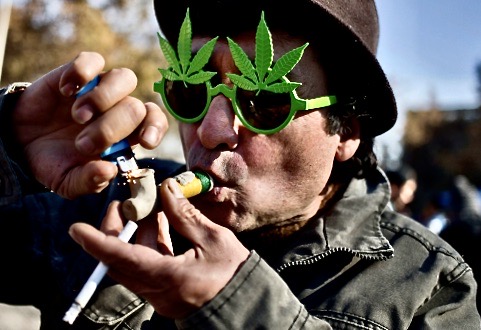
Mexican Stand-Off

By Ed Staskus

   The day my nephew, who was going to be known by the name of Ike from that day on, told me he was changing his name to Wyatt, all I could think of saying was, “Why?” He looked up from his Xbox. He was sitting in a special gaming chair. There was carnage all over the big screen. The game was called Legends of War. It looked like everybody was losing.

   “What do you mean, why?” he asked.

   It turned out he had watched the horse opera “Tombstone” the night before and been enchanted by Wyatt Earp.

   “That might not work,” I said. 

   “Why not?”

   “Wyatt Earp was a lawman through and through. Your law-abiding ways are sketchy at best.”

   “Oh, right, I see what you mean. How about Doc, like Doc Holliday? He was smack.”

   “He was that, but he’s more along the lines of a Greek tragedy. I don’t see you as tragic.”

   “Hell no, I’m not tragic. The girls wouldn’t like that.”

   “How about Ike?” I suggested.

   “Who’s that?”

   “He was one of the cowboys in the movie, fast with a gun.”

   “OK, that sounds good. Ike it is from now on.”

   I didn’t tell him Ike was one of the bad cowboys who had tried to kill Wyatt Earp at the OK Corral.

   Ike was smart enough to make the grade and get admitted into St. Edward High School but scatterbrained enough to get suspended. St Ed’s is a Catholic school in Lakewood, Ohio in the Holy Cross tradition. Thousands of teenage boys apply to get in every year. A couple of hundred make it. Ike  had enough applesauce in him to not get expelled. He made it to graduation day by the skin of his teeth.

   He wasn’t so lucky at Cleveland State University. CSU is a state school. So long as your high school grades are somewhere near consciousness there is no problem getting admitted. After one thing and another he was told in no uncertain terms he had to find another school. When he left CSU, leaving his student housing apartment in need of disaster relief, he started looking for another place to live.

   His problem was no landlord with even a grade school education would rent to him. He camped out at his sister’s apartment until she said he had to go. His father suggested his uncles. He stayed with one after another until the last one told him he had to go. He stayed at my mother’s house, throwing parties for his friends whenever she broke a leg and was recovering at the Cleveland Clinic or had a stroke and was recovering at the Welsh Home in Rocky River. 

   When my brother asked me to throw some work his son’s way, I was of a mind to say no. It was almost the first thing I said. It was what I should have said. I had already hired Ike to waterproof our basement walls and repaint the concrete floor some months earlier. Every time I looked, he was easing himself down onto one of our lawn chairs and lighting up. He liked to smoke reefer rather than attend to the job at hand. When he wasn’t blazing, he was talking on his cell phone. In the end it was such a makeshift effort that I spent almost as much time in the basement as he had done, following up on his no effort work.

   I thought, that’s the last time. What I said, though, when my brother asked, was OK. I could have kicked myself.

   I worked more-or-less full-time for Light Bulb Supply in Brook Park. There were no brooks or parks anywhere in Brook Park. The biggest greenspace was Holy Cross Cemetery, 240 acres of it, across the street. I went there for walks instead of taking lunch whenever the day was dry and sunny. The office work more-or-less paid the bills. It was a family business, however, and I wasn’t a part of the family. I wasn’t going to get anywhere by relying on their good will, of which there was little. It was like my paycheck, on the stingy side.

   I got ahead by repairing tanning equipment part-time, on my own time, stand-ups and lay-downs, at tanning salons, beauty salons, gyms, and people’s homes. Indoor tanning was booming. I bought a tool box and electrical tools. I taught myself how to do it. My hourly rate was more, by far, than what Light Bulb Supply paid me. If it was an insurance job, I raised the price. If the insurance agent protested, I hung up.

   Allstate Insurance sent me to Dearborn, Michigan to inspect a tanning bed that had been under water for a few days in a family’s basement rec room. They found out their sump pump had failed when they got home from vacation. I drove there on a Saturday morning. It was going to be an all-day job getting there and back.

   Dearborn is just west of Detroit. and home to the most Muslims in the United States. It is also home to the largest mosque in the country. I thought I would stop and check it out. I got my signals crossed, missed the turn-off off I-75,  and missed the mosque. When I got to Detroit what I saw was an exit for Dearborn St. I took it. It was the wring exit. When all I saw were bars, funeral parlors, beauty shops, empty lots, and no white faces, I parked, found a phone booth, and called the folks with the soggy tanning bed. I told them where I thought I was.

   There was a pause. “Get back in your car and drive away from there right now,” the man of the house said. “It’s not safe.” There was no sense in tempting fate by sightseeing. I got back into my car and followed the Rouge River to Dearborn.

   I told Ike I had a job at a big tanning salon in North Royalton south of Cleveland. There were some repairs involved and re-lamping 9 or 10 tanning beds. It was going to take Ike and me a weekend and two or three nights. In the end it took me closer to a weekend and a week of nights. Ike was supposed to re-lamp during the day, since he was unemployed and had the free time, while I did the repairs at night, except he only showed up once and didn’t finish even one of the tanning beds.

   One day he wasn’t feeling well. His stomach hurt. Another day his garage door broke with his car inside it. Another day he didn’t bother to call me to say he needed a mental health day. The last time before I told him not to bother anymore, he said the laundromat was closed and he didn’t have any clean clothes to wear to work. In the end I chalked it up to experience.

   “Nobody wants to hire me,” he complained, one of his many complaints. He seemed to think he could get the job done without going to work. He liked to say, “I don’t want to be tied down.” He didn’t want to be another cog in the wheel. There was little chance of that. Who wants a buzzkill of a cog?

   My brother asked my sister to let Ike move into her house. She lived nearby, had the space, but was reluctant. There was finally some peace and quiet in her house. She and her husband had split up. He had moved out and was on the road most of the time working as a long-haul trucker. Her daughter had graduated from Miami University and struck out on her own. There were two empty bedrooms. She could use the rent money. I suggested she get it up front.

   She told my brother she had reservations, especially since everybody knew Ike wasn’t just smoking reefer. He was selling reefer and branching out into fun pills. She didn’t want a drug dealer in her house.

   “He doesn’t have anywhere else to go,” my brother said.

   “What about your house?”

   “My wife doesn’t want him in our house.” His wife was Ike’s foster mother. She was a schoolteacher. Ike had been a student in her class during middle school. She probably knew what he was up to, although she was close-mouthed about it.

   Ike was arrested strolling down Detroit Rd. on the Cleveland side of its west side border in the middle of the night. He was puffing on a stogie-sized spliff. It was before reefer was legal. He was packing pills and cash in his pockets and having a high old time. A year later he appeared in court and was rewarded with intervention instead of jail time. My brother spent a small fortune sending him to assessment counseling treatment and prevention classes. I drove Ike to the classes now and then. He was chill as a cottonmouth.

   When he moved into my sister’s house, he brought clothes, shoes, and a safe with him. He kept the key to the safe on his person at all times. He moved into one of the vacant bedrooms. My brother paid his rent occasionally. Ike kept his clothes within easy reach and his shoes on display. “He thought nothing about buying $150.00 tennis shoes,” my sister said. “He had lots of them.”

   She didn’t ask what he kept in the safe. She didn’t want to know. One day she noticed one of the floorboards in his bedroom had been pried up and put back in place. When she looked under the board, she saw a green stash. She put the board back in its place. Boys and girls drove up to her house day and night, leaving their cars running at the curb. When they did, Ike ran outside, handed them something through their open car windows, and they gave him something in return.

   He texted his girlfriend a photograph of tens, twenties, and fifties fanned out across his bed cover. “Top of the world,” he seemed to be saying. When he was done with the display, he neatly packed the dough up and put it back in his safe. He was feeding the crocodile, hoping it would eat him last.

   My sister had told Ike, “No friends in the house.” A week later, pulling into her driveway after work, she saw more than a dozen boys and girls on her front porch and front steps. Two of them were sprawled over a railing. They were waiting for Ike. My sister called my brother.

   “Get over here right now and tell your son’s friends to leave.” 

   I happened to be driving by and stopped to see what was going on with the crowd on the front porch. When I asked if they were waiting for somebody, one of the youngsters on the railing said, “We are the ones we’re waiting for.” I assumed it was a smarmy Millennial trope. “Never talk to the monkey when the organ grinder is out of the room,” I said. “I understand,” the youngster said, which surprised me. I barely understood it myself. I left when I saw my brother’s car coming down the street and my sister storming down the driveway

   When Ike showed up, she asked him, “What do you not understand about no friends?”

   He was fluent when it came to complaining and explaining. Before he was done my sister cried uncle. “Just don’t let it happen again,” she said. He promised it wouldn’t happen again. It happened again and again. Ike could be sincerely insincere when he had to be.

   The driveway was delineated by the two houses on its sides. It wasn’t a wide driveway by any means. There was a grass strip on one side of the driveway but no buffer on her house’s side. Fortunately, Ike drove a compact car. Unfortunately, he had forgotten what he learned in driver’s education. He bounced off the house several times, denting his car, and ripping vinyl siding off the house.

   He liked to text my sister, asking if she needed anything done around his crash pad. When he wiggled down the driveway and hit the house he texted her, promising to fix it right away. He never did. He never did anything else, either, except breaking into the house through the back kitchen window whenever he locked himself out. Every time he did my sister had to replace the screen. A neighbor called the Lakewood Police Department when they noticed one of the break-ins, but Ike was able to explain it away. 

   After the intervention went bust, he was arrested again and charged with drug possession, possessing criminal tools, and a trafficking offense. He pled guilty since law enforcement had the goods on him. His charm, good looks, and a silver tongued lawyer carried the day. He was ordered to be drug tested on a week-to-week basis. 

   Something needed to save the day for my sister. She wanted Ike gone but didn’t know how to get it done. He was a blood relative and needed a place to live, even though he wasn’t willing to do what it takes to civilize an apartment and stock the shelves. It was a stand-off. My brother insisted there wasn’t anywhere else Ike could go. He had burned one bridge too many. She bit the bullet, but it tasted bitter.

   The magic bullet turned out to be the court-mandated drug-testing Ike was obliged to undergo. When spring turned to summer and summer turned to fall, he fell over his up-market tennis shoe laces and tested positive. Boys just want to have fun, even though I had told him not to squat with his spurs on. It meant the slammer. It meant he was packing up, shoes and safe and all. It meant my sister could slam and lock the door behind him the minute he left, which is what she did.

   The state of Ohio has the power to seize cash and property involved in drug trafficking. Asset seizures and forfeitures are a deterrent and a tool to take down criminal activity. “We generally seize assets that are believed to be the fruits of drug trafficking or used to facilitate the crime of drug trafficking,” Paul Saunders, a senior police official, said. “The courts have a litany of rules that are applied to each case to determine whether assets will be forfeited.”

   The last thing my sister needed was to have her home seized and taken away from her because of somebody else’s bad behavior. Fortunately, no searchlights were searching for her. She went back to mowing her lawn, walking her dogs, and watching “Law and Order” on TV.  When the crime drama wrapped everything up on a happy note, she went to bed snug as a bug with nothing bristling in her bonnet.

   I chewed on the idea of telling Ike who Ike really was, but never got around to it. It’s been said the truth will set you free. Sometimes it can feel good. Other times it can feel bad. I wasn’t in the advice business, however. I thought it best that Ike take whatever fork in the road he thought best.

Ed Staskus posts monthly on 147 Stanley Street http://www.147stanleystreet.com, Made in Cleveland http://www.clevelandohiodaybook.com, Atlantic Canada http://www.redroadpei.com, and Lithuanian Journal http://www.lithuanianjournal.com

“Cross Walk” by Ed Staskus

“Captures the vibe of mid-century NYC, from stickball in the streets to the Mob on the make.” Sam Winchell, Beyond Fiction

Available on Amazon: https://www.amazon.com/dp/B0CRPSFPKP

Late summer and early autumn. New York City, 1956. President Eisenhower on his way to the opening game of the World Series. A hit man waits in the wings. A Hell’s Kitchen private eye scares up the shadows.

A Crying of Lot 49 Publication
Escape Velocity

By Ed Staskus

   Before Agnes ever went to the Surprise House at Euclid Beach, the city fun park, she went to Holiday Sands. It was her little brother and her friends. It was her mother Eva and their neighbor Anna MacAulay. It was old times and new times all mixed up together. Years later she thought they might have been the best times she ever had in her life. 

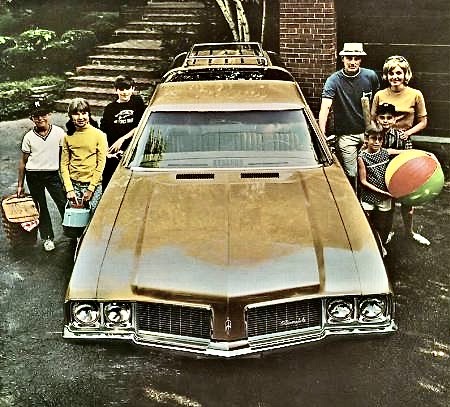
   They went from when she was a small girl, right after Sammy was potty-trained and she was five years old. They car-pooled with the MacAulay’s since they had a summer pass and an Oldsmobile Vista Cruiser that fit all of them. Olds called the car the “Escape Machine.” Eva made most of the food for the day the night before and the rest of it early in the morning. She baked Texas sheet cake with buttermilk in the chocolate batter and cream cheese frosting. Anna brought puffed Cheez Doodles. Sometimes they had barbecue chicken and other times hamburgers on the grill, and grapes, watermelon, lemonade, and Eva’s new drink, Diet Pepsi. 

   She kept cases of it in the pantry, even though it made her husband Nick mad. “You’re flushing all my money down the toilet,” he complained. She popped a can open as soon as he went to work. Eva Giedraityte knew when to stay behind Nick Goga’s back. It hadn’t always been that way, but that’s the way it had gone.

   Anna was Eva’s best friend on the hill. They saw each other every day and talked on the telephone the rest of the time. They lived across the street from one another on Hillcrest Drive in the Euclid Villas. Nick called their telephone the blower. “All that talk is just blowing hot air through the wires,” he said. Eva didn’t like that. She wanted to call him a blowhard but bit her tongue.

   In the morning when the coolers and picnic baskets were full and they were ready to go they ran to the yellow car, begging Eva to hurry up. Holiday Sands was in Ravenna, a place Eva called the armpit of Cleveland, even though it was where she got her blue and white china with snow scenes on it. It was a long drive and Agnes’s best friend Marcia and she sometimes lost track of where they were because they sat in the rear-facing third seat playing category abc’s.

   Anna and Eva sat in the front talking non-stop, Eva’s arm stuck out the window, Anna steering with one hand and smoking Pall Malls. Sammy wriggled to get next to one of the windows so he wouldn’t have to sit between Diane and Michelle. They were the other MacAulay girls. Marcia and Agnes watched the road going backwards. When they heard gravel crunching, they knew they were finally there and twisted around towards the wormy green wood walls, the signs saying, ‘Stop, Pay Ahead’ and ‘Positively No Cameras’ and the run-down guardhouse leaning sideways.  

   Once they got there none of them could remember getting out of the car or into their bathing suits, only the next thing they knew they were in front of the mirrors outside the bathhouse. They drank water at the frog fountain and ran to the cement edge of the lake, walking around to the beach side and the sand playground, while their mothers spread out blankets and folding chairs and a plastic tablecloth on a picnic table. 

   Their day camp was in a grove of sweet gum trees where they were always cleaning up the space bug seedpods that killed when they stepped on them barefoot. Black squirrels rummaged in the high grass eating handouts and hiding out, jumpy and curious at the same time.

   They ate lunch and dinner like fattening calves at Holiday Sands and lay down afterwards in the shade, looking up at the sky or the giant slide. They weren’t allowed back in the lake for sixty minutes. Otherwise, they might get cramps and drown. Sometimes they would take a nap on the shady side of a hill, but most of the time they never slept until the end of the day riding home on the darkening road.

   Marcia was Agnes’s bosom buddy and barrel champion of Holiday Sands, mean as an old man on the rings, daring and brave on the slide that scared the crap out of her. She was a swashbuckler in a swimsuit on the barrels, taking on all comers until her feet blistered. The two barrels were rusty red white and blue, striped, and swiveled on rods attached to a laddered platform in the middle of the lake. They were sketchy trying get on top of from the platform, wet and slimy, rotating in the water. 

   Nobody could logroll Marcia off them once it was her turn, not the local runty boys with their fast feet nor the stuck-up east side girls from the gymnastic classes. She was like a squid on a skateboard.

   Almost a year older than Agnes she was strong and fast, too, on the big rings that crossed the lake. She was famous for fights with anyone who tried crossing at the same time from the other side, kicking at them and wrapping her legs around them and shaking them off the line into the water.

   “When am I going to catch up to Marcia, so we are the same?” she asked her mother.

   “You never will,” Eva said. “You’ll always be a year apart.”

   “How can that be?”

   The giant slide was on the grassy side of the lake. It was a hundred feet up a corkscrew staircase to a deck that swayed and creaked whenever anybody let a breath out. Agnes climbed up the twisting steps grimly holding on to the handrail, never looking down, and when it was her turn to go Marcia had to give her a shove, even though Agnes knew she could never go back down on the stairs, anyway, because with every step she would have to stare through the slats to the deadly cement slab below. She slid down the ramp slower than anybody ever, chafing and burning her legs as she pressed them against the gunwales all the way to the pitch, finally heaving herself, after a dead stop at the bottom, into the water with a plop.

   Marcia put her arm around her shoulders. “If I wasn’t so scared on that slide I’d be scared to death,” she told her secretly when everybody laughed about her slowdown ride. Marcia always raced it, though, scared or not.

   Most kids started by sitting at the top and tilting over the brink, but Marcia liked to get air, shooting out over the slide at the top and landing on the drop side of the lip with momentum. Sometimes she landed with her legs splayed halfway off but throwing her head up and back, she would straighten out and cracker down like a rocket.

   Whenever she felt more daring than concerned, she would start on her stomach, belly-slam over the hump halfway down the slide, and flip in mid-air at the bottom finishing feet first. One windy day a boy drift-paddled to the base of the slide and looking up saw Marcia suddenly double-flipping over his gaping face. Lots of kids got wedgies coming down, but not Marcia, who came down slick like clean underwear.

   Every hour a recording played on the staticky loudspeakers “Water safety check, water safety check, please return to the shore” and everybody had to get out of the water for fifteen minutes. After the safety check the loudspeakers crackled again. “Remember the buddy system, remember the buddy system, never swim alone.” 

   Only after the safety check did everybody get to go back on the barrels and slides and diving boards. One day a boy who had been in the water didn’t make the count, and everyone thought he might have drowned. The lifeguards swam back and forth, and children circled the lake, craning to see underwater, their mothers hovering over them. Finally, the boy came walking down from the concession stand with a can of Welch’s Grape Juice. He had ridden to the park like all the local boys from Kent did on the back of his older brother’s banana bike, so no one blamed him about causing so much trouble, but one of the lifeguards was peeved, and told them they both had to sit the next hour out. 

   “Let’s go drift to the back of a window,” the bigger boy said smirking.

   Agnes liked the rides in the playground best, the springy mushrooms, lopsided pirate ship, and alligator swing. The round-headed mushrooms were on coiled springs, spotted with colored dots, greasy from baby oil and shed skid. They were stinkhorns, they smelled horrible, and crossing them without falling on the twisting trail was almost impossible. A ramp led to the deck of the pirate ship where tree trunk cannons stuck out the side toward the lake. They flew down pipe slides jutting off the poop deck and rode the rope swings hanging from the spars. Red and purple Jolly Roger flags flew from the mast, dark gap-toothed skulls grinning in the bright light.

   “See the white skeleton, and see that dart in his hand, blow the man down, he’s poking the bloody heart with it. There’s an hourglass in his other hand. Time’s running out, let’s go play.”

   A submarine made of drainage tiles lay in the ditch beside the pirate ship, and the alligator swing was behind them, separated by low cypress hedges. They rode the swing at twilight in the shadows. It had five toboggan style seats, and when whoever was pushing got it going, all scrunched together her friends and she arced up, leaning into the forward and backward swings, taking it to the moon. A boy climbed out onto the nose of the gator and when it reached its highest point, he jumped twenty feet up into the air and flew out over the sand. He broke his arm when he landed with a hard thud on a bare spot.

   “Oh, my Goddamn, damn, damn, damn, that really, really hurts,” he cried and cried, rolling off his cracked arm and cradling it.

   Agnes’s favorite was the corkscrew. Some kids called it the mean green machine and other kids called it the wheel of death. She called it the peanut butter maker, although she couldn’t say why. It was a carousel with horizontal rings made into a circular wheel attached to a maypole by chains stretching from the middle spokes to the top of the pole. The runts got on first and the rest turned the wheel, walking alongside it, the chains shortening and wrapping themselves up the pole, until they jumped on, and the bigger boys kept winding the wheel as far as they could until only the tallest boy was left stretching up on his toes, finally jumping on and grabbing hold.

   The wheel started spinning back in the direction it had come, slowly then faster and faster, the chains grinding and clanging on the maypole. Some crouched inside the frame, while others dangled from the outside rails like octopi. Hanging on they were pulled parallel to the ground as the peanut butter maker spun downwards, and one by one they lost their grips and were sprayed out in all directions screaming and crying. The white sand was soft enough, but grown-ups walking by had to watch out for small fry flying at them like ballistic missiles.

   “Somebody ought to shut that thing down,” a dirty man lying under a tree said, his lips like pink goo, watching them, smoking a dark cigar, his shirt open, ash floating like charred mercury on his belly.

   At the end of the day, they trudged up to the concession stand on the hill, worn-out and exhausted. They had ice cream cones and played their favorite songs on the Rock-Ola jukebox, drowning out the bug zapper with a pile of dead bugs under it, dance shuffling together on the damp concrete. 

   “When I first met you girl you didn’t have no shoes, now you’re walking ‘round like you’re frontpage news, not your steppingstone not your steppingstone not your steppingstone.” 

   They bought pink wintergreen disc candy for the ride home and at sunset ran to the guardhouse to watch a lifeguard play taps on his bugle into a microphone that piped it out to all the loudspeakers. As the park lights blinked on, they cozied into the warm vinyl seats of the station wagon, wrapped in beach towels, sad that their day was over, but glad since they had been in the sun all day.

   Sometimes they were quiet or slept on the ride home, but other times they stayed up and sang songs. Their favorite songs were tunes from TV and the movies. “Spider-Man, Spider-Man, does whatever a spider can,” Sammy whooped, believing he could sing, and squirted pretend webbing at them from his wrists through the haze of Anna’s cigarette smoke. 

   Agnes loved movies like “Ghost in the Invisible Bikini” and “Dr. Doolittle.” They sang ‘Kissin’ Cousins’ and ‘Talk to the Animals’ and all the “Chitty Chitty Bang Bang” songs since they had seen it at least three times. “You’re the answer to my wishes, Truly Scrumptious,” Michelle and Diane sang in the dark, drowning out Sammy while Marcia and Agnes finished the stanzas from the third seat. “And I shan’t forget this lovely day, my heart beats so unruly, I also love you Truly, honest truly, I do.”

   “Can’t you girls keep it down for a minute, just one minute,” Anna barked at them. 

   Nick never went to Holiday Sands, except for the time Eva got sun poisoning. The MacAulay’s Vista Cruiser broke down, so Nick took everybody in his Buick Riviera, piling them in one on top of the other, and leaving a beach carryall and food cooler behind because his golf bag needed room in the trunk. He dropped them off at the guardhouse with half rations and missing Eva’s Coppertone and drove away to the Sunny Hill Golf Course. 

   He was crazy about golf. Nick had heard talk about the South 9 at Sunny Hill, that it was sparkling new and pockmarked with sand traps, and he just had to play it. They watched him drive away.

   “It’s not fair,” Agnes complained when he picked them up after his golf game and they had to leave early before sunset. “I always ride the alligator, it’s my ride.”

   “Your father had a bad game, and he wants to go home and have dinner,” Eva said in the car, her arms wrapped around Agnes while she sat on her lap. She felt cold, even though she had been in the sun all day. Nick steered fast that night, complaining about Sunny Hill, and they got home in record time.   

   Eva had pale Lithuanian skin, blue eyes, and blonde hair she kept in a loose flip. At the park she always wore a wide brim hat and globs of suntan lotion, but that day she only had her hat, shading her face. She got sun poisoning and had to lie in bed for two days. Her legs were swollen like sausages. Sammy and Agnes sliced up cucumbers and spread them out on her thighs, but she was nauseous and couldn’t lie still, and they ended up littering the room. Anna brought hand towels, soaked them in water and apple cider vinegar, chilled them in the fridge, and wrapped them around her legs until she got better.   

   Whenever Nick wasn’t working or at home eating or reading or sleeping, he was playing golf. He loved it more than they loved Holiday Sands. Sometimes Eva said he loved golf more than the three of them. Agnes hoped it wasn’t true. She knew it was true.

   “Golf is a thinking man’s game. It’s all up here,” he said, tapping the space between his eyebrows. “It’s simple, just a ball and a club, but it’s complicated, remember that. No two lies are ever the same, that’s when the ball is on the grass, but when it’s pitch and putt it’s the best thing in the world.”

   Eva liked telling everybody her husband had great legs, and he did, too, because of the thousands of miles he walked on all the links he went to with his clients and friends.

   “I don’t play cart golf,” he declared with pride. 

   Nick always had a tan, except in the dead of winter, and except for his left hand, which was his glove hand. He wasn’t a big man, but he wasn’t small, either, standing trim and compact like a boxer. He still fit into the Korean War uniform he kept in the attic. He fought Golden Gloves when he was young and once made it as far as the main event at the Cleveland Arena. There wasn’t anything mashed up or broken down about him from the fighting, either. He had Chiclets teeth, green eyes, and brown wavy hair. When he finger-rolled Royal Crown into it and combed it back his hair got flat slick and dark, like a street man’s.

   “How do you like your old man now?” he asked Agnes, who was watching him in the bathroom mirror, his suspenders floppy and collar open. 

   Eva hardly ever called him by his given name, which was Nicolae. She called him Nick when they were happy. To her children she always said he was their pop, and that was what they called him. When Sammy was a toddler, he called his father poppy, but after he started walking, he started calling him pop just like his mother and sister did. 

   Nick nicknamed his wife daughter son the Three Musketeers because they did everything together, which they did since he worked all day and played golf the rest of the time. He didn’t punch a clock at work but did at home. He left first thing in the morning, like clockwork. He went home only when the golf game or dinner with clients was over. 

   He never went back to Holiday Sands with them, with his wife and kids, and never became the Fourth Musketeer. Instead, inside of a few twisting and turning years, he became the Count of Monte Cristo, when the dream machine between Eva and him came slowly rolling tumbling down on all of them.

Ed Staskus posts monthly on 147 Stanley Street http://www.147stanleystreet.com, Made in Cleveland http://www.clevelandohiodaybook.com, Atlantic Canada http://www.redroadpei.com, and Lithuanian Journal http://www.lithuanianjournal.com

“Cross Walk” by Ed Staskus

“Captures the vibe of mid-century NYC, from stickball in the streets to the Mob on the make.” Sam Winchell, Beyond Fiction

Available on Amazon: https://www.amazon.com/dp/B0CRPSFPKP

Late summer and early autumn. New York City, 1956. Jackson Pollack opens a can of worms. President Eisenhower on his way to the opening game of the World Series where a hit man waits in the wings. A Hell’s Kitchen private eye scares up the shadows.

A Crying of Lot 49 Publication
Hanging Tough With Mr. T

By Ed Staskus

   The Saturday morning that I played a racquetball match against Dick Stager for the first time was at a tournament in Cleveland Heights. I had beaten a so-so player from Akron the night before and was in the second round. Watching Dick warm up I could see he had good direction on his shots. He was a target shooter rather than a cannon blaster.

   My first impression of the stockbroker was that he wasn’t an athlete, but I had long ago learned to beware of first impressions. Even though he looked more suited to golf than the pinball of racquetball, I later learned that as a teenager growing up in Kent, he was a whiz at baseball, football, and basketball.

   Once our match started, I quickly found out he was fiendishly clever, never overhitting the ball except when it suited him. He played the long game, running me back and forth. He believed racquetball wasn’t a game of power, but one of mental chess, harking back to an earlier era when Charlie Brumfield ruled the roost. He played patiently efficiently taking few chances, always looking for the next sure opportunity to close out the point.

   “Crushing the ball with all your might will usually not beat someone who knows how to play the angles,” he liked to say. He smiled when he said it. It wasn’t a friendly smile.

   He was infuriating, slowing down the action, wiping up every drop of sweat up from the floor, discussing the fine point of a ruling with the referee, and getting in my way. He did it slyly, so that it was a hinder but wasn’t a hinder. He was hardly ever penalized a point because of it. He always apologized effusively so that it seemed like it was my own fault for needing so much space in which to take my swing.

   I barely won the match. He was several years younger than me and more talkative by a long shot. Getting a word in edgewise was like trying to squeeze past his hinders. He invited me to play at the newish 13th Street Racquet Club sometime. He worked downtown and the club was downtown. We set up a lunchtime match a few weeks from then.

   The club was on the 5th floor of the Dodge Building on East 13th Street, around the corner from Euclid Ave., the city’s main thoroughfare. It bustled with lawyers and businessmen. The courts were built of panel walls instead of concrete. They sucked all the power out of power racquetball. The floors were cheap parquet and already warped. Dick knew where all the dead spots were. I was thoroughly vexed by the end of the second game, which I lost just like I lost the first one.

   He treated me to lunch and a beer afterwards. We sat at the bar and watched a squash match going on in one of the two glass back-walled hardball courts. Everything about the courts was better than their country cousins, starting with the floors. They weren’t cheap and they weren’t warped. I was aware of the game but had never seen it played. Watching it I saw right away where Dick Stager got his approach from.

   I was introduced to Vaughn Loudenback, the club pro, who specialized in squash but dabbled in racquetball, too. We played a friendly match, my Ektelon composite racquet against his no-name wood racquetball paddle.  His shots were even slower and better placed than Dick Stager’s. He was like the Invisible Man, never hindering, somehow always right there where my shots were going and returning them. After he made mincemeat of me, I determined to never hit a lob serve or ceiling shot or anything at moderate speed when playing him again. 

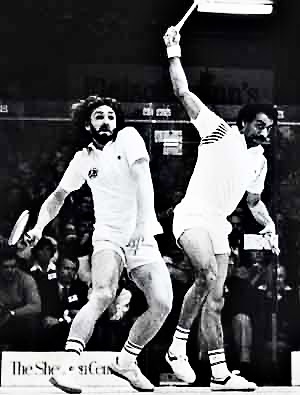
   I asked him if he would teach me how to play squash. He gave me one free lesson, about how to hold the racquet, how to swing, and the rules. He told me to make sure to dominate the T, the intersection of the red lines near the center of the court, shaped like the letter “T”, where I would be in the best position to retrieve an opponent’s next shot. I continued to play racquetball, but less of it, and played more squash. 

   Squash has a long history in Cleveland with the first courts built in the early 1900s. 

   “I started the 13th Street Racquet Club in 1979,” said Ham Biggar. “It became one of the top squash centers. We hosted the nationals as well as the North American Open. I met my wife on a squash court.” Ham was a Cleveland, Ohio native whose great-great-grandfather Hamilton Fisk Biggar, who was a pioneering homeopath, ministered to John D. Rockefeller Sr. and golfed with him.

   “I opened the Mad Hatter, Cleveland’s first disco, in 1971 and the Last Moving Picture Company in 1973,” he said. “We were ahead of the curve. We ended up with 11 discos across the country. I had 10 years of starting work at 7 PM. The Mad Hatter had a Drink and Drown Wednesday. You could come in as a woman for $2 or a man for $3 and drink all you wanted for a penny a beer. Mixed drinks were a quarter.”

   Squash got its start as a game called rackets played in London’s notorious prisons in the 19th century. The first squash court in North America was at St. Paul’s School in New Hampshire in 1884. The earliest national association of squash in the world, the United States Squash Racquets Association, was formed in 1904 in Philadelphia. 

   In 1912, the Titanic had a squash court in first class. A tournament was organized. Nobody got to the finals.

   I met Kurt Otterbacher, whose Burbank-area family owned a concession business catering to fairs and festivals around Ohio. They fried funnel cakes, spun cotton candy, and popped homemade caramel corn. His father ran the show while he and his brother put on the show. We started practicing together, even though he was far better than me. I learned by trial and error. One of the trials I had was learning to not hit the tin, which meant side out and the other side got the serve.

   Not being able to hit kill shots gave me the blue johnnies. Kill shots are winners in racquetball, hit so low they are either difficult or impossible to return. The shot was useless on squash courts where a 17” high tin stretched the width of the front wall up from the floor. Hitting the tin was out of bounds. Hit the tin and everybody knew it. The ball didn’t just thud, it clanged. 

   Kurt was a grab bag of shots. He could hit the ball with pace, and the next shot take all the pace away. He was not above trying a drop shot from anywhere on the court. He wasn’t a magician, but every time we played some of his squash magic rubbed off on me. I finally got over the kill shot shakes and learned to keep the ball at least an inch or two above the tin.

   The hardball squash court is about as wide as a racquetball court but eight feet shorter. Racquetball rallies are short, and the better the players the shorter they are, four five six shots before somebody hits a winner. Squash rallies are long, and the better the players the longer they are, thirty and forty shots before somebody mercifully hits a winner. I ran more and sweated up a storm on the smaller court more than I ever did on the bigger court.

   “The healthiest sport in the world,” is the way Forbes Magazine put it.

   Jahangir “The Plumber” Khan, considered by many to be the greatest squash player of all time, was unbeaten in competitive play for 5 years, from 1981 to 1986. He recorded 555 straight wins in competitive matches. Not only is this a squash record, but it is recognized by Guinness World Records as the world record for a winning streak by any athlete in any sport. The longest rally ever officially recorded was between Jahangir Khan and Gamal Awad. It lasted 7 minutes, hundreds of every kind of shot imaginable, and ended in a let. They had to replay the point. The same match at the 1983 Chichester Festival was also one of the longest ever, going to a tie breaker. Jahangir Khan was noted for his exceptional stamina. Gamal Awad was a broken man after the match, and his career never recovered.

   The day came when I stopped playing racquetball and stuck to squash. I practiced by myself. I ran the club’s indoor track to build endurance. The club’s squash players were generally disdainful of racquetball, and I had some trouble scratching up games. I played Kurt and Bob McLean, a converted racquetball player like me. I played softball squash with a South African on the only international court at the far back of the club. I had seen him train by going at a speed bag and heavy bag. After he was done with me, I was done with the international game, played with a ball that had to be microwaved beforehand to warm it up so that there would be some bounce to it. 

   When Gul Khan became the squash pro at the Cleveland Athletic Club, he moonlighted at the 13th Street Racquet Club. He was a small man with a big smile, a free-spirited member of the Khan clan. He had been a junior champion in Pakistan before spending ten years as a pro in Boston and New York City. After he moved to Cleveland, he lived in an apartment on East 30th Street. He didn’t own a car. Whenever he was at the club late, and I happened to be there, I always volunteered to drive him home, in exchange for 5 minutes of advice. Instead of giving me any coaching, he told me stories about his brother Mo and first cousin Shariff, about giving lessons to Senator Ted Kennedy and New England Patriots owner Bob Kraft, and about busting it up with the artist Frank Stella.

   “Control the T,” he told me, which was about all he ever told me. 

   He was great fun to watch at pro hardball tournaments. He had wizard-like racquet skills, speed, and power. He had a crowd-pleasing style with a flair for the dramatic. He was like Mr. T in more ways than one.

   “Gul had a heart of gold,” said Sharif Khan. “He lived large. He knew politicians, lawyers, wheeler-dealers, baseball stars, famous artists, and they knew him. But he also knew the guys at the local bar, the maintenance man in his apartment building, and the people who needed a helping hand on his block in Cleveland.”

   Gul got some of the guys at the club to play me, and one day one of them suggested I try out for the club’s “B” traveling team. The “A” team featured the best players. The one and only way to get on the team was to play your way onto it. I played half a dozen matches and made the team. I was bottom man, but I was on the team.

   We played home and away matches with the Cleveland Skating Club, University Club, Cleveland Athletic Club, and Mayfield Racquet Club. I learned more on the road than Gul ever taught me, but I continued driving him home, especially when there was a thunderstorm. He didn’t like getting wet. 

   I played more guys at 13th Street and found out that even though squash is a gentleman’s game, not everyone who played squash was a gentleman. It was Jekyll and Hyde when they stepped on the court. They were more conniving and aggressive than the racquetball players I had known. Two bounces were two bounces, and a kill shot was a kill shot in racquetball, no argument. What was an honest save, whether it was a let or not, and whether getting in the way had been on purpose or not, was often open to interpretation on squash courts.

   I played Mike Shaughnessy, a stocky big shot printing company executive, several times until I didn’t. The last time I played him, after giving him as good as I got, he was determined to not let me hit any passing shots whenever he left the ball doing nothing in mid-court. The rule is you must allow your opponent straight access to the ball. As the non-striker, you generally are supposed to move back to the T in a curved line. If your opponent is moving straight to the ball, and there is interference, it is your fault.

   Mike was in a surly mood, and it was no good calling foul. He seemed to think interference was a judgment call, even when I was clawing my way around him. “Pity the fool who tries to take the T,” he muttered, smirking. We spent more time jockeying for position than making shots. We got into a squabble that came to nothing. It was the last time I played him. I never called him Mike again, either. From then on, I called him Mr. Trouble.

   My “B” team was at the Mayfield Racquet Club the night the Gulf War broke out. Everybody knew it was coming but it was still surprising to see it happening in real time on TV. All the televisions in the lobby were tuned to the action when we walked in. For 42 consecutive days and nights starting on January 16th, the coalition forces subjected Iraq to one of the most intensive air bombardments in history, flying more than 100,000 sorties and dropping 88,500 tons of bombs. 

   It was run up and salute the flag. It was weapons of mass destruction, real and unreal. It was rocket’s red glare galore in the skies above Baghdad.

   We stopped and glanced at the mayhem, but since we knew the Mayfield team was warming up for us, we continued to the locker room. There was no sense wasting time on something we couldn’t do anything about. The jarheads and towelheads were going to have settle their religious ideological and gasoline supply differences themselves. Besides, we were in second place in the league. We had our own business to take care of, our own gold prize to keep our eyes fixed on.

Photograph by Ham Biggar.

Ed Staskus posts monthly on 147 Stanley Street http://www.147stanleystreet.com, Made in Cleveland http://www.clevelandohiodaybook.com, Atlantic Canada http://www.redroadpei.com, and Lithuanian Journal http://www.lithuanianjournal.com

“Cross Walk” by Ed Staskus

“Captures the vibe of mid-century NYC, from stickball in the streets to the Mob on the make.” Sam Winchell, Beyond Fiction

Available on Amazon: https://www.amazon.com/dp/B0CRPSFPKP

Late summer and early autumn. New York City, 1956. Jackson Pollack opens a can of worms. President Eisenhower on his way to the opening game of the World Series where a hit man waits in the wings. A Hell’s Kitchen private eye scares up the shadows.

A Crying of Lot 49 Publication

Salty Dog Days

By Ed Staskus

   A football team can have the best running backs, linemen, and defensive backs but if they have a goat taking the snap instead of a GOAT, they are unlikely to make it to the Super Bowl. If they have competent role players and a ‘Greatest of All Time’ spiraling TD passes here there and everywhere, they are not only likely to get to the promised land there’s a good chance they will be hoisting the Vince Lombardi Trophy and going to the White House to be hosted and boasted by POTUS. Tom Brady has proven that to everybody’s satisfaction and Bill Belichick’s discomfiture. Nobody needs the best coach of all time. They simply need the best QB of all time.

   Almost everybody develops osteoarthritis sooner or later, even the GOAT’s and POTUS’s of this world. Live to be a hundred and the odds are hard against you. Live to be two hundred, like the ageless Tom Brady will probably do, and you can absolutely bet the family farm on it.

   I knew my hip replacement surgery scheduled for the third day of spring had been coming for ten years. What I didn’t know was that Light Bulb Supply, a commercial lighting distributor in Brook Park I worked twenty-five years for, was going to go out of business as fast as they did. When they did my blue-chip health insurance disappeared in the blink of an eye. Without it I couldn’t afford the surgery. I pushed the idea to the back of my mind. It stayed there for a long time.

   I started walking more, flipping upside down on a Teeter, taking supplements, taking yoga classes, and ignoring get-healthy-quick claims, but not before trying some of them. I might as well have set my paper money on fire. I waited to get on Medicare. Two years ago, I fell down walking on a beach when my hip gave out. It was a warning shot. I kept limping along, even though my mind was made up. When the 19 virus made its appearance, the flat tires in the Oval Office ignoring it, the ineptitude screwed everything up, but eventually I got to see Dr. Robert Molloy, who had been recommended to me.

   I had never been operated on. I wasn’t looking forward to it. But there was no going back because there was no future with the bone-on-bone bad news I had unless I was up for crawling.

   “How are you walking?” the surgeon asked after looking at my x-rays.

   “On one leg, more-or-less,” I said.

   If Dr. Molloy didn’t have a stubble beard, he would have looked like Doogie Howser, maybe younger.

   “Let’s get you going on two legs.”

   Five minutes later he was done with me. One of his outfit walked in and made an appointment for the procedure. Five minutes after that I was in my car driving home. After that it was a matter of waiting. The week before surgery was a long week. I wasn’t allowed to take Celebrex, which is an anti-inflammatory. Until then I hadn’t realized what a nitty-gritty role the drug played in keeping me on my feet. I barely made it to the Cleveland Clinic’s Lutheran Hospital under my own power

   An operating team is like a football team. It is made up of many moving parts. The surgeon is the top dog but unlike teams that throw catch kick balls, he is less the star of the show and more the lead man of the ensemble. He doesn’t spit snort chaw or scratch his balls while at work. The surgeon, the team, and  the operating room have to be as sterile as possible. The surgeon doesn’t pretend what he does matters, like pro athletes do, because it does matter. He doesn’t throw interceptions because what he does is a matter of life and death.

   Dr. Robert Molloy doesn’t earn the kind of the paycheck Tom Brady does, although if it was a left-brain world he would, and more. But it isn’t, so sports heroes have the key to Fort Knox. He doesn’t do hip replacement surgeries in front of 70,000 crazy cheering fans, which is probably a good thing. What if they were cheering for the other side? When Tom Terrific makes a mistake, he gets a do over the next time the offense takes the field. That isn’t necessarily the case with surgeries.

   “While I’ve done over 10,000 operations and invented devices that are used every day in surgery, the joy I receive from watching even one person take back their health just can’t be surpassed, and certainly can’t be measured monetarily,” Steve Gundry, a heart surgeon, said.

In the meantime, Tom Brady has $4 million dollars of sheet metal parked in his garage, including a Rolls Royce Ghost, two Aston Martins, a Bugatti Veyron Super Sport, and a Ferrari. “Moderation in everything,” he says is his go-to mantra. Hip, hip, hooray for moderation.

   Hip replacements got going in Germany in 1891. Themistocles Gluck used elephant ivory to replace the ball on the femur attaching it with screws. The cement he used was made from plaster of Paris, powdered pumice, and glue. He might have added some spit to the mix. I’m glad I wasn’t the patient. He couldn’t have lasted long. Molded-glass implants were introduced in the 1920s but were mechanically fragile. Metallic prostheses started to appear in the 1930s.

   The first metallic total hip replacement was performed in 1940 at Columbia Hospital in South Carolina. It ushered in a new age. Modern technological advances spare surrounding muscles and tendons during total hip replacement surgery. The surgery protects the major muscles around the joint and the surgeon can see that the components fit just right. It allows the patient under the knife to take advantage of better motion and muscle strengthening after surgery. About 400,000 of the procedures are performed annually in the United States, making it the most common of joint replacements.

   Once I was checked in, checked out, and fitted with a one-size-fits-all gown, I was wheeled to the staging area, which is the pre-op room. It looked like the deck of the Starship Enterprise. There were computers and flat screens everywhere. LED lights blinked and there was a buzz in the air. The body shop nurses and doctors came and went, some of them dressed like spacemen.

   Two nurses were attending to somebody next to me. I could hear them on the other side of the curtain. “I don’t know how Amazon does it,” one of them said. “You order what you want and it’s at your house the same day, the next day at the latest.”

   “I know,” the other one said. “It’s like a miracle.”

   When I looked around, I thought, Amazon puts things in boxes, puts the boxes in trucks, and then puts the boxes on your front porch. It doesn’t seem like a miracle by any stretch of the imagination. The miracle is this pre-op room.

   An anesthesiologist with a Brazilian nametag asked me some questions. “We’ll have you up and dancing at Carnival sooner than later,” he said. He asked me to sit up and hug a pillow, hunching over it. I felt a cold solution being rubbed on my lower back. The next thing I knew somebody was waking me up. I was in the recovery room. There was a group of men and women standing around and looking down at me.

   One of them reminded me of Doogie Howser. “It went very well,” Doogie said. Whoever he was and whatever he was talking about went over my head and I fell instantly back asleep. The next time I woke up I was in a different room, cold and shivering. My left side felt like I had fallen from a ten-story building and landed on that side. When I gingerly felt for the soreness, my hand landed on an ice pack. That explained the shivering. I drew my blanket tighter around me and fell asleep again.

   The night nurse came and went, taking my vitals. I tried to explain to her how vital it was that I sleep, but she woke me up with her thermometer and blood pressure gizmo every couple of hours. I was hooked up to an IV. She told me it was for my own good, full of anti-inflammatories and pain killers.

   “It still hurts like hell,” I said.

   She brought me a small white pill that she said was Oxycodone. It did the trick. I fell asleep and stayed asleep, at least until she came back to get more vitals. It was two in the morning when she woke me up. She had brought a walker.

   “It’s time for you to take a walk,” she said.

   She must be new, I thought. I patiently explained that I had come out of major surgery just a few hours earlier and that there was a foreign object made of ceramics and plastic, titanium alloys, and stainless steel inside of me. Nurse Ratched shrugged it off and before I knew it, I was out of bed and plodding down the long hallway. She made sure I stayed on my feet and got me back into bed safely. She gave me another small white pill and I went back to dreamland, which was nothing if not wide-screen technicolor.

   When breakfast arrived the next morning, I wolfed it down like I hadn’t eaten anything for nearly two days, which I hadn’t. Its tastiness belied its reputation for blandness. When the lady who delivered the breakfast came back for the tray, she asked me how it had been.  

   “Better than hospital food is supposed to be,” I said. 

   “That’s good, honey, that’s good, got to keep your strength up,” she said.

   After breakfast the day nurse strolled in and stuck a memory stick into the flat screen on the wall at the foot of my bed. It was a 45-minute Cleveland Clinic video about what recovery was going to encompass. Halfway through the video a troop of nurses walked in to check on the Palestinian in the room with me, and me, too. I paused the video. The Arab had been there when I arrived and was still there when I left. He had a Frankenstein-like incision on one side of his Adam’s apple. “They did surgery on my neck, on some herniated disks,” he said. All that morning a nurse had been trying to get his medicine to go down, but even when they crushed and mixed it with apple sauce, he couldn’t swallow it. His throat was so swollen he couldn’t swallow anything. After a doctor showed up with something new, he was right as rain an hour later. When his wife came for a visit, they called their children to let them know how it was going. They toggled their phone to speaker. While they talked to their kids in all-Arabic, their kids responded in all-English.

   When the troop of nurses was done with my roommate, they turned their attention to me. One of them asked what I thought of the video. “It’s good,” I said. “The lady doing the talking got off to a slow start, sort of fumbling around, but got her footing and some spice soon enough. I liked the part about doing recovery the Cleveland Clinic Way and not the Burger King Way.” The narrator meant don’t do it your way, do it our way. “She’s a Salty Dog, that one,” I said.

  “Meet the Salty Dog,” one of them said, motioning to a woman at the back of the pack. It was Karen Sanchez. She was the leader of the pack. She was the Salty Dog. She shot me a tepid look. I wished I was still out cold.

   One day after entering the hospital I was on my way home. I said goodbye to the Palestinian. “Remember, follow the rules or follow the fools,” he said. The day nurse wished me luck and called for transit. “Ron will be up in ten minutes,” she said. The last person I saw before leaving my room was Karen Sanchez. She came alone and gave me a stern talking to about what to do and what not do the next few weeks. By the time she was halfway through I was convinced. She wasn’t convinced and continued her lecture. When she was done, I gave her a thumb’s up. She gave me a reassuring smile from behind her mask.

   I was put in a wheelchair and wheeled to an elevator. My last look back was of the stern watchdog admonishing somebody trying to get out of bed on his own. “What are you doing?” she barked. “Get right back in bed and ring for your nurse.” She was as much mother hen as anything else.

   The pre-op and post-op teams, the check-in and check-out teams, had done their jobs. The transit team was Ron. He sported a jet-black Elvis pompadour and asked if I liked rockabilly. “I don’t like anything just now,” I said. I couldn’t have gotten into my car without him. My wife watched while he showed me the tricks of the trade. If I had tried to do it myself, I probably would have dislocated my new hipbone and he would have had to wheel me right back inside. Everybody described that kind of thing happening as “excruciating.”

    Surgical teams need a top dog, but unlike fun and games in colorful jerseys, they need a team as good as the surgeon to get the patient to the operating table and afterwards get the patient back on his feet. The goal isn’t to kick a field goal and win the Super Bowl, while the other guy slouches away dejected. The goal is for one and all to win the Super Bowl. The day after the operation I went home. When I got there, it took me five minutes to get up to the second floor, on the same steps my grade school niece and nephew could barrel up in less than five seconds. Our cats always ran the other way. They looked me up and down quizzically.

   It was a cold and overcast day. It was raining. I got into bed and slept for thirteen hours. The next day was cold again but sunny. My aftermarket hip needed breaking in. I broke open the recovery book the Salty Dog had given me, flipping to page one, and got down to business. 

Ed Staskus posts monthly on 147 Stanley Street http://www.147stanleystreet.com, Made in Cleveland http://www.clevelandohiodaybook.com, Atlantic Canada http://www.redroadpei.com, and Lithuanian Journal http://www.lithuanianjournal.com

“Cross Walk” by Ed Staskus

“Captures the vibe of mid-century NYC, from stickball in the streets to the Mob on the make.” Sam Winchell, Beyond Fiction

Available on Amazon: https://www.amazon.com/dp/B0CRPSFPKP

Late summer and early autumn. New York City, 1956. Jackson Pollack opens a can of worms. President Eisenhower on his way to the opening game of the World Series where a hit man waits in the wings. A Hell’s Kitchen private eye scares up the shadows.

A Crying of Lot 49 Publication
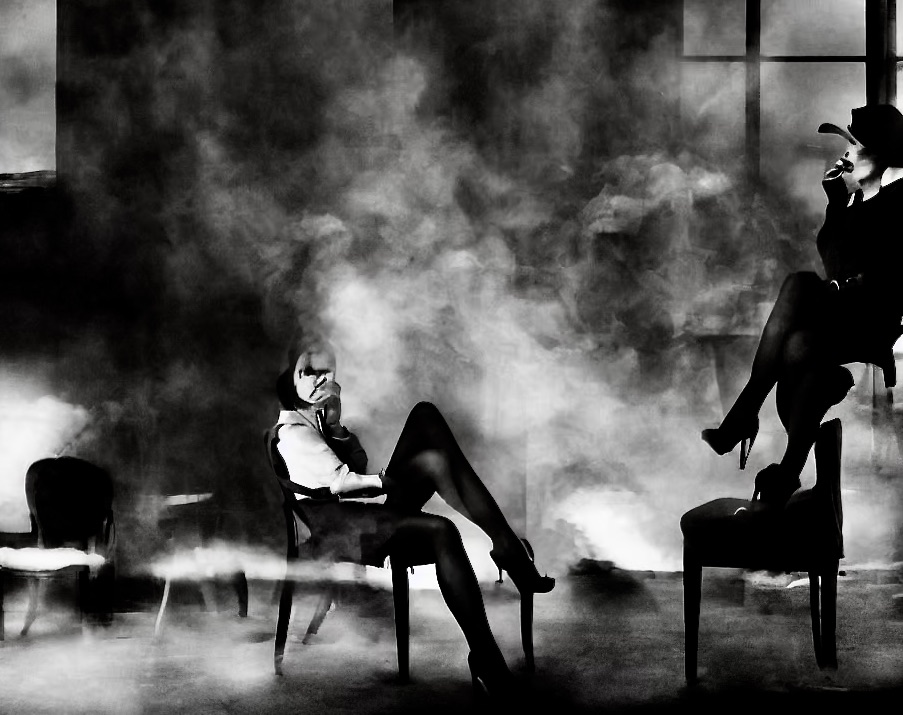
Smoke Signals

By Ed Staskus

   Not everybody was too big at Born to Travel, but except for Sally, the office secretary, and my sister Rita, they were either full to the brim or getting close to it. Sharon, Karen, and Vivian were in love with the feedbag. Gino had a hankering for the beefy mixed with gravy. Sandy Eisen and Sima Zucker had fallen into the trough a long time ago and weren’t coming up for air.

   The travel agency was in Beachwood, a far east side suburb of Cleveland. The office wasn’t the biggest to begin with, making it a tight fit. It was a squeeze coming and going to the desks. The staff of six and the two boss women had to wiggle sideways to make their way around the cramped space.

   Everybody except Rita and Gino were Jewish. Gino was Italian, a gay man, and hated Sandy and Sima. Even so, he was there before Rita started working at the agency and he was still there when she gave notice after a gasoline tanker truck flipped over outside their doors. She had had enough by then and called it quits.

   Rita was the goy blonde girl who was good for business. Before she went to work at Born to Travel, she worked at another travel agency on Fairmount Circle, not far from John Carroll University. A jug-eared man who lived down the street owned the business. He put her desk in the window. He wasn’t hiding it. He thought she would attract whitish waspy people from the college.

   “Oh, look, they have a Christian girl there,” is what he hoped all the Christians would say.

   Sandy Eisen and Sima Zucker were sisters. They owned the agency. They were from Israel, like their cousin, who was Orthodox. Sandy and Sima were on the lighter side of Reformed. They didn’t take it seriously, although they could get serious in a second, if need be. They came to the United States when they were children. By the time they were teenagers it was as though they had always lived in McMansions in Beachwood. They only ever talked about the homeland when one of their tour groups was going there.

   In the 1970s Sandy was a dancer in downtown Cleveland. She worked at a disco bar serving drinks and dancing in a cage. The place was the Mad Hatter. It had a bubble machine, a strobed multi-colored dance floor, and sticky red-shag carpeting. She wore white go-go boots. Twenty-five years and 200 pounds later she showed Rita a picture of herself, in a shimmering sleeveless fringe dress, doing the funky chicken.

   Rita could hardly believe it and said so. Sandy didn’t like her tone. She lit a Virginia Slim cigarette and puffed on it, vexed, smoke coming out of her ears.

   Sandy and Sima’s world revolved around food. They loved all-you-can-eat buffets. Their favorite time of day was breakfast lunch dinner. They weren’t food snobs. Their motto was, eat up now. They were supposed to fast during the Jewish holidays, but because they were fat, they were diabetic and had to take medication. They had to take their pills with food, so they couldn’t fast. But they were sticklers about breaking the fast. Sandy would rush home right away and make a batch of potato latkes.

   Sima had two sons in high school. Her husband worked at a grocery store. He was the head butcher. He brought kosher beef and lamb home. Sandy had three daughters and her husband, a tall balding man with a nice smile, was a porno movie wholesaler. He sold them to video stores around the state. He made a good living selling glossy naked girls.

   All of Sandy’s daughters were pudgy-cheeked fat and fluffy. The youngest one was 22 years old and clocked in at close to three hundred pounds. The middle gal never went anywhere without her portable fridge. The oldest one’s neck was turning black because oxygen was being blocked by blubber. When they started hunting for husbands all three got gastric bypass surgery and lost weight by the boat load.

   No one ever knew what got into her, but Sima went to Weight Watchers for a month. She kept a journal and wrote down what she ate morning, noon, night, and snacks. But she lied to her journal. She made it all up.

   “I’m not going to say I ate all that,” she explained.

   “They’re not going to be checking up on you,” Rita said. “You’re just lying to yourself.”

   Gino didn’t believe she was going to lose any weight. “It’s a pipe dream,” he said. He chewed his cud about it. Rita encouraged her to keep it up, but Sima didn’t lose any weight, not that anybody thought she would.

   Sandy went on the Adkins Diet. She loved meat and started eating a slab of bacon every day. She brought it to the office in the morning. There was a microwave in the fax machine room. She tossed slices of bacon into it every morning, heated them up, and ate all of it. The office smelled like a fry shop for hours.

   “I don’t know about all that bacon,” Rita said. “It can’t be good for you.”

   “I’m on the Adkins Diet,” Sandy said. “I’m allowed to eat as much of it as I want.”

   “She’s double-crossing herself,” Gino said. Everybody looked the other way. Sandy didn’t lose any weight, the same as Sima.

   Whenever Sandy had to go to the bathroom, she would hoist herself up from the desk. It took a slow minute. She could have used a lift-o-matic. “Oy, vey” she complained. Her knees were giving out. When she came back from the bathroom and flopped down in her chair, it bounced, the hydraulic hissing and groaning.

   Every year, two or three times a year, Sandy and Sima went on cruises. They loved cruises for two reasons, which were food and gambling. They didn’t care what cruise line it was, so long as it was the cheapest. No matter how cut-rate it was, you could still eat all you wanted, and they all had casinos. They loved to gamble. The nightlife didn’t matter, either. The ports they stopped at didn’t matter. The only thing that mattered was that it was a floating chuck wagon with one-armed bandits.

   Rita went on one of their dime-a-dozen cruises. The ship was creaky old but not yet rusty. It sailed out of Miami into the Caribbean for a week. Sandy and Sima spent every waking minute eating and betting. Rita got sun poisoning at the pool the first day and couldn’t sit on the sunny side of the street after that. The rest of the trip she had to stay on the shady side of the street with the 70-year-olds. She was bitter about it every minute of the cruise.

   When gambling started showing up on computers, Sandy started gambling at work. She played winning and losing games at her desk and made Sima do all the work. She bossed Sima around most of the time, anyway. Sandy was the older of the two, although Sima was the harder worker, so Sandy could throw everything at her without caring too much about it.

   They bought clothes by remote control because they couldn’t find their sizes at department stores. Catalogs arrived at the office every day. Their clothes were XXL, but nice looking. They didn’t wear sack dresses. Most of the clothes were sets, coordinated stretchy pants and a top, like turquoise pants and a turquoise blouse.

   Sandy and Sima were both top-heavy, even though both had skinny legs. Sandy talked about her legs all the time. “Look how thin I am,” she said, pulling up her pants. “My legs are so thin.” But from the waist up she was huge. She never pulled her top up or down. It would have been indecent.

   It was when Sima got false teeth that she finally lost weight. Her real teeth were a mess from smoking and eating sugary greasy processed food and not brushing and flossing nearly enough. She was in pain for months because of the new teeth and hardly ate anything. Her dentist told her to stop smoking, too. She wasn’t happy about it, but she lost weight for a while.

   She didn’t like having to buy new shoes before their time, but she had to. Her fat feet had gotten skinnier, and she needed them. She only ever had one pair of shoes, a kind of basic black loafer. When they were worn out, she would buy another pair the same as before. “I can’t live with sore feet,” she said.

   Sandy wasn’t happy about the change in her sister. She didn’t like Sima losing weight, especially whenever she sprang out of her chair like a spring chicken to go to the bathroom. Sima started saying, “Oh, I can’t stand that smell,” whenever Sandy lit up, since she had stopped smoking. They were sisters, but they bickered most of the time, arguing about whoever did whatever it was they were doing better than the other.

   Everybody in the office smoked, except for Rita. Sima went back to blazing. They were always blowing smoke out of their mouths and noses. They were in a non-smoking building, but nobody cared. They were all addicted to tobacco. Besides opening the windows to air out the office, they bought devices that supposedly sucked smoke out of the air. One was next to Rita’s desk, although she was never sure it did any good.

   One day after work she met one of her friends for dinner. When they got to the restaurant her friend said, “We can sit in the smoking section if you want to.”

   “Have you ever seen me smoke?” Rita asked.

   “No,” she said.

   “OK then.”

   Gadi Galilli, Rita’s boyfriend, made her change her clothes the minute she stepped into the house after work. He didn’t smoke and didn’t like the smell. “I know they are well off, but it smells like poverty,” he said.

   She always smelled like smoke, since she sat in the office all day, an office where somebody was always lighting up. Gino’s desk faced hers, which made it worse. She had a cloud of smoke in her face most of the day. It wasn’t just them, either. Most of their clients had the same bad habit, as though the agency specialized in people who smoked cigarettes.

   If Sandy wasn’t lighting up a Virginia Slims, Sima was lighting one up. One or the other was always huffing and puffing. They were a pair of choo-choo’s. Sandy’s wastebasket under her desk caught fire one afternoon. She absentmindedly flicked a butt into it instead of stubbing it out in the ashtray. They had to call the building’s security guard, who had to find a fire extinguisher, and by the time he got it under control the fire burned the underside of the desk and all the wires to her computer.

   She never said she hadn’t done it, at least not to anyone in the office. She never said anything about it. But she denied it to the insurance company. She didn’t want to pay for a new desk and a new computer. She didn’t start the fire purposely, which made it all right in her mind, and she got her settlement in the end.

   One day a few days before Halloween a gasoline tanker truck overturned on Chagrin Blvd., turning too fast on the ramp coming up I-271, just outside the office building. The street slopes downward for a quarter mile as it wends east. The gasoline from the ruptured tanker ran down the road like smeary water. None of them knew anything about it until a fireman with all his gear burst in.

   “Everybody out!” he said. “We’re evacuating the building.”

   Gino, Sally, and Rita grabbed their coats. Sandy leaned halfway up from her chair.

   “Nobody takes their car,” the fireman said. “The ignition could spark the gas. If anybody even tries to start a car, you’re going to get arrested.”

   Sandy and Sima wrestled themselves up to their feet. They all went into the hallway, everybody from the upstairs offices coming down the emergency stairs, shuffling towards the front door, stopping, and waiting their turn to go outside. Standing in line, rocking back and forth, Sandy pulled out her box pack of cigarettes, her BIC lighter, shook out a Virginia Slims Luxury Light 120, flicked the lighter, and lit up.

   The fireman came running over to them. “Stop!” he yelled. “What the hell do you think you’re doing?”

   He pulled the cigarette out from Sandy’s lips and crushed it between his gloved fingers. “Give me that lighter,” he said. Sandy gave it to him. She was furious but didn’t say anything. Rita thought she was going to burst, but she gave the fireman the stink eye, instead. 

   He didn’t give the look a thought. He threw the BIC lighter in the trash. He kept his eyes on her.

   When they got outside everybody was walking up the road, up to the bridge over the highway, away from the gasoline. Sandy and Sima turned the other way. The office followed them. As they walked past the gas pooling on Chagrin Boulevard where it levels off, splashing down into the storm drains, Rita realized why they were walking in the opposite direction from everybody else. Sandy and Sima couldn’t walk far and besides, they had trouble walking uphill. They could walk farther if they were going downhill. They were also going towards the stretch of fast-food restaurants where all the fire trucks and emergency vehicles, their lights flashing, were blocking the road.

   They stopped at Burger King and had burgers and fries. Firemen tramped in and evacuated everybody. They had to move on. They stopped at Taco Bell and had chicken tacos. The next thing they knew firemen were evacuating everybody again. They stopped at Wendy’s, and everybody had a frosty.

   The gas smelled like more gasoline than Rita had ever smelled in her life. She didn’t have an appetite, although she had a strawberry frosty to pass the time. Sally had one, too. The rest of the office had the empty feeling, a hunger that got bigger and bigger, and scarfed up.

   Sandy called her husband from the phone booth outside Wendy’s, and he came and picked them up in his family van. He deposited Sandy and Sima at home, drove the rest to their residences, and dropped Rita off in Cleveland Heights.

   While parked in front of Rita’s up and down double, the engine running, he turned in his seat and said, “You’re a very pretty girl, have you ever thought about being in dirty pictures?” He flashed her a warm smile.

   “No,” she said.

   “You could make a lot of money,” he said. “We’re always looking for sick minds in healthy bodies.”

   “No thanks,” she said.

   He looked down in the mouth for a minute but took it like a man.

   Walking up the sidewalk to her front door, as Sandy’s husband drove away, she thought, “I’m going to have to quit my job soon. Who needs a sex maniac, and all those stinky butts? That can’t be good for me.” That’s what she did, finally, the week after New Year’s. “Where there’s smoke, there’s smoke blowing in my face,” she said to Gadi. She was peeved. “They don’t even pay me hazard pay.” 

   They never asked her, “Do you mind if we have a cigarette?” She was just the blonde girl to get the goys to cough up. They were topping off the tank, Virginia Slimming, rolling in the dough, while she was saving every spare penny to get ahead.

   “I don’t care if they are spoiled rotten, or not,” she told Gadi after clearing her throat and breaking the news. “They don’t pay me enough to stay. I’m not bringing home the bacon I need. I’ve got to go.” 

   Gadi waved his hand, brushing away imaginary smoke. “Go change your clothes,” he said.

Ed Staskus posts monthly on 147 Stanley Street http://www.147stanleystreet.com, Made in Cleveland http://www.clevelandohiodaybook.com, Atlantic Canada http://www.redroadpei.com, and Lithuanian Journal http://www.lithuanianjournal.com

“Cross Walk” by Ed Staskus

“Captures the vibe of mid-century NYC, from stickball in the streets to the Mob on the make.” Sam Winchell, Beyond Fiction

Available on Amazon: https://www.amazon.com/dp/B0CRPSFPKP

Late summer and early autumn. New York City, 1956. Jackson Pollack opens a can of worms. President Eisenhower on his way to the opening game of the World Series where a hit man waits in the wings. A Hell’s Kitchen private eye scares up the shadows.

A Crying of Lot 49 Publication

Thrills and Spills

By Ed Staskus

   Two days after we got married in the Lithuanian Roman Catholic church on Cleveland’s east side my wife and I drove over the Rainbow Bridge to the Canadian side of Niagara Falls. It used to be called the Honeymoon Bridge, but it collapsed in 1938. When the new one opened in 1941 a quote from the Book of Genesis about a “bow in the clouds” was engraved on the side of the bridge. A half century later the span was still standing, God willing.

   We must have looked happy as larks when we got to the other side of the crossing. After paying the toll, and showing the border patrol our driver’s licenses, we were told to join a line of cars off to the side. Ten minutes later German Shepherds and their handlers showed up, sniffing the cars up and down for drugs. One of the uniforms used a tactical mirror to inspect the underside of the cars. 

   When it was over and done with and they told us we were free to go, I said, “Love is the drug, man.” The lawman at my driver’s side window didn’t like it and scowled but Rin Tin Tin gave me a forty-two-tooth salute. He was glad to be going back to headquarters for grub. We were steps from the Honeymoon Capital of the World.

   After lunch we went to Goat Island, bought tickets, got outfitted in bright yellow ponchos, and were elevatored 18 stories down to the Niagara Gorge. The Cave of the Winds started life as a rock overhang that was like a cave. There used to be an overhanging ledge of Lockport Dolostone at the top of the gorge which stuck out more than 100 feet. The overhang wasn’t there anymore but the Hurricane Deck was. We followed a guide on a series of wood walkways to it, stopping standing staring at the thundering water 20 feet away. It sprayed us in the face. There was a rainbow right there. We could almost touch it.

   “Did you bring a camera?” my wife asked.

   “No,” I said.

   “That’s all right, better to remember it the way we want to,” she said.

   Since we were soggy already, we decided to go to the Journey Behind the Falls. An elevator went down 13 stories through bedrock to tunnels that led to the Cataract Portal and the Great Falls Portal. We walked to the Lower Observation Deck at the foot of the Falls and watched one-fifth of the world’s freshwater crash down at 40 MPH into the basin below. We left dripping freshwater behind us.

   There was still some daylight left in the day, and waterlogged as we were with nothing to lose, we boarded the Maid of the Mist. The first boat in 1846 was called Maid of the Mist and the name had never changed although the ships had. The first ones were steam powered. Ours was a diesel-powered vessel put into service in 1955. It was two years after Marilyn Monroe cuckolded and tried to murder her husband Joseph Cotton in the movie “Niagara.”

   The first Maid of the Mist was a barge-like steamer that was more ferry than anything else. It was a 72-foot-long side-wheeler powered by a wood-and coal-fired boiler. The ferrying only lasted two years, when a suspension bridge opened. Not knowing what to do with the boat, the owners finally decided to make it a sightseeing wheeler.

   We took the Incline Railway from street level down to the boat dock. The new Maid was looking good, having replaced the old Maid in 1983. The old boat was plying the Amazon River as a missionary ship under an assumed name. She had been a trooper in her day. In 1960 the Maid wheeled to the starboard and the crew rescued Roger Woodward, a seven-year-old who became the first person to survive going over the Horseshoe Falls wearing only a life jacket. Getting on the boat we were both handed blue ponchos and advised to wear them, or else.

   “Or else what?” I asked. 

   “You’re free to not wear it and soak in the experience,” the man said. We put our ponchos on and cinched the hoods.

   The boat chugged to the base of the American Falls. It started to rock and roll. We kept our balance hanging on to a rail. I never knew water droplets could pummel or that half a million gallons of water pouring out of the faucet at once could be so loud. The Maid went on to the basin of the Canadian Horseshoe Falls. We stood at the front of the boat on the upper level up close and personal. The captain took her closer and closer. We got as close as it gets. The waterfall was in our faces. We could barely keep our eyes open. It might as well have been raining, even though the sky was sunny and blue. When the boat turned to go back, she spun around in place, spray coming at us from every direction.

   There was a full moon that night. “When the moon hits your eye like a big pizza pie, that’s amore.” We had fun fooling around that night.

   The next day we went high and dry. We were done with getting wet and took a helicopter ride. The chopper was an Enstrom, operated by Pan-Air. They had a “Chapel in the Sky” service although since we were freshly minted, there was no need for more vows. The helicopter sat six, but my wife and I and two Japanese men were the only ones on the flight. We sat in the front with the pilot and the Japs sat in back, where they took a million pictures. The front of the chopper was plexiglass. When I looked down the sky was right under our feet. Rainbows shot up at us from the rapids and falls.

   The ride was only ten or fifteen minutes long, but we got an eyeful. The bird’s-eyeview was nothing if not breath-taking. We saw the American Falls, Bridal Veil Falls, Horseshoe Falls, Whirlpool Rapids, the Rainbow Bridge, and Queen Victoria Park.

   “Ooh-wee,” we both said when the helicopter landed. We got our land legs back and went back to the Howard Johnson’s for a nap and dinner. The Japs stayed behind taking pictures of the chopper.

   The next day we left Niagara Falls, messed around in Toronto, and drove to Ottawa in our VW Golf. The city is the capital of Canada, on the south bank of the Ottawa River, straddling the provinces of Ontario and Quebec. Brian Mulroney was the Prime Minister. He kept order by saying things like, “I am not denying anything I did not say.” The city had been there since 1826 and by 1989 was the fourth-largest one in the country. A big part of it burned down in 1900 and had to be re-built for the better. We stayed at a small motel near Pig Island. The drive to Byward Market and Lower Town was a short one up Colonel By Dr. along the Rideau Canal. We discovered a Portuguese bakery in Lower Town and pigged out.

   We visited the Notre-Dame Cathedral Basilica, Parliament Hill, which is the neo-Gothic home of the law of the land, checked out the Centennial Flame and the statue of Queen Victoria, took a stroll through Major’s Hill Park, and had dinner two nights back-to-back at two terrific restaurants near Confederation Park, walking the food and drink off afterwards, and tossing a Loonie in the fountain, the one-dollar coin introduced two years earlier.

   One afternoon we were standing on the Mackenzie King Bridge watching boats going to and from the locks when we noticed a houseboat coming our way. The canal was built starting in 1826. More than a thousand Irish, Scottish, and French laborers died of malaria digging it out. It opened in 1832. The idea behind the canal was a lifeline between Montreal and the naval base at Kingston in case Canada ever went to war with the United States. 

   The Pumper was the first steamboat to make the trip, carrying Colonel By and his family. John By was the man who made the canal happen. Canada and the United States never went to war and the canal became a thoroughfare for shipping grain, timber, and minerals from the hinterland to the east. Immigrants used it moving westward. After railroads appropriated the shipping trade, the canal was mostly used by pleasure craft.

   It was a pleasure watching the houseboat approach. A man was sitting in a folding chair at the bow. His legs were crossed, he was reading a newspaper, and smoking a cigar. A woman was standing at the stern with a long pole. She was slowly leaning into the pole and pushing the forty-foot flat bottomed houseboat forward. She kept her push pole lined up with the center line of the boat to keep it moving in a straight line. I could see they had an inboard motor but weren’t using it. Smoke from her husband’s cigar drifted back to her. She waved it away from her face.

   “Take notes,” I told my new bride. 

   “That’ll be the day,” she grumbled.

   After we got home from our honeymoon, we often went back to Canada, to Montreal and Quebec City, up the St Lawrence River, and to Nova Scotia and Prince Edward Island. We never went back to Ottawa, not for any especial reason. One morning while I was looking out our living room window at yet another winter storm blowing through town, my wife asked me if I had seen the news about the protests in Ottawa. I flipped an iPad open and read the news. Sure enough, protests were roiling the capital.

   A convoy of truckers had descended on the city three weeks earlier protesting a regulation requiring drivers moving goods across the USA Canada border to be vaccinated against the 19 virus. Other truckers were blocking bridges between Windsor and Detroit and another bridge linking Alberta to North Dakota. The federal police had already arrested more than a dozen drivers out west and seized all their guns and ammo. They had been planning on ambushing and shooting law enforcement officers.

   When the Ottawa camel train pulled into town to throw gasoline on the fire they rumbled straight to Wellington St. and Parliament Hill and surrounded it. Their $100,000 travel trailers, $150,000 recreational vehicles, and $200,000 heavy trucks brought traffic to a standstill. Businesses shut down for the duration. There wasn’t any money coming in, anyway. Flatbed trucks became stages. Organizers clapped themselves on the back and made misinformation speeches. DJ’s spun rap cranked up so everybody within miles could hear it. Bouncy castles were plopped down in the streets for kids playing hooky. Some drivers had brought their children with them. An inflatable hot tub was pumped up and set up for rest and recreation. They flew QAnon and Confederate flags, even though QAnon is a Whac-A-Mole, and Johnny Reb got his ass kicked a long time ago.

   Who flies slaveholder-or-die flags to prove how virtuous they are? Folks who want a slave of their own? Folks who live in caves? Folks who are far over the full moon? 

   Drivers put their air horns on autopilot 24/7. It didn’t take long for everybody living nearby to get sick of it. “You got vehicles laying on their horns for hours and hours at a time,” said Peter Simpson. “We don’t even live on Parliament Hill. It’s very difficult to work or relax or to do anything. All you can do is focus on calming yourself down.”

   The morning I read about the protests was the morning things were coming to a head. The police sat on their hands for weeks until the mayor got tired of it, fired the police chief, put a by the book man in charge, and a few days later the cops were showing up in force. “It’s horrific,” said Dagny Pawlak, a protestor spokeswoman. “It’s a dark moment in Canadian history. Never in my life would I have believed anyone if they told me that our own Prime Minister would refuse dialogue and choose violence against peaceful protesters instead.”

   “Look, I am a big, brassy guy who won and won big,” is what Brian Mulroney always said. “I do what I want.” But he wasn’t the Prime Minister anymore. Justin Trudeau was the man upstairs. He said the truckers were “an insult to memory and truth.” He did what he had to do.

   When I was student at Cleveland State University in the 1970s we went marching from our campus down Euclid Ave. to Public Square every spring to protest the Vietnam War. We never marched in wintertime because it was too cold and snowy. Nobody wanted to be plowed under by a snowplow. We wore buttons saying, “How Many More?” and “I’m a Viet Nam Dropout” and “Ship the GI’s Home Now!”  Many of the GI’s shooting it out with Charlie were true believers who volunteered. The rest were unlucky trailer trash. They were the ones who were always getting drafted first. We were college students with draft deferments and wanted to keep it that way.

   We carried banners and damp handkerchiefs in our pockets. Everybody wore sensible shoes. One springtime I noticed two coeds next to me wearing pumps with two-inch heels and straps that looked like they would snap at the slightest provocation.

   “You might want to change into flats,” I said. 

   “Why would we want to do that?” one of them asked.

   “In case you’ve got to run.” They giggled and skipped away. The last time I saw them they were skinning their knees trying to run and getting themselves easily arrested.

    When we got to the Sailors and Soldiers Monument, firebrands made fiery speeches, we chanted slogans, listened to more speeches about justice and freedom, half of us high on weed, and waited for the cops to show up. When they did and ordered us to disperse and we didn’t, they lobbed tear gas at us. We gave them the finger. They beat us with rubber batons. We threw cherry bombs at them. They sent in the mounted police. Nobody wanted to be trampled by a horse. We usually ran for the train station in the Terminal Tower trying to lose ourselves in the workaday crowd.

   I never went on a Civil Rights march. They had it worse. Vigilantes and police used whips, Billy clubs, guns, dogs, Cossack-style horses, fire hoses, and tear gas. When we were protesting the Vietnam War, we were white kids being corralled by white policemen. They didn’t like us but weren’t trying to kill us. 

    The Freedom Convoy in Ottawa had plenty of banners and slogans. Reading them was like trying to find meaning in a bowl of alphabet soup. Mandate Freedom 4 All. He Will Not Divide. Hold the Line. Take Back Our Freedom. We Will Not Acquiesce. Were they trying to dam up Niagara Falls with toothpicks? One of the signs said they were willing to take a bullet for their country. What about taking a shot for your neighbors?

   Matthew Wall, an electrician from Manitoba, joined the Freedom Convoy after popping psychedelics and having a vision. “I’m here for the rights of our kids, for parents’ rights, for everyone’s rights,” he said. “It is so kids can live in a future where they don’t have to have something covering their face. You don’t have the human connection, don’t see them smile anymore. It’s dehumanizing. They’re taking away the love!”

   Many of Ottawa’s residents had their own slogan: Make Ottawa Boring Again!

   “I wonder what would be going on if it was the 1340s and 1350s?” I wondered aloud to my wife, watching it snow in the meantime.

   “What do you mean?” she asked.

   “I mean, I wonder how long the lines would be to get vaccinated against the Bubonic Plague if it was the plague instead of the 19 virus,” I said.

   Five years into the pandemic at the beginning of the Middle Ages almost 50 million Europeans were dead, more than half of the population. They called it the Great Pestilence. They didn’t have vaccines. They resorted to mixing tree resin, roots of white lilies, and human excrement into a porridge and slathering it all over themselves. If you caught the Black Death, your chances of making it back alive were almost zero. Nobody died peacefully in an ICU. There were no ICU’s. They got crazy feverish, their joints on fire like a ten-alarm. They broke out in buboes, oozing pus and blood, vomiting non-stop, and got diarrhea to die for.. The suffering went on non-stop for a week-or-so. When it was over, they fell down dead in the streets, glad it was over.

   “I bet the spaghetti o’s with their portable spas in Ottawa would be the first ones pushing their way to the head of the vaccination line while crying there is a conspiracy to push them to the back. They would be going 100 MPH in their trucks and RV’s to get somewhere anywhere to snag a shot, not complaining about government overreach.”

   “Maybe you’re right,” she said. “Thank goodness we’re on the other side of the Middle Ages.”

   “Hats off to that, sugar, although now and then when there’s a full moon it’s back to the Dark Ages,” I said.

Ed Staskus posts monthly on 147 Stanley Street http://www.147stanleystreet.com, Made in Cleveland http://www.clevelandohiodaybook.com, Atlantic Canada http://www.redroadpei.com, and Lithuanian Journal http://www.lithuanianjournal.com

“Cross Walk” by Ed Staskus

“Captures the vibe of mid-century NYC, from stickball in the streets to the Mob on the make.” Sam Winchell, Beyond Fiction

Available on Amazon: https://www.amazon.com/dp/B0CRPSFPKP

Late summer and early autumn. New York City, 1956. Jackson Pollack opens a can of worms. President Eisenhower on his way to the opening game of the World Series where a hit man waits in the wings. A Hell’s Kitchen private eye scares up the shadows.

A Crying of Lot 49 Publication
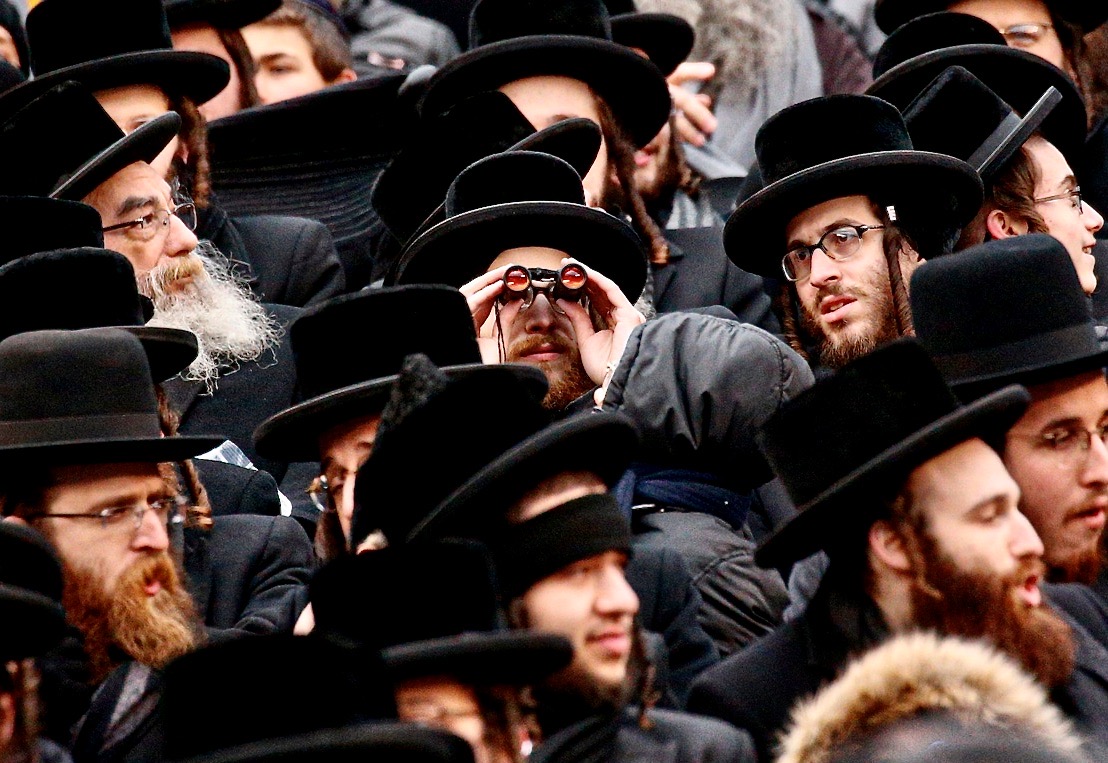
Tower of Babel

By Ed Staskus

   My sister Rita thought Gadi Galilli was going to help her learn Hebrew, but he didn’t, not even for a minute. He was from Jerusalem, he had a boat load of friends who spoke Hebrew, and they yakked it up among themselves all the time. But he never helped her, even though they lived together, and she was the designated driver who drove him to synagogues. 

   She met Gadi when he was with the Cleveland International Group. They were both looking up at the same dinosaur one day at the Natural History Museum and afterwards she gave him a ride home. Everybody in the immigrant group loved him. He asked her for her phone number. He was a cute guy, and she liked him, but found out later he had almost no patience, even though it is a Biblical virtue.

   He was from a Kurd family, had been born in Haifa, and was an orthodox Jew. Rita always thought there was something out of joint with him. He never talked about why he left Israel when everybody else said it was the homeland. He didn’t always go to the same synagogue, either. He was supposed to walk to the service but she always drove him. She dropped him off a block from whatever synagogue he was going to that day and he walked the rest of the way. He didn’t want anyone to see him in a car.

   Rita was working at Born to Travel in Beachwood when she started thinking about learning to speak Hebrew. Beachwood is an ethnic neighborhood on the far east side of Cleveland and many of the people who came to the agency spoke Hebrew. She thought, “Maybe I should learn it. It would help me get ahead in my job.” Gadi and she would have something in common, other than going out and making out. 

   Sandy Eisen and Sima Zucker encouraged her. They were the co-owners of the travel agency. They wanted Rita to guide tours to Israel. What could be better, they said to one another, hacking and spitting into their trash cans, making their plans. They were sisters and both were fat. They were always at the head of the buffet line. Sandy was usually ahead of her sister. Sima worked hard, but Sandy didn’t, since she had Sima. Sandy fell asleep at her desk every day, her head lolling on triple chins. They both smoked cigarettes non-stop all day, stinking up the office, like it was the most important thing to stick in the mouths, next to chow. They were from Israel, from when they were children. They had never gone back. They weren’t even planning on visiting anytime soon.

   Although Rita wasn’t Jewish and only knew a handful of Hebrew words, she spoke Lithuanian fluently and some German. “I’m pretty good with languages,” she thought. She used to be a schoolteacher and was sure she could learn. At least she thought so until she tried. “I couldn’t have been more wrong,” she admitted. It was like baby talk being your native tongue and trying to learn Chinese and Hungarian both at once. 

    Sima told her about a language school on Shaker Boulevard, just 10 minutes from where Rita and Gadi lived. Classes were at night, twice a week, Tuesdays and Thursdays, from 8 o’clock until 10 o’clock. She made sure to get there early her first night, although when she got there every last person was already in the classroom.

   When the teacher walked in, Rita could barely see her, she was so short, barely bumping five feet. She had dark hair and was from Yemen. The first thing she said was, “Yemenite Jews are the most Jewish of all Jews. Be glad I am your teacher. Sit up straight and pay attention.” Her name was Ayala. She handed notebooks out with the Hebrew alphabet in them to the class. She started speaking in Hebrew, too, right away, and never went back to English unless she absolutely had to. She was all business.

   “Let’s go,” she said clapping at the start of every class.  Everybody had to stand up and sing the Israeli national anthem. Then it was down to the business of Hebrew.

   Rita’s biggest fear was Ayala calling on her. “I would have to speak in front of everyone,” she complained to herself. She tried to keep her nose buried in her notebook, scribbling notes. She tried to keep her head down in the foxhole. Everybody in the class was Jewish, except for her. Everybody had to tell everybody else their names the first day of class, There were Esther, Joshua, Miriam, Daniel, and 1Alexander. One man’s name was Gilead, which Alaya explained means mound of testimony, although she never explained what mound of testimony meant. Most of the class called him Gil, although one wise guy called him Mound of Gil, because he was heavyset.

   “Oh, my name’s Rita,” she said when it was her turn. Right away somebody asked her, “What’s your Hebrew name?” She wanted to say, “What the hey, I’m not even Jewish,” but instead said, “My family calls me Rita.” 

   Ayala asked questions in Hebrew, and when everyone around her answered in Hebrew, she realized they all knew at least some of the language, while she knew nothing. It was a beginner’s class, but she was as far back from the starting line as could be. When Ayala found out Rita didn’t know anything, she devoted a little more time to her. 

   Rita couldn’t make out the strange alphabet, and on top of that the writing was backwards. When the teacher spoke, it sounded like she was clearing her throat. She decided she wouldn’t be able to make those sounds. “I’m not coming back,” she decided. But two days later she was back. She told herself, “I am taking the class for work’s sake. I want to travel overseas. I don’t want to admit to Gadi I am quitting after one night.” She ended up taking the course from beginning to end, nine months of Hebrew. 

   Every symbol of the alphabet had to be memorized back to front and back. She tried, but it was hoodoo to her for a long time. Everything the teacher wrote on the black board she copied in her notebook. She wrote sentences first in English and then in Hebrew. She wrote her name repeatedly until she got it right. She wrote, “We have three children in our family, two boys and one girl,” and then she wrote it in Hebrew, over and over.

  The Pilgrims, when they landed in America, for a few minutes thought of making Hebrew their national language. It didn’t matter that it was the New World, not the Old World. But there’s no word in Hebrew for history, so the Hebrew proposal became lost history.

   The classroom across the hall was a conversion class. Everybody in the class was somebody converting to being Jewish. Rita’s classmates craned their necks, a sour look on their faces, watching them go in their door. They didn’t like it, at all.

   “Oh, they’ll never be real Jews, those non-Jews trying to be Jewish.” they said.  

   “Take a look at that shiksa,” a skinny man sneered looking down his nose.

   Rita thought everybody believed her mother was Jewish, although she didn’t know why. She had shoulder-length blonde hair. “I don’t look Jewish,” she thought, but if you say that in front of Jews, they’ll say, “What? There are plenty of blondes in Israel.” 

   Gino, who was the travel agent at the desk opposite her, and she were talking about the Jewish look one afternoon when a man walked in and she said, “Tell me he doesn’t look Jewish.” She said it too loud. It just came out. Everybody heard her say it.. Sandy and Sima put their cigarettes down. The secretary looked up from her typewriter. Most people who came to the agency were Jewish, so it wasn’t any surprise, but the man looked like Barbara Streisand.  

   Gino and she were outsiders because everybody else in the office and almost everybody else in the building and neighborhood was Jewish. Sandy and Sima would sometimes say, “I don’t know why the Christians don’t like Jews.” They made it sound like Christians were a crazy backwoods clan. They made it sound like being Jewish was God’s blue-ribbon plan.

   The Jewish holidays start in September. Yom Kippur is the heavyweight holiday. Everybody in Rita’s class was talking about it. One of them asked her, “What synagogue do you go to?” Most of the class lived on the east side, including her. She lived in Cleveland Heights up the hill from Little Italy. Rita thought, “Oh, Christ, there are a lot of small ones, but they’re all ultra-orthodox.” She didn’t want to look overly conservative. When she drove to work, she always passed the big Sinai Synagogue, so she said, “SInai.” It turned out it was ultra-orthodox.   

   Everybody was good with that, even though Rita didn’t wear a wig or have a real Hebrew name. She decided she had to go to the Sinai Synagogue to see it. At the service the men were all downstairs and the women upstairs, on a balcony, segregated. She took the stairs. It looked like most of the women were wearing wigs. She didn’t own a wig and never went back.

   Her classmates knew she lived with Gadi. He dropped her off at school and picked her up afterwards. He was OK with her saying she was orthodox. Since everybody mistakenly thought she was Jewish she knew she had to be crafty about it. She ran into them all the time where she lived and worked, especially around Corky and Lenny’s in the plaza next to Born to Travel, where she went to lunch every day.

  One evening an elderly lady with a scratchy voice, the mother of a woman she sat next to in class, called her out of the blue. It was a week before Christmas. It was the day before the last day of Hanukkah.

   “What did you do today?” she asked, like they were old friends.

   “I just finished all my shopping,” Rita said. She almost said Christmas shopping, but caught herself. Her family celebrated Kucius, the Lithuanian Christmas Eve. Her kith and kin were dyed in the wool Christians.

   “But it’s the last day of Hanukkah tomorrow,” she said.  

   “In my family that’s how we do it, we do everything the last minute,” Rita explained. “I’m not breaking tradition. Oh, I bought some donuts, too.” Somebody had told her to say donuts if she ever felt she was being called out.

   “Oh, I see, that’s good,” the old lady said.

   Rita was never certain whether she was getting a good grasp on Hebrew, or not. After every class she thought, “I’m never going back.” One night she finally didn’t go back. She couldn’t bring herself to do it. That night Alaya called her at 11 o’clock, just as she was going to bed. 

   “Why weren’t you in class?” she asked. 

   Rita wanted to tell her, “You should be asking me why I go, not why I didn’t go this one time.” But she told her because of the holiday coming up, she had to clean her cupboards, getting rid of all the yeast in the kitchen. If you’re ultra-orthodox you have to remove any yeast you have in the house, sweep away crumbs, look under cushions for moldy donuts, remove every trace of the stuff.  Most of the people in class were reformed Jews and didn’t take it too seriously, but because she had mistakenly made everybody believe she was more conservative than them, she was expected to be serious about ritual.

   “It never was my intention to say I was Jewish, but a good time to admit it never came up,” she explained to Gadi. What was worse, she was Roman Catholic. That side of her didn’t like Jews. The Lithuanian side of her didn’t like Jews, either. She kept her peace of mind by doing breathing exercises.

   After Alaya hung up, Rita had to meet her on Sunday morning, just the two of them, to make up the class. It was impossible to keep her head down with her teacher breathing down her neck. Alaya told her she was making progress. It made Rita glad.

   Gadi’s younger brother Oz from Israel visited them for two weeks in the spring. He was a big help, taking the time to talk to Rita in Hebrew, helping her get the feel of the language. It sounded like something between Arabic and French when he spoke it. He helped her more in a few days than Gadi ever did.

   Since his brother was visiting, the two men went to services together on Fridays, dressed up in business casual. Gadi turned off all the lights in the apartment when they went, walking to the synagogue. He had never done that before. He even unscrewed the light bulb in the refrigerator. When they left, they left Rita sitting alone in the half-dark.

   At the end of the class Rita got a B, even though she more-or-less staggered through it like wandering in the desert. Her reading and writing were sketchy, but by graduation time she spoke the language tolerably well. Even so, she was glad when it was all over.

  She started chaperoning Born to Travel tours to Israel soon afterwards. Sandy and Sima saw her off at Cleveland Hopkins Airport. They waved goodbye with their long Virginia Slims, their fingertips stained yellow, their flat feet achy. They bought giant hot pretzels to tide them over on the way home.

   Rita stayed with Gadi’s mother the first time she was in Jerusalem. Oz still lived at home. He  took her to a wedding. He told her how to dress for it. “Wear a black dress.” Rita wore a black dress. The men sat on one side and the women on the other side. After the ceremony she sat at a table with the women who passed around platters of food. 

   They were separated from the men by a low wall. The women sat and talked, most of the chatter too fast for her. All the men wore black hats and were having a great time, drinking, singing, and dancing, sweating up a storm, their hats bobbing up and down on the other side of the wall. The groom wouldn’t say a word to her when she tried to talk to him. He and his bride didn’t dance together, not even once. Rita danced with some of the other women. She had a wonderful time.

   The more often she went to Israel the better her Hebrew got. One day she was walking around Jerusalem by herself, sight-seeing the way she liked it. A young man with red hair wearing a yarmulke asked her something as he was passing by.

   “What’s that?” she asked.

   “Do you know where Jaffa Road is?” he repeated.

   Her tour group was staying in a hotel on Ben Yehud Street. It was exactly where it met Jaffa Road. She pointed over her shoulder.

   “It’s over there,” she said in throat-clearing squeaky-clean Hebrew.

Ed Staskus posts monthly on 147 Stanley Street http://www.147stanleystreet.com, Made in Cleveland http://www.clevelandohiodaybook.com, Atlantic Canada http://www.redroadpei.com, and Lithuanian Journal http://www.lithuanianjournal.com

“Cross Walk” by Ed Staskus

“Captures the vibe of mid-century NYC, from stickball in the streets to the Mob on the make.” Sam Winchell, Beyond Fiction

Available on Amazon: https://www.amazon.com/dp/B0CRPSFPKP

Late summer and early autumn. New York City, 1956. Jackson Pollack opens a can of worms. President Eisenhower on his way to the opening game of the World Series where a hit man waits in the wings. A Hell’s Kitchen private eye scares up the shadows.

A Crying of Lot 49 Publication