Category Archives: Constructed Reality

Flying the Coop

By Ed Staskus

   “Hey, what the hell do you think you’re doing?” Juozas Bankaitis barked coming back to his delivery truck. He had just dropped off three orders of fried chicken to a law office on the corner of 3rd St. and Yesler Way on Pioneer Square. Yesler Way was named after Henry Yesler, the founder of Seattle. A Negro man was tearing the spare tire cover off the back of his truck.

   “Who the hell do you think you are calling us coons?” the man yelled back.

   What is he griping about? Juozas wondered. Everybody loves coon chicken.

   Juozas was new to Seattle, Washington. He had come from Cleveland, Ohio. He had emigrated to the United States from Lithuania a year after the Great Depression parked itself for the long haul. None of the work he found in Cleveland ever lasted and he decided to take his chances out west. When he got to Seattle he liked what he saw. It reminded him of his home on the Baltic Sea. He changed his name to Joe Baker. He worked for the Coon Chicken Inn making deliveries and filling in whenever the kitchen needed him. He didn’t belong to the Church of Fried Chicken, but he was good at seasoning them and making sure the cooking oil temperature never dropped below 325 degrees.

   “Give that back to me,” Joe said. 

   “Come and get it,” the man said. His name was Joseph Stanton. He worked for the Northwest Enterprise, a local Negro newspaper. The newspaper had been founded in 1920 by William Henry Wilson. By the time Joe Baker arrived in town William Henry Wilson was thought to be the most successful Negro in Seattle.

   Joe Baker and Joe Stanton each got their hands on the spare tire cover and started tugging. Before long the canvas cover tore in half. A policeman on foot patrol heard the commotion and broke up the tug of war. He arrested Joe Stanton. The Negro was booked for vandalizing an automobile. The next day in court the judge asked to see both parts of the spare tire cover. When a court attendant brought them out, the judge put the parts together and chuckled. It had Coon Chicken Inn printed on it in bold letters. Darkies could be sensitive.

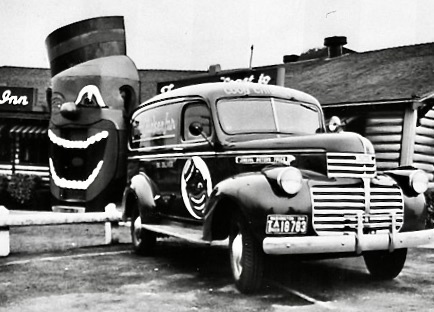
   There was a color picture in the middle of the spare tire cover. It was the head of a grinning bald black man with enormous lips, a winking eye, and wearing a cockeyed porter’s cap. The same bald black man’s head formed the restaurant’s 12-foot high front entryway. The door was through his grinning mouth. The logo was on every menu, dish, and piece of silverware.

   “Well, I’ll just fine you three dollars and you go on home,” the judge said settling the matter by banging his gavel. Joe Stanton’s newspaper paid the fine. They padded his paycheck with a bonus the following week. 

   The first Coon Chicken Inn came to life in 1925 in Salt Lake City. The eatery took off the day its doors opened. Two years later the deep-fat grease-soaked place caught fire and was reduced to ashes. Fifty carpenters worked day and night for ten days building a newer bigger restaurant. An overflow crowd showed up on the eleventh day. Everybody got free dessert when they ordered the Coon Chicken Special. 

   The Seattle restaurant opened in 1929 on Bothell Highway, not far from Henry the Watermelon King, who sold king-sized watermelons. Just like in Salt Lake City, it was an instant success. “Anyone who has lived below the Mason-Dixon line knows that ‘coon chicken’ is the way the fowl is cooked by the old-fashioned southern mammy,” the Seattle Times reported, heedless that there were no old-fashioned southern mammy’s in the kitchen. The following year another one of the restaurants opened in Portland, Oregon. A cabaret, dance floor, and orchestra were soon added to the Salt Lake City and Seattle locations. The dance floor was where Joe Baker met Helen, who became his wife.

   “I’ve always said, never put a sword in the hands of a man who can’t dance,” Helen said. “But, oh boy, you can dance.”

   “I always say, if you can dance, you’ve got a chance,” Joe said. “Never mind that chicken, let’s shake a leg.”

   The fried chicken restaurants were owned and operated by Maxon Graham and his wife Adelaide. Maxon had been barely 16 years old in 1913 when he answered an ad for the Metz Automobile Company. They were looking for car dealers. Maxon wrangled financing from a local bank and got  distributorship rights for Utah, Idaho, and Nevada.  When he did, he became the youngest car dealer in the United States. Twenty years later Maxon and Adelaine were looking for a new opportunity. They settled on fried chicken.

   Most of the waiters, waitresses, and busboys at the Coon Chicken Inn were Negroes. “Their service to whites is preordained by God,” was the feeling of the day. Everybody knew, though, that they were thieving chicken-lovers. Everybody had seen their rascality in the movie “Rastus and the Chicken.” The birds were kept under strict supervision. The cooks were a mixed bag. The rest of the staff was white, especially the cashiers, bartenders, and everybody front-of-house. There were no Chinamen. 

   A Nevada periodical published an interview in 1972 with the grandfather of a waitress who worked at the last of the restaurants in Salt Lake City, which closed in 1957. “I was ridin’ out one day and comes across the Coon Chicken Inn. Seems like that ol’ coon head just sort of winked at me like it always done, and I’ll be dad blamed if I didn’t just wink right on back. I reckon de past ain’t all full of meanness. You got to laugh at some parts.”

   Seattle’s Coon Chicken Inn often hosted meetings of clubs and civic organizations. The Democratic Club met there. Weddings, anniversaries, and birthday parties were celebrated there. There were always an array of drinks at the catered meetings and celebrations, but the food was without fail fried chicken. In 1942, long after Joe Baker had left Seattle, Coon Chicken Inn was listed in ‘Best Places to Eat,’ the nationwide guidebook of auto clubs.

   Joe was filling in one busy Saturday night frying chicken one after the other when one of his friends in the kitchen pulled him aside. His name was Ernie. “You hear what the Chinamen are up to?” he asked.

   “No, I haven’t heard anything.”

   “They are planning on applying for work here at half our pay. It won’t be long before none of us has got no job anymore. Why don’t you join us tomorrow? We’re having a rally about what to do.”

   “OK, I will,” Joe said.

   The rally the next day was in a cleared field on the outskirts of Seattle. It was Sunday night. There were a thousand more men and women there than worked at the Coon Chicken Inn. Most of them were dressed in white robes. They were the rank-and-file. A few of them were dressed in green robes. They were the Grand Dragons. A dozen of them wore black robes. They were the Knighthawks, a kind of bouncer. Some of those in white had emblazoned their robes with stripes and emblems.

   Almost all of them were wearing a conical shaped hat. They were dunce hats with a mask flap. Round eye holes had been cut out of the front of the mask. The eye holes were stitched to prevent fraying. There was a red  tassel attached to the pointy top of the hat.

   “Is this the Ku Klux Klan?” Joe asked Ernie.

   “Yeah, that’s who we are,” Ernie said handing him a robe. “I couldn’t find a hood for you, but that’s all right. You’ll make do.”

   Joe knew hardly anything about the Ku Klux Klan except that they hated Negroes so much they burned down their houses in the night and lynched the survivors. What he didn’t know was they hated Chinamen almost as much as Negroes. He found out later they hated Jews and Catholics as well. When he found out they hated immigrants he was offended, but by then he was no longer living in Seattle.

   “I thought the Ku Klux Klan was against Negroes.”

   “Chinamen are the same as niggers, lazy and shiftless.”

   Joe was puzzled. It didn’t make sense. If they were lazy and shiftless, why were they trying to take everybody’s jobs? He was also puzzled that the Ku Klux Klan was in the Pacific Northwest in the first place. He thought they lived and died in Dixie.

   “No, it ain’t just there. We’ve been here since right after the Civil War, the same as back home. Hell, we were here before there even was a Klan.” Before the Civil War a group calling itself the Knights of the Golden Circle promoted the cause of the Confederacy. During the war they were a Fifth Column. They meant to spread slavery and take California, Oregon, and Washington out of the Union. They planned to form a Pacific Republic allied to Dixie.

   In 1868 in the Livermore Valley outside of San Francisco a circular was in wide circulation. “Action! Action! Action!” it said. “Fellow members of the KKK the days of oppression and tyranny is past, retribution and vengeance is at hand.” The circular threatened to impale those “who seek enslavement of a free people.” Their target was the Chinese. Anti-Chinese sentiment up and down the coast eventually led to the first race-based anti-immigrant laws in the United States. “ I believe this country of ours was destined for our own white race,” Senator John Hager said.

   “How are you going to keep the Chinese from taking our jobs?” Joe asked.

   “Stick around, you’ll see,” Ernie said. “We got the manpower to get it done.”

   In the summer of 1923 200,000 Klansmen gathered in Indiana for a mass rally. There were more Klansmen in Ohio, Illinois, and Indiana than there were south of the Mason Dixon line. That same year 50,000 of them rallied at Wilson’s Station in Oregon. “Over a green sloping hill on which stand four huge crosses an endless line of white-robed Klansmen move in single file and closed ranks,” is how the magazine Watcher on the Tower described it. “They form a square covering the space of five acres standing shoulder to shoulder. Suddenly a figure appears on the brow of the hill riding a horse. A voice heralding the stars passes the word ‘Every Klansmen will salute the Imperial Cyclops.’” Two years later almost 40,000 Klansmen paraded down Pennsylvania Avenue in Washington, D. C. in broad daylight in full regalia.

   The rally started when the sun was down and the moon was up. Ernie elbowed his way to the front, Joe following in his wake. There was a 21-gun salute. A cohort of Klansmen paraded in military formation with red, white, and blue torches. A fireworks display exploded into three gigantic K’s and parachuted hundreds of small American flags. The first speaker declared that “our progress is the phenomena of the age. It is the best, biggest, and strongest movement in American life.” A troupe of actors reenacted scenes from D. W. Griffith’s “Birth of a Nation.” A local minister gave a sermon, calling for “an army of Christ to demand the continued supremacy of the white race as the only safeguard of the institutions and civilization of our country.”

   The imperial Cyclops was the last to speak. “We believe that the mission of America under Almighty God is to perpetuate the kind of civilization which our forefathers created. It should remain the same kind that was brought forth upon this continent. We believe races of men are as distinct as breeds of animals and that any mixture between races is evil. Our stock has proven its value and should not be mongrelized. We hold firmly that America belongs to Americans. Within a few years the land of our fathers will either be saved or lost. All who wish to see it saved must work with us.” 

   At the end of the rally a three story wooden cross was set on fire. Everybody watched as it slowly started to lean and toppled to the ground. The traffic jam leaving the Konklovation was long, clogging the rural roads. Sheriffs from Seattle helped direct traffic.

   Ernie drove to the heart of the city and stopped in front of the Merchants Cafe on Pioneer Square. It was the oldest bar in town. They had never stopped serving booze, Prohibition or no Prohibition. It was built long ago by W.E. Boone, who was a direct descendant of Daniel Boone. The upstairs had once been a brothel. The whores were known as seamstresses. It was their codeword. 

   Joe and Ernie sat down on the last two stools at the bar and ordered mugs of beer. ‘Here’s to You!’ was emblazoned on the stoneware mugs. The beer was a top-fermented local ale. It was cold and refreshing.

   “I watched the parades, listened to all the speeches, and I saw the cross burn, but I still don’t understand how the Ku Klux Klan is going to save our jobs,” Joe said. “Nobody said a word about it.”

   “All the words were about saving our jobs,” Ernie said. “You got to listen between the lines. First, we’re going to jump some of the Chinamen and teach them a lesson. If they don’t learn their lesson then we’ll burn some of their shacks down. If they still won’t listen to reason, we’ll string one or two of them up. That should take care of it. They’ll be out of Seattle soon enough.”

   Later that night, snug in bed, Joe and Helen talked about what was going on and what was in the works. Neither of them liked it. Helen’s grandparents had come from Poland, which like Joe’s Lithuania, had been an unwilling unhappy colony of Russia for a long time. Both countries had gotten their freedom back only after World War One, after a hundred and fifty-some years of tyranny.

   “My father told me all about the Russians,” Joe said. “They treated us like the Ku Klux Klan treats Negroes and Chinamen.”

   The Lithuanian legal code, originating in the 16th century, was quashed. Russian apparatchiks  occupied all the posts of power. Arrests and detention were at their discretion, no matter if a crime had been committed, or not. Russian was the only language allowed to be spoken in public. Teaching the Lithuanian language in schools was forbidden. No arguments were brooked. Books and magazines could be printed only in the Cyrillic alphabet. Latin script was forbidden. Books in Lithuanian in Latin script, printed in East Prussia, had to be smuggled into the country. When they were caught, some of the book carriers were shot on the spot. The rest were exiled to Siberia. The term of exile was 99 years to life. 

   “What should we do?” Helen asked.

   “I think we should leave this place,” Joe said.

   Joe and Helen packed two suitcases and a sea bag early the following Saturday morning. Joe had cashed his weekly paycheck the day before and consolidated their savings, which he entrusted to a money belt. He had warned the head man of the Chinamen in Seattle about what the Ku Klux Klan was planning. He didn’t bother warning the police. Enough of them were Klansmen to make telling them unwise. Joe and Helen took a ferry to Vancouver Island, landing in the town of Victoria after a three hour ride. They took a bus to Port Hardy on the northeast tip of the island, just inside the Arctic Circle.

   At first they both worked at the Bones Bay Cannery, but within two years had saved enough to open their own business. The business was a bakery. They called it Baker’s Bakery. The first employee they hired the next year, after getting their legs under them, was a Chinese immigrant willing to work for low pay.

   “Why you use same name twice?” he asked looking at the sign above the front door.

   “Because our bread is twice as good,” Joe said.

   “You pay me more when I make it three times as good?”

   “You be square with me and I’ll be square with you.”

   No man is an island, but Vancouver Island suited Joe and Helen. He wrote a letter to his parents in Lithuania telling them where he was, but the letter was lost and never delivered. She got pregnant and pregnant again. Their children were born Canadians. Growing up they would have laughed their heads off if anyone had told them about the KKK, about their variety show antics and Halloween-style hoods and robes. They would have hung their heads if anybody had told them about the KKK’s deadly serious night rides. As it was, nobody ever told them, at least not until they came of age and had a better understanding of gods and monsters.

Ed Staskus posts monthly on 147 Stanley Street at http://www.147stanleystreet.com, Made in Cleveland http://www.clevelandohiodaybook.com, Down East http://www.redroadpei.com, and Lithuanian Journal http://www.lithuanianjournal.com. To get the site’s monthly feature in your in-box click on “Follow.”

Help support these stories. $25 a year (7 cents a day). Contact edwardstaskus@gmail.com with “Contribution” in the subject line. Payments processed by Stripe.

“Telling of Monsters” by Ed Staskus

“21st century folk tales for everybody, whether you believe in monsters, or not.” Sam Winchell, Beyond Fiction

Available on Amazon:

Oliver and Emma live in northeast Ohio near Lake Erie. The day they clashed with their first monster he was six years old and she was eight years old. They fought off a troll menacing their neighborhood. From that day on they became the Monster Hunters.

A Crying of Lot 49 Publication

King of the Surf Guitar

By Ed Staskus

   When I saw Dick Dale at the Beachland Ballroom in 2003 I didn’t know he was dying. If somebody had told me that after the show, I would have said they were crazy. By the time he was done with the encore he had put on a set piece of steel string twang. He had a bass player and a drummer with him but he was essentially a one man band. I had to stand in a shoulder-to-shoulder crowd from beginning to end. I was tired of standing by the end of the night. he was more than fifteen years older than me and spent the show the same as me, standing, except he did it while putting on a three ring circus on his Stratocaster.

   “I’ve been performing since 1955 and I’m going to keep performing until I die because I’m not hoping to die in some rocking chair with a beer belly,” he said. “I’ll never die, not that way. I’ll just explode, right before your eyes, onstage.” He spent 60-some years performing before he went kingdom come.

   What I didn’t know was he had been diagnosed with cancer more than thirty years earlier. When that happened, he went to Hawaii for sunshine and treatments. It sidelined him for years. “You know what the doctors call me to this day? They call me ‘The Cancer Warrior.’” He stayed in trim through thick and thin, playing his guitar upside down and backwards. He was born a lefty.

   Before Jimi Hendrix was the Jimi Hendrix Experience, he was the bass player for Little Richard. He was in Little Richard’s back-up band the Upsetters. “We were both left-handed, Jimi and me, but we would use a right-handed guitar held upside down and backwards. He developed my slides and my riffs. He used to say, ‘I patterned my style after Dick Dale.’”

   Dick Dale cut his teeth and made a name for himself at the Rendezvous Ballroom in Orange County. The ballroom was built in 1928 and had long been a swing and big band music hall. He started playing there in 1961. Seventeen people showed up at his first show, all of them surfer friends of his. Less than a year later thousands of fans were attending his nightly gigs. The shows were called “The Surfer Stomp.”

   The Rendezvous Ballroom burned down in 1966. It happened the day after the Fresno band the Cindermen performed there. Although it was a suspicious coincidence, nobody blamed them. When the surf guitar craze died down in the mid-60s, Capital Records declined to renew their contract with Dick Dale. His father Jim and he went back to pressing their own singles. The British Invasion was in full swing. The Beatles were on the throne. The Monkees were on the horizon. Dick Dale took a back seat. “You’ll never hear surf music again,” Jimi Hendrix sang on his 1967 song “Third Stone from the Sun.”

   In the 1970s Dick Dale suffered an accident on his surfboard that almost cost him a leg. It took him a long time to recover. He stopped performing, trying to get his feet back under him. He scored his first comeback in the 1980s when he was nominated for a Grammy alongside Stevie Ray Vaughn for their cover of the Chantay’s “Pipeline.” It was back to the beach and his Stratocaster.

   Satan’s Satellites opened for him when he came to Cleveland. When they were done stirring the pot it was time for the mainline. Dick Dale was dressed like a cowboy, mostly in black. He had an aquiline nose and his hair had gone white. The Stratocaster being driven to a reverb-heavy frenzy in his hands was yellow. The guitar was nicknamed “The Beast.” It was fitted up to be played loud, with thick gauge strings. “I call them cables,’’ he said. “That’s what gives me my fat sound.’’ He was compelled to use heavy picks to make an impact on the strings. His staccato picking led to him breaking dozens of picks every show. He kept many of them in his back pocket. The Stratocaster didn’t have tone controls. What it had was a master volume and a toggle that activated the neck and middle pickups.

   “My philosophy is the thicker the wood, the thicker the sound,” he said. “The bigger the string, the bigger the sound. My smallest string is a 14 gauge.”

   Dick Dale wasn’t born “The King of the Surf Guitar.” He was born Richard Mansour, the son of a Lebanese father and a Polish mother. He learned to play the piano at an early age and moved on to the ukulele. His uncle played the oud and the tarabaki and taught them to his nephew. In his teens he bought a used guitar and it was off to the races. He blended tarabaki drumming with guitar playing, developing a picking technique he called “the pulsation.” When his family moved to southern California, he learned to surf on weekends. He took his board to the beach from sunup to sundown. One thing led to another and the Middle Eastern music he had grown up with became the emerging genre of surf music.

   Surf music popped up seemingly out of nowhere in the late 1950s. It didn’t morph out of anybody else’s sound. The first wave was instrumental surf, played by the likes of Manuel and the Renegades, Eddie and the Showmen, and Dick Dale and His Del-Tones. Dick Dale pioneered the surf sound, folding his boyhood influences in with rock-n-roll, a spring reverb, and rapid alternate picking. His 1961 song “Let’s Go Trippin’” was a big hit and launched the popularity of the new beat.

   The second wave was vocal surf, coming out of the mouths of bands like the Beach Boys, Jan & Dean, and Ronny and the Daytona’s. It was the kind of music meant to stir the hearts of teenage girls and get them to buy records. “Little surfer little one, made my heart come all undone, do you love me, do you surfer girl, surfer girl my little surfer girl,” is how the Beach Boys put it. They weren’t above repeating “surfer girl” four times in one verse.

   Dick Dale wasn’t an old geezer, but he wasn’t a young geezer, either, the night I saw him perform. He was in his mid-60s, an inch or two shorter than six foot, and looked fit as a fiddle, although a little thick around the middle. He wasn’t fiddling around, though. He looked like the kind of guy who knew his way around. He looked like he might have a switchblade somewhere on his person. He looked like the kind of guy you wouldn’t want to get into a knife fight with in a phone booth.

   “I can be a mean maniac,” he said. “Someone once threw a firecracker at a show and I jumped off the side of the stage and whacked them on the side of the head.” He knew how to whack hotheads, having raised wild animals for many years on his ranch. “When I was surfing, I would get a rumble sound,” he said. It was the sound he tried to capture on his guitar. “At the same time, I was raising forty different exotic animals. So, when my mountain lion, he’d go, ‘Waaah!’ I’d imitate that on my guitar. When my African lion wanted his dinner, he’d go, ‘Ooowwwahhhhrrrgh!’ They were matching the sounds of what you go through when on a 15-foot wave.”

   He started the show at the Beachland Ballroom with “Misirlou,” an old Middle Eastern song originally known as “Egyptian Girl.” It was from where his father and uncle came from. He learned it as a boy from his uncle who played it on the oud. “I started playing it,” Dick Dale said, “but I said, ‘Oh no, that’s too slow.’ And I thought of Gene Krupa’s drumming, his staccato drumming. When we moved to California, I got my first guitar, but I was using this rocket-attack, Gene Krupa rhythm on the guitar.”

   The reason Dick Dale was in Cleveland was the movie “Pulp Fiction.” The director Quentin Tarantino used the song “Misirlou” in his mid-90s movie and just like that surf music was back in the spotlight. He released a new album and hit the road again. He announced from the stage he had another new album out called “Spatial Disorientation.” It sounded just about right.

   The Beachland Ballroom hadn’t always been home to the most wide-ranging rock ‘n roll on Lake Erie’s south coast. The building was built in Cleveland’s North Collinwood neighborhood in 1950 as the Croatian Liberty Home. It came with a ballroom and a bar. It was where local Croatians celebrated weddings and lamented deaths. After a shot and a beer, it was time to live it up on the dance floor grooving to the gajde. A kitchen and back bar were added in 1976. During the Age of White Flight most of the Croatians moved farther east to suburban Eastlake and built a new National Home. The old building was boarded up. It became the Beachland Ballroom in 2000. 

   Surf music is usually played on electric guitars in straight 4/4 time with a medium to fast tempo. It is known for its use of a spring reverb incorporated into Fender amps. The Fender Reverb Unit developed in 1961 was the first to feature a wet surf reverb tone. It is the effect heard on Dick Dale recordings from that time on. 

   “People just loved the sound,” he said.

   They loved the sound in California, for sure. “Kids called it surf music, although I didn’t call it that,” he said. “I didn’t go to Julliard. I’m into just chopping, chopping at the strings. That’s the sound, the sound of the waves chopping. The surfing sound is not the reverb. When so-called music historians say reverb’s the surf sound, they don’t know what they’re talking about. It’s the heavy machine gun, the staccato sound. It’s the waves.”

   Halfway through the show, halfway through “The Wedge,” he grabbed a pair of drumsticks and played part of the song on his guitar’s fretboard with them. Music historians everywhere shook their heads. “Where’s the reverb?” they asked. The Rock and Roll Hall of Fame in Cleveland stuck by their decision to not induct him into their museum. They inducted the Ventures instead. It was a wise decision.. Museums are for the antiquated. Dick Dale wasn’t museum fodder. He was a live wire. 

   His staccato sound was a loud sound. Leo Fender was the man who made it loud and louder. He created the first eighty five watt transformer especially for the plank spanker. It peaked at a hundred watts. Leo Fender called it the ‘Showman.’ “It was like going from a little VW Bug to a Testarossa,” Dick Dale said. The Ferrari Testarossa was a championship-winning racing car in its day. The name means “red head” in Italian, referring to the red-painted cam covers on the 12-cylinder engine. In time the ‘Showman’ became a hundred watt transformer peaking at one hundred and eighty watts. Leo Fender called the new deal the ‘Dual Showman.’ Everybody hearing it called it a game changer.

   “Leo is the guru of all amplifiers,” Dick Dale said. “It was him who gave me a Stratocaster. He became a second father to me.” He became Leo Fender’s quality control tester. If an amp could survive his show, it was ready to go big-time. Along the way, Dick Dale destroyed fifty-some standard 30-watt boxes. “Dale and Leo would continue to work together on upping the ante, building a speaker cabinet that could house two 15-inch speakers to sustain his vicious riffage,” is how the Fender folks put it. 

   After he ripped through “Misirlou” to open the show, Dick Dale ripped through “Shake ‘n’ Stomp” and “Rumble” and “Jungle Fever” and “Hava Nagila” and “Banzai Washout” and “Shredded Heat.” He slowed it down for a minute playing “Caterpillar Crawl.” The drummer got to be excited on “Surfing Drums.” After that came “Tidal Wave” and “Ghost Riders in the Sky.” There wasn’t much banter between songs. When one was over and done with it was on to the next one.

   “I’m going to play my goddamn guitar and that’s all there is to it,” he said. “I’m going to make people happy. I’m going to make them forget about all their pains.” He meant get happy and forget your troubles for two-and-a half hours.

   When the show wrapped up after one encore, we shuffled out into the springtime night. There was a full moon in the empty sky. My friends and I wandered along the half mile of storefronts towards East 185th St. The neighborhood had been the headquarters of the Irish Mob in the 1970s. Motorcycle gangs showed up after the Irish were gone. The neighborhood was slowly turning the corner, though. It was becoming the Waterloo Arts District, bustling with art and entertainment.

   Dick Dale died sixteen years after I saw him at the Beachland Ballroom. He was fast off the starting line when I saw him, all the while suffering from diabetes, kidney disease, and heading towards more cancer. What sustained him getting to the finish line was beyond me. Maybe the music kept him going. He said as much when he said, “I make my guitar scream with pain or pleasure. It makes people move their feet and shake their bodies. That’s what my music does.”

   Like the reggae man Bob Marley once said, “One good thing about music, when it hits you, you feel no pain.”

Ed Staskus posts monthly on 147 Stanley Street http://www.147stanleystreet.com, Made in Cleveland http://www.clevelandohiodaybook.com, Atlantic Canada http://www.redroadpei.com, and Lithuanian Journal http://www.lithuanianjournal.com

“Cross Walk” by Ed Staskus

A Cold War Thriller

“Captures the vibe of mid-century NYC.” Sam Winchell, Beyond Fiction

Available on Amazon: https://www.amazon.com/dp/B0CRPSFPKP

Late summer and early autumn, New York City, 1956. Stickball in the streets and the Mob on the make. President Eisenhower on his way to Ebbets Field for the opening game of the World Series. A killer waits in the wings. A Hell’s Kitchen private eye scares up the shadows.

A Crying of Lot 49 Publication

High and Low

By Ed Staskus

   When your back is to the wall, you’ve only got one place to fall, which is face down. I didn’t want to do that. I had gotten married the year before and it was time to buckle up. I needed a steady job. I called Doug Clarke and asked if I could see him. I was looking for a piece of the pie.

   “Absolutely,” he said.

   “What’s a good time?”

   “Any time after lunch.”

   We made a time for the following Monday. I made sure to be on time. Doug was behind his desk at the back of the office, which was a bullpen style office. A half-eaten sandwich lay at his elbow. He was a few years younger than me and at least a hundred times the capitalist I was. He had his own Gilded Age going. Phones were ringing off the hook. Merchandise were being talked up. Money was being made, by hook or by crook.

   I first met Doug when he was in a small building on Linda St. in Rocky River, Ohio. It was going on the late 1980s. He had been set up in business by his father, who was an account manager for Philips Lighting. Doug was selling commercial lighting and had lately started selling tanning bulbs. Philips had developed fluorescent tanning tubes for the European market. They were new on the American market. They were going like hot cakes.

   Light Bulb Supply was three of them in the beginning, Doug, the owner operator, his salesman Marty Gallagher, and Chuck Pampush, who ran the warehouse and did the driving. The company truck was a red F150 Econoline and was called the Lightmobile. Doug had an office, but Marty’s desk was in a hallway leading to the warehouse. They had been friends growing up, but weren’t going to stay friends for long. As tanning bulb sales grew by leaps and bounds Marty jumped ship and set up his own distributorship. The split went to court, there were claims and counterclaims of theft of trade secrets, but in the end, they both stayed in operation, personal enemies and business rivals.

   Randy Bacon, Chuck’s brother-in-law, helped in the warehouse now and then unloading deliveries and stocking shelves. He had a tattoo inside his mouth under his front lip. It said, “Fuck You.” I gave him a wide berth whenever I saw him. I gave his junkyard dog a wider berth. The pooch was unusually tense and snarled all the time.

   By the time I sat down with Doug he wasn’t in Rocky River anymore. He had outgrown his start-up warehouse. He had moved five miles east to Lakewood on the third floor of a hybrid industrial and commercial building, renting space and then more space.

   “What can you offer us?” he asked me.

   “I can offer you 20-some years. After that it’s up for grabs.”

   “Steady Eddie, is that right?”

   “Whatever you say,” I said unwittingly, saying something I ended up saying over and over for a long time.

   “All right, you’re hired.”

   We shook hands. Doug clapped me on the back. It ended up being twenty-two years of the daily grind. In the end I didn’t get a handshake on my way out, although I had not expected one, given the family business I had signed up with. I wasn’t part of the family.

   When Doug was still in Rocky River I had teamed up with a friend of mine and set up a small tanning salon across the street from the Cleveland State University campus. We were in a five-story brick building at East 21st St. and Euclid Ave. The Rascal House Saloon was across the street. It was where concert goers at Peabody’s Down Under went for a middle of the night  fest after shows. The Plain Dealer called it “Cleveland’s Best Pizza.” I went there whenever I was famished and down to a couple of bucks. 

   We were on the lower level. Bill Stech, an architect, and the landlord, was on the top floor. He always wore the same black suit, white shirt, and black tie. He had black hair that looked phony. He always made promises and usually broke his promises. After a while I stopped taking it personally. Whenever he didn’t want to see me, his receptionist said he wasn’t in, even though his car was parked in the back lot in its customary space. Sometimes I could even see him in his office, at his desk, his back turned to me.

   My business partner was a full-time fireman in Bay Village, so I did most of the full-time work at the tanning salon. I also drummed up side jobs at other salons, trying to make myself useful, doing repairs, selling, delivering, and installing bulbs. I kept my head above water, but I was treading water. When Doug hired me for part-time sales, I opened a savings account.

   Doug had moved to the Lake Erie Screw building in Lakewood. Madison Park was in front of the building and Birdtown was all around us. The neighborhood was not the greatest. Everybody made sure their cars were locked up tight in the parking lot. One day after work, as I walked to my car, I saw a dead bird stuck headfirst in my front grill. I hadn’t heard or felt him hit the car that morning. He was stiff and there were flies buzzing around him. I pulled him out, rolled him up in a newspaper, and took him to the park, where I laid him down in a pile of rotting leaves.

   The brick pile we were in was going on a hundred years. It was on 18 acres with plenty of parking. From 1917 to 1924 it had been the Templar Automotive Plant. They built cars, trying to compete with Detroit. Dave Buehler, a Lakewood native, collected cars and had more than a dozen of the Templars. He restored them and kept them stashed in our building on the same floor where they had first been assembled. I sat in one of them one day. It was sizable enough but uncomfortable. The steering wheel was king-size and the mirrors were tiny. It looked like it would transition into a coffin at the first whiff of an accident.

   The building became Lake Erie Screw in 1946 when John Wasmer took it over and started manufacturing fasteners. In the 1970s he added large bolts to their line-up and growth accelerated. When most fastener manufacturers moved to China, the Wasmer family kept up the beat of the hometown and their growth continued apace. By the mid-90s the company was doing about a hundred million dollars in annual sales, all of it in cap screws and structural bolts.

   In the beginning my job was as thankless as it gets in the world of commerce. I had a cubicle the width of a toilet stall and was expected to make cold calls until the end of time. I got sick of it every day at the beginning of the day. There were few overworked business owners who wanted to talk to an eager beaver trying to sell them something. The other salesmen sat back and waited for calls to come to them. They racked up commissions while I racked up zeros.

   It took longer than I wanted, but I finally went full-time, got a real desk, and got to answer in-coming calls. I sat between Betty the typist and Jim Bishop. Betty was a looker who never looked at me, except when she had something obnoxious to say. She was doe-eyed about Doug. Even though Doug had a girlfriend who was going to be his wife soon enough, the gossip was that he and Betty were close.

   He had a bedroom through a locked door behind his desk.. There was an immense waterbed and a mini fridge. There were posters of muscle cars and hot girls on the walls. There were piles of dirty clothes and old mail everywhere. He wasn’t especially tidy. Being the boss, he didn’t need to be.

   One day when I was on the phone with a customer, Betty broke into her song and dance about what I was doing wrong and what I should be doing right to win more friends and influence people enough to make them buy our goods. She didn’t stop even when I finished the call and was writing up the sale. I finally got fed up and said so.

   “Look, shit for brains,” I said loud enough for anybody listening to hear. “You take care of your business at that typewriter over there and I’ll take care of mine over here.” Nobody dropped a pin in case I had more to say. Betty sniffed and went to the bathroom. I went to Doug’s desk and apologized for the outburst. He laughed it off. I never apologized to Betty. She was never going to be Mrs. Doug Clarke, anyway.

   We were riding the wave of the tanning boom. We had more sales than we knew what to do with. Doug rented additional space to stock our bulbs and hired more packers. They worked overtime day after day. Trailer loads of bulbs from Cosmedico, Wolff Systems, and Light Sources rolled in every Friday. We sent small orders out by UPS and FedEx, and pallet orders out by LTL. We were busy as bees.

   Doug started out as Light Bulb Supply selling run-of-the mill commercial lighting. The tanning bulbs we sold under the name of Ultraviolet Resources were making him rich, but we still sold all kinds of incandescent, fluorescent, and high-pressure bulbs. I got into the swing of it and lent a hand, even though the commissions were less. Jim Bishop was the lead man. He sat on the other side of me. Betty hated him more than she hated me. He never stopped baiting her, no matter what, staring intently at her while twisting a strand of hair.

   I couldn’t make him out. He looked like hell, even though John Elias, another salesman one desk down, told me he was trying to “hold on to his youth.” That horse was out of the barn. He lived in the Warehouse District, in the Bradley Building, which was an early pioneer of downtown Cleveland’s revitalized housing. He wore his hair long, down to his shoulders, dressed better than anybody else in the office, and only took calls when he wanted to. He snorted coke on his lunch hour and was always more personable when he got back to the office.

   He was never personable to Betty. Coming back from lunch he liked to stop at her desk and hover over her without saying a word and breathing heavily.

   “What do you want now?” she asked.

   “What if I told you I was gay?” he asked.

   “Just go away, please,” she hissed.

   Kathy Hayes was Mrs. Doug Clarke in the making. There was no mistake about that. She was Doug’s pit bull sales manager. She brought her sister Maggie into the business, then her brothers Kevin and John. Kathy came from a family of thirteen. More brothers and sisters came and went as the need arose. Kevin, John, and Maggie stayed. Kevin and John became Archie and Jughead in my mind. Maggie became the Wicked Witch of the West. I put her out of my mind.

   Kathy was the Queen of Mean. She was a mix of go-getter, unapologetic yuppie greed, and a hair trigger temper. She calmed down after her kids were born, but never lost the mean streak. She was my immediate boss, so I watched my step. She was a sharp gal. I was fake polite to Archie, Jughead, and the Wicked Witch. They were easy enough to do that to, like pretending to water fake plants.

   After I cold called myself into Kathy’s good graces, I settled into a routine of Monday through Friday. It wasn’t what I wanted to do but it was what I had to do. The only concession I was able to wrangle was a starting time of 11 AM to be able to work at my part-time job, which was more remunerative but not as steady. My steady job meant I would be getting a predictable paycheck every two weeks, making good on my bills, and paying into a 401k, which were good things. I never worked overtime and never volunteered for anything. They didn’t pay me enough to go an extra inch, much less a mile. The American Dream is only real for those who say so.

   Towards the end of the millennium Doug broke ground on a new state-of-the-art warehouse and offices in Brook Park. He spared no expense. It was 45,000 square feet next door to the 230-acre Holy Cross Cemetery. There were dedicated 18-wheeler loading docks and a separate dock for the delivery services. The head honchos had sizable offices with windows. There was a gym and a party center on the second floor. The lunchroom was all stainless steel and a huge flat screen. Christ on a cross was fixed to the wall above the front entrance doors. The cross looked like a cactus. Jesus looked like he needed to scratch an itch.

   It rained money like nobody’s business. One day a Middle Eastern man walked in with a paper bag stuffed with more than $50,000 in cash. He was setting up a tanning salon. We were outfitting it with the equipment. I wrote up the sale but didn’t bother counting the loot. I left that to the Wicked Witch, who scowled testily when I poured the legal tender out on her desk.

   We moved into our new building, shiny and up to date, at the beginning of the new century. It was the beginning of the end. It took five or six years but Light Sources, whose tanning bulbs were Doug’s meal ticket, decided they wanted a bigger slice of the pie. They offered Doug a choice. He could sell the tanning division to them, they would send somebody from headquarters to run things, or he could decline their offer, in which case they would open their own operation somewhere else, bypassing him entirely . Doug went with the flow. Everything and everybody stayed put.

   It didn’t do any good. Inside a few years Light Sources moved themselves to Westlake. Archie, Jughead, and the Wicked Witch jumped ship and went with them and Doug was left holding the bag. He lost a boatload of money in the stock market downturn of 2007. As the second decade of the century unfolded, he had to shed most of his remaining staff, including me, sell his deluxe building, find an older, smaller building, then find something even smaller, until he finally ended up in a strip of mom-and-pop shops in Avon selling odds and ends. His kids didn’t re-enroll at their private schools. He lost his McMansion in North Ridgeville. His rich friends became his former friends.

   In life Doug bore a resemblance to the late-night TV talk-show host Johnny Carson. He had a warm smile and went out of his way to make most people feel good, even though he was as oriented to the bottom line as any manhunter. He was elected president of the Brook Park Chamber of Commerce, where everybody was a manhunter. He spent money on himself and his family like he had money to burn. The money ran out slowly but surely. By the time he died there wasn’t much left to burn.

   Doug died when he was struck by a semi-truck trailer on Interstate 90 near his mom-and-pop. It was 2018 in the middle of a sunny day at the beginning of summer. He was taken to University Hospital in Avon where he was pronounced dead. He had been standing outside of his car on the shoulder for a few minutes before he walked onto the marked lanes of I-90, according to the Ohio State Highway Patrol. They couldn’t explain why he had stepped into oncoming traffic.

   It happened so fast the truck driver didn’t have a chance to touch his brakes. “I feel bad for the victim,” Dan Darko of nearby Elyria said. “It sucks to feel pushed to that point. But I feel worse for the driver. One person’s choice will affect him for the rest of his life to the point where he may never be able to do his chosen profession again.”

   It was hard to believe it was an accident, but it was harder to believe Doug had deliberately stepped onto the highway. He was a Roman Catholic, taught Sunday School at his church, and was a member of Religious Readiness. According to Rome, death by suicide is a grave matter. The church holds that one’s life is the property of God and to destroy that life is to wrongly assert dominion over God’s creation. I never knew how sincere Doug was about his faith. I knew he sincerely valued prosperity. I don’t know if he had lost his faith. I knew he had lost his prosperity.

   The funeral was at St Clarence in North Olmsted. He left a wife and four kids behind him. All his in-laws who had bailed on him when Light Sources swallowed the golden goose were there. I didn’t go to the service. I had never been close to Doug or Kathy, anyway, keeping my distance. His in-laws liked to talk loud about what they were contemptuous of. The less I saw of them the better. 

   If Doug stepped in front of the semi-truck trailer on I-90 on purpose, I wondered if he did it for his kids. He probably had a locked and loaded life insurance policy. There might have been a suicide clause limiting the payment of benefits. Maybe he thought he could kill two birds with one stone if it looked like an accident. He could stay in the good graces of the church and still provide for the future of his family.

   Nobody never does not have a good reason for ending it all, especially if they believe hope is gone and not coming back. My memory of Doug is dulled by how he died. The chief thing I now remember about him is how his determined drive for riches and status in this life came to an end on a stretch of godforsaken concrete.

Ed Staskus posts monthly on 147 Stanley Street http://www.147stanleystreet.com, Made in Cleveland http://www.clevelandohiodaybook.com, Down East http://www.redroadpei.com, and Lithuanian Journal http://www.lithuanianjournal.com

“Cross Walk” by Ed Staskus

“Captures the vibe of mid-century NYC, from stickball in the streets to the Mob on the make.” Sam Winchell, Beyond Fiction

Available on Amazon: https://www.amazon.com/dp/B0CRPSFPKP

Late summer and early autumn. New York City, 1956. President Eisenhower on his way to the opening game of the World Series. A hit man waits in the wings. A Hell’s Kitchen private eye scares up the shadows.

A Crying of Lot 49 Publication

Flim Flam Man

By Ed Staskus

   “There’s a sucker born every minute.” PT Barnum

   “John McCain is not a war hero. He was a war hero because he was captured. I like people who weren’t captured.” Donald Trump

   “I will build a great wall, and nobody builds walls better than me, believe me, and I’ll build them very inexpensively. I will build a great, great wall on our southern border, and I will make Mexico pay for that wall. Mark my words.” Donald Trump

   “The only way they can take this election away from us is if this is a rigged election.” Donald Trump

   “Nothing in all the world is more dangerous than sincere ignorance and conscientious stupidity.” Martin Luther King, Jr.

   “Why are we having all these people from shithole countries coming here?” Donald Trump

   “We are effectively run in this country via the Democrats, via our corporate oligarchs, by a bunch of childless cat ladies who are miserable at their own lives and the choices that they’ve made.” JD Vance

   JD Vance, a convert to Catholicism, has said that childless women shouldn’t be teachers. It begs the question, what about nuns teaching in Catholic schools?

   “If you believe that today’s ‘climate change’ is caused by too much carbon, you have been fooled. Climate change is natural. The push for clean energy is a scam.” Marjorie Taylor Greene

   “In politics stupidity is not a handicap.” Napoleon Bonaparte

   “On January 6th, when that happened, we were respected all over the world. All over the world, we were respected” Donald Trump

   “Childless Americans should have less voting power than parents.” JD Vance

    “We are producing fossil fuels. That keeps people’s houses warm in the winter. That saves people’s lives, people die in the cold. This earth warming and carbon is actually healthy for us. It helps us to feed people, it helps keep people alive. The earth is more green than it was years and years ago, and that is because of the Earth warming.” Marjorie Taylor Greene

   “Stupidity is also a gift of God, but one mustn’t misuse it.” Pope John Paul II

   “I don’t think Ivanka would do that inside Playboy magazine, although she does have a very nice figure. I’ve said that if Ivanka weren’t my daughter, perhaps I would be dating her.” Donald Trump

   “The people that came, most of them that came to Washington, D.C., that day, January 6th, were there to support President Trump. On one side of the Capitol, people were singing, they were praying. I mean it was, you know, amazing. Other side of the Capitol, yeah, there was a little riot going on. Approximately over 800 people went inside the Capitol, but there was a very small percent there in total that day, out of all the people that were there that actually did anything wrong. And they are being persecuted. It’s a political witch hunt.” Marjorie Taylor Greene

   “Randi Weingarten – president of the American Federation of Teachers – doesn’t have a single child. If she wants to brainwash and destroy the minds of children, she should have some of her own and leave ours the hell alone.” JD Vance

   “Stupidity is infinitely more fascinating that intelligence. Intelligence has its limits while stupidity has none.” Claude Chabrol

   “The concept of global warming was created by and for the Chinese in order to make U.S. manufacturing non-competitive.” Donald Trump

   “Our message is it’s not your fault that you’re a loser. It’s the government’s fault.” JD Vance

   “Wildfires in California are not natural. Forests don’t just catch fire, you know. Rather, the blazes have been started by Pacific Gas & Electric, in conjunction with the Rothschilds, using a space laser, in order to clear room for a high-speed rail project.” Marjorie Taylor Greene

   “Stubborn and ardent clinging to one’s opinion is the best proof of stupidity.” Michel de Montaigne

   “No matter what you do – guns, no guns – it doesn’t matter. They’re gonna come through the cracks.” Donald Trump

   “If I have to create stories to get attention, then that’s what I’m going to do.” JD Vance

   “We are witnessing a communist takeover of our judicial system to target political enemies.” Marjorie Taylor Greene responding to news that the former national leader of the Proud Boys, Enrique Tarrio, was sentenced to 22 years for his role in the Jan. 6 attack on the U.S. Capitol. Enrique Tarrio was found guilty by a jury and the judge who sentenced him was appointed by former President Donald Trump.

   “If stupidity got us into this mess, then why can’t it get us out?” Will Rogers

   “Sorry losers and haters, but my I.Q. is one of the highest -and you all know it! Please don’t feel so stupid or insecure, it’s not your fault.” Donald Trump

   “I used to use the word incompetent. Now I just say stupid. I went to an Ivy League school. I’m very highly educated. I know words. I have the best words. I have the – but there’s no better word than stupid.” Donald Trump

   “You know, I do the weave. You know what the weave is? I’ll talk about, like, nine different things, and they all come back brilliantly together. And it’s like – and friends of mine that are, like, English professors – they say, it’s the most brilliant thing I’ve ever seen.” Donald Trump

   “Genius may have its limitations, but stupidity is not so handicapped.” Elbert Hubbard

   “Our country is in serious trouble. We don’t have victories anymore. We used to have victories, but we don’t have them. When was the last time anybody saw us beating, let’s say China, in a trade deal? I beat China all the time. All the time.” Donald Trump

   “I probably wouldn’t tell Republicans voting for Comrade Harris anything, because usually it would be maybe a personality problem, maybe they don’t like the way I was tough on China, You know a lot of them don’t want me to be tough on China. A lot of them don’t want me to be tough on anybody because they’re taken care of by people. But for every one they have, I have many, I have so many that have left the Democrats and they’ve come here.” Donald Trump  

   “To be blunt, people would vote for me. They just would. Why? Because I’m so good looking.” Donald Trump

   “Stupidity is infinitely more fascinating that intelligence. Intelligence has its limits while stupidity has none.” Karl Kraus

   “The line of ‘Make America great again,’ the phrase, that was mine, I came up with it about a year ago, and I kept using it, and everybody’s using it, they are all loving it. I don’t know, I guess I should copyright it, maybe I have copyrighted it.” Donald Trump

   “I’m the most successful person ever to run for the presidency, by far. Nobody’s ever been more successful than me. I’m the most successful person ever to run.” Donald Trump

   “All rich, job creating people, that support Comrade Kamala Harris, you are STUPID.  She is seeking an UNREALIZED TAX ON CAPITAL GAINS. If this tax actually gets enacted, it guarantees that we will have a 1929 style Depression. Perhaps even the thought of it would lead to calamity. But at least appraisers and accountants would do well!” Donald Trump

   “Stupidity really gets me going, when it’s just plain stupid, obvious stupidity.” Lewis Black

   “All I know about magnets is this, give me a glass of water, let me drop it on the magnets, that’s the end of the magnets.” Donald Trump

   “Water does not significantly affect a magnet’s strength or function because water is essentially non-magnetic, meaning it doesn’t interact with magnetic fields in a noticeable way.”  Wikipedia

   “I don’t agree with Trump politically, I don’t think he should be anywhere near the White House. I don’t hate the guy. The people who vote for him, I think they’re stupid. I do. I’ll be honest with you.” Howard Stern

   “My candidate is Donald Trump. He has the business sense that the country needs to make the economy go in the direction it needs to go. For too long we’ve gotten into bad trade deals and watched jobs disappear. I have been laid off from several jobs because my jobs relocated either south of the border or into another country altogether. Donald Trump can end a lot of these stupid trade negotiations and get American jobs back in our country. He has built a billion-dollar empire, and yeah, he’s had a few bankruptcies in his past, but what successful businessman hasn’t? So, if it works, hey, you made money, and, if it doesn’t work, that’s what bankruptcy is for. It’s part of the process.” Dan Koehler

   “He’s a man that speaks his mind and he tells the facts the way they are. I think it’s interesting because it’s gonna to determine the direction of the country. If we are going to become just another country where our government is basically the babysitter, or if we’re going to become a country that shows self-efficiency again, like it did when I was a young man. The country I grew up in is definitely not the country I live in.” Pat Acciavatti

   “I guess the stance he’s taken on closing the borders and enforcing, you know, an emphasis on homeland security, that’s my biggest thing with Donald Trump. We need somebody like that that is going to take a stance and do something about it and not just talk about it. Some people think I’m joking, some people think it’s funny, I’ve come across, where people think because I’m Hispanic I’m automatically a Democrat or that’s the way I’m going. It’s a stereotype. I’m more worried because, I mean, Trump, he’s a firecracker. So, it’s scary, yes, it’s scary, we don’t know where we’re going from here.” Herman Delgado

   “Disinformation is more than just lying. it’s the denial and twisting of reality in order to present some desired image to the rest of the world.” Will Hurd

   On August 7, 2024, Vice President Kamala Harris arrived at the Detroit Airport for a rally, where she was received by a large crowd. Four days later Donald Trump posted claims on social media that the crowd was not real, but AI-generated: “She was turned in by an airport maintenance worker who noticed the fake crowd picture. There was nobody at the plane, and she ‘A.I.’d’ it, and showed a massive ‘crowd’ of so-called followers, BUT THEY DIDN’T EXIST! She should be disqualified from the election because the creation of a fake image is ELECTION INTERFERENCE. Anyone who does that will cheat at ANYTHING!”

   Photo images of the event were analyzed with two computer models that can detect patterns associated with AI-generated images. “Both of these models reveal no evidence of AI-generation,” Hany Farid of the University of California stated. “In addition, the text on the signs and plane show none of the usual signs of generative AI,” which can often garble the details in images. So, the crowd was clearly present at Harris’ Detroit-area rally, and there’s no evidence to suggest that the image shown on social media was created or altered with AI. 

   “Some men are just very good at cheating and lying.” Colleen Nolan 

   During the presidential debate with Kamala Harris on ABC Donald Trump said, “In Springfield, Ohio, Haitians are eating the dogs. The people that came in, they are eating the cats. They’re eating, they are eating the pets of the people that live there.”

   The claim spread on social media, with Republican vice-presidential candidate JD Vance promoting it on X. The post had more than 11 million views. However, the Republican governor of Ohio said none of it was true. “Springfield is having a resurgence in manufacturing and job creation,” he said. “Some of that is thanks to the dramatic influx of Haitian migrants who have arrived in the city over the past three years to fill jobs.” Springfield city officials and law enforcement said there have been “no credible reports” that any killing of pets had actually happened. US National Security Council spokesman John Kirby called Vance’s comments “dangerous” and a “conspiracy theory based on an element of racism”.

   “When we first started cataloguing President Donald Trump’s false or misleading claims, we recorded 492 suspect claims in the first 100 days of his presidency. On Nov. 2 alone, the day before the 2020 vote, Trump made 503 false or misleading claims as he barnstormed across the country in a desperate effort to win reelection. This astonishing jump in falsehoods is the story of Trump’s tumultuous reign. By the end of his term, Trump had accumulated 30,573 untruths during his presidency, averaging about 21 erroneous claims a day.” Washington Post Fact Checker Team

   “Global warming will cause the oceans to rise just an eight of an inch in the next 355 years.” Donald Trump

   Sea levels are currently rising more than an eighth of an inch a year according to  scientific estimates.

   “Tariffs on imported Chinese goods will be paid by China, not Americans. No previous president has generated even 10 cents from tariffs on Chinese goods.” Donald Trump

   Tariff payments are made by American importers, not Chinese exporters, and the American government was generating billions from such payments long before Donald Trump took office in 2017.

   “I created the Veterans Choice health care program and got it passed in Congress after others had wanted to do so for 57 years.” Donald Trump

   President Barack Obama was the president who signed the Veterans Choice health care program into law in 2014. 

   “My God Bless the USA Bible is a reminder that the biggest thing we have to bring back in America, and to make America great again, is our religion.” Donald Trump

   The real estate mogul’s God Bless the USA Bibles were printed in a country that he has repeatedly accused of stealing American jobs and engaging in unfair trade practices, namely China. Global trade records reviewed by the Associated Press show a printing company in China’s eastern city of Hangzhou shipped close to 120,000 of the Bibles to the United States earlier this year. The estimated value of the three separate shipments was $342,000, or less than $3 per Bible, according to databases that track exports and imports. The selling price for the Trump-backed Bible is $59.99, putting the potential sales revenue at about $7 million.

   “You can fool all of the people some of time. You can fool some of the people all of the time. But you can’t fool all the people all the time.” Abraham Lincoln

Ed Staskus posts monthly on 147 Stanley Street http://www.147stanleystreet.com, Made in Cleveland http://www.clevelandohiodaybook.com, Atlantic Canada http://www.redroadpei.com, and Lithuanian Journal http://www.lithuanianjournal.com

“Cross Walk” by Ed Staskus

“Captures the vibe of mid-century NYC, from stickball in the streets to the Mob on the make.” Sam Winchell, Beyond Fiction

Available on Amazon: https://www.amazon.com/dp/B0CRPSFPKP

Late summer and early autumn. New York City, 1956. President Eisenhower on his way to the opening game of the World Series. A hit man waits in the wings. A Hell’s Kitchen private eye scares up the shadows.

A Crying of Lot 49 Publication

One Way Ticket

By Ed Staskus

   “I don’t like this jacket, dad,” I said. “It’s too white.”

   “The first communicant has to wear special clothing,” my father said. “It’s white to symbolize purity.” He could be pontifical whenever he wanted to be. There was nothing I could do about it. I had to live with his pronouncements. He had grown up in northern Lithuania in the shadow of the Hill of Crosses. Unlike my mother, he was a true believer in Roman Catholism.

   “That’s right,” my younger brother piped up. “At least you’ll look like a saint.” I could tell from his face that he wanted to add “or a fag” but couldn’t with our father in the same room. I gave him a look we both knew meant we would settle that wisecrack later, when our parents were out of range of his cries for help. His time would come. When it did, his time would be up.

   First Communion was a big deal. Girls wore dresses passed down to them from their sisters or mothers. They sported a veil or a wreath. Boys wore a suit and tie, their Sunday best, or the national dress, with embroidered armbands and white gloves. Thank God all I had to wear were a sports jacket and a pressed pair of clean pants. A folk costume and white gloves in front of my relatives would have been mortifying, especially if they started nodding approvingly at one other. In front of my friends, it would have been unbearable.

   My father was devout and my brother wasn’t far behind, even though his guile was legendary among everybody except grown-ups. I was sure he would find some goofy jacket to wear the day of my First Communion, just to show me up. That is exactly what happened. I couldn’t do anything about it. I had to keep my JFK-style hairdo in place. Even though my parents voted Republican like playing Whac-A-Mole, my mother thought John F. Kennedy the envy of the Western world, new, vibrant, and handsome. She wasn’t going to vote for him, but that was beside the point.

   We lived on Bartfield Ave. at East 128th St. and St. Clair Ave. in the Forest Hills vicinity of the Glenville neighborhood. There were no forests, hills, or glens. Lake Erie wasn’t far away, though it was so polluted nobody but the reckless ever swam in it. Our church was St. George’s on E. 65th St. and Superior Ave. It was also our school. During the week my brother, sister, and I took two city busses, transferring while halfway there, a half-hour ride to get to school, but on Sunday mornings our father drove the family the ten minutes there.

   After the First Communion ceremony a photographer took portraits of us, a prayer book and rosary in our hands, looking pious and glowing in soft focus. Gifts were parceled out. Some parents gave their children holy cards, religious statues, and daily devotional books. My father and uncle were thankfully both accountants and gave me envelopes alive with cash.

   The next day was Jesus Day. We took a prayer walk around the school grounds, which was a big asphalt parking lot, were led on a tour of the church, which I knew full well since I was training to be an altar boy, created a personal bookmark, and sat through a special liturgy. We were reminded that Holy Communion was very special, a matter of life and death. St. Ignatius of Antioch called the Eucharist the “medicine of immortality.”

   The first dead man I ever saw happened the Sunday after my First Communion. It was before we went to church, when one of my friends ran past our front porch shouting something about life and death. I took off after him to St. Clair Ave. where on the corner was a Gulf gas station and repair shop. Police cars and an ambulance were scattered along the street. Their lights were flashing. One policeman was writing in a notebook. Another one was standing around doing nothing. A man was lying in the gutter akimbo all sprawled arms and legs. 

   We walked up to him and looked down. He was missing a shoe. There was a crusty puddle of red goo on the front of his white t-shirt. He looked asleep, except his head was bent sideways in a way I had never seen before. An ugly purple gash on his temple was getting crusty.

   “Run along boys, there’s nothing for you to see here,” a policeman said, prodding us to move along.

   “Did somebody shoot him?”

   The policeman gave my friend a push. We ran home and went to church. We forgot all about the dead man until Monday when we told everybody at school about it. We were the talk of the hallway. I could have run for class president and won handily.

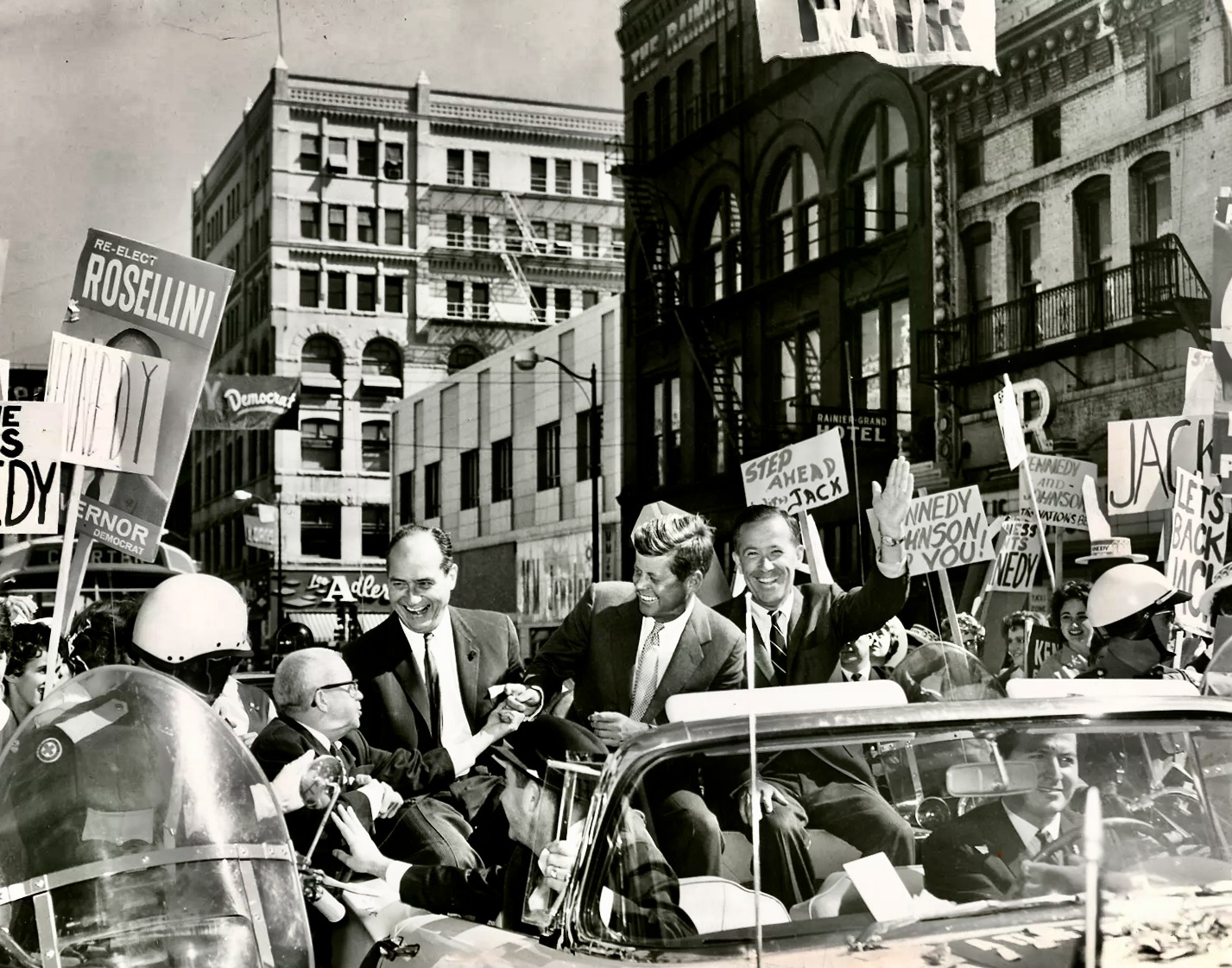
   Less than a year before I had seen John F. Kennedy when he campaigned for the presidency in Cleveland, smiling and waving from the back of a convertible crawling along Superior Ave. It was a sunny early fall day. A little more than two years later I saw reruns on TV over and over of him getting his head blown off in another convertible. Flags went half-mast. One of his children saluted his father during the memorial parade in Washington D. C.

   There were five houses on the north side of Bartfield Ave. where it met Coronado Ave. Our house was the second from the corner. A family of hillbillies who had migrated to Cleveland from West Virginia lived in the corner house. One of their boys my brother’s age and my brother were always wrestling and smacking each other. One day I saw him waving a rake at my brother.

   “Stop that!” I yelled. “Mom said dinner is ready.” It was nearly a mortal sin in our house to be late for dinner.

   A boy my age from South Carolina lived in a two-story brick apartment building on the corner opposite the Gulf gas station. He was one of the new Negro’s in our neighborhood. We were friends and played together but didn’t always get along. One day he called me a dirty DP. Both  of my parents had come to the United States after World War Two. One thing led to another. I called him a dirty nigger and he tried to hit me. I slapped him on the ear. He lunged at me and when I put my hands up, he clamped his teeth onto my right thumb. He wouldn’t let go no matter what. I had to say I was sorry. When he finally let go, he ran away up his back steps. My thumb hurt like the devil and I had to wipe tears out of my eyes.

   When John F. Kennedy debated Richard Nixon in late September 1960, it was the first televised presidential debate in the United States. The TV man Howard Smith moderated the debate. A pack of journalists faced off with the candidates. My mother and father watched it that Sunday evening, so we watched it. My brother, sister, and I were mad about missing our favorite weekend nighttime shows. We complained but our parents were long on civics and short with stir-crazy children. John F. Kennedy looked good. He had style and charisma. Richard Nixon was sweaty, shifty, and no match for his younger competitor.

   “He should have shaved,” my father, a lifelong Republican, lamented. “He looks bad.” He looked pasty and haggard is what he looked like. JFK looked fit and self-assured. He looked like a winner. After the debate he flew out of Chicago and flew to Cleveland. His plane landed at Lost Nation Airport at two in the morning. Students from Western Reserve University turned out to greet him and provide an “Honor Guard.” In the morning his motorcade rolled down Euclid Ave. and around University Circle to a cheering throng.

   On his way to a rally in Lorain Stadium, the motorcade wound its way west along city streets. I was 10 years old and waiting farther east on Superior Ave. with my South Carolina friend. We got one good look at JFK. We were behind everybody, trying to find a hole in the crowd to squeeze through to the front, when there he was, in a convertible, sitting on the back of the car with his feet on the seat. He was waving. We waved back and cheered. He wasn’t the only self-assured grown-up I had ever seen, but he was the youngest-looking best-looking grown-up. He looked like a movie star, baseball player, and war hero all rolled up in one.

   After the rally in Lorain, and lunch at the Moose Hall, John F. Kennedy went to the annual Democratic steer roast at Euclid Beach Park. More than 125,000 people heard him speak, more people than had ever assembled at the amusement park. Lakeshore Blvd. was a mess of cars and busses going nowhere. Drivers chewed the cud in the traffic jam, the smell of the steer roast in their noses.

   “The forgotten man of 1960 is the American consumer,” he said. “The forgotten woman is the American housewife. In 1952 they were promised lower prices. They heard endless Republican commercials about a stable dollar and a cheaper market basket. But under 8 years of Republican rule, the cost of living has gone up and they have done nothing about it. Families are concerned about the missile gap, but they are equally concerned about the gap between what they earn and what they have to spend.”

   It struck a chord with my mother and father, but they voted the GOP slate top to bottom., no matter what. Richard Nixon would have had to shoot Pope John XXIII stone cold dead in front of the Vatican’s Easter Sunday crowd to get my Catholic parents to vote for the Catholic on the ticket. John F. Kennedy wasn’t a Republican and that was that.

   Halloween was a month later. Time is candy was our motto. We knew our neighborhood forward and backward. We knew who handed out old fruit and who handed out new chocolate. We knew what houses to avoid because the householders were mean, stingy, or simply slow, and which houses were gold mines. My brother and I never wasted time with costumes, simply dressing like bums. The freeloader look was best because that is what we were.

   Once back home my sister hid her candy in the attic. The attic was as empty as the day we moved in. Our parents were immigrants and still scraping by, still buying only what we needed and were going to use, not things to forget about as soon as we bought them. My sister found a loose floorboard in a corner and hid her candy there. My brother had a sweet tooth and wasn’t to be trusted. No one knew or ever found out where he hid his candy. He believed loose lips sank ships and never told anybody. I hid mine in the basement, on a shelf behind a box of summer fun beach gear. 

   The next week John F. Kennedy won the White House, although he did it without winning Ohio. Tricky Dick defeated JFK, 53 percent to 47 percent, in the Buckeye State. He took all but 10 of Ohio’s 88 counties. The Democrat won the Cleveland area, though, to the displeasure of my Lithuanian kinfolk.

   That winter was cold although not a lot of snow fell. When it finally did, we built snow forts on Blind Man’s Hill. The hill was the side yard of a house on the other end of our short stretch of Bartfield Ave. A blind man lived alone in the house. We had an arrangement with him. In return for keeping an eye out for anybody messing with his house, he let us mess around on his side lawn. It was a knoll, inclining about four feet, but it was enough for us, especially when we were behind the walls of our fort hurling snowballs down on our enemies.

   The next summer on a rainy afternoon Romas Povilaitis and I almost killed my brother in the attic of our house. It wasn’t our fault, since we were only playing, but after my sister raised the roof there was no explaining it and we just had to take our lumps. We heaved a sigh of relief when my brother exonerated us, saying we were only playing, even though wrath then fell on his head, too.

   Our friend Romas lived in Chicago with his small-fry brother Viktoras, his mother Irma, and father Vytas. The man of the house was muscular and handsome. He was my sister’s godfather. He had wavy blonde hair shiny with Brylcreem. He was better looking even than his wife. Irma said she was glad he worked in a factory and wasn’t trying to better himself, because if he did, she was sure he would leave her. Even though he was blue collar, they lived in a big house in the Marquette Park neighborhood. Chicago has the largest Lithuanian community outside of the homeland. It is known as Little Lithuania among those in the know. 

   Whenever they visited us, we ran around like 10,000 maniacs. Romas was enamored of Spiderman, a new Marvel Comics superhero. He scuttled around our house pretending to squirt web fluid from his wrists. He tried to cling to walls but tumbled to the floor. We were in the attic arguing the merits of Superman, Batman,  and Spiderman when my brother insisted for the last time that Superman was the best of the three.

   “He could crush Batman and Spiderman with his little finger and besides, only he can fly,” he said.

   It finally drove us to distraction. We put a Superman cape on him and hung him by his heels out the third-floor window. He was all for it, except when the cape went flapping over his head and he complained he couldn’t see. It was then my sister walked through the door. Our brother almost nose-dived when she screamed and we were startled. We were pulling him back inside when our mother burst in.

   She dropped a dozen eggs and bum rushed the three of us downstairs. Thank God my father and Vytas Povilaitis were out. As it was, we had to listen to Irma and my mother lay down the law of the land. They seemed deadly serious, so we listened with grim attention.

   “Don’t ever do that again!” is what we heard over and over until we stopped paying attention.

   There were only two bedrooms in our Polish double on Bartfield Ave. Our sister shared a bedroom with my brother and me. Vytas and Irma slept on the living room sofa when visiting. Romas and Viktoras slept on the floor in sleeping bags between our beds. We read comic books by flashlight long into the night. We kept our sister up, but she had the good sense to keep her sleeplessness to herself. She knew she was no match for Superman, Batman, and Spiderman.

   The Friday John F. Kennedy was assassinated I was in my eighth-grade classroom at Holy Cross Catholic School in Euclid, where I had transferred after we moved from our old neighborhood that had gone civil rights to the white community of North Collinwood. My parents had said our house was becoming worthless and we had to leave. The school loudspeaker unexpectedly crackled to life. It was the principal on the broadcast system. She said the president had been shot.

   “Here is a flash from Dallas,” NBC Radio announced. “Two priests who were with President Kennedy say he is dead of bullet wounds suffered in the assassination attempt today. I repeat, a flash from Dallas, two priests say President Kennedy is dead of bullet wounds.”

   We were stunned. It wasn’t something any of us had ever thought about or expected to happen. Nobody knew what to do or say. Everybody was struck dumb. Our teacher asked us to stand and recite the rosary. We did until the principal came back on the PA and told us all to go home. Some kids were crying as they went through the door. 

   Everybody stayed glued to their TVs at home, watching the news. There wasn’t anything else to watch, anyway. The networks suspended their commercials and regular programming for the first time ever and ran coverage on a non-stop basis. The assassin was caught, but a few days later was shot in the stomach in the basement of Dallas Police headquarters. We saw it happen live on TV. It was unbelievable. Even more unbelievable was that the man who killed Lee Harvey Oswald was a strip club owner who went by the nickname of “Sparky.” I didn’t know what strip clubs were, but my father was incredulous.

   “What is this country coming to?” he asked. There was no love lost for John F. Kennedy in our house and community, but nobody wished him dead. They may not have believed in the man, but they believed in law and order. That was why they fled Europe, where law and order had fallen apart after World War Two.

   I started to wonder about God. Why did he want John F. Kennedy dead? Did he have a plan or was he just flipping a coin? When I asked our teacher why God had given him a one-way ticket to get halfway to where he was going, she started into chapter and verse, but then ran out of air. She sent me to the parish priest who told me God always has a plan and to not use words like one-way ticket.

   “Keep your mind clean and on track,” he said. “That way you will always have a one-way ticket to Heaven in your pocket.”

Ed Staskus posts monthly on 147 Stanley Street http://www.147stanleystreet.com, Made in Cleveland http://www.clevelandohiodaybook.com, Atlantic Canada http://www.redroadpei.com, and Lithuanian Journal http://www.lithuanianjournal.com

“Cross Walk” by Ed Staskus

“Captures the vibe of mid-century NYC, from stickball in the streets to the Mob in the shadows.”” Sam Winchell, Beyond Fiction

Available on Amazon:

Late summer and early autumn. New York City. A Hell’s Kitchen private eye. The 1956 World Series. President Eisenhower at the opening game. An assassin in the dugout.

A Crying of Lot 49 Publication.

Ready to Rumble

By Ed Staskus

   When I went to work for Gene Weiss in the 1980s all I knew about him was that he owned a racquetball club in Euclid, Ohio and that he was a famous wrestler. The club was Racquettime, which also went by the name of Gene Weiss’s Place for Fitness. It was a boxy two-story building on Lakeland Blvd. with a big sign clearly visible from I-90. The front doors were on the second floor, the front desk was just inside, and the locker rooms were downstairs. There were lots of racquetball courts and a weight room. Gene sold workout equipment on the side. His other enterprises were top secret.

   I got the job because I had worked for the Back Wall, a Beachwood-based chain of clubs that had transformed its customer base into a cash cow by selling what they touted as lifetime memberships at a ridiculously low price. There was an initiation fee and monthly payments for a while but after that it was the gravy train for the members. At least, that was the pitch. After everybody’s money was safe and sound in the corporate vault, they went out of business and closed all their clubs.

   My job was to reproduce the cash cow. I got an office just inside the front door and was expected to sign up as many members to Gene’s new plan as possible. What he didn’t know was that I was barely an operational salesman. My job at the Back Wall had sort of involved sales, but my aim wasn’t true. I was a hapless peddler.

   Gene went to Shaker Heights High School and won the state wrestling title. After he graduated, he won gold and silver medals for the USA at the Maccabiah Games. In 1961 he was named coach of the United States wrestling team. Four years later he was flag bearer for the USA at the opening ceremonies of the 7th World Maccabiah Games in Israel. He was named Ohio Amateur Athletic Union coach of the year and continued to coach with the United States wrestling teams. In the meantime, he became National Wrestling Chairman of the Maccabiah Games and a member of the United States Olympic Committee. 

   He was inducted into the Ohio Wrestling Hall of Fame in 1977 and in 1980 was inducted into both the Cleveland Sports Hall of Fame and the Shaker Heights High School Hall of Fame. In the 1970s he refereed pro rassling at the Cleveland Arena. He was running the Ohio School of Wrestling when I went to work for him. 

   He introduced himself and his accomplishments to me at some length. I listened dutifully, an attentive expression on my face. When he came up for air, I thought, I hope there isn’t a quiz on this tomorrow. I hadn’t taken notes and most of it went in one ear and out the other. I had gotten the gist of it, though. He was great guy. It was a great club. We were going to have a great time.

   Everybody loved Gene Weiss. “Gene is tough as nails on the outside, but a softie on the inside with a big heart of gold,” said Don Roskoph. “He’s a tough guy with a big heart,” said Bill Turk. “A friend like Gene comes along once in a lifetime. He’s always for the underdog and will give you the shirt off his back in a second,” said Angelo Amato.

   Gene loved unqualified praise. I found out later praise undeserved is satire in disguise. Acclaim for the bridge that got you over to the other side is deserved. Otherwise, it’s hot air.

   “Gene is a big bad dude. He could grab you and he could hurt you.” said Ryan Peters, the athletic director at Beachwood High School. At the same time, he’s a teddy bear, he hastily added. “You can’t help walking away from a meeting with Gene and not give him a big hug. He’s one of these guys that when you meet with him, he’d tell you a story that would change your life.”

   He never hugged me but was always punching my upper arms and slapping me on the back. Thank God he pulled his punches. I loved Gene for a few months until the day after day glad-handing got to be too much while his promises got smaller and smaller, finally fading away to nothing.


   Gene was the owner operator of Racquettime, although he wasn’t in the club overly much nor did it seem like he did over much. When he was there, he mostly mixed with the members and checked with the staff about how things were going. Several young women worked at the front desk and his right-hand man Katherine the Great was in some kind of supervisory position, although whether she was the manager or assistant manager or simply the all-seeing eye for Gene was never clear to me. What was clear was that everybody did what she told them to do, except me. 

   I knew Kathy Roach from racquetball tournaments. She was a good player, athletic fast strong. She didn’t like me, and I didn’t like her. I don’t know why, but there it was. As much as Gene led with smiles she led with scowls. I was forced to play racquetball with Gene every so often, which was literally a pain. He was a human hinder. He hated letting me hit open winners and would do his best to obstruct me. He was a man-sized slab of iron. I wasn’t. Running into him meant bouncing off him, while the ball went bouncing away and he won the point. 

   If I complained about it, he explained and explained, going on and on about why how where I was wrong. On top of that, he signed my paycheck, so I didn’t complain. Besides, his takedowns were accompanied by a full mouth smile full of sparkling Chiclet teeth. I wondered what candy store he got his choppers from.

   Sometimes in the locker room after games he talked about wrestlers, bringing up the names of stars like Mr. Fuji, Tarzan Tyler, Andre the Giant, Killer Kowakski, and the Iron Sheik. I didn’t know anything about wrestling and didn’t know any of them from the man in the moon. He seemed to be on a first name basis with torso twisters far and wide.

   Kathy was a better racquetball player than Gene. However, even though Gene necessarily won every game we played, she never won a single game. I disliked her so much my goal was to always shut her out, which I did. I slowed my serves and shots down against Gene but sped them up against Kathy. After goose-egging her several times she stopped asking me to play. I never asked her, so we stopped altogether, although she never stopped shooting me dark looks.

   She fawned over Gene as though he was the Great Sugar Daddy. After a while I looked the other way. Too much sugar. It wasn’t any of my business anyway. I had my eyes on Emily, a pretty dark-haired girl who worked at the front desk. Despite my best efforts, including charming her parents, I never got anywhere.

   I saw Gene every day because he was there more-or-less every day. I started work at 11 o’clock and worked until 7 o’clock. Gene was gone most afternoons and came back as the after-work surge got started. I made sure I was gone at seven, no matter what. By then I had long ago learned that going the extra mile for employers was giving up my time in a losing cause. When push came to shove it would mean nothing.

   Gene was paying me more than the Back Wall had, said he would spring for health insurance, and promised me a bonus when all was said and done. At first, selling the dream team memberships was easy. I sold them to the tried-and-true members, everybody who loved the club and loved Gene. After that the going got harder, especially with members who only came to the club occasionally sporadically. They wanted to pay for court time or workout time and leave it at that. They didn’t want to sign any contracts. They didn’t want to give me their bank account numbers for monthly withdrawals. It was even harder when it came to first timers. They always asked for a free one-time pass and usually never came back a second time. I was expected to get their phone numbers and follow up with them. I learned quickly enough what it felt like to have one person after another hang up on me.

   But the work wasn’t hard and I kept plugging away. I needed the paycheck since I was living paycheck to paycheck.

   One day at my desk I started experiencing discomfort in my right side. By the end of the day the discomfort had turned to pain. Gene noticed I was squirming during our daily meeting the next day and asked me what was wrong. When I told him he took me to the locker room and said a session in the whirlpool would take care of business. I said maybe I should go see a doctor. He said no, I didn’t need a doctor. He was big on saunas, steams, and whirlpools, and insisted I stay in the hot water tub until I couldn’t stand it anymore. After I got out, I felt better all over except for the pain in my side. It felt worse. That night I couldn’t sleep.

   The next morning, I went to Lakewood Hospital and found out I had kidney stones. The ER doctor gave me a small allowance of morphine-like pills and told me to drink as much water as my bladder could stand. “The pain of kidney stones is right up there with giving birth,” he said. I didn’t go to work that day and that night slept like a baby. In the morning I felt like a new man.

   When the bill for the hospital visit came a few weeks later I left it in Gene’s in-tray, which is when I found out I didn’t have health insurance after all. It was all hot air. He had never signed me up and never paid any premiums. I wasn’t sure what to do. If I confronted him about it, he might put me in a headlock. I heard through the grapevine that nobody, except for maybe Kathy Roach, had health insurance. 

   The last couple of months I worked at Racquettime I stayed busy discovering things weren’t going my way. I had been promising new members we were going to be putting an Olympic-size swimming pool in soon. When I pressed Gene about it, since members were pressing me about it, he hemmed and hawed. I realized there wasn’t any pool on the way.

   Gene wanted me to start giving racquetball lessons, but I didn’t want to. I had done lessons at the Back Wall. No matter how many times I told men, women, and teenagers to hit a thousand forehands backhands ceiling shots and to practice their serves, they never did. What they wanted to do was hit the ball around with me while I tried to correct their swings. Everybody thought there was one sure way to become a winner. When I tried to explain that everybody good went at it in their own way, and what they should do is practice and discover what worked for them, all the while grooving their swings, they weren’t interested. They wanted to know what the easy magic was.

   When I asked Gene about my bonus, the bonus he had promised me for selling his new memberships, he said I hadn’t sold enough of them to make paying me a bonus worth it. On top of that he was so disappointed in my performance that he was going to have to let me go, starting right now. It didn’t take me entirely by surprise, but it took me by surprise. I hadn’t planned on it and hadn’t gone looking for anything new. I didn’t bother arguing with him. I knew when I was down for the count.

   “Gene was on my paper route when I was a kid,” said Randy Harris. “He loved to show me a one-hundred-dollar bill when I’d ring his doorbell with my well-known motto, ‘Cleveland Plain Dealer .75 cents please’, thinking I’d wait until next week. I always told him I’d be right back while I rode my bike home and returned with $99.25.”

   On my way home I reminded myself, never trust the heavyweights. They didn’t get to be big cheeses by giving anybody anything unless they absolutely had to. They got rich by pinning suckers to the mat until they squealed. The only people they respect are others like them, and even that respect is provisional.

   The kingfish always say they got where they are through hard work. They get annoyed when asked whose hard work. They don’t care if they are rich, so long as they have a boat load of money, no matter where it came from. Top dogs make the rules. It’s the law of the land. My rule of thumb was to keep my distance, since when the mondo men make trouble it’s always the small fry who get beat on the anvil. 

   I had been thinking about going to work for myself. Hardly anybody gets much satisfaction other than bread and butter by being a wage slave. I wasn’t going to make it to Fort Knox with the modest plan I had in mind, but I moved the thought from the back of my mind to the front. I might still have to work part-time for somebody else to stay afloat, but I was going to make sure to be wary of whoever it was.

   Nobody quits when they’re wrestling the Iron Sheik and gets sick and tired of it. You quit when the Iron Sheik gets sick and tired of you. I was old enough to know the rules, but I was old enough to know the exception to the rules, as well.

Ed Staskus posts monthly on 147 Stanley Street http://www.147stanleystreet.com, Made in Cleveland http://www.clevelandohiodaybook.com, Atlantic Canada http://www.redroadpei.com, and Lithuanian Journal http://www.lithuanianjournal.com.

“Cross Walk” by Ed Staskus

“A once upon a crime whodunit.” Barron Cannon, Adventure Books

“Captures the vibe of 1950s NYC.” Sam Winchell, Beyond Fiction

Available at Amazon

Apple Books 
http://books.apple.com/us/book/id6502837788

Late summer and early autumn. New York City. A Hell’s Kitchen private eye. The 1956 World Series. President Eisenhower at the opening game. An assassin in the dugout.

A Crying of Lot 49 Publication

Walking the Line

By Ed Staskus

   When I got out of high school finding a job was easy as pie, as long as it was the most thankless job known to man, work like grit blasting, jackhammering, and tearing off roofs. None of it was a bowl of cherries, not that anybody ever said it was going to be. It was more like a crown of thorns with the only salvation at the end of the day being the end of the day.

   The good thing about grit blasting was that the work was indoors, in an all-metal room, out of the sun and rain. The bad thing about it was being in an all-metal room, in a haze of abrasive dust, hoping the blast hose wouldn’t bust a gut. The work room measured twenty feet wide by fifty feet long by fifteen feet tall. It was all business, no windows, no distractions, and no escape.

   The metal finishing shop was in Brook Park near Cleveland Hopkins Airport. Starting time was 7:30 AM, no ifs ands or buts. God forbid I miss my bus. They did shot-peening, deburring, and metal polishing. Other than the occasional odd job, I only did one thing. I blasted an assortment of metal dinguses, most of them incomprehensible to me, with steel grit or crushed glass. Sometimes, if the object was small, I worked at a sandblasting cabinet. It had a foot operated control valve.

   I wore a heavy canvas long-sleeved blast suit, gloves with gauntlets, and steel-toed safety boots. When I was ready, the last thing I put on was an air-fed metal helmet with a shawl protector. My boss was adamant that I go slow, never stopping at one spot with my blaster, keeping the same pace, which was a crawl. I had no problem with that since I could barely move in my protective suit.

   The shop was noisy, dusty, and dingy from front to back, although when we got finished with whatever thing we had been working on it looked brand new. After three months, though, I felt beat up. I was down for the count and quit in the middle of my shift. I took a bus to Edgewater Park, stripped off my shirt, and lay on the sand in the sun the rest of the day. My fish belly got some good color.

   I didn’t think my next job, jackhammering, could be worse than grit blasting. I was wrong. It was worse. It was like hanging on to a prehistoric woodpecker. The pneumatic t-shaped tool weighed a hundred pounds and was very loud. When it got revved up it sounded louder than a jet engine. I was given Willson earmuffs to save my hearing. I didn’t wear them my first five minutes on the job. After the first five minutes I never took them off.

   Charles King, a pioneering engineer in the Gilded Age, produced the first air-powered jackhammer for the mining industry. Miners had labored for ages breaking rocks with sledgehammers. The jackhammer was a groundbreaking invention for them. They are percussive tools. They pound rock and concrete with thousands of hits a minute. Once we had  broken a slab of concrete into small pieces it was time to move on to the next slab. For basic breaking I used a basic point bit. The old hands, who were built like fire hydrants,  used a flat bit for better control.

   We sprayed the concrete with water to keep the dust down. We wore face masks. Since shrapnel wasn’t an unusual hazard, I wore heavy-duty pants and a long-sleeved shirt. I still had my steel-toed boots from my grit blasting days. There was no steep learning curve. Even though I was young and fit, I took breaks all the time. The shock waves were too much to stand. Whole-body vibration is fun and games for only so long. At times I wished for an earthquake to do the work for me.

   The old hands knew the score but still complained about fatigue, headaches, and lower back pain. They sometimes took five to lay down flat on their backs on whatever ground was nearby. It was hard work controlling the heavy tool. We rotated on and off. Everybody said jackhammers were better than sledgehammers in the hot sun, but it struck me as making a fine distinction to no purpose. I didn’t last long. I was neither strong nor sizable enough for the work. After my last day I went home to my apartment and slept for a day-and-a half. My lumpy mattress felt like a bed of roses. 

   It was still summer, so I signed on with a roofing company. There was even less of a learning curve. I was dragooned to be one of the guys who tore roofs off. It sounded easy enough but it was hard to do. I didn’t know it was the most physically demanding specialty trade work of all time. I didn’t know it was the fourth most dangerous job in the country, either.

   “It’s hard work and it can be a risk,” the boss said. “You need to be proud of what you do. It’s good stuff.”

   The other guys ignored the boss. They said don’t climb ladders with your hands in your pockets. I showed them my open palms. “Don’t slide down ladders,” one of the men said showing me his hands. “It might have splinters.” They said don’t slip when topside. I said I would watch out for that. They said don’t touch wires and get electrocuted. I agreed to watch out for that, too. They claimed the company was a storm chaser, even though we never worked during storms. I found out what it meant soon enough. Our warranty was in effect so long as the homeowner could see our truck’s license plate as we were driving away. 

   If it was ninety degrees on the street, it was nine hundred degrees on the roof. If it was a dark-colored or metal roof, it was even hotter. I got a sunburned face my first day. I wore sunscreen and a baseball cap as a matter of course after that. I got heat rash and learned to never wear jeans or dark-colored clothing. I got heat cramps and learned to drink gallons of water. 

   There were two of us at the bottom of the totem pole. We were responsible for cleaning up. The rolling magnetic sweeper was my favorite tool. Sweeping for loose nails and screws was incredibly easy and meant the end of the job was at hand. The pay was good, but I didn’t like going up and down ladders. Once I got on the roof, I settled down, but ladders made me jumpy. I finally had enough of them and called in sick. I stayed sick until the office manager stopped calling me.

   Summer started to drift away after Labor Day. I applied for work at the nearby Collinwood Rail Yards and was hired as a temporary workhand for as long as they needed me. The railroad yard and diesel terminal had been there for about one hundred years, after a machine shop and roundhouse were originally built to repair locomotives. Miles of stock yard rail was laid for freight trains coming and going. By 1930 there one hundred and twenty miles of track handling two thousand cars daily. During World War Two the Collinwood Yards became one of the major switching and repair facilities for the New York Central, and after that for Penn Central.

   My job title was Extra Clerk. I thought it meant a cushy office job. What it actually meant was I had to work wherever they wanted me to, filling in when somebody was sick or on vacation. I found out soon enough that nobody in any office ever got sick or went on vacation.

   A warehouse had been built near the roundhouse. There was a smaller storehouse with two offices next to it. The front office was for whoever wanted to sit around in it. The back office was for my boss. I worked for him even when I was working for somebody else. He was Isaiah Wood, an older man who always wore an Irish scally cap indoors and outdoors, rain or shine. He wasn’t Irish. He was a rabble rouser for the Nation of Islam. He always had stacks of their newspaper “Muhammed Speaks” on the floor behind his desk. When it became “Bilalian News” he piled up stacks of those.

   He sold them to African Americans who worked in the yard. They trooped in, plunked down their dough, and walked out with the newspaper in a coat pocket. Nobody who was white ever trooped in and plunked down anything. Isaiah Wood was disliked by every white man in the Collinwood Yards, especially when I let out who I worked for. They all told me what a dismal dead-end I was stuck in.

   He had a poster on the wall of the Nation of Islam kingpin Elijah Muhammed wearing sunglasses and a funny hat with stars and crescent moons emblazoned on it. The poster quoted the kingpin. “If you think the white man isn’t the devil like I have taught you, then bring me your devil and I will show you that the white man has no equal.” Whenever I had to go into his office the poster was right behind him so it was right in my face.

   He liked to say things like, “Whenever you look at a black man you are looking at God.” Then he would tell Wally and me that there were two or three gondolas with rail wheels on them that needed unloading. He tried to make it sound like orders from the mouth of God, speaking low and slow. We trudged out to the gondolas low and slow.

   Wally was Ozor Benko. Nobody ever called him Ozor or even Ozzie. Everybody called him Wally. He was shorter and older than Isaiah. He had been married for almost fifty years. His wife put together his lunch pail of sandwiches, apples, and grapes. The sandwiches were always Hungarian since he and his wife were Hungarian. He especially liked black bread smeared with cream cheese and topped with plum jam.

   Wally and I worked together. Every morning at 7 AM we collected wood from broken pallets and built a bonfire. Some winter days the fire was as big as Isaiah’s hatred of the white man. We stood around it once it got roaring and warmed ourselves up. Anybody passing by was welcome to take a spot. Whenever we had to unload a gondola in bad weather, we made sure to have a 55-gallon steel drum nearby with a fire going in it. We thawed our hands and dried our gloves over the fire.

   When we were unloading rail wheels the two of us stood in the gondola with a crane on a flat car at hand. The crane operator swung his block to us, one of us wrote a number on the wheel with a thick yellow crayon, while the other one attached a sling to the wheel. The crane lifted it, setting it down in a row of them, and swung back to us. It wasn’t hard work, except when it was cold, snowy, and slippery. There wasn’t as much snow that winter as there would be a few years later during the Great Blizzard, but it was cold enough.

   Wally started taking days off when his wife got sick. I didn’t mind because another Extra Clerk like me, who was about my age, filled in. One week Wally didn’t come to work at all. At the end of the next week Isaiah told me Wally’s wife had died and he would be taking a few weeks off. When he came back, he looked terrible. He started going to one of the bars just outside the yard for lunch, eating pickled eggs, fried baloney sandwiches, and swigging bottles of P.O.C. 

   Even still, he lost weight, getting thinner. His clothes hung loose on him. His skin got gray and cadaverous. He died two months later. He missed his wife so much he didn’t want to go on living. He had a heart attack and died on his sofa watching “Sanford and Son” on a portable TV. We thought he died of a broken heart. Isaiah didn’t say much, although he went to Wally’s funeral. I went with him. We each had a P. O. C. afterwards.

   When spring came, I was assigned to be a tracker in the switching yard. I was given a clipboard and a pocketful of pencils. My job was walking the line. Boxcars, flat cars, and gondolas were busted up a cut and sorted by railway company, loaded or unloaded, destination, car type, and whether they needed repairs. The black snakes hauling coal, unloading across the street, weren’t on my beat. I walked miles a day every day, noting and writing it all down and delivering the paperwork to an office in the shadow of the terminal.

   I discovered small beat-up shacks tucked into shadows where workmen hung out, making hay, killing time, reading the daily papers, listening to the radio, playing cards, and drinking. A lot of drinking went on in the yard and at the bars on East 152nd St. just outside the main entry gate. Even more drinking happened on payday, when many men cashed their checks at the bars and drank part of it before their wives could get their hands on what was left.

   By the end of summer, I was out of a job. Conrail was taking over, cutting costs, and laying workers off. First hired first fired. When the 1970s came to an end Conrail closed the diesel locomotive repair facilities and sold off most of the rail yard. By that time, I didn’t care. I had squirreled away the hard cash I had made and gone back to college so I could make my way. My father was a fan of higher education.

   He had been a miner in Sudbury, Ontario in the 1950s until he finally saw the light. When he did we emigrated to the United States where he worked days and studied nights at Western Reserve University, graduating with a degree in accounting. He was determined to work with his head and not his hands.

   Everybody said I had my father’s looks, but we didn’t always look at things the same way. He had a bad habit of threatening me with the ways of the world, with all the terrible things that were out there. He was from the Old World and had survived World War Two, on the wrong end of the stick for most of it. Even though he and I didn’t routinely see eye to eye, after a year of punching the working stiff’s time clock, I began thinking he might be on to something about working with your head. I wasn’t big on accepted wisdom, but I thought maybe it was time to put my thinking cap on.

Ed Staskus posts monthly on 147 Stanley Street http://www.147stanleystreet.com, Made in Cleveland http://www.clevelandohiodaybook.com, Atlantic Canada http://www.redroadpei.com, and Lithuanian Journal http://www.lithuanianjournal.com

“Cross Walk” by Ed Staskus

“A once upon a crime whodunit.” Barron Cannon, Adventure Books

“Captures the vibe of 1950s NYC.” Sam Winchell, Beyond Fiction

Available at Amazon

Apple Books 
http://books.apple.com/us/book/id6502837788

Late summer and early autumn. New York City. A Hell’s Kitchen private eye. The 1956 World Series. President Eisenhower at the opening game. An assassin in the dugout.

A Crying of Lot 49 Publication

All Jacked Up

By Ed Staskus

   By 1984 many bands had strutted their stuff at the Richfield Coliseum. It was built for basketball and anything else that could be booked between games. Everybody called the venue the Palace on the Prairie. It was in Richfield, Ohio. The bands included Led Zeppelin in 1975, Bruce Springsteen and the E-Street Band in 1978, the Rolling Stones in 1981, and Queen in 1982. The Bee Gees drove girls to screaming, crying, and pleading in 1979.

   Frank Sinatra opened the place with a show in October 1974. “The crisscross of lights, mirroring the animation of 21,000 stylish people packed from floor to roof, transformed the gray amphitheater in the hills of Richfield Township into a huge first-night bouquet of green and blue,” is how The Cleveland Plain Dealer splashed Old Blue Eye’s show across its front page. We called him Slacksey because, no matter what, his slacks were always neatly pressed. Roger Daltrey gone solo closed the doors and shut off the lights for good in 1994. His show drew fewer than 5,000 fans. Nobody wrote a word about it or how he was dressed. Over the years there were might have been a thousand musical events at the Richfield Coliseum. 

   Vann Halen opened for Black Sabbath in 1978 and came back as headliners in 1984. When they did, they had to sit on their hands waiting for ice to melt. Walt Disney’s Magic Kingdom on Ice had just skated out of the building. When Van Halen came to town it was the one and only time I saw the band and the one and only time I went to a show at the Richfield Coliseum. 

   It wasn’t that I didn’t go to rock ‘n roll shows. It was that the few I went to were closer to home, like at the Allen Theater, the Agora, and Engineer’s Hall, where it was standing room only. There were no seats. Downtown was nearby but Richfield was a long way for my long-suffering car. Besides, I was by necessity a Scrooge. Big shows charged big bucks. First things came first, like food and shelter. 

   I saw the Doors at the Allen Theater in 1970, the Clash at the Agora in 1979, and the Dead Kennedys at Engineer’s Hall in 1983. The Dead Kennedys blew into town during a heat wave. The air conditioning at the Engineer’s Hall was non-existent and there were no windows. Everybody sweated up a storm and everybody stayed through the encore. Six years later the Brotherhood of Locomotive Engineers sold their building. It was demolished and replaced by a posh hotel. The Dead Kennedys never came back.

   The Doors opened their sold-out Friday night show in 1970 with ‘Roadhouse Blues’ followed by ‘Break on Through’ and ‘Backdoor Man’. They covered Bo Diddley’s ‘Who Do You Love?’ That was a surprise. “I walk 47 miles of barbed wire, I use a cobra snake for a necktie, I got a brand new house on the roadside, made from rattlesnake hide.” They sounded much better live than on carefully managed vinyl. They were more than worth the six dollars for my orchestra seat ticket. My girlfriend paid her own way. We had an even-steven relationship. Eli Radish, a local band, opened, and were funky and fun, but all through their set everybody was antsy waiting for Jim Morrison.

   “He worked the crowd with his staring sneers and sexy leather posing, witch doctor mumbling and slouching about,” said Jim Brite, who was in the crowd. “The lighting and sound were dramatic. The band was great, with extended solos and workmanlike professionalism, delivering the music behind the shaman. No one could take their eyes off Jim. It was one of the best concerts I ever saw and I’ll never forget it.”

   The Doors were banned in Miami for Jim Morrison’s obscene language and lewd behavior. He told the city fathers to call him the Lizard King. They had been banned from performing in Cincinnati and Dayton the year before. None of it mattered to the 3,000 of us filling every seat at the Allen Theater.

   “Jim Morrison swigged beer and smiled a lot between numbers,” Dick Wooten wrote in The Cleveland Press the nest day. “When he performs, he closes his eyes, cups his hand over his right ear, and clutches the mike. His voice is pleasant, but his style also involves shouts and screams that hammer your nervous system.”

   When it was over we whistled, roared, and clapped until the house lights came on. We were disappointed there was no encore. Everybody was getting to their feet when Jim Morrison suddenly came back on stage. “Somebody stole my leather jacket, he bellowed. “Thanks a lot Cleveland!” He flipped us the finger. Then he said, “Nobody leaves until I get it back!” Nobody knew what to do. A half-dozen rough-looking bikers jogged to the back of the hall and blocked the doors. When my girlfriend and I looked to the side for another way out, Jim Morrison had left the stage, but then a minute later came back.

   “Sorry, that was a mistake. I found my jacket.” 

   He said the band wanted to play some more songs to make up for the mistake, but that John Densmore’s hands were messed up. He was the group’s drummer. The beat couldn’t go on without a beat, except it could and did.

   “John their drummer was walking around backstage and holding up his hands which seemed bloody in the creases of his fingers,” said Skip Heil, the drummer for Eli Radish. “I felt all warmed up since we played before them, so I said I’ll do it. I wasn’t sure of the songs, but I thought they were simple shuffles.” 

   After two encores, and telling everybody how much he loved Cleveland, Jim Morrison accidentally locked himself in an old bathroom backstage. One of the band’s roadies said, “Stand back Jim.” He knocked the door down and set him free.

   The band toured non-stop after they left Cleveland. They had been touring non-stop for several years. Jim Morrison died in Paris of a heroin overdose the next year and the door shut forever on the band. It was a shame.

   The Richfield Coliseum was an arena in the middle of nowhere, halfway between Akron and Cleveland. It was built to be the home of the Cleveland Cavaliers, the local NBA team, although indoor soccer, indoor football, and hockey were played there, too. Larry Bird of the Boston Celtics said it was his favorite place to shoot hoops. He played his last pro game there. Muhammed Ali fought Chuck Wepner there in 1975. Dave Jones, Ali’s nutritionist, could never get the boxer to try soy burgers. He had to have his red meat. Chuck Wepner was his red meat that night. There were rodeos and monster trucks. There were high wire acts and hallelujah choruses. The WWF Survivor Series came and went and came back.

   I had a friend who had gotten free tickets to see Van Halen. Two other friends of ours went with us but had to fork over $10.75 apiece for the privilege. I didn’t know much about the band, except that they were no doubt about it loud as two or three jet engines, but free is free and since I had the free time I went. 

   The headbangers were from Pasadena California. They were Eddie Van Halen on guitar, Eddie’s brother Alex Van Halen on drums, Mike Anthony on bass, and David Lee Roth belting it out up front. Mike Anthony sang back-up while keeping the low pitch going.  

   “It wasn’t until the fourth or fifth Van Halen record that people would go, ‘Wow! You’re singing backgrounds on those records. We thought it was David Lee Roth doing that, too,’” the bass player said. “And I go, Hell, no! That’s not David Lee Roth.”

   The word among aficionado’s was that the band was “restoring hard rock to the forefront of the music scene,” whatever that meant. I was listening to lots of John Lee Hooker and the Balfa Brothers. The rock ‘n roll parade was largely passing me by. I didn’t have a clue who was at the front of the parade.

    Everybody I asked said Van Halen’s live shows were crazy energetic and Eddie Van Halen was a crazy virtuoso on the electric guitar. During the show he switched guitars right and left, but more-or-less stuck to a Stratocaster, except it wasn’t exactly a Stratocaster. Eddie Van Halen called it a Frankenstrat.

   “I wanted a Fender vibrato and a Stratocaster body style with a humbucker in it, and it did not exist,” he said. “People looked at me like I was crazy when I said that’s what I want. Where could I go to have someone make me one? Well, no one would, so I built one myself.” He wasn’t trying to find himself. He was creating himself.

   His homemade six-string was almost ten years old in 1984, made of odds and ends, a two-piece maple neck stuck onto a Stratocaster-style body. He used a chisel to gouge a hole in the body where he stuck a humbucking pickup taken out of a 1958 Gibson. He used black electrical tape to wrap up the loose ends and a can of red spray paint to get the look he wanted. When he met Kramer Guitar boss Dennis Berardi in 1982 Eddie showed him his Frankenstrat. It was his prize possession. 

   “We went up to his house and he got it out,” Dennis said. “It looked like something you’d throw in the garbage. That was his famous guitar.” 

   Van Halen released their first LP in 1978. By 1982 they had released four more LP’s. When they came to northeast Ohio they were one of the most successful rock acts of the day, if not the most successful. Their album “1984” sold 10 million copies and generated four hit singles. “Jump” jumped the charts to become a number one single.

   When the lights went down and the stage lights went up, the band took their spots. Eddie Van Halen wore tiger striped camo pants and a matching open jacket over no shirt. He wore a white bandana and his hair long. Mike Anthony wore a dark short-sleeved shirt and red pants. He wore his hair long, too. David Lee Roth wore a sleeveless vest, leather pants ripped and stitched every which way, and hula hoop bracelets on his wrists. He wore his hair even longer. Alex Van Halen wore a headband. The headband was all I could see of him behind his Wall of Drums. There were speakers galore stacked on top of each other on both sides of the drum set.

   When they launched into “Running with the Devil” Mike Anthony ran across the stage and slid on his knees playing the opening notes. David Lee Roth was a wild man, swinging a sword around like Zorro and doing acrobatics like the Olympian Kurt Thomas. He did Radio City Rockette kicks and jumped over the drum set while singing “Jump.” 

   Taylor Swift would have flipped out if she had been alive, but she wasn’t going to be alive for another five years. When she came into her own years later she got very good at strutting on stage, but she never jumped a drum set. The audience at the Palace on the Prairie was alive as they were ever going to be that night. David Lee Roth’s high flying got a standing ovation.

   In the middle of one song, David Lee Roth stopped singing. The band played on but slowly dropped out, one instrument at a time. “I say fuck the show, let’s all go across the street and get drunk,” he shouted into his handheld microphone. The crowd hooted, hollered, and cheered, forgetting for a moment they were in the middle of nowhere and the closest bar was miles away. 

   One of the best parts of the show was when Alex Van Halen and Mike Anthony did a long bass and drum duet. Eddie Van Halen did some good work on keyboards, doing the opener for “I’ll Wait.” He did his best work, however, on his guitars. He had a way of playing with two hands on the fretboard. He learned it from Jimmy Page of Led Zeppelin. 

   “I think I got the idea of tapping by watching him do his “Heartbreaker” solo back in 1971. He was doing a pull-off to an open string, and I thought wait a minute, open string and pull off? I can do that, but what if I use my finger as the nut and move it around? I just kind of took it and ran with it.” He filed for and got a patent for a device that attaches to the back of an electric guitar. It allows the musician to employ the tapping technique by playing the guitar like a piano with the face upward instead of forward.

   Most of us stayed in our seats during most of the show, only coming to our feet to applaud, but there was an undulating crowd squished like sardines at the front of the stage, where they stayed from beginning to end. They never left their feet. It was more than loud enough where we were up near the rafters. It had to be deafening if not mind-blowing being at the lip of the speakers.

   By the time the show ended Eddie Van Halen and David Lee Roth had long since stripped off their shirts. They came back for several encores and then the music was over. It took a half hour to shuffle out of the arena, a half hour to find our car, and another half hour to inch along the traffic jam the half mile to the highway. My sense hearing came back somewhere along I-271 on the way home.

   After the concert I went back to listening to the blues and zydeco. I didn’t rush out to buy any records by Van Halen. My cat and the neighbors, not to mention my peace and quiet roommate, would have complained about the noise. I tried explaining to my cat that one man’s noise was another man’s symphony, but he wasn’t having any of it. 

   Six years later, after the excitement of being pushed and pulled into existence had died down, when Taylor Swift was in her crib in the living room, she took a peek at a film clip on MTV of the 1984 Van Halen concert at the Richfield Coliseum. She went bananas over the sold-out crowd. She made a vow then and there that she would do the sure thing. She wasn’t going to invite 20,000 fans to hit the bottle. She was going to schmooze them into buying the bottle for her.

    The first thing she would do when she was ready to sing her way to stardom was head to Nashville. It would be a baby step, but she had her sights set. It was going to be the hillbilly highway first and then the superhighway. Her father was a stockbroker at Merrill Lynch and her mother was a marketing manager at an advertising agency. She already knew the way to the teller’s window at the bank. She was determined to be a rich girl when she was grown up. 

   She was sure as shooting not going to strum a Frankenstrat or bust out any freaky Mighty Mouse moves, with or without a sword, with or without a shirt, although her legs were fair game. They were shapely legs made for boots that were made for walking. She was going to belt out her break-up ballads and march her way to the front of the hit parade. She was going to blend Frank Sinatra’s pressed pants with some tried-and-true country, add a dash of spicy pop, mix in lots of love and heartache, and deliver it with catchy melodies. 

   Van Halen’s aim during their time at the top of the charts seemed to be to die of exhaustion rather than boredom. Their aim was true. Taylor Swift’s aim was different. She was going to the top of the charts but she wasn’t going to die of exhaustion getting there. She wasn’t going to take any chances, no matter how boring it might be.

Ed Staskus posts monthly on 147 Stanley Street http://www.147stanleystreet.com, Made in Cleveland http://www.clevelandohiodaybook.com, Atlantic Canada http://www.redroadpei.com, and Lithuanian Journal http://www.lithuanianjournal.com

“Cross Walk” by Ed Staskus

“Captures the vibe of mid-century NYC.” Sam Winchell, Beyond Fiction

Available on Amazon: https://www.amazon.com/dp/B0CRPSFPKP

Late summer and early autumn, New York City, 1956. Stickball in the streets and the Mob on the make. President Eisenhower on his way to Ebbets Field for the opening game of the World Series. A killer waits in the wings. A Hell’s Kitchen private eye scares up the shadows.

A Crying of Lot 49 Publication

Ring of Fire

By Ed Staskus

   Many bands came to Cleveland, Ohio in the 1980s, bands like Queen, Guns N’ Roses, and Journey. I didn’t see or hear any of them. Besides, they just played the same song over and over again. I couldn’t afford arena rock, even if I wanted to squeeze myself into their sold-our shows. What did they do with all their money? Freddie Mercury didn’t spend much of it on his five-and-dime white tank tops.

   I did see and hear Wall of Voodoo when they played the Agora Ballroom, shortly before the band broke up. They were the second-to-last group I saw at the downtown music hall before it burnt down. After the fire the Agora moved thirty blocks uptown into what had been the Metropolitan Theatre, built in 1919. It had been home to the Cleveland Opera until 1929. Twenty two years later, when the prima donnas were long gone and the building was housing the WHK radio station, disc jockey Allen Freed coined the phrase “rock-and-roll” on the air there.

   The Agora was on E. 24th St. across the street from Cleveland State University. It had been there since 1968. It was the brainchild of local entrepreneur Henry LoConti Sr. “Monday Night Out at the Agora” showcased new bands like ZZ Top, Meat Loaf, and Talking Heads. “Live From the Agora” was broadcast on the radio. There were many affiliated stations. Bruce Springsteen’s show at the Agora in 1978 was heard by more than three million listeners. On Sunday nights it was reserved for home-grown bands like the Raspberries and the James Gang. 

   Iggy and the Stooges hit the music hall one night during a thunderstorm. “Iggy came out in a jock strap,” Henry LoConti Sr. said. “He had a razor and cut himself on stage, all kinds of crazy things. A girl and her boyfriend were in the front row. Iggy jumped off the stage on her face. Her boyfriend and his friends started beating on him. Our guys finally got him out of it, dragged him back, and he finished the show like nothing had happened.” The Stooges, however, spent the rest of the night slipping and sliding on Iggy’s blood on the boards.

   Wall of Voodoo was a Los Angeles band fronted by Stan Ridgway, who had been running a film score business before getting into the emerging punk scene in the 1970s. He picked up a bass player and a keyboardist from the Skulls and a drummer from Black Randy and the Metrosquad. They started playing at the Masque, a club underneath the Pussycat Theatre in Hollywood. They mixed electronica with country and western with Ennio Morricone movie music. There were junkyard riffs and percussion effects galore. 

   It didn’t always go over well. “This electronic music quintet makes self-proclaimed nightmare music,” John Swenson wrote in The New Rolling Stone Record Guide. “I pass on this stuff,” he declared in black and white, not writing another word.

   When asked by Dick Clark on American Bandstand to describe their music, Stan Ridgway said, “I’m just as confused as anyone else as to what to call it.” The band released an EP in 1979 featuring a synthesizer driven cover of “Ring of Fire.” It wasn’t what the songwriter June Carter had ever intended. It had a spaghetti western twang to it. It was strange and surreal. Their album “Call of the West” was released in 1982. The catchy single “Mexican Radio” from the album became a big hit. It was about hot desert winds and border blaster radio stations.

   By the end of the 1970s Henry LoConti Sr. had built twelve more Agora music clubs around the country, turning himself into a corporation. He went buttoned down in a no button business. He was awarded Billboard’s Steve Wolfe Award in 1979, presented to the person who had contributed the most to music entertainment the previous year. Billboard’s “Best Club in the Country” award was awarded to him in 1980. 

   For all that, the original Agora in Cleveland was always a rough and tumble place, awards or no awards. The audience was young. The music was loud. The drinks flowed all night long. There were bouncers. They kept their eyes and ears off the stage and more on the disturbances on the floor that erupted time and again.

   The word “bouncer” comes from an 1875 book by Horatio Alger. A young man has a hearty breakfast, claims he has no money to pay for it, whereupon his waiter is ordered to “bounce” him. “A well-directed kick landed him across the sidewalk into the street.” But before there was the word, there were the Romans. In Rome a bouncer was known as an ostiarius. His job was to remove unwanted people from places they were trying to get into. In the Old Testament bouncers protected temples from “illegal entry into sacred places.” In the United States, starting in the mid-19th century, saloons and whorehouses hired them to remove drunk as a skunk, noisome, and violent patrons from the premises.

   The Agora didn’t necessarily call their security staff bouncers, but that is what they were. They checked entrants for underage drinking. They refused entry to those already the worse for wear. Their duty was to maintain some semblance of order. Their No. 1 task was to deal with hot-headed behavior.

   Wall of Voodoo opened their show with “Me and My Dad” followed by “Red Light” followed by “Call of the West.” Everybody’s ears perked up. “Got a green look about ya, and that’s a gringo for starts, sometimes the only thing a western savage understands are whiskey, rifles, and an unarmed man.” It was easy enough to follow the bouncing ball because Stan Ridgway had a clear as a bell voice. He sounded like a revved-up Hank Williams. The band was in fine fettle but didn’t drown him out.

   They finished their first set with “Lost Weekend.” The song was Lou Reed-inflected, about a couple driving home after a losing streak in Las Vegas. “She was in the backseat while he was at the wheel, all the money from the store they’d gambled away. He said the best laid plans often go astray. She lit a cigarette, she didn’t make a sound. I know if we’d had just one more chance, he said. I know, we’d finally hit the big one at last, she said.” It was Wall of Voodoo’s bad dream of the American Dream.

   The club was a haze of never ending cigarette smoke. The ceiling was barely visible. Music lovers elbowed their way to the front of the bar the minute intermission began. I was chronically short of cash and rarely drank at bars. I drifted outside for whatever fresh air there was. Cleveland was a smokestack city and the Agora was just two miles from the smokestacks. Beggars can’t be choosers.

   The front doors were behind a makeshift garage door of corrugated metal. When the sidewalks finally rolled themselves up after a show the corrugated metal door came down. Even though the club was next door to Cleveland State University, it wasn’t in the best neighborhood. When the sun went down it was more along the lines of a bad neighborhood. I stood to the side minding my own business until saying hello to the bouncer by the door, with the idea that it is never a bad idea to get on the good side of bouncers.

   He was younger and taller than me, about twenty pounds heavier, and appeared to be between a WWE wrestler and a bull fighter. He was wearing dark pants and a short-sleeved shirt. He looked like he did bicep curls for a living. He didn’t talk much until I asked him how he had gotten into the bouncer business.

   “My great grandfather was a bouncer before he got into the New York City ganglands,” he said. “His name was Monk Eastman. I’m named after him.”

   “Your great grandfather?” I was dubious. The young usually can’t remember that far back. Their memories go in one direction, which is forward, not backward.

   “Yeah, he was a bouncer from 1894 to 1899, after which he got into the rackets. Back then there were saloons from one end of New York City to the other. He was seventeen years old when he got his first job. The saloon he went to, the manager told him he was too young, and besides, he already had two good men. My great grandfather asked if he could meet them. When they met, he quickly took care of both of  them and got the job on the spot. He worked alone, although he always carried a truncheon.”

   “You mean like a club?”

   “Just like a club. It had notches carved into it for every man he made mincemeat of. Family legend has it, one slow night before he retired from bouncing, he threw his eyes on the bald spot of a man drinking at the bar. He couldn’t take his eyes off the bald spot. He walked up behind the man and clubbed him. ‘I had forty nine nicks in me stick and I wanted to make it an even fifty’ is how he explained it.”

   “You said he got into the rackets after that?”

   “Feet first, free-lancing in the beginning. He charged $15.00 for ‘ear chawed off’ and $19.00 for ‘leg broke.’ It was $100.00 for doing what he called ‘the big job.’ He put together his own gang soon enough. They got into it with another gang. One night he crossed a boundary line by mistake and got jumped. He carried a blackjack and was holding his own until he was shot twice in the stomach. He plugged the holes in his belly with his fingers and found a doctor. Two years later the other gang and my great grandfather’s gang went at it for real in Manhattan under the tracks of the 3rd Avenue Elevated line. It went on all night, fifty or sixty men firing at each other with Colts from behind cast iron arches. The police tried to stop the fighting but they had to retreat. Five men died and dozens were wounded.”

   “It sounds like Iggy Pop,” I said.

   “Iggy Pop has got a screw loose,” he said. “He would have shot himself in the foot.”

   “What happened when the shoot-out was over?”

   “A boxing match happened.”

   “They put their guns down and put up their fists?”

   “My great grandfather and the other man decided to settle matters with a boxing match. The other man was good with his hands but mine had arms long as an ape. In the end they fought for two and half hours to a draw. A month later they were shooting it out again. It was too much for the city fathers. Both of them were finally arrested, convicted of something, and both of them got eleven years in Sing Sing. When my great grandfather got out of prison his gang was gone, up in smoke. He volunteered for the army and was sent to Europe towards the end of World War One. My father told me he never took a prisoner if he could help it. He came home with a medal and told everybody there were plenty of saloons in New York City tougher than what everybody called the Great War.”

   “What did he do after he got home?”

   “Not too much, to be honest. He was found dead behind a dance hall in Brooklyn on New Year’s Eve in 1920. Somebody emptied a revolver into him. There were six bullet holes in him.”

   “That’s too bad,” I said.

   “Yeah, although he probably deserved it,” the bouncer said.

   When I heard the band start their second set I took leave of the bouncer and went back into the Agora. On the cover of the album  “Call of the West” there is a crooked door, slightly ajar, inviting everybody into Wall of Voodoo’s world. A standing room only crowd had squeezed into the Agora. It looked like all of them were still there.

   Wall of Voodoo were pioneers of a kind. Their sound was plenty original. For all that, they were never going to be inducted into the Rock & Roll Hall of Fame.

   When Huey Lewis and the News played the Agora in 1981 they played to a sold-out crowd. “We always heard that the heart of rock and roll was Cleveland, and we’d say ‘Wow, we’re from San Francisco. We had the Grateful Dead! We had Jefferson Airplane! What’s Cleveland got?’’’ The enthusiastic audience inspired Huey Lewis to write “The Heart of Rock & Roll.” He meant Cleveland was the heart of it. Fourteen years later the Rock & Roll Hall of Fame opened in Cleveland, not New York City or someplace in California, or anywhere else. 

   Wall of Voodoo finished their second set with “Mexican Radio” and came back to do an extended version of “Ring of Fire” for their encore. “I fell into a burning ring of fire, I went down, down, down, and the flames went higher, and it burns, burn, burns, the ring of fire.” When they were done the band looked wiped out. They got a big hand and most of the audience shuffled out. Some stayed to reminisce over a last drink.

   I went home to crack open Nathaniel West’s “The Day of the Locust.” I had read it in an English class at Cleveland State University and there was something about the music I heard that night that reminded me of the book. Wall of Voodoo’s songs seemed to be about those with little in the way of hope and getting by on illusions, just like the book. Their songs were not all about hard luck and dark times, but enough of them were for me to get a handle on what thread was being woven. The thread was about one small-time lost in time tragedy after another.

   For all that, I wasn’t about to cue up the arena rockers, or the likes of Madonna or Boy George, now or ever. Better the real deal than deals from the bottom of the deck. Better rough and tumble than a bag of old baloney.

Ed Staskus posts monthly on 147 Stanley Street http://www.147stanleystreet.com, Made in Cleveland http://www.clevelandohiodaybook.com, Atlantic Canada http://www.redroadpei.com, and Lithuanian Journal http://www.lithuanianjournal.com

“Cross Walk” by Ed Staskus

A Mid-Century Crime Thriller

“A once upon a crime whodunit.” Barron Cannon, Adventure Books

“Captures the vibe of 1950s NYC.” Sam Winchell, Beyond Fiction

Available on Amazon: https://www.amazon.com/dp/B0CRPSFPKP

Late summer and early autumn. New York City. A Hell’s Kitchen private eye. The 1956 World Series. President Eisenhower at the opening game. A killer in the Brooklyn Dodger dugout.

Rolling With the Punches

By Ed Staskus

   I was surprised and dismayed the day my father told me that, other than Ausra, the two-week sun and sand Lithuanian camp in Wasaga Beach, and our one-week boy scout camp, I would be working at the newspaper Dirva the rest of the summer. I shouldn’t have been surprised, since my father believed in the work ethic and worked like a dog himself, but I was. He gave me a grave stern annoyed look when I blurted out it would screw up my time off from school. 

   He and I weren’t on the same page, so I kept my dismay to myself.

   It wouldn’t have helped, anyway. I knew once he told me, I would be working at Dirva from Memorial Day to Labor Day. Thank God it was only part-time. I would be home by three o’clock and didn’t have to work on Fridays. I was going to be getting three-day weekends before I even knew what three-day weekends were.

   Before the newspaper Dirva, which means field, was Dirva, it was Santaika, which means peace. Kazys Karpius was the editor, and stayed on the job for thirty years, from the end of World War One through the Great Depression to the end of World War Two, getting the weekly editions out without fail. The paper was anti-communist, pro-democracy, and true-blue the homeland.

   Kazys Karpius wrote poems, plays, and histories about Lithuania, especially about beating off the Vikings and Teutonic Knights back in the day. The Teutonic Knights were always tramping into the Baltics for plunder and conversion, not their own conversion, but that of the natives they regarded as pagans. The Lithuanians didn’t see eye to eye with the Germans about it, insisting it was none of their business. They fought with longswords, battles axes, crossbows, maces, picks and war hammers, knives, clubs, slings, and hand-to-hand.

   The first day I slouched into work was a brisk early summer morning. I was down on Dirva but resigned to my new job. I rode the CTS bus from St. Clair to East 105th Street over Liberty Boulevard down Superior Avenue. It was the same bus and same route I took going to school, to St. George’s, on East 67th and Superior.

   Lithuanian immigrants came to Cleveland, Ohio, on the south shore of Lake Erie, in two waves, the first one in the late 19th century. They were cheap labor for emerging industries. They needed their own newspaper and church. At the turn of the century Father Joe Jankus threw up a small wooden church near downtown. The next pastor bought the land St. George’s was going to stand on and after it was built Father Vincent Vilkutaitis ran the parish for forty years. His last year was my first year of five years there.

   The church was on the top floor of the 2½ story brick building, the grade school on the middle floor, and the community hall on the ground floor, which was partially below ground.  Since it was the Atomic Age, and the Cold War was in full swing, the hall doubled as a Nuclear Fallout Shelter. Every few months we had a Civil Defense drill and had to file out of our classes and down to the hall, where we shuffled around until the drill was over.

   If we had somehow survived the blast, even though we all brought our own sandwiches in Flintstones and Dudley Do-right and Jetson lunch boxes, we would have all slowly starved to death trying to live on crumbs and apple cores. Dudley wouldn’t have helped, snug in his bunker under the White House.

   Jonas Ciuberkis was our neighbor two houses down from where we lived at the corner of Bartfield and Coronado, in a Polish double my mom and dad had bought with my dad’s sister and her family, all of us getting started in the United States. He was the editor of Dirva, in a small office at the front. A quiet man, balding, careful in manner, he was married to a woman fifteen-some years his junior, a woman who had given him three children, and who was fleshy vivacious gregarious.

   Regina Ciuberkiene had an opinion about everything and could talk your ear off. It didn’t matter that we were just kids. We avoided her. My mother never called her Regina. She called her Ciuberkiene, even to her face. Many of his friends called Jonas Janis, which is Latvian for Jonas. He had studied law in Lithuania and worked in Latvia before the war. Their two daughters were either too old or too young, but their son, Arunas, was just right, and we played together.

   Dirva was in a one-story brick building on Superior, next to the haunted house that was next to St. George’s. The Lithuanian Hall Society was next door. It was where all the civic and cultural business was done. It was also where there were dances and heavy drinking. Jonas Ciuberkis wasn’t sure what to do with me, so the first few days I didn’t do anything. After that I started cleaning up the mess, starting with the bathroom. After that I helped with the press and folding and mailing.

   My job was to do this do that, whatever I was told to do.

   The printing press looked like it belonged in a museum. It worked, sort of, but it was my archenemy, always threatening my mitts. It was a hand-fed flat-bed cylinder press. There was metal type for headings and an intertype machine for news and features. When the paper was ready for print, I got the machine rolling, crossing my fingers, and hoping for the best. As the copies came off the belt, I changed hats, becoming the press-boy who checked for defects. If and when the press got everything done, I became the mail-boy, wrapping the papers in bundles. Then I became the push-boy, carting them to beside the back door for pick-up.

   I was always amazed that the week’s news always fit exactly into that week’s edition.

   By World War One there were almost ten thousand Lithuanians in Cleveland. St. George’s was their church. Dirva was their newspaper. It was put out by the Ohio Lithuanian Publishing Company, which was run by Apdonas Bartusevicius. In 1925 Kazys Karpius gained a controlling interest.

   He was involved in Lithuanian projects all his life, including the Unification of Lithuanians in America and the Lithuanian National League of America. He helped found the American Lithuanian Cultural Center. After World War Two boatloads of displaced Lithuanians made it to Cleveland. Dirva published local, national ,and international news, as well as keeping everybody informed about what was going on back in the land. We sent the paper to Detroit and Pittsburgh and other places wherever there was a church or a bendruomene.

   Our editor went out most days for lunch and sometimes came back smelling like whiskey. One day he was walking out the door, I was sitting on a crate doing nothing, when he waved at me and said, “Ateik.” I must have been daydreaming, because he had to say it again before I realized he wanted me to go with him.

   He usually wore a white shirt and brown pleated pants. His thin hair was gray brownish. He drove a brown car. The interior was tan, clean, and anonymous. No one would ever have suspected he had a wife and three kids. He turned right on Norwood Road, six blocks later turned right on St. Clair, past the Slovenian National Home, to the Maple Lanes Bowling Alley and Tavern. It took five minutes. He parked on the street, and we went in.

   Nothing was going on in the bowling alley, but he wasn’t going to the bowling alley, anyway. He walked into the bar, checking to see that I was trailing him, and took a stool at the bar.

   “Atsisesk,” he said, adding, “Don’t tell your mother.”

   I sat down next to him. The bartender stepped up. He was wearing a bow tie and looked like as big as a new mattress wearing a bow tie. I couldn’t see around him.

   Jonas Ciuberkis ordered a shot and a water back and asked me what I wanted. I wanted an ice-cold Coca-Cola. It was in the 90s and humid. There was a big glass jar of pickled eggs at his elbow. He took one out for himself and nodded at the jar, looking at me. I said aciu, but no thanks.

   Pickled eggs are eggs hard boiled, the shell removed, and submerged in a solution of vinegar, salt, spices, and seasonings. The eggs are left in the brine anywhere from one day to several months. They get rubbery the longer they are in the pickling solution.

   “They’re Pennsylvania Dutch,” my boss said. “Try a bite.”

   Pennsylvania Dutch style means whole beets, onions, vinegar, sugar, salt, cloves and a cinnamon stick are used as the brine. The eggs look pink purple from the beets and have a sweet and sour taste.

   I took a bite, gingerly. It wasn’t bad. It was actually good, far better than the koseliena, chopped meat in cold aspic, like headcheese, my mother was always trying to get us to eat. Some food from the old country should have been left in the old country, dead and buried.

   When the bartender moved to the side, I saw the painting. It was on the wall above the paneling and top shelf of liquor bottles. It was of a half-naked woman reclining on her side on a chaise, her head up, looking down on the drinkers, her long golden hair hanging loose. Her eyes were wide set and her lips pouty luscious red.

   It was Lili St. Cyr, a burlesque dancer forty-some years ago. She was a pioneer in the striptease trade, known for her cutting-edge performances. One of her most famous tricks was ‘the Flying G.’ While she was doing her burlesque striptease, the lights slowly going down, just at the instant when everything went completely dark, a man in the wings with a fishing pole would snag her G-string and pull it off. Even if you didn’t blink it looked like it had disappeared just like that.

   A man who had seen her perform many times painted the mural in 1954. Maple Lanes paid him off in beer. Above the burlesque queen’s legs in the painting was an English proverb, “A woman is an angel at ten, a saint at fifteen, a devil at forty, and a witch at fourscore.”

   Jonas Ciuberkis flicked his eyes at the painting ten twenty times, while I narrowed my St. George altar boy eyes. Some gals are like the highway from Akron to Cleveland, no curves. She wasn’t one of those gals. I was an altar boy at St. George’s on the side. The boss had another shot, this time with a beer chaser. My mother always told us an apple a day, not a bottle of pop, kept the doctor away, so, I turned down more Coca-Cola.

   He talked about the “Great Books,” one of his favorite subjects, so I didn’t tell him about my reading habits, and about Lithuania, his other favorite subject, its history, the commies, and how to restore its freedom. I didn’t tell him it was going in one ear and out the other. He talked in a gloomy milk and water way. It was hard to pay attention, so I gave up, and set my sights back on Lili St. Cyr.

   She started looking familiar. I finally realized, if she were wearing clothes, she looked just like Regina Ciuberkiene, wide set eyes and full mouth, buxom, calves of salami.  She wasn’t a spitting image but as close as spit got.

   I noticed the TV on the wall in a corner was re-run broadcasting a boxing match. The two men were jabbing hooking punching but not landing much of anything. When one threw a punch the other one rolled with it.

   My boss had to drag me away and never invited me to Maple Lanes again. Mondays through Thursdays the summer crawled by, while Fridays through Sundays flew by. I messed around with my friends, rode my bike, and played a boatload of pick-up sandlot baseball.

   By the time my employment was coming to an end, Labor Day fast approaching, I had come to an accommodation with my job. The printing press and I were on speaking terms. I was no longer down on Dirva. I almost enjoyed it. I asked about my paychecks. I hadn’t seen a single one of them.

   “I gave them to your father every two weeks,” Jonas Ciuberkis said.

   “Oh,” I said.

   I didn’t ask my father about the paychecks. My mother and he were fanatical savers, putting every spare penny in the bank. I knew what he was going to be doing with the money, which was clothes and tuition for school.

   By the next year we had moved past Five Points to the Lithuanian neighborhood on the farther east side. Everybody was moving there because, with urban renewal in full swing, black people were slowly steadily shifting east, moving into our neighborhood. “We like them less than the Americans,” my mother told me. “They’re lazy.” If you weren’t a workaholic my parents thought you were lazy.

   The first Lithuanians in Cleveland lived near downtown, but fifty years later were relocating to the Superior-St. Clair area around St. George’s. The new community emerged in the Collinwood-Nottingham neighborhood, near the church of Our Lady of Perpetual Help on Neff Road off East 185th Street. Most Lithuanians are Roman Catholic, although some are Jews, and a few are Lutherans. A small group of Cleveland’s Lithuanians broke off to live among working-class Poles on the south side, even though there is no love lost between Poles and Lithuanians.

   I enrolled in St. Joseph’s High School where the main road, a couple of miles of every kind of shop and store, intersected Lakeshore Boulevard. It was an all-boy’s school. It was still summer, the next summer, but fall was coming up. I looked at Dirva now and then, but when classes started all I read were my schoolbooks and Doc Savage adventure books from the library. I read them on weekends. There were twenty-four of them in all. I read them all. My favorite was “The Secret of Satan’s Spine.”

   Jonas Ciuberkis was fired from his job and Vytautas Gedgaudas took over. I didn’t know him and nobody I knew ever told me anything about him. He expanded the publication schedule to three times a week, but it went back to its original weekly frequency soon enough. Working that much must have driven the printing press crazy, and driven whoever was operating it crazy, too.

   Maple Lanes Bowling Alley and Tavern was sold that same summer of 1964. Ann Abranovich and Josephine Reeves, sisters and working mothers, bought it so they could make more money and spend more time with their sprouting growing families. Josephine lived a few blocks from the bowling alley and walked to work. Ann moved her family into the apartment upstairs. The noise downstairs was money in the bank.

   When I heard the St. Joseph’s bowling team was going there for a tournament, I told them I knew all about the bowling alley and they let me tag along. Everybody asked me about the painting, which the new owners hadn’t messed with. I told them I knew everything about it.  I didn’t know bowling from polo, although I knew you rolled the ball trying to knock all the pins down, so I sat in the back and watched. The St. Joe’s and Padua and Ignatius teams rolled the worst scores of their lives.

   The kingpin kids from upstairs were the pinsetters. You had to be careful not to roll while they were still setting up. They screamed and sent pins flying at you if you did. The alleys weren’t even and smooth. They were wood, not laminate, old wood, and there were warps bumps gouges divots waves from one end to the other. It was hard if not impossible to tell what your ball was going to do. The talk was that no one had ever rolled a three hundred score perfect game at Maple Lanes, and that no one ever would, unless they made a deal with the devil.

   That was unlikely to happen, because everybody in that old neighborhood neck of the woods went to church on Sundays. There weren’t as many churches as bars, but it was close enough. There would have been talk, the news would have spread like wildfire, and there would have been hell to pay if you did roll a perfect game.

Ed Staskus posts monthly on 147 Stanley Street http://www.147stanleystreet.com, Made in Cleveland http://www.clevelandohiodaybook.com, Atlantic Canada http://www.redroadpei.com, and Lithuanian Journal http://www.lithuanianjournal.com

“Cross Walk” by Ed Staskus

A Mid-Century Crime Thriller

“A once upon a crime whodunit.” Barron Cannon, Adventure Books

“Captures the vibe of 1950s NYC.” Sam Winchell, Beyond Fiction

Available on Amazon: https://www.amazon.com/dp/B0CRPSFPKP

Late summer and early autumn. New York City. A Hell’s Kitchen private eye. The 1956 World Series. President Eisenhower at the opening game. A killer in the Brooklyn Dodger dugout.