Category Archives: Constructed Reality

Sonic Youth

By Ed Staskus

   I was in my mid-teens when I started nodding off at Sunday mass. Before long I was snoozing at the drop of a hat, no matter what time I had gotten to bed the night before. My mother was a go-along Catholic but my father was a true believer, so the whole family went to church weekly. Part of my problem was familiarity. I had been an altar boy and knew the ceremony inside and out. I even knew the Latin, what was left of it, not that I knew what any of it meant. The other part of my problem was my growing belief in deism. I didn’t disbelieve the Roman Catholic theology but I didn’t believe it, either. I thought the Golden Rule and the Ten Commandments were good ideas, but that was as far as my commitment went.

   The Sunday in 2005 I first saw Jane Scott she was in a back pew at the First Church of Christ in Rocky River, Ohio, one suburb west of where my wife and I lived in Lakewood. I wasn’t a member of the congregation but my wife was. I went to services with her sometimes. Jane was wearing red glasses and a wide-brimmed church crown. She was out cold. I recognized a kindred spirit when I saw one. 

   When the service was over my wife made her rounds, saying hello and goodbye, chatting with the churchgoers she knew best. I stayed to the side. By the time we were ready to go Jane Scott had shaken off the sandman. My wife talked to her for a minute before we left for home.

   “That lady you were talking to, the one with the red glasses, she looked familiar, even though I don’t think I’ve ever met her before,” I said.

   “That’s Jane Scott,” she said. “She used to write for the newspaper. She was their rock ‘n  roll reporter until she retired a couple of years ago.”  She was in her early 80s the day she retired. She had long been known as “The World’s Oldest Rock Critic.”

   She went to work for the Cleveland Plain Dealer in 1952, three days after Alan Freed hosted the Moondog Coronation Ball, the world’s first rock ‘n roll concert. She covered the local social whirl through most of the 1950s. Starting in 1958 she wrote the “Boy and Girl” column. It targeted seven-and eight year-olds. She wrote “Senior Class” about issues relevant to senior citizens. “I covered everything from pimples to pensions,” she said. 

   She reviewed the Beatles concert when they first appeared in Cleveland in 1964 and two years later interviewed them before their sold-out rock fest at the 80,000 seat Municipal Stadium. “I never before saw thousands of 14-year-old girls, all screaming and yelling. I realized this was a phenomenon. The whole world changed.” She was going on nearly fifty years of age when her interview with the Fab Four appeared in the newspaper.

   When she became the rock critic for the Plain Dealer the newspaper became the first major newspaper to have a full-time music critic on staff. “Once I found rock I was never interested in anything else.” Not everybody considered rock ‘n roll to be music. Many considered it to be noise for the neck down. “This rock and roll stuff will never last,” said Mitch Miller, a maestro of the singalong. Others thought it was the “Devil’s Music.” They didn’t like hips gyrating and lyrics on the other side of pious. 

   Jane Scott was a Christian Scientist as well as a boogie on down correspondent. I don’t think she gave a damn about Satan. She knew full well he wasn’t interested in music of any kind unless it was the funeral march kind. He marched to the beat of doom and death. She was a live wire.

   “My husband Harry was Jane’s first boss when she started at the Cleveland Plain Dealer,” said Doris Linge. “Since she and Harry worked together, I would often get invited to her wonderful annual holiday party. She was a character, quirky and real.”

   Jane Scott was born in Cleveland less than a year after the end of World War One. She graduated from Lakewood High School and later from the University of Michigan. She tried out for the college newspaper but didn’t make the grade. During World War Two she enlisted in the Navy, rose to lieutenant, and worked as a code breaker. After the war, back home, she got a job as Women’s Editor for the suburban Chagrin Valley Herald, a community rag. 

   She went to Sunday services. She taught Sunday School. “Jane was a member of the Fifth Church, which was on the border of Lakewood and Cleveland,” said Doris Carlson, a member of First Church in Rocky River since 1957. “When it closed she came to our church. I remember seeing her on the TV news once in 1962, when she performed at an honorary birthday party here in town for President Kennedy. She was a hoot. She sang ‘Happy Birthday’ the same way Marylin Monroe did, even though she was practically a middle-aged woman. She could be sexy when she wanted to be.”

   The 1960s came and went and she missed her chance to go to the Woodstock Festival. Twenty five years later she went to the 25th anniversary show at the age of seventy five, tramping through the same kind of mud on the same kind of wet weekend. “I am going to try to make the 50th anniversary in 2019,” she said. If she made it she would be one hundred years old, she was reminded.

   “I don’t like the word retirement,” she said “Rock ‘n roll is excitement. It’s that unity of feeling you get when the audience is loving and sharing the music together. It’s the unexpectedness and the swift changes. You go from pop to hip-hop. It all melds into rock somehow. It keeps you on your toes.”

   Covering shows night after night, being on the short side, she always tried to get up front so she wouldn’t have to stand on her toes to see over fans. She always carried the same hefty bag slung over her shoulder. “I call it my security kit,” she said. “It includes ear plugs, Kleenex, because when you are at a show with 80,000 people they are sure to run out of toilet paper, safety pins to pin my car keys and backstage pass on, at least four pens because people borrow them and don’t return them, and two notebooks, one for interviews and one for observations.” She always had a peanut butter sandwich in the bag. “Peanut butter doesn’t spoil and sometimes you don’t have time to stand in line for food.” 

   When it came to rock ‘n roll, she always had ants in her pants for the next show and the will power to see her chronicles of the new music through. “She was allowed to take the rock beat because the newspaper thought it was trivial at the time, and a woman could have it,” said Anastasia Pantsios, a Plain Dealer writer and photographer. She had good energy, keeping at it for nearly forty years. “She literally did it ‘my way,’ independent, not afraid to go places by herself, with so much tenacity and work ethic,” her friend Mary Cipriani said.

   Jane made it a point to interview music makers with opinions, contentious musicians like Lou Reed and Frank Zappa. Lou Reed and she were close friends from the late 1960s until their deaths two years apart. “She was one of the only ones to treat me with respect in the early years,” Lou said. “Always fair, always interested.” The man who became the Grandfather of Punk called her Sweet Jane after his song of the same name.    

   The first time Jane saw the Velvet Underground hardly anybody in town noticed they were in town. There might have been as many people in the audience as there were in the band. The band was Lou Reed, a bad-tempered young man from Long Island, Sterling Morrison on guitar, the violist John Cale who doubled on bass, drummer Moe Tucker, who did her drumming standing up, and the partially deaf actress Nico, who sang in deadpan English with a German accent. 

   “I don’t know just what it’s all about but put your red pajamas on and find out,” Lou Reed said.

   Jane Scott was smitten the minute she heard the sound the band made. The man she had been waiting for sounded somewhere between Bob Dylan and Sonic Youth with some Andy Warhol thrown in. The band was about Beat poetry, Pop Art, and the French New Wave. Jane was good with the offbeat but kept the beat steady in her head.

   The Velvet Underground lasted until the early 1970s. When Sterling Morrison left the band he put his guitar down for a foghorn. He found work as captain of a tugboat and later earned a PhD in Medieval Literature. Moe Tucker formed her own one-gal band playing proto punk. The old Lou Reed became the new Lou Reed.

   Before the Velvet Underground there was L. A. and the Eldorados, back when Lou Reed was a student at Syracuse University. His friend Allan Hyman, who had been his friend since third grade, was tasked with getting him to frat party gigs on time. “He’d be asleep under three hundred pounds of pistachio nut shells, because Lou loved pistachios, so I’d have to shake him awake, throw him in the shower, and physically get him dressed,” Allan said. “He would be surly, but he’d play.”

   “Lou Reed was a prick,” said Rich Mishkin, the bassist for L. A. and the Eldorados. “He was not the kind of guy who would be nice to people in most circumstances. We got a lot of beer thrown at us over the years.” Rich drove the band around in his tail-finned white Chrysler with red guitars emblazoned on the sides.

   “It’s no secret that he has lived as well as walked on the wild side, the demi-world of drugs and violence and despair,” Jane said about Lou Reed. “’Heroin’ and ‘White Light, White Heat’ were two of the most popular songs of his first major group, the Velvet Underground in 1967, the same year of ‘I’m a Believer’ by the Monkees and ‘To Sir With Love’ by Lulu. He is wild, changeable, streetwise, poetic, cynical, and offbeat sensitive, maybe.”

   Jane wasn’t wild, although she was plenty streetwise, in a matronly kind of way. “We’re talking about some of the most depraved people in the world,” said Michael Stanley, who played heartland rock ‘n roll for donkey’s years in the Rock Capital of the World. “But with Jane, it was like they were talking to their mom or their grandma. It was, ‘Yes, ma’am’ and ‘No, ma’am.'”  

   Behind her trademark red-rimmed trifocals and dyed-blonde hair, she was unflappable. She was a fan as well as an advocate of the sound. “Since I was a little girl, I remember my dad, whose name was Pepe, enjoyed Jane’s reviews and would read them to my brothers and me after dinner,” said Callie Paris Rini. “We were music lovers. When the Beatles first came to Cleveland, Jane gave my dad a newsprint plate of them, and I still have it. I still have Jane’s review when Jimi Hendrix came to Cleveland, too. I read her articles whenever I went to concerts in the 60s and 70s.”

   The Beatles broke up in 1970. Jimi Hendrix, Jim Morrison, and Janet Joplin all died, all three of them at the age of 27. Rock concerts moved from clubs and small theaters to sports arenas. Disco and glitter rock came and went. Jane Scott went to all the shows, even the new wave ones, where guitars were unplugged and synthesizers were plugged in. “I sat next to her for nearly three years of concerts back in the late 70s,” said Rick Weiner. “She would always ask me if I was enjoying myself. Jane stood out like a sore thumb, but once you conversed with her you knew there was a reason she was there.” 

   Her favorite musician of all time was Bruce Springsteen and her favorite album of all time was ‘Born to Run.’ When she reviewed his show at downtown Cleveland’s Allen Theatre in 1975 she wrote, “His name is Bruce Springsteen. He will be the next superstar.” Before the year was out the Boss was on the covers of Time and Newsweek. At a later Cleveland concert, he dedicated “Dancing in the Dark” to Jane Scott, who was in the audience. “If you can meet Bruce Springsteen, who wants to sit around and play bridge?” she asked tongue in cheek.

   When it came to her job, it was the more the merrier. “Jane was the first to welcome me to the news room when I came to Cleveland in 1979 as a Plain Dealer feature writer,” said Janet Gardner. “After I returned to New York, she would call me between sets from the Peppermint Lounge, breathless with enthusiasm. She was a truly ‘The World’s Oldest Teenager.’”

   In the 1980s superstars continued to sell out, selling out stadium concerts. Alternative rock emerged. Synth-pop got more and more popular. Dance-pop got hot. Hip-hop popped up. Olivia Newton-John recorded one number hit after another. Jane Scott covered them all. The older she got the younger she got. “I met Jane in 1984 when she was covering a Husker Du show at Pirate’s Cove,” said Rev Recluse. “She was the sweetest, kindest person to everyone and melted this too-cool-to-exist teen hipster’s heart by the encore.” The Pirate’s Cove was in the Flats when it was still a rough-and-tumble place featuring a shot and a beer. There were real shots sometimes down dark back alleys. Olivia Newton-John never set foot there. She kept it in the sugar bowl.

   “Jane didn’t critique music,” said Pere Ubu’s frontman Dave Thomas. Pere Ubu was a Cleveland-area avant-garage band. “She reported facts. And, subversively, she demystified the art. She peeked behind the curtain and rooted out the parochial. Every musician sees the media as gullible rubes. Well, Jane just didn’t cooperate. She laid the haughty low with enthusiasm.”

   The 1990s saw rap and reggae get popular. Urban-style music blended jazz, soul, and funk. Fusion genres came and went. Jane Scott stayed on top of it, reviewing everything that came her way. If it was going to be a long night she packed two peanut butter sandwiches in her hefty bag.

   “I had the privilege of attending several concerts with Jane in the 80s and 90s,” said Emile Knud-Hansen. “It was amazing to watch her interview some covered-in-black with safety pins in the eyebrows teenage rocker. She never judged anyone but gave performers ample time to explain their music. I was surprised to learn that she had never gone to a rock concert as a guest. So, my friends and I took her to see Huey Lewis and the News at the Blossom Music Center. We were in front of the amplifiers, right up front. She was happy in spirit and ruffled in appearance.”

   After Jane Scott retired from the Cleveland Plain Dealer and her long-time companion Jim Smith died, her legs started to go bad. She bought a walker and moved into Ennis Court, a small assisted-living facility in her hometown of Lakewood. When she did, Danielle Rose began visiting her, keeping her company.

   “I met her at First Church where we were both members,” Danielle said. “I lived up Detroit Ave. and could walk to where she was living. We started car-pooling to Wednesday Testimony Meetings. One summer night going home we were pulled over by a Lakewood cop car.” The policeman was a woman. She asked Jane if she knew why she had pulled her over.

   Jane thought for a moment. She fiddled with her hefty bag. She finally said, “No.”

   “Your lights aren’t on.”

   “Oh.”

   “Don’t forget to turn them on and drive safely,” the policewoman said.

   Jane had been pulled over in front of one of her favorite ice cream shops. When she noticed the lights were still on in the shop she left the running car where it was and stepped onto the sidewalk. 

   “Do you want to join us?” Sweet Jane asked the policewoman. 

   “She loved ice cream. She was just a big kid. Her car knew where every cone on the west side of town could be gotten,” Danielle said.

   “Thanks, but I’m on duty,” the policewoman said.

   “Maybe next time,” Jane said. 

   “She had a young spirit but she really shouldn’t have been driving anymore,” Danielle said.

   True to her spirit Jane Scott died on Independence Day in 2011. The next month a memorial service was held for her at the Rock and Roll Hall of Fame, which was attended by nearly a thousand people. A year later the museum unveiled a life-size bronze memorial statue of her sitting on a bench and taking notes, created by Dave Deming, past president of the Cleveland Institute of Art. It was permanently installed in the Reading Room of the Rock Hall’s Library and Archives. 

   All it took to get Jane Scott to sit still in one spot while the beat went on was for the clock to run down. “Walk it on home” is what Lou Seed sang in her ear. There was a hell of a band waiting for her in heaven.

Photograph by Janet Macoska.

Ed Staskus posts monthly on 147 Stanley Street  http://www.147stanleystreet.com, Made in Cleveland http://www.clevelandohiodaybook.com, Down East http://www.redroadpei.com, and Lithuanian Journal http://www.lithuanianjournal.com. To get the site’s monthly feature in your in-box click on “Follow.”

“Cross Walk” by Ed Staskus

“A Cold War thriller that captures the vibe of mid-century NYC.” Sam Winchell, Beyond Books

Late summer, New York City, 1956. The Mob on the make and the streets full of menace. President Eisenhower on his way to Brooklyn for the opening game of the World Series. A killer waits in the wings. Stan Riddman, a private eye working out of Hell’s Kitchen, scares up the shadows.

Available on Amazon: https://www.amazon.com/dp/B0CRPSFPKP

A Crying of Lot 49 Publication

Kingpin of the T

By Ed Staskus

   The one and only time I met Daffy Dan was at a party in a fourth floor warehouse studio on Superior Ave. between downtown Cleveland and the Innerbelt. It was the ArtCraft Building. There was a car-sized freight elevator in the back, but the front stairs were what all the partygoers used. Nobody knew how to operate the old-fashioned elevator controls. They were ready for a drink by the time they got upstairs. The studio belonged to Joe Dwyer, somebody I had gone to high school with. He was an artist and was making artworks in the studio. He also threw parties there, especially on Halloween, which it was the night I met Daffy Dan. No sooner did I meet him than the lady friend I had come with wandered off.

   When I was introduced to Daffy Dan I realized who he was right away, if only because I had just seen the custom-made fifteen-foot tall caricature of him on the front of the warehouse building across the street. The sign next to the cut-out said, “The Creative Studio of Daffy Dan’s.”

   He was on the short side and wore his hair long, over his shoulders, and parted in the middle. He was 28 years old, slightly older than me. He had a handlebar mustache. It was the kind of mustache lawmen and outlaws wore in the 19thcentury. He wasn’t wearing a costume for the Halloween party. He had on faded blue jeans and a sports jacket over a  t-shirt. The t-shirt featured WWMS-FM, the city’s favorite rock ‘n’ roll radio station. Their buzzard logo, a top hat in one hand and a walking stick in the other hand, was in the middle of the t-shirt. “Ohio Tuxedo” was in bold red letters above the smiling blonde-haired buzzard.

   A campaign-style button was pinned to the lapel of his jacket. It said, “If your t-shirt doesn’t have a DD on the sleeve, it’s just underwear!!” The two exclamation points meant he meant business. Daffy had a can of beer he wasn’t drinking in his hand. Every few minutes somebody stopped and said hello to him.

   “How did you get into the t-shirt business?” I asked. I was interested because I wasn’t in any business of any kind. I floated from one job to another and was consequently relatively poor. Even though Daffy didn’t have a degree of higher learning, after a few minutes of talking to him it became clear he wasn’t a sandwich short of a picnic.

   “I dropped out of high school my senior year and went to work in the record store business,” he said. “I started to carry some rock group t-shirts. I got a catalog of shirts from who knows where. Other record stores started coming to me and asking me where I got them from, and rather than telling them, I looked up a dealer and started to wholesale them.”

   Even though he looked as counter cultural as the best of them, he was bright as a button when it came to commerce and capitalism. He was the city’s top dog of t-shirts. He knew how to circle his way around a dollar. Before long I started to realize, wait a minute, those dealers aren’t doing it right. I can do it better. The rock group t-shirts just took off like a rocket. We located our storefront over on Clifton and West 104th St., and that’s where we really started. From the beginning we marketed ourselves as Daffy Dan’s from Cleveland, Ohio. We opened a single store in 1973.” There were now five of them, with four more planned. “It isn’t tourists, either. It is Clevelander’s buying Cleveland-themed t-shirts and merchandise. It’s a phenomenon.”

   The slogan of Daffy Dan’s first store was, “If You’ll Wear It, We’ll Print It.” By the time I met the man behind the phenomenon he was moving more than forty thousand t-shirts annually. One of his most popular offerings displayed the legend “Cleveland: You Gotta Be Tough.” On another best seller Andy Gibb’s face was the hot potato plastered on bosoms far and wide. It was followed in popularity by Darth Vader and Farrah Fawcett-Majors. 

   “It’s not a fad,” Daffy said. “Blue jeans and t-shirts have become the American way of life.”

   Back in the day t-shirts were called tunics. Well into the 19th century they were simply called undergarments. The first t-shirt was created when a union suit was cut in half with the top long enough to tuck into a waistband. The U. S. Navy put them into circulation as crew-necked, short-sleeved undershirts during World War One. Naval work parties in steaming hot engine rooms took to wearing them all the time. Farmers adopted them during the Great Depression. They were cheap and lightweight. The first printed t-shirt was an Air Corps Gunnery School t-shirt issued in 1942. In the 1960s they got popular as souvenirs, advertisements, and self-expression billboards. A friend of mine had one, featuring an angry Micky Mouse, that said, “My parents went to Disneyland and all I got was this lousy t-shirt.”

   Plain t-shirts were going out of fashion, even though they are versatile, like a blank canvas. Everybody has got something to say. If you don’t get what’s on your chest out on your chest you end up looking like nobody. That’s why you get a t-shirt with an iron-on monkey and the caption, “Here Comes Trouble.” There is no sense messing around. One of Daffy Dan’s t-shirts went in the out door. It said, “I Am a Virgin. This Shirt Is Very Old.” Another one of them was an entreaty for hugs and kisses. “Turkeys Need Love Too.” One got right down to its own bad-tempered point. It said, “Go to Hell.”

   “I love you, Daffy Dan,” Marsha Greene said years later. “You were with me through my teenage hood. I loved wearing your t-shirts. They made me feel proud and you were considered one of the cool kids when you wore a DD t-shirt back then. They helped my self-esteem.” Like they say, is a hippopotamus a hippopotamus, or just a really cool opotamus?

   The Halloween party had gone into overdrive. There were no quiet corners. Smoke from marijuana and tobacco lowered the ceiling. Joe threw an LP by Bobby “Boris” Pickett & the Crypt-Kickers onto the turntable. They started in on their smash hit ‘Monster Mash.’ The singer had a British accent with a sniff of Transylvania. “They did the monster mash, it was a graveyard smash, it caught on in a flash, they did the monster mash.” The speakers weren’t the greatest, but they didn’t have to be. They just had to hold out until the end of the night.

   “You silk screen a lot of rock ‘n’ roll t-shirts,” I said, pointing out the obvious. 

   “Yeah,” he said. “When I was starting, the Agora was packing them in every night. I saw rock ‘n’ roll t-shirts as an absolute natural.”

   “Do you listen to much music? Do you go to shows?” Cleveland was often touted as the Home of Rock ‘n’ Roll.

   “I go to music clubs or concerts every night of the week,” he said. “The offerings are spectacular. The Agora, of course, is at the top of my list, but there are a hundred clubs and concert venues, the Hullabaloo Club, It’s Boss, the Viking Saloon, the Roundtable, Utopia, Atomic Alps, and the Plato. I go to them all. The music scene in Cleveland is like being a kid in a candy store.”

   Joe  slid another record on the turntable. It went round and round. It was the Rolling Stones belting out ‘Sympathy for the Devil.’ Mick Jagger was in fine form. “Just as every cop is a criminal, and all the sinners saints, as heads is tails, just call me Lucifer.” It was a kind of Halloween theme song for the times.

   “Did you really drop out of high school?” I asked. “I thought that’s something you’re not supposed to do anymore, unless the Devil makes you do it.”

   “I was walking down the hall between classes at Shaker Heights High School when the baseball coach grabbed me,” Daffy Dan said. “He grabbed me by the peace sign hanging around my neck on a leather strap and led me to the principal’s office proclaiming that I would not be allowed to graduate with my class in June without a haircut. Mind you, this is 1968, and my hair barely touched my collar and was just a tad over my ears, but according to the coach, not up to the school dress code. The gauntlet had been thrown down and I promptly withdrew from school. That was a proud moment in our household. Not! I was plumb nuts back then.”

   After the Summer of Love in the late 1960s became a fact, entrepreneurs in California started producing t-shirts featuring motifs and emblems, especially anything associated with hippies, the Grateful Dead, and Che Guevara. They silk screened their t-shirts, just like Daffy Dan was doing. When screen printing, a design is separated into individual colors. Water based inks are applied to the shirt through mesh screens, limiting the areas where ink is deposited. The most important factors are making sure the t-shirt is on a flat surface and that the stencil is positioned exactly where the artwork is supposed to appear.

   T-shirts with glow-in-the-dark charts of the periodic elements were silk screened by special order. “My customers are individualists and eccentrics who want something a little different from what you can buy off the rack,” Daffy said. “They want a work of art.”

   The lady friend I had come with was still sight seeing, God knows where. Story of my life. The smell of marijuana was everywhere, even though it was decidedly illegal. Richard Nixon had declared a ‘War on Drugs’ a few years earlier. He said drugs were Public Enemy Number One. He didn’t say what was Public Enemy Number Two, although I might have suggested Tricky Dick himself. Daffy and I had to raise our voices to be understood, especially when Jimi Hendrix got going. “Purple haze all in my brain.” We lowered our voices between songs.

   “How did you get your nickname?” I asked. He told me he had been at a friend’s house pitching his idea of imprinting t-shirts. He was trying to raise capital. His friend’s wife didn’t think much of his business plan. “You’re daffy, Dan,” she said. It made him, Daniel Roger Gray, sit up straight. 

   “I stopped, speechless for a moment. That was it, Daffy Dan’s!”

   It was going on midnight when Joe slipped some Screamin’ Jay Hawkins under the needle. “I put a spell on you because you’re mine, stop the things you do, watch out, I ain’t lyin’, I can’t stand no runnin’ around, I can’t stand no puttin’ me down, I put a spell on you because you’re mine.”

   I said good night to Daffy Dan and looked around for my lady friend. I didn’t find her. I didn’t care all that much. She was slumming, anyway. She was a rich girl with conservative suburban parents. I wouldn’t have minded being rich, but not on her father’s terms. His terms were my way or the highway. She was going to become him sooner or later. I had dinner with her family one time and it was plain as day. 

   Out on the sidewalk it was starting to rain. I looked across the street at Daffy Dan’s Superior Ave. nerve center. His cut-out caricature was lit up by a floodlight. He had been lit up at the party, although not by marijuana or beer. He was glowing with going his own way. He had probably taken some wrong turns along the way but he seemed to have his eye on the prize. His path to flying colors looked somewhat different than most but that didn’t mean he was going in circles. He was no Daffy Duck, that was for sure.

Photograph by Heather Hileman.

Ed Staskus posts monthly on 147 Stanley Street  http://www.147stanleystreet.com, Made in Cleveland http://www.clevelandohiodaybook.com, Down East http://www.redroadpei.com, and Lithuanian Journal http://www.lithuanianjournal.com. To get the site’s monthly feature in your in-box click on “Follow.”

“Cross Walk” by Ed Staskus

“A Cold War thriller that captures the vibe of mid-century NYC.” Sam Winchell, Beyond Books

Available on Amazon: https://www.amazon.com/dp/B0CRPSFPKP

Late summer, New York City, 1956. The Mob on the make and the streets full of menace. President Eisenhower on his way to Brooklyn for the opening game of the World Series. A killer waits in the wings. Stan Riddman, a private eye working out of Hell’s Kitchen, scares up the shadows.

A Crying of Lot 49 Publication

Spaghetti House

By Ed Staskus

   The morning after my first night waiting tables at the New York Spaghetti House I got a call from the assistant manager to not come back. He was loud and clear about what he meant to say. He said, “Don’t come back.” I told him I understood. I couldn’t have done a worse job. It would have been better for all concerned if I hadn’t shown up at all. I was surprised when he called me back in the middle of the afternoon and asked me to come back. He was again clear about why I was being asked to return.

   “I am not able to find anybody else,” he said.

   When I went back that night I was demoted from waiter to busboy and one of the experienced busboys was promoted to waiter. I had told them I was experienced at waiting tables, which was a gross exaggeration. I had once waited tables for a month at a greasy spoon near Chinatown where all I had to do was pour coffee and shuffle plates of breakfast and burgers back and forth. My first night had proven how thin my qualifications were.

   I worked at the New York Spaghetti House for nearly two weeks in the late 1970s because one waiter had gone to Las Vegas for a daughter’s wedding, where he stayed for another week when he got on a winning streak, one was helping his mother move into a rest home, and another was coughing his head off with the flu. The restaurant was all of a sudden short-handed. They had to take desperate measures, which was the only reason I was there. I was neighbors with one of the waiters. He was an older man, divorced, and lived in North Collinwood, like me. He had put the good word in about me. They paid me in cash, which I was good with.

   The New York Spaghetti House opened in 1927 in downtown Cleveland. Before it became a restaurant the building, built in 1870, had been the parsonage of the Zion Lutheran Church. After it wasn’t a parsonage anymore, sometime around 1900, a vaudeville promoter housed his actors there. The restaurant was opened by Mario and Maria Brigotti, who came from New York City, where Mario had worked as a waiter in several basement spaghetti houses. When they opened on E. 9th St. the neighborhood around them was overflowing with Greeks and Turks. They went to the New York Spaghetti House for Turkish coffee and hookahs. 

  The Brigotti’s served fresh warm bread and large bowls of pasta with a spicy brown sauce. The sauce was made from a vegetable and plum tomato base, finely ground up beef, and a secret blend of spices. The brown sauce made their name in the city. It’s not     how you write your name, it’s the ink in the pen that matters.

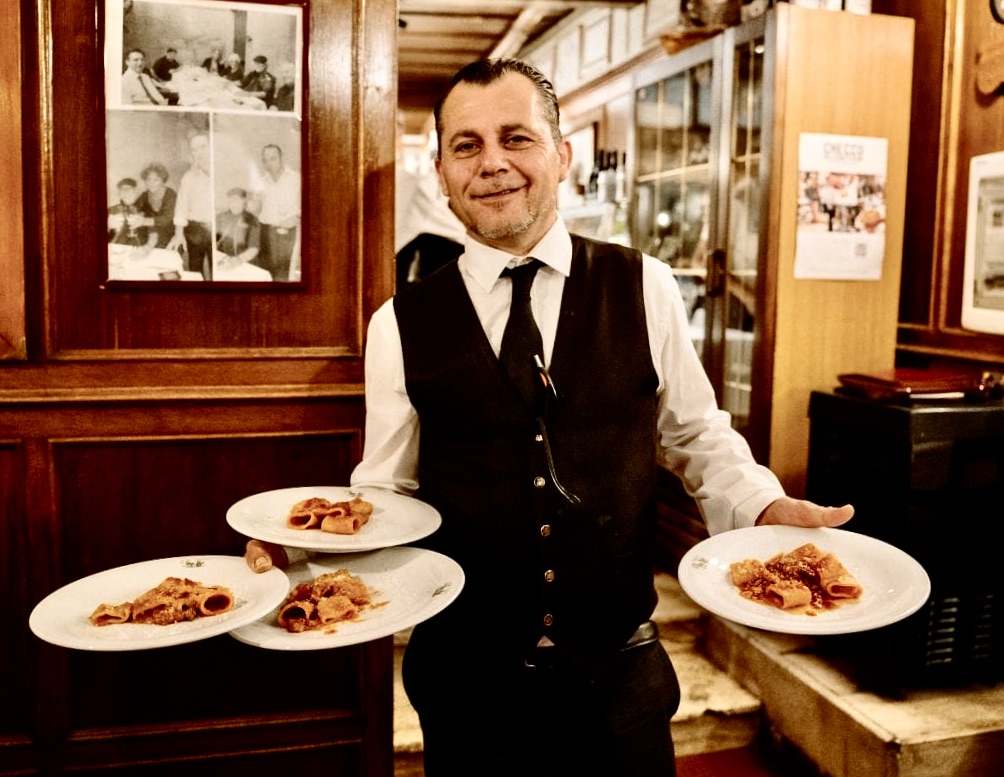
   The waiters at the New York Spaghetti House were all men, middle-aged and older. They carried themselves with poker faces, as though on military parade. The busboys were younger. I was one of the youngest busboys during my tenure there, even though I was in my late 20s. The waiters wore black pants, black shoes, and black ties. Some of them wore black vests. Their shirts were white. They took orders by memory, never writing anything down. That turned out to be my downfall. My memory played tricks on me all night long my first night there. The kitchen crew got sick and tired of replacing my mistakes.

   Once I got the hang of busing tables I didn’t mind it. At least I didn’t have to memorize anything. Bussing meant removing soiled  plates, glasses, silverware, and napkins from tables, setting tables for new feeders with clean plates, glasses, silverware, and napkins, refilling drinks and delivering food if servers were busy, as well as keeping the dining room tidy, mopping up spills, and staying out of the way of the head waiter. He was a stern man and didn’t suffer fools among the workforce, although he was unfailingly polite to diners.

   One evening a woman with Shaker Heights written all over her asked him if the cream in her coffee was fresh. “Yes, it is fresh,” he said. “This morning it was still grass.”

   “Oh, I’m so glad,” she said. The head waiter flashed a thin smile.

   The tablecloths were red and white checkered. Bussing tables meant always being at hand, even though there wasn’t always anything to do. In between staying busy I listened in on the goings on at nearby tables. It was like going to the movies. There were first dates and wedding anniversaries. There were birthdays, graduations, and family reunions. There was plenty of gossip to be overheard, there being plenty of lawyers, bankers, and politicians downtown.

   I listened in on a pair of yuppies. I worked out that they were both lawyers. I couldn’t work out the whys and wherefores behind their dinner date. They were a good-looking couple but sparred with mean-spirited conversation all through the appetizer, soup, and the principal meal. When they were done chewing their food they kept on chewing on each other.

   “You shouldn’t drink so much,” she said. “You’ve got be at work bright and early.”

   “Like they say, work is the curse of the drinking class,” he said.

   “You should know.”

   He got steamed up and looked like he was going to jump down his own throat, but instead poured some more booze down it.

   When vaudeville houses downtown were going strong in the 1920s performers like Jimmy Durante and W. C. Fields ate at the New York Spaghetti House all the time. After World War Two Mario’s brother Marino came from Rome to help out and stayed, eventually becoming the head chef. He was the boss of the kitchen during my short stint there. After my first day I avoided him, the same as I avoided the head waiter. I didn’t have a problem with authority, so long as it ignored me.

   The dining tables were draped with red-and-white-checked tablecloths and the walls were wood paneled, except where they were covered by murals. The murals were painted by John Cgosz, an expatriate Hungarian painter. They depicted gondoliers in Venice, the harbor at Naples, the Coliseum in Rome, and the island of Capri. The island was intensely sunlit in the dimly lit dining room. It was like a tour of Italy.

   Every so often somebody or other came in alone and ate alone, He was almost always a man. The life in his eyes was usually the color of something he’d forgotten. He drank Chianti while waiting for his spaghetti. He slurped coffee after dinner and never left much of a tip. He always looked the way somebody looks when he doesn’t know anybody at a party.

   One night a couple came in with twin six year olds. Children eating at the New York Spaghetti House weren’t entirely unusual, but it was uncommon. The twin girl started acting up during dinner and wouldn’t stop. Her brother soon joined her. Diners at two tables asked to be moved downstairs. The head waiter finally made an appearance and explained the children were being disruptive and they would have to leave. The father of the children, however, wasn’t prepared to leave his half-eaten dinner behind. He frog-marched his twins outside and came back alone a minute later. When the head waiter raised his eyebrows the man said, “I locked them up in the car.”

   The front of the restaurant was chalet-style, like something from the old country. Inside it was bigger than it looked from the sidewalk. It was six thousand square feet big, which was nearly two thousand square feet bigger than an NBA basketball court. There was a long oak bar in the lounge. There was a floating staircase. The kitchen was small. The station chefs, sous chefs, and head chef were always cursing in Italian in the infernal heat.

   On a mid-week night a man and woman walked in. “They have great spaghetti here,”  the man said as they entered. They had gotten married over the weekend and were still celebrating. They were seated on the main floor and ordered a bottle of red wine and matching spaghetti plates with meatballs on the side. Shortly after being served dinner their waiter came over and said to the wife as politely as he could, “We do not cut our spaghetti here.”  Long spaghetti is designed to be twirled around a fork. It ensures a better distribution of sauce. The brown sauce at the New York Spaghetti House was their measure of craftsmanship. Cutting the spaghetti made it harder to twirl and reduced the lengthy surface for the brown sauce. It altered the aesthetic.

   The wife looked up at the waiter and said, ‘I’m from Baltimore and we cut our spaghetti there.” She didn’t put her knife down. The waiter didn’t want to insult Baltimore and so he  didn’t say any more. The waiters could be stiff-necked but knew when to be discrete.

   I got acquainted with the other busboys, since we were all in the same boat. One of them, whose name was Enzo, was my age and we got along fine, until he was sent home and I didn’t see him after that. What happened occurred on a Sunday night. It wasn’t especially busy. Enzo and I were busy doing nothing when a young man strode across the main dining room right at us. He was wearing a gray t-shirt, black pants, and a scowl on his face. His hair was black, slicked back, and his skin was olive. He was Italian like Enzo.

   When he got to us he ignored me and got into Enzo’s face. He was speaking in Italian. I didn’t understand a word of it, although I could tell he was angry. Before I knew it he grabbed Enzo’s shirt collar, twisted it, and pushed him hard against the wall. Enzo was pinned. He pulled the ears of the young man but to no effect, so he head butted him. Blood gushed from the young man’s forehead. He punched Enzo and broke his nose, but before anything else could happen a scrum of waiters and busboys broke it up. They dragged the young man out the back door and threw him into the alley.

   When they came back Enzo was sitting in a corner with his head thrown back and ice on his nose. There was blood all over his white shirt. I asked one of the waiters what it had all been about. 

   “Enzo steal his girl,” the waiter said.

   A man in a dark suit and an angel face in a low cut dress were one of the last tables my last night. Thankfully, nothing had gone wrong that night, although closing time was still an hour away. The man was smoking a cigar. He looked like a gangster. After dinner he ordered decaf coffee for himself. The angel face was inspecting herself in a hand mirror. She didn’t order anything. The waiter was  busy and asked me to serve the coffee. “Make sure it’s decaf, pal,” the man said. “If I’m still awake at three in the morning, I’m going to call you to complain.” I didn’t like his sense of humor, if that’s what it was. It was the end of my job of work at the restaurant and I decided one more mistake wasn’t going to kill me. I brought him straight-up coffee. I wasn’t worried about him calling me. He didn’t have my phone number, which was a good thing. I found out later he didn’t just look like a wise guy. He was a wise guy up the hill in Little Italy.

   I collected my pay, had dinner on the house, and went home. It was the last time I set foot in the New York Spaghetti House. After I got married and thought about going for dinner sometime, it had closed and moved to the suburbs. My wife and I didn’t drive out there because the suburbs are more flavorless than not.

   One day the next summer I was standing outside of Captain Frank’s on the E. 9th St. pier when a man in a dark suit approached the front door. He looked like the Mob. Another man in a dark suit, younger and bigger, held the front door open for him. He looked like Mob muscle. Captain Frank’s was a seafood house. Cleveland’s underworld ate there day in and day out. I had gone for a long walk along the lakeshore to the Cleveland Public Power plant and back and was waiting for a friend of mine to pick me up.

   “Hey, don’t I know you from somewhere?” the Mob man said, pausing inside the doorway. ”Aren’t you a waiter here?”

   “No, sir, I don’t work here.” I didn’t say anything about the New York Spaghetti House.

   “I swear I remember you from somewhere and it’s a sour memory.”

   Oh, oh, spaghetti-o’s. “I’m new in town,” I said. “I just got here, so it couldn’t have been me.”

   “All right,” he said and made his way into Captain Frank’s.

   I walked to the landward side of the pier and leaned on a telephone pole, waiting for my friend. Whitecaps were breaking over the pier. Lake Erie is shallow, long, and narrow. The fetch makes waves grow taller and break forcefully. I knew full well there were no sharks in the water, but I kept my eyes open for any more unpleasant surprises.

A version of this story was published in the ezine Spillwords.

Ed Staskus posts monthly on 147 Stanley Street  http://www.147stanleystreet.com, Made in Cleveland http://www.clevelandohiodaybook.com, Down East http://www.redroadpei.com, and Lithuanian Journal http://www.lithuanianjournal.com. To get the site’s monthly feature in your in-box click on “Follow.”

“Cross Walk” by Ed Staskus

“A Cold War thriller that captures the vibe of mid-century NYC.” Sam Winchell, Beyond Books

Late summer, New York City, 1956. The Mob on the make and the streets full of menace. President Eisenhower on his way to Brooklyn for the opening game of the World Series. A killer waits in the wings. Stan Riddman, a private eye working out of Hell’s Kitchen, scares up the shadows looking for a straight answer.

Available on Amazon: https://www.amazon.com/dp/B0CRPSFPKP

A Crying of Lot 49 Publication
Boss Man

By Ed Staskus

   It was ten minutes before five o’clock on a Friday when Dave Myers asked me to come into his office. I knew his plan was to get rid of me. Efficient Lighting was going downhill fast. There wasn’t much that was efficient about it anymore. I also knew I wanted to stick it out before it all went to hell and the doors closed for good. There was still some blood in the turnip. All I had to do was somehow convince the boss man to let bygones be bygones.

   That was going to be easier said than done. Dave’s bite could be worse than his bark. When I walked into his office and saw him with his wiener dog in his lap, sitting behind his St. Bernard-sized desk, I thought if I played my cards right, I might have a chance. He was high-handed but he could be flighty, too. The dog was the key.

   “You wanted to see me, Dave?”

   He was wearing a green checked shirt and a blue blazer. He gave me a sour look. He didn’t like me calling him Dave. I didn’t like calling him David. Some of the sales guys called him Corner Office. The two Vietnamese women who did the bookkeeping called him Big Daddy. The guys in the warehouse called him Big Cheese. 

   Efficient Lighting was the parent company of several offspring. We sold commercial lighting of all kinds for all kinds of uses, from illumination to disinfection. We sold heating bulbs and metal halide bulbs. We sold high-pressure sodium bulbs for parking lots. We sold plant grow bulbs and bulbs that made salt water coral grow. Our big seller was Light Sources tanning bulbs. We sold them by the boat load, although the boats had been slowly getting smaller since the start of the aughts, after tanning beds got mixed up with cigarettes. It was a slow death, but it was the kiss of death. Fewer and fewer people wanted to risk skin cancer for a drop-dead tan.

   The first time I met Dave Myers was at the Light Sources factory in Connecticut. Our sales guys were there for a tour of the plant, to see how fluorescent UV bulbs were made. I was one of the sales guys. When we were introduced to him, I couldn’t help noticing his office was spacious, something on the order of ten times the size of my cubicle. He was some kind of executive in charge of something. It seemed he was close to Christian Sauska, the head man of the operation. I found out later Dave Myers was married to a woman from the Sauska family.

   Light Sources went back to 1983, back to Hungary, when Christian Sauska and some long-gone buddies got the company off the ground. All the top guys in Connecticut, the site of their American factory, were Hungarians. Dave was enough Hungarian to count as one of the guys. When Light Sources engineered a takeover of Ultraviolet Resources International, the golden goose of Efficient Lighting, they sent Dave to us where we were in Brook Park, Ohio to run the show. He became our Dutch uncle.

   Doug Clarke was the owner of Efficient Lighting. He had built a state of the art 45,000 square foot warehouse and offices in Brook Park at the turn of the millennium, across the street from the Holy Cross Cemetery, after more than fifteen years in the light bulb business, most of them in a repurposed building in Lakewood. When Light Sources took control of Ultraviolet Resources everything stayed the same for a while. Everybody stayed right where they were. I stayed in my cubicle where everything was within arm’s reach. The only change was that Doug was kicked upstairs and Dave took over Doug’s ground floor corner office and day-to-day operations.

   I was a jack of all trades, working general lighting, salt water fish lighting, and tanning bulbs. Everybody was the boss of me at the same time nobody knew what to do with me. I kept my head down and kept moving, trying to stay out of the weeds. I went to all the sales and motivational meetings and tried not to doze off. I had trouble concentrating on the gasbags who did all the talking. 

   The second time I met Dave was at a trade show in Las Vegas. By the end of the day I thought, “This guy must get the same briefing the President of the United States gets every morning.” He seemed to know everything about everything. I never ventured an opinion about anything to him. I didn’t need him turning me over every chance he got.

   I was more-or-less civil to Dave from the day he showed up to the day he took Ultraviolet Resources to greener pastures. The family firm was splitting up and the day they would split up for good was fast approaching. Kathy Hayes, Doug’s wife, had brought her brothers and sisters into the business one after the other. They were all on the verge of jumping ship and signing on to the HMS Bounty. In the end that is what happened.

   Patty Hayes was our sales manager for the moment, but she was too mild-mannered to last and didn’t last. John Hayes, Kevin Hayes, and Maggie Hayes ran the show. They were mean-spirited and fit the bill. They rotated who was Beavis and who were the Buttheads on a daily basis. Maggie did her best to be Beavis as often as possible and took the trophy home more often than not. Kevin took personality lessons from Dave. John handled big accounts and tried to look too busy to care about trophies. What he cared about was his super-sized paycheck. Kevin’s wife was our long-time bean counter. She controlled the books with a left-handed smile.

   Dave and the Beavis and Butthead crew were on the verge of leaving Brook Park for a bigger building in Westlake. He was dreaming up a new business venture with Wisconsin-based Tan-U, a regional distributor in the upper Midwest. He had plans for becoming the top dog of the tanning bulb world.

   “As the indoor tanning industry evolves into a more mature market, consolidation makes a great deal of business sense,” he said. “I can’t think of another company which could result in a better fit and look forward to cementing the new company’s position as a major player in the market.” Dave could be on the level on occasion, but he was a big fan of corporate snake oil.

   He started by asking me if I liked my job.

   “Sure,” I said, stretching the truth.

   “Are you satisfied with how things are going?”

   “Sure,” I lied. 

   “What are your goals?”

   He was getting to be bothersome with his business school questions, but I played along. I made up some goals. Dave liked the sound of his own voice far more than he liked the sound of anybody else’s voice. I kept it short. The less said the better, unless I wanted to be treated like a country cousin.

   Dave nodded, stroking his wiener dog, considering my goals. He rubbed his chin and looked down his nose. I knew it was in one ear and out the other. His middle-aged dog was recovering from hip surgery. One of my middle-aged hips hurt. I was taking yoga classes, looking for relief. I was taking them two and three times a week. Along the way I was learning meditation and patience.

   Dave started explaining how the business world works. He was snarky and patronizing while talking at me. He told me that to understand how business works, you must have a firm understanding of how people think and behave, how people make decisions, act on those decisions, and communicate with others. At its core, he intoned, every enterprise is a collection of people whose work and processes can be reliably repeated to produce a particular result.

   “Do you understand what I’m getting at?” he asked after tossing me his guidance counselor crumbs.

   “Sure,” I said. “How is your dog doing?”

   “Much better,” he said. “Thanks for asking.” He described the limp the dog had had to live with, the operation, his recovery, and the first day the purebred Daschund had stepped out on grass and run a few steps, wagging its tail. He brought the dog to work every day. The dog slept in a custom-made bed in the corner. He ate a special diet catered to him in special doggie bowls. Dave encouraged the dog to follow at his heels whenever he went anywhere in the building in order to build its strength back up.

   “If there’s one thing that man loves without a shred of contempt, it’s that dog,” I thought.

   We talked about pets, animal cruelty and animal rescue, the companionship of dogs, the loyalty of dogs, and whether dogs were better people than people. By the time he was done, since he did most of the talking, it was past six o’clock and he said he had to pack up for a weekend trip. He gave me a bottle of wine from the walnut custom-made wine rack in his office. 

   “Thanks, Dave,” I said, hefting the bottle like a trophy. II was surprised. It was undoubtedly worth more than I made in a day. Dave had seventy or eighty bottles in his office. Maybe I could sell it on eBay. Maybe I would leave it out in the sun and let it turn to vinegar.

   He had forgotten to fire me, thanks to the dog. I slipped away to my cubicle, got my stuff, and left. In the parking lot I saw his four door luxury sedan and his natty ragtop sports car. They were parked on either side of my Saturn. I made sure to not dent, scratch, or otherwise molest one or the other of his rides. The last thing I wanted was a lecture from a clubhouse lawyer.

   When Westlake was ready for Ultraviolet Resources International, Dave, John, Kevin, Maggie, Kevin’s cagey accountant wife, somebody’s dodgy sister-in-law, and some others of the sales force went to the outer-ring suburb. Our building felt half-empty after that because it was half-empty. We were going to struggle for the next three years until all the downsizing that could be done was done and the building had to be sold. I was one of the last to be laid off, but I didn’t mind. There was hardly any work left for me to do by then, anyway. I had gotten tired of taking long lunches with nobody to talk to.

   The next thing I heard through the grapevine was that Dave wasn’t with Ultraviolet Resources reinventing corporate tricks anymore. He was up to his own tricks. He had set up an ISO Italia office near the Chagrin Highlands, selling glossy Italian tanning beds and shoddy Canadian-made Sylvania tanning bulbs. I was sure he could explain away the performance problems of his bulbs.

    The following year I read news that he had gone into the business of backdoor crookery. He had been charged by the Securities and Exchange Commission with insider trading. He had always been bullish on the stock market. I wasn’t sure he would be able to explain his actions away. Federal agents didn’t usually like it when their suspects talked down to them.

   “Baltimore-based consultant Brett Cohen received coded e-mails from a fraternity brother about two biotechnology companies and passed the information to an uncle, David Myers, of Cleveland, Ohio who traded on the tip,” the Securities and Exchange Commission said.

   The fraternity brother got the information from his real brother, who was a patent agent for California-based Sequenom, which made genetic analysis products. The patent agent passed along non-public information about the company’s plans to acquire Exact Sciences. Dave bought 35,000 shares of Exact Sciences on the sly before the acquisition was announced. The news sent Exact Sciences’ stock up 50 percent, setting Dave up to pocket first class profits by selling the stock over the next few weeks. “David Myers garnered more than $600,000 in profits trading on the inside information,” the Securities and Exchange Commission complained.

   The patent agent also passed on tips about an up-coming announcement that investors should no longer rely on Sequenom’s data about its Down syndrome testing. Dave bought Sequenom options just before the announcement, which caused a 75 percent drop in the company’s stock, according to the Securities and Exchange Commission complaint.

   “David Myers later sold that entire position for illegal profits of more than $570,000,” the complaint alleged. He knew how to put his nose to the grindstone when he had to. He knew how to generate cold hard cash out of nothing and spend it on himself, no problem. 

   On top of everything else, the United States Attorney for the Southern District of California filed criminal charges against Brett Cohen and Dave. My Dutch uncle was going to have to spend some of his profits on a mouthpiece. The mouthpiece was no great help. They both eventually pled guilty to conspiracy to commit securities fraud. 

   “Holy smokes,” I thought, shutting off my Apple iPad. I didn’t wish Dave any real harm, but it was nice to know he didn’t know everything after all. I didn’t care how much he knew because I knew he didn’t care what I thought. He had sometimes forgotten my name in mid-sentence. I had forgotten the wiener dog’s name but wished him the best, on and off the leash, although I thought he would be better off if he made a break for it, so long as his new hip was good to go. No good dog should end up being bad to the bone.

Ed Staskus posts monthly on 147 Stanley Street  http://www.147stanleystreet.com, Made in Cleveland http://www.clevelandohiodaybook.com, Down East http://www.redroadpei.com, and Lithuanian Journal http://www.lithuanianjournal.com. To get the site’s monthly feature in your in-box click on “Follow.”

“Made in Cleveland” by Ed Staskus

Coming of age in the Midwest in the 1960s and 1970s.

“A collection of street level short stories blended with the historical, set in Cleveland, Ohio. The storytelling is plugged in.” Sam Winchell, Beyond Books

Available on Amazon:

A Crying of Lot 49 Production

Brother From Another Planet

By Ed Staskus

   I wasn’t a sportswriter or a sports photographer at the time, but I had a media pass so I saw more Cleveland Cavalier games in the flesh during the 1980-81 season than I have ever seen in my life. I saw them from a better seat, too, even though I didn’t have a seat. I sat, stood, or knelt court side, sometimes under the baskets at the base of the stantions or beside the benches, and pretended to be doing something like taking notes. Nobody questioned my Kodak Instamatic Point & Shoot camera or schoolboy spiral notepad, even though the camera was rarely loaded with film and I often forgot to bring a pen.

   I got the media pass from my brother, who was a student at Lakeland Community College in Kirtland. He worked part-time for the school newspaper. He was their communications and media man. I had it laminated and wore it clipped on my belt. Whenever anybody bumped me jostling in or out of the arena I checked to make sure the pass was still on my belt. It was worth its weight in gold, getting me in to see the wine and gold whenever I wanted.

   The Cavaliers weren’t very good in 1980. Mike Mitchell was their best player. It was a steep drop-off from there. Bill Musselman, who was the coach, didn’t have much to work with and it showed on his game face game after game. The team finished the year twenty four games out of first place.

   My drive to the Richfield Coliseum in Richfield Township, twenty-five miles south of where I lived near downtown Cleveland, was long and longer, especially whenever they were playing a league-leading team like the Boston Celtics or Philadelphia 76ers. I soon enough learned to go early or get stuck in traffic. The Richfield Coliseum was Larry Bird’s favorite basketball arena, but he didn’t have to drive there. An interstate and a turnpike dumped cars onto a two-lane road in the middle of nowhere. It was a snail’s pace at the best of times. The traffic issues got worse the worse the weather got. In addition, the single level concourse made for massive congestion among the fans and nobody liked that, either. I had to pay for parking, which I didn’t like, although I brushed it off. Once I flashed my pass and strolled in without a hitch I was happy again.

   A lot went on at the Richfield, Coliseum, including concerts, truck pulls, rodeos, circuses, ice shows, wrestling, hockey, and indoor soccer. The arena hosted a championship boxing match between Muhammad Ali and Chuck Wepner in the mid-70s. The fight went to the bitter end, the human punching bag holding on for dear life but going down nineteen seconds before the final bell, losing in a TKO and inspiring Sylvester Stallone’s movie “Rocky.”

   The Cavaliers weren’t the first pro basketball team in Cleveland. The first three teams, starting in 1924, were the Rosenblums, the Rebels, and the Pipers. When the “Miracle of Richfield” happened during the 1975 season, the Cavaliers advancing to the Eastern Conference Finals, everybody forgot about the team’s basketball pioneers, if they had ever thought about them in the first place.

   The Richfield Coliseum opened in October 1974 with Frank Sinatra doing the honors. When he sang “My Way” the sold-out crowd roared its approval. “My friend, I’ll make it clear, I’ll state my case, of which I am certain.” Nobody roared louder than Nick Mileti. He had been a prosecutor in the inner-ring suburb of Lakewood, but then got the bug. “I want to have fun, make some dough, and leave a few footprints,” he told sportswriter Bob Oates of the Los Angeles Times.

   “Nick could sell you the Brooklyn Bridge, whether you wanted it or not,” said Bill Fitch, the Cavaliers coach from 1970 to 1979. The new arena in the middle of nowhere was the immigrant Sicilian son’s Brooklyn Bridge to glory. “My daddy was a machinist who came over as a teenager and had a dream that I was to wear a white shirt,” he said.

    He started by buying the Cleveland Arena and the city’s hockey team. He owned the Cleveland Indians baseball team for a while and then picked up the basketball team. He wasn’t using his own money, but he doctored it to look like it was his. After a while he took a good look at the 30-plus-year-old Cleveland Arena with its bad plumbing and a seating capacity of only 11,000. What he saw was money flying out the window. The players called it “The Black Hole of Calcutta.” They later called the new arena “The Palace on the Prairie.”

   “We met with the guy running the old arena,” Nick Mileti said. “On the wall, there was a calendar, and I said, ‘Why is it all white?’ They said, ‘Because we don’t have any events.’ It was an incredible situation. I bought the Barons and the arena, and after that, the first call I made was to Walter Kennedy, the commissioner of the NBA, and said I wanted a franchise. And two years later, I got one.”

   When in the early 1970s he decided on moving the basketball team halfway to Akron to do better business, every Cleveland politician and businessman was against the idea. They wanted to revitalize downtown, not vitalize someplace in the boondocks. They wanted the cash flow of twenty thousand fans driving in forty or fifty times a season. They wanted the countless concerts, circuses, and events the venue would host. They wanted the tax revenue. They didn’t get what they wanted. But that was what Nick Mileti wanted, and that was that.

   I didn’t get to know any broadcasters doing the games, but I got to know some of the writers and cameramen well enough to say hello. They were guys like Bill Nichols, Chuck Heaton, and Burt Graeff. One or the other of them was always giving me the fisheye. When I saw it happening, I pretended to be taking a picture with my Instamatic. The only newshound I was on more than hello and goodbye terms was Pete Gaughan. He was a sportswriter for the SunMedia suburban papers, writing about golf, high school, college, and pro sports, and anything else that involved hitting, kicking, throwing, or catching a ball. I met him while refereeing flag football Sunday mornings at Lakeland Community College.

   My brother had started a flag football league there with four teams. By 1980 he had two fields and fourteen teams. The teams were mainly made up of former high school players. He and I were the only two refs at first, but as more teams joined, he needed a second and third two-man crew. He paid $20.00 to each ref each game, but still had trouble recruiting and keeping crews for the Sunday morning games. When Pete Gaughan volunteered and my brother took him on, it was scraping the bottom of the barrel. Pete may have known all about local sports, but he didn’t know how to be on time and was indifferent about the rules.

   The first Sunday I met him he misjudged a parking space and brought his rust bucket to a stop on the wrong side of the curb. When the driver’s door swung open, the car still running, a half dozen empty Budweiser cans rolled out, a leg flopped here and there, and he finally staggered out of the car in a cloud of cigarette smoke. He looked like hell, like he hadn’t slept in a week. I turned his car off while my brother got him into ref’s clothes, gave him a whistle and a penalty flag, and decided he would work with me.

   “Thanks, bro,” I said while he trotted off to another field.

   Pete worked behind the offensive line while I worked downfield. He didn’t blow his whistle or throw his yellow rag once, not even when there was blood. One of the teams was made up of former Mentor High School players, and unlike most of the teams, they ran the ball more than they threw it. They were the number one team in the flag football league because they had played together in school and knew how to execute. One guy on the opposing team got tired of being battered by the relentless running attack, and when the halfback came through the line one more time the ball tucked under his arm, the other arm swatting hands away, he didn’t bother trying to reach for either of the flags on the runner’s waist. He raised his forearm head high and let the halfback’s nose run into it. He went down like a shot and blood gushed out of his nose. Pete spotted the ball at the spot and stepped to the side, lighting up a cigarette. 

   We called 911 and after an EMS truck showed up, they drove off with him, telling us his cheekbone was fractured along with his messed-up nose. We called the game. The Mentor boys were up by eight touchdowns anyway. Pete popped a Budweiser.

   By the 1980 season the “Miracle of Richfield” was five years in the dustbin and Nick Mileti had given up his title as president of the Cavaliers, sold his interest, and control of the team went to Ted Stepien, the King of Errors. There weren’t going to be any miracles under his reign. The NBA stayed busy writing rules addressing some of the crazy things he was prone to doing. He traded away five consecutive first-round picks. The wrote the Stepien Rule, which states no team can trade away consecutive first-round draft picks.

   In the meantime, I tried to see all the games involving the better teams in the league. The Cavaliers were a half-good team who could keep up with other half-bad teams. They had trouble with the cream of the crop. That year they went 1 and 4 against the Celtics, 1 and 5 against the Bulls, 0 and 5 against the Knicks, 0 and 6 against the Bucks, and 0 and 6 against the 76ers.

   The Philadelphia team was my favorite team. They were always in the hunt for the title. Maurice Cheeks and Doug Collins were the guards. Bobby “The Secretary of Defense” Jones cleaned up around the basket. Julius “Dr. J” Erving and Daryl “Dr. Dunkenstein” Dawkins led the scoring parade. When the doctors were in the house, they were good for almost fifty points. Julius Erving was menacing enough, but Daryl Dawkins was a menace unto himself.

   A year earlier in a game against the Kansas City Kings in KC, dunking the ball with enthusiasm, Daryl broke the backboard, sending both teams ducking. Three weeks later, he did it again at home against the San Antonio Spurs. The next week the NBA wrote a new rule that smashing a backboard to smithereens was wrong, so wrong that it would result in a fine and suspension.

   Daryl named his backboard-breaking dunks “The Chocolate-Thunder-Flying, Teeth-Shaking, Glass-Breaking, Rump-Roasting, Wham-Bam, Glass-Breaker-I-Am-Jams.” His other dunks earned their own names, like the Rim Wrecker, the In-Your-Face Disgrace, the Spine-Chiller Supreme, and the Greyhound Special, for when he went coast to coast. “When I dunk, I want to go straight up, and put it down on somebody.” 

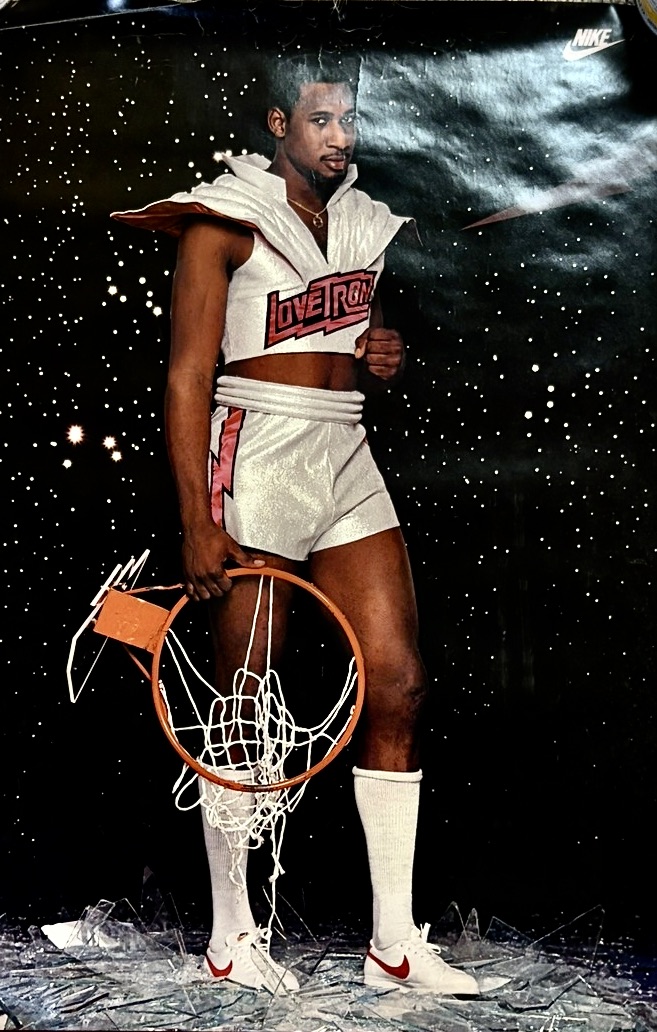
   His nicknames were Sir Slam, Chocolate Thunder, and Dr. Dunkenstein. He wore a LoveTron t-shirt while warming up. He told the Cleveland sportswriters he was an alien from the planet LoveTron, where he spent the off-season practicing “interplanetary funkmanship” with his girlfriend Juicy Lucy. The reporters scribbled it down like it was sirloin.

   His coach asked him to tone it down. “All the talk and bravado, enough,” Billy Cunningham said. The next day at practice Daryl told his teammates, “I’m not talking today. Coach made me Thunder Down Under.” It didn’t last long. He went back to talking the next day.

   Daryl Dawkins was in his mid-20s, six foot eleven, and 260 pounds of beef, brawn, and swagger. The Cavalier centers were Kim Hughes and Bill Lambeer, both six eleven, but both slower and skinnier than Daryl, who wore gold chains during games. One of them featured a cross while another one proclaimed Sir Slam in gold script. Sometimes, he would shave his head and oil it, along with wearing a gold pirate’s earring. 

   The year before he had averaged almost 15 points and 9 rebounds, helping the 76ers to the NBA Finals, which they lost in six games to the Los Angeles Lakers. I watched him go coast to coast against a back-pedaling Bill Lambeer one night. If it had been the other Cavalier center, Kim Hughes, about 40 pounds lighter than Daryl, he wouldn’t have even bothered back-pedaling. Bill Lambeer was far more stubborn. All the way to the inevitable slam dunk Daryl’s gold chains swung one way and the other way slapping at Bill’s face until he finally ducked and covered. The next year the NBA forbade the wearing of any jewelry while playing ball.

   The last three games I saw at the Richfield Coliseum were the last three games of the season. The Cavaliers lost by 26 to the Bucks, by 21 to the 76ers, and by 35 to the Bullets. It had been a long year. The opening game of the next season boded another long year when the wine and gold lost to the 76ers by 24. But before that game was even played, I didn’t have a media pass anymore and wasn’t planning on going back to the Richfield Coliseum anytime soon. I didn’t have a dependable car and God forbid I break down in the cow pastures of Summit County in the middle of the night.

   I missed going out there, missed the lights and noise, groaning and cheering, being on the floor, the action and excitement, the coaches fuming and cursing, and the players putting up with venomous fans sitting behind them. Daryl Dawkins wasn’t big on putting up with anything. When he flaked on a dunk one night, hearing the catcalls, he kicked somebody’s extra-large Coke off the floor, sticky sugar water spraying on everybody in the big-ticket seats. He didn’t look back and didn’t apologize. I kept a firm grip on my jumbo soft pretzel.

   After the Cleveland Cavaliers returned to Cleveland to a new arena the Palace on the Prairie closed and the parking lot went to weeds and shadows. I walked to games downtown a couple of times, but the atmosphere was more corporate than cutthroat and I didn’t go back. Besides, they were charging corporate prices for the tickets, and I wasn’t about to bust my piggybank to cheer grown men in shorts bouncing a ball from one end of a hardwood floor to the other end. Besides, the last time I checked on Daryl Dawkins, he was playing for the Harlem Globetrotters. That was where the fun and games were.

Ed Staskus posts monthly on 147 Stanley Street at http://www.147stanleystreet.com, Made in Cleveland http://www.clevelandohiodaybook.com, Down East http://www.redroadpei.com, and Lithuanian Journal http://www.lithuanianjournal.com. To get the site’s monthly feature in your in-box click on “Follow.”

“Cross Walk” by Ed Staskus

“A Cold War thriller that captures the vibe of mid-century NYC.” Sam Winchell, Beyond Books

Available on Amazon: https://www.amazon.com/dp/B0CRPSFPKP

The end of summer, New York City, 1956. Stickball in the streets and the Mob on the make. President Eisenhower on his way to Ebbets Field for the opening game of the World Series. A torpedo waits in the wings. A Hell’s Kitchen private eye scares up the shadows.

A Crying of Lot 49 Publication

Chilling at Irv’s

By Ed Staskus

   Every Friday and Saturday in the 1970s deli’s like Solomon’s in South Euclid, Budin’s in Shaker Hts., and Irv’s in Cleveland Hts. were packed to the gills. The minute the front doors opened the smells of pastrami and corned beef wafted out like minstrels. We followed our noses. The minute anybody sat down was the minute a cup of coffee and a menu appeared. After that it was about waiting for a waitress to bring the sandwiches, French fries, and pickles.

   Even though we hardly ever went to Solomon’s, and only stopped in at Budin’s when we were going to the nearby Shaker Movie Theatre, I was at Budin’s one day having a bagel and coffee when Sandy Herskovitz’s friend won a bet. “I was sitting with a friend,” Sandy said. “A few tables down there were some women. One of them had on a straw hat. A countermen walked by with a jug of coleslaw and my friend says to me, ‘How much do you want to bet that guy is going to dump the coleslaw on the straw hat?’ OK, I’ll take that bet. Sure enough, he tripped and dumped his coleslaw all over the straw hat.”

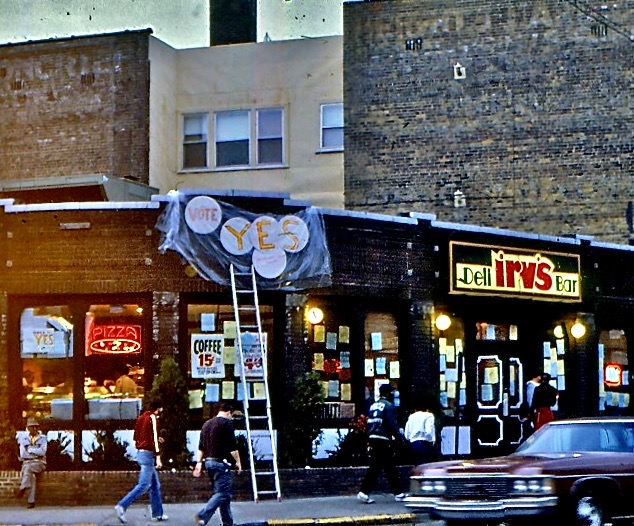
   We went to Irv’s Deli in Coventry Village like going to grandma’s house. It was closest to where we lived and it was where the fun beatniks and hippies, cops and lawyers, college students, cutie pies, no-good bookies and gangster wannabees, and Hebrew folks went for breakfast, lunch, and dinner. There was the occasional misfit everybody ignored. We went there for the cheap breakfasts. We went there late at night, after everything else closed. Irv’s never closed. There were Outlaws and Hells Angels who lurked here and there, at least when the weather was warm and dry, but we avoided them. They spent most of their time drinking heavy down the street at the C-Saw Café, anyway.

   How Irv made any money with us spending the night ordering free refills of coffee is beyond me. Matzo ball soup was a buck a bowl and corned beef sandwiches were a buck-and-a-half. Somebody said Irv printed money in a room behind the kitchen. “You know how those Jews are,” a Case Western Reserve University student said. “They’ve always got secrets.” He was wearing bell bottoms and a turtleneck sweater and sported a Prince Valiant. One time when a waitress was complaining about the bikers and hippies who hung around without ever leaving a tip, Irv, who was always there, said, “You know how those losers are.” He knew how to give as good as he got.

   Although we went there all the time we didn’t usually eat there because we were chronically short on cash. We always had 15 cents for a cup of coffee, but not much more for food, unless it was a free deli roll and butter. Besides, the kitchen was sketchy. None of us ever got sick eating at Irv’s, but all of us closely inspected our food as soon as it was delivered. Nothing that appeared on a plate in front of us ever bore any resemblance to the way it was described on the menu. Beggars can’t be choosers. One night a hippie girl at our table said the sinks and stoves in the kitchen were filthy. We all rolled our eyes and laughed. 

   “No, I mean it,” the girl said. We laughed because the kitchen couldn’t have been any dirtier than her. She needed a bath right away and an appointment at a hair salon right after that. When my friend Jimmy the Jet said he was willing to send an SOS to Mr. Clean, she got into a huff. “Hey, babe, it’s all right, your beauty shines through,” he said. He was a smooth-talking devil.

   Jimmy was called the Jet not because he was fast on his feet but because he talked a mile a minute. Everything he said was a springboard for the next thing he was going to say. He always had an ace up his sleeve, and then another one, and another one. We knew he kept little white pills on his person at all times. He was the only one of us still bright-eyed as the night wore on, rapping with his dope fiend friends. He was always the last to leave, talking to himself as he walked back to his apartment on Mayfield Rd.

   Irv’s was a Jewish deli that served Chinese food, among everything else food-wise, and a bar that specialized in strong shots and weak beer. It was on the corner of Hampshire Rd. and Coventry Rd. in what was called Coventry Village in Cleveland Hts. Irving Gulko opened the delicatessen in 1959. His father and grandfather had both once operated eateries in Cleveland. It was in his blood, even though his food was generally bloodless. There were rumors that he wasn’t really in the deli business, but was in the drugs, prostitution, and bookmaking businesses. We never saw any drug-addled hookers lounging around and laying down bets, but that was neither here nor there.

   The prostitution supposedly went on in the basement, spilling over into the apartment building next door. Jimmy told us there was a secret door leading from Irv’s basement to the apartment building’s basement. “Everybody knows that,” he said. None of us knew it, but we didn’t have the means to rent a hooker, anyway, even if we wanted to. Besides, at the time, we believed in free love.

   At the turn of the century Coventry Village was a retail and restaurant venue for Cleveland’s Jewish community. The Mayfield and Euclid Heights streetcar lines met at the Coventry Rd. and Mayfield Rd. intersection. The streetcars made coming and going more convenient. By the 1920s a profusion of walk-up apartments had been built. There were bakeries and tailor shops. There was a kosher poultry slaughterhouse. By the time we showed up, however, many Jews were packing up and moving to Beachwood and the neighborhood was filling up with head shops and record stores.

   We hung around Coventry Books and flipped through books we weren’t going to buy. Reading was what libraries were for. “Bookstores are a place for youth to come and see people that you wouldn’t see at home,” the owner Ellie Strong said. We followed her advice and did more people watching than reading.

   We didn’t buy books unless we bought them from Kay’s Used Books downtown, where “War and Peace” could be had for 50 cents, but we did buy new records. We bought them at Record Revolution, which had opened a few years earlier. It was up the street from Irv’s. They sold tie-dyed t-shirts and pot paraphernalia, as well, calling the stuff “smoking accessories.” The walls were covered with autographs by Lou Reed, Led Zeppelin, and The Who, among others. Rock critics called it the “coolest place to buy records in Ohio.” It was a dingy place but it had the best LP’s. The rock station WWMS-FM routinely inquired about what was selling and added the albums to its playlist. 

   Many of us didn’t have cars, but some of us had bikes. We kibitzed at Pee Wee’s Bike Shop where they knew everything. If it wasn’t too involved of a repair, Marvin Rosenberg, who was Pee Wee during working hours, fixed things for free. When he was done he always said, “And don’t come back unless you have cash next time.”

   We idled through the High Tide Rock Bottom gift shop. Marcia Polevoi, the owner, never had any advice for us, although she kept an eagle eye on our doings. Shoplifting was endemic. The only customers who always paid were the Outlaws and the Hells Angels. They were criminals but didn’t do any petty thieving.

   The Coventry Street Fair happened for the first time in 1974, drawing close to 50,000 people in a neighborhood where 5,000 was too many. It was dreamt up to draw a new crowd to the scene. There were magicians and fire eaters. We checked out the scene but ran out of breathing room. The crowd was mostly suburbanites curious about the counter culture. “It got so big that the neighbors said they liked it, but whenever it was on, they left town,” said Bruce Hennes, president of the Coventry Neighbors Association. We didn’t leave town although we did what amounted to the same thing. We stayed away. We wouldn’t have been able to elbow our way into Irv’s, anyway.

   We went to the Dobama Theatre. It was a small playhouse in a renovated bowling alley that mostly featured serious style shows. I never saw a musical there. I saw Gore Vidal’s 1972 play “An Evening with Richard Nixon.” The playbill said, “ It is the playwright’s contention that American citizens don’t really remember anything. And a politician is thus able to re-invent himself on a day-to-day basis. Unless it is otherwise noted in the dialogue, what the Nixon character says and does this evening is what Mr. Nixon has really said and done.” I put my toy G.O.P. elephant away in a quiet corner so it could repent its sins. 

   The Saloon was where we went to hear bands. It was more-or-less a rowdy local bar, which worked well when the music was bad, but not so well when the music was good. Stairway and Rocket from the Tombs played there. Our favorite was the Electric Eels. The lead singer liked to dress up in tin foil and rat traps. “Wake up you miracle dumbbells!” he sang. “It’s time to fall out the window!” Their songs were more anti-social noise attack than music. They liked to bring a lawnmower on stage with them. Whenever fans got out of hand the Eels threw glasses of water on them. When that happened, we left, not saying goodbye.

   When we wanted a milkshake we stopped at Tommy Fello’s new dinette, which he called Tommy’s. It was small place with a small menu. He had bought the seven-seat Fine Arts Confectionary two years earlier. He knew how to make three dishes, which were all three of them Lebanese. We stuck to the milkshakes. They were fit for a king and only cost 35 cents each.

   We went to the Heights Art Theatre all the time. It was a 1,2000-seat movie house that opened in 1919. They showed movies nobody else was showing in northeastern Ohio. I saw “The Discrete Charm of the Bourgeoisie” there. The surrealist Spanish movie bowled me over. I was at the midnight showing of it and didn’t make it to Irv’s that night.

   “The Lovers” was screened at the Heights Art Theatre in 1959. It had won a Special Jury Prize at the Venice Film Festival the year before. The local cops weren’t handing out any awards. They cleared the theater and confiscated the film. The Cleveland Plain Dealer called the movie “shockingly nasty.” The manager got arrested and convicted of “public depiction of obscene material.” He cried foul and appealed the verdict. The case worked its way up the chain of command. Five years later the Supreme Court overturned the ruling. They said the criminal conviction was improper and the film was not obscene. “I know it when I see it,” is what Justice Potter Stewart said about obscenity. When I saw the movie years later I thought, “What was all the fuss about?” It was a French movie. Everybody talked a lot and smoked a lot cigarettes more than they did anything else.

   Irv’s Deli was where we hung out and where we went when we were down to spare change. It was also where we ran seeking sanctuary whenever things went wrong out on the street. Even though we went to the C-Saw Café sometimes, we generally avoided it. The baseball fans who rioted at Municipal Stadium during Ten Cent Beer Night the summer of 1974 in the middle of a game between the Texas Rangers and Cleveland Indians, and who ended up at the C-Saw Cafe later that night, didn’t know what they were getting into when they started arguing with the bikers at the bar. It is one thing to drunkenly storm a playing field and attack baseball players. It is another thing to drunkenly attack Hells Angels. The bikers drink more than anybody but never get drunk. When they fight they are all business. They don’t hit singles. When they hit you it is a home run.

   Jimmy the Jet and I were walking past the bar when a man came stumbling all arms and legs out the door and landed on his back. All the breath went out of him. He started gasping. He was followed out the door by a Hells Angel who began kicking him. Before long there was blood coming out of the man’s mouth. His friends poured out onto the sidewalk, but stood back like innocent bystanders. The Hells Angel continued to kick the man. Before I knew it Jimmy was stepping in. “Hey, stop that!” he yelled and pushed the biker. That was a big mistake.

   “What the hell?” the biker bellowed and swung his arm at Jimmy. He was unsteady on his feet, however, and the momentum toppled him over. When he did other Hells Angels came out of the bar. When they did they saw Jimmy and me standing over their fallen motorbike brother. When they glared at us and growled, showing their teeth, we knew the jig was up.

   Jimmy and I ran into Irv’s, the Hells Angels on our heels. We barreled past Irv who was sitting where he always sat. I followed Jimmy when he ran to the back of the deli and through a door. It was the door to the basement. He fastened the dead bolt on the other side as soon as we were through the door. As soon as he did hobnail boots started kicking the other side of it. The boots sounded angry. We ran down the stairs and into the basement of the apartment building next door. I looked around for the helping hand of a hooker, but there weren’t any, not even one. We ran up the apartment building’s stairs to the first floor and back out onto Coventry Rd. There was a crowd of bikers milling around Irv’s front door.

   “What’s going on?” I asked, still breathless.

   “Some punk jumped one of our guys,” a biker said. “When we find him we’re going to feed him to the rats. Then it will be down the sewer for whatever is left of him.”

   We wished him and his friends the best of luck and hurried away. We walked to Jimmy’s apartment. When we got there he set the deadbolt and secured the chain lock behind us. We sat in the gloom. Jimmy kept the lights off like it was a scary movie. He hadn’t said a word since we left Irv’s, setting a new world’s record. He lit a Lucky Strike and started to chill out. He put an LP on the turntable and lowered the needle. It was Jim Croce singing “Bad, Bad Leroy Brown.”

   “It’s too bad more men aren’t angels,” he said, leaning back and idly blowing smoke rings. “If they were we wouldn’t need to be sitting here like this.” There was a full moon that night. A police car siren went past wailing. I left in the middle of the night, but didn’t go home. I went back to Irv’s and splurged on a pastrami sandwich.

Ed Staskus posts monthly on 147 Stanley Street at http://www.147stanleystreet.com, Made in Cleveland http://www.clevelandohiodaybook.com, Down East http://www.redroadpei.com, and Lithuanian Journal http://www.lithuanianjournal.com. To get the site’s monthly feature in your in-box click on “Follow.”

“Made in Cleveland” by Ed Staskus

Coming of age in the Rust Belt in the 1960s and 1970s.

“A collection of street level stories blended with the historical, set in Cleveland, Ohio. The storytelling is plugged in.” Sam Winchell, Beyond Books

Available on Amazon:

A Crying of Lot 49 Production

Cooking Up Trouble

By Ed Staskus

   “Mom, you know it’s not dinner without a napkin,” Matt said. He was on the third floor on his cell phone talking to his mother Terese who was in the first- floor kitchen. She answered on the land line. She had made a 3-course dinner for him and taken it upstairs a minute earlier. 

   She made dinner and took it upstairs to him every night, at least on those nights he was at home. When he wasn’t, she caught a break. She would then quick fry some chicken and kick back in front of the TV. She liked B & W movies, mostly comedies and melodramas. Her husband worked split shifts. She had the house to herself those nights to laugh it up at the funny parts and cry at the sad parts.

   Terese was my mother-in-law. She was a self-taught chef. She got the bug from her mother Stefanija, who had emigrated from Lithuania to the United States after World War Two. Stefanija worked in the kitchen of Stouffer’s flagship restaurant in downtown Cleveland for the rest of her working life. After she retired, she compiled her favorite Lithuanian recipes and published them in a book called “Kvieciu Prie Stalo.” It means “We Welcome You to the Table.”

   Terese taught herself well enough that she could make anything, from sloppy joes at feed-the-poor kitchens to wedding cakes for millionaires. She only ever thumbed through cookbooks when she had to. No matter that she was intrepid and skilled, having conceived and operated several restaurants, as well as working as a pastry chef and a caterer, she had to play dumb waiter once a day.

   “I’ll bring one right up to you,” she said to her son. What else could she do? After all, she had taught him his table manners.

   Matt lived on carry out dinners except they were carry up dinners. His mother did the cooking and carrying. Matt did the eating. When he was done he dutifully brought his dishes downstairs. My father-in-law Dick washed them by hand every day. They had a dishwasher, but he preferred to stand at the sink and get his hands dirty while getting the dishes clean. He had been a war-time MP in Vietnam before becoming a bartender. He was a hands-on kind of man.

   Their house was on E. 73rd St. at the corner of Chester Ave. in the Fairfax neighborhood. It was built in 1910, three stories of it, four bedrooms, two baths, two fireplaces, and a full basement. The third floor was originally servant’s quarters. The foundation was sandstone quarried in nearby Amherst by the Cleveland Stone Company. Amherst was the “Sandstone Capital of the World” back in the day.

   There were stores, churches, and schools everywhere back then. There were light industries and warehouses. Street cars ran east and west all day and night on Euclid Ave., which was one block north of Chester Ave.. The Karamu House Theater opened in 1915. Langston Hughes developed and premiered some of his plays at the theater. Sears, Roebuck & Co. built a flagship store there in 1928. 40,000 people lived in Fairfax in the 1940s. Sixty years later, when my mother-in-law showed up, only 5,000-some people still lived there. 

   By the 1950s the servants on the third floor were long gone and so were the well-off families who had raised their children in the house. They moved away to the suburbs. Urban renewal was in full swing. As 1960 rolled around the neighborhood became nearly all-black and low-income. The house was divided up and converted into boarding rooms. By the 1980s it had gone to hell, in more ways than one.

   Terese and her husband were living in Reserve Square in a 17th floor three-bedroom corner apartment overlooking Lake Erie on E. 13th St. and Chester Ave. when they bought the house with the intention of bringing it back to life. They were living well enough. They owned and operated a bar restaurant on the ground floor of the apartment complex. They didn’t realize how much trouble they were getting into making the move. It was the kind of trouble confidence men outside their ken had dreamed up.

   The neighborhood they moved to was three miles from their former home in downtown Cleveland. The Fairfax neighborhood was on the edge of University Circle, where most of the city’s major educational institutions and museums were. The eastern side of the locality was dominated by the Cleveland Clinic, which was growing by leaps and bounds. The Hough neighborhood was just to the north and the St. Clair-Superior neighborhood was north of that.  On the other side of the city limits was the lake, where yellow perch and walleye lived rent-free.

   The house was being flipped when Terese and Dick first saw it. The flipper put the house back together as a single-family home, putting in a new central staircase, a new kitchen, and a new two-car garage. He stopped there. He bought the house for pennies on the dollar. He sold it to my in-laws for dollars on the dollar. They paid $135,000.00 for the house, more than double what almost all the other houses in Fairfax were priced at. The real estate agent described it as a ”steal.” A vacant lot next door was thrown in as a bonus. There was another vacant lot across the street. There were several others within sight. The empty lots were like tumbleweeds. The neighborhood was more ghost town than not. 

   Hough was where race riots happened in 1966, when Terese was in her mid-20s, married to her first husband, with a child and another one in the making. They then lived on the border of the Euclid Creek Reservation, bounded by North Collinwood and Richmond Hts. It was a family friendly neighborhood with good schools. All the men drove to work in the morning. Most of the women kept house. Children walked to school. Their backyard was a forest. On clear days in the winter they could see Mt. Baldy in the distance.

   The Hough Riots started when the white owner of the Seventy-Niners Café on Hough Ave. and E. 79th St. said “Hell, no” after being asked by a passing black man for a glass of water on an oppressively hot day. One thing led to another, an angry crowd gathered, there was some rock throwing which led to looting and vandalism, arson and sniper fire followed, and two days later the Ohio National Guard rolled in with .50 caliber machine guns mounted on their Jeeps. They carried live ammunition.

   Terese and Dick opted for the Fairfax house because Terese was pining for a house on the near east side near where she had grown up. She grew up in a Lithuanian family, her father and mother and four sisters in a two-bedroom bungalow where she slept on the sofa. It didn’t matter to her that the house she wanted was on the wrong side of the racial divide. Dick wanted what his wife wanted. They lived for each other. He cashed in his 401K to make the down payment on the house. The next summer they took out a second mortgage for $85,000.00 to replace the roof, replace all the old windows with vinyl windows, blow liquid polyurethane insulation into the walls, and side the exterior. They painted the interior, which meant Matt and I pulled on our painter’s pants and got to work.

   The floors were hardwood from back when there were man-sized forests. They had them refinished. When the floors were done, they sparkled like the clock had been turned back a century. No matter how old anything is, everything was once new.

   They blew through their second mortgage fast. When ownership of Terese’s downtown lunch counter in the National City Bank building on E. 9th St. and Euclid Ave. slipped out from under her feet, her partner getting the better of her, they began living partly on Dick’s paycheck, partly on her freelancing, and partly on their credit cards. It wasn’t long before they were making only the minimum payment on their many credit cards. It was a downward spiral.

   Matt moved in with his parents after sampling the bachelor life in Lakewood. He was working full-time for General Electric and going part-time to graduate school to get a second high-tech degree. He played lead guitar in a local rock ‘n roll band, keeping his eyes open for girls who might become his girlfriend. He paid some rent for his third-floor space and helped out around the house. 

   My wife landscaped the front yard and Dick put in a sizable garden in the back yard. Terese liked herbs and fresh vegetables where she could get her hands on them in a jiffy. They adopted a handful of stray cats. They invited Terese’s sisters and their husbands over for holiday dinners. Dick’s family lived in New York, which was a long drive and short excuse away. The house was spacious and cozy at the same time. The house was pretty as a postcard when it was lit up and full of people on Christmas.

   They had barbeques in the summer, opening the garage door and wheeling out a grill. Dick was a driveway cook. He wasn’t a chef, but he was a master at charcoal-broiling when it came to hot dogs, hamburgers, and steaks. We played horseshoes in the vacant lot where there was plenty of room for the forty-foot spacing. Dick was a big man with a soft touch and almost impossible to beat when it came to pitching. He was King of the Ringers. Even when he didn’t hit a ringer he was always close. The game is deceptively simple, but hard to master. When I complained about losing to him over and over again, he said, “You can’t blame your teammates for losing in horseshoes.”

   We bought skyrockets, paper tubes packed with rocket fuel, for Independence Day and shot them off from the vacant lot when it got dark. One of them went haywire and flew into the garage through the open door. Dick was standing at the grill in the driveway but ducked in the nick of time. The cats went running every which way. They stayed on the run for two days, until they got hungry and came back.

   Their garage got broken into. It got broken into again. It wasn’t the safest neighborhood. They installed a security system. They lost their front porch patio furniture to thieves. Terese saw the thieves dragging the furniture down the street in broad daylight, but she was alone and there wasn’t anything she could do about it. She called the Cleveland Police Department but there wasn’t anything they were inclined to do about it. The crime rate in Fairfax was high and the cops had better things to do. Dick replaced the furniture, chaining it down to the deck of the porch. They went on litter patrol most mornings, picking up empty wine and beer bottles and sweeping up cigarette butts and plastic bag trash.

   What few neighbors they had watched out for each other. A mailman lived in a newer house catty corner to them where Spangler Ct. met E. 73rd St.  He clued them in on the workings of Fairfax, what to watch out for and what didn’t matter, and after they took the measure of the neighborhood they got as comfortable with it as they were ever going to get. Terese started ministering to some of the kids who lived in the run-down walk-up four-story apartment building behind them. She made lunch for some of them, took some of them on day trips to nearby museums, and drove some of them to school when their parents were incapacitated.

   There were cluster homes and McMansions being built in both Hough and Fairfax, but they were far and few between. Police cars and ambulances sped up and down Chester Ave. every hour on the hour sirens blaring. There was an occasional gunshot in the night. Everybody locked their doors at sunset.

   One day, sitting on the steps of their front porch, I watched three men tie a rope around a dead tree in the vacant lot across the street. They were going to try to yank it out of the ground with a pick-up. The first time they tried the rope snapped. The second time they tried they used two ropes. They put their pick-up in low gear and tugged. The rear bumper got yanked off and the truck shot forward, the driver slamming on the brakes, tearing up the turf. They came back with a bigger truck. When the tree started to lean it fell over fast, cracking, the roots ripping loose, barely missing them. I thought they were going to saw the branches off and section the trunk after it crashed to the ground, but they didn’t. The tree lay moldering in the grass all summer.

   Neither Terese nor Dick lived to see their house vanishing in front of their eyes. If they had they would have seen their one asset in life reduced in value by 90%. All the money they had was tied up in the house. They would have been left with nothing. They could see it coming and it made them miserable. Their health started to fail. The confidence men who puffed up the housing market until the bubble blew up walked away free and clear. Alan Greenspan, who ran the Federal Reserve Bank for nearly twenty years, said the meltdown was due to a “flaw in the system.” He didn’t say much more about it that mattered.

   Terese died on New Year’s Eve 2005 and Dick died on Easter Saturday 2006. She collapsed  on the landing of their central staircase. She was dead by the time 911 got her to the nearby Cleveland Clinic. Dick collapsed in the wine room of their house in the middle of the night four months later while working on a crossword puzzle. He never used a pencil. He always filled the squares in with a pen. When Matt discovered him in the morning, he had almost finished the puzzle. His pen was on the floor. It still had plenty of ink in it.

   It was at that time that house prices started to crumble and the collapse that was going to push the United States into a recession picked up speed. Matt stayed in the house for a few years, trying to make the bank payments, taking in Case Western Reserve University student boarders, but it was no good. When he walked away it was for good. My wife and I helped empty the house, giving most of everything that wasn’t a personal effect to whoever could use it. 

   When it was all over Matt moved away and never went back. Whenever he found himself driving through the Fairfax neighborhood, the night sky filled with fat glittering stars and the streets empty, he avoided the crossroad at E. 73rd St. and Chester Ave. He preferred to not look backwards. He had no taste for what he might see, or not see.

Ed Staskus posts monthly on 147 Stanley Street http://www.147stanleystreet.com, Made in Cleveland http://www.clevelandohiodaybook.com, Atlantic Canada http://www.redroadpei.com, and Lithuanian Journal http://www.lithuanianjournal.com

“Made in Cleveland” by Ed Staskus

Coming of age in the Rust Belt in the 1960s and 1970s.

“An anthology of first-person street level stories blended with the historical, set in Cleveland, Ohio. The storytelling is plugged in.” Sam Winchell, Beyond Fiction

Available on Amazon:

A Crying of Lot 49 Production

Brand New Plan

By Ed Staskus

   The year my senior class graduated from St Joseph’s High School was the high point of the Vietnam War. It was the low point of the American War, which was what the North Vietnamese called it. It was 1968, the year nearly 600,000 American troops were battling the enemy up and down the country and the year 80,000 of them struck back during the Tet Offensive. They hoped to ignite a popular uprising. It didn’t happen. Their hopes were dashed. During the month-long battle for the city of Hue, the city was destroyed. The residents rose up and fled.

   In 1964 the undeclared war got up to full speed with the Gulf of Tonkin Resolution. Just ten-some years after the end of the Korean War, the United States military began pouring back into Asia. By the time the war ended in 1975, nearly 60,000 American servicemen lost their lives, along with 250,000 South Vietnamese troops, as well as a million Viet Cong and North Vietnamese combatants and more than two million civilians.   There was no use trying to count the maimed, shredded, and burned by napalm. Eight million tons of bombs, two-and-a-half times as much as were dropped on Europe from 1940 to 1945, were dropped by the United States Air Force down onto Vietnam. Who knows who was down there?

   I didn’t know the Gulf of Tonkin from the man in the moon the summer before my freshman year. I barely knew anything about Vietnam. I had a vague idea about where it might be, which was somewhere near China. I had never heard of the domino theory or the idea of dying for it. Four years later I knew more, although sometimes it did me more harm than good. I learned enough to stay away from the principal’s office and the kind of trouble officialdom could bring to bear, which was at least something.

   Many of my friends at St. Joseph’s High School, on the east side of Cleveland, were Lithuanian Americans. The neighborhood was crawling with us. We were all Roman Catholic and the school was Roman Catholic, within walking distance for most of us. We were taught math, history, science, civics, religion, and English. There were vocational classes and there was an honors program. The football team was big and bad, playing for titles. We were taught to be good Catholics and good citizens for God and country.

   None of us worried about the Vietnam War as freshmen and sophomores. We had other things to worry about, like getting to the next class on time, homework, pep rallies, school assemblies, dances in the gym, our status and looks, part-time jobs, outside activities, and summer vacation. The greasers had cars and we could only look on in envy. The jocks had good looks and never mind getting a good look at their girlfriends. The honor students had brains and were looking towards the future.

   It changed fast our junior and senior years. President Lyndon Johnson’s State of the Union address in 1967 was bleak. It was bad no matter if you were the parent of a draft-age young man or if you were the young man. “I recommend to the Congress a surcharge of 6 percent on both corporate and individual income taxes, to last for 2 years or for so long as the unusual expenditures associated with our efforts in Vietnam continue,” LBJ said. “I wish I could report to you that the conflict is almost over. This I cannot do. We face more cost, more loss, and more agony.”

   Adults didn’t like the cost part. The White House proposed a record-breaking $135 billion-dollar federal government budget. My father, an accountant, was shocked. I didn’t know how to count that high and kept quiet. I didn’t like the agony part and said so.

   Our last two years in high school nobody wanted to not be going to college. A student deferment wasn’t a sure thing, but it was better than nothing. In 1965 President Lyndon Johnson ordered the country’s young men to get up, stand up, and fight. It didn’t matter that twenty-five years earlier LBJ had largely avoided World War Two except for a couple of months of make believe. What mattered was what he said now.

   Lewis Hershey, the head of the Selective Service, ordered draft boards to stop granting deferments so that more men would have to join up. College students found themselves being reclassified. When the Selective Service Qualifying Test came into play for anyone who wanted to keep their deferments, students took to the streets. The next year “Hershey’s Directives” ordered draft boards to punish anyone who protested against the Vietnam War. After that the shit hit the fan and kept hitting the fan until the Paris Peace Agreement was signed in 1973.

   The year after we graduated was the year the Selective Service started drawing lottery numbers determining who would or would not be drafted. The drawing was televised live. Everybody aged 19 to 26 stayed glued to the tube. If you were born on September 14th then your number was number one and you were going to be drafted the next day, or sooner. If you were born on March 14th, like me, your number was 354 and you weren’t going to be drafted and weren’t going anywhere more dangerous than your own backyard. No Viet Cong were going to be firing hot lead dominoes at you napping in your backyard.

   I was dismayed when I found out the lottery in 1969 didn’t apply to me. I had entered high school early and wasn’t quite 19 years old. I was going to have to wait a year for the sword of Damocles. I was worried lightning might not strike twice. Was it possible to replicate the good luck of landing a number like 354 out of 365?

   Two of my friends, John Degutis and Algis Karsokas, were shipped to Vietnam as riflemen for tours of duty fighting Commies in God-forsaken jungles. They didn’t know what they were getting into until they got there. When they came back, they weren’t the same. Joe McCarthy, another friend of mine, came back undamaged in 1971. He came home with a Zippo lighter engraved with an epigram. The epigram said, “We the unwilling, led by the unqualified, to kill the unfortunate, die for the ungrateful.”

   When Mark Rudd, a national leader of the Weathermen, snuck into Cleveland for a February 1970 meeting with the local boys and girls, he said they were going underground for “strategic sabotage against all symbols of authority” according to an informer. He called for urban guerilla warfare.

   A fellow Viking at St. Joseph’s High School, John Skardis, who was a National Honor Society student, enrolled in Columbia University and joined Students for a Democratic Society. He later joined the Weathermen and then the even more radical Weather Underground. He thought he knew the approach for fighting the man, but he was wrong.

   From 1965 to 1972, 150,000-and-more men of draft age lived in Cleveland and within surrounding Cuyahoga County. About 60,000 of them served in the military, many of whom enlisted, while the others were drafted. More than 90,000 never served in the armed forces. Nearly 4,000 of them were draft dodgers and the rest deferred, exempted, or disqualified from service. Of those who served 47,000 never went to Vietnam, 3,000 were stationed in Vietnam but saw no fighting, and some 10,000 experienced combat. 427 of them were killed and more than 2,000 were wounded.

   The odds weren’t bad, but who wants to roll snake eyes in the crap game of a meaningless war? By 1970 slightly more than half of all Americans believed troops should be pulled out of Southeast Asia. Kent State happened in May 1970. The spring quarter was coming to an end. Warm weather was busting out all over and everybody wanted to be out in the sun. Some three hundred students were protesting the war when Jim Rhodes, the four-term “Get It Done” governor, had enough and ordered the Ohio National Guard to put down the disturbance. When they had enough, they started shooting. Four students were killed and nine wounded. 

   Before the shooting the Tower of Rhodes said the protestors were “the worst type of people that we harbor in America.” After the shooting he said, “We deeply regret those events and are profoundly saddened by the deaths of four students and the wounding of nine others.” The bloodshed turned the mess into a place on the map busting out across the country. Crosby Stills Nash & Young wrote a song about it. “Tin soldiers and Nixon’s coming, we’re finally on our own, this summer I hear the drumming, four dead in Ohio.”

   Gerald Casale, who later became the lead singer and bassist for the alternative rock quintet Devo, was there. “All I can tell you is that it completely changed my life. Two of the four people who were killed, Jeff Miller and Allison Krause, were my friends. I was a hippie boy and then I saw exit wounds from M1 rifles on two people I knew. We were all running our asses off. It was total, utter bullshit. Live ammunition, none of us knew, none of us could have imagined. They shot into a crowd that was running away from them. I stopped being a hippie and started to develop the idea of devolution. I got real, real pissed off.”

   The shootings ignited outrage on campuses around the country. More than 4 million students participated in walk outs at hundreds of high schools, colleges, and universities. It was the largest student strike in the history of the United States. Everything at Cleveland State University, where I was a student, stopped dead in its tracks. We all thought it was a horrible thing. Everybody knew Kent State University, 30-some miles away, was a chill campus, and even though somebody had burned down the ROTC building the night before, the demonstration was civil as far as riots go. Some coarse words and Billy clubs would have done the trick.

   I was dumbfounded the next week when a Gallup Poll revealed that 58% of respondents blamed the students. Many people confuse feeling with thinking. 11% blamed the National Guard and 31% expressed no opinion. I was surprised that one out of three people didn’t know what to think about what happened. Didn’t they even feel bad about what happened?

   The tabloids sided with the military, but the national press didn’t agree. “It took 13 terrifying seconds last week to convert the traditionally conformist campus into a bloodstained symbol of the rising student rebellion against the Nixon Administration and the war in Southeast Asia,” wrote Time Magazine. “When National Guardsmen fired indiscriminately into a crowd of unarmed civilians, killing four students, the bullets wounded the nation.”

   Newsweek Magazine was more analytical. “The National Guard insisted that their men fired as they were about to be overrun by the students. But if the troops were so closely surrounded, how was it that nobody closer than 75 feet away was hit? And if the rocks and bricks presented such overwhelming danger, how did the troops avoid even one injury serious enough to require hospital treatment?”

   The average distance from the soldiers to those killed and wounded was the length of a football field. It was a turkey shoot, especially since the students didn’t have two toy guns to rub together. In the end, none of the National Guardsmen took a dead undergraduate home for their roasting pans, turkey shoot or not.

   Less than a week after the shootings 100,000 people demonstrated in Washington, D.C., protesting the war and the killing of unarmed if unruly students. “The city was an armed camp,” said Ray Price, Richard Nixon’s chief speechwriter from 1969 to 1974. “Mobs were smashing windows, slashing tires, dragging parked cars into intersections, even throwing bedsprings off overpasses into the traffic down below. That was the student protest. That’s not student protest, that’s civil war.” President Nixon was whisked away to Camp David for two days for his own safety.

   John Skardis went on the run after he and a band of Weather Undergrounders rampaged through a gleaming new indoor mall in Cleveland Heights, smashing plate glass windows and terrorizing mid-day shoppers. He was arrested, but after his parents made bail for him, he fled the state. The FBI got involved, naming him a fugitive charged with “Unlawful Flight to Avoid Prosecution.” 

  “Attended Columbia University in1968 and 1969 and was involved in student disorders,” said the dryly worded wanted poster. “Joined the revolutionary Weatherman group and took part in several violent demonstrations in Chicago and Ohio. Entered the Weather Underground in early 1970. He has used the alias Jonas Rytis Skardis,”

   In 1975 he was named by United States Senate investigators as one of 37 members of the Weather Underground who the FBI were still looking for after 19 politically motivated bombings since 1970. The year before the group had managed to plant a bomb in the State Department building in Washington. Although they avoided blowing people up, they scared the hell out of a lot of people in power suits. When John Skardis and a companion surrendered the following year, they had been globetrotting for months in several European countries with passports issued in false names based on false ID’s. After he was extradited he disappeared down the by-the-book rabbit hole. 

   Although I went to a couple of anti-war demonstrations on Public Square, I avoided the clouds of tear gas and confrontations with the Cleveland Police Department, especially the police on horseback. I bided my time until next December and the next Selective Service drawing. When the time came, I found my hopes for another draft-defying lottery number were fool’s gold. My number came up 12. I was going to Vietnam to fight in a failing war that most people, whether they said so or not, didn’t believe in anymore. In 1965 about 80% of the American public supported the war. Six years later it was down to 40%. By the end of the war, it was 30%.

   I had to appear at my draft board for a physical, which went well, thanks to my having been a Boy Scout for many years. But I was determined to not go to Vietnam. “Hell No! We Won’t Go!” was the handwriting on the wall. I was willing to volunteer if the Viet Cong invaded the United States, but I wasn’t willing to put myself in harm’s way in anybody else’s civil war, especially not nine thousand miles away in Southeast Asia where they had been fighting for self-determination since 1943. It didn’t seem like they were about to give up anytime soon. 

   Young men coast to coast were burning their draft cards. I was hoping it wouldn’t come to that. I didn’t even have a lighter. I had to pull out all the stops. First, I declared myself a conscientious objector. The draft board laughed it off. Then I told them I had been an altar boy and objected on religious grounds. They laughed that off, too. They were church-going men on Sundays but not any other time. Finally, I told them I would frag an officer the first chance I got if I was forced into poplin fatigues and sent to Vietnam. I wasn’t trying to be mutinous, but I wasn’t prepared to be crippled or killed keeping somebody’s dominoes in place. That was no laughing matter to them.

   They sent me to a Master Sergeant who chewed me out for being unpatriotic, who then sent me to a commissioned officer who chewed me out for being unpatriotic, and finally to an indifferent psychiatrist who wrote me up as hopeless. He gave me a 4F deferment, meaning I was “physically, mentally, or morally unfit to serve.” I was OK with the snub.

   In the meantime, my father, who was  a God-fearing Republican, and I got into several belligerent arguments and I moved out. I dropped out of Cleveland State University for half-a-year and discovered the Upper Prospect bohemian enclave on the city’s near east side. I had grown up from one end of high school to the other, but I hadn’t grown up as much as I thought. Cooking and cleaning, making the rent, and meeting new kinds of people in my new place outside of my old world was a kind of coming of age.

   The war in Southeast Asia went on without me. I stopped reading the news about it. I hoped when Johnny came marching home he came home in one piece, but got to thinking that marching in lockstep might not be the best and brightest way for me to make my way when on the road ahead.

Ed Staskus posts monthly on 147 Stanley Street at http://www.147stanleystreet.com, Made in Cleveland http://www.clevelandohiodaybook.com, Down East http://www.redroadpei.com, and Lithuanian Journal http://www.lithuanianjournal.com. To get the site’s monthly feature in your in-box click on “Follow.”

“Bomb City” by Ed Staskus

“A police procedural when the Rust Belt was a mean street.” Sam Winchell, Beyond Books

Available on Amazon:

Cleveland, Ohio 1975. The John Scalish Crime Family and Danny Greene’s Irish Mob are at war. Car bombs are the weapon of choice. Two police detectives are assigned to find the bomb makers. Nothing goes according to plan.

A Crying of Lot 49 Publication
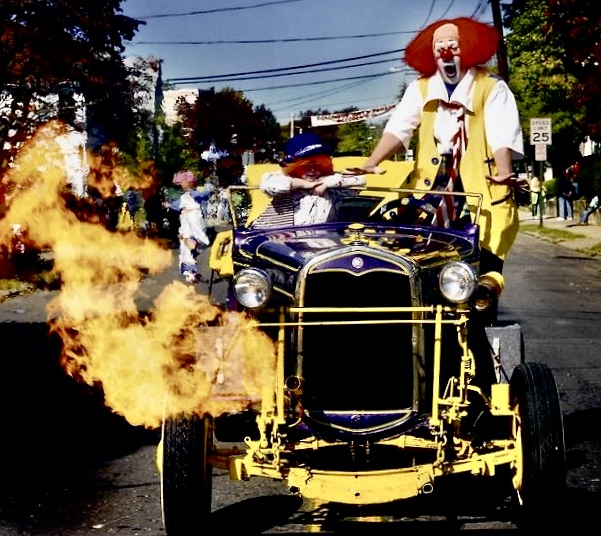
Lost and Found

By Ed Staskus

   When Agnes was growing up everybody said her mother was the best-looking woman on the hill. Her mother’s hair was soft, not stiff like all the neighboring women, and she colored it champagne blond instead of the brassy yellow and bleached white that was popular. Eva was shapely with long legs, not skinny or fleshy, or too tall, but taller than her husband. When she walked, even when she was doing housework, she walked like a ballerina with hips. 

   They lived on a bluff above the factories on Euclid Avenue, in the Euclid Villas, on the western edge of the North Chagrin parkland, just a few miles from the Lithuanian neighborhood where Eva grew up. In the summer Eva, Agnes, and Sammy went picnicking in the reservation at Squires Castle and hiked through the trees at Strawberry Lane. The park bumped up to their backyard so that they were almost a part of it. Their street was a one-way street, the only one in the neighborhood. Nobody understood why it was one-way. There were deer that rubbed on the tree bark, raccoons that snuck into their attic, and possums in the woods where they played the knocking game at night.

   Eva always had to be doing something. Whether she was dancing or not she moved like she had never heard there isn’t anything that isn’t set to music. She sang all the time, too, even though she was tone deaf. At house parties all the husbands except hers wanted to be her partner. “There’s nothing faithful in it,” Eva’s husband Nick grumbled about his wife’s dancing. He had boxed Golden Gloves when he was younger. He didn’t mind dancing, but only his way. He was the son of a Romanian Saxon and liked small steps in place, rapidly changing steps, tapping and syncopated steps. He didn’t like ebb and flow dancing.

    Eva knew all the smooth moves, like the foxtrot and waltz, her favorites, and even honky-tonk twisting. She had studied ballet and danced with a Lithuanian folk group. She was tireless and never had to catch her breath, although she wouldn’t dance with just anyone, only with some of the men. “Never give a sword to a man who can’t hoof it,” she said winking and gliding away with whoever knew how to lead.

   When they went to weddings, she was on the ballroom floor all night, waltzing and trotting, but Anna, her best friend, knew she would never got in the middle of anybody who was married, like some other women, because that’s not what she wanted. She wanted to dance the room down and have a good time. Eva knew how to forget everything, even herself, but there was life bubbling up all the time inside her.

   She did all the shopping and housework. Before she had a car, she took buses and taxis to the grocery store. She made breakfast, lunch, and dinner for the three of them, and sometimes for Nick, too, if he wasn’t gone already. He worked all day, and when he wasn’t working, he was playing golf. He didn’t work around the house or even the yard. He hired kids to mow the lawn in the summer, rake leaves in the fall, and shovel snow in the winter. They were the only neighbors he knew or liked on the street, and they liked him because he always paid them on the spot with Lincolns. Whenever anything had to be repaired, he called Sears, and the next day a van would pull up in their driveway and the Sears man would ring the doorbell. Even though he had a Craftsman toolbox in the basement, the only thing anybody ever saw him do tool-wise was replace a light’s pull chain once, although he didn’t need a Craftsman to do it. 

   After Sammy got the first of his two-wheelers and they started breaking and falling apart because of his Evel Knievel smash-ups, he lugged them across the street for repairs. The man there was a big man who worked in a factory. He had wavy hair and a turnip nose. He knew how to fix everything. “What did you kids do today? And you better have done something,” he usually said, waving and rubbing his hairy hands together, pulling open the garage door, flipping the bike upside down on a workbench, and taking care of whatever was wrong with it. Nick couldn’t pump up their bike tires when they were low because he didn’t know where the inflator was in the mystery the garage was to him.

   Nick was hardly ever home for dinner, even on weekends. But he was always in his chair for the “Ed Sullivan Show” at eight o’clock every Sunday night, right after the family finished watching the “Wonderful World of Disney.” He looked forward to the comedians like Jackie Mason, Charlie Callas, and Senor Wences, but not the singers, especially not the Supremes, or any of the other Negro groups. He would go to the bathroom whenever they were announced and only come back when he heard Ed Sullivan’s voice again.  

   The most unfunny man Agnes ever saw on television was Ed Sullivan. He stood in the middle of the screen like a cigar-store Indian, arms folded across his gray suit lapels, his no personality eyes sunk into their late-night dark bags. “And now introducing on the show…” he said after the commercials were over, shifting his weight from one leg to the other, while Nick sank back into his sofa. Stoneface made “show” sound like “shoe.”

   Eva made dinner at 5:30 sharp every day, as though Nick was going to be at the head of the table like the other fathers on the street, which he hardly ever was. From the steps of their front porch Agnes could see, if she wanted to, Mr. MacAulay, Mr. Holloway, and Mr. Newman coming home from work. Her friends slapped bare feet out of their houses as their fathers came up the walk from their garages. That almost never happened at their house.  

   Whenever they knew their father was on his way home for dinner, they walked to the far end of Hillcrest Rd., and then to Grand Blvd. and to the blue collection mailbox on the corner. They lay on the sloping lawn of the Robinson house and looked for his car coming up the hill. Eva liked to say good things come to those who wait, but Agnes wanted him to come home so bad she couldn’t sit still, running back-and-forth.

   “Waiting wears out my patience,” she said when Eva called her back to the lawn, telling her to be patient. “I don’t have a lot of it and it runs out fast the more I have to wait.”

   The nights Nick was on time for dinner, instead of spaghetti and meatballs or the Dutch Oven chicken they liked best, Eva prepared beef brisket. She busted the family food budget, taking a taxi to Fazio’s, the big grocery store. Nick munched on crudités and dip before dinner and afterwards his favorite dessert was apple pie with cheddar cheese on it. Sammy and Agnes weren’t big fans, so they nibbled on hard-boiled eggs floating in mayonnaise. Eva made sure there was Neapolitan ice cream for them after dinner.

   Celery was Nick’s all-time favorite food, which caused a commotion one summer. Eva wanted dress fabric she had seen in a McCall’s sewing pattern and started skimming from the grocery money Nick gave her on paydays. He didn’t notice anything until the week she didn’t buy celery. Nick’s brother Tom was living with them that summer, painting their house for more than two months, and sleeping on a foam mattress in the laundry room. 

   Uncle Tom and Nick both made lists of what they liked to eat and gave the lists to Eva so she would know what they wanted. Before Tom came, she always made barbecue chicken for Sammy and Agnes on Friday nights, in Kraft’s Original Sauce, but she didn’t that summer after Tom told Nick that BBQ was out. Eva knew celery was Nick’s special food, but she thought he wouldn’t miss it for a week. What she didn’t know was that celery was Tom’s favorite, too, because she always threw his list away without looking at it.

   “How could you forget the celery? What were you thinking?” was all she heard from them day after day until Uncle Tom finally moved out the Labor Day weekend before school started. “I didn’t stop to think,” she told him, smiling and shuffling, “and then I forgot.” She didn’t tell him about the dress fabric she bought, especially after she sewed the dress and he never noticed how she looked in it.

   Nick ate some of a family-size ice-cold Hershey bar every day. He kept it in the freezer and always knew how much was left. If he suspected any was missing his eyes got small and fixed and he complained to Eva about it.  Sammy and Agnes hardly ever ate any of it because they knew he would be grumpy, and besides, they knew what it was like to come home looking forward to something that wasn’t there anymore. Nick loved coffee, too, but not the drinking kind. He kept gobs of coffee ice cream in the freezer, coffee yogurt in the fridge, and coffee nibs in the kitchen cupboard, and no one was allowed to touch any of those, either.

   They had breakfast together more often than their father-less dinners. But before they were allowed to eat Nick passed out piles of vitamins. They would push the pills into order and then sit looking at them while he drank apple cider vinegar from one glass and black strap molasses from another. The first one down the gullet was vitamin A, then vitamin E, while the worst ones they saved for last. Lecithin was a horse pill. Agnes hated it. The yeast, kelp, and liver she swallowed fast, the narky flavors sliding over her tongue. Zinc and garlic were bad later in the day because she couldn’t help burping them up. The desiccated liver was not the worst. The worst was the huge tablespoon of pale-yellow cod liver oil they had to swallow. Their mother secretly slipped drops of lemon into it so they wouldn’t throw up.

   Eva had to get on Nick’s vitamin bandwagon, too, but she got a Wheateena Juicer to grease the wheels. She told Nick she couldn’t get the pills down and needed smoothies. She told Sammy and Agnes the machine digested everything ahead of time and all they had to do was drink it. She squeezed oranges, and added apples, beets, and wheatgrass. Sometimes she would halve carrots on the long side and slide them down the chute into the auger, but then Agnes drank the juice holding her nose since she hated carrots.

   One of the last times she ever ate cooked carrots was when she had a mess of them in her mouth at dinner but wouldn’t swallow them. She had had enough. She felt like she was going to gag and choke. Eva got mad when she saw Agnes’s mouth at a standstill and made her stand in the corner. She still wouldn’t swallow, until Eva finally let her spit the orange paste into her hands, and then clean up at the kitchen sink.

   The only thing worse was koseliena, which their grandmother served every time the few times they went to their house. Eva’s parents had disowned her for marrying a man not Lithuanian and ten years her senior. The no-go rules had since been relaxed. Koseliena is chopped organ meat set in cold gelatin with horse radish on the side. Agnes always said, “I don’t want to try it.” She always had to stare down a slice of it, threatening to throw up.

   “You should eat your vegetables,” Eva said. “They’re good for you, for your eyes.” Agnes’s eyes were going bad. They were going out of focus, like a screwed-up telescope. She needed glasses. “Carrots aren’t vegetables, they’re roots,” she retorted. “I don’t care about seeing in the dark, why should I care, it’s still dark, there’s nothing to see, and I just really hate carrots.” Eva gave her the belt after that. Nick never hit the children. It was always Eva who did the hitting. She never said wait until your father gets home since they would have said, “Who?”

   Eva got married because her three sisters slept in the second bedroom while she slept on a daybed in a no-bedroom, because her mother was always bossing her around, and because she was a free spirit. She got married the day she was one minute older than eighteen. She immediately loved sleeping in her own bed in her own room in her own house.

   Nick was always busy selling ball bearings and hitting golf balls so that they only ever went on two family vacations. Eva once took Agnes to Dainava, a Lithuanian summer camp, but it wasn’t meant to be. Eva’s older sister was a bigwig in the community and had the blood of their parents in her veins. She was a bigwig at the camp, too.

   Eva drove her Mercedes to the summer camp, the top down, laughing and singing, Agnes’s bags tossed into the trunk. It was in Michigan, farmland all around, outside a small town, which is Manchester. The summer camp had been there since the early 1960s when the American Lithuanian Catholic Federation bought 200-some acres for it. They wouldn’t let her stay, though, because Agnes didn’t speak Lithuanian. She felt very alone walking back to the car. Eva knew for sure her older sister’s hand was behind it. She spun gravel turning around. She was so mad she got two speeding tickets going home, one in Michigan and one in Ohio. They never went back to the camp.

   Before they went to Fredericksburg on their second vacation, they went to Niagara Falls with Bob Bliss, Nick’s golf buddy who they had never seen before, and his wife and their little girl. Eva asked Nick to put them up on the Canadian side so they could walk in Queen Victoria Park and Table Rock Point on top of the waterfall. But he wanted to play golf on the American side, so they stayed in New York at a roadside motel with a pool out front.  

   Agnes had gotten a new bathing suit for the vacation, a blue cotton gingham pinafore with elasticized puffy bottoms. Friday morning after breakfast Nick and Bob went golfing and they went to the pool. Sammy played with something he was inventing. Eva sat on the lip of the pool with her legs scissoring and watching Agnes paddle back and forth.  

   The bottom of the pool was robin egg blue and the sun felt like a fuzzy electric blanket. By the time she saw the black bug floating on the water in front of her it was too late. She skimmed over it and felt it get under her bib and bite her on the stomach. It stung like crushed red peppers. Eva helped her out of the water and laid her down on the scratchy concrete and they watched a red welt rise on her stomach. 

   “I don’t like looking at sores,” the little Bliss girl said looking down at Agnes.

   Sammy and Agnes were dying to go to Ripley’s Believe It or Not across the bridge in Canada. They begged their father to take them to the odditorium. In the travel brochure it looked like a fallen over Empire State Building with King Kong on the side of it. But he went golfing again the next day and they had to go bowling. She was only seven, but Eva found pint-sized black bowling shoes for her, and a blue marbleized ball she could push at the pins. After twenty minutes Agnes felt like her arm was going to fall off. 

   “One thing about bowling that’s better than golf is you never lose a bowling ball,” Bob Bliss guffawed.  

   They had dinner that night at Michael’s Italian Restaurant. Eva and Nick had liver and onions and they ate all the American cheese and salami from the antipasto plate, and the chicken fingers, hot dogs, and French fries, too, except for the slices of them Sammy tested for floatability in his glass of Sprite. Agnes didn’t drink soda, but Eva let Sammy have it because he liked the lime flavor.

   “Taste its tingling tartness,” he said, slurping it up his straw.

   The next morning Eva put out a bread pan of congealed scrapple she had brought with her, slicing it into squares, and frying it on the hot plate in their room.  She made it from pork scraps, everything but the oink, she said, with cornmeal, and spices. Nick called Eva’s scrapple pon haus. It was a salty meat cracker. “Shoofly pie and apple pandowdy,” he sang, standing next to Eva as she mixed in scrambled eggs and ketchup. “Makes your eyes light up, your tummy say howdy, makes the sun come out, when heavens are cloudy.”

   Perched on the top deck of the Maid of the Mist later that afternoon they set sail for the Horseshoe Falls. Sammy and Agnes hung on the rail at the front of the boat, their faces wet in the swell and noise. Agnes thought about Moe singing his Niagara Falls song in the Three Stooges movies Sammy and she watched Saturday mornings.“Slowly I turn, step by step, inch by inch,” Moe purred, leaning away from Larry, looking sideways at Curly, his eyes slits of mischief and mayhem.

   Everybody on the boat was wearing a blue rain poncho just like everybody else. Even though it was a sunny day they were being rained on. When the boat ricocheted turning in the turmoil at the base of the falls, Agnes mixed up Mrs. Bliss and Eva, grabbing the wrong hand, Eva snatching at her other hand. She was pulled up on her toes between the two women.

   Eva had learned to sink or swim when her father took her out on Lake Erie in his rowboat and threw her into the water. But Agnes’s family didn’t have a boat, so she didn’t know how to swim, only paddle like a dog. Eva never taught her, since she was scared to death of open water,  and Nick was too busy to take her to the city pool.

   After the Maid of the Mist docked, Nick picked them up, they stopped at HoJo’s for a dinner of beans and sweet brown bread, and then drove straight home, the sun sinking into the twilight ahead of them. While Sammy napped with his head lolling in her lap, Agnes inspected her leather moccasin change purse. She had gotten it from Marcia. The Shoshone Indians had sewed it. It was studded with green, red, and pink glass seed beads. Marcia, who was her best friend, always brought back souvenirs from her family vacations, the change purse from Yellowstone, a gold-trimmed Ghost Town cowboy hat from Lake George, and a “Don’t Mess with Texas” t-shirt from the Alamo. 

   Five years later coming home from Fredericksburg from their second family vacation, Agnes kept her eyes down while Sammy stared at his reflection in the back-door window. Their parents were at it again, cutting and slashing each other all the way home while Sammy and she fidgeted in the back seat.

   “I give you cash, so when I say don’t use the credit card, I mean don’t use the credit card,” Nick insisted.

   “But you don’t give me enough cash,” Eva told him.

   “That’s what I give you the credit card for,” he told her.

   “But you’re telling me not to use the credit card, to wait until you give me cash, which you don’t do,” she said.

   They argued and fought about money from Hagerstown to Youngstown  until they finally ran out of steam. Later, after nightfall and a gas station stop, Nick started up again. He laid down the law and insisted she promise to never use the credit card. He said she was ruining them by spending all the family money and their nest egg, too. “I’ll just charge it,” was one of Eva’s favorite things to say as she slid her Diner’s Club card out of her purse. Sammy and Agnes didn’t exactly know what it was all about and didn’t ask.

   “Doesn’t that sound weird to you?” Eva asked, twisting over the car seat towards her children. “He wants me to put food on the table, clothes on your back, and fill up the piggybank with money he never gives us. What do you think about that?” Nick said people were putting things into her head. Eva said she didn’t want her head to be empty as a coconut.

   Agnes stared at the change purse she had filled with pebbles from the Fredericksburg battlefields. The closer they got to home the more Eva and Nick argued. He said he brought home the bacon. She said he had bacon for brains. Every twenty-or-so miles he threatened to throw her out of the car. 

   “Get out of the car or I’ll throw you out” he yelled, mashing down on the gas pedal, even though they were already going faster than all the other cars. But he didn’t throw her out. When they got home, he slept on the sofa downstairs for a week until they made up, but they were never the same again

   Eva started taking classes downtown when Agnes was eight years old. Nick didn’t want her going to Cleveland State University. He didn’t want her going downtown, either, where the school was, even though he worked close to there and ate lunch at the Theatrical on Short Vincent every day.

   “I don’t like you going downtown,” he said, putting his foot down.

   “What about you?” Eva asked, stamping her foot.

   Eva and Agnes went downtown every week, Tuesdays and Thursdays for Agnes’s ballet lessons, and Wednesdays for white gloves and party manners classes at Higbee’s. Sometimes they stopped at the Hippodrome, where there was a movie house, and said hello to Vince. He had an office next to the poolroom in the basement. Eva explained he was the man in charge. He wore a brown suit and always gave them something to drink, ice water for Agnes, and something in a fancy glass for Eva.

   Afterwards they stayed and saw a movie with the free tickets Vince gave them. They saw “Jaws” and “The Sting” and “Live and Let Die.” Agnes loved the big screen. She liked Roger Moore. She loved  Robert Redford. She was terrified of the shark.

   Nick and Eva loved each other once, but it had drained away. One night at dinner they got into a do-or-die argument. Eva bolted from the table and went upstairs. Nick followed her. Sammy and Agnes could hear them in their bedroom, screaming at each other in foreign languages. Suddenly there was a loud crash. Eva came running down and ran to Anna’s house. Nick came downstairs after she was gone and told them everything was all right. He sat by the back window the rest of the night and stared into the ravine.

   When they went upstairs, they looked into their parent’s bedroom and saw a hole in the wall. A potato masher was lying on the floor. They found out later he had thrown it at her but missed. It lay on the floor until the next day when Eva came home. She cleaned up the dinner table, did the dishes, and put the potato masher away. 

   Anna came over the next day when Nick was at work. Eva packed a suitcase and told them she would be gone for a few days. She took them into the kitchen and showed them the food she had prepared in casserole dishes and explained how to heat it up. Agnes had a hollow leg in those days and could eat as much as she wanted and never gain weight.

   “I’ll be back Monday,” Eva said.

   But she didn’t come back Monday, or the rest of the next week. She finally came back two weeks later, on a Tuesday, just after Agnes had gotten home from school.

   “Mom, we’re almost out of food,” she said.

   They found out she wasn’t coming back when she took them to Helen Hutchley’s for ice cream. They sat in a booth in the back. Agnes had strawberry swirl on a plate, Sammy had tin roof in a cone, and Eva had two scoops of butterscotch in a cup. She told them things weren’t going good at home, which they knew, and then she said she was leaving Nick for good and moving downtown. 

   “How can you do that to him?” Agnes asked, even though she didn’t like her father as much as she did her mother, who she loved more than anything. Sammy put his cone of tin roof down on a napkin and wrapped his short arms around his mother.

   “Whatever you want to do, mom, whatever you think is best,” he said. But Agnes was mad and started to cry. “Finish your ice cream, peanut,” Eva said, so she did, before it melted.

   Sammy and Agnes lived with Nick for a year after Eva left, but afterwards moved in with her. It had been hard at home. Agnes had never done anything when the family was together. Eva had done everything, so it was an undertaking for Agnes to do anything. She tried cleaning and cooking but it was a rough go. She couldn’t keep up at school. Sometimes she sat inside her closet in the middle of the day, hiding. She was bitter that her father never helped her, either. He was always gone, no matter what happened.

   After they moved away, and moved into a new downtown apartment building, which was the Park Centre on Superior Ave., she only ever had to help her mother dry the dishes. It was Sammy and Agnes and Eva, the Three Musketeers again. Nick had never exactly been one of the Musketeers. He was never going to be one. He had lost his chance.

   Agnes got a second chance. She did better in her new school. She made new friends. She didn’t sit in closets anymore, staring at nothing in the dark. She sat on their 17th floor balcony and looked at the far horizon on the other side of Lake Erie. It was where she could see stars blink on at night. She counted her lucky stars.

Ed Staskus posts monthly on 147 Stanley Street at http://www.147stanleystreet.com, Made in Cleveland http://www.clevelandohiodaybook.com, Down East http://www.redroadpei.com, and Lithuanian Journal http://www.lithuanianjournal.com. To get the site’s monthly feature in your in-box click on “Follow.”

“Bomb City” by Ed Staskus

“A police procedural when the Rust Belt was a mean street.” Sam Winchell, Beyond Books

Available on Amazon:

 https://www.amazon.com/dp/B0F1LM1WF9/ref=sr_1_1?crid=2MYAQAOZIC2U9&dib=eyJ2IjoiMSJ9.hTm7BGbiQbSe5ZapFwYPPfcwOpTe-Vdg6VLE4aGyTyk.Z0R-VNBWWEcvKcNaO9LdCOUnNIOOXgvYkRS_FXiXuHk&dib_tag=se&keywords=bomb+city+ed+status&qid=1742136726&sprefix=bomb+city+ed+staskus%2Caps%2C84&sr=8-1

Cleveland, Ohio 1975. The John Scalish Crime Family and Danny Greene’s Irish Mob are at war. Car bombs are the weapon of choice. Two police detectives are assigned to find the bomb makers. Nothing goes according to plan.

A Crying of Lot 49 Publication

Clown Car

By Ed Staskus

   Ronald the Borgia wanted to be the mayor of some place. Wherever the place was didn’t matter. He wanted it bad. He was the richest man in Oklahoma. He knew that just like he knew he was smarter than everybody else in the state. They were rubes and easily led by the nose. They didn’t eat so much as swallow what you fed them. Even though he was already an old man, he had plenty of energy and so he ran for mayor of Oklahoma City. He told anybody who would listen, “I’m the only candidate who can save us. If I win, wonderful things will happen. If I lose, awful things will happen.” 

   He put everything he had into the campaign, crisscrossing the state, whipping up his audiences, doing jigs to Kid Rock songs, and showcasing pro wrestlers who endorsed him as better than blubber. He was sure he was going to be the next bossman of the little people. When he lost, garnering less than 20% of the vote, he was very angry.  He declared the election had been rigged and stolen from him.

   His hot as a hooker wife tried to console him. Natasha was from the Balkans but spoke passable English.

   “I am sorry for your loss, honeykins,” she said. “Maybe you find comfort in the hard work you make.”

   “Hard work doesn’t count,” Ronald the Borgia said. “Winning is the only thing that counts. Another word out of you and I’ll go looking for wife number four.”

   “I zip my lip.”

   Ronald the Borgia tossed her a handful of one hundred dollar bills.

   “Go doll yourself up,” he said.

   The man who would be mayor came from old Oklahoma stock. His great-great-great-great grandfather Frederick the Borgia had been one of the original Sooners. The original Sooners were men who knew full well that the only thing that counts is winning. Every Borgia descendant after 1889 got up every morning enthusiastically chanting the mantra of victory.

   “One, two, three, four, why are we here for? Five, six, seven, eight, what do we appreciate? Go Borgia World!”

   Before 1889 they were no-account cattle rustlers and occasional bank robbers. What transformed them was the Oklahoma Land Rush. The Federal Congress in Washington had decided to renege on an 1830 treaty with tribes living there and take back the two million acres the natives had been granted. The land was called Indian Territory until it suddenly became the Unassigned Lands. President Benjamin Harrison proclaimed all two million acres of the Unassigned Lands open for settlement. Anybody could claim 160 acres of public land if they could stake it out.

   The Borgia’s had other plans. They weren’t interested in 160 acres. They gathered together all their relations and as many footloose cowboys as they could. They planned to get a head start and stake out as much land as they could. After that they planned on getting into the real estate business with money they didn’t have. They knew they would get the money by hook or by crook.

   The Land Rush began at noon on April 22, 1889. 50,000 men, and a few hardy women, on horses and buggies were let loose by a blue-clad army officer firing his pistol into the air. The Borgia’s didn’t hear the pistol shot. They were far away. They had staked their many claims the day before. They weren’t Boomers at the starting line. They were Sooners.

   For the next ten years Sooner was a fighting word. It meant somebody who had cheated and so deprived land from the Boomers. After the dust settled, however, the University of Oklahoma football team quixotically adopted the nickname Sooner and in the 1920s the state was officially nicknamed the Sooner State. That was neither here nor there to the Borgias.

   They were able to stake out more than three thousand acres adjoining what would become Oklahoma City. The day after the Land Rush there were already 5,000 people living in tents on land that would become the place. By the early 20th century it was a full-fledged modern city of 64,000 people. The Borgias bided their time. When their time came and the city came to them, they made a fortune. They continued to make money hand over fist for the next one hundred years.

   But that was then and Ronald the Borgia was now. After losing his bid to become mayor of Oklahoma City he took a long vacation at a friend’s mansion in southern Florida and sulked. When he was done sulking he moved to Ohio. He abandoned the Sooners for the Buckeyes. He ran for mayor of Mentor, northeast of Cleveland, and lost big again. He ran for mayor of Parma, southwest of Cleveland, and lost big there, too.

   Ronald the Borgia cried foul again, crying the voting was rigged, but bit the bullet and hired a political consultant. Steve Brandman was grizzled and blunt spoken. He washed his voluminous hair every day. He never washed out his mouth. He got right to the point.

   “You’ve got to get God on your side and you’ve got to get yourself a Devil on the other side,” Steve Brandman said.

   “I don’t believe in God.” 

   “That doesn’t matter, just say you do. Lip sync a prayer or two, even if you don’t know the words. Wave a Bible in the air. Tell everybody you’re a big fan of the Ten Commandments.”

   “What are the Ten Commandments?”

   “We’ll get into that later.”

   “What about this Devil thing?”

   “That’s so there’s something really bad you can oppose with your great godliness.”

   “Like what?”

   “Migrants would be a good choice, especially the wetback kind. They’ve been whipping boys on and off for a long time. Whip up some fear and loathing. Whip up some frenzy. Whip up some hatred.”

   “I can do that with my eyes closed.”

   “There you go, be a Christian soldier, go strong and put your foot on the neck of the weak.”

   “I’ve been doing that my whole life. I’m a pro at it. Migrants won’t stand a chance when I get going. Where should I run next?”

   “Lakewood, right here next to Cleveland.”

   “Lakewood? That dumb-ass suburb is about as liberal as it gets.”

   “You’re right about that.”

   “If I’m right about that then you’re wrong about me running there next.”

   “You’re a three time loser but you think you know better than me? See you later.”

   “No, no, I’ll do whatever you say, but why Lakewood?”

   “One big reason. So far you’ve campaigned against three incumbents, all men, and lost three times. The mayor of Lakewood is an incumbent, too, but it’s a woman. Catch my drift?”

   “I’m with you,” Ronald the Borgia said. “There’s no way I’m losing to some broad. Is she ugly?”

   “What does that matter?”

   “It matters to me.”

   “Whatever,” Steve Brandman said. “Lakewood is just the start. If you can win there you’ll be able to win anywhere, and I mean anywhere.”

   “All right, all right.”

   “One last thing.”

   “What’s that?”

   “My fee is payable in advance, and on top of that, I don’t start working until the check has cleared.”

   “You know I’m good for it.”

   “I don’t know anything of the kind.”

   Steve Brandman knew his man. He got his check. After it cleared the Borgia for Mayor campaign office opened in Lakewood. The election for the mayor’s seat was in two months.

   “That’s not enough time,” Ronald the Borgia complained.

   “You let me worry about that, big guy,” Steve Brandman said. “You do the complaining and explaining. Leave the rest to me.” The big guy waved his hands in the air.

   When Steve Brandman looked at Ronald the Borgia’s hands they seemed unusually small for a man his size. He wondered what else was small on the man. It couldn’t be that, could it? He had it on reliable gossip that his man was a many happy returns customer at many Houses of the Rising Sun. He put his idle thoughts aside and got to work.

   It was a rough and tough campaign. The incumbent mayor campaigned on ethics and efficiency. She campaigned on principle and safe streets. She campaigned on all the new schools being built in town and all the upgrades to the water and sewage systems. She promised to continue the good work of her administration.

   Ronald the Borgia ignored all the issues except two, what he called the “waste of space” in the mayor’s office and the threat of migrants. 

   “She’s slow, she’s got a low IQ, and she’s lazy,” he said. “She’s dumb as a rock. She’s a horrible person. Does she drink? Does she take drugs? I wouldn’t be surprised. She has no respect for the American people and takes voters for granted. She’s on the radical side of the radical left. She’s a retard, mentally disabled, we all know that. She lies all the time. I believe she was born that way. She needs a doctor. Thousands of migrants from the most dangerous countries are destroying the character of Lakewood and leaving the community a nervous wreck. She doesn’t care that migrants are eating people’s dogs and cats, skinning them and barbequing them. I’m very angry about that. Vote for godliness, vote for me, and tell her, you’re fired, get the hell out of here.”

   He began appearing on the campaign trail as a Knight Templar, wearing a white cloak emblazoned with a red cross. He wore chainmail and a great helm with a narrow visor on his head. He carried a one-handed sword and a white Templar shield. His assistants dressed like monks in brown robes. They had to run to McDonalds in their sandals whenever their boss wanted a Big Mac. 

   “I love God, sure, but I really love my Big Mac’s,” he said before returning to a rant about migrants. “We have thousands of migrants overflowing into Lakewood from you know where. Many of those people have terrible diseases and they’re coming here. And we don’t do anything about it, we let everybody come here. It’s like a death wish for our town. They’re rough people, in many cases from prisons, from mental institutions, insane asylums. You know, insane asylums, that’s ‘Silence of the Lambs’ stuff. Hannibal Lecter, everybody knows Hannibal Lecter, right? Do you want him living next door to you? My opponent says, ‘Please don’t call them animals. They’re humans.’ I say, ‘No, they’re not humans. They’re animals.’ God doesn’t want us to live like animals. He wants us to live like gods. I’m already a god, so make sure you vote for me.”

   A week before the election the race was neck-to-neck. Ronald the Borgia seemed calm enough, but was sweating bullets. He called Steve Brandman into his office.

   “You said I was a sure thing,” he said wearing out the carpet.

   “Don’t bother putting words into my mouth,” Steve Brandman said. “I’m not the other side.”

   “I don’t care what you said, but do something, for God’s sake.”

   “It’s in the bag. The polls open on Tuesday. Wait for Monday. You’ll see.”

   Monday morning a fleet of Tesla Cybertrucks wound its way into Lakewood, They drove slowly so the body panels of the Cybertrucks wouldn’t fall off. Emil of Croesus was at the head of the fleet. The fleet stopped in front of City Hall. When Emil of Croesus got out of his stretch limo version of a Cybertruck an aide set up a golden card table and a golden folding chair for him in the middle of the street. Another aide put a cushion on the seat of the chair. Emil of Croesus sat down. A third aide massaged his neck. Traffic ground to a halt. Passersby gathered and gawked.

   “Get Your One Thousand Dollars By Voting the Right Way” a portable marquee sign declared blinking on and off. Emil the Croesus had a stack of one thousand dollar bills in front of him. It wasn’t long before the line stretched from the middle of Lakewood to all the corners of town.

   The next day the neck-to-neck-race became a rout. Ronald the Borgia won in a landslide. Lakewood’s many bars and eateries were full of people celebrating, eating and drinking their fill, at least until they tried paying with Emil the Croesus’s one thousand dollar bills, which nobody would accept. President Grover Cleveland’s face used to be the face on the denomination, at least until 1969 when the U. S. Treasury discontinued it. Emil the Croesus’s bill had the face of Bernie Madoff on it. The money was fake as fake could be.

   It was no matter to Doanld the Borgia, He had gotten what he wanted. He was the new mayor of Lakewood and everybody was going to have to do whatever he said. From now on the God’s truth was going to be coming out of his mouth. “If I don’t like somebody or something and need to get it straightened out, I’ll send in my clowns, I mean my law enforcement, and it’ll get done,” he said. He meant forget the saints above and the fiends below. 

   “Winning is the most important thing in life,” Ronald the Borgia said when Steve Brandman asked how he liked the result. “Losing is for suckers. Suckers are losers. I am the way. I am a winner. Winning first, no matter how, no matter what, everything else way back behind.” He smoothed his red tie. He made his little hands into fists. He pasted a left-handed smile on his face and smirked for all the world to see.

Ed Staskus posts monthly on 147 Stanley Street at http://www.147stanleystreet.com, Made in Cleveland http://www.clevelandohiodaybook.com, Down East http://www.redroadpei.com, and Lithuanian Journal http://www.lithuanianjournal.com. To get the site’s monthly feature in your in-box click on “Follow.”

“Telling of Monsters” by Ed Staskus

“21st century folk tales for everybody, whether you believe in monsters, or not.” Sam Winchell, Beyond Fiction

Available on Amazon:

Oliver and Emma live in northeast Ohio near Lake Erie. The day they clashed with their first monster he was six years old and she was eight years old. They fought off a troll menacing their neighborhood. From that day on they became the Monster Hunters.

A Crying of Lot 49 Publication