Category Archives: Atlantic Canada

Lobsterman

111209-lobster.jpg

By Ed Staskus

“It will bring tears to a grown man’s eyes,” said Kelly Doyle, a lobsterman who works out of the Prince Edward Island harbor of North Rustico. He was talking about lobster claws. The bite force of a large dog in pounds per square inch is about 500 PSI. A good-sized lobster’s crusher claw exerts about 1000 PSI.

“I had a claw on my hand one morning, he was squeezing my finger, and not letting go. He’s got you and you think, that’s it, he can’t go no more, but then he’ll squeeze some more. My brother Kenny had to take a screwdriver to it. Kenny is a big man, and he had a big screwdriver, but it took him a few minutes to pry it off of my finger.”

A 27-pound lobster was caught off the coast of Maine in 2012. The claws were so large they would “break a man’s arm,” said Elaine Jones of the Department of Marine Resources.

“We don’t catch those kinds of monsters,” said Kelly. “The biggest one I ever caught in my traps was maybe 7 pounds, max. But that’s a damn big lobster, a foot-and-a-half long.”

29 million pounds of lobster were harvested on Prince Edward Island in 2014, much of it during the spring season, which is May and June. It is a limited entry fishery. “1200 lobster fishers land their catches at approximately 42 ports all around the province,” said April Gallant of PEI’s Agriculture and Fisheries. Many of them are pulled up from the north shore, from Malpeque to St Peter’s Bay. The Rustico fisheries are roughly the axis of the lobster world along that shoreline.

Besides North Rustico, there are the towns of Rustico, Rusticoville, and South Rustico, all named after a fisherman by the name of Rene Racicot, a French Norman who came to PEI in 1724. Racicot became Rustico among the Acadian-French settlers.

The reason the north shore was settled was fishing. After the deportation of Acadians by the British in 1758, and the eventual return of those who had hidden or survived drowning and shipboard epidemics, fishing was what meant life or death for their families.

“I’ve been fishing for 30 years,” said Kelly Doyle, “although I took a few years off, which was a little sabbatical.” After leaving PEI for Montreal in his early 20s, he returned in 1983. “I built a cottage, but I couldn’t get a job anywhere. The next spring I got offered a fishing job in North Rustico.”

Although fishing in North Rustico dates back more than two hundred and fifty years, groundfish stocks contracted in the 20th century. Shellfish and crustaceans, especially lobsters, emerged as the species of choice. Lobster landings almost tripled between 1960 and 1990.

In the early 1990s a moratorium was enacted limiting the taking of many kinds of groundfish. “We were shut down completely,” said Kelly. “No more white fish. All we were allowed was lobster, although we could still catch our own bait, like mackerel and herring, at that time.”

Nowadays lobstermen buy their bait. “I come in, pull up to the wharf, and Doiron takes every lobster I’ve got,” said Kelly. “I buy my bait from them, too.”

North Rustico’s Doiron Fisheries got its start when Aiden Doiron bought his first fishing boat in 1957. One day, when a man asked him for a cooked lobster, he said, “I’ll be right back.” He grabbed a lobster, a pot, and cooked the lobster on the spot. The Doirons still sell fresh fish out of a shanty on the wharf.

“We cook lobster on the boat sometimes,” said Kelly Doyle.

Thirty years ago he often bagged his own bait for lobstering, late at night. “There was a freshwater run about 2 or 3 kilometers down Cavendish Beach, where the gaspereau would come up from the ocean, smell the fresh water, and spawn there. When they came back down we caught them in nets.”

Alewife is a herring called gaspereau in Atlantic Canada. Catching them meant waiting for them to swim back to the ocean with the tide at midnight. “We would net them by hand, standing in waist-high water. When we got them on shore they’d be flapping around and sand flying everywhere. We’d fill up 40 or 50 boxes and carry them by hand back to our pick-up trucks.“

Neither motor vehicles nor horses are allowed in the National Park, which is what Cavendish Beach is. “We’d ice them up for the morning, get home by 2, and then back up at 4 o’clock, 6 days a week in the season.”

There are 37 boats in the harbor at North Rustico. All of them are made of fiberglas, all are equipped with diesel engines, and all carry a trove of electronic gear. Hulls cost upwards of a quarter million dollars. The annual cost to operate Kelly Doyle’s boat, which he co-owns with Paul Doiron, a man he’s known since grade school, is nearly $50,000. “The word boat is actually an acronym,” he said. “It means break out another thousand.”

Seventy years ago lobster boats were all wood, ran on 6-cylinder gas engines, and most of them didn’t come with a cabin that anyone could stand up inside of. It wasn’t until the 1960s that windshields were added for protection against the elements.

“In those days in the winter motors were removed and taken home,” said Norman Peters of the Fisheries Museum. “Boats were hauled to a field and turned upside down to keep rain and snow out. I remember playing under the upside boats and finding bits of fishing line to use to fly kites.”

“Our boat is the Flying Spray,” said Kelly. “It’s hull number177, built in Kensington, so it’s called a Provincial. It’s a great lobster boat, very dependable, although a little on the rocky side. It’s good going into it, but it doesn’t like being turned. It throws you around a bit.

“Most of my career was in wood. The best thing about fiberglas is it doesn’t leak. Except, not like wood, they don’t float at all. If you put a hole in them they sink pretty well instantly.”

Lobstermen start their day early. “He gets up at 4:20 in the morning,” said Kelly Doyle’s girlfriend, Ryoko. “I make his breakfast and lunch and he’s gone before 5. I go back to bed and sleep a little more.”

Paul Doiron captains the Flying Spray and Kelly Doyle is the sternman. Both are in long johns through May and sometimes into June. “On top of those I wear insulated overalls and when I get to the boat I oil up,” said Kelly. “We put on oilskins, a full bib, and a jacket. It’s so you can stand in the rain for hours.”

After they’ve cleared the North Rustico harbor the first thing Paul Doiron does is turn on his GPS to locate their traps.

“The first guy I fished with only had a compass,” said Kelly Doyle. “But, it never really worked right for him. They fished by strings back then, by their compasses and landmarks. You would probably find your buoys, but on a dirty morning, no. They’re only so big floating in a big ocean out there.”

Fishermen on the island are restricted to 300 traps by the Department of Fisheries and Oceans. In the early 19th century lobsters were so abundant they washed up after storms. Islanders used wooden tongs to pick them up, although many were ashamed to be seen eating lobster because it was regarded as a poor man’s dinner. There used to be no rules about harvesting lobster. But, by the 1890s there were problems with declining stock.

“Many fishermen had from 1200 to 1500 traps,” said Norman Peters. In the latter half of the 20th century the fishing season has been shortened, fishermen must be licensed, and taking spawning lobsters isn’t allowed. “It’s the responsibility of those who are fishing today to conserve our fishery,” said Mr. Peters.

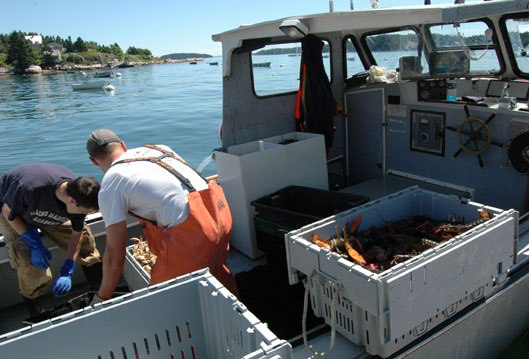
Once out on the Gulf of St. Lawrence the Flying Spray looks for its traps. “We’ve got 37 bunches of 8 traps and one trap of 4,” said Kelly Doyle. Traps are connected by a line, eight of them along a stringer, and attached to buoys with a unique color for easy identification. “There’s 8 traps between buoys and that’s called a set, or a full trawl. They’re all numbered in our GPS and we pick them up every morning.”

The Prince Edward Island gulf coastline is largely ledge and sand. When the frozen shallow waters thaw in April lobsters move in from the deeper ocean. They return to warm shoal water for egg-bearing females to hatch and release in springtime and early summer.

“Hard rock is what you want for lobsters, rock that looks like mountains,” said Kelly. “Sometimes they’ll cross sand. Most of the time sand is full of crabs and crabs hate lobsters. When lobsters cross sand they scare the crabs out and you can have a tremendous catch the next day. You’ve got to think like a lobster, about the depth of the water, how warm it is, and when you think they’re going to be there.”

When the fishing is good he, and often a hired hand, haul one lobster after another out of the traps they’ve pulled, slip rubber bands over the claws of the keepers, loading them into onboard tanks, and re-bait the traps. As the traps are lowered back into the ocean the most important rule for sternmen is to not step on rope, get snagged in the rope, and get dragged overboard.

“Lots of guys will get caught for a minute,” said Kelly, “but the last guy who drowned out of this harbor was Jackie Dussett in the 1960s. He got his leg caught and was just gone, overnight. The tide worked him loose the next day.”

Lobster fishing on Prince Edward Island is not usually unusually dangerous, but it is hard work, in more ways than one. Everything on a boat is hard. “Everything’s hard as steel,” said Kelly. “Or, it is steel. No matter, whatever you hit hurts.”

Boats bob and toss at sea since the ocean is never steady like dry land. “I’ve been hurt every year I’ve fished, banged up like an old man.” Working on a lobster boat means working on an exposed, slippery, and moving platform in weather that is bad as often as it is good. Tourists drown in small swimming pools. Fishermen are faced with miles of open water.

Next to logging, commercial fishing is statistically the second deadliest kind of work to be in, deadlier even than police work or firefighting. “Fishing at sea is probably the most dangerous occupation in the world,” according to the Food and Agriculture Organization of the United Nations.

“I come out of the cabin one morning last year, coming up the three steps, when something came off the sea and literally threw me out of the cab. The momentum of the boat picked my body up like it was weightless. I banged on the bulkhead and just like that you’re on the ground, hurting, black and bruised.”

Unlike many fishermen on Prince Edward Island, Kelly Doyle doesn’t come from a fishing family. The first Doyle came to the north shore from Ireland in 1847. He was granted land along was is now Doyle’s Cove. They raised thoroughbred horses and later bred black silver foxes for their pelts. When fox furs went out of fashion his grandfather and father mix farmed, growing turnips, barley, and wheat.

“I have three brothers and they all became fishermen,” said Kelly. “We weren’t fishermen, but I think it was in our blood. We were all at ease on the water. None of us got sick. But, I’m the only one who still fishes. It can be hard on you.”

In season the Flying Spray sails for lobster every day it can. Some days, like after a storm when the 7 kilometers of line they carry are tangled and need to be untangled, they are out for up to 15 hours. “Gear starts to move. Before you know it it’s all snarled, mine and everybody else’s. You’ve got to pull it up, bind your gear, and that’s rough.”

Lobster cages weigh about 20 pounds without the 44 pounds of concrete ballast in them. When they are wet they are more than 100 pounds. “Thank you to the man who invented hydraulics!” said Kelly. “Years ago it was all hauled by hand. The forearms of those guys in Rustico back then were like Popeye.”

Although not born to it, although his business interests have expanded to include Coastline Cottages and PEI Select Tours, and although it is exacting, physical work, Kelly Doyle plans to continue lobstering.

“I had been out of fishing for a few years, but bought back into it. My first year back I thought I was going to die. It was a tough spring, shitty weather, and I was going to bed at 7 o’clock, just beat up. It’s all about wind, which creates seas, which creates bouncing around like a cork.”

Seas can be dangerous and storms terrible. But, the lives of commercial fishermen are subsumed by their boats, the waters they sail, and the work they do. “Later part of March, you’ll hear a seagull on the coast, it just seems to draw you back,” said Francis Morrissey, a fifth-generation lobsterman in Tignish, on the northwest tip of the island.

“This is the best place in the world to be fishing,” said Mike McGeoghegan, past president of the PEI Fisherman’s Association.

Oceans are more ancient than anything, including mountains. Men have fished for more than 40,000 years, from about the same time modern humans moved into Europe. 1,100 kilometers of red sandstone shoreline rim Prince Edward Island, some of it sand beaches, some of it cliffs, all surrounded by the wide sea.

“I’m going to fish this year, at least I will as long as I’m on this side of the sod,” said Kelly Doyle. “To tell you the truth, if and when I die, I hope it’s out there.”

Ed Staskus posts stories on 147 Stanley Street http://www.147stanleystreet.com and Cleveland Ohio Daybook http://www.clevelandohiodaybook.com. To get the site’s monthly feature in your in-box click on “Follow.”
A Fateful Trip

dlyqag1w0aat8ib.jpg

By Ed Staskus

“Just sit right back and you’ll hear a tale, a tale of a fateful trip.” Gilligan’s Island

“I’ve sailed my whole life,” said Michelle Boyce.

A native of London, Ontario, where she grew up, where her father worked for the Board of Education, Michelle raised her own children in Aylmer, a half hour down from London and less than a half hour from the north shore of Lake Erie. There is plenty of sailing from Port Dover to Long Point to the Port Stanley Sailing Squadron. It is Ontario’s south shore.

It isn’t Margaritaville, but it’s laid back. In Port Stanley, on the shoreline, making yourself at home with lemonade or a cold beer on GT’s Beach patio, making time is watching the town’s drawbridge go up and down. Lift bridges can get stuck up, but that’s the only thing stuck up in town.

“At one time we owned five sailboats,” she said.

“The kids and I used to sail across the lake to Cedar Point every summer. My daughter and I are roller coaster fanatics. We would spend a week in the harbor at Cedar Point and then sail back home.”

During the day cannons can be heard when pirates attack riverboats at the amusement park.

Although she still calls her neck of the woods home, where she spends half the year, the other half of the year she now spends on Prince Edward Island. The country’s smallest province, PEI is almost a thousand miles east of Canada’s seed corn hinterland.

“Sailing to PEI, it got really bad before it got really good.”

It started when Michelle, her kids, and her partner, Monika Chesnut, went to Prince Edward Island in 2008.  They went for a wedding. They liked what they saw.

“We fell in love with the island. We felt at home there, so on the way home we tossed around ideas about how we could spend more time on PEI. We’re an entrepreneurial family. We dreamt up the sailing business.”

The sailing business is Atlantic Sailing PEI, weighing anchor out of North Rustico on the north-central coast of the island. The three-hour cruises start at the dock, boarding the only sailboat in the harbor, turning out to sea, looking for dolphins and whales. The sunset sails are on the romantic side.

It’s OK to bring a bottle of champagne and get cloud nine.

Two years after first setting foot on PEI, Michelle and her daughter Jessica took the first step toward turning their dream into reality. “We knew nothing about the marine industry on PEI, but we went ahead,” said Michelle. The person with a vision is often more single-minded and able-bodied than somebody with all the facts.

The facts can be helpful, though, sooner or later.

“We went on a sailing trip, from Lake Erie, across Lake Ontario, and up to Montreal. We spent a couple of weeks there and went up the river to Ottawa. Near there we stopped at a marina and found a 38-foot boat we fell in love with.”

The name of the boat was Folie. It was going to be the boat Atlantic Sailing PEI would sail the starry-eyed to idyllic sunsets on the Gulf of St. Lawrence. It wasn’t meant to be, however, maybe because folie is a French word meaning, more-or-less, delusional.

“It can also mean crazy mad person,” said Michelle. “The gentleman we bought it from was 90-years-old. He had sailed it to the Caribbean and back. He had pictures. I don’t know how he did it without dying.”

Folie is a 1960s-era strong as an ox medium-sized cruising yacht capable of offshore passage. It is a serious no-nonsense boat. The first fiberglass sailboat, the Chinook 34, was built in 1956. “Who built the Folie had no idea how thick they had to make the fiberglass,” said Michelle. “They decided they had to make it as thick as wood. The thing was built like a tank.” Since indestructible is what they ended up needing, indestructible ended up standing them in good stead.

Michelle Boyce knows her ragtops, from stem to stern. She knows what makes them go, and she knows the free enterprise end of them, too. “When Detroit was going down, I used to buy sailboats there, sell them, and sail them all over the Great Lakes to the people who bought them.”

The first thing she did to the Folie was replace its engine. “Everything on that boat was end of life.” The engine was a Universal Atomic 4, last manufactured in the early 1980s. The Atomic 4 used to be the Utility Four, used extensively during WW2 to power lifeboats.

“I found a brand new one in a barn in northern Ontario, still in its shipping crate from the factory,” said Michelle.

After the new motor was installed, she and her daughter set off for Prince Edward Island. They planned on the trip taking two weeks, sailing to and around the Gaspe Peninsula, down the New Brunswick coast, and landing on PEI at Northport. They began accepting on-line reservations for summer cruises.

They got to Northport seven weeks later.

Halfway down the channel out of their first harbor their new Atomic 4 started to overheat. “She was red-lining on the temperature gauge. There was nothing we could do. I couldn’t stop in the middle of the channel.” They raced the boat out to the St. Lawrence Seaway, shut off the engine, and threw out the anchor.

“We spent the next five days in the middle of the seaway fixing the boat.”

The engine was undamaged, but the hoses carrying the coolant to the engine had melted. “The gentleman I bought the boat from had used crappy transparent hosing that you use for fish tanks. Fortunately, I’m anal about repairs, and I had another boat on the boat.”

One rule of thumb on the high seas is, whatever it is, if you can’t repair it, it probably shouldn’t be on board in the first place. The other rule is always have spare parts.

No sooner, however, did they make it through the Iroquois Canal lock, when the boat floundered again. This time the impeller melted. “The old gentleman was also anal, and he had left spare parts scattered all around the boat, so every time we broke down, it was a scavenger hunt. We knew he had one on board, but where?”

They found it, because they had to. In the event, ‘Regulations Governing Minimum Equipment & Accomodations Standards’ state that the owner, or owner’s representative, the captain, “must ensure that all equipment is properly maintained and stowed and that the crew know where it is kept and how it is to be used.”

After replacing the water pump, they sailed down the seaway, staying on the cruising side of the buoys, cruising the wide river. They kept the engine quiet, not dousing their sails, keeping them set to the way they were going.

It was a windy day, the waves like rippled potato chips, leaving the last lock outside of Montreal, when their steering went. “The boat would only turn right. It wouldn’t turn left. We were heading for a sandbar. One of the locals in his boat beside me was screaming, ‘Turn, turn, turn, you’re going to hit ground.’ We hit ground and came to a stop.”

“Only two sailors, in my experience, never ran aground,” observes Dan Bamford, a veteran sailor. “One never left port and the other one was an atrocious liar.”

“A cable fastener broke,” said Michelle, “which was a minor happening of all the happenings. We plugged a hand tiller on, but we were still stuck on the sandbar.”

She took a low-tech approach to the problem. Michelle had lowered the sails, but now got them back up, and when the wind blew into them it threw the boat over. “The wind in the sails took the boat off the shallow water,” she said.

“The goal is not to sail the boat, but rather to help the boat sail herself,” John Rousmaniere, one time editor at Yachting magazine, has pointed out.

They pulled into a marina, filled their tank, and got started, except they couldn’t get going. “They filled our tank with dirty gas. I got it running off a jerry can, running a hose directly from the carburetor to the can, bypassing the tank on the boat. But then, we weren’t twenty minutes out of the harbor when we picked up a rope on our prop.”

She was done with problems for the day. “The wind was going in the right direction, so I just threw up the sails and we sailed from Montreal to Quebec City.”

They ended up floating in one spot off Quebec City for five days. “The wind died and we had no propulsion,” she said. “Our cooler went warm and we were eating dry reserves. We didn’t have any idea the tides were going to be 24 feet. There was either a 10-knot current going this way or a 10-knot current going that way. The current was so crazy there was no rowing our dinghy to shore. We couldn’t dive under the boat to get the rope off our prop, either, too much current.”

When the wind finally picked up slightly they slowly hove into a marina on sail power.

“My daughter chickened out, and so even though my holding my breath under water days are long past, I dove in and got the rope off the prop.”

At the next marina they followed a friendly local in. He had a sailboat similar to theirs. He waved to them. “We’re fine following you,” she shouted across to him. “You’ll be safe,” he shouted back.

He got stuck.

Then they got stuck.

“Fortunately we were stuck in mud and stayed afloat,” said Michelle. “He ended up on dry land. “

The next day, having gotten unstuck, back on the St. Lawrence, they fought a following sea all day. “The waves behind you throw your boat this way and that. It’s hard to steer. At the end of the day I was exhausted.”

It might be why she misread her charts.

“I thought I was in 25 feet of water at low tide. Actually, I was in 25 feet of water at high tide. The water all disappeared in the middle of the night. My daughter and I were sound asleep when, all of a sudden, BANG! We were sideways.”

Waking up with a start, she saw their cats, Cali and Pablo, jump from the bed to the wall, which was now the floor. “They were totally confused.”

Keeping her wits about her, she remembered a story the man they bought the boat from had told them, about the same thing happening to him in the Caribbean. “He just went to sleep when it happened, the water came back, and it was fine. So, that’s what we did. We made a bed on the wall and went to sleep.”

In the morning the tide came in and the Folie floated up and away. “It is a tough, tough boat,” said Michelle. ”It was fine. We had pretty much worked out the bugs by then.”

At least, she thought so. “A tale of a fateful trip, aboard this tiny ship, the mate was a mighty sailin’ lad, the skipper brave and sure.” Assumptions, on the other hand, are like termites.

They picked up Monika, her partner, at Riviere-du-Loup, a city near where boats turn towards Atlantic Canada. One of the best places for whale watching in the world is at the Saguenay-St. Lawrence Marine Park offshore from Riviere-du-Loup. Beyond the small town are scattered even smaller towns hugging the coastline, and lots of forest.

“Every so often you’ll see a town and a church steeple. There were almost no other boats around, just the three of us on the Folie, when a superfast black Zodiac came on our horizon. He circled me until he got behind me, and started coming up my wash.”

There were no markings on the Zodiac. There were four men, clad in black, on the boat. Michelle got on her radio.

“Vessel approaching, please identify yourself.”

There was no response.

She tried again. There was no response. She tried the Coast Guard. “I have a vessel of unknown origin approaching me, unknown intent, mayday, mayday.” There was no response. She grabbed her flare gun.

“He was coming up my tail. Pirates are a real thing,” she said. “Since we’re a floater, our decks were lined with water and gasoline cans. I had a pirate plan, which was open a gas can, throw it at them, and shoot the flare gun, lighting them on fire.”

It was when they came within range, the flare gun cocked, that the blue lights on the boat blinked on. It was the police.

“Slow down,” one of the policemen shouted.

“Whatever,” Michelle muttered.

“Where are you going?”

“Prince Edward Island.”

“Where are you putting into next?”

“There,” she said.

“Where’s the man on board?”

“Pardon me?” The man on board was news to her.

“You guys are by yourselves?”

Michelle. Monika, and Jessica looked from one end of the boat to the other. “The cops finally left us alone.” The Zodiac sped away and the Folie got back on track. Time was their enemy.

“The whole time we had all these bookings in North Rustico. We were booked solid. Every single day I wasn’t on the island I was hitting the refund button.”

They hadn’t got much farther when their alternator blew, stuff started to seize, belts got red hot, and smoke filled the boat, which ended up sideways to the waves. “We instantly got into our deal with it mode.” Jessica ran the jib up, Michelle stabilized the boat, the smoke cleared, and they found a spare alternator, although they were starting to run out of the other boat on the boat.

By the time the Folie flooded a few days later she was already starting to wonder what the difference is between an ordeal and an adventure.

They had dropped Monika off near Dalhousie, New Brunswick, so she could pick up her car and rendezvous later on PEI, when they noticed with a jolt that the boat was half full of water.

“It still wasn’t over!” said Michelle. “One of the grease fittings, a cap at the prop shaft, had popped, and water was shooting into the boat. The bilge pump was pumping like crazy, but it couldn’t keep up.”

It was sink or swim.

She grabbed a length of rubber hose, some clamps, and a broom handle. She stuffed the handle into the rubber and stuffed the works into the hole. “I clamped it tight so water would stop coming into the boat.” They pumped the seawater out, but by then it had gotten into the engine oil. “It turned it into chocolate mllk. It was like a chocolate milkshake.” They sailed to open water, threw the anchor out, and the next day replaced the oil.

They could see the oxidized red of Prince Edward Island in the far distance.

Taking it easy in a bay one morning, having coffee, they watched baby belugas approach the boat. They are sometimes called sea canaries because of their high-pitched twitter. Big whales were blowing in deeper water. A herd of seals slipped in close to the sailboat.

“The cats were running around the boat,” said Michelle. “The seals were lined up beside the boat, their noses stuck up, and the cats were on top of the boat with their noses stuck down, trying to figure each other out. It was like first contact.”

When they once and for all pulled into Northport on the west end of Prince Edward Island, they were beyond a shadow of a doubt on the island.

“I’m not a quitter,” said Michelle.

That is when they found out the harbors they were going to sail in and out of were too shallow for the Folie’s keel. They also found out there wasn’t a crane-lift big enough to lift their sailboat out of the water. It couldn’t stay where it was. Boats on PEI get winterized in the fall and summerized in the spring. Setting and forgetting your pride and joy from January to April in the water is leaving your boat on the frozen hot seat.

The first thing Michelle did was to channel the Professor, one of those marooned on Gilligan’s Island. A science teacher, he could build anything, hammocks and houses, so the castaways could live comfortably. He rigged up washing machines, supplied water, and generated electric power, using nothing but indigenous coconuts and bamboo, although he was never able to repair the Minnow.

“The hole on that boat defies all of my advanced knowledge,” said the Professor.

Michelle built her own 10-ton hydraulic trailer with which to back up, get under the Folie, pick it up, and carry it away.

“There must have been thirty guys standing around there watching being brutal.”

“Do you know what you’re doing?”

“That’s not going to work.”

“You’re going to kill yourself.”

“Are you sure that’s going to work?” asked Monika, who had joined them.

When she had the boat on the trailer and the trailer hooked up to her pick-up, and was driving the boat away, to be stored away safe and sound and out of sight in Summerside for the unforeseeable future, none of the bystanders were there anymore.

“They scattered like flies,” she said. “Not one of them was there for I told you so.”

The second thing she did was drive home to Ontario, pick up her 29-foot sailboat, the Calypso, and haul it back to land’s end, across the Confederation Bridge, and to North Rustico.  To this day the Calypso is Atlantic Sail PEI’s bread and butter, three cruises a day, private charters, and special events.

“Awesome experience,” said Donna Burgoyne.

“Monika and Michelle were fabulous hosts, very knowledgeable,” said Andre Pelletier.

“Elle nous fait decouvrir la faune marine et les magnifiques paysages de PEI,” said Sabrina Bottega. “Avec Michelle, c’est super capitaine.”

“The Folie drained us, in more ways than one,” said Michelle. “It almost bankrupted us. We had to refund tens of thousands of dollars, although we ended up doing some tours at the end of the season.”

Before landing at Northport, they spent the day anchored off West Point. “It’s where all the windmills are,” said Michelle. It’s where ship yards built sailboats long ago. It’s where sightings of a sea serpent still happen. It is where buried treasure is reportedly buried, still a secret.

Michelle made herself at home on her back in the sun on the deck while Jessica lolled at the stern.

“There is nothing like lying flat on your back on the deck, alone except for the helmsman aft at the wheel, silence except for the lapping of the sea against the side of the ship,” Errol Flynn once said.

The three-bladed wind turbines on West Point go around and around. There are 55 of them, rock steady as long as the epoxy sails stay full, at the West Cape Wind Farm. Tilting at windmills is quixotic, like running in circles. But if you can stay the course, and square the circle, making your energy making it a go, you might end up where you wanted to be all along.

When Michelle Boyce stepped off the plank she landed on the sure-footed red sandstone of Prince Edward Island.

Ed Staskus posts stories on 147 Stanley Street http://www.147stanleystreet.com and Cleveland Ohio Daybook http://www.clevelandohiodaybook.com. To get the site’s monthly feature in your in-box click on “Follow.”