Category Archives: Atlantic Canada

My Aim is True

By Ed Staskus

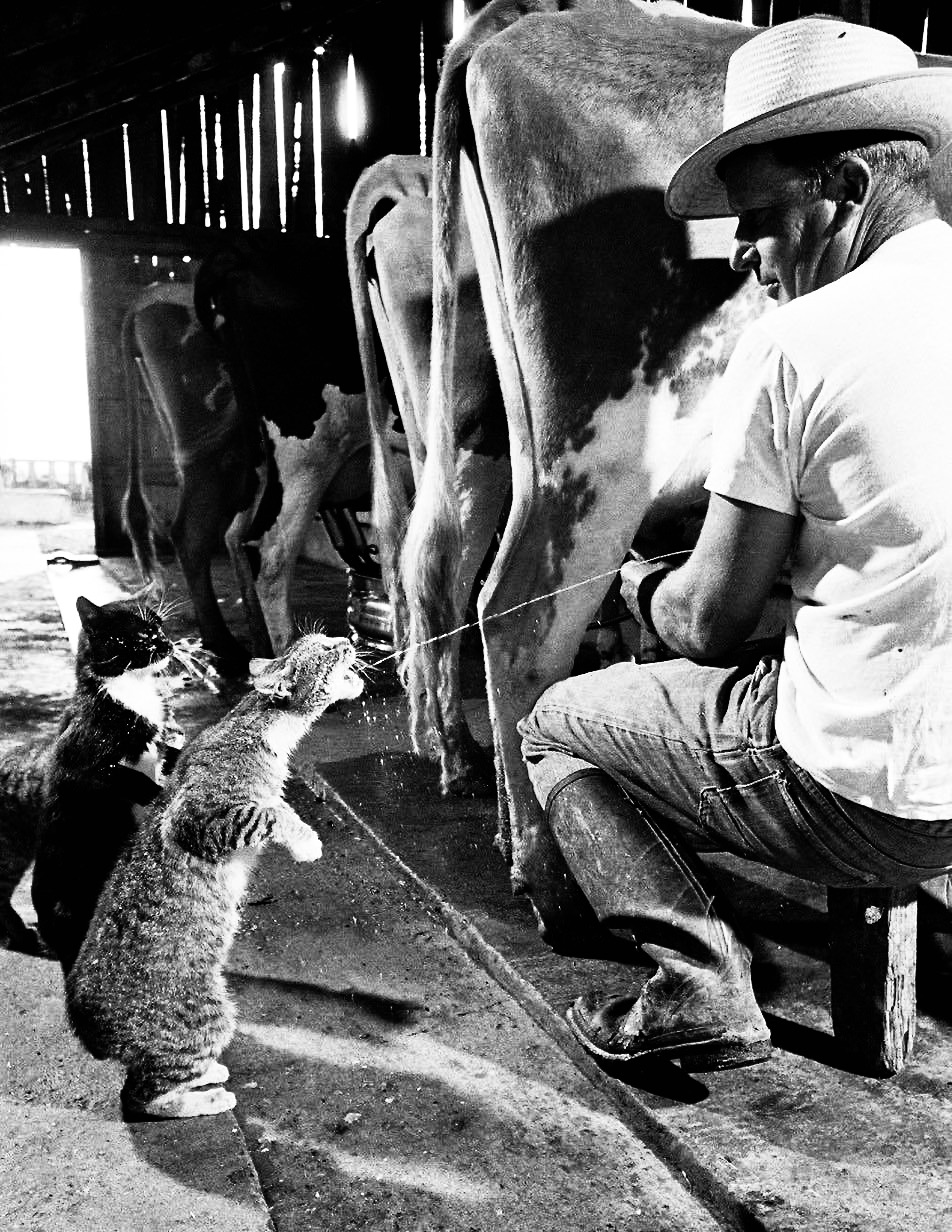
   “I think all the farmers on the island did it,” Linda Hewitt said. What all the farmers on Prince Edward Island used to do was squirt a stream of milk in the direction of whatever barn cat was hightailing it into the barn during milking time. “We used to enjoy watching them line up for their treat.”

   Even though milk is not ideal for grown-up cats, because it can cause gassiness once they are of age, squirt milk in the direction of a clowder of cats and they will come running. They drank milk non-stop when they were kittens. When they grow up they remember the familiar smell and taste of it. Their sense of smell is closely linked to memory, more so than the other senses, the same as in people. Straight from the source is their No. 1 comfort food. 

   “Granny Matheson my cousin’s grandmother squirted milk to the cats,” PEI native Anne Fuller said. “They loved it.” Seen from the sky Prince Edward Island lives up to its moniker “Million Acre Farm.” It is known by several different names, including Spud Island, but is most commonly called PEI. The natives including grandmothers on down the line call themselves islanders with a capital “I”.

   Almost all cows nowadays are milked by automatic suction machines. The devices increase the yield of milk and reduce the labor involved. Milking by machine draws about 5 liters of milk. Milking one cow takes between 5 and 7 minutes. Milking by hand draws about 3-and-a-half liters and one cow takes 15 to 20 minutes. The machines go back to the late 1800s. It took decades for them to gain the upper hand. Many cows in North America were still being milked by hand well into the 1940s. Some cows on Prince Edward Island were still being milked by hand even later than that.

   “I did that every time we milked the cows,” PEI native Cecil Wigmore said about the squirting.

   Milking cows on Prince Edward Island in the 21st century is a highly mechanized operation. The total number of cattle on the island is more than 60,000 head. 13,900 of those are dairy cows and 6,300 are dairy heifers. 170-some farms ship their milk to cooperatives and the volume amounts to 120-some million liters. The milk is known for its good taste and high quality.

   Cows Ice Cream makes some of the world’s best ice cream. They have been making it on the island since 1983 with island milk. They won the award for Canada’s Best Ice Cream in 2015. Their frozen confections were recently named the World’s Best Ice Cream by Tauck World Discovery. 

   “Yes, I sure do remember doing that for cats on visits to my grandfather’s farm,” PEI native Norma MacLean said. “I have many special memories.”

   One of dairy farmer Bloyce Thompson’s cows won the award for Top Holstein in the World in 2011. He is a third-generation farmer in Frenchfort, in the middle of the island, with a sizable herd of purebred cows. He serves as Deputy Premier of Prince Edward Island and has long opposed NAFTA-mandated dairy imports. Why mess with a good thing when you’ve already got the best?

   The dairy business on Prince Edward island is made up of dairy producers, who operate farms and produce raw milk, and dairy processors, who process raw milk into butter, cheese. yogurt, ice cream, and condensed milk. ADL is the major processor, by far. Island cheese is known and celebrated worldwide. Avonlea Clothbound Cheddar, made by Cows Creamery on the island, won the Super Gold of the World Cheese Awards at the 28th annual BBC Good Food Show in 2015. 

   Milking by hand isn’t rocket science. It is easy enough to do. “I used to do that,” PEI native Tom McSwigan said. While milking a cow he would wait for his cat to rise up on its hind legs and then give it a squirt right from the cow’s udder. “If I missed and hit the cow’s leg she kicked viciously. Not only that, if I got caught doing it I got the heavy hand of justice from my grandaunt, for because me doing it free of charge.”

   Neolithic farmers in northern Europe were among the first to milk cattle for human consumption. They put hand to teat about 6,000 years ago. It was around that time that the ability of human beings to digest milk was slowly but surely accomplished. It was accomplished by the spread of a genetic mutation called lactase persistence. It was what allowed post-weaned human beings to continue to drink and digest milk.

   Heath McLennan milked cows from the 1930s until his death in 2021.The family farm is in Port Hill on the west end of the island. Heath lived across the street. “He couldn’t wait to get over and that was the highlight of the day,” his son Hilton said. “It was in his blood.” The farm has thirty Holsteins who are milked by machine. “We used to milk them out in the field,” Heath said. “It wasn’t a very excellent job when it was raining. The water was running off the cows.”

   When asked if he ever milked cows by hand anymore, Heath said he wasn’t sure if it would be a good idea to try milking their cows that way anymore. “I wouldn’t want to touch them when they’re not used to it now. They might kick the head off you.”

   Hand milking is done one way or the other, by stripping or by full hand. When stripping the teat is held between thumb and forefinger and the hand glides in one smooth motion down the teat while applying pressure to draw the milk out. When employing the full hand method, the teat is held with all the fingers and the teat is pressed against the palm. The full hand method is thought to be the better of the two methods because it applies a more consistent pressure on the teat and simulates the sucking action of a calf.

   “I can still see my father doing it by hand,” PEI native Adele Shea said. “The cats loved it.”

   Before the machine age children played a big part doing what had to be done on the family farm. They gathered eggs, cleaned, fed, and watered the stock, made butter, made lard and soap, weeded the garden, and went berry picking. They helped with planting and harvesting. One thing they did all year round was milk the cows. When they did, sitting on a stool or balancing on their haunches, they made an immediate connection to one of their most important food sources. Kids being kids, they shared the food source with whatever was wandering in for a taste of white..

   “Me when I was younger did it to the cats,” PEI native Ken Macleod said. “I also did it to the dogs.” 

   Even though cows are by nature easygoing creatures, they can sometimes be buttholes. They can be irascible and stubborn. They can even be dangerous. A cow kick can be deadly. It takes the form of a sharp blow. Most cow kicks are brush-offs, but some lead to a trip to the Emergency Room, and a few are fatal. Always move slowly around cows. Always announce yourself when approaching a cow. Never approach a cow from behind. Always be patient. Never flap your arms. Stay a kick away is the way to be. Stay safe getting your glass of milk.

   “Daddy would squirt the barn cats when we were kids,” PEI native Joanne Creamer said. Cats are much faster than cows and even faster when a cow kicks at them. They are rarely overmuch bothered so long as they get their milk. “Me, when I was squirting milk, sometimes I hit the wrong end of the cat,” PEI native Dwight Llewellyn said.

   “I exactly do remember doing that,” PEI native Brian Trainor said. “The cats would sit there waiting while we milked.”

   Fathers milking cows by hand and directing squirts at cats was an island-wide practice back in the day. “Oh, yes, my dad did it all the time!” PEI native Helen Verhulp said. “My dad always done that and sometimes to us, too,” PEI native Caroline MacLean said. “My father did it,” PEI native Joan Coulthard said. “He did it to us kids as well. It was warm sweet milk.”

   Not all parents were as generous. “I always did it until my father caught me,” PEI native Erroll Jon Campbell said. Waste not want not was his father’s motto. The Scottish are notoriously thrifty. They preach the smart thing to do is be more frugal than not, cats or no cats.

   Milking machines are made of a vacuum pump, a vacuum controller, a pulsation system, a milk transport system, and a milker cluster. The machines apply constant vacuum pressure to the tips of a cow’s udder, mimicking the way milk is naturally drawn. The vacuum tubes are attached to a container where milk is collected. The machines also squeeze the udder periodically so that blood circulation is maintained.

   Milking by hand instead of techno milking is more time-consuming but it is simpler. What’s needed is a milking pail, a wash bowl ,white towel rags, a filter, a funnel, and storage jars. Mason jars are preferred. Glass jars are preferred. Plastic jars are discouraged. They are harder to disinfect. White wash rags are used to clean the udder. Wash bowls are used for cleaning the wash rags. Funnels are used to direct milk from the pail into the storage jar.

   Not all milk ends up where it should. “I remember being sprayed by Shawn and Brian Shea when Granny Trish still had cows,” PEI native Krista Dillon said. “Oh, my God, that was so long ago. I loved that house and farm.”

   Hand milking isn’t coming back anytime soon. Time marches on. Hand milking lives on in the memories of those who made it happen every morning and every afternoon, but there is no squirting anymore. Machine milking is more efficient. Dairy farmers don’t miss the good old days. Who misses the good old days are the island’s cats. The Industrial Age means nothing to them. A stream of warm cow’s milk straight from teat to mouth twice a day is what meant everything to them.

   “Oh my, yes,” PEI native Clara Ross said. “All the barn kitty’s loved it.”

Photograph by Nat Farbman.

Ed Staskus posts monthly on 147 Stanley Street http://www.147stanleystreet.com, Made in Cleveland http://www.clevelandohiodaybook.com, Atlantic Canada http://www.redroadpei.com, and Lithuanian Journal http://www.lithuanianjournal.com

A New Thriller by Ed Staskus

Cross Walk

“A once upon a crime whodunit.” Barron Cannon, Adventure Books

“Captures the vibe of mid-century NYC.” Sam Winchell, Beyond Fiction

Available on Amazon: https://www.amazon.com/dp/B0CRPSFPKP

Late summer and early autumn. New York City. A Hell’s Kitchen private eye. The 1956 World Series. President Eisenhower at the opening game. A killer in the dugout.

Calm Before the Storm

By Ed Staskus

   There is plenty of good better best even better seafood chowder on Prince Edward Island, since there is plenty of seafood on all sides of the crescent-shaped province. There are cultured mussels and lean white halibut and wild-caught lobster. They go into the chowder. It comes in cups and bowls. Some of the bowls are bigger than others and can be meals in themselves.

   Or more than a meal in themselves.

   “We had a large bowl of chowder last year, but I don’t see it on the menu anymore,” Frank Glass said to the young man who was putting glasses of water down on their table.

   “We have a really good seafood chowder,” he said, pointing to the menu.

   “Is it a big bowl?” asked Frank.

   The young man sized up an imaginary bowl with his hands.

   “No, the chowder we had was in a bowl about twice that size,” Frank said.

   “Oh, you mean the big ass bowl.”

   “What kind of bowl?” asked Vera Glass, sitting across from her husband. They were at a table at one of the windows overlooking the Clyde River. On the far bank the red roof of the PEI Preserve Company, where jams and jellies are made, glowed in the rolling up of dusk.

   “That’s what we call it in the kitchen,” the young man said. “We don’t call it that on the menu, obviously. If you want it, I can ask, and I’m sure we can make it for you.”

   “You’ll just clear the decks and whip it up, even though it’s not on the menu?” Vera asked.

   “Sure,” said the young man.

   “Sweet,” she said.

   Vera and Frank Glass were at the Mill, a snug as a bug up-to-speed restaurant in New Glasgow on Prince Edward Island. It is neither a small nor big roadhouse, seating maybe fifty diners, right on the road, on a zigzag of Route 13 as it runs south from coastal Cavendish through New Glasgow to Hunter River. There is a performance space on the second floor. A deli case just inside the front door is always full of fruit pies and meat pies. The building is blue, two–story, and wide front-porched. It is kitty-corner to the bridge that crosses the snaky river. The Mill describes itself as “carefully sourcing seafood, steaks and entrees served in a rustic yet refined space with scenic views.”

   That’s hitting the nail square on the head.

   It was the night before Hurricane Dorian slammed into PEI, even though it wasn’t a hurricane anymore when it did. It was a post-tropical storm, which is like saying you took it on the chin from a cruiserweight rather than a heavyweight boxer.

   “Under the right conditions, post-tropical storms can produce hurricane-strength winds,” said CBC meteorologist Jay Scotland the day after the storm. “Dorian serves as a good example that the difference between a hurricane and a post-tropical storm is more about the storm’s structure and not its intensity.” On Saturday morning, moving north, it sucked up energy from another weather system moving in from the west. The winds spreading over the island grew to hurricane strength during the day and the storm unrolled over a larger area than Hurricane Juan, the “storm of the century,” had done in 2003.

   “Look who’s back,” said Vera, looking over Frank’s shoulder.

   “Who?”

   “Michelle.”

   “Good, maybe she’ll be our waitress.”

   “She looks better tonight, not so spaced.”

   “Didn’t she have to go home the last time we were here?”

   “I think so.”

   “Hi, how are you?”

   “Good,” said Michelle. “I see you two have made it back again.”

   “This is our third time here in three weeks, although we’re leaving for home on Sunday,” said Vera.

   “So, you’ll be here for the storm.”

   “It looks like it.”

   “Where’s home?”

   “In Ohio, Lakewood, which is right on the lake, just west of Cleveland,” said Frank. “We get thunderstorms that come across Lake Erie from Canada, but nothing like what we’ve been hearing is going to blow up here in your neck of the woods.”

   Hurricane Dorian hit home like a battle-ax.

   “The result was much higher rainfall and more widespread destructive winds across PEI with Dorian compared to Juan,” said Jay Scotland, the weatherman. On Monday Blair Campbell, the chief executive officer of PEI Mutual Insurance, said they logged the most claims ever on Sunday, the day after the storm. More than four hundred policy holders called in property damage.

   “These are damage claims in the frequency and magnitude that we have not seen before,’’ he said.

   Fishing boats from Stanley Bridge to Covehead were smashed submerged sunk.

   “Sobeys in Charlottetown this morning was worse than Christmas time,” said Michelle. “You couldn’t get anywhere with your cart. Everybody was buying dry cereal, canned fruit, ready-to-eat, and cases of water.”

   Frances MacLure was stocking up like everybody else.

   “So far I have just bought batteries,” she said. “I have two radios and I’m going to make sure one of them is going to work. It’s always nice to be able to keep in touch if the power is out for any length of time,” she said.

   There were sandwich makings on her list, as well.

   “Just for a quick bite if the power goes off.”

   “Everybody was buying batteries,” said Michelle. “The last time a hurricane came to the island, power was out for more than a week.”

   “We are very concerned, we’ve certainly spent the last three days in readiness, in going through all of our checklist and checking our equipment,” said Kim Griffin of Maritime Electric as the weekend approached. “There is a lot of greenery and foliage on the trees, that is a concern to us. So, we are really asking our customers to make sure they are prepared and ready.”

   “When was that?” asked Frank.

   “About fifteen years ago,” said Michelle. “Summerside has its own power, but if it goes out in New Brunswick, this whole part of the island won’t have any power.”

   “Do you still have that moonshine cocktail?” asked Vera.

   “We do,” Michelle said.

   Vera had an Island Shine and Frank had a pint of Charlottetown lager.

   “Are you going to have the big chowder?” asked Vera.

   “Yes,” Frank said.

   “I’m going to have a small bowl of soup and the ribs,” Vera said. “What about going halves on the lamb and feta appetizer? It’s good with everything.”

   “Sure,” Frank said. “You can’t go wrong with the ribs, and the mac and cheese they come with. That cheese from Glasgow Glen, it’s good. I had it the last time we were here.”

   “I hope Emily has the sweet potato curry soup tonight,” said Vera. “Curry is my number one favorite thing in the world.”

   “What about me?”

   “You’re close, maybe third or fourth.”

   “That close, huh?”

   “You don’t like curry, which is a problem. It drops you in the standings. I think Emily is a curry person, like me. She probably does a great Fall Flavors menu.”

   The Mill’s owner and chef Emily Wells was born in England and lived on the continent before coming to Prince Edward Island in 1974 when her parents bought Cold Comfort Farm. She is a graduate of the Culinary Institute of Canada, committed to local healthy food and ethical food production. She has worked in restaurants in PEI and Ontario for more than three decades and is a key contributor to the River Clyde Pageant. The pageant is about the tidal river, and features great blue herons, trout puppets, schools of dressed-up jellyfish, bridge trolls and mermaids and fishermen.

   “I love it when you put curry in things, but sometimes all of a sudden you don’t taste anything else. I feel like you can taste everything in her soups.”

   “It’s like her chowder, it’s chock-full, but nothing’s drowned out, all the parts stand out,” Frank said. “It’s not too busy.”

   “Everything here is always better than I expect, even though I always expect it to be good,” Vera said.

   “My boyfriend is a chef at the Blue Mussel in North Rustico, and it’s hard for us to get a day off in the summer on the same day, so we hardly ever eat out,” Michelle said.

   “After eating here and at the Mussel, we don’t always want to go, anyway, but we ate out in Charlottetown a few weeks ago, and the chowder we got was mostly a milky liquid, with so little fish in it. We poked around for whatever we could find but ended up asking for another loaf of bread. We got it to dunk into the chowder, because there were hardly any pieces of anything.”

   From one end of Prince Edward Island to the other pieces of preparation for the storm were coming together.

   “We have been busy as a team,” said Randy MacDonald, chief of the Charlottetown Fire Department, the day before the storm. “Our team has been making preparations for tomorrow.”

   He said chainsaws and generators were on hand. “We may see trees down, branches down, large branches taking down power lines, that sort of thing.” Rapid response cars, trucks, and ambulances were gassed up full and staff was on the alert, ready to go.

   While the tempest was rolling up the coast, Michelle didn’t only rush to Sobeys. She took matters into her own hands, in her own kitchen, in her own house.  “I live just down the road from here, next to the Gouda place. I send my son there for pizza, since he can walk over.”

   The Gouda place makes artisan cheese.

   “I’ve passed my name and my expertise on to Jeff McCourt and his new company Glasgow Glen Cheese,” said the former Cheese Lady, Martina ter Beek.

   Glasgow Glen Farm slaps out skins from scratch, down the line doing the dough to sprinkling homegrown veggies and meats on the pie, featuring their own made from scratch gouda, working behind the front counter at two long tables just inside the door, wood firing the pizzas in a brick oven.

   In the summer there are picnic tables on the side of the gravel parking lot, a grassy field sloping away from a pile of cordwood.

   “I made chowder,” said Michelle. “It was a fishy stew, like Mel does. I ended up using cod, clams, and scallops. I made everything else, clam juice, potatoes, carrots, onions, and tomatoes out of my garden. Once the potatoes were almost completely cooked, I took the pieces of cod and sat them on top. I put a lid on it and all the flavor of the cod went into it, yeah.”

  She didn’t need any bread to help her chowder out, either.

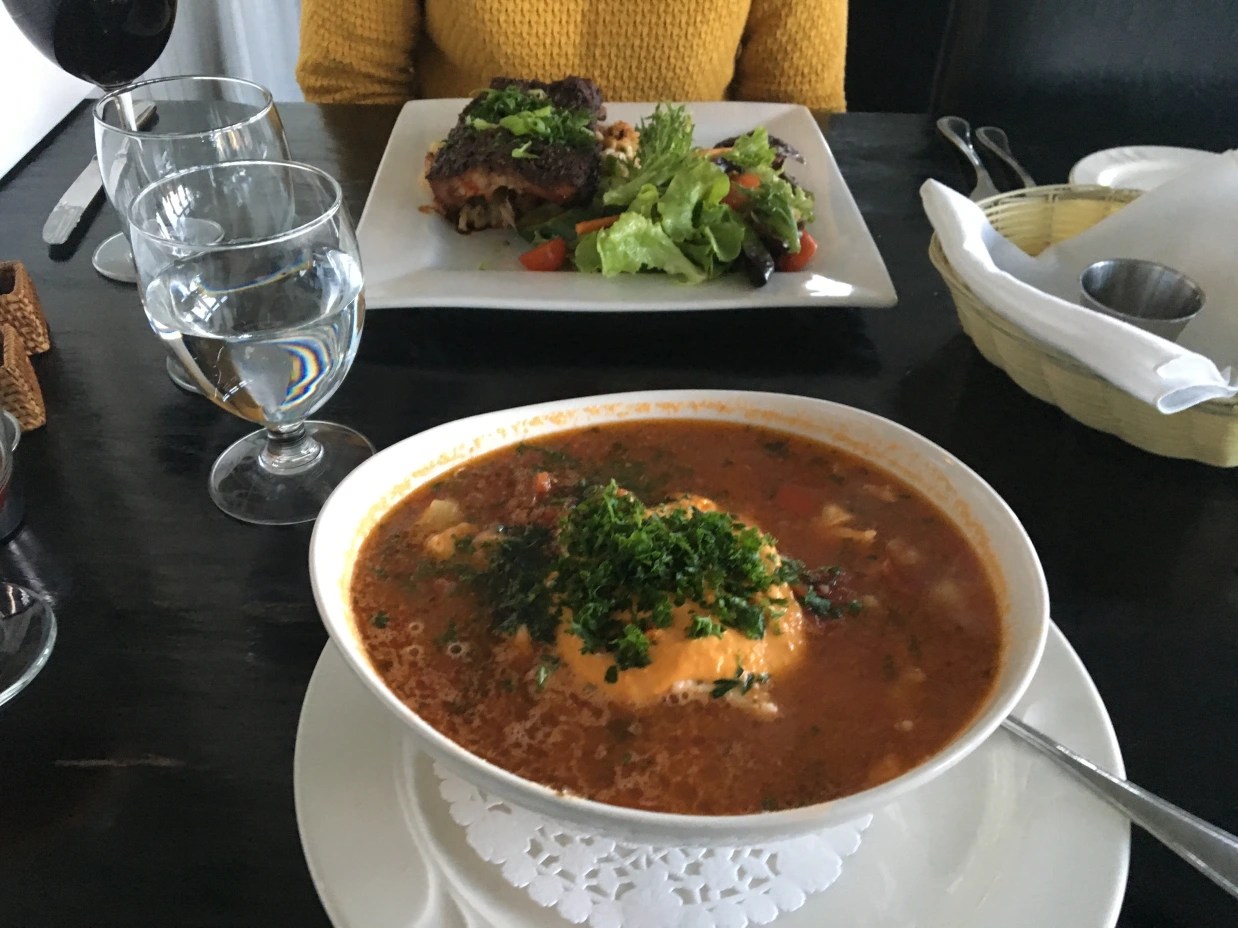
   While Vera pulled gently at her baby back ribs, Frank started scooping out his large bowl of broth and seafood.

   “How’s the sinkhole?” Vera asked.

   “So far so good,” said Frank. “It’s sort of like a Manhattan clam chowder, like the Portuguese make, and like a seafood goulash at the same time.”

   “Like a cioppino.”

   “Like a what?”

   “That’s the official name of it,” Vera said.

   “Anyway, I can taste bay leaves and thyme, and there might be some oregano in it. It’s loaded with stuff. She must have hit the motherload at the fish market. There are mussels, halibut, lobster, a chuck of salmon, and shrimp.”

   “Emily probably uses whatever she has on hand,” Vera said.

   “On top there’s a red pepper rouille, almost like a pesto, which gives it a kick.”   

   “Are you going to be able to finish it?”

   “I’m going to give it my best shot.”

   Halfway through their meal, when Vera spotted a plate of maple mousse walking by, she said to Frank, “That’s what I want to try for dessert tonight. It’s frozen mousse, like ice cream. I thought it might not be good for sharing, but that thing is more than big enough.”

   “All right,” said Frank, “since that Anna kid is a wizard. First, we eat well, then we face tomorrow, no matter what happens.”

   The Mill was almost vacated evacuated when they paid their bill of fare and left.

   “You wouldn’t know a hurricane is blowing in,” Frank said to Vera as they lingered in the front lot after dinner, leaning against the back hatch of their Hyundai, watching the no traffic on the quiet road, the starry northern sky inky and still above them.

   When Saturday morning rolled around, it started getting dark, and by noon it started raining. It got windy and windier. The Coastline Cottages and the Doyle houses on the other side of the park road lost power in the late afternoon. Churchill Avenue in town was shut down. The Gulf Shore Parkway east from Brackley was shut down. Roads in all directions were shut down, as utility wires and branches blew away. Fences were flattened, roofs torn off, and hundred-year-old trees toppled.

   The damage to the Cavendish Campground, seven-some miles away from where Frank and Vera were staying, was so bad it was closed for the rest of the year. An arc from Cavendish to Kensington to Summerside was walloped. Islanders tarped their roofs, sawed up tree limbs, and hauled away debris for days afterwards. On Sunday morning all the trails administered by Parks Canada everywhere on PEI were shut down until they could be assessed.

   After their cottage lost power, Frank and Vera packed for their drive home the next day and tidied up while there was still some light. “At least we know the mondo bridge is as sturdy as it gets,” said Vera. When it got dark, 19th century-style dark, they popped open the remains of a bottle of red wine and spent the rest of the night riding out the lashing all-out rain and gusting big ass wind.

Ed Staskus posts monthly on 147 Stanley Street http://www.147stanleystreet.com, Made in Cleveland http://www.clevelandohiodaybook.com, Atlantic Canada http://www.redroadpei.com, and Lithuanian Journal http://www.lithuanianjournal.com

“Cross Walk” by Ed Staskus

“Captures the vibe of mid-century NYC, from stickball in the streets to the Mob on the make.” Sam Winchell, Beyond Fiction

Available on Amazon: https://www.amazon.com/dp/B0CRPSFPKP

Late summer and early autumn. New York City, 1956. Jackson Pollack opens a can of worms. President Eisenhower on his way to the opening game of the World Series where a hit man waits in the wings. A Hell’s Kitchen private eye scares up the shadows.

A Crying of Lot 49 Publication

Behind Bulletproof Glass

By Ed Staskus

   I should have known better when I told the young woman on the other side of the Walgreen’s bulletproof drive-thru window that I needed the kind of coronavirus test that would get my wife and me into Canada and she breezily said, “For sure, this is it.” She was a trained pharmacy technician, but made up her harebrained reply, assuring me all was well even though she didn’t know what she was talking about. We found out three days later trying to cross the border at Houlton, Maine into Woodstock, New Brunswick.

   Getting a straight answer from the young can sometimes be like trying to give fish a bath. They often have a quippy answer for everything. Their answers are in earnest no matter what they’re asked and no matter their wealth or lack of knowledge. Whenever they are fazed by anything they say, “Oh, whatever.” 

   They say whatever they want when they are behind bulletproof glass.

   My wife and I were going to Prince Edward Island, where we didn’t go the summer before because of the 19 virus. Canada closed itself up tight as a clam in March of that year and didn’t reopen for Americans until early August of this year. Once we heard the opening was going ahead, we got in touch with the folks who operate Coastline Cottages in the town of North Rustico on PEI and let them know we were coming on August 21st and staying for three weeks.

   The cottages are on a hillside, on land that has been in the Doyle family going on two hundred years. A park road cut through their farm when it was built in the 1970s, but unlike other landowners they didn’t sell their remaining acreage to the state, so it sits snug inside the National Park. There are several homes on the bluff side of the eponymous Doyle’s Cove, some old and some brand new. In one way or another every one of them houses a homegrown north shore family, except for Kelly Doyle, who has lived on the cove the longest and lives alone.

   It takes two and half days to drive from Lakewood, Ohio to Prince Edward Island. At least it did every other year we had driven to the island. This year it took us six and half days.

   When we got to the Canadian border the black uniform in the booth asked for our passports. We forked them over to the tall trim guard, forearms tattooed, a Beretta 9mm on his hip. He was young and just old enough to be on this side of Gen Z. He looked our documents over and asked where we were from and where we were going.

   “Cleveland, Ohio,” I said. Although we live in Lakewood, an inner ring suburb, we always tell red tape we live in Cleveland. No one has heard of Lakewood. Everybody has heard of Cleveland, for good or bad. At least nobody calls it “The Mistake on the Lake” anymore. 

   I almost preferred the insult. “It keeps the riff raff rich away,” I explained to my wife. “There is no need for Cleveland to become the next new thing. They will just use up all the air and water and our real estate taxes will go ballistic. On top of that, we would end up knee deep in smarmy techies with their cheery solutions to all the world’s problems.”

   We handed our ArriveCAN documents over. We handed our virus inoculation cards over. We had both gotten Moderna shots. We handed our virus tests over, proving we had both tested negative.

   “You are cutting it close,” the border guard sniffed, shuffling everything in his hands like a deck of cards. I was hoping he wouldn’t turn a Joker up.

   The negative test had to be presented at the border within 72 hours of taking it. We were there with an hour to spare, although it would have been two hours if we hadn’t had to wait in line in our car for an hour. We had driven a thousand miles. It was tiresome but waiting in an idling car wasn’t any more skin off our noses.

   It started to smell bad when a second border guard stepped into the booth and the two guards put their heads together.

   “The antigen tests you took aren’t accepted in Canada,” the Joker said. “It has to be a molecular test. You can go ahead, since you’re from Canada, but your wife has to go back.”

   I was born in Sudbury, Ontario, and have dual citizenship, although I only carry an American passport. I couldn’t tell if he was being serious, so I asked him to repeat what he said. He repeated what he said and gave us a turn-around document to return to the USA when I told him I wasn’t ready to abandon my wife.

   We went back the way we had come, just like two of the six cars ahead of us, although we had to wait in line at the American crossing for an hour. Once we returned to Maine, we found out we could get the molecular test, but it would be a week-or more before we got the results. Nobody we talked to, not even the Gods of Google, was any help. A friendly truck driver mentioned New Hampshire was faster, only taking a day or two.

   The truck driver was stout, bowlegged, wearing a Red Sox baseball cap, a two-or-three-day growth of beard on his face, with a small shaggy dog to keep him company on the road. He wasn’t a Gen Z man. It was hard to tell what generation he belonged to, other than the changeless working-class generation.

   We drove six hours the wrong way to Campton, New Hampshire and checked into the Colonel Spencer Inn. It was Saturday night. We got on-line and made test appointments for noon at a CVS in Manchester, an hour away. We streamed “Castle of Sand” on our laptop. It was a 1970s Japanese crime thriller movie and kept us up past our bedtime.

   Over breakfast the next morning our innkeeper told us to go early since the traffic leaving New Hampshire for home on Sunday mornings was heavy. We gave ourselves an hour and a half to drive the 55 miles and barely made it. Luckily, we hadn’t made appointments for an hour later. We never would have made it. The traffic on I-93 going south was a snarl of stop and go by the time we started north back to Campton.

   We got our test tubes and swabs and stuck the swabs up our noses. I spilled some of the liquid in my tube and asked the Gen Z pharmacy technician behind the bulletproof glass if I should start over with a new kit.

   “You’re fine, it doesn’t matter,” she said, lazy as a bag of baloney. She couldn’t have been more wrong, which we discovered soon enough.

   Gen Z is self-centered and self-sacrificing both at the same time. “My goals are to travel the world and become the founder of an organization to help people.” They want to stand out. “Our generation is on the rise. We aren’t just Millennials.” They say they are the new dawn of a new age. “We are an unprecedented group of innovation and entrepreneurship.”

   Welcome to the future, just don’t take the future’s word for it.

   We spent the night at the Colonel Spencer. It was built in 1764, a year after the end of the French and Indian War. During the war the British, allied with American colonists, weaponized smallpox, trading infected blankets to Indians. The virus inflicts disfiguring scars, blindness, and death.

   “Could it not be contrived to send the smallpox among those disaffected tribes of Indians? We must on this occasion, use every stratagem in our power to reduce them,” the British commander Sir Jeffrey Amherst wrote to his subordinates.

   The results were what the continent’s newest immigrants from the Old World expected.

   “They burned with the heat of the pox, and they died to feed the monster. And so, the village was deserted, and never again would the Indians live on that spot,” is how one of the natives described the deadly epidemic.

   We had dinner at Panorama Six82, not far from our inn. The hostess seated us outside on the patio which looked out over a valley and a series of cascading White Mountain hilltops. The sun went down behind one of them and we finished our dessert in the dark.

   Our server was a middle-aged man from Colombia wearing jeans, a Panorama Six82 signature shirt, and a Sonoma-style straw hat. He went back to the homeland every year to visit relatives.

    “They always want money, so I don’t bring too much of it,” Fernando said. “It’s not as dangerous as most Americans think it is. I avoid some neighborhoods, sure, and I avoid riding in cabs. The rebels are in the hills, not the cities, and besides, they don’t do much anymore. The Venezuelans are a problem, all of them leaving their god-forsaken country. But they do a lot of the dirty work for us these days.”

   We drove back to Houlton on I-95. The speed limit north of Bangor is 75 MPH. I set the cruise to 85 MPH and kept my eyes peeled for moose. The fleabags lumber onto the roadway, sometimes standing astride one lane or another. Hitting a moose is a bad idea. A full-grown bull moose stands six to seven feet tall and tips the scales at 1500 pounds. It isn’t certain that the collision will kill the beast, but it will kill your car, and maybe you. They do most of their roaming around after nightfall. We made sure we got to our motel before dusk.

   In the morning my wife was winding down a business meeting on Zoom when there was a knock on our door. It was the housekeeper. She wore a black uniform and black hair pulled back in a bun. She was young. She was part of the Z crowd.

   “We’ll be out in about a half-hour,” I said.

   “Can I replace the towels and empty the trash?”

   “Sure.”

   “Weren’t you here a few days ago?”

   “Yes,” I said, and told her about trying and failing to get across the border and our search for a fast 19 test.

   It turned out the explanation for the motel being sold-out was because of the same problem. Every other person lodging there had been turned around for one reason or another.

   “You should go to the Katahdin Valley Medical Center,” she said. “A friend of mine went there, they did the test, she got it back the next day, and went to Nova Scotia.”

   “Thanks,” I said. We packed and followed Apple Maps to the medical center. The receptionist didn’t know anything about a fast molecular test. She sent us to Jesse, the man upstairs, who was the man in charge.

   “We test on Mondays, Wednesdays, and Fridays,” he said. “It takes about a week to get the results back from the lab.” It was Tuesday. We were already three days late. I started looking over my shoulder for Chevy Chase.

   “Not the next day?”

   “No.”

   We left Houlton and drove to Presque Isle, had lunch, messed around, my wife went running on the town’s all-purpose trail, and we drove to the Caribou Inn in the next town north. While the receptionist checked her computer for our reservation, we heard a wolf whistle through the open door of the office behind the front desk. A minute later we heard it again.

   “That’s just Ducky,” the receptionist said. “She belongs to the manager.”

   “Does she do that often, whistle, I mean?” I asked.

   “Whenever she sees a pretty girl.”

   Another wolf whistle came my wife’s way.

   I must have looked cross, because the receptionist said, “Ducky is a parrot.”

   Ducky was a parrot in a tall white cage just inside the door of the office. Her plumage was green with some red and yellow mixed in. She was a saucy character.

   “She’s twenty years old,” the receptionist said.

   “How long has she been here?”

   “Twenty years.”

   Ducky was spending all her Gen Z years locked up at the Caribou Inn, where flocks came and went. The only lasting relationship she had was with Betty, the hotel’s manager, and the bird’s keeper.

   “I didn’t know parrots lived that long.”

   “They can live to be seventy, eighty years old,” Betty said.

   “Ducky wolf whistles women?”

    “And men. We thought she was a he until she started laying eggs not long ago.”

   The parrot was going to outlive most of us, the 19 or no 19. They sometimes play dead in response to threats. They can also look dead when they are asleep. But if a parrot is lying still and not breathing, looking lifeless, you can assume it is dead.

   We had a non-smoking room, although every hallway that led to our room was lined with smoking rooms. The hallways smelled sad and stale. We were settling in with a bottle of wine and a movie when we got a phone call. It was the lab in New Hampshire that was doing our 19 molecular tests. They had good news and bad news. My wife tested negative, but my test was discarded. 

   “There wasn’t enough liquid in the test vial to maintain the sample,” the lab technician said. “Did you happen to spill some of it?”

   I didn’t bother trying to explain. I got on-line and filled out another ArriveCAN form. When we got to the border my wife had no problem. The only problem I had wasn’t make or break, since they couldn’t deny me entry, test or no test. A health officer gave me a self-test kit and told me to make sure I performed it within four days. She was in her early 30s. I had no reason to be skeptical. She was just out of Gen Z range. I should have been leery since she was wrong. She wasn’t as far out of the field of friendly fire as I thought.

   Four days later, when I went on-line and followed the directions for the self-test, the Indian-looking Indian-sounding woman on the other side of screen was nonplussed when I apologized for waiting to the last minute.

   “I don’t understand.” she said. “You are four days early. You are supposed to test after eight days of self-quarantine.”

   When I started to spell out what had happened, she wasn’t in the mood, and said she would schedule Purolator to pick my test up the next day. Purolator sent me an e-mail saying they would pick up between nine and noon. The truck pulled up just before five. I was grilling dogs and corn on the front deck. The next day I got an e-mail informing me my test came back negative. I had been tested four times in ten days and was finally officially virus-free.

   No matter the generation, Prince Edward Island was the only place and people who got it right. When we arrived late Wednesday afternoon and crossed the nine-mile-long bridge to the province, we waited in one of the many lines edging towards checkpoints. It didn’t take long. A young woman took our vitals while an older man in a spacesuit swabbed our noses.

   “If we don’t call you within two hours you tested negative,” he said.

   We drove to the Coastline Cottages. “Welcome to Canada,” our hosts said. “You made it.” 

   No one from Health PEI called us. We unpacked, watching the day get dark over the Atlantic Ocean, and fell into bed. I drifted off thanking God somebody on our part of the planet knew what the 19 score was, not some mumbo jumbo they dreamed up because they neglected to check the scoreboard.

Ed Staskus posts stories on 147 Stanley Street http://www.147stanleystreet.com and Cleveland Ohio Daybook http://www.clevelandohiodaybook.com. To get the site’s monthly feature in your in-box click on “Follow.”

Searching for the Surfside

By Ed Staskus

“Whenever we leave home, to Ontario or New Brunswick, I always say we are crossing into another world, into a strange world, into Canada,” said Marie Bachand. “I always ask Louie did you bring our passports?” She always asks in French because her partner Louie Painchaund doesn’t speak English.

It was a cumulus cloud high sky day when they went to Prince Edward Island. They didn’t have their passports. Who wants to look like their passport picture on a sunny summer day, anyway?

They live in Saint-Gregorie in Quebec, a community of the city of Becancour, on the south side of the St. Lawrence River. Their house dates to the 1780s, built by refugee Acadians after the French and Indian War. “They came down the St Lawrence River, four hundred families. It was a rough time. They stopped, said OK, looks good, and settled here.”

It is about six hundred miles to Prince Edward Island, up the St. Lawrence, down New Brunswick, and across the Confederation Bridge to PEI. The first time they went they were touring the Maritimes. The island was a spur of the moment runaround. They drove across the Northumberland Straights on the nine-mile-long bridge to the other side.

“We thought we could run over and visit PEI in one or two days,” Marie said. “It’s so small.”

Even though it is pint-sized, the smallest of the ten Canadian provinces at just a little more than two thousand square miles, compared to Quebec’s almost six hundred thousand square miles, it goes over big.

Ten years later, even after Andy’s Surfside Inn is no more, they still go to Prince Edward Island two weeks in the summer, staying at the Coastline Cottages up the hill across the street, riding their bikes all over the place, still finding substantial fresh things to rack up on the to-do list.

The inn was on the ocean side of North Rustico, near the entrance to the harbor, a white clapboard two-story house with a dozen windows, two dormers and three porches on the side facing the water. A broad lawn slopes down to the cliffs. It wasn’t always the Surfside Inn and isn’t the Surfside Inn anymore, having since taken up where it left off, back to being a home.

“The first house was bigger,” said Kelly Doyle.

Kelly’s grandparents, Mike and Loretta Doyle, were visiting and playing cards at a neighbor’s house one winter night in 1929. Their friends lived about a mile away. At the end of the evening, going home in their horse-drawn sled, they crested a frozen hill. A red glow lit up the sky and flared across the flat cove below them.

The house was being swallowed up by fire. The pitch-dark night was blazing. They had left seven children behind in the care of the eldest.

“It was a flue fire,” said Kelly. “It burnt down because of the stove.”

By the time the Doyle’s raced their sled down to the house, and finding all the children safe and sound outside, there wasn’t much they could do. There were no neighbors nearby to help and there was no fire department. Mike Doyle was able to drag some furniture from the first floor out the front door and saved as many fox furs as he could.

The house was rebuilt the next year and finished the following year.

“The foxes my grandfather saved built the new house.” Kelly’s grandfather was a fox farmer. What he sold the pelts for paid for the work of the itinerant immigrant tradesmen who built the house.

Furry garments are made of furry animal hides. Even though it has lately fallen on hard times, fur is one of the oldest forms of clothing. Once we started globe-trotting out of Africa, to where everywhere else was colder, we started wearing furs. Ever since, people have worn beaver racoon sable rabbit coyote wolf chinchilla opossum mink and foxes.

Mountain men wore the bears they shot and killed.

In the 1880s foxes were bred for the first time, accomplished on Prince Edward Island by locals Charlie Dalton and Robert Oulton. Theirs was the original fur farm in 1884. Within several years the rush was on. But the rush didn’t really and truly mushroom until after a pelt sale a few years later when their harvest of 25 skins brought them nearly $35 thousand dollars. It was a boat load of a barn door of money, bearing in mind that the average island farm worker those days made less than $30 dollars a month.

In 1926 nearly nine hundred live silver foxes were shipped from Summerside to the United States. It was the most valuable shipment in the history of Prince Edward Island up to that time and is still called the ‘Million Dollar Train’. Andy Doyle was born the same year, spunky and healthy, although nobody ever called him the ‘Million Dollar Baby’.

By the 1930s the fox farm industry was strong as a bull, raking in multi-millions of dollars. There were hundreds of thousands of foxes being farmed and skinned coast to coast throughout Canada and the United States.

“The furs my grandfather was able to rescue from the fire were worth five thousand. In the end the new house cost five thousand,” said Kelly.

“We stayed at a country inn, at the information center at the bridge they said it was nice, but it was a little room, yuk,” said Marie. She picked up the official PEI tourist book. Where to stay next? She thumbed through the book. She put her finger on Andy’s Surfside Inn. “I say to Louie, what’s that, the north shore? We had already decided to stay three or four more days. We went looking for it.”

Gavan Andrew “Andy” Doyle was 81 years old in 2007 when Marie and Louie went driving up and down the north shore looking for his eponymous inn. Andy had been born in the white house that was the inn. Years later, grown-up a young man, pushing off after World War Two, he landed in Montreal, married, brought up three stepchildren, and years later, when his wife Vivienne died, went back to Prince Edward Island.

His mother died shortly after and he inherited the house on Doyle’s Cove. “My aunt, his sister in Montreal, always had a soft spot for Gavan. She helped him get the place up and running. She bought a bunch of nice furniture for him,” said Kelly Doyle. It was the late 80s. Andy Doyle resurrected the Surfside Inn that had been his mother’s brainchild in the late 40’s.

“When my grandfather died in 1948, my grandmother wanted to make some money with the house and started taking in tourists,” said Kelly. “There was a white picket fence, she had ducks and geese and sheep in a big barnyard, and she kept a garden.” It was a large working garden. “She fed the bed and breakfasts herself.”

As her six girls and two boys grew up and left home, she converted their rooms to guest rooms.

“She filled those rooms all through the 50s and 60s,” said Kelly. “PEI wasn’t like the rest of the world back then. Tourists found the way of life interesting, honest and down-to-earth. There wasn’t much entertainment, but there was always lots to do. They just liked the place.”

When Marie telephoned the Surfside Inn, a Japanese woman answered the call.

“Andy always had Japanese girls, three girls, housekeepers for the season who were exchange students who wanted to learn English. They shared a small bedroom over the kitchen. She told us, yes, we have a room.”

Louie and Marie drove up and down Route 6 between Cavendish and North Rustico searching for the Surfside Inn. When they couldn’t find it, they finally stopped at a National Parks kiosk and got directions. It was in the park, although on private land, Doyle’s Land on Doyle’s Cove. They drove down the Gulf Shore Parkway, past Cape Turner and Orby Head, and down to the coastal inlet.

When they got there, there wasn’t a room. There were four rooms that shared a bath. They were all taken. What Marie and Louie didn’t know was that there was a fifth room on the ground floor, which was Andy’s bedroom with a private bath.

“When we are full, he gives you that room,” explained the young woman.

“We’ll take that,” said Marie. “Where does Andy go to sleep?”

“He sleeps in the boat.”

The Japanese girls did the heavy lifting in return for being able to learn English. “I don’t know where they learned it, but it wasn’t from Andy,” said Marie. “He never talked to them.”

Outside the house was a castaway wooden lobster boat. The hull and forward cabin were worthy enough, although it needed some planks and rib work. it looked like it still had some spirit to it, like it could still make a living at sea.

“It smelled bad, all old stuff papers tools junk a small bed,” said Marie. “It should have been burned long ago.”

The Surfside Inn had a kitchen with several refrigerators. “We thought it was just for breakfast, but we saw other people storing food and making supper.” They started shopping at Doiron’s Fish Market on the harbor road. One suppertime Andy saw them coming into the kitchen with lobsters.

“Let me fix those for you,” he said.

“Oh, my God,” said Marie, “he was good. Tack, tack, tack, all done.”

They started bringing their own wine from home, though.

“I don’t like PEI Liquor wines. We brought Italian and French whites and rose for the fish.”

Coming back from Doiron’s one day, putting away fresh cod wrapped in Kraft paper, Marie noticed small buckets of frozen milk in the freezer.

“There was a Muslim couple staying at Andy’s, the guy was always in the living room, but she was wrapped up, always going to the bedroom. She didn’t talk. At breakfast, no words. She looked at her iPad, that’s all.”

The mother was expressing her breast milk and storing it. She kept it in the back of the freezer, the coldest part of fridges. One day all the milk was gone.

“We never saw the baby, though, maybe it was somewhere else, with a grandma.”

“Tourists in the 50s and 60s weren’t from Monkton or Toronto,” said Kelly. “Some were from the States, but a lot of them were from Europe. We lived next door and ran around the yard, having fun, meeting people. In 1970 my grandmother got a little bit ill and couldn’t keep it going. She lived alone for seven years until my dad moved her into the senior citizen’s home in North Rustico.”

The white house was empty for about ten years, for most of the 80s. It came back to life as the rooms filled up. In summertime it was never vacant.

“You could see the sea right in front of you,” said Marie. “We sat on the porch every day. It was a special place. After a week we would say, let’s stay another day, then another day. Other people, too, were crazy about this place.”

One day Andy asked Louie to help him take an old heavy bicycle out of the lobster boat. “You’re a big guy, you can do it,” said Andy.

When the bike was on the ground Andy straddled it and pedaled to the downhill on the all-purpose path. “He was going down the hill, but Louie told me there were no brakes. Stop! Stop! I yelled but he yelled back, I’ve been riding this bike for thirty years!”

Whenever Andy pulled his four-door sedan out to run errands or go to the grocery, Marie and Louie kept their distance. “I don’t think there were any brakes on his car, either,” she said.

He seemed to own only three short-sleeve shirts. “I have three nice ones,” he said. “I got them for a dollar each at the Salvation Army.” One was yellow, one green and one blue. The blue shirt was his favorite. He dried all his laundry on an outside clothesline, in the sun and ocean breeze.

“All the guests, they were from Canada, the United States, Italy, England, all over. A Chinese couple had a four-year-old who had been born in Quebec, so they named him Denis. Whenever we saw a Chinese child after that we always called the child Denis Wong. There was a couple from Boston, they lived in the harbor on a boat there. He was 80 and she was in her 70s.”

“I didn’t come with my boat. I came with my girlfriend,” he said.

“There is no age,” said Marie. Until you find out your grade school class is running the town city province country.

Aging and its consequences usually happen step-by-step, sometimes without warning. One minute you’re only as old as you feel and the next minute you don’t feel good. It’s like going on a cruise. It can be smooth sailing or a shipwreck. Once you’re on board, though, there’s not much you can do about it.

“There were always many guests, but suddenly a few years ago Andy started getting mixed up. He forgot reservations, there were two Japanese girls instead of three, it wasn’t the same.” What it takes to make an inn work wasn’t getting done. By 2016 it was far more vacant than occupied and Marie and Louie were staying at Kelly Doyle’s Coastline Cottages up the hill across the street.

“Andy introduced us to him,” Marie said.

Like Dorothy said at the end of ‘The Marvelous Land of Oz’, “Everything has to come to an end, sometime.”

In 2018 Andy Doyle moved to the Garden Home in Charlottetown and his nephew Erik Brown took the house over, renovating it and transforming it into his home. In November Andy died. He was 92. It was the end of the Surfside Inn.

“On the ocean was wonderful,” said Marie. “Once we found it, Louie and I loved the Surfside.”

Ed Staskus posts stories on 147 Stanley Street http://www.147stanleystreet.com and Cleveland Ohio Daybook http://www.clevelandohiodaybook.com. To get the site’s monthly feature in your in-box click on “Follow.”

Rolling Up the Oilcloth

By Ed Staskus

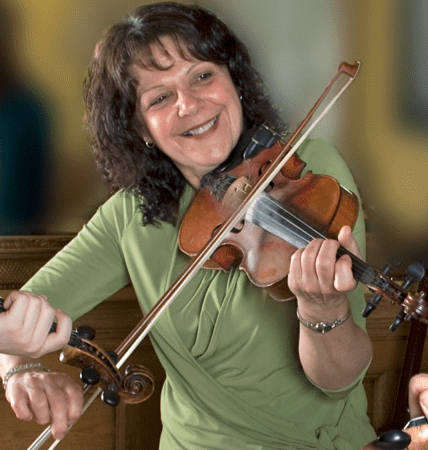
   When Mary Smith picks up a fiddle, she’s got about twenty years of life with it behind her. When she picks up a guitar, she’s got about seventy years behind her. When she plays the mandolin, organ, or piano, it’s anybody’s guess.

   “We always had music at home,” she said. “My dad played mouth organ and step danced. When I was growing up there was no TV, so the thing to do was have house parties.”

   Home was the North Rustico lighthouse on the north-central shore of Prince Edward Island, and later a house her father, George Pineau, built up the road on Harbourview Drive. George and his wife Ruby rolled up the oilcloth on weekends. The kids were sent to bed.

   “They would have three or four couples come over, cook up a big feed of salt fish and potatoes, and play music,” said Mary. Her father would dance jigs and play ‘George’s Tune’ on his harmonica.

   “On winter nights it was the custom in villages for friends to collect in a kitchen and hold a ceilidh,” explained Joe Riley, who designs and installs kitchens in the surrounding area. “They sang old or new songs set to old music or new music composed in the manner of the old, and maybe a few lies would be shared among friends.”

    “We used to sneak down the stairs. I always wanted to be a part of it,” Mary said. “I thought, if I can get a guitar, and learn to play it, I could stay up and play for them. My dad wanted me to play a fiddle, but I wouldn’t bother with it. I kept asking for a guitar and eventually he ordered one.”

  It came from Sears, Roebuck & Co. It was a Gene Autry Round-up guitar. Gene Autry was a rodeo performer and crooner. He was “The Singing Cowboy” in the movies. His name was inscribed on the guitar. A cowboy riding herd and swinging a lariat above his head was stencil-painted on the front. She still has it, although it’s not part of her gear on the road.

   “I learned how to play a few chords.”

   Square dancing was popular in her neck of the woods, and even though there were several good fiddlers, there were no guitar players. As she became more accomplished on her Round-up, she began accompanying fiddlers at local dances.

   The North Rustico lighthouse was her home when she was a child. Although not many children are born at home, it was where she was born. She didn’t go far that first day, tired out by the move, and slept the rest of the day.

   Only about 1% of babies today are delivered outside of a hospital. Until the 20th century most women gave birth at home. When someone was ready to go, her friends and relatives and a midwife would help. As late as 1900 about half of all babies were still brought into the world by midwives. By the 1930s, however, after the advent of anesthesia, only one of ten were delivered by them.

   Not many were delivered by a neighbor, like Mary. “There was nobody else around. If you stayed home to have a baby, somebody had to help out.” 

   The lighthouse was built in 1876 on the North Rustico beach, a pyramidal white wooden tower and attached living space. Eight years later it was moved to the entrance of the harbor. George Pineau was the keeper of the lighthouse from 1925 until 1960, when the beam was automated.

   “My grandfather was lighthouse keeper for many years, and my father was the keeper for thirty four years. I lived in the lighthouse until I was eight years old.”

   Mary grew up on the harbor road, where she has moved back to and lives to this day, as a child running the mile-or-so up and down the road from one end to the other with her brother and sister. Fish factories canned lobster and salt fish, shipping it to the United States and West Indies. Fish peddlers loaded horse-drawn wagons and small trucks, selling cod, herring, and mackerel door-to-door.

   A three-story hotel stood on the rise across the street from the present-day Blue Mussel Café.

“My Aunt Angie bought it, tore it down, and built a house with the lumber. My dad was laid back, but his twin sister was a fiery person.” Her father was a fisherman, working hard, but enough of a go-with-the-flow man to be able to live to one hundred and three before he was laid to rest.

   In the summer Mary fished for smelt and sold them for a penny a dozen to tourists. When she had a pocketful of pennies she ran to the grocery store on Route 6. “You could buy a lot of candy for three or four cents.”

   There were two schools serving the community, one Protestant and one Catholic. “In them days the Protestant and Catholic relationship wasn’t great.” When the Stella Maris school in North Rustico burned down in the early 1950s, classes were organized in the church until the school was rebuilt.

   “I was in grade ten when I quit. You can’t quit now, but we went to work early back then.”

   Many secondary students dropped out of school. There were plenty of entry-level jobs in agriculture and the fisheries. As late as 1990 the dropout rate on Prince Edward Island was 20%. Today, it is 6%.

   She moved to Ontario, worked, came back to Prince Edward Island, met her husband-to-be, Al Smith, a Nova Scotian who was seasonal fishing out of the town harbor, and they got married when she was eighteen years old.

   When they had a son and made a home, at the far end of the harbor mouth, it was in North Rustico. “We had a deep-sea fishing business.” Fishing, along with farming and tourism, drive the economy on the island. Shellfish like mussels and lobsters are the mainstay. Mary kept house, raised their son, and lent a hand with the gear. She mended nets, repaired pots, and rafted trap muzzles. She mixed their own cement runners for weights to sink the pots.

   “The twine in the traps, what we called the hedge, we used to knit all those by hand. Nowadays they buy all the stuff.”

   She stayed on shore more often than not. She was prone to seasickness, a disturbance of the inner ear. It especially wreaks havoc with balance. Christopher Columbus and Lord Nelson both suffered from it.

   One day, just as that year’s fishing season was about to start, Al Smith’s hired man told him he was moving west in search of better prospects. He would have to look for another helpmate right away. “Well, Mary would never go because she gets seasick,” said one of their neighbors. That evening she told her husband, “I guess I’m going fishing in the spring.” 

   “Oh, God, it’ll be too hard for you,” Al said.

   “There’s no women fishing in Rustico, and they say I can’t do it, so I’m going to go,” said Mary said. She shortly became the fishing fleet’s first girl Friday.

   There are several ways of battling motion sickness. Cast off well-rested, well-nourished, and sober. Insert an ear plug in one ear. Keep your eyes on the horizon. Riding it out is sometimes the only remedy.

   “I couldn’t physically lift the traps, they were too heavy, but I could slide them. My husband would haul them up and push the trap to me. I would take the lobster out and rebait the trap, slide it down the washboard to the back with the movement of the boat, and kick it off. There was rope all over, so you had to watch where your feet were, because there’s fathoms of rope and it’s going over fast.

   “On a nice morning, going out to work, the sun coming up, we would look back and see the green and red of Prince Edward Island. It was beautiful. It was good work.”

   Al and Mary Smith fished together for four years. They fished for lobster, mackerel, cod, and tuna. “It took me four years to get over being seasick,” she said. A sure cure is sitting down under your own roof on dry land four years later.

   When her work on the water was done, she cast about for another kind of work.  

   “I always loved to draw,” she said. “So, when I wasn’t fishing anymore, and our son was grown up, I talked to my husband about it.”

   “Why don’t you take a course?” Al said.

   “Someday I’ll do that,” Mary daid

   Someday came sooner than later and she enrolled in a two-year commercial design course at Holland College in Charlottetown, the provincial capital. The community college is named after British Army surveyor Captain Samuel Holland, offers more than one hundred and fifty degree pathways, and more than 90% of its graduates find employment.

   Two years later, art degree in hand, she decided she wanted to teach art. She thought, I’ll go to the University of Prince Edward Island and get a teacher’s license. She went to see the Dean of Education at UPEI.

   “What education do you have?” asked Roy Campbell, who was the dean. 
   

   “I only have grade ten.”

   “Well,” he said.

   She had brought a long list of courses she was interested in taking. He looked at the list. “Well,” he said, “you should be realistic. I suggest you not take more than three courses at any one time.”

   “That was kind of insulting. He thinks I probably can’t even do three. I’ll show him. I’ll take six. Oh, my God, that was a mistake. It was a hectic time.”

    It got more hectic her second year, when she entered the world of higher level courses.

   “I took a course on Dante, which was really crazy. I’m never going to make it through this. I thought about it for a while and thought the only way I’m going to be able to pass this course is if I draw it. So that’s what I did.”

   She put her all into drawing the Circles of Hell. Her professor had never gotten a paper like that. “He was thrilled with it.” She got an A in the course.

   “I got my teacher’s license. I proved that I could do it.”

   She taught at a private art school in Summerside and lent a hand part-time at Rainbow Valley in nearby Cavendish during the summer season until, in 1990, her husband of thirty years tied an anchor around his neck and threw himself into the North Rustico Harbor waters.

   “He was a great guy. I decided to do a three-dimensional sculpture of Al as he was, as a fisherman.”

   At first, her plan was to make the commemorative sculpture in cement. “But then I thought, we had just gotten a new fiberglass boat, so I could do it in fiberglass.” It was an idea that would reinvent her from then until now.

   The boat was a Provincial, built by Provincial Boat and Marine Limited in Kensington, less than twenty miles west on the north coast. “Earl Davison had a fiberglass plant in Kensington and was producing great fiberglass boats.” They are known for their speed and durability. They are sometimes called “lifetime boats.” Mary went to Kensington to see Earl, who also owned and operated Rainbow Valley.

   “I went to see him, and I said, I’ve got something that I’d like to do in fiberglass, so he said, I’ll come down to look at it. He came down to the house this one day and looked at my plan. I got a call a few days later. He offered me a full-time job instead.” 

   “I need an artist,” Earl said.

   “Yeah, I’ll do that,” she said.   

   The sculpture of Al Smith got made and Mary went to work full-time at Rainbow Valley in Cavendish, a hop, skip, and a jump away from her home.

   She never left. She worked seven days a week, May through September, until the water safari adventure amusement park was purchased by Parks Canada in 2005. It has since been remade into Cavendish Grove and become conserved land with a network of walking trails.

   Rainbow Valley, named after Lucy Maud Montgomery’s 1919 book “Rainbow Valley,” was thirty six years’ worth of waterslides, animatronics, swan boats, a sea monster, a monorail, roller coaster, castles, suspension bridges, and a flying saucer gift shop. “We tried to add something new every year,” Earl said. “That was a rule.” The other rule-of-thumb was families with smiles plastered all over their faces.

   “The most important thing you could do for somebody was to have them all together as a family and help make memories,” said John Davison, Earl’s son who grew up running around the park and as a grown man worked there. “Some of the memories you hear are from people whose parents aren’t with them anymore. But they remember their visits to Rainbow Valley with their parents and those experiences last a lifetime.”

   Earl Davison had envisioned the park in 1965, buying and clearing an abandoned apple orchard and filling in a swamp, turning it into ponds. “We borrowed $7,500.00,” he said. “It seemed like an awful lot of money at the time.” When they opened in 1969 admission was  fifty cents. Children under five got in free. In 1979 he bought his partners out and eventually expanded the park to sixteen hectares. Most of the attractions were designed and fabricated by him and his crew. 

   “Rainbow Valley was a unique place to work, because Earl was so creative,” Mary said.

   “Mary had a talent,” Earl said. “She could see things, create things, draw, and she seemed to always be able to draw what I told her about.”

   He told her about rum running on the island, where there had been a total ban on alcohol from 1901 until 1948. Smugglers laid low off Cavendish in the Gulf of St. Lawrence, avoiding Coast Guard cutters, hiding kegs of hard liquor in the sand dunes and woods at night. When the kegs were empty fishermen often used them to salt mackerel in, the smells of rum and salt fish mixing it up.

   She sketched out what became an animated simulated dark ride about booze and bootleggers.

   “Mary designed it,” said Earl. “She did all the faces for the characters and helped dress them, too.”

   At the end, an animatronic man coming home with a keg of rum in a handcart tells his protesting wife it’s molasses. “Don’t you lie to me,” she says. He takes a step between his wife and his handcart. “I would never lie to you, my smuckins, and if this here’s rum, may lightning strike me right here where I stand.” Every day, morning, noon, and night, a thunderous crack of lightning struck him where he stood.

   In the early 1990s Mary approached Earl about mounting a music show. It became Fiddlers and Followers, which became the North Rustico Country Music Festival, which is still going strong. The music festival, staged over the course of a weekend every August at the town’s North Star Arena, concerts as well as workshops and jam sessions, brings together some of Atlantic Canada’s best-known down-home, old-time, country, bluegrass, island-fiddling, folk-inspired music makers.

   “We’ve never missed a year. We’re getting older, but I still get really pumped up about it.”

   Earl and the Rainbow Valley construction crew built a barn and a stage for Fiddlers and Followers, local talent was secured, and they fabricated a 24-foot fiddle to be a beacon at the front of the building.

   “Earl provided the opportunity for it to start. I designed the big fiddle.”

   “It was a giant fiddle,” Earl said. In the event, it might have been even more gigantic, given the chance. “We coulda gone higher. It was Mary’s fault. She drew it to be twenty four feet, so that’s what we did.” In 2017 the giant fiddle was moved to the New Brunswick front lawn of fiddle champions Ivan and Vivian Hicks.

   “Burns MacDonald and I did shows every day,” Mary said. 

   When she began playing with Burns MacDonald it was the first time in more than thirty years she played anywhere outside of home or at a house party.

   He was the piano player. “I would be in the shop painting, doing artwork, and somebody would say, you’ve got to go for the show.” She would drop everything, grab a guitar, and run to the stage. “I never got tired.” Pete Doiron was their fiddler at the evening shows. “He was one of the best on PEI.” They played together three times a day for twenty-minute stretches.

   The first time she heard Burns playing the piano she was working with her boss one floor down.

   “I have to go see who that is,” she told Earl.

   “I run upstairs, and it was this Burns MacDonald. I went over, stood by him, and we started talking. He never stopped playing while he was talking.”

   When she went back downstairs, she said to Earl, “You’ve got to hear this guy. He’s unreal.”

   Burns MacDonald got hired on the spot and started playing during intermissions of the Roaring 20s show then on stage. The next year he came from his home in Nova Scotia for the whole season, living in a trailer in the park. “He was there fourteen years steady,” said Mary. “Everybody was just blown away by him.”

   Shortly before his death Al Smith had gotten his wife a fiddle.

   “We were at a show in Charlottetown and the entertainer was a fiddler. I thought, gee, someday I’m going to learn how to play a fiddle.” Her husband thought it was a good idea and bought her one. But when her husband passed away, Mary put the fiddle back in its case and put it away.

   She took it out of its case after a bus tour she had organized to Cape Breton. Burns was the entertainer on the tour. “I said something about fiddles, and he said, you’ll never learn how to play the fiddle.” He might as well have thrown down the gauntlet as made a passing remark.

   “That wasn’t the thing to say to me,” Mary said. 

   Since dusting off the fiddle, and learning how to play it, she’s done well enough to receive the Tera Lynne Touesnard Memorial Award at the 2017 Maritime Fiddle Contest. “It was a humbling experience and one I really don’t deserve,” she said. “It’s a great honor, however, and one I’ll always cherish.” She has also been made a lifetime member of the PEI Fiddle Association.

   Mary came to the piano by misadventure.

   She had agreed to be a co-host during an on-air fundraiser for Make-A-Wish. After finishing her stint at the station, she went home, but kept track of the auction. She noticed a keyboard valued at more than a thousand dollars wasn’t attracting many bids. She decided to prime the pump.

   “I started bidding, figuring when it’s high enough, I’ll stop.” However, she got carried away. “I kept bidding. I thought, I can’t let them outbid me. Just as I put my last bid in, time ran out, and I ended up with the keyboard.” It cost her $800.00.

   “I couldn’t afford it, but it was a for a good cause,” she said. “When I got it home, I took my guitar, and since I knew the chords on it, I just figured them out on the piano. I have my own style.” Being self-made means doing things your own way, no matter how much teamwork is involved.

   When Mary Smith takes the stage at the North Star Arena, whether as one of the key organizers of the North Rustico Music Festival, or with guitar, fiddle, keyboards in hand, she is within sight of the lighthouse she was born in. There are sixty three lighthouses on Prince Edward Island. More than thirty of them are still active. The North Rustico harbor light is one of the operational ones, sending out five seconds of light every ten seconds.

   Lighthouses, like music makers, aren’t narrow-minded about who sees their light. “When you play, never mind who listens to you,” said the pianist Robert Schumann. They shine for all to see. Without a guidepost, steaming into a dark harbor would be a mistake. Without music to brighten the day, getting up in the morning might be a mistake.

   Music is in Mary’s bones. She plays with several groups, including Mary Smith and Friends, Touch of Country, and the Country Gentlemen. The North Rustico Choral Group, which performs for seniors, was her brainchild ten years ago. 

   “I see Mary’s performances at Sunday Night Shenanigans,” said Simona Neufeld, a local music buff and fun fan.

   “Music has been a big part of my life,” Mary said. “I’ve met so many great people, some really great friendships.” She plays in living rooms, at outdoor venues, and on motor coach day tours. She often plays at community centers.

   “Life would be pretty dull if you just sat at home and watched TV. I guess being born in a lighthouse, I have to be brighter. You have to keep going.”

Ed Staskus posts on 147 Stanley Street http://www.147stanleystreet.com and Made in Cleveland http://www.clevelandohiodaybook.com. To get the site’s monthly feature in your in-box click on “Follow.”

Let ‘Er Rip

louise-et-Jonathan

By Ed Staskus

“J’aurais quelque chose a dire.”  Barachois

The Sterling Women’s Institute is the Stanley Bridge Hall on the corner of Route 6 and Rattenbury Road on the north-central coast of Prince Edward Island. The small town of Stanley Bridge spreads out in all directions.

A new traffic circle at the old intersection keeps the traffic moving. On one corner is the Race Trac gas station and farther down is the farmer’s market. Where the road flattens out at the river is the actual bridge that kids spend the summer jumping off down into the channel flowing out to the New London Bay.

The Women’s Institute is a yellow two-story clapboard building with white trim and a fair-sized deck. From the vantage of the front deck is a solitary house across the street, a cropland spread out wide and long, and the Atlantic Ocean. It is a quiet building on rising ground, except when six nights a week ceilidhs fill the hall with Irish Scottish Acadian fiddles guitars pianos and step dancing.

The hall holds close to 150 if every seat and bench along the side is taken. The night the Arsenault Trio – Helene Arsenault Bergeron, Jonathan Arsenault, and his mother Louise Arsenault – joined by Gary Chipman, played their first show of the summer in Stanley Bridge on a Wednesday night, there were upwards of a hundred ready to go.

“It’s great to see you all, thanks for coming,” said Marsha Weeks, the host of the show.

“All set?” asked Gary Chipman.

“All set,” said Louise Arsenault.

Ceilidhs are concerts, but more like musical gatherings, often staged at small halls in the Canadian Maritimes. Not so long ago, and sometimes even today, they were more along the lines of a kitchen party, a kind of jam session at home with the neighbors. Whoever could play a fiddle or a guitar or belt out a song at the top of their lungs would inevitably find themselves in the kitchen with everyone else. In the middle of January a case of beer might be close at hand in the snow just outside one of the windows.

The word itself comes from the Old Irish for companion.

“On long, dark winter nights it is still the custom in small villages for friends to collect in a house,” Donald Mackenzie wrote explaining ceilidhs more than a hundred years ago. “Some sing old songs set to old music or new music composed in the manner of the old.”

The music at Prince Edward Island ceilidhs is alert animate full of life, mainly jigs and reels, with a mix of waltzes and country songs. There are occasional vignettes about life on the island, some island humor, and stories about islanders making the music. Most of the shows are set in community centers, churches, town halls, and Lion’s clubs.

The Arsenault Trio ripped into the ‘Acadian Reel,’ an Evangeline Region tune in the Cape Breton style played in 4/4 time, in other words, on the fast side. From kitchen parties to laser-lit techno dance floors, the same rhythm pattern is part and parcel of the carousing. The signature style of Acadian fiddling is down home rhythmic drive with sawstroke syncopation, sometimes called shuffles.

“When you do the shuffle,” said Louise Arsenault, “it’s like two up bows in a row. That was dad’s style.”

The Evangeline Region of PEI is the land west of Summerside, from Miscouche to Mont Carmel to Abrams Village. Flags in blue, white, and red with a single gold star fly from front porches and front yards. Mailboxes are painted in the Acadian colors. The annual Agricultural Exhibition and Acadian Festival features boot throwing, horse pulling, and a big music and dance party at the end.

The communities are about co-operatives, farming and fishing, vittles and fiddling.

“Where’s everybody from?” Marsha asked the crowd.

Ontario, Quebec, Alberta, Ohio, Florida, and Australia were some of the answers.

“Massachusetts,” a man called out.

“Whatever you said,” said Marsha. “I can’t pronounce that.”

“Wellington,” another man called out.

Several in the audience, probably all from Prince Edward Island, laughed. Wellington is a small town on PEI. It is home to the head office of College Acadie as well as the Bottle Houses, which are three fantasy-like buildings made of approximately 30,000 recycled glass bottles.

Most of the year islanders have the island to themselves. In the summer ten times as many people as live on PEI visit there for a week-or-two.

“They gave it 150% and we could feel it down to our tappin’ toes,” said a man from Amherst, Massachusetts.

The Aussies in the audience thought it was an “all there bonzer” show.

“The energy was amazing,” said a woman from New South Wales, Australia. “We all clapped and stamped our feet.”

Gary Chipman announced he was going to sing a song.

“I’ve been told I have a great voice, but that I’m going to ruin it by singing,” he said. Still and all, he has been singing for many years. He sang ‘Prince Edward Island Is Heaven To Me,’ a country song penned in 1951 by Hal Lone Pine and recorded with his Lone Pine Mountaineers.  

“The air is so pure, and the people so gay, Prince Edward Island, I’m coming to stay, there’s swimming and hunting and fishing galore, the sun shines so bright on its long golden shore, a touch of God’s great hand this island must be, Prince Edward Island is heaven to me.” 

“Yes, sir!” somebody rang out at the end of the song.

Somebody else called out a request for the ‘Arkansas Traveler.’

“It was some hot day today,” said Louise Arsenault. “You can go from your fur coat to your bikini just like that here on this island.” A few days earlier it had rained eighteen hours straight and never reached fifty degrees. The day of the show it was a breezy sunny 74 degrees.

“Arkansas Traveler!”

“Has anybody got a drink in his car?” asked Gary Chipman, to keep his singing voice well-oiled. He told a joke about a young woman in a tight skirt trying to board a bus.

“Arkansas Traveler!”

The ‘Arkansas Traveler’ is a plantation fiddle tune, a quick reel, from the early 19thcentury, one of the most famous of American fiddle tunes. Back in the day it was a barn raiser, meant to tear the audience up. The band tore into it, followed by ‘The Maid Behind the Bar’ and ‘Farmer’s Daughter.’

Jonathan Arsenault played ‘Cottonwood’ on his guitar. In the second half of the show he played ‘Jerry’s Breakdown.’ Written by Jerry Reed, a Nashville guitarist and country singer, the song is played finger-style on guitar in a similar way to the banjo.

“It’s a wicked hard tune to play, but Jonathan makes it look easy,” said Gary.

“When I was a boy, mom bought a little guitar at a flea market,” said Jonathan. “That was her only guitar back then. She sat me at a table, put the fiddle in her lap, and played a set. I learned to flat top pick from my mom, from the fiddle, since she didn’t have a second guitar to show me what a fret was.”

Step dancing is a part of most, if not all, ceilidhs on Prince Edward Island.

“Louise and I are from Acadian backgrounds,” said Helene Arsenault Bergeron. “We grew up with fathers playing the fiddle. In those days they didn’t have a lot of accompaniment, so they accompanied themselves with their feet. That way they always had their accompanists with them.”

She and Louise Arsenault stepped to the front of the stage.

“When you hear that every day, you learn how to play and dance and you don’t even remember learning it. We saw our fathers, aunts and uncles, and grandfathers, and it was just kind of always there, and so we’re going to do a dance for you now.”

The dancing was sparkling high-spirited swashbuckling.

“I was waiting all night for that,” said Jonathan.

Step dancing descends from traditional Irish dancing. Tap dancing is a modern form of it. It is a looser form. The arms move along with the feet. Step dancers keep their upper bodies still with their arms at their sides, except when they don’t, when they’re fiddling at the same time.

Creating your own melody by using your feet is challenging enough, but fiddling a reel at the same time as step dancing like the Arsenault’s do is gnarly, time to sit up and take notice. Louise and Helene do it like a walk in the park, no matter the large front tap on one of Helene’s shoes secured with black electrical tape.

Louise grew up down the road from Helene and Albert Arsenault, who she would later collaborate with in a roots music band. Her father, Alyre Gallant, played music, too. “I grew up in a musical family,” she said. “My father played the fiddle and my mother played the pump organ. I started playing when I was seven. I learned a lot of tunes from my dad.”

At a time in the 1960s when few Prince County girls picked up the fiddle, her father jigged tunes when she was a girl so she could find them on her instrument.

The first half of the show ended with a series of reels. “Whoop, whoop,” someone in the audience shouted. Someone else stamped their feet. It was getting dark on the other side of the windows. It was still fired up inside the hall.

The second half opened the same way as the first half, with the ‘Acadian Reel.’ The song is the work of Eddy Arsenault, a carpenter and fisherman and one of the hands-down best fiddlers on PEI for more than 70 years. Helene Bergeron’s father, he blended local Acadian fiddling with the Scottish approach.

“Is this a new tune,” asked Marie Gallant Arsenault the first time she heard the song a few minutes after its composition. “It is lively.”

“Yes, it is,” said Eddy Arsenault. “What are we going to call it?”

“That sounds right like Acadian music,” said Marie. “Why don’t you call it the Acadian Reel?”

The name stuck.

Even though Eddy Arsenault wrote it, it’s the kind of song that was never new and never gets old.

Gary Chipman strolled into ‘You Are My Sunshine,’ inviting everyone to join in, which many did, some of their voices uncommonly good.

“You are my sunshine, my only sunshine, you make me happy when skies are gray, you’ll never know dear, how much I love you, please don’t take my sunshine away.”

After Gary put his guitar down to the side, Helene stepped around her piano to the front of the stage, and brought some perspective to the sunshine song that had brought a warm glow to the hall.

“Louise and I used to be in a band called Barachois,” she said.

Helene Arsenault Bergeron got her start as a fledgling in a barn putting on step dancing shows set to old records scratching out fiddle tunes. She watched her elders. “The kitchen parties we had at my grandfather’s and at our house, everybody was always jumping up to dance because the fiddling, the music was so lively.” By her 30s she was one of the best step dancers on Prince Edward Island. She took up the piano, taking on the Cape Breton style, with lift, syncopated, marked by step dancing rhythms.

“Jonathan would come on tour with us when he was a small boy, and he just loved this song we’re going to do for you. Some of the older generation, they used to compose songs as a way of keeping track of local events. It’s a song about an old maid, an old girl, whose neighbor, a young girl, asks for advice about getting married, but the old girl is disillusioned, so it’s not a very encouraging song.”

Louise threw her head back and laughed zestfully full-mouthed.

“It’s called ‘The Family Song,’” said Helene.

Later in the summer Gary might tell a joke about a RCMP officer who calls his station from a crime scene.

“I have an interesting case here,” he says. “A woman shot her husband for stepping on the floor she just mopped.”

“Have you arrested her?” asks his sergeant.

“No, not yet, the floor’s still wet.”

After more hoedowning by the band, Helene and Louise brought two chairs to the center front of the stage.

“Helene and I are going to do a sit down dance,” said Louise. “It’s not because we’re lazy. We can dance standing, we can dance sitting, so here we go!”

Their arms at their sides, their hands gripping the sides of their seats, able-bodied, their feet a breakdown blur, seeming to never leave the floor no matter the tapping, they chair danced up a storm.

Marsha Weeks walked out from the wings with her fiddle.

“You know it’s a great show when the host comes back on stage,” said Jonathan.

Gary, who taught Marsha how to play, picked up his fiddle, as did Helene and Louise.

Gary Chipman has been playing the fiddle since he was five-years-old. He says it was “about a hundred years ago.” Later in life he picked up the guitar and vocals, when “Elvis Presley and the boys came along and the fiddle was out.” With the revival of PEI fiddling in the 1990s, he rosined up his bow again. He earned a degree in clinical psychology, but says it “only made me a smarter fiddle player.”

A hundred years later he concedes, “I’m going to keep playing until I can’t play anymore.”

They played an arrangement of the ‘Tennessee Waltz,’ a tune from the 1940s whose lyrics were first written down on the back of a matchbox and whose music by Pee Wee King remains sad and lively to this day, tracing a man and a woman turning around and around a dance floor.

“I was dancing with my darling to the Tennessee Waltz, when an old friend I happened to see, I introduced her to my loved one, and while they were dancing, my friend stole my sweetheart from me.”

They played a pretty arrangement on four fiddles of the pastoral melody ‘The Rosebud of Allenvale.’

Although they had been letting it rip all along, at the last Gary and the Arsenault’s let it rip. “We’re going to end with the fastest tune of the night, I’m pretty sure,” said Marsha. They dove headlong into an instrumental version of the ‘Orange Blossom Special.’

Laisse les aller!

The tune is for raising high the roof beam. It is sometimes just called ‘The Special’ and is known as the fiddle player’s national anthem. For a long time fiddle players needed to know how to play that one song before being able to join any bluegrass band.

“It is a vehicle to exhibit the fiddler’s pyrotechnic virtuosity,” wrote Norm Cohen in his book about railroads in folksongs. “It is guaranteed to bring the blood of all but the most jaded listeners to a quick, rolling boil.”

No one at the Stanley Bridge ceilidh was left jaded as the last notes of the ‘The Special’ steamed away into the night.

“She’s the fastest train on the line, it’s that Orange Blossom Special, rollin’ down the seaboard line.”

The show ended with hootin’ and hollerin’ and a big round of applause.

“If you had a great time, please tell everybody at your cottage and campgrounds,” said Marsha as the lights came up. “If you didn’t have a good time, you can just see Gary in the kitchen after the show.”

It wouldn’t be a kitchen party if something lively wasn’t going on in the kitchen.

Ed Staskus posts stories on 147 Stanley Street http://www.147stanleystreet.com and Cleveland Ohio Daybook http://www.clevelandohiodaybook.com. To get the site’s monthly feature in your in-box click on “Follow.”

It Takes 2 to Tango

By Ed Staskus

   “I’ve always been obsessed by weddings,” said Marsha Weeks. “I used to buy wedding magazines when I was 7-years-old and dream about planning a wedding.” We have to dream before our dreams come true.

   Most kids don’t grow up to be the firemen and rock stars, much less the heroes and explorers they dreamt about. It’s a long shot when it comes to becoming a hero, or even a wedding planner. Most children, because of ups and downs, twists and turns, turn out becoming and doing something else, mechanics, working in stores, teachers, and doctors.  

   Marsha Weeks grew up in Fredericton, a small community in Queens County on Prince Edward Island. The province is Canada’s most bantam, made up of only three counties. It is the only province with a capital that isn’t a metropolis. Most islanders live in the country and small towns.

   After graduating from high school, she moved west, almost three thousand miles west, enrolling at the Southern Alberta Institute of Technology. She stayed for ten years. “I did hospitality management and managed restaurants,” she said. When she moved back to PEI she worked in hotels in Charlottetown, the capital, then went into sales and marketing at the Stanley Bridge Resort, not far from where she grew up.

   “I now work for the Children’s Wish Foundation,” she said. She is a wish coordinator. “We grant wishes to children from the ages of 3 to 17 who have been diagnosed with life-threatening illnesses.” Founded in 1983, the charitable organization has chapters in every province and territory of Canada. It has granted more than 25,000 wishes. The most popular ones include travel and meeting celebrities.

   Super-heroes are splashed across the pages of comic books and IMAX screens, battling super-villains and saving the world. Real heroes are usually real people helping another real person. She helps kids hitch their wagons to a shooting star.

   She also helps grown-ups get hitched to their sweethearts. Since returning to Prince Edward Island, she has become a licensed marriage commissioner and officiant. Dreaming about weddings and watching re-runs of “Say Yes to the Dress” has finally paid off.  

   “The provincial government started licensing it in 2006, because there was a demand for same-sex marriages,” said Marsha. “There was the church, too, which doesn’t allow marriages outside of the church. A priest wouldn’t be allowed to marry somebody on the beach.”

   When 90 people flew to the island last summer for the wedding of Matthew MacDonald and Katie Shaver, they landed at a wedding officiated by Marsha Weeks and staged on a red cliff overlooking the Northumberland Straight. “It was important to us to showcase the island and have a real east coast feel,” said Katie.  

   “We were blessed with perfect weather, a great late summer PEI day!” 

   Although you have to take the birds and bees into consideration, as well as inclement weather and the buffet table surviving the wind, nothing beats tying the knot outdoors. Unless you mistake the lay of the land and your car gets waylaid. “Someone from Ontario coming to a wedding here decided to drive over the dunes on to the beach,” said Marsha. “They got stuck in the sand and had to be towed out.”

   In any event, the flowers are already there – pink and purple lupins line the fields, roads, and ditches in June and July – and your photos will look great.

   Almost 900 marriage certificates were issued in the province in 2018, according to PEI Vital Statistics, nearly 400 of them going to couples with a relationship to the island, but not necessarily living there. The Marriage Act was simplified in 2016, allowing people off-island to wed with passports alone, doing away with the need for birth certificates. There are almost one hundred marriage commissioners licensed to conduct a legal marriage ceremony. Marsha Weeks is one of the busiest of them.

   One summer day last year she officiated five weddings on one Saturday.

   “I started at Cavendish, a destination wedding, went to Fox Meadows Golf Course, a farmer’s field in Brookfield, into the woods at Clinton Hills, and ended up on a back road on the Trout River, at a private residence.” 

   For once, she hired somebody to drive her. “I didn’t want to risk being late, and I wanted to be able to give them as much attention as I could,’ she said. “I didn’t want to just jump out in time for their ‘I do’s’”

   It isn’t only traditional wedding season bells, either.

   “I officiated a large wedding in western PEI,” she said. “The bride and groom chose to incorporate their children with a sand ceremony to symbolize the blending of their two families into one and presented the children with necklaces as their own special gifts. It was a reflection on how important a big happy family meant to the couple.”

    Most people, as recently as ten years ago, used to get married in a church. Nowadays most people get married in a civil ceremony. “I think it’s going to continue that way,” said fellow commissioner Marlo Dodge. “You can get married wherever you want, whenever you want. You can tailor the ceremony to the way you want.”

   So long as you include the legal parts, you can write your own ceremony. 

   Not many people, however, write their own music. There are scores of wedding ceremony songs, from the traditional to the modern. “All You Need Is Love” by the ever-popular Beatles is still popular, as are Josh Groban’s “The Prayer” and “Fairytale” by Enya. “The Wedding March” by Felix Mendelssohn has stayed a Top 10 on the soul music charts since it was first played in 1858 as a recessional for a royal wedding.

   Marsha started making soul music on her own when she moved back to Prince Edward Island. She had gotten the hang of the pump organ as a tot sitting at her grandmother’s feet. “One of the fondest memories I have growing up is of her playing hymns. She loved playing for herself. I’m like that. I get something out of it on the inside.” She started taking fiddle lessons six years ago from Gary Chipman.

   “Someone recommended him,” she said.

   She couldn’t have tied the bowstring knot with anybody better. Gary Chipman learned to play the fiddle when he was 5 years old. His father, a well-known Charlottetown-area fiddler, taught him his first tunes. By the 1960s he was being featured at local dance halls. He toured with Stompin’ Don Connors and is well known for his down east Don Messer style of fiddling.

   “The Cape Breton style is rhythmic, with Scottish cuts,” said Marsha. “The down east style is melodic, it flows, it’s a lot faster.” If Don Messer played with little ornamentation and great assurance, Gary Chipman plays with expressiveness and great assurance.

   “I was taking lessons from him, but I had not heard him play,” said Marsha. She heard him one afternoon at Remembrance Day. “I couldn’t see the stage, but I could hear a person playing. That is amazing, I thought. Who is playing that fiddle?”

   It was her music teacher. She had only ever heard him play scales. She didn’t know he had played on the folk musical TV variety show “Don Messer’s Jubilee” when he was still a youngster. “My chest swelled so much I thought it would burst, it was so exciting,” said Gary. The half-hour show at the time was second in viewership only to “Hockey Night in Canada.”

   “These are the good old days, today,” said Gary. “I’m going to keep playing until I can’t play anymore.” What Louis Armstrong said is, “Musicians don’t retire. They only stop when there’s no more music in them.”

   “The Don Messer show was near and dear to a lot of people in Atlantic Canada,” said Marsha. ”When they cancelled it, there was a huge protest. Not riots, but a huge uproar.”

   Since brainstorming is the marriage of ideas, Marsha put on her thinking cap. She went to the beach on the national seashore. She went for a walk by herself. She went home and took a hot shower. It’s where some people do their best thinking. She let her thoughts take center stage. 

   “I’ve always had an element of promotions and event planning in my career. Gary’s natural ability to play music, my entrepreneurial spirit, it was a kind of natural fusion, and I decided I wanted to organize a show.”

   They put together a performance, and then did another one, and ”it kind of blossomed after that.” They spent two seasons doing shows at Avonlea Village and two seasons after that at Stanley Bridge.

   Avonlea Village is in Cavendish, the small town that Lucy Maud Montgomery called Avonlea in “Anne of Green Gables.” It is a re-creation of the 19th century village, merging purpose-built with heritage buildings. The Women’s Institute in Stanley Bridge is 4 miles up the main drag on Route 6. There are ceilidhs at the community hall six days a week in the summer. 

   “The Stanley Bridge hall has such a soul,” said Marsha.

   Two years ago Gary Chipman spent summer nights there playing with Keelin Wedge, a hairpin turns wizard on the fiddle, and Kevin Chaisson. Last year he played Mondays with the Chaisson Family Trio and Wednesdays with the Arsenault Trio. Jordan Chowden, a world-class step-dancer, made the stage boards go percussive. The Chaisson’s from Bear River have deep roots in PEI’s music scene They are part of the spearhead keeping traditional fiddling alive and well on the island.

   Marsha hosted the shows, joining in when the opportunity arose, although keeping up with the Arsenault’s was no mean feat.

    “Their liveliness is amazing,” she said. “If we are playing ‘St Anne’s Reel,’ they definitely add more notes to it. They put their own spin on everything. It’s their Acadian style and it’s fast.” 

   Before the shows Marsha does all of the social media, organizes the schedule, takes notes during rehearsals, and types up the play list in capital letters. She makes sure the doors of the hall are open, the lights are on, and the soundboard is right on.  “I’m always so proud to hand them their play list, although by the end of the night they might have done only a few songs on the page,” she said. “It’s just the way it is. Most of the time it works.”

   During the shows Marsha is the emcee and stage manager. “Everybody likes the sound of their instruments through the monitors a certain way. They’ve got to have water. Gary has to have his guitar on his right side, or else he gets all tangled up.”

   She is also the timekeeper. “It seems like I’m the boss of it, but that’s only because they never think to look at the clock. They would keep going all night if they could. Gary is the biggest offender. I don’t necessarily want the music to stop, either, but I’m the one who knows the show has to end at 9:30.”

   Marsha’s own fiddle has become an extension of her. “I understand now what I was missing,” she said. “It’s a part of me, a part of who I am. It’s a part of what makes myself me. You don’t have to be the best. You just have to feel it.”

   It’s her own soul music.

   “I make soul music,” explained Louis Kevin Celestin, a Montreal DJ and partner in the hip hop duo the Celestics. “I don’t think of it as a genre. It’s more of a feeling.” 

   “Don Messer was my idol when I was a kid,” said Gary Chipman. “I thought his band was the best kind in the world.  I had a dream of doing my own tribute show.”

   The dream came true in 2015 when he did a tribute show at Winsloe United Church, on the road between Oyster Bed Bridge and Charlottetown. Gary’s daughter was in the band and the Charlotte Twirlers, a square dance group, hoofed it up.

   Two years later Marsha and Gary took “A PEI Salute to the Music of Don Messer and His Islanders” farther down the road. They took the toe-tapping jigs and reels to National Fiddling Day in Charlottetown and the Harbourfront Theatre in Summerside. They took the show to Harvey, New Brunswick, Don Messer’s hometown.

   “It’s of real sentimental importance to me, having tried to emulate the sounds of Don Messer my entire fiddling career,” said Gary. 

   “The older the fiddle, the sweeter the sound,” is what they say.

    In September 2017 they took the show to Walter’s Dinner Theatre in Bright, Ontario. “I didn’t even know where Bright was, but we found it,” said Gary. When they got there, they sold out all the nine performances they did during their week’s run at the show hall and watering hole.

   “Gary plays old tunes in new ways,” said Marsha. “He’s the real deal. He puts his own twist on things.” 

   Sometimes Marsha puts her own twist on weddings. Sometimes stepping up to the altar and step dancing happen all on the same day. Sometimes somebody’s first dance is in the center aisle at the Stanley Bridge community hall, to the soul music of three or four island fiddlers getting the action going.

   “There were the two moms, the couple, their son, and me,” said Marsha. “It was an intimate wedding.” The couple from Alberta had come especially to PEI the middle of last summer to get married. 

   “I try to personalize it. I want them to have an amazing experience when they’re making their forever promises to each other.” There’s a diverse high kind of happiness in commitment. The first event many couples plan together is their wedding. There’s nothing unfun about it, either.

   “Marsha brought a genuine joyful vibe that is priceless. We felt she was truly happy for us. We are so glad we chose her to officiate our ceremony. That joy is something one can’t pay for.“

   Even though the sunny season is generally mild thanks to the warm water out in the Gulf of St. Lawrence, summer is short, and winter is long on Prince Edward Island. When it starts to snow it lasts until April. Harbors can be frozen solid into May. 

   “I’m a bit of an old soul,” she said. “I work full-time, but in the winter, I slow down and recharge. I write, do projects, and plan for the spring. I practice my fiddle. I practice every day.” Winter is when wishes are made and organized and saved up.

   “If I could just do weddings and fiddles all the time, it would be my perfect life,” said Marsha Weeks.

Ed Staskus posts stories on 147 Stanley Street http://www.147stanleystreet.com and Cleveland Ohio Daybook http://www.clevelandohiodaybook.com. To get the site’s monthly feature in your in-box click on “Follow.”

Finding the Coastline

By Ed Staskus

   “Remember what the dormouse said, feed your head, feed your head.”  Grace Slick, Jefferson Airplane

   There are no dormice on Prince Edward Island but there are plenty of mice. There are house mice, field mice, and meadow jumping mice. There are rats, too. There is the Norway rat, otherwise known as the brown rat. There are so many of them the wide world over, next to human beings, they are the most successful mammal on the planet.

   Mice are little bundles of energy and love to chow down. They eat fruits, seeds, and grains. They are omnivorous, which means they eat plants and meat. They eat just about anything they can find, always on the prowl. The trouble with the rat race is, win or lose, you are still in the rat race.

   Every day is a field day for them on Prince Edward Island. The state of the island is that its land mass is 1.4 million acres and almost half of it is cleared for agricultural use. Back in the day swarms of vermin would show up out of nowhere and eat everything in the fields. In the 19th century, the years 1813 to 1815 were known as “The Years of the Mouse.”

   We had a mouse in our cottage a couple of years ago. We heard something at night scratching around in the kitchen. The next morning, my wife Vanessa found droppings.” She tucked all the food away and told Kelly Doyle, the proprietor of Coastline Cottages, which are five cottages up a sloping lawn from the eponymous Doyle’s Cove in North Rustico. He found a tiny hole at the back of the cottage the mouse had chewed to get in, plugged it up, and set a trap under the sink.

   “That’s the end of that mouse,” I said.

   “You know what they say,” Vanessa said.

   “No, what?”

   “It’s the second mouse that gets the cheese.” The second mouse never showed up, though, staying away in the barley field behind the cottages.

   The first farmers at Souris, near the northeastern tip of the island, suffered many infestations. Vermin can and will lay waste to croplands. The first of a dozen plagues of mice in the 18th century happened in 1724. When the time came to give the town a name, the townsfolk called it Souris, which is French for mouse. Even though they are not welcome, the town’s mascot is a mouse.

   Integrated pest management systems have gone a long way controlling infestations in the 21st century. It doesn’t mean complete eradication of them, but rather bringing their numbers down to where losses are below economic injury levels. It’s about not throwing the baby out with the bath water, but rather ensuring crop protection while reducing human health risks and environmental damage.

   Mice have since gone That’s Entertainment! on Prince Edward Island. In 2010 small bronze statues of them were hidden around Charlottetown. They were based on Eckhart the Mouse, who is a character from PEI author David Weale’s book “The True Meaning of Crumbfest.” The around town game was about downloading clues and trying to find the hidden in plain sight little urchins.

   Mice in the wild live a year or two. The bronze rodents are still in Charlottetown. They’ve been living on their charm and good looks.

   Wherever there are mice there are foxes, and since there are a lot of foxes in the National Park between Cavendish and North Rustico, there are consequently a lot of mice. Foxes are omnivores and eat seeds, berries, worms, eggs, birds, frogs, and fungi. They are a lot like the mice they chase and snatch up. They eat everything. In the winter they eat lots of rabbits.

   We saw red foxes the first time we drove up to the north side of the island. They sat on the side of the road eyeing us. We were on a car trip across Nova Scotia, our second in as many years, when somebody mentioned Prince Edward Island. “What’s that?” Vanessa asked. I was born in Sudbury, Ontario, and was still a Canadian citizen, but couldn’t answer her question. I had never heard of the place.

  We took the Northumberland Ferry at Caribou to the island the next morning. The best dressed person on board in the brisk wind was a Chow Chow. We stayed at the Sunny King Motel in Cornwall. The next day we had lunch sitting at the bar inside Churchill Arms in Charlottetown. Vanessa had a Havarti and vegetable sandwich, and I had a clubhouse.

   “How long are you here?” asked the bartender.

   “Just a day or two. We need to be back to work on Monday.”

   “Where are you from?”

   “Northern Ohio, west of Cleveland, on Lake Erie.”

   “Eerie as in scary and strange?”

   “No, it was named after the Erie tribe of Indians.”

   “You mean Native Americans?”

   “Right, the Indians. The Iroquois called them Erie, which means long tail, because they wore bobcat fur hats with the tail on the back.”

   “Don’t bobcats have short stubby tails?” asked the bartender.

   “That’s the part that stumps everybody.”

   “We had never even heard of Prince Edward Island before,” Vanessa said.

   “I’ve seen some Canadian maps where we aren’t even there,” said the bartender, refilling our coffee cups. “There’s New Brunswick and Nova Scotia and the next thing is Newfoundland, which is not even really Canadian.”

   “I’m originally from Sudbury and I had an idea there was something here, but I couldn’t have told you what it was.”

   The bartender gave us a Visitor’s Guide.

   “You might try the north coastal side of the island, Rustico, Cavendish, Brackley Beach, up around there.”

   We took Route 7 to North Milton and Oyster Bed Bridge, took a left to North Rustico, and kept going to Cavendish. We saw a Visitor Center, turned right, and drove to the National Park. It was mid-September, and the toll booths were closed. There were no boom barriers. We drove onto the Gulf Shore Parkway. The road followed the curve of the ocean, the Gulf of St. Lawrence, the landscape rolling.

   We stopped at MacNeill’s Brook and took a walk on the beach. The freshwater outflow comes from the brook, part of David and Margaret MacNeill’s farm and house a hundred years ago, when they were cousins and neighbors of Lucy Maud Montgomery, who wrote “Anne of Green Gables.”

   We stopped at MacKenzie’s Brook and walked up to a grassy bluff. The brook passes underneath the parkway through two culverts. There was a long beach to the west and red sandstone cliffs to the east. One enormous rock in the cliff face had an enormous hole in it. We lay on our backs on the grass and looked up into the sky. The sun was warm on our faces and the breeze was cool.

   We stopped at Orby Head, parked in the gravel lot, and walked to the edge of the cliff. Cormorants was nesting in the cliffs. Some of them were fishing off the shore, others were drifting, their heavy bodies low in the water, while others were chilling in the sunshine on a ledge. They are large water birds with small heads on long necks. Their thin hooked bills are about the length of their heads. The birds are dark, brownish black with a small patch of yellow-orange skin on their face. They look pre-historic up close.

   “Oh, man, this is where we should come next year,” I said, getting back into our car.

   “I am with you,” my wife said.

   Before we could pull out, a red fox ran diagonally across the parking lot and jumped into the brush, hellbent after something running for its life.

   We passed Cape Turner and a minute later the road dipped down to Doyle’s Cove. On our left were two older frame houses, one green and the other one white. The white house had a sign on it that said, “Andy’s Surfside Inn.” On our right, up a grassy slope, were some cottages. The sign at the front of the drive read “Coastline Cottages.” We drove up to the office and parked in front of a neon OPEN sign in the window.

   A Japanese woman carrying a blue plastic bucket came out of one of the cottages. She told us her name was Katsue and that the owner was away, but she could show us one of the cottages, the one she had just finished cleaning. By the time we left, our names were on the paper schedule board for a cottage the next September, right after Labor Day.

   A year later, driving up and down Route 6 between North Rustico and Cavendish in the dark, after twelve hours in the car, having lost all sense of where exactly the park road and the cottages were, we finally found the Visitor Center on Cawnpore Lane. It was closed, but we heard voices across the street at Shining Waters. One of the cottages was still lit up and four men were talking laughing drinking beer on the deck.

   None of them knew the Coastline Cottages, but all of them knew where the shore road was.

   “That’s a step in the right direction,” Vanessa said, shooting me a vexed relieved look. “Maybe we won’t have to sleep in the car after all.”

   In the event, we almost fell asleep on the deck of our cottage after we found it, wrapped in blankets, looking up at the wide expanse of stars in the inky sky, stars we never saw at home, where the lights of the city obscured the heavens.

   “Keep your feet on the ground and your eyes on the stars,” I said.

   “I know you just said that, but who said that?” asked Vanessa.

   “Teddy Roosevelt, in the biography about him I’m reading.”

   “We are all stars, and we all deserve to twinkle.”

   “Who said that?”

   “Marilyn Monroe.”

   I read more books than watched movies and my wife watched more movies than read books. I was a by-the-book man, and she had her head in the stars.

   The next morning, the day clear brisk breezy, we unpacked and went for breakfast at Lorne’s Snack Shop in town. We both ordered the special, sausage eggs hash fries and toast at the kitchen hole at the back of the front room. There was a mixed bag of potato chip bags on wire racks attached to a wall where we stood.

   “We got a couple gut founded,” we heard the woman at the counter say to the other woman at the stove. “Fire up a scoff.”

   We sat down on worn chairs at a worn table. Everything was in apple-pie order but worn. There were scattered card tables in a back room and shelves on two walls full of VCR tapes for rent. Three rough and ready men talking low threw us a glance.

   When the front counter woman brought me my plate, I asked, “Is that for both of us?

   “No, that’s your, we’re just doin’ the other toast.”

   “It’s a good thing we haven’t eaten since yesterday afternoon.”

   “Where yah longs to?”

   “What’s that?” I asked.

   “Where yah from?”

   “The States,” said Frank. “What country are you from?”

   “Here in Canada, man, from Newfoundland.”

   “Oh.”

   Twenty years Lorne’s Snack Shop is gone, their poutine a strike-it-rich memory. The Co Op is gone, and although the food market across the street isn’t any bigger, it’s better. Amanda’s and their wood-fired pizza pies is gone, taken over by Pedro’s Island Eatery, big plates of fish on a new deck. The hard scrabble park road has been replaced, flanked by an all-purpose walking running biking path. The toll booths at the entrances to the National Park have been torn down and rebuilt.

   “This is swank,” I said. “What do you call these things, anyway?” I asked a teenager in a green shirt in the toll booth.

   “The guardhouse,” the teenager said, leaning out the window of the air-conditioned guardhouse.

   The town is bigger than it used to be. A trove of big ass houses has been raised in the triangle formed by Harbourview Drive, Church Hill Avenue, and the North Rustico beach. When winter comes most of the occupation army leaves and the houses sit empty. A brick-faced line of condos has been built on Route 6 between Co Op Lane and Autumn Lane.

   One summer evening we threw our beach chairs in the back of our Hyundai, popped open a bottle of wine, and drove to Orby Head to see the sun set. We unfolded our chairs at the edge of the cliff, poured ourselves wine in plastic water cups, and settled down, the orange red orb of the sun sinking over Cavendish. A sweet-tempered breeze drifted through the stunted trees.

   A minute later we were running back to our SUV, our wine splashing, the cork God knows where, swatting at the lynch mob of mosquitos coming after us. “What the hell,” I said as we stepped into the cottage. “You try to enjoy some out of doors and see what it gets you, a swarm of biters.”

   “The out of doors gets you a lot, but not just strong legs and a suntan,” Vanessa said. “Sometimes it’s best keeping the outdoors outdoors.”

   “Some people say the mosquito is the official bird of PEI,” Kelly Doyle said. “The sunset is when you’re most likely to feel them. If you were to stop at a certain place, like Orby Head, and get surprised by the little buggers, just move on. So long as it’s not sunset, they won’t follow.”

   It’s the price you pay to feed your head.

   A Stanford University study found that students who walked in a green park for an hour-and-a-half exhibited quieter brains than those who walked next to a rip-roaring highway. They manifested less activity in the prefrontal cortex, a part of the brain associated with depression. Walking in a natural setting was shown to improve frame of mind. It also avoids clouds of carbon monoxide soaking into the lining of your lungs.

   A study at the University of Exeter in En­gland found that people who moved from concrete spaces to green spaces experienced a clear-cut improvement in their mental health. The boost was long-lasting, mental distress over all lessened even three years post-move. An analysis in 2018 of more than a hundred studies on green spaces found that the benefits included upgraded heart rate and blood pressure, lowering of cholesterol levels, and better sleep duration. There were discernable reductions in type II diabetes, cardiovascular mortality, as well as overall mortality.

   Nobody needs to wash down the ‘Drink Me’ potion Alice did to get perspective, or slip away on Grace Slick’s Orange Sunshine, to have the zero cool red cliffs make your head spin. Just go there and see for yourself. Don’t stand too near the edge, though. Don’t go at sunset, either.

   “Maybe about fifty feet of our land has fallen away since I was a boy,” said Kelly. “It might be climate change, but the storms have gotten more intense, for sure. This island is made of sandstone. We’re like a BIC lighter, not meant to last. There’s no stopping that. It’s just our geology.”

   There is no granite or hard rock to keep the breaking waves away. “Everybody knows it,” said Adam Fenech, director of UPEI’s Climate Lab, echoing Kelly Doyle. He meant everybody on the island, like the Doyle’s, who have been there going on two hundred years. But nothing lasts forever, not mice, not red sandstone, not even hard rock. In the meantime, put on your walking running biking shoes, get out into outer space, never minding the bugs or what’s in the cards.

   Feed your head while you can is where it’s at.

Ed Staskus posts stories on 147 Stanley Street http://www.147stanleystreet.com and Cleveland Daybook http://www.clevelandohiodaybook.com. To get the site’s monthly feature in your in-box click on “Follow.”

Bringing Back the Future

By Ed Staskus

   The green house on Doyle’s Cove and the shore road on the Gulf of St. Lawrence have both been there for more than a century, except last century they changed places. The road used to be on the cliff side and the house on the hillside. The green house is on the cliff side today and the road has been moved away from the ocean. It is now the National Park road.

   “It was on the property but maybe a few hundred yards away,” said Kelly Doyle, about what became the green house. When Kelly’s father, Tom, hauled it down to the water’s edge, it was because his new bride refused to stay in the white family house, the house that ended up within earshot.

   “Dad in the back of his head thought his mother and wife would get along, but they were both very damned strong women,” Kelly said. “They just couldn’t live in the same house, both determined about that.”

   When Doris and Tom Doyle married in 1947, both in their early 20s, Dottie from Boston and Tom native to the island, they moved into the big white house on the cove built in 1930 that Tom grew up in.

   “The only place to live was living in the white house,” Kelly said.

   The white house is on the ocean side of North Rustico, on the north side of Prince Edward Island, near the entrance to the harbor, a clapboard two-story house with a dozen windows, two dormers and three porches on the side facing the water. A broad lawn slopes down to the cliffs. 

   “The first house was bigger,” said Kelly.

   It had been bigger, but it was gone.

   Kelly’s grandparents, Mike and Loretta Doyle, were playing cards at a neighbor’s house one night in 1929. It was winter, cold and snowbound. Their friends lived about a mile away. At the end of the evening, going home in their horse-drawn sled, they crested a frozen hill. A red glow lit up the sky and flared across the ice in the cove below them. 

   The pitch-dark night was lit up. The house was on fire. They had left seven children behind in the care of the eldest. Tom was the youngest, four years old.

   “It was a flue fire,” said Kelly. “It burnt down because of the stove.”

   By the time the horses raced down to the house, the parents finding all their children safe and sound outside, there wasn’t much Mike and Loretta could do. There were no neighbors nearby to help and there was no fire department. Mike was able to drag some furniture from the first floor out the front door and saved as many fox furs as he could.

   The house was rebuilt the next year and finished the following year.

   “The foxes my grandfather saved from the fire built the new house.” Kelly’s grandfather was a fox farmer. What he sold the pelts for went to pay for the work of the nomadic immigrant tradesmen who built the house.

   “Nobody knew them,” said Kelly. “They weren’t from around here.”

   It took the Great Depression a year to get to Prince Edward Island, but when it did it disrupted farming, what the island did for a living. In 1930 PEI farmers had a large grain and potato harvest. They had never had problems selling to their markets, but by then their markets were going broke. For the next couple of years, no markets were buying. By 1933 average net farm income on PEI was twenty dollars a year, selling fruits, produce, vegetables, and cattle.

   Although agriculture and the fisheries crashed, tourism and fox fur farming boomed during the 1930s. It was how many islanders kept their heads above water. One in ten PEI farmers were involved in keeping foxes, supporting their families. There were 600-some fox farms on the island in 1932. Five years later there were double that. By the end of the decade ten times the number of pelts went to market as had the previous decade.

   “When my mother married my dad, she didn’t get along with my grandmother all that well,” said Kelly. They were all living together in the family house. “My mom and grandmother liked each other enough, but not enough to live in the same house. She finally said to my dad, you better build me a house.”

   It put Tom Doyle on the spot. There wasn’t the money for a new house, even though they had the property. “Dad had a choice to make, either lose your wife, or build a house.” He couldn’t build a house, so he improvised.

   “I don’t know what kind of a building it was,” Kelly said. “It was few hundred yards away. He hauled it down the hill to the cliffs and turned it into a house, even though he had his hands full farming at the time.”

   Moving a building is no small amount of work. Fortunately, the building was on the small side, there was a short clear route, and there weren’t any utility wires that had to raised. There was no electricity or plumbing to disconnect, either. Still, wooden cribs had to be inserted to support the building inside and out, jacks had to raise it at the same exact rate and lower it the same way, and it had to be trailered slowly and carefully to its new foundation, between the barn and the white house.

   “It was almost eighty years old when my dad moved it,” said Kelly. “It was two thirds the size of what it is now. When I grew up in it, it was pretty small. They built onto it in 1964 when I was eight years old. We spent that winter in my grandmother’s house while our house was being renovated.”

   The Doyle kids, Cathy, Elaine, Kenny, John, Mike, and Kelly grew up in what became a two-story, gable-roofed, green-shingled house, even though it was never big enough for all of them, never enough bedrooms.

   “It wasn’t bad, since there was a fifteen-year difference between the youngest and the oldest. We all left the house at different times.”

   Mike Doyle died in 1948, soon after Tom and Dottie’s marriage, leaving Loretta a widow. She started taking in summer tourists, putting up a sign that said Surfside Inn. She harvested her own garden for the B & B’s breakfasts. “My grandmother filled all the rooms every summer. Some Canadians came, and more Europeans, and Americans because they had lots of money.” 

   She ran the inn for more than twenty years. 

   “She got a little bit ill around 1970, and lived alone for six, seven years until my dad moved her into the senior’s home in the village. After that nobody lived in the house for ten years.”

   In the late 1980s Andy Doyle took it over, rechristening it Andy’s Surfside Inn. 

   “My uncle had been gone for more than twenty years, nobody ever heard from him, and then he came out of the woodwork and took it over,” Kelly said. Nobody could believe that a man in his late 60s wanted or could run a five-room inn. He ran the show for almost twenty-five years, outliving all his siblings until dying in his sleep two years ago.

   It was the end of the Surfside Inn, but not the end of the white house. Erik Brown, the son of Elsie, Andy’s sister, moved in, keeping it in the family. The next summer he started renovating the house back to a home.

   “It was a rambling old home with large rooms and a spectacular view,” said a woman who came from Montreal. “The best thing is having breakfast in the morning with all the guests around one table. One year ten years ago it was with mime artists from Quebec, an opera singer from Holland, and another lady from Switzerland. A dip in the cove outside the front door is a must before breakfast. There are lovely foxes gambling outside, in the evening, on the large lawn!”

   “It was neat when I was growing up,” said Kelly. It was the 1960s. “There were ducks geese and sheep and white picket fences. She had lots of tourists from Europe. We were just kids, all these little blond heads running around. I started meeting those people from overseas.”

   Up the hill from the bottom of the pitch where today there is forest land there was in the 1970s a summer camp for clansman kids.

“They called it Love it Scots. There wasn’t a tree up there then. A couple hundred kids from around the Maritimes would come and they would teach them Scottish music and their heritage. We could hear the bagpipes being played every night on our farm down here.”

   Highland College staged the PEI Scottish Festival there.

   “After that it was a campground, three four hundred families up there.”

   When the campground closed, the trees began to grow back until today it looks like the trees have always been there, rimming out the horizon, alive with damp and shadow. Blue jays, weasels, red squirrels and red foxes live there. The foxes hunt mice and rabbits. The blue jay is the provincial bird and stays above the fray.

   “I grew up with tourists,” said Kelly. “It was different back then. Now people come here and expect to be entertained.”

   There is Anne of Green Gables for the kids. There is harness racing and nightlife. There are performing arts in Charlottetown, Summerside, and even North Rustico. There are ceilidhs every summer evening all over the island. There is a country music festival in Cavendish that draws tens of thousands of people. There is cultural tourism. There are bus tours. Cruise ships dock in Georgetown, Summerside, and Charlottetown, disgorging hundreds of passengers on shore excursions, looking for something to do.

   The provincial authorities opened a buffalo park in the 1970s after getting a score of bison as a gift. Bison is not native to the island. Nevertheless, tourists lined up to see the car-sized animal like a large cow with horns curving upwards. Bison can run three times faster than people and jump fences five feet high. Fortunately, they were behind six-foot fences.

   “Back then people came here with a different attitude. There was lots to do, too, because they found the local life interesting. They liked the humbleness of everybody, the way of life that was so honest and down to earth. PEI wasn’t like the rest of the world back then. The Maritimes were kind of cut off from the rest of the world once the Merchant Marine was taken away. We kind of fell behind there.”

   The tourists of the 1950s and 60s were young couples travelling with children. Some were older couples from the American east coast. There were nature lovers. There were artists. Some of them were bohemians. Others came because PEI had become the “Cradle of Confederation.”

   “Even though, it was a dump here when I was growing up, to be honest,” said Kelly. “Everyone had an outhouse and a pig in the backyard. There were rats everywhere. It wasn’t all that nice in Rustico, but a lot of artists, writers, photographers, people who liked nature came here. It took a long time to come back, in the 70s and 80s, before it became looking like a real village.”

   In the 1970s the provincial government invested in tourism and has stayed invested ever since. It partnered in the Brudenell Resort near Georgetown and the Mill River Resort. Both include golf courses, which are seen as important tourist attractions. 

   Fifty years later, Prince Edward Island is a different place.

   “It’s sterilized now,” said Kelly. “It’s a completely different PEI, and the people who come here are different, different attitude, different interests.”

   Kelly grew up in the green house, on the cove. After storms the beach and red sandstone were often choked with seaweed, stinking for hundreds of yards. Back in the day some men collected it for fertilizer in their gardens and banked it against their house walls as insulation against the cold winter weather.

   Everyone went to school in town. After school Kelly and his friends didn’t have to go far for fun.

   “Between the pool hall and the rink, those were my social events, before I could drink. We grew up in the pool hall here.”

   To this day John Doyle is an outstanding pool player and participates in tournaments. “John is a decent shot,” said Kelly. “Keep your money in your wallet.”

   The pool hall was down and around the corner from Church Hill Road. A boatbuilder had several shops there and one of his sons converted one of them. The shop that became a pool hall was green like the green house. “There were a couple of pinball machines up front and eight tables in the back. it was the spot for boys and girls on weekends.”

   By the time he was 16 years old and finished with 9th grade, he was finished with school. Many boys did the same, going to work with their fathers, or simply going to work. Kelly went west to Quebec and Ontario, but when he got back to Prince Edward Island and started going into the tourist trade, the green house was still there. 

   He built a cottage up the hill from it.

   In the years since then Kenny Doyle built a brown house behind the barn. After Tom and Dottie passed away, the green house was rented to a young woman from the village for a few years, but John Doyle has taken it over. Bill and Michelle DuBlois, sprung from Elaine Doyle, have built a blue house across the street. 

   It is Doyle’s Land, from the edge of the ocean to the edge of the trees.

Ed Staskus posts stories on 147 Stanley Street http://www.147stanleystreet.com and Cleveland Ohio Daybook http://www.clevelandohiodaybook.com. To get the site’s monthly feature in your in-box click on “Follow.”

Six Oysters Ahoy

IMG_6834 2

By Ed Staskus

“He was a very valiant man who first adventured on the eating of oysters.”  King James VI and I

“I checked the weather report,” said Frank Glass.

“What did you find out?” asked Vera Glass.

“It’s going to be the same today as it was yesterday.”

“Is it going to rain all day?” asked Vera.

“You don’t need a weatherman for that,” said Frank, throwing a glance at the window.

A steady rain was falling outside the large front window of the cottage, down on the long sloping lawn of the Coastline Cottages, on the Gulf Shore Parkway, on the three houses on the other side of the road, and out to the horizon as far as they could see. The sky was dark over Doyle’s Cove. Broad surfboard-sized waves worked up the water. When Frank looked out the northwest-facing kitchen window, the sky, where the weather was coming from, was even darker.

“What should we do? It rained all day yesterday. I’m getting cabin fever.”

“We could play cards, read, and talk among ourselves. How about dinner and a show?”

“That sounds good, especially the part about dinner,” said Vera. “Where do you want to eat?”

“There’s a show opening tonight at the Victoria Theatre.”

“All right, but what about dinner?”

“We could eat at the Landmark, it’s right there.”

“I’ve always liked the Landmark,” said Vera. “Eugene is a great cook. They have the best meat pies.”

“Somebody told me he sold it and there are new owners,” said Frank.

“What? How can that be? Eugene and Olivier and Rachel are gone?”

The Sauve family tree had repurposed an old grocery store in Victoria into a café restaurant in the late 1980s, adding a deck, digging a basement for storage and coolers, and expanding their dining space several times. They were a perennial ‘Best Place to Eat on Prince Edward Island’ in the magazine Canadian Living.

“It’s now called the Landmark Oyster House.”

“I love oysters,” said Vera. “Let’s go.”

It was still raining when Frank and Vera drove up Church Hill Road and swung onto Route 6, through North Rustico to Route 13, through Hunter River and Kelly’s Cross. It was still raining when they pulled into the small seaside town of Victoria on the other side of Prince Edward Island, on the Northumberland Straight side, 45 minutes later. It rained on them as they rushed into the Landmark Oyster House.

There wasn’t a table to be had, but there were two seats at the bar.

“Look, we’re right in front of the oysters,” said Vera, as they sat down at the closed end of it. “I love this spot.”

Kieran Goodwin, the bartender, agreed, standing on the other side of the bar, on the other side of a large shallow stainless steel bin full of raw oysters on ice.

“Best seats in the house,” he said. “They were going to put the bar in the front room, but the dimensions didn’t work out.”

“Who’s they?” asked Frank.

Vera looked the chalkboard on the wall up and down. The names of the oysters on ice were written on the board. There were six of them, Valley Pearl, Sand Dune, Shipwreck, Blackberry Point, Lucky Limes, and Dukes. She looked down into the bin. She couldn’t make heads or tails of which were which. She knew raw oysters were alive, more-or-less.

She wondered, how could you tell?

“Greg and Marly Anderson,” said Kieran. “They own a wedding venue up the road.”  It is the Grand Victoria Wedding Events Venue, in a restored former 19th century church. “When this opportunity came up, when Eugene was looking to tone it down a bit, they decided to purchase it.”

“I worked at the Oyster House in Charlottetown shucking oysters for almost five years,” said Marly. “We heard that the family wanted to retire because they had been working at this restaurant for 29 years. We already felt a connection to this place and we are friends and neighbors with the family.”

“They’ve put their roots down in the community, are making their stand here,” said Kieran.

“I like what they’ve done in here, casual but upscale,” said Vera.

“It looks like the kitchen is more enclosed than it was,” observed Frank.

“Yeah, they did up a wall,” said Kieran. “When you used to walk in, you could peek right in.”

“I remember Eugene telling us once he learned all his cooking from his mom. Who does the cooking now?”

“Kaela Barnett is our chef.”

“We couldn’t do this without her,” said Greg Anderson.

Somebody’s got to have a steady hand on the ladle that stirs the soup.

“I’m thinking of doing oysters and a board,” said Vera.

“That’s a good choice,” said Kieran. “I recommend the large board. You get a bit of everything. I personally like getting some cheese.”

“Me, too.”

“Are you oyster connoisseurs?” asked Kieran.

“Not me,” said Frank. “I can’t remember the last time I ate an oyster.”

“I wish I was, but I love them,” said Vera. “We were on the island last year and went to the Merchantman in Charlottetown with Doug and Rachel, Eugene’s daughter. We had oysters and she went through all the ones we ate, explaining them to me.”

“Would you like something from the bar?” asked Kieran.

“I’ll take the Gahan on tap, the 1772 Pale Ale.”

“What wine goes with oysters?” asked Vera.

“We have a beautiful California chardonnay,” said Kieran. “It’s great with shellfish. I recommend it.”

“This is good, fruity,” said Vera, tasting it.

“We have six oysters,” said Kieran. “You could do one of each.”

“That’s what I’ll do,” said Vera.

“I think I’ll have the seafood chowder and some of the board,” said Frank.

“Oh, Frank, try one,” said Vera.

“Lucky Limes are my favorite,” said Kieran. “It’s a good medium oyster.”

“OK, I’ll try it,” said Frank, shrugging.

Kieran handed him a Lucky Lime.

“How do I eat this thing?” Frank asked Vera.

“Sometimes I chew it, sometimes I don’t,” she said.

“Some people like putting stuff on it, like horseradish, which kills the taste,” said Kieran. “But straight up is best. That’s how islanders do it, just shuck it.”

Frank looked down at the liquid-filled half shell.

“From the wide end,” said Kieran.

He slurped the oyster into his mouth and swallowed it.

“Now you’re a pro,” said Vera.

“That wasn’t bad,” said Frank. “How could you tell it was a Lucky Lime? They all look the same to me.”

“If you look at the chalkboard, it’s one through six. That’s one way.”

“Can you tell by looking at them?” asked Vera.

“I can tell by the shell,” said Kieran. “The ones that are more green, that means there’s more saltwater content. So this is a Sand Dune, quite briny. That one is almost straight salt water.” He pointed to an even darker greener shell.

“The Shipwreck, the name made me nervous to have it, but it was mild,” said Vera.

“It would be farther up the estuary, closer to fresh water.”

“Blackberry Point was very salty.”

“The Blackberry’s are from Malpeque, which is near Cavendish,” said Kieran. “The Sand Dune is from Surrey, down east, and the Lucky Limes are from New London Bay. Valley Pearl is from Tyne Valley and the Dukes are from Ten Mile Creek.”

“I thought you were just making all this up,” said Frank.

“No, its like wine,” said Kieran.

“How did you get into the shellfish racket?” asked Frank.

“I graduated in business, traveled, lived in New Zealand and Australia, and then came back home, and worked in a bank as a financial advisor for six years, in Summerside and Charlottetown, but then I just got tired of working in a bank, and went back to school.”

“How did you find your way here, behind the bar?”

“I date Jamie, who is Marly’s sister.”

“Are those pickled carrots?” asked Vera, pointing at the charcuterie board in front of her.

“Yes, and you have raisin jam, too,” said Kieran.

“Chutney, stop the madness!” exclaimed Vera. “Oh, it’s strawberry jam. It just looks like chutney. It’s delicious.”

“We had raisin pie at a small diner in Hunter River the other day,” said Frank.

“The one by the side of the road, up from the Irving gas station?” asked Kieran.

“That’s the one,” said Frank. “The waitress told us she always thinks of raisin pie as funeral pie, because back in the day, if there was a funeral in the winter, women always made raisin pies for the reception after the memorial service, because raisins kept all year round.”

“Can I take my oyster shells with me?” asked Vera.

“Sure,” said Kieran. ”We can get a little bag for you.”

“You can really taste the sea eating oysters,” said Vera. “Blackberry Point was a little thin and too salty, but once you eat one, and you don’t like it, whoa, what are you going to do? Valley Pearl didn’t have a lot of flavor, but there was some good texture to it. Lucky Lime was very good. My favorite was Sand Dune. It had a strong ocean flavor, briny.”

“I’ve heard people say oysters are slimy, but the one I had, it didn’t seem that way,” said Frank. “I can see having oysters again.”

“Don’t people sometimes say the world is your oyster?” said Vera.

“Do you want dessert?” asked Kieran.

“Do you have carrot cake?”

“It’s made here.”

“We’ll split a slice of that, and two coffees, thanks.”

As Vera and Frank dug into their carrot cake, there was a commotion at the other end of the bar. Kieran, Jamie, and Marly were huddling over glowing screens.

“Did your electronics go haywire?” asked Frank when Kieran brought them coffee.

“The microwave in the basement tripped the breaker. We hardly ever use it, except to melt butter sometimes. It’s weird, it’s been working until now. We have a thing that magnifies our wi-fi signal. We just found out it’s on the same circuit.”

“My mother was a pastry chef,” said Vera. ”She didn’t use microwaves much, but whenever she did, she always said, ‘I’m going to nuke it now!’”

Frank and Vera used their forks on the last crumbs of their cake and finished their coffee. Frank checked the time on his iPhone. “Time to go, sweetheart,” he said. They paid the bill and stood to go.

“Enjoy the show, hope to see you again,” Kieran said as Frank and Vera walked out of the Oyster House.

“It’s raining and sunny at the same time,” said Frank as they dashed across the street to the Victoria Theatre, yellow slanting sunlight leading the way.

“That’s PEI for you,” said Vera. “By the way, what are we seeing?”

“Where You Are.”

“I know where we are,” said Vera.

“That’s the name of the show,” said Frank.

“Aha, I see,” said Vera.

“Hustle it up, we’re almost late.”

They went up the steps into the theater, got their programs, and sat down. Vera tucked the bag of shells under her seat. “Wherever you are, there you are, oyster boys and girls,” she thought, making sure they were safe and sound.

“How could you even tell?” she wondered, as the lights went down and the show started.

Photograph by Vanessa Staskus

Ed Staskus posts stories on 147 Stanley Street http://www.147stanleystreet.com and Cleveland Ohio Daybook http://www.clevelandohiodaybook.com. To get the site’s monthly feature in your in-box click on “Follow.”